Review

Review of Numerical Simulation of Overburden Grouting in Foundation Improvement

State Key Laboratory of Simulation and Regulation of Water Cycle in River Basin, China Institute of Water Resources and Hydropower Research, Beijing 100038, China
*
Authors to whom correspondence should be addressed.
Geotechnics 2026, 6(1), 3; https://doi.org/10.3390/geotechnics6010003 (registering DOI)
Submission received: 26 October 2025 / Revised: 15 December 2025 / Accepted: 18 December 2025 / Published: 1 January 2026
(This article belongs to the Special Issue Recent Advances in Geotechnical Engineering (3rd Edition))

Abstract

Overburden layers, composed of unconsolidated sediments, are widely distributed in construction, transportation, and water conservancy projects, but their inherent defects (e.g., developed pores, low strength) easily induce engineering disasters. Grouting is a core reinforcement technology, yet traditional design relying on empirical formulas and on-site trials suffers from high costs and low prediction accuracy. Numerical simulation has become a key bridge connecting grouting theory and practice. This study systematically reviews the numerical simulation of overburden grouting based on 82 core articles screened via the PRISMA framework. First, the theoretical system is clarified: core governing equations for seepage, stress, grout diffusion, and chemical fields, as well as their coupling mechanisms (e.g., HM coupling via effective stress principle), are sorted out, and the advantages/disadvantages of different equations are quantified. The material parameter characterization focuses on grout rheological models (Newtonian, power-law, Bingham) and overburden heterogeneity modeling. Second, numerical methods and engineering applications are analyzed: discrete (DEM) and continuous (FEM/FDM) methods, as well as their coupling modes, are compared; the simulation advantages (visualization of diffusion mechanisms, parameter controllability, low-cost risk prediction) are verified by typical cases. Third, current challenges and trends are identified: bottlenecks include the poor adaptability of models in heterogeneous strata, unbalanced accuracy–efficiency, insufficient rheological models for complex grouts, and theoretical limitations of multi-field coupling. Future directions involve AI-driven parameter optimization, cross-scale simulation, HPC-enhanced computing efficiency, and targeted models for environmentally friendly grouts. The study concludes that overburden grouting simulation has formed a complete “theory–parameter–method–application” system, evolving from a “theoretical tool” to the “core of engineering decision-making”. The core contradiction lies in the conflict between refinement requirements and technical limitations, and breakthroughs rely on the interdisciplinary integration of AI, multi-scale simulation, and HPC. This review provides a clear technical context for researchers and practical reference for engineering technicians.

1. Introduction

1.1. Research Background and Engineering Requirements

As a geological stratum composed of unconsolidated sediments (such as sand, clay, silt, and crushed stone) in the shallow surface layer, the overburden layer is widely distributed in engineering sites related to construction, transportation, water conservancy, and other fields [1]. Under natural conditions, it generally exhibits inherent defects such as well-developed pores, low mechanical strength, and the uneven spatial distribution of permeability, which are prone to inducing engineering disasters including uneven foundation settlement, foundation pit instability, excessive dam foundation deformation, and dike seepage, posing significant threats to the safety of engineering structures. Grouting technology, as a traditional, yet mature, method for foundation treatment and structural reinforcement, has been widely applied in various engineering scenarios, with specific application fields, as shown in Table 1.
The core mechanism of grouting technology lies in injecting grout with a specific proportion into the pores or fractures of the overburden layer. Through physical and chemical processes such as grout filling, cementation, and compaction, the stratum skeleton structure is reconstructed, thereby improving the physical and mechanical properties of the overburden layer [4]. It serves as a key technical approach to solving engineering problems related to overburden foundations. From the simple grouting reinforcement of dams in the early stage to complex engineering scenarios such as deep foundation pit support, cross-sea bridge foundation treatment, and high dam anti-seepage curtain construction at present, grouting technology has achieved a strategic transformation from “passive defect repair” to “active stratum performance optimization”. In-depth understanding and accurate prediction of the above processes are of core guiding significance for optimizing the grouting scheme design, scientifically estimating the grout diffusion range, effectively reducing the engineering risks, and systematically evaluating the long-term reinforcement efficiency. The schematic diagram of grouting and anti-seepage for the overburden is shown in Figure 1.
Traditional grouting engineering design and construction mostly rely on empirical formula derivation and on-site trial grouting verification, which have limitations such as high engineering costs, long construction periods, and insufficient accuracy in predicting the reinforcement effects. By establishing an equivalent geomechanical model, numerical simulation technology quantifies the grout diffusion law, stratum response characteristics, and multi-parameter coupling relationship [5] and can realize three core values. Firstly, replacing part of the on-site physical tests with virtual tests can reduce the R&D costs by 40%~60% according to relevant research statistics. Secondly, it can predict potential grouting defects under complex geological conditions in advance, providing a basis for the optimal layout of grouting holes and dynamic adjustment of construction parameters. Thirdly, it reveals the micro-mechanism of the grout–stratum interaction, providing theoretical support for the development of new grouting materials and the innovation of construction technologies. It has become a core bridge connecting basic grouting theory and engineering practice [6,7,8,9].

1.2. Review of Research Status

The application and evolution of numerical simulation technology in the grouting field can be divided into three core stages. The period from 1980 to 2000 was the single-field simplified simulation stage [10,11]. During this stage, the Finite Element Method (FEM) was the core numerical method, focusing on the independent solution of seepage field or stress field. Mainstream numerical tools were represented by ANSYS 5.0, ABAQUS, and self-developed programs dedicated to geotechnical engineering. For example, scholars realized the preliminary quantitative calculation of the pore expansion pressure during compaction grouting through the Mohr–Coulomb constitutive model in ABAQUS/Standard 5.4. The core research objective of this stage was to establish a basic mechanical model for the grouting process and to verify the engineering applicability of numerical methods. The period from 2001 to 2015 was the multi-field coupling simulation stage [12,13]. With the upgrading of engineering requirements, multi-field coupling simulation technology has become a research hotspot, covering various forms such as seepage–stress (HM) coupling, grout solidification–mechanical property evolution coupling, and thermal–hydraulic–mechanical–chemical (THMC) multi-field coupling. Numerical software such as FLAC3D 3.0, COMSOL Multiphysics 3.2, and ADINA 9.3 were widely applied, and the simulation accuracy gradually upgraded from weak coupling to strong coupling. The core research focus shifted to revealing the interaction mechanism of multi-physical fields during the grouting process. Since 2016, it has entered the refined and intelligent simulation stage [14,15,16]. The cross-scale coupling of the Discrete Element Method (DEM) with the Finite Element Method (FEM), Finite Difference Method (FDM), or Volume of Fluid (VOF) method has become a key technical breakthrough direction (e.g., using the VOF-DEM coupling method to characterize the micro-mechanism of grouting in saturated water-bearing sand layers), realizing full-scale characterization from the macro grout diffusion morphology to the meso particle cementation process. At the same time, artificial intelligence algorithms (including fuzzy control, machine learning, etc.) have been deeply integrated into the numerical simulation process, which not only effectively solves the problem of low efficiency in grouting parameter inversion but also achieves technological breakthroughs in the intelligent optimization of grouting parameters and real-time feedback adjustment of construction processes. Combined with the computing power support of GPU parallel computing, it promotes the comprehensive upgrading of grouting numerical simulation towards precision, efficiency, and engineering application.
Driven by both the rapid iteration of advanced numerical methods and the growing demand for high-fidelity prediction in engineering practice, there is an urgent need to carry out systematic, core, and mechanism-oriented review research in the field of overburden grouting numerical simulation. Up to now, the existing review literature has mostly focused on specific sub-themes, such as the rheological properties of grouting materials, permeation grouting mechanism, split grouting technology, or grouting effect evaluation methods [17,18,19,20]. Few reviews comprehensively cover the core contents of overburden grouting, such as multi-field interaction mechanism, multi-scale modeling technology, and full-process verification strategy. In addition, the existing studies lack systematic and critical evaluation of the capability boundaries, inherent limitations, and engineering applicability of various numerical models, while such evaluations are of irreplaceable value for guiding subsequent research directions and engineering practice applications.

1.3. Research Scope and Framework of This Paper

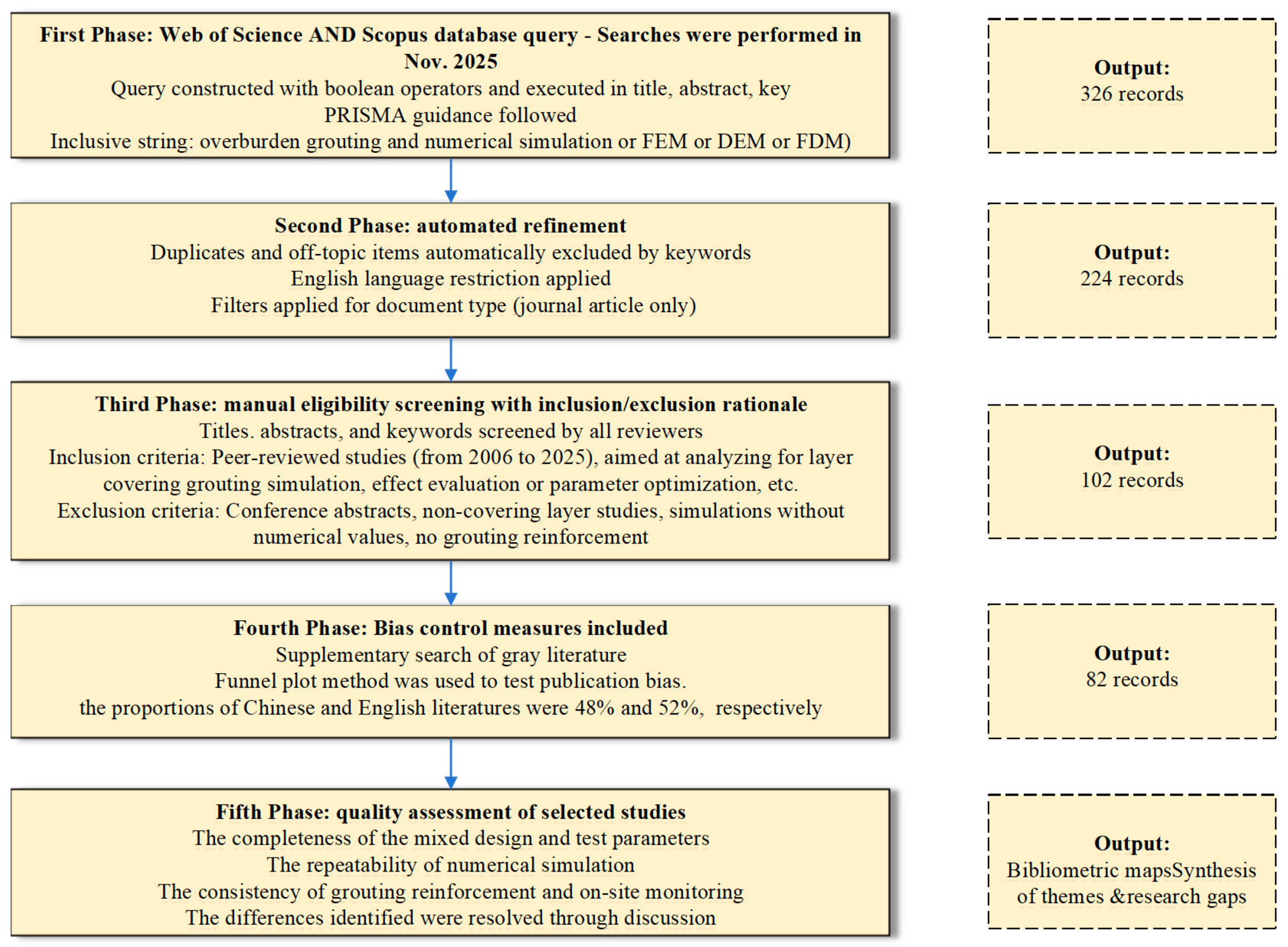
To ensure the systematicity, objectivity, and scientificity of the review research, this paper adopts the PRISMA (Preferred Reporting Items for Systematic Reviews and Meta-Analyses) methodological framework to carry out the literature screening, with the specific process as follows. ① In terms of the search strategy, core literature databases including Web of Science (Core Collection), China National Knowledge Infrastructure (CNKI), and EI Compendex were used. The English search term combination was set as “overburden grouting” and (“numerical simulation” or “FEM” or “DEM” or “FDM”). The literature time span was limited to 2004–2025, and 326 articles were initially retrieved. ② In the title/abstract preliminary screening stage, 102 articles with inconsistent themes (such as rock mass grouting and lining grouting) were excluded, and 224 relevant articles were retained. ③ In the full-text re-screening stage, 66 articles without core data (such as parameter calibration methods and simulation error analysis), duplicate publications, and conference abstracts were further excluded; finally, 102 core articles were included in the review analysis. ④ Bias control measures included the supplementary search of gray literature (such as major engineering technical reports) through databases such as Elsevier and Springer to ensure that the proportions of Chinese and English articles were 48% and 52% respectively, to balance the regional research bias. The funnel plot method was used to test the publication bias, and the results showed that the effect size distribution of the simulation errors of the core parameters was symmetric, with no significant publication bias detected. ⑤ The definition standard of highly cited articles was articles ranked in the top 10% of citation frequency (≥150 citations) in the Web of Science field and with ≥50 citations in CNKI. Based on this, 23 highly cited articles were screened, which served as the core citation basis for the theory and method part of this paper. Table 2 summarizes the distribution characteristics of the sources of the initially retrieved articles under a single search term.
This paper adopts a progressive logical structure of “Theory–Method–Application–Outlook”: Section 2 systematically sorts out the core theoretical system and material parameter characterization methods of overburden grouting numerical simulation, focusing on solving the basic question of “what is the basis for simulation”; Section 3 expounds the practical application scenarios and multi-dimensional verification system of numerical simulation combined with typical engineering cases, focusing on answering the key question of “how to apply simulation to engineering practice”; Section 4 deeply analyzes the core bottlenecks and future development trends of current numerical simulation technology, clarifying the directional question of “where to make breakthroughs in subsequent research”; Section 5 condenses the core conclusions of the full text, forming a research closed loop of theoretical combing and application guidance. Through this structural design, it is expected to provide a clear technical development context for researchers engaged in grouting numerical simulation and provide directly referable simulation application schemes for engineering and technical personnel. The PRISMA workflow is shown in Figure 2.

2. Core Theories and Foundations of Numerical Simulation for Overburden Grouting

2.1. Core Governing Equations of Numerical Simulation

The core governing equations for overburden numerical simulation are constructed around key physical fields such as the seepage field, stress field, grout diffusion field, and chemical field, with tight coupling relationships between these fields. The seepage field and stress field interact through the effective stress principle (changes in pore water pressure alter effective stress, while geotechnical deformation in turn affects the pore structure and permeability coefficient) [3]. The seepage field and chemical field are characterized by grout migration carrying chemical components to induce changes in medium permeability (e.g., cementation reduces the porosity, while dissolution increases the permeability coefficient). The stress field and chemical field are manifested in chemical erosion weakening the geotechnical mechanical parameters (e.g., reduction in the cohesion and internal friction angle), while stress concentration exacerbates the localization of chemical effects. These core governing equations and multi-field coupling relationships collectively form the theoretical basis of overburden numerical simulation, supporting the accurate characterization of engineering behaviors such as grouting reinforcement and seepage control [21]. The core governing equations for the numerical simulation of the overlay grouting are shown in Table 3.

2.2. Numerical Characterization and Parameter Optimization of Material Properties

(1) Simulation of Rheological Properties of Grouting Materials
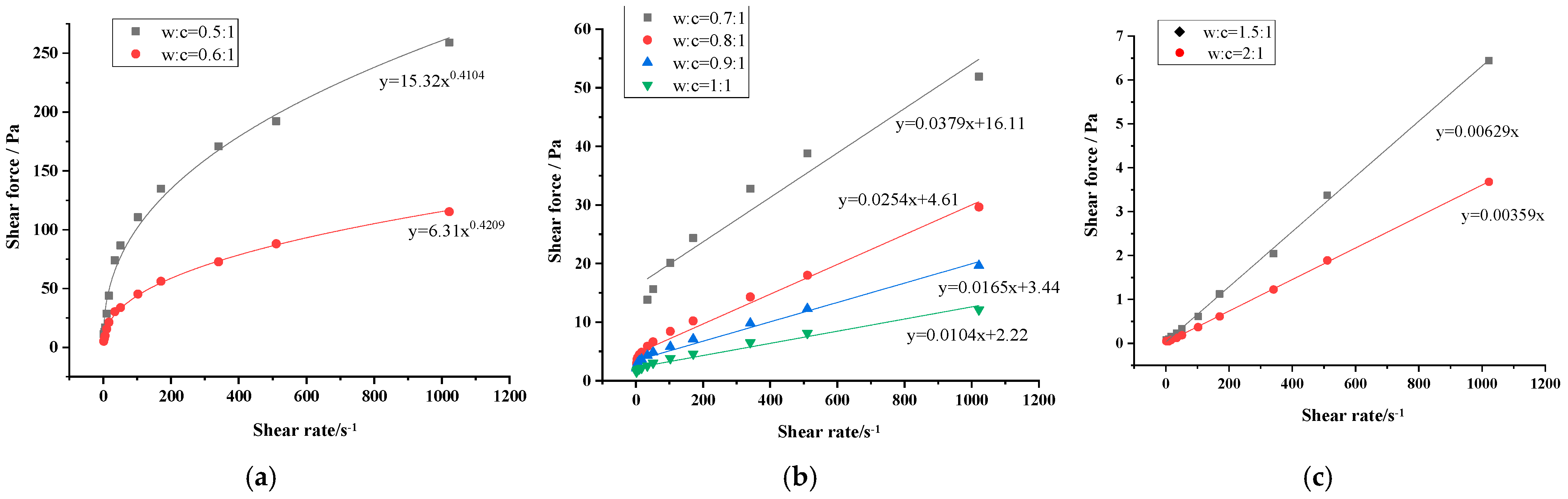
The rheological properties of grout directly determine its diffusion morphology, and corresponding rheological models should be selected based on grout types. The Newtonian fluid model is applicable to chemical grouts (e.g., epoxy resin, water glass) and low-concentration cement grouts (water–cement ratio > 2.0). These grouts exhibit stable viscosity, with a linear relationship between the shear stress and shear rate and can be directly implemented using the “Newtonian Fluid” module in COMSOL 3.5a [37].
The power-law fluid model is widely used for medium-concentration cement grouts (water–cement ratio 1.0~2.0) and composite grouts. Among them, the consistency coefficient K reflects the grout viscosity, and the flow behavior index n distinguishes between shear thickening (n > 1) and shear thinning (n < 1) characteristics. For example, cement grout mixed with bentonite has n = 0.6~0.9, showing obvious shear thinning effects, and the values of K and n need to be measured in situ using a rheometer [38].
The Bingham fluid model is suitable for high-concentration cement grouts (water–cement ratio < 1.0) and cement–sand pastes. The yield stress τ0 is the critical pressure for grout to start flowing, and the plastic viscosity μ_p reflects the flow resistance. A key note for this model is that when the grouting pressure is lower than τ0, the grout cannot diffuse; so, a pressure threshold must be set in numerical simulation to avoid calculation distortion. In addition, for unsteady grouts (e.g., aluminate cement grout), a time-dependent rheological model should be adopted, and a time-varying viscosity function μ(t) = μ0ekt is introduced to quantify its growth law over time [39,40]. The flow curves for different water–cement ratios are shown in Figure 3.
For generalized Newtonian fluids, the apparent viscosity depends solely on the shear rate; thus, in grouting numerical models, the Newtonian behavior can be represented by specifying the slope of the corresponding function. However, incorporating non-Newtonian fluids (e.g., Bingham or Herschel–Bulkley models) into numerical simulations remains challenging. As the shear rate γ approaches infinity, the apparent viscosity tends toward infinity, creating a singularity in the numerical calculations. Consequently, yield–stress fluids in numerical studies are typically addressed using either the dual-viscosity model or Papanastasiou regularization [41,42,43]. The dual-viscosity model captures shear-thinning or shear-thickening behavior by introducing two viscosity parameters: a low-shear-rate viscosity and a high-shear-rate viscosity. Papanastasiou regularization converts the infinite-viscosity singularity of the original model into a finite computable value through the introduction of an exponential decay function.
Current grouting numerical simulations mostly focus on the grout diffusion stage [44,45,46]. To comprehensively evaluate grouting reinforcement effects, some scholars have conducted research on the grout transformation process from the liquid to solid state. The core parameters of numerical simulation include the viscosity, compressive strength, and permeability, whose evolution laws need to be realized through the combination of laboratory tests and numerical fitting. The viscosity evolution can be divided into three stages: the initial static period (0~30 min) with slow viscosity growth, conforming to the linear model μ(t) = μ0 + at; the accelerated growth period (30~120 min) with exponential viscosity growth affected by hydration reaction, following μ(t) = μ1bt; and the stable period (>120 min), where viscosity tends to a constant value μ∞. The strength evolution is described using maturity theory, with the compressive strength expressed as f_c(t,T) = f_c28 × M(t,T)/M28, where M(t,T) is the equivalent age calculated by integrating the temperature–time curve. For example, in ABAQUS 6.10+, the dynamic update of strength with age can be realized through user-defined field variables (UVARM). Permeability evolution is synchronized with changes in the pore structure: in the early stage, grout bleeding increases the porosity, leading to a peak in permeability k; subsequently, hydration products fill pores, causing k to decrease following a power function k(t) = k0t−c and finally stabilize at the order of 10−10~10−12 m/s. This process needs to be dynamically coupled with seepage field simulation [47,48].
Particle suspension is a prominent feature of cement-based grouts. Ignoring the particle suspension characteristics in the grouting numerical simulation will lead to significant deviations in simulation results for grouts under high pressure or low water–cement ratio [49]. Segregation (settlement of solid particles) and bleeding (exudation of free water) are the main issues affecting grout uniformity, and existing simulations face two major challenges: high difficulty in multi-phase medium coupling simulation and difficulty in macroscopically characterizing micro-particle movement [50]. For segregation, the Euler–Euler two-fluid model can be adopted, treating the grout as a mixture of solid phase (cement particles) and liquid phase (water). The distribution of the solid volume fraction is calculated based on particle dynamics theory [51]. For bleeding, based on Terzaghi’s consolidation theory, the bleeding volume is regarded as the pore water discharge and calculated using the porous medium seepage model. In COMSOL, the “Saturated–Unsaturated Seepage” module can be used to define the relationship between the effective stress and pore water pressure and quantify the volume shrinkage caused by bleeding (usually with a shrinkage rate of 5~15%). In addition, the volume fraction transport equation is used to realize the coupled simulation of segregation and bleeding [52,53,54].
(2) Characterization of Physical and Mechanical Properties of Overburden Strata
The heterogeneity (e.g., stratification, interlayers, lenses) and anisotropy (e.g., permeability differences caused by sedimentary bedding) of the overburden layer are core factors affecting the simulation accuracy [55]. For horizontally stratified strata, the “equivalent modulus method” is used for layered modeling, with parameters of each layer determined by laboratory tests. Interlayer interfaces are simulated using “contact elements”, and normal stiffness and tangential friction coefficients are set to avoid the calculation distortion caused by interlayer slip [56].
For strata containing weak interlayers (thickness < 1 m), modeling according to actual dimensions easily causes mesh distortion [57]. The “equivalent continuous medium method” can be adopted, treating the interlayer and surrounding strata as a composite medium. For overburden layers with developed fractures, the “Discrete Fracture Network (DFN) model” is used [58,59,60]. Fracture parameters (attitude, density, aperture) are extracted through field geological surveys and geophysical exploration data, and a random fracture network is generated in 3DEC. Grout diffusion in fractures follows the cubic law [33].
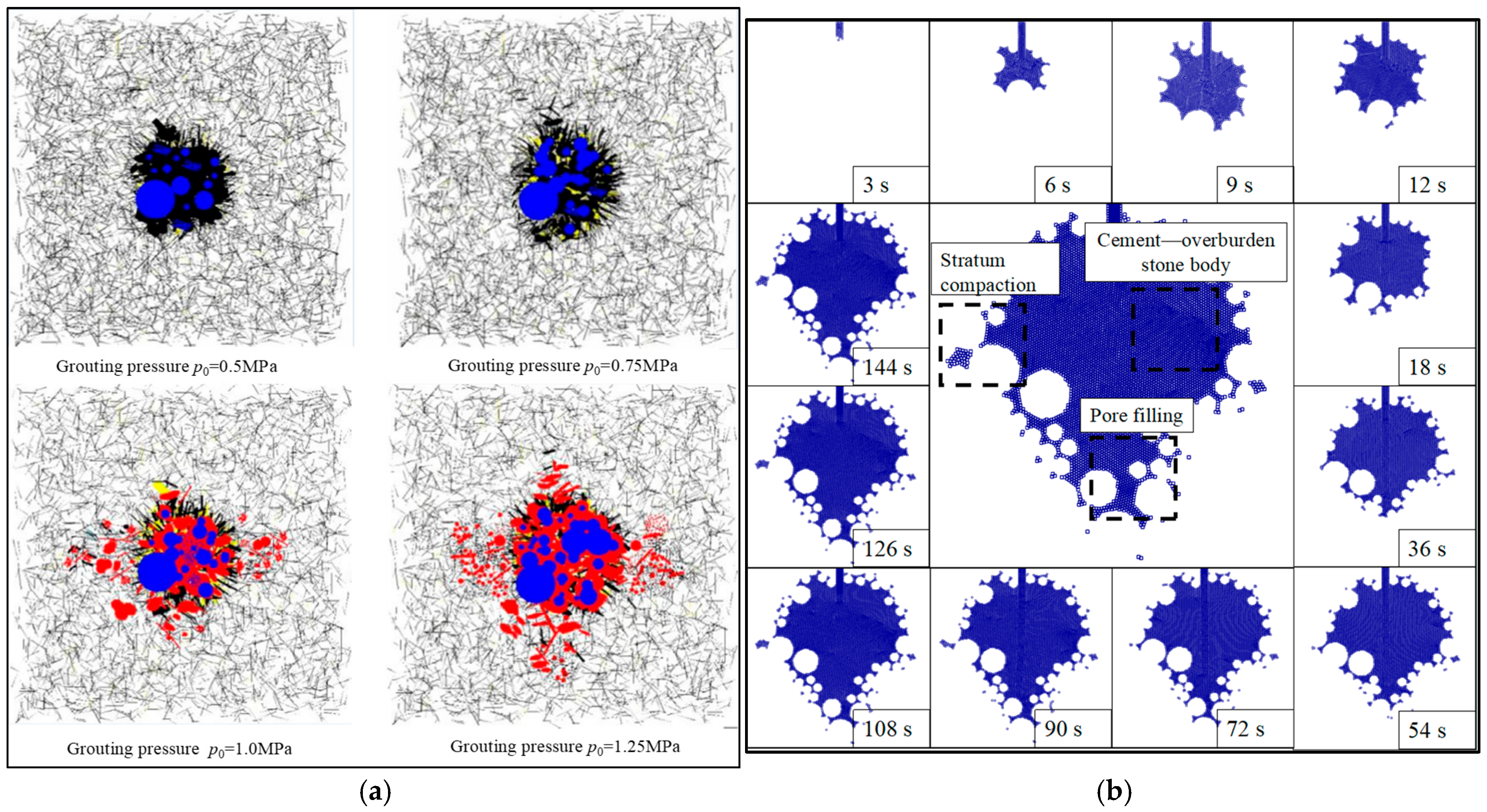
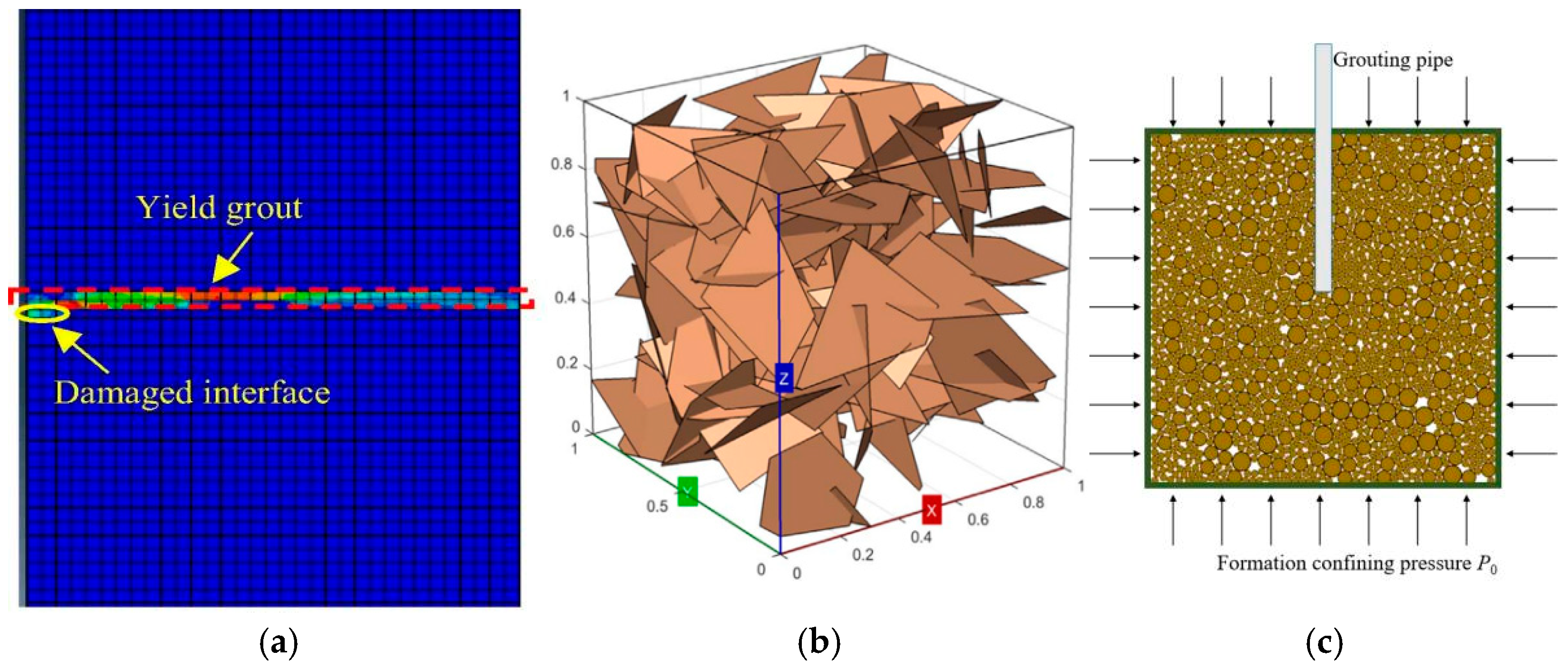
Pores are the main channels for grout diffusion, and the pore characteristics (porosity n, pore distribution, pore connectivity) determine the diffusion rate and range by affecting the permeability k [61]. The relationship between the porosity n and permeability k can be described by the Carman–Kozeny equation. This equation is the core basis for converting microscopic pore parameters into macroscopic permeability parameters. In a numerical simulation, the “porosity field” can be used to characterize heterogeneous pore distribution [62]. In FLAC3D 5.0+, a random porosity distribution function is compiled using FISH language to simulate the gradual variation of n = 0.2~0.4 in natural overburden layers. Pore connectivity is corrected using “effective porosity”, which is usually 60~80% of the total porosity in natural overburden layers. When simulating grout retention in dead-end pores (disconnected pores), the “adsorption coefficient” should be introduced to correct the mass conservation equation. In addition, grout filling pores during grouting reduces n; so, a coupling relationship between n and the grouting volume must be established, to realize the dynamic linkage between pore characteristics and the grouting process [63,64]. The schematic diagram of the grouting diffusion mechanism is shown in Figure 4.
(3) Key Parameter Calibration Methods and Verification System
Accurate parameter acquisition is essential for ensuring the reliability of grouting numerical simulations, as the key parameters directly influence the model predictions of the slurry flow, diffusion morphology, and reinforcement performance [65,66]. In current research, parameter determination generally involves three complementary approaches: laboratory testing, in situ characterization, and inverse analysis [67]. Table 4 shows the acquisition and numerical conversion methods of core parameters in current overburden grouting numerical simulations.
The accuracy of an overburden grouting numerical simulation depends on the precision of the parameter acquisition, which can be optimized and verified through numerical simulation [68,69]. Laboratory tests, in situ tests, and inversion analysis each have their own advantages and limitations and are suitable for acquiring different types of grouting parameters. In practical engineering, the collaborative application strategy of parameter acquisition is the key to constructing an accurate numerical model. The three-step method of “obtaining basic parameters through in situ tests, verifying and supplementing through laboratory tests, and correcting and optimizing through inversion analysis” can acquire the accurate parameters required for overburden grouting numerical simulation, improving the simulation accuracy and engineering application value.
Traditional parameter calibration methods have problems of low efficiency and difficulty in multi-parameter coupling [70,71,72]. Intelligent algorithms realize efficient parameter optimization through global search and nonlinear fitting [73,74,75,76]. The Genetic Algorithm (GA) is suitable for multi-parameter coupling calibration, with core steps including the following: ① encoding: encoding parameters such as the grout viscosity μ, stratum permeability k, and grouting pressure φ into chromosomes; ② fitness function: taking the minimum deviation between the simulated and measured diffusion ranges as the target; ③ selection–crossover–mutation: realizing an iterative search for the optimal parameter combinations through roulette selection, single-point crossover (crossover probability 0.6~0.8), and random mutation (mutation probability 0.01~0.05).
The Back Propagation Neural Network (BPNN) is used for parameter prediction and sensitivity analysis [77,78,79]. It takes laboratory test parameters (e.g., soil particle gradation, water content) as input and field parameters (e.g., k, φ) as output to establish a nonlinear mapping model. Model training requires sufficient sample data (≥50 groups), and weights are optimized using the Levenberg–Marquardt algorithm. Support Vector Machine (SVM) is suitable for parameter calibration with small sample data. It maps low-dimensional parameter space to high-dimensional feature space through kernel functions (e.g., RBF kernel) to solve nonlinear classification problems and has unique advantages in projects lacking large amounts of field data. Different methods for covering the surface layers are shown in Figure 5.
Parameter sensitivity analysis is used to identify core parameters that have the highest impact on the simulation results, providing a basis for testing and monitoring priorities. Common methods include the orthogonal test, response surface method, and Morris screening method [80]. The Response Surface Method (RSM) fits the relationship between parameters and simulation results (e.g., diffusion radius) by constructing a quadratic polynomial model and uses Analysis of Variance (ANOVA) to test parameter significance. This method can quantify the impact of the parameter interactions, such as discovering a negative interaction between grout viscosity and grouting pressure (high-viscosity grout is more sensitive to pressure changes). The Morris screening method identifies parameters with significant main effects and interaction effects by calculating the “main effect” (ME) and “total effect” (TE) of parameters. Parameters with large ME and TE ≈ ME are main effect parameters (e.g., permeability), while parameters with a TE much larger than the ME have strong interaction effects (e.g., grout viscosity and stratum porosity). This method has high calculation efficiency and is suitable for the initial parameter screening stage.

2.3. Comparison and Selection of Numerical Simulation Methods

The selection of overburden grouting numerical simulation methods is crucial for engineering effect prediction and parameter optimization. The selection of overburden grouting numerical simulation methods and models is not based on a single standard, but it is a comprehensive trade-off decision closely centered on specific calculation requirements, actual stratum conditions, and clear engineering objectives. Continuous methods, discrete methods, coupling methods, and multi-scale model methods are each applicable to different geological conditions and grouting mechanisms and have significant differences in software tools, calculation efficiency, and simulation accuracy. In practical engineering, appropriate methods should be selected based on the overburden type, fracture development degree, and grouting process characteristics to achieve efficient and accurate numerical simulation [63]. Table 5 shows the main methods and application scenarios of overburden grouting numerical simulation.

2.4. Application of High-Performance Computing in Overburden Grouting Numerical Simulation

High-Performance Computing (HPC) has shown significant advantages in the field of overburden grouting numerical simulation, which can break through the limitations of traditional computing resources in mesh scale, calculation accuracy, and real-time performance, and provide strong technical support for grouting process optimization under complex geological conditions. The heterogeneity of overburden foundations requires numerical models to adopt mesoscopic/mesoscale meshes (e.g., sand–gravel particle-level resolution, refined modeling of fracture networks). However, the simulation scope of large-scale projects (e.g., million-kilowatt hydropower stations, cross-sea bridge foundations) often reaches “kilometer-level space + thousand-hour time”, and traditional single-machine computing cannot bear the solution pressure of 100-million-level meshes, which directly limits the number of iterations in engineering design and the space for scheme optimization.
HPC splits computing tasks into hundreds or thousands of computing cores through architectures such as Message Passing Interface (MPI) and Open Multi-Processing (OpenMP), significantly improving computing efficiency. For example, mainstream simulation software such as ANSYS 18.1+ and COMSOL 5.5+, with their HPC versions, can shorten computing tasks that originally took days or even weeks to hours or days through distributed computing and GPU acceleration technologies.
Although the computing power advantage of HPC can break through the numerical stability and efficiency bottlenecks in solving coupled equations, the high cost of hardware and operation and maintenance results in a high threshold for engineering applications. In addition, there are problems such as the insufficient parallel adaptability of geotechnical engineering numerical software, a verification gap between numerical models and engineering practice, and difficulties in interpreting calculation results and engineering transformation. Furthermore, HPC can only accelerate the computing process and cannot solve the theoretical bottlenecks of multi-field coupling numerical methods themselves. For example, the strong nonlinearity of seepage–stress–chemical field coupling equations easily leads to iteration non-convergence, which requires adjustment through complex numerical stability algorithms (e.g., adaptive time step, damped iteration), and the parallel adaptability of such algorithms is highly challenging.

3. Engineering Application and Verification of Numerical Simulation

3.1. Advantages of Numerical Simulation in Grout Diffusion Law Research

The core advantages and engineering contributions of numerical simulation in grout diffusion research are as follows. Compared with traditional research methods relying on empirical formulas and on-site trial grouting, numerical simulation exhibits four core advantages in the study of overburden grout diffusion laws, forming key engineering contributions.
(1) Advantage of visualization and mechanism transparency. Traditional methods can only infer the diffusion morphology through post-event coring, while numerical simulation can dynamically present the flow path, pressure distribution, and concentration evolution process of grout in pores/fractures.
(2) Advantage of “parameter controllability and multi-scenario comparison”. The single-factor variable method can be used to accurately quantify the impact of a single parameter (such as grout viscosity, grouting pressure) on diffusion, avoiding the problem of multi-factor interference in on-site tests.
(3) Advantage of “low cost and high-risk prediction”. The cost of a single set of numerical simulations is only 1/20 of that of on-site trial grouting, which can quickly screen the optimal solution among more than 10 schemes. At the same time, it can predict in advance the risks such as grout channeling and blank areas caused by complex geology (such as karst caves and faults).
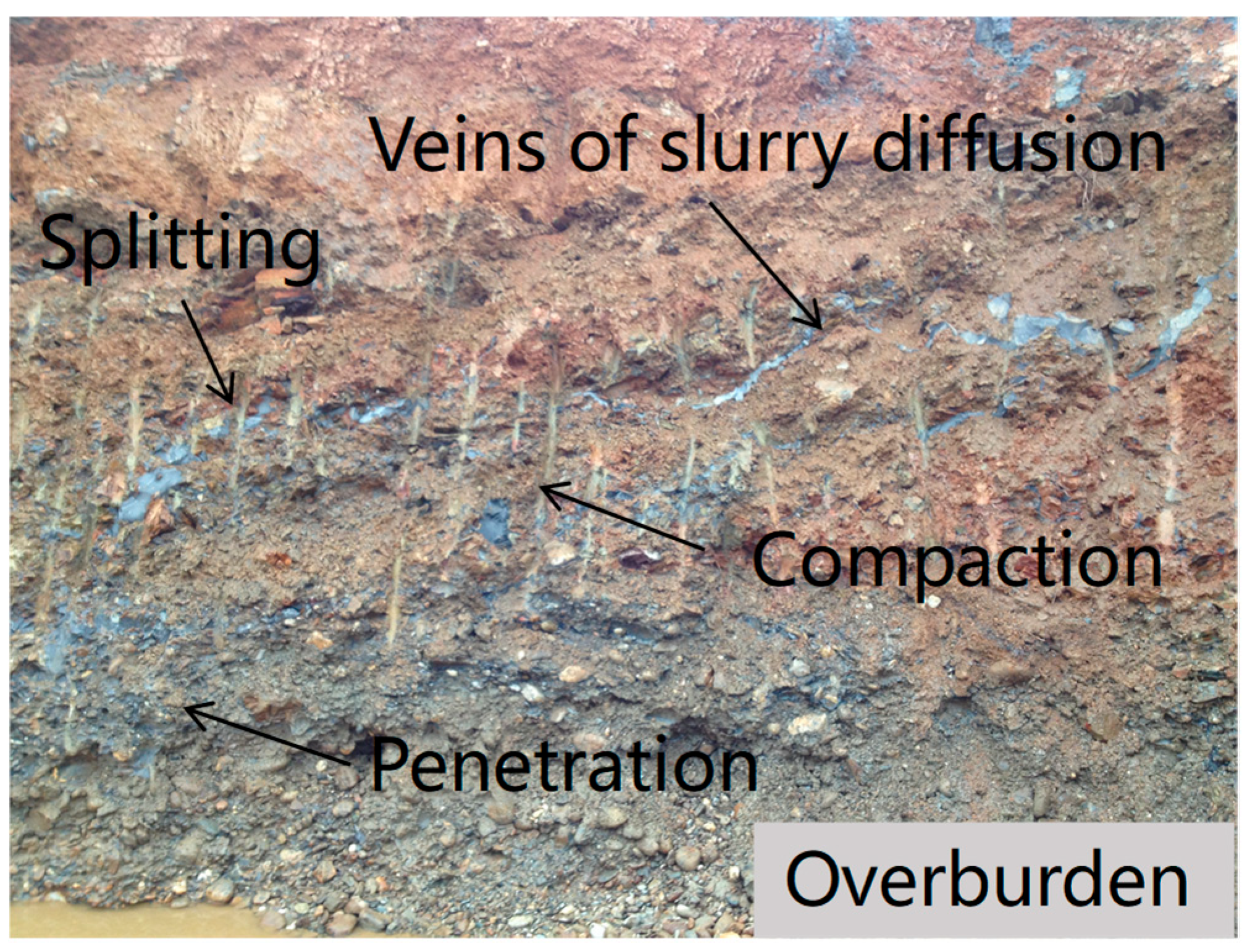
(4) Contribution as a “bridge between theory and practice”. As an important tool for studying the grouting process, numerical simulation needs to establish different mathematical models for the flow characteristics, boundary conditions, and coupling relationships of the two methods to accurately predict the grout diffusion range, stone body formation, and engineering effects. It can verify and modify the applicable boundary of traditional empirical formulas, providing a more reliable theoretical basis for engineering design. The schematic diagram of the grouting diffusion mode of the covering layer is shown in Figure 6.

3.2. Simulation and Mechanism Revelation of Grout–Stratum Interaction

Numerical simulation technology can predict the engineering behavior under different combinations of construction parameters from the micro- to the macro-scale by establishing accurate mathematical models and performing discretization processing, thus enabling the transformation of design from experience-driven to data-driven. In terms of construction parameter optimization, numerical simulation can input key parameters such as the size of the support structure, grouting pressure, and excavation sequence as variables into the model. Through methods like orthogonal experiments, single-factor analysis, or global sensitivity analysis, it can systematically quantify the influence of each parameter on engineering performance (e.g., stress distribution, deformation, and stability). During the scheme design phase, numerical simulation can construct multi-physical field coupling models, taking into account complex factors such as the nonlinear characteristics of soil and the fluid–solid coupling effect and providing a quantitative evaluation basis for different design schemes. By comparing and validating with actual monitoring data, the model parameters can be continuously modified, forming a closed-loop optimization process of “simulation–validation–modification”, which significantly improves the design accuracy and construction safety. With the development of artificial intelligence and Internet of Things technologies, numerical simulation has gradually achieved real-time data interaction with intelligent monitoring systems, providing scientific support for the refined construction of underground engineering.

3.3. Numerical Support for Construction Parameter Optimization and Scheme Design

Numerical simulation technology has become a key supporting tool for optimizing engineering parameters and designing schemes in modern engineering projects. By establishing precise mathematical models and performing discretization processing, it can predict the engineering behavior under different combinations of construction parameters from the microscopic to the macroscopic scale, achieving a transformation from experience-driven design to data-driven design. In the aspect of construction parameter optimization, numerical simulation can input key parameters such as support structure size, grouting pressure, and excavation sequence as variables into the model. Through methods such as orthogonal experiments, single-factor analysis, or global sensitivity analysis, it can systematically quantify the influence degree of each parameter on engineering performance (such as stress distribution, deformation amount, stability). For example, in shield tunnel construction, the synchronous grouting pressure has been proven to be the dominant factor affecting the maximum surface displacement. Through numerical simulation, the optimal range of this parameter can be determined, allowing the surface settlement to be controlled within the safety threshold. In the scheme design stage, numerical simulation can construct multi-physics field coupling models, considering complex factors such as soil nonlinearity and fluid–solid coupling effects, to provide quantitative evaluation basis for different design schemes. The coupled process of seepage–compaction grouting in overburden is illustrated in Figure 7.

3.4. Numerical Verification Method System for Simulation Results

(1) Collection of On-Site Monitoring Data and Simulation Comparison Method
On-site monitoring is the most direct means to verify the simulation accuracy, focusing on the core physical quantities of the grouting process and stratum response. A “point–line–surface” monitoring network should be constructed: “points” refer to key positions such as grouting holes and adjacent structures; “lines” are monitoring sections along the grouting direction; “surfaces” cover the entire grouting reinforcement area, ensuring full coverage of monitoring data [81].
The core value of on-site monitoring lies in forming a “simulation–prediction, on-site monitoring, parameter correction, simulation optimization” closed-loop system, which realizes the dynamic iteration of the numerical model and significantly improves the consistency between the simulation results and the engineering reality. The commonly used methods for detecting the grouting effect are shown in Table 6.
Geophysical exploration technology (geophysical prospecting) has the advantage of non-destructive testing, which can realize the large-scale detection of grout diffusion range and stone body distribution, making up for the limitations of point-like monitoring and providing a “surface” verification basis for numerical simulation. Ground Penetrating Radar (GPR) is suitable for shallow overburden (≤30 m) verification. Its principle is to identify the grout stone body through the difference in dielectric constant: the dielectric constant of the stone body (8~12) is significantly higher than that of the original stratum (3~5), thus showing strong reflection signals in the radar profile.
Drilling coring and indoor tests are recognized as the “gold standard” for verifying simulation results, which can directly obtain the physical and mechanical properties of the grouted stratum and stone body, and realize the “macro–micro” combined verification of simulation accuracy.
The collaborative application of the three verification methods forms a complete “surface detection (geophysical prospecting), point verification (monitoring), direct confirmation (coring)” system. Among them, geophysical prospecting locates the overall diffusion range, on-site monitoring captures the dynamic process, and drilling coring confirms the intrinsic properties, which jointly guarantee the engineering reliability of the numerical simulation results.

4. Discussion: Current Challenges and Development Trends

4.1. Current Challenges

(1) Adaptability of Numerical Models Under Complex Heterogeneous Geological Conditions
Although numerical simulation techniques for grouting have achieved substantial maturity—spanning quasi-continuous, fractured, and porous media models—their applicability under strongly heterogeneous and anisotropic overburden remains markedly limited [40]. Geological conditions such as fine sandy strata, mudstone debris zones, deep soft-soil formations, water-rich fault zones, and large karst voids exhibit nonlinear multi-mechanism slurry diffusion behaviors that existing models cannot fully capture. For example, in composite layers of fine-grained soils and fractured rock masses, slurry may simultaneously permeate pores and propagate along fractures. The resulting “pore-fracture synergy” diffusion pattern is dynamically affected by lithologic interfaces, structural weakness zones, and variable hydraulic boundaries [14,36], yet few numerical approaches can quantitatively describe such coupled behaviors. The core reason lies in the inherent contradiction between the randomness of microscale interactions and the continuity assumption of macroscopic media: microscopically, the cementation strength distribution at the grout–particle contact interface is uneven, while macroscopic simulations adopt averaged parameters, resulting in simulation errors exceeding 30% in complex strata. This bottleneck directly limits the revelation of the correlation law between “microscopic cementation quality and macroscopic engineering performance”, making it difficult for simulations to accurately predict the long-term effects of grouting.
(2) Balance Between Accuracy and Efficiency and Challenges in Multi-Scale Computation
Achieving high accuracy in simulations requires fine-scale resolution that captures pore-level slurry–particle interactions, clogging phenomena, local shear failure, and fracture initiation [29]. However, the resulting computational demand renders such models impractical for engineering-scale applications. For example, realistic DEM simulations of field-scale strata would necessitate trillions of particles, far exceeding current computational capacities [41]. Similarly, high-fidelity CFD–DEM or FDEM models are constrained to laboratory-scale demonstrations due to their computational intensity and parameterization complexity. The determination of the representative elementary volume (REV) for heterogeneous media remains largely empirical, and the upscaling of permeability, viscosity, and fracture parameters from pore-scale to macro-scale models lacks rigorous theoretical foundations [20]. Although parallel computing technology can improve efficiency, when the number of elements exceeds 10 million, data communication delay causes the speedup ratio to saturate, and the parallel efficiency of commercial software is generally lower than 60%. In addition, the computational cost of multi-field coupling simulations (such as HM-THC full coupling) increases exponentially, restricting its large-scale application in engineering.
(3) Insufficient Adaptability of Rheological Models for Complex Grouting Materials
With the development of grouting technology, composite grouts (e.g., cement–bentonite–nano SiO2 grout) and environmentally friendly grouts (e.g., biopolymer grout) are increasingly widely used, but existing rheological models struggle to characterize their special properties. Composite grouts usually have the combined characteristics of shear thinning, thixotropy (thickening at rest, thinning upon stirring), and time dependence, while traditional power-law or Bingham models can only describe a single rheological property. For example, the thixotropic recovery time of cement–nano grout in a certain project reaches 15 min; existing models ignore this property, leading to a 40% smaller simulated diffusion range compared with the measured value. The degradability of biopolymer grouts further increases the simulation difficulty—their viscosity decreases exponentially with the degradation time, yet there is currently a lack of a coupling model between “chemical degradation and rheological parameters”, making it impossible to simulate the stratum permeability rebound process 3 to 6 months after grouting.
(4) Engineering-Oriented Evaluation System and Data-Driven Integration
Current numerical studies predominantly focus on slurry diffusion morphology—such as the diffusion radius and shape [71,72]—while paying less attention to post-grouting performance, including mechanical enhancement, hydraulic conductivity reduction, and long-term stability. Engineering applications require a comprehensive performance evaluation framework that integrates grouting diffusion characteristics, reinforcement effects, and operational safety [75]. However, most existing evaluation systems rely on single indicators such as the Lugeon value or local permeability, and they rarely integrate multi-source data from drilling logs, grouting records, in situ monitoring, laboratory tests, and long-term field inspections. The absence of standardized data-sharing mechanisms across projects limits the accumulation of engineering knowledge and hinders model validation.

4.2. Future Development Trends and Integration of Cutting-Edge Technologies

(1) Artificial Intelligence (AI) Technology: A New Path for Parameter Optimization and Model Correction
AI technology provides a new approach to solving the problems of parameter optimization and model correction. In terms of parameter calibration, the CNN-LSTM hybrid model can realize the end-to-end mapping of “multi-source data to parameters”—inputting laboratory test curves, on-site geophysical images, and monitoring data to directly output optimal rheological parameters and constitutive parameters.
In terms of simulation result correction, AI models based on transfer learning can use the “simulation–measurement” database of completed projects to compensate for errors in new project simulation results [80]. Future development directions include AI-driven adaptive mesh generation (dynamically adjusting mesh density according to grout diffusion characteristics) and intelligent fault diagnosis (real-time identification of parameter anomalies and mesh distortion in simulations).
(2) Cross-Scale Simulation Framework: Breaking the Scale Segmentation Bottleneck
Constructing a cross-scale simulation framework covering “molecular scale–particle scale–engineering scale” is the core to solving the scale segmentation problem. At the molecular scale (10−9~10−6 m), Molecular Dynamics (MD) is used to simulate the generation and evolution of grout hydration products, outputting the microscopic mechanical parameters of C-S-H gel; at the particle scale (10−6~10−3 m), the Discrete Element Method (DEM) converts microscopic parameters into particle contact model parameters, simulating the cementation process of grout in particle gaps; at the engineering scale (10−3~103 m), the Finite Element Method (FEM)/Finite Difference Method (FDM) is adopted to input the equivalent parameters from the particle scale into the macroscopic model, realizing the quantitative correlation between “microscopic mechanism and macroscopic response”. Key technologies to be broken through in the future include multi-scale data transfer interfaces and time synchronization methods for cross-scale computation.
(3) New Numerical Methods for Environmentally Friendly Grout
Aiming at the characteristics of environmentally friendly grout (e.g., degradable biopolymer grout, industrial solid waste-based grout), new numerical simulation methods need to be developed. For degradable grout, a coupling model of “biodegradation kinetics and rheological parameters” is established to quantify the relationship between the degradation time (usually 3~12 months) and viscosity/strength. In an ecological revetment project of a river channel, this model accurately predicted the stratum permeability recovery process after grout degradation. For industrial solid waste-based grout (e.g., fly ash-slag grout), the simulation needs to consider the difference in the hydration activity of solid waste particles, and a “multi-component reaction model” is used to describe the hydration rate of different particles, avoiding the strength prediction deviation caused by the assumption of uniform composition in traditional models [42]. In addition, a “grouting–environmental impact” simulation system should be constructed to predict the migration law of heavy metal ions in grout, providing a tool for environmental risk assessment of green grouting projects.
(4) High-Performance Computing (HPC): Guaranteeing Efficiency and Accuracy
HPC is the core hardware and algorithm guarantee for breaking the “efficiency-accuracy” contradiction in grouting numerical simulation, enabling refined computation in complex scenarios. In cross-scale simulations, the distributed storage and computing capabilities of HPC solve the problem of the efficient transfer of multi-scale data, enabling the simultaneous hosting of the microscale computation of Molecular Dynamics (MD) and the macroscopic simulation of Finite Element Method (FEM) and realizing seamless connection between “microscopic parameters and macroscopic response”. Future integration directions of HPC and numerical simulation include the development of adaptive load balancing algorithms (addressing uneven computing load in heterogeneous strata), optimization of GPU-accelerated particle methods (e.g., DEM/PFC), and combination with AI to realize the intelligent matching of “computing resources and simulation needs”, further improving computing efficiency and resource utilization.

5. Conclusions and Outlook

5.1. Core Conclusions

(1) The numerical simulation of overburden grouting has formed a complete technical system of “theory–parameter–method–application”. At the theoretical level, the diffusion mechanisms and governing equations of three types of grouting (permeation, split, and compaction) are relatively mature, and multi-field coupling (HM/HC/TH) is the core theoretical support for simulations in complex scenarios; at the parameter level, the grout rheological model must be accurately matched according to the grout type (Newtonian fluid for chemical grout, Bingham fluid for high-concentration cement grout), parameter calibration needs to combine laboratory tests, on-site inversion, and intelligent algorithms, and sensitivity analysis can clarify the priority of core parameters (e.g., grout viscosity, stratum permeability); at the method level, FEM is suitable for complex geometries and multi-field coupling, FDM for large-scale engineering, and DEM for particle-scale mechanism research, requiring “scale–method” adaptation according to engineering scenarios.
(2) Numerical simulation has transformed from a “theoretical research tool” to the “core of engineering decision-making”. In the prediction of diffusion laws, it can quantify the impact of parameters such as the grouting pressure and rate on the diffusion range—for example, in cohesive soil, when the pressure increases from 0.8 MPa to 1.5 MPa, the diffusion radius increases logarithmically (R = 0.5 ln(P) + 0.3); in parameter optimization, a multi-objective model realizes the balance between “cost and effect”—for example, the optimal ratio of cement–water glass grout (water–cement ratio 1.0, admixture 10%) achieves a strength of 15 MPa while reducing costs by 20%; in risk prevention and control, it can accurately predict the grout channeling path in complex geology (faults, karst caves), reducing material loss by 60%.
In terms of the verification system, multi-source verification combining “on-site monitoring, geophysical exploration, and borehole coring” can control the simulation error within 10%, ensuring the engineering applicability of the simulation results.
(3) The core contradiction of current simulations focuses on the conflict between the “refinement requirements” and “technical limitations”. Issues such as the connection between microscopic mechanisms and macroscopic simulations, the lack of models for complex grouts, and insufficient accuracy in long-time scales essentially reflect that traditional simulation methods are difficult to adapt to the engineering development trend of “depth, difficulty, and precision” (e.g., deep soft soil, complex geology, long-term durability requirements). These bottlenecks also clarify the breakthrough points for future research, i.e., through technologies such as AI, multi-scale, and digital twins, realizing the leap of simulation from “phenomenon fitting” to “mechanism prediction” and from “construction period simulation” to “full life cycle simulation”.

5.2. Research Outlook

The numerical simulation technology of overburden grouting has become an indispensable core support for foundation treatment engineering, and its development process is a spiral upward process of “theoretical innovation–technical breakthrough–engineering application”. Although there are still many bottlenecks, with the integration of cutting-edge technologies such as AI, multi-scale, digital twins, and HPC, it will achieve the goals of “accurate prediction, intelligent optimization, and full life cycle management” in the future, providing more efficient and reliable technical support for complex overburden foundation treatment, and promoting grouting engineering towards “safety, economy, and greenness”. The numerical simulation of overburden grouting will show a more refined, intelligent, and real-time development trend.
(1) To address the micro–macro connection issue, it is recommended to carry out research on “cross-scale parameter transfer”, establish a coupling interface for MD-DEM-FEM, and develop a macroscopic parameter inversion model based on microscopic test data; for complex grout simulation, a “multi-characteristic coupling rheological model” should be constructed, considering shear thinning, thixotropy, and time dependence and introducing a degradation kinetic equation to describe the performance evolution of environmentally friendly grouts; for long-time scale issues, the creep–durability coupling model should be improved, integrating environmental factors such as groundwater erosion and dry–wet cycles and calibrating long-term parameters through accelerated aging tests; for computational efficiency issues, research and development of adaptive mesh and parallel computing optimization technologies are needed to improve the computational efficiency of million-element models to within 12 h.
(2) Future numerical simulations need to develop towards “intelligence, integration, and visualization”. In terms of intelligence, develop a dedicated AI simulation platform for engineering to realize the automation of parameter calibration, scheme optimization, and risk early warning; in terms of integration, integrate BIM, IoT, and numerical simulation technologies to build a full-process simulation system covering “design–construction–operation and maintenance”—for example, in deep foundation pit grouting, realize integrated decision-making from grouting hole design and construction parameter optimization to long-term settlement prediction; in terms of visualization, use VR/AR technology to present the grout diffusion process and stratum deformation characteristics, helping engineering and technical personnel intuitively understand the simulation results and reduce the technical thresholds.
(3) Breakthroughs in the numerical simulation of overburden grouting rely on interdisciplinary integration. The integration of materials science and mechanics can reveal the microscopic mechanism of new grouts, providing a theoretical basis for model construction; the integration of computer science and civil engineering can promote the engineering application of technologies such as AI and digital twins; the integration of environmental science and geotechnical engineering can improve the environmental impact simulation of green grouting, supporting engineering construction under the “dual carbon” goal. In addition, it is necessary to strengthen domestic and international research cooperation, establish a shared database covering different geological conditions and grout types, and provide support for the generalization and verification of simulation models.

Author Contributions

Writing—review and editing, P.G. and W.Z.; Writing—review and original draft, P.G., L.Q., X.L., Y.M. and P.L. All authors have read and agreed to the published version of the manuscript.

Funding

This research was funded by the Doctoral Student Innovation Fund of the China Institute of Water Resources and Hydropower Research, grant number BS202302, and the Special scientific research project of China Institute of Water Resources and Hydropower Research, grant number ZS0145C012025 and EM0145B022021. The APC was funded by the Special scientific research project of China Institute of Water Resources and Hydropower Research, grant number ZS0145C012025.

Institutional Review Board Statement

Not applicable.

Informed Consent Statement

Not applicable.

Data Availability Statement

The original contributions presented in this study are included in the article. Further inquiries can be directed to the corresponding author. The data are not publicly available due to privacy.

Conflicts of Interest

The authors declare that they have no known competing financial interests or personal relationships that could have appeared to influence the work reported in this paper.

References

  1. Zheng, G.; Zhang, X.; Diao, Y.; Lei, H. Experimental study on grouting in underconsolidated soil to control excessive settlement. Nat. Hazards 2016, 83, 1683–1701. [Google Scholar] [CrossRef]
  2. Xiao, F.; Liu, Q.; Zhao, Z. Information and knowledge behind data from underground rock grouting. J. Rock Mech. Geotech. Eng. 2021, 13, 1326–1339. [Google Scholar] [CrossRef]
  3. Turkmen, S. Treatment of the seepage problems at the kalecik dam (turkey). Eng. Geol. 2003, 68, 159–169. [Google Scholar] [CrossRef]
  4. Tong, F.; Yang, J.; Duan, M.Q.; Ma, X.F.; Li, G.C. The numerical simulation of rock mass grouting: A literature review. Eng. Comput. 2022, 39, 1902–1921. [Google Scholar] [CrossRef]
  5. Guo, P.; Zhao, W.; Ma, Y.; Gen, H.L. Discrete element analysis of grouting reinforcement and slurry diffusion in overburden strata. Appl. Sci. 2025, 15, 8464. [Google Scholar] [CrossRef]
  6. Hazlett, R.D. Simulation of capillary-dominated displacements in microtomographic images of reservoir rocks. Transp. Porous Media 1995, 20, 21–35. [Google Scholar] [CrossRef]
  7. Wilson, C.R.; Witherspoon, P.A. Steady state flow in rigid networks of fractures. Water Resour. Res. 1974, 10, 328–335. [Google Scholar] [CrossRef]
  8. Mirza, J.; Saleh, K.; Langevin, M.A.; Mirza, S.; Bhutta, M.; Tahir, M. Properties of microfine cement grouts at 4 °C, 10 °C and 20 °C. Constr. Build. Mater. 2013, 47, 1145–1153. [Google Scholar] [CrossRef]
  9. Zou, L.; Håkansson, U.; Cvetkovic, V. Yield-power-law fluid propagation in water-saturated fracture networks with application to rock grouting. Tunn. Undergr. Space Technol. 2020, 95, 103170. [Google Scholar] [CrossRef]
  10. Nordqvist, A.W.; Tsang, Y.W.; Tsang, C.F.; Dverstorp, B.; Andersson, J. A variable aperture fracture network model for flow and transport in fractured rocks. Water Resour. Res. 1992, 28, 1703–1713. [Google Scholar] [CrossRef]
  11. Quiblier, J.A. A new three-dimensional modeling technique for studying porous media. J. Colloid Interface Sci. 1984, 98, 84–102. [Google Scholar] [CrossRef]
  12. Ruan, W.J. Spreading model of grouting in rock mass fissures based on time-dependent behavior of viscosity of cement-based grouts. Chin. J. Rock Mech. Eng. 2005, 24, 2709–2714. [Google Scholar]
  13. Lavrov, A. Non-Newtonian fluid flow in rough-walled fractures: A brief review. In Proceedings of the ISRM SINOROCK, 2013: ISRM-SINOROCK-2013-061, Shanghai, China, 18–20 June 2013. [Google Scholar]
  14. Li, Z.; Liu, H.; Dun, Z.; Ren, L.; Fang, J. Grouting effect on rock fracture using shear and seepage assessment. Constr. Build. Mater. 2020, 242, 118131. [Google Scholar] [CrossRef]
  15. Alghalandis, Y.F. ADFNE: Open source software for discrete fracture network engineering, two and three dimensional applications. Comput. Geosci. 2017, 102, 1–11. [Google Scholar] [CrossRef]
  16. Nong, X.; Bai, W.; Yi, S.; Baghbani, A.; Lu, Y. Vibration mitigation performance of a novel grouting material in the tunnel environment. Constr. Build. Mater. 2024, 452, 138995. [Google Scholar] [CrossRef]
  17. Zhang, L.Z.; Zhang, Q.S.; Liu, R.T.; Li, S.C.; Wang, H.B.; Li, W.; Zhang, S.J.; Zhu, G.X. Penetration grouting mechanism of quick setting slurry considering spatiotemporal variation of viscosity. Rock Soil Mech. 2017, 38, 443–452. [Google Scholar]
  18. Potyondy, D.O.; Cundall, P.A. A bonded-particle model for rock. Int. J. Rock Mech. Min. Sci. 2004, 41, 1329–1364. [Google Scholar] [CrossRef]
  19. Fang, H.; Wang, L.; Du, X.; Li, B.; Xue, B.H.; Wang, S.Y. Numerical and experimental research on diffusion characteristic of polymer slurry in narrow slot at constant pressure. Int. J. Civ. Eng. 2024, 22, 1523–1535. [Google Scholar] [CrossRef]
  20. Cheung, G.; O’Sullivan, C. Effective simulation of flexible lateral boundaries in two- and three-dimensional DEM simulations. Particuology 2008, 6, 483–500. [Google Scholar] [CrossRef]
  21. Sun, B.T.; Ling, X.Z.; Ling, C.; Zhu, G.R. Numerical simulation for diffusion and pressure distribution of permeation grouting. Shuili Xuebao 2007, 3, 1402–1407. [Google Scholar]
  22. Joekar-Niasar, V. Pore-scale modelling techniques: Balancing efficiency, performance, and robustness. Comput. Geosci. 2016, 20, 773–775. [Google Scholar] [CrossRef]
  23. Escribano Leiva, D.; Kuncar Medina, C.; Montalva, G. Using a smartphone device to quantify particle size and shape descriptors. Acta Geotech. 2025, 20, 5277–5295. [Google Scholar] [CrossRef]
  24. Hu, S.Y.; Liu, Q.S.; Li, S.H.; Sang, H.W.; Kang, Y.S. Advance and review on grouting critical problems in fractured rock mass. Coal Sci. Technol. 2022, 50, 112–126. [Google Scholar]
  25. Ferreira, C.A.S.; Nick, H.M. A correlation for the matrix-driven increase in hydraulic permeability of rough-walled fractures. J. Hydrol. 2025, 662, 133790. [Google Scholar] [CrossRef]
  26. Ju, Y.; Gong, W.; Chang, W.; Sun, M. Effects of pore characteristics on water-oil two-phase displacement in non-homogeneous pore structures: A pore-scale lattice boltzmann model considering various fluid density ratios. Int. J. Eng. Sci. 2020, 154, 103343. [Google Scholar] [CrossRef]
  27. Lawankar, S.; Kumar, S.; Pandit, B.; Tiwari, G.; Deshpande, V. Dynamic behaviour of un-grouted and grouted jointed samples of a brittle rock in split hopkinson pressure bar tests: Insights from experiments and DEM modelling. Eng. Geol. 2025, 351, 108033. [Google Scholar] [CrossRef]
  28. Gao, J. An extended discontinuous deformation analysis for simulation of grouting reinforcement in a water-rich fractured rock tunnel. J. Rock Mech. Geotech. Eng. 2025, 17, 168–186. [Google Scholar] [CrossRef]
  29. Lavrov, A. Flow of non-Newtonian fluids in single fractures and fracture networks: Current status, challenges, and knowledge gaps. Eng. Geol. 2023, 321, 107166. [Google Scholar] [CrossRef]
  30. Zhang, L.Z.; Huang, C.X.; Zhang, Q.S.; Pei, Y.; Li, Z.P.; Yang, W.D.; Liu, J.; Wang, X.C. Rock fissure grouting diffusion mechanism of quick-setting grout considering fluid-solid phase transition characteristics. Chin. J. Rock Mech. Eng. 2024, 43, 1190–1203. [Google Scholar]
  31. Raffle, J.F.; Greenwood, D.A. The relation between the rheological characteristics of grouts and their capacity to permeate soil. In Proceedings of the 5th International Conference of Soil Mechanics and Foundation Engineering, Paris, France, 17–22 June 1961. [Google Scholar]
  32. Wang, Q.L.; Zhu, Y.Q.; Li, W.J.; Cui, P.B.; Pan, Y.D. Study on the mechanism of column permeation grouting of Bingham fluid considering the spatial attenuation of viscosity. Chin. J. Rock Mech. Eng. 2022, 41, 1647–1658. [Google Scholar]
  33. Liu, Q.; Sun, L. Simulation of coupled hydro-mechanical interactions during grouting process in fractured media based on the combined finite-discrete element method. Tunn. Undergr. Space Technol. 2019, 84, 472–486. [Google Scholar] [CrossRef]
  34. Lavrov, A. Numerical modeling of steady-state flow of a non-newtonian power-law fluid in a rough-walled fracture. Comput. Geotech. 2013, 50, 101–109. [Google Scholar] [CrossRef]
  35. Zhang, L.; Yu, R.; Zhang, Q.; Liu, R.; Feng, H.; Chu, Y. Permeation grouting diffusion mechanism of quick setting grout. Tunn. Undergr. Space Technol. 2022, 124, 104449. [Google Scholar] [CrossRef]
  36. Mishra, A.; Ma, L.; Reddy, S.C.; Attanayake, J.; Haese, R. Pore-to-darcy scale permeability upscaling for media with dynamic pore structure using graph theory. Appl. Comput. Geosci. 2024, 23, 100179. [Google Scholar] [CrossRef]
  37. Zhan, Q.L.; Liu, X.; Bai, C.J.; Ge, Y.J. Comparison of meshing strategies at corners in engineering flow simulation. Eng. Mech. 2023, 42, 1–10. [Google Scholar]
  38. Zhang, T.L.; Zhang, L.Y.; Zhang, D.L. An FEM/VOF hybrid formulation for fracture grouting modelling. Comput. Geotech. 2014, 58, 14–27. [Google Scholar] [CrossRef]
  39. Liu, J.; Shen, J.; Zhang, Y.; Tao, L.J.; Ding, P.F. Grouting diffusion mechanism of curtain grouting in pebble strata under flowing water conditions. Chin. J. Undergr. Space Eng. 2025, 21, 403–411. [Google Scholar]
  40. Liu, Y.J.; Yang, J.; Zhu, H.H.; Yi, Z.Y. A novel multiphysics modelling approach for grout loss analysis of backfill grouting in highly permeable soils during TBM tunnelling. Rock Soil Mech. 2023, 44, 2744–2756. [Google Scholar]
  41. Lin, T.; Zhao, Z.H.; Zhou, S.M. Block-based dem modeling on grout penetration in fractured rock masses. Chin. J. Undergr. Space Eng. 2021, 17, 1080–1090. [Google Scholar]
  42. Sun, L.; Grasselli, G.; Liu, Q.; Tang, X. Coupled hydro-mechanical analysis for grout penetration in fractured rocks using the finite-discrete element method. Int. J. Rock Mech. Min. Sci. 2019, 124, 104138. [Google Scholar] [CrossRef]
  43. Liu, X.; Wang, F.; Huang, J.; Wang, S.; Zhang, Z.; Nawnit, K. Grout diffusion in silty fine sand stratum with high groundwater level for tunnel construction. Tunn. Undergr. Space Technol. 2019, 93, 103051. [Google Scholar] [CrossRef]
  44. Ouyang, J.W.; Zhang, G.J.; Liu, J. Diffusion mechanism of split grouting. Chin. J. Geotech. Eng. 2018, 40, 1328–1335. [Google Scholar]
  45. Xu, Z.H.; Pan, D.D.; Li, S.C.; Bu, Z.H.; Zhang, Y.C. Latest research progress and future development direction of grouting numerical simulation in underground engineering. J. Basic Sci. Eng. 2025, 33, 903–922. [Google Scholar]
  46. Park, D.; Oh, J. Permeation grouting for remediation of dam cores. Eng. Geol. 2018, 233, 63–75. [Google Scholar] [CrossRef]
  47. Hu, J.; Liu, G.L.; Chen, J.Q.; Chen, Y. A three-dimensional grouting model of slurry diffusion-particle deposition-permeability evolution in discrete fracture network. Comput. Geotech. 2026, 189, 107658. [Google Scholar] [CrossRef]
  48. Axelsson, M.; Gustafson, G.; Fransson, Å. Stop mechanism for cementitious grouts at different water-to-cement ratios. Tunn. Undergr. Space Technol. 2009, 24, 390–397. [Google Scholar] [CrossRef]
  49. Schwarz, L.G.; Krizek, R.J. Hydrocarbon residuals and containment in microfine cement grouted sand. J. Mater. Civ. Eng. 2006, 18, 214–228. [Google Scholar] [CrossRef]
  50. Shrivastava, N.; Zen, K. Finite element modeling of compaction grouting on its densification and confining aspects. Geotech. Geol. Eng. 2018, 36, 2365–2378. [Google Scholar] [CrossRef]
  51. Wei, J.; Li, J.; Gao, F.; Wang, X.; Yang, J. Effect of injection rate and water/cement ratio on fracturing grouting in soft rocks. Tunn. Undergr. Space Technol. 2025, 165, 106913. [Google Scholar] [CrossRef]
  52. Mehrjoo, H.; Monfared, A.E.F.; Jafari, S.; Saeid, M.A.; Schaffie, M. Simulation of newtonian and non-newtonian reactive fluids during the dissolution process in porous media using lattice boltzmann method. Int. Commun. Heat Mass Transf. 2026, 170, 110061. [Google Scholar] [CrossRef]
  53. Messa, G.V.; Malavasi, S. A CFD-based method for slurry erosion prediction. Wear 2018, 398, 127–145. [Google Scholar] [CrossRef]
  54. Kazidenov, D.; Omirbekov, S.; Amanbek, Y. CFD-DEM modeling of fluid-driven fracture induced by temperature-dependent polymer injection. Particuology 2025, 105, 259–276. [Google Scholar] [CrossRef]
  55. Wang, Y.; Li, G.P.; Wang, R.; Huang, S.; Li, G.W. Research on slurry diffusion characteristics of shield tunnel based on coupled DEM-FDM numerical simulatio. J. Eng. Geol. 2025, 33, 667–678. [Google Scholar]
  56. Liu, Q.; Song, H.; Cheng, H.; Yang, C.; Ding, B.; Niu, Y. Solid waste-based bed-separation grouting materials: Experimental properties and CFD simulation of pipeline transport. Constr. Build. Mater. 2025, 491, 142727. [Google Scholar] [CrossRef]
  57. Brown, N.M.; Dejam, M. Tracer dispersion due to non-newtonian fluid flows in hydraulic fractures with different geometries and porous walls. J. Hydrol. 2023, 622, 129644. [Google Scholar] [CrossRef]
  58. Cao, N.; Huo, Z.; Liang, Y.; Zhang, L.; Yao, H. Research on slurry seepage law and in-situ test based on the 3-D of goaf porosity in CFD modelling. Fuel 2024, 361, 130701. [Google Scholar] [CrossRef]
  59. Zhang, Y.; Cao, Z.; Liu, C.; Huang, H. Fluid-solid coupling numerical simulation of micro-disturbance grouting treatment for excessive deformation of shield tunnel. Undergr. Space 2024, 19, 87–100. [Google Scholar] [CrossRef]
  60. Stille, H.; Gustafson, G.; Hassler, L. Application of new theories and technology for grouting of dams and foundations on rock. Geotech. Geol. Eng. 2012, 30, 603–624. [Google Scholar] [CrossRef]
  61. Rafi, J.Y.; Stille, H. Applicability of using GIN method, by considering theoretical approach of grouting design. Geotech. Geol. Eng. 2015, 33, 1431–1448. [Google Scholar] [CrossRef]
  62. Li, X.; Zhou, J.; Zhao, W.; Zhang, J.; Liang, C.; Ren, Z. Field grouting test study for high-level radioactive waste disposal at the beishan underground research laboratory. Int. J. Geomech. 2026, 26, 04025326. [Google Scholar] [CrossRef]
  63. Gustafson, G.; Stille, H. Stop criteria for cement grouting. Felsbau Z. Geomech. Ingenieurgeol. Bauwes. Bergbau 2005, 25, 62–68. [Google Scholar]
  64. Deb, S.; Tafti, D.K. Two and three dimensional modeling of fluidized bed with multiple jets in a DEM–CFD framework. Comput. Geotech. 2014, 16, 19–28. [Google Scholar] [CrossRef]
  65. Virnovsky, G.A.; Friis, H.A.; Lohne, A. A Steady-State Upscaling Approach for Immiscible Two-Phase Flow. Transp. Porous Media 2004, 54, 167–192. [Google Scholar] [CrossRef]
  66. Wang, Q.; Gao, H.; Yu, H.; Jiang, B.; Liu, B. Method for measuring rock mass characteristics and evaluating the grouting-reinforced effect based on digital drilling. Rock Mech. Rock Eng. 2019, 52, 841–851. [Google Scholar] [CrossRef]
  67. Ma, G.; Wang, Z.; Wang, H. Grouting geological model (GGM): Definition, characterization, modeling, and application in determining grouting material and pressure. Rock Mech. Rock Eng. 2025, 58, 6513–6538. [Google Scholar] [CrossRef]
  68. Muzemder, A.S.H.; Singh, K. Influence of sedimentary structure and pore-size distribution on upscaling permeability and flow enhancement due to liquid boundary slip: A pore-scale computational study. Adv. Water Resour. 2024, 190, 104752. [Google Scholar] [CrossRef]
  69. Zhu, X.; Zhang, Q.; Hu, D.; Zhong, L.; Li, Z.; Jin, L. Composite solid sand reinforcement grouting material preparation and diffusion characteristics of slurry-water replacement grouting. Case Stud. Constr. Mater. 2025, 22, E04213. [Google Scholar] [CrossRef]
  70. Aslannezhad, M.; Sayyafzadeh, M.; Tang, D.; You, Z.; Iglauer, S.; Keshavarz, A. Upscaling relative permeability and capillary pressure from digital core analysis in otway formation: Considering the order and size effects of facies. Gas Sci. Eng. 2024, 128, 205363. [Google Scholar] [CrossRef]
  71. Wang, X.; Liu, B.; Li, P.; Wang, S. Experimental and numerical investigation on the diffusion characteristics of cement slurry grouted in medium sand soils. Tunn. Undergr. Space Technol. 2025, 165, 106857. [Google Scholar] [CrossRef]
  72. Zhou, Z.; Li, Z.; Wang, X.; Wang, J.; Li, N. Design and application of cement-based composite grouting material for high-temperature water plugging. Case Stud. Constr. Mater. 2025, 23, E05532. [Google Scholar] [CrossRef]
  73. Alsharahi, G.; Faize, A.; Louzazni, M.; Mostapha, A.M.M.; Bayjja, M.; Driouach, A. Detection of cavities and fragile areas by numerical methods and GPR application. J. Appl. Geophys. 2019, 164, 225–236. [Google Scholar] [CrossRef]
  74. Cao, P.; Zhang, G.; Liu, J.; Ouyang, J.; Zhang, Q.; Wang, X. Permeation diffusion mechanism of pulse grouting with bingham fluid considering tortuosity and spatiotemporal variations in viscosity. Comput. Geotech. 2025, 184, 107295. [Google Scholar] [CrossRef]
  75. Tamang, R.; Zhu, Y.; Coe, J. Bayesian deep learning for uncertainty quantification and prediction of jet grout column diameter. Comput. Geotech. 2025, 179, 106981. [Google Scholar] [CrossRef]
  76. Yousefzadeh, R.; Ahmadi, M. Fast marching method assisted permeability upscaling using a hybrid deep learning method coupled with particle swarm optimization. Geoenergy Sci. Eng. 2023, 230, 212211. [Google Scholar] [CrossRef]
  77. Sathiparan, N. Predicting compressive strength of grouted masonry using machine learning models with feature importance analysis. Mater. Today Commun. 2024, 41, 110487. [Google Scholar] [CrossRef]
  78. Kim, B.; Natarajan, Y.; Sri Preethaa, K.R.; Danushkumar, V.; Shamet, R.; Chen, J.; Xie, R.; Copeland, T.; Nam, B.H.; An, J. Advancements in sinkhole remediation: Field data-driven sinkhole grout volume prediction model via machine learning-based regression analysis. Artif. Intell. Geosci. 2025, 6, 100159. [Google Scholar] [CrossRef]
  79. Díaz, E.; Salamanca-Medina, E.L.; Tomás, R. Assessment of compressive strength of jet grouting by machine learning. J. Rock Mech. Geotech. Eng. 2024, 16, 102–111. [Google Scholar] [CrossRef]
  80. Elbaz, K.; Shen, S.L.; Zhou, A.; Yoo, C. Reinforcement learning-based optimizer to improve the steering of shield tunneling machine. Acta Geotech. 2024, 19, 4167–4187. [Google Scholar] [CrossRef]
  81. Wang, L.; Zheng, G. Numerical analysis of underground displacements stirred by compaction grouting during tunnel construction. Tunn. Undergr. Space Technol. 2024, 152, 105931. [Google Scholar] [CrossRef]
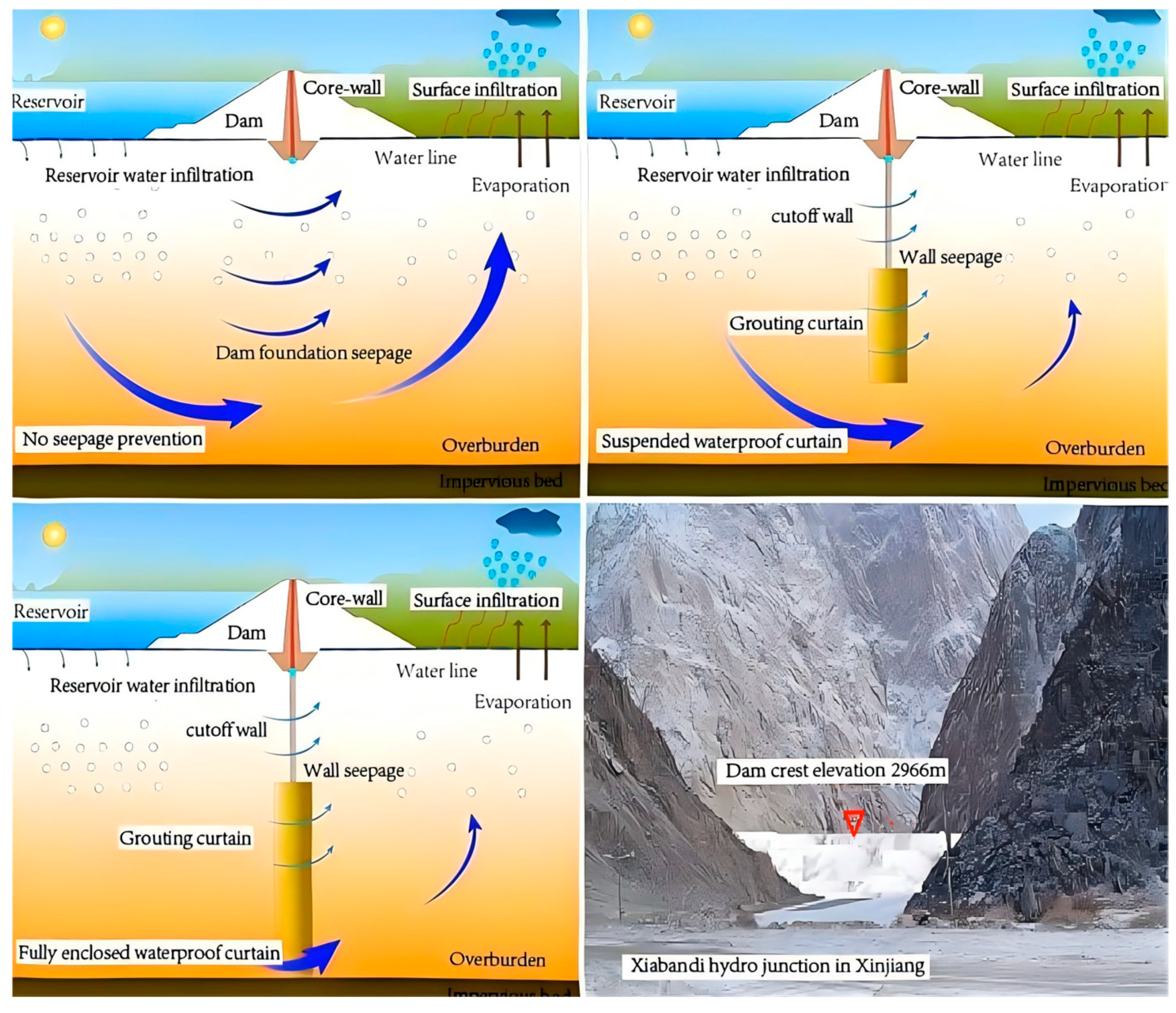
Figure 1. Application of overburden grouting in dam foundation seepage control.
Geotechnics 06 00003 g001
Figure 2. PRISMA workflow of database search, screening & synthesis.
Geotechnics 06 00003 g002
Figure 3. Rheological curves of clean slurry with different water–cement ratios. (a) Power-law fluid, (b) Bingham fluid, (c) Newtonian fluid. Note: w:c is the water–cement mass ratio.
Geotechnics 06 00003 g003
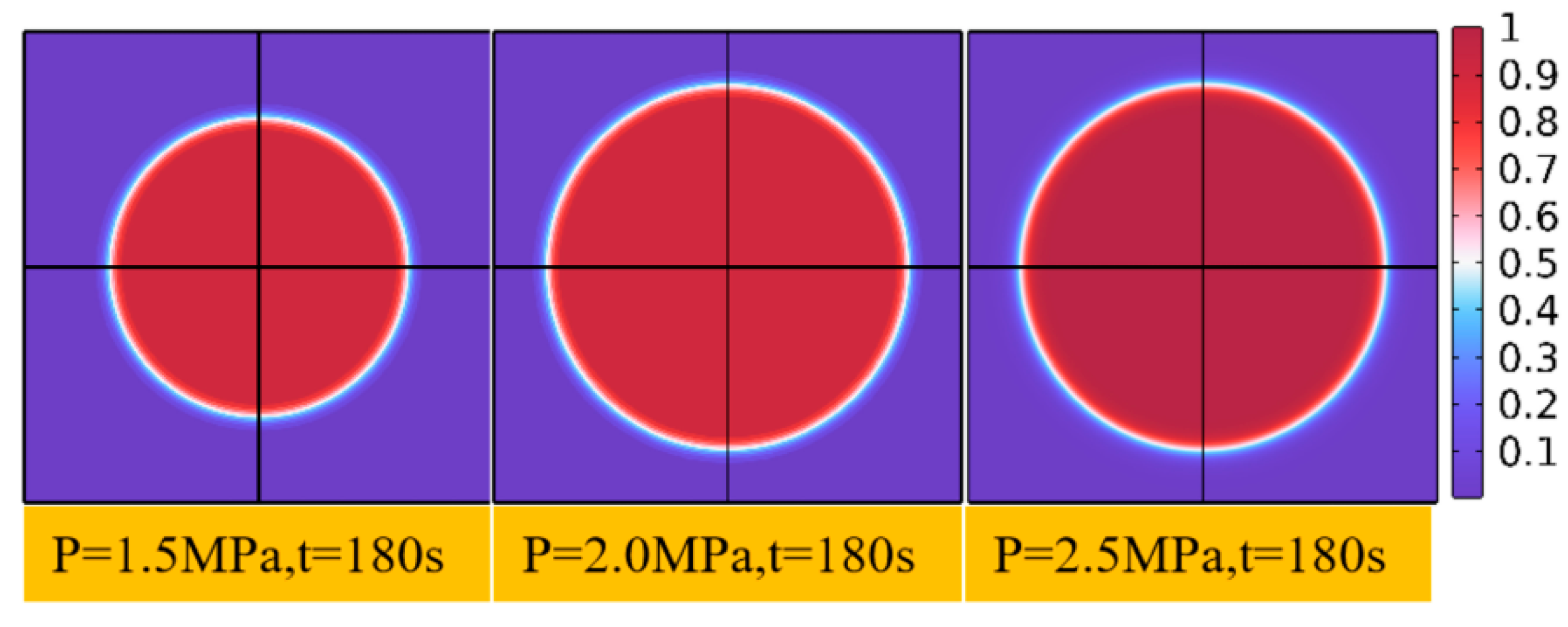
Figure 4. Schematic diagram of grouting diffusion mechanisms. (a) Grout diffusion under different grouting pressures [43]; (b) grout diffusion at different grouting times [5].
Geotechnics 06 00003 g004
Figure 5. Methods and applications for characterizing overburden strata. (a) Quasi continuous medium [14]; (b) fracture medium [15]; (c) porous media [5].
Geotechnics 06 00003 g005
Figure 6. Schematic diagram of the diffusion pattern of the overburden grouting.
Geotechnics 06 00003 g006
Figure 7. Schematic diagram of grouting diffusion mechanisms [62].
Geotechnics 06 00003 g007
Table 1. Application of grouting technology in different projects.
Grouting FormApplication ScenariosObjectiveCharacteristic
Consolidation groutingFoundation reinforcement of hydraulic structures [1]Improve mechanical properties, compactness, uniformity, elastic modulus, and bearing capacity of rock/soil; reduce deformation and uneven settlement; enhance overall integrity and anti-sliding stability of foundations [2]Core Objective: strengthen the rock mass
Scope: regional (surface reinforcement)
Hole Arrangement:
grid (e.g., plum blossom), sequentially encrypted
Depth: shallow (several meters to tens of meters)
Pressure: medium–low (mainly permeation)
Key Feature: reinforces the “mass”
Reinforcement of tunnel and cavern surrounding rockImprove bearing capacity, correct deviation, prevent collapse and seepage, block water flow, reinforce surrounding rock, suppress ground displacement, reduce surface settlement, lower permeability, facilitate excavation and support, reduce construction risks
Foundation reinforcement on fractured or weathered bedrockCement fractured rock blocks, enhance deformation resistance, improve integrity, eliminate weak interlayers, reduce differential settlement, block seepage paths, prevent seepage failure [3]
Curtain groutingBasic anti-seepage measures in water conservancy projectsCut off foundation seepage, maintain design head, meet economic benefits of reservoir/dam design; reduce uplift pressure, enhance anti-scouring and erosion capacity of embankmentsCore Objective: anti-seepage and water blocking (form continuous low-permeability barrier)
Scope: linear barrier (curtain formation)
Hole Arrangement: linear (single/multiple rows), strictly ordered and encrypted
Depth: moderate (several meters to tens of meters)
Pressure: high (fracturing/permeation)
Key Feature: establishes a “defense line”
Excavation and slope engineeringReinforce underground structures, control groundwater impact on foundations and tunnels, increase soil shear resistance, reduce earth pressure
Mining and geological disaster managementFill and cement to form impermeable walls, prevent groundwater inflow into mines, ensure mining safety [4]
Building foundation reinforcementTreat fine cracks in walls and floors, improve overall strength and stability, prevent water inrush in retaining structures
Contact groutingDam engineeringGrout at concrete–rock interface, especially on steep slopes and contact surfaces, to enhance bondingCore Objective:
fill contact gaps
Scope: point/seam (specific interfaces)
Hole Arrangement: targeted pre-embedding
Depth: very shallow (interface only)
Pressure: low (avoid lifting/damage)
Key Feature: bridges the “interface”
Underground engineeringFill gaps between tunnel/mine lining and surrounding rock to prevent lining deformation or leakage
Metal structuresGrout between metal structures (e.g., pressure steel pipes, spiral cases) and concrete foundations to improve connection tightness and foundation integrity
OtherMicrobial riverbank protection [5]Cement sand particles to improve shear strength and overall slope integrityCore Objective: ecological restoration
Scope: point/seam (specific areas)
Depth: shallow
Pressure: low
Key Features: low disturbance, environmentally sustainable
Marine pipeline layingEnhance anti-sliding stability, improve shear resistance of marine rock/soil, and increase rock mass integrity
Microbial grouting for desert reinforcementImprove soil structure, enhance engineering stability, support vegetation growth
Restoration of rock and soil cultural relics [6]Form calcium carbonate waterproof layer to alleviate weathering of earthen site surfaces
Table 2. Statistics of data sources for literature on keywords related to the theory and numerical simulation of overburden grouting.
Sources of DateSearch CategoryGrouting Numerical SimulationOverburden GroutingStudy on Fluid–Solid Coupling of Slurry FlowSlurry Diffusion ModelGrouting Theory
CNKITitle/keyword/abstract12205441071179231
EITitle/keyword/abstract2210100899491253
Web of ScienceTopic237032010426061439
Wanfang dataTopic1215100026210525035
ASCEKeyword3080214053110793106
ElsevierKeyword692077710,45276,0468631
John WileyTitle/keyword/abstract28181096855132,7613503
SpringerTitle/keyword/abstract2974222248813,8422551
Table 3. Core control equations for numerical simulation of covering layer grouting.
Type of Governing EquationBasic Equation CombinationAdvantagesLimitations
Seepage Field Governing EquationDarcy’s Law + Mass Conservation EquationIt has a mature theoretical system and serves as the basis for seepage simulation. With a concise form, clear physical meaning, and high computational efficiency, it can quickly characterize the migration law of pore water or grout under saturated/unsaturated conditions. It is suitable for predicting the seepage velocity, water level change, and anti-seepage effect at the engineering scale, and its parameters are easy to obtain through on-site tests, resulting in strong engineering applicability [22].It relies on the continuous medium assumption, insufficiently characterizes the microscopic pore structure of highly discrete overburden, and has difficulty accurately reflecting the non-Darcy flow behaviors such as grout splitting and diffusion. Its prediction accuracy for seepage under complex working conditions is limited [23,24].
Stress Field Governing EquationEquilibrium Equation + Constitutive Equation + Geometric EquationIt can adapt to the mechanical properties of various overburden geotechnical materials (cohesive soil, sandy soil, crushed stone soil) through different constitutive models, effectively characterizing the foundation settlement, deformation coordination, and failure mechanism. As a core tool for analyzing overburden stability (such as bearing capacity after grouting reinforcement), it has rigorous calculation logic and its results can directly serve engineering design [25,26].The constitutive parameters have strong discreteness, and it has difficulty reflecting the influence of the mesoscopic structure of geotechnical materials (particle contact, pore evolution) on macroscopic mechanical response; convergence difficulties are prone to occur under large deformation or strong nonlinear working conditions, and its adaptability to complex loading paths is insufficient [27,28,29,30].
Grout Diffusion Governing EquationSolute Transport/Fluid Flow EquationFocusing on the core grouting process, it can quantify the grout concentration distribution, diffusion range, and migration rate. Combined with grout properties (time-varying viscosity, bleeding, and consolidation), it can optimize key parameters such as the grouting pressure and hole spacing, providing theoretical support for technologies such as targeted grouting and segmented grouting and directly meeting practical engineering needs [31,32,33].It is necessary to simplify the grout–geotechnical interaction (such as ignoring the dynamic process of grout stone body blocking pores) and has poor adaptability to overburden heterogeneity; the parameters are significantly affected by the construction environment, making accurate value acquisition difficult, which easily leads to deviations between simulation results and on-site reality [14,34,35].
Chemical Field Governing EquationReaction Kinetics EquationIt can reveal the chemical interaction between grout and overburden (ion exchange, cementation reaction, dissolution), quantify the long-term evolution law of geotechnical mechanical parameters (such as strength, permeability), and make up for the deficiency of pure mechanical simulation in predicting long-term stability, which is suitable for durability evaluation (such as foundation treatment in saline soil areas) [36].The reaction mechanism is complex, requiring a large number of chemical kinetic parameters that are difficult to obtain directly through tests; the calculation process involves multi-component transport and reaction coupling, resulting in a large computational load, high difficulty in collaborative solution with other physical fields, and reduced accuracy in engineering applications due to the simplified assumptions.
Table 4. Acquisition and numerical conversion of core parameters.
Acquisition MethodParameter Types ObtainableAdvantagesLimitationsGrout ParametersGeological ParametersCommon Tests/Methods
Laboratory TestsGrout parameters,
formation parameters
Controlled conditions, precise data, ability to obtain time-dependent parametersSample disturbance, scale limitations, cannot reflect in situ heterogeneityRheological parameters
Setting time
Hardened grout strength
Permeability coefficient
Porosity
Shear strength
Particle size distribution
Permeability test
Compression test
Direct shear test
Triaxial test
Particle size analysis test
In situ TestsFormation parametersAvoids sampling disturbance, reflects real field conditions, obtains continuous profile dataEquipment limitations, limited data dimensions, limited adaptability to complex formations/Permeability coefficient
Porosity
Tensile strength
Fracture density
Water pressure (Lugeon) test
Grouting test
Cone penetration test (CPT)
Standard penetration test (SPT)
Ground penetrating radar (GPR)
Sonic logging
Inverse AnalysisModel parametersConsiders multiple influencing factors, corrects heterogeneous parameters, improves simulation accuracyRelies on high-quality monitoring data, high computational complexity, prone to local optima//Data preprocessing
Objective function construction
Optimization algorithm selection
Parameter sensitivity analysis
Table 5. Comparison of key characteristics of various medium models for grouting engineering.
Method CategoryTypical Software/ToolsPrimary Application ScenariosDiffusion Mode(s)AdvantagesLimitations
Continuum MethodsCOMSOL,
ABAQUS,
PLAXIS 2D/3D,
ANSYS Fluent
Homogeneous or low-fracture density overburden (e.g., sandy gravel, clay layers); shallow overburden grouting (hole depth ≤ 15 m); low-pressure grouting (<3 MPa); scenarios with high grout concentrationPermeationHigh computational efficiency, intuitive simplified models; suitable for rapid assessment of grouting effectiveness; easy to handle macro-scale parametersCannot accurately depict discontinuous fracture characteristics; models may be oversimplified; poor adaptability to heterogeneous formations; simplistic treatment of time-dependent grout rheology.
Discrete MethodsPFC,
UDEC,
3DEC
Grouting studies in layers with significant particle size variation, gravel layers, or crushed stone layers; high-fracture-density overburden (>12%); high-pressure injection (>4 MPa); scenarios involving high-yield-strength grouts; clogging, filtration failure, and channelized flow.Permeation
Fracturing
Compaction
-induced
Can realistically describe local channel flow, preferential flow paths, fracture initiation and propagation; accurately simulates fracture opening/closure due to grout pressure; can represent filtration and clogging effects in varied particle size distributions.High computational complexity; massive computational load, difficult for large-scale site simulation; simulation of discontinuous fractures may overlook microstructural randomness; parameters (particle modulus, friction coefficient, interface parameters) are difficult to obtain.
Coupled Continuum–Discrete MethodsFluent–EDEM,
Abaqus–DEM,
PFC–COMSOL
Mixed “permeation + local fracturing” diffusion mechanisms in overburden grouting; gravel/sand–gravel mixed layers, where particle skeleton and grout flow interact significantly; thermo-mechanical coupling during grout solidification; synergistic chemical grout hydration reaction and diffusion.Permeation
Fracturing
Compaction
-induced
Can comprehensively consider multiple influencing factors; improves simulation accuracy; suitable for parameter optimization under complex grouting conditions; simultaneously reflects macro-scale formation deformation and micro-scale fracture/channel formation.High computational resource consumption; requires fine mesh/grid discretization; multi-field coupling may introduce additional errors; indirect coupling methods may have convergence issues.
Multi-scale Models(µ-scale) LBM, PNM;
(meso-scale) DEM, DFN;
(macro-scale) COMSOL, ABAQUS, FLAC, PLAXIS
Heterogeneous overburden (e.g., sandy gravel layers with clay interbeds); ultra-deep overburden grouting (>150 m); rock masses with coexisting complex fractures and pores; scenarios requiring coordination between macro-scale curtain formation and micro-scale filling.PermeationCan bridge macro and micro characteristics; capable of capturing complex behaviors in heterogeneous overburden; suitable for simulating combined filling of large and micro fractures in sandy gravel layers.Complex algorithms, high difficulty in developing cross-scale interfaces; long computation times, requiring high-performance computing platforms; relies on complex parameter settings across multiple software tools; multi-scale mapping algorithms are complex.
Table 6. Evaluation methods for grouting effects during and after construction.
StageEvaluation MethodScaleAdvantagesCharacteristic
During GroutingGrouting machine parametersGrouting pressureEngineeringCore control parameter; directly controls slurry diffusion range; ensures filling compactness; prevents structural damage; optimizes construction processKey parameter for controlling grouting quality
Slurry flow rateEngineeringCore control parameter; controls total injection volume; evaluates formation permeability; allows dynamic adjustment of construction parameters; prevents equipment failureFlow rate reflects injection speed and formation grout absorption capacity
Slurry densityEngineeringCore control parameter; ensures slurry stability; controls filling effect; prevents workmanship issues; optimizes resource utilization; guides field testing and mix proportion adjustment; enables real-time monitoring of slurry status; effectively controls fluidityDirectly reflects slurry concentration (e.g., water–cement ratio)
Formation monitoringPore pressureEngineeringPrevents hydraulic fracturing and formation uplift; controls formation settlement induced by excess pore water pressure; quantifies slurry diffusion range and filling degreeImportant basis for judging construction phase and completion conditions
Formation upliftFieldEnsures construction safety and structural stability; guides subsequent remedial measuresExhibits hysteresis
Grout leakageEngineeringQuantifies grouting influence range; verifies rock mass reinforcement effectExhibits hysteresis
Grouting durationEngineeringCore control parameter; controls slurry diffusion and solidification; allows dynamic adjustment of completion timing; balances efficiency and quality; enables construction record traceabilityExhibits hysteresis
Post GroutingIn situ testingUltrasonic testingModel/ComponentNon-destructive, layered detection; evaluates improvement in rock mass integrity, compactness, and elastic modulus; increased wave velocity indicates fracture filling and enhanced consolidationSusceptible to boundary condition interference
Geophysical explorationLaboratoryLarge-scale, non-destructive; integrates elastic wave CT, ground-penetrating radar, tomography, etc., to non-invasively detect slurry distribution, fracture filling, and rock mass integrity, e.g., elastic wave CT reveals inter-borehole wave velocity distribution, reflecting slurry diffusion rangeComplex equipment, high cost
Water pressure test (Lugeon test)FieldSimple operation, seepage prevention assessment; evaluates anti-seepage performance by measuring permeability (e.g., Lugeon value), core acceptance indicator for curtain grouting; reduced permeability indicates effective fracture sealingLow resolution, requires verification
Laboratory testingDynamic triaxial testEngineeringQuantitative dynamic performance: measures dynamic characteristic parameters (e.g., shear modulus, damping ratio) of grouted rock mass under dynamic loading, assesses liquefaction resistance and dynamic stabilityCannot reflect mechanical properties
Core inspectionFieldAccurate results; direct observation of filling compactness, cementation quality, and fracture closure in cores; most intuitive verification method, e.g., bonding degree between cement stone and surrounding rock indicates bond strengthDestructive, localized
Triaxial testComprehensiveMeasures compressive strength, deformation modulus, and other mechanical parameters of grouted rock mass through triaxial compression tests on core samples, evaluates improvement in mechanical propertiesRelies on expert experience
Multi-criteria decision methodsFuzzy comprehensive evaluationComprehensiveHandles multi-index fuzziness; integrates multi-dimensional indicators (permeability, rock mass integrity, fracture sealing degree, etc.); quantifies weights through Analytic Hierarchy Process (AHP) and fuzzy mathematics for systematic grouting effect evaluationRequires substantial data support
Disclaimer/Publisher’s Note: The statements, opinions and data contained in all publications are solely those of the individual author(s) and contributor(s) and not of MDPI and/or the editor(s). MDPI and/or the editor(s) disclaim responsibility for any injury to people or property resulting from any ideas, methods, instructions or products referred to in the content.