1. Introduction
Since the initiative of Tom Hughes and the seminal book on the subject [
1], efforts have been made to obtain a closer connection between computer-aided design (CAD) and simulation. Instead of generating meshes for the analysis, the aim was to directly connect CAD and simulation. CAD data describe surfaces using nonuniform rational B-splines or NURBS, which have the advantage of being able to describe perfectly smooth surfaces with few parameters.
The first step to bringing analysis and CAD together is, therefore, to use NURBS instead of Lagrange polynomials or serendipity functions for the description of the geometry. However, for domain-based methods such as the finite element method (FEM), the problem exists that CAD programmes define surfaces rather than volumes. This means that for the FEM, the surface information has to be turned into volume information, involving mesh generation. On the contrary, surface-based methods, such as the boundary element method (BEM), do not have this problem, allowing direct use of CAD data. The use of NURBS in the BEM for the definition of the geometry moves it not only closer to CAD but also has an additional benefit: using NURBS for the approximation of the unknowns offers new possibilities to increase the accuracy of the solution. The very first implementations of the BEM using NURBS are given in [
2,
3].
Despite numerous contributions to soil–structure interaction since the beginning of the 20th century (see the reviews in [
4,
5]), there has, up to now, been limited application of the BEM to the simulation of underground construction. Examples of application of the linear BEM are given, for instance, in [
6], where the 3D harmonic response of the NATM (new Austrian tunnelling method) tunnel is provided, and in [
7], which solves a linear infinite 2D space with a tunnel. Nevertheless, the limited application of BEM to underground construction derives from the fact that realistic simulations including plasticity and ground support are not possible. The most recent publication that addressed the implementation of plasticity within BEM was by Gao and Davies [
8,
9], but it was not applied to underground excavations specifically. In recent decades, a concerted effort has been undertaken to address the problems that prevent the application of this method to underground construction, and many papers have been published.
The purpose of this paper is to show how the innovations presented in these papers, put together, can result in a simulation method that is superior to existing methods. A short summary of the current state of the simulation of underground excavation is presented so that readers can appreciate the advances made by the proposed method. Next, there is a short introduction to the isogeometric boundary element method (IGABEM), referring readers to a book published on this topic for more details. It will be shown how data from CAD can be used directly for describing the geometry of excavations, without mesh generation and how NURBS can be used to easily control the accuracy of the simulation. Next, it is shown how volume effects, such as nonlinear, anisotropic, and heterogeneous material behaviour, can be considered. Finally, the consideration of rock bolts and arches is discussed. It should be specified that the aim of this paper is not to demonstrate the accuracy of the presented features (this is considered in the cited publications) but to present them together as an alternative to volume-based methods, addressing their potential and advantages. All the features described here have been implemented in the research software BEM3D using the programming language MATLAB and tested against known solutions. Several examples are presented that show applications to real underground construction projects.
Example 1 demonstrates how complex excavation geometry can be taken directly from CAD without mesh generation and how an accurate solution can be obtained with few degrees of freedom. Example 2 demonstrates how geological features can be considered with a small additional discretisation effort. Example 3 shows how the effect of rock bolts can be elegantly analysed. Finally, recent work on modelling shotcrete and arches is shown.
2. Current State of Simulation for Underground Excavation
For simulations in underground construction, the finite element method (FEM) and other volume-based methods have been almost exclusively used. There are three main suppliers of FEM software for geotechnical engineering, which offer sophisticated, user-friendly programmes: PLAXIS, Rocscience, and Itasca. Despite being widely used and having a high state of development, FEM analysis still has key limitations, especially the need to create a volumetric mesh, which is often time-consuming, prone to errors, and may require mesh sensitivity investigations. Mesh quality is another major challenge, since underground models must capture small excavation details as well as the large surrounding rock mass that, for all practical purposes, extends to infinity. This leads to very large meshes (often with over 1 million degrees of freedom), including sometimes poorly shaped elements that can yield unreliable results.
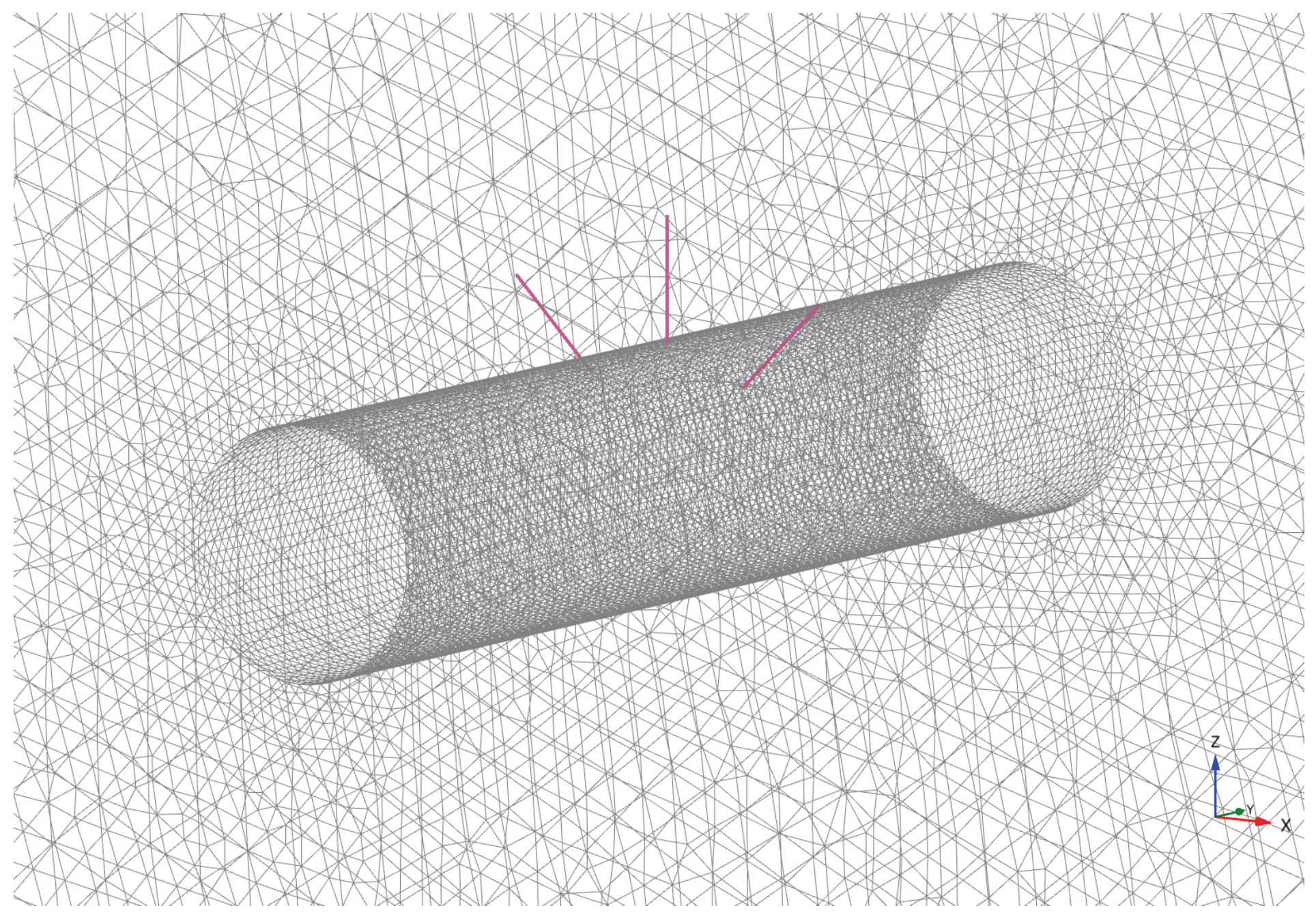
As an example of complexity, we show in
Figure 1 details of a volume mesh generated by the software PLAXIS for the simulation of a circular tunnel in an infinite domain with radius 1 and with three rock bolts. The simulation was used to verify the implementation of rock bolts, mentioned later. One can observe that it is difficult to see the geometry of the tunnel because it is hidden by the volume discretisation. Of course one can switch off the volume mesh to see the geometry better, but that would mean hiding an important aspect of the simulation from the user.
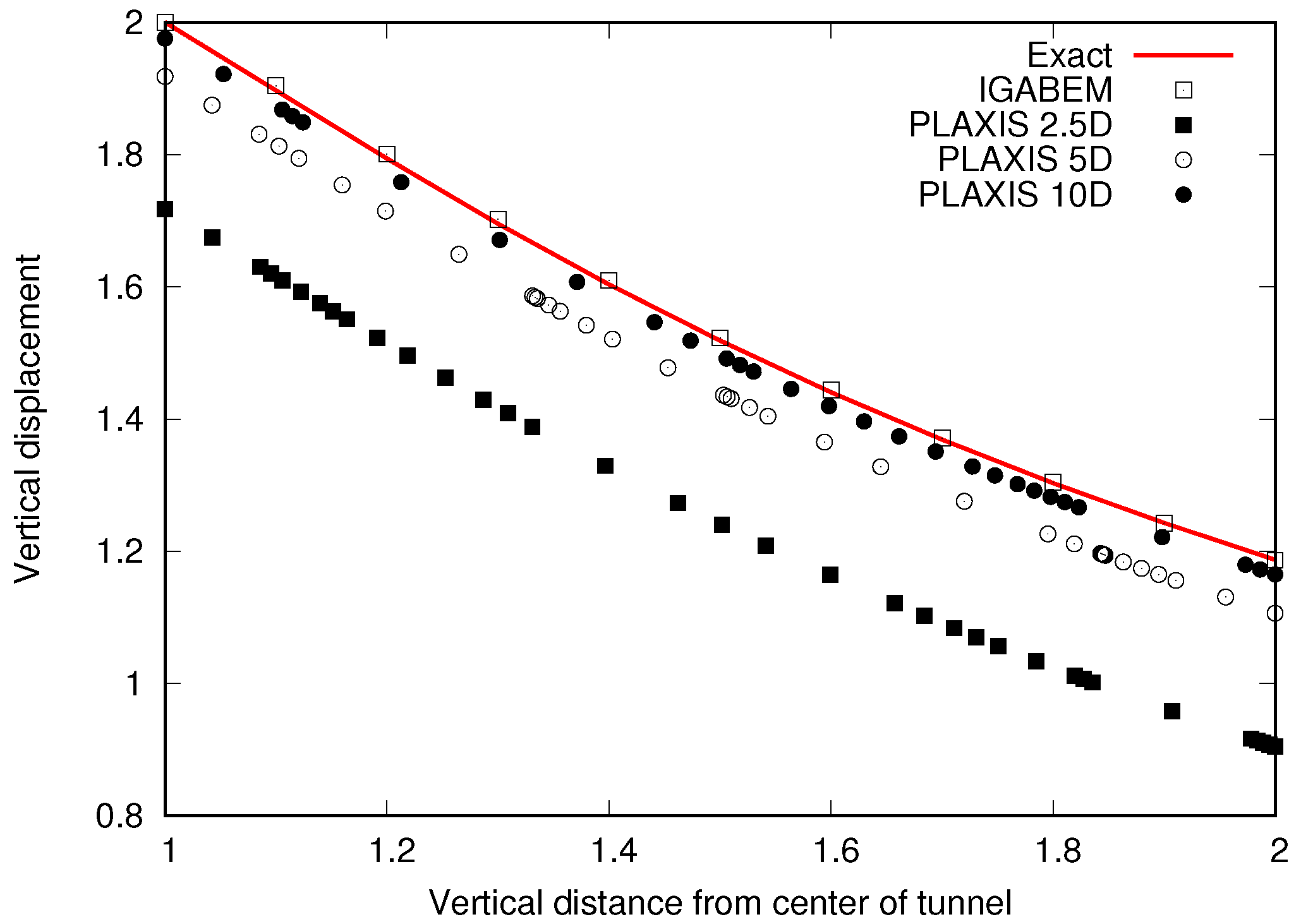
Since the infinite domain cannot be modelled, the mesh has to be truncated at a safe distance away, and this can also have an influence on the results. Using the same example but without the bolts, we show in
Figure 2 the effect of truncation on the displacements. The exact solution is that of a circular tunnel in an infinite domain [
10]. The FEM mesh with the result closest to the exact solution had about one million degrees of freedom. Note that this is a static analysis. The influence of the artificial boundary would be different for a dynamic solution (see [
11]). The IGABEM result, where the infinite domain is implicitly considered, is exactly the same as the analytical solution.
In addition, the variation of the unknown displacements in the FEM is approximated by piecewise continuous functions inside the domain, i.e., continuous shape functions are used within each element. The stresses are then computed individually for each element by taking derivatives of the shape function, meaning that stress discontinuities exist between elements. Using the isogeometric FEM [
12] things can be improved considerably, but the fact that a volume mesh has to be generated remains.
In summary, the quality of the FEM results depends on three aspects:
The approximation of the geometry of excavation surfaces;
The approximation of the displacements inside the domain;
The approximation of the (infinite) rock mass.
It should be noted that these comments also affect other types of volume discretisation, such as the discrete element method (DEM). It is not clear how developers of commercial software handle these aspects and how the simulation meshes are generated. One software vendor actually provides software to “fix” errors in the mesh generation. One idea, recently proposed in [
13], to use artificial intelligence for checking the adequacy of meshes looks promising. One reliable way to test the quality of the results would be to do an additional run with a finer mesh and check if the results are similar to the ones obtained with the original mesh. However, this means a complete re-meshing and an unacceptable overhead for large-scale problems, which may become infeasible for large simulations. In conclusion, it is not always possible to guarantee that the results of a large FEM simulation meet the desired level of accuracy. Such challenges have been addressed in several studies, also reporting adaptive re-meshing techniques aimed at improving the robustness and reliability of numerical solutions [
14,
15,
16].
An attractive alternative to volume-based methods is the boundary element method (BEM). The main attraction of the BEM is that the infinite domain is implicitly considered in the simulation because fundamental solutions (in an infinite domain) of the governing differential equations are used. This also means that in contrast to the FEM, the stress results inside the domain are continuous. As a consequence, large volume meshes are avoided, and the quality of the results is superior to the FEM. In this context, it is worth mentioning the BEM-based simulations on a cylinder with uniform internal pressure published in [
17] and a coupled BEM-FEM approach for wave propagation in underground structures presented in [
18].
Only one software vendor (Rocscience) uses the boundary element software. However, in examples that are presented on their website, it appears that very simple triangular boundary elements are used and that only elastic, homogeneous ground conditions can be considered. Triangular facet elements were used in the early stage of the development of the BEM. They allow a straightforward generation of meshes, but a fine mesh has to be used to obtain good-quality results because an attempt is made to use planar elements to approximate a smooth boundary. As will be shown later, the geometry can be described as perfectly smooth using isogeometric methods.
The main reason why the BEM has not been applied more widely in geomechanics is that, with a boundary discretisation, only homogeneous, isotropic, elastic ground conditions can be considered. However, in recent decades, a concerted effort has been made to not only lift these limitations but also to allow the consideration of ground support. This can be achieved by including a volume integral in the system of equations. This seems to be contrary to the boundary-only philosophy of the BEM and appears to move it closer to the FEM. However, this is not the case because the BEM retains the main advantages: the ability to implicitly model infinite domains and the superior accuracy in computing displacement and stress fields. In addition, the volume mesh will be an order of magnitude smaller than for the FEM because it can be limited to zones where the volume effects exist (more about this later).
The development of the BEM as a powerful tool to simulate underground excavation problems has been slow, and only a small number of researchers have contributed to making it a useful tool. Most contributions have actually been led by the first author of this paper. A summary of the work has been published in a book [
19], where the work of others has been extensively referenced.
3. The Isogeometric Boundary Element Method for Elastic Problems
Solutions for elastic, homogeneous, and isotropic materials are sometimes useful for an overview of the situation underground and identify zones where a more realistic analysis with inelastic, heterogeneous materials may be required. In this section, the method is first presented for elastic problems, and in the next section, it is expanded to include volume effects (volume effects are effects that cannot be captured with a boundary discretisation only, such as inclusions and plasticity). Here, we concentrate on explaining the main features of the IGABEM only. For a more detailed description, readers are referred to a book published on this topic [
19]. We start with a system of equations that contains integrals over excavation surfaces. The integrals contain fundamental solutions of displacements and tractions due to unit forces in an infinite domain. Such solutions can only be obtained for homogeneous, isotropic, elastic domains. Therefore, we are restricted to these problems at the moment. The integral equations can be solved numerically by discretisation. This involves the subdivision of the excavation surfaces into subsurfaces (patches), the numerical description of the surface geometry, and the approximation of the unknown displacements. The integration is carried out in the local coordinate system of patches and then mapped to the global system (for details, see [
19]).
3.1. Definition of the Surface Geometry
Here, the technology of CAD is used to obtain a perfectly smooth definition of surfaces. NURBS, which are used by CAD, are superior to the Lagrange polynomials commonly used in simulation. They are able to describe certain surfaces, such as cylindrical and spherical ones, exactly.
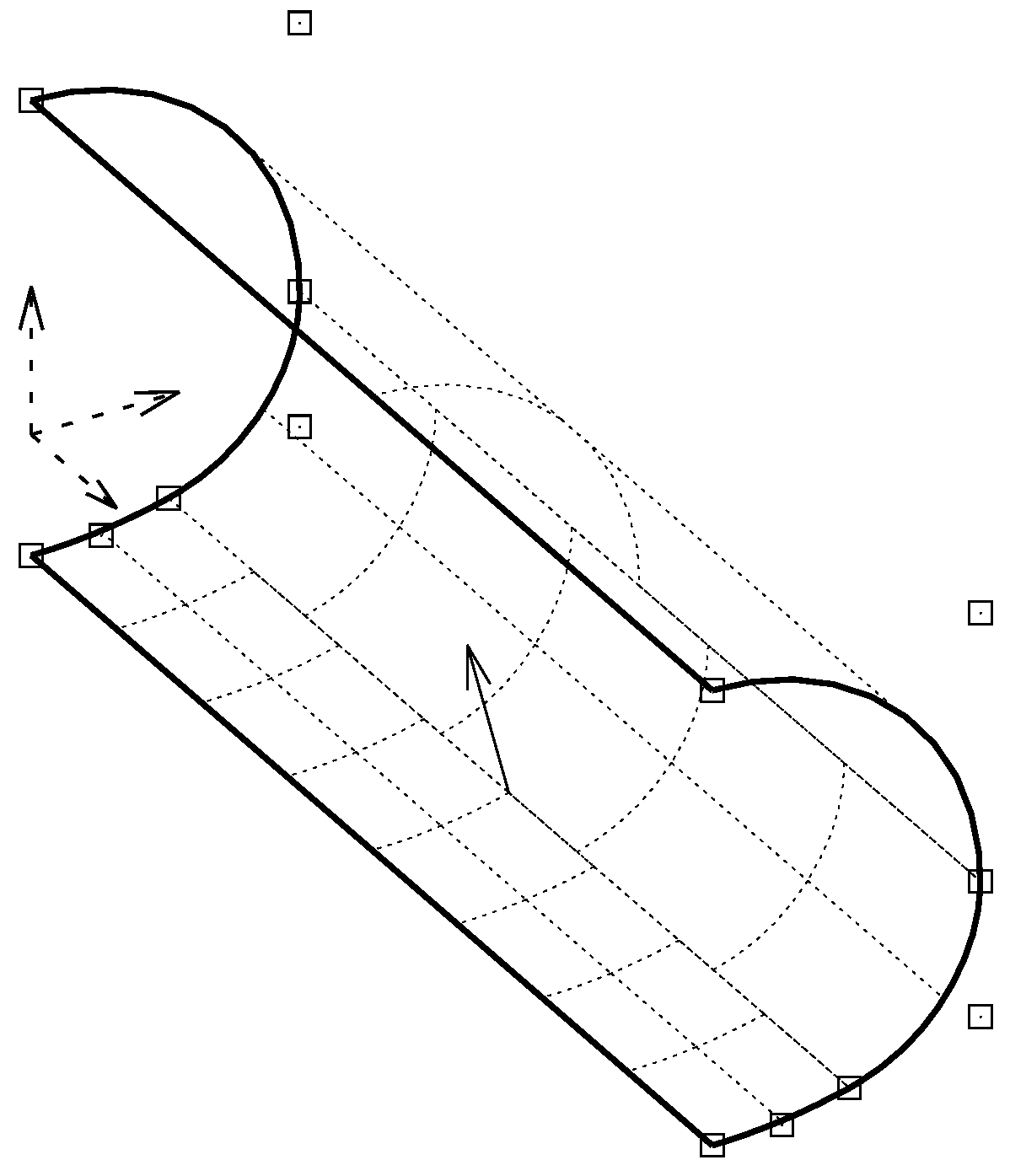
A surface is defined by a knot vector and control points (see [
20]). The knot vector determines the order and continuity of the surface and the control points of its shape.
Figure 3 shows an example of how the geometry of half of an NATM tunnel can be defined. In this case, an order of two has been specified in the knot vector, resulting in a perfectly smooth surface, without any mesh generation.
For the case where there are no intersections of surfaces, CAD data can be used directly for the geometric description of patches. In the case of intersecting surfaces, CAD data provide additional information for computing the intersection curves. Using this information, the geometry of the intersecting patches can be defined. For details, see [
21].
Example 1: Geometrical Description
Here, only the geometrical description for the simulation model is discussed; the actual simulation is presented later. This relates to a preliminary design for a real project concerned with the construction of tunnels for a rail crossing under the Hudson River between New York and New Jersey.
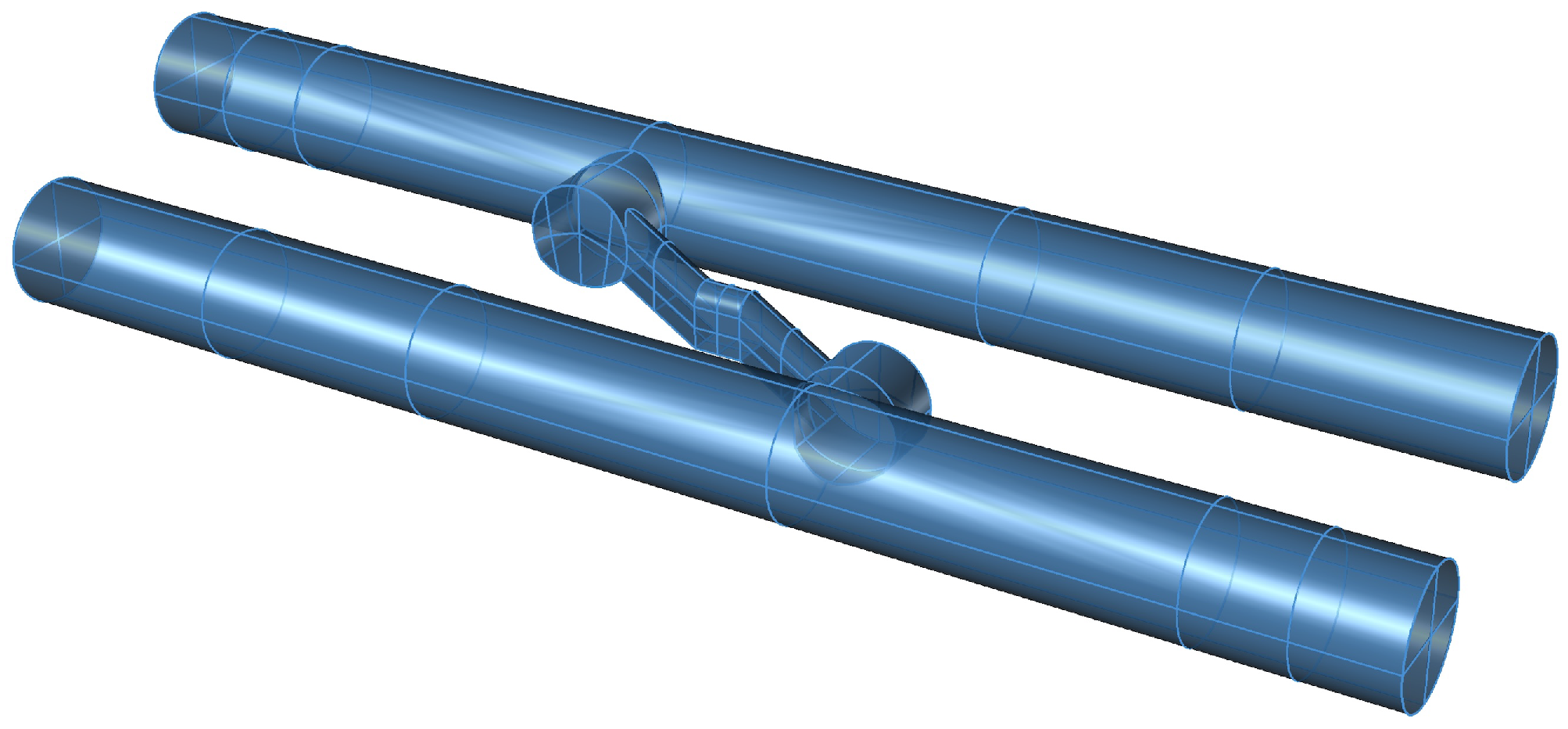
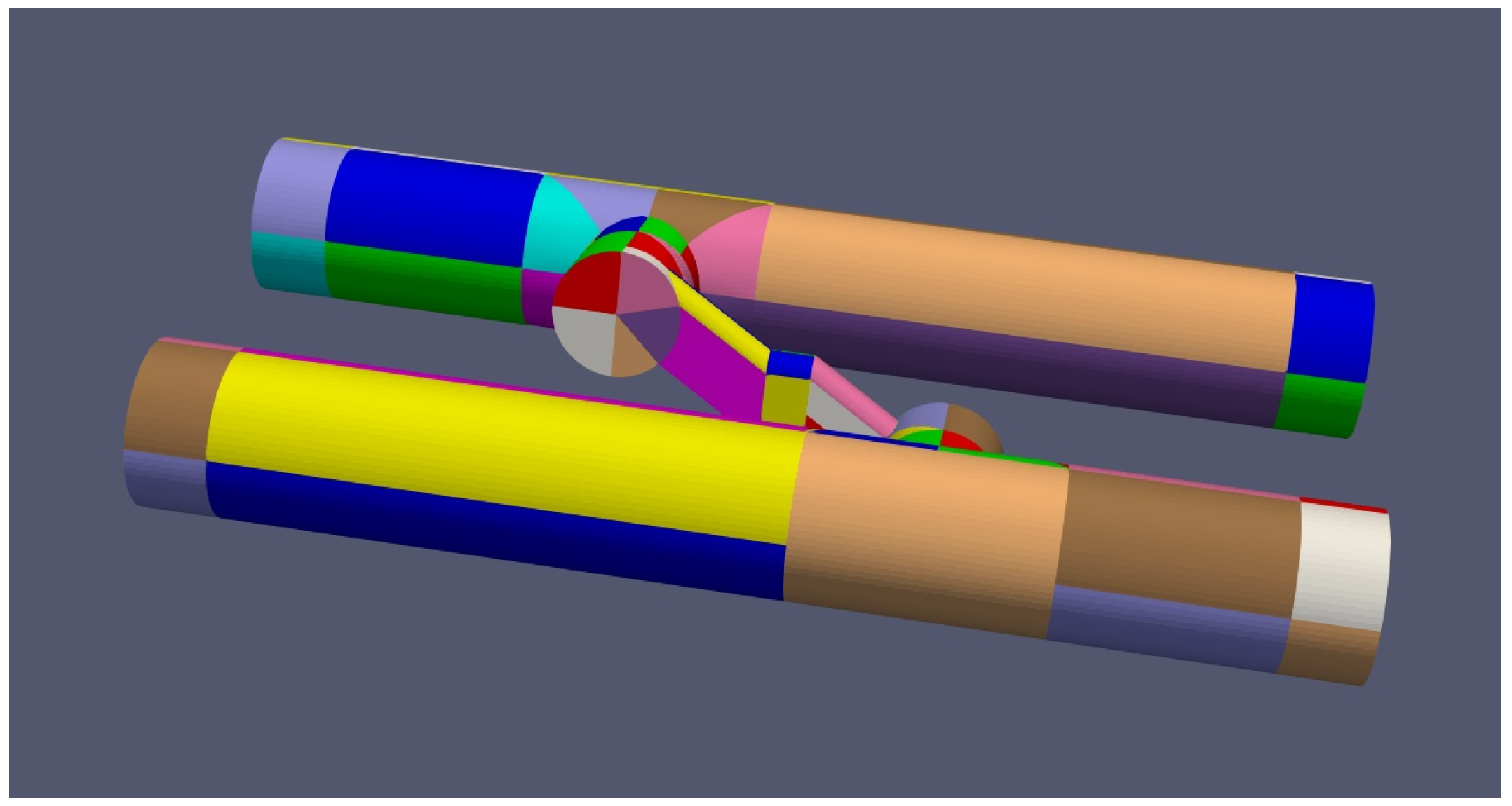
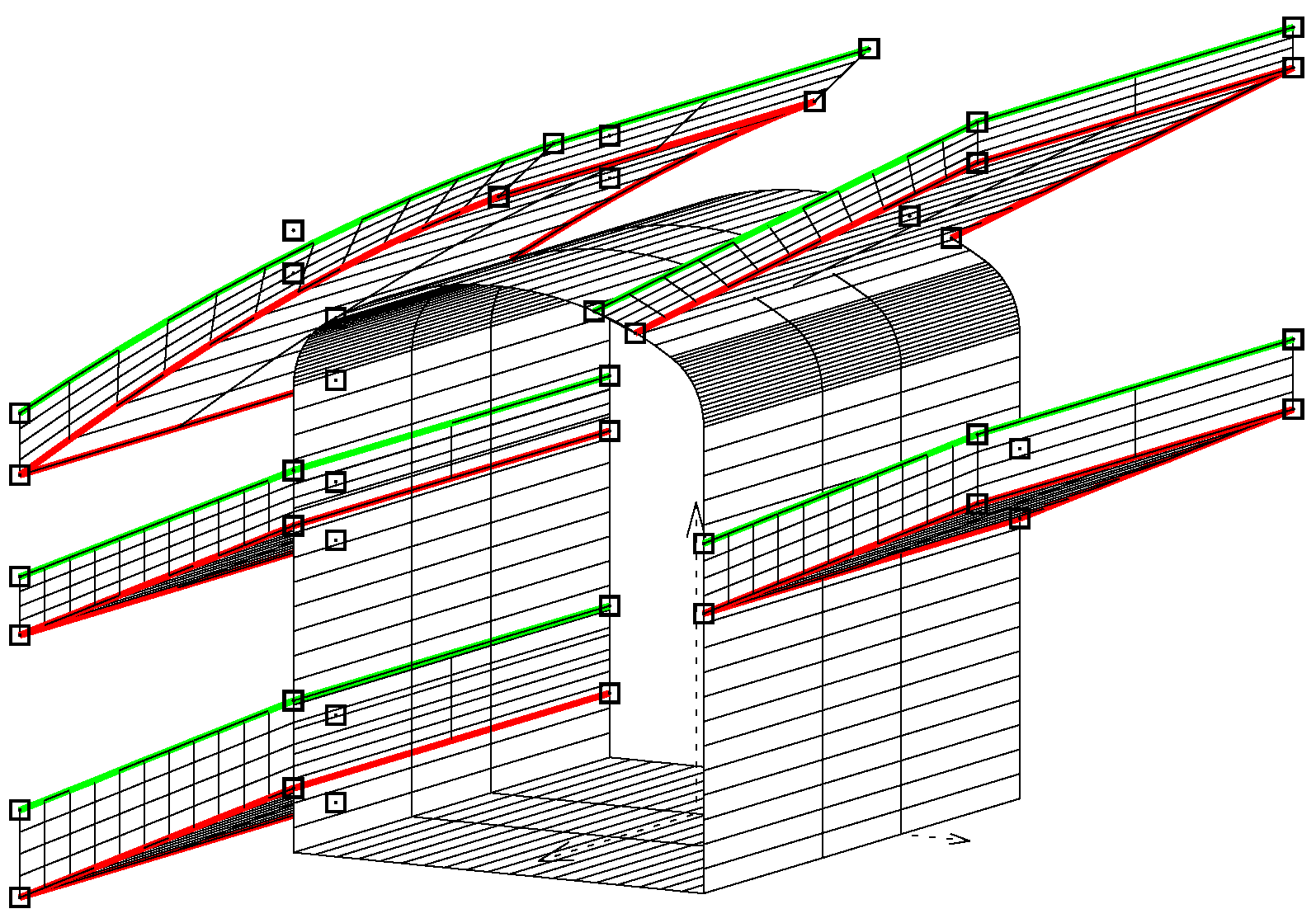
The part of the planned crossing selected for this demonstration consists of two tunnels at different elevations that are connected by a cross passage. Available data from CAD are used.
Figure 4 shows an axonometric view generated by CAD of the part of the tunnel system that was selected. Although the tunnels extend much further, they were truncated in the CAD model. Infinite patches [
22] were used in the simulation to model a very long tunnel. The simulation model obtained automatically from the CAD data by applying the procedures discussed above is shown in
Figure 5 and consists of 103 patches.
It should be noted that the geometrical representation, suitable for simulation, is exactly the same as defined by the CAD model. No approximation by a mesh is used.
3.2. Approximation of the Unknown
In order to solve the integral equations, the unknowns (in this case, the displacements) have to be approximated. In contrast to the FEM, no nodal points exist in the IGABEM. Instead, displacement values reside at anchors of the basis functions used for approximating the unknowns. Furthermore, the values at these points are not displacement values but parameters that, in a similar way to control points, control the variation of the unknowns inside a patch.
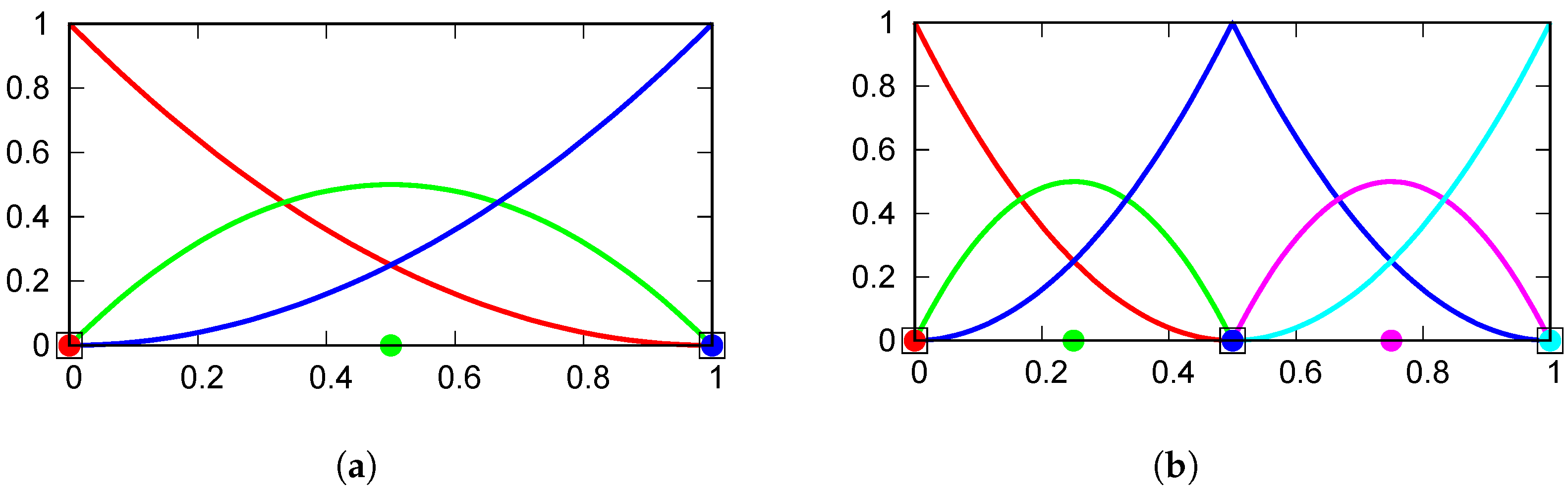
Whereas in the FEM, the approximation of the unknown is always linked to the geometry, IGABEM allows a complete separation of geometry and the approximation of the unknown. Indeed, looking at the previous section, one can observe that the geometry is already perfectly defined and needs no more refinement. In this way, we can concentrate on the refinement of the approximation of the displacements. Instead of Lagrange polynomials used in the FEM, we use NURBS, where we can manipulate the knot vector not only to define the continuity of the functions but also the number of functions used to approximate the unknown. In
Figure 6, the basis functions are shown that have been used for the description of the geometry and can now also be used for the approximation of the unknowns. Note that the basis functions do not fulfil the Kronecker delta condition, i.e., they do not have a unit value at the point where the basis function is defined and have zero values at other points. The important difference to Lagrange polynomials is that the continuity and number of basis functions can be changed by simply changing the knot vector. For example, inserting a value of
in the knot vector would change the basis function
Figure 6a to the one in
Figure 6b. The equivalent FEM operation would be splitting an element into two.
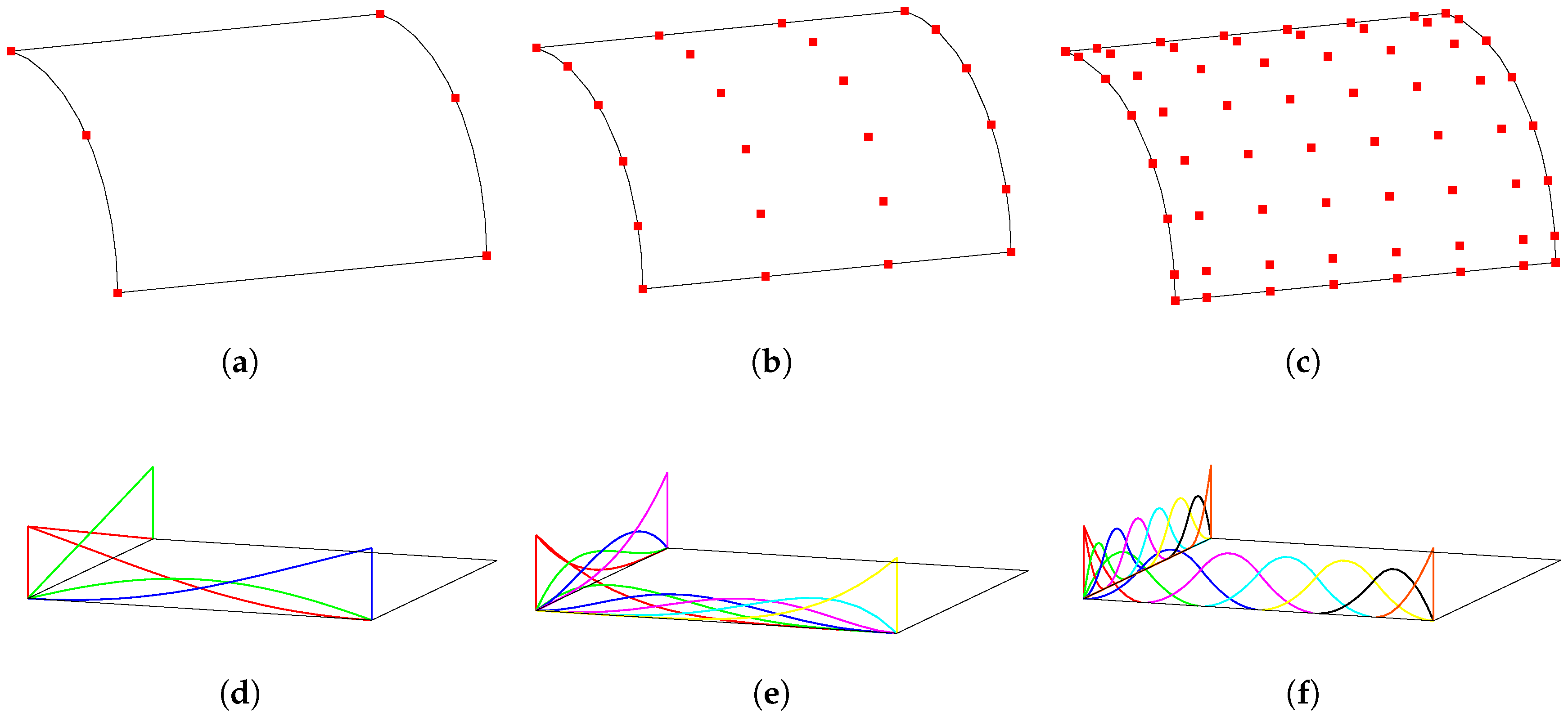
The refinement strategy involves refining the basis functions that describe the variation of the unknown by order elevation or knot insertion. This is demonstrated on an example of a cylindrical patch in
Figure 7. In
Figure 7d, the functions for the approximation of the unknown are the same as for the definition of the geometry. The resulting anchors, i.e., the points where the unknowns reside, are shown in
Figure 7a. In
Figure 7e, the functions are elevated by 3 orders in both directions, resulting in the anchor points depicted in
Figure 7b. In
Figure 7f, the functions are elevated by one order in one direction, and five knots are inserted in both directions, resulting in the anchor points depicted in
Figure 7c. It can be seen how easy it is to refine the solution just by changing the knot vectors.
This is the fundamental difference from the FEM, where a refinement of the solution always necessitates a complete re-meshing, which also affects the description of the geometry. In the IGABEM, the geometry (already perfect) is untouched, and only the approximation of the unknowns is changed by simply manipulating the knot vector.
3.3. Solution
After the discretisation of the integral equations, we end up with a matrix equation
where
is a fully populated non-symmetric matrix,
is a vector containing displacement parameters at anchor points, and
is a right-hand side containing load parameters.
In contrast, the system of equations obtained with the FEM is
where
is a stiffness matrix, and
are actual displacement values.
is sparsely populated and symmetric, allowing special solution methods to be applied that can solve millions of equations in a reasonable time. However, since the size of the matrix
relates to anchor points located on the excavation surfaces, it is an order of magnitude smaller.
3.4. Postprocessing
Once the system of equations has been solved, one can obtain values of displacements and stresses on the excavation surfaces and inside the domain. It should be noted that the variation of stresses inside the domain that is obtained using fundamental solutions is perfectly smooth and accurate (for details, see [
23]). This is in contrast to the FEM, where values of stress are computed by taking derivatives of the displacement field inside finite elements and, therefore, are not continuous. Pictures of results from FEM that use smoothing obscure this fact.
Example 1: Results
Here, the problem whose geometry was defined in the previous section is analysed. The excavation process is simulated by subjecting the boundary to excavation forces that are determined by the following constant virgin stress field: stress in the horizontal direction across the tunnel MPa, along the tunnel MPa, and in the vertical direction MPa (all compression). The surrounding medium was assumed to be of infinite extent and elastic with the following material properties: Poisson ratio , Young’s modulus MPa. For the approximation of the unknown displacements, NURBS functions, used for defining the geometry, were refined by order elevation and knot insertion.
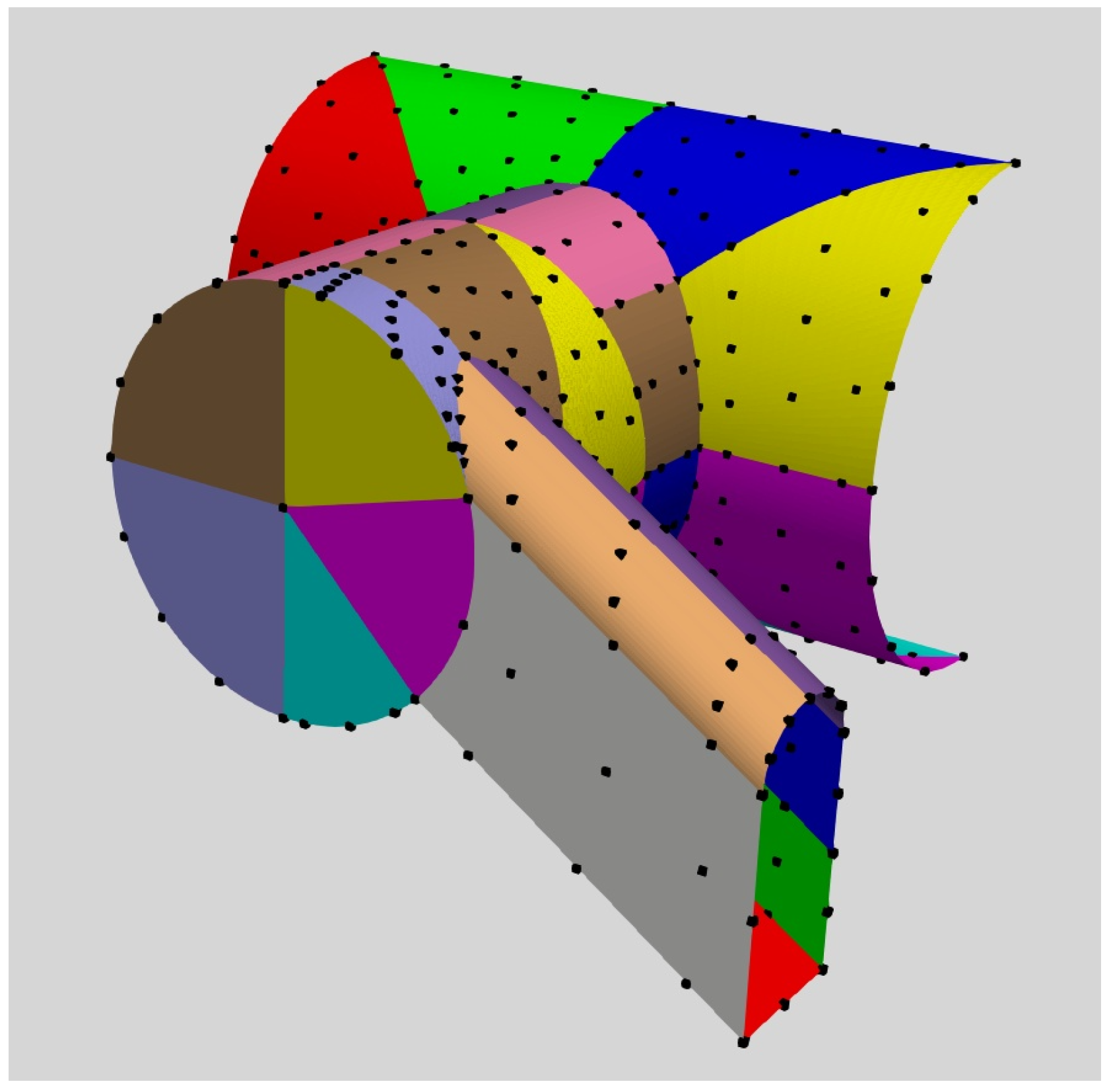
Figure 8 shows details of the geometry together with the anchor points (where the displacement parameters reside) resulting from the refinement procedure.
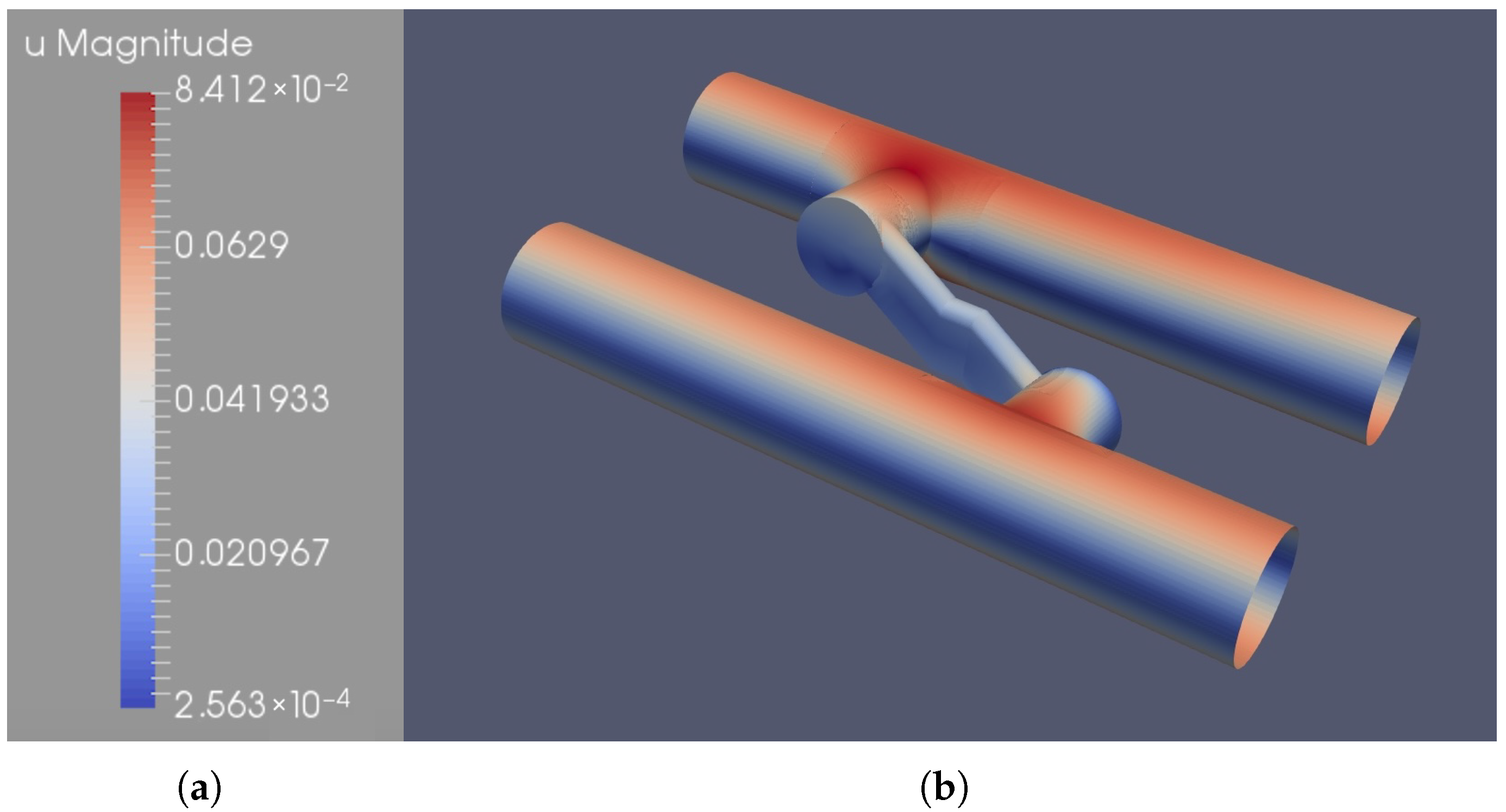
For the main tunnels, which in reality extend much further than shown in the CAD model, the infinite patches mentioned earlier are used, which simulate plane strain conditions, meaning that the displacements do not change in the infinite directions. The model has only 1980 degrees of freedom. One of the results of the simulation, namely the total displacement, is shown in
Figure 9.
3.5. Discussion
It is clear that for the simulation of underground excavations in homogeneous and elastic ground, the IGABEM has the potential to be far superior to the FEM. This derives from the exact representation of the geometry, without the need for mesh generation, combined with a lower number of degrees of freedom. However, to be useful for practical use, its capabilities have to be expanded. In the next section, it will be shown how heterogeneous, inelastic ground conditions, as well as ground support, including rock bolts and linings, can be considered.
4. The Isogeometric Boundary Element Method Including Volume Effects
So far, the simulation can only consider effects that occur on the boundary, and since the fundamental solutions are for a homogeneous, elastic domain, they are restricted to these types of problems. However, it is possible to include effects that occur in the domain (volume effects), and this allows elasto-plastic material behaviour and heterogeneous ground conditions to be simulated. Regarding volume effects, we distinguish between elasto-plastic material behaviour and elastic inclusions that have material properties different from those used in the fundamental solutions. To capture volume effects, one needs a discretisation of the volume, and this seems to move the IGABEM closer to the FEM. However, the volume discretisation is not achieved in the same way as with the FEM and has the following features:
A structured mesh (i.e., the requirement that elements connect at nodal points) is not required. The discretisation is only used to compute a volume integral.
The discretisation is only required in part of the domain, where volume effects occur. This is in stark contrast to the FEM, where the discretisation is used to model the infinite rock mass. This allows us to concentrate on the details.
The volume can be discretised in various ways, for example, as a NURBS volume, as shown in
Figure 10. Alternative ways, such as methods based on simple cell clouds, are currently being developed.
4.1. Elasto-Plastic Material Behaviour
The well-known initial stress method (see, for example, [
24]) is used, which proceeds in iterations or time steps. The increment of displacement at time step
i is computed by
where
is a vector that contains initial stress values at points inside the volume mesh, and
is a matrix that contains volume information (for details, see [
19]).
The volume discretisation is only required where initial stresses exist. Since this is not known a priori, one has to make an educated guess, which may result either in the discretisation of an unnecessarily large portion of the domain or, conversely, in an overly limited region that compromises the accuracy of the numerical results. However, a possibility exists to make a minimum guess and to grow the volume mesh during the time steps. A procedure aimed at growing the required volume mesh is currently under development and will be presented in a dedicated paper. What is described here is a general methodology that may be followed if the zone of plasticity can be estimated or to define geological features.
Once a discretisation of the required volume has been defined (for instance by NURBS volumes), the initial stresses can be computed with any material models and methods that are used in FEM (for a good summary of available methods and models, see [
24]).
For example, using a visco-plastic approach and a Mohr–Coulomb material model, the yield condition can be computed by:
where
are principal stresses,
is the friction angle, and
c is the cohesion. The flow law is given by:
where
is the dilation angle.
The visco-plastic strain rate is specified as
where
is a viscosity parameter and
The visco-plastic strain increment during a time increment
can be computed by an explicit time integration scheme
An example will be shown later.
4.2. Inclusions
This section is concerned with the consideration of parts of the domain that have elastic properties different from the ones used for computing the fundamental solutions. We use the same approach as in the treatment of plasticity, but the initial stresses are computed in a different manner:
where
is the stress-strain matrix of the inclusion.
can be any stress–strain matrix. For example, the elasto-plastic matrix allows a full Newton–Raphson iteration for plasticity. It can also be an anisotropic matrix, considering that anisotropic fundamental solutions are difficult to find.
It has been shown in [
25] that the effect of inclusions can be considered without iterations, resulting in
where
is a modified left-hand side that includes the effect of inclusions.
There are different types of inclusions that can be considered.
The inclusions considered include the following:
- 1.
Parts of the domain that have properties different to the domain (geological features);
- 2.
Rock bolts, cables and other similar reinforcement;
- 3.
Lining or arches.
4.2.1. Geological Features, Example 2
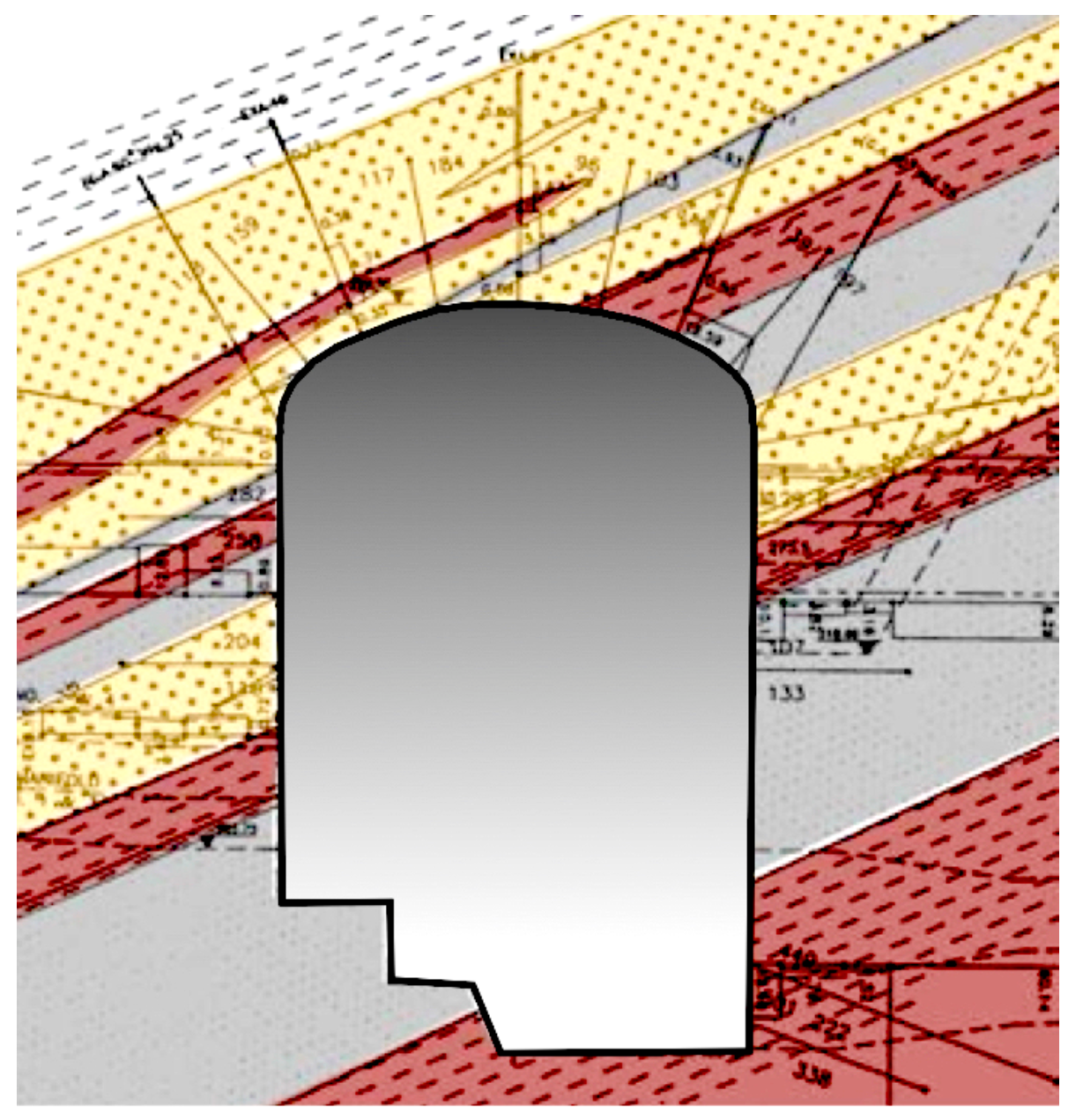
The example presented here is related to a real project, where the first author was involved in the numerical simulation. The excavation of the cavern for the Masjed-Soleiman underground hydroelectric power plant in Iran is presented. The aim here is to show how geological features can be considered, not to compare with measurements. This has been performed in an unpublished internal report. A geological cross-section is shown in
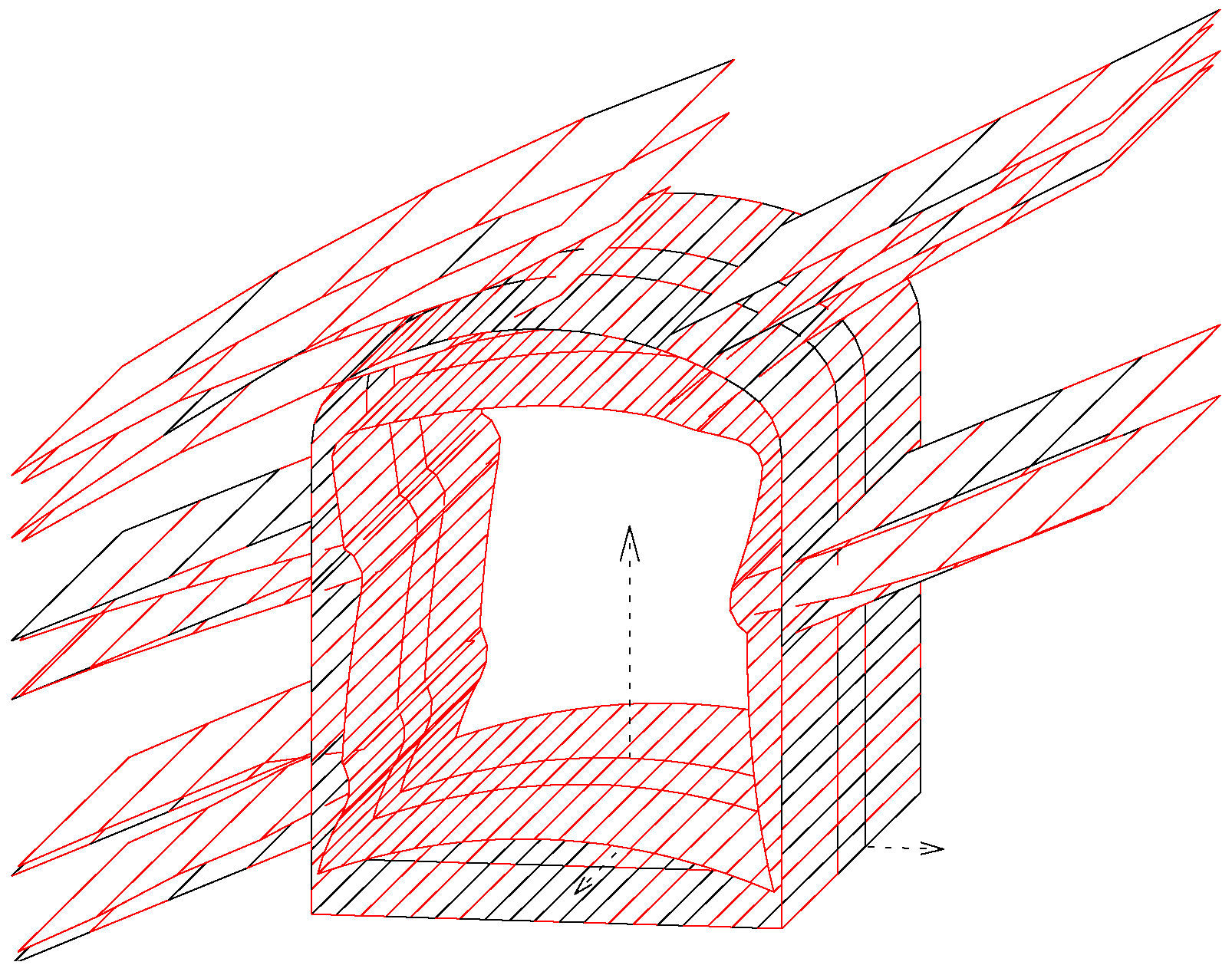
Figure 11 and is dominated by layers of mudstone, depicted in red.
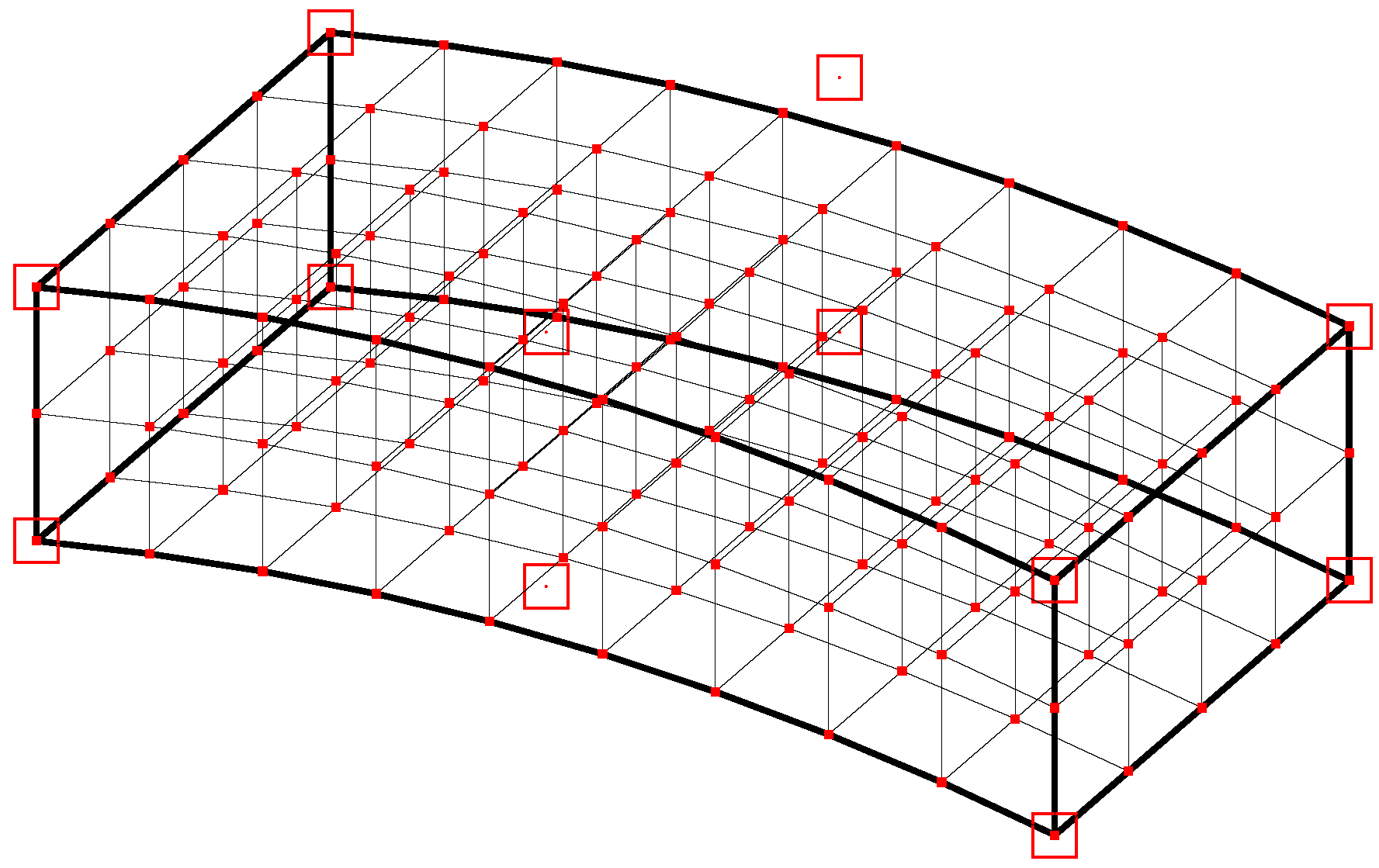
The simulation was designed to evaluate the effect of the mudstone layers on the deformation of the cavern walls. For this, a middle part of the cavern was modelled with finite and infinite (plane strain) patches. The model geometry, as well as the anchor points used for the analysis, is shown in
Figure 12. The mudstone layers are modelled by NURBS volumes, as shown in
Figure 13. Geological layers were defined by bounding surfaces. Control point coordinates, supplied by CAD, were directly used to generate the NURBS volume.
The following project data were used:
Virgin compressive stress:
6.2 MPa horizontal along the cavern
4.1 MPa horizontal across the cavern
8.3 MPa in the vertical direction
Properties of the rock mass:
Elastic modulus = 10 GPa,
Properties of mudstone layers:
Elastic modulus = 6 GPa,
Mohr–Coulomb, visco-plasticity
Cohesion = 0.73 MPa
Angle of friction =
Dilation angle =
The result of the simulation is shown in
Figure 14. It can be seen that the mudstone layers have a significant influence on the deformation behaviour.
4.2.2. Rock Bolts and Mono-Bars, Example 3
Rock bolts require a different method for computing the volume matrices.
They are modelled as line inclusions, and a semi-analytical method is used, where the integration across the thickness of the bolt is performed analytically and along the bolt numerically. For details of implementation, see [
25]. The change in length of the rock bolts is computed using NURBS functions, and the axial strain in the bolt is computed by taking their derivatives. Depending on the choice of the functions, the bolts can be modelled as fully grouted or not grouted.
Here, we revisit example 2, but the simulation has a different objective. The objective is to find out what effect bolt support has on the deformation behaviour. We refer to [
26] for details of the cross-section of the cavern with the installed support. It can be seen that heavy support was installed, consisting of rock bolts and mono-bars. A record of the displacements that occurred during the excavation and reported in [
26] shows that up to 26 mm of displacement occurred at some measured points on the roof during excavation, before the installation of the rock bolts and mono-bars.
The simulation presented here was carried out to test a novel approach, where support is installed before the excavation process starts. This is expected to reduce the loosening of the rock mass that would occur during the unsupported stage of an excavation in standard underground construction practice. It could also result in a reduction of the required support and an increase in safety. However, the purpose of showing some preliminary results here is only to demonstrate how plasticity and rock bolts can be simulated. Details of the idea of pre-supporting and a comparison with measured data will be presented in a confidential report. A patent application is underway.
The following properties were used:
Properties of the rock mass:
Elastic modulus = 10 GPa,
Mohr–Coulomb, visco-plasticity
Cohesion = 0.9 MPa
Angle of friction =
Dilation angle =
Viscosity = 1.66 -/h
Properties of rock bolts:
Elastic modulus = 100 GPa, diameter = 25 mm
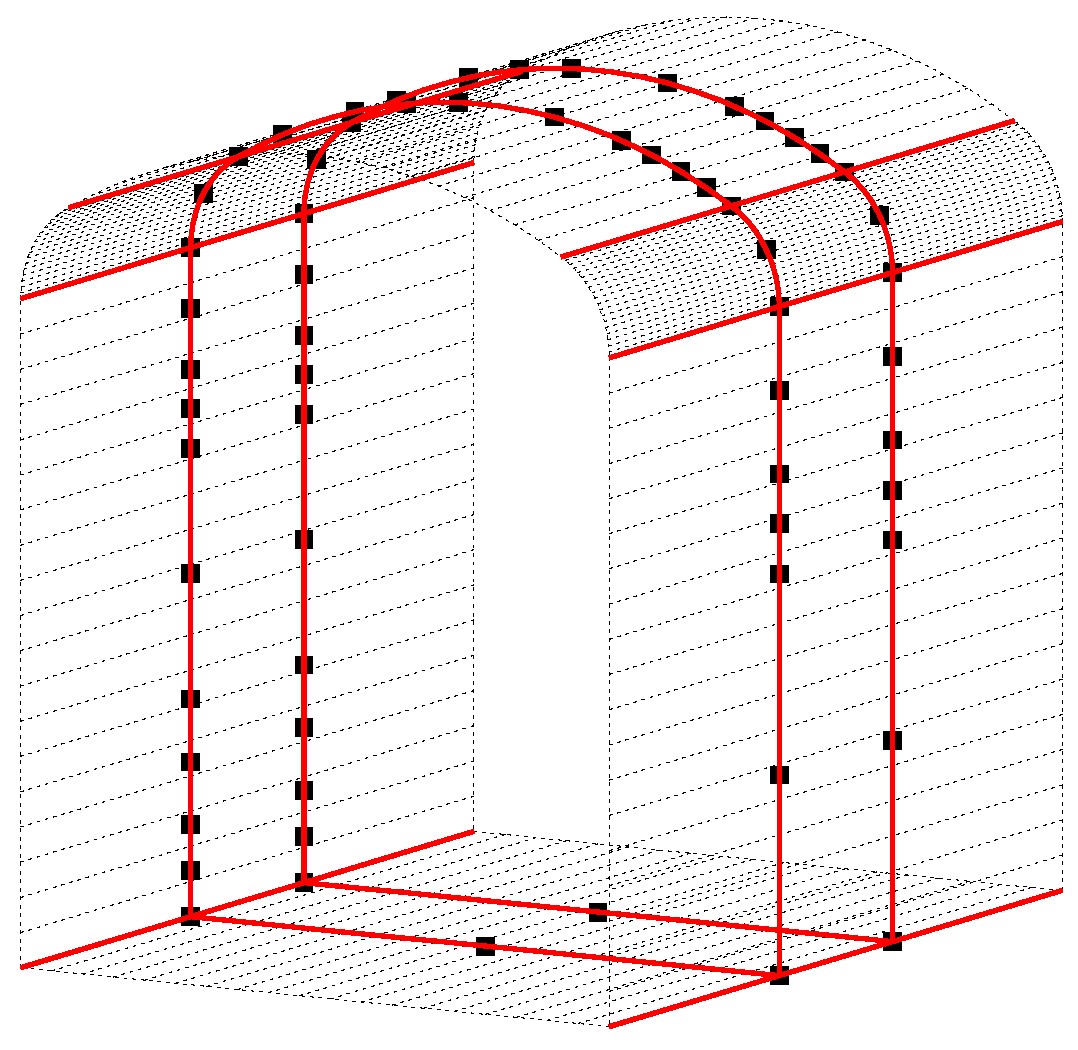
The numerical model that examines the excavation of the top of the cavern is shown in
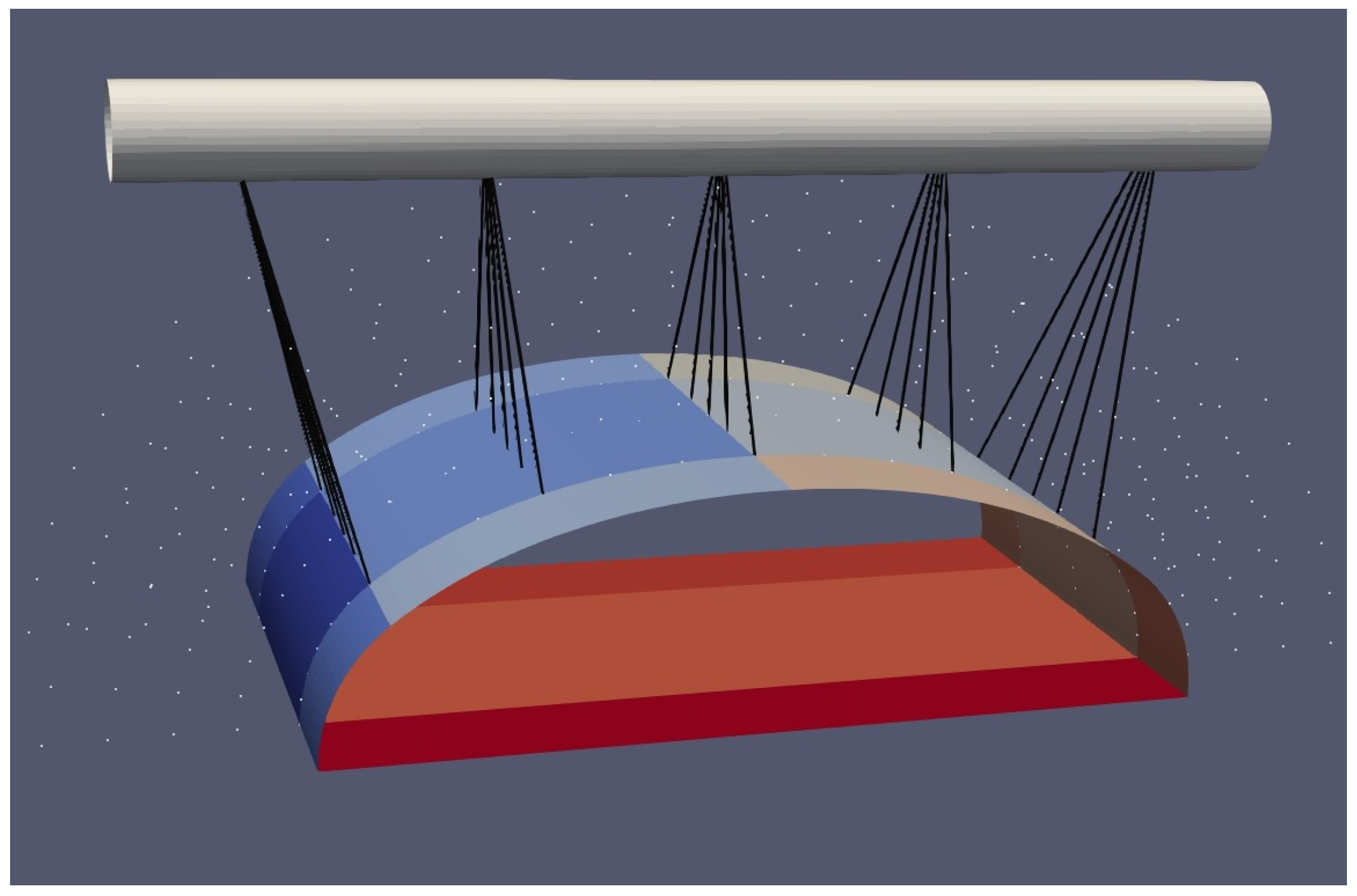
Figure 15. The geometry of the excavation surface is defined by 5 finite patches and 10 infinite patches. This models the case of an infinitely long cavern and approximates the real behaviour of a section at the middle of the cavern. The mono-bars are shown as lines; they are installed from the auxiliary drive and are assumed not to be grouted. The most significant effect of visco-plasticity on the deformation behaviour was considered to be between the drive and the excavation, so the volume discretisation is restricted to this part of the rock mass.
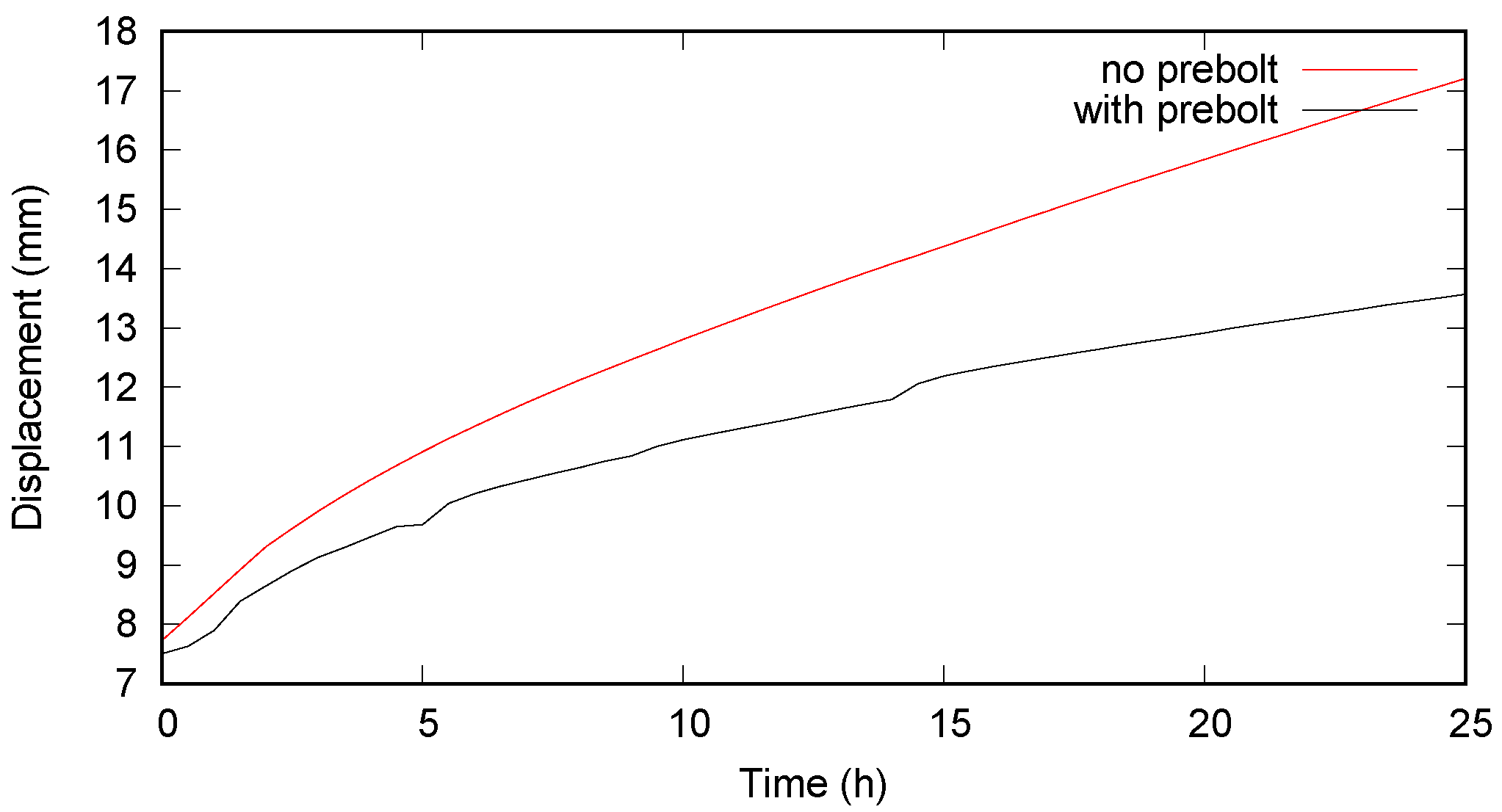
Two cases were examined: the case where the mono-bars were installed before the excavation took place (with prebolt) and one where they were installed after excavation (no prebolt).
Figure 16 shows how the displacement on top of the cavern varies with time for both cases. The effect of pre-bolting can be clearly seen. Not only the displacement but also the rate of increase is reduced considerably. This is a good example of how a simulation can be carried out quickly, concentrating on the task to be solved without being burdened by a huge volume mesh.
4.2.3. Linings
Here, we introduce some recent work on the modelling of linings, such as shotcrete and concrete arches. The lining is geometrically defined by the patch surface that is to be lined and a surface that is moved from the patch surface by the thickness of the lining. Analytical integration is used across the thickness and numerical integration along the surface. This work has not been published.
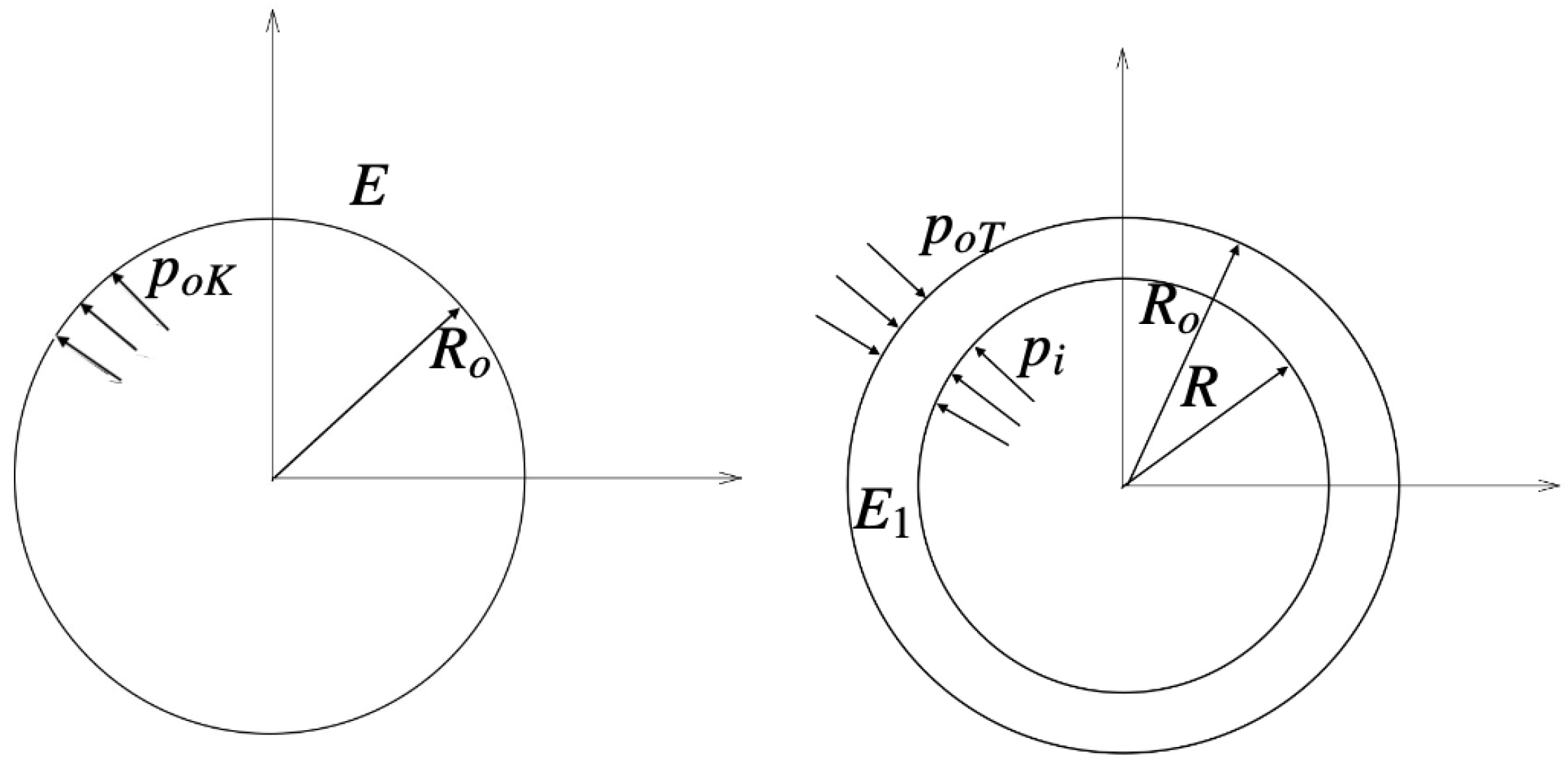
To demonstrate that the implementation works, we show a test example where an analytical solution is used for comparison. The analytical solution is presented in
Appendix A. To the authors’ best knowledge, it has not been published before.
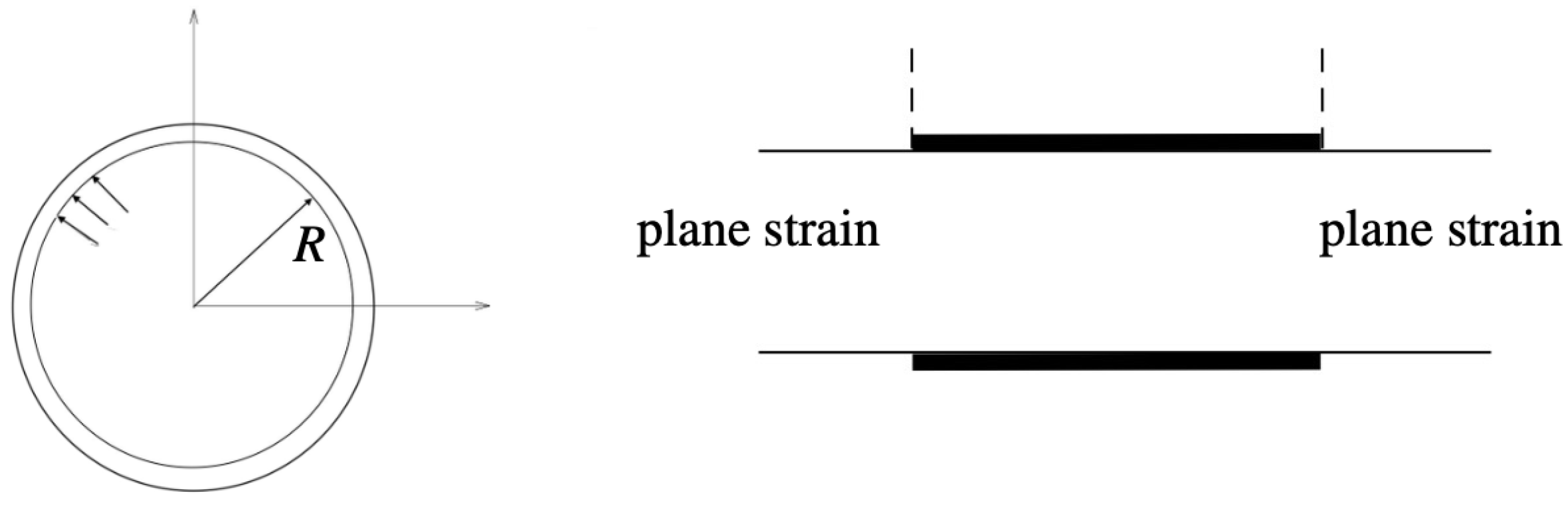
The example is an infinite cylindrical opening in an infinite domain subjected to an internal hydrostatic pressure of
. The radius
R of the opening is 5. The opening is reinforced by a cylindrical lining with a thickness
, which is assigned an elastic modulus (
) that is twice the value of the surrounding medium (
E). See
Figure 17.
For the 3D analysis, we assume that the extent of the reinforcement ring along the axis of the cylindrical opening is . Plane strain conditions (i.e., the assumption is that displacements remain constant along the axis of the opening) are assumed where the reinforcement finishes.
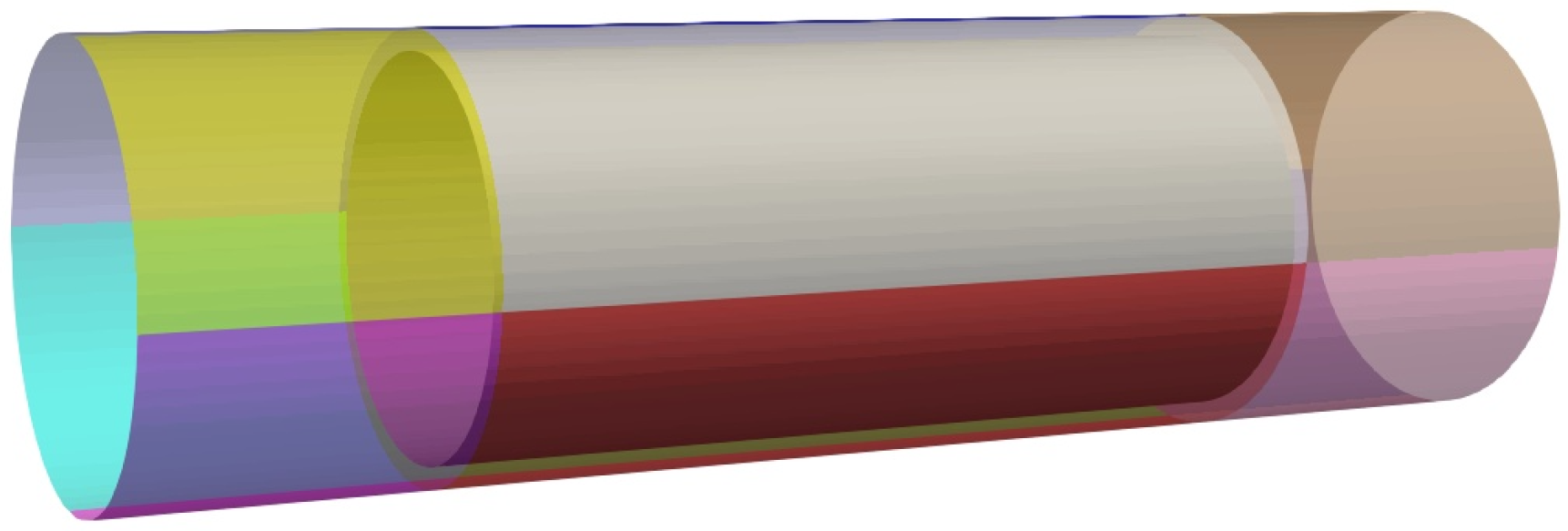
The IGABEM model of the test example is shown in
Figure 18. The geometry of the lining is described by two surfaces: a curved surface that follows the excavation surface at a distance of
d and the excavation surface. The excavation surface is modelled using finite and infinite (plane strain) patches.
For approximating the displacements in the circumferential direction, NURBS functions of order two are used. Across the thickness, it is assumed that the displacements vary linearly and therefore the stress in the lining is constant across the thickness. This is a reasonable assumption for thin linings.
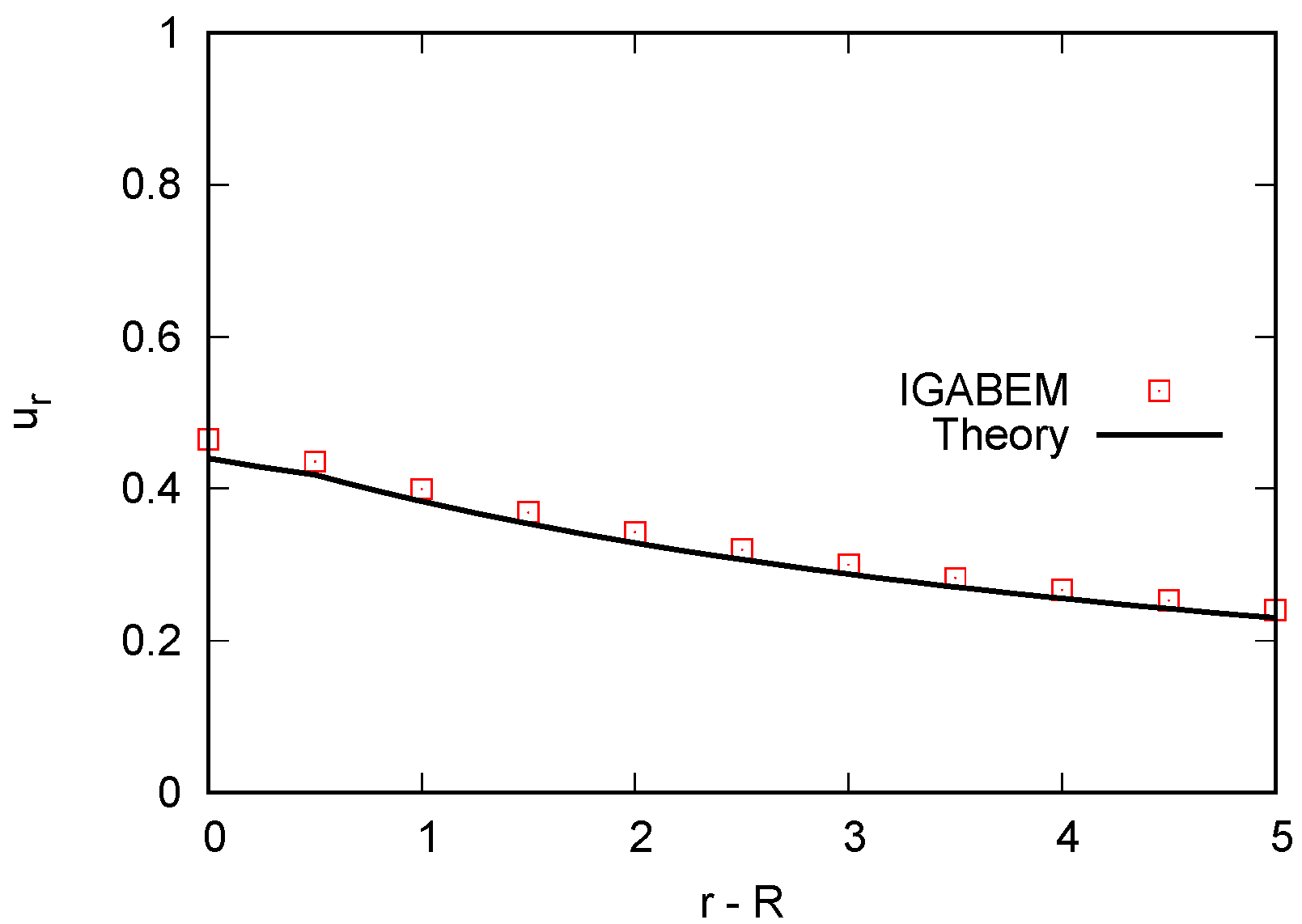
In
Figure 19, we compare the variation of the radial displacement in the surrounding medium obtained by the simulation with the theoretical results. Good agreement can be found.
5. Summary and Conclusions
Domain-based methods like the FEM have dominated the simulation of underground construction in recent decades. Although the programmes have become more sophisticated, allowing completely automatic mesh generation with data taken from CAD, the main problems remain: the need to approximate the infinite domain with a large volume mesh, even though one may be only interested in the behaviour of some parts of the excavation. The fidelity of these meshes is difficult to check but has an impact on the quality of the results. Indeed, in some commercial packages, the volume meshes are hidden from view, so users are sometimes unaware that they exist.
A method that implicitly includes the infinite domain in the simulation and only considers the excavation surfaces is an attractive alternative. This method exists and is the boundary element method. The reason why its application to the simulation of underground excavation problems has been very limited is that the implementation of important aspects such as plasticity, heterogeneity, and ground support has not been rigorously pursued. After a concerted effort in recent decades, these aspects have been addressed, and solutions have been implemented that allow the BEM to be applied to realistic simulations. This could be the birth of a powerful alternative to the currently used methods for underground construction.
In this paper, we have shown that, in the current state of development, the IGABEM allows simulations where the infinite domain is implicitly considered and where most of the options available in the FEM regarding nonlinear behaviour and ground support are available. The potential of IGABEM with respect to the traditional FEM has been demonstrated with examples taken from real underground construction projects. The last example, where the effect of pre-bolting is analysed, clearly shows how results can be obtained with minimum effort.
Perfectly smooth excavation boundaries are generated with a few parameters, and high-fidelity results are obtained using fundamental solutions of the governing differential equations, instead of the piecewise continuous approximation used in the FEM. One can concentrate on the problem at hand without having to generate a volume mesh that attempts to model the infinite domain and which may affect the quality of the results. The user gets a clear picture of the problem to be solved, without having a huge volume mesh that has to be hidden from view in order to be able to see the details. One can concentrate on the problem to be solved, only considering rock mass behaviour that is important for the results. In the last simulation, for example, visco-plastic behaviour was only considered in the part of the rock mass that was assumed to have a major influence on the behaviour of the rock bolts.
Companies that sell software for geomechanics have relied on FEM technology since the method was invented and have been very successful, even though many users may have yearned for a simpler modelling process. Implementing a new technology would be a big step and would require a big investment but could result in a competitive advantage.