


Abstract
Understanding the strain rate behavior of rock materials is key to geomechanical engineering. However, in numerical tools such as the Particle Flow Code (PFC), the chosen bonded-particle contact model also fundamentally dictates the mechanical response. A systematic comparison of how quasi-static strain rates affect different contact models, Parallel-Bonded (PBM), Soft-Bonded (SBM), and Flat-Jointed (FJM), using a common calibration baseline, has been lacking. This study addresses that gap by first calibrating all three models against identical laboratory data from the siltstone of Paleozoic-aged Trakya formation in Cebeciköy-Istanbul, Türkiye. Subsequently, numerical uniaxial loading simulations were conducted on the calibrated models at three distinct quasi-static strain rates (0.01, 0.005, and 0.001 s−1) to compare their stress–strain response, crack evolution, and failure patterns. The results demonstrate that while the initial elastic stiffness was largely insensitive to the applied strain rates across all models, the post-peak behavior and failure mechanism remained fundamentally distinct and model dependent. PBM consistently produced an abrupt, localized brittle failure, SBM exhibited more gradual softening with distributed tensile damage, and FJM displayed the most widespread, mixed-mode failure pattern. It is concluded that within the quasi-static loading conditions, the intrinsic formulation of the chosen contact model is a more dominant factor in controlling the failure style, damage localization, and post-peak characteristics than the specific strain rate applied.
1. Introduction
Rocks in engineering projects are subjected to a wide range of loading rates, from quasi-static to dynamic conditions. In most applications, such as underground excavations, energy facilities, and storage sites, the loading is quasi-static, with characteristic axial strain rates ranging from 10−7 to 10−3 s−1 [1,2,3]. By contrast, during landslides, earthquakes, or mining operations, rocks are subjected to dynamic loading, with strain rates spanning roughly 10−4 to 104 s−1 [4,5,6]. The static strength and failure mechanisms of rocks are commonly characterized by conventional laboratory tests such as uniaxial compressive strength (UCS), direct tensile strength (DTS), and triaxial compressive strength (TCS) tests conducted at quasi-static strain rates [7]. However, the mechanical response of the rocks is time-dependent, and the measured parameters are sensitive to the strain rate of the loading apparatus. Higher strain rates can overestimate the practical capacity, while lower rates are mostly time-consuming and impractical for most applications. Therefore, a systematic and robust assessment of strain-rate dependence in UCS, DTS, and TCS tests is necessary to improve forecasts of strength and failure in actual field conditions.
An experimental study on the Oshima granite quantified UCS strain rate effects (from 10−8 to 10−4 s−1), finding that peak strength and acoustic emission activity rise exponentially with increasing strain rate, while inelastic volumetric strain is higher at lower rates [8]. Multiple igneous and sedimentary rocks were tested under varying quasi-static strain rates, providing insight into a log-linear increase in UCS with strain rate [9]. A list of several Japanese rocks documented systematic UCS increases with strain rate, supporting quasi-static rate-strengthening trends with different rock types [10]. Hashiba and Fukui (2015) [11] introduced an index to quantify the loading rate dependency of rock strength with cross-material comparisons and provided insights into material-specific variations. An empirical scaling for fracturing under high-energy mechanical loads, constraining the dynamic strengthening envelope at very high strain rates, is also defined with laboratory experiments [4].
In addition to laboratory investigations of strain-rate effects, numerous studies address the phenomenon from a numerical perspective, particularly using bonded and grain-based discrete-element models (DEM), which are widely employed by researchers. Early bonded-particle implementations incorporated stress corrosion to capture time-dependent deformation and rate effects in DEM [12]. There are also subsequent studies focused on how to choose loading rates and apply quasi-static controls in bonded-particle models (BPM), making it possible to distinguish true rate effects from numerical inertia [13]. At the engineering scale, there are also DEM studies on unloading-induced brittle failure that show that rapid unloading elevates strain burst risk, highlighting how loading rate history governs instability in rock materials [5]. Grain-based DEM with an explicit stress-corrosion mechanism has reproduced experimental-style rate trends and tightened the microphysics–macro response connection in the material, while localized strain-rate and rate-dependent strength-field analyses show a transition in strain rate that governs cracking behavior, strength change with strain rate [14,15,16]. While changes in strain rate are important, in numerical rock mechanics, particularly in grain-based software such as the Particle Flow Code (PFC), grain-scale bonding and the chosen contact model are the primary drivers of model behavior. The chosen contact model (e.g., parallel-bonded model-PBM, soft-bonded model-SBM, or flat-jointed model-FJM) controls how forces and moments are transmitted through grains and their bonds. It also determines whether damage accumulates gradually or breaks suddenly, and how the mixed-mode fracture is addressed. As a result, stiffness, peak strength, post-peak brittleness, localization width, and even apparent rate sensitivity can change just by switching the bond model, with everything else kept the same. Early studies introduced the PBM in PFC and set the basic approach for bonded contacts. They also noted calibration trade-offs, such as matching the peak/tensile strength ratio and mode mix [17]. FJM was developed to handle surface-based, mixed-mode failure, and side-by-side tests showed clear differences from PBM [18]. A follow-up comparative analysis of bond models offered practical insights into choosing the appropriate model based on the rock type and loading conditions scenario [19]. The PFC documentation also features UCS and direct-tension examples that execute PBM and FJM under identical conditions, emphasizing differences in crack paths and strength ratios. In addition, Reference [20] compared several bond models for sedimentary rock modeling and provided insights into their differences in displacement fields, force chains, and cracking characteristics. However, none of these studies systematically compared the strain rate effect across different bond models under the same calibration process and quasi-static conditions. In particular, a comprehensive assessment of PBM, SBM, and FJM—calibrated using the same rock type and laboratory dataset and tested across various quasi-static axial strain rates—is necessary to understand how the selection of contact model influences the rate-dependent behavior of rocks. Beyond experimental studies, numerical investigations using the distinct-element method and bonded-particle models have explored the effects of strain rate and failure in brittle rocks. Early PFC applications with the parallel-bonded model (PBM) demonstrated how grain-scale bonding and contact stiffness influence macroscopic properties and localization, while also revealing calibration trade-offs, such as matching both compressive and tensile strengths. Later developments introduced models such as the SBM and FJM models to better simulate mixed-mode fracture and surface damage. Studies indicate that the choice of contact model influences fracture mode, force-chain structure, and brittleness, even under the same loading conditions. These findings highlight that both strain rate and contact law are key factors in the numerical response. However, systematic comparisons isolating strain-rate and contact-model effects in a common calibration are lacking. Prior research has often focused on a single model or comparing contact laws at a single rate, without exploring both together. A comprehensive assessment of PBM, SBM, and FJM, calibrated to a single dataset and tested at various strain rates, remains lacking.
This study calibrates these models to Istanbul siltstone and examines how strain rates (0.01, 0.005, 0.001 s−1) affect stress–strain, crack evolution, and damage under quasi-static conditions. By standardizing calibration and loading, it aims to distinguish the influence of strain rate from the choice of contact model. Laboratory data from siltstone specimens commonly encountered in Istanbul were used to calibrate three bonded-particle contact models (PBM, SBM, FJM) and to examine how axial strain rate (0.01, 0.005, and 0.001 s−1) affects the stress–strain response, fracture characteristics, and force-chain architecture under quasi-static conditions. The study aims to clarify strain-rate effects relevant to contact-model selection for numerical analyses that can be upscaled to large-scale engineering applications, such as tunneling for transportation or infrastructure.
2. Materials and Methods
2.1. Rock Material and Specimen Geometry
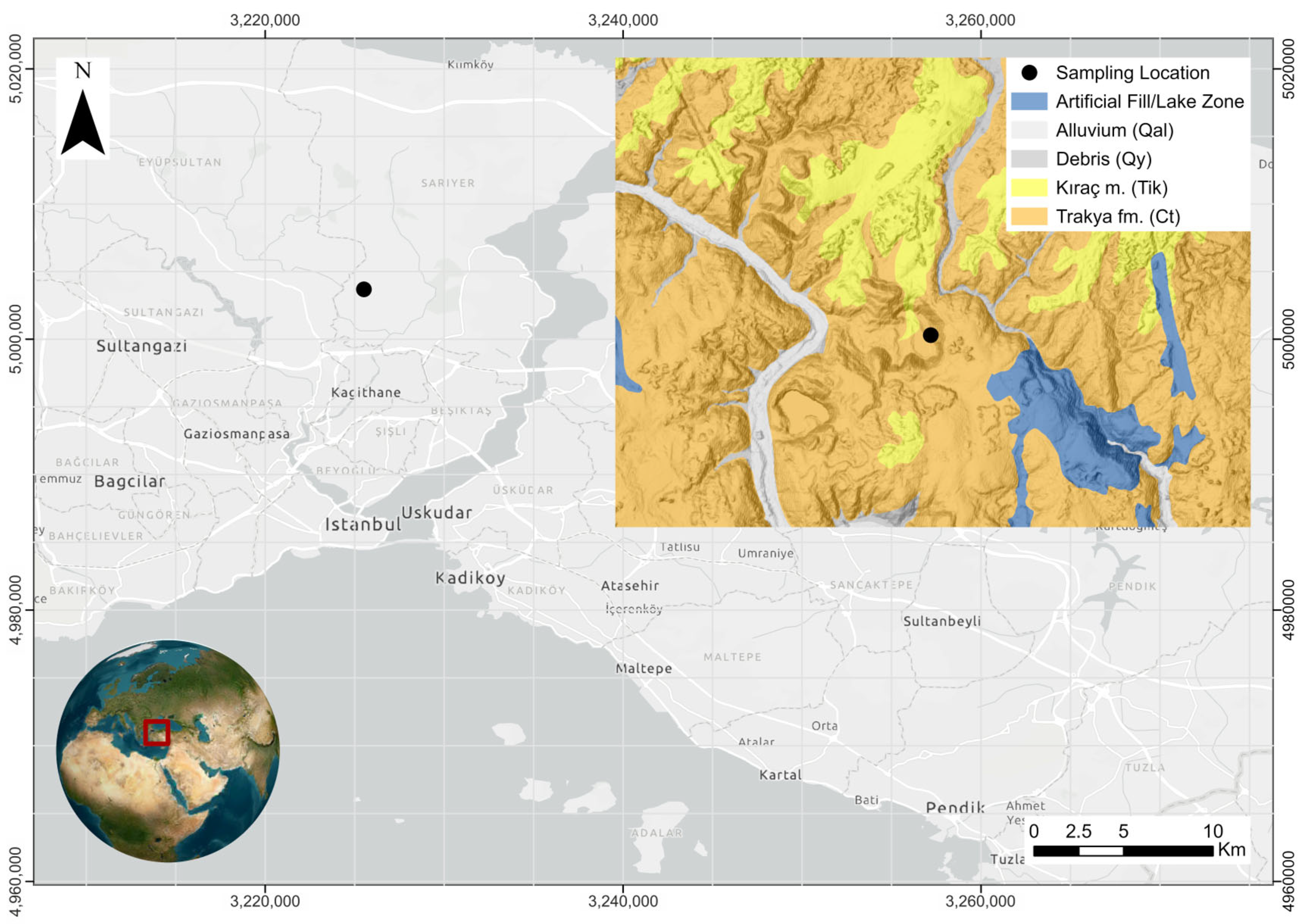
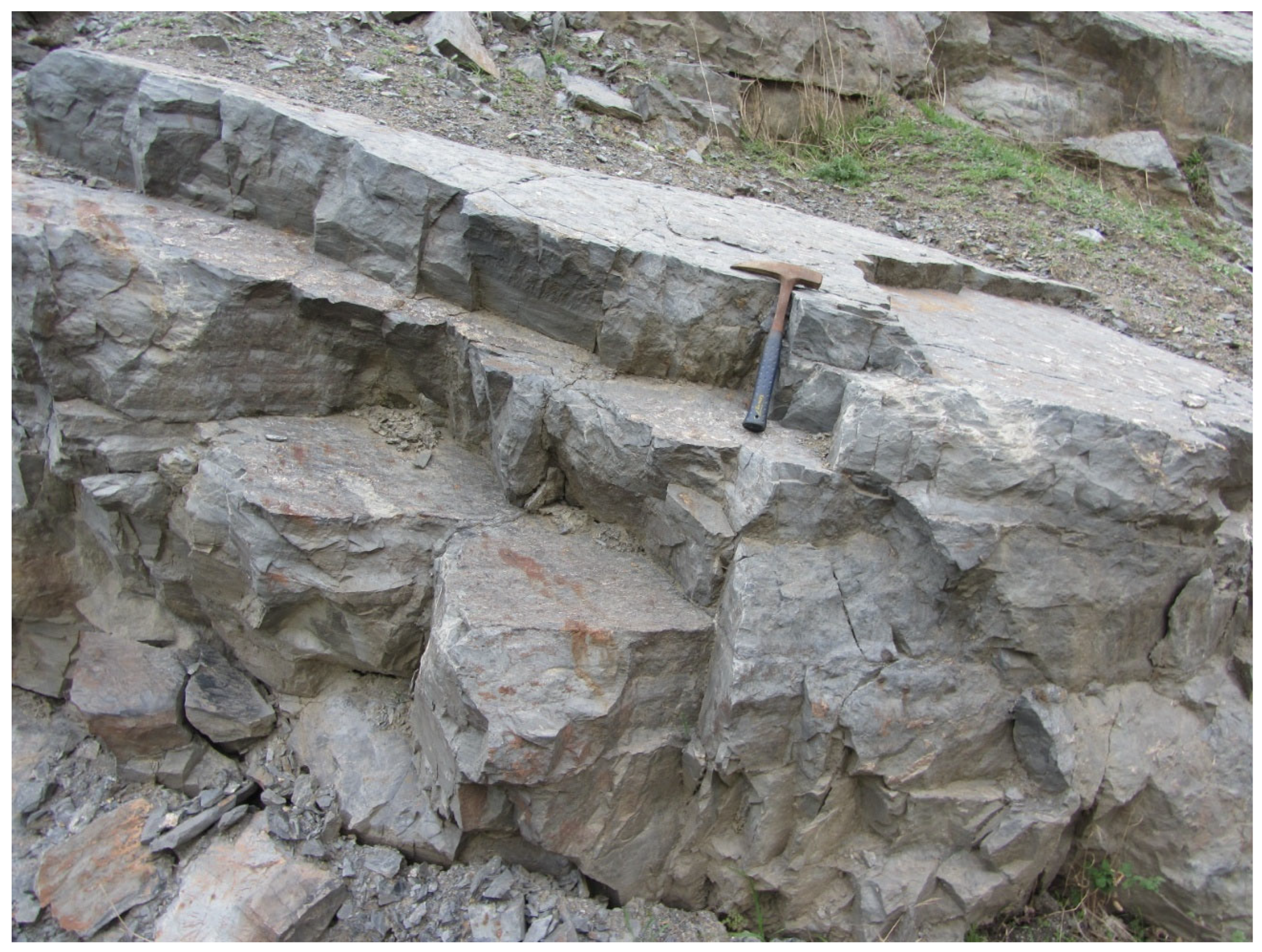
Istanbul settles on the Western Pontide belt, where a continuous Paleozoic sedimentary succession from the Lower Ordovician to the Lower Carboniferous is widely exposed. This sequence comprises thick packages of sandstone, siltstone, shale, and intercalated carbonates, later overlain locally by Mesozoic–Cenozoic units [21,22]. Near-surface engineering studies commonly intersect fine-grained, weakly cemented layers within this succession; well-studied formations in the area include Visean carbonates near Cebeciköy (Figure 1) [23,24,25]. Siltstone of the Trakya formation, belonging to this Paleozoic sequence, a dense, fine-grained sedimentary rock widely encountered around Istanbul, especially in tunnel projects, is selected as the reference lithology for numerical modeling (Figure 2). Representative blocks were trimmed and cored following ISRM guidance to produce right-cylindrical specimens with a nominal diameter of 54 mm and an L/D ratio of 2. End faces were ground to within standard tolerances for flatness and parallelism, and visible defects were avoided.
Figure 1.
Generalized location and simplified geological map of the study area.
Figure 2.
General view of the siltstone outcrops at Cebeciköy region (Photo taken by Ömer Ündül).
2.2. Bonded-Particle and Contact Models in PFC
The Discrete Element Method (DEM) was introduced for rock problems with discontinuities and was later formalized for assemblies of spherical particles by [26,27]. During the early years of its use, DEM was mostly employed for granular flows and rock masses with blocks to provide an alternative to continuum methods. DEMs most important innovation was the explicit definition of particle interactions with each other, employment of contact forces, progressive failure, which leads to well-defined fracturing in heterogeneous geomaterials [26,27,28]. In the following years, advances in computing and DEM enabled the use of them for jointed rock masses and slope stability analysis. During the 1990s, PFC extended DEM to intact and fractured rocks, for tracking the model response to loading, fracturing, and post-peak softening for rock engineering applications [17]. Since the 2000s, faster hardware/software have driven 2D/3D applications such as tunnel stability, excavation-induced stresses, rock burst, and hydraulic fracturing [20,29,30,31,32].
In parallel with the developments in DEM, bond models have also begun to develop in order to better represent the different properties and stress-dependent behavior of rocks, especially in PFC (Itasca Consulting Group, Minneapolis, MN, USA). Early models focused on replicating the bonded-particle nature of rock materials [17]. These contact models treated particles, disks in 2D, and spheres in 3D, as rigid bodies with fundamental contact laws, which were sufficient for granular materials but not for cemented bodies and the tensile strength of intact rocks. This limitation is especially important when the mechanical response of the rock mass surrounding underground openings needs to be addressed or focused. In order to solve this problem, multiple contact models were developed for the PFC environment. Basically, in all contact models, particles are bonded by strength-defined bonds, yet each model shows different behavior under stress. By this, the behavior of different types of rocks under stress can be modeled more comprehensively with different contact models. Although many built-in contact models exist in PFC, the three most used contact models, Parallel-Bonded (PBM), Soft-Bonded (SBM), and Flat-Jointed (FJM) contact models, are focused on in this study in terms of strain rate effect on the failure behavior of sedimentary rocks under quasi-static conditions. The PBM has been widely used in PFC for simulating intact rock for almost a couple of decades. In this model, particles are bonded by finite-size parallel bonds that transmit normal and shear forces as well as bending and twisting moments, making the contact mechanically analogous to a short elastic beam [33]. In PBM, it is possible to reproduce the compressive and tensile responses of the rock material, which is important to model the brittle nature of rocks. Each bond is governed by a linear force-displacement law and an activity-deletion criterion that is more or less similar for all contact models. Bonds between models break when shear or tensile stress exceeds the limit of the bonds load capacity. It is also possible to monitor the different parameters, such as changes in stress, energy release, and cracking during the test, as well as all other contact models. The main limitation of the PBM is its bias in making the rotation of the particles and bonds too stiff and in producing a crack pattern more uniform than in real rock. After the PBM, the SBM was introduced to represent bonding in a weaker way to create a model with less brittle failure [34]. Unlike PBM, where beam-like bonds between particles fail abruptly once stress thresholds are exceeded, SBM allows a more gradual softening from bonded to unbonded behavior contacts. SBM defines and calculates the normal and shear forces, transmitted bending and twisting moments, and also the post-peak deformation in a more realistic way than PBM. In SBM, during bond weakening until the occurrence of the bond breakage, energy is split into stored and slip-dissipated parts, reflecting stress redistribution and release [35]. SBMs main advantage is to capture the strain-softening and distributed damage better than PBM, but this requires calibrating more micro-mechanical parameters and is time-consuming in comparison. The FJM introduces finite-size, surface-based contacts to represent angular, interlocked grains, which are closer to real rock microstructures [18]. Instead of a single beam-like bond in other contact models at the particle centers, there is a notional interface defined at each contact node in FJM. This interface is discretized into multiple elements that may or may not be bonded or unbonded. Each of the bonds can store strain energy while carrying normal or shear forces and transmitting bending moments. Also, these bond breaks can break in shear or tension and carry partial damage contacts. With FJMs, these capabilities, it is also possible to replicate and capture the cracking processes more realistically than PBM and SBM. FJM formulation considers elastic response and frictional slip, partitioning energy into stored strain and slip-dissipated parts [36]. FJM is more computationally demanding, but it can also reproduce the anisotropy, nonlinear strength envelopes, and complex fracture networks, which are important for heterogeneous and interlocked rock materials. By the employment of the same calibration procedure for siltstone, PBM, SBM, and FJM contact models were evaluated across under quasi-static conditions with strain rates of 0.01, 0.005, and 0.001 s−1. Strain rates in PFC differ from laboratory rates because deformation is imposed through incremental steps in an explicit dynamic scheme. Lower rates (e.g., 10−5 s−1) are impractical due to small time steps and long runtimes, increasing inertial effects. Even at lower rates, such as 0.005 and 0.001 s−1, each simulation took 3–4 days on a workstation with an Intel i9 processor. These rates balance cost, stability, and inertial effects in DEM simulations. Comparisons focused on stress–strain response of models with different contact models, cracking, and force-chain architecture to identify a suitable contact law for subsequent upscaling for both future studies and complex rock mass environments.
2.3. Calibration and Simulation Setup
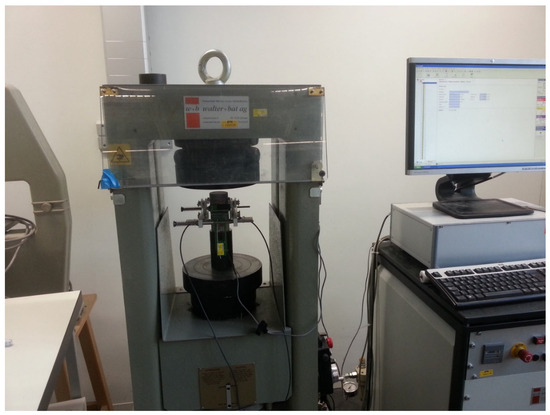
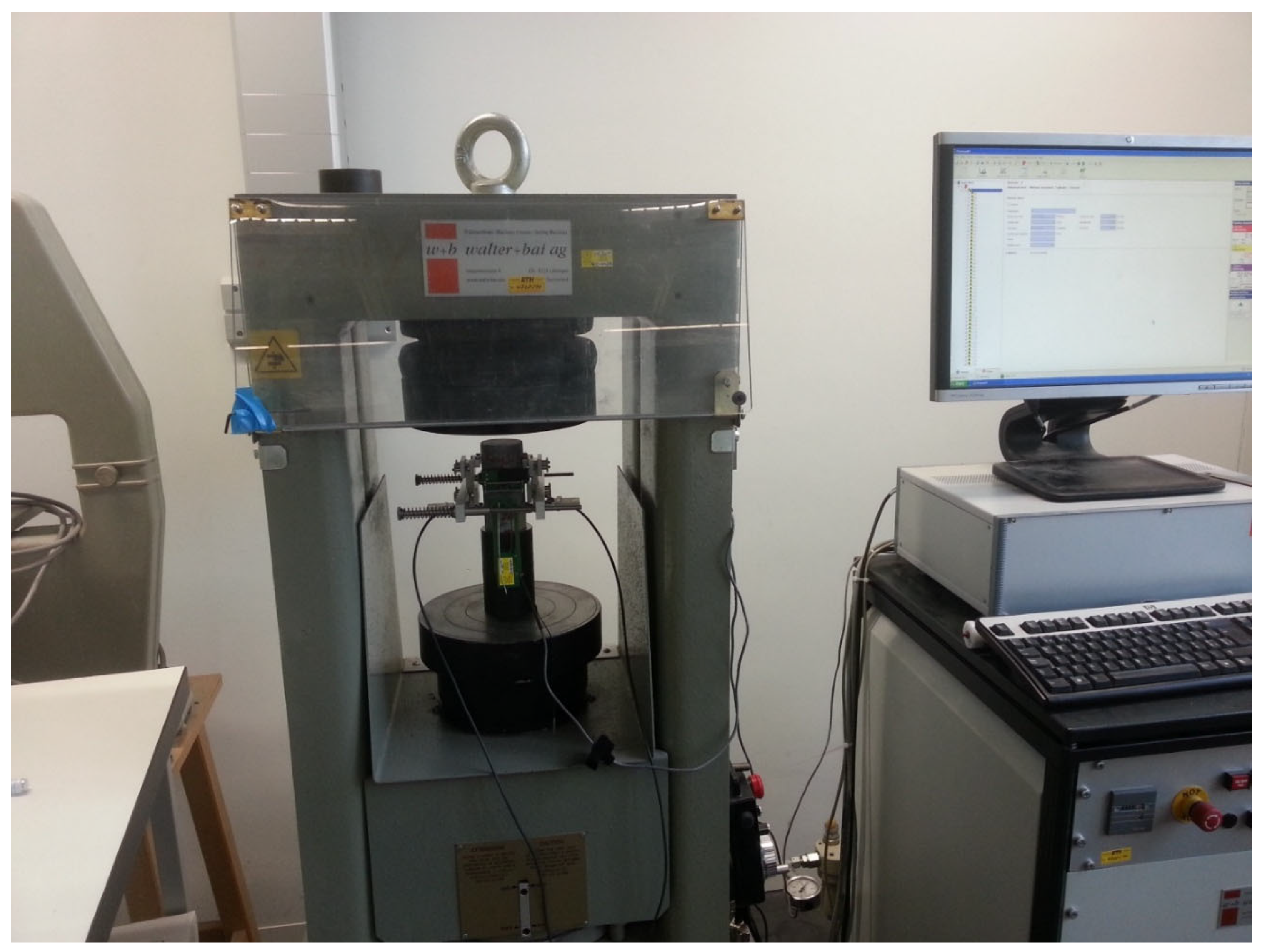
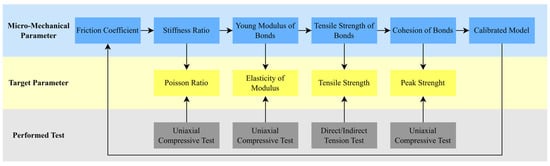
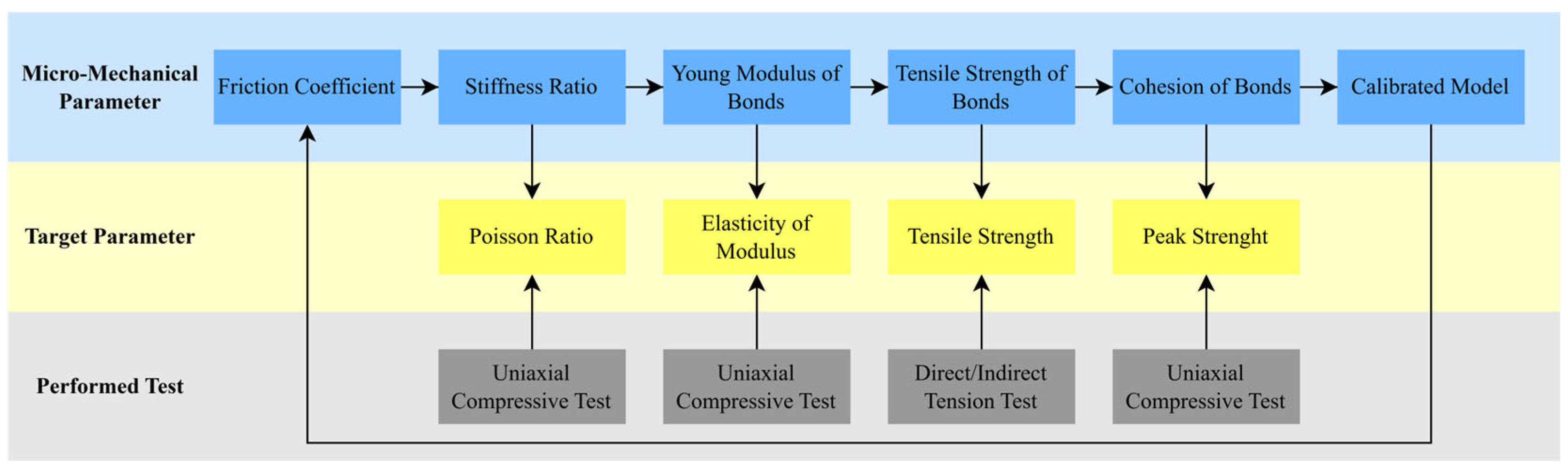
Laboratory specimens of the siltstone have a dense, low-porosity fabric. Cylindrical cores were prepared from block samples with a diameter of around 54.08 mm, a length of 105.89 mm, (L/D ≈ 2) in accordance with ISRM recommendations [7,37]. Siltstone samples have an average of a dry unit weight of 26.70 kN/m3, an effective porosity of 2.43% and a P-wave velocity of 2.89 km/s, showing a microstructure with low porosity. Uniaxial compression tests had an average peak strength of 38.0 MPa at a peak axial strain of around 0.35%; the Young’s modulus was 11.3 GPa and the Poisson’s ratio 0.05 (Figure 3). Crack initiation occurred at approximately 11.0 MPa, giving a CI/UCS ratio of 0.29, which is consistent with a predominantly brittle post-peak response. In PFC, calibration is inherently multi-stage and iterative; contact stiffnesses, bond strengths, and frictional properties are tuned, mostly one by one, while their couplings make convergence demanding. Micro-parameters such as contact/bond stiffness, normal/shear bond strengths, cohesion, and friction were iteratively adjusted until the simulated curves matched the target parameters such as modulus, peak strength, peak strain, qualitative failure pattern, etc. The same calibration flowchart was followed for PBM, SBM, and FJM models to have a common approach and baseline for fair comparisons between each other. The model resolution is also another important parameter for calibration; larger models with finer particles increase representativeness but also demand higher computational infrastructure [38,39,40]. Consequently, during the calibration phase, many iterations need to be made before the simulated stress–strain envelope matches the laboratory results. Considering the large number of micro-mechanical parameters in bonded-particle models, calibrating each micro-parameter independently is neither practical nor meaningful because many act in coupled ways and lack direct macroscopic analogs. Therefore, a simplified but effective and pragmatic calibration flowchart is followed in this study (Figure 4). Calibration results showed that all three contact models reproduced the siltstone’s UCS and Young’s modulus under uniaxial loading (Table 1). Tensile strength was less consistent; PBM and SBM overestimated the laboratory value, whereas FJM matched more closely. This difference emerges from each models’ inherent formulations; beam-like normal bonds in PBM/SBM inflate tensile capacity, while the surface-based FJM permits progressive splitting toward a realistic tensile limit [17,18].
Figure 3.
Deformation-controlled test setup used for uniaxial compressive tests at ETH Zürich in 2015 (Photo taken by Ömer Ündül).
Figure 4.
Flow chart used for calibration of PBM, SBM, and FJM models.
Table 1.
Comparison between laboratory and numerical model results of the studied siltstone.
In addition to the iterative calibration steps outlined above, it is important to note that PBM and SBM tend to systematically overestimate tensile strength when tuned to match uniaxial compressive strength. This is due to the intrinsic structure of these bond models, where the same microparameters control both compressive bond failure and tensile bond breakage. Increasing normal and shear bond strengths to match the UCS also raises the tensile capacity of contacts, making it challenging to achieve a realistic UCS-tensile-strength ratio without adding extra heterogeneity or predefined flaws. This limitation is well-documented in prior bonded-particle modeling research [19,41,42]. For clarity, the key point here is that PBM and SBM may cause tensile cracking to occur earlier and more suddenly than in natural siltstone; however, the comparison among PBM, SBM, and FJM remains valid, as all models were calibrated consistently under the same conditions. The calibration involved an iterative process due to coupled microparameters affecting multiple responses. Initially, the elastic modulus was matched by adjusting contact stiffnesses (kn and ks) until the stress–strain curve aligned with laboratory Young’s modulus. Next, the uniaxial compressive strength was calibrated by modifying bond strengths (σc and τc). Since these adjustments sometimes affected tensile response, tensile behavior was fine-tuned with tensile bond parameters and limits. When conflicts arose, such as UCS overestimating tensile strength, UCS was prioritized, and tensile parameters were re-adjusted without changing the elastic modulus. Finally, minor adjustments to the stiffness ratio (ks/kn) ensured localisation width and post-peak softening matched observed brittle behavior. This process was repeated until Young’s modulus, UCS, tensile strength, and post-peak characteristics were simultaneously calibrated.
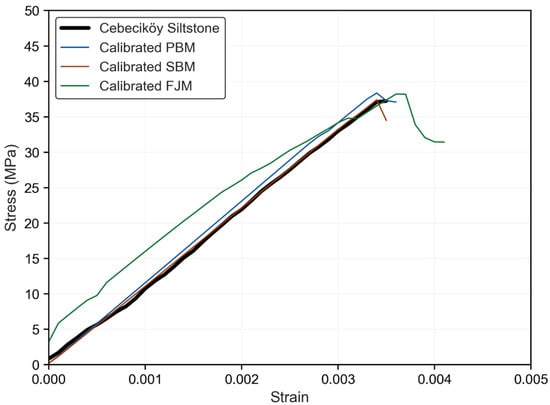
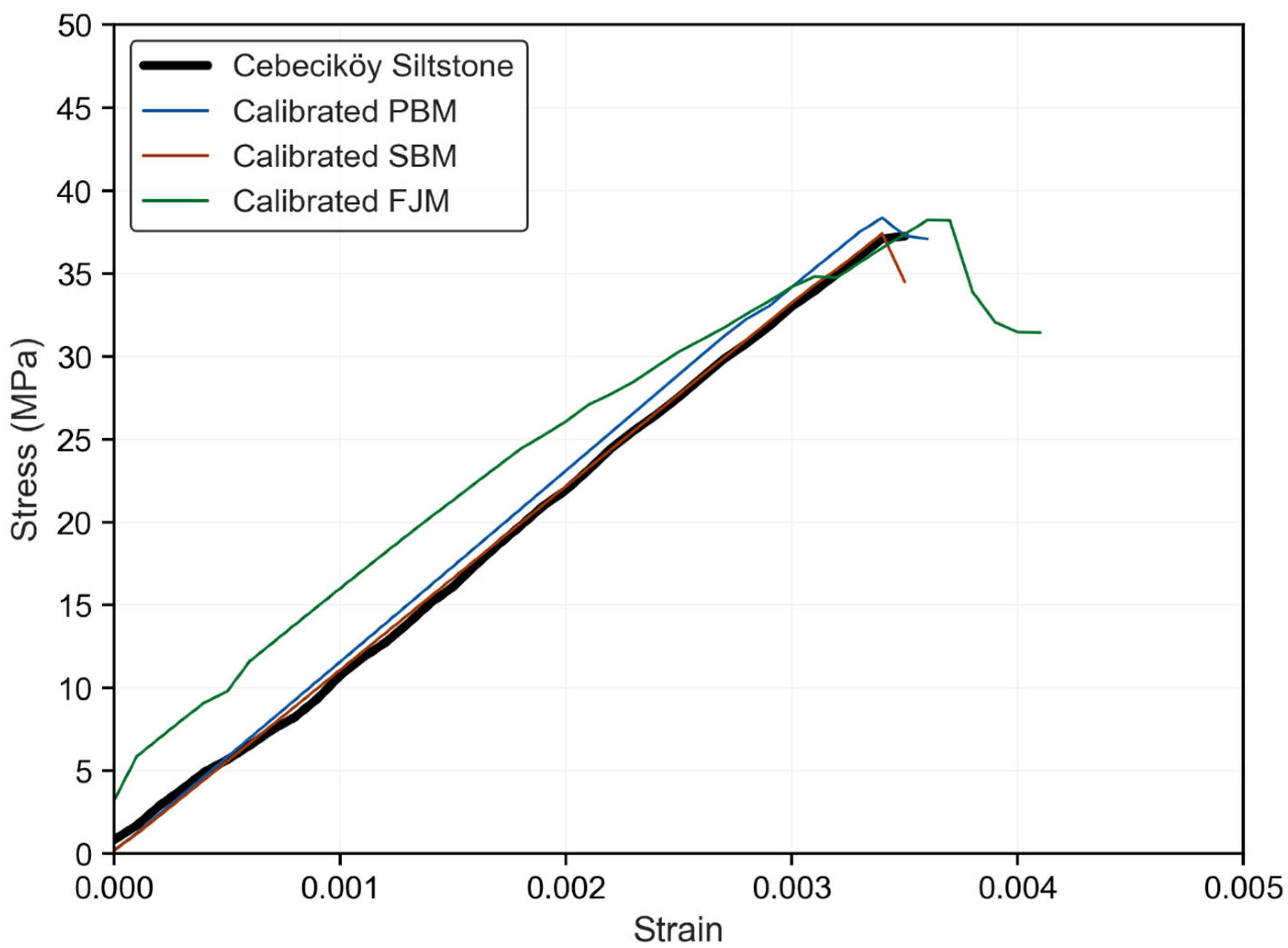
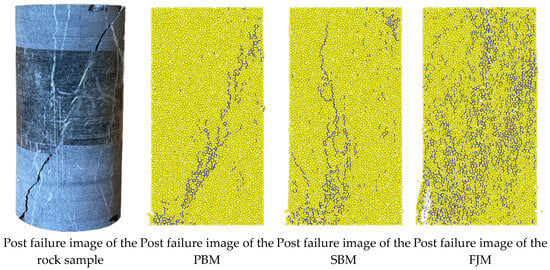
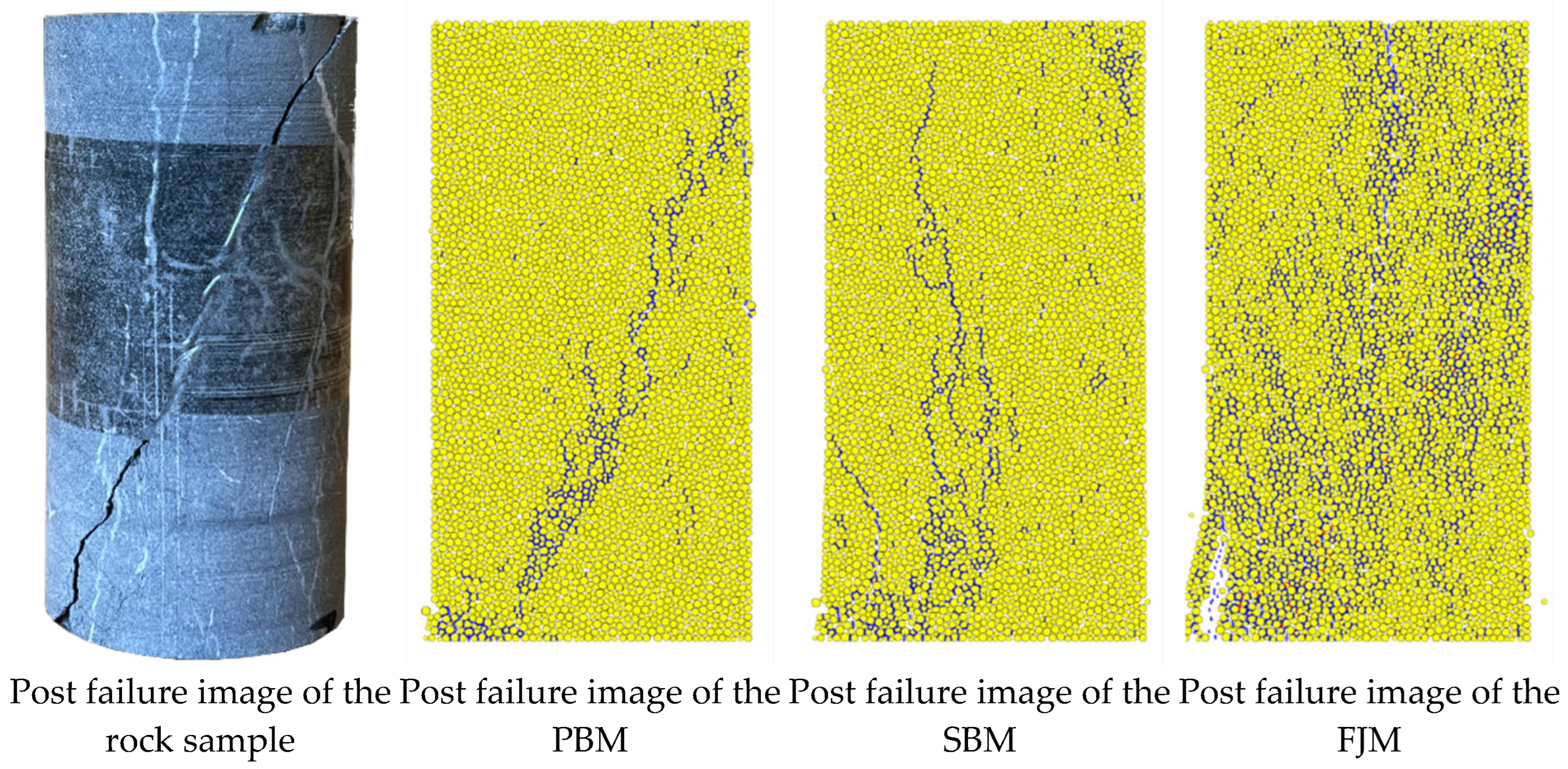
During calibration, it was also targeted to the overall stress–strain shape and damage thresholds, crack initiation, onset of yielding, and post-peak behavior. As shown in Figure 5, all models capture the elastic modulus and UCS, SBM best reproduces gradual post-peak softening, PBM exhibits a sharper brittle drop, and FJM captures distributed cracking while slightly underestimating initial stiffness. The simulated balance of tensile vs. shear bond failures agrees with specimen-scale microcracking observations. PBM develops a localized, shear-dominated fracture, SBM shows a more diffuse crack network, and FJM exhibits mixed tensile–shear damage as a result of calibration (Figure 6). These trends align with laboratory observations of predominantly brittle behavior in the tested Cebeciköy siltstone. The validation step thus confirms that the calibrated models reproduce not only strength and stiffness but also the broader fracture style and damage evolution, which could be used in future studies. Table 2 summarizes the calibrated micro-parameter sets for PBM, SBM, and FJM.
Figure 5.
Stress–strain curves of the selected siltstone with calibrated PBM, SBM, and FJM, respectively.
Figure 6.
Failure patterns of selected siltstone and numerical models calibrated with PBM, SBM, and FJM under uniaxial loading (Blue: tension cracks, Red: shear cracks, yellow circles: particles).
Table 2.
Micro-mechanical parameters were used to calibrate the PBM, SBM, and FJM.
3. Results
The results are organized for three calibrated bonded-particle contact models (PBM, SBM, FJM) tested at three axial strain rates (0.01, 0.005, 0.001 s−1) under identical specimen geometry and boundary conditions, considering quasi-static conditions. Rate-dependent stress–strain responses, tension and shear crack counts versus strain, and qualitative fracture patterns, force-chain and contact-force magnitudes are presented, respectively.
3.1. Rate-Dependent Stress–Strain Behavior of the Models
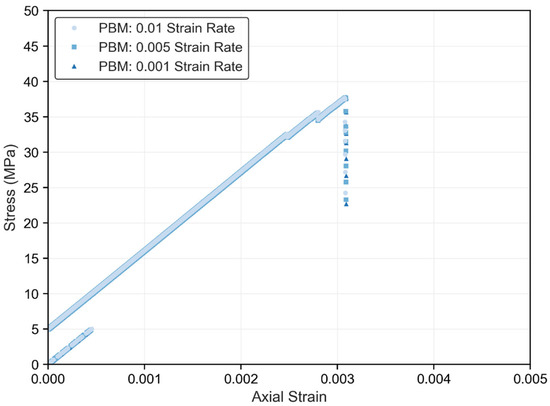
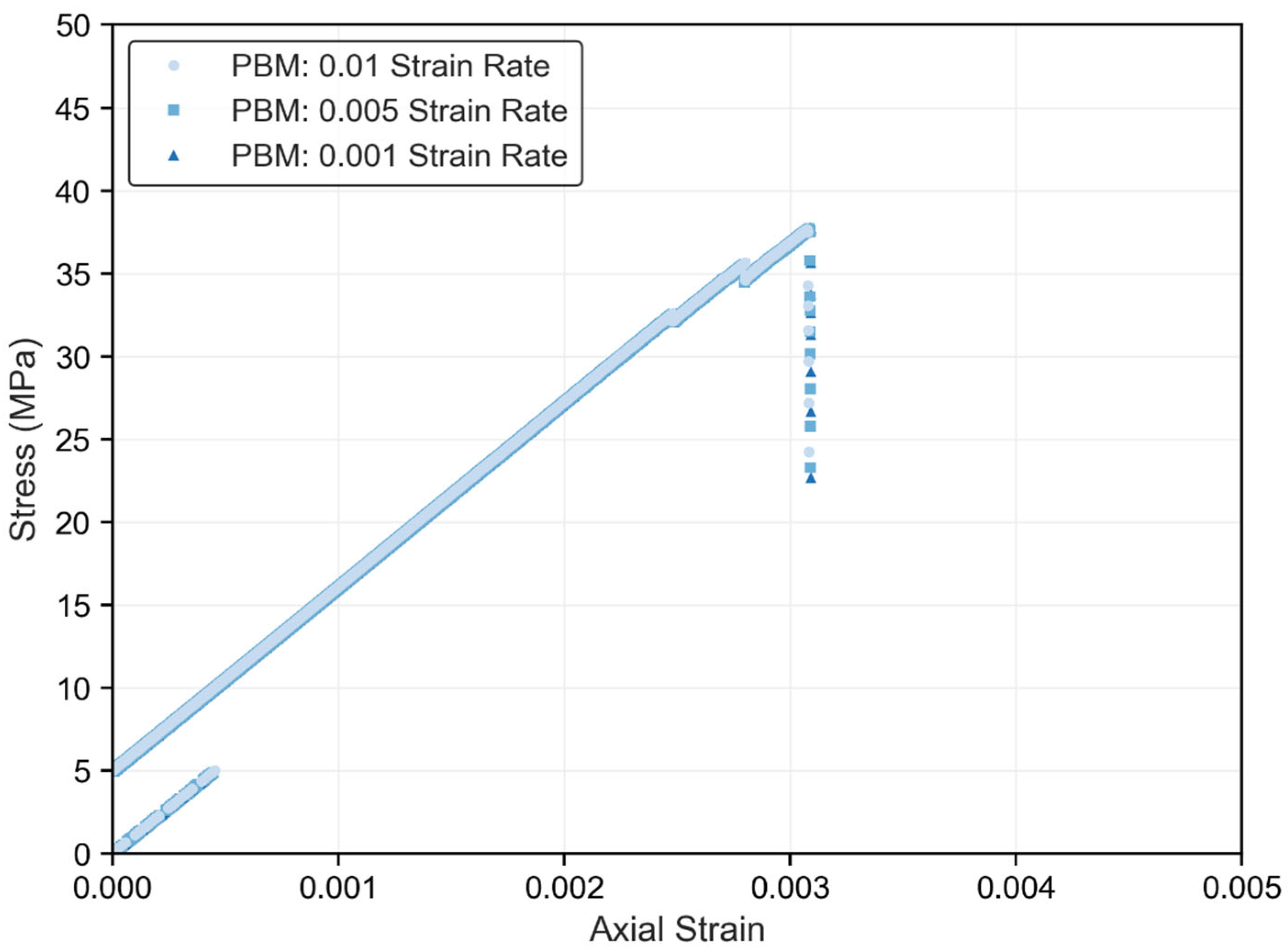
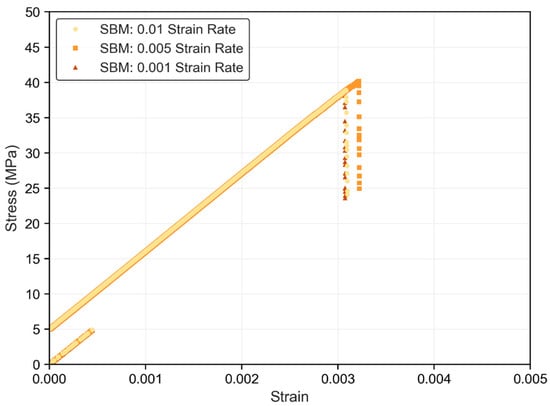
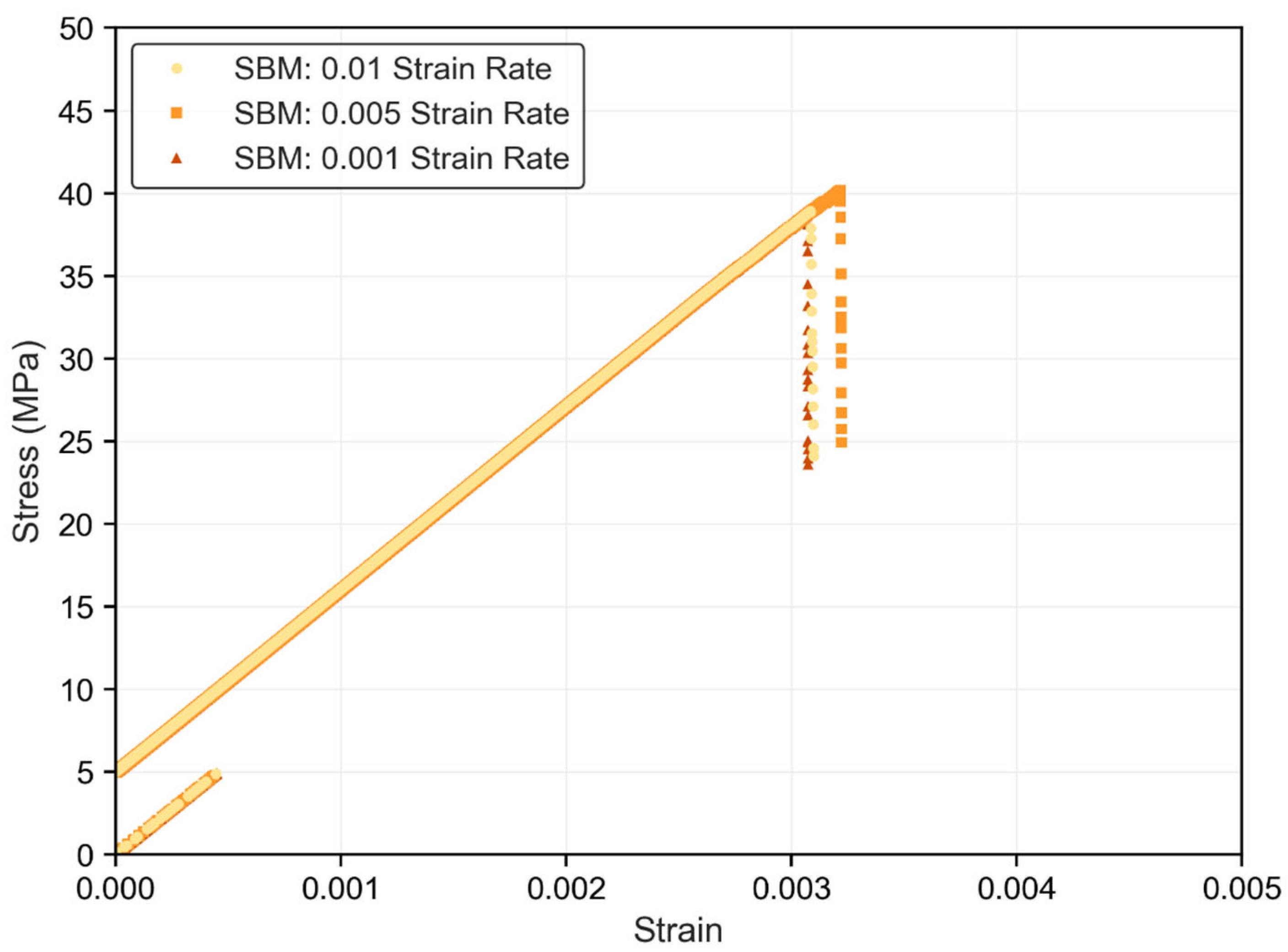
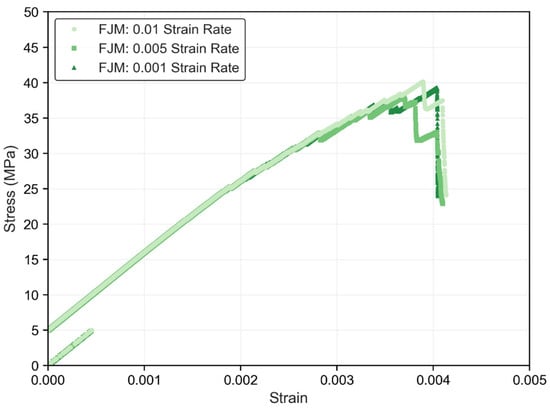
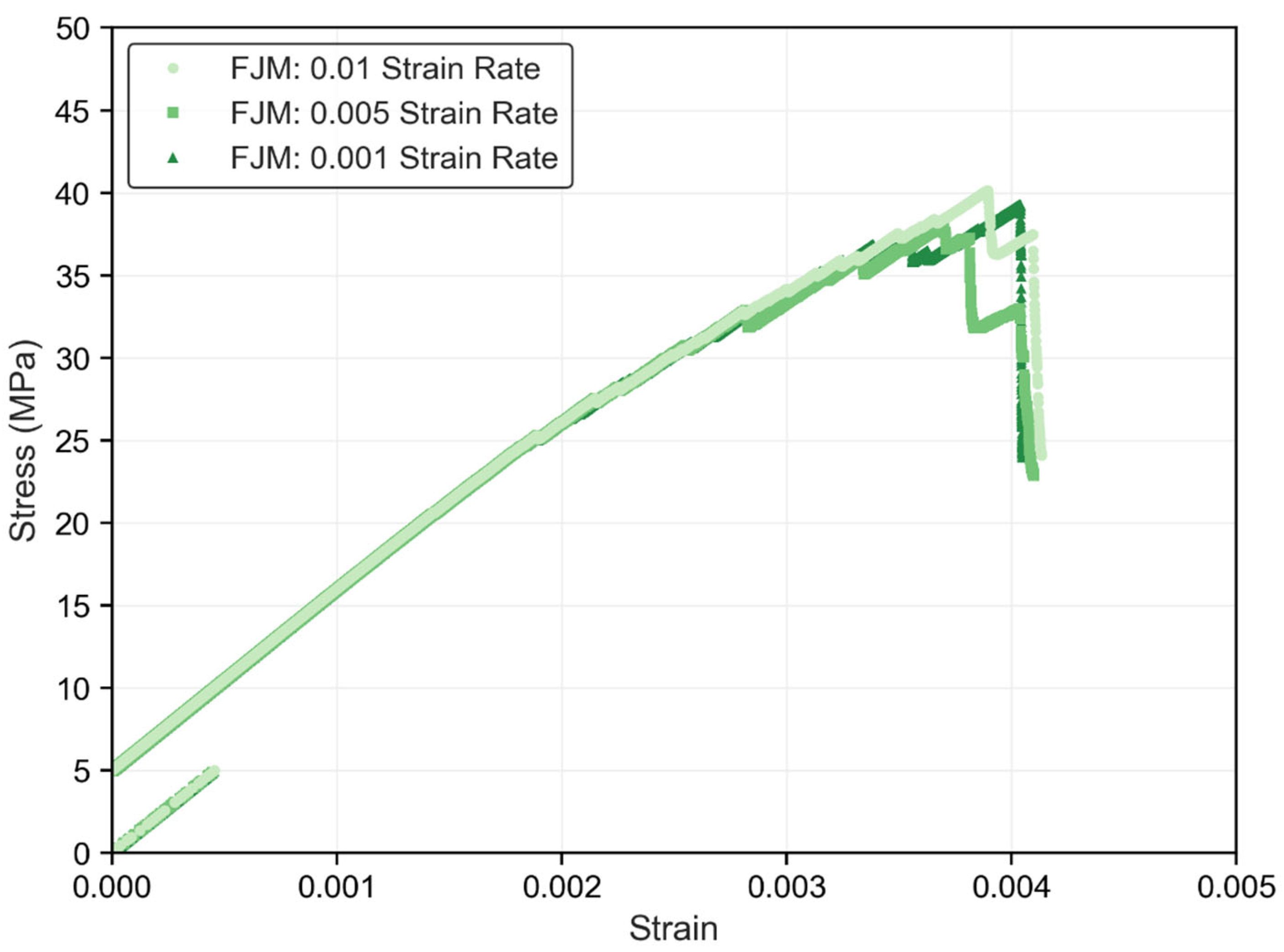
Across all three contact models, the initial linear elastic portion of the stress–strain curves remains remarkably consistent regardless of the applied strain rate. The nearly identical slopes at 0.01, 0.005, and 0.001 s−1 strongly demonstrate that the calibrated Young’s modulus is fundamentally rate-insensitive within the examined quasi-static range. This indicates that the most significant strain-rate effects manifest in peak strength and post-peak behavior, not in elastic stiffness, highlighting the robustness of the elastic response. The strain-rate effect on the stress–strain behavior of calibrated PBM, SBM, and FJM models was evaluated by applying three different strain rates under uniaxial loading conditions. For the PBM, the elastic part of the curve overlaps at rates of 0.01, 0.005, and 0.001 s−1, indicating a rate-insensitive stiffness of the model. Peak stress is reached at an axial strain of ≈0.003, with values around 37–38 MPa. After the peak, stress drops steeply with little additional strain, reflecting a brittle, localization-dominated response. Differences between 0.005 and 0.001 s−1 are minor in the peak region, while the 0.01 s−1 series shows only the early elastic segment due to its limited range. In PBM, a change in strain rate causes the stress drop to occur after the peak, which indicates a brittle and localized response (Figure 7). For the SBM, stress–strain curves seem unaffected by the change in strain rate and show stable modulus for all models (Figure 8). However, with decreasing strain rate, particularly at 0.005 s−1, a 3–4 MPa increase in peak strength was observed, unlike PBM, and failure occurred at approximately 40 MPa. After the peak, stress decreases gradually in stepwise drops, indicating distributed damage and mixed tensile–shear cracking rather than a single localized failure seen in PBM and SBM. The strain rate effect seems modest, with small shifts in peak level seen (the 0.005 s−1 series is slightly higher, the 0.001 s−1 series is slightly lower), while the main variation is in the extent and slope of the post-peak tail of the model. Overall, FJM sustains deformation over a wider strain interval and exhibits the least brittle post-peak response among the three models (Figure 9).
Figure 7.
Stress–strain curves of the PBM model at strain rates 0.01, 0.005, and 0.001 s−1.
Figure 8.
Stress–strain curves of the SBM model at strain rates 0.01, 0.005, and 0.001 s−1.
Figure 9.
Stress–strain curves of the FJM model at strain rates 0.01, 0.005, and 0.001 s−1.
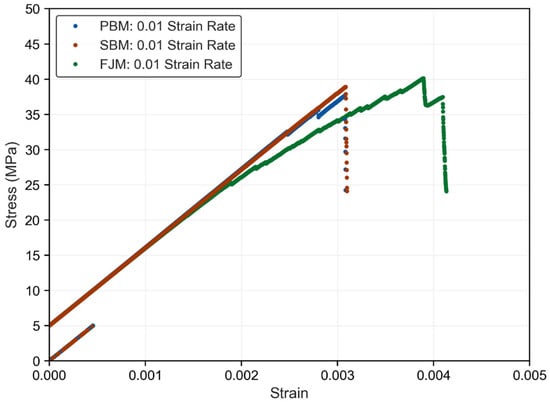
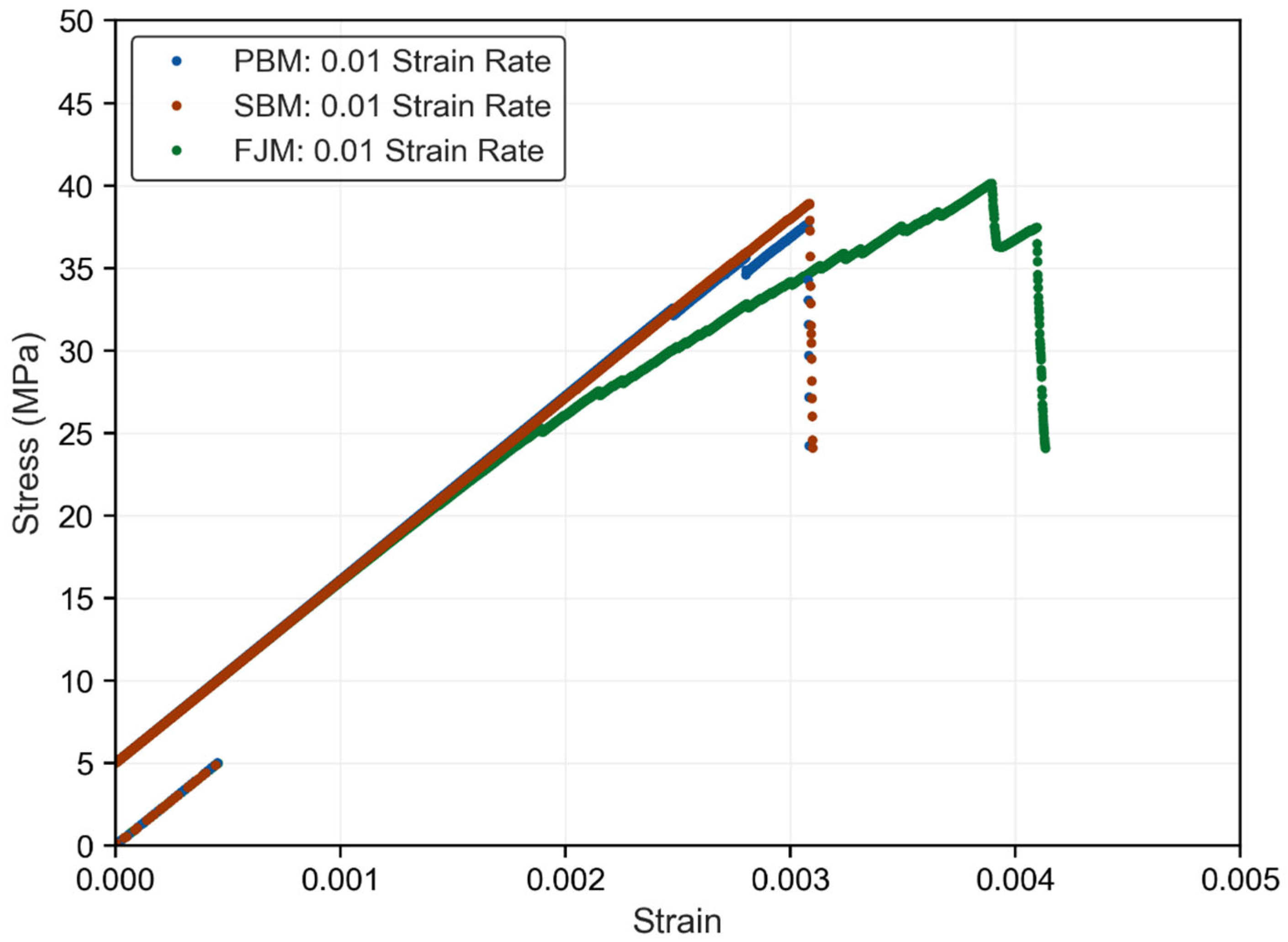
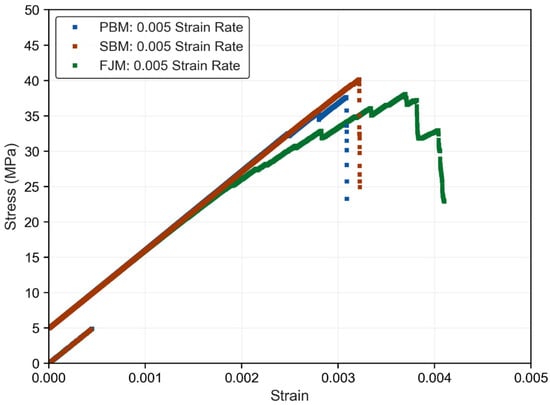
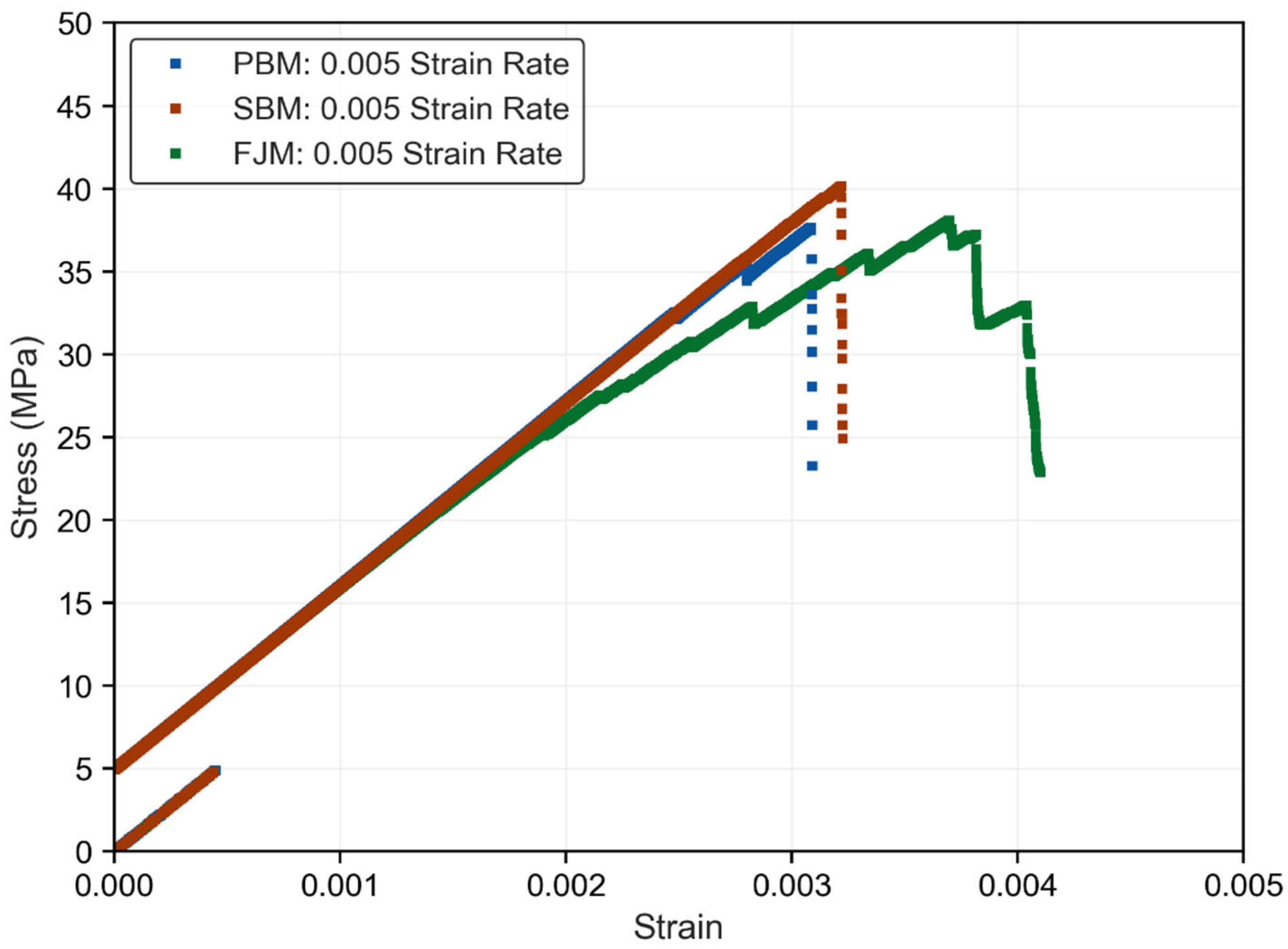
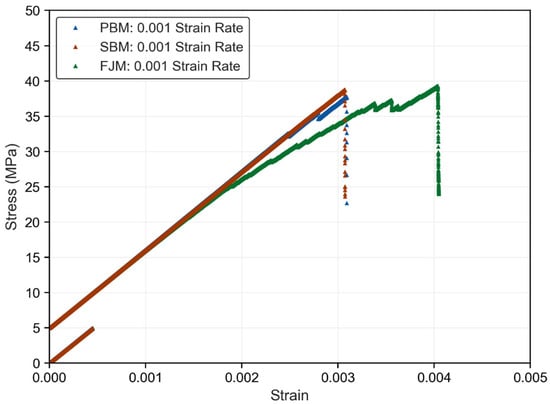
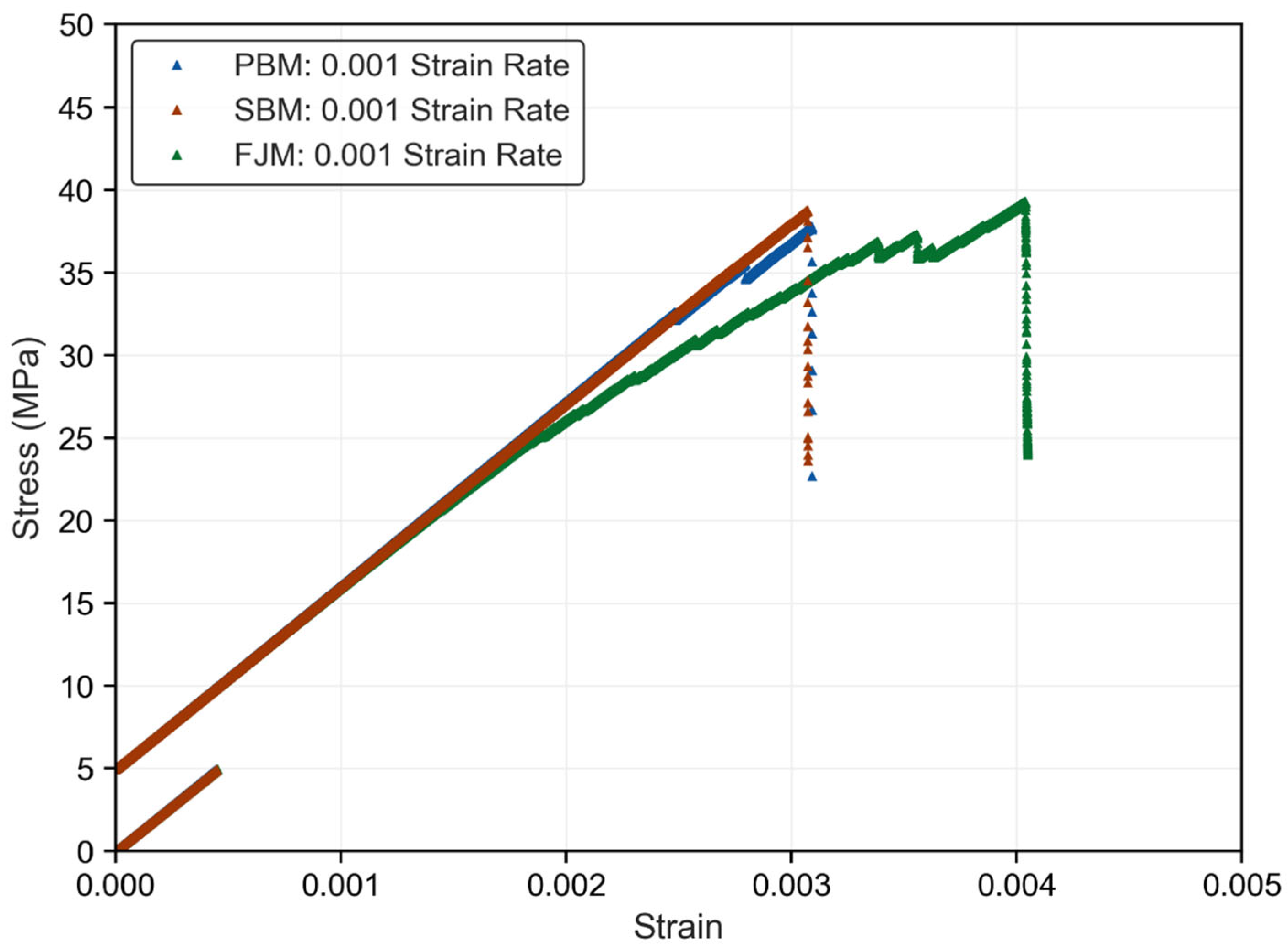
Cross-model comparisons are also carried out to better understand the strain-rate effect on model behavior and response to the uniaxial loading (Figure 10, Figure 11 and Figure 12). At each rate, the initial elastic part of the stress–strain curve for PBM, SBM, and FJM nearly overlaps, indicating that the calibrated Young’s modulus is essentially insensitive to loading rate. Differences between models appear close to peak and, more strongly, in the post-peak part of the curve, where the character of softening is controlled by the contact law of the contact model. At the strain rate of 0.01 s−1, PBM shows a lower peak (mid-30 MPa) reached near strain of 0.003, followed by an abrupt drop, indicating a distinctly brittle response with the shortest post-peak path while SBM reaches the highest peak, about 40 MPa at strain 0.003, and then softens quickly over a narrow strain window, consistent with sudden localization after peak. However, FJM attains a peak at a larger strain with 0.004 and preserves a wider load interval than PBM and SBM, keeping post-peak behavior long and stepwise, indicating disturbed damage. For the strain rate of 0.005 s−1, PBM once again gives a slightly lower peak than the other models and fails with a drop, showing an example of a brittle, localization-dominated post-peak. SBM, unlike the PBM, maintains a higher peak around 40 MPa at 0.003 strain and exhibits a short softening behavior after the peak. FJM exhibits a different response to strain rate compared to PBM and SBM. It reaches its peak at a higher strain and maintains deformation over the broadest strain range; its long post-peak tail is the most pronounced among the models. At the lowest strain level, PBM exhibits the lowest peak and the sharpest stress decline, with only a brief post-peak segment, whereas SBM displays a short softening phase, indicating limited rate sensitivity in peak magnitude. FJM shows a modest rise in peak stress and larger strains, with prolonged post-peak behavior, extending deformation until failure.
Figure 10.
Stress–strain curves of calibrated PBM, SBM, and FJM at a strain rate of 0.01 s−1.
Figure 11.
Stress–strain curves of calibrated PBM, SBM, and FJM at a strain rate of 0.005 s−1.
Figure 12.
Stress–strain curves of calibrated PBM, SBM, and FJM at a strain rate of 0.001 s−1.
Overall, the post-peak failure response differs systematically among the three contact models. PBM demonstrates the most brittle behavior after the peak, with a sharp stress decline and a brief softening phase, indicative of highly localized shear failure. SBM exhibits an intermediate response, showing a slightly more gradual and longer post-peak segment, linked to limited distributed damage around the main shear band. In contrast, FJM appears the least brittle, maintaining residual strength over a broader strain range and developing a more extensive damage zone. Its prolonged, stepwise post-peak tail indicates a more dispersed failure process.
3.2. Crack Evolution Under Different Strain Rates
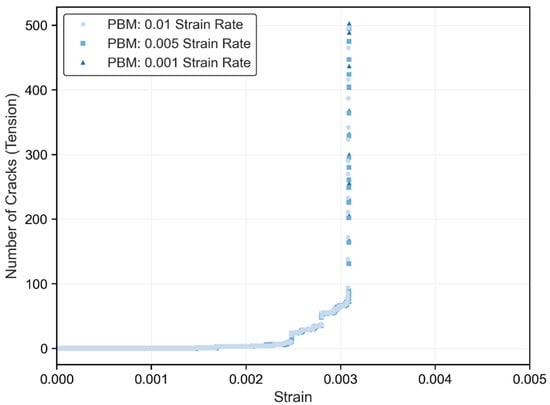
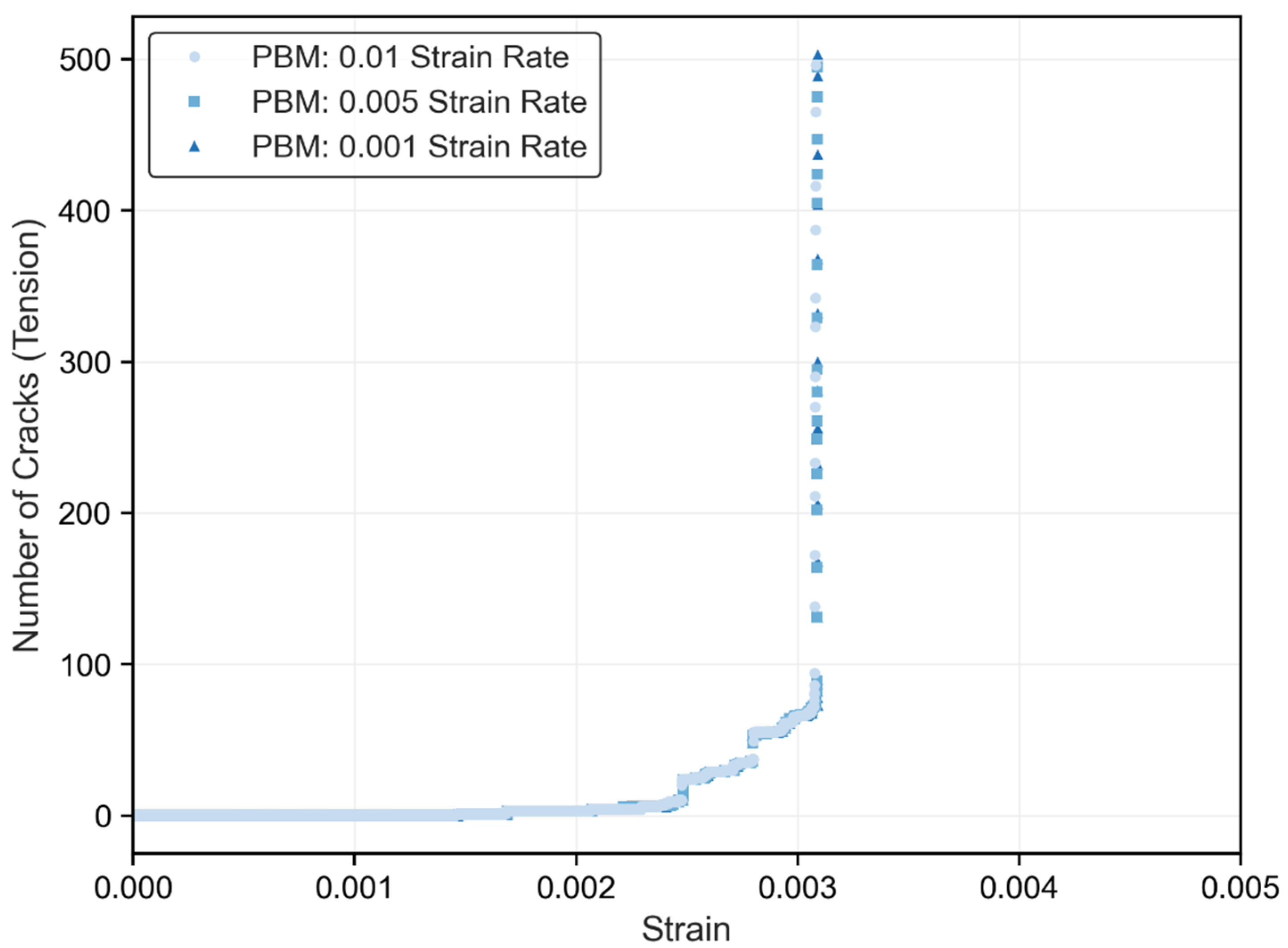
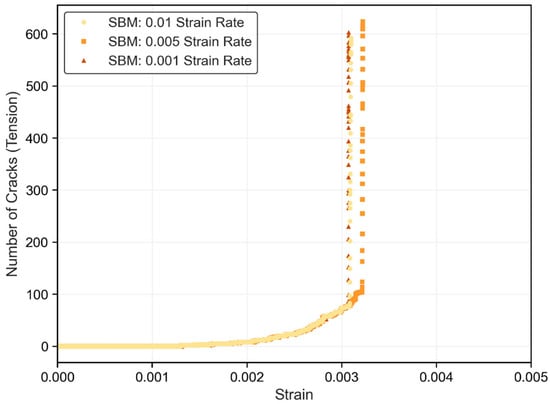
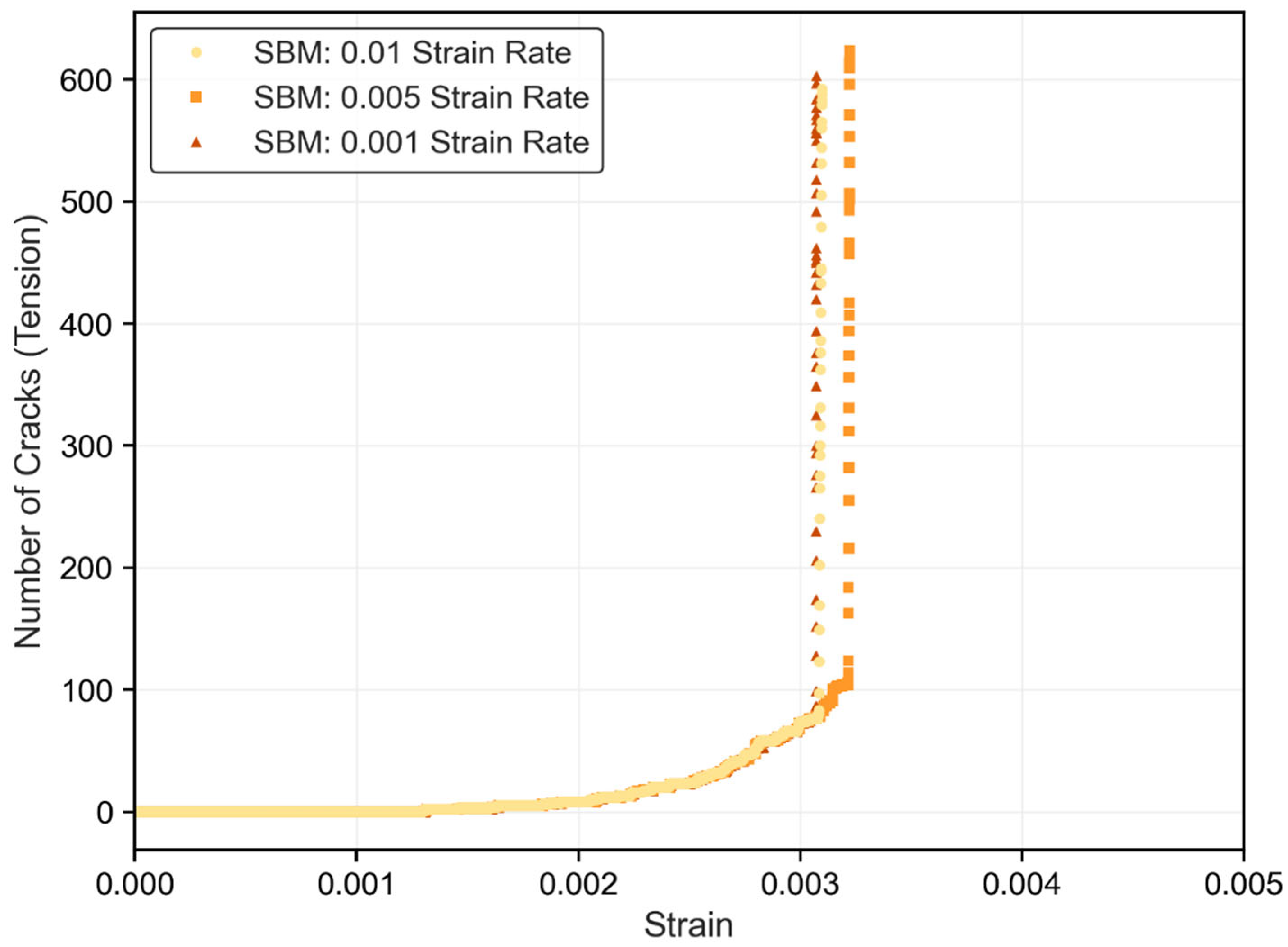
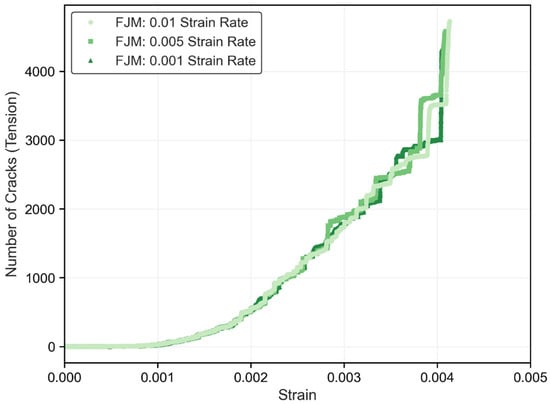
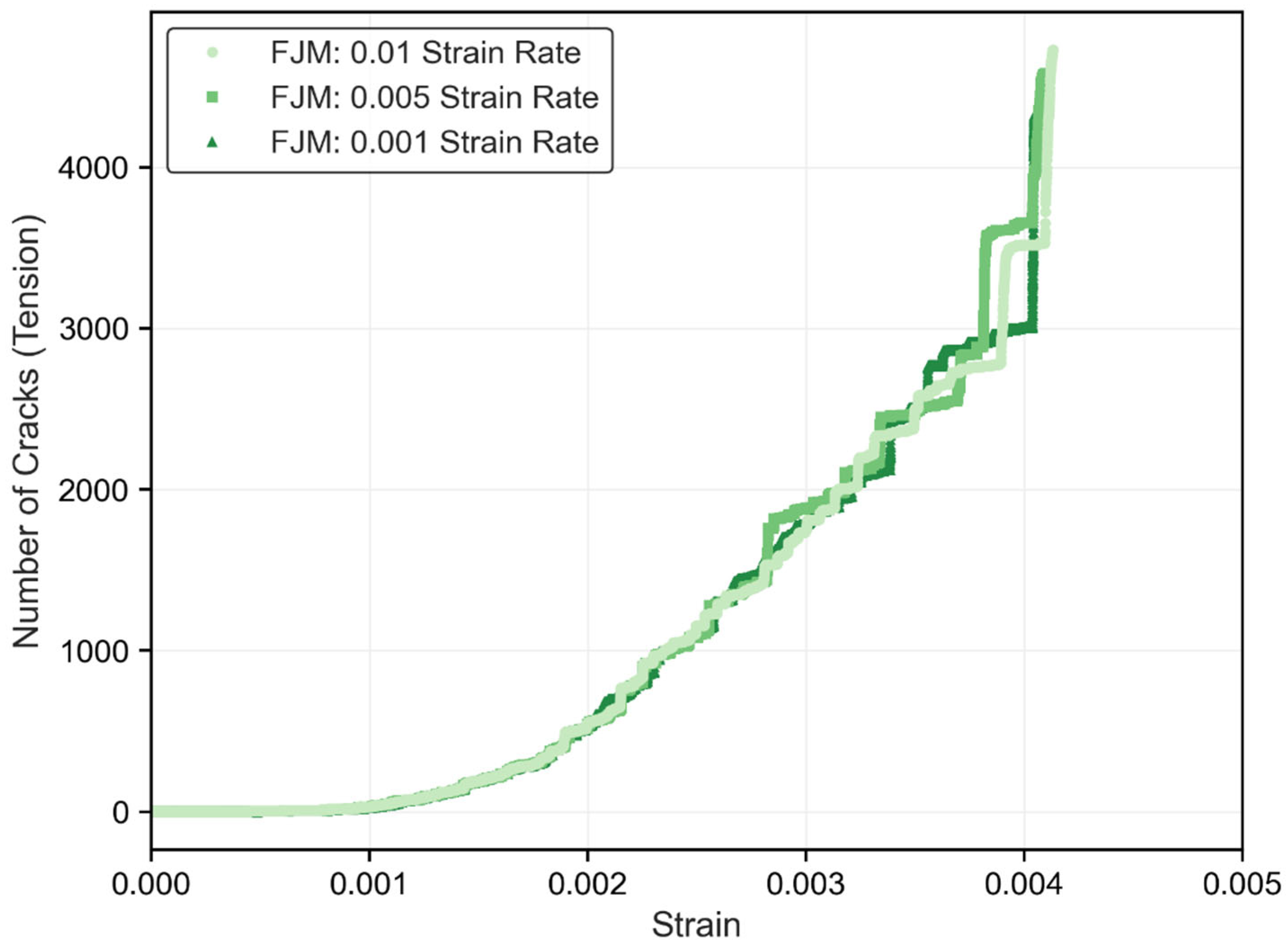
Crack counts at different strain rates were examined to better understand the damage accumulation in the calibrated models under uniaxial loading. Shear cracking is generally negligible, except in the late stages of FJM immediately prior to failure, so the discussion is confined to the relationship between strain rate and tensile cracking. For clarity, the curves were interpreted separately within each model by itself. For the PBM, tensile cracking remains scarce through the elastic part of the loading and then rises sharply in a narrow strain window around peak load. Post-peak, the curve saturates quickly within a small strain, indicating rapid localization and limited additional distributed damage. PBM model’s cracking behavior seems independent from the strain rate as long as the quasi-static conditions are kept (Figure 13). Tensile cracking begins earlier and increases more gradually at SBM than in PBM. A broader peak region can be seen with continuation, moderate crack growth into the post-peak stage. The distinction between the strain rates is small to moderate over most of the curve, which indicates a more distributed damage and smoother softening behavior (Figure 14). It can also be stated that the accumulation pattern indicates that failure proceeds by progressive microcracking rather than an abrupt crack burst. However, in FJM, tensile cracking onsets early and is sustained over a wider strain interval, which leads to a longer post-peak failure (Figure 15). Strain rate dependence is clearer in FJM than in PBM and SBM, especially at the end of the elastic to the post-peak region, consistent with progressive and spatially distributed damage. It is also noted that the extended crack accumulation indices the mixed-mode cracking rather than a single localization event leading to the sudden failure. Considering all the models, the initiation phase of cracking is only weakly strain rate dependent, whereas peak and post-peak behavior show the clearest difference. PBM exhibits the most abrupt, high-density crack accumulation, SBM shows a gradual and steady increase, and FJM sustains damage over the widest strain range.
Figure 13.
Crack numbers under different strain rates for PBM.
Figure 14.
Crack numbers under different strain rates for SBM.
Figure 15.
Crack numbers under different strain rates for FJM.
3.3. Failure Patterns of the Models Based on Strain Rate Variations
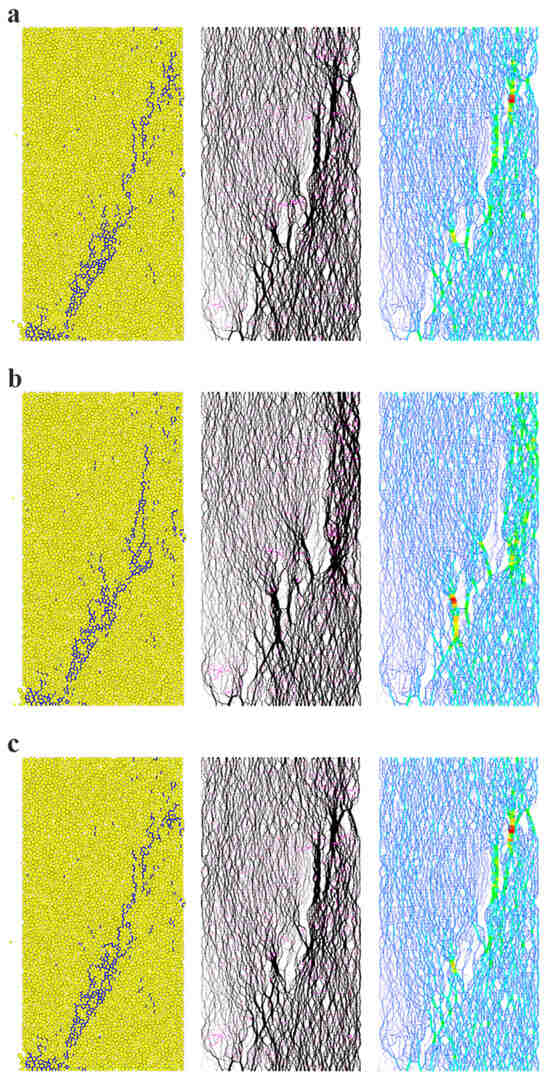
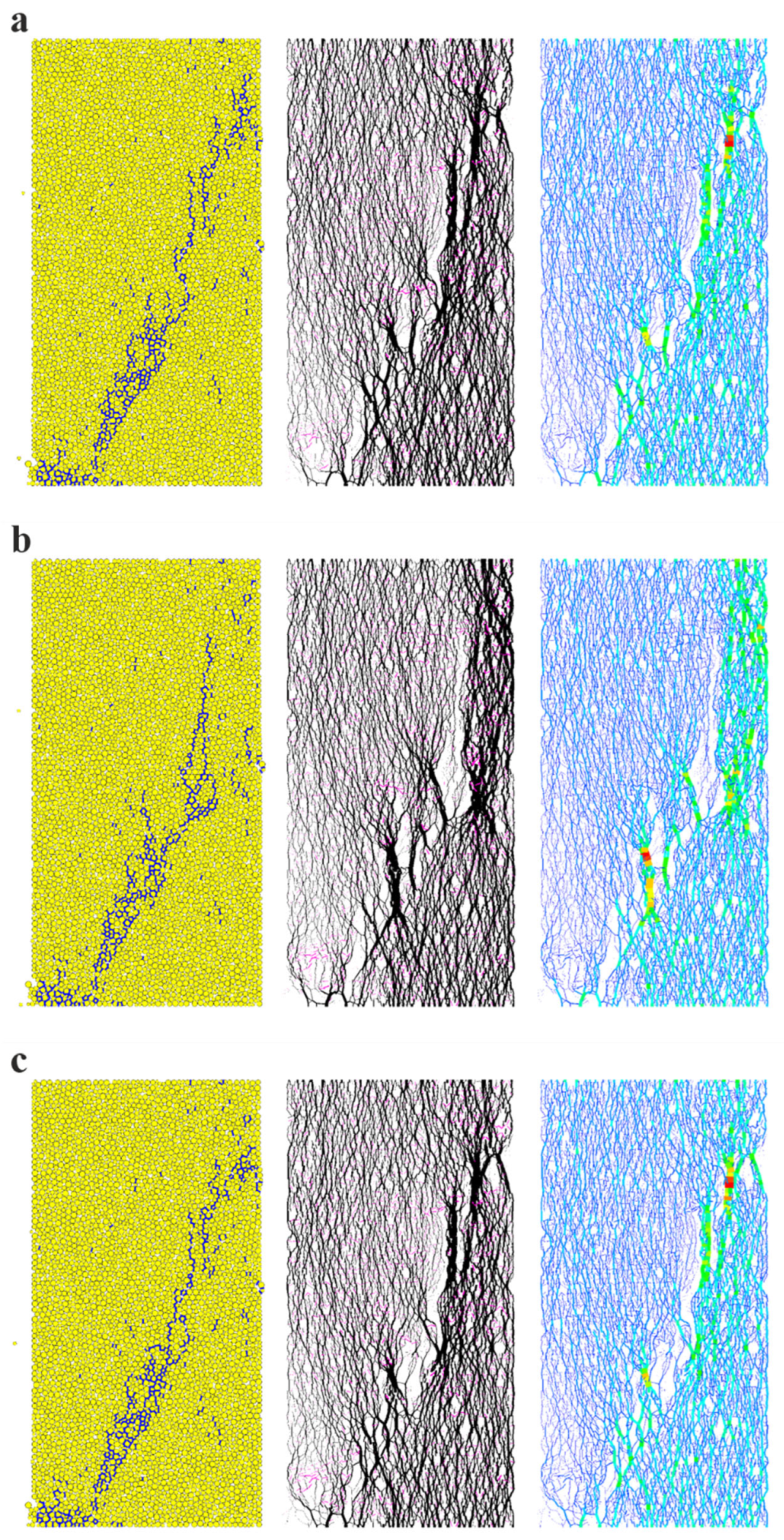
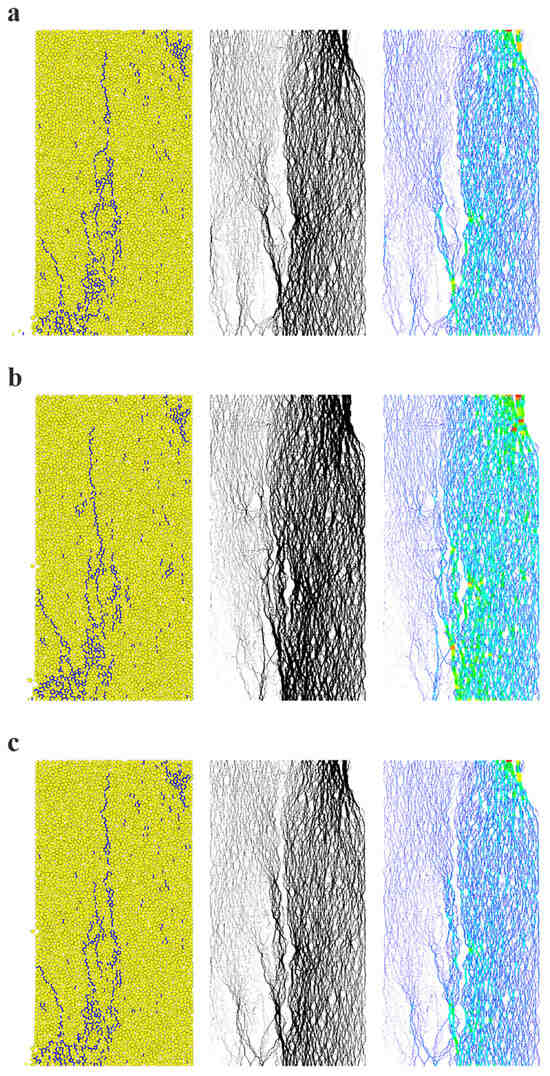
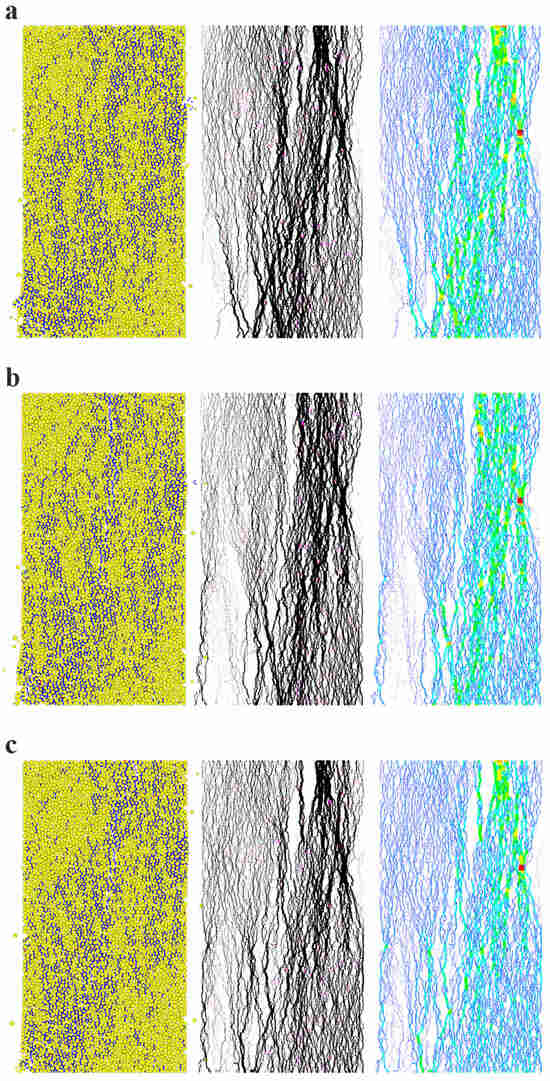
Failure patterns were evaluated at post-failure for three strain-rate cases for PBM, SBM, and FJM. Interpretation was based on three aspects: the spatial distribution of tensile and shear cracks, the intensity of contact force chains, and the magnitude field of contact forces. These parameters were taken into consideration to understand the crack initiation, coalescence, loading path, and cracking relationship, as well as the zones of stress concentration. Considering all strain rate variations applied to PBM, in general, failure is governed by a single, persistent inclined fracture formed by the rapid coalescence of tensile cracks (Figure 16). At the macroscopic level, the stress–strain curve remains nearly linear until microcracking begins, although tensile microcracks start to form sparsely early on and then grow quickly within a narrow strain range near the peak stress. The contact-force chain maps showed a strongly columnar load path that remained highly aligned up to peak and then collapsed abruptly across the forming band; at 0.005, the column appeared most continuous immediately prior to failure, consistent with the relatively higher peak stress, whereas at 0.01 and 0.001, a slightly wider process zone preceded collapse. The contact-force magnitude fields are concentrated along the fractures, which shows sharp localization and limited stress redistribution following the peak stress. A brittle, localization-dominated response was observed in PBM. Early tensile activity was small, increasing near the peak stress, after which cracks coalesced abruptly. Post-peak deformation remained confined to a narrow band with negligible shear. For the SBM, damage accumulated through tensile fractures only, with no shear cracks. The failure zone developed as a quasi-planar band with frequent tensile splays, which broadened the affected zone relative to the PBM (Figure 17). Tensile activity was initiated in the early stages of loading and increased more gradually, leading to a broader peak region, and continued with post-peak accumulation. At lower strain rates, the primary fractures developed straighter and denser at peak stress, consistent with the slightly higher peak strength observed for this intermediate rate. In contrast, at strain rates of 0.01 and 0.001, a modest widening of the process zone, accompanied by more off-band tensile microcracks, was observed. The contact-force chain exhibits a reticulated network that reorganizes in stages rather than collapsing in a single event, and the contact-force magnitude displays elevated but more diffusely distributed clusters over a wider zone. Overall, a moderate, distributed softening was observed throughout the model, with tensile cracks gradually linking up and load paths shifting slowly. SBMs strain-rate response is generally consistent across loading conditions, with a slight peak strength increase of 0.005 s−1. This minor deviation is not seen as a systematic rate effect but likely relates to the soft-bonded model’s structure. Unlike PBM, which fails suddenly, and FJM, which spreads damage over a contact surface, SBM features a gradual softening zone before bond breakage. This softening can make crack linking more sensitive to strain rate, causing small stress variations. These differences fall within typical bonded-particle variability and do not change the SBM failure interpretation. For FJM, considering different strain rates, a mixed-mode pattern was observed, dominated by tensile fractures with limited local shear at the linkage points (Figure 18). Tensile cracking began early and continued over a wide strain interval, resulting in a wider zone and a long post-peak. At a strain rate of 0.001, the damage zone was widest, corresponding to larger strains. For 0.005, the damage zone was smaller but still more distributed than in PBM or SBM. At 0.01, several tensile fractures linked progressively before failure. The force-chain network appeared to be multi-path rather than a single column, as seen at PBM and SBM. The contact-force magnitude field formed a corridor with patches of high values, indicating that stress was spread over a broad area rather than concentrated in a single path. Overall, FJM exhibited the most widespread damage among the models, characterized by progressive tensile growth, occasional local shear at crack linkages, and moderate sensitivity to strain rate. The visualizations in Figure 16, Figure 17 and Figure 18 depict the post-failure stage, which occurs after the PFC simulation has fully concluded and the specimen is no longer able to bear load.
Figure 16.
Fracture patterns, force chains, and contact magnitude variations for PBM ((a): 0.01, (b): 0.005, (c): 0.001), The yellow circles represent the particles, while the dark-blue lines indicate tensile cracks. The black lines show the contact force chains, and their thickness is proportional to the transmitted force, with thicker lines indicating higher force. The color scale from red to dark blue illustrates the contact-force magnitudes, where red shows the highest values and dark blue the lowest.
Figure 17.
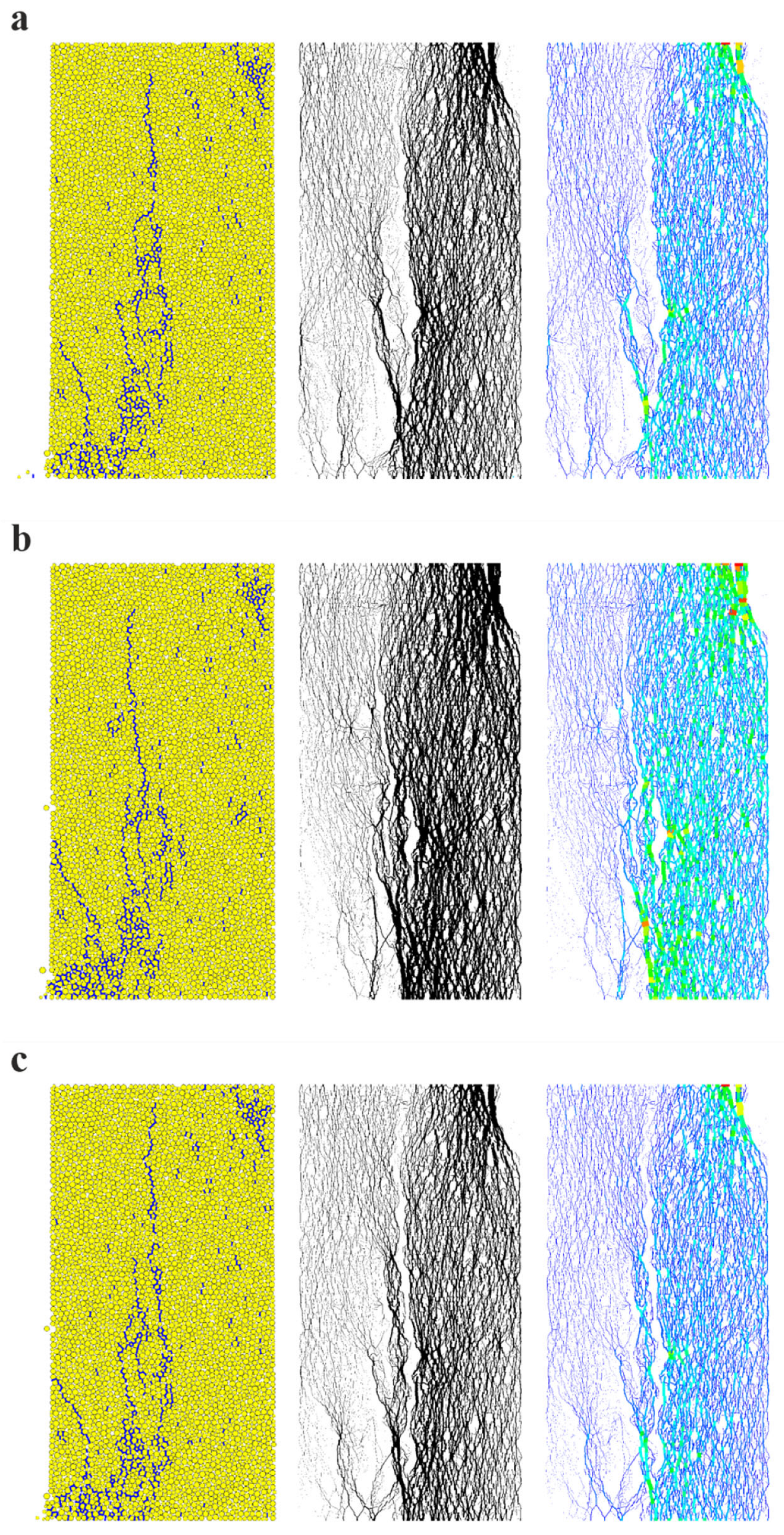
Fracture patterns, force chains, and contact magnitude variations for SBM ((a): 0.01, (b): 0.005, (c): 0.001), The yellow circles represent the particles, while the dark-blue lines indicate tensile cracks. The black lines show the contact force chains, and their thickness is proportional to the transmitted force, with thicker lines indicating higher force. The color scale from red to dark blue illustrates the contact-force magnitudes, where red shows the highest values and dark blue the lowest.
Figure 18.
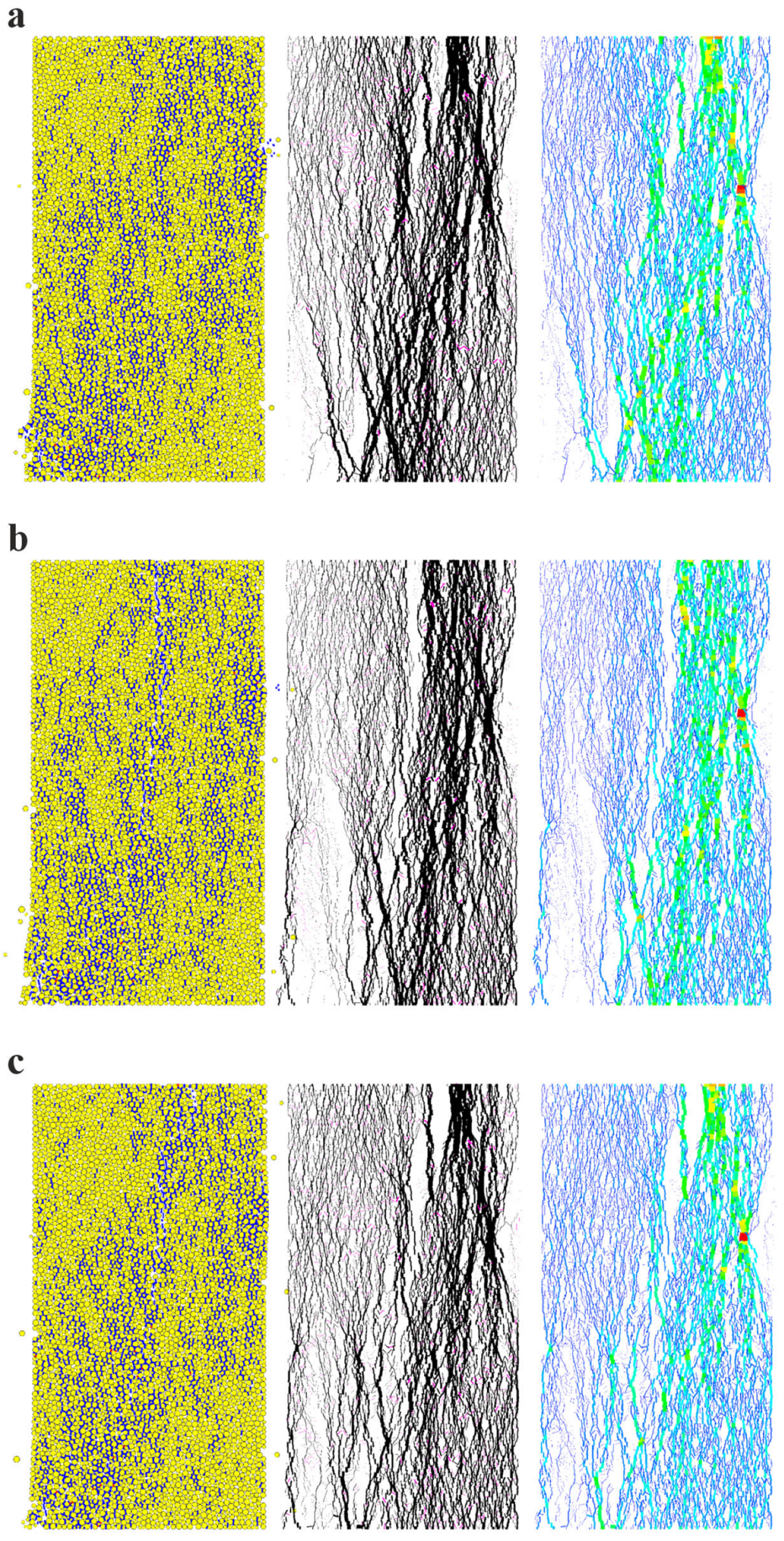
Fracture patterns, force chains, and contact magnitude variations for FJM ((a): 0.01, (b): 0.005, (c): 0.001), The yellow circles represent the particles, while the dark-blue lines indicate tensile and red line indicate share cracks. The black lines show the contact force chains, and their thickness is proportional to the transmitted force, with thicker lines indicating higher force. The color scale from red to dark blue illustrates the contact-force magnitudes, where red shows the highest values and dark blue the lowest.
As a result of strain rate variations in terms of failure patterns of the PBM, SBM, and FJM, failure patterns were consistent with the constitutive styles of the models. PBM showed a brittle, highly localized zone formed by rapid coalescence of tensile fractures, with no shear and little post-peak spreading. SBM exhibited moderately distributed softening, again without shear, where tensile fractures linked earlier and the load path reorganized in stages. FJM produced the most widespread damage, characterized by early, sustained tensile growth and limited local shear at the linkage points. In the FJM model, the damage zone is consistently more extensive than in PBM and SBM across all three strain rates. At 0.01 s−1, a wide band of mixed tensile and shear microcracks forms around the main shear plane, with damage extending well beyond the narrow localisation band observed in PBM. At 0.005 and 0.001 s−1, the failure plane shape remains similar, but the damaged area becomes thicker, and microcrack density increases, with cracks spreading over a larger section of the specimen height. This demonstrates that FJM maintains a broad, surface-based damage zone over the studied quasi-static strain rates, with only slight changes in crack extent and intensity as the strain rate varies. To complement the qualitative analysis, a brief quantitative evaluation of damage patterns was conducted using pixel-based measurements directly extracted from post-failure crack maps. By estimating the number of fractured particles in the damaged area and converting pixel distances into particle diameters, the width and extent of the damage zone were approximated for each model. In PBM, only about 1–2% of the particles are affected within a narrow band approximately 2–3 particle diameters wide. In SBM, roughly 3–4% of particles are within a broader corridor of 4–6 diameters. Meanwhile, FJM exhibits the widest and most diffuse zone, with 6–9% of particles located within a band spanning approximately 10–14 diameters. These pixel-based measurements provide straightforward quantitative support for the observed differences in localization behavior, without introducing methodological complexity. Although the specimens are nominally homogeneous bonded-particle assemblies, tensile cracks can nucleate during uniaxial compression, mirroring laboratory observations. Micro-scale effects—such as variations in contact stiffness, local reductions in lateral confinement, and force-chain buckling—generate small tensile stress zones within the overall compressive field. These lead to extensional microcracks similar to wing cracks in real rocks, explaining why tensile cracking occurs naturally in bonded-particle simulations under compression.
4. Discussion
In this study, the strain-rate effect on the behavior of different bonded-particle contact models in PFC was examined under three different quasi-static rates: 0.01, 0.005, and 0.001 s−1, respectively, using three calibrated models based on laboratory test results of the siltstone in Cebeciköy, Istanbul, Türkiye. The aim was to differentiate strain-rate effects from constitutive variations to clearly identify model-dependent behaviors across the pre-peak, peak, and post-peak stages.
In all scenarios, PBM, SBM, and FJM displayed a shared elastic region that showed minimal sensitivity to changes in strain rate. The calibrated Young’s modulus was accurately reproduced within acceptable tolerances, and the minor differences observed in this region are within the typical numerical variability of quasi-static DEM simulations. The significant strain-rate effects mainly appeared in the peak and post-peak phases. At the intermediate rate of 0.005 s−1, a marginally higher peak strength and a more confined process zone were observed compared to 0.001 and 0.01 s−1, while the elastic stiffness stayed essentially the same. These observations align with laboratory-based quasi-static rate effects, where strength may increase slightly with strain rate while the elastic modulus remains nearly constant. Additionally, they agree with DEM findings indicating that limited strengthening can occur when relaxation times decrease, without causing inertial artifacts [43,44].
A methodological gap in prior bonded-particle model studies was addressed by placing PBM, SBM, and FJM under a single calibration baseline and identical loading histories, allowing for the separation of rate effects from contact-law effects. Under these controlled conditions, post-peak shape and damage localization width were shown to depend more on the contact law than on the small strain rate changes applied. This outcome seems to be in parallel with the mechanism reported in previous studies about contact models and PFC [17,18].
Crack growth was found to be tensile-dominated. In PBM and SBM, failure behavior was controlled by tensile cracks alone, regardless of the differences in strain rate. Tensile nucleation initially emerged sparsely, then intensified prior to the peak and coalesced into a localized band; accumulation after the post-peak was modest in PBM and more gradual in SBM. In FJM, a mixed-mode pattern was observed with tensile cracking remaining dominant, but limited local shear appeared at linkage points, and the process zone broadened as the rate decreased (widest at 0.001 s−1). These trends are consistent with reported strain rate effects in rock and bonded-particle studies. Tensile microcracking governs quasi-static failure, while increasing the rate mainly shifts the timing and compactness of coalescence rather than the elastic stiffness [45,46].
The unique post-peak behaviors of the three models originate from their underlying mechanics. PBM experiences sudden bond failure, resulting in a sharp peak, an immediate drop in stress, and a narrow-inclined damage band. SBM exhibits distributed softening with earlier tensile activity, staged force-chain reorganizations, and a wider damage zone. This is due to its gradual cohesive softening zone, which allows contacts to unload gradually and makes the crack-linking process more sensitive to the loading rate. FJM shows the most distributed and strain-rate-dependent post-peak behavior. Its surface contact structure, made of multiple micro-facets that break progressively, creates a wide process zone. Since stress redistribution among these facets relies on the rate of local stress unloading and migration, its post-peak response is more sensitive to strain rate compared to PBM or SBM.
A final consideration is the tensile strength bias present in PBM and SBM. As explained in Section 2.2, these models tend to overestimate tensile strength when calibrated to UCS because the same microparameters influence both tensile and compressive bond failure. This overstrength could increase the apparent role of tensile cracking in PBM and SBM. However, two factors lessen this impact in the analysis. First, tensile-dominated failure under uniaxial compression is well-supported by laboratory experiments and DEM studies, so it is not solely an artifact of bond modeling. Second, the comparison remains valid because all models underwent the same calibration procedures and experienced identical boundary conditions and strain-rate histories. Consequently, although PBM and SBM might exaggerate tensile effects quantitatively, the qualitative differences among PBM, SBM, and FJM, especially the higher rate sensitivity of the FJM post-peak response, are due to their inherent constitutive structures, not calibration bias.
This study’s results are specific to the fine-grained, low-porosity siltstone used for calibration. Rocks with very different microstructures—such as high-strength crystalline rocks or highly porous sandstones—may exhibit different crack-initiation thresholds, fracture behaviors, and strain-rate responses under the same bonded-particle models. Therefore, the comparison of PBM, SBM, and FJM here should be viewed in the context of rocks with similar grain-scale bonding and deformation features, rather than extended to all lithologies.
5. Conclusions
Choosing the right strain rate is important in simulations such as PFC, where the interaction between particles significantly influences the overall behavior. The applied strain rate determines both the numerical stability and the degree to which the model remains representative of quasi-static laboratory behavior. The three bonded-particle models, PBM, SBM, and FJM, were calibrated using the same procedure and laboratory results obtained from a selected siltstone. Initial stiffness was found to remain essentially stable across different strain rates, while it appears to be more effective, especially in the pre- and post-peak ranges. The intermediate rate (0.005 s−1) tended to be associated with slightly higher peak capacity and a more compact damage zone than the lower and higher rates. Tensile cracking governed the failure in PBM and SBM, while limited local shear appeared only in FJM, where the process zone broadened at a slower rate. Failure patterns within this perspective were primarily controlled by the type of contact model.
In PBM, within the focused quasi-static range, higher strain rates intensified localization and caused a steeper post-peak decline, along with a slight increase in apparent peak strength due to limited microcrack relaxation and inertia effects. Lower strain rates allowed more precursory cracking and marginally broader dilation before collapse, but residual capacity remained minimal in all cases. Compared to the PBM, SBM showed moderate rate sensitivity to the variations, at higher rates the damage zone narrowed and softening steepened, whereas lower rates promoted more distributed yielding and a clearer residual plateau. Peak strength varied little, but post-peak shape and energy dissipation were rate-dependent. Unlike the other models, FJM exhibited the strongest response to strain rate variation in post-peak evolution, with higher rates delaying full coalescence and prolonging load-carrying capacity, resulting in a longer post-peak tail. In contrast, lower rates favored earlier linkage of mixed-mode cracks and faster stiffness loss. Peak and stiffness remained realistic across rates, but the tension–shear interplay and branching density shifted with rate.
Across models, variations in strain rate primarily modulated localization width and the post-peak slope rather than dramatically changing peak strength. PBM for peak-driven, rapidly localizing responses; SBM when residual capacity and distributed softening at slow rates matter; FJM for progressive, mixed-mode damage with rate-sensitive post-peak behavior. For practical use of PFC models, it will be beneficial to conduct triaxial validation, broaden the strain-rate window to cover creep and impact, model heterogeneity/DFN explicitly, and use three-dimensional models.
The conclusions of this study are relevant to the fine-grained, low-porosity siltstone used for calibration but should not be directly applied to lithologies with significantly different microstructures. Future research could include triaxial validation, expanding the strain-rate range to include creep and impact regimes, explicitly modeling heterogeneity or DFN structures, and implementing these in fully three-dimensional bonded-particle assemblies.
Author Contributions
Conceptualization, Ö.Ü. and E.Z.; Methodology, Ö.Ü. and E.Z.; Software, E.Z.; Validation, E.Z.; Formal analysis, E.Z.; Investigation, Ö.Ü. and E.Z.; Resources, Ö.Ü.; Data curation, Ö.Ü. and E.Z.; Writing—original draft preparation, Ö.Ü. and E.Z.; Writing—review and editing, Ö.Ü. and E.Z.; Visualization, E.Z.; Supervision, Ö.Ü.; Project administration, Ö.Ü. and E.Z.; Funding acquisition, Ö.Ü. and E.Z. All authors have read and agreed to the published version of the manuscript.
Funding
This research was funded by TÜBİTAK Project, 116Y349 (PI: Ömer Ündül) and Kütahya Dumlupınar University BAP Project 2020-09 (PI: Enes Zengin).
Institutional Review Board Statement
Not applicable.
Informed Consent Statement
Not applicable.
Data Availability Statement
The data presented in this study are available on request from the corresponding author due to privacy.
Conflicts of Interest
The authors declare that they have no conflicts of interest.
References
- Liang, W.G.; Zhao, Y.S.; Xu, S.G.; Dusseault, M.B. Effect of Strain Rate on the Mechanical Properties of Salt Rock. Int. J. Rock Mech. Min. Sci. 2011, 48, 161–167. [Google Scholar] [CrossRef] [Scilit]
- Montgomery, C.T.; Smith, M.B. Hydraulic Fracturing: History of an Enduring Technology. J. Pet. Technol. 2010, 62, 26–40. [Google Scholar] [CrossRef] [Scilit]
- Brown, E.T.; Hoek, E. Underground Excavations in Rock; CRC Press: Boca Raton, FL, USA, 1980. [Google Scholar]
- Cao, W.; Younis, R.M. Empirical Scaling of Formation Fracturing by High-Energy Impulsive Mechanical Loads. Int. J. Rock Mech. Min. Sci. 2024, 173, 105613. [Google Scholar] [CrossRef] [Scilit]
- Duan, K.; Ji, Y.; Wu, W.; Kwok, C.Y. Unloading-Induced Failure of Brittle Rock and Implications for Excavation-Induced Strain Burst. Tunn. Undergr. Space Technol. 2019, 84, 495–506. [Google Scholar] [CrossRef] [Scilit]
- Donzé, F.V.; Bouchez, J.; Magnier, S.A. Modeling Fractures in Rock Blasting. Int. J. Rock Mech. Min. Sci. 1997, 34, 1153–1163. [Google Scholar] [CrossRef]
- Ulusay, R. The ISRM Suggested Methods for Rock Characterization, Testing and Monitoring: 2007–2014; Springer: Cham, Switzerland, 2014; pp. 1–293. [Google Scholar] [CrossRef] [Scilit]
- Sano, O.; Ito, I.; Terada, M. Influence of Strain Rate on Dilatancy and Strength of Oshima Granite under Uniaxial Compression. J. Geophys. Res. Solid Earth 1981, 86, 9299–9311. [Google Scholar] [CrossRef] [Scilit]
- Lajtai, E.Z.; Duncan, E.J.S.; Carter, B.J. The Effect of Strain Rate on Rock Strength. Rock Mech. Rock Eng. 1991, 24, 99–109. [Google Scholar] [CrossRef] [Scilit]
- Okubo, S.; Hashiba, K.; Fukui, K. Loading Rate Dependency of the Strengths of Some Japanese Rocks. Int. J. Rock Mech. Min. Sci. 2013, 58, 180–185. [Google Scholar] [CrossRef] [Scilit]
- Hashiba, K.; Fukui, K. Index of Loading-Rate Dependency of Rock Strength. Rock Mech. Rock Eng. 2015, 48, 859–865. [Google Scholar] [CrossRef] [Scilit]
- Potyondy, D.O. Simulating Stress Corrosion with a Bonded-Particle Model for Rock. Int. J. Rock Mech. Min. Sci. 2007, 44, 677–691. [Google Scholar] [CrossRef] [Scilit]
- Zhang, X.P.; Wong, L.N.Y. Choosing a Proper Loading Rate for Bonded-Particle Model of Intact Rock. Int. J. Fract. 2014, 189, 163–179. [Google Scholar] [CrossRef] [Scilit]
- Liu, G.; Cai, M. Modeling Time-Dependent Deformation Behavior of Brittle Rock Using Grain-Based Stress Corrosion Method. Comput. Geotech. 2020, 118, 103323. [Google Scholar] [CrossRef] [Scilit]
- Liang, Y.; Kong, F.; Zou, Q.; Zhang, B. Effect of Strain Rate on Mechanical Response and Failure Characteristics of Horizontal Bedded Coal under Quasi-Static Loading. Geomech. Geophys. Geo-Energy Geo-Resour. 2023, 9, 52. [Google Scholar] [CrossRef] [Scilit]
- Sun, Y.; Kwok, C.Y.; Duan, K. Rate Effect of Rocks: Insights from DEM Modeling. Int. J. Rock Mech. Min. Sci. 2024, 181, 105857. [Google Scholar] [CrossRef] [Scilit]
- Potyondy, D.O.; Cundall, P.A. A Bonded-Particle Model for Rock. Int. J. Rock Mech. Min. Sci. 2004, 41, 1329–1364. [Google Scholar] [CrossRef] [Scilit]
- Potyondy, D.O. A Flat-Jointed Bonded-Particle Material for Hard Rock. In Proceedings of the 46th US Rock Mechanics/Geomechanics Symposium, Chicago, IL, USA, 24–27 June 2012; p. 10. [Google Scholar]
- Potyondy, D.O. The Bonded-Particle Model as a Tool for Rock Mechanics Research and Application: Current Trends and Future Directions. Geosystem Eng. 2015, 18, 1–28. [Google Scholar] [CrossRef] [Scilit]
- Zengin, E. Usability Assessment of Different Contact Models for Modelling the Failure Behaviour of Sedimentary Rocks Under Unconfined Stress Conditions. Yerbilimleri 2022, 43, 61–75. [Google Scholar] [CrossRef] [Scilit]
- Lom, N.; Ülgen, S.; Sakinç, M.; Şengör, A.M.C. Geology and Stratigraphy of Istanbul Region. Geodiversitas 2016, 38, 175–195. [Google Scholar] [CrossRef] [Scilit]
- Gözübol, A.M.; Aysal, N. Cebeciköy Kireçtaşı Ocaklarında Litolojik ve Yapısal Kökenli İşletme Sınırları. İstanbul Yerbilim. Derg. 2008, 21, 25–35. [Google Scholar]
- Ündül, Ö.; Tuzrul, A. The Engineering Geology of Istanbul, Turkey. IAEG 2006 2006, 392, 1–13. [Google Scholar]
- Ündül, Ö.; Çobanoğlu, B.C.; Taz, F. The Differences of Strength and Deformation Properties of Dikes and Host Rocks in the Paleozoic Sequence of Istanbul. Jeol. Muhendisligi Derg. 2018, 42, 121–142. [Google Scholar] [CrossRef] [Scilit]
- Ündül, Ö.; Çobanoğlu, B.C.; Taz, F. İstanbul Paleozoyik İstifi’ndeki Dayklar Ile Yan Kayalarının Dayanım ve Deformasyon Özelliklerindeki Farklılıklar. J. Geol. Eng. 2018, 42, 121–142. [Google Scholar] [CrossRef] [Scilit]
- Cundall, P.A. A Computer Model for Simulating Progressive Large Scale Movements in Blocky Rock Systems. In Proceedings of the Symposium of the International Society of Rock Mechanics, Nancy, France, 4–6 October 1971. [Google Scholar]
- Cundall, P.A.; Strack, O.D.L. A Discrete Numerical Moder for Granular Assemblies. Geotechnique 1979, 1, 47–65. [Google Scholar] [CrossRef] [Scilit]
- Cundall, P.A. UDEC: A Generalized Distinct Element Program for Modelling Jointed Rock; Report PCAR-I-80, Peter Cundall Associates Report; European Research Office, US Army: Washington, DC, USA, 1980; Contract, DAJA37-79-C-0548. [Google Scholar]
- Meng, Y. PFC2D Simulation on Stability of Loose Deposits Slope in Highway Cutting Excavation. Geotech. Geol. Eng. 2017, 35, 897–902. [Google Scholar] [CrossRef] [Scilit]
- Zengin, E.; Erguler, Z.A. Effect of Gap Geometries on the Crack Initiation Stress of Synthetic Rock Material. In Proceedings of the European Geosciences Union 2021, Virtual, 19–30 April 2021. [Google Scholar]
- Zhang, T.; Yu, L.; Wei, J.; Pu, H.; Zhang, Q.; Hu, L.; Mi, X. Stress Evolution in Rocks around Tunnel under Uniaxial Loading: Insights from PFC3D-GBM Modelling and Force Chain Analysis. Theor. Appl. Fract. Mech. 2024, 134, 104728. [Google Scholar] [CrossRef] [Scilit]
- Tian, Y.; Wu, Y.; Wang, H.; Li, H.; He, L.; Zhao, H. A Theory of Slope Shear Scouring and the Failure Mechanism of PFC3D on a Gangue Slope. Appl. Sci. 2023, 13, 5066. [Google Scholar] [CrossRef] [Scilit]
- Holt, R.M.; Kjølaas, J.; Larsen, I.; Li, L.; Gotusso Pillitteri, A.; Sønstebø, E.F. Comparison between Controlled Laboratory Experiments and Discrete Particle Simulations of the Mechanical Behaviour of Rock. Int. J. Rock Mech. Min. Sci. 2005, 42, 985–995. [Google Scholar] [CrossRef] [Scilit]
- Jiang, M.; Chen, H.; Crosta, G.B. Numerical Modeling of Rock Mechanical Behavior and Fracture Propagation by a New Bond Contact Model. Int. J. Rock Mech. Min. Sci. 2015, 78, 175–189. [Google Scholar] [CrossRef] [Scilit]
- Ma, Y.; Huang, H. DEM Analysis of Failure Mechanisms in the Intact Brazilian Test. Int. J. Rock Mech. Min. Sci. 2018, 102, 109–119. [Google Scholar] [CrossRef] [Scilit]
- Bahaaddini, M.; Sheikhpourkhani, A.M.; Mansouri, H. Flat-Joint Model to Reproduce the Mechanical Behaviour of Intact Rocks. Eur. J. Environ. Civ. Eng. 2021, 25, 1427–1448. [Google Scholar] [CrossRef] [Scilit]
- Brown, E.T. Rock Characterization Testing and Monitoring. ISRM Suggested Methods; Pergamon Press: Oxford, UK, 1981; ISBN 0080273084. [Google Scholar]
- Yoon, J. Application of Experimental Design and Optimization to PFC Model Calibration in Uniaxial Compression Simulation. Int. J. Rock Mech. Min. Sci. 2007, 44, 871–889. [Google Scholar] [CrossRef] [Scilit]
- Vallejos, J.A.; Suzuki, K.; Brzovic, A.; Ivars, D.M. Application of Synthetic Rock Mass Modeling to Veined Core-Size Samples. Int. J. Rock Mech. Min. Sci. 2016, 81, 47–61. [Google Scholar] [CrossRef] [Scilit]
- Coetzee, C. Calibration of the Discrete Element Method: Strategies for Spherical and Non-Spherical Particles. Powder Technol. 2020, 364, 851–878. [Google Scholar] [CrossRef] [Scilit]
- Potyondy, D.O. Parallel-Bond Refinements to Match Macroproperties of Hard Rock. In Proceedings of the 2nd FLAC/DEM Symposium, Melbourne, Australia, 14–16 February 2011; pp. 14–16. [Google Scholar]
- Potyondy, D.O. A Grain-Based Model for Rock: Approaching the True Microstructure. In Proceedings of the Bergmekanikk i Norden 2010—Rock Mechanics in the Nordic Countries, Kongsberg, Norway, 9–12 June 2010; pp. 225–234. [Google Scholar]
- Zhang, C.; Feng, X.T.; Zhou, H.; Qiu, S.; Wu, W. Rockmass Damage Development Following Two Extremely Intense Rockbursts in Deep Tunnels at Jinping II Hydropower Station, Southwestern China. Bull. Eng. Geol. Environ. 2013, 72, 237–247. [Google Scholar] [CrossRef] [Scilit]
- Burbaum, U. Stress-Rate Dependency of Uniaxial Compressive Strength of Hard Rock with Regard to Test Procedure Standards. Bull. Eng. Geol. Environ. 2022, 82, 4. [Google Scholar] [CrossRef] [Scilit]
- Zhang, X.P.; Wong, L.N.Y. Loading Rate Effects on Cracking Behavior of Flaw-Contained Specimens under Uniaxial Compression. Int. J. Fract. 2013, 180, 93–110. [Google Scholar] [CrossRef] [Scilit]
- Zhu, W.; Wei, J.; Niu, L.; Li, S.; Li, S. Numerical Simulation on Damage and Failure Mechanism of Rock under Combined Multiple Strain Rates. Shock. Vib. 2018, 2018, 4534250. [Google Scholar] [CrossRef] [Scilit]

Disclaimer/Publisher’s Note: The statements, opinions and data contained in all publications are solely those of the individual author(s) and contributor(s) and not of MDPI and/or the editor(s). MDPI and/or the editor(s) disclaim responsibility for any injury to people or property resulting from any ideas, methods, instructions or products referred to in the content. |
© 2025 by the authors. Licensee MDPI, Basel, Switzerland. This article is an open access article distributed under the terms and conditions of the Creative Commons Attribution (CC BY) license (https://creativecommons.org/licenses/by/4.0/).