
Article

Theoretical Solutions of Wave-Induced Seabed Response Under Fully Drained and Undrained Conditions for Verification of a Numerical Analysis Code

Department of Civil and Environmental Engineering, Nagoya University, Chikusa-ku, Nagoya 464-8603, Japan
*
Author to whom correspondence should be addressed.
Geotechnics 2025, 5(4), 81; https://doi.org/10.3390/geotechnics5040081
Submission received: 24 September 2025 / Revised: 28 November 2025 / Accepted: 2 December 2025 / Published: 4 December 2025

Abstract

Yamamoto’s theoretical solution for a two-dimensional wave-induced response of an elastic seabed with finite permeability needs a simultaneous equation to be solved. Analysis of the dimensionless simultaneous equation demonstrated that it becomes unsolvable due to the singularity of its matrix when the permeability coefficient of the seabed approaches infinity and zero, representing (elementwise) fully drained and undrained conditions, respectively. To address this limitation and thus expand the verifiable drainage condition for a finite element analysis code, theoretical solutions for seabed responses under the fully drained and undrained conditions were derived. The feasibility of these solutions was discussed through comparison of the forms of these solutions with the one of Yamamoto. Furthermore, characteristics of seabed behaviors explained by these solutions were obtained. Finally, these theoretical solutions and Yamamoto’s solution were utilized to verify a finite element analysis code by considering horizontally periodic seabed behavior in the numerical analysis. It turned out that the numerical code was capable of expressing seabed behavior in any drainage condition without any approximation to a governing equation as made in the derivation of the fully drained and undrained solutions. Therefore, the numerical analysis code is now reliably used for further studies on wave-induced seabed behaviors even out of the verifiable range of drainage conditions by Yamamoto’s solution.

1. Introduction

1.1. Study Background

Understanding the mechanical behavior of a seabed beneath offshore infrastructure, such as breakwaters and wind farms, is crucial for the reliable design, construction, and maintenance of offshore structures, as wave-induced seabed liquefaction is a significant cause of their instability. To address this, numerical analysis codes have been employed to assess the practical wave-induced seabed behavior, such as seabed liquefaction, by considering elastoplasticity, finite deformation, various geometries, etc. Meanwhile, theoretical solutions for wave-induced seabed behavior are important to verify the numerical analysis codes. So far, numerous theoretical solutions have been proposed, some of which will be reviewed in Section 1.2.
Among the theoretical solutions for wave-induced seabed behavior, Yamamoto [1] derived one of the most well-known solutions. In this study, it was found that Yamamoto’s solution becomes unsolvable due to the singularity of a matrix in its simultaneous equation as a drainage condition of a seabed transitions from a partially drained condition represented by a finite permeability coefficient to (elementwise) fully drained and undrained conditions represented by infinite and zero permeability coefficients, respectively. Consequently, the verifiable drainage condition for the numerical analysis codes is restricted, resulting in reduced reliability of their assessment. However, to our knowledge, no study of theoretical solutions has addressed or even mentioned the limitations of Yamamoto’s solution.
Therefore, this study firstly (1) revealed the limitations associated with Yamamoto’s solution near the fully drained and undrained conditions, then (2) tackled the negative outcome of the limitations, i.e., the restricted verifiable drainage condition for numerical analysis codes, by deriving theoretical solutions for the fully drained and undrained conditions, and (3) demonstrated the viability of the newly derived solutions for verification of a numerical analysis code.
To achieve (1), we first performed non-dimensionalization of Yamamoto’s solution to normalize the problem by extracting dimensionless parameters governing the problem. Subsequently, we expressed the matrix of the simultaneous equation for determining the solution’s coefficients using the dimensionless parameters. We demonstrated that Yamamoto’s solution becomes unsolvable as the drainage condition approaches the fully drained and undrained conditions by analyzing the change in the condition number of the matrix.
To achieve (2) and expand the verifiable range of drainage conditions for a finite element analysis code, we derived new theoretical solutions for wave-induced seabed responses specifically under the fully drained and undrained conditions, with other assumptions aligned with those of Yamamoto [1]. A combination of Yamamoto’s solution and the newly derived solutions can improve the reliability of assessment with numerical analysis codes through verification. This is depicted in Figure 1, providing a definition of the ranges of permeability coefficient, and Table 1, summarizing the applicability of the theoretical solutions and verifiability of the numerical analysis codes in each range.
Furthermore, to achieve (3), we employed the fully drained and undrained solutions as well as Yamamoto’s solution to verify a finite element numerical analysis code. Therefore, the code is more reliably used for understanding the practical wave-induced seabed behavior even out of the verifiable drainage condition of Yamamoto’s solution.

1.2. Review of the Existing Theoretical Solutions for Wave-Induced Seabed Behavior

In the analysis of wave-induced seabed behavior, the following three factors play a significant role: soil skeleton deformation, compressibility of pore water (due to the existence of pore air), and pore water flow. Some existing theoretical solutions for wave-induced seabed behavior can be classified by the three factors, as summarized in Table 2. Note that all the theoretical solutions treat a seabed as an elastic body, such that none of them can consider a residual response of the seabed but only an oscillatory one. Although the residual, i.e., elastoplastic, behavior is natural in practice, it is neglected in our study, too. In the history of the theoretical solutions, the milestone is the derivation of Yamamoto’s solution [1], which is the pioneer to consider all three factors simultaneously. The theoretical solutions that had been derived before or in the same era as Yamamoto are described as follows:
  • Putnam [2] considered only pore water flow, as his solution focuses on solving the Laplace equation for excess pore water pressure. Similar theoretical solutions were proposed by Reid and Kajiura [3], Sleath [4], and Liu [5].
  • Nakamura et al. [6] and Moshagen and Tørum [7] derived theoretical solutions by considering the compressibility of pore water and pore water flow but neglecting seabed deformation.
  • Prévost et al. [8] and Mallaid and Dalrymple [9] assumed that the seabed is an elastic solid and there is neither pore water flow nor compressibility of pore water. Prévost et al. [8] considered that there is no volumetric change in the soil skeleton, and the change in the mean total stress corresponds to the change in excess pore water pressure. The solution of Mallaid and Dalrymple [9] solves the static equilibrium equations by neglecting excess pore water pressure, i.e., the one-phase elastic deformation problem of the soil skeleton.
In summary, all the above-mentioned theoretical solutions do not consider the deformation of the soil skeleton and pore water flow together.
To overcome these limitations, Yamamoto [1] derived a theoretical solution for wave-induced elastic seabed behavior by considering all three factors simultaneously by employing Biot’s equation [10]. Basic assumptions of his solution include a two-dimensional plane strain condition, a quasi-static condition, a sinusoidal form of wave loading, and a finite vertical length of the seabed.
After Yamamoto’s solution, numerous theoretical solutions that also consider the three factors have been derived, with some assumptions different from those of Yamamoto’s solution. Some of them are described as follows:
  • Yamamoto et al. [11], Madsen [12], and Okusa [13] individually derived solutions for wave-induced behavior of a seabed with an infinite vertical length.
  • Hsu and Jeng [14] derived a solution for a seabed with a finite vertical length under plane stress condition.
  • Mei and Foda [15] also addressed the same problem as that of Yamamoto’s solution [1] using the boundary layer theory, dividing a seabed into two layers. The “outer layer,” located deeper, is assumed to be impermeable, whereas the “boundary layer,” near the surface, is considered to allow pore water flow inside the soil skeleton.
  • Jeng and Rahman [16] derived a theoretical solution based on u - p formulation, i.e., considering the inertia terms of the soil skeleton with the relative acceleration of pore water flow neglected. Then, Jeng and Cha [17] and Ulker et al. [18] derived theoretical solutions considering the inertia terms of both the soil skeleton and relative pore water flow, i.e., u - w - p formulation. Ulker et al. [18] compared the analytical results to evaluate the applicability of each solution concerning seabed soil permeability.

Other theoretical solutions, including rather recent ones by Ulker et al. [18] and Tong and Liu [19], consider some advanced factors, e.g., transient wave loading and effects of inertia, in addition to the three basic assumptions. Those advanced factors are out of the scope of this study, and thus they are omitted for clarity.
Yamamoto’s solution [1] and the above theoretical solutions, which consider the partially drained condition with a finite permeability coefficient and the quasi-static condition, become invalid due to the rank deficiency when the permeability coefficient approaches infinity and zero, i.e., under the fully drained and undrained conditions. Consequently, the verifiable drainage condition of numerical analysis codes for wave-induced seabed behavior is restricted.
Table 2. Classification of theoretical solutions.
Soil Skeleton DeformationCompressibility of Pore WaterRelative Pore Water FlowNote a
Putnam [2] ××Infinite thickness
Reid and Kajiura [3]Infinite thickness; effect of water pressure damping at the seabed surface considered
Sleath [4]Infinite thickness; anisotropic permeability of seabed considered
Liu [5]Infinite thickness; rotational field considered
Nakamura et al. [6] ×Infinite thickness
Moshagen and Tørum [7]Finite thickness
Prévost et al. [8]××No compressibility of the soil skeleton
Excess pore water pressure was evaluated
Mallaid and Dalrymple [9]One-phase Biot’s consolidation equation was solved. Excess pore water pressure was not evaluated
Yamamoto [1]Finite thickness; plane strain
Yamamoto et al. [11]Infinite thickness; plane strain
Madsen [12]Infinite thickness; plane strain
Okusa [13]Infinite thickness; plane strain
Hsu and Jeng [14]Finite thickness; plane stress
Mei and Foda [15]Infinite thickness; plane strain; boundary layer theory
Jeng and Rahman [16]Finite thickness; plane strain; u - p
Jeng and Cha [17]Finite thickness; plane strain; u - p ; u - w -p
Ulker et al. [18] Finite thickness; plane strain; u -p; u - w -p
○: Considered, ×: Neglected. a Common assumptions: steady solution, quasi-static formulation (except Jeng and Rahman [16], Jeng and Cha [17], and Ulker et al. [18]).

1.3. Structure of This Paper

The remainder of this paper is organized as follows: In Section 2, the dimensionless form of Yamamoto’s theoretical solution [1] is presented to demonstrate its invalidity when the permeability coefficient approaches infinity and zero, representing fully drained and undrained conditions, respectively. In Section 3, details of the derivation processes of new theoretical solutions for wave-induced seabed responses under fully drained and undrained conditions are presented, and their feasibility is confirmed. In addition, their characteristics are discussed for the reader’s reference. In Section 4, the newly derived solutions and Yamamoto’s solution are utilized for verification of a finite element analysis code by considering horizontally periodic seabed behavior in the numerical analysis. Finally, in Section 5, the conclusions of this study are presented.

2. Limitations of Yamamoto’s Theoretical Solution

The theoretical solution for the two-dimensional wave-induced seabed response formulated by Yamamoto [1] is based on the following assumptions:
  • Linear isotropic elasticity of the seabed.
  • Material homogeneity.
  • Infinitesimal (strain) deformation.
  • Two-dimensional plane strain condition.
  • Quasi-static formulation, which neglects the inertia terms of both the soil skeleton and pore water.
  • The state of equilibrium of forces considered as a reference, allowing neglect of the gravitational force.
  • Progressive sinusoidal wave applied as the total vertical stress and pore water pressure on the seabed surface.
  • Infinite horizontal length such that the seabed behavior can be assumed to be periodic in the horizontal direction.
  • Finite vertical length (thickness) with its uniformity in the horizontal direction.
  • Compressibility of pore water is dependent on pore water pressure.
  • Incompressibility of soil particles.
  • Fixed displacement at the bottom.
  • Steady solution, i.e., a particular solution.
  • Pore water flow subject to Darcy’s law, with a finite permeability coefficient, i.e., under a partially drained condition
Although these assumptions are not viable in most practical cases, such as elastoplastic behavior, layered seabeds, strong accelerations, etc., they should be feasible as far as numerical verification is concerned.
Herein, a dimensionless form of the quasi-static governing equations by Yamamoto [1] was defined by obtaining the influential dimensionless parameters, referring to Ulker et al. [18]. Next, the matrix in a simultaneous equation to determine the coefficients of the solution was described with the dimensionless parameters. The solubility of the normalized simultaneous equation, depending on the permeability coefficient, was evaluated by analyzing the change in the condition number of the matrix. Note that the condition number indicates the sensitivity of output values of the simultaneous equation to the perturbation of input values, i.e., components of the matrix in this case. According to Strang [20], the condition number c of a matrix A is calculated as follows:
c = A || A 1 || = λ m a x / λ m i n   ,
where λ m a x and λ m i n are the maximum and minimum eigenvalues of a matrix A T A ( A T is the transpose of the matrix A ), respectively. The symbol ‖ ‖ denotes the norm of a matrix.

2.1. Non-Dimensionalization of the Problem

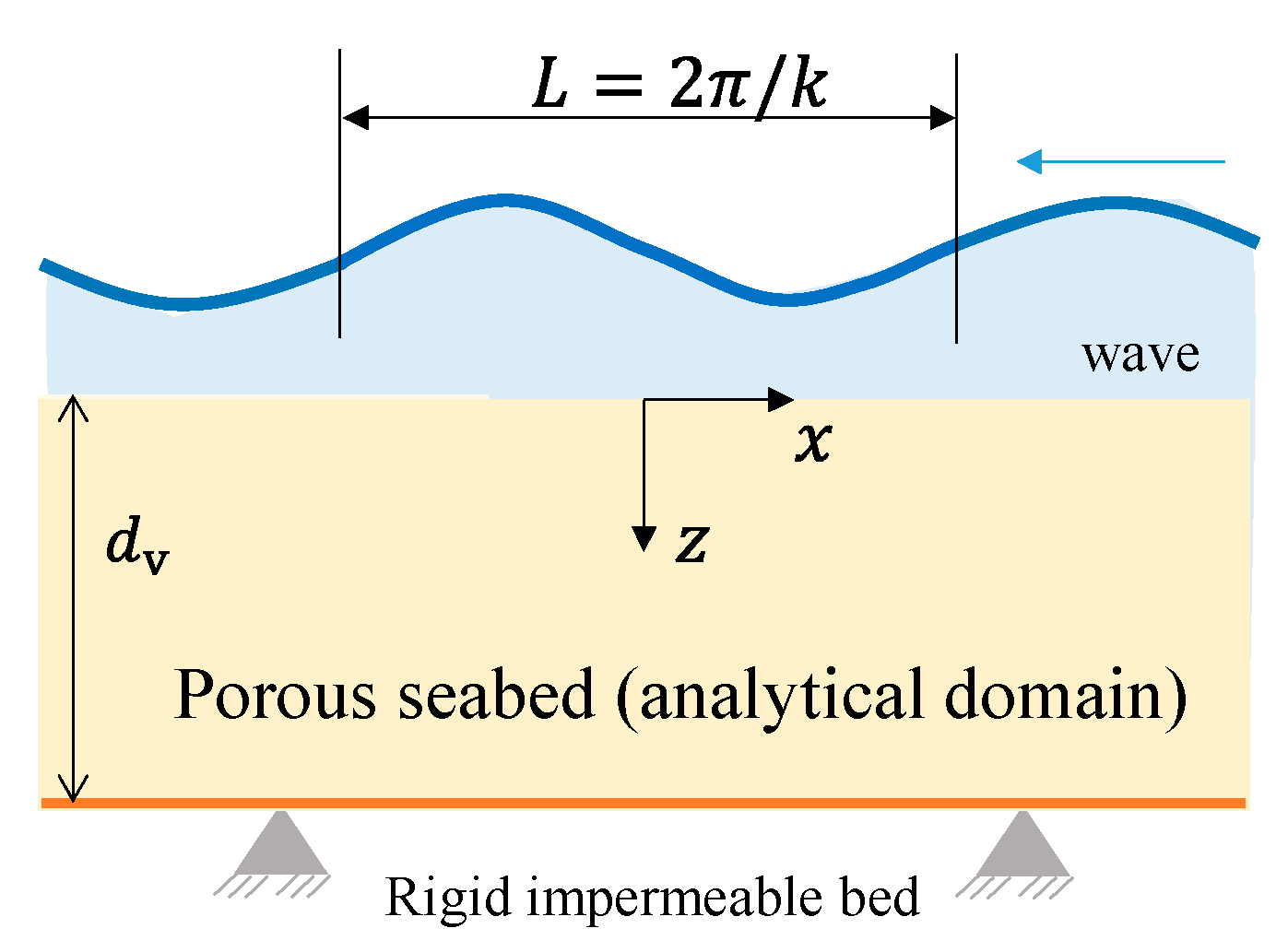
The problem targeted in this study is depicted in Figure 2, with the horizontal and vertical coordinates defined as x and z , respectively. As shown in Figure 2, a porous seabed having a finite thickness of d v lying on an impermeable rigid base is subject to a progressive wave loading p s ( x , t ) ( t : time), which is expressed in a sinusoidal form based on the linear wave theory as
p s = p o exp i k x + ω t   ,
where p o ,   k   ( = 2 π / L ), and ω   ( = 2 π / T ) are the wave pressure amplitude, wave number, and angular frequency, respectively; and L and T are the wavelength and wave period, respectively; i is the imaginary unit satisfying the relation i 2 = 1 .
The governing equations of Yamamoto [1] are summarized in Appendix A. For non-dimensionalization of the static equilibrium equations and the continuity equation, Equations (A1) and (A2), respectively, the dimensionless variables and unknowns are defined as:
x ¯ = k x   , z ¯ = z / d v   , t ¯ = ω t   , u ¯ x = k u x   , u ¯ z = k u z   , p ¯ e = p e / p o ,
where u x = u x ( x , z , t ) and u z = u z ( x , z , t ) are the displacements in horizontal and vertical directions, respectively; p e = p e ( x , z , t ) is excess pore water pressure (compression: positive, considering the state under a mean water level as a reference); the superscript symbol ¯ denotes a dimensionless value.
By considering the horizontal periodicity of seabed behavior, the dimensionless unknowns u ¯ x , u ¯ z , p ¯ e are assumed to have a harmonic form in time and a horizontal position identical to the wave loading and are expressed as follows:
u ¯ x x ¯ , z ¯ , t ¯ = U ¯ x z ¯ exp i x ¯ + t ¯   ,
u ¯ z x ¯ , z ¯ , t ¯ = U ¯ z z ¯ exp i x ¯ + t ¯   ,
p ¯ e ( x ¯ , z ¯ , t ¯ ) = P ¯ e z ¯ exp i ( x ¯ + t ¯ )   ,
where U ¯ x , U ¯ z , and P ¯ e are the functions of z ¯ .
By incorporating Equation (4) into Equations (A1) and (A2), we can obtain the dimensionless governing equations as in Equations (5) and (6) with a spatial gradient operator   D = / z ¯ with respect to z ¯ .
κ 1 + 2 κ 2 + κ 2 D 2 m 2 U ¯ x + i κ 1 + κ 2 D m U ¯ z + i κ a P ¯ e = 0   ,
i κ 1 + κ 2 D m U ¯ x + κ 2 + κ 1 + 2 κ 2 D 2 m 2 U ¯ z + κ a D m P ¯ e = 0   ,
1 U ¯ x + i D m U ¯ z + i κ a κ + Π 1 κ a m 2 1 D 2 m 2 P ¯ e = 0   ,
where the dimensionless parameters Π 1 ,   κ ,   κ 1 ,   κ 2 ,   m , κ a are defined as follows:
Π 1 = k s ( E c + K f / n ) γ w ω d v 2 ,   κ = K f / n E c + K f / n ,   κ 1 = λ E c + K f / n ,   κ 2 = G E c + K f / n , m = k d v   ,
κ a = p o E c + K f / n   .
The dimensionless parameters in Equation (7-1) were defined following those reported by Zienkiewicz et al. [21] and Ulker et al. [18], and the dimensionless parameter κ a in Equation (7-2) is newly introduced in this study. Meanings of each dimensionless parameter can be interpreted as follows: Π 1 is the consolidation parameter and is proportional to the permeability coefficient k s and reciprocal to unit weight of pore water γ w , wave angular frequency ω , and the square of the seabed thickness d v 2 ; κ ,   κ 1 ,   κ 2 are the ratios of pore water compressibility divided by porosity K f / n , Lamé’s constant λ , and shear modulus   G to total stiffness E c + K f / n , respectively; here, E c is the one-dimensional stiffness of the soil skeleton expressed with Young’s modulus E and Poisson’s ratio ν as E c = E 1 ν / { 1 + ν 1 2 ν } ; m is the relative thickness of the seabed to wavelength; and κ a is the ratio of wave pressure amplitude to total stiffness. The definitions and interpreted meanings of each dimensionless parameter are summarized in Table 3.
The definition ranges of Equations (5) and (6) are < x ¯ < ,   0 < z ¯ < 1 ,   t ¯ > 0 .
By considering the definitions of the elastic moduli of the soil skeleton ( E c = λ + 2 G ), the following relationship can be obtained:
1 κ = κ 1 + 2 κ 2 .
Therefore, we can infer that only five dimensionless parameters govern the problem and seabed drainage condition is solely expressed by Π 1 as only this includes the permeability coefficient.
The characteristic equation of Equations (5) and (6) is obtained as follows:
D 2 μ 2 2 D 2 μ 2 = 0 , μ = m , μ = m 1 + i Π 1 m 2 1 κ κ 1 / 2 .
As there are double roots in the solution of Equation (9), the unknown functions U ¯ x , U ¯ z , and P ¯ e can be written in the following forms with 18 coefficients a p 1 - a p 6 , b p 1 - b p 6 , c p 1 - c p 6 :
U ¯ x z ¯ = a p 1 cosh μ z ¯ + a p 2 sinh μ z ¯ + a p 3 z ¯ cosh μ z ¯ + a p 4 z ¯ sinh μ z ¯ + a p 5 cosh μ z ¯ + a p 6 sinh μ z ¯   ,
U ¯ z z ¯ = b p 1 cosh μ z ¯ + b p 2 sinh μ z ¯ + b p 3 z ¯ cosh μ z ¯ + b p 4 z ¯ sinh μ z ¯ + b p 5 cosh μ z ¯ + b p 6 sinh μ z ¯   ,
P ¯ e z ¯ = c p 1 cosh μ z ¯ + c p 2 sinh μ z ¯ + c p 3 z ¯ cosh μ z ¯ + c p 4 z ¯ sinh μ z ¯ + c p 5 cosh μ z ¯ + c p 6 sinh μ z ¯   .
By incorporating Equation (10) into the dimensionless governing equations (Equations (5) and (6)), the dependence of the coefficients can be determined as follows:
b p 1 = i a p 2 + i A 1 a p 3 ,   b p 2 = i a p 1 + i A 1 a p 4 ,   b p 3 = i a p 4 ,   b p 4 = i a p 3 ,
b p 5 = i μ μ a p 6 ,   b p 6 = i μ μ a p 5 ,
and
c p 1 = i A 2 a p 4 ,   c p 2 = i A 2 a p 3 ,   c p 3 = 0 ,   c p 4 = 0 ,   c p 5 = A 3 a p 5 ,   c p 6 = A 3 a p 6   ,
where
A 1 = 1 m 1 + κ 2 1 κ 2 , A 2 = 1 m κ a 2 κ 2 κ 1 κ 2 ,   A 3 = 1 Π 1 κ a m 2 κ   .
The dimensionless boundary conditions defined at the surface ( z ¯ = 0 ) and the bottom ( z ¯ = 1 ) are described as follows:
p ¯ e = exp { i x ¯ + t ¯ }   at   z ¯ = 0   ,
Δ τ ¯ x z = 1 m u ¯ x z ¯ + u ¯ z x ¯ = 0   at   z ¯ = 0   ,
Δ σ ¯ z = κ 1 u ¯ x x ¯ + κ 1 + 2 κ 2 m u ¯ z z ¯ = 0   at   z ¯ = 0   ,
u ¯ x = 0   at   z ¯ = 1   ,
u ¯ z = 0   at   z ¯ = 1   ,
p ¯ e z ¯ = 0   at   z ¯ = 1   ,
where Δ τ ¯ x z and Δ σ ¯ z (tension: positive) represent dimensionless shear and vertical effective stresses, respectively; the symbol Δ denotes an incremental value. Note that Equation (13-2) specifies that the horizontal traction force at the surface ( z ¯ = 0 ) is zero.
Incorporating Equations (10)–(12) into Equation (13) yields a simultaneous equation with a dimensionless matrix [ A ] described as follows:
A a p = { f }   ,
A = 0 0 0 i A 2 A 3 0 0 2 1 m A 1 0 0 2 μ μ 2 κ 2 0 0 1 κ m 1 m A 1 1 κ μ 2 μ 2 κ 1 0 cosh μ sinh μ cosh μ sinh μ cosh μ sinh μ sinh μ cosh μ sinh μ A 1 cosh μ cosh μ A 1 sinh μ μ μ sinh μ μ μ cosh μ 0 0 i μ A 2 cosh μ i μ A 2 sinh μ μ A 3 sinh μ μ A 3 cosh μ ,
{ a p } T = a p 1   a p 2   a p 3   a p 4   a p 5   a p 6 T , { f } T = 1 0 0 0 0 0 T .
By solving Equation (14-1) for the coefficient vector { a p } in Equation (14-3), the horizontal displacement u ¯ x can be determined using the calculated a p 1 a p 6 . In addition, Equations (10-2), (10-3), (11), and (12) allow the calculation of u ¯ z and p ¯ e , and Equation (15) allows the calculation of the increments of horizontal effective, vertical effective, and shear stresses, which are denoted by Δ σ x ,   Δ σ z (tension: positive), and Δ τ x z , respectively. To determine observable behavior, either real or complex parts are extracted from these variables.
Δ σ x = E c + K f n Δ σ ¯ x , Δ σ ¯ x = κ 1 + 2 κ 2 u ¯ x x ¯ + κ 1 m u ¯ z z ¯ ,
Δ σ z = E c + K f n Δ σ ¯ z , Δ σ ¯ z = κ 1 u ¯ x x ¯ + κ 1 + 2 κ 2 m u ¯ z z ¯   ,
Δ τ x z = E c + K f n Δ τ ¯ x z , Δ τ ¯ x z = κ 2 m u ¯ x z ¯ + κ 2 u ¯ z x ¯   .

2.2. Inapplicability of Yamamoto’s Solution near Fully Drained and Undrained Conditions

Herein, we demonstrate that Yamamoto’s solution becomes inapplicable as the seabed drainage condition becomes close to fully drained and undrained conditions, realized by infinite and zero values of the dimensionless parameter Π 1 , respectively. For this purpose, we considered that the seabed drainage condition is represented solely by the permeability coefficient k s and assessed the effect of the change in k s on the solvability of Equation (14-1).
First, we discuss how the components of the coefficient matrix [ A ] in Equation (14-2) are transformed in the following two cases regarding the permeability coefficient k s :
(a)
Fully drained condition
If the permeability coefficient becomes extremely large, i.e., k s , the dimensionless parameter Π 1 approaches infinity such that the coefficient matrix [ A ] can be transformed into the following form as μ μ and A 3 0 :
A = 0 0 0 i A 2 0 0 0 2 1 m A 1 0 0 2 2 κ 2 0 0 1 κ m 1 m A 1 2 κ 2 0 cosh μ sinh μ cosh μ sinh μ cosh μ sinh μ sinh μ cosh μ sinh μ A 1 cosh μ cosh μ A 1 sinh μ sinh μ cosh μ 0 0 i μ A 2 cosh μ i μ A 2 sinh μ 0 0 .
As the first and second columns are identical to the fifth and sixth columns, respectively, the matrix [ A ] becomes singular, making Equation (14-1) unsolvable.
(b)
Fully undrained condition
Next, we consider the case of a zero permeability coefficient, which makes the dimensionless parameter Π 1 become zero. Therefore, the matrix [ A ] can be rewritten as that in Equation (17) since μ and A 3 .
A = 0 0 0 0 1 0 0 0 0 0 0 1 0 0 0 0 1 0 0 0 0 0 1 1 0 0 0 0 1 1 0 0 0 0 1 1 .
All components in the first, second, third, and fourth columns are negligible compared with those in the fifth and sixth columns. Thus, the matrix [ A ] becomes singular, and Equation (14-1) becomes unsolvable in this case too.
By considering cases (a) and (b), we demonstrated that limitations certainly exist in the applicable drainage condition of Yamamoto’s solution [1], especially in terms of the permeability coefficient.
To specify the certainty of solving Equation (14-1) owing to large and small permeability coefficients, we analyzed how the condition number of the matrix [ A ] in Equation (14-2) varied with the permeability coefficient k s using Equation (1). As for analytical conditions, essentially the same soil properties and wave conditions as in the analysis of Yamamoto [1] were assigned and they are summarized in Table 4, where dimensionless parameters computed according to Equation (7) are also listed. Note that complete saturation, thus nearly incompressible pore fluid, was assumed for simplicity of discussion. The geometric conditions were aligned with those in Yamamoto [1], as soil depth d v = 25 m and water depth h = 70 m. Due to the linearity of the wave dispersion relation and the soil constitutive relationship, the water depth was not considered in the analysis, but it justifies the relation, p o = H γ w / 2 ( H is the wave height). Although the wave conditions indicate that the second-order Stokes wave theory is applicable according to Zhao et al. [22], the linear wave theory, likewise, Yamamoto [1], was applied for clear comparison in this study. As numerical round-off, when the values of the components of the matrix [ A ] were smaller than 10 50 , they were neglected. In Table 4, specific values of k s and the dimensionless parameter Π 1 are omitted since they were changed in this analysis. However, for numerical reproducibility, other parameters used in calculating the components of the matrix [ A ] are given for k s = 10 2 m/s as follows: Π 1 = 30.0 , μ = 0.485, μ = 1.83 + 1.77 i , A 1 = 2.07 , A 2 = 7.21 × 10 2 , and A 3 = 1.93 × 10 4 .
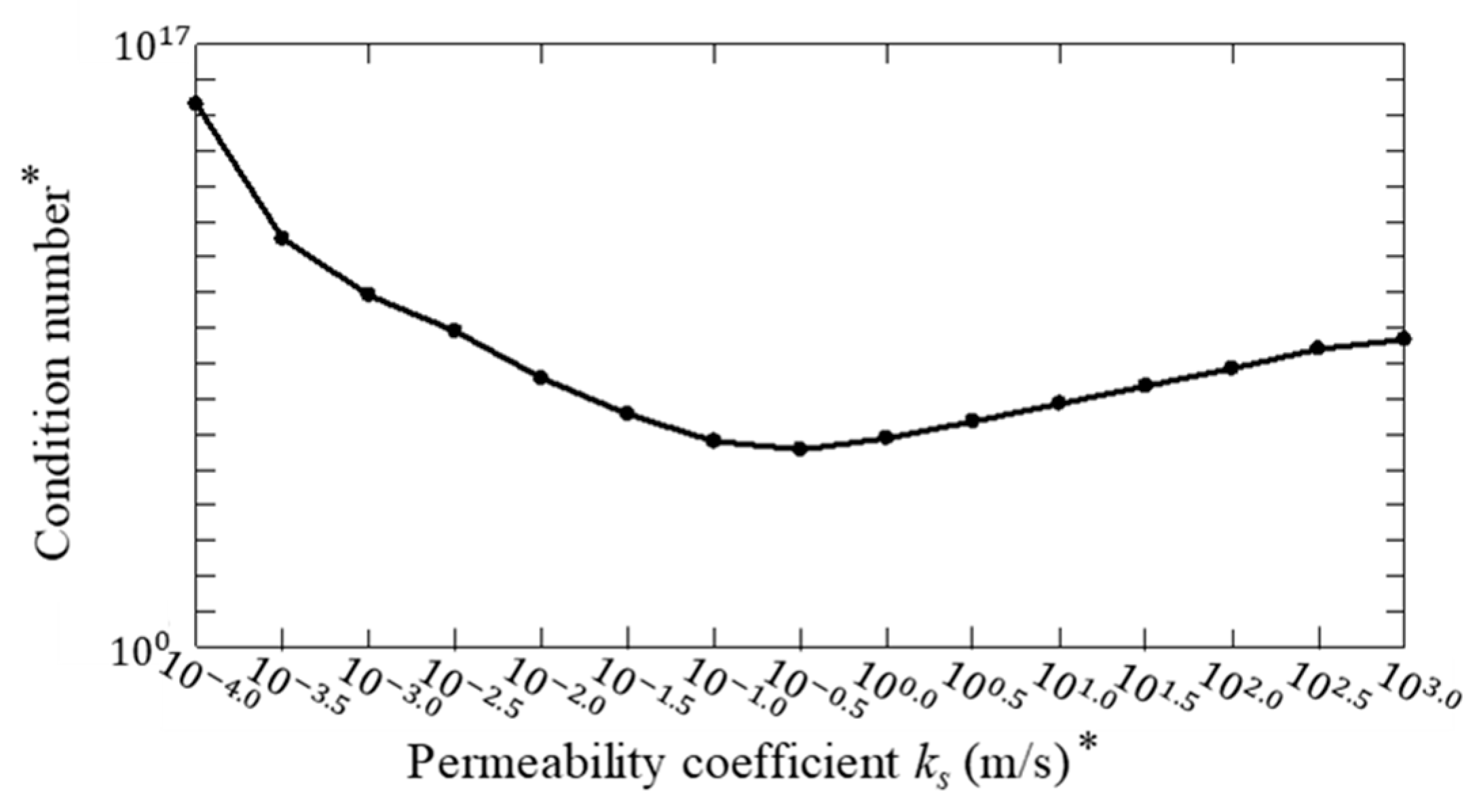
Figure 3 shows the variation in the condition number of the matrix [ A ] for different permeability coefficients. This indicates that Yamamoto’s solution became unfeasible in the ranges of low ( k s < 10 4 m/s) and high ( k s > 10 3 m/s) permeability coefficient as the condition number became 1000 times larger than the minimum value, which was recorded when k s was approximately 3.16 × 10 1 m/s. When the permeability coefficient is in the two ranges, the numerical solution of Equation (14-1) may be unreliable and Yamamoto’s solution cannot be used for verification of a numerical analysis code. These ranges can be represented as the ranges B and B’ as depicted in Figure 1, and the range between them ( 10 4 < k s < 10 3 m/s) is the range A in this case. Note that the computational cost is not the cause of this problem because the size of the matrix [ A ] does not expand, but computational complexity, which is due to the matrix [ A ] becoming singular, is the cause. Consequently, we inferred that theoretical solutions for the wave-induced response of a seabed under such inapplicable drainage conditions for Yamamoto’s solution should be derived. Therefore, we derived new theoretical solutions for the fully drained and undrained conditions realized by infinite and zero permeability coefficients, respectively.

3. Theoretical Solutions for the Wave-Induced Response of a Seabed Under Fully Drained and Undrained Conditions

3.1. Derivation of the Solutions

Herein, solutions for the wave-induced response of a seabed with finite thickness under (elementwise) fully drained and undrained conditions are derived by referring to the derivation of Yamamoto’s solution. In the derivation processes, the permeability coefficient k s in the dimensionless parameter Π 1 is assumed to reach infinity and zero in the continuity equation (Equation (6)). Note that a theoretical solution considering the partially drained condition near the fully drained or undrained conditions, which cannot be described by Yamamoto’s solution as in the ranges B and B’ in Figure 1, is still difficult to derive. Nevertheless, the fully drained and undrained solutions can verify numerical analysis codes beyond the applicable range of Yamamoto’s solution.
(a)
Solution for the seabed behavior under fully drained condition
When the permeability coefficient becomes extremely large ( k s ), the dimensionless parameter Π 1 reaches infinity. Therefore, the dimensionless continuity equation (Equation (6)) can be transformed into the following form, which stems from the part representing the Laplace’s equation of excess pore water pressure:
1 D 2 m 2 P ¯ e = 0   .
From the static equilibrium equations (Equation (5)) and the continuity equation (Equation (18)), the characteristic equation (Equation (9)) can be transformed into the following form:
D 2 μ 2 3 = 0 , μ = m .
As the characteristic equation has triple roots in its solution, solutions to Equations (5) and (18) can be expressed with a different set of functions from that of Yamamoto’s as follows:
U ¯ x z ¯ = a d 1 cosh μ z ¯ + a d 2 sinh μ z ¯ + a d 3 z ¯ cosh μ z ¯ + a d 4 z ¯ sinh μ z ¯ + a d 5 z ¯ 2 cosh μ z + a d 6 z ¯ 2 sinh μ z ,
U ¯ z z ¯ = b d 1 cosh μ z ¯ + b d 2 sinh μ z ¯ + b d 3 z ¯ cosh μ z ¯ + b d 4 z ¯ sinh μ z ¯ + b d 5 z ¯ 2 cosh μ z + b d 6 z ¯ 2 sinh μ z ,
P ¯ e z ¯ = c d 1 cosh μ z ¯ + c d 2 sinh μ z ¯ + c d 3 z ¯ cosh μ z ¯ + c d 4 z ¯ sinh μ z ¯ + c d 5 z ¯ 2 cosh μ z + c d 6 z ¯ 2 sinh μ z ,
where a d 1 a d 6 , b d 1 b d 6 , and c d 1 c d 6 are coefficients, and their dependence can be obtained by incorporating Equation (20) into Equations (5) and (18) as follows:
a d 5 = 0 ,   a d 6 = 0 ,   b d 3 = i a d 4 ,   b d 4 = i a d 3 ,   b d 5 = 0 ,     b d 6 = 0 ,
and
c d 1 = i κ 1 + κ 2 κ a a d 1 i κ 1 + 3 κ 2 m κ a a d 4 + κ 1 + κ 2 κ a b d 2 ,
c d 2 = i κ 1 + κ 2 κ a a d 2 i κ 1 + 3 κ 2 m κ a a d 3 + κ 1 + κ 2 κ a b d 1 ,
c d 3 = 0 ,   c d 4 = 0 ,   c d 5 = 0 ,   c d 6 = 0 .
Coefficients a d 1 ,   a d 2 ,   a d 3 ,   a d 4 , and b d 1 ,   b d 2 are used to describe the other coefficients. It turned out that the coefficients of z ¯ 2 cosh μ z and   z ¯ 2 sinh μ z in Equation (20) are zero. Finally, by incorporating Equations (20) and (21) into the boundary conditions (Equation (13)), the following simultaneous equation can be obtained to determine the coefficients:
A d a d = f ,
A d = i κ 1 + κ 2 κ a 0 0 i κ 1 + 3 κ 2 m κ a 0 κ 1 + κ 2 κ a 0 1 1 m 0 i 0 κ 1 0 0 κ 1 + 2 κ 2 m 0 i κ 1 + 2 κ 2 cosh μ sinh μ cosh μ sinh μ 0 0 0 0 i sinh μ i cosh μ cosh μ sinh μ sinh μ cosh μ κ 1 + 3 κ 2 m κ 1 + κ 2 cosh μ κ 1 + 3 κ   2 m κ 1 + κ 2 sinh μ i c o s h μ i s i n h μ   ,
a d T = a d 1   a d 2   a d 3   a d 4   b d 1   b d 2 T , { f } T = 1 0 0 0 0 0 T .
Notably, the continuity equation (Equation (18)) is the same as the governing equations of the solutions by Putnam [2], Reid and Kajiura [3], Sleath [4], Liu [5], Nakamura et al. [6], and Moshagen and Tørum [7] (only if the compressibility of pore water is neglected). Although excess pore water pressure determined by this fully drained solution can be the same as that given by these previous solutions, deformation and effective stresses of the soil skeleton can be calculated only with this fully drained solution. Furthermore, the solutions of Jeng and Rahman [16], Jeng and Cha [17], and Ulker et al. [18] may express seabed behavior under the fully drained condition by considering inertia forces. Nevertheless, their solutions are incapable of expressing the fully drained seabed behavior if inertia forces are neglected.
(b)
Solution for the seabed behavior under fully undrained condition
Considering that the permeability coefficient reaches zero ( k s 0 , Π 1 0 ), the continuity equation (Equation (6)) is transformed into the following form:
1 U ¯ x + i D m U ¯ z + i κ a κ P ¯ e = 0 .
Using the static equilibrium equations (Equation (5)) and the continuity equation (Equation (23)), the following characteristic equation is obtained:
D 2 μ 2 2 = 0 , μ = m .
Since Equation (24) has only double roots for its solution, U ¯ x , U ¯ z , and P ¯ e can be expressed with 12 coefficients a u 1 a u 4 , b u 1 b u 4 , c u 1 c u 4 as follows:
U ¯ x z ¯ = a u 1 cosh μ z ¯ + a u 2 sinh μ z ¯ + a u 3 z ¯ cosh μ z ¯ + a u 4 z ¯ sinh μ z ¯ ,
U ¯ z z ¯ = b u 1 cosh μ z ¯ + b u 2 sinh μ z ¯ + b u 3 z ¯ cosh μ z ¯ + b u 4 z ¯ sinh μ z ¯ ,
P ¯ e z ¯ = c u 1 cosh μ z ¯ + c u 2 sinh μ z ¯ + c u 3 z ¯ cosh μ z ¯ + c u 4 z ¯ sinh μ z ¯ .
The dependence of the coefficients can be determined by incorporating Equation (25) into Equations (5) and (23) as follows:
b u 1 = i a u 2 + i A 1 a u 3 ,   b u 2 = i a u 1 + i A 1 a u 4 ,   b u 3 = i a u 4 ,   b u 4 = i a u 3 ,
and
c u 1 = i A 2 a u 4 ,   c u 2 = i A 2 a u 3 ,   c u 3 = 0 ,   c u 4 = 0 ,
where A 1 and A 2 are expressed as in Equation (12).
Considering the undrained condition, in which no pore water flow is allowed inside the seabed or even at its surface, the following four dimensionless boundary conditions should be assumed instead of Equation (13), and they satisfactorily determine the four independent coefficients a u 1 a u 4 :
Δ σ ¯ z = exp { i x ¯ + t ¯ }   at   z ¯ = 0 ,
Δ τ ¯ x z = κ 1 u ¯ x x ¯ + κ 1 + 2 κ 2 m u ¯ z z ¯ = 0   at   z ¯ = 0 ,
u ¯ x = 0   at   z ¯ = 1 ,
u ¯ z = 0   at   z ¯ = 1 .
where Δ σ ¯ z is the incremental dimensionless total vertical stress (tension: positive), which is expressed as Δ σ ¯ z = p ¯ e + Δ σ ¯ z , where p ¯ e is dimensionless excess pore water pressure and Δ σ ¯ z is dimensionless incremental vertical effective stress.
Equation (27-1) shows that neither excess pore water pressure nor vertical effective stress is known even at the seabed surface. This condition is valid because no escape of pore water from the surface means that the surface boundary head is unknown in the same way as the heads inside the seabed, namely that excess pore water pressure is a variable and total vertical stress should be given instead at the seabed surface. In this case, excess pore water pressure p ¯ e can be regarded as a Lagrange multiplier for the geometric constraint of volume change in soil skeleton only when incompressible pore fluid is assumed (refer to Toyoda and Noda, [23]). The simultaneous equation to determine the coefficients is derived by incorporating Equations (25) and (26) into Equation (27) and is expressed as follows:
A u a u = { f u } ,
[ A u ] = 2 i κ 2 / κ a 0 0 2 i κ 2 m κ a 1 κ 2 0 2 1 m A 1 0 c o s h ( μ ) s i n h ( μ ) c o s h ( μ ) s i n h ( μ ) s i n h ( μ ) c o s h ( μ ) sinh μ A 1 c o s h ( μ ) cosh μ A 1 s i n h ( μ )   ,
a u T = a u 1   a u 2   a u 3   a u 4 T , f u T = 1 0 0 0 T .
Notably, this fully undrained solution differs from those derived by Prévost et al. [8] and Mallaid and Dalrymple [9], as the solution of Prévost et al. [8] cannot consider the change in effective stresses and Mallaid and Dalrymple’s solution [9] cannot allow for changes in excess pore water pressure. Mei and Foda’s solution [15] can be an alternative to this fully undrained solution only if the “boundary layer” near the seabed surface is neglected.
As one of alternative methods to derive the fully drained and undrained solutions, the following procedure may be considered: the first step is to solve Equation (14-1) by explicitly representing the solution with the dimensionless parameters. The second step is to determine the limits of Yamamoto’s solution when Π 1 or k s approaches infinity and zero as the limits of Yamamoto’s solution should correspond to the newly derived solutions. However, as this method requires complicated and laborious calculations, the direct derivation processes are presented above in this paper.

3.2. Feasibility of the Solutions

In this section, the form of Yamamoto’s solution [1] and the solutions of fully drained and undrained conditions are compared to discuss the feasibility of the newly derived solutions. From Equations (10)–(12), the solution of Yamamoto can be arranged into the following form with independent coefficients and vectors of basic functions (hereafter, function vectors) as follows:
U ¯ x U ¯ z P ¯ e = a p 1 cosh μ z ¯ i sinh μ z ¯ 0 + a p 2 sinh μ z ¯ i cosh μ z ¯ 0 + a p 3 z ¯ cosh μ z ¯ i A 1 cosh μ z ¯ i z ¯ sinh μ z ¯ i A 2 sinh μ z ¯ + a p 4 z ¯ sinh μ z ¯ i A 1 sinh μ z ¯ i z ¯ cosh μ z ¯ i A 2 cosh μ z ¯ + a p 5 cosh μ z ¯ i μ μ sinh μ z ¯ A 3 cosh μ z ¯ + a p 6 sinh μ z ¯ i μ μ cosh μ z ¯ A 3 sinh μ z ¯ .
Similarly, the solutions under the fully drained and undrained conditions are expressed in Equations (30) and (31), respectively:
U ¯ x U ¯ z P ¯ e = a d 1 cosh μ z ¯ 0 i κ 1 + κ 2 κ a cosh μ z ¯ + a d 2 sinh μ z ¯ 0 i κ 1 + κ 2 κ a sinh μ z ¯ + a d 3 z ¯ cosh μ z ¯ i z ¯ sinh μ z ¯ i κ 1 + 3 κ 2 m κ a sinh μ z ¯ + a d 4 z ¯ sinh μ z ¯ i z ¯ cosh μ z ¯ i κ 1 + 3 κ 2 m κ a cosh μ z ¯ + b d 1 0 cosh μ z ¯ κ 1 + κ 2 κ a sinh μ z ¯ + b d 2 0 sinh μ z ¯ κ 1 + κ 2 κ a cosh μ z ¯ ,
and
U ¯ x U ¯ z P ¯ e = a u 1 cosh μ z ¯ i sinh μ z ¯ 0 + a u 2 sinh μ z ¯ i cosh μ z ¯ 0 + a u 3 z ¯ cosh μ z ¯ i A 1 cosh μ z ¯ i z ¯ sinh μ z ¯ i A 2 sinh μ z ¯ + a u 4 z ¯ sinh μ z ¯ i A 1 sinh μ z ¯ i z ¯ cosh μ z ¯ i A 2 cosh μ z ¯ .
When the permeability coefficient reaches infinity, the function vectors for a p 5 and a p 6 in Equation (29) of Yamamoto’s solution correspond to those for a p 1 and a p 2 , respectively. Therefore, the number of independent function vectors becomes four, although there are six independent boundary conditions (Equation (13)) to be expressed. This contradiction results in the absence of Yamamoto’s solution under the fully drained condition. Meanwhile, the fully drained solution in Equation (30) holds six independent function vectors, which enable all the six boundary conditions to be expressed.
In case of the fully undrained condition, the function vectors for a p 5 and a p 6 in Yamamoto’s solution are absent because the function vectors cannot satisfy the following condition of no pore water flow–induced volume change, which is expressed as
0 = u x x + u z z + n K f p e .
If the six independent function vectors are considered to exist even under the fully undrained condition, two vectors become redundant and make Yamamoto’s solution unsolvable as only four boundary conditions (Equation (27)) must be satisfied. Contrarily, the fully undrained solution has only four independent function vectors, which make the solutions suitable to express the four boundary conditions.

3.3. Characteristics of the Solutions

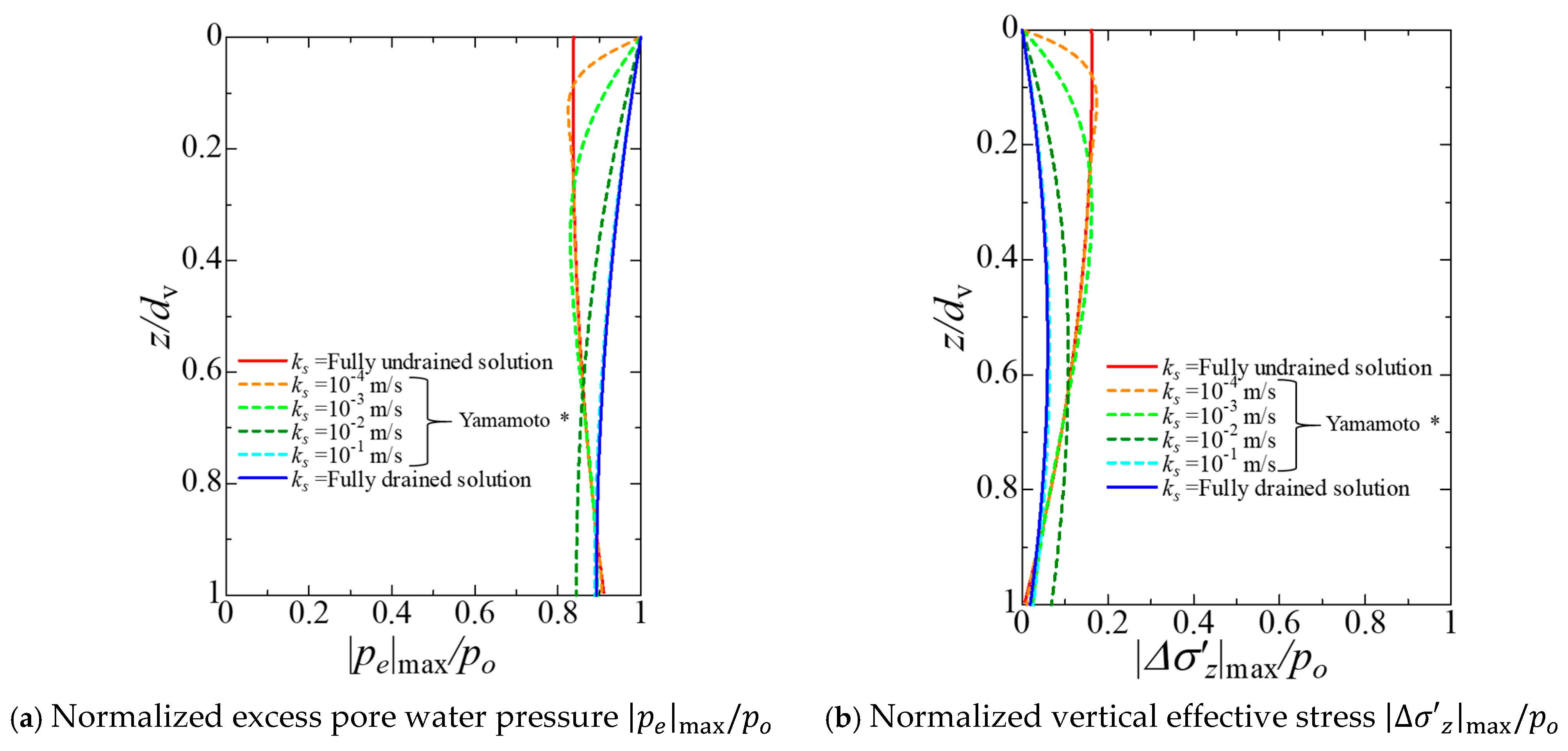
Herein, behaviors of a seabed under fully drained and undrained conditions are compared with those of a seabed with finite permeability coefficients, namely, under partially drained conditions explained by Yamamoto’s solution. Analytical conditions described in Table 4 were used, while four values were considered for the finite permeability coefficient: k s = 10 4 ,   10 3 ,   10 2 ,   10 1 m/s. Figure 4 shows the vertical distributions of the maximum absolute values of variable α normalized by wave pressure amplitude p o at each vertical location within one wave cycle, i.e., α m a x ; the symbol |   | m a x denotes the maximum absolute value. Excess pore water pressure p e and incremental vertical effective stress Δ σ z were chosen as the variable α because they could demonstrate characteristic behaviors of the fully drained and undrained solutions. From Figure 4, the following characteristics of the newly derived solutions could be obtained.
  • For the fully drained solution, the excess pore water pressure p e m a x , which was determined by Laplace’s equation independently of the static equilibrium equations (Equation (6)), showed the largest values at almost any location. This resulted in the smallest incremental vertical effective stress Δ σ z m a x virtually throughout the depth.
  • For the fully undrained solution, it was observed at the seabed surface ( z = 0 ) that Δ σ z m a x was not zero and p e m a x did not correspond to wave pressure amplitude p o . This is due to the boundary condition given by Equation (27-1), which specifies the incremental total stress Δ σ z corresponding to wave loading, i.e., Δ σ z m a x = p o , instead of Δ σ z and p e . In this case, the distribution of p e m a x , which showed the smallest values at almost any location, was determined to prohibit volume change due to pore water flow.
Notably, any variable α essentially varies with the dimensionless parameters, such that the abovementioned characteristics were observable in the given analytical conditions. Additionally, note that actual seabed behavior under the fully drained and undrained conditions should be evaluated with a more sophisticated numerical analysis code verified by these theoretical solutions due to the lack of practical assumptions in the theoretical solutions, e.g., elastoplasticity of soil. However, considering the risk of momentary liquefaction, which is considered to occur when not Δ σ z m a x / p o but p e m a x / p o or more precisely Δ p m a x / p o is close to 1, the liquefaction is most likely to occur in the fully drained case with the analytical conditions.

4. Verification of a Numerical Analysis Code by the Theoretical Solutions

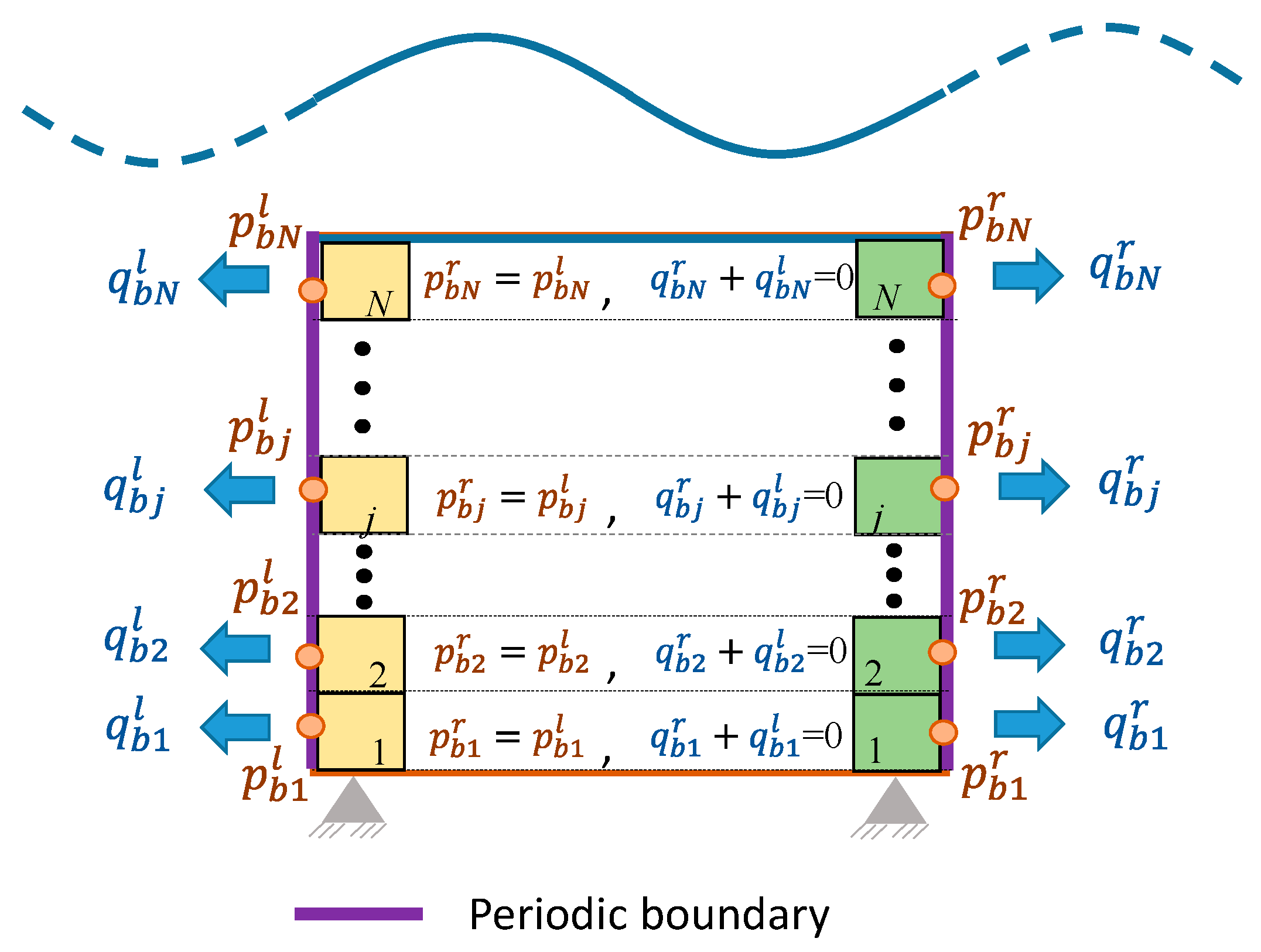
In this section, the fully drained and undrained solutions and Yamamoto’s solution for a partially drained condition are utilized to verify a finite element numerical analysis code. For this purpose, horizontally periodic seabed behavior, i.e., periodic changes in displacement, pore water pressure, and pore water flow, is considered in the numerical simulation because the horizontal periodicity is assumed in all the theoretical solutions, although the fully undrained solution considers only periodic displacement and pore water pressure. For the displacement field of the seabed, the periodic boundary condition can be easily realized using the Lagrangian method (see Asaoka et al. [24]). However, for the pore water field, the periodicity of pore water pressure and flow cannot be achieved with conventional hydraulic boundary conditions, such as undrained (no boundary pore water flow) or drained (known pore water pressure) conditions. To this end, referring to Yoshikawa et al. [25], we propose a numerical method based on u - p - p b formulation that considers boundary water pressures { p b }   as additional independent unknown variables to soil displacements { u } spatially discretized with the FEM and pore water pressures { p } defined inside the seabed domain and discretized with the FVM. This numerical method was developed from the soil-water coupled finite deformation analysis code GEOASIA, based on u - p formulation and proposed by Noda et al. [26] Note that in the numerical simulation of this study, the inertia terms of soil displacements { u } were neglected because of the static equilibrium assumed in the theoretical solutions. Although a general concept of the numerical method based on the u - p - p b formulation is presented in Appendix B, the essence of the method for realizing the horizontal periodicity is provided as follows: Figure 5 describes a model for the numerical simulation of the two-dimensional plane-strain wave-induced seabed behavior, wherein boundary water pressures on the left and right sides p b j l ,   p b j r ( j = 1,2 , , N ; N is the number of elements in a vertical direction) are defined. Furthermore, boundary water flows q b j l ,   q b j r ( j = 1,2 , , N ; positive for an outward discharge) were considered and expressed with p b j l and   p b j r , respectively, based on the physical model of pore water flows between the elements, referring to Christian [27]; Akai and Tamura [28]; Asaoka et al. [29]; Noda et al. [26]. Therefore, a total of 2 N variables were added to the unknown nodal soil displacements { u } and elemental pore water pressures { p } . In this simulation, both boundary and elemental pore water pressures were considered for their excess parts from the static water pressure under a mean water level to be aligned with the theoretical solutions. To close the system, two types of hydraulic boundary conditions were established and solved simultaneously with discretized static equilibrium and continuity equations.
One is the periodicity of the pore water pressure at the same vertical positions and is expressed as
p b j r = p b j l ( j = 1,2 , , N ) .
The above equation can be established for the number of elements in the vertical direction, i.e., N . The other is about the balance of boundary pore water flows between the two side boundaries at the same vertical positions and is expressed as
q b j r + q b j l = 0   ( j = 1,2 , , N ) .
The above equation can also be established for N sets of elements such that the combination of Equations (33) and (34) makes the additional unknown variables, p b j l and p b j r , obtainable. Notably, the horizontal width of the numerical model must be an integer multiple of the wavelength such that two hydraulically periodic conditions are feasible.
Technically, there is an alternative to realize the hydraulically periodic conditions in numerical simulation, which is based on the assumption that the elements in the far-right columns are adjacent to the elements in the far-left columns, and vice versa, when considering pore water flows toward each boundary. This method does not require the definition of an unknown boundary water pressure p b . However, the method of u - p - p b formulation may be more systematic and versatile for further studies, which may consider various hydraulic boundary conditions.
To compare seabed behaviors expressed by the theoretical solutions and the numerical method, the soil property and wave conditions listed in Table 4, and the soil depth h =  70 m were assigned to them. In addition, the assumed conditions for Yamamoto’s solution described in Section 2.1 were also considered in the numerical simulation. For the permeability coefficient k s in the numerical simulation, three values were set, 10 99 , 10 2 , 0 m/s, corresponding to the fully drained, partially drained (explainable by Yamamoto’s solution), and fully undrained conditions, respectively. In the numerical simulation, only the steady-state changes in variables are considered below.
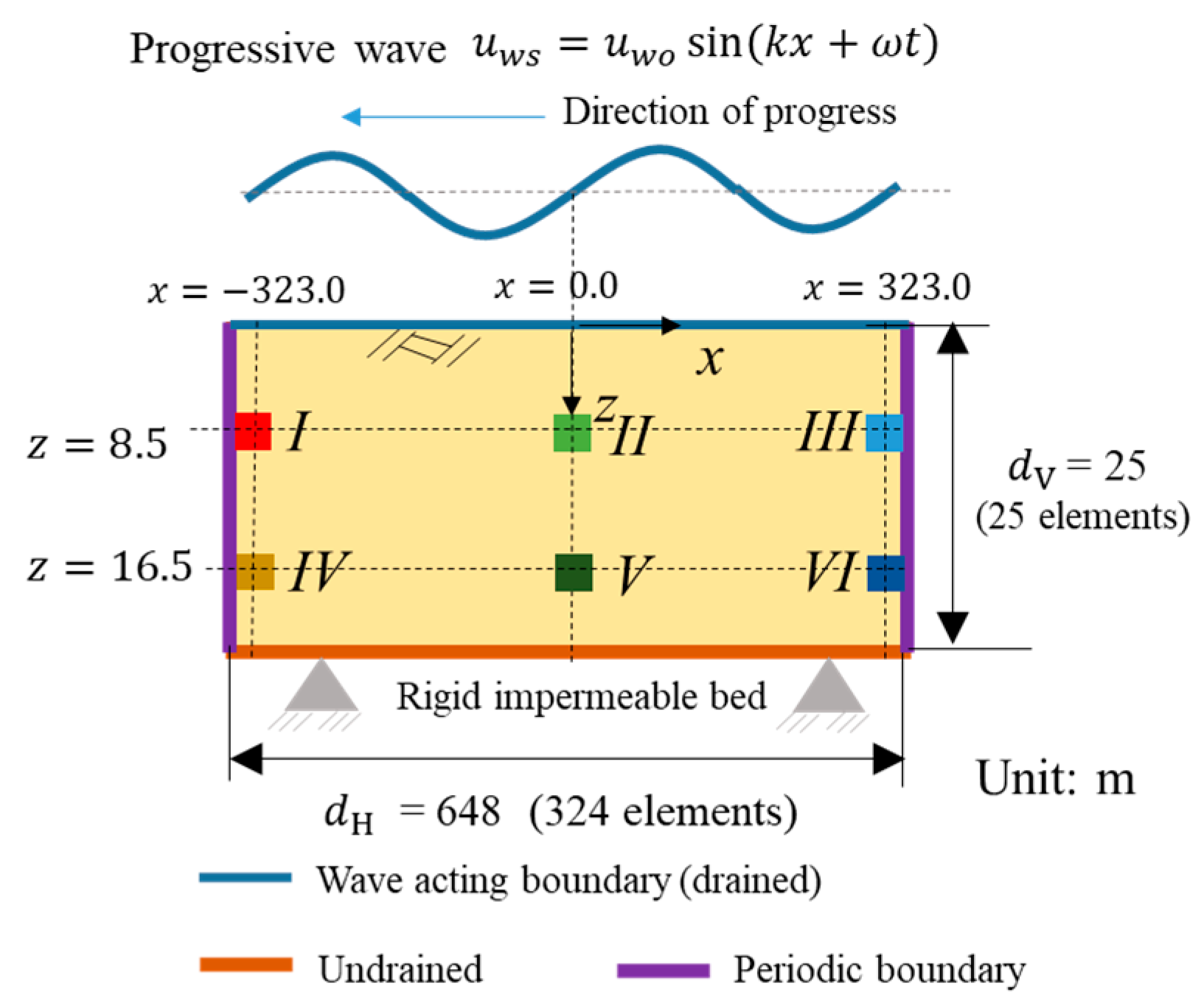
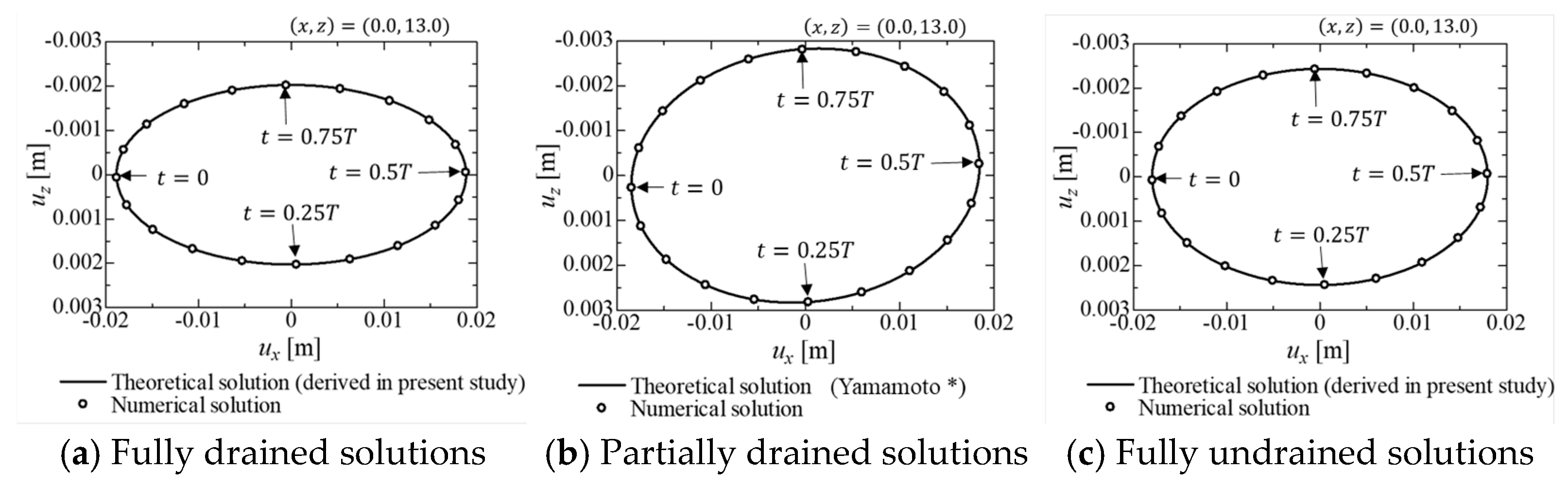
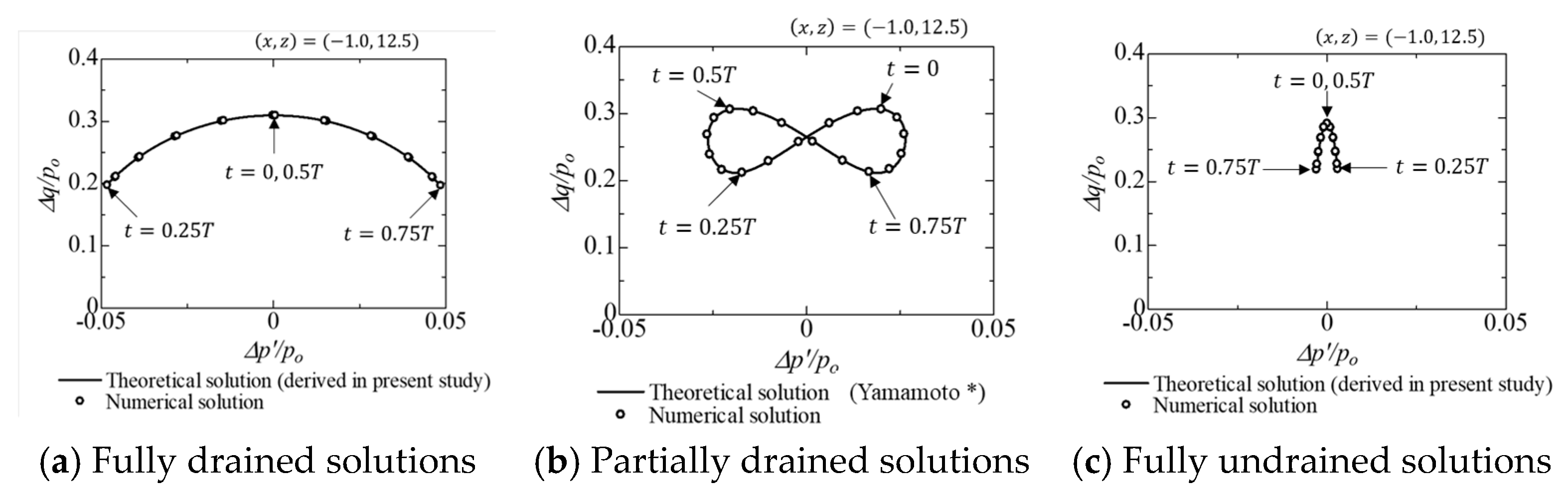
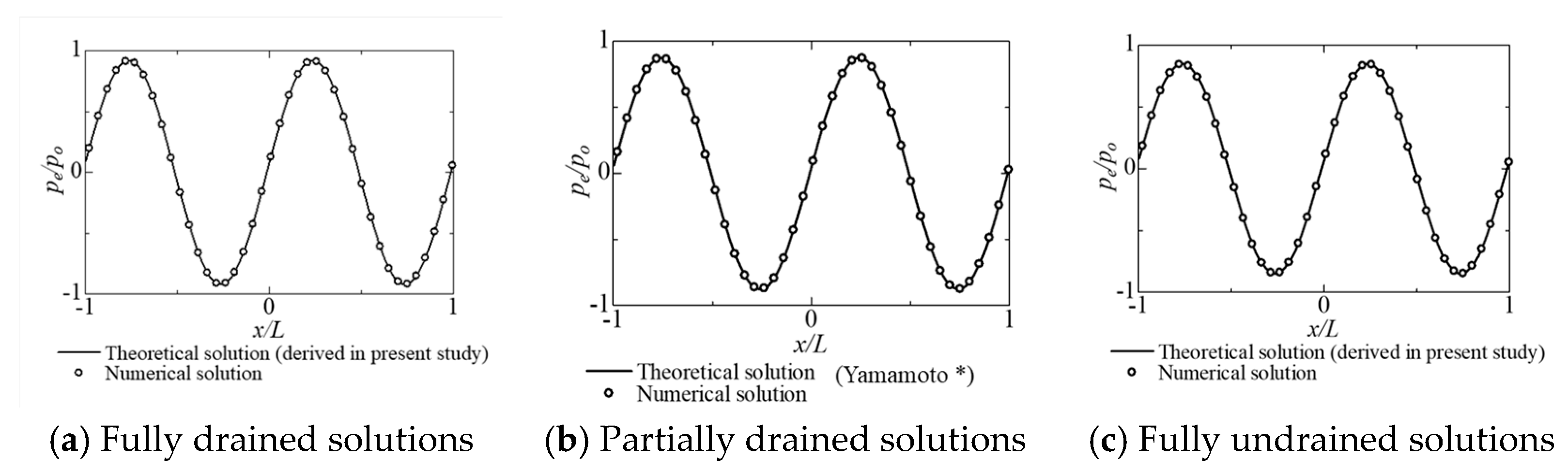
The numerical model is shown in Figure 6, where the coordinates of the x and z axes are defined. Figure 7 and Figure 8 depict relations of horizontal and vertical displacements, i.e., u x u z , and mean effective stress and deviator stresses normalized by wave pressure amplitude, i.e., Δ p / p o Δ q / p o , at a certain location within a wave cycle, respectively. In each figure, the theoretical and numerical solutions are compared under the fully drained, partially drained, and fully undrained conditions. Furthermore, these figures depict the typical elapsed time since the wave load acted on the seabed surface at each horizontal position. These figures show that there was good agreement between the time evolution of all variables expressed in the theoretical solutions and the numerical simulation, regardless of the drainage conditions. The spatial correspondence between the seabed behaviors explained by the theoretical solutions and the numerical simulation can be confirmed in Figure 9, which shows the horizontal isochrones of excess pore water pressure at a certain time. The largest percentage errors of excess pore water pressure within one wave cycle between the theoretical and numerical results were less than 8%.
To summarize the results of the comparison, we found that the numerical analysis method that considers the horizontal periodicity of soil displacement, pore water pressure, and pore water flow between the side boundaries can reproduce all three theoretical solutions for the wave-induced seabed responses under the fully drained, partially drained, and fully undrained conditions. Although the effects of mesh size, element type, and orders of interpolation are not considered in this study, we conclude that the numerical analysis code was verified in a broad range of drainage conditions, i.e., in the ranges A, C, and C’ in Figure 1. In addition, it turned out that in the numerical analysis, independent functions, i.e., base functions, and the physical model of pore water flow can arbitrarily express any bases of the three theoretical solutions. Thus, the numerical analysis method can handle a broad range of drainage conditions or the permeability coefficient without any approximation to the governing equation, especially the continuity equation. Additionally, this implies that the seabed behavior in the unverifiable ranges of permeability coefficient (the ranges B and B’ in Figure 1) may also be estimated by the numerical analysis method verified in the ranges A, C, and C’ by all three theoretical solutions.

5. Conclusions

This study has found that Yamamoto’s theoretical solution [1] becomes invalid due to singularity of the simultaneous equation for coefficients when the seabed drainage condition approaches the fully drained and undrained conditions represented by infinite and zero permeability coefficients, respectively. Theoretical solutions under the fully drained and undrained conditions were newly derived to compensate for the limitations of Yamamoto’s solution. Therefore, a numerical analysis code could be verified in a wide range of drainage condition by the combination of the newly derived solutions and Yamamoto’s solution. As a result, the verified numerical analysis code is now more reliable for assessing actual wave-induced behavior of seabed, such as the one near breakwaters or monopile foundations, only if practical factors of elastoplasticity of soil, finite deformation, inertia forces, and various geometries and soil properties, etc., are additionally considered and validated, and this will be conducted in future study.
The detailed findings of this study are as follows:
  • The dimensionless form of Yamamoto’s solution [1] for a two-dimensional response of an elastic seabed with finite thickness was derived with the newly introduced dimensionless parameter κ a , representing the ratio of wave pressure amplitude p o to total stiffness E c + K f / n , which is the sum of soil stiffness and bulk modulus of the pore fluid.
  • The change in the condition number, calculated from the matrix to determine the coefficients of Yamamoto’s solution, was analyzed regarding the permeability coefficient k s . We found that Yamamoto’s solution was no longer valid if the permeability coefficient was sufficiently large ( k s > 10 3 m/s) or small ( k s < 10 4 m/s) under the analytical conditions listed in Table 4, as the matrix turned out to be singular in such cases.
  • Theoretical solutions for the wave-induced responses of the seabed under the fully drained and undrained conditions were newly derived by considering the limits of the continuity equation with the permeability coefficient reaching infinity and zero, respectively.
  • A comparison of the forms of the solutions revealed that the fully drained solution is feasible because the six function vectors remain, and thus the solution can express the six independent boundary conditions satisfactorily. Furthermore, the form of the fully undrained solution comprising four independent function vectors is suitable for expressing the four boundary conditions that should be met under the fully undrained condition.
  • Characteristics of the fully drained and undrained seabed behaviors were observed under certain analytical conditions. Under the fully drained condition, excess pore water pressure was determined by Laplace’s equation and the largest almost throughout the depth. Under the fully undrained condition, disagreement between excess pore water pressure and wave pressure amplitude at the seabed surface was observed owing to the vertical total stress given at the seabed surface.
  • The newly derived theoretical solutions and Yamamoto’s solution were used for verification of the finite element numerical analysis code. To this end, horizontal periodicity of soil displacement, pore water pressure, and flow was considered in the numerical analysis. As for the soil displacement field, the method of Lagrange multiplier was utilized. Regarding the pore water pressure field, u - p - p b formulation, in which boundary water pressures { p b } are treated as unknown variables, was employed to consider periodic boundary conditions of pore water pressure and flow, solved with the static equilibrium and continuity equations.
  • The numerical analysis code did not need approximation to the governing equation, especially the continuity equation, as made in the derivation of the new theoretical solutions. This is because independence of functions for displacements and the physical model of pore water flow in numerical analysis allow arbitrary expression of bases of the theoretical solutions.
The newly derived theoretical solutions may be applicable to understanding some specific seabed behaviors (e.g., wave-induced responses of a seabed consisting of gravel or clay using fully drained and undrained solutions). However, analyzing the actual seabed behavior, such as seabed liquefaction, is more complex, as the practical factors should be considered. Therefore, the largest benefit of the newly derived theoretical solutions is to complement Yamamoto’s solution in verifying numerical analysis codes, which should be used to evaluate the actual wave-induced seabed behavior even outside the verifiable drainage condition of Yamamoto’s solution.

Author Contributions

Conceptualization, T.T. and T.N.; Methodology, T.T.; Validation, T.I.; Formal analysis, T.I.; Investigation, T.I.; Writing—original draft, T.I.; Writing—review & editing, T.T. and T.N.; Visualization, T.I.; Supervision, T.N.; Funding acquisition, T.T. All authors have read and agreed to the published version of the manuscript.

Funding

This study was supported by JSPS KAKENHI (grant number: 22K14324).

Institutional Review Board Statement

Not applicable.

Informed Consent Statement

Not applicable.

Data Availability Statement

The data presented in this study are available on request from the corresponding author. The data are not publicly available due to privacy.

Conflicts of Interest

The authors declare no conflict of interest.

Appendix A. Governing Equations of Yamamoto (1977) [1]: Solution and Interpretations of the Continuity Equation

The governing equations are the static equilibrium equations in x- and z-directions based on the effective stress concept and Hooke’s law of an elastic body. Following Yamamoto [1], they are expressed as follows:
λ + 2 G 2 u x x 2 + G 2 u x z 2 + λ + G 2 u z x z = p e x   ,
λ + G 2 u x x z + G 2 u z x 2 + λ + 2 G 2 u z z 2 = p e z   ,
where λ and G are Lamé’s first parameter and the shear modulus of the soil skeleton, respectively; u x = u x ( x , z , t ) and u z = u z ( x , z , t ) are the displacements in horizontal and vertical directions, respectively; p e = p e ( x , z , t ) is excess pore water pressure (compression: positive, considering the state under a mean water level as a reference).
The other governing equation is the continuity equation, also known as the storage equation. It is based on Darcy’s law and expressed as follows:
k s γ w 2 p e x 2 + 2 p e z 2 = t u x x + u z z + n K f p e t
where n , k s , and γ w represent the porosity, permeability coefficient, and unit weight of pore water, respectively; K f is the apparent bulk modulus of pore water, which is related to the degree of saturation S r (Verruijt, [30]) and is expressed as follows:
K f = K w P a / P a + K w 1 S r   ,
where K w is the bulk modulus of pure water and P a is the absolute pore water pressure, which can be considered as the water pressure applied on the seabed surface. Equation (A3) indicates that, when the seabed is fully saturated ( S r = 1 ), K f is equal to K w .
The term on the left-hand side of Equation (A2) is the Laplacian term regarding excess pore water pressure p e , which stems from Darcy’s law. The first and second terms on the right-hand side represent the volume change in the soil skeleton and the compressibility of pore water, respectively. When the permeability coefficient approaches infinity, only the Laplacian term remains, and the equation can be regarded as Laplace’s equation. In this case, p e can be determined independently of the static equilibrium equations (Equation (A1)). Conversely, when the permeability coefficient approaches zero, the Laplacian term becomes negligible, and the equation exhibits no pore water flow–induced volume change. If the compressibility of pore fluid (the second right-hand side term) is also neglected, p e can be determined as p e works as a Lagrange multiplier to constrain the volume change of the soil skeleton.
The governing equations (Equations (A1) and (A2)) are defined within the ranges of < x < ,   0 < z < d v ,   t > 0 , where d v is the seabed’s thickness.

Appendix B. General Concept of u - p - p b Formulation Based on the Finite Volume Method (FVM) with the Physical Model
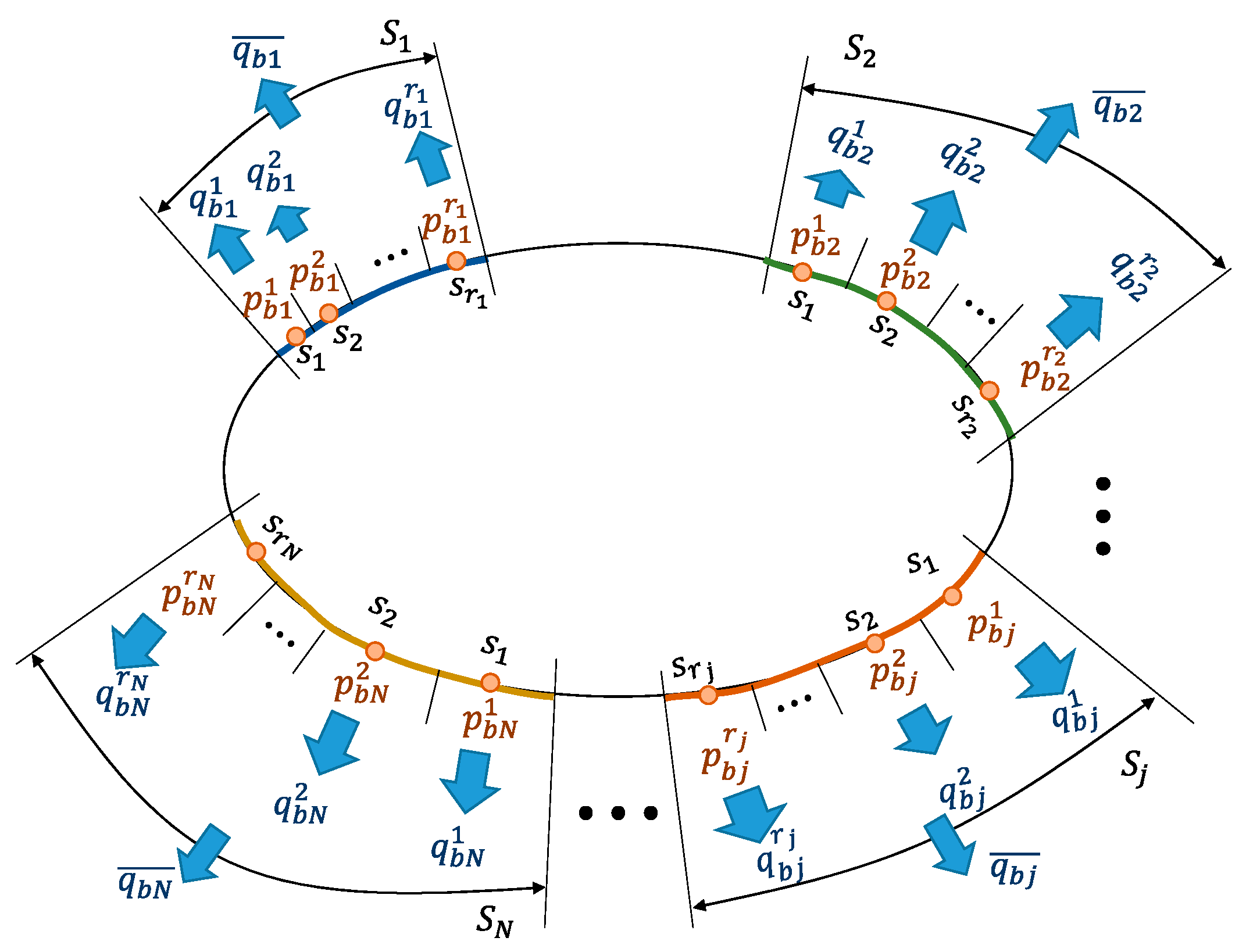
Let us consider a general case with some unconventional hydraulic boundary conditions which can be expressed by u - p - p b formulation in the following manner. As depicted in Figure A1, N sets of boundary surfaces S j ( j = 1,2 , , N ), each of which includes r j elemental boundary surfaces s j i ( i = 1,2 , , r j ), are assumed. At each elemental boundary surface, boundary pressure p b j i and outward boundary water flow (discharge) q b j i , which can be expressed using p b j i referring to the finite volume method with the physical model elaborated by Asaoka et al. [24], are considered. Therefore, the total number of additional unknown variables, i.e., boundary water pressures { p b j i } , is M = j = 1 N r j and these are obtained with nodal soil displacements { u } and elemental pore water pressures { p } . Note that sets of boundary surfaces S j are displayed without any overlap for simplicity in Figure A1; however, they can share the same elemental boundary surfaces s j i .
Next, the conditions of boundary water pressures are established for a total of M N equations as follows:
p b 1 1 + d 1 1 = p b 1 2 + d 1 2 = = p b 1 r 1 + d 1 r 1 r 1 1   E q s . p b 2 1 + d 2 1 = p b 2 2 + d 2 2 = = p b 2 r 2 + d 2 r 2 r 2 1   E q s . p b j 1 + d j 1 = p b j 2 + d j 2 = = p b j r j + d j r j r j 1   E q s . p b N 1 + d N 1 = p b N 2 + d N 2 = = p b N r N + d N r N r N 1   E q s . ( M N   equations ) ,
where d j i is a parameter used to determine the relations between boundary water pressures. When d j 1 = d j 2 = = d j r j , one of the equations in Equation (A4) is transformed into p b j 1 = p b j 2 = = p b j r j , indicating equality of all boundary water pressures within S j . The periodic condition of boundary pore water pressures in Equation (33) were expressed in this manner. Furthermore, if d j i is expressed as d j i = γ w z b j i ( γ w is the unit weight of water and z b j i is the vertical height of the center of the elemental boundary surface s j i ), one of the equations in Equation (A4) is transformed into p b j 1 + γ w z b j 1 = p b j 2 + γ w z b j 2 = = p b j r j + γ w z b j r j . This indicates equality of all boundary heads within S j .
To close the system with the equations of motion (or the equilibrium equations) and the continuity equation, linear relations between boundary water flows are formulated for each set of the boundary surfaces ( N equations) as follows:
i = 1 r 1 c 1 i q b 1 i = q b 1 ¯ i = 1 r 2 c 2 i q b 2 i = q b 2 ¯ i = 1 r j c j i q b j i = q b j ¯ i = 1 r N c N i q b N i = q b N ¯   ( N   equations ) ,
where c j i is a coefficient; q b j ¯ is the known amount of outward boundary water flow from the boundary set S j ; The superscript ¯ denotes a known value only in this appendix. For example, if c j 1 = c j 2 = = c j r j = 1 and q b j ¯ = 0 , no net boundary flow from S j can be considered. The periodic condition of boundary pore water flows in Equation (34) were expressed in this manner.
Figure A1. Treatment of boundary water pressures and water flows in u - p - p b formulation.
Geotechnics 05 00081 g0a1

References

  1. Yamamoto, T. Wave induced instability in seabeds. In Proceedings of the ASCE Special Conference: Coastal Sediments, Charleston, SC, USA, 16–18 November 1977; pp. 898–913. [Google Scholar]
  2. Putnam, J.A. Loss of wave energy due to percolation in a permeable sea bottom. Eos Trans. Am. Geophys. Union 1949, 30, 349–356. [Google Scholar] [CrossRef]
  3. Reid, R.O.; Kajiura, K. On the damping of gravity waves over a permeable sea bed. Eos Trans. Am. Geophys. Union 1957, 38, 662–666. [Google Scholar] [CrossRef]
  4. Sleath, J.F. Wave-induced pressures in beds of sand. J. Hydraul. Div. 1970, 96, 367–378. [Google Scholar] [CrossRef]
  5. Liu, P.L. Damping of water waves over porous bed. J. Hydraul. Div. 1973, 99, 2263–2271. [Google Scholar] [CrossRef]
  6. Nakamura, H.; Onishi, R.; Minamide, H. On the seepage in the seabed due to waves. In Proceedings of the 20th Coastal Engineering Conference, Nagoya, Japan, 9–14 November 1973; pp. 421–428. [Google Scholar]
  7. Moshagen, H.; Tørum, A. Wave induced pressures in permeable seabeds. J. Waterw. Harb. Coast. Eng. Div. 1975, 101, 49–57. [Google Scholar] [CrossRef]
  8. Prévost, J.H.; Eide, O.; Andersen, K.H. Discussions of “wave induced pressures in permeable seabeds”. J. Waterw. Harb. Coast. Eng. Div. 1975, 101, 464–465. [Google Scholar] [CrossRef]
  9. Mallard, W.W.; Dalrymple, R.A. Water waves propagating over a deformable bottom. In Proceedings of the Offshore Technology Conference, Houston, TX, USA, 1–4 May 1977. OTC-2895. [Google Scholar] [CrossRef]
  10. Biot, M.A. General theory of three-dimensional consolidation. J. Appl. Phys. 1941, 12, 155–164. [Google Scholar] [CrossRef]
  11. Yamamoto, T.; Koning, H.L.; Sellmeijer, H.; Van Hijum, E. On the response of a poro-elastic bed to water waves. J. Fluid Mech. 1978, 87, 193–206. [Google Scholar] [CrossRef]
  12. Madsen, O.S. Wave induced pore pressure and effective stresses in porous bed. Géotechnique 1978, 28, 377–393. [Google Scholar] [CrossRef]
  13. Okusa, S. Wave-induced stresses in unsaturated submarine sediments. Géotechnique 1985, 35, 517–532. [Google Scholar] [CrossRef]
  14. Hsu, J.R.C.; Jeng, D.S. Wave-induced soil response in an unsaturated anisotropic seabed of finite thickness. Int. J. Numer. Anal. Methods Geomech. 1994, 18, 785–807. [Google Scholar] [CrossRef]
  15. Mei, C.C.; Foda, M.A. Wave-induced responses in a fluid-filled poro-elastic solid with a free surface—A boundary layer theory. Geophys. J. Int. 1981, 66, 597–631. [Google Scholar] [CrossRef]
  16. Jeng, D.S.; Rahman, M.S. Effective stresses in a porous seabed of finite thickness: Inertia effects. Can. Geotech. J. 2000, 37, 1383–1392. [Google Scholar] [CrossRef]
  17. Jeng, D.-S.; Cha, D.H. Effects of dynamic soil behavior and wave non-linearity on the wave-induced pore pressure and effective stresses in porous seabed. Ocean. Eng. 2003, 30, 2065–2089. [Google Scholar] [CrossRef]
  18. Ulker, M.B.C.; Rahman, M.S.; Jeng, D.S. Wave-induced response of seabed: Various formulations and their applicability. Appl. Ocean. Res. 2009, 31, 12–24. [Google Scholar] [CrossRef]
  19. Tong, L.; Liu, P.L.F. Transient wave-induced pore-water-pressure and soil responses in a shallow unsaturated poroelastic seabed. J. Fluid Mech. 2022, 938, A36. [Google Scholar] [CrossRef]
  20. Strang, G. Linear Algebra and Its Applications, 4th ed.; Cengage Learning: Boston, MA, USA, 2005. [Google Scholar]
  21. Zienkiewicz, O.C.; Chang, C.T.; Bettess, P. Drained, undrained, consolidating and dynamic behaviour assumptions in soils. Géotechnique 1980, 30, 385–395. [Google Scholar] [CrossRef]
  22. Zhao, K.; Wang, Y.; Liu, P.L.F. A guide for selecting periodic water wave theories-Le Méhauté (1976)’s graph revisited. Coast. Eng. 2024, 188, 104432. [Google Scholar] [CrossRef]
  23. Toyoda, T.; Noda, T. Numerical simulation based heuristic investigation of inertia-induced phenomena and theoretical solution based verification by the damped wave equation for the dynamic deformation of saturated soil based on the u–w–p governing equation. Soils Found. 2021, 61, 352–370. [Google Scholar] [CrossRef]
  24. Asaoka, A.; Nakano, M.; Noda, T. Soil-water coupled behavior of saturated clay near/at critical state. Soils Found. 1994, 34, 91–105. [Google Scholar] [CrossRef]
  25. Yoshikawa, T.; Noda, T.; Kodaka, T. Effects of air coupling on triaxial shearing behavior of unsaturated silty specimens under constant confining pressure and various drained and exhausted conditions. Soils Found. 2015, 55, 1372–1387. [Google Scholar] [CrossRef]
  26. Noda, T.; Asaoka, A.; Nakano, M. Soil-water coupled finite deformation analysis based on a rate-type equation of motion incorporating the SYS Cam-clay model. Soils Found. 2008, 48, 771–790. [Google Scholar] [CrossRef]
  27. Christian, J.T. Undrained stress distribution by numerical methods. J. Soil Mech. Found. Div. 1968, 94, 1333–1345. [Google Scholar] [CrossRef]
  28. Akai, K.; Tamura, T. Numerical analysis of multidimensional consolidation accompnaied with elasto-plastic constitutive equation. Proc. Jpn. Soc. Civ. Eng. 1978, 269, 95–104. [Google Scholar] [CrossRef]
  29. Asaoka, A.; Noda, T.; Kaneda, K. Displacement/traction boundary conditions represented by constraint conditions on velocity field of soil. Soils Found. 1998, 38, 173–181. [Google Scholar] [CrossRef]
  30. Verruijt, A. Elastic storage of aquifers. In Flow Through Porous Media; De Wiest, R.J.M., Ed.; Academic Press Publishers: Cambridge, MA, USA, 1969; Volume 1, pp. 331–376. [Google Scholar]
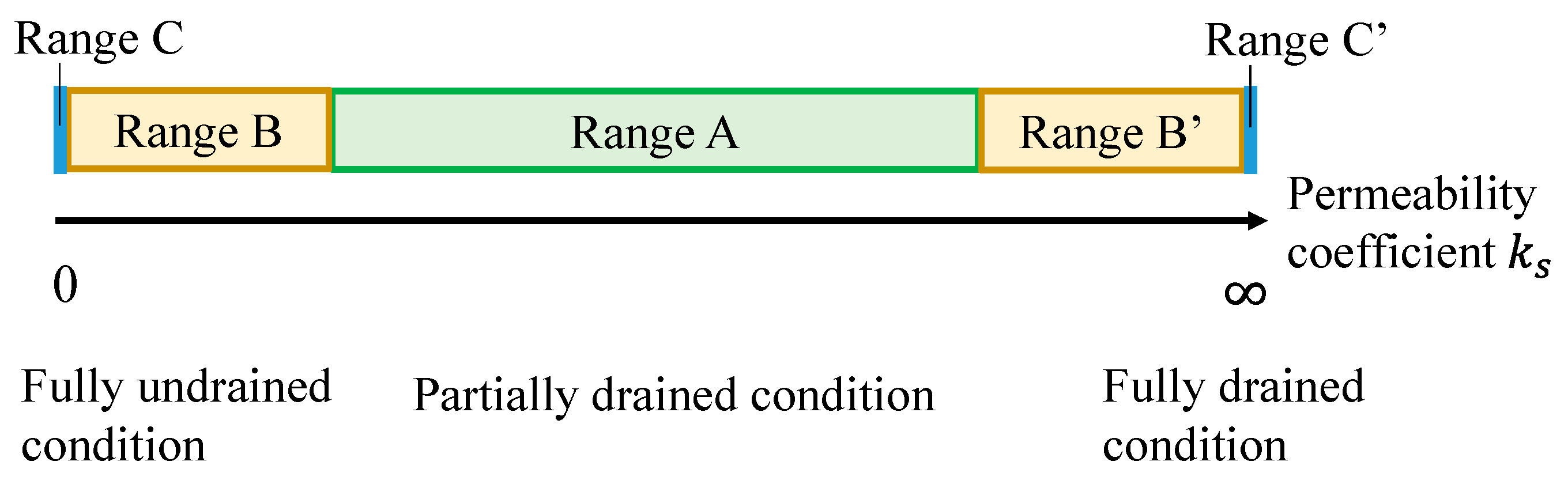
Figure 1. Definition of the ranges of permeability coefficient.
Geotechnics 05 00081 g001
Figure 2. Schematic diagram of the problem targeted in this study.
Geotechnics 05 00081 g002
Figure 3. Condition number of the matrix [ A ] in Equation (14-2) with respect to permeability coefficient k s . * Vertical and horizontal axes are logarithmic.
Geotechnics 05 00081 g003
Figure 4. Vertical distributions of the maximum absolute values of variables with different permeability coefficients. * Expressed by the solution of Yamamoto [1].
Geotechnics 05 00081 g004
Figure 5. Consideration of boundary water pressures and pore water flows for hydraulically periodic conditions in the numerical scheme.
Geotechnics 05 00081 g005
Figure 6. Schematic of the numerical model.
Geotechnics 05 00081 g006
Figure 7. Relations of horizontal and vertical displacements, u x u z , within a wave cycle under the three drainage conditions. * Expressed by the solution of Yamamoto [1].
Geotechnics 05 00081 g007
Figure 8. Relations of incremental mean effective stress and deviator stress normalized by wave pressure amplitude, Δ p / p o Δ q / p o , within a wave cycle under the three drainage conditions. * Expressed by the solution of Yamamoto [1].
Geotechnics 05 00081 g008
Figure 9. Horizontal isochrones of excess pore water pressure normalized by wave pressure amplitude, p e / p o , at z = 12.5 m and t = 0.013   T under the three drainage conditions. * Expressed by the solution of Yamamoto [1].
Geotechnics 05 00081 g009
Table 1. Applicability of theoretical solutions and verifiability of numerical analysis codes.
Yamamoto’s Solution [1]Newly Derived SolutionsNumerical Analysis Codes
Range AApplicableInapplicableVerifiable by Yamamoto’s solution
Ranges B&B′InapplicableInapplicableUnverifiable
Ranges C&C′InapplicableApplicableVerifiable by newly derived solutions
Table 3. Dimensionless parameters governing the problem.
Dimensionless
Parameter
DefinitionPhysical Meanings
Π 1   a = k s ( E c + K f / n ) γ w ω d v 2 Consolidation parameter governing the drainage condition of the seabed
κ   a = K f / n E c + K f / n Ratio of compressibility of pore fluid to total stiffness, i.e., combination of soil stiffness and bulk modulus of pore fluid
κ 1   a = λ E c + K f / n Ratio of bulk modulus of soil skeleton to total stiffness
κ 2   a = G E c + K f / n Ratio of shear modulus to total stiffness
m  a = k d v Ratio of thickness of the seabed to wavelength
κ a  b = p o E c + K f / n Ratio of wave pressure amplitude to total stiffness
a conformed to Zienkiewicz et al. [21] and Ulker et al. [18]. b developed originally in this study.
Table 4. Soil properties and wave conditions.
Soil Properties
Porosity n 0.3
Poisson’s ratio ν 0.333
Shear modulus G (kN/m2)10,000
Bulk modulus of pore fluid K f (kN/m2) a 2.30 × 10 6
Degree of saturation S r 1.0
Unit weight of water γ w (kN/m3)9.81
Wave Conditions
Height H (m)11.6
Amplitude p o ( = H γ w / 2 ) (kN/m2)57.0
Period T (s) b 15.0
Angular frequency ω ( = 2 π / T ) (rad/s) b 0.483
Length L (m) b324.0
Wave number k ( = 2 π / L ) (rad/m)0.019
Velocity C (=L/T) (m/s) 21.6
Dimensionless Parameters
Π 1   c-
κ 1.0 × 10 2
κ 1 2.6 × 10 3
κ 2 1.3 × 10 3
m 0.484
κ a 7.4 × 10 6
a Complete saturation of soil ( S r = 1 ) is assumed. b Sinusoidal wave is applied using the parameters reported by Moshagen and Tørum [7]; c  Π 1 is dependent on permeability coefficient k s .
Disclaimer/Publisher’s Note: The statements, opinions and data contained in all publications are solely those of the individual author(s) and contributor(s) and not of MDPI and/or the editor(s). MDPI and/or the editor(s) disclaim responsibility for any injury to people or property resulting from any ideas, methods, instructions or products referred to in the content.