1. Introduction
This article attempts to surface an issue that has been a research lacuna in human geography. It concerns a ‘substance’ existing within a place that is significant for understanding its space and spatial processes, not less than other forces that produce these processes. This substance consists of concrete, material objects that are integral to a place and are perceived, encountered and even frequented daily by many in the community. Their common denominator posits them as “geographical entities” (GEs) which contribute their agency to understanding how local space is produced, the evolving nature of its space due to its power relationships with them, and how the very nature of the place might possibly be transformed by these relationships. These GEs are the material embodiment and representation of various social economic and governance organizations and institutions, representing all domains of everyday life, whether industrial, commercial, services, leisure, educational and governmental. These are spatial objects that, as concrete, materially distinct geographical entities, are conspicuous in the local landscape and develop relationships with it. Examples, among many, include a hospital or university/college. Having been taken for granted in human landscapes, they have not been studied as individual GEs within a place per se that, as agents within it, participate in the broader process of relationships with the surrounding local community. Yet their relationality is significant in understanding the place as are many other non-geographical agents. Hence, viewed through this alternative lens, as geographical entities in their relational perspective—rather than as mere organizational objects in their respective institutional realms—broad, rich worlds unfold in geography and beyond by studying their relationships with the place.
The significance of this article is inherent in two perspectives. Theoretically, it aims at elaborating an issue, geographical entities within a locality, and their mutual relationships, which has not been given any conceptual and analytical attention among human geographers. Conceptual and empirical engagement with GEs at that scale can enhance understanding of places in considerable measures. However, their material spatial presence highlights also the second perspective, the applicability of such engagement. Their presence is, by definition, relational that is, they can create impacts upon the place which must be foreseen and hence managed in some rational ways by public authorities. This implies, as shown below, applicability of their governance in two fields: public policy of management of their present conduct and urban planning schemes for their future emergence.
Surfacing this issue, as well as insights and merits associated with it, and its practical research issues are the purpose of this article. I begin with addressing the issue of a GE, how it may be viewed relationally despite the alleged contradiction between relationality and entitative thinking, the commonalities and differences between human geography and sociology in engaging with GEs, and relationships of GEs with the place as agents participating in its spatiality. This is followed by elaborating practical analytical issues associated in engaging with GEs and outlining the methodology of this study based on illustrating three previously studied cases of GEs of different natures and geographical contexts. The aim is to reveal how these local spatialities, i.e., how local space is produced, the temporal dynamics in shaping the nature of local space, and their impact on the nature of the place itself, contribute to understanding relationality of GEs in general, that is, at a higher level of abstraction. The discussion following these cases highlights their respective merits for understanding local space from the perspective of GEs. It also expands on various issues and questions of engaging with GEs, including not only their relationships with the place but among themselves, the implications for understanding the place, and applicability in terms of governance and planning issues associated with existing and planned GEs. The conclusion dwells upon the value of studying GEs for human geography and for geography more broadly.
2. Geographical Entities, Spatiality and Relationality: A Conceptual Framework
Engagement with entities dates to Classical Antiquity’s Aristotle arguing that entities are the primary beings of reality and constitutive of space, and are explained primarily through substance form and matter [
1]. Challenging Newton’s absolutist view of space, Leibniz similarly argued for the existence of entities (which he termed “monads” or substances) as indivisible points of force and perception, with space constituted through their position vis-a-vis each other [
2,
3]. In contemporary geography engagement with geographical entities emerged in the 1990s primarily in GIS and spatial information technology e.g., [
4,
5,
6,
7]. Beyond physical geography, where entitative thinking is quite prevalent e.g., [
8], such engagement required concretizing information about the entities so that they could be clearly bounded territorially as “natural things” that have separate, distinct existence and objective or conceptual reality. Nunes [
4] thus approaches a GE as “A part of the earth surface defined by virtue of one or several spatial and/or not spatial properties, which make it a space in itself, physically or functionally different from its surrounding and able of carrying out an individual existence persistent in time and perceived as individual space with particular properties and relationships” (p. 9) (see also Tambassi [
9]).
Contrary to these sub-fields, relational human geographers render such entitative logic questionable due, as argued by Thomasson [
10], to their often engagement with imaginative, mind-dependent issues. Along this critical line, prominent proponents of the relational paradigm (e.g., [
11,
12,
13,
14,
15,
16]) advocate viewing space and its orders as always unbounded, intertwined, multiple and becoming.
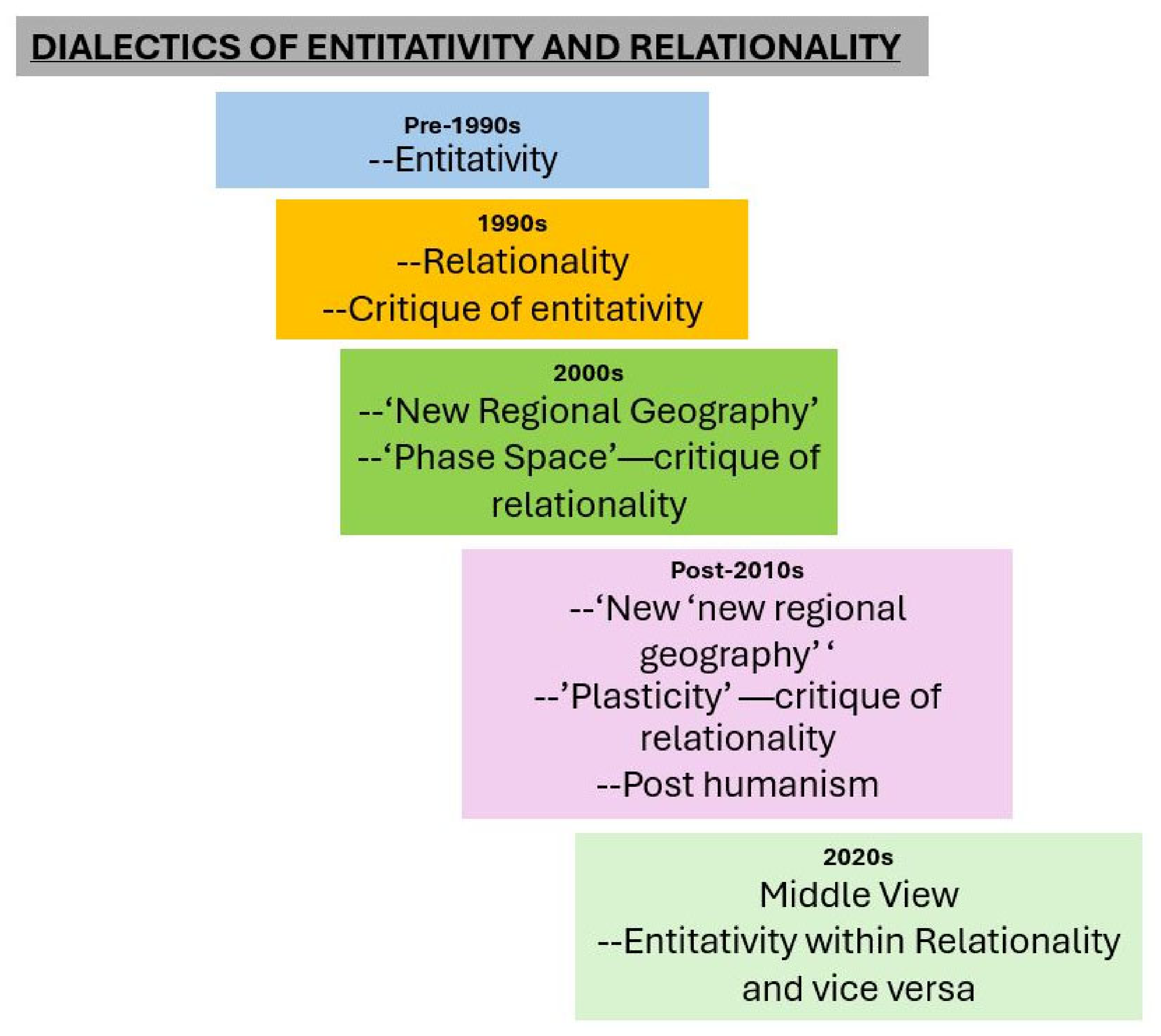
This article presents a middle view, that mind-dependence is not necessarily an obstacle to territorial entitative thinking, and entitativity and relationality do not necessarily defy each other. The middle view is meant to provide a bridge between relational thinking, which advocates spatial boundlessness, and entitative thinking which advocates spatial boundedness. It argues that spatial boundedness (as elaborated below) is not necessarily absolute but rather flexible, allowing at certain circumstances adoption of relationality within entitativity and vice versa. In the present article this bridge becomes operational through geographical entities. In arguing this, I join the “phase space” approach proposed by Jones [
17], albeit about the ‘new regional geography’ paradigm. Jones advocates a moderate relationality that “involves conceding that there
may be certain circumstances in which, as an object of analysis, practical and bounded spaces that have been institutionalized through particular struggles and become identified as discrete territories in the spheres of economics, politics and culture,
matter” (p. 500; italics original). A similar view is advocated by Thomasson [
10] who favors regarding certain geographical kinds as genuine components of the world rather than being flatly mind-dependent: “We are typically concerned with entities that involve independent tracts of land, as well as boundaries or social status” (p. 172). In his later call for a ‘new new regional geography’, Jones raises the question of whether regions can be seen plastically as relational and networked or/and have territorial and scalar concerns [
18], that is, whether, when and under what geohistorical circumstances they may or may not be viewed as bounded distinguishable entities. In between, following the locality debates in the 1980s–1990s, Jones also adopted a middle approach in proposing a new paradigm for localities as entities [
19]. Similarly, Allen’s notion of “more than relational geography” [
20] refers to entities formed through socio-spatial interrelations.
As boundedness is a key issue here, these middle views between entitativity and relationality are ontologically supported by Malpas’ discussion of space [
21]. His engagement with boundedness, and bounded openness, derives from questioning the relationality paradigm’s critique of boundedness as closeness which for him obstructs engagement with genuine ontological questions in geographical thinking. For Malpas, boundedness is not necessarily equated with closeness but rather is associated with openness that generates extendedness, and it is the latter that constitutes the underlying idea of space. Accordingly, space is characterized by inner and outer properties, that is, a body is enclosed by that which surrounds it but concurrently assumes a property of filling that which surrounds it, thus inevitably pressing against it, that is, establishing interaction with it. Hence, rather than boundlessness in relational spatiality, the formation of a relational field, including the elements that are related to within it, as a matter of fact precisely requires boundedness. It follows from Malpas that the very existence of an entity and its relationships with its surroundings, as well as the existence of the surroundings, relies on the ontological fundamentality of its boundedness. Hence, as asserted also by Cox [
22], the entities that make up the world and their interrelations are actually what space is constructed through. Without them and their boundedness there would be no surroundings and hence no space (see also Casey, [
23]).
Yet there are variations in the social sciences about the nature of entities. Sociologists too regard relationality as a major issue. Corresponding with Cox, Fu [
24] too argues that space is the expression of relations, of interactions of people, and spatiality implies the spatial experience and challenge of the
individual. Hence spatiality in relational sociology constitutes an epistemological framework for spatial research, reverberating its epistemological value for relational geographers as suggested by Malpas [
21]. However, it is appropriate to probe the difference between the sociological and geographical realms regarding what is that which prompts the relations that produce the relational field within which a certain spatiality takes place, the entity which the relational discourse revolves around. For Fu [
24,
25] in sociology it is the individual in public space, or the relevant derivative such as groups in neighborhoods, and therefore the essence of space is more sociological rather than physical or geographical. In geography it is the geographical entity, as outlined in detail below, which is an actor that provides an epistemological framework for spatial research. Furthermore, Fu distinguishes the relational spatiality of sociology from that of physics or geography: “space in relational sociology cannot be located in a static point as an epistemological premise of geography, but instead in the betweenness of social relations” (Fu, [
24], p. 603), that is, between coordinate-less individuals. In human geography, I argue, the epistemological premise is that space can precisely be situated in a static point due to the nature of geographical entities as substances. This notion of substance corresponds with Harvey’s [
26] “permanences” which are forms carved out from the flow of spatio-temporal processes and are temporarily stabilized in a certain spatio-temporal coordinate.
These differences notwithstanding, Fu’s [
25] significant contribution lies in extending a more radical epistemological perspective of relational spatiality. It involves moving from the epistemology of inter-action to that of trans-action between entities, from an encounter between two independent and distinct entities to that where neither one can be regarded independent of the relations. It follows that the entities are constitutive of each other, co-producing each other mutually within a complex joint activity beyond fixed social or spatial structures, changing each other through their inter-action. In other words space is “… the productive mode of social trans-actions rather than merely … a substance waiting to be influenced by society” 25, p. 352]. In principle this notion of trans-action should apply to all kinds of entities, whether sociological or geographical.
Taken together, these views facilitate adopting the entitative approach in human geography within the purview of relationality. Human geographers have studied extensively various GEs such as states, regions, localities, neighborhoods, streets and homes. While these entities may be thought of to cover the entire range of human territorial phenomena, there are forms of substance that as GEs assume a considerable spatial role within localities, yet constitute a significant research lacuna. That is, they accommodate a population of a certain size. Their “inhabitants”, that is, those choosing or compelled to be there, on a quasi-permanent non-dweller basis, spend a major part or all their daily time there. They contain physical structures (buildings, roads, sidewalks, gardens, parking space, and facilities) and infrastructures (power, water, sewage, communication). They provide various social, emergency/security and even commercial services to their ‘inhabitants’. They occupy a territory that is bounded at various legal or non-legal levels, which in certain circumstances may even be fenced and barred to public entrance through various physical and legal apparatuses granted by statutory planning and government regulations. These territories, which at times occupy a considerable aerial size within the hosting place, manifest the essence of their respective institutional organization. They are supervised by private public or governmental institutions, some of which are relegated with legal governance power to practice internal quasi-policing/security regime commensurate with their specific institutional requirements, internal constitutions or by-laws. In certain respects, these institutions become a quasi-local government partly substituting for the legal local one depending on their nature and function within the community whether in business (commercial or industrial corporation), government (local/regional or national authority), or civil society (local or countrywide organization or association).
In line with Anderson et al. [
27], each such entity may be viewed as a spatially compact assemblage of objects, people and institutions. This assemblage materializes into a stabilized substance at a particular moment and site through various processes (social, economic, administrative, political, and cultural) and relations to become this distinguishable bounded entity. These materialities and non-materialities assemble into a substance of a GE whose most important attribute, from the perspective of entitativity, is the prominence and distinctiveness of its compound and territory from its surrounding environment and landscape, whether in urban or rural contexts. Examples include hospital campuses, industrial parks/compounds, intentional communities, university/college campuses, military bases, government compounds, cultural and sports compounds, and others [
28].
This approach towards a GE corresponds with Nunes’ [
4] shown above. However, the latter is more abstract, general and exclusionary, particularly when framed within GIS domains. The approach proposed here is more socially and politically inclusive and relationally oriented, viewing a GE
within its time-space contextuality, as by definition
existing within a place. The material and functional gap between it and its surroundings, as outlined above, inevitably raises the issue of its relationships with those surroundings. By virtue of these attributes, and despite the betweenness of its formal and informal statuses, such a GE becomes, in fact, a place nesting within a place [
29]. That is, beyond these properties, the entity contains affective and discursive perspectives like those that place studies (e.g., [
30,
31]) commonly highlight. Hence, attributing agency (e.g., [
32]) to this GE as a place itself is also significant for its spatial performance.
Attributing such agency to GEs draws upon the posthuman (or more-than-human) ontology that de-centers humans as sole agents shaping social and spatial life. It argues instead that agency should be attributed also to other, non-human entities (animals, plants, technologies, materials, and even landscapes), all of which are entangled and interconnected actors in a complex web of relations [
33,
34,
35]. This logic also applies to entities such as those at the focus of this article. In line with this, such an entity is part of a domain of GEs which is integral to the host place’s fabric of quarters, neighborhoods, infrastructures, institutions and community. As GEs, they play a role in developing relations with the hosting entity in various fields and issues that project upwards subject to the imperatives of their respective supervising institutions. These relations imply that they partake in the broader social and economic structural forces producing local space, configuring the nature of local space and possibly impacting the very nature of the place itself. Since these entities are of various types, their relations with the host place may result in a mosaic of sub-spaces.
Yet, despite regarding them as substances and permanencies within the posthuman realm, GEs are not detached from the local social context. On the contrary, they assume sociological functions. First, they constitute a geographical response to various economic, social, cultural or environmental societal/communal needs, wants and requirements. Second, some have evolved organically with their built and social environment while others are alien to it, predating the host entity but later engulfed by it or, conversely, having been formally or informally implanted within its physical landscape and social fabric. Third, they are composed of people, whether or not of the same community, who are interacting with the local community within their specific spaces of relationality. Such interactions are different in nature from those in other social contexts studied by sociologists such as the home, the neighborhood or public spaces, thus complexifying the nature of social interactions. Their agency and interactions, along with their material and non-material properties as described above, assemble to become the substance of this entity as a geographical one, in contrast with individuals or groups which constitute the entities studied by sociologists. Obviously, social contexts of interactions vary depending on types of GEs, culture, political regimes and other frameworks.
Viewed as geographical agents, their existence in space can be conceptualized by adopting relational vocabulary. Massey [
13], Murdoch [
36] and Thrift [
37] suggest that space is co-constituted by entities of differing identities and natures
and of their embedded power relations. Their ensuing spatiality, meaning
how the surrounding space is produced by them and
what its
nature is, may be either consensual (through agreement and alignment) or contested (through exclusion or forcibly engagement). This corresponds with Meir and Karplus’ [
38] “consummate space,” that is, space is not an issue sparking political action, in contrast with “intensive space” which entails political action. Murdoch [
36] further elaborates that relationships are double-edged: they can facilitate movement and access but can equally entrench confinement and exclusion. Consequently, the edges might be described as spaces of negotiation and acceptance vs. spaces of prescription and dictation, but they may also suggest a relational spectrum of dynamic relations.
The major temporal nodes of the dialectics of entitativity and relationality are presented in
Figure 1. Following this extensive review and conceptual framework of relationality of GEs, the practical question now is how they may be studied empirically.
3. Practical Research Issues and Current Methodology
There are three complementary relational forms for studying a GE: nature of the process of spatiality (i.e., production of space), nature of the relational end-product space, and transformed nature of the place (as impacted by this entity). Together these three forms exhaust the entire range of relationality of a GE. Understanding how space is produced through these relations may rely, as an analytical framework, on Schmid’s [
39] interpretation of moments of space as material production, production of knowledge and production of meaning to Lefebvre’s [
40] spatial trialectic platform of perceived, conceived and lived spaces. In the present context, it is the GE’s agency that activates the interplay between these three moments. The study of the nature of a place’s space, as produced by these relations, relates to its typification through the above distinction between consensual vs. contested spaces that subsume the political dimension inherent in relations. The transformed nature of the host place through this relationality may be studied by analyzing the impact of a GE upon the various social, cultural, economic, environmental and political realms of that locality.
Based on this tripartite analysis, further questions relate to the method of data collection and analysis of these relations. Given that information, its conceptualization, and its meaning, emotions and symbolism within the public are at stake, it is most appropriate to rely primarily on a qualitative methodology, especially interviews with various kinds of actors engaged in these relations, representing both the entity studied and the community, as well as media and social networks representing the relevant community’s discourse. A thematic analysis of the data can surface the themes and narratives that conform to the three forms of study. It corresponds with Fu’s [
24,
25] notion of the role of space as a discursive power in studying relational spatiality, revealing societal experiences with and attitudes towards power.
As noted, a GE may be viewed as a place within a place that is, a ‘substance’ that partakes in constituting what a place is. Hence, information about a GE may dwell within Mocnik’s [
41] proposed paradigm of Platial Information (vs. the dominant Spatial Information paradigm). In suggesting that a place cannot exist without a fixed spatial extent, Mocnik in fact aligns with the notion of boundedness inherent in a place and, by implication, in a GE. This emergent paradigmatic shift, forecasted by Goodchild [
42] about the intersecting digital technology, social science and digital data, thus re-centers the concept of place into geography’s core through what Mocnik refers to as Platial Information Systems (PIS). Obviously, this includes the introduction by Cope and Elwood [
43] of the ‘qualitative’ into GIS despite its fuzziness challenge to boundedness and by implication to entitativity.
As indicated by Stavrianopoulou [
44], place-related aspects of space have indeed become increasingly important in recent decades. Technological developments, including immersive technologies [
45], have not only afforded an ever increasing range of information about places, but this ‘supply’ has also been generating an increasing public and academic ‘demand’ for that information. The dialectic between these processes has increased the complexity of the data available, prompting Mocnik [
41] to raise paradigmatic theoretical questions as to how we can conceptualize, represent, analyze and gain insights about places through PIS. Extending this line of thought to GEs carries a significant future potential for enriching the body of information needed for understanding one, both in itself, as a place, and as a place within a place, that is, its relationality.
Fu’s call [
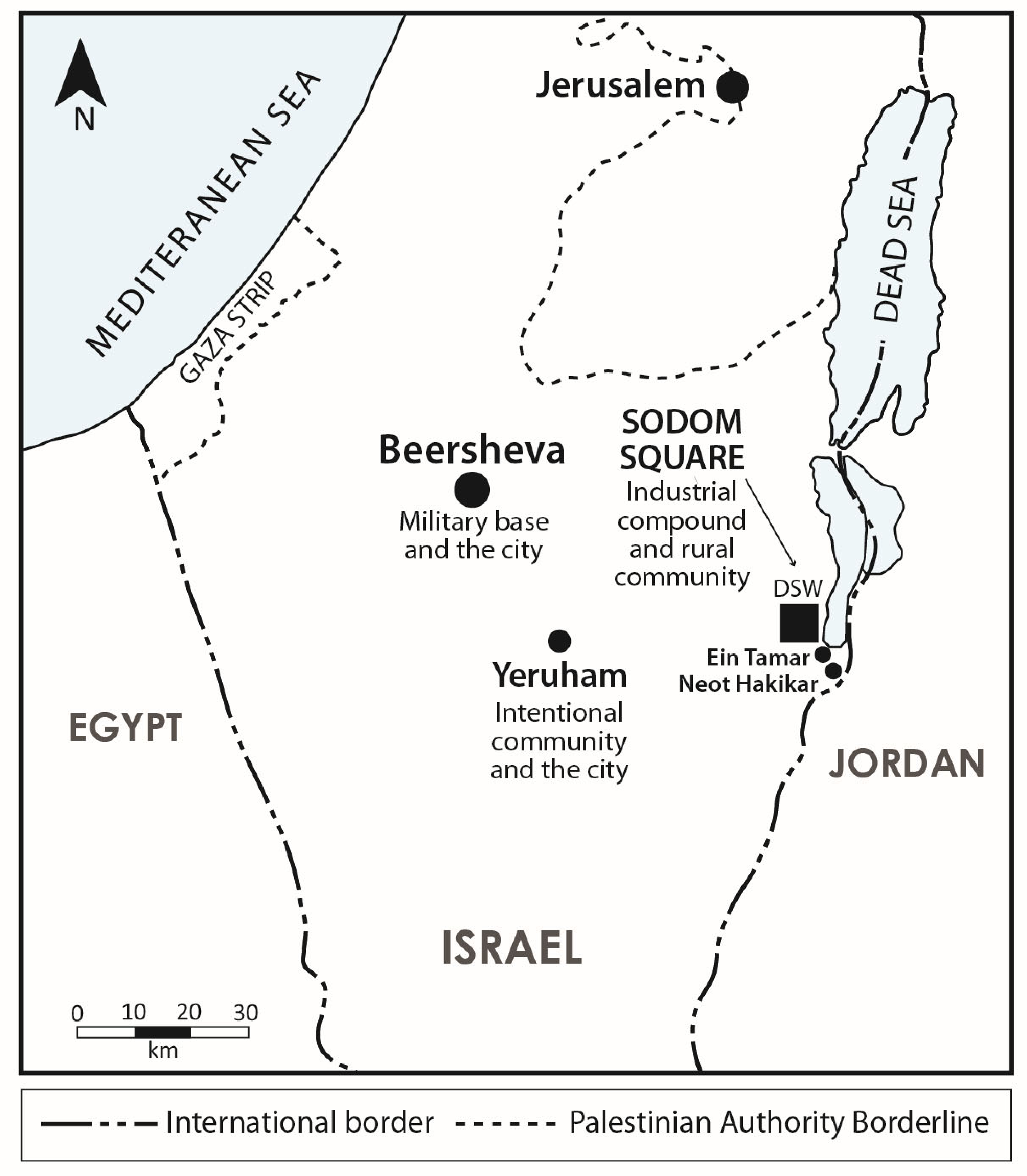
25] upon relational sociologists to analyze spaces specifically through the empirical reality of case studies is relevant to relational human geographers too. The following sections summarize three previously studied cases of relational space of GEs of different natures in southern Israel (
Figure 2). Each was studied under a different form of relationality: the
spatiality of a military base; the
nature of space formed by an industrial compound; and the impact of an intentional community on the
nature of a place, all situated within urban or rural places, and representing the main sectors of society: government, business, and civil society.
These cases were not in themselves studied within the present conceptual framework, as each had its own theoretical and sub-disciplinary context, each involving analysis of rich field empirical data commensurate with this context. In the present article, instead, the analytical approach adopted and the ‘empirical’ evidence analyzed is more conceptual. The ‘empirical’ evidence is composed of major findings and insights arrived at in these cases, each in its own way, to reveal and discuss, at a higher level of abstraction, the vitality of the conceptual development of GEs within the context of relationality and spatiality. This, it is believed, is highly useful in illustrating to the geographical readership how different GEs at different spatial settings can be studied under a unifying conceptual umbrella, thus opening an avenue for future studies.
Due to the novelty of the issue dealt with in this paper, these three cases are the only ones available for analysis under the proposed conceptual framework. This absence of random sampling from a wider selection of cases constitutes a methodological weakness. It is believed, however, that under this circumstance, each case, in its own way, still provides a real contribution to portray at least the initial broader picture of understanding the relationality and spatiality of GEs.
4. Production of Space by a Geographical Entity: A Military Base
The “Pikkud” camp, currently the headquarters of the Southern Command of the Israeli Defense Force (IDF), was established by the Ottoman Empire in 1903 as a government building (“Seraya”) in the city of Beersheba, then newly established as a regional government center in southern Palestine. Currently, it occupies 2.6 hectares, including the old Seraya, enveloped by a typical Tegart fort built by the British Army in Mandatory Palestine, all surrounded during Israeli statehood by IDF’s military structures, fences, and a circumferential wall. Many of its hundreds of regular and standing military personnel are residents of Beersheba and its metropolis. Located in the heart of the Old City, overlooking its mostly non-residential, low-building profile, and equipped with several watch towers and communication antennas, it is a distinct feature in the Old City’s urban landscape. Obstructing open urban visibility, walkability, mobility, traffic, parking, urban aesthetics, urban development and life routines of the neighboring population and institutions, it is currently subject to several civil development and planning projects including evacuation to city outskirts.
Despite being a regional capital, Beersheba (pop. ~220,000, 117 km2, serving a metropolis of ~750,000) was until a few decades ago a socio-economically peripheral city, with a considerable underprivileged, weakened population. Economically, it is mostly public-service oriented. Until recent decades development around the base was blocked southwards due to national defense considerations. Hence most of Beersheba residential quarters radiate in northeast and northwest directions from the Old City and the base.
The study of the production of space by the Pikkud as a GE [
46] is part of the growing field of military geographies [
47]. The study employed the Lefebvre’s spatial trialectic of perceived, conceived and lived spaces. To complement Schmid’s above outline, perceived (concrete, material production) space is the extant material arrangements and characteristics of uses of space in various ways. Conceived space (representation of space, production of knowledge) is an abstract formation produced by scientists, administrators and technocrats to impose order upon concrete space through concepts, laws, and regulations. Lived space (space of representation, production of meaning) embodies the total everyday experience of people through symbolism, meaning, emotional bonding and the community’s sense of place related to its space.
As access to direct official military or defense information sources or to military personnel is barred, the study adopted a methodology of analyzing multiple overt civilian sources including semi-structured interviews conducted in 2018 with 21 retired senior officials of the IDF and Ministry of Defense, current and retired national and local municipal senior officials, former officers and enlisted soldiers that served on this base, and civilians operating nearby businesses and civil institutions. The focus was mostly on local resident professionals, officials, and laymen who maintain the most intensive relations with the base. To supplement the interviews, an e-mail questionnaire survey regarding civilians’ attitudes towards the base was distributed via a snowball method, yielding thirty-four returns (close to 100%). National and municipal governmental documents were also used. The objective was to capture relations between the base and its civilian environment in as many fields as possible. The data was interpreted qualitatively using thematic analysis of identifying basic themes, which were sorted into categories within the spatial triad of perceived, conceived and lived spaces.
The attributes of a military GE contradict those of its civilian surrounding in physical-material terms, systems of governance and regulation, statutory status, planning autonomy and authority over its own compound and even beyond, which together are capable of configuring the urban space shared with the community. Hence, nesting within a civilian urban setting may hypothetically develop conflictual and disharmonious relations with the community. However, synthesizing the findings of the spatial trialectic reveals a more complex reality. Conceptually, the status of the Pikkud in the past derived primarily from national security considerations, resulting in profound and broad symbolic inclusion and acceptance as normal in the Old City by all segments of the local community. It even dictated the growth of Beersheba, as noted, by barring its free spatial expansion. In this respect, mutual exclusion shaped relations between the military and civil planning authorities: the military’s planning processes ignored the presence of the base in the city, whereas the base was an untouchable entity to be circumvented by the civilian planning authorities, thus stalling the planning and development of the Old City and even beyond.
Presently, however, the status of the base has changed, primarily because of urban planning considerations, rising land values, and real estate politics, in which two trends converge: a national government project to evacuate bases from major cities to peripheral areas to allow development, and the growing dominance of professional urban planning knowledge in city and national politics over military planning knowledge. This transformation emerged not only from changes in national security conditions after the 1979 Peace Accord with Egypt but also from stronger neo-liberal trends in Israeli society, considerably impacting the spatiality of the base. Rather than localistic and patriotic sentiments or flat alignment with military needs, rooted in a profound national and militaristic spirit that blindly accepted the military GE, the dominance of universalistic, neo-liberal values of urban renewal, real estate values, and rebranding of the Old City as an inviting and accessible contiguous space increased considerably. These forces transformed the compound’s high-value land towards alignment with civilian uses, including tourist and leisure development. They also facilitated opening other territories for residential development around the Old City which became more centrally and accessibly located within the city.
While professionals and bureaucrats have been conceptually reasserting the evolving contradictory natures of these military and civil entities, the lived space relations of the base with the community reveal reserved attitudes towards the evacuation of the Pikkud. Beyond business interests, there is a considerable emotional bonding between the Old City’s retail community and the militarized space, reflected in sensing it as a homey place with economic value that also grants personal security. They warmly accommodate the young soldiers as rejuvenating the Old City and refreshing the atmosphere. Furthermore, the Pikkud is a symbol of Beersheba’s local historical heritage, which is especially significant given this peripheral city’s deficit in national prestige. Symbolism thus overrides the base’s various nuisances, some of which are highlighted by professionals and administrators of city and public institutions, and even admitted by senior military officers. Objectively, the base obstructs various spatial cultural and civilian freedoms and rights, including open urban visibility (due to closing the adjacent minaret to visitors for security reasons), walkability (due to constrained contiguous pedestrian mobility through downtown space), constrained residential permits (particularly for high-rise condos), disrupted urban aesthetics (due to the crude wall and military structures and installations), and freedom of Moslem worship (due the closure of the adjacent old mosque and minaret). These values may be subsumed under the umbrella of spatial justice and equality, right to the city and right to spatiality (that is, the uninterrupted spatial civilian routine of a city).
Subjectively, however, these civilian freedoms, reflecting professional and administrative conceptualizations and governmental violence and power, are quite alien to most of the local public. The latter’s experiences are rooted in the popular militaristic–patriotic sentiment towards the IDF as the “people’s army,” contrasting with the anti-militaristic atmosphere of planning and academic institutional conceptualizations that are liberal and universalistic but largely detached from the sentiments of the wider public. Hence, the Pikkud subordinates to the city in those aspects of being a GE that constitute their common interface. These are manifest in some features of architectural relations, such as attempts to harmonize and beautify the appearance of its street-facing wall, voluntary collaboration with the municipality in heritage conservation of buildings within the base compound, voluntary collaboration with civil agencies, or avoiding noise nuisances in downtown, all of which moderate the steep hierarchical relationship between the base and the city as derived from the logic of military–civic relations.
Thus, a military base is a very concrete, hermetically sealed GE with a strictly bounded territory. As a closed and non-democratic enclave, it is antithetical to the city whose essence is free, liberal civilian life for individuals, communities, and institutions, with spaces that are open for all. These two spaces are a product of entirely distinct cultures of governance. However, merging spatiality and relationality with the conceptualization of a GE and its agency produces a more layered scene than the flat military–civilian dichotomy. The base may be considered a place, revealing complex, diverse relations with multiple, even contradictory, meanings. Within an approach that views a city as relational [
48], even the case of a military base suggests that the boundaries and “edges” of a GE are rigid at certain moments and fluid at others, corresponding with Jones’ [
18] plasticity approach. Thus, as a GE, a military base is homogenous and exists apart from other things, yet maintaining overlapped relations and entanglements with community life, with a spatiality extending beyond its physical territory, allowing some mutual molding.
5. Nature of Space Produced by a Geographical Entity: An Industrial Compound
Dead Sea Works, a major extractor of chemicals and producer of their products, is a distinct concrete GE in Sodom Square on the southern edge of the Dead Sea, operating since the 1920s under a state concession covering an area of 600 km2 in a remote, desolate and arid environment. Employing ~4000 commuters from distant cities, with huge industrial facilities and infrastructures, DSW functions as a quasi-local authority within the concession territory. The arid environment is extremely unfriendly and remained uninhabited until the late 1970s when two rural semi-cooperative communities, Neot Hakikar and Ein Tamar, were established by the state within DSW’s concession territory. Their present population is ~400 and ~200 respectively, relying primarily on saline water’s winter crops and desert tourism. Their inhabitants are highly esteemed national pioneers for developing the harsh desert frontier of Sodom Square.
The decades-long environmental footprint of DSW has been enormous on any scale and measure, causing considerable shrinkage of the Dead Sea and various hazardous geo-ecological consequences, subjecting it to severe public criticism by civil organizations and some legal action by state agencies. In 2000, the corporation joined the international Responsible Care (RC) program and committed to following its procedures for environmental safety, human health protection and accountability to its neighboring rural communities as stakeholders. In attempting to realize its environmental responsibility towards the rural communities as the only local human bearers of its environmental footprint, DSW agreed to join a joint public forum that was established in 2005 by an environmental NGO. The forum has been convened 3–4 times annually, with representatives of both parties, as well as other regional and national state agencies and regional business organizations. Under these auspices, DSW reached out to the communities and committed to agreements with them regarding its environmental safety practices and other issues.
The study of the relations between DSW as a GE and the two communities [
49] used two sources of data. The first source was minutes of the forum’s sessions. The first five years of the forum (2005–2009), with twenty sessions, were regarded in the study as formative in the development of relations in this region. The minutes were analyzed qualitatively through a thematic analysis. Major themes were extracted relating to various bilateral issues that emerged in terms of relations between the parties. The second source was in-depth interviews conducted with five community leaders and four acting and past DSW top officers. The interviews allowed delving into deep subjective issues that relate to personal experience and narratives of the nature of relations, especially in the pre-forum years that were unreachable in the objective and impersonal data of the minutes. Forum participants were afforded the personal opportunity of reflecting critically upon the entire process free from the impact of the forum’s internal power relations and political dynamics. Analysis of both types of data involved breaking the body of raw data into as many pieces as possible and evaluating their meanings from as many angles as possible among members of both DSW and the communities.
The findings reveal the multiple respects of complexity of relational circumstances in Sodom Square. First, both the communities and DSW may be considered on multiple scales and contexts. DSW could be seen on the global scale because of producing unique chemicals for various industries worldwide; on the national scale, it contributes significantly to the national economy but has persistent high environmental impact and critical media coverage. Yet, this cannot obscure the local scale; DSW is also a GE situated near rural communities with mundane local footprints. The communities may be looked upon first at the local scale of small young pioneering rural communities struggling with a harsh and desolate arid environment within a remote frontier, but under governmental policy of settlement on the national and geopolitical scale responsible for situating them within this industrial environmentally hazardous space which, under the poor spirit of environmental responsibility of the 1970s, pays little regard for the consequences.
The second respect is local contextuality, the local conditions within which these communities and DSW exist. Until the 1970s DSW was situated in a desolate desert space, coping solely with nature. Rurality was imposed upon its urban-natured industrial identity by a national policy of rural settlement compelling it to cope with humans too. The villagers, for their part, were not forced to settle in this place, but chose to volunteer in aligning with a national ideological campaign of making the desert bloom particularly along the national border. However, they were compelled into neighboring an environmentally notorious industrial entity. Their expectations of an idyllic rural–agricultural place were interrupted by an alien industrial nature, whose presence was a fait accompli.
Third, the concession grants DSW enormous economic and political power. Its own workers are detached from local nature; even an impact on their home bio-physical and social environments is not an issue here. Yet, this power is significantly eroded by the DSW problematic environmental and corporate reputations, which it wishes to improve. On the other hand, and unlike many communities neighboring extractive industries worldwide [
50], the Sodom Square communities are neither dependent on nor accountable to DSW as an employer, nor are they typical weakened peripheral or indigenous rural communities who, as elsewhere worldwide [
51], are vulnerable to effects of development or globalization on a local geographical periphery. This independence is their potential source of political power in freely asserting their views, opinions and emotions about their place, their industrial neighbor, and their relations with it. Furthermore, being a highly esteemed national elite pioneer settlers of the rural desert frontier endows them with symbolic capital and further potential power.
However, while the only asset both entities share, Sodom Square is a restrictive and contradictive spatial setting both were compelled into co-production through the dynamics of their strengths and weaknesses. Each side holds its own sense of place as a GE. As an industrial place, DSW’s sense of place in its early years revolved around a pioneer spatial exclusivity, remoteness and desert emptiness. Before its privatization this was accompanied by pride in its industrial creation and producing significantly added economic value. The communities, despite their small size, are also very proud of their pioneer agricultural and communal creation, and their own added economic and social values. Yet, emanating from DSW’s quasi-jurisdictional status, co-production of this space began under highly hierarchical conditions. The “steepness” of this hierarchy was manifested in DSW’s inapproachability by the powerless communities in environmental issues, a one-sided assertion of power, a space of prescription.
The communities could begin to assert their power only with the aid of the environmental NGO. During its early intervention, this included realization of DSW’s contradictory economic and environmental reputation which led to suspicion of its genuine intentions. Aware of this reality DSW, for its part, entered this phase of relations under suspicion about its credibility among the communities. The forum’s decision to expand the participants’ circle to include other agents provided both sides with an assurance umbrella of a local network for environmental responsibility.
Thus, from one-sided prescriptive relations, the parties entered a phase of growing intensive relations, negotiating diverse issues and problems. The range of these issues has gradually expanded functionally and spatially, reflecting a transition from locally conflicting to shared interests. In terms of DSW functioning within the shared territory, it has expanded from environmental to social and cultural. The spatial scale of these issues also increased too, from the local to the regional to include agents and environments in the Dead Sea area at large, such as the resort hotels, and even beyond. Under the growing intensity of this space, Sodom Square has thus transformed from a space of prescription into a space of negotiation.
With time, the parties’ understanding of these relations changed, as well as the vocabulary used. Under the impact of an emerging atmosphere of environmental and social corporate responsibility, DSW had to face the various mundane nuances of its responsibility towards the local communities. This entailed adopting a more ecocentric rather than solely anthropocentric–technocentric terminology, reflecting an emergent grasp of ethical differences. Thus, terms such as “public domain,” “natural resources,” “natural values,” and “environmental conservation and rehabilitation” were added to the previous corporate, business-oriented vocabulary of “concession territory,” “raw materials” and “industrial products,” reflecting the corporation’s expanded grasp of the local bio-physical environment. This grasp, however, also included a realization that the environmental and the social are not independent of the economic, or of each other. In this respect, DSW not only reveals itself and its industrial practices more openly vis-à-vis the communities or responds more willingly to their environmental safety demands, but it has also even yielded a small portion of its concession area to allow their residential expansion and supported several cultural events there. DSW also aligns with them and accepts the value of their own local knowledge regarding its past and present environmental impact. All these translate into improved social responsibility for protecting their personal and communal environment to the extent of even harnessing its economic status by attempting environmental entrepreneurship projects on their behalf vis-à-vis the government.
In response, the narrative of the communities towards DSW has too begun to change. They realized the more humane aspects of this enterprise as an entity composed of human beings, not just an inanimate industrial compound. Under conditions of local deficit of government, they also realized the benefit in capitalizing on the economic and financial might of this industrial giant more positively. They view it as a local authority within the concession territory capable of substituting for the government in a peripheral desolate region by caring not only for their environmental wellbeing but also providing some of their social and economic needs, such as medical emergency services and business networking with other regional economic agents. In fact, governance-wise, the forum itself became an informal “cabinet” for handling various bilateral issues in Sodom Square. The communities also gradually capitalize on their own status and symbolic capital as a social elite, transforming this social resource into power in their relations with their neighbor. Accepting DSW’s material giving for improving their environmental and socio-economic wellbeing, they view themselves as capable of giving local support to their neighbor’s effort to materialize its corporate commitment to RC. Within the emerging nature of relations, and building of mutual trust, they view this engagement as their own, moral giving and reciprocation to DSW. This, too, moderates the previously steep hierarchical relations.
All these issues converge into emergent shared local identity for the parties. Each side attempts to implant within the other’s consciousness the recognition of its own sense of place, whether originating in its urban-oriented industrial identity or in a rural-oriented agricultural identity. Both identities are anchored in a shared national ideology of developing the desert frontier. In certain respects, the communities imagine an even greater shared Sodom Square identity and closer relations with DSW, co-becoming a closer joint community. DSW, as the dominant entity, by virtue of its concession and economic might, relinquished the option of rigid assertion of territoriality. Instead, it opted for relationality, that is, reaching outwards to negotiate its relationship with the communities with greater mutual acceptance in this territory. In relational terms, rather than power relations the parties asserted the power of relations inherent in their genuine mutuality. Thus, from a space of willful negotiation, preceded by a space of alienation and stressful prescription, Sodom Square has become a space of more consummate trustful collaboration, highlighting the temporal beyond the spatial dimension in its co-production and relationality.
6. Impact upon the Nature of the Place: An Intentional Community
Intentional communities (ICs) are relatively new, radical and innovative entities in socio-spatial urban and rural landscapes [
52]. Socially, an IC is a group of people organized under shared norms and goals, living together, engaging in frequent intensive internal relations, and pursuing a particular intention ranging from co-housing to making a sustainable social and environmental difference [
53]. Geographically, these goals are pursued in a chosen place where the IC occupies a predefined geographical territory such as a small neighborhood (or part thereof) or condominium. Being a radical social novelty implies it is “implanted” within an existing normative urban landscape and social fabric. As such it constitutes a GE that is bounded at various degrees and socially and spatially distinct from its neighboring environment.
The transformed nature of a place through the impact of such a GE was studied in Yeruham (pop. ~12,000) in southern Israel [
54]. Yeruham’s economy relies primarily on extractive industries and public services. With a deprived population of mostly Oriental–Sefardi ethnic origins (i.e., offsprings of Jewish immigrants from Arab countries), low income, education and housing quality and negative migration balance, it has been stereotyped as an under-developed locality and excluded from the national successful elite pioneering and affluent narrative of Ashkenazi population (i.e., offsprings of Jewish immigrants from Western countries).
The Bnei Akiva IC is a religious group which settled in Yeruham in 1992. By 2021, it numbered ~300 households (pop. ~1800) of a high socio-economic status and Ashkenazi origins). It belongs to a countrywide movement of religious, right-wing, ideologically motivated groups that settled recently in urban places within the 1967 national borders intending to increase the presence, legitimacy and political impact of the spirit of West Bank-Jewish settler movement. The IC established a gender-segregated religious elementary school and high school, a youth movement club and a synagogue. By virtue of its financial capabilities and political backing from religious right-wing national bodies, it won a municipal tender for building a neighborhood of private homes. It also established an association financed by philanthropic, governmental, and municipal sources which aimed at reaching out to city residents, and provided a platform for IC members’ active involvement in three missions: socially, involving educational and welfare fields; religiously, invigorating residents’ Judaic faith; and ideologically, enhancing residents’ right-wing political inclination, all under what they regard “social correction” in Yeruham. The association is also engaged internally in the IC members’ social wellbeing and manages its various facilities. Beyond being a radical social innovation as an IC within a city, its compound is a cultural spatial enclave due to its religious orthodox lifestyle, covering an area of ~100 acres (~10% of the municipal built area).
Understanding the impact of the IC upon the host city could be best realized through unpacking the discursive scene about the IC by city residents as those who bear its consequences. Interviews were therefore conducted in 2018 with nineteen adult residents, including one senior municipal politician, and five members of the IC, of various ages and genders, chosen by the snowball method. In addition, background documentary information from municipal agencies, social networks and forums and the local media was used. The raw data were analyzed thematically by identifying major, significant themes that reflect how residents view the impact of the IC, and views of IC members regarding their role within the city. Here too, the body of raw data was broken down into as many pieces as possible, and their meaning was evaluated for significance in the various fields of impact.
The analysis of relations of the IC with the city surfaces several areas of its impact. Demographically, the local population increased due to this religious high-fertility IC but outmigration by the original residents continues. Socio-ethnically, residents regard as illusionary the IC’s enthusiasm about positive change in residents’ social mobility and hence in Yeruham’s social quality, arguing that in fact the socio-ethnic gap has widened, fixating them on their own peripheral social class. This is manifest most conspicuously in public education where enrollment rates in secular schools dropped, depriving residents seeking quality secular education. Social integration and encounters are barred further by the IC, which, in protecting its children’s social exclusiveness, avoids ethnic mixing in its youth movement club by establishing a separate one for non-IC children. Spatially, Yeruham’s built space reveals a profound aesthetical–architectural gap between the low-quality, older housing in the neighborhoods of the original residents and the affluent IC’s luxurious homes. The latter is a secluded compound composed of private homes and the IC’s public buildings, practicing its own spatial religious observance and behavioral rules such as interrupting secular residents’ traffic and even pedestrians on Sabbath. Economically, professional and maintenance jobs in the IC’s educational and communal institutions and the municipality are mostly reserved for IC members. Several members are engaged in local tourist lodging entrepreneurship, while others are employed by various private and public employers locally and regionally. Naturally, funding received by the IC and member’s salaries circulates within the local economy and generates a multiplier effect. IC members also pay city taxes and utilities, contributing to strengthening the municipal tax base. The economic drawback of the IC relates, however, to becoming dominant in the local labor market, particularly in desired jobs in public services thus excluding the locals, not the least due to their ethnic and class affiliation. Politically, the IC has gained considerable local power derived from its cohesiveness, becoming very influential in local politics and elections, influencing municipal policy-making and conduct, thus greatly impacting the other residents. A notable example was religionizing the school system by transforming a secular school into a religious one with gender-segregated classes, and greater control over curricula.
The negative impact of the IC, as viewed by the residents, overpower the positive ones, translating into a negative discourse about the IC built on “segregation,” “exclusion,” “domination,” “patronizing,” “superiority,” “arrogance,” “hypocrisy,” “discrimination” and “racism” expressions. Beyond residents’ peripheralization at the national scale, these accumulate and converge into mutual alienation, social displacement and further peripheralization, now within their own city. This, in turn, nurtures the residents’ growing sense of helplessness and dispossession from their symbolic and material resources by the settlers, diminishing their place identity and sense of place. Together, these emotions encourage the tendency of the better-off among the residents to migrate, thus further weakening those left behind. This process is aggravated by municipal politicians and officials who, due to local electoral and national politics interests, embrace the IC and succumb to its practices of power.
Thus, three decades since the emergence of the Bnei-Akiva IC in Yeruham, and despite its enclave nature, the nature of the city has changed considerably. Socially, from the perspective of the residents and their generations-long seniority in the city, the decades-old established social order and hierarchy of power have been inverted. This results in a detrimental social schism within a place that hitherto was relatively homogenous, rendering the original residents inferior socio-politically vis-a-vis members of the IC. Spatially, the old socio-ethnic spatial contiguity of the place, as well as its relatively contiguous secular space and residents’ routine space–time schedules, which granted them a homey sense of social assurance despite their national-level peripherality, have become seriously disrupted. In fact, residents’ rights to their city, individualism and representation as individuals have become severely impaired by the presence of the IC as a GE. Expectedly, by virtue of many of their ideological, social, and organizational attributes, members of the IC think highly of their contribution to the city. They believe that settling there has added considerable human capital to this place by “removing the local trash,” as one of them put it, and that city leadership gratefully acknowledges their contribution to improving Yeruham’s image.
7. Geographical Entities, Relationality and Spatiality: Discussion
Separately and together, these three cases reveal the significance of engaging with human GEs that dwell within a place, and their considerable ontological contribution to its greater relational and nuanced understanding. One wonders how would the production of space in the Old City quarter of Beersheba and hence the city as a whole could be grasped in its entirety without considering the role of the Pikkud base in this process, including the three moments of this process; or the nature of Sodom Square’s rural space and its dynamics without studying its relations with Dead Sea Works and its transformation from a space of alienation and stressful prescription (intensive space) into a space of trustful collaboration (consummate space); or the nature of the city of Yeruham and its transformation if it were not for the role of the Bnei Akiva intentional community through its various socio-economic–spatial impacts; or, more generally, any other GE with its respective specificity and nuanced nature impacting a place.
Several insights into relationality and spatiality arise from the cases reviewed. First, they demonstrate the significance of the geographical entities as a geographical substance that has not been studied as distinct bounded entities. Second, GEs are the geographical equivalent of individuals in sociology in creating the relational spaces. Third, GEs reveal the variable temporality of relationality, that is, the dynamics inherent even under distinctiveness and boundedness assumptions. Bounded entities with an intrinsic logic of rigid boundaries and “edges” and closeness may turn fluid and open to their social surroundings and vice versa, corresponding with Jones’ [
18] plasticity. Fourth, they can moderate social hierarchies but in contrast with the former insight, can also exacerbate them. Fifth, the radical notion of trans-actions, substituting for inter-action [
25] in the sense of mutuality of relations and impacts, is revealed also by GEs’ relations with the place, as in the case of the military base; yet the opposite is possible too, remaining “blocked” and “prescriptive” as in the case of the particular intentional community studied, revealing the role of culture in relational spatiality. Sixth, rather than a broad spectrum of issues, relationality is often focused on a particular central one, whether economic, social, cultural, or environmental.
Beyond these insights, and beyond the sociological role played by individuals in creating the relationality, various issues may surface when delving into this substance of GEs. One may ponder what such understandings of a place and its space/spaces would be like without considering the ubiquity of GEs of various kinds and natures within it, their existence as a layer of meaningful and impactful geographical objects, and their cumulative and joint role in creating the revealed material local landscape sensed by members of the community. Related to this is whether there are differences or even contradictions between the sociological and geographical epistemologies of understanding local space as facilitated by this ontology of GEs. Furthermore, this layer of GEs may feature a life of its own. This realm might manifest in internal relations among its various types themselves, each with its own particular nature and power. These relations alone are capable of producing a particular spatiality, configuring the inter-entity space, and exerting their impact onto the place and the wider social, economic and political super forces that restructure it from above. This is not an issue of mere relations between these GEs. The entities’ various natures are of considerable significance because they may represent contradicting societal sectors and forces, e.g., government vs. business, business vs. community, or community vs. government, each with its own nature of internal territorial institutional governance and type of activity. All of them may result in consensual or contested micro-spaces (i.e., spaces of prescription and dictation vs. negotiation and acceptance) which may project upwards to the host place.
Moreover, it is not only about entities of contradicting sectors. Entities in the same sector can have conflicting interests, let alone competition with each other (for instance, intentional communities competing for municipal support in funding, provision of services, residential space, infrastructures, etc.), or with entities of different natures and spatialities over common resources such as territory, mobility, transportation, parking space, expansion space, etc. Conversely, there is a potential for cooperation and co-existence and the possible processes of spatial imbrication (e.g., a government center and a military base or a university campus surrounded by intentional communities), or conversely spatial seclusion and fractures. Even further, the manner of understanding this relationality, whether between the entities and the place or among entities, may affect understanding the super structural forces that shape the place from above but are not directly operative at its level of entities where different ones may be dominant and are yet to be discovered.
A whole set of more general questions surfaces once we delve into this issue. Beyond the major government, business and community types of GEs, there may be various levels of subtypes, each with its own attributes. How would these sub-types relate to the three forms of studying their relationality as suggested here? The entities might be classified by degree of complexity based on their boundedness, closure/secludedness or openness/integrative vis-a-vis the local community (e.g., a military base vs. a university campus). How would these degrees of complexity affect understanding that relationality? To what degree can each type and sub-type of GE be regarded as a place that dwells congruently or incongruently within the host place? Is it a nuisance to the community, an interruption to its material landscape or consummate space? How do variations in internal regulations by-laws and practices of the supervising institutions (government, business corporations, civil associations) affect spatiality and relations with the local environment of their affiliate GEs? What are the relations between these GEs and their sub-types with the other sub-local geographical manifestations mentioned above (the neighborhood, the street, the home or the individual)? Would locational preferences of GEs of different types matter in this relationality? Can we imagine spatial or functional clusters of entities of the same or different types that concertedly exert their spatial agency directly or indirectly towards the place and its authorities [
55]? Is such agency independent or contingent upon the geographical nature of the place itself (e.g., metropolitan vs. non-metropolitan, large vs. small, core vs. peripheral places, etc.), or upon the socio-cultural nature of that place?
Finally, given the above discussion, it becomes evident that engagement with GEs carries not only theoretical significance for understanding space but also an applied value. Urban planning and public policy governance are important issues emanating from GEs’ presence in a place. As shown in the cases illustrated, engaging with GEs carries practical significance for designing and managing space. This draws from realizing the relationality inherent in GEs in the sense that they are not mute objective entities detached from their environment. They can generate considerable social, economic, cultural, political, spatial and environmental impacts upon the hosting place, handling of which is the responsibility of the local authority. In the case of newly planned GEs, extra care should be given by the planning authorities not only to adherence with physical planning regulations and bylaws or to higher echelon out-of-place planning directives. Attention should be given also to the degree of future congruence of a planned entity with its host place such that its inevitable impacts can be accommodated leniently in all respects by the community. This invites consideration of, for example, social and political planning practices to prevent future frictions and conflicts due to uneven power relations. In the case of an existing GE, it is the responsibility of the local authority to outline appropriate policy guidelines, regulative measures and governance apparatuses of spatial management. These are meant to prevent conflict (e.g., due to double governance systems or disagreement over social and environmental monitoring outcomes), thus minimizing the negative effects and maximizing the positive ones of the relationships between the GE and the place.
Obviously, these questions and issues underscore the reality that there is a great deal of substance to be discovered and understood about a place by studying these relations of GEs either with the host locality or their individual mutual relations. The bottom line of this article is that the place and its spaces can doubtfully be fully comprehended without considering the relationality of its GEs as presented here.
8. Conclusions
As geographers and human beings, we do not directly envisage society, economy, culture, politics, physics, chemistry and biology. Rather, we encounter and engage with the real world’s material manifestations of these epistemological domains of knowing reality. When their processes are assembled spatially and temporally into specific sites and moments, these materialities and non-materialities evolve into substances that become permanences as geographical entities whose co-existence and relations result in geographical space. While human geography has primarily been concerned with places as elementary entities, including their sub-divisions (neighborhoods, streets, homes), this article endeavors to open the scope further inwards to include the realm where entities of other kinds exist and create the micro-space of the place, thereby becoming a significant component in shaping the geographical reality of the place from inside. When converging with the view of the external regional, national and global structural forces shaping the place from outside, it results in its great deal more comprehensive grasp. In fact, rather than engagement with locality geographies as shaped from outside, the engagement here is with the geographies of the local as created in a posthuman manner from inside by its various GEs as prime components and agents.
Beyond the epistemological value for human geographers’ understanding of the substance we are engaged with, the entitist approach suggested here is of wider disciplinary value too. As shown, while entitism in geography has been more common outside human geography, proponents of the relationality paradigm in the latter are uncomfortable with the boundedness inherent in it. Such unease has perhaps been one of the sources for the protracted schism between physical and human geographies as well as GIS. However, the conceptual reliance here upon various more-than-relational critiques from within the relationality paradigm, along with the posthuman critique, does not imply that openness towards entitism in human geography necessarily involves relinquishing the relationality perspective. There is much relational that is inherent in GEs, even in those that are seemingly most bounded and closed from the outset as the cases reviewed demonstrate. Enriching human geography through understanding the micro-geography created by GEs has considerable value in and of itself. But beyond this contribution, the decades-long attempts for sub-disciplinary bridging among human and physical geographies (e.g., [
22,
56,
57,
58]; to name but the most recent ones), as well as GIS, through the recent contribution from PIS realms [
41], may benefit from narrowing the rift among them as the proposed introduction of entitist thinking into human geography could do.: