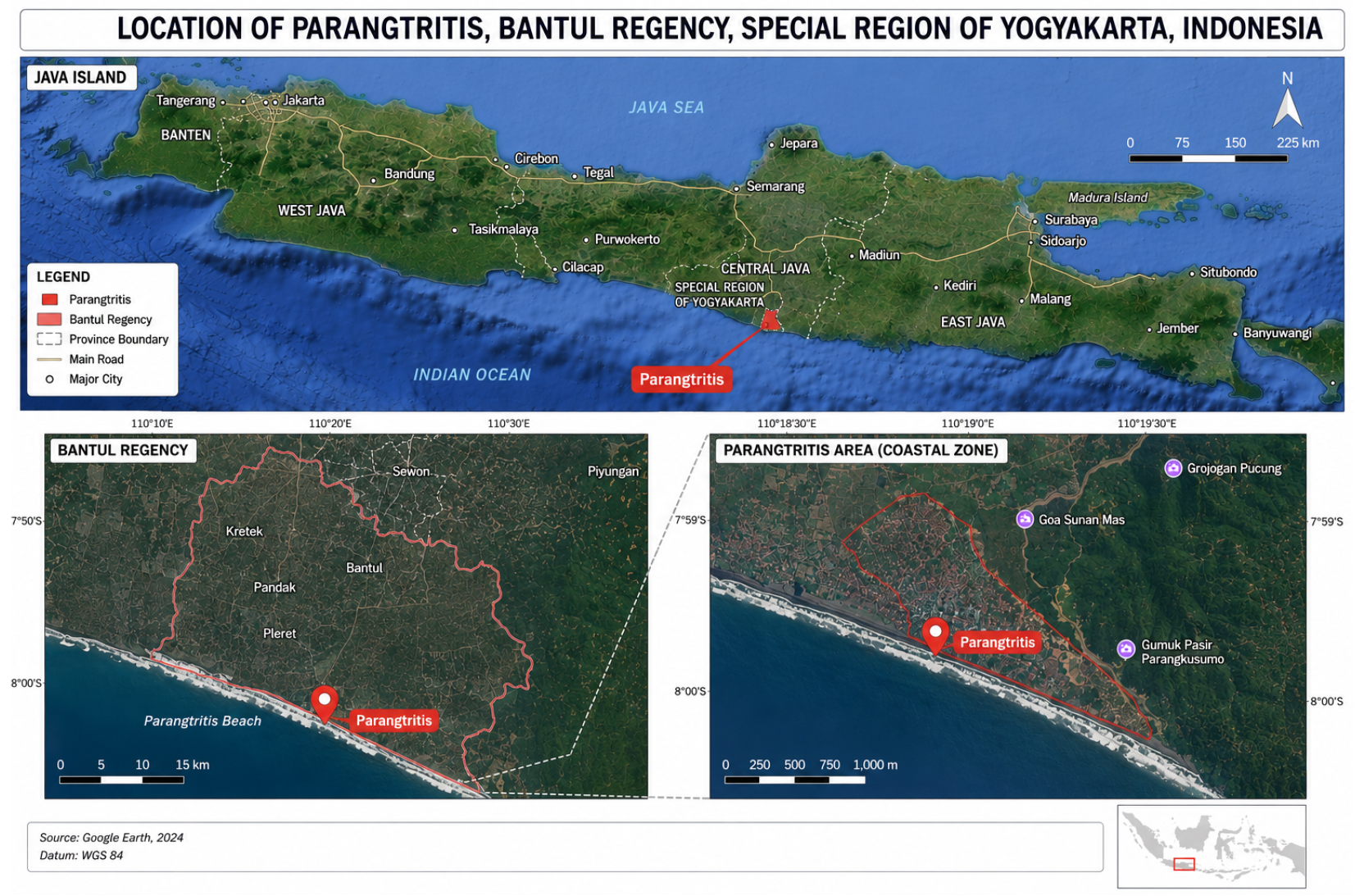
1. Introduction
Women have long functioned as primary organizers of community survival in disaster-prone regions, and the mechanisms through which their labor produces resilience continue to attract scholarly attention [
1,
2]. In multi-hazard environments (MHEs), disasters do not merely destroy physical infrastructure. They also strip away the formal systems on which communities nominally depend, and they shift the work of sustaining life back onto informal, localized, and largely gendered networks. The literature on disaster risk reduction (DRR) has increasingly recognized women as important actors [
3]. Much of the existing work, however, still tends to oscillate between two poles: treating women as a particularly vulnerable population requiring protection, or celebrating women’s agency in generalized terms that can obscure the material conditions under which that agency is exercised. Building on this active body of work, the present paper contributes a theoretically grounded reading of the specific labor processes through which one women-led organization converts everyday social reproductive work into effective crisis governance.
Indonesia provides an especially productive context for this analysis. Positioned at the convergence of the Indo-Australian, Eurasian, and Pacific tectonic plates, the archipelago ranks among the most geologically volatile territories on the planet. Within this national context, the Special Region of Yogyakarta represents an extreme case. The region sits above the Sunda Megathrust, where active subduction of the Indo-Australian plate beneath the Eurasian plate generates persistent seismic stress. The Opak Fault, a localized structure cutting through the Bantul graben, ruptured catastrophically in the 2006 earthquake that killed over 5700 people and destroyed approximately 156,000 homes [
4,
5]. The thick deposits of young volcanic material from Mount Merapi that fill the graben dramatically amplified ground motion during that rupture, producing severe liquefaction and lateral spreading across large areas of the built environment [
6,
7]. This geological volatility is not episodic but continuous: the region exists in a state of persistent environmental stress that renders static, top-down preparedness infrastructures structurally inadequate.
It is important to clarify what is meant here by “state withdrawal” or “institutional disruption.” We do not claim that the Indonesian state is absent from disaster governance in Yogyakarta. The Regional Disaster Management Agency (BPBD) is operational, post-2006 reconstruction occurred, and a range of national, faith-based, and international non-governmental organizations are active in the region [
3,
8]. The argument advanced in this paper is more specific: state and NGO provision is uneven across time and across populations. Significant gaps appear during acute crisis windows when formal logistics are temporarily fractured, and they also appear across the longer arc of preparedness, where granular, neighborhood-level vulnerability tracking is structurally beyond the reach of centralized institutions. It is into these temporally and spatially uneven gaps that women’s reproductive labor is folded, often as an unpaid supplement to, rather than a replacement for, formal provision.
The socio-political dimensions of this vulnerability have deep historical roots. In Javanese society, women have historically occupied a significant, if ambiguous, position within the informal economy and community governance. Javanese market women (
bakul) have long managed household finances and maintained extensive trade and social networks that operate below and alongside formal political structures. During periods of crisis, community survival in Java has historically depended on
gotong royong, a form of collective mutual assistance. The political genealogy of
gotong royong is, however, more complex than its contemporary usage suggests. As Bowen [
9] demonstrated, the Suharto-era New Order regime reframed and institutionalized
gotong royong as state ideology, recasting a heterogeneous set of local reciprocal practices as a uniform national narrative of communal harmony. This ideological operation served a precise function: by presenting mutual aid as a spontaneous cultural trait, the state helped to normalize the use of unpaid community labor for development projects while limiting space for independent political organization at the village level. This historical genealogy is relevant to the present argument because it points to a discursive infrastructure through which contemporary disaster governance can continue to absorb women’s reproductive labor without recognizing it as labor. When the Indonesian state today invokes
gotong royong as evidence of inherent community resilience, it draws on the same rhetorical move Bowen identified, with two consequences that this paper traces empirically: the labor is overwhelmingly performed by women, and its persistence appears to offset the unevenness of formal disaster response rather than supplementing an already-adequate baseline.
Within disaster studies, gender-sensitive approaches have gained increasing institutional support, notably through the Sendai Framework for Disaster Risk Reduction [
1]. Empirical research suggests that women’s participation in DRR can improve early warning dissemination and strengthen household-level preparedness [
2]. The wider literature, however, is fragmented across several conversations that rarely meet. Studies of women’s networks outside disaster contexts emphasize empowerment, micro-finance, and social collaboration [
10,
11,
12], but they less often examine these dynamics under conditions of acute institutional disruption. Disaster resilience research has engaged productively with social capital [
13,
14], but it often treats communities as internally undifferentiated units and attends less to the gendered distribution of labor that sustains collective survival. The present paper does not claim to resolve these conversations. It offers one carefully observed case that may be read alongside them.
This study examines the activities of Daya Annisa, a women-led community organization based in Bantul Regency, Yogyakarta. The selection of Daya Annisa as a case is deliberate. Established in 2005 as a collective of women micro-entrepreneurs, the organization formed in the immediate run-up to the 2006 Yogyakarta earthquake and subsequently evolved into a grassroots body engaged in both women’s economic empowerment and disaster risk management. Three features make it analytically valuable. First, its longevity (over two decades of continuous operation) allows observation of how reproductive labor is sustained across multiple disaster cycles. Second, its dual mandate (livelihood and DRR) makes visible the connection between everyday economic life and crisis response that more specialized disaster organizations tend to obscure. Third, its location in Bantul places it within an unusually well-documented geological setting, providing material for joint analysis of social and Earth-system processes. By deploying Social Reproduction Theory (SRT) as its primary analytical framework, this research examines women’s resilience not as an individual attribute or a generic community capacity, but as a collective labor process through which the material and social conditions of community survival are continuously produced and reproduced under geological duress.
The overall aim of this paper is to specify, through one detailed case, how gendered social reproductive labor functions as a material infrastructure of disaster governance in a multi-hazard environment, and to draw from that specification a set of concrete policy implications. Three research questions guide the inquiry: how do women in Daya Annisa contribute to disaster preparedness, response, and recovery through everyday social reproductive practices? What internal organizational and external structural factors shape their capacity to function as grassroots governance actors? And what conditions enable or constrain the long-term sustainability of women-led disaster initiatives in MHEs? On the basis of this analysis, the paper develops three policy proposals that are previewed here and elaborated in the conclusion: (i) long-term, flexible funding mechanisms calibrated to the continuous temporality of reproductive preparedness; (ii) official integration of community-generated vulnerability data into local and regional risk assessment, paired with appropriate privacy and inclusion safeguards; and (iii) the institutional inclusion of grassroots women’s organizations as autonomous decision-making actors in disaster governance.
2. Theoretical Framework
In disaster studies, resilience is conventionally defined as the capacity of systems to anticipate, absorb, adapt to, and recover from hazardous events [
15,
16]. Early formulations treated resilience as an outcome: a measurable state of recovery, essentially the ability of a community to return to a prior equilibrium after disruption [
17]. More recent scholarship has moved toward processual understandings, framing resilience as dynamic, relational, and socially embedded [
13]. This conceptual shift is productive, but Neocleous [
18] argues that the resilience paradigm carries a deeper ideological function. It can displace responsibility for crisis management from the state onto communities and individuals, reframing what is fundamentally a political failure of public provision as a question of local adaptive capacity. When disaster policy instructs communities to “be resilient,” it can implicitly demand that they absorb the costs of systemic failures through their own labor. This critique has particular force in MHEs defined by continuous geological stress, where the demand for resilience is not episodic but permanent. In such contexts, resilience is not only an emergency capacity activated during rare crises. It is also an ongoing labor requirement imposed on communities that live under perpetual threat. The question that follows is not simply whether a community is resilient, but
who performs the labor of resilience, under what conditions, and at whose expense. Answering this question requires a framework that can specify the material and gendered character of that labor.
SRT provides such a framework. Originating in the Marxist feminist tradition, SRT addresses the relationship between unpaid domestic labor and capitalist accumulation. Vogel’s [
19] foundational analysis established that the reproduction of labor power is a necessary condition for capitalist production. This reproduction includes the daily and generational processes through which workers are fed, housed, cared for, socialized, and restored. Yet such reproductive labor is systematically externalized from the wage relation and assigned disproportionately to women. Bhattacharya [
20] extended this analysis by arguing that social reproduction encompasses not only biological reproduction and household maintenance but the entire ensemble of activities through which human life is sustained: food provisioning, water gathering, caregiving, emotional labor, community organization, and the maintenance of social ties. Fraser [
21] further developed the framework by identifying a structural contradiction at the heart of capitalist societies: capital depends on social reproductive labor for its own continuation, yet its drive toward accumulation systematically undermines the conditions under which that labor can be performed. Fraser terms this the “crisis of care,” a tendency whereby the social reproductive capacities on which the system depends are progressively eroded through defunding, privatization, and the intensification of demands on households. This contradiction becomes acutely visible during disasters. When formal state systems, supply chains, and market infrastructure are severely disrupted, the work of sustaining human life shifts more heavily onto localized and informal networks of social reproduction [
22,
23]. Women do not simply “help out” during crises. They perform much of the essential labor of keeping people alive when the institutions nominally responsible for that task are stretched, delayed, or absent.
Federici [
24] adds a crucial historical dimension. Her analysis of the transition to capitalism argues that the privatization of reproductive labor within the nuclear household was not a natural arrangement but a political project, one that required the active destruction of communal forms of social reproduction and the enclosure of women’s labor within the domestic sphere. This historical perspective informs the analysis of contemporary grassroots women’s organizations. When women collectivize their reproductive labor through communal gatherings, shared childcare, or coordinated emergency response, they may be re-establishing forms of communal reproduction that the capitalist organization of the household worked to eliminate.
The intersection of gender, environment, and knowledge production has been productively theorized within feminist political ecology (FPE). Rocheleau et al. [
25] established that women’s environmental knowledge is not merely supplementary to formal scientific expertise. It constitutes a distinct epistemological resource rooted in the material practices of daily survival. This situated knowledge, generated through the everyday labor of provisioning, caretaking, and navigating immediate physical environments, can capture dimensions of vulnerability and ecological change that centralized data systems may not register. Nightingale [
26] further demonstrated that the production of environmental knowledge is itself a site of gendered power relations, where the authority to define risk, map vulnerability, and allocate resources is distributed unevenly along lines of gender, class, and caste. These insights apply to disaster governance. When women in hazard-prone communities document the locations and needs of vulnerable residents, they generate knowledge that complements, and at times exceeds the granularity of, formal institutional datasets. We treat this grassroots data labor as a form of situated knowledge production, while recognizing that such knowledge is also subject to its own limits of access, sustainability, and inclusion.
The gendered dynamics of post-disaster recovery have received growing attention. Enarson and Morrow [
27] documented that disaster recovery processes do not simply restore a prior social order. They actively reconstitute gendered inequalities. Formal reconstruction economies tend to channel resources toward male-dominated sectors such as construction and infrastructure, while women are pushed into the most precarious, lowest-return economic activities. Adams [
28] extended this analysis in the context of post-Katrina New Orleans, showing how the retreat of the state from reconstruction created a vacuum filled by faith-based organizations and informal community networks whose labor, predominantly performed by women, subsidized the state’s withdrawal. The Indonesian context differs in important respects, but the analytical pattern recurs across both settings: women absorbing the volatility of transitional economies through flexible and frequently uncompensated labor. In geologically volatile regions where destruction recurs, this pattern is not a one-time adjustment but a long-running condition.
Taken together, conventional resilience and social capital frameworks [
14,
16,
29,
30] have illuminated important community-level dynamics but often treat communities as internally homogeneous. Gender-focused disaster research [
1,
2] has documented women’s contributions but has not always offered a structural account of why this labor takes the form it does. Literature on women’s networks and empowerment [
10,
11,
12] has examined collective economic and social agency, with comparatively less work focused on conditions of acute institutional disruption. The contribution of this paper is more modest than a synthesis. It examines how SRT, brought into dialogue with FPE, can be used to read one well-documented case in a way that makes visible the labor processes through which women-led organizations operate as grassroots disaster governance.
4. Results
This section presents the empirical findings organized around four interlinked practices through which Daya Annisa contributes to disaster governance, followed by an account of the organization’s internal capacities and structural constraints. Theoretical interpretation of these findings is reserved for
Section 5.
4.1. Preparedness Embedded in Routine Reproductive Spaces
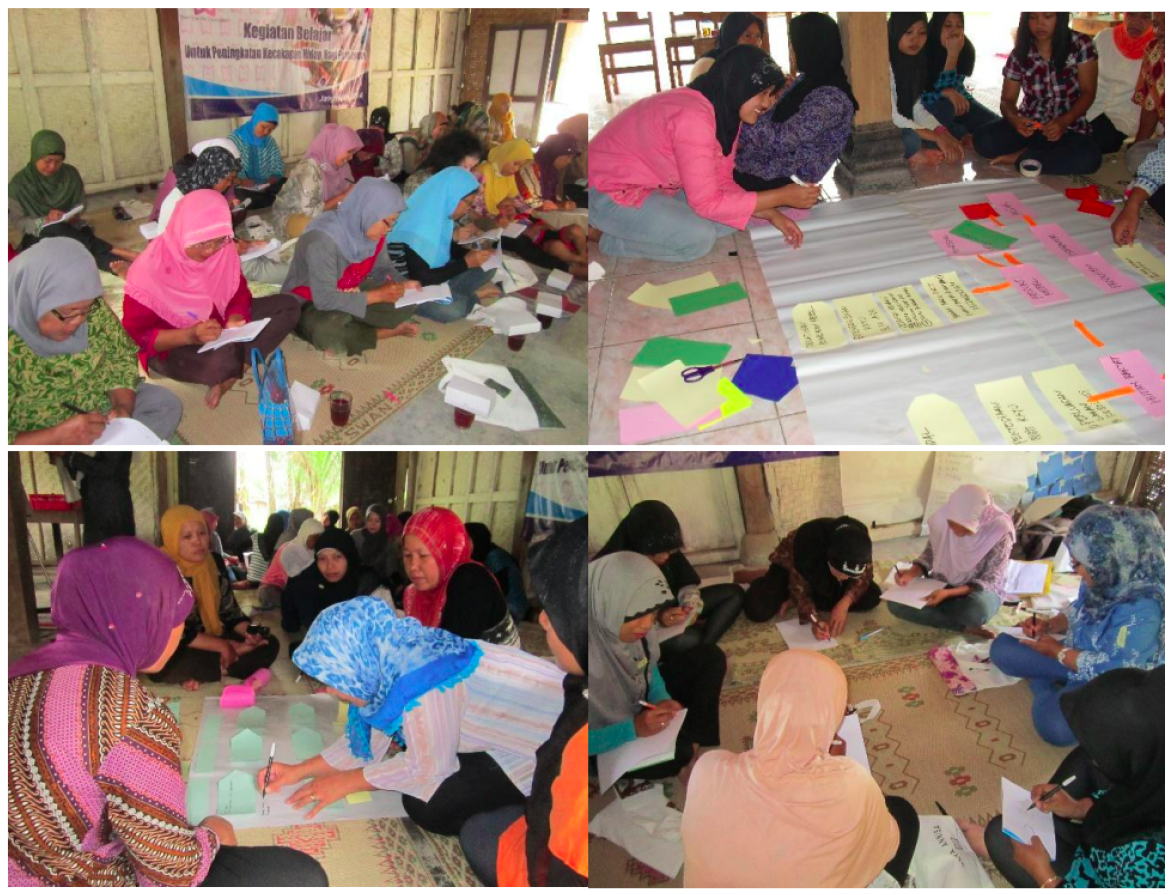
The empirical material indicates that women associated with Daya Annisa do not participate as passive recipients of formalized DRR programs. Instead, they actively embed disaster preparedness into routine social reproductive labor. Information on hazard risks, evacuation routes, and emergency procedures circulates through weekly religious study groups (
pengajian) and financial pooling gatherings (
arisan) (
Figure 2).
Figure 2 is included not as decorative illustration but to make visible the spatial form of these gatherings. The seated, circular arrangement and the use of shared paper materials evident in the photographs are themselves indicators of a horizontal, participatory mode of information exchange that differs in kind from the lecture-style transmission characteristic of formal DRR briefings.
Across IDIs with core members and FGDs with beneficiaries, informants described how preparedness content was woven into the ordinary agenda of these meetings rather than delivered as a separate module. Topics that recurred across sessions included evacuation routes for households with limited mobility, the location and condition of community wells that could provide drinking water if the piped system was disrupted, agreed meeting points if mobile networks failed, and the identification of which neighbors would be responsible for which dependents in an emergency. Core members reported that the weekly cadence of arisan and pengajian allowed updates to circulate within days of any change in household composition (a new child, a recent illness, a relative moving in to assist). The operational picture of the neighborhood was therefore continuously refreshed without a formal data-gathering exercise. Participants in FGDs emphasized that this mode of communication was effective in part because it was not framed as a state mandate. The same content delivered as a top-down briefing was reported by several participants to feel detached from daily life and quickly forgotten.
4.2. Community-Based Vulnerability Mapping
A vital yet frequently overlooked contribution of these women lies in their systematic community-based data recording practices. Participants routinely document localized demographic information, identifying the residences of vulnerable populations (children, the elderly, and disabled individuals) in relation to their immediate neighbors. These records are often informal, held partly in shared notebooks at the organizational level and partly in the working memory of active members. They are continuously revised through daily social interaction and caretaking networks. This data labor functions as a component of inclusive preparedness, helping make vulnerable groups visible within local risk governance frameworks.
Two features of this practice emerged consistently from the empirical material. First, the granularity of the information was finer than what formal datasets capture. Members tracked not only the presence of a vulnerable individual at an address, but the times of day at which that individual was alone, the names of the immediate neighbors who could reach them quickly, and household-level information such as which residence had a working torch, a charged mobile phone, or a covered water container. Second, the BPBD informants interviewed for this study acknowledged the operational value of this granularity without overstating it. They described community-level mapping as a complement to, rather than a substitute for, the centralized hazard exposure data they themselves rely upon. Both registers of knowledge were described as necessary, and neither was described as sufficient on its own.
The empirical material also indicated genuine costs and risks associated with informal mapping. Members acknowledged that families newly arrived in the neighborhood, families estranged from active arisan or pengajian participants, and households with stigmatized conditions could be undercounted. Members also recognized that the information was sensitive and that its security depended substantially on the discretion of a small number of leaders. These limitations are reported here, in the empirical section, because they were named by participants themselves and were not introduced from outside the case.
4.3. Crisis Response Following the 2006 Earthquake
During acute disaster events, the everyday responsibilities of women for care and household provisioning scale rapidly into collective crisis management. Following the 2006 Yogyakarta earthquake, formal communication channels and state aid logistics were severely disrupted across the Bantul graben for a period of days to weeks before stabilizing [
8]. The empirical data, in particular retrospective accounts gathered through FGDs and IDIs with long-standing members, indicate that women were consistently among the first to organize temporary cooking spaces, secure clean water, and distribute critical survival resources. Members and FGD participants described the establishment of communal cooking stations in open yards within the first 48 h after the rupture, the pooling of dry rice and other staples from undamaged or partially damaged kitchens, the rotation of childcare across households so that adults could assist with debris clearance, and the use of pre-existing
arisan membership lists to track which households had been accounted for and which still needed to be reached.
Their trust-based social networks facilitated the rapid circulation of practical survival information regarding aid distribution points and supply availability, helping to bridge fractured institutional systems during the acute phase. These accounts are retrospective and are best read as patterned reconstructions rather than verbatim records of what occurred in 2006. For this reason, our claims here are illustrative of the labor process rather than precise quantitative reports. Across multiple informants, however, the description was consistent. The response in the days immediately following the earthquake was not improvised from scratch. It extended the routines and information networks that already existed in the community before the rupture.
4.4. Post-Disaster Livelihood Strategies
In the longer term, women contribute to disaster resilience through highly temporal livelihood strategies that bridge economic gaps during post-disaster recovery. While male household members typically seek stable long-term employment following catastrophe, women initiate short-term and informal income-generating activities. Across IDIs with beneficiaries, the activities that recurred most frequently were small-scale food preparation and street-level vending of cooked items, agricultural day labor on neighboring plots, the sale of home-garden produce, and the resumption of small-scale trading networks linking inland producers to coastal markets. Beneficiaries reported that these activities were resumed within days to weeks after the 2006 earthquake and continued for months while reconstruction progressed.
The necessity for such strategies is shaped in part by the physical geological reality of the region. The Bantul graben, filled with thick, young volcanic deposits from Mount Merapi, significantly amplified ground motion during the 2006 rupture of the Opak Fault and produced extensive liquefaction and infrastructural collapse [
6]. The resulting devastation of the local economy required highly flexible recovery mechanisms. Beneficiaries also reported that formal reconstruction wage labor was largely allocated to male household members, while women’s income-generating activities operated outside the visibility of reconstruction accounting and outside the eligibility windows of most reconstruction-related cash transfers.
4.5. Organizational Capacities and Structural Constraints
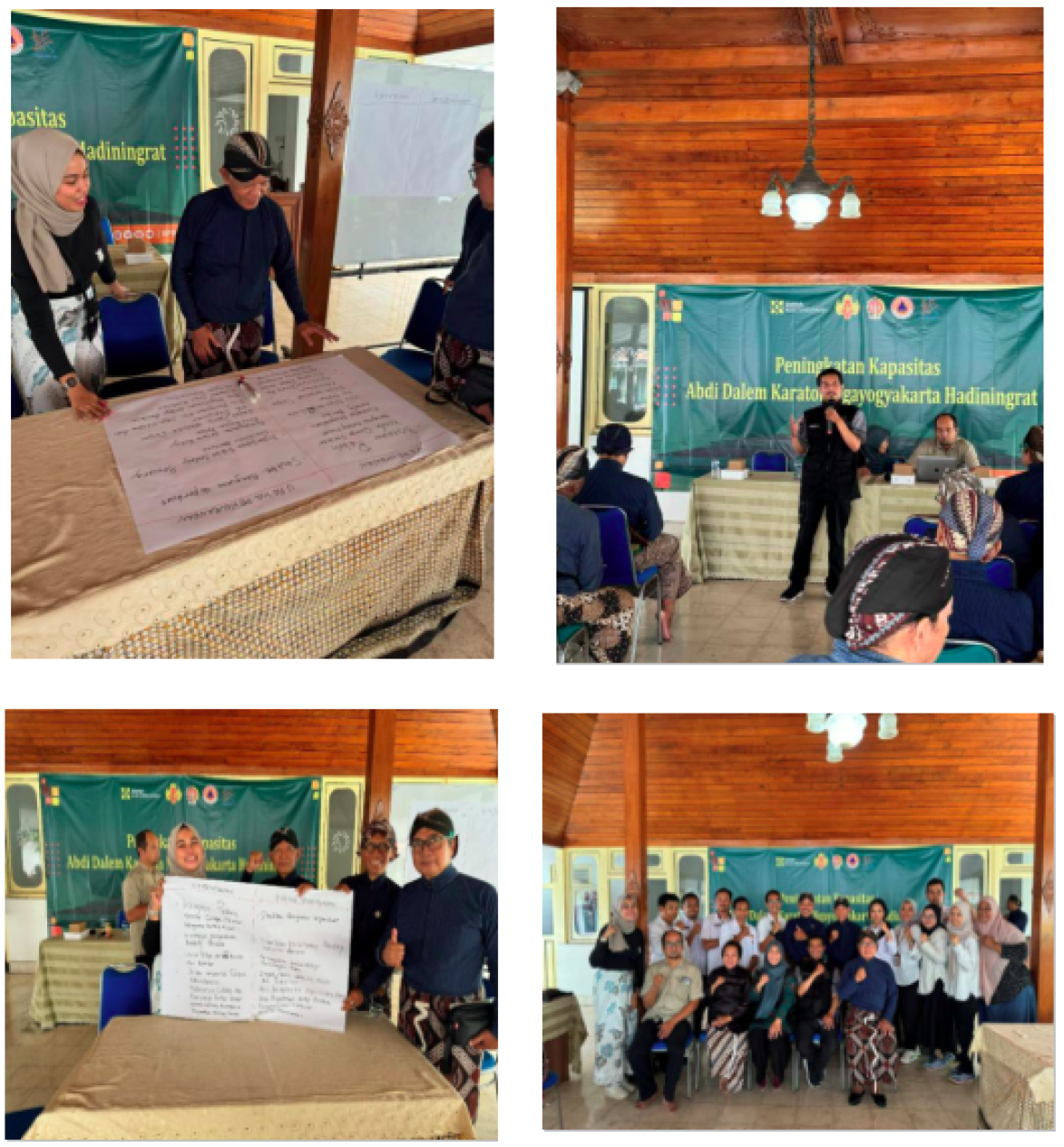
An organizational assessment of Daya Annisa exposes both internal capacities and structural constraints. These dynamics are articulated through participatory capacity-building sessions and disaster-related volunteer activities (
Figure 3).
Figure 3 depicts four moments from these sessions: knowledge transfer briefings, participatory vulnerability mapping, presentation of community-identified mitigation strategies, and the consolidation of organizational networks. The figure is included because it makes visible the polycentric structure of the work, in which authority, knowledge, and responsibility circulate horizontally rather than flowing from a single coordinating node.
In terms of internal capacities, Daya Annisa exhibits high social cohesion, adaptive programming, and targeted outreach to structurally marginalized groups. The organization supports female-headed households in vulnerable coastal areas (kampung janda) through tailored micro-loans and skills training that formal banking institutions typically deny on account of collateral requirements. Core members described the social cohesion that enables rapid emergency coordination as built through years of shared caregiving, communal gathering, and reciprocal economic support, rather than as a feature deliberately cultivated for disaster preparedness purposes.
Internal constraints reported by core members include severely limited financial backing, heavy reliance on a small pool of active leaders, and notable gaps in formal administrative documentation. Members reported that when two or three of the most active leaders were simultaneously unavailable due to illness, family obligations, or competing employment, several routine activities of the organization were delayed or suspended for that period. They also reported that recruitment of new volunteers was relatively easy, but that the transfer of accumulated organizational and neighborhood knowledge to new members was slow. Much of that knowledge resided in the working memory and personal relationships of long-standing leaders rather than in written records.
Externally, accessible funding for the organization comes primarily through small project grants tied to specific deliverables, occasional faith-based or NGO partnerships, and irregular government program windows. There is no continuous core-funding mechanism for organizations of its size and form. The persistent tendency of disaster policy to operate through short-term, project-based funding cycles was reported by core members as a recurring source of strain. This was particularly so when reporting requirements designed for larger formal organizations were applied to a small grassroots body whose work is largely relational rather than transactional. International recognition of gender-responsive DRR, exemplified by the Sendai Framework, was reported as creating some space for organizations like Daya Annisa to claim legitimacy and resources. Members noted, however, that translating community work into the language of project deliverables and indicators required substantial additional effort that diverted time from frontline activity.
5. Discussion
This section interprets the empirical findings of
Section 4 through the conceptual lenses set out in
Section 2, addresses the limits of informal networks, and reflects on the SWOT-SRT mapping as an analytic device.
5.1. Collectivization and the Reversal of Enclosure
Read through SRT, the significance of
arisan and
pengajian extends beyond information dissemination. What occurs in these gatherings can be interpreted as a process of collectivization. Individually, each woman performing care work operates in relative isolation within the household, her labor largely invisible to both the state and formal disaster governance structures. When these women gather, they transform private reproductive labor into a collective organizational infrastructure. This transformation carries a specific historical resonance. Federici [
24] argued that the enclosure of reproductive labor within the private household was a precondition for capitalist accumulation, accomplished through the systematic destruction of communal forms of social reproduction. The gatherings organized by Daya Annisa women appear, in this light, to partially reverse this enclosure. They re-establish communal reproductive labor as a basis for governance. The
arisan, in particular, combines financial pooling with social coordination in a form that simultaneously addresses economic precarity and collective preparedness. We do not claim that
arisan or
pengajian were designed for this purpose, nor that they constitute a complete substitute for institutional preparedness. We do suggest that the labor performed in these spaces operates as governance in a meaningful sense, parallel to and at times in lieu of the state.
5.2. Situated Knowledge and Its Limits
From the perspective of FPE [
25,
26], the community-based vulnerability mapping described in
Section 4.2 can be read as a form of situated knowledge production. The Indonesian state maintains centralized databases on population and hazard exposure, but these datasets are typically produced through periodic census exercises and remote sensing technologies. Such methods capture different dimensions of vulnerability than the granular, relational, and temporally dynamic knowledge generated through embodied daily presence.
We want to be careful here, however, to avoid an unhelpful binary. Abstract categories such as age, disability status, building type, and probabilistic hazard exposure are themselves indispensable for disaster preparedness. Centralized datasets and spatial models capture exposure patterns, structural fragility, and population aggregates that no neighborhood-level practice can produce on its own. The argument is not that relational knowledge is the “best” form of vulnerability information, but that the two registers are complementary, and that the relational register is structurally undervalued in current governance arrangements. The BPBD informants we interviewed articulated this complementarity directly: formal exposure maps and community-level mapping were both described as necessary, neither as sufficient.
There are also genuine costs to relying on community-based mapping. Privacy and dignity concerns arise because identifying disabled, elderly, or female-headed households inside an informal register depends on the judgment of mappers and on social norms of disclosure within the community. Inclusion risks arise because families that are newly arrived, socially marginal, or estranged from active members may be undercounted. The sustainability of such mapping depends on a small number of leaders whose own labor capacity is finite. When those leaders are absent, ill, or simply exhausted, the data ages quickly. These limitations are not reasons to dismiss situated knowledge production as a governance resource, but they are reasons to integrate it carefully with formal systems rather than treat it as a free substitute for them.
5.3. Scalar Continuity and the Appropriation of Mutual Aid
The crisis-response findings reported in
Section 4.3 underscore the scalar continuity between routine and crisis. The women who organized emergency food distribution in 2006 did not acquire a new skill during the earthquake. They extended the social reproductive labor they performed daily, including cooking, provisioning, and coordinating care, into a context of acute urgency. The pattern is consistent with the dynamics Illner [
22] describes: when formal capitalist markets and state infrastructures are disrupted, the burden of sustaining human life shifts more heavily onto localized and informal networks of social reproduction.
The apparent “spontaneity” of community response that state narratives celebrate as
gotong royong can therefore be read, more accurately, as the visible surface of long-accumulated organizational capacity built through years of collectivized reproductive work. As Bowen [
9] documented, the state has historically drawn on the language of mutual aid in ways that can obscure the labor that sustains it. We read the post-2006 context as showing a similar dynamic. The state’s rhetorical celebration of community solidarity appears to have helped normalize, and in this way left uncompensated, the expansion of women’s reproductive labor that helped sustain people during the weeks and months when state services were intermittent or inadequate. This is the analytical bridge from the historical genealogy of
gotong royong introduced in
Section 1 to the present case. The same discursive structure that the New Order period drew on to depoliticize mutual aid appears to continue to render women’s crisis labor culturally legible primarily as “tradition” rather than as governance. We mark this reading as interpretive rather than as a documented equivalence with earlier state practice, while noting its consistency with the empirical pattern in our data.
5.4. Reconstruction Economies and Gendered Shock Absorption
Describing post-disaster livelihood strategies solely as “adaptive” risks obscuring the structural relations they instantiate. The gendered division of post-disaster labor reported in
Section 4.4 is not a neutral allocation of comparative advantages. It is one of the mechanisms through which disaster recovery itself tends to reconstitute patriarchal economic relations [
27]. Formal reconstruction economies, typically funded by international aid and state budgets, channel resources toward male-dominated sectors such as construction and infrastructure. Women are pushed into the lowest-return, most precarious economic activities. As Adams [
28] documented in the post-Katrina context, the retreat of the state from adequate reconstruction creates a gap that women’s informal labor fills, in effect subsidizing the state’s withdrawal through uncompensated reproductive and economic improvisation. In Bantul, a related dynamic appears to operate. Women’s post-disaster micro-trading can be read as more than a coping strategy. On the analysis we develop here, it operates as a gendered mechanism through which a portion of the costs of geological hazard (those not covered by formal reconstruction provision) are absorbed by women’s labor rather than by the state or the formal economy. Recognizing this dynamic suggests reframing post-disaster livelihood strategies. They are not best read as evidence of women’s resilience in the celebratory sense often deployed in development literature. They can instead be read as evidence of the structural conditions that lead women to absorb economic shocks that more adequate state provision would otherwise mitigate.
5.5. The SWOT-SRT Mapping as an Analytic Device
Reading the organizational findings of
Section 4.5 through the SWOT framework reinterpreted via SRT yields a structured account of how reproductive labor is enabled, devalued, recognized, or eroded.
Table 1 summarizes this mapping, pairing each SWOT category with its SRT reinterpretation and the corresponding empirical instance from Daya Annisa.
The internal capacities reported in
Section 4.5 (high social cohesion, adaptive programming, targeted outreach to marginalized groups) are not incidental organizational features. They are direct expressions of collectivized reproductive labor power, corresponding to the “strengths” quadrant in our reinterpretation. Social cohesion is the cumulative product of years of shared caregiving and reciprocal economic support. Adaptive programming reflects the flexibility inherent in reproductive labor, which by its nature must respond to changing and unpredictable needs.
The internal constraints reported in
Section 4.5 (limited finance, leader concentration, documentation gaps) correspond to the “weaknesses” quadrant. Interpreted through SRT, however, they are not organizational failures in any straightforward sense. They are symptoms of what Fraser [
21] identifies as the crisis of care: the systematic tendency of capitalist societies to depend on social reproductive labor while simultaneously undermining the material conditions necessary for that labor to be sustained. The chronic underfunding of grassroots women’s organizations reflects the structural devaluation of reproductive labor within existing political-economic arrangements. The documentation burden, similarly, is not a neutral administrative requirement. It is a mechanism through which donor institutions and state agencies impose the logics of formal accountability onto organizations whose primary mode of operation is relational, embodied, and embedded in daily life. The demand that grassroots organizations translate their work into the language of logframes, indicators, and measurable outputs subordinates the logic of social reproduction to the logic of institutional governance. It penalizes organizations precisely for the qualities (informality, flexibility, and embeddedness) that make them effective.
External openings (the “opportunities” quadrant) include increasing international recognition of gender-responsive DRR, exemplified by the Sendai Framework, which creates institutional space for organizations like Daya Annisa to claim legitimacy and resources. The funding landscape described in
Section 4.5 is the empirical referent for our policy recommendation in the conclusion. The proposal for “long-term flexible funding” is not a call to create funding ex nihilo. It is a call to restructure existing project-based funding cycles into something better matched to the continuous temporality of reproductive preparedness. External pressures (the “threats” quadrant) include the persistent tendency of disaster policy to operate through short-term, project-based funding cycles, which threatens the sustainability of organizations whose effectiveness depends on continuous, long-term community presence. The geological permanence of the threat posed by the Sunda Megathrust and localized fault systems means that the demand for reproductive labor in disaster governance is itself permanent. Addressing this structural mismatch between permanent need and episodic funding requires a reorientation of how disaster policy values and compensates the labor on which community survival depends.
We treat this SWOT-SRT mapping as a small theoretical contribution rather than only a methodological device. Reading SWOT through SRT reframes a familiar organizational tool as an analytic for surfacing the structural conditions under which reproductive labor is enabled, devalued, recognized, or eroded. This reframing may be useful in other settings where grassroots organizations are studied, particularly where the “managerial” SWOT has been criticized for naturalizing the very institutional arrangements that produce organizational weakness.
5.6. Limits of Informal Networks and the Question of Substitution
A critical reading of our own argument is in order. The case for treating women’s grassroots labor as governance must not become a case for treating it as a substitute for adequate state and professional capacity. Three classes of limitation deserve attention.
First, informal networks raise privacy and inclusion concerns, as discussed in
Section 5.2. The vulnerability mapping is precise precisely because it is intimate, and that intimacy is also its risk. Households outside the active social circuits of
arisan and
pengajian may be undercounted or invisible to the same networks that capture others with high resolution. The very social cohesion that makes the network effective can also harden its boundaries.
Second, informal networks lack the trained professional capacity that some disaster tasks require. Search and rescue, structural triage of damaged buildings, advanced medical care, and large-scale logistics remain tasks for which professional teams and centralized infrastructure are necessary. Treating community resilience as the answer to all phases of disaster response is the very move Neocleous [
18] criticizes. Our argument is the opposite: grassroots reproductive labor should be recognized and resourced
alongside, not in place of, professionalized capacity.
Third, internal social dynamics within women’s organizations are themselves uneven. Leader concentration, generational gaps, and differences in education, marital status, and economic standing among members shape who speaks in meetings, whose vulnerability is named, and whose labor is rewarded with informal authority. Our data did not allow systematic analysis of these dynamics, but the reader should not infer that their absence from the empirical material implies their absence from the organization.
6. Limitations
The analysis rests on a detailed reading of one organization in one regency. Single-case designs prioritize depth over breadth. The patterns identified here are not statistically generalizable, and comparative work across other MHEs is needed to test whether they recur. The 19 IDIs and two FGDs cover the central organizational and governance positions but do not represent every voice in the surrounding community. Men’s perspectives on women’s disaster labor, the views of women who declined to participate or who are not engaged with Daya Annisa, and the perspectives of inactive or former members are largely absent.
The data did not allow systematic analysis of class, age, marital status, and household composition differences within the women’s organization. The risk of treating “women” as an internally homogeneous category is one we acknowledge and to which we did not fully resolve a response. The SRT and FPE commitments that structured this study shape what counts as data and how that data is read. We have tried to mitigate this through reflexive coding logs and triangulation across informant categories, but a reader committed to a different theoretical orientation would likely emphasize different features of the same case.
While we have argued that SWOT can be productively reinterpreted through SRT, the four-quadrant structure remains a heuristic, and like all heuristics it imposes a discrete classification on continuous and overlapping phenomena. Several themes in our data could plausibly sit in more than one quadrant. We have made interpretive choices in such cases that another analyst might make differently. Finally, several claims about the post-2006 earthquake response are based on retrospective recollection roughly two decades after the event. We have flagged these as illustrative of the labor process rather than as quantitative records, and we encourage readers to weight them accordingly.
7. Conclusions
The theoretical and policy stakes of this analysis converge on a single structural contradiction. Disaster governance regimes in MHEs depend materially on women’s social reproductive labor for community survival under geological duress, yet often fail to compensate, institutionalize, or even formally recognize that labor as governance. Addressing this contradiction suggests three concrete shifts in disaster policy. First, long-term, flexible funding mechanisms should be calibrated to the continuous temporality of reproductive preparedness rather than the episodic project cycles that currently burden grassroots leaders with administrative demands designed for formal bureaucracies. As discussed in
Section 5.5, the relevant reform is not the creation of new funding from nothing. It is the restructuring of existing short-cycle project funding into longer, more flexible instruments that match the rhythm of reproductive labor. Second is the official integration of community-generated vulnerability data into local and regional risk assessment, acknowledging that the relational knowledge produced through daily care work captures dimensions of exposure that centralized datasets are not designed to capture, while pairing this integration with explicit safeguards for privacy, consent, and inclusion. Third, the institutional inclusion of grassroots women’s organizations as autonomous decision-making actors in disaster governance should be implemented, not as implementers of externally defined agendas or as beneficiaries of empowerment programming, but as entities whose labor constitutes part of the material base of collective survival. These three shifts are interrelated: stable funding, knowledge integration, and decisional inclusion reinforce one another, while any one alone risks formalizing dependence without distributing authority.
The contributions of this study can be summarized briefly. It extends SRT into disaster governance through one carefully observed case. It offers a theorized reinterpretation of SWOT as a lens on the structural conditions of reproductive labor. And it historicizes gotong royong as a site of gendered state extraction that connects long-standing political economy to present-day disaster rhetoric. We have tried throughout to hold these contributions at appropriate scale. This is one case, read closely, that participates in a wider conversation rather than closing it. Several avenues for further inquiry follow: comparative analysis across MHEs to test whether the patterns identified in Bantul recur; longitudinal tracking of grassroots reproductive labor under chronic environmental stress; and closer examination of internal differentiation within women’s organizations along lines of class, age, marital status, and household composition. What we hope remains, regardless of how subsequent work develops, is the analytical starting point. Until disaster policy ceases to treat the uncompensated labor of women as a free subsidy for uneven state provision, and begins to treat it as part of the public infrastructure on which community survival in geologically volatile regions actually depends, the structural contradiction at the heart of community resilience will persist.




 ,
,