Article

Spatial Inequality in Urban Park Provision: A GIS-Based Comparative Analysis of Sofia (Bulgaria) and Istanbul (Republic of Türkiye)


by
Velimira Stoyanova
1,*,
Petja Ivanova-Radovanova
2,
Dessislava Poleganova
1,
Stefan Genchev
1,
Georgi Belev
2 and
Gergana Metodieva
1
1
National Institute of Geophysics, Geodesy, and Geography-Bulgarian Academy of Sciences (NIGGG-BAS), 1113 Sofia, Bulgaria
2
Institute for Climate, Atmosphere and Water Research-Bulgarian Academy of Sciences (CAWRI-BAS), 1113 Sofia, Bulgaria
*
Author to whom correspondence should be addressed.
Geographies 2026, 6(2), 52; https://doi.org/10.3390/geographies6020052
Submission received: 1 April 2026 / Revised: 15 May 2026 / Accepted: 16 May 2026 / Published: 20 May 2026

Abstract

Rapid urbanization highlights the increasing importance of urban green infrastructure in shaping urban spatial organization, quality of life, and environmental sustainability. This study examines spatial inequalities in the provision of urban parks in Sofia (Bulgaria) and Istanbul (Republic of Türkiye) from a comparative urban geography perspective. The two cities are selected as contrasting urban contexts in Southeastern Europe, characterized by different patterns of urban development, population density, and spatial structures. A GIS-based analytical framework is applied at the district administrative level, integrating indicators such as the share of urban parks, park area per capita, Local Moran’s I, and the Gini coefficient. The results reveal distinct spatial patterns: Sofia demonstrates relatively higher levels of park provision but pronounced inequalities, characterized by the concentration of large park areas in a limited number of central districts. In contrast, Istanbul exhibits a more even spatial distribution but significantly lower levels of park area per capita, indicating an overall shortage of urban park space. The findings demonstrate that Sofia and Istanbul experience different forms of spatial disparities in park provision due to distinct trajectories of urban development.

1. Introduction

The world population has been growing steadily in recent decades, with much of the population living in cities since 2008 [1]. According to World Bank forecasts, by 2050, nearly 70% of the world’s population will be concentrated in urban areas [2].
The trend of rapid urbanization highlights the growing importance of urban green infrastructure (a network of natural and semi-natural green elements in the urban environment, including parks, gardens, urban forests, and green corridors) as a key factor in the quality of life, environmental sustainability, and adaptability of urban systems [3]. Although urban green spaces include various categories, this study focuses on urban parks. They represent the most clearly defined and spatially distinct category and perform important recreational, social, and ecological functions [4,5]. The provision of urban parks near residential areas and workplaces is a key factor influencing willingness to use them, thereby affecting citizens’ well-being [6,7].
From a theoretical perspective, this study is grounded in the concepts of spatial justice and urban spatial inequality, which emphasize the uneven distribution of urban resources across different social and spatial groups [8,9]. In the context of the present study, spatial justice is approached primarily through its distributive dimension, focusing on the territorial arrangements of publicly accessible parks across urban districts. At the same time, critical perspectives in urban studies highlight the concept of “just green enough”, which emphasizes the need to balance environmental improvements with social equity to avoid displacement and exclusion [10,11,12,13,14]. This study is also framed within comparative urban geography, which seeks to identify how different urban contexts shape distinct spatial patterns of resource distribution [15,16].
Accelerated urbanization and increasing pressure on urban land use have led to competition between green spaces, including urban parks, and other land uses, such as residential, commercial, and infrastructure development [17,18,19]. In this context, the spatial distribution of urban parks becomes an important aspect of sustainable and socially equitable urban development. Several studies have shown that the provision and spatial distribution of urban parks are often uneven across cities as a result of the historical evolution in demographic and socioeconomic development in urban settlements [20,21,22,23,24,25,26,27]. These inequalities can lead to significant differences in the availability of recreational opportunities, ecosystem services, and health benefits. At the same time, the scientific literature also draws attention to the phenomenon of green gentrification, in which the creation or renovation of green spaces, including parks, can lead to an increase in property and rental values and subsequent physical or socio-cultural displacement, and can also negatively affect the mental health of people seeking to purchase or rent housing in a given area [28,29,30,31].
To identify these important spatial differences in the provision of urban parks, it is necessary to apply spatial analyses that allow for an assessment of their distribution within the urban territory. Therefore, research at the level of administrative districts is particularly important for identifying urban spatial inequalities in park distribution [32,33,34,35,36].
In recent years, GIS-based spatial indicators have been increasingly used to assess the distribution and provision of urban green spaces [4,21,22,37]. Despite the growing number of such studies, relatively few of them combine both urban land use indicators and demographic indicators of urban park provision, as well as spatial inequality and spatial clustering analysis [22,27,36,38,39]. Furthermore, comparative studies between cities of different scales and urban development structures remain relatively limited [40].
In this context, the choice of Sofia (Bulgaria) and Istanbul (Republic of Türkiye) is determined both by their common regional affiliation and by their contrasting characteristics of urban development. Both cities are major urban centers in Southeastern Europe, experiencing dynamic urbanization and increasing pressure on urban green spaces, which makes them relevant for comparative analysis. At the same time, they differ significantly in terms of population size, density, spatial structure, and urban development patterns.
Sofia represents a medium-sized European capital with a relatively lower population density and an urban structure shaped by socialist planning traditions, characterized by centralized management and integration of green spaces into urban development policies. In contrast, Istanbul is a rapidly growing transcontinental metropolitan city, characterized by high population density, strong pressure on land use, and a more market-oriented urban development pattern. These differences are further reflected in their geographical location and scale, which enhances the comparative potential of the analysis.
This combination of similarities and contrasts makes the two cities suitable for a comparative approach based on the logic of “different systems”, allowing for the investigation of how different urban contexts influence the spatial distribution of urban parks.
In this context, this study is guided by the following research questions:
(1)
What are the spatial patterns of urban park provision at the inner-city level in Sofia and Istanbul?
(2)
To what extent do these patterns reflect spatial inequalities in each city?
(3)
How do differences in urban structure and development patterns affect the distribution of urban parks in the two cities?
Based on these questions, this study is guided by the hypothesis that differences in urban spatial structure and development patterns are associated with different forms of spatial inequality in urban park provision, leading to contrasting patterns of concentration and distribution in the two cities.
The present study aims to analyze the spatial distribution and inequalities in urban park provision in Sofia (Bulgaria) and Istanbul (Republic of Türkiye) by applying geographic information systems (GIS) and spatial statistical methods. By comparing these two cities, this study contributes to a better understanding of the different patterns of urban park disparities across contrasting development contexts. By combining population-based measures of park provision, local spatial autocorrelation, and GIS-based indicators, the current research offers a transferable analytical framework for the identification and comparison of diverse forms of green-space inequality in urban territories.

2. Materials and Methods

2.1. Study Areas

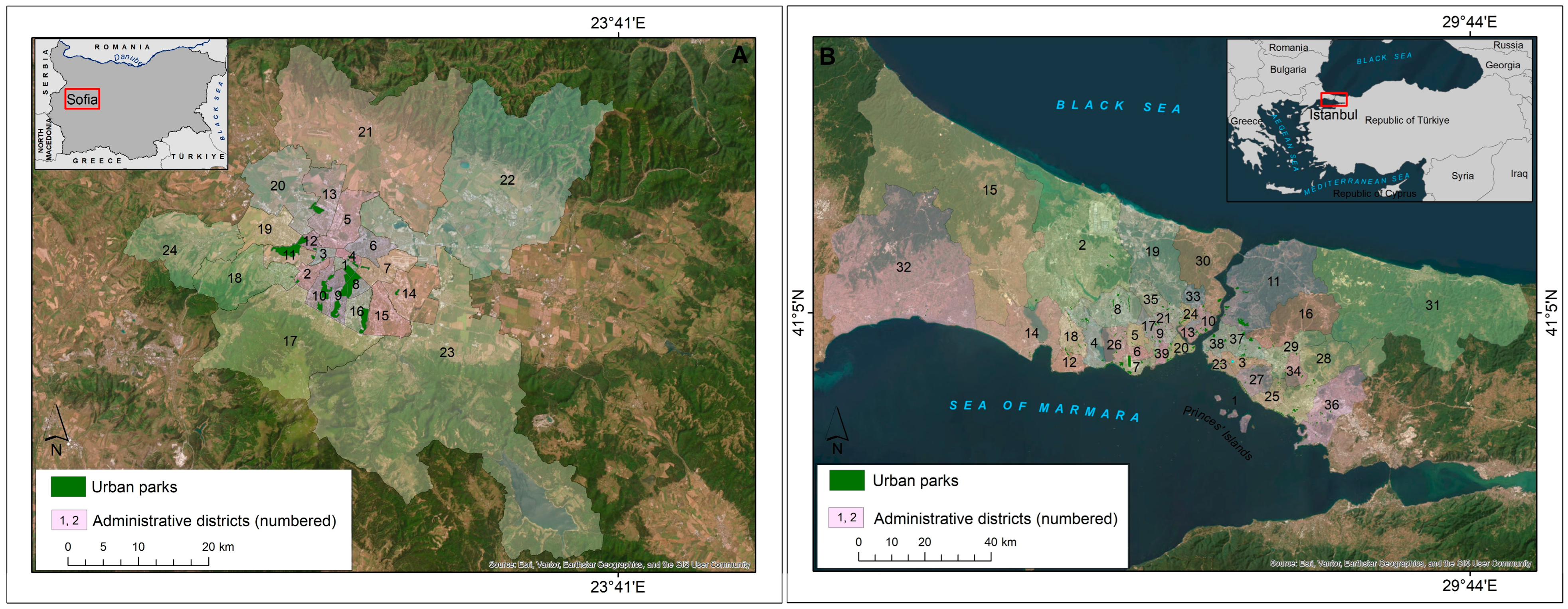
The present study examines two major urban agglomerations in Southeastern Europe—Sofia, the largest city in the country and the capital of Bulgaria since 1879, and Istanbul, the largest city in the Republic of Türkiye (Figure 1A,B).
The capital, Sofia, is in the western part of Bulgaria, in the Sofia Valley, at the foot of the Vitosha Mountain. The city has a long history dating back to antiquity, when it was known as Serdika. Today, Sofia is the largest city in the country, with a population of approximately 1,295,931 [41], and serves as the main political, economic, and cultural center of Bulgaria [42,43,44]. The urban green space system in Sofia consists of parks, gardens, and other elements of green infrastructure, which play a significant role in recreation, tourism, and the improvement in urban environment quality. The study area corresponds to the territorial scope of the Sofia municipality, which includes administratively 24 districts [45] (Figure 1A).
Istanbul is in the northwestern part of the Republic of Türkiye along the Bosphorus, which connects the Black Sea with the Sea of Marmara. Historically, the city was known as Byzantium and later as Constantinople and was the capital of the Byzantine and Ottoman Empires. In modern times, Istanbul is one of the largest metropolitan centers in Europe, with a population of 15,754,053 [46]. Like other large metropolitan cities, Istanbul has a system of urban green spaces, including parks, gardens, and other recreational areas, which perform important ecological, health, and social functions. The study area covers the territory of Istanbul province (“il”), which is administratively divided into 39 districts (ilçeler) [46] (Figure 1B).
The selected study areas support methodological comparability, as both cities are analyzed at equivalent metropolitan administrative levels. Administrative districts in Sofia and Istanbul are used as the main spatial units to examine spatial inequalities in urban park provision. While these units ensure the consistency of spatial and demographic data and are relevant for urban planning and policymaking, it is important to note that districts may vary in size and degree of urbanization. In this study, analysis of urban parks refers to their spatial differences within the administrative boundaries of the districts, rather than strictly within fully urbanized areas. This approach allows for a consistent comparative analysis, although it does not explicitly account for differences in the degree of urbanization across districts.

2.2. Data Sources

The descriptive and spatial analyses are based on three main categories of data, as detailed below.

2.2.1. Administrative Boundaries

The information about district-level administrative boundaries for Sofia and Istanbul was obtained from official municipal and national sources and used as the spatial framework for the analysis.

2.2.2. Urban Park Data

For the city of Sofia, data on urban parks were extracted from the municipal green infrastructure dataset. Within the main categories defined for the green system in Sofia, only areas classified as “urban parks and garden areas” were included to ensure conceptual consistency with the definition of public urban parks. Other green areas, such as local gardens and specialized green spaces, were excluded from comparative analysis.
Similarly, for Istanbul, official GIS datasets on public urban parks were used, including the categories “park” and “kent parkı”. In the Turkish planning system, a distinction exists between the general category “park” and the more specific category “kent parkı” (urban park), which usually refers to larger multifunctional green spaces serving broader urban populations. Kent parks are generally characterized by larger spatial extent and multifunctionality, often including recreational facilities, cultural and social spaces, landscape design elements, water features, and areas with natural vegetation intended to serve city-wide recreational needs. The category “park” generally includes smaller public green spaces serving neighborhood- and district-level recreational functions. Both categories were included in the present study because they represent publicly accessible urban green spaces with recreational functions and together provide the closest functional equivalent to the urban park category applied to Sofia. This approach improves methodological consistency and enhances comparability between the two cities despite differences in national classification systems and urban planning traditions.
Table 1 summarizes the definition, classification, and functional characteristics of urban parks used in the comparative analysis of Sofia and Istanbul.

2.2.3. Population Data

District-level population data for Sofia were obtained from the National Statistical Institute [41]. For Istanbul, comparable district-level population statistics were obtained from official national sources—the Turkish Statistical Institute [46]. These data refer to the total resident population within the administrative boundaries of each district, including both urban and less urbanized areas.

2.3. Spatial Units/Definition of Urban Area

For this study, urban areas are based on the administrative boundaries of districts, which include both highly urbanized and less urbanized zones. In both Sofia and Istanbul, administrative districts serve as the primary spatial unit of analysis due to data availability and their relevance for urban planning and policymaking. However, it is important to note that administrative districts do not strictly correspond to fully urbanized territories. Some districts, particularly in peripheral areas, include significant non-urbanized zones, resulting in varying degrees of internal heterogeneity. Consequently, the analysis reflects the overall spatial distribution of urban parks at the administrative level rather than exclusively within built-up areas.
This methodological choice has direct implications for the interpretation of the quantitative indicators used. Due to the internal heterogeneity of districts, especially in Istanbul, values of park provision indicators (share of park areas and park area per capita) should be interpreted as aggregated measures that may capture both actual spatial inequalities and differences in the degree of urbanization within districts.
Despite the limitations of the Modifiable Areal Unit Problem (MAUP) [47,48], the use of administrative districts remains a widely accepted approach in urban studies, as it ensures comparability between cities and aligns with the spatial framework of urban governance [49]. Therefore, the adopted methodology—combining classical inequality indicators (coefficient of variation and Gini index) with spatial statistical analysis (Local Moran’s I)—allows for a balanced interpretation of results and a consistent comparative analysis between Sofia and Istanbul.

2.4. Indicator Derivation

The provision of urban parks in the studied cities is assessed using spatial indicators calculated at the administrative district level. This approach allows for the identification of intra-city differences in the distribution of parks.
For Sofia, the analysis is based on the category “city parks and gardens”, which is the most appropriate category of green spaces for assessing the provision of city parks due to their public accessibility and recreational function.
To ensure comparability between the two cities, an equivalent category of green spaces—urban parks (“park” and “kent parkı”)—was used for Istanbul, which is functionally equivalent to the urban park category applied in Sofia.
Based on this classification, two main indicators were calculated at the administrative district level:
Share of urban parks (%)—a relative indicator showing what part of the territory of a given region is occupied by urban parks.
P a r k   S h a r e = A p a r k A d i s t r i c t × 100
where:
  • A p a r k —total area of urban parks within the respective administrative district.
  • A d i s t r i c t —total area of the administrative district.
It is important to note that this indicator is calculated based on the total area of each administrative district, including both urbanized and less urbanized zones.
Area of urban parks per capita (m2/person)—an indicator that relates the area of parks to the number of residents and reflects the level of provision of the population with park spaces.
P a r k   A r e a   p e r   C a p i t a = A p a r k P × 100
where:
  • A p a r k —total area of urban parks within the district.
  • P—population of the respective administrative district.
This indicator reflects the level of urban park provision in relation to the resident population.
The combined use of these indicators allows for an assessment of the provision of urban parks from both a territorial and a demographic perspective.

2.5. Spatial Analysis and Assessment of Inequality

Based on the derived indicators, descriptive statistics were calculated, including minimum, maximum, and average values for each city. To assess intra-city spatial differences, the coefficient of variation (CV) was calculated for both the share of urban parks and the area of parks per capita.
To examine spatial patterns in the distribution of parks, local spatial autocorrelation analysis was applied using the Local Moran’s I indicator, which allows for the identification of statistically significant spatial clusters and deviations at the local level.
Spatial relations between districts were defined using the contiguity edges and corners criterion, in which districts are considered neighbors if they share a common border or corner point. To ensure comparability between districts with different numbers of neighbors, ordinal standardization of the spatial weight matrix was applied.
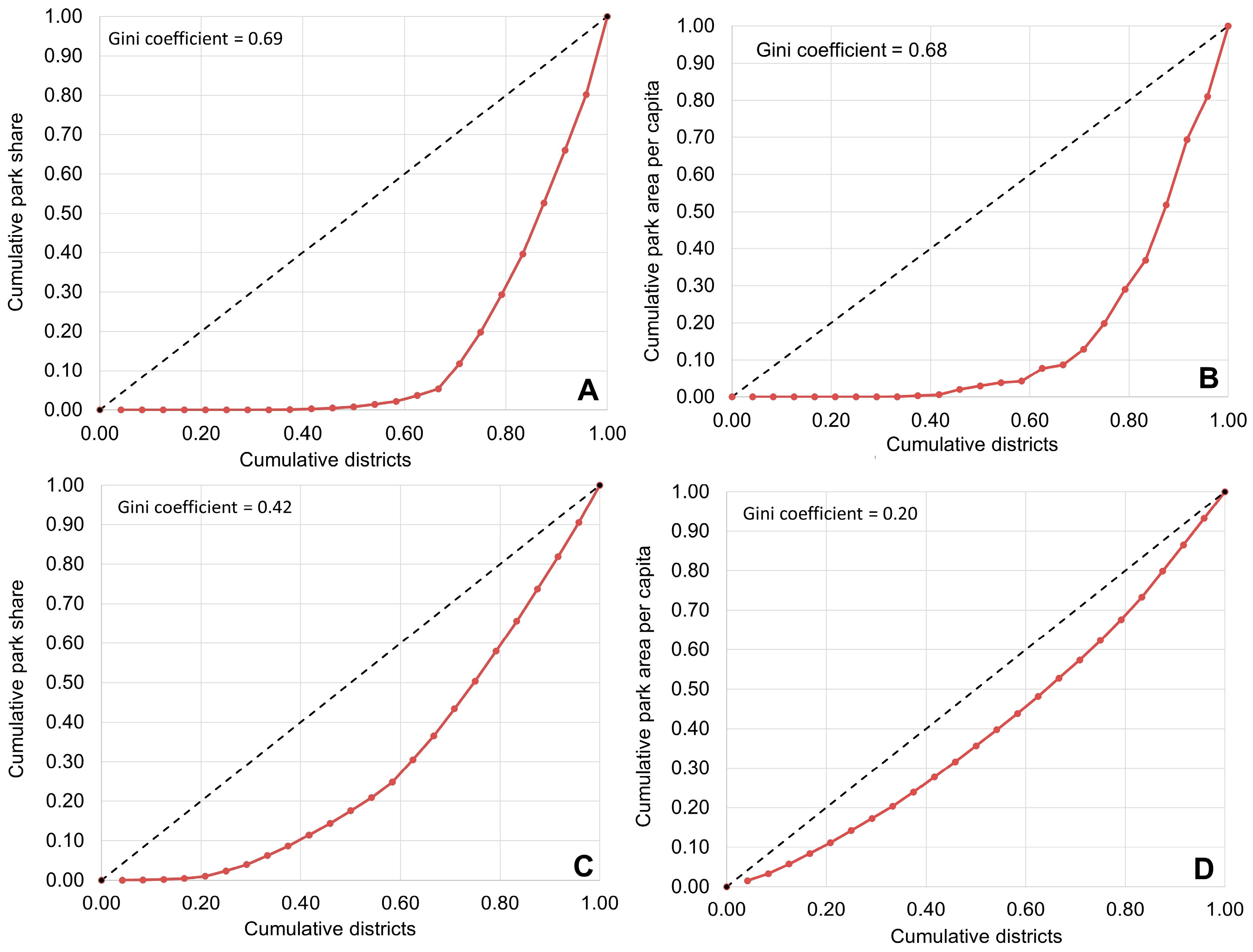
The Lorenz curve and the Gini coefficient were used to assess spatial inequality in the distribution of urban parks. The Lorenz curve represents the cumulative distribution of indicators across administrative regions, while the Gini coefficient provides a quantitative measure of the degree of inequality.

2.6. Data Processing

Spatial data processing and analysis were conducted using ArcGIS software (ArcMap 10.6). All spatial datasets were harmonized and transformed into a common projected coordinate reference system (WGS 84/UTM zone 35N, EPSG: 32635) to ensure accurate area calculations and comparability between the two cities. Urban Park polygons were spatially aggregated at the administrative district level using a spatial join operation, allowing for the calculation of the total park area within each district. Park areas were calculated in square meters and converted to hectares where necessary. Attribute tables were verified to ensure data consistency.

3. Results

3.1. Comparative Patterns of Urban Park Provision

Table 2 summarizes the main indicators of urban park provision in Sofia and Istanbul. The results highlight two contrasting patterns: higher overall park provision, but combined with pronounced spatial inequalities in Sofia, and lower but more evenly distributed park provision in Istanbul. These differences are further influenced by the spatial structure of administrative units, particularly in Istanbul, where large and internally diverse districts affect the interpretation of statistical indicators.
These contrasting patterns form the basis for the more detailed analysis presented in the following sections.

3.2. Spatial Distribution of Urban Parks

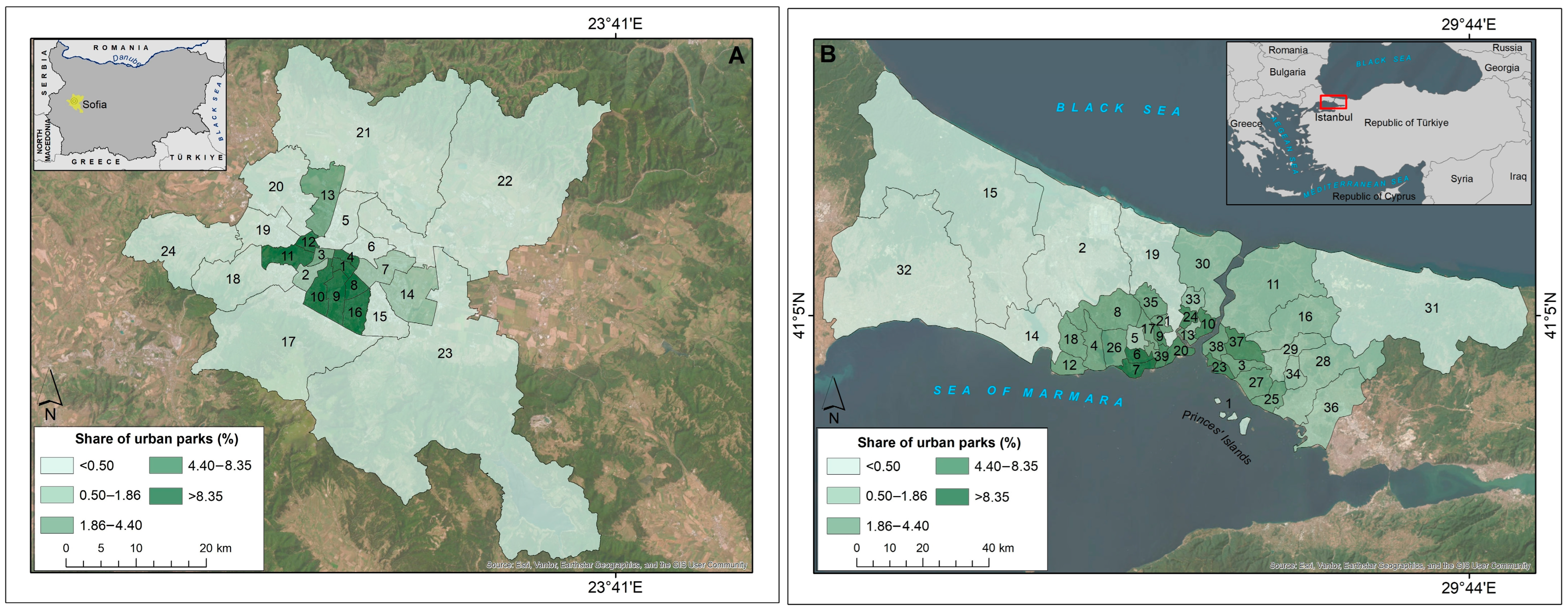
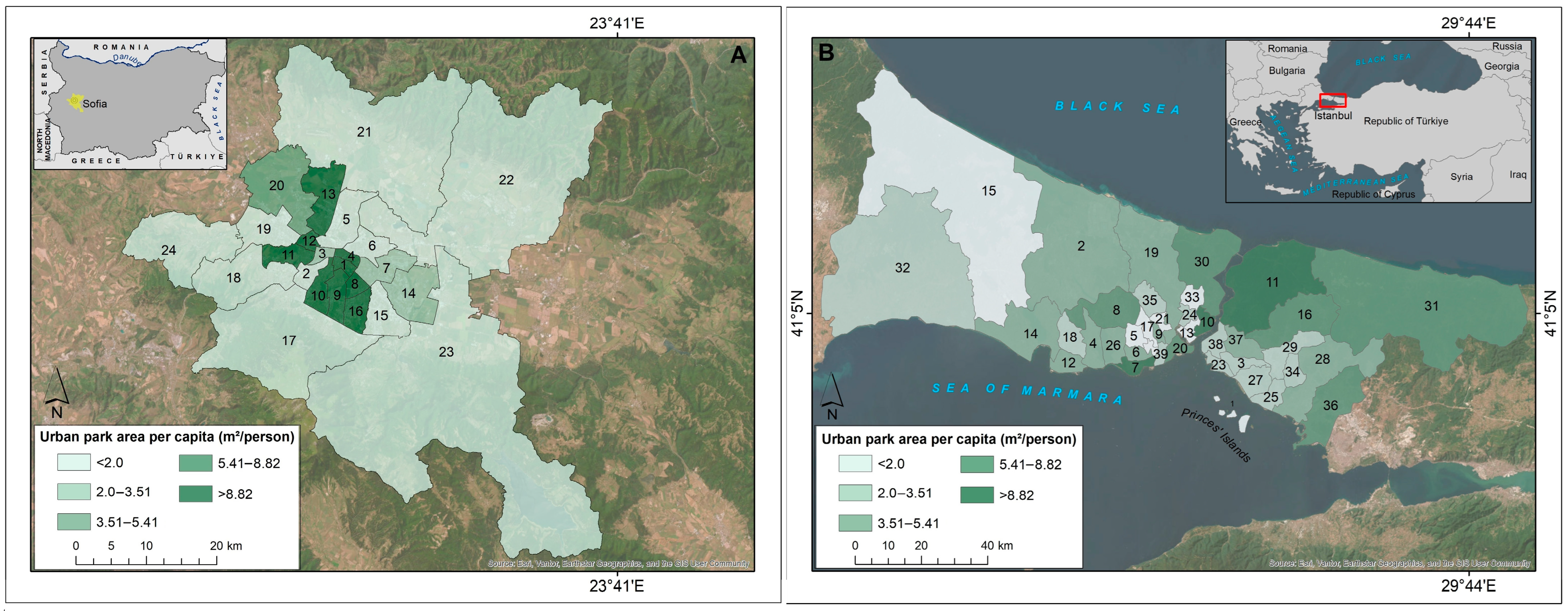
The spatial distribution of urban parks further highlights differences in urban structure between the two cities (Figure 2 and Figure 3).
Figure 2 presents the spatial distribution of the share of urban parks (%) by administrative districts in Sofia and Istanbul.
In Sofia, the higher values of the indicator are concentrated mainly in the central urban areas, where the main historical parks are located. The highest values are observed in the districts of Izgrev (39.77%), Sredets (28.39%), and Lozenets (26.19%), which are associated with the inclusion of significant parts of Borisova Gradina (Sofia’s largest historical urban park). High values are also observed in the districts of Krasna Polyana (26.82%) and Ilinden (20.58%), which include large areas of the Western Park (the second largest park in Sofia). In contrast, some peripheral districts, such as Mladost (0.07%), Ovcha Kupel (0.11%), Lyulin (0.37%), and Vrabnitsa (0.40%), show a significantly lower share of park areas (Figure 2A). Similar values are typical for areas with more intensive housing construction, where the provision of designated park spaces is limited. Low values of the indicator are also observed in areas such as Vitosha, Pancharevo, Novi Iskar, and Bankya, where a significant part of the territory is covered by natural and semi-natural landscapes that are not classified as city parks. This pattern outlines a clear center-periphery structure in the spatial distribution of city parks in Sofia.
In Istanbul, the spatial distribution of city parks is more heterogeneous than in Sofia. The highest share of park areas is observed in the Bakırköy district (14.05%), followed by Bahçelievler (10.67%) and Beşiktaş (8.35%). The high values in these areas are associated with the presence of large city parks and green spaces. For example, Beşiktaş is home to Yıldız Park, one of the largest historical parks in central Istanbul. At the same time, Bakırköy includes significant green areas such as Bakırköy Botanical Park and green spaces along the Ayamama Valley. In contrast, the lowest values of the indicator (below 0.50%) are observed in districts such as Çatalca, Şile, Silivri, Adalar, Arnavutköy, Büyükçekmece, and Eyüpsultan (Figure 2B). These districts are mainly located in the metropolitan region’s peripheral areas. They are characterized by large areas of natural landscapes, forests, agricultural land, or coastal areas that are not classified as urban parks.
Figure 3 presents the distribution of the area of urban parks per capita (m2/person) by administrative district in Sofia and Istanbul.
In Sofia, the values of the indicator vary between 0.13 m2/person in the Mladost district and 53.55 m2/person in the Izgrev district. The average value for the city is 11.79 m2/person, indicating notable variation in the level of urban park provision across districts. After the Izgrev district, high values are also observed in Krasna Polyana (49.61 m2/person) and Lozenets (42.42 m2/person), as well as in Sredets (33.20 m2/person) and Triaditsa (25.86 m2/person), which include parts of large urban parks. In contrast, densely populated residential areas such as Mladost (0.13 m2/person), Lyulin (0.72 m2/person), and Ovcha Kupel (0.77 m2/person) are characterized by very low values of the indicator (Figure 3A).
In Istanbul, the range of values is smaller. The area of parks per capita varies between 0.95 m2/person in the Bağcılar district and 23.73 m2/person in the Bakırköy district, with an average value of 5.01 m2/person, indicating generally lower levels of urban park provision. The highest values of park area per capita are observed in Bakırköy (23.73 m2/person), Beykoz (23.03 m2/person), and Beşiktaş (15.98 m2/person). At the same time, the lowest values are found in densely populated districts such as Bağcılar (0.95 m2/person), Adalar (1.10 m2/person), Güngören (1.51 m2/person), Gaziosmanpaşa (1.64 m2/person), and Şişli (1.71 m2/person) (Figure 3B).
Overall, the results show two different types of intra-city inequalities in urban park provision. While Sofia represents concentration-driven disparities where higher total park provision coexists with strong spatial imbalances, the Istanbul case shows scarcity-driven inequalities where park provision is more even but is insufficient in relation to population size.

3.3. Spatial Clustering of Urban Park Provision

The observed spatial distribution patterns of urban parks in Sofia and Istanbul indicated the need for further analysis using the LISA indicator Local Moran’s I, which allows for the identification of statistically significant spatial clusters and outliers.
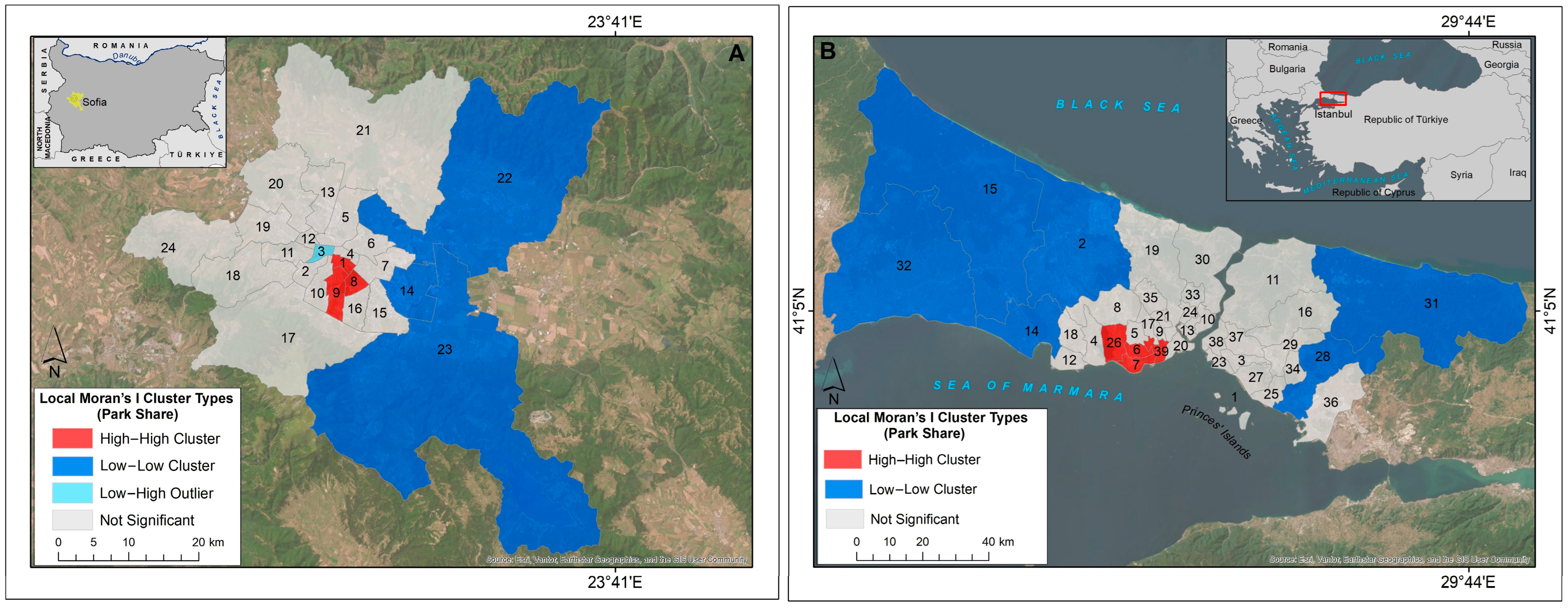
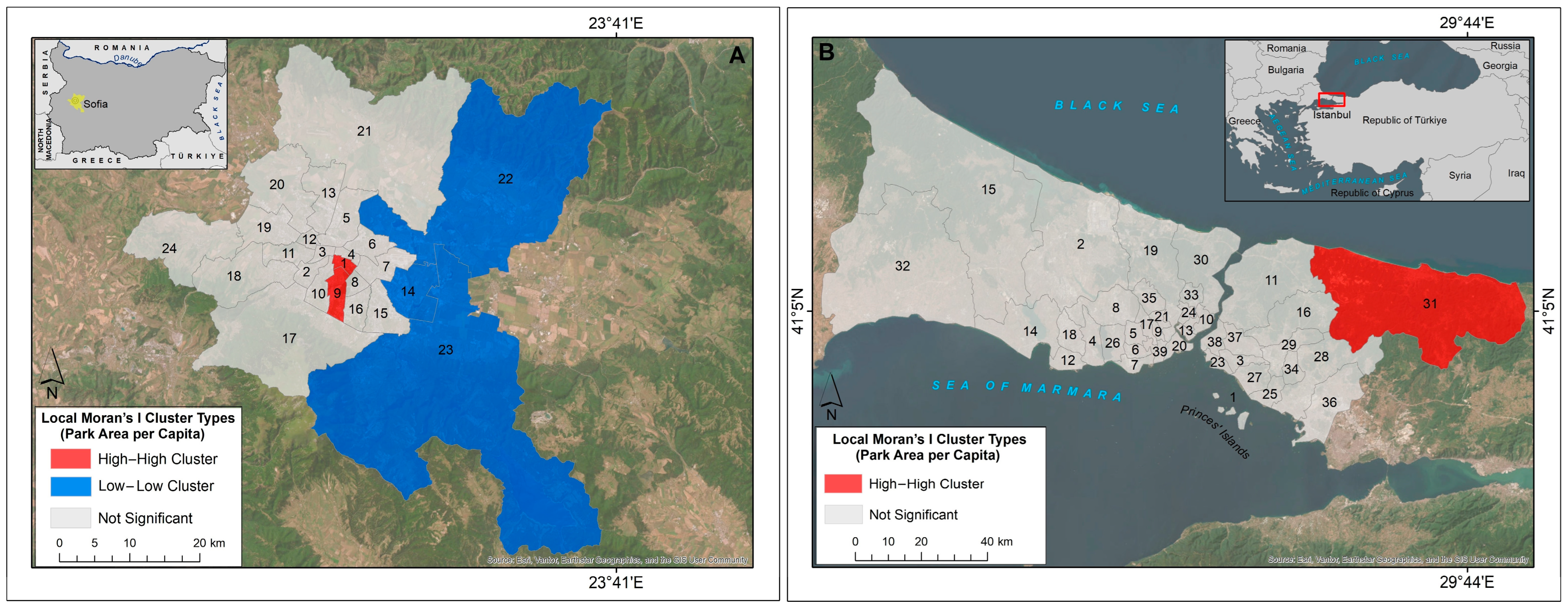
The Local Moran’s I analysis of the relative share of urban parks confirms the presence of clearly expressed spatial dependencies in both cities. In Sofia, High–High clusters are concentrated in the central urban areas (e.g., districts of Sredets, Izgrev, and Lozenets), where an accumulation of high values of the relative park share is observed compared to neighboring territories. These zones coincide with areas including major urban parks and key elements of the green infrastructure of the capital agglomeration. In the eastern peripheral parts of the city (e.g., districts of Iskar, Pancherevo, and Kremikovitsi), Low–Low clusters dominate, characterized by a lower relative share or lack of park areas (Figure 4A). This is a result of the specific combination of urban environment features in these districts: a large territorial size, but accompanied by smaller population numbers; allocation of numerous industrial zones and enterprises, as well as business and administrative buildings; a higher share of water, mountainous, and relatively low urbanized territories, which are mainly used for recreation and tourism (especially in the Pancherevo district).
The only outlier (Low–High) for Sofia is the district of Vazrazhdane (with a 3.3% share of urban parks), which is surrounded by districts in which are located some of the largest and most famous urban parks of the capital (Borisova Gradina Park and Prince’s Garden in Sredets; Zaimov Park and Military Academy Park in Oborishte; Zapaden (Western) Park in Ilinden and Krasna Polyana; and South Park in Triaditsa).
A similar spatial structure is also observed in Istanbul, where High–High clusters are localized in the central European parts of the city (e.g., districts of Bahçelievler, Bakırköy, Küçükçekmece, and Zeytinburnu). This cluster is formed not so much by the presence of large parks but rather by the high density and even distribution of urban parks (“kentpark”) within a compact urban structure. At the same time, the predominant part of the peripheral areas of the Istanbul metropolitan area forms Low–Low clusters (e.g., Şile, Pendik, Arnavutköy, Büyükçekmece, Çatalca, and Silivri), which are characterized by lower values of relative park share against the neighboring districts. This clustering indicates a shortage of urban park areas relative to the total area of the districts due to the combined effect of a variety of factors, such as the presence of key transportation infrastructure (international airports) in Arnavutköy and Pendik districts, accompanied by rapid urbanization and a dynamic real estate market, as well as the presence of favorable natural resources for summer seaside tourism and recreation (in Şile, Çatalca, and Silivri districts), associated with a large share of holiday facilities for the residents of Istanbul (Figure 4B).
The results of local autocorrelation analysis clearly confirm the conclusions from the previous results regarding the presence of pronounced spatial polarization in urban park provision in Sofia and Istanbul: a concentration of higher values in central urban areas and a limited number in the peripheral zones.
The spatial clustering analysis of the indicator park area per person shows quite diverse patterns for Sofia and Istanbul: Sofia reveals similar spatial inequalities when compared to the relative share of parks (Figure 5A), while Istanbul displays a different picture (Figure 5B).
In Sofia, a limited cluster of the High-High type is identified in central urban districts (e.g., Sredets and Lozenets), characterized by a high provision of park areas per person (33.2 and 42.4 m2/person, respectively). This pattern reflects the combination of the location of large park areas and differences in population size (Figure 5A). In contrast, a Low-Low cluster is in the eastern periphery of the capital agglomeration (e.g., districts of Iskar, Pancherevo, and Kremikovitsi), which spatially coincides with the Low-Low cluster identified for the relative share of park areas. These results confirm further the core-periphery spatial disparities in the provision of the capital population with this type of green infrastructure.
In Istanbul, a High-High cluster is formed in the Northeast (Asian) peripheral parts of the urban metropolitan territory (district Şile), which is known to be one of the famous Black Sea summer recreational destinations for the citizens. The higher values of the indicator (7.30 m2/person) are due to a substantial share of green areas, combined with a very low population density, compared to the neighboring districts (Figure 5B).
Most districts in both cities are classified as statistically insignificant, contrary to the analysis of the park share, especially for Istanbul. This suggests that the spatial autocorrelation of park provision per capita is less pronounced and more heterogeneous and is influenced by local demographic factors rather than the purely territorial distribution of park areas. These patterns stress the importance of using a wider indicator set, which will capture the spatial differentiation and inequalities in urban green infrastructure provision.
Overall, the LISA analysis demonstrates distinct spatial inequalities in park provision in both study areas. For Sofia, the spatial model reveals a clear concentration of large park areas in central urban districts, associated with better provision per capita and disadvantaged peripheral territories, especially in the eastern direction. Istanbul displays a center (European districts)-periphery (European and Asian districts) spatial distribution in urban parks shares (%) and more diffuse spatial patterns in terms of per capita provision. The statistical analysis is further complemented by the Gini coefficient, providing a more nuanced understanding of the spatial inequalities in the provision of park areas.

3.4. Spatial Inequality in Urban Park Distribution

The Lorenz curves show clear differences in the distribution of urban parks between Sofia and Istanbul (Figure 6).
In Sofia, both indicators demonstrate a strong deviation from the line of perfect equality, which is reflected in high values of the Gini coefficient (0.69 for the share of parks and 0.68 for the area per capita) (Figure 6A,B). This indicates a high degree of concentration of park resources in a limited number of districts and high inequality in the spatial provision of this type of green infrastructure.
In Istanbul, the Lorenz curves are significantly closer to the line of equality. Accordingly, the values of the Gini coefficient are lower (0.42 for the share of parks and 0.20 for the area per capita) (Figure 6C,D), which reflects a more even distribution, especially in the per capita indicator. However, these results should be interpreted with caution, as in the case of Istanbul, they reflect insufficient access to park areas for the population rather than the optimal level of provision.

4. Discussion

The observed spatial differences in the provision of urban parks in Sofia and Istanbul suggest differences in urban structure, population density, and the historical context of urban development. From a distributive perspective of spatial justice, these findings highlight two different forms of inequality for Sofia and Istanbul. While the former reflects the spatial concentration of park resources in a limited number of districts, the latter is associated with systemic limitations in the overall availability of urban parks in the context of rapid urbanization.

4.1. Relation to Existing Studies and Methodological Contribution

The findings for Sofia confirm the existence of urban spatial inequalities in the distribution of green spaces [33]. The spatial contrasts, which are observed in the present paper, are examined through the lens of functionally defined urban parks and show different patterns of spatial distribution compared to general vegetation cover. Similar conclusions to the current study are reported by Todorova (2023), whose GIS-based analysis demonstrates significant territorial differences in the distribution of green spaces in Sofia [34]. In addition, previous research [50] highlights the role of urban planning processes and land-use transformations in shaping the contemporary spatial structure of the city. The study by Vatseva et al. (2016) indicates that vegetation covers approximately 48.6% of the urbanized territory of Sofia; however, this measure reflects overall vegetation distribution rather than the provision of publicly accessible urban parks [32]. More recent work by Vatseva and Dinkov (2025) further differentiates urban green spaces into multiple categories, demonstrating that not all green areas function as publicly available recreational spaces [35]. This distinction is essential, as it underlines the difference between the presence of vegetation and the spatial provision of functionally defined green infrastructure.
While the present study focuses on urban parks as a clearly defined and publicly accessible category, it is important to emphasize that other types of green spaces-including private, residual, and semi-natural areas—also provide significant ecosystem services. These include biodiversity conservation, climate regulation, and ecological connectivity, which extend beyond recreational functions. Therefore, the analysis does not imply that non-park green spaces are less valuable, but rather that urban parks are used as a comparable indicator of publicly accessible green infrastructure. At the same time, the results for Istanbul are consistent with recent studies reporting low levels of park provision per capita (e.g., approximately 5–7 m2/person) [51]. This paper’s findings are also supported by the observed negative effects, like significant loss of green spaces, biodiversity, and ecosystem services, because of land competition, economic growth, population increase, and policies conducted in Istanbul [52,53].

4.2. Scope and Limitations of This Study

The results should be interpreted considering the methodological approach used in this study. The use of administrative districts as spatial units introduces a limitation related to their internal heterogeneity, particularly in Istanbul, where large districts include significant non-urbanized areas. This affects the calculation and interpretation of statistical indicators and reflects the well-known Modifiable Areal Unit Problem (MAUP), which highlights the sensitivity of spatial analysis results to the choice of spatial units. In this context, the observed lower variability in Istanbul may partly result from the inclusion of large areas with low levels of urbanization. At the same time, the use of administrative units ensures comparability between the two cities and corresponds to the spatial framework used in urban planning and policymaking.
The results suggest that the integrated use of inequality indicators (like the Gini coefficient) and spatial autocorrelation analysis (like Local Moran’s I) provides a robust framework for exploring spatial patterns and differences. The Gini index captures overall park-area concentration but does not account for intra-district spatial structure. Spatial analysis using Local Moran’s I supports valuable insights by identifying clusters of districts with similar characteristics; however, these results should also be interpreted with caution, considering the potential mismatch between administrative and functional urban territories. This is particularly relevant for Istanbul, where administrative expansion has increased the mismatch between administrative and functional urban areas.
It is important to emphasize that this study focuses on the provision and spatial distribution of urban parks, rather than their accessibility. Although accessibility is conceptually related to provision, it requires specific analysis based on distance, transport networks, and physical barriers, which are beyond the scope of the present study. In addition, the analysis focuses on the quantitative characteristics of urban parks and does not include qualitative aspects such as design, maintenance, safety, or user perception. Therefore, areas with similar levels of provision may differ significantly in terms of actual usability and attractiveness. Finally, this study provides a static assessment of urban park distribution based on available spatial data and applies the case study approach.
Future research could extend this approach by incorporating accessibility measures, qualitative indicators, socio-demographic factors, and temporal dynamics in order to deepen the understanding of spatial inequalities in urban park provision. Additionally, the future scope of the current study can be expanded in geographical terms (to a larger number of cities) to extract more common tendencies and broader generalizations.

5. Conclusions

This study presents a comparative analysis of spatial inequalities in urban park provision in Sofia and Istanbul (at the district level), using a GIS-based comparative framework and a set of indicators. This study contributes to the existing research by providing a transferable framework that combines classical descriptive measures with spatial statistical analysis, revealing patterns of inequality that may remain hidden when using aggregated indicators.
The findings from cross-city comparison reveal that urban park provision is shaped by distinct urban development contexts, and the results indicate that Sofia and Istanbul show diverse patterns of park provision inequalities. These differences may in part be related to broader contrasts in historical patterns of urban development between the two cities. The results underline the importance of context-sensitive approaches in the assessment and planning of urban green infrastructure. In cities with relatively higher park provision but strong spatial disparities, such as Sofia, planning efforts should focus on improving the spatial provision of urban parks, particularly by prioritizing underserved districts, enlarging and creating green corridors and networks, enabling the public use of urban parks, and sustainable redevelopment of brownfield territories. In cities characterized by an overall shortage, such as Istanbul, priority should be given to increasing the total availability of urban parks, especially in densely populated areas, and implementing legislative regulations for the development of urban parks in peripheral and low-urbanization areas.

Author Contributions

Conceptualization, V.S., D.P. and S.G.; methodology, V.S., P.I.-R., D.P. and S.G.; software, V.S., S.G. and G.B.; validation, P.I.-R., S.G., G.B. and G.M.; formal analysis, V.S., P.I.-R., D.P. and S.G.; investigation, G.B. and G.M.; resources, S.G. and D.P.; data curation, G.B. and G.M.; writing—original draft preparation, V.S. and P.I.-R.; writing—review and editing, V.S., D.P., G.B. and S.G.; visualization, V.S., G.B. and G.M.; supervision, V.S., D.P. and S.G. All authors have read and agreed to the published version of the manuscript.

Funding

This research received no external funding.

Data Availability Statement

The original contributions presented in this study are included in the article. Further inquiries can be directed to the corresponding author.

Acknowledgments

The authors acknowledge the use of the scientific infrastructure provided under Project No. BG16RFPR002-1.014-0011 “Sustainable Development of the Centre of Excellence ‘Heritage BG’”, funded by the program “Research, Innovation and Digitalization for Smart Transformation 2021–2027”. Generative AI tools were used only for language editing and text polishing. The authors take full responsibility for the scientific content of this manuscript. The authors have reviewed and edited the output and take full responsibility for the content of this publication.

Conflicts of Interest

The authors declare no conflicts of interest.

References

  1. Syrbe, R.-U.; Neumann, I.; Grunewald, K.; Brzoska, P.; Louda, J.; Kochan, B.; Macháč, J.; Dubová, L.; Meyer, P.; Brabec, J.; et al. The Value of Urban Nature in Terms of Providing Ecosystem Services Related to Health and Well-Being: An Empirical Comparative Pilot Study of Cities in Germany and the Czech Republic. Land 2021, 10, 341. [Google Scholar] [CrossRef]
  2. Halder, B.; Juneng, L. Quantifying Spatial Urban Park Cooling Efficiency and Blue-Green Infrastructure Performance in Tropical Megacity Using Advanced Remote Sensing. Urban Sci. 2026, 10, 110. [Google Scholar] [CrossRef]
  3. Salvo-Tierra, Á.E.; Ruiz-Valero, Á. Why urban greening requires more than just species biodiversity. Acad. Environ. Sci. Sustain. 2025, 2, 4. [Google Scholar] [CrossRef]
  4. Haase, D.; Larondelle, N.; Andersson, E.; Artmann, M.; Borgström, S.; Breuste, J.; Gomez-Baggethun, E.; Gren, Å.; Hamstead, Z.; Hansen, R.; et al. A quantitative review of urban ecosystem service assessments: Concepts, models, and implementation. Ambio 2014, 43, 413–433. [Google Scholar] [CrossRef]
  5. Cai, Y.; Duan, J.; Qin, L.; Jiao, S. Identifying the Nonlinear Impact Mechanisms of Urban Park Vitality: A Case Study of Changsha. Land 2026, 15, 231. [Google Scholar] [CrossRef]
  6. Gao, W.; Lyu, Q.; Fan, X.; Yang, X.; Liu, J.; Zhang, X. Building-Based Analysis of the Spatial Provision of Urban Parks in Shenzhen, China. Int. J. Environ. Res. Public Health 2017, 14, 1521. [Google Scholar] [CrossRef]
  7. Yang, Y.; Wang, K.; Jiang, L.; Liu, S. Identification, Evaluation, and Optimization of Urban Park System Network Structure. Forests 2026, 17, 186. [Google Scholar] [CrossRef]
  8. Harvey, D. Social Justice and the City; Edward Arnold: London, UK, 1973. [Google Scholar]
  9. Soja, E.W. Seeking Spatial Justice; University of Minnesota Press: Minneapolis, MN, USA, 2010. [Google Scholar]
  10. Wolch, J.R.; Byrne, J.; Newell, J.P. Urban green space, public health, and environmental justice: The challenge of making cities ‘just green enough’. Landsc. Urban Plan. 2014, 125, 234–244. [Google Scholar] [CrossRef]
  11. Rigolon, A. A complex landscape of inequity in access to urban parks: A literature review. Landsc. Urban Plan. 2016, 153, 160–169. [Google Scholar] [CrossRef]
  12. Anguelovski, I.; Connolly, J.J.T.; Masip, L.; Pearsall, H. Assessing green gentrification in historically disenfranchised neighborhoods: A longitudinal and spatial analysis of Barcelona. Urban Geogr. 2018, 39, 458–491. [Google Scholar] [CrossRef]
  13. Curran, W.; Hamilton, T. Just green enough: Contesting environmental gentrification in Greenpoint, Brooklyn. Local Environ. 2012, 17, 1027–1042. [Google Scholar] [CrossRef]
  14. Sun, W.; Ren, J.; Zhai, J.; Li, W. ‘Just green enough’ in urban renewal: A multifunctional and pragmatic approach in realizing multiscale urban green space optimization in built-up residential areas. Urban For. Urban Green. 2023, 82, 127891. [Google Scholar] [CrossRef]
  15. Nijman, J. A tale of many cities: Universalism and particularism in urban theory. Urban Geogr. 2007, 28, 1–6. [Google Scholar] [CrossRef]
  16. Robinson, J. Ordinary Cities: Between Modernity and Development; Routledge: London, UK, 2006. [Google Scholar]
  17. Artmann, M.; Inostroza, L.; Fan, P. Urban sprawl, compact urban development and green cities: How much do we know, how much do we agree? Ecol. Indic. 2019, 96, 3–9. [Google Scholar] [CrossRef]
  18. Mattijssen, T.J.M.; Olafsson, A.S.; Møller, M.S.; Gulsrud, N.; Caspersen, O.H. (Eds.) Urban Green Infrastructure: Connecting People and Nature for Sustainable Cities. A Summary for Policy Makers; GREEN SURGE D8.5; GREEN SURGE: Copenhagen, Denmark, 2017. [Google Scholar]
  19. Pan, J.; Xue, S.; Hu, Y. Social Value Measurement and Attribute Impact of Urban Complex Parks: A Case Study of Shanghai. Sustainability 2026, 18, 56. [Google Scholar] [CrossRef]
  20. Stanilov, K. Democracy, markets, and public space in the transitional societies of Central and Eastern Europe. In The Post-Socialist City. The GeoJournal Library; Stanilov, K., Ed.; Springer: Dordrecht, The Netherlands, 2007; Volume 92. [Google Scholar] [CrossRef]
  21. Boone, C.G.; Buckley, G.L.; Grove, J.M.; Sister, C. Parks and people: An environmental justice inquiry in Baltimore, Maryland. Ann. Assoc. Am. Geogr. 2009, 99, 767–787. [Google Scholar] [CrossRef]
  22. Wüstemann, H.; Kalisch, D.; Kolbe, J. Access to urban green space and environmental inequalities in Germany. Landsc. Urban Plan. 2017, 164, 124–131. [Google Scholar] [CrossRef]
  23. Yao, M.; Yao, B.; Cenci, J.; Liao, C.; Zhang, J. Visualisation of High-Density City Research Evolution, Trends, and Outlook in the 21st Century. Land 2023, 12, 485. [Google Scholar] [CrossRef]
  24. Zhu, Z.; Li, J.; Chen, Z. Green Space Equity: Spatial Distribution of Urban Green Spaces and Correlation with Urbanization in Xiamen, China. Environ. Dev. Sustain. 2023, 25, 423–443. [Google Scholar] [CrossRef]
  25. Krsnik, G.; Reyes-Paecke, S.; Reynolds, K.M.; Garcia-Gonzalo, J.; González Olabarria, J.R. Assessing Relativeness in the Provision of Urban Ecosystem Services: Better Comparison Methods for Improved Well-Being. Land 2023, 12, 1088. [Google Scholar] [CrossRef]
  26. Atanur, G.; Mirici, M.E.; Ersöz, N.D. Kaybolan Kent ve Doğa İlişkisini Kentsel Açık Yeşil Alanlar Üzerinden Tartışmak: Bursa Yıldırım İlçesi Örneği. Idealkent 2024, 16, 393–414. [Google Scholar] [CrossRef]
  27. Tang, Y.; Guo, X.; Liu, C.; Wang, Y.; Li., C. The Spatial–Temporal Evolution Analysis of Urban Green Space Exposure Equity: A Case Study of Hangzhou, China. Sustainability 2026, 18, 1131. [Google Scholar] [CrossRef]
  28. Smith, N.; Williams, P. Gentrification of the City; Routledge: Abingdon, UK, 2013; Available online: https://books.google.bg/books?hl=en&lr=&id=KeNXAQAAQBAJ&oi=fnd&pg=PP1&ots=kpuiL4vUTo&sig=pxCSovbTgQYSIpjJn1HjuqAFXMs&redir_esc=y#v=onepage&q&f=false (accessed on 28 March 2026).
  29. Rigolon, A.; Keith, S.; Harris, B.; Mullenbach, L.; Larson, L.; Rushing, J. More than “Just Green Enough”: Helping Park Professionals Achieve Equitable Greening and Limit Environmental Gentrification. J. Park Recreat. Adm. 2020, 38, 29–54. [Google Scholar] [CrossRef]
  30. Anguelovski, I.; Cole, H.V.S.; O’Neill, E.; Baró, F.; Kotsila, P.; Sekulova, F.; Pérez Del Pulgar, C.; Shokry, G.; García-Lamarca, M.; Argüelles, L.; et al. Gentrification pathways and their health impacts on historically marginalized residents in Europe and North America: Global qualitative evidence from 14 cities. Health Place 2021, 72, 102698. [Google Scholar] [CrossRef] [PubMed]
  31. Brown, C.; Rigolon, A.; Zdrodowski, P.; Pearson, A. A systematic review of green gentrification and mental health. Health Place 2026, 97, 103599. [Google Scholar] [CrossRef]
  32. Vatseva, R.; Kopecka, M.; Otahel, J.; Rosina, K.; Kitev, A.; Genchev, S. Mapping urban green spaces based on remote sensing data: Case studies in Bulgaria and Slovakia. In Proceedings of the 6th International Conference on Cartography and GIS; Bandrova, T., Konechny, M., Eds.; Bulgarian Cartographic Association: Sofia, Bulgaria, 2016; pp. 569–578. [Google Scholar]
  33. Sarafova, E. How green the urban development units in Sofia are: Earth observation and population time series analysis. J. Bulg. Geogr. Soc. 2021, 44, 25–37. [Google Scholar] [CrossRef]
  34. Todorova, E.R. Green spaces in Sofia—Analyses of spatial distribution. Silva Balc. 2023, 24, 69–80. [Google Scholar] [CrossRef]
  35. Vatseva, R.; Dinkov, D. Mapping urban green spaces using remote sensing data for sustainable development in Sofia city, Bulgaria. Eng. Geol. Hydrogeol. 2025, 39, 181–192. [Google Scholar] [CrossRef]
  36. Song, Q.; Tian, S.; Zheng, L.; Zheng, Y.; Qiu, L.; Huang, B.; Ameijde, J. Beyond sentiment: Using large language models to decode multidimensional urban park perceptions for enhanced equality. Landsc. Urban Plan. 2026, 268, 105571. [Google Scholar] [CrossRef]
  37. Colbert, J.; Chuang, I.-T.; Sila-Nowicka, K. Measuring spatial inequality of urban park accessibility and utilisation: A case study of public housing developments in Auckland, New Zealand. Landsc. Urban Plan. 2024, 247, 105070. [Google Scholar] [CrossRef]
  38. Ayala-Azcárraga, C.; Diaz, D.; Zambrano, L. Characteristics of urban parks and their relation to user well-being. Landsc. Urban Plan. 2019, 189, 27–35. [Google Scholar] [CrossRef]
  39. Pinto, L.; Ferreira, S.; Pereira, P. Using Local Indicators of Spatial Association (LISA) to Assess Spatial Relation between. Urban Parks’ Structure and Users’ Activities in Vilnius (Lithuania). In Proceedings of the 16th International Conference Monitoring of Geological Processes and Ecological Condition of the Environment; European Association of Geoscientists & Engineers: Bunnik, The Netherlands, 2022; pp. 1–5. [Google Scholar] [CrossRef]
  40. Faka, A. Mapping Green Space Inequalities in 26 European Cities. Land 2025, 14, 2362. [Google Scholar] [CrossRef]
  41. National Statistical Institute. Available online: https://www.nsi.bg/sites/default/files/files/pressreleases/Census2021_Population_SOF.pdf (accessed on 25 March 2026). (In Bulgarian)
  42. Tsvetkov, K. Sofia. Section: Regions. In Geography of Bulgaria. Volume 2: Social and Economic Geography. Regional Geography; Zhelezov, G., Ilieva, N., Nedkov, S., Miloshev, N., Gadzhev, G., Eds.; Publishing House of the Bulgarian Academy of Sciences “Prof. Marin Drinov”: Sofia, Bulgaria, 2025; pp. 398–401. [Google Scholar]
  43. Poleganova, D. Current trends and challenges in urban, demographic, and socio-economic development of Sofia municipality. Probl. Geogr. 2025, 1–2, 45–64. (In Bulgarian) [Google Scholar] [CrossRef]
  44. Stoyanova, V.; Poleganova, D.; Genchev, S.; Belev, G.; Ivanova-Radovanova, P.; Metodieva, G. Spatial assessment of urban parks for sustainable urban development in Istanbul. Probl. Geogr. 2026, 1–2, 28–56. (In Bulgarian) [Google Scholar] [CrossRef]
  45. Sofia Municipality. Available online: https://www.sofia.bg/web/sofia-municipality/administrative-territorial-structure (accessed on 20 March 2026).
  46. Türkiye İstatistik Kurumu (TÜİK). Available online: https://cip.tuik.gov.tr/ (accessed on 8 January 2026).
  47. Openshaw, S. The Modifiable Areal Unit Problem; Geo Books: Norwich, UK, 1984. [Google Scholar]
  48. Fotheringham, A.S.; Wong, D.W.S. The modifiable areal unit problem in multivariate statistical analysis. Environ. Plan. A 1991, 23, 1025–1044. [Google Scholar] [CrossRef]
  49. Dark, S.J.; Bram, D. The modifiable areal unit problem (MAUP) in physical geography. Prog. Phys. Geogr. 2007, 31, 471–479. [Google Scholar] [CrossRef]
  50. Vitanova, L.; Matsumura, S.; Petrova-Antonova, D. Influence of Muesmann’s plan on contemporary urban planning in Sofia City. City Environ. Interact. 2026, 29, 100303. [Google Scholar] [CrossRef]
  51. Aksoy, Y. The Relationship Between Planned Development and Green Space Sufficiency: The Case of Istanbul. Preprints 2025, 2025081523. [Google Scholar] [CrossRef]
  52. Sert, E. Urban green spaces of Istanbul: From ‘beautifying’ efforts to ‘mega-projects’. Plan. Perspect. 2024, 39, 1359–1380. [Google Scholar] [CrossRef]
  53. Coskun, H. An ecological dilemma, novel sustainable ideas for Istanbul examining zoning regulation for green-areas and housing. City Territ. Archit. 2024, 11, 21. [Google Scholar] [CrossRef]
Figure 1. Administrative districts and spatial distribution of urban parks within the metropolitan territories of Sofia municipality (24 districts, (A)) and Istanbul metropolitan province (39 districts, (B)). Administrative districts correspond to the numbers shown on the maps: Sofia (A)—1. Sredets, 2. Krasno selo, 3. Vazrazhdane, 4. Oborishte, 5. Serdika, 6. Poduene, 7. Slatina, 8. Izgrev, 9. Lozenets, 10. Triaditsa, 11. Krasna Polyana, 12. Ilinden, 13. Nadezhda, 14. Iskar, 15. Mladost, 16. Studentski, 17. Vitosha, 18. Ovcha kupel, 19. Lyulin, 10. Vrabnica, 21. Novi Iskar, 22. Kremikovtsi, 23. Pancherevo, 24. Bankya; Istanbul (B)—1. Adalar, 2. Arnavutköy, 3. Ataşehir, 4. Avcılar, 5. Bağcılar, 6. Bahçelievler, 7. Bakırköy, 8. Başakşehir, 9. Bayrampaşa, 10. Beşiktaş, 11. Beykoz, 12. Beylikdüzü, 13. Beyoğlu, 14. Büyükçekmece, 15. Çatalca, 16. Çekmeköy, 17. Esenler, 18. Esenyurt, 19. Eyüpsultan, 20. Fatih, 21. Gaziosmanpaşa, 22. Güngören, 23. Kadıköy, 24. Kağıthane, 25. Kartal, 26. Küçükçekmece, 27. Maltepe, 28. Pendik, 29. Sancaktepe, 30. Sarıyer, 31. Şile, 32. Silivri, 33. Şişli, 34. Sultanbeyli, 35. Sultangazi, 36. Tuzla, 37. Ümraniye, 38. Üsküdar, 39. Zeytinburnu.
Geographies 06 00052 g001
Figure 2. Spatial distribution of the share of urban parks (%) across administrative districts in the metropolitan territories of Sofia (A) and Istanbul (B). District numbers correspond to the administrative districts shown in Figure 1.
Geographies 06 00052 g002
Figure 3. Spatial distribution of urban park area per capita (m2/person) across administrative districts in the metropolitan territories of Sofia (A) and Istanbul (B). District numbers correspond to the administrative districts shown in Figure 1.
Geographies 06 00052 g003
Figure 4. Local Moran’s I cluster map of urban park share (%) across administrative districts in the metropolitan territories of Sofia (A) and Istanbul (B). Statistically significant clusters are identified at p < 0.05. District numbers correspond to the administrative districts shown in Figure 1.
Geographies 06 00052 g004
Figure 5. Local Moran’s I cluster map of urban park area per capita (m2/person) across administrative districts in the metropolitan territories of Sofia (A) and Istanbul (B). Statistically significant clusters are identified at p < 0.05. District numbers correspond to the administrative districts shown in Figure 1.
Geographies 06 00052 g005
Figure 6. Lorenz curves and Gini coefficients illustrating spatial inequality in the distribution of urban parks across administrative districts in the metropolitan territories of Sofia (A,B) and Istanbul (C,D). Panels (A,C) represent the share of urban parks (%), while panels (B,D) show urban park area per capita (m2/person). The dashed line represents perfect equality.
Geographies 06 00052 g006
Table 1. Definition and classification of urban parks.
AspectSofiaIstanbul
Official classificationUrban parks and gardens within the municipal green systemPublic parks (“park”) and urban parks (“kent parkı”) within the metropolitan green infrastructure system
Planning frameworkGeneral Development Plan for Sofia and Municipal Green System RegulationsIstanbul Metropolitan Municipality Park classification
Green spaces includedPublic urban parks and large municipal parksPublic urban parks and metropolitan parks
Green spaces excludedLarge natural and peri-urban landscapes (e.g., Vitosha Mountain)Large forest areas and peri-urban natural landscapes (e.g., Belgrad Forest)
Main functionRecreation, leisure, and urban ecological servicesRecreation, public leisure, and urban green infrastructure
Example parksBorisova Gradina, South Park, West ParkEmirgan Park, Gülhane Park, Yıldız Park, Maçka Park
Yoğurtçu Park
Table 2. Indicators for comparative analysis of urban park areas in Sofia and Istanbul.
IndicatorSofiaIstanbul
Total city area (ha)134,339.98534,266.95
Urbanized area (CORINE, ha)29,528.98124,208.03
Share of urbanized areas (%)21.9723.25
Total population (2024)1,295,93115,754,053
Population density (person/km2)9641642
Number of administrative districts2439
Total Park area (ha)1331.936499.46
Share of park area (%)0.990.67
Average Park area per capita (m2/person)11.795.01
Minimum Park area provision by district (m2/person)0.13 (Mladost)0.95 (Bağcılar)
Maximum Park area provision by district (m2/person)53.54 (Izgrev)23.74 (Bakırköy)
Coefficient of variation—park share (%)141.4998.00
Coefficient of variation—park area per capita (%)141.9398.66
Standard deviation park area per capita (m2/person)16.734.95
Median Park area per capita (m2/person)2.593.51
Disclaimer/Publisher’s Note: The statements, opinions and data contained in all publications are solely those of the individual author(s) and contributor(s) and not of MDPI and/or the editor(s). MDPI and/or the editor(s) disclaim responsibility for any injury to people or property resulting from any ideas, methods, instructions or products referred to in the content.