1. Introduction
Land Use and Land Cover (LULC) dynamics play a decisive role in the sustainability of agricultural production systems, the continuity of ecosystem services, and the spatial organization of rural areas [
1]. Agricultural areas, in particular, are exposed to rapid and multidimensional structural transformations driven by increasing population pressure, urbanization trends, and climatic stress factors, affecting both their extent and spatial configuration [
2,
3,
4]. Such transformations have significant impacts on production efficiency and the sustainability of agricultural enterprises, while also directly influencing the management of water and soil resources and the preservation of ecological balance in agricultural systems [
5]. In this context, the quantitative, comparable, and spatially detailed analysis of changes in agricultural areas has emerged as a critical requirement not only for academic research but also for the development of effective and sustainable agricultural policies [
6,
7]. Short-term dynamics are particularly important because they capture early-stage and incremental landscape transformations that accumulate rapidly and may lead to irreversible structural changes if not detected in time, especially under strong urbanization and agricultural pressure.
In recent decades, remote sensing (RS) and geographic information system (GIS) technologies have become indispensable tools for monitoring and analyzing LULC dynamics. By providing high-spatial- and temporal-resolution data over large areas through satellite imagery and aerial photographs, these approaches offer significant advantages over traditional field-based methods in terms of efficiency, spatial coverage, and continuity of observations [
8,
9]. In addition to enabling the discrimination of vegetation types and agricultural land classes, RS- and GIS-based methods facilitate the analysis of landscape structure and the detection of temporal changes through time-series approaches, while also contributing to more cost-effective data acquisition in large-scale studies [
10,
11]. Beyond the simple quantification of land cover gains or losses, the assessment of agricultural land change through these technologies requires a more detailed understanding of the direction, magnitude, and interactions of land use transitions with other land cover types, which is essential for interpreting complex landscape dynamics.
Within this analytical framework, landscape metrics have emerged as essential complementary tools for quantitatively characterizing the spatial structure of agricultural areas and their associated ecological and land management processes [
10,
12]. By measuring attributes such as patch size, density, edge characteristics, and connectivity, landscape metrics not only describe existing land use patterns but also reveal the direction and magnitude of spatial changes over time [
13]. Metrics such as number of patches (NP), patch density (PD), edge density (ED), and Aggregation Index (AI/CONTAG) provide robust quantitative indicators for evaluating landscape configuration and organization [
14,
15]. Consequently, landscape metrics enable a detailed assessment of agricultural landscape dynamics and facilitate the interpretation of structural changes in relation to land management and ecological processes [
16,
17]. The theoretical basis of these metrics further demonstrates their strong linkage with ecological processes when analyzing landscape characteristics such as configuration and connectivity [
18,
19].
Previous studies have shown that increasing fragmentation (defined as the breaking up of continuous agricultural land into smaller and more isolated patches due to land use changes) of agricultural areas leads to declines in agricultural production economics, reductions in land use efficiency, and heightened environmental pressures [
20,
21]. However, existing research has predominantly concentrated on long-term landscape changes (10–30 years), resulting in a limited understanding of short-term and recent dynamics that directly reflect ongoing environmental and socio-economic pressures [
22,
23]. This gap is particularly critical, as short-term changes often capture rapid and incremental transformations that cannot be detected through long-term assessments alone [
24]. Integrating landscape metrics with high-resolution satellite data in such monitoring efforts is particularly important, as it enables the detection of structural changes in agricultural landscapes with high spatial detail and consistency [
25,
26]. Although recent studies have increasingly benefited from AI-supported LULC products, these datasets are generally used as inputs rather than representing a methodological innovation within the analytical framework itself. High-spatial-resolution data with improved accuracy now allow for the precise detection of small-scale and parcel-level transformations in agricultural areas. Nevertheless, the systematic integration of multi-temporal, high-resolution LULC data with landscape metrics for explicitly assessing short-term agricultural landscape dynamics remains insufficiently addressed in the literature [
9,
27]. Accordingly, this study focuses on quantifying short-term changes (2017–2024) in agricultural landscapes by combining AI-supported LULC datasets with Fragstats-based landscape metrics. Rather than proposing a new AI method, the study utilizes existing AI-derived data within a landscape ecology framework to provide a consistent and reproducible assessment of fragmentation and spatial structure. This approach aims to deliver a clearer and more empirically grounded understanding of recent landscape transformations, thereby supporting more effective agricultural land management and planning processes.
The Finike district, characterized by a Mediterranean climate type, was selected as the study area, and multi-temporal, AI-generated LULC raster data for the years 2017 and 2024 were utilized. The selection of the 2017–2024 period is based on the availability of the ESRI 10 m Annual Land Cover dataset, which provides consistent AI-supported global LULC products starting from 2017, enabling reliable short-term temporal analysis of landscape dynamics. The analyses were conducted with a specific focus on the agricultural land class, and changes in the spatial structure of the agricultural landscape were evaluated at both class and landscape levels. In this context, landscape metrics calculated using Fragstats quantitatively reveal the temporal spatial transformation of agricultural areas. Another important aspect of the study is that it does not solely address agricultural landscape analyses within a theoretical framework but also interprets the results from an agricultural management and planning perspective. The spatial reduction in and fragmentation of agricultural areas pose significant risks to the sustainability of agricultural production systems. Therefore, the quantitative indicators derived from landscape metrics provide a scientific basis for the conservation of agricultural areas, land consolidation policies, and the development of sustainable land use strategies. Accordingly, this study provides an analytical framework capable of addressing the question of how agricultural land extent and spatial configuration have changed between 2017 and 2024 under short-term land use dynamics. The case of the Finike district allows for the derivation of generalizable implications for similar agricultural areas within the Mediterranean climate zone.
2. Materials and Methods
2.1. Study Area
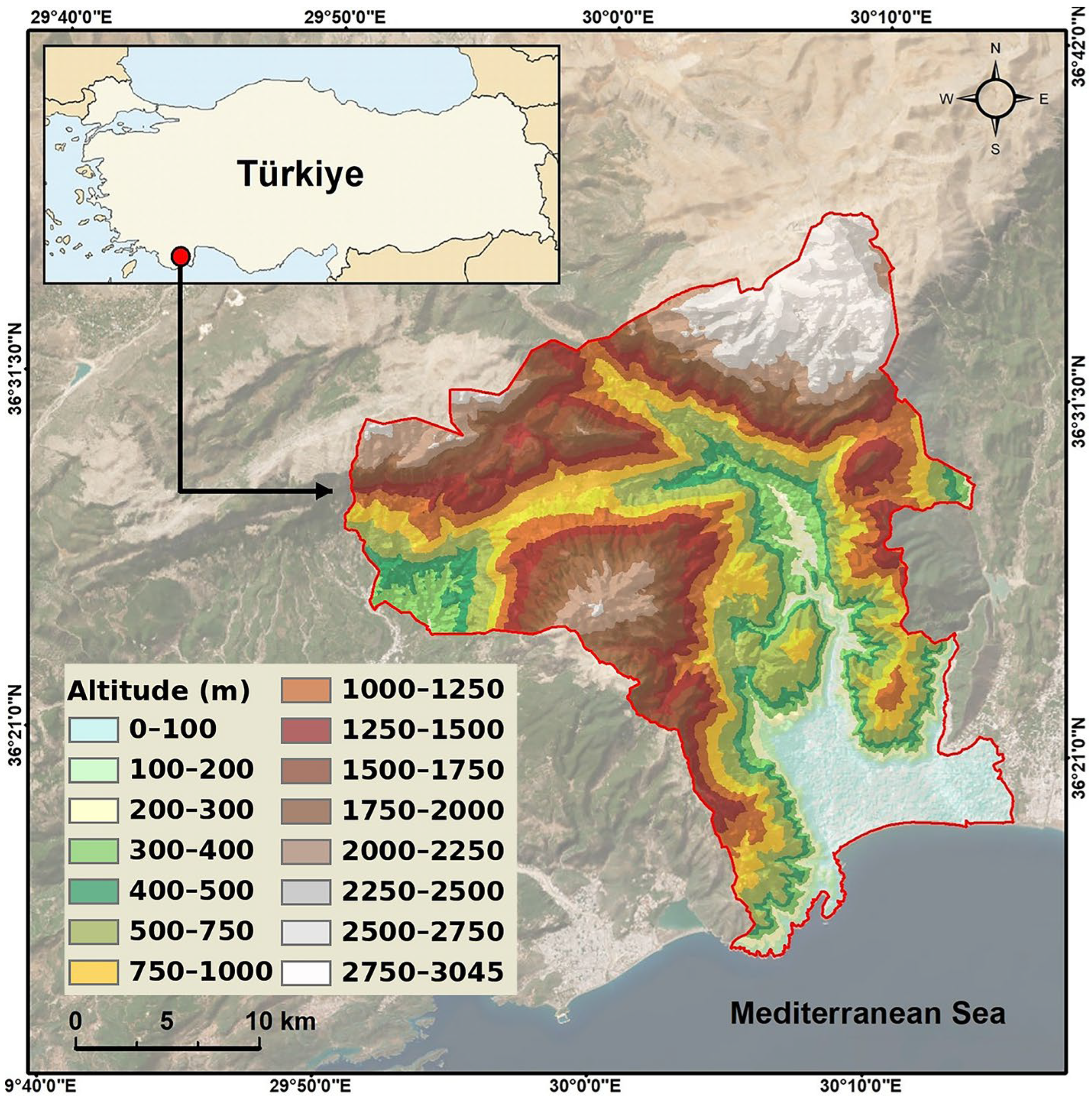
This study was conducted in the Finike district of Antalya Province, Türkiye (36°20′–36°40′ N, 29°00′–29°30′ E). The Finike covers an area of approximately 655 km
2 and is characterized by a Mediterranean coastal landscape. According to the Address-Based Population Registration System of the Turkish Statistical Institute, the district has a population of 51,620 and extends geographically from the coast of the Teke Peninsula to the foothills of the Taurus Mountains [
28,
29]. The district exhibits diverse topographic features, including flat coastal plains, gently sloping terraces, and steep mountainous areas [
30], which directly shape land use patterns and agricultural practices (
Figure 1). The region is characterized by a typical Mediterranean climate, with hot, dry summers and mild, rainy winters. The mean annual temperature is approximately 19 °C, while the average annual precipitation is around 800 mm, most of which occurs between October and April. These climatic conditions, together with fertile alluvial soils in the coastal plains, make the Finike district highly suitable for intensive agricultural activities, particularly citrus production. In addition, olive cultivation, banana farming, and greenhouse vegetable production contribute to the agricultural diversity of the district [
31].
The Finike district is a settlement area distinguished by its environmental and ecological characteristics. Coastal wetlands, small streams, and Mediterranean maquis vegetation provide important habitats for the region’s biodiversity. As a result of the interaction between natural elements and agricultural activities, a heterogeneous landscape structure has emerged, composed of cultivated fields, orchards, and semi-natural vegetation [
32]. The socio-economic structure of the district is largely based on the agriculture and tourism sectors. While tourism activities are predominantly concentrated in coastal areas, agriculture continues to serve as the primary source of livelihood for the local population [
29]. The heterogeneous topography of the Finike district, its diversified land use patterns, and its Mediterranean climate conditions make the region an ideal case study area for analyzing short-term agricultural landscape changes using high-resolution remote sensing data and landscape metrics.
2.2. Datasets
The study utilized two primary datasets: AI-supported LULC data and landscape metrics. The LULC data were obtained from the open-access, high-resolution, comparable, and up-to-date dataset produced by Impact Observatory and licensed by Esri, available via the ArcGIS Living Atlas platform (
https://livingatlas.arcgis.com/landcover/ (accessed on 12 March 2026)). In this context, the corresponding Sentinel-2 L2A-derived land use/land cover (LULC) datasets representing the years 2017 and 2024 were used. These annual products were generated by Esri to reflect the mean land use/land cover conditions for each respective year, thereby ensuring temporal comparability between datasets. Since the cloud coverage within the images covering the study area was found to be below 1%, the data for these years were considered suitable and reliable for analysis (
Table 1).
The generation of these AI-based LULC products was achieved through classification models developed by Esri and Impact Observatory, which were trained using a globally compiled large-scale dataset consisting of billions of image pixels labeled by individuals worldwide, with support from the National Geographic Society [
33]. This comprehensive training process has improved classification performance by ensuring that samples representing different geographic regions, climatic conditions, and land cover types are included in the model.
The trained models have been applied to the entire Sentinel-2 satellite image collection at annual time steps. In the analyses, multi-temporal satellite data derived from six spectral bands of the Sentinel-2 sensor and encompassing more than two million ground observations were utilized. This approach enabled the consistent, comparable, and high-spatial-accuracy (>75%) monitoring of land use changes over large areas and short time intervals [
34,
35]. Consequently, the LULC data were classified into nine categories: water, trees, crops, built area, bare ground, snow/ice, clouds, rangeland, and flooded vegetation (
Table 2).
The LULC dataset used in this study was generated using a fully convolutional neural network with a U-Net architecture approach. The model is trained on a large-scale dataset comprising millions of Sentinel-2 images and billions of labeled pixels at a global scale, and it is reported to predict one of the nine land cover classes listed in the table above for each pixel with high accuracy [
34]. However, the use of this dataset also involves certain limitations. First, the reported accuracy values are calculated at a global scale and may vary at local scales due to factors such as topography, land use heterogeneity, and spectral similarities between different surface types. In addition, the classification scheme is limited to nine general land cover classes, which does not allow for the explicit differentiation of region-specific agricultural patterns such as open and greenhouse cultivation areas, different crop types, or distinctions between annual and perennial agricultural systems. Furthermore, the heterogeneous topographic structure of the Finike district, characterized by Mediterranean climatic conditions, may lead to similar spectral responses among different vegetation types, thereby increasing classification uncertainty. Despite these limitations, the high spatial resolution, temporal consistency, and global comparability of the dataset provide a significant advantage for short-term change analysis. Therefore, the dataset was employed with the acknowledgment of its regional-level limitations, in order to ensure a consistent and reproducible assessment of general land cover changes.
The second dataset consists of landscape metrics used to quantitatively assess the spatial structure of land use changes. These metrics were generated using Fragstats 4.2 software. This software reveals characteristics such as fragmentation, size, shape, connectivity, and dispersion by expressing the structure and composition of the landscape in quantitative metrics. The study specifically examined the spatial integrity and fragmentation level of agricultural areas; it analyzed whether agricultural lands were divided into smaller and scattered pieces rather than homogeneous blocks, as well as the proximity and connectivity of these pieces and their dispersion directions. The preferred metrics and their definitions are provided in
Table 3. Therefore, the effects of short-term changes in the agricultural landscape on spatial patterns were quantitatively assessed in terms of fragmentation and dispersion dimensions, providing important information for land use planning.
Landscape metrics are quantitative indicators used to numerically describe landscape pattern and structure based on LULC data, and they consider not only area size but also spatial arrangement, fragmentation, dispersion, and clustering during the evaluation process [
14]. The CA and PLAND metrics represent the total area of agricultural lands and their proportion within the landscape, thereby revealing trends of expansion or contraction. When CA and PLAND values increase, the dominance of the class within the landscape composition increases, whereas a decrease indicates a loss of dominance [
37,
38]. NP and PD reflect the degree of fragmentation by indicating the number of patches composing agricultural lands and the density of these patches across the landscape. High values indicate a fragmented and heterogeneous structure, while low values represent a more aggregated landscape pattern [
15,
39]. LPI helps to interpret homogeneous or dispersed distributions by determining the importance of the largest agricultural patch within the landscape. A high LPI value indicates that the class is distributed as a single, extensive area, whereas a low value suggests that it is divided into smaller, isolated patches [
40,
41]. PARA_MN reveals the complexity of patch shapes; an increase in PARA_MN values indicates fragmentation and more complex edge structures, while a decrease points to more regular and integrated patches. When evaluated together with NP and LPI, this metric provides a comprehensive analysis of the spatial integrity and heterogeneity of the landscape [
14]. CLUMPY and AI assess the proximity of patches and their degree of aggregation. CLUMPY measures deviation from a spatially random distribution, indicating a more dispersed pattern at negative values and a more aggregated pattern at positive values, thereby providing additional information on the degree of spatial connectedness of the class. High AI values indicate that patches are closer to each other and more clustered, whereas low values represent a more dispersed pattern [
13,
42]. The combined analysis of these metrics enables the evaluation of not only changes in class areas but also structural landscape characteristics such as fragmentation, aggregation, dispersion, and dominance, particularly when monitoring LULC dynamics over a time series.
2.3. Methods
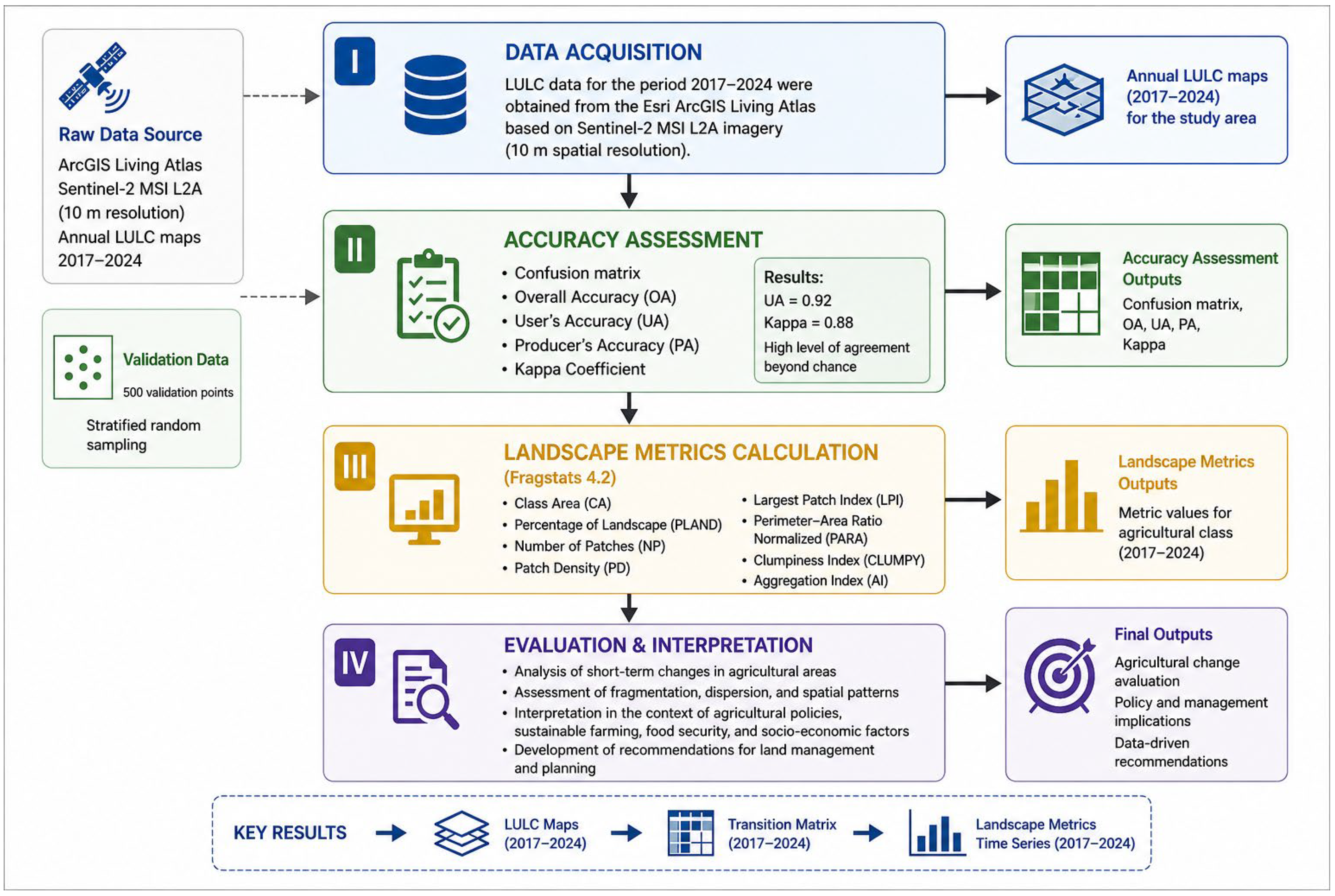
The methodology of the study is organized into a clearly defined workflow consisting of four sequential stages: (I) data acquisition, (II) data accuracy assessment, (III) calculation of landscape metrics, and (IV) evaluation and interpretation of the obtained results (
Figure 2).
Within the scope of the study, LULC data for the period 2017–2024 were obtained from the Esri ArcGIS Living Atlas to examine short-term changes in agricultural areas. These data include annual Land Use and Land Cover estimates based on Sentinel-2 satellite imagery with a spatial resolution of 10 m and provide a detailed representation of the spatial structure of the agricultural landscape.
In the second stage, a total of 500 validation points were generated using ArcGIS Pro 3.1 software to assess the accuracy of the AI-based LULC classification. A stratified random sampling approach was applied, in which the number of validation points assigned to each land cover class was determined in proportion to its areal extent within the study area. This sampling design reduces potential bias arising from class imbalance and ensures a statistically representative evaluation across all land cover categories. Accuracy assessment was conducted through the construction of a confusion matrix, from which overall accuracy, user’s accuracy (UA), producer’s accuracy (PA), and the Kappa coefficient were derived. The classification yielded a user’s accuracy of 0.92 and a Kappa coefficient of 0.88, indicating a strong level of agreement beyond chance. Class-level accuracy analysis further revealed that natural and anthropogenic land cover classes generally exhibited higher classification performance, whereas moderate confusion was observed among spectrally similar classes such as crops, bare land, and rangeland. In addition, transitional confusion was identified between greenhouse areas and built area classes, reflecting mixed spectral responses in these surface types. These misclassification patterns are primarily attributed to spectral overlap and seasonal variability in vegetation conditions. The confusion matrix further indicates that most classification errors occur in transitional zones between agricultural and semi-natural land cover types, which is a well-known limitation in medium-resolution multispectral classification. Nevertheless, the obtained accuracy values, including both user’s and producer’s accuracies at acceptable levels, confirm the overall reliability of the classification framework. These results demonstrate that the dataset provides a robust and consistent baseline for subsequent spatial analyses based on landscape metrics.
Following the accuracy assessment, landscape metrics were calculated using Fragstats 4.2 software to quantitatively evaluate spatial changes in agricultural areas. The analysis focused specifically on the agricultural class, and the class area, percentage of landscape, number of patches, patch density, Largest Patch Index, Perimeter–Area Ratio (Normalized), Clumpiness Index, and Aggregation Index metrics were applied. These metrics were selected to reveal key characteristics of agricultural lands, including fragmentation, dispersion, shape complexity, clustering, and spatial connectivity. The theoretical background and a detailed justification of these metrics are provided in the Datasets section. The resulting landscape metrics were used to comprehensively analyze short-term changes in agricultural areas in terms of spatial integrity, fragmentation, and dispersion. This approach enables a quantitative assessment of agricultural landscape dynamics specific to the Finike district, the identification of spatial pattern changes, and the derivation of data-driven implications for sustainable land use planning.
In the final stage of the methodology, the calculated landscape metrics and LULC analysis results were evaluated within the framework of agricultural policies, sustainable farming practices, food security, and regional socio-economic structures. This evaluation aims to understand not only the effects of short-term changes in agricultural areas on spatial patterns but also their implications for agricultural production capacity, land use planning, and the local economy. The analyses examine the consistency of fragmentation and clustering levels of agricultural lands with existing policy and management strategies, thereby providing data-driven recommendations for sustainable land management and resource allocation. In addition, this comprehensive assessment highlights the functional importance of agricultural landscapes in achieving food security goals and enhancing the resilience of agricultural production systems to climatic and market-related changes. Overall, this approach enables a holistic analysis of short-term agricultural landscape dynamics in the Finike district and supports policy, planning, and management decision-making processes.
3. Results
The study findings are presented within an integrated multi-stage analytical framework combining temporal land use/land cover (LULC) change analysis, landscape-metric-based structural assessment, and a vulnerability evaluation of LULC classes. In the first stage, satellite-derived LULC data for 2017 and 2024 were analyzed to identify temporal changes, general transformation trends, and spatial distributions of land use classes across the study area. In the second stage, landscape metrics were employed to quantify changes in landscape structure, particularly focusing on fragmentation patterns, spatial configuration, and the integrity of agricultural and semi-natural land covers. In the final stage, a vulnerability assessment was conducted by integrating area change, percentage change, built area conversion, and fragmentation intensity to evaluate the relative susceptibility of each LULC class to anthropogenic pressure and land transformation processes. This integrated approach enables a comprehensive interpretation of land system dynamics by capturing not only areal changes but also structural transformations and differential vulnerability of land use classes under increasing urban-driven pressure during the 2017–2024 period.
3.1. Analysis of Temporal Changes in LULC Data Using Satellite Imagery
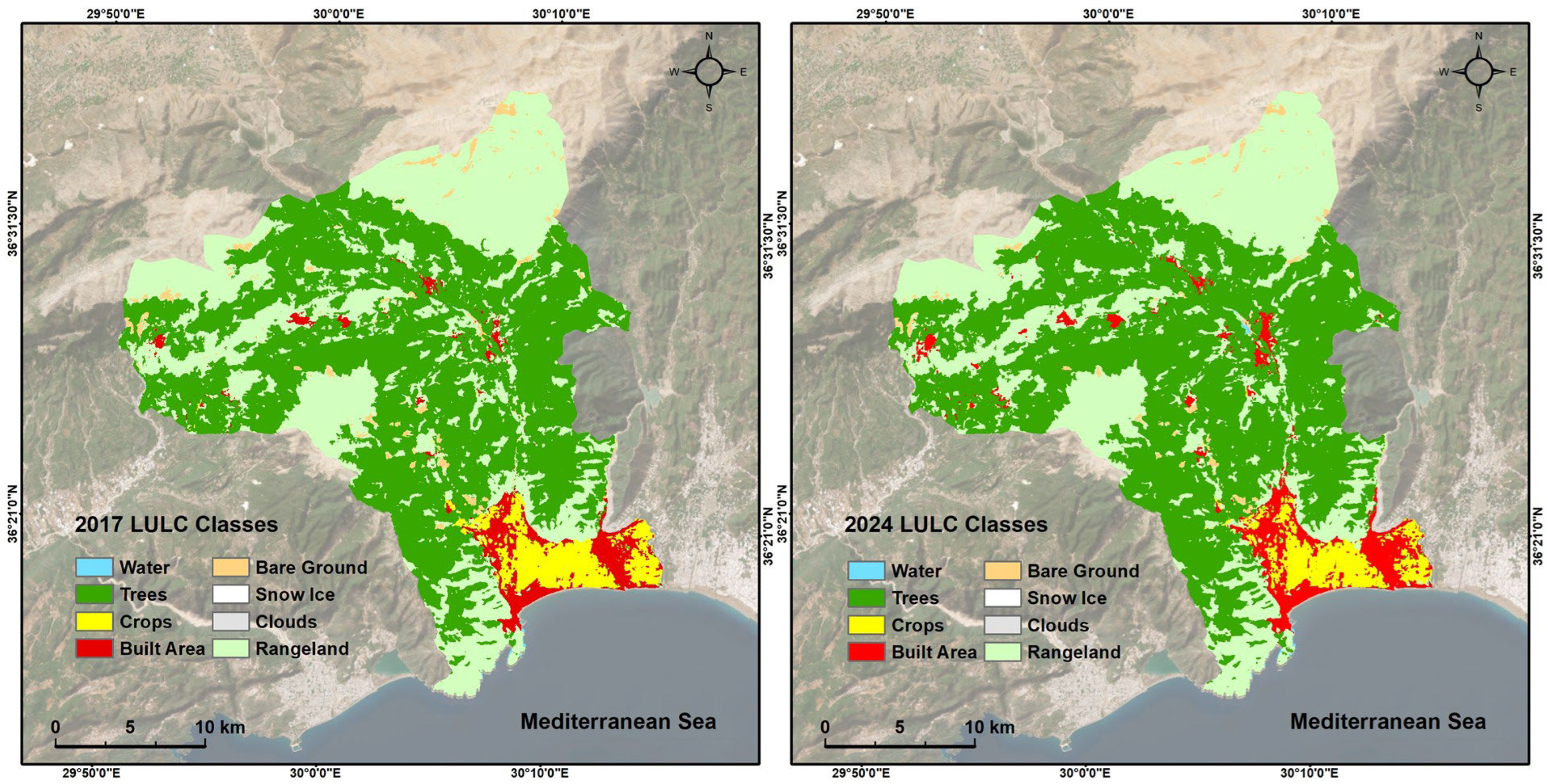
When the temporal changes in LULC data for the years 2017 and 2024 are compared, it is observed that a pronounced transformation has occurred in land use organization in the Finike district (
Figure 3).
According to the spatial distribution of LULC classes in the study area, built area and crop classes are distributed along the coastal zone and are predominantly concentrated in low-slope areas. In contrast, the trees and rangeland classes are dominant in the steeper northern parts of the area. During the short-term period, notable changes are observed in the built area, crops, and bare ground classes (
Table 4).
According to the area assessment, an increase of approximately 32.32% was observed in built areas during the study period, while a decrease of 15.49% occurred in the crops class and a decrease of 36.64% in the bare ground class. While the tree class maintained its dominance at higher elevations, a relative increase was observed in water surfaces depending on seasonal variations. Based on the transition patterns among LULC classes, the most critical conversions were identified from crops to built area, from crops to rangeland, and, to a lesser extent, from rangeland to built area. The land use/land cover transition matrix for 2017–2024 is provided in
Appendix A and offers a detailed quantification of these inter-class dynamics. To strengthen the empirical basis of these transitions, the observed changes are consistent with a general land conversion pattern driven by urban expansion processes, as confirmed by the dominant directional shifts in the LULC classes. The transition matrix further indicates that natural land cover remains dominant in the study area, with the trees class and rangeland class exhibiting a high degree of persistence. The fact that agricultural land losses were concentrated particularly on the coastal plain and low-elevation fertile flat areas provides an important spatial indicator regarding the direction of urban growth. However, notable anthropogenic transformations are evident, particularly the conversion of approximately 390 ha of crops, 491 ha of rangeland, and 148 ha of trees into built areas, clearly reflecting ongoing urban expansion pressures. The linear expansion of settlement areas parallel to the coastline is consistent with tourism- and housing-oriented socio-economic dynamics and corresponds to the growth type defined as “linear coastal sprawl” [
43]. This transformation simultaneously intensifies competition between agricultural lands and urban development and strengthens the agriculture–settlement conflict through the increasing incorporation of low-elevation alluvial soils into land rent mechanisms. Field-based observations and regional development trends indicate that increasing population demand has led to intensified urbanization pressure in the coastal corridor, resulting in the gradual conversion of agricultural parcels within and around the urban core into built areas. At higher elevations, more limited transformation occurred, and natural tree cover and semi-natural rangeland classes were relatively preserved. This is also supported by the matrix results, which indicate relatively low transition rates at higher elevations and the continued dominance of natural and semi-natural classes. Overall, the evaluation of land use in the Finike district for the period 2017–2024 indicates a land use pattern characterized by increasing anthropogenic pressure at lower elevations, the contraction and fragmentation of agricultural production areas, and urban sprawl directed toward the coastal zone.
Changes in the crops class occurred not only in terms of net area loss but also through spatial redistribution and a multi-layered transformation process. In 2017, the crops class was characterized by a continuous agricultural belt; however, by 2024, this belt had become fragmented in favor of the built area class. This indicates that agricultural land has not only decreased in extent but has also undergone a transformation in its structural integrity. The pronounced conversion of crop areas toward built areas reflects a transition from agricultural production to urban functions. According to the transition matrix, 390 ha of crops were converted into built areas, while 144 ha transitioned to rangeland and 43.77 ha to trees, indicating both urban-driven land loss and partial land abandonment followed by natural regeneration processes. In addition, the reduction in bare ground areas can be partly attributed to two concurrent processes: the conversion of exposed land into newly developed built areas and the reclamation or incorporation of such lands into agricultural production systems, particularly in response to land use planning and expansion pressures. This is further supported by the finding that approximately 405 ha of bare ground transitioned into rangeland, suggesting ongoing vegetation recovery. In addition, a lower rate of crop–rangeland conversion was detected at higher elevations, and this transformation is considered to be potentially associated with changes in maintenance costs, water availability, and operational pressures. The matrix also indicates a slight increase in water surfaces due to gains from other classes, particularly rangeland and bare ground, which is likely associated with seasonal precipitation variability.
3.2. Analysis of Temporal Changes in LULC Data Using Landscape Metrics
The impact of spatial and temporal changes occurring in the LULC classes in the Finike district between 2017 and 2024, particularly in the crops class, on short-term landscape dynamics was evaluated using landscape metrics (
Table 5). Beyond the numerical variation in metrics, these changes were further interpreted in relation to underlying spatial processes such as urban expansion, agricultural land conversion, and changes in landscape configuration driven by anthropogenic pressure.
These results indicate that significant landscape changes occurred in the crops and built area classes during the study period. The total area of agricultural lands decreased from 3128.17 ha to 2643.57 ha, and their proportion within the landscape declined from 4.38% to 3.70%. The increase in the number of patches from 203 to 269 and in patch density from 0.2841 to 0.3766 reveals that agricultural lands became subdivided into smaller and more numerous patches, resulting in a more heterogeneous structure. While the Largest Patch Index (LPI) decreased from 2.994 to 2.4448, the mean Perimeter–Area Ratio (PARA_MN) increased from 2248.84 to 2312.23. This indicates an increase in edge lengths of agricultural patches, making patch edges more pronounced within the landscape, which suggests a decline in spatial cohesion and an increase in landscape fragmentation within agricultural areas. The slight decreases in CLUMPY and AI values suggest a partial reduction in the spatial integrity of agricultural lands and an ongoing increase in fragmentation. Spatially, these changes are particularly concentrated in low-elevation coastal zones, where agricultural areas are progressively replaced and fragmented due to expanding urban pressure. These patterns collectively indicate that agricultural land loss in the study area is not only represented by a reduction in area but also reflects a structural weakening of landscape connectivity, likely driven by increasing urban pressure along low-elevation fertile zones.
In contrast, for built areas, their total area increased from 2804.16 ha to 3710.51 ha, and their proportion within the landscape rose from 3.93% to 5.19%. Increases in the number of patches, patch density, and the Largest Patch Index for built areas indicate both expansion and the formation of new patches. Furthermore, increases in PARA_MN, CLUMPY, and AI values demonstrate that built areas expanded within the landscape in a more structurally integrated and clustered manner. This spatial pattern is especially evident along the coastal corridor, indicating a linear and coherent urban expansion process. This suggests that urban growth in the region is not random but follows a spatially coherent expansion pattern, particularly along the coastal corridor, consistent with linear urban sprawl processes driven by socio-economic development and population demand. Overall, these findings show that the spatial distribution and fragmentation dynamics of agricultural and built areas changed substantially over the short term, resulting in distinct differences from a landscape ecological perspective.
When other LULC classes are examined, both the total area and the proportion within the landscape increased for the tree class, while the limited increases in NP and PD values, together with the rise in LPI, indicate that tree-covered areas expanded and fragmentation remained limited. In the rangeland class, a slight decrease was observed in CA and PLAND values, whereas increases in NP and PD indicate that these areas formed a more fragmented and heterogeneous landscape pattern. For bare ground and snow classes, both their total area and their proportion within the landscape decreased; however, increases in NP and PD values suggest that these areas were subdivided into smaller patches and that edge density increased. In particular, the reduction in bare ground areas may be associated with two concurrent processes: conversion into built areas due to urban expansion and partial incorporation into agricultural or managed land systems under land use pressure. In contrast, for water areas, total area and PLAND increased, while slight decreases were observed in NP and PD values, and the increase in LPI indicates that the largest water patches expanded.
These findings demonstrate that the short-term dynamics of different LULC classes within the Finike landscape have changed through interactions with ecological processes, human activities, and natural conditions, resulting in a heterogeneous and fragmented landscape structure. Rather than representing isolated changes, these dynamics reflect interconnected processes driven primarily by urban expansion, land use conversion, and environmental constraints. LULC changes other than the crops and built area classes in the Finike district have generated notable effects, particularly on the spatial structure and continuity of agricultural lands. The increase in the tree class and the limited level of fragmentation are considered to have contributed to the preservation of agricultural lands in areas surrounded by natural or semi-natural landscapes at northern and higher elevations. This suggests that topographic constraints and relatively lower anthropogenic pressure in these areas help maintain landscape stability and ecological continuity. Conversely, fragmentation in the rangeland class and the reduction in bare ground areas have led to the formation of a heterogeneous landscape pattern around agricultural lands, thereby constraining land use or increasing the complexity of agricultural management. Such patterns may indicate transitional land use processes, where semi-natural areas are gradually incorporated into either agricultural production systems or urban land use under increasing pressure. The expansion of water areas and their transformation into larger patches may create indirect effects in terms of irrigation potential and access to water resources for agricultural production. However, there is no field data to confirm improved access to irrigation, and this remains one of the key areas requiring further investigation. Overall, these dynamics in other LULC classes have influenced both the structural integrity and spatial continuity of agricultural lands, forming an interaction network that should be considered in production planning and land management.
Analyses conducted using satellite imagery and landscape metrics indicate that significant spatial changes and transformations occurred in the landscape structure of the study area over the short term. Agricultural lands contracted and became fragmented in the coastal plain and low-elevation areas and were reshaped through reciprocal interactions with the expansion of built areas. This pattern clearly points to spatial competition between agriculture and urban land uses, particularly in economically valuable and accessible coastal zones. Built areas exhibited a linear expansion along the coastline, resulting in both an increase in their spatial extent and a transformation toward a more integrated and clustered structure. This form of expansion is consistent with coastal urban sprawl driven by tourism development, population growth, and infrastructure expansion. While the trees and rangeland classes maintained their dominance at higher elevations, only limited changes were observed in fragmentation and heterogeneity levels, and natural and semi-natural areas largely preserved their ecological structure. The bare ground class showed a trend of contraction and fragmentation, whereas water surfaces expanded relative to these changes. The contraction of bare ground areas can be interpreted as a result of their conversion into either built areas or managed land uses, reflecting increasing land demand in the region. This holistic analysis reveals that, over the short term, the Finike landscape has been restructured under increasing anthropogenic pressure at lower elevations, agricultural production areas have contracted and fragmented, urban sprawl has intensified along the coastal zone, and the landscape has generally transformed into a more heterogeneous and functionally differentiated structure.
3.3. Vulnerability Assessment of LULC Classes
To complement the analysis of land use/land cover changes and to better identify the most affected land categories, a vulnerability assessment was conducted by integrating area change, percentage change, built area conversion, and fragmentation intensity. This approach allows a comparative evaluation of the susceptibility of each LULC class to anthropogenic pressure and land transformation processes during the 2017–2024 period. The results of the vulnerability assessment are summarized in
Table 6.
The vulnerability assessment results indicate a clear hierarchical differentiation among land use/land cover (LULC) classes in terms of their exposure to land transformation processes during the 2017–2024 period. Cropland represents the most vulnerable class, characterized by a substantial area loss (~15.5%) and the highest magnitude of conversion to built areas (390.43 ha), which collectively place it in the very high vulnerability category. This is followed by bare ground and rangeland, both of which exhibit high vulnerability due to notable reductions in area and strong exposure to fragmentation processes and land conversion pressures, particularly toward urban land uses.
In contrast, the trees class demonstrates a relatively stable structure, marked by a net increase in area and limited transitions to other land cover types, indicating low vulnerability. Similarly, the water class constitutes the most stable land cover type, with minimal changes and negligible conversion dynamics, corresponding to a very low vulnerability level.
On the other hand, the built-up area class is not interpreted as a vulnerable category, but rather as the dominant driver of landscape transformation, continuously expanding at the expense of agricultural and semi-natural land covers.
Overall, the integrated vulnerability assessment consistently demonstrates that urban expansion is the primary driving force shaping land use dynamics in the study area, exerting the strongest pressure on cropland and other semi-natural ecosystems. These findings are strongly consistent with the results obtained from transition matrix analysis and landscape metrics, collectively confirming a coherent pattern of agricultural decline, increasing fragmentation, and urban-driven landscape restructuring across the study period.
4. Discussion
The integration of satellite-derived LULC data with landscape metrics in this study enabled an objective assessment of changes in agricultural areas in both the spatial and temporal dimensions. Landscape metrics quantitatively revealed the structural characteristics and fragmentation levels of land use classes through various indicators; thus, both the areal loss of agricultural lands and the degree of deterioration in their spatial integrity was measured. Overall, these results provide a clear quantitative basis for understanding short-term landscape transformations in the study area. In this context, the use of the LULC dataset, derived from Sentinel-2 imagery and deep learning-based classification, provides a standardized and globally consistent framework for change detection; however, alternative remote sensing data sources such as Landsat or very high-resolution drone imagery may offer different spatial and temporal advantages depending on the scale and objectives of the analysis. Nevertheless, it should be noted that the interpretation of these metrics is inherently dependent on the accuracy and thematic resolution of the underlying LULC dataset, particularly given its AI-based classification structure. This dependency is particularly important when interpreting fragmentation and connectivity-related metrics, as classification uncertainty may propagate into spatial pattern analyses.
Monitoring such metrics over short time periods allows for the early detection of land use changes, facilitating the rapid adaptation of planning and management decisions, the timely implementation of preventive measures in pressured agricultural lands, and the development of sustainable land management strategies. At the same time, the study’s relatively short temporal scope (2017–2024) limits the ability to capture longer-term cyclical or structural trends, and therefore, the findings should be interpreted as indicative of recent dynamics rather than long-term transformations. Accordingly, the results should be considered as a representation of short-term landscape responses to ongoing anthropogenic pressures rather than stable long-term trajectories. In this way, the sensitive and reproducible monitoring of change processes in agricultural areas presented in this study reveals not only long-term trends but also short-term dynamics, providing important inputs for landscape planning and the resilience of food production systems in the Finike district. The value of this approach for the simultaneous assessment of environmental and socio-economic impacts has also been emphasized in the international literature [
10,
44], and the applicability of this method to regions with similar characteristics has been acknowledged.
The temporal variation in LULC data in the Finike district over the period 2017–2024, based on comprehensive assessments conducted using satellite imagery and landscape metrics, indicates that short-term land use dynamics generate significant impacts in both environmental and socio-economic contexts. The reduction in agricultural lands in terms of both total area and spatial continuity, together with increasing fragmentation, points to a transformation that may adversely affect local food production capacity [
45]. In the specific case of the Finike district, this transformation is closely linked to the spatial expansion of settlement areas into low-elevation and agriculturally productive zones, suggesting direct land use competition rather than an isolated decline in agricultural activity. The international literature emphasizes that land use change and the loss of agricultural areas pose risks to food production and food security [
46], which is consistent with findings indicating that the degradation of agricultural lands reduces agricultural productivity and directly affects food supply. Globally, declines in agricultural crop yields due to human-induced land degradation have been reported, highlighting the urgency of sustainable land management and production strategies [
47]. Similarly, it is emphasized that agricultural land degradation at the global scale has negative impacts on food security and the economy, and that declining soil productivity leads to social and environmental consequences [
48]. Nevertheless, the extent to which these global patterns are directly transferable to the Finike case should be approached with caution, given regional differences in production systems, irrigation infrastructure, and socio-economic drivers. In this context, the contraction, fragmentation, and deterioration of the structural integrity of agricultural lands in the Finike district may weaken the resilience and long-term sustainability of the agricultural production system. In particular, the conversion of agricultural lands in coastal plain areas into settlement areas may reduce local food supply and increase dependency on external sources, which could further undermine food security at both national and regional levels, especially when population growth and the impacts of climate change are considered.
Documents related to the food and agriculture policies of international organizations frequently emphasize the importance of sustainable land use and integrated planning [
49]. The FAO Strategic Framework identifies the promotion of sustainable agricultural production, the strengthening of natural resource management, and the support of long-term food security as its core objectives [
50]. These objectives indicate the need to understand the impacts of land use changes on broader socio-ecological systems in local contexts such as the Finike district, since sustainable agriculture involves not only increasing production levels but also preserving soil health, maintaining biodiversity, and supporting ecosystem services [
4,
51,
52]. In this study, the observed fragmentation patterns and loss of spatial integrity in agricultural lands provide empirical evidence that such policy frameworks are directly relevant at the local scale. Moreover, at the international level, reducing land degradation and promoting sustainable land management contribute both to the protection of agricultural output and to enhancing adaptive capacity to climate change and sustaining the well-being of rural communities [
53]. In this context, international agreements such as the United Nations Convention to Combat Desertification (UNCCD) also promote the fight against land degradation and the implementation of sustainable land management practices [
54]. However, the effectiveness of these frameworks ultimately depends on their translation into locally adapted planning strategies that consider site-specific land use pressures and constraints. When such international frameworks are integrated into local land use planning processes, they can provide tangible benefits for the sustainability of agricultural production and food security.
The LULC changes in the Finike district, which are associated with the expansion of built areas and the fragmentation of agricultural lands, necessitate additional policy interventions in terms of landscape planning and the resilience of local food systems [
55,
56]. In particular, sustainable land use strategies, the protection of agricultural production areas, and ensuring integration in productive lands can directly contribute to achieving food security goals [
57]. Furthermore, ecosystem-based agricultural practices and integrated land use plans are critical for long-term production sustainability and environmental resilience [
58]. From a critical perspective, the findings of this study highlight that without targeted spatial planning and regulatory mechanisms, ongoing urban expansion may continue to exert pressure on high-quality agricultural lands, thereby accelerating fragmentation and reducing landscape functionality. Implementing such policies and international recommendations at the local level will contribute to strengthening sustainable food systems.
Despite the strengths of this study, several limitations should be acknowledged. Since the results are largely based on the LULC dataset, the accuracy and thematic resolution of the dataset directly influence the analysis outcomes. In particular, classification uncertainties may arise due to spectral similarities between crops, greenhouse areas, and built area classes. In addition, rapidly emerging newly cultivated agricultural parcels may not be fully captured due to the annual temporal resolution of the dataset. Furthermore, in areas with steep topography, classification accuracy may be partially reduced due to terrain effects and mixed pixels. Therefore, the results should be interpreted within the context of a short temporal window and do not fully capture long-term structural landscape transformation dynamics. Building on this limitation, future research could incorporate predictive modeling approaches, such as the CA–Markov model, to simulate and forecast land use/land cover changes (e.g., for the 2024–2030 period). Such an approach would enhance the understanding of potential future trajectories of agricultural fragmentation and urban expansion in Mediterranean coastal landscapes, thereby strengthening the policy relevance of the findings.
5. Conclusions
This study comprehensively evaluated LULC changes in agricultural areas within the Finike district, which is notable for its agricultural activities under Mediterranean climatic conditions, over the period 2017–2024, through the integration of satellite-derived data and landscape metrics. The primary contribution of the study lies in demonstrating the effectiveness of combining AI-supported LULC datasets with landscape metrics for capturing short-term spatial transformations in agricultural landscapes. The obtained findings demonstrate that the applied methodology is both valid and reproducible, confirming that landscape metrics are an effective tool for quantitatively revealing area loss and spatial fragmentation levels in agricultural lands. Specifically, the crops class decreased from 3128.17 ha to 2643.57 ha (−15.5%), while built areas increased from 2804.16 ha to 3710.51 ha (+32.3%). At the same time, rangelands declined from 26,649.36 ha to 25,431.24 ha, whereas the trees class increased from 37,595.13 ha to 38,798.44 ha. Fragmentation indicators also confirm this trend, with crop patch number (NP) rising from 203 to 269 and patch density (PD) increasing from 0.28 to 0.38, indicating growing spatial fragmentation. In particular, these results highlight that even within a relatively short temporal period, measurable and significant structural changes can be detected in agricultural landscapes. In this way, both long-term trends and short-term land use dynamics were objectively monitored, and it was determined that changes in agricultural areas generate significant impacts in both environmental and socio-economic contexts. These changes imply increasing pressure on agricultural production, gradual habitat alteration despite stable forest clustering levels (CLUMPY ≈ 0.98), and rising economic costs associated with land conversion and urban expansion. Analyses specific to the Finike district reveal that agricultural lands have decreased in terms of both total area and spatial integrity, while fragmentation levels have increased. This pattern indicates increasing pressure from urban expansion on productive agricultural zones, particularly in low-elevation coastal areas. These findings indicate a potential decline in local food production capacity and emphasize the necessity of urgent measures in landscape planning and land management. From a policy perspective, decision-makers should prioritize limiting built area expansion (which increased by over 900 ha), protecting contiguous agricultural parcels (LPI declined from 2.99 to 2.45 in crops), and implementing land consolidation and zoning strategies to reduce fragmentation. The landscape-metric-based approaches and integrated land use planning applied in this study are of critical importance for long-term production sustainability and environmental resilience. From a planning framework, the results suggest that controlling spatial expansion of settlements and protecting contiguous agricultural parcels should be prioritized in regional land use strategies. Within this approach, it is understood that sustainable land use strategies and policy interventions aimed at protecting agricultural production areas can directly contribute to food security objectives. The methodological approach used in this study demonstrates transferability to the Finike district and other regions sharing similar socio-environmental and spatial characteristics. However, its transferability is most appropriate for Mediterranean-type coastal landscapes experiencing comparable urbanization and agricultural pressure dynamics. In this context, similar patterns to those observed here (i.e., increasing built area pressure and agricultural fragmentation) can be expected in other Mediterranean coastal regions, making the approach directly applicable and comparable. This approach provides valuable scientific input for planners, central and local administrators, stakeholders in the agricultural sector, and policymakers focused on strengthening sustainable food systems by enabling the short-term detection of land use changes. Therefore, the study offers a practical decision-support framework for monitoring rapid land use changes and integrating spatial metrics into evidence-based land management policies. Furthermore, the novelty of this study lies in integrating AI-based LULC datasets with multi-metric landscape analysis to detect short-term spatial changes with high sensitivity, which is rarely addressed in conventional long-term LULC studies. In this respect, this study presents an applied and policy-oriented framework for both monitoring short-term land use changes and developing long-term strategic land management plans.