Article

Spatiotemporal Monitoring of Nighttime Light Satellite Data Using Google Earth Engine: Insights from the Italian Case


1
Department of Geomatics Engineering, Faculty of Civil Engineering, University of Isfahan, Isfahan 81746-73441, Iran
2
School of History and Geography, Faculty of Humanities and Social Sciences, Dublin City University (DCU), D09 V209 Dublin, Ireland
3
Department of Tourism Studies, University of Piraeus, Karaoli & Dimitriou 80, EL-18534 Piraeus, Greece
4
Department of Geospatial Information Engineering, School of Surveying and Geospatial Engineering, University of Tehran, Tehran 14174-66191, Iran
*
Authors to whom correspondence should be addressed.
Geographies 2026, 6(2), 45; https://doi.org/10.3390/geographies6020045
Submission received: 2 March 2026 / Revised: 9 April 2026 / Accepted: 21 April 2026 / Published: 1 May 2026

Abstract

Nighttime light (NTL) satellite data provide an effective proxy for analyzing urbanization, tourism development, industrial activity, and population dynamics. Based on these premises, the present study investigates the spatiotemporal behavior of Nighttime Light Dynamics across 107 Italian provinces from 2014 to 2022 using VIIRS Day/Night Band composites processed in Google Earth Engine (GEE). A comprehensive framework combining descriptive statistics, seasonal analysis, correlation assessment, time-series clustering, and Emerging Hotspot Analysis (EHA) was applied to characterize spatial patterns, temporal trends, and joint spatiotemporal dynamics. The results reveal pronounced spatial heterogeneity, with higher and more stable Nighttime Light Dynamics concentrated in Northern and Central Italy, while Southern regions exhibit lower intensity and greater temporal variability. Seasonal analysis shows that summer contributes more strongly to intra-annual Nighttime Light Dynamics dispersion, whereas winter illumination patterns are rather uniform. A strongly positive relationship between Nighttime Light Dynamics and population density was observed at national and regional scales (R2 = 0.71), confirming the reliability of Nighttime Light Dynamics as an honest demographic proxy. Time-series clustering and EHA further identify central locations, stable urban cores, transitional regions, and areas experiencing intensifying (or diminishing) illumination trends. Overall, the study highlights the value of integrating spatiotemporal analytics with Nighttime Light Dynamics data to support evidence-based regional planning and sustainable development strategies aimed at addressing spatial inequalities across Italy and, more generally, advanced economies.

1. Introduction

Sustainable development is defined as a specific development process that meets the needs of the present generation without compromising the ability of future generations to meet their own needs [1,2,3]. Sustainable development requires spatially balanced and consistent trends over time, considering environmental, economic, and socio-demographic factors while leaving no one behind [4,5,6]. One of the major challenges in achieving sustainable development is monitoring complex socio-environmental dynamics across time and space. This class of information is crucial for scientific research and government policies [7]. Studies at various scales—from global to national, subnational, and even at the grid (lattice) level—are actively progressing to address such challenges [8,9].
In recent years, remote sensing data have emerged as one of the most practical and widely used sources of large-scale data, often classified as big data. It enables observing and monitoring Earth’s environment at various geographical scales, allowing for a precise change detection analysis over significant time intervals and global coverage. This capability is a critical step toward efficient resource management and sustainable environmental development [10,11]. Remote sensing provides an alternative to traditional data collection processes, offering global availability, periodic collection, low cost, and spatial precision [12,13]. It has applications in a wide range of fields, including mapping, urbanization, geology, agriculture, and hydrology. Over the past decades, remote sensing and geospatial analysis have become powerful tools for researchers and policymakers, shedding light on patterns of urbanization, economic development, and environmental changes.
Among remote sensing products, Nighttime Light (NTL) satellite data—collected since 1992 by the Defense Meteorological Satellite Program (DMSP) and later by the Suomi National Polar-orbiting Partnership (Suomi-NPP) satellite—are widely used to track environmental, economic, and socio-demographic dynamics [6]. NTL data provide unique insights into human activity and its environmental impacts, offering a valuable means of assessing regional and global inequalities [11,14,15]. Furthermore, NTL data can serve as a proxy for economic activity, such as the Gross Domestic Product (GDP), especially in regions where official statistics are lacking or unavailable. It can be particularly useful in assessing the impact of policy interventions or economic shocks on a small geographic scale [8].
On the one hand, NTLs indicate the living conditions of people, as brightly lit areas tend to have better access to goods and services compared to darker regions [12]. The significance of NTL data goes beyond mere visualization; it acts as a critical tool for understanding and addressing contemporary challenges. The radiance of NTL reflects not only urbanization but also societal dynamism and economic vitality [16]. On the other hand, there are correlations between NTL data and both human and ecological health that need to be better monitored and more clearly understood [17,18]. NTL data have applications across many fields, including spatial planning, environmental management, and socioeconomic studies. The potential for multi-temporal NTL data to be used in processes at both regional and global scales is thus wide and constantly increasing [16,19].
In parallel with the growing availability of remote sensing data, various software tools, algorithms, and cloud-based platforms have been developed to efficiently process large geospatial datasets and extract meaningful information [20]. Among these platforms, Google Earth Engine (GEE) has gained popularity. Released in 2010, GEE offers geospatial (big data) analysis at various operational scales ranging from local to global [11,20]. This platform is designed to store and process vast datasets for use in analysis and decision-making [21]. GEE is used in a variety of applications, including vegetation mapping, land cover detection, agricultural monitoring, disaster management, and earth science at large [20,22,23]. Empirical studies using GEE on NTL data have grown steadily in recent years. Spanning a wide geographical range, from local to global scales, GEE-NTL applications tend to focus on three primary research areas: urbanization [24], environmental studies [25,26,27], and socioeconomic dynamics [28]. A growing body of literature demonstrates the effectiveness of combining NTL data with cloud-based geospatial platforms for spatiotemporal analysis and sustainability-related research [11].
Building on these advances, a wide range of analytical approaches and models have been developed to extract meaningful information from remote sensing data, including Machine Learning (ML) and Artificial Intelligence (AI) techniques. These methods support tasks such as object detection, image classification, change detection, land cover mapping, and data fusion [29]. Since the release of large-scale remote sensing datasets, various approaches and algorithms for qualitative and quantitative analysis have been introduced and developed. These algorithms depend heavily on the type and volume of data, as well as the availability of sampling data [30]. Existing approaches can be categorized into three main types: (i) mathematical and statistical approaches (e.g., thresholding and filtering methods) [31], (ii) ML algorithms (e.g., Random Forest (RF), Support Vector Machines (SVM), ISO Data) [32,33], and (iii) AI techniques (e.g., Convolutional Neural Networks (CNN), Recurrent Neural Networks (RNN), Autoencoders (AE)) [29]. Many of these algorithms are currently used, or remain under active development for immediate future adoption as routine computational techniques. The choice of algorithm depends on factors such as data type and the specific information being extracted, which influences the accuracy of the results.
Building on advances in remote sensing, cloud computing platforms, and analytical methods, researchers have increasingly applied NTL data to examine regional socio-environmental dynamics in advanced economies. In Italy, a paradigmatic country representative of important territorial disparities, studies investigating spatial indicators of sustainable development, economic growth (e.g., income, productivity, employment), and the socio-institutional environment (e.g., education, institutional quality, bureaucratic efficiency) have consistently identified a North–South divide, with Northern regions assumed as more competitive than Southern ones [4,34,35,36,37,38]. However, comprehensive examinations of temporal NTL patterns using advanced machine learning and remotely sensed data remain scarce and mostly fragmented. Our study addresses this specific gap by analyzing Italy’s NTL dynamics, providing insights that can inform environmental management, spatial planning, and evidence-based policymaking. Such information may support data-driven decisions that promote sustainability and improve quality of life [39]. By highlighting Italy’s NTL patterns, our research contributes to various fields, including remote sensing, geospatial analysis, environmental studies, and social sciences such as human geography and spatial demography. The research questions of this research are as follows:
  • How do NTL satellite data reflect the socioeconomic and demographic dynamics of Italian provinces?
  • What are the spatial and temporal patterns observed in NTL intensity across different Italian regions (e.g., Northern, Central, Southern)?
  • How do the mean and standard deviation (STD) of NTL data vary among Italian provinces, and what insights do these variations provide about urbanization and economic activity?
  • What is the relationship between NTL data and population density in Italy, and how does this correlation inform our understanding of demographic vitality and urban illumination?
  • How can time series clustering and space–time analysis be applied to identify significant shifts in NTL across Italian provinces?
  • What role can geospatial analysis using the GEE platform play in shaping evidence-based urban policies and sustainable development practices in Italy?
In summary, the study provides a comprehensive examination of NTL data in Italy, focusing on temporal variations in NTL. Through spatial and temporal analysis, the research aims to substantiate its thesis and provide valuable insights into Italy’s evolving NTL landscape. The following sections will cover the methodologies used, the empirical results, and the implications of the findings, culminating in a thorough evaluation of Italy’s NTL data. By integrating remote sensing technology, geospatial analysis, and environmental research, the study seeks to unravel the complexities of Italy’s NTL data and its underlying dynamics. The central thesis argues that Italy’s NTL patterns exhibit distinct temporal trends that are closely tied to urbanization processes and land-use transitions, reflecting the multifaceted changes Italy has undergone in recent years. These issues are closely associated with the spatial redistribution of the resident population. Population migration, especially along the South-to-North route and toward metropolitan areas in Northern and Central Italy, remains a significant topic [35,40]. The remainder of the paper is organized as follows: First, the dataset used in this study is described. Section 2 presents the statistical analysis methodologies and machine learning algorithms used for the spatiotemporal analysis of NTL data. Section 3 covers the empirical results and the statistical analysis. Section 4 discusses the findings, and Section 5 summarizes the paper’s conclusions.

2. Materials and Methods

2.1. Study Area

The study area for this research is Italy, which covers approximately 301,340 km2 and has a population of nearly 60 million inhabitants. Located in Southern Europe, Italy is geographically bordered by the Mediterranean Sea to the South and by France, Switzerland, Austria, and Slovenia to the North. Renowned for its ancient Roman heritage, Renaissance art, and architectural marvels, Italy offers a unique region for investigating the relationship between cultural heritage and modern urbanization under intense spatial polarizations [39,41]. A key characteristic of Italy is the persistence of long-standing regional disparities [4,34,39]. The North and Center of Italy are generally more economically developed compared with the South and Islands. This economic disparity has significant implications for population dynamics, particularly regarding fertility patterns [42] and migration flows [43]. Administratively, Italy is divided into 20 regions corresponding to the NUTS 2 (Eurostat) level, each characterized by distinctive socioeconomic and environmental conditions, and further subdivided into provinces (namely, NUTS-3 Eurostat level of territorial classification, as reported on the web page https://ec.europa.eu/eurostat/statistics-explained/index.php?title=Glossary:Nomenclature_of_territorial_units_for_statistics, accessed on 5 January 2026).
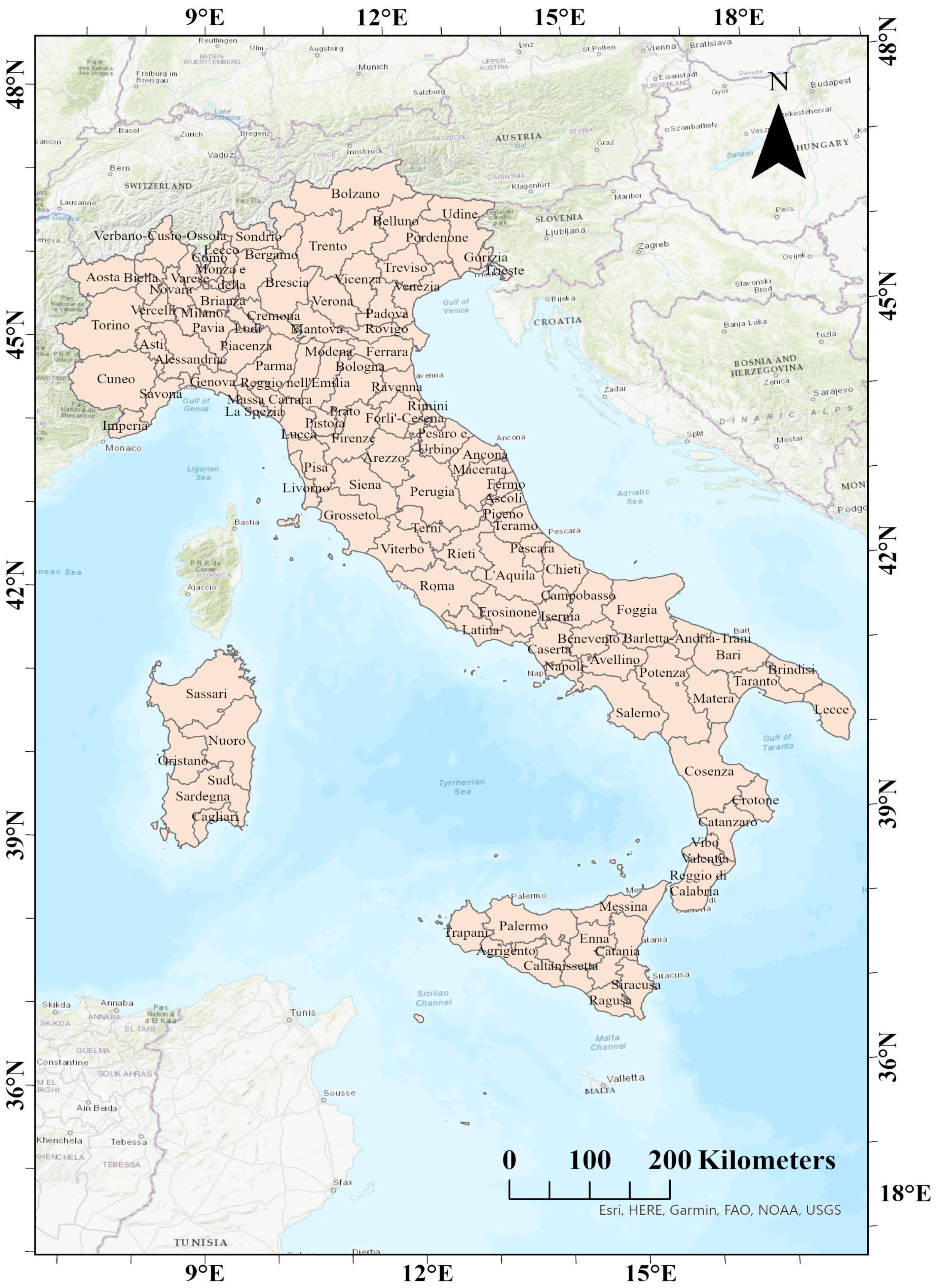
In this study, the analysis focuses on the provincial scale, examining all 107 Italian provinces (Figure 1). This fine spatial resolution allows for capturing the spatiotemporal patterns of NTL and how these patterns evolve over time. Italy was selected as the study area due to its pronounced heterogeneity in key variables, including income levels, urban morphology, population density, natural resource distribution, and agricultural intensity. Although Northern Italy is one of the wealthiest and most developed regions in Europe, Southern Italy continues to experience structural economic challenges, with much of its structure dependent on low- and medium-income agriculture and traditional tertiary industries [4]. The combination of advanced urban development, preservation of cultural heritage, and environmental challenges across provinces makes Italy an ideal case study for investigating NTL data and its broader socioeconomic and environmental implications.

2.2. Earth Observation

This study integrates Earth Observation (EO) and demographic datasets to investigate the spatiotemporal dynamics of nighttime activity and urban development across Italy. The primary data sources include satellite-derived nighttime light observations and official demographic statistics, which together enable a comprehensive analysis of human activity patterns and their evolution over time. The combination of remotely sensed and socio-demographic data provides a robust framework for linking spatial variations in nighttime illumination to underlying population and urbanization processes. Satellite-based nighttime light data form the core EO component of the analysis, while demographic information serves as complementary ancillary data to support the interpretation of observed spatial and temporal patterns [12]. A summary of the datasets, including temporal coverage, spatial resolution, and data sources, is provided in Table 1.

2.2.1. VIIRS Data

Satellite-based NTL observations are primarily derived from two sources: the Defense Meteorological Satellite Program (DMSP), equipped with the Operational Linescan System (OLS), and the Suomi National Polar-orbiting Partnership (Suomi-NPP) satellite carrying the Visible Infrared Imaging Radiometer Suite (VIIRS) sensor [15]. Although DMSP-OLS provides a longer historical record, its Digital Number (DN) values cannot be directly converted to radiance, as the sensor lacks onboard calibration. This limitation, combined with orbital degradation over time, complicates temporal consistency and inter-satellite comparisons. In contrast, VIIRS data offer radiometrically calibrated measurements with higher spatial and temporal resolution, making them more suitable for quantitative and predictive analysis [8]. For this reason, VIIRS constitutes the primary NTL data source in this study. The sensor captures nighttime illumination with improved sensitivity and reduced saturation, and its data products are available in multiple formats, including month composites, which are used to support spatiotemporal analysis.
VIIRS data products are developed by NASA and distributed through the NASA Land Processes Distributed Active Archive Center (LP DAAC). The VIIRS instrument is mounted on both the NASA/NOAA Suomi-NPP and NOAA-20 satellites. Suomi-NPP, launched on 28 October 2011 as part of the Joint Polar Satellite System (JPSS), carries five instruments, including VIIRS. NOAA-20, launched on 18 November 2017, represents the first satellite in NOAA’s next-generation polar-orbiting satellites. Operating jointly, these two platforms enhance temporal coverage and data continuity for NTL observations [15]. The VIIRS sensor observes the Earth’s surface twice daily from a polar orbit at an altitude of approximately 824 km (512 miles). Suomi-NPP crosses the equator at approximately 1:30 a.m. and 1:30 p.m., while NOAA-20 crosses it at around 2:20 a.m. and 2:20 p.m. With a swath width of approximately 3000 km, VIIRS provides near-global coverage with minimal gaps. The sensor records data across 22 spectral bands, ranging wavelengths from 412 nm to 12 µm, at two spatial resolutions of 375 m and 750 m. These observations are resampled to 500 m, 1 km, and 0.05° in standard NASA products to ensure consistency with MODIS-derived datasets [15].

2.2.2. Demographic Data

Demographic data were obtained from official statistics (Istat) and are freely available through its official website (www.istat.it, accessed on 5 January 2026). The dataset comprises annual resident population counts from 2002 to 2022. As of 2022, Italy’s total resident population was 58.98 million, reflecting a decline of nearly one million inhabitants over the previous four years. Population distribution across Italy is highly uneven. The highest concentration is found in the Northern region of Lombardy, which accounts for approximately one-sixth of the national population. Latium in central Italy and Campania in the South follow as the second and third most populous regions, respectively. Italy’s largest metropolitan areas—Rome, Milan, and Naples—are located within these regions, underscoring their demographic and economic significance. Population projections indicate that Italy’s population will continue to decline in the coming decades. According to Istat forecasts, the total population is expected to decrease to approximately 54 million by 2050. This trend is primarily attributed to persistently low fertility rates observed since the mid-1990s [44], combined with the pronounced and ongoing aging of the population [45]. In this study, demographic data are integrated with VIIRS NTL observations to examine the relationships between NTL patterns, human activities, urbanization dynamics, and socioeconomic conditions. All demographic variables are aggregated at the provincial level, ensuring consistency with the spatial scale of the NTL analysis.

2.2.3. Data Preprocessing

Data preprocessing is essential in ensuring that our datasets are of high quality and are compatible for analysis. This process overlaps population data onto the VIIRS NTL dataset to align them with geographical coordinates using Geographic Information Systems (GIS) software (Arc GIS Pro 3.1 by ESRI) for accurate geo-referencing. A masking process is then applied to isolate urban and suburban areas, excluding non-urban regions, water bodies, and undeveloped land. We employ gap-filling techniques to address gaps in the VIIRS data, which may result from cloud cover or other factors. Additionally, a radiometric correction is applied to standardize the radiance values, accounting for variations caused by atmospheric conditions and sensor performance. Finally, temporal aggregation converts the data into monthly composites, enabling meaningful trend analysis and correlation assessments. NTL data were preprocessed and exported via GEE for further refinement. These preprocessing steps ensure that our datasets are of the highest quality, providing a solid foundation for the spatiotemporal analysis of NTL patterns and their relationship with demographic factors in Italian provinces.

2.3. Data Processing and Analysis

This section outlines the data processing procedures and statistical methods employed to extract meaningful information from geo-referenced, masked, and preprocessed NTL datasets. The analytical framework integrates statistical analysis with geospatial techniques to identify significant spatiotemporal patterns in NTL intensity and to examine their relationships with population density, one of the most widely used demographic and socioeconomic indicators across Italian provinces. All analyses are conducted at the provincial level within a cloud-based geospatial environment, enabling efficient handling of large-scale datasets and ensuring consistency across spatial and temporal dimensions.

2.3.1. Statistical Analysis

To investigate the spatial and temporal dynamics of NTL across Italy, we applied a set of complementary statistical methods. These include trend analysis, which captures temporal changes in NTL intensity, and correlation analysis, which assesses the relationships between NTL emissions and demographic or socioeconomic variables such as population density and economic activity [46,47,48]. Together, these methods provide a comprehensive understanding of how NTL patterns evolve over time and vary across space. Trend analysis constitutes a core component of the methodological framework, enabling the identification of long-term changes in NTL intensity across Italian provinces. This approach is particularly effective for detecting patterns associated with urban expansion, economic development, and demographic transformation [37,49,50]. For each province, annual mean NTL values are computed from monthly composites. Linear regression models are then applied to quantify temporal trends and assess their statistical significance. This procedure allows us to distinguish provinces exhibiting sustained increases in NTL intensity—often indicative of urban growth or economic expansion—from those showing stable or declining trends, which may reflect economic challenges, demographic decline, or policy interventions such as energy efficiency measures and light pollution mitigation strategies [37,51,52].
Correlation analysis is used to explore the relationships between NTL intensity and selected socioeconomic and demographic variables, including population density, GDP proxies, and land-use characteristics [7,50,53]. This analysis helps in evaluating the extent to which NTL emissions serve as a proxy for urbanization and economic activity. Pearson’s correlation coefficient is employed to quantify linear associations between NTL intensity and demographic indicators. In regions where non-linear dynamics are expected—such as tourism-driven or seasonally populated areas—additional attention is given to interpreting deviations from linearity [54,55]. The results provide insights into urban–rural disparities, highlighting provinces where high NTL intensities correspond to densely populated urban centers, as well as areas where low NTL values are associated with rural, peripheral, or conservation-oriented regions [7,34,39]. In cases where the correlation between NTL intensity and population density is weaker than expected, region-specific socioeconomic or environmental factors are examined to explain these anomalies.
Trend and correlation analyses jointly form the backbone of the statistical framework adopted in this study. Trend analysis reveals significant temporal shifts in NTL intensity, shedding light on processes such as urban growth, economic change, and policy impacts. Correlation analysis complements this perspective by clarifying the strength and nature of relationships between NTL emissions and socioeconomic variables. By integrating these statistical approaches within a geospatial framework supported by GEE, the study ensures the efficient processing of large NTL datasets and enables robust, scalable analysis. The resulting insights contribute to a deeper understanding of Italy’s spatiotemporal NTL dynamics and offer valuable evidence to support urban planning, environmental management, and regional policy decisions [46,56].

2.3.2. Machine Learning Algorithms

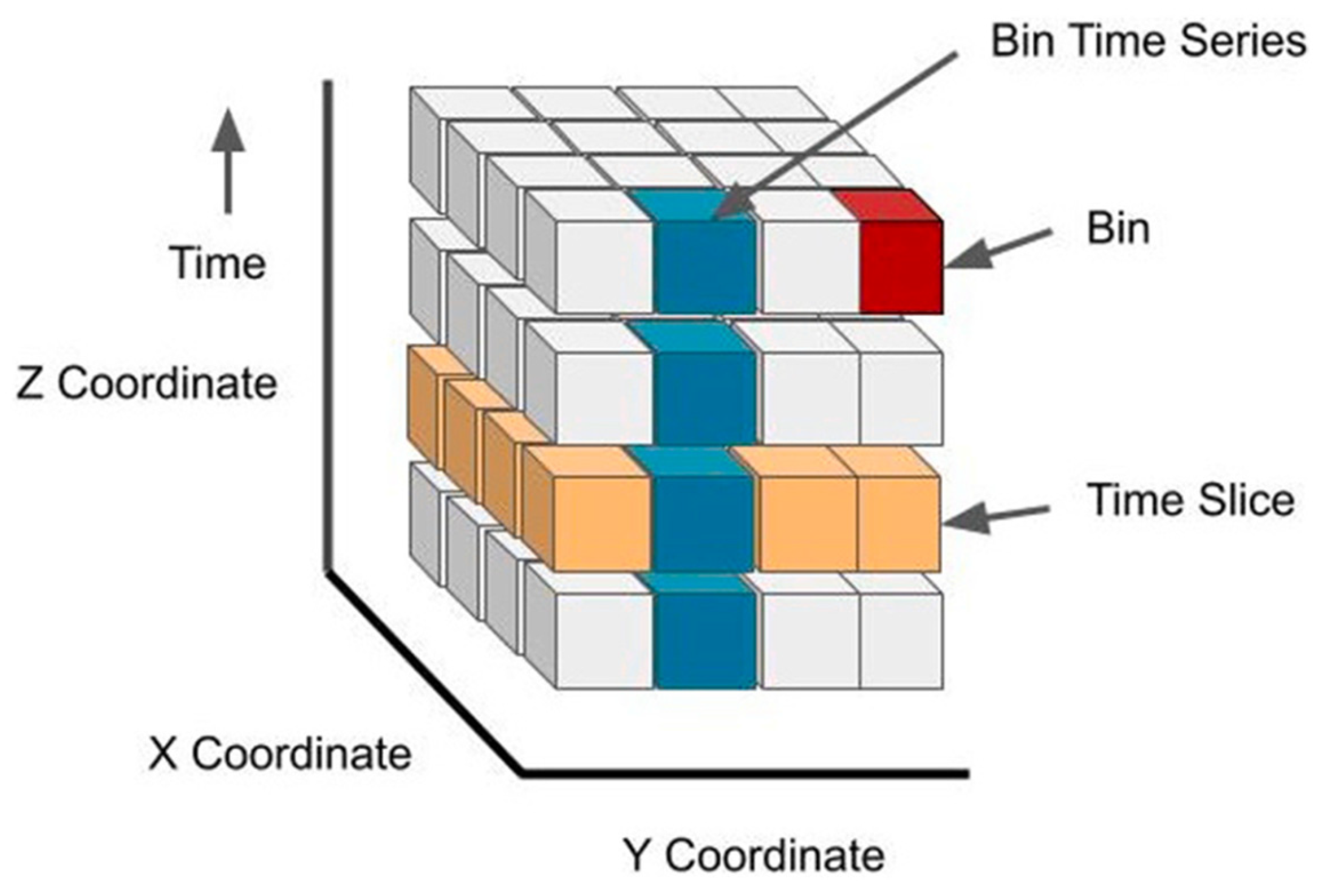
In addition to conventional statistical methods, this study employs Machine Learning (ML) algorithms to capture complex spatiotemporal patterns in NTL data across Italian provinces. ML methods are particularly effective for handling large geospatial datasets and detecting nonlinear relationships that may not be apparent in conventional analyses. Specifically, this study focuses on two Space–Time Cube (STC)-based analyses, which are hotspot analysis and clustering analysis, to detect significant patterns, trends, and anomalies, providing deeper insights into the spatial and temporal dynamics of NTL [33,57,58]. The STC is a powerful geospatial data structure that integrates spatial and temporal dimensions within a three-dimensional framework (Figure 2), where the x and y axes represent spatial coordinates and the z-axis represents time [59,60,61]. This structure allows for the visualization and analysis of how NTL intensity evolves across space and time by aggregating data into discrete space–time bins (voxels), revealing emerging patterns such as urbanization and fluctuations in NTL intensity across regions. Adopted from Hägerstrand’s time–geography concept [62], the STC is widely used to monitor trajectories and geographical distributions over time [60]. In this structure, data points—such as NTL data or, e.g., Airbnb properties—are aggregated within a space–time fishnet grid at defined specific locations and temporal intervals, facilitating the detection of spatial–temporal trends and patterns [59].
In this study, time-series NTL data are aggregated at the provincial level to construct the STC, with each voxel containing NTL values for a specific province and time interval. This approach enhances 3D visualization of NTL patterns, improves the detection of temporal trends, and allows for integration with ML algorithms such as clustering and hotspot analysis [63] (see, for a better reference, the web pages https://pro.arcgis.com/en/pro-app/latest/tool-reference/space-time-pattern-mining/an-overview-of-the-space-time-pattern-mining-toolbox.htm, accessed on 5 January 2026, and https://pro.arcgis.com/en/pro-app/latest/tool-reference/space-time-pattern-mining/learnmorecreatecube.htm#ESRI_SECTION1_F1EA94A3BA8940E0B56AB08A302D1C08, accessed on 5 January 2026).
Emerging Hotspot Analysis
Emerging Hotspot Analysis (EHA) is a valuable tool for identifying significant spatial and temporal trends in NTL intensity by examining how clusters evolve over time [59,63]. Hotspots represent areas with consistently high or intensifying NTL values, whereas cold spots indicate persistently low or declining intensities. (https://pro.arcgis.com/en/pro-app/latest/tool-reference/space-time-pattern-mining/emerginghotspots.htm, accessed on 5 January 2026). These patterns are detected by applying the Getis-Ord Gi* statistic, which assesses the degree of clustering and determines if the observed distribution follows a distinct pattern (are statistically significant) or randomly distributed [64]. Through this process, EHA identifies regions undergoing statistically significant changes, classified as increasing ‘hotspots’ or decreasing ‘cold spots’. This capability is particularly important in detecting socioeconomic dynamics, such as urbanization, infrastructure expansion, or economic decline, within specific geographic areas over time.
In this study, EHA is applied within the STC framework to classify provinces according to their spatiotemporal NTL behavior. Implementing a classical metric such as the z-score, the empirical analysis identifies areas exhibiting persistent, emerging, intensifying, or diminishing hotspot and cold-spot patterns. Positive z-scores highlight increasing NTL intensity, often associated with urban expansion or economic growth, while negative z-scores suggest declining activity, potentially associated with population loss and/or economic downturns. The stability or fluctuation of these scores over time reflects long-term or seasonal trends in human activity, which can be associated with factors such as tourism, migration, or industrial activity [65,66,67].
To further assess trend significance, the nonparametric Mann–Kendall test was also used in conjunction with EHA to detect trends in previously identified hotspots and cold spots. This test calculates trends based on Getis-Ord Gi* values over different time intervals, allowing for a more nuanced understanding of how NTL intensity evolves (https://pro.arcgis.com/en/pro-app/latest/tool-reference/spatial-statistics/h-how-hot-spot-analysis-getis-ord-gi-spatial-stati.htm, accessed on 5 January 2026). Positive, negative, and zero Mann–Kendall values indicate increasing, decreasing, or stable trends, respectively [64,68]. In addition, the Self-Adjusted DBSCAN3 clustering method was applied [69,70] to identify high-density clusters of NTL properties and adjust its search distance based on the probability that a point belongs to a cluster. This method can highlight neighborhoods (or regions) where NTL intensity is particularly concentrated, often revealing areas of rapid development or gentrification [37].
The combined application of EHA, STC, the Mann–Kendall test, and Self-Adjusted DBSCAN provides a comprehensive analysis detecting and interpreting spatiotemporal changes in NTL patterns across Italy [59,71]. The findings offer critical insights into the socioeconomic transformations underway, such as urbanization, neighborhood change, and economic shifts, which are reflected in the evolving patterns of NTL (https://pro.arcgis.com/en/pro-app/latest/tool-reference/space-time-pattern-mining/learnmoreemerging.htm, accessed on 5 January 2026). A detailed description of the EHA pattern categories is provided in Table 2.
Clustering Analysis
Clustering techniques are used to group provinces based on similar temporal trajectories of NTL intensity patterns, allowing a complete exploration of spatial and temporal variations. To capture both the shape and magnitude of NTL intensity changes over time, time series clustering techniques are applied to provinces with similar NTL behaviors grouped into clusters, which helps identify regions experiencing comparable urban growth, economic development, or policy impacts [72,73]. The clustering process involves three main steps: data preparation, distance measurement, and using a clustering algorithm [74]. First, in ‘data preparation’, NTL time series data are normalized to ensure scale differences do not affect clustering results. In ‘distance measurement’, similarities between time series are quantified using appropriate distance metrics, such as Euclidean distance. Finally, in the stage of ‘using clustering algorithms’, k-means, hierarchical clustering, and DBSCAN are used, followed by cluster validation procedures to assess their quality [72].
The clusters reveal urbanization patterns, economic activity, and the effectiveness of local developmental policies, providing insights into NTL dynamics across Italy (see, for a better reference, the webpage: https://pro.arcgis.com/en/pro-app/latest/tool-reference/space-time-pattern-mining/learnmoretimeseriesclustering.htm, accessed on 5 January 2026). Integrating ML algorithms into the analysis of NTL data provides a robust framework for uncovering significant spatiotemporal patterns across Italian provinces. STC analysis offers a detailed 3D perspective on NTL dynamics, while EHA detects clusters of significant changes in NTL intensity, and clustering identifies provinces with similar NTL behaviors. Together, these complementary methods offer a powerful analytical framework for understanding the relationship between NTL, urbanization, and socioeconomic factors, providing valuable insights for spatial planning and sustainable development.

2.4. Validation

Validation is an essential step to confirm the accuracy and reliability of NTL data analysis. In this study, population density data is assumed as a key validation metric due to its strong correlation with urbanization and artificial light emissions. By comparing provincial-level NTL intensity with population density, we assess whether observed NTL patterns accurately reflect real-world socioeconomic dynamics [50,52]. Population density is widely recognized as a reliable indicator for urbanization, making it an ideal reference dataset for validating NTL data. The validation process involves several stages. First, population density data are acquired from authoritative sources, such as the Istat, or global datasets such as the Gridded Population of the World (GPW). These data are then spatially aligned and normalized, enabling a direct comparison with NTL data [4,39]. Subsequently, Pearson’s correlation coefficient is calculated to quantify the relationship between NTL intensity and population density [68].
To further validate spatial patterns, the Global Moran’s I test is applied to examine whether the spatial distribution of NTL–population correlations is random or exhibits spatial clustering [56,68]. Additionally, applying a comparative analysis of urban and rural provinces helps to monitor population density and the differences between such areas for better planning [75]. Some discrepancies arise in provinces with high levels of tourism or strict lighting regulations, where NTL data may not fully align with the resident population density. These variations suggest that seasonal activities or specific policies may influence NTL patterns. To address temporal mismatches between census intervals and NTL data, recent data like Luojia-1-01, Yangwang-1, SDGSAT-1, BlackSky, and Jilin-1, and interpolation techniques like Cubic Hermite or Linear methods, were employed [35,43,76,77,78]. Overall, the strong correlations observed across provinces confirm the use of NTL data as a proxy for demographic and urbanization trends. This validation supports the broader conclusions of the research, emphasizing the usefulness of NTL data for monitoring socioeconomic dynamics.

2.5. Methodology Workflow

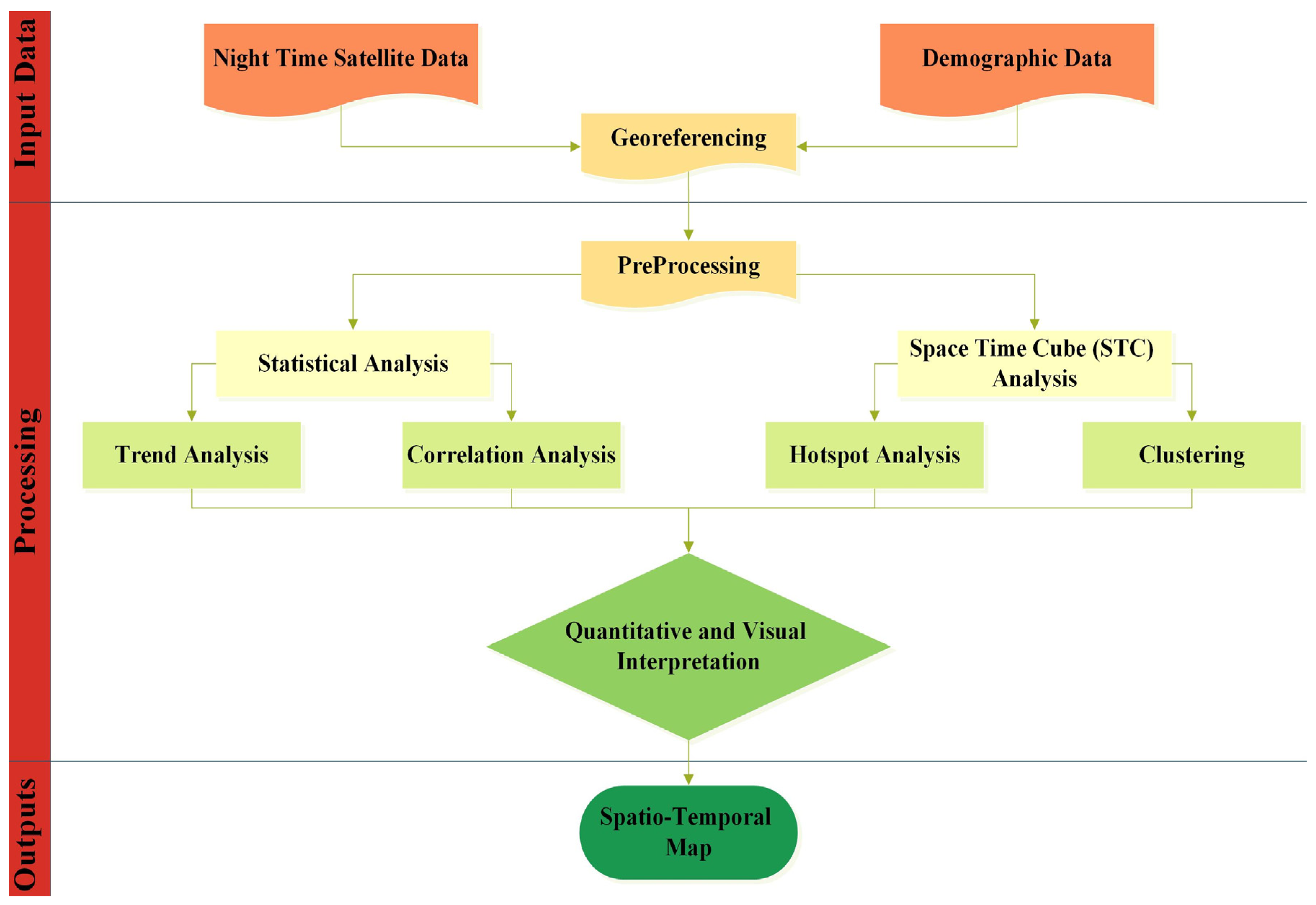
Our research methodology consists of three primary steps, illustrated in Figure 3. The first step involves introducing the input data, including NTL satellite data (VIIRS) and demographic data (population density), which are essential for analyzing the spatiotemporal dynamics of NTL across Italian provinces. The second step, referred to as the ‘processing’, involves several critical steps. Georeferencing ensures that all datasets are aligned with geographical coordinates, providing the spatial context required for the analysis. This phase also includes data preprocessing to clean and standardize datasets, statistical analysis to uncover trends, and the application of ML algorithms for deeper data exploration.
This step culminates in the quantitative and visual interpretation of the results, offering comprehensive insights into the relationships between NTL and demographic variables. The final step focuses on representing the analysis results as spatiotemporal map outputs. This map serves as a visually engaging and informative representation of NTL dynamics across Italian provinces, providing key insights into the country’s urbanization and environmental changes. This map serves as the central output of the research methodology, offering a valuable tool for further investigation and policy planning.

3. Results

This section illustrates the main results of the spatiotemporal analysis of NTL Data (NTLD) across Italian provinces for the study period encompassing 2014–2022. The empirical findings are presented as a way of progressively examining (i) spatial distribution and variability, (ii) long-term time trends, (iii) seasonal modulation, (iv) demographic associations, and, finally, (v) summary spatio-temporal patterns.

3.1. Spatial Distribution and Temporal Variability of NTL Intensity

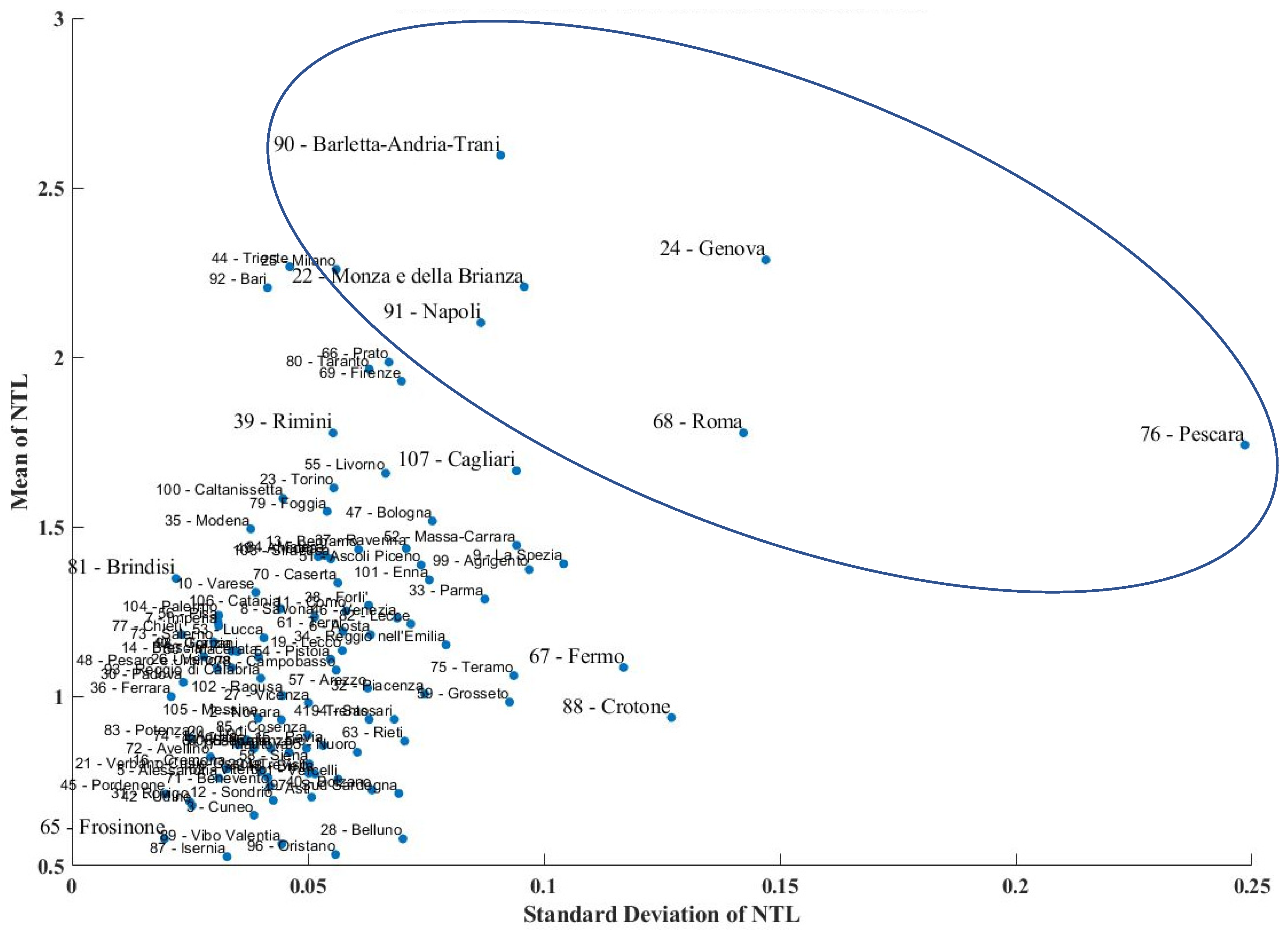
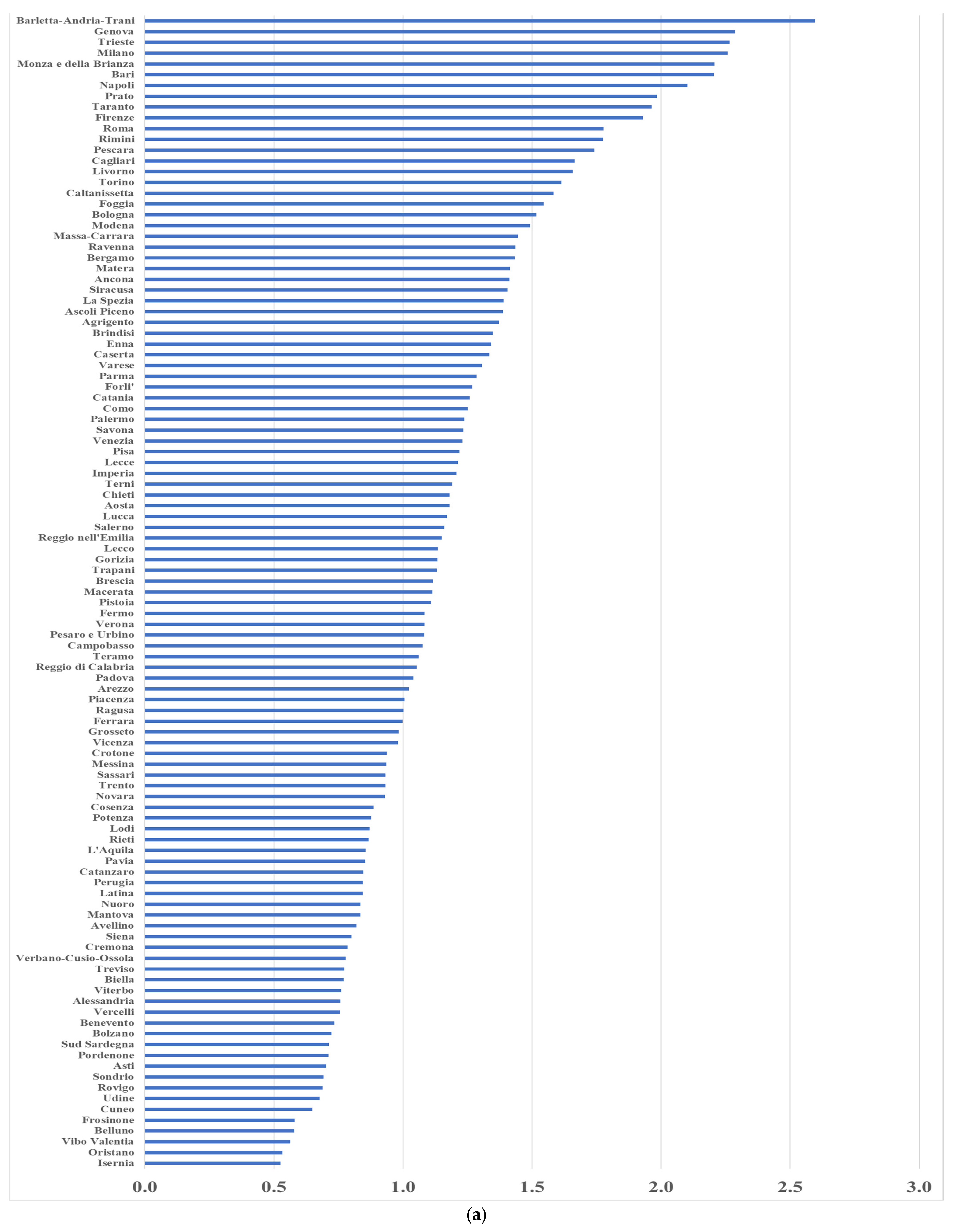
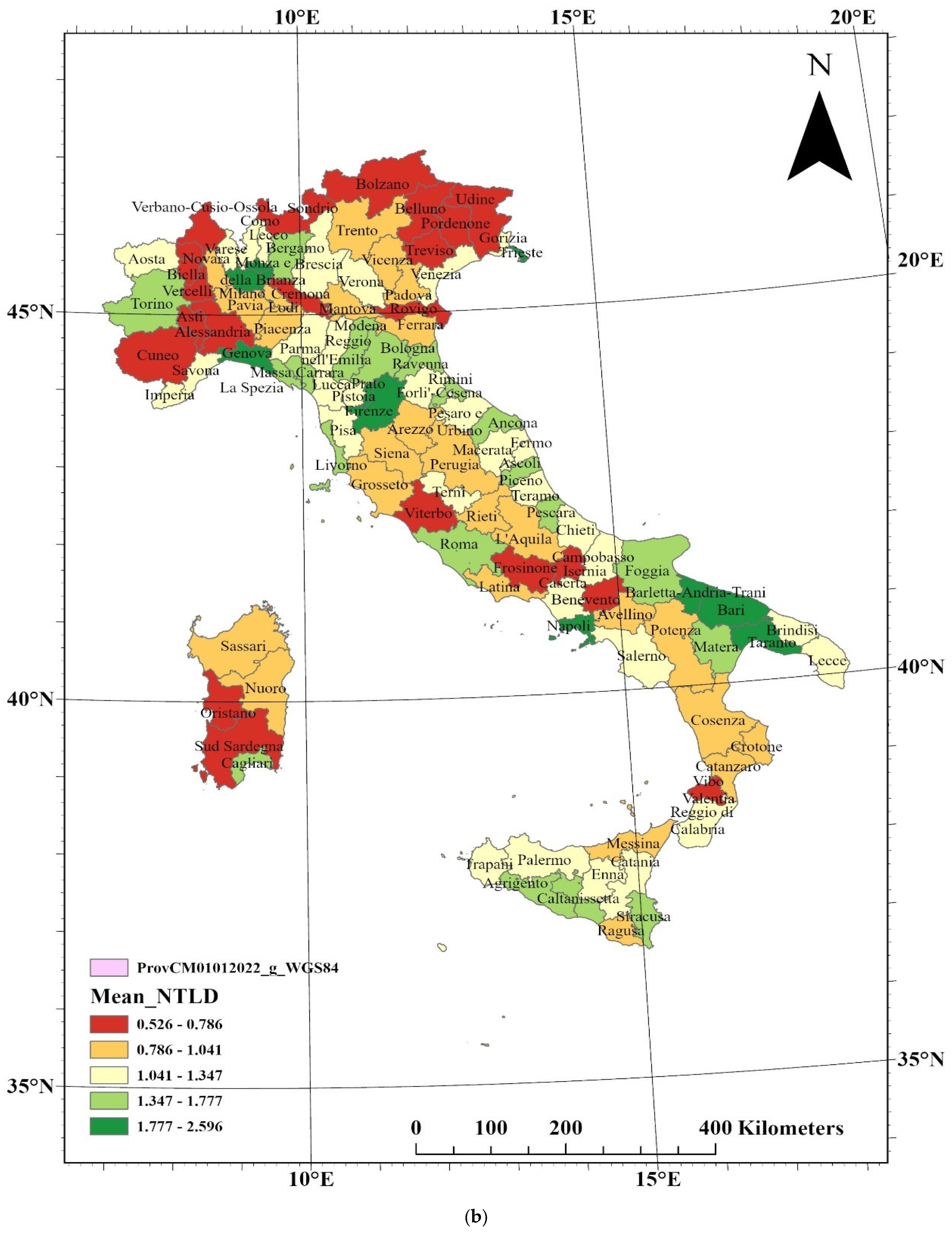
This subsection examines the spatial distribution and temporal variability of NTLD across 107 Italian provinces using mean and standard deviation metrics. Together, these metrics characterize both the overall intensity of nighttime illumination and its temporal stability, providing a foundational overview of provincial-scale NTL dynamics. The mean NTLD values reveal pronounced spatial heterogeneity across Italy, as evidenced in the provincial ranking and the spatial distribution of mean NTLD (Figure 4). Provinces occupying the upper ranks of the national (statistical) distribution exhibit substantially higher average nighttime illumination, with Barletta-Andria-Trani, Genova, Trieste, Milan, Monza-Brianza, Bari, Naples, and Florence consistently positioned at the top of the ranking.
These high-ranking provinces form a discontinuous yet clearly defined spatial pattern that is largely concentrated in Northern and Central Italy, with additional high-intensity provinces located along coastal and metropolitan corridors in Southern Italy. The spatial ranking map further highlights the clustering of high mean NTLD values within major urbanized regions, including Lombardy, Liguria, Emilia-Romagna, Latium, and parts of Apulia. Provinces classified in the highest-ranking classes are predominantly associated with dense built-up environments and sustained nighttime activity, whereas intermediate-ranking provinces are spatially dispersed across Central Italy and portions of the South.
By contrast, provinces with the lowest mean NTLD values are primarily located in mountainous, inland, or less urbanized areas, including Belluno, Isernia, Frosinone, and Vibo Valentia. These provinces consistently occupy the lower end of the ranking distribution, indicating persistently reduced nighttime illumination throughout the study period. Overall, the distribution of mean NTLD values underscores strong spatial contrasts at the provincial scale, with a clear separation between highly illuminated urban provinces and persistently low-intensity regions. This spatial stratification of mean nighttime light intensity provides a quantitative baseline for assessing temporal variability and the subsequent spatiotemporal analysis.
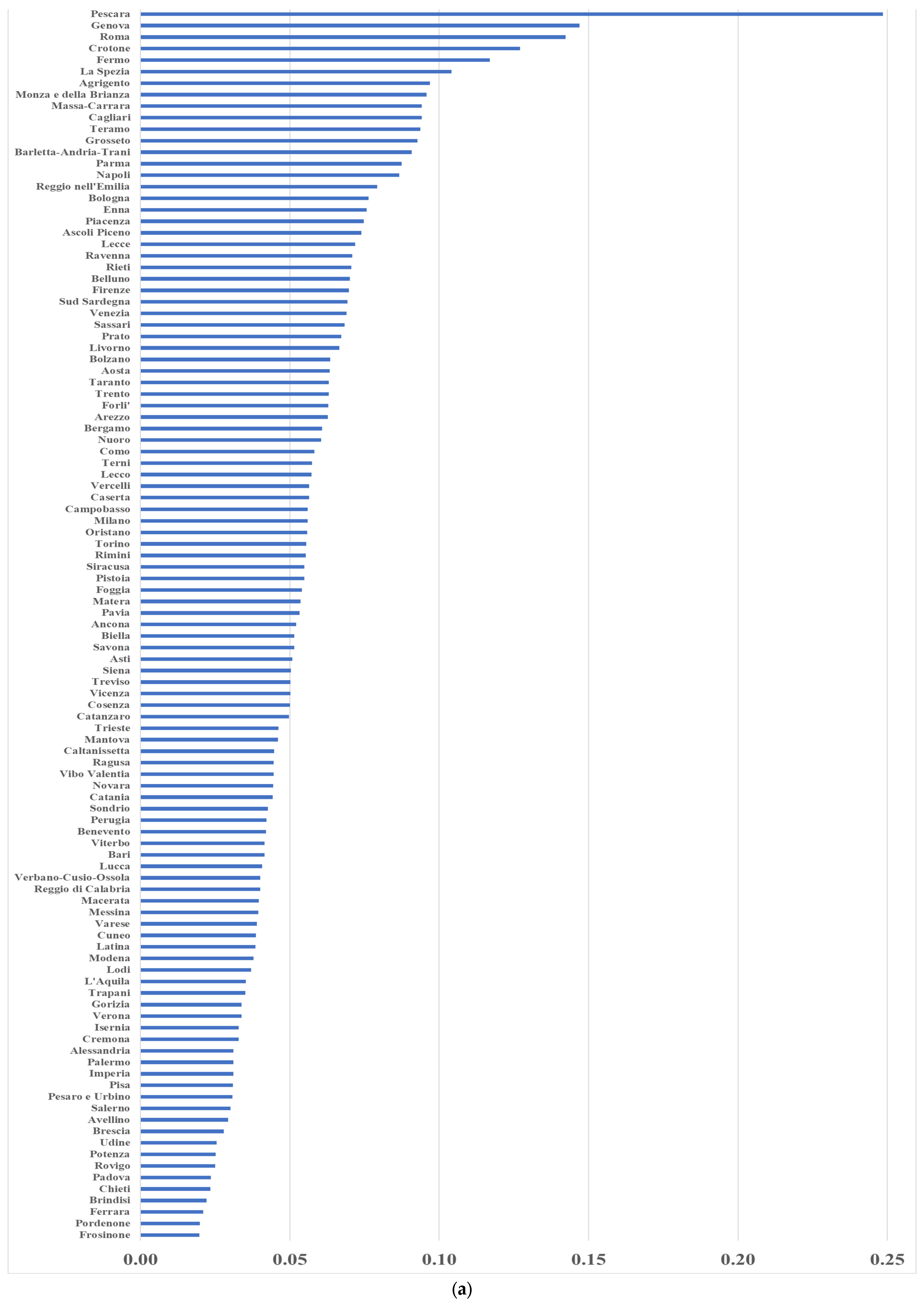
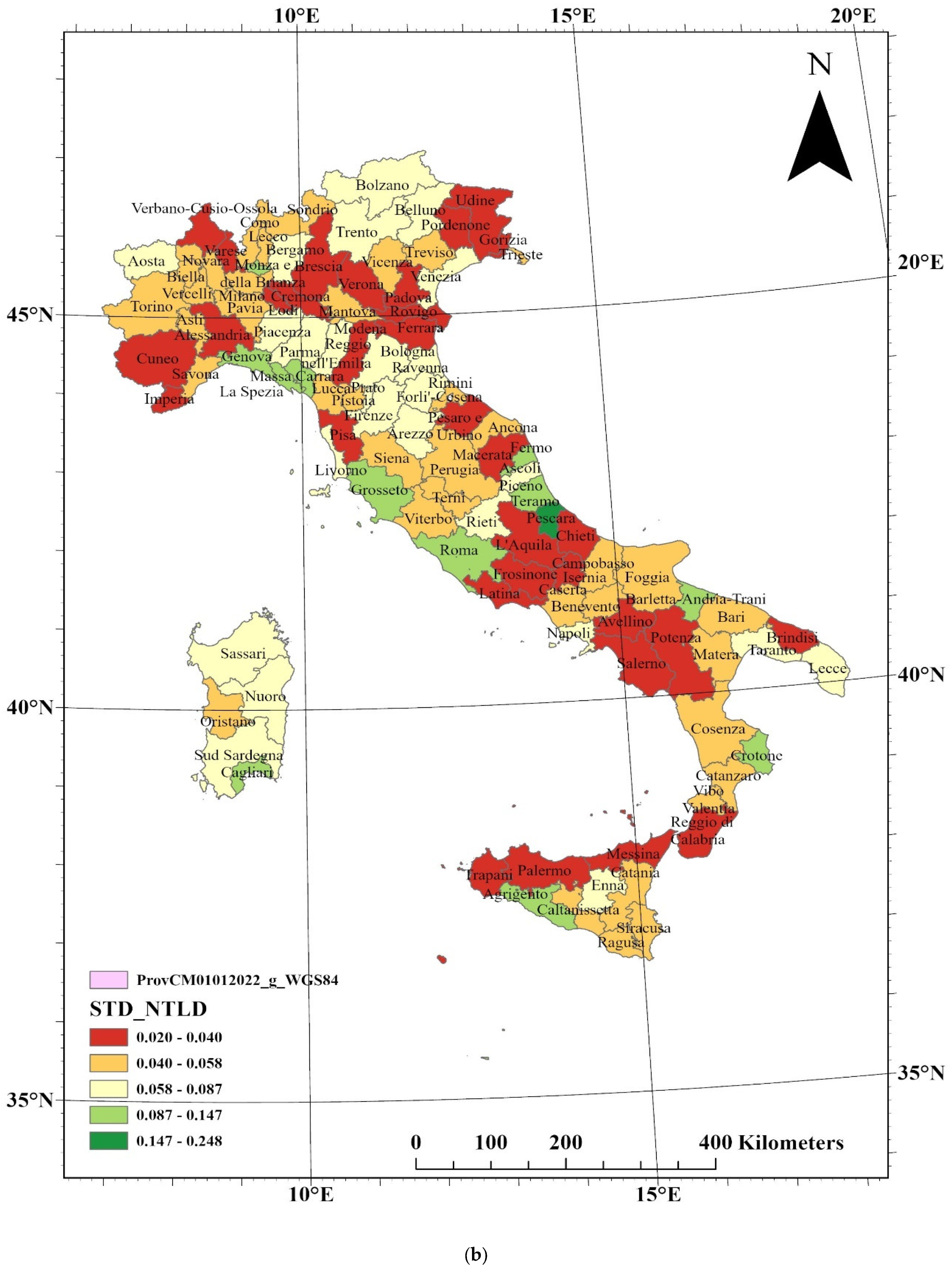
While the mean NTLD captures the magnitude of nighttime illumination, the standard deviation of NTLD provides a quantitative measure of the temporal stability and variability of illumination patterns across provinces over the 2014–2022 time interval (Figure 5). Provinces with higher STD values experience greater interannual fluctuations in nighttime light intensity, whereas lower STD values indicate more stable and consistent illumination over time. The provincial ranking of STD values reveals substantial heterogeneity in temporal variability across Italy (Figure 5a). Provinces such as Pescara, Genoa, Rome, Crotone, and Fermo occupy the highest positions in the STD ranking, indicating pronounced temporal variability in nighttime illumination. These provinces exhibit wide ranges of NTLD values across the study period, reflecting dynamic temporal behavior.
In contrast, provinces including Frosinone, Pordenone, Ferrara, Brindisi, and Chieti consistently display among the lowest STD values, suggesting relatively stable nighttime illumination with limited year-to-year variation. The spatial distribution of STD rankings further emphasizes distinct geographical patterns in temporal variability (Figure 5b). Provinces classified in the highest STD ranking categories (red and orange classes) are predominantly concentrated in Northern and Central Italy, forming spatial clusters across regions such as Liguria, Emilia-Romagna, Tuscany, and Latium. These areas exhibit high temporal variability relative to the national average. In contrast, lower STD values (light and dark green classes) are more frequently observed in Southern Italy and parts of the islands, indicating comparatively stable nighttime illumination patterns over time.
Notably, the STD ranking map reveals that high temporal variability is not limited to provinces with low mean NTLD values. Several highly illuminated provinces also exhibit high STD values, indicating that strong nighttime illumination can coexist with pronounced temporal fluctuations. Conversely, provinces with low STD values tend to maintain consistent illumination levels regardless of their overall NTLD magnitude. This spatial contrast highlights the heterogeneous temporal dynamics of nighttime light behavior across Italy. Overall, the STD of NTLD provides a complementary perspective to mean illumination levels by revealing provinces characterized by stable versus fluctuating nighttime light patterns. These differences in temporal stability establish an essential context for the joint mean–STD analysis and support the subsequent spatiotemporal clustering and hotspot detection presented in the following sections.
The combined interpretation of mean and STD metrics is further illustrated by the mean–STD scatter plot (Figure 6), which summarizes how average NTLD levels relate to their temporal variability across the 107 Italian provinces. Overall, the point cloud shows a general upward tendency, indicating that provinces with higher mean NTLD frequently exhibit higher STD values as well, although the relationship is not uniform across all provinces. Most provinces cluster in the low-to-moderate mean range (approximately 0.7–1.3) with low STD values (generally below ~0.08), reflecting broadly stable illumination conditions with limited year-to-year variation.
Several provinces stand out as informative outliers, helping clarify distinct behaviors. Barletta-Andria-Trani occupies the highest mean NTLD position (around 2.6) while maintaining only moderate variability (STD near ~0.09), representing a high-intensity but comparatively stable illumination profile. In contrast, provinces such as Genoa and Rome combine relatively high mean NTLD (≈2.3 and ≈1.7–1.8, respectively) with higher STD values (≈0.12–0.15), indicating high-intensity illumination with more pronounced temporal fluctuations. Pescara is the most prominent variability outlier, with the highest STD (≈0.24) despite a mid-to-high mean level (≈1.7), which may highlight exceptionally dynamic temporal behavior relative to other provinces. Additional provinces positioned toward the right side of the plot (e.g., Fermo and Crotone) show remarkable STD values despite moderate mean levels, further emphasizing that notable variability can also occur outside the highest-mean group.
At the opposite end, provinces such as Isernia, Vibo Valentia, Belluno, and Frosinone cluster in the lower-left portion of the plot, combining low mean NTLD with low STD values, indicating persistently low and temporally stable nighttime illumination. Taken together, Figure 6 supports a practical differentiation of provinces into three broad groups: stable high-intensity provinces (high mean with relatively low-to-moderate STD), fluctuating high-intensity provinces (high mean with higher STD), and persistently low-intensity provinces (low mean with low STD). This joint mean–STD perspective provides a concise basis for interpreting subsequent trend, clustering, and hotspot analyses.
Overall, the spatial patterns of mean NTLD combined with the temporal variability captured by STD establish a robust spatial–temporal baseline for Italy’s nighttime illumination landscape. These results provide context for interpreting the subsequent analysis of long-term trends, seasonal modulation, spatiotemporal clustering, and hotspot dynamics, presented in the following sections.

3.2. Long-Term Trends in NTL Intensity

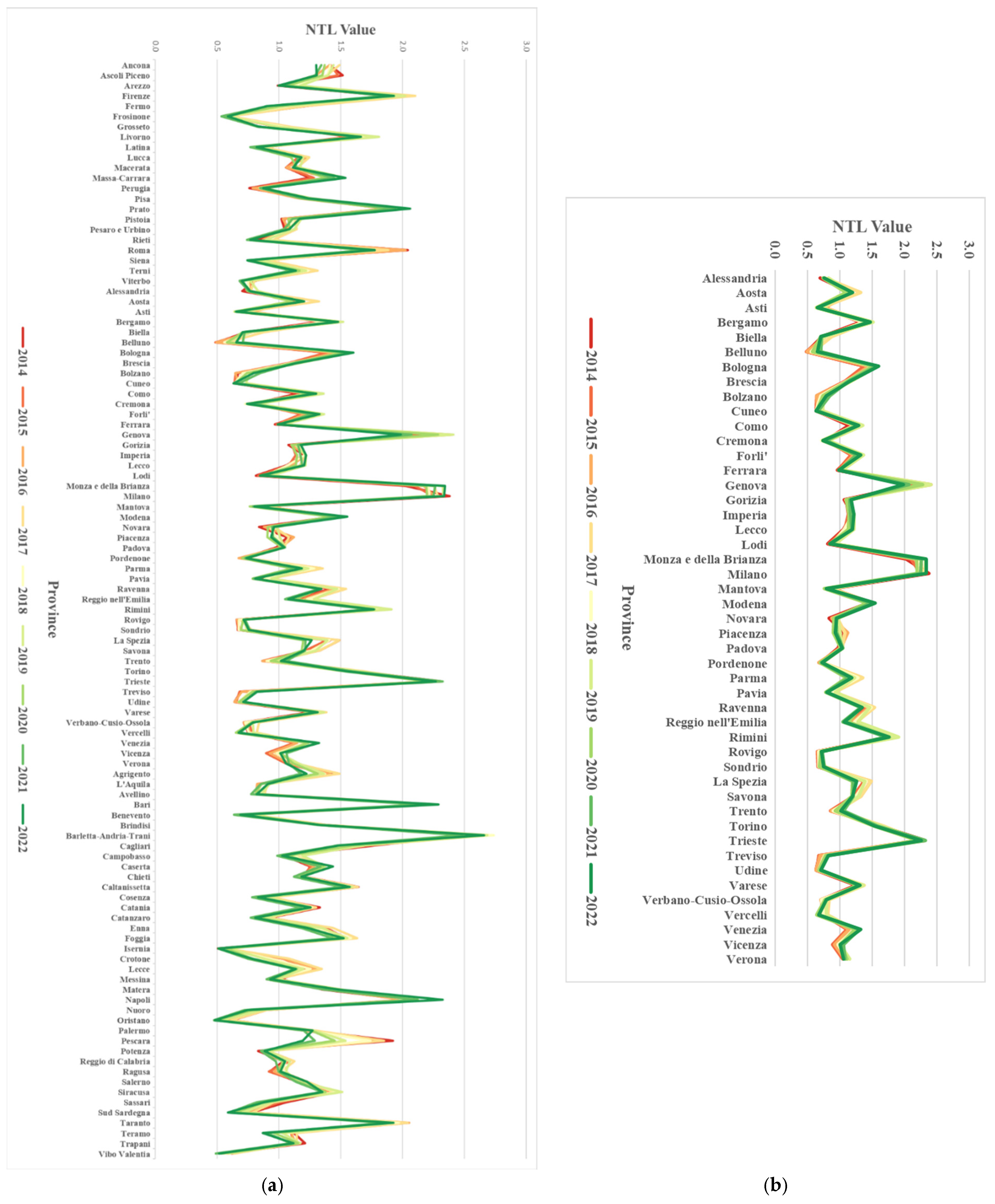
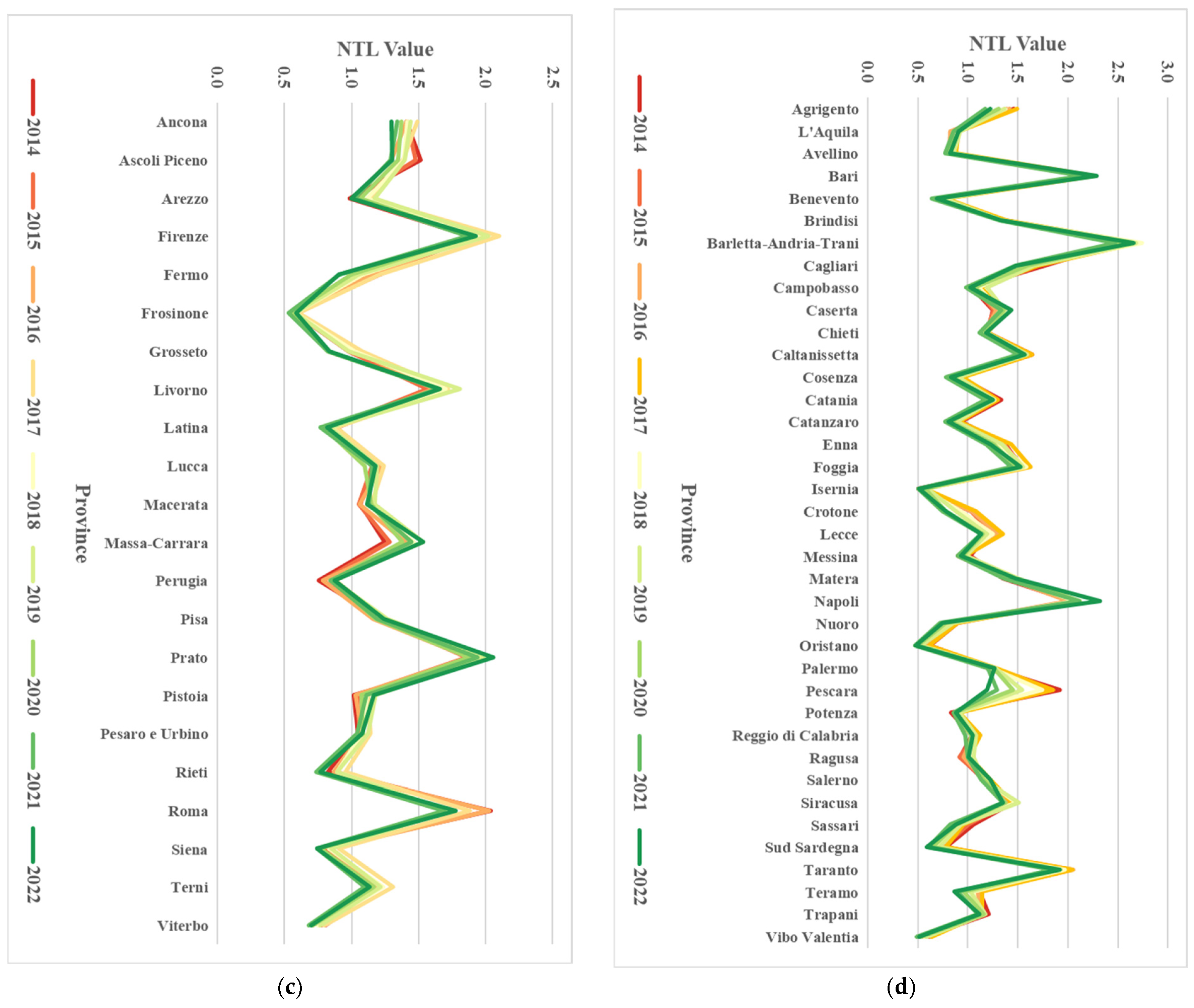
To characterize inter-annual variations in nighttime illumination across Italian provinces, long-term trends in NTLD were examined at both national and regional scales during the 2014–2022 period (Figure 7). This analysis highlights how NTL intensity evolves over time and reveals differences in temporal behavior among regions. At the national scale (Figure 7a), NTLD exhibits gradual year-to-year variation, with moderate inter-annual fluctuations observed across provinces. While the overall national pattern remains relatively stable throughout the study period, individual provinces display localized increases and decreases in NTLD in specific years. These variations indicate that changes in nighttime illumination are not uniform across Italy but instead reflect heterogeneous temporal dynamics at the provincial level.
Clear regional contrasts emerge when the analysis is disaggregated into Northern, Central, and Southern Italy (Figure 7b–d). In Northern Italy (Figure 7b), provinces generally maintain higher NTLD levels than other regions, with relatively consistent trajectories over time. Major urban and industrial provinces such as Milan and Monza-Brianza exhibit persistently high NTLD values throughout the study period, with modest inter-annual variation. Other Northern provinces display similar stable behavior, although lower-intensity provinces such as Belluno and Bolzano consistently remain at the lower end of the regional distribution, punctuated by limited temporal fluctuations.
In Central Italy (Figure 7c), NTLD values are generally moderate to high, with more pronounced interannual variability than observed in the North. Provinces such as Rome, Florence, and Prato maintain relatively high illumination levels across the study period, while exhibiting noticeable year-to-year fluctuations. Several central provinces display alternating increases and decreases in NTLD, indicating dynamic temporal behavior that differentiates this region from the more stable Northern patterns.
In Southern Italy (Figure 7d), NTLD trajectories display the largest range of temporal variability among the three regions. Provinces such as Bari and Barletta-Andria-Trani consistently show high NTLD values across multiple years, whereas other provinces—including Isernia, Vibo Valentia, and parts of Calabria—remain persistently low throughout the study period. Several Southern provinces exhibit sharper year-to-year changes relative to Northern and Central Italy, resulting in a more heterogeneous temporal pattern across the region.
Overall, the long-term temporal analysis reveals distinctive regional signatures in NTLD evolution across Italy. Northern Italy is characterized by higher and more stable nighttime illumination, Central Italy by moderate-to-high levels with noticeable inter-annual variation, and Southern Italy by a wider spread of NTLD values and stronger temporal fluctuations. These heterogeneous temporal trajectories underscore the importance of regional-scale analysis and provide a foundation for subsequent investigations of seasonal dynamics, spatio-temporal clustering, and hotspot evolution.

3.3. Seasonal Modulation of NTL Dynamics

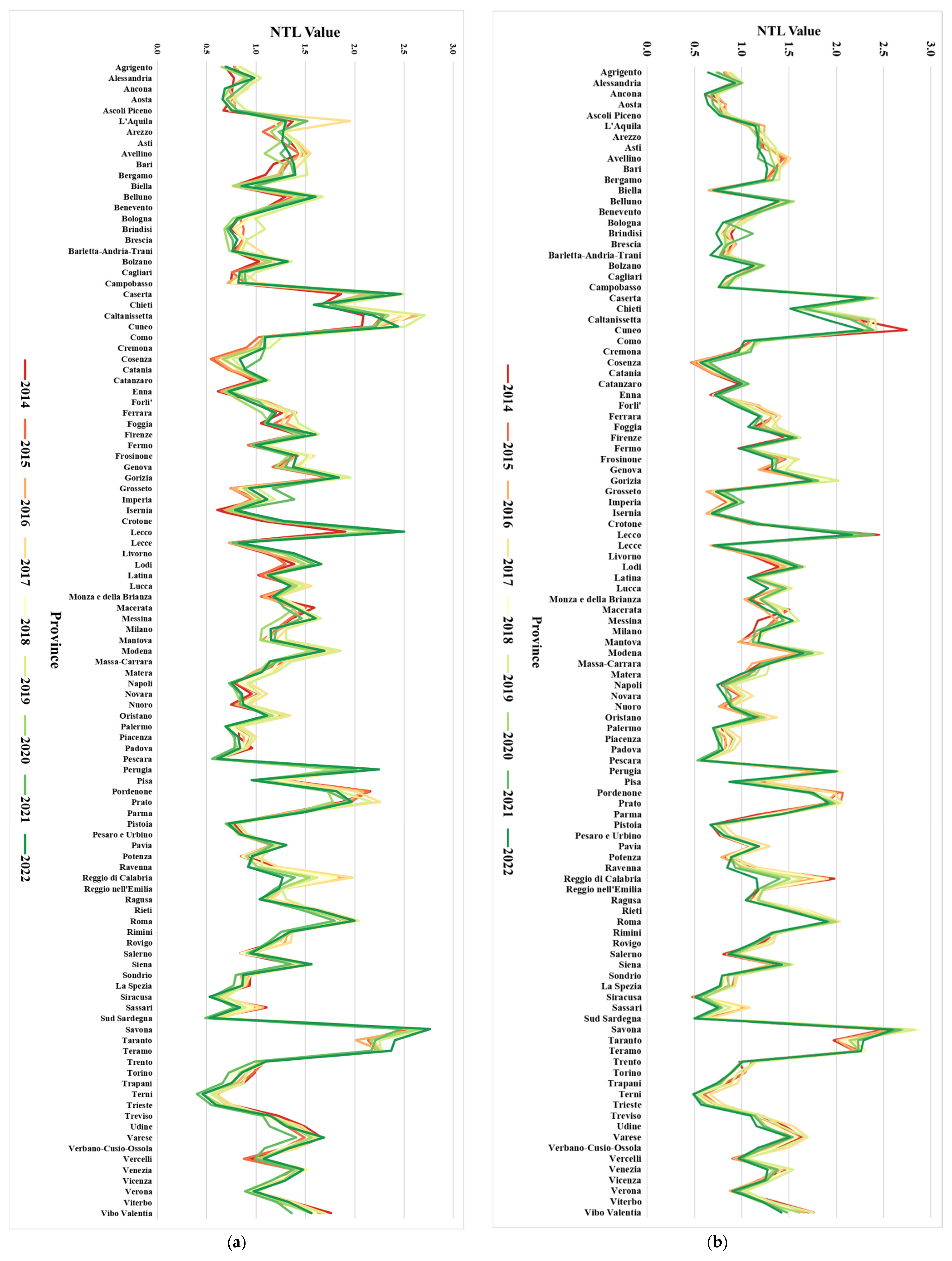
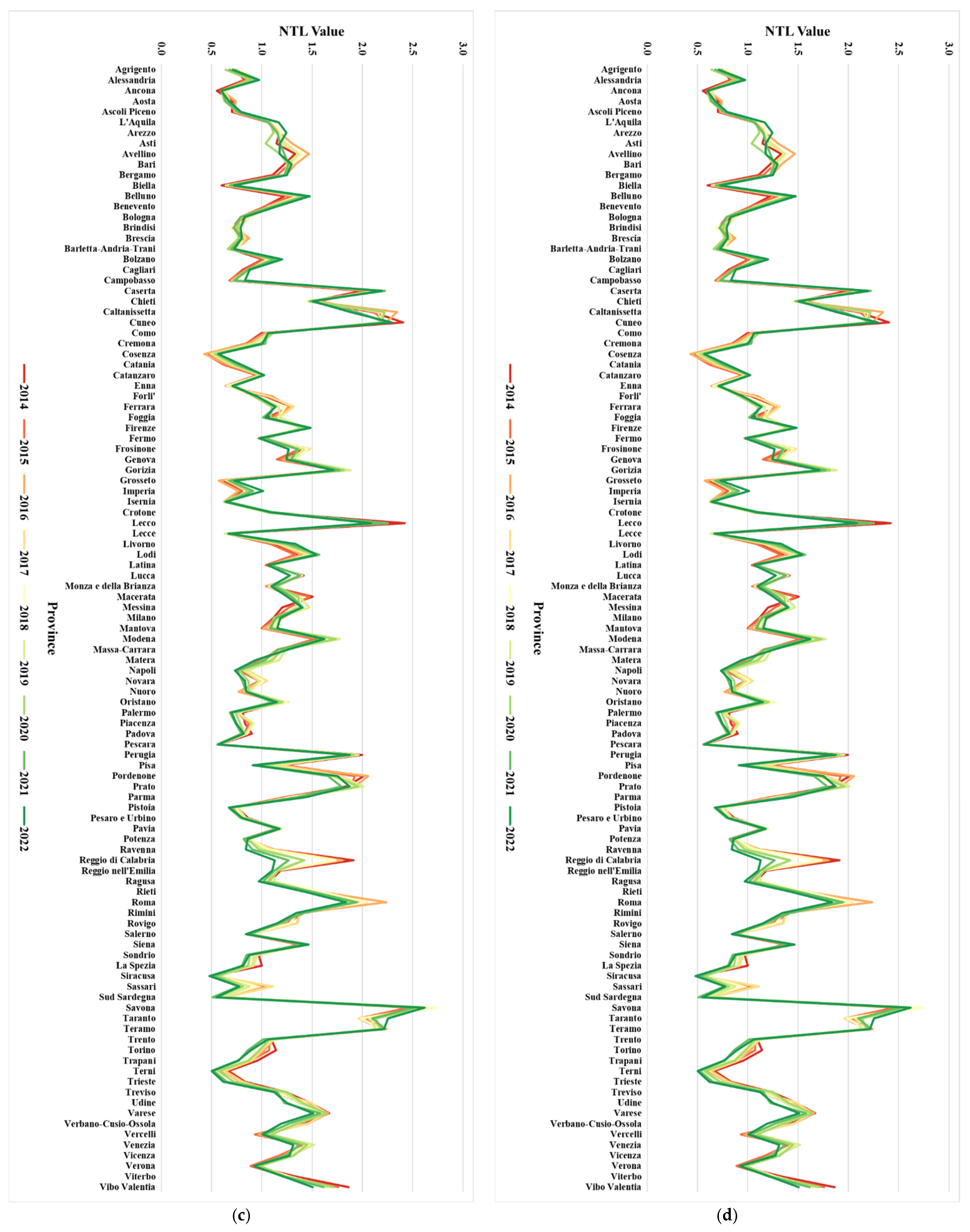
Seasonal variations in NTLD were analyzed to characterize intra-annual changes in nighttime illumination across Italian provinces (Figure 8). The seasonal decomposition highlights systematic differences in NTLD behavior among winter, spring, summer, and autumn, revealing how illumination levels fluctuate within a typical annual cycle. Overall, NTLD exhibits clear seasonal modulation across provinces, with recurring patterns evident in all four seasonal snapshots. While several provinces maintain relatively consistent illumination levels throughout the year, others display pronounced seasonal contrasts, indicating heterogeneous intra-annual dynamics across Italy. During winter (December–January–February), NTLD values are generally remarkable in highly urbanized provinces, with several Northern and Central provinces exhibiting consistently high illumination levels (Figure 8a). Provinces such as Milan, Rome, and other major urban centers maintain strong nighttime brightness during winter, whereas provinces with lower urban intensity, particularly in inland or mountainous areas, exhibit comparatively lower NTLD values. The winter pattern suggests reduced seasonal dispersion in highly urbanized regions, with more uniform illumination across provinces.
In spring (March–April–May), NTLD values showed moderate increases in several provinces relative to winter, accompanied by enhanced variability across regions. Various provinces display upward shifts in NTLD, while others remain relatively stable (Figure 8b). This transitional season is characterized by a broader spread of NTLD values, indicating increased heterogeneity in nighttime illumination across provinces compared to winter conditions. The summer season (June–July–August) exhibits some of the highest NTLD levels and strongest inter-provincial contrasts (Figure 8c). Several provinces demonstrate notable increases in nighttime illumination relative to other seasons, while others remain stable or show limited change. The dispersion of NTLD values during summer is more pronounced, particularly in coastal and Southern provinces, reflecting intensified seasonal variability across Italy. This season contributes substantially to the overall intra-annual variability observed in the NTLD time series.
During autumn (September–October–November), NTLD values generally stabilized or declined relative to summer, with many provinces converging toward intermediate illumination levels (Figure 8d). While major urban centers continue to exhibit high NTLD, the overall distribution became more compact, indicating a reduction in seasonal extremes. Autumn thus represents a transition toward more stable illumination conditions preceding the winter season. Across all seasons, certain provinces consistently occupy the higher end of the NTLD distribution, indicating persistent nighttime activity throughout the year, whereas others repeatedly appear at lower NTLD levels, reflecting sustained low illumination conditions. Provinces exhibiting strong seasonal contrasts contributed disproportionately to intra-annual variability, complementing the inter-annual trends identified in Section 3.2.
In summary, the seasonal analysis demonstrates that intra-annual variability is a significant component of NTLD across Italy, with distinctive seasonal signatures observed among provinces. These patterns highlight the importance of seasonal resolution for characterizing nighttime illumination behavior and provide a critical link between long-term trends and subsequent analyses of spatial clustering and hotspot evolution.

3.4. Relationship Between NTL Intensity and Population Density

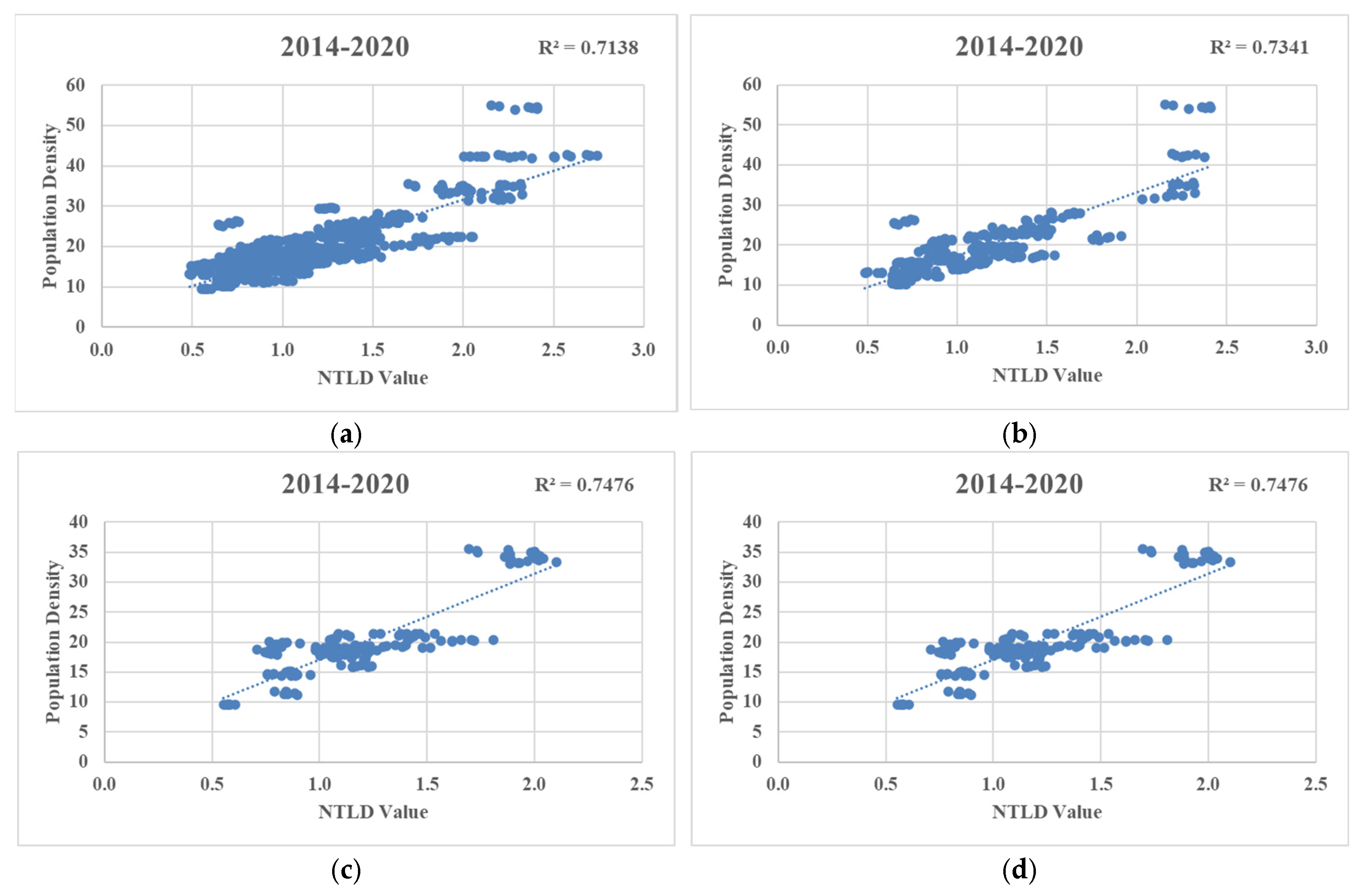
To evaluate the extent to which nighttime illumination reflects population distribution across Italy, the relationship between NTLD and population density was examined using Pearson correlation analysis at national and regional scales (Figure 9). At the national scale (Figure 9a), NTLD exhibited a strongly positive linear relationship with population density, with an R2 of 0.71. This result indicates that provinces with higher population density tend to display higher NTLD values, confirming a close association between artificial nighttime illumination and population concentration across the entire study area. The scatter distribution shows a clear upward trend, with limited dispersion around the fitted regression line, particularly at moderate NTLD levels.
Regional analysis reveals systematic differences in correlation strength (Figure 9b–d). In northern Italy (Figure 9b), the relationship between NTLD and population density strengthens further, with an R2 value of 0.73. The data points in this region are more tightly clustered along the regression line, reflecting a consistent correspondence between population density and nighttime illumination across highly urbanized and industrialized provinces. Central Italy (Figure 9c) exhibits the highest correlation among all regions, with an R2 value of 0.75. This strong association indicates a particularly close alignment between NTLD and population density, with reduced scatter relative to other regions. Central provinces show a well-defined linear trend across a wide range of NTLD values, suggesting a stable relationship between population concentration and nighttime light intensity. In Southern Italy (Figure 9d), the correlation remains strong but slightly weaker, with an R2 value of 0.69. Compared with Northern and Central regions, the Southern scatter plot displays greater dispersion, particularly at lower NTLD values.
This pattern indicates increased heterogeneity in the relationship between population density and nighttime illumination, although the overall positive association remains evident, possibly due to the intrinsic contributions of summer tourism and second-home urban expansion to overall illumination patterns. Overall, correlation analysis demonstrates that NTLD is strongly and consistently associated with population density across Italy, with variations in correlation strength reflecting regional differences in settlement structure and spatial population distribution. The results confirm the suitability of NTLD as a proxy for population density and highlight regional contrasts in the degree to which nighttime illumination aligns with demographic patterns.

3.5. Spatiotemporal Grouping of Provincial NTL Trajectories

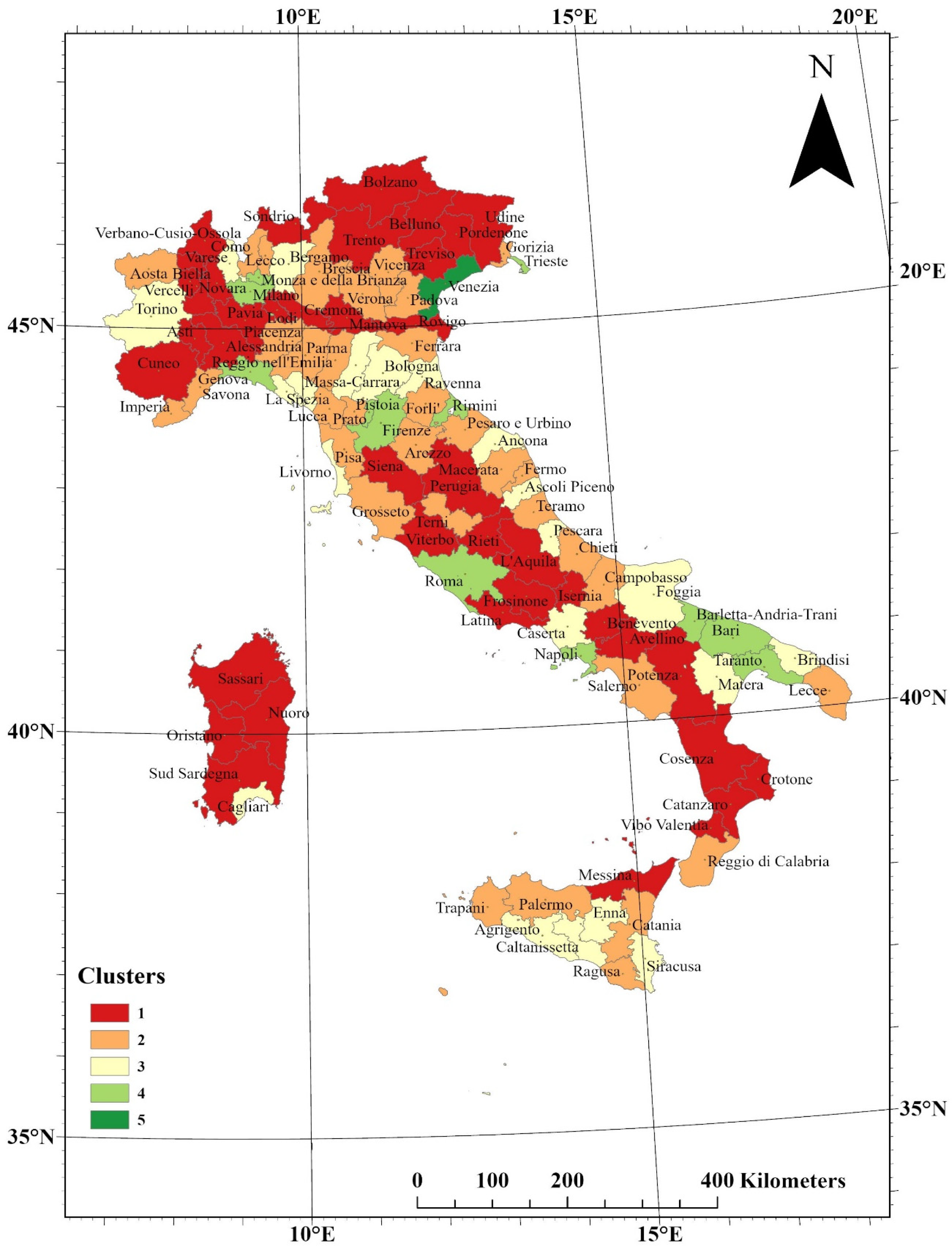
Time-series clustering was applied to group Italian provinces according to similarities in their NTLD temporal trajectories over the study period (Figure 10). This approach reduces the complexity of individual provincial time series by identifying common patterns of NTLD evolution and organizing provinces into a limited number of representative trajectory types. The clustering results revealed five distinct groups, each characterized by a unique temporal pattern of nighttime illumination. Provinces within the same cluster exhibited broadly similar NTLD trajectories, indicating comparable long-term dynamics in nighttime light intensity. These clusters captured differences in NTLD magnitude, temporal variability, and the persistence or fluctuation of illumination levels over time.
The spatial distribution of clusters demonstrates strong regional coherence. Large portions of Northern Italy, including several provinces in Lombardy, Veneto, and Trentino-Alto Adige, were grouped within clusters characterized by consistently higher NTLD levels and relatively stable temporal behavior. These provinces form contiguous spatial patterns, suggesting shared temporal trajectories across neighboring regions. In Central Italy, provinces are distributed across multiple clusters, reflecting more heterogeneous NTLD trajectories. Some Central provinces align with clusters exhibiting stable or moderately increasing NTLD over time, while others fall into clusters characterized by greater variability. This spatial intermixing indicates transitional temporal behaviors relative to the more homogeneous patterns found in Northern provinces. In Southern Italy and the islands, provinces were predominantly assigned to clusters associated with lower NTLD levels and more pronounced temporal fluctuations. Several Southern provinces exhibit trajectories marked by variability rather than sustained stability, leading to the participation of distinct, spatially concentrated clusters. Sardinia, in particular, shows strong internal consistency in cluster membership across its provinces, highlighting coherent temporal behavior at the regional scale.
Overall, clustering results indicate that provinces with similar NTLD temporal trajectories tend to be geographically homogeneous, forming spatially coherent groups across Italy. This spatiotemporal organization highlights systematic regional differences in the evolution of nighttime light and provides a structured framework for interpreting temporal dynamics beyond individual province-level trends. The identified clusters establish a foundation for subsequent hotspot and trend analysis by distinguishing provinces with stable, transitional, or highly variable nighttime illumination patterns.

3.6. Spatio-Temporal Hotspot Dynamics of NTL Intensity

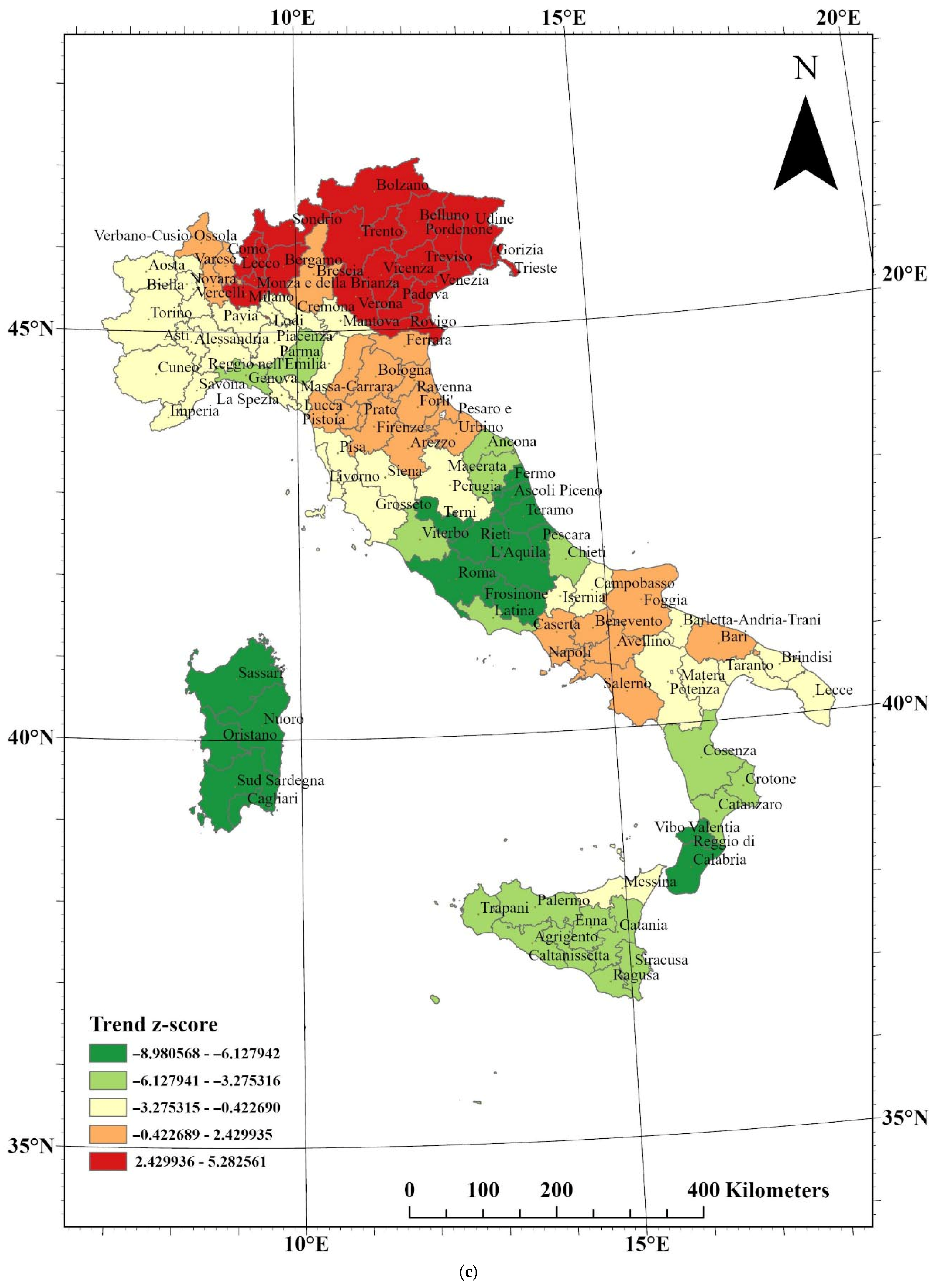
Emerging Hotspot Analysis (EHA) was applied to the NTLD time series to identify statistically significant spatio-temporal patterns in nighttime illumination across Italian provinces over the study period (Figure 11). By jointly evaluating temporal trends and spatial clustering, EHA provides a dynamic perspective on how NTL intensity evolves, revealing areas of sustained growth, decline, or instability.
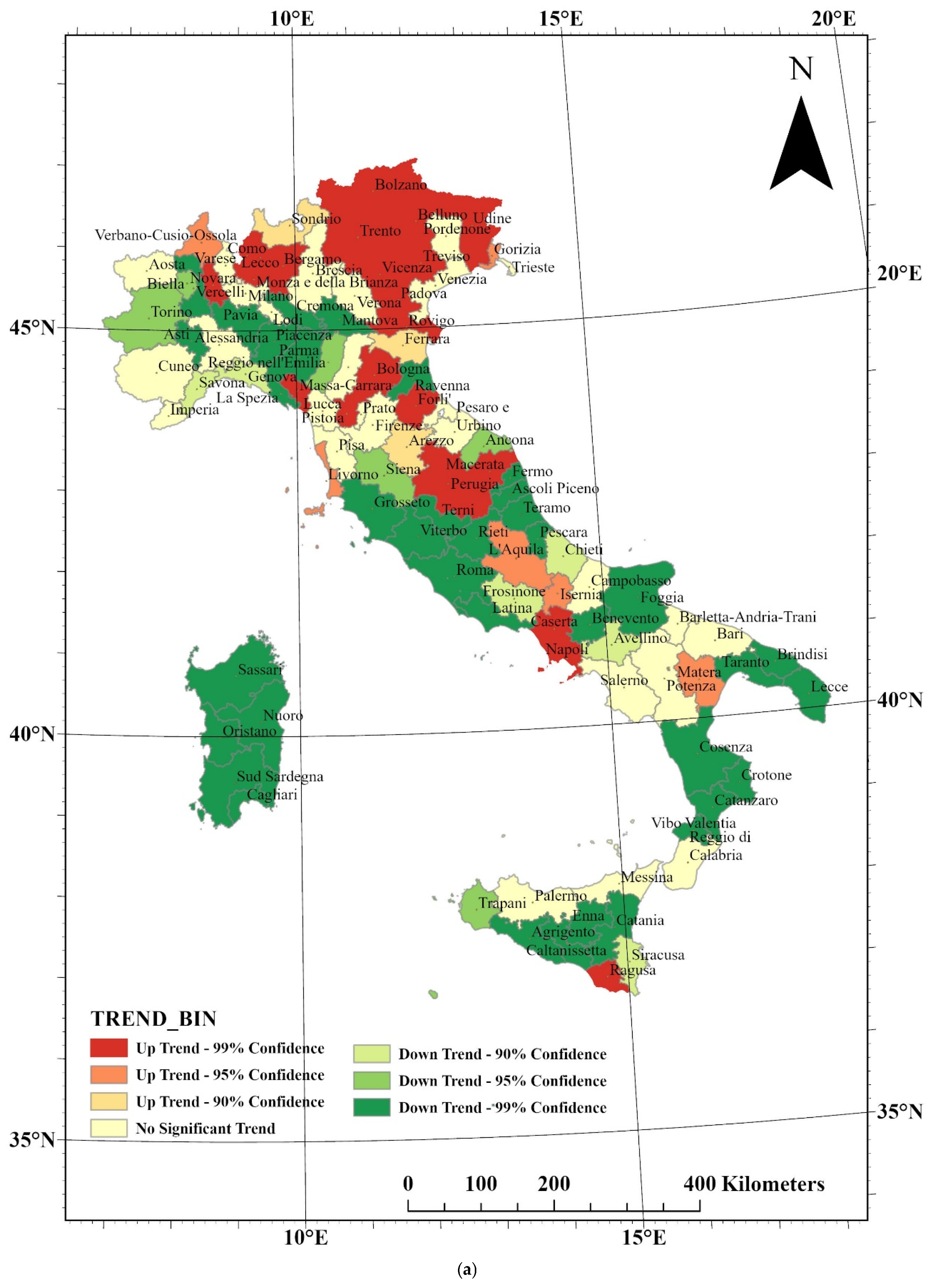
The trend map (Figure 11a) highlights provinces exhibiting statistically significant upward or downward NTLD trends. Provinces characterized by significant upward trends (upward at 90–99% confidence levels) were predominantly concentrated in Northern Italy and selected urbanized areas of Central and Southern Italy. These regions displayed persistent increases in nighttime illumination, indicating sustained growth in artificial lighting over time. In contrast, significant downward trends were observed in several provinces across Southern Italy and parts of the major islands, suggesting declining or stagnating illumination levels. A substantial number of provinces fell into the non-significant trend category, reflecting relatively stable NTLD conditions without a clear long-term directional change.
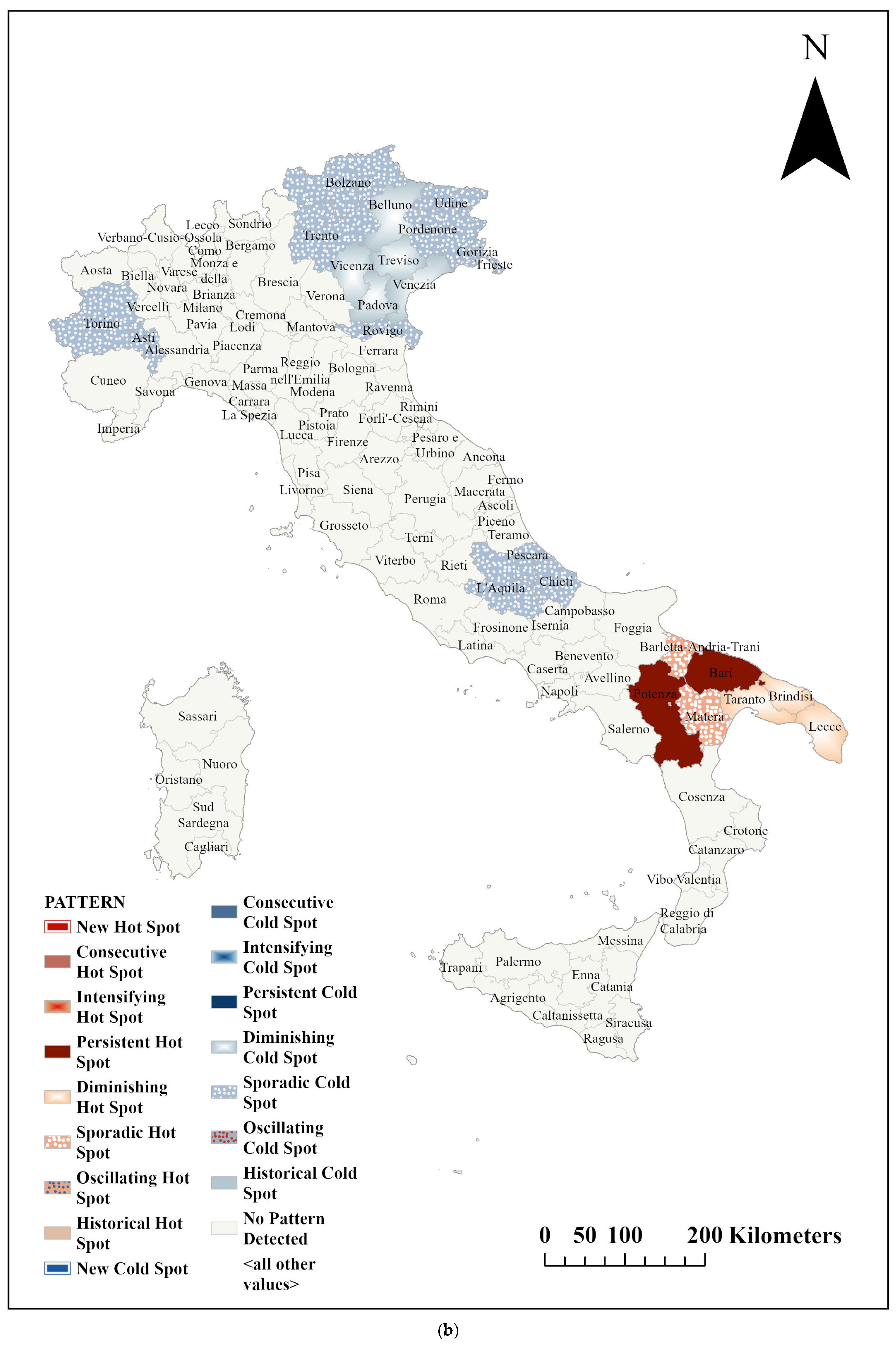
The pattern map (Figure 11b) further refines these results by categorizing provinces into distinctive hotspot and cold spot typologies based on the temporal consistency of spatial clustering. Persistent and intensifying hotspots are primarily associated with major urban and metropolitan regions, indicating provinces where high NTLD values are not only spatially clustered but also strengthening over time. These areas exhibited a stable concentration of high illumination, reflecting continuous nighttime activity. Sporadic and oscillating hotspots appeared in several provinces, particularly in some parts of Southern Italy, indicating an intermittent clustering of high NTLD values without a consistent temporal trajectory. Conversely, persistent and intensifying cold spots were primarily located in less urbanized or peripheral regions, where low NTLD values remained spatially clustered through time. Provinces classified as ‘no pattern detected’ suggest an absence of statistically significant spatiotemporal clustering.
The z-score map (Figure 11c) quantifies the statistical strength of the detected patterns, providing an additional measure of confidence in the identified hotspots and cold spots. High positive z-scores correspond to provinces with strongly significant hotspot behaviors, while strongly negative z-scores indicate robust cold spot dynamics. The spatial distribution of z-scores reinforces the North–South contrast observed in the trend and pattern maps, with higher statistical significance generally associated with Northern and selected Central provinces.
Overall, the EHA results reveal a heterogeneous spatiotemporal structure of nighttime illumination across Italy. While some provinces exhibited persistent and intensifying growth in NTLD, others demonstrated declining, sporadic, or even unstable patterns, highlighting the diverse trajectories of nighttime light dynamics. By integrating trend direction, spatial clustering, and statistical significance, the EHA provides a comprehensive summary of provinces undergoing sustained change versus those characterized by temporal instability or stagnation. These results complement the preceding clustering and correlation analysis and contribute to a holistic understanding of Italy’s spatio-temporal NTL dynamics.

4. Discussion

This study demonstrates the strong potential of nighttime light data as an integrative indicator of socioeconomic activity, metropolitan structure, and population dynamics across Italy. By combining descriptive statistics, temporal analysis, seasonal decomposition, clustering, and Emerging Hotspot Analysis, the empirical results of this study provide a multi-dimensional perspective on how nighttime illumination reflects both stable and evolving settlement processes. The spatial distribution of mean NTLD confirms that provinces with sustained economic activity and dense urban infrastructure exhibit persistently high illumination levels. Northern and Central Italian provinces—particularly major metropolitan and industrial areas—consistently rank highest in mean NTLD, reinforcing the established association between artificial light intensity, urbanization, and economic vitality [79,80,81]. In contrast, provinces characterized by lower urban density and weaker economic infrastructure display systematically lower NTLD values. These findings corroborate previous research identifying nighttime lights as a reliable proxy for urban growth and economic development, while extending this evidence through province-scale analysis [82,83,84].
Beyond average illumination levels, the joint interpretation of mean and temporal variability (STD) provides important insights into the stability of nighttime activity. Provinces combining high mean NTLD with low-to-moderate variability represent structurally stable local systems, whereas provinces exhibiting high variability indicate dynamic or uneven development trajectories. This distinction is particularly relevant for identifying regions where growth is episodic or spatially uneven, rather than sustained and uniform. The mean–STD framework therefore adds interpretive depth beyond conventional spatial ranking approaches. Long-term trend analysis further reveals pronounced regional contrasts in the evolution of nighttime illumination. Northern Italy exhibits comparatively stable and elevated NTLD trajectories, reflecting mature urban systems and sustained economic activity. Central Italy shows moderate-to-high NTLD levels accompanied by noticeable interannual variability, suggesting more dynamic yet still consolidated development patterns. Southern Italy displays the greatest heterogeneity, with provinces ranging from persistently high illumination to consistently low or fluctuating trajectories. These results reinforce the long-standing North–South gradient in Italian development, while highlighting that temporal dynamics—not only spatial averages—are essential for understanding regional inequality.
Seasonal modulation emerges as a critical component of NTLD. The seasonal analysis demonstrates that intra-annual variability contributes substantially to overall temporal dispersion, with summer exhibiting the strongest differentiation among provinces. Elevated summer NTLD levels, particularly in coastal and tourism-oriented regions, reflect intensified seasonal activity, while winter illumination patterns are comparatively more spatially uniform. This seasonal asymmetry indicates that short-term socioeconomic processes, such as tourism and seasonal mobility, play a significant role in shaping nighttime illumination patterns, and should be explicitly quantified.
The strong correlation between NTLD and population density across national and regional scales confirms the robustness of nighttime light data as a demographic proxy. Higher correlation strengths in Northern and Central Italy reflect more compact settlement patterns and consistent urban structures, whereas the slightly weaker association in Southern Italy delineates more heterogeneous relationships between population distribution and artificial lighting. These regional differences highlight the importance of contextual interpretation when using NTLD to infer demographic processes.
The application of time-series clustering provides additional insight by grouping provinces according to shared temporal trajectories rather than static attributes. The resulting clusters reveal spatially coherent regions characterized by stable, transitional, or highly variable NTLD behavior. This spatio-temporal grouping captures developmental pathways that are not readily apparent from single-year or average-based analysis, and offers a valuable framework for comparative regional assessment [85,86,87]. Emerging Hotspot Analysis further enhances this perspective by identifying statistically significant patterns of intensification, persistence, or decline in nighttime illumination. Persistent and intensifying hotspots are primarily associated with established economic centers, whereas diminishing or sporadic hotspots characterize regions experiencing instability or transitional dynamics [88,89,90]. The spatial coherence of these patterns underscores the utility of EHA for detecting not only where change occurs, but also how consistently it unfolds over time.
From a technical and operational point of view, the study is flexible enough to be applied across vastly different socioeconomic contexts worldwide. However, further studies are necessary to clarify some possibly different responses of VIIRS sensors to vastly diverging socioeconomic contexts in advanced, emerging, and ‘follower’ countries. For instance, the VIIRS sensor is blind to blue light; in many industrialized countries, a significant shift in lighting toward LED sources—which have a strong blue component—has been recorded, estimated, or at least hypothesized in recent years. This recent process could be investigated further to exclude a possible underestimation of the actual emitted light flux, and to better clarify the eventual time-series volatility due to ongoing changes. In this perspective, the estimations proposed here for Italy can be considered as prudential and may benefit from additional (technical) investigation in such directions, contributing to a fully operationalized, routine use of such sensors in economic applications.
Making available new data from original sources, such as remote sensing, adds great value to any economic study, and is usually based on official statistics, land cadasters, and other (more traditional) information sources. Based on these premises, integrating temporal statistics, seasonal analysis, clustering, and hotspot detection provides a comprehensive understanding of Italy’s nighttime illumination dynamics. This multi-method framework moves beyond descriptive mapping to reveal the structural, temporal, and spatial mechanisms underlying observed patterns [91,92,93]. From a policy perspective, these findings offer valuable guidance for regional planning, infrastructure investment, and sustainable development strategies, particularly in addressing uneven growth trajectories and reinforcing balanced regional development [94].

5. Conclusions

This study presented a comprehensive spatiotemporal assessment of nighttime light data across Italian provinces, demonstrating the capacity of NTLD to capture long-term, seasonal, and spatial dynamics of urbanization and socioeconomic activity. By integrating descriptive statistics, temporal trend analysis, seasonal decomposition, time-series clustering, and Emerging Hotspot Analysis, the research provides a unified framework for understanding how nighttime illumination evolves across heterogeneous regional contexts. The results reveal pronounced regional inequalities in Italy’s nighttime light dynamics. Northern and Central provinces exhibit persistently higher and more stable NTLD patterns, reflecting consolidated urban systems and sustained economic activity, whereas Southern regions display lower illumination levels and greater temporal variability, indicative of uneven development trajectories and structural socioeconomic challenges. Seasonal analysis further shows that summer contributes most strongly to intra-annual NTLD dispersion, while winter illumination patterns remain comparatively uniform, underscoring the role of short-term socioeconomic processes such as tourism.
The strong association between NTLD and population density confirms the robustness of nighttime lights as a proxy for demographic distribution, while regional variations in correlation strength highlight the need for context-aware interpretation. Moreover, the combined use of time-series clustering and Emerging Hotspot Analysis enables the identification of provinces undergoing persistent growth, decline, or transitional dynamics, offering insights that extend beyond static or single-period analyses. From a policy perspective, these findings emphasize the value of spatiotemporal NTL analysis for evidence-based regional planning. Identifying provinces with shared temporal trajectories or significant hotspot behaviors can support targeted interventions aimed at reducing regional disparities and promoting balanced, sustainable development. Future research should focus on integrating higher-resolution NTL products, complementary socioeconomic datasets, and multi-scale analytical approaches to further enhance the interpretability and applicability of nighttime light data in urban studies.

Author Contributions

Methodology, S.A.; Software, M.S.; Validation, I.K.; Formal analysis, H.R.-D.; Investigation, M.P. All authors have read and agreed to the published version of the manuscript.

Funding

This work has been partly supported by the University of Piraeus Research Center.

Institutional Review Board Statement

Not applicable.

Informed Consent Statement

Not applicable.

Data Availability Statement

The original contributions presented in this study are included in the article. Further inquiries can be directed to the corresponding authors.

Acknowledgments

We would like to express our sincere gratitude to Federico Benassi (University of Naples Federico II) for his valuable comments and helpful suggestions on an earlier draft of this paper. The authors would like to thank Sofia Ermida for the LST retrieval code (https://code.earthengine.google.com/?accept_repo=users/sofiaermida/landsat_smw_lst) (accessed on 5 January 2026). The authors would like to thank net friends from gis.stackexchange.com for the GEE operation’s generous professional instruction.

Conflicts of Interest

The authors declare no conflict of interest.

References

  1. Chichilnisky, G. What is Sustainable Development? In Man-Made Climate Change; Hohmeyer, O., Rennings, K., Eds.; ZEW Economic Studies; Physica-Verlag HD: Heidelberg, Germany, 1999; Volume 1, pp. 42–82. [Google Scholar] [CrossRef]
  2. Elliott, J. An introduction to Sustainable Development; Routledge: Oxfordshire, UK, 2012; Available online: https://www.taylorfrancis.com/books/mono/10.4324/9780203844175/introduction-sustainable-development-jennifer-elliott (accessed on 17 October 2024).
  3. Mitlin, D. Sustainable Development: A Guide to the Literature. Environ. Urban. 1992, 4, 111–124. [Google Scholar] [CrossRef]
  4. Salvati, L.; Venanzoni, G.; Carlucci, M. Towards (spatially) unbalanced development? A joint assessment of regional disparities in socioeconomic and territorial variables in Italy. Land Use Policy 2016, 51, 229–235. [Google Scholar] [CrossRef]
  5. Galeotti, M. Economic growth and the quality of the environment: Taking stock. Environ. Dev. Sustain. 2007, 9, 427–454. [Google Scholar] [CrossRef]
  6. Andreano, M.S.; Benedetti, R.; Piersimoni, F.; Savio, G. Mapping Poverty of Latin American and Caribbean Countries from Heaven Through Night-Light Satellite Images. Soc. Indic. Res. 2021, 156, 533–562. [Google Scholar] [CrossRef]
  7. Zhang, G.; Guo, X.; Li, D.; Jiang, B. Evaluating the potential of LJ1-01 nighttime light data for modeling socio-economic parameters. Sensors 2019, 19, 1465. [Google Scholar] [CrossRef]
  8. Bluhm, R.; McCord, G.C. What can we learn from nighttime lights for small geographies? measurement errors and heterogeneous elasticities. Remote Sens. 2022, 14, 1190. [Google Scholar]
  9. Elvidge, C.D.; Baugh, K.E.; Anderson, S.J.; Sutton, P.C.; Ghosh, T. The Night Light Development Index (NLDI): A spatially explicit measure of human development from satellite data. Soc. Geogr. 2012, 7, 23–35. [Google Scholar] [CrossRef]
  10. Fragou, S.; Kalogeropoulos, K.; Stathopoulos, N.; Louka, P.; Srivastava, P.K.; Karpouzas, S.; Kalivas, D.P.; Petropoulos, G.P. Quantifying land cover changes in a mediterranean environment using Landsat TM and Support Vector Machines. Forests 2020, 11, 750. [Google Scholar] [CrossRef]
  11. Mncube, Z.; Xulu, S. Progress of nighttime light applications within the google earth engine cloud platform. Geocarto Int. 2022, 38, 1–22. [Google Scholar] [CrossRef]
  12. Chelli, F.M.; Guandalini, A. Satellite imagery for studying development? the italian case study. Riv. Ital. Econ. Demogr. E Stat. 2015, 69, 144–154. [Google Scholar]
  13. Crisci, M.; Benassi, F.; Rabiei-Dastjerdi, H.; McArdle, G. Spatio-temporal variations and contextual factors of the supply of Airbnb in Rome. An initial investigation. Lett. Spat. Resour. Sci. 2022, 15, 237–253. [Google Scholar] [CrossRef]
  14. Ivan, K.; Holobâcă, I.-H.; Benedek, J.; Török, I. Potential of night-time lights to measure regional inequality. Remote Sens. 2019, 12, 33. [Google Scholar] [CrossRef]
  15. Zhao, M.; Zhou, Y.; Li, X.; Cao, W.; He, C.; Yu, B.; Li, X.; Elvidge, C.D.; Cheng, W.; Zhou, C. Applications of satellite remote sensing of nighttime light observations: Advances, challenges, and perspectives. Remote Sens. 2019, 11, 1971. [Google Scholar] [CrossRef]
  16. Zhang, Q.; Seto, K.C. Mapping urbanization dynamics at regional and global scales using multi-temporal DMSP/OLS nighttime light data. Remote Sens. Environ. 2011, 115, 2320–2329. [Google Scholar] [CrossRef]
  17. Zhou, K.; Liang, Y.; Zhong, C.; Zeng, J.; Zhou, Z. Spatial features of urban expansion in Vietnam based on long-term nighttime lights data. Land 2022, 11, 601. [Google Scholar] [CrossRef]
  18. Jalali, S.; Karbakhsh, M.; Momeni, M.; Taheri, M.; Amini, S.; Mansourian, M.; Sarrafzadegan, N. Long-term exposure to PM2. 5 and cardiovascular disease incidence and mortality in an Eastern Mediterranean country: Findings based on a 15-year cohort study. Environ. Health 2021, 20, 112. [Google Scholar] [CrossRef]
  19. Kaban, P.A.; Nasution, B.I.; Caraka, R.E.; Kurniawan, R. Implementing night light data as auxiliary variable of small area estimation. Commun. Stat. Theory Methods 2024, 53, 310–327. [Google Scholar] [CrossRef]
  20. Zhao, Q.; Yu, L.; Li, X.; Peng, D.; Zhang, Y.; Gong, P. Progress and trends in the application of Google Earth and Google Earth Engine. Remote Sens. 2021, 13, 3778. [Google Scholar] [CrossRef]
  21. Mutanga, O.; Kumar, L. Google earth engine applications. Remote Sens. 2019, 11, 591. [Google Scholar] [CrossRef]
  22. Sood, V.; Gupta, D.K.; Singh, S.; Biswajeet, P. Google Earth Engine and Artificial Intelligence for Earth Observation—Algorithms and Sustainable Applications; Elsevier: Amsterdam, The Netherlands, 2025; Available online: https://www.sciencedirect.com/book/edited-volume/9780443273728/google-earth-engine-and-artificial-intelligence-for-earth-observation (accessed on 5 January 2026).
  23. Cardille, J.A.; Crowley, M.A.; Saah, D.; Clinton, N.E. Cloud-Based Remote Sensing with Google Earth Engine: Fundamentals and Applications; Springer Nature: Berlin/Heidelberg, Germany, 2023; Available online: https://books.google.com/books?hl=en&lr=&id=AyTbEAAAQBAJ&oi=fnd&pg=PR6&dq=Cloud-Based+Remote+Sensing+with+Google+Earth+Engine+Fundamentals+and+Applications&ots=wLoJSb3c6J&sig=xNe1B4lr9E5YntKji36FBI4GM1Y (accessed on 26 August 2025).
  24. Zheng, Q.; Weng, Q.; Wang, K. Characterizing urban land changes of 30 global megacities using nighttime light time series stacks. ISPRS J. Photogramm. Remote Sens. 2021, 173, 10–23. [Google Scholar] [CrossRef]
  25. Mohammadi, S.; Saber, M.; Amini, S.; Mostafavi, M.A.; McArdle, G.; Rabiei-Dastjerdi, H. Environmental conditions in middle eastern megacities: A comparative spatiotemporal analysis using remote sensing time series. Remote Sens. 2022, 14, 5834. [Google Scholar]
  26. Shen, Z.; Wang, Y.; Su, H.; He, Y.; Li, S. A bi-directional strategy to detect land use function change using time-series Landsat imagery on Google Earth Engine: A case study of Huangshui River Basin in China. Sci. Remote Sens. 2022, 5, 100039. [Google Scholar] [CrossRef]
  27. Rabiei-Dastjerdi, H.; Mohammadi, S.; Saber, M.; Amini, S.; McArdle, G. Spatiotemporal Analysis of NO2 Production Using TROPOMI Time-Series Images and Google Earth Engine in a Middle Eastern Country. Remote Sens. 2022, 14, 1725. [Google Scholar] [CrossRef]
  28. Wu, P.; Tan, Y. Estimation of economic indicators using residual neural network ResNet50. In 2019 International Conference on Data Mining Workshops (ICDMW); IEEE: New York, NY, USA, 2019; pp. 206–209. Available online: https://ieeexplore.ieee.org/abstract/document/8955511/ (accessed on 13 October 2024).
  29. Janga, B.; Asamani, G.P.; Sun, Z.; Cristea, N. A review of practical ai for remote sensing in earth sciences. Remote Sens. 2023, 15, 4112. [Google Scholar]
  30. Zhang, L.; Zhang, L. Artificial intelligence for remote sensing data analysis: A review of challenges and opportunities. IEEE Geosci. Remote Sens. Mag. 2022, 10, 270–294. [Google Scholar]
  31. Wilkinson, G.G. A review of current issues in the integration of GIS and remote sensing data. Int. J. Geogr. Inf. Syst. 1996, 10, 85–101. [Google Scholar] [CrossRef]
  32. Amini, S.; Saber, M.; Rabiei-Dastjerdi, H.; Homayouni, S. Urban Land Use and Land Cover Change Analysis Using Random Forest Classification of Landsat Time Series. Remote Sens. 2022, 14, 2654. [Google Scholar]
  33. Shirmard, H.; Farahbakhsh, E.; Müller, R.D.; Chandra, R. A review of machine learning in processing remote sensing data for mineral exploration. Remote Sens. Environ. 2022, 268, 112750. [Google Scholar] [CrossRef]
  34. Asso, P.F. New perspectives on old inequalities: Italy’s north–south divide. Territ. Polit. Gov. 2021, 9, 346–364. [Google Scholar] [CrossRef]
  35. Buonomo, A.; Gatti, R.; Benassi, F. Internal Migration Patterns of National and Foreign Population in Italy. A Local Spatial Comparative Approach. Migr. Lett. 2023, 20, 411–420. [Google Scholar] [CrossRef]
  36. Chen, Z.; Yu, B.; Yang, C.; Zhou, Y.; Yao, S.; Qian, X.; Wang, C.; Wu, B.; Wu, J. An extended time-series (2000–2018) of global NPP-VIIRS-like nighttime light data from a cross-sensor calibration. Earth Syst. Sci. Data Discuss. 2020, 13, 889–906. [Google Scholar] [CrossRef]
  37. Pambuku, A.; Elia, M.; Gardelli, A.; Giannico, V.; Sanesi, G.; Bergantino, A.S.; Intini, M.; Lafortezza, R. Assessing urbanization dynamics using a pixel-based nighttime light indicator. Ecol. Indic. 2024, 166, 112486. [Google Scholar] [CrossRef]
  38. Marcantonio, M.; Pareeth, S.; Rocchini, D.; Metz, M.; Garzon-Lopez, C.X.; Neteler, M. The integration of Artificial Night-Time Lights in landscape ecology: A remote sensing approach. Ecol. Complex. 2015, 22, 109–120. [Google Scholar] [CrossRef]
  39. Salvati, L.; Zitti, M.; Carlucci, M. In-between regional disparities and spatial heterogeneity: A multivariate analysis of territorial divides in Italy. J. Environ. Plan. Manag. 2017, 60, 997–1015. [Google Scholar] [CrossRef]
  40. Strozza, S.; Benassi, F.; Ferrara, R.; Gallo, G. Recent Demographic Trends in the Major Italian Urban Agglomerations: The Role of Foreigners. Spat. Demogr. 2016, 4, 39–70. [Google Scholar] [CrossRef]
  41. Benassi, F.; Buonomo, A.; Rabiei-Dastjerdi, H.; Carella, M. Multiscale dimensions of the foreign working citizens participation to the Italian labour market: Intra-regional heterogeneities across the North–South divide. Lett. Spat. Resour. Sci. 2024, 17, 22. [Google Scholar] [CrossRef]
  42. Salvati, L.; Benassi, F.; Miccoli, S.; Rabiei-Dastjerdi, H.; Matthews, S.A. Spatial variability of total fertility rate and crude birth rate in a low-fertility country: Patterns and trends in regional and local scale heterogeneity across Italy, 2002–2018. Appl. Geogr. 2020, 124, 102321. [Google Scholar] [CrossRef]
  43. Bonifazi, C.; Heins, F.; Licari, F.; Tucci, E. The regional dynamics of internal migration intensities in Italy. Popul. Space Place 2021, 27, e2331. [Google Scholar] [CrossRef]
  44. Billari, F.; Kohler, H.-P. Patterns of low and lowest-low fertility in Europe. Popul. Stud. 2004, 58, 161–176. [Google Scholar] [CrossRef]
  45. Reynaud, C.; Miccoli, S. Population ageing in Italy after the 2008 economic crisis: A demographic approach. Futures 2019, 105, 17–26. [Google Scholar] [CrossRef]
  46. Lin, J.; Shi, W. Statistical correlation between monthly electric power consumption and VIIRS nighttime light. ISPRS Int. J. Geo-Inf. 2020, 9, 32. [Google Scholar] [CrossRef]
  47. Forbes, D.J. Multi-scale analysis of the relationship between economic statistics and DMSP-OLS night light images. GIScience Remote Sens. 2013, 50, 483–499. [Google Scholar] [CrossRef]
  48. Ali, Z.; Bhaskar, S.B. Basic statistical tools in research and data analysis. Indian J. Anaesth. 2016, 60, 662–669. [Google Scholar] [CrossRef] [PubMed]
  49. Levin, N.; Kyba, C.C.; Zhang, Q.; de Miguel, A.S.; Román, M.O.; Li, X.; Portnov, B.A.; Molthan, A.L.; Jechow, A.; Miller, S.D.; et al. Remote sensing of night lights: A review and an outlook for the future. Remote Sens. Environ. 2020, 237, 111443. [Google Scholar] [CrossRef]
  50. Proville, J.; Zavala-Araiza, D.; Wagner, G. Night-time lights: A global, long term look at links to socio-economic trends. PLoS ONE 2017, 12, e0174610. [Google Scholar] [CrossRef] [PubMed]
  51. Huang, Q.; Yang, X.; Gao, B.; Yang, Y.; Zhao, Y. Application of DMSP/OLS nighttime light images: A meta-analysis and a systematic literature review. Remote Sens. 2014, 6, 6844–6866. [Google Scholar] [CrossRef]
  52. Henderson, M.; Yeh, E.T.; Gong, P.; Elvidge, C.; Baugh, K. Validation of urban boundaries derived from global night-time satellite imagery. Int. J. Remote Sens. 2003, 24, 595–609. [Google Scholar] [CrossRef]
  53. Ma, T.; Zhou, Y.; Zhou, C.; Haynie, S.; Pei, T.; Xu, T. Night-time light derived estimation of spatio-temporal characteristics of urbanization dynamics using DMSP/OLS satellite data. Remote Sens. Environ. 2015, 158, 453–464. [Google Scholar] [CrossRef]
  54. Elvidge, C.D.; Hsu, F.-C.; Baugh, K.E.; Ghosh, T. National trends in satellite-observed lighting. Glob. Urban Monit. Assess. Earth Obs. 2014, 23, 97–118. [Google Scholar]
  55. Mellander, C.; Lobo, J.; Stolarick, K.; Matheson, Z. Night-time light data: A good proxy measure for economic activity? PLoS ONE 2015, 10, e0139779. [Google Scholar] [CrossRef]
  56. Zhao, H.; Duan, X.; Stewart, B.; You, B.; Jiang, X. Spatial correlations between urbanization and river water pollution in the heavily polluted area of Taihu Lake Basin, China. J. Geogr. Sci. 2013, 23, 735–752. [Google Scholar] [CrossRef]
  57. Van Den Bergh, F.; Wessels, K.J.; Miteff, S.; Van Zyl, T.L.; Gazendam, A.D.; Bachoo, A.K. HiTempo: A platform for time-series analysis of remote-sensing satellite data in a high-performance computing environment. Int. J. Remote Sens. 2012, 33, 4720–4740. [Google Scholar] [CrossRef]
  58. Almalki, R.; Khaki, M.; Saco, P.M.; Rodriguez, J.F. Monitoring and mapping vegetation cover changes in arid and semi-arid areas using remote sensing technology: A review. Remote Sens. 2022, 14, 5143. [Google Scholar]
  59. Rabiei-Dastjerdi, H.; McArdle, G.; Hynes, W. Which came first, the gentrification or the Airbnb? Identifying spatial patterns of neighbourhood change using Airbnb data. Habitat Int. 2022, 125, 102582. [Google Scholar] [CrossRef]
  60. Andrienko, G.; Andrienko, N.; Demsar, U.; Dransch, D.; Dykes, J.; Fabrikant, S.I.; Jern, M.; Kraak, M.-J.; Schumann, H.; Tominski, C. Space, time and visual analytics. Int. J. Geogr. Inf. Sci. 2010, 24, 1577–1600. [Google Scholar] [CrossRef]
  61. Rabiei-Dastjerdi, H.; McArdle, G. Novel exploratory spatiotemporal analysis to identify sociospatial patterns at small areas using property transaction data in Dublin. Land 2021, 10, 566. [Google Scholar] [CrossRef]
  62. Hedley, N.R.; Drew, C.H.; Arfin, E.A.; Lee, A. Hagerstrand revisited: Interactive space-time visualizations of complex spatial data. Inform. Ljubl. 1999, 23, 155–168. [Google Scholar]
  63. Cao, Z.; Wu, M.; Wang, D.; Wan, B.; Jiang, H.; Tan, X.; Zhang, Q. Space-time cube uncovers spatiotemporal patterns of basin ecological quality and their relationship with water eutrophication. Sci. Total Environ. 2024, 916, 170195. [Google Scholar]
  64. Getis, A.; Ord, J.K. The Analysis of Spatial Association by Use of Distance Statistics. Geogr. Anal. 1992, 24, 189–206. [Google Scholar] [CrossRef]
  65. Campello, R.J.G.B.; Moulavi, D.; Sander, J. Density-Based Clustering Based on Hierarchical Density Estimates. In Advances in Knowledge Discovery and Data Mining; Pei, J., Tseng, V.S., Cao, L., Motoda, H., Xu, G., Eds.; Lecture Notes in Computer Science; Springer: Berlin/Heidelberg, Germany, 2013; Volume 7819, pp. 160–172. [Google Scholar] [CrossRef]
  66. Kraak, M. Geovisualization and Time—New Opportunities for the Space–Time Cube. In Geographic Visualization, 1st ed.; Dodge, M., McDerby, M., Turner, M., Eds.; Wiley: Hoboken, NJ, USA, 2008; pp. 293–306. [Google Scholar] [CrossRef]
  67. Dodge, M.; McDerby, M.; Turner, M. Geographic Visualization: Concepts, Tools and Applications; John Wiley & Sons: Hoboken, NJ, USA, 2011; Available online: https://books.google.com/books?hl=en&lr=&id=71rRm1xDEYwC&oi=fnd&pg=PA1966&dq=Geographic+visualization:+Concepts,+tools+and+applications+(pp.+Mann,+H.+B.+(1945).+Nonparametric+tests+against+trend&ots=1_nxGXLxLw&sig=rDI_C8vsz0znbDXSBfznagQaMg4 (accessed on 18 October 2024).
  68. Kendall, M.G. Rank Correlation Methods; Springer: Boston, MA, USA, 1948; Available online: https://psycnet.apa.org/record/1948-15040-000 (accessed on 18 October 2024).
  69. Birant, D.; Kut, A. ST-DBSCAN: An algorithm for clustering spatial–temporal data. Data Knowl. Eng. 2007, 60, 208–221. [Google Scholar]
  70. Rong, Q.; Yan, J.; Guo, G. Research and implementation of clustering algorithm based on DBSCAN. Comput. Appl. 2004, 24, 45–46. [Google Scholar]
  71. Hamed, K.H. Exact distribution of the Mann–Kendall trend test statistic for persistent data. J. Hydrol. 2009, 365, 86–94. [Google Scholar] [CrossRef]
  72. Aghabozorgi, S.; Shirkhorshidi, A.S.; Wah, T.Y. Time-series clustering–a decade review. Inf. Syst. 2015, 53, 16–38. [Google Scholar] [CrossRef]
  73. Liao, T.W. Clustering of time series data—A survey. Pattern Recognit. 2005, 38, 1857–1874. [Google Scholar] [CrossRef]
  74. Jian, A.K. Data clustering: 50 years beyond k-means. Pattern Recognit. Lett. 2009, 31, 651–666. [Google Scholar] [CrossRef]
  75. Sutton, P.C.; Elvidge, C.D.; Ghosh, T. Estimation of gross domestic product at sub-national scales using nighttime satellite imagery. Int. J. Ecol. Econ. Stat. 2007, 8, 5–21. [Google Scholar]
  76. Scheyvens, R.; Russell, M. Tourism, Land Tenure and Poverty Alleviation in Fiji. Tour. Geogr. 2012, 14, 1–25. [Google Scholar] [CrossRef]
  77. Wagner, W.C.; Neigh, C.S.; Shean, D.E.; Montesano, P.M.; Yin, T.; Mkaouar, A. Vegetation Height Stereo Reconstruction with BlackSky Commercial Frame Camera Imagery. In IGARSS 2024—2024 IEEE International Geoscience and Remote Sensing Symposium; IEEE: New York, NY, USA, 2024; pp. 2446–2450. Available online: https://ieeexplore.ieee.org/abstract/document/10642757/ (accessed on 5 January 2026).
  78. Li, X.; Zhao, L.; Li, D.; Xu, H. Mapping urban extent using Luojia 1-01 nighttime light imagery. Sensors 2018, 18, 3665. [Google Scholar] [CrossRef]
  79. Quaranta, G.; Salvia, R.; Salvati, L.; Paola, V.D.; Coluzzi, R.; Imbrenda, V.; Simoniello, T. Long-term impacts of grazing management on land degradation in a rural community of Southern Italy: Depopulation matters. Land Degrad. Dev. 2020, 31, 2379–2394. [Google Scholar] [CrossRef]
  80. Coluzzi, R.; Bianchini, L.; Egidi, G.; Cudlin, P.; Imbrenda, V.; Salvati, L.; Lanfredi, M. Density matters? Settlement expansion and land degradation in Peri-urban and rural districts of Italy. Environ. Impact Assess. Rev. 2022, 92, 106703. [Google Scholar] [CrossRef]
  81. Tomao, A.; Quatrini, V.; Corona, P.; Ferrara, A.; Lafortezza, R.; Salvati, L. Resilient landscapes in Mediterranean urban areas: Understanding factors influencing forest trends. Environ. Res. 2017, 156, 1–9. [Google Scholar] [CrossRef]
  82. Lamonica, G.R.; Recchioni, M.C.; Chelli, F.M.; Salvati, L. The efficiency of the cross-entropy method when estimating the technical coefficients of input–output tables. Spat. Econ. Anal. 2020, 15, 62–91. [Google Scholar] [CrossRef]
  83. Salvati, L.; Morelli, V.G.; Rontos, K.; Sabbi, A. Latent exurban development: City expansion along the rural-to-urban gradient in growing and declining regions of southern Europe. Urban Geogr. 2013, 34, 376–394. [Google Scholar] [CrossRef]
  84. Salvati, L.; Carlucci, M. The economic and environmental performances of rural districts in Italy: Are competitiveness and sustainability compatible targets? Ecol. Econ. 2011, 70, 2446–2453. [Google Scholar] [CrossRef]
  85. Incerti, G.; Feoli, E.; Salvati, L.; Brunetti, A.; Giovacchini, A. Analysis of bioclimatic time series and their neural network-based classification to characterise drought risk patterns in South Italy. Int. J. Biometeorol. 2007, 51, 253–263. [Google Scholar] [CrossRef] [PubMed]
  86. Salvati, L.; Zitti, M. Regional convergence of environmental variables: Empirical evidences from land degradation. Ecol. Econ. 2008, 68, 162–168. [Google Scholar] [CrossRef]
  87. Salvati, L.; Carlucci, M. A composite index of sustainable development at the local scale: Italy as a case study. Ecol. Indic. 2014, 43, 162–171. [Google Scholar] [CrossRef]
  88. Salvati, L.; Zitti, M. Substitutability and weighting of ecological and economic indicators: Exploring the importance of various components of a synthetic index. Ecol. Econ. 2009, 68, 1093–1099. [Google Scholar] [CrossRef]
  89. Salvati, L.; Venanzoni, G.; Serra, P.; Carlucci, M. Scattered or polycentric? Untangling urban growth in three southern European metropolitan regions through exploratory spatial data analysis. Ann. Reg. Sci. 2016, 57, 1–29. [Google Scholar] [CrossRef]
  90. Ferrara, C.; Carlucci, M.; Grigoriadis, E.; Corona, P.; Salvati, L. A comprehensive insight into the geography of forest cover in Italy: Exploring the importance of socioeconomic local contexts. For. Policy Econ. 2017, 75, 12–22. [Google Scholar] [CrossRef]
  91. Sallustio, L.; Pettenella, D.; Merlini, P.; Romano, R.; Salvati, L.; Marchetti, M.; Corona, P. Assessing the economic marginality of agricultural lands in Italy to support land use planning. Land Use Policy 2018, 76, 526–534. [Google Scholar] [CrossRef]
  92. Egidi, G.; Salvati, L.; Vinci, S. The long way to tipperary: City size and worldwide urban population trends, 1950–2030. Sustain. Cities Soc. 2020, 60, 102148. [Google Scholar] [CrossRef]
  93. Seifollahi-Aghmiuni, S.; Kalantari, Z.; Egidi, G.; Gaburova, L.; Salvati, L. Urbanisation-driven land degradation and socioeconomic challenges in peri-urban areas: Insights from Southern Europe. Ambio 2022, 51, 1446–1458. [Google Scholar] [CrossRef]
  94. Sánchez de Miguel, A.; Bennie, J.; Rosenfeld, E.; Dzurjak, S.; Gaston, K.J. First Estimation of Global Trends in Nocturnal Power Emissions Reveals Acceleration of LightPollution. Remote Sens. 2021, 13, 3311. [Google Scholar] [CrossRef]
Figure 1. Location of the study area showing Italian provinces analyzed in this study.
Geographies 06 00045 g001
Figure 2. Space–time cube representation [59].
Geographies 06 00045 g002
Figure 3. Workflow of the proposed methodology illustrating a spatio-temporal monitoring of nighttime light satellite data in Italy.
Geographies 06 00045 g003
Figure 4. Spatial distribution of mean NTLD across Italian provinces for 2014–2022 time interval: (a) ranking of provinces based on mean NTLD values (ranging approximately from 0 to 3), and (b) spatial map of mean NTLD rankings (see Panel (a)), illustrating the geographical concentration of high and low illumination levels at the provincial scale.
Geographies 06 00045 g004aGeographies 06 00045 g004b
Figure 5. Temporal variability of NTLD across Italian provinces (2014–2022): (a) ranking of provinces based on the STD of NTLD, and (b) spatial distribution of STD rankings, highlighting regional differences in the temporal stability of nighttime illumination.
Geographies 06 00045 g005aGeographies 06 00045 g005b
Figure 6. The relationship between mean NTLD and temporal variability (STD) across 107 Italian provinces. Each point represents a province, illustrating the joint behavior of average nighttime illumination intensity and its inter-annual variability; the blue circle indicates provinces jointly with high mean and variability illumination rates, indicating particularly complex (urban–rural) territorial systems, such as Rome, Naples, Milan, and Genoa.
Geographies 06 00045 g006
Figure 7. Interannual variation in NTLD across Italian provinces during 2014–2022 time interval: (a) national-scale trends for all provinces, (b) Northern Italy, (c) Central Italy, and (d) Southern Italy.
Geographies 06 00045 g007aGeographies 06 00045 g007b
Figure 8. Seasonal variations in NTLD across Italian provinces: (a) winter (December–January–February), (b) spring (March–April–May), (c) summer (June–July–August), and (d) autumn (September–October–November).
Geographies 06 00045 g008aGeographies 06 00045 g008b
Figure 9. Correlation between NTLD and population density at national and regional scales: (a) the whole study area, (b) Northern Italy, (c) Central Italy, and (d) Southern Italy. Each subplot shows the linear relationship between NTLD and population density, with the corresponding regression trend line.
Geographies 06 00045 g009
Figure 10. Time-series clustering results of NTLD trajectories across Italian provinces.
Geographies 06 00045 g010
Figure 11. Results of EHA for NTLD: (a) trend map, (b) hotspot pattern map (the graph includes all the possible typologies, not only the typologies found in Italy), and (c) z-score map.
Geographies 06 00045 g011aGeographies 06 00045 g011bGeographies 06 00045 g011c
Table 1. Description of datasets included in the study.
NameDataset ProviderData AvailabilitySpatial ResolutionUnit
VIIRS Stray Light Corrected Nighttime Day/Night Band Composites Version 1Earth Observation Group, Payne Institute for Public Policy, Colorado School of Mines1 January 2014/1 January 2023463.83 mnanowatts/cm2/sr
National demographic dataItalian National Institute of Statistics (Istat)2002–2022
(Annual series)
Province-BasedMixture of Units
Table 2. Description of different patterns in EHA.
Pattern NameDefinition
No Pattern DetectedA location where no statistically significant clustering pattern has been identified.
New Hot SpotA location that became a statistically significant hot spot in the final time step, without being one before.
Consecutive Hot SpotA location with at least two consecutive significant hot spot intervals at the end, without prior hot spot history.
Intensifying Hot SpotA location that has been a hot spot for 90% of intervals, showing a significant increase in clustering intensity.
Persistent Hot SpotA location that has been a hot spot for 90% of intervals, with no overall change in clustering intensity.
Diminishing Hot SpotA location that has been a hot spot for 90% of intervals, with a significant decrease in clustering intensity.
Sporadic Hot SpotA location that was a significant hot spot in the final interval, with a history of intermittent hot spots, but fewer than 90% of intervals being hot spots, and no cold spot intervals.
Oscillating Hot SpotA location that was a hot spot in the final interval but previously a cold spot, with fewer than 90% of intervals as hot spots.
Historical (Former) Hot SpotThe most recent time period is not a hot spot, but 90% of previous intervals were significant hot spots.
New Cold SpotA location that became a statistically significant cold spot in the final time step, without being one before.
Consecutive Cold SpotA location with at least two consecutive significant cold spot intervals at the end, with no prior history of being a cold spot, and fewer than 90% of all intervals being cold spots.
Consecutive Cold SpotA location with at least two consecutive cold spot intervals at the end, with no prior cold spot history.
Intensifying Cold SpotA location that has been a cold spot for 90% of intervals, with a significant increase in clustering intensity.
Persistent Cold SpotA location that has been a cold spot for 90% of intervals, with no overall change in clustering intensity.
Diminishing Cold SpotA location that has been a cold spot for 90% of intervals, with a significant decrease in clustering intensity.
Sporadic Cold SpotA location that was a significant cold spot in the final interval, with a history of intermittent cold spots, but fewer than 90% of intervals were cold spots, and there were no hot spot intervals.
Oscillating Cold SpotA location that was a cold spot in the final interval, but previously a hot spot, with fewer than 90% of intervals as cold spots.
Historical Cold SpotThe most recent time period is not a cold spot, but 90% of previous intervals were significant cold spots.
Disclaimer/Publisher’s Note: The statements, opinions and data contained in all publications are solely those of the individual author(s) and contributor(s) and not of MDPI and/or the editor(s). MDPI and/or the editor(s) disclaim responsibility for any injury to people or property resulting from any ideas, methods, instructions or products referred to in the content.