Article

Stride Mechanics and Strength Analysis of Lower Limbs in Runners with Medial Tibial Stress Syndrome vs. Asymptomatic Runners


by
Estélio Henrique Martin Dantas
1,2,3,
Ronald Bispo Barreto
1,
Miguel Angel Narvaez Silva
4,
Marcos Antonio Almeida-Santos
1,3,
Guido Belli
5,* and
Luca Russo
5
1
Undergraduate Medical Course, Tiradentes University (UNIT), Aracaju 49032-490, Brazil
2
Doctoral Degree Program in Nursing and Biosciences (PPgEnfBio), Federal University of the State of Rio de Janeiro (UNIRIO), Rio de Janeiro 22290-250, Brazil
3
Master’s and Doctoral Degree Program in Bioscience and Health (PPBS), Tiradentes University (UNIT), Aracaju 49032-490, Brazil
4
Western Illinois University (WIU), Macomb, IL 61455, USA
5
Department of Theoretical and Applied Sciences, eCampus University, 22060 Novedrate, Italy
*
Author to whom correspondence should be addressed.
Biomechanics 2025, 5(4), 106; https://doi.org/10.3390/biomechanics5040106
Submission received: 11 October 2025 / Revised: 24 November 2025 / Accepted: 4 December 2025 / Published: 17 December 2025
(This article belongs to the Section Gait and Posture Biomechanics)

Abstract

Background: Street running has seen rapid growth due to its health benefits and accessibility, leading to a simultaneous rise in running-related injuries, particularly among recreational and professional street runners. Medial Tibial Stress Syndrome (MTSS) is a common injury affecting up to 15% of athletes and posing significant risks to runners of all levels of participation. Objective: This study aimed to investigate the strength and kinematic differences in the lower limbs of runners diagnosed with MTSS compared to asymptomatic runners. Methods: A total of 56 participants were divided into an MTSS group (27 runners) and a healthy control group (29 runners). Participants were evaluated for demographics, physical activity level, pain threshold using algometry, and running kinematics obtained through high-resolution 2D video analysis with Kinovea software. Lower-limb muscle strength was measured using an isometric Lafayette® digital dynamometer. Results: Although there were no significant differences in age or anthropometric measures, MTSS runners exhibited lower initial (∆% = 10.6%, p = 0.002) and intermediate (∆% = 8.7%, p = 0.026) running speeds. Pain assessment revealed significant lower pain thresholds in the MTSS group. Kinematic analysis identified greater foot-strike angles (left foot: ∆% = 31.9%, p = 0.004; right foot: ∆% = 25.9%, p = 0.0049) at initial speeds in MTSS runners, while other parameters like medial calcaneus rotation, push-off angles, and support time did not differ significantly. Additionally, MTSS runners demonstrated reduced strength in the quadriceps femoris (QF—Left QF: ∆% = −28.5%, p = 0.0049; Right QF: ∆% = −28.2%, p = 0.003). Conclusions: MTSS appears to affect female and male runners. MTSS may be attributed to a weaker quadriceps strength, higher heel contact angles during foot strike, or both, suggesting that interventions focusing on the improvement of these factors may be beneficial in preventing and treating MTSS.

1. Introduction

Currently, the general population in Brazil has a greater awareness of the positive effects of regular physical activity on quality of life and well-being. This has led to an increase in participation in various activities, which include running various distances and speeds on varying terrain. With well-publicized health benefits and low barriers to participation, street running has experienced rapid growth [1,2]. Furthermore, with formalized physical activity campaigns encouraging regular physical activity participation, the creation of runner clubs is on the rise [3]. Recent data suggests that the number of street-running events and participants has increased by more than 200% in the last decade. As a result of this higher participation, the number of running-related injuries has also increased substantially [4].
In both recreational and competitive street runners, there is a high risk of acute and overuse-related musculoskeletal injuries, including fractures, sprains, joint dislocations, and muscular strains. It is estimated that between 19.4% to 79,3% of runners from different disciplines (from track and field to marathon) sustain an injury related to the activity over 12 weeks to one year of follow-up [5]. The yearly incidence of running-related injuries (about 85%) can affect novice, recreational, and competitive runners in relation to the type of training (distance, duration, frequency, and intensity) and physical condition [6]. Even if mechanical and non-mechanical factors are involved in these problems, the accumulation of repetitive stress in the body is the main cause of running injuries occurring in the lower body [7]. In particular, lower leg injuries (shin, Achilles tendon, foot) range from 9.0% to 32.2% [5].
Running biomechanics involves complex interactions between impact forces, vertical loading rate, tibial acceleration, and limb stiffness regulation, all of which influence mechanical stress imposed on the tibia during repetitive loading cycles. Higher vertical loading rates and peak tibial acceleration have been strongly associated with the development of bone stress injuries, as they reduce the time available for muscular absorption and increase the magnitude of force transmitted directly to the tibial cortex [8,9]. Additionally, running velocity modulates these variables, as slower speeds rely less on elastic energy storage and more on initial contact mechanics, whereas higher velocities shift load distribution across the stride phases [10]. Considering that some overuse injuries are related to pathological increases in tibial stress, examining how impact-related variables differ between symptomatic and asymptomatic runners provides crucial insight into potential injury mechanisms.
From a neuromuscular perspective, the tibialis anterior plays a critical role in maintaining dorsiflexion during the swing phase, preventing premature ground contact [11]. In the terminal swing, this muscle positions the foot in dorsiflexion and inversion to optimize heel contact. Lower-limb musculature also absorbs and dissipates impact forces during stance; however, as muscular fatigue develops, the ability to attenuate shock diminishes, increasing skeletal loading and contributing to stress injuries such as tibial stress fractures [12]. Muscular fatigue is therefore considered a key etiological factor in stress-related pathologies, particularly through its effect on limiting excessive pronation or supination [13].
Running-related bone stress injuries are generally preceded by identifiable mechanical abnormalities. The condition affecting the runner’s tibia is defined as Medial Tibial Stress Syndrome (MTSS). MTSS, commonly known as “shin splints,” is one of the most common and debilitating overuse conditions in runners, with a prevalence of 13.6% to 20% [14]. It is characterized by pain along the posteromedial border of the tibia, typically during physical activity and often persisting afterward, and can be provoked by palpation over a segment of at least 5 cm [15]. The etiology is multifactorial, encompassing intrinsic factors such as anatomical alignment, biomechanical alterations, and muscle imbalances, as well as extrinsic factors such as training load, running surface, and footwear [16].
Previous studies have documented alterations in stride mechanics associated with overuse injuries in runners, including changes in ankle dorsiflexion, subtalar motion, tibial rotation, and foot-strike patterns [17,18,19,20]. Research focusing on MTSS has demonstrated tendencies toward excessive foot pronation, prolonged eversion duration, and deficits in shock-attenuation strategies, suggesting that both proximal and distal biomechanical deviations contribute to excessive tibial loading [21,22]. Additional work has highlighted the role of stride frequency, foot-ground angle at initial contact, and push-off mechanics as key modulators of running stiffness and impact attenuation [23,24]. Together, these findings support the importance of analyzing discrete kinematic parameters that directly influence tibial stress distribution.
MTSS is understood as a bone stress injury driven by elevated vertical loading rates, increased tibial acceleration, and impaired limb stiffness regulation during stance [13,25,26]. In this context, foot-strike and push-off angles serve as meaningful surrogate markers of tibial loading. A more pronounced heel-strike angle has been linked to greater impact transients, higher tibial shock, and increased cortical stress [8,27]. Meanwhile, push-off angle reflects propulsive strategies that influence distal segment loading and force redistribution across the lower limb [23]. These kinematic measures, therefore, provide a physiologically grounded and reproducible framework for investigating mechanical patterns associated with MTSS, justifying their selection as primary outcomes in this study.
Despite MTSS being highly prevalent among runners, important knowledge gaps remain regarding its biomechanical underpinnings. Understanding how symptomatic and asymptomatic runners differ in terms of kinematics and lower-limb strength may clarify mechanisms contributing to the onset and progression of MTSS. Prior evidence has highlighted alterations in loading patterns, foot kinematics, and muscle strength in runners with MTSS [25]; however, the specific interaction between stride mechanics and lower-limb strength remains insufficiently defined. A deeper understanding of these relationships may assist in developing more effective preventive and therapeutic strategies—an essential consideration given the growing global population of runners. In this context, the present study aims to compare lower-limb strength and running kinematics between runners experiencing MTSS-related pain and asymptomatic runners.

2. Materials and Methods

The study was conducted in accordance with Brazilian legislation, Law 14.874 of 28 May 2024 [28], which regulates the conduct of research involving human subjects and establishes the National System of Ethics in Research Involving Human Subjects and the Helsinki Convention [29]. Further, the study was approved by the Ethics and Research on Human Beings Committee of Tiradentes University (n. 212, 11 April 2023).
Participants signed a Free and Informed Consent Form before participating in the study, which explained the objectives of the study, the procedures to be carried out, the risks and benefits of participation, the right to withdraw from the study at any time, with assurances related to the confidentiality of the data collected.
Symptomatic participants were recruited through social media and by direct contact with street runner groups of Aracaju-SE (Brazil), between January and August of 2023. Simultaneously, using the same method, asymptomatic participants were matched accordingly by age and gender to the symptomatic group.
Participants were included if they presented clinically stable MTSS symptoms for at least two weeks without a recent acute exacerbation. Runners who reported symptom flare-ups in the previous seven days were excluded, and a 7-day wash-out period without fluctuations in symptom severity was required. Symptom laterality was assessed independently for each limb. MTSS presentation was predominantly bilateral; however, unilateral cases were also included. Affected limbs were defined as those presenting pain on palpation along ≥ 5 cm of the posteromedial tibial border, reduced algometry thresholds relative to the contralateral limb, and self-reported pain during running. In bilateral cases, both limbs were classified as affected; in unilateral cases, only the symptomatic limb was labeled affected, although both limbs were evaluated to allow intra-participant comparisons.
Runners were divided into two main groups: the MTSS, including runners diagnosed with Medial Tibial Stress Syndrome, and the Control group, composed of healthy individuals. All the participants were categorized as rear-foot strike runners.

2.1. Design and Participants

The study was a cross-sectional, exploratory-descriptive study with a quantitative and qualitative approach. The sample is non-probabilistic, with convenience sample pairs by gender and age of the subjects.
The inclusion criteria considered recreational and professional runners who were diagnosed with Medial Tibial Stress Syndrome (MTSS) by an orthopedic surgeon who had experience in the evaluation and diagnosis of this condition. All runners who experienced exercise-induced pain during and after the run, localized on the postero-medial margin of the tibia or felt diffuse pain through a postero-medial palpation of it, with a minimum extension of 5 cm, were included in the study. Most MTSS participants presented bilateral symptoms; therefore, both limbs were evaluated independently for strength, pain threshold, and kinematic parameters. Other inclusive factors were a minimum age of 18, a running frequency of at least once a week, any gender, a body mass index (BMI) less than 35 kg/m2, and the absence of previous ligamental, meniscal, or deep cartilage injuries.

2.2. Data Collection and Evaluation Instruments

The initial evaluation and demographic data collection were performed in DeCós Day Hospital—Aracaju (SE). Functional and kinematic analyses were made at the Gymnastics Academy Ana Fontes and at the Kinematics Laboratory of the Trata Institute, Aracaju.

2.2.1. Questionnaire

A questionnaire was used during the study: the International Physical Activity Questionnaire (IPAQ). The IPAQ short version with international validation was used, which allowed participants to classify into 5 categories: sedentary, irregularly active A, irregularly active B, active, and very active [30].

2.2.2. Algometry

The FPX 25 (Greenwich, EUA) digital pressure algometer is a validated instrument for measuring postero-medial tibial pain before and after running. The use of pressure algometry and its application in the adult population is reported [31]. The device features a rounded 1-cm2 contact tip designed to apply pressure perpendicularly to the posteromedial tibial surface. Pressure was progressively increased until the point of greatest palpable tenderness, and three measurements were obtained for each limb. All values were recorded as absolute force in kilogram-force (kgf), following standardized procedures described by Oliveira et al. [32].
To minimize inter-rater variability, all algometry assessments were performed by a single trained examiner with established proficiency in pressure-pain threshold (PPT) testing. The painful site was identified through a standardized palpation protocol along a predefined 5 cm segment of the posteromedial tibial border and subsequently marked with a dermatological pencil to ensure accurate repositioning of the algometer. The probe was maintained at a perpendicular angle to the bone surface, and three PPT measurements were collected with 30 s intervals to prevent temporal summation. Trials showing > 10% intra-trial variability were repeated. Our laboratory has previously demonstrated high intra-rater reliability for this procedure using the same Lafayette platform (ICC = 0.87–0.92; SEM = 0.24–0.31 kgf), supporting the reproducibility of the applied protocol.

2.2.3. Running Kinematic Analysis

Each participant performed a single treadmill running trial. The trial was conducted until exhaustion. Participants were allowed to warm up by running on a treadmill without inclination [33,34,35]. To preserve ecological validity, runners wore their habitual training shoes. Footwear model and basic characteristics (heel-to-toe drop, cushioning category, and rocker profile) were documented, and all participants used conventional neutral or cushioned shoes. No minimalist, carbon-plate, or highly rockered models were identified, reducing the likelihood of substantial footwear-induced variability [36].
After warm-up, each participant began running at a self-selected preferred speed (V1), a procedure commonly used in treadmill-based biomechanical studies to maintain natural gait patterns. Participants were allowed to increase the speed at their own discretion after maintaining a given pace for at least one minute. The incremental protocol continued until the highest speed tolerated, defined either by voluntary exhaustion or by reaching 18 on the Borg scale [37]. This protocol yielded three individualized velocities: Initial speed (V1), Intermediate speed (V2), and Final speed (V3). The intermediate velocity (V2) was defined as the arithmetic mean between V1 and V3 to ensure internal consistency across participants.
For each velocity, three complete gait cycles were analyzed. Cycles were selected based on the most stable and consistent kinematic patterns, identified by visual inspection of the high-speed video data. Only steady-state, mid-interval strides were included, avoiding periods of acceleration, deceleration, or stride irregularity. Although additional stride sampling was not performed, the selected cycles showed minimal intra-participant variability and were representative of each runner’s habitual mechanics at the tested speeds.
All runs were filmed for kinematic bidimensional analysis (2D) with one high-resolution camera (GoPro Hero 8) set at a sampling frequency of 120 fps [38,39].
The camera acquired the lateral view, positioned at the same height as the knee, at a distance that allowed for capturing the length of the treadmill in the field of view and parallel to it. This setup allowed the recording and measurement of the foot-strike and push-off angles in both feet at the three determined velocities. Kinematic analyses were conducted using Kinovea software (Ver. 0.9.4) [40], a video annotation tool designed for sport analysis. Foot contact and push-off angles were determined using kinematic data from the heel and toe markers obtained through the motion capture system. Specifically, foot contact was defined as the frame in which the vertical velocity of the heel marker changed from negative to zero when the heel marker made contact with the ground, indicating ground contact. Push-off was identified as the instant when the toe marker lost contact with the ground, determined by the frame where its vertical position began to increase consistently. These instances were automatically identified through the motion analysis software and confirmed through manual verification of the trajectories to ensure accuracy and consistency across all analyzed cycles.
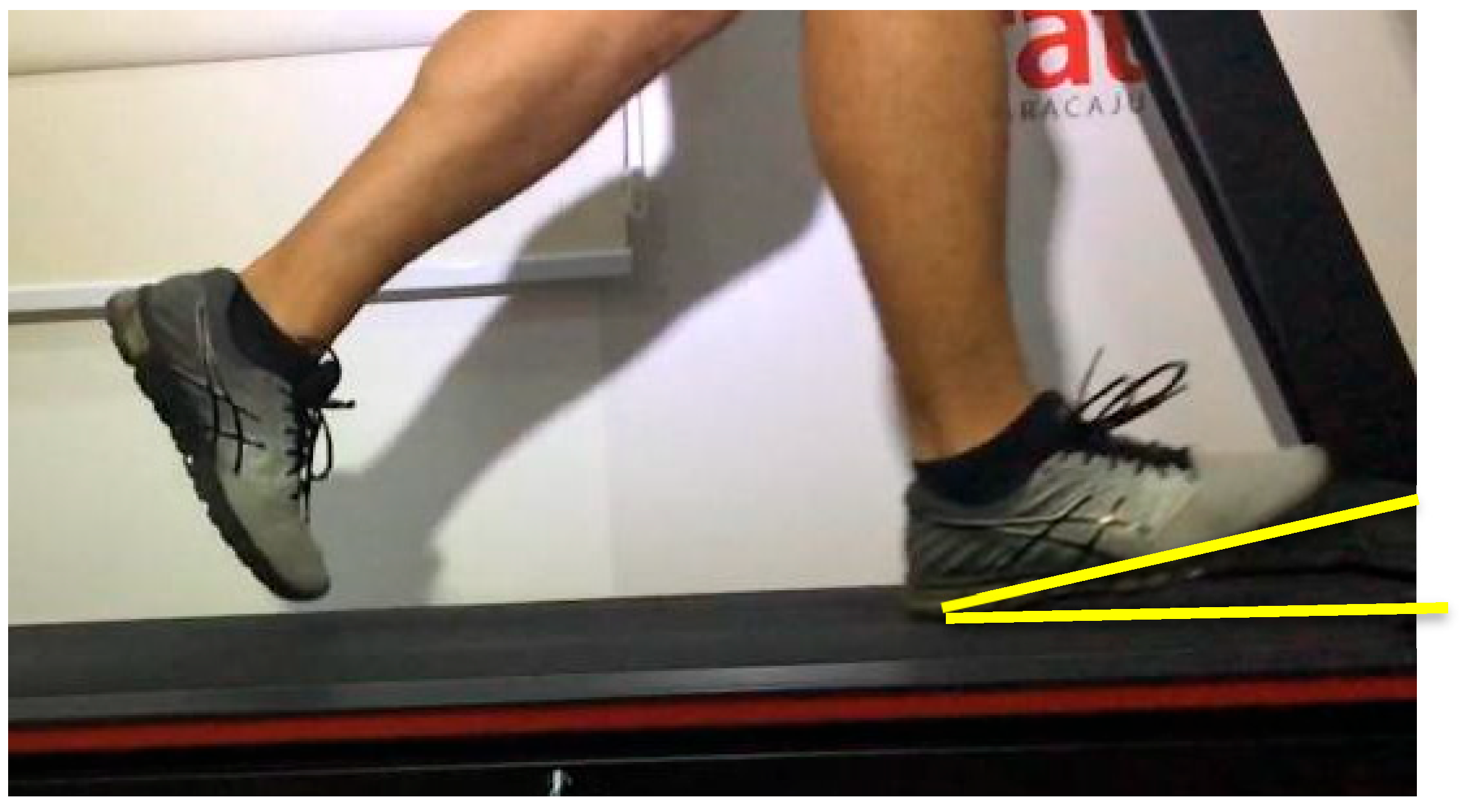
Push-off angle was defined as the angle between the foot and the ground right before the foot ends contact with the ground (Figure 1).
Foot-strike angle was defined as the angle between the ground and the foot at initial contact. A negative angle value indicates a rearfoot-strike pattern, while a positive angle value indicates a forefoot-strike pattern. A 0° angle describes a midfoot-strike pattern (Figure 2).

2.2.4. Muscular Strength

An isometric digital Lafayette® dynamometer, model 01165 (Lafayette, IN, USA) was used to evaluate muscle strength of four main muscular groups of the lower extremities, the quadriceps femoris, abductors (gluteus medius, gluteus minimus, and piriformis muscle), hip external rotators (superior and inferior gemellus, internal and external obturators, and quadratus femoris), and gluteus maximus [41,42]. These evaluations were made on different days from the algometry to avoid any influence between the test results. The evaluations were performed with the patient seated comfortably on a stretcher. Three measurements were obtained of a five-second maximum strength effort, with a 30 s interval between them, and a rest period of three minutes between each muscle group.

2.3. Statistical Analysis

Categorical variables were presented as absolute frequencies and percentages and compared between groups using Fisher’s exact test. Continuous variables were summarized using means and standard deviations. Between-group differences at each running speed condition (V1, V2, V3) were examined using independent-samples t-tests, consistent with the original design in which each speed represented a distinct biomechanical state. Effect sizes (Cohen’s d) and their 95% confidence intervals were calculated for all primary comparisons to improve interpretability.
The primary kinematic endpoint was pre-specified as foot-strike angle at V1, representing the condition most reflective of habitual running. For secondary kinematic comparisons, multiplicity was controlled using the Holm correction.
In addition to group-wise comparisons, an exploratory predictive model of MTSS was developed using a mixed hierarchical model to account for the repeated-measures structure of the dataset. This model allowed simultaneous evaluation of within-subject correlations, potential autocorrelation, heteroskedasticity, and collinearity. Given the modest sample size and the associated limitations of asymptotic assumptions, the Kenward–Roger approximation was applied to obtain small-sample–adjusted estimates of the variance–covariance matrix for fixed effects [43]. A non-structured variance–covariance matrix was adopted to flexibly model correlations among repeated observations.
Model selection considered clinical relevance (e.g., age, sex), significant variables identified in univariate analyses, variance–covariance structure adequacy, goodness of fit, and parsimony criteria balancing predictive performance and model simplicity. The Akaike Information Criterion (AIC) and Bayesian Information Criterion (BIC) guided the selection of the final model. As no participants used atypical footwear, a sensitivity analysis based on shoe characteristics was not required.

3. Results

There were 56 participants in this study; 27 were assigned to the MTSS group and 29 to the control group. There were 19 (70%) female and 8 (30%) male participants in the MTSS group; the control group had 10 (34%) female and 19 (66%) male participants. The anthropometric measurements obtained from the participants, including age, weight, and height, are summarized in Table 1. No statistical differences were observed between groups.
Participants were classified into one of five categories based on their IPAQ results: sedentary, irregularly active A, irregularly active B, active, and very active. MTSS results indicated that 74% of participants in this group were classified as very active (n = 20), 22% as active (n = 6), and 4% as sedentary (n = 1). In the control group, 90% (n = 26) of participants were classified as very active, 7% (n = 2) as irregularly active B, and 3% (n = 1) as irregularly active A. A significant difference among these groups was observed at p = 0.00, with the control group being more active overall.
Algometry results are listed in Table 2. Significant statistical differences were observed in pain level between groups, bilaterally, before and after the run (p < 0.001), indicating that the MSS reported more pain throughout the different conditions. Before running, algometry results for the left-side extremity showed mean values of 5.2 (±1.4) kgf for the MTSS group and 9.0 (±2) kgf for the control group. Results for the right-side extremity showed mean values of 5.6 (±1.8) kgf and 8.9 (±2.3) kgf for the MTSS and control groups, respectively. After running, algometry results showed mean values for the left-side extremity of 4.4 (±1.5) kgf for the MTSS group and 8.8 (±2.1) kgf for the control group. Correspondingly, the mean values for the right-side extremity were 4.4 (±1.6) kgf for the MTSS group and 8.8 (±2.4) kgf for the control group. Higher kgf values indicate a higher pain threshold, whereas lower values indicate greater susceptibility to pain.
Results on V1, V2, and V3 are listed in Table 3. The MTSS group had a mean initial speed (V1) of 7.6 km/h (±1.0), whilst the control group had a mean initial speed (V1) of 8.5 km/h (±1.0). There was a statistical difference between the groups (p = 0.002), indicating that the MTSS group was running at a lower speed rate. The mean intermediate speed (V2) was 10.5 km/h (±1.6) for the MTSS group and 11.5 km/h (±1.6) for the control group. There was a statistically significant difference between groups (p = 0.026), indicating that the MTSS group was running at a lower speed rate as well. The mean value of Final speed (V3) for the MTSS group was 13.5 km/h (±2.3) and 14.5 km/h (±2.3) for the Control group. There was no statistical difference between the two groups (p = 0.097).
The foot-strike and the push-off angles were measured bilaterally at V1, V2, and V3; the data are listed in Table 4. For V1, significant differences were measured between groups for left and right foot-strike angles. The control group and MTSS group showed −14.4 ± 9.2° and −19.7 ± 6.7°, respectively, for the left side (p = 0.04), and −17.0 ± 9.5° and −21.4 ± 5.8°, respectively, for the right side (p = 0.04). No statistical differences were measured for any parameter on both sides, V2 and V3. Although the between-group difference in foot-strike angle was observed predominantly at V1, this effect should be interpreted as reflecting differences in habitual running mechanics rather than a causal marker of MTSS pathology, as higher velocities (V2 and V3) tend to homogenize foot-strike mechanics across runners.
Table 5 summarizes the mean values of muscular strength in both legs for each muscle in the two groups. The results show a significant statistical difference for the quadriceps femoris (left and right, p = 0.00) and external rotators (left and right, p = 0.02), showing that the MTSS group had lower strength values than the control group. The means for the quadriceps femoris for the MTSS group were as follows: left extremity 151.9 ± 78.3 N, and right extremity 159.9 ± 73.1 N. Correspondingly, the control group means were 212.4 ± 73.1 N for the left extremity and 222.8 ± 72.8 N for the right. The means for the external rotators for the MTSS group were 149.7 ± 95.9 N for the left extremity and 156.6 ± 92.3 N for the right extremity. Lastly, the means for the external rotators for the control group were 211.5 ± 95.1 N for the left extremity and 217.9 ± 102.0 N for the right extremity. There were no statistically significant differences between the adductors and gluteus maximus muscles.
It is important to consider the effect sizes observed in this study. The difference in foot-strike angle at initial speeds showed moderate effect sizes (Cohen’s d ≈ 0.5–0.7), suggesting a practically meaningful difference in running mechanics between the groups. Similarly, the strength differences in the quadriceps femoris also indicate moderate to large effects (Cohen’s d ≈ 0.7–0.9), supporting the potential clinical relevance of these findings.

4. Discussion

Medial Tibial Stress Syndrome (MTSS) is a frequent musculoskeletal disorder among recreational and competitive runners. The present study compared lower-limb strength and running kinematics between symptomatic and asymptomatic adult runners. Overall, the findings demonstrated that individuals with MTSS show distinct deficits in muscle force production, altered foot-strike mechanics, and lower pressure-pain thresholds when compared with healthy runners. The results are presented according to four major domains: questionnaires, algometry, kinematics, and muscle strength.

4.1. Questionnaires

Previous literature identifies gender, body mass, navicular drop, training load, and lower-limb strength imbalance as potential contributors to MTSS development [25,44]. In the current sample, no differences between groups were observed for body height or weight, suggesting that these factors did not influence MTSS presentation in this cohort. IPAQ scores indicated that asymptomatic runners were generally more active than symptomatic runners, supporting the notion that MTSS may limit daily and sport-related activities [45]. Because all symptomatic participants had a confirmed clinical diagnosis of MTSS, patient-reported pain outcomes (e.g., VAS or MTSS Score) were not included.

4.2. Algometry

This study found markedly reduced pressure-pain thresholds (PPT) in the MTSS group both before and after running, with large effect sizes. These results confirm the presence of heightened mechanical sensitivity along the posteromedial tibia, consistent with MTSS pathophysiology. The additional decline in PPT following running in symptomatic runners suggests that mechanical loading exacerbates local sensitivity, whereas thresholds remained stable in controls. Such findings align with previous work describing MTSS as an overuse condition characterized by periosteal irritation and nociceptive sensitization [46,47]. Clinical literature supports the use of pressure algometry for diagnosis and follow-up of MTSS [22,31,48], reinforcing its applicability as an objective clinical tool.

4.3. Kinematics

Kinematic differences between groups were observed exclusively at the initial, self-selected running speed (V1). Runners with MTSS exhibited a more rearfoot-oriented foot-strike angle bilaterally compared with controls. This pattern is consistent with a more pronounced heel contact during initial stance, which may conceptually increase tibial loading based on previous biomechanical findings [17,18,49,50]. No between-group differences emerged at higher velocities (V2 and V3). As speed increases, runners tend to converge toward more homogeneous foot-strike mechanics, reducing inter-individual variability. Therefore, the group effect at V1 likely reflects habitual, unconstrained running behavior rather than a direct causal mechanism of MTSS.
Furthermore, push-off angles did not differ between groups, suggesting that MTSS-related kinematic deviations may be isolated to the initial contact phase. This partially contrasts with studies reporting alterations during pronation or mid-stance in MTSS populations [20]. Given that all participants were rearfoot strikers, technique-specific factors should also be considered when interpreting these findings.

4.4. Strength

The MTSS group demonstrated significant bilateral deficits in quadriceps femoris and hip external rotator strength, with moderate-to-large effect sizes. These muscle groups play a key role in shock attenuation and lower-limb alignment control during stance. Weakness in the quadriceps may reduce the capacity to dissipate impact forces upon ground contact, increasing load transmission to distal structures. Similarly, reduced external rotator strength may lead to excessive hip internal rotation during early stance, a factor previously associated with anteromedial tibial pain [21,22]. In contrast, the hip abductors and gluteus maximus did not differ significantly between groups, suggesting that MTSS is associated with selective rather than generalized lower-limb weakness.
Absolute PPT differences of 3.2–4.4 kgf and their corresponding effect sizes (d = 1.59–2.40) further reinforce the magnitude and clinical relevance of neuromuscular and sensory deficits in runners with MTSS. These findings highlight the potential value of assessing strength deficits and pain sensitivity in clinical evaluations.

4.5. Overview Discussion and Synthesis

Across all analyses, anthropometric characteristics did not differ between groups in this sample. Algometry showed clear and consistent discrimination between symptomatic and asymptomatic runners. Kinematic alterations were speed-dependent, emerging only at self-selected velocities, and did not affect maximal running capacity. Muscle strength deficits were specific to the quadriceps and external rotators, supporting their role in managing tibial loading during running.
Taken together, MTSS in this cohort was characterized by a combination of:
  • increased sensitivity along the posteromedial tibia;
  • altered initial-contact mechanics at habitual running speed;
  • selective deficits in key lower-limb stabilizing muscles;
  • reduced physical activity levels among symptomatic runners.
These combined elements form a coherent biomechanical and neuromuscular profile that differentiates MTSS runners from healthy controls.

4.6. Limitations of the Study

This study has several limitations. The sample size did not allow subgrouping by gender, limiting conclusions about sex-specific differences. Recruitment procedures excluded participants with prior lower-limb injuries to minimize confounding, which enhances internal validity but may reduce generalizability. Although the 120 fps capture rate is suitable for 2D kinematic analysis, higher sampling frequencies could improve the temporal resolution of gait events. Furthermore, the limitations of the use of Kinovea software must be considered.
Running footwear was not standardized; however, all participants used neutral or cushioned models, and no extreme designs (minimalist, carbon-plate, or rockered shoes) were present. Only three gait cycles per speed were analyzed, which limits the assessment of stride-level variability. Within-session repeatability metrics (e.g., ICC) could not be computed. Contact time and mixed-model interaction terms were not analyzed, which restricts the interpretation of speed-by-group effects.

5. Conclusions

Runners with MTSS differed from healthy runners in several domains, including tibial pain sensitivity, foot-strike mechanics at self-selected speed, and selective deficits in quadriceps and hip external rotator strength. These findings indicate a combined pattern of kinematic, sensory, and neuromuscular alterations characterizing MTSS, offering clinically relevant insights for evaluation and targeted intervention.

Author Contributions

Conceptualization, E.H.M.D. and R.B.B.; methodology, M.A.N.S.; software, M.A.A.-S.; validation, E.H.M.D., R.B.B. and M.A.A.-S.; formal analysis, M.A.N.S.; investigation, E.H.M.D.; resources, R.B.B.; data curation, M.A.N.S.; writing—original draft preparation, E.H.M.D.; writing—review and editing, G.B. and L.R.; visualization, L.R.; supervision, E.H.M.D.; project administration, E.H.M.D. All authors have read and agreed to the published version of the manuscript.

Funding

This research received no external funding.

Institutional Review Board Statement

The study was conducted in accordance with the Declaration of Helsinki and approved by the Ethics and Research on Human Beings Committee of Tiradentes University (n. 212, 11 April 2023).

Informed Consent Statement

Informed consent was obtained from all subjects involved in the study.

Data Availability Statement

The data presented in this study are available on request from the corresponding author.

Conflicts of Interest

The authors declare no conflicts of interest.

References

  1. Karp, J.R. The effects of strength training on distance running performance and running injury prevention. J. Phys. Educ. Sport 2024, 25, 1352–1367. [Google Scholar] [CrossRef]
  2. Ruta, D.; Bocianiak, B.; Kajka, A.; Hamerska, J.; Antczak, J.; Hamerska, L.; Fenrych, U.; Wojtczak, K.; Skupińska, O.; Lipska, J. Health Aspects of Amateur Long-Distance Running. Qual. Sport 2024, 20, 53342. [Google Scholar] [CrossRef]
  3. Lower-Hoppe, L.M.; Aicher, T.J.; Baker, B.J. Intention–behaviour relationship within community running clubs: Examining the moderating influence of leisure constraints and facilitators within the environment. World Leis. J. 2022, 65, 3–27. [Google Scholar] [CrossRef]
  4. Jiang, X.; Zhang, Q.; Bíró, I. Effects of Long-Distance Running on Lower Limb Joint Kinematics in Recreational Runners. In Proceedings of the 2024 IEEE 18th International Symposium on Applied Computational Intelligence and Informatics (SACI), Timisoara, Romania, 21–25 May 2024; pp. 000095–000098. [Google Scholar] [CrossRef]
  5. Van Gent, R.N.; Siem, D.; Van Middelkoop, M.; Van Os, A.G.; Bierma-Zeinstra, S.M.; Koes, B.W. Incidence and determinants of lower extremity running injuries in long distance runners: A systematic review. Br. J. Sports Med. 2007, 41, 469–480. [Google Scholar] [CrossRef]
  6. Fredette, A.; Roy, J.S.; Perreault, K.; Dupuis, F.; Napier, C.; Esculier, J.F. The association between running injuries and training parameters: A systematic review. J. Athl. Train. 2022, 57, 650–671. [Google Scholar] [CrossRef] [PubMed]
  7. Willwacher, S.; Kurz, M.; Robbin, J.; Thelen, M.; Hamill, J.; Kelly, L.; Mai, P. Running-Related Biomechanical Risk Factors for Overuse Injuries in Distance Runners: A Systematic Review Considering Injury Specificity and the Potentials for Future Research. Sports Med. 2022, 52, 1863–1877. [Google Scholar] [CrossRef] [PubMed]
  8. Zadpoor, A.A.; Nikooyan, A.A. The relationship between lower-extremity stress fractures and ground reaction forces: A systematic review. Clin. Biomech. 2011, 26, 23–28. [Google Scholar] [CrossRef]
  9. Milner, C.E.; Hamill, J.; Davis, I.S. Are knee mechanics during early stance related to tibial stress fracture? Clin. Biomech. 2010, 25, 691–695. [Google Scholar] [CrossRef] [PubMed]
  10. Derrick, T.R.; Hamill, J.; Caldwell, G.E. Energy absorption during running and its relationship to injury risk. Med. Sci. Sports Exerc. 1998, 30, 128–135. [Google Scholar] [CrossRef]
  11. Frigo, C.A.; Merlo, A.; Brambilla, C.; Mazzoli, D. Balanced Foot Dorsiflexion Requires a Coordinated Activity of the Tibialis Anterior and the Extensor Digitorum Longus: A Musculoskeletal Modelling Study. Appl. Sci. 2023, 13, 7984. [Google Scholar] [CrossRef]
  12. Alderink, G.J.; Ashby, B.M. Ankle/Foot Complex: Recurrent Stress Fractures. In Clinical Kinesiology and Biomechanics; Springer: Cham, Switzerland, 2023; pp. 329–396. [Google Scholar] [CrossRef]
  13. Coslick, A.M.; Lestersmith, D.; Chiang, C.C.; Scura, D.; Wilkens, J.H.; Emam, M. Lower Extremity Bone Stress Injuries in Athletes: An Update on Current Guidelines. Curr. Phys. Med. Rehabil. Rep. 2024, 12, 39–49. [Google Scholar] [CrossRef]
  14. Winters, M.; Bakker, E.W.P.; Moen, M.H.; Barten, C.C.; Teeuwen, R.; Weir, A. Medial tibial stress syndrome can be diagnosed reliably using history and physical examination. Br. J. Sports Med. 2018, 52, 1267–1272. [Google Scholar] [CrossRef]
  15. Tweed, J.L.; Avil, S.J.; Campbell, J.A.; Barnes, M.R. Etiologic factors in the development of medial tibial stress syndrome: A review of the literature. J. Am. Podiatr. Med. Assoc. 2008, 98, 107–111. [Google Scholar] [CrossRef]
  16. Franklyn, M.; Oakes, B. Aetiology and mechanisms of injury in medial tibial stress syndrome: Current and future developments. World J. Orthop. 2015, 6, 577–589. [Google Scholar] [CrossRef]
  17. Ohmi, T.; Aizawa, J.; Hirohata, K.; Ohji, S.; Mitomo, S.; Ohara, T.; Yagishita, K. Biomechanical characteristics of the lower extremities during running in male long-distance runners with a history of medial tibial stress syndrome: A case control study. BMC Musculoskelet. Disord. 2023, 24, 103. [Google Scholar] [CrossRef]
  18. Moreira, P.F.; Veras, P.M.; Oliveira, T.M.; Souza, M.A.; Catharino, L.L.; Borel, W.P.; Barbosa, A.C.; Fonseca, D.S.; Felício, D.C. Incidence and biomechanical risk factors for running-related injuries: A prospective cohort study. J. Clin. Orthop. Trauma 2024, 57, 102562. [Google Scholar] [CrossRef]
  19. Parry, G.N.; Williams, S.; McKay, C.D.; Johnson, D.J.; Bergeron, M.F.; Cumming, S.P. Associations between growth, maturation and injury in youth athletes engaged in elite pathways: A scoping review. Br. J. Sports Med. 2024, 58, 1001–1010. [Google Scholar] [CrossRef] [PubMed]
  20. Mousavi, S.H.; Khorramroo, F.; Jafarnezhadgero, A. Gait retraining targeting foot pronation: A systematic review and meta-analysis. PLoS ONE 2024, 19, e0298646. [Google Scholar] [CrossRef] [PubMed]
  21. Onsen, L.T.; Lima, J.; Hutchinson, M. Chronic Leg Pain in Running Athletes. In Endurance Sports Medicine; Miller, T.L., Ed.; Springer: Cham, Switzerland, 2023; pp. 175–186. [Google Scholar] [CrossRef]
  22. Menéndez, C.; Batalla, L.; Prieto, A.; Rodríguez, M.Á.; Crespo, I.; Olmedillas, H. Medial Tibial Stress Syndrome in Novice and Recreational Runners: A Systematic Review. Int. J. Environ. Res. Public Health 2020, 17, 7457. [Google Scholar] [CrossRef]
  23. Napier, C.; Willy, R.W. Biomechanical strategies for injury prevention in distance runners. J. Orthop. Sports Phys. Ther. 2018, 48, 736–742. [Google Scholar]
  24. Ceyssens, L.; Vanelderen, R.; Barton, C.; Malliaras, P.; Dingenen, B. Biomechanical risk factors associated with running-related injuries: A systematic review. Sports Med. 2019, 49, 1095–1115. [Google Scholar] [CrossRef] [PubMed]
  25. Deshmukh, N.S.; Phansopkar, P. Medial Tibial Stress Syndrome: A Review Article. Cureus 2022, 14, e26641. [Google Scholar] [CrossRef]
  26. Meardon, S.A.; Hamill, J.; Derrick, T.R. Running injury mechanisms: Biomechanical loading and tissue fatigue. Exerc. Sport Sci. Rev. 2015, 43, 75–81. [Google Scholar]
  27. Davis, I.S.; Milner, C.E.; Hamill, J. Gait biomechanics and stress fractures in runners. Clin. Sports Med. 2004, 23, 217–231. [Google Scholar]
  28. BRASIL. Lei nº 14.874, de 28 de maio de 2024. Dispõe Sobre a Pesquisa com Seres Humanos e Institui o Sistema Nacional de Ética em Pesquisa com Seres Humanos. Diário Oficial da União: Seção 1, Brasília, DF, 28 maio 2024. Available online: https://legislacao.presidencia.gov.br/atos/?tipo=LEI&numero=14874&ano=2024&ato=677Izaq1ENZpWT381 (accessed on 15 November 2024).
  29. World Medical Association (WMA). Declaration of Helsinki—Ethical Principles for Medical Research Involving Human Subjects. In Proceedings of the Relatory of 64th WMA General Assembly, Fortaleza, Brazil, 16–19 October 2013; Available online: https://www.wma.net/policies-post/wma-declaration-of-helsinki-ethical-principles-for-medical-research-involving-human-subjects/ (accessed on 15 November 2024).
  30. Roberts-Lewis, S.F.; White, C.M.; Ashworth, M.; Rose, M.R. The validity of the International Physical Activity Questionnaire (IPAQ) for adults with progressive muscle diseases. Disabil. Rehabil. 2021, 44, 7312–7320. [Google Scholar] [CrossRef]
  31. Vesal, M.; Roohafza, H.; Feizi, A.; Asgari, K.; Shahoon, H.; Ani, A.; Adibi, P. Pressure algometry in the general adult population: Age and sex differences. Medicine 2024, 103, e39418. [Google Scholar] [CrossRef]
  32. Oliveira, N.C.D.; Silva, K.R.; Santos, A.C.; Alfieri, F.M. Reproducibility and reliability of pressure algometry: Are digital and analogue devices comparable? BrJP 2024, 7, e20240055. [Google Scholar] [CrossRef]
  33. Russo, L.; Di Capua, R.; Arnone, B.; Borrelli, M.; Coppola, R.; Esposito, F.; Padulo, J. Shoes and Insoles: The Influence on Motor Tasks Related to Walking Gait Variability and Stability. Int. J. Environ. Res. Public Health 2020, 17, 4569. [Google Scholar] [CrossRef]
  34. Di Giminiani, R.; Di Lorenzo, D.; La Greca, S.; Russo, L.; Masedu, F.; Totaro, R.; Padua, E. Angle-Angle Diagrams in the Assessment of Locomotion in Persons with Multiple Sclerosis: A Preliminary Study. Appl. Sci. 2022, 12, 7223. [Google Scholar] [CrossRef]
  35. Russo, L.; Belli, G.; Di Blasio, A.; Lupu, E.; Larion, A.; Fischetti, F.; Montagnani, E.; Di Biase Arrivabene, P.; De Angelis, M. The Impact of Nordic Walking Pole Length on Gait Kinematic Parameters. J. Funct. Morphol. Kinesiol. 2023, 8, 50. [Google Scholar] [CrossRef]
  36. Ardigò, L.P.; Buglione, A.; Russo, L.; Cular, D.; Esposito, F.; Doria, C.; Padulo, J. Marathon Shoes vs. Track Spikes: A Crossover Pilot Study on Metabolic Demand at Different Speeds in Experienced Runners. Res. Sports Med. 2023, 31, 13–20. [Google Scholar] [CrossRef]
  37. Bilić, Z.; Sinković, F.; Barbaros, P.; Novak, D.; Zemkova, E. Exercise-Induced Fatigue Impairs Change of Direction Performance and Serve Precision among Young Male Tennis Players. Sports 2023, 11, 111. [Google Scholar] [CrossRef]
  38. Russo, L.; Montagnani, E.; Buttari, D.; Ardigò, L.P.; Melenco, I.; Larion, A.; Migliaccio, G.M.; Padulo, J. Track Running Shoes: A Case Report of the Transition from Classical Spikes to “Super Spikes” in Track Running. Appl. Sci. 2022, 12, 10195. [Google Scholar] [CrossRef]
  39. Russo, L.; Micozzi, M.; Racil, G.; Larion, A.; Lupu, E.; Padulo, J.; Migliaccio, G.M. Decoding Motor Skills: Video Analysis Unveils Age-Specific Patterns in Childhood and Adolescent Movement. Children 2024, 11, 1351. [Google Scholar] [CrossRef] [PubMed]
  40. Kinovea [Computer Software]. 2024. Available online: https://www.kinovea.org (accessed on 1 April 2021).
  41. Padulo, J.; Trajković, N.; Cular, D.; Grgantov, Z.; Madić, D.M.; Di Vico, R.; Traficante, A.; Alin, L.; Ardigò, L.P.; Russo, L. Validity and Reliability of Isometric-Bench for Knee Isometric Assessment. Int. J. Environ. Res. Public Health 2020, 17, 4326. [Google Scholar] [CrossRef]
  42. Sørensen, L.; Oestergaard, L.G.; Van Tulder, M.; Petersen, A.K. Measurement Properties of Isokinetic Dynamometry for Assessment of Shoulder Muscle Strength: A Systematic Review. Arch. Phys. Med. Rehabil. 2021, 102, 510–520. [Google Scholar] [CrossRef] [PubMed]
  43. Staggs, V.S.; Feldman, K. Use of between-within degrees of freedom as an alternative to the Kenward–Roger method for small-sample inference in generalized linear mixed modeling of clustered count data. Commun. Stat. Simul. Comput. 2021, 52, 5099–5109. [Google Scholar] [CrossRef]
  44. Joachim, M.R.; Kuik, M.L.; Krabak, B.J.; Kraus, E.M.; Rauh, M.J.; Heiderscheit, B.C. Risk Factors for Running-Related Injury in High School and Collegiate Cross-country Runners: A Systematic Review. J. Orthop. Sports Phys. Ther. 2024, 54, 120–132. [Google Scholar] [CrossRef]
  45. Castillo-Domínguez, A.; García-Romero, J.C.; Alvero-Cruz, J.R.; Ponce-García, T.; Benítez-Porres, J.; Páez-Moguer, J. Systematic Review of Patient-Reported Outcome Measures for Patients with Exercise-Induced Leg Pain. Medicina 2022, 58, 841. [Google Scholar] [CrossRef]
  46. Saad, M.A.; Jamal, J.M.; Aldhafiri, A.T.; Alkandari, S.A. Medial Tibial Stress Syndrome: A Scoping Review of Epidemiology, Biomechanics, and Risk Factors. Cureus 2025, 17, e81463. [Google Scholar] [CrossRef]
  47. Galbraith, R.M.; Lavallee, M.E. Medial tibial stress syndrome: Conservative treatment options. Curr. Rev. Musculoskelet. Med. 2009, 2, 127–133. [Google Scholar] [CrossRef] [PubMed]
  48. Naderi, A.; Fallah Mohammadi, M.; Heidaralizadeh, A.; Moen, M.H. Effects of Integrating Lower-Leg Exercises Into a Multimodal Therapeutic Approach on Medial Tibial Stress Syndrome Management Among Recreational Runners: A Randomized Controlled Study. Orthop. J. Sports Med. 2025, 13, 23259671241311849. [Google Scholar] [CrossRef] [PubMed]
  49. Leporace, G.; Guadagnin, E.C.; Carpes, F.P.; Gustafson, J.; Gonzalez, F.F.; Chahla, J.; Metsavaht, L. The Search for the Holy Grail in Running Biomechanics: Is There an Ideal Movement Profile for Minimizing Mechanical Overload? Sports Health A Multidiscip. Approach 2025. [Google Scholar] [CrossRef]
  50. Van Oeveren, B.T.; De Ruiter, C.J.; Beek, P.J.; Van Dieën, J.H. The Biomechanics of Running and Running Styles: A Synthesis. Sports Biomech. 2024, 23, 516–554. [Google Scholar] [CrossRef] [PubMed]
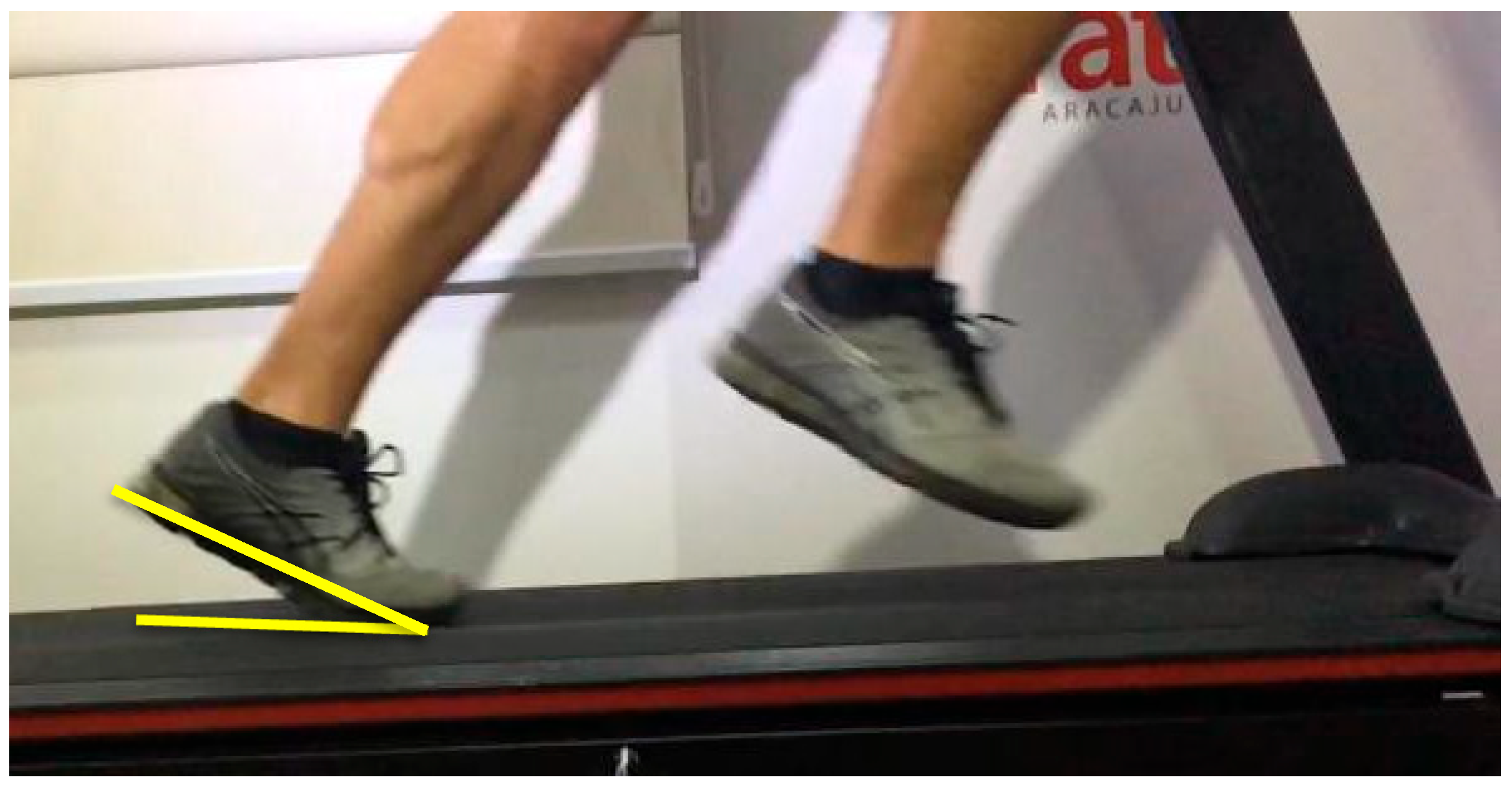
Figure 1. Push-off angle.
Biomechanics 05 00106 g001
Figure 2. Foot-strike angle.
Biomechanics 05 00106 g002
Table 1. Sample data divided by groups.
GroupAge (Years)Weight (kg)Height (cm)
MTSS32.7 ± 8.166.4 ± 13.9164.9 ± 10.9
Control36.4 ± 10.471.9 ± 14.6169.3 ± 7.2
Table 2. Algometry (pain threshold) between groups.
Control
(n = 29)
MTSS
(n = 27)
p-ValueEffect Size (95% CI)
Before run
Left leg (kgf ± SD)9.0 ± 2.05.7 ± 1.4<0.0011.90 (1.26–2.53)
Right leg (kgf ± SD)8.9 ± 2.35.6 ± 1.8<0.0011.59 (0.99–2.19)
After run
Left leg (kgf ± SD)8.8 ± 2.14.4 ± 1.5<0.0012.40 (1.70–3.09)
Right leg (kgf ± SD)8.8 ± 2.44.4 ± 1.6<0.0012.14 (1.48–2.80)
Table 3. Mean values of the three different velocities measured during running in the two groups. V1, initial speed; V2, intermediate speed; V3, final speed.
Variable Control
(n = 29)
MTSS
(n = 27)
p-Value Effect Size (95% CI)
V1 (km/h ± SD)8.5 ± 1.07.6 ± 1.00.0020.90 (0.36–1.42)
V2 (km/h ± SD)11.5 ± 1.610.5 ± 1.60.0260.62 (0.10–1.14)
V3 (km/h ± SD)14.5 ± 2.313.5 ± 2.30.0970.43 (–0.08–0.93)
Table 4. Comparison of kinematic angles at three running speeds (V1, V2, V3) between the MTSS and control groups.
V1V2V3
ControlMTSSpd (95% CI)ControlMTSSpd (95% CI)ControlMTSSpd (95% CI)
Left foot-strike angle (°)−14.4 ± 9.2−19.0 ± 6.70.040.57 (0.03–1.10)−14.1 ± 9.6−17.4 ± 6.20.130.39 (−0.16–0.93)−15.3 ± 9.3−17.5 ± 6.30.330.37 (−0.19–0.92)
Right foot-strike angle (°)−17.0 ± 9.5−21.4 ± 5.80.040.55 (0.02–1.09)−18.1 ± 9.0−20.3 ± 7.80.360.25 (−0.28–0.79)−18.0 ± 7.3−20.4 ± 9.60.250.28 (−0.24–0.81)
Left push-off angle (°)38.3 ± 5.036.1 ± 6.10.140.40 (−0.13–0.93)37.2 ± 5.235.8 ± 6.10.380.25 (−0.28–0.79)39.0 ± 5.237.2 ± 5.70.540.33 (−0.20–0.86)
Right push-off angle (°)36.4 ± 9.634.8 ± 4.60.400.18 (−0.33–0.70)35.2 ± 5.435.7 ± 6.70.770.08 (−0.44–0.60)38.0 ± 6.636.4 ± 4.80.580.28 (−0.25–0.80)
Table 5. Muscle-strength comparison between the MTSS and the control groups.
Muscle GroupControl
(n = 29)
MTSS
(n = 27)
p-ValueEffect Size
d (95% CI)
Left Quadriceps femoris (N ± SD)212.4 ± 73.1151.9 ± 78.30.000.80 (0.25–1.35)
Right Quadriceps femoris (N ± SD)222.8 ± 72.8159.9 ± 73.10.000.86 (0.31–1.41)
Left abductors (N ± SD)180.4 ± 56.9165.1 ± 71.40.390.24 (−0.29–0.76)
Right abductors (N ± SD)186.7 ± 68.4158.6 ± 62.20.120.43 (−0.10–0.96)
Left external rotators (N ± SD)211.5 ± 95.1149.7 ± 95.90.020.65 (0.11–1.19)
Right external rotators (N ± SD)217.9 ± 102.0156.6 ± 92.30.020.63 (0.09–1.17)
Left Gluteus maximus (N ± SD)171.7 ± 74.8157.8 ± 80.40.510.18 (−0.35–0.70)
Right Gluteus maximus (N ± SD)176.5 ± 76.7145.7 ± 67.70.130.42 (−0.11–0.96)
Disclaimer/Publisher’s Note: The statements, opinions and data contained in all publications are solely those of the individual author(s) and contributor(s) and not of MDPI and/or the editor(s). MDPI and/or the editor(s) disclaim responsibility for any injury to people or property resulting from any ideas, methods, instructions or products referred to in the content.