


Abstract
Background: Shoulder exercises using elastic resistance integrated within the kinetic chain appear to modify scapular control strategies; however, a deeper understanding of these mechanisms is still needed. Objectives: We aim to compare three-dimensional scapular kinematics during two exercises performed on different bases of support, under both non-resisted and resisted conditions in asymptomatic adults. Methods: This cross-sectional study analyzed three-dimensional shoulder kinematics in 36 healthy adult male participants during the overhead squat and kneeling position exercises. Movement patterns were evaluated by phase using statistical parametric mapping. Results: Scapular internal/external rotation demonstrated a main effect for exercise type (p = 0.04), a main effect for resistance conditions (p < 0.00), and a significant exercise–resistance interaction (p = 0.04) during arm elevation. During the lowering phase, a main effect was observed for exercise types (p = 0.04) and exercise conditions (p < 0.00). Scapular upward rotation showed a main effect for exercise type (p = 0.02) and resistance conditions (p = 0.04) during arm elevation. During the lowering phase, a significant main effect was observed for exercise type (p = 0.01) and exercise conditions (p < 0.00). Scapular posterior tilt presented a main effect for exercise type (p < 0.00), a main effect for exercise condition (p = 0.01), and an exercise–resistance interaction (p = 0.04) during arm elevation. During the lowering phase, a main effect for exercise type (p < 0.00), a main effect for exercise condition (p = 0.02), and an exercise–resistance interaction (p = 0.00). Conclusions: The resistance and exercises demonstrated different kinematic strategies that helped maintain scapular stability during movement.
1. Introduction
Several studies have examined the effects of exercise on scapular kinematics in both healthy individuals and those with shoulder disorders [1,2], supporting the use of scapular-focused exercise therapy. Different exercise modalities, including dumbbells, proprioceptive neuromuscular facilitation, machines, and elastic resistance, have been used to address shoulder dysfunctions, aiming to reduce pain [3,4], enhance muscular strength [4], improve neuromuscular control [1,2,3], and restore functional and pain-free patterns [5]. Elastic resistance, commonly delivered through elastic bands, rubber bands, and tubing, provides a mechanical load that increases linearly with elongation. It is considered an effective and accessible tool for rehabilitation, showing activation levels comparable to isoinertial resistance [6], free weights, or training machines [7]. These exercise strategies are designed to optimize scapular kinematics and control, promoting coordinated motion between the scapula and humerus [8,9], which is essential for efficient shoulder function and for preventing injuries such as scapular dyskinesis and subacromial pain syndrome.
In recent years, growing attention has been directed toward exercises that integrate the kinetic chain (KC) concept [10,11,12], which emphasizes the coordinated transfer of force and motion among the lower limb, trunk, and shoulder complex. The KC encompasses the sequential activation of body segments during daily and sports-specific tasks [10,13], progressing through the hip and trunk, and ultimately influencing upper-limb movement [11,14]. Incorporating KC principles into exercise design helps improve neuromuscular efficiency, facilitate proximal stability, and promote more functional patterns of scapular control. Elastic resistance has emerged as an effective tool within this context [15], as it allows for progressive loading, multiplanar movement, and variable force vectors that can closely mimic functional demands and enhance dynamic stabilization [16,17]. When applied correctly, elastic resistance contributes to improving motor control [18], postural alignment, and dynamic shoulder stability, which is a key target in both preventive and rehabilitative programs. Previous studies have reported changes in scapular upward rotation, posterior tilt, and internal/external rotation depending on resistance direction and trunk posture [18,19,20], providing limited insight into how resistance direction and body positioning influence scapular motion within the KC [11,21]. Existing evidence also shows that integrating elastic resistance into the KC alters load transmission pathways from the lower limbs and trunk to the upper limb [11,21], which subsequently modifies scapular control strategies [10,13].
Body positioning, particularly the base of support (BoS), may also influence scapular control. The BoS refers to the area between a body segment or an external support surface in contact with the ground, which determines postural stability [22]. A wider BoS enhances stability, whereas a narrower BoS increases postural demand and may consequently modify KC involvement and neuromuscular activation patterns [23]. Previous studies comparing exercises with different BoS configurations have demonstrated changes in kinematics and muscle recruitment, suggesting that BoS plays a relevant role in how elastic resistance affects scapular motion [24,25].
Building on these findings, our previous work investigated elastic resistance integrated into the KC during the overhead squat (OHS) and kneeling position (KP) [24,25]. These studies varied in their BoS and degrees of KC engagement, primarily evaluating differences across resistance conditions, without fully addressing the distinct biomechanical differences between the exercises themselves. However, a direct comparison of the biomechanical differences between exercises themselves, including how exercise type interacts with resistance, has not been fully explored. Understanding these interactions is critical for exercise prescription in both performance and rehabilitation settings, particularly when targeting scapular motor control.
Therefore, the present study aimed to compare three-dimensional scapular kinematics during two exercises performed on different bases of support, under both non-resisted and resisted conditions in asymptomatic adults. Based on previous findings indicating that resistance direction and trunk posture can alter scapular motion patterns, we hypothesized that (1) OHS would produce greater scapular internal and upward rotation than KP, (2) the addition of external resistance will increase scapular upward rotation and posterior tilt during OHS compared with KP, and (3) KP, due to its reduced BoS, would elicit greater posterior tilt as result of higher proximal stabilization demands.
2. Materials and Methods
2.1. Participants
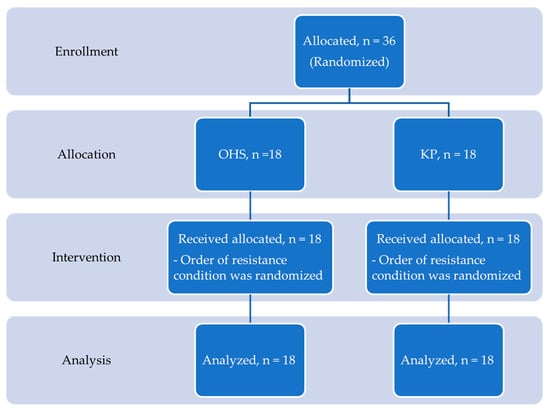
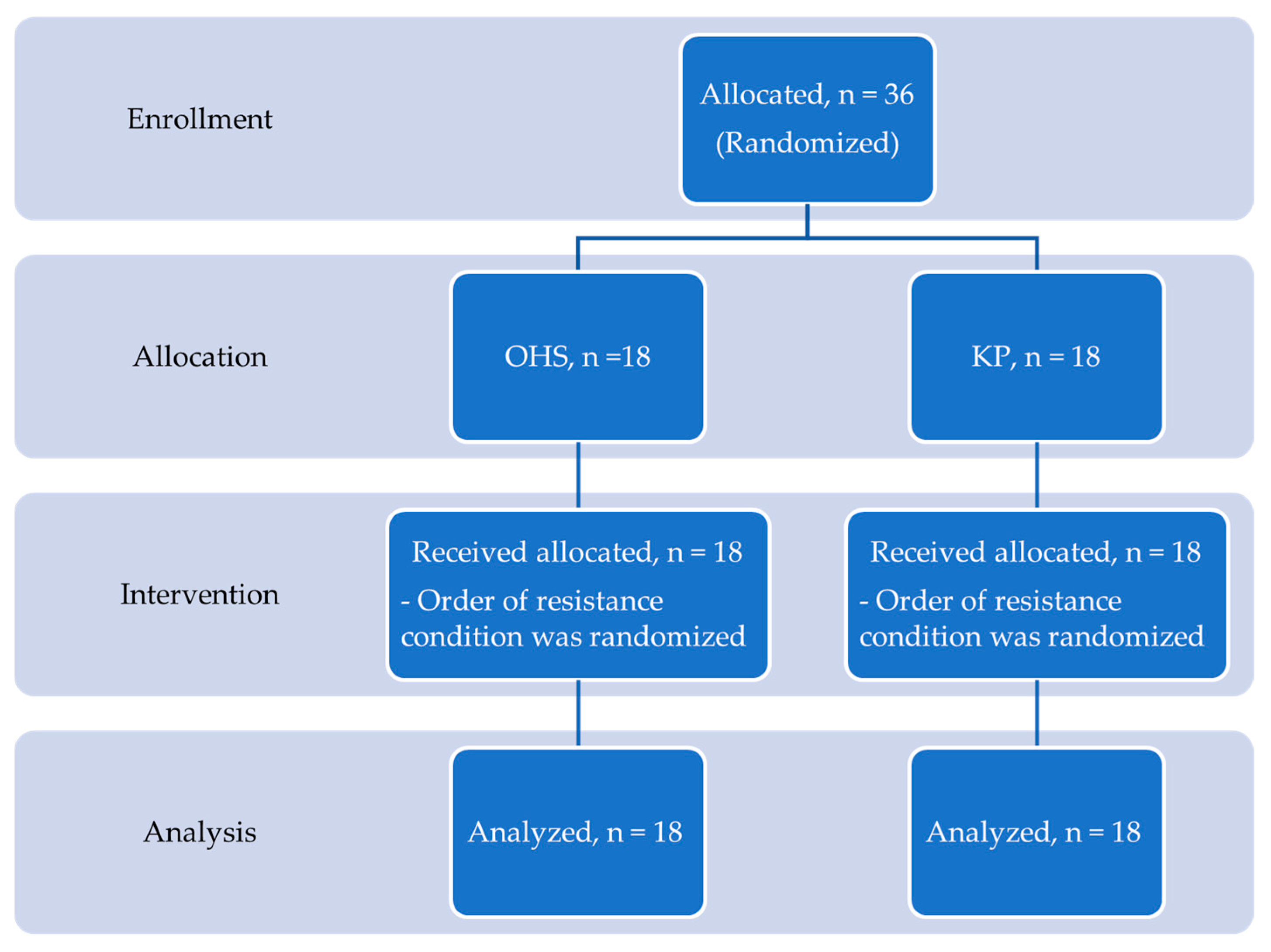
Thirty-six healthy right-handed adults were enrolled in this cross-sectional study. Participants were recruited through convenience sampling from the academic community (Figure 1) and were randomly allocated to two distinct groups (Table 1) for inter-group comparisons. Individuals were excluded if they reported any of the following: (1) shoulder or neck issues for the past 6 months, (2) a history of shoulder fractures, or (3) previous shoulder surgeries. To ensure the absence of functional alterations in the lower limbs and the KC, all participants completed the lunge [26,27] and step-down tests [28].
Figure 1.
Flow diagram for participant recruitment, allocation, and analysis.
Table 1.
Descriptive data for demographic, anthropometric, and physical activity characteristics. Values presented as mean, standard deviation (SD) and standard error (S.E.).
The study protocol was approved by the Faculty of Human Kinetics Ethics Review Board (CEIFMH n°: 45/2021). All participants were informed about the study procedures and provided written informed consent before participation.
Sample Size Estimation
An a priori sample size calculation was conducted using G*Power (version 3.1.9.2), informed by the effect sizes reported in scapular motor control and elastic resistance studies by Hotta et al. [29] and Bench et al. [30]. For this study, we used an effect size of 0.25, a significance level of 0.05, a power (1-β error probability) of 0.90, a nonsphericity correction ε of 1.0 for a two-way mixed ANOVA design, and a partial ƞ2 of 0.5. The analyses indicated that a minimum of 16 participants per group was required, yielding an actual power of 0.92.
2.2. Instrumentation and Procedures
A six-degree-of-freedom electromagnetic tracking device (FASTRACKTM, Liberty, Polhemus Inc., Colchester, VT, USA) was used in conjunction with MotionMonitorTM software (Motion Monitor V9, Innovative Sports Training Inc., Chicago, IL, USA) to record the three-dimensional (3D) position and orientation of the thorax and shoulder at a sampling frequency of 30 Hz. The kinematic recording and analysis procedures were identical to those described in two studies [24,25], and followed the recommendations of the International Society of Biomechanics [31].
In this study, the orientations of the scapula and humerus relative to the thorax were analyzed using three-dimensional (3D) bone kinematics described by Euler angles. Scapular rotations were represented using the Euler angle sequence (Y-X′-Z″) as scapular internal (positive) and external rotation, upward (positive) and downward rotation, and anterior (negative) and posterior scapular tilts. The humerus rotations were defined as thoracohumeral angles using a Euler angle sequence (Y-X′-Y″), resulting in the plane of elevation as anterior (positive) and posterior, elevation (negative) and depression, and axial rotation as external rotation (negative) and internal rotation. To provide a more intuitive description of scapular and humeral motion around the X′-axis, the rotations were multiplied by −1. Thus, positive values now represent upward rotation of the scapula and arm elevation.
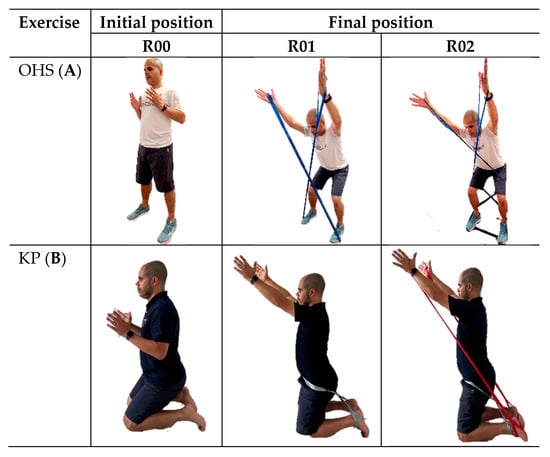
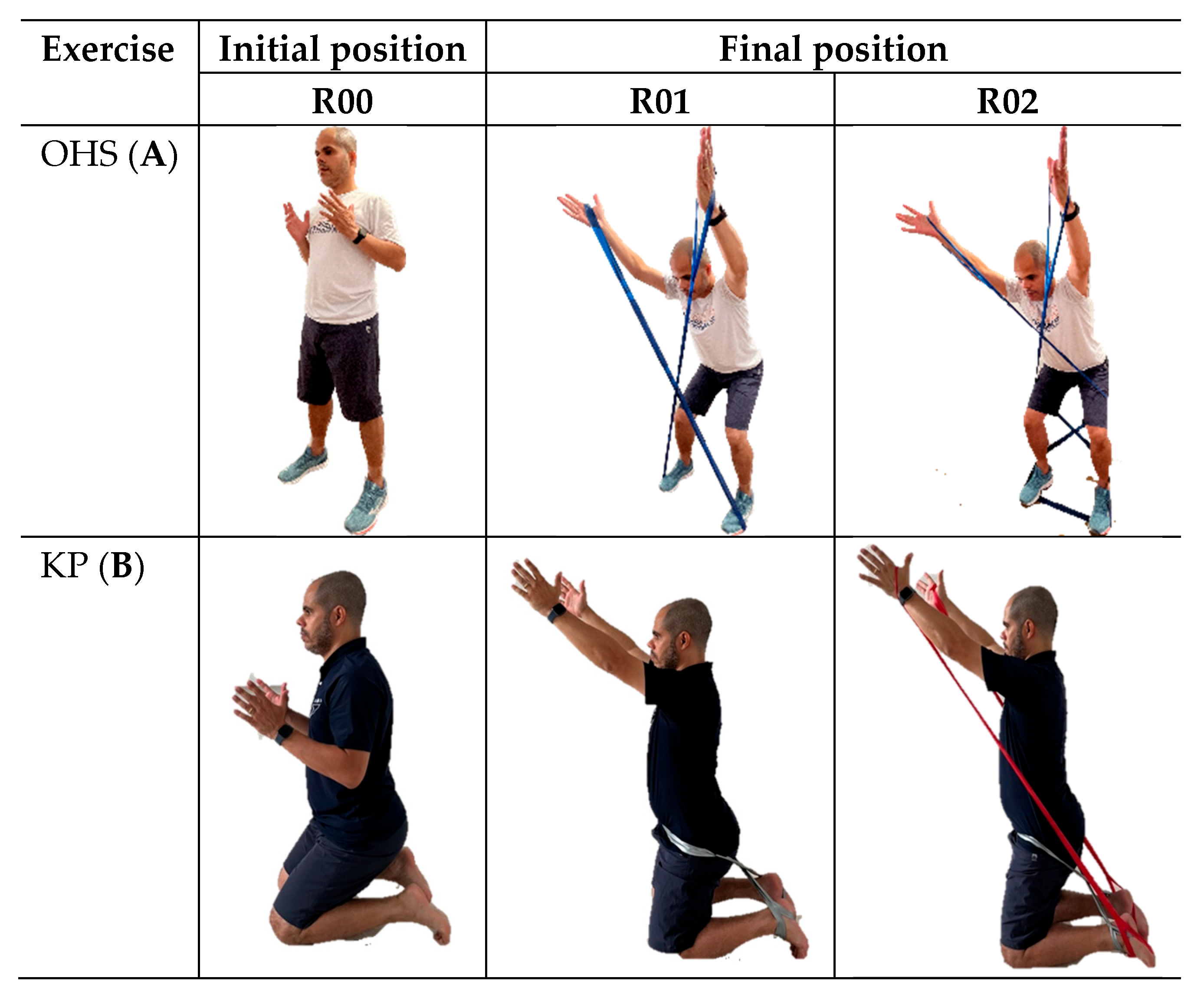
Each participant completed five repetitions of both exercises, the OHS and KP. For analysis, the arm-raising (concentric phase) and lowering (eccentric phase) phases of each repetition were considered. To minimize the influence of learning or fatigue, only the middle three repetitions were used for all kinematics calculations. The warm-up consisted of 5 repetitions of OHS or KP. In the OHS exercise, participants stood upright with their arms relaxed at their sides. They initiated the movement by simultaneously raising their arms (flexion) while performing a squat, flexing their hips and knees until they reached maximum squat depth. After reaching the maximum squat depth, participants returned to the initial position by extending their arms, thighs, and knees (Figure 2A) [24]. In the KP exercise, participants started in a kneeling position, sitting on their heels with their arms flexed and their hands placed at chest level [25]. The movement began with participants simultaneously elevating their arms (flexion) while extending their knees and trunk until they achieved the fully upright kneeling position. Upon reaching the maximum upright kneeling position, they returned to the starting posture by extending their arms and flexing their knees and trunk (Figure 2B).
Figure 2.
Initial and final positions of the overhead squat (OHS—(A)) and kneeling position (KP—(B)) exercise under three resistance conditions: no elastic resistance (R00); R01 level of elastic resistance; and R02 level of elastic resistance.
To examine the influence of different loading strategies on scapular kinematics, three experimental conditions were tested: a baseline condition involving only gravitational load (R00) and two conditions combining gravity with elastic resistance (R01 and R02). In R00, gravity was the only external force acting on the upper limb. In the R01 and R02, the external load resulted from the combined effect of gravity and elastic resistance (TheraBand®, Performance Health, Akron, OH, USA). R1 applied unidirectional resistance to the upper limb for OHS and to the pelvis for KP, whereas R02 connected the lower and upper limbs to promote KC involvement. All three conditions were performed in a randomized order.
The tension associated with each condition was determined according to the linear elongation properties of the elastic band. For R01, resistance corresponded to the force produced by linear stretching of the band. For R02, resistance reflected the combined tension generated when the elastic band linked the lower and upper limbs. For the OHS, the resistance used during R02 was equivalent to 10–18 kg (Equation (1)), while for the KP, resistance ranged from 11 to 13 kg (Equation (2)):
Elastic resistance was applied using color-coded bands, with the specific band assigned to each exercise shown in Table 2. Our previous work demonstrated no significant differences between blue and black bands during OHS [24], nor between red and black bands during KP [25]. Therefore, these color combinations were adopted to maintain consistency across resistance conditions.
Table 2.
Tension force of elastic bands at 100% elongation and corresponding proportion of body mass (%) used for each exercise.
2.3. Statistical Analysis
The independent variables included exercise type (OHS vs. KP), the resistance conditions (R00 vs. R01 vs. R02), and the normalized time series. Dependent variables were scapular positions recorded across five repetitions per condition, and separate analyses were conducted for each scapular rotation by phase (arm-raising and lowering).
The group analysis was performed using one-dimensional statistical parametric mapping (SPM). Initially, a two-way mixed ANOVA was used to analyze the normalized time series and determine whether there were significant differences in exercise and resistance conditions, and in their interaction. Post hoc comparisons using Bonferroni-adjusted t-tests were conducted to identify significant differences when significant ANOVA effects were observed on the normalized time series. For both the ANOVA and t-test analyses, SPM involved four steps: (1) computing the value of a test statistic at each point in the normalized time series, (2) estimating temporal smoothness based on the average temporal gradient, (3) computing the value of test statistic above which only alfa = 5% of the data would be expected to reach had the test statistic trajectory resulted from an equally smooth random process, and (4) computing the probability that specific suprathreshold regions could have resulted from an equivalently smooth random process. Technical details are provided elsewhere [33,34]. The arm elevation was linearly interpolated from 0% to 100% stance using 101 nodes. Partial eta squared (η2p) was used as the effect size measure, with thresholds defined as follows: 0.01 for a small effect, 0.06 for a medium effect, and 0.14 for a large effect [35]. All SPM analyses were implemented in MATLAB (R2022b, MathWorks, Natick, MA, USA).
3. Results
3.1. Scapular Internal/External Rotation
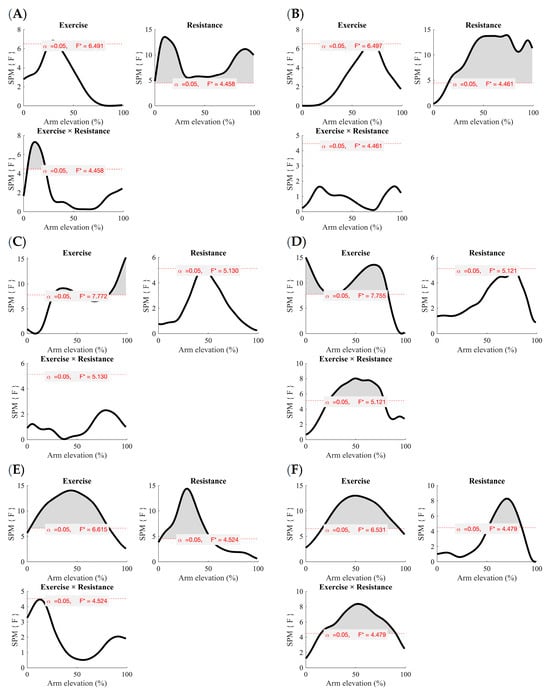
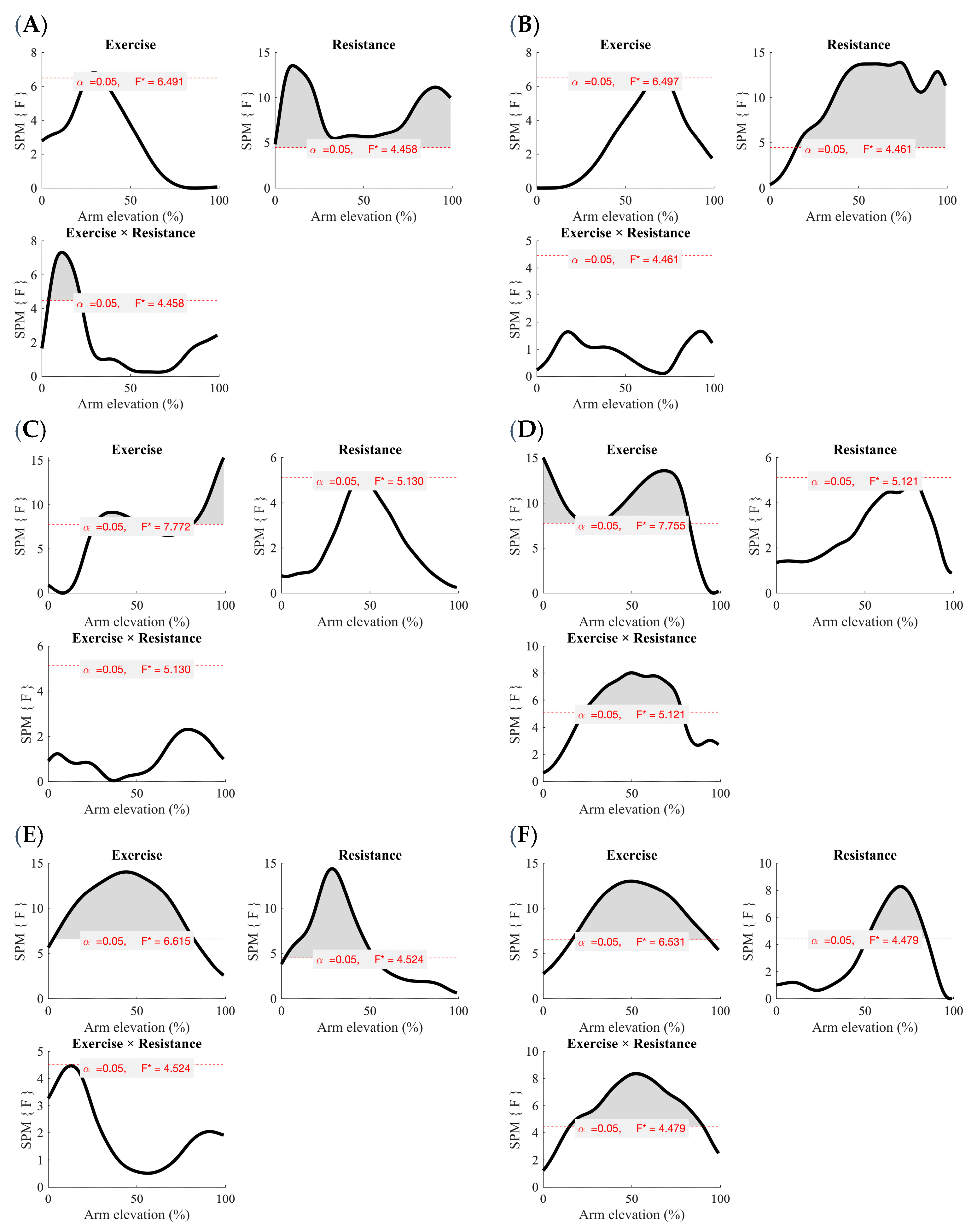
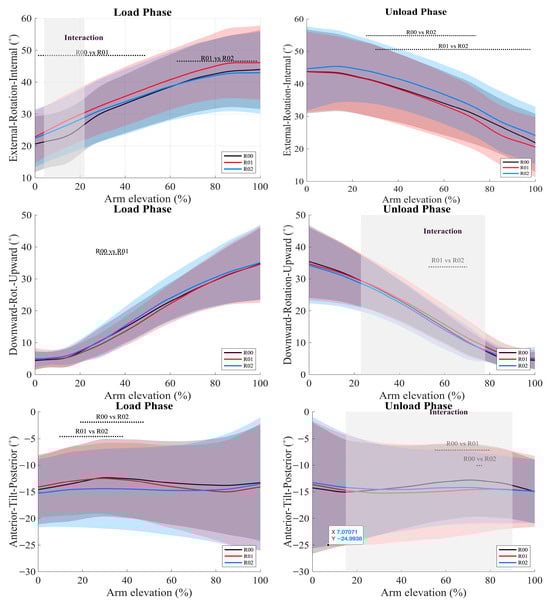
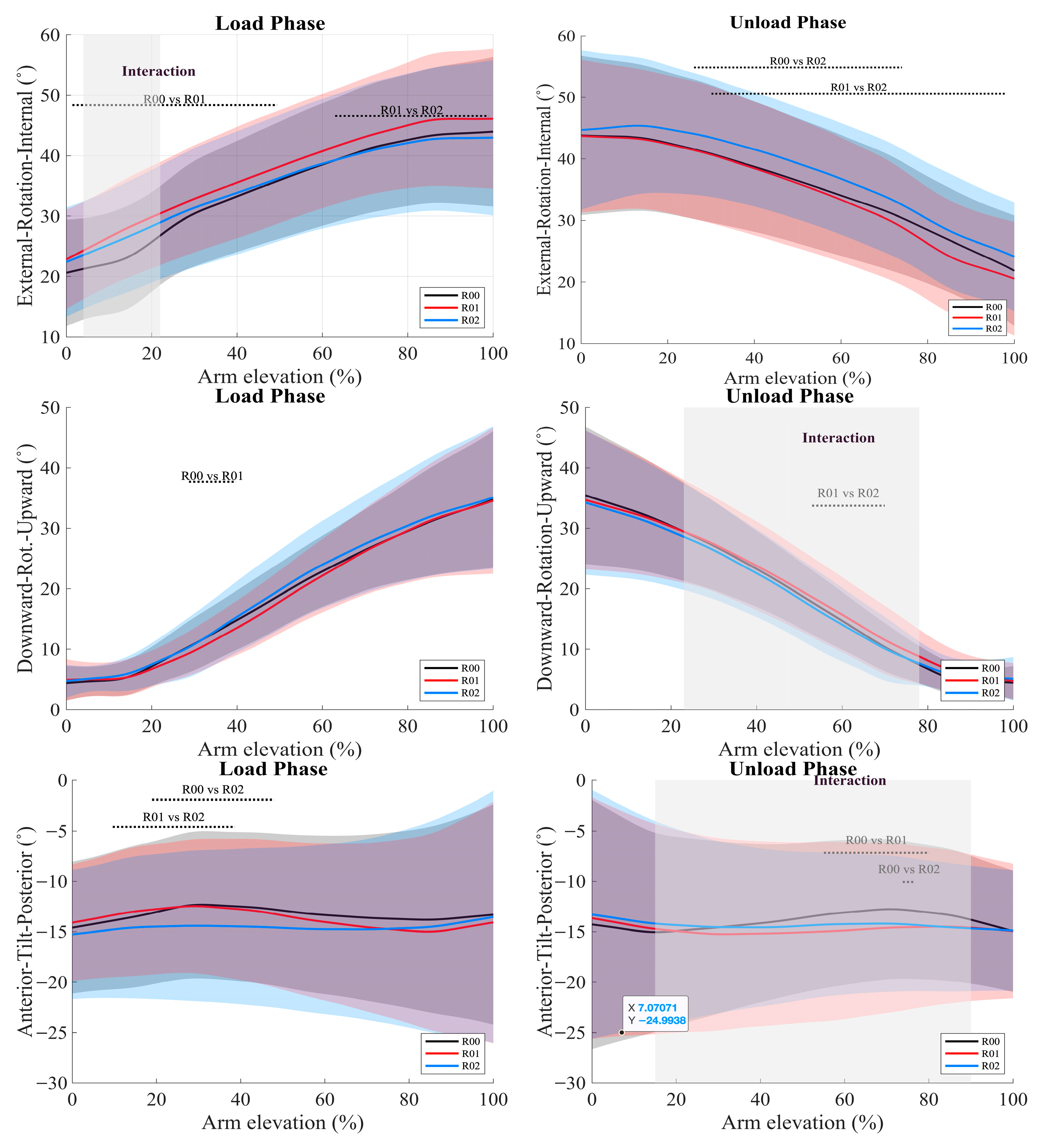
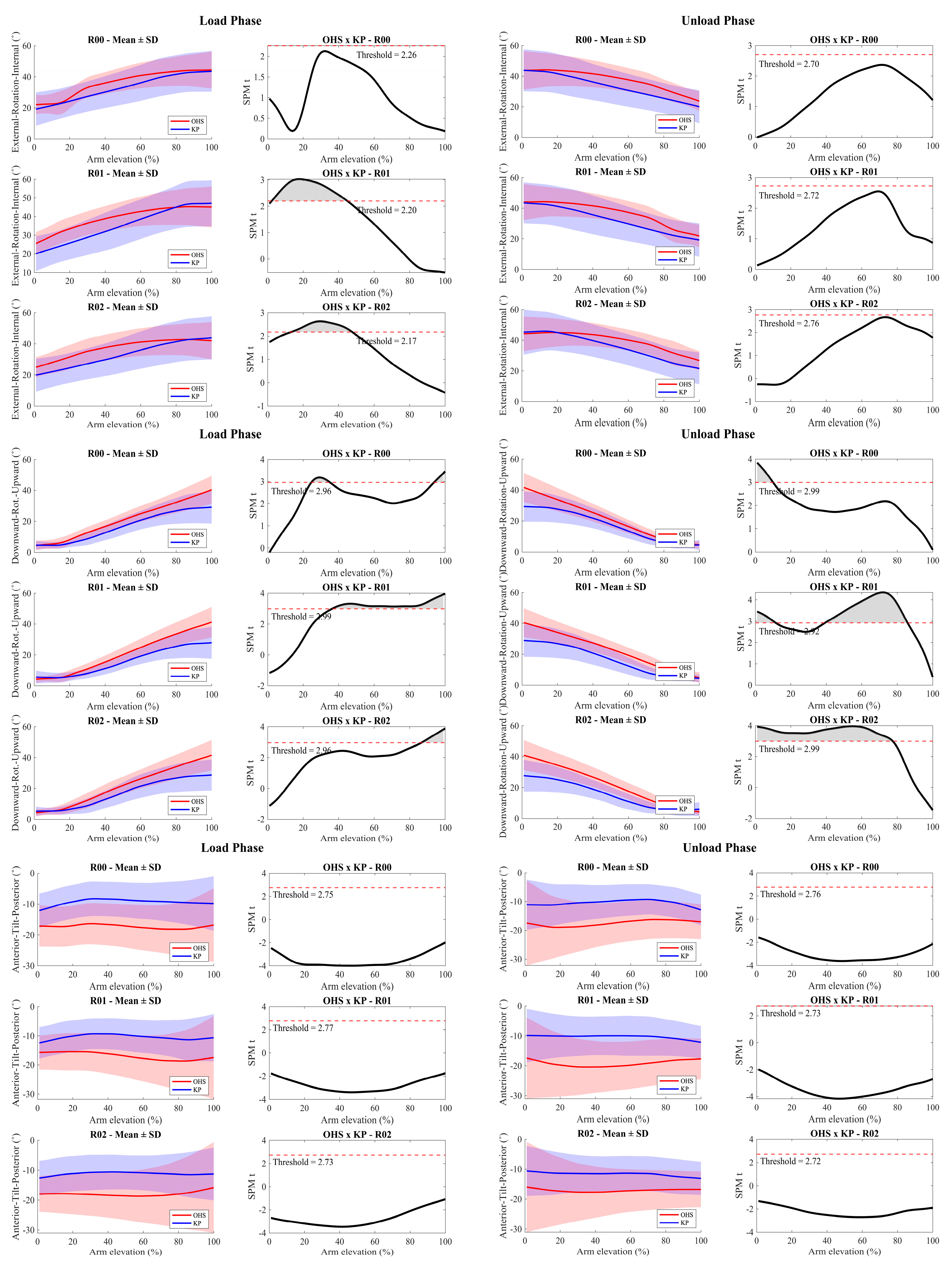
Scapular internal/external rotation during the arm elevation phase revealed a significant main effect of exercise from 25.7% to 32.8% of the cycle (31–39°, p = 0.04, η2p = 0.57), with more internal rotation for OHS. A main effect of resistance conditions across the entire cycle (0–100%) (0–120°, p < 0.00, η2p = 0.64). Post hoc analysis revealed significant differences between resistance conditions, with higher internal rotation in R01 compared to R02 from 58.85 to 100% (71–120°, p < 0.00). A significant interaction between exercise and resistance was observed from 4.1% to 21.9% of the cycle (5–26°, p = 0.04, η2p = 0.54). Post hoc analyses revealed significant differences were identified between exercise within resistance levels, with greater internal rotation in OHS compared with KP, ranging from 1% to 44% in R01 (1–53°, p = 0.03) and from 11.7% to 47% in R02 (14–56°, p = 0.04) (Figure 3A, Figure 4 and Figure 5).
Figure 3.
Two-way mixed ANOVA analysis during arm elevation and lowering phases. Load phase: (A) Internal/External Rotation, (C) Upward/Downward Rotation, (E) Anterior/Posterior Tilt. Unload phase: (B) Internal/External Rotation, (D) Upward/Downward Rotation, (F) Anterior/Posterior Tilt. ANOVA results, including the raw SPM {F} and critical F* threshold (grey areas show statistically significant differences).
Figure 4.
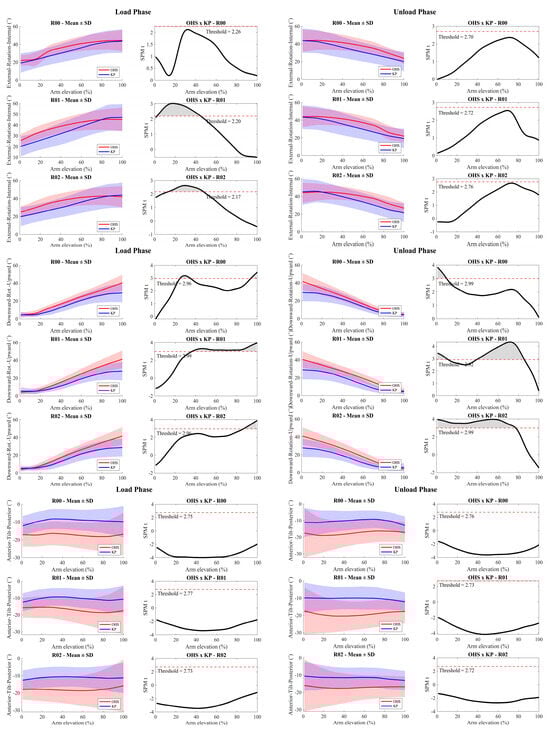
Resistance conditions during arm elevation and lowering phases: mean ± standard deviation (SD), post hoc significant differences for resistance are shown in a dotted line, and interactions are shown in a grey area.
Figure 5.
Two-way mixed ANOVA analysis during arm elevation and lowering phases: mean ± standard deviation (SD), and post hoc significant differences effects for interaction are shown in the grey area.
Scapular internal/external rotation during the lowering phase revealed a significant main effect of exercise from 65.9% to 73.1% of the cycle (79–88°, p = 0.04, η2p = 0.56), with more internal rotation for OHS. A main effect of resistance conditions from 14% to 100% of the cycle (17–120°, p < 0.00, η2p = 0.76). Post hoc analysis revealed no significant differences between resistance conditions. No significant interaction was observed between exercise and resistance (Figure 3B, Figure 4 and Figure 5).
3.2. Scapular Upward/Downward Rotation
Scapular downward/upward rotation during the arm elevation phase revealed a significant main effect of exercise from 26.4% to 51% of the cycle (32–61°, p = 0.01, η2p = 0.72) and from 81% to 100% (97–120°, p = 0.02, η2p = 0.72), with higher upward rotation for OHS. A main effect of resistance condition from 42% to 44% of the cycle (50–53°, p = 0.04, η2p = 0.01). Post hoc analyses revealed significant differences between resistance conditions, with higher upward rotation in R00 compared to R01 from 26.7% to 43.3% of the cycle (32–52°, p < 0.00). No significant interaction between resistance and exercise was observed (Figure 3C, Figure 4 and Figure 5).
Scapular downward/upward rotation during the lowering phase revealed a significant main effect of exercise from 0% to 23.3% of the cycle (0–28°, p = 0.01, η2p = 0.77) and from 32.6% to 82.4% (39–99°, p < 0.00, η2p = 0.77), with higher upward rotation for OHS. No main effect was observed for the resistance condition. A significant interaction between resistance and exercise was observed from 22.9% to 78.3% of the cycle (27–94°, p < 0.00, η2p = 0.60). Post hoc analyses revealed significant differences were identified between exercise within resistance levels, with greater internal rotation in OHS compared with KP, ranging from 0% to 9% in R00 (0–11°, p = 0.01), from 0% to 10.5% (0–12.6°, p = 0.01) and from 38.2% to 84.7% (45.8–101.6°, p < 0.00) in R01, and from 0% to 76.7% in R02 (0–92°, p = 0.04) (Figure 3D, Figure 4 and Figure 5).
3.3. Scapular Posterior/Anterior Tilt
Scapular anterior/posterior tilt during the arm elevation phase revealed a significant main effect of exercise from 3% to 82% of the cycle (4–98°, p < 0.00, η2p = 0.78), with posterior tilt for KP. A main effect of resistance condition from 2.1% to 52.5% of the cycle (3–63°, p = 0.01, η2p = 0.67). Post hoc analyses revealed significant differences between resistance conditions with posterior tilt in R00 compared to R02, from 17.3% to 51.6% of the cycle (21–62°, p < 0.00), and in R01 compared to R02, from 6.2% to 42.6% (7–51°, p = 0.00). A significant interaction between resistance and exercise was observed from 12.8% to 14.7% of the cycle (15–18°, p = 0.04, η2p = 0.00); no post hoc analyses were revealed (Figure 3E, Figure 4 and Figure 5).
Scapular anterior/posterior tilt during the lowering phase revealed a significant main effect of exercise from 16.2% to 94.1% of the cycle (19–113°, p < 0.00, η2p = 0.76), with posterior tilt for KP. A main effect of resistance condition from 51.3% to 85.3% of the cycle (62–102°, p = 0.02, η2p = 0.58). Post hoc analyses revealed significant differences between resistance conditions with posterior tilt in R00 compared to R01, from 51.5% to 83.1% (61.8–99.7°, p = 0.00), and R00 compared to R02, from 66.5% to 83.1% of the cycle (80–100°, p = 0.01). A significant interaction between resistance and exercise was observed from 14.3% to 90.0% of the cycle (17–108°, p = 0.00, η2p = 0.56); no post hoc analyses were revealed (Figure 3F, Figure 4 and Figure 5).
4. Discussion
We aimed to compare two exercises to expand understanding of previously described baseline kinematic patterns that may serve as a reference for future comparisons with symptomatic populations. These shoulder KC exercises clarify the role of elastic resistance, thereby contributing to rehabilitation and injury-prevention strategies.
4.1. Effect of Exercise Type
The exercise type revealed different scapular kinematics strategies. These exercises engage the KC under distinct conditions and bases of support, revealing similar patterns for stabilizing the scapula in both phases. Several studies have demonstrated that the KC approach is more effective than localized training strategies [9,21,36], suggesting that it should be included at multiple rehabilitation stages. Prior studies have used elastic resistance to activate scapular muscles, typically positioning it between the hands [2,12,18], without incorporating a whole-body component. Consistent with this approach, scapular-focused exercises improve motor control, joint position sense, and movement patterns, while reducing shoulder disability [1,3,37]. Moreover, incorporating KC exercises in shoulder rehabilitation may facilitate activation of the scapular stabilizer muscles [10], contributing to shoulder stability.
KC exercises were examined with a focus on the lumbo-pelvic-hip complex and scapular stabilizers [20]. Their results indicated that while elastic resistance effectively promoted scapular stabilization, it was less so for the lumbo-pelvic-hip complex, likely due to the horizontal resistance vector. Our study investigated two exercises performed on different bases of support, each employing novel approaches to elastic resistance: one applying a vertical vector on OHS or an oblique vector on KP, whereas resistance was integrated into the whole body. Thus, the OHS resulted in higher scapular internal and upward rotation than KP, supporting hypothesis 1. In contrast, KP promoted increased posterior tilt, reflecting the heightened demand for proximal stabilization due to a reduced base of support, supporting hypothesis 3.
4.2. Effect of Resistance
Resistance conditions revealed the most pronounced differences in scapular rotation across both phases. The direction and magnitude of elastic resistance distinctly modulate scapular motion throughout movement. Increased internal rotation enhances anterior stability, while midrange upward rotation supports subacromial clearance through enhanced stabilizer activation [38]. Control of posterior tilt during early elevation and eccentric lowering emphasizes the importance of targeting both phases to improve scapulohumeral rhythm and prevent compensatory anterior tilt [11,39]. Clinically, these adaptations underscore the value of resistance-based strategies for improving scapular control and shoulder stability during overhead tasks. Specifically, the resistance conditions (R00 and R01) showed more upward, internal rotation, and posterior tilt during arm elevation, while posterior tilt was pronounced in the R00 during the lowering phase. These adjustments enhance the humeral head positioning and help maintain a stable rotation center during shoulder movement [8,13], thereby preventing subacromial space narrowing and reducing the risk of impingement [40,41].
Studies on OHS and KP found no significant effect of theraband color on shoulder kinematics [24,25], likely due to slight differences in band tension [42,43,44]. One study using a standardized load of 5% body mass reported significant alterations in scapular kinematics [45]; however, differences in scapular motion induced by external loading do not appear to be substantially influenced by variation in load magnitude [46]. In the present study, scapular rotation varied under load conditions, ranging from 4% to 18% of body mass during OHS and from 8% to 13% in KP. Regardless of specific band tension, the application of resistance within the kinetic chain appears to be the primary driver of scapular adaptation, underscoring the dominant role of elastic resistance. Thus, the addition of external resistance increased scapular upward rotation for OHS and posterior tilt for KP, partially supporting the hypothesis 2.
4.3. Clinical Implications and Limitations
Exercise and resistance interactions revealed distinct effects in both phases, highlighting arm elevation during internal rotation. The base of support modulates how resistance vectors influence scapular mechanics along the movement [24,25]. OHS promoted scapular internal rotation, potentially functioning as a preparatory adjustment to maintain glenohumeral congruence and facilitate the progression of upward rotation during arm elevation, while KP emphasized posterior tilt. These findings emphasize the importance of KC integration for optimizing scapular control, showing that outcomes depend on multiple interacting factors rather than isolated conditions.
The resistance effect on scapular kinematics was exercise-dependent, reflecting subtle neuromuscular adaptations to maintain alignment under varying load magnitude or direction [11]. The scapulothoracic system appears capable of redistributing effort among axioscapular and axiohumeral groups [12,18], while maintaining consistent kinematic output and optimizing mechanical efficiency. Such behavior supports the concept of movement variability as a stabilizing mechanism within the KC [11,21], particularly under changing external demands. Clinically, resistance-based exercises can induce meaningful neuromuscular adaptations, even when kinematic differences are not evident, emphasizing the importance of monitoring both muscle activation and movement quality. Progressive resistance may therefore be used to refine scapular control and enhance dynamic stability, especially in individuals with altered motor patterns or scapular dyskinesis.
Both exercise type and resistance configuration significantly influence scapular kinematics, underscoring the relevance of kinetic-chain-based exercises. Additionally, linear resistance (R01) enhanced scapular kinematics compared with whole-body resistance (R02), indicating that resistance direction distinctly modulates scapular stabilization. These results support tailoring exercise and resistance orientation to improve neuromuscular control and shoulder function during rehabilitation and performance training.
Some limitations should be acknowledged. First, the study was conducted in asymptomatic young adults, which limits its generalizability to the clinical population with shoulder issues. Second, the cross-sectional design does not allow inferences about causal relationships or long-term adaptations. Third, the study used elastic resistance exercise with a specific intensity, limiting conclusions regarding different exercise modalities or loading schemes. Future studies should use more diverse samples, include a clinical population, investigate dose–response effects of resistance intensity, and employ longitudinal designs to investigate long-term adaptations in scapular and shoulder control.
5. Conclusions
It was demonstrated that the exercises contributed to scapulohumeral rhythm and stabilization during the overhead moment, highlighting their effectiveness as kinetic chain-integrated exercises. These results indicate that both exercise selection and the orientation of applied resistance are key determinants of scapular mechanics and should be carefully considered when designing rehabilitation and training programs.
Author Contributions
Conceptualization, F.L.P.S.; methodology, F.L.P.S. and A.G.P.; software, F.L.P.S. and A.G.P.; formal analysis, F.L.P.S. and A.G.P.; investigation, F.L.P.S. and A.G.P.; writing—original draft preparation, F.L.P.S.; writing—review and editing, F.L.P.S. and A.G.P.; supervision, A.G.P.; project administration, F.L.P.S. and A.G.P. All authors have read and agreed to the published version of the manuscript.
Funding
This research received no external funding.
Institutional Review Board Statement
The study was conducted in accordance with the Declaration of Helsinki and approved by the Institutional Review Board of the Faculty of Human Kinetics (CEIFMH n°: 45/2021; Approval Date: 3 November 2021).
Informed Consent Statement
Informed consent was obtained from all subjects involved in the study.
Data Availability Statement
The original contributions presented in this study are included in the article. Further inquiries can be directed to the corresponding author.
Conflicts of Interest
The authors declare no conflicts of interest.
References
- Reijneveld, E.A.; Noten, S.; Michener, L.A.; Cools, A.; Struyf, F. Clinical outcomes of a scapular-focused treatment in patients with subacromial pain syndrome: A systematic review. Br. J. Sports Med. 2017, 51, 436–441. [Google Scholar] [CrossRef] [Scilit] [PubMed]
- Castelein, B.; Cagnie, B.; Parlevliet, T.; Cools, A. Superficial and Deep Scapulothoracic Muscle Electromyographic Activity During Elevation Exercises in the Scapular Plane. J. Orthop. Sports Phys. Ther. 2016, 46, 184–193. [Google Scholar] [CrossRef] [Scilit] [PubMed]
- Larsson, R.; Bernhardsson, S.; Nordeman, L. Effects of eccentric exercise in patients with subacromial impingement syndrome: A systematic review and meta-analysis. BMC Musculoskelet. Disord. 2019, 20, 446. [Google Scholar] [CrossRef] [Scilit] [PubMed]
- Saito, H.; Harrold, M.E.; Cavalheri, V.; McKenna, L. Scapular focused interventions to improve shoulder pain and function in adults with subacromial pain: A systematic review and meta-analysis. Physiother. Theory Pract. 2018, 34, 653–670. [Google Scholar] [CrossRef] [Scilit]
- Valles-Carrascosa, E.; Gallego-Izquierdo, T.; Jimenez-Rejano, J.J.; Plaza-Manzano, G.; Pecos-Martin, D.; Hita-Contreras, F.; Achalandabaso Ochoa, A. Pain, motion and function comparison of two exercise protocols for the rotator cuff and scapular stabilizers in patients with subacromial syndrome. J. Hand Ther. 2018, 31, 227–237. [Google Scholar] [CrossRef] [Scilit]
- Aboodarda, S.J.; Page, P.A.; Behm, D.G. Muscle activation comparisons between elastic and isoinertial resistance: A meta-analysis. Clin. Biomech. 2016, 39, 52–61. [Google Scholar] [CrossRef] [Scilit]
- Lopes, J.S.S.; Machado, A.F.; Micheletti, J.K.; de Almeida, A.C.; Cavina, A.P.; Pastre, C.M. Effects of training with elastic resistance versus conventional resistance on muscular strength: A systematic review and meta-analysis. SAGE Open Med. 2019, 7, 2050312119831116. [Google Scholar] [CrossRef] [Scilit]
- Castelein, B.; Cagnie, B.; Cools, A. Scapular muscle dysfunction associated with subacromial pain syndrome. J. Hand Ther. 2017, 30, 136–146. [Google Scholar] [CrossRef] [Scilit]
- Cools, A.M.; Maenhout, A.G.; Vanderstukken, F.; Decleve, P.; Johansson, F.R.; Borms, D. The challenge of the sporting shoulder: From injury prevention through sport-specific rehabilitation toward return to play. Ann. Phys. Rehabil. Med. 2021, 64, 101384. [Google Scholar] [CrossRef] [Scilit]
- Richardson, E.; Lewis, J.S.; Gibson, J.; Morgan, C.; Halaki, M.; Ginn, K.; Yeowell, G. Role of the kinetic chain in shoulder rehabilitation: Does incorporating the trunk and lower limb into shoulder exercise regimes influence shoulder muscle recruitment patterns? Systematic review of electromyography studies. BMJ Open Sport Exerc. Med. 2020, 6, e000683. [Google Scholar] [CrossRef] [Scilit]
- Sciascia, A.; Thigpen, C.; Namdari, S.; Baldwin, K. Kinetic chain abnormalities in the athletic shoulder. Sports Med. Arthrosc. Rev. 2012, 20, 16–21. [Google Scholar] [CrossRef] [Scilit] [PubMed]
- Borms, D.; Maenhout, A.; Cools, A.M. Incorporation of the Kinetic Chain Into Shoulder-Elevation Exercises: Does It Affect Scapular Muscle Activity? J. Athl. Train. 2020, 55, 343–349. [Google Scholar] [CrossRef] [Scilit]
- Zaremski, J.L.; Wasser, J.G.; Vincent, H.K. Mechanisms and Treatments for Shoulder Injuries in Overhead Throwing Athletes. Curr. Sports Med. Rep. 2017, 16, 179–188. [Google Scholar] [CrossRef] [Scilit]
- Oliver, G.D.; Washington, J.K.; Barfield, J.W.; Gascon, S.S.; Gilmer, G. Quantitative Analysis of Proximal and Distal Kinetic Chain Musculature During Dynamic Exercises. J. Strength Cond. Res. 2018, 32, 1545–1553. [Google Scholar] [CrossRef] [Scilit] [PubMed]
- Picha, K.J.; Almaddah, M.R.; Barker, J.; Ciochetty, T.; Black, W.S.; Uhl, T.L. Elastic Resistance Effectiveness on Increasing Strength of Shoulders and Hips. J. Strength Cond. Res. 2019, 33, 931–943. [Google Scholar] [CrossRef] [Scilit]
- Seguin, R.C.; Cudlip, A.C.; Holmes, M.W.R. The Efficacy of Upper-Extremity Elastic Resistance Training on Shoulder Strength and Performance: A Systematic Review. Sports 2022, 10, 24. [Google Scholar] [CrossRef] [Scilit]
- de Oliveira, P.A.; Blasczyk, J.C.; Souza Junior, G.; Lagoa, K.F.; Soares, M.; de Oliveira, R.J.; Filho, P.; Carregaro, R.L.; Martins, W.R. Effects of Elastic Resistance Exercise on Muscle Strength and Functional Performance in Healthy Adults: A Systematic Review and Meta-Analysis. J. Phys. Act. Health 2017, 14, 317–327. [Google Scholar] [CrossRef] [Scilit]
- Borms, D.; Maenhout, A.; Berckmans, K.; Spanhove, V.; Vanderstukken, F.; Cools, A. Scapulothoracic muscle activity during kinetic chain variations of a prone elevation exercise. Braz. J. Phys. Ther. 2022, 26, 100420. [Google Scholar] [CrossRef] [Scilit] [PubMed]
- De Mey, K.; Danneels, L.; Cagnie, B.; Van den Bosch, L.; Flier, J.; Cools, A.M. Kinetic chain influences on upper and lower trapezius muscle activation during eight variations of a scapular retraction exercise in overhead athletes. J. Sci. Med. Sport 2013, 16, 65–70. [Google Scholar] [CrossRef] [Scilit]
- Wasserberger, K.W.; Downs, J.L.; Barfield, J.W.; Williams, T.K.; Oliver, G.D. Lumbopelvic-Hip Complex and Scapular Stabilizing Muscle Activations During Full-Body Exercises With and Without Resistance Bands. J. Strength Cond. Res. 2020, 34, 2840–2848. [Google Scholar] [CrossRef] [Scilit]
- Chu, S.K.; Jayabalan, P.; Kibler, W.B.; Press, J. The Kinetic Chain Revisited: New Concepts on Throwing Mechanics and Injury. Pm&r 2016, 8, S69–S77. [Google Scholar] [CrossRef] [Scilit]
- Nam, H.S.; Kim, J.H.; Lim, Y.J. The Effect of the Base of Support on Anticipatory Postural Adjustment and Postural Stability. J. Korean Phys. Ther. 2017, 29, 135–142. [Google Scholar] [CrossRef] [Scilit]
- Hamill, J.; Knutzen, K.; Derrick, T.R. Biomechanical Basis of Human Movement, 4th ed.; Wolters Kluwer Health: Philadelphia, PA, USA, 2015; p. xi. 419p. [Google Scholar]
- Salles, F.L.P.; Pascoal, A.G. A Kinematic Study on the Use of Overhead Squat Exercise with Elastic Resistance on the Shoulder Kinetic Chain Approach. J. Funct. Morphol. Kinesiol. 2025, 10, 97. [Google Scholar] [CrossRef] [Scilit]
- Salles, F.L.P.; Pascoal, A.G. Enhancing Shoulder Kinetic Chain Rehabilitation Using Elastic Resistance in Kneeling Positions. A Kinematics Study. JOSPT Open 2025, 3, 449–457. [Google Scholar] [CrossRef] [Scilit]
- Hoch, M.C.; Farwell, K.E.; Gaven, S.L.; Weinhandl, J.T. Weight-Bearing Dorsiflexion Range of Motion and Landing Biomechanics in Individuals With Chronic Ankle Instability. J. Athl. Train. 2015, 50, 833–839. [Google Scholar] [CrossRef] [Scilit] [PubMed]
- Hoch, M.C.; McKeon, P.O. Joint mobilization improves spatiotemporal postural control and range of motion in those with chronic ankle instability. J. Orthop. Res. 2011, 29, 326–332. [Google Scholar] [CrossRef] [Scilit] [PubMed]
- Park, K.M.; Cynn, H.S.; Choung, S.D. Musculoskeletal predictors of movement quality for the forward step-down test in asymptomatic women. J. Orthop. Sports Phys. Ther. 2013, 43, 504–510. [Google Scholar] [CrossRef] [Scilit] [PubMed]
- Hotta, G.H.; Queiroz, P.O.P.; de Lemos, T.W.; Rossi, D.M.; Scatolin, R.O.; de Oliveira, A.S. Immediate effect of scapula-focused exercises performed with kinematic biofeedback on scapular kinematics in individuals with subacromial pain syndrome. Clin. Biomech. 2018, 58, 7–13. [Google Scholar] [CrossRef] [Scilit]
- Bench, R.W.; Thompson, S.E.; Cudlip, A.C.; Holmes, M.W. Examining Muscle Activity Differences During Single and Dual Vector Elastic Resistance Exercises. Int. J. Sports Phys. Ther. 2021, 16, 322–334. [Google Scholar] [CrossRef] [Scilit]
- Wu, G.; van der Helm, F.C.; Veeger, H.E.; Makhsous, M.; Van Roy, P.; Anglin, C.; Nagels, J.; Karduna, A.R.; McQuade, K.; Wang, X.; et al. ISB recommendation on definitions of joint coordinate systems of various joints for the reporting of human joint motion-Part II: Shoulder, elbow, wrist and hand. J. Biomech. 2005, 38, 981–992. [Google Scholar] [CrossRef] [Scilit]
- Agustin, R.M.; Medina-Mirapeix, F.; Gacto-Sanchez, M.; Canovas-Ambit, G.; Vecchia, A.A. Mechanical Evaluation of the Resistance of Theraband CLX. J. Sport Rehabil. 2023, 32, 220–226. [Google Scholar] [CrossRef] [Scilit]
- Pataky, T.C. Generalized n-dimensional biomechanical field analysis using statistical parametric mapping. J. Biomech. 2010, 43, 1976–1982. [Google Scholar] [CrossRef] [Scilit]
- De Ridder, R.; Willems, T.; Vanrenterghem, J.; Robinson, M.; Pataky, T.; Roosen, P. Gait kinematics of subjects with ankle instability using a multisegmented foot model. Med. Sci. Sports Exerc. 2013, 45, 2129–2136. [Google Scholar] [CrossRef] [Scilit]
- Norouzian, R.; Plonsky, L. Eta- and partial eta-squared in L2 research: A cautionary review and guide to more appropriate usage. Second Lang. Res. 2018, 34, 257–271. [Google Scholar] [CrossRef] [Scilit]
- Kibler, W.B.; McMullen, J.; Uhl, T. Shoulder rehabilitation strategies, guidelines, and practice. Orthop. Clin. N. Am. 2001, 32, 527–538. [Google Scholar] [CrossRef] [Scilit] [PubMed]
- Ravichandran, H.; Janakiraman, B.; Gelaw, A.Y.; Fisseha, B.; Sundaram, S.; Sharma, H.R. Effect of scapular stabilization exercise program in patients with subacromial impingement syndrome: A systematic review. J. Exerc. Rehabil. 2020, 16, 216–226. [Google Scholar] [CrossRef] [Scilit] [PubMed]
- Lawrence, R.L.; Braman, J.P.; Laprade, R.F.; Ludewig, P.M. Comparison of 3-dimensional shoulder complex kinematics in individuals with and without shoulder pain, part 1: Sternoclavicular, acromioclavicular, and scapulothoracic joints. J. Orthop. Sports Phys. Ther. 2014, 44, A636–A638. [Google Scholar] [CrossRef] [Scilit]
- Bautista, D.; Durke, D.; Cotter, J.A.; Escobar, K.A.; Schick, E.E. A Comparison of Muscle Activation Among the Front Squat, Overhead Squat, Back Extension and Plank. Int. J. Exerc. Sci. 2020, 13, 714–722. [Google Scholar] [CrossRef] [Scilit]
- Lawrence, R.L.; Braman, J.P.; Ludewig, P.M. The Impact of Decreased Scapulothoracic Upward Rotation on Subacromial Proximities. J. Orthop. Sports Phys. Ther. 2019, 49, 180–191. [Google Scholar] [CrossRef] [Scilit] [PubMed]
- Thompson, M.D.; Landin, D.; Page, P.A. Dynamic acromiohumeral interval changes in baseball players during scaption exercises. J. Shoulder Elbow Surg. 2011, 20, 251–258. [Google Scholar] [CrossRef] [Scilit]
- Andersen, L.L.; Andersen, C.H.; Mortensen, O.S.; Poulsen, O.M.; Bjornlund, I.B.; Zebis, M.K. Muscle activation and perceived loading during rehabilitation exercises: Comparison of dumbbells and elastic resistance. Phys. Ther. 2010, 90, 538–549. [Google Scholar] [CrossRef] [Scilit]
- Haraldsson, B.T.; Andersen, C.H.; Erhardsen, K.T.; Zebis, M.K.; Micheletti, J.K.; Pastre, C.M.; Andersen, L.L. Submaximal Elastic Resistance Band Tests to Estimate Upper and Lower Extremity Maximal Muscle Strength. Int. J. Environ. Res. Public Health 2021, 18, 2749. [Google Scholar] [CrossRef] [Scilit]
- Machado, A.F.; Souto, L.R.; Silva, J.S.; Andersen, L.L. Determination of shoulder abduction strength using a submaximal elastic band test. J. Perform. Health Res. 2017, 1, 31–39. [Google Scholar]
- Forte, F.C.; de Castro, M.P.; de Toledo, J.M.; Ribeiro, D.C.; Loss, J.F. Scapular kinematics and scapulohumeral rhythm during resisted shoulder abduction--implications for clinical practice. Phys. Ther. Sport 2009, 10, 105–111. [Google Scholar] [CrossRef] [Scilit] [PubMed]
- Pascoal, A.G.; Helm, F.C.T.; Correia, P.P.; Carita, I. Effects of different arm external loads on the scapulo-humeral rhythm. Clin. Biomech. 2000, 15, S21–S27. [Google Scholar] [CrossRef] [Scilit] [PubMed]

Disclaimer/Publisher’s Note: The statements, opinions and data contained in all publications are solely those of the individual author(s) and contributor(s) and not of MDPI and/or the editor(s). MDPI and/or the editor(s) disclaim responsibility for any injury to people or property resulting from any ideas, methods, instructions or products referred to in the content. |
© 2025 by the authors. Licensee MDPI, Basel, Switzerland. This article is an open access article distributed under the terms and conditions of the Creative Commons Attribution (CC BY) license (https://creativecommons.org/licenses/by/4.0/).