
Article

From Organic Waste to Clean Fuel and Water: Plant-Extract-Assisted TiO2 Nanoparticles for Simultaneous 2-Naphthol Degradation and H2 Production


by
Osama Y. Al-Madanat
Chemistry Department, Mutah University, Mutah, Al-Karak 61710, Jordan
Nanoenergy Adv. 2026, 6(2), 18; https://doi.org/10.3390/nanoenergyadv6020018

Submission received: 14 March 2026 / Revised: 12 May 2026 / Accepted: 13 May 2026 / Published: 26 May 2026

Abstract

The development of sustainable technologies capable of simultaneously addressing environmental pollution and renewable energy production remains a major scientific challenge. In this work, titanium dioxide nanoparticles (GTiO2) were synthesized through a plant-extract-assisted route using Punica granatum (pomegranate) peel extract and subsequently modified with platinum nanoparticles (Pt NPs) to obtain an efficient photocatalyst for the photoreforming of organic pollutants. The resulting Pt-GTiO2 material exhibited an anatase crystal structure with an average crystallite size of approximately 12 nm and a specific surface area of about 140 m2 g−1. Comprehensive characterization using XRD, BET, TEM, FTIR, Raman, and photoluminescence spectroscopy (PL) revealed favorable structural and optoelectronic properties that promote efficient charge separation. The photocatalytic performance of Pt-GTiO2 was evaluated through the simultaneous degradation of 2-naphthol, a priority aromatic pollutant, and hydrogen evolution under simulated solar irradiation in anaerobic conditions. Under the investigated conditions, Pt-GTiO2 effectively promoted 2-naphthol degradation, with substantial but incomplete mineralization, as confirmed by TOC removal. The synthesized catalyst showed degradation efficiency higher than Pt-UV100 and comparable to Pt-P25, while exhibiting superior hydrogen evolution when compared with Pt-P25. Mechanistic investigations combining scavenger experiments, electron paramagnetic resonance (EPR) spectroscopy, and the identification of reaction intermediates suggest that photogenerated holes play a major role in the initial oxidation step under the mechanistic test conditions. The detected intermediates indicate that photoreforming proceeds via multiple pathways, including hydroxylation, ring-opening, reduction, and fragmentation. These findings highlight the potential of biogenic TiO2-based photocatalysts for converting hazardous organic pollutants into clean hydrogen fuel while simultaneously achieving wastewater purification, offering a promising route toward sustainable environmental and energy technologies.

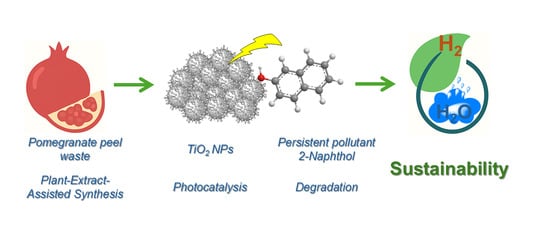
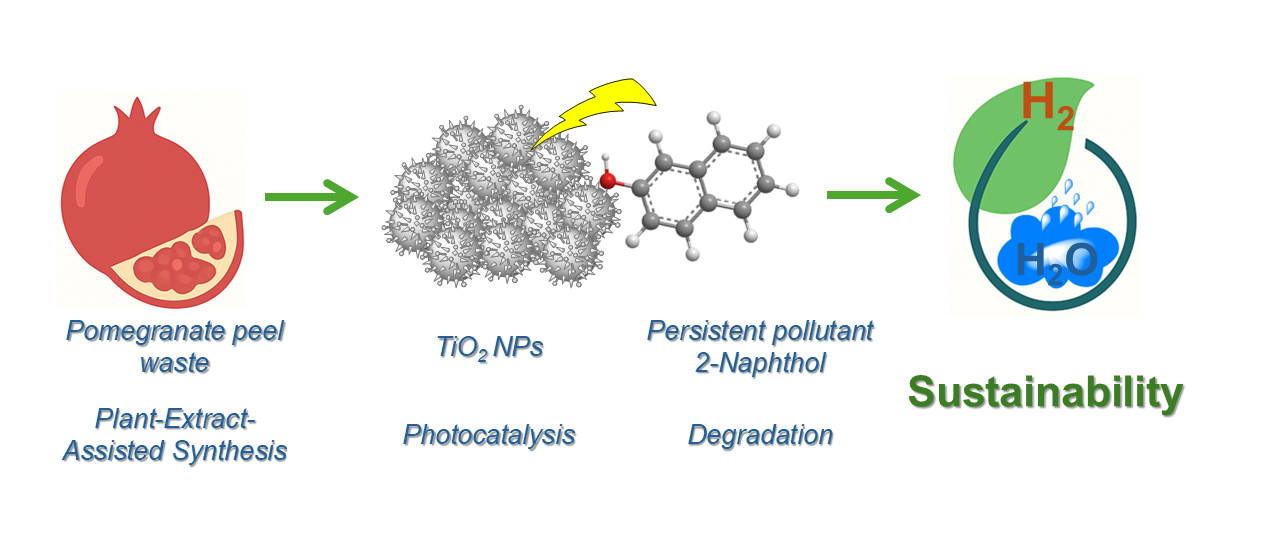
Graphical Abstract

1. Introduction

The growing demand for sustainable energy and the rapid increase in environmental pollution represent two major challenges facing modern society [1]. The heavy reliance on fossil fuels to meet the global energy demand has significantly contributed to climate change [2,3]. At the same time, conventional wastewater treatment methods are often insufficient to remove the large volumes of complex organic pollutants released daily from industrial and human activities [1,4]. Therefore, the development of integrated technologies capable of producing clean energy while simultaneously treating contaminated water is urgently needed.
As a promising alternative to fossil fuels due to its clean combustion, which produces only pure water, and its efficiency due to its exceptionally high heat-to-weight density, molecular hydrogen has become an attractive renewable energy carrier [5,6]. However, despite these advantageous properties, its traditional production methods, like water electrolysis and steam methane reforming, often rely on the consumption of large amounts of water and energy, exacerbating the problems of increasing water scarcity and increasing energy demand [5]. Therefore, there is an urgent need for renewable and sustainable hydrogen production pathways that do not rely primarily on the consumption of traditional energy resources and drinking water sources [7,8,9].
Semiconductor photocatalysis is a light-driven process that accelerates redox reactions at a catalyst surface which has been widely investigated for environmental remediation, fuel generation, and the synthesis of valuable organic compounds. The photoexcited catalysts can drive selective redox transformations under mild conditions [4,10]. In this context, photocatalytic reforming of organic pollutants could be one of the most attractive and sustainable methods as an alternative for H2 production [2,4,5,6]. In fact, this novel approach offers a dual benefit through simultaneous wastewater treatment and transformation of the chemical energy stored inside the organic pollutants into sustainable H2 [11,12]. Because this process relies primarily on solar energy, it aligns with sustainability principles by repurposing wastewater streams into valuable products, including a sustainable energy carrier and purified water, rather than releasing them into the environment [13].
2-Naphthol serves as a necessary raw and intermediate material for multiple chemical syntheses and industries, such as pigments, dyes, insecticides, fungicides, pharmaceuticals, and other chemicals. In addition, it is a widespread by-product contaminant in effluents from various industries, such as those originating from the petroleum, textile, and coal sectors, mainly due to its relatively higher water solubility [14]. Due to its derivation from polycyclic aromatic hydrocarbons (PAHs) and its human toxicity, 2-naphthol is classified as a priority pollutant [14,15]. Although some literature studies suggest that 2-naphthol is “readily biodegradable” under controlled and specific laboratory conditions, other sources highlight its resistance and slow degradation rates in the environment [16,17]. The main concern regarding this compound is its accumulation in aquatic ecosystems, enabling it to eventually enter the food chain [17,18,19]. As traditional wastewater purification methods are insufficient to remove this compound and its persistent derivatives, new technologies are urgently needed to eliminate these pollutants without producing equally or more toxic by-products. Recently, several studies have focused on the implementation of advanced oxidation processes (AOPs), such as photocatalysis, to eliminate these persistent pollutants from the environment [4,11].
Recently, bifunctional heterogeneous photocatalysis based on semiconductors has received increasing attention as a sustainable, cheap, and environmentally friendly strategy for both solar energy harvesting and environmental pollution remediation [4,20,21]. Among the broad number of candidate semiconductor materials, titanium dioxide nanoparticles (TiO2) and their derivatives stand out as the most widely studied, engineered, and utilized due to their low toxicity, chemical stability, low cost, and high photoreactivity. These nanoparticles, with the aid of solar energy, can mineralize a broad spectrum of organic pollutants into harmless carbon dioxide (CO2) and water [15,22], while converting the chemical energy stored in these pollutants into a sustainable, green carrier under specific conditions.
The conventional and industrial methods for synthesizing TiO2 NPs involve the use of harsh and toxic chemicals such as Titanium(III) chloride, Titanium(IV) chloride, and titanyl sulfate. These chemicals pose a threat to the environment by producing hazardous waste [4,20,23]. Therefore, it is essential to transition toward more environmentally benign synthetic routes to achieve sustainability. Recently, the plant-extract-assisted synthesis of TiO2 NPs based on plant or plant residue extracts, such as pomegranate peels, has been considered a useful alternative method for the synthesis of environmentally friendly, cost-effective, simple, and scalable materials [23,24]. This approach relies on naturally occurring reducing and capping agents extracted from plants using a suitable solvent, such as water, to facilitate the stabilization of the formed nanoparticles [25]. Several research groups have reported the successful synthesis of various metal oxide nanoparticles using a broad spectrum of plant or plant residue extracts [25,26]. Mohammadi et al. synthesized zinc oxide nanoparticles using Punica granatum fruit peel extract [27]. Moghni et al. prepared TiO2 NPs via a plant-extract-assisted synthesis using Inula viscosa aqueous extract [28]. In this study, an aqueous extract of Punica granatum (pomegranate) peels was used for the synthesis of TiO2 NPs due to its rich composition of bioactive compounds, including tannins, polyphenols, flavonoids, and carboxylic acids, which function as natural reducing and stabilizing agents. This approach is perfectly consistent with circular economy principles for the transformation of biowaste materials into higher-value products [23,25].
Despite extensive research on TiO2-based photocatalysis, most previous studies have focused primarily on either pollutant degradation or hydrogen production as separate processes. Furthermore, many investigations employ simple sacrificial agents such as methanol or oxalic acid, which do not adequately represent the complexity of real organic contaminants present in industrial wastewater. In addition, conventional synthesis routes for TiO2 often involve environmentally hazardous reagents, contradicting the sustainability principles that photocatalytic technologies aim to address.
This work presents a sustainable strategy that integrates plant-extract-assisted synthesis of TiO2 nanoparticles using pomegranate peel extract with bifunctional photocatalytic reforming of the priority pollutant 2-naphthol for simultaneous wastewater remediation and hydrogen production. TiO2 photocatalysis, Pt cocatalysts, and green nanoparticle synthesis are well established individually, and many previous studies have shown that TiO2-based photocatalysts can couple pollutant oxidation with H2 evolution [29,30,31,32]. However, their integration for the anaerobic photoreforming of priority aromatic pollutants remains insufficiently explored, as shown in the comparison of literature reports in Table S1. The novelty of the present work lies in coupling the photocatalytic reforming of 2-naphthol over pomegranate peel extract-assisted TiO2 loaded with Pt NPs under oxygen-free and simulated solar light irradiation conditions, which was systematically investigated and accompanied by a detailed mechanistic analysis. The study combines comprehensive physicochemical characterization of the Pt-GTiO2 catalyst with kinetic analysis, benchmarked directly against Pt-P25 and Pt-UV100 under identical reaction conditions, intermediate identification using GC-MS and ion chromatography, and reactive species investigation through scavenger experiments and EPR spectroscopy. This integrated approach provides new insights into the photoreforming pathways of aromatic pollutants, thereby contributing to the development of sustainable photocatalytic systems capable of converting organic pollutants into clean hydrogen fuel.

2. Materials and Methods

2.1. Raw Materials

The benchmark TiO2 used in this study includes Aeroxide (P25, Evonik Corporation, Champaign, IL, USA) and Hombikat (UV100, Sachtleben Chemie GmbH, Duisburg, Germany). The following reagents were sourced from Sigma-Aldrich (St. Louis, MO, USA): Titanium Tetra Isopropoxide (TTIP, C12H28O4Ti, 97%), naphthalen-2-ol (99%), chloroplatinic acid hexahydrate (H2PtCl6·6H2O, 99.9%), potassium iodide (99.5%), ethyl acetate (GC grade), 5,5-Dimethyl-1-pyrroline N-oxide (DMPO, ≥98.0%), and barium sulfate (≥99%). Methanol (HPLC grade), hydrochloric acid (37 wt%), and tert-butanol (≥99%) were purchased from Carl Roth (Karlsruhe, Germany). OASIS HLB and Sep-Pak C18 Cartridges, 500 mg Sorbent (6 mL 500 mg−1) were obtained from Waters® (County Wexford, Ireland). All chemicals in this study were used in their received form without any additional purification. Milli-Q water (18.2 MΩ·cm at 25 °C) was prepared locally in the lab using the Millipore Milli-Q system.

2.2. Plant-Extract-Assisted Synthesis of TiO2 Nanoparticles

A plant-extract-assisted method was used for the synthesis of titanium dioxide nanoparticles by incorporating a biowaste extract—namely, pomegranate peel extract—as a capping agent. The term plant-extract-assisted synthesis is used here to describe the use of aqueous pomegranate peel extract as a renewable source for capping and stabilizing agents that can assist particle formation and stabilization. Indeed, the sustainability advantages of this approach are relative. Although this route reduces the need for harsh and toxic organic compounds, it is not a completely impact-free synthesis. The process still uses a titanium precursor, washing solvents, and calcination at 500 °C, all of which carry environmental and energy costs [25].
Pomegranate fruit was purchased from a local market in Al Al-Karak province, Jordan. The collected fruit was cleaned twice with tap water and finally rinsed with Milli-Q water to ensure the removal of dust and potential contaminants. After drying, the peels were separated from the fruit, washed with Milli-Q water, chopped into small pieces, and left to dry at room temperature inside a clean room in the absence of direct sunlight contact for around 2 weeks. The resulting dried peels were then mixed very well and pulverized into a powder using an electric grinder apparatus. To prepare the extract solution, 50 g of the well-mixed peels’ fine powder was suspended in 100 mL of Milli-Q water, gently heated, and stirred at 50 °C/600 rpm for 5 h on a hot plate. After cooling, the resulting extracted solution was filtered twice using Whatman filter paper No. 1, stored in an amber glass bottle, and finally stored at 4 °C in a refrigerator for further analysis.
The TiO2 nanoparticles sample (GTiO2) was synthesized by adapting Aravind et al.’s method [33] with some modifications. First, 10.0 mL of titanium (IV) isopropoxide was placed inside a 250.0 mL Erlenmeyer flask and dissolved in 100.0 mL of Milli-Q water under vigorous stirring. To this solution, 50.0 mL of the pomegranate peel extract was added dropwise, controlling the addition rate at around 0.5 mL min−1, under continued vigorous stirring at room temperature. Afterward, stirring of the resulting solution continued for an additional 3 h. During this stage, the solution color changed from pure white to yellowish, confirming the successful formation of the GTiO2 nanoparticles. The obtained suspension was then filtered using Whatman filter paper No.1 to separate the formed NPs. The collected nanoparticles were washed twice with methanol and then repeatedly with Milli-Q water to remove organic and inorganic residues. Finally, the collected nanoparticles were dried overnight at 100 °C, then calcinated in a Muffle furnace at 500 °C for 4 h.

2.3. Platinization of the TiO2 Materials

Platinization of the TiO2 samples, GTiO2, UV100, and P25, was performed using a refined photodeposition method, adapted from a protocol established by Al-Madanat et al. [34]. Initially, all TiO2 nanoparticle samples were calcined at 400 °C under a continuous flow of oxygen for 2 h. Once cooled, a specified amount of bare TiO2 nanoparticles was suspended in 100 mL of Milli-Q water inside a 150 mL borosilicate photoreactor. The suspension was sonicated for 60 min, after which the appropriate quantity of platinum precursor (H2PtCl6) was introduced to achieve the desired weight percentage. The resulting suspension was stirred overnight to promote the adsorption of Pt (IV) ions onto the surface of the TiO2 nanoparticles. Following this, the system was purged with pure argon for 30 min to eliminate any oxygen. The mixture was then illuminated at room temperature for 30 min. After this initial period, 5 mL of methanol was added to the system, and the suspension was illuminated for an additional 5 h. Ultimately, the platinized material was centrifuged, washed three times with methanol, followed by several washes with Milli-Q water, and dried at 120 °C overnight. The obtained samples were labeled Pt-GTiO2, Pt-UV100, and Pt-P25.

2.4. Photocatalytic Experiments

In each typical experiment for the photocatalytic H2 evolution and 2-naphthol photooxidation, 1.0 mg mL−1 of photocatalyst powder was suspended in a 20.0 ppm solution of 2-naphthol inside a 20.0 mL glass vial sealed with a silicone septa crimp cap, or a 50 mL borosilicate photoreactor. The suspension was then purged with high-purity argon gas for 30 min. The concentration of 2-naphthol was adjusted according to the specific requirements of each experiment, while its concentration before, during, and after the photocatalytic process was precisely determined (three times) through the High-Performance Liquid Chromatography with ultraviolet detection (HPLC-UV) technique. After preparing the suspension based on the reaction conditions, the vials were horizontally positioned within an orbital shaker water bath to maintain the reaction temperature at 25 °C ± 2 °C. Afterward, the samples were left in the dark for around 1 h to establish the adsorption–desorption equilibrium. The distance between the solar simulator and the shaker was adjusted to 30 cm, while the simulator consisted of a chamber designed to reflect the light from all directions and was fitted with a xenon lamp (1000 W, Hönle Technology, Munich, Germany). This light source was equipped with a specialized filter to reduce the UV irradiation. The photon flux density was measured from the spectral irradiance of the lamp in the wavelength range between 320 nm and 380 nm at the irradiated window of the photoreactor and was found to be I0 = 3.31 × 10⁻⁴ mol m−2 s−1. All photocatalytic experiments concerning the photooxidation of 2-naphthol and H2 production were conducted in triplicate, yielding a relative standard deviation (RSD) of less than 10%. Additionally, control experiments were performed using pristine GTiO2 and pristine commercial TiO2 materials (P25 and UV100), besides the corresponding Pt-loaded samples. Bare GTiO2 was used as the plant-extract-assisted synthesized TiO2 control without Pt, while P25 and UV100 represent commercial TiO2 references without plant extract prepared in conventional methods. Pt-P25 and Pt-UV100 were included as Pt-loaded controls without the pomegranate peel extract. All samples were tested under identical reaction conditions to separate and distinguish the effects of Pt loading from the influence of the TiO2 support.
For scavenger experiments, the initial 2-naphthol concentration was 20.0 ppm, the Pt-GTiO2 loading was 1.0 mg mL−1, and the suspension volume was 50.0 mL. The required amounts of the KI and tert-butyl alcohol (TBA) solutions were added to the reaction suspension to achieve a final concentration of 20.0 mM prior to the dark equilibration period. Afterward, the reactor was sealed, purged with argon for 30 min, kept in the dark for another 60 min, and finally illuminated under a Philips CLEO 15 W UV lamp at 25 °C [6].

2.5. Analytical Methods

To quantify the concentration of 2-naphthol and the total organic carbon in the reaction medium during or after each experiment of 2-naphthol photooxidation, a 1 mL sample of the reaction suspension was drawn using a disposable syringe pre-purged with argon. This sample was immediately filtered through a 0.2 µm PTFE online filter and then stored in a 1.5 mL amber glass GC vial. Finally, the samples were subsequently either injected immediately after each experiment or analyzed within 24 h in the chromatographic system or analytical equipment.
The extent of 2-naphthol mineralization during the photocatalytic process was determined employing a total organic carbon (TOC) analyzer (Shimadzu 5000A, Kyoto, Japan) to monitor the decrease in the TOC from the system medium.
The precise and accurate concentration of 2-naphthol was determined using the High-Performance Liquid Chromatography (HPLC) technique, equipped with UV-VIS detectors (Merck L 6200A, Hitachi, Chiyoda, Tokyo). The detector operated at 274 nm, and the temperature of the Nucleosil-C18 column (ID: 25 cm × 0.4.0 cm × 5.0 µm) was maintained during the analysis period at 35 °C. A gradient mobile phase consisting of methanol (A) and 1.0% acidified Milli-Q water (B) at a 1.0 mL/min flow rate during the analysis period was used to efficiently separate the present 2-naphthol in the 50 µL injected sample. Prior to the analysis, the solvents were degassed with argon gas for a period of 15 min. The eluent composition was initiated with 55% of methanol, which linearly increased the percentage level up to 85% over a period of 10 min and then maintained for another 2 min. In the final stage, the methanol percentage increased over a period of 2 min to 95%, where it was then maintained for another 4 min before it decreased to its initial stage to stabilize the system for the next analysis.
The photocatalytic H2 evolution during the photoreforming of 2-naphthol was detected using gas chromatography (Shimadzu GC-8A, Kyoto, Japan) equipped with a thermal conductivity detector (GC-TCD) and quantified through building a standard calibration curve. At specific irradiation time intervals, the gas sample from the headspace of the reaction reactor was taken through a 50 µL Valco gas-tight sampling syringe, which was pre-purged with high-purity argon gas. Immediately, the collected sample was injected into the preheated injector of the system, whose temperature was fixed at 120 °C, as well as the TCD temperatures. Separation was performed inside a Molecular Sieve column (5 Å, Sigma-Aldrich, St. Louis, MO, USA), placed inside an oven to maintain the column temperature at 80 °C during the analysis time.
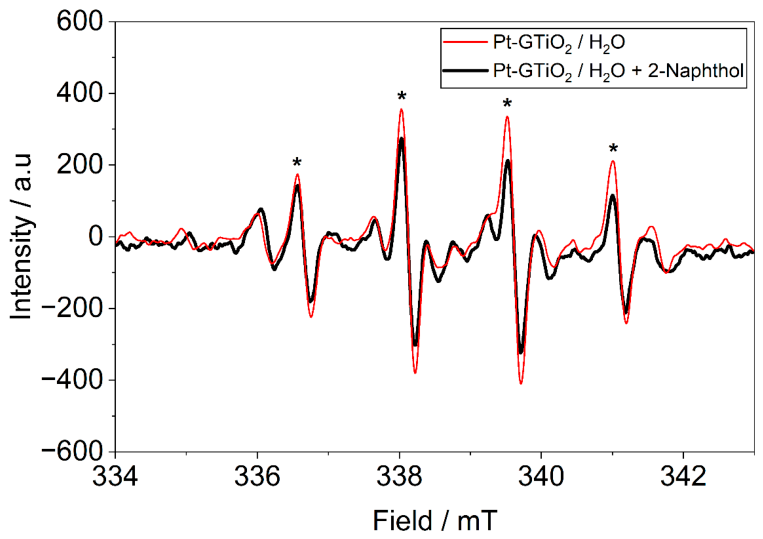
The electron paramagnetic resonance (EPR) experiments were conducted to investigate the formation of photogenerated hydroxyl radical (OH) using an X-band MiniScope MS400 spectrometer (Magnettech GmbH, Berlin, Germany) at a frequency of 9.42 GHz. A UV spot-light (LC8, Hamamatsu, Japan, 200 W mercury−xenon lamp) was used to illuminate the solution samples inside the instrument using a small quartz flat cell cuvette (FZK 160-7×0.3, Magnettech GmbH, Berlin, Germany). 5,5-Dimethyl-1-pyrroline N-oxide (DMPO) was used as the spin-trapping agent at a concentration of 100 mM. The Pt-GTiO2 concentration was 1.0 mg mL−1, and the 2-naphthol concentration was 20.0 ppm [6].

2.6. By-Products Identification

To identify the stable organic intermediates that are present in the photocatalytic system after photooxidation of 2-naphthol, the solid-phase extraction (SPE) technique has been used. For this purpose, the irradiated suspension was immediately filtered through a 0.2 µm PTFE filter, stored in an amber glass bottle at 4 °C, and the extraction was conducted within 24 h. In a typical experiment, a dual serial extraction cartridge mode was used to isolate a large spectrum of the formed organic intermediates. C18 SPE cartridges, followed by OASIS HLB cartridges, were linked serially together with the Pyrex glass SPE (Supelco, Bellefonte, PA, USA) attached to a vacuum pump. After preconditioning the SPE cartridges with the required solvent, the acidified sample (pH 2) was passed into the serial cartridges, one by one. The flow rate was maintained between 1 and 2 mL/min. Following this, the cartridges were washed with 2–3 mL of a 5% methanol solution and acidified Milli-Q water, respectively, and left for 10 min to dry under low air pressure vacuum. Finally, the captured organic compounds were eluted from the cartridges by passing (1 mL/min) ethyl acetate (2 × 3 mL) from the head of the first cartridge. The organic extract eluent was then dried using pre-heated anhydrous sodium sulfate, concentrated to about 0.5 mL, and finally transferred to an amber glass GC vial for gas chromatography–mass spectrometry (GC-MS) analysis.
The ethyl acetate organic extracts were analyzed using a Shimadzu GC-MS (QP5050, Kyoto, Japan) system equipped with an AOC-5000 Plus autosampler and an Agilent DB-5MS capillary column (30 m × 0.32 mm × 0.25 µm). High-purity helium was used as the carrier gas at a constant flow rate of 1.25 mL/min, while the detector interface and the injector temperatures were maintained at 280 °C and 250 °C, respectively. The GC oven temperature program was initialized at 70 °C (held for 3 min), ramped at 5 °C min−1 to 180 °C (held for 2 min), then ramped at 5 °C min−1 to a final temperature of 315 °C (held for 5 min). The mass spectrometer was operated in electron impact ionization (EI) mode at 70 eV, and data acquisition was performed in full scan mode. Constituent peaks were identified by comparing their mass spectra with those of reference compounds in the National Institute of Standards and Technology (NIST) mass spectral library. Only peaks with a NIST library match factor greater than 70% were considered in the pathway discussion. To exclude contamination during the extraction and analysis, a solvent blank was analyzed using the same extraction and GC-MS analysis methods.
The Dionex ICS-1000 High-Performance Ion Chromatography (HPIC) system (Sunnyvale, CA, USA) was employed to detect the simple organic acids generated as by-products in the illuminated 2-naphthol system. The chromatograph was fitted with an anion exchange resin column (Ion Pac AS9-HC 2 × 250 mm) connected to an electro-regenerative suppressor and a conductivity cell serving as detectors. The temperature was maintained at 35 °C throughout the 90 min analysis. A mixture of 1.5 × 10⁻³ mol/L NaHCO3 and 8 × 10⁻³ mol/L Na2CO3 alkaline solutions, which flow inside the system at 0.3 mL/min, was used as an eluent. Each sample analyzed was processed prior to analysis according to the procedures outlined in the HPLC methodology.

2.7. Characterization of the Photocatalyst

The synthesized platinized and bare samples were characterized with different physicochemical techniques as follows. X-ray diffraction analysis (XRD) patterns were obtained using a Bruker D8 Advance diffractometer (Bruker AXS GmbH, Karlsruhe, Germany) with a Bragg–Brentano geometry and employing Cu Kα radiation (λ = 1.54060 Å). The patterns were recorded in the 2θ range from 10° to 80° in increments of 0.039°. The specific surface areas of the platinized TiO2 samples were assessed using a FlowSorb II 2300 instrument (Micromeritics Instrument Corporation, Norcross, GA, USA), equipped with a Micromeritics AutoMate 23. Prior to the measurements, all synthesized samples were pre-degassed in a vacuum at 150 °C for one hour. The specific surface area was determined through single-point standard Brunauer–Emmett–Teller (BET) surface area measurements, with each measurement conducted in triplicate to ensure precision. UV-vis spectra in the wavelength range of 200 to 800 nm were recorded using a Varian Spectrophotometer (Cary 100 Bio, Agilent, Santa Clara, CA, USA) equipped with a diffuse reflectance accessory. The fluorimeter used to collect Photoluminescence (PL) data was a FluoroMax P HORIBA (Jobin Yvon fluorescence spectrophotometer, Edison, NJ, USA), which was equipped with a 150 W Xe lamp. The colloidal solutions for PL measurements were prepared with a mass concentration of 0.2 mg mL−1 in Milli-Q water. The pH of the solution was adjusted to 3.4 using H2SO4 to reduce aggregation and maintain the dispersion of the NPs. The samples were excited at a wavelength of 290 nm, and the emission spectra were recorded in the range of 300 to 550 nm. The morphology of the samples was investigated using Transmission Electron Microscopy (TEM) measurements. The TEM images were obtained using a Tecnai G2 F20 TMP (FEI, Hillsboro, OR, USA) instrument with an accelerating voltage of 200 kV. The real (w/w) % of Pt NPs in the synthesized TiO2 was evaluated using Inductively Coupled Plasma Optical Emission Spectrometry (ICP-OES, Varian 715-ES, Santa Clara, CA, USA). About 20–50 mg of each Pt-TiO2 material was digested (triplicated to ensure precision and accuracy) in 5.00 mL of aqua regia at 150 °C for 5 h until all the acid evaporated. After cooling, each sample was re-dissolved in 10.00 mL of 3% HNO3, filtered, and finally stored at 4 °C until further analysis.

3. Results and Discussions

3.1. Characterization

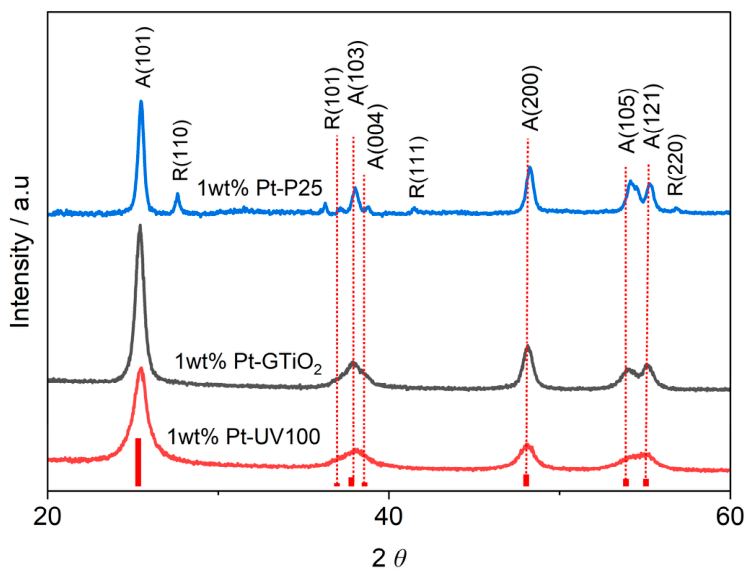
As shown in Figure 1, the XRD patterns for 1 wt% Pt-GTiO2, 1 wt% Pt-UV100, and 1 wt% Pt-P25 nanoparticles were recorded to identify the crystallographic structure and the phase composition. The recorded spectrum reveals that the diffraction patterns as well as the peak positions of 1 wt% Pt-GTiO2 and 1 wt% Pt-UV100 nanoparticles are almost identical. Both materials exhibit distinct characteristic peaks attributed to the tetragonal crystal structure of the anatase phase (JCPDS card No. 21-1272) [15]. The XRD spectrum of 1 wt% Pt-GTiO2 does not show any signal for phase impurity, confirming the purity of the anatase phase. While the recorded diffraction patterns for 1 wt% Pt-P25 material exhibit the existence of a mixture of anatase and rutile phases, which is consistent with the data of JCPDS card Nos. 21-1272 and 21-1276, respectively. Our results for the synthesized GTiO2 NPs were in agreement with the results of several research groups that reported the formation of pure anatase phase after the green synthesis of TiO2 NPs using different plant extracts, Ti precursors, and calcination temperatures [35,36].
Moreover, we observed that loading of the surface of all TiO2 materials with Pt NPs does not result in any impact or change on the XRD pattern position or features, indicating that the photodeposition method for preparing the platinized materials did not significantly alter the crystallinity or the formed TiO2 phase [15]. In addition, no diffraction peaks for the Pt NPs were observed in the recorded XRD diffraction for all TiO2 materials (Figure 1), which can be attributed to the low loading amount of Pt and the uniform distribution of these Pt NPs on the surface of the prepared materials [15,34]. The sharper and thinner 101 plane peak at 25.0° observed for Pt-GTiO2, compared to Pt-UV100, indicates a higher crystalline structure and larger crystallite size of Pt-GTiO2 nanoparticles [36]. These observations are confirmed by estimating the crystallite size of these materials based on the Scherrer equation [15]. The calculated average crystallite sizes of 1 wt% Pt-GTiO2, 1 wt% Pt-UV100, and 1 wt% Pt-P25 were found to be 12.4, 7.5, and 25.0 nm, respectively (Table 1). Several research groups reported a similar crystallite size for the plant-extract-assisted TiO2 using TTIP as precursor [35,36].
In order to verify the presence of Pt NPs on the synthesized materials and determine their actual loading percentage, ICP-OES analysis was performed. The results presented in Table 1 indicate that the actual loading percentage of Pt NPs is lower than the expected value in all samples analyzed. However, the reduction values fall in the accepted range of experimental error [19].
In a complementary manner, the textural characteristics of the photocatalyst, particularly the specific surface area, directly influence the density of active sites, adsorption capacity for reactants and, finally, the photocatalytic efficiency [4]. The BET surface area analysis of the synthesized and commercial Pt-TiO2 materials reveals significant differences in their values, as summarized in Table 1. The 1 wt% Pt-UV100 sample exhibited the highest surface area of 290 ± 5.3 m2 g−1, which is consistent with the known properties of Hombikat UV100, a benchmark anatase TiO2 specifically engineered for a very high surface area [6,15]. In contrast, the 1 wt% Pt-P25 exhibits a considerably lower surface area of 51 ± 2.8 m2 g−1. In fact, this value is one of P25’s well-reported characteristics, which has a low surface area to maintain higher crystallinity, leading to better charge carrier separation compared to the UV100 [15,37].
The plant-extract-assisted 1 wt% Pt-GTiO2 shows an intermediate BET surface area between Pt-P25 and Pt-UV100, with a value of 137 ± 3.9 m2 g−1. This value is notably higher than that of Pt-P25 and lower than Pt-UV100, suggesting that the biogenic synthesis method successfully produced a TiO2 material with favorable properties, potentially balancing between a high density of surface active sites (compared to its surface area with that for P25) and sufficient crystallinity with special surface chemistry to reduce the rapid recombination of photogenerated electron–hole pairs [38]. In addition, it has been observed that the surface area of plant-extract-assisted TiO2 nanoparticles is proportionally affected by the concentration of the plant extract [38]. In our study, we adapted the synthesis method developed by Aravind et al. [33] to prepare the GTiO2 nanoparticles, resulting in the production of a material with smaller particle sizes than those reported by the Aravind research group. This variation may be attributed to the higher concentration of pomegranate peel extract utilized in our research compared to that in the study by Aravind et al. Indeed, the crystallite size calculated using the Scherrer equation coincides with this textural analysis. The smaller crystallite size of Pt-GTiO2 (12.4 nm) is directly linked to their surface areas, as reducing particle size increases the surface-to-volume ratio. From the BET specific surface area, it is possible to estimate the mean particle size of the GTiO2 by assuming spherical and non-porous TiO2 nanoparticles, employing Equation (1) [39] based on the theory of Brunauer, Emmett, and Teller. The mean particle size (dBET) was found to be 11.26, which is close to the value estimated from the XRD result based on the Scherrer equation.
d B E T   ( n m ) = 6000 ρ g c m 3   ×   S B E T     m 2 g 1
where   S B E T   is the measured BET surface area and ρ a n a t a s e   is the apparent density of anatase TiO2.
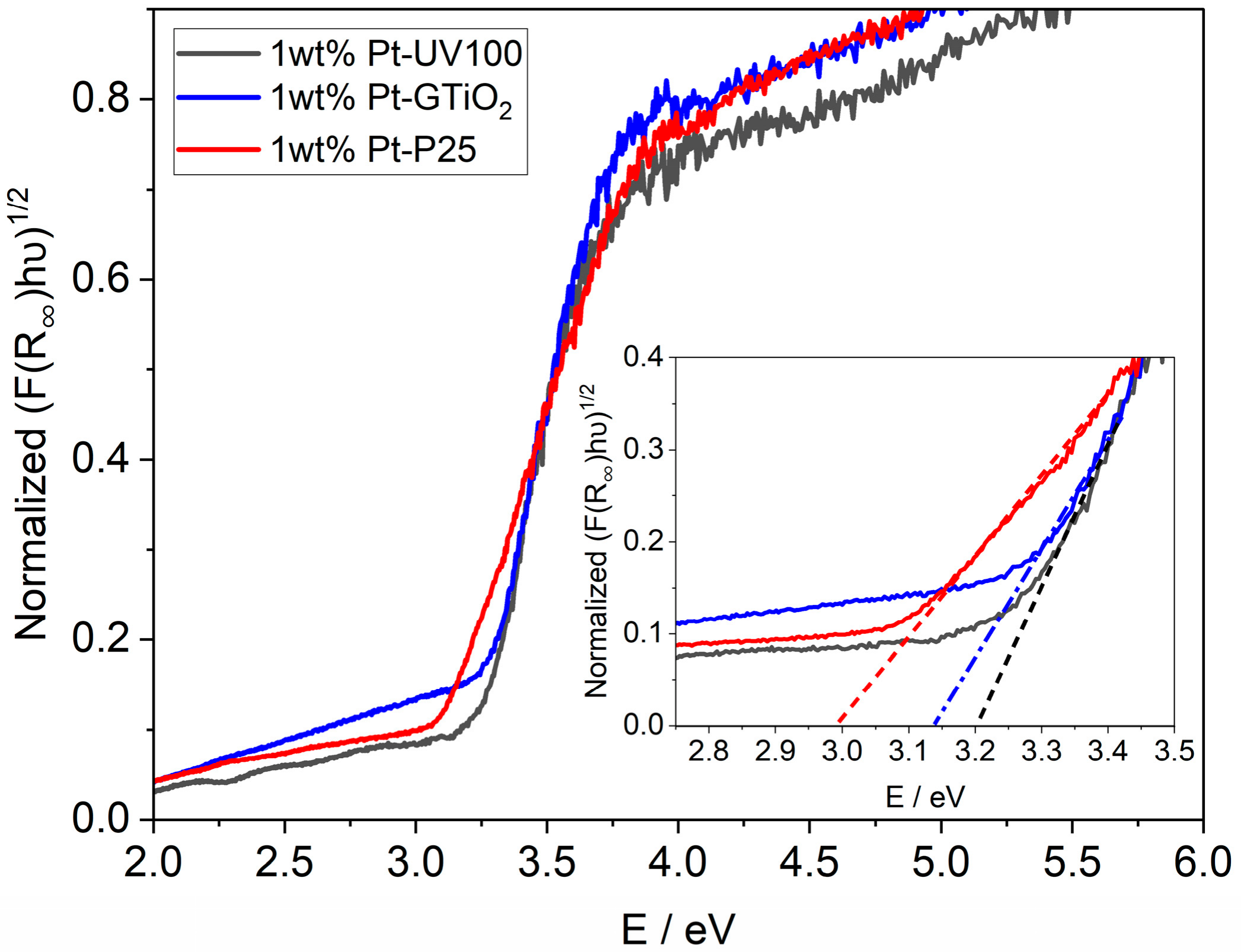
The optical absorption properties for all the platinized TiO2 materials were characterized using DRS. The reflectance data were transformed via the Kubelka–Munk function, F(R∞), to determine absorption characteristics, and Tauc plots were constructed after baseline correction, assuming indirect transitions to estimate the bandgap energy of each material.
As shown in Figure 2, the estimated band gap for Pt-GTiO2 and Pt-UV100 are 3.14 and 3.2 eV, respectively. Since both materials consist of the anatase phase, which is characterized by 3.2 eV, the lower band gap of Pt-GTiO2 indicated a small redshift in its absorption edge compared to Pt-UV100. This bandgap reduction suggests that the plant-extract-assisted synthesis method in the case of Pt-GTiO2 could introduce electronic structural modifications, such as defect-rich states and/or residual heteroatom-related states associated with the plant-derived synthesis environment, thereby altering crystallinity. This modification may arise from organic residues during plant-extract-assisted synthesis using Punica granatum peel extract, leading to differences in the optical properties [27,40]. Saini et al. [26] reported the formation of defect states such as oxygen vacancies in the plant-extract-assisted synthesized TiO2 nanoparticles, which originated from the organic residues in the Tinospora cordifolia plant stem extract. Recently, Mohammadi et al. [27] synthesized ZnO nanoparticles using the Punica granatum fruit peel extract and observed a similar redshift in the plant-extract-assisted synthesized ZnO NPs sample compared to the chemically prepared one.
On the other hand, the Pt-P25, which consists of a mixed phase of anatase and rutile, exhibits a bandgap of 3.00 eV, which is lower than the value estimated for Pt-GTiO2. This lower bandgap value for Pt-P25 can be attributed to the difference in phase composition between the materials. TiO2-P25 consists of a mixed phase of anatase and rutile, and its bandgap is regularly reported to be 3.00 eV [15].
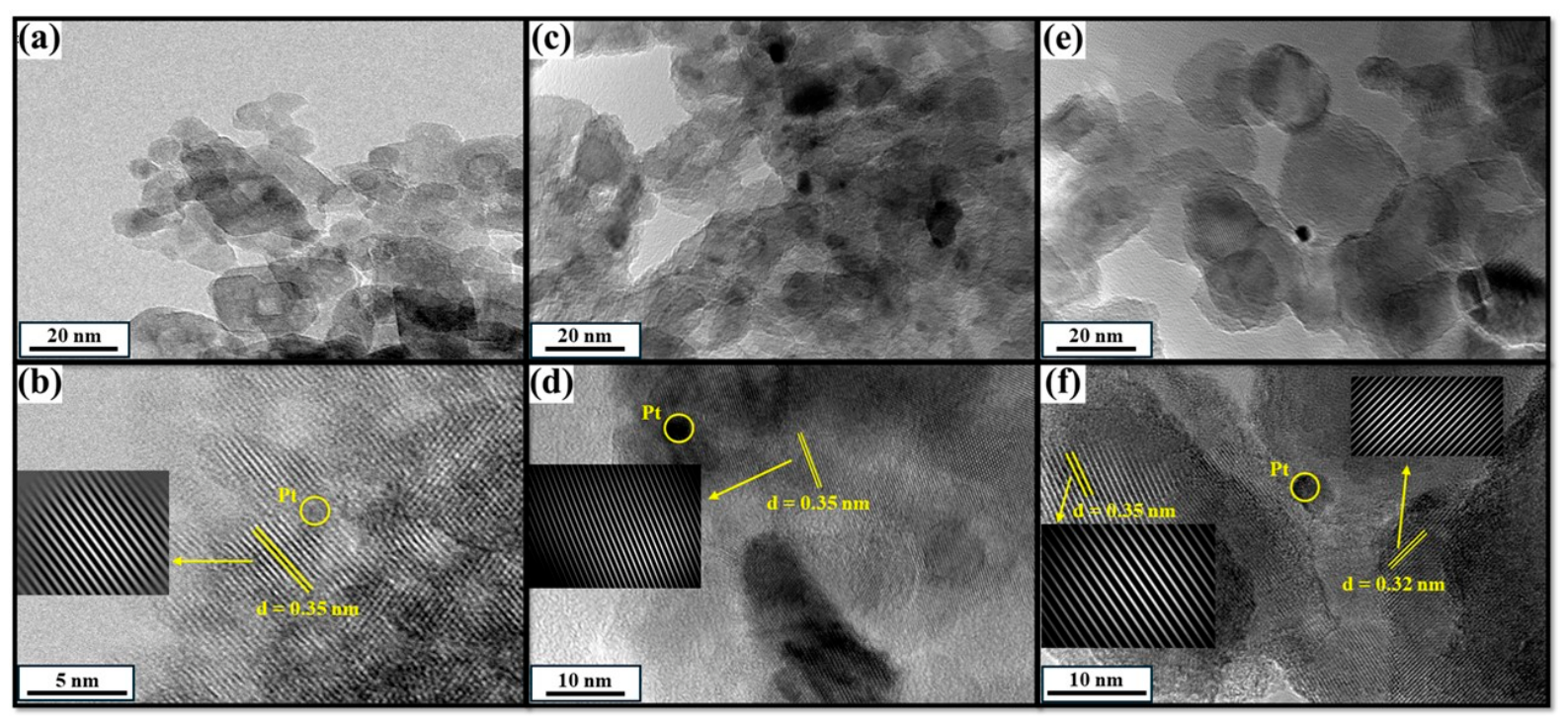
HR-TEM was employed to study the morphology of the synthesized platinized photocatalysts. The micrographs presented in Figure 3a–f clearly indicate the structural distinctions between Pt-GTiO2 (Figure 3a,b), Pt-UV100 (Figure 3c,d), and Pt-P25 (Figure 3e,f). All TiO2 nanocrystals are spherical with a clear difference in grain boundaries, indicating a difference in size and degree of crystallinity during the synthesis processes.
As clearly seen in Figure 3c, the Pt-UV100 sample exhibits high agglomeration and small particles, indicating a relatively larger surface area compared to the Pt-GTiO2 nanoparticles in Figure 3a. The particles of Pt-GTiO2 appear less agglomerated, more uniform, and have intermediate sizes, compared to both commercial TiO2 materials. Based on the ImageJ software (version 1.52p) for analyzing micrographs in Figure 3a,c,e, the average crystallite sizes of Pt-UV100, Pt-GTiO2, and Pt-P25, respectively, are 8.9 ± 1.6, 13.5 ± 2.0, and 21 ± 1.5 nm. These values are in agreement with those that were obtained from the XRD results based on the Scherrer equation. The small crystallite size of the GTiO2 NPs can be attributed to the advantages of the biowaste-assisted synthesis method in material preparation. Several research groups have reported similar or comparable crystallite sizes for plant-extract-assisted TiO2 NPs obtained using various plant extracts [26,41].
Furthermore, analysis of the micrographs shown in Figure 3 indicated the uniform distribution of Pt NPs on the surfaces of all the synthesized Pt-TiO2 materials, with an average particle size of 2–4 nm. This suggests the success of the modified photodeposition method for achieving small and well-dispersed Pt NPs. We reported previously a similar particle size with uniform distribution for the Pt NPs on the surface of TiO2, using a different photodeposition method [34].
The FFT analysis of specific regions in Figure 3b,d,f, obtained using the ImageJ program, revealed a well-defined d-spacing of 0.35 nm in both Pt-GTiO2 (Figure 3b) and Pt-UV100 (Figure 3d). This value corresponds to the (101) plane of anatase, thus confirming the phase purity and its retention after the platinization process [15,34]. While similar analysis in Figure 3f of the Pt-P25 sample showed the appearance of diffraction fringes with a d-spacing of 0.32 nm associated with (110) planes of the rutile phase. This phase was observed alongside (101) planes of the anatase phase, confirming the biphasic nature of P25.
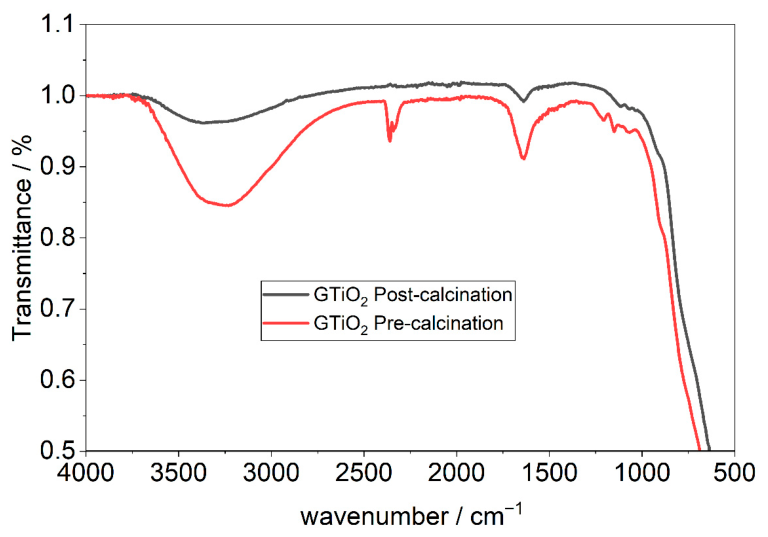
As shown in Figure 4, the pre-calcination ATR-FTIR spectrum reveals several transmittance bands indicative of organic functional groups derived from the plant extract, as well as TiO2-related vibrations. The broad transmittance band between 3200 and 3600 cm−1, associated with O–H stretching, indicates the presence of hydroxyl groups that could be related to the presence of alcohols, phenols, carboxylic acids, or adsorbed water molecules on the surface of freshly prepared GTiO2. Indeed, Altarawneh et al. [42] reported the presence of such organic compounds in Punica granatum peel extracts that contain flavonoids, phenolic compounds, and other capping agents [27,42].
In addition, the band observed around 2850–3000 cm−1 in the pre-calcinated GTiO2 sample could be related to aliphatic C–H stretching, indicating the presence of organic residues like alkanes or alkyl groups in the plant extract, and O–H stretching from a carboxylic acid. The observed transmittance band at 2350 cm−1 could be assigned to the adsorbed CO2 on the surface of the pre-calcinated GTiO2. Furthermore, on the surface of the pre-calcinated sample, the bands observed around 1240 and 1650 cm−1 are related to the C–O stretching vibration of phenols and esters, and the C–H bending of aromatic compounds, respectively [23,25,43]. All of these bands were significantly quenched or disappeared after the calcination of GTiO2 (Figure 4), indicating the removal of the organic functional groups from the plant extract used in the synthesis. Calcination at a temperature higher than 400 °C combusts organic capping agents, such as organic acids and polyphenols, that are present from the plant extract [35,44]. This aligns with several previous studies that reported the calcination process removes biogenic residues, enhancing TiO2’s crystallinity, and improving photocatalytic properties [26]. Meanwhile, the observed broad peak below 1000 cm−1 in both materials before and after calcination can be related to Ti–O–Ti stretching vibrations in anatase [44,45].
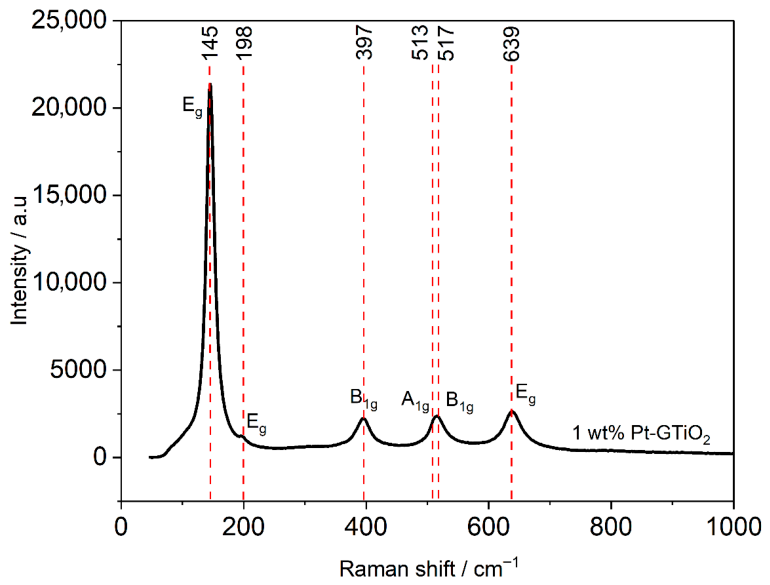
Raman spectroscopy analysis was employed to identify the purity and crystallinity of the plant-extract-assisted Pt-GTiO2 NPs phase. As shown in Figure 5, the studied sample displays six active modes centered around 144, 197, 399, 513, 519, and 639 cm−1. According to the literature, these vibrational bands are consistent with the anatase phase of TiO2, which aligns perfectly with our results from the XRD analysis and HRTEM micrographs analysis. Anatase TiO2 crystallizes in a tetragonal structure with the space group I41/amd and exhibits D2d point group symmetry. According to group theory, the anatase phase possesses six Raman-active modes, designated as A1g + 2B1g + 3Eg [41]. The strong peak at 145 cm−1 corresponds to the Eg symmetric stretching mode of O–Ti–O bonds, while the features at 198 cm−1 and 397 cm−1 are also attributed to Eg and B1g modes, respectively. The doublet observed at 513 and 519 cm−1 can be assigned to overlapping A1g and B1g modes, while the broad peak near 639 cm−1 corresponds to the Eg mode. The obtained bands correlate well with the values in the literature for the anatase phase of TiO2 that was greenly synthesized using gum Arabic and beta vulgaris extract [41,46].
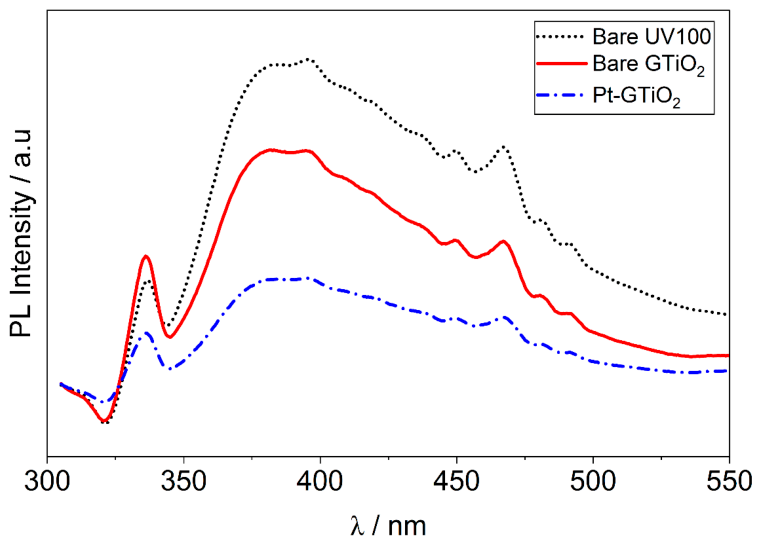
PL emission spectroscopy was employed to study the dynamics and recombination process of photogenerated charge carriers. As shown in Figure 6, a sharp feature near 335 nm appears in the bare UV100, bare GTiO2, and Pt-loaded GTiO2 spectra. This band can be related to residual scattering of excitation light due to its closeness to the 290 nm excitation wavelength. Moreover, another broad emission bands across the UV-visible region centered around 390 nm, as well as minor peaks near 450, 465, and ~520 nm were recorded for the three studied materials. These emissions were previously reported to various radiative recombination pathways, including intrinsic band-to-band transitions and defect-related states [45,47]. Since the bandgap of anatase TiO2 was documented between 387 and 390 nm, the observed strong band around 390 nm can be related to the direct recombination of the photogenerated electron/hole after excitation [4]. However, the observed emission bands in the visible region reflect the contributions from shallow and deep-level defect states that could be oxygen vacancies and surface hydroxyl groups [45].
Furthermore, as observed in Figure 6, the bare GTiO2 sample exhibits a lower emission intensity compared to the bare UV100 at 390 nm wavelength. This decrease reflects the lower recombination process of the photogenerated charge carrier in the case of bare GTiO2, which can be related to the benefits of the plant-extract-assisted method in forming a material with better crystallinity and fewer radiative recombination centers. This enhancement in charge-carrier separation will lead to improved photocatalytic efficiency. Sangeetha et al. [45] observed similar PL characteristics in extract-assisted TiO2 nanoparticles and noted that both chemical and biological synthesis routes yielded comparable optical behaviors.
Moreover, the presence of the Pt NPs on the surface of GTiO2 exhibits a significant reduction in the PL signal compared to the bare GTiO2 material. This quenching can be related to better separation of the charge carrier in the presence of the Pt NPs on the surface of the GTiO2 material, which serve as a sink for the photogenerated electrons, thus reducing the recombination of electron–hole pairs. This observation highlighted the main role of the Pt NPs in the charge carrier separation. It has been reported that the formation of the Schottky barrier between Pt NPs and GTiO2 enhances the charge carrier separation and thus improves the photocatalytic efficiency of Pt-GTiO2 [15].

3.2. Comparison Between Different Catalysts

The photocatalytic performance of the plant-extract-synthesized GTiO2 was evaluated based on 2-naphthol photodegradation with simultaneous molecular H2 evolution under anaerobic conditions using simulated solar light. To evaluate the photocatalytic performance of the synthesized GTiO2 NPs before and after loading with Pt NPs, it was compared against commercial TiO2 benchmarks, Aeroxide P25 and Hombikat UV100. This comparison was designed as a control set to clarify the role of each component. Bare GTiO2 represents the pomegranate-peel-assisted TiO2 support without Pt. Bare P25 and bare UV100 represent commercial TiO2 supports without plant extract and without Pt. Pt-P25 and Pt-UV100 represent Pt-loaded TiO2 controls without the pomegranate extract, while Pt-GTiO2 contains both the plant-extract-assisted TiO2 support and Pt cocatalyst. Therefore, the comparison between bare GTiO2 and Pt-GTiO2 reflects the effect of Pt loading on the green-synthesized material, whereas the comparison between Pt-GTiO2 and Pt-P25/Pt-UV100 shows the effect of the TiO2 support under the same Pt-loading approach.
In the dark, it was observed that there was no activity for molecular hydrogen formation in the absence or presence of 2-naphthol over all types of pristine TiO2 materials. The dark adsorption experiment showed that the 2-naphthol concentration reached a near-stable and unchanged concentration after 50 min of contact with Pt-GTiO2 in suspension, as shown in Figure S1. After 60 min in the dark, the adsorption removal of 2-naphthol on the surface of the Pt-GTiO2 was around 13%. Therefore, the 60 min dark period was sufficient to approach adsorption equilibrium under the present experimental conditions. Similar behaviors and values were observed for the adsorption of 2-naphthol on the surface of TiO2 [48] and ZnO nanoparticles [14]. Additionally, to distinguish the contribution of photolysis to the removal of 2-naphthol from that of photocatalytic degradation, a control experiment was performed. Therefore, dark adsorption, photolysis, and photocatalysis were compared directly. As shown in Figure S2, the removal of 2-naphthol under illumination in the absence of the Pt-TiO2 photocatalyst is about 15% after 240 min of irradiation. This value was found to be comparable to the adsorption value of 2-naphthol on the surface of the same catalyst in the dark. In contrast, the Pt-GTiO2 photocatalytic system exhibited ~80% removal under the same irradiation time. These results confirm that the observed conversion is mainly photocatalytic and not caused by adsorption or direct photolysis alone.
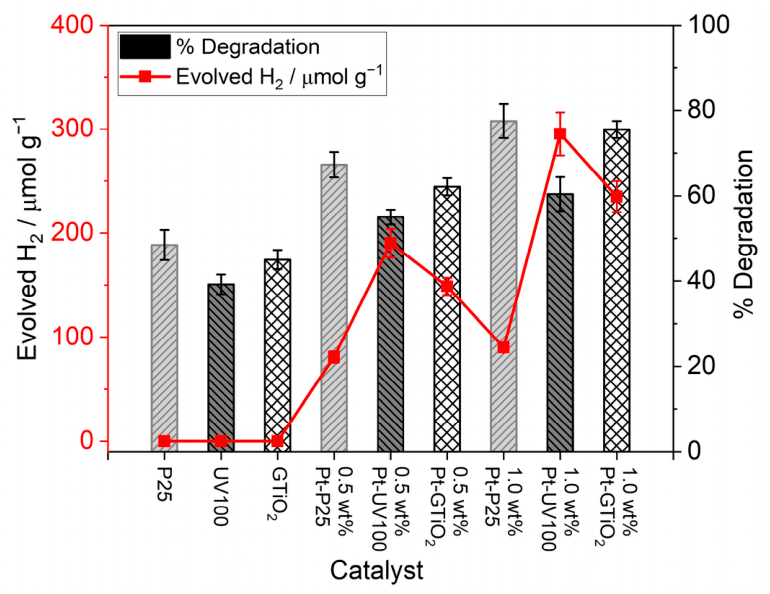
As presented in Figure 7, during the irradiation of the pristine and platinized TiO2 materials studied, the H2 evolution was not observed in the absence of 2-naphthol. This phenomenon was well documented previously, and it was attributed to the fast recombination of the charge carriers in the absence of a suitable hole scavenger, such as 2-naphthol, and the overpotential of molecular hydrogen formation on the surfaces of all types of studied TiO2 photocatalysts [15,49]. Different types of pristine TiO2 have been reported to be ineffective photocatalysts for molecular H2 production. Hence, even in the presence of the organic pollutant, naphthalene, in the system as an electron donor, Al-Madanat et al. showed that bare Aeroxide P25 and Hombikat UV100 did not exhibit any efficiency for photocatalytic molecular H2 formation [4,6,15]. Electron paramagnetic resonance (EPR) results have confirmed that while the photogenerated holes are consumed by the electron donor during illumination, the photoexcited electrons are trapped inside or on the surface of the TiO2 as reduced Ti(III) ions instead of catalyzing the reduction of the proton [4].
Additionally, the bare GTiO2 demonstrated higher and comparable degradation efficiency for 2-naphthol against commercial UV100 and P25 TiO2 samples, respectively. However, pristine P25 showed higher photocatalytic activity in converting 2-naphthol than both UV100 and GTiO2. This enhanced activity is attributed to the synergistic effect of the anatase–rutile heterojunction in P25 material, which promotes efficient charge separation. It has been reported that anatase TiO2 has a greater electron affinity than rutile TiO2, promoting the transfer of photogenerated electrons from rutile to anatase, while holes migrate to rutile, enhancing the availability of holes for oxidation reactions [4]. These results align with the work of Hurum et al. [37], who reported that the mixed-phase of TiO2 in Degussa P25 improves charge separation, reduces recombination, and boosts photocatalytic performance. Qourzal et al. studied the photocatalytic degradation of 2-naphthol under different types of TiO2 materials. The Degussa P25 was found to be the most efficient catalyst compared to the UV100 and PC-500 TiO2 materials [48].
On the other hand, the improvement of the 2-naphthol photocatalytic removal efficiency on the surface of pristine GTiO2 compared to UV100 is attributed to the lower rate of e/h+ recombination in GTiO2 compared to UV100. These results are consistent with agreements with the PL analysis results, where the GTiO2 NPs exhibited lower recombination intensity than UV100. This serves as a positive indicator of enhanced charge separation and reduced carrier recombination, resulting in greater availability of photogenerated charge carriers for surface redox reactions. Consequently, this leads to an increase in photocatalytic efficiency [50].
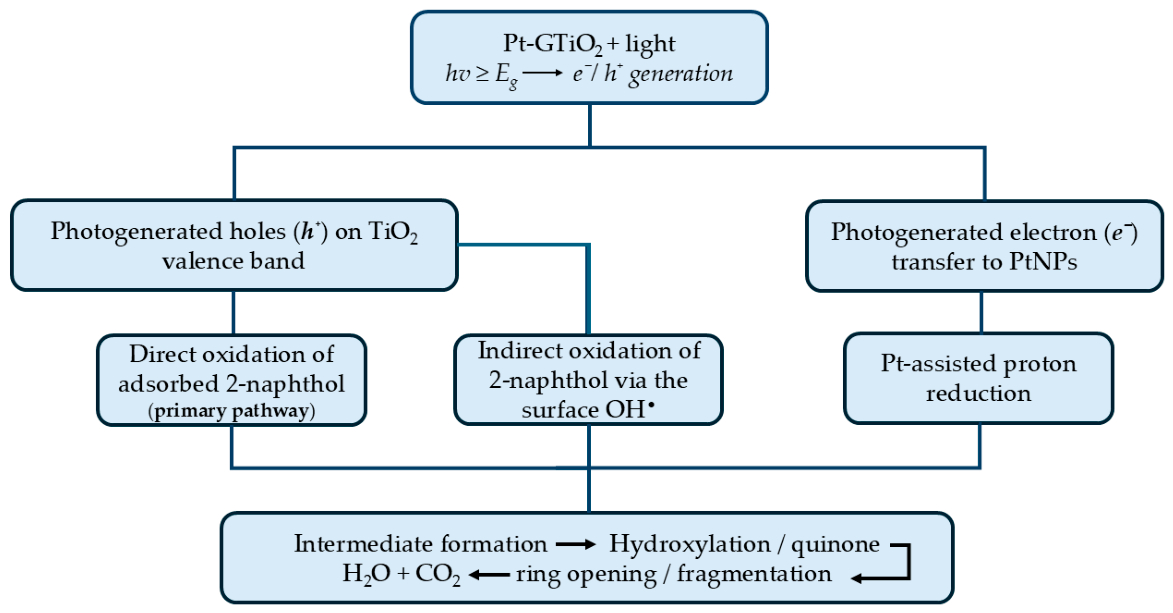
As shown in Figure 7, a significant enhancement in molecular H2 formation was observed after platinization of all the tested photocatalysts in the presence of 2-naphthol. Under the present anaerobic conditions, this observation confirms that 2-naphthol is not only a pollutant to be removed from the system, but also an effective hole scavenger or “organic electron donor” that enables molecular hydrogen formation. During illumination, the valence-band photogenerated holes and the photoformed oxidative species oxidize the adsorbed 2-naphthol due to its electron-rich aromatic system and highly favorable oxidation potential. Thereby, consuming the photogenerated holes at the photocatalyst surface, and significantly extends the lifetime of the conduction band electrons. This will suppress electron–hole recombination. As a result, the photogenerated electrons accumulated on the Pt NPs, thus facilitating the proton reduction to H2. Several research groups have reported the role of a similar organic pollutant to 2-naphthol as a hole scavenger during the photocatalytic degradation of organic compounds, along with H2 production [6,20].
The Pt-GTiO2 NPs showed higher H2 evolution than P25 but lower than UV100 at the same Pt weight percentage content. The evolution of molecular H2 after platinization can be related to effective electron trapping on the Pt NPs and Schottky barrier formation at the Pt-TiO2 interface, which promotes proton reduction [22]. The different activities in H2 evolution between the tested materials align with the differences in the surface area, as shown in Table 1. The higher the surface area, the better the rate of H2 formation. As the surface area of the photocatalyst increases, organic substrate adsorption is enhanced due to the greater availability of the active sites, which increases the electron transfer rate to Pt NPs, and thus promotes the formation of molecular hydrogen [6,15]. It has been reported that surface area is one factor affecting adsorption and reaction rates, but crystallinity, phase composition, Pt dispersion, and charge separation also contribute to the observed photocatalytic behavior [4,29,30]. It was observed that the platinization process leads to enhancing the photocatalytic degradation efficiency, indicating that Pt NPs not only catalyze the reduction of protons but also promote oxidation of the organic pollutants [51].
Furthermore, as shown in Figure 7, a different influence for the loading percentage of Pt NPs on the photocatalytic reforming of 2-naphthol was observed. By increasing the % weight of the Pt NPs from 0.5% to 1% on the surface of the tested materials, H2 evolution and the degradation efficiency increase. The 1 wt% Pt-GTiO2 NPs exhibited a degradation efficiency of about 70%, which was higher than that of 1 wt% Pt-UV100 and comparable to 1 wt% Pt-P25. Moreover, 1 wt% Pt-GTiO2 showed a better H2 evolution of about 300 µmol g−1 than the 1 wt% Pt-P25. In addition, although Pt-P25 benefits from the anatase–rutile heterojunction, which is well known to promote charge separation and fast oxidation reactions, the superior H2 evolution of Pt-GTiO2 in the present system arises mainly from its textural and interfacial advantages, which balance between the higher BET surface area (137 ± 3.9 m2 g−1) and the smaller crystallite size. These features will lead to an increase in the number of accessible Pt-TiO2 interfacial sites, improve the adsorption of 2-naphthol and its reforming intermediates, and facilitate electron transfer from TiO2 to Pt for proton reduction. In addition, the biogenic synthesis route may generate beneficial surface states and hydroxyl-rich surface chemistry, further supporting interfacial charge transfer. Therefore, Pt-GTiO2 provides a more favorable balance for hydrogen evolution, whereas Pt-P25 remains slightly more favorable for fast oxidative disappearance of the parent pollutant [28,40]. These presented results indicate that Pt loading is the main factor responsible for H2 evolution, while the nature of the TiO2 support controls the balance between pollutant oxidation and hydrogen production.
Based on the previous discussion, it was shown that Pt-GTiO2 did not outperform all commercial Pt-TiO2 references across all activity parameters; thus, their activity cannot be attributed only to the pomegranate peel extract. Instead, the extract-assisted synthesis appears to provide GTiO2 with a useful combination of anatase phase, intermediate surface area, particle morphology, and lower charge recombination, which together contribute to its photocatalytic behavior. It should be noted, however, that the specific contribution of the pomegranate peel extract to the observed enhancement in the photocatalytic performance of GTiO2 in the absence of a control TiO2 sample synthesized under identical conditions but without the plant extract must be interpreted with caution. The absence of such baseline control limits the possibility of interpreting variation in photocatalytic activities based on the differences in crystallinity, surface chemistry, and charge-carrier dynamics solely to the biogenic extract, rather than to other synthesis parameters [23,25].

3.3. Comparison of Kinetic Profiles

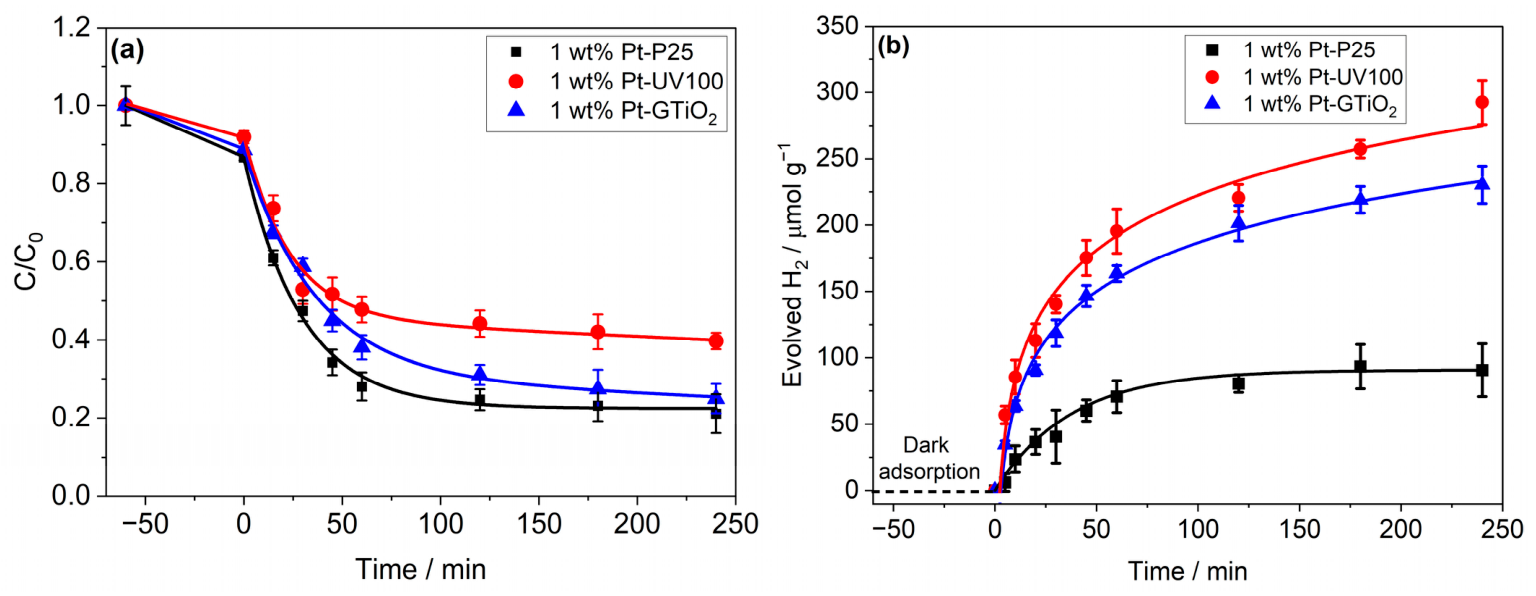
Figure 8 shows the kinetic profiles of photocatalytic 2-naphthol degradation with simultaneous molecular H2 production over 1 wt% Pt-GTiO2, 1 wt% Pt-UV100, and 1 wt% Pt-P25 catalysts under the same experimental conditions. During the 60 min dark period before illumination, approximately 10% of the initial 2-naphthol concentration was adsorbed onto the surfaces of all the photocatalysts tested. In this stage, there is no activity for molecular hydrogen formation. Like other research groups’ reports, our FTIR analysis, which is presented in Figure 4, confirmed the hydroxylated nature of the TiO2 surface [26,52]. As a result, a number of 2-naphthol molecules adsorb to the surface of TiO2 through interactions with hydroxyl (~OH) and deprotonated oxyanion (~O~) groups.
Upon irradiation, a rapid decrease in the 2-naphthol concentration in the presence of all photocatalysts during the first 60 min of illumination (Figure 8a) was observed, with approximately 80–90% of the total converted 2-naphthol removed in this period. This fast conversion is found to be accompanied by rapid production of molecular H2 (Figure 8a,b). After this period to the end of illumination, a slight decrease in 2-naphthol conversion, as well as evolved H2, was noticed. This observation suggests that the photocatalyst surface is deactivated by accumulated intermediates occupying active sites, and that 2-naphthol and its by-products compete for the remaining available active sites and the photogenerated holes. This result aligns with previous reports indicating that the degradation of aromatic compounds photocatalytically leads to the formation of different types of harsh intermediates, such as polymeric nature and coupling compounds, which deactivate the catalyst surface [6,15,53].
Furthermore, the results in Figure 8b show that Pt-UV100 exhibits the highest H2 production, followed by Pt-GTiO2, and Pt-P25 with the lowest yield. The trends of both kinetic profiles for Pt-UV100 and Pt-GTiO2 are similar. The observed behavior suggests that the Pt-UV100 is most effective for H2 production, which can be attributed to its more negative conduction band (CB) edge and its higher surface area. The typical CB edge for the Pt-UV100 has been reported around −0.5 V vs. Normal Hydrogen Electrode (NHE), compared to 0.0 V vs. NHE to rutile’s CB [6,37]. This higher CB energy in UV100 provides a greater tendency for proton reduction to H2.
On the other hand, although Pt-P25 showed the highest degradation efficiency (Figure 8a), its kinetic profile trend is very similar to that of Pt-UV100. Both materials exhibit a rapid photodegradation rate in the first 60 min of illumination, which then declines to near zero after 120 min. A different behavior was observed in the case of Pt-GTiO2. Although its degradation rate decreases with time, it still exhibits better activity after the previously mentioned period to the end of the illumination compared to the other catalysts. This behavior can be attributed to its synthesis method, which leads to the formation of a material characterized by superior surface chemistry and lower charge carrier recombination, thus enhancing its photocatalytic activity by altering charge carrier dynamics.
To compare the photocatalysts more fairly, the initial rates for H2 production ( r H 2 ), 2-naphthol degradation ( r d e g ), and normalized activities based on the surface area and the initial rates were calculated for the first 30 min of irradiation, which represent the early reaction region. The initial rates and the normalized values are listed in Table 2. Pt-UV100 showed the highest initial H2 evolution rate per catalyst mass, while Pt-GTiO2 gave a lower value but remained clearly higher than Pt-P25. After normalization to BET surface area, Pt-GTiO2 and Pt-P25 showed much higher H2 rates per surface area than Pt-UV100. This indicates that the higher accumulated H2 over Pt-UV100 is partly related to its much larger surface area. For 2-naphthol degradation, Pt-P25 and Pt-UV100 showed similar initial degradation rates, higher than Pt-GTiO2. However, after normalization to the BET surface area, Pt-GTiO2 and Pt-P25 showed much higher degradation rates per surface area than Pt-UV100. Furthermore, Pt-GTiO2 maintained activity for a longer irradiation period compared to the other catalysts.

3.4. Effect of TiO2 Dosage

It is well known that the catalyst concentration in the photocatalytic system highly affects the rate of H2 production and the degradation of organic pollutants, due to its direct correlation with the active sites available for the reaction. Increasing the catalyst dosage in the reaction system provides more active sites for the adsorption of organic molecules, generating active species (such as ROS) that participate in the degradation of the adsorbed molecules, and the reduction of the adsorbed proton to H2 [26,48].
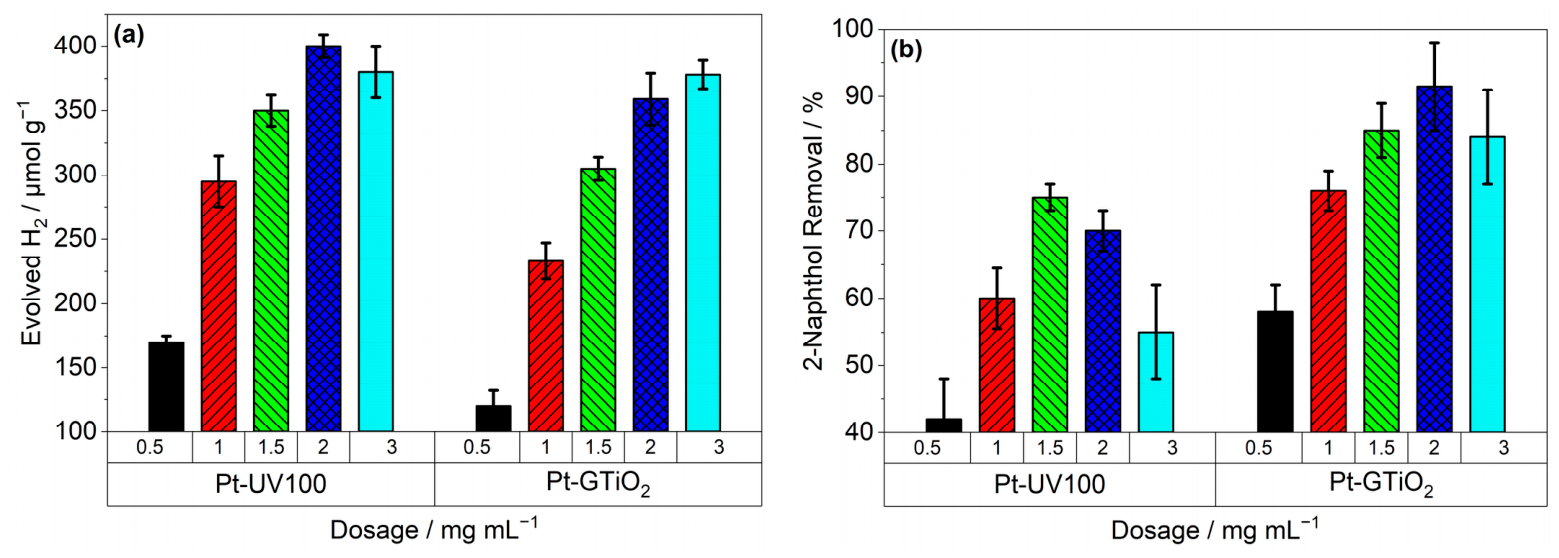
The results presented in Figure 9a exhibit clear dependence on catalyst concentration for both Pt-UV100 and Pt-GTiO2 under illumination in the presence of 2-naphthol. By increasing the dose of the Pt-UV100 catalyst from 0.5 to 2.0 mg mL−1, the H2 evolution increases to reach approximately 400 µmol g−1. However, increasing the concentration to 3.0 mg mL−1 resulted in a slight decline, suggesting that the optimal dosage is around 2.0 mg mL−1. Furthermore, the H2 evolution over the Pt-UV100 catalyst is higher than that of the Pt-GTiO2 at comparable dosages, which can be related to the difference in the surface area of the two materials. The surface area of the 1 wt% Pt-UV100 and the 1 wt% Pt-GTiO2 are about 300 m2 g−1 and 140 m2 g−1, respectively. Thus, more active sites are available on the surface of the 1 wt% Pt-UV100 for the reduction of the H+ to molecular H2. In contrast to 1 wt% Pt-UV100, the extract-assisted 1 wt% Pt-GTiO2 catalyst demonstrates a continuous increase in H2 evolution with increasing dosage from 0.5 to 3.0 mg mL−1, with its maximum reaching around 375 µmol g−1.
On the other hand, both tested catalysts exhibit a characteristic shape similar to a volcano during the photodegradation of 2-naphthol when the catalyst concentration is increased from 0.5 to 3.0 mg mL−1, as shown in Figure 9b. The optimal concentration for both materials was found to be 1.5 mg mL−1 for Pt-UV100 and 2.0 mg mL−1 for Pt-GTiO2. As observed in the results of the H2 evolution, beyond the optimal values, the performance of both catalysts declined markedly during 2-naphthol conversion. In fact, this phenomenon is well known and has been previously reported in various TiO2-based materials during the photocatalysis process [26,48]. Increasing the catalyst concentration results in more active sites for both the reduction and oxidation reactions on the catalyst’s surface, thereby enhancing H2 production and pollutant conversion. However, exceeding the optimal concentration of the photocatalyst in the reaction medium leads to an increase in both light scattering during illumination and particle agglomeration. This will limit light penetration into the reaction medium, thereby reducing the number of excited particles and the photogenerated charge carriers. While the agglomeration reduces the available active sites, thus decreasing the overall photocatalytic efficiency [15,26].
Furthermore, as presented in Figure 9b, Pt-GTiO2 showed better photodegradation efficiency for 2-naphthol compared to Pt-UV100. It nearly converted 2-napthol completely in the presence of 2.0 mg mL−1 of Pt-TiO2, and 85% conversion was achieved at a concentration of 3.0 mg mL−1. In the case of Pt-UV100 at the same catalyst doses, the conversion efficiencies were found to be about 70% and 50%, respectively. The higher activity of Pt-GTiO2 can be related to its plant-extract-assisted synthesis process. This method yields a higher crystallite size with distinct surface properties and morphology, which could exhibit less susceptibility to light scattering and agglomeration, thereby enhancing the degradation of 2-naphthol [54].

3.5. Effect of the pH

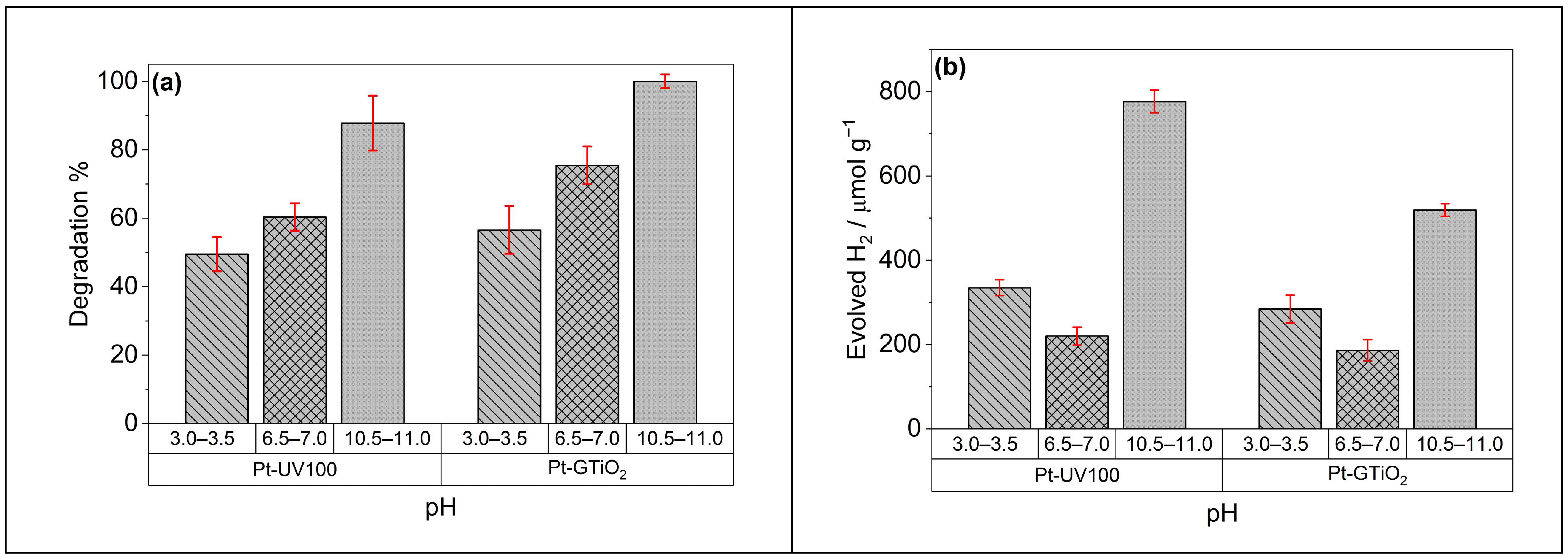
The effect of varying the pH in the range between 3.0 and 11.0 on the degradation of 2-naphthol and H2 evolution during the photocatalytic reforming process over Pt-UV100 and Pt-GTiO2 was evaluated. The results presented in Figure 10 reveal the high dependence of 2-naphthol degradation and molecular H2 formation on the system’s initial pH. As shown in Figure 10a, increasing the initial pH of the reaction medium from 3 to 11 resulted in an enhancement in the degradation efficiency of 2-naphthol, following the same trend in both photocatalyst systems. The Pt-GTiO2 system achieved higher degradation efficiencies than the Pt-UV100 system at all the studied pH levels. It exhibited almost complete conversion of 2-naphthol in an alkaline medium, and about 56% and 75% conversion efficiencies in acidic and neutral conditions, respectively. Meanwhile, the 2-naphthol degradation in the Pt-UV100 system was found to range from 50% to 86% when changing the initial pH of the system from acidic to basic, respectively.
The better performance of both materials in basic medium can be attributed to the interplay between the surface charge of the TiO2 support and the acid–base properties of 2-naphthol. The point of zero charge (pzc) of anatase TiO2 is typically around pH 6.2–6.8 [55,56]. At pH values below the pzc, the catalyst surface is positively charged (TiOH2+) while, at pH values above the pzc, it becomes negatively charged (TiO~) [22,48]. Concurrently, 2-naphthol, with a pKa of approximately 9.5, exists in its molecular form at acidic and neutral pH and transitions to its anionic naphtholate form in strongly alkaline conditions (pH > 9.5). At this point, the adsorption of naphtholate ions is expected to be very small due to the repulsion with the negatively charged TiO2 surface. However, this negative surface promotes the formation of hydroxyl radical (OH) species at the surface of the TiO2 through the reaction of the high-concentration OH near the catalyst surface with photogenerated holes, which improves the efficiency of the photocatalysis process, as shown in Equations (2) and (3) [6,22,48,55].
Pt-Ti O 2 + h ν Pt-Ti O 2 [ h + + e ]
Pt-Ti O 2 h + + O H a d s o r b e d Pt-Ti O 2 + O H
The superior performance of Pt-GTiO2 in the photodegradation of 2-naphthol at all pH levels over Pt-UV100 is attributed to its favorable optical properties, which were formed during the plant extract synthesis method using Punica granatum peel extract. As previously discussed, the PL analysis confirms the lower rate of charge carrier combination during the excitation of Pt-GTiO2. This lower recombination rate leads to more ROS generation and efficient charge separation, thereby enhancing the degradation efficiency.
On the other hand, although H2 production is favored in alkaline conditions, a different relationship was observed under other pH media than those in 2-naphthol degradation. Pt-GTiO2 reached a maximum H2 rate of approximately 520, 285, and 190 µmol g−1 in the basic, acidic, and neutral mediums, respectively. In the same manner, but with slightly higher values than Pt-GTiO2, the Pt-UV100 photocatalyst exhibited H2 production of nearly 780, 335, and 220 µmol g−1 under alkaline, acidic, and neutral pH conditions. This trend reflects the strong relationship between H2 production and 2-naphthyl degradation, as presented in Figure 10. The higher efficiency of hole consumption during 2-naphthol oxidation in alkaline media leads to the suppression of electron–hole recombination. This, in turn, improved charge separation, making a larger population of photogenerated electrons available at the Pt NPs to reduce protons to molecular H2, according to Equations (4)–(6) [6,22,55].
Pt-Ti O 2 e + H + Pt-Ti O 2 + H
2 H H 2
2 H 2 O + 2 e H 2 + 2 O H
The higher performance of Pt-UV100 compared to the Pt-GTiO2 can be attributed to the differences in the specific surface area of the two materials, as previously discussed in Section 3.2. Higher values for the photocatalysis of molecular hydrogen were reported in a basic medium at a similar pH, as documented in the literature by several research groups [55,56].
The lower H2 yield in neutral and acidic media, which is combined with moderate degradation, suggests that charge recombination or competing reductive pathways may be more prevalent in these media. In fact, the degradation of organic pollutants in acidic and neutral media often proceeds by attacking the surface-bound OH radicals, which are generated by the oxidation of H2O/OH by the photogenerated holes. This pathway is indirect and often slow, and it is governed by the limit of the adsorption of the organic molecules on the surface of the photocatalyst, which is essentially a prerequisite for efficient degradation according to the Langmuir–Hinshelwood kinetics model [51].

3.6. Effect of the Initial Concentration of 2-Naphthol on the Degradation Efficiency

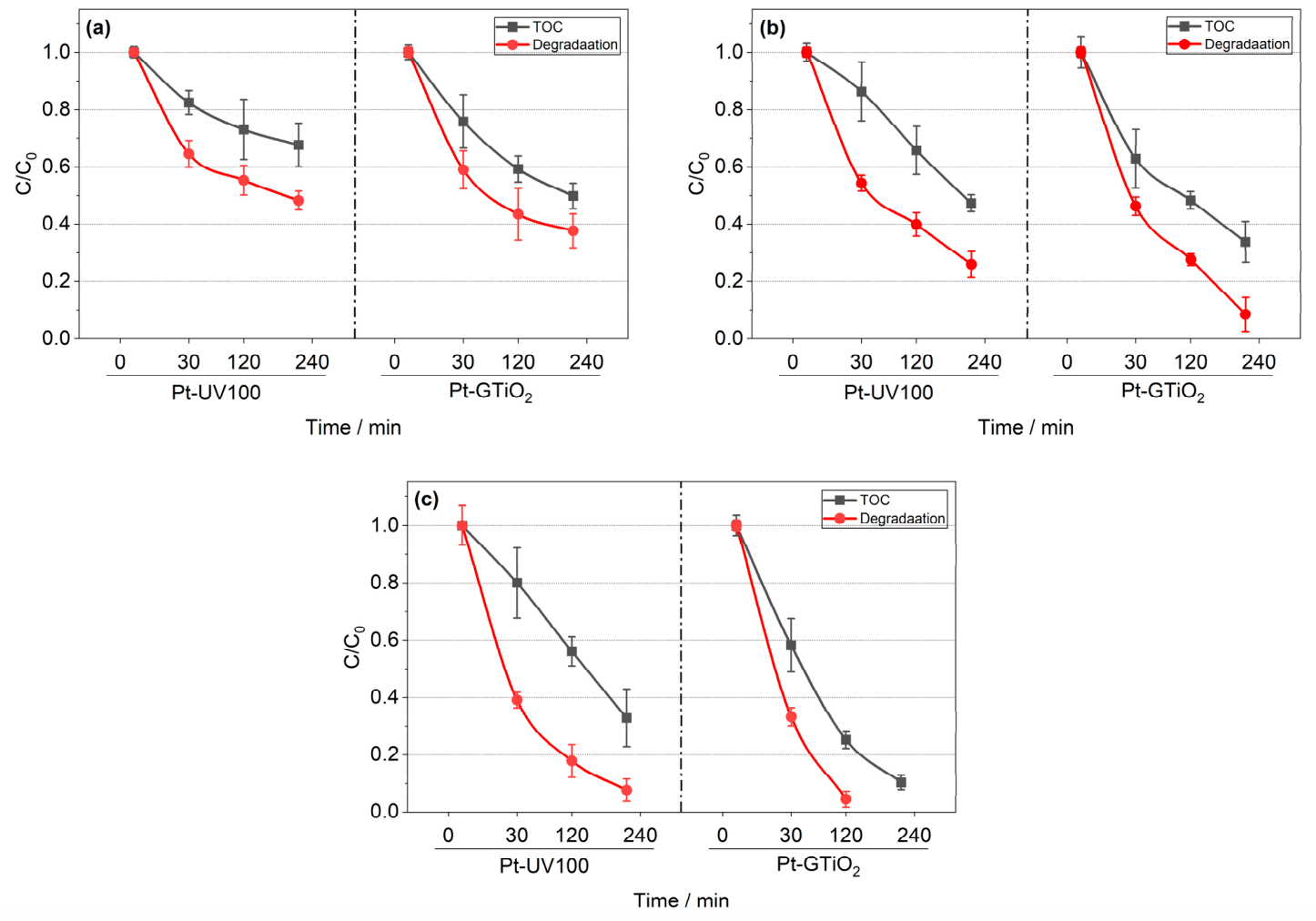
Unlike the previous experiments, which used a platinized catalyst with 1 wt% Pt NPs. In this study, Pt NPs were employed at a 0.5 wt% concentration on the surface of GTiO2 and UV100 catalysts to facilitate monitoring and tracking the reaction rate at low substrate concentration. Figure 11a–c illustrates the photocatalytic performance of the synthesized 0.5 wt% Pt-GTiO2 and 0.5 wt% Pt-UV100 catalysts for the degradation of 2-naphthol at varying initial substrate concentrations (20.0, 10.0, and 5.0 ppm). The presented results indicate clear concentration-dependent efficiency for both catalysts, with superior performance observed at lower substrate concentrations.
As shown in Figure 10a, at the highest substrate concentration (20.0 ppm), Pt-GTiO2 exhibits significantly faster reduction in both pollutant concentration and TOC compared to Pt-UV100. Pt-GTiO2 exhibits an outperforming approximately 65% conversion efficiency and 50% TOC removal within 240 min compared to Pt-UV100, which showed around 50% degradation and 30% TOC removal. The lower removal rate of the TOC in Pt-GTiO2 and Pt-UV100 systems indicates that the oxidized amount of 2-naphthol is converted into stable, non-mineralized organic intermediates rather than being completely oxidized to CO2 and H2O [6]. In fact, this is a common phenomenon during the photocatalysis process, which can be attributed to the complex degradation pathways of aromatic pollutants [4].
Furthermore, overall improvements in 2-naphthol degradation and TOC removal efficiencies were observed in both systems after reducing the initial concentration to 10.0 ppm (Figure 11b), with better performance for Pt-GTiO2. After 240 min of illumination, a nearly complete and around 75% conversion for 2-naphthol, combined with a partial mineralization of around 70% and 50% was observed in Pt-GTiO2 and Pt-UV100 systems, respectively. With a further reduction in 2-naphthol concentration to 5 ppm (Figure 11c), although both catalysts demonstrated remarkable conversion efficiencies, Pt-GTiO2 exhibited exceptional performance. It achieved a complete 2-naphthol degradation within 120 min and a substantial mineralization of about 90% after 240 min, overtaking the 90% degradation and the 70% TOC removal of its counterpart Pt-UV100, which was achieved after 240 min. This enhanced performance at lower substrate concentrations can be related to the increased availability of active sites on the photocatalyst surface relative to the number of substrate molecules. Indeed, the concentration-dependent behavior is explained by the Langmuir–Hinshelwood model [14,56]. At higher concentrations, the competition between the parent compound and the formed intermediates for these limited active sites becomes more intense, resulting in a reduced overall efficiency [14,48]. The most significant results at lower concentrations in the case of the Pt-GTiO2 system suggest that once the parent pollutants are converted, the formed intermediate species are rapidly mineralized on the available active sites on the surface of the catalyst that have a powerful ability for ROS formation [15,48].

3.7. Reusability Test

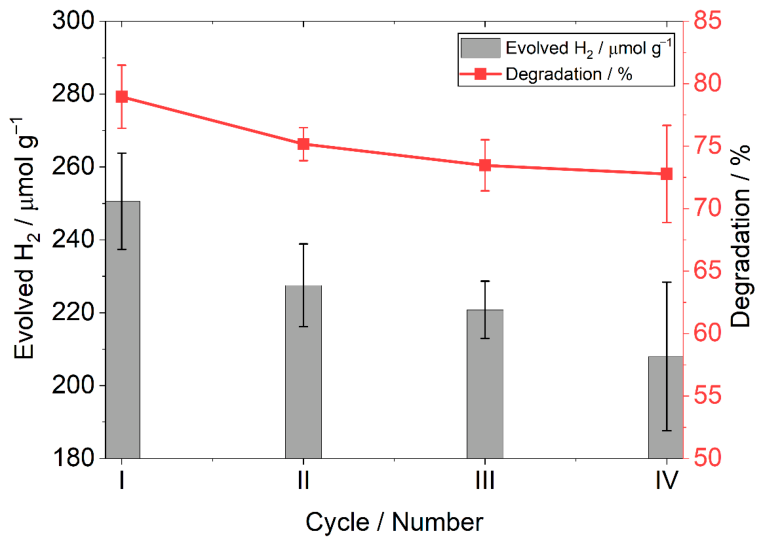
It is well known that the stability and reusability of photocatalysts are crucial factors that directly influence the cost and the practical application of photocatalysis technology. Therefore, in this study, the photocatalytic activity of the 1 wt% Pt-GTiO2 photocatalyst was evaluated regarding the photooxidation of 2-naphthol and its simultaneous H2 formation after four successive cycles. Indeed, this test evaluates the reusability of Pt-GTiO2 after a regeneration step, rather than continuous operation without treatment between cycles. To this end, after each cycle, the used photocatalyst was collected through centrifugation and subjected to irradiation in the presence of molecular oxygen for 60 min to eliminate any adsorbed organic compounds on its surface resulting from the previous reforming process. The photocatalyst was then washed twice with methanol and subsequently with Milli-Q water. Following this, it was centrifuged again and dried in the oven at 100 °C overnight.
As shown in Figure 12, the recycled 1 wt% Pt-GTiO2 photocatalyst exhibits good photocatalytic performance and reasonable reusability after regeneration towards the photooxidation of 2-naphthol and molecular H2 over four successive runs. It was observed that the photocatalytic degradation efficiency of 2-naphthol and the simultaneous H2 production were slightly decreased compared to the fresh photocatalyst, where the gradual decrease between each cycle was found to be around 2–5%.
After completing four cycles, the percentage of remaining Pt nanoparticles on the GTiO2 surface was analyzed using ICP-OES techniques, as shown in Table 1. The analysis revealed that the amount of Pt was about 15% lower than the original ratio, which can explain the limited drop in 2-naphthol photodegradation and H2 production. In addition, post-reaction characterization, including XRD and ATR-FTIR, was performed after the fourth cycle, as shown in Figures S4 and S5. The XRD pattern of the used catalyst, shown in Figure S4, indicates that the anatase phase was retained and has the same features as the fresh Pt-TiO2 samples before performing the reaction. Compared to the freshly synthesized catalyst, the post-reaction FTIR spectrum after four cycles showed a small band in the region between 1600 and 2400 cm−1, similar to the fresh Pt-TiO2 samples, suggesting no strong residual organic compounds or adsorbed species on the catalyst surface. These results support the practical robustness of the catalyst over repeated use, while also indicating that stronger Pt anchoring would be beneficial for longer-term operation. Furthermore, although the physical retention of Pt nanoparticles on the surface of GTiO2 was confirmed by ICP-OES, the long-term chemical stability and potential changes in the oxidation states of the Pt species during repeated cycles were not directly evaluated by surface techniques such as X-ray photoelectron spectroscopy (XPS). Future investigations focusing on the surface chemical dynamics of the cocatalyst under prolonged irradiation will be valuable.

3.8. Mechanism of Photoreforming of 2-Naphthol

3.8.1. Identified By-Products

It is widely recognized that the identification of reaction intermediates provides essential insights into the mechanistic pathways underlying the photocatalytic degradation of organic pollutants [4,6]. In this study, we have successfully identified several by-products generated during the photocatalytic reforming of 2-naphthol on the surface of Pt-GTiO2 in an inert atmosphere, employing a different chromatographic technique. Several of these intermediates were tentatively identified by GC-MS, which cannot be confirmed due to the lack of authentic standards for all compounds.
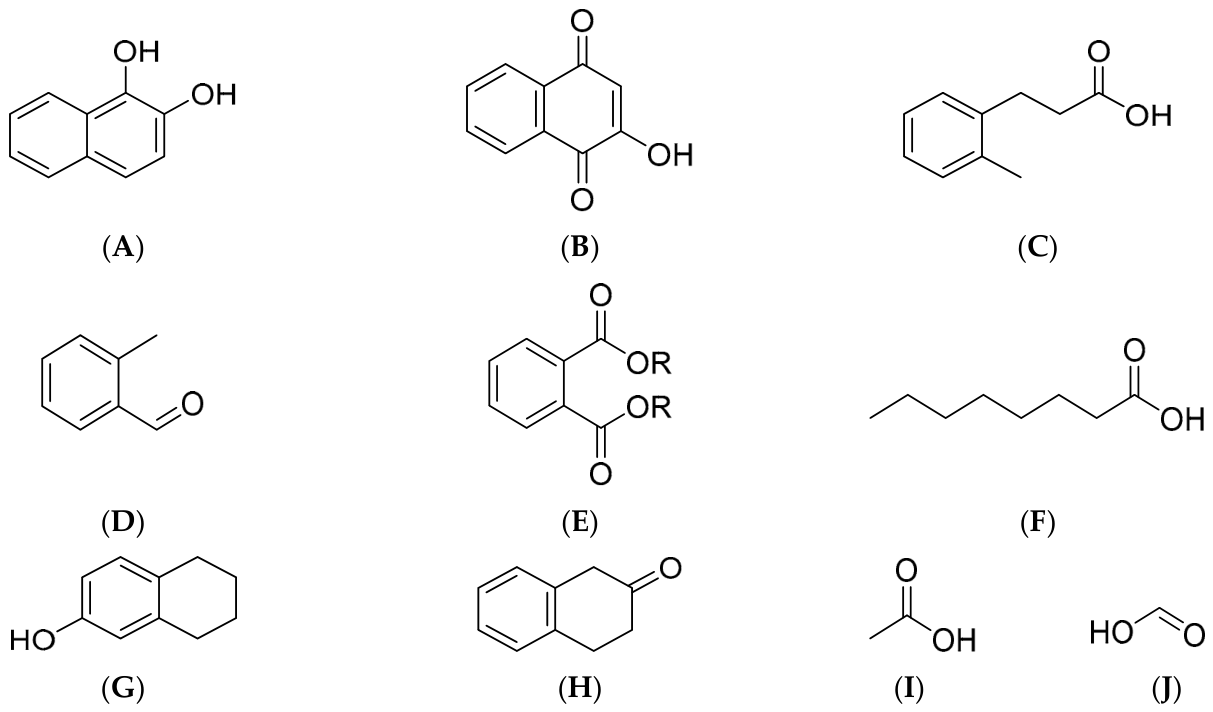
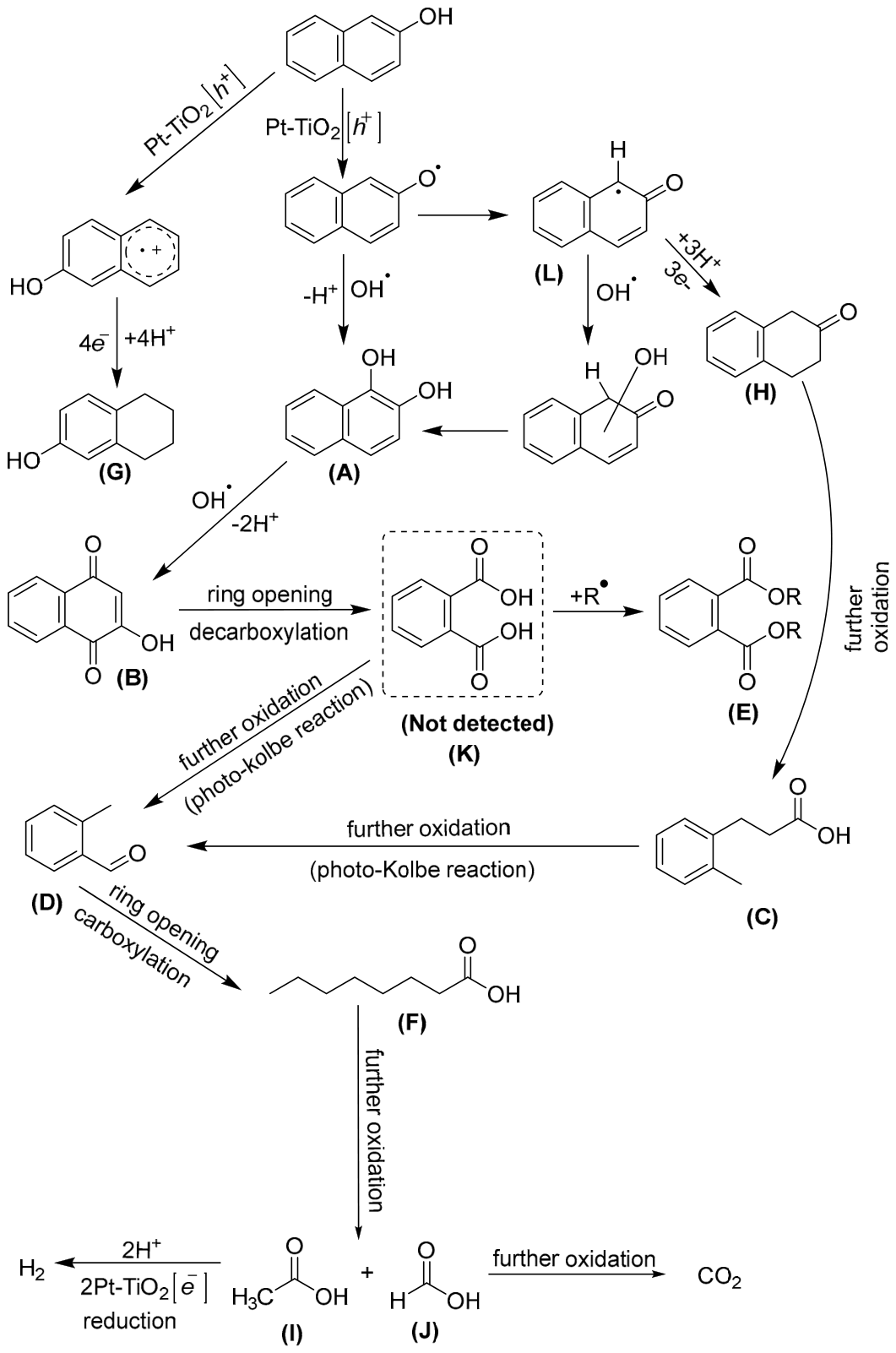
After analyzing the concentrated extract from the solid phase extraction using GC-MS chromatography (Figure S3), several oxidative and reductive aromatic and aliphatic stable intermediates were tentatively identified based on their retention times, diagnostic mass fragments, and comparison with the NIST mass spectral library, such as naphthalene-1,2-diol, 3-(2-Methylphenyl)propionic acid, Octanoic acid, and 3,4-Dihydro-2(1H) naphthalenone, as illustrated in Scheme 1 and Table S2.
The detected by-products, in fact, reflect their formation in the early stage of the degradation process and their maintenance in the reaction system during illumination, due to their continued formation through the conversion of the parent compound, 2-naphthol. These results, to the best of our knowledge, represent the first investigation into the photoreforming of 2-naphthol under inert conditions, which precludes comparison with previously reported intermediates. However, similar stable intermediates have been reported in the literature for similar compounds, such as naphthalene, under anaerobic conditions [6], and for 2-naphthol under aerobic conditions [48,57]. In this context, it is worth noting that strong adsorption of the photocatalyzed byproducts during the photocatalytic reforming of 2-naphthol limits full mass balance in the presented study. This observation is consistent with the previously discussed phenomenon of poisoning the surface of the catalyst, which leads to constraining the complete mineralization of the parent compound and the formed byproducts during the photocatalytic process under anaerobic conditions [6].
To extend the investigation of by-products, the reaction aqueous medium after illumination was analyzed using an HPIC chromatograph to identify the formation of small and short-chain organic acids. Trace amounts of formic acid and acetic acid were detected (Scheme 1), confirming the extension and continuation of 2-naphthol oxidation to the formation of CO2 and H2O.

3.8.2. Trapping and EPR Experiments

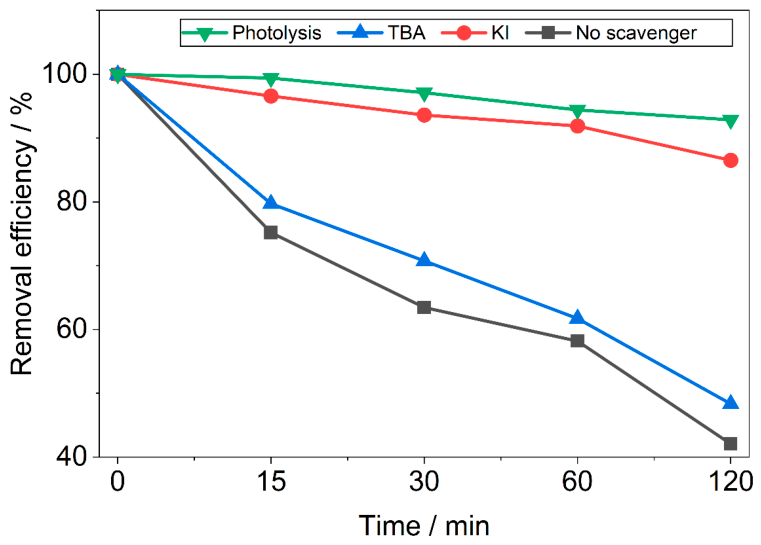
To determine the primary reactive species participating in the photocatalytic degradation of 2-naphthol, various trapping agents were added to the reaction medium. Potassium iodide (KI) and ter-butyl alcohol (TBA) were used as hole and hydroxyl radical scavengers, respectively (Figure 13) [6]. In this context, it is worth mentioning that a superoxide radical ( O 2 ) scavenger was not included in this investigation because the scavenger experiments were performed under oxygen-free conditions. After preparing the reaction suspension, the reactor or the vial was sealed and then purged with high-purity Ar gas. Therefore, molecular oxygen was not intentionally present in the system. Because O 2 is mainly produced by the reduction of dissolved or adsorbed O2 by photogenerated electrons, and O2 is removed from the reaction medium, O 2 was not expected to be a main reactive species in the present anaerobic photoreforming system. Nevertheless, it should be mentioned that the absence of a dedicated superoxide scavenger experiment partially limits a complete mapping of all potential minor reactive species pathways. This experiment could have provided complementary information and further confirmed the negligible involvement of O 2 in the present anaerobic system [51]. Unlike all previous experiments that used solar light as the irradiation source, UV light was employed in these trapping, EPR, and photolysis experiments in order to reduce the degradation rates of both the parent compound and the resulting intermediates. This modification of the light source guarantees the detection of EPR signals and clearer scavenger responses, thereby distinguishing the roles of the reactive species (holes and hydroxyl radicals) present in the reaction medium during the photodegradation of 2-naphthol. Indeed, the photolysis experiment was included in Figure 13 as an internal reference for the scavenger investigation, but not as a general control for the solar photocatalytic experiments. Since the scavenger experiments were performed under UV irradiation, the photolysis results show direct light-only removal of 2-naphthol under the same conditions. This comparison is important for the KI and TBA systems.
As shown in Figure 13, the photolysis experiment was conducted to monitor the degradation efficiency of 2-naphthol in the absence of the Pt-GTiO2 photocatalyst under the same UV irradiation conditions used in the scavenger experiments. The photolysis of 2-naphthol after 120 min of illumination was found to be around 10% of the initial concentration of 2-naphthol. The addition of the hole scavenger, KI, to the system in the presence of Pt-GTiO2 resulted in 15% degradation efficiency, which is very close to the photolysis value. In contrast, 50% conversion efficiency was achieved after addition of the TBA to the photocatalytic system. Compared to the control system (the photocatalytic system without any scavenger), which achieved about 60% removal efficiency, the addition of KI led to a 75% reduction in the removal of 2-naphthol, suggesting that the photogenerated holes (h+) played a significant role in the primary degradation pathway. The scavenging of photogenerated holes from the system leads to a removal efficiency comparable to the photolysis process, which is the least efficient degradation process. On the contrary, a slight reduction of about 15% in the removal efficiency of the control system was observed in the presence of the TBA in the reaction system, highlighting the limited contribution of the hydroxyl radicals in the primary degradation pathway [6].
This observation suggests that both photoformed reactive species (OH, h+) play synergistically but unevenly to enhance the photodegradation of 2-naphthol. Based on these results, it can be proposed that the degradation of 2-naphthol occurs mainly through a direct oxidation pathway. This pathway involves charge transfer between the substrate organic pollutant and the h+ on the material surface [6]. The other, very limited pathway is indirect, via the attack of 2-naphthol by OH. These OH species formed indirectly through the photooxidation of the adsorbed water molecules (Equation (7)) or the hydroxyl ions (Equation (3)) on the surface of the TiO2 photocatalyst. Several research groups have reported that such suggested mechanisms are commonly involved in the photocatalytic degradation of organic pollutants on the surface of different photocatalysts [14,57]. This suggests a multi-step reaction mechanism in which OH and h+ play key roles, while H2O acts as a facilitator in producing OH and other reactive species. In fact, the synergistic interaction of all active species is essential for achieving maximum photocatalytic activity.
Pt-Ti O 2 h + + H 2 O   a d s o r b e d Pt-Ti O 2 + H + + O H
Furthermore, EPR spectroscopy, using DMPO as a spin-trapping agent, is regularly employed to confirm the production and dynamics of OH in the presence and absence of organic substrates, such as 2-naphthol, under illumination [58]. In fact, this technique was used to support the previously suggested mechanism for the reactive species involved in the system via monitoring the formation of OH [6,59]. In the dark, no signal for the DMPO–OH species was observed, indicating that no OH formed without illumination (not presented). As presented in Figure 14, upon starting the illumination of the Pt-GTiO2/DMPO aqueous system in the absence of 2-naphthol, a weak DMPO–OH signal was detected, indicating the initiation of OH generation via water oxidation by the h+. However, after the addition of 2-naphthol to the system, the signal intensity decreased slightly, reflecting minor consumption of the OH in the system [6]. The stronger DMPO–OH signal in the absence of 2-naphthol compared to DMPO–OH in the 2-naphthol system confirmed the dominant role of the photogenerated holes in the degradation process. These findings align with previously reported proposed mechanisms, which suggest that h+ plays a significant role in the initial step of photooxidation of organic compounds such as naphthalene, benzene, oxalic acid, and methanol [6,21,22,34].

3.8.3. Proposed Mechanism

In order to understand the redox reaction pathways of the formed intermediates, such as diols, aldehydes, ketones, and carboxylic acids, that were identified in Scheme 1 during the photocatalytic reforming of 2-naphthol on the surface of Pt-GTiO2, the expected mechanism is proposed based on the results presented in this study and the literature, and is shown in Scheme 2 and Scheme 3. In fact, the detected intermediates clearly indicate that the redox reactions during the photoreforming process involve several complex pathways, such as oxidation, hydroxylation, ring-opening, reduction, and fragmentation reactions [6,48]. To the best of our knowledge, this is the first study to document the photoreforming pathways for 2-naphthol on the surface of a TiO2-based material.
As shown in Scheme 2 and Scheme 3, the photocatalytic reforming process is initiated upon starting the irradiation. The Pt-GTiO2 photocatalyst absorbs photons that have an energy above or equal to its bandgap (≈3.18 eV). As a result, electron–hole pairs (e/h+) are generated (Equation (2)), which migrate to the surface to participate in the redox reaction, unless they recombine [4]. The powerful oxidant holes may react directly with the bound water or hydroxide on the surface of the photocatalyst to form highly reactive OH (Equations (3) and (7)). The other strongly expected pathway for the holes is reaction with the adsorbed 2-naphthol, as revealed by the scavenger experiment shown in Figure 13. In this pathway, holes attack the naphtholic ring, leading to deprotonation and formation of a naphthoxide anion or radical intermediate via proton abstraction [4].
On the other hand, the surviving photogenerated electron from the recombination process takes advantage of the presence of co-catalyst Pt NPs on the surface of GTIO2 and accumulates there. These electrons then participate in the reduction of the present protons to form hydrogen atoms (Equation (4)), which in turn dimerize to produce molecular hydrogen (Equation (5)) [6,21].
Subsequent oxidation of the formed naphthoxide intermediate through attachment of the formed surface-bound hydroxyl radicals yields naphthalene-1,2-diol (A). The formed diol is further oxidized by a similar mechanism to form 2-Hydroxy-1,4-naphthalenedione (B) [14], which is characterized by partial ring destabilization. This intermediate is a quinone derivative, often detected through the oxidation of phenolic and aromatic compounds [14,60]. A new hydroxylation step oxidizes the Dione intermediate (B), which successively undergoes a ring cleavage reaction to produce phthalic acid (K). This compound (K) may be involved in an alkylation reaction with alkyl radicals (R) present in the reaction medium, producing dialkylphthalates (E). Such compounds have been detected during the photocatalytic oxidation of naphthalene in aerobic and anaerobic conditions over different metal oxides [6,60,61].
Moreover, the further oxidation of phthalic acid (K) via the photo-Kolbe reaction leads to the formation of 2-Methylbenzaldehyde (D), which, with successive hydroxylation and partial ring destabilization, leads to ring cleavage and the generation of aliphatic species as octanoic acid (F) [48]. In the final stages of photooxidation of 2-naphthol, simple linear organic acids such as formic acid (I) and acetic acid (J) are produced as a result of the continuation of the photo-Kolbe reaction [57], which finally convert to H2O and CO2 [21,22]. It is well-documented in the literature that the attack of aromatic compounds by reactive species present in the photocatalytic system leads to hydroxylation, fragmentation, and eventual breaking of the aromatic ring, converting them into simpler, less-toxic compounds such as CO2 and H2O [48,61,62].
Another pathway for photocatalytic degradation of 2-naphthol is likely to occur via direct hole attack at the electron-rich positions of the naphthalene ring, forming a radical cation [6]. Simultaneously, as the formed by-products can compete with the parent compound for holes, they can also compete for the photogenerated electrons. Thus, this carbocation can involve several reductive reactions, as well as oxidation reactions leading to the formation of 5,6,7,8-tetrahydro-2-Naphthol (G). In a similar manner, the formation of 3,4-Dihydro-2(1H) naphthalenone (H) can be explained by the participation of the intermediate naphthalenone radical (L) in several reductive reactions, which, with further oxidation, can be converted to 3-(2-Methylphenyl)propionic acid (C) via ring-opened carboxylation. Several research groups have reported the involvement of aromatic intermediates in such reductive reaction pathways. For instance, Yoshida et al. [62] have reported the formation of cyclohexanol during the photocatalytic photoreforming of benzene. Meanwhile, Al-Madanat et al. [6] observed the formation of partially reduced compounds, such as 1,2,3,4-tetrahydro-1-naphthalenone and 1,2,3,4-tetrahydro-1-naphthalenol, during the photocatalytic reforming of naphthalene over Pt-UV100 in inert conditions.

4. Conclusions

The results of this study demonstrate that plant-extract-assisted TiO2 NPs after loading with Pt NPs can efficiently catalyze decomposition of the organic pollutant 2-naphthol and molecular H2 formation under simulated solar irradiation in the absence of molecular oxygen. The physicochemical characterization of Pt-GTiO2 confirmed the formation of pure anatase phase with a crystallite size of about 12 nm and a surface area of 140 m2 g−1. Meanwhile, PL investigation revealed the formation of a photocatalyst characterized by a lower electron–hole recombination rate, which may be associated with the defect-rich surface chemistry generated during the plant extract synthesis route. The photocatalyst Pt-GTiO2 has a higher efficiency for the degradation of 2-naphthol compared to Pt-UV100, and is similar to Pt-P25 commercial TiO2 powders. In the case of molecular H2, Pt-GTiO2 exhibited a better and higher formation rate than that of Pt-P25. Optimization of the reaction conditions showed that higher 2-naphthol conversion and H2 formation activities can be achieved in a basic medium, at an optimal catalyst dose of 2.0 mg mL−1. It was found that Pt-GTiO2 can efficiently degrade 2-naphthol and partially mineralize it to carbon dioxide, water, and molecular hydrogen. The detection of numerous stable aromatic, cyclic, and aliphatic compounds indicates that the photocatalytic reforming process involves several pathways, including hydroxylation, ring-opening, reduction, alkylation, and photo-Kolbe. The scavenging experiments, EPR investigation, and detected intermediates support a proposed photoreforming mechanism in which photogenerated holes appear to play a major role in initiating the oxidation process.

Supplementary Materials

The following supporting information can be downloaded at: https://www.mdpi.com/article/10.3390/nanoenergyadv6020018/s1, Figure S1: Adsorption kinetics of 2-naphthol on the surface of 1 wt% Pt-GTiO2; Figure S2: A comparison of the removal of 2-naphthol using different processes; Figure S3: GC-MS chromatogram for the concentrated organic extract after the photocatalytic reforming of 2-naphthol in an oxygen-free atmosphere over Pt-GTiO2; Figure S4: X-ray diffractogram of Pt-GTiO2 nanoparticles post-reaction after 4 cycles and fresh sample pre-reaction (for comparison purposes); Figure S5: ATR-FTIR spectra of Pt-GTiO2 nanoparticles post-reaction after 4 cycles and a fresh sample pre-reaction (for comparison purposes); Table S1: Comparison of the present work with related biomass-assisted photocatalytic and photoreforming studies; Table S2: The tentatively identified compounds during the photocatalytic reforming of 2-naphthol.

Funding

This work was supported by the Deanship of Scientific Research at Mutah University, Jordan, [grant numbers 938/2024].

Data Availability Statement

Data are contained within this article and will be made available on request.

Acknowledgments

The author, Osama Y. Al-Madanat, would like to thank the Deanship of Scientific Research at Mutah University, Jordan, for its financial support through research grant 938/2024. This support enabled the purchase of chemicals and consumables and the execution of various analyses. It is important to note that the funders had no involvement in the study design, data collection and analysis, decision to publish, or the preparation of the manuscript. The author gratefully acknowledges Prof. Dr. rer. nat. Detlef Bahnemann and his research group at Leibniz University Hannover, Germany, for hosting a part of this research and providing laboratory resources.

Conflicts of Interest

The author declares that he has no known competing financial interests or personal relationships that could have appeared to influence the work reported in this paper.

References

  1. Nguyen, T.T.; Grote, U.; Neubacher, F.; Rahut, D.B.; Do, M.H.; Paudel, G.P. Security risks from climate change and environmental degradation: Implications for sustainable land use transformation in the Global South. Curr. Opin. Environ. Sustain. 2023, 63, 101322. [Google Scholar] [CrossRef]
  2. Deng, Y.; Li, S.; Liu, H.; Zhang, H.; Baeyens, J. Recent research in solar-driven hydrogen production. Sustainability 2024, 16, 2883. [Google Scholar] [CrossRef]
  3. Tuluhong, A.; Chang, Q.; Xie, L.; Xu, Z.; Song, T. Current status of green hydrogen production technology: A review. Sustainability 2024, 16, 9070. [Google Scholar] [CrossRef]
  4. Al-Madanat, O.; Alsalka, Y.; Ramadan, W.; Bahnemann, D.W. TiO2 photocatalysis for the transformation of aromatic water pollutants into fuels. Catalysts 2021, 11, 317. [Google Scholar] [CrossRef]
  5. Zhang, L.; Jia, C.; Bai, F.; Wang, W.; An, S.; Zhao, K.; Li, Z.; Li, J.; Sun, H. A comprehensive review of the promising clean energy carrier: Hydrogen production, transportation, storage, and utilization (HPTSU) technologies. Fuel 2024, 355, 129455. [Google Scholar] [CrossRef]
  6. Al-Madanat, O.; Alsalka, Y.; Curti, M.; Dillert, R.; Bahnemann, D.W. Mechanistic insights into hydrogen evolution by photocatalytic reforming of naphthalene. ACS Catal. 2020, 10, 7398–7412. [Google Scholar] [CrossRef]
  7. Altarawneh, R.M. Designing high-performance Pt-based catalysts for energy-efficient hydrogen production via ethanol electrolysis in acidic PEM environments. Ionics 2025, 31, 9509–9523. [Google Scholar] [CrossRef]
  8. Altarawneh, R.M. Enhancing ethanol electrooxidation in acidic media using Pt nanoparticles supported on metal oxide-modified Vulcan XC72 nanocomposites. Langmuir 2025, 41, 11101–11112. [Google Scholar] [CrossRef]
  9. Altarawneh, R.M. Rational design of modified carbon black-supported ternary PtCuAu & PtCuNi nanocomposites for hydrogen production by electrochemical reforming of ethanol in proton exchange membrane cells. Electrochim. Acta 2025, 539, 147161. [Google Scholar] [CrossRef]
  10. Haider, Z.; Archana, R.; Ju, H. Recent advancements in photocatalytic synthesis of five membered nitrogen heterocycles and their derivatives. Molecules 2025, 30, 3490. [Google Scholar] [CrossRef] [PubMed]
  11. Parvulescu, V.I.; Epron, F.; Garcia, H.; Granger, P. Recent progress and prospects in catalytic water treatment. Chem. Rev. 2022, 122, 2981–3121. [Google Scholar] [CrossRef]
  12. Ombaka, L.M.; McGettrick, J.D.; Oseghe, E.O.; Al-Madanat, O.; Rieck genannt Best, F.; Msagati, T.A.M.; Davies, M.L.; Bredow, T.; Bahnemann, D.W. Photocatalytic H2 production and degradation of aqueous 2-chlorophenol over B/N-graphene-coated Cu0/TiO2: A DFT, experimental and mechanistic investigation. J. Environ. Manag. 2022, 311, 114822. [Google Scholar] [CrossRef] [PubMed]
  13. Shanmugasundaram, S.; Thangaraja, J.; Rajkumar, S.; Denis Ashok, S.; Sivaramakrishna, A.; Shamim, T. A review on green hydrogen production pathways and optimization techniques. Process Saf. Environ. Prot. 2025, 197, 107070. [Google Scholar] [CrossRef]
  14. Faaizatunnisa, N.; Ediati, R.; Yusof, E.N.M.D.; Fadlan, A.; Karelius, K.; Kulsum, U.; Ariesta, M.N. Optimized photocatalytic degradation of 2-naphthol using ZnO/rGO nanocomposites synthesized from palm kernel shell waste. J. Water Process Eng. 2025, 70, 106977. [Google Scholar] [CrossRef]
  15. Al-Madanat, O.; Alsalka, Y.; Dillert, R.; Bahnemann, D.W. Photocatalytic H2 production from naphthalene by various TiO2 photocatalysts: Impact of Pt loading and formation of intermediates. Catalysts 2021, 11, 107. [Google Scholar] [CrossRef]
  16. Cheng, X.; Zhang, X.; Zhou, S.; Shi, L. Degradation of 2-naphthol in aqueous solution by electro-Fenton system with Cu-supported stainless steel electrode. Water 2022, 14, 1007. [Google Scholar] [CrossRef]
  17. Mehra, S.; Chadha, P. Bioaccumulation and toxicity of 2-naphthalene sulfonate: An intermediate compound used in textile industry. Toxicol. Res. 2020, 9, 127–136. [Google Scholar] [CrossRef]
  18. Zulfa, L.L.; Hidayat, A.R.P.; Utomo, W.P.; Putri, D.R.; Hartanto, D.; Widyastuti, W.; Ali, B.T.I.; Akhlus, S.; Ediati, R. Fabrication of mixed-ligand ZIF-8-derived mesoporous ZnO for enhanced photocatalytic activities for methylene blue and naphthol degradation. J. Mol. Struct. 2025, 1339, 142355. [Google Scholar] [CrossRef]
  19. Jiries, A.; Al-Nasir, F.; Hijazin, T.J.; Al-Alawi, M.; El Fels, L.; Mayyas, A.; Al-Dmour, R.; Al-Madanat, O.Y. Polycyclic aromatic hydrocarbons in citrus fruit irrigated with fresh water under arid conditions: Concentrations, sources, and risk assessment. Arab. J. Chem. 2022, 15, 104027. [Google Scholar] [CrossRef]
  20. Jang, D.; Kim, Y.; Lee, J.; Shin, H.; Kang, M. Dual-functional Cu-Fe Co-Doped TiO2 photocatalyst for efficient hydrogen production and phenol degradation. Surf. Interfaces 2024, 55, 105394. [Google Scholar] [CrossRef]
  21. Alsalka, Y.; Al-Madanat, O.; Hakki, A.; Bahnemann, D.W. Boosting the H2 production efficiency via photocatalytic organic reforming: The role of additional hole scavenging system. Catalysts 2021, 11, 1423. [Google Scholar] [CrossRef]
  22. Alsalka, Y.; Al-Madanat, O.; Curti, M.; Hakki, A.; Bahnemann, D.W. Photocatalytic H2 evolution from oxalic acid: Effect of cocatalysts and carbon dioxide radical anion on the surface charge transfer mechanisms. ACS Appl. Energy Mater. 2020, 3, 6678–6691. [Google Scholar] [CrossRef]
  23. Ghareeb, A.; Fouda, A.; Kishk, R.M.; El Kazzaz, W.M. Unlocking the potential of titanium dioxide nanoparticles: An insight into green synthesis, optimizations, characterizations, and multifunctional applications. Microb. Cell Fact. 2024, 23, 341. [Google Scholar] [CrossRef]
  24. Abu-Dalo, M.; Jaradat, A.; Albiss, B.A.; Al-Rawashdeh, N.A.F. Green synthesis of TiO2 NPs/pristine pomegranate peel extract nanocomposite and its antimicrobial activity for water disinfection. J. Environ. Chem. Eng. 2019, 7, 103370. [Google Scholar] [CrossRef]
  25. Shakeel, N.; Piwoński, I.; Iqbal, P.; Kisielewska, A. Green synthesis of titanium dioxide nanoparticles: Physicochemical characterization and applications: A review. Int. J. Mol. Sci. 2025, 26, 5454. [Google Scholar] [CrossRef]
  26. Saini, R.; Kumar, P. Green synthesis of TiO2 nanoparticles using Tinospora cordifolia plant extract & its potential application for photocatalysis and antibacterial activity. Inorg. Chem. Commun. 2023, 156, 111221. [Google Scholar] [CrossRef]
  27. Mohammadi, A.; Hashemi, N.; Ghassabzadeh, M.; Sharafi, A.; Yazdinezhad, A.; Danafar, H. Green synthesis and toxicological evaluation of zinc oxide nanoparticles utilizing Punica granatum fruit Peel extract: An eco-friendly approach. Sci. Rep. 2025, 15, 20853. [Google Scholar] [CrossRef] [PubMed]
  28. Moghni, N.; Khalaf, H.; Menseri, O.; Boutoumi, H.; Boudali, R.; Dif, F.; Boucheffa, Y. One–pot green synthesis of TiO2 nanoparticles using Inula viscosa leaf extract as an efficient photocatalyst for organic dyes removal. J. Photochem. Photobiol. A Chem. 2025, 461, 116158. [Google Scholar] [CrossRef]
  29. Reyes-Vallejo, O.; Sánchez-Albores, R.; Cano, F.J.; Escorcia-García, J.; Mora, J.R.; Cruz-Salomón, A.; Hernández Méndez, J.M.E.; Sebastian, P.J. Acid-free solvothermal synthesis of BiVO4–C hybrid photocatalysts from orange peel extract for enhanced visible-light dye degradation. Ceram. Int. 2026, 52, 22292–22309. [Google Scholar] [CrossRef]
  30. Reyes-Vallejo, O.; Cano, F.J.; Sánchez-Albores, R.; Luévano-Hipólito, E.; Escorcia-García, J.; Torres-Martínez, L.M.; Joseph Sebastian, P. Orange peel—Derived CoFe2O4 spinel: A sustainable nanocatalyst for dye removal, water splitting, and CO2 reduction. Sustain. Mater. Technol. 2026, 47, e01869. [Google Scholar] [CrossRef]
  31. Sánchez-Albores, R.; Cano, F.J.; Sebastian, P.J.; Reyes-Vallejo, O. Microwave-assisted biosynthesis of ZnO-GO particles using orange peel extract for photocatalytic degradation of methylene blue. J. Environ. Chem. Eng. 2022, 10, 108924. [Google Scholar] [CrossRef]
  32. Reyes-Vallejo, O.; Cano, F.J.; Sánchez-Albores, R.; Luévano-Hipólito, E.; Serrano-Ramirez, R.P.; Hernández-Cruz, M.C.; Valencia, D.; Torres-Martínez, L.M.; Velumani, S. Sustainable combustion synthesis of BiVO4 using orange peel for photocatalytic applications. J. Mater. Sci. Mater. Electron. 2025, 36, 1251. [Google Scholar] [CrossRef]
  33. Aravind, M.; Amalanathan, M.; Mary, M.S.M. Synthesis of TiO2 nanoparticles by chemical and green synthesis methods and their multifaceted properties. SN Appl. Sci. 2021, 3, 409. [Google Scholar] [CrossRef]
  34. Al-Madanat, O.; Curti, M.; Günnemann, C.; AlSalka, Y.; Dillert, R.; Bahnemann, D.W. TiO2 photocatalysis: Impact of the platinum loading method on reductive and oxidative half-reactions. Catal. Today 2021, 380, 3–15. [Google Scholar] [CrossRef]
  35. Rajaram, P.; Jeice, A.R.; Jayakumar, K. Influences of calcination temperature on titanium dioxide nanoparticles synthesized using Averrhoa carambola leaf extract: In vitro antimicrobial activity and UV-light catalyzed degradation of textile wastewater. Biomass Convers. Biorefin. 2024, 14, 20665–20678. [Google Scholar] [CrossRef]
  36. Yitagesu, G.B.; Leku, D.T.; Workneh, G.A. Green synthesis of TiO2 using Impatiens rothii Hook.f. leaf extract for efficient removal of methylene blue dye. ACS Omega 2023, 8, 43999–44012. [Google Scholar] [CrossRef]
  37. Hurum, D.C.; Agrios, A.G.; Gray, K.A.; Rajh, T.; Thurnauer, M.C. Explaining the enhanced photocatalytic activity of Degussa P25 mixed-phase TiO2 using EPR. J. Phys. Chem. B 2003, 107, 4545–4549. [Google Scholar] [CrossRef]
  38. Langa, C.; Hintsho-Mbita, N.C. Plant and bacteria mediated synthesis of TiO2 NPs for dye degradation in water. A review. Chem. Phys. Impact 2023, 7, 100293. [Google Scholar] [CrossRef]
  39. Benkhennouche-Bouchene, H.; Mahy, J.G.; Wolfs, C.; Vertruyen, B.; Poelman, D.; Eloy, P.; Hermans, S.; Bouhali, M.; Souici, A.; Bourouina-Bacha, S.; et al. Green synthesis of N/Zr co-doped TiO2 for photocatalytic degradation of p-nitrophenol in wastewater. Catalysts 2021, 11, 235. [Google Scholar] [CrossRef]
  40. Kunthakudee, N.; Puangpetch, T.; Ramakul, P.; Serivalsatit, K.; Ponchio, C.; Hunsom, M. Ultra-fast green synthesis of a defective TiO2 photocatalyst towards hydrogen production. RSC Adv. 2024, 14, 24213–24225. [Google Scholar] [CrossRef]
  41. Sivan, S.K.; Shankar, S.S.; Sajina, N.; Kandambath Padinjareveetil, A.; Pilankatta, R.; Kumar, V.B.S.; Mathew, B.; George, B.; Makvandi, P.; Černík, M.; et al. Fabrication of a greener TiO2@gum arabic-carbon paste electrode for the electrochemical detection of Pb2+ ions in plastic toys. ACS Omega 2020, 5, 25390–25399. [Google Scholar] [CrossRef]
  42. Altarawneh, R.M.; Al-Jaafreh, A.M.; Qaralleh, H.; Al-Qaralleh, O.S. Chemical profiling of Punica granatum peels from Jordan using LC–MS/MS and study on their biological activities. Int. J. Food Sci. Technol. 2022, 57, 5256–5267. [Google Scholar] [CrossRef]
  43. FTIR Functional Group Database Table with Search. Available online: https://instanano.com/all/characterization/ftir/ftir-functional-group-search (accessed on 1 July 2025).
  44. Pasieczna-Patkowska, S.; Cichy, M.; Flieger, J. Application of Fourier transform infrared (FTIR) spectroscopy in characterization of green synthesized nanoparticles. Molecules 2025, 30, 684. [Google Scholar] [CrossRef]
  45. Sangeetha, A.; Ambli, A.; Nagabhushana, B.M. Green and chemical synthesis of TiO2 nanoparticles: An in-depth comparative analysis and photoluminescence study. Nano-Struct. Nano-Objects 2024, 40, 101408. [Google Scholar] [CrossRef]
  46. Pillai, A.M.; Harisankar, A.; Salini, P.S.; John, B.; SarojiniAmma, S.; Devassy, M.T. Green synthesis of TiO2 nanoparticles using Beta vulgaris extract and the evaluation of their photocatalytic and antibacterial activity. Ionics 2024, 30, 4257–4270. [Google Scholar] [CrossRef]
  47. Secundino-Sánchez, O.; Díaz-Reyes, J.; Sánchez-Ramírez, J.F.; Martínez-Juárez, J. Stimulation of the photoluminescent properties of electrospinning TiO2 nanofibres induced by structural modifications resulting from annealing at high temperatures. J. Lumin. 2019, 215, 116700. [Google Scholar] [CrossRef]
  48. Qourzal, S.; Barka, N.; Tamimi, M.; Assabbane, A.; Ait-Ichou, Y. Photodegradation of 2-naphthol in water by artificial light illumination using TiO2 photocatalyst: Identification of intermediates and the reaction pathway. Appl. Catal. A Gen. 2008, 334, 386–393. [Google Scholar] [CrossRef]
  49. Abdulrazzak, F.H.; Hussein, F.H.; Alkaim, A.F.; Ivanova, I.; Emeline, A.V.; Bahnemann, D.W. Sonochemical/hydration-dehydration synthesis of Pt-TiO2 NPs/decorated carbon nanotubes with enhanced photocatalytic hydrogen production activity. Photochem. Photobiol. Sci. 2016, 15, 1347–1357. [Google Scholar] [CrossRef]
  50. Shi, J.; Wang, X.; Feng, Z.; Chen, T.; Chen, J.; Li, C. Photoluminescence spectroscopic studies on TiO2 photocatalyst. In Environmentally Benign Photocatalysts: Applications of Titanium Oxide-Based Materials; Anpo, M., Kamat, P.V., Eds.; Springer: New York, NY, USA, 2010; pp. 185–203. [Google Scholar]
  51. Schneider, J.; Matsuoka, M.; Takeuchi, M.; Zhang, J.; Horiuchi, Y.; Anpo, M.; Bahnemann, D.W. Understanding TiO2 Photocatalysis: Mechanisms and Materials. Chem. Rev. 2014, 114, 9919–9986. [Google Scholar] [CrossRef] [PubMed]
  52. Ansari, F.S.; Daneshjou, S. Optimizing the green synthesis of antibacterial TiO2—Anatase phase nanoparticles derived from spinach leaf extract. Sci. Rep. 2024, 14, 22440. [Google Scholar] [CrossRef]
  53. Weon, S.; Kim, J.; Choi, W. Dual-components modified TiO2 with Pt and fluoride as deactivation-resistant photocatalyst for the degradation of volatile organic compound. Appl. Catal. B Environ. 2018, 220, 1–8. [Google Scholar] [CrossRef]
  54. Pechyen, C.; Tangnorawich, B.; Toommee, S.; Marks, R.; Parcharoen, Y. Green synthesis of metal nanoparticles, characterization, and biosensing applications. Sens. Int. 2024, 5, 100287. [Google Scholar] [CrossRef]
  55. Ragab, S.; Elkatory, M.R.; Hassaan, M.A.; El Nemr, A. Experimental, predictive and RSM studies of H2 production using Ag-La-CaTiO3 for water-splitting under visible light. Sci. Rep. 2024, 14, 1019. [Google Scholar] [CrossRef]
  56. Muscetta, M.; Clarizia, L.; Race, M.; Andreozzi, R.; Marotta, R.; Di Somma, I. Visible–light driven systems: Effect of the parameters affecting hydrogen production through photoreforming of organics in presence of Cu2O/TiO2 nanocomposite photocatalyst. Appl. Sci. 2023, 13, 2337. [Google Scholar] [CrossRef]
  57. Ijadpanah-Saravi, H.; Dehestaniathar, S.; Khodadadi, A.; Safari, M. Optimization of photocatalytic degradation of β-naphthol using nano TiO2-activated carbon composite. Desalin. Water Treat. 2016, 57, 4708–4719. [Google Scholar] [CrossRef]
  58. Al-Madanat, O.; Nunes, B.N.; Alsalka, Y.; Hakki, A.; Curti, M.; Patrocinio, A.O.T.; Bahnemann, D.W. Application of EPR spectroscopy in TiO2 and Nb2O5 photocatalysis. Catalysts 2021, 11, 1514. [Google Scholar] [CrossRef]
  59. Alshammari, M.S.; Hassan, W.H.; Al-Zahiwat, M.M.; Mahariq, I.; Ismail, M.A.; Atamuratova, Z.; Muminov, S.; Amari, A. Fabrication of dual-functional Cs3Bi2I9-WO3 S-scheme heterojunction for photocatalytic H2 production and polluted water treatment: Optimization, mechanism and toxicity evaluation. J. Alloys Compd. 2025, 1021, 179730. [Google Scholar] [CrossRef]
  60. Nedelkovski, V.; Radovanović, M.; Alagić, S. Photocatalytic degradation of naphthalene, using various nanocomposite materials mostly based on metal oxides. Zašt. Mater. 2024, 65, 524–533. [Google Scholar] [CrossRef]
  61. Khalaj, M.; Kamali, M.; Estrada, A.C.; Rasekh, S.; Trindade, T.; Aminabhavi, T.M.; Sobolev, N.A.; Costa, M.E.V.; Dewil, R.; Capela, I. Mechanistic analysis of photocatalytic transformation of naphthalene using a nano-O-doped-g-C3N4-CuO n-p heterojunction. Process Saf. Environ. Prot. 2025, 195, 106794. [Google Scholar] [CrossRef]
  62. Yuzawa, H.; Aoki, M.; Otake, K.; Hattori, T.; Itoh, H.; Yoshida, H. Reaction mechanism of aromatic ring hydroxylation by water over platinum-loaded titanium oxide photocatalyst. J. Phys. Chem. C 2012, 116, 25376–25387. [Google Scholar] [CrossRef]
Figure 1. X-ray diffractogram of different platinized TiO2 nanoparticles. The baseline correction was performed to improve the data presentation.
Nanoenergyadv 06 00018 g001
Figure 2. Tauc’s plot for different 1 wt% platinized TiO2 materials. The Tauc plots were prepared from baseline-corrected diffuse reflectance data using the Kubelka–Munk function. The linear-fitting regions used for band-gap estimation are presented in colored dashed lines.
Nanoenergyadv 06 00018 g002
Figure 3. HRTEM images of platinized GTiO2 (a,b), UV100 (c,d), and P25 (e,f), with their corresponding inverse FFT images (derived from the FFT image for the corresponding area).
Nanoenergyadv 06 00018 g003
Figure 4. ATR-FTIR spectra of TiO2 nanoparticles synthesized by Punica granatum peel extract before (red line) and after (black line) calcination at 500 °C for 4 h.
Nanoenergyadv 06 00018 g004
Figure 5. Raman spectrum of the plant-extract-assisted Pt-GTiO2.
Nanoenergyadv 06 00018 g005
Figure 6. PL spectra for bare UV100, bare GTiO2, and 1 wt% Pt-GTiO2.
Nanoenergyadv 06 00018 g006
Figure 7. Comparison of simultaneous photocatalytic degradation of 2-naphthol and molecular H2 production in the presence of pristine and platinized different TiO2 nanomaterials. (1.0 mg mL−1 catalyst dose; 20.0 ppm 2-naphthol conc.; 240 min illumination using simulated solar light).
Nanoenergyadv 06 00018 g007
Figure 8. Comparison of the photocatalytic reforming of 2-naphthol over 1 wt% platinized P25, UV100, and GTiO2. (a) photodegradation and (b) H2 evolution. (1.0 mg mL−1 catalyst dose; 20.0 ppm 2-naphthol conc.; 240 min illumination using simulated solar light).
Nanoenergyadv 06 00018 g008
Figure 9. Comparison of the effect of the catalyst dosage on (a) molecular hydrogen evolution and (b) removal efficiency of 2-naphthol (20.0 ppm) in the presence of platinized GTiO2 and UV100 photocatalysts illumination for 240 min under simulated solar light at 25 °C.
Nanoenergyadv 06 00018 g009
Figure 10. Comparison of the photocatalytic reforming of 2-naphthol over 1 wt% platinized UV100 and GTiO2 in different pH media. (a) photodegradation and (b) H2 evolution. (1.0 mg mL−1 catalyst dose; 20.0 ppm 2-naphthol conc.; 240 min illumination using simulated solar light.
Nanoenergyadv 06 00018 g010
Figure 11. Comparison of degradation efficiency and TOC removal over 1.0 mg mL−1 of Pt-UV100 and Pt-GTiO2 during the photocatalytic degradation of 2-naphthol at different initial concentrations. (a) 20.0 ppm, (b) 10.0 ppm, and (c) 5.0 ppm.
Nanoenergyadv 06 00018 g011
Figure 12. Reusability investigation of 1 wt% Pt-GTiO2 photocatalyst. ([catalyst] = 1.0 mg mL−1, C0 = 20.0 ppm, V = 50.0 mL; irradiation time 240 min).
Nanoenergyadv 06 00018 g012
Scheme 1. The detected by-products during the photocatalytic reforming of 2-naphthol using Pt-GTiO2. (A) naphthalene-1,2-diol; (B) 2-Hydroxy-1,4-naphthalenedione; (C) 3-(2-Methylphenyl)propionic acid; (D) 2-Methylbenzaldehyde; (E) dialkyl phthalate; (F) Octanoic acid; (G) 5,6,7,8-tetrahydro-2-Naphthol; (H) 3,4-Dihydro-2(1H)naphthalenone; (I) Acetic acid; (J) Formic acid.
Nanoenergyadv 06 00018 sch001
Figure 13. Photolysis and photocatalytic degradation of 2-naphthol in the absence and presence of KI and TBA under UV irradiation. Photolysis was included as a light-only baseline under the same irradiation conditions used for the scavenger experiments. Reaction conditions: 1.0 mg mL−1 of 1 wt% Pt-GTiO2, C0 of 2-naphthol = 20.0 ppm, V = 50.0 mL, under inert conditions.
Nanoenergyadv 06 00018 g013
Figure 14. EPR spectra indicating the formation of hydroxyl radical under illumination in the Pt-GTiO2/DMPO aqueous solution system in the absence (red line) and presence (black line) of 2-naphthol. (1.0 mg mL−1 Pt-TiO2, C0 of 2-naphthol = 20.0 ppm).
Nanoenergyadv 06 00018 g014
Scheme 2. Overall charge-carrier-driven mechanism for photocatalytic reforming of 2-naphthol over Pt-GTiO2 under anaerobic conditions.
Nanoenergyadv 06 00018 sch002
Scheme 3. Proposed mechanism for the photodegradation of 2-naphthol over the Pt-GTiO2 photocatalyst under inert conditions.
Nanoenergyadv 06 00018 sch003
Table 1. Actual Pt NPs loading, crystallite size, and BET surface area for platinized TiO2 materials.
MaterialActual Pt NPs Loading
wt.%
Crystallite Size a
nm
Measured Surface Area (BET) m2 g−1
1 wt% Pt-UV1000.91 ± 0.057.5 ± 2.3290 ± 5.3
1 wt% Pt-P250.92 ± 0.0425.0 ± 3.451 ± 2.8
1 wt% Pt-GTiO2 (fresh sample)0.89 ± 0.0612.4 ± 1.7137 ± 3.9
1 wt% Pt-GTiO2 (after 4 cycles)0.76 ± 0.10--
a. The calculated sizes are obtained based on the Scherrer equation.
Table 2. Initial and normalized photocatalytic H2 production and 2-naphthol degradation rates over different photocatalysts calculated from the first 30 min of irradiation.
Catalyst r H 2
(µmol g−1 h−1)
Normalized Activities
H2 Rate/BET Area
(µmol m−2 h−1)
R2
(H2)
r d e g
(µmol g−1 h−1)
Normalized Activities
2-Naphthol Rate/BET Area
(µmol m−2 h−1)
R2
(deg)
Pt-GTiO2225.6681.6470.95382.9980.6060.949
Pt-UV100254.9280.8790.896108.3860.3740.999
Pt-P2585.6361.6790.908109.0682.1390.969
Disclaimer/Publisher’s Note: The statements, opinions and data contained in all publications are solely those of the individual author(s) and contributor(s) and not of MDPI and/or the editor(s). MDPI and/or the editor(s) disclaim responsibility for any injury to people or property resulting from any ideas, methods, instructions or products referred to in the content.