Article

Biomass Waste Chitosan-Derived Carbon with Si Doping Rich in C–O–Si Bonds for Boosting Lithium/Sodium-Ion Battery Anodes


1
Key Laboratory of Silicon Chemical New Materials, School of Chemistry and Chemical Engineering, Shihezi University, Shihezi 832003, China
2
Xinjiang Tianhongji Technology Co., Ltd., Shihezi 832099, China
3
School of Energy and Power Engineering, Beihang University, Beijing 102206, China
*
Authors to whom correspondence should be addressed.
Nanoenergy Adv. 2026, 6(2), 15; https://doi.org/10.3390/nanoenergyadv6020015

Submission received: 31 January 2026 / Revised: 2 April 2026 / Accepted: 9 April 2026 / Published: 17 April 2026

Abstract

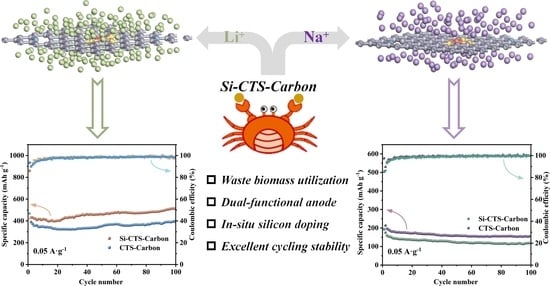
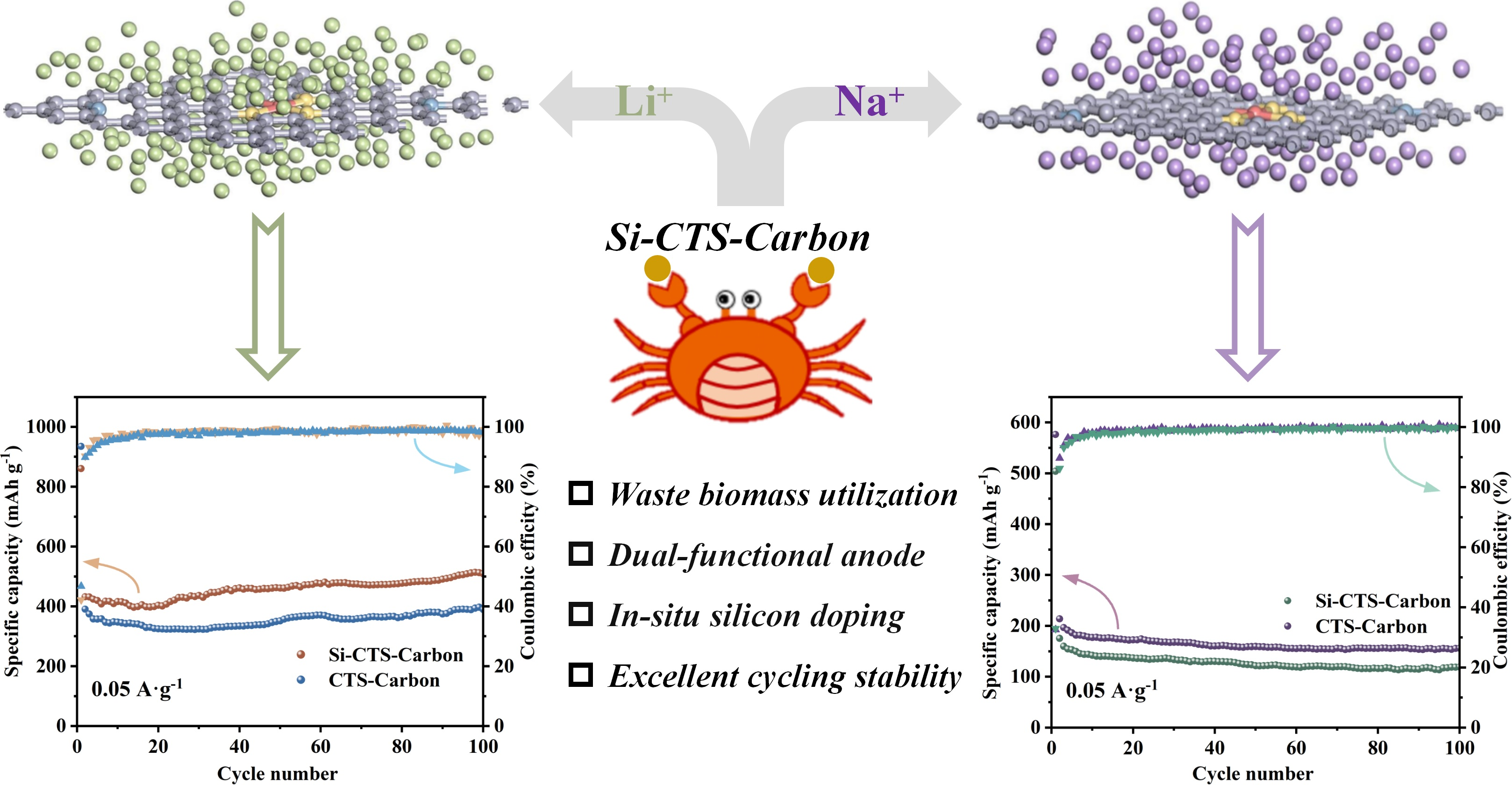
The valorization of biomass waste into advanced electrode materials presents a promising pathway toward sustainable electrochemical energy storage. Herein, a silicon-doped carbon material (Si-CTS-Carbon) is synthesized from chitosan via an in situ reaction with silicon tetrachloride (SiCl4) and subsequent controlled pyrolysis. When evaluated as an anode for lithium-ion batteries (LIBs), Si-CTS-Carbon exhibits a high reversible capacity of 509.2 mAh g−1 with 99% capacity retention after 100 cycles at 0.05 A g−1. For sodium-ion battery (SIB) applications, it achieves a stable reversible capacity of 155.4 mAh g−1 under identical conditions. Structural and electrochemical analyses reveal that the robust C–O–Si covalent network effectively accommodates volume variation of silicon and enhances structural integrity during cycling. Furthermore, the hierarchically porous architecture shortens ion diffusion pathways, leading to improved Li+/Na+ transport kinetics. This work demonstrates a viable strategy for fabricating high-performance battery anodes by synergistically doping silicon into biomass-derived carbon, enabling practical biowaste valorization for energy storage.

Graphical Abstract

1. Introduction

The development of high-performance anode materials is critical for advancing the energy and power density of lithium-ion batteries (LIBs) and sodium-ion batteries (SIBs). While graphite remains the commercial standard for LIBs, its limited theoretical capacity (372 mAh g−1) and the risk of lithium plating at high rates restrict its application in next-generation devices [1,2,3,4]. In this context, biomass-derived hard carbons have emerged as promising sustainable alternatives, offering tunable porosity, inherent heteroatom doping, and cost-effective production [5,6,7]. Chitosan (CTS), a widely available nitrogen-rich biopolymer derived from chitin, serves as an excellent precursor for fabricating functional carbon materials [8,9,10]. The resulting CTS-derived carbons possess naturally doped nitrogen, modifiable surface chemistry, and tailorable nanostructures, making them attractive candidates for both LIB and SIB anodes [11,12,13].
Substantial research efforts have been directed toward enhancing the electrochemical performance of chitosan-derived carbons, primarily through compositing with various metal-based compounds (e.g., transition metal selenides, phosphides, or carbides). These composites leverage synergistic effects to improve specific capacity and cycling stability. For instance, MoSe2/N-doped CTS carbon composites have demonstrated enhanced sodium storage, while CuP2/CTS and graphitic carbon/Fe3C composites have shown improved cycling performance for SIBs and LIBs, respectively [14,15,16]. These advancements underscore the importance of structural design and interfacial engineering in chitosan-derived systems. However, the exploration of non-metallic elemental doping—a strategy that can fundamentally alter the electronic structure and ion transport properties of carbon matrices without introducing heavy metals—remains relatively underexplored for biomass-derived carbons.
Herein, we report a novel in situ silicon doping strategy to engineer the properties of chitosan-derived carbon. Through a reaction with SiCl4 followed by controlled pyrolysis, we synthesized a silicon-doped carbon (Si-CTS-Carbon) featuring a robust covalent C–O–Si network. This structure not only effectively anchors silicon species to mitigate volume changes but also enhances Li+/Na+ transport pathways. When evaluated as an anode, Si-CTS-Carbon delivered significantly improved reversible capacities of 509.2 mAh g−1 for LIBs and 155.4 mAh g−1 for SIBs at 0.05 A g−1, markedly outperforming its undoped counterpart (CTS-Carbon). This work demonstrates that non-metallic silicon doping is an effective strategy for tailoring the interfacial and bulk properties of biomass-derived carbons, providing a new pathway for the design of sustainable, high-performance electrode materials for energy storage applications.

2. Materials and Methods

2.1. Experimental Materials

Chitosan ((C6H11NO4)n), silicon tetrachloride (SiCl4, 99.5%), and N-methyl-2-pyrrolidone (C5H9NO, NMP, 98%) were purchased from Shanghai Macklin Biochemical Technology Co., Ltd. (Shanghai, China), and used without further purification.

2.2. Material Synthesis

Preparation of CTS-Carbon: Chitosan powder (1.0 g) was added to a 5 mL crucible, which was then sealed and placed within a 100 mL crucible containing activated carbon powder. The crucible assembly was then heated using a carbon bath method. The temperature was ramped to 300 °C at a rate of 5 °C/min and held for 30 min, followed by a subsequent ramp to 800 °C with a hold time of 2 h to yield the pristine CTS-Carbon.
Preparation of Si-CTS-Carbon: Chitosan (1.0 g) was dispersed in 3 mL of NMP, and the resulting mixture was subjected to magnetic stirring at room temperature for 30 min. Subsequently, SiCl4 (0.5 mL) was added dropwise to the mixture to initiate in situ doping, resulting in the formation of a gel-like solid. The resulting solid was then dried under vacuum, at 35 °C for 12 h and subsequently at 80 °C for an additional 12 h. After being ground into a powder, the sample was subjected to the same carbon bath procedure previously described for CTS-Carbon to yield the Si-CTS-Carbon.

2.3. Materials Characterization

Scanning electron microscopy (SEM) images were captured using a Hitachi SU 8020 scanning electron microscope (Hitachi High-Technologies, Tokyo, Japan). Transmission electron microscopy (TEM) and high-resolution TEM (HRTEM) images were captured by a FEI Tecnai G2 F30 system (FEI Company, Hillsboro, OR, USA). Powder X-ray diffraction (PXRD) patterns were recorded using a Bruker D8 Advance diffractometer with Cu-Kα radiation (λ = 0.154 nm) (Bruker Corporation, Billerica, MA, USA). Fourier transform infrared (FT-IR) spectroscopy was conducted using a Thermo Nicolet iS10 spectrometer (Thermo Fisher Scientific, Waltham, MA, USA). Raman spectra were recorded on a Renishaw inVia micro-Raman spectrometer (514 nm laser excitation) (Renishaw plc, Wotton-under-Edge, Gloucestershire, UK). Nitrogen adsorption–desorption isotherms were measured at 77 K on an ASAP 2460 surface area analyzer (Micromeritics Instrument Corporation, Norcross, GA, USA). X-ray photoelectron spectroscopy (XPS) was conducted using a Thermo 250Xi instrument with Al Kα radiation (Thermo Fisher Scientific, Waltham, MA, USA).

2.4. Electrochemical Measurements

Working electrodes were fabricated by preparing a slurry of the active material, Ketjenblack (conductive additive), and polyvinylidene fluoride (PVDF, binder) in an 8:1:1 weight ratio. This slurry was then cast onto copper foil and vacuum-dried at 80 °C for 12 h to achieve a final loading density of 0.8~1.1 mg cm−2. Coin-type half-cells (CR2032) were assembled in an argon-filled glovebox. ForLIBs, lithium metal served as the counter/reference electrode with a polypropylene membrane as the separator. For SIBs, sodium metal and a glass fiber membrane were used as the counter/reference electrode and separator, respectively.
The electrolyte for LIBs consisted of 1.0 M lithium hexafluorophosphate (LiPF6) dissolved in a mixture of ethylene carbonate (EC) and diethyl carbonate (DEC) (1:1, v/v). For SIBs, the electrolyte was 1.0 M sodium perchlorate (NaClO4) in EC/DEC (1:1, v/v) with a 5% fluoroethylene carbonate (FEC) additive. Galvanostatic charge–discharge cycling was performed using a LANHE-CT2001A battery testing system within voltage windows of 0.01 to 3.0 V (vs. Li/Li+) for LIBs and 0.01 to 2.5 V (vs. Na/Na+) for SIBs. Cyclic voltammetry (CV) and electrochemical impedance spectroscopy (EIS) were conducted on a CHI760E electrochemical workstation. CV scans were performed at a rate of 0.2 mV s−1 within the same voltage ranges as the cycling tests for LIBs and SIBs, respectively. EIS measurements were recorded over a frequency range of 100 kHz to 0.01 Hz at open-circuit voltage.

2.5. Theoretical Calculations

Molecular mechanics (MM) simulations were conducted using the DMol3, Sorption, and Forcite modules implemented in Materials Studio 2020. First, single-point energy calculations were performed on the bulk material models within DMol3, followed by assignment of partial Mulliken charges to each atom. Next, adsorption under a Li+/Na+ fugacity of 10 kPa was evaluated in the Sorption module. The lowest-energy adsorption configurations were exported to Forcite, where NVT-ensemble molecular dynamics simulations were carried out with a Nosé-Hoover thermostat at 298.15 K. The self-diffusion coefficient of Li+/Na+ within the target material was extracted from the resulting trajectories by linear regression of the mean-square displacement curve according to the Einstein relation. All calculations were executed at the Fine or Ultrafine accuracy level, consistent with the highest standards prescribed by the software’s built-in protocols.

3. Results

3.1. Structural and Morphological Analysis

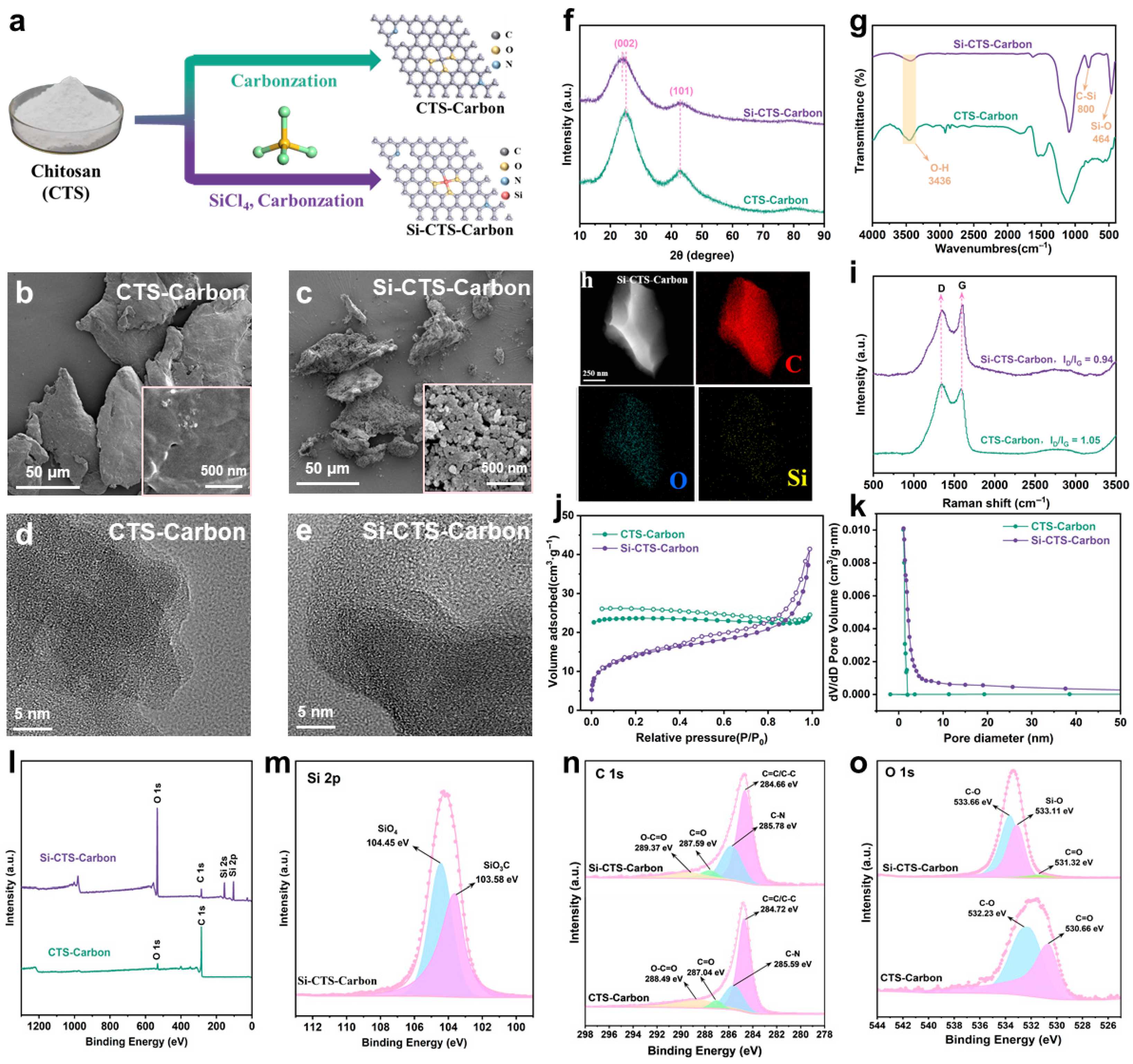
The synthesis process of silicon-doped, chitosan-derived carbon (Si-CTS-Carbon) is schematically illustrated in Figure 1a. The abundant hydroxyl groups on the chitosan backbone facilitate in situ doping with SiCl4, followed by high-temperature carbonization to yield a carbon matrix incorporating C–O–Si covalent linkages. Scanning electron microscopy (SEM) images reveal that whereas the undoped CTS-Carbon exhibits a sheet-like morphology with lateral dimensions of 10–100 μm, the Si-CTS-Carbon displays significantly refined particle size (Figure 1b,c). This refinement is attributed to the in situ generation of HCl gas during the pyrolysis of SiCl4, which fragments the carbonaceous particles and concurrently introduces a porous architecture, thereby enhancing electrolyte accessibility [17]. High-resolution transmission electron microscopy (HRTEM) images of both CTS-Carbon and Si-CTS-Carbon show no distinct lattice fringes, confirming their amorphous nature (Figure 1d,e). Energy-dispersive X-ray spectroscopy (EDS) mapping further confirms a homogeneous spatial distribution of Si, C, and O within Si-CTS-Carbon. (Figure 1h). This uniform dispersion of silicon is crucial for mitigating volume variations during Li+/Na+ insertion-extraction cycles, thereby promoting structural integrity and electrochemical stability [18].
The crystal structures of CTS-Carbon and Si-CTS-Carbon were examined by powder X-ray diffraction (PXRD), as shown in Figure 1f. Both materials exhibit two broad diffraction peaks around 23° and 43°, corresponding to the (002) and (101) planes of disordered carbon, respectively [19]. Notably, the (002) peak of Si-CTS-Carbon shifts toward a lower angle compared with that of CTS-Carbon, indicating an expansion of the interlayer spacing from 0.360 nm to 0.366 nm, as calculated using Bragg’s law. This enlarged interplanar distance is expected to facilitate faster Li+/Na+ transport kinetics [20]. Fourier transform infrared (FT-IR) spectroscopy was employed to further probe the chemical structures (Figure 1g). The spectrum of Si-CTS-Carbon displays three characteristic absorption bands at 800 cm−1 (C–Si), 464 cm−1 (Si–O) [18], and 1085 cm−1 (C–O–Si) [21], which are absent in the spectrum of CTS-Carbon, confirming successful silicon incorporation. Raman spectroscopy (Figure 1i) was conducted to evaluate the structural ordering of the carbons (Figure 1i). Both samples show the typical D band near 1350 cm−1, associated with structural defects and disordered sp3 carbon, and the G band around 1600 cm−1, corresponding to the in-plane vibration of sp2-hybridized graphitic domains. After silicon doping, the ID/IG ratio decreased to 0.94. This is attributed to silicon acting as a graphitization catalyst during high-temperature heat treatment, reducing the energy barrier for carbon layer rearrangement and promoting the transformation of disordered carbon into ordered carbon [22,23]. Although this structural ordering sacrifices part of the initial lithium storage capacity, it significantly enhances the structural stability of the material, laying the foundation for excellent long-cycle performance [24,25].
Nitrogen adsorption–desorption measurements were performed to characterize the specific surface area and pore structure (Figure 1j). Both materials exhibit type IV isotherms, indicative of mesoporous characteristics that can provide efficient pathways for ion diffusion. Notably, Si-CTS-Carbon shows a distinct H1-type hysteresis loop, suggesting a uniform and ordered mesoporous network that favors homogeneous electrolyte penetration and mitigates local concentration polarization [26,27]. Pore size distributions derived from the Barrett–Joyner–Halenda (BJH) model confirm a broad pore size range in both carbons (Figure 1k). X-ray photoelectron spectroscopy (XPS) survey scans reveal the presence of C, O, and Si in Si-CTS-Carbon (Figure 1l). High-resolution C 1s spectra of CTS-Carbon (Figure 1n) can be deconvoluted into four components at 284.66, 285.78, 287.59, and 289.37 eV, corresponding to C–C/C=C, C–N, C=O, and O–C=O bonds, respectively, consistent with its expected functional groups [25,28,29]. Comparison of the O 1s spectra (Figure 1o) shows that, in addition to the peaks related to C=O (530.66 eV) and C–O (532.23 eV) present in CTS-Carbon [30], Si-CTS-Carbon exhibits an additional peak at 533.11 eV attributed to Si-O bonds [31], in agreement with the FT-IR analysis. Deconvolution of the Si 2p spectrum for Si-CTS-Carbon (Figure 1m) yields two contributions at 103.58 and 104.45 eV, assigned to SiO3C and SiO4 environments, respectively. These results indicate that silicon is incorporated into the carbon matrix through a stable C–O–Si covalent network, which is expected to enhance the structural robustness during electrochemical cycling [32,33].

3.2. Lithium-Ion Battery Performance

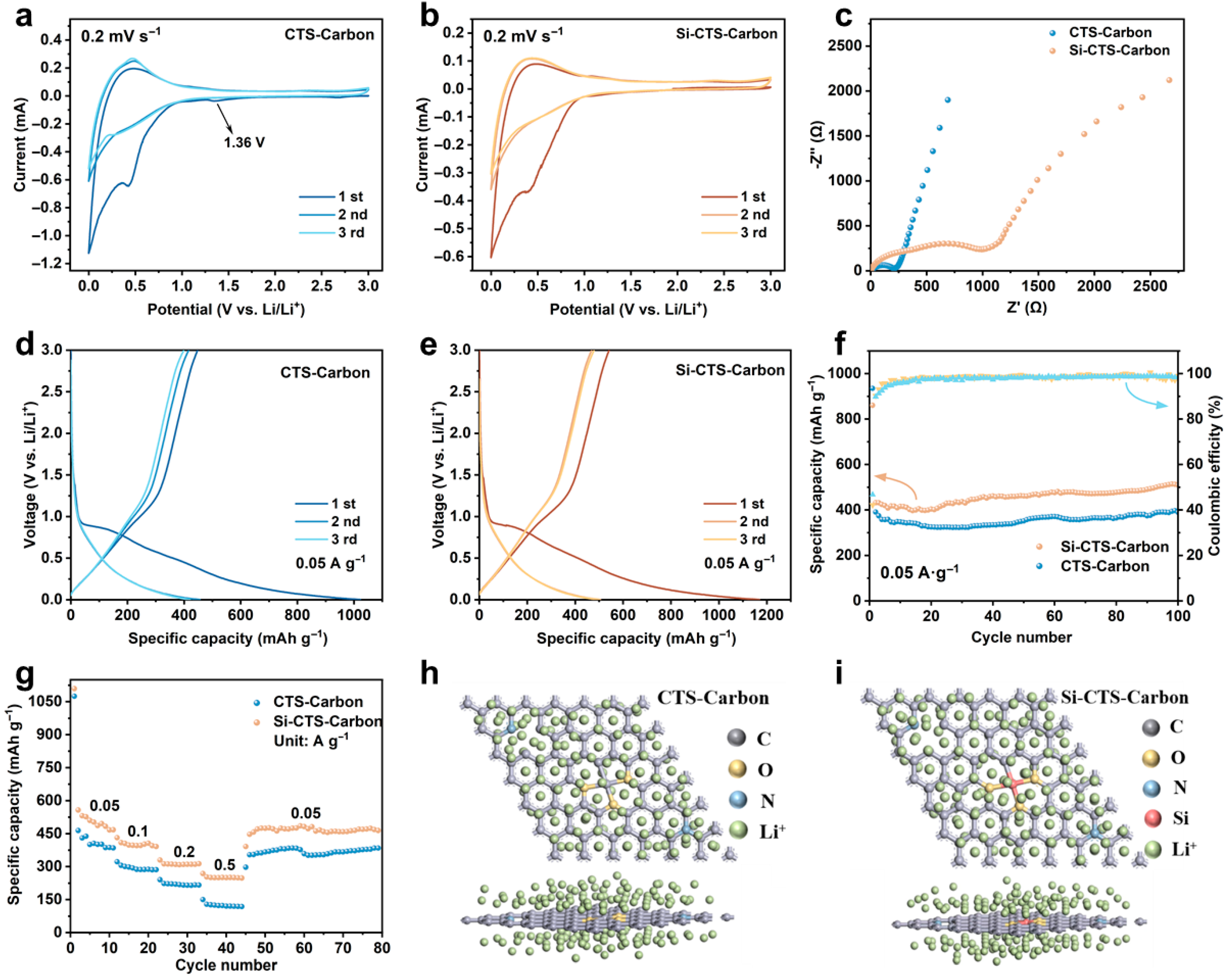
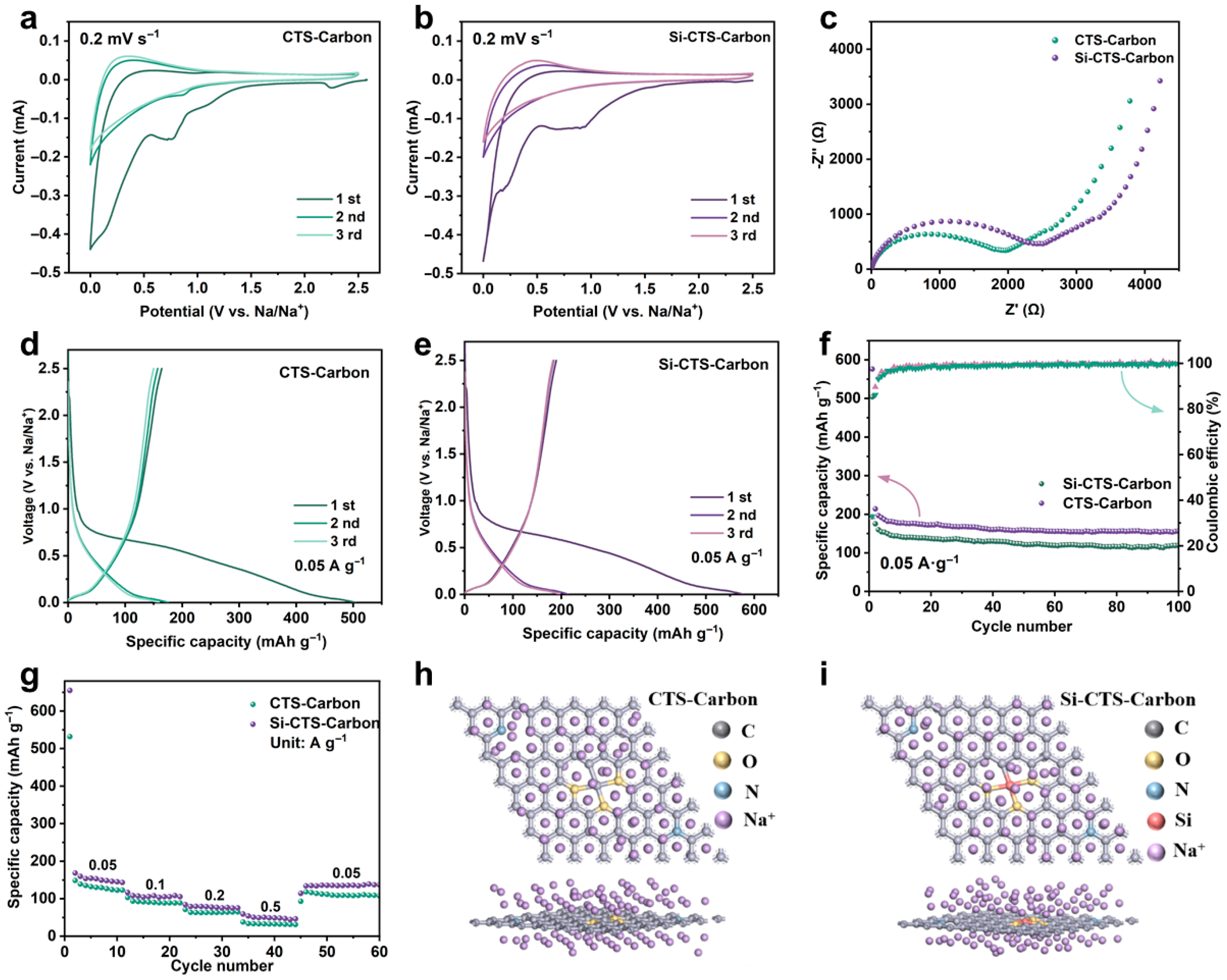
The electrochemical performance of CTS-Carbon and Si-CTS-Carbon as anodes for LIBs was systematically evaluated. Figure 2a,b present the cyclic voltammetry (CV) curves obtained at a scan rate of 0.2 mV s−1. In the first cathodic scan, a prominent reduction peak observed around 0.5 V for both materials is attributed to the formation of the solid electrolyte interphase (SEI) film. An additional peak near 1.36 V correlates with electrolyte decomposition [26,33,34]. The subsequent second and third cycles exhibit nearly overlapping curves, indicating excellent electrochemical reversibility after the initial activation. Galvanostatic charge–discharge (GCD) profiles recorded at 0.05 A g−1 are shown in Figure 2d,e. The CTS-Carbon anode delivered an initial discharge and charge capacity of 1022.3 and 445.6 mAh g−1, respectively, yielding an initial Coulombic efficiency (ICE) of 42.1%. The significant irreversible capacity loss is primarily ascribed to SEI formation and related parasitic reactions. In contrast, the Si-CTS-Carbon anode exhibited a higher initial discharge capacity of 1169.1 mAh g−1, and a charge capacity of 546.0 mAh g−1, corresponding to an improved ICE of 46.7%. Although this value is still relatively low, it represents a significant improvement compared with the undoped materials. The irreversible capacity loss of Si-CTS-Carbon is not only attributed to the formation of the SEI film but also to the generation of electrochemically inert lithium silicate during the initial lithiation of silicon oxide.
The long-term cycling stability was assessed at 0.05 A g−1 (Figure 2f). After 100 cycles, the Si-CTS-Carbon anode retained a reversible capacity of 509.2 mAh g−1, significantly outperforming the 389.6 mAh g−1 retained by the CTS-Carbon anode. Furthermore, Si-CTS-Carbon demonstrated superior rate capability (Figure 2g). It delivered reversible capacities of 509.9, 395.6, 309.4, and 249.8 mAh g−1 at current densities of 0.05, 0.1, 0.2, and 0.5 A g−1, respectively. Notably, when the current density was returned to 0.05 A g−1, the capacity recovered to 484.9 mAh g−1 for Si-CTS-Carbon, compared to 366.0 mAh g−1 for CTS-Carbon, highlighting its remarkable structural resilience and kinetic reversibility.
To elucidate the mechanism underlying the enhanced LIB performance of Si-CTS-Carbon, electrode kinetics and theoretical adsorption capacity were analyzed. Electrochemical impedance spectroscopy (EIS) spectra (Figure 2c) reveal that Si-CTS-Carbon exhibits a larger charge-transfer resistance (Rct) than CTS-Carbon, which is attributed to the modified interfacial electronic structure following silicon incorporation. Molecular-mechanical (MM) simulations (Figure 2h,i) predicted a marginally higher Li+ adsorption capacity for Si-CTS-Carbon (1.28 g g−1) compared to CTS-Carbon (1.25 g g−1), reflecting the introduction of additional active sites via silicon doping. Collectively, these results suggest the performance enhancement stems from a synergistic effect: the stable C–O–Si covalent network mitigates volumetric strain during lithiation/delithiation, while the expanded interlayer spacing (0.366 nm vs. 0.360 nm) facilitates more efficient ion transport [35].

3.3. Sodium-Ion Battery Performance

To further assess the advantageous role of silicon, the SIB performance of both carbons was investigated. The CV curves (Figure 3a,b) show irreversible reduction peaks between 0.2 and 1.0 V, corresponding to electrolyte decomposition and SEI formation. A sharp cathodic peak near 0.01 V signifies Na+ intercalation into the carbon layers, while a broad anodic peak from 0.16 to 0.8 V corresponds to Na+ extraction [19]. The excellent overlap of subsequent CV curves confirms high reversibility and structural stability. GCD profiles at 0.05 A g−1 (Figure 3d,e) indicate that both anodes delivered similar initial discharge capacities of approximately 576 mAh g−1. However, the Si-CTS-Carbon electrode exhibited significantly accelerated electrochemical activation. Its CE increased rapidly from 86.2% in the second cycle to 93.1% in the third cycle, surpassing that of CTS-Carbon and underscoring the role of silicon in enhancing interfacial kinetics for sodium storage.
The long-term cycling stability for SIBs was evaluated at 0.05 A g−1 (Figure 3f). After 100 cycles, the Si-CTS-Carbon anode retained a capacity of 155.4 mAh g−1, substantially exceeding the 118.6 mAh g−1 retained by the CTS-Carbon anode. This superior stability aligns with MM simulations, which predicted a slightly higher Na+ adsorption affinity for Si-CTS-Carbon (Figure 3h,i). Moreover, Si-CTS-Carbon demonstrated excellent rate capability (Figure 3g), maintaining robust capacities at current densities up to 0.5 A g−1 and recovering 138.7 mAh g−1 when the rate was restored to 0.05 A g−1. The EIS analysis (Figure 3c) revealed a moderately higher Rct for Si-CTS-Carbon, likely indicative of a more stable and optimized SEI layer that is crucial for long-term cycling durability.

3.4. Ions Storage Mechanism

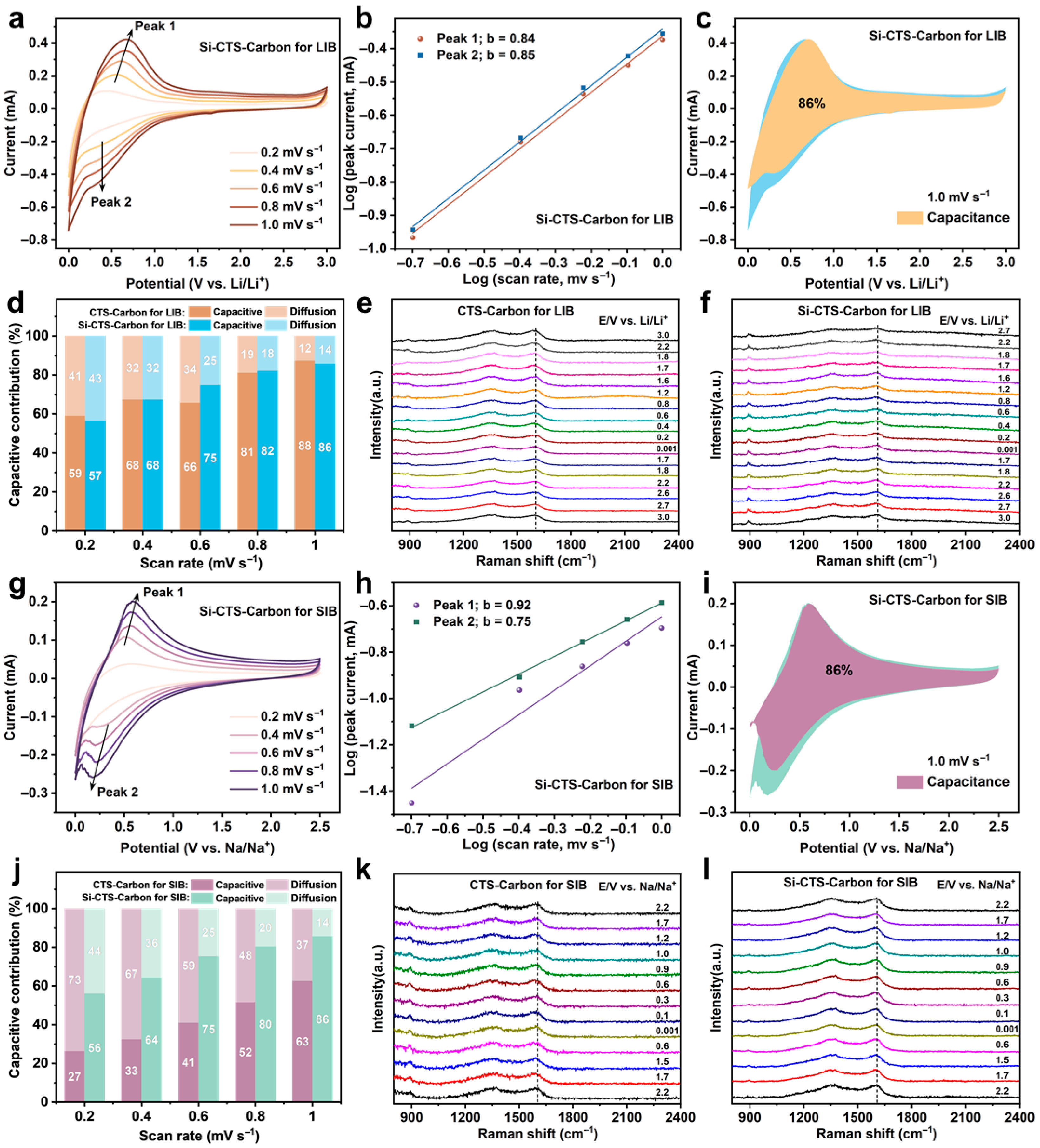
To elucidate the lithium-ion storage kinetics of the Si-CTS-Carbon anode, systematic cyclic voltammetry (CV) analyses were conducted at scan rates ranging from 0.2 to 1.0 mV s−1. As shown in Figure 4a, the CV profiles maintained their shape across all scan rates, exhibiting only minor peak potential shifts (<50 mV) with increasing rate. This behavior indicates favorable reaction kinetics and minimal polarization, even under high-rate conditions, a critical feature for high-power applications [36,37]. The lithium storage mechanism was quantitatively decoupled using the classic power-law relationship between peak current (i) and scan rate (v) [38]:
i = avb
The b-value is obtained from the slope of the log(i) versus log(v) plot (Figure 4b) and is used to distinguish between capacitive-controlled (b → 1) and diffusion-controlled (b → 0.5) processes. The calculated b-values for the anodic and cathodic peaks are 0.84 and 0.85, respectively, confirming that charge storage is mainly dominated by fast surface-driven capacitive processes. To further quantify capacitive contributions, the current response was partitioned using equation [37]:
i = k1v + k2v1/2
where k1v and k2v1/2 represent capacitive and diffusion-limited components. Figure 4d shows that for Si-CTS-Carbon, the capacitive contribution gradually increases with the scan rate, rising from 57% at 0.2 mV s−1 to 86% at 1.0 mV s−1. This indicates that the Si-CTS-Carbon material exhibits favorable electrochemical kinetics, which underpin its excellent rate capability and cycling stability [39]. At the same time, at a scan rate of 1 mV s−1, Si-CTS-Carbon exhibited a slightly lower capacitance contribution than CTS-Carbon, which is attributed to the introduction of silicon components leading to a high-capacity bulk diffusion-controlled lithium storage process. At a high scan rate of 1.0 mV s−1, capacitive processes accounted for 86% of the total charge storage (Figure 4c), consistent with the exceptional rate capability observed in galvanostatic tests. This behavior originates from the hierarchically porous, Si-doped carbon architecture, which exposes abundant electrochemically active sites for rapid ion adsorption, while the silicon dopants synergistically enhance electronic conductivity and ion-accessible surface area.
In situ Raman spectroscopy was performed on both CTS-Carbon and Si-CTS-Carbon during cycling (Figure 4e,f). The G-band of both materials remained unchanged throughout the discharge/charge process, indicating preservation of the carbon lattice. This finding rules out significant bulk intercalation of lithium ions, which would otherwise induce notable peak shifts. Thus, spectroscopic evidence confirms that charge storage in both electrodes is governed by a surface-adsorption-dominated mechanism.
To probe the Na+ storage dynamics, a detailed kinetic analysis of the Si-CTS-Carbon electrode was conducted. CV curves collected at scan rates up to 1.0 mV s−1 showed minimal polarization (Figure 4g). Applying the power-law relationship yielded b-values of 0.92 and 0.75 for the primary redox peaks, respectively (Figure 4h), suggesting a hybrid storage mechanism dominated by non-diffusion-limited, pseudocapacitive processes [19]. As shown in Figure 4j, the capacitive contribution of CTS-Carbon increases from 27% at 0.2 mV s−1 to 63% at 1.0 mV s−1, while that of Si-CTS-Carbon increases from 56% to 86%. In the silicon-doped carbon material, Si–O–C bonds are formed and embedded into the carbon framework. This ensures that, during long-term cycling, the active silicon centers do not detach from the carbon matrix or aggregate due to volume expansion, thereby maintaining the stability of the interface structure. Consequently, Si-CTS-Carbon exhibits a higher capacitive contribution than CTS-Carbon at high scan rates. At a high scan rate of 1.0 mV s−1, capacitive processes accounted for 86% of the total charge storage (Figure 4i), verifying that the electrode’s exceptional rate performance is governed by rapid, surface-driven Na+ storage [40]. The Na+ storage mechanism was further investigated via in situ Raman spectroscopy during sodiation/desodiation (Figure 4k,l). The characteristic G-band of both carbons showed no significant shift, indicating the absence of lattice strain typically associated with ion intercalation. This provides direct evidence that charge storage in both materials is predominantly governed by a surface-adsorption mechanism. To comprehensively assess the electrochemical performance of Si-CTS-Carbon anode materials, Table 1 summarizes the applications of various carbon-based materials in lithium/sodium-ion battery anodes. The comparison of cycle life and reversible specific capacity shows that Si-CTS-Carbon anode materials have certain advantages over carbon-based materials synthesized by conventional methods.

4. Conclusions

In conclusion, this study demonstrates a sustainable and effective strategy for engineering high-performance biopolymer-derived carbon anodes via atomic-level doping. A silicon-doped chitosan-based carbon (Si-CTS-Carbon) was successfully synthesized, featuring a robust covalent C–O–Si network that effectively anchors silicon species, mitigates electrode pulverization, and facilitates rapid Li+/Na+ transport. When evaluated as a dual-functional anode, Si-CTS-Carbon exhibited significantly enhanced cycling stability, retaining reversible capacities of 509.2 mAh g−1 in LIBs and 155.4 mAh g−1 in SIBs after 100 cycles at 0.05 A g−1, substantially outperforming its undoped counterpart. Kinetic analyses revealed that charge storage is predominantly governed by a surface-induced pseudocapacitive mechanism, which underpins the material’s exceptional rate capability. This work thus provides a feasible and promising pathway for the rational design of advanced, biomass-derived carbon materials for next-generation energy storage systems.

Author Contributions

Y.S.: methodology, validation, formal analysis, writing—original draft. P.C.: conceptualization, writing—review and editing, visualization. C.H.: validation. S.Y.: validation. B.L.: validation. G.P.: project administration. J.L.: project administration. W.P.: software. F.Y.: supervision, writing—review and editing. All authors have read and agreed to the published version of the manuscript.

Funding

This work was financially supported by the Bingtuan Science and Technology Program (2023CB008-21) and Xinjiang Science and Technology Program (2023TSYCCX0118).

Data Availability Statement

The original contributions presented in the study are included in the article, further inquiries can be directed to the corresponding authors.

Conflicts of Interest

Guojun Pei was employed in Xinjiang Tianhongji Technology Co., Ltd. The remaining authors declare that the research was conducted in the absence of any commercial or financial relationships that could be construed as a potential conflict of interest.

References

  1. Jafarizadeh, H.; Yamini, E.; Zolfaghari, S.M.; Esmaeilion, F.; Assad, M.E.H.; Soltani, M. Navigating challenges in large-scale renewable energy storage: Barriers, solutions, and innovations. Energy Rep. 2024, 12, 2179–2192. [Google Scholar] [CrossRef]
  2. Elalfy, D.A.; Gouda, E.; Kotb, M.F.; Bureš, V.; Sedhom, B.E. Comprehensive review of energy storage systems technologies, objectives, challenges, and future trends. Energy Strategy Rev. 2024, 54, 101482. [Google Scholar] [CrossRef]
  3. Abdel-Ghany, A.E.; Abbas, S.M.; Hashem, A.M.; Mauger, A.; Julien, C.M. Comparative Performance Analysis of Fluoride-Decorated Li1.2Ni0.13Co0.13Mn0.54O2 as Cathode Materials for Li Batteries. Nanoenergy Adv. 2025, 5, 23. [Google Scholar] [CrossRef]
  4. Blachowicz, T.; Mpofu, N.S.; Ehrmann, A. Measuring Physical and Chemical Properties of Single Nanofibers for Energy Applications-Possibilities and Limits. Nanoenergy Adv. 2024, 4, 300–317. [Google Scholar] [CrossRef]
  5. Lu, W.; Si, Y.; Zhao, C.; Chen, T.; Li, C.; Zhang, C.; Wang, K. Biomass-derived carbon applications in the field of supercapacitors: Progress and prospects. Chem. Eng. J. 2024, 495, 153311. [Google Scholar] [CrossRef]
  6. Zhang, J.; Xiang, H.; Cao, Z.; Wang, S.; Zhu, M. Research progress of lignin-derived materials in lithium/sodium ion batteries. Green Energy Environ. 2025, 10, 322–344. [Google Scholar] [CrossRef]
  7. Yan, L.; Liu, H.; Yang, Y.; Dai, L.; Si, C. Lignin-derived carbon fibers: A green path from biomass to advanced materials. Carbon Energy 2025, 7, e662. [Google Scholar] [CrossRef]
  8. Oladzadabbasabadi, N.; Mohammadi Nafchi, A.; Ariffin, F.; Wijekoon, M.M.J.O.; Al-Hassan, A.A.; Dheyab, M.A.; Ghasemlou, M. Recent advances in extraction, modification, and application of chitosan in packaging industry. Carbohydr. Polym. 2022, 277, 118876. [Google Scholar] [CrossRef] [PubMed]
  9. Ababneh, H.; Hameed, B.H. Chitosan-derived hydrothermally carbonized materials and its applications: A review of recent literature. Int. J. Biol. Macromol. 2021, 186, 314–327. [Google Scholar] [CrossRef]
  10. Vicente, W.C.; Carli, L.N.; Brondani, P.B. Recent advances in the application of chitosan nanoparticles for the modification of textiles. Prog. Org. Coat. 2025, 198, 108910. [Google Scholar] [CrossRef]
  11. Wang, L.; Wu, Q.; Zhao, B.; Li, Z.; Zhang, Y.; Huang, L.; Yu, S. Multi-functionalized carbon aerogels derived from chitosan. J. Colloid Interface Sci. 2022, 605, 790–802. [Google Scholar] [CrossRef] [PubMed]
  12. Nisticò, R.; Guerretta, F.; Benzi, P.; Magnacca, G. Chitosan-derived biochars obtained at low pyrolysis temperatures for potential application in electrochemical energy storage devices. Int. J. Biol. Macromol. 2020, 164, 1825–1831. [Google Scholar] [CrossRef]
  13. Xia, W.; Cheng, M.; Hu, J.; Liu, Q.; Wei, T.; Wang, R.; Li, W.; Liu, B. Facile and controllable synthesis of nitrogen self-doped chitosan-derived carbon for high-performance Li-ion batteries. Carbon Lett. 2023, 34, 85–94. [Google Scholar] [CrossRef]
  14. Lei, Z.; Li, X.; Liu, Y.; Wu, J.; Wang, Y.; Luo, Y.; Chen, Q.; Wei, M.; Zeng, L.; Qian, Q. Two-dimentional MoSe2/chitosan-derived nitrogen-doped carbon composite enabling stable sodium/potassium storage. J. Phys. Chem. Solids 2022, 163, 110573. [Google Scholar] [CrossRef]
  15. Duan, J.; Deng, S.; Wu, W.; Li, X.; Fu, H.; Huang, Y.; Luo, W. Chitosan Derived Carbon Matrix Encapsulated CuP2 Nanoparticles for Sodium-Ion Storage. ACS Appl. Mater. Interfaces 2019, 11, 12415–12420. [Google Scholar] [CrossRef]
  16. Li, B.; Zhang, Y.; Xiong, J.; Gui, Y.; Huang, T.; Peng, J.; Liu, H.; Yang, F.; Li, M. Chitosan-derived graphitic carbon@Fe3C as anode materials for lithium ion battery. J. Mater. Sci. 2022, 57, 9939–9954. [Google Scholar] [CrossRef]
  17. Chen, W.; Xu, D.; Kuang, S.; Wu, Z.; Hu, H.; Zheng, M.; Yu, X. Hierarchically porous SiOx/C and carbon materials from one biomass waste precursor toward high-performance lithium/sodium storage. J. Power Sources 2021, 489, 229459. [Google Scholar] [CrossRef]
  18. Zhang, N.; Liu, K.; Zhang, H.; Wang, X.; Zhou, Y.; He, W.; Cui, J.; Sun, J. Constructing Biomass-Based Ultrahigh-Rate Performance SnOy@C/SiOx Anode for LIBs via Disproportionation Effect. Small 2023, 19, e2204867. [Google Scholar] [CrossRef] [PubMed]
  19. Gong, H.; Du, T.; Liu, L.; Zhou, L.; Wang, Y.; Jia, H.; Cheng, Z. Self-source silicon embedded in 2D biomass-based carbon sheet as anode material for sodium ion battery. Appl. Surf. Sci. 2022, 586, 152759. [Google Scholar] [CrossRef]
  20. Wu, F.; Liu, L.; Yuan, Y.; Li, Y.; Bai, Y.; Li, T.; Lu, J.; Wu, C. Expanding Interlayer Spacing of Hard Carbon by Natural K+ Doping to Boost Na-Ion Storage. ACS Appl. Mater. Interfaces 2018, 10, 27030–27038. [Google Scholar] [CrossRef]
  21. Criado, M.; Sobrados, I.; Sanz, J. Polymerization of hybrid organic–inorganic materials from several silicon compounds followed by TGA/DTA, FTIR and NMR techniques. Prog. Org. Coat. 2014, 77, 880–891. [Google Scholar] [CrossRef]
  22. Lower, L.; Dey, S.C.; Vook, T.; Nimlos, M.; Park, S.; Sagues, W.J. Catalytic Graphitization of Biocarbon for Lithium-Ion Anodes: A Minireview. ChemSusChem 2023, 16, e202300729. [Google Scholar] [CrossRef]
  23. Kim, J.; Lee, S.-H.; Yang, J. Revealing the Calcium Assisted Partial Catalytic Graphitization of Lignin-Derived Hard Carbon Anode and Its Electrochemical Behaviors in Sodium Ion Batteries. Polymers 2025, 17, 540. [Google Scholar] [CrossRef]
  24. Chowdury, M.S.K.; Park, Y.J.; Park, S.B.; Park, Y.I. Review: Two-dimensional nanostructured pristine graphene and heteroatom-doped graphene-based materials for energy conversion and storage devices. Sustain. Mater. Technol. 2024, 42, e01124. [Google Scholar] [CrossRef]
  25. Sang, Z.; Yan, X.; Wen, L.; Su, D.; Zhao, Z.; Liu, Y.; Ji, H.; Liang, J.; Dou, S.X. A graphene-modified flexible SiOC ceramic cloth for high-performance lithium storage. Energy Storage Mater. 2020, 25, 876–884. [Google Scholar] [CrossRef]
  26. Kong, X.; Xi, Z.; Jiang, Y.; Li, S.; Chen, X.; Zhang, J.; Wang, L.; Wan, Z.; Pan, A. Fe-N-C decorated fibrous network-wrapped biomass SiOx/C with gradient conductive structure for high performance Li-ion battery anodes. Chem. Eng. J. 2023, 477, 147178. [Google Scholar] [CrossRef]
  27. Wang, H.; Que, X.; Liu, Y.; Wu, X.; Yuan, Q.; Lu, J.; Gan, W. Facile synthesis of yolk–shell structured SiOx/C@Void@C nanospheres as anode for lithium-ion batteries. J. Alloys Compd. 2021, 874, 159913. [Google Scholar] [CrossRef]
  28. Yang, S.; Li, B.; Yang, Z.; Song, Y.; Wang, G.; Yu, F. Silicon-doped multilayer graphene as anode material for secondary batteries. Appl. Surf. Sci. 2025, 681, 161483. [Google Scholar] [CrossRef]
  29. Luo, L.; Chen, T.; Li, Z.; Zhang, Z.; Zhao, W.; Fan, M. Heteroatom self-doped activated biocarbons from fir bark and their excellent performance for carbon dioxide adsorption. J. CO2 Util. 2018, 25, 89–98. [Google Scholar] [CrossRef]
  30. Wang, P.; Hou, S.; Pang, F.; Liu, M.; Li, Y.; Liu, T.; Luo, Y.; Fan, Y.; Zhao, L. SiOx/C-Decorated CoO Nanosheets as a Long-life Anode for Lithium-Ion Batteries. ChemElectroChem 2019, 6, 1574–1581. [Google Scholar] [CrossRef]
  31. Wu, Z.; Cheng, X.; Tian, D.; Gao, T.; He, W.; Yang, C. SiOC nanolayers directly-embedded in graphite as stable anode for high-rate lithium ion batteries. Chem. Eng. J. 2019, 375, 121997. [Google Scholar] [CrossRef]
  32. Zhang, J.; Chen, H.; Wei, J.; Zhang, Y.; Wang, L. Electrochemical performance of SiOC anodes prepared by a different silicone. Int. J. Appl. Ceram. Technol. 2022, 20, 313–320. [Google Scholar] [CrossRef]
  33. Li, K.; Yuan, G.; Liu, X.; Guo, Y.; Huang, R.; Li, H.; Zhang, H.; Jia, Q.; Xie, Z.; Zhang, S.; et al. On the Practical Applicability of Rambutan-like SiOC Anode with Enhanced Reaction Kinetics for Lithium-Ion Storage. Adv. Funct. Mater. 2023, 33, 2302348. [Google Scholar] [CrossRef]
  34. Bie, X.; Xiong, M.; Wang, B.; Dong, Y.; Chen, Z.; Huang, R. Glucose hydrothermal encapsulation of carbonized silicone polyester to prepare anode materials for lithium batteries with improved cycle stability. RSC Adv. 2022, 12, 9238–9248. [Google Scholar] [CrossRef]
  35. Yang, S.; Tang, Y.; Yang, Z.; Yang, S.; Li, B.; Peng, W.; Peng, B.; Wang, G.; Liang, J.; Ji, J.; et al. Modulation of electron distribution and intermediate adsorption by C–O–Si sites for efficient oxygen reduction and lithium storage. Green Chem. 2025, 27, 1997–2007. [Google Scholar] [CrossRef]
  36. Idrees, M.; Batool, S.; Cao, J.; Javed, M.S.; Xiong, S.; Liu, C.; Chen, Z. 3D printed PC/SiOC@Zn hybrid composite as dendrite-free anode for Zn-Ion battery. Nano Energy 2022, 100, 107505. [Google Scholar] [CrossRef]
  37. Huang, X.; Christopher, B.; Chai, S.; Xie, X.; Luo, S.; Liang, S.; Pan, A. Cowpea-like N-Doped Silicon Oxycarbide/Carbon Nanofibers as Anodes for High-Performance Lithium-Ion Batteries. ACS Appl. Energy Mater. 2021, 4, 1677–1686. [Google Scholar] [CrossRef]
  38. Muduli, S.; Blázquez-Moreno, J.M.; Benítez, A.; Buchmeiser, M.R. Role of electrolyte in the polysulfide shuttle effect and long-term cycling performance in cathodes for Li S batteries based on sulfurated polyisoprene. Appl. Energy 2025, 389, 125778. [Google Scholar] [CrossRef]
  39. Yao, Y.; He, Z.; Xu, X.; Tong, Y.; Chen, D.; Huang, C.; Zhao, H. Upgraded lithium storage performance of defect-rich Si@C anode assisted by Fe2O3-induced pseudocapacitance. Electrochim. Acta 2023, 455, 142430. [Google Scholar] [CrossRef]
  40. Ku, M.; Park, D.; Kim, M.; Choi, M.; Choi, W. Hydrophobic dispersion-derived Si/rGO nanocomposites in SiOC ceramic matrix as anode materials for high performance lithium-ion batteries. J. Mater. Chem. A 2023, 11, 15277–15285. [Google Scholar] [CrossRef]
  41. Wan, H.; Hu, X. Nitrogen doped biomass-derived porous carbon as anode materials of lithium ion batteries. Solid State Ion. 2019, 341, 115030. [Google Scholar] [CrossRef]
  42. Wang, S.; Yang, S.; Li, M.; Liu, K.; Liang, S.; Wang, X.; Li, N.; Sun, Z.; An, H. A hierarchical porous structure and nitrogen-doping jointly enhance the lithium-ion storage capacity of biomass-derived carbon materials. Int. J. Hydrogen Energy 2024, 68, 1229–1239. [Google Scholar] [CrossRef]
  43. Chen, Y.; Wu, Y.; Liao, Y.; Zhang, Z.; Luo, S.; Li, L.; Wu, Y.; Qing, Y. Tuning carbonized wood fiber via sacrificial template-assisted hydrothermal synthesis for high-performance lithium/sodium-ion batteries. J. Power Sources 2022, 546, 231993. [Google Scholar] [CrossRef]
  44. Li, R.; Huang, J.; Li, J.; Cao, L.; Zhong, X.; Yu, A.; Lu, G. Nitrogen-doped porous hard carbons derived from shaddock peel for high-capacity lithium-ion battery anodes. J. Electroanal. Chem. 2020, 862, 114044. [Google Scholar] [CrossRef]
  45. Yu, Y.; Ren, Z.; Li, L.; Han, J.; Tian, Z.; Liu, C.; Chen, J. Ionic liquid-induced graphitization of biochar: N/P dual-doped carbon nanosheets for high-performance lithium/sodium storage. J. Mater. Sci. 2021, 56, 8186–8201. [Google Scholar] [CrossRef]
  46. Yang, F.; Yu, F.; Zhang, Z.; Zhang, K.; Lai, Y.; Li, J. Bismuth Nanoparticles Embedded in Carbon Spheres as Anode Materials for Sodium/Lithium-Ion Batteries. Chem.—A Eur. J. 2016, 22, 2333–2338. [Google Scholar] [CrossRef]
  47. Qu, Y.; Guo, M.; Wang, X.; Yuan, C. Novel nitrogen-doped ordered mesoporous carbon as high-performance anode material for sodium-ion batteries. J. Alloys Compd. 2019, 791, 874–882. [Google Scholar] [CrossRef]
  48. Jiang, Q.; Zhang, Z.; Yin, S.; Guo, Z.; Wang, S.; Feng, C. Biomass carbon micro/nano-structures derived from ramie fibers and corncobs as anode materials for lithium-ion and sodium-ion batteries. Appl. Surf. Sci. 2016, 379, 73–82. [Google Scholar] [CrossRef]
Figure 1. (a) Synthesis scheme of Si-CTS-Carbon. SEM images of (b) CTS-Carbon and (c) Si-CTS-Carbon. TEM images of (d) CTS-Carbon and (e) Si-CTS-Carbon. (h) Elements EDS mapping of Si-CTS-Carbon. (f) PXRD patterns, (g) FT-IR spectra, (i) Raman spectra, (j) Nitrogen adsorption–desorption isotherms, (k) Pore size distribution, and (l) XPS survey spectra of CTS-Carbon and Si-CTS-Carbon, respectively. Deconvoluted XPS spectra for CTS-Carbon and Si-CTS-Carbon: (m) Si 2p, (n) C 1s, and (o) O 1s.
Nanoenergyadv 06 00015 g001
Figure 2. LIBs performance and theoretical simulations of CTS-Carbon and Si-CTS-Carbon. (a,b) CV curves at a scan rate of 0.2 mV s−1. (c) Nyquist plots. (d,e) Galvanostatic charge–discharge profiles. (f) Cycling stability and Coulombic efficiency at 0.05 A g−1. (g) Rate capability. Simulated Li+ adsorption configurations on the surfaces of (h) CTS-Carbon and (i) Si-CTS-Carbon, respectively.
Nanoenergyadv 06 00015 g002
Figure 3. SIBs performance and theoretical simulations of CTS-Carbon and Si-CTS-Carbon. (a,b) CV curves at a scan rate of 0.2 mV s−1. (c) Nyquist plots. (d,e) Galvanostatic charge–discharge profiles. (f) Cycling stability and Coulombic efficiency at 0.05 A g−1. (g) Rate capability. Simulated Na+ adsorption configurations on the surfaces of (h) CTS-Carbon and (i) Si-CTS-Carbon, respectively.
Nanoenergyadv 06 00015 g003
Figure 4. Kinetic analysis of ions storage for Si-CTS-Carbon. (a,g) CV curves at various scan rates. (b,h) The b-values. (c,i) Capacitive contribution at a scan rate of 1.0 mV s−1. (d,j) Plots of the contribution of the capacitive capacity at various scan rates. In situ Raman spectra of the (e) CTS-Carbon and (f) Si-CTS-Carbon during the initial discharge/charge cycle in the LIBs. In situ Raman spectra of the (k) CTS-Carbon and (l) Si-CTS-Carbon during the initial discharge/charge cycle in the SIBs.
Nanoenergyadv 06 00015 g004
Table 1. Application of various carbon materials in lithium/sodium ion battery anode materials.
MaterialPreparation StrategyCurrent Density (A g−1)Cycle NumbersAfter Circulation Capacity (mA h g−1)Battery TypeRef.
N-doped biomass-derived porous carbonhigh-temperature activation0.1100530LIB[41]
nitrogen-doped hierarchical porous carbonone-step activation and carbonization procedures0.1100700LIB[42]
nitrogen-doped carbonized porous wood fiberin situ sacrificial template-assisted hydrothermal strategy0.2300434LIB[43]
nitrogen-doped porous hard carbonsalkali activation and carbamide-induced N-doping procedure0.05100673LIB[44]
N/P co-doped graphitized carbon nanosheetshydrothermal treatment and pyrolysis process11000385LIB[45]
2D self-sourced silicon-embedded carbon sheetspre-treatment high-temperature1100170SIB[19]
Bi@Caerosol spray pyrolysis technique1100125SIB[46]
novel nitrogen-doped ordered mesoporous carbonsimple template method0.05150174SIB[47]
corncob carbonheat treatment1100122SIB[48]
silicon-doped carbon materialin situ doping strategy0.05100509LIBThis work
silicon-doped carbon materialin situ doping strategy0.05100155SIBThis work
Disclaimer/Publisher’s Note: The statements, opinions and data contained in all publications are solely those of the individual author(s) and contributor(s) and not of MDPI and/or the editor(s). MDPI and/or the editor(s) disclaim responsibility for any injury to people or property resulting from any ideas, methods, instructions or products referred to in the content.