
Article

Fluorinated Solvent Additive and Low-Cost Sodium Salt Synergistically Improve the Electrochemical Interface Stability of Flame-Retardant Phosphate-Based Electrolytes in Sodium Metal Batteries

School of Chemistry, Chemical Engineering and Life Sciences, Wuhan University of Technology, Wuhan 430070, China
*
Author to whom correspondence should be addressed.
Nanoenergy Adv. 2026, 6(2), 14; https://doi.org/10.3390/nanoenergyadv6020014
Submission received: 30 January 2026 / Revised: 18 March 2026 / Accepted: 30 March 2026 / Published: 3 April 2026

Abstract

Sodium metal batteries (SMBs) are promising energy storage systems, yet their practical application is hindered by unstable solid electrolyte interphases (SEIs) and safety issues associated with flammable electrolytes. Although the flame-retardant solvent trimethyl phosphate (TMP) is widely used in rechargeable batteries, its application in SMBs remains constrained due to uncontrolled and accumulated parasitic reactions with sodium metal anodes. Here, we propose a novel synergistic strategy that combines a fluorinated additive (FEC) with a low-cost, high-concentration NaClO4 to stabilize the electrode–electrolyte interface in TMP-based electrolytes. This approach enables the formation of a robust, NaF-rich SEI while restructuring the Na+ solvation sheath to coordinately trap TMP molecules, thereby suppressing parasitic reactions between sodium metal and TMP. As a result, the Na|Na3(VOPO4)2F cell achieves exceptional cycling stability with 89.04% capacity retention over 1000 cycles at 1C. This work provides a cost-effective and practical pathway toward safe and long-lasting SMBs using non-flammable phosphate electrolytes.

1. Introduction

With the rapid development in portable electronic devices, electric vehicles, and smart grids, the demand for cost-effective, high-energy-density, and safe electrochemical energy storage systems for the modern industrial society is growing increasingly urgent [1,2,3,4]. So far, sodium metal batteries (SMBs) have emerged as an alternative to commercial lithium-ion batteries due to the high abundance and low cost of sodium resources [5,6,7]. Sodium (Na) metal anode has an attractive theoretical specific capacity of 1165 mA h g−1 and a low redox potential of −2.714 V versus the standard hydrogen electrode, enabling the potentially high energy densities of SMBs [8,9,10]. However, similar to lithium metal, Na metal exhibits high chemical reactivity derived from its low reduction potential, which induces an unstable Na anode/electrolyte interface and consequently degrades the cycling life and hinders the practical application of SMBs [11,12,13,14]. In practice, sodium metal anodes show poor compatibility with carbonate ester electrolytes used in lithium-ion batteries, forming an unstable solid electrolyte interphase (SEI) that degrades cycling stability [15,16,17,18]. Therefore, developing and designing novel electrolytes that are highly compatible with the Na metal anode is crucial for the practical implementation of SMBs.
Previous studies have shown that ether-based electrolytes are more compatible with Na anodes than ester-based ones, reaching Coulombic efficiencies as high as 99.9% [19]. Nevertheless, uncontrolled Na dendrite growth remains a challenge even in ether-based electrolytes. This is because SEI components such as NaF on the Na metal anode are more soluble than those (e.g., LiF) on Li metal, owing to the lower charge density of Na+ [20,21,22]. During repeated Na stripping and deposition, the SEI on Na metal anode undergoes continuous dissolution and fracture, exposing fresh Na surfaces to the electrolyte and leading to persistent parasitic reactions [23,24]. These side reactions, therefore, result in accumulated fragile and non-uniform SEI layers. Thus, the uncontrolled growth of Na dendrites can penetrate the separator, leading to internal short circuits and potential thermal runaway [25,26]. In this situation, the flammability and low boiling points of ether and ester-based electrolytes further exacerbate these safety risks. To improve the safety of electrochemical energy storage systems, phosphate-based electrolytes have been introduced in batteries such as lithium-ion systems [27,28,29,30]. The phosphorus atom in phosphate solvents can effectively scavenge active hydrogen radicals, thereby suppressing combustion chain reactions [30]. However, the application of phosphate-based electrolytes in sodium metal batteries remains largely unexplored, primarily due to the perceived instability of phosphate solvents against Na metal. Phosphate-based electrolytes are known to undergo severe and continuous reduction upon contact with Na, which has limited their adoption in Na-metal configurations [31,32].
Fortunately, recent studies have shown that electrolyte engineering can modulate electrolyte reactivity and Na metal/electrolyte interface stability, thereby suppressing side reactions and enabling kinetic compatibility between phosphate-based electrolytes and Na metal [31,32,33,34]. These approaches will make the application of flame-retardant and high-safety phosphate-based electrolytes in sodium metal batteries (SMBs) a realistic possibility. Firstly, the precise modulation of the SEI chemical composition can be achieved by designing functional electrolyte additives. This strategy facilitates the creation of a highly stable and mechanically robust interphase between the Na metal anode and the electrolyte, which consequently suppresses the growth of sodium dendrites and enhances the cycling stability. For example, two functional fluorinated solvents, 1,1,2,2-tetrafluoroethyl-2,2,3,3-tetrafluoropropylether (HFE) and fluoroethylene carbonate (FEC), were incorporated into a trimethyl phosphate (TMP)-based electrolyte [27,33,35]. These two solvent additives synergistically promote the formation of a fluoride-rich solid electrolyte interphase (SEI), thereby achieving compatibility between the flame-retardant electrolyte and the Na metal anode. Secondly, the electrolyte reactivity could be tuned by increasing the sodium salt concentration, which modifies the Na+ solvation structure. This modification promotes the incorporation of phosphate solvent molecules into the solvation shell and reduces the population of free solvent molecules [28,36,37], thereby effectively suppressing parasitic reactions between the electrolyte and the sodium metal anode. In such an environment, the anions decompose preferentially, forming an inorganic-rich SEI that stabilizes the anode interface. However, the film-forming salts used in high-concentration electrolytes, such as sodium bis (trifluoromethanesulfonyl)imide (NaTFSI) and sodium bis (fluorosulfonyl)imide (NaFSI), are relatively expensive, which significantly increases the manufacturing cost of Na metal batteries and limits their economic feasibility for large-scale applications [33,34,37,38,39,40]. Therefore, further design of efficient and low-cost electrolyte systems is essential for ensuring the interfacial stability of flame-retardant phosphate-based electrolytes in sodium metal batteries.
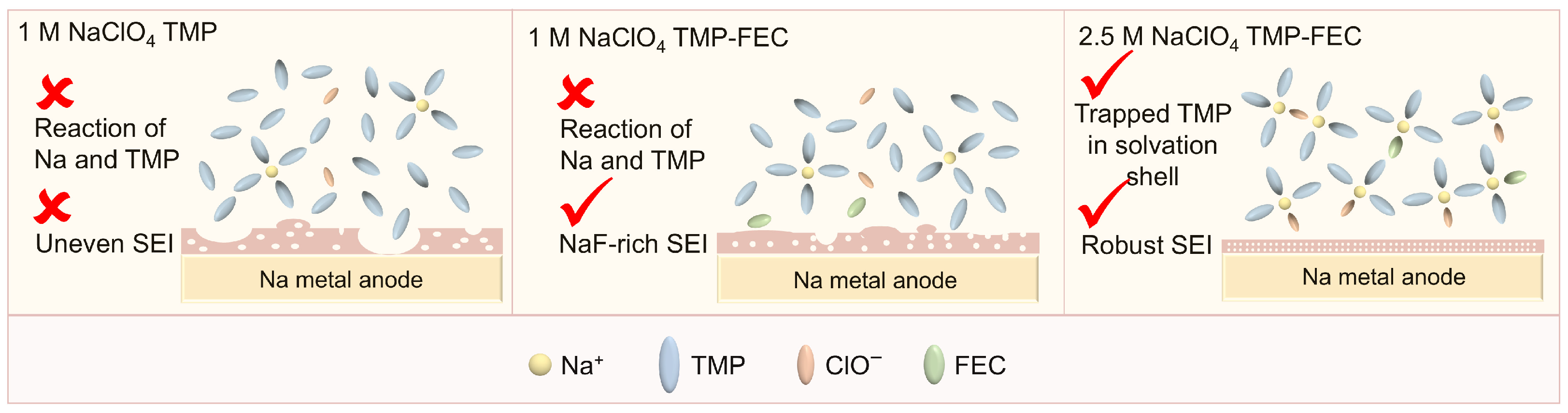
To this end, the present work proposes a novel synergistic strategy employing a fluorinated solvent additive and low-cost sodium salt to enhance electrochemical interface stability of flame-retardant TMP-based electrolytes in Na metal batteries, and intrinsically enhance the safety of SMBs. As schematically illustrated in Figure 1, this work employs fluoroethylene carbonate (FEC) as a film-forming additive to construct a robust NaF-rich SEI, which blocks parasitic reactions between TMP and the Na anode and suppresses Na dendrite growth. In addition, the Na+ solvation structure is regulated by a high concentration of low-cost NaClO4, which traps TMP within the solvation sheath and reduces free TMP molecules (Figure 1), thereby further mitigating uncontrolled reactions between TMP and the Na anode and enhancing the cycling stability of the battery. The synergistic strategy of fluorinated solvent additives and low-cost sodium salts achieves 1000 cycles of SMB with a capacity retention of 89.04%. The innovative electrolyte design in this work provides strong support for the application of high-safety, long-cycling SMBs and offers new insights for the design of functional electrolytes in electrochemical power sources.

2. Materials and Methods

2.1. Materials and Electrolytes Preparation

Sodium perchlorate (NaClO4) salt was purchased from Aladdin Scientific Corp (Shanghai, China). and used as received. Trimethyl phosphate (TMP), fluoroethylene carbonate (FEC), ethylene carbonate (EC), and propylene carbonate (PC) were purchased from DoDoChem Corp (Suzhou, China). All the solvents were dried using 4A molecular sieves for 24 h before use. The electrolytes were all prepared in an argon-filled glovebox (MIKROUNA, Shanghai Company Ltd., Shanghai, China), where both O2 and H2O levels were less than 0.1 ppm. Different concentrations of NaClO4 were prepared in the TMP solvent with 5 wt.% FEC and denoted as xM NaClO4 TMP-FEC, where x is the concentration of NaClO4. An amount of 1 M NaClO4 in TMP without FEC was prepared as the reference electrolyte and denoted as 1 M NaClO4 TMP. An amount of 1 M NaClO4 in EC:PC = 1:1 Vol.% with 5 wt.% FEC was purchased from DoDoChem Corp. as one of the reference electrolytes marked as NC004. High-purity sodium chips as the anodes were obtained from MTI Corp (Richmond, CA, USA). Na3(VOPO4)2F (NVOPF) cathode composited with reduced graphene oxide (rGO) was prepared according to an interfacial redox self-assembly approach proposed by a previous report [41].

2.2. Electrochemical Testing

The cathode slurry was prepared by blending NVOPF, Super P, and poly(vinylidene fluoride) (PVDF) in an 8:1:1 weight ratio using N-Methyl-2-pyrrolidone (NMP) as the solvent. The cathode slurry was coated onto an Al foil as the current collector. After drying at 60 °C, the cathode was cut into disks with a diameter of 12 mm and further dried overnight at 60 °C under vacuum conditions. The mass loading of the NVOPF cathode is approximately 1.5 mg cm−2. CR2032 coin cells of Na metal batteries were assembled in a glovebox with the Na metal anode, the NVOPF cathode, a polypropylene (PP) separator, and 100 μL of the as-prepared electrolytes. The performance of the Na|NVOPF cells was tested by constant current charge and discharge on Land CT2001A battery testers (Wuhan Land Electronic Co., Ltd., Wuhan, China). The electrochemical impedance spectra (EIS) of the Na|NVOPF cells after different cycles were determined on a CHI600C Electrochemical Workstation (Chenhua, Shanghai Chenhua Instrument Co., Ltd., Shanghai, China). The potential amplitude of EIS testing was set to be 10 mV, and the frequency range was set from 0.01 Hz to 106 Hz.
The electrochemical stability of the as-prepared electrolytes was evaluated using Na|stainless steel (SS) cells by linear sweep voltammetry (LSV) at a scan rate of 0.1 mV s−1 over two potential ranges: from 1.0 V to −1.0 V and from 2.5 V to 5.0 V (vs. Na/Na+). The ionic conductivities of the as-prepared electrolytes were determined on ion-blocking cells (SS|SS) with two SS disk electrodes by electrochemical impedance spectroscopy (EIS) testing. A piece of glass fiber (GF/F, Whatman, Maidstone, Kent, UK) with a diameter of 1.9 cm and a thickness of 450 μm was used as the separator for the ion-blocking cell. The ionic conductivities (σ) were calculated based on the following Equation (1):
σ   =   d RS
where d is the thickness of the glass fiber separator, R is the resistance obtained by EIS plots, and S is the area of the SS electrodes. The ionic conductivities of electrolytes were determined at different temperatures from 25 to 65 °C. The activation energy (Ea) of Na+ diffusion in electrolytes was calculated by the Arrhenius formula in Equation (2):
σ   ( T )   =   A exp ( E a RT )
The Na|Na symmetric cells were cycled at constant currents to investigate the interface stabilities of Na metal anodes.

2.3. Materials Characterization

Raman spectra of the electrolytes were collected using a laser micro-Raman spectrometer (LabRam HR Evolution, HORIBA Scientific, Lille, France) with a 532 nm excitation wavelength under ambient conditions. Fourier transform infrared spectroscopy (FT-IR) was performed on a Nicolet iS10 spectrophotometer (Thermo Fisher Scientific, Madison, WI, USA). The cycled sodium metal anodes were retrieved from disassembled coin cells in an argon-filled glovebox (H2O and O2 < 0.1 ppm). The obtained sodium metal pieces were gently rinsed with TMP to remove residual salts and then dried in a vacuum chamber at room temperature. The prepared sodium metal samples were stored in the glovebox prior to characterization. For scanning electron microscopy (SEM) analysis, the samples were transferred to a Zeiss GeminiSEM 300 (Carl Zeiss AG, Oberkochen, Germany) instrument using an airtight vacuum transfer holder to prevent air exposure. SEM images were collected at an accelerating voltage of 10 kV with a beam current of 9.7 μA to minimize damage to the sodium metal anodes. The cycled NVOPF cathodes were also harvested from disassembled coin cells. Unlike the anode preparation, the cathode samples were handled and characterized under ambient conditions without special protection. Transmission electron microscope (TEM) images of the cathode electrolyte interphase (CEI) on cycled NVOPF cathodes were obtained using a JEOL JEM-F200 instrument (JEOL Ltd., Tokyo, Japan). X-ray photoelectron spectroscopy (XPS) measurements for surface component analysis were conducted on a Thermo Scientific K-Alpha spectrometer (Thermo Fisher Scientific, East Grinstead, UK). The flame-retardant property of the TMP-based electrolyte was evaluated by measuring its self-extinguishing time (SET). The test was performed by igniting a glass fiber separator saturated with 120 μL of the electrolyte and recording the burning duration. The burning temperature was simultaneously monitored using infrared thermography (FLIR Systems, Inc., Wilsonville, OR, USA).

3. Results

3.1. Effects of FEC Additive and Salt Concentration on Battery Performance

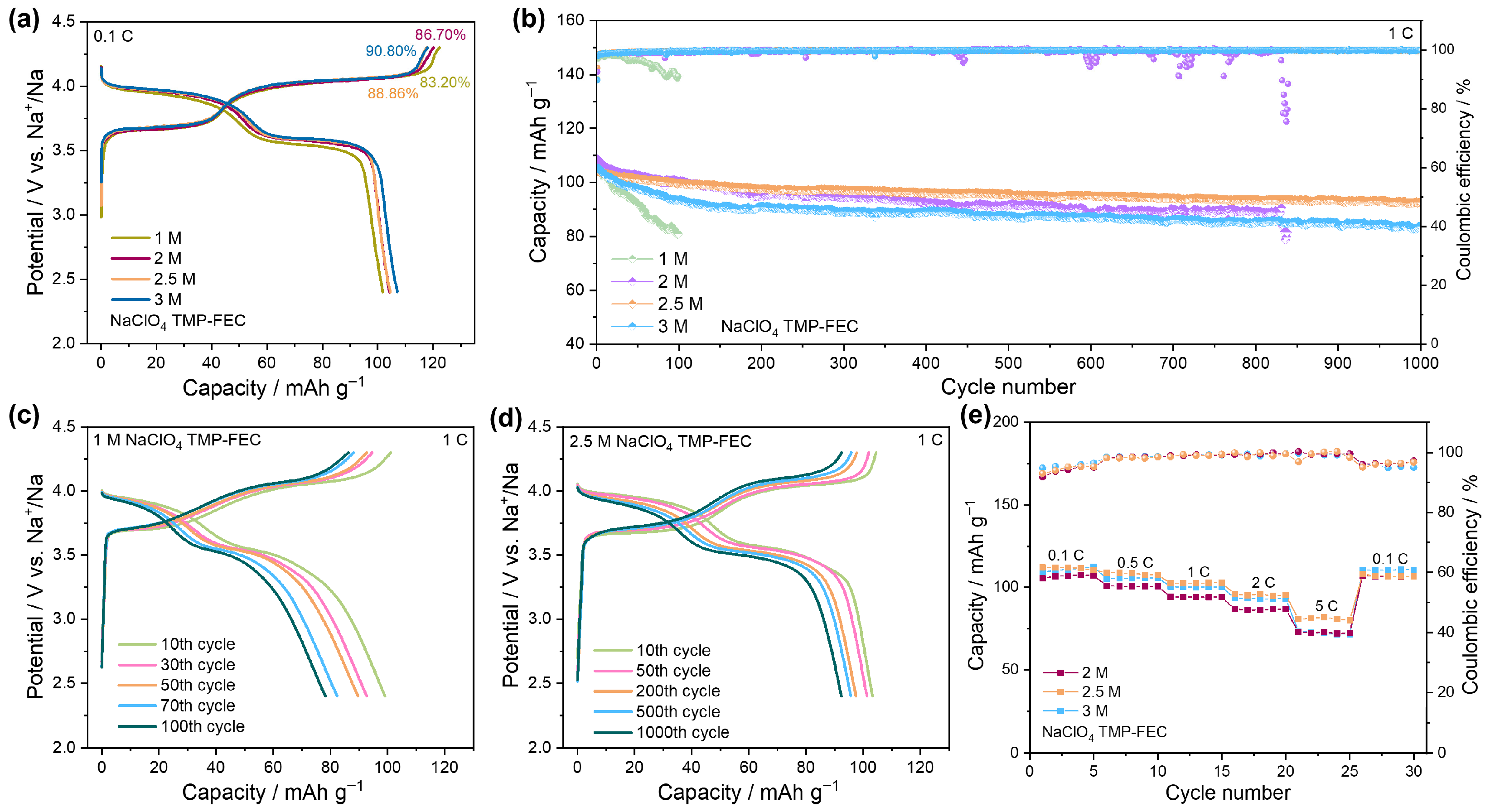
To enable the application of phosphate-based flame-retardant electrolytes in SMBs, this study introduces the fluorinated solvent FEC as the additive to mitigate parasite reactions and stabilize the electrode/electrolyte interface. As shown in Figure S1a in the Supporting Information (SI), the Na|NVOPF cell in 1 M NaClO4 TMP electrolyte without FEC additive delivers a Columbic efficiency lower than 36%. After the addition of FEC, the Columbic efficiency of Na|NVOPF cell sharply increases to 83.20%. To further enhance the Coulombic efficiency of the Na|NVOPF cell, the present work utilizes low-cost NaClO4 to achieve a high salt concentration, which aids in establishing a stable electrode/electrolyte interface. As shown in Figure 2a, in electrolytes with different NaClO4 concentrations, the as-prepared NVOPF cathode material facilitates the reversible insertion/extraction of two sodium ions. The stepwise extraction/insertion of two sodium ions per formula unit at two distinct crystallographic sites (Na(1) and Na(2)) within the tetragonal structure, coupled with V5+/V4+ redox, yields two corresponding voltage plateaus near 3.6 and 4.0 V vs. Na+/Na, providing a specific capacity of approximately 110 mAh g−1. For the NaClO4 TMP-FEC electrolyte containing FEC, the Coulombic efficiency (CE) of the Na|NVOPF cell at 0.1C gradually increases from 83.20% to 90.80% as the NaClO4 concentration is raised from 1 M to 3 M. The synergistic effect of the FEC additive and high salt concentration successfully mitigates parasite reactions and enhances the initial CEs for SMBs using TMP-based electrolytes.
The cycling performance of the Na|NVOPF cells is compared in Figure 2b at 1C (corresponding to a current density of 128 mA g−1) with different NaClO4 concentrations in the TMP-FEC solvent. The cell with the 1 M NaClO4 TMP-FEC electrolyte suffers from rapid capacity decay, retaining only 77.01% of its initial capacity after just 100 cycles. At the same current density, the cell employing a 2 M NaClO4 TMP-FEC electrolyte fails abruptly at around 830 cycles due to a short circuit caused by Na dendrite growth. These phenomena demonstrate that electrolytes with concentrations below 2 M and their derived SEIs fail to suppress the formation of Na dendrites over extended periods. In contrast, the Na|NVOPF cell with the 2.5 M and 3 M NaClO4 TMP-FEC electrolytes delivers capacity retentions of 89.04% and 79.74% after 1000 cycles, respectively. Although the cell with the 3 M NaClO4 TMP-FEC electrolyte exhibits reasonable cycling performance in Figure 2b, its specific capacity is significantly lower than that with the 2.5 M NaClO4 TMP-FEC. This is likely because the 3 M electrolyte forms a high-resistance interphase. The accumulated interfacial reactions impede the charge/discharge kinetics, thereby resulting in the low reversible capacity.
The present work further compares the electrochemical performance degradation during cycling via the voltage profiles in Figure 2c,d. The cell with the 1 M NaClO4 TMP-FEC electrolyte shows rapidly increasing polarization during cycling, whereas the cell with the 2.5 M NaClO4 TMP-FEC electrolyte maintains flat and stable voltage plateaus with minimal polarization. Subsequently, the rate performance of cells with different electrolyte concentrations is compared in Figure 2e, among which the cell with the 2.5 M NaClO4 TMP-FEC electrolyte exhibits superior rate performance. Consistent with the low reversible capacity in cycling performance tests, the 3 M NaClO4 TMP-FEC electrolyte shows slightly inferior rate performance compared to the 2.5 M electrolyte. Under the same testing protocol, the cell with the 1 M NaClO4 TMP-FEC electrolyte quickly fails when the charge/discharge rate is increased to 1C (Figure S2, SI). This is attributable to the unstable Na metal/electrolyte interface in the 1 M electrolyte, which promotes rapid Na dendrite growth at the 1C rate, leading to cell short-circuiting. In summary, the 2.5 M TMP electrolyte demonstrates excellent compatibility with the sodium metal anode, enabling the successful implementation of non-flammable TMP as a viable electrolyte for SMBs.
Maintaining the NaClO4 concentration at 2.5 M, the present work also discusses the influence of FEC content on the electrode/electrolyte interface stability and the cycling performance of sodium metal batteries. As presented in Figure S3 (SI), a lower FEC content was found to improve the initial Coulombic efficiency. However, cells with 1 wt.% FEC failed to cycle at 1C, while those with 3 wt.% FEC exhibited a significantly shorter cycle life compared to the formulation with 5 wt.% FEC. The carbonate-based NC004 electrolyte was tested as a reference. Even with a 5 wt.% FEC addition, this electrolyte led to Na dendrite formation and cell short-circuiting during the first charge/discharge cycle (Figure S4, SI). Therefore, 2.5 M NaClO4 in TMP with 5 wt.% FEC is identified as the optimal electrolyte composition. In this optimal system, fluoroethylene carbonate (FEC) acts as a film-forming additive to construct a robust NaF-rich SEI, while the high concentration of low-cost NaClO4 traps TMP molecules in the solvation sheath and decreases the number of free TMP solvent molecules. This dual mechanism mitigates uncontrolled reactions between TMP and the Na anode, thereby improving the cycling stability of the battery.

3.2. Electrochemical and Flame-Retardant Properties of TMP-Based Electrolytes

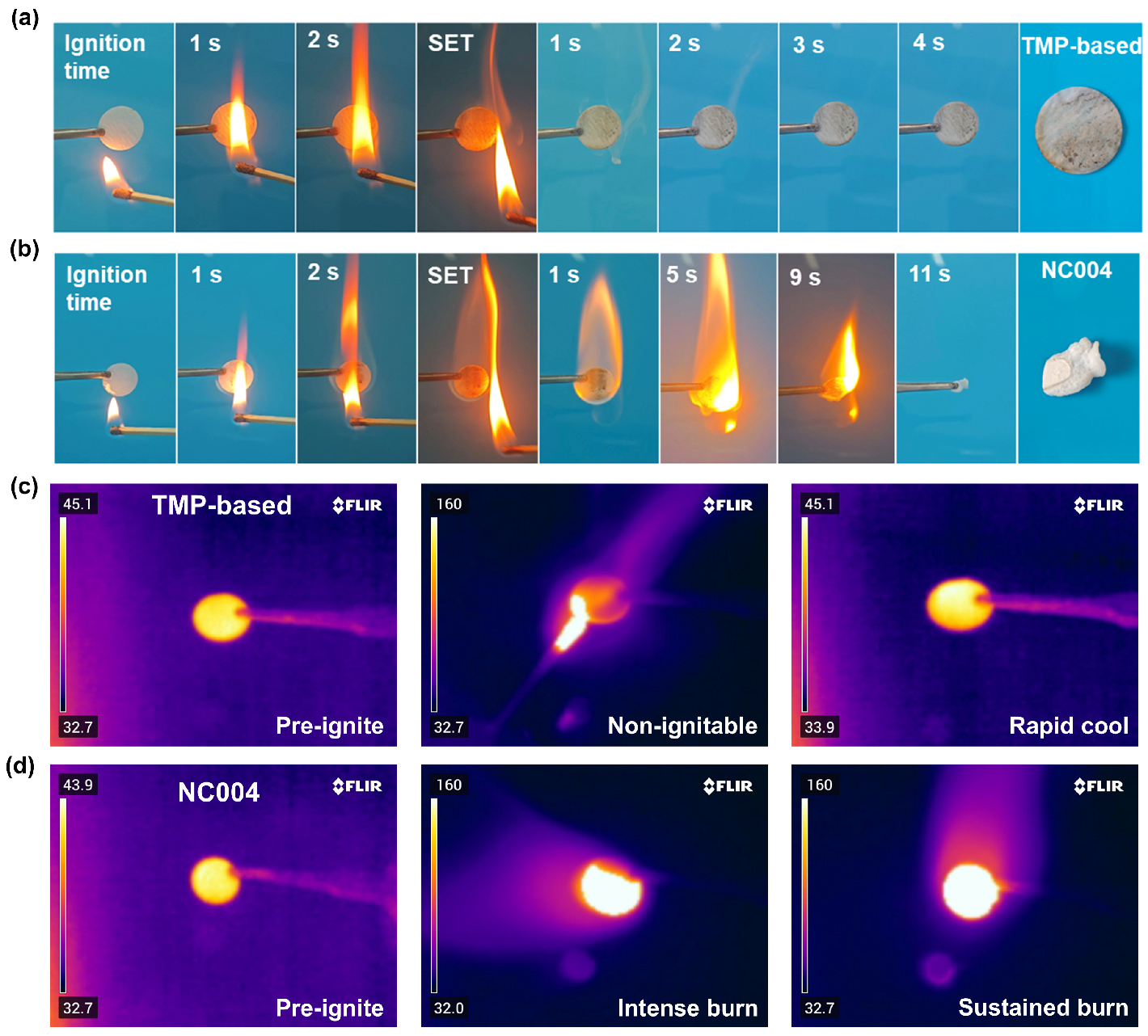
The non-flammable properties and thermal behavior of the TMP-based electrolytes were systematically examined using self-extinguishing time (SET) measurements and infrared thermography. As illustrated in Figure 3a, upon exposure to an open flame, the TMP-based electrolytes demonstrated complete non-flammability, showing no ignition. After flame removal, their temperature, shown in Figure 3c, returned to ambient levels within 45 s, confirming exceptional fire-retardant performance. In sharp contrast, the carbonate-based electrolyte was ignited immediately upon contact with the flame (Figure 3b) and sustained intense combustion at approximately 160 °C until complete consumption (Figure 3d).
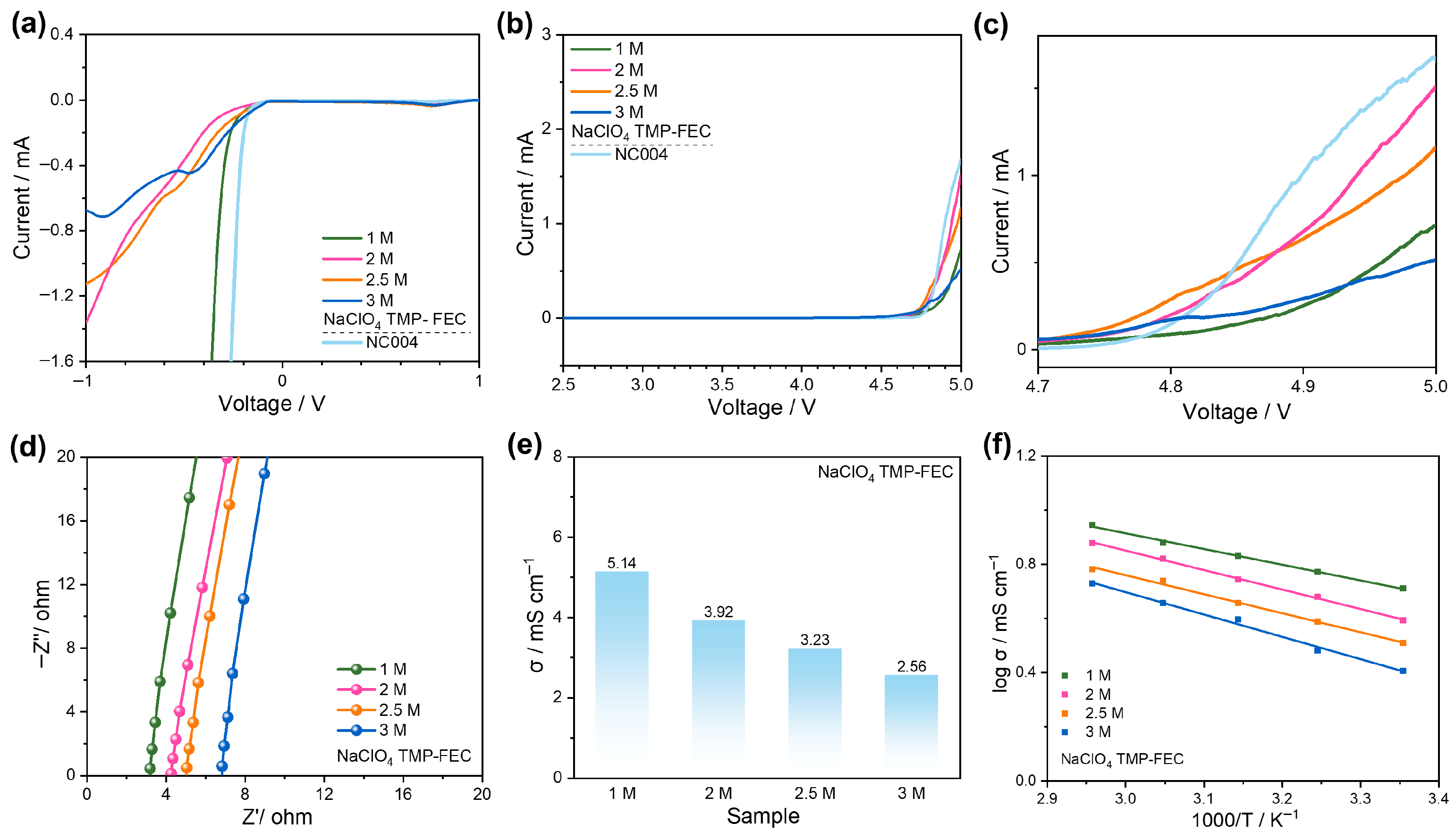
The electrochemical stability windows of the NaClO4 TMP-FEC electrolytes and the carbonate-based electrolyte NC004 (1 M NaClO4 in EC:PC = 1:1 Vol.% with 5 wt.% FEC) were compared in Figure 4a–c. Figure 4a shows that as the NaClO4 concentration increases, the reductive current of the electrolytes at low potentials gradually decreases, indicating enhanced reductive stability. In contrast, the conventional carbonate-based electrolyte NC004 exhibits poor reductive stability, undergoing severe decomposition at potentials slightly below 0 V vs. Na+/Na. Figure 4b,c show that all the TMP-based electrolytes display excellent oxidation resistance, with oxidation onset potentials exceeding 4.7 V (vs. Na+/Na), meeting the requirements for high-voltage cathode materials.
The electrochemical impedance spectroscopy (EIS) plots of the ion-blocking cells (SS/electrolyte/SS) with two stainless steel (SS) disk electrodes were recorded for electrolytes with different NaClO4 concentrations, as shown in Figure 4d. The corresponding ionic conductivity, calculated based on this measurement, is plotted against salt concentration in Figure 4e. The measured ionic conductivities for the 1 M, 2 M, 2.5 M, and 3 M TMP-based electrolytes are 5.14, 3.92, 3.23, and 2.56 mS cm−1, respectively. Although the ionic conductivity of the TMP-based electrolytes shows a decreasing trend with increasing salt concentration, the values remain sufficiently high for practical SMB applications. Furthermore, temperature-dependent ionic conductivity measurements were performed. The activation energies for ion transport, calculated from the Arrhenius equation, are 11.12, 13.78, 13.45, and 15.79 kJ mol−1 for the 1 M, 2 M, 2.5 M, and 3 M TMP-based electrolytes, respectively (Figure 4f). This trend indicates a slight increase in the energy barrier for Na+ transport with rising salt concentration, which is consistent with the observed decrease in ionic conductivity.
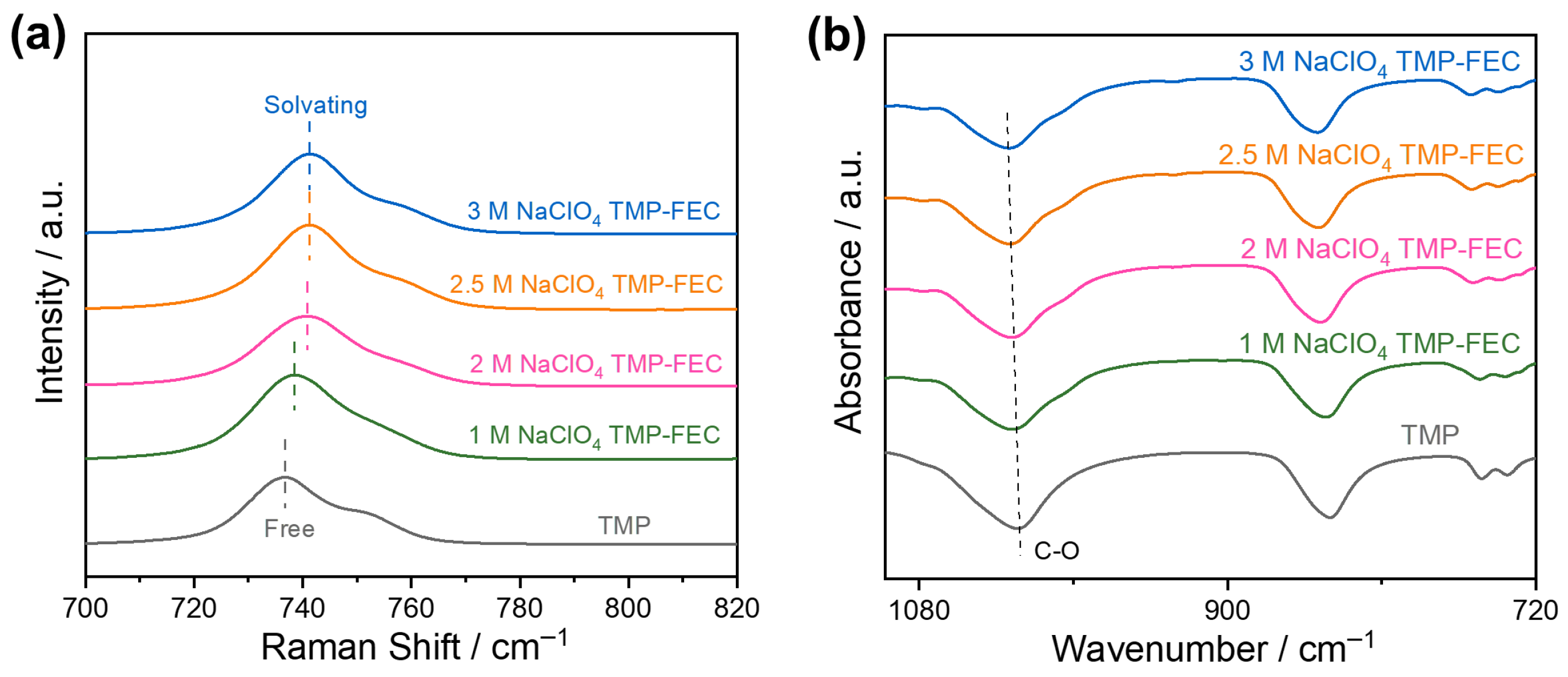
To investigate the enhanced performance of the sodium metal anode in the 2.5 M NaClO4 TMP-FEC electrolyte, spectral tests were performed to analyze the solvent–salt interactions and Na+ coordination behavior. The Raman spectra in Figure 5a show two characteristic peaks at 738 and 752 cm−1 in pure TMP solvent, corresponding to symmetric P–O–C stretching vibrations of free TMP molecules. It should be noted that the ring breathing mode of FEC appears at 730 cm−1 in the Raman spectrum. However, its signal is weak due to the low concentration and is obscured by the signal from TMP, making it difficult to observe. In the 1 M NaClO4 TMP-FEC electrolyte, the P–O–C band at 738 cm−1 remains largely unchanged compared to pure TMP, indicating an abundance of free solvent molecules. As the concentration increases to 3 M, this band shifts to 742 cm−1, demonstrating strengthened coordination between Na+ ions and TMP molecules. Further analysis of the solvation structure was carried out through Fourier-transform infrared (FT-IR) spectroscopy. As shown in Figure 5b, the C–O stretching frequency of free TMP appears at 1010 cm−1. With increasing salt concentration, this band shifts to 1040 cm−1 for Na+-coordinated TMP, confirming the progressive coordination of TMP molecules with Na+ ions. Thus, the high concentration of low-cost NaClO4 traps TMP molecules in the solvation sheath and decreases the number of free TMP solvent molecules, thereby mitigating parasite reactions between TMP and the Na anode.

3.3. Investigation of the Electrode/Electrolyte Interface

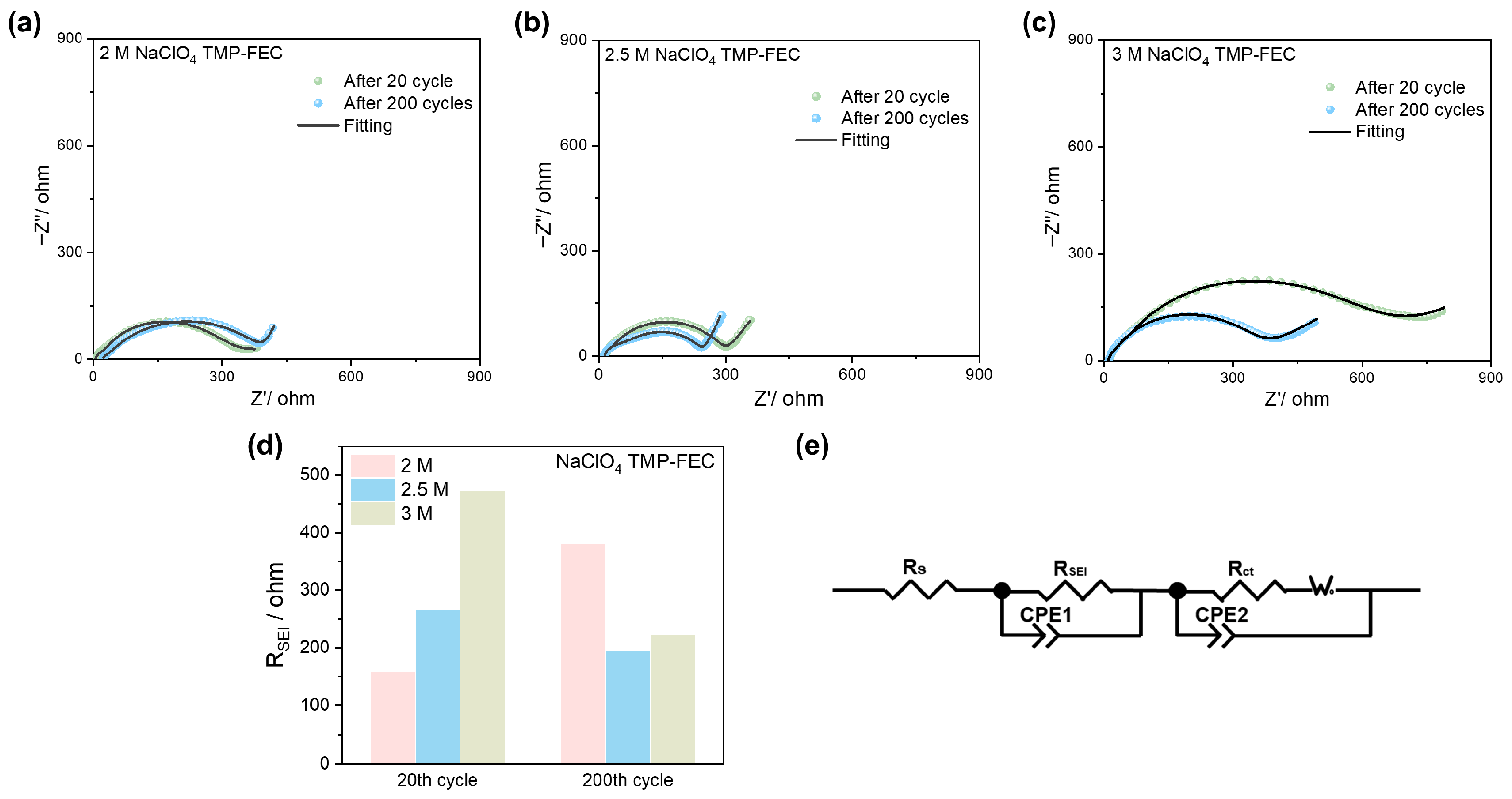
To further elucidate the enhanced electrochemical performance of sodium metal batteries (SMBs) employing highly concentrated TMP-based electrolytes, a combination of EIS, SEM, XPS, and TEM characterizations was performed to study the composition and stability of the interfaces between the electrolyte and the electrode materials (both cathode and anode). Electrochemical impedance spectroscopy (EIS) tests were conducted on the Na|NVOPF cells to monitor the evolution of the electrode/electrolyte interfacial resistance, as shown in Figure 6a–c. The fitting parameters of the Nyquist curves were plotted in Figure 6d according to the equivalent circuit in Figure 6e. Rs is assigned to the solution resistance, and W1 is the Warburg resistance in Figure 6e. Two series resistances (RSEI and Rct) coupled with constant phase elements (CPE1 and CPE2) are used to fit the EIS as well, which are assigned to the resistances of electrode/electrolyte interfaces and charge transfer resistances, respectively. The fitting parameters are also listed and compared in Table 1.
Given the highly unstable performance observed for the 1 M NaClO4 TMP-FEC electrolyte (Figure 2b,c and Figure S2), the EIS measurements focused on cells containing 2 M, 2.5 M, and 3 M NaClO4 TMP-FEC electrolytes. The results presented in Figure 6 and Table 1 indicate that the interfacial impedance of the cell employing the 2 M NaClO4 TMP-FEC electrolyte gradually increases during cycling. In contrast, the cells with 2.5 M and 3 M NaClO4 TMP-FEC electrolytes show a decrease in impedance. This suggests that the 2 M concentration is insufficient to effectively suppress parasitic reactions, leading to the continuous growth and accumulation of the SEI layer. When the concentration exceeds 2 M, as in the 2.5 M and 3 M electrolytes, the number of free TMP molecules is significantly reduced. Consequently, the side reactions between the electrolyte and the sodium metal anode are substantially limited. This restriction allows the interfacial resistance to stabilize and even decrease during the activation process. Nonetheless, the impedance of the cell with the 3 M electrolyte remained higher than that of the 2.5 M counterpart throughout the cycling test. A possible explanation is that the SEI formed in the 3 M electrolyte has a different composition—potentially richer in inorganic compounds—which may contribute to its higher impedance. This elevated interfacial impedance in the 3 M electrolyte is also consistent with its inferior rate capability and lower specific capacity at 1C, corroborating the overall electrochemical performance trends.
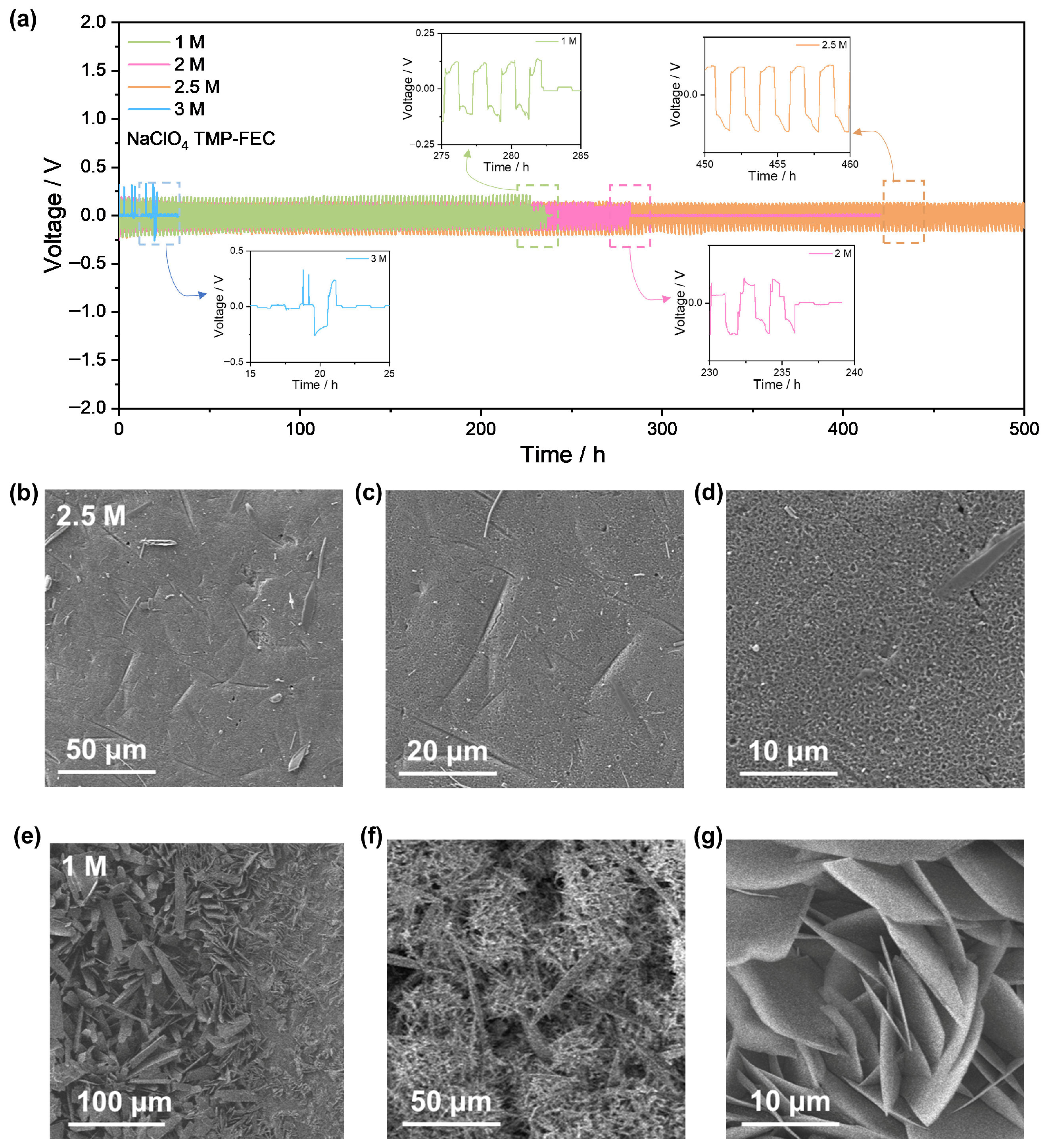
The plating/stripping stability of sodium metal anodes was evaluated in the Na|Na symmetric cells employing NaClO4 TMP-FEC electrolytes of different concentrations (Figure 7a). The cell with the 3 M NaClO4 TMP-FEC electrolyte experienced short-circuiting during the initial operating stage, which is attributed to inhomogeneous electrolyte distribution caused by its high viscosity. The cells containing the 1 M and 2 M NaClO4 TMP-FEC electrolytes short-circuit after 230 h and 280 h of operation, respectively. In contrast, the cell with the 2.5 M NaClO4 TMP-FEC electrolyte exhibits the most stable voltage profiles over 500 h, demonstrating significantly improved cycling reversibility. SEM was employed to examine the morphology of cycled Na metal anodes from the cells containing the 1 M and 2.5 M NaClO4 TMP-FEC electrolytes. As shown in Figure 7b–d, the Na metal anode cycled in the 2.5 M NaClO4 TMP-FEC electrolyte displays a relatively smooth and compact surface with only minor amounts of needle-like phosphorus oxides, consistent with the robust SEI mentioned above. In contrast, the Na metal cycled in the 1M NaClO4 TMP-FEC electrolyte exhibits a flake-like morphology with visible cavities (Figure 7e–g). Such a porous structure promotes continuous parasitic reactions between the liquid electrolyte and the freshly exposed sodium metal, accounting for the short cycling lifespan. Additional SEM images of the Na anodes cycled in the FEC-free TMP electrolytes (Figure S5) reveal abundant flake-like phosphorus oxides on both electrode surfaces. Notably, the phosphorus oxides formed in the low-concentration system appear larger and more irregularly shaped. Therefore, the synergy between a high NaClO4 concentration and the FEC additive is essential, as both conditions are crucial for forming a robust SEI that improves the compatibility of TMP with the Na metal anode.
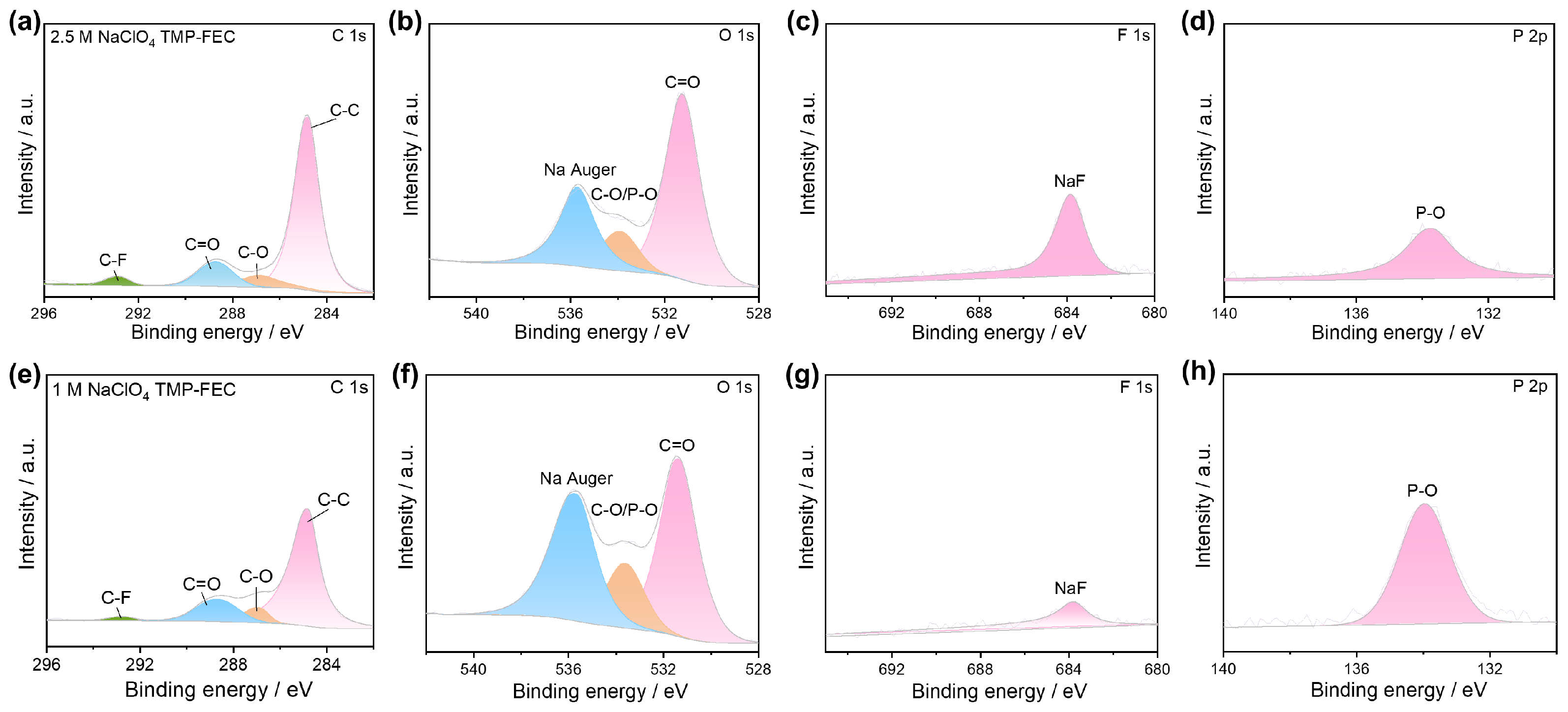
To illustrate the interfacial chemistry evolution of the sodium metal anode with electrolytes of different concentrations, XPS analysis was performed on cycled sodium metal anodes. Figure 8 compares the normalized XPS fitting results of C 1s, F 1s, and P 2p spectra collected from Na metal anodes after 50 cycles in 1 M and 2.5 M NaClO4 TMP-FEC electrolytes. In the C 1s spectra (Figure 8a,e), signals at 284.8 eV, 286.9 eV, 288.6 eV, and 292.8 eV correspond to C–C/C–H, C–O, C=O, and C–F species, respectively. In the O 1s spectra (Figure 8b,f), signals at 534 eV and 530 eV are attributed to C–O/P–O and C=O, respectively. These results indicate a certain degree of decomposition for both TMP and FEC occurred at both 1 M and 2.5 M concentrations. However, the F 1s spectra in Figure 8c,g show that the SEI formed on the sodium metal surface at the higher 2.5 M concentration contains a higher content of NaF (684.5 eV). Concurrently, the P 2p spectra in Figure 8d,h indicate that the SEI contains less P–O species (at 133.8 eV) at the 2.5 M concentration. These results confirm that the FEC additive promotes the formation of an F-rich SEI, which synergizes with the modulation of the Na+ solvation structure by the high 2.5 M NaClO4 concentration. This TMP trapped solvation structure reduces the amount of free TMP molecules, thereby mitigating parasitic reactions between TMP and the sodium metal and enhancing the overall compatibility of the TMP-based electrolyte with the Na metal anode.
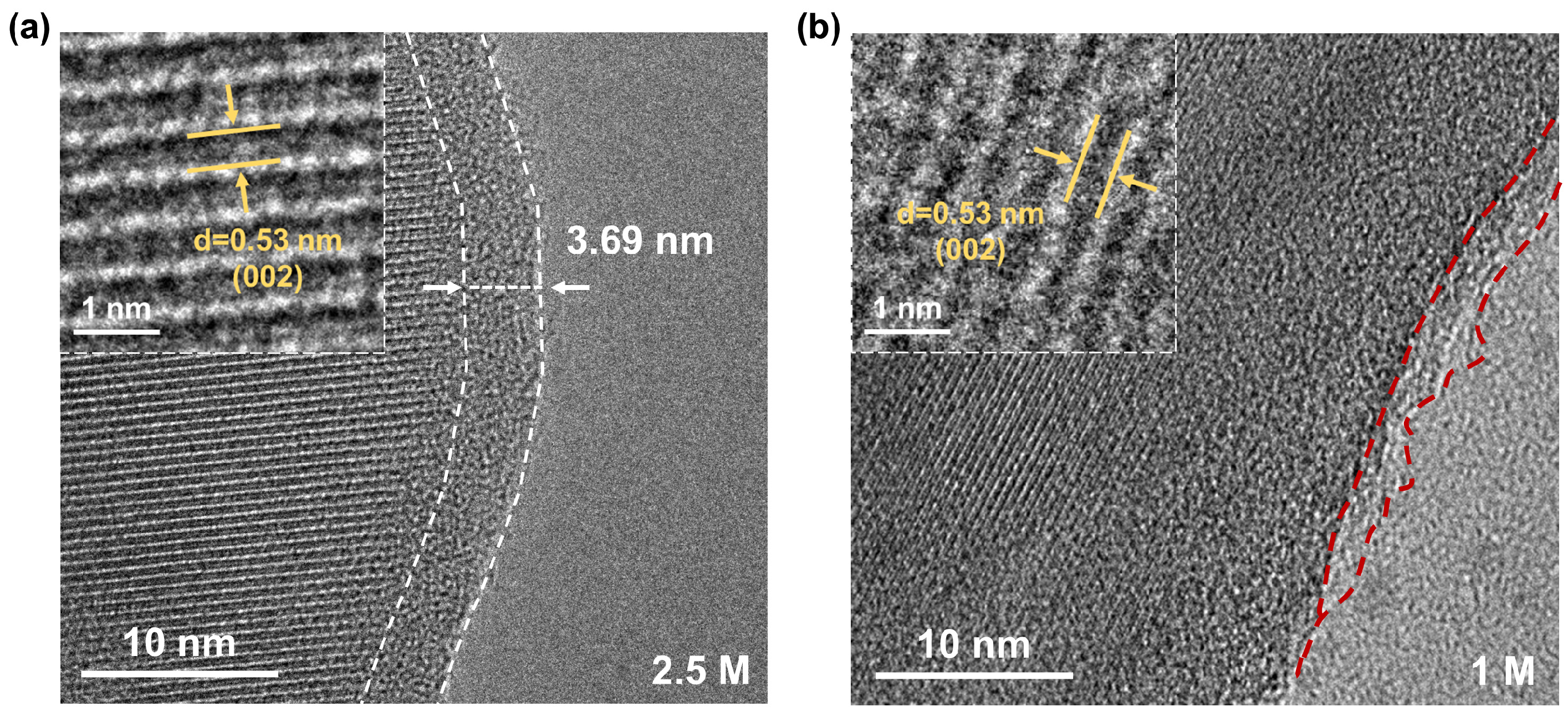
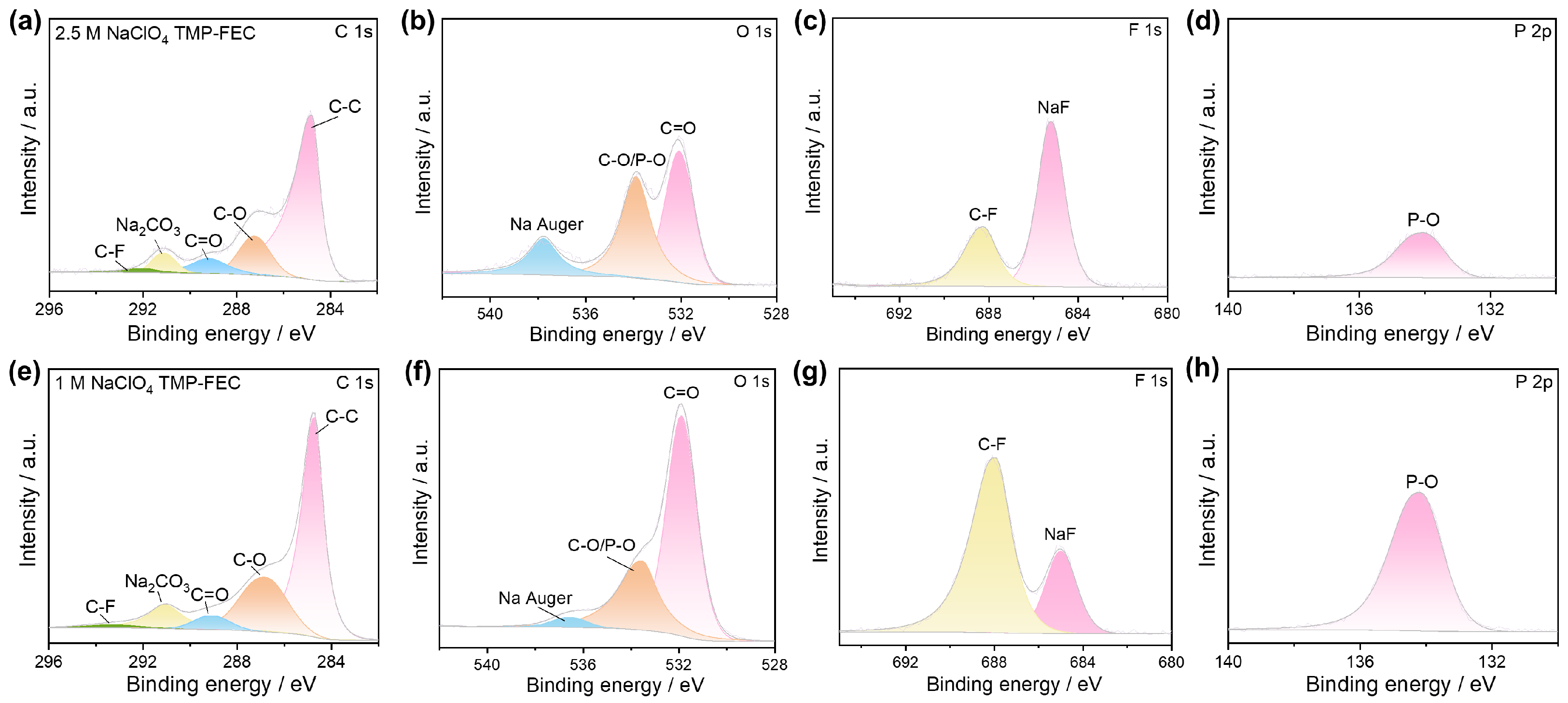
To investigate the compatibility of the TMP electrolyte with the NVOPF cathode, the surface chemistry and structure of cycled NVOPF electrodes were studied using XPS and TEM. As shown in the insets of Figure 9a,b, lattice fringes with a spacing of 0.53 nm can be attributed to the (002) plane of NVOPF. Figure 9a shows that a uniform and compact Cathode-Electrolyte Interphase (CEI) layer with a thickness of 3.69 nm forms when using the 2.5 M NaClO4 TMP-FEC electrolyte, which helps protect NVOPF from electrolyte corrosion and contributes to good cycling stability. In contrast, Figure 9b indicates that in the 1 M NaClO4 TMP-FEC electrolyte, an unevenly distributed CEI layer forms on NVOPF, which cannot effectively suppress parasitic reactions such as vanadium dissolution. Figure 10 presents the C 1s, O 1s, F 1s, and P 2p XPS spectra of cycled NVOPF cathodes in TMP-based electrolytes with different concentrations. The compositional analysis of the CEI on the cycled NVOPF cathodes is essentially consistent with that of the SEI on the sodium metal surface, namely, that the higher concentration 2.5 M NaClO4 TMP-FEC electrolyte favors the formation of a stable, F-rich CEI layer.

4. Conclusions

In conclusion, this study successfully develops a high-performance, non-flammable electrolyte for sodium metal batteries (SMBs) by synergistically employing a fluorinated additive (FEC) and a high concentration of low-cost NaClO4 salt in a trimethyl phosphate (TMP) solvent. The optimized formulation of 2.5 M NaClO4 in TMP with 5 wt.% FEC enables a Na|Na3(VOPO4)2F cell to achieve exceptional long-term cycling stability, retaining 89.04% capacity after 1000 cycles at 1C, alongside superior rate capability and outstanding safety characterized by rapid self-extinguishing behavior. The enhanced performance originates from a dual stabilization mechanism: FEC facilitates the formation of a robust, NaF-rich solid electrolyte interphase (SEI) on the sodium metal anode, effectively suppressing dendrite growth and parasitic reactions, while the high salt concentration restructures the Na+ solvation sheath to coordinate and trap TMP molecules, thereby minimizing free solvent decomposition at the interface. Comprehensive characterizations confirm the formation of stable, low-impedance interfaces on both anodes and cathodes. This work provides a cost-effective and viable strategy to overcome the fundamental incompatibility between phosphate solvents and reactive sodium metal, offering significant insights into solvation and interphase engineering for developing safe and durable Na metal-based batteries.

Supplementary Materials

The following supporting information can be downloaded at https://www.mdpi.com/article/10.3390/nanoenergyadv6020014/s1. Figure S1: The voltage profiles of the Na|NVOPF cells in the 1 M NaClO4/TMP electrolytes (a) without and (b) with 5 wt.% FEC; Figure S2: The voltage profiles of the Na|NVOPF cells at different rate in the 1 M NaClO4 TMP-FEC electrolyte; Figure S3: The voltage profiles of the Na|NVOPF cells: (a) the first cycle at 0.1 C in the 2.5 M NaClO4 TMP electrolytes with 1 wt.%, 3 wt.% and 5 wt.% FEC; the first cycle at 1 C in the 2.5 M NaClO4 TMP electrolytes with (b) 1 wt.%, (c) 3 wt.% and (d) 5 wt.% FEC. (e) The cycling performance of the Na|NVOPF cells in the 2.5 M NaClO4 TMP electrolytes with 3 wt.% and 5 wt.% FEC; Figure S4: The voltage profile of the Na|NVOPF cell at the first cycle with the NC004 electrolyte (1 M NaClO4 in EC:PC = 1:1 Vol.% with 5 wt.% FEC); Figure S5: SEM images of the Na electrodes cycled in the (a,b) 2.5 M NaClO4 TMP and (c,d) 1 M NaClO4 TMP electrolyte without FEC.

Author Contributions

Z.L.: Writing—original draft and investigation. E.W.: Validation. K.Z.: Methodology. J.M.: Methodology. X.Z.: Methodology. L.X.: Supervision, conceptualization, formal analysis, writing—review and editing, and funding acquisition. All authors have read and agreed to the published version of the manuscript.

Funding

The authors greatly appreciate the financial support of the National Natural Science Foundation of China (No. 22075219) and the Fundamental Research Funds for the Central Universities (WHUT: 104972025KFYjc0125).

Data Availability Statement

The original contributions presented in this study are included in the article and Supplementary Material. Further inquiries can be directed to the corresponding author.

Conflicts of Interest

There are no conflicts of interest to declare.

References

  1. Feng, Y.-H.; Cheng, Z.; Xu, C.-L.; Yu, L.; Si, D.; Yuan, B.; Liu, M.; Zhao, B.; Wang, P.-F.; Han, X. Low-Cost Al-Doped Layered Cathodes with Improved Electrochemical Performance for Rechargeable Sodium-Ion Batteries. ACS Appl. Mater. Interfaces 2022, 14, 23465–23473. [Google Scholar] [CrossRef] [Scilit]
  2. Fu, Z.; Wang, S.; Yu, H.; Nie, M.; Feng, X.; Zuo, X.; Fu, L.; Liu, D.; Zhang, Y. CeO2 Supported on Reduced Graphene Oxide as Li-O2 Battery Cathode. Chem. Res. Chin. Univ. 2023, 39, 636–641. [Google Scholar] [CrossRef] [Scilit]
  3. Jin, F.; Wang, B.; Wang, J.; Wang, Y.; Ning, Y.; Yang, J.; Zhang, Z.; Liu, P.; Zhou, Y.; Wang, D.; et al. Boosting electrochemical kinetics of S cathodes for room temperature Na/S batteries. Matter 2021, 4, 1768–1800. [Google Scholar] [CrossRef] [Scilit]
  4. Liu, J.; Huang, W.; Liu, R.; Lang, J.; Li, Y.; Liu, T.; Amine, K.; Li, H. Entropy Tuning Stabilizing P2-Type Layered Cathodes for Sodium-Ion Batteries. Adv. Funct. Mater. 2024, 34, 2315437. [Google Scholar] [CrossRef] [Scilit]
  5. Armand, M.; Tarascon, J.M. Building better batteries. Nature 2008, 451, 652–657. [Google Scholar] [CrossRef] [Scilit] [PubMed]
  6. Pan, H.; Hu, Y.-S.; Chen, L. Room-temperature stationary sodium-ion batteries for large-scale electric energy storage. Energy Environ. Sci. 2013, 6, 2338–2360. [Google Scholar] [CrossRef] [Scilit]
  7. Li, Z.; Bommier, C.; Chong, Z.S.; Jian, Z.; Surta, T.W.; Wang, X.; Xing, Z.; Neuefeind, J.C.; Stickle, W.F.; Dolgos, M.; et al. Mechanism of Na-Ion Storage in Hard Carbon Anodes Revealed by Heteroatom Doping. Adv. Energy Mater. 2017, 7, 1602894. [Google Scholar] [CrossRef] [Scilit]
  8. Hu, X.; Joo, P.H.; Wang, H.; Matios, E.; Wang, C.; Luo, J.; Lu, X.; Yang, K.; Li, W. Nip the Sodium Dendrites in the Bud on Planar Doped Graphene in Liquid/Gel Electrolytes. Adv. Funct. Mater. 2019, 29, 1807974. [Google Scholar] [CrossRef] [Scilit]
  9. Wang, Y.; Wang, Y.; Wang, Y.-X.; Feng, X.; Chen, W.; Ai, X.; Yang, H.; Cao, Y. Developments and Perspectives on Emerging High-Energy-Density Sodium-Metal Batteries. Chem 2019, 5, 2547–2570. [Google Scholar] [CrossRef] [Scilit]
  10. Choudhury, S.; Wei, S.; Ozhabes, Y.; Gunceler, D.; Zachman, M.J.; Tu, Z.; Shin, J.H.; Nath, P.; Agrawal, A.; Kourkoutis, L.F.; et al. Designing solid-liquid interphases for sodium batteries. Nat. Commun. 2017, 8, 898. [Google Scholar] [CrossRef] [Scilit]
  11. Wang, Q.; Liu, B.; Shen, Y.; Wu, J.; Zhao, Z.; Zhong, C.; Hu, W. Confronting the Challenges in Lithium Anodes for Lithium Metal Batteries. Adv. Sci. 2021, 8, 2101111. [Google Scholar] [CrossRef] [Scilit] [PubMed]
  12. Ruan, D.; Chen, S.; Guo, J.; Wang, D.; Zhu, W.; Huang, B.; Li, Y.; Ma, J.; Ma, Z.; Wang, Z.; et al. Molecularly aligned electron channels for ultrafast-charging practical lithium-metal batteries. Nat. Energy 2026, 11, 425–435. [Google Scholar] [CrossRef] [Scilit]
  13. Wu, S.; Su, B.; Ni, K.; Pan, F.; Wang, C.; Zhang, K.; Yu, D.Y.W.; Zhu, Y.; Zhang, W. Fluorinated Carbonate Electrolyte with Superior Oxidative Stability Enables Long-Term Cycle Stability of Na2/3Ni1/3Mn2/3O2 Cathodes in Sodium-Ion Batteries. Adv. Energy Mater. 2021, 11, 2002737. [Google Scholar] [CrossRef] [Scilit]
  14. Liu, Y.; Zhu, L.; Wang, E.; An, Y.; Liu, Y.; Shen, K.; He, M.; Jia, Y.; Ye, G.; Xiao, Z.; et al. Electrolyte Engineering with Tamed Electrode Interphases for High-Voltage Sodium-Ion Batteries. Adv. Mater. 2024, 36, 2310051. [Google Scholar] [CrossRef] [Scilit]
  15. Hu, C.; Guo, S.; Huang, F.; Yang, Y.; Yan, C.; Zhao, C.-Z.; Liang, S.; Fang, G.; Zhang, Q. Carbonate Ester-Based Sodium Metal Battery with High-Capacity Retention at −50 °C Enabled by Weak Solvents and Electrodeposited Anode. Angew. Chem. Int. Ed. 2024, 63, e202407075. [Google Scholar] [CrossRef] [Scilit]
  16. Winter, M.; Barnett, B.; Xu, K. Before Li Ion Batteries. Chem. Rev. 2018, 118, 11433–11456. [Google Scholar] [CrossRef] [Scilit]
  17. Zhang, D.; Li, L.; Zhang, W.; Cao, M.; Qiu, H.; Ji, X. Research progress on electrolytes for fast-charging lithium-ion batteries. Chin. Chem. Lett. 2023, 34, 107122. [Google Scholar] [CrossRef] [Scilit]
  18. Wu, M.; Yang, M.; Yu, J.; Ma, X.; Sun, S.; She, Y.; Yang, J.; Zou, X.; Hu, Y.; Yan, F. Weakly Solvating Electrolytes for Safe and Fast-Charging Sodium Metal Batteries. J. Am. Chem. Soc. 2024, 146, 35229–35241. [Google Scholar] [CrossRef] [Scilit]
  19. Feng, J.; Zhang, Z.; Li, L.; Yang, J.; Xiong, S.; Qian, Y. Ether-based nonflammable electrolyte for room temperature sodium battery. J. Power Sources 2015, 284, 222–226. [Google Scholar] [CrossRef] [Scilit]
  20. Bao, C.; Wang, B.; Liu, P.; Wu, H.; Zhou, Y.; Wang, D.; Liu, H.; Dou, S. Solid Electrolyte Interphases on Sodium Metal Anodes. Adv. Funct. Mater. 2020, 30, 2004891. [Google Scholar] [CrossRef] [Scilit]
  21. Zhou, J.; Li, B.; Xie, L.; Han, Q.; Qiu, X.; Cao, X.; Zhu, L. Progress in optimizing the application strategy of SEI membranes for HC sodium ion batteries. J. Energy Storage 2024, 104, 114443. [Google Scholar] [CrossRef] [Scilit]
  22. Guo, Y.; Li, C.; Li, X.; Li, Y.; Li, T. Solubility Activation of Recessive Solvent Mitigates Interphase Dissolution for High-Performance Sodium-Ion Batteries. Angew. Chem. Int. Ed. 2026, 65, e24808. [Google Scholar] [CrossRef] [Scilit]
  23. Liu, T.; Yang, X.; Nai, J.; Wang, Y.; Liu, Y.; Liu, C.; Tao, X. Recent development of Na metal anodes: Interphase engineering chemistries determine the electrochemical performance. Chem. Eng. J. 2021, 409, 127943. [Google Scholar] [CrossRef] [Scilit]
  24. Wang, L.; Ren, N.; Yao, Y.; Yang, H.; Jiang, W.; He, Z.; Jiang, Y.; Jiao, S.; Song, L.; Wu, X.; et al. Designing Solid Electrolyte Interfaces Towards Homogeneous Na Deposition: Theoretical Guidelines for Electrolyte Additives and Superior High-Rate Cycling Stability. Angew. Chem. Int. Ed. 2023, 62, e202214372. [Google Scholar] [CrossRef] [Scilit]
  25. Wu, D.; Zhu, C.; Wu, M.; Wang, H.; Huang, J.; Tang, D.; Ma, J. Highly Oxidation-Resistant Electrolyte for 4.7 V Sodium Metal Batteries Enabled by Anion/Cation Solvation Engineering. Angew. Chem. Int. Ed. 2022, 61, e202214198. [Google Scholar] [CrossRef] [Scilit] [PubMed]
  26. Lee, B.; Paek, E.; Mitlin, D.; Lee, S.W. Sodium Metal Anodes: Emerging Solutions to Dendrite Growth. Chem. Rev. 2019, 119, 5416–5460. [Google Scholar] [CrossRef] [Scilit]
  27. Zeng, Z.; Jiang, X.; Li, R.; Yuan, D.; Ai, X.; Yang, H.; Cao, Y. A Safer Sodium-Ion Battery Based on Nonflammable Organic Phosphate Electrolyte. Adv. Sci. 2016, 3, 1600066. [Google Scholar] [CrossRef] [Scilit]
  28. Zhang, T.; Li, Y.; Chen, N.; Wen, Z.; Shang, Y.; Zhao, Y.; Yan, M.; Guan, M.; Wu, F.; Chen, R. Regulating the Solvation Structure of Nonflammable Electrolyte for Dendrite-Free Li-Metal Batteries. ACS Appl. Mater. Interfaces 2021, 13, 681–687. [Google Scholar] [CrossRef] [Scilit] [PubMed]
  29. Chen, H.; Chen, K.; Yang, J.; Liu, B.; Luo, L.; Li, H.; Chen, L.; Zhao, A.; Liang, X.; Feng, J.; et al. Designing Advanced Electrolytes for High-Safety and Long-Lifetime Sodium-Ion Batteries via Anion–Cation Interaction Modulation. J. Am. Chem. Soc. 2024, 146, 15751–15760. [Google Scholar] [CrossRef] [Scilit] [PubMed]
  30. You, J.; Zhang, B.; Li, T.; Li, Y.; Wang, W. Inhibition of sodium dendrites by solvent structural reorganization for non-flammable high-performance sodium-metal batteries. J. Mater. Chem. A 2024, 12, 18572–18581. [Google Scholar] [CrossRef] [Scilit]
  31. Feng, Y.-H.; Liu, M.; Qi, W.; Liu, H.; Liu, Q.; Yang, C.; Tang, Y.; Zhu, X.; Sun, S.; Li, Y.-M.; et al. Dual-Anionic Coordination Manipulation Induces Phosphorus and Boron-Rich Gradient Interphase Towards Stable and Safe Sodium Metal Batteries. Angew. Chem. Int. Ed. 2025, 64, e202415644. [Google Scholar] [CrossRef] [Scilit]
  32. Cheng, Z.; Zhang, Z.; Wu, M.; Jia, M.; Du, X.; Gao, Z.; Tong, S.; Wang, T.; Yan, X.; Zhang, X.; et al. Electrolytes with Tailored Solvent–Solvent Interactions for Flame-Retardant Stable Sodium-Metal Batteries. Angew. Chem. Int. Ed. 2025, 64, e202503864. [Google Scholar] [CrossRef] [Scilit]
  33. Liu, X.; Zheng, X.; Dai, Y.; Wu, W.; Huang, Y.; Fu, H.; Huang, Y.; Luo, W. Fluoride-Rich Solid-Electrolyte-Interface Enabling Stable Sodium Metal Batteries in High-Safe Electrolytes. Adv. Funct. Mater. 2021, 31, 2103522. [Google Scholar] [CrossRef] [Scilit]
  34. He, J.; Bhargav, A.; Su, L.; Lamb, J.; Okasinski, J.; Shin, W.; Manthiram, A. Tuning the solvation structure with salts for stable sodium-metal batteries. Nat. Energy 2024, 9, 446–456. [Google Scholar] [CrossRef] [Scilit]
  35. Liu, X.; Jiang, X.; Zeng, Z.; Ai, X.; Yang, H.; Zhong, F.; Xia, Y.; Cao, Y. High Capacity and Cycle-Stable Hard Carbon Anode for Nonflammable Sodium-Ion Batteries. ACS Appl. Mater. Interfaces 2018, 10, 38141–38150. [Google Scholar] [CrossRef] [Scilit]
  36. Cao, R.; Mishra, K.; Li, X.; Qian, J.; Engelhard, M.H.; Bowden, M.E.; Han, K.S.; Mueller, K.T.; Henderson, W.A.; Zhang, J.-G. Enabling room temperature sodium metal batteries. Nano Energy 2016, 30, 825–830. [Google Scholar] [CrossRef] [Scilit]
  37. Fang, W.; Jiang, H.; Zheng, Y.; Zheng, H.; Liang, X.; Sun, Y.; Chen, C.; Xiang, H. A bilayer interface formed in high concentration electrolyte with SbF3 additive for long-cycle and high-rate sodium metal battery. J. Power Sources 2020, 455, 227956. [Google Scholar] [CrossRef] [Scilit]
  38. Wu, J.; Liu, J.; Lu, Z.; Lin, K.; Lyu, Y.-Q.; Li, B.; Ciucci, F.; Kim, J.-K. Non-flammable electrolyte for dendrite-free sodium-sulfur battery. Energy Storage Mater. 2019, 23, 8–16. [Google Scholar] [CrossRef] [Scilit]
  39. Wang, Y.; Jiang, R.; Liu, Y.; Zheng, H.; Fang, W.; Liang, X.; Sun, Y.; Zhou, R.; Xiang, H. Enhanced Sodium Metal/Electrolyte Interface by a Localized High-Concentration Electrolyte for Sodium Metal Batteries: First-Principles Calculations and Experimental Studies. ACS Appl. Energy Mater. 2021, 4, 7376–7384. [Google Scholar] [CrossRef] [Scilit]
  40. He, X.; Peng, J.; Lin, Q.; Li, M.; Chen, W.; Liu, P.; Huang, T.; Huang, Z.; Liu, Y.; Deng, J.; et al. Sulfolane-Based Flame-Retardant Electrolyte for High-Voltage Sodium-Ion Batteries. Nano-Micro Lett. 2024, 17, 45. [Google Scholar] [CrossRef] [Scilit] [PubMed]
  41. Ba, D.; Gui, Q.; Liu, W.; Wang, Z.; Li, Y.; Liu, J. Robust cathode-ether electrolyte interphase on interfacial redox assembled fluorophosphate enabling high-rate and ultrastable sodium ion full cells. Nano Energy 2022, 94, 106918. [Google Scholar] [CrossRef] [Scilit]
Figure 1. Schematic illustration of a synergistic strategy that combines a fluorinated additive (FEC) with high-concentration NaClO4 to stabilize the electrode–electrolyte interface in TMP-based electrolytes.
Nanoenergyadv 06 00014 g001
Figure 2. Electrochemical performances of Na|NVOPF cells in TMP-based electrolytes: (a) voltage profiles at the first cycles and (b) cycling performance with different NaClO4 concentrations in TMP with 5 wt.% FEC; voltage profiles during cycling at 1C with (c) 1 M NaClO4 TMP-FEC electrolyte and (d) 2.5 M NaClO4 TMP-FEC electrolyte; (e) rate performance in TMP with 5 wt.% FEC with different NaClO4 concentrations.
Nanoenergyadv 06 00014 g002
Figure 3. Self-extinguishing time (SET) and corresponding infrared thermography for (a,c) 2.5 M NaClO4 TMP-FEC and (b,d) 1 M NaClO4 EC-PC-FEC (NC004).
Nanoenergyadv 06 00014 g003
Figure 4. LSV curves of the Na|SS cells with different concentrated electrolytes at a scan rate of 0.1 mV s−1: (a) cathodic polarization, (b) anodic polarization, (c) the magnified anodic polarization; (d) ESI spectra of ion-blocking cells (SS|SS), (e) room-temperature ionic conductivities and (f) fitted Arrhenius plots of TMP-based electrolytes at different concentrations.
Nanoenergyadv 06 00014 g004
Figure 5. (a) Raman spectra and (b) FTIR spectra of the TMP-based electrolytes.
Nanoenergyadv 06 00014 g005
Figure 6. The ESI spectra and fitting results of the Na|NVOPF cells after 20 and 200 cycles with (a) 2 M, (b) 2.5 M, and (c) 3 M NaClO4 TMP-FEC electrolytes; (d) fitting parameters with electrolytes at different concentrations; (e) equivalent circuit of Na|NVOPF cells.
Nanoenergyadv 06 00014 g006
Figure 7. (a) Galvanostatic plating/stripping of Na/Na symmetrical cells cycled in TMP-based electrolytes at 0.1 mA. SEM images of Na electrodes cycled in (bd) 2.5 M NaClO4 TMP-FEC and (eg) 1 M NaClO4 TMP-FEC electrolyte.
Nanoenergyadv 06 00014 g007
Figure 8. The C 1s, O 1s, F 1s, and P 2p XPS spectra and fitting results of the Na metal anodes cycled in the (ad) 2.5 M NaClO4 TMP-FEC and (eh) 1 M NaClO4 TMP-FEC electrolyte.
Nanoenergyadv 06 00014 g008
Figure 9. TEM images of cycled NVOPF cathodes in (a) 2.5 M NaClO4 TMP-FEC and (b) 1 M NaClO4 TMP-FEC electrolyte.
Nanoenergyadv 06 00014 g009
Figure 10. The C 1s, O 1s, F 1s, and P 2p XPS spectra and fitting results of the NVOPF cathodes cycled in the (ad) 2.5 M NaClO4 TMP-FEC and (eh) 1 M NaClO4 TMP-FEC electrolyte.
Nanoenergyadv 06 00014 g010
Table 1. EIS fitting parameters of Na|NVOPF cells with electrolytes at different concentrations.
Electrolyte20th Cycle200th Cycle
RSEI (Ω)Rct (Ω)RSEI (Ω)Rct (Ω)
2 M NaClO4 TMP-FEC157.613.83378.86.284
2.5 M NaClO4 TMP-FEC263.88.437193.741.18
3 M NaClO4 TMP-FEC471.425.27221.57.455
Disclaimer/Publisher’s Note: The statements, opinions and data contained in all publications are solely those of the individual author(s) and contributor(s) and not of MDPI and/or the editor(s). MDPI and/or the editor(s) disclaim responsibility for any injury to people or property resulting from any ideas, methods, instructions or products referred to in the content.