
Article

PDA-Decorated MXene Nanosheets Lead to Elevated Dielectric Performances in PVDF Nanocomposites
School of Chemistry and Chemical Engineering, Xi’an University of Science & Technology, Xi’an 710054, China
*
Author to whom correspondence should be addressed.
Nanoenergy Adv. 2026, 6(2), 13; https://doi.org/10.3390/nanoenergyadv6020013
Submission received: 31 January 2026 / Revised: 5 March 2026 / Accepted: 18 March 2026 / Published: 1 April 2026

Abstract

As a prospective two-dimensional conductive filler, titanium carbide (MXene) can remarkably boost the dielectric constant (ε) of polymer composites at low loadings. Nevertheless, the accompanied large dielectric loss (tan δ) and leakage current greatly limit their practical applications in dielectric-related fields. To tackle this dilemma, an organic polydopamine (PDA) shell was coated on an MXene surface via a self-polymerization method, and the dielectric properties of PDA-modified MXene/poly(vinylidene fluoride) (PVDF) were explored. The findings show that, in comparison to unmodified MXene/PVDF, MXene@PDA/PVDF retains a high ε and improved breakdown strength (Eb). It further realizes a notable decrease in both tan δ and electrical conductivity. The introduced PDA interlayer serves to effectively separate adjacent MXene nanosheets, which inhibits the development of conductive paths and introduces charge traps to restrict carrier migration, thus reducing tan δ. Further, the interlayer not only improves the interfacial compatibility, but also mitigates strong dielectric mismatch between MXene and PVDF, which facilitates the homogeneous redistribution of the local electric field, contributing to enhanced Eb. Theoretical fitting and simulation studies unlock the profound polarization mechanisms and charge migration modulated by the PDA interlayer. The resulting Mxene@PDA/PVDF exhibits concurrently elevated ε (35.68) and enhanced Eb (12.94 kV/mm), as well as low tan δ (0.34) at 103 Hz and 7 wt% filler loading, which is not achievable in neat MXene/PVDF. This work demonstrates that core–shell interfacial engineering offers an effective strategy for designing flexible polymer dielectrics with superior dielectric performances, showcasing potential applications in energy storage, advanced power systems and flexible electronics.

1. Introduction

With the rapid advancement of modern electronics and electrical power systems, dielectric materials have become irreplaceable in a broad spectrum of applications, including energy storage devices, flexible electronic devices, and high-frequency communication apparatuses. Compared to conventional ceramic dielectrics, dielectric polymer materials are highly regarded for their excellent flexibility, ease of processing, and high breakdown strength (Eb) and ultra-low loss [1,2]. Nevertheless, a notably low dielectric constant (ε) stands as a primary limitation for these materials, hindering their practical and efficient utilization in high-performance electronic devices and the field of electrical insulation.
To address this limitation, two primary strategies have been widely adopted. The first approach involves incorporating high-ε inorganic ceramic fillers such as barium titanate (BaTiO3) or copper calcium titanate (CCTO) into the polymer matrix. However, achieving a significant enhancement in ε typically demands high filler loadings, sometimes exceeding 50 vol%, which can introduce excessive interfacial defects, compromise mechanical flexibility and strength, and deteriorate the Eb [3,4,5,6]. The second strategy involves adding conductive fillers (such as metals, carbon nanotubes, and two-dimensional (2D) conductive materials, etc.) into host polymers. When filler concentration approaches the percolation threshold (fc), ε of the composites increases remarkably, owing to the formation of micro-capacitors and strengthened interfacial polarization (IP). Nevertheless, this approach often leads to undesirable dielectric loss (tan δ) and high leakage current, which inevitably causes premature electrical failure. Therefore, achieving a synergistic improvement of high ε, low tan δ, and large Eb in polymer composites remains a challenge [7,8,9].
A promising approach to address this problem involves the design of functional fillers with core–shell structures, which can effectively suppress tan δ and leakage current while simultaneously enhancing Eb. In detail, the introduced insulating shell prevents direct contact between adjacent conductive fillers, thereby suppressing long-range charge migration, leading to a noticeable reduction in tan δ. In addition, the outer shell serves as a buffer layer that not only elevates interfacial compatibility, but also realizes a more uniform redistribution of local electric fields, subsequently contributing to distinctly enhanced Eb [10,11,12]. For example, Zhao et al. [13] prepared the molybdenum (Mo)@magnesium oxide (MgO)/PVDF composites that attain superior dielectric performances, outperforming the unmodified Mo/PVDF. The significant reduction in the tan δ and leakage current of resulting Mo@MgO/PVDF is attributed to the MgO interlayer, introducing deep traps to impede long-distance carrier migration.
In recent years, titanium carbide (MXene), a typical 2D conductive material, has become a highly attractive conductive filler for polymer-based dielectrics due to its excellent electrical conductivity, large specific surface area, and rich surface functional groups. Specifically, MXene nanosheets possessing a high specific surface area can induce extensive charge accumulation at the filler/polymer interfaces, markedly boosting the IP effect and consequently elevating the ε of the resulting nanocomposite. Nevertheless, its inherent high conductivity induces dramatically increased tan δ and leakage current, thereby impeding their practical engineering deployments. Zhang et al. [14] successfully prepared core–shell structured MXene@SiO2 (silica) through a sol–gel approach, and the MXene@SiO2/poly(vinylidene fluoride) (PVDF) exhibits outstanding overall dielectric properties. The results verify that a wide-bandgap SiO2 interlayer can effectively inhibit charge migrants, thereby suppressing tan δ and electrical conductivity of the nanocomposites. Nonetheless, inferior interfacial compatibility intrinsically persists between the inorganic SiO2 shell layer and organic PVDF matrix, which leads to relatively low Eb. Hence, exploring ways to further promote the interfacial compatibility between MXene nanofillers and PVDF host, alongside enhanced ε and Eb of the nanocomposites, is an urgent problem to be resolved currently.
Taking the above aspects into account, this study proposes a core–shell structured interfacial engineering approach aimed at further improving the dielectric properties of MXene/PVDF nanocomposites. In this work, MXene@PDA nanofillers were initially fabricated via a dopamine (DA) self-polymerization method, and then the as-prepared nanofillers were mixed into a PVDF matrix by a solution casting method to produce the MXene@PDA/PVDF flexible nanocomposite. We selected PVDF as the polymer matrix due to its advantageous Eb, outstanding flexibility, superior thermal stability, and notable ferroelectric properties. The inorganic PDA interlayer introduces more trap sites that can adequately capture charge carriers, thus effectively suppressing current leakage and tan δ. Additionally, the PDA interlayer, endowed with abundant functional groups, including hydroxyl (–OH) and amino (–NH2) groups, can establish numerous hydrogen bonds with the F atoms in PVDF [15,16,17]. This can significantly improve interfacial compatibility, thereby promoting a more homogeneous distribution within the polymer matrix and elevating the Eb of the nanocomposites. Moreover, this study systematically investigates the effect of PDA shell thickness on the integrated dielectric properties of the nanocomposites, while clarifying the core–shell structure’s unique role in modulating polarization mechanisms, as well as the role of the PDA layer on charge carrier transport within MXene@PDA/PVDF nanocomposites [18,19,20,21]. This study demonstrates that interfacial engineering is an effective strategy to realize the synergistic enhancement of dielectric performance in MXene/PVDF nanocomposites. Therefore, the presented work offers a novel methodology for achieving high-performance flexible dielectric materials, which can fully meet the rigorous performance requirements of next-generation advanced electronic devices and high-efficiency power systems.

2. Materials and Methods

2.1. Materials

PVDF (with a polymerization degree of 200,000) was purchased from Shanghai Organic Fluorine Materials Plant (Shanghai, China). Lithium fluoride (LiF, analytically pure AR grade) was acquired from Shanghai Macklin Biochemical Technology Co., Ltd. (Shanghai, China). Titanium aluminum carbide (Ti3AlC2, ≥98.0%) was commercially purchased from Shanghai Haohong Biomedical Technology Co., Ltd. (Shanghai, China). Hydrochloric acid (AR grade) was obtained from Luoyang Haohua Chemical Reagent Co., Ltd. (Luoyang, China). Tris (hydroxymethyl) aminomethane (Tris, AR grade) and dopamine hydrochloride (K-30) were sourced from Shanghai Aladdin Biochemical Technology Co., Ltd. (Shanghai, China). N,N-dimethylformamide (DMF, AR grade) was supplied by Shanghai Aladdin Biochemical Technology Co., Ltd. Deionized water (AR grade) was procured from Sichuan UP Ultra-Pure Technology Co., Ltd. (Chengdu, China).

2.2. Sample Preparations

2.2.1. Fabrication of MXene Nanosheets

MXene nanosheets were obtained by the selective etching of aluminum layers from Ti3AlC2 MAX phase precursors, employing a LiF/HCl-based hydrofluoric acid etching approach. For a typical synthesis process, 2.3 g of LiF was first dissolved in 40 mL of 9 M hydrochloric acid placed in a polytetrafluoroethylene beaker, with continuous magnetic stirring maintained for 30 min. Afterwards, 2 g of Ti3AlC2 powder was slowly introduced to the etching solution in small portions of 0.3 g each, which helped us to control the reaction kinetics effectively. To ensure complete elimination of aluminum layers, the etching reaction was carried out at 44 °C with precise temperature regulation and constant stirring at 200 rpm over 48 h. Following the reaction, the product was collected and subjected to several centrifugation cycles.
Each washing cycle was performed at 5000 rpm for one minute with 2 M diluted HCl, and this procedure was recycled three times to thoroughly eliminate residual LiF and soluble by-products. Subsequently, the sample was subjected to centrifugal washing repeatedly with deionized water until the pH of the supernatant became approximately neutral at 7.
The collected sediment was subsequently dispersed again in 40 mL of deionized water and treated with ultrasonic exfoliation for 30 min. Ice baths were used throughout this process to keep the temperature below 30 °C and avoid overheating. The black slurry obtained was centrifuged at 3500 rpm for 15 min, after which the supernatant was carefully decanted to isolate few-layer Ti3C2Tx MXene nanosheets. The as-prepared few-layer MXene nanosheets exhibit a thickness of approximately 10 nm, with their lateral dimensions ranging from 15 to 20 μm.

2.2.2. Preparation of MXene@PDA Nanosheets

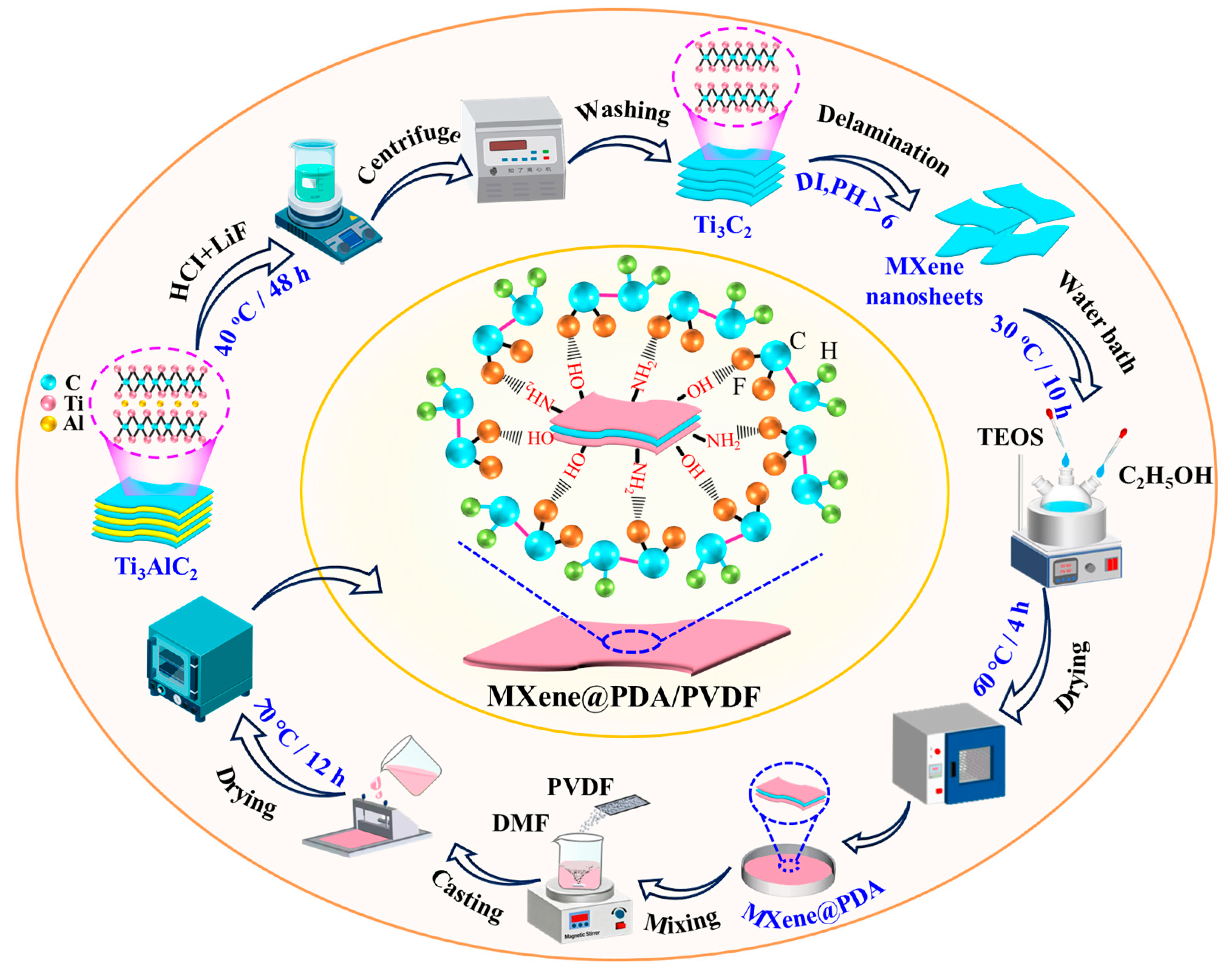
The schematic diagram of the MXene@PDA preparation process is presented in Figure 1. First, surface modification of MXene nanosheets was conducted. Briefly, 8 mL of MXene dispersion was added to 40 mL ethanol and magnetically agitated for 30 min. The mixture was subsequently placed in a 35 °C water bath for heating. DA was weighed according to four distinct mass ratios to MXene (5 wt%, 10 wt%, 15 wt%, and 20 wt%) and introduced into the reaction system. A Tris-HCl buffer was used to adjust the mixture’s pH to 8.5 ensuring reaction stability. Magnetic stirring was maintained at room temperature for 10 h to enable full self-polymerization of DA on the MXene surface. Upon completion of the reaction, the resulting product was isolated by centrifugation and subsequently rinsed multiple times with deionized water. The MXene@PDA powder was finally obtained by drying in a 60 °C vacuum oven for 4 h.

2.2.3. Fabrication of PVDF Nanocomposites

The preparation process of MXene@PDA/PVDF is schematically depicted in Figure 1. Nanocomposite films were fabricated via a solution casting technique. Initially, 0.2 g of PVDF powder was dehydrated in a forced-air oven for 24 h. MXene@PDA powder was incorporated into the PVDF matrix at targeted mass fractions of 1 wt%, 3 wt%, 5 wt%, 7 wt%, and 9 wt%. Specifically, the required quantity of MXene@PDA was dispersed in 2 mL of DMF through 30 min of ultrasonication (200 W, 40 kHz) to obtain a homogeneous suspension. This suspension was magnetically stirred at ambient temperature for 6 h prior to the addition of 0.2 g pre-dried PVDF powder. The resultant mixture was placed on a magnetic stirrer and continuously agitated at 50 °C for 3 h to ensure complete dissolution of PVDF, followed by stirring at room temperature for an additional 12 h. The uniform solution was cast onto a clean glass substrate and vacuum-dried at 70 °C for 12 h. Afterwards, the glass substrate was dipped in deionized water, which enabled the composite film to detach from the substrate automatically. Residual moisture and DMF solvent were eliminated by drying the film in a 70 °C vacuum oven for 12 h, resulting in the final nanocomposite products. The specimens were designated as MXene-1/PVDF, MXene-2/PVDF, MXene-3/PVDF, and MXene-4/PVDF, matching PDA contents of 5 wt%, 10 wt%, 15 wt%, and 20 wt%, respectively.

2.3. Characterizations

Fourier-transform infrared spectroscopy (FT-IR, Paragon 1000, Shanghai Research Institute of Materials, Shanghai, China) was employed to characterize the surface chemical properties of the samples, with measurements conducted over a spectral range of 400–4000 cm−1. Transmission electron microscopy (TEM, H-800, Hitachi Ltd., Tokyo, Japan) measurements were carried out to observe the microstructural morphology of MXene and MXene@PDA nanosheets. The crystal structures of filler particles were probed via X-ray diffraction (XRD-6000, Shimadzu Corporation, Kyoto, Japan), with a 2θ range of 30°–80° and a scanning rate of 2° min−1. A scanning electron microscope (SEM, JSM-6460LV, JEOL Ltd., Tokyo, Japan) was used to observe the cross-sectional morphology of MXene/PVDF films. Before observation, the samples were fractured in liquid nitrogen under cryogenic conditions, and their cross-sections were coated with a thin gold layer via sputtering.
An impedance analyzer (Agilent 4294A, Agilent Technologies Inc., Santa Clara, CA, USA) was employed to characterize dielectric properties at room temperature with an applied test voltage of 10 V. Specimens were fabricated into 1 × 1 cm square shapes, and both surfaces were sputter-coated with gold electrodes before measurement, which covered a frequency span from 40 Hz to 107 Hz. The Eb was assessed using a voltage breakdown tester (BDJC-50 kV, Beijing Beiguang Jingyi Instrument Co., Ltd., Beijing, China) fitted with two spherical copper electrodes of 10 mm in diameter. During electrical testing, the specimens were submerged in insulating oil to prevent surface flashover. A voltage ramp rate of 2 kV/s was applied continuously until dielectric breakdown occurred. The Eb was subsequently determined using the recorded peak voltage and the measured thickness of each sample.

2.4. Simulation Method

To systematically explore the spatial electric field distribution and thermal transport characteristics within composite films featuring diverse core–shell architectures, finite element numerical simulations were performed using COMSOL Multiphysics software (Version 1.63). The established simulation model adopts a two-dimensional configuration, and a constant external electric field of 10 MV/m is exerted to probe the spatial electric field distribution and temporal temperature evolution of different composite systems.
A set of numerical computations was implemented to determine the spatial distribution of the electric field throughout the progression of electrical tree growth. All these simulation frameworks were developed on the basis of experimental results by means of finite element analysis:
p i , j i , j = ( φ i φ i , j φ ) m ( Φ φ i , j φ i , j φ ) m + ( φ i , j φ i , j φ ) m l o s s
where φi,j, φi′,j′, and φi″,j″ stand for the electric potentials at the discharge node, the possible propagation node, and the relevant connecting site, respectively. The symbol φ represents the critical electric potential that induces dielectric breakdown across crystalline grains and grain boundaries. The parameter loss and m correspond to the energy loss during the evolution of the tip channel and the fractal dimension of the electrical tree structure, respectively.

3. Results and Discussion

3.1. Characterizations of MXene and MXene@PDA Nanoparticles

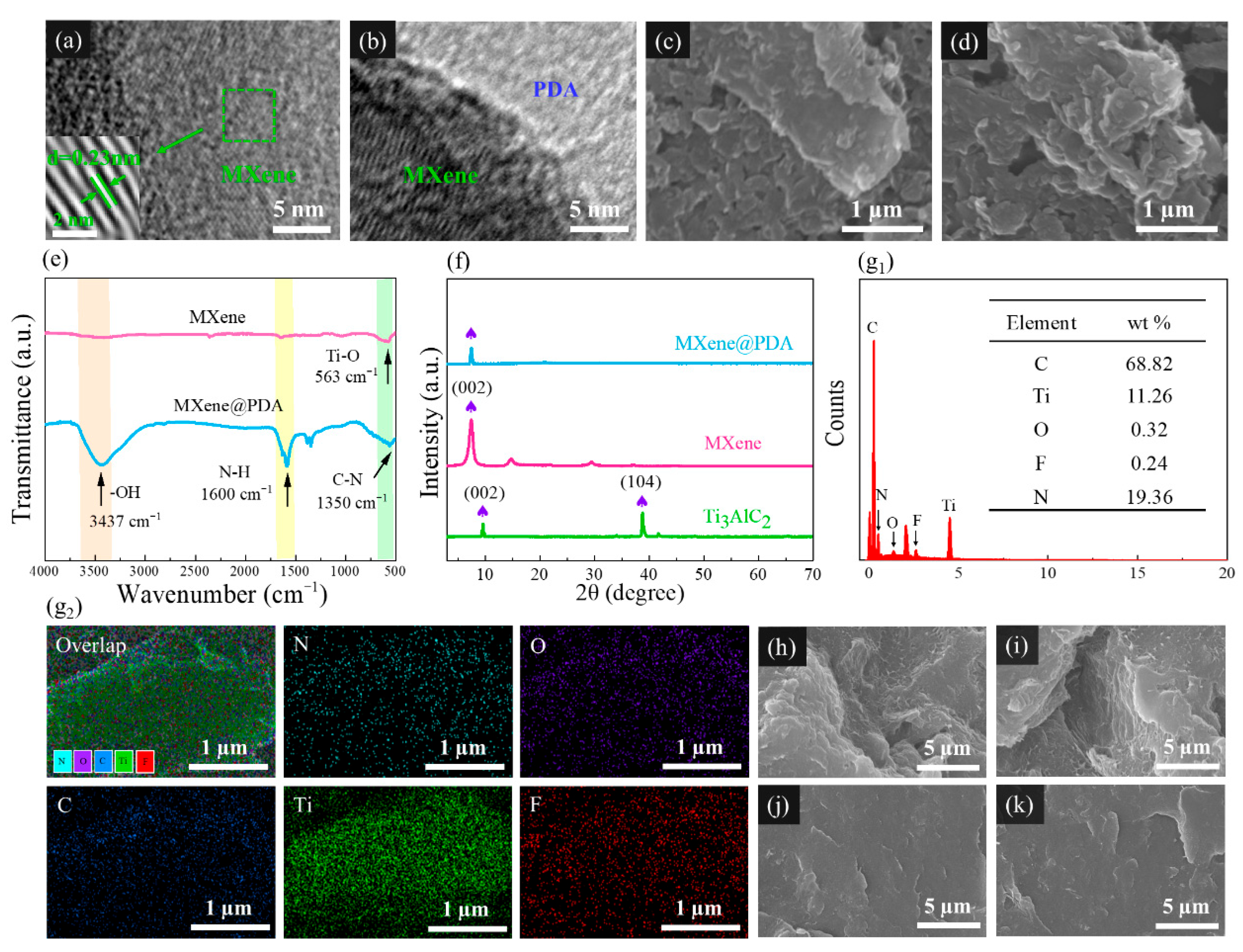
The microstructural changes in the materials were examined using TEM, as presented in Figure 2a,b. In Figure 2a, well-defined lattice fringes can be seen on the surface of the as-prepared MXene. Following the coating treatment, a homogeneous PDA layer is deposited on the MXene surface, leading to the formation of a core–shell MXene@PDA nanostructure, as displayed in Figure 2b. A comparison of the surface morphologies depicted in Figure 2c,d demonstrates a notably higher surface roughness for MXene@PDA, as opposed to the smooth surface morphology of uncoated MXene. A comparative FT-IR study between the pure MXene and MXene@PDA is provided in Figure 2e. The spectrum of pristine MXene exhibits a distinct peak at 563 cm−1, corresponding to Ti–O bond vibrations. In contrast, the MXene@PDA composite displays a broad absorption band near 3437 cm−1, attributed to the –OH stretching vibration from catechol groups in PDA. Additionally, two new peaks appear at 1600 cm−1 and 1350 cm−1, assigned, respectively, to the N-H bending vibration in the aromatic structure and the C–N stretching vibration within PDA. The presence of these functional groups, along with the retained Ti–O signal, confirms the successful polymerization and homogeneous coating of PDA onto the MXene surface while maintaining the integrity of the material.
The XRD patterns of Ti3AlC2, MXene, and MXene@PDA are shown in Figure 2f. The disappearance of the Al-related diffraction peak at 2θ = 39° in the MXene pattern verifies that the precursor was effectively etched. Moreover, a shift in the (002) diffraction peak from 9.6° for Ti3AlC2 to 7.3° for MXene is observed, which indicates an enlarged interplanar spacing resulting from the acid treatment and subsequent ultrasonic exfoliation. Finally, the XRD profile of MXene@PDA exhibits no additional crystalline reflections, confirming that the coated polydopamine layer is amorphous in structure.
SEM images of fracture surfaces for PVDF nanocomposites filled with pristine MXene (Figure 2j,k) and MXene@PDA are presented in Figure 2h,i. In contrast to the nanocomposite containing unmodified MXene, the MXene@PDA-filled system exhibits the improved dispersion of the filler and a marked decrease in interfacial defects. This improvement points to enhanced compatibility between the filler and the PVDF matrix, owing to the introduced PDA interlayer. The strengthened interfacial adhesion promotes a denser and more uniform composite microstructure, which is beneficial for the dielectric and mechanical performance of the material.
Elemental mapping via EDS was conducted on the MXene@PDA, presented in Figure 2(g1,g2), to further corroborate their surface composition. The mapping results distinctly reveal the presence of characteristic C, O, Ti, and N signals. This elemental evidence aligns well with the findings from the FT-IR and SEM analyses, and together they confirm the successful formation of a polydopamine coating on MXene.

3.2. Dielectric Properties

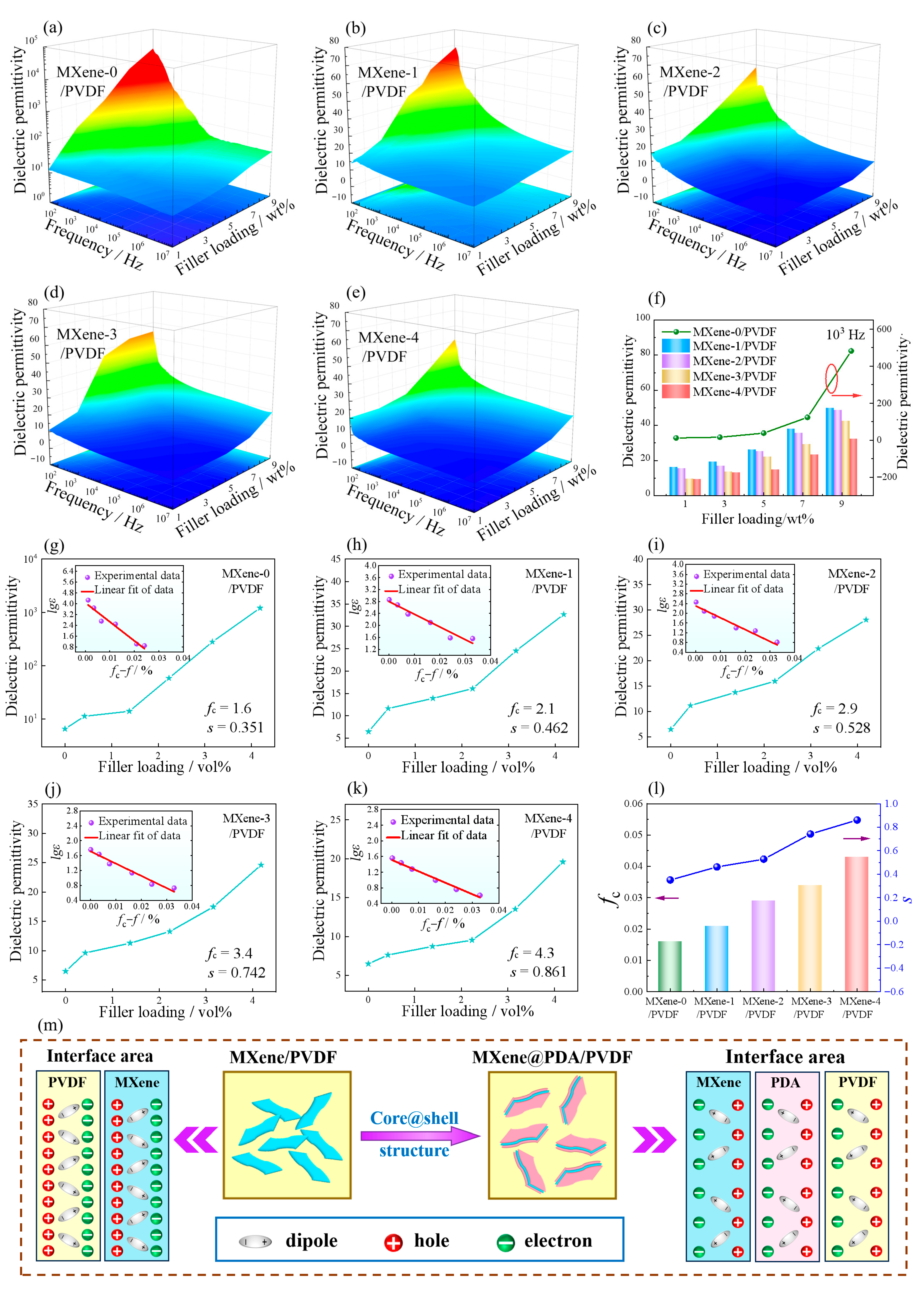
The ε of polymers is a key parameter for evaluating their charge storage capability and plays a vital role in the dielectric performance of thin-film capacitors [22]. For clarity and comparison, the dielectric permittivity of pure PVDF matrix and pure PDA at 103 Hz is determined to be 11.2 and 4, respectively. Figure 3 presents a systematic analysis of how ε varies with frequency and filler content in PVDF-based nanocomposites. As shown in Figure 3a,e, under low-frequency conditions, both interfacial charge accumulation and dipole orientation in the PVDF matrix can fully respond to the applied electric field, thereby increasing the ε value. However, as the frequency increases, these relatively slow polarization mechanisms cannot keep up with the rapidly alternating electric field, leading to a pronounced decrease in ε. Furthermore, as depicted in Figure 3f, ε increases markedly with increasing nanofiller content. The intense IP existing between MXene and PVDF serves as the key factor contributing to this enhancement of performance. The incorporation of MXene nanosheets into a PVDF matrix leads to the formation of interfaces that behave like a multitude of microscopic capacitors. Such a structure enhances electron transfer and promotes the accumulation of electrical charges at the boundary between the polymer and the nanofiller.
The dielectric properties of composite systems are frequently analyzed using effective medium theories. The Maxwell Garnett (MG) model provides a fundamental approach for estimating the ε of materials comprising a continuous polymer matrix with dispersed filler particles. This model generally applies under conditions of low filler concentration and idealized interfacial interactions between the filler and the matrix. It is mathematically represented as
ε = ε 1 + 3 φ ε 1 ε 2 ε 1 2 ε 1 + ε 2 + α ε 2 ε 1
In this expression, φ denotes the filler volume fraction, ε1 and ε2 correspond to the permittivity of the polymer matrix and the filler, respectively, and α is a factor associated with depolarization. Equation (2) demonstrates that the composite’s overall ε depends on both the inherent dielectric properties of its components and the amount of filler incorporated.
Introducing conductive MXene nanosheets into the PVDF matrix significantly enhances the ε of the nanocomposites. This phenomenon is explained by percolation theory, which predicts a sharp increase in ε as the filler content nears a critical threshold, termed the fc. A power-law model captures this relationship:
ε = ε m ( f c f ) s   for   f f c
Here, εm is the matrix ε and s is a critical exponent [23]. The experimental data analysis presented in Figure 3g–k yields fc values of 2.4 for MXene/PVDF and 2.6 for MXene@PDA/PVDF composites. Their respective s values are 0.346 and 0.73. The slight increase in fc for the core–shell system is due to the PDA coating, which acts as a barrier to prevent direct contact between adjacent MXene sheets and suppresses the development of conductive networks.
Figure 3f further shows the effect of PDA shell thickness on ε measured at 103 Hz. A clear decrease in ε is observed as the PDA content rises from 5 to 20 wt%. This decline results from the improved insulating properties of a thicker PDA shell, which more efficiently restricts charge movement between particles and diminishes the micro-capacitor network effect. Meanwhile, for MXene@PDA/PVDF nanocomposites, ε shows a marked upward trend with higher filler loading, a behavior attributable to the micro-capacitor effect. Increased filler concentration introduces a larger number of these micro-capacitors into the system, thereby boosting charge storage capacity and raising the ε [24,25]. Nevertheless, all core–shell composites exhibit lower ε values than their uncoated MXene/PVDF counterparts, confirming that the PDA shell moderates the inherent polarizability of MXene. The significant difference in electrical conductivity between the conductive MXene core and the insulating PDA shell promotes considerable space charge accumulation at their interfaces under an electric field.
The macroscopic ε of the composite can be quantitatively related to its microscopic structural features through the Clausius–Mossotti equation:
ε 1 ε + 2 = N α 3 ε 0
In Equation (4), N refers to the molecular number density per unit volume, α denotes polarizability, and ε0 stands for the ε of free space. This relationship establishes a theoretical foundation indicating a direct proportionality between the polarizability of the material and its relative dielectric constant. This formula is valid for isotropic, homogeneous dilute dielectric systems under static/low-frequency fields (Lorentz local field approximation) [26], which is well satisfied by our 103 Hz tested MXene@PDA/PVDF nanocomposites with uniformly dispersed fillers and negligible interparticle interactions.
IP can be interpreted by employing an electric double-layer concept. Within this framework, stationary charges on the MXene surface draw oppositely charged ions from the nearby medium, leading to the formation of a stratified interface. This interfacial structure comprises an inner Stern layer with immobilized ions and an outer diffuse layer containing mobile ions. The lower ε detected in MXene@PDA/PVDF nanocomposites compared to their MXene/PVDF is presumably ascribed to the introduction of the insulating PDA coating. This layer obstructs charge transfer among adjacent MXene nanosheets; such insulation mitigates charge polarization inside MXene, resulting in an overall reduction in ε. As illustrated in Figure 3m, although the PDA shell suppresses charge transport, the core–shell structure itself generates multiple interfaces that act as extra polarization sites, which contribute to maintaining a relatively high ε.
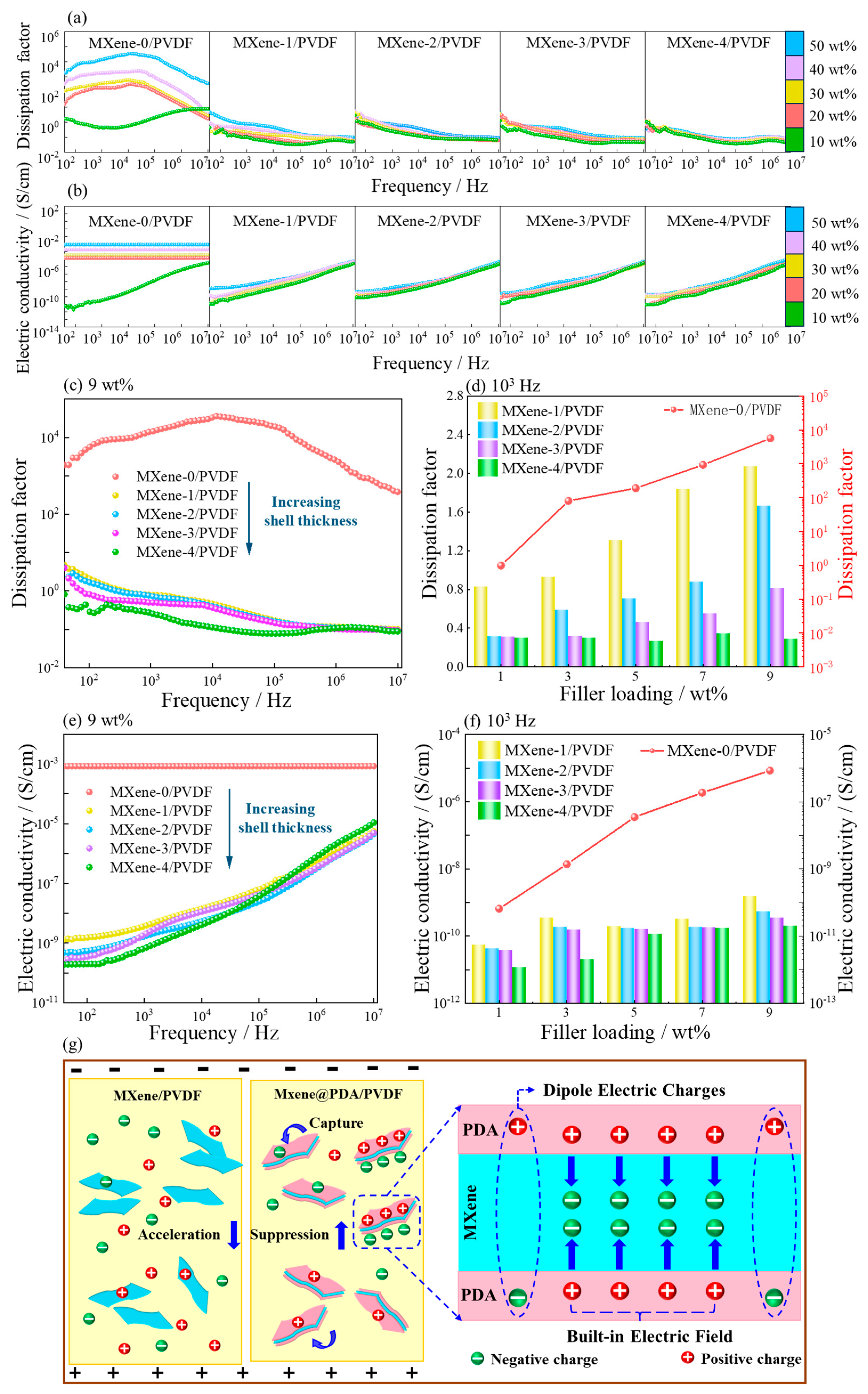
To systematically investigate how the PDA coating influences dielectric behavior, Figure 4a illustrates the variation in tan δ with frequency for various PVDF nanocomposites. A clear correlation is observed wherein tan δ values increase progressively with higher filler content. Specifically, at a frequency of 103 Hz, the nanocomposite containing 9 wt% of unmodified MXene exhibits a marked enhancement in tan δ. This behavior is attributed to the overlapping of electrical double layers between neighboring conductive MXene nanosheets, leading to the formation of a percolated conductive architecture within the polymer matrix. Based on electron tunneling theory, interfacial charge transport is promoted when the spacing between particles decreases below a critical distance. The enhanced charge carrier mobility forms continuous conductive pathways, consequently leading to degraded dielectric characteristics of PVDF nanocomposites.
In marked contrast, the MXene@PDA/PVDF nanocomposites exhibit a significantly mitigated increase in tan δ, an effect particularly evident at elevated filler contents, as presented in Figure 4c,d. Notably, the MXene-4/PVDF nanocomposite demonstrates the most superior low tan δ characteristics, which can be primarily attributed to the insulating PDA interlayer effectively suppressing long-range carrier migration and substantially enhancing interfacial compatibility. As schematically illustrated in Figure 4g, the PDA coating serves as a barrier that inhibits direct contact between neighboring MXene nanosheets, consequently curtailing leakage current and reducing tan δ. From the perspective of charge trapping, the PDA coating introduces deep-level trap states at the interface between the filler and the polymer matrix. The gradual buildup of space charges in this region perturbs the local electric field distribution, resulting in the formation of an internal electric field that opposes the direction of the externally applied field. This built-in field attenuates the initial field strength and impedes the further injection of charges. The fundamental mechanism involves multiple aspects: First, the insulating PDA layer provides ample trapping sites capable of sequestering charge carriers. Second, the thicker barrier reduces electron tunneling probability and prolongs charge relaxation time, leading to less IP.
These traps function through a combination of mechanisms, including confinement of carrier migration along specific directions, shortening of carrier transport pathways, and an increase in carrier kinetic energy via non-radiative transitions. Together, these effects contribute to the improved dielectric properties of the composite materials. This inhibits the development of conductive pathways, resulting in a decrease in both the bulk electrical conductivity and the tan δ of the nanocomposite material. The ε″ of the composite can be deconvoluted into three distinct contributions, as described by Equation (5):
ε = ε D C + ε M W S + ε D
where the symbol ε D C refers to conduction loss, ε M W S represents interfacial polarization loss, and ε D indicates dipole loss [27,28,29]. The conduction loss component can be described by Equation (6):
ε D C = σ D C 2 π f
Here, σDC represents the DC conductivity and f corresponds to the frequency used in the measurement.
In alignment with the behavior noted for tan δ, the measured results further demonstrate that the introduction of nanofillers with a core–shell configuration significantly lowers the overall σ of the PVDF nanocomposites. As presented in Figure 4b, the alternating current (AC) conductivity of these materials across various loading levels demonstrates clear frequency-dependent behavior. This variation conforms to the characteristic trend expressed by the Jonscher universal power law:
σ ( ω ) = σ 0 + A ω s
The experimental data were analyzed using the Jonscher model, parameterized by DC conductivity (σ0), a scaling constant A, and an exponent s that varies with frequency and temperature. This analysis indicates that σ(ω) increases exponentially with frequency for all composite samples [30].
Figure 4g demonstrates the effect of filler content on σ in the MXene@PDA/PVDF nanocomposites. For the unmodified MXene/PVDF, elevated filler concentration reduces the interparticle spacing. This facilitates the formation of conductive percolative pathways and thereby significantly enhances σ. In comparison, the MXene@PDA/PVDF exhibits reduced σ throughout the measured frequency range. A thicker polydopamine coating leads to further improvements in the insulating properties of the material. According to electrical percolation theory, in the case of unmodified MXene/PVDF, the spacing between neighboring MXene nanosheets decreases progressively as the filler concentration rises. Once the filler content surpasses the fc, conductive networks are formed and electron tunneling becomes prominent. This effect elevates leakage conductivity and consequently lowers the Eb. In contrast, within the MXene@PDA/PVDF system, the non-conductive PDA interlayer functions as a physical barrier between neighboring MXene fillers, effectively suppressing leakage current paths. Such obstruction likewise explains the elevated fc identified in PDA-coated nanocomposites. Consequently, the introduction of a PDA interlayer significantly increases the resistivity of the composite material, thereby effectively suppressing the overall electrical conductivity of the nanocomposites. Consistent with theoretical predictions, the semicrystalline structure of polymers leads to chain entanglements and conformational distortions that modify the electronic band configuration to introduce multilevel energy traps. Experimental evidence suggests that an increased thickness of the PDA shell promotes the formation of deeper energy traps. These traps improve the capture efficiency of space charges while significantly raising the energy barrier that trapped carriers must overcome. A primary mechanism behind this enhancement is the interface formed between the core and shell, specifically the MXene-PDA boundary. The marked difference in the electronic band structures of conductive MXene and insulating PDA establishes a pronounced interfacial energy barrier. Second, the PDA shell further restricts intra-filler charge migration while strengthening interfacial adhesion via hydrogen bonding with PVDF chains. This dual mechanism inhibits filler agglomeration and disrupts percolation pathway development, collectively contributing to the observed tan δ suppression. Lastly, regarding asymmetric charge trapping, the MXene@PDA/PVDF nanocomposite utilizes the PDA shell and trap sites in the PVDF matrix as dominant trapping centers for positive charges. These trap sites in PVDF primarily consist of negatively charged centers formed through molecular chain scission. The key trapping sites are the MXene-PDA core–shell interface and intrinsic defects in the PDA layer. Such intrinsic defects in PDA, often nitrogen-related vacancies, generally function as positively charged centers. This asymmetric regulation of charge trapping effectively lowers both tan δ and σ in the MXene@PDA/PVDF nanocomposite, thereby enhancing its dielectric performance.
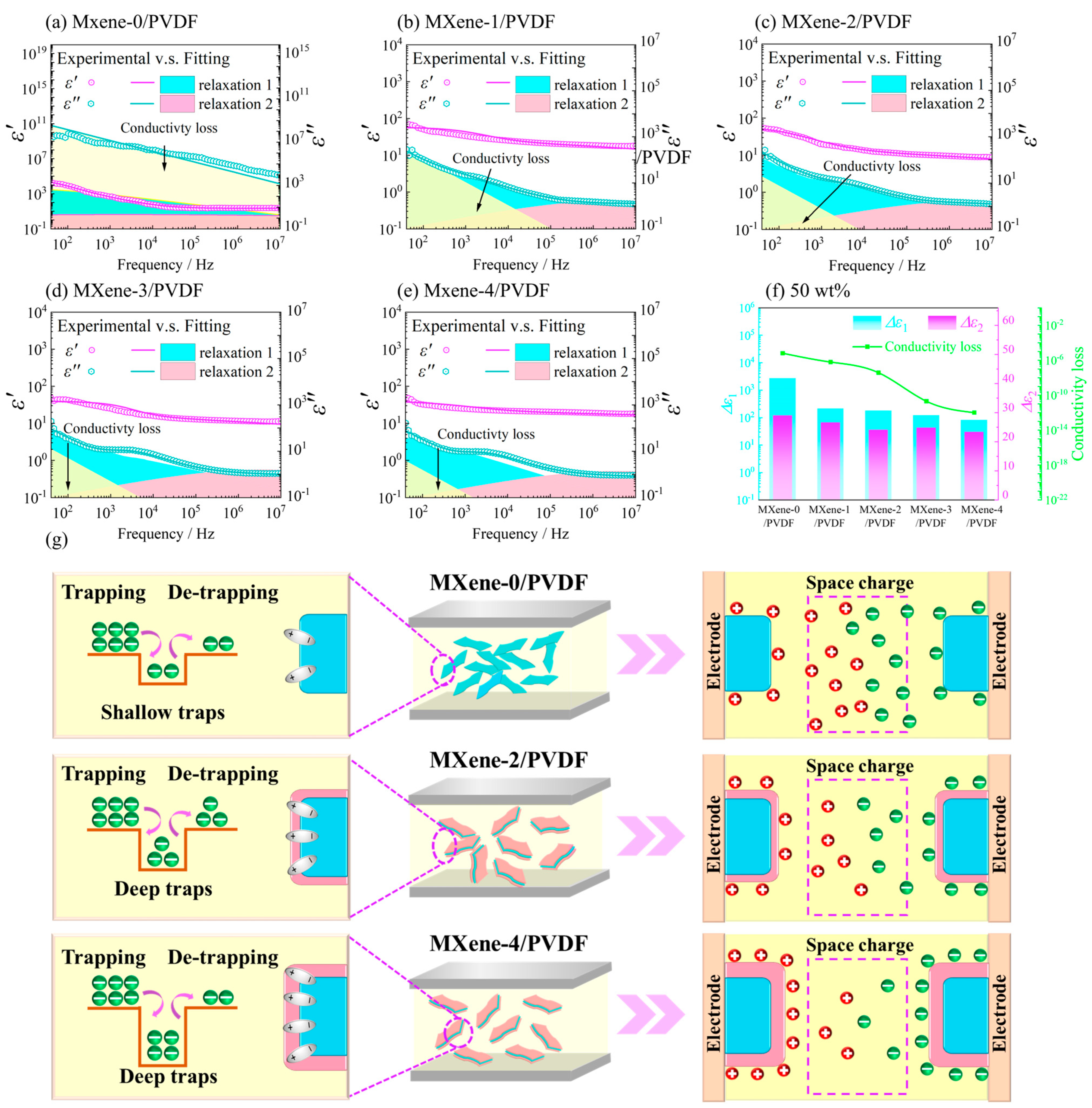
Figure 5a–e displays the deconvolution of spectra used to analyze the dielectric relaxation dynamics in PVDF nanocomposites incorporated with unmodified MXene and nanofillers possessing a core–shell architecture. The fitted curves distinctly illustrate the distribution and contribution of various relaxation modes, obtained by modeling the experimental data with the Havriliak–Negami (H–N) equation:
ε * ω = ε + j = 1 2 ε j 1 + ( i ω τ j ) α j + σ d c i ω ε 0
Here, the model incorporates the angular frequency ω, along with several key parameters: the high-frequency limit of the permittivity ε, the relaxation strength Δε, and for each relaxation mode j, the characteristic time constant τj and the asymmetry parameter αj describing the distribution width. Additionally, the DC conductivity σdc and the permittivity of free space ε0 are included.
The dielectric behavior of the nanocomposites is governed by two principal relaxation mechanisms. Two main relaxation mechanisms determine the dielectric behavior of the nanocomposites. The first relaxation process, detected at higher frequencies (approximately 105–107 Hz) and named relaxation 2 (Δε2), originates from segmental micro-Brownian motions in the amorphous regions of the PVDF matrix. Since all samples contain the same amount of PVDF, the intensity of this relaxation varies slightly among different composites. The second relaxation, denoted as relaxation 1 (Δε1), appears in the lower frequency range (40–105 Hz) and is ascribed to IP caused by charge accumulation at the filler-matrix boundaries, consistent with earlier reports [31,32]. Experimental data demonstrate that enhanced carrier localization becomes more pronounced as the thickness of the PDA shell increases. This trend can be explained by the presence of a more substantial insulating interlayer, which promotes the trapping of a larger quantity of space charges in deep energy levels under an applied electric field. As a consequence, the population of mobile charges available to participate in interfacial polarization is reduced, leading to a systematic decrease in the measured Δε1 parameter. This relationship is clearly illustrated in Figure 5g.
Moreover, the decrease in conductive losses observed at lower frequencies is primarily attributed to a reduced population of charges that can migrate over long distances. As demonstrated in Figure 5f, a comparison of the fitted Δε1 parameters and corresponding conductive loss data for the MXene@PDA/PVDF nanocomposites reveals that the insulating PDA shell exerts a remarkable influence on their polarization behaviors and conductivity loss of the nanocomposites [33].
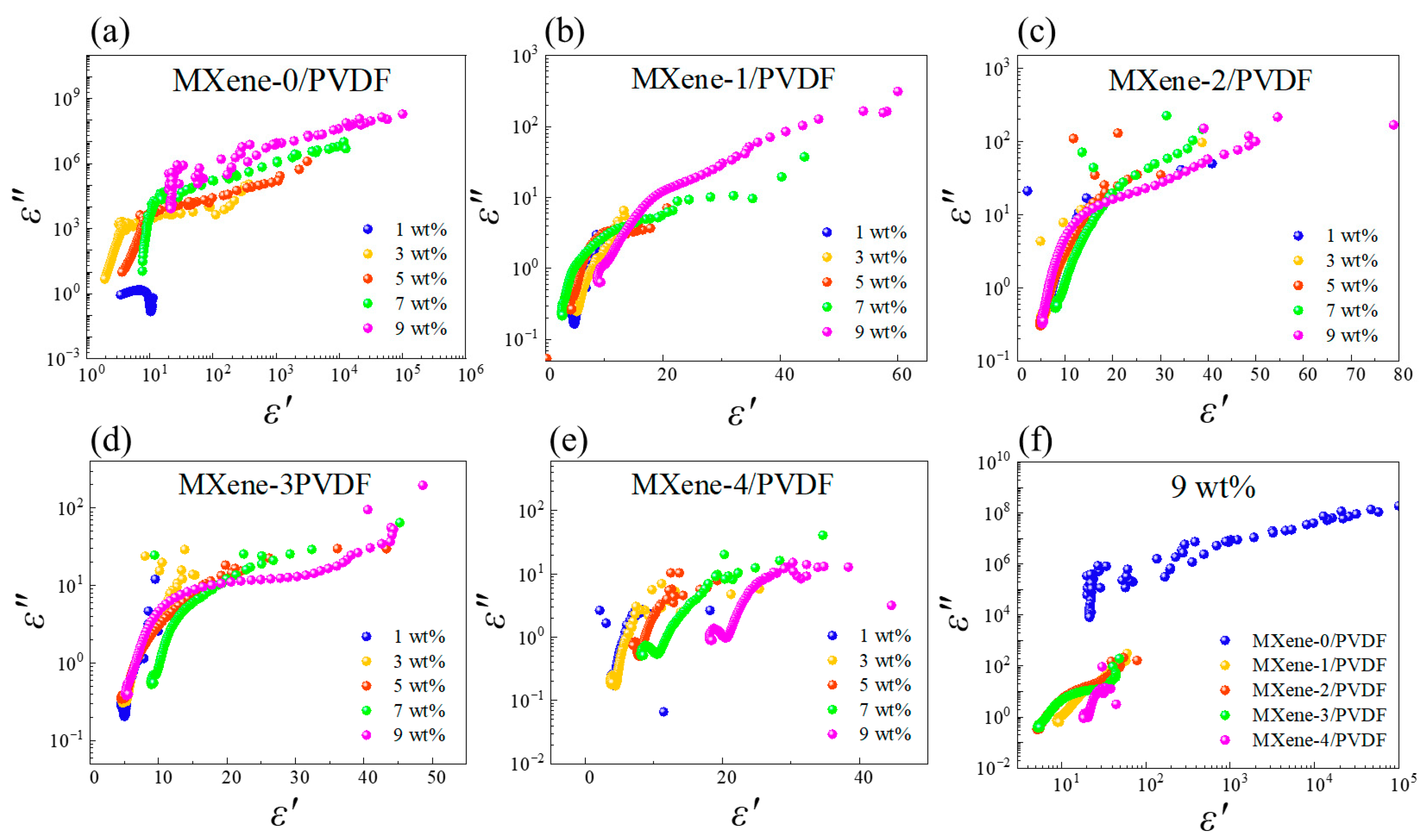
Figure 6a–e displays the complex permittivity spectra (Cole-Cole plots) for PVDF nanocomposites containing either pristine MXene or MXene@PDA particles at different filler concentrations. The ε″ versus ε′ curves show two separate arcs, each representing a distinct polarization process. The smaller arc observed at higher frequencies results from dipole reorientation intrinsic to the PVDF polymer, a behavior consistent with Debye-type relaxation. Conversely, the larger arc at lower frequencies is attributed to IP between the filler particles and the polymer matrix. This process exhibits a distribution of relaxation times, departing from an ideal Debye model [34,35].
Equation (9) offers a quantitative description of the dielectric response:
ε * = ε + ε 0 ε 1 + i ω τ i γ ω
Here, ω (ω = 2πf) denotes angular frequency, τ represents characteristic relaxation time, α is a distribution parameter, and γ accounts for electrical conductivity.
An increase in filler concentration leads to higher σ in the nanocomposites, which is visually evident as a greater deviation of the low-frequency arc from a perfect semicircular shape. Importantly, the MXene@PDA/PVDF nanocomposites demonstrate significantly suppressed conductivity compared to systems with unmodified MXene, with this effect becoming more pronounced for thicker PDA shells. This observation confirms that the PDA interlayer substantially enhances the electrical insulation of the nanocomposites. By effectively lowering electrical conductivity, the PDA coating concurrently contributes to improved breakdown strength in the composite material [36,37].
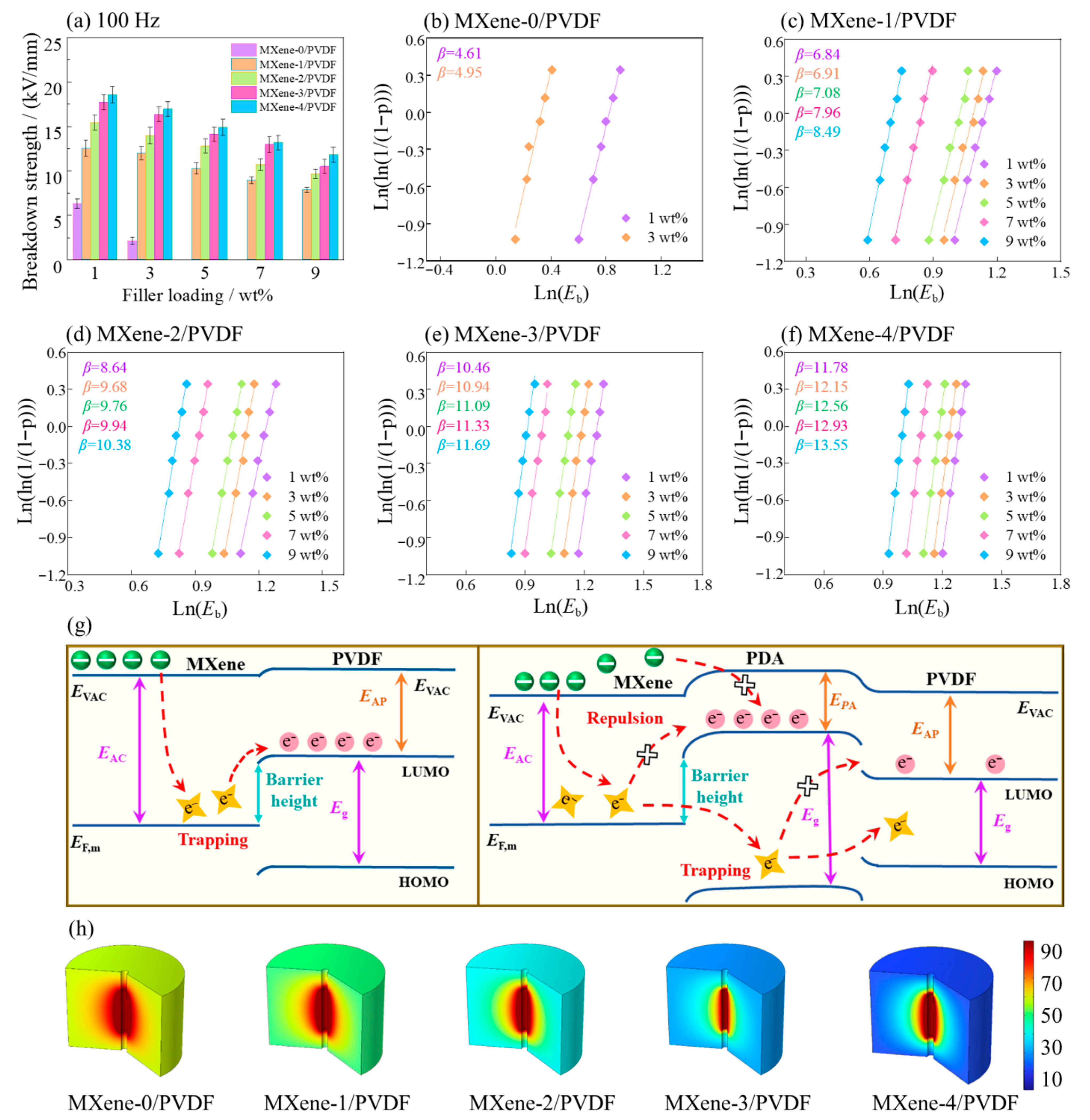
Energy storage capability of a dielectric composite is not only determined by their relative permittivity ε, but also by its high field Eb, with the latter being equally critical. Eb stands for the maximum electric field that a material is able to bear while maintaining the integrity of its insulating property and polarization function. For ensuring statistically rigorous assessment, the Eb values of the nanocomposite series in the present study were analyzed by means of the Weibull distribution model. The Weibull probability function may be represented in the following form:
P = 1 e x p [ ( E b α ) ] β
where P refers to the cumulative failure probability, α indicates the characteristic breakdown strength at a failure probability of 63.2%, and β is the shape parameter, which characterizes the data scatter and the reliability of the measured results [38].
Figure 7a systematically illustrates the relationship between Eb and filler concentration across different PVDF-based nanocomposites. A clear descending trend in Eb is observed with increasing filler content, primarily attributed to the rising density of micro-voids and interfacial defects introduced by inorganic filler incorporation [39]. Such imperfections serve as localized electric field concentration sites, thereby expediting dielectric failure under high field conditions. However, it is clear that, under the same filler loadings, the MXene@PDA/PVDF composites show better breakdown performance than the unmodified MXene/PVDF. As a specific example, with a filler content of 7 wt%, the measured Eb values for MXene-0/PVDF, MXene-1/PVDF, MXene-2/PVDF, MXene-3/PVDF, and MXene-5/PVDF are 0, 8.91, 10.68, 12.94, and 13.15 kV/mm in sequence. The observed gradual improvement in breakdown strength for the MXene@PDA/PVDF system results from a band-engineering effect. In this mechanism, the wide-bandgap PDA coating alters the interfacial energy structure and creates a high density of deep-level traps distributed throughout the composite. These traps efficiently restrict the movement and accumulation of space charges. Furthermore, as depicted in Figure 7g, the detailed energy band diagrams corresponding to PVDF loaded with various nanofillers are provided at first. The band offset across MXene and PDA facilitates the generation of trap states at the material interface, realizing the effective entrapment of both electrons and holes. Meanwhile, the localized accumulation of space charges in composites incorporating MXene@PDA nanofillers is notably mitigated through interfacial charge carrier trapping, which not only effectively inhibits the leakage current, but also leads to a significantly enhanced Eb [40]. Moreover, the shape parameter β derived from the Weibull distribution serves as a critical metric for assessing the structural uniformity and fabrication precision of dielectric nanocomposites. As presented in Figure 7b–f, the experimental results confirm that, with comparable nanofiller contents, MXene@PDA/PVDF shows markedly higher β values than the pristine MXene/PVDF nanocomposites. This observation further validates the beneficial role of the PDA insulating shell in improving the breakdown performance and reliability of the nanocomposites.
Figure 7h provides a further comparison of the simulated thermal distributions in MXene/PVDF and MXene@PDA/PVDF nanocomposites under intense electric fields. The findings demonstrate that the MXene@PDA/PVDF composite shows a more homogeneous temperature profile and a diminished thermal gradient. This improvement mainly stems from the insulating nature of the PDA interphase. By substantially lowering both the tan δ and σ, the PDA layer suppresses Joule heating induced by alternating electric fields. It is also noteworthy that composites with thicker PDA coatings exhibit a considerably lower core temperature than those with thinner shells. This can be accounted for by the progressive reduction in the nanocomposite’s tan δ as the PDA shell thickens, which accordingly suppresses the formation and accumulation of Joule heat within the material. Overall, the synergistic effects of reduced conductivity, suppressed tan δ and improved thermal uniformity collectively augment the dielectric stability and working reliability of the nanocomposites.
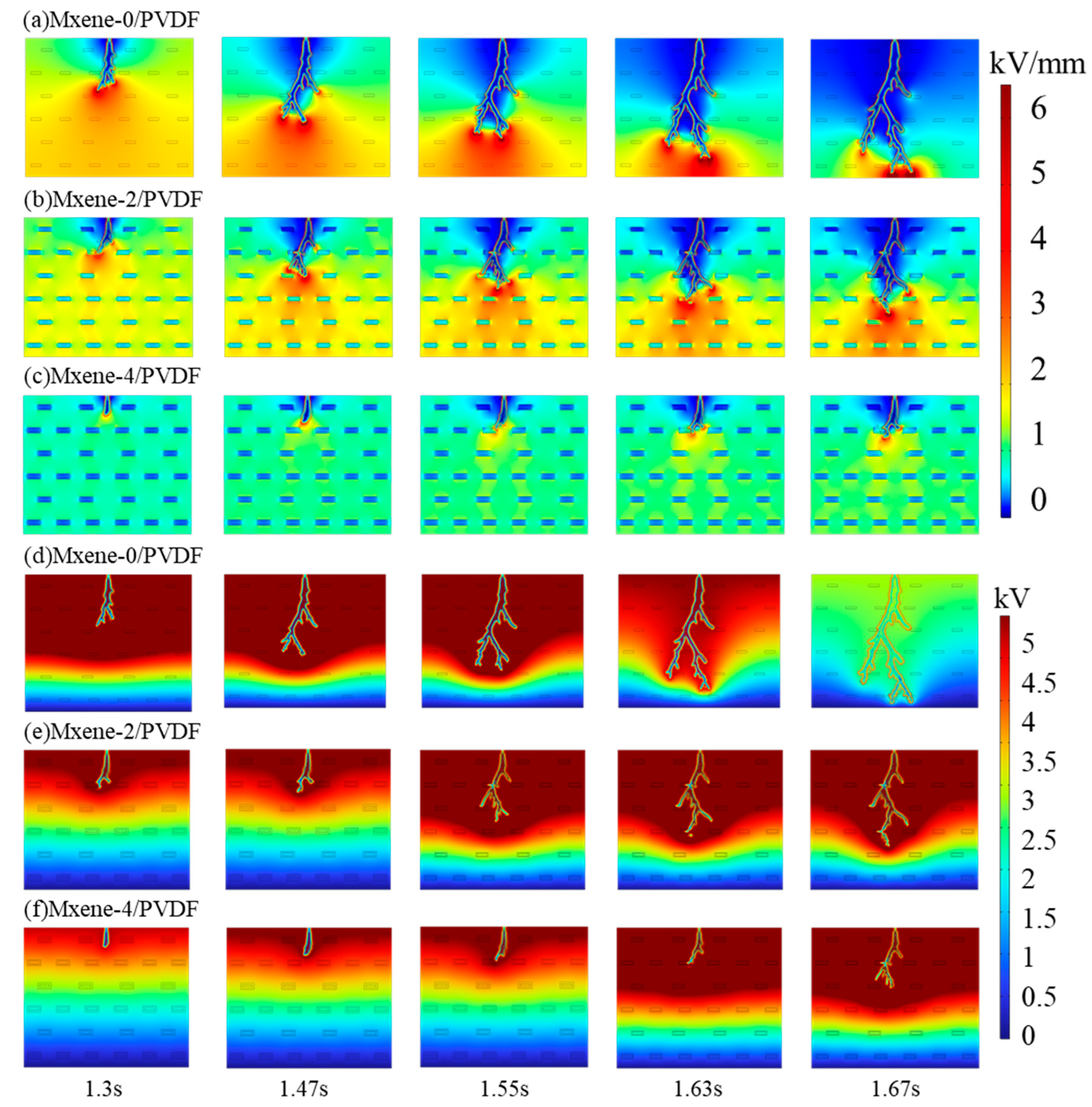
To elucidate the mechanism underlying the enhanced Eb of MXene@PDA/PVDF nanocomposites, phase-field modeling was performed using COMSOL Multiphysics. Figure 8 presents the simulated dynamic evolution of electrical tree growth together with the corresponding electric field distribution inside the composite. Analysis of the spatial electric field gradient reveals that dielectric breakdown generally initiates in the upper region of the sample, where branched conductive channels form and extend downward.
During the development of electrical trees, nanofillers with high aspect ratios promote the formation of intricate branching in these conductive pathways. This branching pattern lengthens and complicates the propagation path of electrical failure, thereby enabling the more efficient dissipation of electrostatic energy [41,42,43]. Once the local electric field intensity exceeds a certain critical value, conductive channels tend to advance predominantly along the filler-matrix interfaces. Through systematic control of filler content and interfacial structure achieved by controllable PDA shell coating, the extension of breakdown channels can be effectively impeded, and the dielectric stability of the composite is significantly improved.
Therefore, in high-performance nanocomposite dielectric materials, rational regulation of filler concentration combined with interfacial engineering can effectively enhance breakdown strength while maintaining low tan δ.
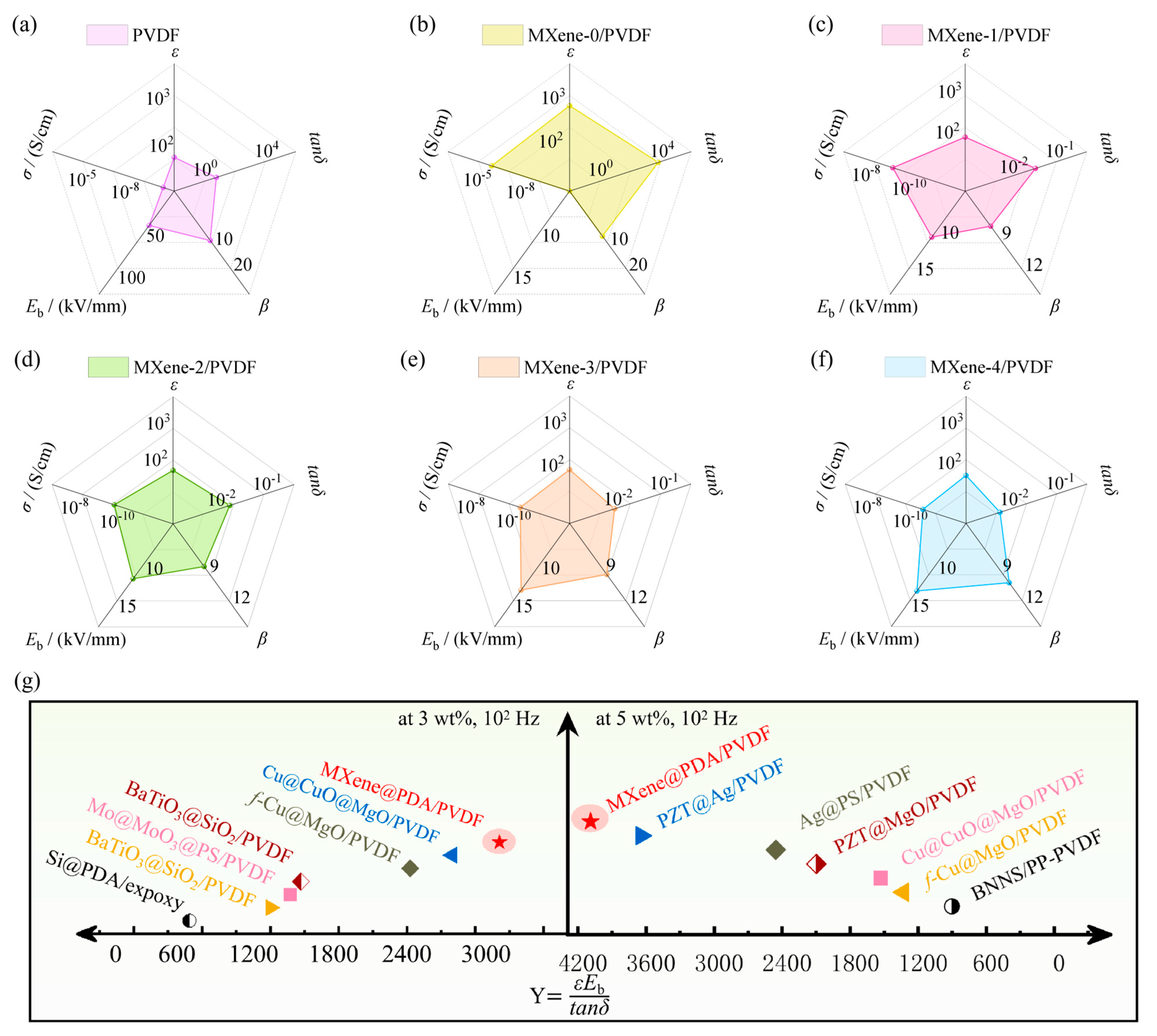
Based on the data presented in Figure 9a–f, the dielectric behavior of pure PVDF and its nanocomposites was assessed at a frequency of 103 Hz. The results demonstrate that the MXene-3/PVDF sample maintains a comparatively high ε and an enhanced Eb. Furthermore, this composite shows a significantly reduced tan δ and lower electrical conductivity relative to neat MXene/PVDF and other reference composites.
Figure 9g presents a performance comparison between the MXene-4/PVDF nanocomposite developed in this study and core–shell nanocomposites documented in earlier works [43,44,45,46,47,48,49,50,51,52]. Prior studies have established that the simultaneous realization of superior ε, large Eb and weak tan δ constitutes a challenge for PVDF-based composite systems. As an example, the Mo@SiO2 filler system is characterized by a relatively low tan δ of 0.09, yet only exhibits a dielectric constant of 12 alongside inadequate breakdown strength performance [45]. By contrast, the MXene-4/PVDF nanocomposite constructed in this research achieves a high ε of 32.29, a low tan δ of 0.0025, and a notably high Eb of 13.15 kV/mm, thus yielding an excellent dielectric figure of merit Y where Y = ε·Eb/tan δ. These results confirm that the core–shell structural design can effectively reduce the tan δ and electrical conductivity of PVDF while maintaining high ε and Eb values, which provides a novel feasible strategy for the application of dielectric materials in the electronic and electrical industries.

4. Conclusions

This research endeavors to improve the comprehensive dielectric properties of MXene/PVDF composites by realizing the synergistic tuning of superior ε, weak tan δ, and excellent Eb. After preparing layered MXene nanosheets through in situ exfoliation and etching, a sequence of MXene@PDA/PVDF nanocomposites was constructed using dopamine self-polymerization in combination with solution casting. A suite of analytical characterization techniques validates the structural stability of MXene@PDA fillers and their uniform dispersion throughout the PVDF polymer matrix.
Experimental findings demonstrate that depositing an insulating PDA layer on the surface of highly conductive MXene not only optimizes the dispersion of MXene within the PVDF matrix and efficiently suppresses leakage current as well as tan δ, but also boosts the Eb of the composites under high electric field conditions. It is worth noting that the MXene@PDA/PVDF system achieves a better balance between high ε and low tan δ than the MXene/PVDF nanocomposite. The decrease in tan δ is primarily attributed to the interfacial internal electric field, which impedes electron migration and thereby restrains leakage current.
Notably, the MXene@PDA/PVDF nanocomposites exhibit a remarkable enhancement in Eb, and this enhancement can be explained by the following cooperative effects: (1) The wide-bandgap PDA shell introduces a high density of deep-level traps, effectively capturing charge carriers and strongly suppressing their de-trapping and long-range migration. (2) Acting as a buffer interphase, the PDA layer not only strengthens the interfacial adhesion between the nanofiller and the polymer matrix, but also moderates the dielectric gradient, thereby alleviating the permittivity mismatch between the filler and PVDF. (3) Moreover, the core–shell architecture significantly obstructs the propagation pathways of electrical breakdown, leading to a substantial improvement in Eb. Further modulation of the dielectric performance can be realized by precisely controlling the thickness of the PDA interlayer. This work proposes an effective route toward balanced dielectric properties through the design of core–shell structured nanofillers, showing considerable potential for future applications in microelectronics and advanced power systems.

Author Contributions

G.Y.: Formal analysis, Methodology, Writing—original draft. S.Z.: Data curation. N.L.: Data curation. J.Z.: Data curation. H.Z.: Data curation. P.Z.: Data curation. W.Z.: Funding acquisition, Supervision, Conception. All authors have read and agreed to the published version of the manuscript.

Funding

This research was funded by the National Natural Science Foundation of China (No. 52277028).

Data Availability Statement

The original contributions presented in this study are included in the article. Further inquiries can be directed to the corresponding author.

Acknowledgments

The authors gratefully acknowledge the financial support from the National Natural Science Foundation of China (No. 52277028) and acknowledge the Analytic Instrumentation Center of XUST.

Conflicts of Interest

The authors declare no conflicts of interest.

References

  1. Yuan, J.; Feng, Z.; Li, D.; Luo, Y.; Zhou, Y. Epidermal visualized health monitoring system based on stretchable and washable TPU hybrid conductive microtextiles. Rare Met. 2024, 43, 3185–3193. [Google Scholar] [CrossRef]
  2. Feng, Y.; Li, J.-L.; Li, W.-L.; Li, M.-L.; Chi, Q.-G.; Zhang, T.-D.; Fei, W.-D. Effect of BaTiO3 nanowire distribution on the dielectric and energy storage performance of double-layer PVDF-based composites. Compos. Part A Appl. Sci. Manuf. 2019, 125, 105524. [Google Scholar] [CrossRef]
  3. Yuan, M.; Zhang, G.; Li, B.; Chung, T.; Rajagopalan, R.; Lanagan, M. Thermally Stable Low-Loss Polymer Dielectrics Enabled by Attaching Cross-Linkable Antioxidant to Polypropylene. ACS Appl. Mater. Interfaces 2020, 12, 14154–14164. [Google Scholar] [CrossRef]
  4. Ren, J.; Zeng, R.; Yang, J.; Wang, Z.; Zhao, L.; Wang, G.; Jia, S. Significantly enhancing the through-plane thermal conductivity of epoxy dielectrics by constructing aramid nanofiber/boron nitride three-dimensional interconnected framework. J. Appl. Phys. 2024, 136, 045101. [Google Scholar] [CrossRef]
  5. Li, X.; Wu, Y.; Chen, T.; Wang, Q.; Lu, C.; Hao, H.; Wei, B.; Wang, H.; Yao, C.; Zhang, F.; et al. Construction of proton channels in POMCPs@MXene electrodes for flexible all-solid-state symmetrical supercapacitors. Chem. Eng. J. 2025, 519, 164816. [Google Scholar] [CrossRef]
  6. Li, B.; Randall, C.; Manias, E. Polarization Mechanism Underlying Strongly Enhanced Dielectric Permittivity in Polymer Composites with Conductive Fillers. J. Phys. Chem. C 2022, 126, 7596–7604. [Google Scholar] [CrossRef]
  7. Gao, F.; Yue, X.; Xu, X.; Xu, P.; Zhang, F.; Fan, H.; Wang, Z.; Wu, Y.; Liu, X.; Zhang, Y. A N/Co co-doped three-dimensional porous carbon as cathode host for advanced lithium-selenium batteries. Rare Met. 2023, 42, 2670–2678. [Google Scholar] [CrossRef]
  8. Li, X.; Hu, P.; Jiang, J.; Pan, J.; Nan, C.; Shen, Y. High-Temperature Polymer Composite Dielectrics: Energy Storage Performance, Large-Scale Preparation, and Device Design, Advanced Materials. Adv. Mater. 2025, 37, 2411507. [Google Scholar] [CrossRef]
  9. Liu, Z.; Titus, C.; Jaye, C.; Fischer, D.; Bhowmick, A.; Chen, G.; Shu, Y.; Jahrman, E.; Liu, D. Vitreous silica supported metal catalysts for direct non-oxidative methane coupling. Chem. Eng. J. 2024, 499, 156436. [Google Scholar] [CrossRef]
  10. Li, B.; Sarkarat, M.; Baker, A.; Randall, C.; Manias, E. Interfacial effects on the dielectric properties of elastomer/carbon-black/ceramic composites. MRS Adv. 2021, 6, 247–251. [Google Scholar] [CrossRef]
  11. Zhong, S.; Chen, K.; Wang, S.; Manshaii, F.; Jing, N.; Wang, K.; Liu, S.; Zhou, Y. Metal-based nanowires in electrical biosensing. Rare Met. 2024, 43, 6233–6254. [Google Scholar] [CrossRef]
  12. Zhang, Y.; Chen, F.; Liu, D.; Wang, J.; Feng, Q.; Jiang, H.; Wang, X.; Zhao, H.; Zhong, S.; Shah, F.; et al. AI safety of film capacitors. IET Nanodielectr. 2024, 7, 131–139. [Google Scholar] [CrossRef]
  13. Zhao, S.; Zhou, W.; Chen, X.; Cao, Y.; Zhao, J.; Zuo, J.; Liu, D.; Lin, S.; Yuan, M. Achieving synchronously high permittivity and breakdown strength in Mo/PVDF dielectrics via engineering insulating MgO as interlayer. Inorg. Chem. Commun. 2025, 183, 115716. [Google Scholar] [CrossRef]
  14. Zhang, K.; Zhou, W.; Niu, Z.; Lin, N.; Liu, J.; Zhang, D. Interface-modulation of the core-shell structured MXene@SiO2 nanosheets enables elevated dielectric performance in PVDF nanocomposites. Compos. Commun. 2026, 62, 102700. [Google Scholar] [CrossRef]
  15. Li, Y.; Bi, X.; Wang, S.; Zhan, Y.; Liu, H.; Mai, Y.; Liao, C.; Lu, Z.; Liao, Y. Core-shell structured polyethylene glycol functionalized graphene for energy-storage polymer dielectrics: Combined mechanical and dielectric performances. Compos. Sci. Technol. 2020, 199, 108341. [Google Scholar] [CrossRef]
  16. Ren, J.; Jiang, G.; Wang, Z.; Qing, Q.; Teng, F.; Jia, Z.; Wu, G.; Jia, S. Highly thermoconductive and mechanically robust boron nitride/aramid composite dielectric films from non-covalent interfacial engineering. Adv. Compos. Hybrid Mater. 2024, 7, 5. [Google Scholar] [CrossRef]
  17. Yang, Y.; Chao, J.; Jiang, P.; Xu, R.; Li, Y.; Zhan, Y.; Shi, Z.; Liao, C. Improved dielectric and energy storage properties of three-dimensional BaTiO3/polyvinyl alcohol-boron nitride flexible dielectric composite via template infiltration strategy. IET Nanodielectr. 2024, 7, 68–77. [Google Scholar] [CrossRef]
  18. Wang, Z.; Liu, C.; Cao, X.; Cheng, B.; Wang, J.; Sun, G. Molecularly Ordered Epoxy/Organic Acceptor Composites for Superior Thermal Transport and Electrical Insulation Performance. Adv. Funct. Mater. 2025, 36, e16105. [Google Scholar] [CrossRef]
  19. Wang, Z.; Yang, G.; Cao, X.; Li, M.; Zhang, T.; Liu, C.; Zhou, Y.; Cheng, Y. Dielectric and thermal properties characterisation and evaluation of novel epoxy materials for high-voltage power module packaging. High Volt. 2024, 9, 1021–1032. [Google Scholar] [CrossRef]
  20. Wang, Z.; Wang, R.; Luo, M.; Cao, X.; Wang, J.; Tian, X.; Li, L. Enhancing Electrical Insulation and Thermal Conductivity in Polymer Through Constructing Energy-Dissipation Organic Electron Acceptor/Inorganic Filler. Small 2025, 21, 2502696. [Google Scholar] [CrossRef] [PubMed]
  21. Qu, Y.; Zhou, Y.; Luo, Y.; Liu, Y.; Ding, J.; Chen, Y.; Gong, X.; Yang, J.; Peng, Q.; Qi, X. Universal paradigm of ternary metacomposites with tunable epsilon-negative and epsilon-near-zero response for perfect electromagnetic shielding. Rare Met. 2024, 43, 796–809. [Google Scholar] [CrossRef]
  22. Zhou, Y.; Yin, L.; Xiang, S.; Yu, S.; Johnson, H.; Wang, S.; Yin, J.; Zhao, J.; Luo, Y.; Chu, P. Unleashing the Potential of MXene-Based Flexible Materials for High-Performance Energy Storage Devices. Adv. Sci. 2024, 11, 2304874. [Google Scholar] [CrossRef]
  23. Zhou, Y.; Wang, Y.; Qiu, S.; Zhao, W.; Wang, S.; Bao, H.; Qu, Y.; Wen, Z. Microscopic Response Mechanism of Epsilon-Negative and Epsilon-Near-Zero Metacomposites. Research 2025, 8, 0556. [Google Scholar] [CrossRef] [PubMed]
  24. Wang, H.-Q.; Wang, J.-W.; Wang, X.-Z.; Gao, X.-H.; Zhuang, G.-C.; Yang, J.-B.; Ren, H. Dielectric properties and energy storage performance of PVDF-based composites with MoS2@MXene nanofiller. Chem. Eng. J. 2022, 437, 135431. [Google Scholar] [CrossRef]
  25. Wang, Z.; Bian, C.; Zhang, J.; Gao, M.; Tong, Y.; Chen, J.; Zhang, L.; Zhuo, R.; Ren, J.; Zha, J.; et al. Plasma-Modified Boron Nitride Nanosheets for High-Performance Aramid-Based Dielectric Films with Enhanced Multifunctionality. Adv. Sci. 2025, 13, e16944. [Google Scholar] [CrossRef]
  26. Robinson, D.A. Calculation of the Dielectric Properties of Temperate and Tropical Soil Minerals from Ion Polarizabilities using the Clausius–Mosotti Equation. Soil Sci. Soc. Am. J. 2004, 68, 1780–1785. [Google Scholar] [CrossRef]
  27. Tian, G.; Deng, W.; Yang, T.; Xiong, D.; Zhang, H.; Lan, B.; Deng, L.; Zhang, B.; Jin, L.; Huang, H.; et al. Insight into interfacial polarization for enhancing piezoelectricity in ferroelectric nanocomposites. Small 2023, 19, 2207947. [Google Scholar] [CrossRef]
  28. Sun, H.; Liang, S.; Xing, Z.; Niu, S.; Yin, C.; Zhang, Y.; Zhang, C.; Chen, Q.; Chi, Q.; Zhang, T. Substantially enhanced high-temperature capacitive performance in BOPP films via coating with a magnetic inorganic nanolayer. Mater. Horiz. 2025, 12, 9149–9159. [Google Scholar] [CrossRef] [PubMed]
  29. Liang, J.; Zhu, S.; Chen, D.; Li, Y.; Zhou, D.; Meng, N.; Liao, Y.; Sun, H.; Kong, J. Dual built-in electric field engineering in heterostructure nickel-cobalt bimetallic composites for boosted electromagnetic energy dissipation. Adv. Powder Mater. 2025, 4, 100344. [Google Scholar] [CrossRef]
  30. Gu, M.; Zhong, Y.; Hu, J.; Zhang, T.; Mei, S.; Shen, H.; Miao, S.; Chen, L.; Sun, X.; Wen, Z.; et al. Bio-Inspired nanoengineered wood for scalable monolithic gas sensor fabrication. Adv. Mater. 2025, 37, 2507829. [Google Scholar] [CrossRef]
  31. Luo, M.; Cao, X.; Zhou, Y.; Wang, R.; Wang, Z. Improved electrically insulating properties of modified silicone gel with trifluoropropyl and phenyl for IGBT packaging. IEEE Trans. Dielectr. Electr. Insul. 2024, 31, 2539–2547. [Google Scholar] [CrossRef]
  32. Zhou, Y.; Tian, X.; Cao, X.; Wang, Q.; Wang, J.; Xu, Y.; Luo, M.; Wang, Z. Enhanced thermal conductivity and electrical insulation properties of liquid crystalline epoxy composites by using optimized alumina hybrid fillers. Mater. Today Phys. 2025, 54, 101719. [Google Scholar] [CrossRef]
  33. Wang, H.; Bai, L.; Zhong, S. Enhanced dielectric constant and concurrently suppressed dielectric loss of PVDF composites incorporating BaTiO3@SSCNT@SiO2 core@double-shell structured fillers. Ceram. Int. 2024, 50, 26334–26342. [Google Scholar] [CrossRef]
  34. Zhai, N.; Wang, Z.; Cheng, Z.; Xu, Z.; Guo, K.; Zhou, W.; Gao, F.; Luo, G.; Ji, G. Simultaneous Manipulation of Multidimensional Heterojunctions and Dielectric Gene Engineering for Broadband Microwave Absorption. Adv. Funct. Mater. 2025, 35, 2502480. [Google Scholar] [CrossRef]
  35. Xia, S.; Lei, L.; Zhu, L.; Tang, Q.; Ren, Z.; Dastan, D.; Shi, Z. Enhancing high-temperature energy storage properties of polyetherimide dielectrics by constructing hierarchical Coulomb blockade layers of gold nanoparticles. Chem. Eng. J. 2025, 506, 160247. [Google Scholar] [CrossRef]
  36. Tang, T.; Yang, W.; Shen, Z.; Wang, J.; Guo, M.; Xiao, Y.; Ren, W.; Ma, J.; Yu, R.; Nan, C.; et al. Compressible polymer composites with enhanced dielectric temperature stability. Adv. Mater. 2023, 35, 2209958. [Google Scholar] [CrossRef]
  37. Zhang, J.; Zhang, J.; Ye, X.; Ma, X.; Rong, L.; Sun, Q.; Zhou, Y. Ultralight and compressive SiC nanowires aerogel for high-temperature thermal insulation. Rare Met. 2023, 42, 3354–3363. [Google Scholar] [CrossRef]
  38. He, D.; Li, S.; Kong, X.; Lin, H.; Ma, Y.; Cai, Y. Mechanism of gas seepage enhancement based on the evolution of micro-pores and energy dissipation in coal under dynamic load. Geomech. Energy Environ. 2025, 44, 100762. [Google Scholar] [CrossRef]
  39. Zhang, T.; Sun, S.; Yin, C.; Zhang, X.; Zhang, C.; Zhang, Y.; Zhang, Y.; Chi, Q. Superior energy storage performance in lead-free SrTiO3 films via ion doping and crystalline optimization. Ceram. Int. 2024, 50, 47560–47571. [Google Scholar] [CrossRef]
  40. Chen, C.; Wang, Y.; Wang, S.; Shang, Y.; Gong, Z.; Zhang, C.; Zhang, Y. Energy storage performance of sandwich structure dielectric composite by BNNS/TiO2 Co-doping for the high electric field capacitor. J. Power Sources 2024, 624, 235551. [Google Scholar] [CrossRef]
  41. Pan, Y.; Wang, X.; Sun, Y.; Qiu, S.; Zhou, Y.; Huang, Y. Flexible and printed electronics manufacturing in China. Flex. Print. Electron. 2025, 10, 043001. [Google Scholar] [CrossRef]
  42. Huang, B.; Yu, J.; Dong, J.; Zhou, Y.; Zhai, L.; Dou, L.; Wu, C.; Liang, X.; Zhang, C.; Ostrikov, K.; et al. Improving charge storage of biaxially-oriented polypropylene under extreme electric fields by excimer uv irradiation. Adv. Mater. 2024, 36, e2311713. [Google Scholar] [CrossRef]
  43. Chen, X.; Shi, Y.; Zhang, K.; Feng, Y.; Zuo, J.; Wu, H.; Ren, X.; Zhou, W. Synergistically depressed dielectric loss and elevated breakdown strength in core@double-shell structured Cu@CuO@MgO/PVDF nanocomposites. Polymer 2024, 307, 127321. [Google Scholar] [CrossRef]
  44. Chen, X.; Zhou, W.; Meng, X.; Lv, Y.; Kong, F.; Ling, N.; Zheng, J.; Han, C. Synergistically enhanced dielectric properties and thermal conductivity in percolating flaky copper/poly(vinylidene fluoride) nanocomposites via engineering magnesium oxide as a buffer interlayer. J. Appl. Polym. Sci. 2024, 141, 56070. [Google Scholar] [CrossRef]
  45. Zhang, Y.; Zhou, W.; Zhang, E.; Li, Y.; Feng, Y.; Liu, J.; Zhang, N.; Cai, H.; Yuan, M. Investigation into elevated dielectric properties of molybdenum particle/PVDF composites by engineering insulating silica shell as an interlayer. Mater. Chem. Phys. 2024, 317, 129153. [Google Scholar] [CrossRef]
  46. Wang, F.; Zhou, W.; Chen, X.; Kong, F.; Lin, S.; Yang, Y.; Cai, J.; Cai, H. Interfacial insight of core@double-shell Mo@MoO3@PS/PVDF composites towards prominently meliorative dielectric performances. J. Appl. Polym. Sci. 2023, 140, E54438. [Google Scholar] [CrossRef]
  47. Celebi, H.; Duran, S.; Dogan, A. The effect of core-shell BaTiO3@SiO2 on the mechanical and dielectric properties of PVDF composites. Polym. Technol. Mater. 2022, 61, 1191–1203. [Google Scholar] [CrossRef]
  48. Wang, Z.; Cheng, Y.; Yang, M.; Huang, J.; Cao, D.; Chen, S.; Xie, Q.; Lou, W.; Wu, H. Dielectric properties and thermal conductivity of epoxy composites using core/shell structured Si/SiO2/Polydopamine. Compos. Part B Eng. 2018, 140, 83–90. [Google Scholar] [CrossRef]
  49. Jing, L.; Li, W.; Feng, Y.; Zhang, Y.; He, J.; Fei, W. PVDF-based composites filled with PZT@Ag core-shell structured particles for enhanced dielectric properties. Mod. Phys. Lett. B 2019, 33, 1950139. [Google Scholar] [CrossRef]
  50. Tian, X.; Yu, Q.; Kong, X.; Zhang, M. Preparation of plasmonic Ag@PS composite via seed-mediated in situ growth method and application in SERS. Front. Chem. 2022, 10, 847203. [Google Scholar] [CrossRef] [PubMed]
  51. Cao, J.; Zhou, W.; Li, T.; Guan, Y.; Liu, J.; Zhao, Y.; Li, Y. Interfacial engineering of PZT/PVDF composites via insulating MgO as an interlayer towards enhanced dielectric performances. J. Polym. Res. 2023, 30, 281. [Google Scholar] [CrossRef]
  52. Fan, B.; Zhou, M.; Zhang, C.; Yuan, J.; He, D.; Liu, Y.; Haghi-Ashtiani, P.; Bai, J. Improved dielectric properties in polypropylene/poly(vinylidene fluoride) binary blends containing boron nitride nanosheets: Toward high-voltage current application. J. Phys. Chem. C 2019, 123, 11993–12000. [Google Scholar] [CrossRef]
Figure 1. Schematic fabrication of MXene@PDA nanofillers and their PVDF nanocomposites.
Nanoenergyadv 06 00013 g001
Figure 2. (a,b) TEM images of untreated MXene and MXene@PDA; (c,d) SEM images of as-prepared MXene and its PDA-coated counterpart; (e) FT-IR spectral comparison of pristine MXene and MXene@PDA; (f) XRD profiles of Ti3AlC2 precursor, pristine MXene, and MXene@PDA; (g1,g2) EDS elemental distribution map and spectrum of MXene@PDA; (h,i) fracture surface SEM images of PVDF nanocomposites containing pure MXene; (j,k) corresponding images of composites incorporating MXene@PDA.
Nanoenergyadv 06 00013 g002
Figure 3. (ae) Frequency-dependent ε of composites containing various nanofillers at different concentrations; (f) ε as a function of filler loading at 103 Hz; (gk) corresponding log-log plots of ε versus (fcf) at 103 Hz, where fc denotes the percolation threshold and f the filler volume fraction; (l) variation in the fitting parameters fc and s with PDA shell thickness; (m) schematic representation of the distinct dielectric polarization mechanisms in PVDF composites incorporating pristine MXene and MXene@PDA.
Nanoenergyadv 06 00013 g003
Figure 4. (a,b) Frequency-dependent evolution of tan δ and σ for nanocomposites with varying filler types and concentrations; (c) tan δ as a function of frequency across different composite systems; (d) comparative performance evaluation among the prepared nanocomposites; (e) conductivity spectra of nanocomposites over a broad frequency range; (f) direct comparison of σ for all investigated nanocomposites; (g) schematic of the built-in electric field within the MXene@PDA/PVDF.
Nanoenergyadv 06 00013 g004
Figure 5. (af) Dielectric spectral deconvolution results of various nanocomposites; (g) visual schematic to demonstrate how the influence of core–shell structured nanofillers enhances the dielectric properties.
Nanoenergyadv 06 00013 g005
Figure 6. (ae) Representations (ε″ vs. ε′) of the dielectric response for nanocomposites with varying PDA shell thicknesses; (f) corresponding ε″–ε′ relationships displayed for the different PVDF-based nanocomposites.
Nanoenergyadv 06 00013 g006
Figure 7. (a) Eb values of five MXene@PDA/PVDF nanocomposites at different filler contents; (bf) Weibull distribution curves matching each of the above nanocomposites; (g) band structure diagrams of pristine MXene and MXene@PDA; (h) simulated dynamic evolution of spatial temperature distribution within nanocomposites under continuous service.
Nanoenergyadv 06 00013 g007
Figure 8. Temporal development of electrical trees (ac) and the associated electric field profiles (df) in PVDF nanocomposites containing MXene and MXene@PDA fillers.
Nanoenergyadv 06 00013 g008
Figure 9. Radar charts illustrating the performance comparison across various nanocomposites (af); (g) quality factor Y (where Y = ε·Eb/tan δ) of MXene-3/PVDF nanocomposites compared with values reported in prior studies [43,44,45,46,47,48,49,50,51,52].
Nanoenergyadv 06 00013 g009
Disclaimer/Publisher’s Note: The statements, opinions and data contained in all publications are solely those of the individual author(s) and contributor(s) and not of MDPI and/or the editor(s). MDPI and/or the editor(s) disclaim responsibility for any injury to people or property resulting from any ideas, methods, instructions or products referred to in the content.