Review

Research Progress on Challenges and Modification Strategies for Lithium-Ion Battery Layered Oxide Cathode Materials


1
College of Chemical Engineering, Fuzhou University, Fuzhou 350108, China
2
College of Materials Science and Engineering, Fuzhou University, Fuzhou 350108, China
3
School of Physics and Energy, Fujian Normal University, Fuzhou 350117, China
4
School of Advanced Materials, Peking University Shezhen Graduate School, Shenzhen 518055, China
*
Authors to whom correspondence should be addressed.
Nanoenergy Adv. 2026, 6(1), 12; https://doi.org/10.3390/nanoenergyadv6010012
Submission received: 25 December 2025 / Revised: 18 February 2026 / Accepted: 18 March 2026 / Published: 23 March 2026

Abstract

The increasing demand for higher energy density in lithium-ion batteries has driven significant interest in layered oxide cathode materials. However, their development is hindered by an inherent trade-off between structural stability and ion transport kinetics. This compromise often manifests as a conflict between achieving high capacity, long cycle life, and excellent rate performance. Consequently, mitigating structural degradation and minimizing interfacial side reactions have emerged as core research priorities. Based on this, this review summarizes the crystal chemistry and key challenges of three main types of layered oxide cathode materials, and critically evaluates two main modification strategies: bulk doping, which enhances performance by regulating the electronic structure and suppressing phase transitions; and surface coating, which builds a protective layer at the particle–electrolyte interface to suppress side reactions and metal dissolution. Looking ahead, in terms of modification, the focus should be on multi-scale co-doping to construct a stable bulk phase structure and multi-functional coating to optimize the interface. Integrating artificial intelligence with high-throughput computation will powerfully enable the pursuit of these advanced modification strategies. This integrated approach may resolve the fundamental contradiction between energy density and stability, thereby paving a new pathway for next-generation lithium-ion batteries.

1. Introduction

In response to the global shift toward clean energy, high-efficiency storage has become central to powering this transformation [1,2]. Lithium-ion batteries (LIBs), the dominant power source for portable electronics and electric vehicles (EVs) [3,4], remain central to the mobile era [5]. They are preferred as secondary batteries primarily due to their high energy density, long cycle life, low self-discharge, lack of memory effect, fast charging, wide temperature adaptability, environmental friendliness, light weight, high voltage, low maintenance cost, and broad applicability [6,7]. Today, commercial LIBs rely on the reversible intercalation and deintercalation of lithium ions between the cathode and anode. This process enables the efficient conversion between chemical energy and electrical energy. Although widely adopted in consumer electronics, their energy density remains limited [8]. The direct approach to enhancing energy density lies in developing electrode materials with higher intrinsic energy density. Given that the cathode contributes significantly more to the overall energy density than the anode, advancing high-performance cathode materials is crucial for overcoming the current energy density bottleneck [9,10].
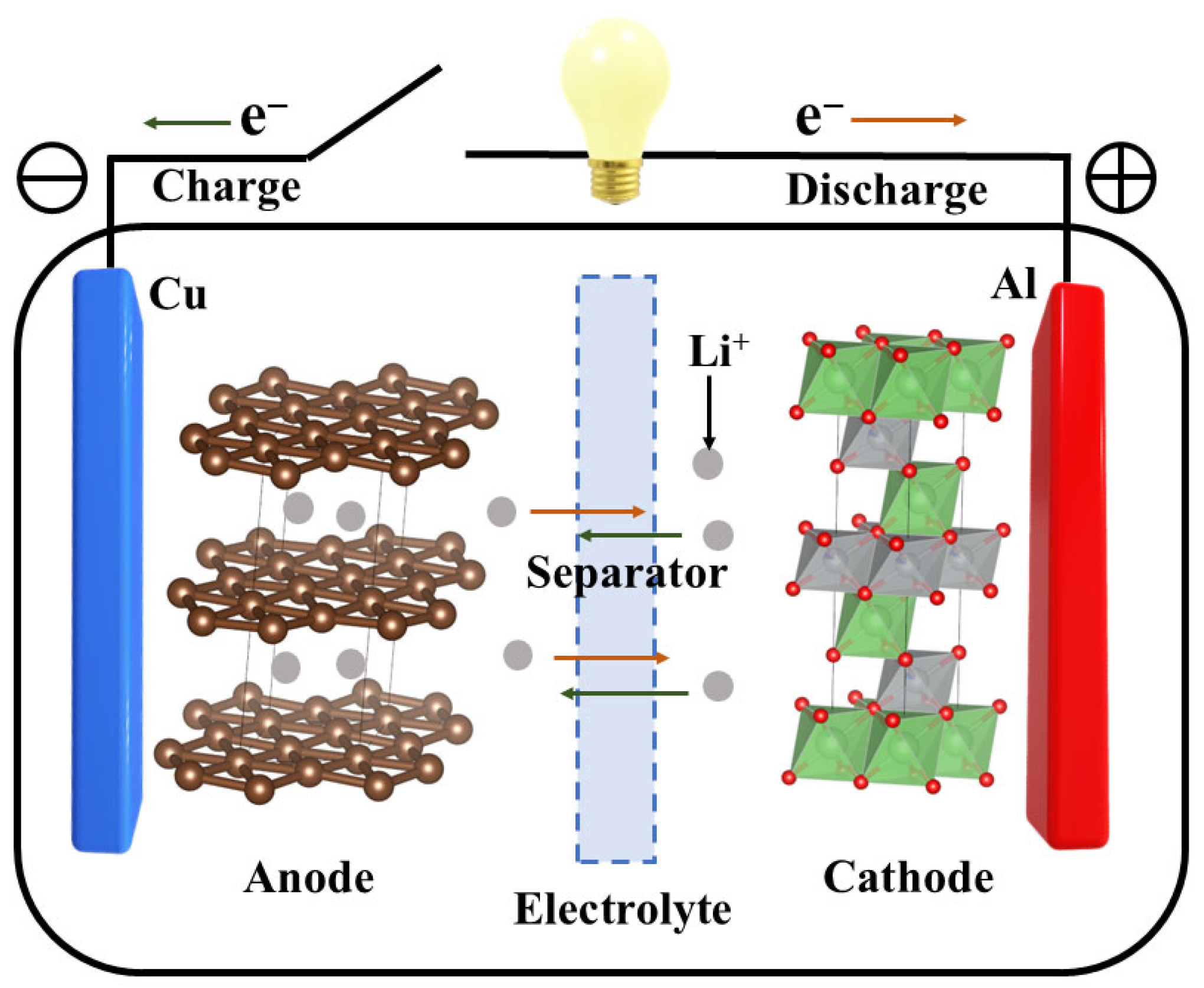
Lithium-ion batteries primarily consist of four components: the cathode, anode, separator, and electrolyte, as shown in Figure 1. During charging, under the influence of an external current, lithium ions are released from the cathode material structure into the electrolyte and then intercalate into the anode. During discharging, lithium ions are released from the anode, enter the electrolyte, and re-intercalate back into the cathode material. Taking a graphite/lithium cobalt oxide battery as an example, the reactions occurring at the cathode and anode are as follows:
Cathode reaction: LiCoO2 ↔ Li1−xCoO2 + xLi+ + xe
Anode reaction: C + xLi+ + xe ↔ LixC
Overall reaction: LiCoO2 + C ↔ LixC + Li1−xCoO2
Currently, mainstream cathode materials for LIBs mainly include three categories: spinel-type, polyanion-type, and layered oxides. Spinel-type cathode materials, represented by LiMn2O4 (LMO), are often mixed with Nickel Cobalt Manganese Layered Oxide in low-cost EVs due to their low cost and high safety [11]. Polyanion-type cathode materials, most notably Polyanion-type LiFePO4 (LFP), are recognized for their low toxicity, long cycle life, and excellent thermal stability. In recent years, LFP is widely used in power systems such as EVs, aerospace applications, power tools, and uninterruptible power supplies [12,13]. However, both material families are intrinsically limited by relatively low operating voltage and moderate specific capacities, which constrains their achievable energy density. In contrast, layered oxide cathode materials—such as LiNixMnyCozO2 (NCM), LiNixCoyAlzO2 (NCA), and LiCoO2 (LCO)—dominate the current high-end consumer electronics and EVs power battery markets. This dominance is attributed to their high theoretical specific capacity, high operating voltage, and mature preparation processes.
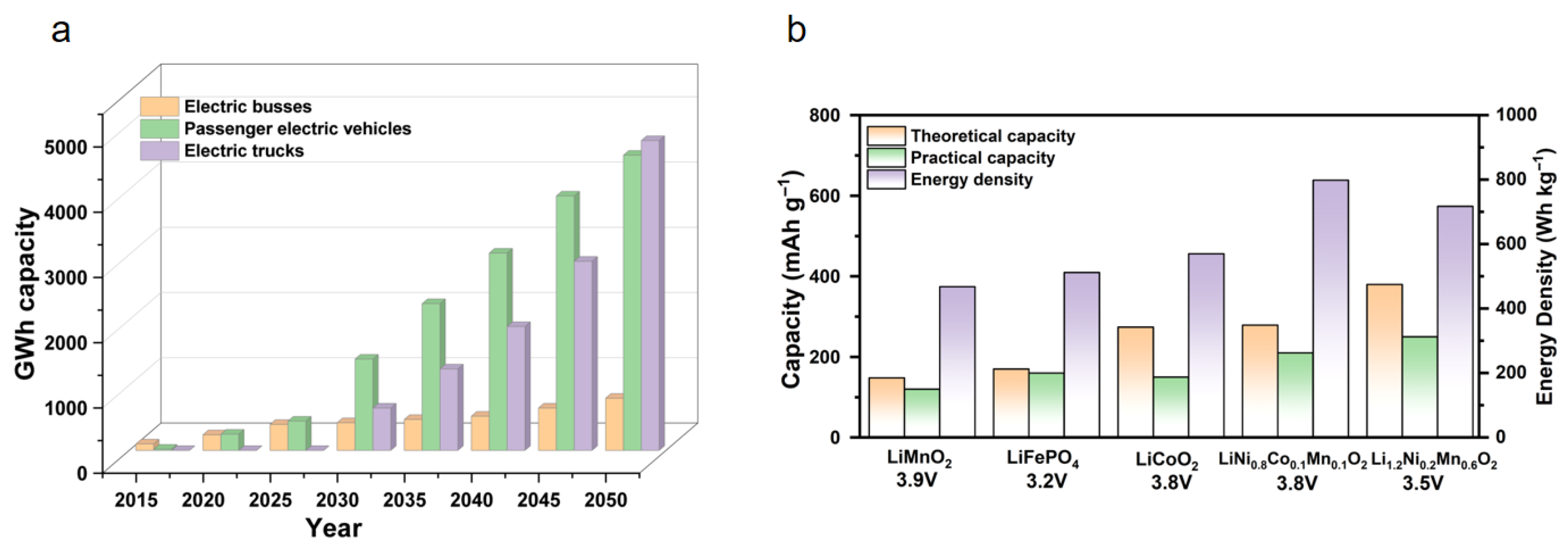
Driven by the demands of the electric transportation industry, a forecast model (Figure 2a) projects a rapid rise in energy density requirements from 2015 to 2050. This pressing need requires the development of cathode materials with superior energy density. In this context, layered oxides have emerged as the dominant choice. And their advantages are highlighted in the performance comparison of Figure 2b. Specifically, layered oxides (represented by NCM) exhibit both higher operating voltages and significantly greater reversible capacity. For instance, NCM811 maintains an average voltage of approximately 3.8 V vs. Li/Li+ while delivering a reversible capacity exceeding 200 mAh g−1, granting it a distinct advantage in energy density [14]. In contrast, although spinel LMO offers a relatively high operating voltage (~4.1 V), it suffers from a lower practical capacity [15] and severe capacity fading at elevated temperatures [11]. LFP is renowned for its excellent safety and long cycle life but is intrinsically limited by a lower operating voltage (~3.45 V) and a lower theoretical capacity than layered oxides [16].
This review first elucidates the fundamental crystal and electronic structures of layered oxide cathodes and analyzes the core challenges they are facing. Subsequently, we evaluate the mechanisms and research progress of two mainstream modification strategies: bulk doping and surface coating. Finally, we outline future development directions, emphasizing the integrated application of multiscale co-doping and multifunctional coating.

2. Key Challenges for Layered Oxide Cathode Materials

Layered oxide cathode materials have many advantages such as high energy density, elevated operating voltage, and mature manufacturing processes. But their practical deployment in next-generation high-energy LIBs is significantly limited by a series of intrinsic and interfacial instabilities. These challenges become especially pronounced under high-voltage operation or in nickel-rich and lithium-rich compositions. It means the pursuit of higher capacity often deteriorates structural degradation, triggers harmful phase transitions, and accelerates interfacial side reactions. In this section, we analyze the root causes and manifestations of these critical issues in three representative layered oxide systems: LCO, NCM/NCA, and Lithium-rich Manganese-based Layered Oxide (LRMO). thereby laying the groundwork for the discussion of modification strategies to follow.
LCO dominates the cathode market for 3C electronics [18], owing to its well-balanced combination of high energy density and exceptional manufacturability. It delivers remarkable volumetric (~3700 Wh L−1) and gravimetric (~880 Wh kg−1) energy densities when charged to 4.6 V, coupled with a high operating voltage plateau (3.7–3.9 V) and an unparalleled electrode tap density (4.1–4.3 g cm−3) [19,20,21]. For high-nickel NCM/NCA, Ryu et al. [22] have reported NCM cathodes with Ni-content ≥ 90%, specifically LiNi0.9Co0.05Mn0.05O2 and LiNi0.95Co0.025Mn0.025O2, exhibited discharge specific capacities of 227 and 235 mAh g−1, respectively, at 0.1 C (2.7–4.3 V). This represents a significant increase in energy density compared to the 80% Ni-content counterpart NCM811 (LiNi0.8Co0.1Mn0.1O2), which typically delivers around 206 mAh g−1. Thus, the high specific capacity (200–250 mAh g−1) and relatively high operating voltage (4.3 V vs. Li/Li+) of Ni-rich cathodes are their main advantages, making them the dominant choice for EVs power batteries [23]. In contrast to the aforementioned cathode materials, LRMO, with the general formula xLi2MnO3·(1−x)LiMO2 (M = Ni, Mn, Co, etc.), have attracted considerable attention due to their exceptional specific capacity (>250 mAh g−1) and considerable energy density (>1000 Wh kg−1), positioning them as one of the most promising candidates for next-generation LIBs [24,25], although they have not yet achieved large-scale commercial application and still face severe challenges such as voltage decay.

2.1. Fundamental Commonalities

2.1.1. Crystal Structure

The crystal structure foundation of layered oxide cathode materials for LIBs is based on the α-NaFeO2-type structure (space group: R-3m) [26]. In this structure, oxygen atoms are arranged in a cubic close-packed sequence, while lithium ions (Li+) and transition metal (TM) ions occupy the octahedral spaces of the oxygen lattice, forming MO6 and LiO6 octahedra. These octahedra share edges within their respective layers and share faces between adjacent layers, ultimately stacking alternately on the (111) crystal planes to form a “sandwich”-like structure composed of TM–O layers and Li–O layers [27]. The core characteristics of this structure are the two-dimensional lithium-ion transport channels and structural stability. Lithium ions undergo reversible deintercalation and intercalation within the a–b planes between adjacent transition metal layers, providing fast migration channels for lithium ions, which is key to achieving high-rate performance. The structural stability highly depends on the support provided by the transition metal layers to the oxygen framework. The type and proportion of transition metal ions directly affect the stability of the layered structure, operating voltage, and specific capacity. In recent years, the research focus has shifted from ideal structural models to understanding and controlling complex phenomena in real materials, most critically cation mixing [28]. Recent research progress emphasizes the use of advanced characterization techniques, such as in situ XRD [29], and DFT theoretical calculations [30] to precisely quantify the degree of cation mixing and investigate how structure affects properties with electrochemical performance.

2.1.2. Electronic Structure

The electrochemical behavior of cathodes is largely governed by their electronic structure. Therefore, extensive research has focused on the electronic structure of layered oxides and its evolution during cycling. These studies are typically conducted using X-ray photoelectron spectroscopy (XPS), X-ray absorption spectroscopy (XAS), and theoretical calculations [20]. The fundamental electronic structure is primarily manifested in the orbital interactions between TM ions and oxygen. In the typical α-NaFeO2 layered structure, TM ions (such as Co, Ni, Mn, etc.) occupy octahedral sites. Their 3d electron orbitals hybridize with oxygen’s 2p orbitals, forming TM–O covalent bonds. Within the octahedral coordination sphere, the 3d orbitals of the TM ion undergo splitting, yielding lower-energy t2g orbitals (dxy, dyz, dxz) and higher-energy eg orbitals (dx2−y2, dz2). The t2g orbitals form π-type interactions with oxygen 2p orbitals, while the eg orbitals undergo strong σ overlap with oxygen 2p orbitals. This hybridization results in a combination of bonding and antibonding orbitals, collectively constituting the bulk of the material’s valence and conduction bands. The degree of TM–O hybridization directly influences bandgap width, charge transfer efficiency, and the ion/covalent bond ratio.
The electronic configurations of different TM ions exhibit significant variations within this framework, thereby determining their macroscopic electrochemical behavior. For instance, Co3+ adopts a low-spin configuration (3d6: t2g6eg0) in LCO, with fully occupied t2g orbitals and empty eg orbitals, resulting in structural stability and absence of Jahn–Teller distortion. Its redox reaction (Co3+/Co4+) primarily occurs in the t2g band, resulting in a higher potential. In contrast, Ni3+ (3d7: t2g6eg1) and Mn3+ (3d4: t2g3eg1) possess unpaired electrons in their electron-gap (eg) orbitals, readily inducing Jahn-Teller distortion and potentially leading to magnetic ordering, which affects structural stability. During charging to high voltages, oxidation of TM ions typically involves electron extraction from eg related orbitals. When TM ions can no longer provide sufficient electrons for charge compensation upon being charged to high voltages, charge compensation proceeds by extracting electrons from the oxygen 2p orbitals, thereby activating anion redox reactions [31]. While this process enhances capacity, it often leads to oxygen loss, structural disorder, and voltage decay.

2.2. Material-Specific Introductions and Challenges

2.2.1. Lithium Cobalt Oxide (LCO)

LCO was identified as a cathode material for LIBs by Goodenough et al. in 1980 [32] and commercialized by Sony in 1991 [33]. It possesses a typicalα-NaFeO2-type layered structure belonging to the R-3m space group, with lattice parameters typically around a ≈ 2.816 Å, c ≈ 14.08 Å [34,35,36]. According to Pauling’s rules, Li+ can stably occupy the octahedral voids in the oxygen lattice, while the coordination of Co3+ at octahedral sites exhibits a certain degree of metastability [31]. Additionally, LCO exhibits excellent thermal stability (decomposition temperature up to about 1000 °C) and low formation energy (theoretical calculation about −1.753 eV/atom), which facilitates the formation of large (about 10 μm), highly crystalline microcrystals during synthesis [37,38], providing an important foundation for its commercial application.
Based on these excellent properties, LCO possesses exceptional volumetric and gravimetric energy density, a high voltage plateau, and ease of synthesis. To fully unlock its energy potential, it typically requires charging to high cut-off voltages (>4.2 V vs. Li/Li+), but this also introduces a series of significant challenges, including irreversible structural transformation, surface degradation, cobalt dissolution and oxygen evolution, and detrimental side reactions with the electrolyte. These challenges lead to rapid capacity decay and safety concerns [39].
Among these challenges, the detrimental phase transition induced by high voltage constitutes a critical factor leading to structural degradation and performance deterioration. When the voltage exceeds 4.55 V, LCO undergoes a detrimental phase transition from the O3 hexagonal phase to the H1–3 phase composed of O1 and O3, accompanied by the sliding of the O–Co–O slabs and the collapse of the O3 lattice structure [40,41,42]. This harmful phase transition is accompanied by severe internal strain within the crystal structure, especially on the O3 lattice. Subsequently, cracking and pulverization further aggravate unexpected capacity loss [43,44].
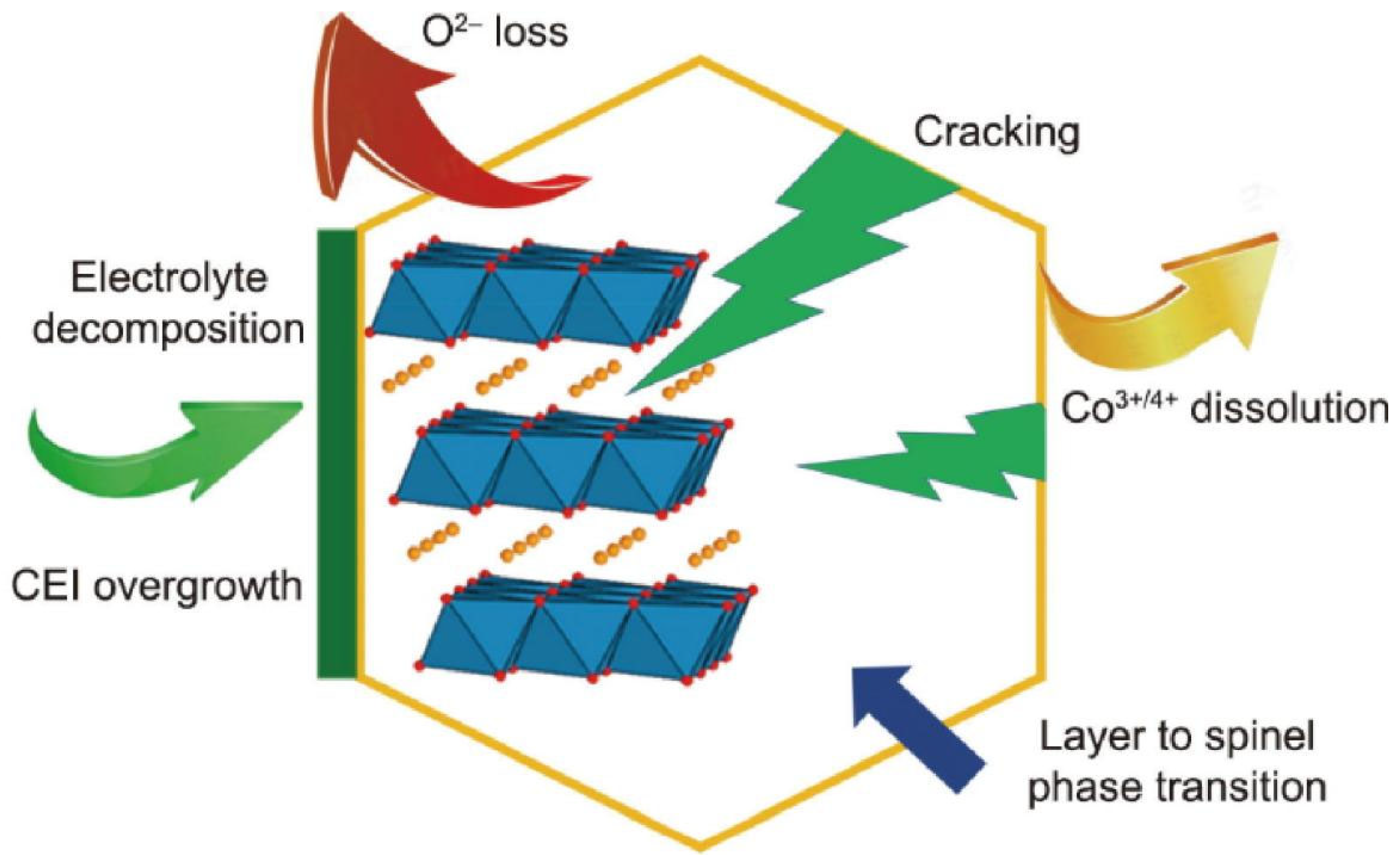
Common electrolytes have a safe electrochemical window. Once the applied electrochemical potential surpasses the electrolyte’s oxidation threshold, accelerated decomposition occurs through oxygen evolution reactions (OER) that generate superoxide radicals. Similar to the Solid Electrolyte Interphase (SEI) layer on the anode, side reactions continuously occur between the cathode and electrolyte. These long-term complex reactions lead to multiple products at the LCO particle interface, forming an electronically insulating Cathode Electrolyte Interphase (CEI). Since Goodenough’s pioneering work in 1985, CEI composition and formation mechanisms have been extensively studied [45]. To enhance the energy density of LCO, increasing the cut-off voltage is a common strategy. However, Wang et al. demonstrated that this approach induces stepped surface degradation in pristine LCO, which primarily drives rapid capacity decay [46]. As illustrated in Figure 3, upon repeated lithiation and delithiation, the LCO surface experiences synergistic degradation in both structural and chemical aspects, including stepped surface structural damage, transition metal dissolution, and the formation of an unstable CEI. These processes collectively lead to rapid capacity fading and increased interfacial impedance. Notably, this high-voltage phase transition is a direct manifestation of oxygen instability. The sliding of O–Co–O slabs at deep delithiation reflects the weakened TM–O covalency, which triggers the chain of structural degradation discussed in Section 2.3.

2.2.2. Ternary Cathode Material (NCM)

Most currently commercialized cathode materials are constrained by either low discharge capacity or poor cycling stability, issues closely linked to their crystal and electronic structures. To fulfill both requirements, NCM811, with its ultra-high reversible capacity [48], is widely regarded as the most promising candidate. It exhibits a layered structure similar to α-NaFeO2 and crystallizes in the rhombohedral system with the R-3m space group. In this structure, O2− ions occupy the 6c octahedral sites, while those of TM occupy the 3a octahedral sites, forming alternating layers with O2− ions. Li+ occupies the remaining 3b octahedral interstitial sites, facilitating reversible Li+ transport.
Nickel ions are primarily responsible for the high capacity and rate capability. Cobalt ions, meanwhile, enhance electronic conductivity and suppress cation mixing. The synergy between these ions ultimately improves both rate performance and discharge capacity. Manganese ions stabilize the layered structure by inhibiting multi-step phase transitions in nickel-rich materials upon delithiation. Furthermore, the abundance of manganese reserves reduces the cost of LIBs [49]. Collectively, this combined effect of elements gives nickel-rich NCM materials an attractive balance of high specific capacity, enhanced rate capability, and improved structural stability, making them leading candidates for high-energy-density applications.
However, nickel-rich content introduces two mainly problems. The first is Li/Ni cation mixing. During high-temperature synthesis, a fraction of Ni3+ reduces to Ni2+. The ionic radius of Ni2+ (~0.69 Å) is similar to that of Li+ (~0.76 Å), enabling it to migrate from the TM layer into Li layer vacancies, especially at high states of charge (SOC) where Li vacancy concentration is high. This migration typically follows two pathways: (I) from the Ni ions octahedral site to the nearest tetrahedral vacancy, then to the adjacent LiO6 octahedral site (Oh–Td–Oh); or (II) through an oxygen vacancy of the NiO6 octahedral site to the LiO6 octahedral site (Oh–Vo–Oh) [50]. Such cation mixing disrupts the layered order, leading to the expulsion and further migration of TM cations from the TM layer, which ultimately induces a phase transition from a disordered to an ordered arrangement of TM ions. It is predictable that the nickel-rich local structure in the NCM structure is the main cause of structural phase transition, leading to the generation of particle microcracks and lattice mismatch [51].
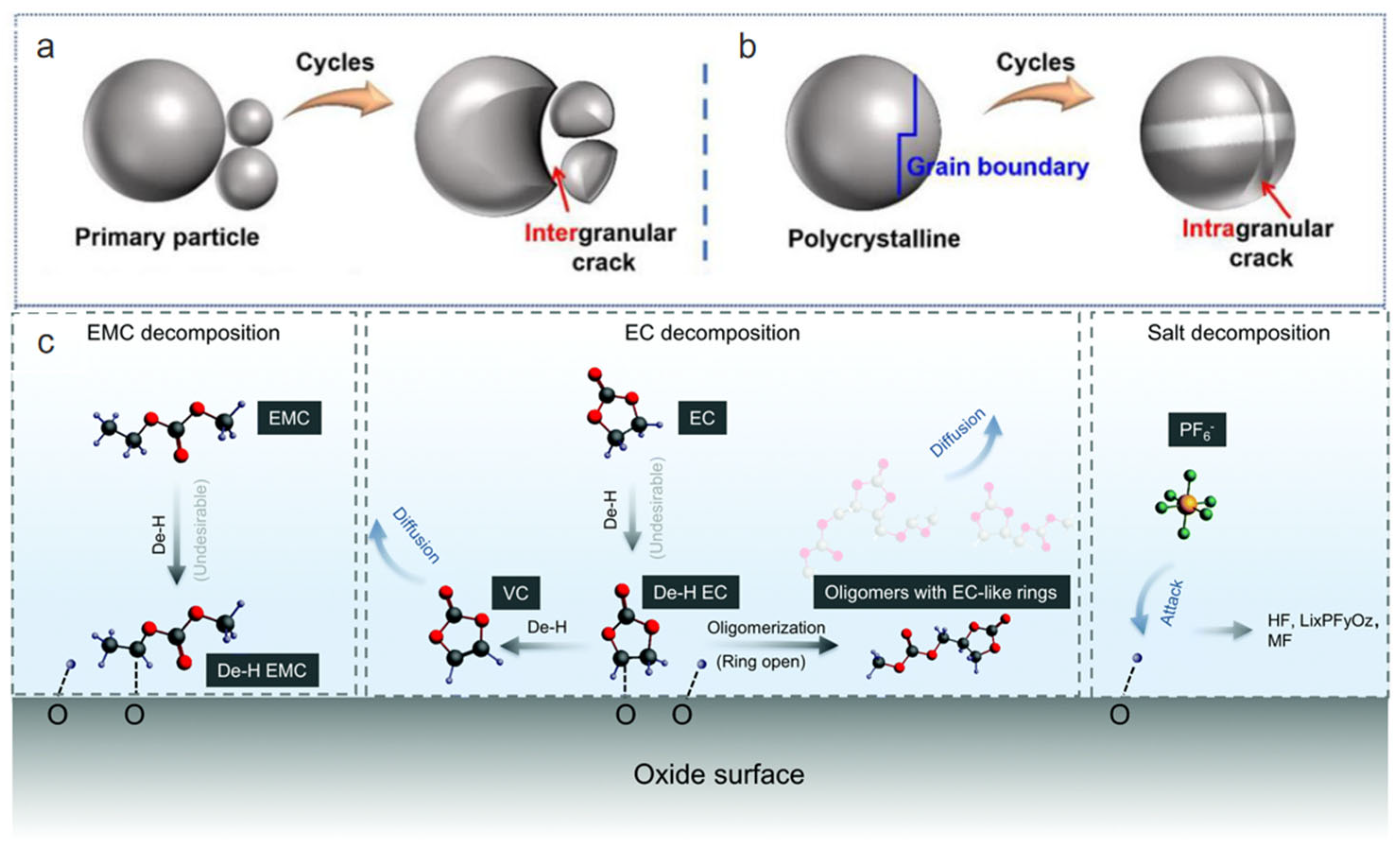
The second and most damaging mechanism is the H2–H3 phase transition. At high SOC, the H2–H3 phase transition induces abrupt and anisotropic contraction of the crystal lattice, generating severe internal stresses within the secondary particles. This accumulated stress ultimately triggers intergranular microcracks at grain boundaries. These microcracks increase the contact resistance between primary particles, leading to increased resistance in ternary cathode materials [52], and are a key factor in the cycling performance degradation of NCM811 cathodes [53]. This detrimental cycle of crack formation and electrolyte invasion is visually captured in the schematic of intergranular cracks in Figure 4a and the comparison in Figure 4b. These cracks increase the exposed surface area of the cathode in contact with the electrolyte solution, allowing for deeper penetration into the secondary particles and subsequent reaction with the internal active material. At the molecular level, Figure 4c explains the complex decomposition pathway of the electrolyte on the NCM811 surface. This ultimately leads to a resistive interphase and capacity loss. The decomposition involves both the solvent (EMC and EC) and the anion (PF6). This process initiates with the dehydrogenation of the solvent. The resulting dehydrogenated EC species can then undergo further decomposition via additional hydrogen removal or oligomerization. Critically, the key point is that the positively charged particles formed after dehydrogenation further attack the PF6 anions in the electrolyte, triggering the decomposition of the salt. These decomposition products, mainly from the solvent, accumulate on the electrode surface and form a high-resistance film. This film significantly increases the battery’s internal resistance, which is the main reason for the capacity decay of NCM811 batteries. Such side reactions may further induce structural changes in the cathode material, leading to structural collapse and oxygen release.
Meanwhile, safety concerns related to thermal runaway in LIBs have hindered their widespread adoption in battery applications. Improving the thermal stability of cathode materials is crucial for reducing the frequency of thermal runaway events. Studies indicate that the root cause lies in the release of lattice oxygen and structural phase transitions that occur in NCM ternary layered oxide materials under thermal abuse conditions.
While nickel-rich layered oxide cathodes achieve superior specific capacities, their nickel-rich content intrinsically degrades thermal stability. Bak et al. [54] utilized in situ time-resolved X-ray diffraction (TR-XRD) and mass spectrometry (MS) to analyze the thermal stability of various NCM ternary layered oxide materials, specifically NCM433, NCM523, NCM622, and NCM811. The phase transition sequence observed during the thermal decomposition of these materials is as follows: layered → spinel → M3O4-type spinel → rock-salt structure, accompanied by oxygen release during these transitions. TR-XRD/MS results indicated that increased nickel content in NCM ternary layered oxide materials correlates with a lower onset temperature for phase transitions and an increased amount of released oxygen. Among the materials studied, NCM811 exhibited the lowest thermal stability, initiating phase transitions around 150 °C and releasing a significant amount of oxygen. In contrast, NCM523 exhibited excellent thermal stability. The enhanced stability and capacity of NCM523 are largely attributed to its balanced composition of Ni, Co, and Mn. Ni is considered the most unstable component, particularly under a high SOC. Under this condition, Ni exists dominantly as highly oxidative Ni4+, which readily extracts electrons from lattice oxygen, leading to oxygen evolution and thereby undermining the structural stability of the crystal lattice. This negative correlation between nickel content and thermal stability is no coincidence. It reflects the same root cause driving electrochemical degradation under high voltage, oxygen instability. Whether triggered by heat or charging, the release of lattice oxygen represents an inherent weakness in nickel-rich chemistry systems.
This instability is equally pronounced at the interface. The highly reactive nickel-rich surface readily catalyzes the oxidative decomposition of conventional organic electrolytes, particularly under the high operating voltages required for such cathodes [55]. This irreversible process generates a thick and unstable CEI layer on the cathode surface. Without a dense and thin CEI, continuous electrolyte decomposition persists, while interfacial Li+ transport is simultaneously impeded [56,57]. Concurrently, the decomposition consumes active Li+, further accelerating capacity fade [58,59,60].
Additionally, during the synthesis of cathode materials, lithium-rich compounds such as Li2O tend to remain on the surface of active material particles. When these materials are inevitably exposed to air during post-synthesis handling, they react with moisture and carbon dioxide to form impurities including LiOH and Li2CO3. These compounds further compromising electrode processing and overall battery performance [61]. In contrast, Co and Mn contribute significantly to improving the material’s thermal stability. They effectively widen the temperature range over which phase transitions occur. Specifically, these transitions involve the transformation to LiMn2O4 and M3O4-type spinel structures. Additionally, loss of lattice oxygen during material synthesis and at high charge voltages generates a large number of oxygen vacancies, accelerating nickel migration via pathway II. Therefore, the severity and frequency of Li/Ni mixing increase with the state of charge and operating voltage [62].
Figure 4. (a) Schematic illustration of intergranular crack; (b) Schematic illustration of pristine and cycled NCM811, reprinted with permission from Ref. [50]. Copyright 2025, Wiley; (c) Proposed mechanism and pathways of electrolyte decompositions on NCM811, reprinted with permission from Ref. [63]. Copyright 2020, Royal Society of Chemistry.
Nanoenergyadv 06 00012 g004

2.2.3. Lithium-Rich Manganese-Based Layered Oxide (LRMO)

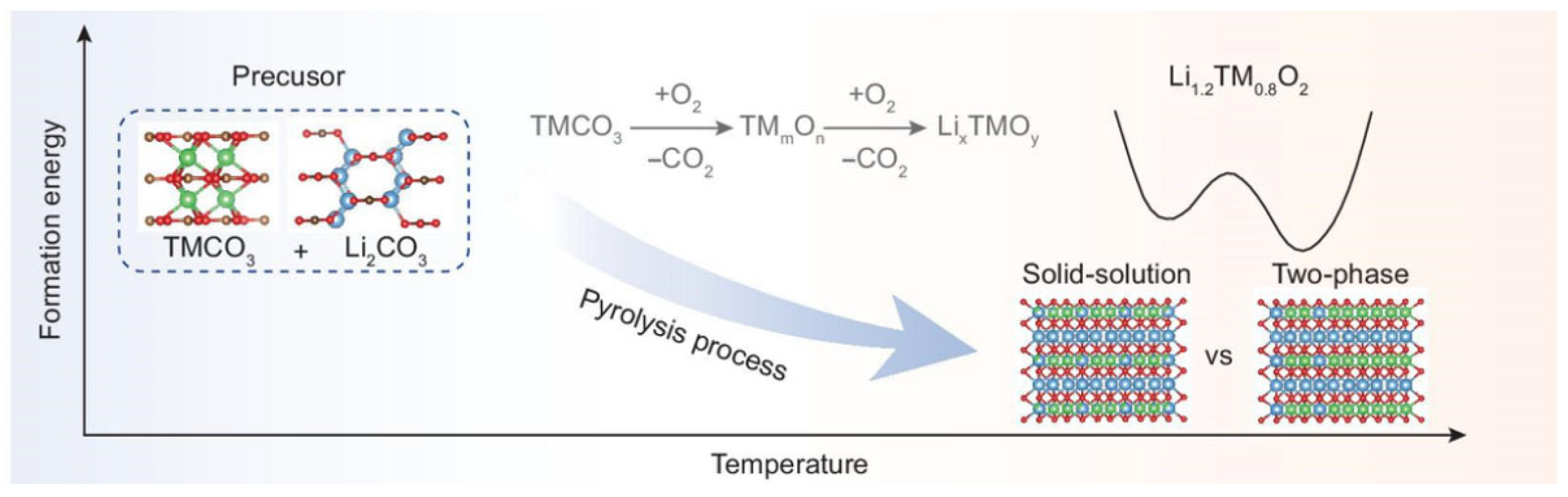
Regarding the structure of LRMOs, the debate between the “solid solution” model and the “two-phase composite” model persists to this day [64]. Jarvis et al. employed high-spatial-resolution HAADF-STEM to observe long-range ordered arrangements of Li and Mn within the transition metal layer, rather than interface-separated nanodomains, demonstrating that the material constitutes an atomically uniform solid solution [65]. Yu et al. employed atomic-resolution ABF/HAADF-STEM techniques to directly observed a two-phase structure in Li1.2Mn0.567Ni0.166Co0.067O2 material, featuring the coexistence of the rhombic LiTMO2 phase and the monoclinic Li2MnO3 phase along with their heterointerface, providing evidence for the “two-phase composite” model [66]. The debate surrounding the structural model of LRMO may partly stem from its sensitivity to synthesis conditions. In Figure 5, recent in situ XRD studies by Wang et al. [67] indicate that its synthesis is a temperature-driven dynamic process: starting from an initial solid solution intermediate phase, it ultimately evolves into a thermodynamically stable two-phase composite structure after high-temperature treatment. Therefore, the observed “solid solution” or “two-phase” characteristics likely reflect the material being “frozen” at different stages of synthesis.
The fundamental origin of voltage decay remained equally enigmatic. It was not until 2022 that Liu et al. [68] achieved a breakthrough using in situ, nanosensitive coherent X-ray diffraction imaging (BCDI) and other characterization techniques. Building upon the two-phase model, they discovered intrinsic differences in electrochemical activity between the LiTMO2 and Li2MnO3 components. During battery operation, this heterogeneous electrochemical reaction kinetics induces uneven lithium intercalation and deintercalation, leading to the continuous accumulation of lattice strain and displacement within the material. The study demonstrates for the first time that this accumulated lattice strain and displacement is the direct driving force behind oxygen release and structural phase transitions.
The unique crystal structure of LRMO leads to anomalous electrochemical behavior during the first charge process, manifesting as a typical long voltage plateau above 4.4 V vs. Li/Li+ [69]. This plateau originates from the electrochemical activation of the Li2MnO3 phase within the material, during which Li+ deintercalate from the TM layer, and their charge is compensated by the oxidation of lattice oxygen (O2−/On−) [70,71].
This anionic redox reaction is the key source of LRMO’s ultra-high discharge capacity. However, it also triggers a series of severe electrochemical challenges. The oxygen redox during the initial charge is not fully reversible, leading to the irreversible release of part of the lattice oxygen as oxygen gas. This process not only directly consumes active Li sources (removed as Li2O), resulting in low first-cycle coulombic efficiency (typically only 80–88%). More importantly, it triggers a chain of negative structural evolution. The loss of lattice oxygen creates vacancies in the lattice, destabilizing the transition metal sublattice, thereby driving the migration of TM ions (especially Mn4+) into the Li layer vacancies. As discovered early by Yamada et al. [72] and later revealed by Gent et al. [73] using advanced characterization techniques, this TM ions migration triggers an irreversible phase transition from the layered structure to a spinel phase, and further to a rock-salt phase in the material’s near-surface region.
This structural degradation from the surface inward directly triggers two other core challenges. On one hand, the spinel and rock-salt phases formed on the material surface have poor ionic and electronic conductivity. This severely hinders Li+ transport at the electrode–electrolyte interface, leading to a significant drop in rate performance. On the other hand, the continuous phase transition process is the main inducer of voltage decay during cycling. Xu et al. [74] used aberration-corrected high-angle annular dark-field scanning transmission electron microscopy (HAADF-STEM) to observe Li[Ni1/5Li1/5Mn3/5]O2 materials before and after cycling, finding obvious spinel structure on the surface after cycling. This result indicates that a structural transformation from layered to spinel phase occurred on the LRMO surface during electrochemical cycling. This transformation was accompanied by severe surface Li loss, rooted in the migration of a large number of TM ions into Li layer vacancies. The decrease in operating voltage stems directly from TM ions occupying Li sites. These ions block reversible Li+ deintercalation and raise the migration energy barrier within the lattice. Furthermore, Fell et al. [75] pointed out that micro-strain generated due to lattice mismatch during phase transition further exacerbates structural instability. These factors collectively drive a continuous decrease in average discharge voltage and rapid energy density decay.
The above discussions highlight the distinct degradation mechanisms in LCO, NCM/NCA, and LRMO materials, which are rooted in their respective crystal and electronic structures. Despite their differences, all three systems share common challenges related to structural instability, interfacial side reactions, and oxygen activity under high-voltage or high-nickel conditions. To provide a clear comparative overview, Table 1 summarizes the core advantages and key challenges of these major layered oxide cathode materials.

2.3. The Central Role of Oxygen Instability

The failure mechanisms in LCO, NCM, and LRMO are discussed separately in the preceding sections. These phenomena exhibit high consistency across different layered oxide cathode material systems. Issues such as oxygen loss, transition metal migration, phase transitions, microcrack formation, and interfacial instability are intrinsically linked. Together, they dictate the structural degradation and performance decline of layered oxide cathodes during cycling. The so-called “oxygen instability” or “oxygen-involved redox” in layered oxide cathodes does not simply represent the conversion of O2− to O or the direct release of molecular oxygen upon oxidation. Rather, it constitutes an intrinsic structure–electron coupling behavior jointly induced by specific local structural configurations and electronic state characteristics. Its root causes lie in the alteration in TM-O covalency, the formation of non-bonding O 2p states, and the presence of unique Li–O–Li coordination environments. In over-lithiated layered oxides, lithium occupies some transition metal sites, forming abundant Li–O–Li configurations. This localized environment weakens TM–O bonding strength, significantly elevating the corresponding O 2p orbital energy levels and imparting non-bonding characteristics. Consequently, during deep delithiation when the redox capacity of transition metals is depleted, these high-energy oxygen species preferentially participate in electrochemical oxidation [76].
Although oxygen participation in oxidation contributes additional capacity to some extent, the oxidized oxygen species often struggle to remain stably incorporated within the layered lattice over extended periods. Oxygen oxidation undermines the integrity of the TM–O covalent framework and destabilizes the local coordination environment. This triggers a cascade of degradation processes, including lattice oxygen release, structural collapse, and transition metal migration. Specifically, the weakened TM–O bond substantially lowers the energy barrier for transition metal ions migrating from the transition metal layer to the lithium layer. Transition metal ions with radii similar to Li+ are more prone to migration, readily occupying lithium sites. This leads to cation disorder and a structural transformation from layered to spinel and then to rock-salt phases [73]. This process induces irreversible structural transformation and further disrupts the local structural conditions necessary for oxygen stability, thereby establishing a progressive cycle of “oxygen instability → transition metal migration → structural collapse.”
Notably, while the aforementioned failure mechanisms share highly consistent origins across different layered oxide systems, their specific manifestations and dominant contributions vary. For LCO, due to its strong TM–O covalent bonding and oxygen instability typically occurring only at high voltages, failure behavior primarily manifests as surface oxygen release and local structural rearrangement. In contrast, within nickel-rich NCM/NCA systems, high nickel content reduces TM–O bond energy. Under deep delithiation conditions, lattice oxygen readily participates in oxidation reactions, leading to a more pronounced coupling effect between oxygen instability and transition metal migration. This typically manifests as phase transitions, structural collapse, and voltage decay. In LRMO, the prevalence of Li–O–Li configurations makes oxygen participation in oxidation a key source of high theoretical capacity, yet it also most readily triggers severe oxygen release, transition metal migration, and structural degradation.
Microcrack formation in layered oxide cathodes represents a classic electrochemical-mechanical coupling process. Electrochemically induced phase transitions often accompany anisotropic lattice changes, leading to sustained internal stress accumulation during repeated cycling and ultimately triggering microcrack initiation. These microcracks not only compromise the mechanical integrity of cathode particles but also provide pathways for electrolyte infiltration into the particle interior, further accelerating CEI growth [77]. Therefore, bulk structural degradation, transition metal migration, and interfacial side reactions are not isolated phenomena but are tightly coupled through the core mechanism of oxygen instability, collectively governing the performance degradation of layered oxide cathode materials.

3. Modification Strategies for Layered Oxide Cathode Materials

Recent research aims to employ synthesis methods like surface coating and elemental doping to overcome problems limiting their electrochemical performance [78].
Doping refers to the substitution of anions or cations within the crystal lattice. It introduces a small amount of heteroatoms without altering the bulk phase. This technique has become a key method for improving the structure and electrochemical performance of cathode materials [79]. Surface coating functions by constructing a physical and chemical barrier on the exterior of active material particles. This barrier effectively minimizes direct contact between the cathode and the electrolyte. Consequently, it prevents side reactions under high-voltage conditions, reduces transition metal dissolution, and enhances interfacial stability [80]. In addition to the two main modification methods mentioned above, other approaches can also enhance the electrochemical performance of layered oxide cathode materials. The entropy stabilization strategy serves as a universal method for improving material stability. Song et al. [81] successfully applied the entropy stabilization strategy to LRMO, improving the local structural adaptability and stability of the material. In terms of precursor design, Liu et al. [82] employed gradient coprecipitation to mitigate Li/Ni cation mixing in NCM materials. These modification methods enhance the material’s ability to resist structural degradation and interfacial side reactions under high voltage across multiple dimensions, from bulk to surface.

3.1. Elemental Doping

The role of elemental doping in layered oxide cathode materials can be understood from three fundamental aspects: First, it regulates the TM–O bond strength and lattice oxygen stability [83]; Second, it modulates charge compensation pathways during lithium extraction and alters local structural evolution through site-selective occupation [84]. The role of dopant elements extends beyond simple compositional modification. Instead, they selectively target one or more key degradation mechanisms, thereby influencing the material’s overall degradation behavior. Doping elements such as Al, Mg, Ti, and Zr are commonly employed to reinforce the TM–O framework structure and suppress oxygen instability. These elements exhibit strong bonding affinity with oxygen and possess low redox activity. Consequently, they stabilize the crystal lattice structure and indirectly inhibit transition metal migration. High-valent dopants effectively modulate the charge compensation pathway during delithiation by delaying the participation of lattice oxygen in charge balance. This reduces the likelihood of oxygen instability at high states of charge. The selective occupation of dopants at either transition metal or lithium sites is decisive for their regulatory effect, as this directly influences the local coordination environment and the tendency for cation disorder.
By introducing heteroatoms into the lattice framework, with appropriate synthesis control, the layered structure of LCO can be modified by doping with different additional elements. Typically, this doping treatment does not alter the layered structure of LCO itself, but the physicochemical properties of the cathode material can be significantly regulated after introducing trace doping elements. The past few years have documented various doping effects observed for different elements, including various elements and different methods [85,86,87,88,89]. For example, Mg doping can improve the electronic conductivity of the cathode material [90], while Ti [91], Sb [92], Ni [93], etc., can change lattice parameters. Al doping is regarded as the most widely adopted single-element doping strategy, as it effectively reduces the stabilizes the crystal structure of LCO while enhancing its redox potential [94]. Despite these advances, researchers continue to explore novel doping architectures to further enhance high-voltage stability. Wang et al. [95] proposed a gradient Ta doping strategy to enhance the electrochemical performance of LCO at a high voltage of 4.6 V. They successfully synthesized LCO cathode materials with varying Ta doping concentrations via a solid-state reaction method. The experimental results demonstrated that the optimized Ta-doped LCO with 1 mol% exhibits outstanding overall performance: it delivers a high discharge capacity of 165.1 mAh g−1 at 5 C and maintains a remarkable capacity retention of 88% after 150 cycles at 0.5 C. The performance improvement is primarily attributed to two factors. First, strong Ta–O bonds stabilize the lattice oxygen. Second, the expanded interlayer spacing facilitates lithium-ion transport. Collectively, these effects suppress irreversible structural transformations under high-voltage operation. Although single-element doping can enhance some properties of LCO materials, its effectiveness is inherently limited. It fails to simultaneously tackle the multiple challenges under high-voltage operation, such as bulk structural distortion, interfacial side reactions, and hindered ion transport.
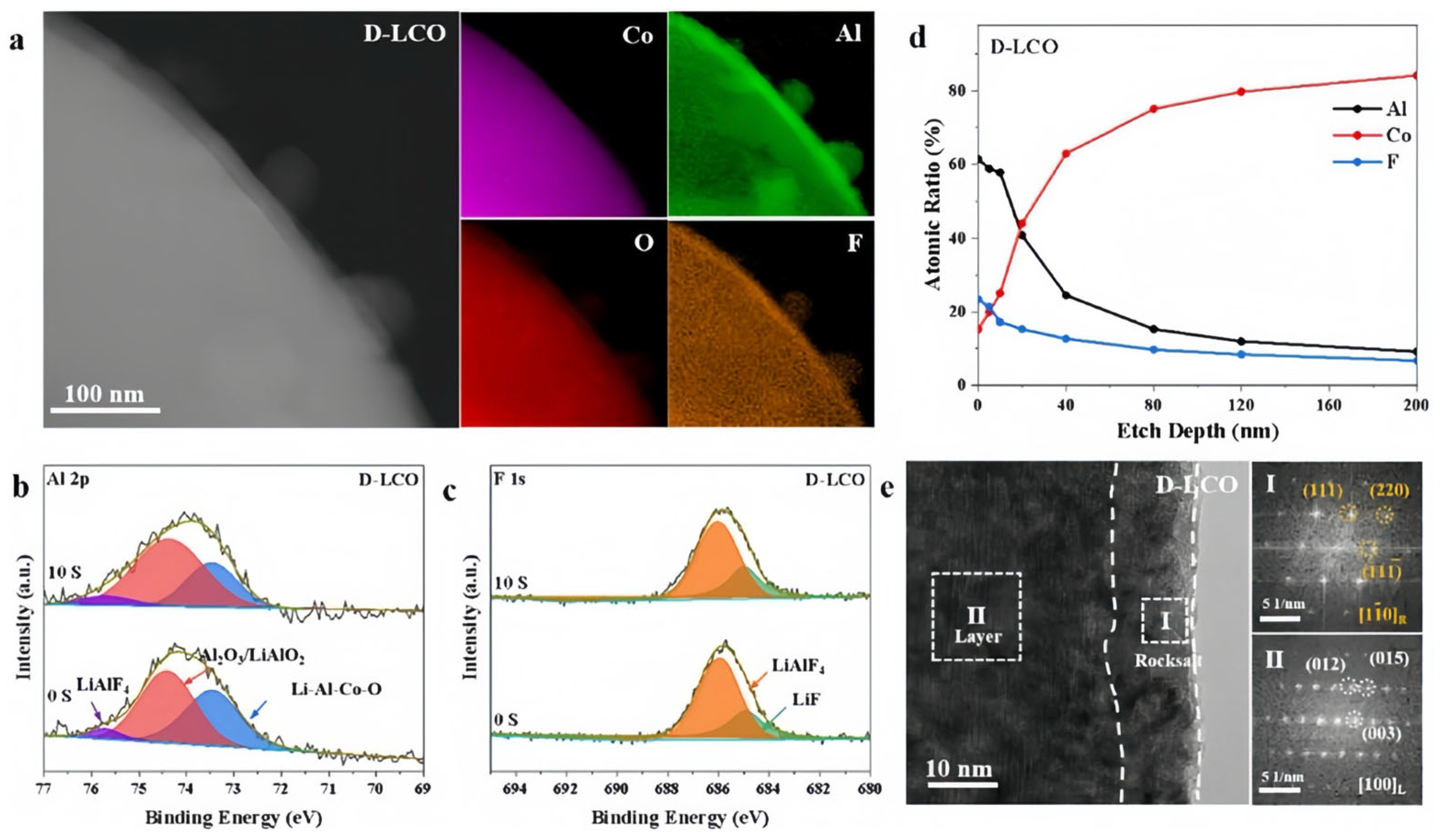
In recent years, researchers have increasingly turned to multi-element co-doping strategies to achieve more comprehensive performance enhancement. A representative example is the dual-optimized LCO reported by Yi et al. [96], which features synergistic subsurface Al/F co-doping (depth > 50 nm) coupled with a surface rock-salt phase. The successful implementation of this dual-optimized strategy has been systematically validated through a series of complementary characterization techniques. Figure 6a presents transmission electron microscopy (TEM) and corresponding energy-dispersive X-ray spectroscopy (EDS) mapping of the particle surface. The results demonstrate a uniform distribution of Al and F elements. The high-resolution XPS spectra of Al 2p and F 1s in Figure 6b,c further elucidate the chemical states of the doped elements, indicating their presence in the forms of LiAlF4, LiF, and Li–Al–O species. The semi-quantitative XPS depth profile in Figure 6d demonstrates the deep diffusion of Al/F, which extends up to 80 nm beneath the surface and confirms the formation of a reinforced subsurface region. Figure 6e presents the cross-section TEM morphology and the diffraction analyses in the surface and subsurface regions of D-LCO. The results reveal that D-LCO exhibits a surface RS phase (thickness of 10 nm), serving as a surface structure reinforcing layer, while the subsurface maintains a pure layered phase. This sophisticated design specifically addresses the intertwined challenges at ultrahigh capacity (236 mAh g1 at 4.6 V vs. Li+/Li). The D-LCO cathode demonstrates excellent cycling stability, retaining 90.3% of its capacity after 200 cycles at 1 C and 81.2% after 1000 cycles even at the high rate of 4 C. This demonstrates that multi-element co-doping, which simultaneously stabilizes the anionic and cationic sublattices, can effectively address both bulk structural degradation and interfacial instability in high-voltage layered oxide cathodes.
Elemental doping serves as an effective strategy for mitigating surface side reactions on nickel-rich NMC cathode particles. When a dopant with a large ionic radius is introduced as a cation, it can expand the interlayer spacing within the lattice structure. This enlargement facilitates easier lithium-ion insertion and extraction during cycling. This expansion not only increases Li+ diffusion but also enhances structural stability. Furthermore, the higher ionic radius allows the dopant to reside on the cathode particles, protecting the particle surface and refining particle morphology to suppress crack formation [97]. During charging, the doped material exhibits a smaller change in the c/a ratio compared to the undoped material, which can delay the H1 to H3 phase transition and thereby mitigate lattice strain within the active cathode particles. This alleviation of volumetric shrinkage during battery charging helps maintain particle morphology and integrity while reducing microcrack formation at high anode potentials [98]. The introduction of suitable dopants can expand the pathways for Li+ diffusion while also oxidizing Ni2+ to Ni3+ due to its strong oxidizing power when doped into the material, thereby reducing Li+/Ni2+ mixing. Ko et al. [99] published an extensive review on the results of 46 dopant elements in NMC over the years. These include Mo6+ [100], Te6+ [101], Ta5+ [102], Nb5+ [103], Ce4+ [104], etc. Taking Al doping [105] as an example, Al doping mitigates anisotropic lattice changes and volume changes during cycling. It also maintains a wider LiO6 inter-slab thickness from collapsing at high states of charge, stabilizing the structure of the cathode material via strong Al–O bonds. This is because Al–O (512 kJ mol1) bonds are stronger than Ni–O (391.6 kJ mol1), Co–O (368 kJ mol1), and Mn–O (402 kJ mol1), making the crystal structure of the cathode material more stable. Meanwhile, Zr doping has become an effective strategy to enhance the electrochemical performance of lithium cathode materials by stabilizing the crystal structure, improving lithium-ion diffusion, and suppressing phase transitions [106].
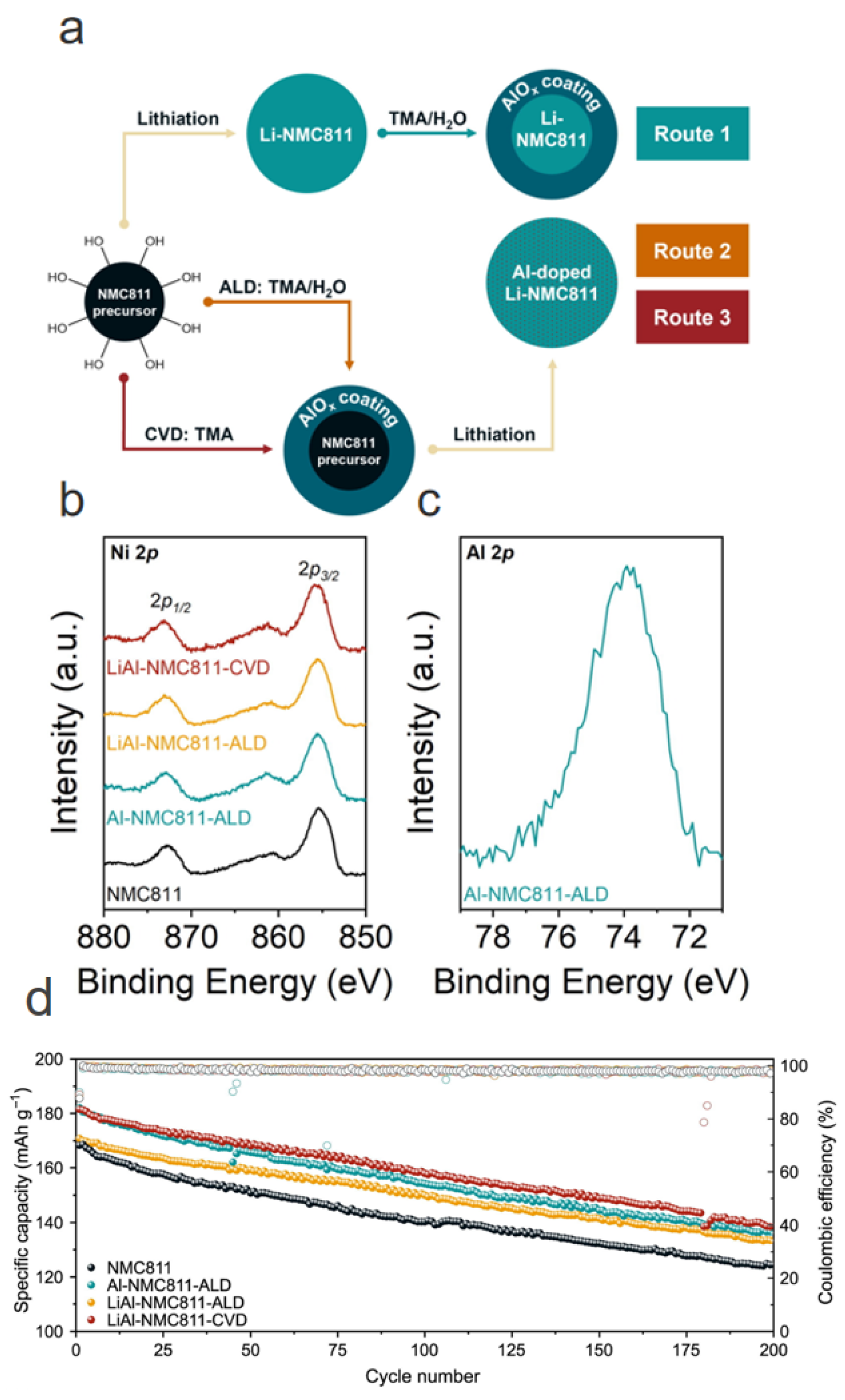
Al2O3 has been widely studied as a coating material for NCM811 cathodes prepared by Atomic Layer Deposition(ALD) [107]. In an innovative approach, Bogdanova et al. compared three different synthetic routes to evaluate the modification effects of ALD and post-lithiation treatment on NMC811 cathodes, revealing distinct stabilization mechanisms. As shown in Figure 7a, Route 1 employs a conventional ALD process to deposit an AlOx coating on NMC811 powder. Route 2 follows a similar ALD process but uses the hydroxide precursor Ni0.8Mn0.1Co0.1(OH)2 as the substrate. Route 3 adopts a Chemical Vapor Deposition (CVD)-like process in which Ni0.8Mn0.1Co0.1(OH)2 is treated solely with trimethylaluminium (TMA), followed by a water-vapor treatment to remove residual precursor. XPS analysis indicates that the Ni 2p spectra of all samples are consistent (Figure 7b), suggesting similar oxidation states of nickel. However, a distinct Al 2p signal is detected only on the sample from Route 1 (Figure 7c). The absence of Al3+ on the surfaces of samples from the other two routes confirms that aluminum is incorporated into the bulk lattice during the post-lithiation modification. The post-lithiation route does not generate a continuous surface protection layer. Instead, it achieves bulk doping with stronger Al–O bonds and uniform elemental distribution, which explains the improved cycling stability. Among them, Route 3 exhibits the highest capacity retention (78%, 3.0–4.4 V, 1 C), outperforming the 75% retention of Route 1 (Figure 7d). Although the performance improvement observed in this study is moderate, the method holds significant potential for future surface modification of electrode materials using heavy-element oxides such as niobium and tantalum [108].
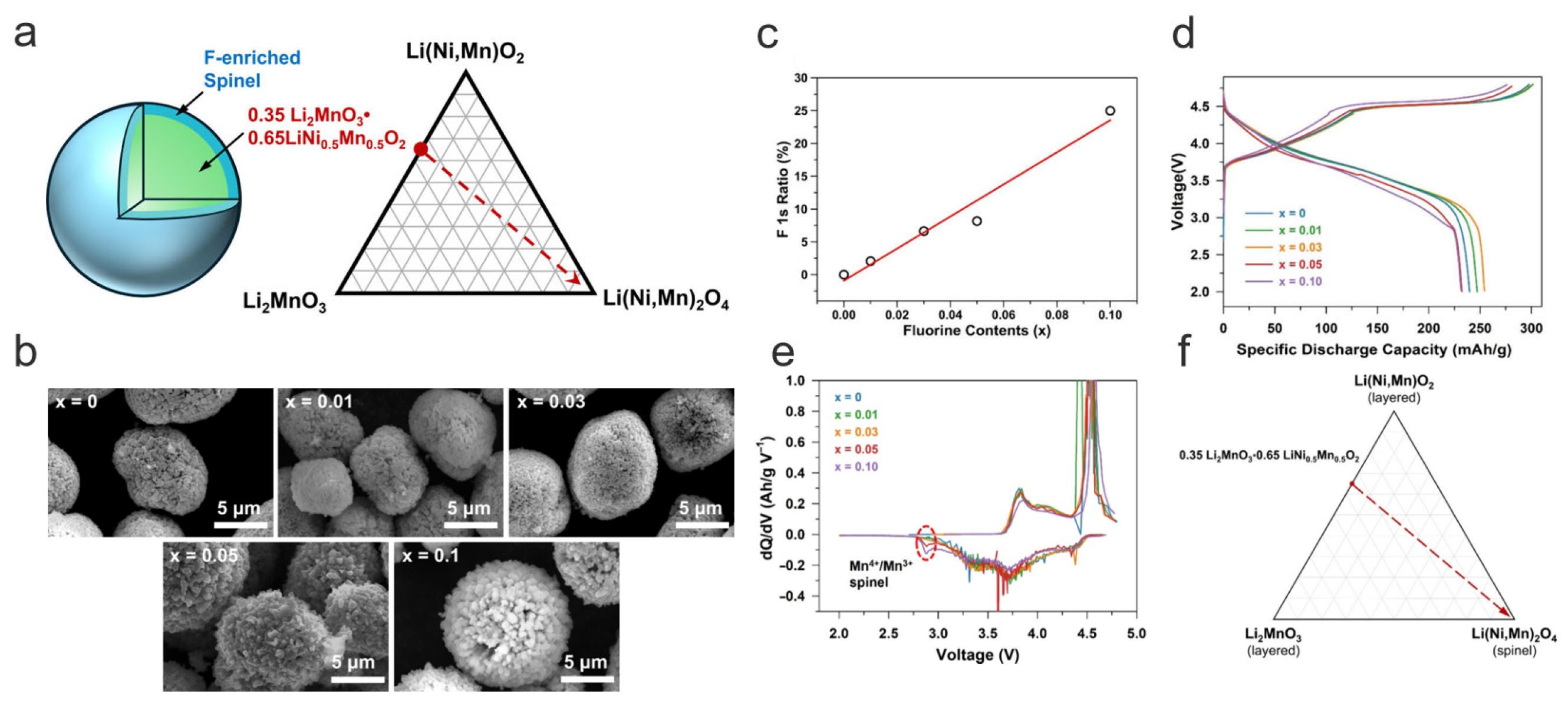
Elemental doping has emerged as one of the simplest and most effective approaches to enhance the structural stability of LRMO material, suppress irreversible oxygen redox reactions, mitigate oxygen loss, and inhibit discharge voltage decay. It offers two key advantages over surface coating or treatment. First, it introduces no heterogeneous layers, avoiding potential structural incompatibility. Second, it does not sacrifice material capacity by incorporating electrochemically inactive passivation layers [109]. Elemental doping addresses its voltage decay and poor cycling stability by regulating the crystal structure and suppressing side reactions. Cation doping primarily stabilizes the host structure by introducing metal ions with different valence states. Luo et al. [110] introduced Al substitution into a Co-free LRMO material by co-calcining Al2O3 with Na2CO3 and Li2CO3 during the lithiation process, using a molten salt method for ion exchange. This method demonstrated reduced oxygen release, cation mixing, and voltage decay. Besides common cation doping, research has also explored the effects of anion doping. Anion doping primarily functions by introducing anions to modulate the local charge distribution and bonding environment, demonstrating particularly remarkable effectiveness in stabilizing interfaces. Kang and Amine studied the effect of F doping in lithium-rich layered cathodes, resulting in improved cycling performance and thermal stability under high-temperature conditions [111]. The efficacy of fluorine doping in modulating the surface properties of lithium-rich manganese-based cathodes is comprehensively detailed in Figure 8. Choi et al. employed an NH4F treatment combined with thermal annealing to incorporate fluorine into the structure of Li1.15Ni0.28Mn0.57O2−xFx, achieving varying doping concentrations. Figure 8a present a novel approach to surface modification by fluorine (F) doping. As schematically illustrated in SEM images of the F-doped LRMO materials (Figure 8b), the introduction of fluorine does not exert a significant effect on the secondary particle sizes. However, samples with large amounts of F-doping (e.g., ≥5%) exhibit a rough surface morphology in the SEM images due to the growth of the primary particle sizes. XPS quantitative analysis (Figure 8c) reveals a linear increase in surface fluorine signal with doping concentration, indicating significant fluorine accumulation in the near-surface region. Electrochemical characterization in panels (Figure 8d) and (Figure 8e) reveals that the optimal performance in half-cells is achieved at a doping concentration of x = 0.03, exhibiting enhanced initial cycle performance and distinct redox behavior, characterized by a pronounced reduction peak at 2.75 V corresponding to Mn4+/Mn3+ redox in the spinel phase. Critically, mechanistic studies confirm that the performance improvement is primarily attributable to the pre-formed spinel phase on the surface, rather than changes in the bulk structure. The phase diagram in Figure 8f conceptually situates this surface transformation within the broader Li(Ni,Mn)O2-layered Li2MnO3-spinel Li(Ni,Mn)2O4 compositional system, underscoring the role of fluorine in steering the surface chemistry. This work provides novel design insights for the surface engineering of lithium-rich cathodes, highlighting anion doping as a precise tool for interfacial stabilization [112].
To concisely overview recent progress, Table 2 summarizes key doping strategies and their electrochemical performance improvements reported over the past three years.
We can observe that the trend in elemental doping is shifting from single-element to multi-element approaches. Although single-element doping has demonstrated certain advantages in enhancing the structural stability of layered oxide cathode materials, its regulatory capability is constrained by the trade-off between structural stability and electrochemical activity. A single dopant element typically struggles to simultaneously address multiple degradation mechanisms such as oxygen instability, transition metal migration, and structural degradation. Furthermore, excessive doping with electrochemically inert elements inevitably leads to a significant reduction in reversible capacity. Therefore, researchers have proposed multi-element doping and anion-cation synergistic regulation strategies. Different doping components can play complementary roles in stabilizing the bulk structure, modulating oxygen-involved redox behavior, and suppressing transition metal migration. This approach provides a more effective solution for addressing the multi-scale, multi-mechanism coupled degradation behavior in layered oxide cathode materials. This principle is clearly demonstrated in the following cases: Al/F co-doping in LCO to simultaneously stabilize oxygen and cobalt, Zr/Ti co-doping in NCM for synergistic bulk and interfacial stability, and combined anion/cation doping in LRMO to regulate redox activity and structural integrity. Such multi-element doping represents a more powerful and necessary engineering approach for next-generation cathodes.

3.2. Surface Coating

Surface coating can form a stable protective layer on the surface of cathode particles, effectively mitigating side reactions between the electrolyte and electrode while inhibiting the dissolution of transition metals. Typically, an ideal surface coating material should possess both excellent resistance to electrolyte dissolution and strong oxidation stability. Currently, extensively studied coating materials primarily include metal oxides (e.g., Al2O3, TiO2, MgO) and phosphates (e.g., MnPO4, AlPO4). These coatings primarily function by forming an inert barrier layer between the cathode and electrolyte, thereby inhibiting electrolyte decomposition and surface oxygen loss. Metal fluorides (e.g., LiF, AlF3) suppress interfacial side reactions to enhance stability, while lithium compound coatings (e.g., Li3PO4, LiNbO3) form lithium-conductive interfaces that maintain chemical passivation while promoting Li+ transport. Surface coatings of carbon-based materials can enhance material conductivity and improve lithium interfacial transport rates [124]. The actual regulatory effect of surface coatings depends on the type, thickness, and uniformity of the coating material, as well as specific preparation conditions. Commonly used surface coating methods include solid-state methods, wet chemical methods, sol-gel methods, chemical vapor deposition (CVD), pulsed laser deposition (PLD), and atomic layer deposition (ALD) [125].
Cathode materials experience surface degradation and phase transformation when in contact with the electrolyte during repeated charge and discharge cycles [126]. Therefore, surface engineering of high-voltage LCO by introducing a protective layer can stabilize the surface structure, enabling longer cycle life during extended cycling [127]. In this regard, surface coating has been extensively studied to address the stability challenges of high-voltage LCO. The surface chemistry of cathode materials is usually determined by multiple parameters. Therefore, surface treatment can be more functional and diverse to meet the needs of charge transfer and surface stability, rather than simply constructing an inert barrier around LCO particles to alleviate surface side reactions. Precise control of the surface structure is also anticipated to establish clear structure-property relationships on high-voltage LCO cathodes.
An inert coating is commonly used to stabilize the cathode/electrolyte interface, as it physically isolates the cathode material from the liquid electrolyte. Consequently, various electrochemically inactive coating materials have been used, such as various oxides [128], fluorides [129], and phosphates [130]. For example, Al2O3 has been widely used as a coating material for LCO surface protection [131,132,133], which can improve the cycling performance of the cathode material, significantly reduce electrolyte decomposition, and irreversible side reactions.
Most oxides convert to fluorides during high-voltage cycling, leading to coating degradation and reduced cycling performance.
As for fluorides, though most of them are both electronic and ionic insulators, they hinder lithium transport pathways and reduce the initial capacity of the cell. However, recent studies have shown that a LiF cap can significantly improve the ability of LCO cathodes to sustain cycling at high voltages. By pyrolyzing lithiated polyvinylidene fluoride (Li-PVDF) in air, an ultrathin and dense LiF modification layer was successfully constructed on the LCO surface without compromising the bulk lattice structure. This optimized interface effectively isolates the electrolyte from the active material, suppressing side reactions, mitigating surface degradation, and preventing excessive CEI growth. As a result, the LiF@LCO cathode exhibits excellent cycling stability at 4.6 V, retaining 80.5% of its capacity after 700 cycles at 0.5 C, while the corresponding full cell maintains 89% capacity after 100 cycles, significantly outperforming the unmodified counterpart (44%). These results fully validate the effectiveness of the LiF-coating strategy in enabling stable high-voltage LCO operation [134]. Building upon the concept, Jian’s team [135] recently selected conductive polymer PAN as the outer coating and double-layer insulating LiF as the inner coating for a synergistic effect. LiF offers chemical stability at high voltage by suppressing side reactions, phase transitions, and electrolyte erosion. Meanwhile, the electron-withdrawing C–N group in PAN compensates for LiF’s insulating properties, creating a synergistic protection layer. After 100 cycles, the capacity retention rate was close to 90%.
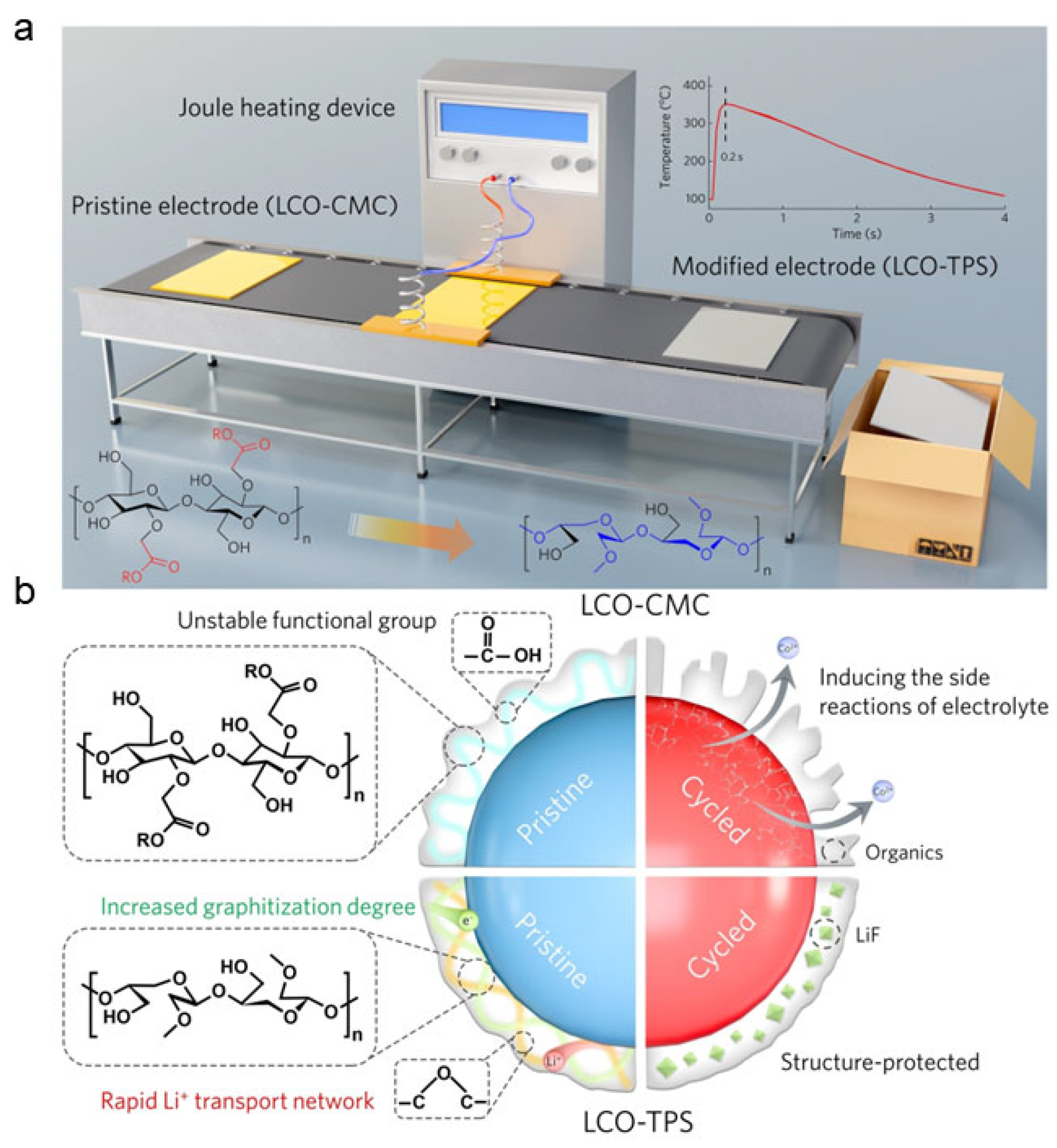
However, the protective efficacy of these “external” surface coatings is limited by their dependence on uniformity, thickness, and interfacial contact with the active material. In contrast, Chen et al. [136] recently proposed a “built-in” stabilization strategy that originates from the molecular structure of the binder. Using thermal pulse sintering technology (Figure 9a), the inexpensive and environmentally friendly water-soluble binder sodium carboxymethyl cellulose was modified in situ. This technique generates an instantaneous high-temperature gradient inside the electrode via Joule heating, which on one hand induces selective pyrolysis of the unstable carboxyl groups (–COOH) in CMC, eliminating electrochemically active sites, and on the other hand triggers ring-opening of molecular chains, forming abundant ether linkages (–C–O–C–) and an O-doped carbon network (Figure 9b). The modified binder (CMC-TPS) forms a uniform, dense ultrathin coating on the LCO surface. More critically, it constructs a continuous molecular-level Li+/electron transport pathway throughout the entire electrode. As a result, it simultaneously enhances both interfacial stability and bulk-phase conduction capability. Owing to this, the LCO cathode employing CMC-TPS achieves 93% capacity retention at 4.6 V (200 cycles, 1 C). This work extends the stabilization strategy from traditional surface engineering to the integrated regulation of binder molecular design and electrode structure, providing a new paradigm for developing low-cost, high-performance binders suitable for high-voltage cathodes.
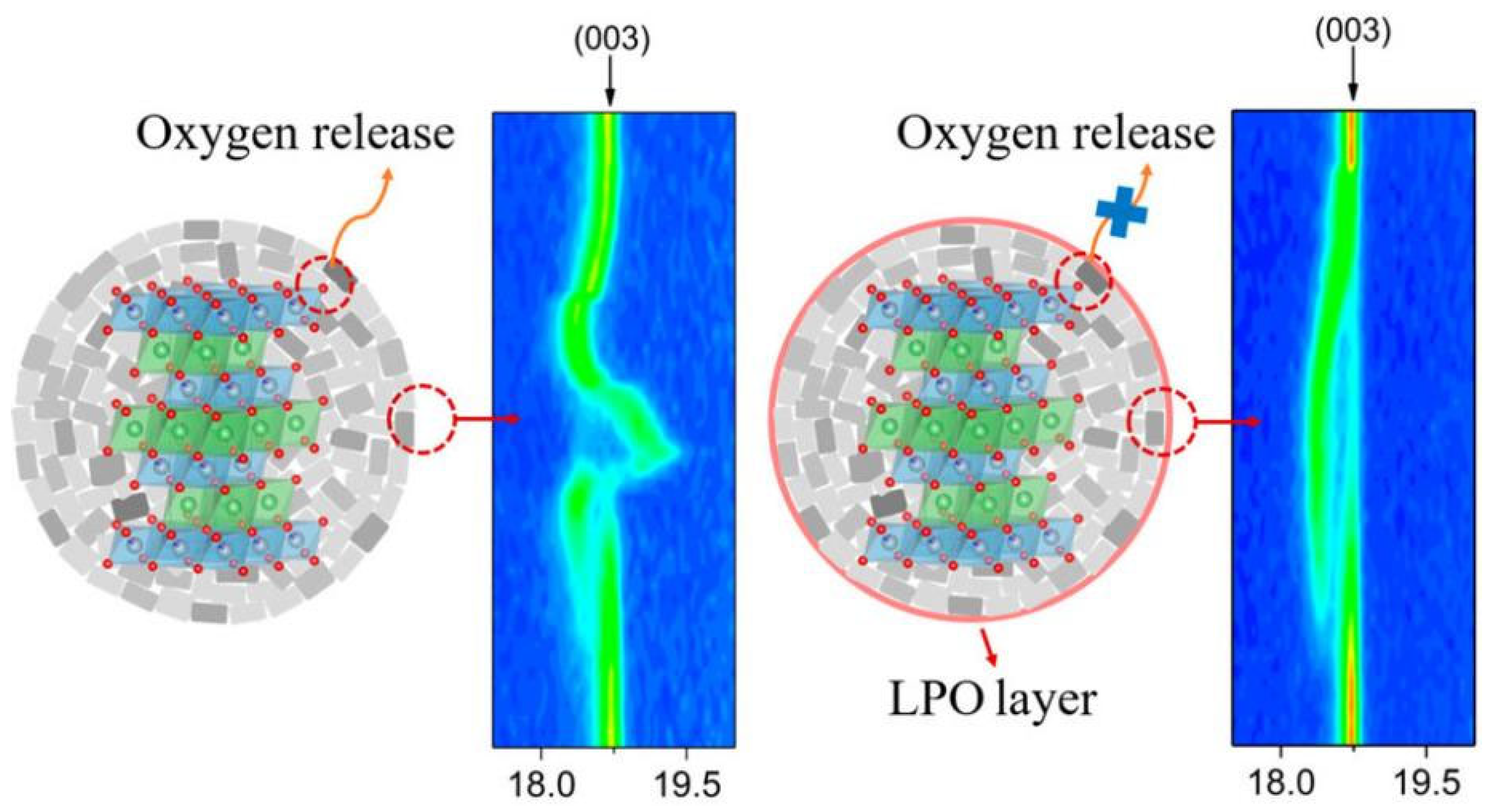
The study of nickel-rich NCM cathode materials aims to obtain high specific capacity, which also means a partial loss of safety and stability. Compensating for this loss is mainly studied from two aspects: precursor preparation and modification [137]. Al2O3 is a representative metal oxide coating material. Due to its strong stability, Al2O3 is commonly used as a surface coating for cathode materials. Chen [138] used Al2O3 nanoparticles for ultrasonic coating on LiNi0.6Co0.2Mn0.2O2, achieving a capacity retention rate of 91.0% after 30 cycles (compared to 82.9% for uncoated), suppressed electrolyte-side reactions, and further increased the orderliness of the layered structure. The inert chemical properties of transition metal phosphates were effective in preventing side reactions between the cathode and the electrolyte. In addition, the strong covalency of the PO43− polyanions may improve the thermal stability of the materials [139]. Lee [140] coated Li3PO4 on the surface of LiNi0.6Co0.2Mn0.2O2 by a sol-gel method. After 100 cycles, the capacity retention rate was 79.7% (uncoated was 63.9%). The Li3PO4 layer serves a dual function: it not only protects the cathode from HF corrosion in the electrolyte but also enhances Li+ ionic conductivity, thereby contributing to improved rate capability. Gan et al. [141] extended their investigation to a higher nickel-content LiNi0.8Co0.1Mn0.1O2 system. The study demonstrates that Li3PO4 surface modification suppresses oxygen release in nickel-rich NCM under deep delithiation, reducing thermal runaway risk. Mechanistic studies revealed that the coating inhibits the layered to rock-salt transition, stabilizing metal-oxygen bonds and blocking oxygen release pathways. As shown in Figure 10, in situ X-ray diffraction results indicate that the bare NCM cathode material exhibits a significant (003) peak shift under high voltage, signifying c-axis collapse during the H2–H3 phase transition. This induces lattice strain and triggers oxygen release. In contrast, Li3PO4-coated samples exhibit a mitigated peak shift, indicating that Li3PO4 buffers the H2–H3 phase transition, reduces lattice strain, and consequently suppresses oxygen release. This work provides atomic-scale insights into the intrinsic mechanism of Li3PO4 coating in stabilizing nickel-rich cathode materials, offering new theoretical perspectives for surface modification research.
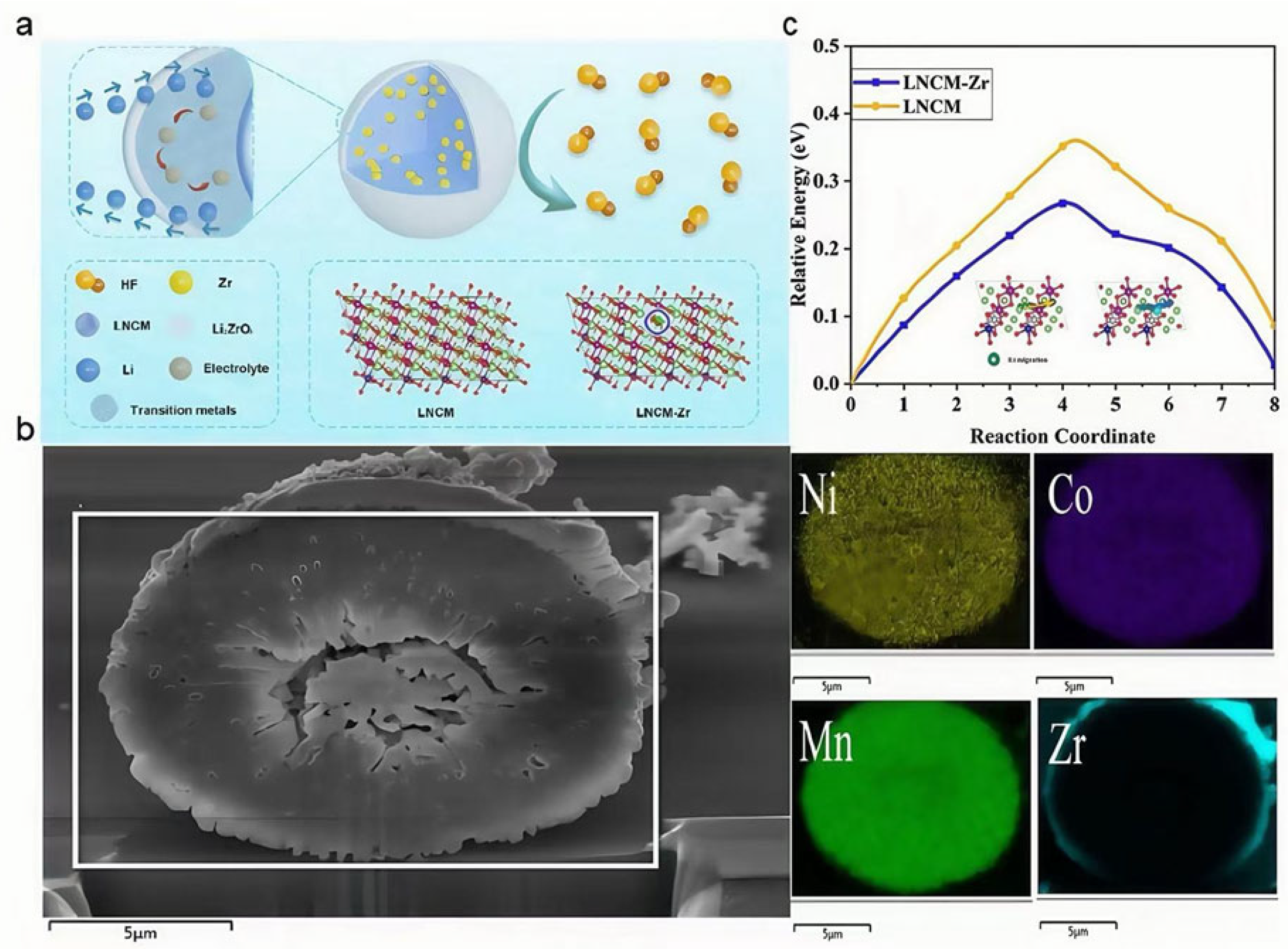
For the more structurally complex LRMO materials, surface coating represents one of the most direct and effective strategies for enhancing their electrochemical performance [142]. Surface coating can effectively suppress undesirable interfacial reactions [143,144], and enhance surface stability [145]. The primary function of the coating layer is to serve as a physical and chemical interface that stabilizes the material surface. Consequently, an ideal surface coating material should possess excellent chemical and electrochemical stability, high ionic conductivity, and maintain good lattice compatibility with the LRMO host material [17]. Early studies primarily focused on the physical barrier function of coatings to suppress side reactions by isolating reactive oxygen species from the electrolyte. Recent developments in functional coatings have enabled a transition from mere physical barriers to active chemical protection through precise surface chemistry design. Currently, coatings can generally be divided into lithium-free metal oxide layers such as Nb2O5 [146], Ta2O5 [147], ZrO2 [148], Al2O3 [149,150], etc.; lithium-containing metal oxide layers (e.g., Li4Ti5O12 [151], Li2MnO3 [152], Li2ZrO3 [153]); and emerging lithium-containing phosphate layers in recent years [154]. The surface stability of LRMO can be significantly improved by applying lithium-free metal oxide coatings. These layers offer high corrosion resistance and excellent thermodynamic stability, serving as protective barriers that prevent side reactions and inhibit phase transitions [155,156]. Pan et al. [146] constructed an inert Nb2O5 coating layer on the LRMO surface to mitigate phase transitions during cycling, achieving enhanced capacity retention and reduced voltage decay. Notably, the microstructure of the Nb2O5-coated LRMO resembled the pristine surface structure after the same cycling process. These results, consistent with previous studies [157], confirmed that the coating formed by Nb-based oxides can establish robust Nb–O bonds on the LRMO surface stabilizing oxygen atoms and preventing oxygen loss. The modified LRMO showed a high initial discharge capacity (320 mAh g−1) and ICE increased from 80.1% to 94.4%. To further investigate the universal mechanism of lithium-free metal oxide coating systems, Dong et al. [158] designed a ZrO2-modified LRMO material (Figure 11a). The coating serves as a physical barrier to suppress direct electrolyte corrosion and transition metal dissolution. Simultaneously, it facilitates Li+ transport by lowering the diffusion energy barrier at the interface. Furthermore, the coating chemically passivates the surface against acidic species (e.g., HF) from electrolyte decomposition. The lower-right inset contrasts the atomic arrangement, indicating that Zr incorporation stabilizes the surface lattice and reduces defects. The cross-sectional SEM and EDS mapping (Figure 11b) verify the successful construction of a continuous and uniformly distributed coating layer. This structural design translates directly into enhanced electrochemical performance: the optimal sample (0.02 mol ZrO2) achieves a high initial discharge capacity of 308.5 mAh g−1 with a ICE of 95.38% at 0.1 C, and maintains 200.2 mAh g−1 after 170 cycles (68.68% retention). The underlying mechanism is unequivocally revealed in Figure 11c: DFT calculations demonstrate that the ZrO2 coating effectively reduces the energy barrier (ΔE) for Li+ migration, thereby facilitating ion transport kinetics. This work establishes a new paradigm for interface design. It shows that metal oxide coatings do more than just act as inert barriers, they actively promote better kinetics.
Surface coating strategies target material-specific issues. For LCO, they suppress electrolyte corrosion and phase transitions. For nickel-rich NCM, they inhibit oxygen release and interfacial side reactions. For LRMO, they mitigate surface reconstruction and voltage fade. While the aims differ, the main idea behind coatings has evolved. It has moved from creating a simple, inert barrier to designing multi-functional and chemically active surfaces. This change from passive protection to active stabilization marks a major step forward in interface engineering.

3.3. The Relationships Between Surface Coating and Element Doping

Elemental doping and surface coating are the two most widely adopted modification strategies for layered oxide cathodes. They essentially operate at different scales, targeting distinct aspects of material degradation. Doping represents a bulk engineering approach that modifies the material by altering its crystal structure, electronic structure, and intrinsic stability. Coating, conversely, is an interfacial engineering strategy that functions by shielding particle surfaces from direct electrolyte contact and suppressing side reactions. While these strategies are complementary, each possesses inherent limitations. Their combination often yields synergistic effects unattainable through either approach alone.
Doping effectively stabilizes lattice oxygen, suppresses cation intermixing, and enhances structural integrity [159]. However, its effectiveness is constrained by multiple factors. First, doping concentrations are typically maintained at low levels (<5 mol%) to avoid secondary phase formation or excessive lattice distortion, demanding high process precision. Second, doping with non-active metal elements leads to capacity reduction. Additionally, single-element doping generally addresses only one degradation pathway. For example, Al doping strengthens TM-O bonds but provides weaker direct suppression of interfacial side reactions compared to coating [160]. As discussed in Section 3.1, multi-element co-doping has partially overcome this issue, yet the complex interactions among multiple dopants and their occupancy positions remain poorly understood. Finally, doping may hinder Li+ transport when dopants occupy lithium sites or induce lattice strain that narrows diffusion pathways. From an industrial perspective, achieving uniform dopant distribution in mass production remains challenging, particularly for gradient or high-entropy doping designs.
Capping layers can form physical barriers to mitigate electrolyte decomposition, transition metal dissolution, and surface phase transitions. However, their effectiveness is highly dependent on the uniformity, thickness, and chemical compatibility of the capping layer with the substrate. Overly thick or poorly conductive coatings increase interfacial impedance and degrade rate performance. Many oxide coatings (e.g., Al2O3) act as electronic and ionic insulators, potentially raising Li+ migration barriers without proper engineering. Furthermore, coating layers may undergo chemical transformations during cycling. For instance, many oxides convert to fluorides in the presence of HF, potentially altering their protective properties [161]. Long-term mechanical integrity of the coating is also problematic, as volume changes in cathode particles during cycling may cause delamination or cracking. From a fabrication perspective, techniques like atomic layer deposition offer precise control but are costly and slow; wet chemical methods are more scalable but often produce uneven coatings. Balancing cost, scalability, and performance remains a key challenge for industrial applications.
Doping and coating address distinct spatial domains. Doping enhances bulk resistance against intrinsic degradation like oxygen loss and phase transitions, while coating protects surfaces from external attacks like electrolyte corrosion and CEI accumulation. Consequently, doping may slightly sacrifice lithium-ion transport kinetics for structural stability. And coating may introduce additional interfacial resistance, slightly reducing rate performance. However, these trade-offs can be minimized when both approaches are synergistically combined. The dual-optimized LCO reported by Yi et al. [96] employs subsurface Al/F co-doping to reinforce lattice resistance against high-voltage phase transitions, while an in situ formed surface rock-salt layer acts as a protective barrier. The results demonstrate that the combination of bulk and interfacial modifications can synergistically achieve outstanding cycling stability at ultra-high capacities. Similarly, in nickel-rich NCM, bulk Zr doping mitigates microcrack formation by reducing anisotropic lattice strain [106], while Li3PO4 coating suppresses surface oxygen release and HF erosion [141]. This demonstrates that combining doping and coating can address degradation mechanisms.
In practical industrial production, doping is typically easier to implement in existing production lines, as it can be introduced during precursor synthesis or calcination without requiring additional processing steps. In contrast, coating usually necessitates extra processing steps, increasing complexity and cost. For high-volume applications like electric vehicles, the cost-effectiveness of coating technology must be carefully evaluated. Neither doping nor coating alone is enough to completely solve the multifaceted degradation problems that originate from oxygen instability. Therefore, future industrial applications may favor integrated modification strategies that combine the simplicity of doping with the effectiveness of coating such as employing one-step synthesis to achieve both bulk doping and surface layer modification [162], or developing low-cost dry coating processes for electrode manufacturing [163].

4. Conclusions and Outlook

Despite fluctuations in the supply chain and cost pressures, Li+ layered oxide cathode materials will continue to lead the development of high-energy-density battery technology for their competitive advantages in their respective target application fields. LCO features high electrode compaction density and excellent high-voltage platform stability. The future market is positioned in the high-end consumer electronics sector. LCO is expected to retain its core position in markets requiring high volumetric energy density. This will be achieved through continuous high-voltage modification (≥4.5 V) and adaptation to solid-state battery systems. Key application areas include flagship smartphones, ultra-thin portable devices, and specialized power supplies. Nickel-rich NCM/NCA has established a mainstream position in the field of electric vehicle power batteries. Its high energy density supports the continuous miniaturization and battery life improvement of the equipment. In the field of power batteries, the industry is constantly breaking through its energy density upper limit through composition optimization and structural design. The future development direction of this material system lies first in addressing the structural and interface stability issues brought about by high nickel content, and secondly in the problem of high raw material costs. LRMO are regarded as important candidate materials for achieving the next generation of ultra-high energy density batteries. Its commercialization remains in the early stages. However, based on the ultra-high theoretical capacity of anion redox reactions, it holds strategic potential in fields such as aerospace and specialized long-range equipment. However, significant challenges such as voltage decay and low initial Coulombic efficiency must be overcome before their practical application can be realized.
Traditional layered oxide cathode materials have focused on isolated optimization through single-element doping, single coating strategies, and individual modification methods. This approach makes it difficult to balance all performance aspects. Future development trends are shifting towards synergistic approaches, focusing on the following four points:
1.
Adherence to Differentiated Development Paths for Specific Material Systems
For different cathode material systems, distinct development priorities and strategies are required. LCO should continue to focus on ultra-high voltage platforms (≥4.6 V), combining lattice reinforcement and interface passivation to further enhance volumetric energy density and cycling stability. This focus will solidify its leading role in high-end consumer electronics. Nickel-rich NCM/NCA materials must prioritize overcoming the issues of reduced thermal stability and intensified interfacial side reactions caused by high nickel content. Through surface reconstruction suppression, grain-boundary strengthening, and synergistic electrolyte modification, a balance among high energy density, long cycle life, and high safety can be achieved. LRMO need to concentrate on breaking through the three major bottlenecks of voltage decay, low initial Coulombic efficiency, and poor rate performance. Strategies such as anionic redox regulation and pre-construction of surface spinel phases should be adopted to advance their practical application, especially in scenarios demanding ultra-high energy density.
It is worth noting that a significant gap exists between laboratory-scale synthesis and industrial manufacturing. Deeper insights into defect chemistry, surface reconstruction, and impurity phase formation under actual processing conditions are required.
2.
Multi-Scale, Multi-Functional Bulk and Interface Engineering
In terms of bulk engineering, multi-element co-doping strategies such as high-entropy doping, gradient doping, should be developed to stabilize lattice oxygen and suppress cation mixing while optimizing lithium-ion transport channels. Particularly for LRMO materials, it is essential to regulate the reversibility of anionic redox through dual-site anion and cation doping, fundamentally mitigating voltage decay.
In terms of interface engineering, multilayer composite coatings should be designed that integrate physical isolation, chemical stability, and ion/electron conduction promotion. However, realizing these strategies requires a deeper understanding of how degradation processes are interconnected. The mechanistic relationship between cation migration, phase transitions, and microcrack formation remains not fully understood. Most existing models treat these degradation processes separately, lacking a unified framework to describe the interplay between oxygen release, transition metal migration, lattice strain accumulation, and intergranular fracture.
Furthermore, interface compatibility in surface coating design still lacks universal, accurately predictive methodologies. Coating selection largely remains trial-and-error dependent. Future work should aim to establish how crystal structure and chemical affinity determine long-term interface stability at high operating voltages.
3.
AI Prediction and High-Throughput Computation Driven Material Discovery and Mechanism Analysis
AI and high-throughput computational methods offer new possibilities for addressing several key challenges summarized in this paper. Machine learning and high-throughput computing enable rapid screening of suitable doping and coating combinations from vast compositional libraries.
For bulk doping strategies, machine learning models built upon compositional, structural, and electronic structure descriptors can efficiently identify dopants that enhance TM–O bonding, suppress oxygen instability, and prevent transition metal migration. Concurrently, high-throughput first-principles calculations can predict the sites of dopant elements, migration energy barriers, and their impact on oxygen-involved redox behavior, thereby transcending empirical trial-and-error approaches to achieve more rational doping design.
For surface modification, data-driven methods hold promise for predicting surface reconstruction trends and oxygen release behavior in different layered oxide systems under deep delithiation conditions, revealing intrinsic differences in surface stability. Furthermore, we should integrate first-principles calculations, molecular dynamics simulations, and rapidly advancing atomic-scale in situ characterization techniques, such as in situ electron microscopy, X-ray absorption spectroscopy, and atomic probe microscopy. This integrated approach would enhance our understanding of failure mechanisms during cycling, including lattice distortion, oxygen loss, phase transitions, and crack nucleation.
A fundamental question that remains unresolved is the atomic origin of oxygen redox irreversibility. Although the Li–O–Li configuration and non-bonded O 2p states are known to activate anion redox reactions, the key conditions governing the reversible recombination of oxidized oxygen species (O, O22−, trapped O2) versus irreversible O2 gas release remain poorly understood. Data-driven methods, combined with first-principles calculations, hold promise for uncovering these conditions.
Beyond oxygen redox, the thermodynamic and kinetic constraints on voltage stability in lithium-rich and nickel-rich layered oxides also remain unquantified. Voltage decay in lithium-rich manganese-based oxides and structural degradation in nickel-rich materials due to H2–H3 phase transitions are typically explained empirically, lacking clearly defined values for free energy and activation energy barriers. High-throughput computations can calculate these energy parameters, providing a quantitative foundation for understanding and predicting voltage stability.
4.
System Innovation for Industrialization and Sustainable Development
In terms of process and manufacturing, efforts should be made to reduce material costs and protect the environment. Promoting the large-scale application of green manufacturing technologies, such as water-based adhesives, cobalt-free or low-cobalt material systems, and dry electrode processes, is highly recommended. At the same time, for the supply chain of key metals such as cobalt and nickel, the design for material recyclability and efficient battery recycling technologies should be considered to enhance resource utilization efficiency.
The above strategic directions need to be translated into actionable progress. In the short term, the focus should be on advancing the industrial maturity of existing modification technologies. In the long term, this field should pursue predictive and design capabilities through the development of artificial intelligence, enabling autonomous discovery of cathode material compositions with high stability and high capacity.

Funding

This research received no external funding.

Data Availability Statement

No new data were created or analyzed in this study. Data sharing is not applicable to this article.

Conflicts of Interest

The authors declare no conflict of interest.

References

  1. Osman, S.H.; Yatim, N.S.M.; Elham, O.S.J.; Shaari, N.; Zakaria, Z. Three decades of hydrogen energy research: A bibliometric analysis on the evolution of green hydrogen technologies. Sustain. Energy Fuels 2025, 9, 3182–3202. [Google Scholar] [CrossRef] [Scilit]
  2. Li, X.L.; Zhu, X.N.; Li, X.G.; Zhao, X.T.; Wei, G.L.; Gao, W.H.; Nie, C.C.; Yan, S.; Ge, L.H.; Wang, Z.Y. Recent advances in the extraction of critical metals from spent lithium-ion batteries: Challenges and solutions-a review. Sep. Purif. Technol. 2025, 376, 134070. [Google Scholar] [CrossRef] [Scilit]
  3. Li, W.Y.; Qian, X.Y.; Hou, S.Q.; Xia, X.; He, D.F.; Xia, J.W.; He, G.Y.; Chen, H.Q. Recent progress of self-supported anode materials for Li-ion batteries. J. Energy Storage 2024, 99, 113188. [Google Scholar] [CrossRef] [Scilit]
  4. Armand, M.; Tarascon, J.M. Building better batteries. Nature 2008, 451, 652–657. [Google Scholar] [CrossRef] [Scilit] [PubMed]
  5. Sun, J.L.; Du, Y.C.; Liu, Y.J.; Yan, D.B.; Li, X.D.; Kim, D.H.; Lin, Z.Q.; Zhou, X.S. Recent advances in potassium metal batteries: Electrodes, interfaces and electrolytes. Chem. Soc. Rev. 2025, 54, 2543–2594. [Google Scholar] [CrossRef] [Scilit] [PubMed]
  6. Zhu, G.L.; Wen, K.C.; Lv, W.Q.; Zhou, X.Z.; Liang, Y.C.; Yang, F.; Chen, Z.L.; Zou, M.D.; Li, J.C.; Zhang, Y.Q.; et al. Materials insights into low-temperature performances of lithium-ion batteries. J. Power Sources 2015, 300, 29–40. [Google Scholar] [CrossRef] [Scilit]
  7. Pampal, E.S.; Stojanovska, E.; Simon, B.; Kilic, A. A review of nanofibrous structures in lithium ion batteries. J. Power Sources 2015, 300, 199–215. [Google Scholar] [CrossRef] [Scilit]
  8. Wang, Q.; Yang, C.K.; Yang, J.J.; Wu, K.; Qi, L.Y.; Tang, H.; Zhang, Z.Y.; Liu, W.; Zhou, H.H. Stable Li metal anode with protected interface for high-performance Li metal batteries. Energy Storage Mater. 2018, 15, 249–256. [Google Scholar] [CrossRef] [Scilit]
  9. Pan, J.W.; Xie, L.; Wang, Y.E.; Zheng, J.F.; Ma, Y.L.; Shu, C.Y.; Zhang, Q.Y.; Tang, W. Reevaluating the Critical Role of Cobalt in Ultra-High Nickel Cathodes: Toward Sustainable and High-Performance Lithium-Ion Batteries. Adv. Funct. Mater. 2025, 36, 11503. [Google Scholar] [CrossRef] [Scilit]
  10. Liu, Y.; Lin, X.J.; Sun, Y.G.; Xu, Y.S.; Chang, B.B.; Liu, C.T.; Cao, A.M.; Wan, L.J. Precise Surface Engineering of Cathode Materials for Improved Stability of Lithium-Ion Batteries. Small 2019, 15, 1901019. [Google Scholar] [CrossRef] [Scilit]
  11. Lin, Y.C.; Li, F.K.; Zhao, K.; Zou, S.H.; Tan, X.; Shi, Z.H.; Fan, J.; Ouyang, L.Z.; Zhu, M.; Liu, J. Earth-Abundant Spinel LiMn2O4 Cathode for Lithium-Ion Batteries: Challenges, Strategies, and Perspectives. Small Methods 2025, 9, 2402233. [Google Scholar] [CrossRef] [Scilit]
  12. Padhi, A.K.; Nanjundaswamy, K.S.; Goodenough, J.B. Phospho-olivines as positive-electrode materials for rechargeable lithium batteries. J. Electrochem. Soc. 1997, 144, 1188–1194. [Google Scholar] [CrossRef] [Scilit]
  13. Xu, H.; Feng, D.; Li, Y.; Xie, Y.H.; Yang, Z.; Wu, F.; Mei, Y.; Xie, D.L. A Robust and Scalable N-Doped Carbon Coating Strategy for the High-Performance LiFePO4 Cathode. Ind. Eng. Chem. Res. 2024, 63, 14458–14468. [Google Scholar] [CrossRef] [Scilit]
  14. Dutta, J.; Ghosh, S.; Martha, S.K. A short review on fast charging of Ni-rich layered oxide cathodes. J. Solid State Electrochem. 2025, 29, 4117–4131. [Google Scholar] [CrossRef] [Scilit]
  15. Park, O.K.; Cho, Y.; Lee, S.; Yoo, H.C.; Song, H.K.; Cho, J. Who will drive electric vehicles, olivine or spinel? Energy Environ. Sci. 2011, 4, 1621–1633. [Google Scholar] [CrossRef] [Scilit]
  16. Xu, Z.W.; Song, K.W.; Chang, X.Y.; Li, L.; Zhang, W.C.; Xue, Y.X.; Zhang, J.H.; Lin, D.W.; Liu, Z.Y.; Wang, Q.; et al. Layered oxide cathodes: A comprehensive review of characteristics, research, and development in lithium and sodium ion batteries. Carbon Neutralization 2024, 3, 832–856. [Google Scholar] [CrossRef] [Scilit]
  17. Liu, J.X.; Wang, J.Q.; Ni, Y.X.; Zhang, K.; Cheng, F.Y.; Chen, J. Recent breakthroughs and perspectives of high-energy layered oxide cathode materials for lithium ion batteries. Mater. Today 2021, 43, 132–165. [Google Scholar] [CrossRef] [Scilit]
  18. Lyu, Y.; Wu, X.; Wang, K.; Feng, Z.; Cheng, T.; Liu, Y.; Wang, M.; Chen, R.; Xu, L.; Zhou, J.; et al. An Overview on the Advances of LiCoO2 Cathodes for Lithium-Ion Batteries. Adv. Energy Mater. 2020, 11, 2000982. [Google Scholar] [CrossRef] [Scilit]
  19. Liu, Y.M.; Chen, S.; Quan, X.; Yu, H.T. Efficient Electrochemical Reduction of Carbon Dioxide to Acetate on Nitrogen-Doped Nanodiamond. J. Am. Chem. Soc. 2015, 137, 11631–11636. [Google Scholar] [CrossRef] [Scilit]
  20. Wang, K.; Wan, J.J.; Xiang, Y.X.; Zhu, J.P.; Leng, Q.Y.; Wang, M.; Xu, L.M.; Yang, Y. Recent advances and historical developments of high voltage lithium cobalt oxide materials for rechargeable Li-ion batteries. J. Power Sources 2020, 460, 228062. [Google Scholar] [CrossRef] [Scilit]
  21. Li, M.; Lu, J.; Chen, Z.W.; Amine, K. 30 Years of Lithium-Ion Batteries. Adv. Mater. 2018, 30, 1800561. [Google Scholar] [CrossRef] [Scilit]
  22. Ryu, H.-H.; Park, K.-J.; Yoon, C.S.; Sun, Y.-K. Capacity Fading of Ni-Rich Li[NixCoyMn1–x–y]O2 (0.6 ≤ x ≤ 0.95) Cathodes for High-Energy-Density Lithium-Ion Batteries: Bulk or Surface Degradation? Chem. Mater. 2018, 30, 1155–1163. [Google Scholar] [CrossRef] [Scilit]
  23. Luo, L.; Wang, D.; Zhou, Z.R.; Dong, P.; Yang, S.Y.; Duan, J.G.; Zhang, Y.J. Engineering a Robust Interface on Ni-Rich Cathodes via a Novel Dry Doping Process toward Advanced High-Voltage Performance. ACS Appl. Mater. Interfaces 2021, 13, 45068–45076. [Google Scholar] [CrossRef] [Scilit]
  24. Xi, Z.J.; Sun, Q.; Li, J.; Qiao, Y.; Min, G.H.; Ci, L.J. Modification Strategies of High-Energy Li-Rich Mn-Based Cathodes for Li-Ion Batteries: A Review. Molecules 2024, 29, 1064. [Google Scholar] [CrossRef] [Scilit]
  25. Kou, P.Z.; Zhang, Z.G.; Wang, Z.Y.; Zheng, R.G.; Liu, Y.G.; Lv, F.; Xu, N. Opportunities and Challenges of Layered Lithium-Rich Manganese-Based Cathode Materials for High Energy Density Lithium-Ion Batteries. Energy Fuels 2023, 37, 18243–18265. [Google Scholar] [CrossRef] [Scilit]
  26. Zhang, Y.P.; Liang, E.Q.; Wang, J.X.; Yu, B.J.; Wang, C.Y.; Li, M.W. Effect of Aluminum Doping on the Stability of Lithium-Rich Layered Oxide Li[Li0.23Ni0.15Mn0.52Al0.10]O2 as Cathode Material. Int. J. Electrochem. Sci. 2017, 12, 9051–9060. [Google Scholar] [CrossRef] [Scilit]
  27. Graetz, J.; Hightower, A.; Ahn, C.C.; Rez, P.; Fultz, B. Electronic structure analysis of LiCoO2 using Electron Energy Loss Spectroscopy (EELS). Microsc. Microanal. 2020, 7, 1186–1187. [Google Scholar] [CrossRef] [Scilit]
  28. Li, J.; Liang, G.M.; Zheng, W.; Zhang, S.L.; Davey, K.; Pang, W.K.; Guo, Z.P. Addressing cation mixing in layered structured cathodes for lithium-ion batteries: A critical review. Nano Mater. Sci. 2023, 5, 404–420. [Google Scholar] [CrossRef] [Scilit]
  29. Wang, D.W.; Kou, R.H.; Ren, Y.; Sun, C.J.; Zhao, H.; Zhang, M.J.; Li, Y.; Huq, A.; Ko, J.Y.P.; Pan, F.; et al. Synthetic Control of Kinetic Reaction Pathway and Cationic Ordering in High-Ni Layered Oxide Cathodes. Adv. Mater. 2017, 29, 1606715. [Google Scholar] [CrossRef] [Scilit]
  30. Ning, F.; Zhang, H.; Dai, J.; Liu, X.; Lu, S.; Yi, J. The Ni/Li disordering evolution mechanisms in Ni-based layered cathode materials: Insights from first-principles calculations. Chem. Commun. 2025, 61, 8228–8231. [Google Scholar] [CrossRef] [Scilit]
  31. Lin, C.; Li, J.Y.; Yin, Z.W.; Huang, W.Y.; Zhao, Q.H.; Weng, Q.S.; Liu, Q.; Sun, J.L.; Chen, G.H.; Pan, F. Structural Understanding for High-Voltage Stabilization of Lithium Cobalt Oxide. Adv. Mater. 2024, 36, 2307404. [Google Scholar] [CrossRef] [Scilit]
  32. Mizushima, K.; Jones, P.; Wiseman, P.; Goodenough, J. LixCoO2 (0 < x ≤ 1): A new cathode material for batteries of high energy density. Mater. Res. Bull. 1980, 15–16, 783–789. [Google Scholar] [CrossRef] [Scilit]
  33. Xie, J.; Lu, Y.C. A retrospective on lithium-ion batteries. Nat. Commun. 2020, 11, 2499. [Google Scholar] [CrossRef] [Scilit]
  34. Molenda, J.; Stoklosa, A.; Bak, T. Modification in the Electronic-Structure of Cobalt Bronze LixCoO2 and the Resulting Electrochemical Properties. Solid State Ion. 1989, 36, 53–58. [Google Scholar] [CrossRef] [Scilit]
  35. Gabrisch, H.; Yazami, R.; Fultz, B. Hexagonal to cubic spinel transformation in lithiated cobalt oxide—TEM investigation. J. Electrochem. Soc. 2004, 151, A891–A897. [Google Scholar] [CrossRef] [Scilit]
  36. Ohzuku, T.; Ueda, A. Solid-State Redox Reactions of LiCoO2 (R3m) for 4 Volt Secondary Lithium Cells. J. Electrochem. Soc. 1994, 141, 2972. [Google Scholar] [CrossRef] [Scilit]
  37. Wang, X.; Wang, X.Y.; Lu, Y.Y. Realizing High Voltage Lithium Cobalt Oxide in Lithium-Ion Batteries. Ind. Eng. Chem. Res. 2019, 58, 10119–10139. [Google Scholar] [CrossRef] [Scilit]
  38. Zhang, S.D.; Qi, M.Y.; Guo, S.J.; Sun, Y.G.; Tan, X.X.; Ma, P.Z.; Li, J.Y.; Yuan, R.Z.; Cao, A.M.; Wan, L.J. Advancing to 4.6 V Review and Prospect in Developing High-Energy-Density LiCoO2 Cathode for Lithium-Ion Batteries. Small Methods 2022, 6, 2200148. [Google Scholar] [CrossRef] [Scilit] [PubMed]
  39. Wu, Q.; Zhang, B.; Lu, Y.Y. Progress and perspective of high-voltage lithium cobalt oxide in lithium-ion batteries. J. Energy Chem. 2022, 74, 283–308. [Google Scholar] [CrossRef] [Scilit]
  40. Kalluri, S.; Yoon, M.; Jo, M.; Park, S.; Myeong, S.; Kim, J.; Dou, S.X.; Guo, Z.P.; Cho, J. Surface Engineering Strategies of Layered LiCoO2 Cathode Material to Realize High-Energy and High-Voltage Li-Ion Cells. Adv. Energy Mater. 2017, 7, 1601507. [Google Scholar] [CrossRef] [Scilit]
  41. Huang, Y.Y.; Zhu, Y.C.; Fu, H.Y.; Ou, M.Y.; Hu, C.C.; Yu, S.J.; Hu, Z.W.; Chen, C.T.; Jiang, G.; Gu, H.K.; et al. Mg-Pillared LiCoO2: Towards Stable Cycling at 4.6 V. Angew. Chem. Int. Ed. 2021, 60, 4682–4688. [Google Scholar] [CrossRef] [Scilit]
  42. Zhang, J.-N.; Li, Q.; Ouyang, C.; Yu, X.; Ge, M.; Huang, X.; Hu, E.; Ma, C.; Li, S.; Xiao, R.; et al. Trace doping of multiple elements enables stable battery cycling of LiCoO2 at 4.6 V. Nat. Energy 2019, 4, 594–603. [Google Scholar] [CrossRef] [Scilit]
  43. Wang, H.T.; Xu, S.C.; Tsai, C.; Li, Y.Z.; Liu, C.; Zhao, J.; Liu, Y.Y.; Yuan, H.Y.; Abild-Pedersen, F.; Prinz, F.B.; et al. Direct and continuous strain control of catalysts with tunable battery electrode materials. Science 2016, 354, 1031–1036. [Google Scholar] [CrossRef] [Scilit]
  44. Hong, Y.S.; Huang, X.J.; Wei, C.X.; Wang, J.Y.; Zhang, J.N.; Yan, H.F.; Chu, Y.S.; Pianetta, P.; Xiao, R.J.; Yu, X.Q.; et al. Hierarchical Defect Engineering for LiCoO2 through Low-Solubility Trace Element Doping. Chem 2020, 6, 2759–2769. [Google Scholar] [CrossRef] [Scilit]
  45. Thomas, M.G.S.R.; Bruce, P.G.; Goodenough, J.B. Ac Impedance Analysis of Polycrystalline Insertion Electrodes—Application to Li1ȒxCoO2. J. Electrochem. Soc. 1985, 132, 1521–1528. [Google Scholar] [CrossRef] [Scilit]
  46. Wang, X.H.; Ren, H.Y.; Du, Y.H.; Li, Z.J.; Zhao, W.G.; Ji, H.C.; Yi, H.C.; Pan, Q.R.; Liu, J.J.; Lou, Z.R.; et al. Tuning surface chemistry to reduce the step-like degradation of LiCoO2 at 4.6 V. Nano Energy 2024, 125, 109537. [Google Scholar] [CrossRef] [Scilit]
  47. Wang, G.R.; Bi, Z.H.; Zhang, A.P.; Das, P.; Lin, H.; Wu, Z.S. High-Voltage and Fast-Charging Lithium Cobalt Oxide Cathodes: From Key Challenges and Strategies to Future Perspectives. Engineering 2024, 37, 105–127. [Google Scholar] [CrossRef] [Scilit]
  48. Shaju, K.M.; Rao, G.V.S.; Chowdari, B.V.R. Performance of layered Li(Ni1/3Co1/3Mn1/3)O2 as cathode for Li-ion batteries. Electrochim. Acta 2002, 48, 145–151. [Google Scholar] [CrossRef] [Scilit]
  49. Chang, L.J.; Yang, W.; Cai, K.D.; Bi, X.L.; Wei, A.L.; Yang, R.F.; Liu, J.N. A review on nickel-rich nickel-cobalt-manganese ternary cathode materials LiNi0.6Co0.2Mn0.2O2 for lithium-ion batteries: Performance enhancement by modification. Mater. Horiz. 2023, 10, 4776–4826. [Google Scholar] [CrossRef] [Scilit] [PubMed]
  50. Zheng, Y.S.; Li, J.F.; Liu, Y.J.; Feng, L.L.; Liu, W.; Lin, L.L.; Wang, Y.M.; Peng, H.Y.; Lu, J.; Zhou, D.; et al. Challenges and Advancements in High-Nickel Layered Oxides Cathode Material for Lithium-Ion Batteries. Energy Environ. Mater. 2025, 9, e70152. [Google Scholar] [CrossRef] [Scilit]
  51. Lee, C.H.; Jun, B.; Lee, S.C.; Lee, S.U. State of charge dependent ordered and disordered phases in a Li[Ni1/3Co1/3Mn1/3]O2 cathode material. Mater. Adv. 2021, 2, 3965–3970. [Google Scholar] [CrossRef] [Scilit]
  52. Park, S.Y.; Baek, W.J.; Lee, S.Y.; Seo, J.A.; Kang, Y.S.; Koh, M.; Kim, S.H. Probing electrical degradation of cathode materials for lithium-ion batteries with nanoscale resolution. Nano Energy 2018, 49, 1–6. [Google Scholar] [CrossRef] [Scilit]
  53. Cui, B.C.; Xiao, Z.X.; Cui, S.L.; Liu, S.; Gao, X.P.; Li, G.R. Safety Issues and Improvement Measures of Ni-Rich Layered Oxide Cathode Materials for Li-Ion Batteries. Electrochem. Energy Rev. 2024, 7, 27. [Google Scholar] [CrossRef] [Scilit]
  54. Bak, S.M.; Hu, E.Y.; Zhou, Y.N.; Yu, X.Q.; Senanayake, S.D.; Cho, S.J.; Kim, K.B.; Chung, K.Y.; Yang, X.Q.; Nam, K.W. Structural Changes and Thermal Stability of Charged LiNixMnyCozO2 Cathode Materials Studied by Combined In Situ Time-Resolved XRD and Mass Spectroscopy. Acs Appl. Mater. Interfaces 2014, 6, 22594–22601. [Google Scholar] [CrossRef] [Scilit]
  55. Heiskanen, S.K.; Laszczynski, N.; Lucht, B.L. Perspective-Surface Reactions of Electrolyte with LiNi0.5Co0.2Mn0.3O2 Cathodes for Lithium Ion Batteries. J. Electrochem. Soc. 2020, 167, 100519. [Google Scholar] [CrossRef] [Scilit]
  56. Chen, S.; Zhao, W.; Zheng, G.; Yang, C.; Chen, T.; Ren, H.; Zuo, Y.; Yao, X.; Li, K.; Xue, H.; et al. Engineering durable interphases for high-voltage Li-ion batteries under thermal stress. Natl. Sci. Rev. 2025, 12, 345. [Google Scholar] [CrossRef] [Scilit]
  57. Ji, Y.; Huang, Y.; Dong, Z.; Fang, J.; Liu, P.; Liu, S.; Cao, A.; Xue, H.; Chen, S.; Qiu, J.; et al. Anion Adsorption at the Inner-Helmholtz Plane Directs Cathode Electrolyte Interphase Formation. Angew. Chem. Int. Ed. 2025, 64, 202425535. [Google Scholar] [CrossRef] [Scilit] [PubMed]
  58. He, X.Y.; Su, S.L.; Zhang, B.; Xiao, Z.M.; Zhang, Z.B.; Ou, X. Alleviating the anisotropic microstructural change and boosting the lithium ions diffusion by grain orientation regulation for Ni-rich cathode materials. J. Energy Chem. 2024, 88, 213–222. [Google Scholar] [CrossRef] [Scilit]
  59. Tang, W.J.; Hu, C.Z.; Li, A.; Huang, X.Q.; Chen, Z.X.; Su, J.H.; Zhang, W.X. Constructing a stable interface on Ni-rich LiNi0.8Co0.1Mn0.1O2 cathode via lactic acid-assisted engineering strategy. J. Energy Chem. 2024, 90, 412–422. [Google Scholar] [CrossRef] [Scilit]
  60. Xiao, Y.Y.; Shi, X.T.; Zheng, T.L.; Yue, Y.; Shi, S.Q.; Cheng, Y.J.; Xia, Y.G. Dual Role of Bis(borate) Additive in Electrode/Electrolyte Interface Layer Construction for High-Voltage NCM 523 Cathode. Acs Appl. Energy Mater. 2023, 6, 4817–4824. [Google Scholar] [CrossRef] [Scilit]
  61. Zou, L.F.; He, Y.; Liu, Z.Y.; Jia, H.P.; Zhu, J.; Zheng, J.M.; Wang, G.F.; Li, X.L.; Xiao, J.; Liu, J.; et al. Unlocking the passivation nature of the cathode-air interfacial reactions in lithium ion batteries. Nat. Commun. 2020, 11, 3204. [Google Scholar] [CrossRef] [Scilit]
  62. Zhu, B.Y.; Qu, J.K.; Wei, G.Y.; Liu, Z.Y.; He, X.C.; Yan, S.; Xu, Q.X.; Diao, W.Z. Investigating the impact of Li/Ni cation mixing asymmetry on the structural and electrochemical performance of NCM811. J. Energy Storage 2025, 124, 116854. [Google Scholar] [CrossRef] [Scilit]
  63. Zhang, Y.R.; Katayama, Y.; Tatara, R.; Giordano, L.; Yu, Y.; Fraggedakis, D.; Sun, J.G.W.; Maglia, F.; Jung, R.; Bazant, M.Z.; et al. Revealing electrolyte oxidation via carbonate dehydrogenation on Ni-based oxides in Li-ion batteries by in situ Fourier transform infrared spectroscopy. Energy Environ. Sci. 2020, 13, 183–199. [Google Scholar] [CrossRef] [Scilit]
  64. Li, Y.; Li, W.; Yang, H.; Zhang, T.; Jiang, Q.; Wang, J.; Wen, H.; Li, M.; Jia, W.; Hua, X.; et al. Understanding lithium-rich manganese-based cathode materials from the perspectives of lattice challenges and doping engineering. Sci. China Chem. 2025. [Google Scholar] [CrossRef] [Scilit]
  65. Jarvis, K.A.; Deng, Z.; Allard, L.F.; Manthiram, A.; Ferreira, P.J. Atomic Structure of a Lithium-Rich Layered Oxide Material for Lithium-Ion Batteries: Evidence of a Solid Solution. Chem. Mater. 2011, 23, 3614–3621. [Google Scholar] [CrossRef] [Scilit]
  66. Yu, H.; Ishikawa, R.; So, Y.G.; Shibata, N.; Kudo, T.; Zhou, H.; Ikuhara, Y. Direct Atomic-Resolution Observation of Two Phases in the Li1.2Mn0.567Ni0.166Co0.067O2 Cathode Material for Lithium-Ion Batteries. Angew. Chem. Int. Ed. 2013, 52, 5969–5973. [Google Scholar] [CrossRef] [Scilit]
  67. Wang, J.Y.; Lei, X.C.; Meng, H.; Ji, P.X.; Lu, T.L.; Liang, W.J.; Liu, X.Z.; Meng, S.; Gu, L.; Liu, M.; et al. Revealing the chemical separated two-phase structure in lithium-manganese-rich cathode. Natl. Sci. Rev. 2025, 12, 202. [Google Scholar] [CrossRef] [Scilit] [PubMed]
  68. Liu, T.C.; Liu, J.J.; Li, L.X.; Yu, L.; Diao, J.C.; Zhou, T.; Li, S.N.; Dai, A.; Zhao, W.G.; Xu, S.Y.; et al. Origin of structural degradation in Li-rich layered oxide cathode. Nature 2022, 606, 305–312. [Google Scholar] [CrossRef] [Scilit] [PubMed]
  69. Wang, J.; He, X.; Paillard, E.; Laszczynski, N.; Li, J.; Passerini, S. Lithium- and Manganese-Rich Oxide Cathode Materials for High-Energy Lithium Ion Batteries. Adv. Energy Mater. 2016, 6, 1600906. [Google Scholar] [CrossRef] [Scilit]
  70. Hy, S.; Liu, H.D.; Zhang, M.H.; Qian, D.N.; Hwang, B.J.; Meng, Y.S. Performance and design considerations for lithium excess layered oxide positive electrode materials for lithium ion batteries. Energy Environ. Sci. 2016, 9, 1931–1954. [Google Scholar] [CrossRef] [Scilit]
  71. Kalyani, P.; Chitra, S.; Mohan, T.; Gopukumar, S. Lithium metal rechargeable cells using Li2MnO3 as the positive electrode. J. Power Sources 1999, 80, 103–106. [Google Scholar] [CrossRef] [Scilit]
  72. Yamada, A. Lattice Instability in Li(LixMn2−x)O4. J. Solid State Chem. 1996, 122, 160–165. [Google Scholar] [CrossRef] [Scilit]
  73. Gent, W.E.; Lim, K.; Liang, Y.F.; Li, Q.H.; Barnes, T.; Ahn, S.J.; Stone, K.H.; McIntire, M.; Hong, J.Y.; Song, J.H.; et al. Coupling between oxygen redox and cation migration explains unusual electrochemistry in lithium-rich layered oxides. Nat. Commun. 2017, 8, 2091. [Google Scholar] [CrossRef] [Scilit] [PubMed]
  74. Xu, B.; Fell, C.R.; Chi, M.; Meng, Y.S. Identifying surface structural changes in layered Li-excess nickel manganeseoxides in high voltage lithium ion batteries: A joint experimental and theoretical study†. Energy Environ. Sci. 2011, 4, 2223–2233. [Google Scholar] [CrossRef] [Scilit]
  75. Fell, C.R.; Qian, D.N.; Carroll, K.J.; Chi, M.F.; Jones, J.L.; Meng, Y.S. Correlation Between Oxygen Vacancy, Microstrain, and Cation Distribution in Lithium-Excess Layered Oxides During the First Electrochemical Cycle. Chem. Mater. 2013, 25, 1621–1629. [Google Scholar] [CrossRef] [Scilit]
  76. Seo, D.-H.; Lee, J.; Urban, A.; Malik, R.; Kang, S.; Ceder, G. The structural and chemical origin of the oxygen redox activity in layered and cation-disordered Li-excess cathode materials. Nat. Chem. 2016, 8, 692–697. [Google Scholar] [CrossRef] [Scilit]
  77. Allen, E.M.; Kwon, B.J.; Wolfman, M.; Cai, Z.; Antipova, O.; De Andrade, V.; Cabana, J. Tailored Architectures to Stabilize Electrode-Electrolyte Interfaces in Cathode Materials for Li-Ion Batteries. ECS Meet. Abstr. 2020, MA2020-01, 543. [Google Scholar] [CrossRef] [Scilit]
  78. Mauger, A.; Julien, C.M. Design Principles and Engineering Strategies for Stabilizing Ni-Rich Layered Oxides in Lithium-Ion Batteries. Batteries 2025, 11, 254. [Google Scholar] [CrossRef] [Scilit]
  79. Kumari, P.; Kundu, R. Outlook of Doping Engineering in NMC and LMNO Cathode Materials for Next-Generation Li-Ion Batteries. Energy Fuel 2025, 39, 10933–10966. [Google Scholar] [CrossRef] [Scilit]
  80. Yu, W.H.; Zhang, C.J.; Wang, Y.Y.; Yang, Z.; Wang, Y.Q.; Du, H.P.; Du, Z.K.; Cai, M.; Xu, Y. Enhancing structural integrity and performance of Li-Rich Mn-based cathode materials via multi-component surface engineering. Electrochim. Acta 2025, 539, 147107. [Google Scholar] [CrossRef] [Scilit]
  81. Song, J.; Ning, F.H.; Zuo, Y.X.; Li, A.; Wang, H.C.; Zhang, K.; Yang, T.H.; Yang, Y.L.; Gao, C.; Xiao, W.K.; et al. Entropy Stabilization Strategy for Enhancing the Local Structural Adaptability of Li-Rich Cathode Materials. Adv. Mater. 2023, 35, 2208726. [Google Scholar] [CrossRef] [Scilit]
  82. Liu, X.X.; Shi, S.X.; Mo, M.; Zhan, H.Q.; Li, Z.P.; Yang, Y.; Lan, D.W.; Huang, J.L.; Kang, G.H.; Huang, M.F.; et al. Synthesis of Core-Shell layered oxide cathode materials with enhanced electrochemical Performance: A Self-Template gradient coprecipitation method. Mater. Lett. 2025, 389, 138331. [Google Scholar] [CrossRef] [Scilit]
  83. Zhao, G.; Zhang, T.; Wang, R.; Zhang, N.; Zheng, L.; Ma, X.; Yang, J.; Liu, X. Engineering Reversible Lattice Structure for High-Capacity Co-Free Li-Rich Cathodes with Negligible Capacity Degradation. Small 2024, 20, 2401839. [Google Scholar] [CrossRef] [Scilit]
  84. Ledwaba, R.S.; Tsebesebe, N.T.; Ngoepe, P.E. Unraveling The Role of Oxygen and Manganese Charge Compensation During Nucleation and Crystal Growth of Li-rich Layered Li1.2Mn0.8O2 Cathode Materials. J. Electrochem. Soc. 2022, 169, 110502. [Google Scholar] [CrossRef] [Scilit]
  85. Jiang, X.K.; Wang, Z.X.; Dong, H.; Zhang, X.; Hu, J.; Chu, M.M.; Hong, Y.S.; Xu, L.; Peng, W.J.; Yu, X.Q.; et al. An in-depth understanding of Al doping homogeneity affecting the performance of LiCoO2 at cut-off voltage over 4.6 V. Chin. Chem. Lett. 2024, 35, 109553. [Google Scholar] [CrossRef] [Scilit]
  86. Li, X.L.; Zhu, X.L.; Zhang, Y.H.; Han, L.; Gao, J.; Liu, D.; Qiu, J.S.; Zhou, W.D. Ternary Inert Element Co-Doping: A New Approach to Stable 4.7 V LiCoO2. Adv. Mater. 2025, 37, 2506228. [Google Scholar] [CrossRef] [Scilit]
  87. Kim, J.H.; Hwang, J.; Lee, Y.H.; Song, S.H.; Lee, J.; Lee, S.H.; Moon, W.J.; Kim, H.; Kim, D.; Yu, S.H.; et al. Improvement of Thermodynamic Phase Stability and High-Rate Capability of Li Layered Oxides. Acs Appl. Mater. Interfaces 2023, 15, 55837–55847. [Google Scholar] [CrossRef] [Scilit]
  88. Kong, W.J.; Zhou, D.; Zhang, Q.H.; Wong, D.N.; An, K.; Schulz, C.; Zhang, N.; Zhang, J.C.; Liu, X.F. Adjusting the Redox Coupling Effect via Li/Co Anti-Site Defect for Stable High-Voltage LiCoO2 Cathode. Adv. Funct. Mater. 2023, 33, 2211033. [Google Scholar] [CrossRef] [Scilit]
  89. Tan, X.H.; Zhang, Y.X.; Xu, S.Y.; Yang, P.H.; Liu, T.C.; Mao, D.D.; Qiu, J.M.; Chen, Z.F.; Lu, Z.X.; Pan, F.; et al. High-Entropy Surface Complex Stabilized LiCoO2 Cathode. Adv. Energy Mater. 2023, 13, 2300147. [Google Scholar] [CrossRef] [Scilit]
  90. Xia, Y.M.; Feng, J.R.; Li, J.H.; Li, Y.; Zhang, Z.F.; Wang, X.Q.; Shao, J.L.; Sui, M.L.; Yan, P.F. Selective core-shell doping enabling high performance 4.6 V-LiCoO2. J. Energy Chem. 2024, 95, 684–693. [Google Scholar] [CrossRef] [Scilit]
  91. Li, G.Y.; Huang, Z.L.; Zuo, Z.C.; Zhang, Z.J.; Zhou, H.H. Understanding the trace Ti surface doping on promoting the low temperature performance of LiNi1/3Co1/3Mn1/3O2 cathode. J. Power Sources 2015, 281, 69–76. [Google Scholar] [CrossRef] [Scilit]
  92. Yao, Y.T.; Zhang, X.K.; Xue, Z.Y.; Chen, X.H.; Li, C.Y.; Li, J.X.; Xue, W.D.; Niu, X.B.; Xiang, Y. Stepwise Screening of Doping Elements for High-Voltage LiCoO2 via Materials Genome Approach. Adv. Energy Mater. 2025, 15, 2502026. [Google Scholar] [CrossRef] [Scilit]
  93. Khan, A.; Hafiz, M.; Gupta, J.; Cheong, J.Y.; Zaid, M.; Abushad, M.; Fahad, M.; Hasan, Z. Influence of Ni doping on microstructural, optical and dielectric properties of lanthanum-based chromite. Phys. B 2025, 696, 416614. [Google Scholar] [CrossRef] [Scilit]
  94. Jang, Y.I.; Huang, B.Y.; Wang, H.F.; Maskaly, G.R.; Ceder, G.; Sadoway, D.R.; Chiang, Y.M.; Liu, H.; Tamura, H. Synthesis and characterization of LiAlyCo1−yO2 and LiAlyNi1−yO2. J. Power Sources 1999, 81, 589–593. [Google Scholar] [CrossRef] [Scilit]
  95. Wang, E.R.; Ye, X.J.; Zhang, B.T.; Qu, B.; Guo, J.H.; Zheng, S.B. Enhancing the Stability of 4.6 V LiCoO2 Cathode Material via Gradient Doping. Nanomaterials 2024, 14, 147. [Google Scholar] [CrossRef] [Scilit]
  96. Yi, H.C.; Zhao, W.G.; Lin, Y.T.; Li, Z.J.; Wu, S.Y.; Ren, H.Y.; Du, Y.H.; Wang, X.H.; Yang, C.K.; Lou, Z.R.; et al. Mitigating Surface Irreversible Layer-To-Spinel Phase Transition for Stable and Ultrahigh-Capacity LiCoO2 Cathodes. Small 2025, 21, 2508900. [Google Scholar] [CrossRef] [Scilit] [PubMed]
  97. Rambukwella, I.; Ponnuru, H.; Yan, C. The role of dopants in mitigating the chemo-mechanical degradation of Ni-rich cathode: A critical review. EcoEnergy 2025, 3, 321–353. [Google Scholar] [CrossRef] [Scilit]
  98. Chakraborty, A.; Bano, A.; Kunnikuruvan, S.; Markovsky, B.; Aurbach, D.; Major, D.T. Doping Strategies in Ni-Rich NCM Cathode Materials for Next-Generation Li-Ion Batteries: A Systematic Computational Study. Acs Appl. Energy Mater. 2025, 8, 10445–10457. [Google Scholar] [CrossRef] [Scilit]
  99. Ko, G.; Jeong, S.; Park, S.; Lee, J.; Kim, S.; Shin, Y.; Kim, W.; Kwon, K. Doping strategies for enhancing the performance of lithium nickel manganese cobalt oxide cathode materials in lithium-ion batteries. Energy Storage Mater. 2023, 60, 102840. [Google Scholar] [CrossRef] [Scilit]
  100. Ryu, H.H.; Lim, H.W.; Lee, S.G.; Sun, Y.K. Optimization of molybdenum-doped Ni-rich layered cathodes for long-term cycling. Energy Storage Mater. 2023, 59, 102771. [Google Scholar] [CrossRef] [Scilit]
  101. Huang, Y.; Liu, X.; Yu, R.Z.; Cao, S.; Pei, Y.; Luo, Z.G.; Zhao, Q.L.; Chang, B.B.; Wang, Y.; Wang, X.Y. Tellurium Surface Doping to Enhance the Structural Stability and Electrochemical Performance of Layered Ni-Rich Cathodes. Acs Appl. Mater. Interfaces 2019, 11, 40022–40033. [Google Scholar] [CrossRef] [Scilit]
  102. Monsees, F.; Misiewicz, C.; Dalkilic, M.; Diddens, D.; Heuer, A. Enhancing the stability and performance of Ni-rich cathode materials through Ta doping: A combined theoretical and experimental study. Phys. Chem. Chem. Phys. 2025, 27, 834–843. [Google Scholar] [CrossRef] [Scilit]
  103. Wang, J.L.; Yi, Z.C.; Liu, C.J.; He, M.Y.; Miao, C.; Li, J.Q.; Xu, G.L.; Xiao, W. Revealing the effect of Nb5+on the electrochemical performance of nickel-rich layered LiNi0.83Co0.11Mn0.06O2 oxide cathode for lithium-ion batteries. J. Colloid Interface Sci. 2023, 635, 295–304. [Google Scholar] [CrossRef] [Scilit]
  104. Wu, F.; Li, Q.; Chen, L.; Lu, Y.; Su, Y.F.; Bao, L.Y.; Chen, R.J.; Chen, S. Use of Ce to Reinforce the Interface of Ni-Rich LiNi0.8Co0.1Mn0.1O2 Cathode Materials for Lithium-Ion Batteries under High Operating Voltage. Chemsuschem 2019, 12, 935–943. [Google Scholar] [CrossRef] [Scilit] [PubMed]
  105. Jeong, M.; Kim, H.; Lee, W.; Ahn, S.J.; Lee, E.; Yoon, W.S. Stabilizing effects of Al-doping on Ni-rich LiNi0.80Co0.15Mn0.05O2 cathode for Li rechargeable batteries. J. Power Sources 2020, 474, 228592. [Google Scholar] [CrossRef] [Scilit]
  106. Colalongo, M.; Ali, B.; Vostrov, N.; Ronovsky, M.; Mirolo, M.; Vinci, V.; Atzori, C.; Martens, I.; Kús, P.; Sartori, A.; et al. Operando Investigation of Zr Doping in NMC811 Cathode for High Energy Density Lithium Ion Batteries. Chemsuschem 2025, 18, 202401796. [Google Scholar] [CrossRef] [Scilit] [PubMed]
  107. Llanos, P.S.; Bogdanova, A.R.; Obrezkov, F.; Farrahi, N.; Kallio, T. Impact of powder and electrode ALD coatings on the performance of intercalation cathodes for lithium-ion batteries. Energy Adv. 2025, 4, 364–386. [Google Scholar] [CrossRef] [Scilit]
  108. Bogdanova, A.R.; Obrezkov, F.A.; Kobets, A.A.; Kong, X.Z.; Miikkulainen, V.; Lahtinen, J.; Yao, L.D.; Jiang, H.; Kallio, T. Tuning the properties of LiNi0.8Mn0.1Co0.1O2 via atomic layer deposition using different synthetic stages. J. Energy Chem. 2025, 110, 270–281. [Google Scholar] [CrossRef] [Scilit]
  109. Chen, H.X.; Sun, C.W. Recent advances in lithium-rich manganese-based cathodes for high energy density lithium-ion batteries. Chem. Commun. 2023, 59, 9029–9055. [Google Scholar] [CrossRef] [Scilit]
  110. Luo, D.; Zhu, H.; Xia, Y.; Yin, Z.J.; Qin, Y.; Li, T.Y.; Zhang, Q.H.; Gu, L.; Peng, Y.; Zhang, J.W.; et al. A Li-rich layered oxide cathode with negligible voltage decay. Nat. Energy 2023, 8, 1078–1087. [Google Scholar] [CrossRef] [Scilit]
  111. Kang, S.H.; Amine, K. Layered Li(Li0.2Ni0.150.5zCo0.10Mn0.55−0.5z)O2−zFz cathode materials for Li-ion secondary batteries. J. Power Sources 2005, 146, 654–657. [Google Scholar] [CrossRef] [Scilit]
  112. Choi, J.; Darbar, D.; Chen, M.Y.; Huang, X.S.; Qi, G.S.; Wang, L.; Kim, J.H. Fluorine Doping for Improved Lithium and Manganese-Rich Layered Cathode Performance. Acs Appl. Energy Mater. 2024, 7, 6920–6928. [Google Scholar] [CrossRef] [Scilit]
  113. Chen, Y.X.; Liu, T.Y.; Brahma, S.; Huang, J.L.; Liu, C.P. Promoting stability and fast-charging capability of LiCoO2 thin-film battery achieving 500 Wh/kg energy density through MgO co-sputtering. Mater. Today Energy 2024, 40, 101486. [Google Scholar] [CrossRef] [Scilit]
  114. Zhang, Z.; Wu, G.X.; Tan, Z.L.; Chen, H.Z.; Yu, Z.; Yu, Z.R.; Huang, X.B.; Yang, W.J.; Huang, Y.D. Lattice-Engineering modulated band structure facilitates enhanced stability of high-voltage LiCoO2 at 4.6 V. Chem. Eng. J. 2024, 502, 158053. [Google Scholar] [CrossRef] [Scilit]
  115. Liu, Q.; Su, X.; Lei, D.; Qin, Y.; Wen, J.G.; Guo, F.M.; Wu, Y.M.A.; Rong, Y.C.; Kou, R.H.; Xiao, X.H.; et al. Approaching the capacity limit of lithium cobalt oxide in lithium ion batteries via lanthanum and aluminium doping. Nat. Energy 2018, 3, 936–943. [Google Scholar] [CrossRef] [Scilit]
  116. Colalongo, M.; Ali, B.; Martens, I.; Mirolo, M.; Laakso, E.; Atzori, C.; Confalonieri, G.; Kus, P.; Kobets, A.; Kong, X.Z.; et al. Comprehensive Study of Zr-Doped Ni-Rich Cathode Materials Upon Lithiation and Co-Precipitation Synthesis Steps. Acs Appl. Mater. Interfaces 2024, 16, 28683–28693. [Google Scholar] [CrossRef] [Scilit]
  117. Wang, Z.; Zhu, H.; Yu, H.; Zhang, T.; Hu, Y.; Jiang, H.; Li, C. Complementary dual-doping of LiNi0.8Co0.1Mn0.1O2 cathode enhances ion-diffusion and stability for Li-ion batteries. Chin. Chem. Lett. 2022, 34, 107718. [Google Scholar] [CrossRef] [Scilit]
  118. Wen, Y.L.; He, Y.Z.; Tang, Y.; Chen, S.Y.; Wang, I.Q.; Huang, Z.Y.; Wang, E.; Wang, X.Y.; Li, X.J.; Ren, Y.; et al. Mitigating fast-charging degradation in Ni-rich cathodes via enhancing kinetic-mechanical properties. J. Energy Chem. 2025, 107, 296–304. [Google Scholar] [CrossRef] [Scilit]
  119. Hu, C.Q.; Li, Y.; Li, S.N.; Luo, D.J.; Bai, Y.; Wu, C. Tailoring Stabilized Multilevel Dynamic Structure Evolution Enables 4.6 V High-Voltage Single-Crystal Ni-Rich Cathode. Small 2025, 21, 2505331. [Google Scholar] [CrossRef] [Scilit]
  120. He, W.; Liu, P.F.; Qu, B.H.; Zheng, Z.M.; Zheng, H.F.; Deng, P.; Li, P.; Li, S.Y.; Huang, H.; Wang, L.S.; et al. Uniform Na+ Doping-Induced Defects in Li- and Mn-Rich Cathodes for High-Performance Lithium-Ion Batteries. Adv. Sci. 2019, 6, 1802114. [Google Scholar] [CrossRef] [Scilit]
  121. Cai, X.P.; Li, S.Y.; Zhang, N.S.; Zhang, J.W.; Yan, J.X.; Gao, C.K.; Cui, X.L. Trace Mo doping-derived symbiotic structure to improve the stability of lithium-rich manganese-based cathode. Chem. Eng. J. 2025, 517, 164410. [Google Scholar] [CrossRef] [Scilit]
  122. Yang, J.C.; Chen, Y.X.; Li, Y.J.; Xi, X.M.; Zheng, J.C.; Zhu, Y.L.; Xiong, Y.K.; Liu, S.W. Encouraging Voltage Stability upon Long Cycling of Li-Rich Mn-Based Cathode Materials by Ta-Mo Dual Doping. ACS Appl. Mater. Interfaces 2021, 13, 25981–25992. [Google Scholar] [CrossRef] [Scilit]
  123. Guo, Z.H.; Li, L.; Su, Z.H.; Peng, G.C.; Qu, M.Z.; Fu, Y.X.; Wang, H.; Ge, W.J. Enhancing cyclic performance of lithium-rich manganese-based cathode via in-situ co-doping of magnesium and fluorine. Electrochim. Acta 2023, 437, 141525. [Google Scholar] [CrossRef] [Scilit]
  124. Cai, M.; Yang, W.; Wu, Z. Modification Strategies of High-Nickel Layered Oxide Cathode for Lithium-Ion Batteries. Batter. Supercaps 2025, 8, 2500095. [Google Scholar] [CrossRef] [Scilit]
  125. Duan, Z.; Wu, Y.; Lin, J.; Wang, L.; Peng, D.-L. Thin-Film Lithium Cobalt Oxide for Lithium-Ion Batteries. Energies 2022, 15, 8980. [Google Scholar] [CrossRef] [Scilit]
  126. Zhang, C.X.; Jiang, W.J.; He, W.T.; Wei, W.F. Heteroepitaxial interface of layered cathode materials for lithium ion batteries. Energy Storage Mater. 2021, 37, 161–189. [Google Scholar] [CrossRef] [Scilit]
  127. Chaudhary, M.; Tyagi, S.; Gupta, R.K.; Singh, B.P.; Singhal, R. Surface modification of cathode materials for energy storage devices: A review. Surf. Coat. Technol. 2021, 412, 127009. [Google Scholar] [CrossRef] [Scilit]
  128. Benavides, L.A.; Moreno, M.S.; Cuscueta, D.J. Novel NiO surface coating on LiCoO2 cathode for Li-ion batteries. Mater. Sci. Eng. B 2022, 283, 115775. [Google Scholar] [CrossRef] [Scilit]
  129. Zhu, C.; Akiyama, T. Optimized conditions for glycine-nitrate-based solution combustion synthesis of LiNi0.5Mn1.5O4 as a high-voltage cathode material for lithium-ion batteries. Electrochim. Acta 2014, 127, 290–298. [Google Scholar] [CrossRef] [Scilit]
  130. Klochko, N.P.; Klepikova, K.S.; Zhadan, D.O.; Petrushenko, S.I.; Kopach, V.R.; Khrypunov, G.S.; Lyubov, V.M.; Dukarov, S.V.; Nikitin, V.O.; Maslak, M.O.; et al. Structure, optical, electrical and thermoelectric properties of solution-processed Li-doped NiO films grown by SILAR. Mater. Sci. Semicond. Process. 2018, 83, 42–49. [Google Scholar] [CrossRef] [Scilit]
  131. Hata, J.I.; Hirayama, M.; Suzuki, K.; Dupré, N.; Guyomard, D.; Kanno, R. Effect of Surface Chemical Bonding States on Lithium Intercalation Properties of Surface-Modified Lithium Cobalt Oxide. Batter. Supercaps 2019, 2, 454–463. [Google Scholar] [CrossRef] [Scilit]
  132. Moon, S.H.; Kim, M.C.; Kim, E.S.; Shin, Y.K.; Lee, J.E.; Choi, S.; Park, K.W. TiO2-coated LiCoO2 electrodes fabricated by a sputtering deposition method for lithium-ion batteries with enhanced electrochemical performance. RSC Adv. 2019, 9, 7903–7907. [Google Scholar] [CrossRef] [Scilit]
  133. Hall, D.S.; Gauthier, R.; Eldesoky, A.; Murray, V.S.; Dahn, J.R. New Chemical Insights into the Beneficial Role of Al2O3 Cathode Coatings in Lithium-ion Cells. Acs Appl. Mater. Interfaces 2019, 11, 14095–14100. [Google Scholar] [CrossRef] [Scilit]
  134. Ding, Q.H.; Jiang, Z.W.; Chen, K.; Li, H.; Shi, J.Z.; Ai, X.P.; Xia, D.G. Superior stable high-voltage LiCoO2 enabled by modification with a layer of lithiated polyvinylidene fluoride-derived LiF. Carbon Energy 2024, 6, 602. [Google Scholar] [CrossRef] [Scilit]
  135. Wei, J.; Wang, J.M.; Ji, Y.X.; Hao, L.; Zhang, H.; Li, X.T. Double coated LiF/PAN lithium cobaltate cathode material to achieve high voltage and high cycling stability. J. Alloys Compd. 2025, 1036, 181607. [Google Scholar] [CrossRef] [Scilit]
  136. Chen, S.M.; Zhu, H.Y.; Li, J.X.; Yin, Z.W.; Chen, T.W.; Yao, X.M.; Zhao, W.G.; Xue, H.Y.; Jiang, X.; Li, Y.S.; et al. Tailoring Sodium Carboxymethylcellulose Binders for High-Voltage LiCoO2 via Thermal Pulse Sintering. Angew. Chem. Int. Ed. 2025, 64, 202423796. [Google Scholar] [CrossRef] [Scilit]
  137. Li, X.; Xie, H.; Jin, H.; Zhang, Q.; Zhang, Y.; Li, Y.; Li, K.; Bao, C. Research Status of Ni-rich Ternary Cathode Materials for Lithium Ion Batteries. IOP Conf. Ser. Earth Environ. Sci. 2020, 603, 012032. [Google Scholar] [CrossRef] [Scilit]
  138. Chen, Y.P.; Zhang, Y.; Wang, F.; Wang, Z.Y.; Zhang, Q. Improve the structure and electrochemical performance of LiNi0.6Co0.2Mn0.2O2 cathode material by nano-Al2O3 ultrasonic coating. J. Alloys Compd. 2014, 611, 135–141. [Google Scholar] [CrossRef] [Scilit]
  139. Ran, Q.W.; Zhao, H.Y.; Wang, Q.; Shu, X.H.; Hu, Y.Z.; Hao, S.; Wang, M.; Liu, J.T.; Zhang, M.L.; Li, H.; et al. Dual functions of gradient phosphate polyanion doping on improving the electrochemical performance of Ni-rich LiNi0.6Co0.2Mn0.2O2 cathode at high cut-off voltage and high temperature. Electrochim. Acta 2019, 299, 971–978. [Google Scholar] [CrossRef] [Scilit]
  140. Lee, S.W.; Kim, M.S.; Jeong, J.H.; Kim, D.H.; Chung, K.Y.; Roh, K.C.; Kim, K.B. Li3PO4 surface coating on Ni-rich LiNi0.6Co0.2Mn0.2O2 by a citric acid assisted sol-gel method: Improved thermal stability and high-voltage performance. J. Power Sources 2017, 360, 206–214. [Google Scholar] [CrossRef] [Scilit]
  141. Gan, Q.M.; Qin, N.; Wang, Z.Y.; Li, Z.Q.; Zhu, Y.H.; Li, Y.Z.; Gu, S.; Yuan, H.M.; Luo, W.; Lu, L.; et al. Revealing Mechanism of Li3PO4 Coating Suppressed Surface Oxygen Release for Commercial Ni-Rich Layered Cathodes. Acs Appl. Energy Mater. 2020, 3, 7445–7455. [Google Scholar] [CrossRef] [Scilit]
  142. Zhao, S.Q.; Guo, Z.Q.; Yan, K.; Wan, S.W.; He, F.R.; Sun, B.; Wang, G.X. Towards high-energy-density lithium-ion batteries: Strategies for developing high-capacity lithium-rich cathode materials. Energy Storage Mater. 2021, 34, 716–734. [Google Scholar] [CrossRef] [Scilit]
  143. Li, J.; Li, W.T.; Zhang, C.; Han, C.; Chen, X.P.; Zhao, H.; Xu, H.Y.; Jia, G.X.; Li, Z.L.; Li, J.X.; et al. Tuning Li2MnO3-Like Domain Size and Surface Structure Enables Highly Stabilized Li-Rich Layered Oxide Cathodes. Acs Nano 2023, 17, 16827–16839. [Google Scholar] [CrossRef] [Scilit]
  144. Wang, Q.C.; Liu, L.; Li, H.D.; Yang, G.J.; Alodhayb, A.N.; Ma, J.M. Recent advance in coating strategies for lithium-rich manganese-based cathode materials. J. Mater. Sci. Technol. 2025, 207, 274–294. [Google Scholar] [CrossRef] [Scilit]
  145. Kim, W.C.; Kim, J.; Kim, J.H.; Park, D.H.; Park, Y.Y.; Jang, J.S.; Ahn, S.Y.; Min, K.; Park, K.W. Ameliorating electrochemical performance of Li-rich Mn-based cathodes for Li-ion batteries by Fe substitution. J. Mater. Chem. A 2024, 12, 1135–1144. [Google Scholar] [CrossRef] [Scilit]
  146. Pan, W.; Peng, W.J.; Yan, G.C.; Guo, H.J.; Wang, Z.X.; Li, X.H.; Gui, W.H.; Wang, J.X.; Chen, N. Suppressing the Voltage Decay and Enhancing the Electrochemical Performance of Li1.2Mn0.54Co0.13Ni0.13O2 by Multifunctional Nb2O5 Coating. Energy Technol. 2018, 6, 2139–2145. [Google Scholar] [CrossRef] [Scilit]
  147. Wu, C.; Li, H.; Cao, S.; Li, Z.; Zeng, P.; Chen, J.R.; Zhu, X.T.; Guo, X.W.; Chen, G.R.; Chang, B.B.; et al. Boosting performance of Co-free Li-rich cathode material through regulating the anionic activity by means of the strong Ta-O bonding. J. Colloid Interface Sci. 2022, 628, 1031–1040. [Google Scholar] [CrossRef] [Scilit]
  148. Zhou, Z.W.; Luo, Z.Y.; He, Z.J.; Zheng, J.C.; Li, Y.J.; Yan, C.; Mao, J. Suppress voltage decay of lithium-rich materials by coating layers with different crystalline states. J. Energy Chem. 2021, 60, 591–598. [Google Scholar] [CrossRef] [Scilit]
  149. Wen, X.F.; Liang, K.; Tian, L.Y.; Shi, K.Y.; Zheng, J.S. Al2O3 coating on Li1.256Ni0.198Co0.082Mn0.689O2.25 with spinel-structure interface layer for superior performance lithium ion batteries. Electrochim. Acta 2018, 260, 549–556. [Google Scholar] [CrossRef] [Scilit]
  150. Chen, Y.W.; Wang, X.C.; Zhang, J.J.; Chen, B.Y.; Xu, J.M.; Zhang, S.; Zhang, L.W. Al2O3-coated Li1.2Mn0.54Ni0.13Co0.13O2 nanotubes as cathode materials for high-performance lithium-ion batteries. RSC Adv. 2019, 9, 2172–2179. [Google Scholar] [CrossRef] [Scilit] [PubMed]
  151. Li, J.L.; Zhao, J.W.; Tang, C.J.; Jia, T.K.; Hou, J.H.; Cao, C.B.; Zhu, Y.Q. Mitigating voltage decay of Li-Rich layer oxide cathode material via an ultrathin “lithium ion pump” heteroepitaxial surface modification. J. Power Sources 2021, 511, 230427. [Google Scholar] [CrossRef] [Scilit]
  152. Li, Y.; Zhang, J.L.; Hong, R.Y.; Liu, N. Role of Li2MnO3 Modification in Improving the Electrochemical Performance of Lithium-Rich Manganese-Based Oxide Electrodes. Ind. Eng. Chem. Res. 2022, 61, 1133–1139. [Google Scholar] [CrossRef] [Scilit]
  153. He, Z.J.; Li, J.Y.; Luo, Z.Y.; Zhou, Z.W.; Jiang, X.K.; Zheng, J.C.; Li, Y.J.; Mao, J.; Dai, K.H.; Yan, C.; et al. Enhancing Cell Performance of Lithium-Rich Manganese-Based Materials via Tailoring Crystalline States of a Coating Layer. Acs Appl. Mater. Interfaces 2021, 13, 49390–49401. [Google Scholar] [CrossRef] [Scilit]
  154. Shi, K.Y.; Liang, K.; Zheng, J.S.; Qiu, Y.C. Enhanced electrochemical performance of Li3V1.5Al0.5(PO4)3-modified Li1.12(Ni0.18Co0.07Mn0.57)O2 cathode for Li-ion batteries. Appl. Surf. Sci. 2019, 483, 1–9. [Google Scholar] [CrossRef] [Scilit]
  155. Zhang, B.D.; Zhang, Y.M.; Wang, X.T.; Liu, H.; Yan, Y.W.; Zhou, S.Y.; Tang, Y.L.; Zeng, G.F.; Wu, X.H.; Liao, H.G.; et al. Role of Substitution Elements in Enhancing the Structural Stability of Li-Rich Layered Cathodes. J. Am. Chem. Soc. 2023, 145, 8700–8713. [Google Scholar] [CrossRef] [Scilit]
  156. Liu, S.; Liu, Z.P.; Shen, X.; Wang, X.L.; Liao, S.C.; Yu, R.C.; Wang, Z.X.; Hu, Z.W.; Chen, C.T.; Yu, X.Q.; et al. Li-Ti Cation Mixing Enhanced Structural and Performance Stability of Li-Rich Layered Oxide. Adv. Energy Mater. 2019, 9, 1901530. [Google Scholar] [CrossRef] [Scilit]
  157. Hu, X.; Guo, H.; Peng, W.; Wang, Z.; Li, X.; Hu, Q. Effects of Nb doping on the performance of 0.5Li2MnO3·0.5LiNi1/3Co1/3Mn1/3O2 cathode material for lithium-ion batteries. J. Electroanal. Chem. 2018, 822, 57–65. [Google Scholar] [CrossRef] [Scilit]
  158. Dong, S.D.; He, X.; Xu, Q.; Ma, L.X.; Hai, C.X.; Zhou, Y. Nano ZrO2 Modification for Enhancement of the Electrochemical Performance of Li-Rich Manganese-Based Cathodic Materials. Langmuir 2023, 39, 7723–7730. [Google Scholar] [CrossRef] [Scilit]
  159. Shumei, D.; Dan, T.; Ping, L.; Huiqin, L.; Fenyan, W.; Zhang, H. Research progress and prospect in element doping of lithium-rich layered oxides as cathode materials for lithium-ion batteries. J. Solid State Electrochem. 2022, 27, 1–23. [Google Scholar] [CrossRef] [Scilit]
  160. Mohanty, S.K.; Jung, H.; Kim, J.; Kim, S.H.; Muniraj, V.K.A.; Kim, J.H.; Nayak, P.K.; Yoo, H.D. Comparing the impact of Mg2+ and Al3+ as dopants of LiNi0.8Co0.1Mn0.1O2 cathode for enhanced structural, interfacial, and thermal stability. J. Energy Storage 2026, 148, 120085. [Google Scholar] [CrossRef] [Scilit]
  161. Zhou, Y.; Bai, P.; Tang, H.; Zhu, J.; Tang, Z. Chemical deposition synthesis of desirable high-rate capability Al2O3-coated Li1.2Mn0.54Ni0.13Co0.13O2 as a Lithium ion battery cathode material. J. Electroanal. Chem. 2016, 782, 256–263. [Google Scholar] [CrossRef] [Scilit]
  162. Li, K.; Chen, W.; Duan, M.; Liu, Z.; Muhtar, D.; Yang, X.; Ning, K.; Xie, F.; Lu, X. Co-Doping Engineered High Performance Ni-Rich Layered Cathode. Small 2025, 21, 2502152. [Google Scholar] [CrossRef] [Scilit] [PubMed]
  163. Cao, K.; Ji, J.; Zhao, Y.; Wang, K.; Zeng, L.; Wang, L.; He, X. Green and economically viable dry-electrode manufacturing for high-energy-density lithium batteries. Energy Storage Mater. 2025, 82, 104649. [Google Scholar] [CrossRef] [Scilit]
Figure 1. The structural diagram of LIBs.
Nanoenergyadv 06 00012 g001
Figure 2. (a) Battery capacity needed to satisfy gradual electrification of ground transportation, adapted with permission from Ref. [16]. Copyright 2024, Wiley; (b) performance radar chart comparison of layered oxide, spinel-type, and polyanion-type cathode materials for LIBs, data from Refs. [15,17].
Nanoenergyadv 06 00012 g002
Figure 3. Illustration of the surface structural and chemical degradation of LCO upon periodic lithiation and delithiation, reprinted with permission from Ref. [47]. Copyright 2024, Elsevier.
Nanoenergyadv 06 00012 g003
Figure 5. Schematic representation of the phase-structure evolution during the LRMO cathode material growth process, reprinted with permission from Ref. [67]. Copyright 2025, Oxford University Press.
Nanoenergyadv 06 00012 g005
Figure 6. Material characterizations of D-LCO cathode. (a) TEM and EDS mapping results of D-LCO; (b,c) XPS spectra of Al 2p and F 1s for D-LCO; (d) semi-quantitative XPS analyses of Al, F, and Co elements at different etching depths from surface to interior of D-LCO; (e) cross-section TEM morphology and the diffraction analyses in the surface and subsurface of D-LCO, adapted with permission from Ref. [96]. Copyright 2025, Wiley.
Nanoenergyadv 06 00012 g006
Figure 7. (a) The scheme of the employed routes to obtain modified NMC811 involving an AlOx coating step; (b) high-resolution Ni 2p XPS spectra for the bare and Al-modified NMC811 samples; (c) high-resolution Al 2p XPS spectrum for the Al-NMC811-ALD sample; (d) the evolution of specific capacity (filled circles) and Coulombic efficiency (open circles) over 200 charge–discharge cycles at 1 C, adapted with permission from Ref. [108]. Copyright 2025, Elsevier.
Nanoenergyadv 06 00012 g007
Figure 8. (a) Schematic illustration of fluorine F doping on Li1.15Ni0.28Mn0.57O2−xFx cathodes; (b) SEM images of Li1.15Ni0.28Mn0.57O2−xFx cathode powders with various F-doping contents, from baseline (F-free) to 10%; (c) quantified F 1s signal obtained from XPS from Li1.15Ni0.28Mn0.57O2−xFx cathodes. x-axis corresponds to the doping amount in Li1.15Ni0.28Mn0.57O2−xFx; (d) voltage profiles of initial cycle performance information on half-cells, operated in 2.0–4.8 V vs. Li/Li+ at C/20-rate and 25 °C; (e) differential capacity (dQ/dV) profiles of the initial cycles; (f) a phase diagram of layered Li(Ni,Mn)O2-layered Li2MnO3-spinel Li(Ni,Mn)2O4 compositional system, adapted with permission from Ref. [112]. Copyright 2024, American Chemical Society.
Nanoenergyadv 06 00012 g008
Figure 9. (a) Schematic illustration of synthesis of LCO-TPS cathode by thermal pulse sintering progress automated continuous production system; (b) schematic illustration of operation mechanism for CMC and CMC-TPS binders, adapted with permission from Ref. [136]. Copyright 2025, Wiley.
Nanoenergyadv 06 00012 g009
Figure 10. In situ X-ray data tracing the evolution of the (003) reflection depending on the state of charge for nickel-rich NCM cathodes with Li3PO4 coating, reprinted with permission from Ref. [141]. Copyright 2020, American Chemical Society.
Nanoenergyadv 06 00012 g010
Figure 11. (a) Schematic diagram of nano-ZrO2 coating on LRMO; (b) SEM images of the cross section of Zr-0.02, and the mapping of Ni, Co, Mn, and Zr; (c) the migration barriers of the structures of Li1.2Ni0.13Co0.13Mn0.54O2 and Zr-doped Li1.2Ni0.13Co0.13Mn0.54O2, adapted with permission from Ref. [158]. Copyright 2023, American Chemical Society.
Nanoenergyadv 06 00012 g011
Table 1. Summary of key advantages and challenges for major layered oxide cathode materials.
MaterialsCore AdvantagesKey Challenges
LCO1. High volumetric energy density
2. Good rate capability
3. High initial Coulombic efficiency
1. High-voltage phase
Transition: O3 → H1–3
2. Structural degradation
3. Interfacial instability
4. Limited thermal stability
NCM/NCA1. Good overall cycling performance
2. High specific capacity
3. Tunable composition
1. Structural phase transition: R-3m → Fd-3m → Fm-3m
2. Poor thermal stability
3. Detrimental side reactions
LRMO1. Exceptionally high specific capacity
2. High operating voltage
1. Poor rate capability
2. Structural degradation
3. Charge–discharge voltage hysteresis
4. Irreversible oxygen release during initial charging, leading to low ICE
5. Transition metal migration
Table 2. A Summary of the electrochemical performance of battery layered oxide cathodes with different doping elements.
TypeDoping ElementTest Voltage (V)PerformanceRefs
LCOMg3.0–4.5 V62.8%, 100 cycles, 5 C [113]
Ti2.0–4.5 V86.6%, 200 cycles, 2.5 C [87]
Al3.0–4.5 V94.1%, 500 cycles, 1 C[85]
Ta3.0–4.6 V88%, 150 cycles, 0.5 C[95]
F & Al3.0–4.6 V90.3%, 200 cycles, 1 C [96]
Zr & Ti3.0–4.6 V87.7%, 300 cycles, 0.5 C[114]
La & Al3.0–4.5 V96%, 50 cycles, C/3 [115]
NCM Al2.8–4.3 V89%, 500 cycles, 1 C [108]
Zr3.0–4.4 V85%, 100 cycles, 1 C[116]
Zr & Ti2.7–4.3 V98.8%, 100 cycles, 1 C [117]
Mg & Ti2.8–4.3 V80.78%, 100 cycles, 1 C [118]
Zr & Al3.0–4.5 V96.8%, 100 cycles, 1 C [119]
LRMOF2.0–4.6 V92.6%, 200 cycles, C/3[112]
Na2.0–4.8 V93.1%, 200 cycles, C/3[120]
Mo2.0–4.8 V92.3%, 200 cycles, 0.2 C [121]
Ta & Mo2.0–4.8 V80%, 240 cycles, 1 C [122]
F & Mg2.0–4.8 V88.56%, 100 cycles, 1 C[123]
Disclaimer/Publisher’s Note: The statements, opinions and data contained in all publications are solely those of the individual author(s) and contributor(s) and not of MDPI and/or the editor(s). MDPI and/or the editor(s) disclaim responsibility for any injury to people or property resulting from any ideas, methods, instructions or products referred to in the content.