
Review

Research Progress on the Preparation and Performance of Nickel Oxide Electrochromic Films
1
Faculty of Electrical Engineering and Computer Science, Ningbo University, Ningbo 315211, China
2
Ningbo Institution of Materials Technology and Engineering, Chinese Academy of Sciences, Ningbo 315201, China
3
University of Chinese Academy of Sciences, Beijing 100049, China
*
Authors to whom correspondence should be addressed.
Nanoenergy Adv. 2026, 6(1), 10; https://doi.org/10.3390/nanoenergyadv6010010
Submission received: 23 December 2025 / Revised: 9 February 2026 / Accepted: 24 February 2026 / Published: 5 March 2026

Abstract

NiO electrochromic films have significant potential for applications in smart windows, displays, energy-efficient buildings, and portable electronics, owing to their excellent electrochemical stability, favorable optical modulation performance, and environmental friendliness. However, several challenges remain, such as limited long-term durability, stability under extreme environmental conditions, and the cost-effectiveness of large-scale production. Future research efforts should focus on enhancing the cyclic stability and environmental adaptability of NiO films, developing low-cost fabrication techniques, and advancing multifunctional composite materials for smart devices. This review summarizes recent advances in the preparation and performance optimization of NiO electrochromic films. Several key fabrication methods—including magnetron sputtering, hydrothermal synthesis, electrodeposition, chemical bath deposition, sol–gel processing, and spray pyrolysis—are highlighted, and their effects on film structure, thickness uniformity, and optical properties are analyzed. Furthermore, the critical role of different electrolytes (inorganic, organic, and gel-based) in the electrochromic process is discussed, with a comparative evaluation of their influence on the electrochromic performance of NiO films. This article offers a comprehensive overview of the progress in high-performance NiO electrochromic films and provides theoretical insights and technical support for their broader application in renewable energy and smart home technologies.

1. Introduction

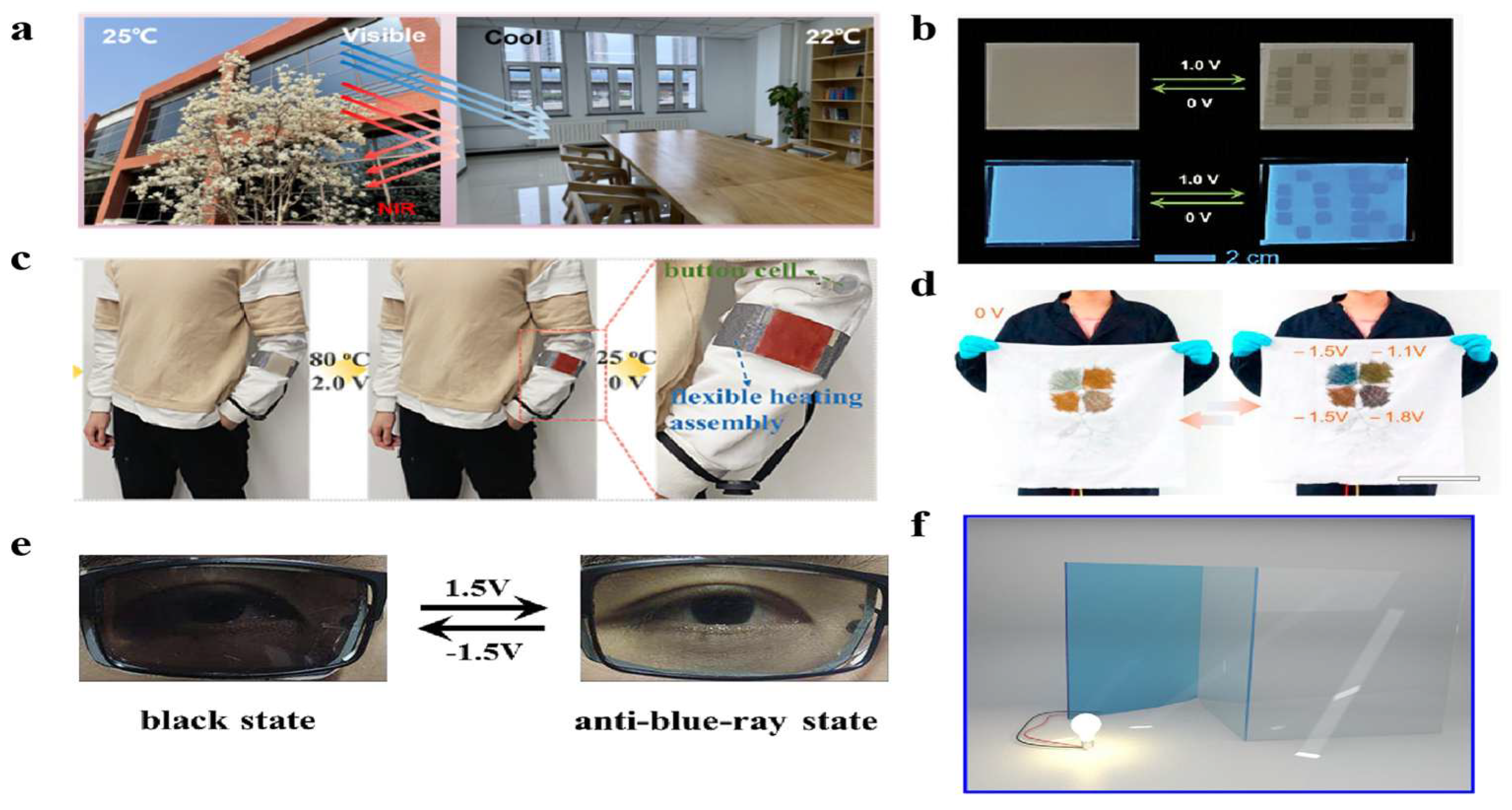
Electrochromic materials exhibit reversible optical modulation, driven by electrochemical redox reactions that cause macroscopic visual color changes under low voltage. Research into electrochromism dates back to the 1960s, when Platt’s pioneering work [1] established the fundamental principles. Over the past five decades, significant progress has been made in both fundamental research and practical applications. As illustrated in Figure 1a–f [2,3,4,5,6,7], some of the most advanced electrochromic devices are used in smart windows for buildings and aircraft [8,9], automatic dimming rearview mirrors in automobiles [10], and energy-efficient architecture [11,12]. Owing to its cost advantage, remarkable stability, and excellent compatibility with cathode materials, nickel oxide (NiO) is established as a leading anodic electrochromic material for the counter electrode in electrochromic devices (ECDs). The functionality of NiO thin films is characterized by their reversible optical switching, which provides controlled modulation of visible light transmittance across the 400–700 nm spectrum—a key requirement for commercial applications like smart windows and dimmable rearview mirrors. This electrochromism is fundamentally governed by the reversible redox reaction between Ni2+ and Ni3+ ions in an alkaline medium [13].
The performance of NiO thin films is marked by outstanding electrochromic characteristics. Pure NiO films boast a coloration efficiency of 107 cm2 C−1, and a NiO/PANI composite also reaches 85 cm2 C−1, both systems possessing high optical contrast [14]. Despite the considerable potential of NiO films, several technical challenges persist in practical applications. These include relatively low electrical conductivity, slow switching kinetics, limited ion diffusion rates, and significant performance degradation after repeated cycling. Furthermore, the choice of fabrication method substantially influences the film’s microstructure, thickness uniformity, and adhesion, which in turn govern its optical and electrochemical properties. To enhance the performance of NiO in electrochromic devices, researchers have developed various thin-film deposition techniques such as sol–gel [15], chemical vapor deposition [16], spray pyrolysis [17], and electrochemical deposition [18,19]. Each method distinctly affects the morphology, thickness, and electrochemical characteristics of the resulting NiO films. Various performance optimization strategies have been proposed to address limitations in conductivity and cycling stability. Metal doping (e.g., with Li, Co, or Ti) can improve electrical conductivity and enhance redox activity, thereby increasing reaction rates and optical contrast. In addition, nanostructural engineering—such as the formation of nanorods or nanosheets—increases the specific surface area of the film, facilitates ion transport, and significantly improves electrochromic performance [20]. Composite material design, incorporating NiO with graphene or carbon nanotubes, further enhances mechanical strength and electrochemical behavior, leading to improved stability during cycling. Heat treatment and annealing processes [21,22] can optimize the crystallinity and surface morphology of the films, improve electrochromic properties, and extend material lifetime. The selection of electrolyte [23,24,25,26] is another critical factor influencing the electrochromic performance of NiO films. Studies indicate that different types of electrolytes—such as inorganic [24], organic [25], and gel electrolytes [26]—offer distinct advantages in improving coloration efficiency, optical modulation range, and cycling stability. The compatibility between the electrolyte and the NiO film is essential for enhancing the overall performance of electrochromic devices.
This review summarizes recent advances in nickel oxide-based electrochromic thin films and offers a comprehensive analysis of their current research progress and remaining challenges. It begins by introducing the typical components and structures of NiO electrochromic films, along with their fundamental working principles. The influence of different fabrication techniques on the film’s microstructure, thickness uniformity, and optical properties is systematically evaluated. Additionally, the effects of metal doping and other modification strategies on the conductivity, optical contrast, response speed, and cycling stability of NiO films are discussed. Finally, current challenges and potential future directions for electrochromic devices are outlined. This review aims to offer valuable insights to support the development of high-performance electrochromic devices.

2. Preparation Methods of NiO Electrochromic Materials

The fabrication techniques for nickel oxide (NiO) thin films are notably diverse, primarily categorized into physical vapor deposition (PVD) and chemical deposition routes. Within PVD, methods such as magnetron sputtering and electron beam evaporation are capable of producing films with high purity and excellent crystalline quality. However, these techniques are often associated with high equipment costs and limitations in scaling up for large-area applications. In contrast, chemical deposition methods, including sol–gel and chemical bath deposition, offer significant cost advantages and simple equipment requirements, making them more competitive for large-scale industrial production. With ongoing research, emerging techniques like electrochemical deposition and spray coating have been developed, demonstrating unique capabilities in tailoring the microstructure and compositional homogeneity of the films. Table 1 systematically compares the technical characteristics of six preparation methods for nickel oxide (NiO) thin films, serving as a valuable reference for material selection and process optimization in electrochromic devices and other optoelectronic applications. Specifically, in the section on preparation methods (Section 2), the discussion is organized into a classification system comprising Magnetron sputtering (Section 2.1), Hydrothermal method (Section 2.2), Electrodeposition (Section 2.3), Chemical bath deposition (Section 2.4), Sol–gel method (Section 2.5), and Spray pyrolysis method (Section 2.6). This classification not only reflects the historical progression of the technology but also highlights the complementary relationships among the different methods. Through this systematic framework, this review presents a clear and coherent picture of the knowledge structure and technological pathways in the field of NiO electrochromic materials.

2.1. Magnetron Sputtering

Magnetron sputtering [27], a physical vapor deposition (PVD) technique [28], is widely used for depositing thin films onto substrate surfaces. Its core principle involves bombarding a target material with high-energy plasma, where positive ions accelerated by an electric field eject atoms from the target, enabling their deposition onto the substrate. The term “magnetron” refers to the use of a magnetic field that confines electron motion within the plasma, thereby enhancing sputtering efficiency and improving film uniformity. Zhang et al. [29] deposited NiO films via direct current (DC) reactive magnetron sputtering, achieving a high optical modulation of 59% at 550 nm and excellent cycling stability with only a 6% decrease after 3000 cycles in a 1 M LiClO4/propylene carbonate electrolyte. Similarly, Mathias et al. [30] employed reactive RF magnetron sputtering to prepare NiO films, which exhibited an optical contrast (ΔT) of 56% at 550 nm and switching times of 1.5 s for bleaching and 5 s for coloring in a LiTFSI-EMITFSI electrolyte. Magnetron sputtering enables the deposition of uniform NiO films over large areas with precise thickness control, ensuring consistent electrochromic performance. By adjusting parameters such as gas pressure, power, and deposition time, the thickness and composition of the film can be finely tuned to optimize optical and electrical properties. In addition, this technique can be performed at relatively low temperatures, making it suitable for a variety of substrates, including temperature-sensitive flexible plastics.
NiO films deposited by magnetron sputtering generally exhibit strong adhesion and high mechanical stability, rendering them suitable for long-term applications. However, the method also presents certain limitations. The equipment required is relatively complex, involving precise control of vacuum, magnetic, and electric fields, which leads to high initial investment. Deposition rates are generally low, especially for thicker films, resulting in extended processing times. The high energy of incident ions may also cause damage to fragile or organic substrates. Furthermore, targets of high-purity or specific compositions can be costly. In summary, while magnetron sputtering is highly effective in producing high-quality electrochromic NiO films, its practical application must consider inherent challenges related to equipment complexity, deposition rate, and material cost when optimizing deposition parameters for specific electrochromic devices.

2.2. Hydrothermal Method

Hydrothermal synthesis is a materials fabrication technique that involves chemical reactions in an aqueous solution under elevated temperature and pressure within a sealed vessel, typically an autoclave. This method is used to prepare various materials, including nanoparticles, thin films, and single crystals, particularly for synthesizing inorganic compounds such as oxides, hydroxides, and sulfides, as well as materials with low solubility or high melting points. In this process, water or other solvents act as the reaction medium. By heating the solution to high temperatures (generally between 100 and 300 °C) under autogenous pressure, precursors dissolve, undergo chemical transformation, and ultimately precipitate as the desired product. For the synthesis of nickel oxide (NiO), nickel-containing salts or other precursors are subjected to hydrothermal conditions, where hydrolysis, oxidation, and related reactions lead to the formation of NiO, which can crystallize as nanoparticles, thin films, or other structured morphologies. For instance, Xu et al. [31] successfully synthesized NiO nanosheets on fluorine-doped tin oxide (FTO) glass via a hydrothermal route. The resulting film, tested in a 1 M KOH aqueous electrolyte, exhibited an optical modulation of 75% with switching times of 5.6 s (bleaching) and 5.5 s (coloring), and maintained good performance over 6000 cycles. Hydrothermal synthesis is particularly effective in producing diverse NiO nanostructures—such as nanosheets, nanospheres, and nanorods—with high specific surface areas. These features supply abundant active sites for electrochemical reactions, thereby accelerating the electrochromic response and enhancing both switching speed and efficiency. As a result, hydrothermal synthesis represents a viable route for fabricating NiO electrochromic materials with well-defined nanostructures and high performance. The technique offers strong morphological controllability, high crystallinity, and operational simplicity, making it well-suited for laboratory and small-scale applications. However, scaling this method to industrial production remains challenging. Process and equipment optimizations are needed to improve throughput and consistency while preserving material properties. In summary, hydrothermal synthesis provides a promising pathway for preparing advanced NiO electrochromic materials with tailored nanostructures. Although limitations in scalability persist, its potential for delivering high-quality, high-performance materials remains considerable for both research and emerging commercial applications.

2.3. Electrodeposition

Electrodeposition is an electrochemical technique used to deposit metal or metal oxide films onto conductive substrates. By applying a voltage or current in an electrolyte solution, metal ions are reduced and deposited onto the substrate surface, forming uniform thin films. This method is widely used in applications such as metal plating, corrosion-resistant coatings, battery electrodes, and the fabrication of functional materials—including electrochromic materials like nickel oxide (NiO). Jin et al. prepared NiO films via electrodeposition with a thickness of 20 nm [32]. They observed that as the deposition current density increased from 1.25 mA/cm2 to 3.75 mA/cm2, the optical modulation amplitude increased by 25%, while the coloration and bleaching times extended by 2.1 s and 1.2 s, respectively. When the current density was fixed at 2.50 mA/cm2 and the film thickness was increased from 10 nm to 50 nm, the optical modulation amplitude rose by 35%, the cycle response time increased significantly, and the transmittance in the colored state decreased to 30%. These changes are attributed to the increased grain boundary surface area resulting from greater film thickness and higher current density, which enhances both optical modulation and ion transport dynamics. Electrodeposition offers an economical, efficient, and easily controllable route for fabricating NiO electrochromic films, with strong potential for large-area applications due to its advantages in cost, thickness control, and structural tunability. However, challenges related to film uniformity, density, and adhesion to the substrate remain. These limitations can be mitigated through optimization of deposition parameters and the introduction of composite materials. In summary, electrodeposition represents a promising approach for producing high-performance NiO electrochromic films, suitable for both laboratory and industrial scales. While the technique already enables efficient and low-cost fabrication, further advances in process control and material design will be key to improving film quality and electrochromic performance.

2.4. Chemical Bath Deposition

Chemical bath deposition (CBD) [33] is a simple solution-based technique used to deposit thin films onto substrate surfaces. The method involves dissolving precursor compounds in a solution, where controlled changes in pH, temperature, and reaction time trigger chemical reactions that produce insoluble precipitates. These precipitates gradually deposit onto the substrate, forming a thin film. CBD is particularly suitable for preparing metal oxide and sulfide films, including nickel oxide (NiO). Harish et al. [34] employed CBD to synthesize bimetallic Ni1−xVxO (NiVO) nanostructured films on ITO substrates. The resulting films exhibited an optical modulation of 68% and a coloration efficiency of 63.18 cm2 C−1, with rapid switching times of 1.52 s for coloring and 4.79 s for bleaching. CBD offers several advantages, such as low cost, operational simplicity, and scalability for large-area deposition, making it a promising method for fabricating NiO electrochromic films. Its mild processing conditions and minimal equipment requirements further enhance its suitability for industrial-scale production. However, films prepared by CBD generally exhibit lower density and inferior performance compared to those deposited by physical methods. Post-treatment or composite strategies are often required to enhance their electrochromic properties. For applications such as smart windows and displays—especially in flexible and large-area formats—CBD holds considerable potential. With further optimization and improved process control, it could become a widely adopted technique for the mass production of high-performance electrochromic materials.

2.5. Sol–Gel Method

Sol–gel processing [35,36] is a widely used chemical synthesis technique that involves the hydrolysis and polycondensation of precursor compounds in solution to form a sol, which gradually transforms into a gel and eventually into a solid material under controlled conditions. Due to its simplicity, low cost, and chemical tunability, this method is extensively employed for the preparation of oxide films, particularly electrochromic materials such as nickel oxide (NiO). A typical process begins by dissolving suitable precursors (e.g., nickel nitrate or nickel acetate) and modifiers (e.g., ethanol, isopropanol, or acetic acid) to form a nickel oxide precursor solution. Gelation is initiated by the addition of water and a catalyst. By adjusting reaction conditions, the stability of the sol and the uniformity of the resulting film can be effectively controlled. Moreover, sol–gel processing allows precise regulation of film composition and stoichiometry at the molecular level through modification of the precursor solution. Key parameters—such as solvent type, solute concentration, surfactants, and annealing temperature—play critical roles in determining the performance of the final electrochromic film. Purushothaman et al. [15] prepared NiO films using a sol–gel dip-coating method on glass and fluorine-doped tin oxide (FTO) substrates. The resulting films, with grain sizes between 12 nm and 20 nm, showed an optical transmittance change (ΔT) of 53% at 630 nm in a 1 M KOH electrolyte. The same films exhibited high anode and cathode diffusion coefficients of 16.7 × 10⁻¹³ cm2/s and 5.73 × 10⁻¹³ cm2/s, respectively. In another study, Hao et al. [37] dissolved nickel chloride (NiCl2) in ethanol, followed by the addition of acetic acid and polyethylene glycol (PEG-400) to form a sol. After heat treatment at 350 °C, the NiO films displayed excellent electrochemical performance in a 1 M KOH electrolyte, achieving a transmittance change (ΔT) of 50.7% at 550 nm, high coloration efficiency (71.4 cm2 C−1), outstanding long-term cycling stability, and remarkable reversibility with a charge injection/extraction ratio (Qex/Qin) of 92.3%. Although sol–gel-derived films often exhibit smooth and compact morphologies—which can somewhat hinder ion transport and electrochemical kinetics—the method remains a cost-effective and versatile route for producing high-performance electrochromic films with strong potential for large-scale applications. Further optimization of processing parameters and post-treatment strategies may help improve electrochemical response and enhance the overall performance of sol–gel-derived electrochromic materials.

2.6. Spray Pyrolysis Method

Spray pyrolysis [38] is a widely used chemical deposition technique for preparing thin films. In this method, a precursor solution is atomized and sprayed onto a heated substrate surface, where the precursor undergoes pyrolytic decomposition and reacts to form a solid oxide film. This approach is particularly suitable for fabricating various metal oxide films, especially nickel oxide (NiO), owing to its simplicity, cost-effectiveness, and scalability for large-area deposition. Spray pyrolysis requires minimal equipment and is easy to operate. Unlike many physical deposition methods, it does not require high-vacuum conditions, which significantly reduces processing costs. By adjusting parameters such as spray rate and deposition time, the thickness of the film can be precisely controlled—a key factor in optimizing electrochromic performance. The technique is also highly versatile, compatible with various substrates including conductive glass, ceramics, and metals, offering flexibility in material selection. Furthermore, by modifying the chemical composition of the precursor solution, doped NiO films, such as those incorporating lithium or cobalt, can be readily synthesized. In 1995, Arakaki et al. [39] successfully prepared NiO films via spray pyrolysis using a 0.1 M nickel nitrate aqueous solution and investigated the influence of substrate temperature on electrochromic performance. Their results revealed that amorphous NiO films deposited at 220 °C exhibited superior electrochromic properties in a 0.1 M KOH electrolyte, with an optical transmittance change (ΔT) of 35%, compared to a ΔT of only 5% for crystalline films prepared at 400 °C. Denayer et al. [40] employed a surfactant-assisted ultrasonic spray pyrolysis method with polyethylene glycol (PEG) to prepare both NiO and lithium-doped NiO (LiNiO) films. In a LiClO4/PC electrolyte, cyclic voltammetry confirmed that the LiNiO-PEG films exhibited enhanced electrochemical performance, including higher current density and improved stability. The LiNiO-PEG films achieved a ΔT of 43.5% at 550 nm, outperforming the NiO-PEG films (ΔT = 39.0%). The former also showed a coloration efficiency of 41.2 cm2/C, with coloring and bleaching times of 17 s and 12 s, respectively, whereas the NiO-PEG films switched faster, with coloring and bleaching times of 8 s and 2 s.

3. Multifaceted Modification Strategies for Enhancing NiO Electrochromic Performance

Nickel oxide (NiO) suffers from several inherent limitations due to its intrinsic physicochemical properties, including poor cycling stability, slow switching kinetics, limited optical modulation range, and low electrical conductivity. To address these challenges, performance enhancement through modification is essential. Physical and chemical modification strategies can improve electronic conductivity, accelerate ion transport, reinforce structural stability, and enhance optical modulation, leading to superior cycling endurance, faster response, and improved coloration performance. Consequently, researchers have developed various modification approaches such as elemental doping, nanostructure engineering, composite formation, and optimization of synthesis methods.

3.1. Ion/Element Doping

Elemental doping [41] is a common strategy for modifying nickel oxide (NiO) to enhance its electrochromic properties. By incorporating metal or non-metal elements into the NiO lattice, its electronic structure, bandgap, electrical conductivity, and electrochemical activity can be effectively tuned, thereby improving key performance metrics for electrochromic applications. The influence of dopants on the electrochromic behavior of NiO primarily involves modifications to the crystal structure and defect concentration. Dopants often introduce cations with different oxidation states or adjust the concentration of oxygen vacancies, which in turn alters the crystal structure and defect distribution of NiO. For example, the incorporation of small-radius cations such as Li+ can modify the lattice parameters of NiO [42], promote the formation of oxygen or nickel vacancies, and enhance electrochemical reactivity. Doping also modulates the electronic structure and bandgap of NiO. Certain dopants can narrow the bandgap, thereby improving the efficiency of electron transitions between the transparent and colored states. For instance, tungsten (W) doping has been shown to reduce the bandgap of NiO, facilitating electron–hole generation and recombination, which accelerates the coloration/bleaching kinetics [43]. In addition, elemental doping contributes to improved electrical conductivity [44] and enhanced ion diffusion [45] in NiO. The introduction of multivalent elements such as Co, Cr, and V promotes charge and ion transport, lowers reaction resistance, and improves both the response speed and efficiency of the electrochromic process. Furthermore, doping enhances the electrochemical stability of NiO. The inclusion of stable dopants helps mitigate structural degradation during repeated cycling. For example, Cr and Zn doping have been demonstrated to improve the mechanical stability and durability of NiO [46,47], reducing stress-induced damage during redox reactions and extending the material’s operational lifespan. The following sections provide a detailed analysis of the effects of various dopant types on the electrochromic performance of NiO and the underlying mechanisms involved [43,46]. Table 2 shows the EC properties of NiO doped with different ions/elements.
The most prevalent doping strategy involves the incorporation of metal elements. By introducing metal ions [48], the electrical properties, optical contrast, and cycling stability of NiO can be effectively modulated, thereby enhancing its overall electrochromic performance. Alkali metals such as Li+ and Na+ improve ionic conductivity, accelerate charge exchange, and increase response speed. Specifically, Li+ ions can intercalate into the NiO lattice, generating additional electron holes and enhancing its p-type conductivity. Lithium doping not only improves electronic conduction but also facilitates lithium-ion diffusion within the material, thereby accelerating the electrochromic reaction. Alkaline earth metals like Mg2+ and Ca2+ enhance the structural stability and mechanical durability of the films [49]. Transition metals such as Co2+, Fe3+, and Mn2+ help regulate the bandgap, increase electrical conductivity, and improve optical contrast. For instance, doping with Co2+ or Co3+ significantly enhances electronic conductivity due to their variable oxidation states, which promotes redox activity during electrochromic cycling and increases the color-switching rate. Noble metals, including Ag+ and Au3+, are also effective in improving conductivity, though their high cost generally restricts their use to specialized applications. Doping further enhances cycling stability by reinforcing the NiO structure. Certain dopants mitigate structural collapse or degradation during prolonged redox cycling, thereby extending the service life. For example, Zn2+ doping stabilizes the NiO lattice due to the smaller ionic radius of Zn2+, which reduces structural strain during ion insertion/extraction and improves longevity. Similarly, Cr3+ doping [46] enhances oxidation stability, minimizes stress variation during electrochemical reactions, and improves overall durability. In addition, doping can tailor the electronic band structure and redox characteristics of NiO, broadening the optical modulation range and increasing the transmittance contrast between colored and bleached states. Ti4+ doping, for example, enhances visible-light modulation—particularly in the blue and green regions—making the transmittance difference more pronounced [50]. V5+ doping increases redox reactivity, leading to greater optical modulation during the electrochromic process and a larger transmittance change [34]. Some dopants also influence the microstructure of NiO, increasing specific surface area and porosity to facilitate ion diffusion and improve electrochromic kinetics. Mg2+ doping [51], for instance, reduces NiO grain size, enlarges the active surface area, and accelerates ion transport, thereby boosting electrochromic efficiency.
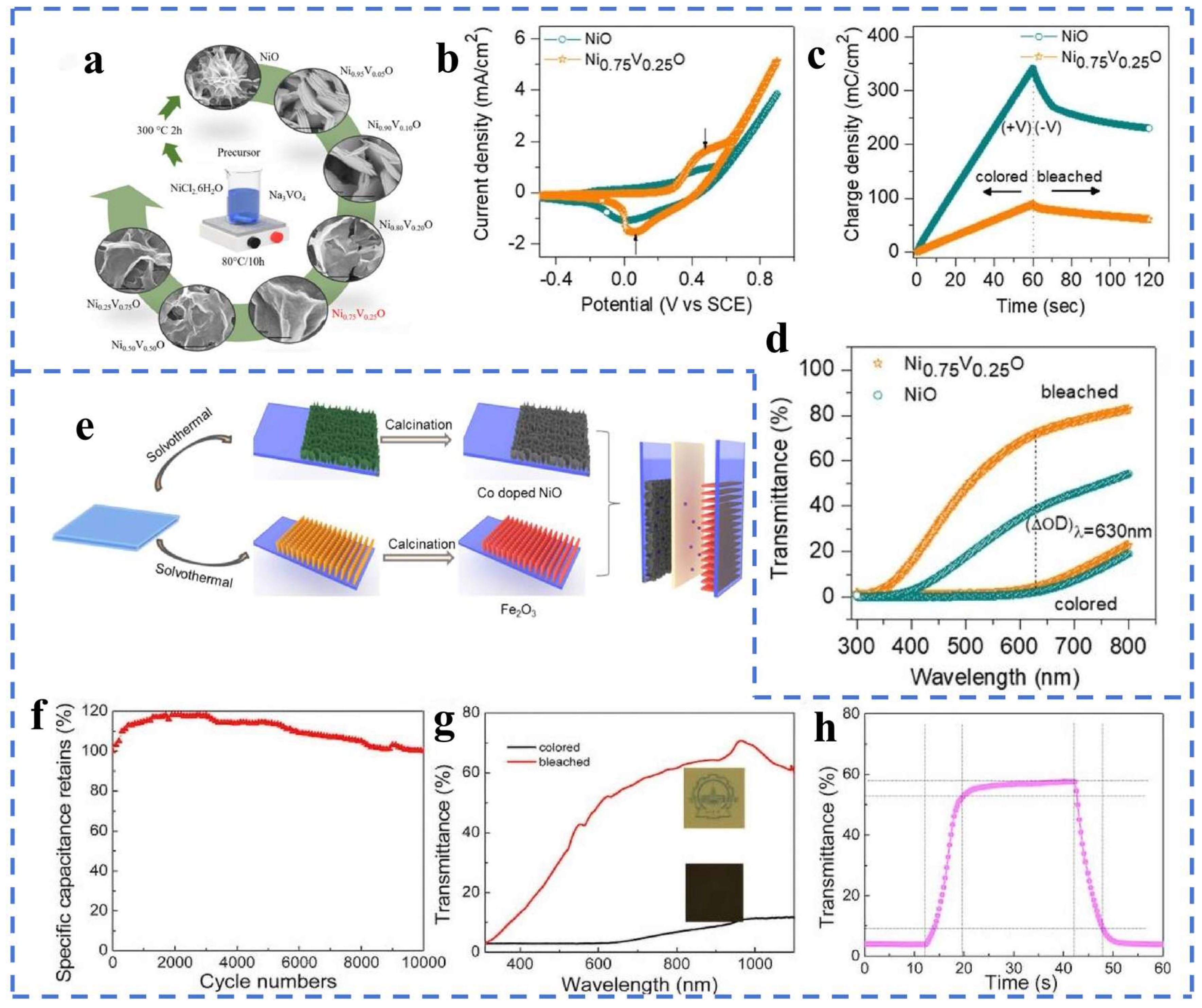
To date, numerous studies have focused on metal element doping to enhance the electrochromic performance of NiO. Shi et al. [52] prepared Al-doped NiO films via an in situ pyrolysis method using layered double hydroxide precursors. The Al-doped NiO films exhibited excellent electrochromic properties, with the Ni-Al (19:1) LDH-derived NiO demonstrating optimal performance. These films showed high transparency (96%) and a large optical modulation range (58.4%) in a 6 M KOH electrolyte, along with fast switching speeds (tb/tc = 1.8 s/4.2 s) and excellent cycling stability (only 30% degradation after 2000 cycles). Al3+ ions were uniformly distributed within the NiO matrix, significantly influencing the crystallinity of both the Ni-Al LDH precursors and the resulting NiO:Al3+ films. Aluminum doping induced lattice contraction while maintaining the NiO crystal structure. Harish et al. [34] synthesized bimetallic NiVO films on ITO substrates using chemical bath deposition. They found that vanadium doping significantly increased the electrochemically active surface area, facilitating better electrolyte contact and providing more active sites for rapid charge transfer. V doping also improved the ion diffusion characteristics, enhancing the insertion and extraction kinetics of OH ions during charge/discharge cycles and resulting in ultrafast coloring/bleaching times.
As shown in Figure 2a–d, NiVO films with a Ni/V ratio of 0.75:0.25 exhibited outstanding electrochemical performance, including high specific capacitance (2403 F/g), color efficiency (63.18 cm2/C), optical modulation (68%), and ultrafast switching behavior (1.52 s for coloring and 4.79 s for bleaching), along with excellent cycling stability (91.95% capacity retention after 2000 cycles). Firat et al. [53] fabricated nanoporous Cu-doped NiO films on ITO-coated glass substrates through electrochemical deposition followed by thermal treatment at 300 °C for 30 min. Compared to undoped NiO, the Cu-doped films showed significantly improved optical modulation (57.1% at 550 nm), higher coloration efficiency (13.78 cm2/C), and faster response times (coloring time tb = 2.26 s, bleaching time tc = 1.77 s).
Zhao et al. [54] prepared Sn-doped NiO films via magnetron sputtering and observed that Sn4+ ions refined the film microstructure, increased the electrochemically active surface area, and promoted lithium-ion diffusion, thereby enhancing electrochromic performance. Sn-NiO films deposited at a sputtering power of 10 W exhibited excellent properties, including high optical modulation (65.1% at 550 nm), high coloration efficiency (39.3 cm2 C−1), fast switching speeds (tb/tc = 1.3 s/1.4 s), and good cycling durability (30% decrease in transmittance modulation after 2000 cycles). Gao et al. [50] synthesized Ti-doped nanoporous NiO films using a sol-thermal method followed by annealing at 300 °C for 2 h. The Ti-doped NiO films showed enhanced conductivity, improved microstructure stability, and superior electrochromic performance, with the best results achieved at 2% Ti doping. These films exhibited short response times (tb/tc = 0.8 s/2.9 s), large optical modulation (54.4%), high coloration efficiency (45.6 cm2 C−1), and an exceptionally long cycle life (50,000 cycles). Notably, Ti doping converted NiO from a p-type to an n-type semiconductor. Xue et al. [55] grew Co-doped NiO nanosheets on FTO glass using a simple hydrothermal method followed by annealing at 300 °C for 2 h. As shown in Figure 2e–h, the Co-doped NiO films exhibited high specific capacitance (88.24 mF cm−2) and excellent electrochromic performance, with reversible color changes from brown (colored state) to yellow (bleached state) during charging. The films also demonstrated high areal capacitance (10.8 mF cm−2), high energy density (3.84 × 10⁻³ mWh cm−2), and superior cycling stability (84.5% capacitance retention after 2000 charge/discharge cycles).
Figure 2. (a) Schematic diagram of NixV1−x oxide and its morphological display growth process. (b) CV curves of NiO and Ni0.75V0.25O recorded in a 2 M KOH electrolyte at a scan rate of 5 mV/s. (c) CC measurements for the colored film at ±0.6 V. (d) Optical transmittance spectra for NiO and Ni0.75V0.25O in colored and bleached states. (e) Schematic diagram of the construction of the AESC. (f) Cycle stability. (g) Transmittance spectra. (h) the switching response curves. (ad), reprinted with permission from Ref. [34], Copyright 2021, ACS; (eh), reprinted with permission from Ref. [55], Copyright 2021, Elsevier.
Nanoenergyadv 06 00010 g002
Non-metallic element doping also contributes to improving the electrochemical performance and environmental stability of NiO. The insertion of H+ ions into the NiO lattice leads to partial oxidation of Ni2+ to Ni3+, thereby enhancing redox reactivity. The presence of hydrogen ions reduces the film impedance, improving electron and ion transport properties, which accelerates the coloration/bleaching response. This enhancement facilitates faster switching kinetics, improved electronic/ionic conductivity, and increased efficiency in electrochemical reactions. Carbon atoms can incorporate into the NiO lattice or occupy oxygen vacancies, improving electron transport pathways and reducing electrical resistance. Carbon-doped NiO films exhibit a larger specific surface area, providing more active sites, promoting ion migration, and further enhancing electron transport and conductivity. Collectively, carbon doping reduces resistance, making NiO films more conductive.
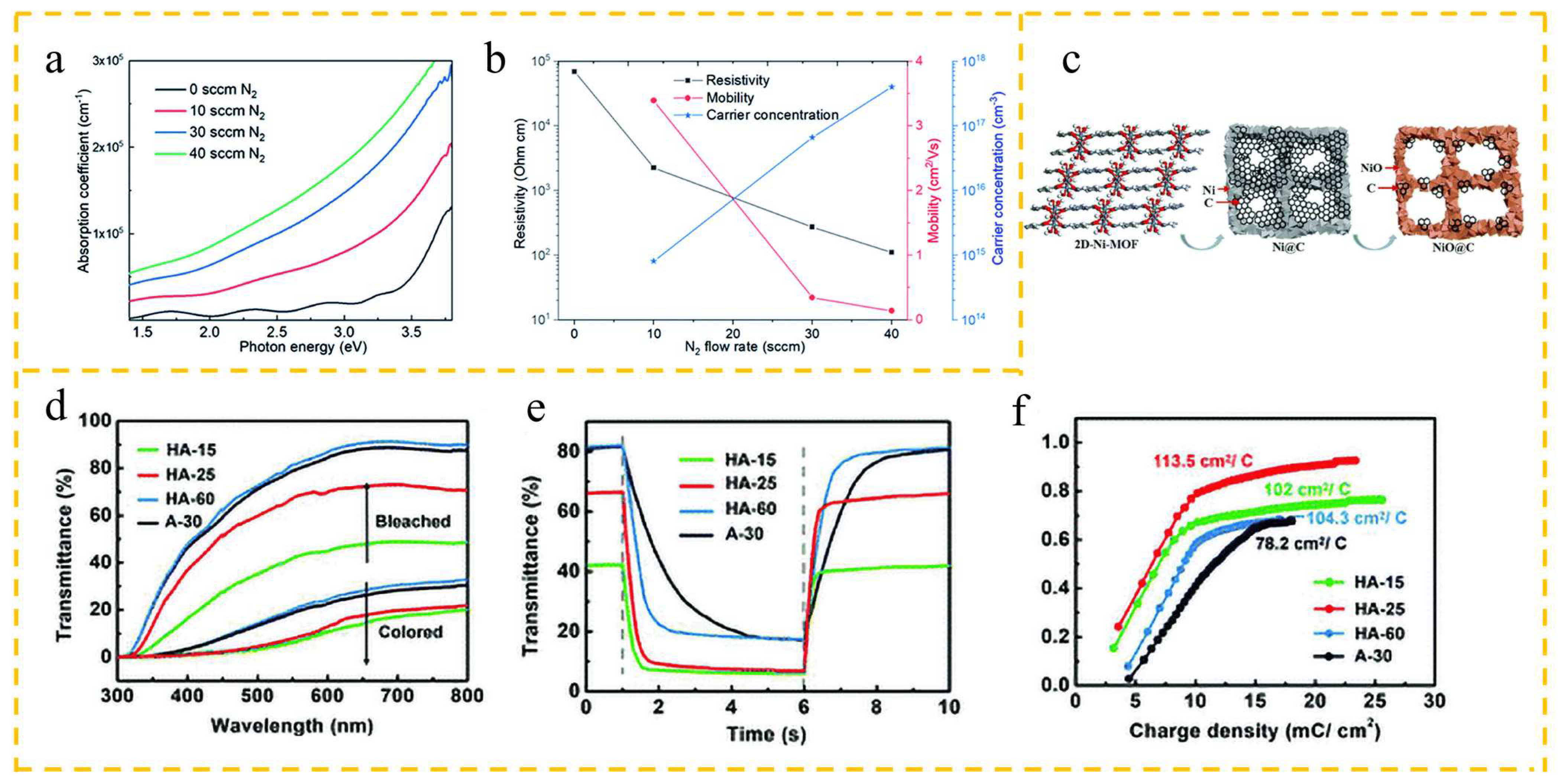
Dong et al. [9] employed a reactive sputtering strategy to fabricate hydrogen-doped NiOx (NiOx:H) films. Specifically, the films were deposited via DC magnetron sputtering of a Ni target in a mixed Ar/O2/H2 atmosphere at room temperature. By adjusting the hydrogen flow rate, the H2 content in the sputtering gas was precisely varied, with key ratios being Ar:O2:H2 = 19:1:0, 19:1:3, 19:1:5, and 19:1:10. This in situ hydrogen doping approach substantially modified the properties of the NiOx films, notably weakening crystallinity to facilitate ion transport, altering chemical states to promote the Ni2+/Ni3+ redox activity, and enhancing electrochemical kinetics. As illustrated in the corresponding figures, the optimally doped film (prepared with Ar:O2:H2 = 19:1:3) demonstrated a significant optical modulation (ΔT) of 56% at 550 nm, an improved coloration efficiency of 52.17 cm2·C−1, and robust switching durability. Furthermore, when integrated as an ion storage layer in a monolithic all-thin-film device (ITO/NiOx:H/ZrO2/WO3/ITO), the optimized film contributed to a high device optical modulation of 68% at 550 nm. Wang et al. [56] deposited nitrogen-doped NiO films via magnetron sputtering in an Ar–O2–N2 atmosphere and investigated the effect of varying nitrogen flow rates (0, 10, 30, and 40 sccm) on film properties. As shown in Figure 3a,b, N doping reduced the optical bandgap of NiO from 3.2 eV and enhanced absorption in the visible region, attributed to the introduction of new electronic states and enhanced sub-bandgap absorption. The resistivity decreased with increasing nitrogen flow, dropping from 69,200 Ω·cm for undoped NiO to 110 Ω·cm at 40 sccm, demonstrating significantly improved conductivity. The film prepared with a nitrogen flow rate of 30 sccm exhibited the best overall performance, with markedly enhanced optical absorption, conductivity, switching efficiency, and cycling stability. Liang et al. [57] converted a Ni-MOF precursor into Ni@C films under an Ar/H2 atmosphere, followed by pyrolysis in air to oxidize Ni to NiO while retaining a controlled amount of carbon. The carbon content was tuned by adjusting the pyrolysis duration (ranging from 3.96% to 29.74%). This MOF-derived carbon doping strategy significantly improved the electrochromic performance of NiO films, particularly in terms of conductivity, ion diffusion, and cycling stability. As shown in Figure 3c–f, the sample with optimal carbon content (HA-25, 11.42% carbon) delivered the best performance: an optical modulation of 60.6% at 650 nm, a coloration efficiency of 113.5 cm2 C−1, and ultrafast switching times (coloring time tb = 0.46 s, bleaching time tc = 0.25 s). After 20,000 cycles, the film retained 90.1% of its initial performance, demonstrating exceptional long-term stability.
Table 2. EC Properties of NiO Thin Films Doped with Different Ions/Elements.
Doping Ion/ElementPreparation MethodΔT (%)CE (cm2/C)tb/tc (s)Cycle Stability (Cycles/% Retained)ElectrolyteRef.
VChemical bath deposition68 (630 nm)63.181.52/4.792000/91.952 M KOH[34]
WMagnetron sputtering52.7 (550 nm)37.47.2/8.8_0.5 M PC-LiClO4[43]
Si, LiMagnetron sputtering38.0 (550 nm)_2.4/8.81001 M PC-LiClO4[47]
TiSolvothermal54.4 (550 nm)45.60.8/2.950,0000.5 M KOH[50]
AlSpin coating58.4 (550 nm)54.21.8/4.22000/706 M KOH[52]
CuElectrochemical deposition method57.1 (550 nm)13.782.26/1.77_0.1 M KOH[53]
SnMagnetron sputtering65.1 (550 nm)39.31.3/1.42000/701 M PC-LiClO4[54]
Cpyrolysis60.6 (550 nm)113.50.25/0.4620,000/90.11 M KOH[57]
Li, TaMagnetron sputtering62.0 (550 nm)35__1 M PC-LiClO4[58]
ZnHydrothermal68.6 (500 nm)52.493.8/6.45000/99.470.1 M KOH[59]
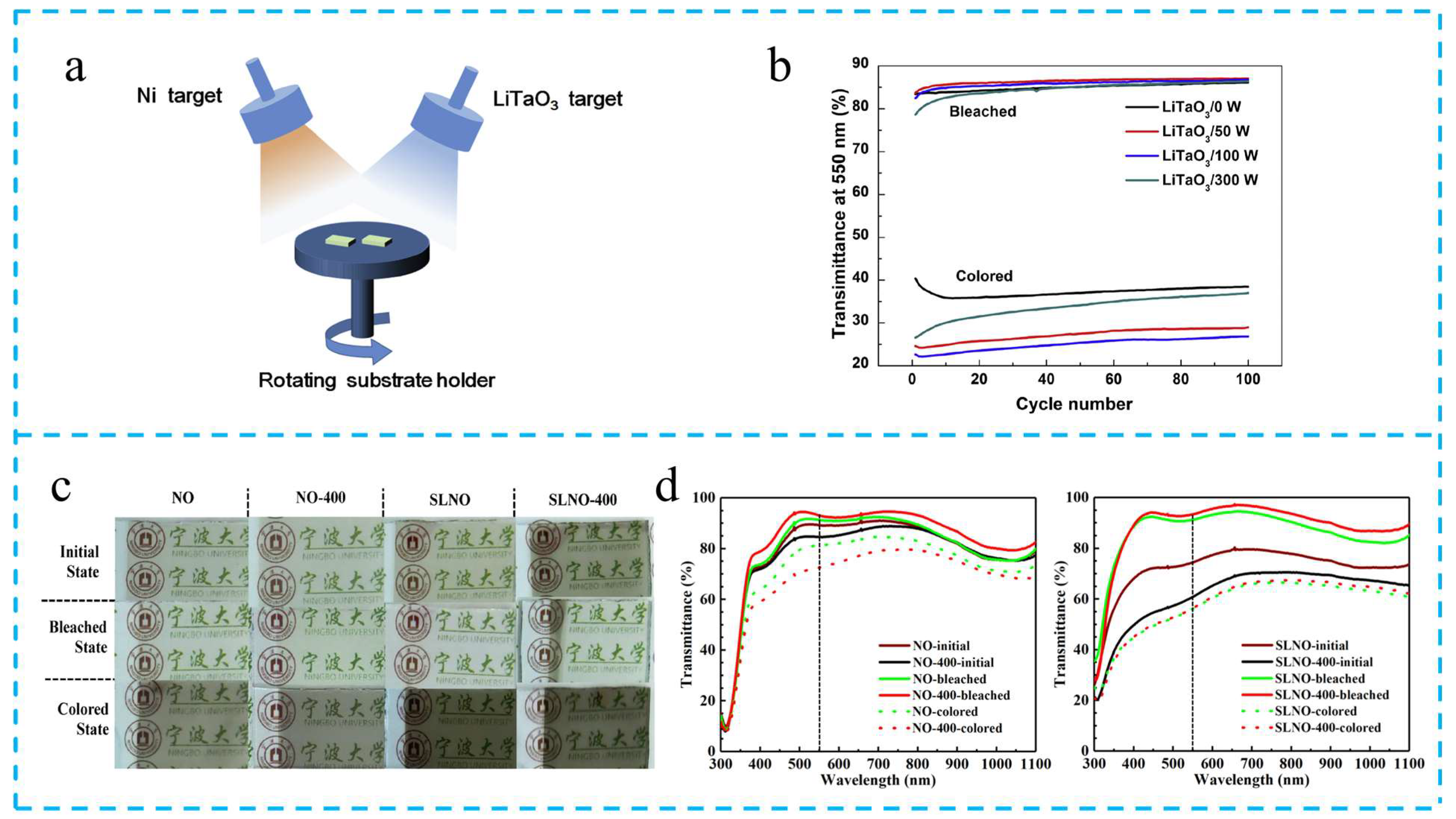
In addition to single-element doping, nickel oxide (NiO) can be co-doped with two or more elements to further enhance its electrochromic properties. Huang et al. [58] utilized a combination of direct current (DC) and radio frequency (RF) magnetron sputtering with metallic Ni and LiTaO3 ceramic targets to prepare Li–Ta co-doped NiO films. They found that when the deposition power for the LiTaO3 target was set to 100 W, the co-doped films exhibited optimal electrochromic performance. As shown in Figure 4a,b, these films achieved an optical modulation of 62% and a coloration efficiency of 35 cm2/C at 550 nm. The improvement was attributed to the effect of Li–Ta co-doping on the crystal structure of NiO, resulting in a mixed crystalline–amorphous phase. This mixed-phase structure contributed to enhanced optical modulation, faster response times, and extended service life. Co-doping also increased the lattice constants, further modifying the NiO crystal structure and optimizing its electrochemical behavior. In addition, the surface morphology of the NiO films became more uniform and smooth due to particle refinement, which improved charge storage capacity and overall electrochromic performance. Moreover, an increased concentration of Ni3+ species induced by co-doping enhanced redox activity, further boosting electrochromic properties. Wu et al. [47] employed a custom-made Si and Li co-doped NiOx ceramic target and deposited films via RF magnetron sputtering in a pure argon atmosphere, followed by rapid thermal annealing (RTA) at 400 °C in air. The sputtering power and argon pressure were optimized to 150 W and 1.6 Pa, respectively. As shown in Figure 4c,d, the Si–Li co-doped films subjected to RTA exhibited the highest bleached-state transmittance (93.3% at 550 nm), a maximum optical modulation of 37.0% at 550 nm, the largest areal charge capacity (14.8 mC·cm−2), good electrochemical stability (over 100 cycles), and fast switching times (tb/tc = 2.4 s/8.8 s). The improved performance was ascribed to the fact that Si–Li co-doping, combined with RTA, promoted preferential growth of NiOx along the (111) orientation, which facilitated interaction with more Li+ ions during electrochromic processes. The RTA treatment also led to the formation of uniformly distributed fine pores, potentially offering additional pathways and active sites for Li+ insertion and reaction. Furthermore, the annealing process enhanced electrochemical stability, likely due to the formation of a robust Si–O network that helped prevent structural collapse during Li+ shuttling. Overall, the co-doped films provided more efficient pathways for rapid Li+ insertion and extraction, accelerating both bleaching and coloring responses during electrochromic cycling.

3.2. Design of Electrolyte

The performance of NiO electrochromic films is critically dependent on the choice of electrolyte, which governs ion transport kinetics, electrochemical stability, and overall device longevity. Different electrolyte systems—including ionic liquids, organic, inorganic, solid-state, and gel electrolytes—offer distinct advantages and challenges. This section provides a systematic overview of these common electrolyte types and their specific impacts on the electrochromic performance of NiO films.
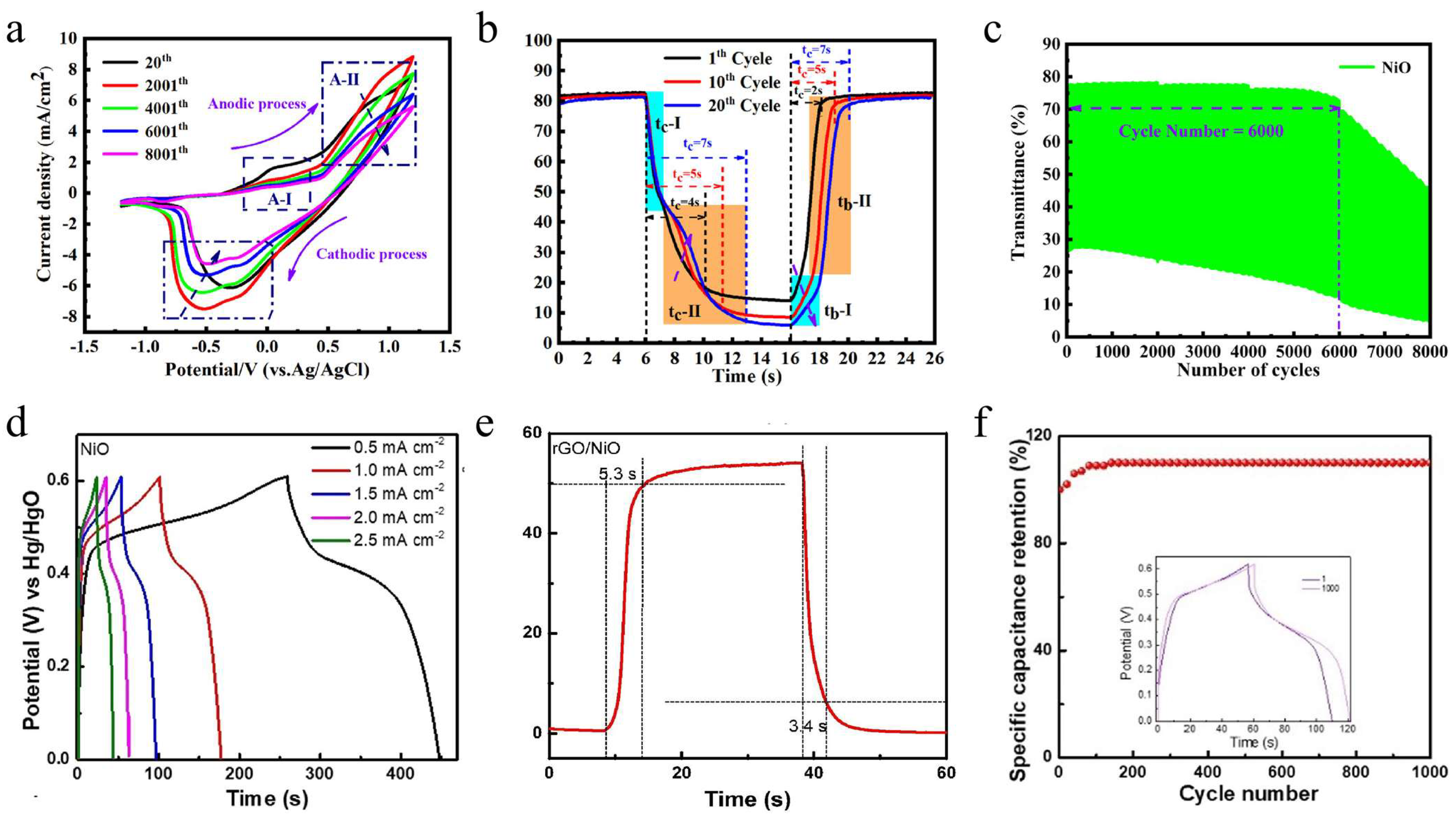
Organic electrolytes, typically comprising lithium salts (e.g., LiClO4) dissolved in organic solvents such as propylene carbonate (PC) or ethylene carbonate (EC), are widely used due to their wide electrochemical stability window and good ionic conductivity [60]. However, their compatibility with NiO in achieving high optical modulation and long-term stability can be inferior to that of aqueous alkaline systems. Xu et al. [31] compared the performance of NiO films in LiClO4/PC electrolyte with that in alkaline KOH. They found that NiO films in the organic electrolyte underperformed, showing lower charge capacity and more pronounced performance degradation over extended cycling compared to films tested in alkaline medium (Figure 5a–c). Inorganic electrolytes [19], particularly aqueous alkaline solutions like KOH or NaOH, are highly effective for NiO electrochromic films due to the high mobility of OH ions, which participate directly in the Ni2+/Ni3+ redox reaction. Xu et al. [31] demonstrated that NiO films in 1 M KOH achieved a high transmittance modulation (75%) and retained satisfactory performance after 8000 cycles, significantly outperforming their counterparts in organic lithium-ion electrolytes. The high ionic conductivity and favorable reaction kinetics in alkaline media contribute to superior optical modulation and cycling endurance. Solid-state electrolytes (e.g., inorganic ceramics, glasses, or solid polymers) offer significant advantages for constructing all-solid-state electrochromic devices, eliminating leakage risks and enhancing mechanical robustness and environmental stability. For instance, advanced dual-band smart windows utilizing inorganic all-solid-state electrolytes have been developed for selective visible and near-infrared modulation, showcasing improved device integration and durability [61]. The development of compatible solid-state ion conductors that maintain high ionic conductivity at the NiO/electrolyte interface remains a key research direction for enhancing device lifetime and safety. Gel electrolytes, formed by immobilizing liquid electrolytes in a polymer or inorganic matrix, combine the high ionic conductivity of liquids with the dimensional stability and handling ease of solids. Ionic gel electrolytes, for example, have been specifically designed for electrochromic devices, offering tunable mechanical properties and good interfacial contact with NiO films [62]. These quasi-solid electrolytes can mitigate leakage issues while maintaining responsive electrochromic switching, making them promising for flexible and large-area device applications. Ionic liquid electrolytes offer distinct advantages in NiO thin-film electrochromic systems, primarily due to their unique physicochemical properties. For instance, when 1-butyl-3-methylimidazolium bis(trifluoromethylsulfonyl)imide (BMITFSI) is used to dissolve lithium bis(trifluoromethylsulfonyl)imide (LiTFSI), forming a 0.3 M electrolyte solution, the electrochromic response characteristics of NiO films are significantly enhanced [63]. Compared to conventional aqueous electrolytes, ionic liquids exhibit lower vapor pressure and higher chemical stability, while effectively suppressing side reactions during electrochemical processes, thereby ensuring long-term cycling stability of NiO films. Electrochromic devices based on NiOx films with BMIMPF6 ionic liquid electrolyte demonstrate shorter coloration and bleaching times, which are closely associated with the faster ion migration rate in ionic liquids.
In summary, the selection and design of the electrolyte are pivotal for optimizing the electrochromic performance of NiO films. While aqueous alkaline electrolytes often deliver the best combination of high modulation and cycling stability, ionic liquids and advanced solid-state or gel systems provide essential pathways toward durable, leak-free, and mechanically flexible electrochromic devices for practical applications.

3.3. Design of Composite Materials

Composite material design plays a key role in enhancing the electrochromic performance of nickel oxide (NiO). By combining NiO with other functional materials, significant improvements can be achieved in performance metrics such as optical modulation range, coloration efficiency, switching speed, and cycling stability. The underlying principle of composite design is to exploit synergistic effects between different materials to optimize the properties of NiO.
Xue et al. [55] developed a two-dimensional rGO/NiO heterostructure film through a multi-step process involving hydrothermal synthesis, liquid-phase exfoliation, filtration transfer, freeze-drying, and annealing. This heterostructure was applied in electrochromic energy storage devices. The designed architecture increased the interlayer spacing and electrochemically active surface area of the NiO-based film, reduced charge transfer resistance and bandgap, and enabled rapid ion diffusion and electron transport, thereby enhancing both the electrochromic and supercapacitive performance. As shown in Figure 5d–f, the resulting film exhibited an excellent areal capacitance of 269 mF cm−2 at 0.5 mA cm−2, outstanding cycling stability (nearly 100% capacitance retention after 1000 cycles at 1.5 mA cm−2), and superior electrochromic properties, including an optical contrast of 53% at 630 nm and switching times of tb/tc = 3.4 s/5.3 s. Meng et al. [65] were the first to prepare Ni-based electrochromic films using a simple hydrothermal method combined with CdS quantum dot sensitization. The composite films adsorbed with CdS quantum dots exhibited multifunctional electrochromic behavior with reversible color changes. The performance improvement is attributed to the synergistic effect between NiO and CdS, which enhances charge transfer dynamics and optical modulation efficiency. Compared to NiO, CdS possesses a higher carrier density, increasing the charge storage capacity of the composite film and thereby improving coloration efficiency and accelerating the electrochromic reaction. In addition, CdS acts as a buffer layer, reducing mechanical stress and inhibiting NiO degradation during repeated cycling, which enhances the cycling stability and durability of the device. The composite films achieved an optical modulation of up to 54.7% and exhibited reversible transitions between two distinct color states.
Despite these improvements, the introduction of composite materials can complicate the fabrication process, increase production costs, and prolong processing time. Compatibility issues between different components may lead to interfacial instability, adversely affecting overall film performance. Furthermore, composite-based films may require more maintenance and pose challenges in terms of recyclability. Although composite materials offer advantages in optical modulation, response time, and coloration efficiency compared to pure NiO, their preparation remains relatively complex and requires further optimization. Table 3 summarizes the electrochromic properties of various NiO-based composite materials, highlighting these aspects.

3.4. Heat Treatment and Annealing

Thermal treatment and annealing [21,47,72] are widely employed post-deposition processes for optimizing electrochromic nickel oxide (NiO) films, significantly enhancing their crystalline structure, electrical conductivity, ion transport properties, and overall electrochromic performance. Through appropriate thermal processing, internal defects can be reduced, and the microstructure of the films can be tailored, leading to improved coloration efficiency, switching speed, cycling stability, and optical modulation range. The following sections detail the specific roles and effects of thermal treatment and annealing on electrochromic NiO films. These processes promote grain growth and crystallization, reduce lattice defects and internal stress, and improve the overall structural quality. The crystal structure of NiO films is critical for efficient ion and electron transport during electrochromic reactions. Highly crystalline NiO films typically exhibit fewer grain boundaries and defects, resulting in enhanced charge transport efficiency. Proper thermal treatment can also decrease the concentration of oxygen vacancies and other lattice defects, which otherwise increase ion migration resistance and impair switching kinetics.
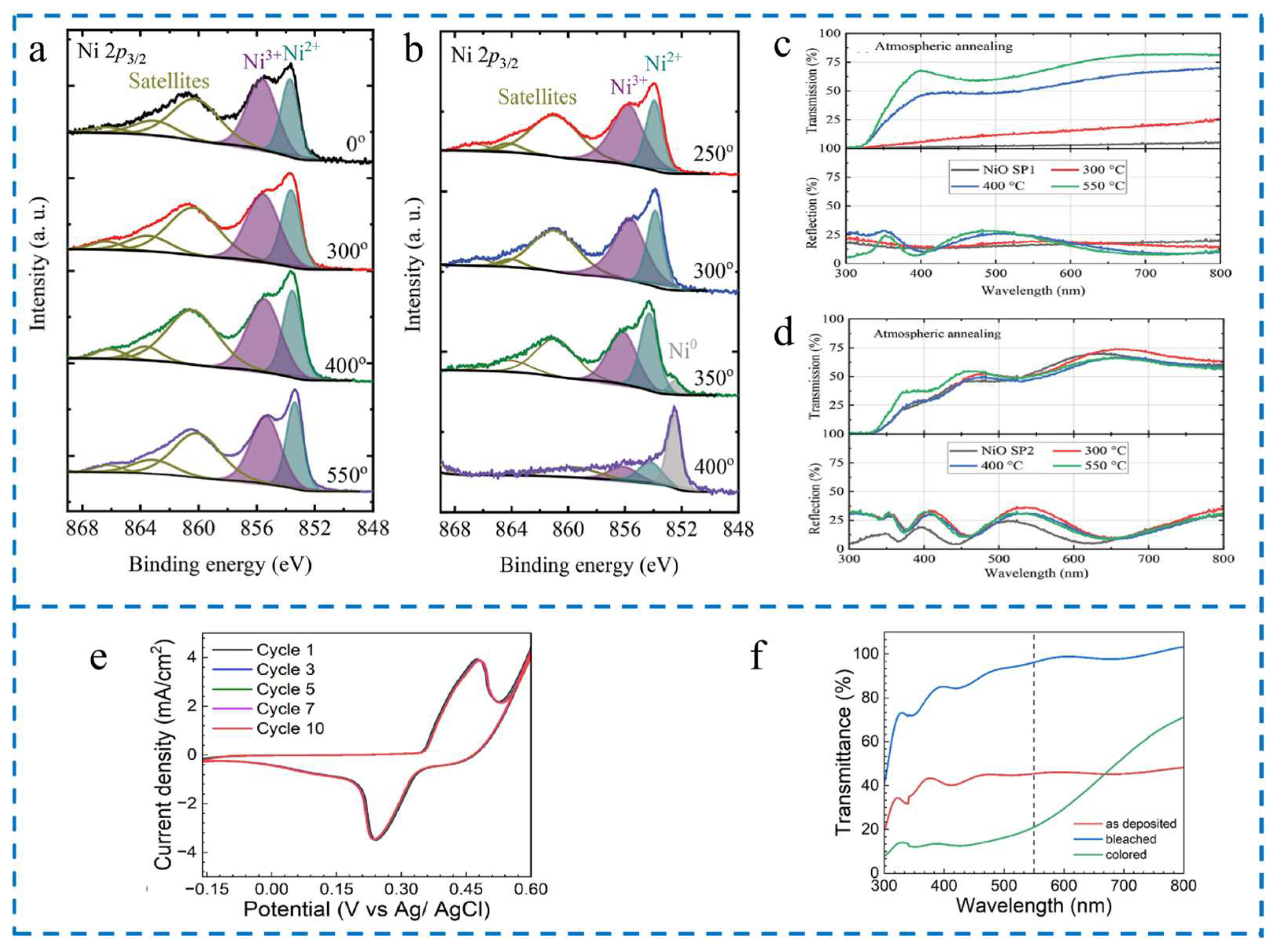
Timoshnev et al. [21] deposited NiO films on glass substrates via direct current (DC) magnetron sputtering and subsequently annealed them in either an oxygen-rich atmosphere or vacuum. The annealing temperatures ranged from 200 °C to 550 °C, with durations of 5 to 120 min. The results demonstrated that annealing improved the crystallinity of the NiO films. Both Ni2+ and Ni3+ oxidation states were identified in the films, and by using lower-power (SP1) and higher-power (SP2) sputtering configurations, the relative carrier concentration (Ni2+/Ni3+ peak area ratio) could be effectively controlled. As shown in Figure 6a–d, this ratio correlates with film conductivity and the concentration of free charge carriers. The deposited films were semitransparent, with optical bandgaps estimated between 3.50 and 3.74 eV. NiO films annealed at 350 °C exhibited the best optoelectronic performance, characterized by an average visible transmittance of 45% and a room-temperature resistivity of 384 Ω cm. Neha et al. [22] deposited Ni films on fluorine-doped tin oxide (FTO) substrates using an electrode nickel deposition technique, followed by annealing at 100 °C, 200 °C, and 300 °C. The annealed Ni films were subsequently electrochemically oxidized at room temperature to form NiO. The films annealed at 100 °C showed the best electrochromic performance, with a coloration efficiency of 20 cm2/C, a transmittance modulation of 75.2% at 550 nm, and switching times of tb/tc = 1.7 s/2.8 s (Figure 6e,f). These optimized films were further used to fabricate electrochromic devices with NiO and WO3-doped electrodes and phosphate-based gel electrolytes. The low-temperature deposition approach described in this study is also compatible with flexible substrates.

3.5. Nanostructured Optimization

Nanostructure optimization [73,74] of electrochromic nickel oxide (NiO) primarily involves tailoring the material’s microstructure to enhance its functional properties. The design of nanostructures influences key performance aspects such as charge transport, ion migration, and optical modulation, thereby significantly improving coloration efficiency, switching speed, and cycling stability. Nanostructured NiO possesses a high specific surface area and a highly porous architecture, which substantially increases the electrolyte-electrode contact area and provides abundant pathways for ion transport. Such structural design optimizes ion insertion/extraction kinetics, reduces transport resistance, and offers numerous charge storage sites compared to conventional films, ultimately enhancing both electronic conduction and electrochromic efficiency.
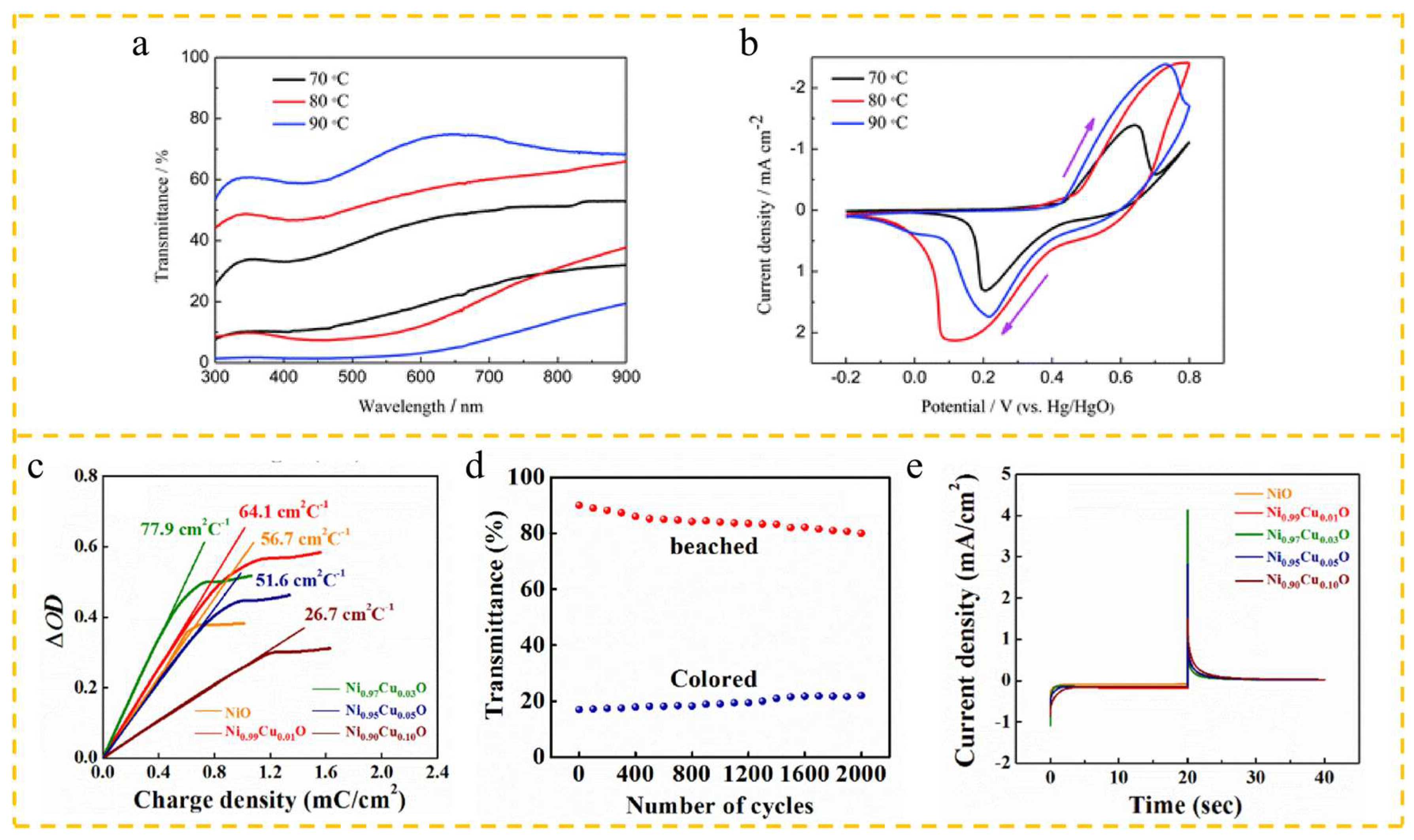
Cai et al. [75] fabricated nanostructured NiO films through a simple electrodeposition method using a choline chloride-based ionic liquid electrolyte. Films deposited at 70 °C exhibited uniformly distributed particles with interparticle voids, while those deposited at 90 °C formed denser structures composed of NiO particles sized between 2 and 6 nm. The optical transmittance of the films increased with rising deposition temperature. As shown in Figure 7a,b, the NiO films deposited at 90 °C demonstrated a high optical modulation of 67% at 550 nm, coloration efficiencies of 98 cm2 C−1 (400 nm), 92 cm2 C−1 (550 nm), and 51 cm2 C−1 (750 nm), along with excellent memory effect and cycling durability. Li et al. [76] prepared one-dimensional (1D) copper-doped NiO nanofibers via electrospinning. This 1D morphology improved electrical conductivity and shortened ion diffusion lengths, thereby accelerating reaction kinetics. Copper doping modified the electronic structure of NiO by broadening the valence band, reducing positive charge localization, and increasing hole concentration and mobility. The nanofibers provided a large specific surface area and capillary-like channels for rapid ion diffusion. With increasing Cu content, the grain size of the NiO nanofibers decreased, further enhancing electrochemical activity and optical modulation. As shown in Figure 7c–e, Ni0.97Cu0.03O nanofibers exhibited a high transmittance modulation of 73% at 550 nm, a coloration efficiency of 77.9 cm2 C−1, good cycling stability (80% retention after 2000 cycles), and fast switching times (tb/tc = 0.9 s/1.6 s).
In summary, nanostructure optimization markedly improves the electrochromic performance of NiO. However, challenges such as limited mechanical stability, complex synthesis routes, insufficient long-term cycling durability, constrained ion migration, and optical degradation under operation remain. These issues currently hinder the large-scale practical application of nanostructured NiO, necessitating further research to achieve cost-effective and scalable fabrication of high-performance NiO films.

4. Application of NiO Electrochromic Thin Film

Excellent electrochromic properties, enabling diverse applications across multiple fields. As electrochromic materials, they can reversibly modulate optical characteristics—such as color and transmittance—under an applied electric field. This unique behavior makes NiO electrochromic films highly promising for use in smart windows, information displays, and energy management systems. Specific application areas of NiO electrochromic films are summarized below:

4.1. Smart Windows

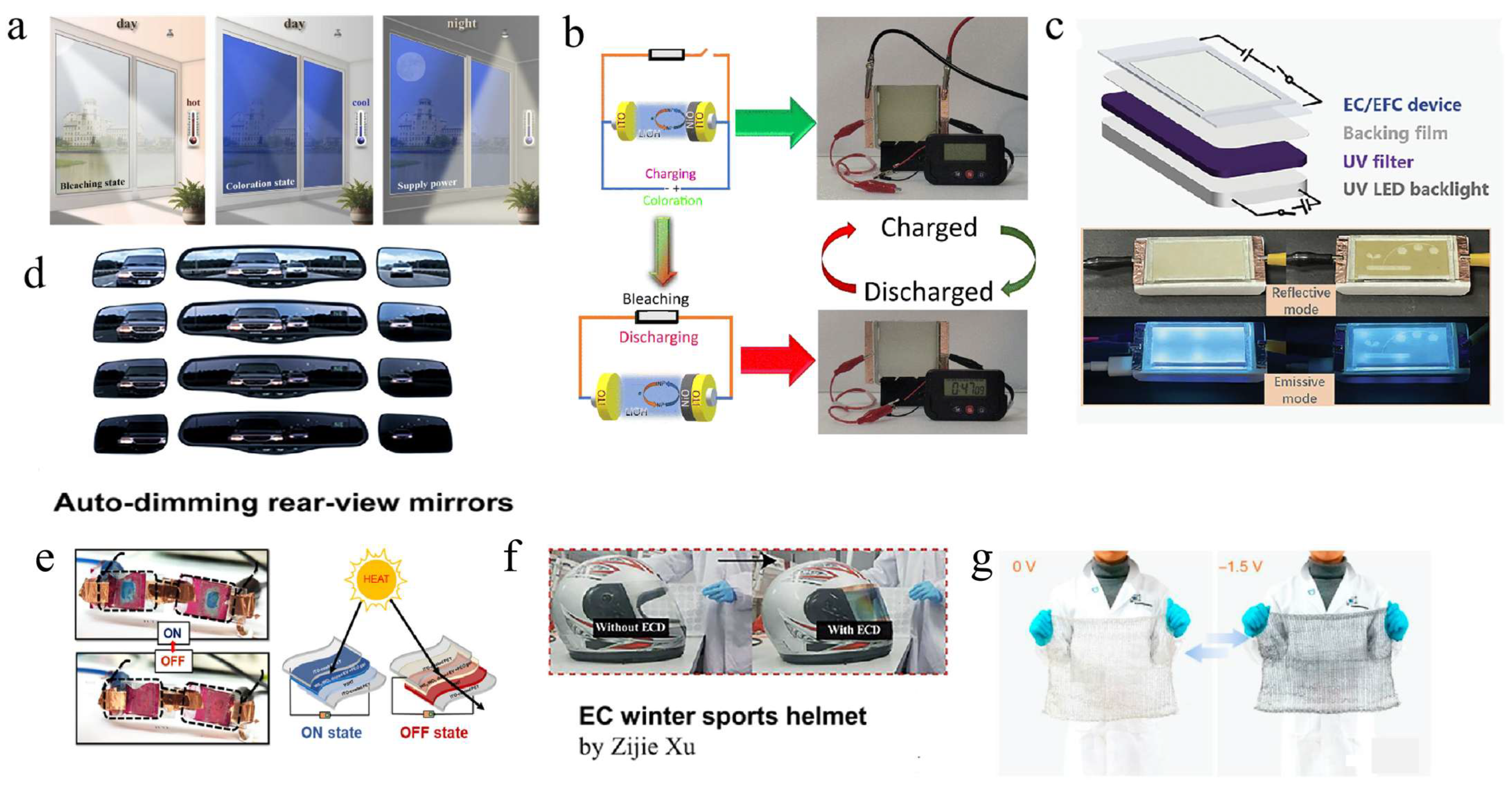
Smart windows represent a primary application of nickel oxide (NiO) electrochromic films. As illustrated in Figure 8a, such windows regulate light transmittance to improve energy efficiency and comfort control, particularly in buildings and transportation systems including automobiles and aircraft [8]. By dynamically controlling light transmission, electrochromic windows can reduce solar heat gain during periods of intense sunlight—thereby lowering air conditioning energy consumption—while increasing light transmittance under low-light conditions to enhance indoor illumination. These smart windows can adjust their transparency without completely obstructing the view, thereby providing privacy protection and making them well-suited for office buildings, conference rooms, and residential spaces. In such systems, NiO often serves as an anodic electrochromic material [77], while WO3 functions as a cathodic electrochromic material [78], working in combination to enable reversible optical modulation.

4.2. Energy Management and Energy Storage Devices

In the renewable energy sector, nickel oxide (NiO) electrochromic films show significant potential for energy storage and management, particularly when integrated with smart windows and building energy systems. Intelligent energy-saving windows combined with solar panels can dynamically regulate indoor lighting while converting excess light energy into electricity, thereby contributing to a building’s energy supply. Owing to its electrochemical activity, NiO is also employed as an electrode material in supercapacitors. By combining electrochromic functionality with energy storage, such supercapacitors can visually indicate their energy status during charging and discharging cycles. As shown in Figure 8b, a device utilizing a NiO thin film undergoes redox reactions under an applied electric field, leading to reversible changes in color and transparency. During charging (under positive voltage), the nickel oxidation state in the NiO film increases, causing the film to darken. Conversely, during discharging (under negative voltage or circuit disconnection), the oxidation state decreases, restoring a brighter appearance or higher transparency. In addition to optical modulation, the NiO film stores electrical energy during charging. This energy storage capability enables the electrochromic device to maintain its colored state temporarily without an external power source. These features make NiO-based electrochromic systems particularly suitable for modern infrastructure and automotive applications, especially as advanced smart windows.

4.3. Display Technology

Electrochromic films are also extensively used in display technology [79]. Under an applied electric field, these materials can reversibly change their color or transmittance, making them ideal as core components in display devices (Figure 8c). Electrochromic displays are capable of maintaining a stable static image with very low power consumption, which makes them suitable for applications such as electronic paper [80], smart labels, watches, and other portable electronic devices. NiO electrochromic films can be processed into flexible thin-film displays. When integrated with flexible substrates, they become well-suited for foldable or bendable display systems [3,81]. Furthermore, by combining NiO with other electrochromic materials—such as tungsten oxide (WO3) and molybdenum oxide (MoO3)—multicolor display applications can be realized, including in e-books and digital signage.

4.4. Automotive and Aircraft Tinting Windows

In the transportation sector, electrochromic films are particularly suitable for automotive and aircraft windows and sunroof systems, where they enable dynamic regulation of cabin lighting and temperature to enhance passenger comfort. Utilizing NiO-based electrochromic technology, these windows can automatically adjust their transmittance in response to external light conditions, effectively reducing glare from direct sunlight. By mitigating heat buildup inside the vehicle, electrochromic windows help lower air conditioning energy consumption, thereby indirectly reducing fuel or electricity usage and extending the driving range of electric vehicles. In addition, they provide privacy protection while contributing to the modern aesthetic appeal of vehicle design.

4.5. Wearable Devices, Smart Glasses, and Electrochromic Mirrors

With the advancement of wearable technology, electrochromic films have gained significant applications in smart glasses and other wearable devices. These films enable smart glass lenses to automatically darken in sunlight, reducing UV exposure, and return to transparency indoors, thereby enhancing visual comfort. Compared to traditional photochromic lenses, electrochromic glasses offer faster response characteristics and a broader adjustable transparency range [82]. Electrochromic films can also be integrated into smartwatch screens or straps to enable personalized color changes, improving both aesthetic appeal and functionality. When fabricated on flexible substrates, NiO electrochromic films can be incorporated into flexible displays or wearable sensors (Figure 8g) [3,82], providing versatile display and interactive capabilities. Furthermore, as shown in Figure 8d–f, NiO electrochromic films can be applied in automotive rearview mirrors and other anti-glare mirror systems. These electrochromic mirrors automatically adjust their reflectance according to ambient light intensity, effectively reducing glare from following vehicle headlights and thereby improving driver visibility and safety.
Figure 8. Different applications of NiO EC films: (a) The nanorod-based WO3/Li+(s)/NiO/glass smart window, reprinted with permission from Ref. [83], Copyright 2024, Elsevier. (b) Process of charging and discharging in the EC device (ITO/NiO//LiOH//ITO), reprinted with permission from Ref. [84], Copyright 2024, RSC. (c) The real photograph of the reflective/emissive dual-modal display device, reprinted with permission from Ref. [4], Copyright 2023, Wiley. (d) Auto-dimming rear-view mirrors of an automobile, reprinted with permission from Ref. [85], Copyright 2022, Elsevier. (e) A highly flexible prototype goggle, reprinted with permission from Ref. [86], Copyright 2024, ACS. (f) Photographs of flexible ECD applied in a winter sports helmet, reprinted with permission from Ref. [87], Copyright 2018, RSC. (g) Digital photographs of large-area smart textile knitted using long EC fibers, reprinted with permission from Ref. [5], Copyright 2020, ACS.
Nanoenergyadv 06 00010 g008

5. Conclusions and Perspectives

This review summarizes recent advances in the preparation, modification strategies, and performance optimization of nickel oxide (NiO) electrochromic films. As a key anodic electrochromic material, NiO has attracted significant attention due to its high electrochemical stability, excellent optical modulation capability, and environmental friendliness, holding great promise for applications in smart windows, wearable devices, and display technologies. Major preparation techniques—including magnetron sputtering, hydrothermal synthesis, and electrodeposition—significantly influence film thickness, adhesion, and switching speed. Strategies such as metal element doping, nanostructure engineering, and composite material design have effectively enhanced the electrical conductivity, optical contrast, and cycling stability of NiO films. Nevertheless, challenges remain in terms of long-term durability, stability under complex mechanical deformation, and scalable manufacturing.
Future research should focus on enhancing durability and environmental stability through optimized film structures and protective coatings. Scaling up production via large-area deposition methods like spray pyrolysis and chemical bath deposition will be crucial for commercialization. The development of high-performance composites with materials such as graphene and carbon nanotubes can enable multifunctional applications, while integration with IoT systems will support adaptive smart devices. Sustainable development using eco-friendly electrolytes and biodegradable substrates should be prioritized in alignment with global environmental goals. As technology progresses, NiO electrochromic films are expected to expand into emerging fields including advanced displays, adaptive camouflage, and aerospace applications. With continued advances in materials design and process innovation, this field is positioned to overcome current technical limitations and contribute to the development of intelligent, environmentally conscious technologies.

Funding

This work was supported by the Pioneer and Leading Goose R&D Program of Zhejiang (2024C01252(SD2)).

Data Availability Statement

No new data were created or analyzed in this study. Data sharing is not applicable to this article.

Conflicts of Interest

The authors declare no conflict of interest.

References

  1. Platt, J.R. Electrochromism, a possible change of color producible in dyes by an electric field. J. Chem. Phys. 1961, 34, 862–863. [Google Scholar] [CrossRef]
  2. Bai, T.; Li, W.; Fu, G.; Zhang, Q.; Zhou, K.; Wang, H. Dual-band electrochromic smart windows towards building energy conservation. Sol. Energy Mater. Sol. Cells 2023, 256, 112320. [Google Scholar] [CrossRef]
  3. Wang, C.; Jiang, X.; Cui, P.; Sheng, M.; Gong, X.; Zhang, L.; Fu, S. Multicolor and multistage response electrochromic color-memory wearable smart textile and flexible display. ACS Appl. Mater. Interfaces 2021, 13, 12313–12321. [Google Scholar] [CrossRef]
  4. Zhang, Y.; Jia, X.; Sun, B.; Huang, R.; Wang, C.; Chao, D. A piezoelectric-driven electrochromic/electrofluorochromic dual-modal display device. Small 2023, 19, 2301886. [Google Scholar]
  5. Fan, H.; Li, K.; Liu, X.; Xu, K.; Su, Y.; Hou, C. Continuously processed, long electrochromic fibers with multi-environmental stability. ACS Appl. Mater. Interfaces 2020, 12, 28451–28460. [Google Scholar] [CrossRef] [PubMed]
  6. Fu, H.; Tang, Y.; Zhan, F.; Zhang, L.; Zhan, W.; Dong, Y.; Li, W.; Zhang, C. Dual polymer electrochromic sunglasses with black to anti-blue-ray conversion based on new anti-blue-ray transparent polymer. Chem. Eng. J. 2023, 461, 141848. [Google Scholar] [CrossRef]
  7. Cai, G.; Wang, J.; Lee, P.S. Next-generation multifunctional electrochromic devices. Acc. Chem. Res. 2016, 49, 1469–1476. [Google Scholar] [CrossRef]
  8. Wu, S.; Sun, H.; Duan, M.; Mao, H.; Wu, Y.; Zhao, H.; Lin, B. Applications of thermochromic and electrochromic smart windows: Materials to buildings. Cell Rep. Phys. Sci. 2023, 4, 101370. [Google Scholar] [CrossRef]
  9. Dong, D.; Wang, W.; Dong, G.; Zhou, Y.; Wu, Z.; Wang, M.; Liu, F.; Diao, X. Electrochromic properties of NiOx:H films deposited by DC magnetron sputtering for ITO/NiOx: H/ZrO2/WO3/ITO device. Appl. Surf. Sci. 2015, 357, 799–805. [Google Scholar] [CrossRef]
  10. Piccolo, A.; Simone, F. Performance requirements for electrochromic smart window. J. Build. Eng. 2015, 3, 94–103. [Google Scholar] [CrossRef]
  11. Cannavale, A.; Martellotta, F.; Cossari, P.; Gigli, G.; Ayr, U. Energy savings due to building integration of innovative solid-state electrochromic devices. Appl. Energy 2018, 225, 975–985. [Google Scholar] [CrossRef]
  12. Cannavale, A.; Ayr, U.; Fiorito, F.; Martellotta, F. Smart electrochromic windows to enhance building energy efficiency and visual comfort. Energies 2020, 13, 1449. [Google Scholar] [CrossRef]
  13. Dong, D.; Wang, W.; Dong, G.; Zhang, F.; He, Y.; Yu, H.; Liu, F.; Wang, M.; Diao, X. Electrochromic properties and performance of NiOx films and their corresponding all-thin-film flexible devices preparedby reactive DC magnetron sputtering. Appl. Surf. Sci. 2016, 383, 49–56. [Google Scholar] [CrossRef]
  14. Sonavane, A.C.; Inamdar, A.I.; Deshmukh, H.P.; Patil, P.S. Multicoloured electrochromic thin films of NiO/PANI. J. Phys. D Appl. Phys. 2010, 43, 315102. [Google Scholar] [CrossRef]
  15. Purushothaman, K.K.; Antony, S.J.; Muralidharan, G. Optical, structural and electrochromic properties of nickel oxide films produced by sol–gel technique. Sol. Energy 2011, 85, 978–984. [Google Scholar] [CrossRef]
  16. Maruyama, T.; Arai, S. Electrochromic properties of cobalt oxide thin films prepared by chemical vapor deposition. J. Electrochem. Soc. 1996, 143, 1383. [Google Scholar] [CrossRef]
  17. Yan, Y.C.; Shi, W.; Jiang, H.C.; Xiong, J.; Zhang, W.L. Fabrication and characterization of NiO films for energetic nano-multilayers by direct current reactive sputtering. Rare Met. 2018, 37, 594–598. [Google Scholar] [CrossRef]
  18. Nakaoka, K.; Ueyama, J.; Ogura, K. Semiconductor and electrochromic properties of electrochemically deposited nickel oxide films. J. Electroanal. Chem. 2004, 571, 93–99. [Google Scholar] [CrossRef]
  19. Tian, L.; Chen, F.; Ding, H.; Li, X.; Li, X. The influence of inorganic electrolyte on the properties of carbon quantum dots in electrochemical exfoliation. J. Electroanal. Chem. 2020, 878, 114673. [Google Scholar] [CrossRef]
  20. Huang, Y.; Wang, B.; Chen, F.; Han, Y.; Zhang, W.; Wu, X.; Li, R.; Jiang, Q.; Jia, X.; Zhang, R. Electrochromic materials based on ions insertion and extraction. Adv. Opt. Mater. 2022, 10, 2101783. [Google Scholar] [CrossRef]
  21. Timoshnev, S.; Kazakin, A.; Shubina, K.; Andreeva, V.; Fedorenko, E.; Koroleva, A.; Zhizhin, E.; Koval, O.; Kurinnaya, A.; Shalin, A.; et al. Annealing Temperature Effect on the Physical Properties of NiO Thin Films Grown by DC Magnetron Sputtering. Adv. Mater. Interfaces 2024, 11, 2300815. [Google Scholar] [CrossRef]
  22. Solly, M.M.; Sharma, N.; Koshy, A.M.; Ali, F.; Arumugam, S.; Swaminathan, P. Effect of Annealing Temperature on the Electrochromic Properties of Electrochemically Oxidized Nickel. J. Electron. Mater. 2024, 53, 6348–6357. [Google Scholar] [CrossRef]
  23. Thakur, V.K.; Ding, G.; Ma, J.; Lee, P.S.; Lu, X. Hybrid materials and polymer electrolytes for electrochromic device applications. Adv. Mater. 2012, 24, 4071–4096. [Google Scholar] [CrossRef]
  24. Yoo, S.J.; Lim, J.W.; Sung, Y.E. Improved electrochromic devices with an inorganic solid electrolyte protective layer. Sol. Energy Mater. Sol. Cells 2006, 90, 477–484. [Google Scholar] [CrossRef]
  25. Huang, B.; Song, J.; Zhong, J.; Wang, H.; Zheng, X.; Jia, J.; Yun, S.; You, D.; Kimura, H.; Kang, L. Prolonging lifespan of Prussian blue electrochromic films by an acid-free bulky-anion potassium organic electrolyte. Chem. Eng. J. 2022, 449, 137850. [Google Scholar] [CrossRef]
  26. Bohnke, O.; Rousselot, C.; Gillet, P.A.; Truche, C. Gel electrolyte for solid-state electrochromic cell. J. Electrochem. Soc. 1992, 139, 1862. [Google Scholar] [CrossRef]
  27. Ma, G.; Tan, Q.; Li, Z.; Xiu, J.; Wang, J.; Cheng, T.; He, D.; Sun, Q.; Ma, X.; Lamberti, F.; et al. Magnetron sputtered nickel oxide with suppressed interfacial defect states for efficient inverted perovskite solar cells. J. Energy Chem. 2025, 100, 348–355. [Google Scholar] [CrossRef]
  28. Lobe, S.; Bauer, A.; Uhlenbruck, S.; Fattakhova-Rohlfing, D. Physical vapor deposition in solid-state battery development: From materials to devices. Adv. Sci. 2021, 8, 2002044. [Google Scholar]
  29. Zhang, C.; Li, Z.; Zheng, Q.; Zhou, X.; Lin, Z.; Zhang, J.; Tang, X.; Zhan, Y.; Luo, J. High-performance laminated NiO film striking a balance between the color-changing capability and cycling stability and its real application in bistable display. Sol. Energy Mater. Sol. Cells 2024, 267, 112729. [Google Scholar] [CrossRef]
  30. Da Rocha, M.; Dunn, B.; Rougier, A. Faradaic and/or capacitive: Which contribution for electrochromism in NiO thin films cycled in various electrolytes? Sol. Energy Mater. Sol. Cells 2019, 201, 110114. [Google Scholar] [CrossRef]
  31. Xu, K.; Wang, L.; Ge, C.; Wang, L.; Wang, B.; Wang, Z.; Zhang, C.; Liu, G. Surface Deposition of Ni(OH)2 and Lattice Distortion Induce the Electrochromic Performance Decay of NiO Films in Alkaline Electrolyte. Energy Environ. Mater. 2024, 7, E12652. [Google Scholar] [CrossRef]
  32. Jin, S.; Wen, S.; Li, M.; Zhong, H.; Chen, Y.; Wang, H. Effect of the grain size on the electrochromic properties of NiO films. Opt. Mater. 2020, 109, 110280. [Google Scholar] [CrossRef]
  33. Zhao, F.; Zeng, Y.; Cheng, Z.; Shi, G.; Liu, Q.; Liu, Y.; Han, G. Cathode/Anode electrodes for large-area bifunctional electrochemical devices prepared by a novel Na3Cit-assisted chemical deposition method. Chem. Eng. J. 2024, 485, 149350. [Google Scholar] [CrossRef]
  34. Chavan, H.S.; Hou, B.; Jo, Y.; Inamdar, A.I.; Im, H.; Kim, H. Optimal rule-of-thumb design of Nickel–Vanadium oxides as an electrochromic electrode with ultrahigh capacity and ultrafast color tunability. ACS Appl. Mater. Interfaces 2021, 13, 57403–57410. [Google Scholar] [CrossRef] [PubMed]
  35. Lei, Y.; Feng, K.; Zeng, A.; Yang, H.; Zhang, L.; Liu, Z.; Chen, Z. Sol-gel deposited ZnO substrate for the modulation of electrodeposited PEDOT nanostructures and enhancement of electrochromic stability. Appl. Surf. Sci. 2025, 681, 161480. [Google Scholar] [CrossRef]
  36. Li, L.; Liu, X.; Wang, G.; Liu, Y.; Kang, W.; Deng, N.; Zhuang, X.; Zhou, X. Research progress of ultrafine alumina fiber prepared by sol-gel method: A review. Chem. Eng. J. 2021, 421, 127744. [Google Scholar] [CrossRef]
  37. Fang, M.; Xiong, X.; Hao, Y.; Zhang, T.; Wang, H.; Cheng, H.M.; Zeng, Y. Preparation of highly conductive graphene-coated glass fibers by sol-gel and dip-coating method. J. Mater. Sci. Technol. 2019, 35, 1989–1995. [Google Scholar]
  38. Tian, Y.; Wang, H.; Liu, S.; Zhang, B. Synthesis, optimization, electrochemical and electrochromic properties of Zr-doped NiO films by chemical spray pyrolysis. Electrochim. Acta 2024, 506, 145057. [Google Scholar] [CrossRef]
  39. Arakaki, J.; Reyes, R.; Horn, M.; Estrada, W. Electrochromism in NiOx and WOx obtained by spray pyrolysis. Sol. Energy Mater. Sol. Cells 1995, 37, 33–41. [Google Scholar] [CrossRef]
  40. Denayer, J.; Bister, G.; Simonis, P.; Colson, P.; Maho, A.; Aubry, P.; Vertruyen, B.; Henrist, C.; Lardot, V.; Cambier, F.; et al. Surfactant-assisted ultrasonic spray pyrolysis of nickel oxide and lithium-doped nickel oxide thin films, toward electrochromic applications. Appl. Surf. Sci. 2014, 321, 61–69. [Google Scholar]
  41. Heo, S.; Cho, S.H.; Dahlman, C.J.; Agrawal, A.; Milliron, D.J. Influence of crystalline and shape anisotropy on electrochromic modulation in doped semiconductor nanocrystals. ACS Energy Lett. 2020, 5, 2662–2670. [Google Scholar] [CrossRef]
  42. Pašti, I.A.; Dobrota, A.S.; Migas, D.B.; Johansson, B.; Skorodumova, N.V. Theoretical analysis of electrochromism of Ni-deficient nickel oxide–from bulk to surfaces. Phys. Chem. Chem. Phys. 2023, 25, 7974–7985. [Google Scholar] [CrossRef] [PubMed]
  43. Xiao, Y.; Zhang, X.; Yan, D.; Deng, J.; Chen, M.; Zhang, H.; Sun, W.; Zhao, J.; Li, Y. Defect engineering of W6+-doped NiO for high-performance black smart windows. Nano Res. 2024, 17, 3043–3052. [Google Scholar] [CrossRef]
  44. Wang, H.; Liu, X.; Bi, H.; Yu, S.; Han, F.; Sun, J.; Zhu, L.; Yu, H.; Pei, L. Effects of NiO on the conductivity of Ce0.85Sm0.15O1.925 and on electrochemical properties of the cathode/electrolyte interface. J. Power Sources 2016, 320, 86–93. [Google Scholar] [CrossRef]
  45. Lu, W.; Xiao, J.; Wong, L.M.; Wang, S.; Zeng, K. Probing the ionic and electrochemical phenomena during resistive switching of NiO thin films. ACS Appl. Mater. Interfaces 2018, 10, 8092–8101. [Google Scholar] [CrossRef]
  46. Ahmed, R.; Nabi, G. Enhanced electrochemical performance of Cr-doped NiO nanorods for supercapacitor application. J. Energy Storage 2021, 33, 102115. [Google Scholar] [CrossRef]
  47. Wu, C.; Yang, Y.; Feng, W.; Song, W.; Tan, R. Towards superior nickel oxide electrochromic films using Si and Li co-doping and rapid thermal annealing. J. Alloys Compd. 2021, 862, 158665. [Google Scholar] [CrossRef]
  48. Vinson, V. A hit-and-run metal ion. Science 2016, 352, 1288–1290. [Google Scholar] [CrossRef]
  49. Li, H.; Li, L.; Fang, S.; Wang, J.; Chen, S.; Huang, X.; Leng, Z.; Li, G. Surface hydroxylation induced by alkaline-earth metal doping in NiO nanocrystals and its application in achieving a wide temperature operation window for preferential CO oxidation. Environ. Sci. Nano 2018, 5, 2368–2381. [Google Scholar] [CrossRef]
  50. Gao, L.; Hou, J.; Li, Z.; Gu, X.; Huang, M.; Su, G. Improved electrochromic performance of nickel oxide porous films by regulating their semiconductor type by titanium doping. J. Phys. Chem. Solids 2023, 174, 111168. [Google Scholar] [CrossRef]
  51. Dong, D.; Wang, W.; Barnabé, A.; Presmanes, L.; Rougier, A.; Dong, G.; Zhang, F.; Yu, H.; He, Y.; Diao, X. Enhanced electrochromism in short wavelengths for NiO:(Li, Mg) films in full inorganic device ITO/NiO:(Li, Mg)/Ta2O5/WO3/ITO. Electrochim. Acta 2018, 263, 277–285. [Google Scholar] [CrossRef]
  52. Shi, J.; Lai, L.; Zhang, P.; Li, H.; Qin, Y.; Gao, Y.; Luo, L.; Lu, J. Aluminum doped nickel oxide thin film with improved electrochromic performance from layered double hydroxides precursor in situ pyrolytic route. J. Solid State Chem. 2016, 241, 1–8. [Google Scholar] [CrossRef]
  53. Firat, Y.E.; Peksoz, A. Efficiency enhancement of electrochromic performance in NiO thin film via Cu doping for energy-saving potential. Electrochim. Acta 2019, 295, 645–654. [Google Scholar] [CrossRef]
  54. Zhao, Y.; Zhang, X.; Chen, X.; Li, W.; Wang, L.; Li, Z.; Zhao, J.; Endres, F.; Li, Y. Preparation of Sn-NiO films and all-solid-state devices with enhanced electrochromic properties by magnetron sputtering method. Electrochim. Acta 2021, 367, 137457. [Google Scholar] [CrossRef]
  55. Xue, J.; Li, W.; Song, Y.; Li, Y.; Zhao, J. Visualization electrochromic-supercapacitor device based on porous Co doped NiO films. J. Alloys Compd. 2021, 857, 158087. [Google Scholar] [CrossRef]
  56. Wang, Y.; Bruyère, S.; Kumagai, Y.; Tsunoda, N.; Oba, F.; Ghanbaja, J.; Sun, H.; Dai, B.; Pierson, J.-F. Tuning the optical band gap and electrical properties of NiO thin films by nitrogen doping: A joint experimental and theoretical study. RSC Adv. 2022, 12, 21940–21945. [Google Scholar] [CrossRef]
  57. Liang, H.; Li, R.; Li, C.; Hou, C.; Li, Y.; Zhang, Q.; Wang, H. Regulation of carbon content in MOF-derived hierarchical-porous NiO@C films for high-performance electrochromism. Mater. Horiz. 2019, 6, 571–579. [Google Scholar]
  58. Huang, Q.; Zhang, Q.; Yu, X.; He, Y.; Diao, X. Improved electrochromic performance of NiO-based thin films by lithium and tantalum co-doping. J. Alloys Compd. 2018, 747, 416–422. [Google Scholar] [CrossRef]
  59. Wang, X.; Ma, M.; Zhang, N.; Zuo, K.; Ma, Y.; Wu, L.; Li, M. The nano-sheet structure adjustment and long-term stability of Zn-doped NiO electrochromic films. Electrochim. Acta 2024, 492, 144342. [Google Scholar]
  60. Padmanathan, N.; Selladurai, S.; Rahulan, K.M.; O’Dwyer, C.; Razeeb, K.M. NiO hybrid nanoarchitecture-based pseudocapacitor in organic electrolyte with high rate capability and cycle life. Ionics 2015, 21, 2623–2631. [Google Scholar]
  61. Chen, M.; Deng, J.; Zhang, H.; Zhang, X.; Yan, D.; Yao, G.; Hu, L.; Sun, S.; Zhao, J.; Li, Y. Advanced Dual-Band Smart Windows: Inorganic All-Solid-State Electrochromic Devices for Selective Visible and Near-Infrared Modulation. Adv. Funct. Mater. 2024, 35, 2413659. [Google Scholar] [CrossRef]
  62. Ma, B.; Tang, L.; Zhang, Y.; Li, Z.; Zhang, J.; Zhang, S. Ionic Gel Electrolytes for Electrochromic Devices. ACS Appl. Mater. Interfaces 2024, 16, 48927–48936. [Google Scholar] [CrossRef]
  63. Moulki, H.; Faure, C.; Mihelčič, M.; Vuk, A.Š.; Švegl, F.; Orel, B.; Campet, G.; Alfredsson, M.; Chadwick, A.V.; Gianolio, D.; et al. Electrochromic performances of nonstoichiometric NiO thin films. Thin Solid Films 2014, 553, 63–66. [Google Scholar] [CrossRef]
  64. Xue, J.; Xu, H.; Wang, S.; Hao, T.; Yang, Y.; Zhang, X.; Song, Y.; Li, Y.; Zhao, J. Design and synthesis of 2D rGO/NiO heterostructure composites for high-performance electrochromic energy storage. Appl. Surf. Sci. 2021, 565, 150512. [Google Scholar] [CrossRef]
  65. Meng, Y.; Zhao, H.; Lian, Y.; Zhao, L.; Liu, Z. Synergistic enhancement of dual-color electrochromic performance in NiO/CdS quantum dots composite film. J. Phys. Chem. Solids 2024, 184, 111693. [Google Scholar] [CrossRef]
  66. Zhang, M.; Xu, X.; Gu, Y.; Cheng, X.; Hu, J.; Xiong, K.; Jiang, Y.; Fan, T.; Xu, J. Porous and nanowire-structured NiO/AgNWs composite electrodes for significantly-enhanced supercapacitive and electrochromic performances. Nanotechnology 2021, 32, 275405. [Google Scholar] [CrossRef]
  67. Bo, G.; Wang, X.; Wang, K.; Gao, R.; Dong, B.; Cao, L.; Su, G. Preparation and electrochromic performance of NiO/TiO2 nanorod composite film. J. Alloys Compd. 2017, 728, 878–886. [Google Scholar] [CrossRef]
  68. Zhao, H.; Meng, Y.; Yu, H.; Li, Z.; Liu, Z. 1D/2D Co3O4/NiO composite film for high electrochromic performance. Ceram. Int. 2022, 48, 32205–32212. [Google Scholar] [CrossRef]
  69. Liu, Y.; Jia, C.; Wan, Z.; Weng, X.; Xie, J.; Deng, L. Electrochemical and electrochromic properties of novel nanoporous NiO/V2O5 hybrid film. Sol. Energy Mater. Sol. Cells 2015, 132, 467–475. [Google Scholar] [CrossRef]
  70. Pan, J.; Zheng, R.; Wang, Y.; Ye, X.; Wan, Z.; Jia, C.; Weng, X.; Xie, J.; Deng, L. A high-performance electrochromic device assembled with hexagonal WO3 and NiO/PB composite nanosheet electrodes towards energy storage smart window. Sol. Energy Mater. Sol. Cells 2020, 207, 110337. [Google Scholar] [CrossRef]
  71. Sonavane, A.C.; Inamdar, A.I.; Dalavi, D.S.; Deshmukh, H.P.; Patil, P.S. Simple and rapid synthesis of NiO/PPy thin films with improved electrochromic performance. Electrochim. Acta 2010, 55, 2344–2351. [Google Scholar]
  72. Purushothaman, K.K.; Muralidharan, G. The effect of annealing temperature on the electrochromic properties of nanostructured NiO films. Sol. Energy Mater. Sol. Cells 2009, 93, 1195–1201. [Google Scholar] [CrossRef]
  73. Huang, Y.; Yang, C.; Deng, B.; Wang, C.; Li, Q.; Thibault, C.D.V.; Huang, K.; Huo, K.; Wu, H. Nanostructured pseudocapacitors with pH-tunable electrolyte for electrochromic smart windows. Nano Energy 2019, 66, 104200. [Google Scholar]
  74. Ma, D.; Wang, J. Inorganic electrochromic materials based on tungsten oxide and nickel oxide nanostructures. Sci. China Chem. 2017, 60, 54–62. [Google Scholar]
  75. Cai, G.; Tu, J.; Gu, C.; Zhang, J.; Chen, J.; Zhou, D.; Shi, S.; Wang, X. One-step fabrication of nanostructured NiO films from deep eutectic solvent with enhanced electrochromic performance. J. Mater. Chem. A 2013, 1, 4286–4292. [Google Scholar] [CrossRef]
  76. Li, Y.; Cui, Y.; Yao, Z.; Liu, G.; Shan, F. Fast electrochromic switching of electrospun Cu-doped NiO nanofibers. Scr. Mater. 2020, 178, 472–476. [Google Scholar]
  77. Qin, S.; Cao, S.; Liu, Y.; Chen, J.; Li, H.; Yang, T.; Liu, G.; Zhao, J.; Zou, B. A Wide Color Gamut and Noniridescent Zinc-Anode Asymmetric Electrochromic Device for Self-Sustaining Color-Adaptive Bio-Camouflage System. Small 2024, 20, 2407838. [Google Scholar]
  78. Pehlivan, I.B.; Atak, G.; Niklasson, G.A.; Stolt, L.; Edoff, M.; Edvinsson, T. Electrochromic solar water splitting using a cathodic WO3 electrocatalyst. Nano Energy 2021, 81, 105620. [Google Scholar] [CrossRef]
  79. Sobel, A. High-speed inks. Nat. Mater. 2003, 2, 643–644. [Google Scholar] [CrossRef]
  80. Xiong, K.; Emilsson, G.; Maziz, A.; Yang, X.; Shao, L.; Jager, E.; Dahlin, A.B. Electronic paper: Plasmonic metasurfaces with conjugated polymers for flexible electronic paper in color. Adv. Mater. 2016, 45, 10103. [Google Scholar] [CrossRef]
  81. Huang, J.; Zhang, D.; Liu, J.; Wang, H. Freestanding La0.7Sr0.3MnO3:NiO vertically aligned nanocomposite thin films for flexible perpendicular interfacial exchange coupling. Mater. Res. Lett. 2022, 10, 287–294. [Google Scholar] [CrossRef]
  82. Yun, T.G.; Hwang, B.; Cheong, J.Y. Recent progress and future research directions for electrochromic zinc-ion batteries. J. Energy Chem. 2024, 90, 220–232. [Google Scholar] [CrossRef]
  83. Phan, G.T.; Van Pham, D.; Thi, N.L.D.; Maria, C.C.S.; Chu, Y.H.; Ma, Y.R. Nanorod-based smart windows with solid-gel electrolyte: An integrated electrochromic and pseudocapacitive technology for energy-saving and conversion. Nano Energy 2024, 132, 110374. [Google Scholar] [CrossRef]
  84. Krishna, V.S.G.; Ganesha, M.K.; Sarthi, C.; Hakkeem, H.; Singh, A.K.; Kulkarni, G.U. Ultrathin sputtered NiO films for enhanced electrochromic performance in smart windows. J. Mater. Chem. A 2024, 12, 19378–19391. [Google Scholar] [CrossRef]
  85. Li, W.; Bai, T.; Fu, G.; Zhang, Q.; Liu, J.; Wang, H.; Sun, Y.; Yan, H. Progress and challenges in flexible electrochromic devices. Sol. Energy Mater. Sol. Cells 2022, 240, 111709. [Google Scholar] [CrossRef]
  86. Sahu, B.; Bansal, L.; Ahlawat, N.; Ghanghass, A.; Rath, D.K.; Kaladi Chondath, S.; Kandpal, S.; Bhatia, R.; Sameera, I.; Kumar, R. Mixed Chalcogenides Nanoflakes’ Infrared Cutting Effect: Utilization in Thermal Soothing Electrochromic Goggles. ACS Appl. Opt. Mater. 2024, 2, 2128–2136. [Google Scholar] [CrossRef]
  87. Xu, Z.; Li, W.; Huang, J.; Liu, Q.; Guo, X.; Guo, W.; Liu, X. Controllable and large-scale fabrication of flexible ITO-free electrochromic devices by crackle pattern technology. J. Mater. Chem. A 2018, 6, 19584–19589. [Google Scholar] [CrossRef]
Figure 1. (a) Dual-band electrochromic smart windows, reprinted with permission from Ref. [2], Copyright 2023, Elsevier. (b) Pixelated reflective-emissive dual-modal display device, reprinted with permission from Ref. [4], Copyright 2023, Wiley. (c) Demonstration of the wearable smart textile, reprinted with permission from Ref. [3], Copyright 2021, ACS. (d) Digital photographs of large-area embroidery with a smart color-changing flower composed of multiple EC petals, reprinted with permission from Ref. [5], Copyright 2020, ACS. (e) Digital photographs of anti-blue-ray EC sunglasses, reprinted with permission from Ref. [6], Copyright 2023, Elsevier. (f) Next-Generation Multifunctional Electrochromic Devices, reprinted with permission from Ref. [7], Copyright 2016, ACS.
Nanoenergyadv 06 00010 g001
Figure 3. (a) Optical absorption coefficients of N-doped NiO thin films grown with various N2 flow rates. (b) Resistivity, mobility and carrier concentration of N-doped NiO thin films as a function of N2 flow rate. (c) schematic of crystal structure evolution. (d) UV-vis transmittance spectra of different NiO@C films measured in 1 M KOH solution at potentials of 0 V and 0.6 V. (e) comparison of the switching time of different NiO@C films measured in 1 M KOH solution in situ transmittance responses. (f) coloration efficiency of different NiO@C films in 1 M KOH solution. (a,b), reprinted with permission from Ref. [56], Copyright 2022, RSC; (cf), reprinted with permission from Ref. [57], Copyright 2019, RSC.
Nanoenergyadv 06 00010 g003
Figure 4. (a) Schematic representation of radio-frequency (RF) and direct-current (DC) reactive magnetron co-sputtering configuration, where the LiTaO3 deposition power level was adjusted to control the Li and Ta contents in the NiO-based materials. (b) In situ transmittance variation at 550 nm plotted against CV cycle number for the Li-Ta co-doped NiO films. (c) the corresponding apparent tint pictures. (d) NO and NO-400, and SLNO and SLNO-400 films in different EC states under the first EC switching with applied constant voltages of 1.2 V and −1.2 V for 20 s. (a,b), reprinted with permission from Ref. [58], Copyright 2018, Elsevier; (c,d), reprinted with permission from Ref. [47], Copyright 2021, Elsevier.
Nanoenergyadv 06 00010 g004
Figure 5. (a) The CV curve of the NiO film during cycling. (b) Change in transmittance during cycling. (c) electrochromic cycle stability from the initial state showing performance decay. (d) GCD curves at different current densities. (e) GCD stability (insert GCD curves of the 1 and the 1000 cycles. (f) Transmittance-time profile at 630 nm. (ac), reprinted with permission from Ref. [31], Copyright 2024, Wiley; (df), reprinted with permission from Ref. [64], Copyright 2021, Elsevier.
Nanoenergyadv 06 00010 g005
Figure 6. (a) for SP1 mode and vacuum annealing. (b) for SP2 mode and vacuum annealing. (c) SP1 modes with annealing under atmospheric and vacuum conditions at various annealing temperatures. (d) SP2 modes with annealing under atmospheric and vacuum conditions at various annealing temperatures. (e) Ten cyclic voltammograms recorded in the 1-M KOH electrolyte at a scan rate of 20 mV/s. (f) UV-Vis transmittance spectra showing the transmittance in the as-deposited, colored, and bleached states. (ad), reprinted with permission from Ref. [21], Copyright 2024, Wiley; (e,f), reprinted with permission from Ref. [22], Copyright 2024, Springer Nature.
Nanoenergyadv 06 00010 g006
Figure 7. (a) Optical transmission spectra of NiO thin films at different deposition temperatures. (b) The 10th CV curve of NiO films electrodeposited at different temperatures. (c) Variation in optical density (OD) vs. charge density for Ni1−xCuxO (x = 0, 0.01, 0.03, 0.05 and 0.1) nanofibers. (d) The durability transmittance test of Ni0.97Cu0.03O nanofibers at 550 nm. (e) CA curves for Ni1−xCuxO (x = 0, 0.01, 0.03, 0.05 and 0.1) nanofibers with voltage interval from −1.0 V (20 s) to 1.0 V (20 s). (a,b), reprinted with permission from Ref. [75], Copyright 2013, RSC; (ce), reprinted with permission from Ref. [76], Copyright 2013, RSC.
Nanoenergyadv 06 00010 g007
Table 1. Comparison of different deposition methods.
Preparation MethodsAdvantagesDisadvantagesNotes
Magnetron sputtering1. Uniform film
2. Suitable for large areas
3. Precise control of thickness and composition
1. Expensive equipment
2. Slow sedimentation
3. High energy damage to brittle substrates
1. Professional operation is required
2. Control energy to avoid substrate damage
3. Optimize parameter adjustment
Hydrothermal method1. Diverse morphology
2. High crystallinity
3. Improve response
1. Complex process
2. Difficult to scale up
3. High-voltage equipment is required
1. Accurate temperature and pressure control
2. Implement security measures
3. Maintain uniform heating
Electrodeposition1. Low cost
2. Strong control
3. Suitable for different thicknesses
1. Poor membrane uniformity
2. Low adhesion
3. Parameters need to be finely tuned
1. Optimize current density
2. Substrate pretreatment enhances adhesion
3. Control sedimentation parameters
Chemical bath
deposition
1. Low cost
2. Easy to expand
3. Simple process
1. Low membrane density
2. Conditions must be strictly controlled
3. Post-processing is required to improve
1. Control temperature and stirring
2. Regularly monitor the purity of the solution
3. Subsequent annealing improves film quality
Sol–gel method1. Low temperature processing
2. Uniform film layer
3. Composition adjustable
1. Poor ion exchange performance
2. Easy to crack
3. Difficulty in drying control
1. Maintain sol stability
2. Precise control of uniform coating
3. Heat treatment improves performance
Spray pyrolysis 1. Easy to operate
2. Suitable for large areas
3. Can be doped and adjusted
1. The film quality is affected by the nozzle
2. Uniformity needs to be controlled
3. Environmental Impact
1. Optimize spraying parameters
2. Adjust the solution to match the membrane characteristics
3. Control environmental stability
Table 3. EC properties of different NiO composite films.
MaterialsPreparation MethodΔT (%)CE (cm2/C)tb/tc (s)Cycle Stability (Cycles/% Retained)ElectrolyteRef.
NiO/PANIElectrodeposition and CBD~74 (550 nm)85_10,0001 M PC-LiClO4[14]
rGO/NiOelectrodeposition53 (630 nm)30.53.4/5.31000/~1001 M KOH[64]
NiO/CdSHydrothermal method54.7 (550 nm)_4.8/3.910001 M PC-LiClO4[65]
NiO/AgNWsCBD56.4 (532 nm)60.56.5/5.4_2 M KOH[66]
NiO/TiO2hot solvent and hydrothermal method71 (550 nm)147.64.0/3.83000/670.5 M KOH[67]
Co3O4/NiOHydrothermal method and intermittent annealing65.2 (600 nm)104.85.9/4.7_1 M PC-LiClO4[68]
NiO/V2O5CBD and electrodeposition35 (776 nm)30.611/8_1 M PC-LiClO4[69]
NiO/PBHydrothermal, annealing and electrodeposition67.6 (630 nm)109.67.9/2.8_1 M PC-LiClO4[70]
NiO/PPyElectrodeposition and CBD~50 (630 nm)3580.395/0.60110,0001 M PC-LiClO4[71]
Disclaimer/Publisher’s Note: The statements, opinions and data contained in all publications are solely those of the individual author(s) and contributor(s) and not of MDPI and/or the editor(s). MDPI and/or the editor(s) disclaim responsibility for any injury to people or property resulting from any ideas, methods, instructions or products referred to in the content.