1. Introduction
The ability to form social relationships constitutes a fundamental aspect of human development, and close relationships play a critical role in individual well-being. Closeness, defined as the perceived degree of interdependence between two people [
1], is a central construct in the study of interpersonal relationships and is often considered a key indicator of relational quality and emotional connection between individuals [
2,
3]. Further, closeness can be understood as a relational dynamic shaped by behavioral and emotional interdependence and its expression may vary depending on the context and on the type of bond [
4,
5]. That is, human beings are innately relational, and they tend to form relationships that differ in their degree of closeness, reflecting diverse emotional, cognitive, and social needs [
6,
7].
Closeness has been conceptualized in terms of three interrelated aspects that account for physical, social, and psychological dimensions, and can be operationalized as distance from others, number of social ties, and level of integration [
8]. Physical closeness refers to spatial proximity that is determined by how people use and perceive personal space. Individuals are more likely to form relationships with those who are physically nearby—a phenomenon observed across settings like neighborhoods, classrooms, and workplaces [
9]. Moreover, according to Hall [
10], four distinct spatial zones characterize social interactions: intimate, personal, social, and public distances. His research also revealed that the amount of space people maintain varies depending on the context and the nature of their relationship with the other person; for instance, individuals tend to keep a greater distance from strangers than from friends. Social closeness refers to the sense of belonging individuals experience in group contexts. Feelings of closeness can lead to feelings of acceptance by peers, but being accepted by peers can also involve other dimensions, such as social skills [
11]. Psychological closeness encompasses the emotional and cognitive sense of connectedness with others. Thus, it can lead to feelings of interpersonal trust and self-disclosure, which in turn lead to merging of identities in close relationships and increased feelings of closeness [
12].
Research has supported the particular importance of a person’s ability to form psychologically close relationships with others for healthy development [
13,
14]. For example, research has suggested that the ability to establish emotionally close and trusting peer connections contributes significantly to identity formation and the appropriate development of emotional regulation and empathy, which in turn motivate prosocial behaviors [
15,
16]. These findings have led to theoretical models explaining how extended feelings of closeness can lead to these prosocial outcomes. For example, the theory of “social discounting” proposes that people assign more value to and are more likely to extend themselves to enhance the welfare of others if they feel close to them [
17]. Thus, if someone does not feel close to others, they will not prioritize extending themselves or making sacrifices for the welfare of others. In support of this theory, a study of 517 children from ages 7 to 12 reported that a child’s ratings of perceived psychological closeness in relationships were related to higher levels of prosocial behaviors, such as intentions of helping others [
18].
As noted above, closeness not only promotes the development of adaptive levels of empathy but has also been linked to positive identity formation and adaptive development of emotional regulation [
3,
16,
19]. Importantly, difficulties in all three of these crucial developmental processes (empathy, identity, and emotion regulation) have been linked to increased risk for behavior problems in children [
20]. Specifically, problems in positive identity development can lead to exaggerations in an adolescent’s tendency to rebel maladaptively against authority figures; problems in emotional regulation can lead to conduct problems in the context of heightened emotional arousal (e.g., anger); and problems in the development of empathetic concern for others can lead to high levels of aggression. A potential link between closeness and conduct problems would be consistent with the well-established link between problematic attachment styles and conduct problems in children and adolescents [
21]. Attachment theory posits that internal working models of relationships guide emotional and behavioral responses; similarly, we argue that a low sense of perceived closeness across multiple relationships may reflect an underlying lack of relational security, thereby increasing vulnerability to externalizing problems. However, while attachment styles focus on a person’s relational pattern and dispositional security with others, they do not directly assess the immediate perception of closeness to others. Therefore, examining perceived closeness provides a distinct, relationship-specific evaluation of an adolescent’s social environment that may uniquely account for variations in both positive and problematic outcomes.
Given the potential importance of perceived closeness to others, there has been increasing interest in developing effective ways for measuring this construct in children. One such measure is Aron, Aron, and Smollan’s Inclusion of Other in the Self Scale (IOS) [
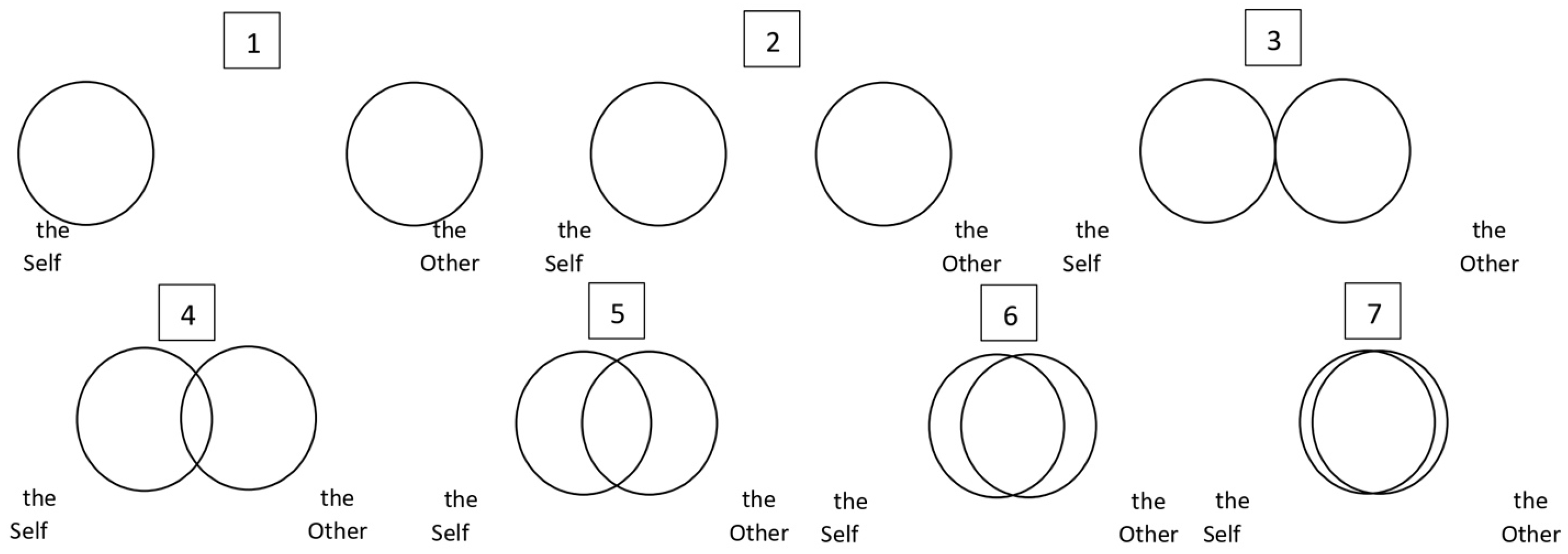
12] that attempts to capture the psychological merging of identities that occurs in close relationships, reflecting a subjective sense of interconnectedness. The IOS was developed as a single-item measure that frames closeness as a cognitive overlap between self and some specified other person, represented by one of seven Venn-like diagrams that best symbolize the relationship with the designated person. It was originally developed by Aron and colleagues [
12] to measure perceived psychological closeness in romantic relationships in adults but has been used to assess perceived closeness in other adult social relationships as well [
22]. The visual nature of this scale makes it potentially useful for assessing perceived closeness towards others in the relationships of younger people. In support of this possibility, Vezzali and colleagues [
18] used the IOS format by asking children (ages 7 to 12) to rate how close they felt “to an unknown child attending the same school”. They reported that scores from the IOS were significantly correlated with prosocial behaviors, such as intentions of helping others. Further, Sichko and colleagues [
23] used the IOS format to assess children’s (ages 9 to 12 years) perceived closeness to their mothers following divorce and reported that their ratings of closeness towards their mother were negatively related to depressive symptoms following their parents’ divorce.
Thus, the IOS format appears to be a useful method for assessing perceived psychological closeness in youth relationships. However, one limitation to date is that its use in research has usually only assessed perceived closeness in a single relationship of the child. This limitation is particularly relevant for assessing perceived closeness in children and adolescents, as the importance of having close relationships across multiple social contexts is essential for youth. Specifically, supportive and close relationships with the family remain essential across childhood and adolescence, while simultaneously, the importance of having close relationships with peers increases during adolescence [
24,
25,
26]. In addition, Marsh [
27] has argued that differences in prosocial and antisocial extremes in personality may be explained better by determining whether feelings of closeness generalize outward towards a large number of others in a person’s social network (e.g., co-workers) rather than being limited to only a few individuals in the person’s immediate social network (e.g., immediate family members), which she has termed the “caring continuum”. Based on this theory, Brethel-Haurwitz and colleagues [
28] used a modification of the IOS that considered multiple relationships (i.e., immediate family, extended family, friend, acquaintance, stranger, and study partner) in a sample of 29 altruistic kidney donors and 29 control adults and reported that altruists did not differ from controls in the perceived connectedness with family members or friends but showed greater levels of connectedness to study partners and strangers.
The Present Study
In summary, perceived psychological closeness in youth’s relationships with others has proven to be critical for adaptive development of prosocial emotions and behaviors but has not been studied extensively in relation to problematic development outcomes. Further, while a measure of closeness using visual stimuli (i.e., concentric circles) has proven to be useful for measuring closeness in samples of children and adolescents, it has largely been limited by focusing on single relationships. Thus, the current study tests a new adaptation of the IOS that is similar to the one used by Brethel-Haurwitz and colleagues [
28]. However, unlike this previous measure, this version has been modified to assess relational contexts more relevant to children and adolescents, acknowledging that as individuals transition from childhood to greater autonomy in social relationships, the physical and psychological closeness they experience across diverse social settings [
7] plays a central role in shaping emotional well-being, identity formation, and interpersonal competence within an expanding social world [
14,
15,
16]. The contexts include both familial (immediate family and extended family) and peer (peers and classmates) relationships, as well as relationships that extend further from the child’s immediate social network (neighbors and others in the community). With this new adaptation, which we have labeled the Perceived Closeness to Others Questionnaire (PCtO), it is important to provide some initial tests of its construct validity to guide its use in research.
First, given that the primary change in the new measure was in its assessment of a greater number of relationships to assess closeness, we felt it important to determine if this change led to a measure that continued to be unidimensional and thus supports the use of a total score in research. Theoretically, interpreting these diverse relational domains as indicators of a single latent construct—rather than partially distinct dimensions—aligns perfectly with this ecological perspective [
7]. Rather than operating as isolated compartments, relationships with family, peers, and community act as cumulative indicators of an adolescent’s underlying sense of social belonging across their social world. Therefore, a unidimensional structure captures this cumulative sense of relational closeness, providing a parsimonious yet comprehensive index of the youth’s perceived social network quality. Specifically, we conducted an exploratory factor analysis to determine if, after including multiple relationships, the scale remains a unidimensional measure or whether feelings of closeness across relationships form separate factors. Second, we tested whether scores from this measure were associated with measures of healthy prosocial outcomes (i.e., empathy, emotion awareness, prosocial behaviors and community connection). We hypothesized that higher levels of perceived closeness would be positively and strongly associated with all indicators of prosocial and adaptive development, consistent with past research. However, given the lack of research on the relationships of perceived closeness on problematic developmental outcomes, we also tested the association with a number of measures of problematic behavior (i.e., callous unemotional traits, peer problems, and conduct problems). We hypothesized that perceived closeness would display negative associations with these problematic outcomes. Specifically, we expected that lower perceived closeness would significantly correlate with higher conduct problems, callous and unemotional traits, and peer problems.
2. Materials and Methods
2.1. Participants
The present study was conducted with a sample of middle school students from 10 public schools in Central Italy (Tuscany Region). The schools were part of a network agreement with the University of Florence called “Good Practices for a Caring Educational Model in the Pistoia Area: Training, Research, and Dissemination” designed to use training and research to enhance socioemotional development in a school context. The agreement was approved by the internal school board. To conduct data collection among students, written informed consent was obtained from the parents of over 500 participants, with no monetary incentives provided. Students who did not receive parental consent or declined to participate were assigned alternative quiet educational activities by their teachers during the session. Students who obtained written parental consent were invited to individually fill out a booklet of questionnaires in a group session of 1.5 h during the school day and during the students’ usual classroom activities. The administration of measures was supervised by trained research assistants. To ensure privacy and reduce social desirability bias, several protocols were implemented. First, before starting, research assistants explicitly informed the students about the study’s aims, emphasized that participation was entirely voluntary, and assured them that there were no right or wrong answers. Second, desks were spaced apart to ensure individual completion, and teachers remained at the front of the room without interfering with or viewing the students’ responses. Finally, each participant was assigned a unique alphanumeric code number to guarantee confidentiality and privacy. Prior to data coding, specific exclusion criteria were applied: explicit refusal or unavailability to participate declared by the student; inability to understand written Italian, even with support, due to severe intellectual disabilities or lack of language proficiency; incomplete or partial completion of the assessment tools. The final sample consisted of 426 students (50.7% girls; M age = 12.90, SD = 0.91; 95.5% of Italian cultural background).
2.2. Measures
2.2.1. Closeness
The Perceived Closeness to Others Questionnaire (PCtO) consists of 6 items representing relationships with close family members, extended family members, peers, classmates, neighbors, and others in the community (for the complete list of items, see
Supplementary Materials). Like the original Inclusion of the Other in the Self (IOS) Scale developed by Aron and colleagues ([
12]; see
Figure 1), the scale used seven images representing two pairs of circles (i.e., one indicating “the Self”, and one indicating “the Other”) at different distances. The instruction was: “Below you will find 7 drawings that represent 7 different ways to depict closeness with other people.” Respondents choose one of the seven pairs to answer the question “Think about [this person/group] and indicate which picture best represents your closeness with this person”, with “1” representing the circles furthest apart and “7” representing the circles almost completely overlapping. The use of such visual depictions of closeness has been used in samples of children ranging from 7 to 12 years [
18] and 9 to 12 years [
23] and has been significantly correlated with prosocial behaviors, such as intentions of helping others.
2.2.2. Prosocial Outcomes
The How I Feel in Different Situations scale (HIFDS [
29]; Italian validation by Bonino et al. [
30]) measured affective and cognitive empathy. The 12-item scale conceptualizes empathy as an emotional response to the affective state of others and includes two factors: affective empathy, defined as the ability to share indirectly in the experience of others’ emotions (e.g., “
When someone tells me a nice story, I feel as if the story were happening to me”), and cognitive empathy, defined as the ability to recognize and understand others’ feelings (e.g., “
I can tell how my friends are feeling by how they act”). Responses are given on a 5-point Likert scale ranging from 1 (“not at all”) to 5 (“very much”). In this study, Cronbach’s alpha was 0.73 for affective empathy and 0.74 for cognitive empathy.
The Emotion Awareness Questionnaire (EAQ [
31]) assessed a child’s self-reported ability to recognize emotions in others. The 30-item self-report tool uses a 3-point Likert scale, with responses ranging from 1 (not true) to 3 (true). It was validated within the Italian context by Camodeca and Rieffe [
32]. Items assess the child’s reported ability in terms of differentiating emotions (e.g., “
I am often confused or puzzled about what I am feeling”, reverse-scored), verbal sharing of emotions (e.g., “
I can easily explain to a friend how I feel inside”), not hiding emotions (e.g., “
When I am upset, I try not to show it”, reverse-scored), bodily awareness of emotions (e.g., “
I don’t feel anything in my body when I am scared or nervous”), attending to others’ emotions (e.g., “
It is important to know how my friends are feeling”), and analyses of (own) emotions (e.g., “
When I am angry or upset, I try to understand why”). In the current study, the 5-item attending to others’ emotions dimension was used, and the scale had a Cronbach’s alpha of 0.63.
The Pre-Adolescent Civic Engagement Scale (PACES [
33]) was used to assess the child’s perceived connection with the community. The scale consists of 11 items, rated on a five-point Likert scale ranging from 1 (“not at all”) to 5 (“very much”), to indicate the level of agreement with each statement. PACES includes items aimed at evaluating attitudes, skills, and actions related to two core components of civic engagement in preadolescents. The foundation of civic ethics assesses civic attitudes and civic-related skills/actions that form the basis for future civic involvement, conceptualized as values, preferences, and behaviors oriented toward the broader social world (e.g., “
I should be a person who helps others”). Community connection includes actions that reflect commitment and place-based connection within one’s local community or neighborhood (e.g., “I take part in projects or activities that help my area or neighborhood”). Only the 5-item community connection subscale was used in analyses, and it had a Cronbach’s alpha of 0.75.
The Strengths and Difficulties Questionnaire (SDQ [
34]; Italian version [
35]) is a widely used rating scale to assess a range of emotional, behavioral, and social characteristics of children. Items are rated on a 3-point Likert scale ranging from 1 = “not true” to 3 = “certainly true.” For the purposes of the present study, the 5-item prosocial behavior subscale was used (e.g., “
I am helpful if someone is hurt, upset or feeling ill”). Cronbach’s alpha in the current sample was 0.74.
2.2.3. Problematic Outcomes
The Inventory of Callous–Unemotional Traits (ICU [
36]; Italian version validated by Ciucci et al. [
37]) was used to assess the callous–unemotional (CU) traits (i.e., lack of empathy, lack of guilt, failure to put forth effort in important activities, and shallow and constricted affect). The self-report questionnaire has 24 items, with 12 rated in the callous direction (e.g., “
The feelings of others are unimportant to me”) and 12 rated in a prosocial direction (e.g., “
I try not to hurt others’ feelings”). Each item is rated on a 4-point Likert scale ranging from 0 = “not at all true,” to 3 = “definitely true”, and items rated in the prosocial direction are reverse-scored prior to forming a total scale score. Extensive support for the reliability of the ICU total score, and its relation to empathy (negative), conduct problems, and aggression, has been reported across multiple samples [
38]. Cronbach’s alpha in the present study was 0.82.
Two additional 5-item subscales from the Italian version of the SDQ [
35] were used to assess conduct problems (e.g., “
I fight a lot. I can make other people do what I want”) and peer problems (e.g., “
I am picked on or bullied by other children”). Cronbach’s alpha values for these subscales in the current study were 0.54 and 0.65, respectively.
2.3. Data Analysis
The first aim of the study was to determine if the item pool of our measure of closeness should still be considered a single domain construct after including multiple relationships in the measure. To address this aim, an exploratory factor analysis (EFA) approach was applied to the 6 items using the IBM SPSS Statistics 29 program. The indices of skewness and kurtosis to explore the form of the distribution of each item were calculated (scores ranging between −2.00 and +2.00 indicate a normal distribution) [
39]. Moreover, to evaluate the adequacy of our data, we applied the Kaiser–Meyer–Olkin sampling adequacy criteria (i.e., KMO), which was required to be above 0.50 for all variables [
40], and Bartlett’s test of sphericity [
41] was used to confirm that the correlation matrix was not arbitrary (in this, the
p-value must be significant). To determine the number of factors to extract, we used a) the scree diagram analysis, where we examined the eigenvalue plot to identify the point of inflection when successive factors account for increasingly less variance in the data set, and b) the Kaiser criterion, which recommends retaining factors with eigenvalues greater than 1.00. The principal axis method was used to avoid distortion due to data distribution and only items with a primary factor loading greater than |0.40| and without cross loadings greater than 0.32 were retained [
42].
The second aim of the study was to provide an initial test of the construct validity of the revised measure of closeness. Importantly, our goal was to determine if our measure of closeness (i.e., PCtO) was correlated with measures of prosocial outcomes (i.e., empathy, emotion awareness, prosocial behaviors and community connection), consistent with other measures of psychological closeness, but to also assess whether the revised measure was related to (i.e., negatively) several problematic developmental outcomes (i.e., callous–unemotional traits, peer problems, and conduct problems). For this test of construct validity, we used Pearson’s r to test the statistical significance of the correlations of the PCtO with our measures of construct validity.
3. Results
Regarding the management of missing data, the percentage of missing items was calculated at the individual level for each multidimensional subscale. Specifically, for each participant, the number of missing responses across the items was computed and converted into a percentage score. To justify the use of parametric statistics, response distributions were evaluated for normality. Inspection of skewness and kurtosis values indicated no severe deviations from normality for any of the study variables, thereby validating the use of Pearson correlation coefficients. Additionally, to provide a more robust presentation of the findings and ensure greater precision, 95% confidence intervals (CIs) were calculated and reported alongside all Pearson correlation coefficients.
Considering the six observed items of the PCtO, skewness scores ranged between −1.50 and 0.53 and kurtosis scores ranged between −1.05 and 1.46, both of which supported the fact that the distributions approached a normal distribution and were appropriate for the factor analysis. The KMO index was moderate (0.69), and the result of Bartlett’s sphericity test was
χ2 = 478.93,
df = 15,
p < 0.001, again supporting the use of these data in the exploratory factor analysis. The scree diagram supported the extraction of one factor, whereas the Kaiser criterion suggested the extraction of two factors (with eigenvalues of 2.441 and 1.127, respectively). However, the second factor had no item that met retention criteria (i.e., low factor loadings or high factor loadings) and only accounted for 18.778% of additional variance. EFA was then conducted, extracting only one factor, and the results are reported in
Table 1. The one-factor structure accounted for 40.69% of the variance. Of note, Item 1 (closeness to one of your closest family members) failed to reach the retention criteria of factor loadings greater than 0.40 and was excluded from subsequent analyses. The other factor loadings ranged from 0.41 to 0.70.
Thus, the factor analysis for the PCtO provided preliminary support for a unidimensional structure for the remaining five items, excluding the item related to perceived closeness to family members. Prior to conducting the tests of construct validity (i.e., the study’s second aim), several tests of the psychometric properties of this total score were conducted. For this finalized five-item set, internal consistency was robust, showing a McDonald’s Omega of 0.69 and a Cronbach’s alpha of 0.69, suggesting that the sum of the items possessed only moderate internal consistency. Also, an independent samples t-test did not reveal a statistically significant gender difference (
t (424) = −0.49;
p = 0.62;
d = −0.05) in the total scores. Descriptive statistics for all study variables (i.e., mean, standard deviation, skewness and kurtosis) are reported in
Table 2. All variables were relatively normally distributed.
Results of zero-order correlations (i.e., Pearson’s
r) testing the second aim of the study are reported in
Table 3. Scores on the PCtO showed significant positive correlations with affective empathy (
r = 0.18,
p < 0.001), cognitive empathy (
r = 0.22,
p < 0.001), attending others’ emotions (
r = 0.19,
p < 0.001), community connection (
r = 0.33,
p < 0.001), and prosocial behaviors (
r = 0.27,
p < 0.001). Moreover, there were significant negative associations with CU traits (
r = −0.20,
p < 0.001) and problems with peers (
r = −0.23,
p < 0.001). No significant association was found with the measure of conduct problems.
4. Discussion
Both theory and empirical research have suggested that perceived closeness to others among youth is an important psychological and relational process that can enhance prosocial development. Unfortunately, this construct has not been studied extensively in children and adolescents, and when it has been studied in samples of youth (e.g., [
18,
23]), it has only focused on single relationships within the child’s immediate social network (e.g., family). Thus, the measures used in past research do not capture the multiple types of relationships within the social network of children and adolescents, and they do not provide information on how far the child’s feelings of closeness extend to persons outside of their immediate social network (e.g., persons in the community).
In the current study, we tested the initial reliability and validity of a self-report measure that attempts to overcome these limitations in measures from past research. The measure, which we have labeled Perceived Closeness to Others Questionnaire (PCtO), uses visual stimuli (i.e., concentric circles) to assess a child’s self-report of closeness to others in their immediate social network (i.e., family and peers), as well as in those more distal relationships (e.g., neighbors and others in the community). The first test of the scale was an exploratory factor analysis (EFA) to test whether the scale retained a unidimensional structure, despite including ratings for several different relationships. The EFA provided initial support for a unidimensional structure. However, since these findings are derived from an exploratory framework, they are consistent with a unidimensional structure but do not provide definitive confirmation of this structural model. Based on these findings, we formally propose a refined five-item version of the instrument for future research and clinical applications. To utilize this tool, practitioners should compute a composite score by calculating the mean of the five relationships, excluding the relationship with close family members. These findings are important because they support the use of total scores on the PCtO that sum a child’s ratings across relationships in research studying a child’s perceived closeness towards others.
The one exception to this unidimensional structure is that the child’s reported closeness in relationships with immediate family members did not show substantial loadings on the single closeness factor. This finding could be explained by two potential limitations of the item. First, the item’s structure required children to first identify the family member they felt closest to and then visually rate that same closeness, which might have constrained response variability. This method of wording was not used for other relationships. Second, the task could be confounding because it placed structurally diverse family subsystems (e.g., parental vs. sibling relationships) on the same level, despite their distinct influences on adolescent development. Third, this finding could also be consistent with Marsh’s [
27] “caring continuum” theory, suggesting that perceived closeness to family members may not be as important for explaining variations in prosocial behavior as is whether the child perceives feeling close to a wide range of people that extends beyond their immediate social network. Fourth, the current results may reflect the qualitatively distinct nature of family relationships in preadolescence, which are typically characterized by greater stability, asymmetry, and emotional security compared to a more dynamic and context-dependent peer relationship [
16,
25]. Fifth, rather than measuring specific, intimate attachment-based closeness, the final five-item structure may tap into a broader psychological construct of generalized social connectedness. In this view, the instrument might evaluate an adolescent’s global propensity to feel integrated within their socioecological environment, rather than the deep, emotional safety typical of attachments with family members. This finding also highlights the limitations in interpreting past research that typically has relied on ratings of perceived closeness to single persons (e.g., romantic partners [
12] and mothers [
23]) in both adult and youth samples, respectively.
We also provide some additional tests of the scale’s construct validity. Consistent with past research [
18], the new unidimensional measure of perceived closeness was significantly correlated with a range of prosocial (affective empathy, cognitive empathy, emotional awareness, prosocial behavior, and community connection) outcomes. Importantly, our measure also showed significant associations with a number of problematic behaviors (CU traits and problems with peers) as well. These findings underscore the central role of perceived social closeness as a factor closely linked to social–emotional competencies, while simultaneously indicating that a lack of perceived closeness may also be related to certain behavioral risks, aligning with prior evidence on both adaptive and maladaptive developmental outcomes [
14,
43,
44]. Of note, there was no significant relationship between scores on our measure of closeness and our measure of conduct problems. This distinction suggests that perceived closeness within the adolescent’s social ecosystem may be more uniquely linked to core affective–interpersonal dimensions—such as callous–unemotional traits and peer difficulties—rather than with externalizing, disruptive behaviors more broadly. This differential correlation between CU traits and conduct problems is particularly intriguing due to recent evidence that, while CU traits can lead to conduct problems in some individuals, those with both conduct problems and elevated CU traits often exhibit more severe behavior problems (i.e., more aggression) and they often exhibit distinct emotional characteristics (e.g., reduced emotional reactivity [
43]). As a result, research has tried to uncover the unique processes related to CU traits that are separate from the processes that can lead to conduct problems in other children (e.g., impulsivity [
43]). Our findings suggest that one promising process uniquely related to CU traits may be lower levels of perceived closeness to others (see also [
27]).
In summary, our results provide some initial promising findings on a measure that can assess the perceived level of closeness among youth across multiple relationships. However, several limitations should be acknowledged. First, the internal consistency of the PCtO subscale, although acceptable, was modest (ω = 0.69), suggesting that further refinement of the scale may be necessary. Second, while our EFA provided initial support for the unidimensionality of the five-item set, future research utilizing larger samples should employ Confirmatory Factor Analysis (CFA) to rigorously test and confirm this structural model. A third limitation concerns the relatively weak reliability of certain validator measures, specifically the SDQ Conduct Problems subscale (alpha = 0.54). Although the SDQ is a widely used and well-validated instrument, its low internal consistency introduces measurement error that could attenuate the observed associations, meaning that the modest correlations between closeness and conduct problems must be interpreted with caution as they likely underestimate the true strength of this relationship. Fourth, the sample was limited to preadolescents within a specific cultural and educational context, which may restrict the generalizability of the findings. Future studies should examine the scale’s performance across broader age ranges and diverse sociocultural settings. Fifth, the cross-sectional design prevents any inference of causality or temporal ordering between closeness and the associated variables, and longitudinal research would help to clarify the developmental trajectories involved. Finally, both the measure of perceived closeness and the measures of prosocial and problematic outcomes were based on the child’s self-report, which may have inflated correlations due to shared method variance. Whereas the construct of perceived closeness likely requires reliance on self-report, measures of CU traits and behavior problems completed by others (i.e., parents and teachers) and laboratory measures of empathy and emotional awareness could be used as validators to avoid problems associated with the use of all self-report measures.
5. Conclusions
These findings provide preliminary support for a measure of psychological closeness that can be used in research with samples of youth. It supports the use of a measure that assesses the perceived closeness to others among youth that extends beyond their immediate family. That is, perceived closeness may be best considered on a caring continuum in which it is important to determine the extent to which a child perceives being close to a wide network of individuals. Future studies should explore individual differences in whether preadolescents differentiate between proximal connectedness (e.g., immediate family and close friends, which serve as direct sources of emotional support) and distal connectedness (e.g., teachers, school, and the broader community, which represent institutional and societal integration). Evaluating individual differences in these domains could provide a more nuanced understanding of how different spheres of closeness uniquely account for variations in both positive and problematic outcomes. Such research could not only enhance theories of prosocial development but could also enhance theories to explain how conduct problems develop in some individuals.
Such research could prove vital for educators, parents, and mental health professionals, as it highlights the importance of encouraging healthy relationships to support optimal development. Promoting emotional closeness through targeted interventions in school, sports, and neighborhood settings can significantly enhance social bonds, fostering trust, empathy, and support networks that contribute to positive developmental outcomes and protect against interpersonal difficulties. From a practical standpoint, the findings support the importance of fostering closeness to others as part of social–emotional learning (SEL) programs in school contexts, which are crucial for promoting youth well-being and preventing maladaptive behaviors [
45,
46]. Structured interventions targeting relational skills and emotional regulation can reduce behavioral problems and support adaptive developmental trajectories in preadolescents and adolescents [
14,
44]. In the Italian context, implementing standardized and validated tools to monitor these dimensions represents a necessary step toward an effective, nationwide SEL approach [
47]. Within this framework, the finalized five-item version of our visual self-report measure provides a brief, pictorial, and highly accessible screening tool. Schools and educators can utilize this instrument to rapidly evaluate students’ perceived closeness toward key relational figures, allowing for the timely identification of isolated or disengaged preadolescents and supporting the tailored design of school-based social–emotional development programs. Given its associations with empathy, prosocial behavior, and community involvement, promoting this dimension may enhance not only peer relationships but also encourage broader forms of civic engagement, particularly for marginalized students [
48]. The school context, much like sports and neighborhood environments, emphasizes the importance of shared experiences in building trust and establishing supportive networks [
49,
50]. As a result, early interventions within the school context aimed at strengthening psychological closeness may serve as protective strategies against the development of interpersonal difficulties associated with emotional detachment.