Article

Family Deviance, Parental Nurturance, Parental Education and Deviant Lifestyles: A Latent Moderated Indirect Effects Analysis


1
Department of Psychological, Health, and Learning Sciences, University of Houston, Houston, TX 77204, USA
2
Indian Institute of Management, Vastrapur, Ahmedabad 380015, Gujarat, India
*
Author to whom correspondence should be addressed.
Adolescents 2026, 6(3), 45; https://doi.org/10.3390/adolescents6030045

Submission received: 31 March 2026 / Revised: 4 June 2026 / Accepted: 8 June 2026 / Published: 10 June 2026

Abstract

Structural constraints arising from the family environment have been highlighted as a key predictor of deviant lifestyles that expose youths to criminogenic circumstances. Intervening processes are not well-understood. This study examined (a) whether family deviance is associated with students’ deviant lifestyles, (b) whether this association is mediated by low parental nurturance, and (c) whether this indirect effect is moderated by low parental education. Cross-sectional data from 233 African American, Hispanic, White, Asian American, and multiracial 11th grade students were used. The student deviant lifestyles construct was assessed using three composite indicators (student delinquent behavior, perceived peer deviance, student substance use). Using structural equation modeling, a latent moderated indirect effects model showed excellent fit (e.g., CFI = 0.986, RMSEA = 0.047, SRMR = 0.027). Parental nurturance significantly mediated the relation of family deviance with student deviant lifestyles, but only for students whose parents have low levels of education. Our results support the utility of an integrative criminogenic framework that includes structural constraints arising from the family environment and showed that high parental education can serve as a buffer against the adverse indirect effects of family deviance on adolescents’ deviant lifestyles via low parental nurturance.

1. Introduction

Integrative criminological frameworks that draw on lifestyle [1] and routine activities [2] perspectives continue to play an important role in research on criminal victimization [3,4]. A fundamental premise of these frameworks is that engagement in a deviant lifestyle or risky routines exposes youths to criminogenic circumstances which subsequently increases their risk of criminal or violent victimization. The term deviant lifestyle refers to behaviors that elevate one’s odds of becoming victimized in the future, such as buying or selling illicit drugs, being intoxicated in public, robbing people, stealing things, and hanging out with delinquent peers in adolescence [3,5]. Empirical research has overwhelmingly shown that deviant lifestyle measures are associated with violent victimization experiences among White and Non-White youths [6,7,8]. In addition, the rate of violent victimization among U.S. youths is high (e.g., >60% in a nationally representative sample [9]) and victimization experiences in adolescence contribute to an array of problematic outcomes in early adulthood [10]. In view of these findings, a better understanding of the factors that contribute to a deviant lifestyle among adolescents is important to minimize the likelihood of subsequent victimization experiences. A second central proposition of deviant lifestyles [1] theory is that structural constraints arising from the family environment can narrow youth’s behavioral lifestyle options and entice them to a deviant lifestyle. However, the complex ways in which such factors might interact with each other and aid in the prediction of a deviant lifestyle in adolescents are understudied. This study focuses on three characteristics of the youth’s family environment (i.e., family deviance, low parental nurturance, and low parental education) and the various ways they are directly or indirectly linked with students’ deviant lifestyles and whether indirect associations are moderated by low parental education.

1.1. Literature Review

1.1.1. Family Deviance

According to deviant lifestyles [1] theory, family deviance may be conceptualized as a structural constraint in the family setting that limits youths’ behavioral lifestyle options and puts them on a path towards a deviant lifestyle. In this literature, family deviance is captured by measures such as parent’s incarceration, parent’s illicit drug use, parent’s antisocial behavior, and gang affiliation of siblings [11]. One explanation for the adverse effects of family deviance on problem behaviors in adolescents is that a parent’s criminal behavior or frequent illicit drug consumption leads to maladaptive parenting behaviors such as less-effective parental supervision [12]. This, in turn, has been found to increase the risk that youths spend their leisure time with delinquent peers and become entrapped in a deviant lifestyle [13,14,15,16]. A second explanation for the adverse effects of family deviance on an adolescent’s substance use and delinquent behaviors builds on the finding that criminal behavior and substance use is often transmitted across successive family generations [17,18]. This tends to entrap adolescents in disadvantaged life circumstances (e.g., poverty, broken family structures, residing in economically disadvantaged neighborhoods), which, in turn, heightens their risk of becoming embroiled in a deviant lifestyle [19]. Rejection by prosocial agemates, behavioral modeling, and inherited genetic propensities are other factors that contribute to the intergenerational transmission of crime and substance use [20].

1.1.2. Low Parental Nurturance

Maladaptive parenting behaviors such as ineffective supervision, poor parental monitoring, and harsh or inconsistent parenting figure prominently in this literature [6,7,21,22]. Other parenting dimensions such as parental warmth and parental support have drawn surprisingly little attention [14]. We contend that low parental nurturance (i.e., low levels of parental warmth, support, and closeness to their offspring) is another important parenting dimension meriting attention. Though seldomly studied in the context of lifestyle and routine activities theories, research guided by other frameworks suggests that parental nurturance plays an important role in the development of risky behaviors during adolescence. For example, one study found that through parental socialization and positive nurturance (i.e., support), youths were less likely to develop deviant behaviors and partake in substance use [23]. A longitudinal study focusing on the association of supportive parenting (i.e., parental knowledge) with adolescent deviant behaviors yielded similar results in a sample of inner-city African American youth [24]. Interestingly, fathers’ warmth and supportive behavior was found to be a particularly strong buffer against risky behaviors in adolescent girls [25]. Finally, other research concluded that the more supportive, present, and nurturing the parenting is, the more likely it acts as a deterrent for adolescent deviant behaviors, especially when coupled with strong social bonds to the youth’s school [26]. Based on these findings, it seems reasonable to speculate that low parental nurturance should be related to higher levels of adolescent deviant lifestyles, possibly mediating in part the effects of family deviance on youths’ deviant lifestyle behaviors.

1.1.3. Low Parental Education

Low parental education also has been conceptualized as a structural constraint in the family environment that can limit youth’s behavioral options [1]. A low parental educational level tends to be confounded with parents’ socioeconomic disadvantage [27,28] and has been indirectly linked to an increased likelihood that youths adopt a range of deviant behaviors [29,30]. However, high parental education which is generally linked to higher socioeconomic status and affords better access to resources (e.g., residing in more affluent neighborhoods) also has been linked to higher levels of adolescent delinquent behavior and substance use [31,32]. These contradictory findings suggest that associations between parents’ educational attainment and adolescent deviant lifestyle levels are more complex and likely explained by differing mechanisms [32].

1.2. The Present Study

In summary, theory suggests that family deviance, low parental nurturance, and low parental education should be predictive of adolescents’ engagement in a deviant lifestyle. However, the direction of these predictive effects has not always been consistent in the extant literature, especially pertaining to parents’ educational attainment. Importantly, the complex ways in which these family factors may jointly or independently influence adolescent deviant lifestyles are greatly understudied. We were unable to locate a study that tested a moderated indirect effects hypothesis involving these three family factors.
To address these gaps in the literature this study proposed the following three research questions and hypotheses. First, we investigated whether family deviance is directly related to deviant lifestyles among 11th-Grade students. Hypothesis 1: Higher levels of family deviance will be related to higher levels of deviant lifestyles in adolescents after adjusting for low parental education (directional alternative hypothesis).
Second, we tested whether the association between family deviance and deviant lifestyles among 11th-Grade students is mediated by low parental nurturance. Hypothesis 2: Higher levels of family deviance will be linked to low parental nurturance, which, in turn, will be associated with higher levels of deviant lifestyles in adolescents, after controlling for low parental education (directional alternative hypothesis).
Third, we examined whether the indirect relation between family deviance and deviant lifestyles via low parental nurturance among 11th-Grade students is moderated by low parental education. Because of a lack of prior research on this issue, we considered the third study question to be exploratory and did not form a hypothesis.

2. Materials and Methods

2.1. Participants

A nonprobability sample of 11th-grade students was recruited in the 2009–2010 school year from six public high schools in a large Southern metropolitan region in the United States. For inclusion, students were required to be enrolled in 11th-Grade in the region and English-speaking. Students not fluent in English were excluded from participation as most instruments administered in the study were only validated for English-speaking populations. Of the 233 students who participated, 92 (39.5%) were male and 141 (60.5%) were female. Seventy-seven (33%) were African American, 128 (54.9%) Hispanic, and 28 (12%) were of other ethnicity/race (i.e., White, Asian American, multiracial). Their average age was M = 17.01 (SD = 0.62) years. One hundred eighty-four (79%) students met criteria for being economically disadvantaged (i.e., eligibility for free/reduced school lunches according to their official school records). This proportion was much higher than the national rate (42.9%) of free/reduced school lunches in the United States at the time [33]. The characteristics of the sample mirrored the makeup of the participating school district in terms of economic disadvantage and ethnic/racial composition. Ninety-seven (48.7%) students had parents who were married/cohabitating, 108 (46.3%) had parents who were separated or divorced, and 11 (4.7%) had widowed parents. Over one third of the parents (78 fathers, 87 mothers) had some years of high school or a GED/high school diploma as their highest level of education; less than seventeen percent (23 fathers, 37 mothers) had obtained a postsecondary degree.

2.2. Measures

2.2.1. Deviant Lifestyles

Three indicators were used to assess students’ deviant lifestyles: delinquent behavior, substance use, and perceived peer deviance. This conceptualization of the deviant lifestyles construct is consistent with prior research on this topic with White and non-White youths [6,8,34].
Delinquent behavior: Using eleven items from the National Longitudinal Survey of Youth [35] and the Rochester Youth Study [36], students reported in an open-ended format how many times they had committed each act in the past year: purposely damaged property, stole something worth less than $50, stole something worth $50 or more, been drunk in public place, committed other property crimes (e.g., fencing), set fire, took someone else’s car or motorcycle for a ride without permission, sold marijuana, attacked someone with the idea of seriously hurting them, used a weapon or force to make someone give money or things, and physically hurt or threatened to hurt someone to get them to have sex. The total score was the sum across the items (Cronbach alpha = 0.79). Higher total scores indicated higher levels of delinquency in the past year.
Substance use: Four items assessed the prevalence of use of one of four substances in the past year (i.e., alcohol, marijuana, inhalants/glue, other drugs; 1 = Yes, 0 = No). The total score was formed by summing endorsement of substance use across the four items. Higher values on this measure indicated use of more substances in the past year.
Perceived Peer Deviance: Eight items from the Denver Youth Survey [37] assessed how many of the respondents’ close friends engaged in the following behaviors in the past 12 months: purposely damaged or destroyed property that did not belong to them, hit or threatened to hit someone, used alcohol, sold drugs, gotten drunk once in a while, carried a knife or a gun, been hurt in a fight, and got into a physical fight. Each item was answered on a five-point Likert scale, from 0 = none of them to 4 = all of them. The total score was the average across the items (Cronbach alpha = 0.85). Higher values indicated higher levels of perceived peer deviance in the past year.

2.2.2. Family Deviance Index

The family deviance index was created based on eleven items adapted from prior research on this topic [11]. Sample items included mother [father] had been arrested one or more times in past year; mother [father] in jail or prison one or more times in past year; mother [father] frequently used illegal drugs in past year; mother [father] frequently drunk in past year; siblings ever used illegal drugs; siblings ever been a member of a gang. Affirmative responses were summed across all items, ranging from 0 = none to 5 = five or more. Higher values on the index indicated higher levels of family deviance (Kuder–Richardson-20 = 0.70).

2.2.3. Low Parental Nurturance

Students used five items adapted from [38,39] to report on the perceived level of supportive and warm parenting behaviors. Students reported how often their parents give them praise or encouragement, give them a hug or kiss, and do things with them that both sides enjoy. In addition, students disclosed how often they discuss personal problems with their parents and rely on their parents for advice and guidance. Each item was answered on a three-point Likert scale, from 1 = almost always to 3 = almost never. The total score was the average across the five items (Cronbach alpha = 0.79). Higher values on the total score indicated lower parental nurturance.

2.2.4. Low Parental Education

Students reported on the highest educational degree obtained by their parent(s), using six categories ranging from “some high school, but did not graduate” to “graduate or professional degree (for example, Master’s degree, Doctorate)”. A binary variable of low parental education was formed from this information. Low parental education was indicated by 1 = yes, one or both parents left high school without obtaining a degree, versus 0 = no. Seventy-Eight (33.5%) students reported that their parents met the criterium for low parental education.

2.3. Procedure

Approval of the study was obtained from the university institutional review board (protocol 08075-01). The study was carried out in accordance with the World Medical Association Declaration of Helsinki. Upon request, the data analyzed in this study is available from the corresponding author contingent on a formal data use agreement. After the research team had secured institutional review board approval of the study, teachers distributed a small packet with information materials to 11th-Grade students and requested that they take it home to their parents. The packet included the parental consent form, a letter from the principal investigator to parents and students, a study information sheet describing the study purpose and procedures, and information regarding participant rights and confidentiality. Research project personnel picked up signed parental consent forms from the schools. Active parental consent as well as student assent were required for study participation. Students whose parents had provided written consent for their child to participate were invited to attend one data collection session on their school campus. Students who agreed to participate (i.e., provided signed assent) first completed a five min neurocognitive test and then a self-report paper-and-pencil survey (37 min average completion time). Trained research personnel administered the test and survey. Neither teachers nor school administrators were present during data collection. School records were also obtained. To thank them for their time, students were offered the opportunity to enter a raffle for an iPod Shuffle.

2.4. Statistical Analysis

Analyses proceeded in four steps. First, descriptive statistics and bivariate relations between all study variables were examined. Second, confirmatory factor analysis was conducted to evaluate whether the three indicators delinquent behavior, substance use, and perceived peer deviance indeed loaded on a single latent variable of deviant lifestyles. This measurement model was tested using the maximum likelihood estimation procedure with robust standard errors (MLR). One study variable (delinquent behavior) exceeded skewness and kurtosis values of −3 to +3 [40]. Hence, the MLR estimator was used because it accommodates non-normally distributed indicators [41]. Model fit criteria included the root mean squared error of approximation (RMSEA), Tucker- Lewis Index (TLI), Comparative Fit Index (CFI), and standardized root mean squared residual (SRMR). Hu and Bentler [42] suggested the following cutoff criteria for good models: TLI > 0.95, CFI > 0.95, RMSEA < 0.06, and SRMR < 0.08. Acceptable RMSEA values have been suggested to lie between 0.05 and 0.08 [43,44].
Third, the first research question was addressed by introducing family deviance as a predictor of a deviant lifestyle (labeled “direct effects only model”). Preliminary model tests included adjustments for student gender and student race/ethnicity because some prior research has found significant differences between these demographic groups in indicators of a deviant lifestyle (e.g., measures of delinquent behavior). In most cases, the constructs under investigation in the current study were not significantly (p > 0.05) correlated with these covariates. Nevertheless, to err on the side of caution, we initially included student gender and student race/ethnicity as covariates in all models. However, study findings did not change when these covariates were eliminated from model tests. Thus, only results from more parsimonious models that did not control for these demographic factors are reported in this study.
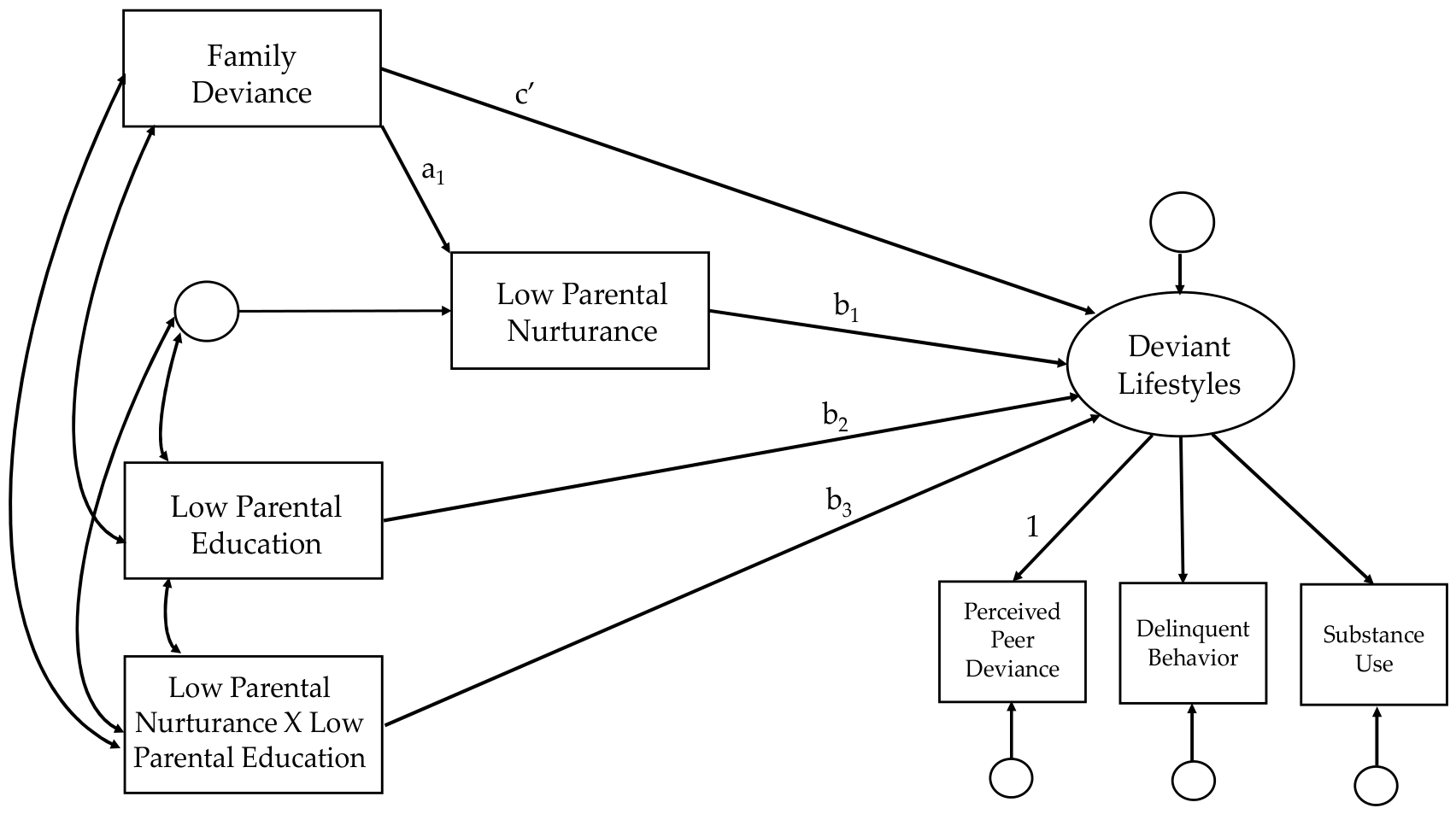
Fourth, moderated indirect effects analysis (labeled “moderated indirect effects model”) was conducted to answer the second and third research questions and respective hypotheses using a comprehensive framework of structural equation modeling. Low parental nurturance was introduced as a mediator of the association between family deviance and the latent deviant lifestyles variable. Low parental education served as moderator of this indirect effect, where the strength of the indirect effect depended on the level of the moderator variable. The analytical approach adopted for testing this conceptual model is consistent with ‘Model 3’ presented in [45]; Figure 2 Panel C [45]). Specifically, we examined whether the relation between the mediator (low parental nurturance) and the dependent variable (deviant lifestyles) was moderated by low parental education (dichotomous variable coded as 1 = yes, 0 = no). In other words, our hypothesis was that the strength of the b1 path shown in Figure 1 depended on the level of the moderator variable, in this case, low parental education. To this end, we calculated bias-corrected bootstrap 95% confidence intervals (CIs) for both indirect effects with the use of 5000 resamples as recommended by [46]. All analyses were performed in Mplus version 7.3 [47].

3. Results

3.1. Descriptive Statistics and Bivariate Correlations

Descriptive statistics and bivariate summaries in the form of Pearson’s product moment correlations are presented in Table 1. As expected, a higher level of family deviance was significantly linked with higher levels of low parental nurturance (r = 0.22), delinquency (r = 0.16), and substance use (r = 0.21). Lower levels of parental nurturance were significantly associated with higher levels of perceived peer deviance (r = 0.17), delinquency (r = 0.16), and substance use (r = 0.31). All three measures of the deviant lifestyle construct were significantly and positively associated with one another (r values > 0.46).

3.2. Confirmatory Factor Analysis

Findings of the confirmatory factor analysis supported the one-factor model for the latent deviant lifestyles construct which consisted of the observed indicators perceived peer deviance, delinquency, and substance use. Overall, the model fit was good (CFI and TLI values > 0.99; RMSEA and SRMR values < 0.001). The completely standardized factor loadings were 0.78, 0.64, and 0.74 for perceived peer deviance, delinquency, and substance use, respectively. On average, the latent deviant lifestyles variable explained 52% variance in the three measured indicators.

3.3. Direct Effects Only Model

The first research question and hypothesis were addressed by examining the predictive effects of family deviance and low parental education on the latent deviant lifestyles variable (see Model 1 in Table 2). The model fit statistics were acceptable (RMSEA = 0.038, 90% CI [0.000, 0.112], CFI = 0.993, TLI = 0.983, SRMR = 0.023) and well within the suggested cut offs. Family deviance and low parental education jointly explained 5% of variation in the latent deviant lifestyles variable. After controlling for low parental education, higher levels of family deviance (unstandardized B = 0.10, SE = 0.03, 95% CI [0.04, 0.16], p = 0.002) were significantly associated with higher levels on the deviant lifestyles construct. Low parental education was not a significant predictor of deviant lifestyles.

3.4. Moderated Indirect Effects Model

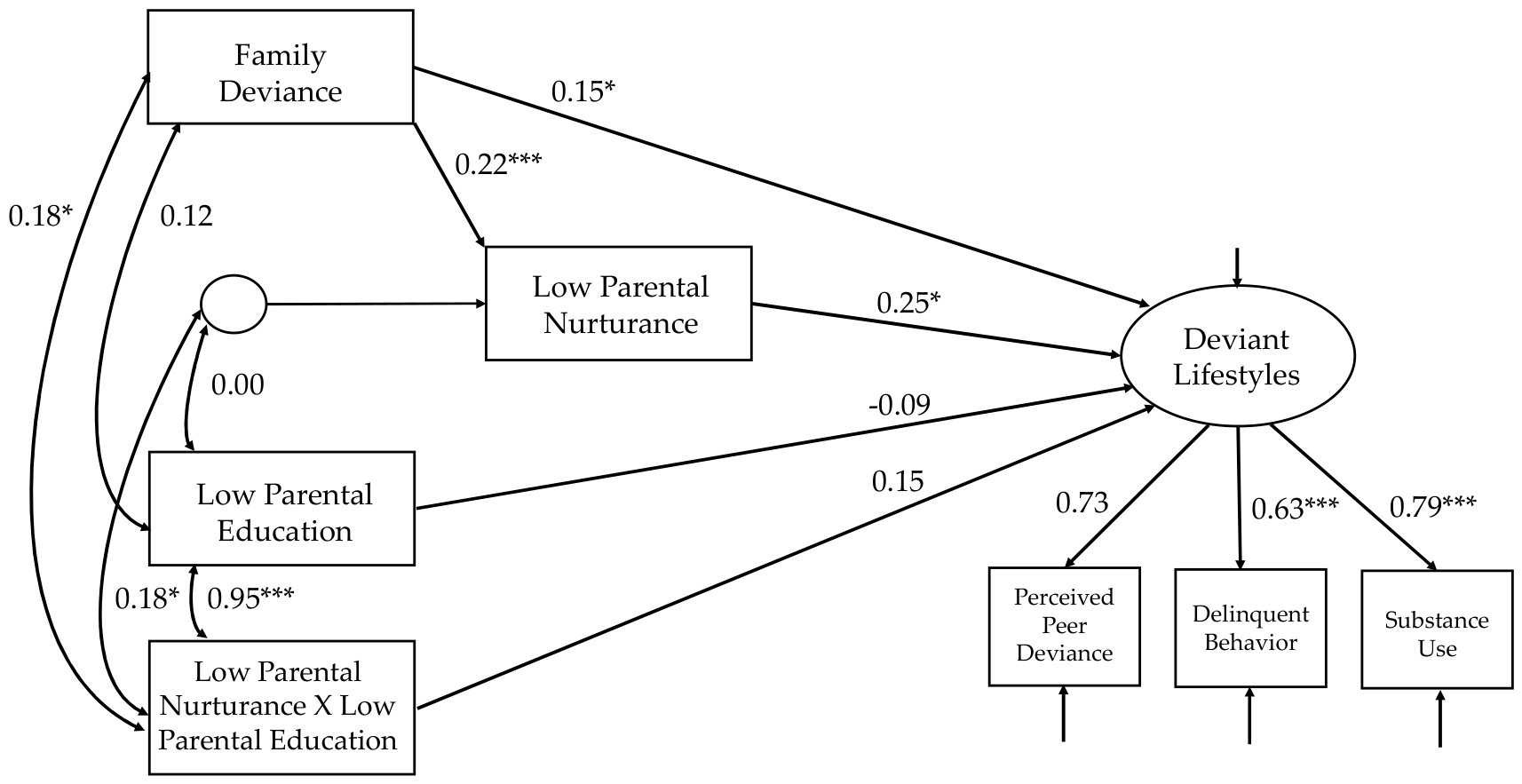
Finally, the hypothesized moderated indirect effects model was examined to address the second and third research questions and respective hypothesis (see Model 2 in Table 2 and Figure 2). Consistent with the analytical approach proposed in [45], low parental nurturance and its interaction with low parental education were added as predictors to those included in Model 1. Model 2 showed excellent fit with the data (RMSEA = 0.047, 90% CI [0.000, 0.097], CFI = 0.986, TLI = 0.969, SRMR = 0.027). All predictors jointly explained about 13% of variation in the latent deviant lifestyles variable. As expected, low parental nurturance (path b1; B = 0.27, SE = 0.13, 95% CI [0.041, 0.554], p = 0.038) and family deviance (path c’; B = 0.07, SE = 0.03, 95% CI [0.004, 0.134], p = 0.04) were significant predictors of a deviant lifestyle. There were no significant relations between low parental education (path b2) and its interaction with low parental nurturance (path b3) and the latent deviant lifestyles variable.
Interestingly, higher levels of family deviance were significantly linked with lower parental nurturance (path a1; B = 0.09, SE = 0.03, 95% CI [0.047, 0.145], p < 0.001). About 5% of variance in low parental nurturance was explained by family deviance. Lastly, the strength of the b1 path between low parental nurturance and the latent deviant lifestyles variable was examined as a function of the moderator variable low parental education. When low parental education was set at 0 (=parents graduated from high school), the indirect effect (IE) of family deviance on a deviant lifestyle via low parental nurturance was non-significant (IE = 0.025, SE = 0.015, 95% CI [0.004, 0.065], p = 0.092). Note that the lower-bound confidence interval (i.e., 0.004) barely exceeded zero. Overall, the magnitude of this indirect effect was not large enough to become statistically significant at conventional levels (less than 0.05). However, when low parental education was set at 1 (=one or both parents left high school without graduation), this indirect effect was statistically significant (IE = 0.032, SE = 0.015, 95% CI [0.010, 0.068], p = 0.027). These results support the moderated indirect effects hypothesis put forth in the current study.

4. Discussion

Theoretical grounding in lifestyle and routine activities perspectives provides support for an association between family deviance, low parental nurturance, low parental education and deviant lifestyles during adolescence. The primary objective of the present study was to examine a latent moderated indirect effects hypothesis. Using data from a sample of mostly economically disadvantaged 11th Graders, analyses proceeded in three steps. First, direct effects were tested (research question 1), then indirect effects (research question 2), and finally moderated indirect effects (research question 3).
As posited in Hypothesis 1, higher levels of family deviance were significantly associated with higher levels of a deviant lifestyle, after controlling for low parental education. This is in accord with findings from prior empirical studies [13,14,15,16,19] and highlights family deviance as a key structural constraint within the family environment that can narrow youths’ behavioral lifestyle options and may lead them to a deviant lifestyle.
Results also supported Hypothesis 2 and showed that higher levels of family deviance are significantly associated with lower parental nurturance, which in turn is significantly related to higher levels of a deviant lifestyle, after controlling for low parental education. Importantly, the direct predictive effect of family deviance on deviant lifestyles remained significant above and beyond its indirect effect via low parental nurturance, indicating partial mediation. These findings suggest that lifestyle theory should not limit itself to just focusing on ineffective supervision, poor parental monitoring, and harsh or inconsistent parenting but consider a broader range of parenting behaviors, including low parental nurturance. It is our contention that when parents are frequently drunk or consume illicit drugs, and become arrested or incarcerated, this may impair their capacity to provide a warm, supportive, and nurturing parenting environment to their offspring. This situation may then limit youths’ exposure to a key protective factor, parental nurturing, which may increase the prevalence of students’ future involvement in deviant behaviors.
Another key finding of this study was that low parental education did not significantly predict deviant lifestyles in any of the tested models. This adds to the mixed results in prior empirical research. In fact, some scholars have argued that socioeconomic status (of which parental education is one common indicator) has ‘both a negative and a positive indirect effect upon delinquency that, in tandem, results in little overall correlation between the two’ [32] (p. 175). The findings of the present study broadly fit with this argument by showing that despite the overall null result, low parental education served as a moderator of the indirect effect of family deviance on adolescents’ deviant lifestyles. To the best of our knowledge, this moderated indirect effect has not been investigated before and thus makes an important novel contribution to deviant lifestyle literature. Specifically, a higher parental educational attainment (i.e., having a high school or college degree) served as a protective factor and prevented low parental nurturance from serving as a mediator between family deviance and youth deviant lifestyles. The indirect effect was, however, statistically significant for youths whose parents had not graduated from high school. We conclude from this finding that parents with relatively higher educational attainment have better access to resources (e.g., financial, living in more affluent and socially cohesive residential areas, access to better schooling and other community resources, less exposure to drug users on the streets). Therefore, they are better able to afford higher-quality relationships with their adolescent offspring which reduces the risk of their subsequent reengagement in a deviant lifestyle. Cross-validation of this speculation derived from the present study in independent research is a critical next step.
These findings need to be tempered with several study limitations. First, findings may not be generalizable beyond our nonprobability sample of 11th-grade students from a large Southern metropolitan region in the United States. For example, findings may not be generalizable to children, students residing in rural or non-metropolitan regions, or high-risk youth samples (e.g., juvenile gang members). Relatedly, it is not clear whether sample heterogeneity in terms of gender and racial/ethnic composition impacted our findings. Interestingly, gender did not significantly moderate the association between parental warmth and youth substance use according to a recent meta-analysis [48]. The authors concluded that potential differential susceptibility of boys and girls to parental influences [49] was likely offset by other factors [48]. This broadly aligns with our finding that study results did not change after student gender was removed as a covariate. Nevertheless, future research with larger samples should investigate the potential role of sample heterogeneity. Second, the measure of low parental education relied on student reports [27,50]. Subsequent studies could incorporate collateral information on parents’ highest educational attainment, including from parents or institutional records. Third, we readily acknowledge that several different models of parental socialization exist. Our study was rooted in criminological lifestyle and routine activity perspectives and therefore prioritized this body of literature. Future research could adopt other well-known conceptualizations of parenting dimensions (e.g., parenting styles [51,52,53]).
Fourth, all measures used in the current study were gathered from a single informant (i.e., 11th grade students). This raises the possibility that findings were inflated to some extent by shared method variance. Future work could incorporate data from multiple informants (e.g., peer reports on their own deviant behaviors, parent reports on their own illicit drug use or arrest history, along with student self-reports). Fifth, the sample size was modest, which limited statistical power to detect associations and possibly the proportion of explained variance. The study needs to be replicated with a larger sample. Sixth, the data was collected approximately 16 years ago. Some contextual factors might have changed since then such as changes in the sanctioning of delinquent behaviors. Adolescent alcohol and cigarette use declined in recent years [54,55] whereas the time spent on social media has increased [56]. These trends could have diminished, to some degree, the influence of parental warmth and nurturance. However, it is unlikely that these societal trends would have completely nullified the role of parental behavior. This speculation is supported by a meta-analysis [48] which found that parental warmth is significantly related to youth substance use, albeit associations were weaker in more recent studies. Therefore, the dataset seems adequate for the purposes of this study. Seventh, the study design was cross-sectional. Compared to longitudinal data, cross-sectional data structures are known to have limitations when testing mediational effects [57,58]. Examining these issues with longitudinal data is an important next step to gain more insights into the directionality of these associations.

5. Conclusions

The above limitations notwithstanding, the present study provides supportive evidence for a moderated indirect effects hypothesis. This study showed that higher parental educational attainment can serve as a buffer against adverse indirect effects of higher levels of family deviance on youths’ deviant lifestyles via lower parental nurturance. Our results also have implications for preventive interventions. Because parental educational attainment is not a malleable factor that can be feasibly targeted in preventive interventions, such efforts should seek to provide a nurturing and supportive environment particularly for youths whose parents did not graduate from high school. Preventive interventions may include strategies to promote positive parenting within the parent–youth relationship and provide alternative access to resources that may be available in the community to strengthen youths’ resilience and ability to resist pressure from siblings and delinquent agemates to engage in delinquent activities. Successful interventions designed to promote parental warmth and nurturing, among other factors, include Triple P [59], a comprehensive community-wide parent support program that has shown positive impacts on youth behaviors [59,60].

Author Contributions

Conceptualization, M.H.D.T., K.D.S., and M.W.; formal analysis, K.D.S.; investigation, K.D.S. and M.W.; data curation, M.W.; writing—original draft preparation, M.H.D.T., K.D.S., and M.W.; writing—review and editing, M.H.D.T., K.D.S., M.W., N.O., and X.X.; visualization, K.D.S., M.W., and X.X.; supervision, M.W.; project administration, M.W. All authors have read and agreed to the published version of the manuscript.

Funding

This research was partially supported by funds from a Faculty Research Excellence Award that the corresponding author received from the College of Education at the University of Houston.

Institutional Review Board Statement

The study was conducted in accordance with the Declaration of Helsinki and approved by the corresponding author’s University Institutional Review Board (protocol code 08075-01, 20 October 2009).

Informed Consent Statement

Active parental informed consent and student assent was required for study participation.

Data Availability Statement

Upon request, the data analyzed in this study is available from the corresponding author contingent on a formal data use agreement.

Acknowledgments

The corresponding author gratefully acknowledges the assistance of Ronda S. Reyna, Kathan D. Shukla, and John T. Spoede with the data collection and coordination with the participating high schools.

Conflicts of Interest

The authors declare no conflicts of interest.

References

  1. Hindelang, M.J.; Gottfredson, M.R.; Garofalo, J. Victims of Personal Crime: An Empirical Foundation for a Theory of Personal Victimization; Ballinger: Cambridge, MA, USA, 1978. [Google Scholar]
  2. Cohen, L.E.; Felson, M. Social change and crime rate trends: A routine activity approach. Am. Sociol. Rev. 1979, 44, 588–608. [Google Scholar] [CrossRef]
  3. Pratt, T.C.; Turanovic, J.J. Lifestyle and routine activity theories revisited: The importance of “risk” to the study of victimization. Vict. Offenders 2016, 11, 335–354. [Google Scholar] [CrossRef]
  4. Turanovic, J.J. Victimization and its consequences over the life course. Crim. Justice 2023, 52, 265–342. [Google Scholar] [CrossRef] [PubMed]
  5. Engström, A. Conceptualizing lifestyle and routine activities in the early 21st century: A systematic review of self-report measures in studies on direct-contact offenses in young populations. Crime Delinq. 2021, 67, 737–782. [Google Scholar] [CrossRef]
  6. Fox, K.A.; Bouffard, L.A. Violent victimization vulnerability: Testing a conceptual model of personality, social, and community factors. Deviant Behav. 2015, 36, 910–934. [Google Scholar] [CrossRef]
  7. Savolainen, J.; Sipilä, P.; Martikainen, P.; Anderson, A.L. Family, community, and lifestyle: Adolescent victimization in Helsinki. Sociol. Q. 2009, 50, 715–738. [Google Scholar] [CrossRef]
  8. Wiesner, M.; Shukla, D. Family deviance, self-control, deviant lifestyles, and youth violent victimization: A latent indirect effects analysis. Vict. Offenders 2018, 13, 504–525. [Google Scholar] [CrossRef]
  9. Finkelhor, D.; Turner, H.; Ormrod, R.; Hamby, S.; Kracke, K. Children’s Exposure to Violence: A Comprehensive National Survey. Available online: http://www.ncjrs.gov/pdffiles1/ojjdp/227744.pdf (accessed on 5 August 2011).
  10. Turanovic, J.J. Heterogeneous effects of adolescent violent victimization on problematic outcomes in early adulthood. Criminology 2019, 57, 105–135. [Google Scholar] [CrossRef]
  11. Stouthamer-Loeber, M.; Drinkwater, M.; Loeber, R. Family functioning profiles, early onset of offending, and disadvantaged neighborhoods. Int. J. Child Fam. Welf. 2000, 4, 247–256. [Google Scholar]
  12. Gottfredson, M.; Hirschi, T. A General Theory of Crime; Stanford University Press: Stanford, CA, USA, 1990. [Google Scholar]
  13. Hoeben, E.M.; Meldrum, R.C.; Walker, D.; Young, J.T.N. The role of peer delinquency and unstructured socializing in explaining delinquency and substance use: A state-of-the-art review. J. Crim. Justice 2016, 47, 108–122. [Google Scholar] [CrossRef]
  14. Hoeve, M.; Dubas, J.S.; Eichelsheim, V.I.; van der Laan, P.B.; Smeenk, W.; Gerris, J.R.M. The relationship between parenting and delinquency: A meta-analysis. J. Abnorm. Child Psychol. 2009, 37, 749–775. [Google Scholar] [CrossRef]
  15. Murray, J.; Loeber, R.; Pardini, D. Parental involvement in the criminal justice system and the development of youth theft, marijuana use, depression, and poor academic performance. Criminology 2012, 50, 255–302. [Google Scholar] [CrossRef]
  16. Wiesner, M.; Capaldi, D.M.; Patterson, G.R. Development of antisocial behavior and crime across the life-span from a social interactional perspective: The coercion model. In Social Learning Theory and the Explanation of Crime: A Guide for the New Century; Akers, R.L., Jensen, G.F., Eds.; Transaction: New Brunswick, NJ, USA, 2003; Volume 11, pp. 317–337. [Google Scholar]
  17. Capaldi, D.M.; Wiesner, M.; Kerr, D.C.R.; Owen, L.D.; Tiberio, S.S. Intergenerational associations in crime for an at-risk sample of U.S. men: Factors that may mitigate or exacerbate transmission. J. Dev. Life-Course Criminol. 2021, 7, 331–358. [Google Scholar] [CrossRef]
  18. Kerr, D.C.R.; Capaldi, D.M.; Pears, K.C.; Owen, L.D. Intergenerational influences on early alcohol use: Independence from the problem behavior pathway. Dev. Psychopathol. 2012, 24, 889–906. [Google Scholar] [CrossRef]
  19. Farrington, D.P.; Jolliffe, D.; Loeber, R.; Stouthamer-Loeber, M.; Kalb, L.M. The concentration of offenders in families, and family criminality in the prediction of boys’ delinquency. J. Adolesc. 2001, 24, 579–596. [Google Scholar] [CrossRef] [PubMed]
  20. Pardini, D.A.; Waller, R.; Hawes, S.W. Familial influences on the development of serious conduct problems and delinquency. In The Development of Criminal and Antisocial Behavior, 1st ed.; Morizot, J., Kazemian, L., Eds.; Springer: New York, NY, USA, 2015; pp. 201–220. [Google Scholar]
  21. Mann, F.D.; Kretsch, N.; Tackett, J.L.; Harden, K.P.; Tucker-Drob, E.M. Person×environment interactions on adolescent delinquency: Sensation seeking, peer deviance and parental monitoring. Personal. Individ. Differ. 2015, 76, 129–134. [Google Scholar] [CrossRef] [PubMed]
  22. Merrin, G.J.; Davis, J.P.; Berry, D.; Espelage, D.L. Developmental changes in deviant and violent behaviors from early to late adolescence: Associations with parental monitoring and peer deviance. Psychol. Violence 2019, 9, 196–208. [Google Scholar] [CrossRef]
  23. Barnes, G.M. Adolescent alcohol abuse and other problem behaviors: Their relationships and common parental influences. J. Youth Adolesc. 1984, 13, 329–348. [Google Scholar] [CrossRef]
  24. Harris, C.; Vazsonyi, A.T.; Bolland, J.M. Bidirectional relationships between parenting processes and deviance in a sample of inner-city African American youth. J. Res. Adolesc. 2017, 27, 201–213. [Google Scholar] [CrossRef] [PubMed]
  25. Daspe, M.-È.; Arbel, R.; Ramos, M.C.; Shapiro, L.A.S.; Margolin, G. Deviant peers and adolescent risky behaviors: The protective effect of nonverbal display of parental warmth. J. Res. Adolesc. 2019, 29, 863–878. [Google Scholar] [CrossRef]
  26. Sabatine, E.; Lippold, M.; Kainz, K. The unique and interactive effects of parent and school bonds on adolescent delinquency. J. Appl. Dev. Psychol. 2017, 53, 54–63. [Google Scholar] [CrossRef] [PubMed]
  27. Aarø, L.E.; Flisher, A.J.; Kaaya, S.; Onya, H.; Namisi, F.S.; Wubs, A. Parental education as an indicator of socioeconomic status: Improving quality of data by requiring consistency across measurement occasions. Scand. J. Public Health 2009, 37, 16–27. [Google Scholar] [CrossRef] [PubMed]
  28. Zaneva, M.; Dumblska, T.; Reeves, A.; Bowes, L. What do we mean when we talk about socioeconomic status? Implications for measurement, mechanisms and interventions from a critical review on adolescent mental health. Gen. Psychiatr. 2024, 37, e101455. [Google Scholar] [CrossRef] [PubMed]
  29. Gottfredson, N.C.; McNaughton-Reyes, H.L.; Wu, J. Predictive associations between adolescent profiles of violent and nonviolent deviant behavior with convictions in adulthood. J. Interpers. Violence 2022, 37, NP12207–NP12237. [Google Scholar] [CrossRef]
  30. Saladino, V.; Mosca, O.; Lauriola, M.; Hoelzlhammer, L.; Cabras, C.; Verrastro, V. Is family structure associated with deviance propensity during adolescence? The role of family climate and anger dysregulation. Int. J. Environ. Res. Public Health 2020, 17, 9257. [Google Scholar] [CrossRef]
  31. Humensky, J.L. Are adolescents with high socioeconomic status more likely to engage in alcohol and illicit drug use in early adulthood? Subst. Abus. Treat. Prev. Policy 2010, 5, 19. [Google Scholar] [CrossRef]
  32. Wright, B.R.E.; Caspi, A.; Moffitt, T.E.; Miech, R.A.; Silva, P.A. Reconsidering the relationship between SES and delinquency: Causation but not correlation. Criminology 1999, 37, 175–194. [Google Scholar] [CrossRef]
  33. National Center for Education Statistics. Number and Percentage of Public School Students Eligible for Free or Reduced-Price Lunch, by State: 2000-01, 2005-06, 2006-07, and 2007-08. Available online: https://nces.ed.gov/programs/digest/d23/tables/dt23_204.10.asp (accessed on 24 January 2011).
  34. Lauritsen, J.L.; Sampson, R.J.; Laub, J.H. The link between offending and victimization among adolescents. Criminology 1991, 29, 265–292. [Google Scholar] [CrossRef]
  35. National Longitudinal Survey of Youth. User’s Guide; U.S. Department of Labor, Bureau of Labor Statistics: Washington, DC, USA, 2006.
  36. Thornberry, T.P.; Krohn, M.D.; Lizotte, A.J.; Smith, C.A.; Tobin, K. Gangs and Delinquency in Developmental Perspective; Cambridge University Press: Cambridge, UK, 2003. [Google Scholar]
  37. Institute of Behavioral Science. Youth Interview Schedule: Denver Youth Survey; University of Colorado: Boulder, CO, USA, 1987. [Google Scholar]
  38. Barnes, G.M.; Farrell, M.P.; Windle, M. Parent-adolescent interactions in the development of alcohol abuse and other deviant behaviors. Fam. Perspect. 1987, 21, 321–335. [Google Scholar]
  39. Barnes, G.M.; Windle, M. Family factors in adolescent alcohol and drug abuse. Pediatrician 1987, 14, 13–18. [Google Scholar] [PubMed]
  40. Pituch, K.A.; Stevens, J.P. Applied Multivariate Statistics for the Social Sciences: Analyses with SAS and IBM SPSS, 6th ed.; Routledge: New York, NY, USA, 2016. [Google Scholar]
  41. Asparouhov, T. Sampling weights in latent variable modeling. Struct. Equ. Model. 2005, 12, 411–434. [Google Scholar] [CrossRef]
  42. Hu, L.T.; Bentler, P.M. Cutoff criteria for fit indexes in covariance structure analysis: Conventional criteria versus new alternatives. Struct. Equ. Model. 1999, 6, 1–55. [Google Scholar] [CrossRef]
  43. Kline, R.B. Principles and Practice of Structural Equation Modeling, 5th ed.; Guilford Press: New York, NY, USA, 2023. [Google Scholar]
  44. Schermelleh-Engel, K.; Moosbrugger, H.; Müller, H. Evaluating the fit of structural equation models: Tests of significance and descriptive goodness-of-fit measures. Methods Psychol. Res. Online 2003, 8, 23–74. [Google Scholar]
  45. Preacher, K.J.; Rucker, D.D.; Hayes, A.F. Addressing moderated mediation hypotheses: Theory, methods, and prescriptions. Multivar. Behav. Res. 2007, 42, 185–227. [Google Scholar] [CrossRef] [PubMed]
  46. Preacher, K.J.; Hayes, A.F. Asymptotic and resampling strategies for assessing and comparing indirect effects in multiple mediator models. Behav. Res. Methods 2008, 40, 879–891. [Google Scholar] [CrossRef] [PubMed]
  47. Muthén, L.K.; Muthén, B.O. Mplus User’s Guide, 7th ed.; Muthén & Muthén: Los Angeles, CA, USA, 2012. [Google Scholar]
  48. Pinquart, M.; Gochaliyev, Z. Associations of parental warmth with substance use in the offspring: A meta-analysis. Int. J. Ment. Health Addict. 2025, 24, 1996–2009. [Google Scholar] [CrossRef]
  49. Gilligan, C. A Different Voice; Harvard University Press: Cambridge, MA, USA, 1982. [Google Scholar]
  50. Lien, N.; Friestad, C.; Klepp, K.-I. Adolescents’ proxy reports of parents’ socioeconomic status: How valid are they? J. Epidemiol. Community Health 2001, 55, 731–737. [Google Scholar]
  51. Alcaide, M.; Garcia, O.F.; Chen, F.; Garcia, F. Raising generation Z children in China: Parenting styles and psychosocial adjustment. Psychosoc. Interv. 2025, 34, 103–115. [Google Scholar] [CrossRef]
  52. Darling, N.; Steinberg, L. Parenting style as context: An integrative model. Psychol. Bull. 1993, 113, 487–496. [Google Scholar] [CrossRef]
  53. Pinquart, M.; Lauk, J. Associations of parenting styles with substance use in the offspring—A meta-analysis. Drug Alcohol Rev. 2025, 44, 133–143. [Google Scholar] [CrossRef]
  54. Johnston, L.D.; Miech, R.A.; Patrick, M.E.; O’Malley, P.M.; Schulenberg, J.E.; Bachman, J.G. Monitoring the Future National Survey Results, 1974–2022: Overview; Institute for Social Research, University of Michigan: Ann Arbor, MI, USA, 2023. [Google Scholar]
  55. Vashishtha, R.; Pennay, A.; Dietze, P.; Marzan, M.B.; Room, R.; Livingston, M. Trends in adolescent drinking across 39 high-income countries: Exploring the timing and magnitude of decline. Eur. J. Public Health 2021, 31, 424–431. [Google Scholar] [CrossRef]
  56. Twenge, J.M.; Martin, G.N.; Spitzberg, B.H. Trends in US adolescents‘ media use, 1976-2016: The rise of digital media, the decline of TV, and the (near) demise of print. Psychol. Pop. Media Cult. 2019, 8, 329–345. [Google Scholar] [CrossRef]
  57. Maxwell, S.E.; Cole, D.A. Bias in cross-sectional analyses of longitudinal mediation. Psychol. Methods 2007, 12, 21–44. [Google Scholar] [CrossRef]
  58. Maxwell, S.E.; Cole, D.A.; Mitchell, M.A. Bias in cross-sectional analyses of longitudinal mediation: Partial and complete mediation under an autoregressive model. Multivar. Behav. Res. 2011, 46, 816–841. [Google Scholar] [CrossRef]
  59. Sanders, M.R.; Markie-Dadds, C.; Turner, K.M.T.; Ralph, A. Using the Triple P system of intervention to prevent behavioural problems in children and adolescents. In Handbook of Interventions That Work with Children and Adolescents: Prevention and Treatment; Barrett, P.M., Ollendick, T.H., Eds.; Wiley: Hoboken, NJ, USA, 2004; pp. 489–516. [Google Scholar]
  60. Sanders, M.R. The Triple P system of evidence-based parenting support: Past, present, and future directions. Clin. Child Fam. Psychol. 2023, 26, 880–903. [Google Scholar] [CrossRef]
Figure 1. Hypothesized moderated indirect effects model for the sample.
Adolescents 06 00045 g001
Figure 2. Moderated indirect effects model with completely standardized estimates (residual variances not shown for visual clarity); *** p < 0.001; * p < 0.05.
Adolescents 06 00045 g002
Table 1. Correlations, means, and standard deviations of study variables (N = 233).
Study Variable123456
  • Family Deviance
  • Low Parental Education
  • Low Parental Nurturance
  • Perceived Peer Deviance
  • Delinquency
  • Substance Use
1.00
0.121.00
0.22 **0.031.00
0.11−0.010.17 *1.00
0.16 *0.070.16 *0.49 **1.00
0.21 **0.090.31 **0.58 **0.47 **1.00
M0.710.331.880.682.080.79
SD1.240.470.510.746.400.91
** p < 0.01; * p < 0.05.
Table 2. Unstandardized regression coefficients (B) and standard errors (SE) for direct effects only (Model 1) and moderated indirect effects (Model 2) prediction models (N = 233).
Dependent VariablePredictor VariableModel 1Model 2
B (SE)B (SE)
Deviant LifestyleFamily Deviance0.10 ** (0.03)0.07 * (0.03)
Low Parental Education0.05 (0.09)−0.11 (0.31)
Low Parental Nurturance X Low Parental Education-0.08 (0.18)
Low Parental Nurturance-0.27 * (0.13)
R20.050.13
Low Parental NurturanceFamily Deviance-0.09 *** (0.03)
R2-0.05
Indirect Effects of Family Deviance on Deviant Lifestyle
Mediated by Low Parental Nurturance
Parental Education Status:0 = Parents Graduated from High School-0.025 (0.02)
Parental Education Status:1 = One or Both Parents Left High School Without Degree-0.032 * (0.02)
*** p < 0.001; ** p < 0.01; * p < 0.05.
Disclaimer/Publisher’s Note: The statements, opinions and data contained in all publications are solely those of the individual author(s) and contributor(s) and not of MDPI and/or the editor(s). MDPI and/or the editor(s) disclaim responsibility for any injury to people or property resulting from any ideas, methods, instructions or products referred to in the content.