Article

Making Choices Amidst Chaos—The Operationalization of Agency Following Forced Displacement for Syrian Adolescent Girls Living in Lebanon

1
Faculty of Health Sciences, Queen’s University, Kingston, ON K7L 3N6, Canada
2
Independent Researcher, Ramallah P639, Palestine
3
Department of Public Health Sciences, Queen’s University, Kingston, ON K7L 3N6, Canada
4
Departments of Emergency Medicine, Kingston General Hospital, Kingston, ON K7L 2V7, Canada
*
Author to whom correspondence should be addressed.
Adolescents 2026, 6(1), 15; https://doi.org/10.3390/adolescents6010015
Submission received: 18 October 2025 / Revised: 9 January 2026 / Accepted: 20 January 2026 / Published: 2 February 2026

Abstract

The Syrian conflict has created one of the largest displacement crises of the twenty-first century, disproportionately affecting adolescent girls. Syrian girls have been primarily portrayed as victims of war or “the lost generation”, neglecting the plurality of their experiences. Building on Bandura’s social cognitive theory, Giddens’ structuration theory, Kabeer’s empowerment framework, and Mahmood’s modalities of agency, this study examines how Syrian refugee adolescent girls in Lebanon enact agency within contexts of forced displacement and how structural factors shape these processes. We conducted a secondary analysis of 293 first-person narratives from Syrian girls and mothers collected in 2016 using Cognitive Edge’s SenseMaker®. Thematic analysis revealed seven structural barriers—restricted access to education, economic insecurity, inadequate infrastructure/living conditions, limited healthcare, gender and social norms, xenophobia, and lack of legal status—as well as key enablers including community services, parental support, and peer networks. Girls expressed agency through seven interconnected processes: awareness/acknowledgement of barriers, emotional navigation, resource identification, decision-making, future planning, reflection, and action execution. These processes were adaptive and recursive, highlighting that agency during displacement is dynamic, relational, and conditioned by structural forces. These findings inform approaches that both reduce structural barriers and enable refugee girls’ agency.

1. Introduction

The nearly 14-year Syrian conflict, that began in 2011, is one of the top five largest refugee and displacement crises of the twenty-first century [1]. Since 2011, over 14 million people have fled Syria and another 7.4 million Syrian civilians have been internally displaced [1]. Given Lebanon’s immediate proximity and deep cross-border social and economic ties, the country became a primary refuge for Syrians, especially between 2011 and 2014 when Lebanon maintained an open-border policy that enabled more than 1.5 million Syrians to enter [2]. Guided by a 2003 Memorandum of Understanding (MoU) with UNHCR, Lebanon allowed limited registration and temporary legal residency for refugees without granting full asylum status or long-term integration [3]. This arrangement reflected both humanitarian considerations and Lebanon’s experience with previous, long-term refugee populations, prioritizing short-term humanitarian protection over permanent settlement. In practice, the MoU means Syrian refugees can register with UNHCR for protection and aid, but they face restrictions on employment—most can only work in specific sectors or must sign a pledge not to work, resulting in high levels of reliance on informal labor [4]. Lebanon also maintains a non-encampment policy, so Syrians live among host communities instead of in official camps [4]. While Lebanon’s framework provides short-term relief, Syrians’ access to education, employment, and healthcare often depends on local municipalities and the shifting priorities of political actors, resulting in significant variation and uncertainty in daily life [5].
In January 2015, the Lebanese government implemented restrictive border policies and a freeze on the United Nations’ registration of refugees, resulting in a decline of registered Syrian refugees [5]. Following the fall of the Assad government in December 2024, Lebanon’s approach to Syrian refugees entered a new phase with the introduction of a national return plan, developed in collaboration with UNHCR and humanitarian partners [1]. As of March 2025, more than 123,000 Syrians had returned from Lebanon to Syria, with UNHCR able to verify around 97,000 of those returns [6]. However, critical assessments reveal that 67 percent of these verified returns occurred under some form of duress, driven more by deteriorating living conditions, restrictive policies, shrinking assistance, and increasing social hostility in Lebanon than by genuine improvements or assurances of safety in Syria [6]. In 2024, only 18% of Syrian individuals above the age of 15 reported having legal residency in Lebanon and 52% of Syrian refugee families in Lebanon lived in overcrowded shelters or shelters in danger of collapse [1]. Further, in 2020, one in four girls aged 15 to 19 were married, with 20% of them in unions with spouses ten or more years older [7].
Across many different contexts, young girls are disproportionately affected by forced displacement when existing age and gender inequalities are magnified [8]. Compared with Syrian men in Lebanon, Syrian women in Lebanon are less likely to have legal residency, are twice as likely to not have access to healthcare, and are nine times more likely to be married before the age of 18 [7]. Overall, 89% of Syrian girls, compared with 57% of Syrian boys between the ages of 19–24, are not being educated, are unemployed, and are not enrolled in training programs [7].
Adolescence is often a stressful period in development as it marks a transition from childhood dependency to independency and self-sufficiency [9]. One major task of adolescence is acquiring a sense of self, which is challenged by youth’s vulnerability to external stressors [10]. Syrian youth facing forced displacement are particularly vulnerable in their formation of a sense of self [11]. However, despite these vulnerabilities, young girls routinely display strength and resilience by taking on new roles and responsibilities during times of adversity [12,13,14].
Adolescence is not a uniform stage of life globally, but a development period that takes on culturally specific patterns and meanings. In Syria, adolescence for girls has traditionally been shaped by close family bonds, strong community networks, and gradual transitions into adulthood that emphasize responsibility, contribution to the household, and preparation for marriage and family life [15,16]. Education has often been highly valued, with many families supporting their daughters’ schooling [17]. Prior to the Syrian war, women in Syria accounted for more than half of all university enrolments and graduated at higher rates than men [18]. However, women only accounted for 15 percent of the labor force in Syria before the war [18]. Following displacement, these norms did not disappear but were adapted to new realities: girls needed to take on expanded roles, whether through caregiving, income generation, or in some cases earlier marriage, as families sought to protect their daughters and ensure security and survival in precarious conditions [19,20]. Recognizing adolescence as culturally embedded allows for a more nuanced understanding of how Syrian girls navigate displacement, balancing inherited traditions with adaptation in rapidly changing circumstances.
A significant body of humanitarian and academic literature frames Syrian refugee girls primarily as victims of war and displacement—often referred to as a “lost generation” [21,22]. While these narratives are well-intentioned and reflect realities of war and displacement, they may inadvertently present Syrian girls as intrinsically docile and passive, in need of rescue from their circumstances. Such portrayals risk obscuring the plurality of girls’ lived experiences and the strategic, deliberate decision-making they exercise in navigating armed conflict, forced displacement, and constrained socio-economic conditions.

The Interplay Between Structure and Agency

Agency is defined as the ability for individuals to act on their own in ways that can impact their own and others’ lives [23]. It is often understood as ‘empowerment.’ Adolescence is characterized by an ongoing challenge to develop a sense of agency [10]. By contrast, structure refers to the external factors including economic status, gender, laws, social and cultural norms, etc., that determine or constrain an individual’s agency [23]. Structuration theory, proposed by sociologist Anthony Giddens, postulates that human behaviour is based on a synthesis of both structure and agency factors [24]. Human action can then be simultaneously enabled or constrained by structures and/or individual expressions of will (i.e., agency). The only way to truly understand human behaviour, therefore, is to understand the interplay between these structures and individual expressions of will. We adopt this dual approach to understanding the agency of Syrian refugee girls following displacement to Lebanon.
In terms of understanding structure, Giddens defines it as rules and resources that are both the medium and outcome of reproduction of social practices [24]. In this understanding, structures can influence individual actions or outcomes but simultaneously, are mediums influenced by individuals. Literature on the influence of structure on the agency of youth and children during forced displacement focuses overwhelmingly on the constraining quality of structural factors [25,26]. Largely absent from the literature is a simultaneous presentation of structural factors as both constraints to and enablers of agency. As for conceptualizing individual agency, within Giddens’ structuration theory, the term reflexivity was coined to describe an agent’s ability to consciously alter their place within the social structure [24]. However, the initial theorization of personal agency was first put forward by Albert Bandura who, like Giddens, describes agents as both the products and producers of social systems [27].
Working in the framework of social cognitive theory, Bandura describes agency as consisting of four key features: intentionality, forethought, self-reactiveness and self-reflectiveness [28]. Intentionality refers to any representation of a future course of action to be performed. These intentions need not be detailed anticipations of situational details, but rather can be partial and later revised or refined in the face of new information. Central to the understanding of intentionality in Bandura’s conceptualization is the fact that outcomes are not the characteristics of agentive acts, but rather the consequences of them; hence, actions are judged by their intent not their outcome [28]. Forethought extends the temporality of agency beyond the intentional forward-directed planning and refers to people motivating themselves and guiding their actions in anticipation of future events. Self-reactiveness is the extension of the agent as not just a planner and forethinker but also a self-regulator. This is beyond the deliberative decision-making and planning process and involves the ability to give shape to appropriate courses of actions and to regulate their execution. Finally, self-reflectiveness refers to the metacognitive capability to reflect upon oneself and the adequacy of one’s own thoughts and actions. It is this metacognitive ability through which people judge their operative thinking against the outcomes of their actions and address motivations to choose and act in favour of one decision over another. Further, Bandura postulates three modes of agency: direct personal agency, proxy agency involving others acting on one’s behalf to secure a desired outcome, and collective agency exercised through interdependent efforts [28].
While Bandura and Giddens provided foundational accounts of agency as intentional, reflexive, and shaped by social structures, subsequent scholars have expanded these ideas to interrogate how agency is experienced in various cultural and political contexts. Naila Kabeer conceptualizes agency as one of three interrelated dimensions of empowerment, alongside resources (the preconditions for exercising choice) and achievements (the outcomes of agency) [29]. In her widely cited work Resources, Agency, Achievements: Reflections on the Measurement of Women’s Empowerment (1999), she defines agency as the ability to define goals and act upon them, whether through individual decision-making or collective strategies. Crucially, Kabeer underscores that agency should not be reduced to overt resistance; it encompasses both the more visible forms of negotiation and struggle, as well as subtler acts of “bargaining with patriarchy”. In contexts of displacement, these may include how refugee women and girls decide on education, marriage, or labor under severe structural constraints, exercising agency even when choices appear circumscribed. Saba Mahmood further complicates conventional notions of agency by arguing that it can take multiple modalities, including endurance, patience, piety, and practices of self-cultivation, rather than being limited to resistance or autonomy [30]. Her work highlights that what counts as agency must be understood through the cultural and political contexts in which it is enacted, expanding possibilities for recognizing girls’ strategies of survival and meaning-making in displacement.
Kabeer later extends this analysis by emphasizing that agency is always embedded within structures of constraint and possibility [31]. In Gender Equality and Women’s Empowerment: A Critical Analysis of the Third Millennium Development Goal (2005), she critiques policy framings that treat empowerment as a linear, universal process, and instead argues for a relational, context-specific understanding. This has been applied in studies of displacement and migration, where women’s constrained choices such as entering into early marriage, undertaking precarious labor, or prioritizing family survival must be understood not as passivity but as strategic navigation of limited options [32]. However, far less is known about the process through which adolescent girls navigate these structural conditions in pursuit of their own goals. In particular, the steps through which girls define their goals and act upon them—the middle space between constraints and outcomes where agency is practiced, negotiated, and transformed—remain underexplored.
We have previously studied and examined the multifaceted realities of Syrian refugee adolescent girls’ lives in Lebanon, including the drivers and consequences of early marriage [19,33]. the paradoxical emotional landscapes of hope and worry [34], exposure to sexual and gender-based violence [35], the protective yet risky potential of education [17], their unmet needs [36], and the lived experiences of child brides [37]. We re-examined our previously collected data to ask the question: What are the processes through which Syrian refugee adolescent girls in Lebanon enact agency during forced displacement, and how do structural factors shape, constrain, or enable these processes? Although data were collected in 2016, the structural conditions shaping Syrian refugees’ lives in Lebanon—including legal precarity, restricted access to education and healthcare, gendered social norms, and economic marginalization—have remained largely unchanged. As such, these data remain analytically relevant for examining the processes through which adolescent girls enact agency within the context of displacement.

2. Methods

2.1. Study Design and Participants

This analysis used data collected from a cross-sectional, mixed-methods study performed by the ABAAD Resource Center for Gender Equality and Queen’s University from July to August 2016. The original research examined the experiences of Syrian adolescent girls in Lebanon with a particular focus on child, early and forced marriage (Bartels et al. [19]). Participants had to be 13 years of age or older to be eligible for participation. Data were collected from six participant subgroup types of which three were incorporated into this analysis, namely married and unmarried Syrian adolescent girls, and Syrian mothers. All first-person narratives from these subgroup types were screened for inclusion. For the purposes of this study, Syrian adolescent girls are defined as girls under the age of 18. Syrian mothers who discussed their own experiences from before they were 18 were also included. Full details of data collection and further description of the SenseMaker® instrument (The Cynefin Company, Birmingham, UK) have been previously published [33].

2.2. Data Collection

Data were collected using Cognitive Edge’s SenseMaker®—a digital visual analytic tool that collects both qualitative and quantitative data and aids researchers in visualizing patterns across narratives shared within a study population. The qualitative component consisted of participants’ brief narratives, while the quantitative component was generated through their self-interpretation of these stories using triads, dyads, and multiple-choice questions. For the purposes of this study, only the qualitative first-person stories were used for analysis. Twelve interviewers (six Syrian females, three Syrian males and three Lebanese males) were selected to collect data based on their place of residence, gender, nationality, and prior work experience. Interviewers were locals recruited through the ABAAD Resource Center and were often known to ABAAD staff through previous programming. Interviewers underwent a four-day training prior to data collection. Interviews were conducted in three locations: the greater Beirut area, Tripoli and Bekaa Valley. This community-based recruitment approach was used to foster trust and rapport with participants. Convenience sampling was used to recruit participants in various public places such as markets and transportation depots. Interviewers strove to recruit participants from diverse backgrounds and geographic locations. All data were collected in Arabic and transcribed and translated to English. Participants were prompted to share a story based on one of three questions: (1) Suppose a family is coming to Lebanon from Syria, and the family has girls under the age of 18. Tell a story about a Syrian girl in Lebanon that the family can learn from. (2) Tell a story about a situation that you heard about or experienced that illustrates the best or worst thing about the life of a Syrian girl (under the age of 18) in Lebanon. (3) Provide a story that illustrates the biggest difference between life for Syrian adolescent girls (under the age of 18) living in Lebanon in comparison to life for Syrian adolescent girls in Syria. Following the prompt, participants were asked to indicate whether the story they shared was about themselves or about someone else.

2.3. Data Analysis

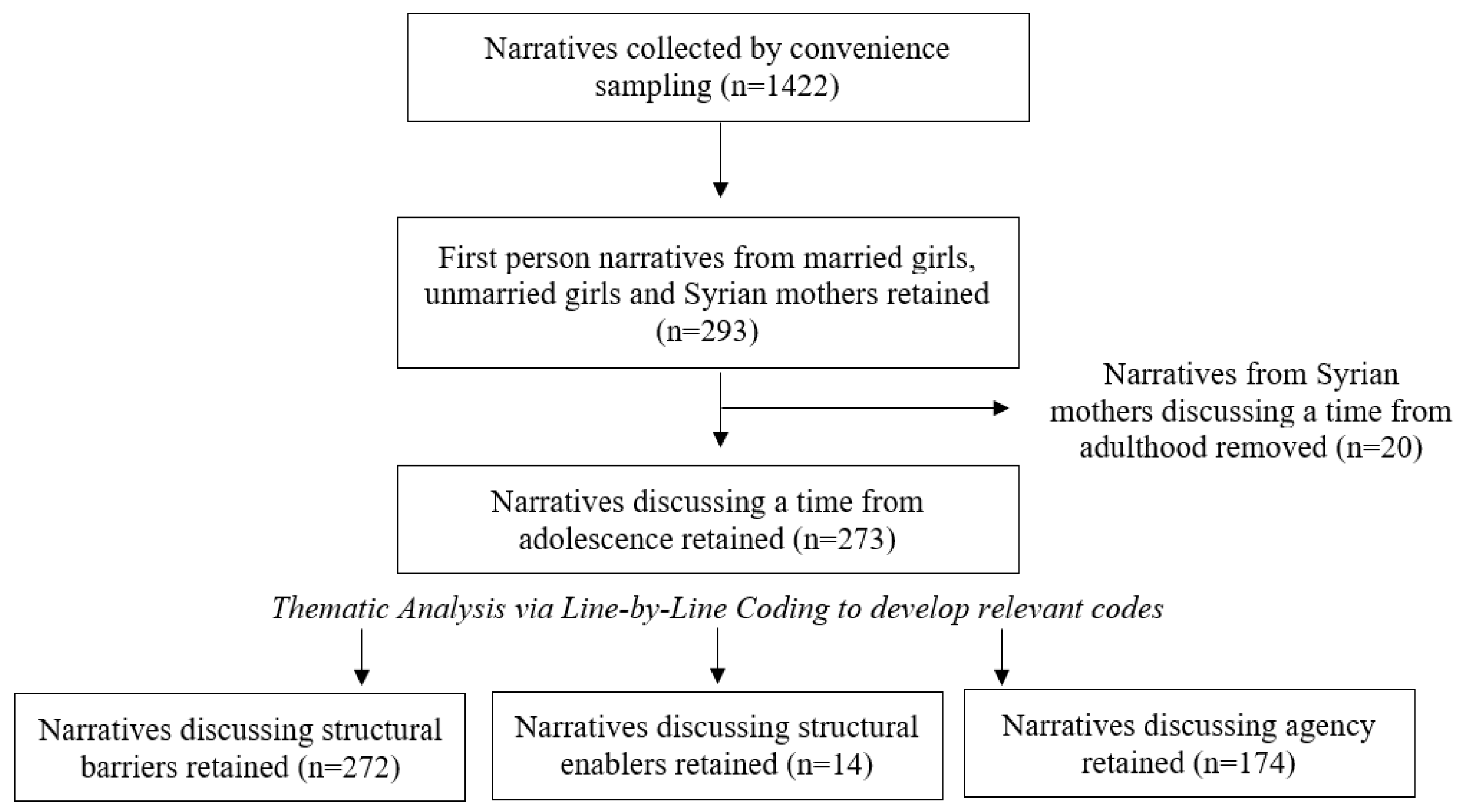
All first-person narratives shared by Syrian adolescent girls or mothers were included in the analysis (n = 293). Narratives from mothers that did not include mention of details or discuss events in their own lives prior to turning 18 were excluded (n = 20). Given the open-ended prompts and the timeline of the Syrian conflict, mothers’ accounts often reflected their own recent adolescent experiences; these narratives were included because many women had experienced motherhood during adolescence or had only recently transitioned into adulthood, providing temporal depth to the analysis of adolescent agency across displacement. The analysis was split into two sub analyses—one examining structural factors enabling/constraining agency and the other examining processes of individual agency. See Figure 1 for a summary of the data screening process for inclusion. All narratives were independently screened for inclusion by two researchers (SH and SM) blinded to each other’s selections. Where inclusion discrepancies existed between SH and SM, SAB reviewed the narratives and a determination regarding inclusion was made by conversation and consensus.
Reflexive thematic analysis was employed as the primary analytic method [38,39]. Analysis was inductive, with themes generated through close engagement with participants’ narratives. Existing theoretical frameworks on structure and agency informed interpretation and model development.
The primary analysts (S.H. and S.M.) are native Arabic speakers with cultural familiarity with the study context. Although they did not conduct the original interviews themselves, both were closely involved across multiple stages of the study, including transcription, translation, and analysis. Notably, S.M. was extensively involved in the original study design and implementation, including development of the research proposal, interview guides, and sampling framework, training and supervision of research assistants, quality control during data collection, participation in focus groups, and involvement in translation and early analytic discussions. In addition, S.B. and C.M.D. were on the ground during all major phases of data collection and were actively engaged in field implementation and preliminary analysis, providing critical contextual insight that informed subsequent interpretation.
Reflexivity was maintained through repeated engagement with the data, iterative analytic discussions conducted primarily between S.H. and S.M., with S.A.B. involved as needed for triangulation and resolution of interpretive uncertainties, and ongoing reflection on how researchers’ positionality, disciplinary training, and theoretical orientations shaped interpretation. All narratives were collected in Arabic and analysed in English. Translation was treated as an interpretive process rather than a purely technical one; analysts attended to dialect and culturally specific expressions, returned to the original Arabic audio recordings when interpretation was unclear, and prioritized meaning-based translation. As this was a secondary analysis, analysts were not able to seek clarification from participants; interpretations therefore relied on careful engagement with recorded narratives, documented analytic decisions, and reflexive discussion. Quotations were selected to illustrate variation in how themes were expressed rather than to represent frequency or extremity.
Following familiarization with the dataset, S.H. and S.M. conducted line-by-line coding of the narratives to generate a list of initial codes in Microsoft Excel. Initial codes were reviewed, and secondary codes developed based on synthesis of the initial codes by S.H. and S.M. The secondary codes were then sorted into themes by S.H. and S.M. and reviewed by S.A.B. We deliberately chose to separate the analysis of narratives for structural barriers and expressions of agency to ensure that expressions of agency were not overlooked within narratives that were otherwise dominated by accounts of structural barriers to agency. A clear audit trail was maintained, including documentation of coding decisions, theme development, and points of analytic disagreement and resolution, to enhance transparency and dependability of the analytic process.
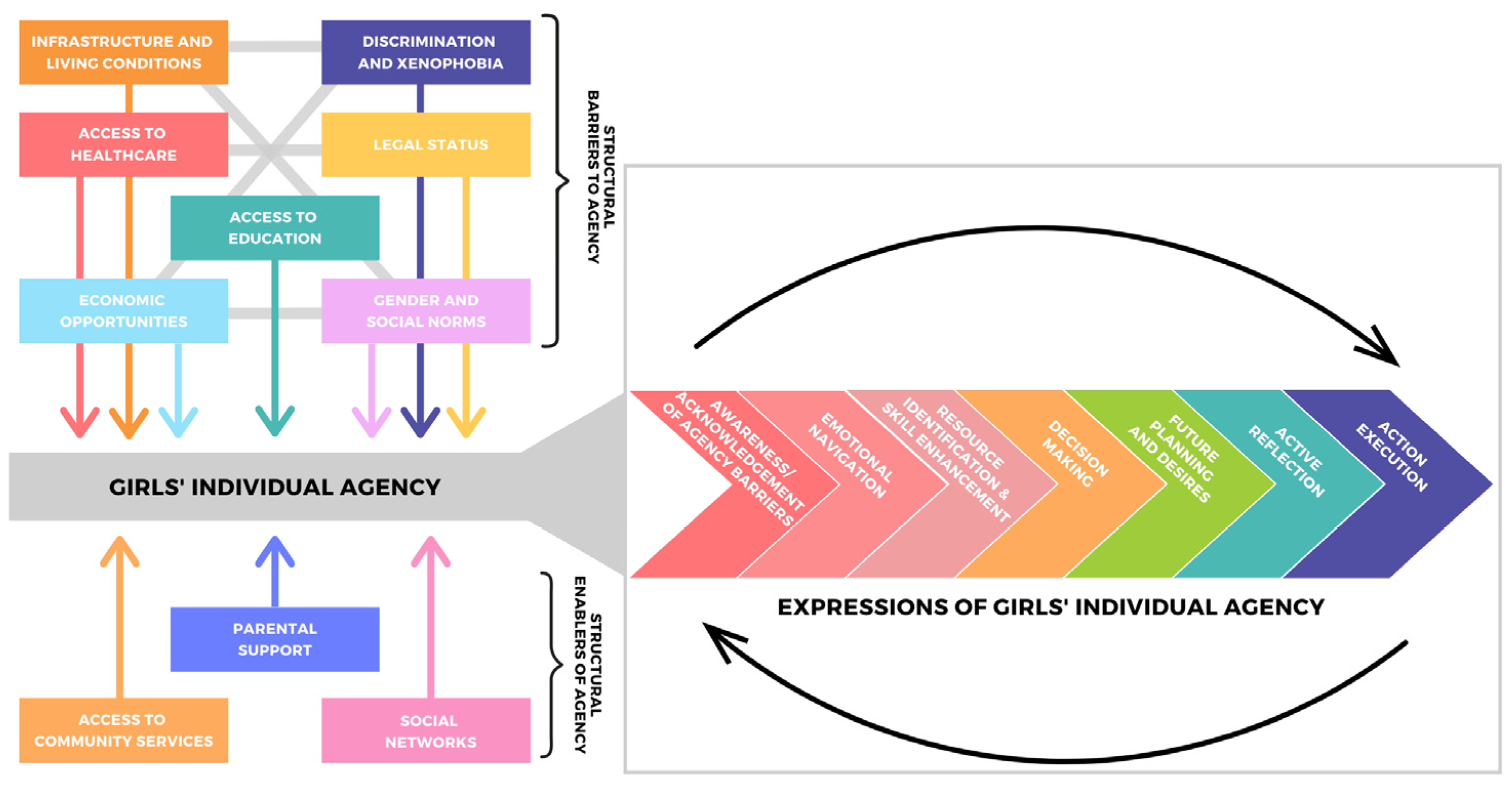
Direct quotations from first-person narratives highlighting the themes from the structural factors and individual agency analysis were noted by S.H. and S.M. Varied quotes most reflective of the different manifestations of each theme were selected by SH and are discussed below. Final framing of the structural barriers was drawn from the World Bank’s 2014 report ‘Voice and Agency’ [40]. This report by Klugman et al., 2014 offers a comprehensive and empirically validated framework for categorizing key structural constraints faced by women and girls, which has been institutionalized in global development policy [40,41]. S.H. developed the final model of the operation of agency within forced displacement based on the theoretical frameworks of structuration theory and social cognitive theory which was then reviewed by S.M. and S.A.B. (Figure 2).

2.4. Strengths and Limitations

Some strengths of this study include the large sample size, data collection from varied locations in Lebanon and open-ended questioning to avoid leading responses. The use of convenience sampling limits the transferability of findings beyond similar contexts of displacement, and marginalized groups, including individuals with disabilities, may be underrepresented. As this was a secondary analysis, the analytic team did not conduct the original interviews and was therefore unable to probe or clarify narratives in real time, which may have influenced interpretation. Although analysts were native Arabic speakers and attended to dialect and culturally specific expressions during translation, some linguistic nuance may have been lost in the translation of narratives from Arabic to English. Finally, narratives from Syrian mothers who were adults at the time of offering their stories may be subject to recall bias; however, given the timeline of the Syrian conflict, these often described relatively recent displacement-related experiences. These narratives were analyzed alongside contemporaneous adolescent accounts.

3. Results

3.1. Structural Constraints to Agency

With regard to structural factors, our final analysis included 272 first-person narratives; 111 from unmarried Syrian adolescent girls, 116 from married Syrian adolescent girls, and 45 from Syrian mothers telling a story about themselves from before they were 18. Several barriers to agency emerged including the following categories: access to education, economic opportunities, infrastructure and living conditions, access to healthcare, gender and social norms, discrimination and xenophobia and legal status. Results are outlined below.

3.1.1. Access to Education as a Barrier to Agency

Participants consistently described barriers to continuing their education in Lebanon. For many, education was a means of achieving future goals, securing financial independence, and delaying or avoiding early marriage. The interruption of schooling was repeatedly linked to a loss of hope, diminished security, and a sense of constrained futures.
Girls described how displacement and economic hardship forced them out of classrooms: “In Syria, we went to school. After the Syrian crisis, we stopped going to school because of financial reasons.” Others emphasized that even when education was technically available, it lacked accreditation or legitimacy: “I decided to stop my education because this is not a real certificate, so there is no point.” These narratives highlight that barriers were not only material but also institutional, eroding the perceived value of investing in education.
Safety and mistreatment also emerged as recurring deterrents. One girl recalled: “Harassment in school so I stopped school.” Another explained, “Poor quality of education; mistreatment from teachers,” pointing to experiences that made school not just unproductive but actively harmful. In some families, gendered restrictions compounded these challenges: “Girls were not allowed to go to school.” In other cases, education gave way to economic necessity, with children working instead of studying: “We couldn’t get into school so we started working.
Girls often linked education with empowerment, contrasting the “voicelessness” of early marriage to the agency they associated with learning. As one participant explained: “I loved learning […] I was married at a young age, and I acted emotionally rather than rationally. I couldn’t secure my rights, but an older woman would have fought for her rights.” Another poignantly framed education as a form of resistance: “I advise you that if you have girls that are below 18, never pull them out of schools, a woman’s weapon is her education.

3.1.2. Economic Opportunities as Barriers to Agency

Participants described the lack of economic opportunities and financial strain as major barriers influencing their ability to act with agency. Families struggled to secure adequate income, and these pressures directly affected girls’ education and life choices. One participant explained, “Since we first left Syria we came here, we worked but couldn’t make enough money, and we couldn’t put our children in school.” Another similarly reflected, “We’ve been here in Lebanon for 5 years. The situation is difficult. We are forced to work long hours and we still don’t have enough.” These accounts show how financial pressures limited not only immediate options but also opportunities for the future.
Adolescent girls frequently spoke of being drawn into work themselves or of siblings leaving school to contribute to the household income. As one participant described, “After we came to Lebanon, we all started working, even though I was still very young.” Another recounted, “My brother left school because he had to help provide for the family.” These stories highlight how economic hardship shifted responsibility onto children, curtailing their education and narrowing their future opportunities.
Participants recognized the trade-offs between education and labor. One girl explained, “We should be in schools, but we are obliged to work instead.” Another shared the day-to-day struggle of laboring without relief: “We work all day and can barely afford food.” For many, economic insecurity meant that agency was constrained to strategies of survival rather than long-term planning or self-determined choices.

3.1.3. Infrastructure and Living Conditions as Barriers to Agency

Narratives pointed to the absence of basic services such as water, electricity, and sanitation, which not only created daily hardships but also eroded girls’ sense of security and dignity. One girl observed, “The situation here is not good at all. As you can see, there’s no water, no electricity, and no bathrooms.” Others echoed this precariousness with statements like “Life here is not comfortable at all; everything is missing” and “When we were in Syria, we had a house, during the war our house was destroyed and now we live in very poor conditions.
The shift from secure houses in Syria to fragile tents in Lebanon was described as deeply disempowering. As one girl vividly recounted, “Back home, I was living happily and comfortable in a secured, brick house, but in the refugee camps, I live in a tent where snakes and rats would come in. Three of my children were bit by rats […] If I want to take them to a hospital, I have to go to Zahle, and there is no mean of transportation there, nor do I have financial means to afford the trip. We are not living comfortably in these tents knowing that the rats can rip them.
Living in tents or temporary camps was repeatedly contrasted to the comfort and dignity of former homes, with one adolescent noting, “I displaced to Lebanon with my husband, and I live in a tent. We have two daughters. I am not used to live in a tent. I am not comfortable here. In Syria, I was more comfortable.” Others described how unsafe neighborhoods and deteriorating infrastructure outside the home restricted mobility, with parents often prohibiting girls from leaving the house, as reported by this participant “So the girl was not allowed to leave the house because the area was unsafe.

3.1.4. Access to Healthcare as a Barrier to Agency

Participants described challenges in accessing healthcare as an important barrier influencing their agency. Narratives pointed to the high cost of services, the distance to hospitals and clinics, and the lack of reliable transportation, all of which combined to make medical care difficult to obtain. As one girl explained, “When I was living in Syria, everything was secure and safe. Here in Lebanon, even if someone gets sick, we can’t take them to the doctor.” For many, these challenges limited their ability to act when health concerns arose.
Maternal and reproductive health needs were also prominent in the narratives. Several girls described giving birth or facing complications without professional medical support because hospitals were either too far away or unaffordable. One adolescent recalled, “I got married in Syria when I was 13 years old. When I gave birth here, there was no one to help me, and I couldn’t afford to go to the hospital.” Another shared, “I am 16 years old… when I was pregnant, I had to deliver without proper medical care, because the hospital was too expensive and far away.
Other participants noted that the costs of healthcare often forced families to delay or forgo treatment. One girl explained, “We work all day and can barely afford food, so when my children are sick, we just wait and hope they get better instead of going to a clinic.” Another added, “The hardest thing we face here is hospitalization for our children; they don’t take them in without money, and we don’t have it.
These accounts suggest that healthcare inaccessibility was experienced as a structural barrier to agency, as costs, distance, and lack of maternal health services constrained responses to illness or pregnancy and narrowed available adolescent girls’ choices.

3.1.5. Gender and Social Norms as Barriers to Agency

Cultural and gender norms influenced girls’ ability to shape their own lives, with some girls describing limited input into decisions about marriage and little room to challenge family or societal expectations. One participant explained, “My family forced me to marry when I was still a child.” Others described staying in marriages despite unhappiness because of the stigma surrounding divorce. As one adolescent put it, “Even if a woman is suffering, she has to stay with her husband, because if she leaves him, society will blame her.
Family members often played decisive roles in whether girls could pursue education or other opportunities, illustrating how agency was mediated by gendered expectations. One adolescent reflected, “There’s a difference between my dad and mom. My mom encourages me to continue school, but my dad won’t let me.” Another explained the limits placed on her freedom after marriage: “My husband doesn’t let me go out or visit anyone; I have to stay at home all the time.
Experiences of sexual and gender-based violence (SGBV) were also prominent. Girls reported both domestic violence and harassment in public spaces, which limited their participation in schooling, social life, and play. One adolescent explained, “My husband beats me whenever I ask to go out,” while another shared, “My mother-in-law hits me when she thinks I’m not doing enough housework.” Others described how harassment in public curtailed their mobility: “I used to go to school with my friends without fear, I used to go out with them to play without fear […] I can’t go out with my friends anymore because it’s not safe anymore.
Mobility and participation in educational or social activities were further constrained by concerns over reputation and honour. One participant described withdrawing from courses due to community scrutiny: “When I came here, I started participating in courses with the United Nations and Norwegian, in Tripoli and here. But then I became scared from the society surrounding me, because they started talking about me and where I go. So I stopped.” Another added, “People talk badly about girls if they go out too much; they say she’s not respectable”. These accounts highlight how reputational concerns and social surveillance curtailed girls’ ability to engage in activities outside the home.
Domestic expectations also shaped girls’ everyday experiences, with many reporting that housework and caregiving consumed much of their time. One adolescent explained, “I spend all day cooking and cleaning; I don’t have time for anything else.” Another noted how this work affected her opportunities: “Since I got married, I stopped school because I have to stay at home and take care of the house.

3.1.6. Discrimination and Xenophobia

Participants described xenophobia and discrimination as significant barriers shaping their agency. Narratives highlighted how social stigma and mistreatment limited opportunities in education, work, and daily life, and how being Syrian often carried connotations of devaluation. One girl captured this sentiment directly: “When you say ‘Syrian’ it’s just as if you mentioned something filthy, they treat you like an animal here, they don’t give you any sort of value.
Discrimination was particularly noted in schools, where girls reported harassment, bullying, and unfair treatment from both peers and teachers. One participant explained, “In Syria, we were very happy. I reached the 9th grade. When we came here, I couldn’t continue because the teachers mistreated me, they didn’t teach me, and they failed me on purpose”. Another noted being excluded from schools altogether or targeted with bullying: “I could not continue my education in the hosting country; they didn’t accept me and I was bullied.
For others, discrimination extended beyond school into housing and the workplace. One participant shared, “Here in the building the treatment is horrible. They hurt us a lot with their words, they curse my husband. He works as the building’s concierge.” Another recalled verbal abuse while working in the fields: “We are always verbally abused and cursed. In our work as farmers, as well, we are constantly told that we are stupid and looked down upon, but despite the disrespect that we face, we must keep working to get money.” Others described being denied employment altogether, as one explained: “No one was employing any Syrian worker.
For many participants, these experiences were not confined to one setting but reflected broader patterns of humiliation and exclusion. As one adolescent summarized, “We got humiliated a lot, everything’s different here, they don’t treat us like human beings.” These narratives suggest that xenophobia and discrimination functioned as structural barriers that eroded dignity, limited access to education and work, and narrowed the scope of agency for Syrian adolescent girls in Lebanon.

3.1.7. Legal Status as a Barrier to Agency

Participants described legal status as a central barrier to agency, with expired or absent residency permits limiting access to education, registration of marriages and births, and basic services. One participant recalled, “Two of her daughters were very young when they were displaced […] she wasn’t able to either get their identification cards or to enroll them in any school. Now, they are 17 and 18 years old […] they do not have any legal documentation. So, they weren’t able to register their marriages in the embassy.” One adolescent explained, “We got married, but we do not have any legal papers to prove our marriage […] I am worrying about not being able to register my child when I give birth.
The absence of valid papers also shaped daily life by restricting mobility and access to services. One girl summarized, “We can’t do anything without our papers and our official IDs.” Another recounted how lack of legal status kept her family confined: “The family is not staying legally, consequently they cannot go outside of the house often.
Several participants described the financial strain of attempting to secure residency, including the costs of sponsors and paperwork. One adolescent explained, “I went to renew my papers, but the UN didn’t renew […] so I had to find a sponsor. I paid 200$ for me, and 200$ for my husband and 100$ for the papers. I had to borrow the money. I’m living illegally here.” Such accounts illustrate how legal recognition was tied to financial resources many families did not have, further reinforcing exclusion.

3.2. Structural Enablers of Agency

We noted three main categories of structural agency enhancers, namely access to community services, parental support, and other social supports. These external supports were shown to improve sense of independence and well-being, protect girls from SGBV, and support decisions to not marry at a young age.

3.2.1. Access to Community Services

Many girls noted access to community services, including courses, skills training programs and the opportunity to meet other Syrians enhanced their freedom and potential. One participant explained, “I used to go to the organization every day to attend the courses, and it was the only time I felt free.” Some noted a preference for attending Syrian-specific resources that connected them with peers who shared similar experiences. As one girl shares, “Here I didn’t register into a school. Abaad [local grassroots organization] provides us with these activities which allow us to express our potential to some extent.
These organizations often offered practical, transferable skills. One girl shared how NGO involvement created the possibility of economic independence: “We had to move to Lebanon because of the war, and I began work in a hair salon. At the moment, I am working with an NGO that takes care of camps, and if the association’s plans work, they promised to equip me with whatever I need to open my own hair salon.” Others described taking sewing and parenting courses that equipped them with tangible skills for everyday life.
Even basic forms of support were experienced as enabling. One adolescent recalled, “First when we were in Syria, everything was available… here [in Lebanon] the UN and NGOs help us with food and aid.” Though modest, this assistance provided stability and recognition that helped families survive displacement.

3.2.2. Parental Support

A second category of external support came from parents. Mothers in particular expressed a determination to protect their daughters especially from SGBV and early marriage. Some even intervened directly to shield their daughters from harm. One girl recalled, “A 13-year-old girl was going to her aunt’s to borrow something, when a man within the refugee compound stopped her and verbally abused her. She told her mom about what happened, so the mom went out and yelled at him for his unacceptable behavior.
Parents also supported their daughters’ decision-making around marriage. For some, this meant delaying marriage until their daughters themselves were ready. One mother stated firmly, “Marriage is not allowed. I would never get them married until she thinks she wants to and can get married. As long as they are with me, I will protect them”. In other cases, parental support extended to validating girls’ decisions to divorce, challenging the social stigma surrounding separation. As one participant explained, “When I wanted to leave my husband, my mother stood by me and said it was better to be divorced than to stay suffering.
Parental encouragement was equally important in education. Several participants described mothers who defended their daughters’ right to study. One adolescent explained, “My mother told me not to listen to what people say, to keep studying and learning.” Fathers too reinforced this message. One girl remembered, “My father told me education is your weapon, don’t give it up.” Parental advocacy and protection functioned as enabling structures that allowed Syrian adolescent girls to resist social pressures, pursue education, and exercise agency in deeply constrained contexts.

3.2.3. Social Networks

In addition to formal community services and parental support, many girls described the importance of friendships, peers, siblings and neighbors in sustaining their sense of agency by providing solidarity, encouragement, and protection. For some, friendships reinforced the pursuit of education. One participant recalled, “My twin sister and I used to study together in Syria, and we continued here, encouraging each other not to give up”. Another emphasized the role of peers in keeping her motivated, explaining, “I used to study with my friends, and together we encouraged each other to stay in school.
Friendships also created moments of normalcy and joy. As one adolescent explained, “When I was with my friends, I felt like a child again.” Another reflected on how social ties gave her something to look forward to, “I have made new friends, and now I have every Thursday to look forward to when I go out and see them.
Neighbors and extended family were also described as important enablers of agency in the absence of strong institutional safety nets. One participant shared, “In front of my house I saw my neighbours who were protecting me and helping me.” Others described how relatives stepped in with childcare, enabling them to return to school or participate in courses: “My relatives helped with my children so I could go back to classes.” Taken together, these accounts highlight that social networks were not just a source of companionship, but a structural enabler of agency.

3.3. Expressions of Individual Agency

Our analysis included 174 first-person stories: 88 from unmarried Syrian adolescent girls, 83 from married Syrian adolescent girls and 3 from Syrian mothers. From these accounts, seven interconnected themes emerged that together illuminate the process through which girls articulated and enacted individual agency: (1) Awareness and Acknowledgement of Barriers to Agency, (2) Emotional Navigation, (3) Resource Identification and Skill Enhancement, (4) Decision Making, (5) Future Planning and Desires, (6) Active Reflection, and (7) Action Execution.

3.3.1. Awareness and Acknowledgement of Barriers to Agency

Acknowledgement and awareness themselves functioned as an act of reflexivity, in which girls demonstrated insight into how macro-level social and political structures shaped their micro-level lives, decisions, and relationships. Rather than passively accepting these constraints, participants articulated how they recognized, interpreted, and in some cases challenged the structural obstacles surrounding them.
Girls described a nuanced understanding of multiple, intersecting barriers, including those related to education, economic opportunities, discrimination, safety, and shifting gender and social norms. As one adolescent explained, “In Syria, we were children. We liked adventures and playing. Here, we grew up. In Lebanon, we are working to support our families financially. This is what we are suffering from due to the war. We should be in schools, but we are obliged to work. We got married, and we have responsibilities. When we got married, we relieved our parents from our responsibility.” This reflection captures the layered way in which educational disruption was entangled with economic necessity and early marriage.
Similarly, in discussing economic opportunities, girls acknowledged that their Syrian identity heightened vulnerability to exploitation and constrained their ability to build social connections. Discrimination was frequently identified as a factor that not only limited access to jobs but also eroded self-esteem and contributed to stalled academic progress. One participant summarized this exclusion bluntly: “When you say ‘Syrian’, it’s just as if you mentioned something filthy, they treat you like an animal here, they don’t give you any sort of value.
Awareness also extended to mobility and safety. Girls recognized how security concerns restricted their freedom of movement, often forcing them to remain at home. They noted how limited mobility curtailed schooling opportunities, increased the risk of early marriage, and exposed them to ongoing harassment regardless of marital status. As one girl explained, “Here I only spend time at home, I don’t go out, I don’t have friends... I’m not informed about what’s been going on outside.
Finally, girls articulated how displacement had altered social norms, particularly around gender expectations, mobility, and marriage. They described how increased harassment in public spaces and heightened social scrutiny of girls’ reputations fostered a shift toward early marriage as a perceived form of protection. Awareness of these shifting norms reflected not resignation but an active cognitive process of situating themselves within rapidly changing social structures.

3.3.2. Emotional Navigation

Emotional recognition and navigation emerged as another element of individual agency. Girls described varied emotional responses to displacement and actively acknowledged and integrated these emotions into their everyday decision-making.
Frustration was a common response to disrupted schooling, poor working conditions, or tense relationships with in-laws. One adolescent explained, “I don’t go to school here, and it frustrates me. I was a good student. Now, I’m forgetting everything, all the material. I wish I could go back to school and start learning again”. Another described her daily struggles bluntly: “Life here is full of pressure. Work is hard, and even when I am tired, I have to keep going.
Many participants expressed acceptance of responsibilities that came with early marriage, financial hardship, or the abrupt entry into adulthood. One girl reflected, “I got married young, but now I accept it. I have to take care of my family; this is my life.” Another noted, “We don’t have the same opportunities here, but I accept my situation and try to make the best of it.
Despite hardship, some spoke of happiness or contentment, whether in marriage, in learning new languages (English and French), or in experiencing mobility through work. One girl captured this sense of cautious joy and hope: “I have made new friends, and now I have every Thursday to look forward to when I go out and see them. I love that I am healthy, and I wish that my situation gets better.” Another explained, “I was happy when I learned French here, because I felt like I was learning something new despite everything.
Gratitude was also frequently articulated. Girls expressed appreciation for escaping war and for any support received after displacement. One participant shared, “Even though it’s hard here, I am grateful we left Syria alive. We have a roof, and we are safe.” Another noted, “I thank God for what we have, even if it’s little.
Some described forgiveness as a coping mechanism, allowing them to release anger toward those who had mistreated them. As one adolescent explained, “My boss made me work long hours, but I forgave him because I need the job.” Another reflected on family conflict: “I forgive my parents for making me marry early; I know they thought it was for the best.
Finally, many expressed optimism and excitement for small, everyday pleasures, which they framed as meaningful steps toward a better life. One girl said, “I was excited to visit Beirut for the first time; it made me feel alive again.” Another looked forward to her friendships, “When I see my friends, I feel hopeful again, like things can improve.
Differences in expressed frustration, acceptance, or optimism reflected not only material conditions but also individualized emotional responses, emotional self-regulation and coping. By naming, accepting, and reframing emotions, girls demonstrated reflexive agency, illustrating that agency can lie in emotional regulation as well as overt action.

3.3.3. Resource Identification and Skill Enhancement

Identifying resources, seeking information, and engaging in skill-building activities highlight the proactive steps girls took to expand their options and prepare themselves for the future.
Many participants described efforts to locate legal and financial support through organizations and agencies. One girl explained, “I went to the UN to ask for help with my papers… even if they didn’t give me what I needed, at least I knew where to start.” Others described seeking sponsors or approaching community leaders for guidance, illustrating how even the act of identifying a potential pathway was experienced as meaningful.
Education and career planning were also prominent domains of resource-seeking. Several girls reported applying for scholarships, identifying schools that supported refugees, or inquiring about ways to pursue careers such as fashion design. As one explained, “I found an organization that teaches sewing, and now I make clothes for my family and hope to make it my work.” Others highlighted language acquisition as a deliberate skill-building strategy, with one adolescent sharing, “I was happy when I learned French here, because I felt like I was learning something new despite everything.
Girls also sought resources in relation to safety and wellbeing. Some described turning to relatives, neighbors, or community networks when facing harassment or difficult family situations. One participant recounted, “I was married very quickly, and the problems started immediately. One night I ran away, and people I knew helped me get to my parents’ village.” Identifying trusted networks in moments of crisis reflected another form of agency: recognizing where help might be found and reaching out.
Finally, many participants emphasized self-development as a skill in its own right. Displacement, though disruptive, was also described as a context where they learned to self-advocate and voice their opinions. One girl reflected, “A good thing that happened to me here is that I changed. In Syria, a girl couldn’t give her opinion. I worked in a salon here and I became stronger. I worked and learned a lot of things here and I became stronger.” Others noted how they learned to negotiate with their parents for greater mobility or to develop interpersonal skills that helped them form friendships in unfamiliar environments.

3.3.4. Decision-Making

Decision-making and intention-setting was another critical aspect of agency. Girls described choices related to education, employment, marriage/divorce, safety, migration, and finances, framing them as deliberate strategies within the constraints of displacement.
Education was a central site of decision-making. Some chose to stop school because of harassment or repeated failures; others paused work in order to continue their education. One girl explained, “I left school because the teachers were mistreating me, and I didn’t see the point of staying. It was my choice to stop.” Another decided differently: “I stopped working so I could go back to my classes. Even if I don’t finish fast, I want to keep studying.
In the sphere of work and career, participants made decisions to either work, stop working, or remain at home. One adolescent explained, “I chose to work in the field instead of going to school, because at least this way I can help my family.” Another framed staying home as a protective decision: “I prefer to stay home and not work, because at home I feel safe.” Even when these decisions aligned with restrictive norms, they reflected intentional judgments about safety, livelihood, and dignity.
Marriage and divorce were domains where decision-making was particularly complex. Some girls reported accepting marriage proposals as their own choice, often to address experiences of harassment or dissatisfaction with school. One adolescent explained, “When I was 14 years old, I chose to get married. I hated school, and I accepted to get married to the first man who proposed to marry me. I was relieved after I got married. I was relieved from men’s harassment. I preferred to get married. Now, I am very comfortable.” Others described rejecting proposals, breaking off engagements, or ending abusive marriages. As one girl recounted, “I told my family I would not marry him. I didn’t agree, and they respected my choice.” Another shared, “I left my husband because he was hitting me, and I decided I would raise my children alone.
Decision-making also emerged in relation to discrimination and safety. Girls described weighing how to respond to harassment, gossip, or gender-based violence, sometimes choosing silence to avoid escalation, while other times confronting harassers. One adolescent explained, “I didn’t tell my parents when the men harassed me, because I didn’t want to upset them and make things worse.” Another shared the opposite approach: “When he insulted me, I yelled back and told him to stop.” Others described choosing to stay at home as a strategy: “I don’t leave the house now because the area is unsafe. I’d rather stay inside than risk it.
Migration decisions also reflected careful deliberation. Some families chose to move to Lebanon for safety, while others attempted return trips to Syria for accreditation or healthcare. One adolescent explained, “We decided to go back to Syria for my school papers, even though it was dangerous. Without them, I couldn’t continue here.” Another described choosing to remain in Lebanon despite discomfort: “I thought about leaving Lebanon to find work elsewhere, but my family needed me here.
Finally, girls described financial decisions, including borrowing money, selling belongings, or deciding to work to support their families. One explained, “We sold our furniture to pay the rent. It was a hard decision, but it was better than being on the street.” Another reflected, “I decided to start working in the shop so I could buy books for my siblings.

3.3.5. Future Planning and Desires

Plans and desires for the future allowed Syrian adolescent girls to exercise agency by granting themselves permission to dream. These aspirations reflected both personal ambitions and collective responsibilities, and they provided a sense of purpose.
A central theme was education and career goals. Education was frequently referred to as a “weapon for the future,” and many girls expressed determination to finish school despite the barriers they faced. One adolescent explained, “I hope that an opportunity will come where I can properly study because I love education and I want to become someone important in society.” Others articulated specific career paths such as medicine, pharmacy, architecture, fashion design, and teaching. One girl shared, “I dream of becoming a doctor so I can help people, even if I know it will be difficult here.” Another said, “I want to finish school and teach, so that other children don’t lose their education the way I did.
Beyond education, many participants expressed aspirations for financial independence and stability. Some dreamed of escaping poverty through work, while others imagined starting small businesses. One adolescent explained, “One day I want to open my own shop, so I don’t have to depend on anyone.” These desires underscored how financial autonomy was viewed as key to reclaiming dignity and agency.
Several participants also spoke of travel and mobility as central to their hopes. Dreams included both returning to Syria and leaving Lebanon for better opportunities. One girl said, “I want to travel and see other places where I can study and live in peace.” Another noted, “I wish to go back to Syria when it is safe, to rebuild our home.
Finally, some girls described giving back as an important part of their imagined futures. This often took the form of volunteering or helping other Syrians who were displaced. One adolescent reflected, “In the future I want to help other refugee children, because I know what they are going through.” These aspirations highlighted that even in dreaming, girls looked beyond themselves to the well-being of their communities.

3.3.6. Active Reflection

Reflection, both retrospective and evaluative, was another means of expressing agency and it allowed girls to interpret their own involvement in events, weigh priorities, and consider how past experiences might shape future choices. For example, in the realm of education, girls often recounted reasons for their school performance and reflected on the role of education for their future. One adolescent admitted, “I didn’t focus on my studies before; I cared more about being with my friends. Now I see how important school is, and I regret it.” Others connected their reflections to future opportunities, noting how specialized training centers and language courses could improve job prospects. Reflection also emerged in relation to work. One girl evaluated her job experiences by distinguishing what she valued and what she resisted: “I liked earning my own money, but I hated when my boss threatened me. I started to understand how he tried to control us.” These narratives reveal how girls analyzed the power dynamics at play in their work environments and drew lessons from them.
Other reflections took the form of self-accountability. A few participants described taking responsibility for decisions, even when external circumstances shaped the outcomes. One explained, “I wouldn’t resort to stealing or anything illegal, even if we needed the money. I have to find another way.” Another, reflecting on harassment she experienced, said, “I agreed to play with the boys, and that’s why it happened.” While her account misplaces blame on herself, it highlights how reflection involved grappling with deeply internalized social norms.
Within early marriage and intimate partner violence (IPV), reflection provided a space for girls to analyze difficult relationships. One described why she remained in an abusive marriage: “I stayed with him because of my children. I didn’t want them to suffer, so I tolerated it.” Another reflected on early warning signs in her current relationship, noting, “We can’t communicate, and he is much older than me. I can see this could become a problem.” These accounts underscore how reflection gave girls tools to interpret relational dynamics and assess their consequences.
Finally, reflection emerged in narratives about migration. Some participants wondered how life might have unfolded if they had remained in Syria, while others acknowledged how displacement was framed by initial assumptions that the crisis would be temporary. One explained, “We thought we would come here for a short time and then go back, but now so many years have passed.” Another observed, “If we had stayed in Syria, maybe I could have finished school. Here, everything is different.

3.3.7. Action Execution

Despite structural constraints, taking action was one of the most visible ways Syrian adolescent girls expressed agency. For instance, with respect to education, girls enrolled in schools or informal courses, applied for scholarships, repeated grades, or chose to leave school altogether. One explained, “I enrolled again even though I had already repeated the year, because I wanted to keep trying.” Another chose differently: “I stopped going to class after the principal said girls and boys should not speak. I decided to continue working instead.” These actions, whether of persistence or withdrawal, were deliberate responses to circumstances they judged untenable or promising. In the realm of work and career, girls described finding jobs to support their families, leaving unsafe or exploitative positions, or seeking mobility through work. One shared, “When I arrived in Lebanon, I was obliged to work to support my family. I also applied to continue my education, but when I couldn’t keep up with both, I decided to leave school and keep working.” Another explained, “I liked my job and the people I worked with. Even if it wasn’t easy, it gave me independence.
Marriage and divorce were also spaces of action. Girls recounted leaving abusive partners, asserting marital rights, and in some cases marrying against family wishes. One described, “I refused to get married at first because I didn’t know the man. Later, I was married because of our traditions and financial situation. He abused me, and I tolerated it for a while. Then I went back to my parents. I told them everything, and they stood by my side. I recorded the insults as evidence. Now I want to get a divorce so I can continue my education and work.” Another shared how she broke an engagement: “I was engaged very young, but after my father died and problems started with my fiancé, I decided to leave him and focus on my education.” These stories show how action within marriage was not limited to acceptance but also included resistance and reorientation.
When confronted with discrimination and violence, some participants stood up against harassment or found ways to protect themselves. One recounted, “When he insulted me, I yelled back and told him to stop.” Another sought protection through concealment: “I hid and waited until he left because I didn’t want things to get worse.” Others acted by questioning authority in school when treated unfairly: “I went to the teacher and asked why I failed when I had studied. I wanted to know the reason.
Actions in relation to migration reflected both family decisions and personal choices. Some girls migrated to Lebanon with their families, while others described journeys back to Syria to retrieve school documents or access healthcare. One explained, “We went back to Syria for my papers so I could continue my studies. It was dangerous, but I had no other choice.” Others chose to remain in Lebanon despite the hardships, weighing safety against opportunity.
In the sphere of finances, girls acted to sustain themselves and their families by borrowing money, selling belongings, finding sponsors, or taking up informal jobs. One shared, “We sold our furniture to pay the rent. It was difficult, but better than having nowhere to stay.” Another explained, “I prayed for God to help us, but I also went looking for work with my husband. Together we found a way to pay for food.” Prayer, described by several participants, was itself framed as an active means of seeking intervention and support, particularly in relation to financial hardship.
In many cases, girls described what could be termed deliberate schemes or actions that involved maneuvering around multiple barriers, trying different strategies, and persisting despite obstacles. These included taking on several jobs to fund education, returning to Syria for documents, starting small businesses, gathering evidence to secure divorce, or alternating between work and school. One adolescent described this process succinctly: “I tried one way, and when it didn’t work, I tried another. You can’t just stop; you have to keep finding a way.

4. Discussion

This study set out to explore the processes through which Syrian adolescent girls in Lebanon enact agency during displacement, and how structural factors shape, constrain, or enable these processes. We adopt here a broad definition of agency as the ability to define one’s goals and act upon them [29] recognizing that such goals and actions are always embedded within structures of constraint and possibility. By re-examining a large body of narrative data, we sought to understand: what are the everyday practices through which girls define their goals, weigh constraints, and act within displacement? In doing so, we address a type of “missing middle” between resources and achievements in Kabeer’s model of empowerment [31]. Our findings suggest that these processes unfolded in relation to three sets of influential forces. First, structural barriers including limited access to education and healthcare, economic opportunities, infrastructure and living conditions, legal status, gender and social norms, and xenophobia exerted powerful constraints on girls’ lives, shaping the boundaries within which decisions could be made. Second, structural enablers such as access to community services, supportive parents, and social networks functioned as countervailing forces, expanding opportunities and scaffolding pathways for action. Finally, within this context of constraint and possibility, girls articulated individual expressions of agency across seven interconnected processes: awareness/acknowledgement of barriers, emotional navigation, resource identification, decision-making, future planning, reflection, and action. These elements were often sequential but not strictly linear, underscoring that agency is best understood as a process that is adaptive, recursive, and deeply situated in the lived realities of displacement.
In our analysis of structural barriers to agency, we identify seven structural forces that most powerfully shaped the space for agency. These forces did not operate in isolation; they were additive and intersecting. For example, lack of legal residency curtailed mobility and access to public services, which in turn undermined healthcare access (e.g., referrals to public facilities) and educational continuity (e.g., accreditation, grade repetition), while poverty and gendered expectations pushed girls toward early marriage. This compounding effect aligns with broader scholarship in Lebanon documenting how legal precarity, economic collapse, and service-system bottlenecks simultaneously structure refugee lives, especially for adolescents (e.g., barriers to school access and progression; healthcare foregone due to cost; and exposure to discrimination in everyday institutions) [42,43] Our findings echo this layered pattern: decisions that girls narrated (to withdraw from school, seek informal work, marry, or remain at home) were rarely single-issue responses; they were situated at the intersection of multiple, mutually reinforcing constraints. In our final model conceptualizing agency for Syrian girls, these structural constraints are all interacting and overlapping.
To better understand these structural barriers, they must be situated within Lebanon’s broader sociopolitical climate. Lebanon has not signed the 1951 Refugee Convention or its 1967 Protocol, largely out of concern that granting formal rights would encourage permanent settlement and upset the country’s sectarian balance [43,44]. Instead, refugee governance rests on a 2003 Memorandum of Understanding with UNHCR, which frames Lebanon as a transit rather than asylum state and encodes temporariness into Syrians’ legal status [4]. This has also meant restrictions on refugee registration: since 2015, Lebanon has barred UNHCR from registering new arrivals, leaving hundreds of thousands without legal recognition and deepening their vulnerability to arrest, exploitation, and denial of services. This policy stance continues to shape practice, most recently through state-led initiatives for large-scale repatriation of Syrians following the fall of the Assad government, often under conditions where voluntariness is uncertain [6].
With more than 1.5 million Syrians alongside longstanding Palestinian communities, Lebanon now hosts the world’s largest refugee population per capita [45]. This scale of displacement has strained education and healthcare systems already weakened by years of underinvestment and economic crisis. In education, Lebanon introduced a “double-shift” system, with Lebanese students in morning sessions and Syrians in separate afternoon classes [46]. While this expanded access, the afternoon shifts are typically under-resourced, lack extracurriculars, and rely heavily on temporary teachers. The late dismissal raises safety concerns for girls, and instruction in French or English creates further barriers. Dropout and grade repetition remain widespread, leaving many girls’ educational futures curtailed [46].
Healthcare access is similarly fragile. Although refugees are formally included in the national primary care network, reliance on private providers (70–80% of hospitals in Lebanon are privately owned) and high out-of-pocket costs make services unaffordable for many [42]. Transport costs and fear of checkpoints due to expired residency permits further deter care-seeking, while reliance on NGOs leaves gaps in coverage. The result is frequent delays or denial of needed services, particularly for chronic conditions, maternal care, and children’s health [42]. The economic crisis since 2019 has further tightened access, with heightened costs and system strain disproportionately affecting both refugee and host populations.
A key contribution of this study is demonstrating that structures in displacement do not only constrain adolescent girls’ agency but can also enable it. This aligns with Giddens’ (1979) notion of structuration, in which structures are not fixed external entities but both the medium and outcome of social practices, simultaneously constraining and enabling. Critical scholarship rightly cautions that non-governmental organizations (NGOs) may depoliticize or discipline refugees by reproducing state security logics or donor priorities [47]. Yet in Lebanon’s unique no-encampment context, where Syrians are dispersed across urban and peri-urban settings and where the state has barred UNHCR registration of new arrivals, grassroots organizations and local NGOs often function as substitute infrastructures. In the absence of formal state protections, they provide educational bridging, vocational and language training, psychosocial support, and legal guidance. These are all resources that expand what Kabeer would call the “resources for agency” [29]. Importantly, these spaces also allow Syrians to rebuild social ties and draw on community networks, which research shows are central to refugee well-being, belonging, and resilience [48,49].
Parents, and especially mothers, often acted as critical mediators of agency within the constraints of displacement. Existing scholarship emphasizes that in patriarchal contexts, women and girls frequently negotiate their autonomy within family systems [50]. Our findings resonate with this: mothers who themselves had been married young described actively working to protect their daughters from early marriage, supporting their choices to continue education, and in some cases defending their decisions to divorce. These practices exemplify what Kabeer conceptualizes as relational resources for agency or supports that expand the range of options girls can pursue even under structural constraints [29]. Such parental advocacy also complicates dominant media portrayals of refugee parents as solely complicit in reproducing restrictive gender norms. In a sense, parental interventions can be understood as both acts of agency in their own right and as structural enablers of their daughters’ agency.
Beyond parents, social networks and peer ties were another vital source of support that enabled agency. As mentioned earlier, the dispersement of Syrians as a result of the no-encampment policy has exacerbated social isolation. Under such conditions, community centers, neighborhood groups, and friendships become crucial, as a type of everyday infrastructure for belonging. Our narratives echo this: neighbors intervened to protect girls from harassment, relatives provided childcare so they could attend classes, and peers offered companionship that mitigated loneliness. These forms of collective support enabled girls to leave their homes more safely, to pursue learning opportunities, and to maintain a sense of optimism about their futures. Mahmood’s emphasis on multiple modalities of agency helps make sense of these practices: forging and sustaining relationships may not look like resistance, but they provide critical pathways through which adolescent girls can navigate precarity [30]. In contexts where state protection is absent, social networks thus become both a protective buffer and a practical mechanism that broadens the space in which girls can exercise agency.
While our analysis was not quantitative, it is noteworthy that stories of structural barriers to agency (n = 272) were noted nearly twenty times more often than stories of structural enablers (n = 14). Ongoing systemic barriers to agency persist that are far greater than the number of these individual efforts. Addressing these intersecting barriers will require multi-level responses. At the international level, sustained funding, resettlement, and burden-sharing are critical. Nationally, reforms to ease residency renewal, expand legal work opportunities, and strengthen public health safety nets could reduce precarity for both refugees and host communities. System-level investment is needed to improve education beyond the double-shift model and stabilize healthcare through affordable access and public provision. Finally, community-level initiatives, including NGOs and grassroots networks, remain vital for providing immediate support, skills-building, and protection. Taken together, these efforts underscore that no single reform is sufficient; only coordinated action across international, national, system, and community levels can meaningfully expand the space for agency among Syrian refugee girls in Lebanon.
Within this landscape of constraint and possibility, our findings reveal how Syrian adolescent girls enacted agency as a dynamic, processual phenomenon rather than as a fixed attribute or single act. This resonates with contemporary feminist and displacement scholarship that critiques linear, outcome-focused models of agency and instead emphasizes fluid, situated practices [30,48,51]. By tracing seven interconnected elements, namely: awareness/acknowledgement of barriers, emotional navigation, resource identification and skill-building, decision-making, future planning, reflection, and action execution, we highlight the process by which Syrian girls exercised agency. While these elements often appeared sequential, they were also fluid. For example, reflection could occur before, during, or after action; planning for the future might coexist with decisions to withdraw from school; and acknowledgement of barriers was often intertwined with emotional acceptance and resilience.
This processual view highlights how displacement reshapes the conditions under which agency is possible. Much of the humanitarian and psychological literature, including Bandura’s influential framework, assumes that agency begins with intentionality, defined as a deliberate setting of goals that then guides action [28]. In contrast, our participants often began with a process of sensemaking—interpreting their environments, recognizing constraints, and regulating emotional responses—before forming explicit intentions. This sensemaking aligns with what Bandura conceptualizes as self-reactiveness, but foregrounds how girls actively assessed feasibility and meaning under conditions of constraint. This reordering reflects the profound structural constraints of displacement, where feasibility assessments necessarily precede goal-setting. Similar adaptive sequencing has been described in studies of refugee youth facing precarity, who recalibrate aspirations in response to intersecting risks and opportunities [51]. Our findings therefore extend Bandura’s model by showing that, in contexts of forced displacement, agency is not simply linear but recursive, contingent, and structurally conditioned.
Situating these findings within feminist theories of agency further underscores their significance. Kabeer’s work conceptualizes agency as the “missing middle” between resources and achievements or an ongoing process of defining goals and acting within structures of constraint and possibility [29,31]. Our model captures this middle space in detail, tracing the everyday steps through which girls weighed barriers and opportunities, adjusted aspirations, and acted on their circumstances. Mahmood’s concept of “multiple modalities of agency” is also instructive: for many Syrian girls, agency did not only appear in acts of resistance but also in endurance, patience, or practices of faith that preserved dignity and sustained hope [30]. In this sense, our data highlight how adolescent girls negotiated agency through both visible actions (such as challenging harassment or seeking education) and quieter strategies (such as gratitude or prayer), each requiring deliberation and self-regulation.
Finally, we propose that action execution should not be viewed as merely the “end point” of agency but as one manifestation among many. Actions such as leaving abusive marriages, pursuing informal education, or even exercising restraint and waiting for better conditions reflect the culmination of iterative cycles of awareness, emotional navigation, resource-seeking, decision-making, planning, and reflection. Often, these deliberate schemes involved trial-and-error strategies across multiple domains (i.e., education, work, family, and migration) illustrating how girls continually maneuvered within tight constraints. By conceptualizing agency in this way, our findings contribute to a growing body of scholarship that redefines refugee agency as emergent, processual, and relational, embedded in the everyday practices through which displaced youth make meaning and chart possible futures [31,48,51].
To summarize these components, we created a final model for the operation of agency among Syrian refugee girls in Lebanon (Figure 2). In this figure, the barriers (top left) are linked to each other and work in conjunction, often in additive ways, to limit a girl’s agency. Enablers (bottom left) function as structural supports that expand the conditions under which girls can exercise their agency. Finally, within the context of those barriers and enablers is the manifestation of girls’ agency (right), represented as 7 arrows. The curved arrows illustrate feedback and iteration across elements of agency.

5. Conclusions

This study demonstrates that Syrian adolescent girls in Lebanon exercise agency through a dynamic, recursive process shaped by intersecting structural constraints and enablers. Barriers such as limited access to education, economic insecurity, gendered expectations, xenophobia, and lack of legal status narrowed their choices, while community services, supportive parents, and peer networks expanded opportunities and created protective buffers. Within these contexts, girls enacted agency across seven interconnected elements, awareness/acknowledgement of barriers, emotional navigation, resource identification, decision-making, planning, reflection, and action execution, highlighting that agency is not a fixed attribute but a process of adaptive navigation.
To meaningfully support adolescent girls, interventions must reframe them not as a “lost generation” but as a generation with strategies, aspirations, and the capacity to lead solutions. Internationally, this means going beyond humanitarian relief to prioritize equitable resettlement, create educational opportunities, perhaps through international scholarship opportunities, and offer safe access to reproductive healthcare. Nationally, policies in Lebanon should be reimagined to reduce precarity by introducing youth-specific residency schemes tied to school enrollment or vocational training, ensuring that legal insecurity does not push girls out of classrooms or into early marriage. Strengthening legal aid programs could further assist families with documentation and registration, preventing intergenerational cycles of exclusion.
At the level of systems, investment is needed to move beyond temporary measures in education and healthcare. Hybrid community–school models that integrate NGO programming with public accreditation could bridge resource gaps and foster inclusion, while mobile health units and telehealth services could reach girls constrained by cost, mobility, or legal status. These structural reforms would reduce the compounding effects of insecurity across sectors, enabling girls to plan and act with greater autonomy.
Finally, at the community level, efforts should shift from aid provision to leadership cultivation. Programs that train adolescent girls as peer mentors, health advocates, or digital storytellers can amplify their voices, strengthen their skills, and position them as contributors to social change rather than mere recipients of assistance. Supporting mothers as allies through psychosocial programs and parenting workshops can further reinforce protective effects, creating family environments that nurture rather than constrain agency.
Ultimately, expanding the space for agency requires dismantling structural barriers while actively constructing enabling environments where Syrian adolescent girls can imagine and enact futures beyond survival. By embedding their insights into program and policy design, and by amplifying their capacity for resilience, dignity, and leadership, humanitarian and policy actors can transform displacement from suspended possibility into growth and limitless possibility.

Author Contributions

C.M.D., S.M. and S.A.B. contributed to the conceptualization of the original parent study and secured funding. S.M., C.M.D. and S.A.B. led study design and field implementation, including development of the research proposal, interview guides, and sampling framework, training and supervision of research assistants, quality control during data collection, facilitation of focus groups, and oversight of translation processes. S.M., C.M.D. and S.A.B. were responsible for data curation. S.H., S.M. and S.A.B. conceptualized the present secondary analysis and contributed to methodology and formal analysis. S.H. and S.M. conducted the investigation, including screening narratives for inclusion, code development, and generation of categorical themes, with S.A.B. validating coding decisions and resolving discrepancies. S.H. prepared the visualization by developing the final theoretical model, which was reviewed and refined by S.M., S.A.B. and S.H. drafted the original manuscript, and S.M., C.M.D. and S.A.B. contributed to critical review and editing. All authors have read and agreed to the published version of the manuscript.

Funding

This research was funded by the Sexual Violence Research Initiative and the World Bank Group’s Development Marketplace for innovation on GBV prevention (in Memory of Hannah Graham). This research was undertaken, in part, thanks to funding from the Canada Research Chairs Program (CRC-2024-00176, S. Bartels).

Institutional Review Board Statement

The study was conducted in accordance with the Declaration of Helsinki and approved by the Institutional Review Board of Queen’s University Health Sciences & Affiliated Teaching Hospitals Research Ethics Board (protocol code 6014981, approved on 6 May 2016).

Informed Consent Statement

Informed consent was obtained from all subjects involved in the study.

Data Availability Statement

The datasets used and/or analysed during the current study are available from the corresponding author on reasonable request.

Acknowledgments

We want to extend our gratitude to the ABAAD Resource Center for Gender Equality for facilitating data collection. We would like to thank all the participants for sharing their experiences.

Conflicts of Interest

The authors declare no conflict of interest.

References

  1. United Nations High Commissioner for Refugees. Syria Refugee Crisis Explained. 13 March 2025. Available online: https://www.unrefugees.org/news/syria-refugee-crisis-explained/ (accessed on 10 August 2025).
  2. Chaaban, J.; Chalak, A.; Ismail, T.; Khedr, S. Analysing Migration Policy Frames of Lebanese Civil Society Organizations. 2018. Available online: https://www.iai.it/sites/default/files/medreset_wp_19.pdf (accessed on 10 August 2025).
  3. Janmyr, M. Precarity in Exile: The Legal Status of Syrian Refugees in Lebanon. Refug. Surv. Q. 2016, 35, 58–78. [Google Scholar] [CrossRef]
  4. Mufti, K. Official response to the Syrian refugee crisis in Lebanon, the disastrous policy of no-policy. Civ. Soc. Knowl. Cent. 2014, 1. [Google Scholar] [CrossRef]
  5. Geha, C.; Joumana, T. Politics and the Plight of Syrian Refugees in Lebanon Political Brief on the Return of Syrian Refugees The Plight of Syrian Refugees. 2018. Available online: https://www.aub.edu.lb/Documents/Politics-and-the-Plight-of-Syrian-Refugees-in-Lebanon.pdf (accessed on 12 August 2025).
  6. Diab, J.L. Lebanon’s 2025 Syrian Repatriation Agenda: Consent under Constraint? Social Issues. 2025. Available online: https://www.lcps-lebanon.org/en/articles/details/4948/lebanon%E2%80%99s-2025-syrian-repatriation-agenda-consent-under-constraint (accessed on 31 August 2025).
  7. United Nations High Commissioner for Refugees. 2020 Vulnerability Assessment for Syrian Refugees in Lebanon (VASyR); United Nations High Commissioner for Refugees: Geneva, Switzerland, 2021; Available online: https://data2.unhcr.org/en/documents/details/85002 (accessed on 10 August 2025).
  8. United Nations. Women Suffer Disproportionately During and After War, Security Council; United Nations: New York, NY, USA, 2003; Available online: https://www.un.org/press/en/2003/sc7908.doc.htm (accessed on 30 August 2025).
  9. Erikson, E.H. Childhood and Society. 1950. Available online: https://books.google.ca/books?hl=en&lr=&id=L-UrEpS3UbEC&oi=fnd&pg=PP2&ots=H_fiIPs9h4&sig=0peMokzubE4IhA13-Zw2-g_EBpk&redir_esc=y#v=onepage&q&f=false (accessed on 7 February 2022).
  10. Zimmerman, B.J.; Cleary, T.J.; Zimmerman, B.J.; Cleary, T.J. Self-Efficacy Beliefs of Adolescents; Information Age Publishing: London, UK, 2006; pp. 45–69. [Google Scholar]
  11. Hassan, G.; Ventevogel, P.; Jefee-Bahloul, H.; Barkil-Oteo, A.; Kirmayer, L.J. Mental health and psychosocial wellbeing of Syrians affected by armed conflict. Epidemiol. Psychiatr. Sci. 2016, 25, 129–141. [Google Scholar] [CrossRef] [PubMed]
  12. Haeri, M.; Puechguirbal, N. From helplessness to agency: Examining the plurality of women’s experiences in armed conflict. Int. Red. Cross Red. Crescent Mus. Geneva Switz. Has Exhib. These 2010, 92, 103–122. [Google Scholar] [CrossRef]
  13. Holloway, K.; Stavropoulou, M.; Daigle, M. Gender in Displacement: The State of Play; Humanitarian Policy Group, Overseas Development Institute: London, UK, 2013. [Google Scholar]
  14. Kanesan, A. Women Lead the Response to COVID-19 in Displacement Camps Around the World|Women in Displacement. Women in Displacement. 29 December 2020. Available online: https://womenindisplacement.org/node/300 (accessed on 6 February 2022).
  15. Charles, L.; Denman, K. Syrian and Palestinian Syrian Refugees in Lebanon: The Plight of Women and Children. J. Int. Women’s Stud. 2013, 14, 7. Available online: https://vc.bridgew.edu/jiws/vol14/iss5/7 (accessed on 10 August 2025).
  16. DeJong, J.; Sbeity, F.; Schlecht, J.; Harfouche, M.; Yamout, R.; Fouad, F.M.; Manohar, S.; Robinson, C. Young lives disrupted: Gender and well-being among adolescent Syrian refugees in Lebanon. Confl. Health 2017, 11, 25–34. [Google Scholar] [CrossRef]
  17. Garbern, S.; Helal, S.; Michael, S.; Turgeon, N.J.; Bartels, S. “It Will be a Weapon in My Hand”: The Protective Potential of Education for Adolescent Syrian Refugee Girls in Lebanon. Refug. Canada’s J. Refug. 2020, 36, 3–13. [Google Scholar] [CrossRef]
  18. Fincham, K. Syrian refugee women’s negotiation of higher education opportunities in Jordan and Lebanon. Int. J. Educ. Dev. 2022, 92, 102629. [Google Scholar] [CrossRef]
  19. Bartels, S.A.; Michael, S.; Roupetz, S.; Garbern, S.; Kilzar, L.; Bergquist, H.; Bakhache, N.; Davison, C.; Bunting, A. Making sense of child, early and forced marriage among Syrian refugee girls: A mixed methods study in Lebanon. BMJ Glob. Health 2018, 3, e000509. [Google Scholar] [CrossRef]
  20. Mourtada, R.; Schlecht, J.; Dejong, J. A qualitative study exploring child marriage practices among Syrian conflict-affected populations in Lebanon. Confl. Health 2017, 11, 27. [Google Scholar] [CrossRef]
  21. Rizkalla, N.; Mallat, N.K.; Arafa, R.; Adi, S.; Soudi, L.; Segal, S.P. “Children Are Not Children Anymore; They Are a Lost Generation”: Adverse Physical and Mental Health Consequences on Syrian Refugee Children. Int. J. Environ. Res. Public Health 2020, 17, 8378. [Google Scholar] [CrossRef]
  22. United Nations. UNHCR—Syria Conflict at 5 Years: The Biggest Refugee and Displacement Crisis of Our Time Demands a Huge Surge in Solidarity; United Nations: New York, NY, USA, 2016; Available online: https://www.unhcr.org/news/press/2016/3/56e6e3249/syria-conflict-5-years-biggest-refugee-displacement-crisis-time-demands.html (accessed on 12 August 2025).
  23. Moore, J.D. Visions of Culture: An Introduction to Anthropological Theories and Theorists; Altamira Press: Lanham, MD, USA, 2004. [Google Scholar]
  24. Giddens, A. Central Problems in Social Theory: Action, Structure, and Contradiction in Social Analysis; University of California Press: Oakland, CA, USA, 1979. [Google Scholar]
  25. Haer, R. Children and armed conflict: Looking at the future and learning from the past. Third World Q. 2019, 40, 74–91. [Google Scholar] [CrossRef]
  26. Stoffel, S.L. Beyond “Women and Children”—Children’s Agency in Armed Conflict—PeaceLab-Blog. PeaceLab. 2021. Available online: https://peacelab.blog/2021/04/beyond-women-and-children-childrens-agency-in-armed-conflict (accessed on 10 August 2025).
  27. Bandura, A. From Thought to Action: Mechanisms of Personal Agency. New Zealand J. Psychol. 1986, 15, 1–17. Available online: https://www.psychology.org.nz/journal-archive/NZJP-Vol151-1986-1-Bandura.pdf (accessed on 6 February 2022).
  28. Bandura, A. SOCIAL COGNITIVE THEORY: An Agentic Perspective. Annu. Rev. Psychol. 2001, 52, 1–26. [Google Scholar] [CrossRef]
  29. Kabeer, N. Resources, Agency, Achievements: Reflections on the Measurement of Women’s Empowerment. Dev. Change 1999, 30, 435–464. [Google Scholar] [CrossRef]
  30. Mahmood, S. Politics of Piety: The Islamic Revival and the Feminist Subject; Princeton University Press: Princeton, NJ, USA, 2005. [Google Scholar]
  31. Kabeer, N. Gender equality and women’s empowerment: A critical analysis of the third Millennium Development Goal. Gend. Dev. 2005, 13, 13–24. [Google Scholar] [CrossRef]
  32. Krause, U. Analysis of Empowerment of Refugee Women in Camps and Settlements. J. Intern. Displac. 2014, 4, 28–52. Available online: https://journalofinternaldisplacement.org/index.php/JID/article/view/44 (accessed on 10 August 2025).
  33. Bakhache, N.; Michael, S.; Roupetz, S.; Garbern, S.; Bergquist, H.; Davison, C.; Bartels, S. Implementation of a SenseMaker® research project among Syrian refugees in Lebanon. Glob. Health Action 2017, 10, 1362792. [Google Scholar] [CrossRef]
  34. Dube, A.; Bartels, S.A.; Michael, S.; Michaelson, V. Positive worry and negative hope: Paradoxical perceptions of the experiences of Syrian refugee girls in Lebanon. J. Int. Humanit. Action 2019, 4, 1–15. [Google Scholar] [CrossRef][Green Version]
  35. Roupetz, S.; Garbern, S.; Michael, S.; Bergquist, H.; Glaesmer, H.; Bartels, S.A. Continuum of sexual and gender-based violence risks among Syrian refugee women and girls in Lebanon. BMC Women’s Health 2020, 20, 1–14. [Google Scholar] [CrossRef]
  36. Davison, C.M.; Watt, H.; Michael, S.; Bartels, S.A. “I don’t know if we’ll ever live in harmony”: A mixed-methods exploration of the unmet needs of Syrian adolescent girls in protracted displacement in Lebanon. Arch. Public Health 2021, 79, 173. [Google Scholar] [CrossRef]
  37. Collier, A.; House, E.; Helal, S.; Michael, S.; Davison, C.M.; Bartels, S.A. ‘Now, She’s a Child and She Has a Child’—Experiences of Syrian Child Brides in Lebanon after Early Marriage. Adolescents 2023, 3, 212–227. [Google Scholar] [CrossRef]
  38. Braun, V.; Clarke, V. Using thematic analysis in psychology. Qual. Res. Psychol. 2006, 3, 77–101. [Google Scholar] [CrossRef]
  39. Braun, V.; Clarke, V. Conceptual and design thinking for thematic analysis. Qual. Psychol. 2022, 9, 3. [Google Scholar] [CrossRef]
  40. Klugman, J.; Hanmer, L.; Twigg, S.; Hasan, T.; McCleary-Sills, J.; Santamaria, J. Voice and Agency: Empowering Women and Girls for Shared Prosperity. In Voice and Agency: Empowering Women and Girls for Shared Prosperity; The World Bank: Washington, DC, USA, 2014. [Google Scholar] [CrossRef]
  41. Caceres, S.; Porter, S. World Bank Group Gender Strategy Mid-Term Review. 2021. Available online: https://ieg.worldbankgroup.org/evaluations/gender-strategy-mid-term-review (accessed on 12 August 2025).
  42. Honein-AbouHaidar, G.; Bou-Karroum, L.; Parkinson, S.E.; Majed, R.; Salameh, S.; Daher, N.; Hemadi, N.; Fouad, F.M.; El-Jardali, F. Integrating Syrian refugees into Lebanon’s healthcare system 2011–2022: A mixed-method study. Confl. Health 2024, 18, 1–20. [Google Scholar] [CrossRef] [PubMed]
  43. Janmyr, M. No Country of Asylum: ‘Legitimizing’ Lebanon’s Rejection of the 1951 Refugee Convention. Int. J. Refug. Law 2017, 29, 438–465. [Google Scholar] [CrossRef]
  44. The UN Refugee Agency. Lebanon: May 2021; The UN Refugee Agency: Geneva, Switzerland, 2021; Available online: https://www.unhcr.org/where-we-work/countries/lebanon?dataset=POP&yearsMode=range&selectedYears=%5B2012%2C2026%5D&level=OPR&category=PTY&fundingSource=ALS&compareBy=%5B%22category%22%5D&levelCompare=%5B%5B%22OLBN_ABC%22%5D%5D&viewType=chart&chartType=bar&contextualDataset=BUD&tableDataView=absolute (accessed on 30 August 2025).
  45. United Nations High Commissioner for Refugees (UNHCR); United Nations Children’s Fund (UNICEF); United Nations World Food Programme (WFP). Vulnerability Assessment of Syrian Refugees (VASyR) 2024; United Nations High Commissioner for Refugees (UNHCR): Geneva, Switzerland; United Nations Children’s Fund (UNICEF): New York, NY, USA; United Nations World Food Programme (WFP): Rome, Italy, 2025. [Google Scholar]
  46. Adelman, E.; Chopra, V.; Dryden-Peterson, S. Including and educating Syrian refugees in national education systems: The case of Lebanon. In Arab States 2019 Glob; UNESCO: Paris, France, 2019; Available online: https://unesdoc.unesco.org/ark:/48223/pf0000371554 (accessed on 10 August 2025).
  47. Fiddian-Qasmiyeh, E. The Ideal Refugees: Gender, Islam, and the Sahrawi Politics of Survival; Syracuse University Press: London, UK, 2014; Available online: https://books.google.ca/books?id=pYCiAgAAQBAJ&printsec=frontcover&redir_esc=y#v=onepage&q&f=false (accessed on 21 August 2025).
  48. Brun, C. There is no Future in Humanitarianism: Emergency, Temporality and Protracted Displacement. Hist. Anthropol. 2016, 27, 393–410. [Google Scholar] [CrossRef]
  49. Rabiah-Mohammed, F.; Oudshoorn, A.; Hussain, Y. An Exploration of Integration Journeys, Identity, and Well-Being with Syrian Refugee Youth. Refuge 2025, 41, 1–27. [Google Scholar] [CrossRef]
  50. Kandiyoti, D. Bargaining with patriarchy. Gend. Soc. 1988, 2, 274–290. [Google Scholar] [CrossRef]
  51. Krause, U.; Schmidt, H. Refugees as Actors? Critical Reflections on Global Refugee Policies on Self-reliance and Resilience. J. Refug. Stud. 2020, 33, 22–41. [Google Scholar] [CrossRef]
Figure 1. Summary of Data Screening for Inclusion in Subsequent Sub Analyses.
Adolescents 06 00015 g001
Figure 2. A Model for the Process of Agency for Syrian Adolescent Girls Displaced to Lebanon. (Left Top): Structural Barriers to Agency. (Left Bottom): Structural Enablers of Agency. (Right): Expressions of Girls’ Individual Agency. Barriers to agency are often intersecting and additive, seldom operating in isolation, represented by connecting lattice between all the barriers. Agency is conceptualized as an adaptive and recursive process represented by bi-directional process arrows.
Adolescents 06 00015 g002
Disclaimer/Publisher’s Note: The statements, opinions and data contained in all publications are solely those of the individual author(s) and contributor(s) and not of MDPI and/or the editor(s). MDPI and/or the editor(s) disclaim responsibility for any injury to people or property resulting from any ideas, methods, instructions or products referred to in the content.