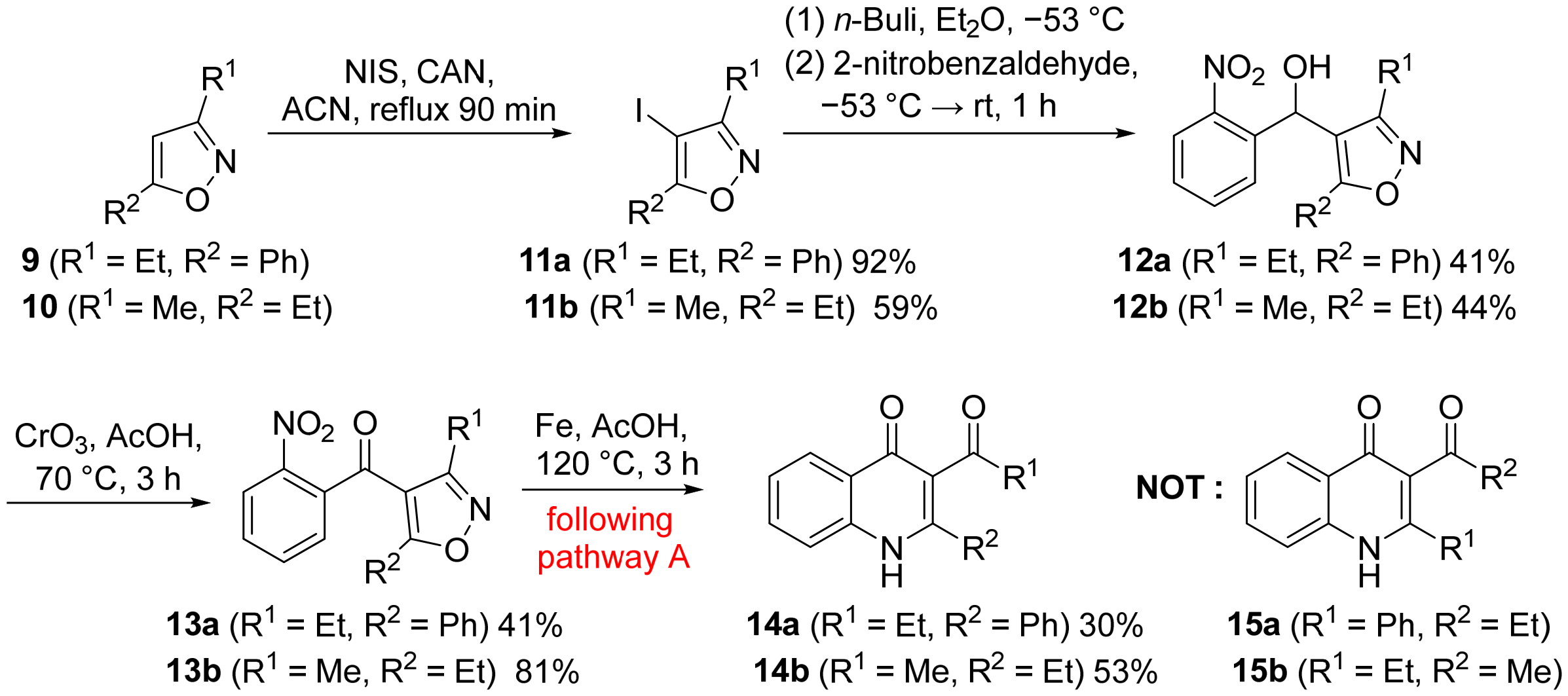

Synthesis of 3-Acyl-4-quinolones via Reductive Ring Transformation of 4-(2-Nitrobenzoyl)isoxazoles



Abstract
1. Introduction
2. Materials and Methods
3. Results
3.1. Aroylisoxazole Intermediates
3.2. Reductive Ring Transformations
4. Discussion
5. Conclusions
Supplementary Materials
Author Contributions
Funding
Data Availability Statement
Conflicts of Interest
References
- Heeb, S.; Fletcher, M.P.; Chhabra, S.R.; Diggle, S.P.; Williams, P.; Cámara, M. Quinolones: From antibiotics to autoinducers. FEMS Microbiol. Rev. 2011, 35, 247–274. [Google Scholar] [CrossRef] [Scilit] [PubMed]
- Kamigiri, K.; Tokunaga, T.; Shibazaki, M.; Setiawan, B.; Morioka, M.; Suzuki, K.-I.; Rantiatmodjo, R.M. YM-30059, a novel quinolone antibiotic produced by Arthrobacter sp. J. Antibiot. 1996, 49, 823–825. [Google Scholar] [CrossRef] [Scilit] [PubMed]
- Li, X.-W.; Herrmann, J.; Zang, Y.; Grellier, P.; Prado, S.; Müller, R.; Nay, B. Synthesis and biological activities of the respiratory chain inhibitor aurachin D and new ring versus chain analogues. Beilstein J. Org. Chem. 2013, 9, 1551–1558. [Google Scholar] [CrossRef] [Scilit] [PubMed]
- Shao, C.L.; Wang, C.Y.; Gu, Y.C.; Wei, M.Y.; Pan, J.H.; Deng, D.S.; She, Z.G.; Lin, Y.C. Penicinoline, a new pyrrolyl 4-quinolinone alkaloid with an unprecedented ring system from an endophytic fungus Penicillium sp. Bioorg. Med. Chem. Lett. 2010, 20, 3284–3286. [Google Scholar] [CrossRef] [Scilit] [PubMed]
- Wagner, S.; Sommer, R.; Hinsberger, S.; Lu, C.; Hartmann, R.W.; Empting, M.; Titz, A. Novel Strategies for the Treatment of Pseudomonas aeruginosa Infections. J. Med. Chem. 2016, 59, 5929–5969. [Google Scholar] [CrossRef] [Scilit] [PubMed]
- Mugnaini, C.; Pasquini, S.; Corelli, F. The 4-Quinolone-3-Carboxylic Acid Motif as a Multivalent Scaffold in Medicinal Chemistry. Curr. Med. Chem. 2009, 16, 1746–1767. [Google Scholar] [CrossRef] [Scilit] [PubMed]
- Gootz, T.D.; Brighty, K.E. Fluoroquinolone antibacterials: SAR, mechanism of action, resistance, and clinical aspects. Med. Res. Rev. 1996, 16, 433–486. [Google Scholar] [CrossRef] [Scilit]
- Sissi, C.; Palumbo, M. The Quinolone Family: From Antibacterial to Anticancer Agents. Curr. Med. Chem. Anti-Cancer Agents 2003, 3, 439–450. [Google Scholar] [CrossRef] [Scilit] [PubMed]
- Wills, T.; Vega, V. Elvitegravir: A once-daily inhibitor of HIV-1 integrase. Expert Opin. Investig. Drugs 2012, 21, 395–401. [Google Scholar] [CrossRef] [Scilit] [PubMed]
- Fan, Y.-L.; Cheng, X.-W.; Wu, J.-B.; Liu, M.; Zhang, F.-Z.; Xu, Z.; Feng, L.-S. Antiplasmodial and antimalarial activities of quinolone derivatives: An overview. Eur. J. Med. Chem. 2018, 146, 1–14. [Google Scholar] [CrossRef] [Scilit] [PubMed]
- Vu, C.B.; Oalmann, C.; Perni, R.B.; White, B. Quinazolinone, Quinolone and Related Analogs as Sirtuin Modulators. U.S. Patent 9326986, 3 May 2016. [Google Scholar]
- Boteva, A.A.; Krasnykh, O.P. The methods of synthesis, modification, and biological activity of 4-quinolones (review). Chem. Heterocycl. Compd. 2009, 45, 757–785. [Google Scholar] [CrossRef] [Scilit]
- Chongau, R.J.; Siddiqui, M.A.; Snieckus, V. Synthetic connections to the aromatic directed metalation reaction. A modified von niementowski quinoline synthesis from anthranilamides. Tetr. Lett. 1986, 27, 5323–5326. [Google Scholar] [CrossRef] [Scilit]
- Shvekhgeimer, M.G.A. Synthesis of Heterocyclic Compounds Based on Isatoic Anhydrides (2H-3,1-Benzoxazine-2,4-diones). (Review). Chem. Heterocycl. Compd. 2001, 37, 385–443. [Google Scholar] [CrossRef] [Scilit]
- Şenol, İ.; Satioğlu, S.; Çelik, İ. N-(2-Aminobenzoyl)benzotriazole Mediated Synthesis of 3- Acyl-2-alkyl(aryl)-4-hydroxyquinolines and 3-Acylamino-4(3H) quinazolinones. Turk. J. Chem. 2024, 48, 97–107. [Google Scholar] [CrossRef] [Scilit] [PubMed]
- Ma, Y.; Zhu, Y.; Zhang, D.; Meng, Y.; Tang, T.; Wang, K.; Ma, J.; Wang, J.; Sun, P. Eco-friendly decarboxylative cyclization in water: Practical access to the anti-malarial 4-quinolones. Green Chem. 2019, 21, 478–482. [Google Scholar] [CrossRef] [Scilit]
- Zhao, Y.-L.; Yang, S.-C.; Di, C.-H.; Han, X.-D.; Liu, Q. Highly efficient synthesis of 3-amino-/alkylthio-cyclobut-2-en-1-ones based on the cyclization of acyl ketene dithioacetals. Chem. Commun. 2010, 46, 7614–7616. [Google Scholar] [CrossRef] [Scilit] [PubMed]
- Wentland, M.P.; Lesher, G.Y.; Reuman, M.; Gruett, M.D.; Singh, B.; Aldous, S.C.; Dorff, P.H.; Rake, J.B.; Coughlin, S.A. Mammalian topoisomerase II inhibitory activity of 1-cyclopropyl-6,8-difluoro-1,4-dihydro-7-(2,6-dimethyl-4-pyridinyl)-4-oxo-3-quinolinecarboxylic acid and related derivatives. J. Med. Chem. 1993, 36, 2801–2809. [Google Scholar] [CrossRef] [Scilit] [PubMed]
- Tremmel, T.; Bracher, F. New approaches to the synthesis of canthin-4-one alkaloids and synthetic analogues. Tetrahedron 2015, 71, 4640–4646. [Google Scholar] [CrossRef] [Scilit]
- Kamlah, A.; Bracher, F. A Novel Approach to Highly Substituted β-Carbolines via Reductive Ring Transformation of 2-Acyl-3-isoxazolylindoles. Eur. J. Org. Chem. 2020, 2020, 2708–2719. [Google Scholar] [CrossRef] [Scilit]
- Lohrer, B.; Bracher, F. Novel access to 2-substituted quinolin-4-ones by nickel boride-mediated reductive ring transformation of 5-(2-nitrophenyl)isoxazoles. Tetr. Lett. 2019, 60, 151327. [Google Scholar] [CrossRef] [Scilit]
- Coffman, K.C.; Palazzo, T.A.; Hartley, T.P.; Fettinger, J.C.; Tantillo, D.J.; Kurth, M.J. Heterocycle–Heterocycle Strategies: (2-Nitrophenyl)isoxazole Precursors to 4-Aminoquinolines, 1H-Indoles, and Quinolin-4(1H)-ones. Org. Lett. 2013, 15, 2062–2065. [Google Scholar] [CrossRef] [Scilit] [PubMed]
- Sakamoto, T.; Kondo, Y.; Uchiyama, D.; Yamanaka, H. Condensed heteroaromatic ring systems. XIX. Synthesis and reactions of 5-(tributylstannyl)isoxazoles. Tetrahedron 1991, 47, 5111–5118. [Google Scholar] [CrossRef] [Scilit]
- Alberola, A.; Pérez Serrano, A.; Rodríguez Rodríguez, M.T.; Orozco, C. Synthesis of 4-Carbosubstituted Isoxazole Derivatives. Heterocycles 1989, 29, 667–677. [Google Scholar] [CrossRef] [Scilit]
- Kalish, R.; Broger, E.; Field, G.F.; Anion, T.; Steppe, T.V.; Sternbach, L.H. Quinazolines and 1,4-benzodiazepines LXVIII. 5-Heterocyclic-substituted benzodiazepinones. J. Heterocycl. Chem. 1975, 12, 49–57. [Google Scholar] [CrossRef] [Scilit]
- Bouillot, A.M.J.; Donche, F.; Gellibert, F.J.; Lamotte, Y.; Mirguet, O. Imidazo [4, 5-C] Quinoline Derivatives as Bromodomain Inhibitors. U.S. Patent 8557984, 15 October 2013. [Google Scholar]
- Gutierrez, C.D.; Bavetsias, V.; McDonald, E. ClTi(OiPr)3-Promoted Reductive Amination on the Solid Phase: Combinatorial Synthesis of a Biaryl-Based Sulfonamide Library. J. Comb. Chem. 2008, 10, 280–284. [Google Scholar] [CrossRef] [Scilit] [PubMed]
- Ganem, B.; Osby, J.O. Synthetically useful reactions with metal boride and aluminide catalysts. Chem. Rev. 1986, 86, 763–780. [Google Scholar] [CrossRef] [Scilit]
- Sridharan, V.; Ribelles, P.; Ramos, M.T.; Menéndez, J.C. Cerium(IV) Ammonium Nitrate Is an Excellent, General Catalyst for the Friedländer and Friedländer−Borsche Quinoline Syntheses: Very Efficient Access to the Antitumor Alkaloid Luotonin A. J. Org. Chem. 2009, 74, 5715–5718. [Google Scholar] [CrossRef] [Scilit] [PubMed]
- Fuentes, J.A.; Maestro, A.; Testera, A.M.; Báñez, J.M. Synthesis of optically active β′-hydroxy-β-enaminoketones via enzymatic resolution of carbinols derived from 3,5-disubstituted isoxazoles. Tetr. Asymmetry 2000, 11, 2565–2577. [Google Scholar] [CrossRef] [Scilit]
- Wu, W.; Chen, Q.; Tian, Y.; Xu, Y.; Huang, Y.; You, Y.; Weng, Z. Synthesis of polysubstituted 5-trifluoromethyl isoxazoles via denitrogenative cyclization of vinyl azides with trifluoroacetic anhydride. Org. Chem. Front. 2020, 7, 1878–1883. [Google Scholar] [CrossRef] [Scilit]
- Coffman, K.C.; Duong, V.; Bagdasarian, A.L.; Fettinger, J.C.; Haddadin, M.J.; Kurth, M.J. Heterocycle-to-Heterocycle Route to Quinoline-4-amines: Reductive Heterocyclization of 3-(2-Nitrophenyl)isoxazoles. Eur. J. Org. Chem. 2014, 2014, 7651–7657. [Google Scholar] [CrossRef] [Scilit] [PubMed]
- Nitta, M.; Kobayashi, T. Reductive ring opening of isoxazoles with Mo(CO)6 and water. J. Chem. Soc. Chem. Commun. 1982, 18, 877–878. [Google Scholar] [CrossRef] [Scilit]
- Boruah, M.; Konwar, D. Water promoted iodotrimethyl silane reactions: Reductive cleavage of isoxazolidines and 2,1-benzisoxazoles to γ-Amino Alcohols and o-aminobenzophenones. J. Chem. Res. 2002, 2002, 601–603. [Google Scholar] [CrossRef] [Scilit]
- Cain, G.A.; Holler, E.R. Extended scope of in situ iodotrimethylsilane mediated selective reduction of benzylic alcohols. Chem. Commun. 2001, 37, 1168–1169. [Google Scholar] [CrossRef] [Scilit]
- Hansen, T.V.; Wu, P.; Fokin, V.V. One-Pot Copper(I)-Catalyzed Synthesis of 3,5-Disubstituted Isoxazoles. J. Org. Chem. 2005, 70, 7761–7764. [Google Scholar] [CrossRef] [Scilit] [PubMed]
- Brunelle, D.J. Isoxazoles as β-diketone synthons-selective anion formation on 3,5-dialkylisoxazoles. Tetr. Lett. 1981, 22, 3699–3702. [Google Scholar] [CrossRef] [Scilit]
- Brough, P.A.; Baker, L.; Bedford, S.; Brown, K.; Chavda, S.; Chell, V.; D’Alessandro, J.; Davies, N.G.M.; Davis, B.; Le Strat, L.; et al. Application of Off-Rate Screening in the Identification of Novel Pan-Isoform Inhibitors of Pyruvate Dehydrogenase Kinase. J. Med. Chem. 2017, 60, 2271–2286. [Google Scholar] [CrossRef] [Scilit] [PubMed]
- Wang, Y.; Li, W.; Lin, H.; Le, Z.; Xie, Z. Reaction of 2-Aminobenzyl Alcohols with β -Dicarbonyl Compounds to Synthesize Quinoline Derivatives in Water Promoted by Active Manganese Dioxide. Chin. J. Org. Chem. 2024, 44, 1649–1657. [Google Scholar] [CrossRef] [Scilit]
- Makosza, M.; Owczarczyk, Z. Reactions of organic anions. 161. Dihalomethylation of nitroarenes via vicarious nucleophilic substitution of hydrogen with trihalomethyl carbanions. J. Org. Chem. 1989, 54, 5094–5100. [Google Scholar] [CrossRef] [Scilit]
- Hu, F.; Szostak, M. Recent Developments in the Synthesis and Reactivity of Isoxazoles: Metal Catalysis and Beyond. Adv. Synth. Catal. 2015, 357, 2583–2614. [Google Scholar] [CrossRef] [Scilit]
- Sauers, R.R.; Hadel, L.M.; Scimone, A.A.; Stevenson, T.A. Photochemistry of 4-acylisoxazoles. J. Org. Chem. 1990, 55, 4011–4019. [Google Scholar] [CrossRef] [Scilit]
- Yu, D.; Xu, F.; Li, D.; Han, W. Transition-Metal-Free Carbonylative Suzuki-Miyaura Reactions of Aryl Iodides with Arylboronic Acids Using N-Formylsaccharin as CO Surrogate. Adv. Synth. Catal. 2019, 361, 3102–3107. [Google Scholar] [CrossRef] [Scilit]
- Uchiyama, D.; Yabe, M.; Kameyama, H.; Sakamoto, T.; Kondo, Y.; Yamanaka, H. Synthesis and reactions of 4-tributylstannyl-3-methylisoxazole. Heterocycles 1996, 43, 1301–1304. [Google Scholar] [CrossRef] [Scilit]
- Madhavan, S.; Keshri, S.K.; Kapur, M. Transition Metal-Mediated Functionalization of Isoxazoles: A Review. Asian J. Org. Chem. 2021, 10, 3127–3165. [Google Scholar] [CrossRef] [Scilit]







 | |||||
| Entry | Reducing Agent | Educt | Solvent | Conditions | Product (Yield) |
| 1 | NaBH4/NiCl2 | 4 | MeOH, THF | 0 °C, 30 min | 6 (37%) |
| 2 | NaBH4/NiCl2 | 3 | MeOH, THF | 0 °C, 30 min | 6 (35%) |
| 3 | Pd/H2 | 3 | EtOH | r.t., 24 h | 6 (19%) |
| 4 | Zn/AcOH | 3 | AcOH | 90 °C, o.n. | none |
| 5 | Fe/AcOH | 3 | EtOH | 85 °C, 4 h | 6 (15%) |
| 6 | Mo(CO)6/H2O | 3 | MeCN | 100 °C, 2 h | 6 (13%) |
| 7 | TMSCl, KI | 3 | acetonitrile, H2O | rt, 30 min | 7 (27%) |
Disclaimer/Publisher’s Note: The statements, opinions and data contained in all publications are solely those of the individual author(s) and contributor(s) and not of MDPI and/or the editor(s). MDPI and/or the editor(s) disclaim responsibility for any injury to people or property resulting from any ideas, methods, instructions or products referred to in the content. |
© 2026 by the authors. Licensee MDPI, Basel, Switzerland. This article is an open access article distributed under the terms and conditions of the Creative Commons Attribution (CC BY) license.
Share and Cite
Pelagias, P.; Sandler, J.P.; Bracher, F. Synthesis of 3-Acyl-4-quinolones via Reductive Ring Transformation of 4-(2-Nitrobenzoyl)isoxazoles. Compounds 2026, 6, 44. https://doi.org/10.3390/compounds6030044
Pelagias P, Sandler JP, Bracher F. Synthesis of 3-Acyl-4-quinolones via Reductive Ring Transformation of 4-(2-Nitrobenzoyl)isoxazoles. Compounds. 2026; 6(3):44. https://doi.org/10.3390/compounds6030044
Chicago/Turabian StylePelagias, Pavlos, Jan P. Sandler, and Franz Bracher. 2026. "Synthesis of 3-Acyl-4-quinolones via Reductive Ring Transformation of 4-(2-Nitrobenzoyl)isoxazoles" Compounds 6, no. 3: 44. https://doi.org/10.3390/compounds6030044
APA StylePelagias, P., Sandler, J. P., & Bracher, F. (2026). Synthesis of 3-Acyl-4-quinolones via Reductive Ring Transformation of 4-(2-Nitrobenzoyl)isoxazoles. Compounds, 6(3), 44. https://doi.org/10.3390/compounds6030044