Article

Synthesis of 3-Acyl-4-quinolones via Reductive Ring Transformation of 4-(2-Nitrobenzoyl)isoxazoles


Department of Pharmacy, Center for Drug Research, Ludwig-Maximilians University, 81377 Munich, Germany
*
Author to whom correspondence should be addressed.
Compounds 2026, 6(3), 44; https://doi.org/10.3390/compounds6030044
Submission received: 15 June 2026 / Revised: 18 July 2026 / Accepted: 21 July 2026 / Published: 23 July 2026

Abstract

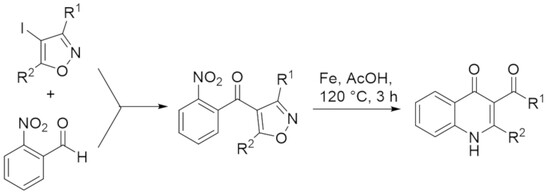
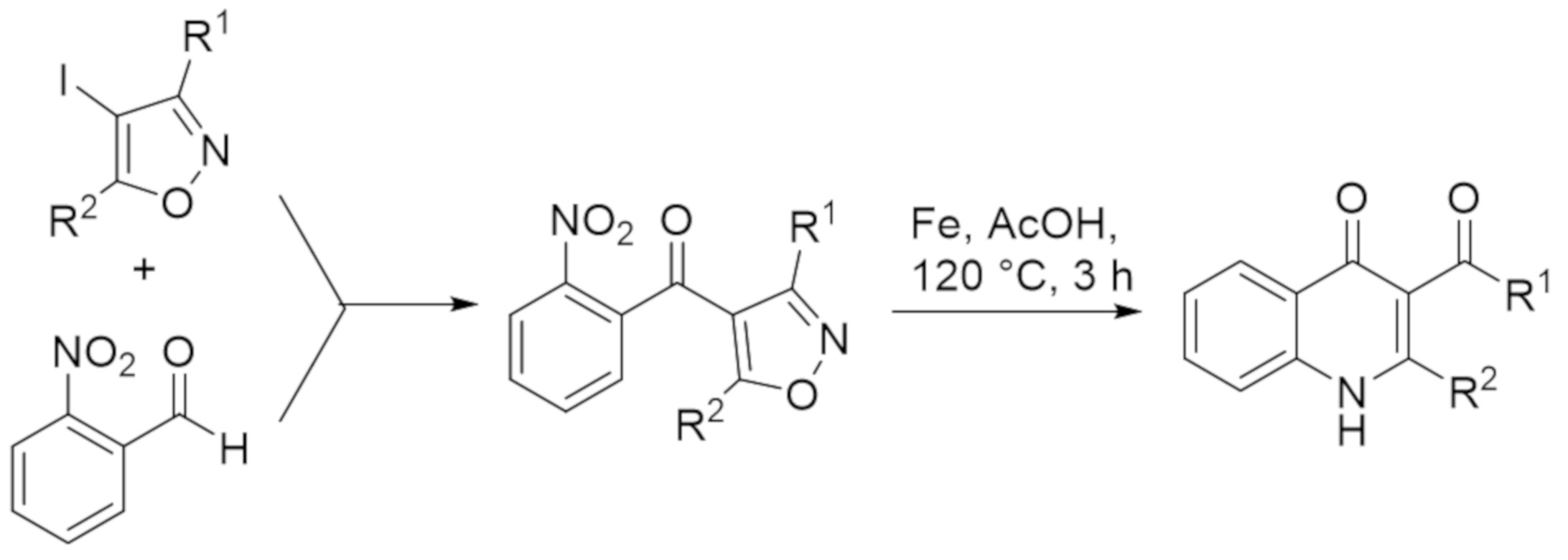
4-(2-Nitrobenzoyl)isoxazoles are readily available from 3,5-disubstituted 4-iodoisoxazoles through iodine–lithium exchange and trapping with 2-nitrobenzaldeyde, followed by Jones oxidation of the obtained secondary alcohols. Reductive ring transformation by means of treatment with iron in acetic acid gives 2-substituted 3-acyl-4-quinolones. The mechanism of the cyclization reaction was elucidated by using appropriately substituted isoxazole building blocks and 2D NMR investigation of the products. In contrast, catalytic hydrogenation leaves the isoxazole ring untouched, whereas reduction with NaBH4/NiCl2 gives 2-substituted 3-acylquinolines in an unprecedented reductive ring transformation.

Graphical Abstract

1. Introduction

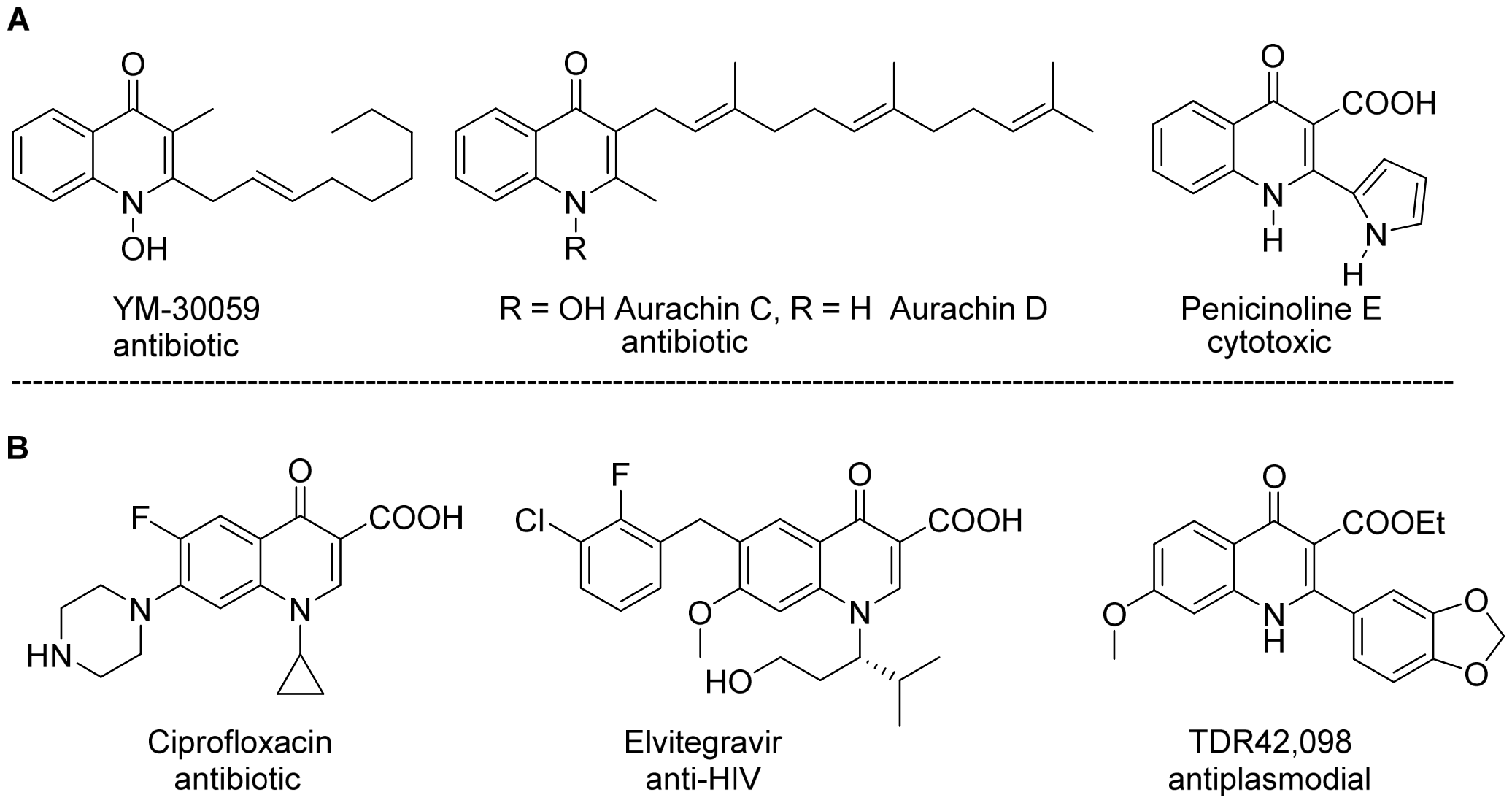
The 4-quinolones are a small class of alkaloids isolated from biological sources (plants like the Evodia species and microorganisms like Pseudomonas and related species), and antibacterial, antiplasmodial, and cytotoxic activities have been reported for a couple of them [1]. These natural products are characterized by an alkyl, alkenyl or (hetero)aryl group at C-2, and some of them bear an additional substituent at C-3. N-Hydroxylation was detected in 4-quinolones exhibiting strong antibiotic activity, e.g., YM-30059 [2] and aurachin C [3]. 2-Pyrrolyl derivative penicinoline E exhibits strong cytotoxic activity [4]. Recently, naturally occuring 2-alkylquinolones like HHQ were identified as quorum sensing signal molecules in pathogenic Pseudomonas species, controlling the expression of virulence genes as a function of cell population density [1] (Figure 1A). The synthetic quorum sensing inhibitors derived thereof represent a promising new option for the treatment of multidrug-resistant Pseudomonas aeruginosa infections [5]. Further, synthetic 4-quinolones are an important scaffold in medicinal chemistry [6]. Appropriately substituted 4-quinolone-3-carboxylic acids, e.g., ciprofloxacin, targeting bacterial DNA gyrase (topoisomerase II/IV) are among the most important antibiotics. In this subclass, substituents at C-2 of the 4-quinolone scaffold are not tolerated [7]. Related compounds inhibit mammalian topoisomerases and are in development as anticancer agents [8]. The 4-quinolone elvitegravir has been launched as an in inhibitor of HIV integrase [9], 2-alkyl- and 2-aryl-4-quinolone-3-carboxylates show antiplasmodial activities [10] (Figure 1B), and 3-unsubstitited 2-aryl-4-quinolones were patented as sirtuin activators [11].
4-Quinolones bearing alkyl or aryl residues at C-2 are readily accessible via traditional strategies like the Conrad–Limpach synthesis (from anilines and β–ketoesters), the Camps method (cyclization of ortho-acylaminoacetophenones) and the Niementowski reaction (from anthranilic acid derivatives and ketones as well as variants using isatoic anhydride) [12,13,14]. In the field of 2-unsubstituted 3-substituted 4-quinolones plenty of work has been published on synthetic approaches during and after the boom of gyrase inhibitor development [6]. However, the aforementioned approaches are limited in application to the synthesis of 2,3-disubstituted 4-quinolones, and newer direct approaches frequently require the use of expensive transition-metal catalysts [15,16] or complex multi-carbonyl building blocks with limited options for structure variations [17]. Subsequent introduction of residues at C-2 of 3-substituted 4-quinolones is limited to special substitution patterns [18].
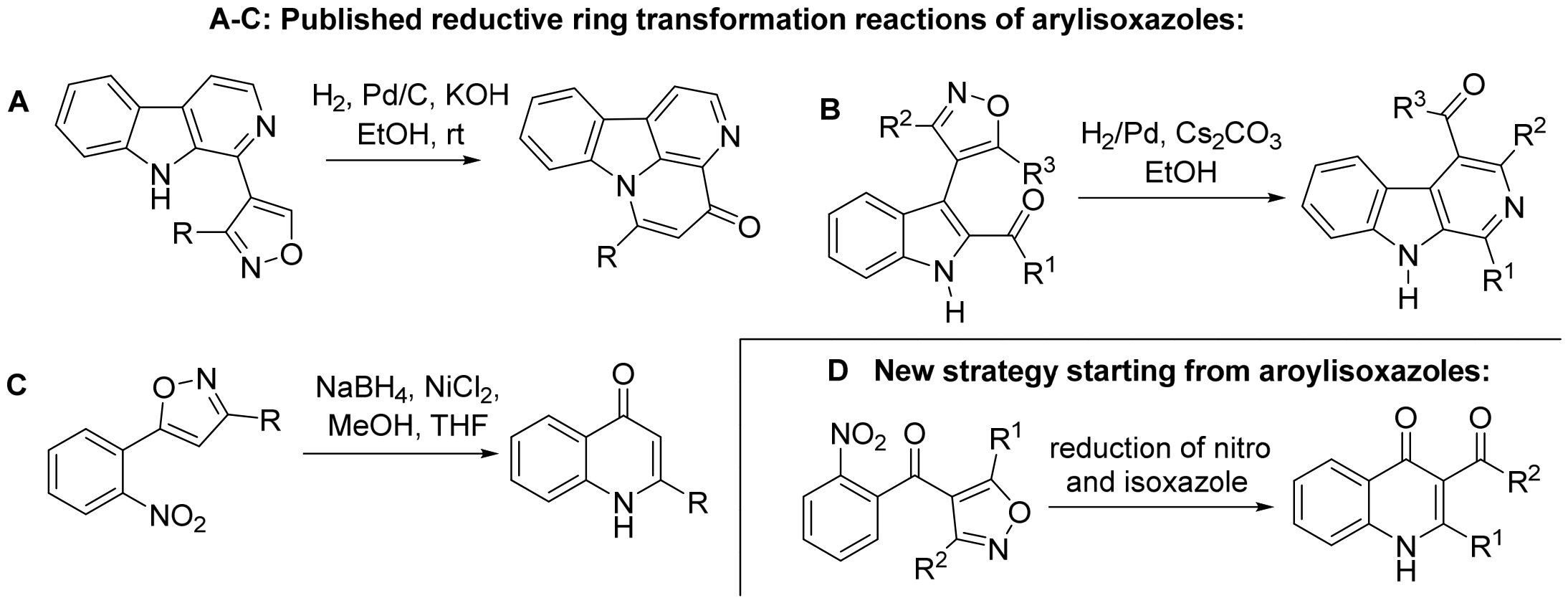
This prompted us to work out a novel approach to 2,3-disubstituted 4-quinolones. Our special focus was on the stereoselective approach to previously underinvestigated 3-acyl derivatives, which should open up the possibility for subsequent strucure modifications in the process of drug discovery beyond antibacterial gyrase inhibitors. This new approach is based on our recent work on the application of reductive ring transformations of isoxazoles. This concept was applied to the synthesis of canthin-4-one alkaloids from isoxazol-4-yl-β-carbolines (Scheme 1A) [19], the synthesis of highly substituted β-carbolines from 2-acyl-3-(isoxazol-4-yl)indoles (Scheme 1B) [20] and the synthesis of 2-substituted 4-quinolones from 5-(2-nitrophenyl)isoxazoles. In the latter method, simultaneous reductive cleavage of the isoxazole ring to the corresponding enaminoketone and reduction of the nitro group to a primary amine were performed by us with a NaBH4/NiCl2 reagent in order to keep olefinic bonds unaffected [21]. Similar conversions with unproblematic residues were performed earlier by Coffman [22] using Fe/AcOH as the reducing agent, and by Sakamoto [23] using H2/Raney nickel (Scheme 1C). Hereby the 4-oxo group of the quinolone arises from C-5 and the ring oxygen of the isoxazole. In our new concept (Scheme 1D), we utilized 4-(2-nitroaroyl)isoxazole building blocks instead of the 5-(2-nitrophenyl)isoxazoles. Upon reductive ring cleavage and reduction of the nitro group, the carbonyl group of the starting material would end up as the 4-oxo group of the quinolone, while the components of the 3,5-disubstituted isoxazole would provide C-2 and C-3 of the quinolone ring system as well as an alkyl or aryl residue at C-2 and an acyl residue at C-3 upon condensation with the newly formed primary amino group. The aroyl-isoxazole building blocks should be available through standard methods of diarylketone synthesis.

2. Materials and Methods

Solvents and reagents were purchased from commercial suppliers and used without further purification. Reactions were monitored by thin-layer chromatography (TLC) using POLYGRAM SIL G/UV254 polyester sheets coated with 0.2 mm silica gel (Macherey-Nagel, Düren, Germany). Products were purified by flash column chromatography (FCC) using Kieselgel 60 (0.040–0.063 mm) from Merck (Darmstadt, Germany). NMR spectra were recorded on Avance III HD 400 MHz Bruker BioSpin and Avance III HD 500 MHz Bruker BioSpin instruments (1H-NMR: 400 MHz and 500 MHz, 13C-NMR: 101 MHz and 126 MHz) (Bruker, Billerica, MA, USA). Chemical shifts (δ) are given in parts per million (ppm) and are referenced to the respective residual solvent peak. Multiplicities are denoted as follows: s—singlet; d—doublet; t—triplet; q—quartet; and m—multiplet. Coupling constants (J) are given in Hz. Infrared spectra were recorded on a Perkin Elmer Spectrum BX-59343 FT-IR instrument (Perkin Elmer, Shelton, CT, USA) using a Smiths Detection DuraSamp IR II Diamond ATR sensor (Smiths Detection, Danbury, CT, USA) for detection. High-resolution mass spectra (HR-MS) were recorded using a Jeol MStation 700 or JMS GCmate II Jeol instrument (Jeol, Tokyo, Japan) for electron impact ionization (EI). The Thermo Finnigan LTQ (Thermo Finnigan, Somerset, NJ, USA) was used for electrospray ionization (ESI). Melting points were determined with a Büchi apparatus B-540 (Büchi, Flawil, Switzerland).
4-Iodo-3,5-dimethylisoxazole (2). A solution of 3,5-dimethylisoxazole (1, 4.86 g, 50.0 mmol, 1.00 eq), iodine (6.98 g, 27.5 mmol, 0.55 eq), and ceric ammonium nitrate (15.4 g, 27.5 mmol, 0.55 eq) in acetonitrile (175 mL) was stirred at room temperature for 18 h. After the reaction was completed, the solvent was removed under reduced pressure. The residue was dissolved in ethyl acetate, and the organic layer was washed sequentially with 5% (w/v) aqueous sodium bisulphite solution and brine. The organic phase was dried over anhydrous magnesium sulphate and evaporated to dryness under reduced pressure. The pure product was obtained as a white solid (11.1 g, 49.9 mmol, 50.0 mmol, quant.), m.p. 50–52 °C. 1H NMR (400 MHz, CDCl3) δ (ppm) 2.43 (s, 3H, 5-CH3), 2.25 (s, 3H, 3-CH3). 13C NMR (101 MHz, CDCl3) δ (ppm) 170.2 (C5), 161.7 (C3), 60.3 (C4), 12.7 (5-CH3), 12.3 (3-CH3). IR (ATR): ṽ (cm−1) 2986, 2948, 1685, 1477, 1440, 1286, 1115, 1074, 926, 787, 699. HRMS (EI): m/z calculated for C5H6INO•+: 222.9489 [M]•+, found: 222.9487.
(3,5-Dimethylisoxazol-4-yl)(2-nitrophenyl)methanol (3). A solution of 4-iodo-3,5-dimethylisoxazole (2, 4.07 g, 18.3 mmol, 1.00 eq) in diethyl ether (61 mL) was cooled to −53 °C. A 2.5 M solution of n-butyllithium in hexanes (7.31 mL, 18.3 mmol, 1.00 eq) was added dropwise, ensuring that the temperature did not exceed −50 °C during the addition. The resulting mixture was stirred at −53 °C for 5.5 h, then a solution of 2-nitrobenzaldehyde (2.62 g, 17.4 mmol, 0.95 eq) in THF (17 mL) was added dropwise. The reaction mixture was stirred at −53 °C for 1 h, then quenched by the addition of water. The organic phase was separated, and the aqueous layer was extracted with diethyl ether (2 × 50 mL). The combined organic extracts were dried over anhydrous sodium sulfate and concentrated in vacuo. Purification by flash column chromatography (FCC) (i-hexane:ethyl acetate, (8:2 → 2:8)) afforded a yellow oil (4.14 g, 16.7 mmol, 96%), which crystallized after four days. M.p. 103–105 °C. 1H NMR (400 MHz, CDCl3) δ (ppm) 7.97 (dd, J = 8.1, 1.3 Hz, 1H, 3′-H), 7.88 (dt, J = 7.8, 1.2 Hz, 1H, 6′-H), 7.68 (td, J = 7.6, 1.2 Hz, 1H, 5′-H ), 7.50 (dddd, J = 8.0, 7.4, 1.5, 0.5 Hz, 1H, 4′-H), 6.40 (d, J = 3.7 Hz, 1H, CHOH), 2.80 (d, J = 4.2 Hz, 1H, OH), 2.23 (s, 3H, 5-CH3), 2.03 (s, 3H, 3-CH3). 13C NMR (101 MHz, CDCl3) δ 167.2 (C5), 159.1 (C3), 148.0 (C2′), 136.7 (C1′), 133.5 (C5′), 129.1 (C4′), 128.6 (C6′), 125.3 (C3′), 114.4 (C4), 63.5 (CHOH), 11.6 (5-CH3), 10.7 (3-CH3). IR (ATR): ṽ (cm−1) 3361, 3100, 1590, 1520, 1335, 1115, 1029, 867, 855, 795, 719. HRMS (ESI): m/z calculated for C12H13N2O4+: 249.08698 [M + H]+, found 249.08714.
(3,5-Dimethylisoxazol-4-yl)(2-nitrophenyl)methanone (4). (3,5-Dimethylisoxazol-4-yl)(2-nitrophenyl)-methanol (3, 249 mg, 1.00 mmol, 1.00 eq) was dissolved in 5 mL of glacial acetic acid under stirring. Chromium trioxide (CrO3, 201 mg, 2.01 mmol, 2.01 eq) was then added to the solution. The reaction mixture was heated to 70 °C and maintained at this temperature for 3 h. Upon complete consumption of the starting material (TLC control), the reaction mixture was diluted with water and extracted with dichloromethane (DCM, 3 × 50 mL). The combined organic layers were dried over anhydrous sodium sulfate and concentrated under reduced pressure to yield the desired product as a green-yellow solid (233 mg, 0.95 mmol, 94% yield), m.p. 91–93 °C. 1H NMR (400 MHz, CDCl3) δ 8.22 (dd, J = 8.2, 1.2 Hz, 1H, 3′-H), 7.81 (td, J = 7.5, 1.2 Hz, 1H, 5′-H), 7.70 (ddd, J = 8.2, 7.5, 1.5 Hz, 1H, 4′-H), 7.43 (dd, J = 7.5, 1.5 Hz, 1H, 6′-H), 2.24 (s, 3H, 5-CH3), 2.23 (s, 3H, 3-CH3). 13C NMR (101 MHz, CDCl3) δ 187.0 (CO), 174.9 (C5), 159.5 (C3), 146.2 (C2′), 136.8 (C1′), 134.7 (C5′), 131.1 (C4′), 127.9 (C6′), 124.9 (C3′), 116.2 (C4), 13.4 (5-CH3), 11.7 (3-CH3). IR (ATR): ṽ (cm−1) 3110, 1662, 1570, 1518, 1399, 1330, 1157, 902, 854, 791, 700. HRMS (ESI): m/z calculated for C12H10N2NaO4+: 269.0533 [M + Na]+, found: 269.0533.
1-(2-Methylquinolin-3-yl)ethan-1-one (6). A solution of (3,5-dimethylisoxazol-4-yl)(2-nitrophenyl)methanone (4, 0.65 mmol, 159 mg, 1.00 eq) in 6.5 mL MeOH and 2.6 mL THF was treated with NiCl2•6H2O (0.65 mmol, 154 mg, 1.00 eq) and cooled to 0 °C. Sodium borohydride (2.47 mmol, 93.6 mg, 3.83 eq) was then added. After the gas evolution had ceased, the ice bath was removed, and the reaction mixture was stirred for an additional 30 min at room temperature. The mixture was then poured into 100 mL EtOAc and washed with 60 mL H2O. The aqueous layers were extracted with EtOAc (4 × 40 mL), and the combined organic phases were dried over Na2SO4 and evaporated. The resulting residue was purified by flash column chromatography (FCC) using a DCM-MeOH gradient (from 100% to 98% DCM), yielding the product as a dark yellow solid (44 mg, 0.238 mmol, 37%), m.p. 72–74 °C. 1H NMR (500 MHz, CDCl3) δ 8.48 (s, 1H, 4-H), 8.04 (dd, J = 8.5, 1.0 Hz, 1H, 5-H), 7.86 (dd, J = 8.1, 1.4 Hz, 1H, 8-H), 7.79 (ddd, J = 8.4, 6.9, 1.5 Hz, 1H, 6-H), 7.56 (ddd, J = 8.1, 6.9, 1.2 Hz, 1H, 7-H), 2.91 (s, 3H, 2-CH3), 2.72 (s, 3H, 3-COCH3). 13C NMR (126 MHz, CDCl3) δ 200.1 (3-CO), 157.8 (C2), 148.5 (C8a), 138.3 (C4), 131.8 (C6), 131.3 (C3), 128.8 (C5), 128.5 (C8), 126.8 (C7), 125.8 (C4a), 29.4 (3-COCH3), 25.8 (2-CH3). IR (ATR): ṽ (cm−1) 3058, 2962, 1704, 1677, 1623, 1559, 1417, 1197, 813, 778. HRMS (ESI): m/z calculated for C12H12NO+: 186.09134 [M + H]+; found: 186.09104.
3,5-Dimethyl-4-(2-nitrobenzyl)isoxazole (7). Trimethylsilyl chloride (0.38 mL, 3.0 mmol) and potassium iodide (498 mg, 3.00 mmol) were dissolved in 10 mL acetonitrile and the mixture stirred at r.t. for 30 min to generate trimethylsilyl iodide in situ. A solution of (3,5-dimethylisoxazol-4-yl)(2-nitrophenyl)-methanol (3, 124 mg, 0.500 mmol) in distilled water (0.38 mL) was added and the mixture stirred for 30 min before removing the solvent. The residue was treated with water (20 mL), stirred for another 30 min and then extracted with Et2O (3 × 20 mL). The combined organic phases were washed with a saturated sodium sulphate solution, dried with a hydrophobic filter and evaporated. The residue was purified by column chromatography (i-hexane/ethyl acetate = 9:1) affording 3,5-dimethyl-4-(2-nitrobenzyl)isoxazole (7) (32.1 mg, 0.138 mmol, 27%) as an orange-red solid. 1H NMR (500 MHz, CDCl3) δ 7.97 (dd, J = 8.1, 1.4 Hz, 1H, 3″-H), 7.52 (td, J = 7.5, 1.4 Hz, 1H, 5″-H), 7.41 (ddd, J = 8.0, 7.4, 1.5 Hz, 1H, 4″-H), 7.13 (dd, J = 7.8, 1.2 Hz, 1H, 6″-H), 4.02 (s, 2H, 1′-H), 2.26 (s, 3H, CH3), 2.04 (s, 3H, CH3). 13C NMR (126 MHz, CDCl3) δ 166.43 (C-3), 159.88 (C-5), 149.22 (C-2″), 133.57 (C-5″), 133.22 (C-1″), 130.55 (C-6″), 127.81 (C-4″), 125.08 (C-3″), 110.18 (C-4), 25.30 (C-1′), 11.02 (CH3), 10.26 (CH3). HRMS (ESI): m/z [M]+ calculated for C12H13N2O3+ 233.09207, found: 233.09219.
(2-Aminophenyl)(3,5-dimethylisoxazol-4-yl)methanone (8). (3,5-Dimethylisoxazol-4-yl)(2-nitrophenyl)methanone (4, 94 mg, 0.38 mmol, 1 eq) was dissolved in 10 mL of MeOH and 10% Pd/C (4.1 mg, 0.04 mmol, 0.1 eq) was then added. The mixture was stirred under hydrogen under atmospheric pressure overnight. Then the catalyst is filtered off over Celite®, and the filtrate was concentrated under vacuum. The crude product is then purified by column chromatography (DCM, then DCM:MeOH = 98:2) affording a yellow solid (67 mg, 0.31 mmol, 81% yield), m.p. 68–69 °C. 1H NMR (400 MHz, DMSO-d6) δ 7.34–7.26 (m, 2H, 4′-H, 6′-H), 7.13 (s, 2H, 2′-NH2), 6.83 (dd, J = 8.8, 1.1 Hz, 1H, 3′-H), 6.54 (ddd, J = 8.0, 7.0, 1.1 Hz, 1H, 5′-H), 2.29 (s, 3H, 5-CH3), 2.19 (s, 3H, 3-CH3). 13C NMR (101 MHz, DMSO-d6) δ 190.2 (CO), 169.3 (C5), 158.6 (C3), 151.4 (C2′), 134.8 (C6′), 133.1 (C4′), 117.2 (C1′), 116.9 (C3′), 116.9 (C4), 114.6 (C5′), 12.5 (5-CH3), 10.5 (3-CH3). IR (ATR): ṽ (cm−1) 3459, 3361, 3110, 1650, 1600, 1525, 1150, 902, 854, 791, 700. HRMS (ESI): m/z calculated for C12H13N2O2+: 217.09715 [M + H]+; found: 217.09699.
3-Acetyl-2-methylquinolin-4(1H)-one (5). (2-Aminophenyl)(3,5-dimethylisoxazol-4-yl)methanone (19, 67 mg, 0.31 mmol, 1 eq) was dissolved in glacial acetic acid (10 mL) in a round-bottom flask. Iron powder (310 mg, 5.55 mmol, 18 eq) was added, and the reaction mixture was heated to 120 °C. After full consumption of the starting material (TLC control) the solids were removed by filtration and the filtrate was extracted with dichloromethane (DCM). The organic phase was dried over anhydrous sodium sulphate, concentrated under reduced pressure, and purified by column chromatography (EtOAC:isohexane = 7:3) to afford the desired product as a pale yellow solid (33 mg, 0.31 mmol, 53%), m.p. 254–255 °C. 1H NMR (400 MHz, DMSO-d6) δ 11.90 (s, 1H, NH), 8.11 (dd, J = 8.0, 1.5 Hz, 1H, 5-H), 7.68 (ddd, J = 8.4, 7.0, 1.5 Hz, 1H, 7-H), 7.54 (dt, J = 8.3, 0.9 Hz, 1H, 8-H), 7.36 (ddd, J = 8.1, 7.0, 1.1 Hz, 1H, 6-H), 2.51 (s, 3H, 3-COCH3), 2.44 (s, 3H, 2-CH3). 13C NMR (101 MHz, DMSO-d6) δ 202.0 (3-COCH3), 175.8 (C4), 152.0 (C2), 139.2 (C8a), 132.8 (C7), 125.9 (C4a), 125.6 (C5), 124.5 (C6), 120.7 (C3), 118.4 (C8), 32.4 (3-COCH3), 19.5 (2-CH3). IR (ATR): ṽ (cm−1) 3295, 3018, 2875, 1671, 1548, 1509, 1346, 756. HRMS (EI): m/z calculated for C12H12NO•+: 201.0784 [M]•+; found: 201.0783.
3-Ethyl-4-iodo-5-phenylisoxazole (11a). N-Iodosuccinimide (3.23 g, 13.9 mmol, 2.00 eq) was added to a suspension of 3-ethyl-5-phenylisoxazole (9, 1.21 g, 6.96 mmol, 1.00 eq) in acetonitrile (50 mL). Ammonium cerium(IV) nitrate (973 mg, 1.74 mmol, 0.25 eq) was added, and the mixture was heated to reflux for 90 min, forming a red solution. The reaction mixture was allowed to cool and was concentrated in vacuo to yield a red-coloured gum. The residue was dissolved in ethyl acetate (150 mL) and prepared as a dry load, then purified via flash chromatography with isohexane/ethyl acetate (9:1). After purification, residual iodine (I2) was still present. The resulting red-brown solid was dissolved in ethyl acetate, extracted with sodium thiosulfate solution (Na2S2O3) and brine, then dried over anhydrous sodium sulphate (Na2SO4). The solvent was removed in vacuo to yield a white solid (1.92 g, 6.43 mmol, 92%), m.p. 71–73 °C. 1H NMR (400 MHz, CDCl3) δ 8.07–7.98 (m, 2H, 2′-H, 6′-H), 7.55–7.42 (m, 3H, 3′-H, 5′-H, 4′-H), 2.73 (q, J = 7.5 Hz, 2H, CH2), 1.36 (t, J = 7.5 Hz, 3H, CH3). 13C NMR (101 MHz, CDCl3) δ 167.6 (C5), 167.0 (C3), 130.6 (C4′), 128.8 (C3′, C5′), 127.5 (C2′, C6′), 127.5 (C1′), 57.1 (C4), 21.0 (CH2), 12.0 (CH3). IR (ATR): ṽ (cm−1) 2978, 2938, 1568, 1376, 1097, 1074, 1051, 767, 691. HRMS (EI): m/z calculated for C11H10INO•+: 298.9802 [M]•+; found: 298.9801.
2-Phenyl-3-propionylquinolin-4(1H)-one (14a). (Step 1) A solution of 3-ethyl-4-iodo-5-phenylisoxazole (11a, 1.91 g, 6.39 mmol, 1.00 eq) in diethyl ether (0.3 M, 22 mL) was cooled to −53 °C. A 2.5 M solution of n-butyllithium in hexanes (2.56 mL, 6.40 mmol, 1.00 eq) was then added dropwise, ensuring that the temperature did not exceed −50 °C during the addition. The resulting suspension was stirred at −53 °C for 5.5 h, after which a solution of 2-nitrobenzaldehyde (875 mg, 5.79 mmol, 0.91 eq) in tetrahydrofuran (THF) (1 M, 5.8 mL) was added dropwise. The reaction mixture was stirred at −53 °C for 1 h, then quenched by the addition of water. The organic phase was separated, and the aqueous layer was extracted with diethyl ether (2 × 50 mL). The combined organic extracts were dried over anhydrous sodium sulphate and concentrated in vacuo to afford (3-ethyl-5-phenylisoxazol-4-yl)(2-nitrophenyl)methanol (12a), corresponding to 41% yield based on crude material.
(Step 2) Crude (3-ethyl-5-phenylisoxazol-4-yl)(2-nitrophenyl)methanol (12a, 803 mg, 2.48 mmol, 1.00 eq) was dissolved in 50 mL of glacial acetic acid under stirring. Chromium trioxide (495 mg, 4.95 mmol, 2.00 eq) was then added to the solution. The reaction mixture was heated to 70 °C and maintained at this temperature for 3 h. Reaction progress was monitored by thin-layer chromatography (TLC). Upon complete consumption of the starting material the reaction mixture was diluted with water (100 mL) and extracted with dichloromethane (DCM, 3 × 50 mL). The combined organic layers were dried over anhydrous sodium sulphate and concentrated under reduced pressure to yield (3-ethyl-5-phenylisoxazol-4-yl)(2-nitrophenyl)methanone (13a) as a greenish-yellow solid, corresponding to a 41% yield based on the crude material. This product was used as is for the next reaction.
(Step 3) To a solution of (3-ethyl-5-phenylisoxazol-4-yl)(2-nitrophenyl)methanone (13a, 322 mg, 1.00 mmol, 1.00 eq) in 10 mL glacial acetic acid, iron powder (1.01 g, 18.0 mmol, 18.0 eq) was added. The reaction mixture was stirred at 120 °C for 3 h and monitored by TLC until the starting material was consumed. After cooling to room temperature, the mixture was filtered, and the filtrate was neutralized by careful addition of a saturated aqueous solution of sodium bicarbonate. The aqueous phase was extracted with ethyl acetate (3 × 50 mL). The combined organic layers were washed with brine, dried over sodium sulphate, and concentrated under reduced pressure. The crude residue was purified by flash column chromatography on silica gel using isohexane/ethyl acetate (1:1) as the eluent, yielding a pale-yellow solid (83.4 mg, 3.01 mmol, 30%), m.p. 240–242 °C. 1H NMR (400 MHz, DMSO-d6) δ 12.02 (s, 1H, NH), 8.15 (dd, J = 8.0, 1.4 Hz, 1H, 5-H), 7.74–7.68 (m, 1H, 8-H), 7.56–7.45 (m, 5H, 2′-H, 3′-H, 4′-H, 5′-H, 6′-H), 7.40 (ddd, J = 8.1, 6.4, 1.7 Hz, 1H, 6-H), 2.76 (q, J = 7.3 Hz, 2H, CH2), 0.90 (t, J = 7.3 Hz, 3H, CH3). 13C NMR (101 MHz, DMSO-d6) δ 205.0 (3-COCH2CH3), 174.8 (C4), 149.5 (C2), 139.4 (C8a), 134.2 (C1′), 132.5 (C7), 129.9 (C4′), 128.6 (C3′, C5′), 128.5 (C2′, C6′), 125.0 (C4a), 125.0 (C5), 124.1 (C6), 122.3 (C3), 118.8 (C8), 37.1 (CH2), 8.0 (CH3). IR (ATR): ṽ (cm−1) 3063, 2980, 2939, 1697, 1570, 1509, 1351, 759, 701. HRMS (ESI): m/z calculated for C18H16NO2+: 278.11756 [M + H]+; found: 278.11786.
5-Ethyl-4-iodo-3-methylisoxazole (11b). N-Iodosuccinimide (3.27 g, 14.1 mmol, 1.10 eq) was added to a suspension of 5-ethyl-3-methylisoxazole (1.42 g, 12.8 mmol, 1.00 eq) in acetonitrile (50 mL). Ammonium cerium(IV) nitrate (7.88 g, 14.1 mmol, 1.10 eq) was added, and the mixture was heated to reflux for 90 min, forming a red solution. The reaction mixture was allowed to cool and was concentrated in vacuo to yield a red-coloured semi-solid. The residue was dissolved in ethyl acetate (150 mL), and the organic layer was washed sequentially with water (2 × 100 mL), 10% (w/v) sodium thiosulphate solution (2 × 100 mL), water (100 mL), and saturated sodium chloride solution (100 mL). It was then dried over anhydrous magnesium sulphate and evaporated to afford the product as an orange oil (1.972 g, 8.32 mmol, 59%). 1H NMR (400 MHz, CDCl3) δ 2.78 (q, J = 7.7 Hz, 2H, CH2), 2.25 (s, 3H, 3-CH3), 1.27 (t, J = 7.6 Hz, 3H, 5-CH2CH3). 13C NMR (126 MHz, CDCl3) δ 174.3 (C5), 161.7 (C3), 59.0 (C4), 20.7 (CH2), 12.3 (3-CH3), 11.7 (5-CH2CH3). IR (ATR): ṽ (cm−1) 2983, 1737, 1372, 1235, 1043, 846. HRMS (EI): m/z calculated for C6H8INO•+: 236.9645 [M]•+; found: 236.9645.
(5-Ethyl-3-methylisoxazol-4-yl)(2-nitrophenyl)methanol (12b). A solution of 5-ethyl-4-iodo-3-methylisoxazole (11b, 1.78 g, 7.51 mmol, 1.00 eq) in 50 mL diethyl ether was cooled to −53 °C. A 2.5 M solution of n-butyllithium in hexanes (3.03 mL, 7.59 mmol, 1.01 eq) was then added dropwise, ensuring that the temperature did not exceed −50 °C during the addition. The resulting mixture was stirred at −53 °C for 5.5 h, and then a solution of 2-nitrobenzaldehyde (1.15 g, 7.59 mmol, 1.01 eq) in tetrahydrofuran (7.6 mL) was added dropwise. The reaction mixture was stirred at −53 °C for 1 h, then quenched by the addition of water. The organic phase was separated, and the aqueous layer was extracted with diethyl ether (2 × 50 mL). The combined organic extracts were dried over anhydrous sodium sulphate (Na2SO4) and concentrated in vacuo. Purification by flash column chromatography isohexane/ethyl acetate (7:3) afforded the product as a yellow solid (875 mg, 3.34 mmol, 44%). 1H NMR (400 MHz, CDCl3) δ 7.96 (dd, J = 8.1, 1.4 Hz, 1H, 3′-H), 7.86 (dt, J = 7.9, 1.2 Hz, 1H, 6′-H), 7.67 (td, J = 7.6, 1.4 Hz, 1H, 5′-H), 7.50 (dddd, J = 8.0, 7.4, 1.5, 0.6 Hz, 1H, 4′-H), 6.41 (d, J = 3.9 Hz, 1H, CH), 2.79 (d, J = 4.3 Hz, 1H, OH), 2.60 (q, J = 7.6 Hz, 2H, CH2), 2.04 (s, 3H, 3-CH3), 1.16 (t, J = 7.6 Hz, 3H, 5-CH2CH3). 13C NMR (101 MHz, CDCl3) δ 171.8 (C5), 159.0 (C3), 148.1 (C2′), 136.8 (C1′), 133.4 (C5′), 129.0 (C4′), 128.6 (C6′), 125.3 (C3′), 113.5 (C4), 63.5 (COH), 19.6 (CH2), 12.1 (5-CH2CH3), 10.8 (3-CH3). IR (ATR): ṽ (cm−1) 3358, 3100, 1585, 1517, 1465, 1115, 1029, 867, 855, 795, 750. LRMS (ASAP): m/z calculated for C13H15N2O4+: 263.1 [M + H]+; found: 263.1.
(5-Ethyl-3-methylisoxazol-4-yl)(2-nitrophenyl)methanone (13b). (5-Ethyl-3-methylisoxazol-4-yl)(2-nitrophenyl)methanol (12b, 875 mg, 3.34 mmol, 1.00 eq) was dissolved in 10 mL of glacial acetic acid under stirring. Chromium trioxide (666 mg, 6.66 mmol, 2.00 eq) was added and the reaction mixture was heated to 70 °C and maintained at this temperature for 3 h. Then the reaction mixture was diluted with water and extracted with dichloromethane (3 × 50 mL). The combined organic layers were dried over anhydrous sodium sulfate and concentrated under reduced pressure to yield the desired product as a greenish-yellow viscous mass (698 mg, 2.68 mmol, 81% yield). 1H NMR (400 MHz, CDCl3) δ 8.21 (dd, J = 8.3, 1.2 Hz, 1H, 3′-H), 7.80 (td, J = 7.5, 1.2 Hz, 1H, 5′-H), 7.70 (ddd, J = 8.2, 7.5, 1.5 Hz, 1H, 4′-H), 7.43 (dd, J = 7.5, 1.5 Hz, 1H, 6′-H), 2.62 (q, J = 7.6 Hz, 2H, CH2), 2.17 (s, 3H, 3-CH3), 1.19 (t, J = 7.6 Hz, 3H, 5-CH2CH3). 13C NMR (101 MHz, CDCl3) δ 187.0 (CO), 179.4 (C5), 159.3 (C3), 146.3 (C2′), 137.0 (C1′), 134.6 (C5′), 131.2 (C4′), 128.0 (C6′), 124.9 (C3′), 115.2 (C4), 21.1 (CH2), 11.7 (3-CH3), 11.3 (5-CH2CH3). IR (ATR): ṽ (cm−1) 3108, 2918, 1660, 1569, 1516, 1460, 1383, 1329, 1156, 891, 781. HRMS (ESI): m/z calculated for C13H13N2O4+: 261.08698 [M + H]+; found: 261.08704.
3-Acetyl-2-ethylquinolin-4(1H)-one (14b). To a solution of (5-ethyl-3-methylisoxazol-4-yl)(2-nitrophenyl)methanone (13b, 260 mg, 1.00 mmol, 1.00 eq) in 10 mL glacial acetic acid, iron powder (1.01 g, 18.0 mmol, 18.0 eq) was added. The reaction mixture was stirred at 120 °C for 24 h. After cooling to room temperature, the solids were removed by filtration and the filtrate was neutralized by careful addition of a saturated aqueous solution of sodium bicarbonate. The aqueous phase was extracted with ethyl acetate (3 × 50 mL). The combined organic layers were washed with brine, dried over sodium sulphate, and concentrated under reduced pressure, yielding the product as a pale-yellow solid (115 mg, 0.53 mmol, 53%), m.p. 252–254 °C. 1H NMR (400 MHz, DMSO-d6) δ 11.86 (s, 1H, NH), 8.14–8.06 (m, 1H, 5-H), 7.73–7.63 (m, 1H, 7-H), 7.60–7.50 (m, 1H, 8-H), 7.36 (ddt, J = 8.0, 5.9, 1.1 Hz, 1H, 6-H), 2.70 (q, J = 7.5 Hz, 2H, CH2), 2.50 (s, 3H, 3-COCH3), 1.24 (t, J = 7.5 Hz, 3H, 2-CH2CH3). 13C NMR (101 MHz, DMSO-d6) δ 202.13 (3-CO), 175.61 (C4), 155.91 (C2), 139.07 (C8a), 132.40 (C7), 125.26 (C4a), 125.08 (C5), 123.98 (C6), 120.11 (C3), 118.12 (C8), 31.96 (3-COCH3), 25.35 (CH2), 14.38 (2-CH2CH3). IR (ATR): ṽ (cm−1) 3273, 3059, 2932, 1682, 1579, 1505, 1476, 1351, 757. HRMS (ESI): m/z calculated.

3. Results

3.1. Aroylisoxazole Intermediates

For the proof of concept, we used cheap, commercially available 3,5-dimethylisoxazole (1) as the building block for the construction of the 4-aroylisoxazole intermediate. Standard protocols for the construction of such ketones utilize 4-metalated isoxazoles (derived from the corresponding bromo or iodo derivatives) and react them with acylating agents (nitriles, tertiary carboxamides) [24]; alternatively aldehydes can be employed, with subsequent oxidation of the formed secondary alcohols to the required ketones [25]. We selected 4-iodo-3,5-dimethylisoxazole (2) as the intermediate, which is available through direct iodination of 3,5-dimethylisoxazole (1). A published protocol from a patent [26] using nitric acid and iodine gave only poor yields (17–36%). To circumvent this issue, alternative iodination methods were explored. A protocol developed by us [20] for the bromination of arylisoxazoles using NBS was adapted, and, in fact, iodination of 1 with N-iodosuccinimide in glacial acetic acid gave the target compound in 84% yield. Finally, a method reported by Gutierrez et al. [27] employing iodine/ceric ammonium nitrate in acetonitrile gave the iodoisoxazole 2 in quantitative yield. Using a slightly modified protocol by Kalish et al. [25], an iodine–lithium exchange on 4-iodo-3,5-dimethylisoxazole (2) with n-BuLi followed by reaction with 2-nitrobenzaldehyde gave the secondary alcohol 3 in 96% yield. Finally, the desired aroylisoxazole intermediate 4 was obtained in 94% yield by Jones oxidation with CrO3 in glacial acetic acid (Scheme 2).

3.2. Reductive Ring Transformations

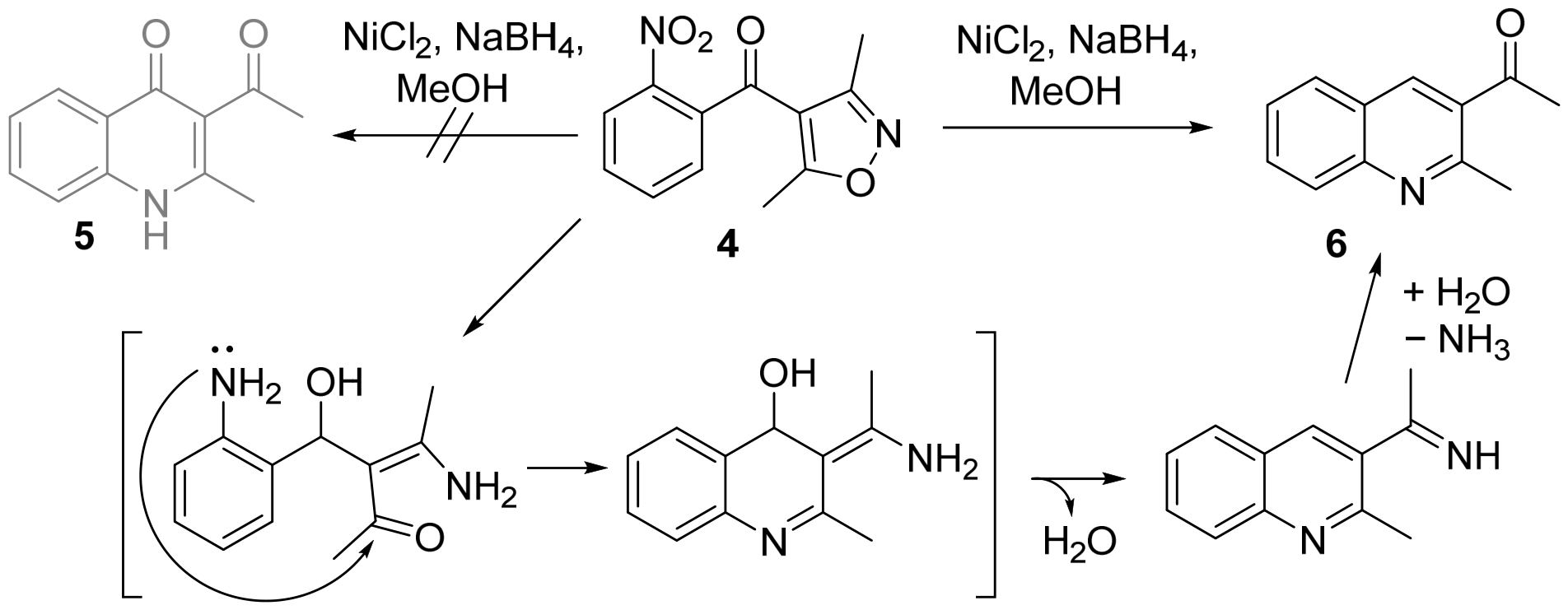
For the envisaged 4-aroylisoxazole-to-4-quinolone ring transformation a reducing agent also able to reduce the nitroarene to an aniline and cleave the isoxazole ring to an enaminone was required. So we selected the NaBH4/NiCl2 system which we had previously applied to the synthesis of 4-quinolones by reductive ring transformation of 5-(2-nitrophenyl)isoxazoles (Scheme 1C) [21]. According to the literature [28], the reduction of nickel(II) salts by sodium borohydride leads to the formation of nickel boride (Ni2B) as a heterogeneous catalyst for catalytic hydrogenation reactions. Additionally, Ni2B catalyzes the decomposition of NaBH4 in protic solvents leading to in situ generation of hydrogen gas. However, treating aroylisoxazole 4 with NaBH4/NiCl2 in methanol resulted in the formation of a product whose MS and NMR data did not fit with the expected 4-quinolone 5. Rather, this product was identified as 3-acetyl-2-methylquinoline (6), and the analytical data were in full accordance with the published values for 6 prepared by Friedländer synthesis [29]. This unexpected outcome includes a deoxygenation at C-4 of the quinoline ring system, which is most likely the result of an undesired reduction of the keto group to a secondary alcohol combined with an aromatization under dehydration after ring closure of the enaminone intermediate. The proposed mechanism is summarized in Scheme 3.
This hypothesis is supported by the fact that the corresponding secondary alcohol 3 (Scheme 2), when treated with the same NaBH4/NiCl2 system, gave 3-acetyl-2-methylquinoline (6) in comparable yield (35%). To evaluate the scope of this novel 3-acylquinoline synthesis, we investigated alternative reducing agents which should also be able to reduce both the nitro group and the isoxazole ring (Table 1): Pd-catalyzed hydrogenation [30] of 3 gave product 6 in 19% yield and the Fe/AcOH system [31] gave the product in 15% yield, whereas no product could be isolated after Zn/AcOH [32] treatment. Reduction with Mo(CO)6/water [33] gave the target compound in 13% yield, whereas reaction with iodotrimethylsilane (TMSI)/water, a reagent described by Boruah et al. [34] for the reductive cleavage of isoxazolidines and 2,1-benzisoxazoles, resulted in deoxygenation of the diarylcarbinol, but did not affect the isoxazole ring and the nitro group. The 4-(nitrobenzyl)isoxazole 7 was obtained in poor yield (27%). This outcome is in accordance with a report on TMSI-mediated deoxygenations of benzylic alcohols in the presence of nitro groups [35].
In conclusion, the NaBH4/NiCl2 system remains the most suitable for achieving this novel ring transformation to 2-substituted 3-acylquinolines, but the yield is still moderate. For this reason, we did not perform an in-depth investigation of this approach.
Next, we investigated catalytic hydrogenation for the initial 4-aroylisoxazole-to-4-quinolone ring transformation. As shown above (Table 1, entry 3), Pd-catalyzed hydrogenation of carbinol 3 resulted in both reduction of the nitro group and cleavage of the isoxazole ring. To our surprise, hydrogenation of the 4-aroylisoxazole 4 only led to reduction of the nitro group, without affecting the isoxazole ring, and (in accordance with a report of Kalish et al. [25]) aminophenyl derivative 8 was isolated in high yield (81%) (Scheme 4).
Having sufficient quantities of primary amine 8 with intact isoxazole ring in hand, we examined an alternative reagent for reductive cleavage of the isoxazole ring. In fact, treatment of 8 with iron in acetic acid [22] resulted in the desired ring transformation, and 4-quinolone 5 was obtained in 53% yield (Scheme 4). The analytical data were in accordance with published values [15].
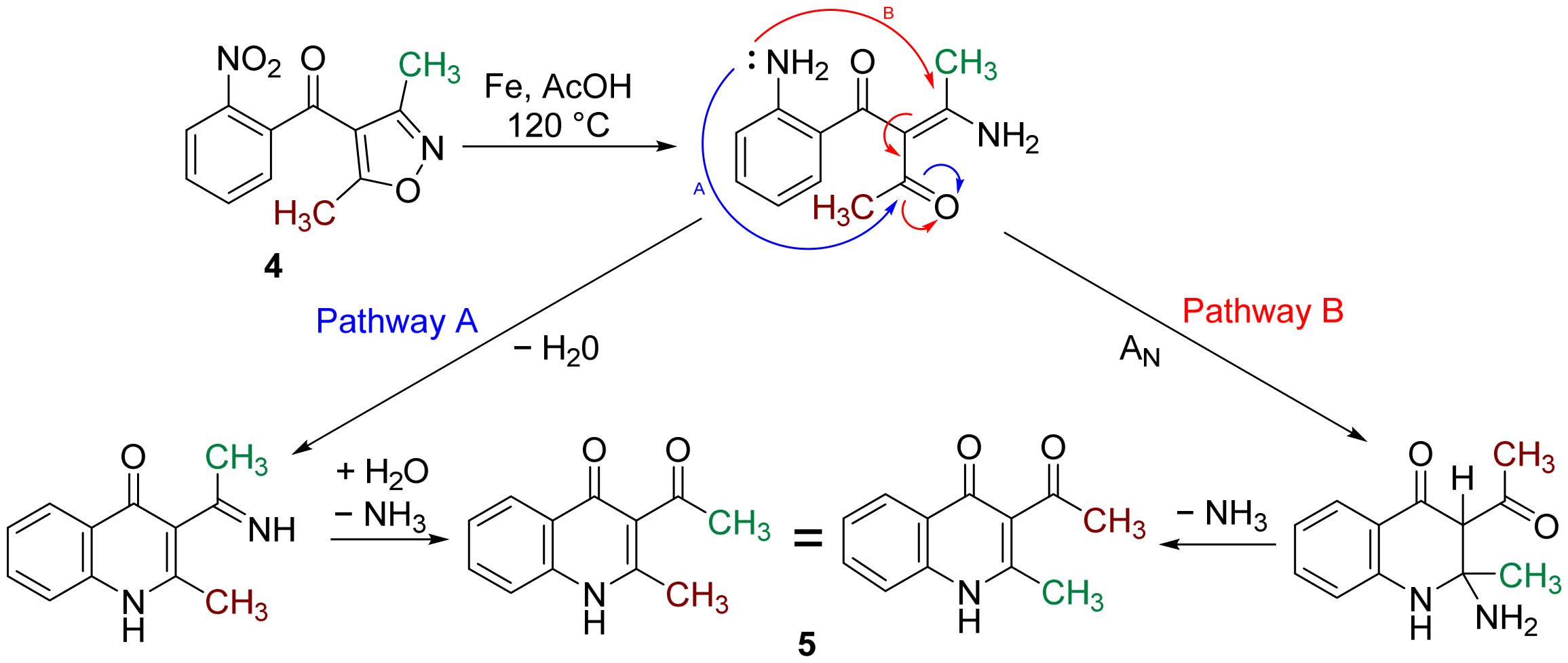
This was the first successful approach affording a 2-substituted 3-acyl-4-quinolone derivative. However, the structure of the product did not allow a precise interpretation of the mechanism of the cyclization of the intermediate enaminoketone, as two conceivable pathways would lead to the same product (Scheme 5). In pathway A, the arylamine would condense with the carbonyl group of the enaminoketone leading to an imino group at C-3, which should release ammonia upon aqueous work-up. In this pathway, the residue at C-5 of the isoxazole would end up as the residue at C-2 of the quinolone product, whereas the residue at C-3 of the isoxazole would be part of the acyl residue at C-3. In pathway B, the arylamine would undergo a Michael-type 1,4-addition with the vinylogous ketone, followed by elimination of ammonia to give the 4-quinolone system, with an inverse placement of the residues of the isoxazole precursor compared to pathway A.
To investigate which of the two proposed cyclisation pathways is operative, efforts were made to prepare asymmetrically 3,5-disubstituted isoxazoles as mechanistic probes with the aim of observing how these substituents were positioned in the resulting quinolone products. The approach was based on the premise that each pathway would lead to a distinct regiochemical outcome, thereby allowing the product structure to serve as a readout of the underlying mechanism.
For this purpose, we selected easily accessible isoxazoles 9 and 10, both bearing two distinct residues at C-3 and C-5. 3-Ethyl-5-phenylisoxazole (9) was prepared using Hansen’s protocol by Cu(I)-catalyzed [3+2]-cycloaddition of phenylacetylene with a nitrile oxide derived from n-butanal [36]. 5-Ethyl-3-methylisoxazole (10) was obtained by regioselective lithiation of the 5-methyl group in 3,5-dimethylisoxazole (1) with n-BuLi, followed by C-methylation with iodomethane [37].
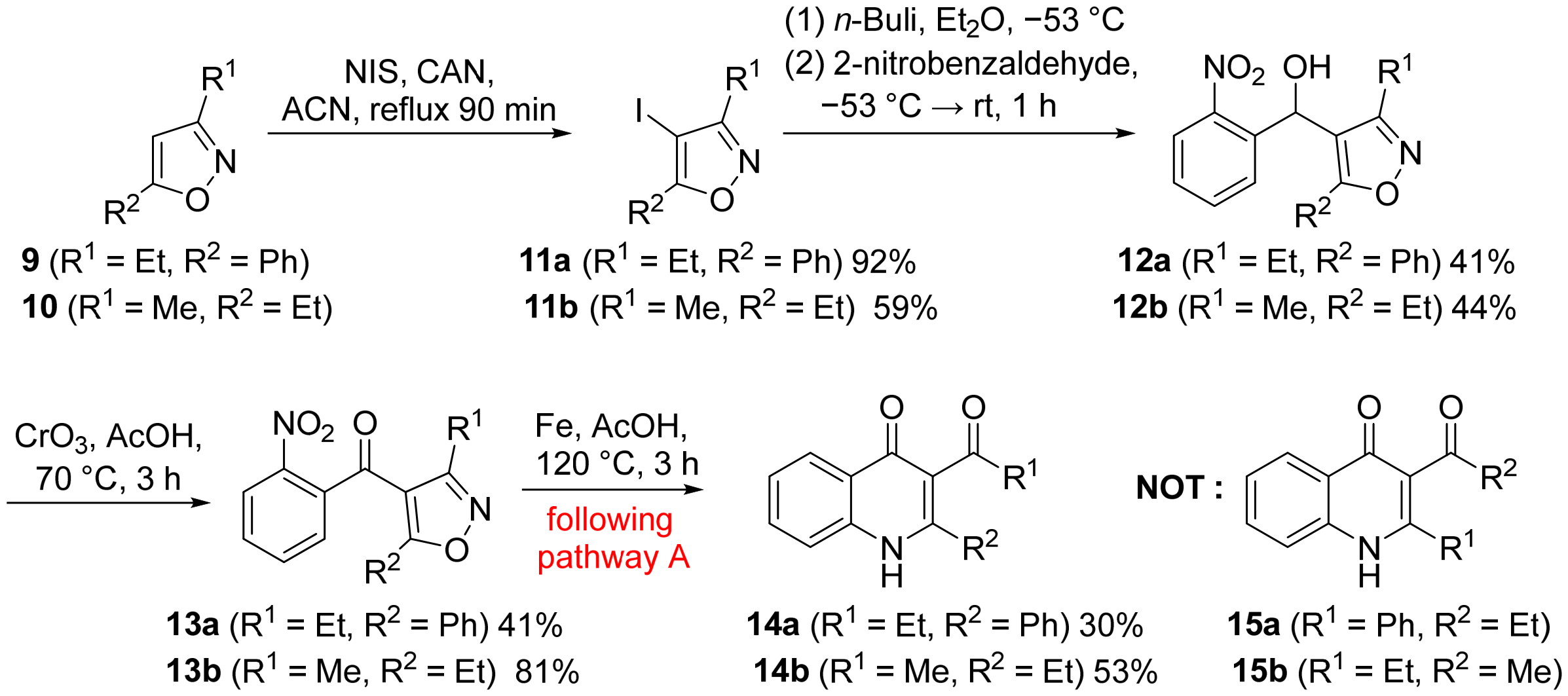
Iodination of 3-ethyl-5-phenylisoxazole (9) was carried out with NIS/CAN using the method of Brough et al. [38], affording the 4-iodo derivative 11a in high yield. Subsequent transformation into the corresponding ketone 13a followed the sequence described above: iodine–lithium exchange, addition to 2-nitrobenzaldehyde, and modified Jones oxidation of the resulting secondary alcohol 12a. In contrast to the two-step synthesis of 4-quinolone 5 described above (Scheme 4), the resulting 4-aroylisoxazole 13a was subjected directly to a reductive cyclisation with Fe/AcOH to furnish a single 4-quinolone product 14a in 30% yield (Scheme 6). If the cyclization followed pathway A (Scheme 5), ethyl ketone 14a would be formed, whereas pathway B would lead to the isomeric phenyl ketone 15a.
In the 1H NMR spectrum of the product, the resonances of the ethyl protons were clearly identified (quartet at δ 2.76 ppm and triplet at δ 0.90 ppm, both with a coupling constant of 7.3 Hz). Crucially, HMBC correlations from both groups of ethyl protons to the ketone carbon at δ 205.0 ppm confirmed that the ethyl group was located directly adjacent to the carbonyl group, indicating the presence of ethyl ketone 14a (Figure S1). This regiochemical outcome provides strong evidence in favour of the mechanistic route proposed in pathway A (Scheme 5).
In virtually the same manner (iodination, iodine–lithium exchange followed by addition to 2-nitrobenzaldehyde, Jones oxidation, reduction with Fe/AcOH) 5-ethyl-3-methylisoxazole (10) was converted into a 2-substituted 3-acyl-4-quinolone derivative (Scheme 6). Again, the HMBC spectrum (Figure S2) clearly indicated the identity of the product: the identification of a methyl ketone moiety is in accordance with the structure 14b (once again originating from a cyclization following pathway A) and excludes the isomeric structure 15b originating from pathway B.
While the conclusions are based on a limited number of examples, the consistent regiochemical outcome across both probes suggests a presumably general preference for pathway A under the standard reaction conditions.

4. Discussion

We have worked out a novel approach to 2-substituted 3-acyl-4-quinolones by reductive ring transformation of disubstituted 4-(2-nitrobenzoyl)isoxazoles. The outcome of this ring transformation reaction strongly depends on the nature of the reducing agent. An unexpected, but low-yielding approach to 2-substituted 3-acylquinolines was observed with the reducing agent NaBH4/NiCl2. Best results for the attempted 2-substituted 3-acyl-4-quinolones were obtained by means of treatment with iron in acetic acid. We learned that established reducing agents published for the reductive cleavage of isoxazoles are not necessarily transferable to the reduction of 4-acylisoxazoles, and competing reduction of the keto group may lead to unexpected alternative products (see compounds 6 and 7). Analysis of the mode of cyclization provided strong evidence for a pathway which excludes formation of isomeric products. Thus, this new protocol compares favourably with established strategies like the Niementowski reaction starting from anthranilic acid derivatives, which gives mixtures of isomers when unsymmetrical 1,3-diketones are used as reaction partners [39]. This new protocol should enable the stereocontrolled synthesis of a broad variety of 2-substituted 3-acyl-4-quinolones for drug discovery and development, since the starting materials (substituted 2-nitrobenzaldeydes [40] and 3,5-disubstituted isoxazoles [41]) are readily available. Further, various approaches lead to the central 4-aroylisoxazole-type intermediates. Besides the route via halogen–metal exchange starting from 4-iodoisoxazoles utilized in this work, a complementary approach is possible starting from 4-formylisoxazoles or related acid chlorides and metalated arenes [42]. 4-Iodoisoxazoles can further be subjected to carbonylative Suzuki–Miyaura reactions with arylboronic acids using N-formylsaccharin as CO surrogate [43], 4-stannylisoxazoles can be acylated with aroyl chlorides under Pd catalysis [44], and 4-unsubstituted isoxazoles undergo transition-metal-mediated direct aroylation with aromatic aldehydes [45]. Moreover, the acyl residue at C-3 opens up the possibility for further modifications, including reduction, addition of nucleophiles (organometallic compounds), condensation and olefination reactions, creating the opportunity for the introduction of diverse functional groups at C-3. Of special interest may be the conversion of acetyl units (see products 5 and 14b) into highly interesting carboxylic acids and esters (see the examples for diverse therapeutic applications like the cytotoxic, antibiotic, antiviral, and antiplasmodial ones shown in Figure 1).

5. Conclusions

In conclusion, we have worked out a unique approach to 2-substituted 3-acyl-4-quinolones by reductive ring transformation of readily available disubstituted 4-(2-nitrobenzoyl)isoxazoles. Further, we gained new insights into the chemical reactivity of 4-acylisoxazoles. With this work, we contribute a new approach for the stereocontrolled synthesis of compounds of high pharmacological interest. The free variability of the residues at C-2 and C-3 of the target compounds should allow for the further optimization and systematic analysis of the structure–activity relationships of known 4-quinolone-type lead structures for diverse therapeutic applications and the design of novel chemotypes of bioactive compounds.

Supplementary Materials

The following supporting information can be downloaded at: https://www.mdpi.com/article/10.3390/compounds6030044/s1, Figure S1: Key HMBC correlations (DMSO-d6, 400 MHz) observed for 14a. Cross-peaks confirm long-range couplings between the methylene (H13) and methyl (H15) protons of the ethyl group and the ketone carbon (C12, δ 205.0 ppm). Atom numbering above follows MestReNova software and does not reflect formal IUPAC conventions; Figure S2: HMBC spectrum of 14b (DMSO-d6, 400 MHz, 2D HMBC). A key cross-peak is observed between the methyl singlet at δ 2.50 ppm (H13) and the carbonyl carbon at δ 202.3 ppm (C12), confirming the methyl group’s direct attachment to the carbonyl group, forming an acetyl fragment at C9. Atom numbering follows the MestReNova assignment scheme and does not reflect formal IUPAC nomenclature. In IUPAC terms, the acetyl group at C9 is located at position 3 and the ketone carbon C10 is position 4 of the quinolone scaffold; Figure S3A: 1H NMR spectrum of (2-aminophenyl)(3,5-dimethylisoxazol-4-yl)methanone (8) in DMSO-d6; Figure S3B: 1C NMR spectrum of (2-aminophenyl)(3,5-dimethylisoxazol-4-yl)methanone (8) in DMSO-d6; Figure S4A: 1H NMR spectrum of 1-(2-methyl-1,4-dihydroquinolin-3-yl)ethan-1-one (5) in DMSO-d6; Figure S4B: 13C NMR spectrum of 1-(2-methyl-1,4-dihydroquinolin-3-yl)ethan-1-one (5) in DMSO-d6; Figure S5A: 1H NMR spectrum of 3-ethyl-4-iodo-5-phenylisoxazole (10) in CDCl3; Figure S5B: 13C NMR spectrum of 3-ethyl-4-iodo-5-phenylisoxazole (10) in CDCl3; Figure S6A: 1H NMR spectrum of 2-phenyl-3-propionylquinolin-4(1H)-one (9) in DMSO-d6; Figure S6B: 13C NMR spectrum of 2-phenyl-3-propionylquinolin-4(1H)-one (9) in DMSO-d6; Figure S7A: 1H MMR spectrum of 5-ethyl-4-iodo-3-methylisoxazole (11b) in CDCl3; Figure S7B: 13C MMR spectrum of 5-ethyl-4-iodo-3-methylisoxazole (11b) in CDCl3; Figure S8A: 1H NMR spectrum of (5-ethyl-3-methylisoxazol-4-yl)(2-nitrophenyl)methanol (12b) in CDCl3; Figure S8B: 13C NMR spectrum of (5-ethyl-3-methylisoxazol-4-yl)(2-nitrophenyl)methanol (12b) in CDCl3; Figure S9A: 1H NMR spectrum of (5-ethyl-3-methylisoxazol-4-yl)(2-nitrophenyl)methanone (13b) in CDCl3; Figure S9B: 13C NMR spectrum of (5-ethyl-3-methylisoxazol-4-yl)(2-nitrophenyl)methanone (13b) in CDCl3; Figure S10A: 1H NMR spectrum of 2-phenyl-3-propionylquinolin-4(1H)-one (14a) in DMSO-d6; Figure S10B: 13C NMR spectrum of 2-phenyl-3-propionylquinolin-4(1H)-one (14a) in DMSO-d6; Figure S11A: 1H NMR spectrum of 3-acetyl-2-ethylquinolin-4(1H)-one (14b) in DMSO-d6; Figure S11B: 13C NMR spectrum of 3-acetyl-2-ethylquinolin-4(1H)-one (14b) in DMSO-d6.

Author Contributions

Conceptualization, F.B.; methodology, P.P., J.P.S. and F.B.; validation, P.P., J.P.S. and F.B.; formal analysis, P.P., J.P.S. and F.B.; investigation, P.P. and J.P.S.; resources, F.B.; data curation, P.P., J.P.S. and F.B.; writing—original draft preparation, P.P. and F.B.; writing—review and editing, F.B.; visualization, P.P. and F.B.; supervision, F.B.; funding acquisition, P.P. and F.B. All authors have read and agreed to the published version of the manuscript.

Funding

This research was funded by a scholarship (F ZP 045-1/2019-2020) to Pavlos Pelagias by the Onassis Foundation, Athens (Greece).

Data Availability Statement

The original contributions presented in this study are included in the article/Supplementary Materials. Further inquiries can be directed to the corresponding author.

Conflicts of Interest

The authors declare no conflicts of interest.

References

  1. Heeb, S.; Fletcher, M.P.; Chhabra, S.R.; Diggle, S.P.; Williams, P.; Cámara, M. Quinolones: From antibiotics to autoinducers. FEMS Microbiol. Rev. 2011, 35, 247–274. [Google Scholar] [CrossRef] [Scilit] [PubMed]
  2. Kamigiri, K.; Tokunaga, T.; Shibazaki, M.; Setiawan, B.; Morioka, M.; Suzuki, K.-I.; Rantiatmodjo, R.M. YM-30059, a novel quinolone antibiotic produced by Arthrobacter sp. J. Antibiot. 1996, 49, 823–825. [Google Scholar] [CrossRef] [Scilit] [PubMed]
  3. Li, X.-W.; Herrmann, J.; Zang, Y.; Grellier, P.; Prado, S.; Müller, R.; Nay, B. Synthesis and biological activities of the respiratory chain inhibitor aurachin D and new ring versus chain analogues. Beilstein J. Org. Chem. 2013, 9, 1551–1558. [Google Scholar] [CrossRef] [Scilit] [PubMed]
  4. Shao, C.L.; Wang, C.Y.; Gu, Y.C.; Wei, M.Y.; Pan, J.H.; Deng, D.S.; She, Z.G.; Lin, Y.C. Penicinoline, a new pyrrolyl 4-quinolinone alkaloid with an unprecedented ring system from an endophytic fungus Penicillium sp. Bioorg. Med. Chem. Lett. 2010, 20, 3284–3286. [Google Scholar] [CrossRef] [Scilit] [PubMed]
  5. Wagner, S.; Sommer, R.; Hinsberger, S.; Lu, C.; Hartmann, R.W.; Empting, M.; Titz, A. Novel Strategies for the Treatment of Pseudomonas aeruginosa Infections. J. Med. Chem. 2016, 59, 5929–5969. [Google Scholar] [CrossRef] [Scilit] [PubMed]
  6. Mugnaini, C.; Pasquini, S.; Corelli, F. The 4-Quinolone-3-Carboxylic Acid Motif as a Multivalent Scaffold in Medicinal Chemistry. Curr. Med. Chem. 2009, 16, 1746–1767. [Google Scholar] [CrossRef] [Scilit] [PubMed]
  7. Gootz, T.D.; Brighty, K.E. Fluoroquinolone antibacterials: SAR, mechanism of action, resistance, and clinical aspects. Med. Res. Rev. 1996, 16, 433–486. [Google Scholar] [CrossRef] [Scilit]
  8. Sissi, C.; Palumbo, M. The Quinolone Family: From Antibacterial to Anticancer Agents. Curr. Med. Chem. Anti-Cancer Agents 2003, 3, 439–450. [Google Scholar] [CrossRef] [Scilit] [PubMed]
  9. Wills, T.; Vega, V. Elvitegravir: A once-daily inhibitor of HIV-1 integrase. Expert Opin. Investig. Drugs 2012, 21, 395–401. [Google Scholar] [CrossRef] [Scilit] [PubMed]
  10. Fan, Y.-L.; Cheng, X.-W.; Wu, J.-B.; Liu, M.; Zhang, F.-Z.; Xu, Z.; Feng, L.-S. Antiplasmodial and antimalarial activities of quinolone derivatives: An overview. Eur. J. Med. Chem. 2018, 146, 1–14. [Google Scholar] [CrossRef] [Scilit] [PubMed]
  11. Vu, C.B.; Oalmann, C.; Perni, R.B.; White, B. Quinazolinone, Quinolone and Related Analogs as Sirtuin Modulators. U.S. Patent 9326986, 3 May 2016. [Google Scholar]
  12. Boteva, A.A.; Krasnykh, O.P. The methods of synthesis, modification, and biological activity of 4-quinolones (review). Chem. Heterocycl. Compd. 2009, 45, 757–785. [Google Scholar] [CrossRef] [Scilit]
  13. Chongau, R.J.; Siddiqui, M.A.; Snieckus, V. Synthetic connections to the aromatic directed metalation reaction. A modified von niementowski quinoline synthesis from anthranilamides. Tetr. Lett. 1986, 27, 5323–5326. [Google Scholar] [CrossRef] [Scilit]
  14. Shvekhgeimer, M.G.A. Synthesis of Heterocyclic Compounds Based on Isatoic Anhydrides (2H-3,1-Benzoxazine-2,4-diones). (Review). Chem. Heterocycl. Compd. 2001, 37, 385–443. [Google Scholar] [CrossRef] [Scilit]
  15. Şenol, İ.; Satioğlu, S.; Çelik, İ. N-(2-Aminobenzoyl)benzotriazole Mediated Synthesis of 3- Acyl-2-alkyl(aryl)-4-hydroxyquinolines and 3-Acylamino-4(3H) quinazolinones. Turk. J. Chem. 2024, 48, 97–107. [Google Scholar] [CrossRef] [Scilit] [PubMed]
  16. Ma, Y.; Zhu, Y.; Zhang, D.; Meng, Y.; Tang, T.; Wang, K.; Ma, J.; Wang, J.; Sun, P. Eco-friendly decarboxylative cyclization in water: Practical access to the anti-malarial 4-quinolones. Green Chem. 2019, 21, 478–482. [Google Scholar] [CrossRef] [Scilit]
  17. Zhao, Y.-L.; Yang, S.-C.; Di, C.-H.; Han, X.-D.; Liu, Q. Highly efficient synthesis of 3-amino-/alkylthio-cyclobut-2-en-1-ones based on the cyclization of acyl ketene dithioacetals. Chem. Commun. 2010, 46, 7614–7616. [Google Scholar] [CrossRef] [Scilit] [PubMed]
  18. Wentland, M.P.; Lesher, G.Y.; Reuman, M.; Gruett, M.D.; Singh, B.; Aldous, S.C.; Dorff, P.H.; Rake, J.B.; Coughlin, S.A. Mammalian topoisomerase II inhibitory activity of 1-cyclopropyl-6,8-difluoro-1,4-dihydro-7-(2,6-dimethyl-4-pyridinyl)-4-oxo-3-quinolinecarboxylic acid and related derivatives. J. Med. Chem. 1993, 36, 2801–2809. [Google Scholar] [CrossRef] [Scilit] [PubMed]
  19. Tremmel, T.; Bracher, F. New approaches to the synthesis of canthin-4-one alkaloids and synthetic analogues. Tetrahedron 2015, 71, 4640–4646. [Google Scholar] [CrossRef] [Scilit]
  20. Kamlah, A.; Bracher, F. A Novel Approach to Highly Substituted β-Carbolines via Reductive Ring Transformation of 2-Acyl-3-isoxazolylindoles. Eur. J. Org. Chem. 2020, 2020, 2708–2719. [Google Scholar] [CrossRef] [Scilit]
  21. Lohrer, B.; Bracher, F. Novel access to 2-substituted quinolin-4-ones by nickel boride-mediated reductive ring transformation of 5-(2-nitrophenyl)isoxazoles. Tetr. Lett. 2019, 60, 151327. [Google Scholar] [CrossRef] [Scilit]
  22. Coffman, K.C.; Palazzo, T.A.; Hartley, T.P.; Fettinger, J.C.; Tantillo, D.J.; Kurth, M.J. Heterocycle–Heterocycle Strategies: (2-Nitrophenyl)isoxazole Precursors to 4-Aminoquinolines, 1H-Indoles, and Quinolin-4(1H)-ones. Org. Lett. 2013, 15, 2062–2065. [Google Scholar] [CrossRef] [Scilit] [PubMed]
  23. Sakamoto, T.; Kondo, Y.; Uchiyama, D.; Yamanaka, H. Condensed heteroaromatic ring systems. XIX. Synthesis and reactions of 5-(tributylstannyl)isoxazoles. Tetrahedron 1991, 47, 5111–5118. [Google Scholar] [CrossRef] [Scilit]
  24. Alberola, A.; Pérez Serrano, A.; Rodríguez Rodríguez, M.T.; Orozco, C. Synthesis of 4-Carbosubstituted Isoxazole Derivatives. Heterocycles 1989, 29, 667–677. [Google Scholar] [CrossRef] [Scilit]
  25. Kalish, R.; Broger, E.; Field, G.F.; Anion, T.; Steppe, T.V.; Sternbach, L.H. Quinazolines and 1,4-benzodiazepines LXVIII. 5-Heterocyclic-substituted benzodiazepinones. J. Heterocycl. Chem. 1975, 12, 49–57. [Google Scholar] [CrossRef] [Scilit]
  26. Bouillot, A.M.J.; Donche, F.; Gellibert, F.J.; Lamotte, Y.; Mirguet, O. Imidazo [4, 5-C] Quinoline Derivatives as Bromodomain Inhibitors. U.S. Patent 8557984, 15 October 2013. [Google Scholar]
  27. Gutierrez, C.D.; Bavetsias, V.; McDonald, E. ClTi(OiPr)3-Promoted Reductive Amination on the Solid Phase: Combinatorial Synthesis of a Biaryl-Based Sulfonamide Library. J. Comb. Chem. 2008, 10, 280–284. [Google Scholar] [CrossRef] [Scilit] [PubMed]
  28. Ganem, B.; Osby, J.O. Synthetically useful reactions with metal boride and aluminide catalysts. Chem. Rev. 1986, 86, 763–780. [Google Scholar] [CrossRef] [Scilit]
  29. Sridharan, V.; Ribelles, P.; Ramos, M.T.; Menéndez, J.C. Cerium(IV) Ammonium Nitrate Is an Excellent, General Catalyst for the Friedländer and Friedländer−Borsche Quinoline Syntheses: Very Efficient Access to the Antitumor Alkaloid Luotonin A. J. Org. Chem. 2009, 74, 5715–5718. [Google Scholar] [CrossRef] [Scilit] [PubMed]
  30. Fuentes, J.A.; Maestro, A.; Testera, A.M.; Báñez, J.M. Synthesis of optically active β′-hydroxy-β-enaminoketones via enzymatic resolution of carbinols derived from 3,5-disubstituted isoxazoles. Tetr. Asymmetry 2000, 11, 2565–2577. [Google Scholar] [CrossRef] [Scilit]
  31. Wu, W.; Chen, Q.; Tian, Y.; Xu, Y.; Huang, Y.; You, Y.; Weng, Z. Synthesis of polysubstituted 5-trifluoromethyl isoxazoles via denitrogenative cyclization of vinyl azides with trifluoroacetic anhydride. Org. Chem. Front. 2020, 7, 1878–1883. [Google Scholar] [CrossRef] [Scilit]
  32. Coffman, K.C.; Duong, V.; Bagdasarian, A.L.; Fettinger, J.C.; Haddadin, M.J.; Kurth, M.J. Heterocycle-to-Heterocycle Route to Quinoline-4-amines: Reductive Heterocyclization of 3-(2-Nitrophenyl)isoxazoles. Eur. J. Org. Chem. 2014, 2014, 7651–7657. [Google Scholar] [CrossRef] [Scilit] [PubMed]
  33. Nitta, M.; Kobayashi, T. Reductive ring opening of isoxazoles with Mo(CO)6 and water. J. Chem. Soc. Chem. Commun. 1982, 18, 877–878. [Google Scholar] [CrossRef] [Scilit]
  34. Boruah, M.; Konwar, D. Water promoted iodotrimethyl silane reactions: Reductive cleavage of isoxazolidines and 2,1-benzisoxazoles to γ-Amino Alcohols and o-aminobenzophenones. J. Chem. Res. 2002, 2002, 601–603. [Google Scholar] [CrossRef] [Scilit]
  35. Cain, G.A.; Holler, E.R. Extended scope of in situ iodotrimethylsilane mediated selective reduction of benzylic alcohols. Chem. Commun. 2001, 37, 1168–1169. [Google Scholar] [CrossRef] [Scilit]
  36. Hansen, T.V.; Wu, P.; Fokin, V.V. One-Pot Copper(I)-Catalyzed Synthesis of 3,5-Disubstituted Isoxazoles. J. Org. Chem. 2005, 70, 7761–7764. [Google Scholar] [CrossRef] [Scilit] [PubMed]
  37. Brunelle, D.J. Isoxazoles as β-diketone synthons-selective anion formation on 3,5-dialkylisoxazoles. Tetr. Lett. 1981, 22, 3699–3702. [Google Scholar] [CrossRef] [Scilit]
  38. Brough, P.A.; Baker, L.; Bedford, S.; Brown, K.; Chavda, S.; Chell, V.; D’Alessandro, J.; Davies, N.G.M.; Davis, B.; Le Strat, L.; et al. Application of Off-Rate Screening in the Identification of Novel Pan-Isoform Inhibitors of Pyruvate Dehydrogenase Kinase. J. Med. Chem. 2017, 60, 2271–2286. [Google Scholar] [CrossRef] [Scilit] [PubMed]
  39. Wang, Y.; Li, W.; Lin, H.; Le, Z.; Xie, Z. Reaction of 2-Aminobenzyl Alcohols with β -Dicarbonyl Compounds to Synthesize Quinoline Derivatives in Water Promoted by Active Manganese Dioxide. Chin. J. Org. Chem. 2024, 44, 1649–1657. [Google Scholar] [CrossRef] [Scilit]
  40. Makosza, M.; Owczarczyk, Z. Reactions of organic anions. 161. Dihalomethylation of nitroarenes via vicarious nucleophilic substitution of hydrogen with trihalomethyl carbanions. J. Org. Chem. 1989, 54, 5094–5100. [Google Scholar] [CrossRef] [Scilit]
  41. Hu, F.; Szostak, M. Recent Developments in the Synthesis and Reactivity of Isoxazoles: Metal Catalysis and Beyond. Adv. Synth. Catal. 2015, 357, 2583–2614. [Google Scholar] [CrossRef] [Scilit]
  42. Sauers, R.R.; Hadel, L.M.; Scimone, A.A.; Stevenson, T.A. Photochemistry of 4-acylisoxazoles. J. Org. Chem. 1990, 55, 4011–4019. [Google Scholar] [CrossRef] [Scilit]
  43. Yu, D.; Xu, F.; Li, D.; Han, W. Transition-Metal-Free Carbonylative Suzuki-Miyaura Reactions of Aryl Iodides with Arylboronic Acids Using N-Formylsaccharin as CO Surrogate. Adv. Synth. Catal. 2019, 361, 3102–3107. [Google Scholar] [CrossRef] [Scilit]
  44. Uchiyama, D.; Yabe, M.; Kameyama, H.; Sakamoto, T.; Kondo, Y.; Yamanaka, H. Synthesis and reactions of 4-tributylstannyl-3-methylisoxazole. Heterocycles 1996, 43, 1301–1304. [Google Scholar] [CrossRef] [Scilit]
  45. Madhavan, S.; Keshri, S.K.; Kapur, M. Transition Metal-Mediated Functionalization of Isoxazoles: A Review. Asian J. Org. Chem. 2021, 10, 3127–3165. [Google Scholar] [CrossRef] [Scilit]
Figure 1. (A) Examples of bioactive 2,3-disubstituted 4-quinolone natural products. (B) Synthetic drugs with 4-quinolone backbone.
Compounds 06 00044 g001
Scheme 1. Reductive isoxazole transformations previously utilized in the Bracher group for the synthesis of (A) canthin-4-ones, (B) β-carbolines, and (C) 2-substituted 4-quinolones, and novel strategy (D) for the reductive conversion of 4-(2-nitroaroyl)isoxazoles into 2-substituted 3-acyl-4-quinolones.
Compounds 06 00044 sch001
Scheme 2. Synthesis of the aroylisoxazole intermediate 4.
Compounds 06 00044 sch002
Scheme 3. Proposed mechanism for the formation of the observed quinoline 6.
Compounds 06 00044 sch003
Scheme 4. Catalytic hydrogenation experiment with Pd/C and subsequent reductive ring transformation to quinolone 5.
Compounds 06 00044 sch004
Scheme 5. Proposed mechanisms for the cyclisation step during reduction of 4. Both mechanisms afford the same quinolone 5 but differ in the regiochemical placement of the methyl substituents derived from the 3,5-dimethylisoxazole unit. Methyl groups are colour-coded (green = 3-methyl, deep red = 5-methyl) to highlight their positional outcomes in each pathway.
Compounds 06 00044 sch005
Scheme 6. Synthesis of quinolones 14a and 14b supporting the hypothesized ring transformation pathway.
Compounds 06 00044 sch006
Table 1. Exploration of different reaction conditions for the formation of quinolone 6.
Compounds 06 00044 i001
EntryReducing AgentEductSolventConditionsProduct (Yield)
1NaBH4/NiCl24MeOH, THF0 °C, 30 min6 (37%)
2NaBH4/NiCl23MeOH, THF0 °C, 30 min6 (35%)
3Pd/H23EtOHr.t., 24 h6 (19%)
4Zn/AcOH3AcOH90 °C, o.n.none
5Fe/AcOH3EtOH85 °C, 4 h6 (15%)
6Mo(CO)6/H2O3MeCN100 °C, 2 h6 (13%)
7TMSCl, KI3acetonitrile, H2Ort, 30 min7 (27%)
Disclaimer/Publisher’s Note: The statements, opinions and data contained in all publications are solely those of the individual author(s) and contributor(s) and not of MDPI and/or the editor(s). MDPI and/or the editor(s) disclaim responsibility for any injury to people or property resulting from any ideas, methods, instructions or products referred to in the content.