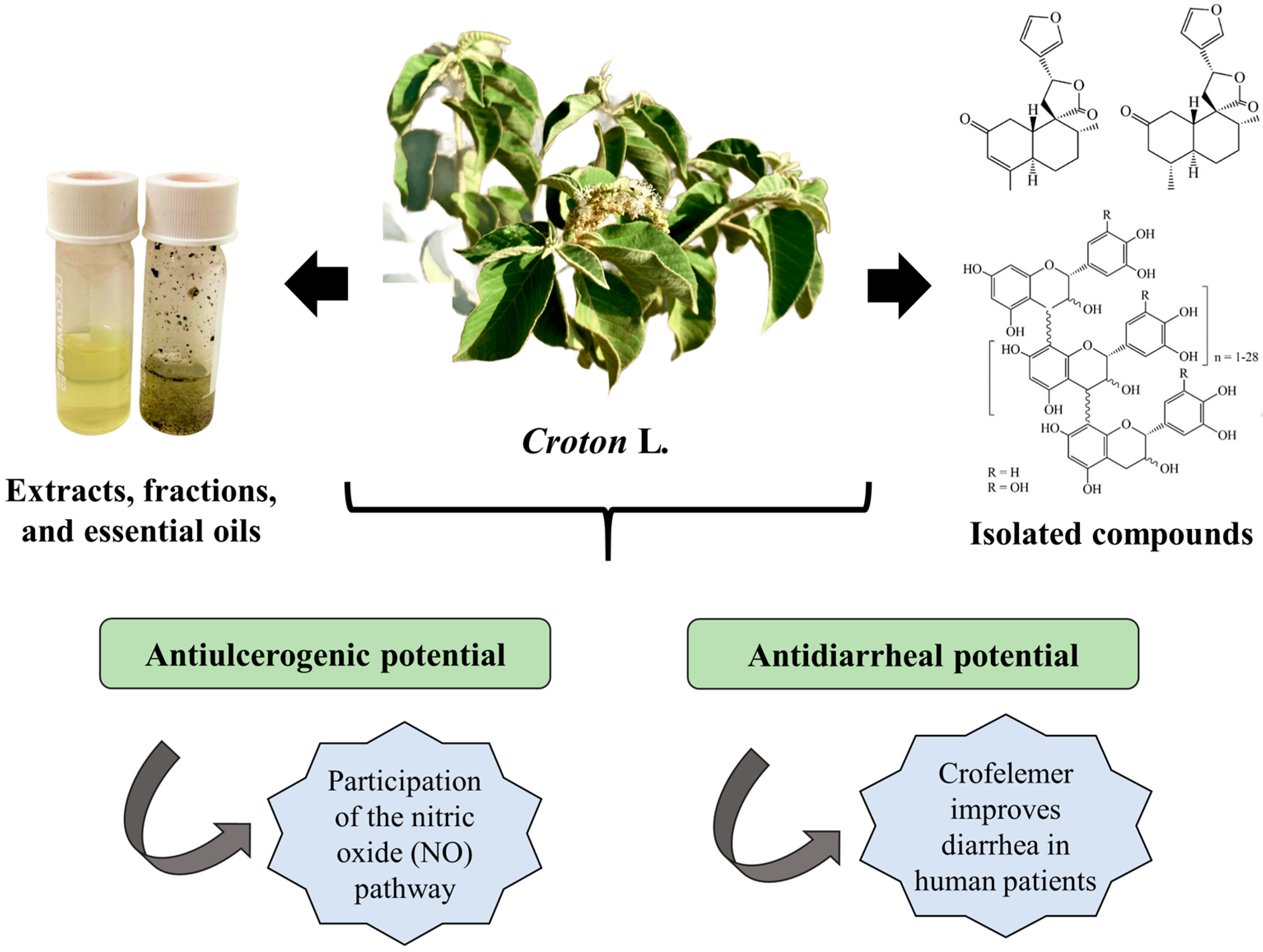


A Comprehensive Review of the Antiulcerogenic and Antidiarrheal Properties of Croton L. Species (Euphorbiaceae)


Abstract
1. Introduction
2. Methodology
2.1. Database Search
2.2. Inclusion and Exclusion Criteria
2.3. Data Screening and Information Categorization
3. Results and Discussion
3.1. Antiulcerogenic and Antidiarrheal Activities of Croton Species

| Species | Part of the Plant | Products | Doses | Methods | Results | References |
|---|---|---|---|---|---|---|
| Croton blanchetianus Baill. | Leaves | Spray-drier extract, effervescent pre-formulation | 50, 100 and 200 mg/kg | Ethanol-induced ulcer | At a dose of 200 mg/kg, the spray-drier extract and the effervescent pre-formulation reduced damage to the gastric mucosa of mice by up to 69.45 and 82.17%, respectively. | Dantas et al. [26] |
| Croton cajucara Benth. | Barks | trans-Dehydrocrotonin | 100 mg/kg | Shay ulcer, indomethacin-induced ulcer, ethanol-induced ulcer, restraint-hypothermic stress ulcer | The observed antiulcerogenic effect may be related to the increase in mucosal defense mechanisms, such as the production of prostaglandins. | Brito et al. [31] |
| Stem bark | Essential oil | 100 mg/kg | HCl/ethanol-induced ulcer, indomethacin-induced ulcer, hypothermic restraint stress ulcer, Shay ulcer | The essential oil exhibited a significant antiulcerogenic effect, probably due to increased mucosal defense mechanisms, such as prostaglandin production. | Hiruma-Lima et al. [39] | |
| Stem bark | Essential oil | 100 mg/kg | Shay ulcer, HCl/ethanol-induced ulcer, restraint hypothermic stress ulcer | The essential oil prevented gastric lesions induced by hypothermic restraint stress and HCl/ethanol; furthermore, in the pyloric ligation model, a significant increase in pH and gastric volume was observed. | Hiruma-Lima et al. [40] | |
| Stem bark | Essential oil | 100 mg/kg | Acetic acid-induced ulcer | The gastroprotective effects of the essential oil resulted mainly from increased PGE2 release and gastric mucus formation. | Hiruma-Lima et al. [41] | |
| Bark | trans-Crotonin | 100 mg/kg | HCl/ethanol-induced ulcer, indomethacin-induced ulcer, hypothermic restraint-stress ulcer, Shay ulcer | The isolated compound showed a significant antiulcerogenic effect probably related to its anti-secretory and gastroprotective properties. | Hiruma-Lima et al. [32] | |
| Stem barks | Essential oil | 100 mg/kg | Shay ulcer, indomethacin-induced ulcer | The antiulcerogenic mechanism of the essential oil is related to increased production of PGE2 and mucus. | Paula et al. [47] | |
| Stem barks | Essential oil | 100 mg/kg | Ethanol-induced ulcer, acetic acid-induced ulcer | The antiulcerogenic activity of the essential oil was mediated by increased somatostatin secretion and expression of Epidermal Growth Factor (EGF) mRNA. | Paula et al. [42] | |
| Stem barks | Essential oil | 100 mg/kg | Ethanol-induced ulcer | The essential oil prevented gastric ulcers, reduced epithelial desquamation, and glandular damage. | Rozza et al. [48] | |
| Leaves | Polysaccharide fraction (25R) | 0.02 and 0.2 mg/kg | Ethanol-induced ulcer | The polysaccharide fraction was able to reduce gastric ulcers in rats, preserving mucus and glutathione (GSH) levels. | Nascimento et al. [49] | |
| Croton campestris A.St.-Hil. | Leaves | Hydroalcoholic extract | 50, 75, 125, 250, 500 and 750 mg/kg | Ethanol-induced ulcer, HCl/ethanol-induced ulcer, indomethacin-induced ulcer | The gastroprotective action of the extract in all gastric ulcer models evaluated may be involved with the nitric oxide pathway. | Júnior et al. [28] |
| Roots | Hydroalcoholic extract | 50, 75, 125, 250, 500 and 750 mg/kg | Ethanol-induced ulcer, HCl/ethanol-induced ulcer, indomethacin-induced ulcer | The antiulcerogenic activity of the extract seems to be mediated by the stimulation of endogenous prostaglandins and release of nitric oxide that lead to an increase in microcirculation. | Júnior et al. [29] | |
| Croton grewioides Baill. (Syn. Croton zehntneri) | Leaves | Essential oil | 10, 30, 100 and 300 mg/kg | Ethanol-induced ulcer, indomethacin-induced ulcer, cold-restraint stress-induced ulceration | The antiulcerogenic effect of essential oil may be related to the production of gastric wall mucus, an important gastroprotective factor. | Coelho-de-Souza et al. [43] |
| Aerial parts | Ethanolic extract | 7.81–500 mg/kg | Castor oil-induced diarrhea, intestinal transit | The extract showed a significant antidiarrheal effect in mice with a reduction in the frequency and number of liquid feces, in addition to reducing intestinal fluid. | Silva et al. [46] | |
| Leaves | Essential oil | 200 and 400 mg/kg | Ethanol-induced ulcer | At doses of 200 and 400 mg/kg, the essential oil inhibited gastric lesions in mice by up to 38.20 and 68.27%, respectively. | Leite et al. [50] | |
| Croton kinondoensis G.W.Hu, Ngumbau & Q.F.Wang | Leaves | Dichloromethane-methanol extract | 100, 200 and 400 mg/kg | Castor oil-induced diarrhea | Although not as potent as the standard drug loperamide, the extract exhibited moderate antidiarrheal effects. | Noor and Terefe [27] |
| Croton lechleri Müll.Arg. | Bark latex | Crofelemer | 1.5–500 µM | In vitro models of intestinal fluid transport and signaling processes | The cellular antisecretory action of crofelemer seems to involve two distinct Cl– channel targets on the luminal membrane of epithelial cells lining the intestine. | Tradtrantip et al. [51] |
| Croton macrostachyus Hochst. ex Delile | Root | Hydromethanolic extract, aqueous fraction, ethyl acetate fraction, chloroform fraction | 100, 200 and 400 mg/kg | Pyloric ligation-induced ulcer, HCl/ethanol-induced ulcer | The hydromethanolic extract exhibited significant antiulcer activity. The chloroform fraction also demonstrated efficacy, while the aqueous fraction showed no antiulcer activity. | Mekonnen et al. [25] |
| Leaves | Chloroform fraction, methanolic fraction, aqueous fraction | 300, 400, 500 and 1000 mg/kg | Castor oil-induced diarrhea | The chloroform and methanol fractions significantly delayed the onset of diarrhea, reduced stool frequency and weight. While the aqueous fraction did not show a significant effect. | Degu et al. [45] | |
| Croton reflexifolius Kunth | Leaves | Polyalthic acid | 30 mg/kg | Ethanol-induced ulcer | The gastroprotective mechanism of the isolated compound involved the participation of nitric oxide and endogenous sulfhydryl groups. | Reyes-Trejo et al. [52] |
| Croton rhamnifolioides Pax & K.Hoffm. | Leaves | Essential oil | 100, 200 and 400 mg/kg | Ethanol-induced ulcer, HCl/ethanol-induced ulcer, indomethacin-induced ulcer | The essential oil showed gastroprotective activity through mechanisms involving the participation of the nitric oxide and opioid pathways. | Vidal et al. [30] |
| Croton urucurana Baill. | Bark | Methanolic extract | 50, 100 and 250 mg/kg | Ethanol-induced ulcer, indomethacin-induced ulcer, acetic acid-induced gastric ulcer | The antiulcerogenic potential of the extract may involve sulfhydryl compounds, increasing mucus production and reducing gastric acidity. | Cordeiro et al. [44] |
| Bark | Red sap | 400, 600 and 800 mg/kg | Castor oil-induced diarrhea, intestinal transit | The red sap caused marked inhibition of the diarrheal response and significantly inhibited intestinal transit. There was no participation of endogenous opioids in its mechanism. | Gurgel et al. [53] | |
| Croton zambesicus (Croton gratissimus var. gratissimus) | Leaves | Essential oil | 5 and 10 mg/kg | Indomethacin-induced gastric ulcer | Low antiulcerogenic potential | Akinlolu et al. [54] |
| Leaves | Methanolic extract | 250 and 500 mg/kg | Indomethacin-induced gastric ulcer | Low antiulcerogenic potential | Akinlolu et al. [54] | |
| Leaves | Ethanolic extract | 200, 400 and 600 mg/kg | Indomethacin-induced ulcer, ethanol-induced ulcer, histamine-induced ulcer | The extract significantly inhibited ulcers induced in rats in all models evaluated. | Okokon et al. [55] | |
| Root | Ethanolic extract | 27, 54 and 81 mg/kg | Indomethacin-induced ulcer, ethanol-induced ulcer, reserpine-induced ulcer | The extract showed significant dose-dependent effects against the different gastric ulcer models evaluated. | Okokon and Nwafor [56] |
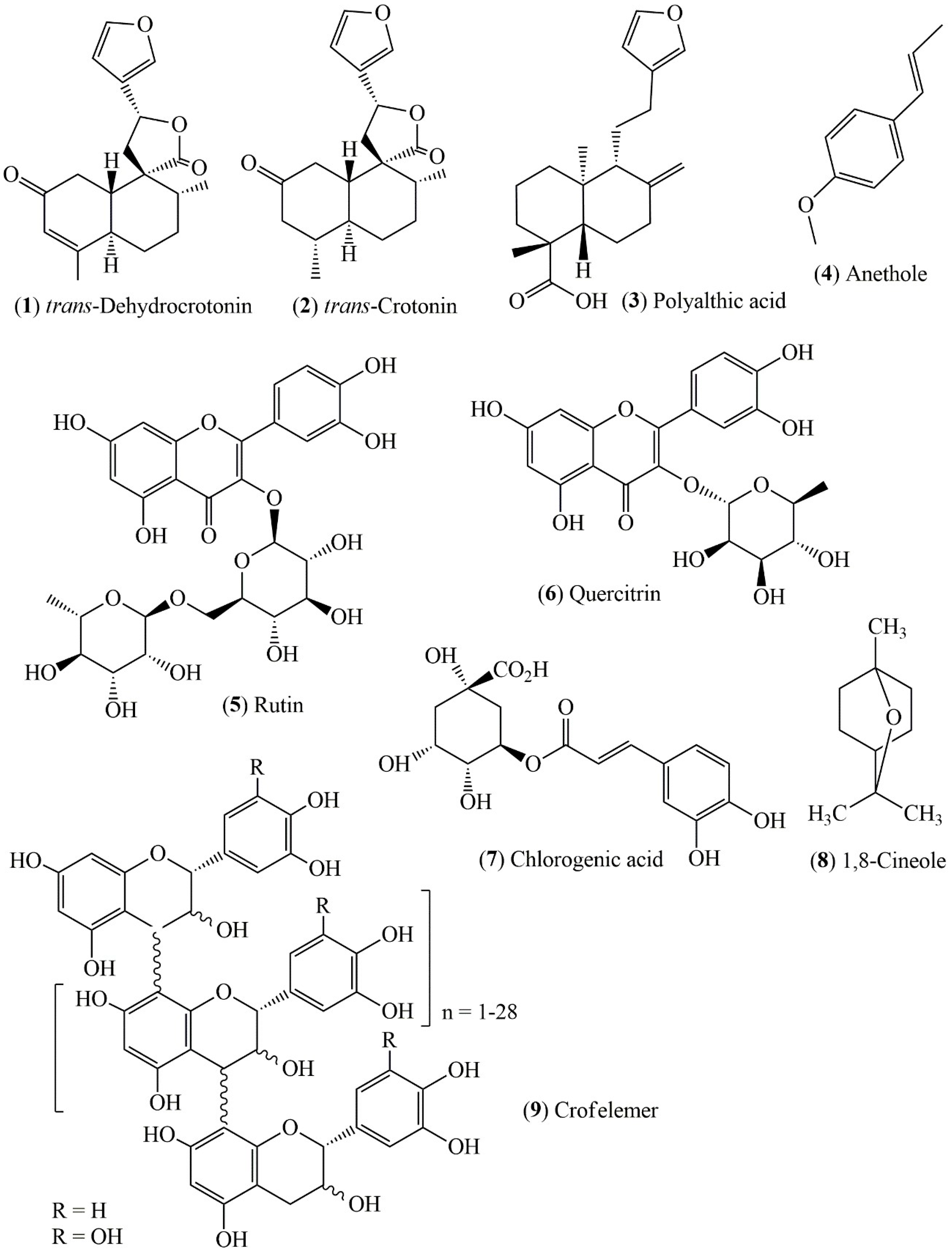
3.2. Major and/or Isolated Compounds from Croton Species
| Majority or Isolated Compound | Class | Species | Activity of the Compound Reported in the Literature |
|---|---|---|---|
| (1) trans-Dehydrocrotonin | Diterpene | Croton cajucara [31] | Antiulcerogenic activity [31,60] |
| (2) trans-Crotonin | Diterpene | Croton cajucara [32] | Antiulcerogenic activity [32] |
| (3) Polyalthic acid | Diterpene | Croton reflexifolius [52] | Antiulcerogenic activity [52] |
| (4) Anethole | Phenylpropanoid | Croton zehntneri [43] | Antiulcerogenic activity [43] |
| (5) Rutin | Flavonoid | Croton blanchetianus [26] | Antiulcerogenic activity [61,62], antidiarrheal activity [63,64] |
| (6) Quercitrin | Flavonoid | Croton campestris [29] | Antidiarrheal activity [65,66] |
| (7) Chlorogenic acid | Phenolic compound | Croton campestris [29] | Antiulcerogenic activity [67,68,69] |
| (8) 1,8-Cineole | Monoterpene | Croton rhamnifolioides [30] | Antiulcerogenic activity [70,71], antidiarrheal activity [72] |
| (9) Crofelemer | Oligomeric proanthocyanidin | Croton lechleri [51] | Antidiarrheal activity [51] |
3.3. Acute Toxicity of Croton Species
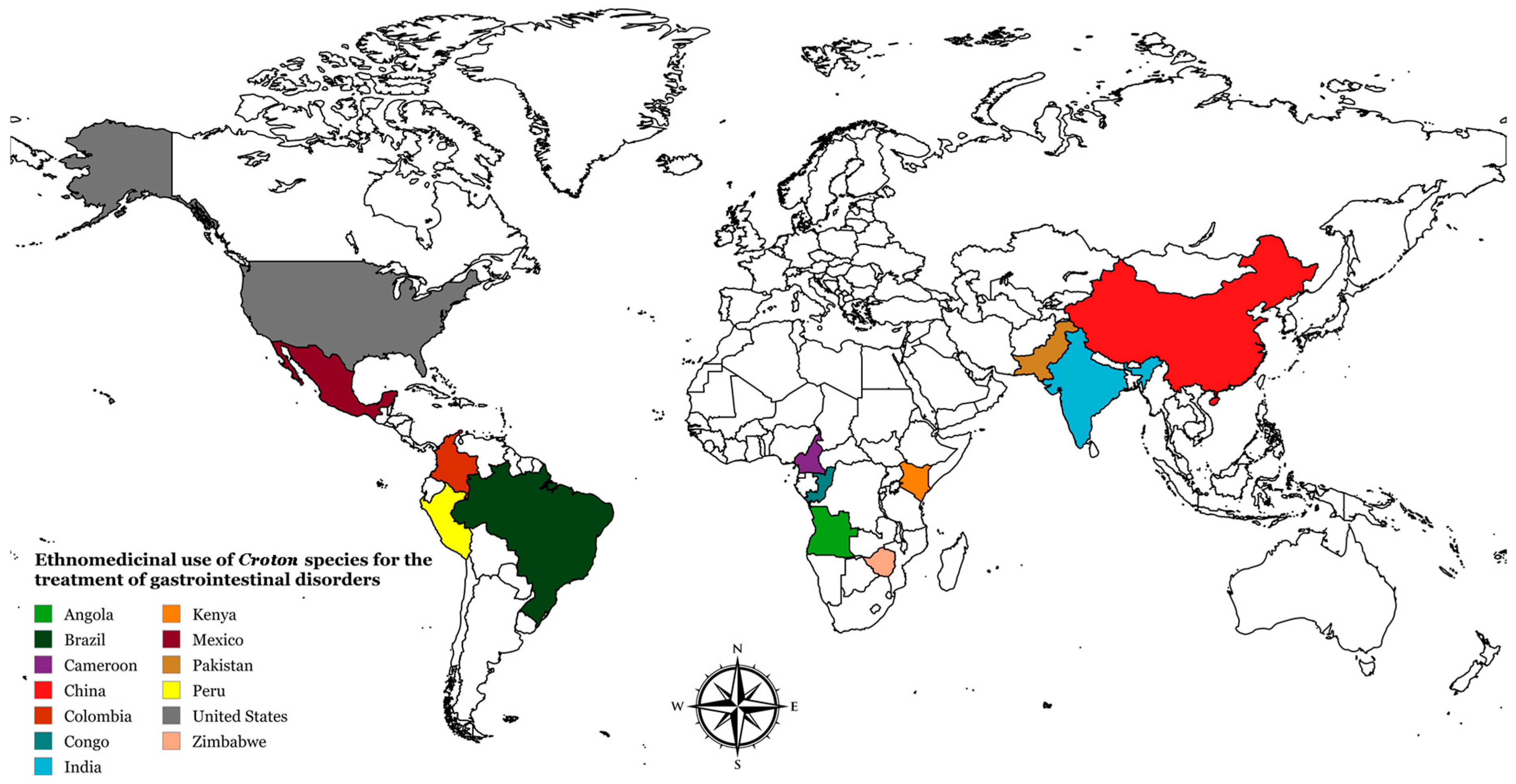
3.4. Croton Species Used in Traditional Medicine to Treat Gastrointestinal Diseases
| Species | Part Used | Mode of Preparation and Administration | Medicinal Use | Country | References |
|---|---|---|---|---|---|
| Croton argyrophylloides (=Croton tricolor Baill.) | Inner bark, root | Immersed in water, decoction, oral use | Stomach ache, upset stomach, diarrhea, indigestion | Brazil | Saraiva et al. [80] |
| Bark | - | Stomach ache | Brazil | Albuquerque et al. [76] | |
| Croton bonplandianus Baill. | Leaves | Juice | Protection of the stomach lining | Pakistan | Mahmood et al. [81] |
| Croton caudatus Geiseler | Leaves, roots | Maceration, oral use | Gastrointestinal problems | India | Kichu et al. [82] |
| Croton dichogamus Pax | Bark | Infusion, oral use | Stomach ache | Kenya | Mutie et al. [83] |
| Croton draconoides Müll.Arg. | Latex | 5 drops of latex diluted in 240 mL of water. Oral use | Internal ulcers, gastritis | Peru | Bussmann and Glenn [84] |
| Croton flavens L. | Leaves | Tea | Stomach problems | United States | Soelberg et al. [85] |
| Croton heliotropiifolius Kunth | Whole plant, leaves | Juice, decoction | Gastritis | Brazil | Castro et al. [77] |
| Croton laui Merr. & F.P.Metcalf | Leaves | Boiled, decoction, baths, oral injection | Stomach ache | China | Zheng et al. [86] |
| Croton limae A.P.S.Gomes, M.F.Sales & P.E.Berry | Bark | - | Belly ache | Brazil | Souza et al. [87] |
| Croton longiracemosus Hutch. | Seed, leaves | Decoction | Gastritis | Cameroon | Jiofack et al. [88] |
| Croton malambo H.Karst. | Leaves | Infusion, oral use | Colitis | Colombia | Duque et al. [89] |
| Croton megalocarpus Hutch. | Bark | Infusion, oral use | Constipation, stomach ache | Kenya | Mutie et al. [83] |
| Croton megalobotrys Müll.Arg. | Bark, root | Infusion, oral use | Swollen stomach (dropsy) | Zimbabwe | Maroyi [90] |
| Bark, root, leaves | - | Diarrhea | Kenya | Njoroge and Kibunga [91] | |
| Croton mubango Müll.Arg. | Stem bark, root bark | Maceration, oral use | Diarrhea, dysentery, abdominal pain | Congo | Otshudi et al. [73] |
| Leaves, stem | Decoction, drink 1 glass a day. | Diarrhea | Congo | Mbayo et al. [74] | |
| Hypogeous organ | - | Depurative for intestine, stomach ache | Angola | Urso et al. [75] | |
| Croton repens Schltdl. | Root | - | Diarrhea | Mexico | Leonti et al. [92] |
| Croton sonderianus (=Croton jacobinensis Baill.) | Inner stem bark | Tea, infusion | Digestive system disease, diarrhea | Brazil | Magalhães et al. [79] |
| Stem bark | Decoction, maceration | Diarrhea, indigestion, stomach | Brazil | Castro et al. [77] | |
| Stem | Tea, infusion | Diarrhea | Brazil | Lemos et al. [78] | |
| Bark | - | Diarrhea | Brazil | Albuquerque et al. [76] | |
| Croton texensis (Klotzsch) Müll.Arg. | Leaves | Tea | Stomach ache | Mexico | Camazine and Bye [93] |
4. Conclusions
Author Contributions
Funding
Data Availability Statement
Acknowledgments
Conflicts of Interest
References
- Wang, R.; Li, Z.; Liu, S.; Zhang, D. Global, regional, and national burden of 10 digestive diseases in 204 countries and territories from 1990 to 2019. Front. Public Health 2023, 11, 1061453. [Google Scholar] [CrossRef]
- Wang, Y.; Huang, Y.; Chase, R.C.; Li, T.; Ramai, D.; Li, S.; Huang, X.; Antwi, S.O.; Keaveny, A.P.; Pang, M. Global burden of digestive diseases: A systematic analysis of the global burden of diseases study, 1990 to 2019. Gastroenterology 2023, 165, 773–783. [Google Scholar] [CrossRef] [PubMed]
- Aslam, H.; Khan, A.U.; Qazi, N.G.; Ali, F.; Hassan, S.S.U.; Bungau, S. Pharmacological basis of bergapten in gastrointestinal diseases focusing on H+/K+ ATPase and voltage-gated calcium channel inhibition: A toxicological evaluation on vital organs. Front. Pharmacol. 2022, 13, 1005154. [Google Scholar] [CrossRef]
- Xie, X.; Ren, K.; Zhou, Z.; Dang, C.; Zhang, H. The global, regional and national burden of peptic ulcer disease from 1990 to 2019: A population-based study. BMC Gastroenterol. 2022, 22, 58. [Google Scholar] [CrossRef]
- Xie, M.; Song, Y.; Tao, J.; Jiang, M.; Liu, Y.; Cheong, I.H.; Kozlakidis, Z.; Chang, Z.; Wei, Q. Global trends, age-period-cohort analysis, and future projections of diarrhea burden: Findings from the global burden of disease study 2021. Biosaf. Health 2025, 7, 295–305. [Google Scholar] [CrossRef] [PubMed]
- Zhu, H.Y.; Xu, F.; Zhao, W.; Wang, H.X.; Wang, H. The global burden of childhood diarrhea and its epidemiological characteristics from 1990 to 2021. Front. Pediatr. 2025, 13, 1656234. [Google Scholar] [CrossRef] [PubMed]
- Forgerini, M.; Mieli, S.; Mastroianni, P.D.C. Safety assessment of omeprazole use: A review. São Paulo Med. J. 2018, 136, 557–570. [Google Scholar] [CrossRef]
- Hamzeloo-Moghadam, M.; Tavirani, M.R.; Jahani-Sherafat, S.; Tavirani, S.R.; Esmaeili, S.; Ansari, M.; Ahmadzadeh, A. Side effects of omeprazole: A system biology study. Gastroenterol. Hepatol. Bed Bench 2021, 14, 334. [Google Scholar]
- Akel, T.; Bekheit, S. Loperamide cardiotoxicity: “A brief review”. Ann. Noninvasive Electrocardiol. 2018, 23, e12505. [Google Scholar] [CrossRef]
- Magozwi, D.K.; Dinala, M.; Mokwana, N.; Siwe-Noundou, X.; Krause, R.W.; Sonopo, M.; McGaw, L.J.; Augustyn, W.A.; Tembu, V.J. Flavonoids from the genus Euphorbia: Isolation, structure, pharmacological activities and structure–activity relationships. Pharmaceuticals 2021, 14, 428. [Google Scholar] [CrossRef]
- Amtaghri, S.; Akdad, M.; Slaoui, M.; Eddouks, M. Traditional uses, pharmacological, and phytochemical studies of Euphorbia: A review. Curr. Top. Med. Chem. 2022, 22, 1553–1570. [Google Scholar] [CrossRef]
- Zhao, H.; Sun, L.; Kong, C.; Mei, W.; Dai, H.; Xu, F.; Huang, S. Phytochemical and pharmacological review of diterpenoids from the genus Euphorbia Linn (2012–2021). J. Ethnopharmacol. 2022, 298, 115574. [Google Scholar] [CrossRef]
- Rojas-Jiménez, S.; Valladares-Cisneros, M.G.; Salinas-Sánchez, D.O.; Pérez-Ramos, J.; Sánchez-Pérez, L.; Pérez-Gutiérrez, S.; Campos-Xolalpa, N. Anti-inflammatory and cytotoxic compounds isolated from plants of Euphorbia genus. Molecules 2024, 29, 1083. [Google Scholar] [CrossRef]
- Zengin, G.; Mahomoodally, M.F.; Sinan, K.I.; Ak, G.; Etienne, O.K.; Sharmeen, J.B.; Brunetti, L.; Leone, S.; Di Simone, S.C.; Recinella, L.; et al. Chemical composition and biological properties of two Jatropha species: Different parts and different extraction methods. Antioxidants 2021, 10, 792. [Google Scholar] [CrossRef]
- Majeed, I.; Rizwan, K.; Saber, F.R.; Munir, S.; Soria-Lopez, A.; Otero, P. Ethnotraditional uses and potential industrial and nutritional applications of secondary metabolites of genus Jatropha L. (Euphorbiaceae): A review. J. Agric. Food Res. 2025, 21, 101861. [Google Scholar] [CrossRef]
- Coy-Barrera, C.A.; Galvis, L.; Rueda, M.J.; Torres-Cortés, S.A. The Croton genera (Euphorbiaceae) and its richness in chemical constituents with potential range of applications. Phytomed. Plus 2025, 5, 100746. [Google Scholar] [CrossRef]
- Bezerra, J.J.L. Anticancer potential of essential oils from Croton L. species (Euphorbiaceae): A comprehensive review of ethnomedicinal, pharmacological, phytochemical, and toxicological evidence. S. Afr. J. Bot. 2024, 175, 180–192. [Google Scholar] [CrossRef]
- Bezerra, J.J.L.; Ferreira, A.P.; Luz, M.A.; Santos, T.P.; Torres, M.D.C.M. Ethnomedicinal uses, antiparasitic potential, and chemical composition of essential oils from Croton species (Euphorbiaceae): A comprehensive review. S. Afr. J. Bot. 2026, 188, 351–363. [Google Scholar] [CrossRef]
- Costa, I.B.; Bonfim, F.P.; Pasa, M.C.; Montero, D.A. Ethnobotanical survey of medicinal flora in the rural community Rio dos Couros, state of Mato Grosso, Brazil. Bol. Latinoam. Caribe Plantas Med. Aromát. 2017, 16, 53–67. [Google Scholar]
- Bezerra, D.G.; Souza, R.R.; Couto, E.A.P.; Novaes, V.R.; Ribeiro, M.B.; de Souza, C.G.; Rodrigues, G.A.; Melo, C.C.; Agra, E.P.; Fernandes, I.C.; et al. Ethnobotanical survey of medicinal plants used by the population in the neighborhoods South of the city of Anápolis, Goiás State, Brazil. Rev. Bras. Plantas Med. 2018, 20, 10–27. [Google Scholar]
- Macedo, J.G.F.; de Menezes, I.R.A.; Ribeiro, D.A.; de Oliveira Santos, M.; de Mâcedo, D.G.; Macêdo, M.J.F.; de Almeida, B.V.; de Oliveira, L.G.S.; Leite, C.P.; Souza, M.M.D.A. Analysis of the variability of therapeutic indications of medicinal species in the Northeast of Brazil: Comparative study. Evid. Based Complement. Altern. Med. 2018, 2018, 6769193. [Google Scholar] [CrossRef]
- Bandeira, A.S.; Sousa, V.F.O.; Santos, G.L.; Rodrigues, M.H.B.S.; Maracajá, P.B.; Silva, R.A.; Santos, J.J.F.; Ribeiro, M.D.S. Ethnoknowledge: Use of medicinal plants in communities. J. Exp. Agric. Int. 2018, 23, 1–12. [Google Scholar] [CrossRef]
- Damtie, D. Review of medicinal plants traditionally used to treat diarrhea by the people in the Amhara Region of Ethiopia. Evid. Based Complement. Altern. Med. 2023, 2023, 8173543. [Google Scholar] [CrossRef]
- Hankiso, M.; Asfaw, Z.; Warkineh, B.; Abebe, A.; Sisay, B.; Debella, A. Ethnoveterinary medicinal plants and their utilization by the people of Soro district, Hadiya zone, southern Ethiopia. J. Ethnobiol. Ethnomed. 2024, 20, 21. [Google Scholar] [CrossRef]
- Mekonnen, A.N.; Atnafie, S.A.; Atta, M.A.W. Evaluation of antiulcer activity of 80% methanol extract and solvent fractions of the root of Croton macrostachyus Hocsht: Ex Del. (Euphorbiaceae) in rodents. Evid. Based Complement. Altern. Med. 2020, 2020, 2809270. [Google Scholar] [CrossRef] [PubMed]
- Dantas, T.d.S.; da Silva, W.A.V.; Machado, J.C.B.; dos Santos, E.C.F.; de Lima, J.S.; Amaral, E.V.F.D.; Ribeiro, K.A.; da Silva, M.S.; da Cruz, R.C.D.; de Souza, I.A.; et al. Gastroprotective and antifungal evaluation of spray-dried extract and effervescent pre-formulation from Croton blanchetianus Baill leaves. J. Biol. Active Prod. Nat. 2023, 13, 522–536. [Google Scholar] [CrossRef]
- Noor, A.I.O.; Terefe, E.M. Evaluation of the antidiarrheal activity of dichloromethane-methanol crude extract of the aerial parts of Croton kinondoensis (Euphorbiaceae) in Mice. PLoS ONE 2025, 20, e0333527. [Google Scholar] [CrossRef] [PubMed]
- Júnior, F.E.B.; de Oliveira, D.R.; Bento, E.B.; Leite, L.H.I.; Souza, D.O.; Siebra, A.L.A.; Sampaio, R.S.; Martins, A.O.P.B.; Ramos, A.G.B.; Tintino, S.R.; et al. Antiulcerogenic Activity of the Hydroalcoholic Extract of Leaves of Croton campestris A. St.-Hill in Rodents. Evid. Based Complement. Altern. Med. 2013, 2013, 579346. [Google Scholar] [CrossRef]
- Júnior, F.E.; de Oliveira, D.R.; Boligon, A.A.; Athayde, M.L.; Kamdem, J.P.; Macedo, G.E.; da Silva, G.F.; de Menezes, I.R.; Costa, J.G.; Coutinho, H.D.M.; et al. Protective effects of Croton campestris A. St-Hill in different ulcer models in rodents: Evidence for the involvement of nitric oxide and prostaglandins. J. Ethnopharmacol. 2014, 153, 469–477. [Google Scholar] [CrossRef][Green Version]
- Vidal, C.S.; Martins, A.O.B.P.B.; Silva, A.A.; Oliveira, M.R.C.; Ribeiro-Filho, J.; Albuquerque, T.R.; Coutinho, H.D.M.; Almeida, J.R.G.S.; Quintans Junior, L.J.; Menezes, I.R.A. Gastroprotective effect and mechanism of action of Croton rhamnifolioides essential oil in mice. Biomed. Pharmacother. 2017, 89, 47–55. [Google Scholar] [CrossRef]
- Brito, A.S.; Rodriguez, J.A.; Hiruma-Lima, C.A.; Haun, M.; Nunes, D.S. Antiulcerogenic activity of trans-dehydrocrotonin from Croton cajucara. Planta Med. 1998, 64, 126–129. [Google Scholar] [CrossRef]
- Hiruma-Lima, C.A.; Toma, W.; Gracioso, J.S.; Almeida, A.B.A.; Batista, L.M.; Magri, L.; Paula, A.C.B.; Soares, F.R.; Nunes, D.S.; Brito, A.R.M.S. Natural trans-Crotonin: The Antiulcerogenic Effect of Another Diterpene Isolated from the Bark of Croton cajucara Benth. Biol. Pharm. Bull. 2002, 25, 452–456. [Google Scholar] [CrossRef]
- Crutchley, R.D.; Miller, J.; Garey, K.W. Crofelemer, a novel agent for treatment of secretory diarrhea. Ann. Pharmacother. 2010, 44, 878–884. [Google Scholar] [CrossRef]
- Cottreau, J.; Tucker, A.; Crutchley, R.; Garey, K.W. Crofelemer for the treatment of secretory diarrhea. Expert Rev. Gastroenterol. Hepatol. 2012, 6, 17–23. [Google Scholar] [CrossRef] [PubMed]
- Chordia, P.; MacArthur, R.D. Crofelemer, a novel agent for treatment of non-infectious diarrhea in HIV-infected persons. Expert Rev. Gastroenterol. Hepatol. 2013, 7, 591–600. [Google Scholar] [CrossRef] [PubMed]
- MacArthur, R.D.; Hawkins, T.N.; Brown, S.J.; LaMarca, A.; Clay, P.G.; Barrett, A.C.; Bortey, E.; Paterson, C.; Golden, P.L.; Forbes, W.P. Efficacy and safety of crofelemer for noninfectious diarrhea in HIV-seropositive individuals (ADVENT trial): A randomized, double-blind, placebo-controlled, two-stage study. HIV Clin. Trials 2013, 14, 261–273. [Google Scholar] [CrossRef]
- Pohlmann, P.R.; Graham, D.; Wu, T.; Ottaviano, Y.; Mohebtash, M.; Kurian, S.; McNamara, D.; Lynce, F.; Warren, R.; Dilawari, A.; et al. HALT-D: A randomized open-label phase II study of crofelemer for the prevention of chemotherapy-induced diarrhea in patients with HER2-positive breast cancer receiving trastuzumab, pertuzumab, and a taxane. Breast Cancer Res. Treat. 2022, 196, 571–581. [Google Scholar] [CrossRef]
- Bezerra, J.J.L. Pharmacological Potential of Cyperaceae Species in Experimental Models of Gastrointestinal Disorders: A Review. Sci. Pharm. 2025, 93, 41. [Google Scholar] [CrossRef]
- Hiruma-Lima, C.A.; Gracioso, J.S.; Nunes, D.S.; Brito, A.S. Effects of an essential oil from the bark of Croton cajucara Benth. on experimental gastric ulcer models in rats and mice. J. Pharm. Pharmacol. 1999, 51, 341–346. [Google Scholar] [CrossRef]
- Hiruma-Lima, C.A.; Gracioso, J.S.; Rodrıguez, J.A.; Haun, M.; Nunes, D.S.; Brito, A.S. Gastroprotective effect of essential oil from Croton cajucara Benth. (Euphorbiaceae). J. Ethnopharmacol. 2000, 69, 229–234. [Google Scholar] [CrossRef]
- Hiruma-Lima, C.A.; Gracioso, J.S.; Bighetti, E.J.; Grassi-Kassisse, D.M.; Nunes, D.S.; Brito, A.S. Effect of essential oil obtained from Croton cajucara Benth. on gastric ulcer healing and protective factors of the gastric mucosa. Phytomedicine 2002, 9, 523–529. [Google Scholar] [CrossRef] [PubMed]
- Paula, A.C.B.; Gracioso, J.S.; Toma, W.; Hiruma-Lima, C.A.; Carneiro, E.M.; Brito, A.R.S. The antiulcer effect of Croton cajucara Benth in normoproteic and malnourished rats. Phytomedicine 2008, 15, 815–825. [Google Scholar] [CrossRef] [PubMed]
- Coelho-de-Souza, A.N.; Lahlou, S.; Barreto, J.E.; Yum, M.E.; Oliveira, A.C.; Oliveira, H.D.; Celedônio, N.R.; Feitosa, R.G.; Duarte, G.P.; Santos, C.F.; et al. Essential oil of Croton zehntneri and its major constituent anethole display gastroprotective effect by increasing the surface mucous layer. Fundam. Clin. Pharmacol. 2013, 27, 288–298. [Google Scholar] [CrossRef] [PubMed]
- Cordeiro, K.W.; Pinto, L.A.; Formagio, A.S.N.; Andrade, S.F.; Kassuya, C.A.L.; Cássia Freitas, K. Antiulcerogenic effect of Croton urucurana Baillon bark. J. Ethnopharmacol. 2012, 143, 331–337. [Google Scholar] [CrossRef]
- Degu, A.; Engidawork, E.; Shibeshi, W. Evaluation of the anti-diarrheal activity of the leaf extract of Croton macrostachyus Hocsht. ex Del. (Euphorbiaceae) in mice model. BMC Complement. Altern. Med. 2016, 16, 379. [Google Scholar] [CrossRef]
- Silva, A.D.S.; Silva, K.D.M.; Neto, J.C.; Costa, V.C.O.; Pessôa, H.D.L.F.; Tavares, J.F.; Silva, M.S.; Cavalcante, F.A. Croton grewioides Baill. (Euphorbiaceae) shows antidiarrheal activity in mice. Pharmacogn. Res. 2016, 8, 202–205. [Google Scholar] [CrossRef]
- Paula, A.; Toma, W.; Gracioso, J.; Hiruma-Lima, C.A.; Carneiro, E.M.; Brito, A.S. The gastroprotective effect of the essential oil of Croton cajucara is different in normal rats than in malnourished rats. Br. J. Nutr. 2006, 96, 310–315. [Google Scholar] [CrossRef]
- Rozza, A.L.; Moraes, T.M.; Kushima, H.; Nunes, D.S.; Hiruma-Lima, C.A.; Pellizzon, C.H. Involvement of glutathione, sulfhydryl compounds, nitric oxide, vasoactive intestinal peptide, and heat-shock protein-70 in the gastroprotective mechanism of Croton cajucara Benth. (Euphorbiaceae) essential oil. J. Med. Food 2011, 14, 1011–1017. [Google Scholar] [CrossRef]
- Nascimento, A.M.; Maria-Ferreira, D.; Souza, E.F.J.; Souza, L.M.; Sassaki, G.L.; Iacomini, M.; Werner, M.F.P.; Cipriani, T.R. Gastroprotective effect and chemical characterization of a polysaccharide fraction from leaves of Croton cajucara. Int. J. Biol. Macromol. 2017, 95, 153–159. [Google Scholar] [CrossRef]
- Leite, G.O.; Penha, A.R.S.; Silva, G.Q.; Colares, A.V.; Rodrigues, F.F.G.; Costa, J.G.M.; Cardoso, A.L.H.; Campos, A.R. Gastroprotective effect of medicinal plants from Chapada do Araripe, Brazil. J. Young Pharm. 2009, 1, 54–56. [Google Scholar] [CrossRef]
- Tradtrantip, L.; Namkung, W.; Verkman, A.S. Crofelemer, an antisecretory antidiarrheal proanthocyanidin oligomer extracted from Croton lechleri, targets two distinct intestinal chloride channels. Mol. Pharmacol. 2010, 77, 69–78. [Google Scholar] [CrossRef]
- Reyes-Trejo, B.; Sánchez-Mendoza, M.E.; Becerra-García, A.A.; Cedillo-Portugal, E.; Castillo-Henkel, C.; Arrieta, J. Bioassay-guided isolation of an anti-ulcer diterpenoid from Croton reflexifolius: Role of nitric oxide, prostaglandins and sulfhydryls. J. Pharm. Pharmacol. 2008, 60, 931–936. [Google Scholar] [CrossRef] [PubMed]
- Gurgel, L.A.; Silva, R.M.; Santos, F.A.; Martins, D.T.; Mattos, P.O.; Rao, V.S. Studies on the antidiarrhoeal effect of dragon’s blood from Croton urucurana. Phytother. Res. 2001, 15, 319–322. [Google Scholar] [CrossRef] [PubMed]
- Akinlolu, A.A.; Kamaldeen, G.O.; Francis, D.; Ameen, M.O. Low anti-ulcerogenic potentials of essential oils and methanolic extract of Croton zambesicus leaves. J. Intercult. Ethnopharmacol. 2014, 3, 97. [Google Scholar] [CrossRef]
- Okokon, J.E.; Umoh, U.F.; Udobang, J.A.; Etim, E.I. Antiulcerogenic activity of ethanolic leaf extract of Croton zambesicus in rats. Afr. J. Biomed. Res. 2010, 13, 119–123. [Google Scholar]
- Okokon, J.E.; Nwafor, P.A. Antiulcer and anticonvulsant activity of Croton zambesicus. Pak. J. Pharm. Sci. 2009, 22, 384–390. [Google Scholar]
- Yu, C.; Wang, D.; Li, Q.; Tong, Y.; Yang, Z.; Wang, T. Trans-anethole ameliorates LPS-induced inflammation via suppression of TLR4/NF-κB pathway in IEC-6 cells. Int. Immunopharmacol. 2022, 108, 108872. [Google Scholar] [CrossRef] [PubMed]
- Zahid, M.S.H.; Awasthi, S.P.; Hinenoya, A.; Yamasaki, S. Anethole inhibits growth of recently emerged multidrug resistant toxigenic Vibrio cholerae O1 El Tor variant strains in vitro. J. Vet. Med. Sci. 2015, 77, 535–540. [Google Scholar] [CrossRef]
- Patel, T.S.; Crutchley, R.D.; Tucker, A.M.; Cottreau, J.; Garey, K.W. Crofelemer for the treatment of chronic diarrhea in patients living with HIV/AIDS. HIV AIDS 2013, 5, 153–162. [Google Scholar] [CrossRef][Green Version]
- Rodríguez, J.A.; Hiruma-Lima, C.A.; Souza Brito, A.R. Antiulcer activity and subacute toxicity of trans-dehydrocrotonin from Croton cajucara. Hum. Exp. Toxicol. 2004, 23, 455–461. [Google Scholar] [CrossRef]
- La Casa, C.; Villegas, I.; De La Lastra, C.A.; Motilva, V.; Calero, M.M. Evidence for protective and antioxidant properties of rutin, a natural flavone, against ethanol induced gastric lesions. J. Ethnopharmacol. 2000, 71, 45–53. [Google Scholar] [CrossRef]
- Olaleye, M.T.; Akinmoladun, A.C. Comparative gastroprotective effect of post-treatment with low doses of rutin and cimetidine in rats. Fundam. Clin. Pharmacol. 2013, 27, 138–145. [Google Scholar] [CrossRef]
- Farrau, U.; Saleh, M.I.A.; Alhassan, A.W.; Babale, A.I.; Saminu, S.; Dogara, K.J. Studies on antidiarrhoeal activities of rutin in mice. Niger. J. Sci. Res. 2019, 18, 389–395. [Google Scholar]
- Ma, L.; Zhou, B.; Liu, H.; Chen, S.; Zhang, J.; Wang, T.; Wang, C. Dietary rutin improves the antidiarrheal capacity of weaned piglets by improving intestinal barrier function, antioxidant capacity and cecal microbiota composition. J. Sci. Food Agric. 2024, 104, 6262–6275. [Google Scholar] [CrossRef] [PubMed]
- Galvez, J.; Crespo, M.E.; Jimenez, J.; Suarez, A.; Zarzuelo, A. Antidiarrhoeic activity of quercitrin in mice and rats. J. Pharm. Pharmacol. 1993, 45, 157–159. [Google Scholar] [CrossRef] [PubMed]
- Galvez, J.; Medina, F.S.; Jimenez, J.; Torres, M.I.; Fernandez, M.I.; Nunez, M.C.; Ríos, A.; Gil, A.; Zarzuelo, A. Effect of quercitrin on lactose-induced chronic diarrhoea in rats. Planta Med. 1995, 61, 302–306. [Google Scholar] [CrossRef]
- Shimoyama, A.T.; Santin, J.R.; Machado, I.D.; Silva, A.M.O.; Melo, I.L.P.; Mancini-Filho, J.; Farsky, S.H. Antiulcerogenic activity of chlorogenic acid in different models of gastric ulcer. Naunyn Schmiedebergs Arch. Pharmacol. 2013, 386, 5–14. [Google Scholar] [CrossRef] [PubMed]
- Ahmed, M.A.; Mohanad, M.; Ahmed, A.A.; Aboulhoda, B.E.; El-Awdan, S.A. Mechanistic insights into the protective effects of chlorogenic acid against indomethacin-induced gastric ulcer in rats: Modulation of the cross talk between autophagy and apoptosis signaling. Life Sci. 2021, 275, 119370. [Google Scholar] [CrossRef]
- Boonyong, C.; Angkhasirisap, W.; Kengkoom, K.; Jianmongkol, S. Different protective capability of chlorogenic acid and quercetin against indomethacin-induced gastrointestinal ulceration. J. Pharm. Pharmacol. 2023, 75, 427–436. [Google Scholar] [CrossRef]
- Santos, F.A.; Rao, V.S.N. 1,8-cineol, a food flavoring agent, prevents ethanol-induced gastric injury in rats. Dig. Dis. Sci. 2001, 46, 331–337. [Google Scholar] [CrossRef]
- Caldas, G.F.R.; Oliveira, A.R.D.S.; Araújo, A.V.; Lafayette, S.S.L.; Albuquerque, G.S.; Silva-Neto, J.D.C.; Costa-Silva, J.H.; Ferreira, F.; Costa, J.G.M.; Wanderley, A.G. Gastroprotective mechanisms of the monoterpene 1,8-cineole (eucalyptol). PLoS ONE 2015, 10, e0134558. [Google Scholar] [CrossRef]
- Jalilzadeh-Amin, G.; Maham, M. The application of 1,8-cineole, a terpenoid oxide present in medicinal plants, inhibits castor oil-induced diarrhea in rats. Pharm. Biol. 2015, 53, 594–599. [Google Scholar] [CrossRef]
- Otshudi, A.L.; Vercruysse, A.; Foriers, A. Contribution to the ethnobotanical, phytochemical and pharmacological studies of traditionally used medicinal plants in the treatment of dysentery and diarrhoea in Lomela area, Democratic Republic of Congo (DRC). J. Ethnopharmacol. 2000, 71, 411–423. [Google Scholar] [CrossRef] [PubMed]
- Mbayo, K.M.; Kalonda, M.E.; Tshisand, T.P.; Kisimba, K.E.; Mulamba, M.; Richard, M.K.; Sangwa, K.G.; Mbayo, K.G.; Maseho, M.F.; Bakari, S.; et al. Contribution to ethnobotanical knowledge of some Euphorbiaceae used in traditional medicine in Lubumbashi and its surroundings (DRC). J. Adv. Bot. Zool. 2016, 4, 1–16. [Google Scholar]
- Urso, V.; Signorini, M.A.; Tonini, M.; Bruschi, P. Wild medicinal and food plants used by communities living in Mopane woodlands of southern Angola: Results of an ethnobotanical field investigation. J. Ethnopharmacol. 2016, 177, 126–139. [Google Scholar] [CrossRef]
- Albuquerque, U.P.; Medeiros, P.M.; Almeida, A.L.S.; Monteiro, J.M.; Neto, E.M.D.F.L.; Melo, J.G.; Santos, J.P. Medicinal plants of the caatinga (semi-arid) vegetation of NE Brazil: A quantitative approach. J. Ethnopharmacol. 2007, 114, 325–354. [Google Scholar] [CrossRef]
- Castro, K.N.C.; Wolschick, D.; Leite, R.R.S.; Andrade, I.M.; Mayo, S.J. Ethnobotanical and ethnoveterinary study of medicinal plants used in the municipality of Bom Princípio do Piauí, Piauí, Brazil. J. Med. Plants Res. 2016, 10, 318–330. [Google Scholar] [CrossRef]
- Lemos, I.C.S.; Silva, L.G.; Delmondes, G.A.; Lima, C.N.F.; Fernandes, G.P.; Barbosa, R.; Menezes, I.R.A.; Kerntopf, M.R. Natural resource use in traditional community for the treatment of diarrheal diseases in children from the Northeast of Brazil. J. Med. Plants 2016, 4, 30–34. [Google Scholar]
- Magalhães, K.D.N.; Guarniz, W.A.S.; Sá, K.M.; Freire, A.B.; Monteiro, M.P.; Nojosa, R.T.; Bieski, I.G.C.; Custódio, J.B.; Balogun, S.O.; Bandeira, M.A.M. Medicinal plants of the Caatinga, northeastern Brazil: Ethnopharmacopeia (1980–1990) of the late professor Francisco José de Abreu Matos. J. Ethnopharmacol. 2019, 237, 314–353. [Google Scholar] [CrossRef]
- Saraiva, M.E.; Ulisses, A.V.R.d.A.; Ribeiro, D.A.; de Oliveira, L.G.S.; de Macêdo, D.G.; Sousa, F.d.F.S.d.; de Menezes, I.R.A.; Sampaio, E.V.d.S.B.; Souza, M.M.d.A. Plant species as a therapeutic resource in areas of the savanna in the state of Pernambuco, Northeast Brazil. J. Ethnopharmacol. 2015, 171, 141–153. [Google Scholar] [CrossRef]
- Mahmood, A.; Qureshi, R.A.; Mahmood, A.; Sangi, Y.; Shaheen, H.; Ahmad, I.; Nawaz, Z. Ethnobotanical survey of common medicinal plants used by people of district Mirpur, AJK, Pakistan. J. Med. Plants Res. 2011, 5, 4493–4498. [Google Scholar]
- Kichu, M.; Malewska, T.; Akter, K.; Imchen, I.; Harrington, D.; Kohen, J.; Vemulpad, S.R.; Jamie, J.F. An ethnobotanical study of medicinal plants of Chungtia village, Nagaland, India. J. Ethnopharmacol. 2015, 166, 5–17. [Google Scholar] [CrossRef]
- Mutie, F.M.; Gao, L.L.; Kathambi, V.; Rono, P.C.; Musili, P.M.; Ngugi, G.; Hu, G.W.; Wang, Q.F. An ethnobotanical survey of a dryland botanical garden and its environs in Kenya: The Mutomo hill plant sanctuary. Evid. Based Complement. Altern. Med. 2020, 2020, 1543831. [Google Scholar] [CrossRef]
- Bussmann, R.W.; Glenn, A. Plants used for the treatment of gastro-intestinal ailments in Northern Peruvian ethnomedicine. Arnaldoa 2010, 17, 255–270. [Google Scholar]
- Soelberg, J.; Davis, O.; Jäger, A.K. Historical versus contemporary medicinal plant uses in the US Virgin Islands. J. Ethnopharmacol. 2016, 192, 74–89. [Google Scholar] [CrossRef]
- Zheng, X.L.; Wei, J.H.; Sun, W.; Li, R.T.; Liu, S.B.; Dai, H.F. Ethnobotanical study on medicinal plants around Limu Mountains of Hainan Island, China. J. Ethnopharmacol. 2013, 148, 964–974. [Google Scholar] [CrossRef] [PubMed]
- Souza, R.K.D.; Silva, M.A.P.; Menezes, I.R.A.; Ribeiro, D.A.; Bezerra, L.R.; Souza, M.M.A. Ethnopharmacology of medicinal plants of carrasco, northeastern Brazil. J. Ethnopharmacol. 2014, 157, 99–104. [Google Scholar] [CrossRef] [PubMed]
- Jiofack, T.; Fokunang, C.; Guedje, N.; Kemeuze, V.; Fongnzossie, E.; Nkongmeneck, B.A.; Mapongmetsem, P.M.; Tsabang, N. Ethnobotanical uses of some plants of two ethnoecological regions of Cameroon. Afr. J. Pharm. Pharmacol. 2009, 3, 664–684. [Google Scholar]
- Duque, M.; Gómez, C.M.; Cabrera, J.A.; Guzmán, J.D. Important medicinal plants from traditional ecological knowledge: The case La Rosita community of Puerto Colombia (Atlántico, Colombia). Bol. Latinoam. Caribe Plantas Med. Aromát. 2018, 17, 324–341. [Google Scholar]
- Maroyi, A. Garden Plants in Zimbabwe: Their ethnomedicinal uses and reported toxicity. Ethnobot. Res. Appl. 2012, 10, 045–057. [Google Scholar] [CrossRef]
- Njoroge, G.N.; Kibunga, J.W. Herbal medicine acceptance, sources and utilization for diarrhoea management in a cosmopolitan urban area (Thika, Kenya). Afr. J. Ecol. 2007, 45, 65–70. [Google Scholar] [CrossRef]
- Leonti, M.; Vibrans, H.; Sticher, O.; Heinrich, M. Ethnopharmacology of the Popoluca, Mexico: An evaluation. J. Pharm. Pharmacol. 2001, 53, 1653–1669. [Google Scholar] [CrossRef] [PubMed]
- Camazine, S.; Bye, R.A. A study of the medical ethnobotany of the Zuni Indians of New Mexico. J. Ethnopharmacol. 1980, 2, 365–388. [Google Scholar] [CrossRef] [PubMed]


Disclaimer/Publisher’s Note: The statements, opinions and data contained in all publications are solely those of the individual author(s) and contributor(s) and not of MDPI and/or the editor(s). MDPI and/or the editor(s) disclaim responsibility for any injury to people or property resulting from any ideas, methods, instructions or products referred to in the content. |
© 2026 by the authors. Licensee MDPI, Basel, Switzerland. This article is an open access article distributed under the terms and conditions of the Creative Commons Attribution (CC BY) license.
Share and Cite
Bezerra, J.J.L.; Oliveira, A.F.M.d. A Comprehensive Review of the Antiulcerogenic and Antidiarrheal Properties of Croton L. Species (Euphorbiaceae). Compounds 2026, 6, 2. https://doi.org/10.3390/compounds6010002
Bezerra JJL, Oliveira AFMd. A Comprehensive Review of the Antiulcerogenic and Antidiarrheal Properties of Croton L. Species (Euphorbiaceae). Compounds. 2026; 6(1):2. https://doi.org/10.3390/compounds6010002
Chicago/Turabian StyleBezerra, José Jailson Lima, and Antonio Fernando Morais de Oliveira. 2026. "A Comprehensive Review of the Antiulcerogenic and Antidiarrheal Properties of Croton L. Species (Euphorbiaceae)" Compounds 6, no. 1: 2. https://doi.org/10.3390/compounds6010002
APA StyleBezerra, J. J. L., & Oliveira, A. F. M. d. (2026). A Comprehensive Review of the Antiulcerogenic and Antidiarrheal Properties of Croton L. Species (Euphorbiaceae). Compounds, 6(1), 2. https://doi.org/10.3390/compounds6010002