Article

Ursolic Acid and Rutin Isolated from Biophytum umbraculum: Antiproliferative Activity of the Plant Against Human Adherent Cancer Cell Lines


by
Mirana Rakotozafy
1,
Rivoarison Randrianasolo
1,
Solomon Tesfaye
2,
Christian Schulze
2,
Dimby Andrianina Ralambomanana
1,
Patrick J. Bednarski
2,
Sharif Mortoga
3 and
Andreas Link
2,*
1
Department of Chemistry, Faculty of Sciences, University of Antananarivo, Antananarivo 101, Madagascar
2
Institute of Pharmacy, University of Greifswald, 17489 Greifswald, Germany
3
Department of Neonatology and Pediatric Intensive Care, University Medicine Greifswald, 17475 Greifswald, Germany
*
Author to whom correspondence should be addressed.
Compounds 2026, 6(1), 19; https://doi.org/10.3390/compounds6010019

Submission received: 31 December 2025 / Revised: 27 January 2026 / Accepted: 2 March 2026 / Published: 5 March 2026

Abstract

In recent years, Biophytum umbraculum Welw. (Oxalidaceae) has undergone several phytochemical and pharmacological investigations. Although its major phytochemical classes have been characterized, few isolated compounds have been reported. The previously detected phytoconstituents, along with the documented antioxidant and anti-inflammatory activities, both align with a potential antiproliferative effect. This study aims to complement the existing chemotaxonomic profile of B. umbraculum through the isolation and identification of phytoconstituents and to evaluate the antiproliferative potential of its extracts. Hexane, ethyl acetate, and methanolic extracts of B. umbraculum were screened against two human adherent cell lines, breast (MCF-7) and cervical (SiSo) adenocarcinomas, by using the crystal violet staining assay. The hexane extract inhibited both MCF-7 and SiSo cell proliferation with IC50 values of 8.93 ± 0.07 and 14.59 ± 0.08 µg/mL, respectively. The ethyl acetate extract showed activity against both cell lines, with IC50 values of 12.60 ± 0.14 and 13.10 ± 0.04 µg/mL, respectively. However, the methanolic extract was inactive on the MCF-7 cell line and only slightly active on the SiSo cell line. Chromatographic fractionations led to the isolation of ursolic acid from the active ethyl acetate extract and rutin from the methanolic extract. A further antiproliferative evaluation is warranted to confirm the contribution of ursolic acid to the effect of the ethyl acetate extract. Additional fractionations may uncover more phytoconstituents of diverse pharmaceutical interests.

Graphical Abstract

1. Introduction

Medicinal plants are an inexhaustible source of active principles. In addition to their use in folkloric medicine, plant metabolites serve as templates for the development of some modern drugs intended to combat complex diseases and to optimize existing treatments [1]. The starting point of such a process is phytochemical screening followed by the isolation and identification of phytoconstituents. A continuous update of chemotaxonomic profiles of plants is of paramount importance, as it orients biological investigations in the right direction. Accordingly, it promotes the discovery and development of more efficient drugs from inexpensive and sustainable raw materials with inherent biodegradability.
Cancer treatment is among the fields that have strongly benefited from natural product research. Major secondary metabolites, such as flavonoids, terpenoids, and alkaloids, have anticancer potential [2,3,4]. Practically, clinically approved anticancer drugs such as vinca alkaloids and taxanes are plant-derived [4,5]. However, a universal anticancer drug is still beyond reach, as cancers encompass a variety of diseases often requiring personalized interventions [6]. Furthermore, the resistance of some cancer cells to existing drugs, their adaptive changes under stress [7,8], and the non-selectivity of chemotherapeutic agents among normal and cancer cells often undermine the effectiveness of chemotherapy [9]. Consequently, the development of new anticancer agents with fewer side effects and adapted mechanisms of action remains a relentless challenge in this expanding research area. Medicinal plants provide a wide range of bioactive compounds to tackle this issue.
Biophytum umbraculum Welw. (syn. Biophytum petersianum Klotzsch) (Oxalidaceae) is among the medicinal plants that captured the interest of researchers in recent years. It is a small annual herbaceous plant growing in tropical and subtropical Africa, Madagascar, as well as in Southeast Asia and New Guinea [10]. Previous studies report the presence of flavonoids, terpenoids, tannins, phenolic compounds, and polysaccharides in different extracts of B. umbraculum [11,12]. However, the isolation and structural characterization of individual constituents from this plant are still poorly documented. Flavone-C glycosides, namely isovitexin, isoorientin, and cassiaoccidentalin A, are among the few compounds thoroughly isolated and identified from this plant [13]. In terms of biological activity, B. umbraculum is a proven anticonvulsant, antiplasmodial, anti-inflammatory, and antioxidant [11,13,14]. The favorable phytoconstituents combined with the antioxidant and anti-inflammatory potential make this plant a suitable candidate for antiproliferative assessment [15].
This study pursues two main independent objectives. Firstly, it aims to characterize the phytoconstituents of B. umbraculum through qualitative phytochemical screening, isolation, and identification of compounds, thereby complementing the existing phytochemical profile of the plant and providing leads for subsequent biological investigations. Secondly, this work seeks to evaluate the antiproliferative potential of B. umbraculum against the MCF-7 (human breast adenocarcinoma) and SiSo (human cervical adenocarcinoma) cell lines and to highlight the potent extracts that may serve as a basis for further antiproliferative assessment. For that, phytochemical and in vitro biological approaches were adopted.

2. Materials and Methods

2.1. General Information

Solvents and reagents were commercially available and purchased from VWR (VWR International GmbH, Darmstadt, Germany) and Abcr (Abcr GmbH, Karlsruhe, Germany). Some solvents, including hexane, ethyl acetate, ethanol, and methanol, were purchased from Chimidis (Chimidis S.A.R.L, Antananarivo, Madagascar) and were distilled before use. MCF-7 and SiSo cell lines were obtained from the German Collection of Microorganisms and Cell Cultures (DSMZ, Braunschweig, Germany). Penicillin/streptomycin and RPMI-1640 culture medium® (PAN Biotech, Aidenbach, Germany), 50% glutaraldehyde solution, trypsin-EDTA solution, and fetal bovine serum (FBS) (Sigma-Aldrich, Munich, Germany) were also purchased. TLC glass or aluminum plates coated with silica gel 60 F254, 20 × 20, were supplied by Merck (Merck KGaA, Darmstadt, Germany) or by Technique et précision (Technique et précision S.A.R.L, Antananarivo, Madagascar). Sea sand and silica gel 60 0.04–0.063 mm (400–230 mesh) were purchased from Carl Roth (Carl Roth GmbH + Co. KG, Karlsruhe, Germany) or from Technique et précision (Technique et précision S.A.R.L, Antananarivo, Madagascar). Sartorius MC1 LC1200S and LA310S analytical balances (Sartorius®, Göttingen, Germany), puriFlash® XS 520 Plus (Interchim, Montluçon, France), CHROMABOND® Flash RS SiOH prepacked flash cartridges (Macherey-Nagel, Düren, Germany), rotary evaporator (BÜCHI Rotavapor® R-3000 and BÜCHI vacuum system B-117, Duisburg, Germany), NMR spectrometer Bruker (Bruker Biospin GmbH, Rheinstetten, Germany), electric pipette controller and channel pipettes (Labopette 50–250 µL, Hirschmann®, Eberstadt, Germany), incubator (Heracell, Thermo Fisher Scientific, Waltham, MA, USA), cell counter and size analyzer (Coulter Z2, Beckman Coulter, Fullerton, CA, USA), microplate shaker TiMix 5 (Lab Tec Edmund Bühler GmbH, Hechingen, Germany), and Spectramax 384 Plus plate reader (Molecular Devices, Sunnyvale, CA, USA) were used for this research. Microsoft Excel 2016 (16.0.4993.1001) (Microsoft Corporation, Redmond, WA, USA) and GraphPad Prism 10.2.0 (GraphPad Software, Boston, MA, USA) were used for the statistical analysis of the biological data. MestReNova 12.0.2 (Mestrelab Research S.L., Santiago de Compostela, Spain) and ChemDraw Pro 8.0 (CambridgeSoft Corporation, Cambridge, MA, USA) were used for NMR data processing and visualizing chemical structures.

2.2. Collection and Preparation of Plant Materials

Aerial parts of B. umbraculum were collected in the meadow of Mamoladahy at Imeritsiatosika, Madagascar. Botanists of the Tsimbazaza Zoo and Botanical Gardens (PBZT) identified the plant. A voucher specimen, RKM03, was deposited at the herbarium of the Flora Department of PBZT. The plant is shown in Figure S1 in the Supplementary Materials. The vegetal materials were air-dried in the shade at ambient temperature for eight weeks. Then, they were ground into powder with a mechanical grinder.

2.3. Qualitative Phytochemical Screening Methods

Phytochemical screening based on coloration and precipitation reactions was carried out on the plant powder or on the hydroethanolic crude extract (70% ethanol in water) of B. umbraculum to detect the chemical families. Saponins were assessed with the foam test [16]. Polysaccharides were revealed by using the ethanol precipitation process [17]. Wilstätter and modified Wilstätter tests were used for the screening of flavonoids, as previously described [18], the Bate–Smith test was used for leucoanthocyanins, the Liebermann–Burchard test was used for steroids and triterpenes, the Salkowski test was used for unsaturated sterols, and the Bornträger test was used for anthraquinones [19]. The detection of polyphenols and tannins was performed by using vanillin hydrochloride, ferric chloride, 1% gelatin, and gelatin salt, as described by Duncan et al. [20]. The presence of alkaloids was evaluated by using the reagents of Dragendorff, Mayer, and Wagner [21,22].

2.4. Plant Extraction Procedure

Plant powder (4 kg) of B. umbraculum was macerated in 3 L of hexane in a glass jar for three days. The mixture was regularly shaken, then filtered with Whatman No. 1 filter paper, Büchner fuel, and an Erlenmeyer filtering flask. The filtrate was evaporated. The marc was macerated three more times in hexane as a depigmentation process, then three times in ethyl acetate, and finally three times in methanol for exhaustive extraction. An overview of the extraction process is provided in the Supplementary Materials (Scheme S1). The evaporated extracts were dried out in a desiccator.

2.5. Fractionation of Extracts, Isolation of Compounds, and Structural Identification

Chromatographic technics, including gravity column, flash chromatography, and preparative TLC, were used to successively fractionate the plant extracts and to purify the fractions.
The ethyl acetate extract (3 g) was subjected to normal-phase gravity column chromatography. The elution was performed with increasing polarity gradients of toluene/propan-2-ol and propan-2-ol/methanol mixtures. One of the major fractions was selected for further fractionation by the same chromatographic technique. The subfractions were eluted with hexane/ethyl acetate and ethyl acetate/methanol mixtures in an increasing polarity gradient. A subfraction was purified with preparative TLC by using a mobile phase of 40% ethyl acetate in hexane. Details of the fractionation process, including the elution systems for each fraction and subfraction, are available in the Supplementary Materials (Scheme S2, Tables S1 and S2).
Normal-phase gravity column chromatography was also carried out on 3 g of the methanolic extract of B. umbraculum. Mixtures of toluene/acetone, acetone/butanol, and butanol/methanol were gradually used to increase the polarity of the elution system. One of the high-yield fractions was selected for further fractionation by flash chromatography. A 40 g normal-phase pre-packed column was used to separate the fraction with a mixture of 50% butanol in methanol under isocratic conditions. One subfraction was purified with preparative TLC by using a mixture of 45% butanol in methanol. Further details regarding the successive fractionation of the methanolic extract are provided in the Supplementary Materials (Scheme S3, Tables S3 and S4).
The isolated compounds were analyzed by 1D (1H, 13 C and DEPT-135) and 2D (COSY, HMQC and HMBC) NMR spectroscopy. The structures were elucidated by analysis of the obtained spectra, supported by comparison with selected data reported in the literature. For each compound, the average absolute chemical shift differences were calculated by averaging the absolute differences of all comparable signals, using Equation (1):
|Δδ| = 1/n (∑|δi,experimental − δi,reference|)
where |Δδ| represents the average absolute chemical shift difference, “n” is the number of chemical shifts compared, “i” corresponds to the individual matched NMR carbon signal, δi,experimental is the chemical shift obtained in our experiment, and δi,reference is the chemical shift reported in the literature.

2.6. Cell Culture

Two human adherent cancer cell lines were tested, namely MCF-7 (breast) and SiSo (cervical) adenocarcinomas. The cells were grown in 25 cm2 culture flasks (T25) in a culture medium composed of 90% RPMI 1640, 10% fetal bovine serum, and supplemented with antibiotics: penicillin (30 mg/L) and streptomycin (40 mg/L). Weekly passaging was intended to maintain an appropriate cell confluence [23]. The culture medium was regularly refreshed to prevent deficiency of nutrients and to avoid the formation of by-products that can alter the pH of the medium [24]. The cells were incubated in a humidified incubator at 37 °C and 5% CO2 to help maintain a stable pH [25].

2.7. Crystal Violet Staining Assay

In order to assess the antiproliferative activity of the extracts, we performed a crystal violet staining (CVS) assay, a method based on the adherence of viable cells on the surfaces of culture vessels and the ability of crystal violet dye to bind to their DNA and proteins [26]. This method was used for both primary and secondary antiproliferative screenings as previously described [27,28].

2.7.1. Primary Antiproliferative Screening of the Extracts of B. umbraculum

Passaged adherent cells were trypsinized to detach them from the surface of the culture flask. Detached cells were suspended in fresh culture medium and seeded in a 96-well plate at a density of 1000 cells per well. The plates were incubated in a humidified incubator at 37 °C and 5% CO2 for 24 h to enable their attachment to the surface of the wells [27]. We dissolved the extracts in dimethylformamide (DMF). For the treatment, we poured a mixture of dissolved extract and culture medium into the 24 h incubated cells to obtain a final concentration of 0.1% DMF and 50 µg/mL of extract in the well. The treated cells were incubated in a humid atmosphere at 37 °C and 5% CO2 for 96 h. This incubation time, providing a prolonged exposure to the extracts compared to standard tests, was to ensure all cells passed at least one complete cell cycle, as antitumor agents intervene during cell division [27]. For each cell line, one plate was left untreated to serve as a control (T0 plate). It was fixed with 100 μL of a 1% glutaraldehyde solution in Dulbecco’s Phosphate Buffer Saline (DPBS) per well in order to stop cell growth. After 20 min, the mixture was removed and replaced by DPBS. The plates were stored at 4 °C until the staining process. The treated cells were fixed and stored only after 96 h of incubation.
To start the staining process, the DPBS was removed, and the adherent cells were stained for 30 min with 100 µL of 0.02% solution of crystal violet dye dissolved in distilled water. The plates were immersed in room-temperature water for 15 min to remove the excess dye. Then, 150 µL of ethanol 70% were added to each well to dissolve the crystal violet dye [28]. The plates were shaken at 200 rpm for two hours on a microplate shaker. We recorded the optical density (OD) with a plate reader at λ = 570 nm and SoftMax® Pro 6 software. The corrected growth percentage (T/C corr. (%)) was determined using Equation (2) [28,29].
(T/C) corr. (%) = (ODT − ODC,0)/(ODC − ODC,0) × 100
where ODT is the OD of the treated cells, ODC,0 is the OD of seeded cells at the time the drug was added, and ODC is the OD of the control.

2.7.2. Secondary Antiproliferative Screening of the Extracts of B. umbraculum

The same process as in the primary screening was performed, but this time, the dissolved extracts were diluted in several concentrations. A two-folded dilution series involving five concentrations was prepared from a stock solution. IC50 values were determined by non-linear least-squares regression of T/C corr. (%) against the logarithm of the extract concentration using a four-parameter logistic curve and by interpolation at T/C corr. value of 50%.

2.7.3. Statistical Analysis

T/C corr. (%) and statistical significance were calculated with MS Excel 2016. T/C corr. (%) was determined via Equation (2), and statistical significance by using a two-tailed Student’s t-test, with p < 0.05 considered significant. IC50 values were analyzed with both GraphPad Prism 10 and MS Excel 2016. Results were reported for 95% CI.

3. Results

3.1. Results of Qualitative Phytochemical Screening

Precipitates and color changes indicated the presence or absence of a specific class of metabolite in the plant material. Polysaccharides, condensed tannins, flavanols, flavones, anthocyanins, leucoanthocyanins, steroids, triterpenoids, and polyphenols were detected in the crude hydroethanolic extract of B. umbraculum. The screening showed no evidence of alkaloids, anthraquinones, flavanones, flavanols, saponins, and unsaturated sterols within the sensitivity limits of the performed colorimetric tests. The details of the observations leading to the results of the qualitative phytochemical screening are displayed in the Supplementary Materials in Table S5.

3.2. Results of Extraction

The extraction process led to hexane, ethyl acetate, and methanolic extracts. The methanolic extract provided the highest yield of extraction: 0.74% (29.7 g). The ethyl acetate and hexane extraction resulted in very low extraction yields: 0.16% (6.5 g) and 0.19% (7.6 g), respectively.

3.3. Results of Fractionation, Isolation and Purification

Ten prominent fractions (Ea.F1–Ea.F10) were collected from the raw fractionation of 3 g of the ethyl acetate extract of B. umbraculum. Ea.F3 (227.8 mg), one of the major fractions, eluted with 18% propan-2-ol in toluene, was selected for further chromatography. The fractionation of Ea.F3 led to nine subfractions (Ea.SF1–Ea.SF9). Ea.SF5 (11.5 mg), eluted with 40% ethyl acetate in hexane, was purified in preparative TLC, resulting in compound 1 (4.7 mg). The amount of each fraction and subfraction, as well as the corresponding elution system, is available in the Supplementary Materials (Scheme S2, Tables S1 and S2).
Seventeen fractions (M.F1–M.F17) resulted from the raw fractionation of 3 g of the methanolic extract of B. umbraculum by normal-phase gravity column. M.F5 (334.5 mg), one of the fractions recovered in a large amount, eluted with 10% acetone in butanol, was selected for further fractionation by flash chromatography. Fifteen subfractions (M.SF1–M.SF15) were collected from the flash chromatography of M.F5. M.SF13 (12 mg) was purified with preparative TLC by using a mixture of 45% butanol in methanol, resulting in compound 2 (5.2 mg). Further details on the numbers of collected fractions and subfractions, along with their corresponding elution systems, are provided in the Supplementary Materials (Scheme S3, Tables S3 and S4).

3.4. Structural Elucidation

3.4.1. Identification of Compound 1

The 1H NMR spectrum of compound 1 (4.7 mg) displayed characteristic chemical shifts, including a vinylic proton at δH 5.23 ppm, an oxymethine proton at δH 3.16 ppm, and an overlapping set of resonances in the aliphatic proton region at δH 2.2–0.7 ppm.
The 13C NMR spectrum showed characteristic signals, including a C-atom of carbonyl function of a carboxylic acid at δC 181.63 ppm; olefinic carbons at δC 139.64 and 126.90 ppm; an oxymethine carbon at δC 79.70 ppm; quaternary carbons, methine, or methylene groups at δC 56.74–31.77 ppm; and methyl carbons at δC 29.53–16.02 ppm. The HMQC spectrum showed a carbon signal at δC 48.98 ppm bearing a proton at δH 1.57 ppm, overlapping with the signal of CD3OD.
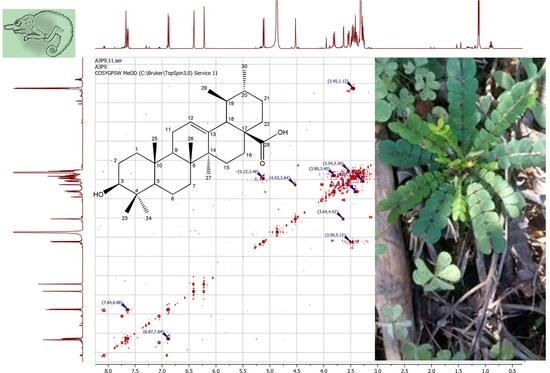
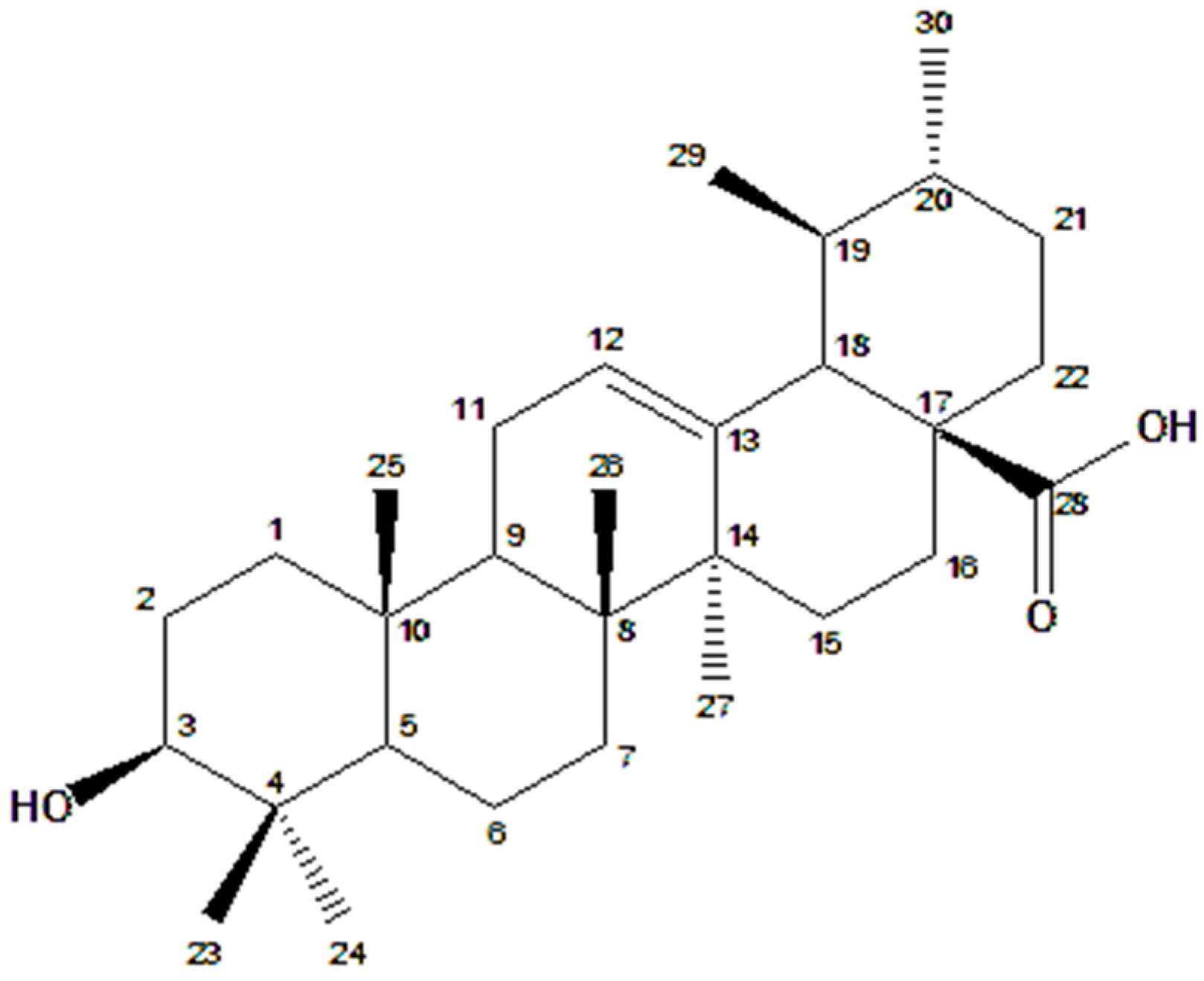
The combination of these characteristic signals (olefinic carbons, vinylic proton, oxymethine, and the cluster of peaks in the aliphatic region in both 1H and 13 C NMR spectra) aligned with the structure of a triterpene, especially triterpenic acid, given the presence of the carboxylic function. The signals at δC 126.90 and 139.64 ppm were assigned to C-12 and C-13, respectively, consistent with ursane-type triterpenic acid [30,31,32]. The complete assignment of the chemical shifts along with the 2D correlations are displayed in the Supplementary Materials (Tables S6 and S7). Figure 1 shows the structure proposal of compound 1, considering the analysis of the 1D (1H and 13 C), as well as the 2D (COSY, HMQC, HMBC) NMR spectra available in the Supplementary Materials (Figures S2–S6).
To ensure consistency with well-established reference NMR spectral data, our results were compared with previous spectra recorded in CDCl3―the solvent commonly used for reporting ursolic acid spectra in the literature―to support our chemical shift assignment summarized in Table 1.
The average absolute difference in the 13C NMR signals is |ΔδC,compound 1| ≈ 0.9 ppm. Due to the unmatched number of protons for each site, this calculation could not be applied to the 1H chemical shifts. The analysis of all NMR spectra, combined with the comparison to previously reported data [30,31,32], pointed to ursolic acid as the best match for compound 1, despite some chemical shift variations caused by the different deuterated solvents used.

3.4.2. Identification of Compound 2

Five protons were observed in the aromatic region of the 1H NMR spectrum of compound 2 (5.2 mg) at δH 7.67–6.22 ppm. Characteristic aromatic carbon signals were detected on the 13C NMR spectrum at δC 166.14–94.87 ppm. We noted the presence of aromatic carbons linked to heteroatoms at δC 166.14–145.86 ppm. Characteristic signals of oxymethine protons were observed at δH 4.52–3.24 ppm and oxymethine carbons at δC 78.19–68.55 ppm, consistent with the presence of sugar moieties. A typical chemical shift of a carbonyl function was detected at δC 179.43 ppm. The carbon at δC 17.88 ppm and the proton at δH 1.12 ppm suggested the presence of a methyl group in compound 2. In the DEPT-135 spectra, only the carbon at δC 68.55 ppm appeared as a CH2.
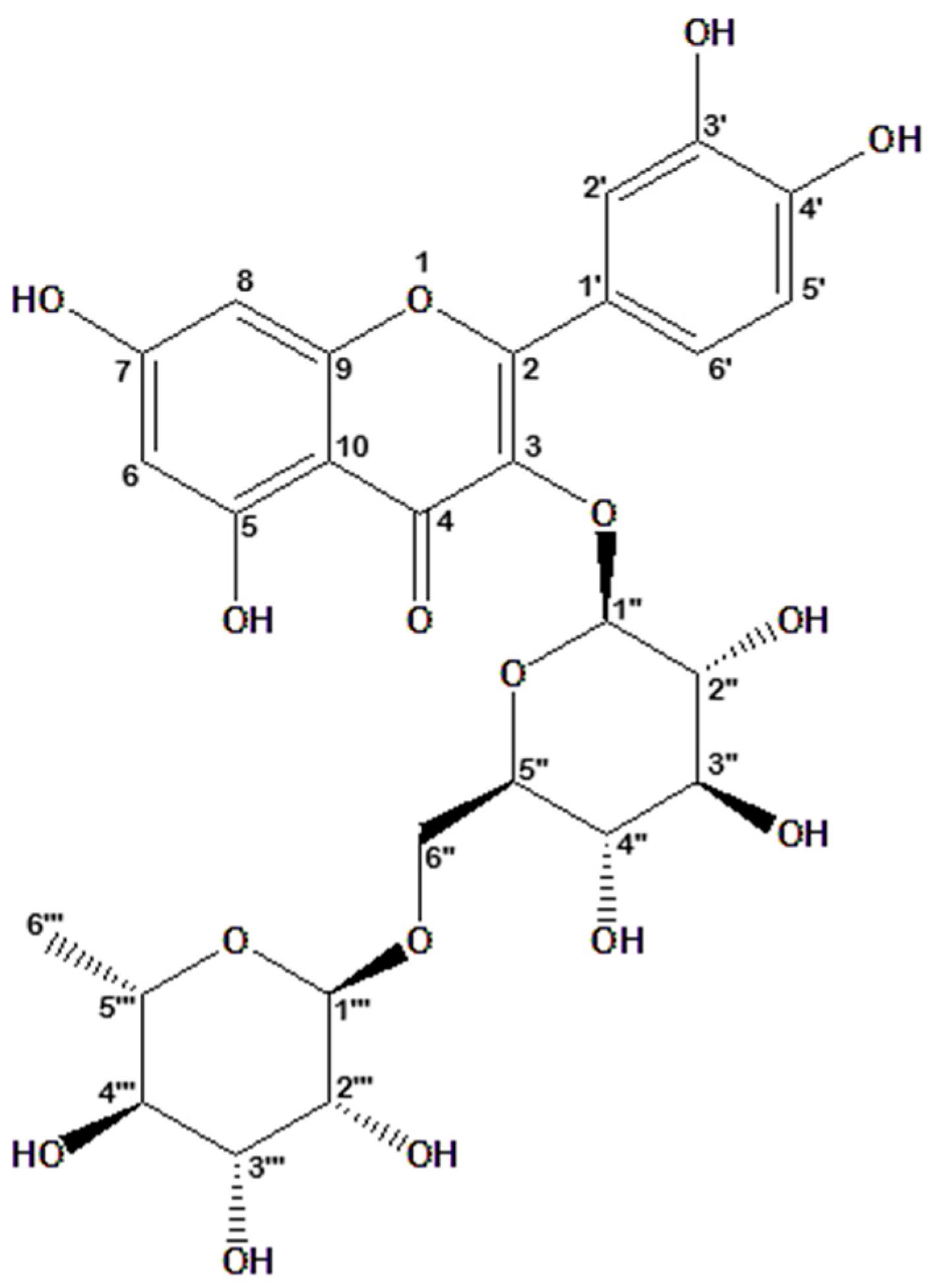
Based on the combination of these characteristic signals along with the correlations in the 2D NMR spectra (COSY, HMQC, HMBC) displayed in the Supplementary Materials (Figures S7–S12), compound 2 was proposed as a flavonoid bearing two sugar moieties. Figure 2 shows the corresponding structure proposal.
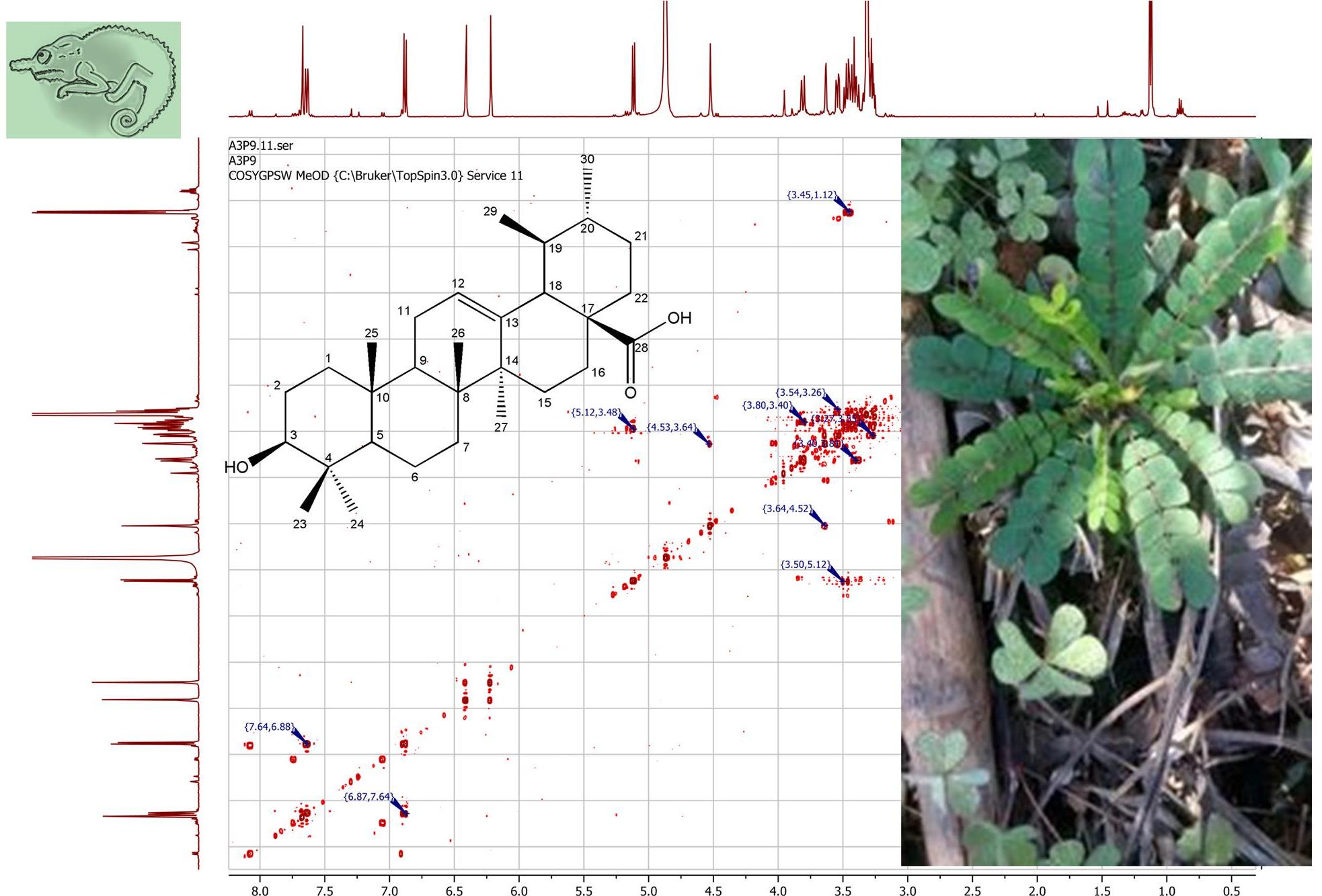
The chemical shift assignment of compound 2 is compiled in Table 2. The corresponding NMR spectra are provided in the Supplementary Materials (Figures S7–S12).
The obtained NMR spectra of compound 2 were sufficiently clear to allow the assignment of its structure as quercetin-3-O-rutinoside. Comparison with previously reported data allowed us to confirm the signal assignments [33] and to appreciate the variations in chemical shifts. The average absolute difference in 13C NMR chemical shifts is |ΔδC,compound 2|≈ 0.19 ppm. This value could not be defined for 1H NMR signals due to the presence of chemical shift intervals in the reference assignments.

3.5. Antiproliferative Screening of the Extracts of B. umbraculum

3.5.1. Effect of the Extracts of B. umbraculum on the MCF-7 and SiSo Cell Lines

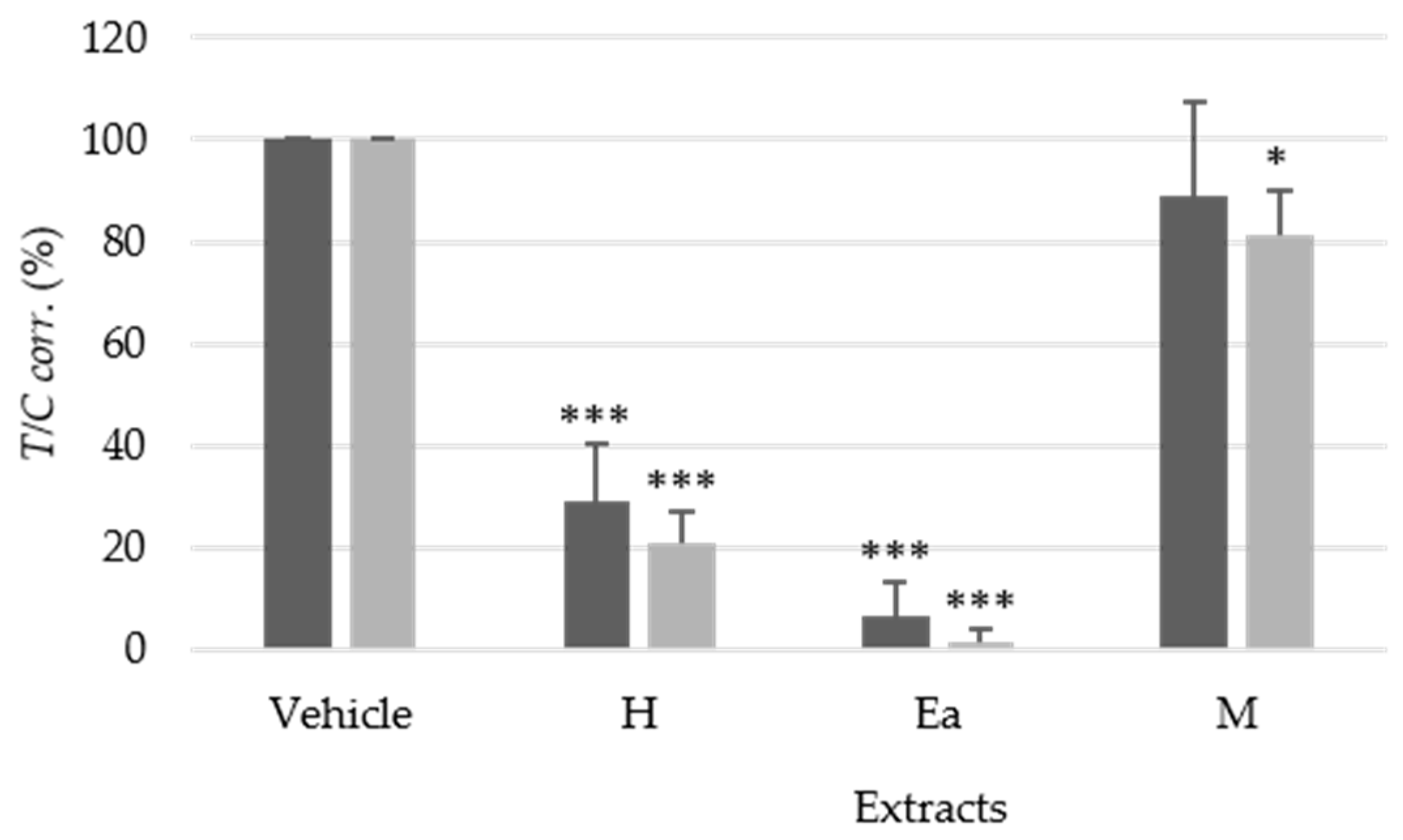
The primary antiproliferative screening was conducted with a single concentration of 50 µg/mL on the hexane, ethyl acetate, and methanolic extracts of B. umbraculum. The results for each extract were expressed as a percentage of cell proliferation relative to DMF (negative control) set as 100%. Figure 3 shows the percentage of proliferation of the two cell lines after 96 h of treatment with the extracts.
After 96 h of treatment, the hexane extract inhibited 70.96% of the MCF-7 cells and 79.06% of the SiSo cells (p < 0.005). The ethyl acetate extract inhibited 93.39% of the MCF-7 cells and 98.56% of the SiSo cells (p < 0.005) (Figure 3). The antiproliferative activity of the ethyl acetate extract was greater compared to that of the hexane extract at a concentration of 50 µg/mL. The SiSo cell line appeared more sensitive to the tested samples at this concentration. Under the same conditions, the methanolic extract did not inhibit the proliferation of the MCF-7 cell line. However, a weak antiproliferative effect was observed on the SiSo cell line (18.66%, p < 0.05).

3.5.2. Determination of the Half-Maximal Inhibitory Concentration (IC50) Values of the Potent Extracts

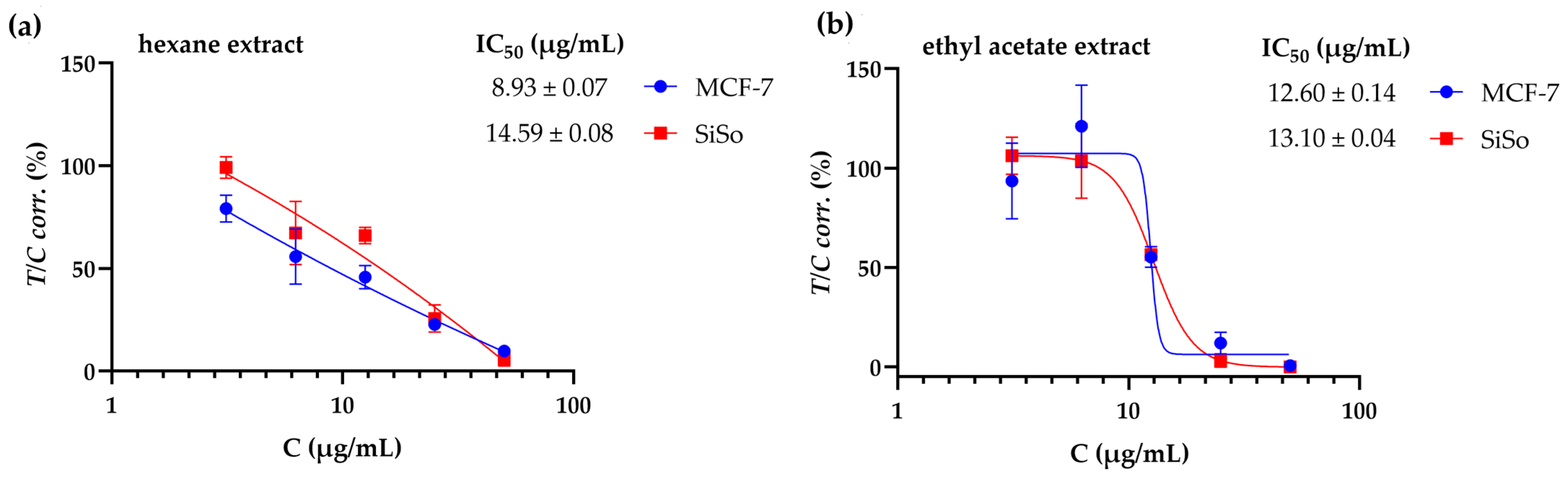
A secondary screening was carried out on the extracts that inhibited more than 50% of the cell proliferation of the two cell lines during the primary screening. The extracts were tested at concentrations of 50, 25, 12.5, 6.25, and 3.12 µg/mL were tested in order to determine the IC50 values displayed in Figure 4.
The hexane extract gradually inhibited the proliferation of both cell lines as the concentration increased, as reflected by the shallow slope in Figure 4a. It showed the lowest IC50 value against the MCF-7 cell line (8.93 ± 0.07 µg/mL).
At a low concentration, the treatment with the ethyl acetate extract maintained a high cell viability percentage until a concentration was reached that drastically inhibited the proliferation of the two cell lines, as indicated by the steep slope in Figure 4b. Compared to the hexane extract, the ethyl acetate extract displayed a slightly lower IC50 value against the SiSo cell line (13.10 ± 0.04 µg/mL).

4. Discussion

The primary antiproliferative screening of the extracts of B. umbraculum demonstrated that at a concentration of 50 µg/mL, the active compounds against MCF-7 and SiSo cell lines are concentrated in the lipophilic and mid-polar extracts. The methanolic extract may contain trace amounts of antiproliferative compounds against the SiSo cell line, as suggested by the T/C corr. value (81.34%, p < 0.05, Figure 3). However, compared to the negative control, the methanolic extract did not sufficiently inhibit the proliferation of the MCF-7 cells, implying that this extract has no relevant activity against this cell line at 50 µg/mL.
While using a single concentration of 50 µg/mL in the primary screening, the two potent extracts inhibited the SiSo cell line more than the MCF-7 cell line. However, the secondary screening involving a range of concentrations revealed that, at low concentrations, those extracts have a greater effect on the MCF-7 cell line than on the SiSo cell line. The steep sigmoidal curve of the ethyl acetate extract (Figure 4b) suggests that a small increase in concentration is sufficient to reach the maximal effect in both cell lines. Correspondingly, the shallow slope of the concentration–response curves of the hexane extract in Figure 4a implies that a much higher concentration is required to achieve the maximal effect in both cell lines.
MCF-7 cells replicate more slowly than SiSo cells with reported doubling times of approximately 63 h and 48 h, respectively [27]. Despite this low proliferating rate, MCF-7 displayed comparable or even greater sensitivity to the extracts, especially to the hexane extract, based on the observed IC50 values. This implies that the detected antiproliferative effects of the extracts do not strictly depend on rapid cell division and may involve mechanisms related to fundamental cellular functions.
In a previous study our group performed with the exact same experimental protocol, including identical cell lines, treatment duration, and assay methodology, pure chemotherapeutic compounds exhibited very low 50% growth inhibitory values (GI50) [27], which are directly comparable to the IC50 values reported here. For example, 5-fluorouracil (5-FU) inhibited the proliferation of the MCF-7 and SiSo cell lines with GI50 values of approximately 0.28 µg/mL (2.15 µM) and 0.263 µg/mL (2.02 µM), respectively. Pacitaxel inhibited the MCF-7 and SiSo cell lines with GI50 of approximately 0.0009 µg/mL (0.0011 µM) and 0.0018 µg/mL (0.0022 µM), respectively. Those reference data were not generated concurrently with our experiments and, therefore, cannot be used for direct quantitative comparisons, but rather provide a contextual reference. Within this framework, the hexane and ethyl acetate extracts of B. umbraculum displayed a meaningful antiproliferative potency with IC50 values less than 15 µg/mL against the two cell lines. The validity of the assay was supported by the concentration-dependent activity of the extracts and the use of a well-standardized experimental protocol. Considering the complex composition of the extracts, which may include inactive and antagonistic components, their antiproliferative potencies remain noteworthy in this regard.
With regard to the phytoconstituents, the findings in our study confirm the presence of flavonoids, triterpenoids, steroids, polyphenols, tannins, and polysaccharides in B. umbraculum, as previously reported [11,12].
Compound 1 was isolated from the ethyl acetate extract. The characteristic signals, such as the clustered peaks corresponding to a polycyclic structure, oxymethine, and the carboxylic acid function, justify the proposal of a triterpenic acid as a possible structure. The chemical shift values of the olefinic carbons were rather typical of ursane-type triterpenic acid rather than oleanane or malsinane types. C-12 is more shielded, and C-13 is more deshielded due to the presence of the methyl group (C-29) at C-19 instead of at C-20 [30].
The chemical shift assignment of ursolic acid continues to be refined in the literature, with most reported NMR spectra recorded in CDCl3 [30,31,32,34]. Although our spectra were recorded in CD3OD, the previous data enabled us to adjust our chemical shift assignment in combination with the 2D NMR correlations in the obtained experimental spectra. Despite obvious variations, the average absolute difference of 13C NMR chemical shifts for compound 1 (approximately 0.9 ppm) is still in the acceptable range [35].
Protons in the polar and non-polar regions of ursolic acid display chemical shifts deviating from the expected trend [36,37,38]. In addition, the signals of the exchangeable protons of the carboxylic acid and the oxymethine were not detected in the 1H NMR spectra recorded in either CDCl3 or CD3OD [30,32,34].
In CDCl3, hydroxyl groups engaging in weak intramolecular H-bonds (IMHB) may explain the absence of these broad signals in the spectra. In CD3OD, the disruption of the IMHBs orients the polar head groups toward the solvent, causing nearby polar protons to shift upfield and, correspondingly, triggering the deshielding of some non-polar protons in the pentacyclic backbone [39,40]. The rapid proton exchange in a polar environment may explain why the hydroxyl signals are not detected in our spectra. Ursolic acid may adapt to its electronic environment depending on its solvation state, a chameleonic-like behavior that is increasingly gaining attention in small molecules [41,42]. A computational NMR study is required to deeply understand the observed unconventional chemical shift variations.
We have not yet tested the antiproliferative activity of ursolic acid against the MCF-7 and SiSo cell lines. However, this compound is known to exhibit biological activities, including anticancer properties. Lewinska et al. demonstrated the anticancer effects of ursolic acid at a low micromolar range on MCF-7 [43]. Ursolic acid may contribute to the detected activity on the ethyl acetate extract of B. umbraculum. Additional antiproliferative tests are warranted to quantify its contribution to that effect.
Compound 2 was isolated from the methanolic extract of B. umbraculum. The chemical shift pattern in the aromatic region of both 1H and 13C NMR spectra points to a substituted flavonoid backbone. The remaining signals were consistent with sugar moieties apart from the single methyl group. The HMBC correlation between the anomeric proton at δH 5.12 ppm and the carbon at δC 135.62 ppm justifies the position of the glycosyl moiety on the flavonoid backbone. The overall set of chemical shifts of compound 2 was consistent with the structure of rutin. Some variations were noted compared with previously reported NMR spectral data of rutin recorded in CD3OD [33,44]. While the chemical shift values were more or less similar, our assignment of C-2 and C-9 differs from the literature [33], as we considered the HMBC correlations where C-2 is correlated with H-2’ and C-9 with H-8. The assignment of C-3″ and C-5″ also differs from the literature [33], as we referred to the COSY correlation between H-5″ and H-6″. The minor discrepancies, supported by the average absolute chemical shift difference for the carbons in compound 2 (approximately 0.19 ppm), may arise from experimental conditions rather than from structural inconsistency [45].
In terms of biological activity, a previous study reported that rutin was ineffective against MCF-7 at a concentration of 20 μM [46]. Our data are consistent with this observation, as the methanolic extract from which rutin was isolated did not possess antiproliferative activity on the MCF-7 cell line. However, at the same concentration, rutin demonstrated a slight effect against the aggressive human breast cancer cell line MDA-MB-231 and acted as an efficient adjuvant for cyclophosphamide and methotrexate against this cell line [46]. This may explain the weak yet significant activity of the methanolic extract towards the SiSo cell line (Figure 3).
Rutin and ursolic acid supplement the phytochemical profile of B. umbraculum, supporting this plant as a source for the isolation of these two compounds for pharmaceutical purposes and offering new perspectives on biological activities related to these structures.

5. Conclusions

B. umbraculum significantly inhibited the proliferation of the MCF-7 and SiSo cell lines. The lipophilic (hexane) and mid-polar (ethyl acetate) extracts are the prominent sources of antiproliferative compounds in this plant. The methanolic extract showed no relevant activity against the MCF-7 cell line, while only a slight effect was detected on the SiSo cell line at a concentration of 50 µg/mL. Ursolic acid was isolated from the active ethyl acetate extract, and rutin was isolated from the methanolic extract. The comparison of NMR data in solvents of different polarities led to the observation of chameleonic properties of ursolic acid. To our knowledge, this study reports the first evidence of the presence and isolation of ursolic acid and rutin from B. umbraculum. Further fractionation may uncover more antiproliferative phytoconstituents against MCF-7 and SiSo cell lines, along with other bioactive components with benign properties in the context of sustainable drug research.

Supplementary Materials

The following supporting information can be downloaded at https://www.mdpi.com/article/10.3390/compounds6010019/s1. Figure S1: Biophytum umbraculum Welw. (Oxalidaceae); Figure S2: 1H NMR spectra of compound 1; Figure S3: 13C NMR spectra of compound 1; Figure S4: HMQC NMR spectra of compound 1; Figure S5: HMBC NMR spectra of compound 1; Figure S6: COSY NMR spectra of compound 1; Figure S7: 1H NMR spectra of compound 2; Figure S8: 13C NMR spectra of compound 2; Figure S9: DEPT-135 NMR spectra of compound 2; Figure S10: HMQC NMR spectra of compound 2; Figure S11: HMBC NMR spectra of compound 2; Figure S12: COSY NMR spectra of compound 2; Scheme S1: Extraction process of Biophytum umbraculum plant powder by successive maceration using solvents of increasing polarity; Scheme S2: Successive fractionations of the ethyl acetate extract of Biophytum umbraculum by gravity column chromatography; Scheme S3: Successive fractionations of the methanolic extract of Biophytum umbraculum by chromatography; Table S1: Masses of the fractions and elution systems used for the fractionation of the ethyl acetate extract of Biophytum umbraculum by gravity column chromatography; Table S2: Masses of the subfractions and elution systems used to fractionate Ea.F3 from the ethyl acetate extract of Biophytum umbraculum by gravity column chromatography; Table S3: Masses of the fractions and elution systems used to fractionate the methanolic extract of Biophytum umbraculum by gravity column chromatography; Table S4: Masses of the subfractions obtained from the flash chromatography of M.F5 from the methanolic extract of Biophytum umbraculum; Table S5: Results of the qualitative phytochemical screening performed on the plant powder or on the hydroethanolic extract of Biophytum umbraculum, based on colorimetric or precipitation tests; Table S6: Assignment of NMR chemical shifts of compound 1 with 2D correlations; Table S7: Assignment of NMR chemical shifts of compound 2 with 2D correlations.

Author Contributions

Conceptualization, M.R.; methodology, M.R., S.T., C.S., and P.J.B.; formal analysis, M.R., S.T., and S.M.; resources, R.R., D.A.R., P.J.B., and A.L.; data curation, M.R. and R.R.; writing—original draft preparation, M.R.; writing—review and editing, M.R., R.R., S.T., C.S., D.A.R., P.J.B., and A.L.; supervision, R.R., D.A.R., and A.L.; project administration, R.R. and A.L.; funding acquisition: R.R. and A.L. All authors have read and agreed to the published version of the manuscript.

Funding

This research was funded by the Deutscher Akademischer Austauschdienst (DAAD), grant number 57645447.

Data Availability Statement

The original data presented in the study are openly available in the repository CKAN (Comprehensive Knowledge Archive Network), University of Greifswald, at https://ckan.fdm.uni-greifswald.de/dataset/ursolic-acid-and-rutin-isolated-from-biophytum-umbraculum, accessed on 5 January 2026. The ABS is registered in the ABS Clearing-House (ABSCH) of the Convention on Biological Diversity (https://absch.cbd.int/en/countries/MG) under permit No. 005/2025/MEDD/SG/DGGE/DAPRNE/ANC-APA, (ABSCH-IRCC-MG-280791-1, accessed on 24 October 2025), issued by the Autorité Nationale Compétente APA (ANC-APA), Ministry of Environment and Sustainable Development (MEDD), Madagascar.

Acknowledgments

M.R. thanks all of the laboratory members of the Pharmaceutical/Medicinal Chemistry Department at the University of Greifswald, Germany, and of the LCSN/COB, LCAF, and LPNB at the University of Antananarivo, Madagascar, for their invaluable support. The authors also thank the DAAD for providing M.R. with the research grant that has made this research project possible.

Conflicts of Interest

The authors declare no conflicts of interest.

Abbreviations

The following abbreviations are used in this manuscript:
CVSCrystal violet staining
DMFDimethylformamide
DPBSDulbecco’s Phosphate Buffer Saline
IC50Half-maximal inhibitory concentration
IUPACInternational Union of Pure and Applied Chemistry
MCF-7Michigan Cancer Foundation-7
MDA-MB-231M D Anderson-Metastatic Breast-231
ODOptical density
PBZTParc botanique et zoologique Tsimabazaza
SiSoSiha supplementary ovarian
T/C corr.Treatment versus control corrected

References

  1. Veeresham, C. Natural Products Derived from Plants as a Source of Drugs. J. Adv. Pharm. Technol. Res. 2012, 3, 200–201. [Google Scholar] [CrossRef]
  2. Sharma, N.; Dobhal, M.; Joshi, Y.; Chahar, M. Flavonoids: A Versatile Source of Anticancer Drugs. Pharmacogn. Rev. 2011, 5, 1–12. [Google Scholar] [CrossRef]
  3. Kamran, S.; Sinniah, A.; Abdulghani, M.A.M.; Alshawsh, M.A. Therapeutic Potential of Certain Terpenoids as Anticancer Agents: A Scoping Review. Cancers 2022, 14, 1100. [Google Scholar] [CrossRef]
  4. Dhyani, P.; Quispe, C.; Sharma, E.; Bahukhandi, A.; Sati, P.; Attri, D.C.; Szopa, A.; Sharifi-Rad, J.; Docea, A.O.; Mardare, I.; et al. Anticancer Potential of Alkaloids: A Key Emphasis to Colchicine, Vinblastine, Vincristine, Vindesine, Vinorelbine and Vincamine. Cancer Cell Int. 2022, 22, 206. [Google Scholar] [CrossRef]
  5. Amin, A.; Gali-Muhtasib, H.; Ocker, M.; Schneider-Stock, R. Overview of Major Classes of Plant-Derived Anticancer Drugs. Int. J. Biomed. Sci. IJBS 2009, 5, 1–11. [Google Scholar] [CrossRef] [PubMed]
  6. Kohn, E.C.; Ivy, S.P. Confronting the Care Delivery Challenges Arising from Precision Medicine. Front. Oncol. 2016, 6, 106. [Google Scholar] [CrossRef] [PubMed]
  7. Wang, X.; Zhang, H.; Chen, X. Drug Resistance and Combating Drug Resistance in Cancer. Cancer Drug Resist. 2019, 2, 141–160. [Google Scholar] [CrossRef] [PubMed]
  8. Uchiya, T.d.S.; da Cunha, H.N.; Casotti, M.C.; Castro, G.d.S.C.d.; Pereira, G.F.; Moura, J.A.D.; Machado, A.M.; Rocha, F.V.V.; Mauricio, L.S.R.; Lopes, V.A.; et al. Resilience in Adversity: Exploring Adaptive Changes in Cancer Cells under Stress. Tissue Cell 2025, 93, 102756. [Google Scholar] [CrossRef]
  9. Blagosklonny, M.V. Selective Protection of Normal Cells from Chemotherapy, While Killing Drug-Resistant Cancer Cells. Oncotarget 2023, 14, 193–206. [Google Scholar] [CrossRef]
  10. Biophytum umbraculum Welw. Available online: https://doi.org/10.15468/dl.9wxbgh (accessed on 29 October 2025). [CrossRef]
  11. Fisseha, N.; Hammeso, W.W.; Nureye, D. Anticonvulsant Activity of Hydro Alcoholic Extract and Solvent Fractions of Biophytum umbraculum Welw. Syn (Oxalidaceae) Root in Mice. J. Exp. Pharmacol. 2022, 14, 291–299. [Google Scholar] [CrossRef]
  12. Inngjerdingen, K.T.; Coulibaly, A.; Diallo, D.; Michaelsen, T.E.; Paulsen, B.S. A Complement Fixing Polysaccharide from Biophytum petersianum Klotzsch, a Medicinal Plant from Mali, West Africa. Biomacromolecules 2006, 7, 48–53. [Google Scholar] [CrossRef]
  13. Pham, A.; Nguyen, C.; Malterud, K.; Diallo, D.; Wangensteen, H. Bioactive Flavone-C-Glycosides of the African Medicinal Plant Biophytum umbraculum. Molecules 2013, 18, 10312–10319. [Google Scholar] [CrossRef]
  14. Austarheim, I.; Pham, A.T.; Nguyen, C.; Zou, Y.-F.; Diallo, D.; Malterud, K.E.; Wangensteen, H. Antiplasmodial, Anti-Complement and Anti-Inflammatory in Vitro Effects of Biophytum umbraculum Welw. Traditionally Used against Cerebral Malaria in Mali. J. Ethnopharmacol. 2016, 190, 159–164. [Google Scholar] [CrossRef] [PubMed]
  15. Zappavigna, S.; Cossu, A.M.; Grimaldi, A.; Bocchetti, M.; Ferraro, G.A.; Nicoletti, G.F.; Filosa, R.; Caraglia, M. Anti-Inflammatory Drugs as Anticancer Agents. Int. J. Mol. Sci. 2020, 21, 2605. [Google Scholar] [CrossRef] [PubMed]
  16. Raal, A.; Liira, J.; Lepiku, M.; Ilina, T.; Kovalyova, A.; Strukov, P.; Gudzenko, A.; Koshovyi, O.; Raal, A.; Liira, J.; et al. The Composition of Essential Oils and the Content of Saponins in Different Parts of Gilia capitata Sims. Crops 2025, 5, 33. [Google Scholar] [CrossRef]
  17. Li, Y.; Yang, X.; Yang, W.; Bian, Z.; Fang, J.; Zhao, A.; Bao, X.; Niu, S.; Bai, J.; Zheng, Y.; et al. Physicochemical Characterization and Immune Activity of Water-Extract Polysaccharides by Stepwise Ethanol Precipitation from Wild Cordyceps Sinensis. Chem. Biol. Technol. Agric. 2025, 12, 148. [Google Scholar] [CrossRef]
  18. Rasoazanakolona, V.; Rakotonjanahary, X. Improvement of the Nutritional and Technological Quality of Rice by Steaming. OALib 2021, 8, e7081. [Google Scholar] [CrossRef]
  19. Sasidharan, S.; Chen, Y.; Saravanan, D.; Sundram, K.; Latha, L. Extraction, Isolation and Characterization of Bioactive Compounds From Plants’ Extracts. Afr. J. Tradit. Complement. Altern. Med. 2010, 8, 1–10. [Google Scholar] [CrossRef]
  20. Duncan, A.C.; Jäger, A.K.; van Staden, J. Screening of Zulu Medicinal Plants for Angiotensin Converting Enzyme (ACE) Inhibitors. J. Ethnopharmacol. 1999, 68, 63–70. [Google Scholar] [CrossRef]
  21. Parekh, J.; Karathia, N.; Chanda, S. Evaluation of Antibacterial Activity and Phytochemical Analysis of Bauhinia variegata L. Bark. Afr. J. Biomed. Res. 2006, 9, 53–56. [Google Scholar] [CrossRef]
  22. Suryani, A.E.; Nisa, K.; Indrianingsih, A.W.; Handayani, S.; Fitrotin, U.; Rahayu, E.; Wulandari, A.A.; Wijayati, N. Phytochemical Screening and Antibacterial Properties of Sungkai (Peronema canescens Jack.) Leaf Extract and Fraction. IOP Conf. Ser. Earth Environ. Sci. 2024, 1377, 012060. [Google Scholar] [CrossRef]
  23. Kusena, J.W.T.; Shariatzadeh, M.; Studd, A.J.; James, J.R.; Thomas, R.J.; Wilson, S.L. The Importance of Cell Culture Parameter Standardization: An Assessment of the Robustness of the 2102Ep Reference Cell Line. Bioengineered 2021, 12, 341–357. [Google Scholar] [CrossRef]
  24. Noel, V.; Berry, M.D. Culture of Adherent Cancer Cell Lines. In Cancer Cell Biology; Christian, S.L., Ed.; Methods in Molecular Biology; Springer: New York, NY, USA, 2022; Volume 2508, pp. 19–29. [Google Scholar]
  25. Talebipour, A.; Saviz, M.; Vafaiee, M.; Faraji-Dana, R. Facilitating Long-Term Cell Examinations and Time-Lapse Recordings in Cell Biology Research with CO2 Mini-Incubators. Sci. Rep. 2024, 14, 3418. [Google Scholar] [CrossRef]
  26. Feoktistova, M.; Geserick, P.; Leverkus, M. Crystal Violet Assay for Determining Viability of Cultured Cells. Cold Spring Harb. Protoc. 2016, 2016, pdb.prot087379. [Google Scholar] [CrossRef]
  27. Bracht, K.; Boubakari; Grünert, R.; Bednarski, P.J. Correlations between the Activities of 19 Anti-Tumor Agents and the Intracellular Glutathione Concentrations in a Panel of 14 Human Cancer Cell Lines: Comparisons with the National Cancer Institute Data. Anticancer Drugs 2006, 17, 41–51. [Google Scholar] [CrossRef] [PubMed]
  28. Tesfaye, S.; Braun, H.; Asres, K.; Engidawork, E.; Belete, A.; Muhammad, I.; Schulze, C.; Schultze, N.; Guenther, S.; Bednarski, P.J. Ethiopian Medicinal Plants Traditionally Used for the Treatment of Cancer; Part 3: Selective Cytotoxic Activity of 22 Plants against Human Cancer Cell Lines. Molecules 2021, 26, 3658. [Google Scholar] [CrossRef]
  29. Mbaoji, F.N.; Behnisch-Cornwell, S.; Ezike, A.C.; Nworu, C.S.; Bednarski, P.J. Pharmacological Evaluation of the Anticancer Activity of Extracts and Fractions of Lannea barteri Oliv. (Anacardiaceae) on Adherent Human Cancer Cell Lines. Molecules 2020, 25, 849. [Google Scholar] [CrossRef]
  30. Dais, P.; Plessel, R.; Williamson, K.; Hatzakis, E. Complete 1H and 13C NMR Assignment and 31P NMR Determination of Pentacyclic Triterpenic Acids. Anal. Methods 2017, 9, 949–957. [Google Scholar] [CrossRef]
  31. Yuan, K.; Qiao, W.-T.; Yin, M.-W. Phytochemical Studies of Mussaenda hainanensis Merr. Asian J. Chem. 2009, 21, 7138–7142. [Google Scholar]
  32. Honda, C.; Inoue, N.; Sakamoto, N.; Suwa, K.; Oku, H. Deterministic 13C NMR Analysis of Oleanolic and Ursolic Acid Derivatives Based on Application of 2D INADEQUATE NMR Technique. Discov. Chem. 2025, 2, 298. [Google Scholar] [CrossRef]
  33. Li, L.; Henry, G.E.; Seeram, N.P. Identification and Bioactivities of Resveratrol Oligomers and Flavonoids from Carex folliculata Seeds. J. Agric. Food Chem. 2009, 57, 7282–7287. [Google Scholar] [CrossRef]
  34. Migas, P.; Cisowski, W.; Dembińska-Migas, W. Isoprene Derivatives from the Leaves and Callus Cultures of Vaccinium corymbosum Var. Bluecrop. Acta Pol. Pharm. 2005, 62, 45–51. [Google Scholar]
  35. Gerothanassis, I.P.; Kupka, T. New Insights into Nuclear Magnetic Resonance (NMR) Spectroscopy. Molecules 2025, 30, 1500. [Google Scholar] [CrossRef]
  36. Gottlieb, H.E.; Kotlyar, V.; Nudelman, A. NMR Chemical Shifts of Common Laboratory Solvents as Trace Impurities. J. Org. Chem. 1997, 62, 7512–7515. [Google Scholar] [CrossRef] [PubMed]
  37. Beyer, T.; Schollmayer, C.; Holzgrabe, U. The Role of Solvents in the Signal Separation for Quantitative 1H NMR Spectroscopy. J. Pharm. Biomed. Anal. 2010, 52, 51–58. [Google Scholar] [CrossRef]
  38. Abraham, R.J.; Byrne, J.J.; Griffiths, L.; Perez, M. 1H Chemical Shifts in NMR: Part 23, the Effect of Dimethyl Sulphoxide versus Chloroform Solvent on1H Chemical Shifts. Magn. Reson. Chem. 2006, 44, 491–509. [Google Scholar] [CrossRef] [PubMed]
  39. Goetz, G.H.; Farrell, W.; Shalaeva, M.; Sciabola, S.; Anderson, D.; Yan, J.; Philippe, L.; Shapiro, M.J. High Throughput Method for the Indirect Detection of Intramolecular Hydrogen Bonding. J. Med. Chem. 2014, 57, 2920–2929. [Google Scholar] [CrossRef]
  40. Shalaeva, M.; Caron, G.; Abramov, Y.A.; O’Connell, T.N.; Plummer, M.S.; Yalamanchi, G.; Farley, K.A.; Goetz, G.H.; Philippe, L.; Shapiro, M.J. Integrating Intramolecular Hydrogen Bonding (IMHB) Considerations in Drug Discovery Using ΔlogP as a Tool. J. Med. Chem. 2013, 56, 4870–4879. [Google Scholar] [CrossRef] [PubMed]
  41. Lemke, J.; Mengers, N.; Schmidt, L.; Schulig, L.; König, S.; Rosendahl, P.; Bartz, F.-M.; Garscha, U.; Bednarski, P.J.; Link, A. Lead Optimization of Positive Allosteric KV7.2/3 Channel Modulators toward Improved Balance of Lipophilicity and Aqueous Solubility. J. Med. Chem. 2025, 68, 8377–8399. [Google Scholar] [CrossRef]
  42. Jiménez, D.G.; Vallaro, M.; Vitagliano, L.; López, L.L.; Apprato, G.; Ermondi, G.; Caron, G. Molecular Properties, Including Chameleonicity, as Essential Tools for Designing the next Generation of Oral beyond Rule of Five Drugs. ADMET DMPK 2024, 12, 721–736. [Google Scholar] [CrossRef]
  43. Lewinska, A.; Adamczyk-Grochala, J.; Kwasniewicz, E.; Deregowska, A.; Wnuk, M. Ursolic Acid-Mediated Changes in Glycolytic Pathway Promote Cytotoxic Autophagy and Apoptosis in Phenotypically Different Breast Cancer Cells. Apoptosis 2017, 22, 800–815. [Google Scholar] [CrossRef] [PubMed]
  44. Cedeño, H.; Espinosa, S.; Andrade, J.M.; Cartuche, L.; Malagón, O.; Cedeño, H.; Espinosa, S.; Andrade, J.M.; Cartuche, L.; Malagón, O. Novel Flavonoid Glycosides of Quercetin from Leaves and Flowers of Gaiadendron punctatum G.Don. (Violeta de Campo), Used by the Saraguro Community in Southern Ecuador, Inhibit α-Glucosidase Enzyme. Molecules 2019, 24, 4267. [Google Scholar] [CrossRef] [PubMed]
  45. Basar, N.; Damodaran, K.; Liu, H.; Morris, G.A.; Sirat, H.M.; Thomas, E.J.; Curran, D.P. Systematic Comparison of Sets of 13C NMR Spectra That Are Potentially Identical. Confirmation of the Configuration of a Cuticular Hydrocarbon from the Cane Beetle Antitrogus parvulus. J. Org. Chem. 2014, 79, 7477–7490. [Google Scholar] [CrossRef]
  46. Iriti, M.; Kubina, R.; Cochis, A.; Sorrentino, R.; Varoni, E.M.; Kabała-Dzik, A.; Azzimonti, B.; Dziedzic, A.; Rimondini, L.; Wojtyczka, R.D. Rutin, a Quercetin Glycoside, Restores Chemosensitivity in Human Breast Cancer Cells. Phytother. Res. PTR 2017, 31, 1529–1538. [Google Scholar] [CrossRef] [PubMed]
Figure 1. Structure proposal of compound 1; IUPAC name: (3β)-3-hydroxyurs-12-en-28-oic acid.
Compounds 06 00019 g001
Figure 2. Structure proposal of compound 2; IUPAC name: 2-(3,4-dihydroxyphenyl)-5,7-dihydroxy-3-[(2S,3R,4S,5S,6R)-3,4,5-trihydroxy-6-[[(2R,3R,4R,5R,6S)-3,4,5-trihydroxy-6-methyloxan-2-yl]oxymethyl]oxan-2-yl]oxychromen-4-one.
Compounds 06 00019 g002
Figure 3. Antiproliferative effect of the extracts of Biophytum umbraculum on the MCF-7 and SiSo cell lines, with primary screening conducted with a crystal violet staining (CVS) assay. Tested concentration of the extracts: 50 µg/mL; vehicle: DMF (negative control); H: hexane extract; Ea: ethyl acetate extract; M: methanolic extract; T/C corr.: treatment versus control corrected; mean + SD; n = 3. * p < 0.05, *** p < 0.005.
Compounds 06 00019 g003
Figure 4. Concentration–response curves from nonlinear regression fits showing the antiproliferative effects of the hexane (a) and ethyl acetate (b) extracts of Biophytum umbraculum on the MCF-7 and SiSo cell lines. Secondary screening was conducted with a crystal violet staining (CVS) assay. Data points represent mean T/C corr. values ± SD; n = 3. Half-maximal inhibitory concentration (IC50) values are expressed as mean ± SD.
Compounds 06 00019 g004
Table 1. Assignment of NMR chemical shifts of compound 1 based on the interpretation of the 1D (1H and 13C) and 2D (COSY, HMQC, and HMBC) NMR spectra recorded in deuterated methanol (CD3OD), comparison with the reported chemical shift assignment of ursolic acid recorded in deuterated chloroform (CDCl3).
Experimental DataLiterature [32]
13 CC (ppm)1HH (ppm)C (ppm) H (ppm)
C-139.84H-11.69, 1.0138.71.65
C-227.90H-21.54, 1.63 27.31.60
C-379.79H-33.1679.13.22
C-440.42 38.8
C-556.74H-50.7655.30.73
C-619.48H-61.39, 1.5818.41.39, 1.54
C-734.33H-71.33, 1.5533.11.32, 1.51
C-840.70 39.6
C-948.97H-91.5747.71.52
C-1038.11 37.1
C-1124.36H-111.9423.41.91–1.94
C-12126.90H-125.23126.05.27
C-13139.64 138.0
C-1443.24 42.1
C-1529.21H-151.0728.11.11, 1.87
C-1625.32H-162.04, 1.6324.32.03, 1.66
C-1748.9 48.0
C-1854.37H-182.2052.92.20
C-1940.42H-190.9739.21.33
C-2039.99H-201.6638.91.02
C-2131.77H-211.53, 1.4930.71.31
C-2238.11H-221.63, 1.6936.81.75, 1.64
C-2316.38H-230.7815.6 0.78
C-2429.53H-241.2528.20.99
C-2516.02H-250.9615.50.93
C-2617.80H-260.8517.20.81
C-2724.09H-271.1223.61.09
C-28181.6 179.8
C-2917.64H-290.8917.00.87
C-3021.57H-300.9721.20.95
Table 2. Assignment of the NMR chemical shifts of compound 2 based on the interpretation of the 1D (1H, 13 C, and DEPT-135) and 2D (COSY, HMQC, and HMBC) NMR spectra and comparison with the reported chemical shift assignment of rutin in a previous study. All spectra were recorded in deuterated methanol (CD3OD).
Experimental DataLiterature [33]
13 CC (ppm)1HH (ppm)C (ppm)H (ppm)
C-2159.33 158.49
C-3135.62 135.64
C-4179.43 179.40
C-5163.02 162.97
C-699.97H-66.2299.956.10
C-7166.14 166.02
C-894.87H-86.4194.876.29
C-9158.54 159.33
C-10105.61 105.61
C-1′123.12 123.57
C-2′117.67H-2′7.67117.707.57
C-3′145.86 145.83
C-4′149.83 149.81
C-5′116.05H-5′6.88116.056.77
C-6′123.54H-6′7.64123.107.54
C-1″104.71H-1″5.12104.755.0
C-2″75.73H-2″3.4875.933.2–3.7
C-3″77.24H-3″3.3178.173.2–3.7
C-4″71.40H-4″3.2671.383.2–3.7
C-5″78.19H-5″3.4277.203.2–3.7
C-6″68.55H-6″3.8168.553.2–3.7
C-1‴102.43H-1‴4.52102.424.42
C-2‴72.11H-2‴3.6372.10
C-3‴72.23H-3‴3.5472.233.2–3.7
C-4‴73.93H-4‴3.2973.933.2–3.7
C-5‴69.71H-5‴3.4569.713.2–3.7
C-6‴17.88H-6‴1.1217.901.01
Disclaimer/Publisher’s Note: The statements, opinions and data contained in all publications are solely those of the individual author(s) and contributor(s) and not of MDPI and/or the editor(s). MDPI and/or the editor(s) disclaim responsibility for any injury to people or property resulting from any ideas, methods, instructions or products referred to in the content.