1. Introduction
The continuous release of antibiotic residues into aquatic environments has become a major global concern due to their persistence, bioactivity, and contribution to antimicrobial resistance. The World Health Organization identifies antibiotic resistance as one of the most urgent environmental and public health threats, with projections of up to 10 million deaths annually by 2050 if current trends continue [
1,
2]. A substantial proportion of administered antibiotics (40–90%, depending on drug class) is excreted unchanged, entering municipal and hospital wastewater systems and ultimately reaching surface and groundwater bodies [
3,
4,
5,
6,
7,
8,
9]. Their occurrence has been widely documented in drinking water [
4], marine environments [
5], food samples [
6], and effluents from healthcare facilities and wastewater treatment plants (WWTPs) [
7,
8,
9]. Beyond direct toxicological effects, these residues facilitate the spread of antibiotic-resistant bacteria (ARB) and antibiotic-resistance genes (ARG), intensifying ecological pressures and posing long-term risks to human populations [
10,
11]. Conventional WWTPs are not designed to remove pharmaceutical contaminants and frequently exhibit inconsistent removal efficiencies—even in advanced systems, elimination rates often remain below 70% [
12,
13,
14,
15].
Existing treatment technologies, such as biological degradation, membrane filtration, adsorption, and advanced oxidation processes, offer partial solutions but are limited by high operational costs, fouling, generation of toxic by-products, or insufficient selectivity [
16,
17,
18,
19]. As a result, the search for new materials with improved stability, reusability, and affinity for emerging contaminants has accelerated. Nanomaterials are promising candidates due to their tunable surface chemistry, high surface-to-volume ratio, and abundance of reactive sites [
20,
21,
22]. Copper sulfide (CuS) nanostructures, in particular, interact effectively with organic pollutants through surface complexation, defect-mediated interactions, and electrostatic binding. Their p-type character and sulfur-rich surfaces enable strong interactions with functional groups commonly found in antibiotics, such as carboxylates, amines, and aromatic rings. However, the direct use of dispersed CuS nanoparticles is challenged by agglomeration, colloidal instability, and difficult recovery, which may lead to secondary contamination.
Embedding CuS nanoparticles within biopolymeric matrices addresses these limitations by enhancing stability, recoverability, and handling. Alginate, a biodegradable and low-cost polysaccharide, forms hydrophilic hydrogel networks capable of physically entrapping nanomaterials while providing inherent sorption capacity and ion-exchange behavior. Integrating CuS into alginate beads therefore couples the semiconductor’s reactive surface chemistry with the mechanical robustness and permeability of the alginate matrix.
Despite prior studies involving CuS nanoparticles and alginate systems, limited work has examined the systematic influence of thiol concentration on CuS nucleation and optical response, or how controlled bead-fabrication conditions affect the structural features of CuS–alginate composites. The novelty of this study lies in: (i) optimizing Cu:TGA ratios to obtain well-defined excitonic features and phase-pure covellite CuS; (ii) correlating ligand concentration with nanoparticle crystallinity and structural properties; and (iii) producing alginate and CuS–alginate beads in two controlled size regimes with quantified size distributions and surface morphological changes induced by nanoparticle incorporation. These materials-focused insights contribute a synthesis–structure framework not addressed in previous CuS–alginate reports.
The objective of this work is to synthesize thiol-stabilized CuS nanoparticles, characterize their structural and optical properties, and incorporate them into calcium–alginate beads to produce porous, recoverable composite materials. This study establishes a well-defined materials foundation to support subsequent investigations on adsorption and photocatalytic degradation of pharmaceutical contaminants. Consistent with this scope, the present work focuses exclusively on materials synthesis and structural characterization; functional performance such as adsorption and photocatalytic evaluation will be addressed in future studies.
2. Materials and Methods
Copper(II) sulfate pentahydrate (CuSO4·5H2O, ACS reagent, ≥99%, MW 249.7 g/mol, Sigma-Aldrich, St. Louis, MO, USA), sodium hydroxide (NaOH, ACS reagent, 98.5%, MW 40.00 g/mol, Acros Organics, Waltham, MA, USA), thioglycolic acid (TGA, HSCH2COOH, ≥98%, MW 92.11 g/mol, Sigma-Aldrich, St. Louis, MO, USA) was used as precursor for the synthesis and surface stabilization of CuS nanoparticles. Sodium alginate (alginic acid sodium salt, medium viscosity, (C6H7O6Na)n, MP Biomedicals, Solon, OH, USA) and calcium chloride dihydrate (CaCl2·2H2O, ACS reagent, 99.0–105.0%, MW 147.01 g/mol, Spectrum Chemical, New Brunswick, NJ, USA) were used for the preparation of alginate beads. Ultrapure water was used for all experiments. All reagents were used as received, without further purification.
2.1. Synthesis of CuS Nanoparticles Using TGA as Capping Agent
Copper sulfide (CuS) nanoparticles were synthesized in an aqueous medium using thioglycolic acid (TGA) as a stabilizing ligand. In a typical procedure, 20.0 mL of a 0.025 M Cu2+ solution prepared from CuSO4·5H2O was transferred into a two-neck round-bottom flask and heated to 100 °C for 5 min. Separately, TGA solutions were prepared by adjusting the Cu2+: TGA molar ratios to 1:2, 1:4, 1:6, and 1:17. For each case, the pH of the TGA solution was adjusted to 10.6–11.0 using 1.0 M NaOH, and the final volume was brought to 20 mL with deionized water prior to use. These different molar ratios were selected to investigate the effect of ligand concentration on nanoparticle stability and to modulate the ligand-to-metal interactions within the reaction medium.
The thiol-containing solution was then added dropwise to the preheated Cu2+ solution over approximately 5 min under gentle stirring. After complete addition, the second neck of the flask was sealed, and the reaction mixture was refluxed for 6 h to promote nanoparticle formation. The resulting CuS nanoparticles were purified by sequential washing with deionized water and isopropanol, followed by centrifugation at 5000 rpm for 15 min. The collected powders were dried overnight at 60 °C and stored in airtight containers until further characterization.
2.2. Synthesis of Calcium–Alginate Beads Loaded with CuS Nanoparticles
Alginate beads were prepared via ionic gelation using calcium chloride as the crosslinking agent. A 2% w/v sodium alginate solution was prepared by dissolving 2.0 g of sodium alginate in 198 mL of deionized water under continuous stirring until fully homogenized. Separately, a 0.2 M CaCl2 solution was obtained by dissolving 11.88 g of CaCl2·2H2O in 400 mL of deionized water. Beads were formed by dispensing the alginate solution dropwise into the CaCl2 bath using a peristaltic pump, which promoted instantaneous ionic crosslinking between alginate chains and Ca2+ ions. Two tubing diameters (1.0 mm and 0.5 mm) were used to regulate bead size. For each batch, 100 mL of alginate solution was introduced into 100 mL of CaCl2 solution, yielding spherical hydrogel beads.
CuS-loaded beads were produced using the same procedure after incorporating 14.4 mL of a CuS nanoparticle suspension (15,875 ppm) into 198 mL of the alginate solution prior to gelation. Following crosslinking, the CuS–alginate beads were allowed to harden, rinsed thoroughly with deionized water to remove residual salts, and stored in aqueous medium until further use.
2.3. Characterization Techniques
The optical properties of CuS nanoparticles were analyzed by UV–visible spectroscopy over 200–900 nm using a UV-2700i spectrophotometer (Shimadzu, Columbia, MD, USA). Fourier-transform infrared (FTIR) spectra were collected on an IRSpirit spectrometer (Shimadzu) to verify ligand coordination and surface functionalization. The crystalline structure was examined via X-ray diffraction (XRD) using a Siemens Powder Diffractometer D5000 with Cu Kα radiation (Siemens, Munich, Germany). Morphology, particle size, and crystallinity were further characterized by high-resolution transmission electron microscopy (HRTEM) using JEOL-2011 (JEOL Ltd., Tokyo, Japan) and JEM-ARM200F (JEOL Ltd., Tokyo, Japan) instruments. Surface morphology and porosity of the alginate and CuS–alginate beads were evaluated by scanning electron microscopy (SEM) using a JEOL JSM-IT500HR system (JEOL Ltd., Tokyo, Japan). Additionally, the dimensions of the alginate beads were determined using a Nikon Zoom Stereo Microscope SMZ745T (Nikon, Tokyo, Japon).
3. Results
3.1. Optical Characterization of CuS NPs
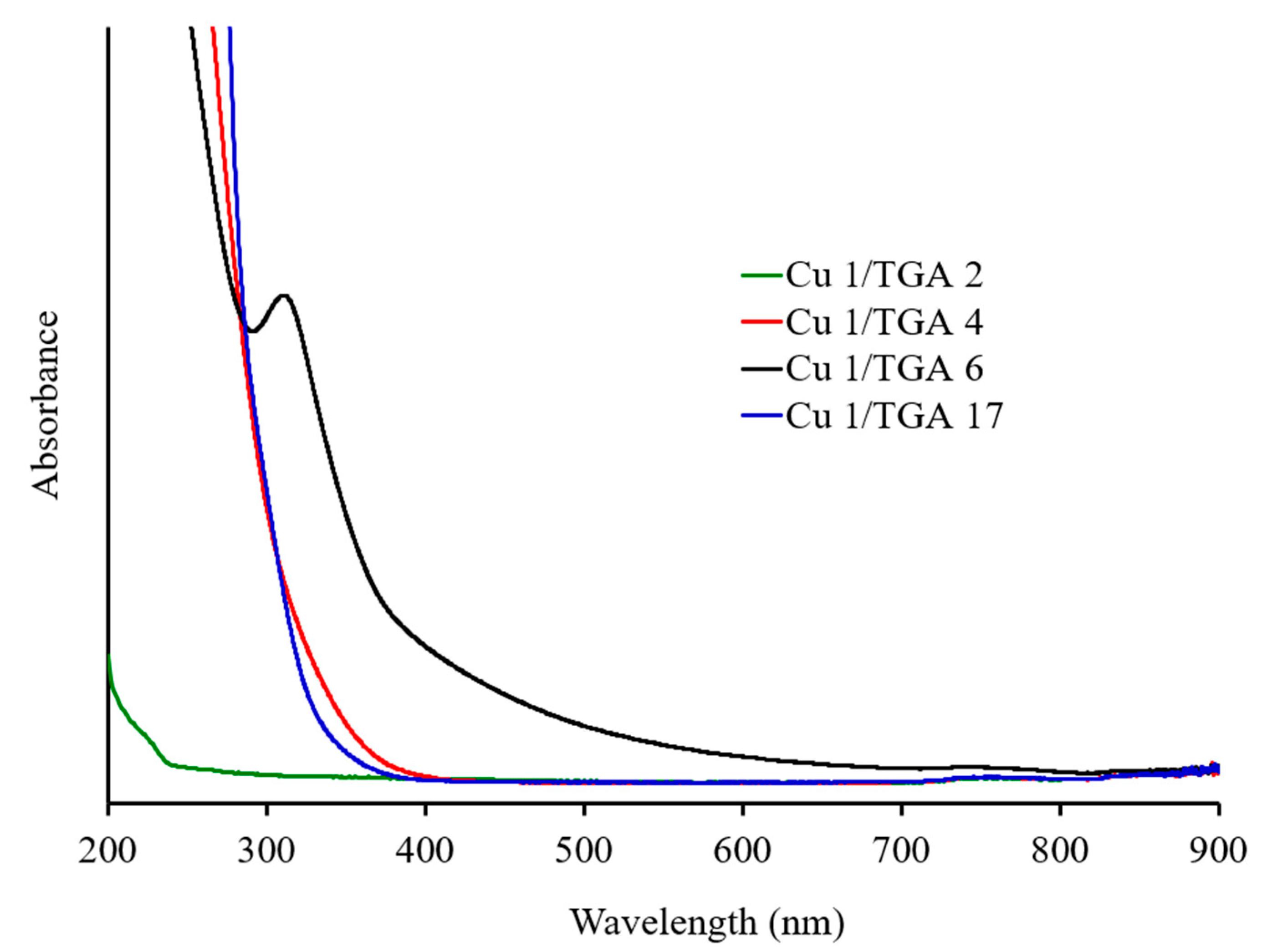
The UV–Vis absorption spectra of CuS nanoparticles synthesized at different Cu
2+:TGA molar ratios (1:2, 1:4, 1:6, and 1:17) are shown in
Figure 1. Among these samples, the 1:6 ratio shows a distinct, well-defined absorption band centered at approximately 312 nm. This feature corresponds to the excitonic transition of CuS nanocrystals, which arises from electronic transitions between the Cu 3d-dominated valence band and the S 3p-dominated conduction band, consistent with the optical behavior reported for nanoscale covellite CuS systems [
23,
24]. The presence and sharpness of this peak indicate the formation of nanocrystals with a relatively narrow size distribution and sufficient surface passivation by TGA.
In contrast, samples synthesized at 1:2 and 1:4 ratios exhibit broader, lower-intensity absorption profiles. These spectra suggest incomplete nucleation and a broader particle-size distribution, likely due to insufficient TGA to effectively cap nuclei and limit particle growth. Under low ligand concentrations, thiol groups cannot saturate the forming surfaces, leading to a combination of suboptimal nucleation and subsequent aggregation, a behavior also reported for other thiol-stabilized metal chalcogenides [
23,
24].
At the opposite extreme, the 1:17 ratio produces a similarly broad and diffuse absorption signal, although for different reasons. Excessive ligand concentration may over-stabilize metal ions in solution, suppressing normal crystal growth and producing either ultrasmall clusters or poorly crystalline species that do not exhibit a clear excitonic transition. This effect, where overly high ligand content disrupts crystallization, has been documented in thiol-mediated nanocrystal synthesis pathways [
23,
24].
Together, these trends demonstrate that the intermediate Cu2+: TGA ratio of 1:6 provides the optimal balance between nucleation and growth, producing particles with superior optical definition. The excitonic peak observed at 312 nm falls within the expected range for CuS nanocrystals with a primary size of ~20 nm, matching the particle dimensions observed by TEM, despite the presence of larger agglomerates in the dried state. Importantly, such aggregates do not negate the underlying nanoscale size of the primary crystallites but rather reflect common dry-state clustering in thiol-capped nanoparticles.
Overall, the comparative spectral profiles shown in
Figure 1 highlight the critical role of TGA concentration in dictating nucleation efficiency, crystal growth kinetics, and optical quality. Based on these observations, the Cu
2+: TGA ratio of 1:6 was selected as the optimal condition for subsequent structural and morphological characterization [
23,
24].
3.2. Surface Characterization of CuS NPs
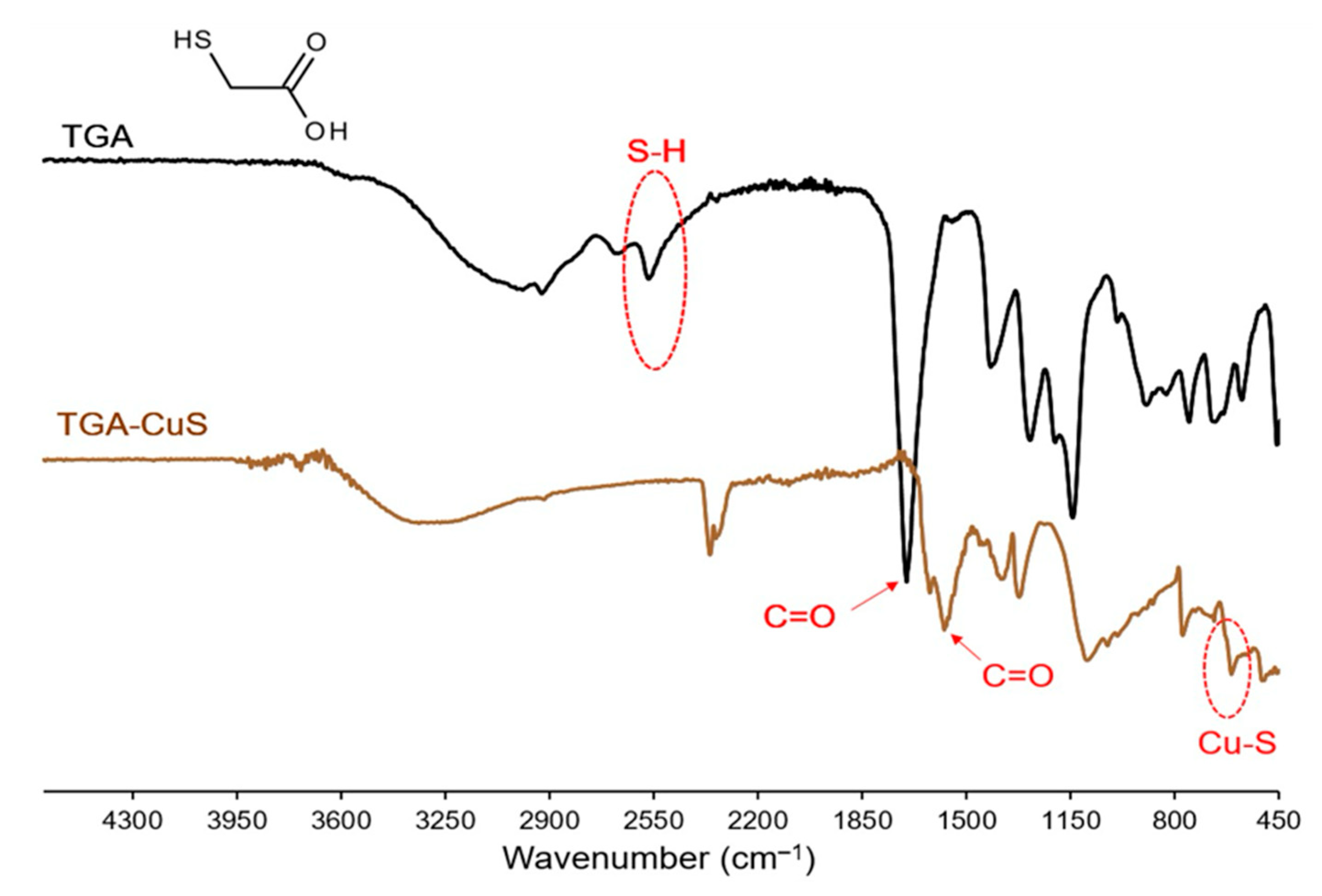
Figure 2 compares the IR spectrum of pure TGA with that of TGA-capped CuS nanoparticles. The absence of the S-H stretching band in the TGA-capped CuS spectrum confirms the binding of the thiol group to the nanoparticle surface, consistent with previous reports on thiol-capped semiconductor nanoparticles (e.g., MSA-capped CdTe), where the disappearance of the S-H band similarly indicates ligand-surface interaction [
25]. The carbonyl (C=O) stretching vibration appears in both spectra but shifts upon capping; in pure TGA it is observed at 1744 cm
−1, whereas in TGA-capped CuS it shifts to 1630 cm
−1, suggesting a conformational change upon coordination to the nanoparticle surface. This band corresponds to an asymmetric stretching mode, consistent with observations in thiol-capped semiconductor nanocrystals where carboxylic groups undergo deprotonation and exhibit -COO
− symmetric and asymmetric stretching vibrations (e.g., at 1420 and 1566 cm
−1 for MSA-capped CdTe QDs). These findings suggest that the TGA ligands bind to the CuS surface through the thiol group while exposing hydrophilic –COO
− groups outward, thus stabilizing the colloidal dispersion via surface charge [
25]. The weak feature observed around 2400 cm
−1 arises from ambient CO
2 and water vapor, which are known to absorb strongly in this mid-infrared region. Variations in their concentration during FT-IR measurements can lead to residual absorption artifacts, particularly within the CO
2 asymmetric stretching region (2208–2442 cm
−1), potentially obscuring intrinsic sample signals [
26]. Overall, these spectral changes confirm the successful functionalization of the CuS nanoparticles with TGA.
3.3. Structural and Morphological Characterization of NPs
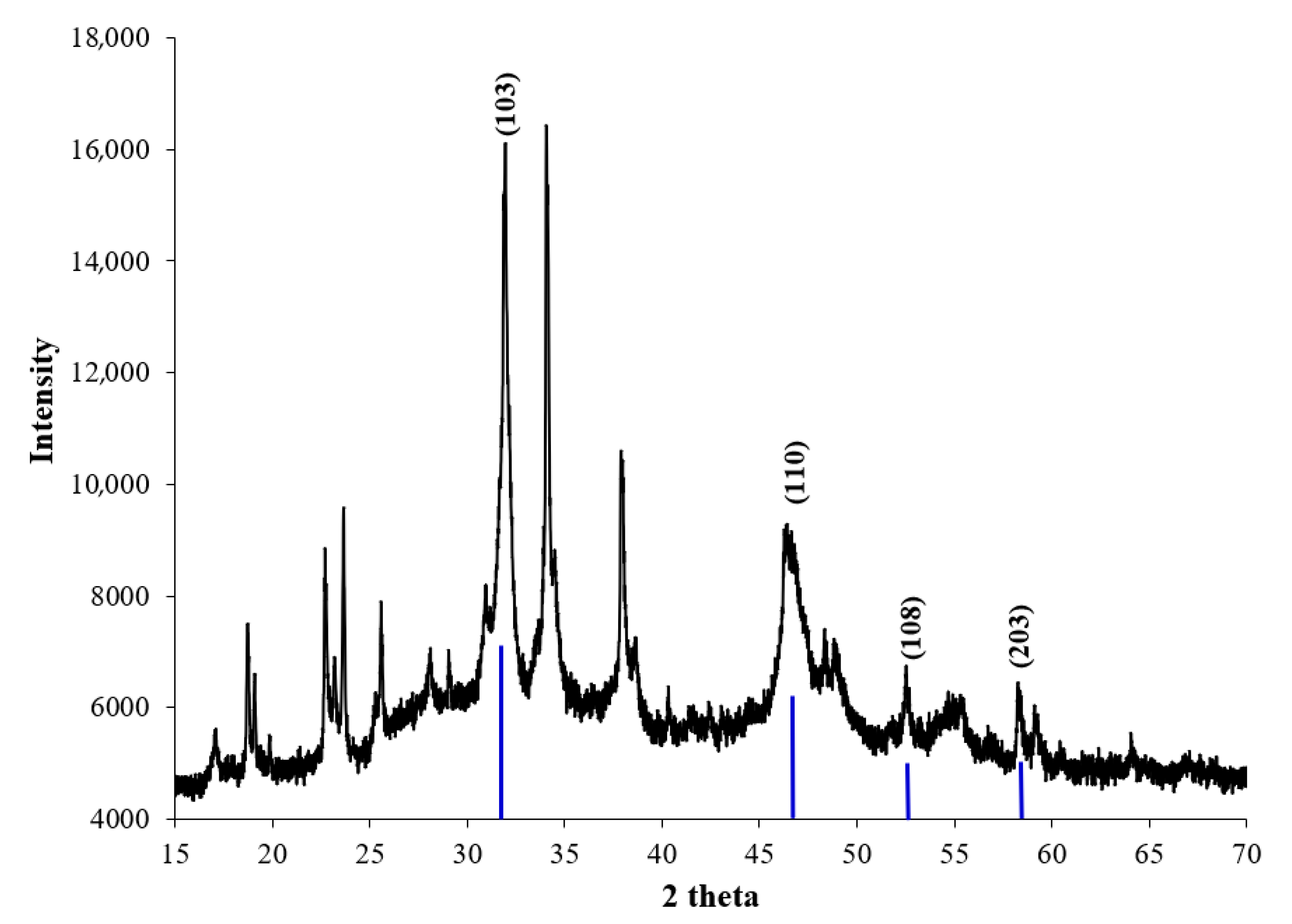
The XRD pattern in
Figure 3 confirms the formation of crystalline CuS nanoparticles, showing well-defined diffraction peaks corresponding to the (103), (110), (108), and (203) planes of the covellite phase (JCPDS 78-0876) [
27]. Peak sharpness reflects high crystallinity, while the slight broadening is consistent with nanoscale crystallite dimensions. These findings agree with previous structural descriptions of covellite CuS, characterized by alternating CuS
3 triangular units and CuS
4 tetrahedra within the hexagonal lattice [
27].
It is important to note that the absence of secondary phases in the XRD pattern confirms structural purity at the time of synthesis; however, XRD alone cannot determine surface oxidation states. The long-term chemical stability of CuS in oxygenated aqueous environments, including possible Cu2+/Cu+ transitions or CuO formation, requires surface-sensitive techniques such as XPS, along with immersion and reuse tests. These analyses were not included in the current materials-development study but will be addressed in future work to evaluate stability and performance under environmentally relevant conditions.
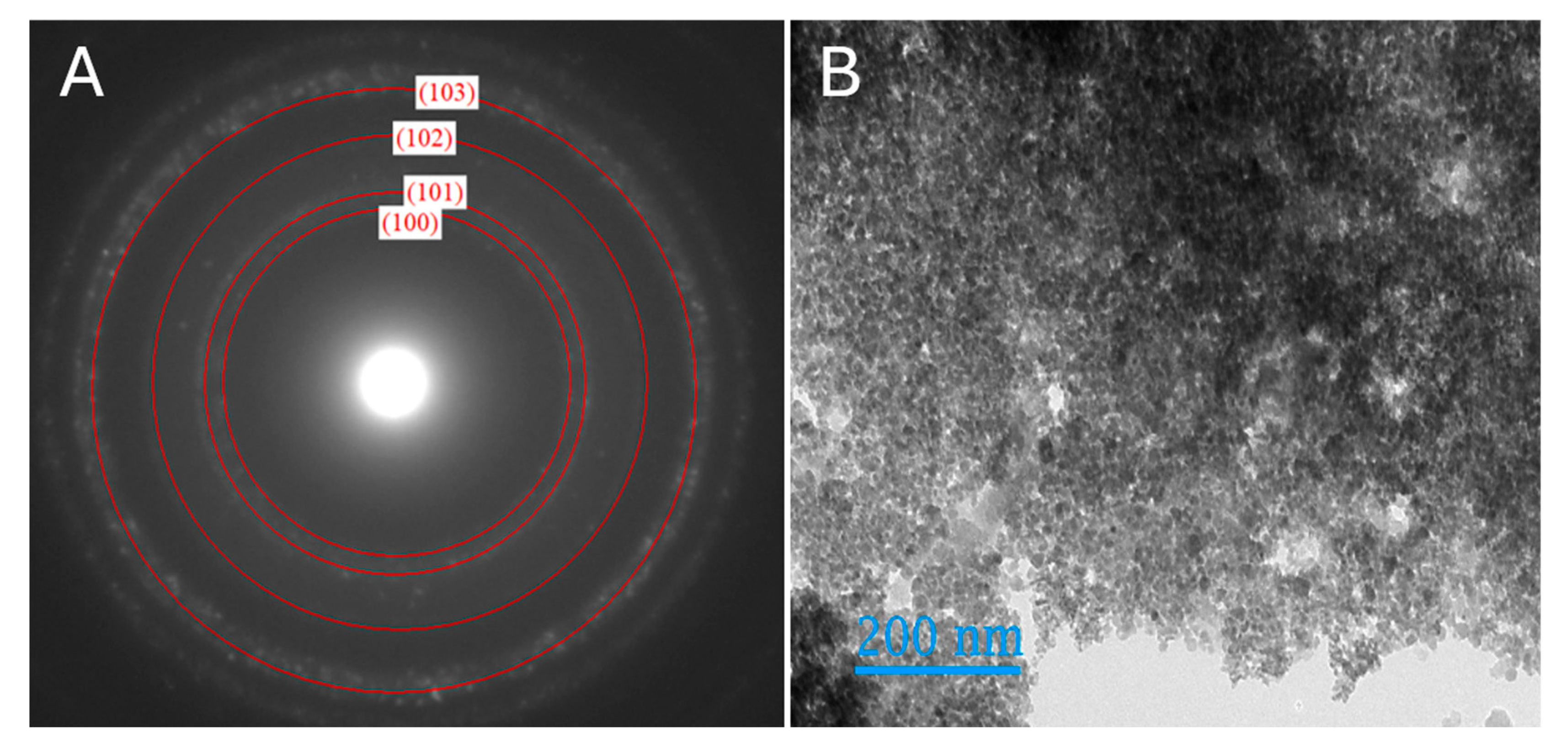
The selected area electron diffraction (SAED) pattern of the CuS nanoparticles (
Figure 4A) shows distinct concentric rings indexed to the (100), (101), (102), and (103) crystallographic planes, characteristic of the hexagonal covellite phase of CuS (JCPDS card No. 06-0464). The well-defined and continuous nature of these rings indicates that the sample is polycrystalline, composed of numerous crystalline domains with random orientations. The absence of diffuse halos suggests that the synthesized nanoparticles exhibit high crystallinity with minimal amorphous content. These observations confirm the successful formation of the covellite CuS phase via aqueous synthesis and are consistent with the XRD results obtained for the same material.
TEM micrographs (
Figure 4B) revealed that the CuS nanoparticles exhibit a clear tendency to form agglomerates, likely due to interparticle interactions and the high surface energy of the nanocrystals. Despite this aggregation, individual nanoparticles can be easily distinguished within the clusters, which show roughly spherical, homogeneous morphologies with an average size of about 20 nm. The images indicate well-defined crystalline domains, consistent with the covellite structure observed in the electron diffraction analysis. Agglomeration behavior is common among metal sulfide nanoparticles synthesized in aqueous media, particularly when ligand-mediated surface stabilization is limited. Overall, the TEM and ED results confirm the formation of crystalline CuS nanoparticles with nanoscale dimensions and moderate aggregation.
3.4. Characterization of Beads and Bead Containing CuS NPs
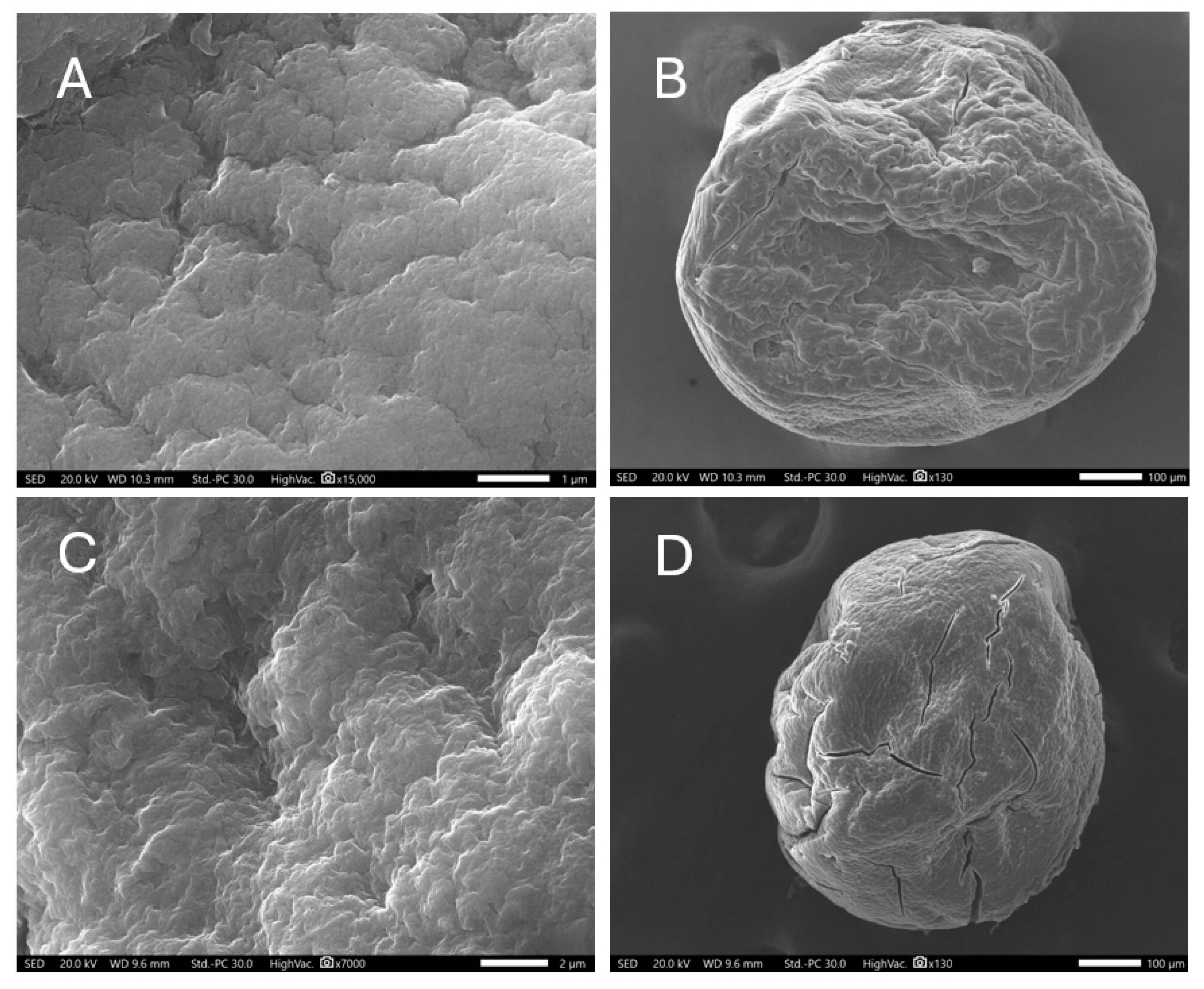
Porosity (
Figure 5) was assessed qualitatively through SEM surface morphology. Because alginate beads are highly hydrated hydrogels, quantitative BET analysis would require freeze-drying and specialized sample preparation not included in this stage of the project. Quantitative porosity evaluation and performance testing will be addressed in future studies specifically designed to examine adsorption behavior. Likewise, complementary analyses such as elemental mapping, copper quantification, BET measurements, and crosslinking-density characterization will be incorporated in follow-up work aimed at establishing structure–function relationships.
Figure 6 and
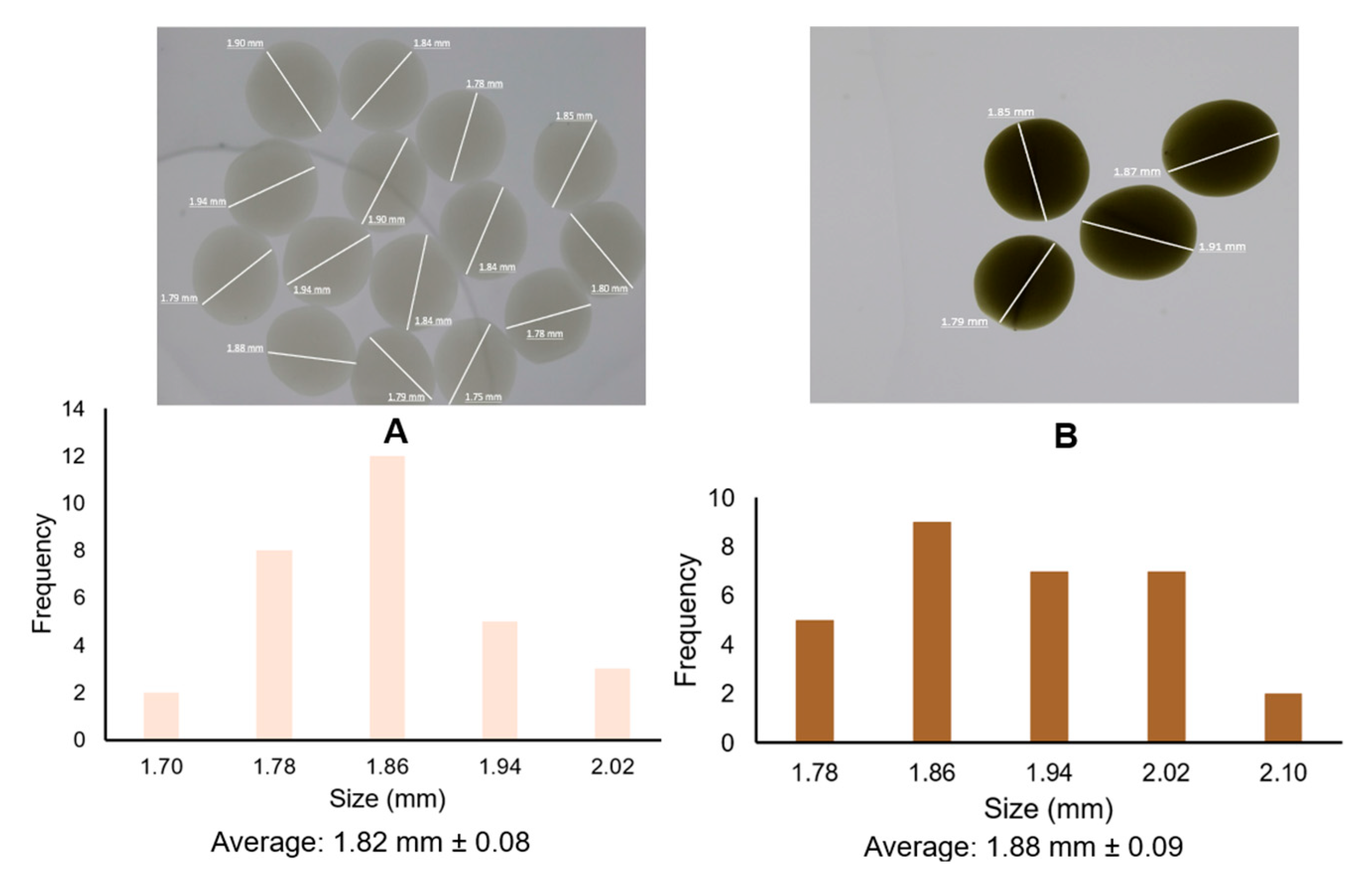
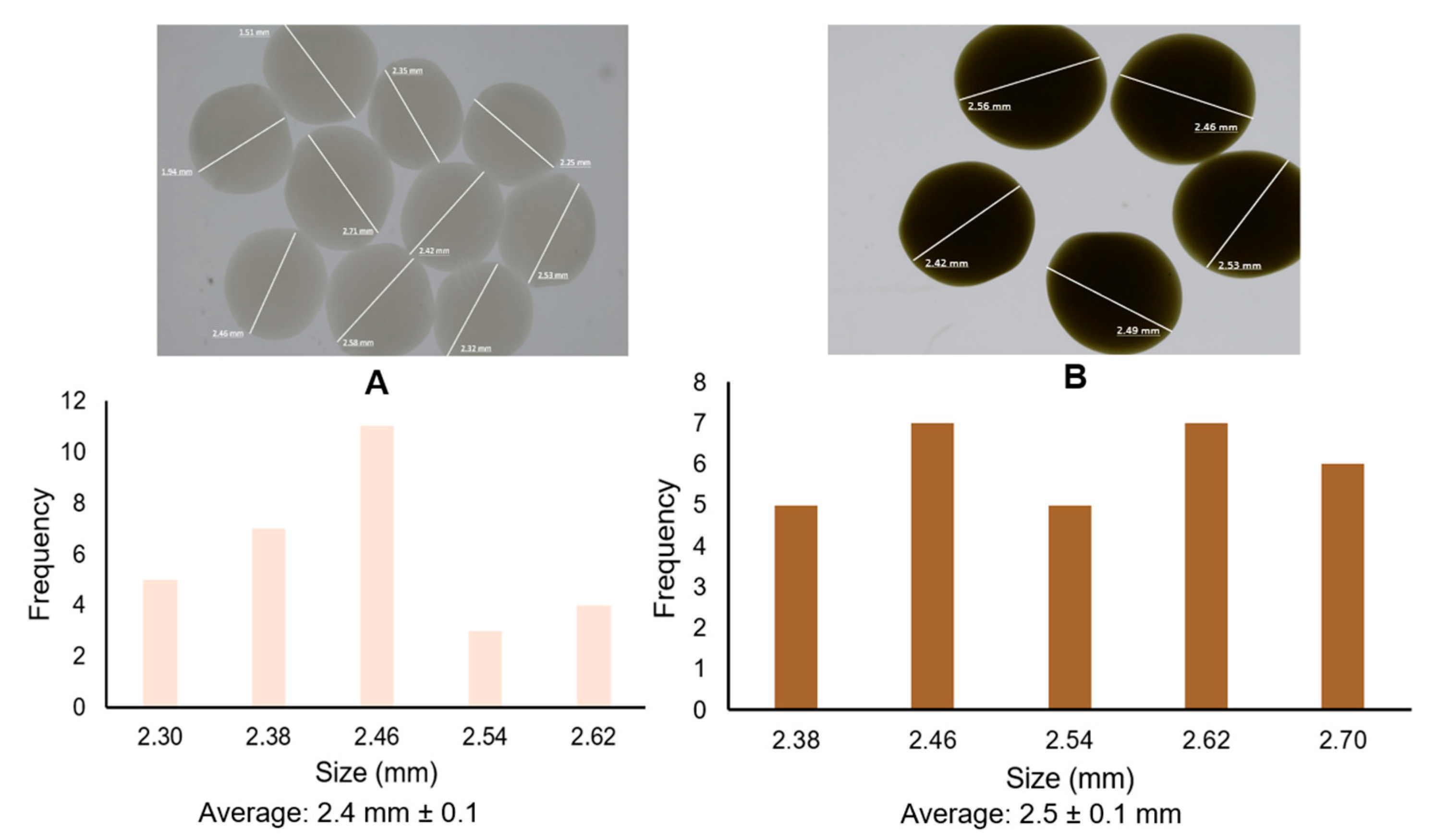
Figure 7 present the histograms illustrating the size distribution of the alginate and CuS-loaded alginate beads prepared using two different tubing diameters. In
Figure 6, the beads were produced using a 0.5 mm tube. The plain alginate beads (A) exhibited an average diameter of 1.82 ± 0.08 mm, while the CuS-loaded beads (B) displayed a slightly larger average diameter of 1.88 ± 0.09 mm. In
Figure 7, beads were fabricated using a 1.0 mm tube. The alginate beads (A) had an average diameter of 2.4 ± 0.1 mm, whereas the CuS-loaded beads (B) showed an average size of 2.5 ± 0.1 mm.
The results demonstrate that increasing the tubing diameter led to the formation of larger droplets and, consequently, larger beads, an expected outcome of the droplet breakup dynamics during dripping. The observed increase in size with CuS incorporation was minimal, suggesting that the inclusion of nanoparticles did not significantly affect the rheological properties of the alginate precursor solution or interfere with the calcium-induced crosslinking process. This behavior indicates that the CuS nanoparticles were well dispersed within the alginate matrix and that their surface interactions with the alginate carboxylate groups did not substantially hinder ion diffusion during gelation.
The narrow size distributions observed in both alginate and CuS–alginate beads confirm the high reproducibility and uniformity of the fabrication method, which is crucial for applications in adsorption, catalysis, and controlled release. Reproducibility in this work refers specifically to geometric uniformity; mechanical strength, swelling behavior, and colloidal stability were not evaluated in this initial materials-focused study. The slight increase in diameter observed for CuS-loaded systems can be attributed to slight changes in the solution’s surface tension or to additional solid content, which marginally alters the droplet detachment frequency.
These findings are consistent with previous reports showing that incorporating inorganic nanomaterials into calcium–alginate matrices generally preserve the overall bead geometry under comparable dripping and crosslinking conditions. Nonetheless, the embedded nanoparticles can subtly influence the internal microstructure, crosslinking density, and mechanical stability of the hydrogel network, potentially enhancing its robustness and surface reactivity, properties that are advantageous for subsequent sorption and catalytic studies [
28,
29].
4. Conclusions
Thiol-stabilized copper sulfide (CuS) nanoparticles were synthesized in aqueous medium using thioglycolic acid (TGA) as a capping ligand, yielding uniform, stable, and crystalline covellite-phase nanostructures. The UV-Vis spectrum exhibited a distinct absorption band near 310–320 nm, consistent with the electronic transitions of CuS. XRD analysis confirmed the formation of the hexagonal covellite phase (JCPDS No. 06-0464), with diffraction peaks indexed to the (100), (101), (102), and (103) planes. TEM images revealed slightly agglomerated nanocrystals with an average size of approximately 20 nm, in agreement with the polycrystalline rings observed in the electron diffraction pattern.
The CuS nanoparticles were incorporated into calcium–alginate beads, producing spherical composites with mean diameters of 1.8 ± 0.1 mm and 2.4 ± 0.1 mm when prepared using 0.5 and 1.0 mm tubing, respectively. SEM micrographs showed a highly porous surface in both pure alginate and CuS–alginate beads, with enhanced porosity in the CuS-loaded samples, which is expected to improve sorption capacity.
This work is intentionally limited to materials synthesis and characterization. No adsorption or photocatalytic degradation tests were conducted. Instead, the CuS–alginate composites developed here provide a structurally validated, recoverable material platform that will support future studies focused on functional performance, including sorption kinetics, photodegradation efficiency, and reusability testing.
Author Contributions
Conceptualization, S.J.B.-R. and D.O.-O.; methodology, S.J.B.-R. and D.O.-O.; formal analysis, S.J.B.-R. and D.O.-O.; investigation, S.J.B.-R. and D.O.-O.; resources, S.J.B.-R.; writing—original draft preparation, S.J.B.-R. and D.O.-O.; writing—review and editing, S.J.B.-R.; project administration, S.J.B.-R.; funding acquisition, S.J.B.-R. All authors have read and agreed to the published version of the manuscript.
Funding
This research was supported by the National Science Foundation under Grant No. 2313252.
Data Availability Statement
The original contributions presented in this study are included in the article. Further inquiries can be directed to the corresponding author.
Acknowledgments
This research was conducted at the Laboratory of Investigation in Nanotechnology and Characterization (LINC), part of the Department of Chemistry and Physics at UPRP. We acknowledge the support of the Department and its Bachelor of Science program in Pharmacological Chemistry, which provided training for the undergraduate researchers involved in this work.
Conflicts of Interest
The authors declare that they have no conflicts of interest.
References
- World Health Organization. Antimicrobial Resistance: Global Report on Surveillance; World Health Organization: Geneva, Switzerland, 2014.
- Pulingam, T.; Parumasivam, T.; Gazzali, A.M.; Sulaiman, A.M.; Chee, J.Y.; Lakshmanan, M.; Chin, C.F.; Sudesh, K. Antimicrobial resistance: Prevalence, economic burden, mechanisms of resistance and strategies to overcome. Eur. J. Pharm. Sci. 2022, 170, 106103. [Google Scholar] [CrossRef]
- Du, L.; Liu, W. Occurrence, fate, and ecotoxicity of antibiotics in agro-ecosystems: A review. Agron. Sustain. Dev. 2012, 32, 309–327. [Google Scholar] [CrossRef]
- Zhong, D.; Zhou, Z.; Ma, W.; Ma, J.; Feng, W.; Li, J.; Du, X. Antibiotic enhances the spread of antibiotic resistance among chlorine-resistant bacteria in drinking water distribution system. Environ. Res. 2022, 211, 113045. [Google Scholar] [CrossRef]
- González-Gaya, B.; Cherta, L.; Nozal, L.; Rico, A. An optimized sample treatment method for the determination of antibiotics in seawater, marine sediments and biological samples using LC-TOF/MS. Sci. Total Environ. 2018, 643, 994–1004. [Google Scholar] [CrossRef]
- Ecija-Arenas, A.; Román-Pizarro, V.; Fernández-Romero, J.M. Usefulness of hybrid magnetoliposomes for aminoglycoside antibiotic residues determination in food using an integrated microfluidic system with fluorometric detection. J. Agric. Food Chem. 2021, 69, 6888–6896. [Google Scholar] [CrossRef]
- Hassoun-Kheir, N.; Stabholz, Y.; Kreft, J.U.; De La Cruz, R.; Romalde, J.L.; Nesme, J.; Paul, M. Comparison of antibiotic-resistant bacteria and antibiotic resistance genes abundance in hospital and community wastewater: A systematic review. Sci. Total Environ. 2020, 743, 140804. [Google Scholar] [CrossRef]
- Sanganyado, E.; Gwenzi, W. Antibiotic resistance in drinking water systems: Occurrence, removal, and human health risks. Sci. Total Environ. 2019, 669, 785–797. [Google Scholar] [CrossRef]
- Zou, M.; Tian, W.; Zhao, J.; Chu, M.; Song, T. Quinolone antibiotics in sewage treatment plants with activated sludge treatment processes: A review on source, concentration and removal. Process Saf. Environ. Prot. 2022, 160, 116–129. [Google Scholar] [CrossRef]
- Caban, M.; Stepnowski, P. How to decrease pharmaceuticals in the environment? A review. Environ. Chem. Lett. 2021, 19, 3115–3138. [Google Scholar] [CrossRef]
- Ghaedi, S.; Rajabi, H.; Mosleh, M.H.; Sedighi, M. MOF biochar composites for environmental protection and pollution control. Bioresour. Technol. 2024, 131982. [Google Scholar] [CrossRef] [PubMed]
- Pereira, A.R.; Paranhos, A.G.O.; de Aquino, S.F.; Silva, S.Q. Distribution of genetic elements associated with antibiotic resistance in treated and untreated animal husbandry waste and wastewater. Environ. Sci. Pollut. Res. 2021, 28, 26380–26403. [Google Scholar] [CrossRef] [PubMed]
- Cao, J.; Zhang, X.J.; Zhao, Q.; Xing, W.W.; Zhang, S.Y. Determination of 11 antibiotics frequently detected in municipal wastewater in China by high-performance liquid chromatography with ultraviolet and fluorescence detector. Chin. J. Ecol. 2022, 41, 190. [Google Scholar] [CrossRef]
- Alam, M.-U.; Ferdous, S.; Ercumen, A.; Lin, A.; Kamal, A.; Luies, S.K.; Sharior, F.; Khan, R.; Rahman, Z.; Parvez, S.M.; et al. Effective treatment strategies for the removal of antibiotic-resistant bacteria, antibiotic-resistance genes, and antibiotic residues in the effluent from wastewater treatment plants receiving municipal, hospital, and domestic wastewater: Protocol for a systematic review. JMIR Res. Protoc. 2021, 10, e33365. [Google Scholar] [CrossRef]
- Liu, Y.; Cai, D.; Li, X.; Wu, Q.; Ding, P.; Shen, L.; Zhang, L. Occurrence, fate, and risk assessment of antibiotics in typical pharmaceutical manufactories and receiving water bodies from different regions. PLoS ONE 2023, 18, e0270945. [Google Scholar] [CrossRef]
- Yadav, S.; Kapley, A. Antibiotic resistance: Global health crisis and metagenomics. Biotechnol. Rep. 2021, 29, e00604. [Google Scholar] [CrossRef] [PubMed]
- Krasucka, P.; Pan, B.; Ok, Y.S.; Mohan, D.; Sarkar, B.; Oleszczuk, P. Engineered biochar—A sustainable solution for the removal of antibiotics from water. Chem. Eng. J. 2021, 405, 126926. [Google Scholar] [CrossRef]
- Kumar, V.; Lakkaboyana, S.K.; Sharma, N.; Chakraborty, P.; Umesh, M.; Pasrija, R.; Thomas, J.; Kalebar, V.U.; Jayaraj, I.; Awasthi, M.K.; et al. A critical assessment of technical advances in pharmaceutical removal from wastewater—A critical review. Case Stud. Chem. Environ. Eng. 2023, 8, 100363. [Google Scholar] [CrossRef]
- Duarte, A.C.; Rodrigues, S.; Afonso, A.; Nogueira, A.; Coutinho, P. Antibiotic resistance in the drinking water: Old and new strategies to remove antibiotics, resistant bacteria, and resistance genes. Pharmaceuticals 2022, 15, 393. [Google Scholar] [CrossRef]
- Isac, L.; Cazan, C.; Andronic, L.; Enesca, A. CuS-based nanostructures as catalysts for organic pollutants photodegradation. Catalysts 2022, 12, 1135. [Google Scholar] [CrossRef]
- Ramamoorthy, C.; Rajendran, V. Synthesis and characterization of CuS nanostructures: Structural, optical, electrochemical and photocatalytic activity by the hydro/solvothermal process. Int. J. Hydrogen Energy 2017, 42, 26454–26463. [Google Scholar] [CrossRef]
- Xu, W.; Zhu, S.; Liang, Y.; Li, Z.; Cui, Z.; Yang, X.; Inoue, A. Nanoporous CuS with excellent photocatalytic property. Sci. Rep. 2015, 5, 18125. [Google Scholar] [CrossRef] [PubMed]
- Ajibade, P.A.; Botha, N.L. Synthesis and structural studies of copper sulfide nanocrystals. Results Phys. 2016, 6, 581–589. [Google Scholar] [CrossRef]
- Cunha, L.R.C.; Carvalho Júnior, J.A.; Santos, C.I.L.; Oliveira, C.; Schiavon, M.A. Understanding how different surface ligands can influence the efficiency of conversion of ZCIS and ZCIS/ZnS sensitized solar cells. Surf. Interfaces 2025, 62, 106324. [Google Scholar] [CrossRef]
- Ajroud, M.; Abdella, F.I.A.; Alanazi, T.Y.A.; Helaoui, M.; Boudriga, S. Exploring the probing capacities of MSA capped CdTe semiconductor quantum dots as optical chemsensors via analytical and isotherms modeling for selective Hg2+ detection. Appl. Water Sci. 2024, 14, 15. [Google Scholar] [CrossRef]
- Ahmed, W.; Osborne, E.L.; Veluthandath, A.V.; Murugan, G.S. Analytical chemistry. Anal. Chem. 2024, 96, 18052–18060. [Google Scholar] [CrossRef]
- Wang, G.; Fakhri, A. Preparation of CuS/polyvinyl alcohol-chitosan nanocomposites with photocatalysis activity and antibacterial behavior against G+/G− bacteria. Int. J. Biol. Macromol. 2020, 155, 36–41. [Google Scholar] [CrossRef]
- Zhao, D.; Shen, X. Preparation of chitosan-diatomite/calcium alginate composite hydrogel beads for the adsorption of Congo red dye. Water 2023, 15, 2254. [Google Scholar] [CrossRef]
- Singha Deb, A.K.; Mohan, M.; Govalkar, S.; Dasgupta, K.; Ali, S.M. Functionalized carbon nanotubes encapsulated alginate beads for the removal of mercury ions: Design, synthesis, density functional theory calculation, and demonstration in a batch and fixed-bed process. ACS Omega 2023, 8, 32204–32220. [Google Scholar] [CrossRef] [PubMed]
| Disclaimer/Publisher’s Note: The statements, opinions and data contained in all publications are solely those of the individual author(s) and contributor(s) and not of MDPI and/or the editor(s). MDPI and/or the editor(s) disclaim responsibility for any injury to people or property resulting from any ideas, methods, instructions or products referred to in the content. |
© 2025 by the authors. Licensee MDPI, Basel, Switzerland. This article is an open access article distributed under the terms and conditions of the Creative Commons Attribution (CC BY) license (https://creativecommons.org/licenses/by/4.0/).