
Article

Relationship of Metallophilic Interactions with Structural and Mechanical Properties of (1−x) (0.73GeSe2-0.27Sb2Se3)-xAg2Se Glasses


by
Yuriy S. Tveryanovich
1,*,
Andrey S. Tverjanovich
1,
Vladimir V. Tomaev
1,2,
Anton S. Mazur
1,
Svyatoslav S. Lun’kov
1,
Sonya A. Zaytseva
1,2 and
Eugene Bychkov
3,*
1
Institute of Chemistry, St. Petersburg State University, 198504 St. Petersburg, Russia
2
Saint-Petersburg State Institute of Technology (Technical University), 190013 St. Petersburg, Russia
3
Laboratoire de Physico-Chimie de l’Atmosphère, Université du Littoral Côte d’Opale, 59140 Dunkerque, France
*
Authors to whom correspondence should be addressed.
Compounds 2025, 5(4), 56; https://doi.org/10.3390/compounds5040056 (registering DOI)
Submission received: 4 November 2025 / Revised: 22 November 2025 / Accepted: 27 November 2025 / Published: 8 December 2025

Abstract

The effect of Ag2Se content on the structure and mechanical properties of (1−x) (0.73GeSe2-0.27Sb2Se3)-xAg2Se glasses is analyzed. The glass structure is studied using XRD and NMR analyses. A particular consideration relates to a multiple increase in plasticity with increasing silver selenide content in chalcogenide glasses. The observed effects are attributed to the formation of silver–silver metallophilic interactions.

1. Introduction

Flexible electronics are currently developing rapidly [1,2,3], expanding into new application areas. A particular example is the use of flexible electronic sensor devices directly on controlled moving objects, such as the human body or clothing [4,5]. To ensure the structural and functional stability of all components of flexible electronic devices, they must withstand repeated mechanical deformations, including the exploration of heating above room temperature [6,7,8]. For this reason, the development of inorganic materials with increased plasticity is an essential objective.
Most of the available inorganic semiconductors are brittle at room temperature [9,10,11]. The development of flexible electronics requires ductile semiconductors. The discovery of plasticity in the Ag2S semiconductor [12,13,14] provides a breakthrough in resolving the contradiction between mechanical deformability and semiconductor properties and may facilitate rapid progress in flexible electronics [15,16,17]. Currently, one of the most promising materials for flexible sensors is ductile crystalline inorganic semiconductors based on Ag2S, Ag2Se, and Ag2Te [18,19,20].
Until recently, three main groups of materials were used in flexible electronics, including inorganic nanocrystalline [21,22,23], inorganic amorphous [24,25,26], and organic compounds [27,28,29]. Nanocrystalline semiconductor materials exhibit relatively high stability of their functional properties, but low flexibility and plasticity. Organic semiconductors are quite flexible, but their properties are unstable over time. Inorganic amorphous semiconductors, represented primarily by amorphous silicon, feature an intermediate level of these performances and hardly adjustable electronic properties.
A special group of materials useful for flexible optoelectronics involves plastic glassy materials [30,31,32]. However, glassy materials commonly feature a high brittleness, resulting in their low resistance to mechanical stress and temperature fluctuations [33]. The same features relate to glassy semiconductors (chalcogenide glasses) used in IR optical fibers [34], micro-optics, and non-volatile memory devices based on phase-change materials [35], etc.
Silver-containing chalcogenide glasses have been studied in a series of research works. A high interest in these materials is primarily determined by their ionic conductivity and related properties [36,37]. In [38], (Ag2S)x(GeS2)100−x, (x ≤ 50) were characterized using neutron and X-ray diffraction techniques coupled with reverse Monte Carlo (RMC) modeling. Based on these studies, it was concluded that Ag ions are coordinated with three S atoms. Short (appr. 3.0 Å) Ag-Ag distances are observed in glasses enriched with Ag2S. Glass transition temperatures (Tg) of glasses in the system Ag2S–GeS2–As(Sb)2S3 determined by differential thermal analysis (DTA) [39] indicate their high glass-formation ability. The bandgap Eg of these glasses was estimated on the basis of optical absorption spectra. It is noteworthy that none of the available publications present any discussions relating to the plasticity and existence of Ag-Ag metallophilic bonds in silver-containing chalcogenide glasses.
However, chalcogenide glasses with a high silver content exhibit increased plasticity compared to other chalcogenide glasses [40,41,42] due to the ability of silver atoms to form non-directional metallophilic bonds in the glass network.
Glasses have a number of advantages over crystals with respect to their use in flexible optoelectronics, including a gradual change in composition, higher ionic conductivity compared to crystals of the same composition, relatively low susceptibility to impurities due to being disordered systems, the possibility to fabricate products of almost any shape using modern glass technologies, etc. [43,44].
Glasses capable of incorporating at least 20 mol% Ag2Se without losing their glass-forming capacity exhibit increased plasticity and may be promising materials for use in flexible electronics [41]. In [42], an analysis of the glass transition temperature of chalcogenide glasses was performed depending on the silver chalcogenide content. The observed changes in glass transition temperature are explained by the coexistence of silver–silver (Ag–Ag) metallophilic bonds in addition to silver–chalcogen (Ag–Ch) covalent bonds. When assessing the degree of connectivity of the chalcogenide glass network, it is conventionally assumed that the number of bonds formed by each atom coincides with its oxidation state. However, the analysis of a large number of studied silver-containing chalcogenide glass-forming systems has led us to the conclusion that the connectivity coefficient of silver in chalcogenide glasses significantly exceeds its formal oxidation state, since silver forms metallophilic bonds in addition to covalent bonds [38].
A more detailed analysis of the data presented in [42] suggests that the Tg value of the considered glass-forming system is primarily determined by germanium selenide GeSe2, since this compound contains a metal with the highest coordination number in this system. It was also concluded that Ag2Se in the studied glasses exerts the same effect on Tg as selenides of trivalent As and Sb.
The research [41] presents the dependence of the plasticity of glasses in the (1−x) (0.73GeSe2-0.27Sb2Se3)-xAg2Se system on the Ag2Se concentration, calculated using the Milman relation [45] and measured by the load–unload method. The observed increase in plasticity may contribute to a significant improvement in functional properties, in particular, improved resistance to temperature fluctuations, and has good potential for use in flexible electronics. Based on the above, the (1−x) (0.73GeSe2-0.27Sb2Se3)-xAg2Se system, which features high plasticity and is promising for use in flexible electronics, was selected as an example for this study, aiming at the further development of the concept of metallophilic interactions of silver atoms in chalcogenide glasses and the study of their effect on the structure and stress relaxation process.

2. Materials and Methods

Glass synthesis. Chalcogenide glasses were synthesized from high-purity simple substances: Sb (99.995%), Se (99.997%), Ag (99.990%), and Ge (99.999%). The following (1−x) (0.73GeSe2-0.27Sb2Se3)-xAg2Se sample compositions were synthesized: x = 0.00; 0.05; 0.10; 0.15; 0.20; 0.25; 0.30; 0.35; 0.40; 0.45. For each case, the components of the corresponding composition were placed in fused silica ampoules, followed by their evacuation to a pressure of 10−4 mm Hg and sealing to guarantee constant glass composition during the synthesis. For all the compositions, the synthesis was carried out in a muffle furnace PM-10-20 (Teplopribor, Chelyabinsk, RF) at 900 °C for 3 h with permanent stirring. To increase the cooling rate, the ampoules were placed in ice water straight after the synthesis.
XRD measurement was carried out according to the methods described in [46] using a D2 Phaser automatic powder diffractometer (Bruker, Billerica, MA, USA) using Cu Kα monochromatic radiation in the range of 2θ angles from 6 to 100° with a scanning step of 0.02°.
NMR characterization of all the prepared chalcogenide glasses ground into powder was carried out using a Bruker Advance III 400 WB spectrometer (Bruker, Billerica, MA, USA) on 77Se nuclei as described in [47]. The spectra were recorded using a standard Hann pulse sequence (90°-τ-180°- acquisition) with the 90° pulse duration 6 μs, delay time between excitation pulses 70 μs, and relaxation delay time between pulse series 20 s.
Mechanical properties were characterized with respect to the effect of Ag2Se content in chalcogenide glasses on the relaxation of mechanical stresses. Cylindrical glass specimens with a diameter of 6 mm were cast in fused silica ampoules. After removal from the ampoules and mechanical treatment of the cylinder ends, their height was 7 mm. A compressive pressure of 10 N/mm2 was applied to the cylindrical specimens. The position of the compressive surfaces was then recorded for a specified time (the first three cycles—150 s, subsequent cycles—300 s), and the change in pressure over time was measured, followed by repeating the cycle.

3. Results and Discussion

3.1. XRD Data and Analysis

The experimental XRD data were corrected, taking into account air scattering, polarization, and absorption, followed by normalization to derive the overall Faber–Zeeman structure factor S(Q) [48]. The resulting S(Q) data for the studied glasses are shown in Figure 1.
The dependence of the structure factor on the wave vector (Q = 4 π(sinΘ)/λ) for glasses forming a network structure is characterized by three peaks [49,50]. The peaks 1 and 2 (starting from small Q values) are usually called the first sharp diffraction peak (FSDP) and the principal peak (PP), respectively, while peak 3 is universal and determined by interatomic correlations between nearest neighbors. The PP is attributed to longer scales in real space. Its position in a purely tetrahedral system, such as germanium chalcogenides, is determined by the base-to-apex distance in the GeX4 tetrahedron [50]. FSDP is associated with an even longer scale relating to the medium-range order and confirms its existence in glasses [51,52,53].
In recent years, numerous models have been proposed to explain the origin of FSDP, which can be divided into three main approaches, involving the cluster approach based on layered structures [54,55,56] and approaches considering intrastructural voids [57] and rings as elements of a disordered glass network [58].
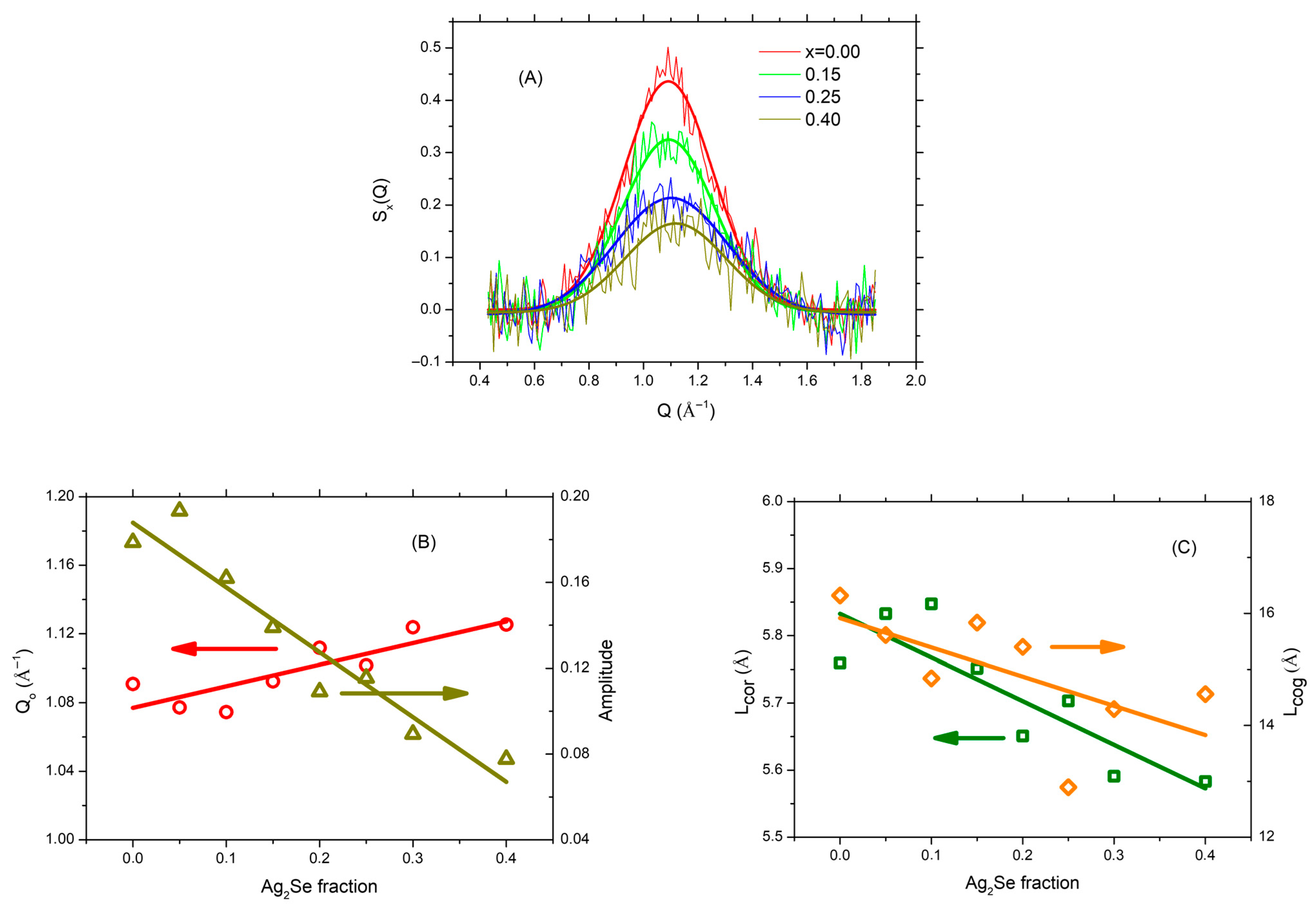
The medium-range order in glass (derived from FSDP) is characterized by two values, the peak position (2π/Q is correlation length) and half-width (2π/ΔQ is coherence length) [59,60]. FSDP data for the studied glasses are presented in Figure 2. The baseline was subtracted from the structure factor vs. wave vector dependence, and the resulting curve was approximated by a Gaussian.
Upon introduction of Ag2Se into the glass matrix, a decrease in the FSDP amplitude, correlation length, and coherence length occurs. A decrease in the FSDP amplitude relating to PP amplitude may be attributed to the disruption of the spatial network formed by the GeSe4/2 and SbSe3/2 structural units by silver. A disruption of the spatial covalently linked network and an increase in its lability should lead to a sharp decrease in the viscosity of the glass-forming melt with increasing temperature and an increase in the coefficient of thermal expansion. Such properties are typical for metallic glasses [61,62], for which no FSDP is commonly observed [50]. The absence of FSDP is also observed for colloidal glass-forming systems [50]. A disruption of the spatially covalently linked network and an increase in its mobility can occur for two reasons. The first one is a decrease in the degree of connectivity of the glass network (average coordination of the atoms forming the glass network). The second possible reason is the weakening of interatomic bonds, leading to their destruction with increasing temperature and transition to a molten state.
The decrease in correlation length Lcor and coherence length Lcog can also be associated with disturbances in the spatial network of the glass matrix by the introduction of Ag2Se. Moreover, all these regularities are observed in the entire studied range of Ag2Se concentrations. The determined correlation length values (Figure 2C) are between the values characteristic of pure glassy GeSe2 (6.3 Å (Qo = 1 Å−1 [63])) and Sb2Se3 (5.4 Å (Qo = 1.17 Å−1 [64])).
The shift in Lcor values with increasing silver concentration from values more characteristic of a network formed by GeSe4/2 structural units to those corresponding to the network formed by SbSe3/2 units may indicate that the introduction of Ag2Se primarily affects the network formed by GeSe4/2 tetrahedra. This conclusion is consistent with the NMR spectral analysis results presented below. Lcog decreases quite significantly upon the introduction of Ag2Se into the glass matrix (Figure 2C).
By Fourier transforming the presented data, we can obtain the total correlation function (Tx(r)):
T X r = 4 π ρ 0 r + 2 π 0 Q m a x Q S X Q 1 sin Q r d r
where ρo is the atomic density.
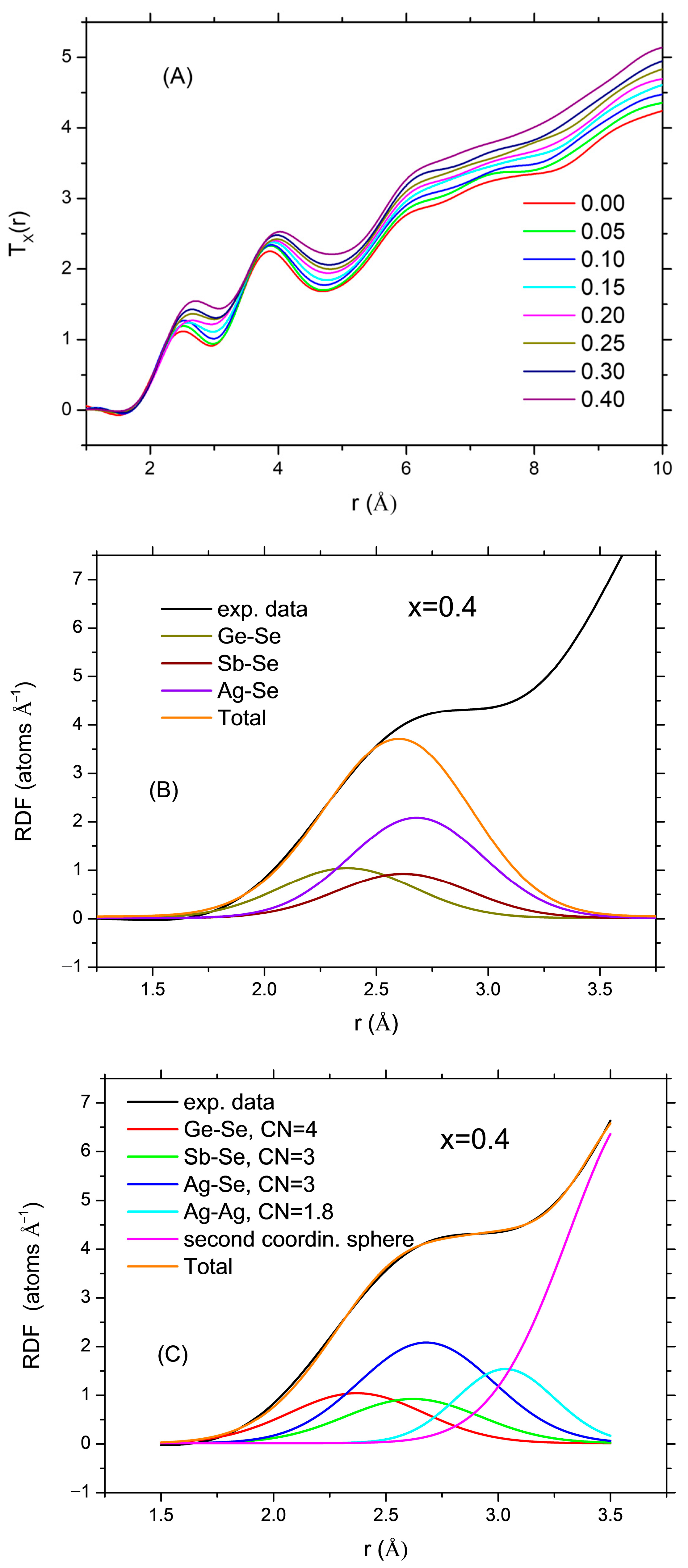
The correlation functions obtained in this way are shown in Figure 3A.
The resulting value Tx(r) × r yields the radial distribution function (RDF), which shows the number of atoms located at a distance from r to r + dr from any given atom.
These data allow us to estimate the coordination numbers (CN) of the elements in the glass structure. Since the peaks corresponding to the first and second coordination spheres overlap, we assume that the boundary between them is at the minimum of the function. In this case, integration yields an average number of atoms in the closest vicinity of an arbitrary atom equal to 2.20 for the original glass and 3.1 for the composition containing 40 mol% Ag2Se. A theoretical estimate, assuming an average coordination of Ge, Sb, Ag, and Se atoms of 4, 3, 3, and 2, respectively, gives values of 2.58 and 3.00, respectively. In addition, Figure 3B shows, as an example, the experimental dependence of RDF for a composition containing 40 mol% Ag2Se and the theoretical partial contributions to RDF from GeSe4/2, SbSe3/2, and AgSe3/2, jointly providing a good approximation of the first coordination sphere. The considered partial contributions were approximated by a Gaussian. The lengths of the corresponding bonds were taken as the positions of the maxima of the function: 2.37 Å (Ge-Se) [65]; 2.62 Å (Sb-Se) [64], 2.68 Å (Ag-Se) [66]. The areas of the Gaussian were calculated as the result of multiplying the corresponding coordination numbers and weighting coefficients. The obtained good agreement allows us to assume that Ge, Sb, and Ag are surrounded by 4, 3, and 3 Se atoms, respectively. It is noteworthy that the determined coordinations correspond to the formal oxidation states of all the involved elements, except silver. Coordination 3 is also characteristic of Ag in Ag2S-GeS2 glasses [38]. The same value was derived from the correlation between the glass transition temperature and the average coordination of atoms for nano-liquating chalcogenide glasses with Ag2Se [67].
In a series of studies [68,69,70], the results of direct structural characterization methods (Isotopic Substitution Neutron Diffraction; Extended X-ray Absorption Fine Spectroscopy; and High-Resolution Neutron Diffraction) for chalcogenide glasses with high silver chalcogenide contents suggested that silver atoms are highly coordinated. Moreover, silver-to-silver coordination was found to be no lower than 2. The results of our studies are consistent with these data. Furthermore, approximation of the experimental RDF plot, taking into account the contribution from the second coordination sphere, requires the presence of an additional peak near 3 Å (Figure 3C). This approximation was carried out with fixed parameters (bond length and CN) relating to Ge-Se, Sb-Se, and AgSe bonds, while the peak in the region near 3 Å and the peak emulating the second coordination sphere were fitted with free parameters. According to the reference data for silver-containing chalcogenide glasses [38,71,72,73], the region near 3 Å corresponds to Ag–Ag interatomic correlations. In [74], this distance is considered between silver atoms in apexes AgX3/2 pyramids connected by edges and formally relates to the second coordination sphere. For the glass containing 40 mol% Ag2Se (Figure 3C), the obtained Ag–Ag distance is 3.03 Å, and CN = 1.8. The value CN = 1.8 is also consistent with data obtained for glasses of the Ag2S–As2S3 and Ag2S–GeS–GeS2 systems [75].
The peak corresponding to the second coordination sphere is apparently determined by the secondary neighbors Ge–Ge and Se–Se. According to the reference data [65] for glassy GeSe2, the corresponding values are 3.57 Å, CN = 3.2 for Ge-Ge and 3.89 Å, CN = 9.3 for Se-Se.

3.2. NMR Data and Analysis

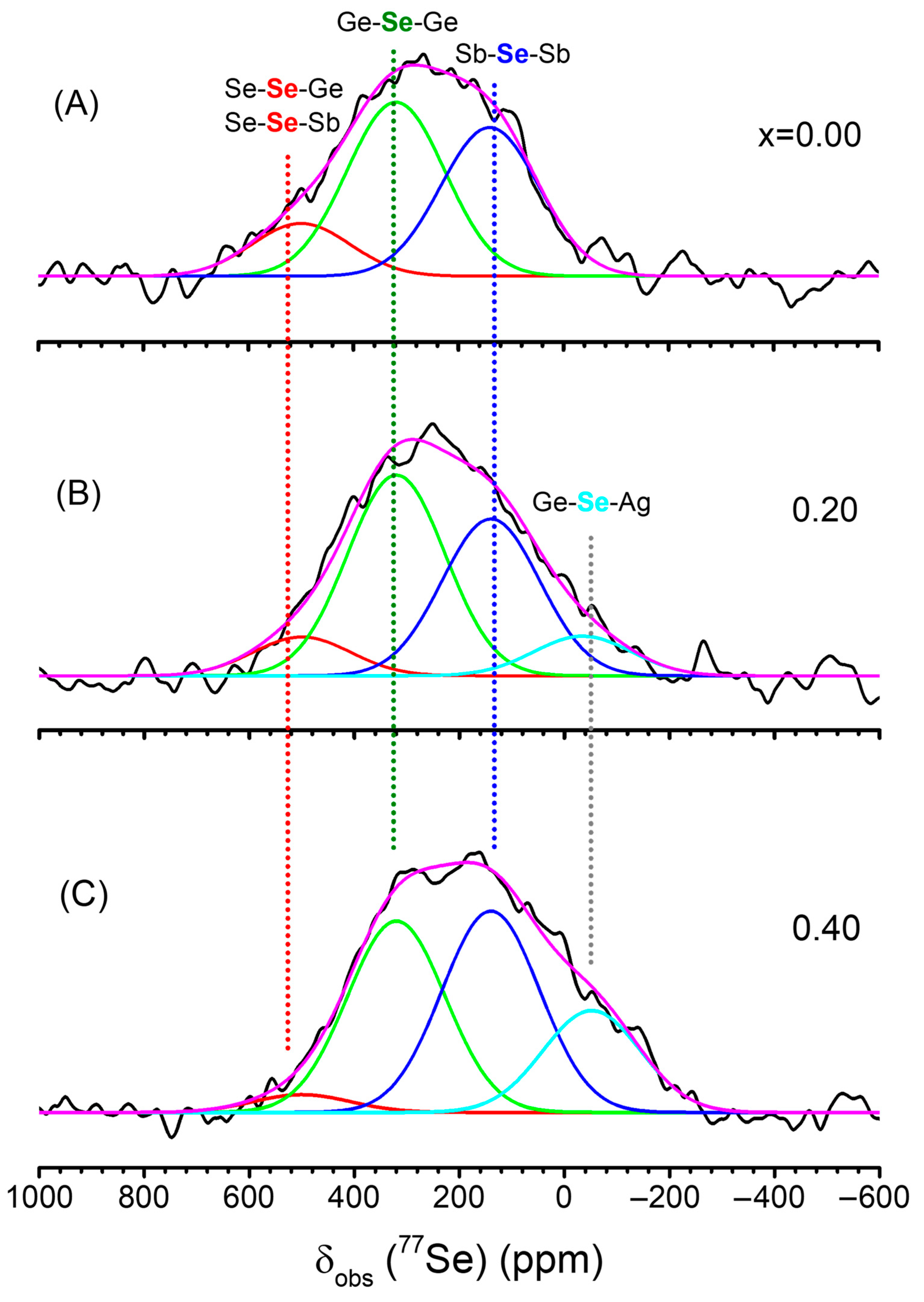
In all 77Se NMR spectra of the studied glasses, a non-uniformly broadened peak is observed with a maximum near 260 ppm. Moreover, the shape of the spectra changes with the variation of silver selenide content due to the redistribution of atoms (Ge, Sb, and Ag) located in the first coordination sphere of selenium atoms.
A detailed consideration of 77Se NMR spectra for glasses with x = 0.00, 0.20, and 0.40 (Figure 4A–C) indicates that the observed spectral bands feature a quite complex shape and cannot be approximated by a single line. For their fitting, three bands were used at x = 0, and four lines for each of the other samples. The approximation allowed us to distinguish the components at 500, 320, 140, and −60 ppm in the studied spectra. According to [76,77,78,79,80], they can be attributed to Se atoms in Se-Se-Ge or Se-Se-Sb environment near 500 ppm, in Ge-Se-Ge environment (most likely, germanium selenide tetrahedra linked by vertices rather than edges) near 320 ppm, in Sb-Se-Sb environment near 140 ppm, and in Ge-Se-Ag environment near −60 ppm.
Furthermore, similar to the Ge-Se-Ge and Sb-Se-Sb pairs, it can be supposed that the signal from Sb-Se-Ag should relate to more negative chemical shift values (to the right in the spectra). However, there are no obvious signs of any detectable signals in this region.
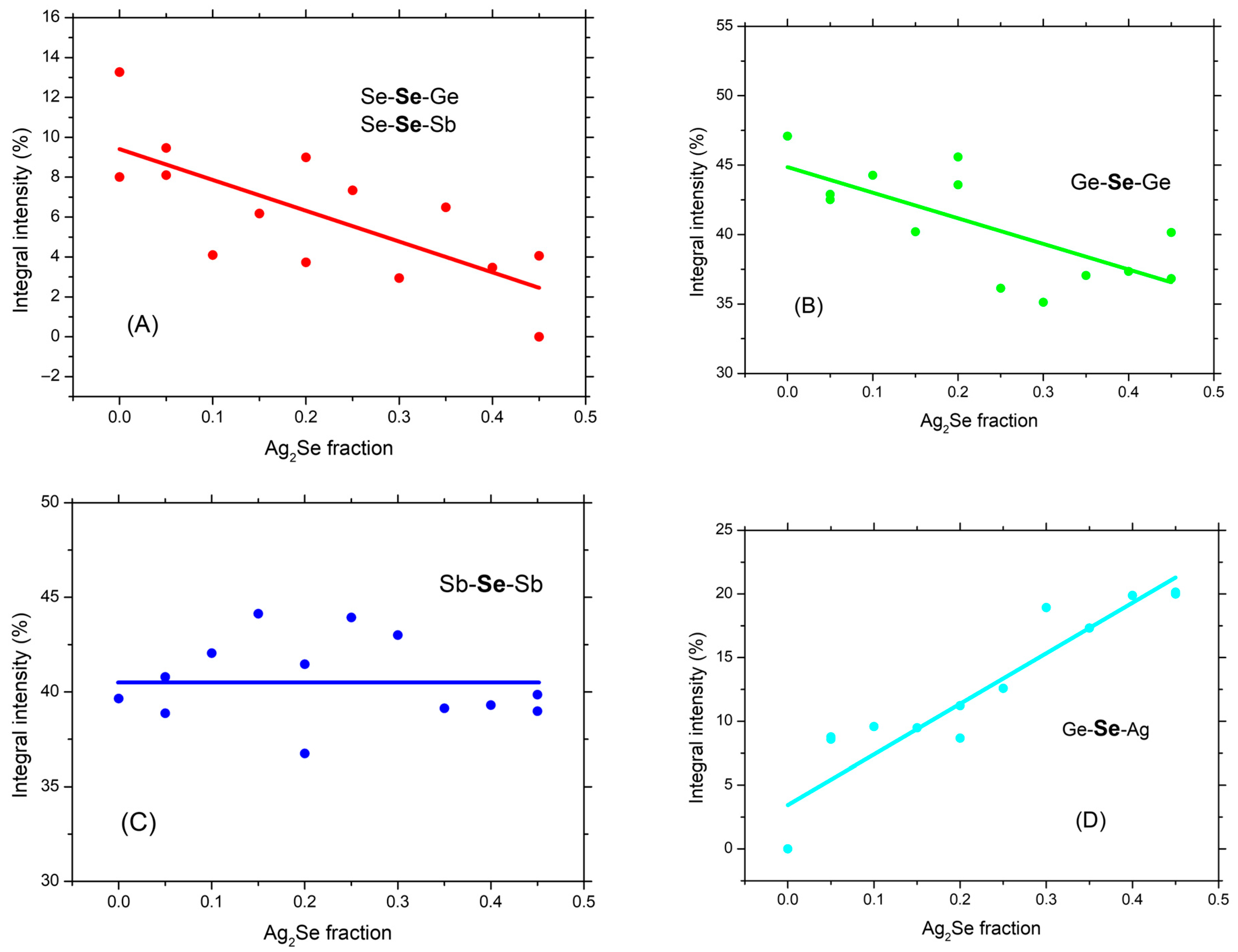
The fraction of the first component near 500 ppm relating to Se atoms in Se-Se-Ge or Se-Se-Sb environment as a function of Ag2Se concentration is shown in Figure 5.
Evidently, the probability of Se-Se bond formation significantly decreases with the increase in silver content. Furthermore, to explain the data in Figure 5A, we note that according to [65], the GeSe4/2 tetrahedron is the main building block in similar glasses with a predominant GeSe2 content, the regular chemical order of the glass is disrupted, and up to 25% of Ge and 20% of Se atoms participate in homopolar bonds. Since Ge has the highest coordination among glass-forming elements, it forms a rigid glass network with high average coordination, providing a stabilization of a significant concentration of short-range chemical order disturbances (Se-Se homo-bonds). In the glass with x = 0.0, almost a third of GeSe2 is replaced by stibium chalcogenide, featuring a lower coordination of 3 according to XRD data. Therefore, the glass network becomes less rigid and stabilizes only about 10% of Se-Se bonds (Figure 5A). The introduction of Ag2Se into the glass makes the network even less rigid. However, unlike the introduction of Sb2Se3 into GeSe2, the average coordination number does not decrease in this case. In addition to the covalent bond with Se, Ag also forms metallophilic Ag-Ag bonds, which, unlike covalent bonds, are not directional and have a lower energy strength. As a result, the number of selenium atoms forming Se-Se homo-bonds decreases to 3%, i.e., only 1.5% of selenium valence bonds participate in the formation of homo-bonds. As discussed above, the existence of Ag-Ag metallophilic bonds is suggested by quantum-chemical calculations [20]. The presence of these bonds is further confirmed by an X-ray Photoelectron Spectroscopy (XPS) characterization of the glasses at the studied cross-section. The data presented in the “Supplementary” section indicate that the increase in Ag2Se content in the glass matrix above the threshold concentration, providing the formation of metallophilic bonds, results in a growth of Ag bond energy. Hence, the formation of Ag-Ag metallophilic bonds in addition to Ag-Se covalent bonds leads to an increase in the bonding energy (see Figure S1).
Figure 5B, based on the NMR spectral results, shows a similar analysis concerning the effect of Ag2Se concentration on the contribution of the second peak, with the maximum at 320 ppm relating to the Se atom surrounded by Ge (Ge-Se-Ge). These data show that the increase in Ag2Se concentration results in a decrease in the integrated area of the first component by a factor of 3, while for the second component, it drops only by a factor of 1.2. This 1.2-fold reduction in the relative intensity of the second component is determined by the decrease in molecular fraction of germanium and antimony selenides in the glass composition with increasing x. This may indicate that the number of germanium selenide tetrahedra linked at their vertices remains virtually unchanged, and the glass matrix remains primarily composed of these structural elements.
Less significant changes with increasing Ag2Se concentration are observed in the area of the third component, featuring a maximum at 140 ppm and attributed to selenium atoms in the Sb-Se-Sb environment. As shown in Figure 5C, the integrated area of this component does not change with Ag2Se concentration. Although it seems unexpected since an increase in Ag2Se content should lead to a decrease in the proportion of selenium bound to Sb, it should be taken into account that this band is associated with selenium not only in Sb-Se-Sb, but also in Ge-Se-Sb configuration. A decrease in the amount of selenium in the Ge-Se-Ge configuration (Figure 5B) is probably partly due to their transformation into Ge-Se-Sb. Therefore, the total amount of selenium in both configurations remains constant.
The percentage of the fourth component near −60 ppm relating to Se atoms in the Ge-Se-Ag environment as a function of Ag2Se concentration is shown in Figure 5D. The addition of Ag2Se in the amount up to 45 mol% evidently and expectedly leads to an almost linear increase (from appr. 0 to 20%) in the content of this component relating to Se atoms in the Ge-Se-Ag environment. Moreover, simple calculations show that the proportion of Se in Ag2Se for glass with 40 mol% Ag2Se is about 23%, confirming that Ag2Se is primarily bound to GeSe2.

3.3. Mechanical Properties of the Glasses

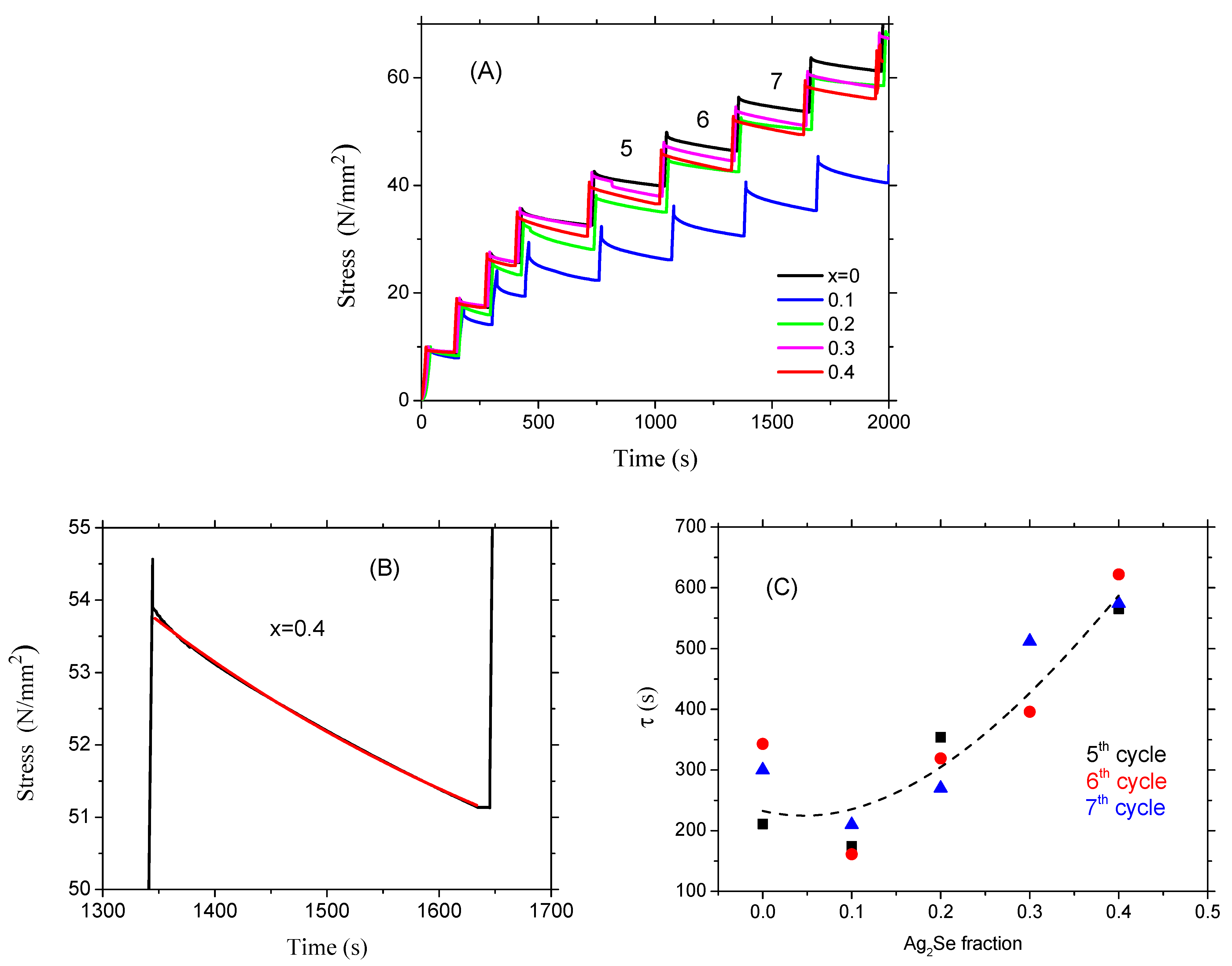
The effect of Ag2Se content in the synthesized glasses upon their mechanical properties is illustrated by the following data. The stress relaxation plots for samples with different Ag2Se contents are shown in Figure 6A with the indication of testing cycle numbers. The stress reduction curve over time was fitted by an exponential function (Figure 6B). The characteristic stress relaxation times for cycles 5, 6, and 7 determined from the corresponding exponents are shown in Figure 6C, depending on Ag2Se content.
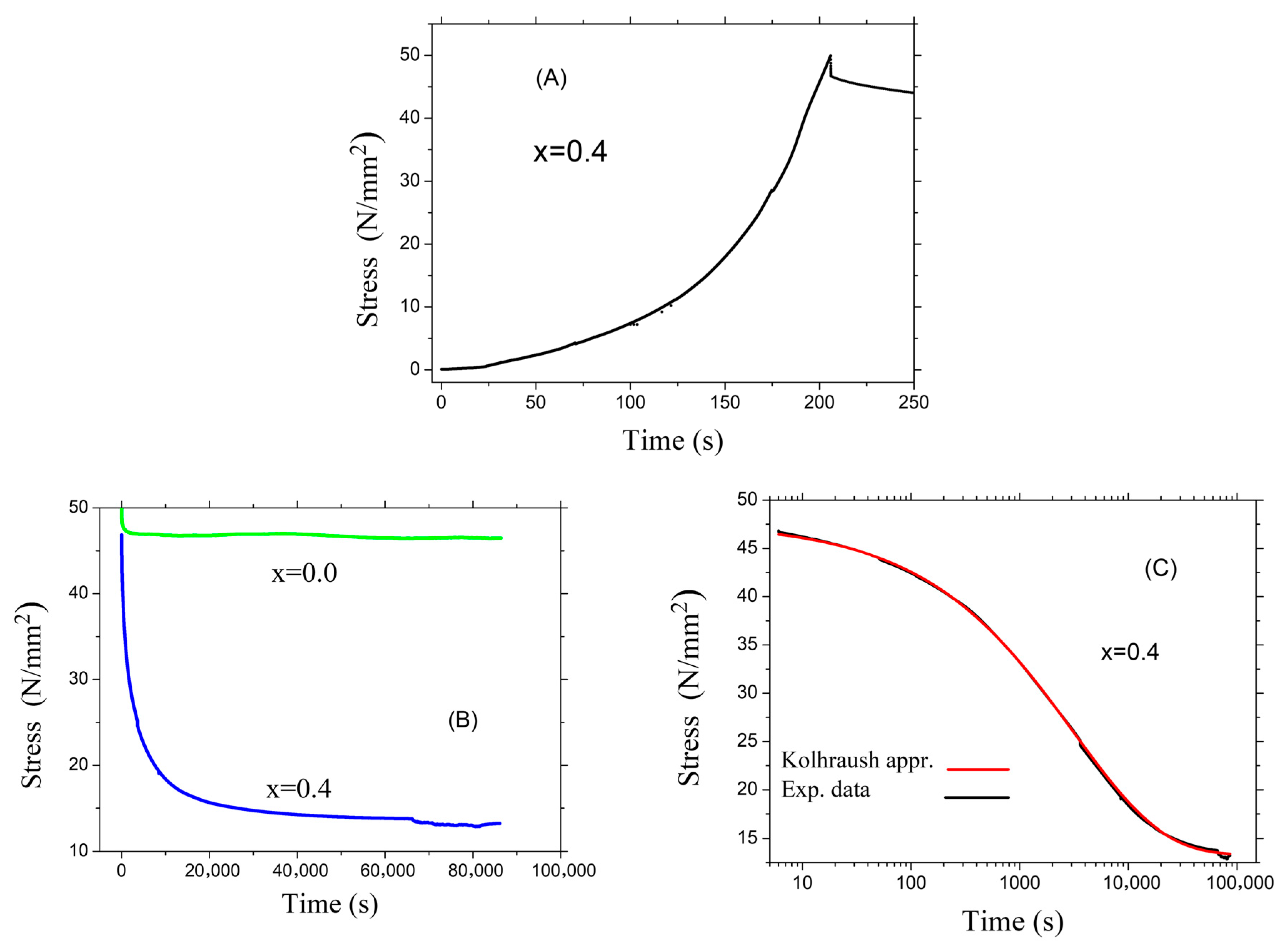
A prominent increase in relaxation time begins for compositions with an Ag2Se content of more than 0.2. To verify the results obtained, a prolonged experiment consisting of a single cycle was performed for samples with x = 0 and x = 0.4. A stress of 50 N/mm2 was applied to each sample for a short period of time (3 min) (Figure 7A), followed by the observation of the stress relaxation within 24 h (Figure 7B). Such a long relaxation time allowed us to obtain more informative plots, which could no longer be satisfactorily approximated by a single exponent. Therefore, the Kohlrausch function [81] was used to fit the following data:
σ = σ +   σ 0 e x p t τ 0 β ,
where τ0 is an effective (averaged) relaxation time; σ0 and σ are relaxable and non-relaxable parts of the initial stress; t is the process time; β ≤ 1 is the parameter characterizing the width of the relaxation time spectrum, the effective value of which is τ0.
The decrease in β indicates broadening of the relaxation time spectrum. As an example, the approximation of the glass relaxation process for the glass x = 0.4 is shown in Figure 7C.
The effective (average) relaxation time τ0 determined for glass without Ag2Se (x = 0) is 24 s, while for glass with x = 0.4 it is 50 min. The stress applied to that glass decreases by half within 20 min, and by the end of relaxation decreases by a factor of 4. It should also be noted that for the Ag-free glass β = 0.21, while for glass with x = 0.4 it is 0.51. These data allow us to make the following conclusions. First, they confirm the conclusion that an increase in Ag2Se content in the glass composition leads to an increase in the relaxation time based on the results of the experiment with multi-stage loading of the samples. This indicates a change in the relaxation mechanism of mechanical stresses. Simultaneously, a multiple increase in the pre-exponential factor σ0 (the relaxed portion of the stress) is observed. Second, stress relaxation for Ag-free glass is caused by processes in a wider range of different structural units of the glass, while in glass with x = 0.4, unified structural units responsible for stress relaxation appear. These structural units may comprise fragments containing numerous labile metallophilic bonds.
One of the most concise definitions of plasticity is the ability to relax mechanical stress. Based on this concept, we can find the values of plasticity (δ) for the glasses with x = 0.0 and 0.4 using the following expression, affording the calculation of the relaxable part of stress initially arising in the sample:
δ = σ 0 σ 0 + σ
The calculation yields the values 0.1 and 0.7 for the glasses with x = 0.0 and 0.4, respectively, being in good agreement with the corresponding values δ0 = 0.2 and δ8 = 0.7 determined using the Milman equation [45]. This publication also states that the Tg value of the glass with x = 0.4 is 200 °C, which is 20 °C higher than that of conventional chalcogenide glasses such as As2S3 and As2Se3. Thus, the introduction of Ag2Se into the chalcogenide glass increased its plasticity several times while maintaining a high softening point.
Memory elements based on phase-change materials (PCM) have been well-known for quite a long time, starting from Ge2Sb2Te5. Although the range of related materials is currently being extended, particularly including metal selenides [64], the problem of high stresses at the glass–crystal interface is not fully addressed due to the rigidity of germanuum, gallium, and stibium chalcogenide structure [82]. The achieved plasticity growth from 0.1 to 0.7 upon the addition of Ag2Se to Ge2Se and Sb2Se3 is a promising approach to this objective.
According to NMR data, the increase in Ag content in the glass network leads to a decrease in a part of non-stoichiometric bonds like Se-Se and an increase in the part of Ge-Se-Ag bridging bonds replacing Ge-Se-Ge. Taking into account the data (particularly XRD) indicting that Ge forms GeSe4/2 with rigid covalent bonds and Ag features a reduced coordination and rigidity due to a higher contribution of electrostatic interactions, the replacement of Ge by Ag in the second coordination sphere should result in an increase in the structural lability, i.e., to mechanical stress relaxation, as confirmed by the study of mechanical properties. NMR results suggesting the increase in Ge-Se-Ag bridging bonds with the growth of Ag content correlate with XRD data indicating a decrease in FSDP amplitude, as well as a reduction in the correlation length and coherence length.
In order to study possible application areas of the prepared silver-containing glasses, some of their functional properties were characterized. The related experimental data and discussions are summarized in the “Supplementary” section. In particular, the dependences of the glass microhardness (Figure S2), the light fundamental absorption edge (Figure S3), and the crystallization stability of the glass (Figure S4) on the Ag2Se content are presented. The difference between the crystallization temperature of the glass and the glass formation temperature is chosen as a measure of their crystallization stability.

4. Conclusions

According to XRD results, silver has a high coordination (3), which does not coincide with its formal valence. The observed disappearance of FSDP indicates an increase in glass network lability with increasing Ag2Se content. Considering the high coordination of silver, the increase in the lability of the glass network cannot be explained by a decrease in the degree of its connectivity. Therefore, the cause is the formation of non-directional metallophilic Ag-Ag bonds with a softer interatomic interaction potential and lower bond energy compared to covalent interactions. The increased lability of the glass network also results in a decrease in the proportion of defective structural elements with disrupted short-range chemical order, i.e., covalent bonds between selenium atoms in stoichiometric glass. The measured mechanical properties also indicate an increase in glass lability and plasticity. Incorporating 40 mol% Ag2Se into the glass increases plasticity from 0.1 to 0.7, and the characteristic stress relaxation time also increases from 24 s to 50 min, which means a change in the relaxation mechanism of mechanical stresses. This is accompanied by a decrease in the relaxation time spread, as evidenced by an increase in β parameter in the Kohlrausch equation. Thus, an increase in the microscopic and macroscopic lability of the glass while maintaining the average coordination of the atoms forming the glass network indicates a change in the nature of the chemical bonds. To ensure increased plasticity, these changes must lead to a decrease in the directionality and rigidity of the interatomic interaction potential. Such changes can ensure the formation of metallophilic Ag-Ag bonds.

Supplementary Materials

The following supporting information can be downloaded at: https://www.mdpi.com/article/10.3390/compounds5040056/s1, Figure S1: XPS data on Ag bonding energy in the studied glasses; Figure S2: Vickers microhardness of the studied glasses; Figure S3: Fundamental absorption edge (on the level 30 cm−1) as a function of Ag2Se content in the glasses; Figure S4: (Tcr−Tg) factor as a function of Ag2Se content in the glasses.

Author Contributions

Author Contributions: Conceptualization, Y.S.T.; methodology, A.S.T., A.S.M., Y.S.T. and E.B.; validation, A.S.T., A.S.M., Y.S.T. and E.B.; investigation, A.S.T. and A.S.M.; data curation, A.S.T., A.S.M. and Y.S.T.; writing—original draft preparation, Y.S.T., V.V.T., A.S.M., A.S.T. and E.B.; writing—review and editing, A.S.T., V.V.T., A.S.M. and Y.S.T.; visualization, S.S.L. and S.A.Z.; supervision, E.B.; project administration, V.V.T.; funding acquisition, V.V.T. All authors have read and agreed to the published version of the manuscript.

Funding

The study is supported by the Russian Science Foundation, grant No. 24-23-00140.

Data Availability Statement

The original contributions presented in this study are included in the article/Supplementary Material. Further inquiries can be directed to the corresponding authors.

Acknowledgments

Measurements of the properties of materials were carried out in the Science Park of St. Petersburg State University (Interdisciplinary Research Center for Nanotechnology, Resource Center for X-ray Diffraction Research Methods, the Research Center for Physical Methods of Surface Research, the Resource Center for Diagnostics of Functional Materials for Medicine, Pharmacology and Nanoelectronics, the Resource Center for Magnetic Resonance Research Methods, and the Center for Research of Extreme States of Materials and Structures).

Conflicts of Interest

The authors declare that they have no conflicts of interest.

References

  1. Chen, K.; Pan, J.; Yin, W.; Ma, C.; Wang, L. Flexible electronics based on one-dimensional inorganic semiconductor nanowires and two-dimensional transition metal dichalcogenides. Chin. Chem. Lett. 2023, 34, 108226. [Google Scholar] [CrossRef]
  2. Chen, H.; Wei, T.-R.; Zhao, K.; Qiu, P.; Chen, L.; He, J.; Shi, X. Room-temperature plastic inorganic semiconductors for flexible and deformable electronics. InfoMat 2021, 3, 22–35. [Google Scholar] [CrossRef]
  3. Li, H.; Cao, Y.; Wang, Z.; Feng, X. Flexible and stretchable inorganic optoelectronics. Opt. Mater. Express 2019, 9, 4023–4049. [Google Scholar] [CrossRef]
  4. Gao, W.; Ota, H.; Kiriya, D.; Takei, K.; Javey, A. Flexible Electronics toward Wearable Sensing. Acc. Chem. Res. 2019, 52, 523–533. [Google Scholar] [CrossRef]
  5. Hu, J.; Dun, G.; Geng, X.; Chen, J.; Wu, X.; Ren, T.-L. Recent progress in flexible micro-pressure sensors for wearable health monitoring. Nanoscale Adv. 2023, 5, 3131–3145. [Google Scholar] [CrossRef] [PubMed]
  6. Kim, J.; Lee, J.; Son, D.; Choi, M.K.; Kim, D.-H. Deformable devices with integrated functional nanomaterials for wearable electronics. Nano Converg. 2016, 3, 4. [Google Scholar] [CrossRef] [PubMed]
  7. Vu, C.C.; Kim, S.J.; Kim, J. Flexible wearable sensors—An update in view of touch-sensing. Sci. Technol. Adv. Mater. 2021, 22, 26–36. [Google Scholar] [CrossRef]
  8. Amani, A.M.; Tayebi, L.; Abbasi, M.; Vaez, A.; Kamyab, H.; Chelliapan, S.; Vafa, E. The Need for Smart Materials in an Expanding Smart World: MXene-Based Wearable Electronics and Their Advantageous Applications. ACS Omega 2024, 9, 3123–3142. [Google Scholar] [CrossRef]
  9. Pisula, W. Inorganic Semiconductors in Electronic Applications. Electron. Mater. 2023, 4, 136–138. [Google Scholar] [CrossRef]
  10. Wang, S.; Sun, M.; Hung, N.T. Advanced Inorganic Semiconductor Materials. Inorganics 2024, 12, 81. [Google Scholar] [CrossRef]
  11. Yu, K.J.; Yan, Z.; Han, M. Inorganic semiconducting materials for flexible and stretchable electronics. npj Flex. Electron. 2017, 1, 4. [Google Scholar] [CrossRef]
  12. Shi, X.; Chen, H.; Hao, F.; Liu, R.; Wang, T.; Qiu, P.; Burkhardt, U.; Grin, Y.; Chen, L. Room-temperature ductile inorganic semiconductor. Nat. Mater. 2018, 17, 421–426. [Google Scholar] [CrossRef]
  13. Liang, J.; Wang, T.; Qiu, P.; Yang, S.; Ming, C.; Chen, H.; Song, Q.; Zhao, K.; Wei, T.-R.; Ren, D.; et al. Flexible thermoelectrics: From silver chalcogenides to full-inorganic devices. Energy Environ. Sci. 2019, 12, 2983–2990. [Google Scholar] [CrossRef]
  14. Zhu, M.; Shi, X.-L.; Wu, H.; Liu, Q.; Chen, Z.-G. Advances in Ag2S-based thermoelectrics for wearable electronics: Progress and perspective. Chem. Eng. J. 2023, 473, 145236. [Google Scholar] [CrossRef]
  15. Sadovnikov, S.I.; Kostenko, M.G.; Gusev, A.I.; Lukoyanov, A.V. Low-Temperature Predicted Structures of Ag2S (Silver Sulfide). Nanomaterials 2023, 13, 2638. [Google Scholar] [CrossRef] [PubMed]
  16. Ge, B.; Li, R.; Zhu, M.; Yu, Y.; Zhou, C. Deformation Mechanisms of Inorganic Thermoelectric Materials with Plasticity. Adv. Energy Sustain. Res. 2024, 5, 2300197. [Google Scholar] [CrossRef]
  17. Zhu, Y.; Liang, J.-S.; Shi, X.; Zhang, Z. Full-Inorganic Flexible Ag2S Memristor with Interface Resistance−Switching for Energy-Efficient Computing. ACS Appl. Mater. Interfaces 2022, 14, 43482–43489. [Google Scholar] [CrossRef]
  18. Yang, D.; Shi, X.-L.; Li, M.; Nisar, M.; Mansoor, A.; Chen, S.; Chen, Y.; Li, F.; Ma, H.; Liang, G.X.; et al. Flexible power generators by Ag2Se thin films with record-high thermoelectric performance. Nat. Commun. 2024, 15, 923. [Google Scholar] [CrossRef]
  19. Yang, Q.; Yang, S.; Qiu, P.; Peng, L.; Wei, T.-R.; Zhang, Z.; Shi, X.; Chen, L. Flexible thermoelectrics based on ductile semiconductors. Science 2022, 377, 854–858. [Google Scholar] [CrossRef]
  20. Evarestov, R.A.; Panin, A.I.; Tverjanovich, Y.S. Argentophillic interactions in argentum chalcogenides: First principles calculations and topological analysis of electron density. J. Comput. Chem. 2021, 42, 242–247. [Google Scholar] [CrossRef]
  21. Kanon, K.; Sharif, S.S.; Irfan, A.; Sharif, A. Inorganic film materials for flexible electronics: A brief overview, properties, and applications. Eng. Rep. 2024, 6, e13006. [Google Scholar] [CrossRef]
  22. Kim, D.-H.; Lu, N.; Ghaffari, R.; Rogers, J.A. Inorganic semiconductor nanomaterials for flexible and stretchable bio-integrated electronics. NPG Asia Mater. 2012, 4, e15. [Google Scholar] [CrossRef]
  23. Wang, C.; Cheng, R.; Liao, L.; Duan, X. High performance thin film electronics based on inorganic nanostructures and composites. Nano Today 2013, 8, 514–530. [Google Scholar] [CrossRef]
  24. Jang, H.-J.; Lee, K.J.; Jo, K.-W.; Katz, H.E.; Cho, W.-J.; Shin, Y.-B. Top-down Fabrication and Enhanced Active Area Electronic Characteristics of Amorphous Oxide Nanoribbons for Flexible Electronics. Sci. Rep. 2017, 7, 5728. [Google Scholar] [CrossRef] [PubMed]
  25. Martinez, R.V. Editorial for Special Issue on Flexible Electronics: Fabrication and Ubiquitous Integration. Micromachines 2018, 9, 605. [Google Scholar] [CrossRef] [PubMed]
  26. Gupta, S.; Navaraj, W.T.; Lorenzelli, L.; Dahiya, R. Ultra-thin chips for high-performance flexible electronics. npj Flex. Electron. 2018, 2, 8. [Google Scholar] [CrossRef]
  27. Li, L.; Han, L.; Hu, H.; Zhang, R. A review on polymers and their composites for flexible electronics. Mater. Adv. 2023, 4, 726–746. [Google Scholar] [CrossRef]
  28. Ling, H.; Liu, S.; Zheng, Z.; Yan, F. Organic Flexible Electronics. Small Methods 2018, 2, 1800070. [Google Scholar] [CrossRef]
  29. Liu, H.; Liu, D.; Yang, J.; Gao, H.; Wu, Y. Flexible Electronics Based on Organic Semiconductors: From Patterned Assembly to Integrated Applications. Small 2023, 19, 2206938. [Google Scholar] [CrossRef]
  30. Wang, X.; He, F.; Zimmer, J. Chemically Toughened Flexible Ultrathin Glass. U.S. Patent 2016/0002103 A1, 7 January 2016. [Google Scholar]
  31. Langgemach, W.; Baumann, A.; Ehrhardt, M.; Preußner, T.; Rädlein, E. The strength of uncoated and coated ultra-thin flexible glass under cyclic. AIMS Mater. Sci. 2024, 11, 343–368. [Google Scholar] [CrossRef]
  32. Ravikumar, K.; Dangate, M.S. Advancements in stretchable organic optoelectronic devices and flexible transparent conducting electrodes: Current progress and future prospects. Heliyon 2024, 10, e33002. [Google Scholar] [CrossRef]
  33. Möckel, M.; Seel, M.; Schwind, G.; Engelmann, M. Temperature distribution and stress relaxation in glass under high temperature exposition. Glass Struct. Eng. 2025, 10, 11. [Google Scholar] [CrossRef]
  34. Zaiter, R.; Adamietz, F.; Désévédavy, F.; Strutynski, C.; Bailleul, D.; Smektala, F.; Buffeteau, T.; Vellutini, L.; Dussauze, M. Biofunctionalization of chalcogenide glass fiber to enhance real time and label free detection by mid infrared spectroscopy. Sci. Rep. 2025, 15, 21679. [Google Scholar] [CrossRef]
  35. Agarwal, S.; Lohia, P.; Dwivedi, D.K. Emerging phase change memory devices using non-oxide semiconducting glasses. J. Non-Cryst. Solids 2022, 597, 121874. [Google Scholar] [CrossRef]
  36. Fraenkl, M.; Frumarova, B.; Podzemna, V.; Slang, S.; Benes, L.; Vlcek, M.; Wagner, T. How silver influences the structure and physical properties of chalcogenides glass (GeS2)50(Sb2S3)50. J. Non-Cryst. Solids 2018, 499, 412–419. [Google Scholar] [CrossRef]
  37. Tveryanovich, Y.S.; Patrusheva, I.V.; Pazin, A.V.; Belyakova, N.V.; Tabolin, A.R. Electrical conductivity of glass Ag2Se–GeSe2–As2Se3 system. Fizika I Himiya Stekla. 1997, 23, 233–240. (In Russian) [Google Scholar]
  38. Itoh, K. Network structure and cation environment in Ag2S-GeS2 glasses. Next Res. 2024, 1, 100049. [Google Scholar] [CrossRef]
  39. Berezniuk, O.; Petrus’, I.I.; Zamurueva, O.; Piskach, L.V. Properties of glasses in the Ag2S–GeS2–As(Sb)2S3 systems. Sci. Bull. Uzhhorod Univ. Ser. Chem. 2023, 48, 29–37. [Google Scholar] [CrossRef]
  40. Tveryanovich, Y.S.; Fazletdinov, T.R.; Tverjanovich, A.S.; Fadin, Y.A.; Nikolskii, A.B. Features of Chemical Interactions in Silver Chalcogenides Responsible for Their High Plasticity. Russ. J. Gen. Chem. 2020, 90, 2203–2204. [Google Scholar] [CrossRef]
  41. Tveryanovich, Y.S.; Fazletdinov, T.R.; Tverjanovich, A.S.; Pankin, D.V.; Smirnov, E.V.; Tolochko, O.V.; Panov, M.S.; Churbanov, M.F.; Skripachev, I.V.; Shevelko, M.M. Increasing the Plasticity of Chalcogenide Glasses in the System Ag2Se–Sb2Se3–GeSe2. Chem. Mater. 2022, 34, 2743–2751. [Google Scholar] [CrossRef]
  42. Tveryanovich, Y.S.; Fazletdinov, T.R.; Tomaev, V.V. Peculiarities of the effect of silver chalcogenides on the glass-formation temperature of chalcogenide glasses with ionic conduction. Russ. J. Electrochem. 2023, 59, 567–572. [Google Scholar] [CrossRef]
  43. Borisova, Z. Glassy Semiconductors; Springer: New York, NY, USA, 1981; p. 506. [Google Scholar]
  44. Tveryanovich, Y.S. Some ideas in the chemistry and physics of chalcogenide glasses. In Proceedings of the International Year of Glass, St. Petersburg, Russia, 17 March 2022; pp. 147–157. [Google Scholar]
  45. Milman, Y.V.; Chugunova, S.I.; Goncharova, I.V.; Golubenko, A.A. Plasticity of materials determined by the indentation method. Usp. Fiz. Met. 2018, 19, 271–308. [Google Scholar] [CrossRef]
  46. Kitaygorodsky, A.I. The structure of glass and methods of its study using X-ray structural analysis. Uspekhi Fiz. Nauk. 1938, 19, 201–216. [Google Scholar] [CrossRef]
  47. Tomaev, V.V.; Mazur, A.S.; Grevtsev, A.S. A study of the process of thermal oxidation of lead selenide by the NMR and XRD methods. Glass Phys. Chem. 2017, 43, 70–74. [Google Scholar] [CrossRef]
  48. Faber, T.E.; Ziman, J.M. A theory of the electrical properties of liquid metals. Philos. Mag. 1965, 11, 153–173. [Google Scholar] [CrossRef]
  49. Elliott, S.R. Medium-range structural order in covalent amorphous solids. Nature 1991, 354, 445–452. [Google Scholar] [CrossRef]
  50. Salmon, P.S.; Zeidler, A. Ordering on different length scales in liquid and amorphous materials. J. Stat. Mech. 2019, 11, 114006. [Google Scholar] [CrossRef]
  51. Elliott, S.R. Extended-range order, interstitial voids and the first sharp diffraction peak of network glasses. J. Non-Cryst. Solids 1995, 182, 40–48. [Google Scholar] [CrossRef]
  52. Gaskell, P.H.; Eckersley, M.C.; Barnes, A.C.; Chieux, P. Medium-range order in the cation distribution of a calcium silicate glass. Nature 1991, 350, 675–677. [Google Scholar] [CrossRef]
  53. Salmon, P.S.; Martin, R.A.; Mason, P.E.; Cuello, G.J. Topological versus chemical ordering in network glasses at intermediate and extended length scales. Nature 2005, 435, 75–78. [Google Scholar] [CrossRef] [PubMed]
  54. Busse, L.E.; Nagel, S.R. Temperature dependence of the structure factor of As2Se3 glass up to the glass transition. Phys. Rev. Lett. 1981, 47, 1848–1851. [Google Scholar] [CrossRef]
  55. Phillips, J.C. Topology of Covalent Non-Crystalline Solids: Medium-Range Order in Chalcogenide Alloys and a-Si(Ge). J. Non-Cryst. Solids 1981, 43, 37–77. [Google Scholar] [CrossRef]
  56. Červinka, L. Medium-Range Order in Amorphous Materials. J. Non-Cryst. Solids 1988, 106, 291–300. [Google Scholar] [CrossRef]
  57. Elliott, S.R. Origin of the first sharp diffraction peak in the structure factor of covalent glasses. Phys. Rev. Lett. 1991, 67, 711–714. [Google Scholar] [CrossRef]
  58. Uchino, T.; Harrop, J.D.; Taraskin, S.N.; Elliott, S.R. Real and reciprocal space structural correlations contributing to the first sharp diffraction peak in silica glass. Phys. Rev. B 2005, 71, 014202. [Google Scholar] [CrossRef]
  59. Lucovsky, G.; Phillips, J.C. Nano-regime Length Scales Extracted from the First Sharp Diffraction Peak in Non-crystalline SiO2 and Related Materials: Device Applications. Nanoscale Res. Lett. 2010, 5, 550–558. [Google Scholar] [CrossRef] [PubMed]
  60. Moss, S.C.; Price, D.L. Physics of Disordered Materials; Plenum: New York, NY, USA, 1985; p. 77. [Google Scholar]
  61. Evertz, S.; Music, D.; Schnabel, V.; Bednarcik, J.; Schneider, J.M. Thermal expansion of Pd-based metallic glasses by ab initio methods and high energy X-ray diffraction. Sci. Rep. 2017, 7, 15744. [Google Scholar] [CrossRef] [PubMed]
  62. Lagogianni, A.E.; Krausser, J.; Evenson, Z.; Samwer, K.; Zaccone, A. Unifying interatomic potential, g (r), elasticity, viscosity, and fragility of metallic glasses: Analytical model, simulations, and experiments. J. Stat. Mech. Theory Exp. 2016, 2016, 084001. [Google Scholar] [CrossRef]
  63. Salmon, P.S. Structure of liquids and glasses in the Ge–Se binary system. J. Non-Cryst. Solids 2007, 353, 2959–2974. [Google Scholar] [CrossRef]
  64. Kassem, M.; Benmore, C.J.; Tverjanovich, A.; Bokova, M.; Khomenko, M.; Usuki, T.; Sokolov, A.; Fontanari, D.; Bereznev, S.; Ohara, K.; et al. Atomic Structure, Dynamics, Changes in Chemical Bonding and Semiconductor-Metal Transition in Sb2Se3: A Remarkable Material for Quantum Networks and Energy Applications. ACS Appl. Mater. Interfaces 2025, 17, 17075–17095. [Google Scholar] [CrossRef]
  65. Salmon, P.S.; Petri, I. Structure of glassy and liquid GeSe2. J. Phys. Condens. Matter 2003, 15, S1509–S1528. [Google Scholar] [CrossRef]
  66. Benmore, C.J.; Salmon, P.S. Structure of fast-ion conducting chalcogenide glasses: The Ag-As-Se system. J. Non-Cryst. Solids 1993, 156–158, 720–724. [Google Scholar] [CrossRef]
  67. Mitkova, M.; Wang, Y.; Boolchand, P. Dual Chemical Role of Ag as an Additive in Chalcogenide Glasses. Phys. Rev. Lett. 1999, 83, 3848–3851. [Google Scholar] [CrossRef]
  68. Bychkov, E.; Price, D.L.; Benmore, C.J.; Hannon, A.C. Ion transport regimes in chalcogenide and chalcohalide glasses: From the host to the cation-related network connectivity. Solid State Ion. 2002, 154–155, 349–359. [Google Scholar] [CrossRef]
  69. Salmon, P.S.; Liu, J. The coordination environment of Ag and Cu in ternary chalcogenide glasses. J. Non-Cryst. Solids 1996, 205–207, 172–175. [Google Scholar] [CrossRef]
  70. Zeidler, A.; Salmon, P.S.; Whittaker, D.A.J. Structure of semiconducting versus fast-ion conducting glasses in the Ag–Ge–Se system. R. Soc. Open Sci. 2018, 5, 171401. [Google Scholar] [CrossRef]
  71. Penfold, I.T.; Salmon, P.S. Glass formation and short-range order in chalcogenide materials: The (Ag2S)x(As2S3)1−x (0 ≤ x ≤ 1) pseudobinary tie line. Phys. Rev. Lett. 1990, 64, 2164–2167. [Google Scholar] [CrossRef] [PubMed]
  72. Dejus, R.J.; Susman, S.; Volin, K.J.; Montague, D.G.; Price, D.L. Structure of vitreous Ag-Ge-Se. J. Non-Cryst. Solids 1992, 143, 162–180. [Google Scholar] [CrossRef]
  73. Lee, J.H.; Owens, A.P.; Pradel, A.; Hannon, A.C.; Ribes, M.; Elliott, S.R. Structure determination of Ag-Ge-S glasses using neutron diffraction. Phys. Rev. B 1996, 54, 3895. [Google Scholar] [CrossRef]
  74. Bychkov, E.; Price, D.L.; Lapp, A. Universal trend of the Haven ratio in glasses: Origin and structural evidences from neutron diffraction and small-angle neutron scattering. J. Non-Cryst. Solids 2001, 293–295, 211–219. [Google Scholar] [CrossRef]
  75. Alekseev, I.; Fontanari, D.; Sokolov, A.; Bokova, M.; Kassem, M.; Bychkov, E. Ionic conductivity and tracer diffusion in glassy chalcogenides. In World Scientific Reference of Amorphous Materials; World Scientific: Singapore, 2020; p. 203. [Google Scholar] [CrossRef]
  76. Černošková, E.; Holubová, J.; Bureau, B.; Roiland, C.; Nazabal, V.; Todorov, R.; Černošek, Z. Thermoanalytical properties and structure of (As2Se3)100−x(Sb2Se3)x glasses by Raman and 77Se MAS NMR using a multivariate curve resolution approach. J. Non-Cryst. Solids 2016, 432, 426–431. [Google Scholar] [CrossRef]
  77. Kaseman, D.C.; Sen, S. A review of the application of 2D isotropic-anisotropic correlation NMR spectroscopy in structural studies of chalcogenide glasses. J. Non-Cryst. Solids 2021, 561, 120500. [Google Scholar] [CrossRef]
  78. Sykina, K.; Bureau, B.; Le Polle, L.; Roiland, C.; Deschamps, M.; Pickardd, C.J.; Furet, E. A combined 77Se NMR and molecular dynamics contribution to the structural understanding of the chalcogenide glasses. Phys. Chem. Chem. Phys. 2014, 16, 17975–17982. [Google Scholar] [CrossRef]
  79. Furet, E.; Lecomte, A.; Le Coq, D.; Zeng, F.; Cormier, L.; Roiland, C.; Calvez, L. Structure of Ga-Sb-Se glasses by combination of 77Se NMR and neutron diffraction experiments with molecular dynamics. J. Non-Cryst. Solids 2021, 557, 120574. [Google Scholar] [CrossRef]
  80. Marple, M.A.T.; Kaseman, D.C.; Hung, I.; Gan, Z.; Sen, S. Structure and physical properties of glasses in the system Ag2Se–Ga2Se3–GeSe2. J. Non-Cryst. Solids 2016, 437, 34–42. [Google Scholar] [CrossRef]
  81. Lukichev, A. Physical meaning of the stretched exponential Kohlrausch function. Phys. Lett. A 2019, 383, 2983–2987. [Google Scholar] [CrossRef]
  82. Nazeer, H.; Bhaskaran, H.; Woldering, L.A.; Abelmann, L. Young’s modulus and residual stress of GeSbTe phase-change thin films. Thin Solid Film. 2015, 592 Pt A, 69–75. [Google Scholar] [CrossRef]
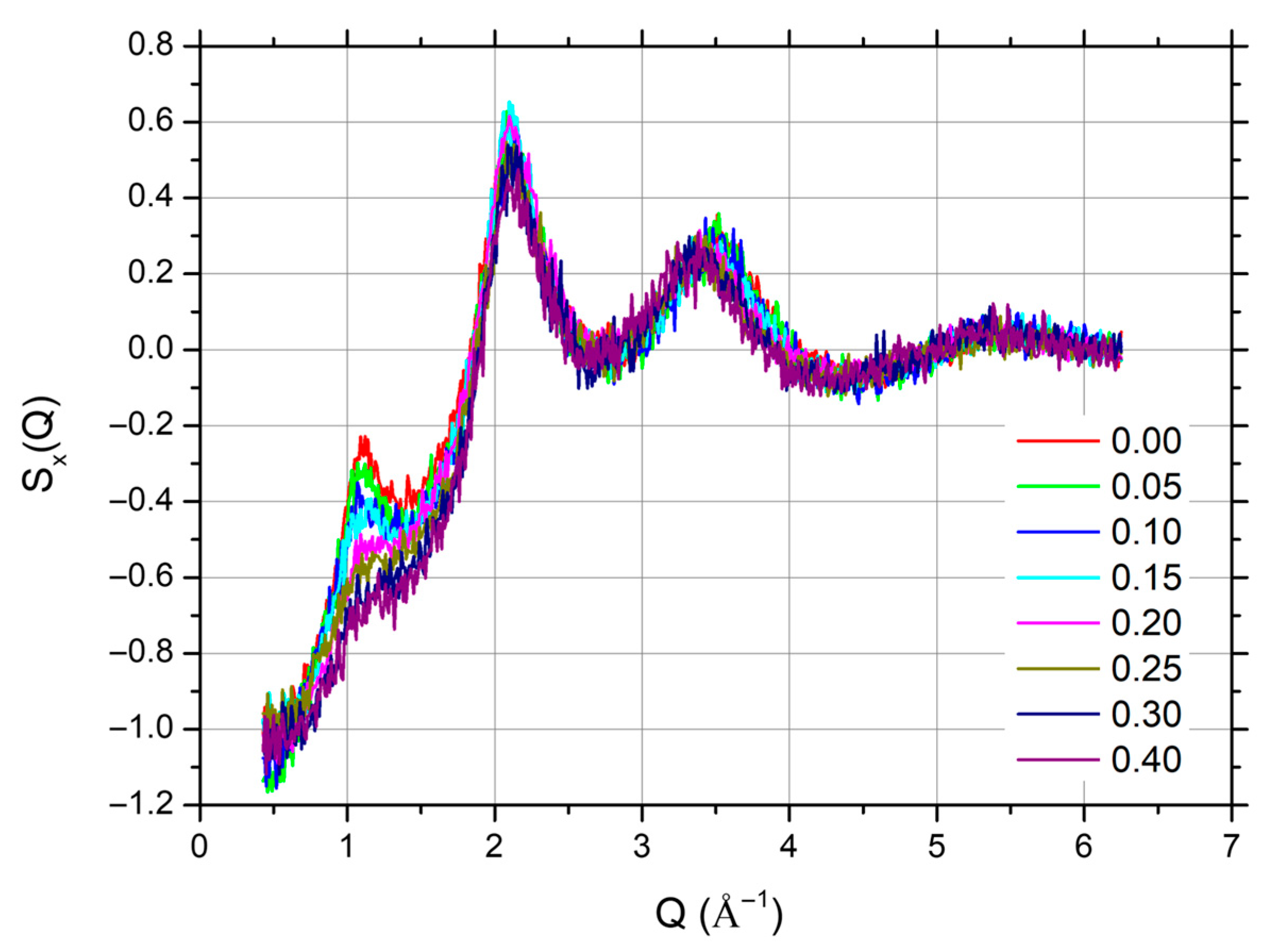
Figure 1. Total structure factor of the glasses in the system (1−x) (0.73GeSe2-0.27Sb2Se3)-xAg2Se. The corresponding x values are indicated in the insert.
Compounds 05 00056 g001
Figure 2. (A) FSDP profile, with compositions indicated in the insert; (B) FSDP position (Qo) and amplitude as a function of Ag2Se content in the glass matrix; (C) correlation length and coherence length at Qo as a function of Ag2Se content in the glass matrix.
Compounds 05 00056 g002
Figure 3. (A) Total correlation function of the studied glasses (x values are indicated in the insert); (B) RDF in the range of the first and second coordination sphere for the composition containing 40 mol% Ag2Se, and theoretical approximation of the first coordination sphere (see text); (C) RDF in the first and second coordination sphere areas for the composition containing 40 mol% Ag2Se, and theoretical approximation of the first coordination sphere and partially, the second coordination sphere (see text).
Compounds 05 00056 g003
Figure 4. NMR 77Se spectra for the studied glasses with x = 0.00 (A), 0.20 (B), and 0.40 (C).
Compounds 05 00056 g004
Figure 5. Fraction of the NMR spectra components near 500 ppm (A), 320 ppm (B), 140 ppm (C), and −60 ppm (D) relating to Se atoms in different environments from the all 77Se NMR signal as a function of Ag2Se concentration.
Compounds 05 00056 g005
Figure 6. (A) Change in compressive pressure with time in the studied glasses (x values are indicated in the insert); (B) exponential decrease in compressive stress with time during the 7th loading cycle for a specimen with x = 0.4; (C) characteristic stress relaxation times for the 5th, 6th, and 7th cycles depending on Ag2Se content.
Compounds 05 00056 g006
Figure 7. (A) Stress vs. time plot in the course of loading of a sample with x = 0.4 for subsequent long-term relaxation; (B) relaxation of the stress 50 N/mm2 applied to specimens with Ag2Se contents 0.0 and 0.4 mol parts; (C) relaxation process approximation for the glass with x = 0.4.
Compounds 05 00056 g007
Disclaimer/Publisher’s Note: The statements, opinions and data contained in all publications are solely those of the individual author(s) and contributor(s) and not of MDPI and/or the editor(s). MDPI and/or the editor(s) disclaim responsibility for any injury to people or property resulting from any ideas, methods, instructions or products referred to in the content.