Previous Article in Journal
Electron Transport, Charge Transfer Processes and Localized States of Charge Carriers in Nanosized Anodic TiO2 Films
 
 
Due to scheduled maintenance work on our servers, there may be short service disruptions on this website between 11:00 and 12:00 CEST on March 28th.
Article

MOF-Derived TiO2 Photocatalysts for Hydrogen Production Coupled to Selective Glycerol Oxidation at Near-Neutral pH


by
Emerson Faustino
1,†,
Priscila Sabioni Cavalheri
2,†,
Emmanuel da Silva Côgo Miguel
2,
Thalita Ferreira da Silva
3,
Gabriel Henrique Diniz Manicoba
4,
Ana Beatriz Saldanha da Silva Ezequiel
4,
Luiz Eduardo Gomes
2,
Heberton Wender
2,
Anderson Rodrigues Lima Caires
2,
Rodrigo Pereira Cavalcante
5 and
Amilcar Machulek Junior
4,*
1
Institute of Chemistry, Federal University of Mato Grosso do Sul, Senador Filinto Muller Ave., 1555, Campo Grande 79070-900, MS, Brazil
2
Institute of Physics, Federal University of Mato Grosso do Sul, Senador Filinto Muller Ave., 1555, Campo Grande 79070-900, MS, Brazil
3
São Carlos Institute of Chemistry, University of São Paulo, Trab. São Carlense Ave., 400, São Carlos 13566-590, SP, Brazil
4
Institute of Chemistry, Federal University of Rio Grande do Norte, Senador Salgado Filho Ave., s/n, Natal 59078-970, RN, Brazil
5
Institute of Chemistry, Federal University of Alfenas, Alfenas 37130-001, MG, Brazil
*
Author to whom correspondence should be addressed.
These authors contributed equally to this work.
Nanomanufacturing 2026, 6(2), 7; https://doi.org/10.3390/nanomanufacturing6020007

Submission received: 29 November 2025 / Revised: 17 January 2026 / Accepted: 17 March 2026 / Published: 26 March 2026

Abstract

Simultaneous hydrogen fuel and value-added chemical production from renewable resources is a key strategy in sustainable catalysis. This work presents a novel strategy employing metal–organic frameworks (MOFs) as precursors for synthesizing advanced titanium dioxide (TiO2) photocatalysts with enhanced structural and optical properties. Two photocatalysts, M-BDC and M-2,5PDC, were synthesized via controlled calcination of MIL-125(Ti) using terephthalic and 2,5-pyridinedicarboxylic acids, respectively. Characterization confirmed the formation of mixed anatase/rutile TiO2 phases with mesoporous structures. Notably, nitrogen incorporation in M-2,5PDC reduced the optical band gap to 2.94 eV compared with 3.08 eV for M-BDC, enhancing visible-light absorption. Photocatalytic experiments conducted at near-neutral pH (6.0) demonstrated effective simultaneous glycerol oxidation and hydrogen evolution without the use of alkaline additives. M-BDC achieved 30% glycerol conversion with 78.85% selectivity toward dihydroxyacetone and 21.15% toward glyceraldehyde, while M-2,5PDC exhibited selectivities of 71.55% and 28.45%, respectively. Glycerol underwent partial oxidation without complete mineralization, generating high-value products in parallel with hydrogen production. Both catalysts displayed excellent reuse stability across three consecutive cycles, with M-BDC showing enhanced dihydroxyacetone selectivity (78.85% to 84.42% between cycles). This MOF-derived TiO2 platform integrates controlled synthesis, near-neutral pH operation, high selectivity, and catalytic stability, thereby establishing a viable strategy for the simultaneous production of clean fuel and value-added chemicals from renewable resources.

1. Introduction

Heterogeneous photocatalysis based on semiconductor materials has emerged as a promising approach for sustainable hydrogen production [1]. Beyond clean energy generation, photocatalytic processes also play an important role in environmental remediation and in the valorization of waste streams into value-added chemicals, contributing to the development of a circular and sustainable economy [1,2].
Among semiconductor photocatalysts, titanium dioxide (TiO2) remains the benchmark material due to its outstanding photochemical stability, resistance to photocorrosion, non-toxicity, and low production cost. These characteristics make TiO2 particularly attractive for large-scale and environmentally benign applications. Nevertheless, the photocatalytic efficiency of pristine TiO2 is limited by intrinsic drawbacks, including its wide band gap (approximately 3.0–3.2 eV for rutile and anatase phases), which restricts light absorption mainly to the ultraviolet region, and the rapid recombination of photogenerated electron–hole pairs, resulting in low quantum efficiency under solar irradiation [3,4,5].
To overcome these limitations, nanostructuring strategies and defect engineering have been widely explored. In this context, metal–organic frameworks (MOFs) have emerged as versatile and cost-effective precursors for the synthesis of advanced TiO2-based nanomaterials. Upon thermal treatment, the collapse of the MOF structure leads to the formation of porous TiO2 architectures with high specific surface areas, improved mass transfer, and enhanced charge separation. Importantly, MOF-derived TiO2 materials can be synthesized without noble metal co-catalysts and operate efficiently under simulated solar light and near-neutral pH conditions, reducing material costs, minimizing reactor corrosion, and lowering downstream processing requirements [6,7,8,9].
Nanomaterials (NMs) have attracted significant research attention for their diverse applications across multiple sectors, including photovoltaic technology, optical systems, catalytic processes, agricultural production, medical treatments, and surface modification technologies [10,11]. Porous TiO2 nanoparticles derived from the calcination of MIL-125(Ti) exhibit favorable physicochemical properties, including mixed anatase/rutile phases that promote efficient separation of photogenerated charge carriers. Additionally, residual carbon species formed during pyrolysis can further enhance charge transfer, contributing to improved photocatalytic performance [7,12].
Simultaneously, the valorization of biomass-derived waste streams represents an important pathway toward sustainable energy and chemical production. Glycerol, a major byproduct of the biodiesel industry, is generated in large quantities and poses both economic and environmental challenges [13]. The use as a sacrificial agent in photocatalytic hydrogen production offers a dual benefit: it facilitates hydrogen evolution due to its lower oxidation potential compared with water, while enabling the selective conversion of a low-value byproduct into high-value chemicals, thereby enhancing the overall efficiency and sustainability of the process [14].
Recent advances have increasingly focused on sustainable hydrogen production using renewable energy sources and engineered semiconductor heterojunctions to improve charge separation and light harvesting efficiency [15]. TiO2-based heterojunctions have been intensively explored as they enable more efficient electron–hole separation while preserving the robustness and stability of TiO2. In parallel, functionalization and post-modification of MOF-derived nanomaterials, such as NH2-MIL-125(Ti), have emerged as versatile strategies to extend visible-light absorption and tailor the band structure through dopants or electron-donor functional groups, thereby enhancing photocatalytic H2 evolution performance. Additionally, recent studies have emphasized the integration of biomass valorization, especially glycerol oxidation [5,16,17], into photocatalytic systems, coupling hydrogen evolution with the selective production of value-added chemicals as a promising route for green hydrogen production and the circular bioeconomy [18,19,20,21]. In this context, MOF-derived TiO2 photocatalysts operating under near-neutral pH with glycerol as a sacrificial agent represent a cutting-edge approach to achieve cost-effective and environmentally compatible solar-driven hydrogen production.
The novelty of this work lies in integrating several features rarely combined in a single system: (i) the use of MIL-125(Ti)-derived TiO2 photocatalysts obtained from distinct organic ligands to modulate phase composition and band gap; (ii) operation at near-neutral pH (6.0), avoiding the strongly alkaline conditions commonly used to drive glycerol oxidation, which increase corrosion and require subsequent neutralization; and (iii) achieving simultaneous hydrogen production and high selectivity for dihydroxyacetone and glyceraldehyde without noble-metal co-catalysts or additional alkaline promoters. Unlike many previous studies that rely on Cu, Ag, Pt, Pd-, or Au-modified TiO2 and/or strongly basic media to achieve high H2 evolution rates, our MOF-derived photocatalysts operate under milder, environmentally compatible conditions [16,22,23,24,25,26,27].
This work, therefore, investigates the development and application of photoactive titanium-based nanomaterials derived from the calcination of MIL-125(Ti) for the photogeneration of hydrogen from the photo-oxidation of glycerol under visible-light irradiation. The synthesis, characterization, and photocatalytic performance of these advanced materials are explored, aiming to provide a cost-effective and scalable solution that simultaneously addresses the challenges of clean energy production and industrial waste valorization.

2. Materials and Methods

2.1. Reagents

Titanium (IV) isopropoxide (TTiP, C12H28O4Ti, 97% purity, Sigma-Aldrich, St. Louis, MO, USA), terephthalic acid (98% purity, Sigma-Aldrich), and 2,5-pyridinedicarboxylic acid (98% purity, Sigma-Aldrich) were used as precursors for MOF synthesis. N,N-dimethylformamide (99.8% purity, Dinâmica, Indaiatuba, SP, Brazil) and methanol (99.9% purity, Supelco, Bellefonte, PA, USA) served as solvents in the solvothermal step. Glycerol (99.5% purity, Dinâmica) was used in photocatalytic tests. Analytical reagents included phosphoric acid (85% purity, Vetec, Duque de Caxias, RJ, Brazil), sulfuric acid (95–98% purity, Proquímios, Rio de Janeiro, RJ, Brazil), acetonitrile (HPLC grade, J. T. Baker, Phillipsburg, NJ, USA), and ultrapure water. Standards for HPLC quantification comprised glycerol, glyceraldehyde, dihydroxyacetone, tartronic acid, and glyoxylic acid (concentration ranges as described in the calibration section). Nylon syringe filters (0.22 µm, Unifil, São Paulo, SP, Brazil) were used for sample preparation prior to chromatographic analyses.

2.2. Synthesis of Photocatalysts

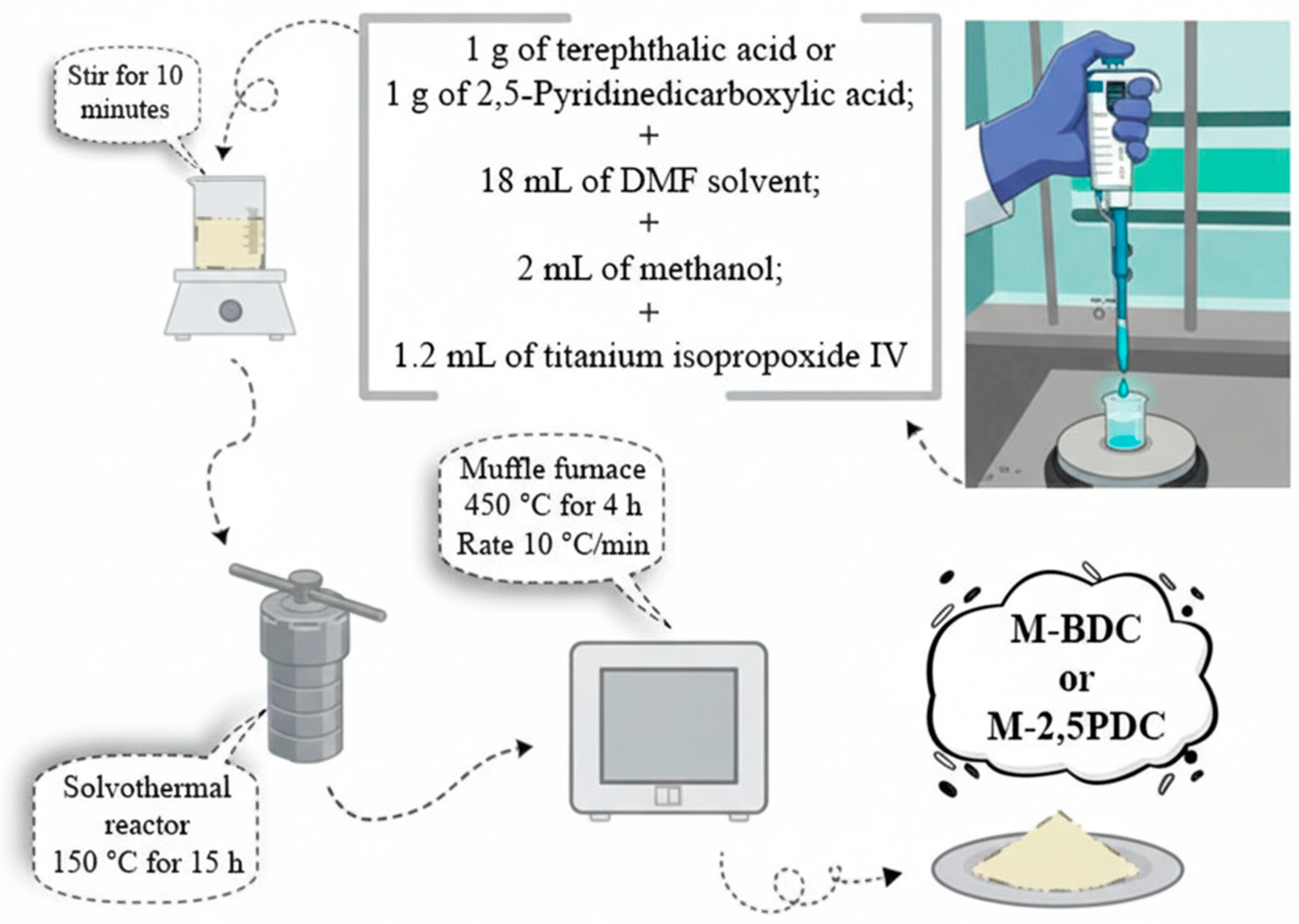
In a 25 mL beaker, 18.0 mL of N,N-dimethylformamide (DMF) and 2.0 mL of methanol were sequentially added. Subsequently, 1.0 g of the ligand was introduced: (a) terephthalic acid (H2BDC) for M-BDC and (b) 2,5-pyridinedicarboxylic acid (H2PDC) for M-2,5PDC.
Then, 1.2 mL of titanium(IV) isopropoxide (TTiP) was added. The mixture was stirred for 10 min at room temperature, transferred to a solvothermal reactor, and heated at 150 °C for 15 h, followed by natural cooling. The white solid was filtered, washed with methanol, and dried at room temperature. Finally, calcination was performed at 450 °C for 4 h (heating rate: 10 °C min−1).
All reagents were used as received, without further purification. The synthesis conditions were identical for both materials, differing only in the organic ligand employed. The experimental setup is illustrated in Figure 1.

2.3. Hydrogen Photogeneration (H2)

Photocatalytic hydrogen (H2) generation experiments were performed in a Teflon reactor equipped with a quartz window (Figure S1, see Supplementary Material). For photocatalysis experiments, a volume of 55 mL of aqueous glycerol (0.05 mol L−1) containing 55 mg of photocatalyst was used. The system was sealed and purged with argon to remove dissolved oxygen. Following purging and under magnetic stirring (1000 rpm), the xenon lamp was turned on. The total reaction time was 240 min, during which 300 µL gas aliquots from the reactor headspace were collected at different time points. The reaction temperature was maintained at room temperature. The solution pH was adjusted to 6.0 at the start of the reaction and was not controlled during the experiment. This pH value was selected because it is near-neutral and relevant for environmental applications [28].
A 150 W xenon lamp solar simulator fitted with an AM1.5G filter simulated solar irradiation. The irradiance was adjusted to 200 mW cm−2 and continuously monitored with a photovoltaic cell connected to a voltmeter positioned outside the reactor’s quartz window. After irradiation, the headspace gas was sampled for gas chromatography (GC) using an SRI 310C chromatograph, available at the Physics Laboratory, INFI/UFMS (Federal University of Mato Grosso do Sul, Brazil).
Glycerol degradation was also monitored during the process. Samples of 1.0 mL were collected at the beginning and at the end of the experiments and analyzed by high-performance liquid chromatography (HPLC) coupled with a UV–Vis detector (Shimadzu SPD-M20A, Kyoto, Japan) operating at 210 nm. A Rezex ROA-Organic Acid ion-exchange column with a matching guard column was used for the separation of by-products. In addition to monitoring the decrease in glycerol concentration, possible by-products such as tartronic acid, dihydroxyacetone, DL-glyceraldehyde, and glyoxylic acid were identified.
After each photocatalytic cycle, the catalyst was recovered by centrifugation at 6000 rpm for 10 min, followed by three washing cycles with deionized water (3 × 20 mL) to remove residues of glycerol and by-products. The washed solid was then dried at 60 °C for 12 h in an oven before being reused in the subsequent cycle. No additional thermal treatment, chemical regeneration, or post-treatment was applied between reusability cycles, ensuring that the observed performance reflects the intrinsic stability of the MOF-derived photocatalyst under the applied reaction conditions [29].
Chromatographic analyses (HPLC) were performed at room temperature under isocratic conditions using 2.5 mmol L−1 phosphoric acid as the eluent. The flow rate was set to 0.4 mL min−1 at 46 bar, with a total run time of 13 min. Samples collected at the beginning and end of the experiments were filtered through a 0.22 μm nylon® syringe filter and acidified with 1.0 mL of 0.1 mol L−1 H2SO4. Aliquots of 20.0 μL were injected into the chromatograph.
Calibration curves were constructed using glycerol standard solutions ranging from 0.1 mol L−1 to 4 × 10⁻³ mol L−1, and for other standards between 3 × 10⁻³ mol L−1 and 1 × 10⁻⁵ mol L−1. As calibration equations used to convert the chromatographic peak area into concentration (mol L−1) were defined as follows: for glycerol, the equation was Integration + 721.81/1.29 × 105; for dihydroxyacetone, Integration + 464.36/3.15 × 105; for glyceraldehyde, Integration − 7637.93/3.83 × 106; for glyoxylic acid, Integration − 824.38/11.03; and for tartronic acid, Integration − 7637.90/3.8 × 106.
Based on the results obtained from HPLC analyses, calculations of glycerol conversion (Equation (1)), and selectivity (Equation (2)), were performed for each synthesized catalyst.
G l y c e r o l   c o n v e r s i o n   ( % ) = [ G l y c e r o l ] i n i t i a l [ G l y c e r o l ] f i n a l [ G l y c e r o l ] i n i t i a l × 100
S e l e c t i v i t y   ( % ) = D e s i r e d   p r o d u c t   c o n c e n t r a t i o n ( C o n c e n t r a t i o n   o f   c o n v e r t e d   p r o d u c t s ) × 100

3. Results and Discussion

3.1. Characterization of Materials

Characterization techniques are detailed in the Supplementary Material.
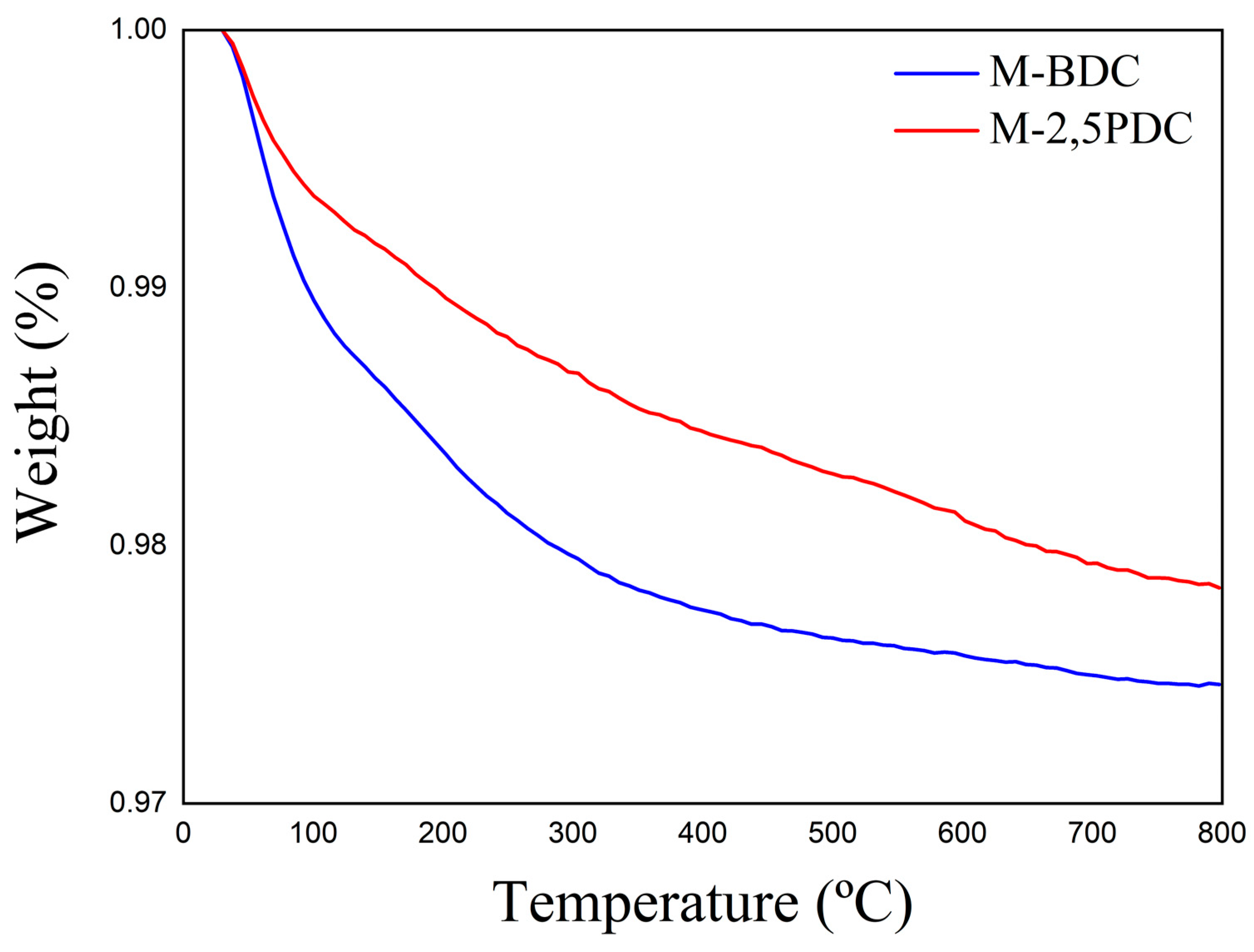
Thermogravimetric analysis (TG) evaluates the mass variation (Δm) of a sample as a function of temperature (ΔT) under controlled heating conditions. The TGA profile of the precursor material shows a multistep weight-loss behavior, indicating distinct thermal events. The initial weight loss below ~100 °C is attributed to the removal of physically adsorbed water and residual solvent molecules [30]. The second mass-loss step, occurring between ~100 and 450 °C, is associated with the partial decomposition of the organic ligands and the release of volatile species. A major weight loss observed in the range of ~350–550 °C corresponds to the complete degradation of the organic framework and collapse of the MOF structure, leading to the formation of the TiO2-based material. Above this temperature, no significant mass loss is detected, indicating the formation of a thermally stable inorganic oxide phase. The synthesized materials displayed excellent thermal stability (Figure 2). M-BDC exhibited a mass loss of approximately 2.53%, whereas M-2,5PDC lost 2.16% up to 800 °C.
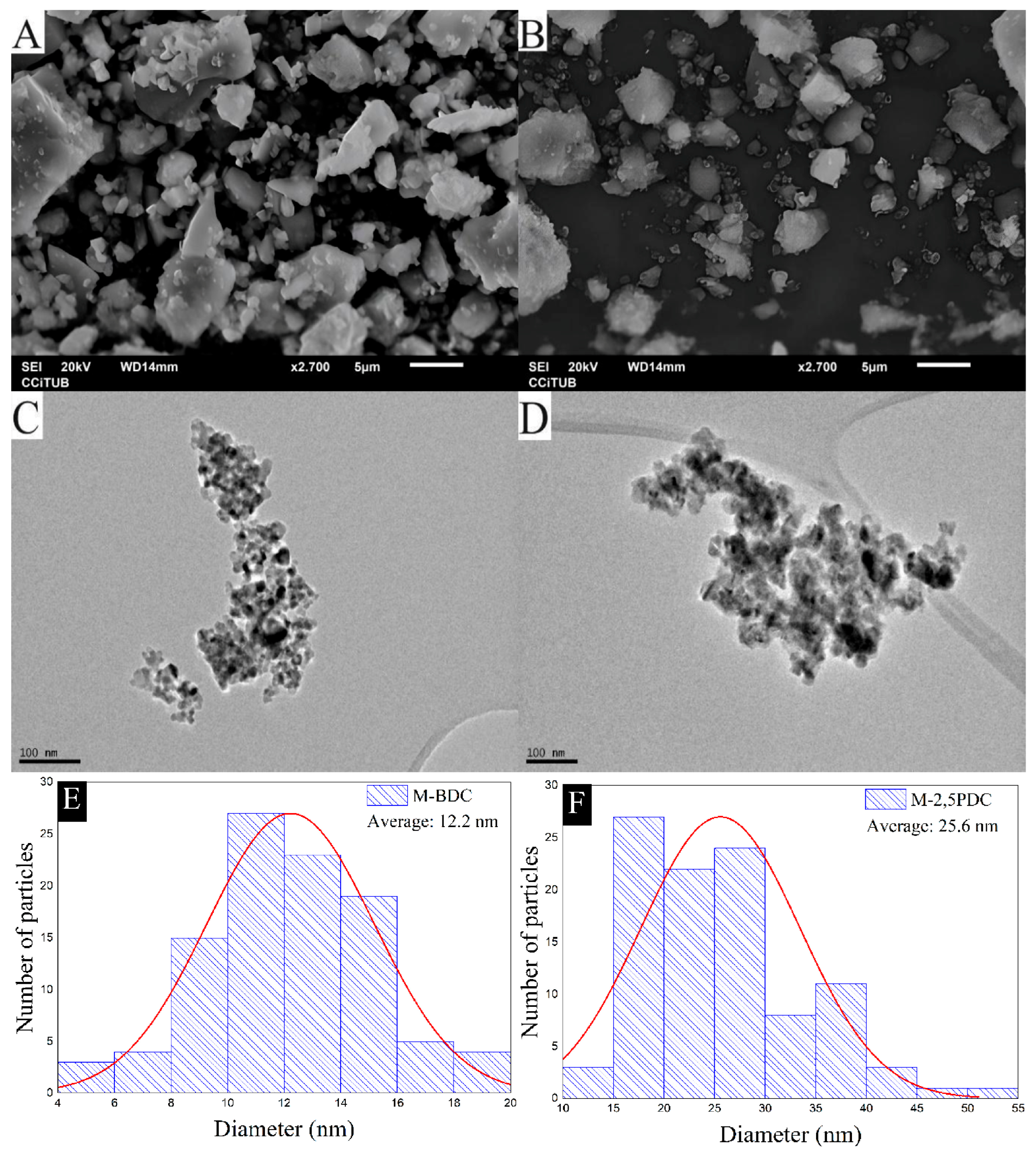
The morphology and particle size of the photocatalysts were analyzed by SEM and TEM. Figure 3A,B show the SEM images of the M-BDC and M-2,5PDC nanomaterials, respectively, in which no defined morphology is observed, but rather aggregates of different sizes. Similar results were reported by [31,32], who also obtained titanium-based materials with irregularly aggregated structures. The SEM images acquired at a magnification of 2700× reveal an irregularly aggregated morphology of the MIL-125(Ti)–derived material after calcination at 400 °C. This morphology originates from the collapse of the MOF framework during thermal treatment, accompanied by the decomposition of terephthalic acid linkers and the condensation of Ti–O species into a Ti–O–Ti inorganic network. These processes promote densification and aggregation of TiO2 domains, leading to the heterogeneous surface features observed.
The TEM images (Figure 3C,D) reveal aggregates with varying diameters. Particle size was determined using the ImageJ software (version 1.54g, National Institutes of Health, EUA) through the Feret diameter function. The obtained values are shown in the histograms (Figure 3E,F), indicating average diameters of 12.2 nm for M-BDC and 25.6 nm for M-2,5PDC.
Similar work by [33] synthesized boron-doped titanium-based materials with average diameters of 8.73 nm (9% B), 10.54 nm (5% B), 12.82 nm (2% B), and 21.29 nm for pure TiO2. An average diameter of 16.16 nm for pure TiO2 was reported by [32] while Fe-, N-, and S-doped materials exhibited average diameters of 14.45 nm, 12.27 nm, and 9.92 nm, respectively. Both studies employed the sol–gel method for material synthesis.
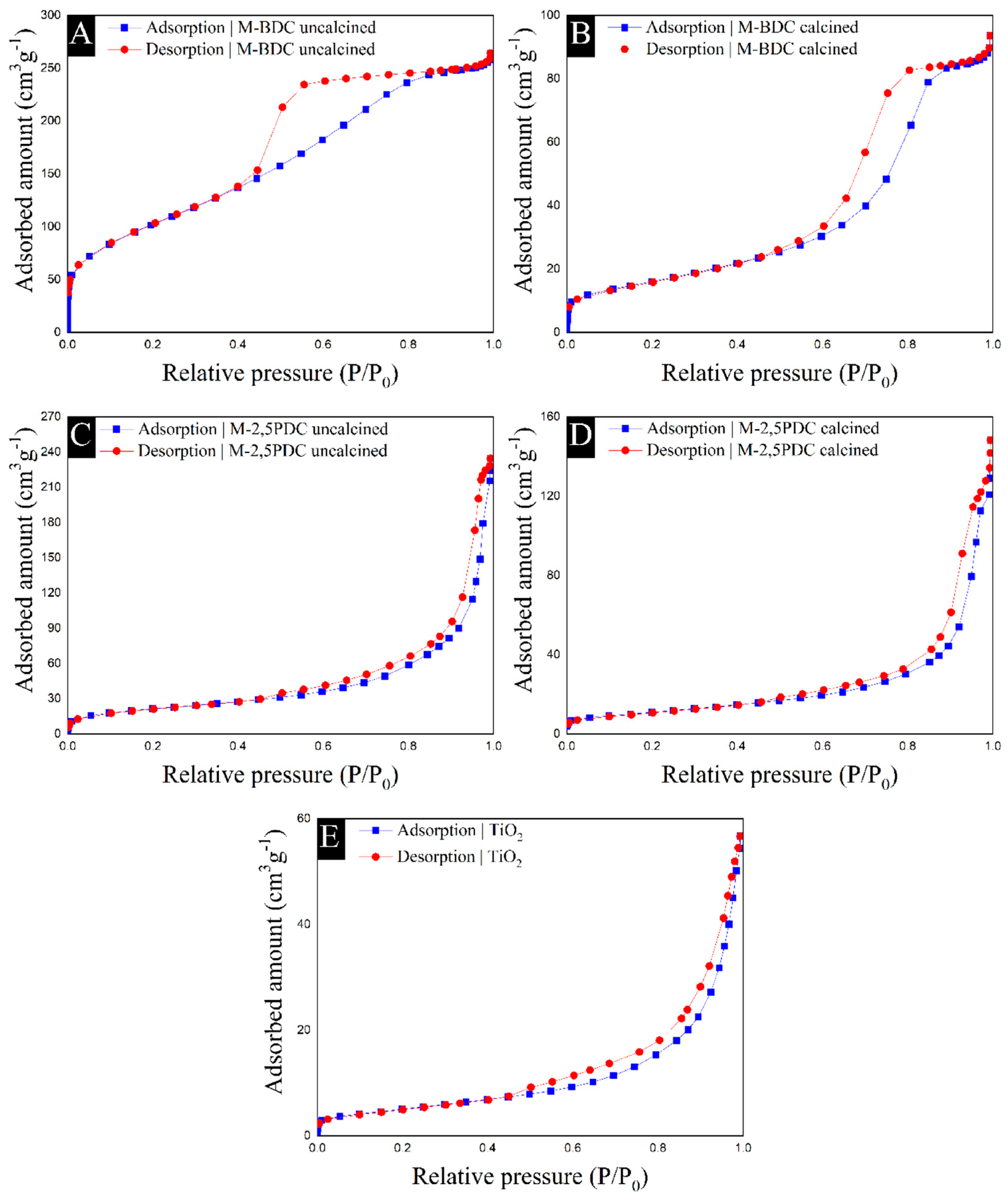
The specific surface areas determined by BET were obtained from N2 adsorption–desorption isotherms. The isotherms of the materials (Figure 4), both before and after calcination, were classified as type IV with H2-type hysteresis loops, indicating mesoporous structures [34]. A hysteresis effect associated with stacked pores was observed, which diminished after calcination [35]. Similarly, MIL125(Ti)type nanomaterials, activated in a Teflon-lined autoclave at 150 °C for 12 h, were synthesized and exhibited type IV adsorption isotherms with H2 hysteresis loops [36]. According to the authors, this mesoporous structure enhances mass transfer and increases the number of active sites, thereby improving the photocatalytic performance of the material.
The pore volume and size were determined using the Barrett-Joyner-Halenda (BJH) method [37]. After the calcination process, a reduction in surface area and an increase in pore diameter were observed.
The BET analysis (Table 1) revealed that for the M-BDC photocatalyst, the specific surface area decreased from 376.00 m2 g−1 to 59.18 m2 g−1 after calcination, while the pore diameter increased from 4.35 nm to 9.79 nm and the pore volume decreased from 0.4088 cm3 g−1 to 0.1448 cm3 g−1. For the M-2,5PDC photocatalyst, the initial surface area of 77.66 m2 g−1 dropped to 40.15 m2 g−1, the pore diameter increased from 18.69 nm to 22.84 nm, and the pore volume decreased from 0.3628 cm3 g−1 to 0.2293 cm3 g−1. These results indicate that due to the thermal treatment applied to the catalysts, their surface area decreased. Studies have shown that lower temperatures combined with prolonged treatment times are more favorable for increasing the catalyst’s surface area [38].
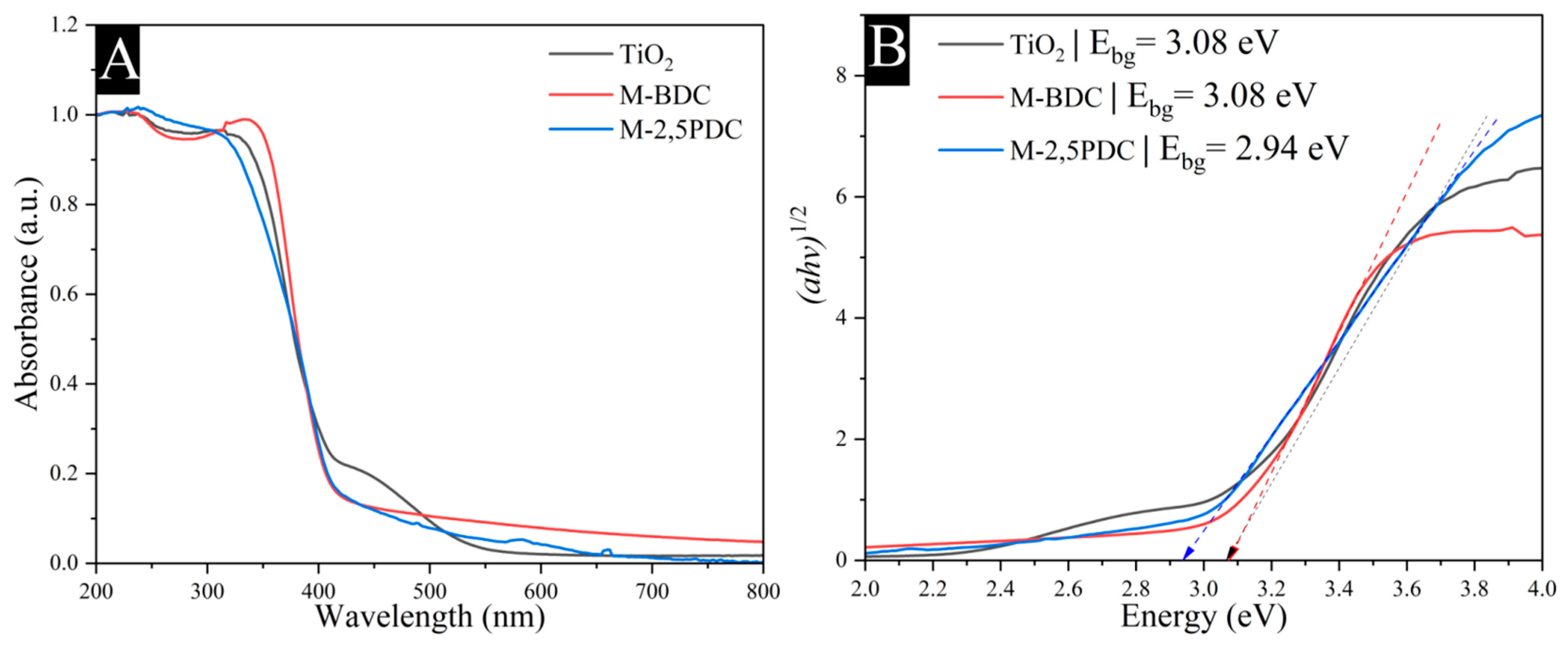
The UV–Vis absorption spectrum (Figure 5A) shows a pronounced band in the 320–420 nm range. Using the Kubelka–Munk function [39] and Planck’s law [40], a Tauc plot was constructed (Figure 5B) to determine the optical bandgap energies. Bandgap values of 3.08 eV (M-BDC) and 2.94 eV (M-2,5PDC) were determined, indicating coexistence of anatase (3.2–3.3 eV) and rutile (3.0–3.1 eV) phases [41] in the synthesized materials. Another important consideration is that the slightly lower band gap energy corresponds to improved visible light absorption [42]. For photocatalytic activity to occur in the TiO2 film, excitation with energy above 3.2 eV (λ < 386 nm) requires the bandgap energy between the valence and conduction bands. Therefore, the reduction in the bandgap to 2.94 eV observed for the M-2,5PDC photocatalyst is considered advantageous for enhancing photocatalytic performance [43,44].
The predominance of the rutile phase in the carbon-doped powder likely contributes to the observed reduction in bandgap energy [45]. Moreover, the prepared powder displayed an absorption tail extending across the visible spectrum from 400 to 700 nm, indicating enhanced visible light absorption. This behavior highlights the effect of the rutile phase on narrowing the band gap and improving photoresponse efficiency [45].
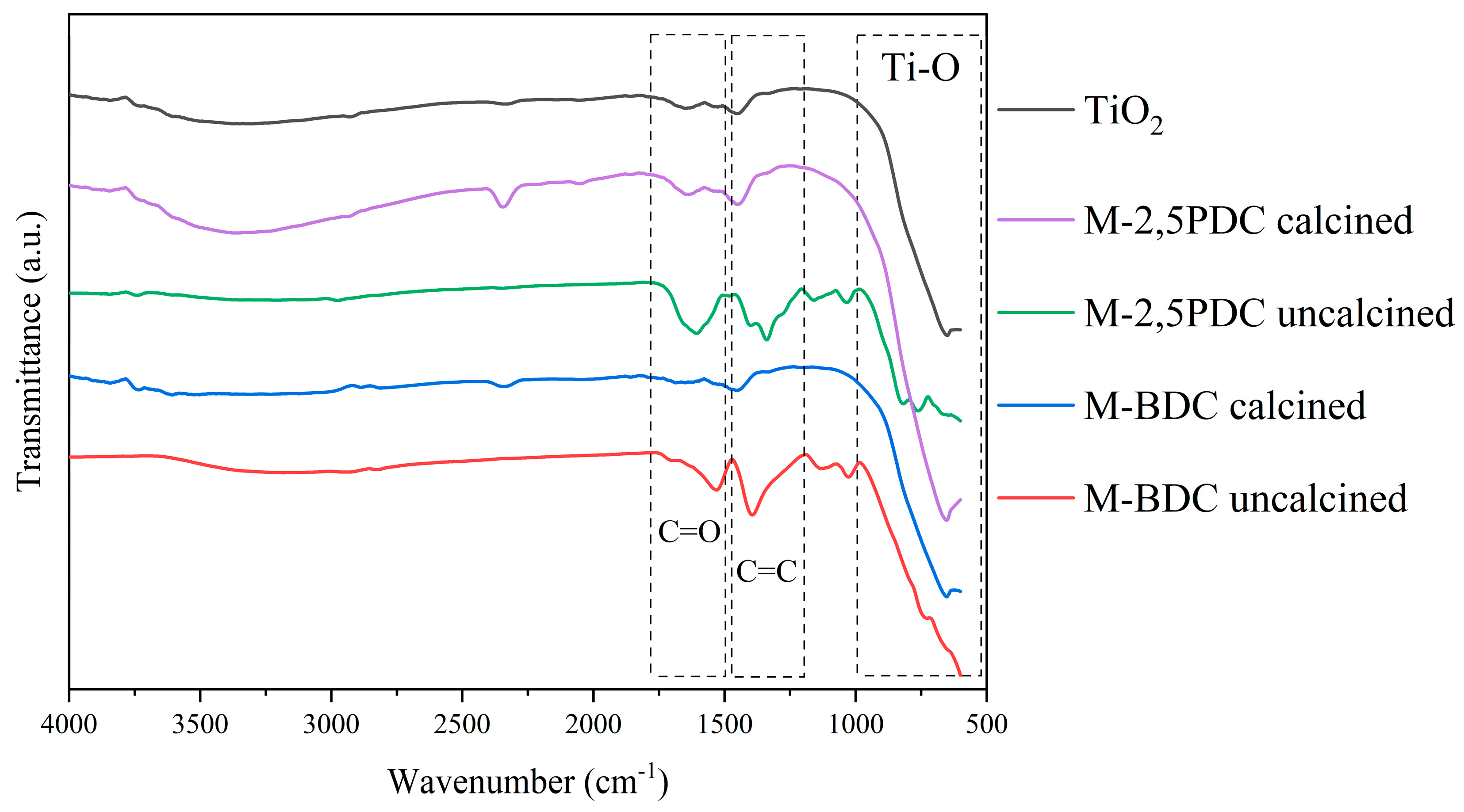
In the 3500–3000 cm−1 region (Figure 6), vibrations associated with water molecules and free solvents within the pores are observed. Between 1750 and 1650 cm−1, bands corresponding to carboxyl (COOH) and carboxylate (COO) stretching vibrations are observed. In the 1600–1400 cm−1 region, aromatic C=C stretching modes are identified, consistent with the terephthalic acid (H2BDC) and 2,5-pyridinedicarboxylic acid ligands. Vibrations below 800 cm−1 are associated with titanium, particularly Ti-O and Ti-O-Ti bonds, confirming the formation of titanium dioxide (TiO2) after calcination [36,46,47,48,49].
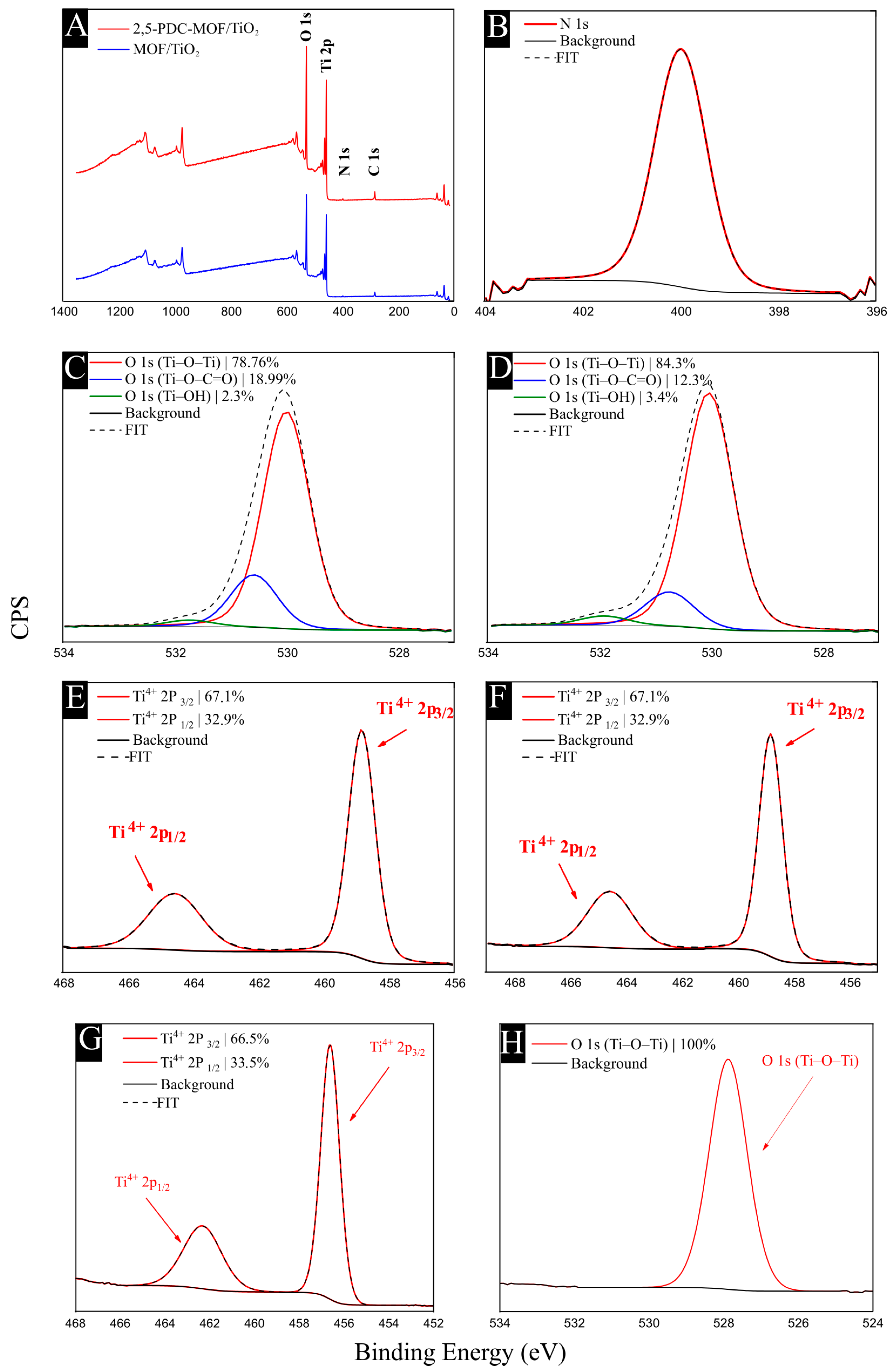
X-ray photoelectron spectroscopy (XPS) analysis (Figure 7) was conducted to elucidate the surface elemental composition and chemical oxidation states of the MOF-derived photocatalysts, with all binding energies calibrated using the C 1s peak at 284.8 eV as an internal reference. The survey spectra (Figure 7A) confirm the presence of Ti, O, and C in both M-BDC and M-2,5PDC samples. In contrast, M-2,5PDC exhibits an additional N 1s signal, evidencing the presence of nitrogen derived from the 2,5-pyridinedicarboxylic acid linker. High-resolution N 1s spectra (Figure 7B) display a single component centered at ~400 eV, which is assigned to pyridinic nitrogen associated with the organic ligand. Peak separation of the O 1s spectra (Figure 7C,D) reveals three main components. The O 1s spectrum was deconvoluted into three components. The peak at ~530.0 eV is assigned to lattice oxygen (Ti-O-Ti) of TiO2 [50]. The component centered at ~530.7 eV is attributed to carboxylate oxygen coordinated to Ti (Ti–O–C=O), arising from the organic linker in the MOF-derived structure. The higher binding energy contribution at ~531.9 eV is associated with non-coordinated carboxylate oxygen and surface hydroxyl groups (Ti–OH), with possible minor contribution from adsorbed water. Analysis of the Ti 2p spectra (Figure 7E,F) displays characteristic Ti4+ doublets (Ti 2p3/2 ~ 458.8 eV; Ti 2p1/2 ~ 464.6 eV) with titanium in the +4 oxidation state, confirming stoichiometric TiO2 formation at the surface. Although the Ti 2p1/2 component exhibits a larger full width at half maximum (FWHM), its integrated area accounts for 32.9% of the total Ti 2p signal, compared to 67.1% for the Ti 2p3/2 peak. Minor deviations from the expected constraint may be influenced by Coster–Kronig decay processes, which affected peak broadening and relative intensities [51]. Comparative analysis with pure TiO2 (Figure 7G,H) underscores that MOF-derived photocatalysts exhibit enhanced surface oxygen and nitrogen components, providing superior active site density. Collectively, XPS analysis confirms the presence of nitrogen-containing linker-derived species at the surface of M-2,5PDC, increased surface oxygen components, and maintained Ti4+ predominance, establishing the direct correlation between surface chemistry modifications and enhanced photocatalytic performance [52,53,54,55].
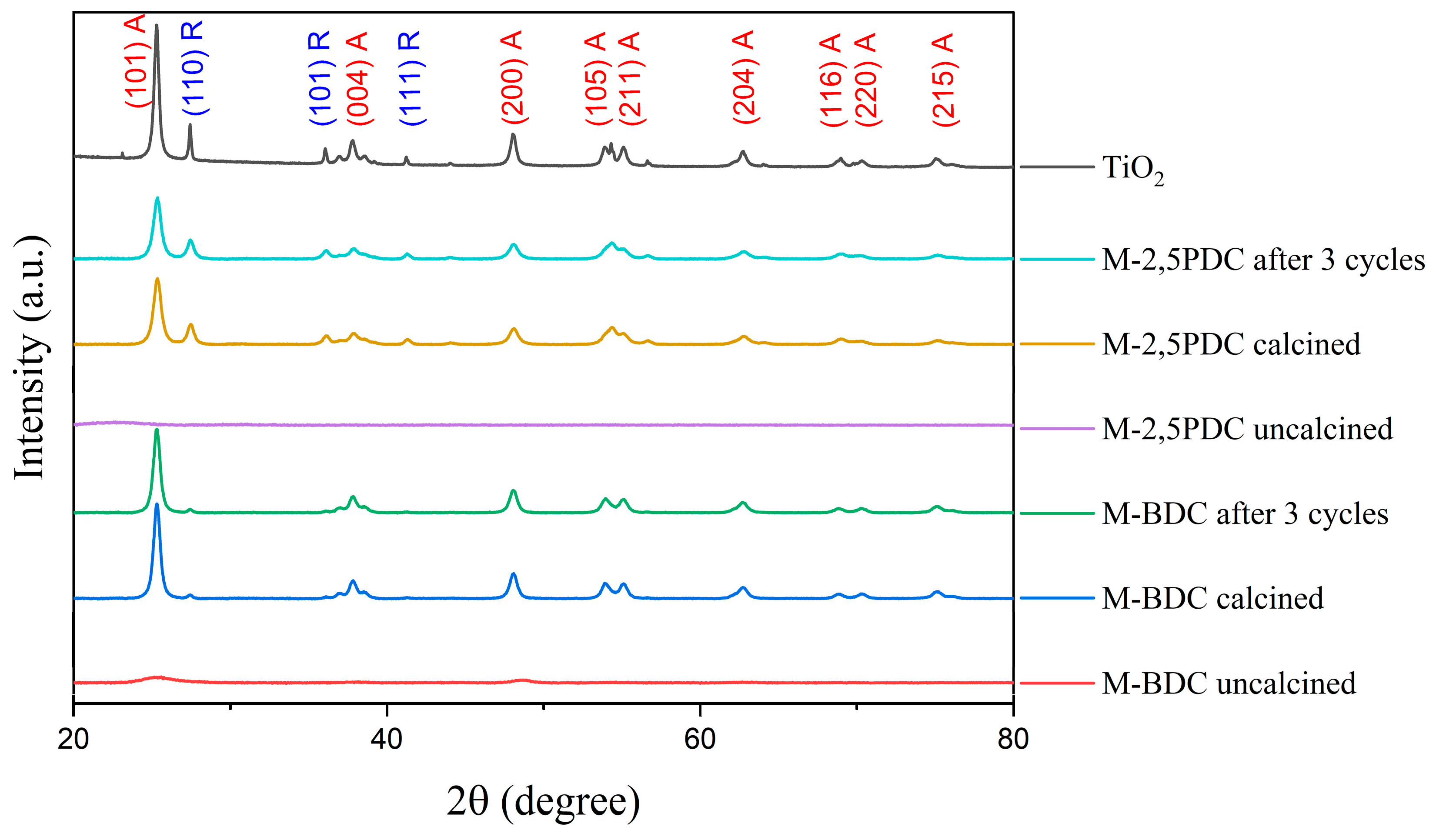
X-ray diffraction (XRD) analyses were performed on the precursor, the calcined TiO2 material, and the samples after photocatalytic experiments. The diffractograms of the calcined samples (Figure 8) confirmed the formation of multiphase TiO2, characterized by the coexistence of anatase and rutile crystalline phases. The peaks were indexed according to JCPDS card No. 21-1272 for anatase and JCPDS card No. 21-1276 for rutile. The anatase (101) diffraction plane was identified as the most intense in all TiO2 samples. The detection of the anatase phase is beneficial, as this crystalline form of TiO2 absorbs photons more efficiently than the rutile phase, thereby enhancing its photo(electro)catalytic performance in practical applications [56]. Additional peaks at 2θ values of 27.56°, 36.08°, and 41.28° correspond to the rutile (110), (101), and (111) planes, respectively. Comparison with literature data further confirmed the formation of well-defined anatase and rutile TiO2 phases [31,57,58,59,60].

3.2. Photocatalytic Experiment: Hydrogen Photogeneration (H2)

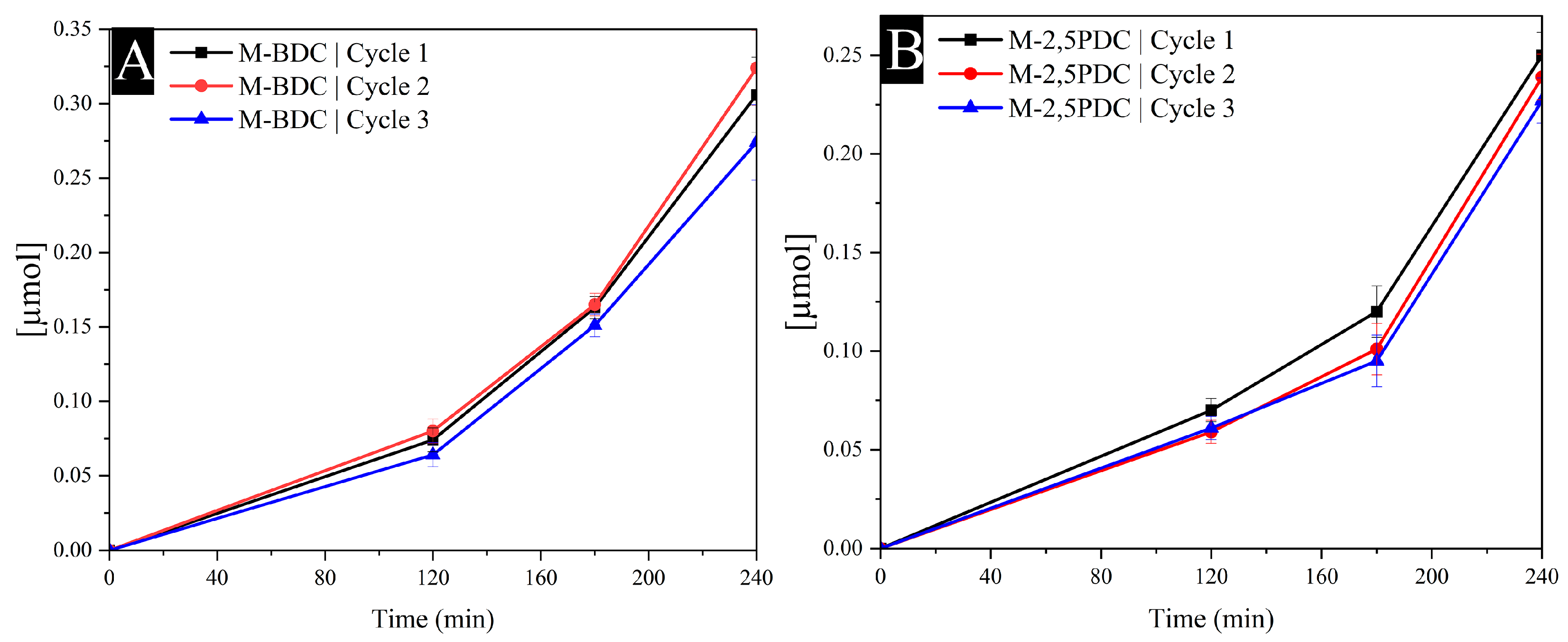
Figure 9A shows that M-BDC is photoactive for H2 generation under simulated solar irradiation (AM 1.5G). Likewise, M-2,5PDC (Figure 9B) also promotes H2 photoproduction, whereas the uncalcined MOFs remain inactive, demonstrating that calcination, yielding multiphase TiO2, is decisive for catalytic activity. A blank test using pristine P25 TiO2 particles was conducted under identical conditions (Figure S2, see Supplementary Material). No hydrogen evolution was detected under AM 1.5 irradiation; hydrogen production was only observed upon removal of the filter, emphasizing the critical role of band gap reduction in enabling visible-light-driven activity in the synthesized samples. The emission spectra of the light source with and without the AM 1.5 filter are shown in Figure S3 (see Supplementary Material), clearly evidencing the spectral differences, particularly the drastic reduction in the UV contribution when the filter is applied, which was consistently used in all experiments with the synthesized samples.
Hydrogen evolution proceeds via a reduction pathway wherein photogenerated electrons (e) localized at the conduction band of TiO2 reduce protons (H+) released during glycerol oxidation, yielding molecular hydrogen according to the reaction (Equation (3)):
2H+ + 2e → H2.
This coupled process, integrating selective glycerol oxidation with hydrogen generation, exemplifies the catalytic efficiency of TiO2 photocatalysts in transforming an organic feedstock into high-value-added products.
The photocatalysts were reused for three consecutive cycles (Figure 9A,B) without appreciable loss of performance, evidencing structural and operational stability and indicating potential for multi-cycle applications.
In a published study, 50 mg of a titanium-based catalyst was employed in 150 mL of alcoholic solution (methanol or ethanol, 0.05 mol L−1) under a solar simulator equipped with a xenon lamp (150 W; 1.36 W m−2 UV), yielding 0.08 µmol H2 (methanol) and 0.32 µmol H2 (ethanol). The authors attributed the yield differences to the alcohol molecular size and the low electron donor concentration, factors that affect charge transfer in TiO2. In the present study, the sustained activity using glycerol as a sacrificial electron donor underscores the robustness and versatility of the obtained photocatalysts [46].
The initial and final solutions were evaluated by Total Organic Carbon (TOC) (Figure S4, see Supplementary Material). Under both H2 photoproduction conditions, no detectable mineralization of glycerol was observed, indicating predominant partial oxidation rather than complete conversion to CO2 and H2O. Analogous findings have been reported in titanium dioxide-based photocatalytic systems, where incomplete glycerol mineralization was observed alongside the preferential formation of partially oxidized intermediates rather than complete conversion to CO2. These studies consistently demonstrate that TiO2-mediated glycerol oxidation generates value-added products such as dihydroxyacetone, glyceraldehyde, and glyoxylic acid, with minimal total organic carbon mineralization [61,62,63].

3.3. Mechanism of Glycerol Oxidation Byproduct Formation

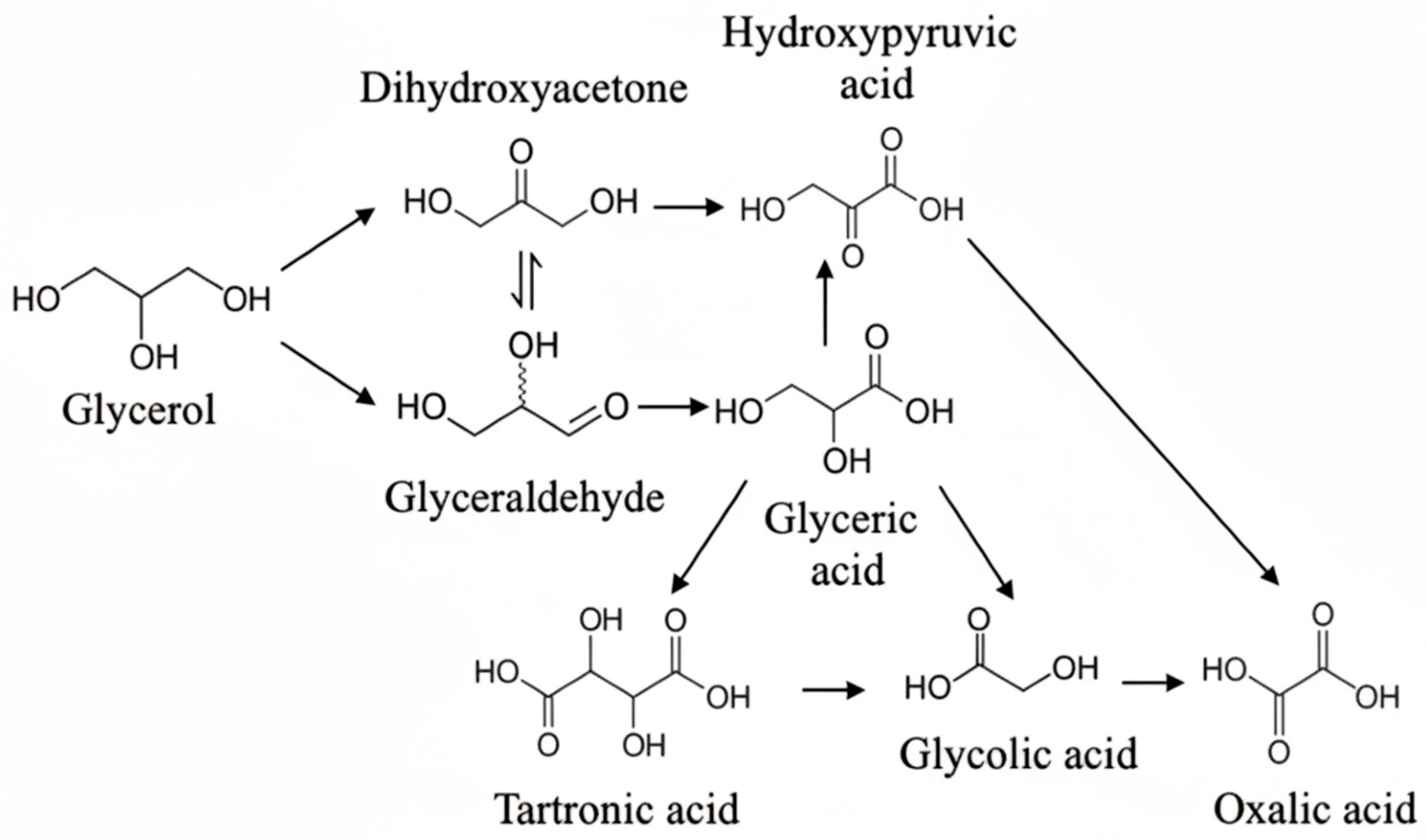
Glycerol oxidation can proceed through multiple pathways, yielding a variety of byproducts (Figure 10). The primary ones are glyceraldehyde and dihydroxyacetone, arising from primary or secondary hydroxyl oxidation of glycerol. These species often coexist in equilibrium in aqueous solution and can be transformed into products such as hydroxypyruvic acid, glyceric acid, tartronic acid, glycolic acid, and oxalic acid, depending on reaction conditions and the catalyst employed [64,65].
In the experiments for H2 photogeneration using glycerol as an electron donor, two main byproducts were detected: glyceraldehyde and dihydroxyacetone. Briefly, the primary and secondary carbon atoms of glycerol are readily attacked by an excess of hydroxyl radicals (HO), resulting in the formation of glyceraldehyde and dihydroxyacetone, respectively. The generated glyceraldehyde can subsequently be oxidized to glyceric acid via hydroxyl radical-mediated pathways. Both the hydroxyl radical and molecular oxygen (O2) can selectively interact with the carbon atoms of dihydroxyacetone, glyceraldehyde, and glyceric acid, producing hydroxypyruvic acid as an intermediate species. This intermediate undergoes successive attacks by hydroxyl radicals, leading to C–C bond cleavage and ultimately resulting in the formation of oxalic acid as the final product [66].
In this system, glycerol acts as a sacrificial electron donor, undergoing partial oxidation by photogenerated holes (h+) and hydroxyl radicals (HO), which generate protons (H+) that are subsequently reduced to H2 by conduction band electrons (e) on the TiO2 surface. The chromatographic data confirm this coupled process, as the selective formation of dihydroxyacetone and glyceraldehyde is observed without complete mineralization of glycerol, indicating preferential partial oxidation rather than full conversion to CO2 and H2O.
The main difficulties faced during hydrogen production include the rapid recombination of photogenerated charge carriers, which decreases the overall quantum efficiency, and the low activity of pristine TiO2 under visible light due to its wide band gap. Additionally, operating at near-neutral pH (6.0), although advantageous from an environmental and operational standpoint, imposes kinetic limitations when compared to strongly alkaline media, where higher glycerol oxidation and H2 generation rates are typically observed. Despite these challenges, the MOF-derived TiO2 photocatalysts investigated here exhibit stable H2 production and high selectivity toward value-added products under simulated solar irradiation and near-neutral pH conditions.
The most frequently addressed products in studies on the catalytic oxidation of glycerol in the literature are dihydroxyacetone [67,68,69] and glyceric acid [70,71]. However, there are few studies on the production of glyceraldehyde through this reaction, which represents a significant gap. Titanium dioxide-based photocatalysts can be used to produce H2 while also improving the selectivity of glycerol photo-oxidation toward dihydroxyacetone or glyceraldehyde [72]. This selectivity is likely due to glycerol oxidation by hydroxyl radicals generated through the photoactivation of TiO2. When TiO2 is irradiated with appropriate energy, electrons are excited from the valence band to the conduction band, creating electron-hole pairs [73]. The resulting holes promote the formation of highly oxidative hydroxyl radicals (with an oxidation potential of 2.8 V) [74], which can efficiently oxidize glycerol and favor the production of the desired products. The efficiency and selectivity observed are directly related to the ability of TiO2 to generate these reactive species during the photocatalytic process [51,60].
The photocatalytic mechanism at near-neutral pH (6.0) is governed by the interaction between glycerol molecules and the MOF-derived TiO2 nanoparticles, primarily mediated by the diffusion of mobile photogenerated hydroxyl radicals (HO). Upon irradiation, electron-hole pairs are generated; while electrons facilitate H2 evolution, the holes promote the formation of HO radicals at the catalyst surface. These radicals migrate into the liquid phase to attack the glycerol molecule.
The significance of functional group changes lies in the selective transformation of the hydroxyl groups (-OH). At pH 6.0, the process preferentially targets the secondary hydroxyl group on the central carbon of glycerol, leading to its oxidation into a carbonyl group (C=O) and the subsequent formation of dihydroxyacetone (DHA) [75]. Alternatively, the attack on primary carbons results in glyceraldehyde. This transition from alcohol to carbonyl functional groups is a critical step for biomass valorization, as it converts a low-value byproduct into high-added-value chemical intermediates while avoiding complete mineralization to CO2 [76,77]. The enhanced surface defect density and nitrogen doping, especially in M-2,5PDC, further modulate this surface chemistry, providing a higher density of active sites for these interactions.
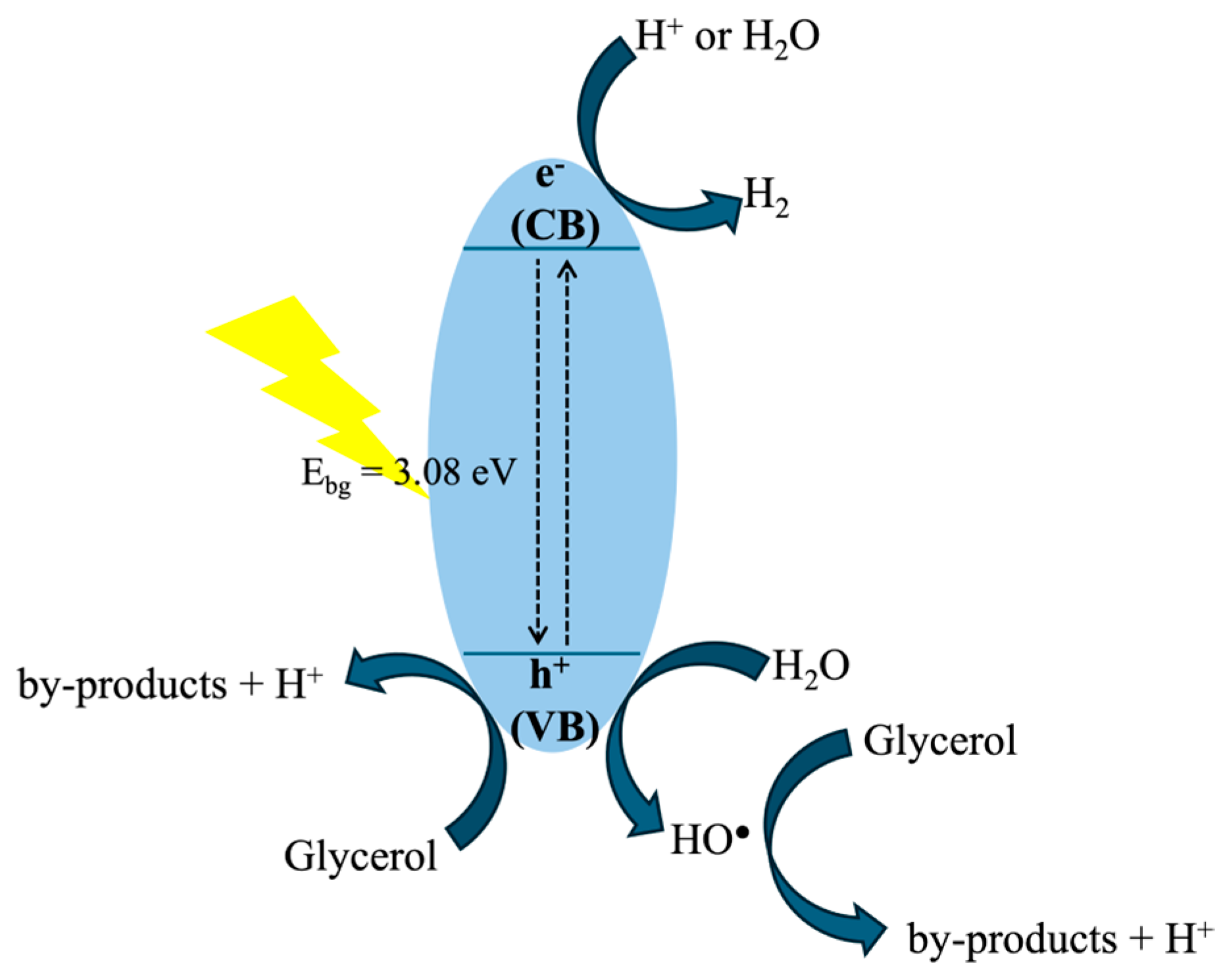
The proposed photocatalytic mechanism for M-BDC is illustrated in the schematic reaction (Figure 11). Under simulated solar light irradiation, electron–hole pairs (e/h+) are generated within the mixed anatase/rutile TiO2 structure. The photogenerated electrons (e) are promoted to the conduction band (CB) and migrate to surface active sites, where they reduce protons (H+) to produce molecular hydrogen (H2).
Simultaneously, the photogenerated holes (h+) in the valence band (VB) oxidize water molecules or surface hydroxyl groups, leading to the formation of highly reactive hydroxyl radicals (HO). At near-neutral pH (6.0), the reaction pathway is dominated by the diffusion of these mobile HO radicals into the liquid phase, where they selectively oxidize glycerol. Hydrogen abstraction from the secondary carbon preferentially yields dihydroxyacetone (DHA), while oxidation at the primary carbon positions leads to glyceraldehyde formation.
The superior photocatalytic performance of M-2,5PDC is attributed to nitrogen doping and the higher density of surface defects, which reduces the band gap to 2.94 eV and enhances visible-light absorption. In contrast, M-BDC provides a more favorable structural environment for charge separation, resulting in a higher hydrogen evolution rate.
The photocatalytic oxidation of glycerol is strongly governed by selective functional group transformations. In this system, the catalyst exhibits pronounced regioselectivity toward oxidation of the secondary hydroxyl group, promoting its conversion into a carbonyl group and favoring the formation of dihydroxyacetone over glyceraldehyde [16,68,73]. This selective alcohol-to-ketone transformation is crucial for glycerol valorization, as it yields a high-value-added product while preserving the C3 carbon backbone [78,79].
Table 2 shows the comparison of the selectivity between glyceraldehyde and dihydroxyacetone formed during the photocatalytic experiments using the M-BDC and M-2,5PDC photocatalysts.
This effect is attributed to the photogeneration of hydroxyl radicals and their direct attack on the glycerol molecule. Under near-neutral conditions (pH 6.0), oxidation of the secondary alcohol preferentially occurs at the central hydroxyl group, leading to ketone formation and conversion to dihydroxyacetone [27]. While alkaline conditions typically yield higher conversion rates, the near-neutral pH utilized here offers a significant advantage in terms of reactor corrosion mitigation and eliminates the need for downstream neutralization, despite the moderate conversion values observed. The reaction mechanism at near-neutral pH proceeds primarily through diffusion-limited interaction of mobile photogenerated HO radicals rather than surface-site-dependent pathways, which significantly impacts both the reaction rate and product distribution [80,81,82]. Despite these limitations, photocatalytic oxidation at near-neutral pH provides an environmentally sustainable alternative for selective glycerol transformation without requiring pH modification [26,62,74]. During the reuse cycles, the selectivity for dihydroxyacetone increases slightly from cycles 1 to 3, demonstrating that the catalyst maintains its selective activity even after multiple uses.
Both photocatalysts exhibit similar total H2 amounts, but M-BDC consistently delivers slightly higher values across all cycles, indicating a greater overall H2 production capacity under identical reaction conditions [83]. The H2 formation rate (H2 rate) highlights this activity difference more clearly, with M-BDC displaying higher values than M-2,5-PDC (1.41–1.45 vs. 1.05–1.14 µmol h−1 g−1). The preservation of comparable H2 and H2 rate values over the cycles indicates good operational stability, in agreement with the behavior reported for MOFs and semiconductor oxides in the selective oxidation of glycerol in aqueous media [84].
M-BDC tends to produce more H2 because the BDC linker provides a more favorable electronic and structural environment for charge separation and transfer of photoexcited electrons to the active sites, thereby enhancing the overall reaction efficiency [85]. In contrast, nitrogen-containing linkers such as 2,5-PDC can introduce additional electronic states and modify the surface electronic structure, which may favor charge recombination and thus decrease H2 generation [86,87,88].
Importantly, XPS analysis confirms that titanium is exclusively present as Ti4+ in both M-BDC and M-2,5PDC, ruling out any contribution from reduced Ti3+ defect states to the observed photocatalytic behavior. Consequently, the differences in hydrogen evolution performance are not associated with changes in titanium oxidation state, but rather with linker-induced surface and interfacial effects. The presence of pyridinic nitrogen and the increased contribution of non-lattice oxygen species (carboxylate- and hydroxyl-related O 1s components) are expected to modulate band alignment, surface charge distribution, and interfacial charge-transfer kinetics, thereby enhancing the efficiency of photogenerated charge separation and utilization under visible-light irradiation. Consistently, the reduction in optical band gap observed for M-2,5PDC is attributed to linker-induced electronic and interfacial structural effects rather than to Ti3+-related defect states. Pyridinic nitrogen and residual carboxylate-derived surface species are expected to introduce localized electronic states near the valence band edge, effectively lowering the optical transition energy without altering the bulk TiO2 lattice. In addition, the coexistence of anatase and rutile phases further contributes to band structure modification at phase junctions, promoting visible-light absorption. These combined effects account for the lower band gap value (2.94 eV) and the enhanced photoresponse of M-2,5PDC under AM 1.5 irradiation.
Table 3 compares the photocatalytic performance of M-BDC and M-2,5PDC with reported metal-based benchmarks, highlighting the superior DHA selectivity (>70%) achieved by our earth-abundant, metal-free MOF-derived catalysts under simulated solar light.
The metal-free MOF-derived catalysts M-BDC and M-2,5PDC demonstrate superior selectivity for dihydroxyacetone (DHA, 71.5–78.8%) in glycerol photocatalytic valorization under mild simulated solar light (pH 6.0), outperforming metal-dependent benchmarks that require Cu, Co, Pt, or Ti centers.
TiO2/ZnIn2S4 (105 μmol g−1 h−1, furfural-focused), CuOx@TiO2 (~1300 μmol g−1 h−1), TiO2/Cu (3847 μmol g−1 h−1, pH 9.0, only 10% GA), (Co/Zr)-UiO-66-NH2 (29.94 μmol g−1 h−1) and Pt/Cu/TiO2 (39,600 μmol g−1 h−1) achieve higher H2 rates, they suffer from costly metals, harsh conditions (UV-Xe/Hg lamps, alkaline pH), low C3 selectivity, or complex substrates.
This high level of control over partial oxidation, combined with the absence of Cu, Co, Pt, or other expensive metals, highlights the potential of these metal-free MOF-derived photocatalysts as sustainable and economically attractive materials for integrated hydrogen production and selective glycerol upgrading to high-value DHA.

4. Conclusions

This work presents an innovative strategy for the synthesis of TiO2 photocatalysts from MOF precursors, enabling the simultaneous production of clean hydrogen and value-added intermediates through the photocatalytic transformation of residual glycerol. The formation of mixed anatase/rutile phases proved to be determinant for photocatalytic activity, while nitrogen incorporation in M-2,5PDC reduced the band gap to 2.94 eV, significantly improving visible-light absorption compared with M-BDC (3.08 eV).
Under near-neutral conditions (pH 6.0), both catalysts achieved approximately 30% glycerol conversion, with M-BDC reaching 78.85% selectivity toward dihydroxyacetone and 21.15% toward glyceraldehyde, while M-2,5PDC exhibited selectivities of 71.55% and 28.45%, respectively. Selectivity toward dihydroxyacetone remained stable during reuse cycles, increasing from 78.85% to 84.42% between cycles 1–3 for M-BDC, confirming the catalytic robustness. The photocatalysts predominantly promote partial oxidation of glycerol, generating high-value products without complete mineralization.
The results demonstrate that this approach, which combines controlled synthesis from MOFs, elevated selectivity at near-neutral pH, catalytic stability through reuse cycles, and the simultaneous production of H2 and value-added intermediates, offers a viable strategy for future applications in renewable energy, green chemistry, and the valorization of residual biomass.

Supplementary Materials

The following supporting information can be downloaded at https://www.mdpi.com/article/10.3390/nanomanufacturing6020007/s1: Figure S1: Photocatalytic reactor for H2 photogeneration; Figure S2: Photocatalytic hydrogen evolution over pristine P25 TiO2 under identical experimental conditions used for the synthesized samples, showing no detectable H2 production under AM 1.5 irradiation; Figure S3: Emission spectra of the light source recorded with and without the AM 1.5 filter, highlighting the strong attenuation of the UV region upon filter application; Figure S4: Total Organic Carbon (TOC) analysis: (A) Three reusability cycles using M-BDC compared to pure TiO2 and Photolysis, and (B) Three reusability cycles using M-2,5PDC compared to pure TiO2 and Photolysis.

Author Contributions

Conceptualization, A.M.J.; methodology, E.F.; validation, E.F., T.F.d.S., H.W. and A.R.L.C.; formal analysis, P.S.C., E.d.S.C.M. and L.E.G.; investigation, E.F., G.H.D.M. and A.B.S.d.S.E.; resources, A.M.J.; writing—original draft preparation, P.S.C.; writing—review and editing, P.S.C., E.d.S.C.M., R.P.C. and A.M.J.; supervision, R.P.C. and A.M.J.; project administration, A.M.J. All authors have read and agreed to the published version of the manuscript.

Funding

This research was funded by Conselho Nacional de Desenvolvimento Científico e Tecnológico (CNPq), Coordenação de Aperfeiçoamento de Pessoal de Nível Superior (CAPES—Finance Code 001) and Fundação de Apoio ao Desenvolvimento do Ensino, Ciência e Tecnologia do Estado de Mato Grosso do Sul (FUNDECT).

Data Availability Statement

Data will be made available on request.

Acknowledgments

The authors wish to thank the Research Group on Photochemistry and Applied Electrochemistry, the Laboratory of Advanced Technologies in Energy and Sustainability (LATES), and the Optics and Photonics Group of the Federal University of Mato Grosso do Sul, Brazil.

Conflicts of Interest

The authors declare no conflicts of interest.

Abbreviations

The following abbreviations are used in this manuscript:
BETBrunauer–Emmett–Teller
BJHBarrett–Joyner–Halenda
DMFN,N-dimethylformamide
FTIR-ATRFourier transform infrared spectroscopy with attenuated total reflectance
GCGas chromatography
HPLCHigh-performance liquid chromatography
M-BDCMIL-125(Ti)-derived photocatalyst with terephthalic ligand (BDC)
M-2,5PDCMIL-125(Ti)-derived photocatalyst with 2,5-pyridinedicarboxylic ligand (2,5-PDC)
MOFMetal–organic framework
PDC2,5-Pyridinedicarboxylic acid
TiO2Titanium dioxide
TOCTotal organic carbon
UV-VisUltraviolet-visible
XPSX-ray photoelectron spectroscopy
XRDX-ray diffraction

References

  1. Shayo, G.M.; Mpelwa, M.; Elimbinzi, E.; Shao, G.N. Toward Sustainable Hydrogen Production from Renewable Energy Sources: A Review. Bull. Natl Res. Cent. 2025, 49, 67. [Google Scholar] [CrossRef]
  2. Balu, S.; Ganapathy, D.; Arya, S.; Atchudan, R.; Sundramoorthy, A.K. Advanced Photocatalytic Materials Based Degradation of Micropollutants and Their Use in Hydrogen Production—A Review. RSC Adv. 2024, 14, 14392–14424. [Google Scholar] [CrossRef]
  3. Balapure, A.; Ray Dutta, J.; Ganesan, R. Recent Advances in Semiconductor Heterojunctions: A Detailed Review of the Fundamentals of Photocatalysis, Charge Transfer Mechanism and Materials. RSC Appl. Interfaces 2024, 1, 43–69. [Google Scholar] [CrossRef]
  4. Ijaz, M.; Zafar, M. Titanium Dioxide Nanostructures as Efficient Photocatalyst: Progress, Challenges and Perspective. Int. J. Energy Res. 2021, 45, 3569–3589. [Google Scholar] [CrossRef]
  5. Zhang, W.; He, H.; Li, H.; Duan, L.; Zu, L.; Zhai, Y.; Li, W.; Wang, L.; Fu, H.; Zhao, D. Visible-Light Responsive TiO2-Based Materials for Efficient Solar Energy Utilization. Adv. Energy Mater. 2021, 11, 2103303. [Google Scholar] [CrossRef]
  6. Bhom, F.; Isa, Y.M. Photocatalytic Hydrogen Production Using TiO2-based Catalysts: A Review. Glob. Chall. 2024, 8, 2400134. [Google Scholar] [CrossRef]
  7. Oar-Arteta, L.; Wezendonk, T.; Sun, X.; Kapteijn, F.; Gascon, J. Metal Organic Frameworks as Precursors for the Manufacture of Advanced Catalytic Materials. Mater. Chem. Front. 2017, 1, 1709–1745. [Google Scholar] [CrossRef]
  8. Zhang, R.; Liu, Y.; Wang, C.; Li, Y.; Zhu, Q.; Zhang, S.; Tian, C.; Sun, X.; Huang, W. Constructing Bifunctional TiO2 from NH2-MIL-125(Ti) for Excellent Photocatalytic Tetracycline Degradation. J. Alloys Compd. 2023, 965, 171396. [Google Scholar] [CrossRef]
  9. Favarin, L.R.V.; Rosa, P.P.; Pizzuti, L.; Machulek, A.; Caires, A.R.L.; Bezerra, L.S.; Pinto, L.M.C.; Maia, G.; Gatto, C.C.; Back, D.F.; et al. Synthesis and Structural Characterization of New Heteroleptic Copper(I) Complexes Based on Mixed Phosphine/Thiocarbamoyl-Pyrazoline Ligands. Polyhedron 2017, 121, 185–190. [Google Scholar] [CrossRef]
  10. Graciano, D.E.; Pontes, M.S.; Araujo, L.O.; Lima, R.G.; Grillo, R.; Machulek, A.; Santiago, E.F.; Oliveira, S.L.; Caires, A.R.L. CuO Nanoparticles’ Effect on the Photosynthetic Performance in Seed Tissues of Inga Laurina (Fabaceae). Environ. Sci. Pollut. Res. 2024, 31, 50722–50732. [Google Scholar] [CrossRef]
  11. Pontes, M.S.; Araujo, L.O.; Santos, J.S.; da Silva, J.L.; Miguel, T.B.A.R.; Miguel, E.C.; Lima, S.M.; Andrade, L.H.C.; Arruda, G.J.; M’Peko, J.C.; et al. Targeted Inhibition of Photosystem II Electron Transport Using Bioherbicide-Loaded Ultrasmall Nanodevices. ACS Omega 2025, 10, 55733–55749. [Google Scholar] [CrossRef]
  12. Aguilera, L.F.; Araujo, L.O.; Facchinatto, W.M.; Lima, R.G.; da Silva Pontes, P.; Pulcherio, J.H.V.; Caires, C.S.A.; de Oliveira, K.T.; de Oliveira, S.L.; Caires, A.R.L. Blue-Light Photoactivated Curcumin-Loaded Chitosan Nanoparticles Prepared by Nanoprecipitation and Ionic Gelation: A Promising Approach for Antimicrobial Photodynamic Inactivation. ACS Appl. Bio Mater. 2025, 8, 4055–4064. [Google Scholar] [CrossRef]
  13. Wang, W.; Qiang, W.; Chen, C.; Sun, D. NH2-MIL-125-Derived N-Doped TiO2@C Visible Light Catalyst for Wastewater Treatment. Polymers 2024, 16, 186. [Google Scholar] [CrossRef]
  14. Moklis, M.H.; Cheng, S.; Cross, J.S. Current and Future Trends for Crude Glycerol Upgrading to High Value-Added Products. Sustainability 2023, 15, 2979. [Google Scholar] [CrossRef]
  15. Garcia-Muñoz, P.; Fresno, F. Oxidation of Alcohols in Photocatalytic Hydrogen Production: From Sacrifice to Valorization. Curr. Opin. Chem. Eng. 2025, 49, 101146. [Google Scholar] [CrossRef]
  16. Zabara, M.A.; Ölmez, B.; Buldu-Akturk, M.; Yarar Kaplan, B.; Kırlıoğlu, A.C.; Alkan Gürsel, S.; Ozkan, M.; Ozkan, C.S.; Yürüm, A. Photoelectrocatalytic Hydrogen Generation: Current Advances in Materials and Operando Characterization. Glob. Chall. 2024, 8, 2400011. [Google Scholar] [CrossRef] [PubMed]
  17. Rojas, N.; Hincapié-Triviño, G.; Velasquez, M. Photocatalytic Oxidation of Glycerol Using x/TiO2 (with X = Cu, Ag, and Cu-Ag) to Dihydroxyacetone and Other Value-Added Products. Mol. Catal. 2024, 566, 114390. [Google Scholar] [CrossRef]
  18. Limpachanangkul, P.; Nimmmanterdwong, P.; Liu, L.; Hunsom, M.; Pruksathorn, K.; Piumsomboon, P.; Chalermsinsuwan, B. Glycerol Photocatalytic Oxidation to Higher Value-Added Compounds via Bismuth Oxyhalide Photocatalysts. Sci. Rep. 2023, 13, 14936. [Google Scholar] [CrossRef]
  19. Chauhan, A.; Srivastava, R. Biomass Valorization with Metal-Free Catalysts: Innovations in Thermocatalytic, Photocatalytic, and Electrocatalytic Approaches. Chem. Soc. Rev. 2025, 54, 7114–7173. [Google Scholar] [CrossRef]
  20. Osman, A.I.; Elgarahy, A.M.; Eltaweil, A.S.; Abd El-Monaem, E.M.; El-Aqapa, H.G.; Park, Y.; Hwang, Y.; Ayati, A.; Farghali, M.; Ihara, I. Biofuel Production, Hydrogen Production and Water Remediation by Photocatalysis, Biocatalysis and Electrocatalysis. Environ. Chem. Lett. 2023, 21, 1315–1379. [Google Scholar] [CrossRef]
  21. Sun, W.; Zheng, Y.; Zhu, J. A “Win-Win” Photocatalysis: Coupling Hydrogen Production with the Synthesis of High Value-Added Organic Chemicals. Mater. Today Sustain. 2023, 23, 100465. [Google Scholar] [CrossRef]
  22. Saxena, N.; Ravuri, B.R.; Kumar, P. Nanotechnology and Green Hydrogen for Circular Bio-Economy. In Green Hydrogen Economy for Environmental Sustainability. Volume 2: Applications, Challenges, and Policies; ACS Publications: Washington, DC, USA, 2024; pp. 181–209. ISBN 1947-5918. [Google Scholar] [CrossRef]
  23. Cao, Q.; Li, Q.; Pi, Z.; Zhang, J.; Sun, L.W.; Xu, J.; Cao, Y.; Cheng, J.; Bian, Y. Metal–Organic-Framework-Derived Ball-Flower-like Porous Co3O4/Fe2O3 Heterostructure with Enhanced Visible-Light-Driven Photocatalytic Activity. Nanomaterials 2022, 12, 904. [Google Scholar] [CrossRef]
  24. Umair, M.; Palmisano, L.; Bellardita, M. Comparison between the Efficiency of Bare and Pt-Loaded TiO2 and ZnIn2S4 for H2 Production in the Presence of Triethanolamine, Methanol, Furfuryl Alcohol Used as Sacrificial Agents. J. Mol. Struct. 2025, 1340, 142567. [Google Scholar] [CrossRef]
  25. Gombac, V.; Sordelli, L.; Montini, T.; Delgado, J.J.; Adamski, A.; Adami, G.; Cargnello, M.; Bernal, S.; Fornasiero, P. CuOx–TiO2 Photocatalysts for H2 Production from Ethanol and Glycerol Solutions. J. Phys. Chem. A 2010, 114, 3916–3925. [Google Scholar] [CrossRef]
  26. Sousa, E.J.R.; Oliveira, M.M.R.; Silva, A.M.P.; Bomfim, L.S.; Duarte, M.M.; Sales, A.J.M.; Antunes, R.A.; Valentini, A.; Araújo, R.S.; Salgado, B.C.B. Thermally Assisted Photocatalytic Hydrogen Production Using TiO2/Cu: Evaluation of Performance and Stability. ChemCatChem 2025, 17, e202500356. [Google Scholar] [CrossRef]
  27. Verma, A.M.; Laverdure, L.; Melander, M.M.; Honkala, K. Mechanistic Origins of the PH Dependency in Au-Catalyzed Glycerol Electro-Oxidation: Insight from First-Principles Calculations. ACS Catal. 2022, 12, 662–675. [Google Scholar] [CrossRef]
  28. Liu, X.; Zou, Y.; Jiang, J. Selective Aerobic Photocatalytic Glycerol Oxidation on Au/TiO2 with Borate Additives. Appl. Catal. A Gen. 2023, 660, 119216. [Google Scholar] [CrossRef]
  29. Daskalaki, V.M.; Kondarides, D.I. Efficient Production of Hydrogen by Photo-Induced Reforming of Glycerol at Ambient Conditions. Catal. Today 2009, 144, 75–80. [Google Scholar] [CrossRef]
  30. Gopalan, A.-I.; Lee, J.-C.; Saianand, G.; Lee, K.-P.; Chun, W.-Y.; Hou, Y.; Kannan, V.; Park, S.-S.; Kim, W.-J. Cost-Effective Production of TiO2 with 90-Fold Enhanced Photocatalytic Activity Via Facile Sequential Calcination and Ball Milling Post-Treatment Strategy. Materials 2020, 13, 5072. [Google Scholar] [CrossRef]
  31. Nassar, E.J.; Ávila, L.R.; Pereira, P.F.S.; Nassor, E.C.O.; Cestari, A.; Ciuffi, K.J.; Calefi, P.S. Fenilsilicato Dopado Com EuIII Obtido Pelo Método Sol-Gel. Quim. Nova 2007, 30, 1567–1572. [Google Scholar] [CrossRef]
  32. Bezerra, P.; Cavalcante, R.; Garcia, A.; Wender, H.; Martines, M.; Casagrande, G.; Giménez, J.; Marco, P.; Oliveira, S.; Machulek, A., Jr. Synthesis, Characterization, and Photocatalytic Activity of Pure and N-, B-, or Ag- Doped TiO2. J. Braz. Chem. Soc. 2017, 28, 1788–1802. [Google Scholar] [CrossRef]
  33. Faustino, E.; Ferreira Da Silva, T.; Cunha, R.F.; Roberto, D.; Guelfi, V.; Cavalheri, P.S.; Oliveira, S.C.; Caires, A.R.L.; Casagrande, G.A.; Machulek, A., Jr. Synthesis and Characterization of N and Fe-Doped TiO2 Nanoparticles for 2,4-Dimethylaniline Mineralization. Nanomaterials 2022, 12, 2538. [Google Scholar] [CrossRef]
  34. Cavalcante, R.P.; Dantas, R.F.; Bayarri, B.; González, O.; Giménez, J.; Esplugas, S.; Machulek, A. Synthesis and Characterization of B-Doped TiO2 and Their Performance for the Degradation of Metoprolol. Catal. Today 2015, 252, 27–34. [Google Scholar] [CrossRef]
  35. Sing, K.S.W.; Everett, D.H.; Haul, R.A.W.; Moscou, L.; Pierotti, R.A.; Rouquérol, J.; Siemieniewska, T. Determination of Surface Area and Porosity Reporting Physisorption Data for Gas/Solid Systems-with Special Reference to the Determination of Surface Area and Porosity. Pure Appl. Chem. 1985, 57, 603–619. [Google Scholar] [CrossRef]
  36. Wen, G.; Guo, Z. Facile Modification of NH2-MIL-125(Ti) to Enhance Water Stability for Efficient Adsorptive Removal of Crystal Violet from Aqueous Solution. Colloids Surf. A Physicochem. Eng. Asp. 2018, 541, 58–67. [Google Scholar] [CrossRef]
  37. Fatima, R.; Park, S.; Kim, J.-O. Effect of Molar Ration of Ti/Ligand on the Synthesis of MIL-125(Ti) and Its Adsorption and Photocatalytic Properties. J. Ind. Eng. Chem. 2020, 90, 166–177. [Google Scholar] [CrossRef]
  38. Tatykayev, B.; Chouchene, B.; Balan, L.; Gries, T.; Medjahdi, G.; Girot, E.; Uralbekov, B.; Schneider, R. Heterostructured G-CN/TiO2 Photocatalysts Prepared by Thermolysis of g-CN/MIL-125(Ti) Composites for Efficient Pollutant Degradation and Hydrogen Production. Nanomaterials 2020, 10, 1387. [Google Scholar] [CrossRef]
  39. Nannuzzi, C.; Janssens, T.V.W.; Berlier, G. Effect of Thermal Treatments on High Surface Area Anatase TiO2. Phys. Chem. Chem. Phys. 2025, 27, 15213–15221. [Google Scholar] [CrossRef]
  40. Kubelka, P.; Munk, F. An Article on Optics of Paint Layers. Z. Tech. Phys. 1931, 12, 259–274. [Google Scholar]
  41. Bose, S. A Lei de Planck e a Hipótese dos Quanta de Luz. Rev. Bras. Ensino Fís. 2005, 27, 463–465. [Google Scholar] [CrossRef]
  42. Liu, R.; Yoshida, H.; Fujita, S.; Arai, M. Photocatalytic Hydrogen Production from Glycerol and Water with NiO /TiO2 Catalysts. Appl. Catal. B 2014, 144, 41–45. [Google Scholar] [CrossRef]
  43. Baccaro, A.; Gutz, I. Fotoeletrocatálise Em Semicondutores: Dos Princípios Básicos Até Sua Conformação À Nanoescala. Quim. Nova 2017, 40, 1067–1075. [Google Scholar] [CrossRef]
  44. Arora, M.; Kaur, H. Effect of Doping in TiO2/Chitosan Composite on Adsorptive-Photocatalytic Removal of Gallic Acid from Water. Chemosphere 2025, 373, 144122. [Google Scholar] [CrossRef]
  45. Li, W.; Li, X.; Zhang, Y.; Xu, Y.; Wen, Z.; Huang, J.; Peng, M. Performance Optimization and Degradation Mechanism Elucidation of Fe-Doped BiOBr Photocatalysts for Enhanced Photocatalytic Activity. J. Alloys Compd. 2025, 1038, 182837. [Google Scholar] [CrossRef]
  46. Gamage McEvoy, J.; Cui, W.; Zhang, Z. Degradative and Disinfective Properties of Carbon-Doped Anatase–Rutile TiO2 Mixtures under Visible Light Irradiation. Catal. Today 2013, 207, 191–199. [Google Scholar] [CrossRef]
  47. de Melo Oliveira, A.C.; de Jesus, R.A.; Bilal, M.; Iqbal, H.M.N.; Bharagava, R.N.; Yerga, R.M.N.; Ferreira, L.F.R.; Egues, S.M.; Figueiredo, R.T. Influence of Sound and Calcination Temperature on the Fabrication of TiO2-Based Photocatalysts and Their Photoactivity for H2 Production. Mol. Catal. 2022, 529, 112523. [Google Scholar] [CrossRef]
  48. Ma, Y.; Jiang, X.; Liu, Z.; Geng, L.; Zhang, X.l.; Niu, P.; Zhang, X.; Zhang, Y.; Zhang, D.; Hu, H.; et al. Combining Hierarchical Pores and Unsaturated Sites into Quasi-MIL-125(Ti) for Ultra-Fast and Efficient Adsorption of Cationic Dyes. Polyhedron 2023, 239, 116430. [Google Scholar] [CrossRef]
  49. Dan-Hardi, M.; Serre, C.; Frot, T.; Rozes, L.; Maurin, G.; Sanchez, C.; Férey, G. A New Photoactive Crystalline Highly Porous Titanium(IV) Dicarboxylate. J. Am. Chem. Soc. 2009, 131, 10857–10859. [Google Scholar] [CrossRef]
  50. Chi, Z.; Wu, X.; Zhang, Q.; Zhai, F.; Xu, Z.; Zhang, D.; Chen, Q. Titanium-based Metal-organic Framework MIL-125(Ti) for the Highly Selective Isolation and Purification of Immunoglobulin G from Human Serum. J. Sep. Sci. 2022, 45, 3754–3762. [Google Scholar] [CrossRef]
  51. da Silva, T.F.; Cavalheri, P.S.; Cardoso, J.C.; Nazario, C.E.D.; Jorge, J.; Martines, M.A.U.; Ravaglia, L.M.; Alcantara, G.B.; Casagrande, G.A.; Caires, A.R.L.; et al. Development of a TiO2 Nanotube Photoanode Decorated with MIL-53(Fe) for the Photoelectrochemical Degradation of 2,4-Dimethylaniline. Catal. Today 2024, 431, 114579. [Google Scholar] [CrossRef]
  52. Nyholm, R.; Martensson, N.; Lebugle, A.; Axelsson, U. Auger and Coster-Kronig Broadening Effects in the 2p and 3p Photoelectron Spectra from the Metals 22Ti–30Zn. J. Phys. F Met. Phys. 1981, 11, 1727–1733. [Google Scholar] [CrossRef]
  53. Chen, Y.; Chen, J.; Liu, J.; Lin, Z.; Hu, X.; Lin, X.; Xu, Z.; Zeb, A. Metal-Organic Framework-Derived Mixed-Phase Anatase/Rutile TiO2 towards Boosted Lithium Storage: Surface Engineering and Design Strategy through Crystal Phase Transition. Mater. Today Nano 2022, 20, 100265. [Google Scholar] [CrossRef]
  54. Bharti, B.; Kumar, S.; Lee, H.-N.; Kumar, R. Formation of Oxygen Vacancies and Ti3+ State in TiO2 Thin Film and Enhanced Optical Properties by Air Plasma Treatment. Sci. Rep. 2016, 6, 32355. [Google Scholar] [CrossRef]
  55. Lee, S.; Cho, I.-S.; Lee, D.K.; Kim, D.W.; Noh, T.H.; Kwak, C.H.; Park, S.; Hong, K.S.; Lee, J.-K.; Jung, H.S. Influence of Nitrogen Chemical States on Photocatalytic Activities of Nitrogen-Doped TiO2 Nanoparticles under Visible Light. J. Photochem. Photobiol. A Chem. 2010, 213, 129–135. [Google Scholar] [CrossRef]
  56. Pisarek, M.; Krawczyk, M.; Hołdyński, M.; Lisowski, W. Plasma Nitriding of TiO2 Nanotubes: N-Doping in Situ Investigations Using XPS. ACS Omega 2020, 5, 8647–8658. [Google Scholar] [CrossRef]
  57. Garcia-Segura, S.; Brillas, E. Applied Photoelectrocatalysis on the Degradation of Organic Pollutants in Wastewaters. J. Photochem. Photobiol. C 2017, 31, 1–35. [Google Scholar] [CrossRef]
  58. Hernández-Del Castillo, P.C.; Rodríguez-González, V. Efficient Visible Photocatalytic Degradation of 4-CP Herbicide Using Immobilized TiO2:Ni on Glass Substrates. Top. Catal. 2022, 65, 1139–1148. [Google Scholar] [CrossRef]
  59. Mancuso, A.; Sacco, O.; Sannino, D.; Pragliola, S.; Vaiano, V. Enhanced Visible-Light-Driven Photodegradation of Acid Orange 7 Azo Dye in Aqueous Solution Using Fe-N Co-Doped TiO2. Arab. J. Chem. 2020, 13, 8347–8360. [Google Scholar] [CrossRef]
  60. Popescu, T.; Matei, C.O.; Culita, D.C.; Maraloiu, V.-A.; Rostas, A.M.; Diamandescu, L.; Iacob, N.; Savopol, T.; Ilas, M.C.; Feder, M.; et al. Facile Synthesis of Low Toxicity Iron Oxide/TiO2 Nanocomposites with Hyperthermic and Photo-Oxidation Properties. Sci. Rep. 2022, 12, 6887. [Google Scholar] [CrossRef] [PubMed]
  61. Song, X.; He, J.; Wang, Y.; Wang, J.; Zhang, S. A Novel MIL-125(Ti)-Based Nanocomposite for Enhanced Adsorption and Catalytic Degradation of Tetracycline Hydrochloride: Synergetic Mechanism of Calcination and the Nitrogen-Containing Reticulated Surface Layer. J. Colloid Interface Sci. 2023, 645, 918–932. [Google Scholar] [CrossRef]
  62. Avilés-García, O.; Mendoza-Zepeda, A.; Regalado-Méndez, A.; Espino-Valencia, J.; Martínez-Vargas, S.L.; Romero, R.; Natividad, R. Photo-Oxidation of Glycerol Catalyzed by Cu/TiO2. Catalysts 2022, 12, 835. [Google Scholar] [CrossRef]
  63. Çetinkaya, S.; Khamidov, G.; Özcan, L.; Palmisano, L.; Yurdakal, S. Selective Photocatalytic Oxidation of Glycerol and 3-Pyridinemethanol by Nanotube/Nanowire-Structured TiO2 Powders Obtained by Breakdown Anodization. Front. Chem. 2022, 10, 856947. [Google Scholar] [CrossRef] [PubMed]
  64. Liu, Y.; Zhang, B.; Yan, D.; Xiang, X. Recent Advances in the Selective Oxidation of Glycerol to Value-Added Chemicals via Photocatalysis/Photoelectrocatalysis. Green Chem. 2024, 26, 2505–2524. [Google Scholar] [CrossRef]
  65. Davis, S.E.; Ide, M.S.; Davis, R.J. Selective Oxidation of Alcohols and Aldehydes over Supported Metal Nanoparticles. Green Chem. 2013, 15, 17–45. [Google Scholar] [CrossRef]
  66. Katryniok, B.; Kimura, H.; Skrzyńska, E.; Girardon, J.-S.; Fongarland, P.; Capron, M.; Ducoulombier, R.; Mimura, N.; Paul, S.; Dumeignil, F. Selective Catalytic Oxidation of Glycerol: Perspectives for High Value Chemicals. Green Chem. 2011, 13, 1960–1979. [Google Scholar] [CrossRef]
  67. Mendoza, A.; Romero, R.; Gutiérrez-Cedillo, G.P.; López-Tellez, G.; Lorenzo-González, O.; Gómez-Espinosa, R.M.; Natividad, R. Selective Production of Dihydroxyacetone and Glyceraldehyde by Photo-Assisted Oxidation of Glycerol. Catal. Today 2020, 358, 149–154. [Google Scholar] [CrossRef]
  68. Painter, R.M.; Pearson, D.M.; Waymouth, R.M. Selective Catalytic Oxidation of Glycerol to Dihydroxyacetone. Angew. Chem. Int. Ed. 2010, 49, 9456–9459. [Google Scholar] [CrossRef] [PubMed]
  69. Vo, T.-G.; Ho, P.-Y.; Chiang, C.-Y. Operando Mechanistic Studies of Selective Oxidation of Glycerol to Dihydroxyacetone over Amorphous Cobalt Oxide. Appl. Catal. B 2022, 300, 120723. [Google Scholar] [CrossRef]
  70. Tongsakul, D.; Nishimura, S.; Thammacharoen, C.; Ekgasit, S.; Ebitani, K. Hydrotalcite-Supported Platinum Nanoparticles Prepared by a Green Synthesis Method for Selective Oxidation of Glycerol in Water Using Molecular Oxygen. Ind. Eng. Chem. Res. 2012, 51, 16182–16187. [Google Scholar] [CrossRef]
  71. Liu, X.; Yang, C. Electrocatalytic Selective Oxidation of Glycerol to Glyceric Acid over Efficient Pt/CNTs-CeO2 Catalysts. Mater. Lett. 2022, 324, 132658. [Google Scholar] [CrossRef]
  72. Hassan, S.; El-Hafiz, D.R.A.; Abdullah, E.S.; Khalil, M.M.H. Clarifying Solvent Effect during Photocatalytic Glycerol Conversion on TiO2/GQD as Selective Photocatalyst. Sci. Rep. 2023, 13, 21820. [Google Scholar] [CrossRef]
  73. Imbault, A.L.; Gong, J.; Farnood, R. Photocatalytic Production of Dihydroxyacetone from Glycerol on TiO2 in Acetonitrile. RSC Adv. 2020, 10, 4956–4968. [Google Scholar] [CrossRef]
  74. Nosaka, Y.; Nosaka, A. Understanding Hydroxyl Radical (OH) Generation Processes in Photocatalysis. ACS Energy Lett. 2016, 1, 356–359. [Google Scholar] [CrossRef]
  75. Lu, Y.; Lee, B.G.; Lin, C.; Liu, T.-K.; Wang, Z.; Miao, J.; Oh, S.H.; Kim, K.C.; Zhang, K.; Park, J.H. Solar-Driven Highly Selective Conversion of Glycerol to Dihydroxyacetone Using Surface Atom Engineered BiVO4 Photoanodes. Nat. Commun. 2024, 15, 5475. [Google Scholar] [CrossRef]
  76. Lari, G.M.; Pastore, G.; Haus, M.; Ding, Y.; Papadokonstantakis, S.; Mondelli, C.; Pérez-Ramírez, J. Environmental and Economical Perspectives of a Glycerol Biorefinery. Energy Environ. Sci. 2018, 11, 1012–1029. [Google Scholar] [CrossRef]
  77. Khan, S.A.; de Carvalho Arabidian, V.; da Silveira Junior, N.; de Farias, B.S.; Kessler, F.; Paes, R.L.; de Almeida Pinto, L.A.; Junior, T.R.S.C. Valorization Glycerol Produced as a By-Product in the Biodiesel Industry: An Insight into Technical and Economic Studies. In Biorefinery of Industrial Effluents for a Sustainable Circular Economy; Elsevier: Amsterdam, The Netherlands, 2025; pp. 307–316. [Google Scholar]
  78. Tang, D.; Liu, J.; Zhang, X.; Chen, L.; Ma, L.; Zhang, Q. Sacrifice and Valorization of Biomass to Realize Energy Exploitation and Transformation in a Photoelectrochemical Way. Green Chem. 2023, 25, 7843–7862. [Google Scholar] [CrossRef]
  79. Zunita, M.; Hariyo, R.S.; Sutanto, N.J.; Adityawarman, D. Integrating Ionic Liquids and Catalytic Processes for Enhanced Biomass Conversion Technologies. RSC Adv. 2025, 15, 45744–45782. [Google Scholar] [CrossRef] [PubMed]
  80. Cavalheri, P.S.; Machado, B.S.; da Silva, T.F.; Rodrigues, J.P.B.G.; Gozzi, F.; Filho, F.J.C.M.; Cavalcante, R.P.; de Oliveira, S.C.; Junior, A.M. Optimization of a Combined System of Vertical Flow Constructed Wetland and Solar Photo-Fenton for Ketoprofen Removal in Sewage and Landfill Leachate. Chem. Eng. J. 2023, 475, 146282. [Google Scholar] [CrossRef]
  81. Gozzi, F.; Sirés, I.; de Oliveira, S.C.; Machulek, A.; Brillas, E. Influence of Chelation on the Fenton-Based Electrochemical Degradation of Herbicide Tebuthiuron. Chemosphere 2018, 199, 709–717. [Google Scholar] [CrossRef] [PubMed]
  82. Miguel, E.d.S.C.; Machado, B.S.; Teles, A.P.S.; da Silva, T.F.; Magalhães Filho, F.J.C.; Cavalheri, P.S. Optimizing Sewage Treatment by UV/H2O2 Process and Vertical Flow Constructed Wetland Integration. J. Water Process Eng. 2024, 64, 105580. [Google Scholar] [CrossRef]
  83. Rueda-Navarro, C.M.; Ferrer, B.; Baldoví, H.G.; Navalón, S. Photocatalytic Hydrogen Production from Glycerol Aqueous Solutions as Sustainable Feedstocks Using Zr-Based UiO-66 Materials under Simulated Sunlight Irradiation. Nanomaterials 2022, 12, 3808. [Google Scholar] [CrossRef]
  84. Tateno, H.; Chen, S.-Y.; Miseki, Y.; Nakajima, T.; Mochizuki, T.; Sayama, K. Photoelectrochemical Oxidation of Glycerol to Dihydroxyacetone Over an Acid-Resistant Ta:BiVO4 Photoanode. ACS Sustain. Chem. Eng. 2022, 10, 7586–7594. [Google Scholar] [CrossRef]
  85. Chen, T.-F.; Wang, L.-Y.; Wang, Y.-F.; Gao, H.; He, J.; Wang, G.; Meng, X.-F.; Wu, Y.-S.; Deng, Y.-H.; Wan, C.-Q. Facile Strategy for Efficient Charge Separation and High Photoactivity of Mixed-Linker MOFs. ACS Appl. Mater. Interfaces 2021, 13, 20897–20905. [Google Scholar] [CrossRef] [PubMed]
  86. Li, Y.; Zhang, A.; Yin, Q.; Fang, Z.; Liu, C.; Liu, T. Light-Modulated Electronic States of Pd Nanoclusters Stabilized in Ionic Hydrogen-Bonded Frameworks for Enhanced CO2 Photoreduction. Adv. Funct. Mater. 2025, 35, 2505195. [Google Scholar] [CrossRef]
  87. Priyadarshini, P.; Mishra, A.; Nayak, S.; Parida, K. NH2-MIL-125(Ti) and Its Functional Nanomaterials—A Versatile Platform in the Photocatalytic Arena. Nanoscale 2025, 17, 4906–4957. [Google Scholar] [CrossRef]
  88. Andrade, P.H.M.; Ahouari, H.; Volkringer, C.; Loiseau, T.; Vezin, H.; Hureau, M.; Moissette, A. Electron-Donor Functional Groups, Band Gap Tailoring, and Efficient Charge Separation: Three Keys To Improve the Gaseous Iodine Uptake in MOF Materials. ACS Appl. Mater. Interfaces 2023, 15, 31032–31048. [Google Scholar] [CrossRef]
  89. Kong, X.; Pan, Q.; Song, S.; He, Z.; Zeng, T.; Yu, Y. Dual Metal UiO-Type Metal–Organic Frameworks for Solar-Driven Photocatalytic Hydrogen Evolution. J. Phys. Chem. C 2021, 125, 20320–20330. [Google Scholar] [CrossRef]
  90. Dai, F.; Guo, Z.; Zhao, W.; Li, Z.; Xing, J.; Wang, L. Interfacial Engineering Boosting Charge Extraction for Efficient Photocatalytic Hydrogen Evolution. Chem. Eng. J. 2022, 450, 138015. [Google Scholar] [CrossRef]
Figure 1. Experimental setup for the synthesis of photocatalysts.
Nanomanufacturing 06 00007 g001
Figure 2. Thermogravimetric curve of the M-BDC and M-2,5PDC photocatalysts.
Nanomanufacturing 06 00007 g002
Figure 3. Morphology of titanium-based materials after the calcination process. SEM images of the photocatalysts: (A) M-BDC and (B) M-2,5PDC. TEM images: (C) M-BDC and (D) M-2,5PDC. Particle size distribution histograms calculated from the TEM micrographs: (E) M-BDC and (F) M-2,5PDC.
Nanomanufacturing 06 00007 g003
Figure 4. Nitrogen adsorption and desorption isotherms of (A) M-BDC-uncalcined; (B) M-BDC-calcined; (C) M-2,5PDC-uncalcined, (D) M-2,5PDC-calcined and (E) pure TiO2.
Nanomanufacturing 06 00007 g004
Figure 5. (A) UV-Vis absorption and (B) Tauc graph and band gap energy values of the materials.
Nanomanufacturing 06 00007 g005
Figure 6. FTIR-ATR spectrum of M-BDC and M-2.5PDC.
Nanomanufacturing 06 00007 g006
Figure 7. XPS Spectrum: (A) Survey of M-BDC and M-2.5PDC; (B) N 1s of M-2.5PDC; (C) O 1s of M-BDC; (D) O 1s of M-2.5PDC; (E) Ti 2p of M-BDC; (F) Ti 2p of M-2.5PDC. (G) Ti 2p-TiO2 Pure; (H) O 1s-TiO2 Pure.
Nanomanufacturing 06 00007 g007
Figure 8. X-ray diffraction (XRD) analyses were performed on the precursor, the calcined TiO2 material, and the samples after photocatalytic experiments.
Nanomanufacturing 06 00007 g008
Figure 9. Hydrogen generation by (A) Three reusability cycles using M-BDC and (B) Three reusability cycles using M-2,5PDC.
Nanomanufacturing 06 00007 g009
Figure 10. Formation of byproducts derived from glycerol oxidation.
Nanomanufacturing 06 00007 g010
Figure 11. Proposed photocatalytic mechanism for simultaneous H2 evolution and selective glycerol oxidation over MOF-derived TiO2, involving photogenerated e/h+ pairs, proton reduction to H2, and HO-mediated regioselective oxidation of glycerol to dihydroxyacetone (major) and glyceraldehyde (minor) at near-neutral pH.
Nanomanufacturing 06 00007 g011
Table 1. Surface area per BET (SBET), pore volume (Vp) and pore diameter (Dp) of photocatalysts.
NanomaterialsSBET (m2 g−1)Dp (nm)Vp (cm3g−1)
TiO218.9484 ± 0.073618.51590.0877
M-BDC—uncalcined376.0019 ± 2.60544.34920.4088
M-BDC—calcined59.1791 ± 0.12569.78920.1448
M-2,5PDC—uncalcined77.6611 ± 0.466818.69080.3629
M-2,5PDC—calcined40.1553 ± 0.160822.84480.2293
Table 2. Selectivity of Dihydroxyacetone and Glyceraldehyde.
PhotocatalystCycleH2 (µmol)H2 Rate
(µmol h−1 g−1)
Selectivity (%)
DihydroxyacetoneGlyceraldehyde
M-BDC10.311.4178.8521.15
20.321.4583.9716.03
30.271.2384.4215.58
M-2,5PDC10.251.1471.5528.45
20.241.0979.3820.62
30.231.0570.5629.44
Table 3. Comparison of photocatalytic H2 production and glycerol valorization performance for M-BDC and M-2,5PDC with reported benchmarks under various light sources and conditions.
PhotocatalystLight SourcepHH2 Rate
(µmol h−1 g−1)
Main Products/SelectivityReferences
M-BDCSimulated solar6.01.41–1.45DHA (78.8%)/GA (21.2%)This work
M-2,5PDCSimulated solar6.01.05–1.14DHA (71.5%)/GA (28.5%)This work
Bare and Pt-loaded TiO2 (P25) and ZnIn2S4Simulated solarNatural pH105Furfural (81%)[23]
CuOx-TiO2UV-vis-1300-[24]
TiO2/CuUV(8 W)9.03847 GA (10.0%)[25]
(Co/Zr)-UiO-66-NH2300 W Xe lamp-29.94-[89]
Pt/Cu/TiO2300 W Xe lampAlkaline medium39,600-[90]
Reaction conditions: aqueous glycerol solution, ambient temperature. DHA = dihydroxyacetone; GA = glyceraldehyde.
Disclaimer/Publisher’s Note: The statements, opinions and data contained in all publications are solely those of the individual author(s) and contributor(s) and not of MDPI and/or the editor(s). MDPI and/or the editor(s) disclaim responsibility for any injury to people or property resulting from any ideas, methods, instructions or products referred to in the content.