Article

First Molecular Characterisation and SEM Observations of Lamproglena barbicola from Labeobarbus altianalis in the Nyando River, Kenya


by
Nehemiah M. Rindoria
1,2,*,
Willem J. Smit
2,
Iva Přikrylová
2 and
Wilmien J. Luus-Powell
2
1
Department of Biological Sciences, School of Pure and Applied Sciences, Kisii University, P.O. Box 408, Kisii 40200, Kenya
2
DSTI-NRF SARChI Chair (Ecosystem Health), Department of Biodiversity, School of Molecular and Life Sciences, University of Limpopo, Private Bag X1106, Sovenga 0727, South Africa
*
Author to whom correspondence should be addressed.
Parasitologia 2026, 6(1), 9; https://doi.org/10.3390/parasitologia6010009
Submission received: 11 December 2025 / Revised: 20 January 2026 / Accepted: 25 January 2026 / Published: 3 February 2026

Abstract

A supplemental description of Lamproglena barbicola Fryer, 1961 is provided based on specimens collected from the gills of Labeobarbus altianalis (Boulenger, 1900) from the Nyando River, Lake Victoria Basin, Kenya, using an integrated approach of scanning electron microscopy (SEM) and molecular analysis (18S, 28S rDNA, and cox1 gene regions). Morphologically, the specimens conform to L. barbicola and closely resemble Lamproglena hoi Dippenaar, Luus-Powell & Roux, 2001; however, SEM revealed a previously undescribed feature on the uniramous antennule in L. barbicola, namely indistinctly three-segmented, tapering from a broad base to the apex, basal segment much longer than distal, comprising 14 setae of varying sizes, ventral laterally, absence of distinctive anterior fringe of setae on the antennule, as well as several characters that differentiate L. barbicola from L. hoi, including 5 setae at the basal endopod of leg one, five cuticular protuberances in the oral region, 19 setae on the basal antennular segment, and 10 setae on the distal segment, with 1 seta on each ramus. The phylogenetic analysis confirms L. barbicola as a sister taxon of L. hoi, supporting their close relationship. The genetic divergence presented as the uncorrected genetic p-distances between L. barbicola and L. hoi are 23.1% and 0.45% for cox1 and 28S rDNA regions, respectively, with observed nucleotide differences of 145 and 3 bp between the sequences, respectively. There was no interspecific variability detected in the 18S rDNA sequences. This study provides novel molecular sequences and the first high-resolution SEM images, which reveal additional taxonomic features for L. barbicola, establishing a robust reference for future identification.

1. Introduction

The genus Lamproglena von Nordmann, 1832, comprises crustacean copepods of the family Lernaeidae Cobbold, 1879, whose females are parasitic on the gills of freshwater fishes [1]. However, there are two records of Lamproglena species from marine fish. Members of this genus have been found inhabiting the realms of the Palearctic, Indomalayan, and regions of Africa [2]. Thus far, 47 species have been described, but only 38 are regarded as valid species [3], with only 12 African lamproglenoids reported from clariid, cichlid, and cyprinid fishes [3,4], including the type species Lamproglena hemprichii von Nordmann, 1832.
The currently known distribution of Lamproglena spp. in Africa is unbalanced, with ten of the twelve species having been recorded from only Eastern African countries, Sudan, Uganda, and Kenya (see Rindoria et al. [4]). The four currently known Lamproglena spp. recorded from Kenya originate from the Lake Victoria Basin (LVB): Lamproglena monodi Capart, 1944 from Oreochromis niloticus L., 1758 and a few haplochromine species (Cichlidae) [1,5], Lamproglena barbicola Fryer, 1961 from Labeobarbus altianalis (Boulenger, 1900) (formerly known as Barbus altianalis radcliffi) in Victoria Nile [5], Lamproglena clariae Fryer, 1956 from Clarias gariepinus (Burchell, 1822) (Clariidae) [4,5], and Lamproglena cleopatra Humes, 1957 from Labeo victorianus Boulenger, 1901 (Cyprinidae) [4].
The SEM approach in studying the morphology of Lamproglena spp. has not yet been extensively used, with only five African species having such results available, i.e., L. clariae, L. hemprichii, L. monodi, L. hoi, and L. cleopatra [1,4,6,7,8]. Even more scarce are SEM-based results from non-African countries, available for two species only, Lamproglena chinnensis Wü, 1937, and Lamproglena orientalis Markevish, 1936 [9]. The current genetic data for the species of Lamproglena are very limited, as the first molecular data for Lamproglena spp. were published in 2008 from China [9] and only later from Africa [1,4,8,10]. The integrated approach combining both SEM and genetic characterisation has been applied to a limited number of Lamproglena spp. [1,4,8] and provides a tool for the precise identification of Lamproglena species.
By combining detailed morphological reassessment with ultrastructural and molecular data, an integrative framework allows for independent lines of evidence to be evaluated concurrently, thereby improving the reliability of species delimitation. Molecular markers provide objective measures of genetic divergence, while ultrastructural features can reveal diagnostic characters not observable under light microscopy. Together, these complementary approaches are essential for stabilising the taxonomic status of L. barbicola, clarifying its distinction from congeners, and establishing a robust baseline for future ecological, biogeographical, and host–parasite interaction studies.
This study was carried out between May 2022 and March 2023 in the Nyando River of LVB in Kisumu County, Kenya, resulting in the collection of specimens of L. barbicola from the gills of a cyprinid, Ripon barbel L. altianalis. The integrated approach was applied to study collected specimens using scanning electron microscopy (SEM) and DNA [18S and 28S rDNA and cytochrome c oxidase subunit 1 (cox1)] analyses. This study aimed at revealing the ultrastructural characteristics of L. barbicola, obtaining molecular barcode data of this species, and clarifying its phylogenetic relationship with closely related species. This study provides additional ultrastructural taxonomic features using SEM, along with the first molecular data of L. barbicola.

2. Materials and Methods

2.1. Fish Sampling, Parasite Collection, and Fixation

The fish collections were performed at two sites (Koru and Ahero) along the River Nyando [11].
Eleven specimens (n = 5 Koru; n = 6 Ahero) of L. altianalis were collected using a 12 V battery-powered electro fisher SAMUS 1000, with a 30 m long cable from May 2022 to March 2023. The fish were kept in aerated plastic tanks with river water until they were examined at a temporary field laboratory. The fish were euthanised by severing the spinal cord with a single cut posterior to the skull following the protocol of Schäperclaus [12], after which the gills were removed and examined using a Leica Zoom 2000 Stereo microscope (Wetzlar, Germany) for the presence of the crustacean copepods. Freshly recovered lamproglenoids were washed in normal saline and fixed in 70% and 96% ethanol for morphological and molecular analyses, respectively.

2.2. Preparation of Parasites for SEM

Three ovigerous adult female specimens of L. barbicola were dehydrated following the procedures of Nation [13] and Dos Santos and Avenant-Oldewage [14], and with ethanol concentration gradients and dehydration timings as outlined by Rindoria et al. [4]. Specimens were mounted on a strip of carbon conductive tape fixed to a half-cut microscope slide and then dried in a portable glass desiccator for at least 12 h. They were then coated with gold in a Denton Vacuum Desk V sputter coater (Quorum Technologies, Newhaven, UK). The lamproglenoids were viewed with a Zeiss Sigma 500VP scanning electron microscope (Jena, Germany) at an acceleration voltage of 3 kV.

2.3. Molecular Analyses

2.3.1. DNA Extraction, PCR, and Sequencing

Three isolated egg strings from three adult females were rehydrated using descending ethanol concentrations and washed with water for 12 h and dried at 35 °C, from which the genomic DNA was extracted using NucleoSpin® Tissue Genomic DNA Tissue Kit (Macherey-Nagel, Düren, Germany) following the manufacturer’s instructions. Two partial fragments of 18S and 28S rDNA regions were amplified using the primer combinations 18SF and 18SR, and 28SF and 28SR described by Song et al. [10]. The partial fragment of the cox1 mitochondrial gene region (mtDNA) was amplified using the primer sets LCO1490 and HCO2198 as outlined by Folmer et al. [15]. The PCR reactions were prepared in a total volume of 25 µL containing 1.25 µL of each primer (10 µM), 7 µL of molecular grade water, 12.5 µL of DreamTaqTM Hot Start Green PCR Master Mix (2X) (ThermoFisher Scientific, Waltham, MA, USA), and 3 µL of the DNA template, following the thermocycler conditions described in Song et al. [10] for the 18S and 28S rDNA genes. The thermal cycling profile for cox1 mtDNA had an initial denaturation of 95 °C for 5 min, followed by 37 cycles of 95 °C for 30 s, 47 °C for 30 s, 72 °C for 1 min, and final extension at 72 °C for 7 min as provided by Rindoria et al. [4], and the thermocycler conditions for the 18S and 28S rDNA genes followed those described by Song et al. [10]. Successful amplicons were verified using a 1% agarose gel electrophoresis and sent for purification and sequencing to Inqaba Biotechnical Industries (Pty) Ltd. (Pretoria, South Africa).

2.3.2. Phylogenetic Analyses

The newly generated sequences were assembled and inspected using the built-in de novo assembly tool in Geneious Prime v2022.2. (https://www.geneious.com (accessed on 3 August 2023)). Subsequent consensus sequences (18S, 28S rDNA, and cox1) were subjected to a basic local alignment search tool (BLAST 2.17.0) [16] to classify the closest congenerics. Default parameters of MAFFT in Geneious were used to construct alignments for each gene fragment. Trimming of the 28S rDNA sequence alignment was performed in trimAL v.1.2. using the “gappyout” parameter selection under default settings to remove gaps in the alignment [17].
The species used in the phylogenetic trees are outlined in Table 1, Table 2 and Table 3. Taxa included in the phylogenetic analyses were selected based on sequence availability in GenBank and taxonomic relevance within the family Lernaeidae. The ingroup comprised Lamproglena species with homologous gene sequences available in the GenBank database, prioritising taxa morphologically and phylogenetically closely related to L. barbicola. For all the alignments, Lernaea cyprinacea Linnaeus, 1758 was selected as the outgroup (18S rDNA DQ107556, host Cyprinus carpio; 28S rDNA DQ107548, host Opsariichthys bidens; cox1 NC025239, host n/a) because it is a well-characterised lernaeid species that is phylogenetically distinct from Lamproglena, allowing reliable tree rooting. The selection of the best-fitting models for each of the three alignments was performed separately using ModelFinder [18] in IQ-TREE v2.2. under the Akaike information criterion (AIC) [19]. The maximum likelihood (ML) analyses were computed in IQ-TREE v2.2. [20] applying TIM2+F+I, TIM3+F+G4, and GTR+F+I+G4 models for 18S rDNA, 28S rDNA, and cox1 alignments, respectively. Bayesian inference (BI) analyses were performed in MrBayes v.3.2 [21] using the GTR model and respective variables. Posterior probabilities were calculated using the Metropolis-coupled Markov chain Monte Carlo algorithm (MCMC) for 1 × 10⁶ generations, sampling trees every 102 generations. The first 25% of trees were discarded as a relative burn-in period. The uncorrected p-distances and numbers of base pair differences in the alignment were generated using MEGA X [22]. The conversion of alignment files was carried out using ALTER v.1.2 [23], and resulting trees were visualised in FigTree v.1.3 (http://tree.bio.ed.ac.uk/software/figtree (accessed on 6 December 2025)) and edited using Adobe Illustrator software 30.1 (Adobe Inc., San Jose, CA, USA).

3. Results

3.1. Taxonomic Summary

  • Lamproglena barbicola Fryer, 1961.
  • Type host: Barbus altianalis radcliff Boulenger.
  • Host: Labeobarbus altianalis (Boulenger, 1900) (Cypriniformes: Cyprinidae).
  • Site of infestation: Gill filaments.
  • Type locality: Victoria Nile.
  • Intensity: Two-six parasites per fish.
  • Fish examined: Body total length range 8.0 cm to 42.5 cm, and body weight range 98.5 g–370.2 g.
  • Locality: Nyando River-Ahero/Koru (0°0’0°22′S, 34°51′E), Kisumu County, Kenya.
  • Voucher specimens: Five ovigerous adult specimens were deposited in the National Museum, Bloemfontein, South Africa (accession no. NMB P 1299-1303).
  • Representative DNA sequences: Gen Bank: PX780858 (1309 bp 18S rDNA); PX687940 (736 bp 28S rDNA gene); PX851548 (655 bp cox1 mt DNA).
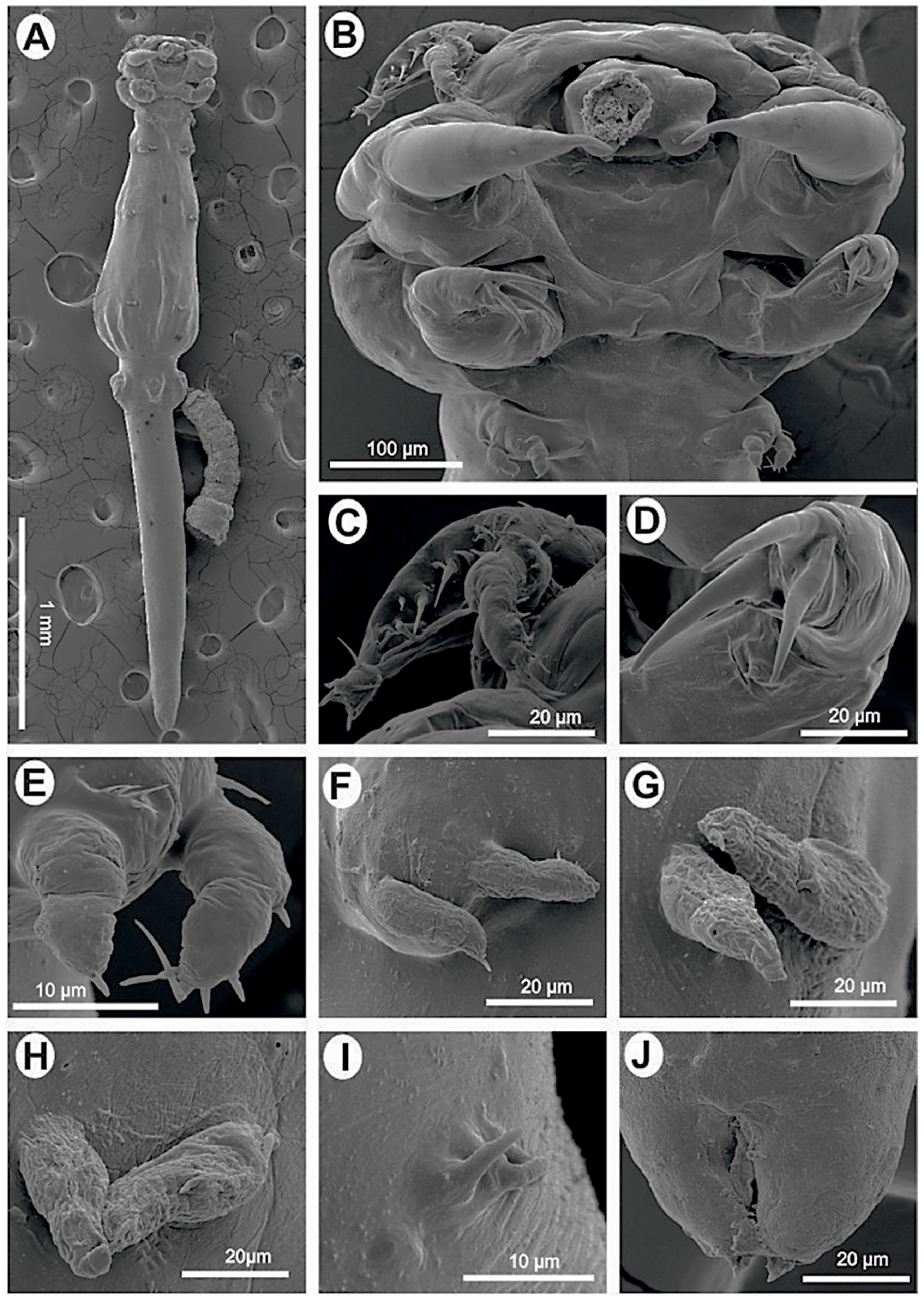
Remarks. Morphologically, the specimens were highly similar to L. barbicola described by Fryer [5]. The present study records additional morphological taxonomic features that were previously not recorded by Fryer [5]. The features include the following: abdomen with indistinct somites (Figure 1A); antennules uniramous, indistinctly three-segmented, tapering from a broad base to the apex, basal segment much longer than distal, comprising 14 setae of varying sizes, ventral laterally, 2 ventral lateral setae on middle segment, distal segment terminates with 7 setae; basal segments lack an anterior fringe of setae (diagnostic feature of L. barbicola as provided by Fryer [5] (Figure 1B,C); antenna 4 segmented, second segment lacks setae, third segment with 3 setae ventrally, fourth distal segment terminates with 4 setae; one-minute spine-like protrusion on the proximal ventral end of maxilliped (Figure 1D); thoracic leg 1–4 biramous, exo- and endopod indistinctly bi-segmented (Figure 1E–I), protopodite of legs 1–4 with one lateral long seta at the base before exopodite (Figure 1E–I), basal segment of exopod with 1 lateral seta, exopod terminal segment of exopod ends with 4 setae (Figure 1E), 4–5 setae slightly before basal segment of endopod (Figure 1E), endopod distal segment terminates with 1 seta (Figure 1F); leg 5 in the form of 2 setae (Figure 1I); caudal rami surface with small openings (Figure 1J). The observed morphological characters were consistent across all examined specimens.

3.2. Molecular Data

A total of five sequences were generated, two each of 18S and 28S rDNA, and one mitochondrial DNA (cox1). The newly generated sequences of 18S and 28S rDNA did not exhibit any intraspecific variability, and the longest fragments were deposited into the database. The alignments subjected to analysis included eight Lamproglena spp. and L. cyprinacea as an outgroup, with lengths of 1325, 746, and 980 bp for the 18S rDNA, 28S rDNA, and cox1 regions, respectively.
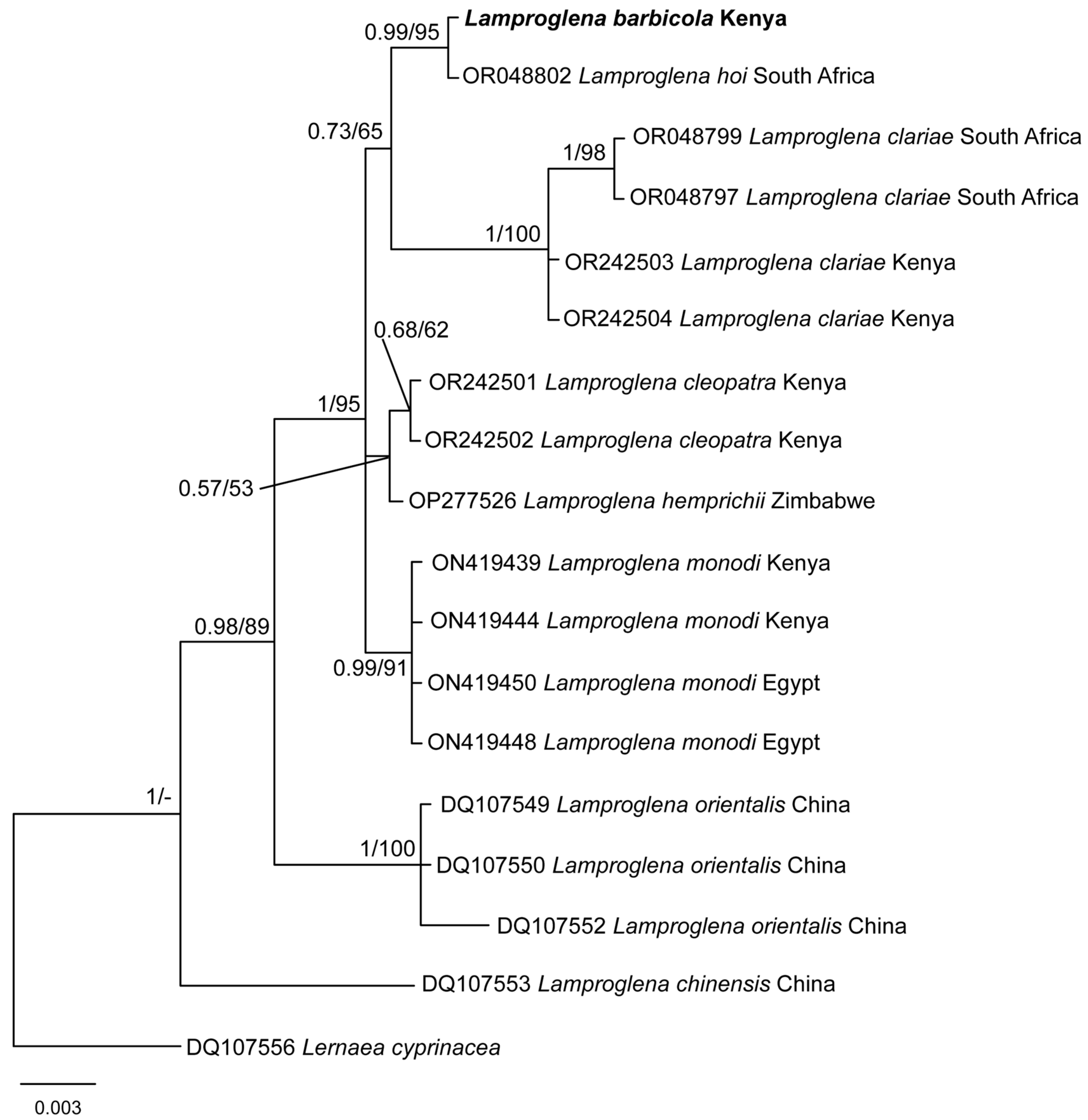
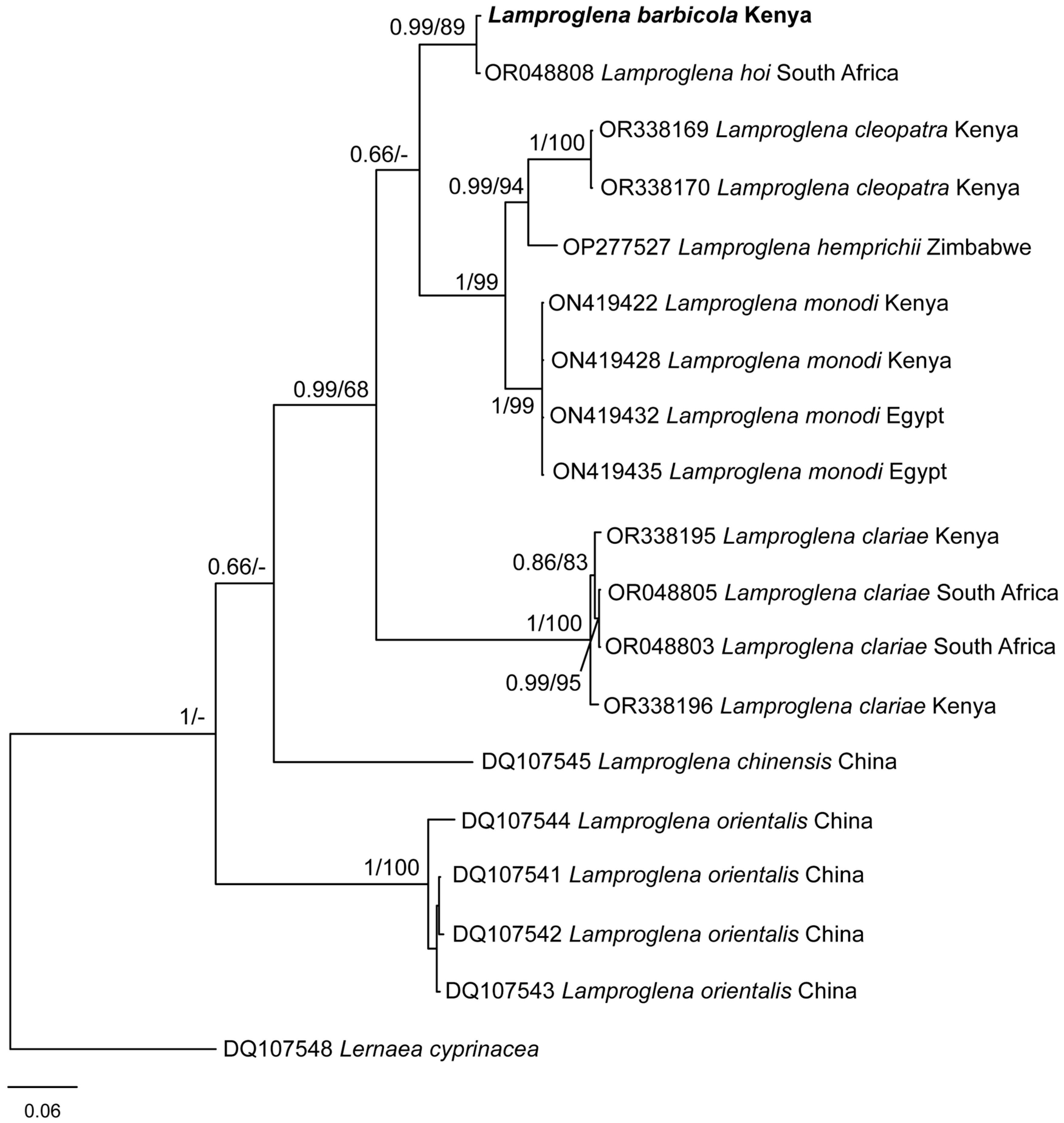
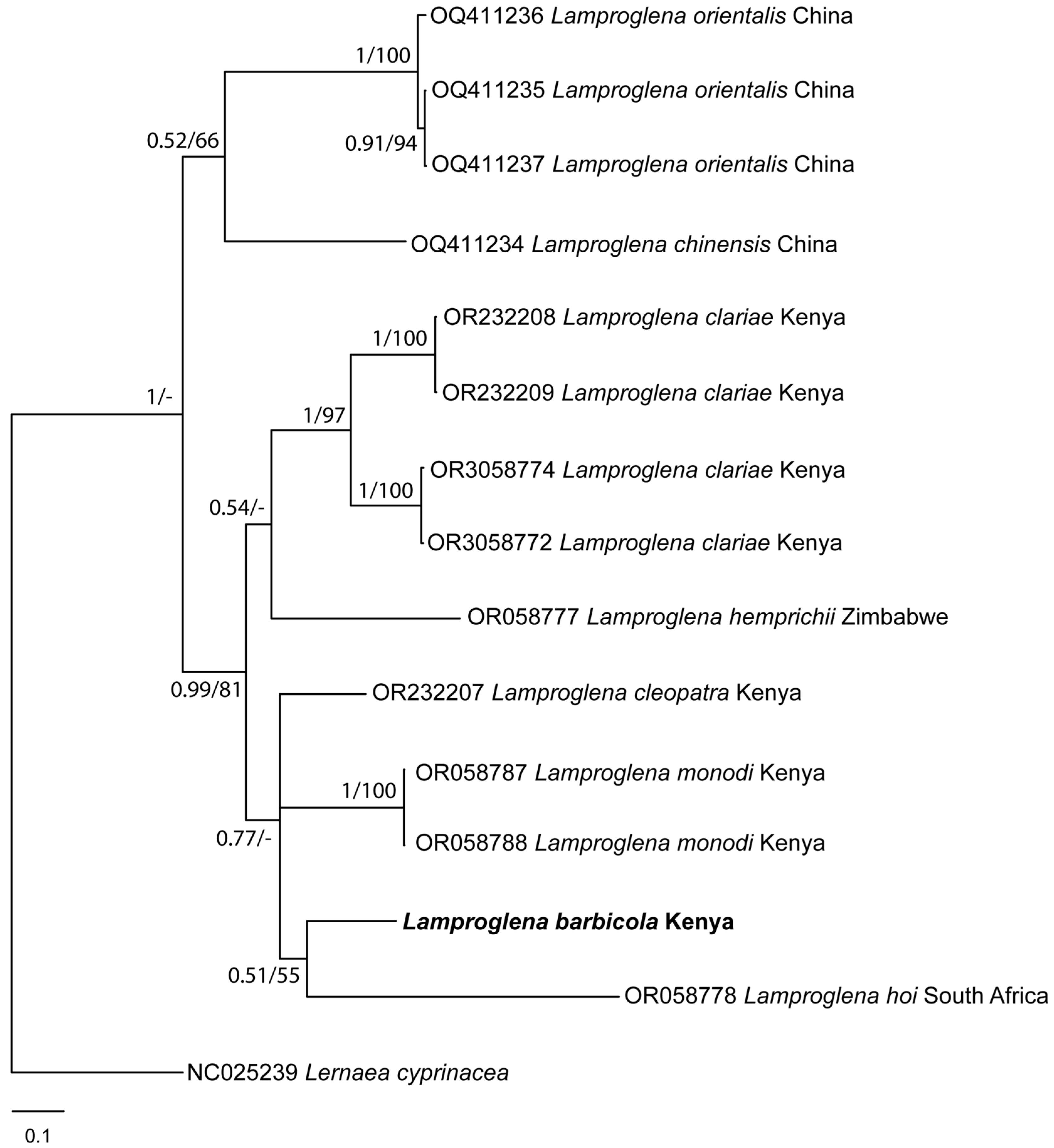
All analyses, irrespective of the regions used, placed L. barbicola as a sister taxon to L. hoi (Figure 2, Figure 3 and Figure 4); however, the nodal support for the cox1-based sequence analysis was only 0.51 and 55 for BI and ML, respectively, while the 18S and 28S rDNA-based analysis resulted in a strong support of this grouping (Figure 2 and Figure 3). The congruences in the tree topologies were found when applying different approaches to the specific dataset; however, there were differences in the tree topologies between the regions used. The 18S rDNA-based analysis placed L. clariae as a sister lineage to L. barbicola and L. hoi, with the position of a cluster formed by L. cleopatra and L. hemprichii not resolved (Figure 2). The tree resulting from the analysis based on the 28S rDNA sequences identified a cluster of L. cleopatra, L. hemprichii, and L. momodi as a sister lineage to L. barbicola and L. hoi (Figure 3). In contrast, the cox1-based analysis did not result in determining sister taxa to the two related species L. barbicola and L. hoi (Figure 4). The position of L. hemprichii was not completely resolved, as the 18S and 28S rDNA-based analysis placed the species as a sister taxon to L. cleopatra. In contrast, the cox1-based analysis placed the species within lineages containing L. clariae. The close relationship between L. barbicola and L. hoi was evident from the uncorrected p-distances (Table 1, Table 2 and Table 3). Both species had identical 18S rDNA sequences, while the 28S rDNA sequences differed by 3 bp (0.4%), and the cox1 by 145 bp (23.1%). The most distant species to L. barbicola was L. chinensis, with differences of 28 bp and a genetic divergence of 2.1% between the 18S rDNA sequence (DQ107553), and 159 bp differences and a genetic divergence of 24.8% between the cox1 sequences (OQ411234). The most distant species based on the 28S rDNA sequences was L. orientalis (DQ107544), differing in 136 bp and genetic divergence of 19.8% (Table 2). Phylogenetic trees reconstructed from the 18S, 28S rDNA, and cox1 datasets showed inconsistent topological structures.

4. Discussion

This study modernises the understanding of the parasite L. barbicola by using an integrated approach. It combines high-resolution SEM imaging and molecular data to resolve previous taxonomic confusion. This method revealed fine anatomical details that were previously invisible, leading to a more accurate and comprehensive species identification.
The SEM observations were pivotal in clarifying the taxonomic position of the studied specimen, which shared similarities with both L. barbicola and L. hoi. This study successfully identified key diagnostic features that distinguish it. The discovery of an “anterior fringe of setae on the antennule” (novel feature) is a notable addition to the taxonomic description of L. barbicola. This character was likely not visible in previous studies using lower-resolution techniques and may prove to be a critical identifier for the species. Distinguishing it from L. hoi, the present study lists as follows several distinct morphological differences that separate L. barbicola from its close relative L. hoi: 5 setae on the endopod of leg 1 (vs. a different number in L. hoi); five bumps on the oral region; 19 and 10 setae on the basal and distal segments of the antennules, respectively, and 1 seta on each ramus (branch). These precise counts and observations, enabled by SEM, provide a reliable morphological toolkit for future identifications, reducing the reliance on subjective interpretations, thus enhancing the resolution of morphological ambiguities.
By sequencing both ribosomal (18S and 28S rDNA) and mitochondrial (cox1) genes, this study added new data for the genus with very scarce availability. The molecular barcode not only confirms the species’ placement within the genus but also provides a quantifiable measure of its genetic distance from its closest relatives, a practice now standard in modern systematics [24]. This synergy between morphology and molecular techniques is the gold standard in contemporary taxonomy, as it mitigates the limitations of either method used independently.
The GTR model was intentionally applied in the Bayesian framework as a general and parameter-rich model capable of accommodating uncertainty in substitution processes, whereas ML analyses relied on marker-specific best-fit models to maximise likelihood estimates. This methodological difference is common practice and is not expected to bias phylogenetic inference at the level addressed in this study.
We further recognise the limited resolving power of the 18S rDNA marker due to its low interspecific variability within Lamproglena, which restricts its utility for species delimitation. Accordingly, observed low genetic distances should be interpreted cautiously, as they may primarily reflect marker conservatism. In addition, conclusions regarding genetic divergence are constrained by the limited taxonomic representation currently available for Lamproglena in public databases, underscoring the need for expanded taxon sampling and additional molecular markers.
Phylogenetic analysis showed insights into the evolutionary relationships and genetic divergence of L. barbicola. The fact that the studied L. barbicola formed a sister taxon to L. hoi in all three phylogenetic trees aligns with the morphological similarity relationship of these species, and most probably they represent the closest evolutionary relatives within Lamproglena. The analysis of the 18S rDNA region showed no interspecific variability between L. barbicola and L. hoi. This is expected, as the 18S rDNA is a highly conserved ribosomal gene and confirms its suitability to represent a tool of the right choice for resolving deeper phylogenetic relationships in the family and between less related genera. Its low genetic divergence in 18S rDNA (up to 2.4%) suggests that L. barbicola and the reference sequence belong to the same species at this broad level [24]. The 28S rDNA sequences of L. barbicola and L. hoi showed only a small difference of 3 bp (0.4% p-distance). As it is generally known, the 28S rDNA region is less conserved than the 18S rDNA part and can be considered as a suitable region for inferring interspecific relationships within and between closely related genera. On the other side, the mt cox1 gene showed a high divergence rate between sequences of L. barbicola and L. hoi, resulting in a difference of 146 bp (23.1% p-distance). The cox1 gene is a fast-evolving mitochondrial marker used for DNA barcoding. A divergence of over 20% is exceptionally high, even for distinct congeneric species in crustaceans (where 10–20% is more typical for species-level divergence) [25]. This substantial genetic distance provides powerful, independent confirmation that L. barbicola and L. hoi are vastly distinct species that have been separated for a considerable amount of evolutionary time. It also demonstrates that, in the case of parasitic copepods, the mt cox1 gene can be seen as the tool used for species delineation, similar as proven for other parasitic groups [26]. Phylogenetic trees reconstructed from the 18S, 28S rDNA, and cox1 datasets showed inconsistent topological structures. These differences are likely attributable to variation in evolutionary rates and levels of sequence conservation among gene regions, as well as differences in phylogenetic signal and taxon representation across datasets.
This study provides the first high-resolution SEM photomicrographs and molecular sequences (ribosomal and mitochondrial) for L. barbicola. This establishes a new, robust baseline for all future research on this species. By providing a supplementary description with both morphological and molecular data, this study helps stabilise the taxonomy of a potentially puzzling group. Future researchers can now confidently identify L. barbicola by comparing their specimens to both the new morphological characters and the DNA barcodes. The collection from L. altianalis in the Nyando River of LVB extends the geographical record, contributing to our understanding of the distribution and host specificity of these parasites. This study paves the way for follow-up research priorities, such as expanding the sampling range to explore the intraspecific genetic diversity of L. barbicola, conducting population genetics research to reveal its evolutionary history, or combining transcriptomics to study the molecular mechanism of its parasitism on hosts.

5. Conclusions

In summary, this study successfully moves the taxonomy of L. barbicola from a historical, morphology-based concept into the modern era of integrative taxonomy [27]. It resolves the morphological ambiguity with its closest relative, L. hoi, by identifying new diagnostic features through SEM. Most importantly, it provides unequivocal molecular evidence of their distinctness, particularly through the highly divergent cox1 gene. The limited number of cox1 sequences currently available in GenBank for the genus Lamproglena constrains the scope of the phylogenetic inferences.

Author Contributions

Conceptualisation, N.M.R. and W.J.L.-P.; methodology, N.M.R., I.P. and W.J.S.; software, N.M.R. and I.P.; validation, N.M.R., I.P., W.J.S. and W.J.L.-P.; formal analysis, N.M.R.; investigation, N.M.R.; resources, W.J.L.-P. and N.M.R.; data curation, N.M.R., I.P. and W.J.S.; writing—original draft preparation, N.M.R.; writing—review and editing, N.M.R., I.P., W.J.S. and W.J.L.-P.; visualisation, N.M.R. and W.J.S.; supervision, W.J.L.-P.; project administration, N.M.R. and W.J.L.-P.; funding acquisition, W.J.L.-P. All authors have read and agreed to the published version of the manuscript.

Funding

This work is based on the research supported in part by the Department of Science, Technology, and Innovation (DSTI) and the National Research Foundation (NRF) of South Africa (Grant Numbers 101054). The funder had no role in the manuscript writing, editing, approval, or decision to publish.

Institutional Review Board Statement

The authors confirm that the ethical policies of the journal, as noted on the journal’s author guidelines page, have been adhered to. No permit or ethical approval was required for this specific study, as fish were collected as part of the routine aquatic research surveys conducted by the Kenya Marine and Fisheries Research Institute (KMFRI), the government agency mandated to conduct research on the fisheries and aquatic ecology of all water bodies in Kenya.

Informed Consent Statement

Not applicable.

Data Availability Statement

The data presented in this study are openly available in GenBank (accession numbers PX780858, PX687940, and PX851548) and the National Museum, Bloemfontein, South Africa (accession no. NMB P 1299-1303).

Acknowledgments

The authors would like to thank George N. Morara and Elijah M. Kembenya, along with their team from KMFRI, for their assistance during sample collection. Gladys Nyambeki J. Rindoria (may her soul rest in eternal peace), Joan M. Maraganga, and Felix O. Olonde, all from Kisii University, are thanked for assisting with fish dissections in the laboratory.

Conflicts of Interest

The authors declare no conflicts of interest.

References

  1. Rindoria, N.M.; Dos Santos, Q.M.; Ali, S.E.; Ibraheem, M.H.; Avenant-Oldewage, A. Lamproglena monodi Capart, 1944 infecting Oreochromis niloticus (Linnaeus, 1758): Additional information on infection, morphology, and genetic data. Afr. Zool. 2022, 57, 98–110. [Google Scholar] [CrossRef]
  2. Moll, J.; Avenant-Oldewage, A. ’n Oorsig oor die verspreiding, taksonomie en aspekte van die ekologie van die genus Lamproglena (Copepoda), ’n ektoparasiet op die kieue van visse. Suid-Afrikaanse Tydskrif vir Natuurwetenskap en Tegnologie 2008, 27, 107–124. [Google Scholar]
  3. Kunutu, K.D.; Tavakol, S.; Halajian, A.; Baker, C.; Paoletti, M.; Heckmann, R.A.; Luus-Powel, W.J. Expanded description of Lamproglena cleopatra Humes, 1957 (Lernaeidae: Copepoda) from Labeo spp. with a key to species of Lamproglena von Nordmann, 1832. Syst. Parasitol. 2018, 95, 91–103. [Google Scholar] [CrossRef]
  4. Rindoria, N.M.; Gichana, Z.; Morara, G.N.; van Wyk, C.; Smit, W.J.; Smit, N.J.; Luus-Powell, W.J. Scanning Electron Microscopy and First Molecular Data of Two Species of Lamproglena (Copepoda: Lernaeidae) from Labeo victorianus (Cyprinidae) and Clarias gariepinus (Clariidae) in Kenya. Pathogens 2023, 12, 980. [Google Scholar] [CrossRef]
  5. Fryer, G. Variation in the parasitic copepod genus Lamproglena and a description of a new species from Lake Albert. Proc. Zool. Soc. Lond. 1961, 136, 381–396. [Google Scholar]
  6. Marx, H.M.; Avenant-Oldewage, A. Redescription of Lamproglena clariae Fryer, 1956 (Copepoda: Lernaeidae) with notes on its occurrence and distribution. Crustaceana 1996, 69, 509–523. [Google Scholar] [CrossRef]
  7. Dippenaar, S.M.; Luus-Powell, W.J.; Roux, F. Lamproglena hoi n. sp. (Copepoda: Lernaeidae) from two yellowfish hosts, Barbus marequensis and Barbus polylepis, caught in a river in Mpumalanga, South Africa. Onderstepoort J. Vet. Res. 2001, 68, 209–215. [Google Scholar] [PubMed]
  8. Mabika, N.; Barson, M.; Dos Santos, Q.M.; Avenant-Oldewage, A. Additional taxonomic information for Lamproglena hemprichii von Nordmann, 1832 (Copepoda: Lernaeidae) based on scanning electron microscopy and genetic characterization, alongside some aspects of its ecology. Zool. Sci. 2023, 40, 32–43. [Google Scholar] [CrossRef]
  9. Dos Santos, Q.M.; Rindoria, N.M.; Avenant-Oldewage, A. Genetic characterisation of four Lamproglena spp. (Copepoda, Lernaeidae) from Africa and the first mitochondrial data. Folia Parasitol. 2023, 70, 14. [Google Scholar] [CrossRef] [PubMed]
  10. Song, Y.; Wang, G.T.; Yao, W.J.; Gao, Q.; Nei, P. Phylogeny of freshwater parasitic copepods in the Ergasilidae (Copepoda: Poecilostomatoida) based on 18S and 28S rDNA sequences. Parasitol. Res. 2008, 102, 299–306. [Google Scholar] [CrossRef] [PubMed]
  11. Rindoria, N.M.; Moraa, G.N.; Smit, W.J.; Truter, M.; Smit, N.J.; Luu-Powell, W.J. Integrated morphological and molecular characterization of the fish parasitic nematode Rhabdochona (Rhabdochona) gendrei Campana-Rouget, 1961 infecting Labeobarbus altianalis (Boulenger, 1900) in Kenya. Int. J. Parasite Parasite Wildl. 2023, 21, 201–209. [Google Scholar] [CrossRef]
  12. Schäperclaus, W. Fischkrankheiten; Akademie Verlag: Berlin, Germany, 1990. [Google Scholar]
  13. Nation, J.L. A new method using hexamethyldisilazane for preparation of soft insect tissues for scanning electron microscopy. Stain. Technol. 1983, 58, 347–351. [Google Scholar] [CrossRef] [PubMed]
  14. Dos Santos, Q.M.; Avenant-Oldewage, A. Soft tissue digestion of Paradiplozoon vaalense for SEM of sclerites and simultaneous molecular analysis. J. Parasitol. 2015, 101, 94–97. [Google Scholar] [CrossRef]
  15. Folmer, O.; Black, M.; Hoeh, W.; Lutz, R.; Vrijenhoek, R. DNA primers for amplification of mitochondrial cytochrome c oxidase subunit I from diverse metazoan invertebrates. Mol. Mar. Biol. Biotechnol. 1994, 3, 294–299. [Google Scholar]
  16. Altschul, S.F.; Gish, W.; Miller, W.; Myers, E.W.; Lipman, D.J. Basic Local Alignment Search Tool. J. Mol. Biol. 1990, 215, 403–410. [Google Scholar] [CrossRef] [PubMed]
  17. Capella-Gutiérrez, S.; Silla-Martínez, J.M.; Gabaldón, T. trimAl: A tool for automated alignment trimming in large-scale phylogenetic analyses. Bioinformatics 2009, 25, 1972–1973. [Google Scholar] [CrossRef]
  18. Kalyaanamoorthy, S.; Minh, B.Q.; Wong, T.K.F.; von Haeseler, A.; Jermiin, L.S. ModelFinder: Fast model selection for accurate phylogenetic estimates. Nat. Methods 2017, 14, 587–589. [Google Scholar] [CrossRef] [PubMed]
  19. Hurvich, C.M.; Tsai, C.L. Regression and time series model selection in small samples. Biometrika 1989, 76, 297–307. [Google Scholar] [CrossRef]
  20. Nguyen, L.T.; Schmidt, H.A.; Von Haeseler, A.; Minh, B.Q. IQ-TREE: A fast and effective stochastic algorithm for estimating maximum-likelihood phylogenies. Mol. Biol. Evol. 2015, 32, 268–274. [Google Scholar] [CrossRef]
  21. Ronquist, F.; Huelsenbeck, J.P. MrBayes 3: Bayesian phylogenetic inference under mixed models. Bioinformatics 2003, 19, 1572–1574. [Google Scholar] [CrossRef]
  22. Kumara, S.; Stecher, G.; Li, M.; Knyaz, C.; Tamura, K. MEGA X: Molecular Evolutionary Genetics Analysis across computing platforms. Mol. Biol. Evol. 2018, 35, 1547–1549. [Google Scholar] [CrossRef] [PubMed]
  23. Glez-Peña, D.; Gómez-Blanco, D.; Reboiro-Jato, M.; Fdez-Riverola, F.; Posada, D. ALTER: Program-oriented conversion of DNA and protein alignments. Nucl. Acids Res. 2010, 38, W14–W18. [Google Scholar] [CrossRef]
  24. Schoch, C.L.; Ciufo, S.; Domrachev, M.; Hotton, C.L.; Kannan, S.; Khovanskaya, R.; Leipe, D.; McVeigh, R.; O’Neill, K.; Robbertse, B.; et al. NCBI Taxonomy: A comprehensive update on curation, resources and tools. Database 2020, 2020, baaa062. [Google Scholar] [CrossRef]
  25. Hebert, P.D.; Cywinska, A.; Ball, S.L.; deWaard, J.R. Biological identifications through DNA barcodes. Proc. R. Soc. B Biol. Sci. 2003, 270, 313–321. [Google Scholar] [CrossRef]
  26. Vermaak, A.; Kudlai, O.; Yong, R.Q.-Y.; Smit, N.J. Novel insights into the genetics, morphology, distribution and hosts of the global fish parasitic digenean Proctoeces maculatus (Looss, 1901) (Digenea: Fellodistomidae). Parasitology 2023, 50, 1242–1253. [Google Scholar] [CrossRef] [PubMed]
  27. Will, K.W.; Mishler, B.D.; Wheeler, Q.D. The perils of DNA barcoding and the need for integrative taxonomy. Syst. Biol. 2005, 54, 844–851. [Google Scholar] [CrossRef] [PubMed]
Figure 1. Scanning electron micrographs of Lamproglena barbicola Fryer, 1961, adult female ex Labeobarbus altianalis (Boulenger, 1900). (A)—ventral view of mature adult; (B)—ventral view of cephalothorax showing antennules, antennae, oral region, maxillae, maxillipeds, and first pair of legs; (C)—detailed antennae and antennules; (D)—maxilliped; (E)—first thoracic leg; (F)—second thoracic leg; (G)—third thoracic leg; (H)—fourth thoracic leg; (I)—fifth thoracic leg; (J)—caudal rami.
Parasitologia 06 00009 g001
Figure 2. Phylogenetic topologies inferred by Bayesian inference and maximum likelihood methods based on 1309 bp alignment of 18S rDNA of Lamproglena barbicola Fryer, 1961, and related species of the Lernaeidae. Bootstrap support for Bayesian inference/maximum likelihood is given at the respective nodes (only bootstrap support above 50% is shown). Newly generated sequences are displayed in bold.
Parasitologia 06 00009 g002
Figure 3. Phylogenetic topologies inferred by Bayesian inference and maximum likelihood methods based on 736 bp alignment of 28S rDNA sequences of Lamproglena barbicola Fryer, 1961, and related species of the Lernaeidae. Bootstrap support for Bayesian inference/maximum likelihood is given at the respective nodes (only bootstrap support above 50% is shown). Newly generated sequences are displayed in bold.
Parasitologia 06 00009 g003
Figure 4. Phylogenetic topologies inferred by Bayesian inference and maximum likelihood methods based on 655 bp alignment of mtDNA (cox1) sequences of Lamproglena barbicola Fryer, 1961, and related species of the Lernaeidae. Bootstrap support for Bayesian inference/maximum likelihood is given at the respective nodes (only bootstrap support above 50% is shown). Newly generated sequences are displayed in bold.
Parasitologia 06 00009 g004
Table 1. The 18S rDNA nucleotide base pair (bp) difference (upper right) and the percentage (%) pairwise distance (lower left).
Species/CountryAccession No.123456789101112131415161718
1Lamproglena orientalis ChinaDQ107549 04181816161517171717232322232935
2Lamproglena orientalis ChinaDQ1075500.0 4181816161517171717232322232935
3Lamproglena orientalis ChinaDQ1075520.30.3 212219191920202020252524243237
4Lamproglena barbicola KenyaPX7808581.41.41.6 06657777161612132835
5Lamproglena hoi South AfricaOR0488021.31.31.60.0 6657777161612132935
6Lamproglena cleopatra KenyaOR2425011.21.21.40.60.4 013333161612132731
7Lamproglena cleopatra KenyaOR2425021.21.21.40.60.40.0 13333161612132731
8Lamproglena hemprichii ZimbabweOP2775261.11.11.40.40.40.10.1 4444151511122632
9Lamproglena monodi KenyaON4194391.31.31.50.50.50.20.20.3 000151511122632
10Lamproglena monodi KenyaON4194441.31.31.50.50.50.20.20.30.0 00151511122632
11Lamproglena monodi EgyptON4194501.31.31.50.50.50.20.20.30.00.0 0151511122632
12Lamproglena monodi EgyptON4194481.31.31.50.50.50.20.20.30.00.00.0 151511122632
13Lamproglena clariae South AfricaOR0487991.71.71.91.21.21.21.21.11.11.11.11.1 0342835
14Lamproglena clariae South AfricaOR0487971.71.71.91.21.21.21.21.11.11.11.11.10.0 342835
15Lamproglena clariae KenyaOR2425031.61.61.80.90.90.90.90.80.80.80.80.80.22.2 02631
16Lamproglena clariae KenyaOR2425041.91.91.91.01.01.01.01.01.01.01.01.00.30.30.0 2632
17Lamproglena chinensis ChinaDQ1075532.12.12.42.12.12.02.01.91.91.91.91.92.12.11.92.1 33
18Lernaea cyprinacea ChinaDQ1075562.62.62.72.72.62.32.32.42.42.42.42.42.62.62.32.62.4
Table 2. The 28S rDNA nucleotide base pair (bp) difference (upper right) and the percentage (%) pairwise distance (lower left).
Species/CountryAccession No.12345678910111213141516171819
1Lamproglena barbicola KenyaPX687940 368827776767677105105105105129136133134133146
2Lamproglena hoi South AfricaOR0488080.4 67817677777778104104104104129136133134133147
3Lamproglena cleopatra KenyaOR33816911.911.7 04557575758118118118119129128128129130132
4Lamproglena cleopatra KenyaOR33817013.012.80.0 4658585859141141141141152153153154155159
5Lamproglena hemprichii ZimbabweOP27752711.411.27.77.1 45454546134134134131139144144145146162
6Lamproglena monodi KenyaON41942211.011.29.78.96.5 000123121121123136138136137138161
7Lamproglena monodi KenyaON41942811.011.29.78.96.50.0 00123121121123136138136137138161
8Lamproglena monodi EgyptON41943211.011.29.78.96.50.00.0 0123121121123136138136137138161
9Lamproglena monodi EgyptON41943511.111.39.99.06.60.00.00.0 124122122124136138136137138162
10Lamproglena clariae KenyaOR33819515.215.020.121.619.317.317.317.317.4 559151166166168166170
11Lamproglena clariae South AfricaOR04880515.515.320.121.619.317.417.417.417.50.7 08149163163165163170
12Lamproglena clariae South AfricaOR04880315.215.020.121.619.317.017.017.017.10.70.0 8149164164166164170
13Lamproglena clariae KenyaOR33819615.215.020.221.618.817.317.317.317.41.31.11.1 148164164166164171
14Lamproglena chinensis ChinaDQ10754518.618.622.123.420.119.319.319.319.221.321.521.020.8 141140142142168
15Lamproglena orientalis ChinaDQ10754419.819.822.023.620.919.619.619.619.523.423.523.123.220.1 181820158
16Lamproglena orientalis ChinaDQ10754119.319.321.923.520.819.219.219.219.223.323.423.123.119.82.5 22159
17Lamproglena orientalis ChinaDQ10754319.419.422.123.720.919.419.419.419.323.623.723.323.320.12.50.3 4161
18Lamproglena orientalis ChinaDQ10754219.319.322.223.821.119.519.519.519.523.323.423.123.120.12.80.30.6 161
19Lernaea cyprinacea ChinaDQ10754821.321.523.325.224.023.423.423.423.524.625.124.624.724.322.923.023.323.3
Table 3. Mt COI nucleotide base pair (bp) difference (upper right) and the percentage (%) pairwise distance (lower left).
Species/CountryAccession No.123456789101112131415
1Lamproglena barbicola KenyaPX851548 109119119128129136136147145155156156159170
2Lamproglena cleopatra KenyaOR23220717.0 117117137136143142147160151152153164182
3Lamproglena monodi KenyaOR05878718.517.4 0138137144145165169165168169165178
4Lamproglena monodi KenyaOR05878818.517.40.0 138137144145165169165168169165178
5Lamproglena clariae KenyaOR23220819.920.420.520.5 1104105159153155157158170178
6Lamproglena clariae KenyaOR23220920.120.220.420.40.1 105106160153156158159171179
7Lamproglena clariae South AfricaOR05877421.221.321.421.415.515.6 4146174167165166174173
8Lamproglena clariae South AfricaOR05877221.221.121.621.615.615.80.6 149174167166167172174
9Lamproglena hemprichii ZimbabweOR05877722.921.924.624.623.723.821.722.2 184170165166178185
10Lamproglena hoi South AfricaOR05877823.124.325.725.723.323.326.526.528.0 185184185204205
11Lamproglena orientalis ChinaOQ41123624.122.524.624.623.123.224.824.825.328.2 1516174189
12Lamproglena orientalis ChinaOQ41123524.322.625.025.023.423.524.624.724.628.02.2 1171184
13Lamproglena orientalis ChinaOQ41123724.322.825.125.123.523.724.724.824.728.22.40.1 170185
14Lamproglena chinensis ChinaOQ41123424.824.424.624.625.325.425.925.626.531.125.925.425.3 193
15Lernaea cyprinacea ChinaNC02523926.527.126.526.526.526.625.725.927.531.228.127.427.528.7
Disclaimer/Publisher’s Note: The statements, opinions and data contained in all publications are solely those of the individual author(s) and contributor(s) and not of MDPI and/or the editor(s). MDPI and/or the editor(s) disclaim responsibility for any injury to people or property resulting from any ideas, methods, instructions or products referred to in the content.