
Article

Isolation and Antiprotozoal Effects of Two Sesquiterpene Lactones from Ptilostemon chamaepeuce subsp. cyprius (Asteraceae)


1
Department of Basic and Clinical Sciences, University of Nicosia Medical School, Nicosia 2408, Cyprus
2
University of Münster, Institute of Pharmaceutical Biology and Phytochemistry (IPBP), PharmaCampus, Corrensstrasse 48, 48149 Münster, Germany
3
Laboratory for Animal Health Virology Section, Veterinary Services (1417), 79, Athalassa Avenue Aglantzia, Nicosia 2109, Cyprus
4
Swiss Tropical and Public Health Institute (Swiss TPH), Kreuzstrasse 2, 4123 Allschwil, Switzerland
5
University of Basel, Petersplatz 1, 4003 Basel, Switzerland
6
Faculty of Medicine and University Hospital, University of Cologne, 50937 Cologne, Germany
*
Authors to whom correspondence should be addressed.
These authors contributed equally to this work.
Parasitologia 2025, 5(4), 66; https://doi.org/10.3390/parasitologia5040066
Submission received: 10 November 2025 / Revised: 1 December 2025 / Accepted: 8 December 2025 / Published: 11 December 2025

Abstract

In continuation of our recent report on the antileishmanial activity of an ethanolic extract from leaves of Ptilostemon chamaepeuce subsp. cyprius (Pcc, Asteraceae), we have now isolated the main sesquiterpene lactone, deacylcynaropicrin, along with a minor derivative, 13-hydroxy-11β,13-dihydro-deacylcynaropicrin. The main constituent was tested for antileishmanial activity against promastigotes and amastigotes of Leishmania infantum (Lin), the causative agent of visceral leishmaniasis. Both STLs were tested against additional protozoan pathogens, including L. donovani, Trypanosoma brucei rhodesiense (Tbr), and Plasmodium falciparum. The STL cynaropicrin from Artichoke (Cynara cardunculus), a congener of deacylcynaropicrin with a hydroxymethacrylate ester group, previously known to possess antiprotozoal activity, was retested against Lin for direct comparison. Cynaropicrin was found to be much more potent than either its deacyl congener or the hydroxylated derivative from Pcc against all tested parasites and also against an isolated parasite enzyme, Tbr pteridine reductase (TbPTR1). The ester moiety of cynaropicrin significantly enhances the antiprotozoal activity of this STL. Since cynaropicrin also displayed significant cytotoxicity against mammalian cells (L6 and J774A.1 cell lines), its utility as candidate for further development appears limited. However, this study provides valuable new insight into the structure–activity relationships of these compounds.

1. Introduction

New effective, safe and affordable drugs for the treatment of tropical infectious diseases caused by protozoan parasites such as Leishmania and Trypanosoma are still urgently needed [1]. Natural products have long been known as a rich source of chemical entities with potential use as antiprotozoal drugs, such as quinine, artemisinin, and others. Searches for new active compounds against protozoan infections in our group have previously led to the identification of sesquiterpene lactones (STLs) from plants of the Sunflower family Asteraceae as promising specialised metabolites with activity against parasites of the genera Trypanosoma, Leishmania and Plasmodium (e.g., [2,3,4]). Very recently, for instance, Arnica tincture, an ethanolic extract of the flowerheads of Arnica montana (Asteraceae), rich in helenalin-type STLs, has been identified as a promising new cure for cutaneous leishmaniasis in human patients [5]. In a recent study, we investigated the potential antileishmanial effect of an ethanolic extract of the Asteraceae representative Ptilostemon chamaepeuce subsp. cyprius (Pcc), which demonstrated significant in vitro activity against L. infantum (Lin), one of the parasites causing visceral leishmaniasis (VL) [6]. LC/MS profiling of the active extract indicated the presence of the guaianolide STL deacylcynaropicrin [6]. In the present communication we report the isolation and identification of this compound as the main STL in Pcc, along with a hydroxylated congener, and their testing for antileishmanial activity against Leishmania promastigotes and amastigotes. The related STL cynaropicrin, isolated from Artichoke, Cynara cardunculus var. scolymus (Ccs; Asteraceae), differing from deacylcynaropicrin by a hydroxymethacrylate ester group attached to position 8 and previously tested against Lin [4] as well as L. donovani (Ldo) [7], Trypanosoma brucei rhodesiense (Tbr), and Plasmodium falciparum (Pfc) [8], was retested against L. infantum for direct comparison.

2. Materials and Methods

2.1. Plant Material

The leaves of Ptilostemon chamaepeuce subsp. cyprius (Greuter) Chrtek & B. Slavík (Pcc) were collected from Kalopanayiotis, Cyprus in June 2023 (voucher number MS22). The leaves of Cynara cardunculus subsp. scolymus (L.) Benth. (Ccs) were collected from Xylofagou, Cyprus in May 2024 (voucher number MS24). Both specimens were identified by Dr. Eleftherios Hadjisterkotis at the Cyprus Agriculture Research Institute. Voucher specimens (MS21, MS22) were deposited at the Department of Basic and Clinical Sciences, University of Nicosia Medical School. The leaves were cleaned, air-dried for three weeks in the shade, and then ground in an electric mill to a fine powder. They were placed in plastic zipper bags and stored at 4 °C.

2.2. Extraction of the Plant Material

Isolation of Pure STLs

The dried and powdered leaves of Pcc (4 g) were extracted with ethanol. To this end, the plant material was portioned into 1 g aliquots for extraction in 50 mL centrifuge tubes. Each aliquot was sonicated with Grant XUB10 ultrasonic bath (200 W, 32–38 kHz; Grant Instruments, Riga, Latvia) twice with 25 mL absolute ethanol for 20 min at 40 °C, after which the combined supernatants were vacuum filtered, and rotary evaporated (Hei-VAP Heidolph Instruments GmbH & Co. KG, Schwabach, Germany) to dryness at 40 °C under reduced pressure in tared glass vials. The resulting Pcc crude extract (0.61 g) was stored at 4 °C. The extraction of Ccs was performed in essentially the same way. The extracts were stored at 4 °C until reconstitution (see Section 2.5.2 below).

2.3. Fractionation and Isolation of the Plant Material

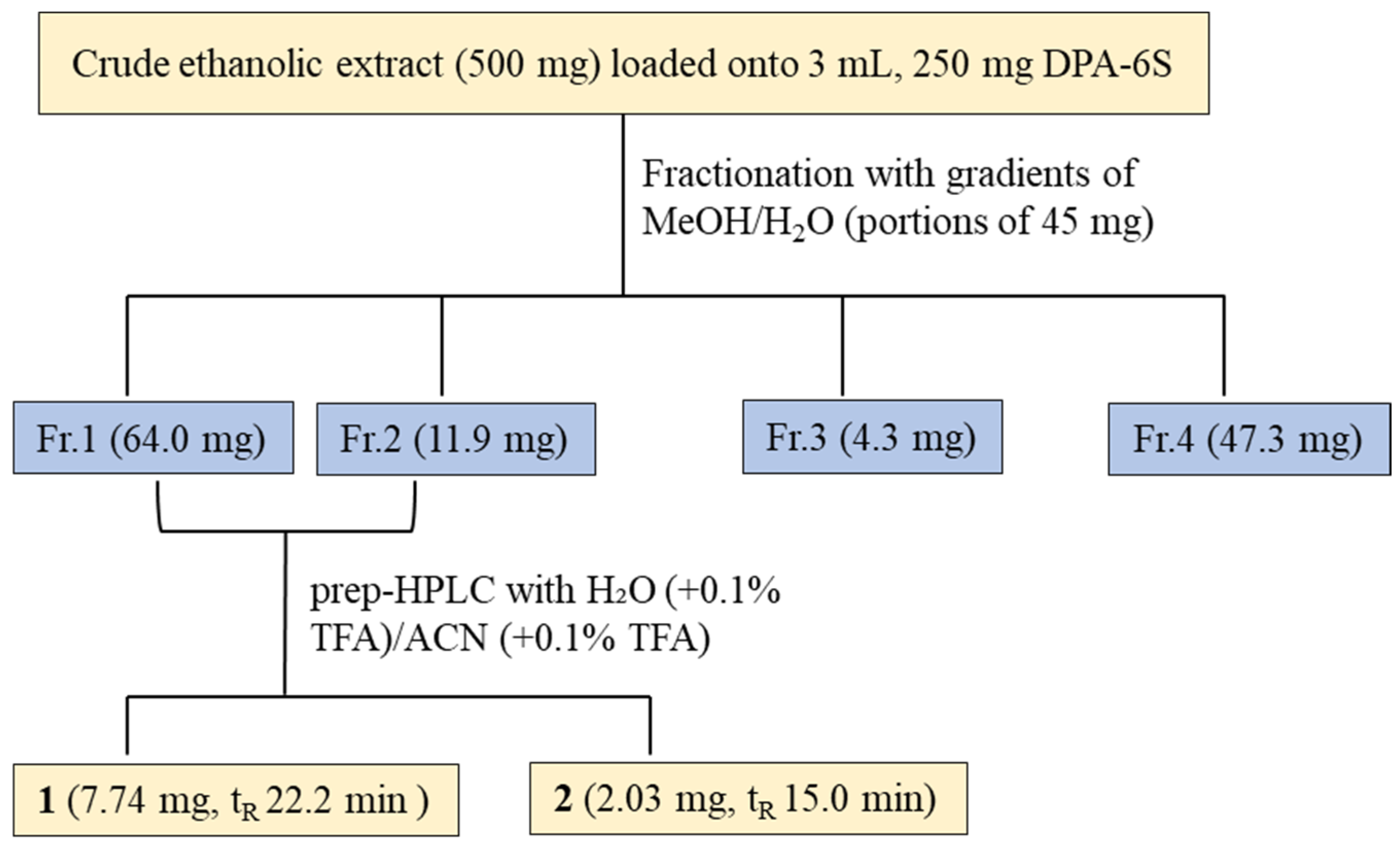
A portion of the crude Pcc ethanol extract (500 mg) was fractionated by solid phase extraction (SPE) using a 3 mL column packed with 250 mg of polyamide resins (DPA-6S). For each successive fractionation, 45 mg of the extract was dissolved in MeOH/H2O (0.5/9.5, v/v), loaded on the column and eluted with gradients of MeOH/H2O from 5%, 10%, 20%, 40%, 60%, and 100% of MeOH. Following LC-MS measurement, the eluates were pooled into four fractions as follows; Fr. 1 (5% + 10%, 64.0 mg), Fr. 2 (20%, 11.9 mg), Fr. 3 (40%, 4.3 mg) and Fr. 4 (60%, 100%, 47.3 mg). Only fractions Fr. 1 and Fr. 2 contained STLs according to LC/MS analyses. They were both separately separated by prep-HPLC on a RP18 phase using binary gradients of H2O (+0.1% TFA; A) and ACN (+0.1% TFA; B). The following gradient conditions were used: 5–30% of B (0–15 min), 30–35% of B (15–25 min), 35–40% of B (25–35 min), 40–45% of B (35–45 min), 45–60% of B (45–50 min), 60–100% of B (50–55 min) and 100% of B (55–60 min) at a flow rate of 10 mL/min and a column temperature of 40 °C. This afforded compounds 1 (7.74 mg, tR 22.2 min) and 2 (2.03 mg, tR15.0 min).
Compound 3 (cynaropicrin) was isolated from Ccs in one of our earlier studies [9]. After repurification by prep. HPLC using the system mentioned above (tR 33.7 min), its identity and purity were confirmed by LC/MS and 1H-NMR to be unchanged and the compound was identical with an authentic sample obtained from Phytolab (Vestenbergsgreuth, Germany) [10].
The purity of the isolated STLs was >90% in all cases as estimated from their 1H-NMR spectra (Figures S1 (1), S7 (2) and S13 (3), Supplementary Materials).

2.4. Spectrometric and Spectroscopic Analysis

2.4.1. LC/MS Analysis

The isolated compounds were analysed by LC/MS using the same parameters and procedure described in our recent article [6], with minimal modifications. In summary, the compounds were analysed using a Bruker Daltonics micrOTOFQII time-of-flight mass spectrometer (Bruker Daltonics GmbH, Bremen, Germany) fitted with an Apollo electrospray ionisation source in positive mode at 3 Hz over a mass range of m/z 50–1500. The compounds were eluted on a C-18 column (Dionex Acclaim RSLC 120, Thermo Fisher Scientific, Waltham, MA, USA) and detected using a Dionex Ultimate DAD-3000 RS (Thermo Fisher Scientific, Waltham, MA, USA) at a wavelength of 200–400 nm. A binary gradient of H2O (+0.1% formic acid; A) and Acetonitrile (+0.1% formic acid; B) at a flow rate of 0.4 mL/min and column temperature of 40 °C was applied as follows: 0–0.4 min: isocratic at 5% B, 0.4–9.9 min: linear from 5% B to 100% B, 9.9–15.0 min: isocratic at 100% B, 15.0–15.1 min: linear from 100% B to 5% B, 15.1–20.0 min: isocratic at 5% B. The sample concentration and injection volume were 0.1 mg/mL and 2 μL, respectively. Data were analysed using the Bruker DataAnalysis 4.1 software.

2.4.2. NMR Spectroscopy

One-dimensional nuclear magnetic resonance (1D-NMR) and two-dimensional nuclear magnetic resonance (2D-NMR) spectra were recorded on an Agilent DD2 600 MHz spectrometer (Agilent, Santa Clara, CA, USA) at 26 °C in deuterated methanol (CD3OD) or chloroform (CDCl3). Spectra were referenced to the solvent signals (CD3OD: 1H: 3.310 ppm; and 13C: 49.000 ppm; CDCl3: 1H: 7.260 ppm; and 13C: 77.160 ppm) and were evaluated with MestReNova version 15.0.0-34764 software (Mestrelab Research, Santiago de Compostela, Spain).

2.5. Biological Assays

2.5.1. L. infantum Parasite and Murine Macrophage Cell Culture

The L. infantum clinical strain MCAN/CY/2005/CD57 was maintained as promastigotes at 26 °C in RPMI-1640 medium supplemented with 2 mM L-glutamine, 10 mM HEPES, 1% penicillin-streptomycin, and 10% heat-inactivated foetal bovine serum, and expanded to late stationary phase. Murine macrophage J774A.1 cells (ECACC 91051511) were cultured in the same supplemented RPMI-1640 medium at 37 °C in 5% CO2 and subcultured by scraping at 70% confluence. Both procedures followed established protocols [6,11].

2.5.2. In Vitro Assays with Murine Macrophages and L. infantum

The cytotoxicity (CC50) against J774A.1 macrophages, and the anti-promastigote (IC50) and intracellular anti-amastigote (IC50) activities against Lin were determined using the resazurin fluorescence assay protocol [6].
Dried plant extracts were solubilized with a specific volume of EtOH (1.5–2 mL) to reach a stock concentration with brief (<1 min) sonication at 30 °C. Depending on the extraction yield and initial plant material, a working stock solution for the bioassays was ~100–375 mg/mL. Then another 1 or 5 mg/mL working stock (diluted with sterile PBS) was used to make the final assay concentrations for the bioassays (0–500 µg/mL). Deacylcynaropicrin (3.3 mg) was solubilized in DMSO (250 µL) and diluted with autoclaved double distilled (dd) H2O (250 µL) for a 6.6 mg/mL working stock. Cynaropicrin (4.1 mg) was solubilized in DMSO (0.2 mL) and autoclaved ddH2O (0.3 mL) for an 8.2 mg/mL working stock. The final DMSO assay concentration did not exceed 1.52% at the high assay concentration tested for each STL (200 ug/mL). The 1% DMSO tested separately in the bioassays had a negligible effect.
The final assay concentrations of the following test compounds, ethanolic leaf extracts of Pcc and Ccs (0–500 µg/mL), isolated sesquiterpene lactones (deacylcynaropicrin, cynaropicrin; 0.78–200 µg/mL or 1.56–200 µg/mL), and miltefosine (1.88–120 µg/mL) as a positive control were used in the bioassays. All treatments were applied in triplicate and repeated in at least two independent runs, with controls for blank, solvent-match, and extract background.
Cytotoxicity (CC50) of the test compounds was evaluated with J774A.1 cells (4 × 10⁴ cells/mL) were seeded overnight and exposed to compounds for 48 h. Viability was quantified by resazurin (20 µg/mL) fluorescence after a 4 h incubation.
The stationary-phase of Lin (1 × 10⁶ promastigotes/mL) was used to evaluate the anti-promastigote (IC50) activity of each compound following exposure to compounds after 60 h at 26 °C. Resazurin (20 µg/mL) was then added, and the mixture was incubated for 24 h before fluorescence was measured.
The intracellular anti-amastigote (IC50) activity was evaluated with J774A.1 macrophage cells (4 × 10⁴ cells/mL) was infected with promastigotes at a 15:1 ratio for 48 h, then treated with compounds for a further 48 h. Surviving parasites were liberated by cell lysis, cultivated in Schneider’s complete medium for 72 h at 26 °C, and then quantified with resazurin (60 µg/mL) after a 24 h incubation.
For data analysis, CC50 and IC50 values were calculated using nonlinear regression analysis (sigmoid dose–response curve with variable slope) in GraphPad Prism 10. Values were reported as standard error of the mean (SEM). The selectivity index (SI) was computed as the ratio of macrophage CC50 to amastigote IC50 (CC50/IC50).

2.5.3. Culture and In Vitro Assays with L. donovani, T. brucei rhodesiense, P. falciparum and L6 Rat Skeletal Myoblasts

The culture and assay conditions for Ldo (axenic amastigotes; tests with intracellular forms were not conducted since the activity level was not sufficiently high), Tbr (bloodstream forms), Pfc (intraerythrocytic forms) and L6 rat skeletal myoblasts were essentially identical with standard protocols of the Swiss TPH, as recently reported [12].

2.6. Enzyme Inhibition Assay with Trypanosoma brucei Pteridine Reductase 1 (TbPTR1)

The expression and purification of TbPTR1, as well as the assay conditions, were described in detail in our previous communication [10]. For compounds 1 and 2, single-concentration assays were performed at a fixed concentration of 10 µg/mL, corresponding to 38 and 36 µmol/L, respectively.

3. Results and Discussion

3.1. Isolation and Identification of Sesquiterpene Lactones from Pcc

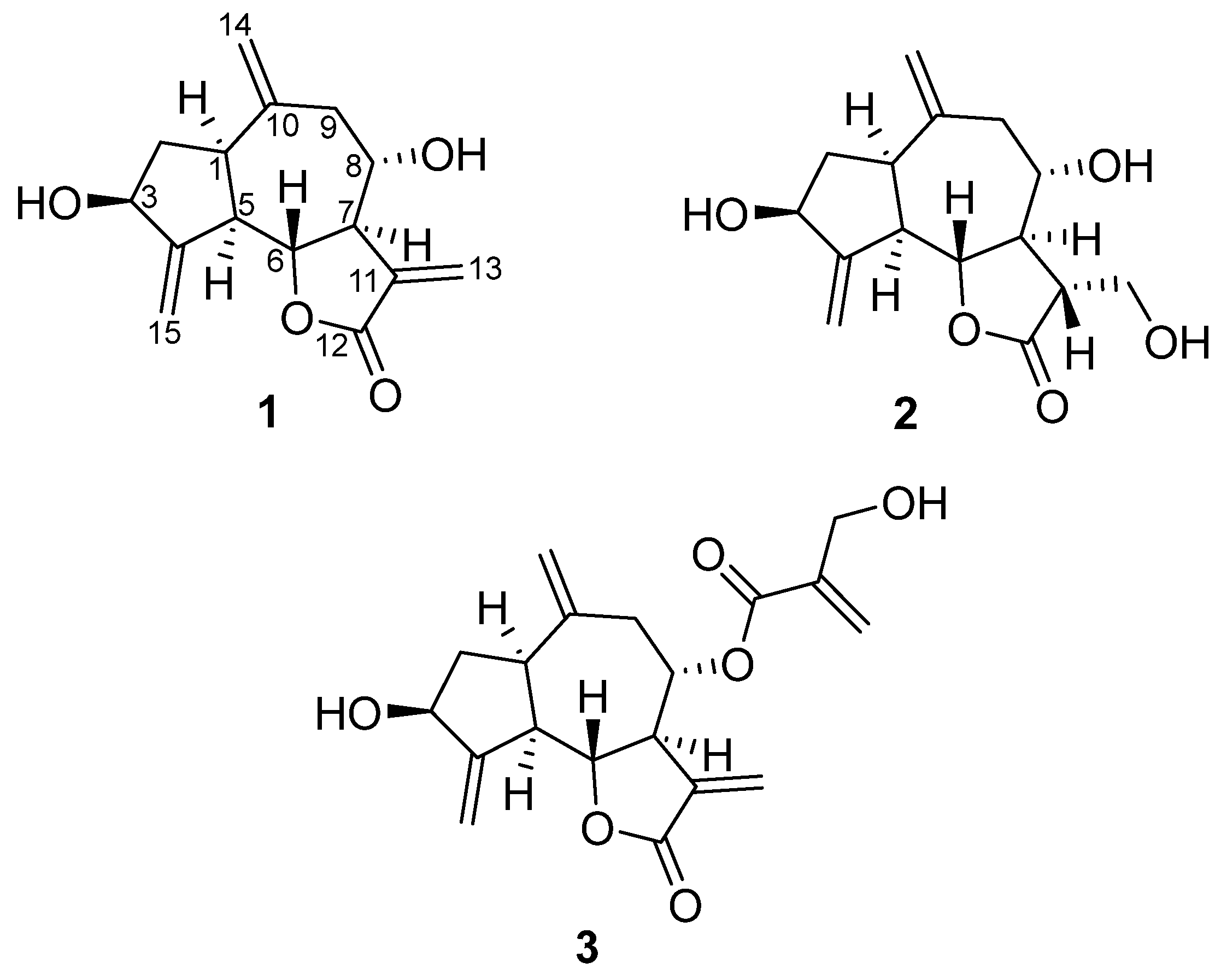
Solid-phase extraction (SPE) and preparative HPLC separation of the ethanol extract of Pcc previously tested for antileishmanial activity [6] yielded two pure sesquiterpene lactones (isolation shown in Figure 1; chemical structures of compounds 1 and 2 shown in Figure 2). The structural characterisation of the isolated compounds was achieved using ultra-high-performance liquid chromatography coupled to positive-mode electrospray ionisation quadrupole time-of-flight mass spectrometry (LC/MS) and one- and two-dimensional nuclear magnetic resonance spectroscopy (1D and 2D NMR). The two compounds were unambiguously identified as the known sesquiterpene lactones (STLs) deacylcynaropicrin (1) [13] and 13-hydroxy-11β,13-dihydro-deacylcynaropicrin (2) [14], and their spectral data were in agreement with those reported in the literature. The NMR data are summarised in Table S1, and the spectra are depicted in Figures S1–S12, Supplementary Materials.
To the best of our knowledge this is the first report on these compounds’ occurrence in Pcc. Compound 2, which is likely formed by addition of water to the reactive exomethylene group of 1, has only been previously reported as a reaction by-product of the chemical hydrolysis of cynaropicrin and clementein B [14,15].
Cynaropicrin was purified by prep. HPLC from an isolate obtained from an Artichoke leaf extract during an earlier study in our group [9]. Its identity and purity were confirmed by its 1H-NMR spectrum data which was in agreement with previous reports [16].

3.2. Antileishmanial Activity of the Isolated STLs

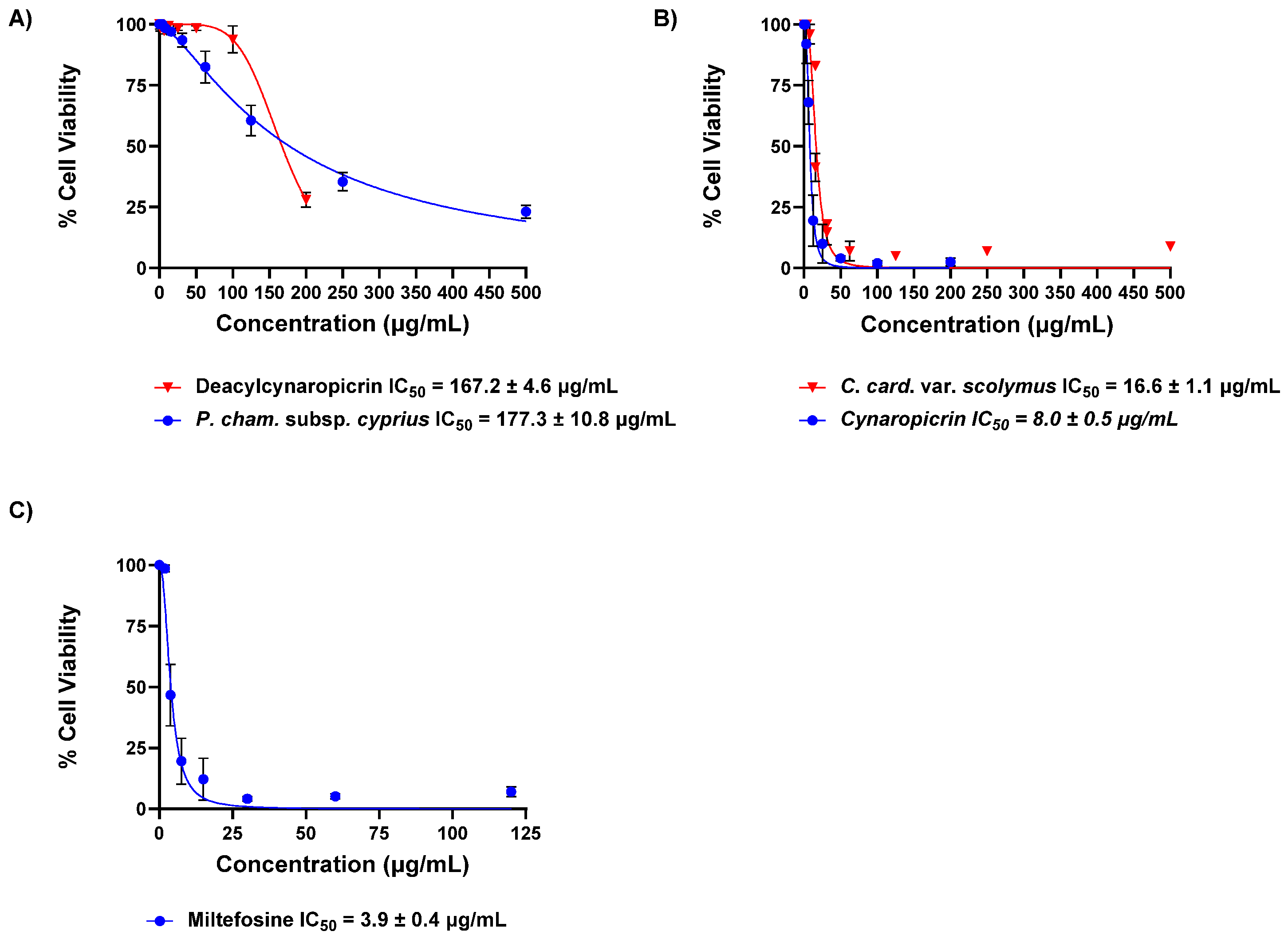
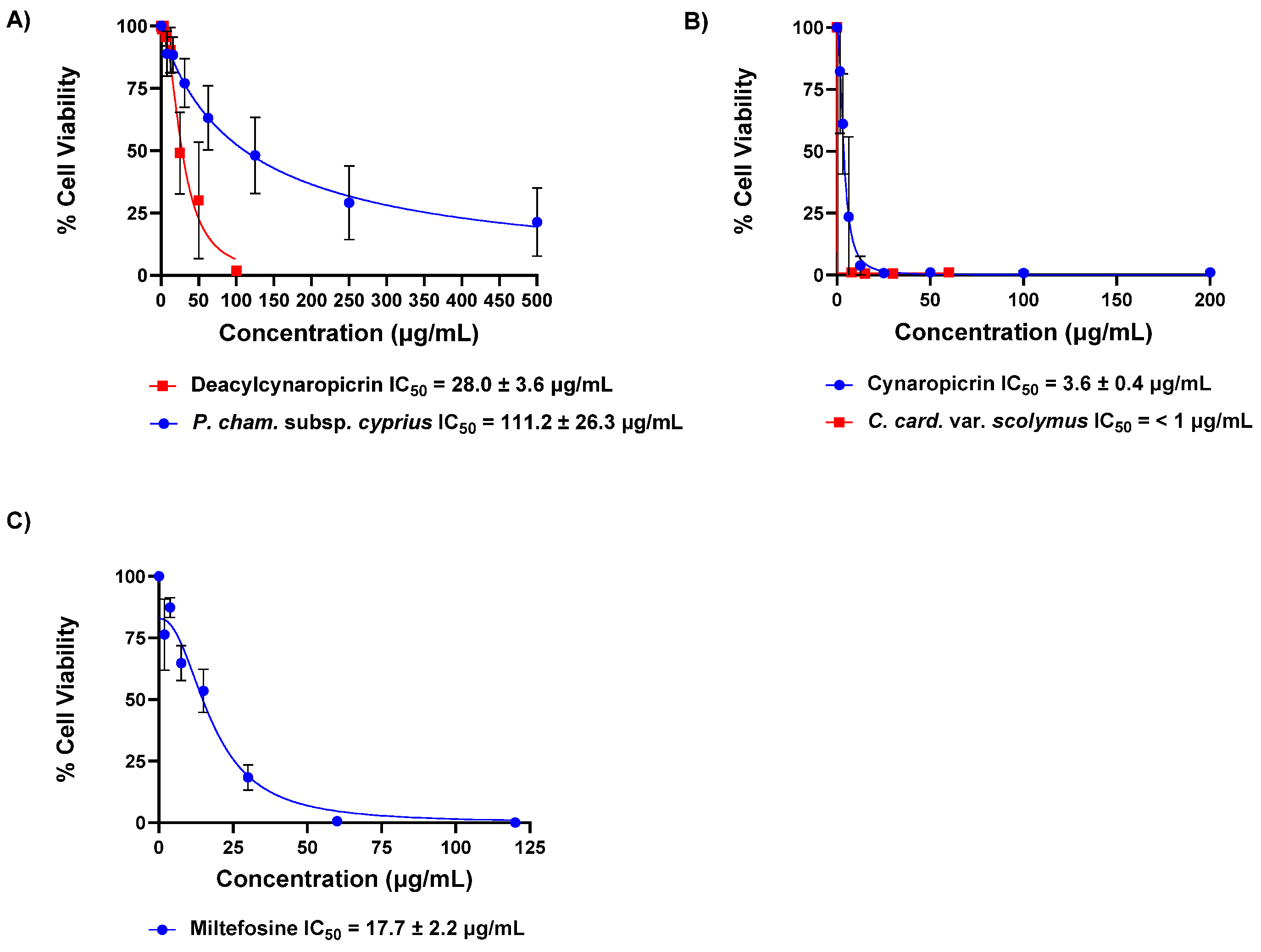
The main STL of the Pcc extract, deacylcynaropicrin (1), was tested for in vitro activity against Lin promastigotes (prom) as well as intracellular amastigotes (ama) residing in murine macrophages. For comparison, compound 1 was also tested against axenically cultured amastigotes of Ldo (another species responsible for VL), and against bloodstream forms (bsf) of the protozoan pathogens Tbr (human African trypanosomiasis) and intraerythrocytic forms (ery) of Pfc (malaria). The resulting activity data are presented in Table 1. Since it appeared interesting to compare the activity of 1 with that of its congener cynaropicrin (3) from Ccs, esterified at position 8 with a hydroxymethacrylic acid moiety, this STL, although previously tested against Lin in a different laboratory under different conditions [4], was re-tested under the conditions of the present study and the results found very similar (literature data are included for comparison in Table 1). The dose–response curves of 1 and 3 against Lin promastigotes and amastigotes are shown, along with those of crude extracts obtained from the plants from which the STLs originate, in Figure 3 and Figure 4, respectively. It becomes evident that the ester side chain of 3 plays an important role in conferring stronger antileishmanial activity since the deacyl compound 1 was found 10–30 times less active, i.e., essentially inactive, with IC50 values > 100 µmol/L, against both Lin life stages. Consistently, the Pcc extract was much less active (IC50 = 177 and 111 µg/mL for promastigotes and amastigotes, respectively) than that of Ccs (IC50 = 16.6 and <1 µg/mL, respectively). The exceptionally strong activity of this extract against the clinically more relevant amastigotes indicates that it possibly contains even more potent constituents or that some synergistic effect of 3 with other constituents is at work. This may be an interesting subject in further studies.
As observed with Lin, the activity of 1 against Ldo, Tbr, and Pfc was much lower than that of 3, which was already known to be rather active against these parasites in the literature [7,8] (data included in Table 1 for comparison).
The minor STL 2 of Pcc, due to its small isolated quantity, could only be tested against Ldo, Tbr, and Pfc (Table 1). While it turned out to be essentially inactive against the Kinetoplastids Ldo and Tbr, with IC50 values of almost 200 µmol/L, the malaria parasite Pfc surprisingly showed some sensitivity to the compound. However, 2 was about 10 times weaker than cynaropicrin 3 (IC50 = 29 vs. 3 [8] µmol/L, respectively). However, vigorous biological and antiprotozoal activity of STLs usually being associated with the presence of reactive α,β-unsaturated carbonyl groups (i.e., “enone” structures able to interact by covalently modifying and irreversibly inhibiting biological nucleophiles such as enzymes, transcription factors, etc.; see, e.g., [2,3,4]), it appears unusual that 2, devoid of such moieties, was about three times more active against Pfc than its “enone” parent STL, 1 (IC50 = 29 vs. 92 µmol/L, respectively). In view of this unexpected activity, it might be an interesting topic in future studies to investigate the antiplasmodial effect of this compound more closely. In spite of its small yield obtainable from the plant material, it could be accessible semi-synthetically from 1 or 3.
Although cynaropicrin (3) was thus found to be by far the most active of the STLs investigated in this study, it should be noted that it was also, by far, the most cytotoxic to mammalian cells (L6 rat skeletal myoblasts as well as J774A.1 murine macrophages). In fact, its cytotoxic activity against both mammalian cell lines was 5–10 times stronger than its antileishmanial activity and somewhat stronger than its antiplasmodial activity. The compound showed significant parasite selectivity in previous studies against Tbr [7,8,17] and demonstrated some in vivo activity in Tbr-infected mice [8]. Due to its comparatively high toxicity, it may not be a desirable candidate for in vivo testing of antileishmanial activity and further development; this problem might, however be overcome by synthetic modifications, but this would have to be the subject of extensive further research.
It is interesting to note that cynaropicrin (3) was recently reported in another project of our group to be an effective dual inhibitor of Tbr pteridine reductase 1 (TbPTR1) and dihydrofolate reductase (TbDHFR) [10], both well-established drug targets as crucial enzymes of the Kinetoplastids’ folate metabolism. Quite noteworthy, 3 was found to selectively interfere with the Tbr enzymes (IC50 = 12.4 and 7.1 µmol/L, respectively) and did not significantly inhibit the analogous enzymes of L. major (LmPTR1 and LmDHFR), nor was it active towards human DHFR [10]. In view of these results, deacylcynaropicrin (1) and the hydrated derivative (2) were submitted to preliminary tests for inhibitory activity against TbPTR1. At a tested concentration of 38 µmol/L, compound 1 inhibited the enzyme activity by about 53%, so that a rough estimate of the IC50 would be about 35–40 µmol/L (i.e., about 3 times less potent than 3 with IC50 = 12 µmol/L [10]). In contrast, the hydrate, compound 2, did not significantly inhibit the enzyme (2% inhibition at 35 µmol/L). Hence, the inhibition of TbPTR1 is also crucially influenced by the ester side chain of 3, but the deacyl derivative retains some of this activity. Tests of 1 for inhibition of DHFR could not be performed at this point, but may be of interest in future studies to determine whether 1, like 3, is a dual inhibitor of both enzymes in the Tbr folate metabolism. If so, 1 might also represent an interesting starting point for modifications, such as the addition of different ester groups, to study structure–activity relationships of these compounds regarding their inhibitory activity against the PTR1 enzymes. In conclusion, while having limited potential for further development as antileishmanial drugs, the STLs isolated from Pcc provide valuable insights into the overall body of knowledge on STLs’ antiprotozoal activity and structure–activity relationships [17,18].

4. Conclusions

The present study being the first chemical investigation of P. chamaepeuce subsp. cyprius, an endemic plant species of Cyprus, we isolated and identified deacylcynaropicrin (1) as the plant’s main sesquiterpene lactone constituent, along with a minor derivative, the water conjugate 13-hydroxy-11β,13-dihydro-deacylcynaropicrin (2). Following from our previous report on the crude extract’s antileishmanial activity, we tested these STLs’ in vitro activity, in comparison with the related STL cynaropicrin (3, from Artichoke leaves) against L. infantum as well as some other protozoan parasites. Compounds 1 and 2 displayed considerably lower antiprotozoal activity than 3. Compound 3, on the other hand, was considerably more toxic to mammalian cells than to the parasites and is hence not a very good candidate for further drug development. From the activity difference between 1 and 3, a strong impact of the hydroxymethacrylic ester moiety of 1 on the overall antiprotozoal potency can be deduced. Compound 3, similar to but somewhat weaker than 1, was found to be an inhibitor of T. brucei Pteridine Reductase (TbPTR1). It will be interesting to investigate whether 3, like 1, also inhibits this parasite’s dihydrofolate reductase (TbDHFR); it might then serve as a starting point for more detailed structure–activity studies on this class of compounds as dual inhibitors of the parasites’ folate metabolism. Furthermore, compound 2 showed weak but significant activity against P. falciparum which may also be an interesting topic to investigate more closely in future studies. Overall, this study adds significantly to the phytochemical knowledge about the studied plant as well as the main constituent’s antiprotozoal activity.

Supplementary Materials

The following supporting information can be downloaded at: https://www.mdpi.com/article/10.3390/parasitologia5040066/s1. Table S1. NMR spectroscopic data of deacylcynaropicrin (1) and 13-hydroxy-11β,13-dihydro-deacylcynaropicrin (2) in comparison with literature data [13,15]; Table S2. Cell Viability (%) of Leishmania infantum promastigotes after 48 h exposure to Crude Extracts and isolated STLs; Table S3. Cell Viability (%) of Leishmania infantum amastigotes after 48 h exposure to Crude Extracts and isolated STLs; Figure S1: 1H-NMR spectrum of compound 1 (CDCl3, 600 MHz); Figure S2: 13C-NMR spectrum of compound 1 (CDCl3, 150 MHz); Figure S3: 1H/13C-HSQC spectrum of compound 1 (CDCl3, 600 MHz); Figure S4: 1H/1H-COSY (key correlations in blue lines) spectrum of compound 1 (CDCl3, 600 MHz); Figure S5: 1H/13C-HMBC spectrum of compound 1 (CDCl3, 600 MHz); Figure S6: 1H/1H-NOESY spectrum of compound 1 (CDCl3, 600 MHz); Figure S7: 1H-NMR spectrum of compound 2 (CD3OD, 600 MHz); Figure S8: 13C-NMR spectrum of compound 2 (CD3OD, 150 MHz); Figure S9: 1H/13C-HSQC spectrum of compound 2 (CD3OD, 600 MHz); Figure S10: 1H/1H-COSY (key correlation in blue line) spectrum of compound 2 (CD3OD, 600 MHz); Figure S11: 1H/13C-HMBC spectrum of compound 2 (CD3OD, 600 MHz); Figure S12: 1H/1H-NOESY spectrum of compound 2 (CD3OD, 600 MHz); Figure S13: 1H-NMR spectrum of compound 3 (CDCl3, 600 MHz).

Author Contributions

Conceptualization, T.J.S. and P.K.; methodology, J.S.; investigation, C.S., J.W.M., J.S., V.C. and M.C.; resources, T.J.S., P.K., V.C. and P.M.; data curation, C.S.; writing—original draft preparation, T.J.S. and C.S.; writing—review and editing, P.K., V.C., P.M., M.C., J.W.M. and J.S.; supervision, T.J.S., P.K. and P.M. All authors have read and agreed to the published version of the manuscript.

Funding

This research received no external funding.

Institutional Review Board Statement

Not applicable.

Informed Consent Statement

Not applicable.

Data Availability Statement

The original contributions presented in this study are included in the article/Supplementary Materials. Further inquiries can be directed to the corresponding authors.

Acknowledgments

We thank Samer Abd Alhai, Münster, for performing the enzyme inhibition assays with TbPTR1 during his masters’ work at IPBP. The cooperation between the University of Nicosia Medical School, Nicosia, Cyprus and the University of Münster, Institute of Pharmaceutical Biology and Phytochemistry (IPBP), was initiated within the framework of COST action CA21111 (One Health drugs against parasitic vector-borne diseases in Europe and beyond (OneHealthDrugs); see https://onehealthdrugs.com/). Part of this work (cooperation of IPBP Münster and Swiss TPH) is an activity of the Research Network Natural Products against Neglected Diseases (ResNEt NPND, see www.resnetnpnd.org).

Conflicts of Interest

The authors declare no conflicts of interest.

Abbreviations

The following abbreviations are used in this manuscript:
PccPtilostemon chamaepeuce subsp. cyprius
LinLeishmania infantum
VLVisceral Leishmaniasis
LdoLeishmania donovani
TbrTrypanosoma brucei rhodesiense
PfcPlasmodium falciparum
CcsCynara cardunculus var. scolymus
STLSesquiterpene lactone
LC/MSLiquid chromatography/mass spectrometry
MeOHMethanol
ACNAcetonitrile
TFA Trifluoroacetic acid
SPESolid phase extraction
NMR Nuclear magnetic resonance
Prep. HPLCPreparative high performance liquid chromatography
TbPTR1Trypanosoma brucei pteridine reductase 1
TbDHFRTrypanosoma brucei dihydrofolate reductase
LmPTR1Leishmania major pteridine reductase 1
LmDHFRLeishmania major dihydrofolate reductase

References

  1. World Health Organization. Neglected Tropical Diseases. Available online: https://www.who.int/news-room/questions-and-answers/item/neglected-tropical-diseases (accessed on 15 October 2025).
  2. Schmidt, T.J.; Nour, A.M.M.; Khalid, S.A.; Kaiser, M.; Brun, R. Quantitative Structure-Antiprotozoal Activity Relationships of Sesquiterpene Lactones. Molecules 2009, 14, 2062–2076. [Google Scholar] [CrossRef] [PubMed]
  3. Schmidt, T.J.; Da Costa, F.B.; Lopes, N.P.; Kaiser, M.; Brun, R. In silico prediction and experimental evaluation of furanoheliangolide sesquiterpene lactones as potent agents against Trypanosoma brucei rhodesiense. Antimicrob. Agents Chemother. 2014, 58, 325–332. [Google Scholar] [CrossRef] [PubMed]
  4. Wulsten, I.F.; Costa-Silva, T.A.; Mesquita, J.T.; Lima, M.L.; Galuppo, M.K.; Taniwaki, N.N.; Borborema, S.E.T.; Da Costa, F.B.; Schmidt, T.J.; Tempone, A.G. Investigation of the Anti-Leishmania (Leishmania) infantum Activity of Some Natural Sesquiterpene Lactones. Molecules 2017, 22, 685. [Google Scholar] [CrossRef] [PubMed]
  5. Robledo, S.M.; López, L.; Quintero, J.; Tabares, Y.; Garcés, A.C.; Rios, S.; Soto, E.; Vélez, I.D.; Schmidt, T.J. A phase Ib/II clinical study to evaluate the safety and efficacy of topical Arnica tincture to treat non-complicated cutaneous leishmaniasis in Colombia. PLoS Negl. Trop. Dis. 2025, 19, e0013123. [Google Scholar] [CrossRef] [PubMed]
  6. Schou, C.; Mukavi, J.; Sendker, J.; Miliotou, A.; Christodoulou, V.; Sarigiannis, Y.; Jovanovic, A.; Schmidt, T.J.; Karanis, P. Antileishmanial activity of Ptilostemon chamaepeuce subsp. cyprius. Microb. Pathogen 2025, 202, 107441. [Google Scholar] [CrossRef] [PubMed]
  7. Mokoka, T.A.; Xolani, P.K.; Zimmermann, S.; Hata, Y.; Adams, M.; Kaiser, M.; Moodley, N.; Maharaj, V.; Koorbanally, N.A.; Hamburger, M.; et al. Antiprotozoal Screening of 60 South African Plants, and the Identification of the Antitrypanosomal Germacranolides Schkuhrin I and II. Planta Med. 2013, 79, 1380–1384. [Google Scholar] [CrossRef] [PubMed]
  8. Zimmermann, S.; Kaiser, M.; Brun, R.; Hamburger, M.; Adams, M. Cynaropicrin: The first plant natural product with in vivo activity against Trypanosoma brucei. Planta Med. 2012, 78, 553–556. [Google Scholar] [CrossRef] [PubMed]
  9. Schomburg, C. Naturstoffe als Inhibitoren c-Myb-Abhängiger Transkriptionsprozesse. Ph.D. Thesis, University of Münster, Münster, Germany, 2013. [Google Scholar]
  10. Possart, K.; Herrmann, F.C.; Jose, J.; Schmidt, T.J. In Silico and In Vitro Search for Dual Inhibitors of the Trypanosoma brucei and Leishmania major Pteridine Reductase 1 and Dihydrofolate Reductase. Molecules 2023, 28, 7526. [Google Scholar] [CrossRef] [PubMed]
  11. Koutsoni, O.S.; Karampetsou, K.; Dotsika, E. In vitro screening of anti-leishmanial activity of natural product compounds: Determination of IC50, CC50 and SI values. Bio-Protocol 2019, 9, e3410. [Google Scholar] [CrossRef] [PubMed]
  12. Bernal, F.A.; Kaiser, M.; Wünsch, B.; Schmidt, T.J. Structure—Activity Relationships of Cinnamate Ester Analogs as Potent Antiprotozoal Agents. Chem. Med. Chem. 2020, 15, 68–78. [Google Scholar] [CrossRef] [PubMed]
  13. Ha, T.J.; Jang, D.S.; Lee, J.R.; Lee, K.D.; Lee, J.; Hwang, S.W.; Jung, H.J.; Nam, S.H.; Park, K.H.; Yang, M.S. Cytotoxic effects of sesquiterpene lactones from the flowers of Hemisteptia lyrata B. Arch. Pharm. Res. 2003, 26, 925–928. [Google Scholar] [CrossRef] [PubMed]
  14. Collado, I.; Macias, F.; Massanet, G.; Luis, F. Structure, chemistry and stereochemistry of clementeins, sesquiterpene lactones from Centaurea clementei. Tetrahedron 1996, 42, 3611–3622. [Google Scholar] [CrossRef]
  15. Macías, F.; Viñolo, V.; Fronczek, F.; Massanet, G.; Molinillo, J. 11, 16 Oxetane lactones. Spectroscopic evidences and conformational analysis. Tetrahedron 2006, 62, 7747–7755. [Google Scholar] [CrossRef]
  16. Yayli, N.; Baltaci, C.; Gok, Y.; Aydin, E.; Ucuncu, O. Sesquiterpene lactones from Centaurea helenioides Boiss. Turkish J. Chem. 2006, 30, 229–233. [Google Scholar]
  17. Zimmermann, S.; Fouché, G.; De Mieri, M.; Yoshimoto, Y.; Usuki, T.; Nthambeleni, R.; Parkinson, C.J.; Van der Westhuyzen, C.; Kaiser, M.; Hamburger, M.; et al. Structure-Activity Relationship Study of Sesquiterpene Lactones and Their Semi-Synthetic Amino Derivatives as Potential Antitrypanosomal Products. Molecules 2014, 19, 3523–3538. [Google Scholar] [CrossRef] [PubMed]
  18. Kimani, N.M.; Matasyoh, J.C.; Kaiser, M.; Nogueira, M.S.; Trossini, G.H.G.; Schmidt, T.J. Complementary Quantitative Structure-Activity Relationship Models for the Antitrypanosomal Activity of Sesquiterpene Lactones. Int. J. Mol. Sci. 2018, 19, 3721. [Google Scholar] [CrossRef] [PubMed]
Figure 1. Isolation scheme of compounds 1 and 2 from P. chamaepeuce subsp. cyprius.
Parasitologia 05 00066 g001
Figure 2. Chemical structure of the STLs 1 and 2 isolated from P. chamaepeuce subsp. cyprius and of cynaropicrin (3) from Cynara cardunculus var. scolymus.
Parasitologia 05 00066 g002
Figure 3. Antileishmanial activity against Leishmania infantum promastigotes. (A) Ptilostemon chamaepeuce subsp. cyprius and (B) Cynara cardunculus var. scolymus ethanolic leaf extracts (3.9–500 µg/mL; n = 7 and 3, respectively) and the isolated STLs 1 and 3 (0.78–200 µg/mL; n = 4 and 2, respectively). (C) Reference drug miltefosine (1.88–120 µg/mL; n = 10). Cell viability (%) was calculated relative to the untreated control as [(control − treatment)/control] × 100. Each concentration was evaluated in triplicate, and every experiment was repeated as n independent runs. Results are presented as mean ± standard error of the mean (SEM). The individual data underlying the graphs are included in Table S2 in the Supplementary Materials.
Parasitologia 05 00066 g003
Figure 4. Antileishmanial activity against Leishmania infantum amastigotes. (A) Ptilostemon chamaepeuce subsp. cyprius (3.9–500 µg/mL; n = 9) and (B) Cynara cardunculus var. scolymus ethanolic leaf extracts (7.8–62.5 µg/mL; n = 2) and the isolated STLs 1 and 3 (0.78–200 µg/mL; n = 4 and 4, respectively). (C) Reference drug miltefosine (1.88–120 µg/mL; n = 10). Cell viability (%) was calculated relative to the untreated control as [(control − treatment)/control] × 100. Each concentration was evaluated in triplicate, and every experiment was repeated at least twice as an independent run. Results are presented as mean ± standard error of the mean (SEM). The individual data underlying the graphs are included in Table S3 in the Supplementary Materials.
Parasitologia 05 00066 g004
Table 1. Antiprotozoal and cytotoxic activity of the isolated STLs (IC50 values in µmol/L). See main text for abbreviations.
Cpd.Lin
prom
Lin
ama
Ldo
ama
Tbr
bsf
Pfc
ery
Cyt.
L6
Cyt.
J774A.1
1637 ± 48107 ± 1447 ± 3238 ± 41
4.92 ± 0.71 c
92 ± 1554 ± 13
19.2 ± 3.2 c
84 ± 2
2n.t.n.t.198 ± 37189 ± 129 ± 229 ± 9n.t.
323 ± 1
31 ± 14 a
10 ± 0
7 ± 4 a
1.56 b0.28 ± 0.001 c2.99 ± 1.2 c1.29 b
2.19 ± 0.27 c
2.0 ± 0.6
PC9.6 ± 1.0 d43 ± 5 d0.22 ± 0.03 d0.016 ± 0.000 e0.013 ± 0.000 f0.022 ± 0.000 g86 ± 5 d
Reported in the literature: a [4], b [7], c [8]. PC: Positive controls: d miltefosine; e melarsoprol; f chloroquine; g podophyllotoxin. n.t.: not tested, not available in the literature.
Disclaimer/Publisher’s Note: The statements, opinions and data contained in all publications are solely those of the individual author(s) and contributor(s) and not of MDPI and/or the editor(s). MDPI and/or the editor(s) disclaim responsibility for any injury to people or property resulting from any ideas, methods, instructions or products referred to in the content.