
Article

Pathogen Surveillance of Haemaphysalis longicornis Ticks in Southern Pennsylvania, USA Using Targeted and Metatranscriptomic Screening

1
Pennsylvania Veterinary Laboratory, Harrisburg, PA 17110, USA
2
Pennsylvania Department of Environmental Protection, Harrisburg, PA 17110, USA
*
Author to whom correspondence should be addressed.
Parasitologia 2025, 5(4), 64; https://doi.org/10.3390/parasitologia5040064
Submission received: 26 September 2025 / Revised: 19 November 2025 / Accepted: 27 November 2025 / Published: 2 December 2025
(This article belongs to the Special Issue New Insights on Veterinary Parasites)

Abstract

Haemaphysalis longicornis (Asian longhorned tick) is an invasive species recently established in the United States and a potential vector for pathogens. This study included 620 H. longicornis collected in southern Pennsylvania from 2022 to 2023 with the aim of investigating the microbial community and host preferences of these ticks along with any association with newly emerging pathogens. To assess specific emerging pathogen carriage, all collected ticks were screened for Theileria orientalis and Anaplasma marginale by targeted PCR. To evaluate host use and broader pathogen diversity, a subset of 56 partially engorged ticks was analyzed by cytochrome b PCR and tested with a multiplex Luminex xMAP® panel for 16 tick-borne pathogens. A subset of these partially engorged (44) H. longicornis were further examined by Oxford Nanopore metatranscriptomic sequencing. Sequencing identified a bacterial community dominated by Coxiella-like endosymbionts, with additional genera including Acinetobacter, Sphingomonas, Pseudomonas, Staphylococcus, Escherichia, Klebsiella, and Wolinella. Neither targeted screening nor sequencing detected recognized human or veterinary pathogens. Blood meal analysis of partially engorged ticks indicated deer (Odocoileus spp.) as primary hosts. The feeding behavior of H. longicornis and its known role as an established vector for pathogens highlight the need for continued surveillance.

1. Introduction

Haemaphysalis longicornis, commonly known as the Asian longhorned tick, was first documented in the United States in the fall of 2017 in New Jersey, where it was identified on sheep. It is suspected, however, that this tick species was first introduced to the United States around 2010, based on an analysis of archived tick specimens [1,2,3]. Since its initial discovery, H. longicornis has expanded its geographic distribution to 22 states [4]. In Pennsylvania, a 2019 surveillance effort recovered over 600 H. longicornis ticks from public lands in four southeastern counties, with densities surpassing those of Ixodes scapularis in some areas [5]. The spread of H. longicornis in the United States can be attributed to its single-brooded life cycle, asexual reproductive strategy, broad host range, and adaptability to varying environmental conditions [3]. These characteristics enable rapid infestations and can lead to high tick densities, resulting in significant burdens on animals, which can have serious implications for wildlife and livestock health.
The spread of H. longicornis in the United States raises important concerns about the potential pathogens these ticks may harbor, as their transmission can lead to significant health issues for animals resulting in economic losses for agricultural operations. The tick species, mostly through laboratory-based studies has been found to be a competent vector for multiple pathogens that can affect wildlife, livestock, and humans, such as Rickettsia rickettsii, Theileria orientalis Ikeda, Heartland virus, and Bourbon virus [3,6,7,8]. T. orientalis Ikeda is a parasitic agent responsible for bovine theileriosis that can result in anemia, lethargy, jaundice, respiratory distress, and, in some cases, death in cattle [3,5]. Other microbial pathogens, including T. cervi, multiple Babesia spp., Borrelia burgdorferi sensu stricto, and Anaplasma phagocytophilum, have been detected in questing H. longicornis, although the role of H. longicornis in transmitting these pathogens is not completely understood [3,9,10].
Metagenomic sequencing allows for the identification of novel pathogens and investigations into the diversity of non-pathogenic microbial communities within ticks. Emerging research indicates that the resident microorganisms of ticks can influence reproduction, ecological fitness, and the infection dynamics of specific tick-borne pathogens [11,12,13,14]. Furthermore, determining the blood meal sources of ticks is essential for understanding their ecology and the dynamics of disease transmission. Host diversity influences the types of pathogens that ticks may acquire and transmit, which is critical for assessing risks and developing targeted vector control strategies [15,16].
This study aims to investigate the microbial community and pathogen presence in H. longicornis collected from southern Pennsylvania, USA, utilizing multiple approaches: metatranscriptomic sequencing, Luminex xMAP® MultiFLEX® Tick-borne Panel (GenArraytion, Inc., Rockville, MD, USA), T. orientalis and A. marginale duplex rRT-PCR, and cytochrome b gene PCR to identify potential blood meal sources.

2. Materials and Methods

2.1. Ticks and Nucleic Acid

H. longicornis nymph and adult ticks were collected by the Pennsylvania Department of Environmental Protection as part of an ongoing active tick surveillance program. Actively questing ticks were collected from the field by dragging as previously described [17], and engorged specimens were identified and characterized following established methods [18]. Scutal index, which was calculated by dividing body length (mm) by the scutum length (mm), ranged from 2.45 to 5.56 as described [19].
A total of 564 ticks collected in Chester and Fayette Counties, Pennsylvania, USA from October 2022 to April 2023 along with 56 partially engorged, actively questing H. longicornis specimens (48 nymphs and 8 adult females) collected from multiple Pennsylvania counties from July 2022 to August 2023 (Figure 1) (Table S1) were tested for T. orientalis and A. marginale using a duplex PCR assay. The 56 partially engorged ticks were additionally used for Luminex xMAP® tick-borne multiplex analysis and cytochrome b PCR for host blood meal detection. In order to represent both the geographic regions and the varied life stages of ticks collected, 44 partially engorged ticks were selected for metatranscriptomic sequencing. Nucleic acid extraction for the 44 sequencing specimens was performed as described below by either pooling ticks in a tube or testing individually, and extractions from the remaining ticks followed previously established methods [9].

2.2. Metatranscriptomics with MinION MK1C

Ticks from the same collection location and date were either pooled (2–4 per extraction) or were tested individually (Supplementary Files S1 and S2). A total of 13 nymph pools, 1 adult pool and 5 adults were sequenced. Samples were rinsed in 70% ethanol followed by a rinse in nuclease-free water to reduce surface contamination. Samples were homogenized using a sterile stainless-steel bead at 30 Hz with a TissueLyser LT (Qiagen, Hilden, Germany) for five one-minute intervals, keeping the samples on ice between homogenizations. Nucleic acid was extracted from 44 partially engorged H. longicornis using the Quick-RNA/DNA™ Miniprep Kit (Zymo Research, Irvine, CA, USA) following the manufacturer’s protocol. MinION MK1C sequencing libraries were prepared using the SMART-9N amplification as previously described [20]. Samples were barcoded and sequencing libraries were prepared following the Ligation sequencing amplicons-Native Barcoding Kit 24 V14 protocol by Oxford Nanopore Technologies, Almeda, CA, USA using the Native Barcoding Kit (EXP-NBD104) and the Ligation Sequencing Kit (SQK-LSK110). Libraries were sequenced on a FLO-MIN114 (R10.4.1) using the MinION MK1C for 72 h.
Reads were base called, demultiplexed, and native barcode sequences and primers were trimmed using MinKNOW v. 24.02.16 (Oxford Nanopore Technologies, Almeda, CA, USA) with default settings. Reads with Q-score ≥ 8 were used for further analysis. Demultiplexed reads were aligned to the H. longicornis genome (GCA_013339765.2) using Bowtie2 within the Galaxy bioinformatic platform (https://usegalaxy.org, accessed on 15 October 2024). Unaligned reads were further classified using Kraken2 using the Prebuilt Refseq indexes: Standard-Full (archaea, bacteria, viral, plasmid, human, UniVec Core) (version: 2022-06-07). Kraken reports for each sample were visualized using Pavian [21]. A heatmap was constructed using ggplot2 in RStudio (Version 2024.04.2+764) based on the Kraken2 reports. Reads with hits to target bacteria or viruses were manually extracted. Consensus sequences were generated using Flye de novo assembler (Version 2.9.5) and subsequently analyzed with BLASTn (BLAST: Basic Local Alignment Search Tool, https://blast.ncbi.nlm.nih.gov/Blast.cgi, accessed on 15 October 2024).

2.3. Targeted Pathogen Detection

Nucleic acid from the 56 partially engorged H. longicornis was analyzed using the xMAP® MultiFLEX® Mega Tick Panel with the MAGPIX® instrument (Luminex, Austin, TX, USA), as previously reported [22]. These ticks were also either tested individually or in pools resulting in 31 specimens comprising 13 nymph pools, 1 adult pool, 6 individual adults and 11 individual nymphs. The Mega Tick Panel is a 21-plex assay designed to detect human and animal pathogens from multiple genera including Anaplasma, Babesia, Bartonella, Coxiella, Ehrlichia, and Rickettsia, as well as Powassan virus and Tick-borne Encephalitis Virus. Data was analyzed using the Test Data Analysis Software (TDAS LSM Version 2.40 (Build 16D222)) with a target-specific signal/noise ratio of 5 FU as the positive threshold.
Nucleic acid from all 620 tick specimens was analyzed using a previously described duplex real-time assay designed to detect T. orientalis and A. marginale on the ABI 7500 Real-Time PCR System (Applied Biosystems, Foster City, CA, USA) [23].

2.4. Cytochrome b Gene PCR for Host Blood Meal Source Detection

Nucleic acid from the 56 partially engorged ticks were tested individually or in pools as for target pathogen detection by a conventional PCR to detect the cytochrome b gene following a previously described protocol [24]. The amplified PCR products were analyzed by capillary gel electrophoresis using a Qiaxcel Advanced with QIAxcel ScreenGel system (Qiagen, Hilden, Germany). Specimens yielding amplicons of the expected size for cytochrome b gene were purified using the QIAquick PCR Purification kit and Sanger sequencing was performed at Eurofins Genomics, Louisville, KY, USA. Sequencing reads were analyzed using NCBI BLASTn to identify the host from the tick’s blood meal.

3. Results

3.1. Metatranscriptomics with MinION MK1C

After demultiplexing and quality trimming, read counts per barcode ranged from 322,379 to 1,414,335. MinKNOW initially reported between 11.41 and 14.96 million total reads per run. Taxonomic classification using Kraken2 revealed that 58–76% of reads mapped to H. longicornis, consistent with sequencing of whole tick homogenates and the absence of host depletion steps. A smaller proportion of reads (3–9%) were classified as bacterial, while 17–32% remained unclassified. The use of random nonamer primers during cDNA synthesis, along with a complex host background and incomplete microbial reference databases, likely contributed to the relatively high proportion of unclassified reads. Despite this, bacterial taxa were detected in all libraries, supporting downstream microbial community analyses.
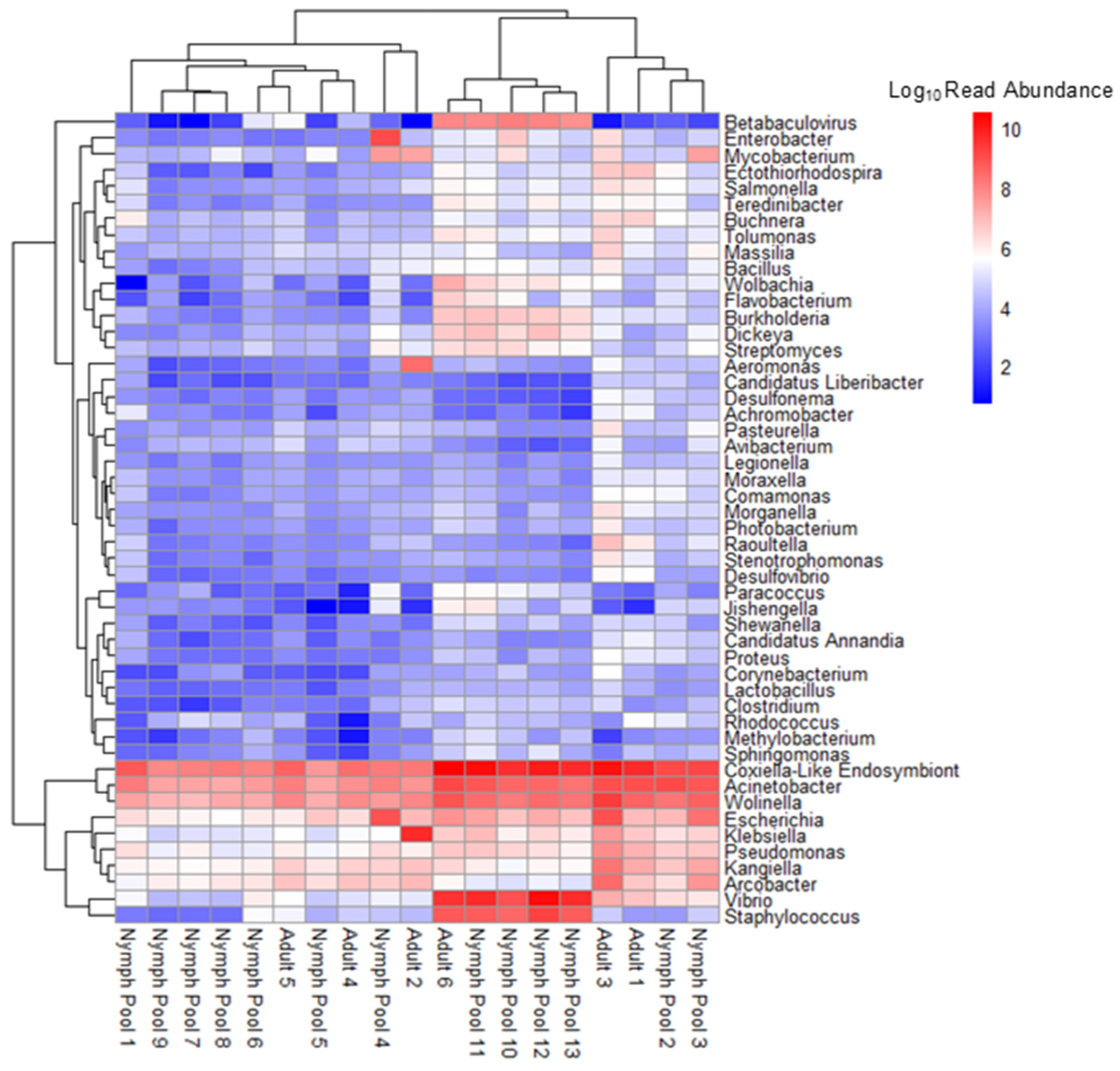
The most abundant bacterial family identified among all 44 partially engorged H. longicornis samples was Coxiellaceae (Figure 2). After extracting the individual reads classified as Coxiella sp. and assembling consensus sequences, it was determined that the reads corresponded to a Coxiella-like endosymbiont (Coxiella-LE) with a range of 2625–37,000 reads across samples (Table S2). Other abundant bacterial genera among all H. longicornis samples included Acinetobacter, Escherichia, Kangiella, and Wolinella, 285–11,602 reads per sample (Figure 2) (Table S2). Klebsiella, Salmonella, and Wolinella had relatively stable read abundances across multiple pools. Notably, adult H. longicornis samples had higher abundances of Acineobacter, Escherichia and Kangiella compared to H. longicornis nymphs. Shewanella and Aeromonas had relatively lower read abundances across all samples. No notable human or animal pathogen was detected from the 44 partially engorged H. longicornis samples with the metatranscriptomics sequencing analysis.

3.2. Targeted Pathogen Detection

Nucleic acid extracted from all 620 H. longicornis samples analyzed by A. marginale and T. orientalis duplex PCR tested negative for both targets. Of these, 554 were tested individually and the remaining 56 were tested using pooled or individual extracted nucleic acids (Tables S1 and S2). In addition, the 56 engorged H. longicornis ticks tested individually or in pools and analyzed by the xMAP® MultiFLEX® Mega Tick Panel tested negative for Babesia, Bartonella, Coxiella, Ehrlichia, and Rickettsia, as well as Powassan virus and Tick-borne Encephalitis Virus. A single tick from Bucks County showed low reactivity for Anaplasma species with the xMAP MultiFLEX Mega Tick Panel, but the follow-up testing with screening for the pathogenic species A. marginale and phagocytophilum was negative (Table S1).

3.3. Cytochrome b Gene PCR for Host Blood Meal Source Detection

Of the 56 partially engorged H. longicornis ticks tested comprising 31 tested specimens, 21 produced cytochrome b PCR amplicons. Eleven amplicons with sufficient band intensity were selected for Sanger sequencing. Two sequences (513 bp and 467 bp) showed 98.44% and 99.36% pairwise identity, respectively, to Odocoileus virginianus (white-tailed deer) based on BLASTn analysis. The remaining sequences ranged from 358 to 599 bp and shared 98.26–98.78% identity with top BLASTn matches to O. virginianus or O. hemionus (mule deer). Given the absence of mule deer in Pennsylvania and the close similarity between cytochrome b sequences of these species, the most likely source is O. virginianus. No correlation was observed between scutal index and successful cytochrome b detection (Table S1).

4. Discussion

Our analysis of H. longicornis sheds light on the complex relationships between these ticks and their microbial communities. Ticks are known to host endosymbionts which play a crucial role in the reproductive success and overall fitness of ticks, providing essential nutrients that help them thrive [25,26]. The dominant presence of Coxiella-LE in all samples points to the significance of Coxiella-LE for H. longicornis. Coxiella-LE co-evolved with ticks and is vital to the development of H. longicornis. The abundance of Coxiella-LE in H. longicornis is known to vary by the life stage of the tick, with fed female ticks carrying the greatest density of Coxiella-LE [26]. Although this study included both nymphs and fed adults, it was not possible to detect these differences in density among the life stages due to the pooling strategy used for all nymphs, leading to a similar and very high abundance of Coxiella-LE among both nymph pools and individual partially engorged adult ticks. In addition, because sequencing libraries were not normalized to the same final concentration across runs, observed patterns of relative abundance should be interpreted cautiously and considered qualitative rather than quantitative.
In addition to Coxiella-LE, we identified several other notable bacterial genera which are known to be part of the core microbiome of H. longicornis, including Acinetobacter, Sphingomonas, Pseudomonas and Staphylococcus [13]. A previous study documented Acinetobacter in H. longicornis collected from both tigers and deer and concluded the relative abundance of this bacterial species will vary based upon the host of the tick [27]. This concept was unable to be verified in this study, as the H. longicornis in this study was determined to have been hosted by the same species. The abundance of Staphylococcus spp. in this study was very diverse and did not appear to be linked to the life cycle of the tick, as opposed to a previous study which found Staphylococcus spp. to be much more abundant in adults than in nymphs [13]. The presence of Staphylococcus is particularly interesting as certain species of Staphylococcus are detrimental to ticks. Further analysis to investigate the species of Staphylococcus carried by H. longicornis could be interesting as these species can vary according to the host of the tick.
Other abundant genera detected in this subset of H. longicornis included Escherichia, Klebsiella, and Wolinella. Wolinella is known to be a symbiont for bovines, specifically in the digestive tract. The high abundance of this genus in all of the H. longicornis samples leads to the question of whether these bacteria are a symbiont of the tick or are acquired by the ticks from the host. Previous investigations of the microbiome of H. longicornis have not identified Wolinella, which makes it less likely that this is a symbiont of H. longicornis. Further studies to compare the microbiome in engorged versus non-engorged ticks would aid in determining the significance of this bacteria. The presence of Acinetobacter and Klebsiella sequences raises important questions about their detection and significance in these ticks [11,13,28].
Less abundant, but still detected genera included Aeromonas, Salmonella and Clostridium. Aeromonas has been identified in H. longicornis in other studies as well and is of potential significance as this genus is known to cause disease in humans [13]. Further investigation into the significance of the relationships between the individual species of Salmonella and Clostridium identified from this study of H. longicornis are warranted.
Our study did not find any significant human or animal pathogens in the partially engorged H. longicornis samples subjected to metatranscriptomics. These findings are consistent with absence of tick-borne bacterial and viral pathogens in 183 H. longicornis ticks collected from a New York City borough and analyzed by metagenomics [28]. However, previous research in Pennsylvania has documented the association of pathogens such as A. phagocytophilum (in 4 ticks out of 265 ticks analyzed) and Borrelia burgdorferi (in 1 adult female tick out of 263 ticks analyzed) with H. longicornis [3,17]. H. longicornis has been documented to be an incompetent vector for A. phagocytophilum, the main cause of human granulocytic anaplasmosis, but there have been reports of A. bovis in H. longicornis [13]. In light of the single Anaplasma species detection in our study, further tick collections and study to investigate the associations of H. longicornis with Anaplasma species is warranted.
The absence of T. orientalis Ikeda in our samples is also notable, but perhaps not surprising, even though there have been reports of this pathogen in cattle in Pennsylvania [29]. H. longicornis is relatively new to this region, and T. orientalis Ikeda is also a newly emerging pathogen, not only in Pennsylvania, but in the eastern United States. The first confirmed case of T. orientalis Ikeda in the east coast of the United States was in Virginia in 2017, and by January 2024, T. orientalis Ikeda infections had been documented in Pennsylvania [29,30]. The collection dates and locations of the ticks in this survey might have played a role in the absence of T. orientalis. All ticks used in this study were collected in 2022 and early 2023. At that point in time, the presence of documented findings of T. orientalis Ikeda in this region is unclear. The ticks collected for this survey were also predominantly from the southeastern region of Pennsylvania, while our recent study and findings of T. orientalis Ikeda are showing presence in the southcentral and southwestern regions of Pennsylvania. Further research into H. longicornis ticks in Pennsylvania, with an emphasis on the areas with documented cases of T. orientalis Ikeda in cattle is warranted to examine whether more current populations of these ticks in Pennsylvania are hosting T. orientalis Ikeda.
The cytochrome b sequencing of partially engorged H. longicornis returned identical top BLAST hits to both white-tailed deer (O. virginianus) and mule deer (O. hemionus). Because mule deer do not occur in Pennsylvania, these results indicate that the ticks had fed on white-tailed deer, but the cytochrome b region targeted does not provide enough resolution to fully distinguish between closely related Odocoileus species. This finding aligns with previous reports that H. longicornis commonly feeds on deer, raccoons, and opossums, targeting medium- to large-sized hosts at all life stages [3,16] (https://scwds.shinyapps.io/haemaphysalis, accessed on 15 October 2024). The cytochrome b gene assay did not produce an amplicon from some of the samples, which reflects challenges associated with this assay as reported by other studies as well. Previous studies have documented difficulty in amplifying host DNA when the ticks are not fully engorged, as the amount of host DNA in a partially engorged tick is insufficient for reliable detection [17]. As compared to other species of ticks, H. longicornis is more likely to have a partial feeding and continue to quest after the initial blood meal, which means that H. longicornis may have multiple hosts in a single life stage [18]. The lower levels of engorgement as also measured by scutal indices and consequently yielding lower amount of host DNA, potentially under the limit of detection by PCR, as seen with our testing makes determining the host of partially engorged H. longicornis specimens more difficult. Improved and more sensitive methods for blood meal analysis is essential, as knowing host preferences can help to predict pathogen transmission patterns [31].
In conclusion, our study highlights the diverse microbial communities of H. longicornis and their relationship to developmental stages of the tick and absence of notable tick-borne pathogens. As this tick species continues to spread and establish a dominant prevalence throughout the United States, including in Pennsylvania, understanding H. longicornis and its interactions with current and emerging tick-borne pathogens will be important to manage the potential risk of disease from this vector. Continued research into the variations in bacterial diversity and abundance throughout the life cycle of the tick, and the effect of host and collection location on the composition of the microbiome of H. longicornis would be of interest and pertinent to aid in the development of effective strategies to manage tick-borne diseases.

Supplementary Materials

The following supporting information can be downloaded at: https://www.mdpi.com/article/10.3390/parasitologia5040064/s1, Table S1: Tick collection data. Table S2: Read counts per genera detected.

Author Contributions

Conceptualization, D.T. and N.T.; methodology, D.T., N.T., J.L. and C.L. validation, N.T., J.L. and C.L.; formal analysis, J.L., C.L. and K.Y.; investigation, D.T., N.T., J.L., C.L. and K.J.P.; resources, K.J.P.; data curation, N.T., J.L., C.L. and K.Y.; writing—original draft preparation, N.T., J.L., D.T., K.J.P. and C.L.; writing—review and editing, J.L., N.T., D.T., K.J.P., K.Y. and C.L.; visualization, J.L., N.T. and D.T.; supervision, D.T., N.T. and J.L.; project administration, D.T. and N.T.; funding acquisition, N.T. and D.T. All authors have read and agreed to the published version of the manuscript.

Funding

This research was funded by PA Department of Health subgrant #4100097044.

Institutional Review Board Statement

Not applicable.

Informed Consent Statement

Not applicable.

Data Availability Statement

The original contributions presented in this study are included in the article/Supplementary Materials. Further inquiries can be directed to the corresponding author.

Conflicts of Interest

The authors declare no conflicts of interest.

References

  1. Egizi, A.; Bulaga-Seraphin, L.; Alt, E.; Bajwa, W.; Bernick, J.; Bickerton, M.; Campbell, S.; Connally, N.; Doi, K.; Falco, R.; et al. First Glimpse into the Origin and Spread of the Asian Longhorned Tick, Haemaphysalis longicornis, in the United States. Zoonoses Public Health 2020, 67, 637–650. [Google Scholar] [CrossRef]
  2. Rainey, T.; Occi, J.L.; Robbins, R.G.; Egizi, A. Discovery of Haemaphysalis longicornis (Ixodida: Ixodidae) Parasitizing a Sheep in New Jersey, United States. J. Med. Entomol. 2018, 55, 757–759. [Google Scholar] [CrossRef]
  3. USDA-APHIS. Monitoring Haemaphysalis longicornis, the Asian Longhorned Tick, Populations in the United States. Available online: https://www.aphis.usda.gov/sites/default/files/monitoring-h-longicornis-plan-final-january-2024.pdf (accessed on 15 October 2024).
  4. U.S. Department of Agriculture (USDA). Asian Longhorned Ticks (Haemaphysalis longicornis). Available online: https://www.aphis.usda.gov/livestock-poultry-disease/cattle/ticks/asian-longhorned#:~:text=Asian%20longhorned%20ticks%20(Haemaphysalis%20longicornis,impact%20both%20animals%20and%20people (accessed on 15 October 2024).
  5. Price, K.J.; Witmier, B.J.; Egizi, A.; Kane, A.J.; Tantum, C.; Jordan, R.A.; Glorioso, A.G.; Hutchinson, M.L. Distribution and density of Haemaphysalis longicornis (Acari: Ixodidae) on public lands in Pennsylvania, United States. J. Med. Entomol. 2021, 58, 1433–1439. [Google Scholar] [CrossRef]
  6. Dinkel, D.; Herndon, R.; Noh, S.; Lahmers, K.; Todd, S.; Ueti, M.; Scoles, G.; Mason, K.; Fry, L. A U.S. Isolate of Theileria orientalis, Ikeda Genotype, Is Transmitted to Cattle by the Invasive Asian Longhorned Tick, Haemaphysalis longicornis. Parasit. Vectors 2021, 14, 157. [Google Scholar] [CrossRef]
  7. Raney, W.; Perry, J.; Hermance, M. Transovarial Transmission of Heartland Virus by Invasive Asian Longhorned Ticks under Laboratory Conditions. Emerg. Infect. Dis. 2022, 28, 726–729. [Google Scholar] [CrossRef]
  8. Stanley, H.; Ford, S.; Snellgrove, A.; Hartzer, K.; Smith, E.; Krapiunaya, I.; Levin, M. The Ability of the Invasive Asian Longhorned Tick Haemaphysalis longicornis (Acari: Ixodidae) to Acquire and Transmit Rickettsia rickettsii (Rickettsiales: Rickettsiaceae), the Agent of Rocky Mountain Spotted Fever, under Laboratory Conditions. J. Med. Entomol. 2020, 57, 1635–1639. [Google Scholar] [CrossRef]
  9. Price, K.; Aryes, B.; Maes, S.; Witmier, B.; Chapman, H.; Coder, B.; Boyer, C.; Eisen, R.; Nicholson, W. First Detection of Human Pathogenic Variant of Anaplasma phagocytophilum in Field-Collected Haemaphysalis longicornis, Pennsylvania, USA. Zoonoses Public Health 2022, 69, 143–149. [Google Scholar] [CrossRef]
  10. Thompson, A.; White, S.; Shaw, D.; Egizi, A.; Lahmers, K.; Ruder, M.; Yabsley, M. Theileria orientalis Ikeda in Host-Seeking Haemaphysalis longicornis in Virginia, USA. Ticks Tick Borne Dis. 2020, 11, 101450. [Google Scholar] [CrossRef]
  11. Bonnet, S.I.; Binetruy, F.; Hernández-Jarguín, A.M.; Duron, O. The Tick Microbiome: Why Non-Pathogenic Microorganisms Matter in Tick Biology and Pathogen Transmission. Front. Cell. Infect. Microbiol. 2017, 7, 236. [Google Scholar] [CrossRef]
  12. Bouquet, J.; Melgar, M.; Swei, A.; Delwart, E.; Lane, R.S.; Chiu, C.Y. Metagenomic-Based Surveillance of Pacific Coast Tick Dermacentor occidentalis Identifies Two Novel Bunyaviruses and an Emerging Human Rickettsial Pathogen. Sci. Rep. 2017, 7, 12234. [Google Scholar] [CrossRef]
  13. Ponnusamy, L.; Travanty, N.V.; Watson, D.W.; Seagle, S.W.; Boyce, R.M.; Reiskind, M.H. Microbiome of Invasive Tick Species Haemaphysalis longicornis in North Carolina, USA. Insects 2024, 15, 153. [Google Scholar] [CrossRef]
  14. Tokarz, R.; Lipkin, W.I. Discovery and Surveillance of Tick-Borne Pathogens. J. Med. Entomol. 2021, 58, 1525–1535. [Google Scholar] [CrossRef]
  15. Thompson, A.T.; White, S.A.; Shaw, D.; Garrett, K.B.; Wyckoff, S.T.; Doub, E.E.; Ruder, M.G.; Yabsley, M.J. A Multi-Seasonal Study Investigating the Phenology, Host and Habitat Associations, and Pathogens of Haemaphysalis longicornis in Virginia, USA. Ticks Tick Borne Dis. 2021, 12, 101773. [Google Scholar] [CrossRef]
  16. Tufts, D.M.; Goodman, L.B.; Benedict, M.C.; Davis, A.D.; VanAcker, M.C.; Diuk-Wasser, M. Association of the Invasive Haemaphysalis longicornis Tick with Vertebrate Hosts, Other Native Tick Vectors, and Tick-Borne Pathogens in New York City, USA. Int. J. Parasitol. 2021, 51, 149–157. [Google Scholar] [CrossRef]
  17. Price, K.J.; Khalil, N.; Witmier, B.J.; Coder, B.L.; Boyer, C.N.; Foster, E.; Eisen, R.J.; Molaei, G. Evidence of Protozoan and Bacterial Infection, Co-Infection, and Partial Blood Feeding in the Invasive Tick Haemaphysalis longicornis in Pennsylvania. J. Parasitol. 2023, 109, 265–273. [Google Scholar] [CrossRef]
  18. Price, K.J.; Witmier, B.J.; Eckert, R.A.; Boyer, C.N. Recovery of Partially Engorged Haemaphysalis longicornis (Acari: Ixodidae) Ticks from Active Surveillance. J. Med. Entomol. 2022, 59, 1842–1846. [Google Scholar] [CrossRef]
  19. Yeh, M.T.; Bak, J.M.; Hu, R.; Nicholson, M.C.; Kelly, C.; Mather, T.N. Determining the duration of Ixodes scapularis (Acari: Ixodidae) attachment to tick-bite victims. J. Med. Entomol. 1995, 32, 853–858. [Google Scholar] [CrossRef]
  20. Claro, I.M.; Ramundo, M.S.; Coletti, T.M.; da Silva, C.A.M.; Valenca, I.N.; Candido, D.S.; Sales, F.C.S.; Manuli, E.R.; de Jesus, J.G.; de Paula, A.; et al. Rapid Viral Metagenomics Using SMART-9N Amplification and Nanopore Sequencing. Wellcome Open Res. 2023, 6, 241. [Google Scholar] [CrossRef]
  21. Breitwieser, F.P.; Salzberg, S.L. Pavian: Interactive Analysis of Metagenomics Data for Microbiome Studies and Pathogen Identification. Bioinformatics 2020, 36, 1303–1304. [Google Scholar] [CrossRef]
  22. Livengood, J.; Hutchinson, M.L.; Thirumalapura, N.; Tewari, D. Detection of Babesia, Borrelia, Anaplasma, and Rickettsia spp. in Adult Black-Legged Ticks (Ixodes scapularis) from Pennsylvania, United States, with a Luminex Multiplex Bead Assay. Vector Borne Zoonotic Dis. 2020, 20, 406–411. [Google Scholar] [CrossRef]
  23. Oakes, V.J.; Todd, S.M.; Carbonello, A.A.; Michalak, P.; Lahmers, K.K. Coinfection of Cattle in Virginia with Theileria orientalis Ikeda Genotype and Anaplasma marginale. J. Vet. Diagn. Investig. 2022, 34, 36–41. [Google Scholar] [CrossRef]
  24. Che Lah, E.F.; Yaakop, S.; Ahamad, M.; Md Nor, S. Molecular Identification of Blood Meal Sources of Ticks (Acari, Ixodidae) Using Cytochrome b Gene as a Genetic Marker. Zookeys 2015, 478, 27–43. [Google Scholar] [CrossRef][Green Version]
  25. Brenner, A.E.; Muñoz-Leal, S.; Sachan, M.; Labruna, M.B.; Raghavan, R. Coxiella burnetii and Related Tick Endosymbionts Evolved from Pathogenic Ancestors. Genome Biol. Evol. 2021, 13, evab108. [Google Scholar] [CrossRef]
  26. Zhang, X.Y.; Li, S.S.; Chen, K.L.; Yang, C.; Zhou, X.J.; Liu, J.Z.; Zhang, Y.K. Growth Dynamics and Tissue Localization of a Coxiella-like Endosymbiont in the Tick Haemaphysalis longicornis. Ticks Tick Borne Dis. 2022, 13, 102005. [Google Scholar] [CrossRef]
  27. Liu, Z.L.; Qiu, Q.G.; Cheng, T.Y.; Liu, G.H.; Liu, L.; Duan, D.Y. Composition of the Midgut Microbiota Structure of Haemaphysalis longicornis Tick Parasitizing Tiger and Deer. Animals 2024, 14, 1557. [Google Scholar] [CrossRef]
  28. Tufts, D.M.; Sameroff, S.; Tagliafierro, T.; Jain, K.; Oleynik, A.; VanAcker, M.C.; Diuk-Wasser, M.A.; Lipkin, W.I.; Tokarz, R. A Metagenomic Examination of the Pathobiome of the Invasive Tick Species, Haemaphysalis longicornis, Collected from a New York City Borough, USA. Ticks Tick Borne Dis. 2020, 11, 101516. [Google Scholar] [CrossRef]
  29. USDA-APHIS. Bovine Theileriosis. Available online: https://www.aphis.usda.gov/sites/default/files/bovine-theileriosis-infosheet.pdf (accessed on 15 October 2024).
  30. USDA-APHIS. Emerging Risk Notice: Theileria orientalis Ikeda. Available online: https://www.aphis.usda.gov/sites/default/files/theileria-orientalis-ikeda-notice.pdf (accessed on 22 January 2024).
  31. Tufts, D.M.; Goethert, H.K.; Diuk-Wasser, M.A. Host-pathogen associations inferred from bloodmeal analyses of Ixodes scapularis ticks in a low biodiversity setting. Appl. Environ. Microbiol. 2024, 90, e00667-24. [Google Scholar] [CrossRef]
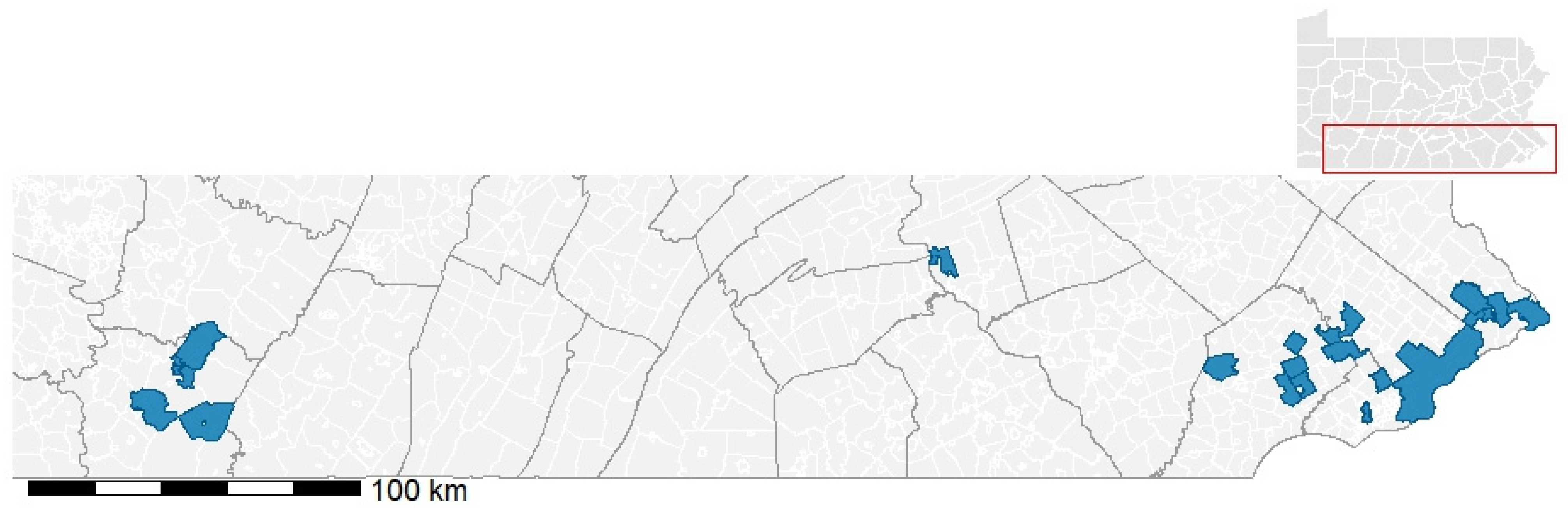
Figure 1. Map of southern Pennsylvania showing municipalities (shaded in blue) where Haemaphysalis longicornis ticks were collected for this study. The inset map displays the state of Pennsylvania with a red bounding box indicating the zoomed-in area. Municipality and boundary data were obtained from the U.S. Census Bureau TIGER/Line shapefiles (2022).
Parasitologia 05 00064 g001
Figure 2. Heatmap showing the log10-transformed read abundance of the top 50 genera detected in metatranscriptomic sequencing of Haemophysalis longicornis samples used in this study. Rows represent genera, and columns represent tick samples (nymph pools and adult individuals). The color scale ranges from blue (low read abundance) to red (high read abundance), highlighting variations in bacterial presence across samples.
Parasitologia 05 00064 g002
Disclaimer/Publisher’s Note: The statements, opinions and data contained in all publications are solely those of the individual author(s) and contributor(s) and not of MDPI and/or the editor(s). MDPI and/or the editor(s) disclaim responsibility for any injury to people or property resulting from any ideas, methods, instructions or products referred to in the content.