1. Introduction
Otorrhagia represents a relatively rare finding in forensic medicine [
1]. In forensic practice, it is classically associated primarily with skull base fractures, temporal bone trauma, and, in certain contexts, with barotraumatic phenomena, such as those observed in diving accidents [
1,
2]. However, in recent years, the literature has drawn attention to the fact that ear bleeding may also be observed, albeit exceptionally, in asphyxial deaths resulting from neck compression, particularly in cases of strangulation and hanging [
3,
4,
5,
6,
7].
In this context, ear involvement does not appear to be limited solely to frank otorrhagia but encompasses a spectrum of findings that also includes hemotympanum and petechiae of the tympanic membrane [
4,
5,
6,
7,
8]. This very variety of manifestations suggests that these signs may represent different expressions of a single pathophysiological mechanism or other concurrent mechanisms, usually linked to the impedance of cervico-cephalic venous outflow and the resulting pressure increase transmitted to the middle ear during respiratory efforts amidst upper airway obstruction [
3,
5,
6]. Specifically, it has been hypothesized that compression of the neck’s vascular structures leads to congestion within the head and neck region, thereby affecting the venous circulation of the middle ear as well. Furthermore, what should also be taken into account, is the potential barotraumatic effect resulting from violent inspiratory efforts against a closed glottis, leading to increased pressure within the Eustachian tube and middle ear [
3,
4,
6].
Although the number of published cases remains relatively small, more reports have recently appeared, helping to challenge the notion that ear bleeding in deaths involving neck compression is a challenging finding [
3,
4,
5,
6,
7]. In this light, Duband et al. [
3] emphasized that otorrhagia and hemotympanum in cases of strangulation warrant particular interpretive attention. Subsequently, Rasmussen et al. [
4] described petechiae of the tympanic membrane in a case of attempted suicide by hanging, suggesting that this auricular finding may fit within the broader spectrum of hemorrhagic signs resulting from stasis and increased pressure. More recently, other case reports and small series have documented the presence of otorrhagia in cases of hanging as well, reinforcing the hypothesis that this constitutes a potentially significant intravital finding, albeit not a pathognomonic one [
5,
6,
7,
8].
Of particular interest are the contributions highlighting the potential role of otoscopy in the post-mortem examination of deaths involving suspected neck compression. Indeed, several authors have observed that otoscopic exploration can reveal alterations not immediately apparent through external inspection alone, such as tympanic petechiae, hemotympanum, superficial vascular lesions, or perforations of the tympanic membrane [
4,
7,
8,
9]. From this perspective, otoscopy may serve as a useful adjunct to the external and internal examination of the body in selected cases, contributing to the documentation of subtle auricular findings and to the differential diagnosis of other causes of auricular bleeding [
2,
8,
9].
However, it must be emphasized that the forensic interpretation of such findings requires caution. Although the most recent literature tends to regard otorrhagia and other auricular signs as elements supporting a diagnosis of neck compression occurring during life, they must always be evaluated within the broader context of all other autopsy, histological, and circumstantial data [
5,
6,
7]. Furthermore, the differential diagnosis remains broad, encompassing not only craniocerebral trauma and barotrauma but also pathological or post-mortem conditions that, under specific circumstances, may mimic similar clinical presentations [
1,
2,
10].
In light of these considerations, the description of new cases of hanging presenting with otorrhagia retains undoubted scientific and practical interest. On one hand, such observations contribute to elucidating the possible pathogenetic mechanisms underlying this finding, on the other, they suggest that examination of the ear, particularly otoscopy, may be considered as an adjunctive assessment in selected cases of suspected neck compression, especially when external auricular bleeding or other ear findings are present [
7,
8,
9]. The distinctive feature of the present case is the association of bilateral otorrhagia, bilateral tympanic membrane laceration, and a gross unilateral petrous bone lesion in a hanging death without skull base fracture. This case report was prepared in accordance with CARE guidelines, and the completed CARE checklist is provided as
Supplementary Material File S1.
2. Case Presentation
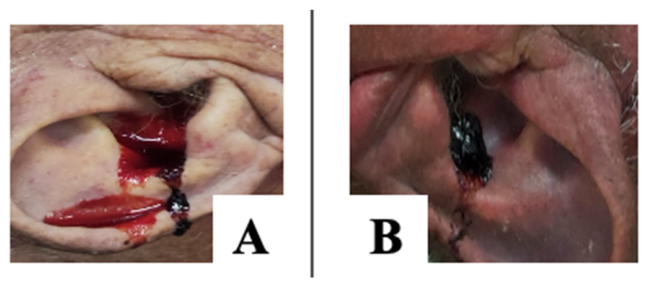
The case concerns a man who died by hanging. His body was found still suspended at the scene. The collection of anamnestic data revealed previous herpetic encephalitis with mild cognitive impairment and psychic disorders under treatment. At external examination, a discontinuous ligature mark was observed on the neck, with an oblique cranio-caudal course, measuring approximately 31 cm in length and 5 to 14 mm in width, with a smooth surface and slight dehydration of the skin. The knot imprint was localized at the medial third of the right mandibular ramus, close to the chin. Hemorrhagic discoloration of the furrow, conjunctival petechiae, and bilateral otorrhagia were also present (
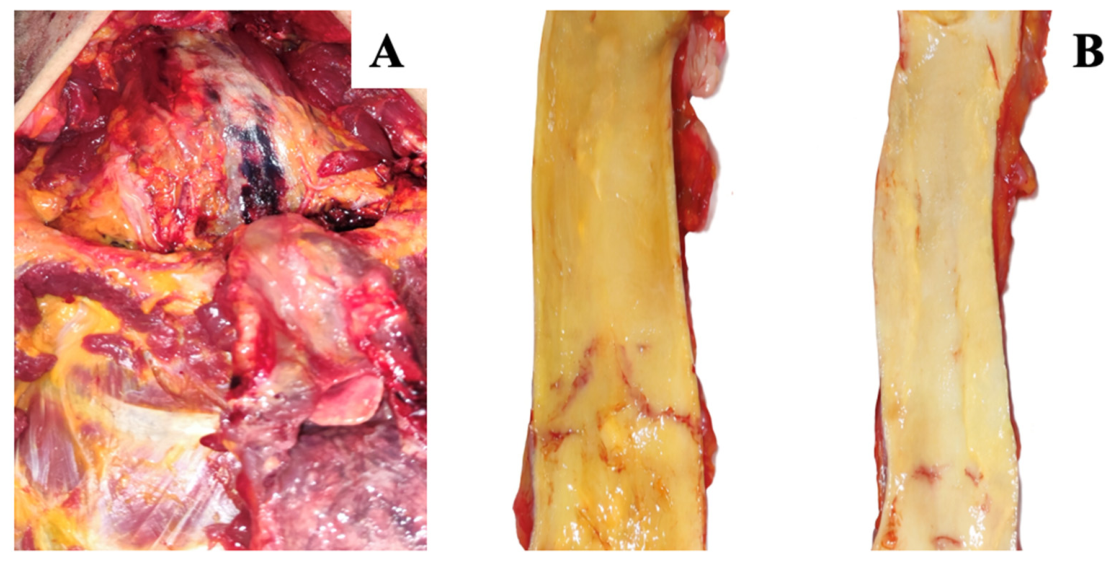
Figure 1). Ecchymotic-excoriated lesions were also present at the root of the nose and on the eyebrow arches. In light of the scene findings, including a broken ligature still attached to a nearby branch, these lesions were considered compatible with a preceding failed hanging episode, likely occurring shortly before the fatal event, because of the fall and the facial impact with the ground. The first attempt then proved unsuccessful. At autopsy, the organs and tissues of the neck showed: small hemorrhagic areas in both peri-thyroid muscles bilaterally and prevertebral soft tissue (Brouardel’s sign) and transverse intimal lesions of both carotid arteries (Amussat’s sign) (
Figure 2).
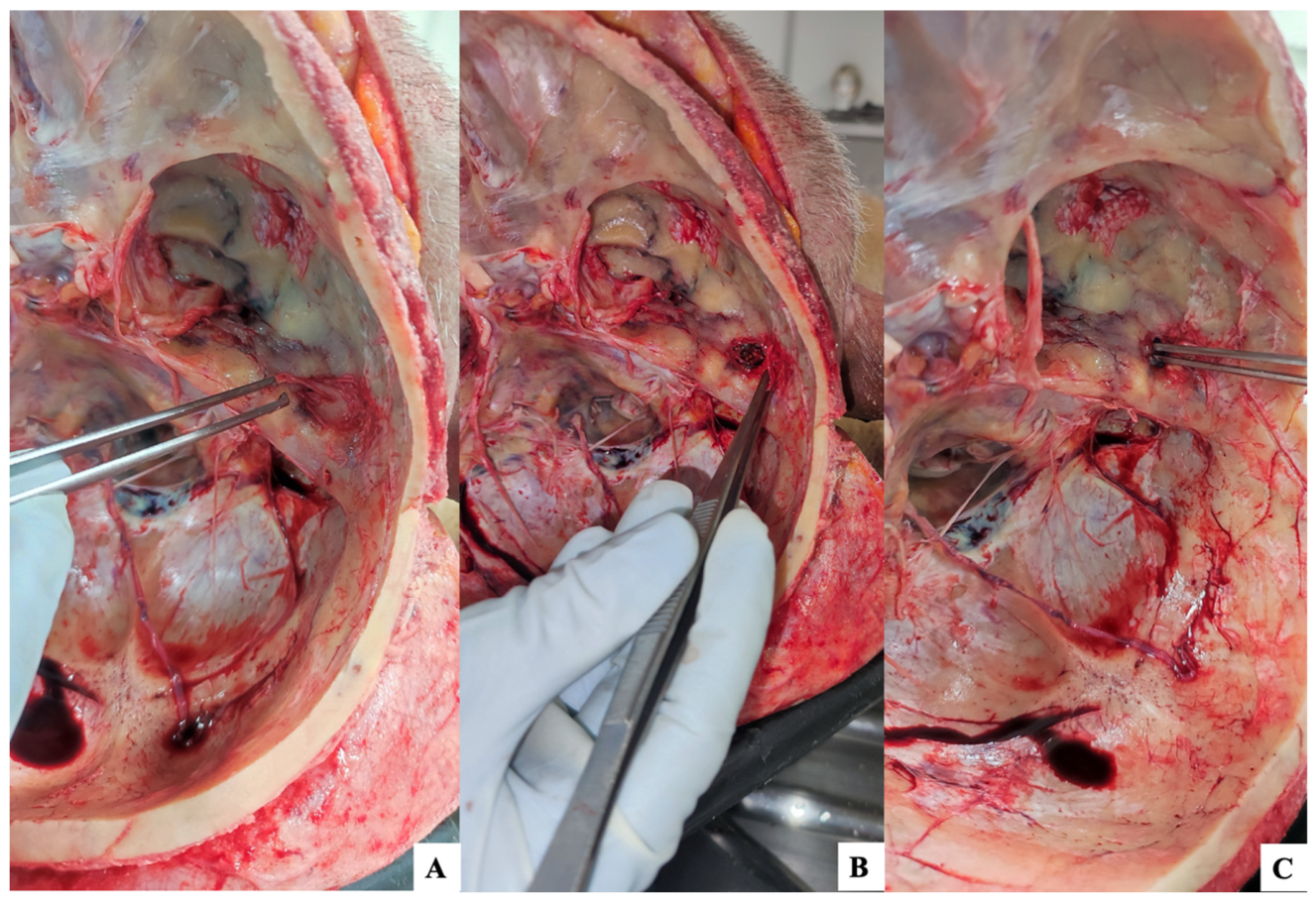
No fractures of the vault and the base of the skull were observed at gross examination, but PMCT was not performed. A unilateral area of bone erosion was detected in the petrous part of the right temporal bone (
Figure 3). The lesion was sampled for histological examination. Otoscopic examination revealed tympanic laceration on both sides. After auricular washing, otoscopic examination was performed: to obtain the best view of each ear canal and tympanic membrane, the head was tilted slightly towards the opposite shoulder to facilitate access of the speculum, subsequently a traction was applied on the auricle upwards and backwards to straighten the ear canal. The otoscopy revealed both on the right the subtotal tympanic perforation with integrity of the annulus, and on the left the partial tympanic perforation.
The main histological findings at routine hematoxylin-eosin staining were organs congestion, large respiratory areas due to rupture of interalveolar septa, cerebral edema and myocardial myofibers break up. Histological examination of the sampled petrous bone fragment showed trabecular remodeling and areas of necrosis. No histological examination of tympanic membrane was performed. Toxicological analyses were not performed. The cause of death was traced back to mechanical asphyxia due to hanging.
3. Discussion
The presented case supports that otorrhagia, although a rare finding in deaths by hanging, warrants particular attention within the scope of the medico-legal assessment of asphyxial deaths resulting from neck compression. In our case, the presence of bilateral otorrhagia associated with bilateral tympanic laceration, in the absence of fractures to the cranial vault or base, points toward a mechanism directly linked to the asphyxial dynamics rather than to major head trauma, which remains the classically most frequent cause of ear bleeding [
1,
2]. From this perspective, the auricular finding should not be regarded as a merely incidental detail, but rather as a potential element to be integrated into the broader anatomo-pathological picture of hanging.
From a pathophysiological standpoint, available literature data converge on the hypothesis that otorrhagia in cases of neck compression stems from the interplay of at least two mechanisms. The first involves obstruction of cervico-cephalic venous outflow, resulting in congestion of the venous networks of the head and neck, including the middle ear circulation, the second is linked to the pressure surge generated by violent respiratory efforts against upper airway obstruction, with potential transmission of this pressure, via the Eustachian tube, to the tympanic cavity [
3,
4,
5,
6]. In this sense, petechiae of the tympanic membrane, hemotympanum, tympanic perforation, and otorrhagia may represent distinct manifestations of a single continuum of injury, the concrete expression of which depends on the intensity and duration of the asphyxia insult, local anatomical conditions, and possible individual tissue fragility [
4,
5,
6,
7,
8].
The autopsy findings in our case appear consistent with this interpretation. The presence of conjunctival petechiae, hemorrhagic ridges of the sulcus, cervical muscle hemorrhages, transverse intimal lesions of the carotid arteries compatible with Amussat’s sign, and general signs of visceral congestion is consistent with mechanical asphyxia due to hanging occurring during life. In this context, otorrhagia may be interpreted as a further peripheral manifestation of hemodynamic and respiratory compromise [
3,
5,
6,
11,
12]. Furthermore, the bilateral nature of the phenomenon points more strongly toward a systemic mechanism linked to cervical compression than toward an isolated local cause, especially considering that, in this case, one failed and one fatal hanging episode were documented, occurring within a short interval of one another. Indeed, in the literature concerning strangulation and hanging, ear bleeding has been described in both unilateral and bilateral forms, sometimes associated with tympanic perforation, lending support to a pathogenesis that is not exclusively traumatic, but rather hemodynamic-barotraumatic in nature [
3,
5,
6].
One aspect of our case that deserves consideration is the unilateral bone erosion within the right petrous temporal bone. Histological examination of the sampled bone fragment showed trabecular remodeling and areas of necrosis. These findings confirm a structural pathological alteration of the petrous bone, but they are nonspecific and do not allow the etiology of the lesion, including any relationship with the previous herpetic encephalitis, to be established. The lesion may therefore have represented a local predisposing condition, potentially increasing tissue fragility in the petrous-temporal region. However, since the lesion was unilateral whereas both otorrhagia and tympanic membrane lacerations were bilateral, it cannot fully explain the overall auricular findings by itself. Accordingly, this finding should be interpreted cautiously as a possible contributory factor rather than as a demonstrated cause of otorrhagia. Although inflammatory and infectious processes involving the temporal bone and petrous apex may be associated with bone erosion and local structural fragility, no definite etiological significance can be assigned to this lesion in the present case [
13,
14,
15,
16].
Indeed, in forensic medicine, blood originating from the ear is traditionally interpreted primarily as a possible indication of fractures of the skull base or temporal bone, or of significant craniocerebral trauma [
1,
2]. Beyond trauma, other potential causes of auricular bleeding or hemotympanum must also be considered, including barotraumatic phenomena, certain middle ear pathologies, and, in specific circumstances, post-mortem events or asphyxial mechanisms other than classic neck compression [
1,
2,
10]. Recent literature, in fact, counsels caution: auricular findings observed in cases of hanging possess undoubted indicative value, yet, when considered in isolation, they cannot currently be deemed pathognomonic, nor are they sufficient to serve as the sole basis for a definitive judgment regarding, for instance, vitality [
5,
6,
7,
8,
10,
17,
18].
In this context, one of the most intriguing aspects emerging from recent studies concerns the role of otoscopy. Several authors have emphasized that post-mortem otoscopic examination can reveal alterations not always discernible through external inspection alone, such as tympanic petechiae, hemotympanum, superficial vascular changes, or perforations of the tympanic membrane [
4,
6,
8,
9]. This specific point appears particularly significant, as it suggests that the true forensic value of ear examination lies not merely in identifying externally visible otorrhagia, but rather in analyzing the full spectrum of findings within the tympanic membrane and middle ear. Our case is consistent with this perspective, suggesting that otoscopy may be a useful adjunct in selected cases involving suspected hanging or strangulation, especially when auricular bleeding is present or when differential diagnosis is required [
6,
8,
9]. At the same time, this case demonstrates that a proper interpretation of otorrhagia requires a correct methodical approach: the exclusion of major alternative traumatic causes, a thorough examination of cervical and cranial structures, correlation with other signs of mechanical asphyxia, and, if deemed potentially useful in specific cases, the integration with an otoscopic examination [
1,
4,
8,
9]. From this perspective, otorrhagia should not be interpreted as an isolated sign, but rather as an accessory and potentially informative finding capable of enriching the medico-legal cause of death assessment and its dynamics.
In the present case, the main alternative causes of otorrhagia were considered in relation to the autopsy and circumstantial findings. Skull base fracture and major craniocerebral trauma were considered first, since these represent classical causes of ear bleeding in forensic practice. No fractures of the cranial vault or skull base were identified at gross autopsy examination. However, post-mortem computed tomography was not performed, and this represents a limitation, since very subtle fractures cannot be completely excluded. With regard to temporal bone trauma or local temporal bone disease, the right petrous temporal bone lesion showed smooth/blunted margins macroscopically, and histology revealed trabecular remodeling and areas of necrosis. These findings are more consistent with a chronic or pathological structural alteration than with an acute traumatic fracture, although its precise etiology could not be established. Moreover, because the petrous lesion was unilateral whereas both otorrhagia and tympanic membrane lacerations were bilateral, it cannot by itself explain the overall auricular findings. Barotrauma was also considered, but the circumstantial investigation did not reveal elements suggestive of diving, explosion, aviation-related pressure changes, or other relevant pressure-related events. Middle ear disease was considered as a further possible cause. However, no history of chronic otitis media, previous ear surgery, or recent ontological disease was available from the anamnestic data and medical records.




 ,
,