1. Introduction
Forensic odontology is a branch of dentistry that has a crucial role in the identification of deceased individuals [
1,
2]. Personal identification relies on multiple modalities, including fingerprints, DNA analysis, lip prints, bite marks, and facial reconstruction. Among these, dental structures are of particular importance due to their long-term preservation and resistance to environmental degradation [
2]. Teeth and orofacial structures help determine fundamental biological characteristics such as age, sex, stature, and ancestry, which are essential in investigations.
Dental morphology exhibits considerable biological variability, primarily influenced by genetic inheritance and evolutionary processes. These morphological traits are highly heritable, population-specific, and remain stable even after development, making them reliable markers for assessing population affinity as well as the identification of the deceased individual [
1,
2,
3].
From an anthropological perspective, the distribution of dental morphological traits is expressed through principles of population genetics and evolutionary biology, including natural selection, genetic drift, gene flow, and population isolation. These processes take place over long periods of time, thus creating variation in trait frequencies across populations. Additionally, genetic structures in these populations may indirectly influence dental morphology patterns at the population level without altering the trait’s expression at the individual level due to naturally occurring differences within populations (ecogeographic variation) and genetic adaptation to various environments (ecological adaptation) [
1,
3,
4,
5].
The Arizona State University Dental Anthropology System (ASUDAS) is a widely accepted and standardized method for recording nonmetric dental morphological traits across human populations. It includes a comprehensive set of crown, root, and skeletal characteristics that are scored using an ordinal system with reference plaques. This standardization ensures objectivity and reproducibility in trait assessment. ASUDAS traits are largely genetically determined and develop early in odontogenesis, with minimal environmental influence after formation. Owing to their stability, these traits are extensively used to study biological diversity, population relationships, and evolutionary patterns [
6,
7,
8,
9,
10].
Previous studies on Indian populations have demonstrated regional and population-specific variation in ASUDAS traits. For instance, studies have reported distinct dental trait patterns among tribal populations of Maharashtra and comparative data obtained from the National Capital Region, highlighting intranational variability in dental morphology [
4,
11]. These findings emphasized the importance of developing population-specific databases to improve the accuracy of forensic identification [
9,
12].
Research on dental anthropology reveals a variation in the global expression pattern of tooth and orofacial morphologies across both East and Southeast Asia, because of a long-term population history and migration patterns. Such findings highlight that dental morphological variation often corresponds to biogeographic regions, suggesting that geographic and ecological factors, acting through evolutionary mechanisms, may contribute to observed differences in trait distribution [
1,
5,
6,
13].
Climatic influences on human morphology have been widely documented, with ecogeographic principles such as Allen’s rule demonstrating that temperature can shape phenotypic traits through both long-term genetic adaptation and developmental plasticity, often manifesting from early life stages, whereas Carabelli’s cusp and reduced shoveling frequencies are more typical of European and many South Asian populations [
1,
2,
9,
14].
Despite the established utility of ASUDAS, there is a lack of comprehensive data representing the diversity of Indian populations. In a highly heterogeneous country such as India, marked by extensive migration and genetic diversity, dental morphological variation within regions is difficult to characterize.
Although ASUDAS traits are predominantly genetically determined, their distribution at the population level reflects underlying genetic structure shaped by ancestry, migration, and demographic history. Anthropological studies have demonstrated that while nonmetric dental traits are largely genetically controlled, their population-level variation reflects long-term evolutionary processes and biogeographic patterns [
5,
7,
15]. Variations in trait frequencies across geographic regions have been widely documented, suggesting that dental morphology can serve as an indirect marker of population history. Similar population-level variation in dental morphological traits has been widely documented in different ethnic groups, further supporting their utility in reflecting underlying population history and biological affinity [
5].
Environmental and climatic conditions do not directly affect the manifestation of nonmetric dental traits post-development, as these characteristics are mainly genetically established during odontogenesis. However, climate could potentially have an indirect effect on population-level variation during long periods of evolution. Climatic circumstances can influence patterns of human migration, population dispersion, and degrees of isolation, which, in turn, affect gene flow and genetic drift. Over generations, these processes may contribute to disparities in the frequency and distribution of dental features across populations. Therefore, the present study does not presume a direct causal relationship between climate and dental morphology but employs an exploratory strategy to evaluate variation in ASUDAS features among people with diverse early-life geographic backgrounds [
16].
1.1. Aim
To evaluate variation in dental morphological characteristics using the Arizona State University Dental Anthropology System (ASUDAS) among individuals with different early-life geographic backgrounds, and to assess their potential forensic applicability in population differentiation.
1.2. Objectives
- (i)
To assess the extent and nature of the manifestation of dental morphological characteristics on dental casts using the Arizona State University Dental Anthropology System (ASUDAS).
- (ii)
To compare the manifestation of selected dental characteristics among individuals with different early-life geographic backgrounds.
- (iii)
To evaluate the potential of dental morphological characteristics for population differentiation and forensic identification.
2. Materials and Methods
- (i)
Study Design and Reporting Framework:
The study was a cross-sectional observational study performed on dental casts retrieved from the department archives and adhered to the Strengthening the Reporting of Observational Studies in Epidemiology (STROBE) statement. The study was planned as a pilot investigation to explore variation in ASUDAS characteristics among individuals with differing early-life geographic backgrounds.
- (ii)
Ethical Considerations:
The study received ethical exemption from the Institutional Ethics Committee as it was performed on anonymized and existing dental casts without any human-identifiable data.
- (iii)
Study Population & Sample Size:
Considering the retrospective nature of the study, the sample size was finalized mainly on the availability of appropriate dental casts in the departmental archives. Only those casts that satisfied the inclusion criteria and showed complete dentition with minimal wear, distortion, or damage were selected. As this study included archival data, the sample size was therefore limited by the number of usable casts rather than by prospective recruitment. Accordingly, a total of 55 dental casts were included for analysis. The study sample consisted of 55 individuals, divided into two groups based on early-life geographic residence:
Maharashtra group (n = 37): individuals residing in Maharashtra from birth to age 10
Non-Maharashtra group (n = 18): individuals raised outside Maharashtra during childhood but residing in Maharashtra after the age of 18.
- (iv)
Age and Sex Distribution:
The age of individuals represented by the casts was 18–22 years, selected to ensure complete permanent dentition, excluding third molars, and to minimize the influence of causes like carious lesions or non-carious alterations on trait observation.
- (v)
Inclusion and exclusion criteria:
Inclusion criteria: Intact maxillary and mandibular casts without casting defects or distortion and presence of dental crown traits amenable to ASUDAS analysis.
Exclusion criteria: Casts with defects occurring during impression or casting procedures, such as air bubbles, fractures, distortions, or surface irregularities affecting crown anatomy, were excluded. Additionally, skeletal traits and root traits described in ASUDAS were not considered, as the dental casts consist only of crowns of maxillary and mandibular teeth.
- (vi)
Rationale for Cast-Based Study:
Dental casts were selected because they preserve most teeth, including anterior and posterior dentition, and provide a reliable record of crown morphology with minimal defects. They also enable comprehensive analysis of both maxillary and mandibular arches.
- (vii)
Trait Selection and Assessment:
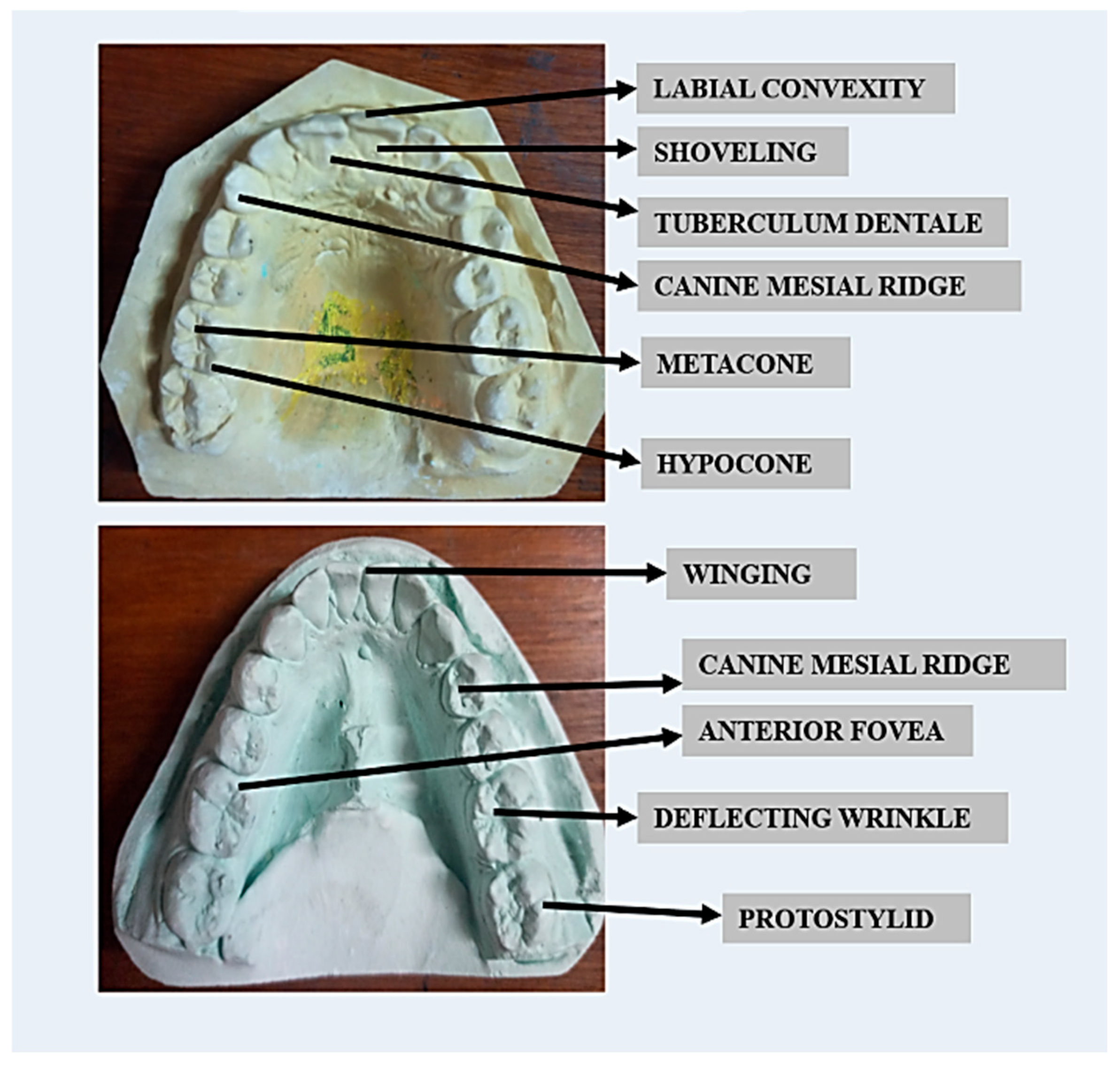
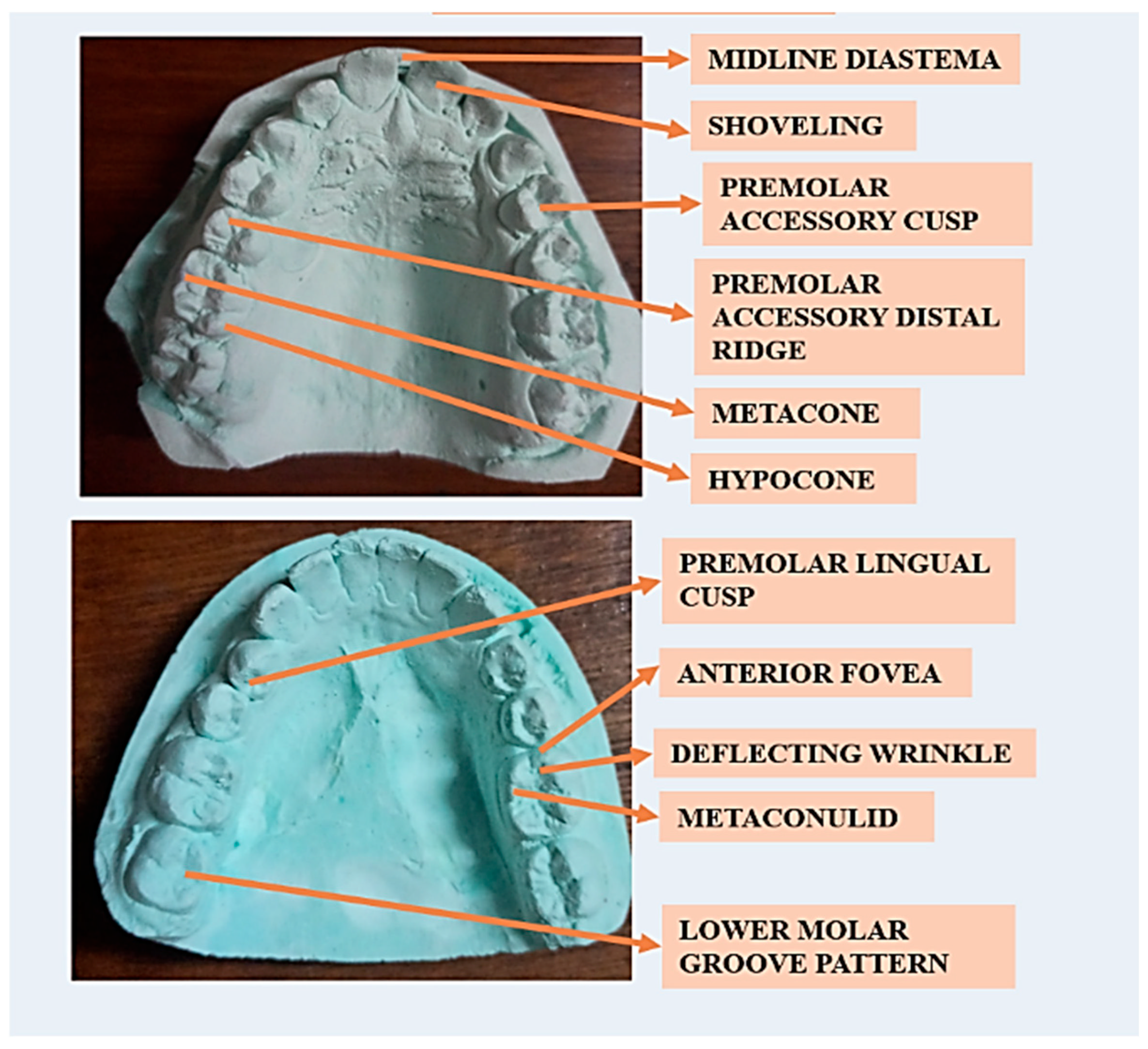
The traits representing the maximum expression were included in maxillary and mandibular arches from the Maharashtra and Non-Maharashtra populations, as illustrated in
Figure 1 and
Figure 2 and
Table 1. The identification and scoring were performed using Arizona State University Dental Anthropology System (ASUDAS) reference plaques and guidelines (Scott & Irish, 2017) [
6]. A total of 42 nonmetric dental traits described in the ASUDAS were considered; however, only crown traits that were clearly observable on dental casts were included for analysis. The traits assessed included features of the anterior and posterior dentition involving crown morphology, such as shovel-shaped incisors, tuberculum dentale, cusp number and pattern variations, and other nonmetric crown characteristics as defined in the ASUDAS (
Table 1).
- (viii)
Data Collection and Analysis:
All traits were scored by a single examiner trained in ASUDAS methodology. The examiner was blinded to the age, sex, and ancestry of the subjects during scoring to reduce observer bias. Calibration was performed using ASUDAS plaques before data collection. Intra-observer agreement was assessed after 2 weeks using Cohen’s kappa, with a value of ≥0.80 considered acceptable. A pre-validated ASUDAS data collection form, with all crown traits and their respective scoring ranges, was used. The scores were entered manually into a structured Excel sheet and later exported to IBM Statistical Package for Social Sciences (Statistics for Windows, Version 21.0. IBM, Armonk, NY, USA) for statistical analysis.
Data validation was performed by double-checking entries and identifying missing or inconsistent scores. Any discrepancies were resolved by re-evaluating the dental cast. The frequencies of traits were analyzed using the Chi-square test or Fisher’s exact test, depending on expected cell counts. For statistical analysis, the graded scores were recoded into “present” and “absent” categories based on standard ASUDAS criteria. A p-value of <0.05 was considered statistically significant. Given the limited sample size and the number of traits analyzed, the statistical analysis was considered exploratory in nature.
- (ix)
Data Sources and Measurement:
The nonmetric characteristics of the dental crowns were scored using the conventional ordinal scoring system of ASUDAS with the aid of reference plaques [
2,
6]. Grade 0 represented absence of the trait, while higher grades indicated increasing expression. Lower grades represented minimal expression, intermediate grades represented moderate development, and higher grades represented well-developed morphology.
Scoring was performed by visually comparing each dental cast with ASUDAS plaques, and the closest matching grade was selected. In cases where the expression appeared between two grades, the lower grade was recorded to prevent overestimation.
For statistical purposes, scores equal to or above the defined cut-off were categorized as “present”, and those below were categorized as “absent”, allowing for standardized comparison between groups.
3. Results
The comparison of morphological traits between Maharashtra and non-Maharashtra subjects showed statistically significant differences in a few maxillary and mandibular traits, while most traits did not show any significant difference.
Among the mandibular traits (
Table 2), the premolar accessory cusp/protoconule showed a highly significant difference (
p < 0.001), with Grade 0 being present in 72.2% of non-Maharashtra subjects compared to 2.7% in Maharashtra subjects. The anterior fovea also showed a significant difference (
p = 0.005), being more pronounced in the non-Maharashtra group, where Grade 0 was seen in 38.9% compared to 5.4% in the Maharashtra group. Another highly significant difference was observed in the deflecting wrinkle (
p < 0.001), which was absent in 72.2% of non-Maharashtra individuals compared to only 16.2% in Maharashtra, where higher grades (Grade 2 and Grade 3) were more frequently expressed.
The remaining mandibular features, including winging (p = 0.714), shoveling (p = 0.081), canine accessory distal ridge (p = 0.459), premolar lingual cusp (p = 0.094), lower molar groove pattern (p = 0.973), lower molar cusp number/hypoconulid (p = 0.2), protostylid (p = 0.065), and metaconulid (p = 0.161), did not show statistically significant variation between the two groups. Additionally, traits such as pegged lateral incisors, peg-shaped molars, odontome, torus mandibularis, and torsomolar angle were uniformly absent across all participants.
Among the maxillary traits (
Table 3), a significantly higher occurrence of shoveling was noted among non-Maharashtra individuals (
p = 0.004), where Grade 1 shoveling was observed in 61.1% of non-Maharashtra participants compared to 18.9% in Maharashtra participants. Interruption grooves were more frequent in the non-Maharashtra group (22.2%) than in the Maharashtra group (
p = 0.01). The canine accessory distal ridge showed significant variation (
p = 0.022), with Grade 1 expression seen exclusively among non-Maharashtra individuals (22.2%), while Maharashtra individuals predominantly exhibited Grade 0 (51.4%). A significant difference was also observed in the expression of the hypocone (
p = 0.029), where Grade 5 was seen more commonly in non-Maharashtra individuals (72.2%) compared to 40.5% in the Maharashtra group. Premolar accessory ridge expression was significantly higher among non-Maharashtra individuals (
p = 0.007), with Grade 2 expression in 66.7% compared to 21.6% among Maharashtra individuals. The tuberculum dentale showed a significant difference (
p = 0.021), being more frequent in non-Maharashtra individuals (44.4%) with Grade 0, compared to 5.4% in Maharashtra individuals. The largest difference was observed in double shoveling, which was found to be significantly higher in non-Maharashtrians (
p = 0.001), where Grade 1 was found in 50% and Grade 2 in 38.9%, whereas in the Maharashtra group, Grade 0 was found in 64.9%.
In contrast, other maxillary features such as winging (p = 0.669), canine mesial ridge (p = 0.172), upper premolar accessory cusp (p = 0.481), midline diastema (p = 0.982), distosagittal ridge (p = 0.481), metacone (p = 0.148), metaconule (p = 0.859), Carabelli’s trait (p = 0.691), labial convexity (p = 0.169), and parastyle (p = 0.481) did not show statistically significant differences between the two groups.
To summarize, there were marked regional differences in the presence of maxillary shoveling, interruption grooves, canine accessory distal ridge, hypocone, premolar accessory ridge, tuberculum dentale, double shoveling, and mandibular premolar accessory cusp/protoconule, anterior fovea, and deflecting wrinkle. These differences reflect the morphological differences among individuals of Maharashtra and non-Maharashtra origins. Despite statistically significant differences in certain traits, substantial overlap in trait expression between groups was observed, indicating that these traits cannot be used deterministically for group classification.
Statistical Analysis
Statistical analysis was conducted using SPSS 29.0. The frequency of traits was compared using Chi-square tests or Fisher’s Exact Test when expected cell values were less than 5. A p-value of less than 0.05 was considered statistically significant.
4. Discussion
This cross-sectional study assessed the expression of crown features of the Arizona State University Dental Anthropology System (ASUDAS) in two groups of young adults who differed according to their residence in Maharashtra or outside Maharashtra during their early life, through maxillary and mandibular dental casts. Individuals who had resided in a particular geographical region from birth up to 10 years of age were included in the respective groups, as this period aligns with the formative stages of permanent tooth crown development [
1,
2,
3,
5,
15]. Individuals in the non-Maharashtra group were those who had spent their childhood outside Maharashtra and migrated to Maharashtra only after the age of 18 years. The age of 18 years was considered the cut-off to ensure that the early developmental period, which is critical for the expression of dental morphological traits, was completed in a different geographical setting. This ensured that the influence of early environmental and population background was consistent within each group and minimized overlap between childhood and adult residence [
1,
2,
3,
7,
14]. The current study demonstrated variation in the frequency and expression of various ASUDAS traits between the two groups, without attributing a definitive underlying causal factor for such differences.
Due to the study’s retrospective design, particular geographic origin, ethnicity, and ancestry information for members of the non-Maharashtra group were not accessible. As a result, rather than representing distinct biological populations, the groups may contain people from a variety of genetic and ethnic backgrounds, reflecting underlying population variability. Although environmental and ecological factors have been examined concerning long-term population variation, their direct impact on the expression of dental morphological traits is relatively limited compared to genetic determinants [
15,
16]. Recent studies indicate that dental morphological variation predominantly represents neutral evolutionary processes, including genetic drift and population history, thereby enhancing their applicability in the examination of population structure and biological affinity. Distinct patterns in trait expression were observed between the Maharashtra-residing group (Group 1) and the non-Maharashtra-residing group (Group 2), suggesting that the observed differences may reflect variation in underlying population structure and demographic background.
- (i)
Population-based variation in ASUDAS traits
Dental morphological traits are highly heritable, selectively neutral, and relatively stable over evolutionary timescales, which makes them excellent proxies for reconstructing population history and affinity when skeletal DNA is absent or degraded [
1,
2,
3,
17]. The heritability and neutrality of many ASUDAS traits have been supported in large-scale global datasets and genetic correlation studies [
6,
7,
14]. Traits such as shoveling, Carabelli’s cusp, cusp number variation, and accessory ridges often show population-specific frequencies and can differentiate major geographic groups [
1,
2,
3]. Recent global analyses of ASUDAS traits have revealed considerable inter- and intra-population heterogeneity, underscoring the necessity of multi-trait methodologies in interpreting dental morphological variation among diverse populations [
13]. Genetic research has identified particular variants, including those in the EDAR gene, that exhibit a strong correlation with traits such as incisor shoveling, thereby supporting the genetic foundation and population-specific nature of dental morphological variation [
15]. In the present study, Group 1 (Maharashtra residents) demonstrated higher frequencies of shoveling, Carabelli’s cusp, accessory distal ridges, upper premolar accessory cusps and ridges, metacone, metaconule, and protoconule, along with features such as tuberculum dentale and midline diastema. In contrast, Group 2 (non-Maharashtra residents) showed a greater prevalence of interruption grooves, hypocone expression/reduction patterns, double shoveling, labial convexity, and distosagittal ridge in the maxillary dentition, as well as differences in lingual cusp number, lower molar cusp number, and groove pattern in the mandibular dentition.
These findings are consistent with the general principle that ASUDAS traits exhibit marked inter-population variation and can reflect underlying genetic heterogeneity. The traits are thus highly heritable, population-specific, and primarily reflect genetic structure [
1,
2,
3,
6,
7,
14].
- (ii)
Comparison with Indian ASUDAS-based studies
Within India, several ASUDAS-based studies have highlighted considerable intra-national variation in nonmetric crown traits [
4,
8,
18,
19]. Recent studies on South Indian populations have similarly shown that nonmetric dental traits show different frequencies in different populations. This further demonstrates the need for regionally stratified dental morphology databases for accurate anthropological and forensic interpretation [
9,
12]. Research conducted in the National Capital Region (NCR) indicates a moderate prevalence of incisor shoveling, low-to-moderate double shoveling, and variable expression of Carabelli’s cusp and premolar accessory traits [
4,
18]. These NCR datasets highlight that even within a relatively confined geographic region, trait frequencies may vary by sex, malocclusion type, and ethnic background [
4,
18]. Similarly, work on tribal and regional populations in Maharashtra using dental morphology has shown population-specific expressions of Carabelli’s cusp, accessory cusp patterns, and other nonmetric traits, reinforcing the need for localized dental morphology databases [
11,
19]. When compared with these reports, the higher expression of Carabelli’s cusp and complex cusp patterns in the Maharashtra-born group in the present study appears to be consistent with previously documented trends for Western Indian and Indo-Aryan populations, which often exhibit relatively robust molar morphology and frequent Carabelli’s expression [
1,
11,
19]. Meanwhile, the relatively greater expression of hypocone variation, double shoveling, and simplified cusp patterns in the non-Maharashtra group underscores that migrants into Maharashtra likely represent heterogeneous ancestries and regional backgrounds, in line with the demographic diversity of the Indian subcontinent [
4,
8,
18,
19].
Overall, the trait distributions reported in this study align with the broader Indian literature in suggesting that ASUDAS traits are sensitive to regional and ethnic composition and that no single “Indian” dental pattern can represent the entire country [
4,
8,
9,
12,
18,
19].
- (iii)
Global context and climatic considerations
Globally, shoveling of upper incisors, double shoveling, and certain accessory cusp configurations are classically associated with East Asian and Native American populations. The intermediate to moderate expression of shoveling and the appreciable expression of Carabelli’s cusp observed in Group 1 fit within the expected range for South Asian dentitions, which are often described as morphologically intermediate between Western Eurasian and Eastern Eurasian extremes [
1,
2,
6,
7,
9,
19]. Evidence suggests that dental morphological traits such as shoveling are mostly determined by genes and not by the environment. This is because certain gene variants influence the trait expression. Studies conducted in different regions of India have found similar results, with traits such as shoveling being very common in maxillary incisors, thereby demonstrating population-specific variations within a particular region [
20]. It is important to note that no direct climatic variables such as temperature, humidity, or rainfall were measured in the present study, and no formal climate classification was applied. Thus, the observed differences cannot be attributed to climate in the absence of genetic or ancestry-related data.
Ecological and climatic influences on dental traits have also been reported. Bernal et al. demonstrated that ecological factors, including climate, can significantly influence dental size and, to a lesser extent, shape among South American populations, with environmental variables explaining a substantial proportion of morphological diversification [
16]. In addition, developmental studies suggest that environmental and epigenetic factors—including nutrition, prenatal conditions, and early-life exposures—can modulate the expression of dental traits, even when underlying genetic control is strong [
15,
16]. Supporting this, evidence from dental research indicates that environmental exposures, particularly during early developmental periods, can play a dominant role in shaping oral characteristics, emphasizing the importance of early-life context in dental variation [
15,
16]. While dental morphology is fundamentally under genetic control, such findings suggest that long-term residence in distinct climatic and dietary environments may modulate trait distributions at the population level [
16]. In the present study, Maharashtra represents a climatic mosaic with a coastal region, semiarid plateau, and hot-dry inland zones. The comparatively robust and complex crown morphology seen in the Maharashtra-born group may, at least in part, reflect long-term adaptation to local ecological and dietary regimes, whereas the trait profile of the non-Maharashtra group likely reflects mixed ancestry and differing climatic histories. However, given the cross-sectional design and small sample, these climatic interpretations must be considered with caution and treated as hypothesis-generating rather than definitive. Additionally, population structure could not be controlled because the study population lacked genetic, ancestry, or ethnic background data. Because of this, any environmental or climatic interpretation is still theoretical and cannot be separated from underlying genetic influences.
- (iv)
Genetic structure, migration, and trait combinations
A study performed by Rathmann and Reyes-Centeno demonstrated that particular combinations of dental traits can maintain neutral genetic signals and can be utilized to estimate the underlying genomic structure in various human populations [
7]. Their study supports the view that carefully selected ASUDAS trait combinations are informative for reconstructing neutral genetic variation when genetic data are limited or unavailable [
7,
14]. Dental morphological traits, owing to their high heritability and resistance to post-developmental remodeling, have also been widely used to trace population admixture and microevolutionary changes across generations [
1,
2,
3,
5]. The clear differentiation in trait combinations between Group 1 and Group 2 in the present study—particularly involving shoveling, Carabelli’s cusp, hypocone expression, groove patterns, and accessory ridges—suggests that even at a small scale, ASUDAS traits may be useful in distinguishing regional or demographic backgrounds within India. Future work incorporating genomic markers alongside ASUDAS scoring would be valuable to confirm how closely these trait combinations track neutral genetic variation in South Asian populations.
- (v)
Forensic and anthropological implications
From a forensic standpoint, nonmetric dental traits are advantageous because they are preserved even when soft tissues and much of the skeleton are destroyed [
1,
2,
3,
21]. The resilience of dental tissues to postmortem degradation further reinforces their value in forensic identification, particularly in cases where other biological structures are compromised [
1,
2,
3,
21]. Recent advancements such as rASUDAS2 demonstrate that combinations of dental morphological traits can reliably estimate biogeographic ancestry, achieving substantial classification accuracy across global populations [
10,
14]. ASUDAS-based approaches in ancestry estimation software such as rASUDAS have shown that dental characteristics can play an important role in the assessment of population affinity in both forensic and archaeological studies [
3,
10,
21,
22]. In the Indian context, where large-scale region-specific dental morphology databases are still not available, the current study provides preliminary evidence that there is a difference in the distribution of trait frequencies between those who have lived in Maharashtra in early life and those who have migrated from other states. These findings support the notion that, with larger and more systematically sampled datasets, ASUDAS traits could enhance biogeographic profiling and narrow the search field in unidentified human remains cases.
From an anthropological perspective, the variation that has been observed also has implications for the migration and admixture of populations in India. The migration of people into Maharashtra from other regions, including distant areas, particularly into the urban areas, may have contributed to the morphological variation that has been observed in Group 2. In addition to the existing literature on the dental morphology of various tribes and regions of India [
8,
9,
11,
12,
19], this information will eventually be used to inform models of population history and migration in the subcontinent.
- (vi)
Strengths of the study
The present study explores an area that has received limited attention in forensic odontology, particularly with respect to intranational variation in dental morphological traits. The use of the Arizona State University Dental Anthropology System (ASUDAS) adds methodological strength by providing a well-established and standardized approach for recording nonmetric dental characteristics. As a pilot study, it offers preliminary insights into regional variations in dental morphology and highlights the need for larger, population-based studies in the future.
- (vii)
Methodological considerations, limitations, and future directions
Methodologically, the use of dental casts rather than skeletal material allowed for a detailed scoring of crown characteristics with less ethical concern and good preservation of anterior and posterior dentition. The use of standardized ASUDAS plaques and an individual scoring approach (scoring the side with the maximum expression of the trait) improves comparison with international data and minimizes the chance of underestimating trait expression [
1,
2,
6,
10,
19,
21]. However, some limitations need to be considered. The sample size was small (n = 55, limiting statistical power and precluding robust analysis of sexual dimorphism or finer regional stratification within the non-Maharashtra group. The grouping based on geographic residence is a pragmatic classification and does not reflect true biological populations, as ancestry, ethnicity, and genetic background were not controlled.
Additionally, information on the exact regional origin, ethnicity, and dietary habits of Group 2 individuals was not stratified, which may mask more subtle substructures.
The cross-sectional nature of the work and reliance on a single generation also restrict the ability to draw strong inferences regarding intergenerational changes in trait expression in response to demographic or climatic shifts. While exploratory statistical approaches (e.g., logistic regression) can suggest that certain trait combinations may have predictive value for demographic background, larger, multicentric studies with well-defined population strata are required to validate predictive models and to integrate ASUDAS traits with genetic and environmental data [
7,
14,
16,
22]. Although dental morphological traits are useful indicators of population affinity, they should not be used in isolation, and their interpretation must be complemented with other biological and contextual data to improve accuracy [
23]. Additionally, the grouping of individuals was based solely on early-life geographic residence and was not derived from a formal climate classification system. It is important to note that the grouping does not represent well-defined climatic zones; therefore, comparisons are based on geographic background rather than specific environmental parameters.
Future studies in India may focus on the following: (i) larger samples from different states and language groups, (ii) standardized ASUDAS scoring, and (iii) integration with genomic data to assess the neutral versus adaptive part of the variation in traits. These studies will help to create a national database of dental morphology and will improve the accuracy of forensic identification, as well as our understanding of human biological diversity and adaptation in the Indian subcontinent. This research provides initial intranational variation data for the ASUDAS trait in Western India, a region where comprehensive dental morphology databases are scarce.




 ,
,