Article

Re-Evaluation of Compsemys and North American Compsemydids (Testudinata)

by
Steven E. Jasinski
1,2,*,
Asher J. Lichtig
1,
Sebastian G. Dalman
3 and
Spencer G. Lucas
1
1
New Mexico Museum of Natural History and Science, 1801 Mountain Road N. W., Albuquerque, NM 87104, USA
2
Department of Environmental Science and Sustainability, Harrisburg University, 326 Market Street, Harrisburg, PA 17101, USA
3
Department of Earth Sciences, Montana State University, P.O. Box 173580, Bozeman, MT 59717, USA
*
Author to whom correspondence should be addressed.
Taxonomy 2026, 6(3), 48; https://doi.org/10.3390/taxonomy6030048

Submission received: 27 June 2026 / Revised: 4 August 2026 / Accepted: 11 August 2026 / Published: 13 August 2026
(This article belongs to the Section Taxonomy of Past Diversity)

Abstract

Compsemys is an enigmatic turtle first described over 160 years ago. Its taxonomic position has been uncertain, as many of the species placed in the genus have since been removed from it. For the last 30+ years, Compsemys victa has been the only recognized North American fossil species. New fossil specimens collected from the Paleocene in the United States necessitate a re-evaluation of the taxonomy of these turtles and call into question the long-held belief that only one species of Compsemys is valid in North America. Specimens from the Paleocene are far more complete than the holotype of C. victa, and all have been referred to this species based on a similar surface texture. Differences between material from the Cretaceous and Paleocene suggest multiple species of Compsemys are valid. In addition to the genotypic species Compsemys victa, C. puercensis, and C. torrejonensis are both valid species from the Paleocene. Beyond surface sculpturing and texture, features of the carapace and plastron can be used to help differentiate the three species. North American Compsemys survived the Cretaceous–Paleogene mass extinction. Rather than being a monospecific genus, Compsemys diversified in the Paleocene. Not only does this suggest an increase in the diversity of North American compsemydids, but it also leads to the possibility of asymmetric or budding cladogenesis among Compsemys species during the Late Cretaceous and Paleocene, at least in the American Southwest.

1. Introduction

Compsemys (sensu stricto) represents a group of fossil turtles known from North America. Records of the genus are known from Cretaceous and Paleocene strata in several western US states, north into Canada and south into Mexico, e.g., [1,2,3,4,5]. However, Compsemys has a complicated taxonomic history. Compsemys victa was first described by Leidy [6] based on fragmentary material from the Late Cretaceous in North Dakota. Compsemys plicatulus was later named by Cope [7] from the Late Jurassic Morrison Formation in Colorado and subsequently placed in the genus Glyptops by Hay [8] as G. plicatulus. This convention has been followed in some other studies, e.g., [1,4]. More recently, Joyce and Anquetin [5] synonymized G. plicatulus with G. ornatus. Other species of Compsemys were named from Paleocene strata in New Mexico. These include C. parva and C. vafer by Hay [9], and C. puercensis and C. torrejonensis by Gilmore [10]. The type specimens of C. puercensis and C. vafer originate from the older, Puercan NALMA (North American Land Mammal Age) interval of the Nacimiento Formation, and that of C. torrejonensis originates from the younger, Torrejonian NALMA interval of the Nacimiento Formation in the San Juan Basin of northwestern New Mexico. The stratigraphic position of the type specimen of C. parva has been uncertain, but it is now considered to be within the Puercan–?Torrejonian NALMAs by Jasinski et al. [11]
The first major review of Compsemys by Gaffney [1] resulted in C. victa being considered the only valid species, which has been followed by most studies since, e.g., [4,5,12,13]. Additionally, some European species have been referred to the genus, including Berruchelus russelli, e.g., [5,14,15].
New material recently collected from the Late Cretaceous and Paleocene in New Mexico has called for a re-evaluation of Compsemys. This re-evaluation allows for a better understanding of the taxonomy of Compsemys, providing evidence of multiple species around the Cretaceous–Paleogene boundary. The current study also allows for a better understanding of these turtles and provides valuable new data for understanding the evolution and morphological variation within this extinct group.

2. Geological Setting

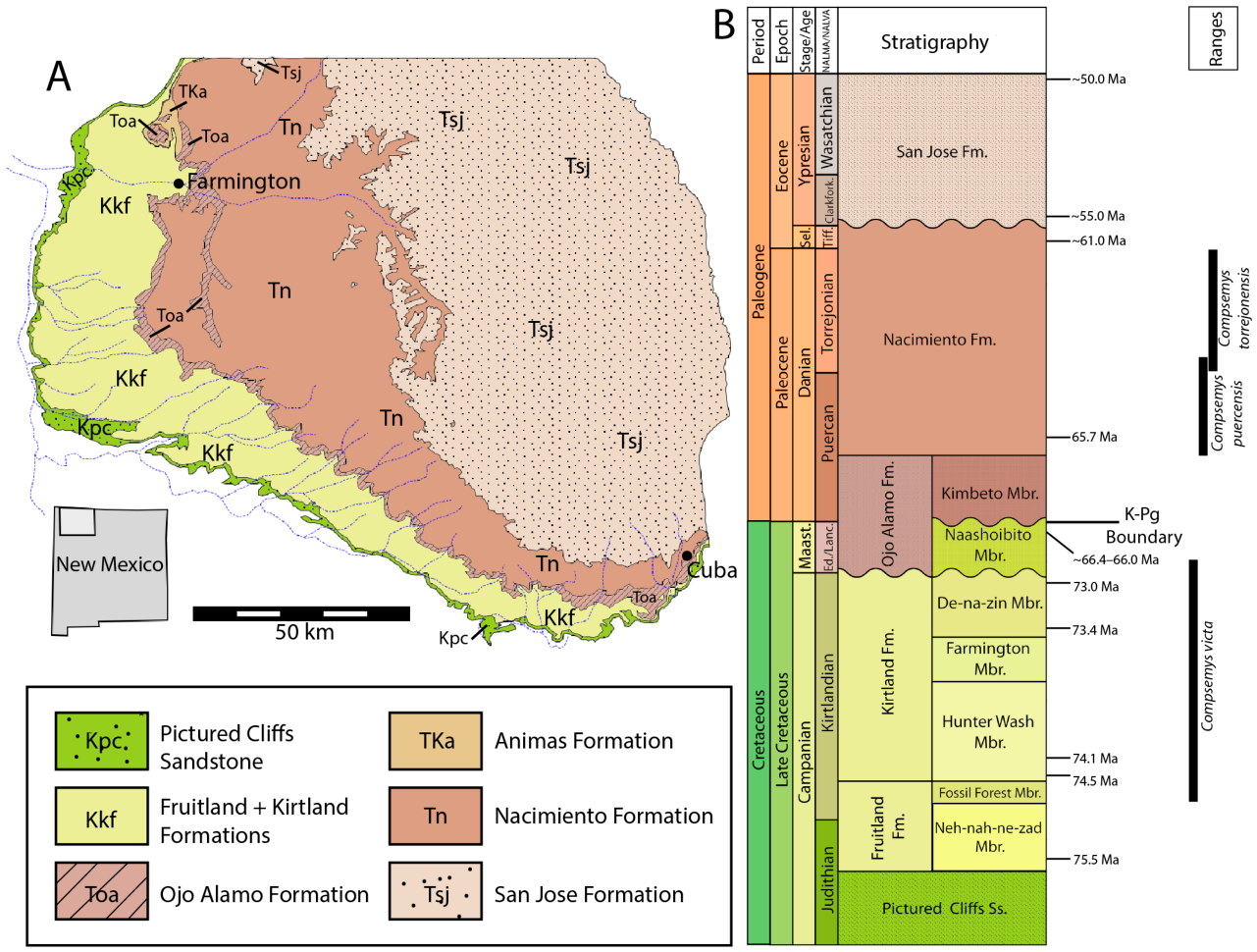
Compsemys victa was first named from material collected from the Maastrichtian Hell Creek Formation in central North Dakota [1,4,6,8]. The new material discussed herein comes from the San Juan Basin, New Mexico, where the specimens of the named North American Paleocene species were also collected (Figure 1). Paleocene species from the San Juan Basin of New Mexico include C. puercensis [10] and C. vafer [9] from the Puercan NALMA (North American Land Mammal Age) interval of the Nacimiento Formation, C. parva from the Puercan–?Torrejonian NALMA interval of the Nacimiento Formation, and C. torrejonensis from the Torrejonian NALMA interval of the Nacimiento Formation.
We consider Berruchelus to be valid (see Discussion below), so only North American records of Compsemys are considered for the stratigraphic distribution of these turtles. In addition to other species, numerous specimens have been referred to Compsemys, and more specifically to C. victa, over the years, mainly based on what was determined to be a unique surface sculpturing of the shell that was also found on isolated cranial material, see [4,12]. However, a specimen (UCMP 131103) consisting of shell material associated with skull material is known and was briefly mentioned and described by both Hutchison and Holroyd [12] and Lyson and Joyce [4]. The referral to the North American taxon C. victa was based on the presumed monospecific status of the genus at the time of those studies. Since Compsemys is no longer considered monospecific in this study, this material (UCMP 131103) may be referable to another species, diagnostic only to the genus level, or undiagnostic.
Brinkman [16] referred material from the Santonian in Alberta to ?Compsemys, but this material is considered here to be too incomplete to confidently refer to the genus. Similarly, Eaton et al. [17] listed the presence of Compsemys within the late Turonian Smoky Hollow Member of the Straight Cliffs Formation in south-central Utah based on shell surface texture, but this material is also considered too incomplete to confidently refer to Compsemys. Other material previously referred to Compsemys, see ref. [5], includes that from the Campanian in Coahuila (Mexico) [3,18], Texas [19], Utah [4,20], and New Mexico [4,13,21,22,23,24]; the Maastrichtian in Alberta (Canada) [4,16], Montana [1,8,25,26,27], North Dakota [4,6,28], Wyoming [8,28,29,30,31], and New Mexico [22,32,33]; the Puercan NALMA interval of the early Paleocene in Montana [4,26,27], Wyoming [4,34], Colorado [12], and New Mexico [9,10,11]; the Torrejonian NALMA interval of the early Paleocene in Montana [4,35] and New Mexico [10,11]; the Puercan–?Torrejonian NALMA interval of the early Paleocene in New Mexico [9,11]; the Tiffanian NALMA interval of the middle–late Paleocene in Texas [19]; and potentially the Tiffanian–Clarkforkian of the latest Paleocene–earliest Eocene in Colorado [36,37]. Most of these records are based on highly fragmentary material that is identified based exclusively, or almost exclusively, on its surface sculpturing. While this surface sculpturing or texture may be diagnostic to the generic level (see discussion below), these records must be re-evaluated and may not yet be diagnostic to any one species, particularly in the case of highly fragmentary material.
It is noted that, when discussing NALMA/NALVA, the majority of the ages belong to the North American Land Mammal Ages; however, the Kirtlandian was defined by Sullivan and Lucas [38,39] as a North American Land Vertebrate Age based on non-mammalian taxa. Additionally, the age of the Naashoibito Member of the Ojo Alamo Formation has been debated as to whether it is from the Edmontonian or the Lancian, e.g., [33,40]. In this paper, we consider it the Maastrichtian Age, within the Lancian NALMA.
Figure 1. (A) Geologic map showing Late Cretaceous through Eocene strata of the San Juan Basin, where the type specimens of Compsemys puercensis and C. torrejonensis were collected. (B) Stratigraphic chart showing important strata of the San Juan Basin related to Compsemys specimens. Ranges of Compsemys spp. shown to the right. The figure pools information from multiple sources, including Lucas and Williamson [41], Williamson and Lucas [42], the Geologic Map of New Mexico [43], Sullivan and Lucas [38,39], Williamson and Weil [44], Williamson et al. [45], Fassett [46], Lucas et al. [47,48], Jasinski and Sullivan [49,50,51], Jasinski et al. [11,33,52,53], Lyson and Joyce [4], Koenig et al. [54], Sullivan and Jasinski [55], Williamson and Brusatte [56,57], Jasinski [58], Ksepka et al. [59], Lichtig et al. [60,61], and Flynn et al. [40]. Abbreviations: Clarkfork, Clarkforkian; Ed, Edmontonian; Lanc, Lancian; Ma, megaannum or million years ago; Maast, Maastrichtian; NALMA, North American Land Mammal Age; NALVA, North American Land Vertebrate Age; Sel, Selandian; Tiff, Tiffanian.
Taxonomy 06 00048 g001

3. Materials and Methods

Fossils presented here are primarily from Cretaceous to Paleocene deposits in the San Juan Basin of New Mexico (Figure 1). Spanning from the Cretaceous to the Paleocene, the focal strata of the present study cross the Cretaceous/Paleogene boundary. Within the current study, we follow the morphological terminology of Gaffney [1], Ernst and Barbour [62], Jasinski [63,64,65], Jasinski et al. [66,67], and Joyce et al. [15].
For the taxonomic relationships of Compsemydidae, we follow the works of Pérez-García [68] and Tong et al. [69] in recognizing that Berruchelus is distinct from Compsemys (see discussion below). We also follow Pérez-García [70] and Pérez-García et al. [71] for the inclusion of only Compsemys and Berruchelus in Compsemydidae (see those works for arguments against the inclusion of other taxa within the family).
For those species within Compsemys, we follow a more restricted inclusion, where the only valid species are C. victa, C. puercensis, and C. torrejonensis. Compsemys parva [9] and C. vafer [9] are based on fragmentary shell material and are considered undiagnostic below the genus level and, therefore, nomina dubia. Other species are either considered nomina dubia or species within other genera (see discussion below).

4. Systematic Paleontology

Testudinata Batsch, 1788 [72].
Paracryptodira Gaffney, 1975 [73].
COMPSEMYDIDAE Pérez-García, Royo-Torres and Cobos, 2015 [74], (Joyce et al., 2021 [75]).
Included genus. Compsemys Leidy, 1856 [6].
Included species. Compsemys victa Leidy, 1856 [6] (type species of Compsemys); Compsemys puercensis Gilmore, 1919 [10]; Compsemys torrejonensis Gilmore, 1919 [10]; and Berruchelus russelli Pérez-García, 2012 [70].
Distribution. Campanian (Late Cretaceous) to Thanetian (late Paleocene) in North America and Thanetian (late Paleocene) in France [1,4,5,6,11,13,15,33,70,74].
Emended diagnosis. Adapted from Pérez-García et al. [74] and Joyce and Anquetin [5]. Note that the diagnosis is adapted from the diagnosis of Compsemys by Joyce and Anquetin [5], since their designation of Compsemys is equivalent to Compsemydidae listed here. The Compsemydidae are members of Paracryptodira through these symplesiomorphies: a midline contact of the nasals with modest lower and upper temporal emarginations (cranial characters from specimens referable to Compsemys, no cranial characters are known in Berruchelus russelli), the lack of a midline contact of the prefrontals, and large mesoplastra with a midline contact. The apomorphies include a dense surface texture, consisting of small, close-set keratin-covered tubercles and surrounding pits, that cover the skull and shell (carapace and plastron); a foramen posterius canalis carotici interni located halfway along the contact between the pterygoid and basisphenoid; and thickenings of the plastron medial to the bridges [most easily seen dorsally (internally)]. Compsemydidae can be differentiated from all other paracryptodires by possessing distinctly thickened skull bones; reduced temporal emarginations; expanded, rectangular quadratojugals; a postorbital contribution to the small, fully enclosed cavum tympani; a median, hooklike tomial process; an expanded secondary palate with a broad contribution from the vomer and palatines; a midline contact of peripheral I anterior to the nuchal combined with a loss of contact between costal I and peripheral I (also present in Selenemys lusitanica); large mesoplastra with an offset midline contact; a deeply sinuous midline plastral sulcus; and a deep anal (= xiphiplastral) notch. Compsemydids (Compsemys spp. and Berruchelus russelli) share the following features: oval and elongate shell with parallel to subparallel sides; a midline contact of peripheral 1 anterior to the nuchal combined with a loss of contact between costal I and peripheral I (also present in Selenemys lusitanica); nuchal fully covered by first vertebral scute; first vertebral trapezoidal, and wider anteriorly than posteriorly; pleurals considerably overlapping onto peripherals; last pair of marginals covering posterior half of the pygal; relatively small extragulars, much smaller than larger gulars; gulars entering the anterior portion of the entoplastron; large mesoplastra with an offset midline contact; a deeply sinuous midline sulcus on the plastron; and a deep and conspicuous anal (=xiphiplastral) notch.
COMPSEMYS Leidy 1856 [6]
Type species. Compsemys victa Leidy, 1856 [6]
Other species. Compsemys puercensis, Compsemys torrejonensis.
Distribution. Late Cretaceous in Montana, North Dakota, and Wyoming, and Late Cretaceous to Paleocene in New Mexico. Additionally, based on fragmentary material identified mainly from surface sculpturing or texture to Compsemys victa, the genus is purportedly also present in the Late Cretaceous in Texas, Utah, Coahuila (Mexico), Montana, North Dakota, Wyoming, and Alberta (Canada); the early Paleocene (Puercan NALMA) in Montana, Wyoming, and Colorado; the early Paleocene (Torrejonian NALMA) in Montana; the middle to late Paleocene (Tiffanian) in Texas; and the middle to late Paleocene (Tiffanian–Clarkforkian NALMAs) in Colorado. As the surface sculpturing may not be diagnostic by itself, many of these records must be re-evaluated.
Emended diagnosis. Paracryptodiran turtles with granular tubercles (finely beaded and ridged) making up the surface sculpturing of the carapace, plastron, and dorsal skull roof; unusually large mesoplastra with a broad, but offset, midline contact; first peripherals meet medially anterior to nuchal, preventing nuchal from reaching the anterior margin of the carapace; flat anterior edge of the carapace (namely peripherals I and II), with potentially inconspicuous anteromedial projection between marginal I; square vertebrals II and III; broad posterior neurals; distinctly broad (wider than long) entoplastron; anteromedial projections of the pectorals, causing the humerals to be sub-triangular and thinner near their mid-length; a sinuous midline sulcus of the plastron; and a deep xiphiplastral notch (=anal notch) that varies from U-shaped to V-shaped. In addition to these shell characters, Lyson and Joyce [4] included several skull and cranial characters from a specimen (UCM 49223) they referred to Compsemys victa, herein referred to Compsemys sp., including no cheek emargination; rectangular quadratojugal; quadratojugal extends ventrally to a level even with mandibular condyles of quadrate, covering up these condyles; postorbital contributes to rim of cavum tympani; and a cavum tympani diameter less than the diameter of the orbit.
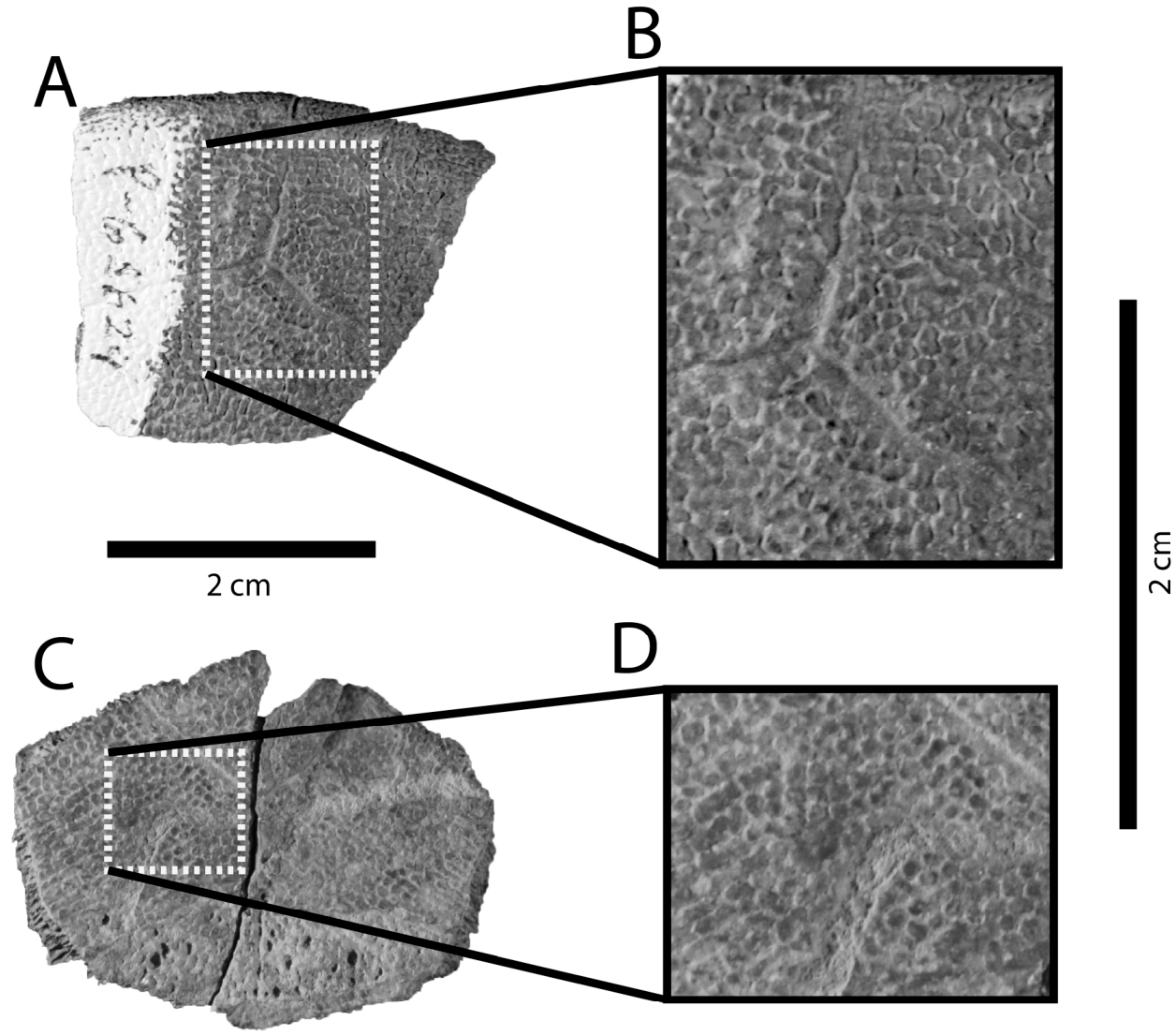
Notes. Compsemys victus (=Compsemys victa) was named by Leidy [6] from fragmentary shell material (USNM 960). Leidy [6]: (p. 312) named the species based on a type of surface sculpturing of the shell (i.e., carapace and plastron) he had not seen before, namely the “free surface of all the bones is thickly studded with granular tubercles, which give to it a shagreened appearance” (see also Figure 2C and Figure 3). While the surface sculpture (i.e., surface texture or ornamentation) alone has been used for diagnosis before, the observance of multiple species with such surface sculpture makes this surface texturing diagnostic only to the genus level. This generic diagnosis applies to the valid species C. victa, C. puercensis, and C. torrejonensis. It includes information from other specimens potentially only referable to the genus Compsemys (e.g., UCM 49223 and UCMP 131103), which were previously referred to Compsemys victa (see discussion below).
Description. Species-level diagnoses of Compsemys are based solely on carapace and plastron material, so current cranial and non-shell post-cranial material cannot yet be referred below the genus level. Despite C. victa being the only species known from the Cretaceous, we take a conservative approach in identifying isolated cranial material until a more complete shell and skull are found together and described. Presently, referral of cranial material is based on the same criteria used by Hutchison and Holroyd [12] and Lyson and Joyce [4], namely that surface sculpturing agrees among the shells and the surface of the skull. This surface sculpturing (Figure 3) consists of “small, close-set, enameled tubercles which produce the appearance of shagreen”, see ref. [8]: (p. 233). Characteristics of Compsemys indeterminate species cranial material are discussed by Lyson and Joyce [4] and includes: no cheek emargination; rectangular quadratojugal; quadratojugal extends ventrally to a level even with mandibular condyles of quadrate, covering up these condyles; postorbital contributes to rim of cavum tympani; and a cavum tympani diameter less than the diameter of the orbit. Additionally, they also noted post-cranial features, including: mesoplastra unusually large and with a broad midline contact; first peripherals meet medially in front of nuchal, preventing the nuchal from being exposed along the anterior margin of carapace; deep xiphiplastral notch present, varying from U-shaped to V-shaped; and sinuous midline sulcus on the plastron [4].
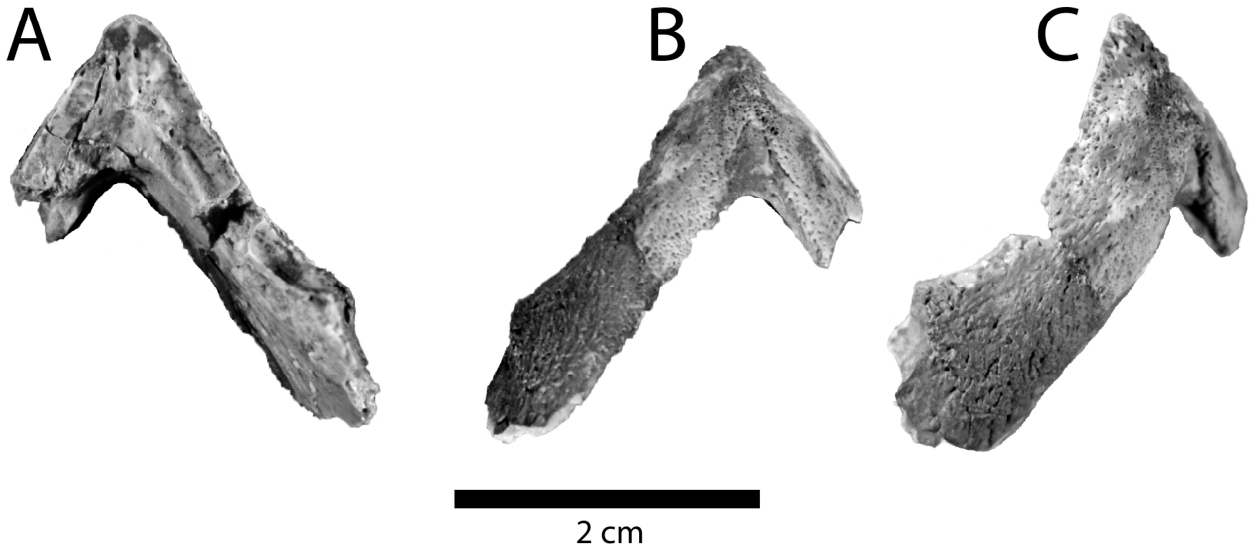
Other cranial material, in addition to that discussed by Hutchison and Archibald [26], Hutchison and Holroyd [12], and Lyson and Joyce [4], is known, including an incomplete set of lower jaws associated with shell fragments; several neurals, the proximal portion of several costals, and plastron fragments (NMMNH P-67478, Figure 4) from the Puercan NALMA interval of the Nacimiento Formation (San Juan Basin) in northwestern New Mexico. Shell fragments indicate referral to Compsemys but cannot be definitely assigned to any particular species. The lower jaws of NMMNH P-67478 are incomplete, missing the majority of the left dentary and all caudal (or posterior) elements, including the left articulation. The jaws have a maximum length of 28 mm, with the right side 13 mm wide at the caudal end and the posterior-most portion of the right side of the jaws is 5 mm wide. The dentary is large and makes up approximately half the total length of the jaws. The rostral-most point of the beak is strongly upturned dorsally, with a pronounced labial ridge. The extreme external side of this has a narrow (1.3 mm wide) band of surface sculpturing, indicating the origin of the overlying keratin sheath. Lingual (=medial) to this is a large, distinct lingual ridge that merges rostrally with its counterpart from the left side to form a midline ridge leading to the rostral-most point of the beak. The ventral side of the dentary has a deep, triangular channel, with its sides paralleling the dorsal outline of the beak. The angular and splenial are similar in size, each making up about half of the height of the coronoid eminence. The coronoid eminence is capped by a narrow coronoid. The Meckelian fossa is ventral to the coronoid eminence and angled nearly perpendicular to the plane of the splenial.
NMMNH P-67478 is the first described isolated lower jaw of Compsemys that is not associated with a skull. This lower jaw corresponds well with UCM 49223 (the skull described by Lyson and Joyce [4]) and possesses a similarly pointed beak. UCM 49223 is a nearly complete, but taphonomically deformed (partially crushed), skull lacking the left temporal area and portions of the posterior margin, and it includes nearly complete right and left dentaries, collected from the early Paleocene Denver Formation (Puercan NALMA, D1 sequence). NMMNH P-67478 represents a smaller and possibly younger individual than UCM 49223, as the mandible of the former is 5 mm wide as opposed to an estimated 15 mm wide in UCM 49223 based on the preserved length of the dentaries. Otherwise, UCM 49223 is difficult to compare to NMMNH P-67478, as the former has only the portion adjacent to the mandibular articulation, and the latter has only the anterior-most portion of this and forward (anterior).
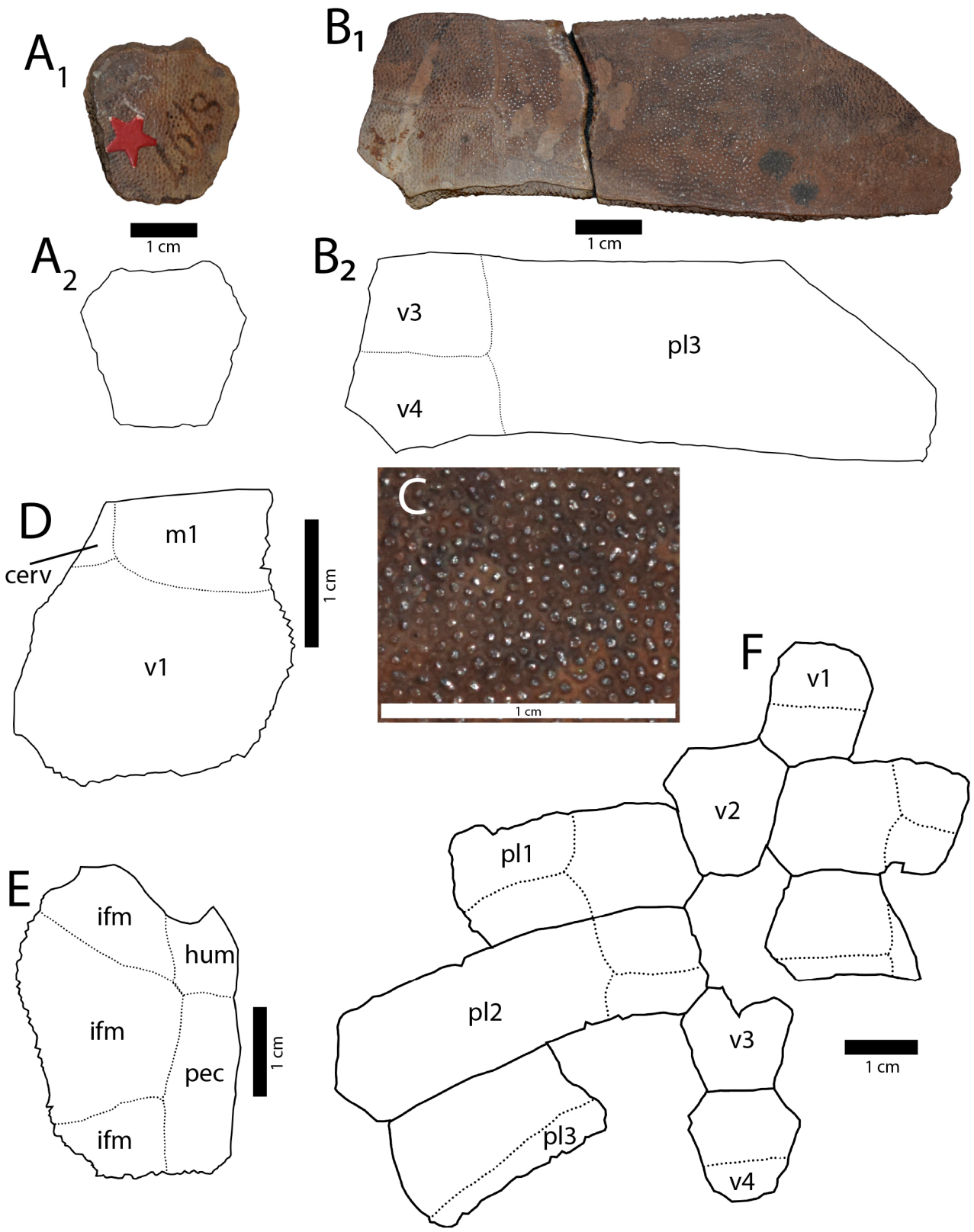
Figure 2. Compsemys victa from the Late Cretaceous in North America. (A–C) USNM 960 (holotype of Compsemys victa); (A) USNM 960 (holotype), neural IV in dorsal view, (A1) photograph, (A2) outline drawing; (B) nearly complete right costal V in dorsal view, (B1) photograph, (B2) outline drawing; (C) USNM 960 (holotype), close up of surface sculpturing. (D) AMNH 1085 (referred specimen), nearly complete right peripheral I in dorsal view; (E) AMNH 1015 (referred specimen), incomplete right hyoplastron in ventral view; (F) UCMP 194249 (referred specimen), fragmentary carapace in dorsal view. Abbreviations: cerv, cervical; hum, humeral; ifm, inframarginal; m, marginal; pec, pectoral; pl, pleural; v, vertebral. Scale bars = 1 cm.
Taxonomy 06 00048 g002
Figure 3. Surface sculpturing of Compsemys. (A) NMMNH P-65624, Compsemys puercensis, peripheral in dorsal view; (B) close up of surface sculpturing; (C) NMMNH P-67478, Compsemys indeterminate species, entoplastron in ventral view; (D) close up of surface sculpturing. Scale bars = 2 cm.
Taxonomy 06 00048 g003
Figure 4. Incomplete lower jaws of Compsemys indeterminate species, NMMNH P-67478. (A) dorsal (=occlusal) view; (B) ventral view; (C) left lateroventral view. Scale bar = 2 cm.
Taxonomy 06 00048 g004
COMPSEMYS VICTA Leidy 1856 [6].
Holotype specimen. USNM 960 [6], complete neural IV, nearly complete right costal V, and fragmentary right costal VIII (Figure 2A–C).
Type locality. Long Lake [6], 30 miles (ca. 50 km) southeast of Bismark, Burleigh County, central North Dakota. While Leidy [6]: (p. 312) stated that the holotype specimen (USNM 960) was found at Long Lake, Nebraska, it was actually from Long Lake, North Dakota. Referred material comes from Montana, see ref [8].
Type horizon and age. Hell Creek Formation, late Maastrichtian, Late Cretaceous.
Referred specimens. AMNH 998, bridge peripheral fragment (Lance Formation, Wyoming); AMNH 1015, incomplete right hyoplastron (Hell Creek Formation, Wyoming); AMNH 1085, nearly complete right peripheral I (Lance Formation, Wyoming); AMNH 6096, right costal VIII fragment (Hell Creek Formation, Montana); UCMP 19429, fragmentary carapace including neurals II and IV–V, fragmentary right costals I–III, incomplete left costals II–IV (left costal III complete) (Kaiparowits Formation, Utah). Other specimens previously referred to Compsemys victa based on surface sculpturing are only referable to the genus level, as the genus is not herein considered monospecific. However, it is noted that currently C. victa is the only valid Cretaceous species, and other Cretaceous material referable to Compsemys may eventually be referred to this species.
Diagnosis. Compsemys victa can be diagnosed as a member of Compsemys by the list of characters for the genus provided above. It differs from C. puercensis and C. torrejonensis in a more lateromedially (=horizontally) flattened humeral–pectoral sulcus; a longer contact (more than a single point contact) between the humeral and the inframarginal at its posterolateral (=caudolateral) side that restricts the pectoral from contacting the anterior-most inframarginal; a flat, transverse anterior border of neural II; and a latitudinally flattened vertebral III–IV sulcus. Differs further from C. torrejonensis by lacking notches on the anterior margin of the carapace at the cervical–marginal sulcus.
Description. USNM 960 (Figure 2A–C) consists of a complete neural IV, a nearly complete right costal V, and a fragment of costal VIII. Neural IV is hexagonal with a length of approximately 2.5 cm and is slightly longer than wide. The incomplete right costal V is missing the lateral portion but has the sulci for vertebrals III and IV and has an anteroposterior length of approximately 3.2 cm. There is a slight indent where the lateral sulci of vertebrals III and IV contact each other, similar to other Compsemys. The vertebral III–IV sulcus is flattened latitudinally, which is more similar to that of C. puercensis, and eventually curves anteriorly near the midline, whereas in C. torrejonensis this sulcus curves posteriorly. Both fragments have the distinct surface sculpturing used to identify fragmentary material as Compsemys. The fragmentary costal VIII also has this surface sculpturing, although it does not offer any other morphologic data. The material is relatively gracile, particularly compared to Paleocene Compsemys fossils.
Hay [8] referred several shell elements to Compsemys victa. Several of these fragments offer little morphologic data, including a fragmentary bridge peripheral (AMNH 998), an incomplete right hyoplastron (AMNH 1015), an incomplete right peripheral I (AMNH 1085), and a right costal VIII fragment (AMNH 6096). Little information can be gathered from AMNH 998 and 6096. They agree with the characteristic surface sculpturing of the type specimen (USNM 960). The first peripheral (AMNH 1085, Figure 2D) preserves the sulci separating the cervical, marginal I, and vertebral I scutes. There is no evidence of a notch on the anterior margin of the carapace between the cervical and marginal I scutes. This is similar to the condition seen in C. puercensis and distinguishes it further from C. torrejonensis. The bridge peripheral (AMNH 998) could be peripheral VIII, X, or XI based on the preserved sulci between the marginals and pleurals. It is more likely peripheral VIII or X, although it agrees with other specimens referred to Compsemys and does not help further distinguish between the potential species. The incomplete right hyoplastron (AMNH 1015, Figure 2E), however, can help distinguish C. victa from other species of Compsemys. An elongated contact between the humeral and the inframarginal scute to its posterolateral edge restricts the pectoral from contacting the anterior-most inframarginal. While the hyoplastron is incomplete, it preserves the lateral portion of the humeral–pectoral sulcus, which shows a distinctly latitudinal, lateromedially flattened orientation. However, in C. puercensis and C. torrejonensis, the humeral–pectoral sulcus is distinctly angled anteriorly where it continues onto the entoplastron.
UCMP 194249 (Figure 2F) consists of a highly fragmentary carapace, including several neurals and costals, see [20]: (figure 13.1). Neurals II, IV, and V are hexagonal. Neural II has a flattened anterior border suggesting a neural I with a flattened posterior border and potentially more distinctly angled sides. Neural IV, preserved with the specimen, agrees with USNM 960, namely in its flattened to only slightly posteriorly concave curvature of the anterior border and being slightly longer than wide. Those of C. puercensis and C. torrejonensis are more distinctly curved, and that of C. torrejonensis is the most conspicuously curved. The vertebral III–IV sulcus is latitudinally flattened as it crosses neural V, further distinguishing C. victa from the Paleocene species. The remaining morphology of the neurals and preserved portions of the costals all agree with other preserved specimens of Compsemys, including the holotypes of C. puercensis (USNM 8544) and C. torrejonensis (USNM 8549).
COMPSEMYS PUERCENSIS Gilmore, 1919 [10].
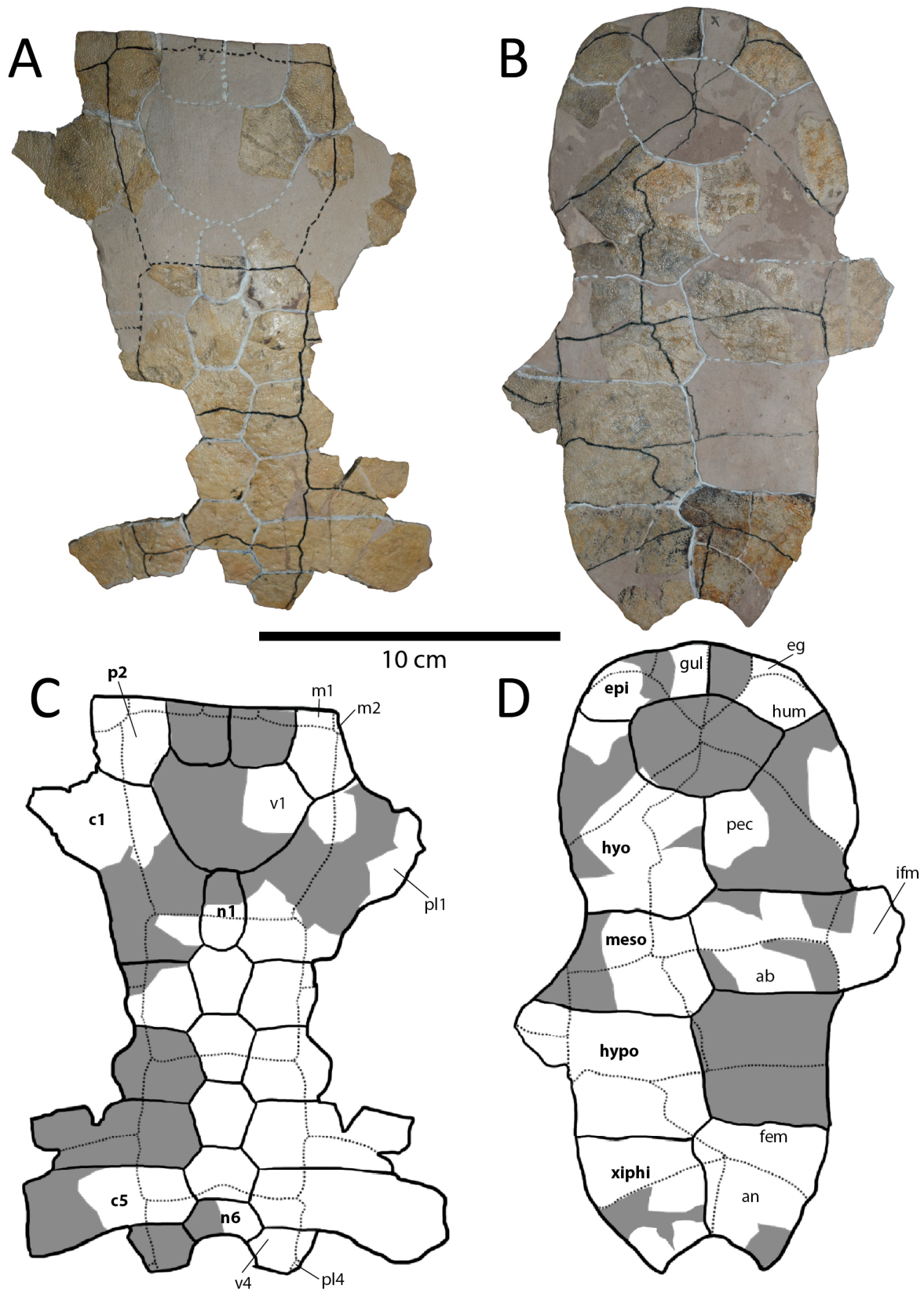
Holotype specimen. USNM 8544 [10], incomplete carapace including portions of peripherals II (left peripheral II complete), costals I–VI, neurals I–VI (neurals II–V complete), an incomplete nuchal, and an incomplete plastron including portions of the ento-, hyo-, meso-, hypo- (complete right hypoplastron), and xiphiplastra (complete right xiphiplastron) (Figure 5).
Type locality. “Four miles northwest of Kimbetoh (Kimbeto), on the north line of sec. 27, T. 23 N., R. 9 W.,” San Juan Basin, northwestern New Mexico, see ref. [10]: (p. 19).
Type horizon and age. “50 feet above the base” of the Nacimiento Formation, see ref. [10]: (p. 19), Paleogene, Paleocene (Puercan). Definitive specimens are from the Puercan NALMA, although some material from the Late Cretaceous may also be from this species, and one specimen from the early Torrejonian NALMA (NMMNH P-21602) suggests this species existed during that age as well.
Referred specimens. NMMNH P-21602, relatively complete left side of the carapace and incomplete plastron missing the entoplastron and posterior lobe (early Torrejonian interval of the Nacimiento Formation, San Juan Basin, New Mexico); NMMNH P-65624, carapace fragments; USNM 8528 (referred to Compsemys parva by Gilmore [10]), nearly complete carapace (missing lateral sections of the middle and anterior portions) and plastron missing lateral sections of the anterior portion and the bridges) (Puercan interval of the Nacimiento Formation, San Juan Basin, New Mexico); USNM 8529 (referred to Compsemys vafer by Gilmore [10]), incomplete carapace (missing anterior portion) and nearly complete plastron (missing lateral sections of the anterior portion and much of the bridges) (Puercan interval of the Nacimiento Formation, San Juan Basin, New Mexico).
Diagnosis. Compsemys puercensis can be diagnosed as a member of Compsemys by the list of characters provided for the genus above. It differs from C. victa by having an anteriorly angled humeral–pectoral sulcus, a shorter contact (single-point contact) between the humeral and the inframarginal at its posterolateral (=caudolateral) side, a concave anterior border of neural II, and an anteromedially convex vertebral III-IV sulcus. It differs from C. torrejonensis by having a flat anterior edge of the carapace with no notches; the vertebral III–vertebral IV sulcus crossing neural V; slightly more rounded anterior edge of the plastron; parallel to subparallel lateral edges of the posterior plastral lobe; straighter (i.e., less sinuous) humeral–humeral sulcus; convexly rounded (anteriorly) to anteromedially pointed femoral–anal sulci; and a less pronounced xiphiplastral notch (=anal notch) with sharply pointed posterior projections.
Description. USNM 8544 consists of the majority of the medial portion of the carapace through neural 6, although most of the costals and peripherals are not preserved, and a nearly complete plastron (Figure 5). The plastron preserves most portions on the right or left sides, although the entoplastron is not preserved and its proportions are only based on the general morphology of the elements preserved around it and referred specimens. Based on the type (USNM 8544) and referred specimens (USNM 8528 and 8529), the majority of the shell is known [10]. The nuchal is restricted from the anterior margin of the shell by the peripherals I. The neural formula for the first six neurals is ?4-6-6-6-6-6. Neural II has a concave anterior border, similar to C. torrejonensis, but is distinct from C. victa, whose neural II has a flat, transverse border. The vertebral I–vertebral II sulcus crosses neural I and the vertebral II–vertebral III sulcus crosses neural III. Of particular interest is the crossing of neural V by the vertebral III–vertebral IV sulcus, which is distinct from C. torrejonensis. The anterior margin of the carapace is relatively flattened when looking at the orientation of peripherals I and II and compared with referred specimens. Based on the preserved medial portion of the right entoplastron, the anteromedial margin would have been slightly elongate, giving it a more rounded outline in dorsal or ventral view. The sinuosity of the sulci running medially through the plastron is preserved on the right hyo- and mesoplastron, showing its offset nature from the sutures running medially between the paired elements of the plastron. The abdominal–femoral sulci are flat to convex (posteriorly), while the femoral–anal sulci are distinctly angled, with the medial portion angled anteromedially. While the posterior-most portion of the left xiphiplastron was reconstructed by Gilmore [10]: (pl. III), the complete right xiphiplastron is preserved and shows that the broad, sub-rounded anal notch would have been a natural morphological feature of C. puercensis. The anal notch is distinctly, but shallowly, notched with sharply pointed posterior projections bordering the notch.
The original material of C. parva (holotype USNM 6548) and C. vafer (holotype USNM 6551 and referred specimen USNM 6553) described by Hay [9] are undiagnostic to the species level and can only be referred to Compsemys indeterminate species. This also makes both C. parva and C. vafer nomina dubia. However, based on the more complete specimens referred to Compsemys parva and C. vafer by Gilmore [10]: (USNM 8528 as C. parva and USNM 8529 as C. vafer), these two species are probably synonymous with C. puercensis. USNM 8528 and 8529 agree with the above features of C. puercensis, particularly the crossing of neural V by the vertebral III–vertebral IV sulcus and the shape of the anterior and posterior margins of the plastron. NMMNH P-21601 and P-65624 are both made up of carapace fragments, but some of the neurals are preserved, allowing referral based on the vertebral III–vertebral IV sulcus. Although peripherals I are not preserved in the type specimen (USNM 8544, Figure 6), they are present in referred specimens (e.g., USNM 8528 and USNM 8529) and maintain the relatively flattened anterior margin of the carapace.
Figure 5. Compsemys puercensis, USNM 8544 (holotype), from the Puercan NALMA, Nacimiento Formation, northwestern New Mexico. (A) incomplete carapace in dorsal view; (B) nearly complete plastron in ventral view; (C) line drawing of incomplete carapace in dorsal view; (D) line drawing of nearly complete plastron in ventral view. Sutures (of bones) are marked by solid lines and sulci (of scutes) are marked by dotted lines in line drawings. White colors indicate preserved original bone material, while dark gray represents reconstructed portions. Abbreviations: ab, abdominal; an, anal; c, costal, eg, extragular; epi, epiplastron; fem, femoral; gul, gular; hum, humeral; hyo, hyoplastron; hypo, hypoplastron; ifm, inframarginal; m, marginal; meso, mesoplastron; n, neural; p, peripheral, pec, pectoral; pl, pleural; v, vertebral; xiphi, xiphiplastron. Bones are labeled in bold to the left, while scutes are labeled to the right. Numbers correspond to the number of the individual elements (i.e., first neural is n1; second marginal is m2). Scale bar = 10 cm.
Taxonomy 06 00048 g005
Joyce and Anquetin [5] noted that the shells referred to various species of Compsemys by Gilmore [10] were originally made up of carapace and plastron fragments that were then reassembled. For the most part, the portions reconstructed by Gilmore [10] were mirrored by pieces that were preserved from the opposite side of the shell, and the fragments that were reassembled were, and currently are, considered to be from single individuals. From the information available, Gilmore did not assemble shells from multiple individuals. Therefore, the morphology shown here is considered accurate, although the entoplastron is not preserved in USNM 8544 (Figure 5) and, as it has no paired element, its morphology is more hypothetical based on referred specimens of C. puercensis (USNM 8528 and 8529). Although the entoplastron is not preserved, the morphology of the humeral–pectoral sulcus on the right hyoplastron suggests the pectoral covered a significant part of the entoplastron and reached to approximately its midpoint (relative to its length). The position of the sulcus between the pectorals usually lies anteromedially on the posterior portion of the entoplastron; however, it is reconstructed as coming from the right posterolateral margin of the entoplastron in USNM 8544 (see Figure 5). While this would be more distinct from other specimens of Compsemys, Gilmore [10] reconstructed this as such due to its position on the right hyoplastron. This placement also seems likely when compared to USNM 8549 (Figure 6), which shows a similar morphology immediately posterior to the entoplastron, although the pectoral–pectoral sulcus still enters the entoplastron medially on its posterior margin. Although the entoplastron is not preserved in USNM 8544, the posteromedially angled gular–hyoplastron sulci, the anteromedially angled humeral–pectoral sulci, and the small humeral–humeral sulcus, resulting in a short contact between the paired humerals, is consistent with Compsemys, or at least the Paleocene Compsemys specimens where entoplastra are known. This morphology is inferred to have been present in USNM 8544 and C. puercensis based on other referred specimens (e.g., NMMNH P-21602, USNM 8528 and 8529).
COMPSEMYS TORREJONENSIS Gilmore, 1919 [10].
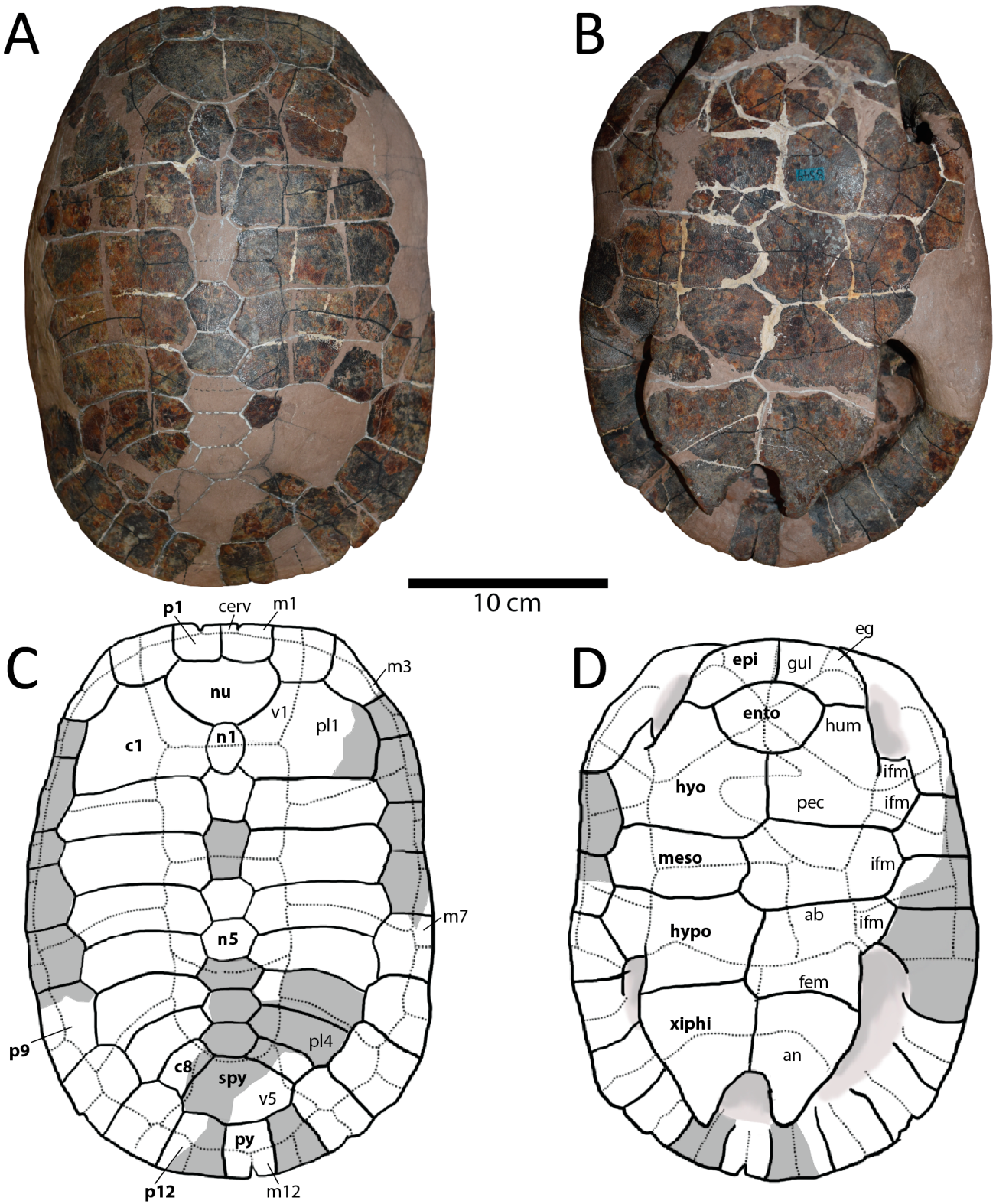
Holotype specimen. USNM 8549 [10], nearly complete carapace and plastron, missing portions of both bridges, including the corresponding peripherals (Figure 6).
Type Locality. “Eight miles N. 60° E. of Kimbetoh (Kimbeto), in sec. 17, T. 23 N., R. 8 W.,” San Juan Basin, northwestern New Mexico, see ref. [10]: (p. 21).
Type horizon and age. “840 feet above base of the Puerco, in Torrejon,” Nacimiento Formation, see [10]: (p. 21), Paleogene, Paleocene (Torrejonian NALMA).
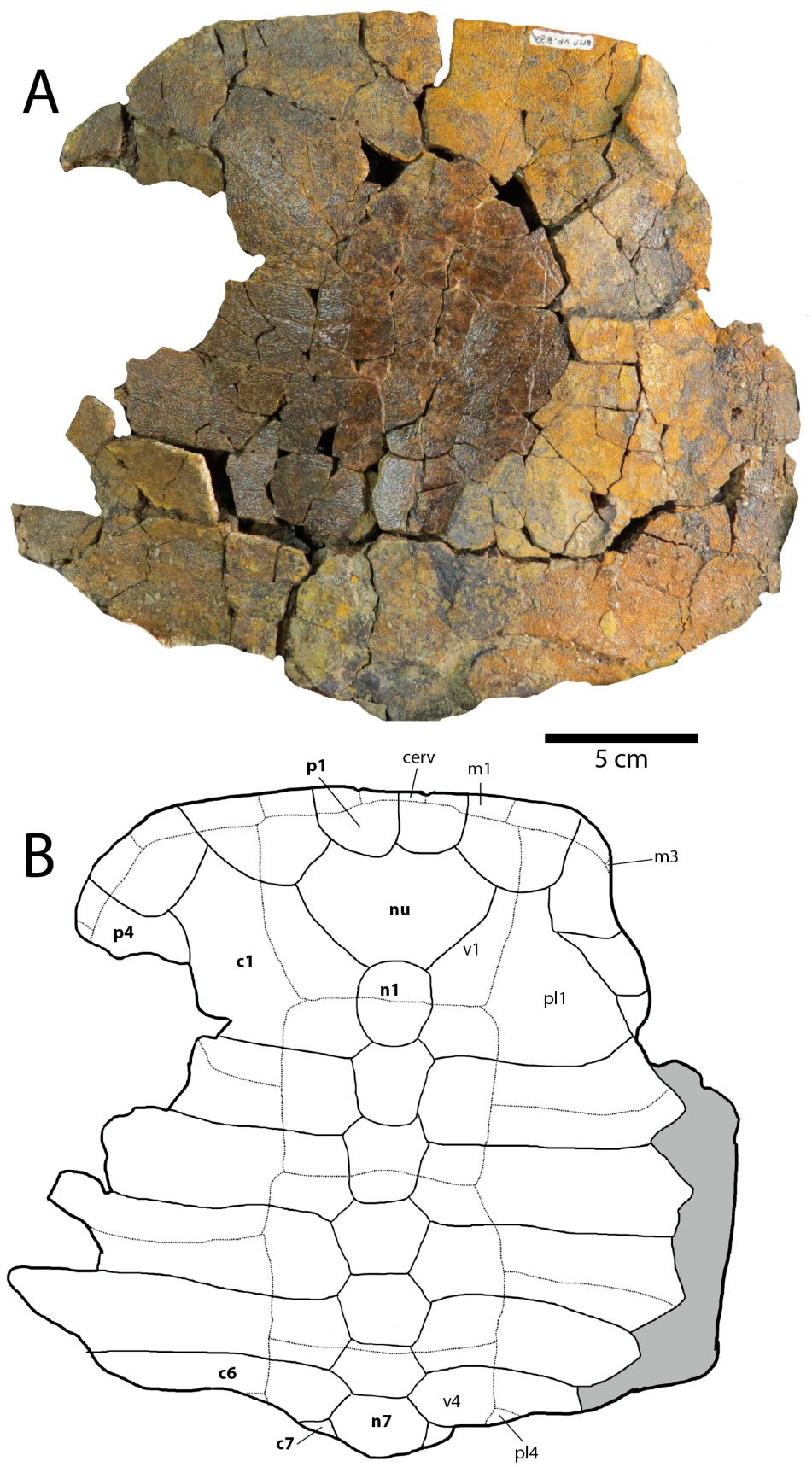
Referred specimen. SMP VP-832, majority of the anterior portions of a carapace (Figure 7) and plastron. SMP loc. 314, “Turtle City,” north De-na-zin Wash (northeast), from the Torrejonian interval of the Nacimiento Formation, San Juan Basin, New Mexico.
Diagnosis. Compsemys torrejonensis can be diagnosed as a member of Compsemys by the suite of characters provided for the genus above. It differs from C. victa and C. puercensis in having notches on the anterior margin of the carapace at the cervical–marginal I sulci and having the vertebral III–vertebral IV sulcus crossing neural VI. It differs further from C. victa in having an anteriorly angled humeral–pectoral sulcus, a shorter contact (single-point contact) between the humeral and the inframarginal at its posterolateral side, a concave anterior border of neural II, and an anteromedially convex vertebral III–vertebral IV sulcus. Lastly, it differs further from C. puercensis in having expanded or inflated lateral edges of the posterior plastral lobe; a highly sinuous humeral–humeral sulcus; flattened, latitudinally oriented medial portion and angled lateral portion of the femoral–anal sulci; and a strongly pronounced, deep xiphiplastral notch (=anal notch) with rounded posterior projections.
Description. USNM 8549 is a nearly complete carapace and plastron [10], missing only portions of the peripherals around both bridges and portions of the posterior of the carapace around neurals VI–VIII, costals VII–VIII, and a portion of the suprapygal (Figure 6).
Figure 6. Compsemys torrejonensis, USNM 8549 (holotype), from the Torrejonian NALMA, Nacimiento Formation, northwestern New Mexico. (A) nearly complete carapace in dorsal view; (B) nearly complete plastron in ventral view; (C) line drawing of nearly complete carapace in dorsal view; (D) line drawing of nearly complete plastron in ventral view. Sutures (of bones) are marked by solid lines and sulci (of scutes) are marked by dotted lines in line drawings. White colors indicate preserved original bone material, while dark gray represents reconstructed portions, and light gray represents internal (visceral) surface. Abbreviations: ab, abdominal; an, anal; c, costal, cerv, cervical; eg, extragular; ento, entoplastron; epi, epiplastron; fem, femoral; gul, gular; hum, humeral; hyo, hyoplastron; hypo, hypoplastron; ifm, inframarginal; m, marginal; meso, mesoplastron; n, neural; nu, nuchal; p, peripheral, pec, pectoral; pl, pleural; py, pygal; spy, suprapygal; v, vertebral; xiphi, xiphiplastron. Bones are labeled in bold to the left, while scutes are labeled to the right. Numbers correspond to the number of the individual elements (i.e., first neural is n1; twelfth marginal is m12). Scale bar = 10 cm.
Taxonomy 06 00048 g006
Figure 7. SMP VP-832, anterior portion of the carapace in dorsal view, referred to Compsemys torrejonensis, from the Torrejonian NALMA Nacimiento Formation, New Mexico. (A) anterior portion of carapace in dorsal view; (B) illustration of anterior portion of the carapace in dorsal view, sutures (of bones) are marked by solid lines, and sulci (of scutes) are marked by dotted lines. White colors indicate preserved original bone material, while gray represents internal (visceral) surface of the plastron below. Abbreviations: c, costal, cerv, cervical; m, marginal; n, neural; nu, nuchal; p, peripheral, pl, pleural; v, vertebral. Bones are labeled in bold to the left, while scutes are labeled to the right. Numbers correspond to the number of the individual elements (i.e., first neural is n1; second marginal is m2). Scale bar = 5 cm.
Taxonomy 06 00048 g007
The nuchal is restricted from the anterior margin of the shell by the peripherals I. The posterolateral edges of the nuchal are distinctly rounded. The formula for the first six neurals is 4-6-6-6-6-6. Neural I is crossed by the vertebral I–vertebral II sulcus, and neural III is crossed by the vertebral II–vertebral III sulcus, whereas the vertebral III–vertebral IV sulcus crosses neural VI. Neural II has a concave anterior border, similar to C. puercensis, but is distinct from C. victa, whose neural II has a flat, transverse border. The anterior margin of the carapace has small notches between the cervical scute and the marginal I scutes, which are also present on the referred specimen SMP VP-832, although they are more inconspicuous in the former.
The plastron, nearly complete except for portions of the bridge, shows a morphology consistent with Compsemys (Figure 6). The humeral scutes are distinctly triangular and medially pinched. This leads to the entoplastron having distinct portions covered by the gular, humeral, and pectoral scutes. The anterior lobe of the plastron has relatively subparallel to constricted lateral edges, whereas the posterior lobe of the plastron is distinctly inflated. The pectoral–pectoral sulcus is extremely sinuous and far more prominent than in the C. puercensis holotype (USNM 8544, Figure 5) and any specimens referred to the latter species. The abdominal–femoral sulci are convexly rounded (posteriorly), whereas the femoral–anal sulci are angled laterally and flat medially. The anal notch is prominent and deep, with the edges bordered by pronounced but rounded posterior projections.
SMP VP-832 represents the greater anterior portion of a carapace (Figure 7), while the anterior portion of the plastron is present but currently unprepared. It agrees with the key features of C. torrejonensis, in particular the crossing of neural VI by the vertebral III–vertebral IV sulcus.

5. Discussion

5.1. Historical Taxonomic Overview

Compsemys was first named for C. victa based on highly fragmentary material [6]. The fragmentary nature of this material, and the original reliance on surface texture, led to numerous taxonomic issues for the taxon moving forward. This was followed by Compsemys plicatulus from the Late Jurassic Morrison Formation in Colorado, named by Cope [7], which was subsequently placed in the genus Glyptops by Hay [8] as G. plicatulus. Other species of Compsemys were eventually named from Paleocene strata in New Mexico, including C. parva and C. vafer by Hay [9], and C. puercensis and C. torrejonensis by Gilmore [10]. Some of the other species originally referred to Compsemys due to presumed similarities in surface texture (e.g., Compsemys variolosus, ?C. ogmius, and C. imbricarius) [76,77] were later placed in the taxon Basilemys [8,78,79].
Another early species referred to Compsemys was Emys obscurus from the Maastrichtian in North Dakota [6], which was subsequently referred to Compsemys obscurus, e.g., [9,80], and C. victa [4]. Hay [8] questioned the referral of the species to Compsemys. Indeed, the type specimen was said to have a smooth surface, which excludes it from Compsemys. Most species referred to Emys belong to various other genera, e.g., [63,65,81], thus the generic referral of E. obscurus to Compsemys is also incorrect, as Emys has been considered something of a wastebasket genus by numerous early turtle workers. The material, a costal fragment, is highly fragmentary, undiagnostic, and represents a nomen dubium, which is in agreement with Joyce and Anquetin [5].
One of the first major reviews of Compsemys was provided by Gaffney [1]. He hypothesized that differences among the New Mexican species (C. victa, C. parva, C. vafer, C. puercensis, and C. torrejonensis) were within the limits of population variation. He noted that the Cretaceous form, C. victa, was too fragmentary to differentiate it from the Paleocene species. He provisionally referred all of the species to C. victa, as it had been named first, with the caveat that further information and specimens might eventually show there to be taxonomic differences. Additionally, he agreed with the generic placement of Glyptops plicatulus first suggested by Hay [8], thus not including it in Compsemys.
Lyson and Joyce [4] also reviewed the genus while describing an isolated skull from Colorado. This skull (UCM 49223), first reported by Hutchison and Holroyd [12], is from “Bijou Creek.” The stratigraphy, however, is uncertain, see ref. [12], particularly as Bijou Creek potentially has Cretaceous and Paleocene strata. It is likely from the Puercan (Paleocene) portion of the Denver Formation. Hutchison and Holroyd [12] referred it to Compsemys as it possessed sculpturing similar to that of the carapace and plastron. Additionally, they justified this referral based on known and associated skull and shell material (UCMP 131103) from the Puercan Tullock Member of the Fort Union Formation in Montana. In their study, Lyson and Joyce [4] agreed with the synonymies of Gaffney [4], while also synonymizing Emys obscurus and Glyptops depressus with C. victa, although they provided little to no justification. However, Joyce and Anquetin [5] surmised that the placement of E. obscurus in C. victa was probably based on the mistaken reference of a different specimen within the plate illustrated by Leidy [82]: (pl. 11, figures 5–7) and considered the former taxon a nomen dubium. Joyce and Anquetin [5] discussed G. depressus further but considered it a nomen dubium as well, agreeing with the findings of Gaffney [83].
Compsemys was recently discussed by Joyce and Anquetin [5], who agreed with the previous hypothesis of the genus as monotypic [1,4], that C. victa is the only valid species of North American Compsemys, and that all fragmentary material from Campanian to Paleocene age strata is referable to this species. They considered the shell surface texture (i.e., shell ornamentation) to be diagnostic and could be used to refer specimens to the genus. They also determined that C. parva, C. vafer, C. puercensis, and C. torrejonensis were nomina invalida and junior synonyms of C. victa. “Compsemys” plicatulus, which was attributed to Glyptops by Hay [8], was still placed within this latter genus by Joyce and Anquetin [5], although they determined that the surface sculpturing was not unique enough among basal paracryptodires, and they considered the name a nomen dubium. In their discussion of Emys obscurus, Joyce and Anquetin [5] determined it to be a nomen dubium due to the loss of the holotype and lack of similarities with other taxa. Furthermore, they considered Glyptops depressus, which Lyson and Joyce [4] also synonymized with C. victa, to likely be a synonym of C. victa based on several features of the carapace and plastron.
However, the G. depressus holotype (USNM 5731), purportedly from the Late Cretaceous in Colorado, is a heavily weathered carapace and plastron lacking all the peripherals and portions of the posterior side of the shell. Gaffney [83] felt it more sensible to consider it a nomen dubium, and Joyce and Anquetin [5] concurred. Glyptops depressus was synonymized with C. victa by Lyson and Joyce [4], but with no justification given. While it does have mesoplastra, G. depressus does not have sinuous plastral midline sutures. Additionally, Hay [8] mentioned that the surface sculpturing was similar to that of G. plicatulus, a species removed from Compsemys and moved to Glyptops, and whose generic placement has not since been altered. Joyce and Anquetin [5] considered G. depressus a nomen dubium, a finding we agree with here. Compsemys plicatulus is based on highly fragmentary material that Joyce and Anquetin [5] determined was more similar to G. ornatus, although they considered the species a nomen dubium based on the undiagnostic nature of the holotype (AMNH 6099), which we also agree with here. The removal of the Jurassic specimens from Compsemys (including those referred to Glyptops) means the specimens currently referred to Compsemys date from the Late Cretaceous to the Paleocene.
None of the characters in the revised diagnoses of Compsemys or C. victa by Joyce and Anquetin [5] are present in the holotype of C. victa (USNM 960), which includes several shell fragments, including a neural (possible fourth) and two costals (a fragment of the ?fifth and eighth) (Figure 2A–C). Instead, the diagnosis for C. victa used by Joyce and Anquetin [5] uses referred specimens, in particular the holotype of C. torrejonensis (USNM 8549) and referred specimens with non-shell elements. Berruchelus russelli was named by Pérez-García ([70] based on a holotype nuchal (MNHN.F.BR 9110) and numerous other shell elements and fragments from the upper Thanetian (upper Paleocene) in France. Joyce and Anquetin [5], however, considered B. russelli referable to Compsemys, although we still consider them generically distinct (discussed further below).
There have also been other reports of Compsemys outside North America. Trionyx bakewelli, a taxon named by Mantell [84] from an isolated costal collected from the Grinstead Clay Member of the Tunbridge Wells Sand Formation (Early Cretaceous, middle–late Valanginian) on the Isle of Wight, UK [85], may be referable to Compsemys. Platychelys(?) anglica was named by Lydekker [86] from the left posterolateral portion of a carapace collected from the Purbeck Limestone Group (Early Cretaceous, Berriasian) on the Isle of Wight [85]. Both species were tentatively referred to Compsemys by Joyce et al. [87], with the caveat that they may represent a different genus (or genera) once more specimens and data are collected. Joyce [88] removed the two species from Compsemys and placed them in “Helochelydra” bakewelli and “H.” anglica, respectively, and neither of these species was mentioned by Joyce and Anquetin [5]. British fossil material previously referred to Compsemys (i.e., (“Helochelydra” anglica and “H.” bakewelli) would have extended the genus back another 80 million years. However, all British fossil material that, at some point, was referred to Compsemys is now identified as belonging to a different lineage of turtles (i.e., Helochelydridae).
As currently interpreted, the entire fossil record of Compsemys lasted for approximately 25 million years. However, if these Early Cretaceous records are indeed referable to the genus, it would extend the genus back another 80 million years, which seems highly unlikely. It is more likely that this surface ornamentation, or similar sculpturing, has evolved multiple times. Gaffney [1]: (p. 291) also stated that the possibility of two fairly unrelated turtles developing similar surface sculpturing would not be that unusual. Indeed, the fact that multiple turtle genera are known for having small tubercles on the surface of their shells (e.g., Glyptops, Helochelydra, and Naomichelys) hints at this possibility. Helochelydrids, in particular, are known for a shell surface texture made up of tubercles [87,89,90,91]. The similar ways these textures are described makes it easier to deduce why workers have had difficulty referring fragmentary material to particular taxa. This is further supported by the fact that other species originally believed to have unique and similar surface texturing were moved to the nanhsiungchelyid Basilemys, another turtle with presumed distinct shell surface texture [8,78,79].

5.2. Morphology and Variation

Variation among turtles differs genotypically and phenotypically to varying degrees. While some taxa exhibit lesser amounts of intraspecific variation, others exhibit larger degrees, such as modern Trachemys, e.g., [63,92,93]. When taxa are named based on highly fragmentary material, and are diagnosed, completely or in large part, on something like shell surface texture, those taxa can quickly become trash-bin taxa. Compsemys, as noted above, has become one such turtle taxon. However, new fossil material, presented herein, including shell and cranial material, is referable to Compsemys based on surface texture and a shared morphology of shell elements. Moreover, specimens previously referred to Compsemys victa show variation in the sutures between bones and sulci between scutes. While some of this variation may represent sexual dimorphism and/or intraspecific variation, some undoubtedly represents interspecific variation (i.e., disparity).
While Compsemys was first named based on distinct sculpturing on the surface of the carapace and plastron, similar sculpturing among other turtles has caused some confusion in referring species to this genus (see further discussion above). For this reason, some species have moved between various genera, e.g., [4,58,94,95]. While the majority of previous diagnoses for C. victa did not include any of the features within the holotype of the species (USNM 960) and instead focused on features of referred specimens and those of specimens previously referred to other species, the holotype does preserve a few important features that allow for a more confident referral of a few other specimens to the species.
Surface sculpturing, previously used as a key feature of the genus, e.g., [8,9,10], and later as a key feature of the monotypic C. victa, is more correctly a generic character when viewed through the prism of interspecific variation within the genus. Although a shagreen-like surface texture with fine, granular tubercles is not part of the diagnosis presented by either Lyson and Joyce [4] or Joyce and Anquetin [5], it can be used to diagnose Compsemys. It is also different than that in Berruchelus russelli, which has a surface texture that is more variable and subdued.
Gilmore [10]: (figure 4) illustrated differences in the posterior lobes of the plastra of the four Paleocene New Mexican species and used these to help distinguish the species. Without a larger sample size, we infer that two Paleocene species are represented based on different morphologies across the shells, not only the posterior plastral lobes. In addition, differences in the anal notch may be due to intraspecific variation or dimorphism, particularly sexual dimorphism, see ref. [5]. However, taxonomically significant differences from the specimens Gilmore [10] reported include the vertebral III–vertebral IV sulcus (crossing neural V in Compsemys puercensis and neural VI in C. torrejonensis) and the shape of the plastral lobes, among others. The placement of the vertebral III–vertebral IV sulcus mostly corresponds to the different NALMAs, with the majority of those individuals from the Puercan crossing neural V and those from the Torrejonian crossing neural VI. A single individual from the early Torrejonian NALMA (NMMNH P-21602) has its vertebral III–vertebral IV sulcus crossing the posterior-most portion of neural V, so the correlation is not perfect, and geologic age alone cannot be used for species referral. The morphology of C. torrejonensis from the Torrejonian interval and that of C. puercensis from the Puercan interval (with possible extension into the earliest Torrejonian) suggest that C. torrejonensis evolved in the Torrejonian and C. puercensis lived in the Puercan and became rare at the beginning of the Torrejonian before dying out. This is shown by the fact that, within the collections of the NMMNHS and SMP, of over 100 specimens in the Cretaceous and Paleocene referable to Compsemys, only one specimen from the Torrejonian NALMA portion of the Nacimiento Formation is referable to C. puercensis. The lone C. puercensis specimen from the Torrejonian NALMA is among 50 total Compsemys specimens (2%) from that age. This suggests slight overlap before leaving C. torrejonensis as the only survivor, at least in the American Southwest.
Additionally, the morphology of C. victa suggests a closer relationship with C. puercensis than with C. torrejonensis, including features from the anterior of the carapace and morphology of neural IV (longer than wide in C. victa and C. puercensis, wider than long in C. torrejonensis), which is to be expected in a lineage undergoing cladogenesis. The changes in morphology through time, although some are slight, potentially show continued variation in an asymmetric or budding cladogenetic lineage, with the latest surviving C. puercensis living with the earliest C. torrejonensis. It may possibly represent a type of sympatric speciation where competition led to C. puercensis being outcompeted by C. torrejonensis, leading to the extinction of the former.
Joyce and Anquetin [5] discussed the shape of the anal notch within species of Compsemys, in particular Paleocene species, as this region of the plastron is not preserved in the holotype of C. victa (USNM 960, Figure 2A–C), and apparent differences in their shapes were believed to be consistent with the sexual dimorphism seen in some extant turtles. While the anal notch in these turtles does not seem to fall into only two morphs, which would be suggestive of sexual dimorphism, further variation in the morphology of the anal notch may be due to ontogenetic or individual variation as well. A larger sample size of this portion of the shell in Compsemys is needed to determine the range of this morphology, and those of closely related species would also be useful in more fully understanding this morphologic variation, particularly as this lineage of turtles has no surviving members today. Regardless, other features also show variation, including the elongated contact between the humeral and the inframarginal scute that restricts the pectoral from contacting the anterior-most inframarginal, which is likely due to intraspecific (i.e., individual) variation, although more specimens are needed to confirm or refute this. Without the addition of more specimens, this feature is also maintained in the diagnosis of C. victa for the moment.

5.3. Taxonomic Relationships

Much of what has been previously written about Compsemys has focused on its phylogenetic placement and relationships, e.g., [1,4,8,9,10,12]. Pérez-García [70] and Pérez-García et al. [74] recovered Berruchelus russelli as sister to the monotypic C. victa in their phylogenetic analyses, with the latter study establishing Compsemydidae for this clade. The phylogenetic analysis by Pérez-García et al. [74] was also recently used by Joyce and Anquetin [5]. Since this latter study considered C. victa to be the only valid North American species within Compsemys at the time, they used the sister relationship between B. russelli and C. victa as a generic clade rather than familial, moving the former species into Compsemys and synonymizing the two genera. Other recent studies have yielded similar results, e.g., [14,15,75], and retained these species within Compsemys, although Pérez-García [68] and Tong et al. [69] kept the species in Berruchelus. Regardless, with Compsemys no longer considered monospecific in the present study, the sister relationship of Berruchelus russelli to C. victa has also changed. Because the three species of Compsemys share more apomorphies with each other than any do with B. russelli, these data suggest that B. russelli should remain in the genus Berruchelus and not be considered a species of Compsemys. The fragmentary nature of the material of C. victa makes determining its phylogenetic relationships difficult; however, if the three species of Compsemys are placed together at the generic level (as Compsemys spp.), they form a generic clade.
With their recognition of Compsemydidae, Pérez-García et al. [74] provided a diagnosis that included Compsemys and Berruchelus russelli. Based on the presence of Berruchelus and our diagnosis of Compsemys and the species therein, a revised diagnosis for Compsemydidae was needed, which we have provided above. Many of the features listed above for the diagnosis of Compsemys are also present in Berruchelus, including large mesoplastra, a nuchal that does not reach the anterior margin, and a deep xiphiplastral notch. There are distinct differences between the genera, though, including a broad suprapygal, neural 8 being broader posteriorly than anteriorly, an anteromedial projection of the nuchal between marginal I, square vertebrals II and III, strongly sinuous plastral midline sutures, and a more distinctly squared-off and flattened anterior plastral edge in Compsemys. Further specimens are needed to understand these relationships more fully. Compsemys, with the current recognition of three valid species, is closely related to Berruchelus, but the two are generically distinct. However, we maintain their inclusion in Compsemydidae (sensu, in part, [74]).
Since the work of Pérez-García et al. [74], other species have been placed within Compsemydidae. Recent studies by Joyce and Rollot [14], Joyce et al. [15], and Tong et al. [69] identified several previous or new species as compsemydids, including Kallokibotion bajazidi, Selenemys lusitanica, Peltochelys duchastelii, Tongemys enigmatica, Calissounemys matheroni, and Riodevemys inumbragigas. However, Pérez-García et al. [96] disagreed with the inclusion of taxa beside Compsemys and Berruchelus russelli in Compsemydidae, particularly making note of P. duchastelii, R. inumbragigas, and S. lusitanica, which had been recovered in the family by Joyce and Rollot [14]. Pérez-García et al. [96] considered these species to still be within Pleurosternidae. A sister relationship between Selenemys lusitanica and Compsemys was recovered by Tong et al. [69], although this seems unlikely, particularly if Selenemys lusitanica is, indeed, a pleurosternid, see ref. [71]. It is apparent that the phylogenetic relationships of compsemydids and pleurosternids still need more work, but for now we conservatively follow the memberships put forward (i.e., species included) by Pérez-García et al. [74], including Compsemys and Berruchelus in Compsemydidae. The other potential compsemydids mentioned above will need to be re-evaluated in light of these new taxonomic hypotheses for North American compsemydids.
Specimens previously referred to Compsemys victa must also be re-evaluated. The phylogenetic placement of C. victa was determined, at least partially, through the use of non-shell characters, including the use of specimens like UCM 49223. With multiple species now present within what was formerly a monospecific Compsemys, the specific identification of these specimens is important but may not yet be possible without more material. As UCM 49223 came from the Puercan NALMA interval of the Denver Formation in Colorado, it is likely that it is C. puercensis. However, without overlapping material, this specific identification is uncertain. If the same arguments are used for its new placement as those used by Hutchison and Holroyd [12] and Lyson and Joyce [4], then it can be referred to Compsemys, but not with certainty to any species.

5.4. Paleoecology

Based on the resemblance of the skull and shell with that of the extant bigheaded turtle Platysternon megacephalum, Compsemys may have been carnivorous without the ability to retract its head within the shell, e.g., [4,5,12]. Indeed, the simple but sharply pointed jaws (on referred skulls) are indicative of a carnivorous lifestyle, e.g., [4,5,12]. As the majority of material previously referred to Compsemys victa comes from muddy overbank deposits, this aquatic turtle may have also preferred ponded habitats with quieter and gentler water systems, e.g., [1,4,5,12,26].

5.5. Evolution and the Cretaceous–Paleogene Mass Extinction Event

Compsemys specimens are less common from the Cretaceous in New Mexico, e.g., [13,33,38,39], compared to more common and complete material known from the Paleocene, e.g., [11,97]. This implies that Compsemys fossils become more prevalent after the K–Pg mass extinction event, at least farther south. Even looking at the collections of NMMNHS and SMP, these patterns are visible in the fossil material referred to Compsemys, even if most of it is made up of shell fragments only identifiable to the genus. These institutions, which have been actively collecting from Cretaceous and Paleocene strata in the San Juan Basin where Compsemys fossils are found, have 103 total catalogued specimens, with 24 (23.3%) coming from Cretaceous (Campanian–Maastrichtian) strata and 79 (76.7%) coming from Paleocene (Danian) strata. Hutchison and Archibald [26] found a different pattern, however, in northeastern Montana, with Compsemys being more common in the latest Cretaceous Hell Creek Formation compared to the early Paleocene Tullock Formation. These different patterns suggest that habitats changed in different ways across the Cretaceous–Paleogene boundary in the north (Montana) compared to the south (New Mexico). Jasinski et al. [11] also showed that some turtles went extinct at or near the K–Pg boundary. This suggests that different regions transformed differently, and different turtles may have taken advantage and diversified, while others went extinct. Additionally, specimens of Compsemys tend to be smaller from the Cretaceous in New Mexico compared to Paleocene material from the state. This may also suggest changing ecological conditions in this region at this time. Although we note that it may also be sampling bias, with more Compsemys specimens known from the Paleocene compared to the Cretaceous in New Mexico.

6. Conclusions

Compsemys currently has three valid species, one from the Late Cretaceous (C. victa), and two from the Paleocene (C. puercensis and C. torrejonensis). This taxonomic hypothesis is distinct from those of previous studies, which considered all North American compsemydids to belong to Compsemys victa, e.g., [1,4,5,12,14,15,69,70,74,87,97,98]. The findings of the current study suggest that specimens previously referred to Compsemys, including C. victa, must be re-evaluated. Much of the material previously referred to C. victa is now only definitively referable to Compsemys sp., as most specimens cannot be confidently referred to a distinct species. This suggests fragmentary material from the Late Cretaceous in North America previously referred to C. victa, is now referable to Compsemys indeterminate species, making the genus a survivor of the end-Cretaceous mass extinction.
Skull material from fossil turtles is rare from the Late Cretaceous in New Mexico, e.g., [11,13,33,64], and finding some associated with shell material will help determine more distinct differences between the species of North American compsemydids. Additionally, the lower number of Compsemys specimens from the Cretaceous in New Mexico compared to more common and complete material from the Paleocene suggests changing conditions in this region around the Cretaceous–Paleogene boundary. Different patterns in the occurrences of Compsemys (and North American compsemydids) in the northern and southern United States, based on the prevalence of fossil material, may suggest that habitats changed in different ways between the regions after the end-Cretaceous extinction event, changed asynchronously, or that different species (in different locations) coped in different ways. More time and specimens may provide additional information, and subsequent study of other specimens previously referred to Compsemys victa may provide further information on Compsemys and North American compsemydids, while also helping us further understand the phylogenetic relationships among compsemydids, pleurosternids, and other basal paracryptodires.

Author Contributions

Conceptualization, S.E.J.; methodology, S.E.J. and S.G.L.; investigation, S.E.J., A.J.L. and S.G.L.; writing—original draft preparation, S.E.J. and A.J.L.; writing—review and editing, S.E.J., A.J.L., S.G.D. and S.G.L.; visualization, S.E.J. and A.J.L. All authors have read and agreed to the published version of the manuscript.

Funding

This research received no external funding.

Data Availability Statement

All data are available in the manuscript.

Acknowledgments

Thanks to Bureau of Land Management (BLM) employees who helped obtain permits for researchers at the New Mexico Museum of Natural History and Science and the State Museum of Pennsylvania and allowing the field work to take place, including Pat Hester and Phil Gensler. Many thanks to those who allowed access to museum specimens and helped with collection visits, including Carl Mehling and Mark Norell at the American Museum of Natural History, and Matthew Miller at the United States National Museum of Natural History. Walter Joyce and Tyler Lyson provided many stimulating conversations about fossil turtles and Compsemys, and we thank both. We thank Robert M. Sullivan, who reviewed an earlier version of this manuscript. SMP VP-832 was collected in 1996 under permit BLM Paleontological Resources use Permit SMP-8270-RSW-95-A issued to Robert M. Sullivan, formerly of the State Museum of Pennsylvania, Harrisburg. Peter Dodson supervised SEJ when this project began and read an earlier draft of this manuscript, and his guidance and help are gratefully acknowledged. We thank the editor and three reviewers whose comments and suggestions helped improve the paper as well.

Conflicts of Interest

The authors declare no conflicts of interest.

Abbreviations

The following abbreviations are used in this manuscript:
Institutional Abbreviations
AMNHAmerican Museum of Natural History, New York, New York, USA
MNHN.F.Paleontology Collection of the Muséum National d’Histoire Naturelle, Paris, France
NMMNHNew Mexico Museum of Natural History and Science, Albuquerque, New Mexico, USA
SMPState Museum of Pennsylvania, Harrisburg, Pennsylvania, USA
UCMUniversity of Colorado Museum, Boulder, Colorado, USA
UCMPUniversity of California Museum of Paleontology, Berkeley, California, USA
USNMUnited States National Museum of Natural History, Smithsonian Institution, Washington D.C., USA
Anatomical Abbreviations
ababdominalananal
ccostalcervcervical
egextragularentoentoplastron
epiepiplastronfemfemoral
gulgularhumhumeral
hyohyoplastronhypohypoplastron
ifminframarginalmmarginal
mesomesoplastronnneural
nunuchalpperipheral
pecpectoralplpleural
pypygalspysuprapygal
vvertebralxiphixiphiplastron
Other Abbreviations
ClarkforkClarkforkianEdEdmontonian
LancLancianMamegaannum or million years ago
MaastMaastrichtianNALMANorth American Land Mammal Age
NALVANorth American Land Vertebrate AgeSelSelandian
TiffTiffanian

References

  1. Gaffney, E.S. The systematics of the North American family Baenidae (Reptilia: Cryptodira). Bull. Am. Mus. Nat. Hist. 1972, 147, 241–320. [Google Scholar]
  2. Hutchison, J.H.; Eaton, J.H.; Holroyd, P.A.; Goodwin, M.B. Larger vertebrates of the Kaiparowits Formation (Campanian) in the Grand Staircase-Escalante National Monument and Adjacent Areas. In Learning from the Land: Grand Staircase-Escalante National Monument Science Symposium Proceedings; Hill, L.M., Koselak, J.J., Eds.; U.S. Department of the Interior, Bureau of Land Management: Salt Lake City, UT, USA, 1998; pp. 391–398. [Google Scholar]
  3. Brinkman, D.B.; Rodriguez de la Rosa, R. Non-marine turtles from the Cerro del Pueblo Formation (Campanian). Bull. N. M. Mus. Nat. Hist. Sci. 2006, 35, 229–233. [Google Scholar]
  4. Lyson, T.R.; Joyce, W.G. Cranial anatomy and phylogenetic placement of the enigmatic turtle Compsemys victa Leidy, 1856. J. Paleontol. 2011, 85, 789–801. [Google Scholar] [CrossRef] [Scilit]
  5. Joyce, W.G.; Anquetin, J. A review of the fossil record of nonbaenid turtles of the clade Paracryptodira. Bull. Peabody Mus. Nat. Hist. 2019, 60, 129–155. [Google Scholar] [CrossRef] [Scilit]
  6. Leidy, J. Notices of extinct Vertebrata discovered by Dr. F. V. Hayden, during the expedition to the Sioux country under command of Lieut. G. K. Warren. Proc. Acad. Nat. Sci. Phila. 1856, 8, 311–312. [Google Scholar]
  7. Cope, E.D. On reptilian remains from the Dakota Beds of Colorado. Proc. Am. Philos. Soc. 1877, 17, 193–196. [Google Scholar]
  8. Hay, O.P. The Fossil Turtles of North America. Carnegie Inst. Wash. Publ. 1908, 75, 1–568. [Google Scholar]
  9. Hay, O.P. Descriptions of eight new species of fossil turtles from west of the one hundredth meridian. Proc. United States Natl. Mus. 1910, 38, 307–326. [Google Scholar] [CrossRef] [Scilit]
  10. Gilmore, C.W. Reptilian Faunas of the Torrejon, Puerco, and Underlying Upper Cretaceous Formations of San Juan County, New Mexico; U.S. Geological Survey Professional Papers; USGS: Reston, VA, USA, 1919; Volume 119, pp. 1–68.
  11. Jasinski, S.E.; Lucas, S.G.; Moscato, D.A. Investigation into the turtles from the Late Cretaceous to Paleocene in the San Juan Basin, New Mexico. J. Vertebr. Paleontol. 2011, 31, 131A. [Google Scholar]
  12. Hutchison, J.H.; Holroyd, P.A. Late Cretaceous and early Paleocene turtles of the Denver Basin, Colorado. Rocky Mt. Geol. 2003, 38, 121–142. [Google Scholar] [CrossRef] [Scilit]
  13. Sullivan, R.M.; Jasinski, S.E.; Lucas, S.G. Re-assessment of Late Campanian (Kirtlandian) turtles from the Upper Cretaceous Fruitland and Kirtland formations, San Juan Basin, New Mexico. In Morphology and Evolution of Turtles; Brinkman, D.B., Holroyd, P.A., Gardner, J.D., Eds.; Springer: Dordrecht, The Netherlands, 2013; pp. 337–387. [Google Scholar]
  14. Joyce, W.G.; Rollot, Y. An alternative interpretation of Peltocehlys duchastelii as a paracryptodire. Foss. Rec. 2020, 23, 83–93. [Google Scholar] [CrossRef] [Scilit]
  15. Joyce, W.G.; Bourque, J.R.; Fernandez, V.; Rollot, Y. An alternative interpretation of small-bodied turtles from the “Middle Purbeck” of England as a new species of compsemydid turtle. Foss. Rec. 2022, 25, 263–274. [Google Scholar] [CrossRef] [Scilit]
  16. Brinkman, D.B. A review of nonmarine turtles from the Late Cretaceous of Alberta. Can. J. Earth Sci. 2003, 40, 557–571. [Google Scholar] [CrossRef] [Scilit]
  17. Eaton, J.G.; Cifelli, R.L.; Hutchison, J.H.; Kirkland, J.I.; Parrish, J.M. Cretaceous vertebrate faunas from the Kaiparowits Plateau, south-central Utah. Utah Surv. Misc. Publ. 1999, 99, 345–353. [Google Scholar]
  18. Rodriguez de la Rosa, R.A.; Cevallos-Ferriz, S.R.S. Vertebrates of the El Pelillal locality (Campanian, Cerro del Pueblo Formation), southeastern Coahuila, Mexico. J. Vertebr. Paleontol. 1998, 18, 751–764. [Google Scholar] [CrossRef] [Scilit]
  19. Tomlinson, S.L. Late Cretaceous and Early Tertiary Turtles from the Big Bend Region, Brewster County, Texas. Ph.D. Thesis, Texas Tech University, Lubbock, TX, USA, 1997. Unpublished. 194p. [Google Scholar]
  20. Hutchison, J.H.; Knell, M.J.; Brinkman, D.B. Turtles from the Kaiparowits Formation, Utah. In At the Top of the Grand Staircase: The Late Cretaceous of Southern Utah; Titus, A.L., Loewen, M.A., Eds.; Indiana University Press: Bloomington, IN, USA, 2013; pp. 295–318. [Google Scholar]
  21. Armstrong-Ziegler, J.G. Amphibia and Reptilia from the Campanian of New Mexico. Fieldiana Geol. 1980, 4, 1–39. [Google Scholar]
  22. McCord, R.D. Turtle biostratigraphy of Late Cretaceous and Early Tertiary continental deposits San Juan Basin, New Mexico. In Proceedings of the Fossils of Arizona: Proceedings of the Southwest Paleontological Society and Mesa Southwest Museum; Mesa Southwest Museum: Mesa, AZ, USA, 1996; Volume 4, pp. 135–153. [Google Scholar]
  23. Lichtig, A.J.; Lucas, S.G. Cretaceous turtles of New Mexico. Bull. N. M. Mus. Nat. Hist. Sci. 2015, 67, 129–137. [Google Scholar]
  24. Sullivan, R.M.; Lucas, S.G. Cretaceous vertebrates of New Mexico. Bull. N. M. Mus. Nat. Hist. 2015, 68, 105–129. [Google Scholar]
  25. Estes, R.; Berberian, P.; Meszoely, C.A.M. Lower vertebrates from the Late Cretaceous Hell Creek Formation, McCone County, Montana. Brevoria 1969, 337, 1–33. [Google Scholar]
  26. Hutchison, J.H.; Archibald, J.D. Diversity of turtles across the Cretaceous/Tertiary boundary in northeastern Montana. Palaeogeogr. Palaeoclimatol. Palaeoecol. 1986, 55, 1–22. [Google Scholar] [CrossRef] [Scilit]
  27. Holroyd, P.A.; Wilson, G.P.; Hutchison, J.H. Temporal changes within the latest Cretaceous and early Paleogene turtle faunas of northeastern Montana. Geol. Soc. Am. Spec. Pap. 2014, 503, 299–312. [Google Scholar]
  28. Holroyd, P.A.; Hutchison, J.H. Patterns of geographic variation in latest Cretaceous vertebrates: Evidence from the turtle component. Geol. Soc. Am. Spec. Pap. 2002, 361, 177–190. [Google Scholar]
  29. Estes, R. Fossil vertebrates from the Late Cretaceous Lance Formation, eastern Wyoming. Univ. Calif. Publ. Geol. Sci. 1964, 49, 1–187. [Google Scholar]
  30. Whitmore, J.L.; Martin, J.E. Vertebrate fossils from the Greasewood Creek locality in the Late Cretaceous Lance Formation of Niobrara County, Wyoming. Proc. S. Dak. Acad. Sci. 1986, 65, 33–50. [Google Scholar]
  31. Lillegraven, J.A.; Eberle, J.J. Vertebrate faunal changes through Lancian and Puercan time in southern Wyoming. J. Paleontol. 1999, 73, 691–710. [Google Scholar] [CrossRef] [Scilit]
  32. Gilmore, C.W. Contributions to the Geology and Paleontology of San Juan County, New Mexico. 2. Vertebrate Faunas of the Ojo Alamo, Kirtland and Fruitland Formations; U.S. Geological Survey Professional Papers; USGS: Reston, VA, USA, 1916; Volume 98, pp. 279–308.
  33. Jasinski, S.E.; Sullivan, R.M.; Lucas, S.G. Taxonomic composition of the Alamo Wash local fauna from the Upper Cretaceous Ojo Alamo Formation (Naashoibito Member), San Juan Basin, New Mexico. Bull. N. M. Mus. Nat. Hist. Sci. 2011, 53, 216–271. [Google Scholar]
  34. Bartels, R.T. Early Cenozoic reptiles and birds from the Bighorn Basin, Wyoming. Univ. Wyo. Pap. Paleontol. 1980, 24, 73–79. [Google Scholar]
  35. Estes, R. Middle Paleocene lower vertebrates from the Tongue River Formation, southeastern Montana. J. Paleontol. 1976, 50, 500–520. [Google Scholar]
  36. Burger, B.J. A new late Paleocene vertebrate fauna from the Ohio Creek Formation of western Colorado. Mt. Geol. 2007, 44, 141–150. [Google Scholar]
  37. Lichtig, A.J.; Lucas, S.G. Paleocene-Eocene turtles of the Piceance Creek Basin, Colorado. Bull. N. M. Mus. Nat. Hist. Sci. 2015, 67, 145–152. [Google Scholar]
  38. Sullivan, R.M.; Lucas, S.G. The Kirtlandian, a new land-vertebrate “age” for the Late Cretaceous of western North America. N. M. Geol. Soc. Guideb. 2003, 54, 369–377. [Google Scholar]
  39. Sullivan, R.M.; Lucas, S.G. The Kirtlandian land-vertebrate “age”-faunal composition, temporal position and biostratigraphic correlation in the nonmarine Upper Cretaceous of western North America. Bull. N. M. Mus. Nat. Hist. Sci. 2006, 35, 7–29. [Google Scholar]
  40. Flynn, A.G.; Brusatte, S.L.; Chiarenza, A.A.; García-Girón, J.; Davis, A.J.; Fenley, C.W., IV; Leslie, C.E.; Secord, R.; Shelley, S.; Weil, A.; et al. Late-surviving New Mexican dinosaurs illuminate high end-Cretaceous diversity and provinciality. Science 2025, 390, 400–404. [Google Scholar] [CrossRef] [Scilit] [PubMed]
  41. Lucas, S.G.; Williamson, T.E. Fossil mammals and the Early Eocene age of the San Jose Formation, San Juan Basin, New Mexico. In Proceedings of the New Mexico Geological Society Guidebook, 43rd Field Conference, San Juan Basin IV, San Juan Basin, NM, USA, 30 September–3 October 1992; pp. 311–316. [Google Scholar]
  42. Williamson, T.E.; Lucas, S.G. Stratigraphy and mammalian biostratigraphy of the Paleocene Nacimiento Formation, southern San Juan Basin, New Mexico. In Proceedings of the New Mexico Geological Society Guidebook, 43rd Field Conference, San Juan Basin IV, San Juan Basin, NM, USA, 30 September–3 October 1992; pp. 265–296. [Google Scholar]
  43. New Mexico Bureau of Geology and Mineral Resources. Geologic Map of New Mexico; Scale 1,500,000.nh; New Mexico Bureau of Geology and Mineral Resources: Socorro, NM, USA, 2003.
  44. Williamson, T.E.; Weil, A. Metatherian mammals from the Naashoibito Member, Kirtland Formation, San Juan Basin, New Mexico and their biochronologic and paleobiogeographic significance. J. Vertebr. Paleontol. 2008, 28, 803–815. [Google Scholar] [CrossRef] [Scilit]
  45. Williamson, T.E.; Nichols, D.J.; Weil, A. Paleocene palynomorph assemblages from the Nacimiento Formation, San Juan Basin, New Mexico, and their biostratigraphic significance. N. M. Geol. 2008, 30, 3–11. [Google Scholar] [CrossRef] [Scilit]
  46. Fassett, J.E. New geochronologic and stratigraphic evidence confirms the Paleocene age of the dinosaur-bearing Ojo Alamo Sandstone and Animas Formation in the San Juan Basin, New Mexico and Colorado. Palaeontol. Electron. 2009, 12, 3A. Available online: http://palaeo-electronica.org/2009_1/149/index.html (accessed on 10 August 2026).
  47. Lucas, S.G.; Sullivan, R.M.; Cather, S.M.; Jasinski, S.E.; Fowler, D.W.; Heckert, A.B.; Spielmann, J.A.; Hunt, A.P. No definitive evidence of Paleocene dinosaurs in the San Juan Basin. Palaeontol. Electron. 2009, 12, 10A. [Google Scholar]
  48. Lucas, S.G.; Sullivan, R.M.; Lichtig, A.J.; Dalman, S.G.; Jasinski, S.E. Late Cretaceous dinosaur biogeography and endemism in the Western Interior Basin, North America: A critical re-evaluation. Bull. N. M. Mus. Nat. Hist. Sci. 2016, 71, 195–213. [Google Scholar]
  49. Jasinski, S.E.; Sullivan, R.M. Re-evaluation of pachycephalosaurids from the Fruitland-Kirtland transition (Kirtlandian, late Campanian), San Juan Basin, New Mexico, with a description of a new species of Stegoceras and a reassessment of Texacephale langstoni. Bull. N. M. Mus. Nat. Hist. Sci. 2011, 53, 202–215. [Google Scholar]
  50. Jasinski, S.E.; Sullivan, R.M. The validity of the Late Cretaceous pachycephalosaurid Stegoceras novomexicanum (Dinosauria: Pachycephalosauridae). Bull. N. M. Mus. Nat. Hist. Sci. 2016, 74, 107–115. [Google Scholar]
  51. Jasinski, S.E.; Sullivan, R.M. Dinevenator, a new genus of troodontid dinosaur from the Late Cretaceous of New Mexico. Foss. Stud. 2026, 4, 21. [Google Scholar] [CrossRef] [Scilit]
  52. Jasinski, S.E.; Sullivan, R.M.; Dodson, P. New dromaeosaurid dinosaur (Theropoda, Dromaeosauridae) from New Mexico and biodiversity of dromaeosaurids at the end of the Cretaceous. Sci. Rep. 2020, 10, 5105. [Google Scholar] [CrossRef] [Scilit] [PubMed]
  53. Jasinski, S.E.; Sullivan, R.M.; Carter, A.M.; Johnson, E.H.; Dalman, S.G.; Zariwala, J.; Currie, P.J. Osteology and reassessment of Dineobellator notohesperus, a southern eudromaeosaur (Theropoda: Dromaeosauridae: Eudromaeosauria) from the latest Cretaceous of New Mexico. Anat. Rec. 2023, 306, 1712–1756. [Google Scholar] [CrossRef] [Scilit] [PubMed]
  54. Koenig, A.E.; Lucas, S.G.; Neymark, L.A.; Heckert, A.B.; Sullivan, R.M.; Jasinski, S.E.; Fowler, D.W. Direct U-Pb dating of Cretaceous and Paleocene dinosaur bones, San Juan Basin, New Mexico: COMMENT. Geology 2012, 40, e262. [Google Scholar] [CrossRef] [Scilit][Green Version]
  55. Sullivan, R.M.; Jasinski, S.E. Coprolites from the Upper Cretaceous Fruitland, Kirtland and Ojo Alamo formations, San Juan Basin, New Mexico. Bull. N. M. Mus. Nat. Hist. Sci. 2012, 57, 255–262. [Google Scholar]
  56. Williamson, T.E.; Brusatte, S.L. Small theropod teeth from the Late Cretaceous of the San Juan Basin, northwestern New Mexico and their implications for understanding latest Cretaceous dinosaur evolution. PLoS ONE 2014, 9, E93190. [Google Scholar] [CrossRef] [Scilit] [PubMed]
  57. Williamson, T.E.; Brusatte, S.L. Pachycephalosaurs (Dinosauria: Ornithischia) from the Upper Cretaceous (upper Campanian) of New Mexico: A reassessment of Stegoceras novomexicanum. Cretac. Res. 2016, 62, 29–43. [Google Scholar] [CrossRef] [Scilit]
  58. Jasinski, S.E. A new dromaeosaurid (Theropoda: Dromaeosauridae) from the Late Cretaceous of New Mexico. Bull. N. M. Mus. Nat. Hist. Sci. 2015, 67, 79–87. [Google Scholar]
  59. Ksepka, D.T.; Stidham, T.A.; Williamson, T.E. Early Paleocene landbird supports rapid phylogenetic and morphological diversification of crown birds after the K-Pg mass extinction. Proc. Natl. Acad. Sci. USA 2017, 114, 8047–8052. [Google Scholar] [CrossRef] [Scilit] [PubMed]
  60. Lichtig, A.J.; Jasinski, S.E.; Lucas, S.G. Eocene North American Testudinidae and Geoemydidae (Reptilia, Testudines): A re-evaluation of their alpha taxonomy, ecology, and origin. Proceedings 2019, 24, 24. [Google Scholar] [CrossRef] [Scilit]
  61. Lichtig, A.J.; Lucas, S.G.; Jasinski, S.E. Complete specimens of the Eocene testudinoid turtles Echmatemys and Hadrianus and the North American origin of tortoises. N. M. Mus. Nat. Hist. Sci. Bull. 2021, 82, 161–176. [Google Scholar]
  62. Ernst, C.H.; Barbour, R.W. Turtles of the World; Smithsonian Institution Press: Washington, DC, USA, 1989; 313p. [Google Scholar]
  63. Jasinski, S.E. A new slider turtle (Testudines: Emydidae: Deirochelyinae: Trachemys) from the late Hemphillian (late Miocene/early Pliocene) of eastern Tennessee and the evolution of the deirochelyines. PeerJ 2018, 6, e4338. [Google Scholar] [CrossRef] [Scilit] [PubMed]
  64. Jasinski, S.E. The Integration of Morphology, Variation, and Phylogenetics to Better Understand Fossil Taxa and Their Modern Relatives. Ph.D. Thesis, University of Pennsylvania, Philadelphia, PA, USA, 2018; 564p. [Google Scholar]
  65. Jasinski, S.E. A new species of Chrysemys (Emydidae: Deirochelyinae) from the latest Miocene-early Pliocene of Tennessee, USA and its implications for the evolution of painted turtles. Zool. J. Linn. Soc. 2023, 198, 149–183. [Google Scholar] [CrossRef]
  66. Jasinski, S.E.; Sullivan, R.M.; Lichtig, A.J.; Lucas, S.G.; Dodson, P. Baenid (Baenidae: Testudines) lower jaws from the Late Cretaceous and Paleocene of the San Juan Basin, New Mexico. Bull. N. M. Mus. Nat. Hist. Sci. 2018, 79, 311–318. [Google Scholar]
  67. Jasinski, S.E.; Heckert, A.B.; Sailar, C.; Lichtig, A.J.; Lucas, S.G.; Dodson, P. A softshell turtle (Testudines: Trionychidae: Plastomeninae) from the uppermost Cretaceous (Maastrichtian) Hell Creek Formation, North Dakota, USA, with implications for the evolutionary relationships of plastomenines and other trionychids. Cretac. Res. 2022, 135, 105172. [Google Scholar] [CrossRef] [Scilit]
  68. Pérez-García, A. A European Cenozoic ‘macrobaenid:’ New data about the Paleocene arrival of several turtle lineages to Europe. J. Vertebr. Paleontol. 2020, 40, e1795874. [Google Scholar] [CrossRef] [Scilit]
  69. Tong, H.; Tortosa, T.; Buffetaut, E.; Dutour, Y.; Turini, E. A compsemydid turtle from the Upper Cretaceous of Var, southern France. Ann. Paléontol. 2022, 108, 102536. [Google Scholar] [CrossRef] [Scilit]
  70. Pérez-García, A. Berruchelus russelli, gen. et sp. nov., a paracryptodiran turtle from the Cenozoic of Europe. J. Vertebr. Paleontol. 2012, 32, 545–556. [Google Scholar] [CrossRef] [Scilit]
  71. Pérez-García, A.; Camilo, B.; Ortega, F. New data on the shell anatomy of Selenemys lusitanica, the oldest known pleurosternid turtle in Europe. J. Iber. Geol. 2024, 50, 105–113. [Google Scholar] [CrossRef] [Scilit]
  72. Batsch, A.J.G.C. Versuch Einer Anleitung, zur Kenntniß und Geschichte der Thiere und Mineralien; Akademische Buchhandlung: Jena, Germany, 1788. [Google Scholar]
  73. Gaffney, E.S. A phylogeny and classification of the higher categories of turtles. Bull. Am. Mus. Nat. Hist. 1975, 155, 387–436. [Google Scholar]
  74. Pérez-García, A.; Royo-Torres, R.; Cobos, A. A new European Late Jurassic pleurosternid (Testudines, Paracryptodira) and a new hypothesis of paracryptodiran phylogeny. J. Syst. Palaeontol. 2015, 13, 351–369. [Google Scholar] [CrossRef] [Scilit]
  75. Joyce, W.G.; Anquetin, J.; Cadena, E.-A.; Claude, J.; Danilov, I.G.; Evers, S.W.; Ferreira, G.S.; Gentry, A.D.; Georgalis, G.L.; Lyson, T.R.; et al. A nomenclature for fossil and living turtles using phylogenetically defined clade names. Swiss J. Palaeontol. 2021, 150, 5. [Google Scholar] [CrossRef] [Scilit]
  76. Cope, E.D. The Vertebrata of the Cretaceous formations of the West. In Report of the United States Geological Survey of the Territories; Government Printing Office: Washington, DC, USA, 1875; 104p. [Google Scholar]
  77. Cope, E.D. Descriptions of some vertebrate remains from the Fort Union Beds of Montana. Proc. Acad. Nat. Sci. Phila. 1876, 28, 248–261. [Google Scholar]
  78. Hay, O.P. Bibliography and Catalogue of the Fossil Vertebrata of North America. Bull. U. S. Geol. Surv. 1902, 179, 1–868. [Google Scholar]
  79. Hatcher, J.B. Vertebrate Fauna. In Geology and Paleontology of the Judith River Beds, Bulletin of the United States Geological Survey; Stanton, T.W., Hatcher, J.B., Eds.; Government Printing Office: Washington, DC, USA, 1905; Volume 257, pp. 67–103. [Google Scholar]
  80. Cope, E.D. Synopsis of the extinct Batrachia, Reptilia and Aves of North America. Trans. Am. Philos. Soc. 1869, 14, 1–252. [Google Scholar] [CrossRef] [Scilit]
  81. Jasinski, S.E. Fossil Trachemys (Testudines: Emydidae) from the Late Hemphillian of Eastern Tennessee and Its Implications for the Evolution of the Emydidae. Master’s Thesis, East Tennessee State University, Johnson City, TN, USA, 2013. Unpublished. 510p. [Google Scholar]
  82. Leidy, J. Extinct Vertebrata from the Judith River and Great Lignite formations of Nebraska. Trans. Am. Philos. Soc. 1860, 11, 139–154. [Google Scholar] [CrossRef] [Scilit]
  83. Gaffney, E.S. The Jurassic turtles of North America. Bull. Am. Mus. Nat. Hist. 1979, 162, 91–136. [Google Scholar]
  84. Mantell, G.A. The Geology of the South East of England; Longman: London, UK, 1833; 415p. [Google Scholar]
  85. Rawson, P.F. Cretaceous: Sea levels peak as the North Atlantic opens. In The Geology of England and Wales, 2nd ed.; Brenchley, P.J., Rawson, P.F., Eds.; The Geological Society: London, UK, 2006; pp. 367–394. [Google Scholar]
  86. Lydekker, R. Catalogue of the Fossil Reptilia and Amphibia in the British Museum (Natural History) Part III. The Order Chelonia; British Museum (Natural History): London, UK, 1889; 239p. [Google Scholar]
  87. Joyce, W.G.; Chapman, S.D.; Moody, R.T.J.; Walker, C.A. The skull of the solemydid turtle Helochelydra nopcsai from the Early Cretaceous of the Isle of Wight (UK) and a review of Solemydidae. Spec. Pap. Palaeontol. 2011, 86, 75–97. [Google Scholar]
  88. Joyce, W.G. A review of the fossil record of basal Mesozoic turtles. Bull. Peabody Mus. Nat. Hist. 2017, 58, 65–113. [Google Scholar] [CrossRef] [Scilit]
  89. Joyce, W.G.; Evers, S.W.; Ren, S.; Rollot, Y.; Schwermann, A.H. The helochelydrid turtle Helochelydra nopcsai from the Early Cretaceous (late Barremian–early Aptian) fissure fills of Balve, North Rhine-Westphalia, Germany, including a large sample of granicones. Foss. Rec. 2023, 26, 117–133. [Google Scholar] [CrossRef] [Scilit]
  90. Joyce, W.G. A review of helochelydrid shell material from late Albian to early Cenomanian greensands of Southern England, United Kingdom. Anat. Rec. 2025, 308, 1633–1645. [Google Scholar] [CrossRef] [Scilit] [PubMed]
  91. Pérez-García, A.; Espílez, E.; Mampel, L.; Cobos, A. New information on the anatomy and paleobiogeographic and stratigraphic distributions of the British basal turtle Plastremys lata (Helochelydridae) based on its most complete skeleton (lower Albian, Spain). Cretac. Res. 2025, 176, 106179. [Google Scholar] [CrossRef] [Scilit]
  92. Parham, J.F.; Papenfuss, T.J.; Sellas, A.B.; Stuart, B.L.; Simison, W.B. Genetic variation and admixture of red-eared sliders (Trachemys scripta elegans) in the USA. Mol. Phylogenet. Evol. 2020, 145, 106722. [Google Scholar] [CrossRef] [Scilit] [PubMed]
  93. Vamberger, M.; Ihlow, F.; Asztalos, M.; Dawson, J.E.; Jasinski, S.E.; Praschag, P.; Fritz, U. So different, yet so alike: North American slider turtles (Trachemys scripta). Vertebr. Zool. 2020, 70, 87–96. [Google Scholar]
  94. Milner, A.R. The turtles of the Purbeck Limestone Group of Dorset, southern England. Palaeontology 2004, 47, 1441–1467. [Google Scholar] [CrossRef] [Scilit]
  95. Milner, A.R. Turtles. Palaeontol. Assoc. Field Guide Foss. 2011, 14, 295–304. [Google Scholar]
  96. Pérez-García, A.; Martin-Jiménez, M.; Aurell, M.; Canudo, J.I.; Castanera, D. A new Iberian pleurosternid (Jurassic-Cretaceous transition, Spain) and first neuroanatomical study of this clade of stem turtles. Hist. Biol. 2022, 34, 298–311. [Google Scholar] [CrossRef] [Scilit]
  97. Sullivan, R.M.; Lucas, S.G. Annotated list of lower vertebrates from the Paleocene Nacimiento Formation (Puercan-Torrejonian), San Juan Basin, New Mexico. J. Herpetol. 1986, 29, 202–209. [Google Scholar] [CrossRef] [Scilit]
  98. Młynarski, M. Testudines. Part 7. In Handbuch der Paläoherpetologie; Gustav Fischer Verlag: Stuttgart, Germany, 1976; 130p. [Google Scholar]
Disclaimer/Publisher’s Note: The statements, opinions and data contained in all publications are solely those of the individual author(s) and contributor(s) and not of MDPI and/or the editor(s). MDPI and/or the editor(s) disclaim responsibility for any injury to people or property resulting from any ideas, methods, instructions or products referred to in the content.