New Species
Genus Lonchaea Fallén, 1820.
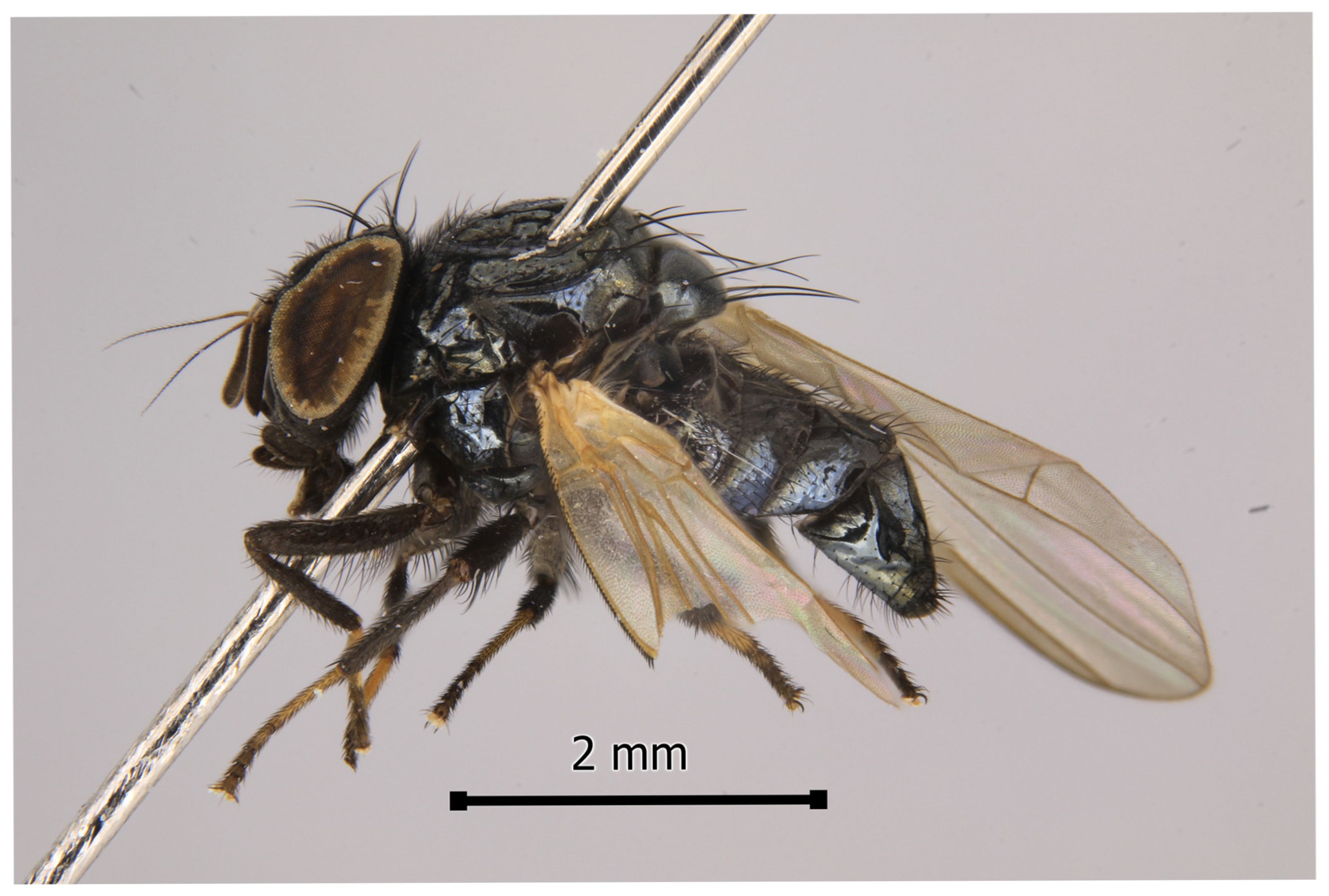
Description. Holotype, Male. Head: Eye bare. Frons at narrowest point above lunule approximately 0.6× width of eye, dull black, covered with light grey dusting, frontal and interfrontal setulae approximately 0.2× length of orbital seta. Orbital plate sub-shining black, dulled by microsculpture, bare apart from orbital seta. Lunule ground colour black with a slight silver dusting, face and parafacial light-grey dusted: anterior genal setulae forming a single row of three–four along the mouth margin. Antenna: scape black, pedicel slightly brownish, postpedicel black with inner surface broadly orange basally and along ventral margin, length to depth ratio 3.0:1, reaching just past mouth margin. Arista orange basally, pubescent.
Thorax: Scutum shining blue-black. Anepisternum mainly shining blue-black with two setae in a vertical row along the posterior margin, one anterior seta, and the remainder of this sclerite with scattered setulae approximately 0.5× as long as the setae. Proepisternum and proepimeron each with a single seta. Katepisternum lightly dusted, with one strong seta located near the dorsal margin, and a few scattered short setulae positioned anterior to this seta. Anepimeron lightly dusted, bare. Scutellum and pre-scutellar area of thorax lightly dusted, rather brassy-black, margin in addition to four strong setae (two broken and missing), with two setulae between apical and lateral setae on the right, one on the left, two between apical setae, these all approximately 0.3× length of the apical setae. Calypter pale yellow with a concolorous marginal fringe of uniform length. Wing: length 3.6 mm, veins light-brown, membrane clear. Legs black, basal and at least the base of the second tarsomere of each leg yellow, covered by small black setulae, apical segments darkened, ventral fringe of short, stiff golden setulae on basal tarsomeres of anterior and posterior legs.
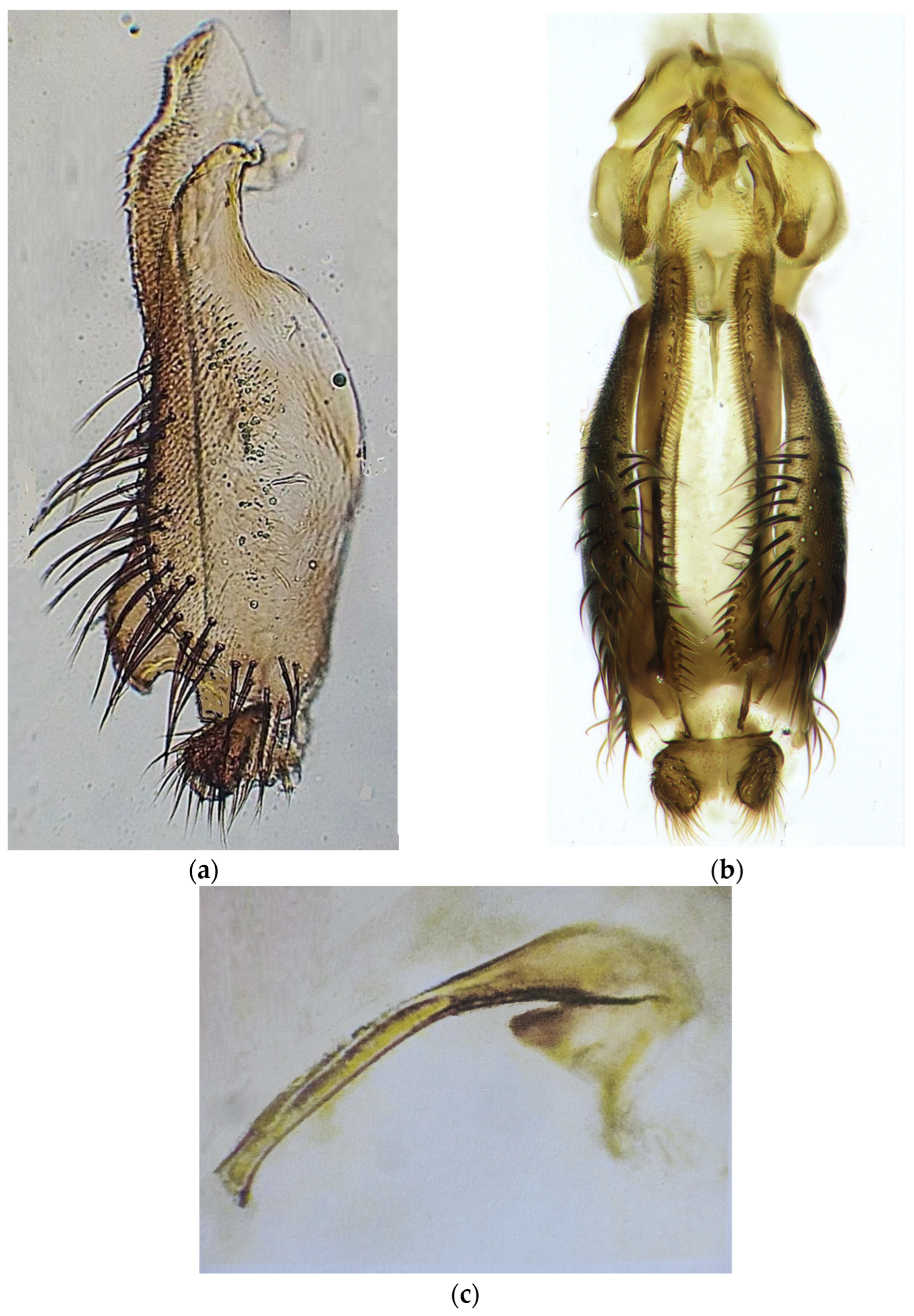
Abdomen: Sternite 1 bare. Apical tergite with a dense brush of short setae on each side of the apex. Male terminalia: in lateral view, epandrium 2.5× as high as wide, very long, strong setae along ventral margin, slightly shorter on posterior margin, narrowed and slightly recurved apically. Cercus somewhat rectangular, 0.2× height of epandrium, slightly sclerotized ventrally, covered in short, quite thick setulae. Surstylus extended posteriorly beyond the shell of the epandrium as a large, rounded process, the posterior margin of which has an obvious semi-circular excavation, extended anteriorly as a truncate projection, ventral margin lined with short stiff setulae, these stronger and more obvious posteriorly. Inner surface of surstylus with a posterior—anterior broad band of micro-spicules running from posterior margin to apical projection, between this and ventral margin with a scattered row of approximately 20 short setae. Pregonite a simple rod with a covering of small setulae on the base. Phallus partially bi-segmented, in lateral view, basiphallus boat-shaped with a large, cone-shaped basal lobe, distiphallus slightly longer than basiphallus, almost straight with an expanded apex.
Female: female specimens from Guadeloupe of the same size and same overall morphology and colouration as the male of L. desirade are considered to be conspecific. With slightly shorter pilosity and lacks the brush of short setae on the apical tergite. Ratio of frons width above the lunule to eye width approximately 1:1. Apical segment of aculeus bullet-shaped, approximately 2× as long as wide, with a pair of dorsobasal setulae less than 0.5× length of segment and a pair of apicoventral setae approximately 0.8× length of segment.
Type material. Holotype ♂, GUADELOUPE: La Désirade, Beauséjour/Latanier (Plateau du Calvaire), PCA-PVB, 16.313° N 61.075° W, 23 October 2024–11 November 2024, 136 m, Polyvie bleu, leg. Jourdan, T, & Poirier, E. Specimen number MNHN-ED15285, La Planète Revisitée.
Paratypes: With the same data as the holotype: 1 ♂ specimen number MNHN-ED15286. 1 ♂ 2 ♀ specimen numbers INRAE Antilles-Guyane, 27523, 27524 £ 27526. 1 ♀ specimen number NMS-10033156.
1. ♂ La Désirade, Grand Bassin, 16.324° N 61.047° W, 22 October 2024–10 November 2024, PVB, leg. Jourdan, T, & Poirier, E. Specimen number NMS-10033165.
1. ♀ La Désirade, Les Sables (Les Salines), SAL-PVB, 16.298° N 61.085° W, 21 October 2024–9 November 2024, 1 m, MAL Piĕge Malaise, T, leg. Jourdan, T, & Poirier, E. Specimen number MNHN-ED15287, La Planète Revisitée.
Species: LSIDurn:lsid:zoobank.org:act:CDF3AC51-DF21-4336-B0D7-0F9C0D7F36F8.
Etymology: The specific epithet refers to the island of La Désirade from which the type series was collected.
Diagnosis: Using the key to Neotropical
Lonchaea species of Luna [
3], this species, with its bare arista, basal tarsomere yellowish, proepimeron with one seta, calypter clear yellow with a uniform fringe, postpedicel yellowish brown on medial base and at least half the medial margin, would lead to a group including
Lonchaea aculeata Bezzi, 1910 and
L. pseudoaculeata Luna, 1988. It is however clearly distinct from these two species in terms of the length of the antennal postpedicel and in the structures of the male genitalia.
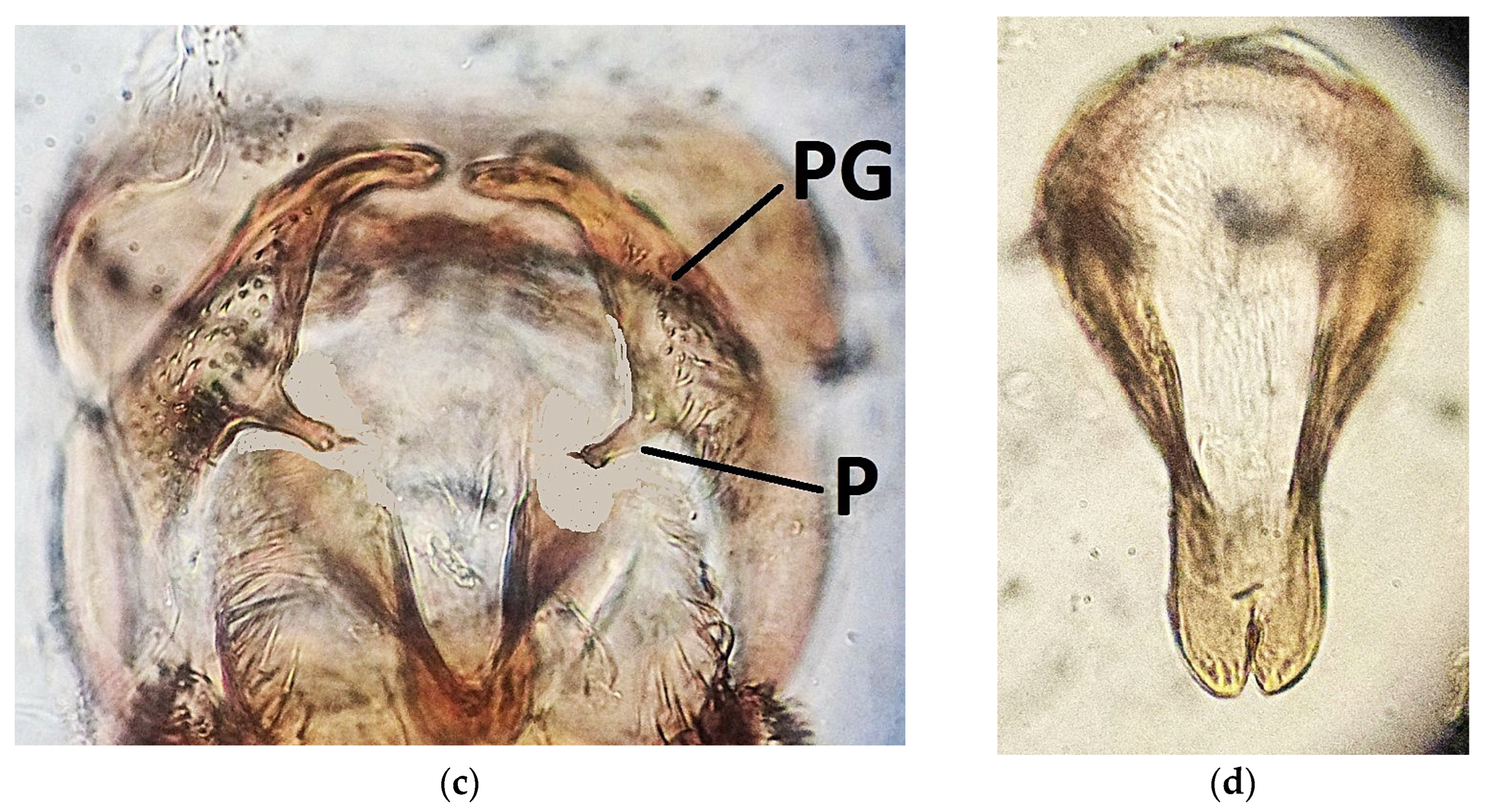
As with most Lonchaea species, the structures of the male genitalia are essential in determining species-level identification. In this case, the posterior projection of the surstylus with its large semi-circular excavation and the shape of the phallus with its cone-shaped basal lobe serve to clearly distinguish it from similar species. The group of short lateral setae at each side of the apical tergite is also a useful indicator for this species.
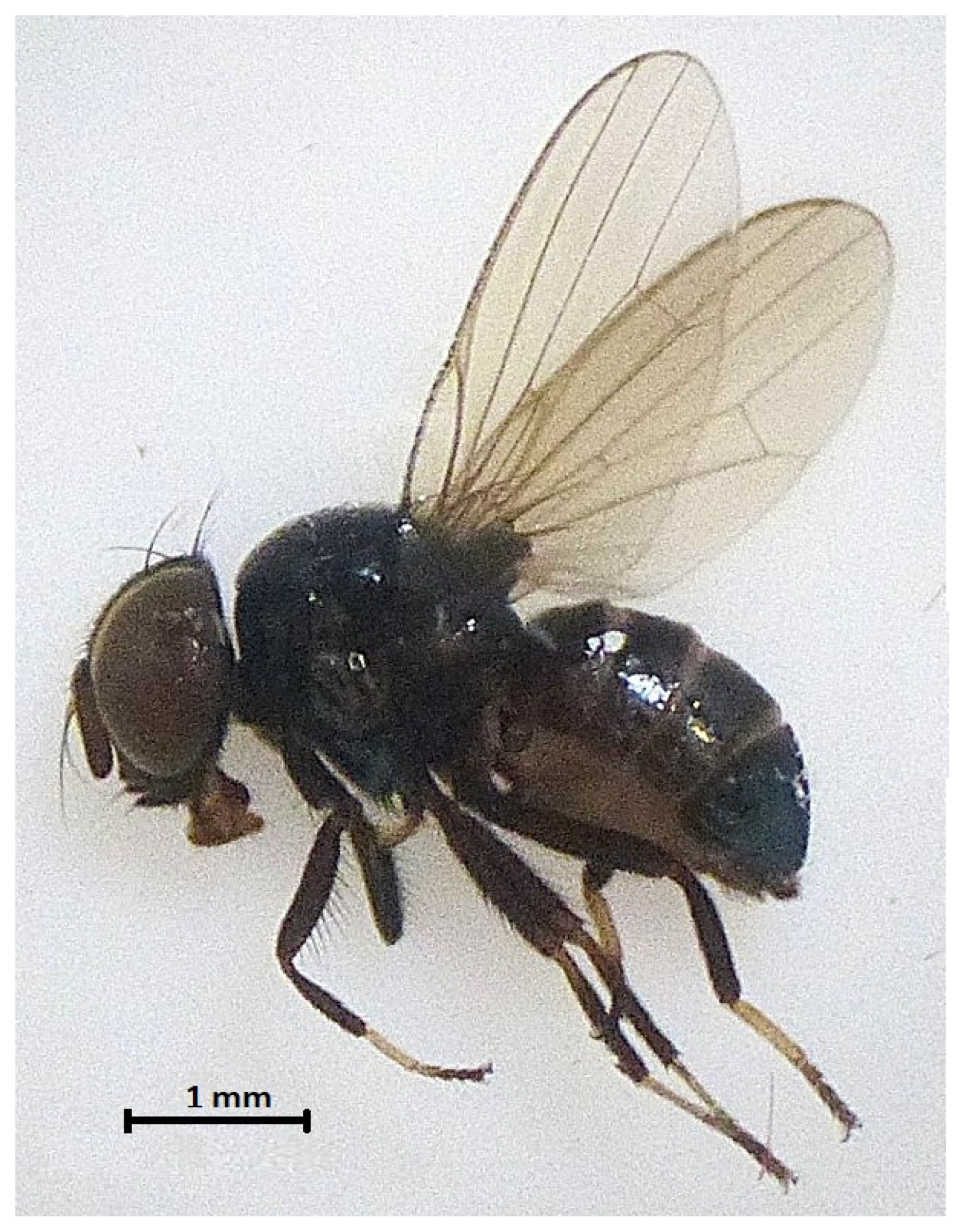
Description. Holotype, Male. Head: Eye bare. Frons, at narrowest point above lunule, approximately 0.4× width of eye, matt black covered with dense grey dusting, frontal and interfrontal setulae approximately 0.2× length of orbital seta. Orbital plate dulled by microsculpture, bare apart from the orbital seta. Lunule ground colour black, covered with silver pollinosity, face and parafacials lightly silver dusted. Anterior genal setulae form a single row of four along mouth margin. Antenna: scape and pedicel black, postpedicel black but broadly orange on medial base, this colouration extending along all of ventral margin, length to depth ratio 2.5:1. Arista entirely black, pubescence at maximum extent equaling width of arista at its base.
Thorax: Scutum shining blue-black. Anepisternum shining blue-black with two setae in a vertical row along the posterior margin, one anterior seta located near the dorsal margin, and the remainder of this sclerite with scattered setulae. Proepisternum with a single seta, proepimeron with a single weaker seta. Katepisternum with a single strong seta located near dorsal margin, positioned anterior to the seta, two setulae of almost the same length, a line of five–six setulae along the anterior margin; otherwise, sclerite bare and shining black. Anepimeron bare. Scutellum with the usual four strong marginal setae, these longer than the length of the scutellum, two setulae between apical and lateral setae on right side, one broken setula on left side, no setulae between apical setae, all these setulae approximately 0.25× length of marginal setae. Calypter whitish with a concolorous marginal fringe of uniform length. Wing: length 2.25 mm, veins light-brown, membrane clear but covered with numerous microtrichia. Legs black, basal and at least base of second tarsomere of each leg yellow, apical segments darkened, ventral fringe of short, stiff golden setulae on basal and second tarsomeres of fore and hind legs.
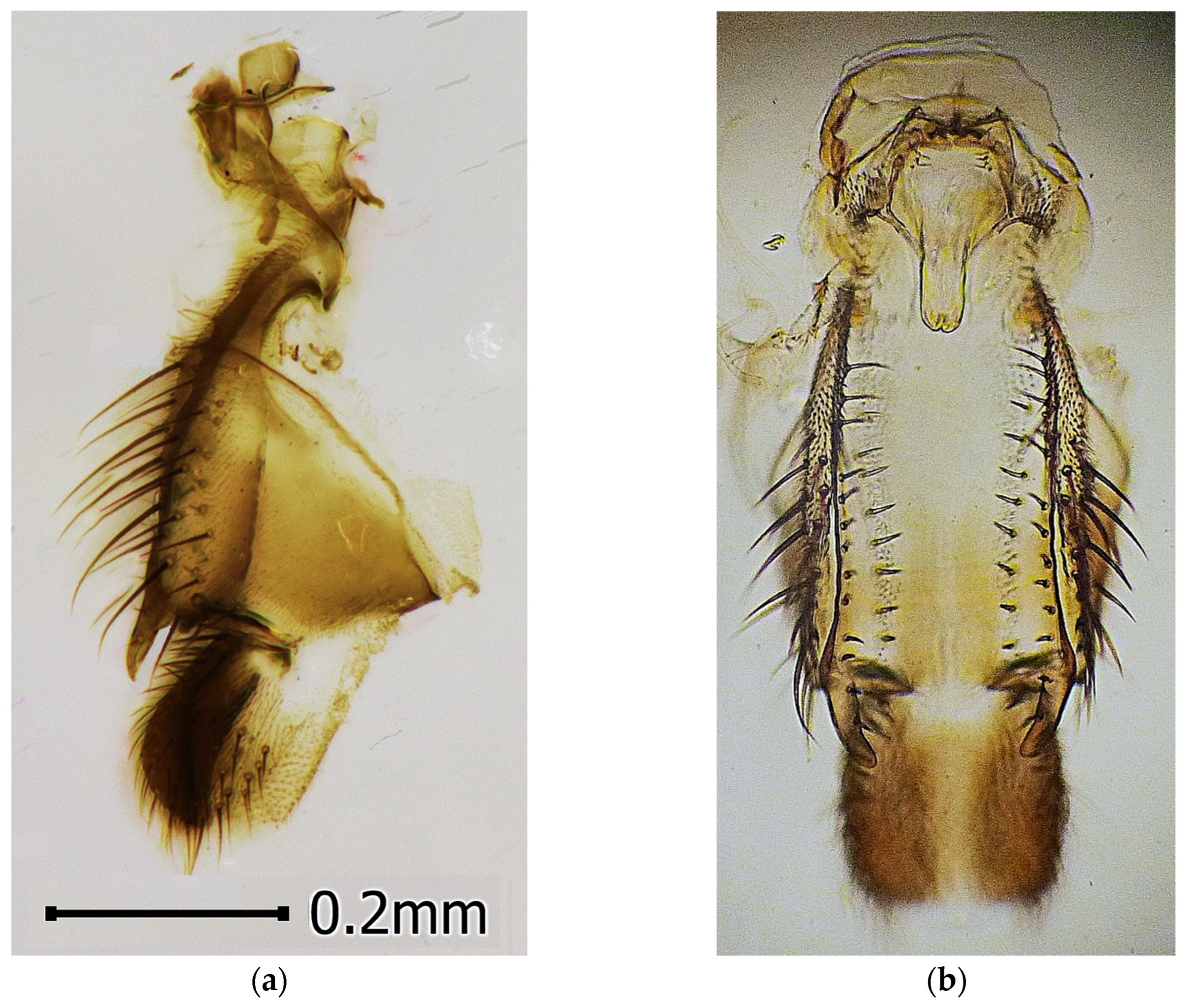
Abdomen: Sternite 1 bare. Male terminalia: In the lateral view, epandrium approximately 0.8× as wide as high, with long, strong setae along ventral margin. Cercus roughly triangular in shape, 0.6× height of epandrium; slightly sclerotized on ventral half, bearing long stiff setulae at ventral base with finer long setulae apically and posteriorly. Surstylus extended posteriorly beyond shell of epandrium as a slender thorn-like process, reaching to almost half height of cercus; at base of posterior process, a medially directed process which itself bears a smaller posteriorly directed blunt-ended process bearing an apical seta. Inner surface of surstylus with an anterior–posterior linear row of 8 well-spaced setulae, placed on a wider row of numerous small spicules. Pregonite covered in small, black setulae, narrowed towards a slightly recurved apex, with a finger-like interior process which bears a few apical setulae. Phallus a simple small boat-like structure, broadly rounded with a central apical slit, similar to the type of phallus found in the genus Dasiops.
Female: female specimens from Guadeloupe of the same very small size and of the same overall morphology and colouration as the male of L. minutissima are considered to be conspecific. These show the usual female characters of slightly shorter pilosity and a wider frons. Apical segment of aculeus bullet-shaped, with a pair of very short dorsobasal and apicoventral setae.
Type material. Holotype: ♂, GUADELOUPE: Marie-Galante, Capesterre-de-Marie-Galante (Nesmond), NES-PVB, 15.930° N 61.231° W, 16 October 2024–24 October 2024, 128 m, Polyvie bleu, leg. Jourdan, T, & Poirier, E. Specimen number MNHN-ED15285, La Planète Revisitée.
Paratypes: With the same data as the holotype—2 ♂ specimen numbers: NMS-10033129 & NMS-10033147. 2 ♂ 7 ♀ specimens, specimen numbers: MNHN-ED-15289, MNHN-ED-15290, MNHN-ED-15291, MNHN-ED-15292, MNHN-ED-15293, MNHN-ED-15294, MNHN-ED-15295, MNHN-ED-15296, MNHN-ED-15297. 1 ♂ 3 ♀ specimens, specimen numbers: INRAE Antilles-Guyane: 27526, 27527, 27528 & 27529.
1 ♂ Les Saintes (Terre-de-Bas), Grande Anse (Morne Sec) (seep with rocks in canopied dry forest), 15.858° N 61.635° W, 8 October 2024, (M)SW, leg. Pollet, M., specimen number: NMS-10033138.
Species: LSIDurn:lsid:zoobank.org:act:C648FEA2-602C-4D91-8F20-4433A4129D8A.
Etymology: The specific epithet refers to the very small size of this species.
Diagnosis: Using the key to Neotropical
Lonchaea species by Luna [
3], this species shares similar characters to
Lonchaea desirade sp. nov. and keys out to couplets which include
L. aculeata and
L. pseudoaculeata. Apart from its diminutive size, this species is distinguished by features of the male genitalia, in particular the thorn-like posterior process of the surstylus, the regular linear row of setae on the inner surface of the surstylus, the small, wide phallus with a blunt apex and the pregonite with a finger-like medial process. The combination of these features makes this species clearly distinct from any other described
Lonchaea.