
An Overview of the Tabanidae (Diptera) of Uruguay

 , , , , , and
Abstract
1. Introduction
Historical Synopsis of Tabanidae Taxonomy in Uruguay
2. Materials and Methods
2.1. Data Sources and Literature Review
2.2. Taxonomic Identification and Specimen Examination
2.3. Data Management and Statistical Analysis
2.4. Acronyms of the Institutions
3. Results and Discussion
3.1. Uruguayan Tabanidae Fauna
3.2. Authors of Uruguayan Species of Tabanidae
3.3. Type Specimens
3.4. Male and Immature Specimens
3.5. Tabanidae Distribution
3.6. Updated Records of Uruguayan Tabanidae
3.7. Unrecognized Tabanidae
3.8. Future Perspectives and Gaps
3.9. Identification of Tabanidae
4. Conclusions
Supplementary Materials
Author Contributions
Funding
Data Availability Statement
Acknowledgments
Conflicts of Interest
Appendix A

| Nº | Species | Uruguayan Department’s Previous Records | Uruguayan Department’s New Records | Distribution | Comments |
|---|---|---|---|---|---|
| 1 | Chrysops berta Pechuman | Río Negro | - | Argentina, Brazil, Uruguay (Río Negro) | Henriques (2016: 163) [67] |
| 2 | Chrysops brevifascia Lutz | Artigas, Tacuarembó | - | Argentina, Bolivia, Brazil, Paraguay, Uruguay (Artigas, Tacuarembó) | Coscarón & Martínez (2019: 41) [43] and Lucas et al. (2020) [44] |
| 3 | Chrysops flinti Coscarón | Montevideo | - | Argentina, Uruguay (Montevideo) | Coscarón (1979: 376) [42]. Paratypes (MLPA) from Montevideo, Carrasco |
| 4 | Chrysops lutzi Kröber | Montevideo | Durazno | Argentina, Brazil, Paraguay, Peru, Uruguay (Durazno, Montevideo) | Previous records in Stone (1944: 126) [49], as crucians subspecies. New record from FCE |
| 5 | Chrysops lynchii Brèthes | Río Negro, Treinta y Tres | Soriano | Argentina, Bolivia, Brazil, Paraguay, Uruguay (Río Negro, Soriano, Treinta y Tres) | New record from FCE |
| 6 | Chrysops nigricorpus Lutz | Montevideo | Artigas | Argentina, Brazil, Paraguay, Uruguay (Artigas, Montevideo) | New record from FCE |
| 7 | Chrysops patricia Pechuman | Tacuarembó | - | Argentina, Bolivia, Brazil, Paraguay, Uruguay (Tacuarembó) | Previous records summarized in Coscarón & Martínez (2019: 41) [43] |
| 8 | Chrysops trisignatus Kröber | Cerro Largo, Montevideo | - | Uruguay (Cerro Largo, Montevideo) | Fairchild (1967: 340) [82] |
| 9 | Chrysops uruguayensis Lutz | Tacuarembó | - | Argentina, ?Paraguay, Uruguay (Tacuarembó) | Lutz (1909: 687) [40]. Lectotype (IOC) from Tacuarembó |
| 10 | Chrysops varians Wiedemann | Montevideo, Rivera, Treinta y Tres | - | Argentina, Brazil, Colombia, Ecuador, Guyana, Panama, Paraguay, Perú, Trinidad, Uruguay (Montevideo, Rivera, Treinta y Tres), Venezuela | Previous records in Coscarón & Martínez (2019: 42) [43] |
| 11 | Chrysops variegatus (De Geer) | Without locality | - | Neotropical | Henriques (2016: 166) [67]. In a list without locality |
| 12 | Esenbeckia esenbeckii (Wiedemann) | Without locality | Argentina, Brazil, Paraguay, Uruguay | Coscarón (1976: 104) [57], without locality | |
| 13 | Scepsis appendiculata (Macquart) | Maldonado, Montevideo | - | ?Argentina, Brazil, Uruguay (Maldonado, Montevideo) | Previous records in Coscarón & Martínez (2019: 42) [43]. Records of living specimens in the Inat: https://www.inaturalist.org/observations/263157307; https://www.inaturalist.org/observations/262045756 accessed on 1 April 2026 |
| 14 | Fidena abominata Philip | Without locality | - | Argentina, Brazil, Uruguay | Coscarón (1998: 349) [27]. In a list without locality |
| 15 | Fidena marginalis (Wiedemann) | - | Rocha | Brazil, Uruguay (Rocha) | First record for country by https://www.inaturalist.org/observations/264871220 accessed on 1 April 2026. Male undescribed, first record from https://www.inaturalist.org/observations/201851013 accessed on 1 April 2026. Species treated in Gorayeb (2025: 247-249) [69] |
| 16 | Fidena sorbens (Wiedemann) | Artigas, Montevideo, Rocha, Salto | - | Argentina, Bolívia, Brazil, Paraguay, Uruguay (Artigas, Montevideo, Rocha, Salto) | Wiedemann (1828: 93) [31]. Lectotype (NMW) from Montevideo. Various records see in Coscarón & Martínez (2019: 42) [43] |
| 17 | Acanthocera exstincta (Wiedemann) | Artigas, Montevideo | - | Argentina, Uruguay (Artigas, Montevideo) | Wiedemann (1828: 214) [31]. Lectotype (NMW) from Montevideo. Another record in Coscarón & Martínez (2019: 42) [43] |
| 18 | Catachlorops flavus (Wiedemann) | Montevideo | - | Argentina, Brazil, Paraguay, Uruguay (Montevideo) | Wiedemann (1828: 163) [31]. Lectotype (NMW) from Montevideo |
| 19 | Catachlorops circumfusus (Wiedemann) | Maldonado, Tacuarembó | - | Brazil, Paraguay, Uruguay (Maldonado, Tacuarembó) | Maldonado is type-locality of Tabanus pictipennis Macquart, 1850, actually a synonym of C. circumfusus. Lucas et al. (2020: 2) [44] |
| 20 | Catachlorops psolopterus (Wiedemann) | Montevideo | - | Brazil, Uruguay (Montevideo) | Wiedemann (1828: 181) [31]. Lectotype (NMW) from Montevideo |
| 21 | Catachlorops muscosus (Enderlein) | Tacuarembó | - | Argentina, Brazil, Uruguay (Tacuarembó) | Coscarón & Martínez (2019: 43) [43] |
| 22 | Chlorotabanus parviceps (Kröber) | Rivera, Rocha | - | Argentina, Brazil, Guyana, Paraguay, Perú, Uruguay (Rivera, Rocha) | Coscarón (1976: 50) [58] |
| 23 | Dasybasis alticola (Enderlein) | Rocha | - | Argentina, Uruguay (Rocha) | Coscarón & Martínez (2019: 43) [43] |
| 24 | Dasybasis missionum (Macquart) | Colonia, Tacuarembó | Rocha, Soriano | Argentina, Brazil, Uruguay (Colonia, Rocha, Soriano, Tacuarembó) | Lucas et al. (2020: 4) [44]. New record from FCE |
| 25 | Dasybasis ornatissima (Brèthes) | Tacuarembó | - | Argentina, Uruguay (Tacuarembó) | Lucas et al. (2020: 4) [44] |
| 26 | Dasybasis trigonophora (Macquart) | Montevideo | ?Soriano | Argentina, Uruguay (Montevideo, ?Soriano) | Macquart (1838: 185) [33]. Holotype (MNHNP) from Montevideo. We identified a series of specimens from Soriano (FCE) as Dasybasis aff. trigonophora |
| 27 | Dichelacera multiguttata Lutz | Tacuarembó | - | Argentina, Brazil, Uruguay (Tacuarembó) | Henriques (2016: 168) [67] |
| 28 | Dichelacera rubricosa (Wulp) | - | Rivera | Argentina, Brazil, Uruguay (Rivera) | New record by Coscarón (1974: 238) [55] |
| 29 | Dichelacera unifasciata Macquart | Cerro Largo, Rivera, Tacuarembó | - | Argentina, Bolivia, Brazil, Paraguay, Uruguay (Cerro Largo, Rivera, Tacuarembó) | Coscarón & Martínez (2019: 43) [43] and Lucas et al. (2020) [44] |
| 30 | Lepiselaga albitarsis Macquart | Artigas, Rocha | - | Argentina, Brazil, Paraguay, Uruguay (Artigas, Rocha) | Coscarón & Martínez (2019: 43-44) [43] |
| 31 | Lepiselaga crassipes (Fabricius) | - | Artigas | Mexico to Uruguay (Artigas) | First record for country by https://www.inaturalist.org/observations/108513901 accessed on 1 April 2026 |
| 32 | Stenotabanus brunnipennis Kröber | Montevideo | - | Uruguay (Montevideo) | Kröber (1930: 78) [38]. Holotype (ISTH—destroyed) from Montevideo |
| 33 | Stibasoma theotaenia (Wiedemann) | Montevideo | - | Argentina, Brazil, Paraguay, Uruguay (Montevideo) | Wiedemann (1828: 136) [31]. Lectotype (NMW) from Montevideo. See Turcatel et al. (2010: 36) [81] |
| 34 | Stypommia minor (Macquart) | Montevideo, Rocha | Artigas, Flores, Soriano | Argentina, Uruguay (Artigas, Flores, Montevideo, Rocha, Soriano) | Previous records in Coscarón & Martínez (2019: 43) [43]. New record from FCE |
| 35 | Poeciloderas lindneri (Kröber) | Cerro Largo, Colonia, Montevideo, Río Negro, Paysandú, Tacuarembó, Treinta y Tres | Artigas, Soriano | Argentina, Brazil, Paraguay, Uruguay (Artigas, Cerro Largo, Colonia, Montevideo, Paysandú, Río Negro, Soriano, Tacuarembó, Treinta y Tres) | Montevideo is type-locality of Agelanius maculipennis Enderlein, actually a synonym of P. lindneri. Previous records in Coscarón & Martínez (2019: 44) [43] and Lucas et al. (2020) [44]. New record from FCE |
| 36 | Poeciloderas quadripunctatus (Fabricius) | Artigas, Cerro Largo, Río Negro, Tacuarembó | - | Mexico to Argentina, Uruguay (Artigas, Cerro Largo, Río Negro, Tacuarembó) | Previous records in Coscarón & Martínez (2019: 44) [43] and Lucas et al. (2020) [44] |
| 37 | Tabanus acer Brèthes | Cerro Largo, Maldonado, Tacuarembó | Soriano | Argentina, Brazil, Uruguay (Cerro Largo, Maldonado, Soriano, Tacuarembó) | Previous records in Coscarón & Martínez (2019: 44) [43] and Lucas et al. (2020) [44]. New record from FCE |
| 38 | Tabanus angustus Macquart | Cerro Largo, Maldonado, Montevideo, Tacuarembó | Soriano | Argentina, Uruguay (Cerro Largo, Maldonado, Montevideo, Soriano, Tacuarembó) | Macquart (1838: 140) [33]. Holotype (MNHNP) from Montevideo. Previous records in Coscarón & Martínez (2019: 44) [43]. New record from FCE |
| 39 | Tabanus campestris Brèthes | Paysandú, Río Negro, Tacuarembó | Artigas, Soriano | Argentina, Uruguay (Artigas, Paysandú, Río Negro, Soriano, Tacuarembó) | “Uruguay” is type-locality of Atylotus rubescens Bigot, actually T. campestris. Previous records in Coscarón & Martínez (2019: 44) [43] and Lucas et al. (2020) [44]. New record from FCE |
| 40 | Tabanus charrua Coscarón | - | Uruguay (Río Negro) | Argentina, Bolivia, Uruguay (Río Negro) | First record for country from FCE |
| 41 | Tabanus claripennis (Bigot) | Artigas, Colonia, Montevideo, Río Negro, Rocha, Tacuarembó | Soriano | West Indies, Costa Rica to Paraguay, Argentina, Brazil, Chile, Uruguay (Artigas, Colonia, Montevideo, Río Negro, Rocha, Soriano, Tacuarembó) | Previous records in Coscarón & Martínez (2019: 44) [43] and Lucas et al. (2020) [44]. New record from FCE |
| 42 | Tabanus corpulentus Brèthes | Without locality | - | Argentina, Brazil, Paraguay, Uruguay | Coscarón (1998: 352) [27]. In a list without locality |
| 43 | Tabanus fuscofasciatus Macquart | Cerro Largo, Colonia, Montevideo, Paysandú, Río Negro, Rivera, Tacuarembó | Artigas, Soriano | Argentina, Bolivia, Brazil, Paraguay, Uruguay (Artigas, Cerro Largo, Colonia, Montevideo, Paysandú, Río Negro, Rivera, Soriano, Tacuarembó) | Previous records in Coscarón & Martínez (2019: 44-45) [43] and Lucas et al. (2020) [44]. New record from FCE |
| 44 | Tabanus fuscus Wiedemann | Montevideo, Tacuarembó | - | Argentina, Brazil, Uruguay (Montevideo, Tacuarembó) | Montevideo is type-locality of Tabanus impressus Wiedemann and Tabanus monochroma Wiedemann, synonyms of T. fuscus. Previous records in Coscarón & Martínez (2019: 45) [43] and Lucas et al. (2020) [44] |
| 45 | Tabanus occidentalis Linnaeus | Montevideo | - | Mexico to Argentina, Uruguay (Montevideo) | Brèthes (1907: 284) [35] |
| 46 | Tabanus ornativentris (Kröber) | Río Negro | - | Argentina, Bolivia, Brazil, Uruguay (Río Negro) | Henriques (2016: 181) [67] as Tabanus nebulosus ssp. ornativentris (Kröber, 1929) [46]. Species revalidated by Krolow et al. (2024) [68] |
| 47 | Tabanus platensis Brèthes | - | Artigas, Rio Negro, Soriano | Argentina, Uruguay (Artigas, Rio Negro, Soriano) | First record for country from FCE. Specimens identified as T. aff. platensis in Lucas et al. (2020) [44] remain undetermined. See discussion in Krolow et al. (2022: 449-451) [45] |
| 48 | Tabanus pungens Wiedemann | Artigas, Montevideo, Tacuarembó, Treinta y Tres | Soriano | U.S.A. (Texas), Neotropics (except West Indies and Chile), Trinidad, Uruguay (Artigas, Montevideo, Soriano, Tacuarembó, Treinta y Tres) | Wiedemann (1828: 175) [31]. Holotype (NMW) from Montevideo. Previous records in Coscarón & Martínez (2019: 45) [43] and Lucas et al. (2020) [44]. New record from FCE |
| 49 | Tabanus sorbillans Wiedemann | Río Negro | Soriano | Brazil, Colombia, Paraguay, Trinidad, Uruguay (Río Negro, Soriano), Venezuela | Henriques (2016: 183) [67]. New record from FCE |
| 50 | Tabanus tacuaremboensis Krolow, Lucas & Henriques | Paysandú, Tacuarembó | - | Uruguay (Paysandú and Tacuarembó) | Krolow et al. (2022: 453 -455) [45] |
| 51 | Tabanus triangulum Wiedemann | Artigas, Cerro Largo, Colonia, Montevideo, Río Negro, Rivera, Rocha, Tacuarembó | Soriano | Argentina, Bolivia, Brazil, Paraguay, Uruguay (Artigas, Cerro Largo, Colonia, Montevideo, Río Negro, Rivera, Rocha, Soriano, Tacuarembó) | Previous records in Coscarón & Martínez (2019: 45) [43] and Lucas et al. (2020) [44]. New record from FCE |
| 52 | Tabanus varipes Walker | Maldonado | - | Uruguay (Maldonado) | Walker (1837: 33) [32]. Holotype (BMNH) from Uruguay, Isla de Gorriti. Krolow et al. (2022: 448–449, Figures) [45]. |
References
- Fairchild, G.B. Tabanidae. In Aquatic Biota of South America, Part 1, Arthropoda; Hurlbert, S.H., Rodriguez, C., Santos, N.D., Eds.; San Diego State University: San Diego, CA, USA, 1981; pp. 290–301. [Google Scholar]
- Medem, F. Horse flies (Diptera: Tabanidae) as ectoparasites on caimans (Crocodylia: Alligatoridae) in eastern Colombia. Cespedesia 1981, 10, 123–191. [Google Scholar]
- Philip, C.B. A collection of four species of tabanid flies taken from an anaconda snake in Peru in May, 1984. Pan-Pac. Entomol. 1986, 62, 23. [Google Scholar]
- Henriques, A.L.; Ferreira-Keppler, R.L.; Vidal, J.F.; Rafael, J.A. Betrequia ocellata Oldroyd (Diptera, Tabanidae, Rhinomyzini) blood feeding on Caiman crocodilus (Linnaeus) (Crocodylia, Alligatoridae) in Manaus, Brazil. Rev. Bras. Zool. 2000, 17, 609–613. [Google Scholar] [CrossRef]
- Ferreira, R.L.M.; Henriques, A.L.; Rafael, J.A. Activity of tabanids (Insecta: Diptera: Tabanidae) attacking the reptiles Caiman crocodilus (Alligatoridae) and Eunectes murinus (Linn.) (Boidae) in the Central Amazon, Brazil. Mem. Inst. Oswaldo Cruz 2002, 97, 133–136. [Google Scholar] [CrossRef]
- Limeira-De-Oliveira, F.; Rafael, J.A.; Henriques, A.L. Phorcotabanus cinereus (Wiedemann, 1821) (Diptera: Tabanidae) an ornithophilic species of tabanid in Central Amazon, Brasil. Mem. Inst. Oswaldo Cruz 2002, 97, 839–842. [Google Scholar] [CrossRef] [PubMed]
- Gorayeb, I.S.; Campos, C.E.C. Tabanidae (Diptera) of the Amazon. XXII. First record of horse flies attacking golden tegu, Tupinambis teguixin Linnaeus 1758 (Reptilia: Squamata: Teiidae). Bol. Mus. Para. Emílio Goeldi Ciênc. Nat. 2018, 13, 157–160. [Google Scholar] [CrossRef]
- Ferreira-Keppler, R.L.; Guerrero, J.C.H.; Martins, R.T.; Rafael, K.A. Tabanidae (Diptera: Insecta) attacking Tapirus terrestris (Linnaeus) (Mammalia: Tapiridae) in Central Amazon, Brazil. An. Acad. Bras. Cienc. 2025, 97, e20241265. [Google Scholar] [CrossRef]
- Pechuman, L.L.; Teskey, H.J. Tabanidae. In Manual of Nearctic Diptera; McAlpine, J.F., Wood, D.M., Eds.; Research Branch Agriculture Canada: Ottawa, ON, Canada, 1989; pp. 463–478. [Google Scholar]
- Johnson, S.D.; Morita, S.I. Floral deception in an orchid pollinated by long proboscid flies. Bot. J. Linn. Soc. 2006, 152, 271–278. [Google Scholar] [CrossRef]
- Corbet, P.S.; Haddow, A.J. Diptera swarming high above the forest canopy in Uganda, with special reference to Tabanidae. Trans. R. Entomol. Soc. Lond. 1962, 114, 267–284. [Google Scholar] [CrossRef]
- Krolow, T.K.; Henriques, A.L.; Rafael, J.A. Tabanidae (Diptera) no dossel da floresta amazônica atraídos por luz e descrição de machos de três espécies. Acta Amazon. 2010, 40, 605–612. [Google Scholar] [CrossRef]
- Buestán, J.; Brito Vera, G.A. Atypical case of sex ratio disruption in Tabanidae collections with Malaise traps in Ecuadorian forests. Biologia 2024, 80, 117–123. [Google Scholar] [CrossRef]
- Horváth, G.; Pereszlényi, Á.; Egri, Á.; Fritz, B.; Guttmann, M.; Lemmer, U.; Gomard, G.; Kriska, G. Horsefly reactions to black surfaces: Attractiveness to male and female tabanids versus surface tilt angle and temperature. Parasitol. Res. 2020, 119, 2399–2409. [Google Scholar] [CrossRef]
- Krinsky, W.L. Animal disease agents transmitted by horse flies and deer flies (Diptera: Tabanidae). J. Med. Entomol. 1976, 13, 225–275. [Google Scholar] [CrossRef]
- Foil, L.D. Tabanids as vectors of disease agents. Parasitol. Today 1989, 5, 88–96. [Google Scholar] [CrossRef]
- Baldacchino, F.; Desquesnes, M.; Mihok, S.; Foil, L.D.; Duvallet, G.; Jittapalapong, S. Tabanids: Neglected subjects of research, but important vectors of disease agents! Infect. Genet. Evol. 2014, 28, 596–615. [Google Scholar] [CrossRef]
- Bilheiro, A.B.; Camargo, J.S.A.A.; Zamarchi, T.B.O.; Tonholo, C.; Bassin, H.C.M.; Sussuarana, I.T.A.; Henriques, A.L.; Camargo, L.M.A. Survey of Trypanosoma (Kinetoplastida: Trypanosomatidae) infection in Monte Negro municipality, State of Rondonia, Western Amazon, with first record of T. evansi in the state. Rev. Soc. Bras. Med. Trop. 2019, 52, e20190270. [Google Scholar] [CrossRef]
- Rodrigues, G.D.; Blodorn, E.; Zafalon-Silva, A.; Domingues, W.; Marques, R.; Krolow, T.K.; Greif, G.; Campos, V.F.; Krüger, R.F. Molecular detection of Trypanosoma kaiowa in Tabanus triangulum (Diptera: Tabanidae) from the Coastal Plain of Rio Grande do Sul, Southern Brazil. Acta Parasitol. 2021, 67, 518–522. [Google Scholar] [CrossRef] [PubMed]
- Rodrigues, G.D.; Lucas, M.; Ortiz, H.G.; Gonçalves, L.S.; Blodorn, E.; Domingues, W.B.; Nunes, L.S.; Saravia, A.; Parodi, P.; Riet-Correa, F.; et al. Molecular of Anaplasma marginale Theiler (Rickettsiales: Anaplasmataceae) in horseflies (Diptera: Tabanidae) in Uruguay. Sci. Rep. 2022, 12, 22460. [Google Scholar] [CrossRef]
- Ramos, J.R.R.; Franco, C.S.; Luz, S.P.; Marques, J.; Souza, K.M.; Nascimento, L.F.N.; Neves, G.B.; Moreira, R.S.; Miletti, C. First record of Trypanosoma evansi DNA in Dichelacera alcicornis and Dichelacera januarii (Diptera: Tabanidae) flies in South America. Parasit. Vectors 2023, 16, 4. [Google Scholar] [CrossRef] [PubMed]
- González, C.R.; Reyes, C.; Castillo, A.; Valderrama, L.; Llanos, L.; Fernández, J.; Eastwood, G.; Cancino-Faure, B. Molecular evidence of pathogens and endosymbionts in the black horse fly Osca lata (Diptera: Tabanidae) in Southern Chile. PLoS Negl. Trop. Dis. 2024, 18, e0012525. [Google Scholar] [CrossRef] [PubMed]
- Morales, D.F.; Parodi, P.; Reis, L.F.F.; Nascimento, M.C.; Rodrigues, G.D.; Nunes, L.S.; Menchaca, A.; Riet-Correa, F.; Krolow, T.K.; Lucas, M.; et al. First molecular detection of Babesia bigemina in horseflies from Uruguay. Acta Trop. 2025, 264, 107595. [Google Scholar] [CrossRef]
- Evenhuis, N.L.; Pape, T. (Eds.) Systema Dipterorum (version 3.1, May 2021). In Species 2000 & ITIS Catalogue of Life; Naturalis: Leiden, The Netherlands, 2026. [Google Scholar]
- Coscarón, S.; Papavero, N. Catalogue of Neotropical Diptera. Tabanidae. Neotrop. Diptera 2009, 16, 1–199. [Google Scholar]
- Henriques, A.L.; Krolow, T.K.; Rafael, J.A. Corrections and additions to Catalogue of Neotropical Diptera (Tabanidae) of Coscarón and Papavero (2009). Rev. Bras. Entomol. 2012, 56, 277–280. [Google Scholar] [CrossRef]
- Coscarón, S. Tabanidae (Diptera-Insecta). In Biodiversidad de Artrópodos Argentinos: Una Perspectiva Biotaxonómica; Morrone, J.J., Coscarón, S., Eds.; Sur: La Plata, Argentina, 1998; pp. 341–352. [Google Scholar]
- Krolow, T.K.; Oliveira, L.P.; Henriques, A.L. Tabanidae. Catálogo Taxonômico da Fauna do Brasil. Available online: http://fauna.jbrj.gov.br/fauna/faunadobrasil/1914 (accessed on 31 March 2026).
- Linnaeus, C. Systema Naturae per Regna Tria Naturae, 10th ed.; Stockholm, Sweden, 1758; Volume 1. [Google Scholar]
- De Geer, C. Mémoires Pour Servir à L’histoire des Insects; P. Hesselberg: Stockholm, Sweden, 1776; Volume 6. [Google Scholar]
- Wiedemann, C.R.W. Aussereuropäische Zweiflügelige Insekten; Hamm, Germany, 1828; Volume 1. [Google Scholar]
- Walker, F. Descriptions of Diptera collected by Capt. P.P.; King, R.N., F.R.S. in the survey of the Straits of Magellan. Trans. Linn. Soc. Lond. 1837, 17, 331–359. [Google Scholar] [CrossRef]
- Macquart, P.J.M. Diptères Exotiques Nouveaux ou Peu Connus; Paris, France, 1838; Volume 1, pp. 5–221. [Google Scholar]
- Macquart, P.J.M. Diptères exotiques nouveaux ou peu connus. 4e. supplément [part.]. Mem. Soc. (R.) Sci. Agric. Arts Lille 1850, 1849, 309–465. [Google Scholar]
- Brèthes, J. Catálogo de los Dípteros de las Repúblicas del Plata. An. Mus. Nac. B. Aires 1907, 16, 277–305. [Google Scholar]
- Kröber, O. Die Chrysops-Arten Süd-und Mittelamerikas nebst den Arten der Inselwelt und Mexikos. Konowia 1926, 4, 319–375. [Google Scholar]
- Kröber, O. Dreizehn neue neotropische Tabanus Arten. Konowia 1931, 10, 291–300. [Google Scholar]
- Kröber, O. Neue Tabaniden und Zusätze zu bereits beschriebenen. Zool. Anz. 1930, 90, 69–86. [Google Scholar]
- Lutz, A. Bemerkungen über die Nomenklatur und Bestimmung der brasilianischen Tabaniden. Zentralblatt Bakteriol. 1907, 44, 137–144. [Google Scholar]
- Lutz, A. Tabaniden Brasiliens und einiger Nachbarstaaten. In Zoologische Jahrbücher (Supp. 10); Georg Fischer: Schaffhausen, Switzerland, 1909; pp. 619–692. [Google Scholar]
- Coscarón, S. Notas sobre tabánidos argentinos XV. El género Tabanus Linnaeus. Obra Cent. Mus. La Plata 1979, 6, 251–278. [Google Scholar]
- Coscarón, S. Notas sobre tabánidos argentinos XVI. El género Chrysops Meigen (Diptera, Insecta). Acta Zool. Lilloana 1979, 35, 365–392. [Google Scholar]
- Coscarón, S.; Martínez, M. Checklist of Tabanidae (Insecta: Diptera) from Uruguay. Rev. Soc. Entomol. Argent. 2019, 78, 40–46. [Google Scholar] [CrossRef]
- Lucas, M.; Krolow, T.K.; Riet-Correa, F.; Barros, A.T.M.; Krüger, R.F.; Saravia, A.; Miraballes, C. Diversity and seasonality of horse flies (Diptera: Tabanidae) in Uruguay. Sci. Rep. 2020, 10, 401. [Google Scholar] [CrossRef]
- Krolow, T.K.; Lucas, M.; Henriques, A.L. Revisiting the tabanid fauna (Diptera: Tabanidae) of Uruguay: Notes on the species of the genus Tabanus Linnaeus, with the description of a new species. Neotrop. Entomol. 2022, 51, 447–457. [Google Scholar] [CrossRef]
- Kröber, O. Über einige kleinere Gattungen der südamerikanischen Tabanini. Zool. Anz. 1929, 83, 47–63. [Google Scholar]
- Kröber, O. Die Ausbeute der Deutschen Chaco-Expedition 1925/26. Diptera. XI-XIII. Konowia 1929, 8, 170–193. [Google Scholar]
- Kröber, O. Catalogo dos Tabanidae da America do Sul e Central, incluindo o Mexico e as Antilhas. Rev. Entomol. 1934, 4, 222–276, 291–333. [Google Scholar]
- Stone, A. Some Tabanidae from Venezuela. Bol. Entomol. Venez. 1944, 3, 125–138. [Google Scholar]
- Ruffinelli, A.; Carbonell, C.S. Segunda lista de insectos y otros artrópodos de importancia económica en el Uruguay. Rev. Asoc. Ing. Agron. 1953, 94, 33–82. [Google Scholar]
- Fairchild, G.B. Synonymical notes on Neotropical flies of the family Tabanidae (Diptera). Smithson. Misc. Collect. 1956, 131, 1–38. [Google Scholar]
- Fairchild, G.B. The Adolpho Lutz Collection of Tabanidae (Diptera). I. The described genera and species, condition of the collection, and selection of lectotypes. Mem. Inst. Oswaldo Cruz 1961, 59, 185–250. [Google Scholar] [CrossRef] [PubMed][Green Version]
- Coscarón, S. Notas sobre tabánidos argentinos—VI. El género Lepiselaga Macq. Rev. Soc. Entomol. Argent. 1968, 30, 51–59. [Google Scholar]
- Coscarón, S. Notas sobre tabánidos argentinos.—VII. Los tábanos del delta del Paraná. Physis 1968, 28, 39–53. [Google Scholar]
- Coscarón, S. Notas sobre tabánidos argentinos. X. El género Dichelacera Macq. Rev. Soc. Entomol. Argent. 1974, 34, 229–242. [Google Scholar]
- Coscarón, S. Notas sobre tabánidos argentinos.—XIII. El género Catachlorops Lutz en la Argentina. Physis 1975, 34, 23–31. [Google Scholar]
- Coscarón, S. Contribución al conocimiento de los Tabanidae Neotropicales, II. Los Pangoniini del Sur de Sudamérica y datos sobre la tribu Scepsidini. Rev. Mus. La Plata 1976, 12, 75–116. [Google Scholar]
- Coscarón, S. Notas sobre tabánidos argentinos XIV. Sobre os géneros Diachlorus Osten Sacken, Stibasoma Schiner, Stypommisa Enderlein, Cryptotylus Lutz y Chlorotabanus Lutz (Diptera). Rev. Soc. Entomol. Argent. 1976, 35, 39–50. [Google Scholar]
- Coscarón, S. Notas sobre tabánidos argentinos XVII. Los géneros Phaeotabanus Lutz y Acanthocera Macquart en la Argentina (Tabanidae: Diptera). Rev. Soc. Entomol. Argent. 1978, 37, 27–32. [Google Scholar]
- Coscarón, S. El género Fidena Walker 1850 en Argentina y Chile (Diptera: Tabanidae). Acta Entomol. Chil. 2001, 25, 51–72. [Google Scholar]
- Coscarón, S.; Philip, C.B. Revisión del género “Dasybasis” Macquart en la región neotropical. Rev. Mus. Argent. Cienc. Nat. Bernardino Rivadavia Entomol. 1967, 2, 15–266. [Google Scholar]
- Coscarón, S.; Fairchild, G.B. El género Poeciloderas Lutz en Argentina (Tabanidae: Diptera). Physis 1976, 35, 293–301. [Google Scholar]
- Fairchild, G.B.; Burger, J.F. A catalog of the Tabanidae (Diptera) of the Americas south of the United States. Mem. Am. Entomol. Inst. 1994, 55, 1–249. [Google Scholar]
- Martínez, M. Relevamiento de Artrópodos. In Cuenca Superior del Arroyo Lunarejo. (Coord. Berrini, R.), Ministerio de Vivienda, Ordenamiento Territorial y Medio Ambiente (MVOTMA)—Dirección Nacional de Medio Ambiente (DINAMA); Sociedad Zoológica del Uruguay (SZU): Montevideo, Uruguay, 1998; pp. 121–142. [Google Scholar]
- Chainey, J.E.; Hall, M.J.R.; Gorayeb, I.S. Stenotabanus Lutz (Diptera: Tabanidae): An identification guide to the South American species. Mem. Entomol. Int. 1999, 14, 75–134. [Google Scholar]
- Bentancourt, C.; Scatoni, I.; Morelli, E. Insectos del Uruguay; Facultad de Agronomía & Facultad de Ciencias, Universidad de la República: Montevideo, Uruguay, 2009. [Google Scholar]
- Henriques, A.L. Tabanidae (Diptera) of the American Museum of Natural History Collection. Zootaxa 2016, 4137, 151–186. [Google Scholar] [CrossRef] [PubMed]
- Krolow, T.K.; Carmo, D.D.D.; Oliveira, L.P.; Henriques, A.L. The Tabanidae (Diptera) in Brazil: Historical aspects, diversity and distribution. Zoologia 2024, 41, e23074. [Google Scholar] [CrossRef]
- Gorayeb, I.S. Revisão Taxonômica do Grupo Fidena (Diptera: Tabanidae) da Região Neotropical; Museu Paraense Emílio Goeldi: Belém, Brazil, 2024; pp. 1–417. [Google Scholar]
- R Core Team. R: A Language and Environment for Statistical Computing; R Foundation for Statistical Computing: Vienna, Austria, 2022; Available online: https://www.R-project.org (accessed on 1 April 2026).
- Oksanen, J.; Blanchet, F.G.; Kindt, R.; Legendre, P.; Minchin, P.R.; O’Hara, R.B.; Simpson, G.L. vegan: Community Ecology Package; R Package Version 2.6-4. 2022. Available online: https://cran.r-project.org/package=vegan (accessed on 1 April 2026).
- Wickham, H.; Averick, M.; Bryan, J.; Chang, W.; McGowan, L.D.A.; François, R.; Grolemund, G.; Hayes, A.; Henry, L.; Hester, J.; et al. Welcome to the Tidyverse. J. Open Source Softw. 2019, 4, 1686. [Google Scholar] [CrossRef]
- Evenhuis, N.L. The Insect and Spider Collections of the World Website. Available online: http://hbs.bishopmuseum.org/codens/ (accessed on 31 March 2026).
- Kröber, O. Die Chrysops-Arten Süd-und Mittelamerikas nebst den Arten der Inselwelt und Mexikos. Konowia 1925, 4, 210–256. [Google Scholar]
- Wulp, F.M. van der Amerikaanshe Diptera. Tijdschr. Entomol. 1881, 24, 141–168. [Google Scholar]
- Wiedemann, C.R.W. Aussereuropäische Zweiflügelige Insekten; Schulzischen Buchhandlung: Hamm, Germany, 1830; Volume 2. [Google Scholar]
- Fabricius, J.C. Systema Antliatorum Secundum Ordines, Genera, Species; Brunsvigae: Brunswick, Germany, 1805. [Google Scholar]
- Brèthes, J. Dípteros nuevos ó poco conocidos de Sud-América. An. Mus. Nac. B. Aires 1910, 20, 469–484. [Google Scholar]
- Wilkerson, R.C.; Fairchild, G.B. A review of the South American species of Esenbeckia, subgenus Esenbeckia (Diptera: Tabanidae). J. Nat. Hist. 1983, 17, 519–567. [Google Scholar] [CrossRef]
- Henriques, A.L.; Rafael, J.A. Revisão do gênero neotropical Acanthocera Macquart (Diptera, Tabanidae). Acta Amaz. Manaus 1993, 23, 403–440. [Google Scholar] [CrossRef][Green Version]
- Turcatel, M.; de Carvalho, C.J.B.; Rafael, J.A. A taxonomic revision of Stibasoma Schiner, 1867 (Diptera: Tabanidae). Zootaxa 2010, 2368, 1–39. [Google Scholar] [CrossRef]
- Fairchild, G.B. Notes on Neotropical Tabanidae. IX. The species described by Otto Kröber. Stud. Entomol. Sao Paulo 1967, 9, 329–379. [Google Scholar]

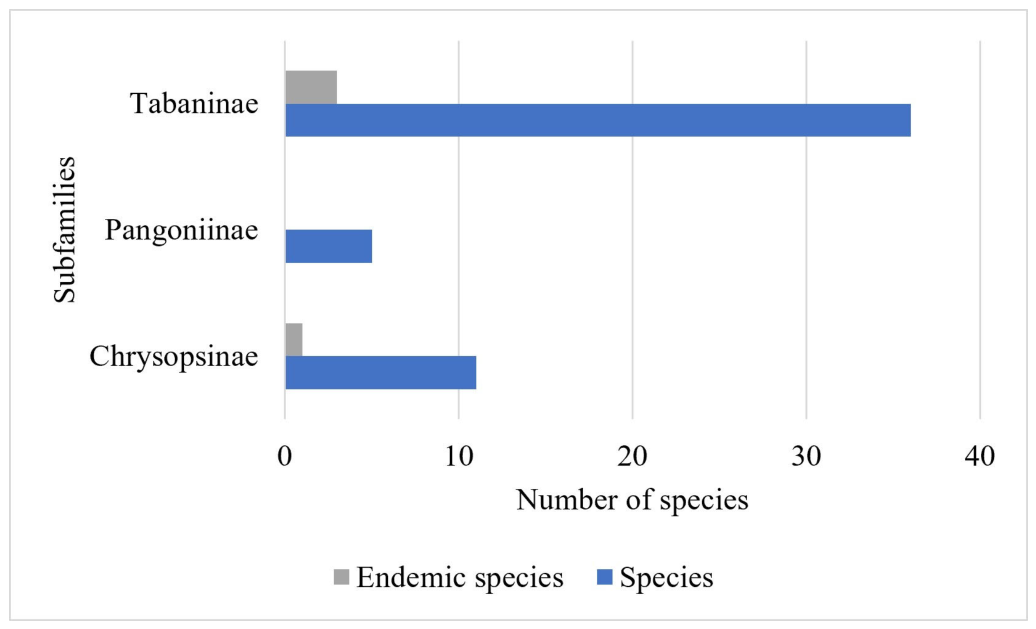
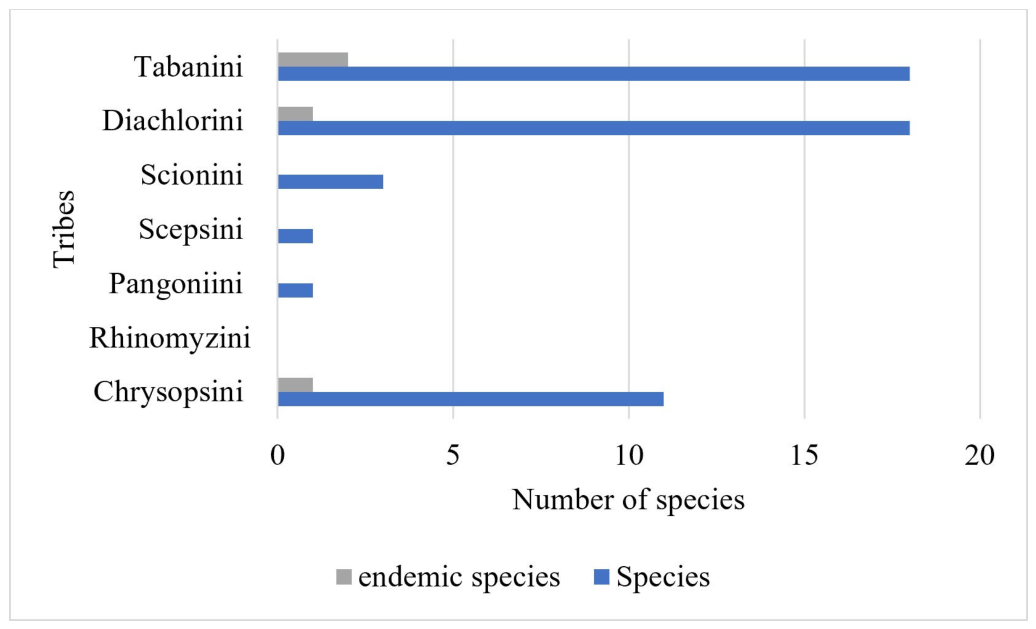


| Subfamily/Tribe | Genus | Number of Species | Endemic Species |
|---|---|---|---|
| Chrysopsinae | |||
| Chrysopsini | Chrysops Meigen | 11 | 1 |
| Pangoniinae | |||
| Pangoniini | Esenbeckia Rondani | 1 | 0 |
| Scepsini | Scepsis Walker | 1 | 0 |
| Scionini | Fidena Walker | 3 | 0 |
| Tabaninae | |||
| Diachlorini | |||
| Acanthocera Macquart | 1 | 0 | |
| Catachlorops Lutz | 4 | 0 | |
| Chlorotabanus Lutz | 1 | 0 | |
| Dasybasis Macquart | 4 | 0 | |
| Dichelacera Macquart | 3 | 0 | |
| Lepiselaga Macquart | 2 | 0 | |
| Stenotabanus Lutz | 1 | 1 | |
| Stibasoma Schiner | 1 | 0 | |
| Stypommia Enderlein | 1 | 0 | |
| Tabanini | |||
| Poeciloderas Lutz | 2 | 0 | |
| Tabanus Linnaeus | 16 | 2 | |
| 15 | 52 | 4 |
| Endemic Species | Type Depository | Comment |
|---|---|---|
| Chrysops trisignatus | ZMHB | Holotype ♂ from Montevideo (Coscarón & Papavero, 2009) [25]. According to Henriques (2016: 166) [67], another female from Tacuari river (Melo Department) determined by Fairchild is deposited in the AMNH. |
| Stenotabanus brunnipennis | ISTH | Holotype (ISTH—destroyed) from Montevideo (Coscarón & Papavero, 2009) [25]. According to Chainey et al. (1999: 81) [65], no other specimens are known. |
| Tabanus tacuaremboensis | MZUSP | This species is abundant in Tacuarembó, less than 120 and 250 km from the borders of Brazil and Argentina, respectively. More samples from these regions may modify the endemicity status. |
| Tabanus varipes | NHMUK | It is probably not a Neotropical species, see Fairchild (1956: 31) [51]. We decided to keep it because the type specimen is available in Krolow et al. (2022:448–449, Figure 1) [45] for comparison with possible new specimens, and new collections from Isla Gorriti may reveal its true status. |
| First Author | Centurie(s) | Gender | Origin | Species | Percentage |
|---|---|---|---|---|---|
| Wiedemann | 19th | man | Europe | 13 | 25% |
| Macquart | 19th | man | Europe | 8 | 15% |
| Brèthes | 20th | man | Europe | 6 | 12% |
| Kröber | 20th | man | Europe | 6 | 12% |
| Lutz | 20th | man | Brazil | 4 | 8% |
| Coscarón | 20th | man | Argentina | 2 | 4% |
| Enderlein | 20th | man | Europe | 2 | 4% |
| Fabricius | 19th | man | Europe | 2 | 4% |
| Pechuman | 20th | man | USA | 2 | 4% |
| Bigot | 19th | man | Europe | 1 | 2% |
| De Geer | 18th | man | Europe | 1 | 2% |
| Krolow | 21st | man | Brazil | 1 | 2% |
| Linnaeus | 18th | man | Europe | 1 | 2% |
| Philip | 20th | man | USA | 1 | 2% |
| Walker | 19th | man | Europe | 1 | 2% |
| Wulp | 19th | man | Europe | 1 | 2% |
| Location | Number of Collections | Primary Types | Percentage |
|---|---|---|---|
| Europe | 10 | 37 | 71% |
| Argentina | 2 | 6 | 12% |
| Brazil | 2 | 5 | 10% |
| USA | 3 | 3 | 6% |
| Unknown | 1 | 1 | 2% |
| Location | Acronym | Number of Types |
|---|---|---|
| Europe | NMW | 10 |
| Europe | MNHN | 8 |
| Europe | ZMHB | 7 |
| Argentina | MACN | 5 |
| Brazil | IOC | 4 |
| Europe | NHMUK | 4 |
| Argentina | MLPA | 2 |
| Europe | SMNS | 2 |
| USA | CUIC | 1 |
| USA | FSCA | 1 |
| Europe | ISTH | 1 |
| USA | MCZ | 1 |
| Brazil | MZUSP | 1 |
| Europe | NHRS | 1 |
| Uknown | Uknown | 1 |
| Europe | ZMUC | 1 |
| Europe | ZMUA | 1 |
| Europe | ZMKU | 1 |
| Primary Type | Number of Types | Female | Male | Female/Male | Lost/Destroyed |
|---|---|---|---|---|---|
| Holotype | 30 | 27 | 4 | - | 2 |
| Lectotype | 13 | 13 | - | - | - |
| Neotype | 1 | 1 | - | - | - |
| Syntype | 8 | 6 | 2 | 2 | - |
| Total | 52 | 47 | 6 | 2 | 2 |
| Genus | References |
|---|---|
| Chrysops Meigen | [36] good plates and illustrations for Neotropical species; [42] key to Argentinian species |
| Esenbeckia Rondani | [79] key to Neotropical species |
| Scepsis Walker | [57] redescription of species (monotipic) |
| Fidena Walker | [69] revision of genus |
| Acanthocera Macquart | [59] Argentinian species; [80] revision and key for Neotropical species |
| Catachlorops Lutz | [56] key to Argentinian species |
| Chlorotabanus Lutz | [58] Argentinian species |
| Dasybasis Macquart | [61] key to Argentinian species |
| Dichelacera Macquart | [55] key to Argentinian species |
| Lepiselaga Macquart | [53] Argentinian species |
| Stenotabanus Lutz | [65] revision for Neotropical species |
| Stibasoma Schiner | [79,81] revision for Neotropical species |
| Stypommia Enderlein | No keys |
| Poeciloderas Lutz | [62] key to Argentinian species |
| Tabanus Linnaeus | A rich taxon with different keys for many groups of species, probably a paraphyletic genus |
Disclaimer/Publisher’s Note: The statements, opinions and data contained in all publications are solely those of the individual author(s) and contributor(s) and not of MDPI and/or the editor(s). MDPI and/or the editor(s) disclaim responsibility for any injury to people or property resulting from any ideas, methods, instructions or products referred to in the content. |
© 2026 by the authors. Licensee MDPI, Basel, Switzerland. This article is an open access article distributed under the terms and conditions of the Creative Commons Attribution (CC BY) license.
Share and Cite
Krolow, T.K.; González, C.R.; Martínez, M.; Menchaca, A.; Saravia, A.; Mihok, S.; Parodi, P.; Krüger, R.F. An Overview of the Tabanidae (Diptera) of Uruguay. Taxonomy 2026, 6, 36. https://doi.org/10.3390/taxonomy6020036
Krolow TK, González CR, Martínez M, Menchaca A, Saravia A, Mihok S, Parodi P, Krüger RF. An Overview of the Tabanidae (Diptera) of Uruguay. Taxonomy. 2026; 6(2):36. https://doi.org/10.3390/taxonomy6020036
Chicago/Turabian StyleKrolow, Tiago Kütter, Christian R. González, María Martínez, Alejo Menchaca, Anderson Saravia, Steve Mihok, Pablo Parodi, and Rodrigo F. Krüger. 2026. "An Overview of the Tabanidae (Diptera) of Uruguay" Taxonomy 6, no. 2: 36. https://doi.org/10.3390/taxonomy6020036
APA StyleKrolow, T. K., González, C. R., Martínez, M., Menchaca, A., Saravia, A., Mihok, S., Parodi, P., & Krüger, R. F. (2026). An Overview of the Tabanidae (Diptera) of Uruguay. Taxonomy, 6(2), 36. https://doi.org/10.3390/taxonomy6020036