1. Introduction
The unique electronic and optical properties of low-dimensional semiconductor nanostructures have driven extensive research over the last few decades. These systems often exhibit behaviors that diverge sharply from their bulk counterparts, primarily due to quantum confinement and reduced dimensionality [
1,
2]. Within this field, III-V compound semiconductors are of particular interest for their roles in optoelectronics and photonics, powering technologies such as light-emitting devices, photodetectors, and high-efficiency photovoltaics [
3]. Among these materials, aluminum arsenide (AlAs) stands out as a technologically vital wide-band-gap semiconductor. In its bulk form, AlAs crystallizes in the zinc-blende structure with a band gap of approximately 2.16 eV [
4]. Its excellent lattice matching with GaAs makes it an indispensable component in the fabrication of heterostructures, quantum wells, and multilayer optical components, including Bragg mirrors and vertical-cavity surface-emitting lasers (VCSELs) [
5]. Beyond these established roles, AlAs-based nanostructures have recently shown promising electronic and optical characteristics in both experimental and theoretical settings, confirming their potential for next-generation nanoscale devices [
6].
At the nanoscale, the electronic and optical profiles of semiconductor systems are governed by pronounced size-dependency, a direct consequence of quantum confinement [
7]. Small stoichiometric clusters serve as ideal building blocks for probing these effects, offering well-defined models to track the evolution of electronic structures as dimensionality increases [
8]. Prototype clusters of the M
4X
4 type (where M is a metal and X a non-metal) have been widely adopted in both theoretical and experimental research to elucidate growth patterns and stability in compound semiconductors [
9,
10]. Typically, these units adopt compact, cubic, or cage-like geometries, providing a robust foundation for assembling more complex, low-dimensional architectures [
11]. By systematically aligning these blocks along specific spatial axes, one can construct 1D chains, ribbons, or 2D networks. Such a bottom-up approach enables a detailed analysis of how dimensionality-driven shifts influence the optical response and absorption characteristics of the resulting nanostructures [
12,
13].
Despite the extensive literature on III-V semiconductors, AlAs nanostructures (particularly small clusters and their evolution into low-dimensional architectures) remain comparatively under-explored. Existing theoretical and experimental research has focused largely on bulk electronic properties, heterostructures, and thin films, often within the framework of AlAs/GaAs superlattices [
14,
15]. Consequently, a detailed understanding of how small Al-As clusters undergo geometric growth and how this process dictates their optical and electronic profiles remains a significant open question. Probing these systems offers a unique vantage point to track the evolution of the electronic density of states as dimensionality increases. Specifically, the transition from isolated, compact clusters to extended 1D and 2D frameworks is expected to drive fundamental modifications in the optical response, yet this transition has not been systematically mapped for AlAs [
16,
17].
In the present work, a systematic first-principles investigation of the structural and optical properties of AlxAsx nanostructures with different dimensionalities and structural motifs is carried out. The stoichiometric Al4As4 nanoparticle is adopted as the fundamental structural building block and serves as the starting point for constructing a series of progressively larger nanostructures. In the first stage, the cubic Al4As4 unit was elongated along a single spatial direction to generate a sequence of one-dimensional systems, named as Al8As8-1D, Al12As12-1D, and Al16As16-1D, enabling a systematic investigation of size-dependent effects along a quasi-linear growth pathway. In the second stage, a set of two-dimensional nanostructures with distinct topologies and exotic geometrical motifs was constructed, including Al16As16-L, Al16As16-L3, Al16As16-S, Al16As16-T, as well as the larger Al24As24-L1, Al24As24-F, and Al24As24-T configurations.
We optimize the ground-state geometries of a broad series of Al
xAs
x nanostructures using Density Functional Theory (DFT), while their electronic excitations and optical absorption spectra are investigated via Time-Dependent DFT (TD-DFT) [
18,
19]. Our primary objective is to elucidate how dimensional extension and structural topology dictate the optical response and energetic stability of these systems. By systematically comparing isolated clusters, 1D chains, and 2D exotic geometries within a unified computational framework, we aim to map the structure–property relationships that govern the evolution of optical behavior as the system size and dimensionality increase. This study provides, to our knowledge, the first comprehensive theoretical account that integrates optical properties, stability trends, and structural diversity across multiple dimensional regimes for Al
xAs
x NP. The rest of the paper is structured as follows:
Section 2 details the computational methodology, while
Section 3 presents a thorough discussion of the structural, vibrational, optical, and stability findings. Finally, our main conclusions are summarized in
Section 4.
2. Materials and Methods
We investigated the structural, vibrational, and optical properties of Al
xAs
x nanostructures using a combination of DFT and TD-DFT. Starting from a cubic-like Al
4As
4 cluster, we systematically generated larger nanoparticles (NPs) by directional elongation and structural rearrangement to explore different dimensional regimes. Ground-state geometries were fully optimized without symmetry constraints. For these calculations, we employed the PBE gradient-corrected exchange–correlation functional alongside the triple-ζ quality def2-TZVP basis set [
20,
21].
To evaluate excited-state properties, we used time-dependent density functional theory (TD-DFT). Specifically, we calculated singlet excitation energies and UV-Vis absorption spectra using the hybrid CAM-B3LYP functional [
22]. This choice was motivated by its long-range correction scheme, which provides reliable excitation energy predictions for molecular clusters. We benchmarked this approach against high-level EOM-CCSD [
23] calculations on smaller clusters to ensure its accuracy before proceeding to larger systems. It should be noted that the EOM-CCSD benchmark was performed on the smallest reference cluster, Al4As4, comparing the first two singlet excited states. Ground-state geometries were optimized at the PBE/def2-TZVP level, whereas excited-state calculations were carried out using CAM-B3LYP/def2-TZVP. All optimizations were performed in TURBOMOLE, ensuring that energy and gradient convergence thresholds were strictly met [
24].
We confirmed the dynamical stability of all optimized structures via harmonic vibrational frequency analysis at the PBE/def2-TZVP level. The absence of imaginary frequencies verified that all geometries correspond to true local minima. From these results, we identified IR-active modes and generated simulated spectra using a Gaussian [
25] broadening scheme (standard deviation of 10 cm
−1). A similar broadening of 0.1 eV was applied to the electronic excitations to approximate experimental UV-Vis line shapes.
Finally, we examined asymmetric motifs—specifically L-, T-, and S-type geometries—to understand how reduced symmetry and directional connectivity affect electronic delocalization. While optimization naturally shifts the initial coordinates, these “exotic” structures remained stable, mirroring motifs previously observed in ScN, AlN, and AlP systems [
26,
27,
28].
3. Results
To validate our computational framework, we initially performed benchmarking calculations on smaller reference nanostructures. The present study focuses on excitation energies and oscillator strengths, as these quantities provide the most direct description of the optical response of the AlAs nanostructures. Comparing TD-DFT results (using the CAM-B3LYP functional) with high-level EOM-CCSD excitation energies confirms that our approach accurately captures the excited-state properties of Al
xAs
x NPs. Specifically, the first singlet excitation energies and oscillator strengths predicted by CAM-B3LYP align closely with EOM-CCSD values, with deviations typically remaining below ~0.1 eV [
29]. Such results are consistent with previous reports on III-V semiconductor nanostructures, where long-range corrected hybrid functionals strike an effective balance between computational efficiency and spectroscopic accuracy [
30].
The performance of various exchange–correlation functionals is summarized in
Table 1. As shown, CAM-B3LYP consistently provides improved agreement for the lowest electronic transitions of representative Al-As clusters compared to standard functionals. While similar strategies have proven successful for ScN, AlN, and AlP systems [
26,
27,
28,
30], the present work extends these efforts by focusing on how size and topology specifically govern the electronic and vibrational evolution of Al
xAs
x nanostructures. The stability of these geometries is further evidenced by our IR spectra calculations. We observe a progressively richer distribution of IR-active modes as the dimensionality shifts from compact clusters to extended one- and two-dimensional geometries. These IR intensities (reported in km/mol) serve as distinct spectroscopic fingerprints, which could be instrumental in identifying the specific structural motifs discussed in this study. Noted that the main UV-Vis absorption features arise predominantly from frontier-orbital electronic transitions, while the dominant IR bands in the 300–420 cm
−1 region are associated with collective Al–As stretching and bending modes.
3.1. Structural Properties and Geometry Optimization of AlxAsx NPs
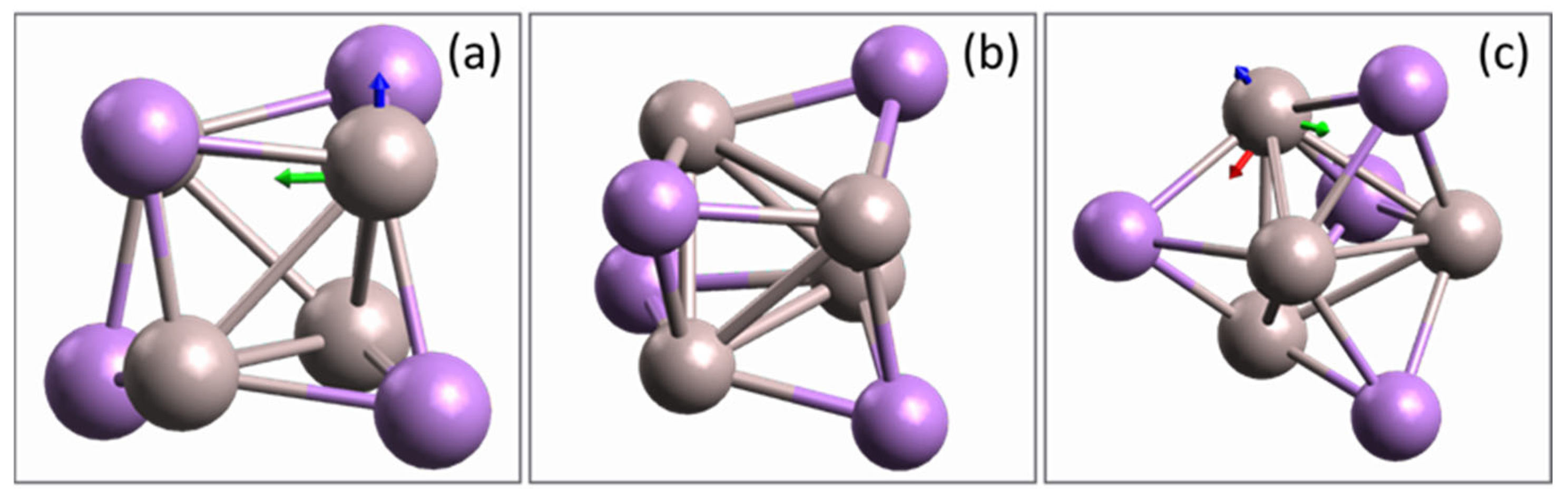
The structural characteristics of the investigated Al-As NPs were first examined by considering the optimized geometry of the fundamental building unit, namely the cubic-like Al
4As
4 NP, which is presented in
Figure 1. This small III-V semiconductor motif provides a convenient starting point for constructing larger nanostructures with different dimensional characteristics. Similar cubic or cage-like clusters have been widely employed as prototype systems for investigating the structural evolution and stability of III-V semiconductor nanostructures at the nanoscale [
31,
32].
Following full geometry optimization at the DFT level, the initial cubic arrangement undergoes slight structural relaxation while preserving its overall topology. Such relaxation effects are commonly observed in small semiconductor clusters and originate from the tendency of the system to minimize strain and optimize the local bonding environment. The resulting nanostructure exhibits well-defined Al-As bonds and a stable framework, confirming that the Al4As4 unit can serve as a robust structural motif for constructing larger NPs with increased dimensionality.
The optimized structure of this basic NP, shown in
Figure 1b,c, subsequently served as the starting point for generating a series of larger Al-As NPs by systematically extending the network along specific directions. This approach allows the investigation of how dimensional growth (from small molecular clusters to quasi-one-dimensional and two-dimensional configurations) affects the structural stability and electronic properties of the system. The relative stability of the examined AlAs nanostructures is closely related to their geometric distortion and bonding uniformity. The more stable compact and planar motifs exhibit a more regular Al–As framework, whereas the exotic low-symmetry isomers present a larger degree of structural distortion and a less uniform bond network. Comparable strategies have been successfully applied in theoretical studies of related semiconductor nanoclusters, including those based on AlP and AlN, where structural expansion was found to play a key role in determining their electronic and optical behavior [
33,
34].
3.1.1. One-Dimensional Elongation Along a Single Direction
By using the optimized cubic-like Al
4As
4 unit as a building block, we constructed larger clusters through sequential extension along a single axis. This process generated quasi-one-dimensional nanostructures with Al
8As
8, Al
12As
12, and Al
16As
16 compositions. Such directional growth preserves the core bonding motif of the parent cluster while increasing the chain length, offering a clear model to track how structural and optical properties evolve with system size.
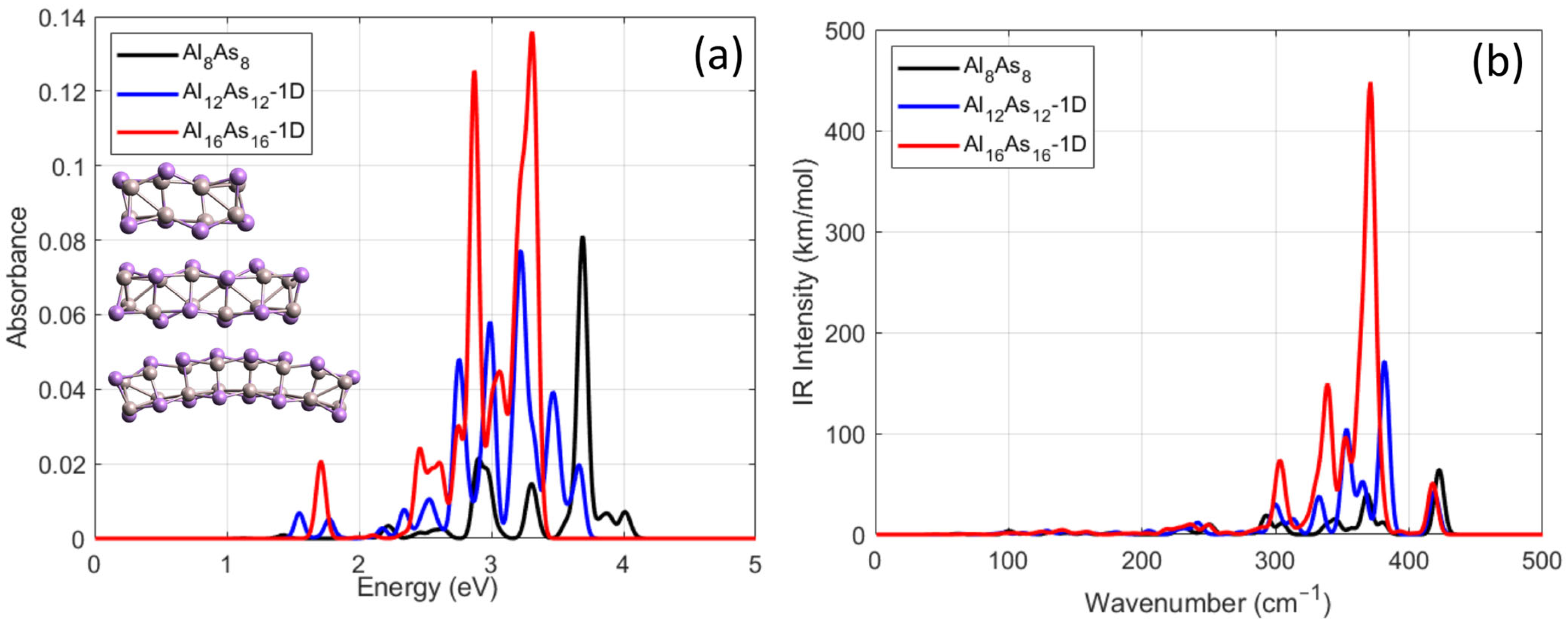
Figure 2a displays the calculated UV–visible absorption spectra for the x = 8, 12 and 16 series. As the framework elongates, the spectral profiles undergo distinct transformations. The absorption features become notably more intense and exhibit energy shifts, suggesting that transitions are coupled to the broadening delocalization of electronic states. Among the series, the Al
16As
16 nanostructure (red curve) shows the most pronounced peaks, indicating that lengthening the cluster significantly enhances the oscillator strength. A systematic redshift of the main absorption bands is evident when moving from Al
8As
8 (black curve) to Al
12As
12 (blue curve) and Al
16As
16 (red curve) NPs. This trend is a direct consequence of reduced quantum confinement as the cluster length increases; the resulting electronic delocalization along the 1D framework lowers the excitation energies. Furthermore, the higher peak intensities in the Al
16As
16 spectrum point to more efficient optical transitions, likely due to the improved overlap between occupied and unoccupied states facilitated by the elongated structure [
35,
36].
The vibrational properties of the elongated clusters were further examined through the calculated infrared spectra shown in
Figure 2b. The spectra display several IR-active modes primarily located in the region between approximately 300 and 420 cm
−1, which can be attributed to collective stretching and bending motions of the Al-As bonds within the extended framework. A closer inspection of the spectra reveals a progressive splitting and intensification of the vibrational bands as the cluster size increases from Al
8As
8 (black curve) to Al
12As
12 (blue curve) and Al
16As
16 (red curve). This effect arises from the larger number of coupled Al-As vibrational units present in the extended structures, which gives rise to additional collective vibrational modes and enhances the overall IR activity of the system. As the NP size increases, additional vibrational modes appear and the corresponding intensities become more pronounced, reflecting the increasing structural complexity of the system f [
37]. In nanoscale semiconductor systems, the spatial restriction of lattice vibrations modifies the phonon dispersion and leads to the appearance of additional vibrational modes as well as changes in IR intensities compared to bulk-like behavior [
38].
3.1.2. Two-Dimensional Structures and Exotic Geometries
Group 1: Planar Two-Dimensional Nanostructures and Symmetric Exotic Geometry
Beyond the one-dimensional elongation discussed previously, we explored the structural expansion of the Al
xAs
x framework in two spatial directions. This 2D growth introduces distinct bonding topologies and symmetry characteristics, which in turn modify the spatial distribution of electronic states and the resulting spectroscopic response. In this section, we focus on three representative configurations: the planar Al1
6As
16 and Al
24As
24 nanostructures, alongside an “exotic” Al
16As1
6 S-type geometry characterized by reduced symmetry.
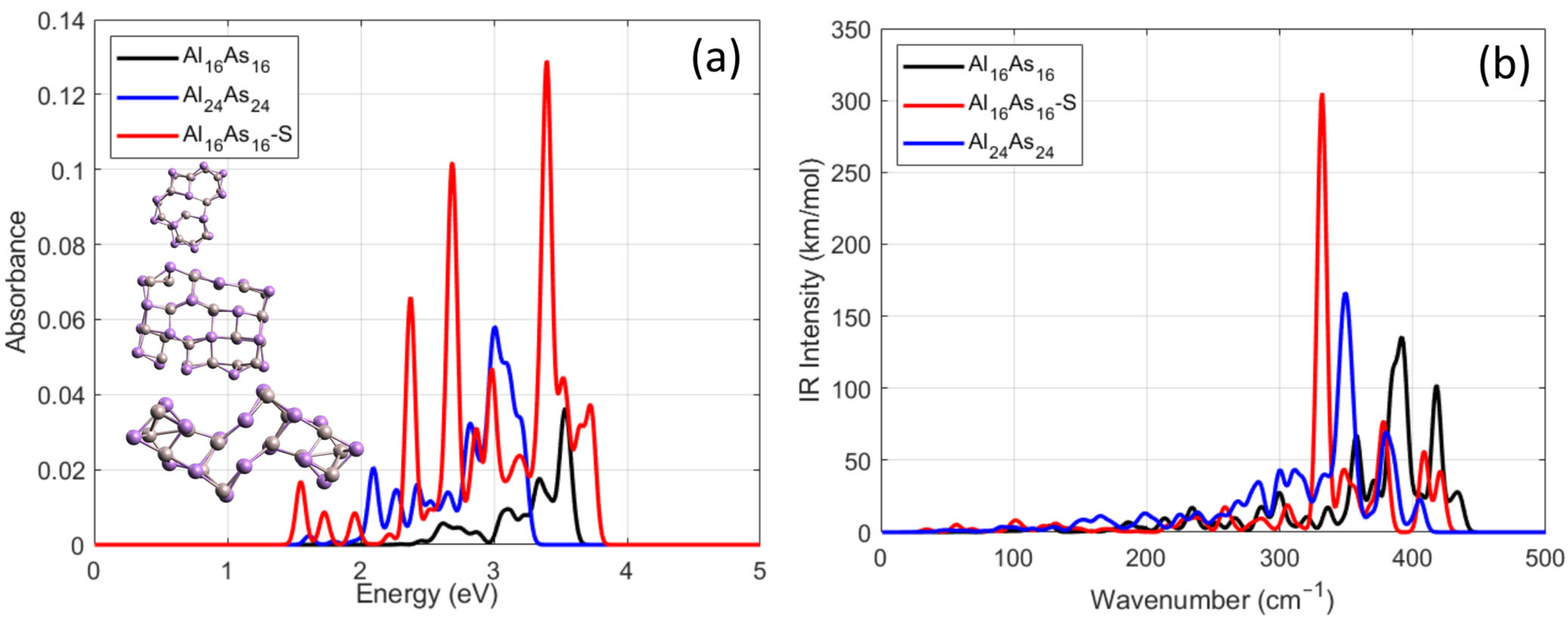
Figure 3a presents the calculated UV–visible absorption spectra for the Group 1 nanoparticles. The planar Al16As16 cluster (black curve) exhibits relatively weak absorption features, primarily concentrated in the higher-energy region. As the 2D network extends to Al
24As
24 (blue curve), the spectral profile becomes more complex and the absorption bands shift toward lower energies. This redshift reflects the enhanced electronic delocalization that typically accompanies the expansion of a two-dimensional atomic lattice. A markedly different behavior is observed for the exotic S-type Al
16As
16 configuration (red curve). Unlike the planar models, this spectrum displays significantly more intense peaks and a broader distribution of transitions across the sampled energy range. The emergence of strong absorption features in the mid-energy region suggests that the reduced symmetry and “bent” topology of the S-shaped motif promote stronger electronic coupling between units. Such symmetry breaking is a well-known mechanism for increasing oscillator strength and modifying the optical response in semiconductor nanoclusters, as structural deformations directly influence the transition dipole moments.
The vibrational properties of these nanostructures are illustrated in
Figure 3b. The calculated infrared (IR) spectra reveal several active modes, primarily concentrated within the 300–420 cm
−1 range. For the planar Al
16As
16 nanostructure (black curve), we observe a set of distinct high-frequency peaks, which we attribute to the collective stretching motions of Al-As bonds within the 2D framework. By contrast, the larger Al
24As
24 nanostructure (blue curve) exhibits enhanced IR activity and additional features, reflecting the increased number of coupled vibrational units in its expanded lattice. The most intense IR signal originates from the exotic S-type Al
16As
16 nanostructure (red curve), which is dominated by a major peak in the mid-frequency region alongside several secondary modes. This pronounced activity is a direct result of the cluster’s reduced symmetry and structural bending; these geometric distortions activate vibrational modes that are otherwise forbidden or weak in more symmetric arrangements. Such findings align with previous spectroscopic studies [
39], where symmetry reduction in semiconductor nanoclusters has been shown to enrich the vibrational profile by lifting degeneracies and increasing the number of IR-active transitions.
Ultimately, shifting from planar 2D growth to more complex, “exotic” geometries profoundly impacts both the optical and vibrational characteristics of Al-As nanoparticles. The comparison between planar and S-type motifs highlights that structural topology (rather than size alone) is a key factor in governing electronic delocalization and the resulting spectroscopic signatures at the nanoscale.
Group 2: Exotic Geometries of Al16As16 NPs
To further isolate the effects of reduced symmetry and structural topology, we examined three additional 2D configurations of the Al16As
16 NP: the L-, T-, and L3-type arrangements. These geometries, all derived from the Al4As4 building block, differ fundamentally in the connectivity and bending of their structural units.
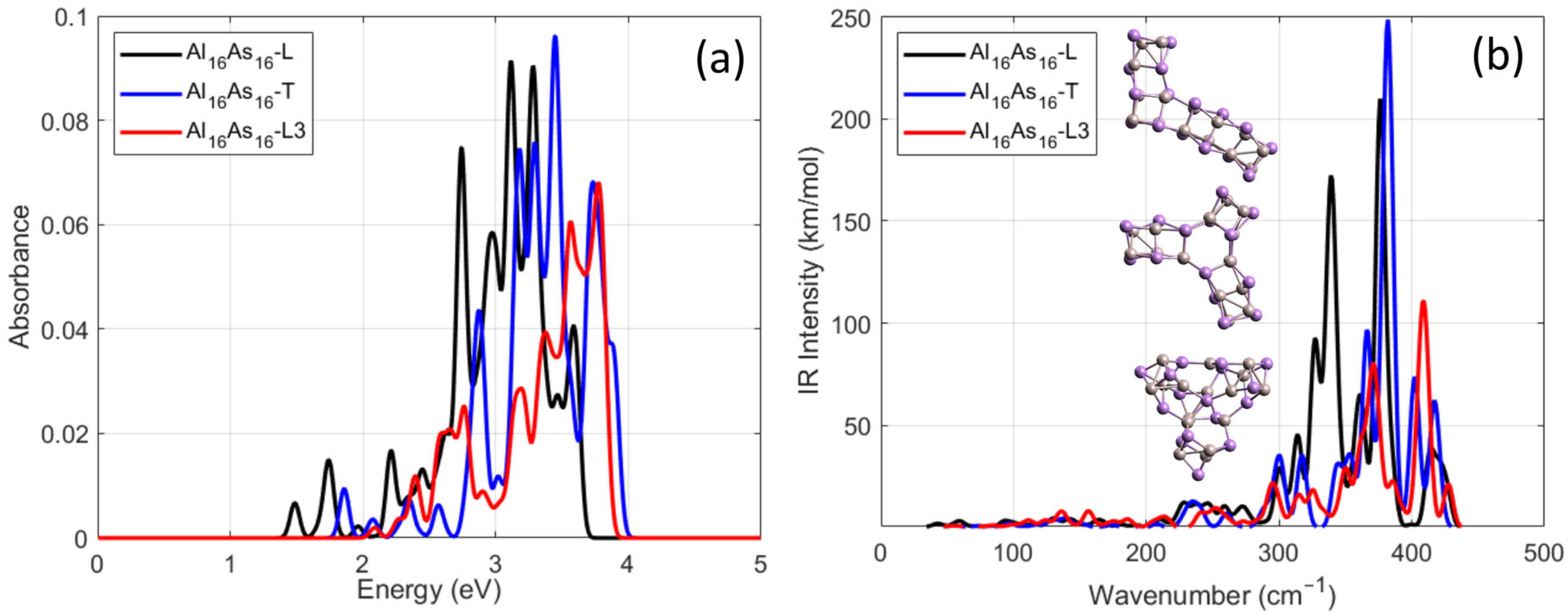
Figure 4a illustrates the calculated UV–visible absorption spectra for these three motifs. The L-type structure (black curve) shows several pronounced absorption features concentrated in the intermediate energy region, signaling multiple allowed electronic transitions within its partially extended framework. In contrast, the T-type configuration (blue curve) yields a distinctly different profile, characterized by stronger and more sharply defined peaks in the higher-energy range. This suggests that the specific connectivity of the T-shaped geometry optimizes the overlap between electronic states, thereby enhancing the intensity of the optical transitions. The L-3 configuration (red curve) presents a different trend, with absorption bands distributed over a broader spectral range. While its individual peaks are slightly less intense than those of the T-type structure, this wider distribution reflects a richer manifold of electronic transitions (a direct consequence of the lower symmetry and increased structural complexity in the L3 cluster). As noted in previous studies on semiconductor nanoclusters [
40], even subtle geometric rearrangements can profoundly redistribute the electronic density, leading to the diverse optical responses observed here.
The corresponding infrared spectra, illustrated in
Figure 4b, reveal several active vibrational modes primarily concentrated within the 300–420 cm
−1 range. The L-type structure (black curve) exhibits a series of distinct peaks originating from the collective stretching and bending motions of the Al-As framework. In the case of the T-type geometry (blue curve), the vibrational response intensifies, featuring a dominant high-frequency peak that signals stronger coupling between the cluster’s structural units. The L-3 configuration (red curve) presents a broader vibrational profile, characterized by multiple moderate-intensity peaks distributed across the spectrum. This spectral broadening stems from the more intricate arrangement of its building blocks, which introduces additional degrees of freedom and activates a wider array of coupled modes. Overall, the comparison among these three exotic geometries underscores the profound impact of structural topology on the system’s vibrational signatures. Importantly, these results demonstrate that even at a constant atomic composition, the specific geometric arrangement of a cluster can drive substantial variations in both optical absorption and vibrational activity. This sensitivity further confirms that symmetry reduction and directional connectivity are decisive factors in governing the physical properties of Al-As nanostructures.
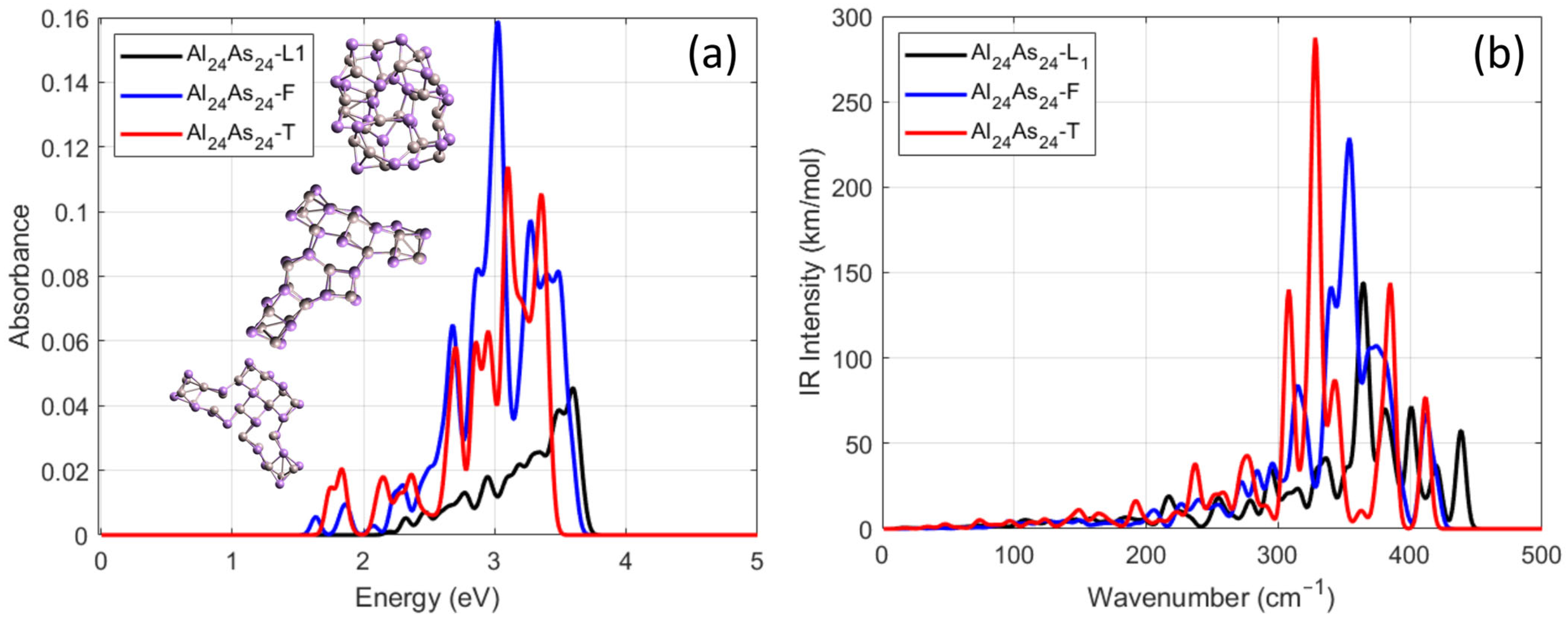
Group 3: Exotic Geometries of Al24As24 NPs
To investigate the interplay between increased system size and reduced symmetry, we examined three additional exotic configurations of the larger Al
24As
24 nanocluster: the L1-, F-, and T-type geometries. These structures explore alternative arrangements of the Al
4As
4 building blocks within a 2D framework. Given their increased complexity, these models offer valuable insights into how geometric topology governs the spectroscopic response as we move toward larger Al-As systems. The calculated UV–visible absorption spectra for these clusters are shown in
Figure 5a. The L1-type structure (black curve) is characterized by relatively weak absorption features, primarily located in the higher-energy region. Such moderate intensities suggest that the underlying electronic transitions remain somewhat localized within the cluster’s framework. Conversely, the F-type configuration (blue curve) exhibits significantly more intense absorption bands, including a dominant peak in the intermediate energy range. This pronounced feature points to enhanced electronic delocalization facilitated by the extended structural pathways unique to this geometry. The T-type configuration (red curve) displays a spectral profile intermediate to the L1 and F types, yet it maintains several strong absorption bands across the mid-energy region. The emergence of multiple peaks with comparable intensities reflects a diverse manifold of allowed electronic transitions. This spectral richness is directly attributable to the intricate connectivity and reduced symmetry inherent in the T-shaped arrangement, which promotes more efficient optical coupling across the nanostructure.
The vibrational spectra for these configurations are presented in
Figure 5b, with IR-active modes once again emerging primarily within the 300–420 cm
−1 range. The L1 geometry (black curve) exhibits a series of moderate-intensity peaks, corresponding to the collective stretching and bending motions of its Al-As framework. In contrast, the F-type structure (blue curve) shows a markedly stronger vibrational response, characterized by an intense high-frequency peak. This enhancement indicates robust coupling between the multiple vibrational units integrated into its extended network. The most pronounced vibrational activity, however, is observed in the T-type structure (red curve). This motif features a dominant mid-frequency peak alongside several auxiliary modes. Such elevated IR activity stems from the reduced symmetry and the expanded vibrational degrees of freedom inherent in the cluster’s complex topology. Ultimately, these results underscore how the interplay of cluster size, dimensionality, and symmetry reduction yields a diverse array of spectroscopic signatures. Such findings highlight the potential for tuning the optoelectronic behavior of these nanoscale systems through precise geometric control.
3.2. Stability and Binding Energy
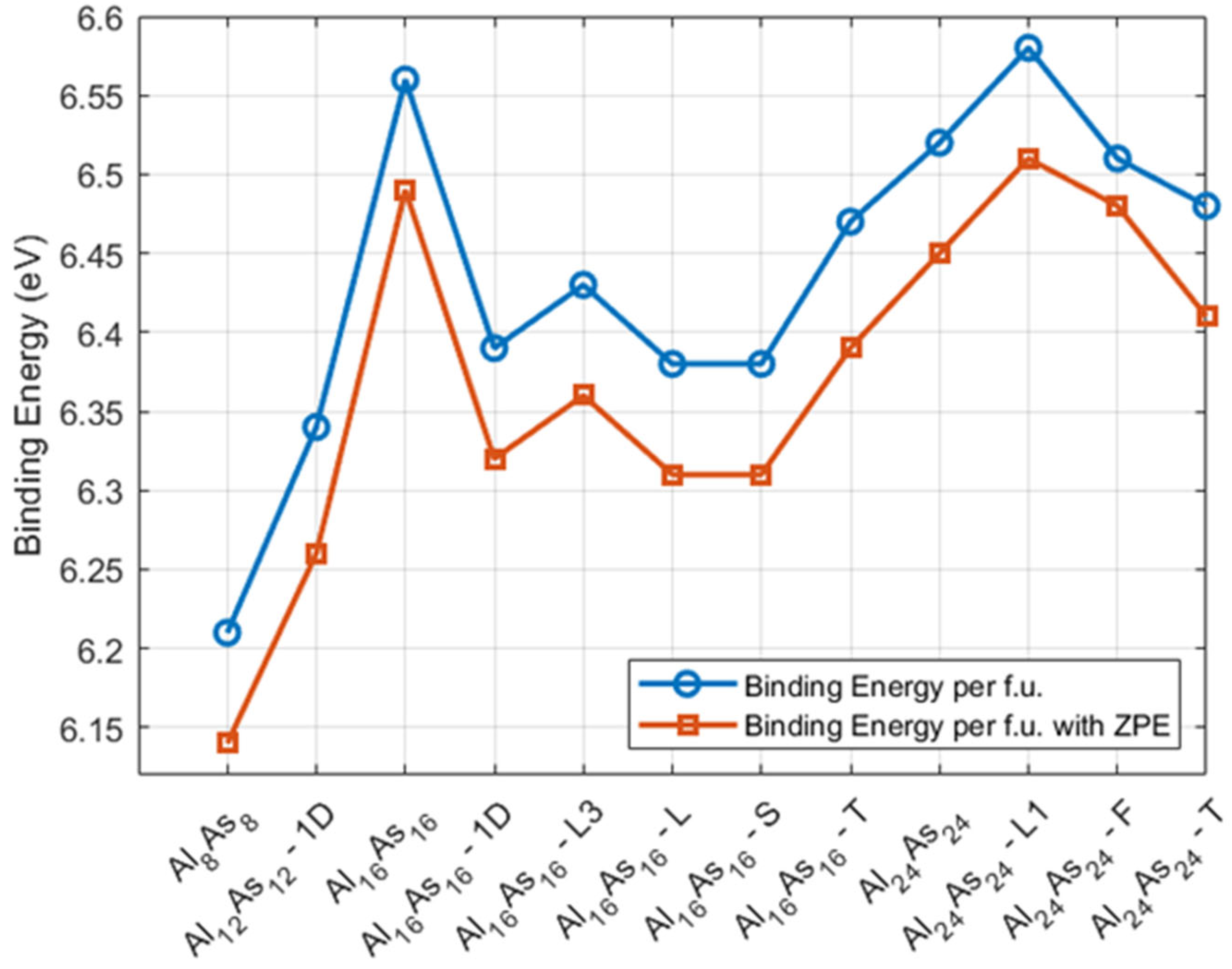
The energetic stability of the optimized AlxAsx NPs was assessed by calculating the binding energy (BE) per formula unit, using both self-consistent field (SCF) electronic energies and values corrected for zero-point vibrational energy (ZPE). The BE serves as a direct measure of the cohesive interactions within each nanoparticle, enabling a systematic comparison across different sizes and structural dimensionalities. In line with established theoretical protocols for III-V semiconductor clusters, we defined the reference state as a set of isolated Al and As atoms. While this atomic reference scheme typically yields larger absolute binding energies than molecular alternatives, it ensures a consistent framework for evaluating relative stability trends across the entire Al-As series. To verify this, we performed additional test calculations using molecular Al-As fragments as reference species. Although the absolute BE values decreased as expected, the relative stability ordering of the clusters remained unchanged. This consistency confirms that our chosen reference scheme is robust and reliable for the comparative analysis of these nanostructures.
The total binding energy of an
AlxAsx cluster was obtained using the expression
where
x denotes the number of AlAs formula units in the cluster,
E(Al) and
E(As) correspond to the total energies of the isolated aluminum and arsenic atoms, and
E(AlxAsx) represents the total electronic energy of the optimized nanoparticle. For a more meaningful comparison between clusters of different sizes, the binding energy was normalized per formula unit according to
which can also be expressed as
This definition provides a convenient stability descriptor that enables direct comparison among clusters containing different numbers of AlAs units, ranging from the smallest elongated one-dimensional motifs to the largest two-dimensional assemblies.
As shown in
Table 2 and
Figure 6, the calculated binding energies (BE) reveal a clear dependence on both system size and structural arrangement. It should be noted that the HOMO-LUMO values reported here correspond to Kohn–Sham orbital gaps and should not be directly identified with the lowest optical excitation energies obtained from TD-DFT. The latter describe vertical singlet excitations and depend on the character of the contributing orbital transitions. Therefore, differences between the orbital gap and the first excitation energy are expected, particularly in low-symmetry nanostructures. Larger clusters and those with higher-dimensional connectivity generally exhibit stronger cohesive stabilization. This trend aligns with the expected evolution of III-V nanostructures, where the relative influence of under-coordinated surface atoms diminishes as the internal bonding network develops. Notably, the inclusion of ZPE corrections results in a small, uniform downward shift in absolute BE values without altering the relative stability ordering, confirming that electronic effects remain the primary driver of stability. The BE per formula unit increases from ~6.21 eV in Al
8As
8 to ~6.58 eV in the largest Al
24As
24 systems. While 1D structures show intermediate stability, we observe more pronounced stabilization in compact or 2D arrangements where the number of Al-As bonds is maximized. Among the Al
16As
16 ΝPs, the planar 2D structure is the most stable, underscoring the benefits of high atomic connectivity. Interestingly, the exotic Al
16As
16 motifs (T-, L-, S-, and L3-type) show slightly lower but comparable energies, with the T-type geometry being the most energetically favorable within this sub-group. In the A
l24As
24 series, the L1 configuration reaches the highest binding energy of all investigated clusters, suggesting a particularly efficient distribution of bonding interactions. While the stability curve in
Figure 6 generally trends upward, it is not strictly monotonic; local maxima and fluctuations between isomers of the same stoichiometry reflect the complex competition between structural strain and bond formation. It should be noted that the HOMO-LUMO gaps reported in
Table 2 were evaluated at the CAM-B3LYP level of theory, consistently with the TD-DFT excitation energies. This ensures a direct and meaningful comparison between the frontier orbital gaps and the lowest singlet excitation energies across the studied nanostructures. The HOMO-LUMO gaps (
Table 2) follow a more nuanced, structure-dependent pattern. While most clusters fall within the 3.49–4.11 eV range, the planar Al
16As
16 nanostructure stands out with a significantly larger gap of 4.41 eV. This enhanced electronic stability likely stems from its higher structural symmetry and uniform bond distribution. Conversely, the reduced symmetry and structural distortions in the exotic geometries promote electronic delocalization, effectively narrowing the frontier orbital separation. These results demonstrate that while size dictates the overall energetic floor, it is the specific topology that governs the electronic fingerprints of Al-As NPs.
4. Conclusions
In this study, we employed DFT and TD-DFT to systematically map the structural, optical, and vibrational evolution of AlxAsx nanoparticles. By using the Al4As4 cube as a primary building block, we explored how directional growth and structural rearrangement, leading to 1D, 2D, and “exotic” motifs (governing the physical properties of these systems). This work provides one of the first detailed theoretical accounts of the interplay between dimensional expansion and structural topology in Al-As nanoclusters. Our results demonstrate that both the optical and vibrational signatures are highly sensitive to the cluster’s geometric framework. Structural elongation and symmetry reduction promote electronic delocalization, resulting in broader UV-Vis absorption profiles and a richer manifold of electronic transitions. Similarly, vibrational analysis shows that as symmetry breaks and complexity increases, a larger number of IR-active modes emerge, providing distinct spectroscopic fingerprints for different isomers. The main UV-Vis absorption features arise predominantly from frontier-orbital electronic transitions, mainly involving HOMO-to-LUMO and nearby occupied-to-virtual excitations, whereas the dominant IR bands in the 300–420 cm−1 region correspond to collective Al–As stretching and bending modes. The electronic structure analysis confirms that while size influences the HOMO-LUMO gaps, topology remains a decisive factor. The notably large gap observed for the planar Al16As16 ΝP (1.34 eV) suggests that specific, highly symmetric arrangements can achieve exceptional electronic stability. Energetically, the binding energy trends reveal a clear size-dependent stabilization, with the Al24As24-L1 configuration emerging as the most cohesive structure among those investigated. The consistency of these trends, even after ZPE corrections, underscores that the stability is primarily driven by the underlying electronic network. Finally, the structure–property relationships identified here offer a roadmap for the rational design of III-V semiconductor nanomaterials. By tuning the dimensionality and topology, it is possible to control the optoelectronic response of Al-As clusters for targeted applications. While experimental data for these specific configurations are currently lacking, our predicted spectra and stability analyses provide a reliable theoretical baseline for the future spectroscopic identification and synthesis of Al-As nanostructures.




 and
and