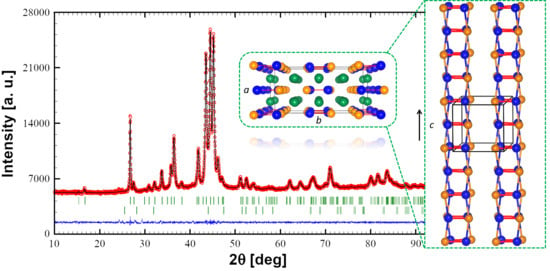

Article

Phase Stability and Competing Crystal Structures in the Formation of the Intermetallic Compounds Cu5As2 and Cu5(As,Sb)2

1
Department of Chemistry, University of Genova, 16146 Genova, Italy
2
Institute for Superconductors, Oxides and Other Innovative Materials and Devices, National Research Council of Italy, 16152 Genova, Italy
3
Department of Physics, University of Genova, 16146 Genova, Italy
*
Authors to whom correspondence should be addressed.
Solids 2026, 7(3), 24; https://doi.org/10.3390/solids7030024
Submission received: 18 February 2026 / Revised: 1 April 2026 / Accepted: 20 April 2026 / Published: 1 May 2026

Abstract

An experimental investigation of the Cu-As-Sb ternary system in the Cu-rich region led to the identification of a new intermetallic phase, Cu5(As,Sb)2. The compound crystallizes in the orthorhombic Mg5Ga2-type structure (oI28, Ibam), analogous to the binary parent phase Cu5As2, with lattice parameters a = 5.968–5.977(1) Å, b = 11.550–11.565(3) Å, c = 5.530–5.573(3) Å. Similar to the parent Cu5As2 phase, the ternary compound forms with slight Cu under stoichiometry and exhibits a limited compositional range, with no continuous solid solubility between the binary and ternary phases. The phase formation, compositional stability, and decomposition behavior were systematically studied using a combination of powder and single-crystal X-ray diffraction (XRD, including Rietveld refinement), metallographic analysis with optical and scanning electron microscopy with energy-dispersive X-ray spectroscopy (LOM, SEM-EDXS), electron backscatter diffraction (EBSD) and thermal analysis (DTA, DSC). The results reveal that Cu5(As,Sb)2 is a high-temperature phase forming peritectically at 650–635 °C and stable only within a limited temperature interval. No continuous solid solubility exists between the ternary compound and the parent binary phase Cu5As2. Its formation occurs in strong competition with that of two other close neighboring solid-solution compounds, [Cu3−x(As1−ySby) (Cu3P-type; hP24, P63cm) and Cu3−x(As,Sb) (Cu9TeSb2-type; cP32, Pm−3n)], reflecting a complex interplay between composition, solubility ranges and thermal history. No evidence for the existence of high-temperature (HT) and low-temperature (LT) polymorphic phases was found for either the binary compound Cu5As2 or the ternary compound Cu5(As,Sb)2. Electrical resistivity measurements on a quenched sample indicate metallic behavior. These findings provide new insight into phase stability and structure–property relationships in Cu-As-Sb alloys and contribute to the understanding of competing intermetallic phases in this system.

Graphical Abstract

1. Introduction

Some of the earliest and most remarkable artifacts created from Cu-As-Sb alloys were discovered in the Nahal Mishmar hoard in Israel, which dates back to the early 4th millennium BCE during the Chalcolithic period [1]. Many of these as-cast objects, along with similar items from nearby locations such as Nahal Zeelim, are characterized by arsenic contents of up to 6 wt.% and antimony levels reaching 22 wt.%, resulting in a distinctive violet-pink hue. Comparable alloy compositions have also been identified in Middle and Late Bronze Age ingots in Switzerland, in several Late Bronze Age hoards in Slovenia, and in a 6th century BCE hoard from Arbedo, Ticino, Switzerland [2]. Since that time, such alloy compositions have become exceedingly rare in prehistory and are virtually undocumented in historical contexts, with no known applications of these alloys.
Conversely, Cu-As-Sb alloys represent a promising area of research in materials science and metallurgy due to their distinct properties and potential applications. They have attracted considerable interest as potential thermoelectric materials capable of converting waste heat into electricity. Investigating these alloys not only advances the development of innovative materials but also ensures that their use aligns with sustainable practices and regulatory standards, particularly with respect to the toxicity and environmental impact of arsenic (As) and antimony (Sb). To date, only one experimental investigation has been reported [3], together with a limited number of thermodynamic modeling studies of the Cu-As-Sb system [4,5,6]. Analysis of the phase diagram, phase formation, and microstructure of these alloys is therefore essential for predicting their behavior during processing and under operational conditions. During our exploration of the copper-rich region of this ternary system, we identified a new intermetallic compound, Cu5(As,Sb)2. The present work focuses on investigating its crystal structure, thermodynamic stability, and electrical transport properties. The binary parent compound of this phase is also known as the mineral koutekite [7], although no reliable data on the purity and chemical composition of the latter have been provided, nor is there information on its stability at room temperature.

2. Experimental Methods

2.1. Synthesis

Samples with varying nominal compositions from the Cu-rich corner of the Cu-As-Sb ternary system were synthesized directly from the constituent elements, with total batch masses of 6–8 g (Table 1). The metals employed in the synthesis included small pieces of Cu (99.997 wt.% purity, sourced from Metallwerke Brixlegg, Brixlegg, Austria, certified as MB-OF101), lumps of As (99.99 wt.% purity from Alfa Aesar, Haverhill, MA, USA), and polycrystalline Sb (99.999 wt.% purity from Koch Light Laboratories LTD, UK). To remove any residual surface oxides, the Cu pieces were treated with a 5–10% nitric acid solution prior to use, followed by rinsing with water and subsequently with absolute ethanol. Similarly, the As pieces were sealed under vacuum in a Pyrex tube and heated to 300 °C, with the upper end of the tube positioned just outside the furnace. This configuration promoted the migration of As2O3 vapors towards the cooler end of the tube, where they condensed. After the elements were subjected to the above-cited preliminary treatment, they were weighed according to the required stoichiometric proportions. They were then sealed in a quartz tube under vacuum and heated at a rate of 40 °C per step (2–3 h/step) up to a maximum of 850 °C for binary Cu-As samples and of 800 °C for the ternary Cu-As-Sb samples, in an electric resistance furnace. The thermal treatment was continued until complete reaction had occurred and a homogeneous liquid was obtained. The samples were then annealed at various temperatures, predominantly between 750 and 250 °C. Once the heat treatment was complete, most samples were quenched in water, while a smaller number was slowly cooled in air. No reaction between the liquid alloys and the quartz was observed; nevertheless, in some cases, small amounts of As separated at the top of the quartz ampoule. No weight losses were detected at the conclusion of the preparation procedure. The alloys were retained within the quartz tube until analysis to prevent possible oxidation; however, the samples were found to be stable in air for extended periods (several months). The use of metal crucibles for sample preparation proved impractical. Reaction of the elements occurred when using Fe, Mo, or Ta crucibles: diffusion of As from the alloy with chemical attack toward the container material occurred in both liquid and vapor states, as noted, for instance, in the case of binary Cu-As samples prepared in a Ta crucible (see Section 3).
The phase analysis and structural characterization was conducted on all samples prepared in order to study the Cu-rich corner of the ternary system. Subsequently, a second series of samples was synthesized with compositions centered within the field of existence of the binary Cu5As2 compound and the new ternary Cu5(As,Sb)2. The Cu concentration was fixed between 60 and 70 at.%, while the Sb/As atomic ratio was varied. The objective was to prepare single-phase materials, for determining the crystal structure of the binary Cu-As and ternary Cu-As-Sb compounds formed, and to determine their thermal and physical measurements. In the following, samples are named according to their nominal composition, followed by annealing temperature and time in days (d) and the indication if quenched (Q), for instance, Cu70As25Sb5 (480 °C/13 d/Q).

2.2. Phase Analysis

The metallographic specimens were prepared following standard polishing procedures: the alloy pieces were embedded in cold-mounting acrylic resin, ground with abrasive paper (up to 1200 mesh), and polished using diamond paste to a fineness of 1 μm. The microstructure of the alloys was analyzed using light optical microscopy (LOM) and field-emission scanning electron microscopy (FE-SEM). For LOM, a Leica DM1750M (Wetzlar, Germany) was employed in both bright field and polarized light modes, achieving magnifications of up to 1000×. The SEM analysis was complemented by energy-dispersive X-ray spectroscopy (EDXS) for semi-quantitative compositional assessments, utilizing a Zeiss Gemini-SEM 360 microprobe (Dublin, CA, USA) equipped with an Oxford X-Max 20 detector. Data acquisition and analysis were carried out using Aztec 6.1 software. Pure cobalt was used as the calibration standard. The compositional analysis was performed based on the characteristic X-ray intensities of each element, using an acceleration voltage of 20 kV and an acquisition time of 100 s. Furthermore, the EDXS measurements were carried out over the entire surface area of the specimens (15–20 mm2) to establish a representative bulk composition, thereby improving the measurement precision, which was estimated to be ±1.0 at.% for each element. To analyze the crystallographic structure of selected specimens, electron backscattered diffraction (EBSD) analyses were carried out using the above-mentioned SEM. EBSD measurements were performed with an Oxford C-nano EBSD detector, coupled with Oxford Aztec 6.1 software for data acquisition and processing. Analyses were conducted under beam acceleration conditions of 20 kV and a beam current of 4 nA.

2.3. Structural Characterization

The crystal structure of the compounds present in the samples was characterized by both powder and single crystal X-ray diffraction (XRD) techniques. Powder X-ray diffraction patterns (PXRD) were collected using a Bruker D4 Endeavour diffractometer equipped with a linear detector and Cu Kα radiation (λ = 1.54184 Å). Data collection was primarily carried out over a 2θ range of 5–90°, with a step size of 0.02° and a counting time of 3 to 5 s per step. Pure silicon, with a lattice parameter of a = 5.4308(1) Å, was used as an external standard. Powder samples were prepared by grinding polycrystalline fragments of each alloy and placing them on a zero-background silicon single-crystal sample holder. The resulting diffraction patterns were indexed using Lazy Pulverix software (https://journals.iucr.org/paper?S0021889877012898, accessed on 17 February 2026) [8], and precise lattice parameters were determined using in-house least squares methods. Rietveld refinement of the structures was conducted on most samples utilizing FullProf software (Version April 2023) [9].
For single crystal analysis, crystals from selected samples were isolated and mounted on a glass fiber using grease. A complete dataset was collected at ambient temperature using a Bruker D8 QUEST diffractometer equipped with a PHOTON III photon counting detector and a graphite monochromator for Mo Kα radiation (λ = 0.71073 Å), operating in ω-scan mode. Intensity data were collected over reciprocal space up to approximately 36° in θ, achieving a resolution of around 0.6 Å with 30 s exposures per frame. The unit cell was initially refined using APEX4 [10]. Data were subsequently processed using SAINT [11] and XPREP [12]. Corrections for Lorentz, polarization, and absorption effects were applied using SADABS [13].

2.4. Thermal Analysis

Samples extracted from the prepared alloys were subjected to differential thermal analysis (DTA) using a NETZSCH DTA 404-S instrument. Alloy fragments were placed in an Al2O3 crucible, covered with an Al2O3 lid and an additional cover made of pure copper foil (6N purity) to prevent the release of arsenic vapor during thermal runs. Heating and cooling rates were set at 10–20 °C/min (heating) and 5–10 °C/min (cooling), respectively; the estimated temperature accuracy is of ±5 °C. Additionally, some specimens (0.20–0.30 g) were subjected to differential scanning calorimetry (DSC) measurements up to 580 °C with heating and cooling rates set at 10 °C/min (Mettler Toledo DSC-821).

2.5. Transport Property Measurements

The electrical resistivity of the sample with nominal composition Cu70As25Sb5 (480 °C/12 d/Q) was measured using a Physical Properties Measurement System (PPMS, Quantum Design, San Diego, CA, USA). A small specimen was mounted on a custom-built sample holder, and the measurement was conducted in a standard four-probe configuration using copper lids attached to the sample with silver paint, over a temperature range of 2–290 K. The uncertainty in the measures of the resistivity values is estimated to be about 10%; it is almost temperature independent mostly due to the determination of the geometrical factors of the specimen measured.

3. Results and Discussion

3.1. Synthesis

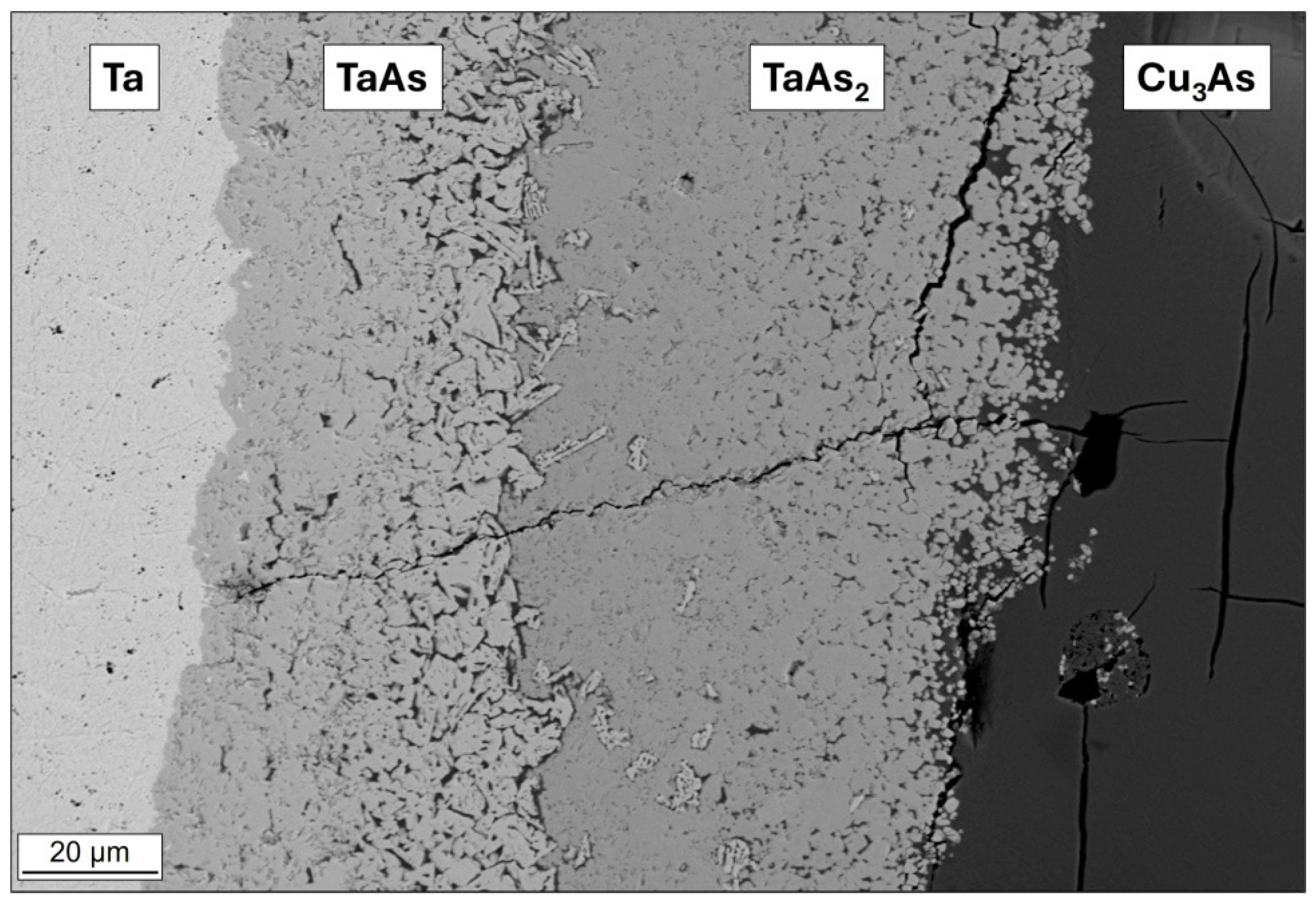
The synthesis of single-phase Cu5As2 and Cu5(As,Sb)2 proved to be challenging. No pure single-phase samples could be obtained, either by cooling from high temperature or by heating from low temperature followed by annealing at different temperatures up to 650 °C. In all cases, the formation of Cu3(As,Sb), together with an (As,Sb) solid solution and an (As,Sb)-rich eutectic, was also observed. Additional difficulties arose when attempting to synthesize Cu-As alloys in crucibles made of Fe, Mo, or Ta (or other transition metals), indicating that the preparation of Cu-As alloys in a metallic container is not feasible. As exemplified by a Cu68As32 sample synthesized in a Ta crucible (sealed by arc-welding under pure Ar flow), As reacts with the Ta walls, forming compounds of the Ta-As system. The overall microstructure, as clearly evident in the SEM micrography shown in Figure 1, appears as if it originated from a pair-diffusion reaction [14,15,16,17,18]. The remaining Cu-As alloy consists only of Cu3As [19]. Therefore, quartz tubes are recommended for the synthesis of such alloys, while alumina crucibles are suitable for their thermal analyses.

3.2. Phase Analysis

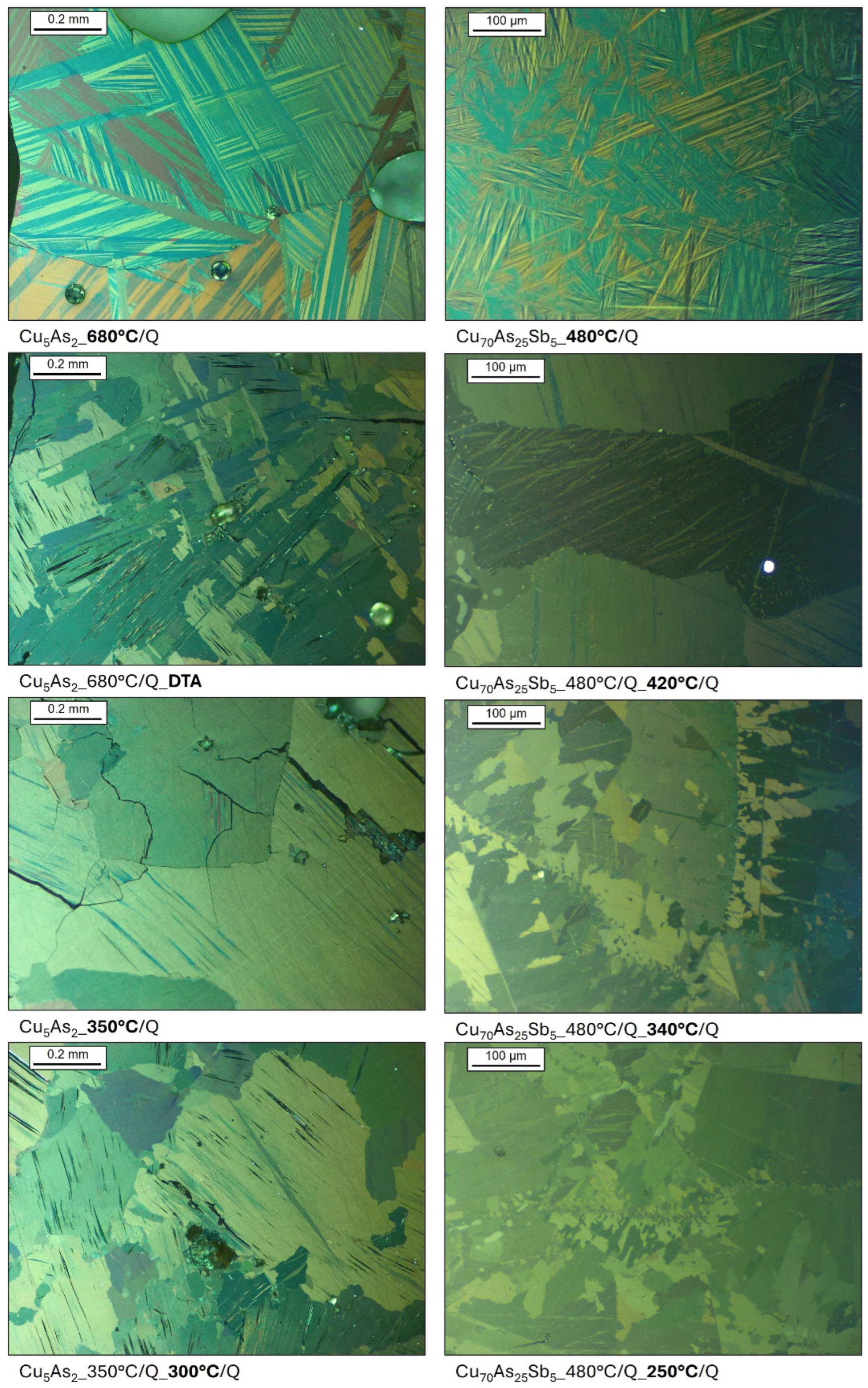
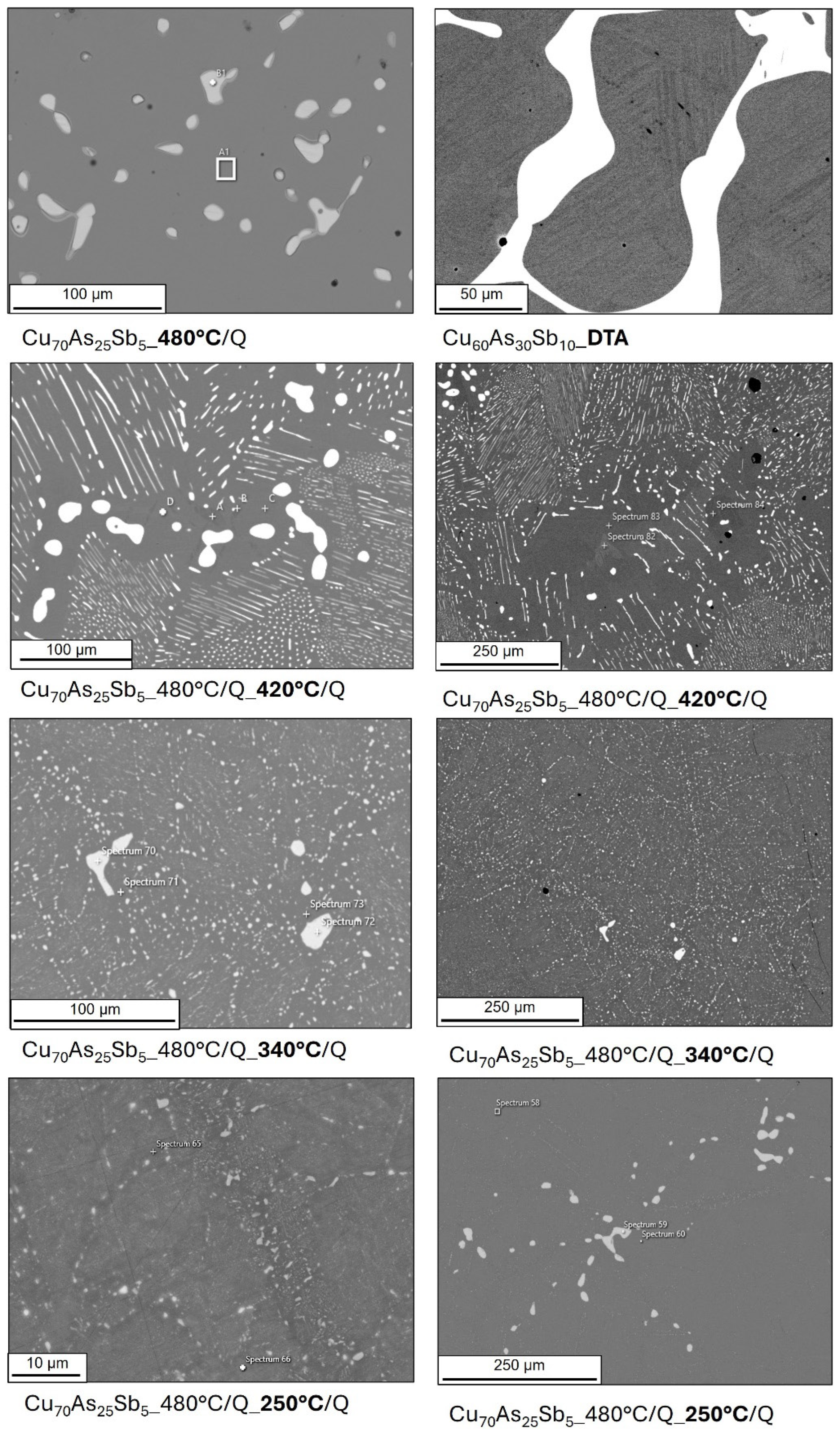
Cross-sections of all samples were prepared and analyzed using LOM and SEM-EDXS. The needle-like morphology of the Cu5As2 and Cu5(As,Sb)2 compounds is particularly evident under polarized light (left panel of Figure 2). Annealing at temperatures of 420, 350, and 340 °C leads to slow and partial decomposition of this phase, whereas annealing at 300 and 250 °C results in complete decomposition of the Cu5As2 [20,21] and Cu5(As,Sb)2 compounds into hexagonal Cu3As and As [or (As,Sb)] (Figure 3). In ternary samples, the amount of inclusions of As-rich Sb increases while decreasing the annealing temperature. EDXS analyses confirm a compositional range of Cu (68.9–71.5 at.%), As (23.2–28.6 at.%) and Sb (1.9–5.1 at.%) for the ternary Cu5(As,Sb)2 phase.
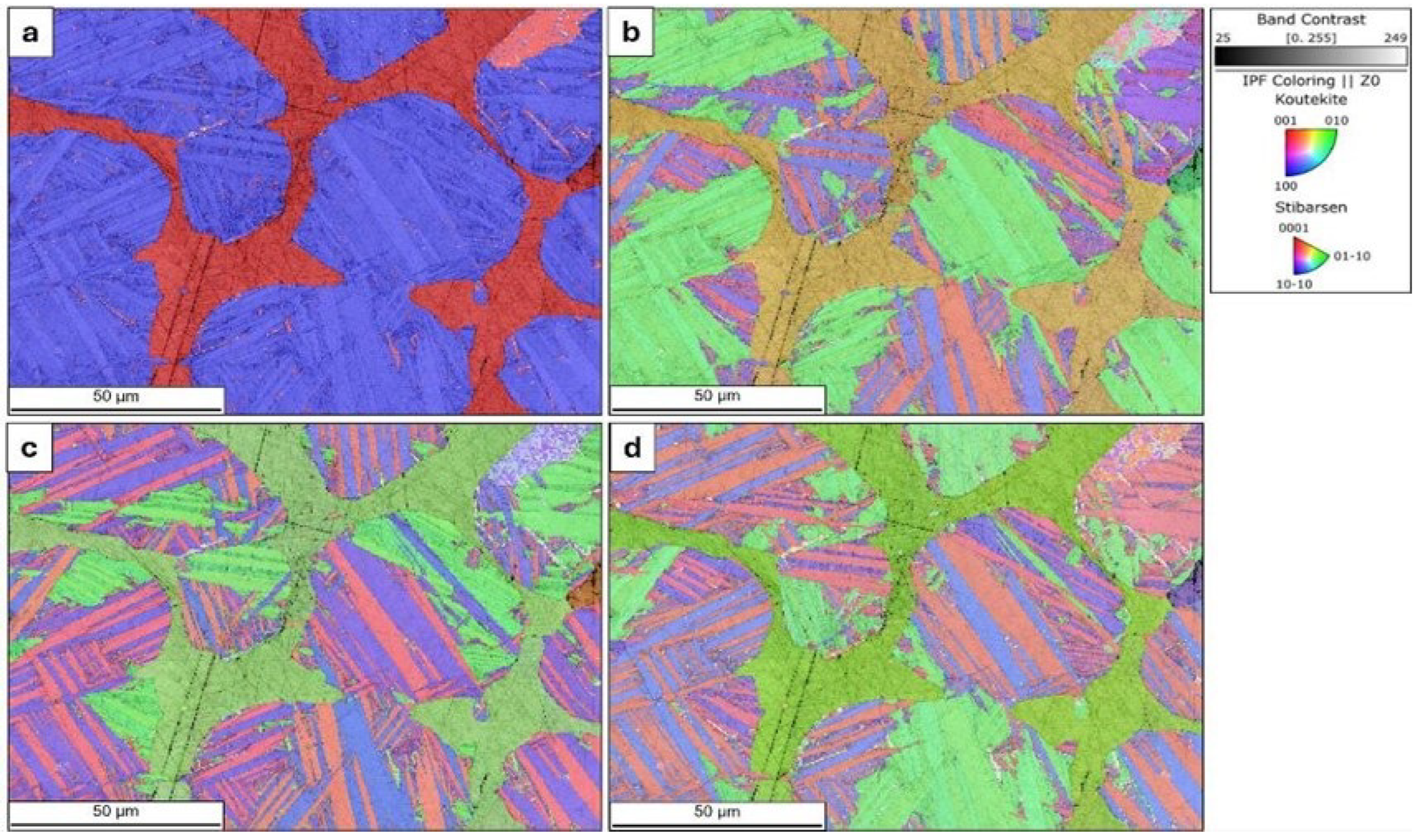
EBSD analyses of the Cu60As30Sb10 (DTA) sample confirmed the presence of two different phases; the main phase was identified using Aztec 6.1 software as the mineral koutekite (Cu5As2) [7,22], while the secondary phase was identified as stibarsen (As,Sb) [23] (Figure 4). EDXS analyses further confirm the presence of Sb at about 1.9–2.0 at.% in the “koutekite” phase, consistent with the formation to the new ternary Cu5(As,Sb)2 compound.
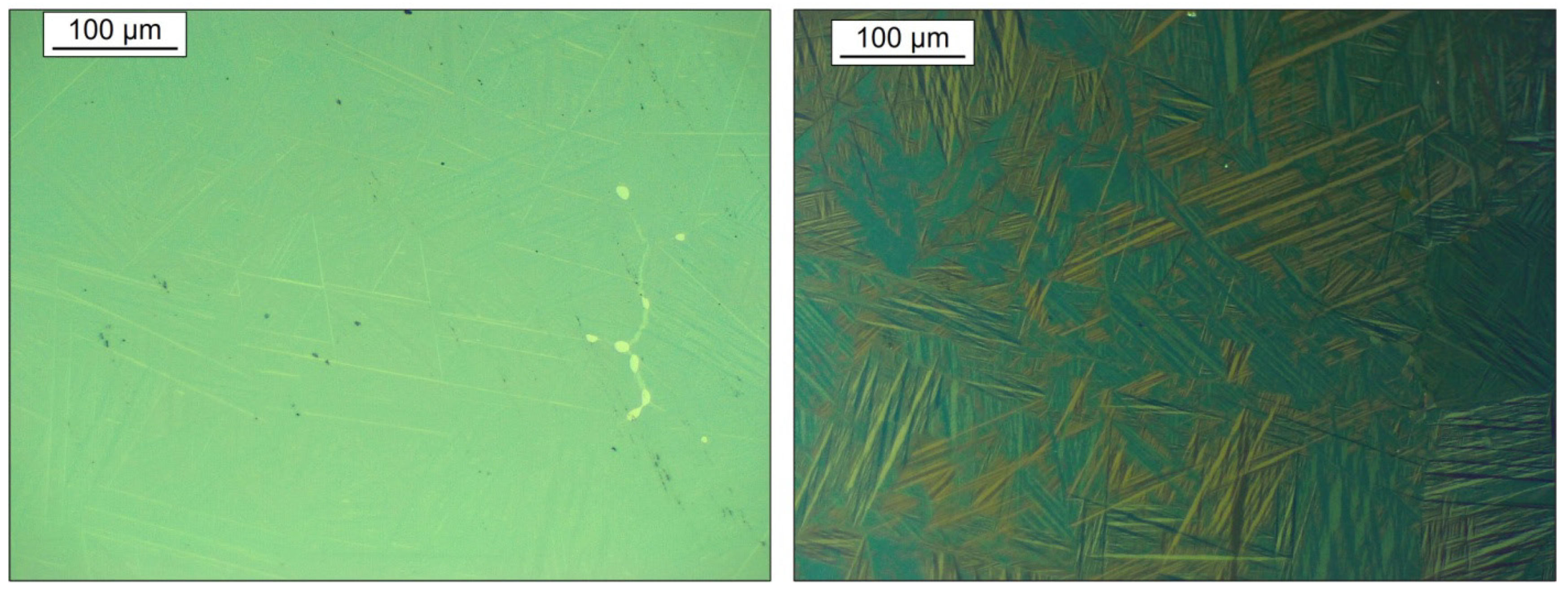
One of the best ternary samples that we were able to synthesize was prepared with a nominal composition Cu70As25Sb5 (480 °C-12 d/Q); it resulted to be almost single-phase (nearly 98 vol.% pure) (Figure 5). This sample was then subsequently used for both structural refinement and for resistivity measurements.

3.3. Crystal Structure

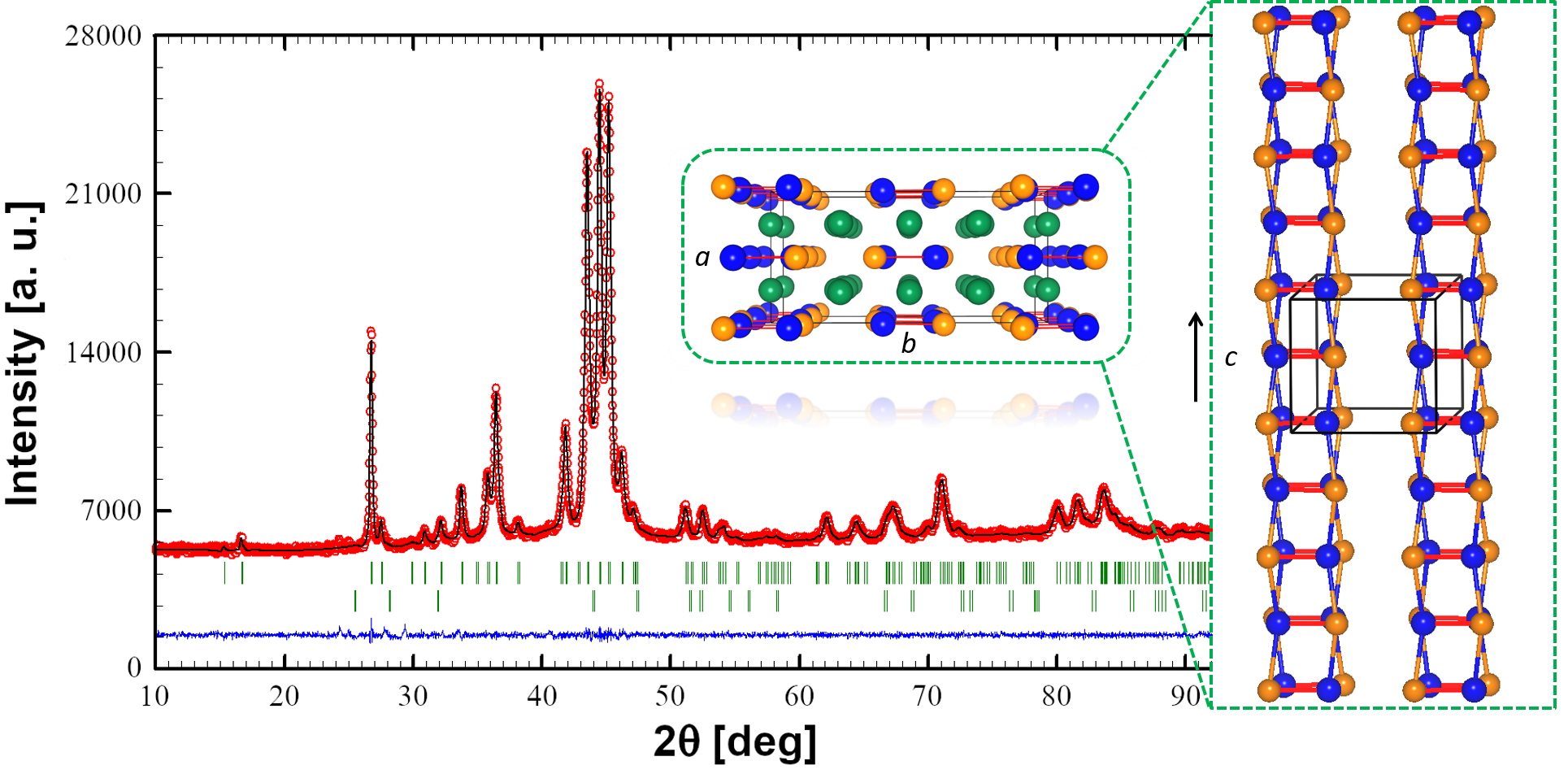
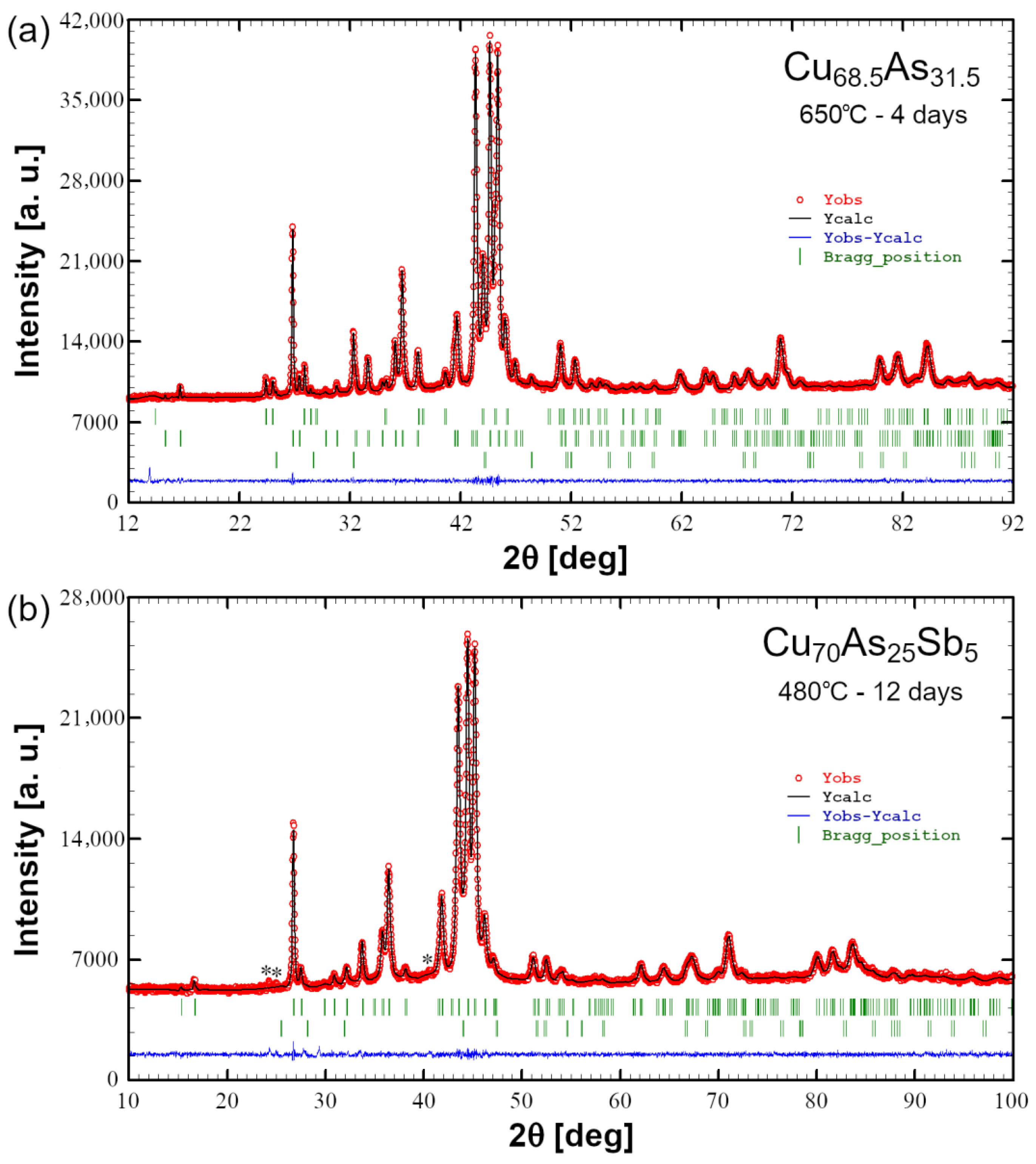
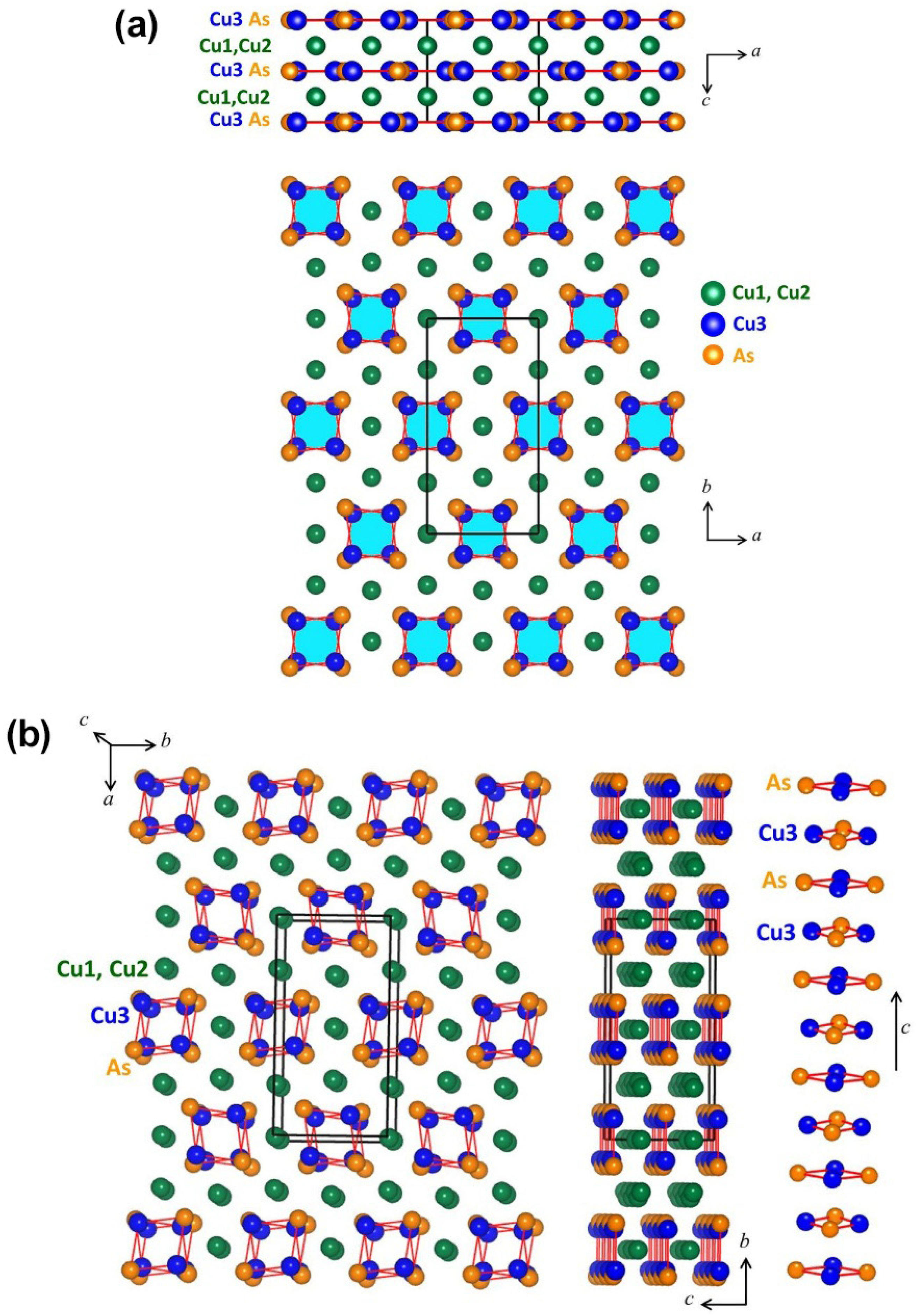
Although numerous single crystals from samples with varying compositions were isolated and tested, no single crystal was suitable for full single-crystal structure refinement. The single-crystal experiments provided only reliable lattice parameters and space group symmetry. Consequently, the crystal structure of Cu5As2 and Cu5(As,Sb)2 was studied and refined using powder X-ray diffraction data. Rietveld refinement of the X-ray powder diffraction pattern was firstly performed on a binary sample with nominal composition Cu68.5As31.5 (650 °C/4 d/Q) (Figure 6a), specifically prepared on the Cu-poorer side of the compositional range, in order to minimize the formation of the congruently melting extra-phase Cu3As. The obtained atomic positions (standardized setting) of Phase 1 are reported in Table 2 and correspond to those of the Cu5−xAs2 compound (Mg5Ga2-type, oI28, Ibam, No. 72), whose refined site occupancies yield a final stoichiometry of Cu4.60(2)As2. In this structure, Cu atoms occupy three atomic positions, Cu1 (4a), Cu2 (8g), and Cu3 (8j), while As fills only one position (8j). Only the Cu3 position is partially occupied (80%); all other positions are fully occupied. The sample contains approximately 82% of Cu4.60(2)As2, approximately 14% of Cu2.885As (Cu3P-type, hP24, P63cm, No. 185) and approximately 4% of elemental As (As-type, hR6, space group R − 3m, No. 166) as unreacted excess reagent (Rwp = 7.10%, χ2 = 1.50). Interatomic distances for dobs/∑rM ≤ 1.180 (where dobs is the observed interatomic distance and ∑rM is the sum of the two metallic radii) and coordination numbers (CNs) in Cu4.60(2)As2 are reported in Table 3. The shortest interatomic distances are formed between Cu and As atoms. A sketch of the crystal structure of Cu5−xAs2 (Mg5Ga2-type, oI28, Ibam, No. 72) is shown in Figure 7. Views along the b-axis and along the c-axis are presented in Figure 7a. A perspective view highlighting the “Cu2As2” units and magnification of a fragment of the “Cu2As2” units extending along the c-axis are shown in the left panel of Figure 7b. Within each unit, the Cu3 atoms are bridged by two As atoms to form a distorted square-shaped, four-membered Cu–As–Cu–As ring with Cu–As bond lengths of 2.459 Å and 2.533 Å. These units stack linearly along the c-axis creating one-dimensional columns of four-membered rings, each rotated 90° with respect to its neighbors, resulting in a repeating zig-zag motif (Figure 7b, right). The Cu–As–Cu–As rings are planar; no direct Cu–Cu or As–As bonds are formed between adjacent units.
Subsequently, structural refinement using the Rietveld method was also carried out for the ternary phase. For this purpose, the X-ray powder diffraction pattern of an almost single-phase sample, nominal Cu70As25Sb5 (480 °C/12 d/Q), was used; its Rietveld refinement profile is shown in Figure 6b. This sample contains about 98 vol.% of the compound Cu5−x(As1−ySby)2 with a resulting composition of Cu4.54(1)As1.81(1)Sb0.19(1) (Mg5Ga2-type, oI28, Ibam, No. 72), together with a small amount of (As,Sb) solid solution (As-type, hR6, R − 3m, No. 166) as impurity phase (2 Vol.%), and trace amounts of Cu2.885(As,Sb) (extra peaks marked with an asterisk in Figure 6b). Rietveld refinement data, atomic coordinates and occupancies, are listed in Table 4. The CIF files of both the compounds Cu5−xAs2 and Cu5−x(As,Sb)2 are available in the Supplementary Information (SI).

3.4. Thermal Analysis

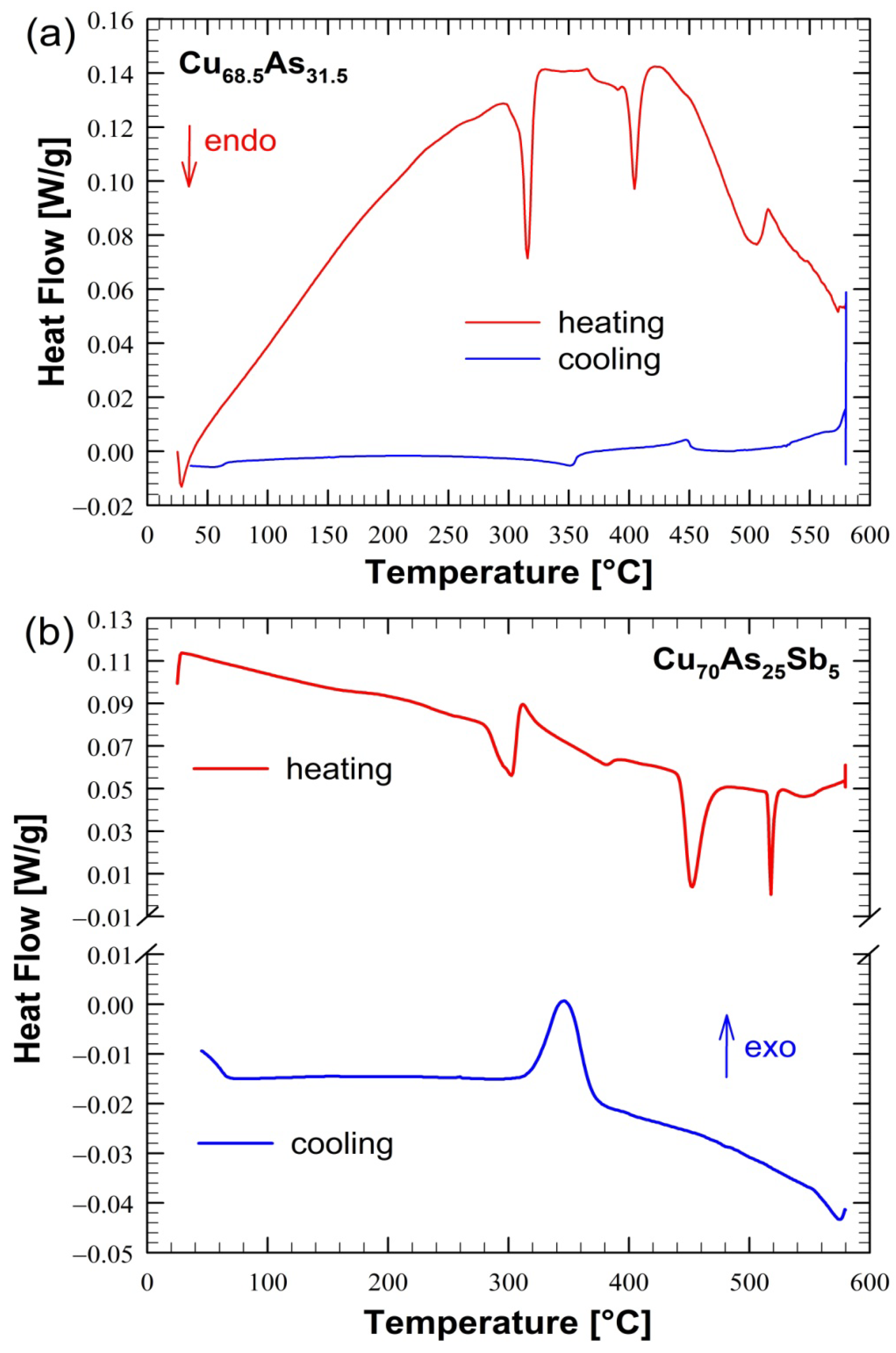
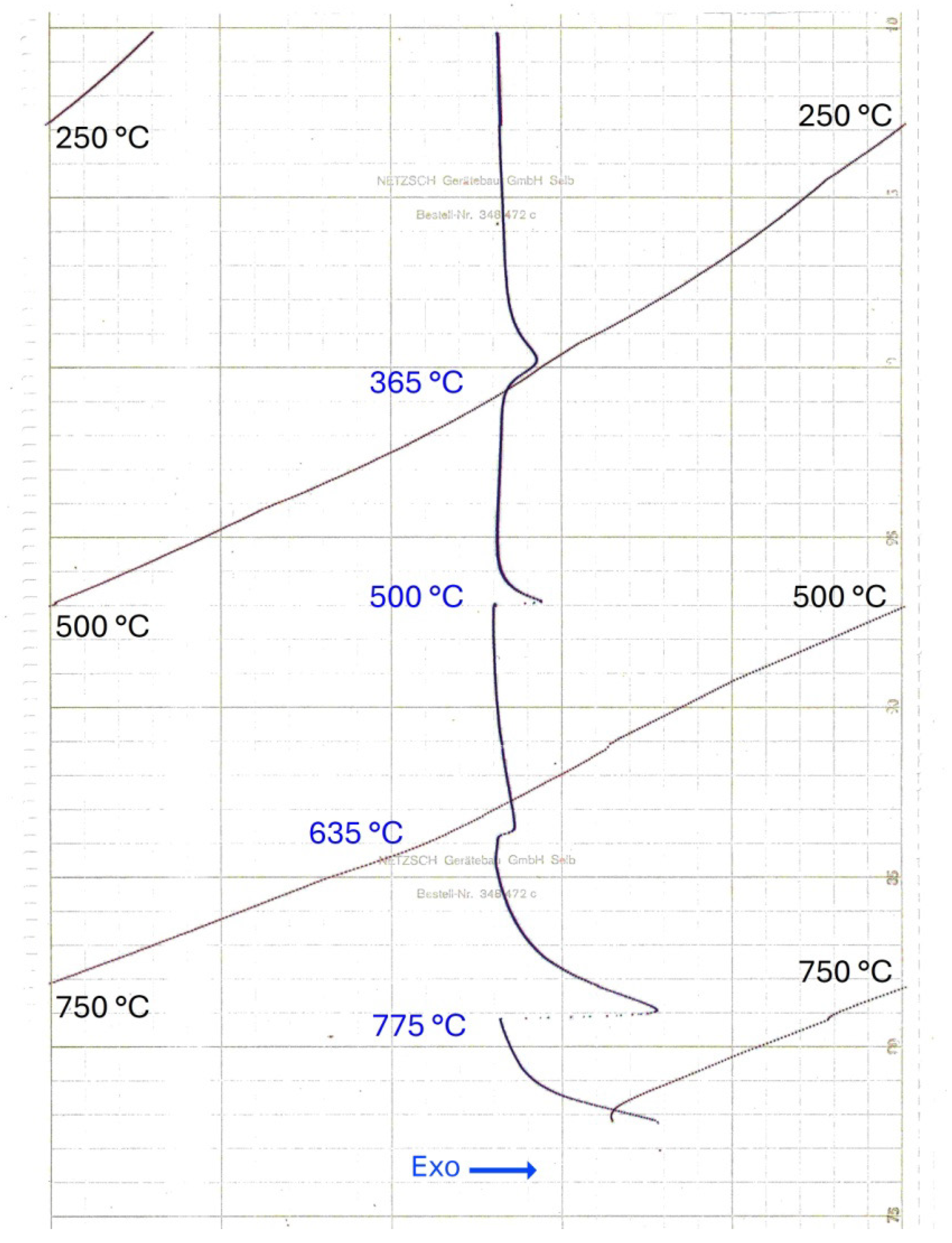
In addition to numerous DTA measurements, DSC analyses were performed on several Cu-As-Sb samples, revealing thermal behavior very similar to that observed for the binary Cu-As alloys in the Cu5As2 composition range. For example, samples with a composition of Cu70As25Sb5 were heated to 580 °C during DSC measurements (higher temperatures were not accessible due to instrumental limitations) and to 800 °C (above the liquidus temperature) during DTA experiments. The following samples were investigated: (1) DSC: Cu70As25Sb5 (480 °C/Q_420 °C/Q) (Figure 8); (2) DTA I: Cu70As25Sb5 (480 °C-12 d/Q); (3) DTA II: Cu70As25Sb5 (DTA I) (Figure 9). These samples exhibited the following characteristic thermal peaks (Table 5):
  • The peak at 775 °C indicates the liquidus temperature of the alloy;
  • The peak between 635 and 650 °C (heating/cooling) is associated with the peritectic formation of Cu5(As,Sb)2;
  • The peak at 500–515 °C (heating/cooling) indicates a eutectic reaction;
  • A transformation at around 440–450 °C (predominantly observed during heating but absent during cooling), also reported in the Cu-As system, may be interpreted as a transformation from ε-As to α-As [24];
  • At 365–380 °C (heating/cooling), an additional peak is observed, which likely marks the onset of the decomposition of Cu5(As,Sb)2 into Cu3−x(As,Sb) and (As,Sb) (upon cooling);
  • The thermal effect at 280 °C likely originates from residual Cu5(As,Sb)2 in the starting alloys due to its incomplete decomposition; hence, this peak is no longer present in the subsequent DTA run (run II).
We disprove the existence of HT and LT phases reported in the literature for the binary Cu5As2. At the same time, we found no evidence of polymorphism in the ternary Cu5(As,Sb)2 compound. As a reference, the relevant phase transformations in the Cu-As system for Cu5As2 are reported as follows: approximately 820 °C (liquidus), 710 °C (peritectic formation), 600 °C (eutectic), about 448 °C [450 °C] (ε-As → α-As transformation), approximately 380 °C [385 °C] (unidentified transformation) and 300 °C [300 °C] (decomposition). Values obtained in this study from DSC measurements are reported in square brackets (Figure 8a), while all other values are taken from Ref. [24].

3.5. Transport Properties

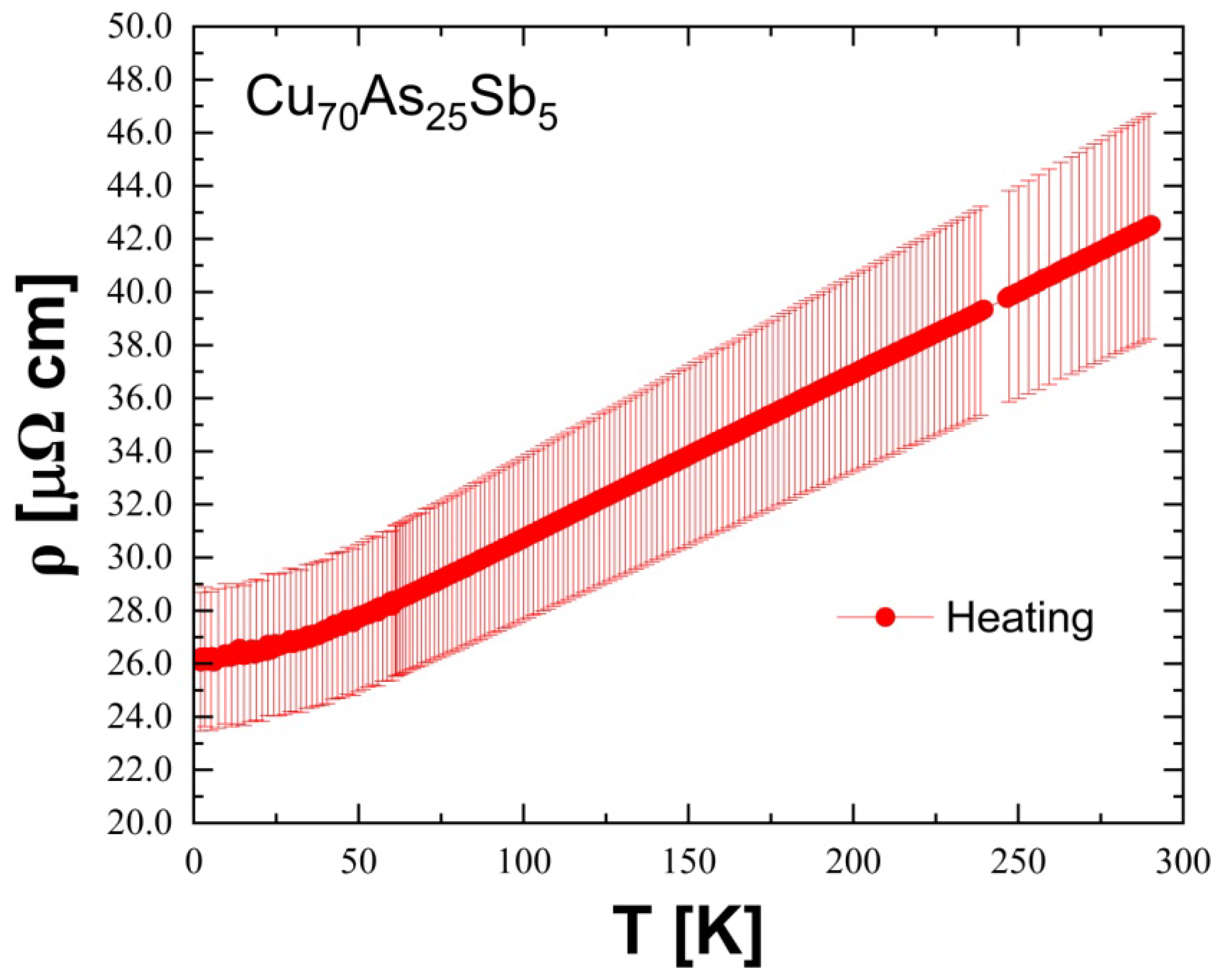
The zero-field electrical resistivity, as a function of temperature between 2 and 290 K, was measured on a polycrystalline bulk sample of the Cu5(As,Sb)2 compound with nominal composition Cu70As25Sb5 (480 °C/13 d/Q). The compound was retained at room temperature as a metastable phase by quenching. The data are shown in Figure 10. The room temperature value of about 420 μΩ cm is of the same order of magnitude but higher than 300 μΩ cm reported in the literature for the cubic ternary Cu3−x(As,Sb) with composition Cu72As21Sb7 (Cu9TeSb2-type, cP32) [3]. The bulk resistivity displays an overall metallic behavior, with the electrical resistivity decreasing linearly as the temperature decreases.

4. Conclusions

The new ternary intermetallic compound Cu5(As,Sb)2 [more precisely, Cu5−x(As1−ySby)2] was identified during an investigation of the Cu-rich corner of the Cu-As-Sb ternary system. The crystal structure was investigated by single-crystal and powder X-ray diffraction and refined by Rietveld methods. Similarly to the pure binary Cu5As2 (more precisely, Cu5−xAs2), the new ternary solid-solution phase was also found to crystallize in the orthorhombic Mg5Ga2-type structure (oI28, Ibam No. 72). The lattice parameters were determined within the range a = 5.968–5.977(1) Å, b = 11.550–11.565(3) Å, c = 5.530–5.573(3) Å. A compositional range, relatively narrow for Cu (68.9–71.5 at.%), but broader for both As (23.2–28.6 at.%) and Sb (1.9–5.1 at.%), was found for this compound. However, a compositional gap (despite being narrow) between the ternary Cu5(As,Sb)2 [Cu5−x(As,Sb)2] and the binary Cu5As2 (Cu5−xAs2) appears to remain, with no evident continuous solid solubility between the two phases.
Similar to the parent binary compound Cu5As2, which exists only within a limited temperature interval (forming peritectically at 709 °C and stable between 709 and 300 °C), Cu5(As,Sb)2 is also a HT phase. It forms at 650–635 °C by a peritectic reaction between the hexagonal solid-solution compound Cu3−x(As,Sb) (Cu3P-type, hP24, P63cm, No. 185) and a liquid (As,Sb) phase. Upon lowering the temperature it begins to decompose at about 380–365 °C and, at about 320–300 °C, is fully transformed back into the hexagonal Cu3−x(As,Sb) and solid (As,Sb) (As-type, hR6, R-3m, No. 166). The initial overall composition of the alloy and the cooling rate are the main factors determining the kinetics of its decomposition. Due to its peritectic formation, and its nature as a high-temperature compound, together with the existence of temperature-dependent compositional ranges for all three elements, the crystallization of Cu5(As,Sb)2 is rather complex to study. Its formation (and therefore its thermodynamic stability) is in strong competition with the crystallization of the two closely related neighboring solid-solution compounds Cu3−x(As1−ySby) (Cu3P-type, hP24, P63cm, No. 185) and Cu3−x(As,Sb) (Cu9TeSb2-type, cP32, Pm − 3n, No. 223). No evidence for the existence of HT and LT phases was found for either the binary compound Cu5As2 or the ternary compound Cu5(As,Sb)2. The compound Cu5(As,Sb)2 exhibits metallic behavior, with electrical resistivity decreasing monotonically as the temperature decreases.

Supplementary Materials

The following supporting information can be downloaded at: https://www.mdpi.com/article/10.3390/solids7030024/s1.

Author Contributions

Conceptualization, M.M., A.P. and P.M.; Methodology, M.M., A.P., P.S. and S.D.N.; Software, P.S.; Validation, A.P., S.D.N., A.B., C.B. and P.M.; Formal analysis, M.M., A.P., P.S., S.D.N., A.B. and C.B.; Investigation, P.S., C.B. and P.M.; Data curation, M.M., A.P., P.S., A.B. and C.B.; Writing – original draft, M.M.; Writing – review & editing, A.P., S.D.N. and P.M.; Supervision, P.M.; Project administration, P.M.; Funding acquisition, M.M. The present research work was performed, and the manuscript written, through the contributions of all authors. All authors have read and agreed to the published version of the manuscript.

Funding

This research was funded by the European Union’s Horizon 2020 research and innovation program under the Marie Skłodowska-Curie grant agreement No. [101018804].

Data Availability Statement

The original contributions presented in this study are included in the article/Supplementary Material. Further inquiries can be directed to the corresponding author(s).

Acknowledgments

The authors would like to thank Metallwerke Brixlegg, Austria, for providing the pure copper metal used in this study.

Conflicts of Interest

The authors declare that they have no conflicts of interest.

References

  1. Shalev, S.; Northover, P. The metallurgy of the Nahal Mishmar Hoard Reconsidered. Archaeometry 1993, 35, 35–47. [Google Scholar] [CrossRef]
  2. Northover, J.P. Metallurgica Antiqua: Der Anschnitt. Beiheft 1998, 8, 113–121. [Google Scholar]
  3. Mödlinger, M.; Provino, A.; Solokha, P.; De Negri, S.; Caglieris, F.; Ceccardi, M.; Bernini, C.; Manfrinetti, P. Crystallochemistry, Thermodynamic and Physical Properties of the novel intermetallic compound Cu3−x(As,Sb). Intermetallics 2025, 176, 108526. [Google Scholar] [CrossRef]
  4. Villars, P.; Prince, A.; Okamoto, H. (Eds.) Handbook of Ternary Alloy Phase Diagrams (10 Volume Set); ASM International: Materials Park, OH, USA, 1995. [Google Scholar]
  5. ASM Alloy Phase Diagram, Digital Database™; ASM International: Materials Park, OH, USA, 2007.
  6. Villars, P.; Cenzual, K. Pearson’s Crystal Data—Crystal Structure Database for Inorganic Compounds (on DVD); Release 2022/2023; ASM International: Materials Park, OH, USA, 2022. [Google Scholar]
  7. Johan, Z. Koutekit—Cu2As, ein neues Mineral. Chem. Der Erde 1960, 20, 217–226. [Google Scholar] [CrossRef]
  8. Yvon, K.; Jeitschko, W.; Parthé, E. LAZY PULVERIX, a computer program for calculating X-ray and neutron diffraction powder patterns. J. Appl. Crystallogr. 1977, 10, 73–74. [Google Scholar] [CrossRef]
  9. Rodriguez-Carvajal, J. Recent advances in magnetic structure determination by neutron powder diffraction. Phys. B 1993, 192, 55–69. [Google Scholar] [CrossRef]
  10. Bruker. APEX4, V2021.10-0; Bruker AXS Inc.: Madison, WI, USA, 2021.
  11. Bruker. SAINT, V8.30A; Bruker AXS Inc.: Madison, WI, USA, 2012.
  12. Bruker. XPREP, V2014/2; Bruker AXS Inc.: Madison, WI, USA, 2014.
  13. Bruker. SADABS, V2016/2; Bruker AXS Inc.: Madison, WI, USA, 2016.
  14. Dybkov, V.I. Reaction Diffusion and Solid State Chemical Kinetics; Materials Science Foundation; Trans Tech Publications Ltd.: Baech, Switzerland, 2010; Volumes 67–68. [Google Scholar]
  15. Mehrer, H. Diffusion in Solid Metals and Alloys; Landolt-Börnstein, New Series, Group III; Springer: Berlin/Heidelberg, Germany, 1990; Volume 26. [Google Scholar]
  16. Mehrer, H. Diffusion in Solids: Fundamentals, Methods, Materials, Diffusion-Controlled Processes; Springer Series of Solid State Sciences; Springer: Berlin/Heidelberg, Germany, 2007; Volume 155. [Google Scholar]
  17. Kodentsov, A.A.; Bastin, G.F.; van Lo, F.J.J. Application of diffusion couples in phase diagram determination. In Methods for Phase Diagram Determination; Zhao, J.-C., Ed.; Elsevier Ltd.: Oxford, UK, 2007; Chapter 6; pp. 222–245. [Google Scholar] [CrossRef]
  18. Kodentsov, A.A.; Bastin, G.F.; van Loo, F.J.J. The diffusion couple technique in phase diagram determination. J. Alloy. Compd. 2001, 320, 207–217. [Google Scholar] [CrossRef]
  19. Mödlinger, M.; Provino, A.; Solokha, P.; Caglieris, F.; Ceccardi, M.; Macciò, D.; Pani, M.; Bernini, C.; Cavallo, D.; Ciccioli, A.; et al. Cu3As: Uncommon crystallographic features, low-temperature phase transitions, thermodynamic and physical properties. Materials 2023, 16, 2501. [Google Scholar] [CrossRef] [PubMed]
  20. Juza, R.; von Benda, K. Zur Kenntnis des “Cu5As2”. Z. Anorg. Allg. Chem. 1968, 357, 238–246. [Google Scholar] [CrossRef]
  21. Liebisch, W.; Schubert, K. Zur Struktur der Mischung Kupfer-Arsen. J. Less-Common Met. 1971, 23, 231–236. [Google Scholar] [CrossRef]
  22. Heyding, R.D.; Despault, G.J.G. The copper/arsenic system and the copper arsenide minerals. Can. J. Chem. 1960, 38, 2477–2481. [Google Scholar] [CrossRef]
  23. Castroviejo, R. Stibarsen (SbAs/allemontite). In A Practical Guide to Ore Microscopy; Springer: Cham, Switzerland, 2023; Volume 1. [Google Scholar] [CrossRef]
  24. Subramanian, P.R.; Laughlin, D.E. The As−Cu (Arsenic-Copper) system. Bull. Alloy Phase Diagr. 1988, 9, 605–618. [Google Scholar] [CrossRef]
Figure 1. SEM photo showing the microstructure of a sample with starting composition Cu68As32, synthesized in a Ta crucible by heating up to 750 °C and subsequently annealed at 750 °C for 1 day. The observed image resembles the result of a diffusion-couple reaction from a Ta-As couple: in sequence, Ta, TaAs, TaAs2, Cu3As.
Solids 07 00024 g001
Figure 2. LOM images of the morphology of selected samples with the nominal compositions Cu5As2 (left column) and Cu70As25Sb5 (right column), annealed at different temperatures, in polarized light. From top to bottom, on decreasing the annealing temperature, the transformation from Cu5−xAs2/Cu5−x(As,Sb)2 to Cu3−xAs/Cu3−x(As,Sb) is visible.
Solids 07 00024 g002
Figure 3. SEM images (backscattering mode) showing the morphology of selected samples [the nominal composition is indicated, followed by annealing time in days (d) and the indication if quenched (Q)]. The decrease in Sb sweat (white/light gray inclusions) at lower temperatures is clearly visible.
Solids 07 00024 g003
Figure 4. EBSD image of sample Cu60As30Sb10 (DTA). Raster: 372 × 279; step size: 0.38 μm. (a) EBSD phase identification: mineral Koutekite (Cu5As2): blue; and mineral Stibarsen (As-Sb): red. Orientation along x-axis (b), y-axis (c), and z-axis (d).
Solids 07 00024 g004
Figure 5. LOM images showing the morphology of sample Cu70As25Sb5 (480 °C/12 d/Q). On the left, the image is in normal light; a small amount of extra phase (As,Sb) is visible as a yellowish separation of grains. On the right, the same area, but under polarized light.
Solids 07 00024 g005
Figure 6. Observed X-ray powder pattern (red circle) and Rietveld refinement profile (black line) for the samples Cu68.5As31.5 (650 °C/4d/Q) (a) and Cu70As25Sb5 (480 °C/12 d/Q) (b). The lower profile (blue line) gives the difference between observed and calculated data; the Bragg angle positions are indicated by vertical bars (green). The sample Cu68.5As31.5 contains the compound Cu4.60(1)As2 (Mg5Ga2-type, oI28, Ibam, No. 72) (middle row), Cu2.885As (Cu3P-type, hP24, P63cm, No. 185) (upper row) and elemental As (As-type, hR6, R−3m, No. 166) as excess unreacted reagent (lower row). The sample Cu70As25Sb5 contains the compound Cu4.54(1)As1.81(1)Sb0.19(1) (Mg5Ga2-type, oI28, Ibam, No. 72) (upper row), together with a small amount of the solid solution (As,Sb) (As-type, hR6, R−3m, No. 166), as impurity phase, and trace amounts of Cu2.885(As,Sb) (not included in the refinement; its peaks are marked with an asterisk).
Solids 07 00024 g006
Figure 7. Sketch of the crystal structure of the Cu5−xAs2 (Mg5Ga2-type, oI28, Ibam, No. 72) compound. Views along the b-axis (top) and c-axis (bottom) (a). Two different views highlighting the “Cu2As2” units (left) and magnification of a fragment of the “Cu2As2” units extending along the c-axis (right) (b).
Solids 07 00024 g007
Figure 8. Representative DSC plot from data collected at a rate of 10 °C/min on the polycrystalline specimen from the sample Cu68.5As31.5 (650 °C/4 d/Q) (a) and Cu70As25Sb5 (480 °C/Q_420 °C/Q) (b). Data collected on heating (red curve) and on cooling (blue curve). Arrows indicate exothermic and endothermic effects (exo and endo, respectively).
Solids 07 00024 g008
Figure 9. Representative DTA plot from data collected on the polycrystalline specimen from the nominal sample Cu70As25Sb5 (480 °C/12 d/Q). Data collected on a cooling run from 835 °C at a rate of 10 °C/min (scanned paper-plot). Arrow indicates direction of the exothermic effects.
Solids 07 00024 g009
Figure 10. The electrical resistivity recorded on a specimen cut out from the nearly single-phase sample Cu70As25Sb5 (480 °C/12 d/Q).
Solids 07 00024 g010
Table 1. Overview on the samples prepared, their thermal treatment, and of the lattice parameters determined for the orthorhombic phase Cu5(As,Sb)2.
NominalThermal TreatmentEDXSXRDOtherAt.% SbXRD
a [Å]b [Å]c [Å]Vobs3]
BinaryCu3As500 °C/16 d-X-06.005(2)11.624(5)5.513(2)384.8(2)
500 °C/16 d-X-06.004(3)11.621(4)5.507(2)384.2(3)
500 °C_750 °C/1 d-X-05.994(1)11.614(4)5.506(1)383.3(2)
750 °C/15 d/Q_300 °C/11 d/QX -0----
Cu5As2350 °C/6 d/QXX-05.999(3)11.582(4)5.497(4)381.9(4)
350 °C/6 d/Q_300 °C/11 d/Q- R0----
680 °C/7 d/QXXR06.001(2)11.614(5)5.508(1)383.9(2)
680 °C/7 d/QXXR05.999(1)11.620(2)5.507(1)383.9(1)
680 °C/7 d/Q_DTA---0----
680 °C/7 d/Q_300 °C/11 d/Q---0----
Cu68.5As31.5650 °C/4 d/QXXR05.991(1)11.592(2)5.499(1)381.9(1)
650 °C/4 d/Q_DSC- DSC0----
650 °C/4 d/Q (Flux)-X-05.967(4)11.628(3)5.451(1)378.2(3)
650 °C/4 d/Q_500 °C/30 d/QXX-0----
CuAs420 °C/34 d/Q (A: As)-XR0----
420 °C/34 d/Q (B: Bulk low)XX-0----
420 °C/34 d/Q (C: Bulk center)-X-05.997(2)11.594(5)5.506(3)382.8(3)
TernaryCu60As30Sb10450 °C/15 d/QXX-5.05.963(2)11.550(3)5.573(2)383.8(1)
480 °C/13 d/QXX-2.55.964(1)11.558(3)5.530(2)381.2(2)
480 °C/13 d/Q-XR2.55.966(1)11.558(2)5.531(1)381.4(1)
480 °C/13 d/Q_700 °C/2 d/Q_DTA--EBSD-----
Cu64As27Sb9DTA-X--5.957(3)11.552(2)5.540(1)381.2(2)
550 °C/14 d/QXX-2.75.968(1)11.565(3)5.548(1)382.9(1)
Cu70As25Sb5650 °C/6 d/QXX-3.75.964(1)11.557(2)5.559(1)383.2(1)
480 °C/12 d/QXXR4.05.966(1)11.557(2)5.551(2)382.7(2)
480 °C/12 d/Q_250 °C/11 d/QXXR4.2----
480 °C/12 d/Q_340 °C/12 d/QXX 4.25.974(2)11.558(9)5.500(4)379.8(4)
480 °C/12 d/Q_420 °C/13 d/QXXDSC4.25.974(6)11.550(2)5.546(4)382.7(5)
[Q] = Quenching; [X] = Analysis performed; [R] = Rietveld refinement.
Table 2. Rietveld refinement data of the X-ray powder diffraction pattern for the sample with nominal composition Cu68.5As31.5 (Rwp = 7.10%, χ2 = 1.50).
AtomWyckoff SiteAtomic CoordinatesBiso2]Occupancy
xyz
Cu14a001/42.57(2)1
Cu28g00.23737(2)1/42.88(2)1
Cu38j0.17252(4)0.40578(3)02.17(1)0.80(1)
As8j0.26597(5)0.12161(3)00.705(9)1
Phase 1: Cu4.60(2)As2 (Mg5Ga2-type, oI28, Ibam, No. 72), Frac. % = 81.7(2) vol.%, a = 5.9985(1) Å, b = 11.6095(1) Å, c = 5.5073(1) Å, Vobs = 383.526(5) Å3, RB = 0.45%, RF = 0.48%. Phase 2: Cu2.885As (Cu occupancy not refined) (Cu3P-type, hP24, P63cm, No. 185), Fract. % = 14.5(3) vol.%, a = 7.1271(1) Å, c = 7.2985(1) Å, Vobs = 321.063(7) Å3, RB = 0.78%, RF = 0.96%; Bover = 0.24(3) Å2. Phase 3: As (As-type, hR6, R−3m, No. 166), Fract. % = 3.8(1) vol.%, a = 3.7601(1) Å, c = 10.5575(5) Å, Vobs = 129.270(8) Å3, RB = 1.02%, RF = 0.69%; Bover not refined.
Table 3. Interatomic distances for dobs/∑rM ≤ 1.180 and coordination numbers (CNs) in Cu4.60(2)As2 (Mg5Ga2-type, oI28, Ibam, No. 72). The shortest interatomic distances are formed between Cu (Cu1, Cu2 and Cu3) and As atoms, and range between about 2.459 Å and 2.559 Å.
Central AtomLigandsd [Å]dobs/∑rM
Cu1 (4a)4 As2.5366(1)0.951
CN = 124 Cu32.6365(3)1.031
2 Cu12.7536(1)1.077
2 Cu22.7557(1)1.078
Cu2 (8g)2 As2.4994(1)0.937
CN = 132 As2.5587(1)0.959
2 Cu32.6056(1)1.019
2 Cu22.7536(1)1.077
1 Cu12.7557(1)1.078
2 Cu32.9182(3)1.142
2 Cu23.0136(1)1.179
Cu3 (8j)1 As2.4593(3)0.922
CN = 111 As2.5327(3)0.949
2 Cu22.6056(3)1.019
2 Cu12.6365(3)1.032
2 As2.7964(1)1.048
2 Cu22.9183(3)1.142
1 Cu33.0116(5)1.178
As (8j)1 Cu32.4593(3)0.922
CN = 102 Cu22.4994(1)0.937
1 Cu32.5327(3)0.949
2 Cu12.5366(1)0.951
2 Cu22.5587(1)0.959
2 Cu32.7964(1)1.048
Table 4. Rietveld refinement data from the X-ray powder diffraction pattern of the sample with nominal composition Cu70As25Sb5 (480 °C/12 d/Q) (Rwp = 8.97%, χ2 = 1.32).
AtomWyckoff SiteAtomic CoordinatesBiso2]Occupancy
xyz
Cu14a001/42.9(1)1
Cu28g00.2358(2)1/42.38(8)1
Cu38j0.1780(3)0.4059(2)01.42(7)0.772(3)
As8j0.2721(3)0.1195(2)01.43(4)0.905(5)
Sb8j0.2721(3)0.1195(1)01.43(4)0.095(5)
Phase 1: Cu4.54(1)As1.81(1)Sb0.19(1) (Mg5Ga2-type, oI28, Ibam, No. 72), Fract. % = 98.5(7) vol.%, a = 5.9768(1) Å, b = 11.5678(2) Å, c = 5.5653(1) Å, Vobs = 384.78(1) Å3, RB = 0.83%, RF = 0.80%. Phase 2: (As,Sb) (As-type, hR6, R − 3m, No. 166), Fract. % = 1.5(6) vol.%, a = 3.836(2) Å, c = 10.49(2) Å, Vobs = 133.7(2) Å3, RB = 7.22%, RF = 5.86%; Bover not refined.
Table 5. Thermal effects observed in different Cu70As25Sb5 samples, by both DSC and DTA (onset temperatures). The samples used for the analyses are in brackets.
DSC
(480 °C/12 d/Q_420 °C/Q)
DTA I
(480 °C/12 d/Q)
DTA II
(DTA I)
Reaction
HeatingCoolingHeatingCoolingHeatingCooling
Temperatures above the limits of the instrument790 °C *775 °C790 °C *775 °CLiquidus point
650 °C635 °C640 °C635 °CPeritectic formation of Cu5(As,Sb)2
515 °C-505–510 °C500 °C500 °C505 °CEutectic reaction
450 °C-450 °C-440 °C-Transformation from ε-As to α-As
380 °C375 °C-365 °C-370 °CDecomposition of Cu5(As,Sb)2
280 °C-290 °C---Likely decomposition of residual Cu5(As,Sb)2 in the starting alloy
(*) Peak point.
Disclaimer/Publisher’s Note: The statements, opinions and data contained in all publications are solely those of the individual author(s) and contributor(s) and not of MDPI and/or the editor(s). MDPI and/or the editor(s) disclaim responsibility for any injury to people or property resulting from any ideas, methods, instructions or products referred to in the content.