Article

Effects of Preparation Conditions and Ammonia/Methylamine Treatment on Structure of Graphite Intercalation Compounds with FeCl3, CoCl2, NiCl2 and Derived Metal-Containing Expanded Graphite

by
Aleksandr D. Muravev
1,*,
Andrei V. Ivanov
1,
Vladimir A. Mukhanov
1,
Sergey K. Dedushenko
2,
Boris A. Kulnitskiy
3,
Alexander V. Vasiliev
1,
Natalia V. Maksimova
1 and
Victor V. Avdeev
1,*
1
Department of Chemistry, Lomonosov Moscow State University, Leninskie Gory 1-3, Moscow 119991, Russia
2
National University of Science and Technology «MISIS», Leninskiy Prospekt 4, Moscow 119049, Russia
3
National Research Centre «Kurchatov Institute», Centralnaya Str. 7a, Troitsk 108840, Russia
*
Authors to whom correspondence should be addressed.
Solids 2025, 6(4), 60; https://doi.org/10.3390/solids6040060
Submission received: 9 September 2025 / Revised: 24 October 2025 / Accepted: 27 October 2025 / Published: 30 October 2025

Abstract

Composites in which finely dispersed particles of the metallic phase are uniformly distributed over the surface of expanded graphite can be used as magnetic sorbents for crude oil and petroleum products, as well as a basis for creating screens that protect against electromagnetic radiation. The literature describes various approaches to obtaining such materials, but from a technological point of view, the most promising is the method in which the formation of a metal-containing phase on the surface of expanded graphite is directly combined with its expansion. For this purpose, graphite intercalation compounds with chlorides of metals of the iron triad (GIC-MClx) were obtained: GIC-FeCl3 of I-VII stages, GIC-CoCl2 of I/II stage and GIC-NiCl2 of II/III stage, which were treated with liquid NH3 or CH3NH2 in order to obtain an occlusive complex, which, due to the presence of a large amount of bound RNH2, would be capable of effective thermal expansion during heating in an inert atmosphere with the formation of low-density expanded graphite, and the presence of reducing properties in ammonia and methylamine would lead to the reduction of the metal from chloride. The structure of GIC-MClx and GIC-MClx treated by NH3 and CH3NH2 was investigated by XRD analysis and Mossbauer spectroscopy. The composition of the metal-containing phase in expanded graphite/metal composite was determined by XRD analysis and its quantity by the gravimetric method. The distribution of metals particles is investigated by SEM, TEM and EDX methods. Expanded graphite/metal composites are characterized by the high saturation magnetization (up to ≈ 50 emu/g) at a bulk density of 4–6 g/L.

1. Introduction

The deposition of a magnetic phase—either metallic (such as Fe [1,2,3,4], Co [5,6], Ni [7,8] or their alloys [9,10,11] or oxide-based (including γ-Fe2O3 [12,13], Fe3O4 [14] and ferrites of Mn, Co or Ni [15,16,17,18])—onto expanded graphite (EG) is used for the preparation of expanded graphite/metal (EG/M) composites. These composites hold significant potential for applications such as magnetic sorbents for oil and petroleum product cleanup in cases of accidental spills [2,12,14,15,17,19,20], as well as in electromagnetic radiation shielding [9,11,21,22,23,24].
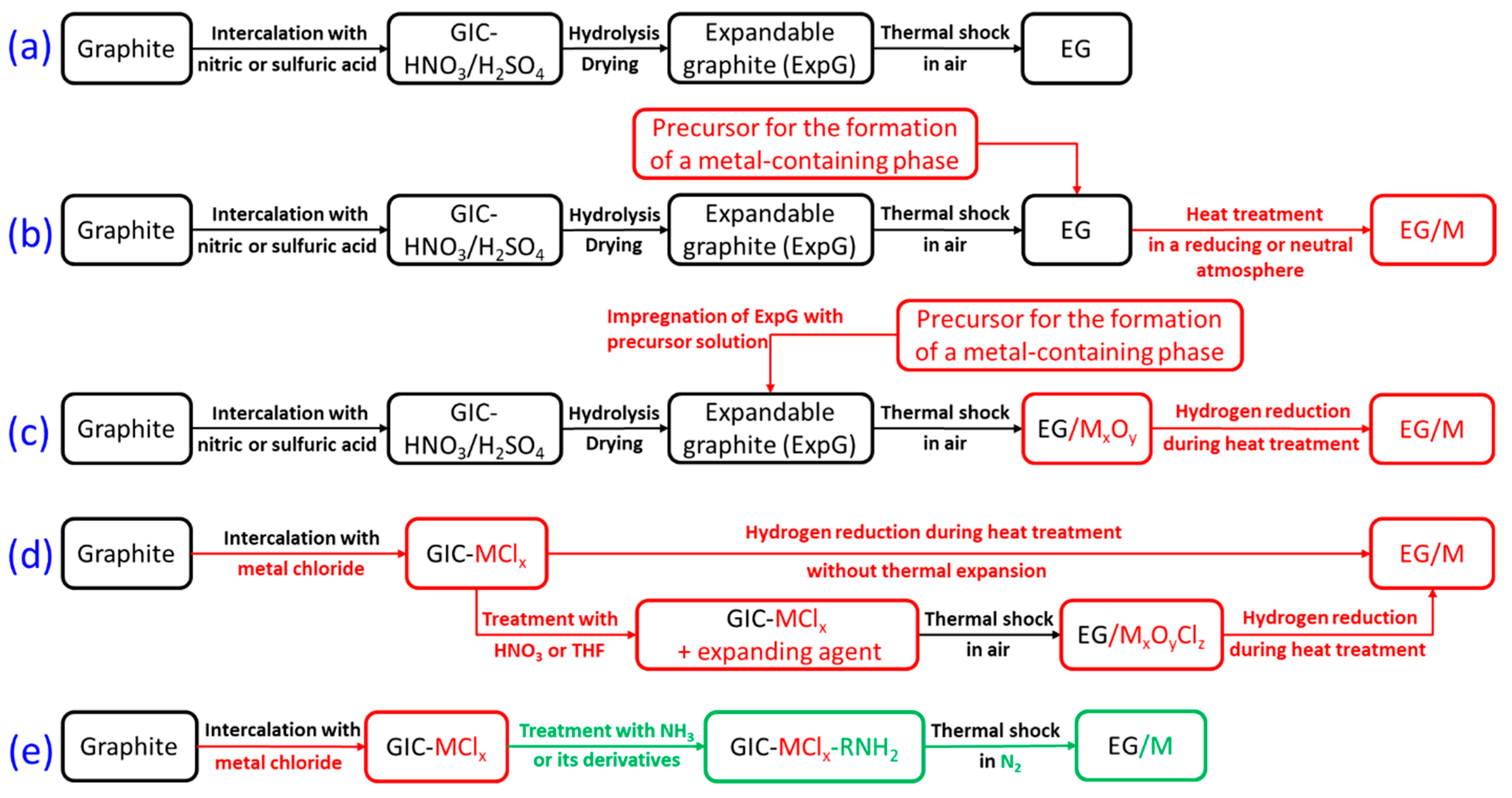
The fabrication of EG is based on a continuous method in which expandable graphite (ExpG), which is a product of hydrolysis of graphite intercalation compounds (GIC) with nitric or sulfuric acid, is dosed with a carrier gas flow into a horizontal tube furnace where the ExpG undergoes thermal expansion, resulting in a continuous flow of EG at the outlet (Figure 1a) [25]. Many known modification methods build upon the standard EG production process by incorporating additional steps: depositing a precursor onto the EG to form the metal-containing phase and thermally treating the intermediate EG/precursor composite [26,27,28]. During heat treatment, the precursor decomposes, resulting in the formation of metal-containing phase particles on the EG surface (Figure 1b).
This deposition method offers excellent control over the morphology and particle size distribution of the metal-containing phase in EG. However, its scalability is constrained to laboratory settings due to their limitations. Industrial applications require large production of metal-containing EG. The characteristics of the material being an ultra-lightweight, low-density foam with high porosity [29,30] render most post-processing approaches prohibitively inefficient. These fundamental limitations highlight the need for alternative strategies that circumvent post-processing entirely.
Integrating the thermal expansion process with the formation of a metal-containing phase eliminates the need for costly and inefficient post-processing of expanded graphite. This can be achieved by introducing a metal-containing precursor directly into expandable graphite prior to thermal treatment (Figure 1c). After the introduction of the precursor into the ExpG, thermal expansion of the intermediate product ExpG/precursor is carried out in air to obtain EG with an applied oxide or ferrite phase. Oxides or ferrites, if necessary, can be reduced in a stream of hydrogen or methane to pure metals [2,31].
In an alternative approach (Figure 1d), the precursor for the formation of a metal-containing phase is introduced not during the modification of expandable graphite, but at the intercalation stage by using not sulfuric or nitric acid as an intercalate, but a metal chloride or acids with a metal compound dissolved in them [2,32,33]. During thermal expansion of GIC-MClx, the dispersing pressure of the gases formed is significantly lower than during decomposition of GIC with acids due to significantly higher boiling points of chlorides and smaller volumes of released substances; therefore, it is advisable to add an “expanding agent” to GIC-MClx so that the bulk density of expanded graphite obtained from GIC-MClx is comparable to the densities obtained during decomposition of nitrates or bisulfates of graphite or ExpG based on them [31]. However, this method does not exclude the need for post-processing of EG in the event that it is necessary to obtain a pure metallic phase on the graphite surface.
In this paper, we propose an alternative scheme (Figure 1e) for producing low-density EG/M composites, according to which intercalated with FeCl3, CoCl2 or NiCl2 graphite is treated with liquid ammonia or methylamine. GIC-MClx-RNH2 is subjected to rapid heating in the thermal shock mode in an inert atmosphere. This releases ammonia or methylamine complexed with the metal chloride, which exerts strong dispersive pressure on the graphite matrix, leading to its significant expansion. The reducing nature of these gases promotes the reduction of chloride to pure metal, and the presence of an inert atmosphere protects it from subsequent oxidation by atmospheric oxygen. Thus, this approach allows combining the stages of graphite expansion and the deposition of the metal phase and appears to be extremely promising for obtaining EG/M composites.
The aim of the work was to obtain EG/M composites using a new scheme that eliminates the need for EG post-processing. All stages of this scheme are considered in detail, namely GIC-MClx synthesis, GIC saturation with ammonia and methylamine and thermal expansion of processed GIC.

2. Materials and Methods

2.1. Sample Preparation

For the synthesis of graphite intercalation compounds with transition metal chlorides, the following were used: natural flake graphite (average particle size 200–250 μm, purity 99.7%), anhydrous (pur.), FeCl3, CoCl2, and NiCl2.
The samples of GIC with MClx were obtained by a one-zone gas-phase method, the essence of which is to hold a mixture of graphite with metal chloride in a sealed glass tube at the synthesis temperature. When obtaining GIC with CoCl2 and NiCl2, the tubes were pre-filled with chlorine gas at room temperature. Gaseous dry chlorine was obtained by the action of a 38% HCl solution on potassium permanganate. The gas obtained in this way was passed through several columns installed in a row with concentrated H2SO4, which acted as a moisture absorber. The synthesis conditions were selected taking into account our accumulated practical experience based on the available literature data and are given in Table 1.
The total amount of the substance sealed in a 25–30 mL tube was 5–6 g in all cases except for the syntheses of GIC with CoCl2 and NiCl2. Since the degree of intercalation in this case is also limited by the amount of chlorine present in the system, the mass of the chlorides and graphite taken did not exceed 2 g in total.
The graphite/FeCl3 ratio during the production of GIC-FeCl3 is stoichiometric, so all chloride is incorporated into the graphite without residue. GICs with CoCl2 and NiCl2 were washed with a 10% aqueous HCl solution after synthesis to remove excess unreacted chlorides. When washing the GIC from non-intercalated NiCl2, the solution was heated to 60 °C. The moisture remaining after washing was removed from the GIC first by pumping on a vacuum filter and then by drying in a muffle furnace at 60 °C.
The stage number of the intercalated compound was determined from the results of XRD analysis.
The gross composition of the GICs with CoCl2 and NiCl2 was determined by the chloride gain, based on the mass of the initially taken graphite and the mass of the formed GIC.
The treatment of GIC-FeCl3 with liquid ammonia (Tbp = −33 °C), methylamine (Tbp = −6 °C) was carried out. Granulated KOH was added to a Wurtz flask with an aqueous solution of ammonia or amine. At the same time, gas began to release and passed through a column of alkali to dry out the water vapor captured from the solution. After passing through the column, the gas was condensed in a test tube placed in a thermos filled with acetone, which was pre-cooled with liquid nitrogen to a temperature of −50 ± 5 °C. After condensation of 3–4 mL amine (for 1 g of GIC), the gas supply to the tube was stopped, and the resulting liquid phase was transferred to test tubes with GIC-MClx. To obtain liquid ammonia and methylamine, the following were used: 25% aqueous ammonia solution (puriss.), 38% aqueous methylamine solution (puriss.), granulated KOH (puriss.), acetone and liquid nitrogen.
After adding excess of NH3/CH3NH2, the tube was sealed and kept at room temperature until the GIC was completely saturated with amine. After the holding period for at least 240 h, the tube was opened, and NH3/CH3NH2 evaporated at room temperature until the sample stopped losing weight. After that, the amine weight uptake was estimated, expressed as a mass percentage of the mass of the initially taken GIC.
To obtain thermally expanded graphite from ammonia/methylamine-saturated GIC-MClx, a special quartz reactor placed in a vertical tubular furnace was used. Thermal expansion took place in the reactor zone heated to a temperature of 900 °C for 3–4 min in a pure nitrogen atmosphere. After that, the reactor was removed from the furnace and cooled to room temperature, after which the EG formed during the synthesis was extracted from it.

2.2. Investigation Techniques

Phase compositions of all specimens were characterized by powder X-ray (XRD) diffraction using a Rigaku Ultima IV diffractometer (Tokyo, Japan) with CuKα radiation (λKα1 = 1.5405 Å, λKα2 = 1.5443 Å).
Room-temperature transmission 57Fe-Mössbauer spectra were recorded on an MS-1104Em spectrometer (South Federal University, Rostov-on-Don, Russia) in the constant acceleration mode using a standard 57Co source in a metallic rhodium matrix with an activity of about 2 mCi (RITVERC JSC, Sankt-Peterburg, Russia). Isomer shifts are related to α-iron at room temperature. The preliminary collection of the spectrum on a larger velocity scale (between −12 and +12 mm·s−1) does not allow us to detect magnetic interactions. Since the impact of magnetic splitting was not detected, the spectra were re-collected between −5 and +5 mm·s−1 to improve resolution. The spectra were fitted using the Happy Sloth software (http://happysloth.ru, D.M. Levin, S.K. Dedushenko, Russian Computer Program Registry, #2016660090, accessed on 9 September 2025).
The morphology and elemental composition of the obtained metal-containing EG were studied by scanning electron microscopy (SEM) and energy dispersive X-ray (EDX) spectroscopy using a TESCAN VEGA3 LMU electron microscope (Brno, Czech Republic).
TEM images of the samples were obtained using a JEM-2010 transmission electron microscope (Tokyo, Japan).
The bulk density (dEG, g/L) of metal-containing EG was calculated from the mass (mEG) and volume (VEG) of the powder:
dEG = mEG/VEG
The metal-phase content in EG ( ω M , %) was determined by thermogravimetry. The pellets of the EG/M composites ( m E G / M ≈ 0.3 g) were pressed from the EG powder and placed in a crucible, which was kept in a muffle furnace in an air atmosphere at 900 °C for 3 h until the carbon was completely oxidized to CO2. Then, the mass of the unburnt residue ( m M x O y , where MxOy: Fe2O3, Co3O4, NiO) was determined. Having determined the mass of the formed oxides, the metal content in the EG was calculated using the following formula:
ω M = m M x O y m E G / M · x   · M r M M r M x O y · 100 % ,
where M r M и M r M x O y are the molecular masses of the metal and the oxide obtained during annealing, respectively.
The magnetic properties of the studied samples were measured by obtaining the magnetization (M, emu/g) curves using an original Faraday balance magnetometer (Institute of Solid State Chemistry, Ekaterinburg, Russia) at room temperature. The magnetic field (H, kOe) varied from −17.9 to 17.9 kOe. The relative error in determining the magnetization was 3%.

3. Results

3.1. GIC-FeCl3, Saturated with Ammonia and Methylamine

Graphite intercalation compounds with iron (III) chloride were obtained by gas-phase synthesis. The intercalation of FeCl3 into graphite in the gas-phase process takes place in several steps [37]. In the first step, iron (III) chloride evaporates and passes into the gas phase in the form of a dimer:
2FeCl3 ⇄ Fe2Cl6
Then thermal dissociation of the formed Fe2Cl6 occurs:
Fe2Cl6 → 2FeCl2 + Cl2
The chlorine released during dissociation oxidizes the graphite and allows iron chloride to be incorporated into the carbon matrix:
12nC + ½Cl2 + FeCl2 + FeCl3 → 2C6nFeCl3,
where n is the stage number.
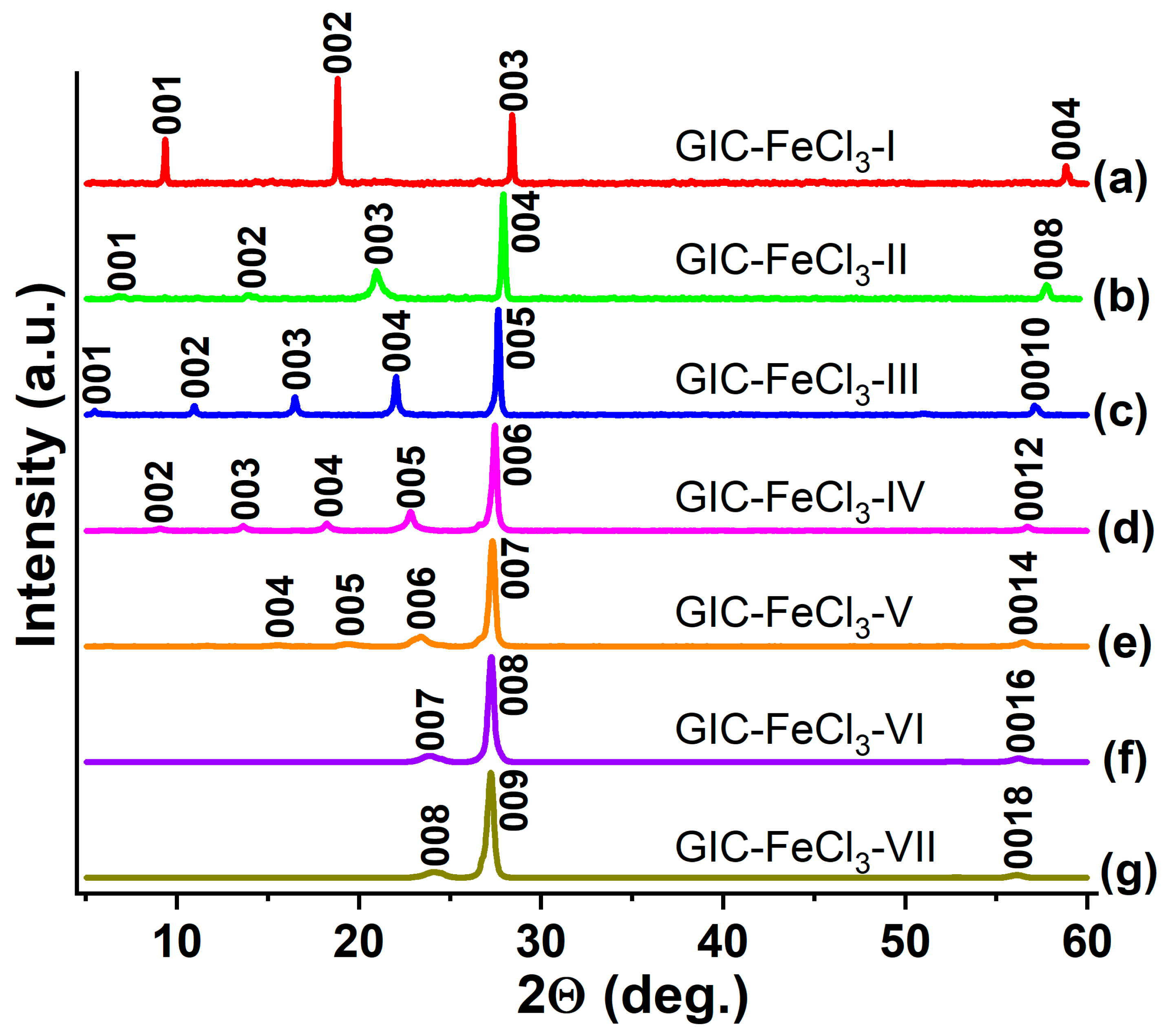
The absence of graphite and iron chloride peaks in the XRD patterns (Figure 2) indicates that a single-phase GIC sample without impurities of the initial reagents was obtained in each case. The identity period (Ic) of obtained GIC-FeCl3-I (Figure 2a) is 9.43 Å, which corresponds to formation of I-stage GIC and is in good agreement with the literature data [38,39,40]. The stage number is the number of graphene layers between two layers of intercalate [41]. The structure of I-stage GIC is represented by alternating layers of graphene and intercalate with the gross composition C6FeCl3.
A decrease in the FeCl3 content in the FeCl3/graphite mixture results in the intercalate becoming insufficient to fill all free graphite galleries. As a result, a disordered GIC is formed, represented by a mixture of layered packets, in which the embedded substance is located between the graphene sheets not in a strictly defined order but in a random order. To avoid this, not only the ratios of the initial reagents but also the synthesis temperature should be varied for the synthesis of GIC with nst. > I. The limits of thermodynamic stability of GIC-FeCl3 of different stages are known from the literature [34]. The higher the GIC stage number, the higher the temperature of its decomposition [42]; therefore, the synthesis of GIC-FeCl3, for example, of the second stage was carried out at a temperature higher than the decomposition temperature of GIC-FeCl3-I but not higher than the decomposition temperature of GIC-FeCl3-II itself.
This method allows obtaining ordered GIC-FeCl3 up to the seventh stage (Figure 2b–g).
The ordering of the GIC can be judged by the shape of the peaks and therefore whether the entire characteristic set of reflections is displayed on the XRD pattern. Starting with the GIC-FeCl3 of the V stage, the peaks become somewhat broadened and only the main reflections are clearly identified, which may indicate a lower ordering of these compounds compared to the GIC of stages I–IV. The data on the composition of the GIC-FeCl3 are given in Table 2.
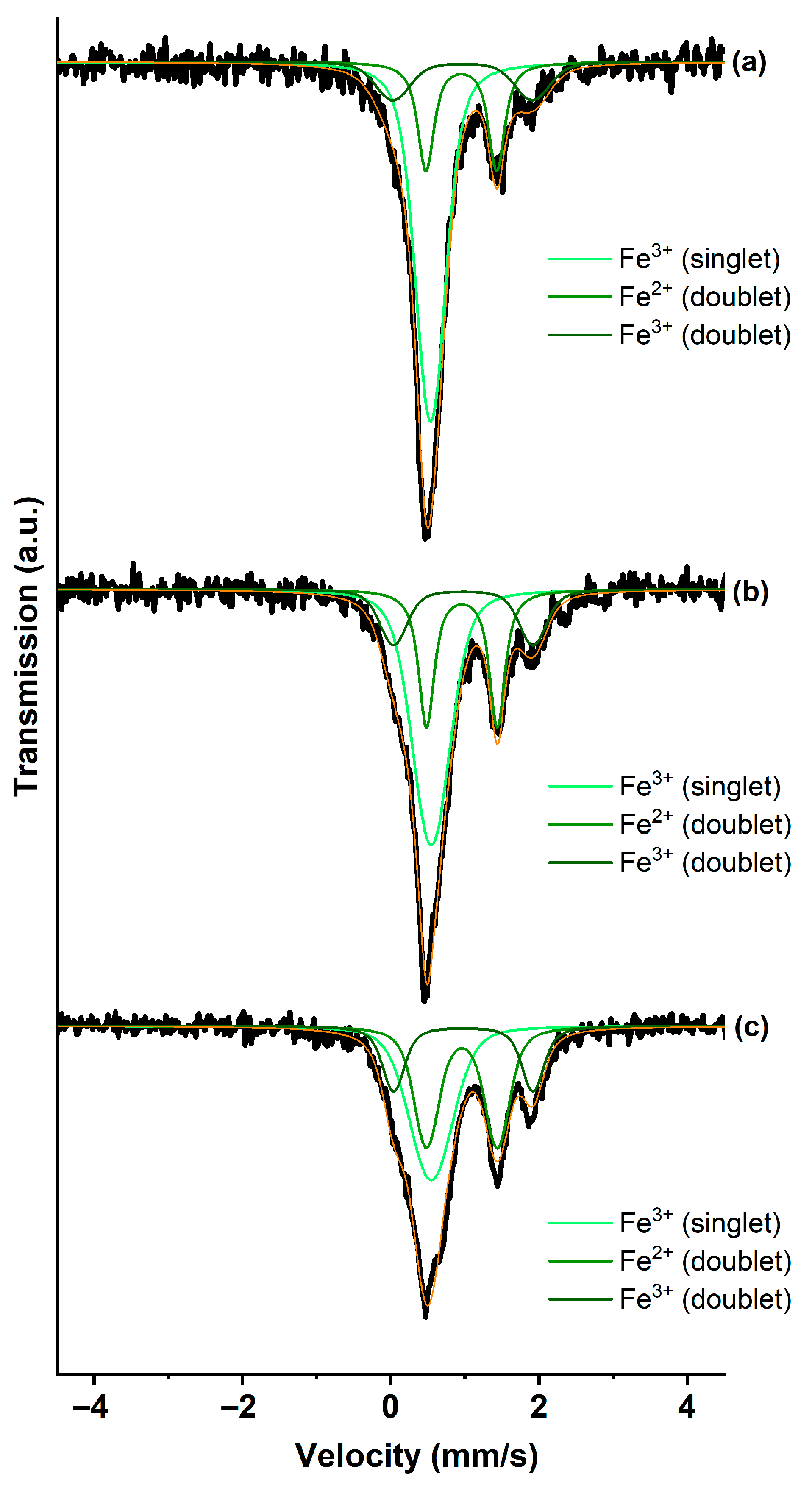
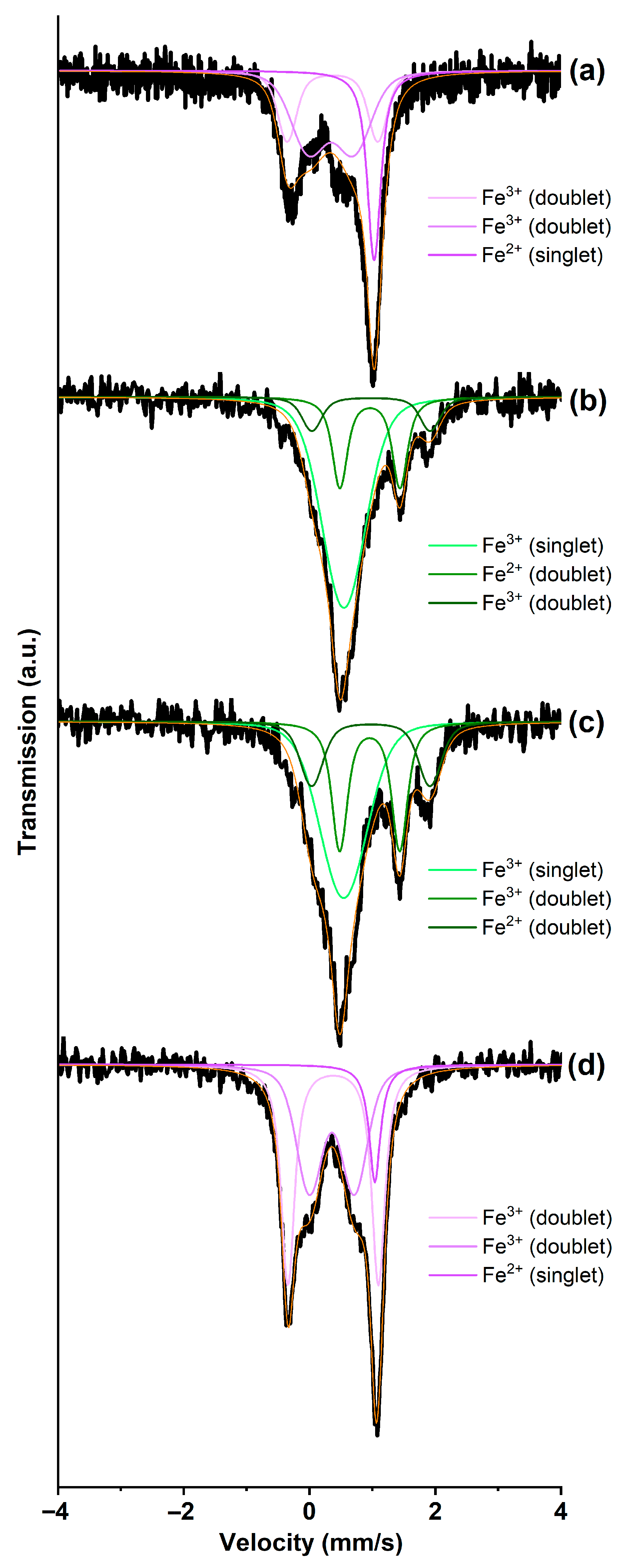
Additionally, the GICs-FeCl3 I, II and III stages were studied by Mossbauer spectroscopy (Figure 3). The total GIC-FeCl3 spectrum can be decomposed into three subspectra: a singlet with parameters IS = 0.54 and QS = 0.00 refers to Fe3+ in FeCl3(int.), intercalated into the graphite matrix; a doublet with parameters IS = 0.95 and QS = 0.96 refers to Fe2+ in FeCl2(int.); and a doublet with parameters IS = 0.97 and QS = 1.88, which can be attributed to Fe3+ in FeCl3 located in the intercrystalline space of graphite [43,44] (Table 3).
With an increase in the stage number, the ratio between these phases changes towards an increase in the content of FeCl2(int.) due to a decrease in the content of FeCl3(int.). This change can be associated with an increase in the synthesis temperature when obtaining higher stages, as a result of which the equilibrium in the decomposition reaction of Fe2Cl6 shifts to the right and a larger amount of FeCl3 irreversibly passes into FeCl2, which is cointercalated into graphite together with FeCl3.
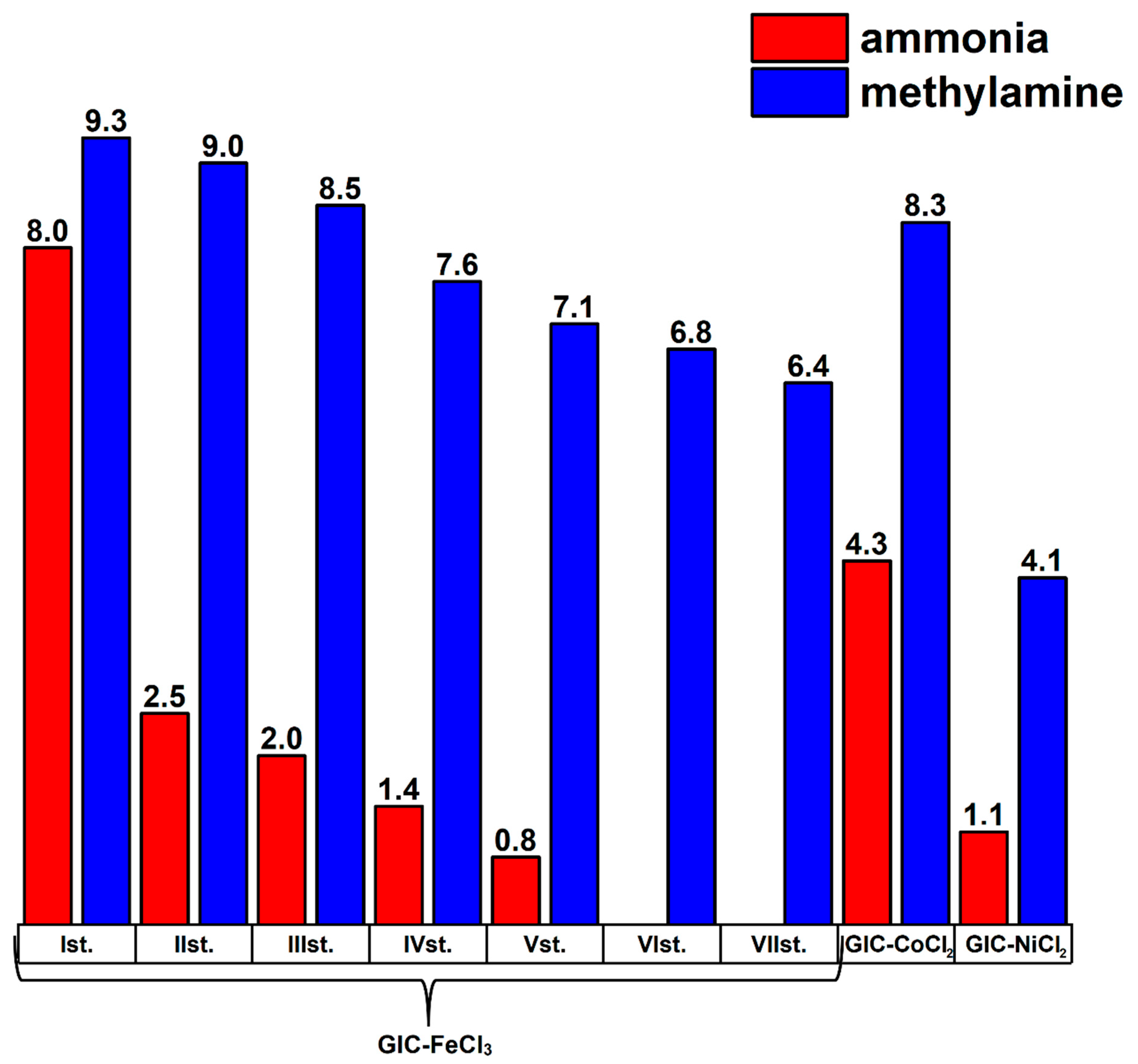
The GIC-FeCl3 of stages I–VII were treated with liquid ammonia and methylamine taken in excess and kept for at least 240 h at room temperature in sealed tubes for maximum saturation. After the keeping, the tubes were opened, the excess NH3/CH3NH2 evaporated to a constant mass of solid substance and the weight gain was estimated, expressed as the number of molecules per one formula unit of GIC (Figure 4). For example, the GIC-FeCl3 of the second stage, saturated with ammonia, had the gross composition C12FeCl3·2.5NH3, and the GIC-FeCl3 of the fifth stage, saturated with methylamine, had the gross composition C30FeCl3·7.1CH3NH2.
As can be seen from the diagram, GIC-FeCl3 is most capable of being saturated with methylamine, which, unlike ammonia, is capable of being incorporated in significant quantities even into high-stage compounds, which may be due to its greater basicity, as well as better solubility of the methylamine complex with iron chloride in liquid methylamine itself. In addition, the saturation of GIC-FeCl3 with ammonia and methylamine decreases when moving from more filled GIC to less filled ones.
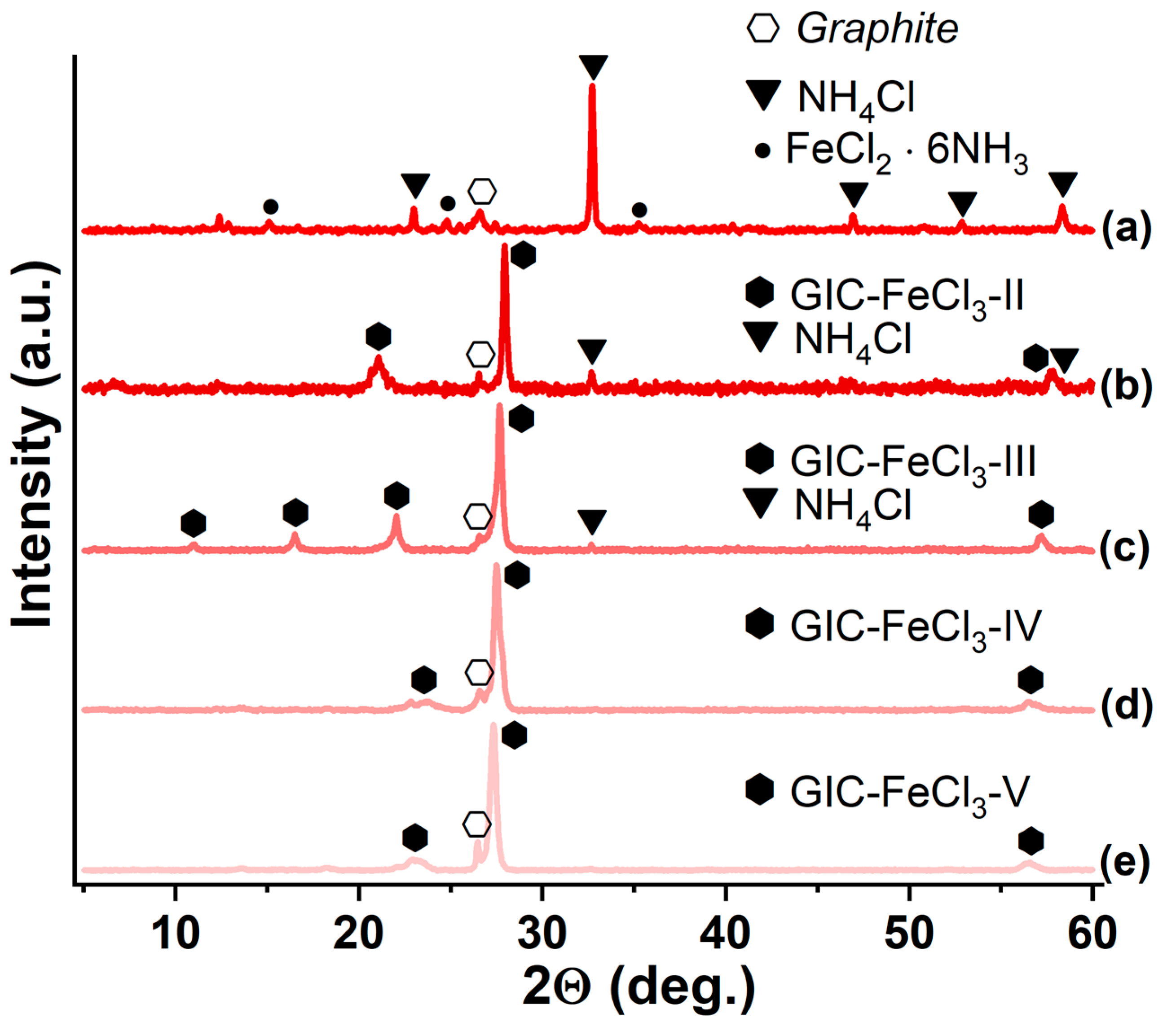
Diffraction patterns reflecting the phase composition of ammonia-saturated GIC-FeCl3 I–V stages are shown in Figure 5.
It is clearly seen that upon saturation of GIC-FeCl3-I with ammonia (the weight gain is 8 ammonia molecules per formula unit of GIC), the phase of the initial GIC disappears, but a graphite phase (ICDD, №00-023-0064, I) appears, and the phases of Fe(NH3)6Cl2 (ICDD, №01-085-2094, C) and NH4Cl (ICDD, №00-003-0785, B), which are products of the interaction of FeCl3 with ammonia, are identified (Figure 5a). However, upon saturation of GIC-FeCl3-II (the weight gain is only 2.5 ammonia molecules per formula unit of GIC), the structure of the initial compound is largely preserved, but a small amount of graphite and NH4Cl is still formed (Figure 5b). With an increase in the step number (Figure 5c–e) and a decrease in the saturation of GIC with ammonia, the phase composition of the resulting adduct increasingly resembles the phase composition of the initial GIC (Figure 2), but in all cases the formation of the graphite phase is detected. This may be due to the fact that only FeCl3 located in the edge regions of graphite particles interacts with ammonia, while the internal regions are inaccessible to it.
The Mossbauer spectra of the initial GIC-FeCl3-I (Figure 3a) and GIC-FeCl3-I-NH3 (Figure 6a) differ greatly, while for GIC-FeCl3-II/GIC-FeCl3-III (Figure 3b,c) and GIC-FeCl3-II-NH3/GIC-FeCl3-III-NH3 (Figure 6b,c) they are practically identical. These results complement the XRD data and indicate that ammonia intensively interacts only with GIC-FeCl3-I. Singlet with IS = 1.03 mm/s appears in the Mossbauer spectrum of the sample GIC-FeCl3-I-NH3 (Figure 6a, Table 2), which refers to Fe2+ in the ammonia complex of iron chloride Fe(NH3)6Cl2 [45,46]. Probably, the reaction of FeCl3 with the ammonia leads to a partial reduction of Fe3+ to Fe2+:
6C6FeCl3 + 44NH3(liq.) → 36C + 6Fe(NH3)Cl2 + 6NH4Cl + N2
However, two additional doublets in the Mossbauer spectrum related to the presence of Fe3+ in the sample composition indicates the incomplete formation of Fe(NH3)6Cl2.
A very similar spectrum was obtained by us for pure FeCl3 treated with ammonia under conditions similar to those for the GIC-FeCl3-I treatment (Figure 6d). It can be assumed that when interacting with liquid ammonia, all the iron chloride from GIC is deintercalated, partially being reduced to FeCl2, bound in an ammonia complex Fe(NH3)6Cl2.
In many ways, a different situation is observed when treating GIC-FeCl3 with methylamine (Figure 7).
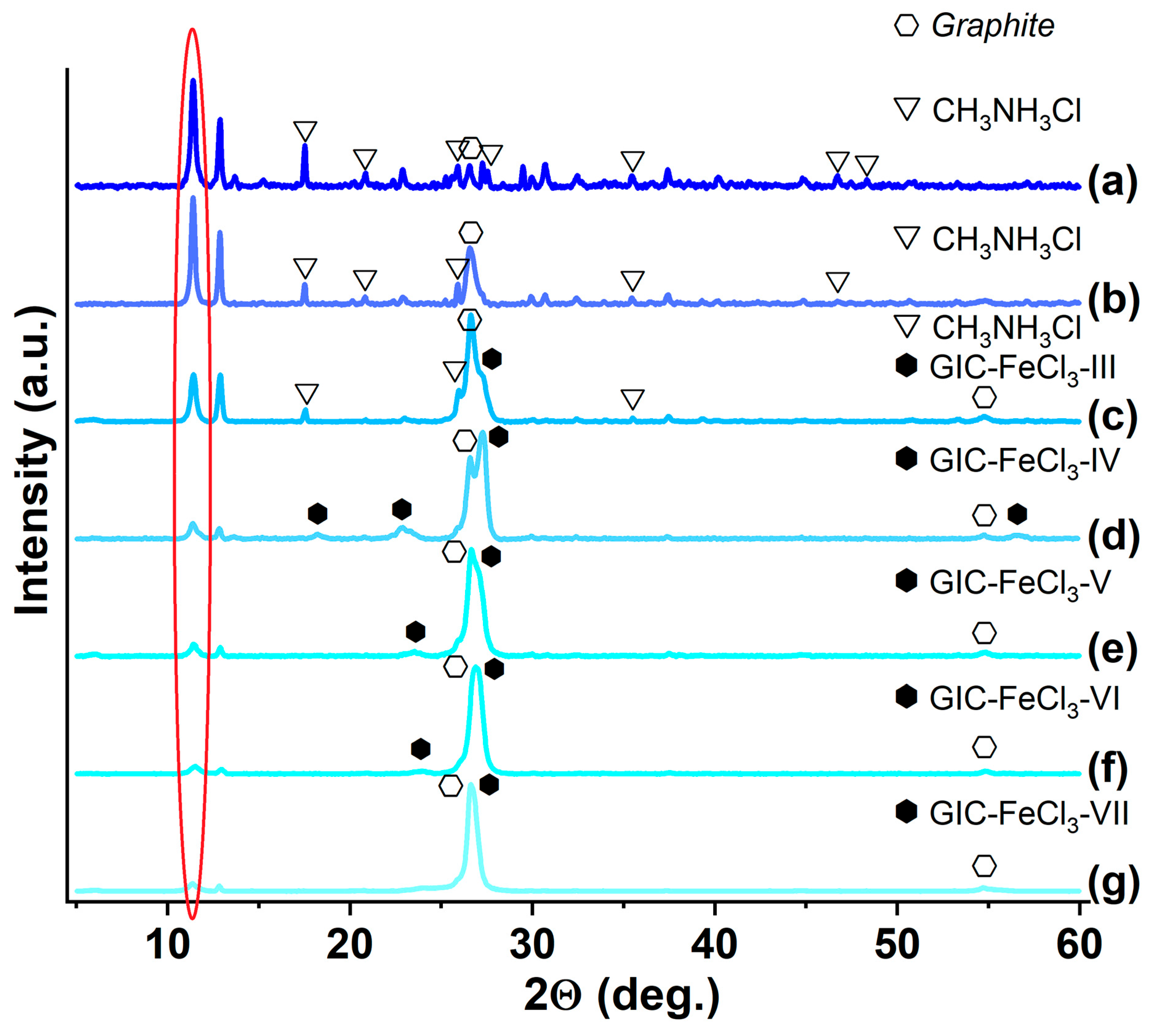
Firstly, it should be noted that all stages of GIC-FeCl3 are characterized by high saturation with methylamine. Even for the compound of the seventh stage, the weight gain is equal to 6.4 amine molecules per formula unit of GIC. Secondly, in addition to the formation of graphite and methylammonium chloride (ICDD, №00-014-0779, B) (product of iron (III) chloride reduction) for all processed stages of GIC-FeCl3, the appearance of reflexes is observed at 2Θ angle equal to 11.43 ± 0.05°, which correspond to interplanar distances di equal to 7.75 ± 0.04 Å. We were unable to unambiguously determine the phase to which these reflections belong, since there is no information in the literature on the crystal structure of complexes of iron (III) chloride or iron (II) chloride with methylamine.
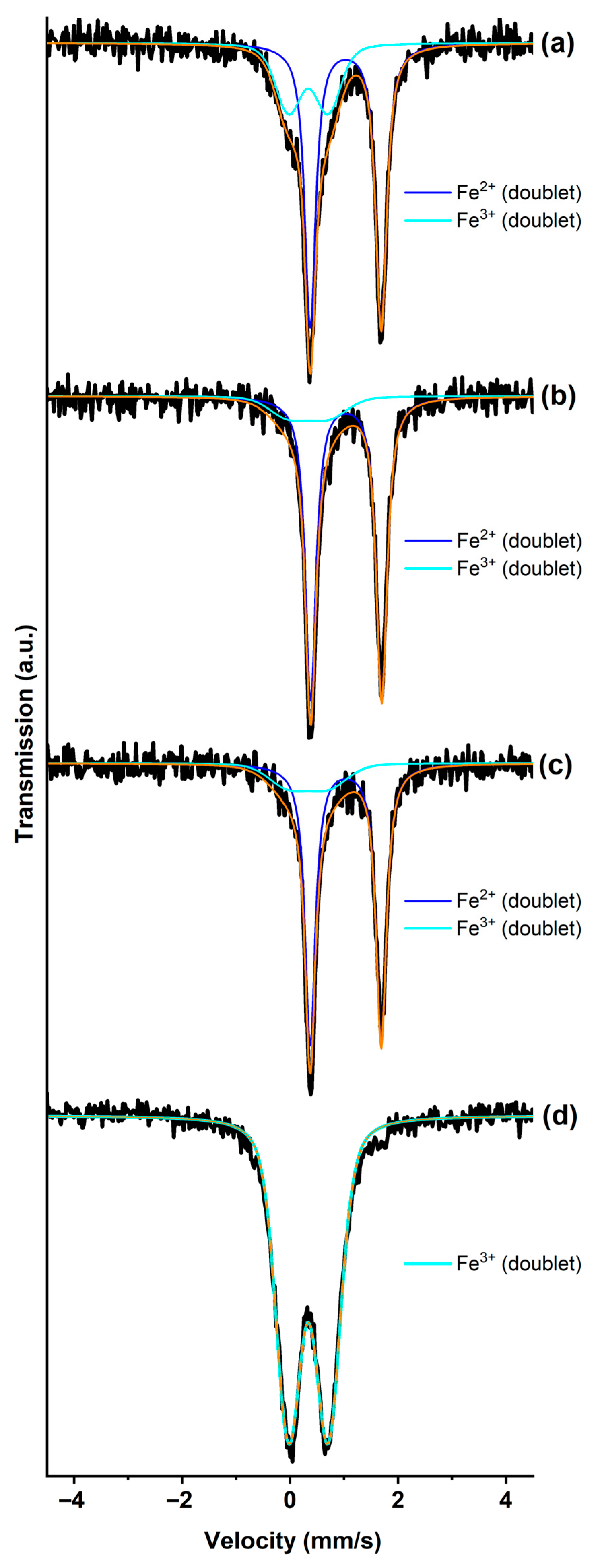
In contrast to ammonia, the treatment of GICs-FeCl3 leads to a complete change in the Mossbauer spectra compared to the initial GICs, where instead of two doublets and a singlet, all three spectra contain two doublets with IS = 1.03 and QS = 1.32 and with IS = 0.34 and QS = 0.73 (Figure 8a–c). The less intense doublet belongs to the phase of the iron chloride complex with methylamine, which we obtained independently by treating FeCl3 with methylamine (Figure 8d). The more intense doublet apparently belongs to the phase of the same complex, located, however, in the interlayer and/or intercrystalline space of graphite.
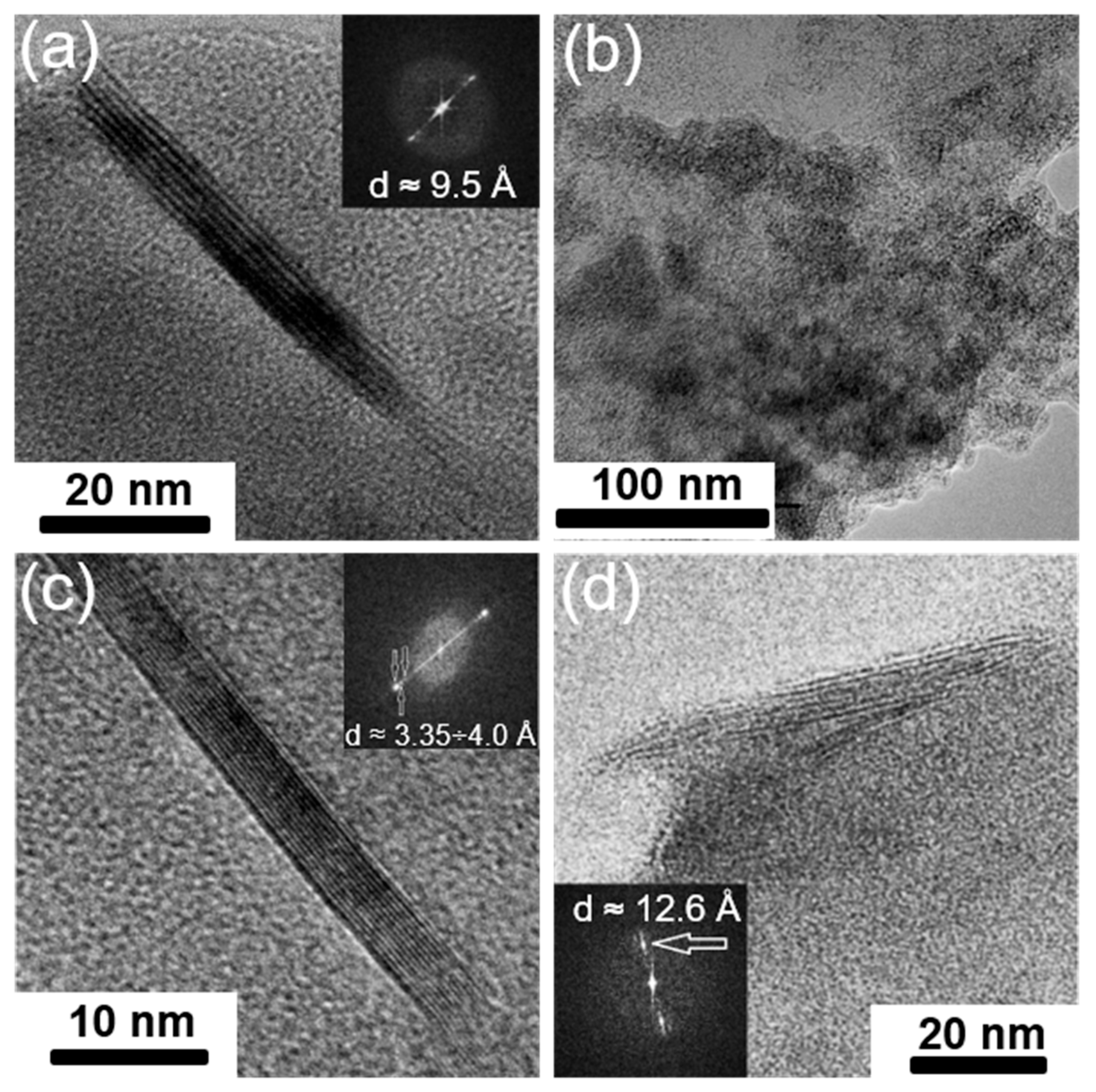
In the TEM image of GIC-FeCl3-I (Figure 9a), layers can be distinguished with an interplanar distance that is approximately three times greater than the interplanar distance (002) for graphite. This distance corresponds to the thickness of the layer filled with intercalate—9.40 Å in GIC-FeCl3. The error in determining the interlayer distance is due to the fact that the accuracy of TEM analysis is lower than the accuracy of XRD. Similar results were obtained in [47].
Methylamine-saturated GIC-FeCl3 was also studied by TEM. The sample of such GIC has regions where FeCl3 is located on the graphite surface in an amorphous state (Figure 9b). Graphite layers with different interplanar distances are often encountered (Figure 9c). In this case, an increase in the distances from 3.35 Å to 3.60–4.00 Å is observed. These data are in good agreement with the XRD data, according to which part of the chloride bound in the methylamine complex is deintercalated from the interlayer space of the graphite. The sample also contains regions with greatly increased interplanar distances (Figure 9d). The arrow in the inset with the FFT image shows a bright reflection corresponding to an interplanar distance of 12.6 Å Streaks through the reflection, on which weak reflections are also visible. This picture indicates that the distances between the layers vary within the range of approximately 10.7 to 15.6 Å.
Thus, the presence of regions with significantly larger interlayer distances compared to the initial GIC-FeCl3 in the methylamine-saturated GIC-FeCl3 sample is confirmed.

3.2. Thermal Expansion of GIC-FeCl3-RNH2

Iron-containing expanded graphite was obtained by the heating in nitrogen atmosphere of GIC-FeCl3 and GIC-FeCl3 samples treated by ammonia and methylamine.
As a result of the thermal shock, a powder of thermally expanded graphite was obtained, but the bulk density of the EG from GIC-FeCl3-I turned out to be at least an order of magnitude greater than the bulk density of the EG obtained by expanding RNH2-saturated GIC (70 g/L vs. 5 g/L) [38]. This is due to the fact that the volume of gases released during the decomposition of the amine complexes of GIC is incomparably greater than during the decomposition of GIC-FeCl3 itself, and, as a consequence, the dispersing pressure exerted by them on the graphite matrix is significantly greater. Greater pressure leads to better dispersion of the graphite and the production of EG with a lower bulk density [48]. In this case, expansion is facilitated only by those substances that are in the interlayer or intercrystalline space at the time of the thermal shock.
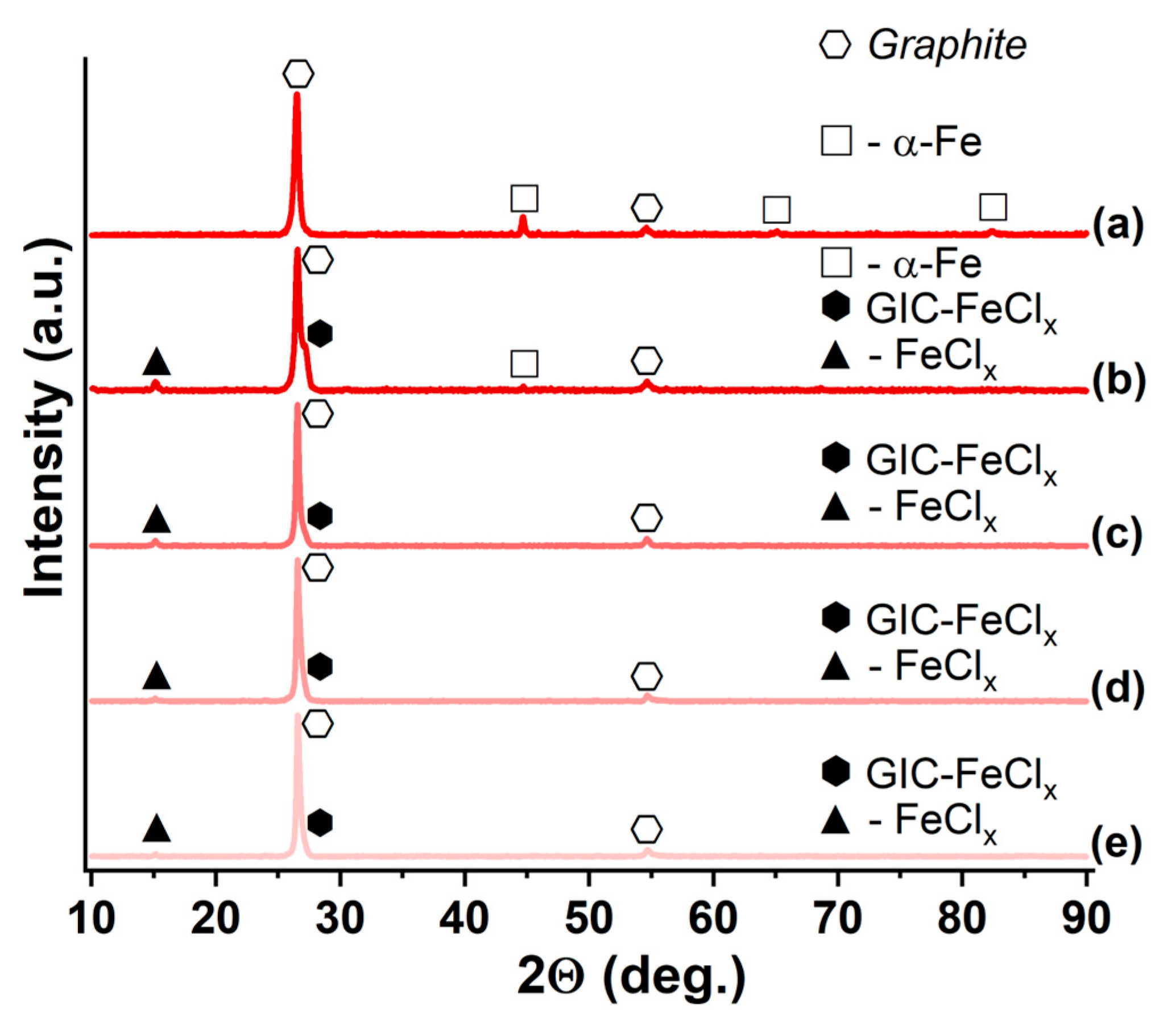
The XRD patterns of the EG obtained from GIC stages I–V saturated with ammonia are shown in Figure 10a–e. Despite the fact that all EGs have the ability to be attracted to a strong permanent magnet, indicating the presence of a reduced iron-containing phase in them, only in the samples obtained from stages I and II is the α-iron phase (ICDD, №00-006-0696, S) detected in the diffraction patterns. This is due, firstly, to a decrease in the total amount of the iron-containing phase upon transition from stage I to stage V, and secondly, to a decrease in the amount of ammonia bound in a complex and directly acting as a reducing agent for FeCl3. The presence of unreduced chloride not associated with the graphite matrix and chloride located in the interlayer space of graphite is also confirmed by the XRD method for EG samples obtained from GIC-FeCl3 of II–V stages treated with ammonia (the presence of the phase of under-decomposed GIC is indicated by the obvious asymmetry of the main 002 peak of graphite).
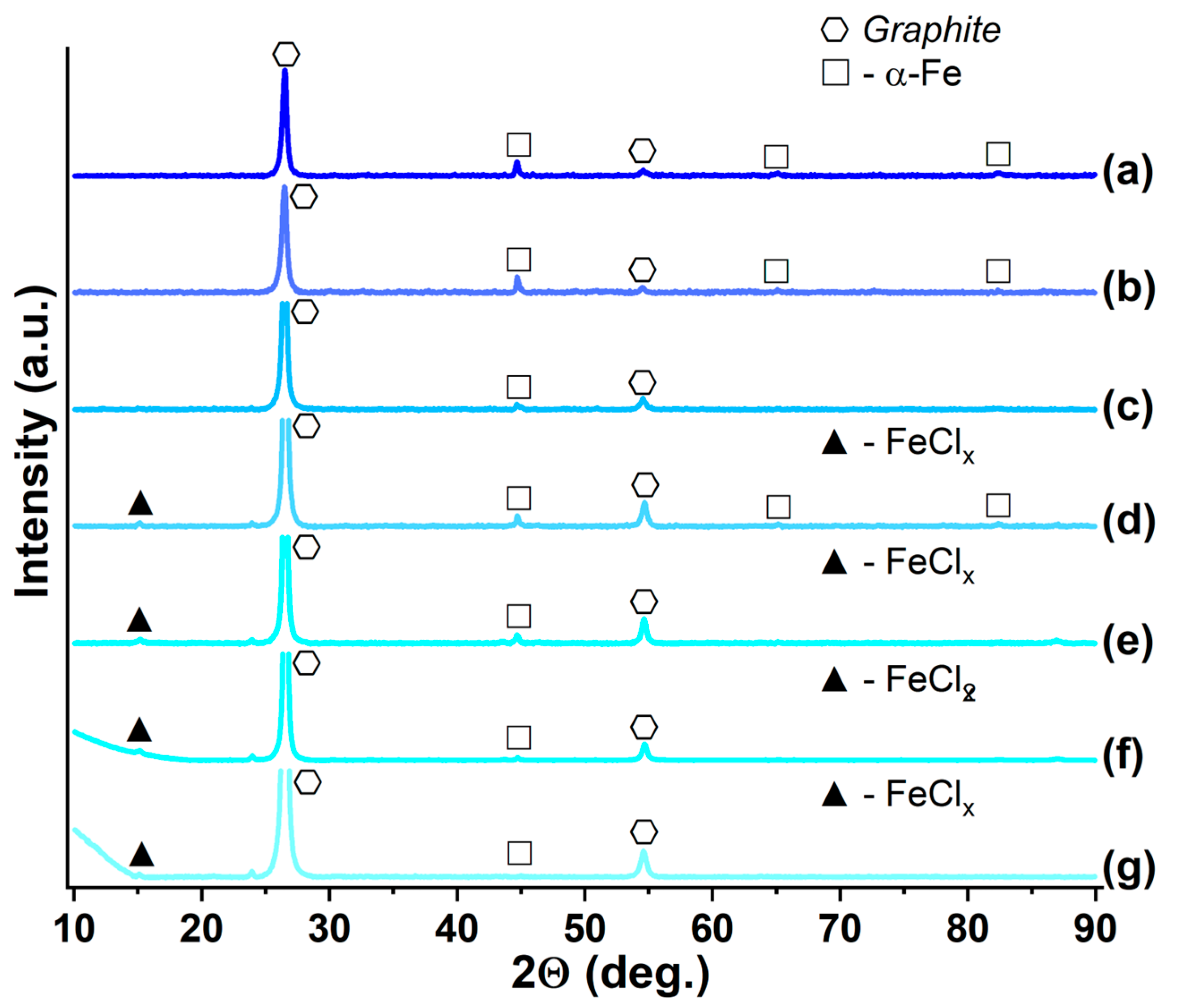
Due to the high saturation of GIC-FeCl3 with methylamine, the phase of metallic iron is detected in all cases in the EGs obtained on their basis (Figure 11). However, in the EGs obtained from GIC with a stage number of IV and higher, the phase of unreduced chloride is also detected.
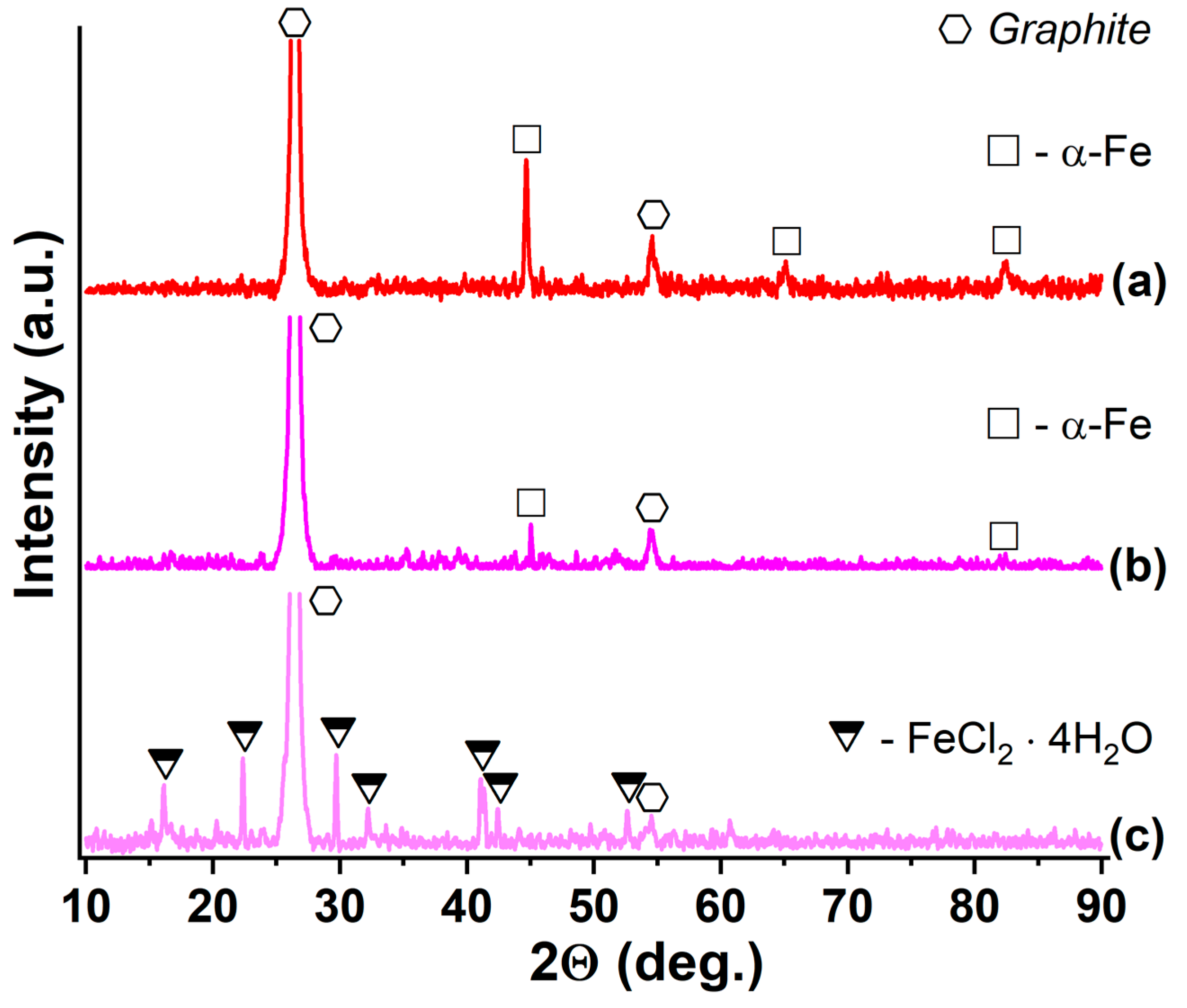
The possibility of carrying out the thermal expansion process at a lower temperature, leading to the formation of a reduced metallic phase, was also investigated using the example of GIC-FeCl3-I treated with NH3 (Figure 12).
When thermal expansion is carried out at 800 °C, the metal-containing phase of EG, according to the XRD data (Figure 12b), is still represented only by reduced α-iron, although the decrease in the intensity of the peaks related to its phase compared to EG obtained at 900 °C (Figure 12a) may indicate an incomplete reduction process. In the EG sample obtained at 700 °C (Figure 12c), the iron-containing phase is represented by the unreduced decomposition product of intercalated FeCl3–FeCl2. The formation of its hydrate (ICDD, №00-016-0123, S) occurred not during thermal expansion, but due to the interaction of chloride with atmospheric moisture during storage of the EG sample. Thus, a decrease in the thermal expansion temperature has a negative effect on the reducibility of iron.
The summarized results on thermal expansion of GIC-FeCl3 treated with ammonia and methylamine are presented in Table 4.
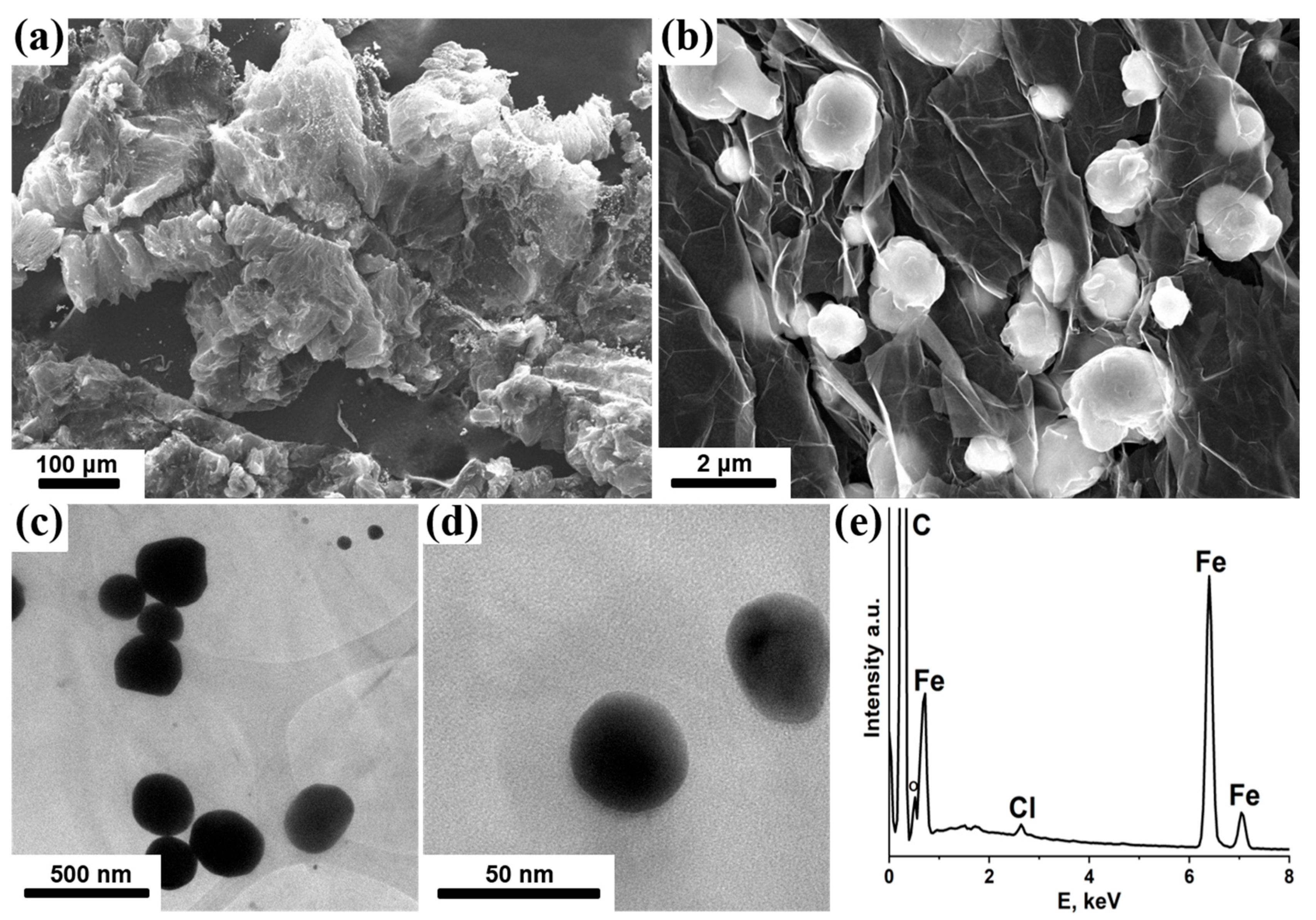
The structure of the EG/Fe composite obtained by expanding GIC-FeCl3-I-NH3 is represented by laminated carbon bundles (Figure 13a). The distribution pattern, shape and size of the iron-containing phase particles on the surface of the EG demonstrate significant homogeneity. They are predominantly individual spherical particles up to 2 μm in size (Figure 13b). In addition to submicron particles, iron on the surface of the EG is also found in the form of significantly smaller particles with sizes from 300–400 to 30–40 nm (Figure 13c,d). The absence of intense signals from the chlorine element in the EDX-spectra of the sample surfaces serves as additional evidence of the almost complete reduction of chloride to metal (Figure 13e).
Thus, low-density iron-containing composites EG/Fe were obtained by heat treatment of complexes GIC-FeCl3-RNH2. The conditions that ensure the most complete reduction of iron chloride to pure metal have been determined, the qualitative and quantitative compositions of the complexes have been established, and their microstructure has been studied.

3.3. GIC-CoCl2 and GIC-NiCl2, Saturated with Ammonia and Methylamine

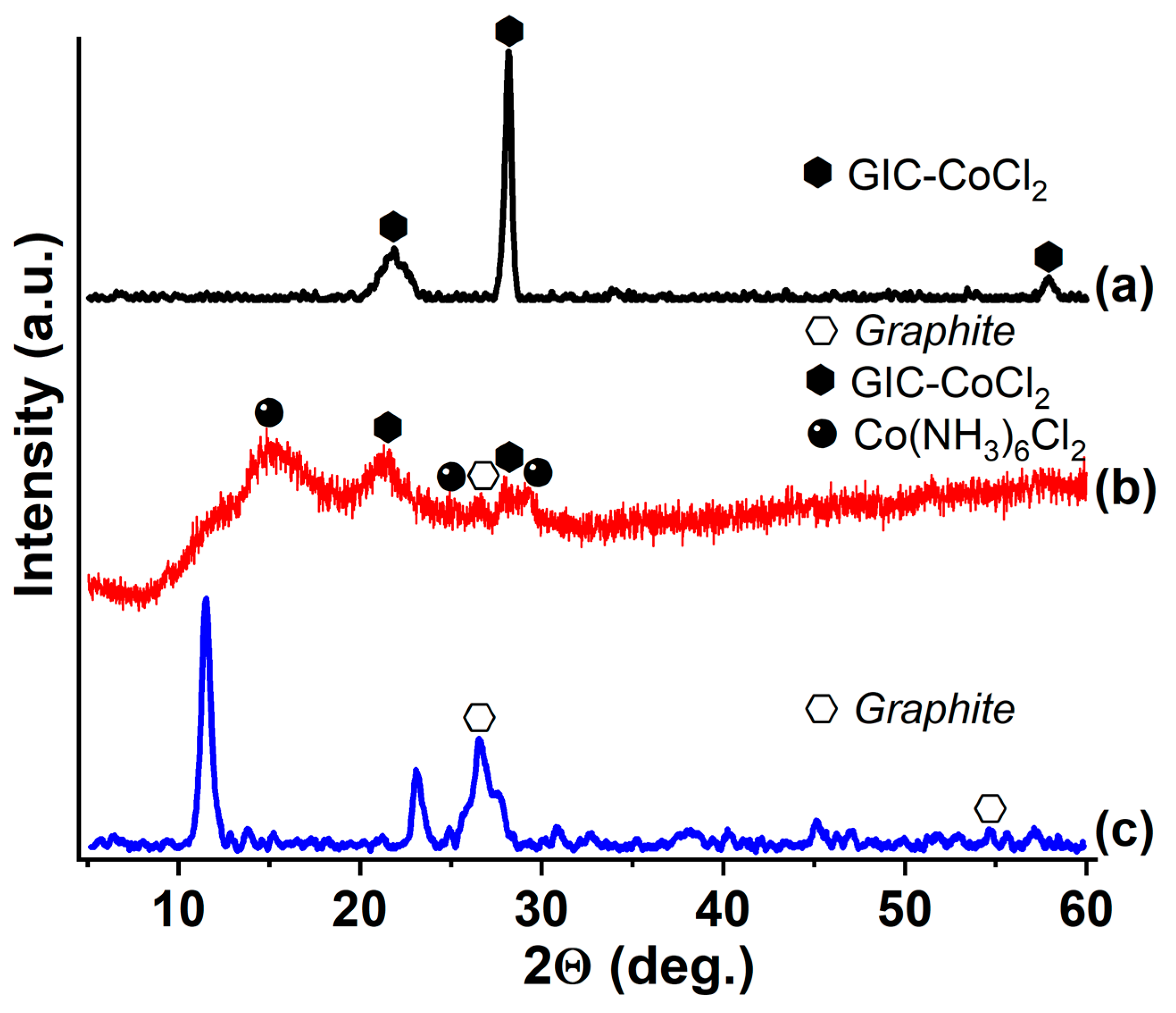
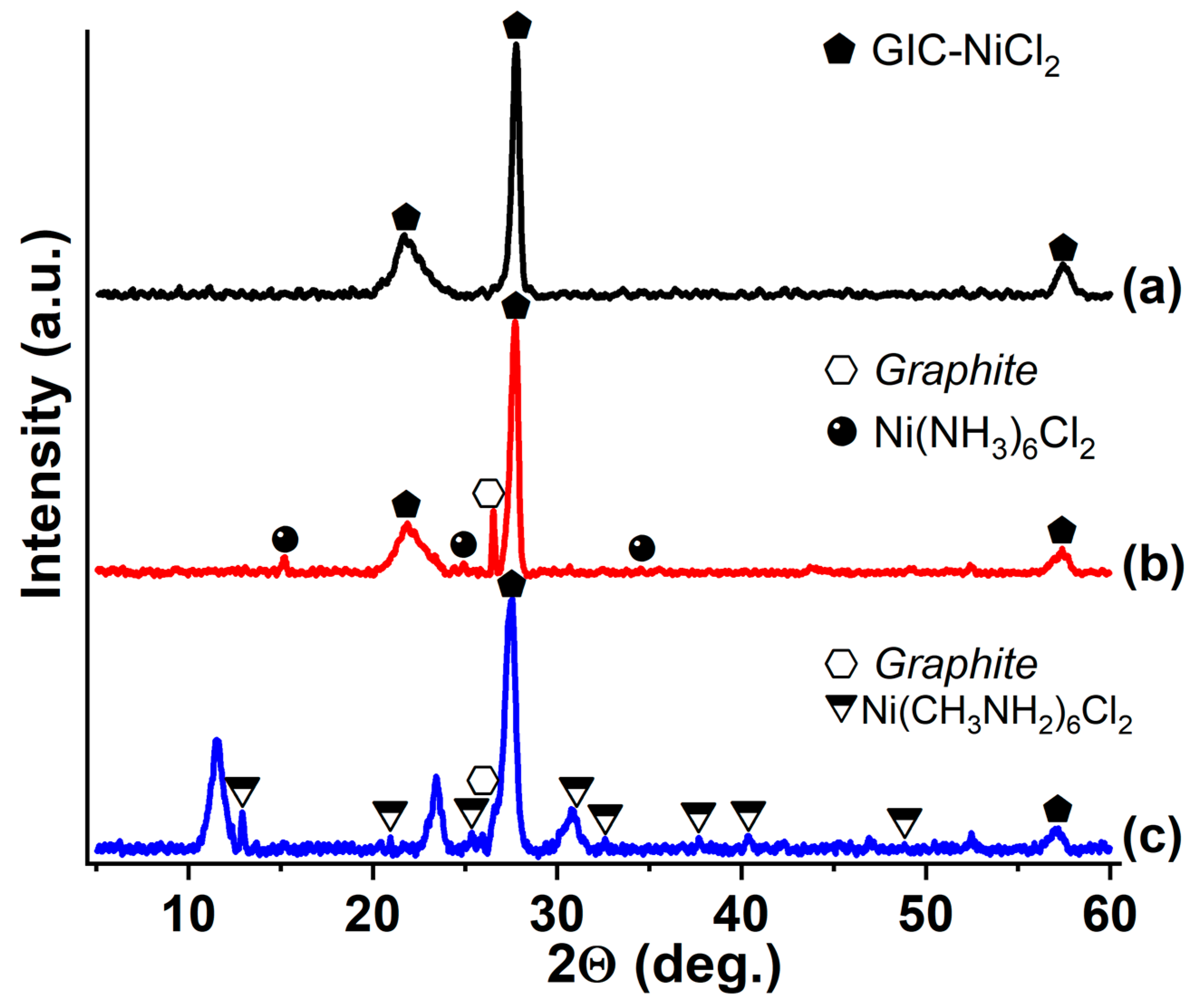
To obtain composites of EG with cobalt and nickel using a similar scheme, GIC-CoCl2 and GIC-NiCl2 were synthesized. The thickness of the intercalate-filled layer (di) of the obtained compounds was determined based on the results of XRD analysis (Figure 14a and Figure 15a). For GIC-CoCl2 the thickness was 9.46 ± 0.01 Å, for GIC-NiCl2 it was 9.50 ± 0.02.
The thickness of the intercalate-filled layer (di) of the obtained compounds was determined based on the results of XRD analysis (Figure 14a and Figure 15a). The obtained results are in fairly good agreement with the literature data [49].
The absence of reflections related to the initial compounds (graphite and chlorides) indicates that all MCl2 is present in the GIC. The GIC peaks are broadened, which may indicate some disorder in the interlayer intercalate packets and the formation of mixed-stage GIC. The compositions of GIC with CoCl2 and NiCl2 are described by the formula C5.5nMCl2.1 (n is the stage number) [50], but based on the weight gains, it was determined that the gross formulas of the obtained GIC are C8.8CoCl2.1 and C13.8NiCl2.1. The gross number of carbon atoms per CoCl2 molecule is 8.8 and is approximately in the middle of the range from 5.5 (corresponding to the first-stage compound) to 11.0 (corresponding to the second-stage compound). The situation is similar with NiCl2; only the value of 13.8 is in the range from 11.0 to 16.5. Thus, it can be considered that in the case of GIC-CoCl2, a compound of mixed I/II stage was obtained, and in the case of GIC-NiCl2, a mixed II/III.
Using a method similar to the treatment of GIC-FeCl3, GIC-MCl2 was saturated with ammonia and methylamine (Figure 4). As in the case of the treatment of GIC-FeCl3, saturation with methylamine occurs to a greater extent. Saturation in the series FeCl3-CoCl2-NiCl2 also decreases for both reagents, which is associated, firstly, with an increase in the GIC stage number (pure I for GIC with FeCl3, I/II for GIC CoCl2, II/III for GIC NiCl2), and secondly, apparently, with a decrease in the solubility of the resulting complexes in ammonia and methylamine.
Changes in the phase composition of GIC-MCl2 after treatment with ammonia and methylamine were recorded using XRD. After saturation of GIC-CoCl2 with methylamine (Figure 14c), reflections corresponding to the initial GIC are not detected; after saturation of GIC-CoCl2 with ammonia (Figure 14b), reflections corresponding to the initial GIC remain, but their intensity becomes significantly weaker (they do not disappear completely due to the fact that ammonia has not interacted with all the chloride present in the GIC, as evidenced by the smaller gain in NH3 compared to CH3NH2) and reflexes appear that can be clearly attributed to the ammonia complex of cobalt chloride—Co(NH3)6Cl2 (ICDD, №01-081-1931, C). In both cases, graphite peaks appear, indicating partial deintercalation of the introduced substance. The graphite peaks have low intensity (although graphite itself has high crystallinity), which may indicate the presence of an ammonia or methylamine complex phase in the interlayer space of graphite in the sample.
When treating GIC-NiCl2 (Figure 15b,c), even less saturation of GIC with ammonia and methylamine occurs, so the reflections of the initial GIC are preserved, but in the GIC sample saturated with NH3, weak reflections are also identified that can be attributed to Ni(NH3)6Cl2 (ICDD, №01-076-1842, C). For the methylamine complex of nickel chloride Ni(CH3NH2)6Cl2, there is information in the literature on its crystal structure [51], and it is possible to determine unambiguously which reflections belong to Ni(CH3NH2)6Cl2 and which may relate to GIC-Ni(CH3NH2)6Cl2.
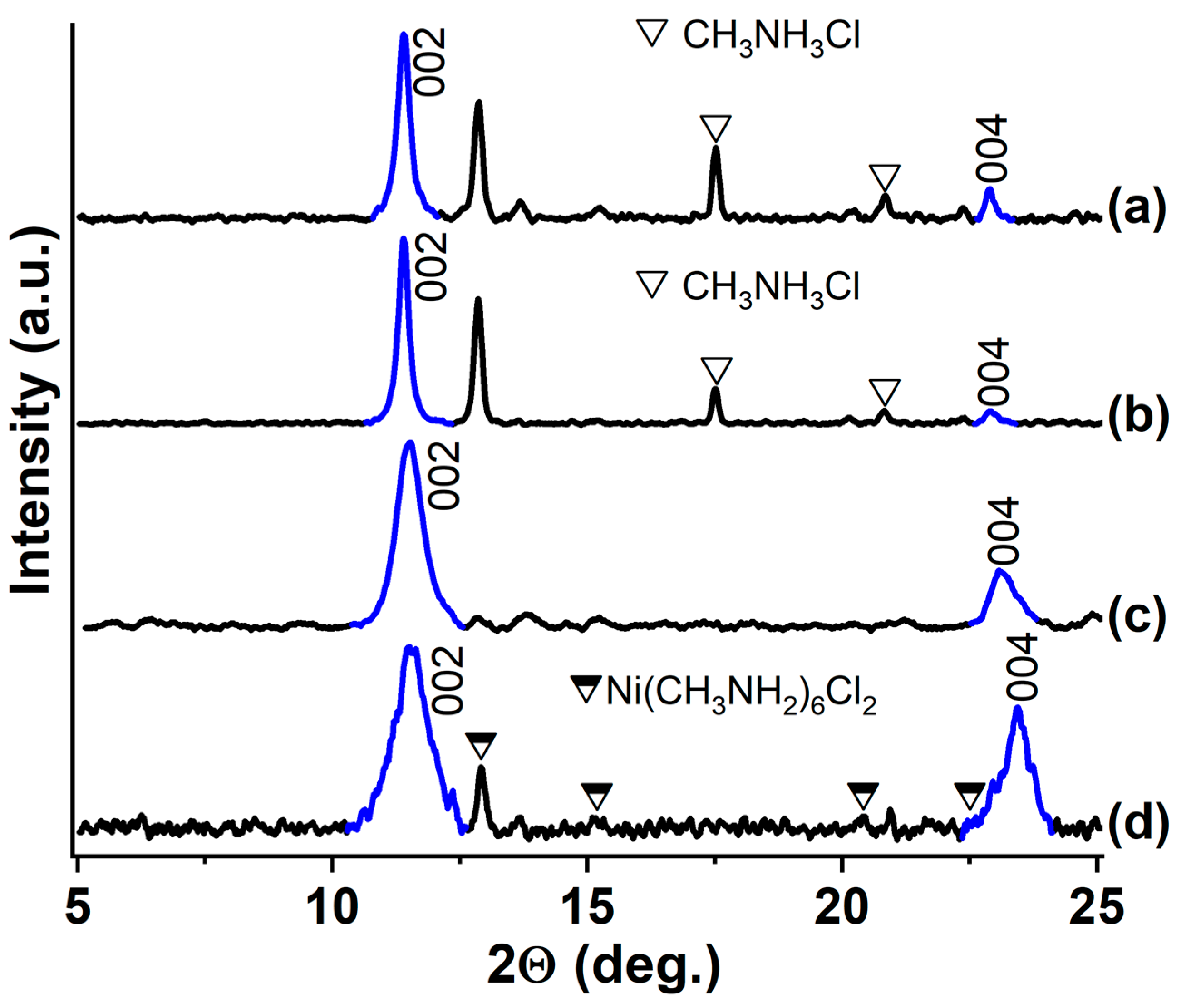
For the GIC with FeCl3 and the GIC with CoCl2 treated with methylamine, there was no unambiguity in assigning certain reflections to the phase of the methylamine complex itself or to the phase of the same complex but embedded in the graphite matrix. In the case of the GIC with NiCl2, it can be stated with sufficient confidence that the reflections at 2Θ angles of 11.65° (d = 7.66 Å) and 23.44° (d = 3.80 Å) belong to the graphite phase, in the interlayer space of which the Ni(CH3NH2)6Cl2 complex is located. Similar pairs of reflections are present in all the GIC treated with methylamine (Figure 16).
If we consider that these reflections are multiples of 002 and 004 reflections of GIC-M(CH3NH2)xCl2 (M = Fe, Co, Ni) of the I stage, then di of reflection 001 will correspond to the thickness of the filled layer of such GIC. Table 5 shows the experimentally determined values of di for reflections 002 and 004 and the value of di (001) calculated on their basis.
The calculated values of the thickness of the filled layer decrease in the series from iron to nickel. If we assume that the structures of all M(CH3NH2)6Cl2 complexes are identical (similar to the ammonia complexes M(NH3)6Cl2), then the thickness of the layer filled by the complex should ultimately depend on the atomic radii of the Fe2+, Co2+ and Ni2+ ions, the values of which also decrease in this series [52]. This assumption is confirmed by the results obtained using transmission electron microscopy (Figure 9d).
Based on the available data, it can be concluded that the treatment of GIC-MClx with liquid methylamine leads to the formation of GIC-M(CH3NH2)xCl2, in which methylamine bound to the metal chloride is located in the interlayer space of graphite. The thickness of the filled layer in such GIC increases by more than 60% compared to the initial one and is ≈ 15.5 Å.

3.4. Thermal Expansion of GIC-MCl2-RNH2

The conditions for thermal expansion of the GIC-MCl2 and (M = Co, Ni) complexes with ammonia and methylamine were chosen to be the same as for thermal expansion of the GIC-FeCl3-RNH2 complexes (inert nitrogen atmosphere, T = 900 °C, rapid heating).
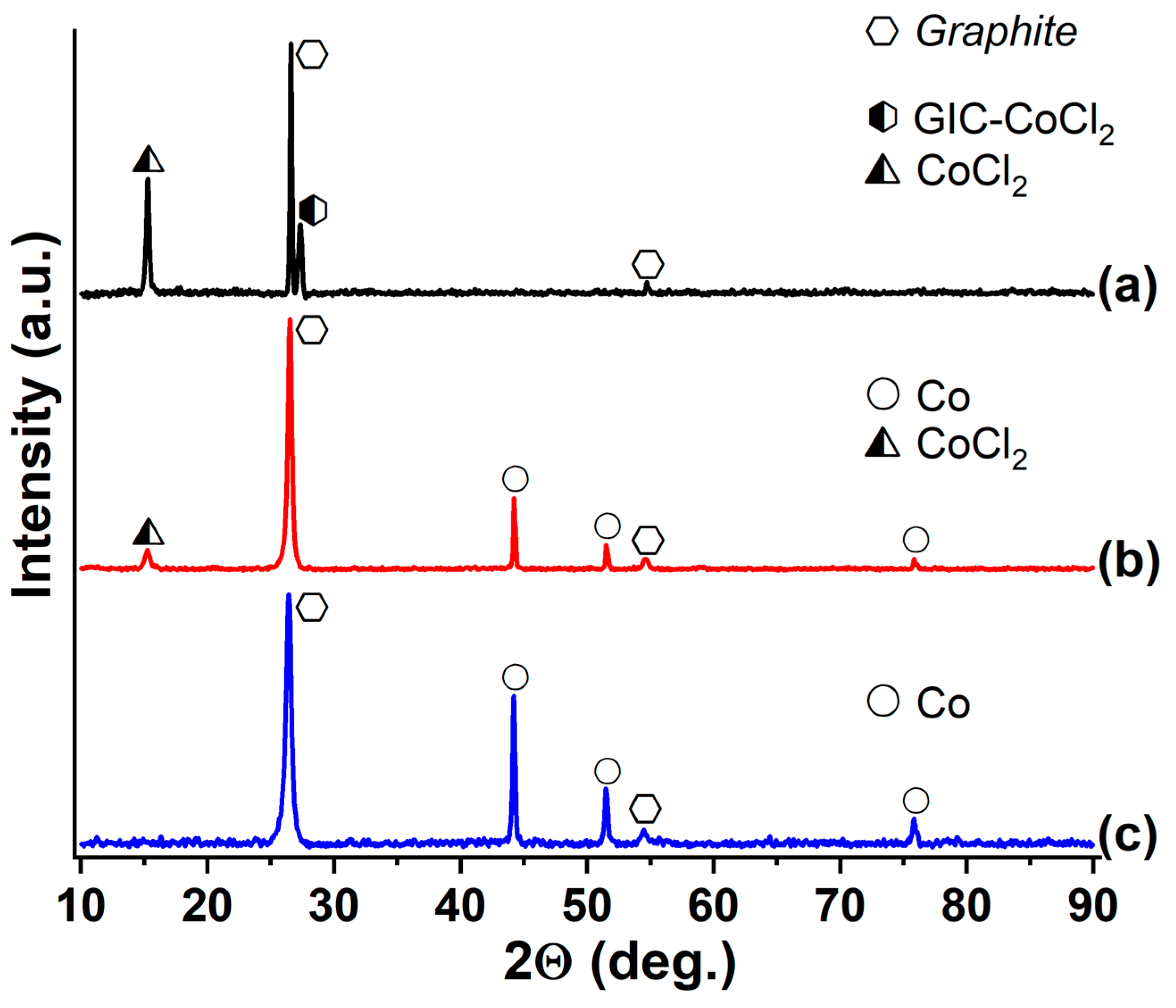
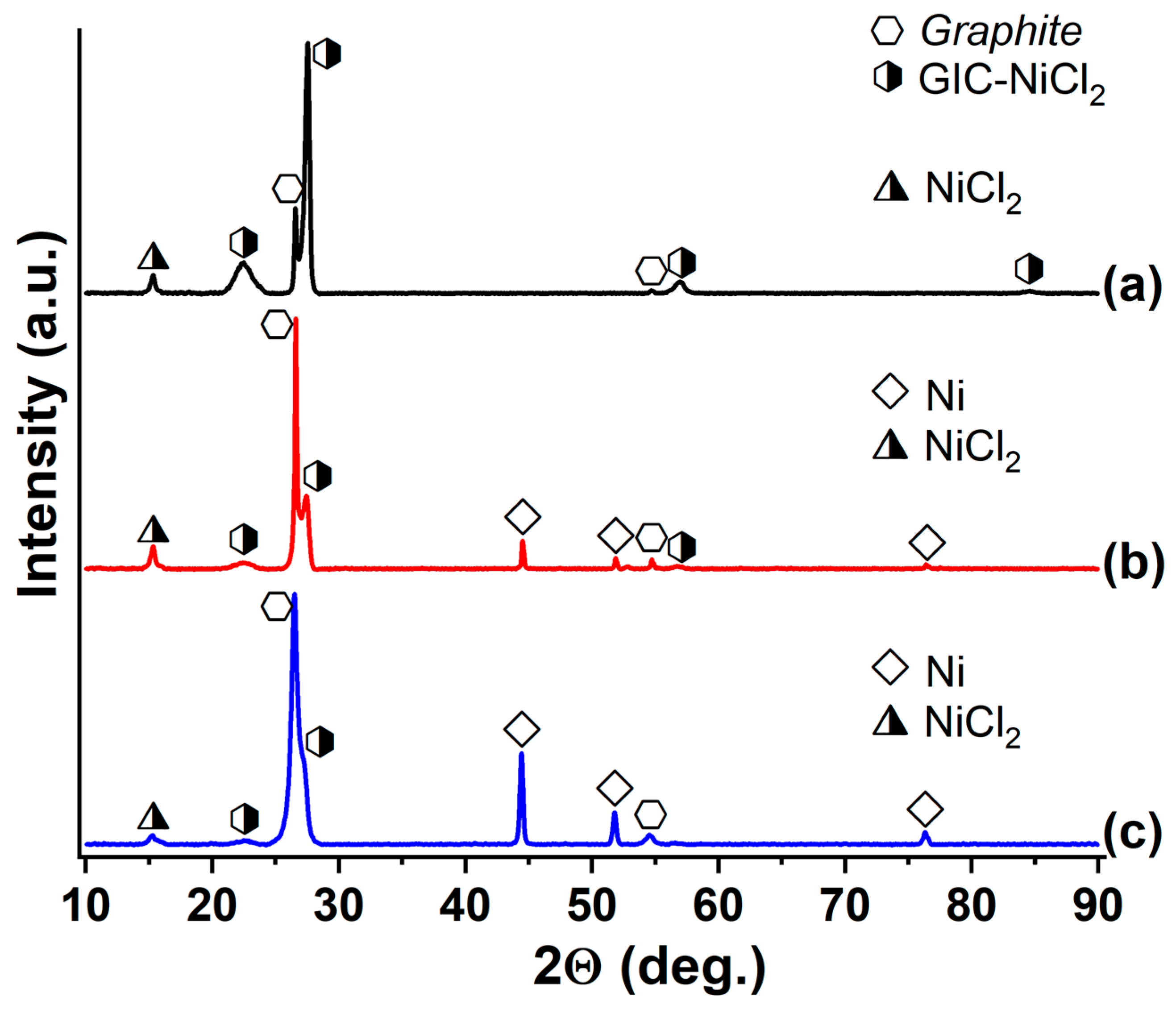
According to XRD data (Figure 17a), in the absence of ammonia or methylamine, heat treatment of GIC-CoCl2 does not lead to the reduction of chloride to metal. In addition, thermal expansion of graphite itself does not occur—the vapor pressure of CoCl2 is not enough for effective dispersion of the graphite matrix. On the contrary, from GIC saturated with NH3/CH3NH2, EG is formed with a low bulk density (about 5 g/L) with a completely (in the case of methylamine) or almost completely (in the case of ammonia) reduced metallic (β-Co) phase (ICDD, №01-089-4307, C).
The treatment of GIC-NiCl2 and its complexes with ammonia and methylamine (Figure 18) leads to similar results in general (reduction of chloride to metallic nickel (ICDD, №00-004-0850, S)), but complete recovery of chloride is not observed even with the expansion of GIC-NiCl2 saturated with CH3NH2 due to the presence of regions in GIC in which NiCl2 that has not reacted with methylamine remains. This also explains the presence of residual GIC-NiCl2 in all samples after thermal shock, although, judging by the intensity ratio of the main graphite peak and the GIC peak, the amount of the latter decreases upon transition from the initial GIC-NiCl2 to GIC-NiCl2-CH3NH2 with the maximum degree of saturation.
The summarized results on the macrocharacteristics of cobalt- and nickel-containing EGs are presented in Table 6.
Thus, by heat treatment of GIC-CoCl2 saturated with methylamine, low-density EG doped with cobalt particles can be obtained.
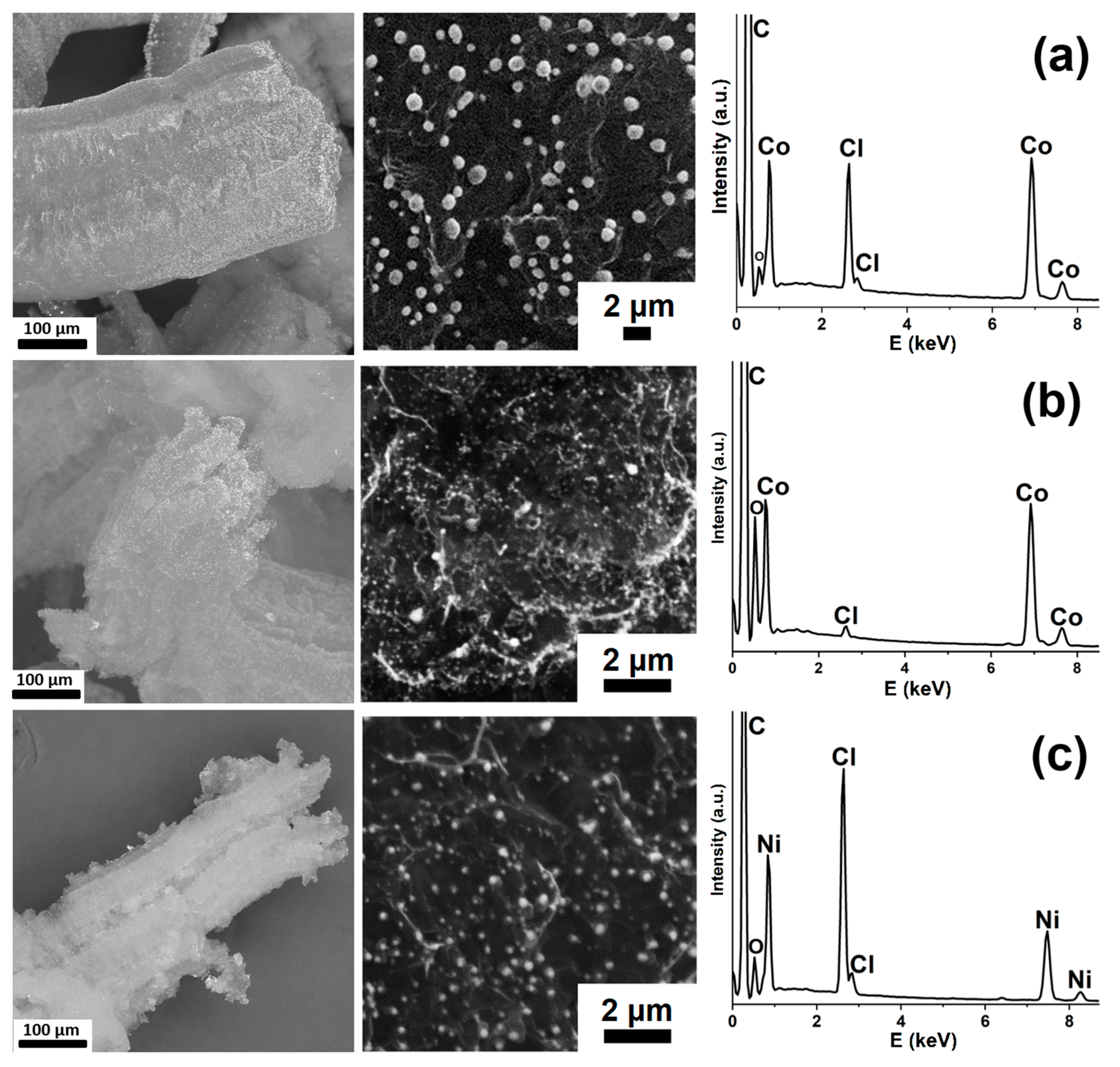
SEM images and EDX analysis data of the surface of EG samples obtained by thermal expansion of GIC-MCl2 complexes with ammonia and methylamine are shown in (Figure 19).
SEM images show that the particles of the metal-containing phase are uniformly distributed over the surface of the expanded graphite flakes, and their size is in the range from tenths of a micron to 1–2 μm. In the EDX spectra of the surface of the EG obtained from GIC-CoCl2-NH3 and GIC-NiCl2-CH3NH2 there are peaks attributed to the element chlorine, which confirms the XRD data and indicates incomplete reducibility of chlorides to metal.

3.5. Magnetic Properties of Metal-Containing Composites EG

The magnetization of the EG samples should depend on two main factors: the total amount of the magnetic phase in the EG and its specific magnetization, determined by the nature of the substance itself. The amount of the metal-containing phase in the EG samples was determined gravimetrically by burning carbon in air at a temperature of 900 °C. The amount of metal oxide formed during oxidation was recalculated to the amount of the original metal. The data obtained are presented in Table 7.
In the limit, from the ammonia- or methylamine-saturated GIC CxMCly·zRNH2, with complete reduction of chloride to metal, EG with the gross composition CxM should be formed. However, due to the removal of part of the metal chloride with the vapor phase, the carbon/metal ratio in the resulting EG shifts towards carbon. In different GIC-reducing agent systems, depending on the nature of the reactants, the process occurs differently, therefore the amount of the metal-containing phase in EG varies from 23 to 34 mass %.
The composition of the metal-containing phase also determines the final magnetization of the EG. Pure metals have the following values of saturation magnetization: MFe = 218 emu/g, MCo = 161 emu/g and MNi = 54 emu/g [53]. Unreduced chlorides are paramagnetic.
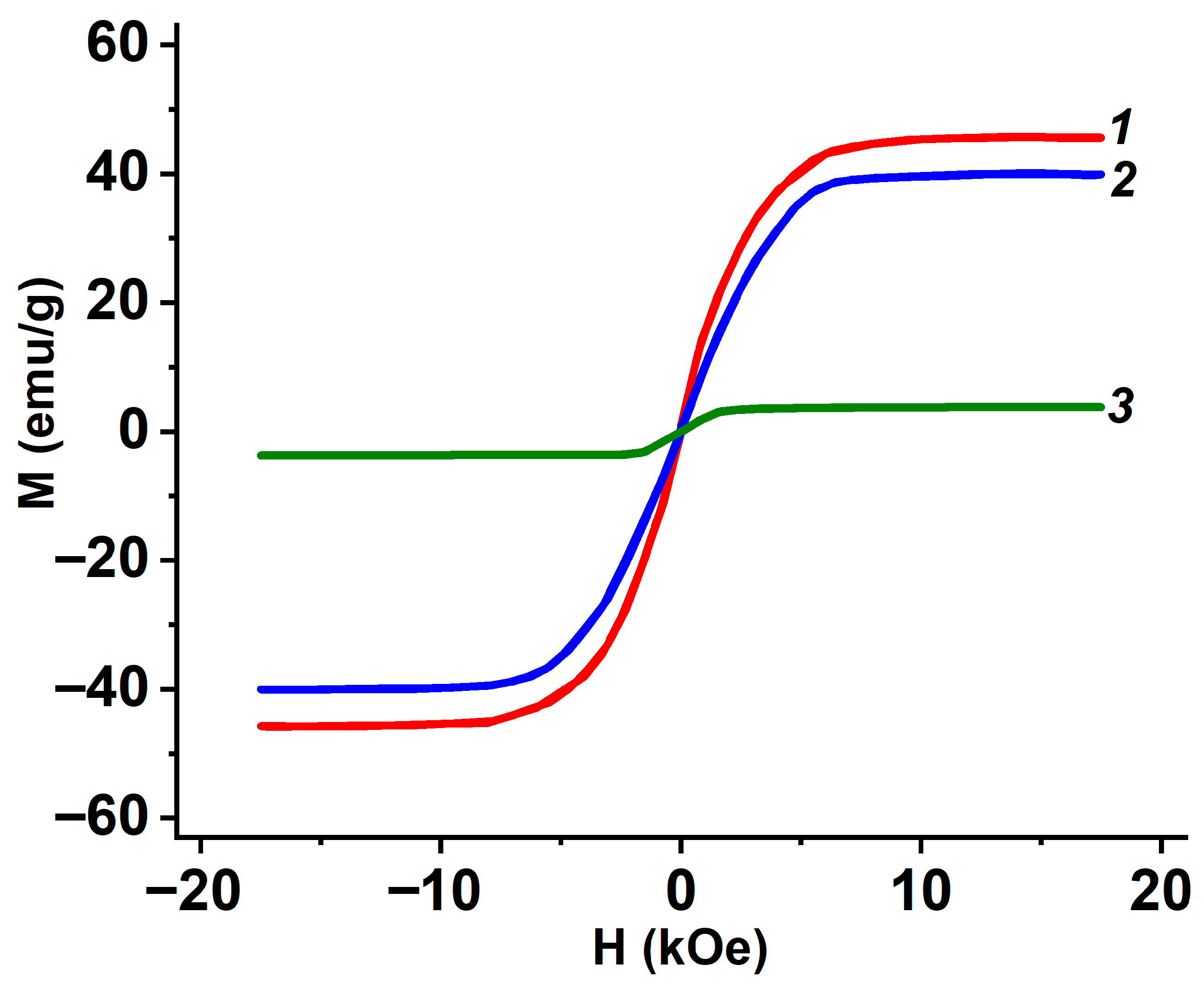
For the samples obtained on the basis of ammonia-saturated GIC-MClx (Figure 19), the magnetization decreases in the series EG/Fe, EG/Co, EG/Ni, and the magnetization of EG/Ni is almost an order of magnitude smaller. Firstly, this is due to the low degree of NiCl2 reduction and, as a consequence, the low metal content, and secondly, to the lowest magnetization of nickel itself. The EG/Fe and EG/Co samples are characterized by close magnetization values, although the magnetization of pure iron is 1.4 times higher than the magnetization of cobalt. This is explained by the fact that during thermal expansion, a significant portion of the highly volatile iron chloride is carried away with the nitrogen flow in the form of steam, as a result of which the amount of metal remaining on the EG is about 1.4 times smaller.
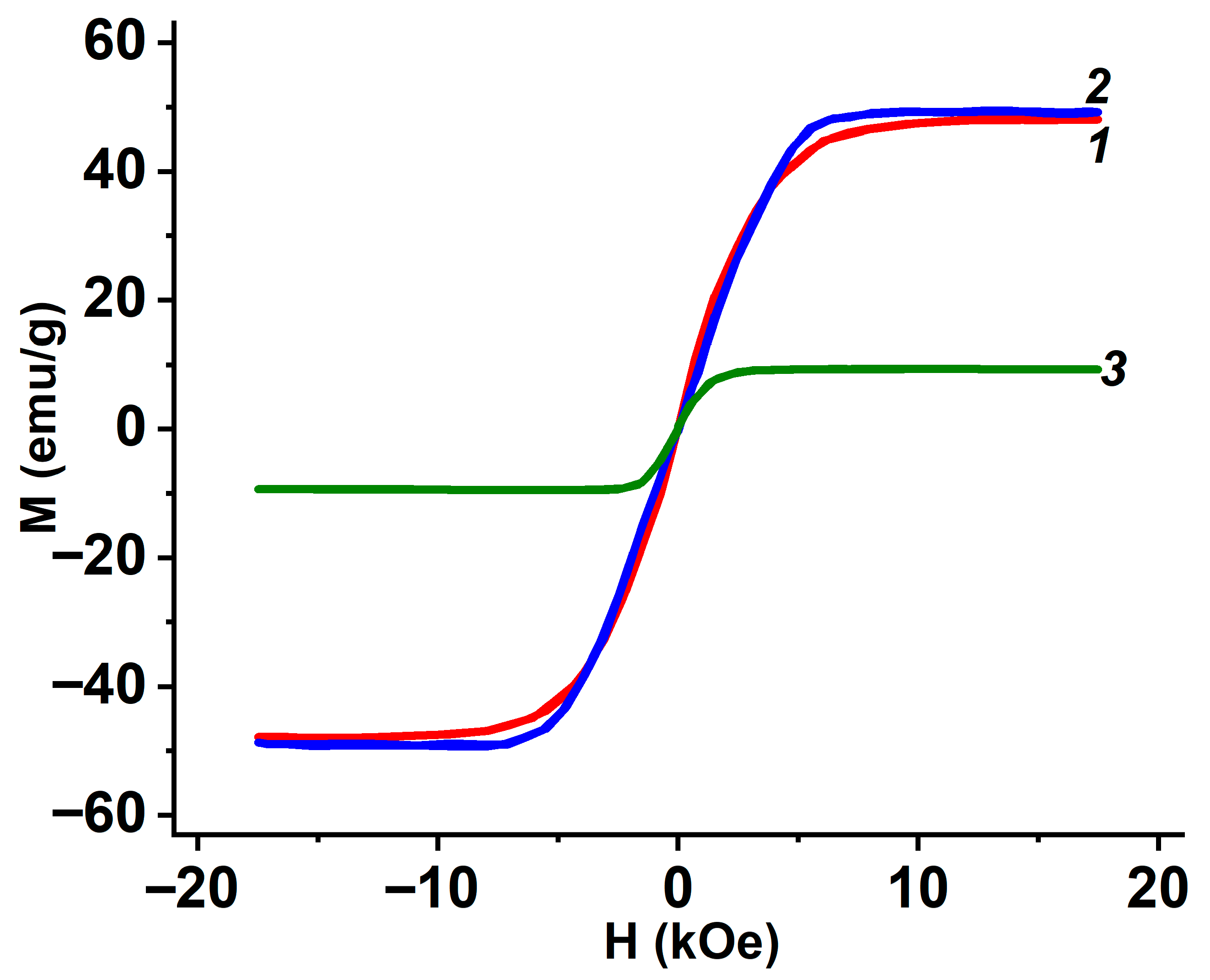
During thermal expansion of GIC-CoCl2 and GIC-NiCl2 saturated with methylamine, EG is formed in which, according to XRD data, the proportion of reduced metal becomes greater than in EG from GIC saturated with ammonia (Table 6), while the total amount of metal-containing phase is practically the same for both cases. Therefore, the magnetization of the EG/Co composite obtained from the complex with methylamine is 22.5% greater than that of EG/Co obtained from the complex with ammonia, and that of EG/Ni obtained from the complex with methylamine is 150% greater (Figure 20). The relatively small increase in magnetization for EG/Co is due to the fact that only a very small part of CoCl2 is not reduced during heat treatment of GIC-CoCl2 saturated with ammonia, while during heat treatment of GIC-NiCl2-NH3, on the contrary, most of the nickel chloride remains unreduced due to the low saturation of GIC with ammonia, so in this case a significant increase in magnetization of the EG/Ni composite is observed.
In the case of the EG/Fe composite, the situation is somewhat different: despite the fact that significant iron removal in the form of chloride does not occur during reduction with methylamine, as evidenced by a 30% higher content of the iron-containing phase in the sample, the magnetization value does not increase by a similar amount (Figure 21). We attribute this to the fact that during reduction with methylamine, the reduced iron interacts with the carbon formed during the decomposition of methylamine. For comparison, the specific magnetization of cementite (Fe3C), which can form under thermal expansion conditions, is 40% lower than that of α-Fe [54].
The Faraday method is a static method with fundamentally low sensitivity limitations in weak fields; the error in determining the coercivity in the range up to 300 Oe is 150 Oe. If ferromagnetic particles can rotate without a matrix, they will rotate with the applied magnetic field rather than undergo a magnetization reversal. For these reasons, the coercivity value measured using a Faraday balance may be underestimated. This behavior of magnetic particles does not preclude the use of the resulting composites as magnetic sorbents or for creating EMI shields.
Thus, a relationship was established between the conditions for obtaining metal-containing composites EG/M and their magnetic properties.

4. Conclusions

In the course of the work it was established that as a result of saturation of GIC-MClx with ammonia and methylamine the following occurs:
  • Interaction of chloride with NH3/CH3NH2, leading to the formation of the M(RNH2)6Cl2 complex, as evidenced by the appearance of phases corresponding to these compounds in the diffraction patterns of GIC saturated with ammonia and methylamine;
  • Partial deintercalation of the introduced chloride. This is evidenced by the appearance of reflexes corresponding to the graphite phase;
  • Formation of a methylamine complex with iron chloride in the interlayer space of graphite. This can be judged by some direct and indirect signs. These include the following: the absence of reflexes in the diffraction patterns of the processed GIC corresponding to the initial GIC at a low intensity of peaks corresponding to graphite (in the case of high saturation), the appearance of reflexes that can be attributed to the GIC-M(RNH2)6Cl2 phase; the presence of various stages of a doublet in the Mossbauer spectrum of methylamine-saturated GIC-FeCl3, which differs greatly in its parameters from the doublet corresponding directly to the methylamine complex of iron chloride; an increase in the interlayer distance up to 15.6 Å, confirmed by TEM; as well as the ability of GIC treated with NH3/CH3NH2 to undergo effective thermal expansion.
The saturation of GIC-MClx with methylamine in all cases is higher than the saturation with ammonia, which may be due to the greater basicity of methylamine, as well as the better solubility of the M(CH3NH2)6Cl2 complex in liquid methylamine itself.
Using the example of processing GIC-FeCl3 at various stages, it is shown that the saturation with ammonia and methylamine decreases with an increase in the stage number, which is explained (in accordance with the domain model of the GIC structure) by the presence in GIC particles with nst. > I of isolated intercalate regions that ammonia or methylamine cannot “reach”.
During thermal treatment of GIC-MClx-saturated NH3/CH3NH2 in the thermal shock mode in an inert atmosphere, EG with a deposited metallic or metal-containing phase can be obtained. The conditions for the formation of the metallic phase are the high temperature of the thermal expansion process (>800 °C) and the presence of bound ammonia or methylamine in an amount sufficient for the complete reduction of chloride to pure metal. In this way, the following EG/M composites with a reduced metal phase can be obtained: EG/Fe from GIC-FeCl3-I-NH3 complex with ammonia and from GIC-FeCl3-(from I to VII stage)-CH3NH2 complexes with methylamine; EG/Co from GIC-CoCl2-I/II-NH3 and GIC-CoCl2-I/II-CH3NH2 complexes with ammonia and methylamine; EG/Ni from the GIC-NiCl2-II/III-CH3NH2 complex with methylamine. The particle sizes of the metallic phase uniformly deposited on the surface of the EG flakes vary from tens of nanometers to several micrometers.
The low-density (≈ 4–6 g/L) EG-metal composites obtained in the work have high values of saturation magnetization (up to 45–50 emu/g) with a total amount of metal-containing phase up to 30–35 wt.%, which makes them potentially applicable as magnetic sorbents, as well as in the creation of systems of protection against electromagnetic radiation.

Author Contributions

A.D.M.: Writing—original draft, investigation, formal analysis. A.V.I.: Writing—review and editing, supervision, formal analysis. V.A.M.: Methodology, investigation. S.K.D.: Investigation, formal analysis. B.A.K.: Investigation, formal analysis. A.V.V.: Investigation, formal analysis. N.V.M.: Validation. V.V.A.: Supervision, resources. All authors have read and agreed to the published version of the manuscript.

Funding

This research received no external funding.

Data Availability Statement

Data will be made available on request.

Acknowledgments

This research was performed according to the Development program of the Interdisciplinary Scientific and Educational School of Lomonosov Moscow State University «The future of the planet and global environmental change and State Program» of TIPS RAS and was supported by the Ministry of Education and Science of the Russian Federation and carried out as part of the work on the topic “Substances and materials for safety, reliability and energy efficiency” on assignment by project № AAAA-A21-121011590086-0.

Conflicts of Interest

The authors declare that they have no known competing financial interests or personal relationships that could have appeared to influence the work reported in this paper.

Abbreviations

The following abbreviations are used in this manuscript:
GICGraphite intercalation compound
EGExpanded graphite
ExpGExpandable graphite
XRDX-ray diffraction
SEMScanning electron microscopy
TEMTransmission electron microscopy
EDXEnergy-dispersive X-ray spectroscopy

References

  1. Cai, X.; Qiu, Y.; Zhou, Y.; Jiao, X. Nanoscale Zero-Valent Iron Loaded Vermiform Expanded Graphite for the Removal of Cr (VI) from Aqueous Solution. R. Soc. Open Sci. 2021, 8, 210801. [Google Scholar] [CrossRef]
  2. Takeuchi, K.; Fujishige, M.; Kitazawa, H.; Akuzawa, N.; Medina, J.O.; Morelos-Gomez, A.; Cruz-Silva, R.; Araki, T.; Hayashi, T.; Terrones, M.; et al. Oil Sorption by Exfoliated Graphite from Dilute Oil–Water Emulsion for Practical Applications in Produced Water Treatments. J. Water Process Eng. 2015, 8, 91–98. [Google Scholar] [CrossRef]
  3. Xu, Z.; Huang, Y.; Yang, Y.; Shen, J.; Tang, T.; Huang, R. Dispersion of Iron Nano-Particles on Expanded Graphite for the Shielding of Electromagnetic Radiation. J. Magn. Magn. Mater. 2010, 322, 3084–3087. [Google Scholar] [CrossRef]
  4. Zhu, Y.; Li, D.; Wu, Z.; Xu, S.; Zhao, Y.; Zhang, Y.; Wang, S.; Shi, J.; Tang, J.; Yan, P. Study on the Microwave Absorbing Properties of Fe Nanoparticles Prepared by the HEIBE Method in Expanded Graphite Matrix Composites. J. Alloys Compd. 2021, 860, 158434. [Google Scholar] [CrossRef]
  5. Zhu, S.; Gao, Y.; Zhou, H.; Zheng, C.; Li, X.; Man, Q.; Liu, X. Expanded Graphite/Co@C Composites with Dual Functions of Corrosion Resistance and Microwave Absorption. J. Mater. Res. Technol. 2023, 23, 3557–3569. [Google Scholar] [CrossRef]
  6. Wolf, M.; Fischer, N.; Claeys, M. Preparation of Isolated Co3O4 and Fcc-Co Crystallites in the Nanometre Range Employing Exfoliated Graphite as Novel Support Material. Nanoscale Adv. 2019, 1, 2910–2923. [Google Scholar] [CrossRef]
  7. Vovchenko, L.; Matzui, L.; Oliynyk, V.; Launetz, V.; Prylutskyy, Y.; Hui, D.; Strzhemechny, Y.M. Modified exfoliated graphite as a material for shielding against electromagnetic radiation. Int. J. Nanosci. 2008, 7, 263–268. [Google Scholar] [CrossRef]
  8. Afanasov, I.M.; Lebedev, O.I.; Kolozhvary, B.A.; Smirnov, A.V.; Van Tendeloo, G. Nickel/Carbon Composite Materials Based on Expanded Graphite. New Carbon Mater. 2011, 26, 335–340. [Google Scholar] [CrossRef]
  9. Yao, Y.; Jin, S.; Sun, J.; Li, L.; Zou, H.; Wen, P.; Lv, G.; Lv, X.; Shu, Q. Sandwich-like Sulfur-Free Expanded Graphite/CoNi Hybrids and Their Synergistic Enhancement of Microwave Absorption. J. Alloys Compd. 2021, 862, 158005. [Google Scholar] [CrossRef]
  10. Krawczyk, P.; Rozmanowski, T.; Frankowski, M. Methanol Electrooxidation at Electrodes Made of Exfoliated Graphite/Nickel/Palladium Composite. Catal. Lett. 2019, 149, 2307–2316. [Google Scholar] [CrossRef]
  11. Zhu, S.; Lei, Z.; Liu, Z.; Wu, F.; Song, J.; Yang, Z.; Tan, G.; Man, Q.; Liu, X. Synthesis and Microwave Absorption Properties of Sandwich Microstructure Ce2Fe17N3-δ/Expanded Graphite Composites. J. Alloys Compd. 2022, 907, 164445. [Google Scholar] [CrossRef]
  12. Ivanov, A.V.; Volkova, S.I.; Maksimova, N.V.; Pokholok, K.V.; Kravtsov, A.V.; Belik, A.A.; Posokhova, S.M.; Kalachev, I.L.; Avdeev, V.V. Exfoliated Graphite with γ-Fe2O3 for the Removal of Oil and Organic Pollutants from the Water Surface: Synthesis, Mossbauer Study, Sorption and Magnetic Properties. J. Alloys Compd. 2023, 960, 170619. [Google Scholar] [CrossRef]
  13. Park, J.-I.; Hong, Y.; Jang, Y.; Ha, M.-G.; An, H.-R.; Son, B.; Choi, Y.; Kim, H.; Jeong, Y.; Lee, H.U. Efficient Iron Oxide/Expanded Graphite Nanocomposites Prepared by Underwater Plasma Discharge for Removing Heavy Metals. J. Mater. Res. Technol. 2021, 14, 1884–1892. [Google Scholar] [CrossRef]
  14. Tian, Y.; Ma, H.; Xing, B. Preparation of Surfactant Modified Magnetic Expanded Graphite Composites and Its Adsorption Properties for Ionic Dyes. Appl. Surf. Sci. 2021, 537, 147995. [Google Scholar] [CrossRef]
  15. Tuan Nguyen, H.D.; Nguyen, H.T.; Nguyen, T.T.; Le Thi, A.K.; Nguyen, T.D.; Phuong Bui, Q.T.; Bach, L.G. The Preparation and Characterization of MnFe2O4-Decorated Expanded Graphite for Removal of Heavy Oils from Water. Materials 2019, 12, 1913. [Google Scholar] [CrossRef]
  16. Tham, N.T.H.; Thinh, P.V.; Uyen, D.T.T.; Tien, N.A.; Thanh, N.T.; Sy, D.T. Synthesis and Characterization of Magnetic Expanded Graphite Material (EG@CoFe2O4) Through Sol-Gel Processing. IOP Conf. Ser. Mater. Sci. Eng. 2020, 991, 012109. [Google Scholar] [CrossRef]
  17. Vinh, N.H.; Hieu, N.P.; Van Thinh, P.; Diep, N.T.M.; Thuan, V.N.; Trinh, N.D.; Thuy, N.H.; Long Giang, B.; Quynh, B.T.P. Magnetic NiFe2O4/Exfoliated Graphite as an Efficient Sorbent for Oils and Organic Pollutants. J. Nanosci. Nanotechnol. 2018, 18, 6859–6866. [Google Scholar] [CrossRef] [PubMed]
  18. Saraf, S.D.; Panda, D.; Gangawane, K.M. Performance Analysis of Hybrid Expanded Graphite-NiFe2O4 Nanoparticles-Enhanced Eutectic PCM for Thermal Energy Storage. J. Energy Storage 2023, 73, 109188. [Google Scholar] [CrossRef]
  19. Pham, V.T.; Nguyen, T.T.; Bui, T.P.Q.; Nguyen, M.T.; Nguyenh, T.D.; Bach, L.G. Simple Synthesis and Characterization of Cobalt Ferrites on Expanded Graphite by the Direct Sol-Gel Chemistry for Removal of Oil Leakage (Fuel Oil, Diesel Oil and Crude Oil). IOP Conf. Ser. Mater. Sci. Eng. 2019, 479, 012054. [Google Scholar] [CrossRef]
  20. Ding, X.; Wang, R.; Zhang, X.; Zhang, Y.; Deng, S.; Shen, F.; Zhang, X.; Xiao, H.; Wang, L. A New Magnetic Expanded Graphite for Removal of Oil Leakage. Mar. Pollut. Bull. 2014, 81, 185–190. [Google Scholar] [CrossRef]
  21. Zhao, Y.; Liu, L.; Han, J.; Wu, W.; Tong, G. Effective Modulation of Electromagnetic Characteristics by Composition and Size in Expanded Graphite/Fe3O4 Nanoring Composites with High Snoek’s Limit. J. Alloys Compd. 2017, 728, 100–111. [Google Scholar] [CrossRef]
  22. Huang, Y.; Xu, Z.; Shen, J.; Tang, T.; Huang, R. Dispersion of Magnetic Metals on Expanded Graphite for the Shielding of Electromagnetic Radiations. Appl. Phys. Lett. 2007, 90, 133117. [Google Scholar] [CrossRef]
  23. Chung, D.D.L. A Perspective on Electromagnetic Interference Shielding Materials Comprising Exfoliated Graphite. Carbon 2024, 216, 118569. [Google Scholar] [CrossRef]
  24. Fan, Y.; Feng, X.; Liu, J.; Guo, X.; Liu, Z.; Li, J.; Gao, L.; Tao, Z.; Hao, B.; Yan, X. Expanded Graphite/Nanosilver Composites for Effective Thermal Management and Electromagnetic Interference Shielding of Electronic Devices. J. Alloys Compd. 2025, 1022, 179794. [Google Scholar] [CrossRef]
  25. Sorokina, N.E.; Nikol’skaya, I.V.; Ionov, S.G.; Avdeev, V.V. Acceptor-Type Graphite Intercalation Compounds and New Carbon Materials Based on Them. Russ. Chem. Bull. 2005, 54, 1749–1767. [Google Scholar] [CrossRef]
  26. Deng, S.; Jiang, J.; Wu, D.; He, Q.; Wang, Y. Three-Dimensional Conductive Network Constructed by in-Situ Preparation of Sea Urchin-like NiFe2O4 in Expanded Graphite for Efficient Microwave Absorption. J. Colloid Interface Sci. 2023, 650, 710–718. [Google Scholar] [CrossRef]
  27. Darwish, M.A.; Morchenko, A.T.; Abosheiasha, H.F.; Kostishyn, V.G.; Turchenko, V.A.; Almessiere, M.A.; Slimani, Y.; Baykal, A.; Trukhanov, A.V. Impact of the Exfoliated Graphite on Magnetic and Microwave Properties of the Hexaferrite-Based Composites. J. Alloys Compd. 2021, 878, 160397. [Google Scholar] [CrossRef]
  28. Zhou, Z.; Tan, Y.; Yan, T.; Wu, X.; He, G.; Li, H.; Zhou, J.; Tong, H.; Yu, L.; Zeng, J. CoFe2O4-x/Expanded Graphite Composite with Abundant Oxygen Vacancies as a High-Performance Peroxymonosulfate Activator for Antibiotic Degradation. Colloids Surf. A Physicochem. Eng. Asp. 2025, 718, 136808. [Google Scholar] [CrossRef]
  29. Chung, D.D.L. A Review of Exfoliated Graphite. J. Mater. Sci. 2016, 51, 554–568. [Google Scholar] [CrossRef]
  30. Cermak, M.; Perez, N.; Collins, M.; Bahrami, M. Material Properties and Structure of Natural Graphite Sheet. Sci. Rep. 2020, 10, 18672. [Google Scholar] [CrossRef] [PubMed]
  31. Lutfullin, M.A.; Shornikova, O.N.; Vasiliev, A.V.; Pokholok, K.V.; Osadchaya, V.A.; Saidaminov, M.I.; Sorokina, N.E.; Avdeev, V.V. Petroleum Products and Water Sorption by Expanded Graphite Enhanced with Magnetic Iron Phases. Carbon 2014, 66, 417–425. [Google Scholar] [CrossRef]
  32. Dunaev, A.V.; Chikin, A.I.; Pokholok, K.V.; Filimonov, D.S.; Arkhangel’skii, I.V. Conversion of Graphite Intercalation Compounds to Carbon Materials Containing Polymetallic Nanoparticles. Inorg. Mater. 2010, 46, 1084–1089. [Google Scholar] [CrossRef]
  33. Dunaev, A.V.; Sorokina, N.E.; Maksimova, N.V.; Avdeev, V.V. Electrochemical Behavior of Graphite in Nonaqueous FeCl3 Solutions. Inorg. Mater. 2005, 41, 127–132. [Google Scholar] [CrossRef]
  34. Mizutani, Y.; Abe, T.; Asano, M.; Harada, T. Bi-Intercalation of H2SO4 into Stages 4-6 FeCl3-Graphite Intercalation Compounds. J. Mater. Res. 1993, 8, 1586–1595. [Google Scholar] [CrossRef]
  35. Tilquin, J.-Y.; Fournier, J.; Guay, D.; Dudelet, J.P.; Dénès, G. Intercalation of CoCl2 into Graphite: Mixing Method vs Molten Salt Method. Carbon 1997, 35, 299–306. [Google Scholar] [CrossRef]
  36. Stumpp, E.; Werner, F. Graphite Intercalation Compounds with Chlorides of Manganese, Nickel and Zinc. Carbon 1966, 4, 538. [Google Scholar] [CrossRef]
  37. Selig, H.; Ebert, L.B. Graphite Intercalation Compounds. In Advances in Inorganic Chemistry and Radiochemistry; Emeléus, H.J., Sharpe, A.G., Eds.; Academic Press: Cambridge, MA, USA, 1980; Volume 23, pp. 281–327. [Google Scholar]
  38. Lutfullin, M.A.; Shornikova, O.N.; Sorokina, N.E.; Avdeev, V.V. Interaction of FeCl3-Intercalated Graphite with Intercalants of Different Strengths. Inorg. Mater. 2014, 50, 29–34. [Google Scholar] [CrossRef]
  39. Li, W.-B.; Lin, S.-Y.; Nguyen, T.D.H.; Chung, H.-C.; Tran, N.T.T.; Han, N.T.; Liu, H.-Y.; Pham, H.D.; Lin, M.-F. FeCl3 Graphite Intercalation Compounds: Iron-Ion-Based Battery Cathodes. In First-Principles Calculations for Cathode, Electrolyte and Anode Battery Materials; IOP Publishing: Bristol, UK, 2021. [Google Scholar]
  40. Niitani, K.; Morita, M.; Abe, T. Electrochemical Preparation of Exfoliated Graphite Composites from a Ferric Chloride-Graphite Intercalation Compound. Carbon Trends 2025, 21, 100560. [Google Scholar] [CrossRef]
  41. Zhou, J.; Lin, Z.; Ren, H.; Duan, X.; Shakir, I.; Huang, Y.; Duan, X. Layered Intercalation Materials. Adv. Mater. 2021, 33, 2004557. [Google Scholar] [CrossRef]
  42. Skoropanov, A.S.; Kizina, T.A.; Samal, G.I.; Vecher, A.A.; Novikov, Y.N.; Vol’Pin, M.E. Thermal analysis of graphite intercalation compounds. Synth. Met. 1984, 9, 355–360. [Google Scholar] [CrossRef]
  43. Tominaga, T.; Sakai, T.; Kimura, T. A Mössbauer Study of Graphite Intercalated with Iron(III) Chloride and Aluminum Chloride. Bull. Chem. Soc. Jpn. 1976, 49, 2755–2758. [Google Scholar] [CrossRef]
  44. Vol’pin, M.E.; Novikov, Y.N.; Lapkina, N.D.; Kasatochkin, V.I.; Struchkov, Y.T.; Kazakov, M.E.; Stukan, R.A.; Povitskij, V.A.; Karimov, Y.S.; Zvarikina, A.V. Lamellar Compounds of Graphite with Transition Metals. Graphite as a Ligand. J. Am. Chem. Soc. 1975, 97, 3366–3373. [Google Scholar] [CrossRef]
  45. Asch, L.; Adloff, J.P.; Friedt, J.M.; Danon, J. Motional Effects in the Mössbauer Spectra of Iron(II) Hexammines. Chem. Phys. Lett. 1970, 5, 105–108. [Google Scholar] [CrossRef]
  46. Asch, L.; Shenoy, G.K.; Friedt, J.M.; Adloff, J.P.; Kleinberger, R. Mössbauer Effect and X-Ray Studies of the Phase Transition in Iron Hexammine Salts. J. Chem. Phys. 1975, 62, 2335–2342. [Google Scholar] [CrossRef]
  47. Wang, L.; Zhu, Y.; Guo, C.; Zhu, X.; Liang, J.; Qian, Y. Ferric Chloride-Graphite Intercalation Compounds as Anode Materials for Li-Ion Batteries. ChemSusChem 2014, 7, 87–91. [Google Scholar] [CrossRef]
  48. Inagaki, M.; Tashiro, R.; Washino, Y.; Toyoda, M. Exfoliation Process of Graphite via Intercalation Compounds with Sulfuric Acid. J. Phys. Chem. Solids 2004, 65, 133–137. [Google Scholar] [CrossRef]
  49. Stumpp, E. The Intercalation of Metal Chlorides and Bromides into Graphite. Mater. Sci. Eng. 1977, 31, 53–59. [Google Scholar] [CrossRef]
  50. Avdeev, V.V.; Mukhanov, V.A.; Litvinenko, A.Y.; Semenenko, K.N. Introduction of element halides into graphite under high pressure. Bull. Mosc. Univ. Chem. Ser. II. 1984, 98, 409–412. [Google Scholar]
  51. Sugiarto; Minato, T.; Sakiyama, H.; Sadakane, M. Anion-Directed Conformation Switching and Trigonal Distortion in Hexakis(Methylamine)Nickel(II) Cations. Eur. J. Inorg. Chem. 2022, 2022, e202200386. [Google Scholar] [CrossRef]
  52. Rabinovich, V.L.; Khavin, Z.Y. Brief Chemical Handbook, 3rd ed.; Potekhina, A.A., Efimova, A.M., Eds.; Khimiya: Leningrad, Russia, 2011. [Google Scholar]
  53. Huber, D.L. Synthesis, Properties, and Applications of Iron Nanoparticles. Small 2005, 1, 482–501. [Google Scholar] [CrossRef] [PubMed]
  54. Lei, X.; Wang, W.; Ye, Z.; Zhao, N.; Yang, H. High Saturation Magnetization of Fe3C Nanoparticles Synthesized by a Simple Route. Dye. Pigment. 2017, 139, 448–452. [Google Scholar] [CrossRef]
Figure 1. Schemes for obtaining EG and EG/M composites: (a)—classic scheme of obtaining EG, (b)—scheme for obtaining a EG/M composites based on EG post-processing, (c)—scheme for obtaining EG/M composites by introducing a precursor for the formation of a metal-containing phase into ExpG, (d)—scheme for obtaining EG/M composites through intercalation of the precursor for the formation of a metal-containing phase into graphite, (e)—a novel scheme for obtaining EG/M composites, which allows the deposition of the metal phase simultaneously with thermal expansion. The stages of the classical scheme for obtaining EG are highlighted in black, and additional operations used to apply the metal-containing phase are highlighted in red, modifications used in the work are highlighted in green.
Solids 06 00060 g001
Figure 2. XRD patterns of GIC-FeCl3: (a) I stage, (b) II stage, (c) III stage, (d) IV stage, (e) V stage, (f) VI stage, (g) VII stage, obtained by the gas-phase method.
Solids 06 00060 g002
Figure 3. Mossbauer spectra of GIC-FeCl3: (a) I stage, (b) II stage and (c) III stage.
Solids 06 00060 g003
Figure 4. Saturation of GIC-FeCl3 of different stages and GIC-CoCl2, GIC-NiCl2 with ammonia and methylamine. The number above the column indicates the number of amine molecules per formula unit of GIC-MClx.
Solids 06 00060 g004
Figure 5. XRD patterns of ammonia-saturated GIC-FeCl3: (a) I stage, (b) II stage, (c) III stage, (d) IV stage and (e) V stage.
Solids 06 00060 g005
Figure 6. Mossbauer spectra of NH3-saturated GICs: (a) GIC-FeCl3-I-NH3, (b) GIC-FeCl3-II-NH3, (c) GIC-FeCl3-III-NH3 and (d) FeCl3-NH3 complex.
Solids 06 00060 g006
Figure 7. XRD patterns of methylamine-saturated GIC-FeCl3: (a) I stage, (b) II stage, (c) III stage, (d) IV stage, (e) V stage, (f) VI stage, (g) VII stage.
Solids 06 00060 g007
Figure 8. Mossbauer spectra of CH3NH2-saturated GICs: (a) GIC-FeCl3-I- CH3NH2, (b) GIC-FeCl3-II-CH3NH2, (c) GIC-FeCl3-III-CH3NH2 and (d) FeCl3-CH3NH2 complex.
Solids 06 00060 g008
Figure 9. TEM images of the surface: (a) of the initial GIC-FeCl3-I sample and (bd) of the GIC-FeCl3-I-CH3NH2 sample. FFT images and interlayer distances determined from them are shown in the corners of the insets.
Solids 06 00060 g009
Figure 10. XRD patterns of EG samples obtained by thermal expansion of ammonia complexes of GIC-FeCl3: (a) I stage, (b) II stage, (c) III stage, (d) IV stage, (e) V stage.
Solids 06 00060 g010
Figure 11. XRD patterns of EG samples obtained by thermal expansion of methylamine complexes of GIC-FeCl3: (a) I stage, (b) II stage, (c) III stage, (d) IV stage, (e) V stage, (f) VI stage, (g) VII stage.
Solids 06 00060 g011
Figure 12. XRD patterns of EG samples obtained by thermal expansion of GIC-FeCl3-I-NH3 saturated with ammonia at: (a) 900 °C, (b) 800 °C, (c) 700 °C.
Solids 06 00060 g012
Figure 13. (a,b)—SEM images; (c,d)—TEM images and (e)—EDX spectra of the surface of EG particles obtained at 900 °C from the first stage GIC-FeCl3-I-NH3.
Solids 06 00060 g013
Figure 14. XRD patterns: (a) initial GIC-CoCl2; after treatment (b) with ammonia (GIC-CoCl2-NH3), (c) with methylamine (GIC-CoCl2-CH3NH2).
Solids 06 00060 g014
Figure 15. XRD patterns: (a)—initial GIC-NiCl2; after treatment (b) with ammonia (GIC-NiCl2-NH3), (c) with methylamine (GIC-NiCl2-CH3NH2).
Solids 06 00060 g015
Figure 16. XRD patterns: (a) GIC-FeCl3-I-CH3NH2, (b) GIC-FeCl3-II- CH3NH2, (c) GIC-CoCl2-CH3NH2, (d) GIC-NiCl2-CH3NH2 in the range of 2Θ from 5 to 25°. Reflections related to GIC-M(CH3NH2)xCl2 phase are highlighted in blue.
Solids 06 00060 g016
Figure 17. XRD patterns of cobalt-containing EG obtained from: (a) GIC-CoCl2, (b) GIC-CoCl2-NH3, (c) GIC-CoCl2-CH3NH2.
Solids 06 00060 g017
Figure 18. XRD patterns of nickel-containing EG obtained from: (a) GIC-NiCl2, (b) GIC-NiCl2-NH3, (c) GIC-NiCl2-CH3NH2.
Solids 06 00060 g018
Figure 19. SEM images and EDX spectra of the surface of EG particles obtained from: (a) GIC-CoCl2-NH3, (b) GIC-CoCl2-CH3NH2, (c) GIC-NiCl2-CH3NH2.
Solids 06 00060 g019
Figure 20. Magnetization curves of samples of metal-containing EG obtained from GIC-FeCl3-NH3 (1), GIC-CoCl2-NH3 (2), GIC-NiCl2-NH3 (3).
Solids 06 00060 g020
Figure 21. Magnetization curves of samples of metal-containing EG obtained from GIC-FeCl3-CH3NH2 (1), GIC-CoCl2-CH3NH2 (2), GIC-NiCl2-CH3NH2 (3).
Solids 06 00060 g021
Table 1. GICs-MClx and conditions for obtaining them.
Synthesized GICMass Fractions of Reagents, %Synthesis Temperature T, °CSynthesis Time t, hStage Number of GIC nst.Ref.
Cgr.Metal Chloride
GIC-FeCl3-I30.070.035524I[34]
GIC-FeCl3-II47.053.039324II[34]
GIC-FeCl3-III57.142.945524III[34]
GIC-FeCl3-VI63.936.1498 24IV[34]
GIC-FeCl3-V68.931.151724V[34]
GIC-FeCl3-VI72.727.352324VI[34]
GIC-FeCl3-VII75.624.452824VII
GIC-CoCl233.366.745096I–II[35]
GIC-NiCl233.366.752096II–III[36]
Table 2. Data on the composition of GIC-FeCl3 at different stages.
GICThickness of the Filled Layer di, ÅPeriod of Identity Ic, ÅGross Composition of GIC
GIC-FeCl3-I9.43 ± 0.019.43 ± 0.01C6.0±0.5FeCl3
GIC-FeCl3-II9.40 ± 0.0512.75 ± 0.05C12.0±0.7FeCl3
GIC-FeCl3-III9.43 ± 0.0216.13 ± 0.02C18.0±0.9FeCl3
GIC-FeCl3-IV9.43 ± 0.0219.48 ± 0.02C24.0±1.2FeCl3
GIC-FeCl3-V9.39 ± 0.0322.79 ± 0.03C30.0±1.6FeCl3
GIC-FeCl3-VI9.38 ± 0.0426.13 ± 0.04C36.0±1.9FeCl3
GIC-FeCl3-VII9.39 ± 0.0429.49 ± 0.04C42.0±2.2FeCl3
Table 3. Parameters of the Mossbauer spectra of the initial GIC-FeCl3 of I–III stages; GIC-FeCl3 saturated with ammonia and methylamine; complexes of FeCl3 with NH3 and CH3NH2.
SampleIsomer Shift
IS, mm/s
Quadrupole Splitting
QS, mm/s
Area Under the
Spectrum S, %
Phase
GIC-FeCl3-I0.540.0062Fe3+ (singlet)
0.950.9623Fe2+ (doublet)
0.971.8815Fe3+ (doublet)
GIC-FeCl3-II0.540.0053Fe3+ (singlet)
0.950.9629Fe2+ (doublet)
0.971.8818Fe3+ (doublet)
GIC-FeCl3-III0.540.0041Fe3+ (singlet)
0.950.9638Fe2+ (doublet)
0.971.8820Fe3+ (doublet)
GIC-FeCl3-I-NH31.030.0027Fe2+ (singlet)
0.350.7247Fe3+ (doublet)
0.371.4426Fe3+ (doublet)
GIC-FeCl3-II-NH30.540.0065Fe3+ (singlet)
0.950.9624Fe2+ (doublet)
0.971.8811Fe3+ (doublet)
GIC-FeCl3-III-NH30.540.0050Fe3+ (singlet)
0.950.9630Fe2+ (doublet)
0.971.8820Fe3+ (doublet)
GIC-FeCl3-I-CH3NH21.031.3269Fe2+ (doublet)
0.340.7331Fe3+ (doublet)
GIC-FeCl3-II-CH3NH21.031.3284Fe2+ (doublet)
0.340.7316Fe3+ (doublet)
GIC-FeCl3-III-CH3NH21.031.3281Fe2+ (doublet)
0.340.7319Fe3+ (doublet)
FeCl3-NH31.030.0011Fe2+ (singlet)
0.350.7243Fe3+ (doublet)
0.371.4446Fe3+ (doublet)
FeCl3-CH3NH20.340.73100Fe3+ (doublet)
Table 4. Macrocharacteristics of EGs obtained from GIC-FeCl3-RNH2 complexes.
Stage Number of
GIC-FeCl3
RNH2Thermal Expansion Temperature T, °CBulk Density of EG
dEG, g/L
Composition of the Iron-Containing Phase
INH37007–8FeCl2 · 4H2O
8006–7α-Fe
9004–5α-Fe
CH3NH23–4α-Fe
60–80FeClx
IINH39008–9α-Fe, FeClx
CH3NH23–4α-Fe
IIINH390010–11FeClx
CH3NH24–5α-Fe
IVNH390035–40FeClx
CH3NH24–5α-Fe, FeClx
VNH390040–45FeClx
CH3NH24–5α-Fe, FeClx
VICH3NH29004–6α-Fe, FeClx
VIICH3NH29004–6α-Fe, FeClx
Table 5. The values of interplanar distances were determined experimentally (for reflexes 002 and 004) and calculated (for reflex 001).
Methylamine Saturatedd Value (Å) for 00l Reflections
004002001
GIC-FeCl3-I3.887.7615.52
GIC-FeCl3-II3.887.7615.52
GIC-CoCl23.847.6815.36
GIC-NiCl23.807.6615.26
Table 6. Macrocharacteristics of EG obtained from GIC-MCl2, saturated with RNH2.
GICRNH2dEG, g/LComposition of the Metal-Containing Phase
GIC-CoCl2CoCl2, CoCl2(int.)
NH34.5Co, CoCl2
CH3NH24Co
GIC-NiCl2NiCl2(int.), NiCl2
NH3>90NiCl2, NiCl2(int.), Ni
CH3NH25.5Ni, NiCl2
Table 7. Results of gravimetric determination of the compositions of EG/M composites.
EG fromTotal Amount of Metal-Containing Phase, ±3%Saturation Magnetization of EG M, emu/g
GIC-FeCl3-NH32446
GIC-FeCl3-CH3NH23148
GIC-CoCl2-NH33340
GIC-CoCl2-CH3NH23449
GIC-NiCl2-NH3254
GIC-NiCl2-CH3NH22310
Disclaimer/Publisher’s Note: The statements, opinions and data contained in all publications are solely those of the individual author(s) and contributor(s) and not of MDPI and/or the editor(s). MDPI and/or the editor(s) disclaim responsibility for any injury to people or property resulting from any ideas, methods, instructions or products referred to in the content.