Article

Characterization and Beneficiation of Carbonate-Rich Phosphate Ore from the Al-Risha Deposit, Northeastern Jordan


by
Faten Al-Slaty
*,
Khalil M. Ibrahim
and
Salsabeel Al-Habarnih
Department of Earth and Environmental Sciences, Prince El Hassan bin Talal Faculty of Natural Resources and Environment, The Hashemite University, P.O. Box 330127, Zarqa 13133, Jordan
*
Author to whom correspondence should be addressed.
Mining 2026, 6(3), 84; https://doi.org/10.3390/mining6030084 (registering DOI)
Submission received: 31 August 2026 / Revised: 11 September 2026 / Accepted: 14 September 2026 / Published: 19 September 2026

Abstract

The Al-Risha phosphate resource deposit in northeastern Jordan represents a promising phosphate ore requiring beneficiation to improve its suitability for industrial utilization. This study characterized the physical, chemical, mineralogical, petrographic, and microstructural properties of the phosphate deposit and evaluated physical, chemical, and thermal beneficiation approaches. Representative samples were characterized by particle-size analysis, X-ray fluorescence (XRF), X-ray diffraction (XRD), petrographic microscopy, and scanning electron microscopy coupled with energy-dispersive X-ray spectroscopy (SEM–EDS). Beneficiation experiments included dry and wet sieving, hydrochloric acid (HCl) and phosphoric acid (H3PO4) leaching, and calcination. The representative phosphate head sample contained 26.70 wt.% P2O5 and was dominated by francolite associated with calcite, quartz, and minor gypsum. Dry sieving provided limited upgrading, whereas wet sieving produced the highest P2O5 grade of 38.19 wt.% in the 0.250 mm fraction, with a mass yield of 41.54%, P2O5 recovery of 59.42%, and an upgrade ratio of 1.43. Among the chemical treatments, 5% (v/v) H3PO4 provided the most favorable balance between grade and phosphate recovery, producing 35.60 wt.% P2O5 in the 0.250 mm fraction with a mass yield of 80.62% and recovery of 97.72%, whereas increasing the acid concentration to 10% (v/v) adversely affected beneficiation performance. Calcination at 950 °C for 2 h increased the P2O5 grade to a maximum of 33.73 wt.%. Overall, the results revealed a trade-off between concentrate grade and phosphate recovery: wet sieving achieved the greatest physical enrichment and represents a promising reagent-free pre-concentration step, whereas dilute H3PO4 leaching provided the best balance between concentrate grade, mass yield, and phosphate recovery. These findings demonstrate the beneficiation potential of the Al-Risha phosphate deposit and provide a basis for further process optimization and techno-economic evaluation.

1. Introduction

Phosphate rock is a strategically important, non-renewable mineral resource and the principal source of phosphorus for the manufacture of phosphoric acid and phosphate fertilizers. Because phosphorus is an essential plant nutrient with no effective substitute in agricultural production, the sustainable exploitation and efficient processing of phosphate resources are directly linked to global fertilizer supply and food security. The fertilizer sector accounts for the dominant share of phosphate-rock consumption, with phosphoric acid serving as a major intermediate in the production of phosphate fertilizers and related products [1,2,3].
Low-grade phosphatic ores commonly require beneficiation to increase P2O5 grade and reduce gangue minerals before downstream processing. The selection and efficiency of an upgrading route depend strongly on ore mineralogy, phosphate–gangue associations, particle-size distribution, and the degree of mineral liberation. Depending on these characteristics, beneficiation may involve physical, chemical, and thermal processes, including crushing and screening, washing, attrition scrubbing and desliming, gravity separation, flotation, selective leaching, and calcination [4,5,6]. Simple size-based separation and washing can be particularly effective where phosphate and gangue minerals are preferentially distributed among different particle-size fractions, whereas flotation is commonly required when adequate liberation and selective surface separation are necessary [4]. Carbonate-rich phosphate ores present a particular beneficiation challenge because carbonate minerals such as calcite and dolomite may be closely associated with apatite and exhibit similar surface properties. In such ores, selective acid leaching can remove carbonate gangue through preferential dissolution, while calcination can decompose carbonate minerals and thereby increase the relative phosphate concentration [5,6].
P2O5 grade provides an important first-order measure of phosphate-rock quality, although industrial suitability also depends on mineralogy and the abundance of deleterious impurities. According to Refs. [7,8], phosphate ores have been classified as low grade (12–16 wt.% P2O5), medium grade (17–25 wt.% P2O5), and high grade (26–35 wt.% P2O5). Marketable phosphate concentrates are commonly around 30 wt.% P2O5 or higher [4]. Based on Ref. [8], economically viable phosphate deposits, which contain 28–38% P2O5 after mining and processing. Nevertheless, concentrate grade alone does not determine processing performance. Carbonate and minor element impurities, particularly MgO, Fe2O3, and Al2O3, influence acid consumption, filtration behavior, product quality, and phosphorus recovery during wet-process phosphoric acid production [5,7]. Consequently, beneficiation performance should be assessed using both concentrate grade and metallurgical indicators such as mass yield, P2O5 recovery, upgrade ratio, and impurity rejection.
Jordan hosts substantial sedimentary phosphorite resources within the South Tethyan phosphogenic province, one of the world’s major phosphorite belts developed from the Late Cretaceous through the Eocene [9,10,11,12,13]. The country’s established economic phosphate deposits, including Eshidiya, Al-Abiad/Al-Hassa, and the former Ruseifa mining district, are principally associated with Upper Cretaceous phosphatic successions, particularly the Al-Hisa Phosphorite Formation [11,13,14]. These deposits formed on shallow, highly productive marine platforms along the southern Tethyan margin and are dominated by carbonate-fluorapatite (francolite) associated with variable proportions of carbonate, siliceous, and clay-rich gangue [12,13].
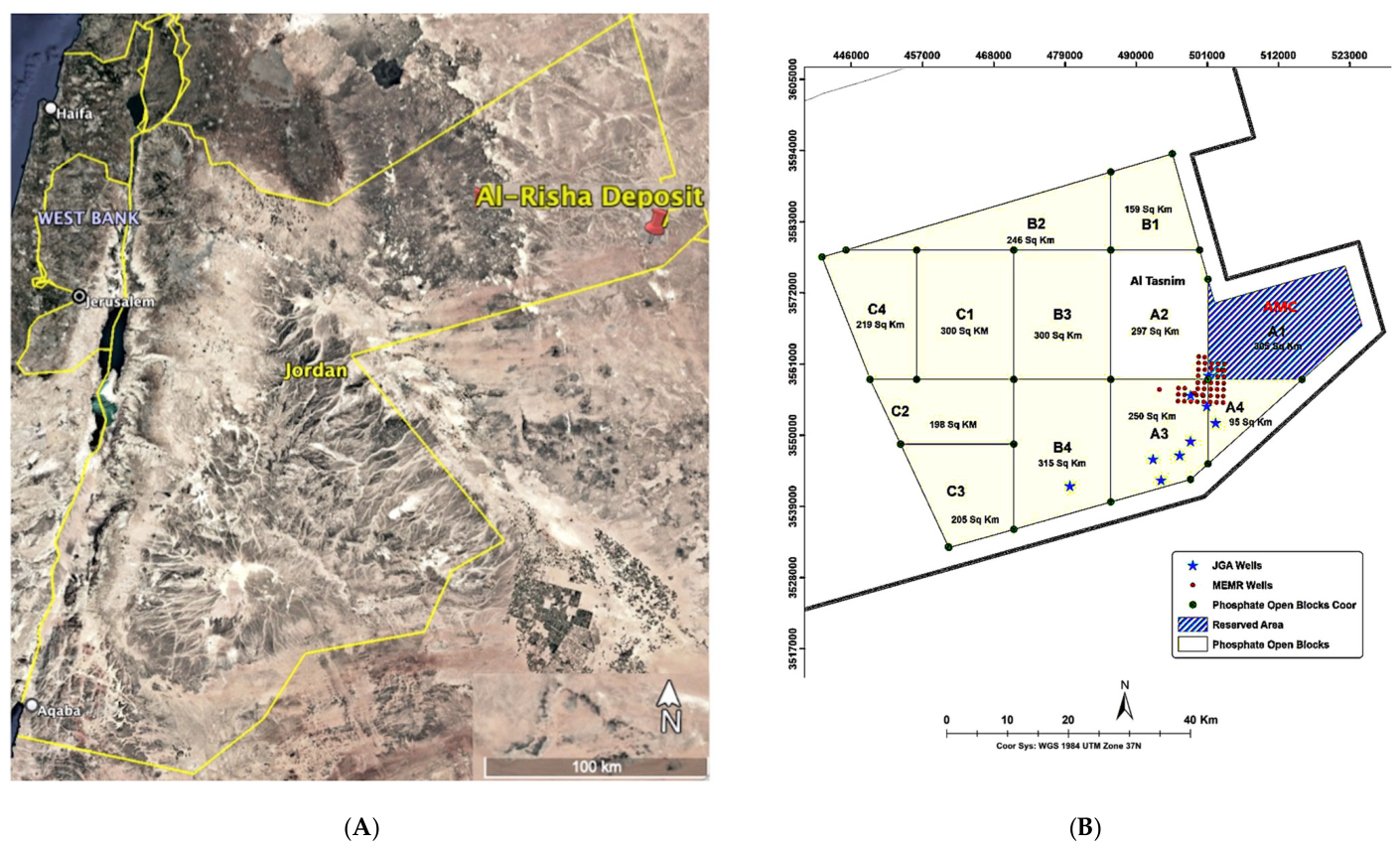
In contrast to these well-established mining districts, a potentially significant phosphate occurrence was identified in northeastern Jordan near the borders with Saudi Arabia and Iraq (Figure 1A). Refs. [15,16] documented this occurrence through field investigation, exploration drills (Figure 1B), lithological and petrographic characterization, geochemical analysis, and preliminary resource evaluation. Importantly, the northeastern occurrence differs stratigraphically from the principal Upper Cretaceous phosphate deposits of central and southern Jordan: it was assigned to the Middle Eocene Wadi Shallala Formation and correlated regionally with Eocene phosphatic successions in northern Saudi Arabia and western Iraq [15]. Nevertheless, compared with Jordan’s established phosphate districts, the Al-Risha deposit remains insufficiently evaluated from a mineral-processing perspective.
The present study therefore provides an integrated characterization and beneficiation assessment of phosphate ore from the Al-Risha deposit. Mineralogical, petrographic, and chemical characteristics are evaluated together with particle-size distribution to establish the principal controls on ore quality and beneficiation behavior. The effectiveness of dry and wet sieving, selective acid leaching, and calcination is systematically compared in terms of P2O5 grade, mass yield, P2O5 recovery, and upgrading ratio. Particular emphasis is placed on determining whether relatively simple beneficiation routes can produce a phosphate concentrate approaching or exceeding the commonly reported marketable benchmark of approximately 30 wt.% P2O5. This integrated approach provides the first systematic assessment of the beneficiation response of the Al-Risha phosphate deposit and establishes a technical basis for evaluating its potential for further development and downstream utilization.

2. Laboratory Works

2.1. Sample Collection and Preparation

Representative phosphatic bulk samples were supplied by the Mineral Expertise Bureau (MinXperts) Company and the Arab Mining Company (AMC) from the Al-Risha phosphate exploration project in northeastern Jordan. The bulk samples were crushed using a laboratory jaw crusher, thoroughly homogenized, and reduced by the quartering method to obtain a representative head sample. This head sample was used for all characterization and beneficiation experiments performed in this study.

2.2. Deposit Characterization

2.2.1. Particle-Size Distribution Test

Particle-size distribution was determined by dry sieve analysis using a 1 kg head sample oven-dried at 105 °C for 24 h. Sieving was carried out with a mechanical shaker using sieve sizes of 4.0, 2.0, 1.0, 0.5, 0.25, 0.125, and 0.063 mm. The mass retained on each sieve was recorded to investigate the particle-size distribution.

2.2.2. Chemical Analysis

Major oxide compositions were determined by X-ray fluorescence (XRF) using a Bruker S4 PIONEER spectrometer (Bruker Corporation, Billerica, MA, USA) at the Jordan Atomic Energy Commission (JAEC). Trace-element concentrations were determined using inductively coupled plasma optical emission spectrometry (ICP-OES; Thermo Scientific iCAP 7000) (Thermo Fisher Scientific, Waltham, MA, USA) and inductively coupled plasma mass spectrometry (ICP-MS; Thermo Scientific iCAP RQ) (Thermo Fisher Scientific, Waltham, MA, USA) at the same laboratory. The tricalcium phosphate (TCP) content was calculated from the P2O5 concentration using the following relationship:
TCP (%) = P2O5 (%) × 2.185.
The minor element ratio (MER) was calculated to determine the degree of purity of the deposit, according to the following relationship:
MER (%) = (Al2O3 + Fe2O3 + MgO/P2O5) × 100.
where Al2O3, Fe2O3, MgO and P2O5 are expressed in wt.%.

2.2.3. Mineralogical Analysis

The mineralogical composition of the deposit was determined using X-ray diffraction (XRD) at The University of Jordan, with a Shimadzu XRD-7000 diffractometer (Shimadzu Corporation, Kyoto, Japan) employing Cu-Kα radiation over a 2θ range of 2–60°. Mineral phases were identified using the ICDD (JCPDS) reference database.

2.2.4. Petrographic Analysis

Petrographic examination was performed on polished thin sections using a Nikon Eclipse LV100POL polarizing microscope (Nikon, Tokyo, Japan) under both plane-polarized light (PPL) and cross-polarized light (XPL) at The Hashemite University. The analysis was conducted to identify the petrographic characteristics, textural relationships, and mineral associations of the phosphate deposit.

2.2.5. SEM–EDS Analysis

The morphology and microstructural characteristics of the deposit were investigated using SEM (FEI INSPECT F50) (FEI, Hillsboro, OR, USA) equipped with an EDS (Bruker Quanta) (Bruker Corporation, Billerica, MA, USA) system at The University of Jordan. Powdered samples were mounted on aluminum stubs using conductive carbon tape and coated with platinum before examination. SEM was used to investigate particle morphology and textural relationships, whereas EDS was employed to determine the elemental composition of selected particles and mineral phases.

2.3. Beneficiation Experiments

2.3.1. Dry Sieving Method

Dry sieving was performed on a 1 kg oven-dried representative feed sample using a mechanical sieve shaker. The sample was separated into seven particle-size fractions using sieves with aperture sizes of 4.000, 2.000, 1.000, 0.500, 0.250, 0.125, and 0.063 mm. The sample was mechanically sieved for 20 min, which was adopted as a fixed laboratory sieving period. The material retained on each sieve was collected separately and weighed to determine the mass yield. Each size fraction was subsequently analyzed by X-ray fluorescence (XRF) to determine its P2O5 grade.

2.3.2. Wet Sieving Method

Wet sieving was performed on a 1 kg representative feed sample using the same sieve series employed in the dry sieving experiment. Continuous water washing was applied during sieving to facilitate the removal of clay-rich and fine particles and to minimize particle agglomeration. The material retained in each size fraction was collected separately, oven-dried at 105 °C, weighed, and analyzed by X-ray fluorescence (XRF) to determine its P2O5 grade.

2.3.3. Acid Leaching Method

Acid-leaching experiments were conducted using hydrochloric acid (HCl) and phosphoric acid (H3PO4) with the aim of promoting carbonate dissolution and enhancing the phosphate grade. Three particle-size fractions (0.500, 0.250, and 0.125 mm), which exhibited relatively high P2O5 grades following dry and wet sieving, were selected for the initial leaching experiments. Each fraction was treated separately with 5% (v/v) HCl and 5% (v/v) H3PO4 at a solid-to-liquid ratio of 1:5. A solid-to-liquid ratio of 1:5 was selected based on previous studies of selective carbonate leaching from calcareous phosphate ores, in which an equivalent liquid-to-solid ratio of 5:1 was reported to provide favorable selective dissolution of carbonate gangue using dilute HCl [17]. The phosphate sample and acid solution were mixed to form a homogeneous slurry. The slurry was stirred magnetically for 30 min at room temperature (25 ± 2 °C). A residence time of 30 min and room temperature (25 ± 2 °C) were adopted as fixed screening conditions to provide sufficient reaction time while maintaining a simple, low-energy laboratory treatment. These parameters were kept constant throughout the experiments to isolate the effects of acid type and concentration and to allow direct comparison among treatments. Following leaching, the solid residue was separated by filtration and washed three times with distilled water to remove residual acid and soluble reaction products. The washed residue was dried at 105 °C for 60 min, cooled, and weighed. The dried residues were then analyzed for P2O5 content. Based on the results of the 5% (v/v) acid treatments, the 0.250 mm fraction was selected for further leaching experiments using 10% (v/v) HCl and 10% (v/v) H3PO4 under otherwise identical experimental conditions. The higher acid concentration was investigated to assess whether increasing acid strength could further improve phosphate upgrading.

2.3.4. Calcination Method

Calcination experiments were conducted on 30 g samples from the 0.500, 0.250, and 0.125 mm size fractions. Each sample was calcined in a muffle furnace at 950 °C for 2 h at a heating rate of 10 °C/min. A calcination temperature of 950 °C was selected as a single screening condition within the temperature range commonly reported for thermal decomposition of carbonate gangue in phosphate ores [6]. Following calcination, the samples were cooled in a desiccator to room temperature and weighed to determine the mass loss associated with thermal treatment. The calcined products were subsequently analyzed by X-ray fluorescence (XRF) to determine their P2O5 grades.

2.3.5. Performance Evaluation

The performance of the beneficiation experiments was evaluated in terms of mass yield, P2O5 recovery, and upgrading ratio according to Equations (1)–(3), respectively. For dry and wet sieving, the P2O5 grade of the representative feed sample (26.70 wt.%) was used as the reference grade (Cf). For acid leaching, and calcination, the P2O5 grade of each corresponding size fraction obtained after dry sieving was used as Cf, while its grade after treatment was used as Cc. Wf and Wc represent the corresponding masses (g) before and after treatment, respectively.
Y i e l d % = W c / W f × 100
R e c o v e r y % = W c C c / W f C f × 100
U p g r a d e r a t i o = C c / C f
All beneficiation experiments were performed in triplicate, and the results are reported as mean ± standard deviation (SD).

3. Results

3.1. Characterization

3.1.1. Particle-Size Distribution

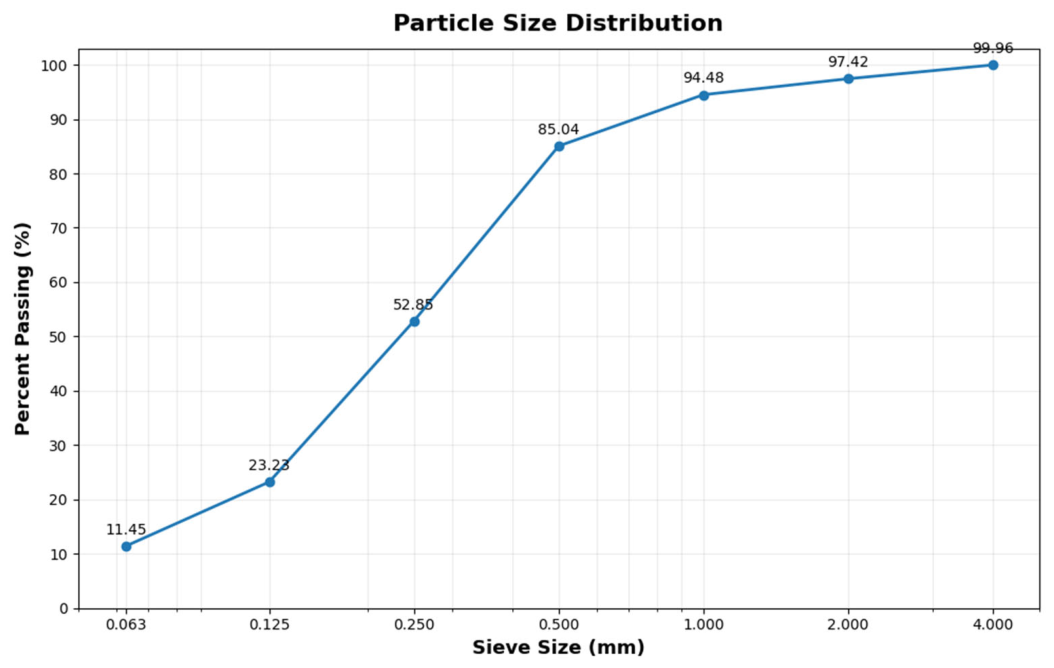
The particle-size distribution of the Al-Risha phosphate ore, determined by dry sieving, is presented in Figure 2. The size distribution was dominated by the intermediate fractions, with 32.19 wt.% of the sample retained in the 0.250–0.500 mm size interval and 29.63 wt.% in the 0.125–0.250 mm interval. Together, these two fractions accounted for 61.82 wt.% of the bulk sample, indicating that a substantial proportion of the ore was concentrated within the 0.125–0.500 mm size range. The cumulative particle-size distribution further showed that 52.85% of the material passed the 0.250 mm sieve, whereas 85.04% passed the 0.500 mm sieve (Figure 2).

3.1.2. Chemical Characterization

The average major-element composition of the Al-Risha phosphate sample is presented in Table 1. The ore is characterized by high CaO (50.52 wt.%) and P2O5 (26.70 wt.%) contents. The P2O5 grade places the investigated sample at the lower end of the high-grade category according to the classification adopted by Refs. [7,8], although further upgrading would be desirable to attain the P2O5 levels commonly associated with marketable phosphate concentrates. SiO2 (3.70 wt.%) is the most abundant non-phosphate major oxide and is consistent with the occurrence of siliceous gangue identified mineralogically. Al2O3 (0.51 wt.%), Fe2O3 (0.50 wt.%), and MgO (0.30 wt.%) occur at comparatively low concentrations, indicating a relatively limited contribution from Fe-, Al-, and Mg-bearing impurities. The high LOI (14.65 wt.%) is consistent with a significant carbonate component in the deposit. Trace-element analysis revealed U (40 ppm), Cd (25 ppm), Y (68 ppm), La (24 ppm), Ni (70 ppm), Zn (222 ppm), Cu (73.1 ppm), and Th (8.4 ppm) (Table 2). The occurrence of U and Cd is characteristic of many marine sedimentary phosphorites, in which these elements may be associated with apatite and/or incorporated during phosphogenesis and subsequent diagenetic processes [9]. The measured U and Cd contents should also be considered during downstream processing, as these elements may partition into phosphoric acid, fertilizer products, or processing residues. Their concentrations in the final products should therefore be monitored against the applicable regulatory limits, particularly for Cd in phosphate fertilizers, while U-bearing process streams and residues may require appropriate environmental management.
The overall geochemical composition of the Al-Risha ore is broadly comparable with that reported for other Jordanian sedimentary phosphorites [10,16,17,18]. The calculated TCP equivalent was 58.34%, whereas the IOR was 0.049. The low IOR reflects the relatively small proportion of these impurity oxides compared with the phosphate content.

3.1.3. Mineralogical Characterization

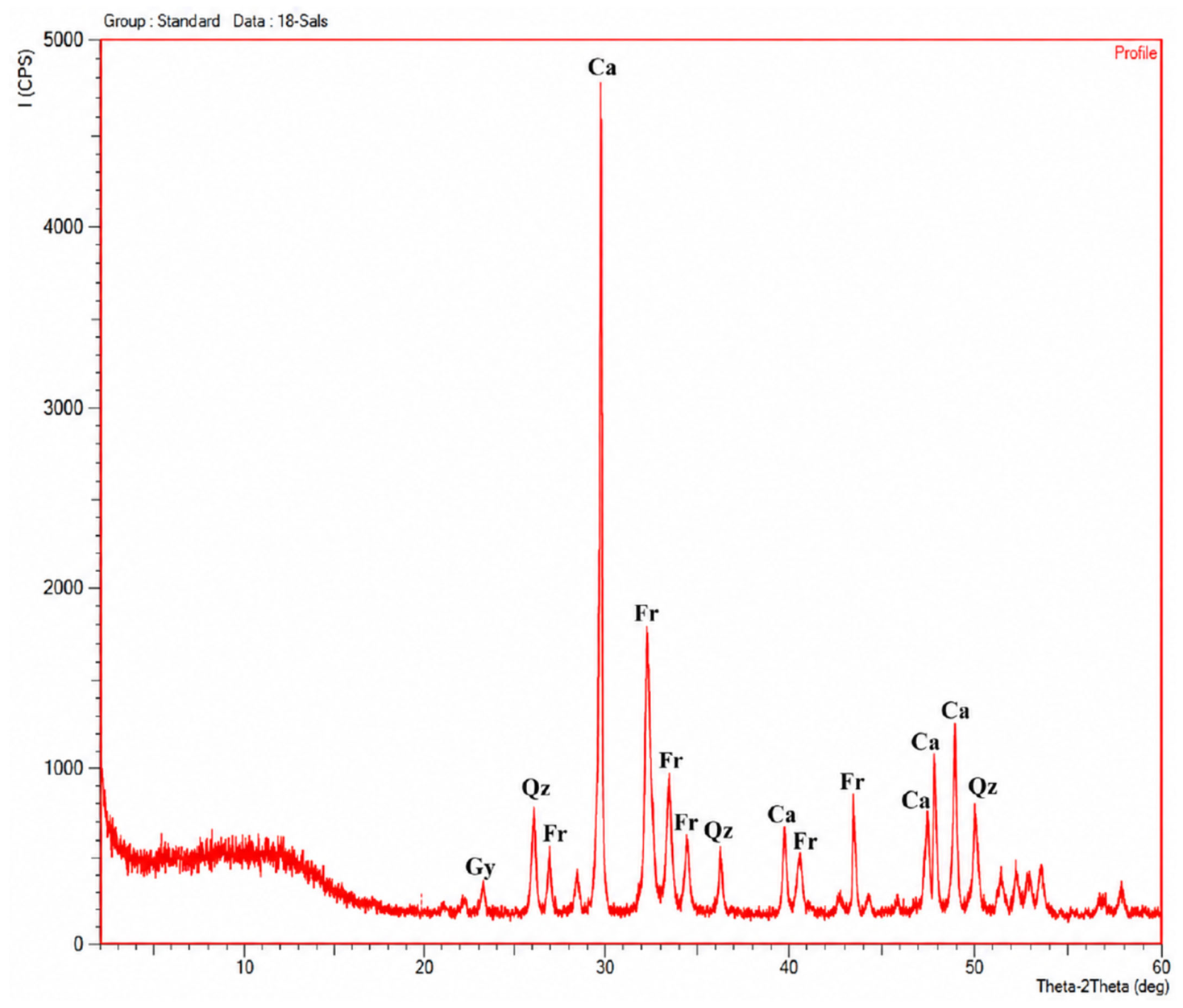
The mineralogical composition of the Al-Risha phosphate sample was characterized by XRD, and the resulting diffraction pattern is presented in Figure 3. The results indicated that carbonate-fluorapatite (francolite) is the dominant phosphate-bearing mineral, accompanied by calcite, quartz, and minor gypsum. Francolite was identified by characteristic reflections at approximately 31.8°, 32.2°, 32.9°, and 39.8° (2θ). Calcite, identified by prominent reflections at approximately 29.4°, 39.4°, 43.1°, 47.5°, and 48.5° (2θ), represents the principal carbonate gangue mineral. Quartz was identified by reflections near 26.6°, 36.5°, and 50.1° (2θ), indicating the presence of siliceous gangue. Minor gypsum was also identified from weak reflections, including a reflection near 23.4° (2θ). The identified mineral assemblage is broadly consistent with those previously reported for Jordanian sedimentary phosphorites [15,16,19]. The coexistence of francolite with calcite and quartz demonstrates that the phosphate-bearing phase occurs in association with both carbonate and siliceous gangue. This mineral assemblage is consistent with the chemical composition determined by XRF, particularly the high CaO and measurable SiO2 contents.

3.1.4. Petrographic Characteristics

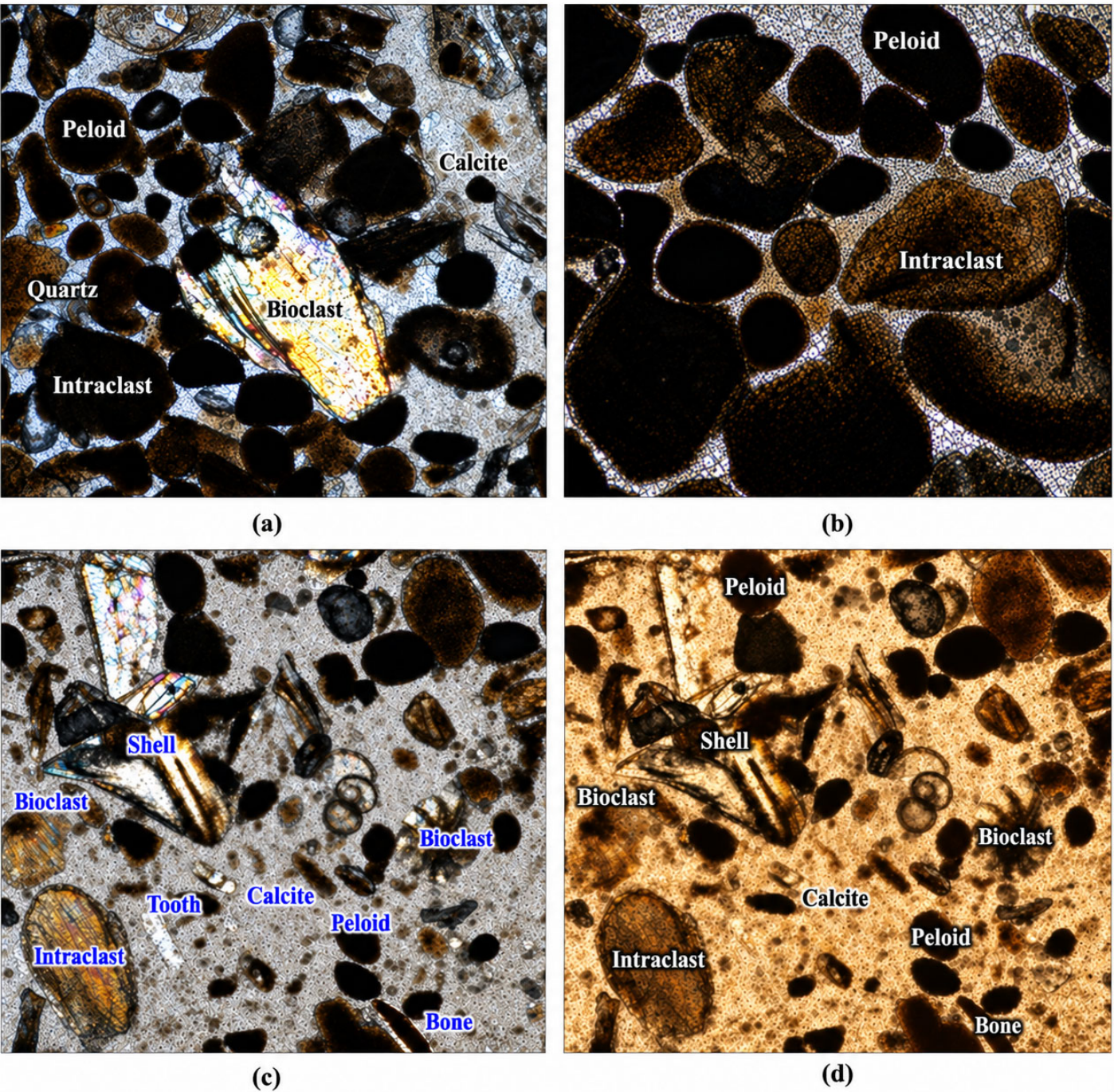
Petrographic examination under plane-polarized light (PPL) and cross-polarized light (XPL) revealed a heterogeneous phosphorite texture characterized by abundant peloids, intraclass, and bioclastic components embedded within a carbonate-rich matrix (Figure 4). Peloids are predominantly rounded to sub-rounded, whereas intraclasts display variable sub-rounded to irregular morphologies. Skeletal and bioclastic components include shell, bone, and tooth fragments, together with other biogenic debris. Detrital quartz occurs as a subordinate component, while calcite constitutes a major part of the matrix and cement surrounding the phosphatic grains. The rounded morphology of many peloids and intraclasts suggests reworking and transport of phosphatic material prior to final deposition [15]. These petrographic observations complement the XRD results, which identified francolite, calcite, and quartz as the principal mineralogical components. The close textural association between phosphatic particles and carbonate matrix/cement indicates that carbonate gangue is an important component of the ore and may influence its response to beneficiation.

3.1.5. Microstructural Characteristics

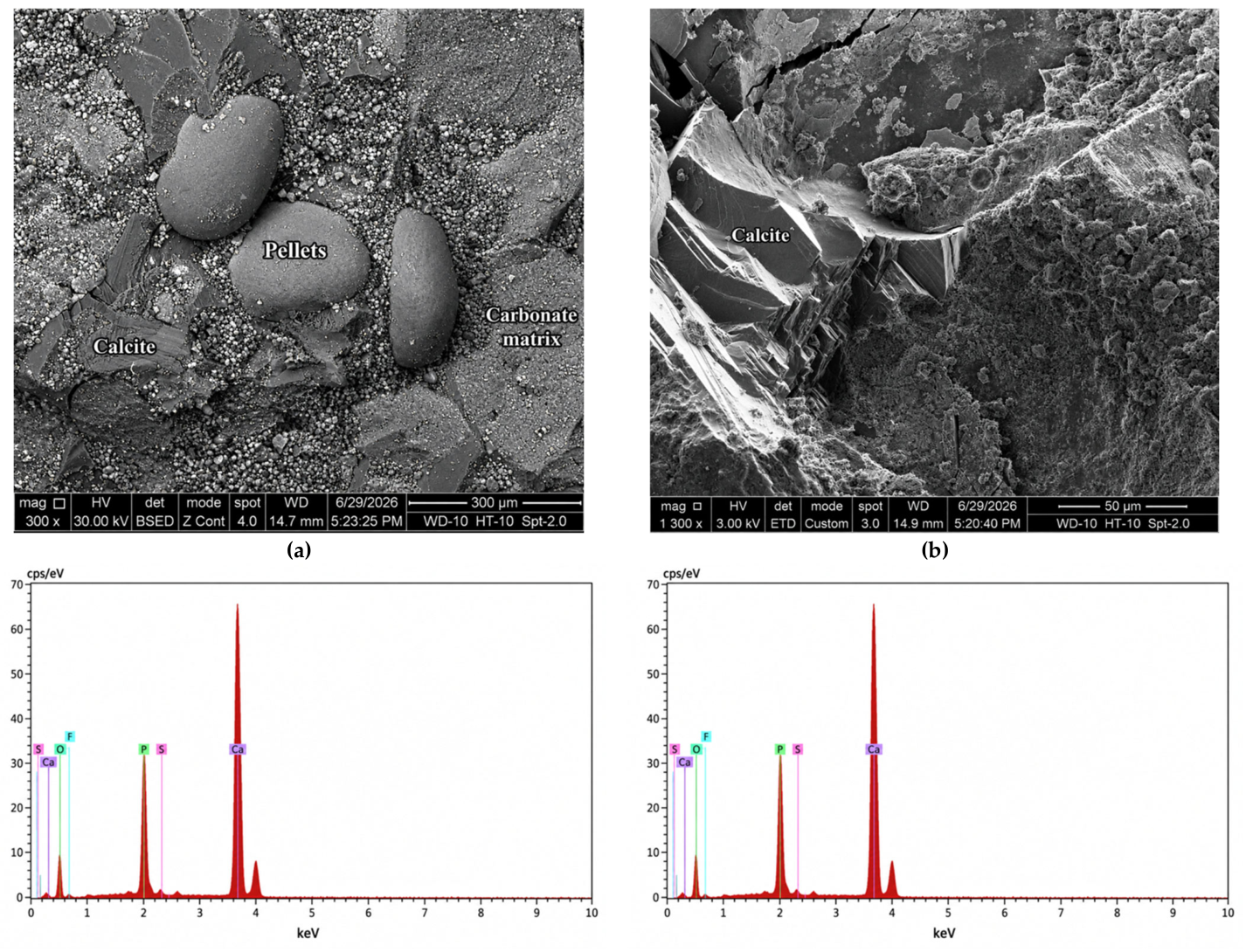
The microstructural characteristics of the Al-Risha phosphorite were examined using scanning electron microscopy (SEM) coupled with energy-dispersive X-ray spectroscopy (EDS). The low-magnification SEM image (Figure 5a) reveals a heterogeneous and well-consolidated texture characterized by abundant rounded to sub-rounded particles embedded within a fine-grained matrix. The particles exhibit variable sizes and are closely associated with the surrounding matrix, consistent with the peloidal and intraclast-rich texture observed petrographically.
At higher magnification (Figure 5b), distinct textural relationships between coarse crystalline and fine-grained components are evident. A relatively coarse crystalline grain exhibiting well-developed planar surfaces occurs in direct contact with a finer-grained matrix. This close association between mineral components suggests that gangue and phosphate-bearing phases may occur in intimate textural contact, which may influence mineral liberation and the response of the ore to beneficiation.
EDS analyses of phosphate-rich areas showed Ca, P, O, and F as the principal detected elements, consistent with the Ca–P–F-bearing phosphate phase identified as carbonate-fluorapatite (francolite) by XRD. In contrast, the coarse crystalline phase was characterized predominantly by Ca and O, with little or no detectable P. When considered together with its morphology and the XRD identification of calcite, this composition supports its assignment to a carbonate phase, most likely calcite. Minor S detected at some analytical locations is consistent with the occurrence of a sulfate-bearing phase, in agreement with the minor gypsum identified by XRD.

3.2. Beneficiation Results

3.2.1. Dry Sieving

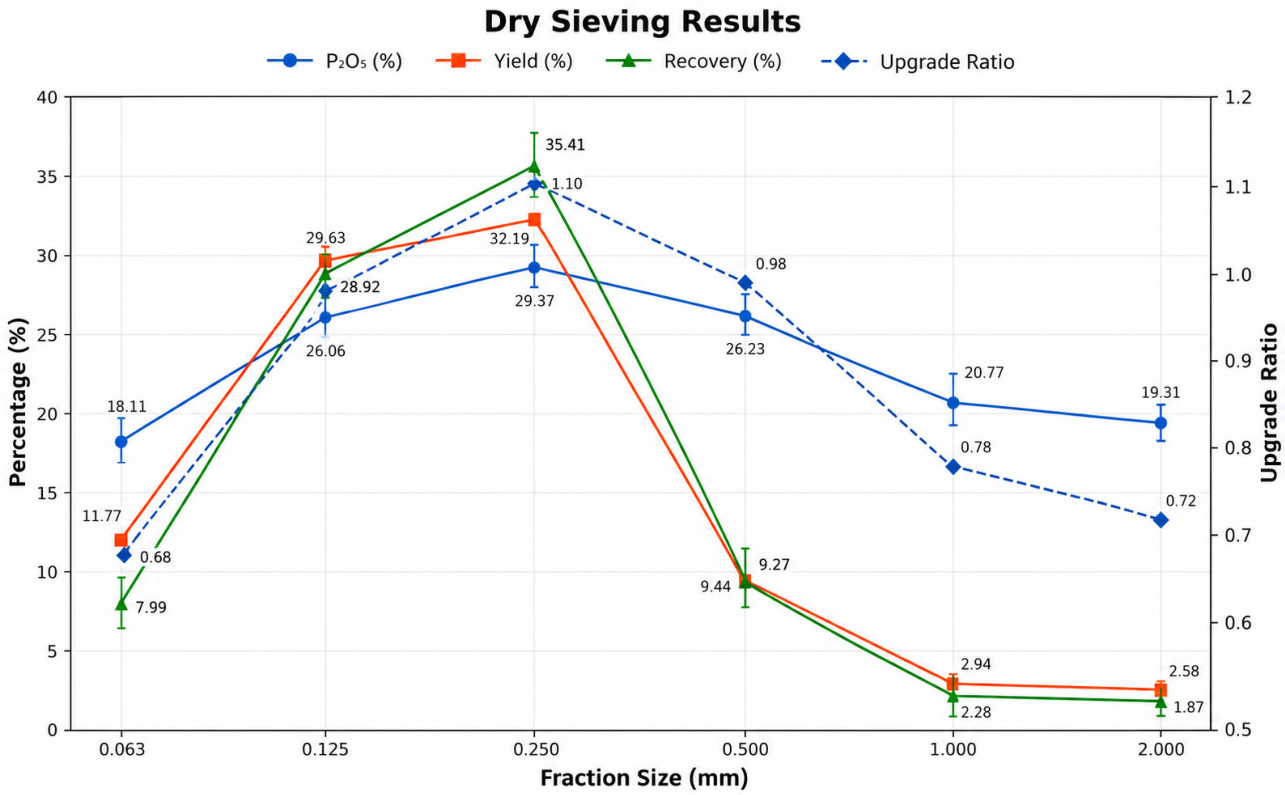
Dry sieving revealed a distinct particle-size dependence of phosphate distribution (Figure 6). Relative to the feed grade of 26.70 wt.% P2O5, the phosphate grade increased across the intermediate size fractions and reached a maximum of 29.37 wt.% P2O5 in the 0.250 mm fraction, corresponding to an upgrading ratio of 1.10. The same fraction accounted for 32.19% of the sample mass and recovered 35.41% of the P2O5 contained in the feed, representing the most favorable balance between grade and recovery among the individual dry-sieved fractions. In contrast, both coarser and finer fractions exhibited lower P2O5 grades. The 0.500- and 0.125 mm fractions contained 26.23 and 26.06 wt.% P2O5, respectively, with upgrading ratios of 0.98, indicating essentially no phosphate enrichment relative to the feed. A pronounced decrease in P2O5 grade occurred in the finer fraction, reaching 18.11 wt.% at the 0.063 mm fraction. Similarly, the coarse 2.000 mm fraction contained only 19.31 wt.% P2O5.
This size-dependent distribution indicates preferential concentration of the phosphate-bearing component within the intermediate particle-size range, whereas both the coarse and finest fractions were comparatively depleted in P2O5. When the 0.500-, 0.250-, and 0.125 mm fractions were considered together, approximately 73.60% of the feed P2O5 was recovered at a combined grade of 27.58 wt.% P2O5, corresponding to an upgrading ratio of 1.03.

3.2.2. Wet Sieving

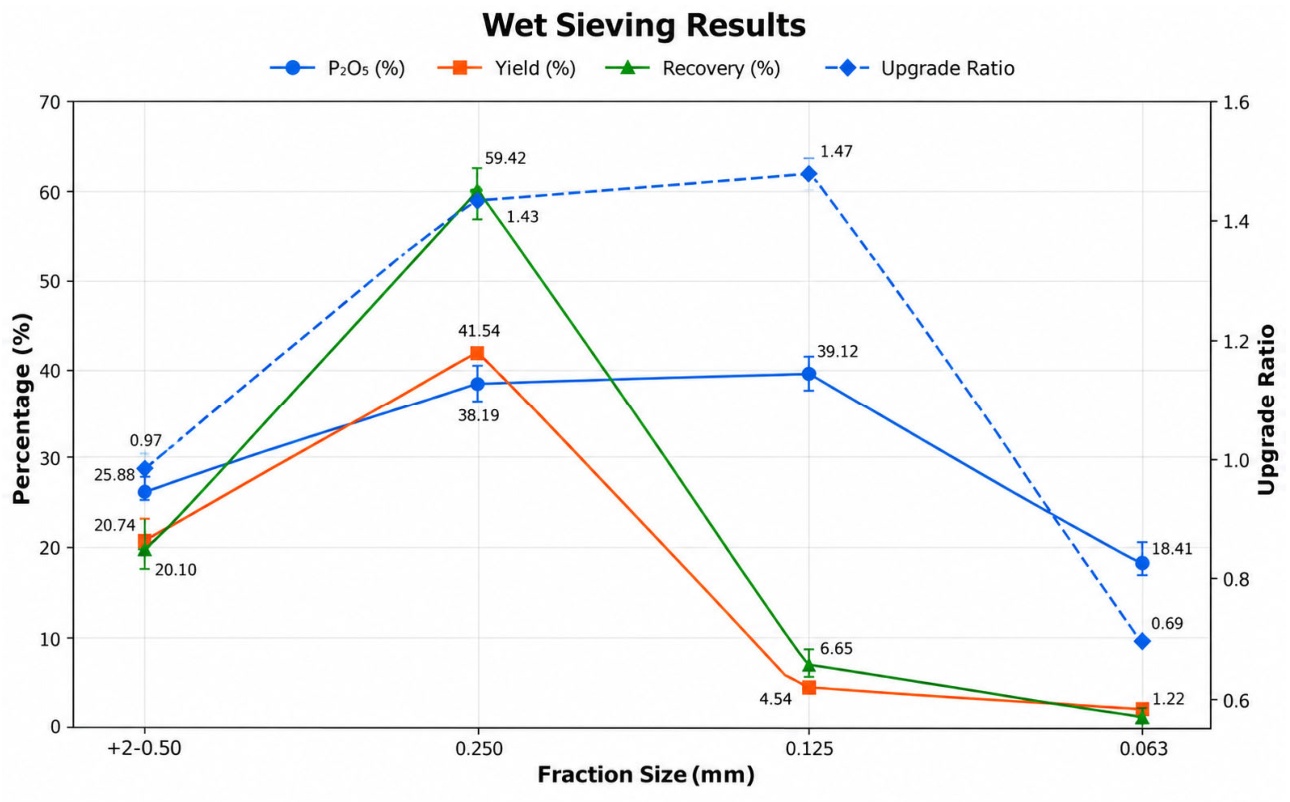
Wet sieving produced substantially greater phosphate upgrading than dry sieving, with phosphate enrichment concentrated primarily in the intermediate particle-size fractions (Figure 7). The 0.250 mm fraction provided the most favorable balance between grade, yield, and recovery, accounting for 41.54% of the feed mass at a P2O5 grade of 38.19 wt.%. This corresponded to a P2O5 recovery of 59.42% and an upgrade ratio of 1.43. Although the 0.125 mm fraction exhibited the highest P2O5 grade (39.12 wt.%) and upgrading ratio (1.47), its low mass yield (4.54%) resulted in a P2O5 recovery of only 6.65%. Thus, the slightly lower grade of the 0.250 mm fraction was offset by its substantially higher mass yield and phosphate recovery, making it the most favorable individual product obtained by wet sieving. In contrast, the coarser (+2.0–0.50 mm) fraction contained 25.88 wt.% P2O5, corresponding to an upgrade ratio of 0.97 and indicating essentially no enrichment relative to the feed. The finer 0.063 mm fraction also exhibited substantially lower P2O5 grade (18.41 wt.%) and an upgrade ratio below unity (0.69). The preferential concentration of P2O5 in the 0.250- and 0.125 mm fractions, together with its depletion in the finest fractions, indicates that wet screening and washing effectively redistributed the phosphate-bearing and gangue-rich components according to particle size.
Overall, wet sieving recovered 74.68% of the original feed mass in the collected size fractions, corresponding to a mass loss of 25.32% during washing. Despite this substantial mass rejection, the collected fractions accounted for 91.85% of the P2O5 initially present in the feed, corresponding to an unrecovered P2O5 fraction of only 8.15% based on the overall mass balance. This disproportionate removal of mass relative to P2O5 indicates that the material removed during washing was comparatively depleted in phosphate. Consequently, wet sieving achieved effective rejection of low-phosphate fine material while retaining most of the phosphate in the recovered fractions. Similar improvements have been reported for other sedimentary phosphate deposits, where washing and desliming significantly enhanced phosphate grade prior to subsequent beneficiation processes [20].

3.2.3. Acid Leaching

Hydrochloric Acid Leaching
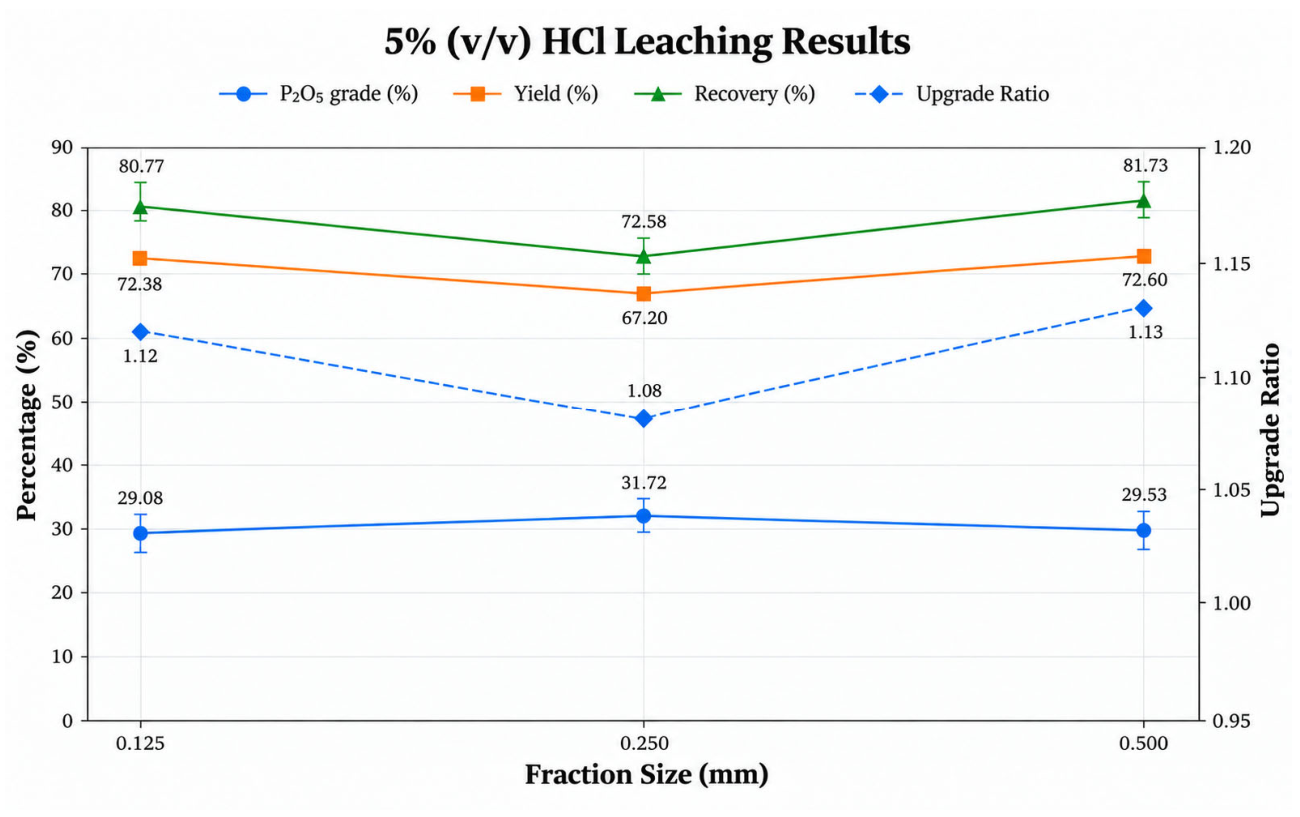
Leaching with dilute hydrochloric acid was investigated as a chemical upgrading approach for the Al-Risha phosphorite, with the aim of promoting carbonate dissolution and increasing the P2O5 grade. Treatment with 5% (v/v) HCl increased the P2O5 grade of all three investigated size fractions (Figure 8). The highest P2O5 grade was obtained for the 0.250 mm fraction, reaching 31.72 wt.% at a mass yield of 67.20% and a P2O5 recovery of 72.58%. The 0.500 mm fraction yielded 29.53 wt.% P2O5 with a mass yield of 72.60% and the highest P2O5 recovery of 81.73%, whereas the 0.125 mm fraction produced 29.08 wt.% P2O5 at a mass yield of 72.38% and a recovery of 80.77%.
The upgrade ratios ranged from 1.08 to 1.13, demonstrating modest phosphate enrichment following HCl treatment. The reduction in solid mass, accompanied by an increase in P2O5 grade, is consistent with preferential dissolution of acid-reactive gangue, particularly in view of the calcite identified by XRD. Overall, 5% (v/v) HCl treatment produced moderate upgrading while maintaining relatively high P2O5 recoveries, particularly for the 0.500- and 0.125 mm fractions.
Similarly, Refs. [17,21] reported that HCl treatment of the phosphate deposit increased the P2O5 grade through the selective dissolution of calcite and the formation of soluble CaCl2, and demonstrated that beneficiation performance is sensitive to acid concentration and other leaching conditions.
Phosphoric Acid Leaching
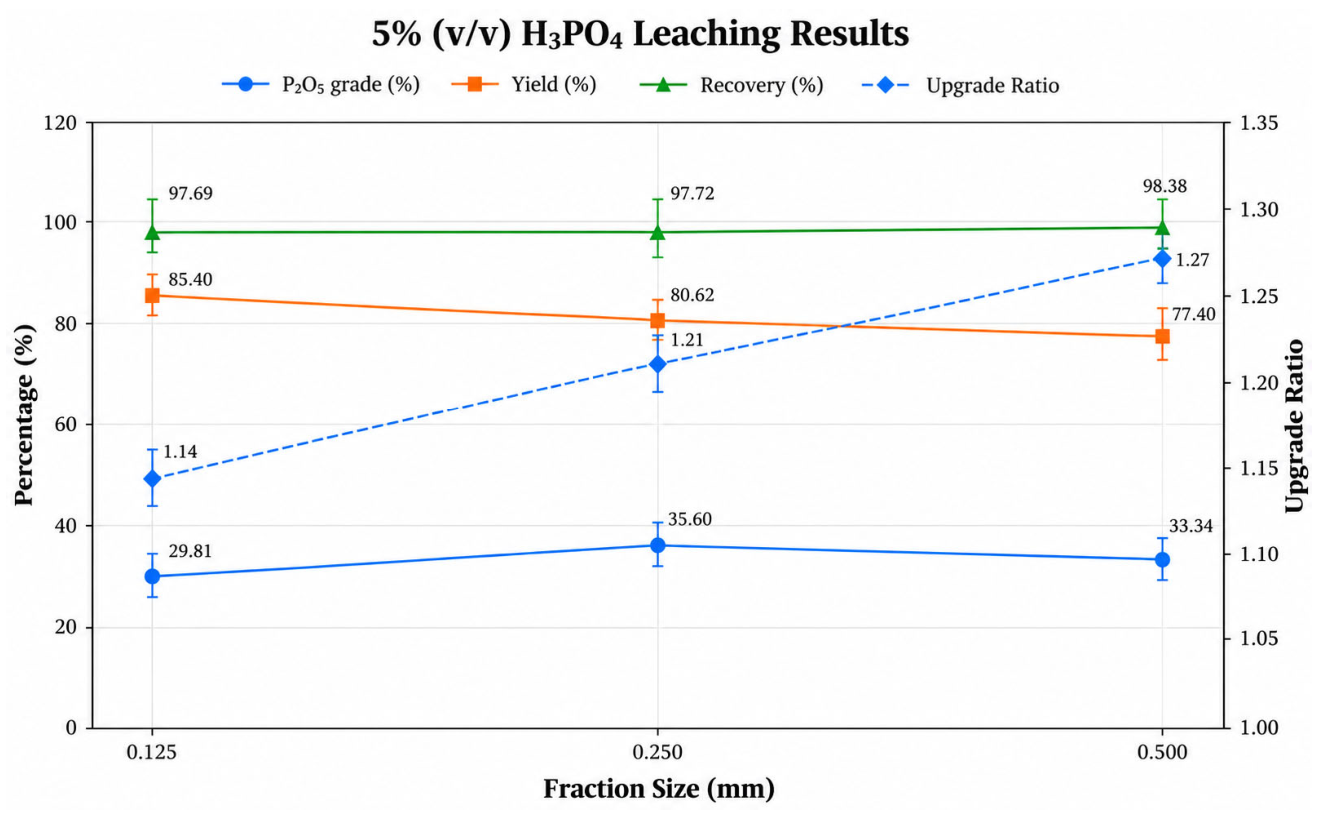
Leaching with phosphoric acid was investigated as an alternative chemical beneficiation method for the carbonate-rich Al-Risha phosphate rock. Treatment with 5% (v/v) H3PO4 increased the P2O5 grade of all investigated size fractions (Figure 9). The 0.500 mm fraction showed the highest P2O5 recovery (98.38%) and upgrade ratio (1.27), producing a concentrate containing 33.34 wt.% P2O5 at a mass yield of 77.40%. In comparison, the 0.250 mm fraction achieved the highest P2O5 grade of 35.60 wt.%, while maintaining a high recovery of 97.72% and a mass yield of 80.62%, with an upgrade ratio of 1.21. The 0.125 mm fraction reached 29.81 wt.% P2O5, with a comparatively higher mass yield of 85.40%, a high recovery of 97.69%, and an upgrade ratio of 1.14.
The simultaneous increase in P2O5 grade and high phosphate recovery across all investigated size fractions indicates effective upgrading with limited phosphate loss from the solid product. The strongest grade enrichment was obtained for the 0.250 mm fraction, whereas the 0.500 mm fraction exhibited the highest recovery and upgrade ratio. The 0.125 mm fraction showed a lower degree of grade enrichment but retained a substantial proportion of the phosphate, as reflected by its high mass yield and recovery. The observed enrichment is consistent with the preferential removal of acid-reactive gangue associated with the phosphate ore [7]. Overall, treatment with 5% (v/v) H3PO4 provided a favorable balance between P2O5 grade, mass yield, and phosphate recovery, with the 0.250 mm fraction producing the highest-grade concentrate and the 0.500 mm fraction achieving the greatest upgrading ratio and recovery.
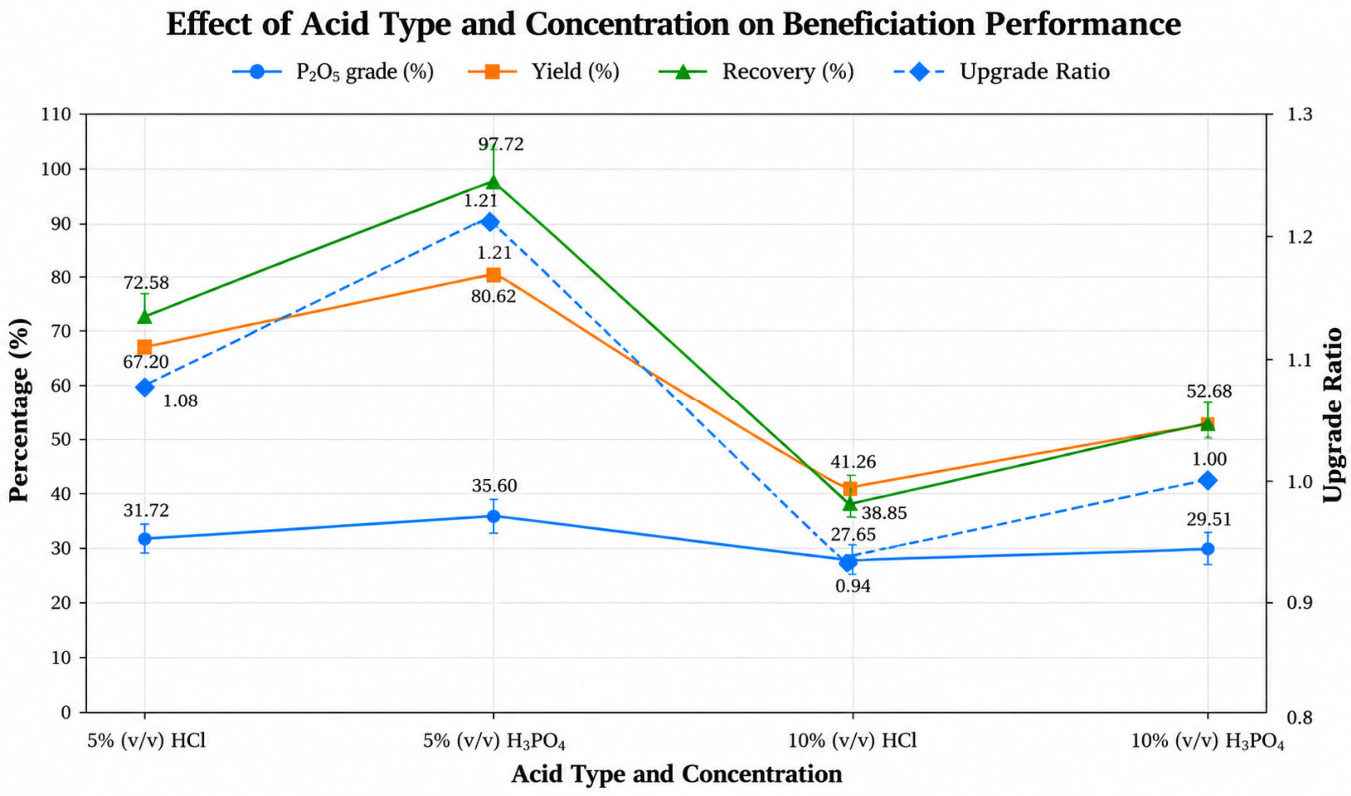
Both hydrochloric and phosphoric acid treatments affected the beneficiation performance of the Al-Risha phosphate ore; however, the extent of upgrading depended strongly on acid type and concentration (Figure 10). For the 0.250 mm fraction, treatment with 5% (v/v) H3PO4 provided the most favorable performance, increasing the P2O5 grade from 29.37 wt.% before treatment to 35.60 wt.%, with a mass yield of 80.62%, a P2O5 recovery of 97.72%, and an upgrade ratio of 1.21. In comparison, treatment with 5% (v/v) HCl increased the P2O5 grade to 31.72 wt.%, but resulted in a lower mass yield of 67.20%, P2O5 recovery of 72.58%, and upgrade ratio of 1.08. Importantly, both treatments produced concentrates exceeding the practical benchmark of approximately 30 wt.% P2O5 adopted in this study, although 5% (v/v) H3PO4 achieved substantially greater enrichment while retaining nearly all of the phosphate in the treated solid product.
Increasing the acid concentration from 5% to 10% (v/v) did not improve beneficiation performance under the fixed experimental conditions investigated in this study. With 10% (v/v) HCl, the P2O5 grade decreased to 27.65 wt.%, falling below both the initial grade of 29.37 wt.% and the adopted 30 wt.% benchmark. The mass yield and P2O5 recovery declined to 41.26% and 38.85%, respectively, while the upgrade ratio decreased to 0.94, indicating that this treatment did not achieve beneficiation. Treatment with 10% (v/v) H3PO4 performed somewhat better, producing 29.51 wt.% P2O5 at a mass yield of 52.42% and P2O5 recovery of 52.67%, with an upgrade ratio of 1.00. Nevertheless, the resulting grade remained slightly below the adopted benchmark and was essentially unchanged relative to the untreated 0.250 mm fraction. The substantial reductions in mass yield and P2O5 recovery at the higher acid concentration suggest greater dissolution and/or loss of phosphate-bearing material from the treated solid [5,7,8].
From a beneficiation perspective, these results demonstrate that increasing acid concentration did not improve concentrate quality under the investigated conditions. Instead, the 5% treatments were more effective, with 5% (v/v) H3PO4 providing the best overall balance among concentrate grade, mass yield, phosphate recovery, and upgrade ratio. The resulting grade of 35.60 wt.% P2O5 exceeded the adopted 30 wt.% benchmark and falls within the approximately 28–38 wt.% P2O5 range commonly associated with phosphate concentrates suitable for industrial processing.

3.2.4. Calcination Experiments

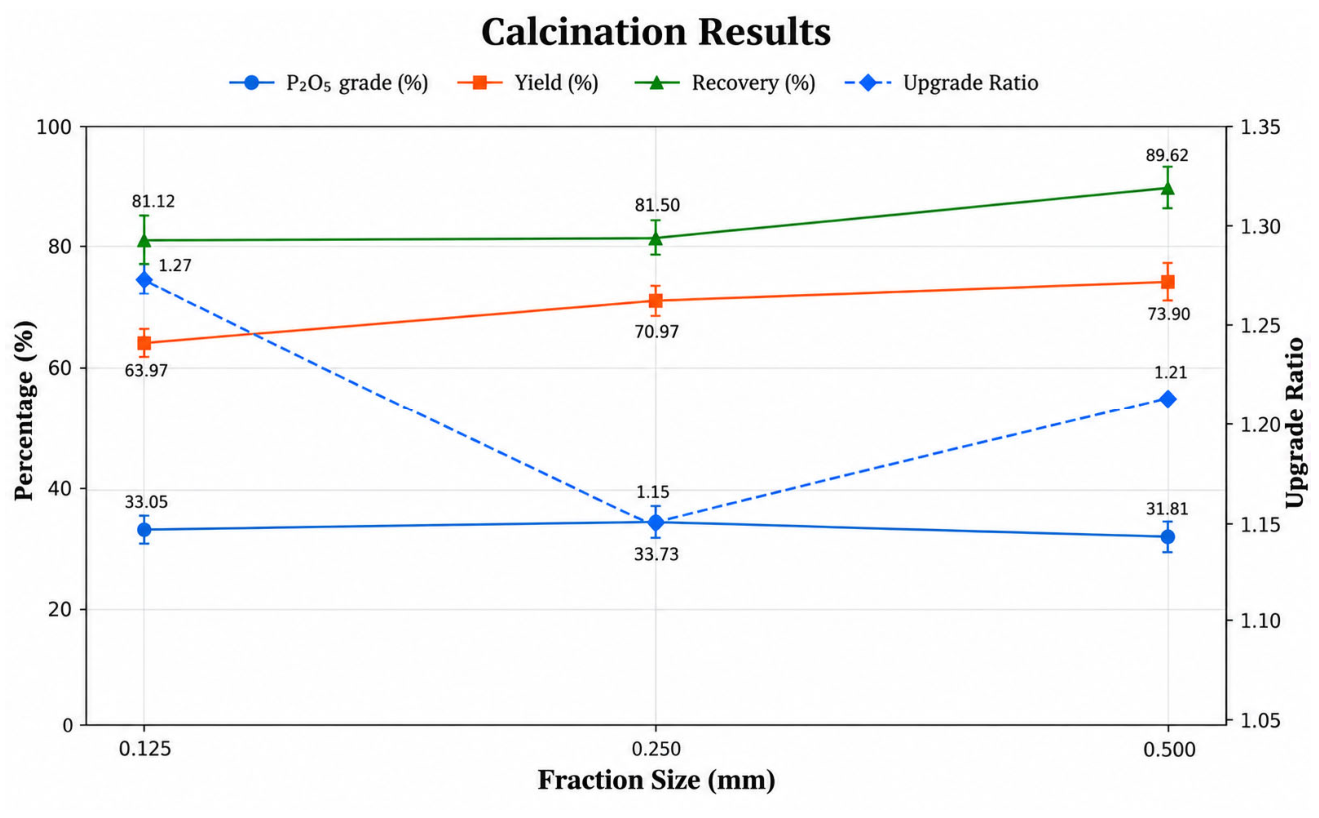
Calcination at 950 °C for 2 h was investigated as a thermal beneficiation method for upgrading the carbonate-rich Al-Risha phosphorite (Figure 11). Thermal treatment increased the P2O5 grade of all investigated size fractions. The 0.250 mm fraction produced the highest P2O5 grade of 33.73 wt.%, with a mass yield of 70.97%, P2O5 recovery of 81.50%, and an upgrade ratio of 1.15. The 0.500 mm fraction produced 31.81 wt.% P2O5 and exhibited the highest mass yield (73.90%) and P2O5 recovery (89.62%), with an upgrade ratio of 1.21. In comparison, the 0.125 mm fraction reached 33.05 wt.% P2O5, with a mass yield of 63.97% and P2O5 recovery of 81.12%, while exhibiting the highest upgrade ratio (1.27) among the investigated fractions.
Importantly, all three calcined fractions exceeded the practical benchmark of approximately 30 wt.% P2O5 adopted in this study, demonstrating that calcination was effective in producing phosphate products of the targeted grade. However, the beneficiation response varied among the size fractions. The 0.250 mm fraction produced the highest-grade product, whereas the 0.500 mm fraction provided the best mass retention and phosphate recovery. The 0.125 mm fraction showed the greatest relative enrichment, as indicated by its upgrade ratio of 1.27, although this was accompanied by the lowest mass yield.
The increase in P2O5 grade after calcination is consistent with the carbonate-rich mineralogy identified by XRD, particularly the presence of calcite as a major gangue phase. At 950 °C, thermal decomposition of carbonate minerals and the associated release of CO2 would reduce the mass contribution of carbonate material, thereby increasing the relative concentration of P2O5 in the calcined product. This interpretation is consistent with previous studies showing that calcination can upgrade carbonate-rich phosphate ores through thermal decomposition of carbonate gangue [4,22]. However, although calcination successfully increased the P2O5 grade above the adopted benchmark, its practical application should also consider the relatively high energy requirement associated with treatment at 950 °C.

4. Discussion

The beneficiation behavior of the Al-Risha phosphate ore was strongly controlled by its mineralogical composition, particularly the association of francolite with carbonate and siliceous gangue. The effectiveness of phosphate beneficiation is known to depend largely on the nature and distribution of the associated gangue minerals, with washing and desliming being particularly effective for removing fine clay- and silica-rich material, whereas carbonate-rich ores may require chemical or thermal treatment [4,5].
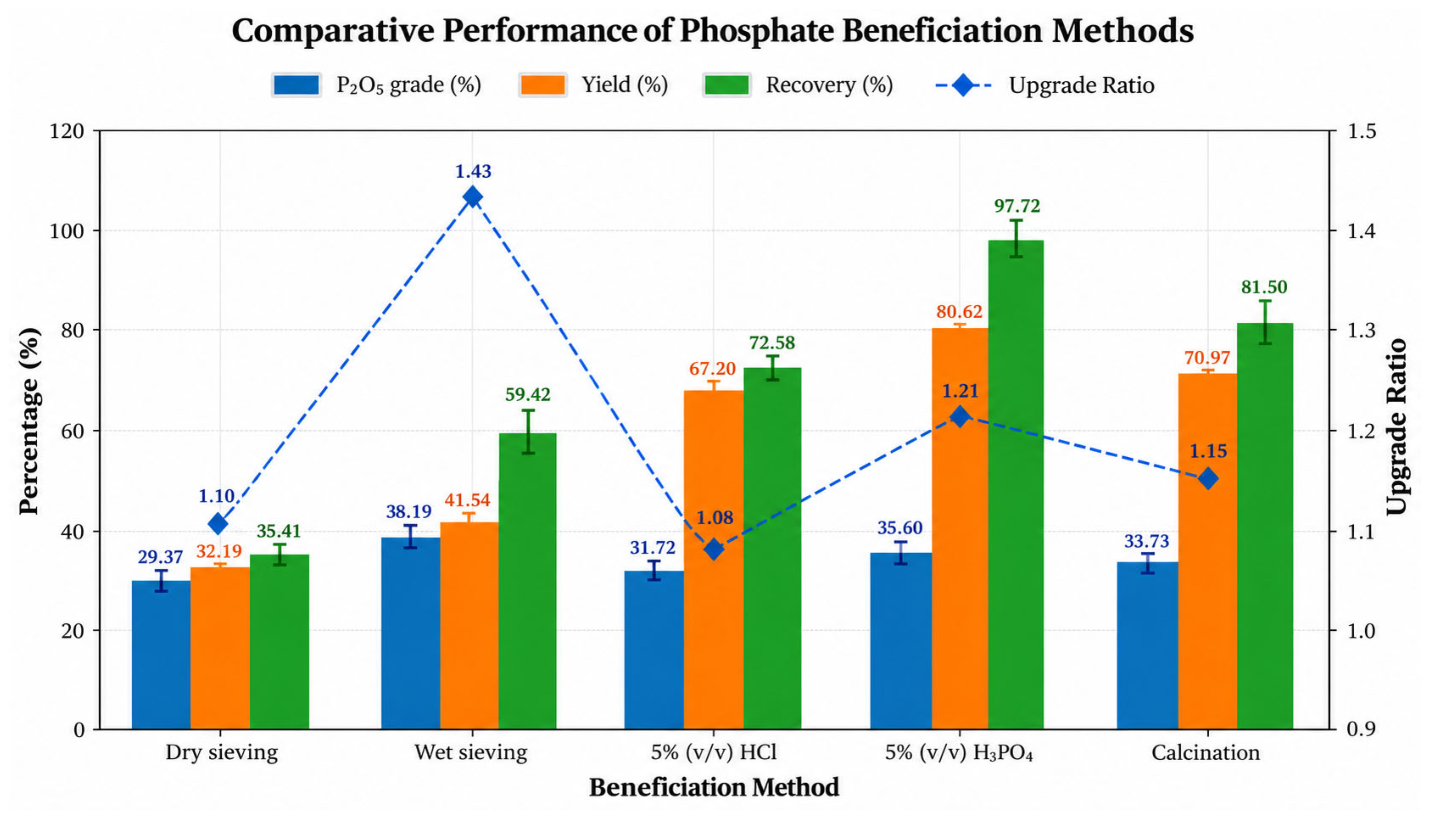
Figure 12 shows the effectiveness of different processing methods on phosphate grade (P2O5%), yield, recovery, and upgrade ratio. Among the investigated physical treatments, wet sieving produced the greatest enrichment in P2O5 grade. The 0.250 mm fraction reached 38.19 wt.% P2O5, compared with 29.37 wt.% P2O5 for the corresponding fraction after dry sieving. The wet-sieved 0.250 mm fraction also showed a mass yield of 41.54%, P2O5 recovery of 59.42%, and an upgrade ratio of 1.43. Thus, although wet sieving produced the highest-grade concentrate among the investigated beneficiation methods, the recovery was moderate (59.42%), indicating considerable phosphate loss. Therefore, wet sieving may be more suitable as a low-cost pre-concentration step rather than a stand-alone process. Further treatment of the rejected fractions could improve overall phosphate recovery, while a techno-economic assessment is needed to confirm commercial feasibility.
Chemical treatment also improved the phosphate grade, although its effectiveness depended strongly on acid type and concentration. For the 0.250 mm fraction, 5% (v/v) H3PO4 provided the most favorable chemical response, producing 35.60 wt.% P2O5 at a mass yield of 80.62%, P2O5 recovery of 97.72%, and an upgrade ratio of 1.21. In comparison, treatment with 5% (v/v) HCl produced 31.72 wt.% P2O5 at a mass yield of 67.20%, recovery of 72.58%, and an upgrade ratio of 1.08. The enrichment obtained by acid leaching is primarily attributed to the preferential removal of carbonate gangue. In the presence of HCl, calcite dissolves to form soluble CaCl2, with the release of CO2 and H2O, according to the following reaction [17]:
CaCO3 + 2HCl → CaCl2 + CO2 + H2O
This behavior may be related to its different interaction with calcite. Ref. [23] demonstrated that phosphoric acid reacts with calcite and promotes the formation of calcium–phosphate phases through the interaction of phosphate species with Ca2+ released during calcite dissolution. Therefore, the higher P2O5 grade observed after H3PO4 treatment may reflect both carbonate removal and the formation or retention of phosphate-bearing calcium phases in the solid residue.
Increasing the acid concentration from 5% to 10% did not improve beneficiation performance under the investigated conditions. For the same 0.250 mm fraction, 10% (v/v) HCl produced 27.65 wt.% P2O5 with 38.85% recovery and an upgrade ratio of 0.94, whereas 10% (v/v) H3PO4 produced 29.51 wt.% P2O5 with 52.68% recovery and an upgrade ratio of 1.00. These results indicate that increasing the acid concentration to 10% promoted greater material loss without providing additional phosphate enrichment under the fixed experimental conditions. This behavior is consistent with the strong influence of acid concentration, particle size, solid/liquid ratio, and mineralogy on the selective leaching of carbonate-rich phosphate ores [5,6,7,8,17,21]. However, because intermediate acid concentrations between 5% and 10% (v/v) were not investigated, the 5% concentration should not be interpreted as an optimized acid concentration. Previous studies have demonstrated that acid concentration, temperature, residence time, and solid-to-liquid ratio can influence carbonate dissolution and leaching selectivity [7,8,21]. Accordingly, systematic evaluation of intermediate acid concentrations (e.g., 6–8% v/v), together with optimization of these operating parameters, is recommended for future work.
Calcination at 950 °C for 2 h also increased the P2O5 grade of all investigated fractions, producing concentrates containing 31.81–33.73 wt.% P2O5. The highest grade was obtained for the 0.250 mm fraction (33.73 wt.% P2O5), whereas the 0.500 mm fraction exhibited the highest mass yield (73.90%) and P2O5 recovery (89.62%). In contrast, the 0.125 mm fraction showed the highest upgrade ratio (1.27), reaching 33.05 wt.% P2O5 with a yield of 63.97% and recovery of 81.12%. The enrichment observed after calcination is consistent with thermal decomposition of carbonate gangue and the associated release of CO2, which reduces the mass contribution of carbonate material and consequently increases the relative concentration of phosphate in the calcined product. Similar behavior has been reported for carbonate-rich phosphate ores treated at elevated temperatures [4,22]. Nevertheless, the relatively high energy requirement associated with treatment at 950 °C represents an important consideration for its practical application.
Future work should therefore evaluate a temperature series between approximately 800 and 950 °C to identify the minimum temperature that provides an acceptable balance between concentrate grade, recovery, upgrade ratio, and energy demand.
Although sequential wet sieving followed by 5% (v/v) H3PO4 leaching was not experimentally investigated, a theoretical combination of the individual-stage results would give an overall mass yield of approximately 33.49% and P2O5 recovery of 58.07%. These values indicate that the phosphate losses during wet sieving would largely determine the overall recovery despite the high recovery achieved during H3PO4 leaching. The final concentrate grade cannot be reliably predicted because the leaching experiments were conducted on dry-sieved material (29.37 wt.% P2O5) rather than the wet-sieved concentrate (38.19 wt.% P2O5).

5. Conclusions

This study provides a comprehensive characterization and beneficiation assessment of the carbonate-rich Al-Risha phosphate ore in northeastern Jordan. Mineralogical and microstructural analyses revealed that francolite is the principal phosphate-bearing mineral, closely associated with calcite and subordinate siliceous gangue, which strongly influenced the ore response to beneficiation. Dry sieving alone provided limited upgrading, with the 0.250 mm fraction reaching 29.37 wt.% P2O5, a recovery of 35.41%, and an upgrade ratio of 1.10. In contrast, wet sieving was the most effective physical treatment, producing the highest P2O5 grade of 38.19 wt.% in the 0.250 mm fraction, with an upgrade ratio of 1.43, although the corresponding phosphate recovery was 59.42%.
Among the chemical treatments, 5% (v/v) H3PO4 provided the most favorable balance between concentrate grade and phosphate recovery, producing 35.60 wt.% P2O5 in the 0.250 mm fraction with a mass yield of 80.62% and a recovery of 97.72%. Increasing the acid concentration to 10% (v/v) adversely affected beneficiation performance, resulting in lower grades, recoveries, and upgrading ratios. Calcination at 950 °C for 2 h also successfully increased the phosphate grade, with the 0.250 mm fraction reaching 33.73 wt.% P2O5, although its recovery (81.50%) and upgrade ratio (1.15) were lower than those achieved by 5% (v/v) H3PO4 leaching and wet sieving, respectively.
The results demonstrate a clear trade-off between phosphate grade and recovery among the investigated beneficiation methods. Wet sieving provided the highest concentrate grade and represents a promising reagent-free pre-concentration step, whereas 5% (v/v) H3PO4 leaching achieved the best overall balance between grade, mass yield, and phosphate recovery. These findings provide a basis for further process optimization and techno-economic evaluation toward the potential development of the Al-Risha phosphate resource.
Future work should focus on systematic optimization of intermediate acid concentrations, evaluation of calcination across a broader temperature range, experimental assessment of sequential wet-sieving–acid-leaching routes, and investigation of attrition scrubbing as a potential low-reagent pre-concentration step.

Author Contributions

Conceptualization, K.M.I.; methodology, F.A.-S., K.M.I. and S.A.-H.; investigation, F.A.-S., K.M.I. and S.A.-H.; resources, K.M.I.; data curation, F.A.-S. and K.M.I.; writing—original draft preparation, F.A.-S., K.M.I. and S.A.-H.; writing—review and editing, F.A.-S. and K.M.I.; visualization, K.M.I. and S.A.-H.; supervision, K.M.I.; project administration, K.M.I. All authors have read and agreed to the published version of the manuscript.

Funding

This research received no external funding.

Data Availability Statement

Data used for the manuscript preparation have been included within the document.

Acknowledgments

The authors warmly thank the MinXperts and the Arab Mining Company (AMC) for providing the samples and thanks extends for the laboratories of the Jordan Atomic Energy Commission (JAEC), The University of Jordan, and The Hashemite University for their invaluable assistance with geochemical, microstructural, petrographic, and mineralogical analyses.

Conflicts of Interest

The authors declare no conflicts of interest.

References

  1. Van Straaten, P. Rocks for Crops: Agrominerals of Sub-Saharan Africa; ICRAF: Nairobi, Kenya, 2002. [Google Scholar]
  2. Abed, A.M. The eastern Mediterranean phosphorite giants: An interplay between tectonics and upwelling. GeoArabia 2013, 18, 67–94. [Google Scholar] [CrossRef] [Scilit]
  3. United States Geological Survey (USGS). Mineral Commodity Summaries 2025: Phosphate Rock; U.S. Geological Survey: Reston, VA, USA, 2025. [Google Scholar] [CrossRef] [Scilit]
  4. Abouzeid, A.Z.M. Physical and thermal treatment of phosphate ores—An overview. Int. J. Miner. Process. 2008, 85, 59–84. [Google Scholar] [CrossRef] [Scilit]
  5. Gharabaghi, M.; Irannajad, M.; Noaparast, M. A review of the beneficiation of calcareous phosphate ores using organic acid leaching. Hydrometallurgy 2010, 103, 96–107. [Google Scholar] [CrossRef] [Scilit]
  6. Amar, H.; Benzaazoua, M.; Elghali, A.; Hakkou, R.; Taha, Y. Waste rock reprocessing to enhance the sustainability of phosphate reserves: A critical review. J. Clean. Prod. 2022, 381, 135151. [Google Scholar] [CrossRef] [Scilit]
  7. Ryszko, U.; Rusek, P.; Kołodyńska, D. Quality of phosphate rocks from various deposits used in wet phosphoric acid and P-fertilizer production. Materials 2023, 16, 793. [Google Scholar] [CrossRef] [Scilit]
  8. Sengul, H.; Ozer, A.K.; Gulaboglu, M.S. Beneficiation of Mardin-Mazıdaği (Turkey) calcareous phosphate rock using dilute acetic acid solutions. Chem. Eng. J. 2006, 122, 135–140. [Google Scholar] [CrossRef] [Scilit]
  9. Abed, A.M.; Fakhouri, K. On the chemical variability of phosphatic particles from Jordanian phosphorite deposits. Chem. Geol. 1996, 131, 1–13. [Google Scholar] [CrossRef] [Scilit]
  10. Abed, A.M.; Sadaqah, R. Role of Upper Cretaceous oyster bioherms in the deposition and accumulation of high-grade phosphorites in central Jordan. J. Sediment. Res. 1998, 68, 1009–1020. [Google Scholar] [CrossRef] [Scilit]
  11. Abed, A.M.; Amireh, B.S. Sedimentology, geochemistry, economic potential and palaeogeography of an Upper Cretaceous phosphorite belt in the southeastern desert of Jordan. Cretac. Res. 1999, 20, 119–133. [Google Scholar] [CrossRef] [Scilit]
  12. Abed, A.M.; Al-Agha, M.R. Petrography, geochemistry and origin of the NW Jordan phosphorites. J. Geol. Soc. 1989, 146, 499–506. [Google Scholar] [CrossRef] [Scilit]
  13. Pufahl, P.K.; Grimm, K.A.; Abed, A.M.; Sadaqah, R.M.Y. Upper Cretaceous (Campanian) phosphorites in Jordan: Implications for the formation of a south Tethyan phosphorite giant. Sediment. Geol. 2003, 161, 175–205. [Google Scholar] [CrossRef] [Scilit]
  14. Abu-Hamatteh, Z.S. Geology, geochemistry and are characteristics of the Jordanian phosphates. Cent. Eur. Geol. 2007, 50, 283–295. [Google Scholar] [CrossRef] [Scilit][Green Version]
  15. Ibrahim, K.M.; Al-Zughoul, K.; Muhtaseb, K. New occurrence of potential phosphate resource in north-east Jordan. Arab. J. Geosci. 2016, 9, 497. [Google Scholar] [CrossRef] [Scilit]
  16. Ministry of Energy and Mineral Resources (MEMR). Final Geological Report on the Al-Risha Phosphate Exploration Project; Ministry of Energy and Mineral Resources: Amman, Jordan, 2023. [Google Scholar]
  17. Zafar, I.Z.; Ansari, T.M.; Ashraf, M.; Abid, M.A. Effect of hydrochloric acid on leaching behavior of calcareous phosphorites. Iran. J. Chem. Chem. Eng. 2006, 25, 47–57. [Google Scholar] [CrossRef]
  18. Abed, A.M.; Abu Murry, O.S. Rare earth element geochemistry of the Jordanian Upper Cretaceous Phosphorites. Arab Gulf J. Sci. Res. 1997, 15, 41–158. [Google Scholar]
  19. Al-Slaty, F.; Ibrahim, K.M.; Amjad, M.; Muhtaseb, M. Characterization of Newly Discovered Phosphorite Deposits in Al-Tafeh, Jordan. Geosciences 2025, 15, 433. [Google Scholar] [CrossRef] [Scilit]
  20. Ahmed, H.A. Optimization of desliming prior to phosphate ore upgrading by flotation. Physicochem. Probl. Miner. Process. 2007, 41, 79–88. [Google Scholar]
  21. Hamadi, A.S.; Remedhan, S.T.; Abd Ali, H. Phosphate rock treatment with hydrochloric acid for increasing P2O5 content. Eng. Technol. J. 2012, 30, 67–76. [Google Scholar] [CrossRef] [Scilit]
  22. Khoshjavan, S.; Rezai, B. Beneficiation of refractory phosphate ore by calcination and flotation. Int. J. Miner. Process. 2011, 99, 187–192. [Google Scholar] [CrossRef] [Scilit]
  23. Filippov, L.O.; Filippova, I.V.; Kaba, O.B.; Fornasiero, D. In-situ study of the kinetics of phosphoric acid interaction with calcite and fluorapatite by Raman spectroscopy and flotation. Miner. Eng. 2021, 162, 106729. [Google Scholar] [CrossRef] [Scilit]
Figure 1. (A) Location map of the Al-Risha phosphate deposits in Jordan, Google Earth. (B) Exploration blocks of the Al-Risha phosphate project from Ref. [16]. Blue stars represent JGA wells, red dots represent MEMR wells, green circles indicate phosphate open-block coordinates, the blue hatched area represents the reserved area, and the outlined polygons indicate the phosphate open blocks.
Mining 06 00084 g001
Figure 2. Cumulative particle-size distribution of the Al-Risha phosphate sample determined by dry sieve analysis.
Mining 06 00084 g002
Figure 3. XRD spectrum of the Al-Risha phosphate. Ca: calcite, Fr: francolite, Qz: quartz, and Gy: gypsum.
Mining 06 00084 g003
Figure 4. Representative photomicrographs of the Al-Risha phosphorite showing its principal petrographic components and textures. (a) Peloids and intraclasts associated with bioclastic material, detrital quartz, and calcite matrix/cement under XPL; (b) rounded to sub-rounded peloids and intraclasts under XPL; (c) diverse bioclastic and skeletal components, including shell, bone, and tooth fragments, together with peloids and intraclasts within a calcite-rich matrix under XPL; and (d) general phosphorite texture showing dispersed phosphatic grains and bioclastic components within the carbonate matrix under PPL.
Mining 06 00084 g004
Figure 5. SEM micrographs and corresponding EDS spectra of the Al-Risha phosphorite. (a) Heterogeneous phosphorite composed of rounded to sub-rounded phosphatic pellets embedded within a fine-grained carbonate matrix. The corresponding EDS spectrum confirms the presence of Ca, P, O, and F, indicating the dominated francolite. (b) Coarse calcite crystal with well-developed cleavage planes surrounded by fine-grained phosphatic material. The corresponding EDS spectrum is dominated by Ca and O.
Mining 06 00084 g005
Figure 6. P2O5 grade, mass yield, P2O5 recovery, and upgrade ratio of the different particle-size fractions obtained by dry sieving.
Mining 06 00084 g006
Figure 7. P2O5 grade, mass yield, P2O5 recovery, and upgrade ratio of the different particle-size fractions obtained by wet sieving.
Mining 06 00084 g007
Figure 8. P2O5 grade, mass yield, P2O5 recovery, and upgrade ratio of the selected particle-size fractions following leaching with 5% (v/v) HCl.
Mining 06 00084 g008
Figure 9. P2O5 grade, mass yield, P2O5 recovery, and upgrade ratio of the selected particle-size fractions following leaching with 5% (v/v) H3PO4.
Mining 06 00084 g009
Figure 10. Effect of acid type and acid concentration on the P2O5 grade, mass yield, P2O5 recovery, and upgrade ratio of the 0.250 mm fraction.
Mining 06 00084 g010
Figure 11. Effect of calcination on the P2O5 grade, yield, recovery, and upgrade ratio of different particle-size fractions.
Mining 06 00084 g011
Figure 12. Comparison of the phosphate grade after processing (P2O5%), yield, recovery, and upgrade ratio obtained using the different processing methods applied to the Al-Risha phosphate ore.
Mining 06 00084 g012
Table 1. Average chemical composition of the Al-Risha phosphate ore compared with previously reported compositional ranges for Al-Risha and other Jordanian phosphorites.
Major Oxide %Current StudyPrevious Study, Al-Risha Phosphate [16]Jordanian Phosphorites [18]
CaO50.5241.20–54.4333.90–53.90
P2O526.7019.00–32.9427.09–34.34
SiO23.701.20–26.370.88–26.23
Al2O30.510.47–0.700.08–2.12
SO31.28-0.32–1.95
Fe2O30.500.23–0.260.07–0.72
MgO0.300.18–0.300.18–0.61
Na2O0.61-0.03–1.59
KO0.05-0.01–0.18
F1.120.51–3.192.68–4.38
Cl0.0730.03–0.310.02–0.25
LOI14.65--
TCP58.3441.52–71.9759.19–75.03
IOR0.0490.03–0.070.01–0.10
Table 2. Average trace-element concentrations (ppm) in the Al-Risha phosphate ore compared with previously reported ranges for Al-Risha and other Jordanian phosphorites.
Trace Elements ppmCurrent StudyPrevious Study, Al-Risha Phosphate [16]Jordanian Phosphorites [9]
Cd25.00-9.00–23.00
La24.00-46.00–245.00
Th8.417.50-
U40.0039.74–119.69 51.00–153.00
Y68.0045.71–113.83-
Ni70.00-62.00–235.00
Zn222.00-60.00–527.00
Cu73.10-25.00–130.00
Disclaimer/Publisher’s Note: The statements, opinions and data contained in all publications are solely those of the individual author(s) and contributor(s) and not of MDPI and/or the editor(s). MDPI and/or the editor(s) disclaim responsibility for any injury to people or property resulting from any ideas, methods, instructions or products referred to in the content.