


Abstract
Optimizing the blast energy distribution is crucial for enhancing rock fragmentation, minimizing overexcavation, and boosting profitability in mining operations. This study introduces a theoretical model to predict the blasting Energy Factor in mining tunnels, based on the Cracking Energy of the rock mass, derived from the deformation energy of brittle materials (Young’s modulus) and adjusted by the Rock Mass Rating (RMR). The model was validated using 42 blasting datasets from horizontal galleries at El Teniente mine, Chile. Data included geometric parameters (tunnel sections, drilling length, diameter, number of holes, meters drilled), explosive type and consumption, and geomechanical properties, particularly the RMR. Results show that as rock mass quality improves (higher RMR), both and increase, more competent rock masses require higher input energy to initiate and propagate cracks, and a greater portion of that energy is effectively utilized for crack formation. For instance, rock masses with an RMR of 66 exhibited an average of 7.62 MJ/m3 and of 4.8%, while those with an RMR of 75 showed higher values ( = 8.47 MJ/m3, = 6.4%). This confirms that less fractured rock masses require higher and for effective fragmentation. Lithology also plays a significant role in energy consumption. Diorite displayed the highest (8.34 MJ/m3) and higher efficiency ( = 7.0%), whereas andesite showed lower (7.61 MJ/m3) and lower crack propagation efficiency ( = 3.7%). Unlike traditional prediction methods, which rely solely on explosive data and excavation volume, this model integrates RMR, enabling more precise energy allocation and fostering sustainable mining practices. This approach enhances decision-making in blast design, offering a more robust framework for optimizing energy use in mining operations.
1. Introduction
Underground mining requires the construction of a complex network of excavations developed in the rock mass, strategically designed to enable the efficient and safe extraction of minerals [1,2,3,4,5]. This process is based on geotechnical engineering principles, which ensure structural stability and minimize risks during operations [6]. In underground mining operations, the drilling and blasting process represents one of the most critical phases for ensuring the continuity of development and production [7]. The effectiveness of this stage directly impacts material fragmentation, energy consumption, personnel safety, and associated operational costs [8]. In this context, the connection between rock mass quality and explosive use has been researched for several decades, with the aim of establishing predictive models that facilitate the optimization of the amount of energy required to achieve controlled rock fracturing. One of the most widely recognized parameters for characterizing rock mass quality is the Rock Mass Rating (RMR), proposed by Bieniawski [9]. This index integrates information on the intact rock compressive strength, discontinuity spacing, joint condition, groundwater presence, and discontinuity orientation, providing a score that allows the rock mass to be classified into quality categories. Its relevance in mining engineering is widely acknowledged, as it serves as input for support design, excavation planning, and the estimation of the rock mass’s mechanical behavior [10]. In parallel, power factor is defined as the ratio between the amount of explosives used and the volume of rock fragmented. This parameter is key to calculating the specific explosive consumption and, therefore, estimating the energy efficiency of blasting. However, most predictive models for power factor have been developed for open-pit operations [11,12]. These formulations assume low confinement, near-free surfaces, and stress conditions that differ substantially from the high-pressure, highly confined environment of underground tunneling, limiting their applicability in deep hard-rock conditions.
Recently, significant advances have been made in correlating rock mass quality with explosive consumption. For example, Li et al. (2025) [13] conducted a geostatistical study that established a correlation of 0.88 between RMR and power factor in low-grade mines. Their findings demonstrated that optimizing fragmentation by 8.5% and reducing boulders by 33.3% is possible, highlighting that rock mass quality not only affects fragmentation but also offers potential for reducing costs and increasing energy efficiency. Despite these advances, a persistent challenge in blasting is its intrinsic low energy efficiency. Several authors have documented that only a small fraction of the energy released is used for effective rock fragmentation. Hosseini and Bagnikhani (2013) [14] estimated that this fraction ranges between 30% and 50%, while Yang et al. (2025) [15] reported much lower values, reporting useful efficiency between 3% and 15% under high confinement conditions. The remaining energy is dissipated as vibrations, airwaves, heat, and plastic deformations. The understanding of this inefficiency has driven research to break down the energy balance of blasting. Finn et al. (2004) [16] noted that approximately 50% of the energy released is unaccounted for, even after considering the fractions for fragmentation, throw, and vibrations. This finding suggests that a significant portion of the energy is transformed into heat and microplastic deformations. Fredj et al. (2024) [17] also indicated that operational factors such as improper stemming can increase energy losses by up to 25%. In underground mining, the situation is further complicated by lateral confinement and the interaction between blast holes. Kiliç et al. (2009) [18] demonstrated that as rock mass quality improves, there is greater attenuation of the shock wave, demanding more energy to generate fractures. This phenomenon is particularly relevant in rock masses with high elastic strength, where crack propagation is restricted, reducing the energy converted into fragmentation. This phenomenon is compounded by the influence of high stresses present in rock at great depths, which directly affect crack propagation after an explosion [19]. Chen et al. (2022) [20] concluded in their study that when stress is below 40 MPa, the stress factor affects energy distribution, although the total amount of energy reaching the rock is not significantly affected. However, effective energy begins to decrease as stress increases, indicating a general trend of reduced efficiency at higher pressures. In the context of the El Teniente mine, where stresses exceed these values, a reduced transfer of effective energy is suggested. When analyzing the Crack Energy () data from blasts, it can be observed that the average useful energy is 5.2% (A detailed analysis is presented in Section 5).
In this context, the combination of field data with mathematical models based on geomechanical parameters adjusted to RMR represents a promising option for predicting explosive consumption and blasting efficiency. However, current predictive approaches rarely incorporate the combined effects of in situ stress, confinement, and water pressure, even though these factors play a dominant role in fracture initiation in deep underground conditions. The present study proposes a predictive model for Energy Factor in mining tunnel blasts, based on the calculation of and its relationship with the total energy supplied. This approach aims not only to improve the calculation of the amount of explosives to be used but also to increase energy efficiency and reduce environmental impact, providing a practical tool for engineers and mine planners.
2. Materials and Methods
2.1. Study Area and Operational Context
The data used in this study were collected at the El Teniente Mine, located in the Libertador General Bernardo O’Higgins Region of Chile. This mine is a large-scale underground operation that employs the panel caving method [21] with preparatory galleries having cross-sectional areas of 14.3 m2. The predominant rock types are andesitic lithologies and igneous porphyries, which are part of the El Teniente Mafic Complex (ETMC) [22,23,24]. The RMR values in this area range from 66 to 75 points, indicating medium to high rock mass quality according to Bieniawski’s classification [9]. The galleries analyzed are located at depths approximately 450 and 900 m below surface, consistent with the development horizons of the El Teniente mine. At these depths, in situ stress conditions are governed by the regional Andean compressive regime, which has been extensively documented for this deposit. Previous geomechanical studies at El Teniente report major principal stresses typically ranging from 15 to 35 MPa within this depth interval, depending on lithology, structural domain, and local excavation-induced effects [25,26]. These stress magnitudes are consistent with stress measurements and numerical modeling performed in the New Mine Level and upper production levels. The blasts evaluated in this study used bulk emulsion explosives, with ANFO used as a complementary product depending on logistical and operational requirements.
The database consists of 42 individual blasting records collected at approximately 600 m depth, each of which includes
- Geometric data of the tunnel section (tunnel area and drilled length);
- Drilling parameters (borehole diameter and drilled meters);
- Explosive consumption data (mass of bulk emulsion, boosters, and contour cartridges);
- Geomechanical properties of the rock mass (tensile strength and elastic modulus);
- Field-determined RMR values;
- Field-calculated total energy values based on explosive consumption.
2.2. Theoretical Foundations of the Model
The formulation of the model is based on the concept of , defined as the energy required to propagate existing microfractures in the rock mass until rupture occurs. This magnitude is based on the strain energy density.
It is important to clarify that this formulation does not attempt to model the dynamic kinematics of crack propagation at the microsecond timescale, typical of an explosion. Instead, the model establishes a Minimum Thermodynamic Threshold required for rock mass failure. This approach is based on the principle that, regardless of the loading rate, the rock mass must reach a critical state of elastic strain energy density to initiate fragmentation. Which states that the propagation of a crack requires overcoming the material’s tensile strength and surpassing the elastic energy accumulated in the rock. In this study, the calculation of is adapted to real rock mass conditions by scaling geomechanical parameters based on the RMR, following the relationships proposed by Hoek and Brown (2019) [27]. Thus, both Young’s modulus (E) and are adjusted using functions of the form:
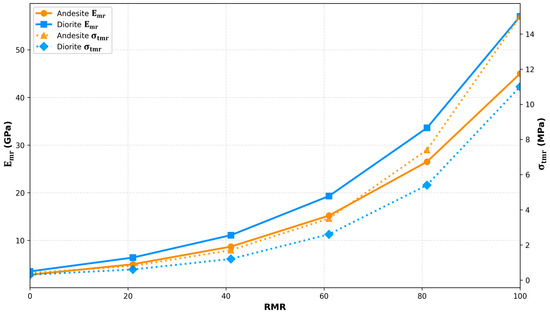
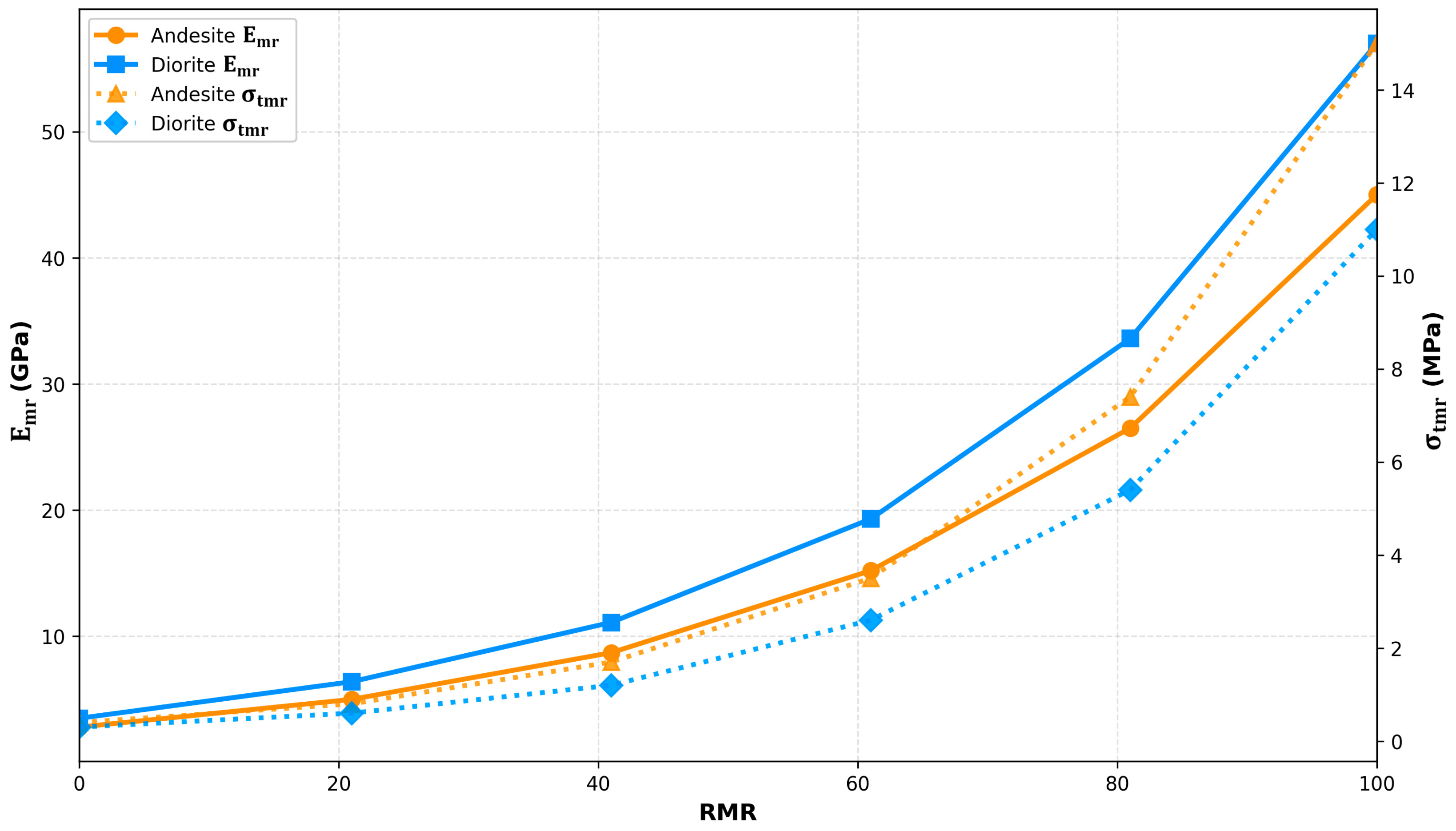
where in Equation (1) and in Equation (2) represent the tensile strength and Young’s modulus, respectively, explicitly adjusted to the rock mass based on the RMR (see Figure 1).
Figure 1.
Relationship between theoretical and RMR.
2.3. Calculation of Theoretical Crack Energy
The total energy required to crack the volume of rocks adjusted to RMR is expressed in Equation (3) as :
It is worth mentioning that the expression or elastic deformation energy at volume breakage, has its origins in the work developed by Griffith (1921) [28], within the framework of Linear Elastic Fracture Mechanics. Since the energy released when micro discontinuities of the rock propagate, it will be equated to the stored elastic deformation energy, providing a theoretical basis to determine Eg in this model. Although blasting is a dynamic process, this classical foundation allows a consistent energy threshold for fracture initiation in the rock mass to be determined.
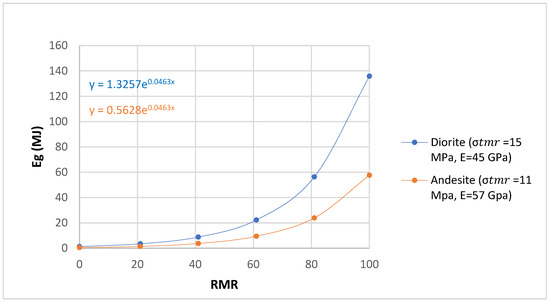
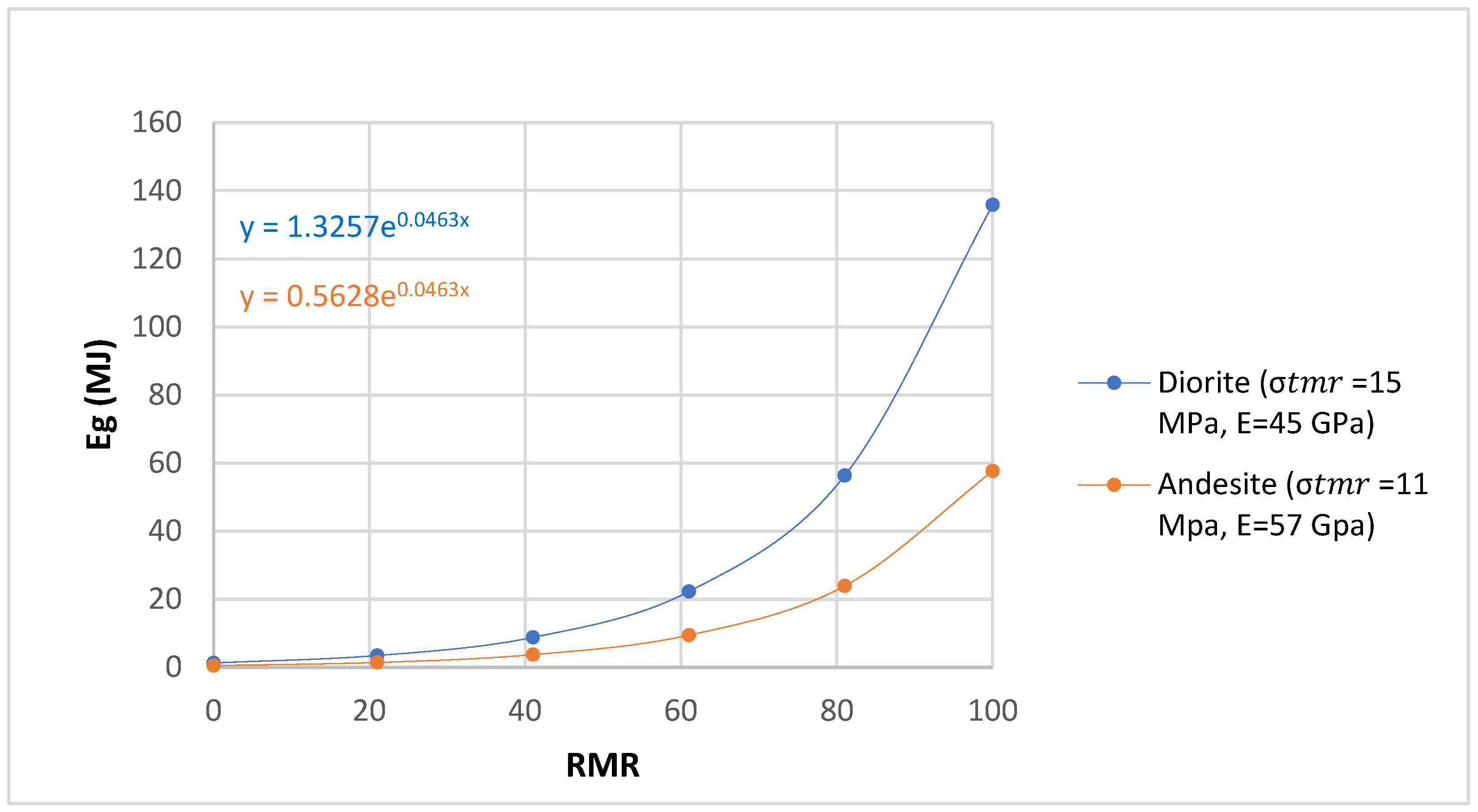
Figure 2 represents the inherent relationship between and RMR, where it is visualized that the minimum cracking energy of the rock mass increases as it is more competent; on the other hand, the tensile and stiffness parameters (, ) also change when scaled with the RMR, where as stiffness increases and is stressed, a higher minimum cracking energy of the rock mass is required.
Figure 2.
Relationship between theoretical crack energy and RMR.
This relationship allows the visualization of the minimum cracking energy per unit volume of rock to be fragmented, the cracking energy factor ( or ) (see Equation (4)):
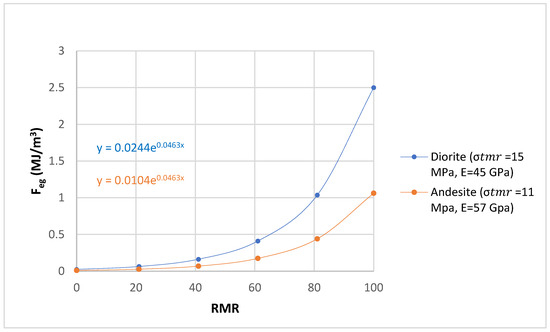
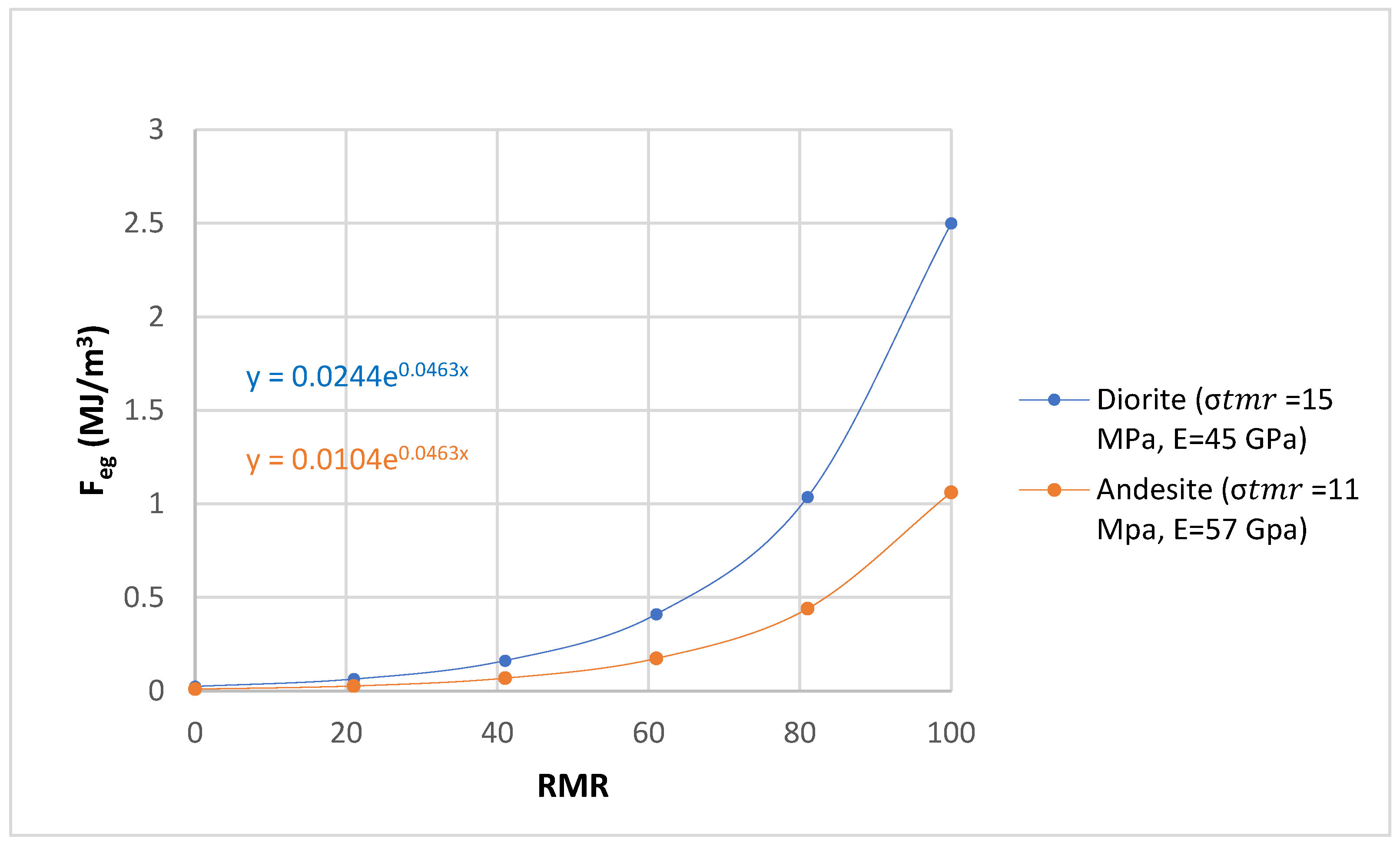
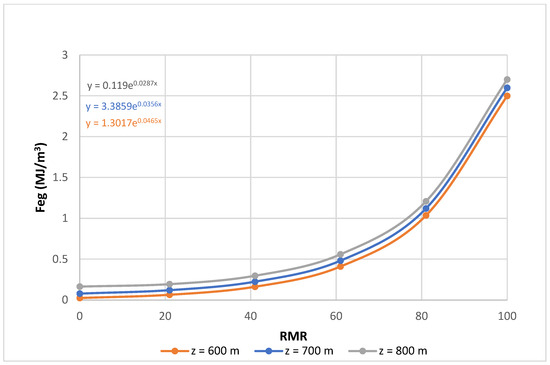
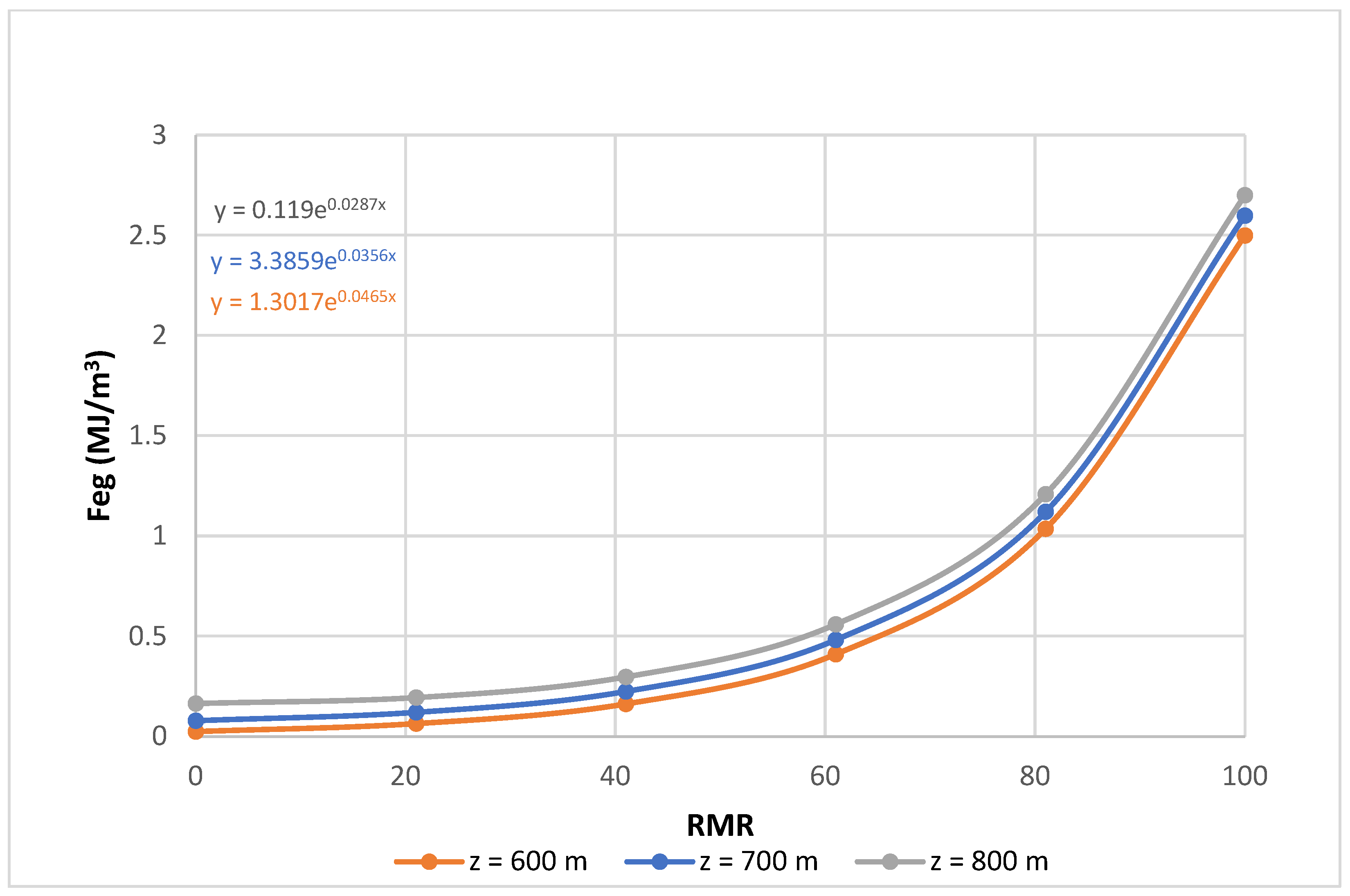
The (see curve in Figure 3) is calculated for geomechanical parameters of Diorite and Andesite, two lithologies that will later be validated with field data during the development of this study. The is represented in MJ/m3 and indicates the energy required to generate rupture per unit volume, constituting the main independent variable of the model. This will allow us to empirically predict the total energy factor of a blast for tunnels of 14.3 m2 in section and 3.8 m of drilling length (54.34 m3 volume rock).
Figure 3.
Theoretical relationship between the cracking energy factor and the RMR, for a rock volume of 54.34 m3.
2.4. Incorporation of Confinement Effects into the Cracking Energy Formulation
Rock masses at depth are subjected to significant in situ stresses that directly influence the initiation and propagation of fractures generated by blasting. In particular, the minimum principal stress () exerts a lateral confinement that inhibits tensile opening in Mode I, increasing the energy required for crack initiation. This behavior has been widely documented in triaxial tensile tests and fractured mechanics studies, where an approximately linear increase in apparent tensile strength is observed as confinement rises. To incorporate this phenomenon into the theoretical model, the tensile strength adjusted to the rock mass () is extended to an effective tensile strength that accounts for the inhibiting effect of on crack opening. This adjustment is introduced through a confinement-sensitivity coefficient kσ, which represents the empirical slope relating increases in σ3 to increases in Mode I tensile resistance:
This formulation is consistent with linearized versions of the Hoek–Brown criterion under low to moderate confinement and with experimental observations from triaxial Brazilian tests, where increases in between 1 and 10 MPa produce proportional increases in the tensile load required to induce splitting. The parameter captures the degree to which confinement suppresses crack opening and can be calibrated directly from field energy–consumption data as performed in this study. The incorporation of into allows theoretical cracking energy to reflect realistic underground conditions, where lateral confinement is significantly higher than in surface blasting, resulting in increased minimum energy requirements at depth.
2.5. Incorporation of Water Pressure Through Effective Stress
In jointed rock masses, the presence of water within fractures and microcracks modifies the stress field that governs crack initiation. Even under low inflow conditions, water exerts an internal pressure that counteracts the externally applied confining stress, reducing the effective normal stress across discontinuities. This mechanism is widely used in tunnel engineering and hard-rock mechanics to account for the weakening effect of water in partially saturated rock masses [27]. Because blast-induced fracture propagation occurs over microsecond to millisecond timescales, drainage is negligible and the medium can be considered undrained. Under these conditions, the relevant quantity governing tensile fracture is not the total confinement but its effective value:
where α is typically 0.6–1.0 for fractured hard rock and p is the pore water pressure acting within the crack network. In underground excavations without detailed hydrogeological characterization, p can be reasonably estimated from typical seepage pressures reported for jointed hard-rock tunnels, commonly 0.05–0.30 MPa under light to moderate inflow, and up to 0.50 MPa in poorly drained zones. The substitution of by in Equation (6) introduces the weakening effect of water directly into the effective tensile strength. When p increases, the decreases, which in turn reduces the effective tensile strength and lowers the minimum cracking energy required for fracture initiation.
2.6. Extended Formulation of Crack Energy Including Confinement and Water
By incorporating the modified tensile strength from Equation (5) into the theoretical cracking energy expression, the extended cracking energy becomes
Equation (7) represents the minimum theoretical energy required to propagate cracks under simultaneous effects of rock-mass degradation captured through RMR scaling, in situ confinement, and pore water pressure acting on discontinuities. This extended formulation naturally reduces to the original expression (Equation (3)) when σ3 = 0 or p = 0, preserving consistency with laboratory conditions while capturing the key geomechanical mechanisms relevant to deep underground blasting.
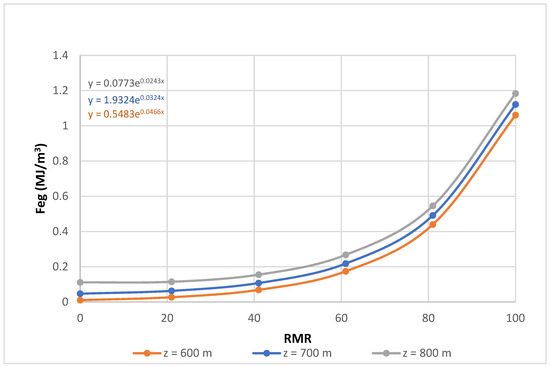
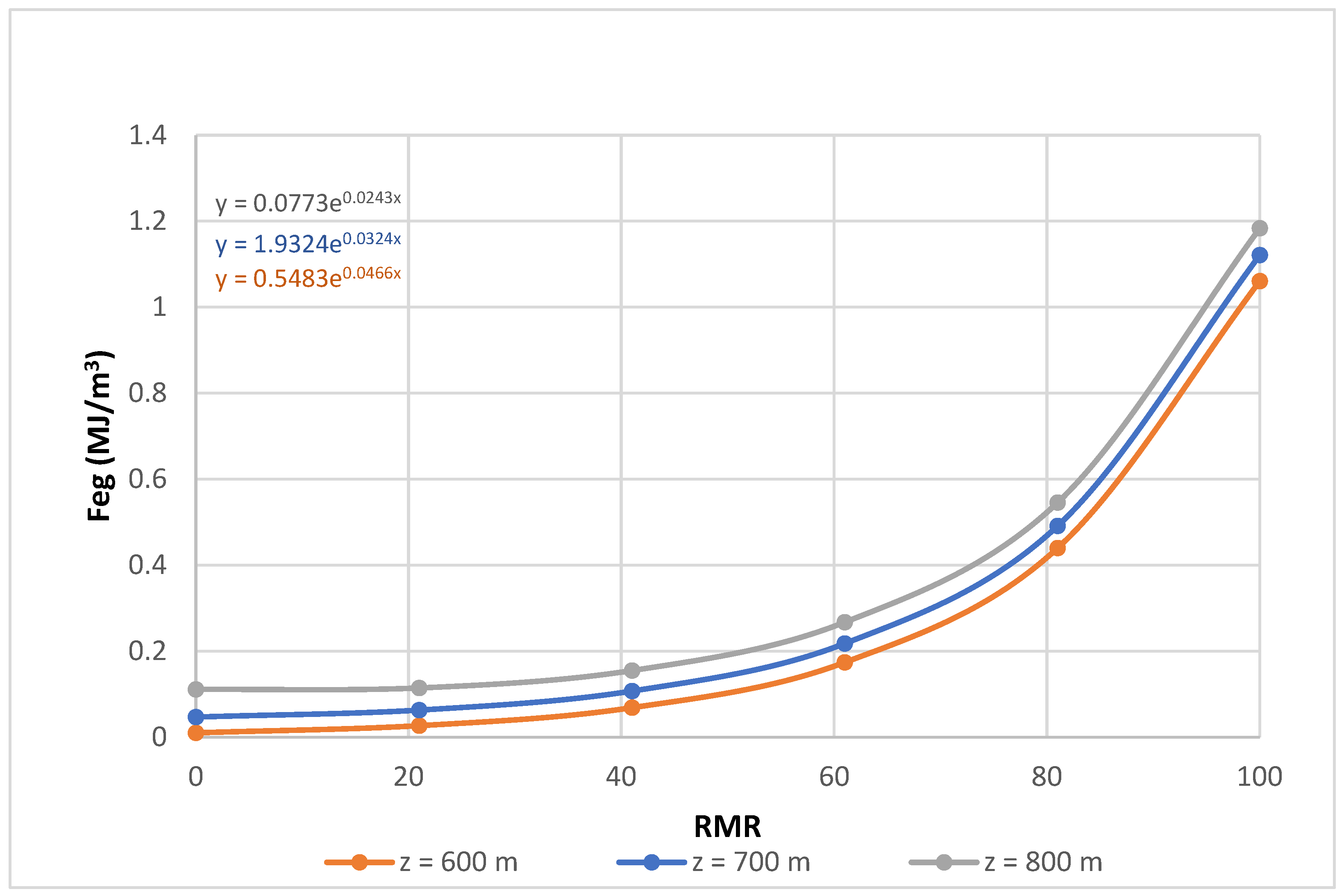
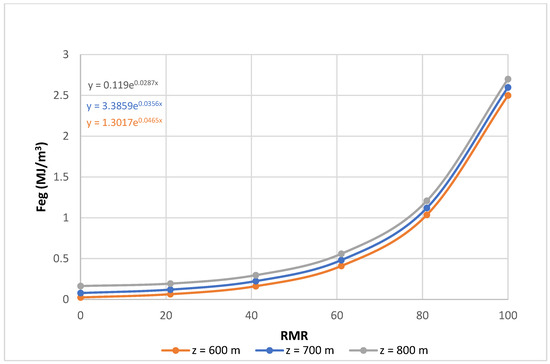
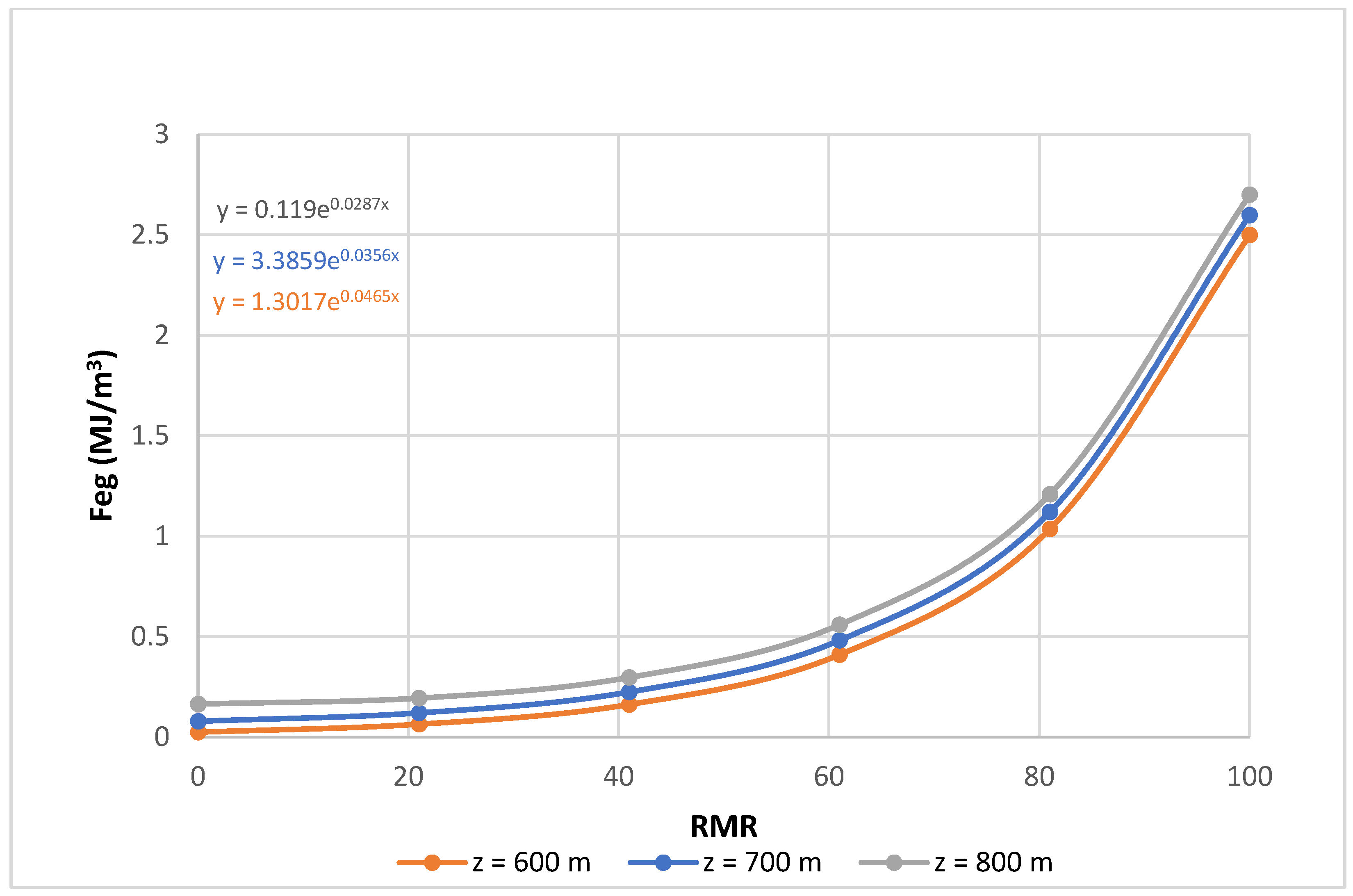
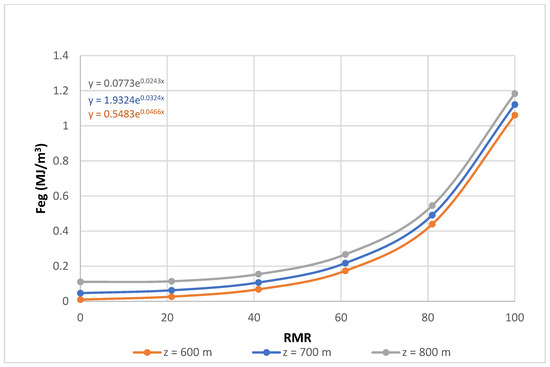
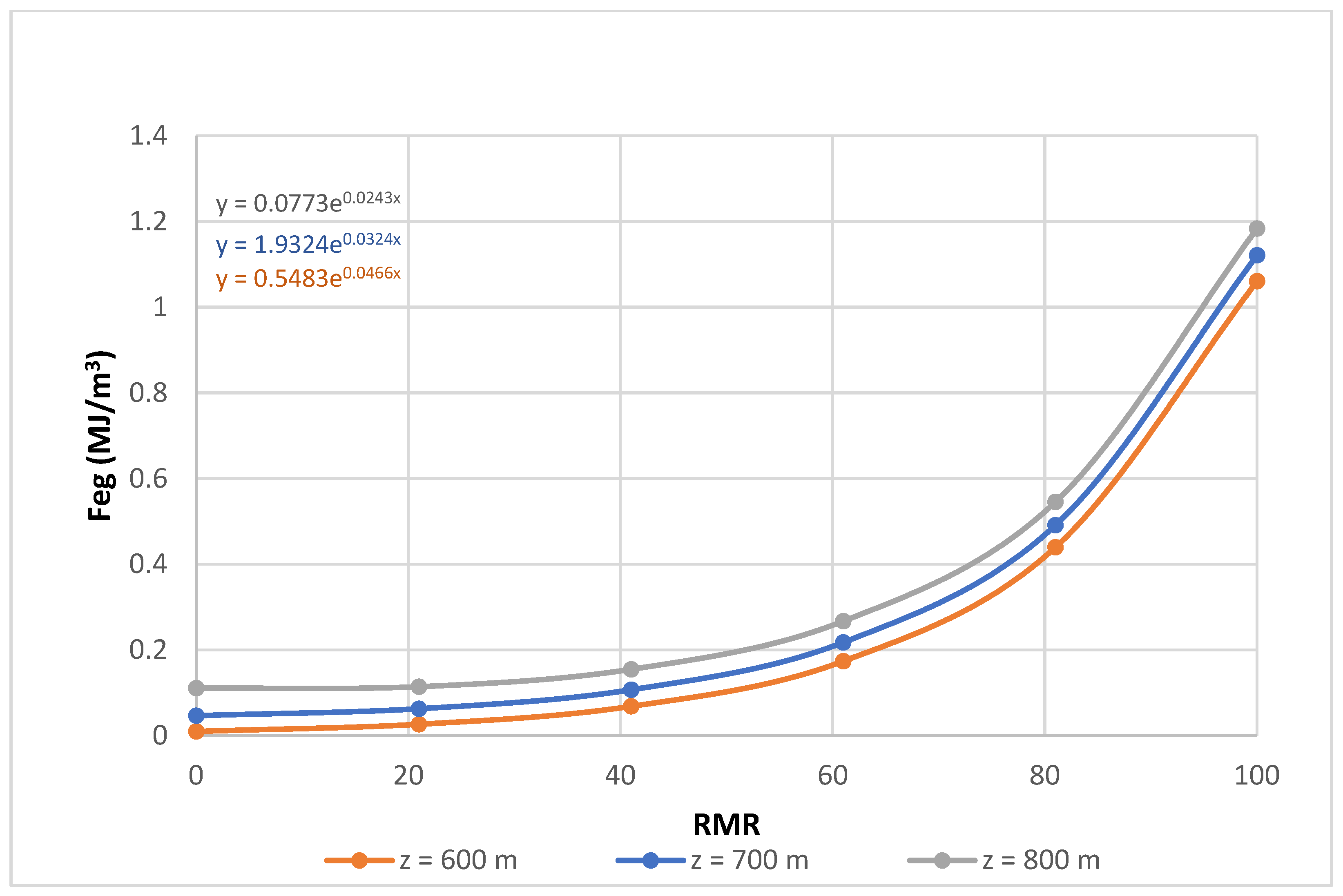
It is worth mentioning that Figure 1, Figure 2, Figure 3, Figure 4, Figure 5, Figure 6 and Figure 7 are derived from the theoretical scaling of σt and E by Equations (1) and (2), covering the entire spectrum of rock mass qualities (0 to 100). These figures are necessary to establish the analytical and generalized foundation of the model, where the minimum Feg can be visualized through all the possible qualities of rock mass.
Figure 4.
Theoretical relationship between the cracking energy factor and the RMR for a rock volume of 54.34 m3. Andesite .
Figure 5.
Theoretical relationship between the cracking energy factor and the RMR for a rock volume of 54.34 m3. Diorite .
Figure 6.
Theoretical relationship between the cracking energy factor and the RMR for a rock volume of 54.34 m3. Andesite .
Figure 7.
Theoretical relationship between the cracking energy factor and the RMR for a rock volume of 54.34 m3. Diorite .
2.7. Calculation of the Energy Factor in Blasting (Field Data)
The derived from field data is calculated based on the total energy provided by the explosive (see Equation (8)) in each round. This energy is obtained by multiplying the mass of the explosive used ( by the specific energy of the explosive .
Subsequently, the is expressed as energy per unit volume of rock (see Equation (9)).
In this study, the specific energy of the explosive (bulk emulsion) used was 2877 kJ/kg, according to the manufacturer’s technical specifications. All explosive consumptions were normalized in power relative to ANFO, to include both contour and production holes, as well as lower initiators.
2.8. Energy Efficiency (Field Data)
Once and are known, the fraction of energy effectively used for rupture is calculated in Equation (10).
The residual energy () is defined in Equation (11) and represents the amount of energy lost through non-productive processes such as vibrations, noise, heat, and plastic deformations [29]. As the quality of the rock mass increases, the decreases.
2.9. Data Field Processing
In Equation (12), a simple linear model is fitted between (dependent variable) and (independent variable):
where α and β are the coefficients estimated using Ordinary Least Squares (OLS). Additionally, the coefficient of determination and the 95% confidence intervals for both parameters were calculated. The regression was performed in Microsoft Excel using the built-in least-squares tool, and residuals were checked to confirm the assumptions of linearity and homoscedasticity. The validation of the model with field data is subsequently introduced in Section 3, where the Et is empirically adjusted by Feg for each lithological case.
3. Results
3.1. Pearson Correlation Matrix
The Pearson matrix was calculated for 42 blastings records to quantify the strength and direction of the linear relationship between the key variables (see Table 1).
Table 1.
Pearson matrix between key variables (N = 42).
- where
- Energy Factor, total explosive energy supplied per unit rock volume.
- Cracking energy per unit volume, derived from elastic deformation energy.
- RMR: Rock Mass Rating, dimensionless rock quality classification.
- Percentage of explosive energy used in crack formation.
3.2. General Description of the Data Field
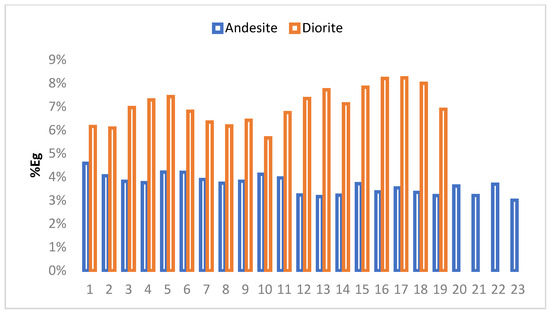
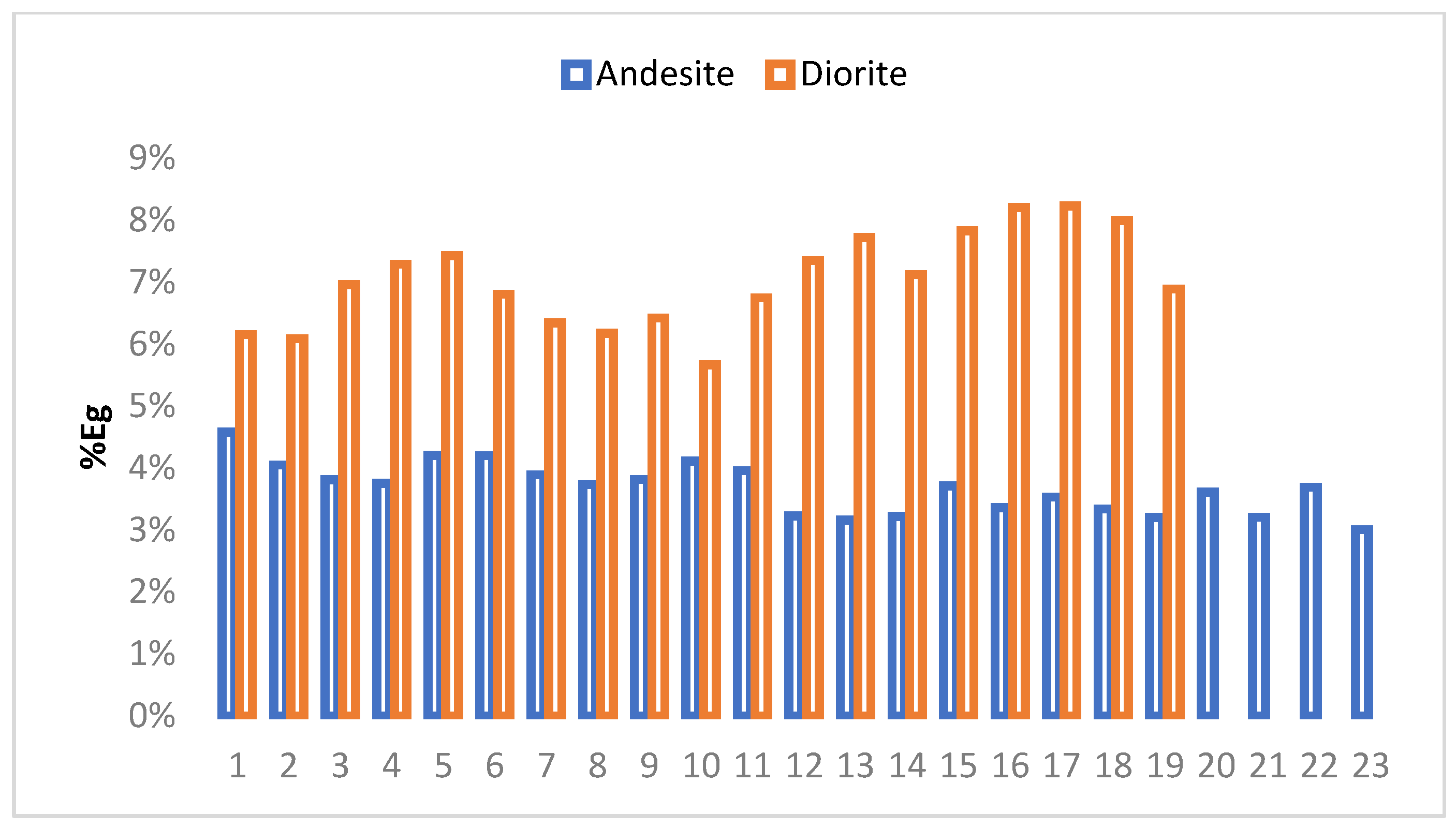
From the 42 blasting records collected at the El Teniente Mine, 23 correspond to blasts in andesite and 19 to blasts in diorite. The RMR values range from 66 to 75, at depths of approximately 600 m, with no presence of water, indicating a rock mass of good to very good quality. The specific explosive consumption, expressed as the , varied between 7.23 MJ/m3 and 8.90 MJ/m3 for andesite, while for diorite it ranged from 7.45 MJ/m3 to 9.25 MJ/m3. On the other hand, for andesite fluctuated between 12.1 MJ/m3 and 22.3 MJ/m3, and for diorite it ranged from 24.4 MJ/m3 to 41.6 MJ/m3. This suggests that, even under high-quality rock mass conditions, the represents a relatively small fraction of the total energy provided, ranging between 3.0% and 4.6% for andesite and 5.7% and 8.2% for diorite.
3.3. Relationship Between Total Energy and Crack Energy
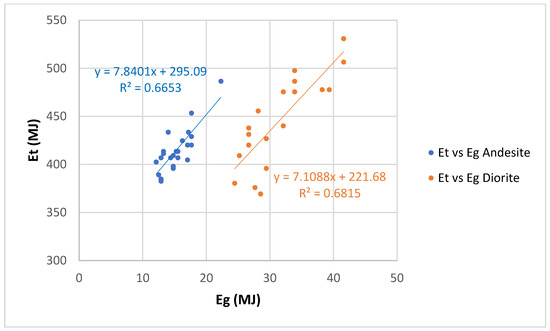
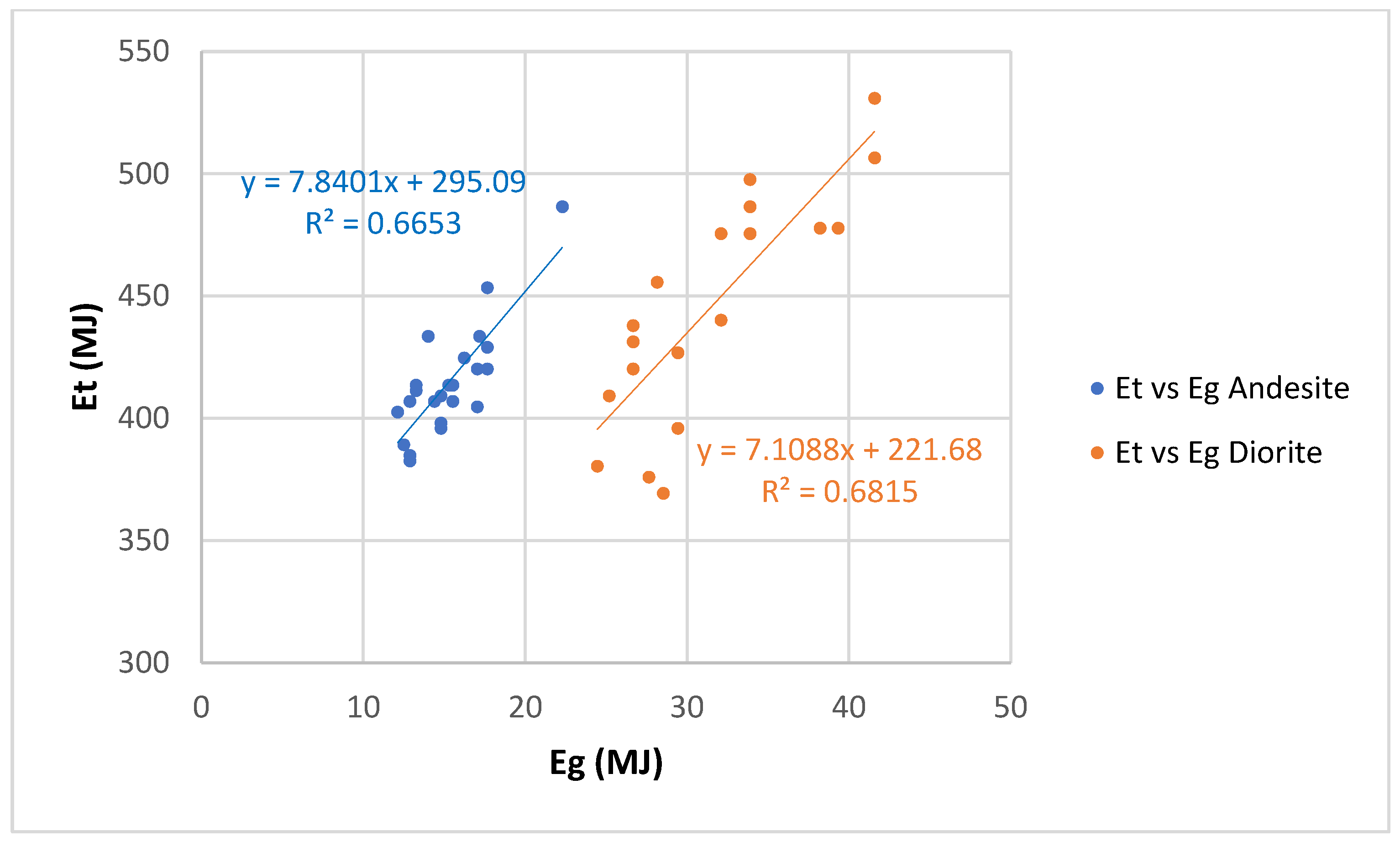
The expressed in Equations (13) and (14) for diorite and andesite rock, respectively, depends on , through a positive linear relationship (see Figure 8).
Figure 8.
Relationship between total energy and crack energy (field data).
With a coefficient of determination and , the model explains 68% and 67% of the variability observed in for both lithologies, indicating a strong relationship between specific explosive consumption and crack energy. On the other hand, the statistical analysis using OLS indicates that the regression coefficients (β) have high significance (p < 0.001) for the two lithologies, validating the quality of the fit of the empirical relationship.
3.4. Distribution of Energy Efficiency (Field Data)
The efficiency study revealed that the fluctuated between 3.0% for andesite rock and 8.2% for diorite rock, with an average of 5.2% (see Figure 9). This supports the findings of previous research [14], which indicate that the portion of energy used in effective fragmentation is limited and that more than 70% of the total energy is lost in other processes. On the other hand, we can observe that in the case of andesite rock, the cracking energy was lower than that required by diorite, this can be explained by the higher deformation capacity on average of diorite before failing according to Table 2.
Figure 9.
Efficiency study through crack energy (field data).
Table 2.
Deformation by lithology.
The average efficiency for crack propagation found in this study (5.2%) falls within the range reported by Yang et al. (2025) [30], who indicated typical values between 3.56% and 13.16%. However, the observed variability suggests that there are opportunities for improvement through adjustments in the drilling pattern, borehole diameter, and the use of explosives with different detonation velocities.
3.5. Relationship Between Predicted (Theoretical Model) and Real of Field Data
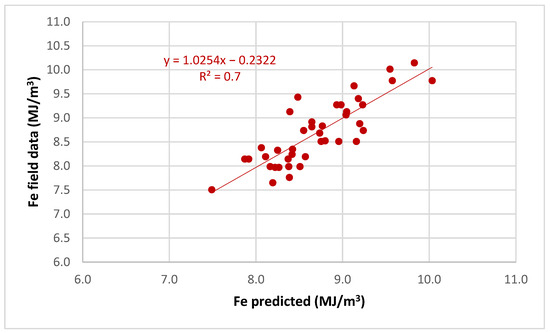
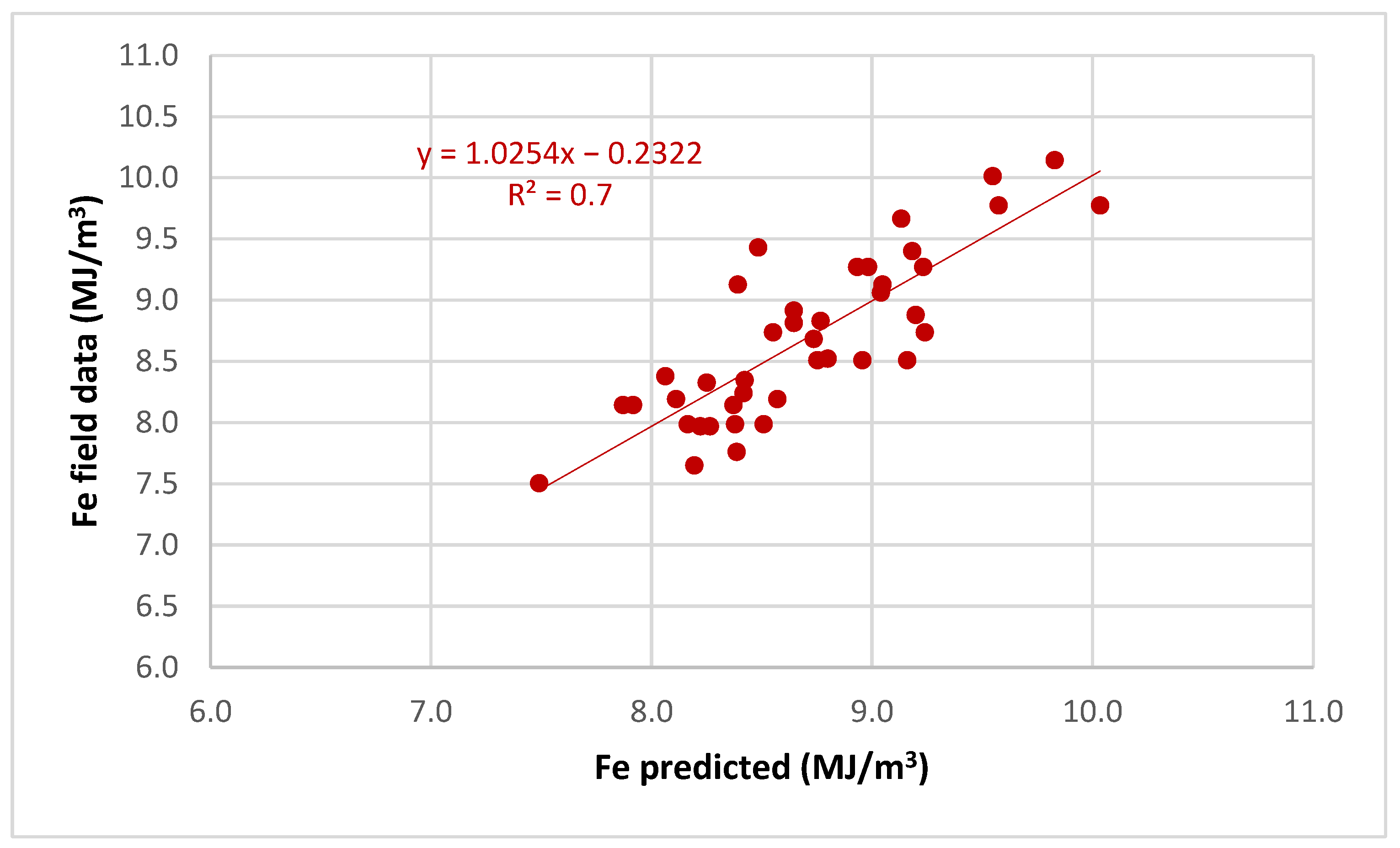
By using the coefficients of Equations (13) and (14), it is possible to obtain a comparison of the field and model , where a strong correlation of R2 = 0.7 is obtained as shown in Figure 10.
Figure 10.
Relationship between predicted and of field data.
3.6. Analysis by RMR Ranges
When the data are divided into three RMR categories (66, 70, and 75), a clear trend is observed. As the RMR increases, the average values of and also increase. This is because higher-quality rock masses require more energy to initiate and propagate cracks, due to their higher Young’s elastic modulus and lower density of discontinuities.
Table 3 shows how both and increase with increasing RMR for diorite, indicating that higher-quality rock masses require more energy to fracture. Table 4 shows a similar trend for andesite, although the average values of are significantly lower; this is explained in Table 2, where it is indicated that andesite requires less energy to deform until the modulus of elasticity is overcome.
Table 3.
Comparison of and by RMR range (diorite field data).
Table 4.
Comparison of and by RMR range (andesite field data).
3.7. Comparison by Lithology
The lithology of rock mass is one of the most important factors influencing blasting behavior, as it determines the mechanical properties, internal structure, and response to explosive energy. According to Hoek and Brown (2019) [27], each rock type has a specific crack energy threshold that varies depending on its tensile strength, elastic modulus, and mineralogical density. In this study, two lithological types predominant in the study area were identified:
- Andesite;
- Diorite.
Table 5 shows the average values of , and for each lithological type, calculated from the field data and processed in the mathematical model.
Table 5.
Average energy parameters by lithology.
Diorite has the highest energy consumption per cubic meter and the lowest efficiency, while andesite shows the best energy efficiency values, with an average of 7.0%. The observed differences are mainly due to the mechanical characteristics of each rock type. Diorite is a fine-grained volcanic rock with high tensile strength and a low fracture coefficient, which increases the energy required to initiate and propagate cracks. Andesite is an intermediate igneous rock that presents more discontinuities, facilitating crack propagation and resulting in medium efficiency. Additionally, in hard igneous rocks, the mineralogical structure and degree of alteration are key factors in blasting efficiency, with lithologies that have pre-existing microfractures being more effective.
3.8. Statistical Characterization of the Data
Before proceeding with the detailed analysis of relationships and efficiencies, a comprehensive statistical characterization of the database was conducted to understand the variability and distribution of the measured parameters. The quality and behavior of the rock mass, along with operational conditions, directly affect energy consumption and blasting efficiency [31].
3.8.1. Geomechanical Parameters
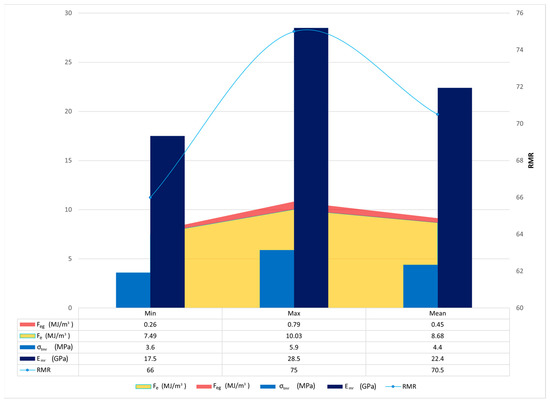
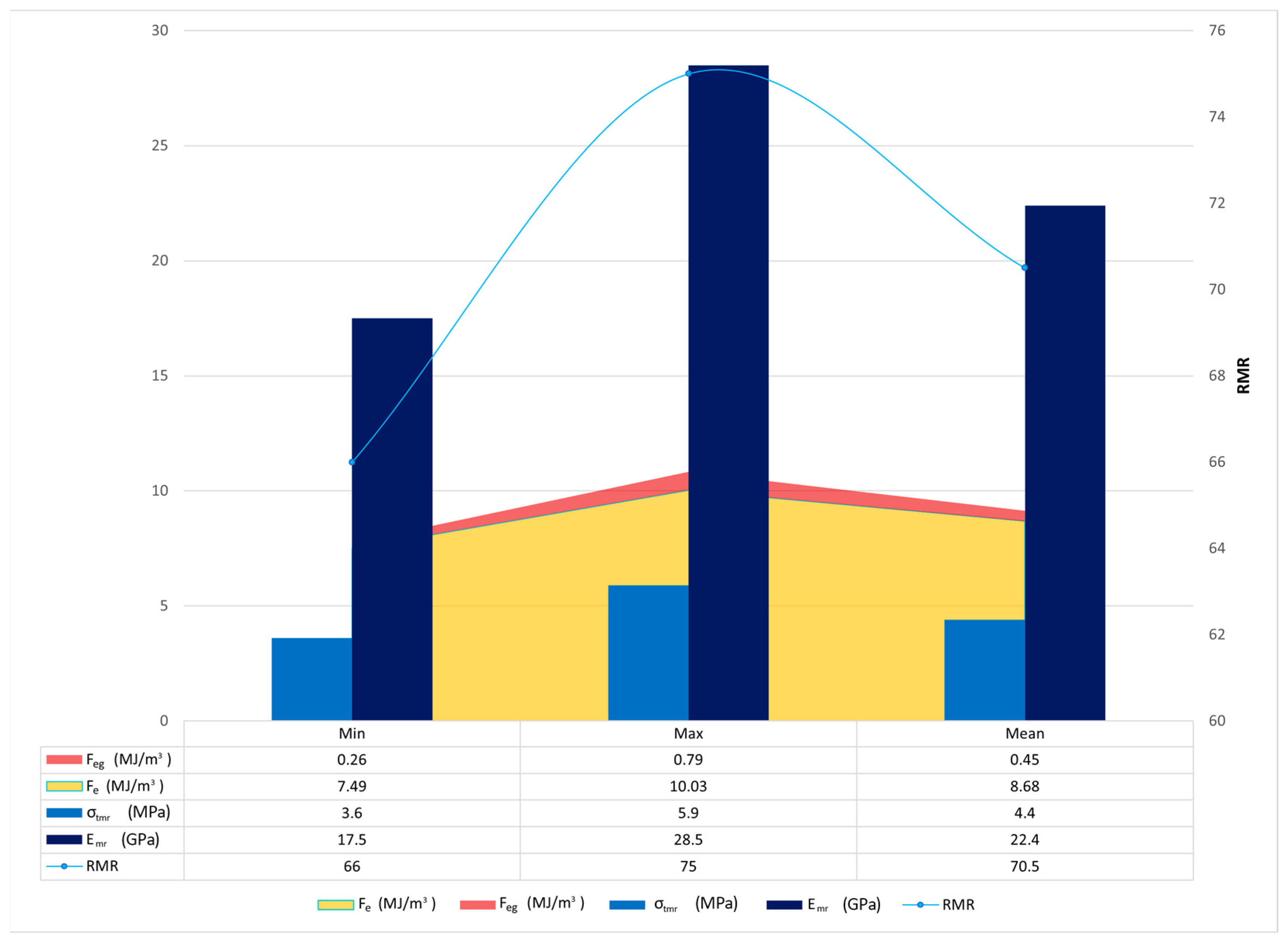
The previously explained RMR values indicate that the analyzed rock mass is of good quality, with a relatively intact structure and high mechanical strength. The density of the intact rock ranges from 2.73 to 2.80 t/m3, which is consistent with dense igneous lithologies such as andesites and porphyries. Additionally, the adjusted tensile strength of the rock mass fluctuated between 3.6 and 5.9 MPa, while the adjusted Young’s modulus ranged from 17.5 to 28.5 GPa.
3.8.2. Geometric and Operational Parameters
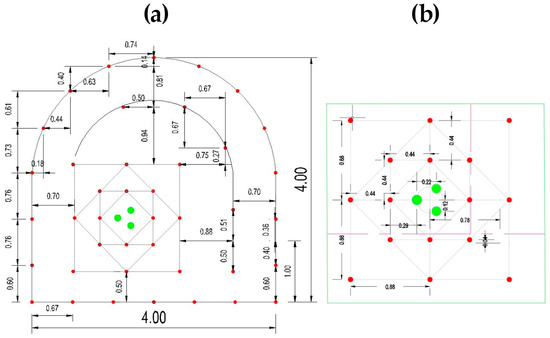
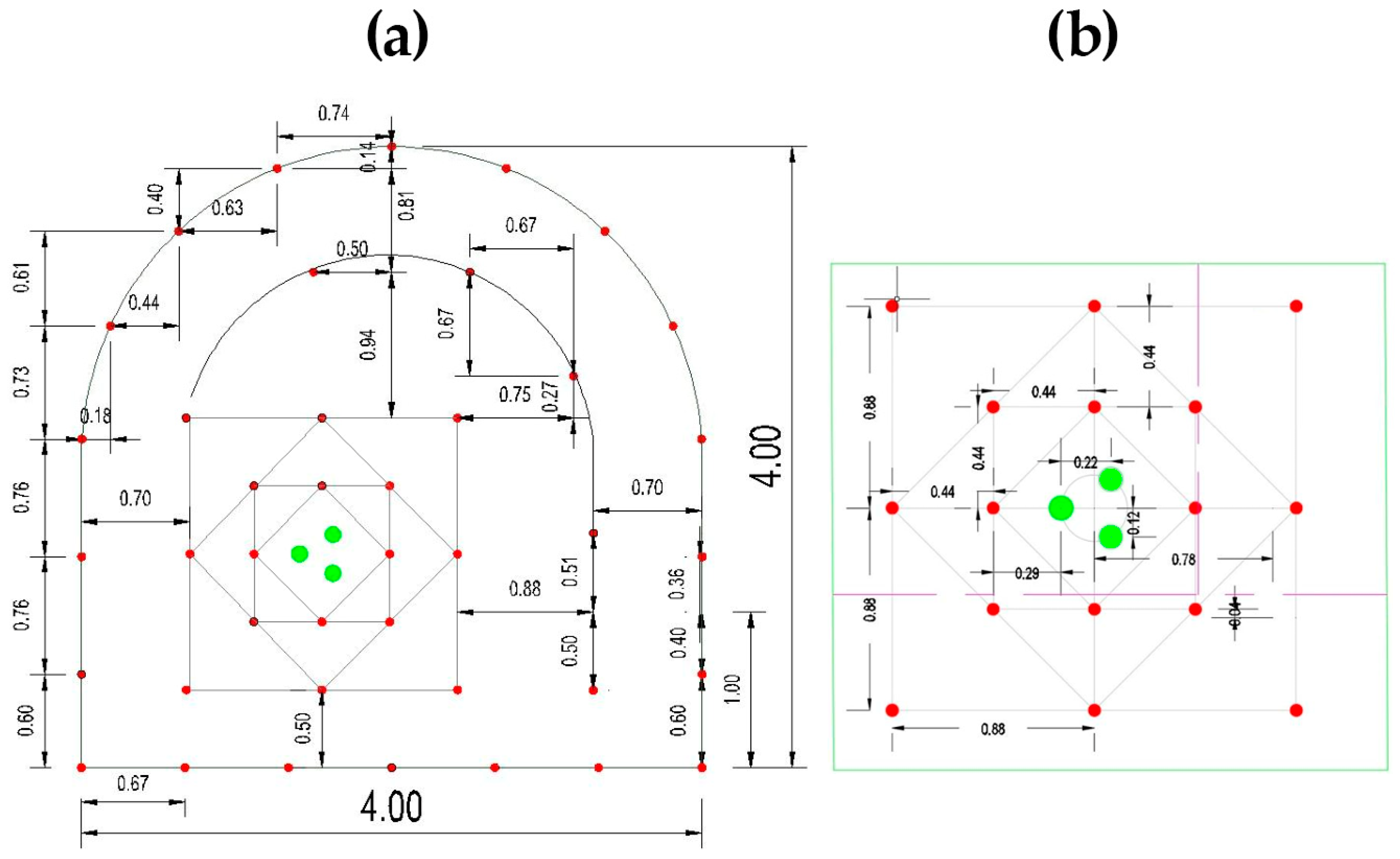
Regarding operational conditions, the excavation area of the analyzed sections was 14.3 m2, with an average drilled length of 3.5 m. The drilling diameter remained constant at 51 mm. The total explosive consumption per blast, considering bulk emulsion, contour cartridges, and boosters, ranged from 167 to 240 kg (power relative to ANFO), resulting in a power factor between 3.1 and 4.1 kg/m3. This variability reflects differences in rock mass hardness and drilling pattern design. Although these explosives’ consumption parameters may seem high, they are within the values estimated in the theoretical designs of drilling and loading explosives for tunnels, where the magnitudes are substantially higher with respect to the consumption related to production blasting that ranges between 0.6 kg/m3 and 1.5 kg/m3. This difference arises due to the confined nature of tunnel holes, i.e., it is required to make a free face through a groove that concentrates a high amount of energy to facilitate the fragmentation and displacement of the rest of the blast holes. A typical explosive loading design for andesite rock is illustrated in Figure 11 and Table 6.
Figure 11.
Design of explosive loading (a) and cut relief holes (b) for andesite rock.
Table 6.
Explosive loading parameters for andesite rock.
3.8.3. Energy Parameters
The calculated from the mass of the explosive and its specific energy (2877 kJ/kg) ranged between 369 and 531 MJ. On the other hand, the or , calculated using Equation (3), showed values ranging from 0.26 to 0.79 MJ/m3. These results are consistent with previous studies in igneous rock masses, where rarely exceeds 0.5 MJ/m3 [32,33].
3.8.4. Statistical Summary
Table 7 presents a statistical summary of the main parameters used in the subsequent analysis.
Table 7.
Descriptive statistics of the evaluated parameters.
Figure 12 shows the direct relationship between RMR and the scaled geomechanical parameters, as well as how it influences the energy required to extend cracks per volume of rock.
Figure 12.
Descriptive statistics of the evaluated parameters.
4. Discussion
The joint analysis of the results obtained and the field observations allows us to identify a series of patterns that not only support the trends mentioned in the literature but also provide specific details for the conditions studied. The obtained magnitudes of , showed a direct correlation with the variation in the geomechanical parameters scaled by the RMR, which indicates that as the energy per unit volume increases, so does the specific energy required to create cracks. In other words, more energy is needed to generate new cracks in more competent rock masses, resulting in inefficiency. Building on this, the model demonstrates that higher-quality rock masses require a greater percentage of explosive energy to overcome elastic resistance and propagate cracks. Ref. [34] further show that shock wave interactions and stress field superposition can amplify peak pressures by up to 2.84 times in central zones, enhancing radial crack development. Thus, while our model quantifies the energy thresholds and ) necessary for effective fracturing, these findings underscore the critical role of efficient energy transfer mechanisms. Ensuring focused and optimal energy delivery during blasting is essential to surpass predicted fracture thresholds and mitigate inefficiencies in competent rock masses.
4.1. Energy Efficiency and Opportunities for Improvement
The average value of falls within the typical range (3.56–13.16%) reported in the work by Yang et al. (2025) [15], but the observed variability (3.0–8.2%) suggests that there is significant room for optimization. Among the strategies that could help improve this indicator are
- Adjusting the burden and spacing to achieve better energy distribution;
- Selecting explosives with detonation velocities that match the rock’s strength;
- Optimizing the firing sequence, minimizing wave interference between holes.
4.2. Influence of RMR on Energy Behavior
The analysis by RMR categories revealed statistically significant differences in both and (p < 0.05), confirming the strong relationship between geomechanical quality and blasting response. While classical works such as that by Bieniawski (1989) [9] established the relevance of RMR for rock mass mechanical behavior, this study advances that understanding by quantifying its influence on blasting energy demand and crack energy efficiency. Specifically, the results show that in rock masses with higher RMR, energy is transmitted more efficiently, reducing losses due to plastic deformation and non-productive absorption, thus providing numerical evidence to integrate RMR directly into energy-based blast design.
4.3. Variations by Lithology
Developing regression functions for diorite (Equation (13)) and for andesite (Equation (14)) in particular, improves the predictive accuracy of the model. Although the objective is to correlate Et with Eg using a common equation (Equation (12)), the geomechanical difference between both lithologies, particularly in their stiffness and strength (as detailed in Table 8), shows a different energy distribution in both cases. The higher intercept (α = 295.09 MJ) and slope (β = 7.8401) of andesite, compared to diorite (α = 221.68 MJ, β = 7.1088), confirm that is channeled in very different proportions, as detailed in the table below.
Table 8.
Analysis of MCO coefficients and their geomechanical implication.
The comparison between andesite and diorite demonstrated that mineral composition and rock structure significantly affect blasting performance. Diorite showed higher values of and (7.0%), associated with its greater mechanical competence and higher tensile strength, meaning a greater proportion of energy is required and consumed in the cracking process. In contrast, andesite exhibited lower and (3.7%), indicating that less energy input is needed to achieve effective fragmentation due to its micro-fracturing and lower tensile strength () compared to diorite (). However, it is important to indicate that the empirical relationship developed in this work is limited according to the lithologies and ranges of the parameters used, where the RMR are from 66 to 75. Therefore, the model is validated under these conditions. It is necessary to emphasize and validate its application in rocks of lower quality (RMR < 40) or excellent quality (RMR > 80) by incorporating calibration data. In addition, this condition highlights the need to generalize the model through machine learning tools or the integration of blasting data from other sites. On the other hand, the influence of external factors such as in situ tensions and water should also be deepened in your study for future investigations and perfection of the model. Regarding the presence of water, this factor is implicitly obtained by calculating the RMR value; however, water in the discontinuities acts as an attenuator of the wave, absorbing detonation energy from the explosive and eventually increasing residual energy under saturation conditions. Future work should explicitly incorporate water saturation to refine prediction accuracy.
In addition, the present results are consistent with recent studies on blast wave interaction and stress field superposition in confined rock masses. Meng et al. (2025) [35] demonstrated that the collision and interference of stress waves significantly influence peak pressure distribution and the initiation of microcracks in hard rocks. Similar findings were reported by Yang et al., 2025 [30], who showed that wave reflection, refraction, and focusing effects at discontinuities govern crack initiation thresholds and propagation paths in jointed media. These mechanisms support the observed relationship between RMR and crack energy demand in this study, as more competent and less fractured rock masses sustain higher peak stresses before their failure, requiring a greater portion of explosive energy to overcome elastic resistance and initiate fracture development.
Although the present model does not explicitly incorporate in situ stress or water saturation as variables, their influence can be reasonably inferred from previous experimental and numerical research. High confinement conditions are known to attenuate stress waves and delay crack initiation, thereby increasing the energy required for effective fragmentation. Likewise, water-filled fractures can absorb part of the blast energy and reduce crack-propagation efficiency through damping effects. These mechanisms are consistent with geomechanical behavior observed in deep-level caving environments such as El Teniente, where elevated stress and groundwater conditions interact with blast-induced damage processes. Therefore, future extensions of the model should incorporate adjustment factors for these conditions, supported by calibration data and advanced numerical tools, to improve prediction accuracy in deep or saturated rock masses.
5. Conclusions
The study introduces methodological advancement by proposing a theoretical model based on volumetric fracture energy, which for the first time integrates the RMR as a predictive variable for the blasting in mining tunnels. This approach surpasses traditional methodologies, limited to explosive data and excavation volume, by incorporating scaled geomechanical parameters (, ) and lithological properties, achieving robust correlations (R2 = 0.67–0.68) validated with 42 blasting records from El Teniente mine. Results demonstrate that more competent rock masses (RMR = 75) require up to 9.16 MJ/m3 in diorite (vs. 7.78 MJ/m3 in andesite), linked to their higher adjusted elastic modulus () for diorite vs. GPa for andesite) and tensile strength . Fracture efficiency ranges between 3.0% and 8.2%, highlighting lithology as a critical factor: diorite, with lower fractureability, exhibits reduced efficiency compared to andesite , underscoring the need for adaptive blast designs tailored to rock type. The model’s key contribution lies in enabling precise energy allocation, lowering operational costs and energy waste ( > 90%) in competent igneous rock masses. Future work should validate its applicability in rock masses with extreme RMR values (<40 or >80), stratified formations, or complex stress fields, integrating in situ stresses and water saturation to extend its use in deep mining and diverse geotechnical contexts, solidifying its role in advancing energy-sustainable mining practices.
Author Contributions
Conceptualization, A.D.; methodology, A.D. and H.H.; software, A.D.; validation, H.H., L.Á. and J.G.; formal analysis, A.D. and H.H.; investigation, A.D. and H.H.; resources, A.D. and H.H.; data curation, A.D., H.H. and J.G.; writing—original draft preparation, A.D.; writing—review and editing, H.H.; visualization, A.D. and H.H.; supervision, J.G., L.Á. and H.H.; project administration, A.D. and H.H. All authors have read and agreed to the published version of the manuscript.
Funding
This research received no external funding.
Data Availability Statement
Data supporting the findings of this study are available from the corresponding author upon reasonable request.
Conflicts of Interest
Alejandro Diaz is employed by the company Orica S.A. However, the company had no involvement in this research and is not part of the funding for the article.
Abbreviations
| ETMC | El Teniente Mafic Complex |
| Crack Energy | |
| Elastic Modulus | |
| Residual Energy | |
| Total Energy | |
| Explosive Energy | |
| Energy Factor | |
| Crack Energy Factor | |
| Residual Energy Factor | |
| Mass of explosive | |
| RMR | Rock Mass Rating |
| OLS | Ordinary Least Squares |
| Determination coefficient | |
| Pearson correlation coefficient | |
| Efficiency Energy | |
| Residual Energy | |
| Tensile Strength |
References
- Álvarez, L.; Hernández, H.; Alberdi, E.; Goti, A. Enhanced Short-Term Scheduling of Underground Mining Activities Using Tabu Search: A Comparative Analysis. Contemp. Math. 2025, 6, 7925–7949. [Google Scholar] [CrossRef] [Scilit]
- Brazil, M.; Grossman, P.A.; Lee, D.H.; Rubinstein, J.H.; Thomas, D.A.; Wormald, N.C. Decline design in underground mines using constrained path optimisation. Trans. Inst. Min. Metall. Sect. A Min. Technol. 2008, 117, 93–99. [Google Scholar] [CrossRef] [Scilit]
- Mishchenko, K.; Åstrand, M.; Molander, M.; Lindkvist, R.; Viklund, T. Developing a tool for automatic mine scheduling. In Proceedings of the 28th International Symposium on Mine Planning and Equipment Selection—MPES 2019, Perth, Australia, 2–4 December 2019; Springer Series in Geomechanics and Geoengineering. Springer: Cham, Switzerland, 2020. [Google Scholar]
- Morales, N.; Mancilla, D.; Miranda, R.; Vallejos, J. Optimal Drift and Level Design in Underground Mining Extracted by Sublevel Open Stoping Method. SSRN Electron. J. 2021, 77, 102670. [Google Scholar] [CrossRef] [Scilit]
- Newman, A.M.; Rubio, E.; Caro, R.; Weintraub, A.; Eurek, K. A review of operations research in mine planning. Interfaces 2010, 40, 222–245. [Google Scholar] [CrossRef] [Scilit]
- Rahimi, B.; Sharifzadeh, M.; Feng, X.T. A comprehensive underground excavation design (CUED) methodology for geotechnical engineering design of deep underground mining and tunneling. Int. J. Rock Mech. Min. Sci. 2021, 143, 104684. [Google Scholar] [CrossRef] [Scilit]
- Díaz-Martínez, J.C.; Guarín-Aragón, M.A.; Jiménez-Builes, J.A. Análisis y diseño de la operación de perforación y voladuras en minería de superficie empleando el enfoque de la programación estructurada. Boletín Cienc. Tierra 2012, 32, 15–22. [Google Scholar]
- Poma Cruz, H.J. Modelos machine learning en geomecánica minera para el control eficaz de perforación. Rev. Investig. 2023, 12, 30–42. [Google Scholar] [CrossRef] [Scilit]
- Bieniawski, Z.T. Engineering Rock Mass Classifications: A Complete Manual for Engineers and Geologists in Mining, Civil, and Petroleum Engineering; John Wiley & Sons: Hoboken, NJ, USA, 1989. [Google Scholar]
- Terzi, V.G.; Manolis, G.D. Basic numerical modelling issues in dynamic soil-tunnel interaction. Soil Dyn. Earthq. Eng. 2023, 172, 108060. [Google Scholar] [CrossRef] [Scilit]
- Lilly, P.A. Empirical method of assessing rock mass blastability. In Proceedings of the Large Open Pit Mining Conference, Newman, Australia, 27–29 October 1986. Symposia Series—Australasian Institute of Mining and Metallurgy. [Google Scholar]
- Shehu, S.A.; Hashim, M.H.M. Evaluation of blast fragmentation and its benefits: A review of the paradigm and ambiguity. Int. J. Min. Miner. Eng. 2020, 11, 338–358. [Google Scholar] [CrossRef] [Scilit]
- Li, J.; Yang, T.; Liu, F.; Du, S.; Deng, W.; Zhao, Y.; Liu, H.; Niu, L.; Xu, Z. Geostatistics-block-based characterization of the relationship between rock mass quality and powder factor and its application on open-pit limit optimization. Int. J. Min. Sci. Technol. 2025, 35, 135–147. [Google Scholar] [CrossRef] [Scilit]
- Hosseini, M.; Bagnikhani, M.S. Analysing the Ground Vibration Due to Blasting at AlvandQoly Limestone Mine. Int. J. Min. Eng. Miner. Process. 2013, 2, 17–23. [Google Scholar]
- Yang, J.; Peng, C.; Ye, Z.; Yao, C.; Zhang, X.; Ma, Y.; Zhou, C. Study on the efficiency of energy transfer in the blasting with different coupling mediums for deep rock mass excavation. Eng. Fract. Mech. 2025, 319, 111048. [Google Scholar] [CrossRef] [Scilit]
- Finn, O.; Ulf, N.; Mats, O.; Ingvar, B.; Lars, G.; Henrik, G. Where does the explosive energy in rock blasting rounds go? Sci. Technol. Energetic Mater. 2004, 65, 54–63. [Google Scholar]
- Fredj, M.; Boukarm, R.; Saadoun, A.; Menacer, K.; Nakache, R. Effect of Stemming Parameters on Blast-Induced Rock Fragmentation: A Case Study. ARPHA Proc. 2024, 7, 128–135. [Google Scholar] [CrossRef] [Scilit]
- Kiliç, A.M.; Yaşar, E.; Erdoǧan, Y.; Ranjith, P. Influence of rock mass properties on blasting efficiency. Sci. Res. Essays 2009, 4, 1213–1224. [Google Scholar]
- Li, X.; Liu, K.; Yang, J.; Song, R. Numerical study on blast-induced fragmentation in deep rock mass. Int. J. Impact Eng. 2022, 170, 104367. [Google Scholar] [CrossRef] [Scilit]
- Chen, H.; Qiu, X.; Shi, X.; Zhang, J.; Huo, X.; Li, D. Experimental Study on Fracturing Characteristics of Double-Hole Blasting Under Static Stresses. Front. Earth Sci. 2022, 9, 829258. [Google Scholar] [CrossRef] [Scilit]
- Castro, R.L.; Vargas, R.; De La Huerta, F. Determination of drawpoint spacing in panel caving: A case study at the el teniente mine. J. S. Afr. Inst. Min. Metall. 2012, 112, 871–876. [Google Scholar]
- Astudillo, N.; Roperch, P.; Townley, B.; Arriagada, C.; Chauvin, A. Magnetic polarity zonation within the El Teniente cop-per-molybdenum porphyry deposit, central Chile. Miner. Depos. 2010, 45, 23–41. [Google Scholar] [CrossRef] [Scilit]
- Rabbia, O.M.; Hernández, L.B.; French, D.H.; King, R.W. The El Teniente porphyry Cu-Mo deposit from a hydrothermal rutile perspective. Miner. Depos. 2009, 44, 849–866. [Google Scholar] [CrossRef] [Scilit]
- Stern, C.R.; Skewes, M.A.; Arévalo, A. Magmatic evolution of the giant El Teniente Cu-Mo deposit, central Chile. J. Petrol. 2011, 52, 1591–1617. [Google Scholar] [CrossRef] [Scilit]
- Jarufe Troncoso, J.; Vasquez, P. Mine-Scale 3D Stress Model for the New Mine Level Project, El Teniente Mine, Codelco, Chile. In Proceedings of the SHIRMS 2008: Proceedings of the First Southern Hemisphere International Rock Mechanics Symposium, Perth, Australia, 16–19 September 2008. [Google Scholar]
- McKinnon, S.D.; de la Barra, I.G. Stress field analysis at the El Teniente Mine: Evidence for N–S compression in the modern Andes. J. Struct. Geol. 2003, 25, 2125–2139. [Google Scholar] [CrossRef] [Scilit]
- Hoek, E.; Brown, E.T. The Hoek–Brown failure criterion and GSI—2018 edition. J. Rock Mech. Geotech. Eng. 2019, 11, 445–463. [Google Scholar] [CrossRef] [Scilit]
- Griffith, A.A., VI. The phenomena of rupture and flow in solids. Philos. Trans. R. Soc. Lond. Ser. A Contain. Pap. A Math. Phys. Character 1921, 221, 163–198. [Google Scholar] [CrossRef] [Scilit]
- Sanchidrián, J.A.; Segarra, P.; López, L.M. Energy components in rock blasting. Int. J. Rock Mech. Min. Sci. 2007, 44, 130–147. [Google Scholar] [CrossRef] [Scilit]
- Yang, X.; Zhang, X.; Wu, Y.; Li, Z.; Gao, W.; Wang, F.; Zhang, Y. Investigation of Stress Wave Propagation and Crack Propagation Characteristics in Intersecting-Joint Mass Under Blasting. Fractal Fract. 2025, 9, 693. [Google Scholar] [CrossRef] [Scilit]
- Jimeno, C.L.; Jimeno, E.L.; Carcedo, F.J.A.; De Ramiro, Y.V. Drilling and Blasting of Rocks; Taylor & Francis: Abingdon, UK, 2017. [Google Scholar]
- Cunningham, C.V.B. The Kuz-Ram fragmentation model—20 years on. In Brighton Conference Proceedings; European Federation of Explosives Engineers: Vienna, Austria, 2005. [Google Scholar]
- Kulula, M.I.; Nashongo, M.N.; Akande, J.M. Influence of Blasting Parameters and Density of Rocks on Blast Performance at Tschudi Mine, Tsumeb, Namibia. J. Miner. Mater. Charact. Eng. 2017, 5, 339–352. [Google Scholar] [CrossRef]
- Ishchenko, O.; Novikov, L.; Ponomarenko, I.; Konoval, V.; Kinasz, R.; Ishchenko, K. Blast wave interaction during explosive detonation in a variable cross-sectional charge. Min. Miner. Depos. 2024, 18, 60–70. [Google Scholar] [CrossRef] [Scilit]
- Meng, X.; Zhou, C.; Jiang, N.; Zhang, Z.; Yang, Y.; Wu, D. Propagation characteristics of stress waves induced by underground blasting under the influence of rock-soil interfaces. J. Rock Mech. Geotech. Eng. 2025, 17, 4139–4159. [Google Scholar] [CrossRef] [Scilit]

Disclaimer/Publisher’s Note: The statements, opinions and data contained in all publications are solely those of the individual author(s) and contributor(s) and not of MDPI and/or the editor(s). MDPI and/or the editor(s) disclaim responsibility for any injury to people or property resulting from any ideas, methods, instructions or products referred to in the content. |
© 2026 by the authors. Licensee MDPI, Basel, Switzerland. This article is an open access article distributed under the terms and conditions of the Creative Commons Attribution (CC BY) license.