Article

Assessment of Learning Through Educational Video Games in Preservice Teacher Education

by
Juan Luis Cabanillas-García
,
Francisca Angélica Monroy-García
* and
Desirée Ayuso-del Puerto
Department of Educational Sciences, Faculty of Education and Psychology, University of Extremadura, Av. De Elvas s/n, 06006 Badajoz, Spain
*
Author to whom correspondence should be addressed.
Digital 2026, 6(2), 50; https://doi.org/10.3390/digital6020050
Submission received: 24 March 2026 / Revised: 11 June 2026 / Accepted: 12 June 2026 / Published: 17 June 2026
(This article belongs to the Collection Multimedia-Based Digital Learning)

Abstract

In today’s educational context, Game-Based Learning (GBL) has emerged as a promising methodology for promoting active learning in an engaging and motivating way. This study aims to analyze the impact of a video game-based intervention on the development of students’ cognitive skills, focusing on the levels of Bloom’s taxonomy, as well as to explore students’ perceptions of this methodology. Accordingly, an intervention was conducted with 52 students in the Early Childhood Education Degree Program, integrating video games designed for this study for pedagogical purposes. An approach combining two quantitative instruments was employed: knowledge assessment tests and a student perception questionnaire. The results show a significant improvement in students’ higher-order cognitive skills, particularly in the dimensions of applying, analyzing, and evaluating. Furthermore, students demonstrated a positive attitude toward the use of video games as a learning tool. Therefore, this study confirms that the integration of GBL methodology at the university level can effectively contribute to the development of higher-order cognitive skills among teachers in initial training. However, further research is recommended to examine its long-term impact and its effectiveness across different levels of education.

1. Introduction

Teacher education currently faces significant challenges due to the rapid evolution and development of technology, which has come to influence the way we communicate, relate to one another, learn, and interact with others [1]. In this regard, higher education faces the challenge of going beyond teaching the instrumental use of these tools. Thus, it is essential to train future teachers in the development of critical-technological thinking as part of the key competencies that must be acquired during their undergraduate studies, so that they are capable of using these tools for pedagogical purposes and from an ethical perspective to address educational challenges [2,3].
In this regard, active methodologies have emerged as a decisive factor in improving students’ critical thinking, not only as a participatory component but also because they allow for the structuring of learning around open-ended problems and authentic situations that lead students to identify and analyze relevant information, generate and test hypotheses, evaluate alternatives, and justify decisions regarding their peers [4,5,6,7].
From this perspective, it is worth asking some questions about what can be done to strengthen pedagogical practices in the university setting through the integration of Information and Communication Technologies (hereinafter, ICT) into the university classroom, as indicated by [8]. In this regard, the prevailing technological culture modifies and complements traditional teaching–learning processes, making ICT a technological ally that helps instructors create and select tasks that are motivating, personalized, and tailored to their students’ learning paces and styles.
Thus, Game-Based Learning (GBL) has emerged in this educational context as an active methodology with great potential to stimulate students’ critical thinking and foster meaningful and active learning experiences among university students [9]. However, it should be clarified that GBL refers to the pedagogical approach that, through play and an interactive and engaging learning environment, promotes the achievement of learning outcomes, conceptual understanding, and skill development, while also fostering curiosity, active participation, and increased intrinsic motivation among students [10,11]. It is worth noting that educational video games also constitute this interactive environment designed for educational purposes, where explicit learning objectives and immediate feedback mechanisms are integrated [12].
In this context, the research questions posed in this study are:
  • To what extent does the implementation of GBL influence the development of students’ various cognitive levels, according to Bloom’s taxonomy?
  • What are university students’ perceptions regarding the use of GBL in terms of motivation, usefulness, and preference compared to traditional methodologies?
These questions are closely linked to the objectives of this research:
  • To analyze the impact of GBL on the development of students’ various cognitive levels.
  • To evaluate university students’ perceptions of the motivational and educational potential of GBL.

2. Theoretical Framework

2.1. Educational Games for Active Learning

Given the presence of new generations of digital natives in the classroom, as noted by [13], the use of video games in education takes on special relevance as an innovative teaching resource that promotes new forms of active and motivating learning, due to their ability to capture students’ attention and enhance their motivation toward learning, both individually and within the classroom group [14,15]. The Spanish Video Game Association [16] adds that video games have the potential to improve students’ memory and cognitive skills, enhance logical, deductive, and spatial orientation abilities, and promote the process of content acquisition. In this regard, De Freitas (2018) [17] notes that digital games foster high-level cognitive skills, such as problem-solving, planning, and adaptation, and have also proven to be an effective tool for achieving educational objectives.
In this regard, video game-based learning is an educational approach that leverages the appeal and interactive nature of video games to enhance learning across various subject areas. Furthermore, these video games allow for the adjustment of difficulty levels based on students’ individual performance and needs. The adaptability of this educational resource, combined with the possibility of customization, will allow students to learn at their own pace and tailor their learning to their style, enabling teachers to collect data on student performance, which provides valuable information for evaluating learning progress based on individual needs [18].
Furthermore, as noted by [2], the immediate feedback provided by the game system enables self-regulated learning and offers constant indicators of individual performance, which in turn helps strengthen the learner’s metacognitive awareness and capacity for strategic adjustment. Given the immersive narrative used in these environments, which, while fictional, is plausible; it allows for the contextualization of knowledge and facilitates the transfer of cognitive skills to real-life situations, thereby increasing the relevance and applicability of learning. In addition to all this, one must take into account the collaborative work and healthy competition inherent in playful learning scenarios, which stimulate group interaction, argumentative debate, and group decision-making [19,20].
Regarding the use of video games in higher education, it should be noted that this has become a focus of analysis in recent years, a period marked by growing interest in video games, their widespread adoption in society, and their broad reach, as noted by [21,22]. The benefits of video games in this educational context have been demonstrated and reinforced by various studies highlighting their potential [8,23,24]. Specifically, research focused on this educational stage highlights the role of educational video games not only as a training tool but also as an enabling tool that promotes the acquisition of languages, music, or chemistry during the initial training of teachers, psychologists, programmers, entrepreneurs, or social educators [8,9,25,26,27]. On the other hand, Ruíz-Chávez & Terrones-Marreros (2023) [28] highlights the potential of video games in higher education to foster the development of logical thinking and problem-solving skills, as well as digital literacy, creativity, and socialization skills among university students.
This fact is evident in previous experiences that include the use of educational video games such as Ecoship, Endeavour, Play the Area, Pokémon Math 2D, or immersive environments such as Minecraft, digital escape rooms, or augmented reality applications, which demonstrate great potential for promoting among students the observation, formulation, and verification of hypotheses, as well as the application of concepts in simulated environments that require analysis and informed decision-making, fostering rapid cycles of trial and error with immediate feedback to facilitate self-regulation and the strategic adjustment of reasoning [2,29,30,31,32,33,34].
In short, as indicated by the various studies reviewed in the GBL and, more specifically, the introduction of educational video games into the teaching process, these resources offer benefits for teaching and learning processes; however, a cautious, consistent, and inclusive implementation of these resources within teaching and learning processes is essential to ensure that their educational potential is fully realized. Similarly, student satisfaction with the video game is not always guaranteed, as factors such as the appropriateness of the established objectives or the quality of the game elements can influence the quality of learning that takes place in this virtual gaming environment [35]. Along these same lines, Antequera-Barroso et al. (2022) [36] notes that the scientific literature shows that video games can have both positive and negative impacts on cognitive abilities; thus, they can improve aspects such as visuospatial abilities, visual or selective attention, and reaction speed, but they can also be associated with attention problems in some cases.
In this vein, various studies point to the need for further research on the use of video games in education in order to understand the different ways and strategies for using these resources as a support for teaching processes, as well as to obtain more empirical evidence that helps to more accurately define their pedagogical potential [8,17]. Similarly, we found limitations in research on the impact of video games on learning, as most studies focus on predominantly male samples and many are correlational, relying on prior gaming experiences rather than assessing the effects of active gameplay [36]. Therefore, this study aims to explore the use of video games as a teaching resource in the teaching–learning process through the perception of university students, as well as to examine their impact on the development of students’ cognitive skills. In this way, we aim to contribute to the scientific debate on the topic and provide evidence regarding the potential or limitations of using video games in education, as well as regarding students’ perceptions of the pedagogical value of GBL.
In turn, this study aims to help address one of the main limitations identified in the literature on video games: the underrepresentation of women in the samples analyzed. In this regard, the fact that our study is conducted primarily with a female sample provides relevant evidence to expand existing knowledge and promote a more diverse and representative understanding of the relationship between video games and learning.

2.2. Bloom’s Taxonomy: A Framework for Educational Evaluation

As mentioned in the previous section, in an educational context, video games should not be viewed solely as a recreational or entertainment resource, but also as tools that, when designed with a pedagogical purpose [37], are capable of stimulating cognitive processes of varying levels of complexity, such as memorizing content and vocabulary, or problem-solving and decision-making [36,38,39]. From a constructivist perspective, educational video games create a virtual learning environment in which students actively and continuously interact with stimuli and challenges, receiving immediate feedback that guides their learning [40,41]. These dynamics foster progressive and self-regulated learning processes, allowing students not only to acquire information but also to apply, analyze, and use it to solve contextualized problems [42]. Consequently, the gaming experience can be linked to different levels of cognitive complexity, an aspect particularly relevant to educational assessment.
In this context, Bloom’s taxonomy serves as a widely accepted framework in educational and scientific circles for classifying and analyzing the cognitive processes involved in learning [43,44,45]. Bloom’s Taxonomy was developed by Benjamin Bloom in 1956 with the aim of classifying educational objectives according to cognitive domain, establishing six levels of complexity which, when taken into account by teachers, help students to achieve the highest level of thinking. The original version of the taxonomy established six hierarchical categories of the cognitive domain: knowledge, comprehension, application, analysis, synthesis and evaluation [46]. These categories represented a progression from basic cognitive skills to higher-order thinking processes that students could not achieve without first mastering the preceding ones [47].
However, the taxonomy was revised in 2001 by David Krathwohl & Lorin Anderson, and this version is the one most widely used today, particularly in research related to active methodologies and educational technologies [48,49,50]. The new version rearranges the levels into: remember, understand, apply, analyse, evaluate and create as a cognitive domains [51]. The categorization into active verbs and the distinction between factual, conceptual, procedural, and metacognitive knowledge provides a precise framework for articulating objectives, activities, and assessment [52,53,54,55]. This approach is particularly useful in competency-based models, which aim to enable students to apply what they know and understand.
Furthermore, as noted in [56], this framework not only allows for the structuring of objectives but also facilitates the design of assessments aligned with the different levels of cognitive processing. With regard to each of these levels, it is worth highlighting what they entail:
Remember: This level involves retrieving specific information previously acquired by students. It is linked to processes such as recalling, identifying, defining, listing, describing, or delimiting [57,58].
Understand: involves grasping, interpreting, and assigning meaning to information. Students demonstrate comprehension when they can explain, summarize, classify, contrast, compare, and associate ideas [58,59].
Apply: This involves using knowledge in new situations and in a practical way. To do so, students must tackle problem-solving or task completion, examining, demonstrating, applying, and showing how they have solved the task or problem [57,58].
Analyse: Analysis requires breaking down or decomposing information into parts, identifying the relationships between them, and detecting patterns or causes. It relates to verbs such as analyzing, categorizing, reporting, discovering, examining, and explaining the reasons behind the issues or situations presented to them [57,58].
Evaluate: involves making critical judgments based on established criteria or standards. It relates to evaluating, assessing, prioritizing, supporting, concluding, and proposing [57,58].
Create: represents the most complex cognitive level of the taxonomy. It involves generating original ideas, designing solutions, developing strategies, or producing innovative content. It is identified with verbs such as generate, formulate, create, integrate, construct, design, and produce [57,58].
According to Rodríguez-Doncel (2025, p. 2) [58], recall and comprehension are lower-order thinking skills, while the other four levels correspond to higher-order thinking skills.
The selection of Bloom’s taxonomy is justified because it is a widely used and accepted framework in instructional planning and formative assessment, facilitating the formulation of objectives and items throughout the instructional design process, as noted [55]. The use of Bloom’s taxonomy to design assessment proposals allows for the creation of instruments that are not limited to recall but require interpretation, transfer, or creation on the part of students [60]. It is necessary to use specific cognitive verbs to clarify what is being assessed and how students’ metacognitive awareness is fostered [61]. Therefore, taxonomy not only allows for the organization of content but also guides the design of assessments with the aim of developing students’ critical and independent thinking.
In this regard, Anderson & Krathwohl (2001) [55] adds that multiple-choice assessment can also be a valuable tool for formative and summative assessment at the university level, as it does not merely test rote recall but can be rigorous and aligned with 21st-century learning objectives. Therefore, using Bloom’s taxonomy as the basis for designing student assessments, both before and after a GBL experience, allows for the evaluation of learning changes resulting from the gaming experience. The pretest makes it possible to identify students’ initial level of knowledge and cognitive skills, while the posttest allows for the analysis of the progress made following the educational intervention. Designing the test according to hierarchical cognitive categories facilitates the comparison of performance levels and helps determine not only whether learning has occurred but also in which cognitive dimension the greatest improvements are observed. Furthermore, it provides a solid theoretical framework for interpreting the results and analyzing how GBL can contribute to the progressive development of cognitive processes of varying complexity.

3. Materials and Methods

This study employs a quantitative approach, adopting a single-group quasi-experimental design with pre-test and post-test measures [55], to evaluate the impact of the GBL-based intervention on student performance, analyzed through the various cognitive levels established in Bloom’s taxonomy: remember, understand, apply, analyze, evaluate, and create [55,57]. This type of design is appropriate for research conducted in real educational contexts where random assignment of participants is not possible for ethical reasons, as all students regularly attend class at the same time and receive the same instruction from a single teacher [53,62].
Furthermore, following [63], a descriptive approach is incorporated through the use of the structured questionnaire designed by [64], with the aim of analyzing students’ perceptions regarding the methodology employed. This is a well-established approach in research conducted in the higher education sector [65,66,67].
Thus, the combination of both designs provides a comprehensive view of the intervention’s impact, both in terms of academic performance and student perception.

3.1. Procedure

Regarding the procedure followed in this study, data collection was carried out using a pre-test/post-test design without a control group. In the first phase, a pre-test was administered to pre-service teachers enrolled in the General Didactics course to measure their initial level of understanding of the syllabus content. Regarding content selection, topics 1 and 4 were chosen for their complementary nature within the teaching–learning process.
On the one hand, Topic 1, which concerns the conceptual definition and historical evolution of Didactics, as well as the Early Childhood Education curriculum, is eminently theoretical in nature, focusing on the acquisition of fundamental knowledge and the understanding of the principles underpinning educational practice.
However, Topic 4, which addresses curricular media, resources, and materials in the classroom, has a more applied and theoretical–practical nature, as it involves not only knowledge of teaching resources but also their selection, design, and use in real educational contexts.
Thus, the selection of both topics allows for an approach to learning from a dual perspective, combining theoretical foundations with practical application, which fosters a more comprehensive and meaningful development of students’ competencies. Furthermore, this selection enables an assessment of the impact of GBL in both dimensions: the acquisition of theoretical knowledge and in its practical application.
Subsequently, the students participated in an in-person activity consisting of playing an educational video game designed by the teacher, in which the learning content was presented and included immediate assessment questions that allowed for the progressive verification of their understanding throughout the course of the game. It should be noted that this content had not been previously presented or explained by the teacher in the classroom.
The intervention was implemented through a two-hour gameplay session for both Topic 1 and Topic 4. During the session, students interacted with the educational video game, in which failing to overcome an obstacle triggered access to a specific section of the topic content that students had to read before completing a related challenge. If the challenge was successfully completed, they could continue progressing through the game; otherwise, the same content and challenge reappeared later in the session until all the tasks were successfully completed.
After the activity concluded, the initial assessment tool was administered again—this time serving as a post-test to analyze any changes in the students’ understanding of the content. The assessment tool consisted of 12 multiple-choice items specifically designed to evaluate students’ learning outcomes following the GBL intervention. Regarding content validity, the items were developed according to the revised Bloom’s taxonomy, ensuring the representation of different cognitive levels (Remember, Understand, Apply, Analyze, Evaluate, and Create). Furthermore, the items were reviewed by experts in didactics and educational technology to ensure conceptual clarity, pedagogical coherence, and alignment with the learning objectives of the intervention. In addition, Table 1 presents the alignment between the 12 assessment items and the corresponding cognitive domains of Bloom’s taxonomy, providing further evidence of content validity.
The cognitive assessment also showed acceptable psychometric behavior for an ad hoc classroom-based test. In Topic 1, internal consistency increased from KR-20 = 0.564 in the pretest to 0.643 in the posttest, while item difficulty values ranged from 0.308 to 0.885, indicating variability in item complexity. Likewise, several items showed adequate discrimination indices and corrected item-total correlations, particularly those associated with higher-order cognitive processes. In Topic 4, internal consistency was lower in the posttest (KR-20 = 0.425), probably due to ceiling effects observed in some items, especially Q10, which was answered correctly by all participants. Similarly, item difficulty values ranged from 0.688 to 1.000, reflecting a high proportion of correct responses across several items. Therefore, the assessment was retained as a measure aligned with the learning contents and objectives addressed during the intervention, although this limitation has been acknowledged in the revised manuscript.
Students’ perceptions of the GBL methodology were assessed using an adapted version of the questionnaire developed by López-Fernández et al. (2021) [65], designed to examine students’ overall perceptions of educational video game-based learning experiences in higher education contexts. The seven-item instrument evaluates a single construct related to students’ perceptions of the motivational, educational, and experiential value of GBL. The questionnaire was administered at the end of the intervention in order to explore students’ perceptions and evaluations of the educational experience.
To ensure content validity, the instrument was reviewed by experts in educational technology and didactics. Furthermore, the original validation study reported satisfactory psychometric indicators, including a Cronbach’s alpha coefficient of 0.85 and a Kaiser–Meyer–Olkin (KMO) index of 0.82, supporting the reliability and validity of the questionnaire.

3.2. Participants

The sample consists of 52 students in the Early Childhood Education degree program at the University of Extremadura. Participants were selected using convenience sampling, as they were students enrolled in the “General Didactics” course in which the intervention took place.
All participants voluntarily took part in the study and participated in the various phases of the data collection process, including the administration of the pre-test, the activity based on the educational video game, and the subsequent administration of the post-test. Participation took place in the usual classroom setting, ensuring at all times the confidentiality and anonymous processing of the collected data. It should be noted that the Bioethics and Biosafety Committee of the University of Extremadura approved the study under reference number 176/2026 on 19 March 2026.

3.3. Data Analysis

IBM SPSS version 25 software was used to perform the statistical analyses. First, a univariate descriptive analysis of the data obtained in both measurements (pre-test and post-test) was conducted, calculating the frequencies of correct and incorrect answers for each response. Furthermore, to analyze students’ perceptions of the GBL methodology, measures of central tendency and dispersion (minimum, maximum, mean, standard deviation, and variance) and response frequencies were analyzed to identify the overall progress and satisfaction of the participants. Subsequently, a bivariate inferential analysis was conducted to determine whether there were statistically significant differences between the scores obtained before and after the intervention. To this end, a nonparametric Wilcoxon signed-rank test was applied, with a 95% confidence level and a 5% error margin.

4. Results

4.1. Level of Understanding if Content of Topic 1 (Pre-Test, Post-Test)

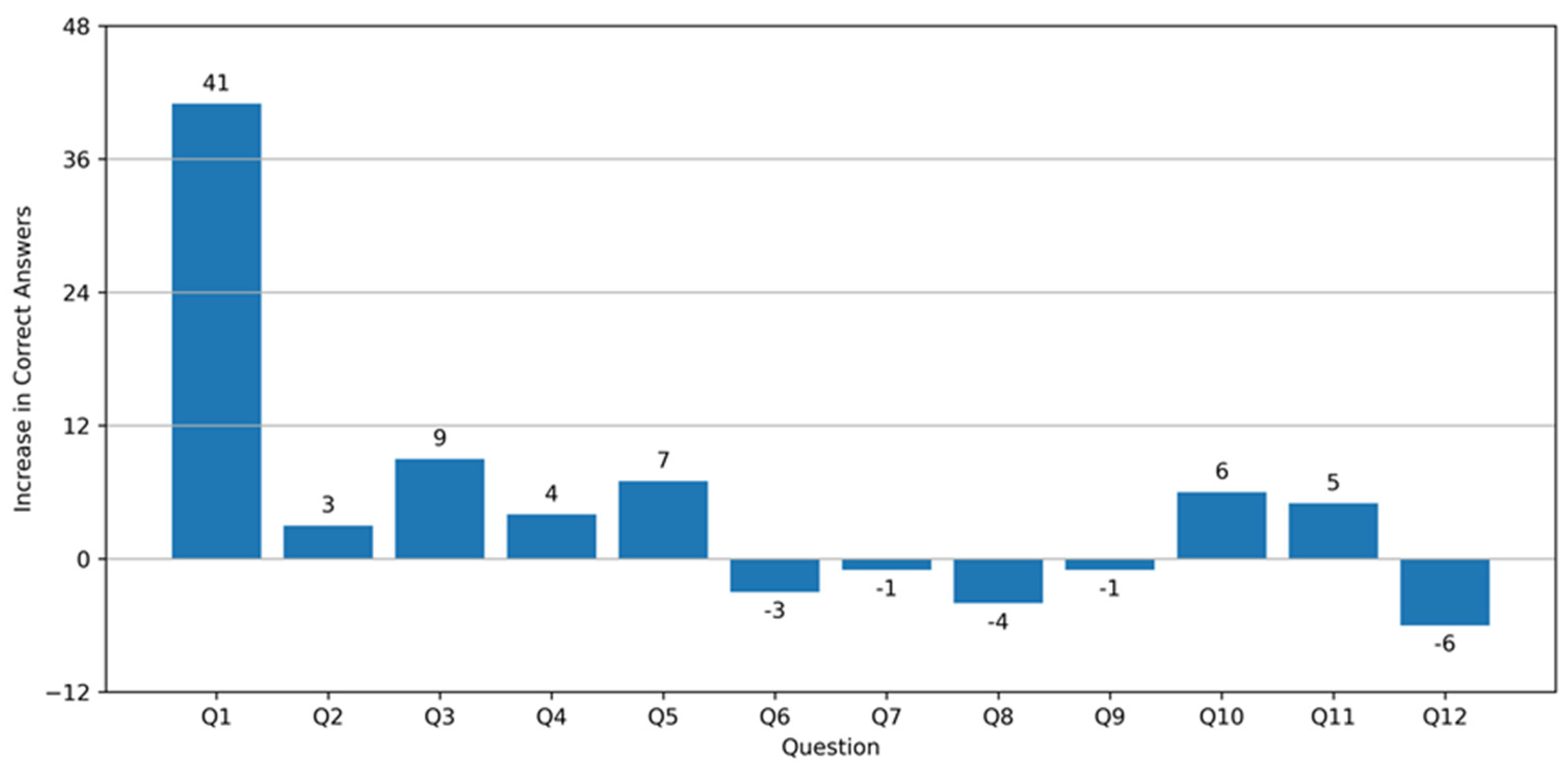
The data show an improvement in seven of the twelve items (Table 2), with Q1 standing out in particular, as it assesses knowledge of the author considered key to the consolidation of didactics as a discipline in the 17th century. The increase in correct answers was +41 (Figure 1), indicating the notable effectiveness of Game-Based Learning (GBL) in conveying historical and foundational content, possibly due to the use of playful dynamics that promote contextualized memorization. It should be noted that this question was formulated according to Bloom’s taxonomy, specifically at the cognitive level of recall, which demonstrates an improvement in information memorization and retention processes following the instructional intervention.
Significant improvements are also observed in Q3 (+9), which addresses the dual nature of teaching as both a science and an art. This question falls under the cognitive level of understanding, reflecting progress in students’ ability to make sense of information and establish connections following the intervention.
Similarly, improvements are observed in Q5 (+7), a question that addresses strategies for integrating interculturality into educational practice, focusing on the cognitive level of application. This reflects progress in students’ ability to transfer and apply their learning to new situations or contexts.
Improvements are also observed in Q10 (+6), which compares the emerging artistic model with the traditional instructional model. These results suggest that GBL enhances the understanding of content requiring comparative analysis, critical reflection, and practical application. This question falls within the cognitive level of evaluating, which also demonstrates an improvement in critical thinking processes, information assessment, and informed decision-making following the instructional intervention.
Along these same lines, it is worth noting that questions Q2, Q4, and Q11 also show moderate improvements (+3 to +5 correct answers), indicating a consolidation of learning regarding concepts such as the etymological meaning of didactics, the child-centered model, and the design of proposals based on the sociocommunicative approach. The results obtained support the improvements in the cognitive levels previously noted and, likewise, reinforce the validity of the educational intervention by demonstrating a positive impact on the development of students’ cognitive processes.
However, a decline in performance is observed on items Q6 (−3), Q7 (−1), Q8 (−4), Q9 (−1), and Q12 (−6). These items address content related to inclusion in contexts of cultural diversity, the limitations of a closed curriculum, the relationship between curricular areas, the definition of teaching–learning methods, and the design of activities for emotional development. The decline in these cases could be due to the conceptual complexity of the content, the need for greater reflective depth, or the gamified dynamics being less suitable for promoting critical thinking and interdisciplinary integration. Thus, the results reveal a decline in performance on items linked to the “analyze” and “create” levels, highlighting the need to reinforce these learning outcomes through direct teacher intervention and the design of complementary tasks aimed at developing higher-order cognitive skills.
Regarding inferential analysis, to examine differences in student performance between the pretest and posttest in Topic 1, the Wilcoxon signed-rank test for paired samples was applied. The results show a significant improvement (Table 3), since, on the one hand, regarding the total score, only one participant scored lower on the posttest than on the pretest, while 51 participants scored higher, and no ties were recorded. The contrast statistic revealed a significant difference between the two measurements (Z = −6.266; p = 0.000), indicating a systematic improvement in students’ total scores following the intervention.
Similarly, when analyzing the number of correct answers, it was observed that 38 students improved their performance on the posttest, 12 maintained the same number of correct answers, and only 2 scored lower than on the pretest. The Wilcoxon test again confirmed significant differences (Z = −5.325; p = 0.000), indicating a significant increase in the number of correct answers following the intervention. These results demonstrate a positive and statistically significant effect of the intervention on learning in Topic 1, both in terms of total scores and the number of correct answers obtained by the students.

4.2. Level of Understanding of the Content of Topic 4 (Pre-Test, Post-Test)

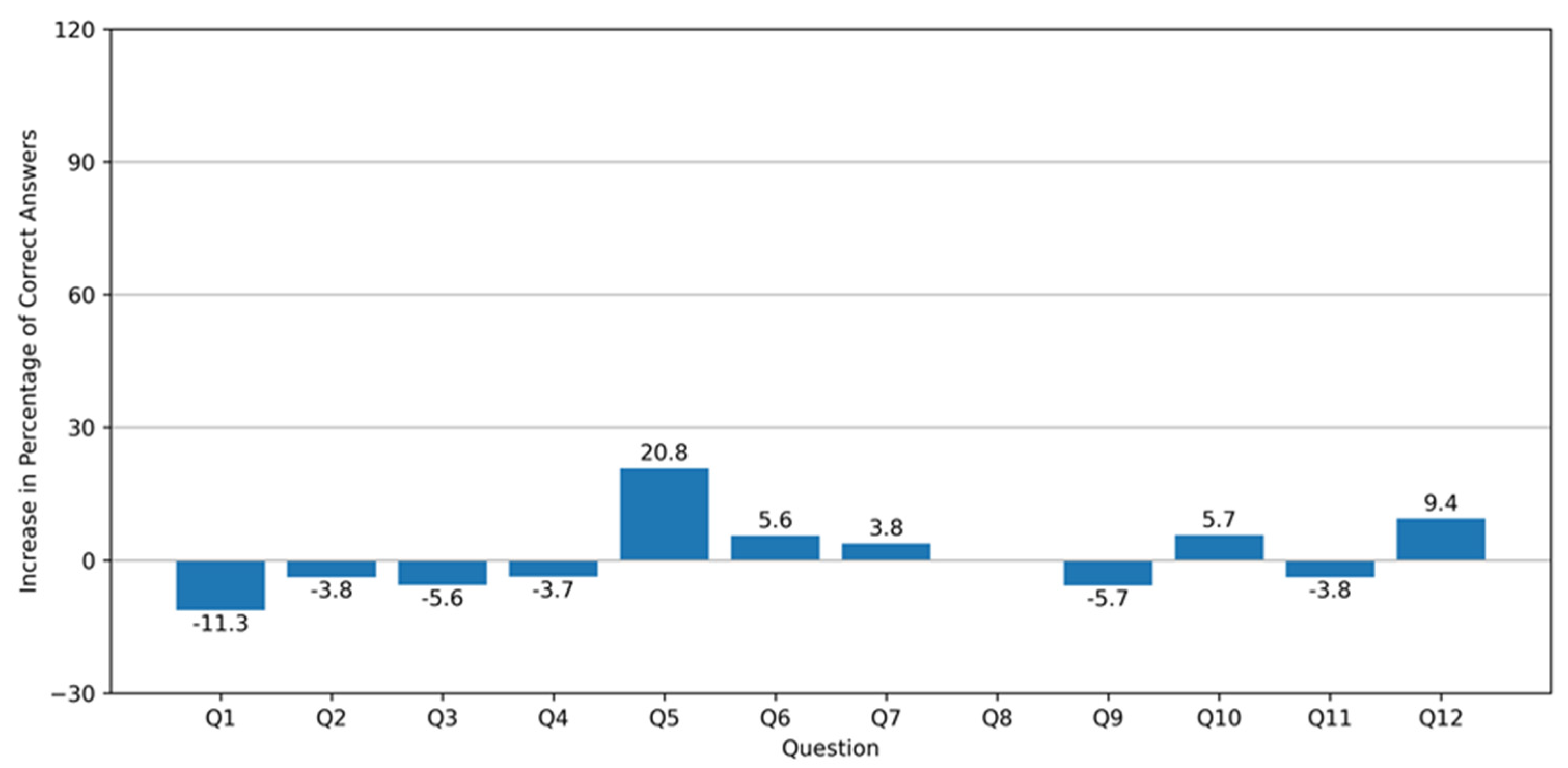
The frequency results (Table 4) show an improvement in five of the twelve questions analyzed (Figure 2), with a particularly notable increase in item Q5, which addresses the layout of classroom spaces for children aged 0–1 year. The increase in correct answers (+11) suggests that GBL promotes understanding of applied content related to the organization of the physical environment based on students’ basic needs, which is consistent with the principles of child-centered teaching. This question falls within the application level, once again highlighting the positive impact of implementing GBL on students’ ability to use acquired knowledge in practical and applied educational situations.
An improvement is also observed in Q12, which assesses the integration of multisensory symbolic resources into classroom routines for pedagogical purposes. The increase of five correct answers indicates that GBL can facilitate the adoption of innovative teaching strategies, especially those involving creativity, sensory stimulation, and instructional planning. This is a highly relevant aspect, as it has been formulated in accordance with the cognitive level of “creating”, demonstrating an improvement in the processes of generating, planning, and producing original ideas based on the learning acquired through the ABP intervention.
Questions Q6 and Q7, focused on the corner methodology and the promotion of children’s autonomy, also show improvements. These results suggest that GBL reinforces the understanding of active methodological approaches, especially when linked to practical experiences and participatory dynamics. It should be noted that both questions fall under the application and analysis levels, respectively, reinforcing the idea that GBL contributes to the development of higher-order cognitive processes.
In the case of Q10, 100% of correct answers were achieved on the post-test, indicating a consolidation of learning regarding the aesthetic and motivational value of webquest teaching materials. This is a very important aspect, as it falls at the evaluation level, associated with the ability to make well-founded critical judgments.
Conversely, a decline in performance was observed on questions such as Q1 (classification of the webquest as a symbolic resource), Q2 (relationship between spaces, resources, and curricular elements), Q3 (child–environment interaction in holistic development), and Q4 (role of aesthetic sensitivity in the educational environment). These items, which are more conceptual and abstract in nature, do not appear to benefit significantly from the video game-based intervention. This could be due to a lack of alignment between the nature of the content and the playful dynamics employed, which limits students’ ability to make theoretical inferences or apply complex conceptual frameworks. Likewise, items Q9 (pedagogical value of the “cave” space) and Q11 (spatial configuration in the “hands-on” model) show a slight decrease in correct responses, suggesting that, although these contents are linked to the design of the educational environment, their understanding requires deeper reflection on pedagogical coherence and didactic intent.
Regarding the inferential analysis (Table 5), of the 48 participants, 27 showed an increase in correct answers on the posttest compared to the pretest, 14 scored lower on the posttest, and 7 showed no change. The mean number of correct answers on the posttest (M = 10.52; SD = 1.429) is higher than that of the pretest (M = 9.88; SD = 1.758), suggesting a trend toward improved performance following the intervention.
Regarding the statistical test, the Z-value was −1.913 with a two-tailed significance level of p = 0.056. This value is very close to the conventional significance threshold but does not reach it. Therefore, it cannot be stated with statistically significant evidence that there is an improvement in performance between the pretest and the posttest. However, the observed trend indicates a possible improvement that could be considered relevant from a pedagogical or practical standpoint, even though it does not reach strict statistical significance.

4.3. Analysis of Learning Outcomes According to Bloom’s Taxonomy Topic 1 and Topic 4 (Pre-Test, Post-Test)

To further explore the cognitive effects of the intervention on Topic 1 (Table 6), item scores were grouped according to Bloom’s revised taxonomy. As shown in Table 6, the largest improvement was observed in the Remember dimension, with correct responses increasing from 47 out of 104 possible answers (45.2%) in the pretest to 91 out of 104 (87.5%) in the posttest. Improvements were also identified in Understand, which increased from 51.0% to 63.5%, Apply, which increased from 67.3% to 71.2%, and Evaluate, which increased from 48.1% to 52.9%.
In contrast, slight decreases were observed in Analyze and Create. The percentage of correct responses in Analyze decreased from 47.1% to 42.3%, while Create showed a marginal reduction from 63.5% to 62.5%.
Overall, these findings suggest that the intervention was particularly effective in enhancing lower- and intermediate-order cognitive processes related to knowledge acquisition, comprehension, and application of theoretical concepts in Topic 1. However, improvements were less evident in higher-order cognitive processes such as analysis and creation.
To further examine the cognitive effects of the intervention on Topic 4, item scores were grouped according to Bloom’s revised taxonomy. As shown in Table 7, the greatest improvement was observed in the Apply dimension, where correct answers increased from 61 out of 102 possible answers (59.8%) in the pretest to 75 out of 96 (78.1%) in the posttest. Improvements were also identified in Create, which increased from 83.3% to 91.7%, and Analyze, which increased from 79.4% to 86.5%.
More stable results were observed in Understand and Evaluate, with slight increases from 91.2% to 91.7% and from 94.1% to 94.8%, respectively. In contrast, Remember showed a slight decrease, from 86.3% in the pretest to 83.3% in the posttest.
Overall, these findings suggest that, in Topic 4, the intervention was particularly effective in supporting applied, analytical, and creative cognitive processes, while changes in knowledge retention, understanding, and evaluation were more limited.
The analysis based on Bloom’s revised taxonomy revealed a significant improvement in Lower-Order Thinking Skills for Topic 1 (Table 8), with students obtaining significantly higher scores in the posttest than in the pretest (Z = −4.930, p = 0.000). In contrast, no significant changes were observed in Higher-Order Thinking Skills for Topic 1 (p = 0.960). Regarding Topic 4, although posttest scores were higher for both, these differences did not reach statistical significance (p = 0.059 and p = 0.170, respectively).

4.4. Analysis of Students’ Perceptions of Game-Based Learning (GBL) Methodology

The results of the descriptive analysis (Table 9) show a highly positive assessment by participants regarding the game-based learning methodology. Items related to the general perception of the methodology, its usefulness for learning, its motivational and fun nature, as well as the desire to repeat similar experiences in the future, have means above 4.75, with low standard deviations (SD < 0.60) and reduced variances, indicating a high concentration of responses at the highest levels of the scale. In particular, the item “The learning methodology made learning fun” achieved the highest mean (M = 4.94), with a standard deviation of just 0.238, reflecting an almost unanimous perception of enjoyment.
These results are reinforced by the response frequencies (Table 10), where more than 80% of participants rate themselves at the “strongly agree” level on the positive items, and no participant disagrees. On the other hand, the item “I prefer learning by playing educational games rather than using traditional materials” has a slightly lower mean (M = 4.45) and greater dispersion (SD = 1.045; S = 1.093), suggesting a greater diversity of opinions regarding the preference for this type of methodology over traditional approaches. Finally, the reverse item “I would have preferred to attend a traditional lecture today rather than learn by playing educational games” shows the lowest mean (M = 2.24) and the highest variance (S = 3.104), with 62.7% of responses in the “strongly disagree” category, confirming the rejection of more conventional methods in favor of game-based approaches. These results demonstrate strong acceptance of the GBL methodology, both in terms of motivation and perceived effectiveness, and support its application in educational contexts as an active, student-centered strategy.

5. Discussion

The results obtained can be interpreted in light of the instructional design model identified by [68], based on Bloom’s taxonomy, which proposes a progression from lower cognitive levels associated with greater passivity (remember, understand, apply) toward higher levels linked to more active student participation (analyze, evaluate, and create). In this regard, the observed improvement in the “apply,” “understand,” and “evaluate” levels in both topics suggests that the Game-Based Learning (GBL) methodology fosters active learning contexts, in which students take on a leading role and actively participate in the construction of knowledge. This finding is consistent with this model, as it positions practical and experiential learning as facilitators of higher-order cognitive processes, and is also in line with previous studies [16,17] that highlight the potential of video games to promote higher-order cognitive skills such as creative problem-solving, logical-deductive reasoning, planning, and decision-making, as well as knowledge acquisition. Nevertheless, the interpretation of these findings should be approached with caution. Although improvements were observed in cognitive levels associated with apply, analyze, and evaluate, the intervention was implemented over a relatively short period of time and therefore does not allow conclusions regarding the long-term development of higher-order thinking skills. Moreover, improvements in performance do not necessarily imply the stable acquisition of these competencies beyond the instructional context. In fact, the statistical analysis did not reveal any significant differences in higher-order skills. However, statistically significant differences were found in lower-order skills related to Topic 1, which addresses the theoretical foundations of the subject. This finding suggests that the intervention primarily promoted conceptual understanding and its application. However, this effect does not appear to have extended to more complex cognitive processes, such as analysis, evaluation, or creation, for which a longer duration of the intervention, or a deeper level of engagement with the content may be required. Furthermore, these findings are consistent with students’ perceptions regarding the motivational potential of GBL compared to traditional methodologies, as well as its ability to facilitate learning acquisition in a more engaging and meaningful way. These results should be interpreted considering previous studies that highlight the potential of active methodologies, and more specifically of GBL, to increase student motivation and promote the acquisition of meaningful learning [69,70]. An alternative explanation for the positive perceptions reported by students may be the novelty effect. Since educational video games are not commonly used in many higher education contexts, part of the motivational benefits observed may be associated with the innovative nature of the experience rather than exclusively with the pedagogical characteristics of GBL. Future longitudinal studies are needed to determine whether these positive perceptions remain stable over time.
Moreover, based on the results, GBL appears to be particularly suitable for supporting the learning of applied content, especially that which is related to classroom organization, activity planning, and the design of instructional resources. These aspects, being closely connected to educational practice, may benefit from active learning environments that promote participation, decision-making, and problem-solving, as previously suggested in the literature [17,28]. However, the effectiveness of GBL should not be assumed to be uniform across all types of educational content. While conceptual, reflective, and epistemological content can also benefit from game-based approaches, these forms of knowledge may require complementary instructional strategies to foster deeper abstraction, critical analysis, and theoretical understanding. Therefore, rather than being considered a stand-alone solution, GBL may be most effective when integrated with other pedagogical approaches, such as case studies, guided discussions, or critical reading activities, which can help students connect practical experiences with broader conceptual and theoretical frameworks [71,72,73]. Thus, it is essential that the instructional design of activities within the GBL framework be aligned with specific learning objectives, taking into account the type of knowledge to be promoted and the students’ cognitive profile. In this regard, it is recommended to incorporate elements of metacognition and pedagogical reflection into the dynamics of GBL to foster the connection between theory and practice, as well as knowledge retention and the development of critical professional competencies in future teachers. This is a relevant aspect, as previous research suggests [74,75,76,77], the effectiveness of its implementation depends not only on the playful dimension of this methodology but also on the incorporation of cognitive scaffolding, careful planning of sessions, and their alignment with learning objectives; for in the absence of these elements, students might focus on the playful dimension to the detriment of academic content assimilation, thereby minimizing their potential. Although the present findings support the educational potential of GBL, they should not be interpreted as evidence that game-based approaches are inherently superior to other active methodologies. Previous research has shown considerable variability in the magnitude of GBL effects, suggesting that learning outcomes are strongly influenced by factors such as instructional design, alignment with learning objectives, duration of the intervention, and the pedagogical integration of game elements. Therefore, the educational value of GBL appears to depend not only on the use of games themselves but also on how these resources are embedded within broader teaching and learning processes.

5.1. Implications

Based on the results obtained, several implications relevant to educational practice and, especially, to the initial training of teachers in the use of the active methodology of Game-Based Learning (GBL) are identified.

5.1.1. Integration of Educational Video Games as a Teaching Strategy

The findings suggest that educational video games can be an effective pedagogical resource for enhancing content comprehension and promoting different cognitive levels of learning. Their integration into the university classroom can help create more active, participatory, and motivating learning experiences for students.

5.1.2. Design of Activities Aligned with Bloom’s Taxonomy

The use of educational video games allows for structuring learning according to different cognitive levels. In this regard, the design of activities based on Bloom’s taxonomy can facilitate progression from basic levels of knowledge, such as remember and understand, to more complex cognitive processes such as analyze, evaluate, or create.

5.1.3. Development of Cross-Cutting Competencies in Teacher Training

The use of educational video games can contribute to the development of students’ digital competence, as well as that of university faculty, through the pedagogical design and use of this resource. Similarly, the incorporation of educational video games into teacher training can foster creativity regarding methodological innovation, the design of digital activities, and the implementation of active learning strategies in their future educational practice.
Furthermore, it contributes to the development of critical thinking, especially in tasks at the “analyze” and “evaluate” levels of Bloom’s taxonomy, as it requires the in r interpretation of information and the formation of well-founded judgments. It also enhances problem-solving and decision-making skills, linked to the “apply” level, by involving the use of knowledge in practical and dynamic contexts.
Finally, GBL fosters motivation and commitment to learning, as well as the development of autonomous learning and self-regulation skills.

5.2. Limitations and Future Research Directions

Despite the results obtained, this study has some limitations that must be considered. First, the pretest–posttest design without a control group limits the ability to establish robust causal relationships between the intervention and the observed changes in content comprehension. Additionally, the sample size and the use of convenience sampling restrict the generalizability of the results to other educational contexts. Furthermore, although the cognitive assessment was aligned with Bloom’s taxonomy, each cognitive domain was represented by a limited number of items, which restricts the possibility of conducting robust analyses at the domain level. In addition, students’ perceptions were assessed through a self-report questionnaire administered only at the end of the intervention. Therefore, the results provide a descriptive overview of students’ evaluations of the experience and may be influenced by subjective response biases or novelty effects associated with the use of innovative educational methodologies.
In this regard, future research could expand the number of participants and incorporate experimental designs with a control group, which would allow for more robust evidence regarding the impact of educational video games on learning. Future studies could also incorporate a larger number of assessment items within each cognitive domain to examine learning outcomes across different levels of Bloom’s taxonomy more comprehensively. Similarly, it would be relevant to explore the application of this type of resource in different educational stages and subject areas, as well as to analyze other relevant variables, such as motivation, engagement, or the development of higher-order skills.

6. Conclusions

The results of this study demonstrate the potential of educational video games as a pedagogical resource for enhancing pre-service teachers’ understanding of content related to teaching methodology. The use of a pretest–posttest design has revealed improvements in the understanding and practical application of the content by pre-service teachers following their participation in the activity, suggesting that educational video games can help promote more active and meaningful learning processes.
Likewise, the assessment of learning based on the different levels of Bloom’s taxonomy has allowed for an analysis of content comprehension from a broader perspective, considering not only the acquisition of basic knowledge at the recall level but also the development of more complex cognitive skills such as apply, analyze, or evaluate, evidenced through the effective application of what was learned to the various educational situations presented throughout the educational video game.
Taken together, these findings reinforce the value of integrating active methodologies such as GBL into higher education contexts and, more specifically, into initial teacher education, and to promote more active student participation and a deeper understanding of content, while simultaneously developing skills and competencies that will enable them to effectively apply this methodology in their future teaching practice, thereby ensuring its impact extends to their students. However, based on the results of this study, it is clear that there is a need to reinforce the learning gained through the GBL intervention with direct teacher involvement and the design of complementary tasks that foster the development of cognitive processes in line with established academic objectives, the nature of the content, and the personal characteristics or needs of the university students themselves.

Author Contributions

Conceptualization, D.A.-d.P. and F.A.M.-G.; methodology, D.A.-d.P. and J.L.C.-G.; software, D.A.-d.P.; validation, D.A.-d.P. and J.L.C.-G.; formal analysis, J.L.C.-G.; investigation, D.A.-d.P.; resources, D.A.-d.P.; data curation, D.A.-d.P. and J.L.C.-G.; writing—original draft preparation, D.A.-d.P., J.L.C.-G. and F.A.M.-G.; writing—review and editing, D.A.-d.P., J.L.C.-G. and F.A.M.-G.; visualization, D.A.-d.P., J.L.C.-G. and F.A.M.-G.; supervision, D.A.-d.P., J.L.C.-G. and F.A.M.-G.; project administration, D.A.-d.P. All authors have read and agreed to the published version of the manuscript.

Funding

This research received no external funding.

Institutional Review Board Statement

The study was conducted in accordance with the Declaration of Helsinki, and the protocol was approved by the Bioethics and Biosafety Committee of the University of Extremadura (176_2026) on 19 March 2026.

Informed Consent Statement

Informed consent was obtained from all subjects involved in the study.

Data Availability Statement

All data generated or analyzed during this study are included in this published article.

Conflicts of Interest

The authors declare no conflicts of interest.

Abbreviations

The following abbreviations are used in this manuscript:
ICTInformation and Communication Technologies
GBLGame-Based Learning
MMean
SDStandard Deviation

References

  1. Boude Figueredo, O.R.; Sarmiento, J.A. The challenge of training university professionals to integrate mobile learning. Educ. Medica Super. 2017, 31, 61–77. [Google Scholar] [CrossRef]
  2. Umatambo, S.; Villacís, D.K.; García, O.A.; Taco, M.V. The impact of gamification and educational video games on the development of critical thinking in primary education students. J. Educ. Sports Sci. 2025, 3, 370–386. [Google Scholar] [CrossRef]
  3. Quenema, N.; Otero, P.; Condeso, S.; Hernández, E.; Castillo, F. Gamification in educational assessment: Transforming learning into interactive experiences based on a systematic review. InveCom J. 2025, 6, 1–10. [Google Scholar] [CrossRef]
  4. Díaz-Romero, Y.; Díaz-Téllez, A.S.; Mejía-Ríos, J.; Lucero-Baldevenites, E.V. Play and reading: Teaching strategies to develop critical thinking in elementary education. Epistem. Koin. 2024, 7, 133–148. [Google Scholar] [CrossRef]
  5. Indriani, M.N.; Isnarto; Mariani, S. Implementation of the PBL model assisted by Monopoly game media in improving critical thinking ability and self-confidence. J. Prim. Educ. 2019, 8, 200–208. [Google Scholar]
  6. Koten, G.J.L.; Munzil; Utama, C. Improving critical thinking skills of elementary school students: Project-based learning vs. gamification-based group investigation. J. Lesson Learn. Stud. 2023, 6, 311–320. [Google Scholar] [CrossRef]
  7. Carrión, E.; Sotomayor, S.; Medel, I. The use of video games and gamification as innovative teaching materials for learning social sciences in higher education. EDMETIC 2022, 11, 6. [Google Scholar] [CrossRef]
  8. Maraza-Quispe, B.; Torres-Loayza, J.L.; Reymer-Morales, G.T.; Solórzano-Bernuy, R.M.; Choquehuayta-Palomino, S.A.; Pacori-Avilés, F.M. Impact of the use of the SimCity video game on the development of critical thinking in students: A quantitative experimental approach. IEEE Rev. Iberoam. Tecnol. Aprendiz. 2023, 18, 411–418. [Google Scholar] [CrossRef]
  9. Xu, M.; Luo, Y.; Zhang, Y.; Xia, R.; Qian, H.; Zou, X. Game-based learning in medical education. Front. Public Health 2023, 11, 1113682. [Google Scholar] [CrossRef] [PubMed]
  10. Yulia, N.M.; Asna, U.L.; Fahma, M.A.; Reviana, P.A.; Cholili, F.N.; Halimahturrafiah, N.; Sari, D.R. Use of Game-Based Learning Media Education as an Effort to Increase Elementary School Students’ Interest in Learning. J. Educ. Res. Innov. Technol. 2025, 2, 38–45. [Google Scholar] [CrossRef]
  11. Pérez, R.E.; Contreras, L.M. Entornos virtuales de aprendizaje versus modalidad presencial en la formación de profesionales de la Educación. Rev. Interdiscip. Educ. Salud Act. Física Deporte 2024, 1, 85–112. [Google Scholar] [CrossRef]
  12. Prensky, M. Teaching Digital Natives; SM Editions; Corwin: Newbury Park, CA, USA, 2010; Available online: https://www.corwin.com/books/teaching-digital-natives-233944?srsltid=AfmBOorU9DYfjunHl4_zVdl2pSWYg-P75xFP_icDWBTNMnv52zcR1cYx (accessed on 11 June 2026).
  13. Del Moral, M.; Fernández, L.C. Video Games in the Classroom: Implications of a Disruptive Innovation for Developing Multiple Intelligences. Rev. Complut. Educ. 2015, 26, 97–118. [Google Scholar] [CrossRef]
  14. Bokolas, V.; Panagouli, D. Between “Fortnite” and “Civilization”: Digital Games and Historical-Cultural Education. In Proceedings of the European Conference on Games-Based Learning, Odense, Denmark, 3–4 October 2019; Academic Conferences and Publishing International Ltd.: Reading, UK, 2019; pp. 74–81. [Google Scholar] [CrossRef]
  15. AEVI. The Video Game Industry in Spain 2020 Yearbook. 2020. Available online: https://www.egdf.eu/la-industria-del-video-juego-en-espana-anuario-2020/ (accessed on 11 June 2026).
  16. Shi, Y.R.; Shih, J.L. Game factors and game-based learning design model. Int. J. Comput. Games Technol. 2015, 2015, 549–684. [Google Scholar] [CrossRef]
  17. De Freitas, S. Are Games Effective Learning Tools? A Review of Educational Games. Educ. Technol. Soc. 2018, 21, 74–84. [Google Scholar]
  18. Qian, M.; Clark, K.R. Game-based learning and 21st century skills: A review of recent research. Comput. Hum. Behav. 2016, 63, 50–58. [Google Scholar] [CrossRef]
  19. Romero-Romero, L.M.; Torres, Á.; Aguaded, I. Educational gamification for civic engagement: Meaningful experiences. EDUCAR 2017, 53, 109–128. [Google Scholar] [CrossRef]
  20. Hoyos, C.R.; Salvador, A.C. Video games and education: An experience within the framework of a Master’s program at the University of Cantabria. In Media Education and Digital Competence: Ludoliteracy, Collective Creation, and Learning; Aranda, D., Sánchez, J., Eds.; University of Oberta of Cataluña: Barcelona, Spain, 2013; pp. 1136–1145. [Google Scholar]
  21. Jiménez, R.; Cuenca, J.M. The Educational Use of Video Games: Conceptions and Ideas of Future Social Science Teachers; Asociación Proyecto Clío History and History Teaching, University of Zaragoza: Zaragoza, Spain, 2015. [Google Scholar]
  22. Grande De Prado, M. Educational benefits and video games: A review of the Spanish literature. Educ. Knowl. Soc. 2018, 19, 15–35. [Google Scholar] [CrossRef]
  23. Sierra, M.C.; Martín-del-Pozo, M.; Fernández, M.R. Video games for the development of competencies in higher education. Rev. Fuentes 2023, 25, 228–241. [Google Scholar] [CrossRef]
  24. Ahijado, S.R.; Nicolás, A.M.B. Innovation and Music Pedagogy for 21st-Century Teaching in Higher Education. DEDiCA J. Educ. Humanit. 2017, 12, 155–169. [Google Scholar]
  25. Fernández, M.R.; Sierra, M.C.; Valverde, J. Serious Games for the Acquisition of Professional Competencies for Social and Community Development. Rev. Prism. Soc. 2020, 30, 141–160. [Google Scholar]
  26. García, I.; Durán, A. Use of business simulation video games as a learning supplement in the field of Industrial Engineering. Manag. Organ. 2020, 70, 19–27. [Google Scholar] [CrossRef]
  27. Soto, L.M.; Melo, L.; Caballero, A.; Luengo, R. Study of future teachers’ opinions on the use of video games as a teaching resource through a qualitative analysis. Rev. Ibérica Sist. Tecnol. Informação 2019, 33, 48–63. [Google Scholar] [CrossRef] [PubMed]
  28. Ruíz-Chávez, M.N.; Terrones-Marreros, M.A. Gamification in the development of critical thinking in elementary school children. Koinonía 2023, 8, 51. [Google Scholar] [CrossRef]
  29. Chen, H.L.; Yohannes, A.; Hung, N.L. Effect of escape room game-based civics education on junior high school students’ learning motivation, critical thinking, and flow experience. Br. J. Educ. Technol. 2024, 56, 1170–1190. [Google Scholar] [CrossRef]
  30. Kurnianto, F.; Rahmat, D.A.; Kuswanto, H. Effect of AR-integrated traditional games Nglarak Blarak on critical thinking and graphical representation skills. Pegem J. Educ. Instr. 2024, 14, 340–346. [Google Scholar] [CrossRef]
  31. Chávez, J.M.; Reyes, V.M.; Ríos Ramón, W.O.; Sequera Morales, A.G.; Davelouis Casana, P.F. Effects of gamification on the critical thinking of students in General Basic Education. Prohominum J. Soc. Sci. Humanit. 2024, 6, 110–120. [Google Scholar] [CrossRef]
  32. Rizki, I.A.; Suprapto, N.; Saphira, H.V.; Alfarizy, Y.; Ramadani, R.; Saputri, A.D.; Suryani, D. Cooperative learning, digital games, and augmented reality to enhance students’ critical thinking skills and learning motivation. J. Pedagog. Res. 2024, 8, 339–355. [Google Scholar] [CrossRef]
  33. Yifan, Y.; Gopalan, V.; Supli, A.A.; Kumaran, S.R.; Alnagrat, A.J.A. Enhancing primary school students’ motivation in mathematics through game-based learning (GBL). In Advancing Smart Cities. FSC 2022.; Advances in Science, Technology Innovation; Bribi, S.E., Visvizi, A., Troisi, O., Eds.; Springer: Cham, Switzerland, 2024; pp. 261–271. [Google Scholar] [CrossRef]
  34. Seraji, F.; Olsadat, H. Does applying the principles of constructivism learning add to the popularity of serious games? A systematic mixed studies review. Entertain. Comput. 2023, 47, 100585. [Google Scholar] [CrossRef]
  35. Buelow, M.T.; Okdie, B.M.; Cooper, A.B. The influence of video games on executive functions in college students. Comput. Hum. Behav. 2015, 45, 228–234. [Google Scholar] [CrossRef]
  36. Antequera-Barroso, J.A.; Revuelta-Domínguez, F.-I.; Guerra Antequera, J. Similarities in Procedures Used to Solve Mathematical Problems and Video Games. Educ. Sci. 2022, 12, 172. [Google Scholar] [CrossRef]
  37. Bondareva, L.V.; Potemkina, T.V. Video Games in the Development of Cognitive Skills Relevant for Language Learning: A Systematic Review. In Multimodality, Digitalization and Cognitivity in Communication and Pedagogy; Sukhova, N.V., Dubrovskaya, T., Lobina, Y.A., Eds.; Springer International Publishing: Cham, Switzerland, 2021; Volume 20, pp. 73–86. [Google Scholar] [CrossRef]
  38. Bocci, F.; Ferrari, A.; Sarini, M. Putting the Gaming Experience at the Center of the Therapy—The Video Game Therapy® Approach. Healthcare 2023, 11, 1767. [Google Scholar] [CrossRef] [PubMed]
  39. Velasco, A.F.; Padilla, D.S.B.; Newball, A.A.N. Videogames and open feedback systems to enhance probabilistic reasoning and engagement. Int. J. Serious Games 2024, 11, 3–24. [Google Scholar] [CrossRef]
  40. Orhani, S.; Shatri, K. Impact of Computer Games on Learning Concepts in the Subject of Technology with ICT. Educ. Process Int. J. 2025, 17, e2025299. [Google Scholar] [CrossRef]
  41. Gumulak, S.; Webber, S. Playing video games: Learning and information literacy. Aslib Proc. 2011, 63, 241–255. [Google Scholar] [CrossRef]
  42. Gamboa, L.; Guevara, M.G.; Mena, Á.; Umaña, A.C. Taxonomía revisada de Bloom como apoyo para la redacción de resultados de aprendizaje y el alineamiento constructivo. Innov. Educ. 2023, 25, 140–155. [Google Scholar] [CrossRef]
  43. Gómez-Martínez, Y.C. Propuesta pedagógica basada en las habilidades de pensamiento crítico siguiendo la taxonomía de Bloom en el aprendizaje del inglés. Int. Ref. J. Eng. Sci. 2025, 1, 150–169. [Google Scholar] [CrossRef]
  44. Toala, S.R.; Gómez, L.Y.; Guevara, R.N.; Quiñonez, E.C. Aplicación de la taxonomía de Bloom para mejorar la enseñanza-aprendizaje. Sapienza Int. J. Interdiscip. Stud. 2022, 3, 176–189. [Google Scholar] [CrossRef]
  45. Bloom, B.S. (Ed.) Taxonomy of Educational Objectives: The Classification of Educational Goals; Longman: New York, NY, USA, 1956. [Google Scholar]
  46. Forehand, M. Chapter 8: Bloom’s Taxonomy. In Instructional Methods, Strategies and Technologies to Meet the Needs of All Learners; Lombardi, P., Ed.; Pressbooks: Montreal, QC, Canada, 2017; Available online: https://www.saskoer.ca/teachingdiverselearners/chapter/blooms-taxonomy-2/ (accessed on 11 June 2026).
  47. Mendis, M.S.; Arachchige, U.S.P.R.; Ishara, G.K.K.; Nirmal, W.C.; Weerasinghe, H.; Wijesinghe, C.; Madhushara, S.; Dilhara, S.R.; Deivendra, H.; Edirisinghe, M. Redefining pedagogy for the 21st century: A framework combining Bloom’s taxonomy, outcome-based education, and active learning strategies. Int. J. Sci. Eng. Sci. 2025, 9, 79–87. [Google Scholar]
  48. Chuen, P.L.; Yan, H.K. Technology-enriched learning through the lens of Bloom’s Taxonomy: A practice-based framework from classroom observations. Res. Pract. Technol. Enhanc. Learn. 2025, 21, 030. [Google Scholar] [CrossRef]
  49. Kilipiris, F.; Avdimiotis, S.; Christou, E.; Tragouda, A.; Konstantinidis, I. Bloom’s taxonomy student persona responses to blended learning methods employing the metaverse and flipped classroom tools. Educ. Sci. 2024, 14, 418. [Google Scholar] [CrossRef]
  50. Muhamad Sori, Z.; Wan Mustapha, W.H. Bloom’s Taxonomy for Effective Teaching and Learning. SSRN 2025. [Google Scholar] [CrossRef]
  51. Arcia, P.F.; Sanhueza, R. Revisión narrativa de las habilidades cognitivas: Transiciones conceptuales desde Bloom hasta la era digital. Rev. Cient. Compend. 2025, 28, 2. [Google Scholar] [CrossRef]
  52. Krathwohl, D.R. A revision of Bloom’s taxonomy: An overview. Theory Pract. 2002, 41, 212–218. [Google Scholar] [CrossRef] [PubMed]
  53. Khokhar, Y. Bloom’s taxonomy and its digital evolution: A framework for school education. Int. Res. J. Mod. Eng. Technol. Sci. 2025, 7, 3151–3159. [Google Scholar] [CrossRef]
  54. García-Beltrán, E.; Cantero, M.A. Evaluación basada en la Taxonomía de Bloom revisada: Marco teórico y matriz de alineamiento para el diseño y validación de ítems tipo test en educación superior online. Edutec Rev. Electrón. Tecnol. Educ. 2025, 94, 313–329. [Google Scholar] [CrossRef]
  55. Anderson, L.W.; Krathwohl, D.R. (Eds.) A Taxonomy for Learning, Teaching, and Assessing: A Revision of Bloom’s Taxonomy of Educational Objectives; Longman: New York, NY, USA, 2001. [Google Scholar]
  56. Pizarro Aguirre, V.d.L.; Suing Nagua, Á.M. Soft CLIL: How to effectively apply Bloom’s taxonomy to promote reading cognitive skills in higher education. Rev. Kronos 2025, 6, 102–109. [Google Scholar] [CrossRef]
  57. Farelo, J.L. Otras planimetrías y cartografías para diseñar en arquitectura: La taxonomía de Bloom como herramienta para mapear conceptualmente el diseño metodológico de los trabajos escritos. Rev. Concént. 2025, 3, 33–50. [Google Scholar] [CrossRef]
  58. Rodríguez-Doncel, V.; Poveda-Villalón, M.; Calleja, P.; Montiel Ponsoda, E.; Martín-Chozas, P. Estandarización de Guías de Aprendizaje con Competencias ESCO y Taxonomía Bloom; Proyecto de Investigación; Universidad Politécnica de Madrid: Madrid, Spain, 2025; Available online: https://oa.upm.es/91956/4/91956.pdf (accessed on 11 June 2026).
  59. Sparck, E.M.; Bjork, E.L.; Bjork, R.A. On the learning benefits of confidence-weighted testing. Cogn. Res. Princ. Implic. 2016, 1, 3. [Google Scholar] [CrossRef] [PubMed]
  60. Kominski, C. Designing Multiple-Choice Tests to Measure Higher Order Thinking Test Item Writing, Paper 10; University of North Texas Health Science Center: Fort Worth, TX, USA, 2012; Available online: http://digitalcommons.hsc.unt.edu/test_items/10?utm_source=digitalcommons.hsc.unt.edu%2Ftest_items%2F10&utm_medium=PDF&utm_campaign=PDFCoverPages (accessed on 11 June 2026).
  61. Chávez-Valdez, S.M.; Esparza, Ó.A.; Riosvelasco, L. Pre-experimental and quasi-experimental designs applied to the social sciences and education. Teach. Res. Psychol. 2020, 2, 167–178. [Google Scholar] [CrossRef]
  62. Naranjo, G.P.; Pallo, R.M.; Corrales, L.V. Use of interactive digital resources to strengthen reading skills in elementary school students: A quasi-experimental study. Rev. Soc. Front. 2025, 5, e–870. [Google Scholar] [CrossRef]
  63. Boneth-Collante, M.; Salazar, J.; Angarita, A. Use of Moodle to strengthen civic competencies in physical therapy students: A pretest-posttest design. Retos 2022, 44, 242–251. [Google Scholar] [CrossRef]
  64. Hernández-Sampieri, R.; Fernández, C.; Baptista, P. Research Methodology; McGraw Hill: Madrid, Spain, 2014. [Google Scholar]
  65. López-Fernández, D.; Gordillo, A.; Alarcon, P.P.; Tovar, E. Comparing Traditional Teaching and Game-Based Learning Using Teacher-Authored Games on Computer Science Education. IEEE Trans. Educ. 2021, 64, 367–373. [Google Scholar] [CrossRef]
  66. Saá-Rojo, M.D.; Carrillo, D.; Dólera, J.; Ibáñez, F.J.; Maurandi, A.; Sánchez, E. Constructivist Approaches in Mathematics Education: Perceptions of Future Teachers. Educ. Siglo XXI 2025, 43, 121–142. [Google Scholar] [CrossRef]
  67. Cabanillas-García, J.L.; Sánchez-Gómez, M.C.; Guillén-Chávez, E.P.; Hurtado-Mazeyra, A. Teachers perceptions of the application of active methodologies in higher education: A study at a Peruvian public university. Pixel-Bit 2025, 73, 10. [Google Scholar]
  68. Culebro, K.; Garizurieta, J.; Gazca, L.A. Study on the perception of the use of Generative Artificial Intelligence in learning processes among higher education students. RIDE. Ibero-Am. J. Educ. Res. Dev. 2025, 16, e984. [Google Scholar] [CrossRef]
  69. Kloos, C.D.; Alario-Hoyos, C. Educational Pyramids Aligned: Bloom’s Taxonomy, the DigCompEdu Framework, and Instructional Designs. In Proceedings of the 2021 World Engineering Education Forum/Global Engineering Deans Council (WEEF/GEDC), Madrid, Spain, 15–18 November 2021; IEEE: New York, NY, USA, 2021; pp. 110–117. [Google Scholar] [CrossRef]
  70. Wang, Y.; Tan, W.H.; Ye, Q.; Gu, T. Effects of Game-Based Learning on Piano Music Knowledge Among Elementary School Pupils: A Pretest-Posttest Quasi-Experimental Study. JMIR Serious Games 2026, 14, e80766. [Google Scholar] [CrossRef] [PubMed]
  71. Parthasarathy, P.D.; Joshi, S. Accessibility education for software engineers: Evaluating the impact of game-based learning. ACM Trans. Comput. Educ. 2026, 26, 25. [Google Scholar] [CrossRef]
  72. Darvenkumar, T.; Anitha Devi, V. Text-based game: A tool to enhance critical reading and critical thinking skills in English classrooms. Theory Pract. Lang. Stud. 2022, 12, 2298–2306. [Google Scholar] [CrossRef]
  73. Cicchino, M.I. Using Game-Based Learning to Foster Critical Thinking in Student Discourse. Interdiscip. J. Probl.-Based Learn. 2015, 9, 4. [Google Scholar] [CrossRef]
  74. Koekoek, J.; van der Kamp, J.; Walinga, W.; van Hilvoorde, I. Exploring students’ perceptions of video-guided debates in a game-based basketball setting. Phys. Educ. Sport Pedagog. 2019, 24, 519–533. [Google Scholar] [CrossRef]
  75. Lozada, R.F.L.; Luna, L.F.B.; Aragón, J.E.C.; Abril, M.E.P. Game-Based Learning (GBL) Strategies in Education: Impact on Motivation and Content Retention. Polo Conoc. 2025, 10, 135–151. [Google Scholar] [CrossRef]
  76. Martínez-Martínez, M. Conceptual mapping of Game-Based Learning as an educational strategy. In Educational Innovations: Models, Designs, and Methodologies for Learning; Castañeda, M.E., Ed.; Editorial Mexicana del Tepeyac: Mexico City, Mexico, 2025; pp. 191–220. [Google Scholar]
  77. Serra, A.; Gabarda, V.; Pardo, M.I.; Busó, P. Between Motivation and Knowledge: A Systematic Review of Game-Based Learning in School Education. Rev. Lusófona Educ. 2025, 69. [Google Scholar] [CrossRef]
Figure 1. Improvement in correct answers per question (Topic 1).
Digital 06 00050 g001
Figure 2. Improvement in the frequency (%) of correct answers per question (Topic 4).
Digital 06 00050 g002
Table 1. Distribution of Cognitive Assessment Items According to Bloom’s Taxonomy.
TopicBloom DomainItemDescription
1RememberQ1Which 17th-century author is considered key to the consolidation of didactics as a discipline?
Q2What is the meaning of the term “didactics” according to its Greek root didaktiké?
UnderstandQ3Why is didactics considered both a science and an art?
Q4What does the student-centered model (child-centeredness) entail?
ApplyQ5A teaching team wishes to integrate interculturality into their educational practice. What would be a coherent strategy?
Q6You are participating in a project to improve inclusion in a culturally diverse classroom. What action would be most appropriate?
AnalyzeQ7What limitation does a closed curriculum present regarding the teacher’s role?
Q8How are the areas of Communication and Representation of Reality and Discovery and Exploration of the Environment related?
EvaluateQ9Why is it important to clearly define teaching and learning methods in the curriculum?
Q10What advantages does the emerging artistic model offer compared to the traditional instructional model?
CreateQ11You are going to design a didactic proposal based on the socio-communicative model. What elements would you include?
Q12Q12 What type of activities would you design to work on emotional development from a globalized approach?
4RememberQ1What type of resource is a WebQuest, according to the classification of symbolic resources?
Q2What element of the curriculum does spaces, resources, and time determine?
UnderstandQ3How does the interaction between a child and their environment influence the construction of their holistic development, according to a current educational perspective?
Q4What role does aesthetic sensitivity play in shaping the educational environment in Early Childhood Education?
ApplyQ5You must organize a classroom for a group of children aged 0–1 years. How would you distribute the spaces to meet their basic needs?
Q6Within the framework of an active methodology based on learning centers, you wish to foster autonomy in Early Childhood Education children. What strategy would be most appropriate to achieve this goal?
AnalyzeQ7What are the implications of learning centers not being static throughout the school year?
Q8What are the differences between workshop-based organization and the traditional classroom structure in terms of methodology and student roles?
EvaluateQ9What pedagogical value does the “Cave” space bring to a holistic learning environment in Early Childhood Education?
Q10From a pedagogical perspective, how does the aesthetic and motivational component of teaching materials influence learning processes in Early Childhood Education?
CreateQ11You have been asked to design an educational environment based on the “hands-on” model for a group of 4-year-olds. What spatial configuration would be most consistent with this approach?
Q12You have designed a symbolic resource that combines auditory and visual stimulation. How would you integrate this resource into the classroom routine for a pedagogical purpose?
Table 2. Evolution of performance in specific knowledge before and after the GBL intervention for Topic 1 (n = 52 PRE/POST).
QuestionsErrors/Correct
Answers
Pre-TestPost-Test
n%n%
Q1Errors4890.6713.2
Correct answers47.54584.9
Q2Errors917.0611.3
Correct answers4381.14686.8
Q3Errors2649.11732.1
Correct answers2649.13566.0
Q4Errors2547.22139.6
Correct answers2750.93158.5
Q5Errors1630.2917.0
Correct answers3667.94381.1
Q6Errors1834.02139.6
Correct answers3464.23158.5
Q7Errors2343.42445.3
Correct answers2954.72852.8
Q8Errors3260.43667.9
Correct answers2037.71630.2
Q9Errors2547.22649.1
Correct answers2750.92649.1
Q10Errors2954.72343.4
Correct answers2343.42954.7
Q11Errors2241.51732.1
Correct answers3056.63566.0
Q12Errors1630.22241.5
Correct answers3667.93056.6
Table 3. Pre-test and post-test results for total scores and the number of correct answers (Topic 1).
VariablePre-TestPost-TestZp-Value
MSDMSD
Total score4344.061605.1155599.171920.212−6.2660.000
Correct6.442.3387.602.483−5.3250.000
Table 4. Evolution of performance in specific knowledge before and after the GBL intervention for Topic 4 (n = 51 PRE; n = 48 POS).
QuestionsErrors/Correct AnswersPre-TestPost-Test
n%n%
Q1Errors713.21018.9
Correct answers4483.03871.7
Q2Errors713.2611.3
Correct answers4483.04279.2
Q3Errors11.911.9
Correct answers5094.34788.7
Q4Errors815.1713.2
Correct answers4381.14177.4
Q5Errors2954.71528.3
Correct answers2241.53362.3
Q6Errors1222.6611.3
Correct answers3973.64279.2
Q7Errors1222.6713.2
Correct answers3973.64177.4
Q8Errors917.0611.3
Correct answers4279.24279.2
Q9Errors59.459.4
Correct answers4686.84381.1
Q10Errors11.900
Correct5094.348100
Q11Errors35.723.8
Correct answers4890.64686.8
Q12Errors1426.4611.3
Correct answers3769.84279.2
Table 5. Pre-test–post-test results for the number of correct answers (Topic 4).
VariablePre-TestPost-TestZp-Value
MSDMSD
Correct answers9.881.75810.521.429−1.9130.056
Table 6. Pretest and posttest performance according to Bloom’s revised taxonomy (Topic 1).
Cognitive Process (Bloom)Associated ItemsPre-Test Correct Answers/Total Possible n (%)Post-Test Correct Answers/Total Possible n (%)Difference (%)
RememberQ1–Q247/104 (45.2)91/104 (87.5)+42.3
UnderstandQ3–Q453/104 (51.0)66/104 (63.5)+12.5
ApplyQ5–Q670/104 (67.3)74/104 (71.2)+3.9
AnalyzeQ7–Q849/104 (47.1)44/104 (42.3)−4.8
EvaluateQ9–Q1050/104 (48.1)55/104 (52.9)+4.8
CreateQ11–Q1266/104 (63.5)65/104 (62.5)−1.0
Table 7. Pretest and posttest performance according to Bloom’s revised taxonomy (Topic 4).
Cognitive Process (Bloom)Associated ItemsPre-Test Correct Answers/Total Possible n (%)Post-Test Correct Answers/Total Possible n (%)Difference (%)
RememberQ1–Q288/102 (86.3)80/96 (83.3)−3.0
UnderstandQ3–Q493/102 (91.2)88/96 (91.7)+0.5
ApplyQ5–Q661/102 (59.8)75/96 (78.1)+18.3
AnalyzeQ7–Q881/102 (79.4)83/96 (86.5)+7.1
EvaluateQ9–Q1096/102 (94.1)91/96 (94.8)+0.7
CreateQ11–Q1285/102 (83.3)88/96 (91.7)+8.4
Table 8. Pre-Test–Post-Test results for the number of correct answers (Topic 4).
VariablePre-TestPost-TestZp-Value
MSDMSD
Correct answers Pre-Post Topic 1 Lower-Order Thinking Skills3.271.3454.441.110−4.9300.000
Correct answers Pre-Post Topic 13.171.5173.151.883−0.0500.960
Correct answers Pre-Post Topic 4 Lower-Order Thinking Skills4.750.9975.061.060−1.8850.059
Correct answers Pre-Post Topic 4 Higher-Order Thinking Skills5.1415.460.683−1.3740.170
Table 9. Descriptive statistics for the items.
ItemMinimumMaxMSDS
My overall opinion of the learning methodology used is positive.454.820.3850.148
The learning methodology helped me learn.354.750.5950.354
The learning methodology was engaging and motivating.354.860.4010.161
The learning methodology made learning fun.454.940.2380.056
I would like to take more classes like this in the future.354.900.3610.130
I prefer learning by playing educational games rather than using traditional materials.154.451.0451.093
I would have preferred to attend a traditional lecture today instead of learning by playing educational games.152.241.7623.104
Table 10. Frequency (%) of responses to the items.
ItemStrongly DisagreeDisagreeNeither Agree Nor DisagreeAgreeStrongly Agree
My overall opinion of the learning methodology used is positive.00017.682.4
The learning methodology helped me learn.007.89.882.4
The learning methodology was engaging and motivating.0029.888.2
The learning methodology made learning fun.0005.994.1
I would like to take more classes like this in the future.0025.992.2
I prefer to learn by playing educational games rather than using traditional materials.3.93.95.917.770.6
I would have preferred to attend a traditional lecture today instead of learning by playing educational games.62.75.92.03.925.5
Disclaimer/Publisher’s Note: The statements, opinions and data contained in all publications are solely those of the individual author(s) and contributor(s) and not of MDPI and/or the editor(s). MDPI and/or the editor(s) disclaim responsibility for any injury to people or property resulting from any ideas, methods, instructions or products referred to in the content.