1. Introduction
The integration of Artificial Intelligence (AI) within cultural heritage preservation has redefined the methodologies available for safeguarding archaeological artifacts and historic sites. Early computer-vision breakthroughs, such as feature-based matching, bundle adjustment, and multi-view stereo, enabled precise, high-fidelity 3D reconstructions from terrestrial imagery [
1]. More recent developments have augmented these workflows by applying machine-learning classifiers, such as Mask R-CNN, FCN, and YOLO, which automate the detection of surface anomalies, thereby streamlining tasks ranging from artifact cataloguing to predictive conservation modeling.
Early applications in virtual heritage have played a critical role in shaping regional digitization efforts, drawing attention to key advances in 3D documentation and visualization, particularly the integration of terrestrial laser scanning into sophisticated digital workflows [
2]. Earlier assessments highlighted the transformative potential of portable laser scanners, emerging in the late 1990s and early 2000s, to capture highly detailed architectural geometries with the accuracy required for virtual reconstruction [
3].
Environmental monitoring technologies have likewise broadened the toolkit available for heritage conservation. Laohaviraphap and Waroonkun [
4] show that IoT sensor networks operating over low-power, wide-area protocols such as NB-IoT and LoRa enable the continuous collection of microclimatic data, including temperature, relative humidity, and air-quality indices, across indoor and outdoor environments. These data streams feed into real-time visualization tools and edge-processing systems, forming the basis for threshold-based alert mechanisms and supporting timely, evidence-based responses to emerging conservation needs.
Despite continued technological advancements, the integration of computational systems into heritage contexts raises substantive ethical concerns. Ghaith [
5] drew attention to the risk that algorithmic reconstruction may inadvertently impose homogenizing representational models or suppress culturally specific forms of expression. To mitigate these risks, she proposes governance frameworks that embed bias-reduction protocols, maintain transparent, open-source auditability, and establish clearly structured stakeholder review mechanisms. Such provisions are essential to ensuring that curatorial judgment remains central to interpretive authority and decision-making within heritage preservation.
Comprehensive surveys affirm the global expansion of computationally supported conservation initiatives. From early virtual reality walkthroughs and photogrammetric meshes to contemporary platforms incorporating sensor-based diagnostics and immersive reconstructions, the field has undergone marked development [
1,
3]. Concurrently, experimental applications of Augmented and Mixed Reality (AR/MR) are being pursued to enhance public engagement and expand interpretive possibilities.
In parallel with these technological developments, the rapid expansion of digital tourism has emerged as an increasingly significant driver of innovation in cultural heritage preservation. Online platforms, virtual museums, and immersive virtual reality environments now play a central role in shaping how global audiences encounter historical sites, particularly those that are geographically remote, politically constrained, or physically vulnerable [
6]. Within this context, the application of artificial intelligence to three-dimensional reconstruction, environmental monitoring, and content personalization constitutes not merely a technical enhancement but a strategic response to growing expectations for interactive, high-fidelity, and sustainable modes of cultural engagement. For regions such as Asia Minor, in this study conceived as a historical–cultural construct denoting the stratified civilizational fabric of Anatolia and the wider Eastern Aegean, rather than as a reference to the contemporary political territories of modern Turkey or Greece, where substantial portions of the architectural and archaeological record remain difficult to access or face ongoing risks of deterioration, AI-supported digital documentation and visualization function as a critical interface linking preservation imperatives, public accessibility, and the evolving dynamics of the digital tourism economy [
7].
Ultimately, the convergence of AI and cultural heritage conservation thus signals a significant reconfiguration in the stewardship of material history. Progress in digitization, environmental monitoring, and immersive visualization continues to underscore these technologies’ transformative capacities. Nevertheless, preserving the integrity of the world’s cultural legacy will require not only sustained technical innovation but also robust ethical frameworks and sustained interdisciplinary collaboration.
2. Materials and Methods
This study employs bibliometric methods to investigate the application of AI in the preservation and advancement of Asia Minor’s cultural heritage [
8,
9]. To ensure a systematic and comprehensive selection of relevant literature, Scopus was designated as the primary and sole data source for curating the dataset, owing to its standardized indexing architecture, consistent bibliographic metadata, and well-established suitability for large-scale bibliometric mapping and reproducible network analysis within interdisciplinary research domains [
10,
11]. The query utilized to retrieve the dataset is provided below:
TITLE-ABS-KEY ((“artificial intelligence” OR “machine learning” OR “AI” OR “ML” OR “text mining” OR “digitization” OR “virtual reality” OR “augmented reality”) AND (“cultural heritage” OR “heritage preservation” OR “historical preservation” OR “digital archives” OR “archaeology” OR “history” OR “cultural studies”) AND (“Asia Minor” OR “Anatolia” OR “Eastern Mediterranean” OR “Near East” OR “Aegean” OR “Byzantine” OR “Ottoman”)) AND (LIMIT-TO (SUBJAREA, “ARTS”) OR LIMIT-TO (SUBJAREA, “SOCI”) OR LIMIT-TO (SUBJAREA, “COMP”) OR LIMIT-TO (SUBJAREA, “ENGI”) OR LIMIT-TO (SUBJAREA, “DECI”) OR LIMIT-TO (SUBJAREA, “MATE”) OR LIMIT-TO (SUBJAREA, “ENVI”)) AND (LIMIT-TO (DOCTYPE, “cp”) OR LIMIT-TO (DOCTYPE, “ar”) OR LIMIT-TO (DOCTYPE, “ch”) OR LIMIT-TO (DOCTYPE, “cr”) OR LIMIT-TO (DOCTYPE, “re”) OR LIMIT-TO (DOCTYPE, “bk”)) AND (LIMIT-TO (LANGUAGE, “English”))
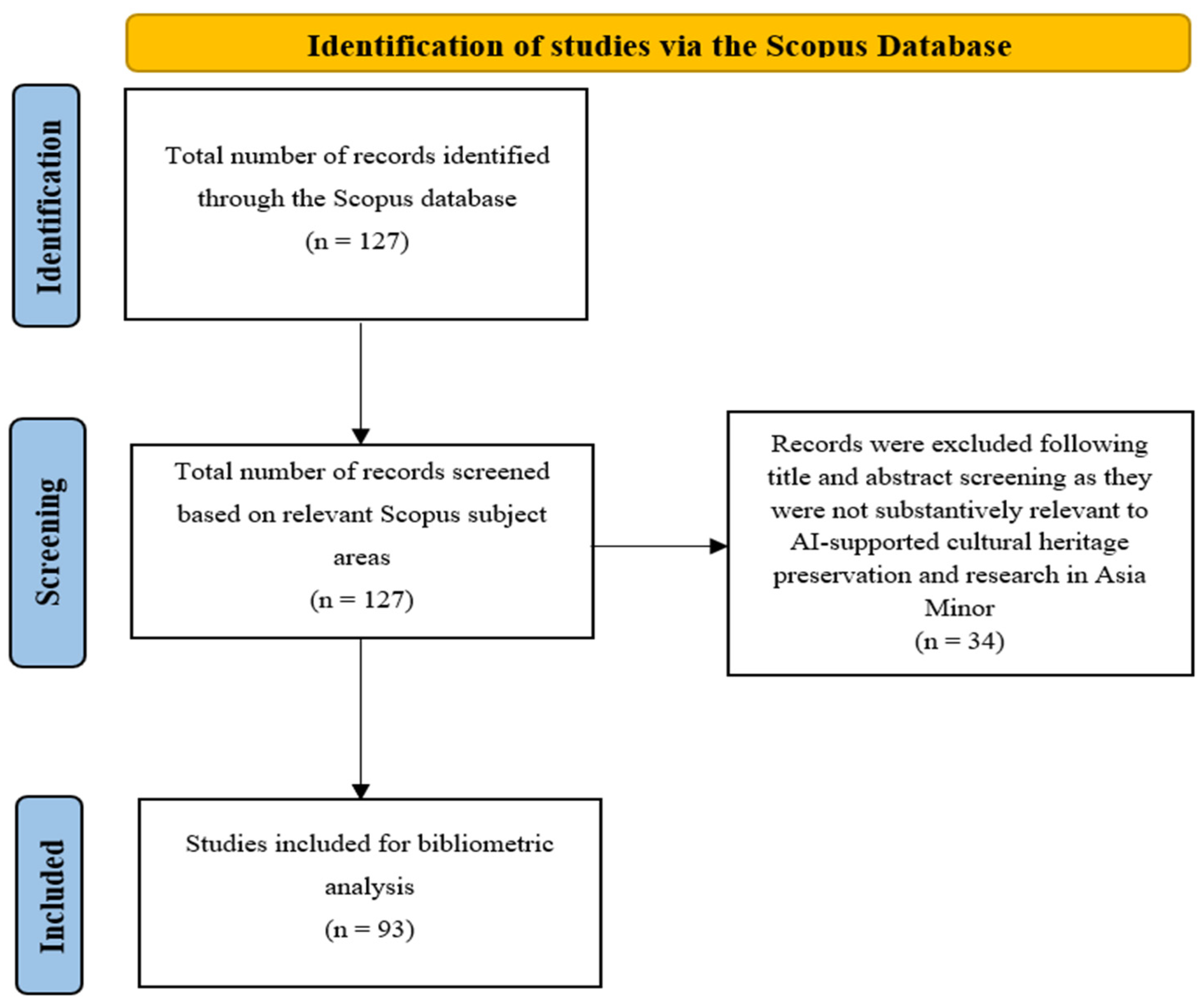
To guarantee complete transparency and reproducibility, the identification and screening of studies were conducted in accordance with the PRISMA 2020 framework (Preferred Reporting Items for Systematic Reviews and Meta-Analyses), as illustrated in
Figure 1 [
12].
The identified corpus of 93 publications, spanning a 25-year research trajectory, reflects a strategic, methodologically rigorous focus on the historically and geographically specific construct of “Asia Minor” as the primary search descriptor. Although substituting this term with broader contemporary geopolitical labels such as “Turkey” or “Greece” would have yielded several thousand results, such an expansion would have substantially diluted the analysis’s thematic specificity. The objective of the study was not to produce an exhaustive quantitative survey of digital heritage research in the region, but to isolate scholarship situated at the intersection of artificial intelligence and the shared, multilayered cultural heritage of Asia Minor. Accordingly, the search strategy prioritized conceptual coherence, contextual integrity, and analytical precision over breadth, resulting in a focused, internally consistent body of literature. Within this framework, the term “Asia Minor” is employed not as a geopolitical designation corresponding to present-day national borders, but as a historiographical and cultural-geographical category denoting a constellation of historically interconnected archaeological sites and cultural landscapes. This terminological choice serves to preserve the historical and cultural coherence of the corpus while simultaneously establishing a stable conceptual boundary that clearly delineates the study’s analytical scope. Consequently, the resulting corpus size reflects this deliberately focused conceptual framing, which privileges thematic specificity and analytical coherence, even as it necessarily circumscribes numerical breadth.
Following data extraction, a range of bibliometric indicators was computed using R (version 4.5.2; R Foundation for Statistical Computing, Vienna, Austria) and the Bibliometrix package (version 5.2.1) [
13,
14,
15]. These included descriptive metrics, trend topic analyses, the identification of the most relevant Keywords Plus, and the construction of a co-occurrence network graph, thereby offering a comprehensive portrayal of the academic literature in this field [
16]. Finally, all results are presented in graphs and tables to facilitate interpretation.
3. Results
This section presents the results of the bibliometric analysis, detailing publication trajectories, citation patterns, and thematic configurations within the domain of AI-based cultural heritage research in Asia Minor. The findings delineate prevailing research foci, patterns of keyword co-occurrence, and methodological orientations that characterize the corpus, offering a structured overview of the field’s intellectual landscape.
As shown in
Table 1, the dataset comprises 93 publications drawn from 67 outlets over a twenty-five-year period, indicating a mature yet narrowly distributed field. The zero percent annual growth rate suggests a plateau in publication activity, potentially indicating either a methodologically stable phase of research or the partial underrepresentation of multidisciplinary venues beyond the selected sources. This pattern may also be associated with the geographically bounded search terminology used to construct the dataset, as well as with the dispersion of relevant digital heritage scholarship across adjacent disciplinary domains that are not consistently indexed under Asia Minor-specific descriptors. An average document age of 6.75 years, along with a citation rate of 8.62 per paper, points to a balance between foundational contributions and continued scholarly engagement. The cumulative total of 2695 references further reflects sustained interaction with adjacent domains, including computer graphics, remote sensing, and archaeological science.
Indexing practices are notably comprehensive. Authors supplied 338 unique keywords, while the Keywords Plus algorithm contributed an additional 573 descriptors, yielding a total of 911 terms. This high density of indexing reflects the field’s inherently multidisciplinary character, wherein individual studies routinely synthesize diverse AI methodologies with heritage preservation imperatives. Although such extensive keyword coverage facilitates fine-grained thematic mapping, it simultaneously highlights the epistemological and classificatory challenges researchers face in navigating intersecting technical and contextual domains.
Collaboration emerges as a defining characteristic of this body of literature. Among the 93 publications surveyed, 74 involve multiple contributors, averaging 3.26 authors per paper, while only 19 are single-authored. International co-authorship appears in 20.43 percent of the multi-authored works, suggesting that, although cross-border collaborations exist, nationally oriented partnerships remain more common. These figures delineate a scholarly ecosystem sustained by interdisciplinary teamwork, blending computational expertise with domain-specific knowledge of heritage preservation, even as collaborative networks largely remain confined within national boundaries.
Lastly, in terms of publication formats, conference proceedings constitute the predominant outlet, followed by journal articles, with a more modest representation of book chapters, review essays, and monographs. This distribution indicates a prevailing inclination toward disseminating methodological innovations and preliminary findings in venues conducive to rapid scholarly exchange, with more formal elaborations appearing in peer-reviewed journals. The relative scarcity of long-form outputs, such as edited volumes and monographs, points to a current dearth of integrative syntheses within the corpus, underscoring an opportunity for future consolidation and theorization across the field (see
Table 1).
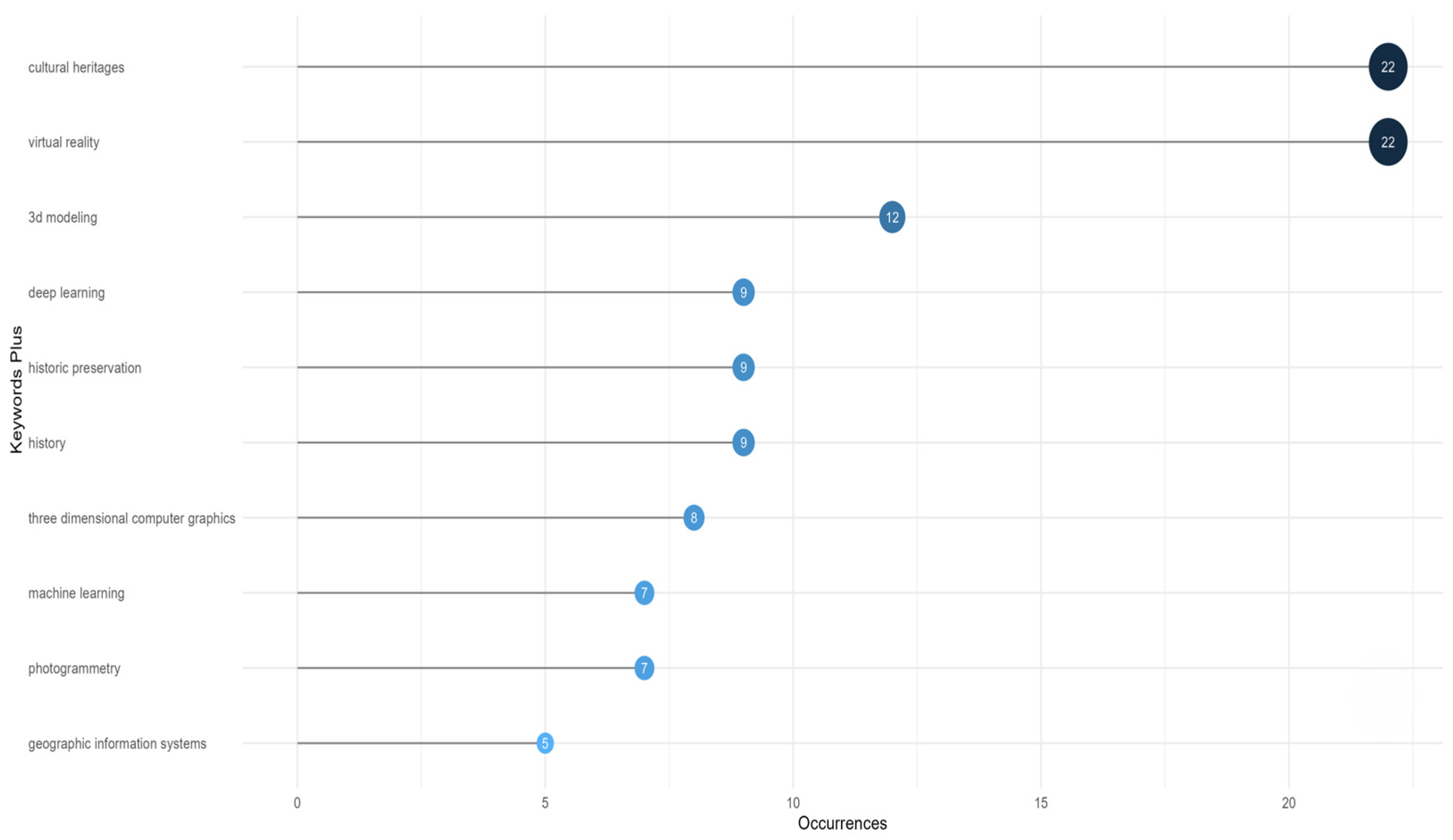
Figure 2 illustrates the ten most frequently occurring keywords Plus in the dataset, prominently featuring cultural heritages and virtual reality, each of which appears 22 times. Their joint preeminence underscores a sustained emphasis on immersive, three-dimensional environments as essential instruments for documenting, interpreting, and disseminating tangible heritage. The parity between these terms suggests that virtual-reality platforms have become integral components of heritage-preservation workflows, offering researchers and public audiences alike interactive reconstructions of archaeological sites.
Following this leading pair, 3D modeling registers 12 instances, further reinforcing the centrality of digital reconstruction techniques. Collectively, these three terms delineate a core methodological axis: the meticulous capture of physical artifacts and sites through precise geometric modeling, followed by their migration into interactive, simulated environments for scholarly analysis and public education. The alignment of 3D modeling with virtual reality suggests that model creation is often undertaken with the explicit aim of achieving immersive visualization.
Occupying the mid-frequency range, each with nine occurrences, are deep learning, historic preservation, and history. The emergence of deep learning alongside established heritage-related terminology signals the nascent incorporation of neural-network approaches into conservation science and historiographical research. Meanwhile, the concurrent appearance of historic preservation and history underscores the field’s enduring commitment to safeguarding cultural narratives, even as computational methodologies become increasingly prominent.
Furthermore, three-dimensional computer graphics appear 8 times, further evidencing the importance of advanced rendering technologies in generating lifelike digital surrogates of heritage assets. At the lower end of the top ten, machine learning and photogrammetry each register 7 occurrences, while geographic information systems appear five times. These frequencies reflect the foundational roles of algorithmic analysis, image-based site capture, and spatial data frameworks in supporting the visualization-centered paradigm.
In sum, the keyword distribution reveals a bifurcated structure: a dominant focus on immersive visualization, manifested in the prominence of cultural heritages, virtual reality, and 3D modeling, complemented by a burgeoning engagement with machine and deep learning techniques, alongside the data-acquisition processes that underpin these advancements. This pattern portrays a research landscape in which digital-reconstruction workflows form the backbone of heritage scholarship, while algorithmic methods are progressively integrated to deepen analytical capabilities and extend interpretative reach (see
Figure 2).
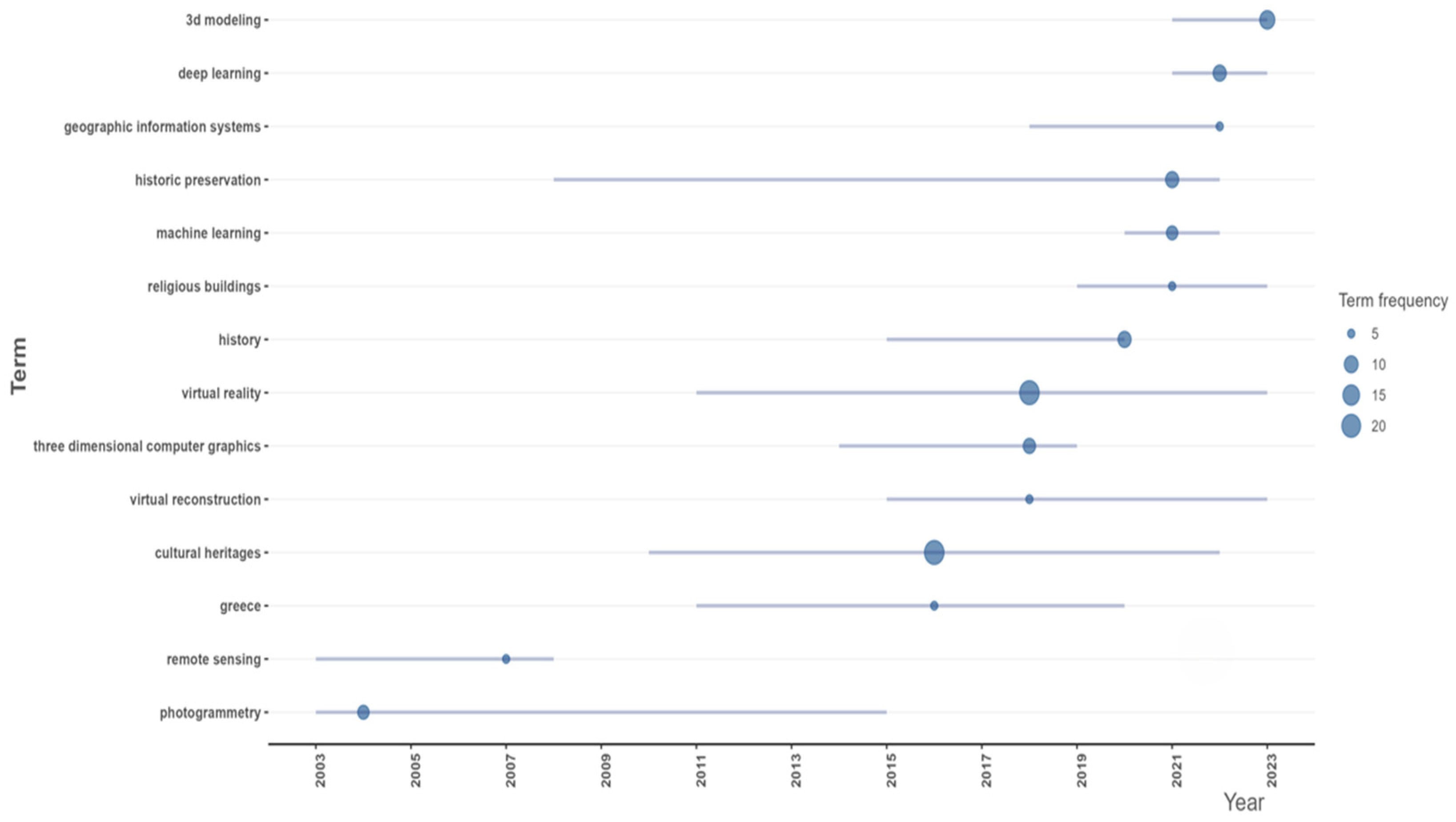
Figure 3 presents the temporal trajectory of trending topics, where bubble size reflects overall term frequency, and horizontal lines indicate the duration of each term’s presence in the scholarly literature. Foundational methodologies, such as photogrammetry and remote sensing, dominated the early phases of research, providing core geospatial and imaging frameworks for the systematic documentation of heritage sites. This methodological foundation was followed by a sustained focus on more integrative heritage constructs, as evidenced by the enduring prominence of terms such as cultural heritage and virtual reconstruction, which have remained central to the evolving discourse. The subsequent rise of three-dimensional computer graphics and virtual reality signals a pivotal shift toward immersive visualization technologies, which build on earlier imaging techniques to enable interactive, pedagogically oriented reconstructions of archaeological environments.
The term geographic information systems has maintained a steady, albeit secondary, presence alongside visualization techniques, underscoring the continued relevance of spatial-analytical frameworks within the broader methodological repertoire. Most notably, the recent ascendancy of machine learning and deep learning signals a pivotal shift toward algorithmic paradigms. The bubble sizes associated with these terms reflect accelerating scholarly engagement, as researchers increasingly experiment with neural-network architectures for tasks such as automated feature extraction and predictive site modeling, areas previously underrepresented in Asia Minor heritage studies.
Concurrent thematic anchors, including historic preservation and religious buildings, indicate domain-specific applications that align conservation objectives with contemporary computational approaches. At the same time, the persistent recurrence of terms such as history and Greece points to enduring geographical and disciplinary focal points, even as methodological diversity broadens.
Ultimately, the overall timeline traces a scholarly trajectory that moves from foundational imaging and geospatial techniques, through the growing adoption of immersive visualization modalities, toward the emerging integration of machine and deep-learning methods, reflecting an increasingly multifaceted approach to the digital documentation and analysis of Asia Minor’s cultural heritage (see
Figure 3).
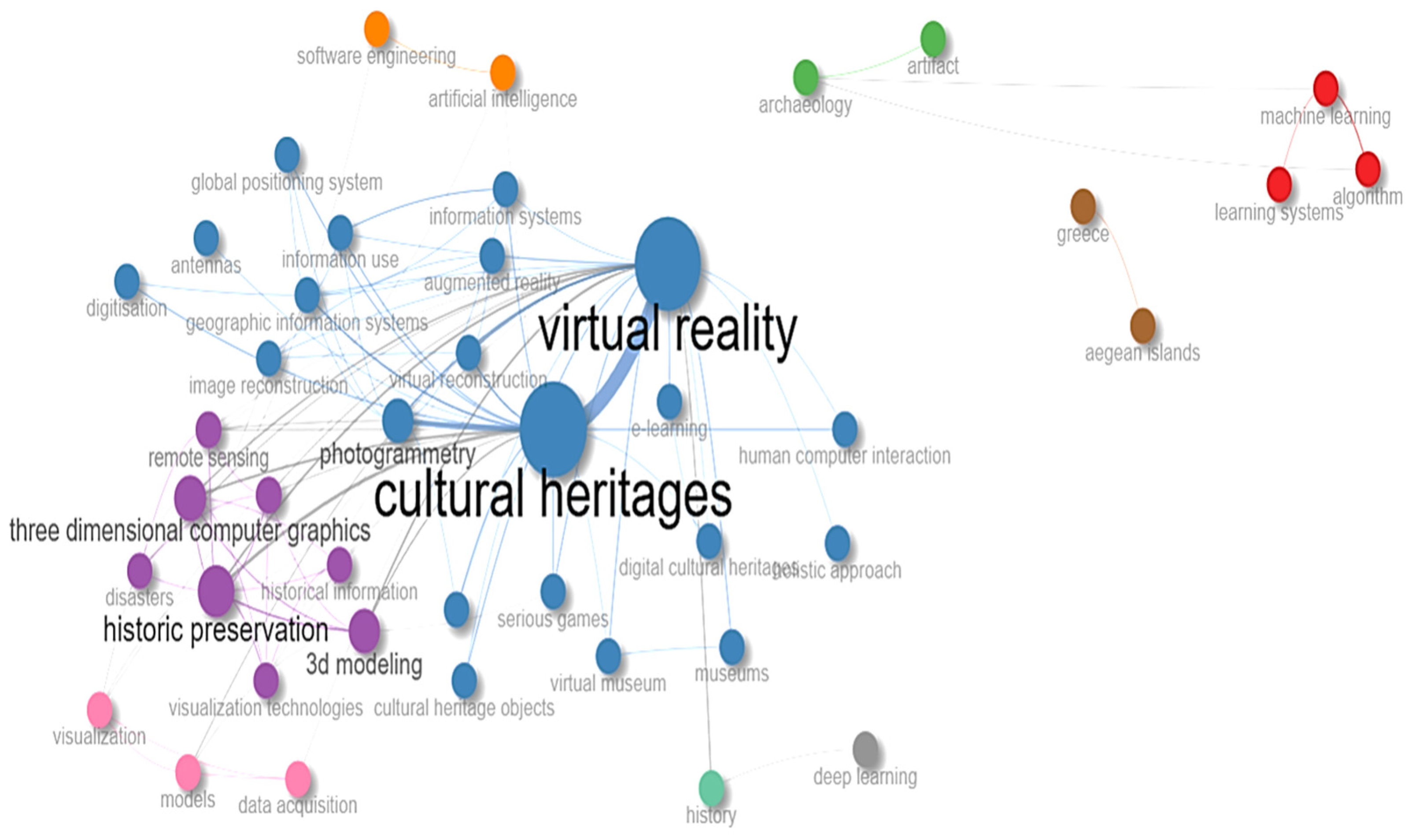
Figure 4 demonstrates the interrelations among author-assigned keywords in the corpus of studies concerning AI in the preservation of Asia Minor’s cultural heritage. Node size reflects term frequency, while edge thickness denotes the strength of co-occurrence. The resulting clusters delineate the principal thematic trajectories and disciplinary intersections that define current scholarly discourse.
The dominant (blue) cluster, anchored by cultural heritages, virtual reality, and photogrammetry, underscores the field’s preoccupation with immersive visualization methodologies. Robust interconnections among these nodes, along with ancillary terms such as augmented reality, information systems, and image reconstruction, point to a sustained effort toward high-fidelity, three-dimensional reconstructions of archaeological sites and artefacts. This emphasis reflects both the urgency of accurate digital documentation and the pedagogical imperative to render Asia Minor’s tangible patrimony accessible to diverse scholarly and public audiences.
Adjacent to this visualization nexus is a secondary (purple) cluster encompassing historic preservation, 3D modeling, remote sensing, and computer graphics. The cohesion of this cluster highlights the integration of geospatial data acquisition techniques, such as satellite imagery, LiDAR, and photogrammetric surveying, with advanced rendering methods, thereby forming a methodological pipeline that supports both conservation planning and digital reconstruction. The pronounced inter-cluster linkages suggest a synergistic workflow in which remote-sensing outputs are directly incorporated into detailed graphical models for analytical interpretation and didactic presentation.
Conversely, a peripheral (red) cluster composed of machine learning, learning systems, and algorithm reveals a more circumscribed engagement with algorithmic paradigms. Although internally cohesive, its limited connections to the central visualization nodes indicate that classification, pattern recognition, and predictive modeling techniques remain largely siloed rather than fully integrated into prevailing heritage-digitization workflows. The solitary placement of the deep learning node (gray) further suggests that neural network methodologies remain underutilized in regional archaeological research, particularly for tasks such as automated typology classification or predictive site modeling.
Smaller clusters anchored by archaeology and artifact (green), and by Greece and the Aegean Islands (brown), represent traditional disciplinary frameworks and specific geographic concentrations, respectively. Their relatively weak associations with advanced AI-related terminology underscore a continuing gap in interdisciplinary engagement, especially beyond the most intensively examined locales.
In sum, the co-occurrence network delineates a scholarly landscape centered on visualization and 3D reconstruction methodologies, while algorithmic approaches and deep learning remain emergent and compartmentalized. Expanding the integration of machine and deep learning techniques into heritage documentation and analysis, alongside a geographic broadening of research agendas, represents a critical direction for future inquiry (see
Figure 4).
Table 2 depicts the 10 most highly cited publications, which collectively illustrate the breadth of research at the intersection of AI, digital technologies, and cultural heritage studies. The works included encompass journal articles, conference papers, and edited proceedings, thereby reflecting both methodological diversity and variation in disciplinary orientation. Several publications are firmly embedded in digital heritage practice and foreground structured workflows for documentation and visualization. Knabb et al. [
17], for instance, examine immersive virtual reality environments developed for archaeological data, with particular emphasis on the technical integration of three-dimensional models, spatial datasets, and interactive visualization systems. Their analysis elucidates how reality-based acquisition methods, including photogrammetry and laser scanning, are processed, structured, and organized to support immersive exploration. Attention is devoted to data structuring, system architecture, and modes of user interaction, while the contribution remains primarily oriented toward visualization and dissemination rather than toward algorithmic inference or automated analysis. Deligiorgi et al. [
18] extend documentation-centered workflows by incorporating deep learning techniques into three-dimensional heritage analysis. Their study outlines the application of convolutional neural networks to classify architectural components in digitized monuments, detailing dataset preparation, model training procedures, and classification outputs. The analytical focus is on the operational integration of ML techniques into established digitization pipelines, intended to support systematic annotation and the organized management of architectural data.
Other studies approach heritage preservation through computational methods designed for monitoring, assessment, or reconstruction. El-Hajj [
19] applies supervised machine learning to multispectral satellite imagery to detect and categorize disturbances affecting archaeological sites. The analysis focuses on selecting remote sensing data, extracting features, and classifying, demonstrating the capacity of algorithmic approaches to process large spatial datasets in a consistent and reproducible manner. Karadağ [
20] adopts a generative modeling framework to address incomplete architectural documentation, employing conditional generative adversarial networks to reconstruct missing elements in historical building plans. The study provides a detailed account of dataset construction, model architecture, and output characteristics, positioning generative techniques as computational tools that support early phases of documentation and restitution. By contrast, Stein [
21] offers a descriptive account of threats to heritage and preservation initiatives in Afghanistan. Although this work does not introduce AI-based methodologies, it contributes valuable contextual insights into preservation practices without engaging in computational or algorithmic analysis.
Several highly cited entries included in the table address analytical domains that fall outside the scope of direct digital heritage preservation, despite their methodological rigor or archaeological relevance. Garnier et al. [
22], for example, investigate archaeobotanical residues using laboratory-based chemical analyses to identify early wine-production practices. Their contribution centers on experimental protocols, biomolecular markers, and analytical validation, rather than on digital reconstruction or artificial intelligence. Yang et al. [
23] developed a distributed machine-learning framework intended to ensure robustness against adversarial behavior in decentralized networks. This study prioritizes theoretical guarantees and algorithmic performance, without application to cultural heritage datasets or preservation contexts. Similarly, Lorilla et al. [
24] employ random forest models and predictive mapping techniques to examine socio-ecological drivers of ecosystem services in Mediterranean landscapes, combining spatial variables with machine-learning classification within an environmental modeling framework. Soygazi et al. [
25] introduce a Turkish historical question-answering dataset and evaluate transformer-based baseline models, focusing on data annotation practices and natural language processing rather than on heritage documentation, visualization, or conservation workflows.
Table 2.
Top 10 Most Cited Papers.
Table 2.
Top 10 Most Cited Papers.
| Paper | Total Citations |
|---|
| Garnier N, [22], J Archaeol Sci | 110 |
| Yang Z, [23], IEEE Trans Signal Inf Process Over Netw | 91 |
| Lorilla Rs, [24], Ecol Model | 45 |
| Loizides F, 2014, Lect Notes Comput Sci | 33 |
| Knabb Ka, [17], Near East Archeol | 29 |
| Stein Gj, [21], Near East Archeol | 22 |
| Karadag İ, [20], Open House Int | 18 |
| Deligiorgi M, [18], Jarchaeol Sci Rep | 17 |
| Soygazi F, [25], Proc-Int Conf Comput Sci Eng, Ubmk | 15 |
| El-Hajj H, [19], J Comput Appl Archaeol | 15 |
Furthermore, the EuroMed [
2] proceedings volume occupies a distinct position in the table. As an edited collection, it brings together a broad range of peer-reviewed contributions addressing cultural heritage informatics, documentation, preservation, and communication. The volume encompasses diverse technological approaches, including three-dimensional reconstruction, visualization platforms, data archiving systems, and computational analysis techniques. Rather than advancing a single, unified methodological argument, the proceedings reflect the breadth and interdisciplinary character of digital heritage research at the time of publication.
Ultimately, the publications in the table demonstrate that citation prominence does not align with a uniform thematic or methodological alignment. Within the subset of studies directly concerned with cultural heritage, a consistent analytical emphasis centers on three-dimensional data acquisition, structured documentation workflows, and visualization systems, with machine learning and deep learning serving primarily as complementary components supporting classification, monitoring, or reconstruction tasks. Other highly cited works contribute foundational insights from archaeology, artificial intelligence, or environmental modeling without directly engaging with heritage preservation technologies. Taken as a whole, the table depicts a research landscape in which digital reconstruction and documentation function as the methodological core of heritage-oriented scholarship, while data-driven computational techniques are increasingly integrated as auxiliary analytical instruments rather than as primary epistemic drivers. This configuration carries significant historiographical implications for the study of Asia Minor. In particular, the turn toward immersive reconstruction and algorithmically assisted documentation enables scholars to move beyond static descriptions of archaeological remains and toward more interpretive analyses of spatial organization, architectural sequencing, and patterns of continuity across Byzantine and Ottoman contexts. High-fidelity digital reconstructions enable the examination of collapsed or eroded structures in analytically rigorous ways, while ML-based annotation and restitution tools facilitate systematic comparison and digital reassembly of fragmented material evidence. In this respect, AI-enabled heritage workflows do not merely visualize the past; they actively contribute to the reinterpretation and synthetic understanding of Asia Minor’s multilayered historical landscapes (see
Table 2).
4. Discussion
The findings of this study demonstrate that recent advances in intelligent computational methods have significantly enhanced three-dimensional reconstruction, immersive visualization, and environmental monitoring in cultural heritage research, with particular relevance to Asia Minor. Developments in computer vision, most notably feature-based matching, bundle adjustment, and multi-view stereo, laid the technical groundwork for the digital documentation of archaeological contexts. Building upon this base, subsequent research has increasingly incorporated machine learning classifiers, such as Mask R-CNN, FCN, and YOLO, to automate a range of tasks, including surface anomaly detection, artifact cataloguing, and condition assessment. Concurrently, the deployment of Internet of Things (IoT) sensor networks has enabled real-time monitoring of environmental variables, including temperature, humidity, and air quality, thereby facilitating timely interventions when conditions threaten structural or material integrity. Collectively, these developments reflect an expanding analytical capacity that now encompasses documentation, monitoring, and preservation workflows.
An analysis of keyword co-occurrence patterns further reveals that visualization-centric methodologies continue to dominate current scholarly discourse. Densely interconnected clusters organized around terms such as cultural heritage, virtual reality, and photogrammetry delineate a cohesive methodological core that integrates remote sensing, computer graphics, and immersive technologies to produce high-fidelity reconstructions. These approaches serve both academic inquiry and public engagement by enabling detailed spatial exploration of heritage assets. By contrast, machine learning and deep learning emerge as less central and more loosely connected themes, suggesting that algorithmic techniques are frequently treated as auxiliary tools rather than integral components of digital heritage methodologies. This structural arrangement underscores a notable disjunction between visualization-driven practices and data-driven analytical approaches.
From a methodological perspective, this disjunction further underscores the importance of developing more explicitly integrated analytical pipelines in which machine learning and deep learning components are embedded directly within heritage documentation and visualization workflows, rather than deployed as post hoc analytical adjuncts. Such integration would facilitate automated feature extraction during three-dimensional acquisition, enable adaptive classification within reconstruction environments, and support predictive conservation modeling dynamically linked to spatial datasets. In doing so, algorithmic systems would shift from functioning as auxiliary tools to becoming structurally constitutive elements within the epistemic and operational architecture of digital heritage research.
A temporal analysis of scholarly output indicates a methodological trajectory encompassing three broad phases. Initial efforts centered on imaging, photogrammetry, and geospatial technologies; this was followed by a period characterized by the adoption of immersive visualization platforms [
26,
27]. More recently, there has been a discernible, though still limited, uptake of algorithmic and learning-based techniques [
7]. Throughout these phases, Geographic Information Systems (GIS) have maintained a stable and enduring presence, reaffirming the foundational role of spatial analysis in heritage research [
28]. Simultaneously, thematic and geographic continuity, particularly the sustained focus on archaeological investigations in Greece and the Aegean, highlights a persistent regional concentration. This pattern suggests that substantial portions of Asia Minor’s cultural landscapes remain underrepresented in the scholarly corpus [
29,
30].
These structural characteristics can have direct and consequential implications for the emergent domain of digital cultural tourism. The predominance of immersive visualization technologies, most notably virtual reality, three-dimensional reconstruction, and photogrammetry, has enabled the early production of precisely the high-quality digital assets required for the development of virtual museums, online heritage repositories, and interactive virtual walkthroughs [
31,
32]. In the specific context of Asia Minor, where numerous Ottoman, Byzantine, and Classical sites remain geographically remote, politically sensitive, or materially fragile, such high-fidelity digital surrogates facilitate a mode of remote, non-invasive engagement that significantly extends public access beyond the logistical, economic, and physical constraints of on-site visitation [
33,
34].
From the standpoint of sustainable tourism, these digital representations serve as a critical mechanism for mitigating the pressures of mass visitation on vulnerable archaeological landscapes, while simultaneously preserving their cultural presence and educational relevance within the global tourism economy [
35]. Furthermore, although machine learning and deep learning techniques currently occupy a marginal position within existing research networks, their gradual incorporation signals the potential emergence of more adaptive and responsive digital tourism platforms. Such developments may include the automated annotation of architectural and material features, the generation of personalized narrative pathways, and the provision of context-aware interpretive frameworks [
36]. In this respect, the convergence of artificial intelligence with visualization-centered heritage workflows underwrites a broader transition toward more intelligent, scalable, and environmentally sustainable forms of digital engagement with the cultural heritage of Asia Minor [
37].
Quantitative indicators further affirm the impression of a mature yet circumscribed field of inquiry. The analyzed corpus, comprising ninety-three publications over 25 years, shows no discernible growth in annual output, indicating a plateau in research dissemination. Conference proceedings constitute nearly half of the corpus, while peer-reviewed journal articles account for slightly more than one-third. This distribution suggests an ongoing reliance on conference venues for the rapid dissemination of technological innovations, alongside a smaller subset of integrative journal studies. Collaboration rates are relatively robust, averaging over 3 authors per publication; however, international collaboration remains limited. These trends point to untapped opportunities for more extensive cross-border and interdisciplinary partnerships within the field. Lastly, the corpus’s limited size reflects the use of geographically bounded search terms rather than an absence of digital heritage research in the broader Eastern Mediterranean, yielding a dataset that is both conceptually focused and methodologically coherent.
Ultimately, several limitations related to the construction of the dataset warrant acknowledgment. The analysis was conducted using Scopus as the sole bibliographic source, a choice that ensured the use of standardized, carefully curated citation records suitable for reproducible bibliometric mapping, yet may have excluded relevant studies indexed exclusively in other scholarly databases or regional publication systems. In addition, the restriction to English-language publications may have limited the visibility of locally produced scholarship and research disseminated in other linguistic contexts, a constraint that is particularly salient in historically and geographically diverse areas such as Asia Minor. The inclusion criteria applied to document types further constrain the corpus by excluding alternative scholarly outputs, technical reports, and other forms of academic dissemination not captured within the selected categories. Accordingly, these dataset parameters delineate the practical boundaries within which the present bibliometric analysis was conducted. Future research may extend this framework by incorporating additional bibliographic databases to evaluate cross-index coverage and to assess the stability of thematic configurations and network structures under conditions of corpus expansion.