Article

The Effect of Connective Tissue Grafting on Soft Tissue Dimensional Changes After Immediate Implant Placement and Provisionalization: A Randomized Clinical Trial


Department of Oral Implantology, Peking University School and Hospital of Stomatology, Beijing 100081, China
*
Authors to whom correspondence should be addressed.
Oral 2026, 6(3), 77; https://doi.org/10.3390/oral6030077 (registering DOI)
Submission received: 6 May 2026 / Revised: 8 June 2026 / Accepted: 12 June 2026 / Published: 19 June 2026

Highlights

What are the main findings?
  • Within the limitations of this prospective randomized clinical study, both buccal soft tissue height and thickness increased following immediate implant placement and provisionalization (IIPP) in the esthetic zone.
  • The use of connective tissue grafting (CTG) was associated with greater postoperative buccal soft tissue thickness, while no additional effect was observed on soft tissue height.
What are the implications of the main findings?
  • CTG may be considered when increased buccal soft tissue thickness is desired in the esthetic zone.
  • The influence of CTG on vertical soft tissue changes appears to be limited.

Abstract

Objectives: To quantitatively evaluate soft tissue dimensional changes after immediate implant placement and provisionalization (IIPP) in the esthetic zone with or without connective tissue grafting (CTG). Methods: In this prospective clinical trial, 44 patients requiring a single maxillary anterior immediate implant were randomly allocated to a test group (IIPP + CTG) or a control group (IIPP alone). At baseline and 6 months postoperatively, buccal soft tissue height (STH) and soft tissue thickness (STT) at various levels were recorded. Measurements were obtained through three-dimensional superimposition of cone-beam computed tomography (CBCT) and intraoral scanning data. Results: Forty-three patients completed the 6-month follow-up. From baseline to 6 months, buccal soft tissue height increased 2.14 ± 0.74 mm and 1.71 ± 0.81 mm in the test and control groups, respectively, without statistically significant differences between groups (p = 0.078). Buccal soft tissue thickness increased at most measured levels in both groups (p < 0.05), except at 1 mm apical to the crest in the control group (p = 0.11). However, thickness augmentation was consistently greater in the test group at all levels (p < 0.001). Conclusions: Within the 6-month follow-up period, both soft tissue height and thickness increased after IIPP. CTG performed simultaneously with IIPP was associated with significantly thicker buccal soft tissue compared with IIPP alone.

1. Introduction

Tooth loss in the esthetic zone poses considerable clinical challenges. Patients’ expectations extend beyond the long-term stability of the implant to the natural appearance of the surrounding soft and hard tissues [1,2]. Immediate implant placement and provisionalization (IIPP) was initially proposed by Wöhrle in 1998 [3]. It was defined as the placement of an implant immediately following tooth extraction with a restoration placed within 48 h. It offers several advantages, including a reduced treatment time, fewer surgical procedures, and partial preservation of the morphology of the alveolar ridge [4,5]. In the short term, immediate implant placement (IIP) has demonstrated survival rates comparable to those of delayed implant placement [6]. Although its long-term outcomes remain a matter of debate [7], the overall survival rates generally exceed 95%. Consequently, IIPP has been widely applied in the treatment of tooth defects in the esthetic zone.
However, although IIPP can partially maintain the socket structure after tooth extraction, the thin buccal bone plate usually undergoes rapid resorption [8,9]. More pronounced vertical and horizontal bone resorption may occur when the thickness of the buccal bone plate is less than 1 mm, further influencing the process of soft tissue remodeling [10]. It has been indicated that IIP may occasionally lead to gingival recession >1 mm [11,12,13,14] and contour collapse >0.6 mm [15,16]. These may severely affect the final esthetic outcome. Patients presenting with a thin gingival phenotype in the maxillary anterior region are particularly susceptible to such esthetic complications [12,14].
Currently, various clinical strategies have been employed to mitigate this issue [17]. Connective tissue grafting (CTG) has been applied with immediate implant procedures since 1995 [18]. The technique is considered an effective approach to enhance the peri-implant soft tissue phenotype, manage soft tissue stability, and optimize esthetic outcomes [19]. Several systematic reviews and meta-analyses have demonstrated that IIP combined with CTG in the esthetic zone can reduce gingival recession [20,21], and increase soft tissue thickness [22]. Previous studies have also suggested that it may help compensate for buccal tissue collapse and maintain the contour [23,24]. Regarding long-term outcomes, a study with 4–13 years of follow-up indicated that gingival margin position and gingival thickness remained stable after CTG [25].
Previous studies have mainly focused on facial tissue collapse, mid-facial gingival margin migration, and peri-implant hard tissue remodeling following IIPP, including findings from our previously published randomized clinical trial [10]. However, quantitative evaluations of peri-implant soft tissue height (STH) and soft tissue thickness (STT), particularly at different levels, remain limited. This lack of evidence may be attributable to the invasive nature of conventional soft tissue measurement techniques [26,27]. In the limited available studies, gingival thickness has been assessed only at single reference spots, most commonly 2 mm apical to the gingival margin [28,29,30,31]. However, following IIP, the position of the buccal gingival margin itself may change, potentially compromising the reliability of such measurement sites [32]. In the present study, a method combining superimposed intraoral scanning data and cone-beam computed tomography (CBCT) was employed to assess soft tissue dimensions [33]. This approach has been validated in previous studies as a reliable and noninvasive strategy, avoiding traumatic measurement procedures [34,35]. Therefore, the aim of this study was to quantitatively evaluate changes in buccal gingival height and thickness following IIPP, with or without CTG, in the anterior maxilla, thereby providing complementary information to previous studies that focused primarily on facial tissue contour changes and gingival margin stability.

2. Materials and Methods

The present study was derived from a previously reported randomized clinical trial using the same study cohort and 6-month follow-up data [10]. While the previous publication focused on facial tissue collapse, mid-facial gingival margin migration, and peri-implant hard tissue remodeling, the present study specifically evaluated peri-implant soft tissue height and thickness changes integrating cone-beam computed tomography (CBCT) and intraoral scan (IOS) data through a superimposition approach. These outcomes were not analyzed or reported in the previous publication.

2.1. Patient Enrollment Criteria

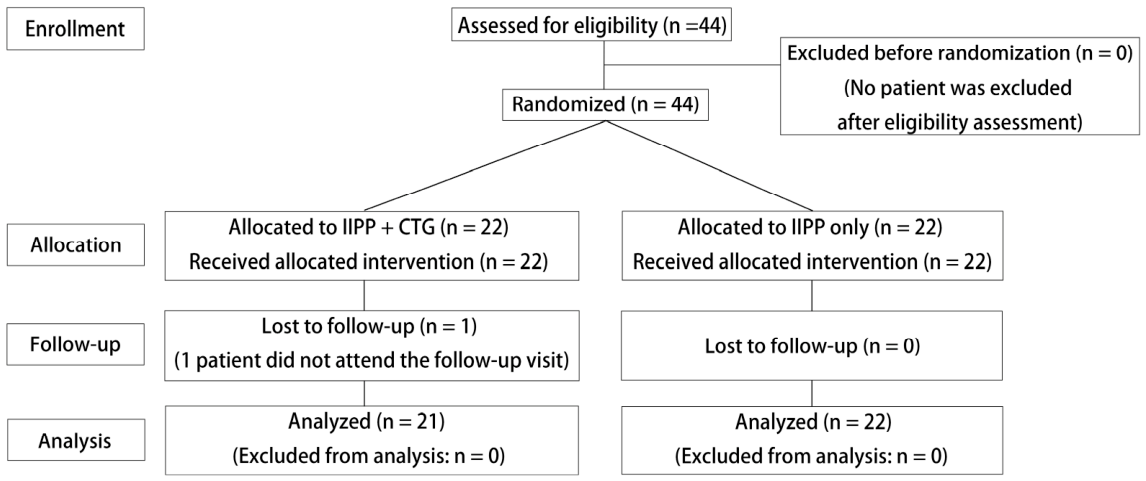
This clinical trial was approved by the local ethics committee (Institutional Review Board of Peking University School and Hospital of Stomatology) (Approval Number: PKUSSIRB-201639123) and registered at chictr.org.cn (Registration number ChiCTR1900028494) on 23 December 2019. The trial was retrospectively registered. The study was conducted in the Department of Oral Implantology at Peking University School and Hospital of Stomatology between October 2016 and December 2021. The study was reported in accordance with the CONSORT 2010 guidelines (Figure 1). The CONSORT 2010 checklist is included in the Supplementary Materials.
Inclusion criteria were as follows:
  • Aged between 20 and 65 years.
  • Presence of a single non-restorable maxillary incisor (teeth 12–22) due to root fracture, trauma, residual root, or root resorption.
  • Healthy periodontal condition of adjacent teeth.
  • Intact buccal bone after extraction and ability to achieve a final insertion torque of at least 35 N·cm.
  • Willingness to participate and compliance with follow-up requirements.
Exclusion criteria included:
  • History of periodontal disease with attachment loss of the target or adjacent teeth.
  • Buccal bone plate deficiency after extraction.
  • Insufficient bone volume or quality preventing implant placement with a minimum insertion torque of 35 N·cm.
  • Pregnancy.
  • Heavy smoking habit (>10 cigarettes/day).
  • Any systemic or local condition contraindicating implant surgery.

2.2. Sample Size Calculation

The primary outcome of this study was peri-implant STT. STH was considered a secondary outcome. Sample size calculation was performed using PASS software (NCSS, Kaysville, UT, USA) based on the study by Guglielmi et al. [23]. The expected mean difference in STT between the test and control groups was set at 1.0 mm, with a standard deviation of 1.0 mm. At a significance level of α = 0.05 and a power of 90% (β = 0.10), the required theoretical sample size was calculated to be approximately 20 subjects per group, for a total of 40 subjects. Considering a dropout rate of approximately 10% (e.g., patients failing to attend follow-up or missing data), this study planned to recruit 44 participants.

2.3. Randomization and Allocation Concealment

After enrollment, participants were randomly assigned to the test or control group using a computer-generated randomization list (IBM SPSS Statistics, version 18; IBM Corp., Armonk, NY, USA). Allocation concealment was ensured by an independent researcher using sequentially numbered, opaque, sealed envelopes. The envelopes were opened immediately before surgery to reveal the group assignment.

2.4. Clinical Procedures

Prior to extraction, all patients underwent intraoral scanning (software version 2014-1; 3Shape A/S, Copenhagen, Denmark) to record the baseline labial soft tissue contour. Subsequently, CBCT images (Planmeca ProMax 3D, Planmeca Oy, Helsinki, Finland) were obtained to document the alveolar hard tissue morphology. The CBCT scanning parameters were as follows: field of view (FOV) diameter of 13 cm, height of 10 cm, acceleration voltage of 90 kV, beam current of 8.0 mA, and voxel size of 0.2 mm.
Prophylactic antibiotics (cefuroxime 0.25 g) were administered orally 1 h before surgery, and patients were rinsed with 0.2% chlorhexidine solution for 1 min. Local infiltration anesthesia was performed using primacaine with adrenaline (Produits Dentaires Pierre Rolland, Acteon Pharma Division, Mérignac, France).
The unsalvageable tooth was extracted using a minimally invasive approach to preserve both hard and soft periodontal tissues, without flap elevation. After extraction, the integrity of the buccal bone plate was assessed. Sequential osteotomy was carried out against the palatal wall of the extraction socket and extended apically to the base of the maxilla. The implant (NobelActive, Nobel Biocare AB, Zurich, Switzerland) was inserted approximately 4 mm apical to the gingival margin, leaving at least 2 mm between the buccal bone wall and the implant platform. Primary stability was confirmed by a final insertion torque of >35 N·cm; patients not achieving this criterion were excluded from the study. The gap between the implant and the socket walls, from apical to beyond the bony crest, was filled with deproteinized bovine bone mineral Bio-Oss, Geistlich Pharma AG, Wolhusen, Switzerland).
In the test group, a de-epithelialized connective tissue graft (approximately 15 mm × 5 mm × 1.5 mm), harvested from the posterior palate, was inserted beneath the buccal gingiva using a tunneling technique. The graft dimensions were adjusted according to the anatomical characteristics of the donor site and the specific requirements of the recipient site to ensure adequate tissue augmentation. No additional intervention was carried out in the control group. An implant-level impression was taken immediately after surgery, and a screw-retained provisional restoration without occlusal or lateral contacts was delivered within 24 h.
Postoperative follow-up visits were scheduled for 1 week, 1 month, and 6 months to monitor healing. CBCT and intraoral scans were repeated at 6 months, prior to the final restoration. All surgical and prosthetic procedures were carried out by an experienced clinician (Dr. X.J.).

2.5. Measurement of the Outcomes

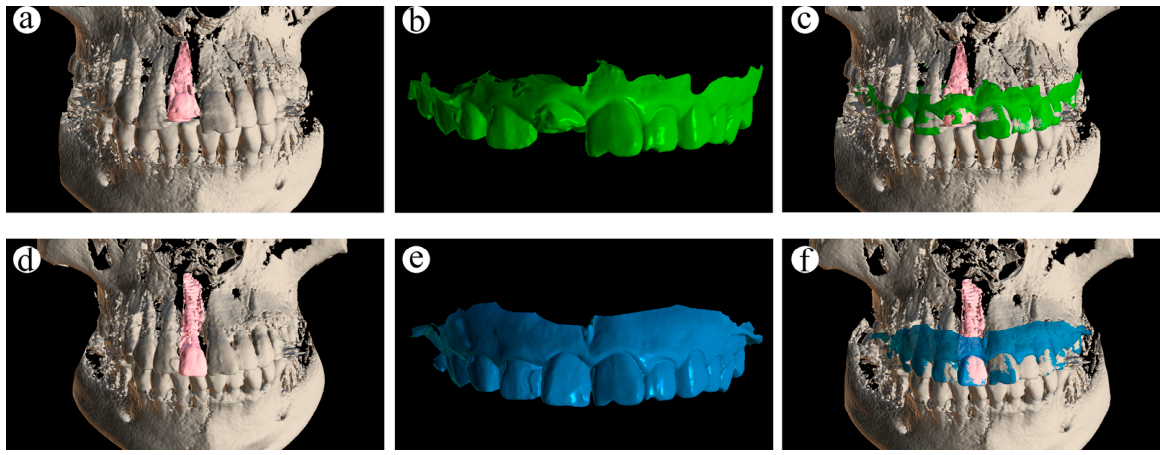
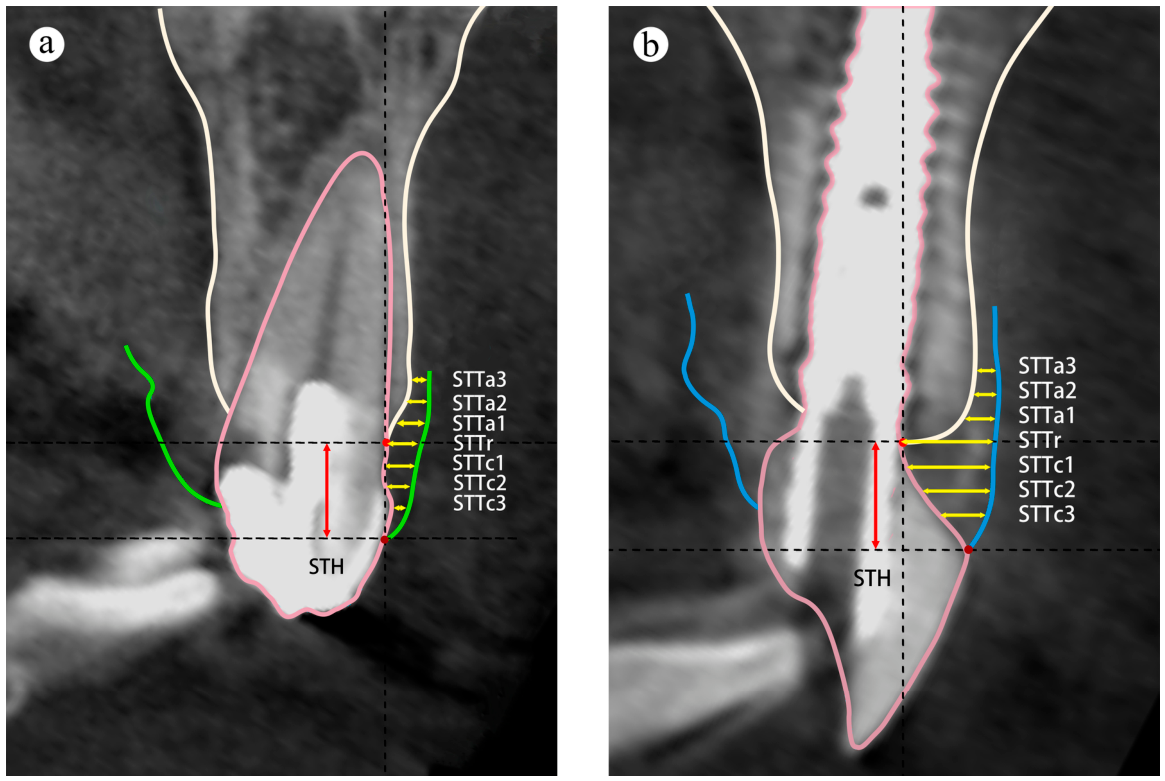
The DICOM files of patients’ CBCT data and the STL files of intraoral scans were registered and aligned using the three-dimensional data processing software BlueSkyPlan 4 (version 4.11; Blue Sky Bio, Libertyville, IL, USA) (Figure 2). Cross-sectional images passing through the long axis of the affected tooth (baseline) or the implant (6 months postoperatively) were then obtained from the 3D models generated. Using the graphic analysis software Adobe® Photoshop® CS6 (version CS6; Adobe Systems Inc., San Jose, CA, USA), the vertical distance from the alveolar crest to the gingival margin was measured and defined as soft tissue height (STH). Soft tissue thickness was measured along the tooth or implant long axis at the level of the alveolar ridge crest (STTr), as well as at 1-, 2-, and 3-mm coronal (STTc1–3) and apical (STTa1–3) to the crest, as in Figure 3. All measurements were performed by a blinded examiner who was unaware of group allocation. To assess intra-examiner reliability, 15 randomly selected cases were re-measured by the same examiner after an interval of approximately 1 year. Intraclass correlation coefficients (ICCs) were calculated for STH and STT measurements at all levels.

2.6. Statistical Analysis

Statistical analyses were performed using IBM SPSS Statistics (version 18; IBM Corp., Armonk, NY, USA). The normality of data distribution was assessed using the Shapiro–Wilk test. Continuous variables are presented as mean ± standard deviation (SD). A two-sided p value < 0.05 was considered statistically significant.
Within-group comparisons between baseline and 6 months were performed using paired t-tests. Between-group comparisons between the test and control groups were conducted using independent samples t-tests.
Multiple comparisons across different STT measurement levels were adjusted using the Holm–Bonferroni method. In addition, analysis of covariance (ANCOVA) was performed to evaluate between-group differences at 6 months, with baseline values included as covariates to adjust for potential baseline imbalances.

3. Results

3.1. Demographics

A total of 44 patients were included, with 22 patients in the test group and 22 in the control group. One patient in the test group was lost to follow-up, leaving 43 subjects for the final analysis. All implants achieved uneventful healing, with a 100% survival rate at 6 months. No infection, graft-related complications, donor-site complications, or other adverse events were observed in either group during the observation period. Information regarding demographics, tooth positions and implant types is summarized in Table 1.

3.2. Changes in STH

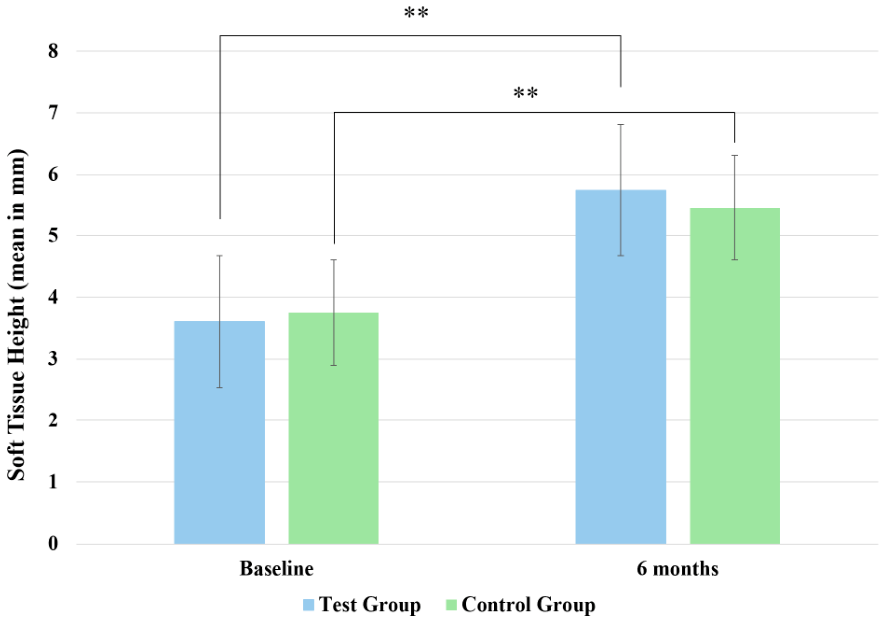
Soft tissue height, from the gingival margin to the alveolar crest, increased in both groups after 6 months (p < 0.001) (Figure 4). STH demonstrated no statistically significant differences between the test and control groups at baseline (p = 0.266) and 6 months post-surgery (p = 0.262). STH increased by 2.14 ± 0.74 mm and 1.71 ± 0.81 mm in the test and control groups, respectively, without statistically significant differences between groups (p = 0.078) (Table 2). It should be noted that postoperative changes in STH may reflect not only soft tissue adaptation but also alterations in alveolar crest morphology resulting from hard tissue remodeling.

3.3. Changes in STT

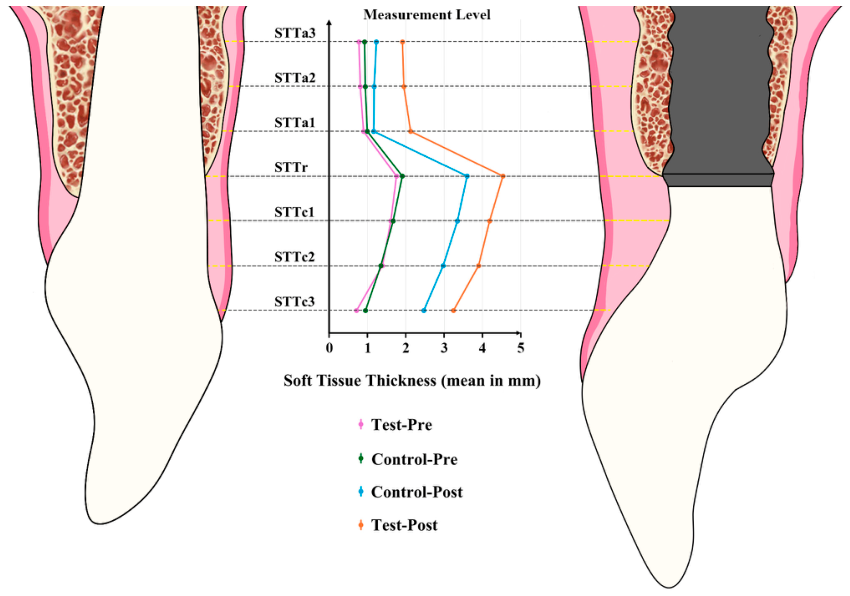
The soft tissue thickness increased significantly in both groups 6 months after surgery, except at 1 mm apical to the crest in the control group. The STT increases were significantly greater in the test group at all measurement levels compared with those in the control group, which suggests a positive effect of CTG (p < 0.001) (Figure 5) (Table 3).

3.4. Intra-Examiner Reliability

To assess intra-examiner reliability, 15 randomly selected cases were re-measured by the same examiner after an interval of approximately 1 year. Intra-examiner reliability analysis showed that the ICC values for STH and STT measurements at all levels ranged from 0.77 to 0.90, indicating acceptable reproducibility.

3.5. Adjusted Analysis

After adjustment for baseline values using ANCOVA, the test group demonstrated significantly greater STT at all measurement sites compared with the control group (all p ≤ 0.002). However, no significant between-group difference in STH was observed after adjustment (p = 0.123), which was consistent with the primary analysis.
All between-group differences in STT remained statistically significant after Holm–Bonferroni correction.

4. Discussion

The present study aimed to quantitatively assess changes in buccal gingival height and thickness in the esthetic zone following IIPP performed with or without CTG. Following the 6-month follow-up, STH increased significantly in both groups, with no significant intergroup difference. Regarding STT, significant increases were observed at most measured levels in both groups, except 1 mm apical to the crest in the control group. However, the magnitude of thickness gain was consistently greater in the test group than in the control group.
The present study observed that, compared with baseline, both buccal soft tissue height and thickness showed an increasing trend 6 months after IIPP. Quantitative analyses of this phenomenon have rarely been reported in the previous literature. De Angelis et al. reported that a slight tendency of soft tissue thickening may occur in IIPP cases even without CTG [22]. According to Wang et al., immediate provisionalization itself may play a role in shaping and supporting the buccal soft tissue contour [16]. Aldhohrah et al. also noted that immediate provisionalization can help achieve satisfactory esthetic outcomes of the buccal soft tissues [36].
In this study, the test and control groups exhibited increases in STH of 2.14 ± 0.74 mm and 1.71 ± 0.81 mm, respectively, without statistically significant differences between groups (p = 0.078). Previous studies have predominantly used changes in gingival margin position as the primary outcome measure, while analyses specifically focusing on STH have been scarce. Guglielmi et al. and Seyssens et al. reported that buccal soft tissue thickening may also occur after IIP, suggesting that soft tissues may possess inherent healing and compensatory potential [20,23]. Previous studies have proposed the concept of peri-implant mucosal creeping, describing the gradual coronal thickening of the peri-implant mucosal margin and papillae during the healing phase [37,38]. The phenomenon was hypothesized to be driven by the negative intraoral pressure which was generated during the oral phase of swallowing and the subsequent resting position. According to earlier histological evidence, the connective tissue and junctional epithelium surrounding implants tend to be approximately 3.6 mm above the alveolar crest [39]. When the sulcus depth is considered, this distance may partially explain the STH observed in the present study. Notably, the use of CTG did not appear to modify this vertical soft tissue adaptation. However, the interpretation of STH changes should be approached with caution, as STH was defined as the distance between the gingival margin and the alveolar crest. Therefore, the observed increase in STH may also have been influenced by postoperative alveolar crest remodeling in addition to soft tissue adaptation.
Both groups in this study demonstrated some degree of buccal soft tissue thickening, especially in the sites coronal to the crest. However, the test group showed substantially greater augmentation. For instance, at 3 mm coronal to the crest, the thickness increased by 2.53 mm in the test group compared with 1.52 mm in the control group. At 1–3 mm apical to the crest, the control group showed only minimal thickness gains (+0.17 to +0.31 mm), whereas the test group consistently maintained over 1 mm of increase. These findings suggest that CTG might convert a thin gingival phenotype into a thicker, more stable phenotype, thereby improving the esthetic outcomes of buccal peri-implant soft tissue.
These results are consistent with previous studies reporting soft tissue changes following simultaneous CTG during IIP [23,25,27,29,30,40,41]. Frizzera et al. [30] demonstrated that IIP combined with CTG in compromised alveolar ridges effectively maintained soft tissue thickness. As a result, it could also help achieve higher pink esthetic scores (PESs). Migliorati et al. reported a 2-year follow-up in which the test group showed a 35% increase in soft tissue thickness compared with baseline [27]. The control group experienced a 10% reduction. Moreover, sites without soft tissue grafting were more prone to buccal gingival recession and lower PESs. Fujita et al. found that over a 1-year follow-up, the buccal tissue thickness increased by 1.2–1.37 mm in the test group, whereas no significant postoperative changes were observed in the control group [29]. The difference between previous studies and the present study might originate from the differences in the evaluated sites. De Angelis et al. confirmed these results by measuring multiple buccal soft tissue sites [40]. Regarding long-term outcomes, Kan et al. reported in a retrospective analysis of 4–13 years of follow-up that soft tissue thickness in the CTG group remained stable [25].
The present study used soft tissue thickness and height as fundamental dimensional parameters, rather than focusing on soft tissue contour changes and gingival margin position, which may be more directly relevant from a clinical perspective. Our previous study on these outcomes demonstrated that CTG in IIPP might compensate for buccal tissue collapse but had limited influence on gingival margin position [10]. These findings, to some extent, support the interpretation of the present results. Nevertheless, these outcomes may be influenced by multiple factors, including buccal bone remodeling, implant positioning, and the design of the provisional restorations, which may confound the interpretation of treatment effects. Soft tissue thickness and height, however, represent more direct and relatively less confounded parameters.
Hard tissue changes, including buccal plate resorption of the socket and alveolar ridge remodeling following IIPP, have also been reported in our previous study on the same cohort [10]. In that study, no significant differences were observed between sites treated with or without CTG, suggesting that the effect of CTG on bone remodeling is limited. Therefore, bone-related parameters were not re-evaluated in the current study, which specifically focused on soft tissue dimensional changes. Nevertheless, it should be noted that sites with a preoperative buccal bone thickness of <1 mm exhibited more pronounced buccal bone resorption [10]. Although both groups underwent identical bone grafting procedures and immediate provisionalization protocols, inter-individual variations in bone characteristics and crown morphology should be acknowledged as additional potential factors influencing the observed outcomes.
In this study, CTG was performed simultaneously with IIPP in the test group. However, the difference in outcomes between simultaneous and delayed CTG procedures remains a topic of debate [42]. A review has suggested that 4–6 weeks before abutment connection may be a more favorable time point [43]. A meta-analysis reported no significant differences in treatment outcomes between CTG performed at IIP and staged procedures [44], such as the maintenance of the gingival margin position and the width of keratinized mucosa. These staged procedures were carried out either before implant placement, several months after implant placement, or after delivery of the final restoration. Poli et al. compared CTG performed simultaneously with implant placement and CTG performed 3 months after implant placement with a one-year follow-up of buccal soft tissue thickness [45]. Their findings also indicated that the timing of CTG did not result in differences in postoperative soft tissue morphology. Nevertheless, the authors noted that simultaneous CTG could help reduce the number of surgical interventions and antibiotic usage, whereas delayed CTG allows for more precise augmentation according to the specific location of soft tissue deficiencies.
This study has several limitations. First, the relatively limited sample size and the short follow-up period of 6 months may have affected the statistical power and the assessment of long-term stability of the findings. Although the 6-month follow-up period captures the early healing phase of peri-implant soft tissues, morphological changes may continue to occur beyond this time point due to ongoing tissue remodeling. Future studies with larger cohorts and extended follow-up are warranted to improve the generalizability of the results. Second, clinical parameters, including probing depth, esthetic indices, and patient-reported outcomes, were not included, which may limit the clinical interpretability and comprehensiveness of the findings. Future studies should incorporate both clinician-assessed and patient-centered outcome measures to provide a more comprehensive evaluation of treatment effectiveness. Third, this study relied on CBCT and intraoral scanning for soft tissue measurements. Although the measurement procedures were standardized and have been applied in multiple previous studies [33,34,35], the measurements may still be slightly affected by factors such as image resolution. Lastly, only single anterior tooth extraction sites treated with IIPP were included. The strict inclusion criteria may have resulted in a relatively homogeneous and low-risk study population. Therefore, caution should be exercised when generalizing these findings to more complex conditions in the esthetic zone, such as multiple missing teeth or cases with severe buccal bone deficiency. Future studies are needed to validate these findings across a broader range of clinical conditions.

5. Conclusions

Within the limitations of this prospective randomized clinical study and the 6-month follow-up period, both buccal soft tissue height and thickness increased following IIPP in the esthetic zone. The use of CTG was associated with significantly greater postoperative buccal soft tissue thickness, while no additional effect was observed on soft tissue height.

Supplementary Materials

The following supporting information can be downloaded at: https://www.mdpi.com/article/10.3390/oral6030077/s1, the CONSORT 2010 checklist.

Author Contributions

H.Z. conceived the study and drafted the article. D.W. contributed to patient recruitment and data analysis. Y.T. contributed to statistical analysis, data collection and analysis. P.D. conceived the study and acquired funding. Y.L. critically revised the manuscript, recruited the participants and acquired funding. C.Y. supervised the project. X.J. conceived the study, critically revised the manuscript and participated in clinical investigation. All authors have read and agreed to the published version of the manuscript.

Funding

This research was funded by (1) Beijing Natural Science Foundation, Grant Number: L232111; (2) General Program of the National Natural Science Foundation of China (NSFC), Grant Number: 62576012.

Institutional Review Board Statement

This study was conducted in accordance with the Declaration of Helsinki and approved by the Ethics Committee of Peking University School and Hospital of Stomatology (PKUSSIRB-201639123, 22 October 2016).

Informed Consent Statement

Written informed consent was obtained from all participants.

Data Availability Statement

The datasets generated and analyzed during the current study are publicly available in the Zenodo repository: https://doi.org/10.5281/zenodo.19334827.

Acknowledgments

The authors would like to acknowledge the participants of the study and the staff of the Department of Oral Implantology, Peking University School and Hospital of Stomatology (PKUSS), for their assistance in conducting this clinical trial.

Conflicts of Interest

The authors declare no conflicts of interest.

References

  1. Belser, U.C.; Grütter, L.; Vailati, F.; Bornstein, M.M.; Weber, H.; Buser, D. Outcome Evaluation of Early Placed Maxillary Anterior Single-tooth Implants Using Objective Esthetic Criteria: A Cross-sectional, Retrospective Study in 45 Patients with a 2- to 4-year Follow-up Using Pink and White Esthetic Scores. J. Periodontol. 2009, 80, 140–151. [Google Scholar] [CrossRef] [PubMed]
  2. Fürhauser, R.; Florescu, D.; Benesch, T.; Haas, R.; Mailath, G.; Watzek, G. Evaluation of Soft Tissue around Single-tooth Implant Crowns: The Pink Esthetic Score. Clin. Oral Implants Res. 2005, 16, 639–644. [Google Scholar] [CrossRef] [PubMed]
  3. Wöhrle, P.S. Single-Tooth Replacement in the Aesthetic Zone with Immediate Provisionalization: Fourteen Consecutive Case Reports. Pract. Periodontics Aesthet. Dent. 1998, 10, 1107-14. [Google Scholar] [PubMed]
  4. Lang, N.P.; Pun, L.; Lau, K.Y.; Li, K.Y.; Wong, M.C. A Systematic Review on Survival and Success Rates of Implants Placed Immediately into Fresh Extraction Sockets after at Least 1 Year. Clin. Oral Implants Res. 2012, 23, 39–66. [Google Scholar] [CrossRef] [PubMed]
  5. Chen, S.T.; Buser, D. Clinical and Esthetic Outcomes of Implants Placed in Postextraction Sites. Int. J. Oral Maxillofac. Implants 2009, 24, 186–217. [Google Scholar]
  6. Garcia-Sanchez, R.; Dopico, J.; Kalemaj, Z.; Buti, J.; Pardo Zamora, G.; Mardas, N. Comparison of Clinical Outcomes of Immediate versus Delayed Placement of Dental Implants: A Systematic Review and Meta-analysis. Clin. Oral Implants Res. 2022, 33, 231–277. [Google Scholar] [CrossRef] [PubMed]
  7. Chatzopoulos, G.S.; Wolff, L.F. Assessing the Long-Term Survival of Dental Implants in a Retrospective Analysis: Immediate versus Delayed Placement. Clin. Exp. Dent. Res. 2025, 11, e70096. [Google Scholar] [CrossRef] [PubMed]
  8. Chappuis, V.; Engel, O.; Reyes, M.; Shahim, K.; Nolte, L.-P.; Buser, D. Ridge Alterations Post-Extraction in the Esthetic Zone: A 3D Analysis with CBCT. J. Dent. Res. 2013, 92, 195S–201S. [Google Scholar] [CrossRef] [PubMed]
  9. Botticelli, D.; Berglundh, T.; Lindhe, J. Hard-tissue Alterations Following Immediate Implant Placement in Extraction Sites. J. Clin. Periodontol. 2004, 31, 820–828. [Google Scholar] [CrossRef] [PubMed]
  10. Jiang, X.; Di, P.; Ren, S.; Zhang, Y.; Lin, Y. Hard and Soft Tissue Alterations during the Healing Stage of Immediate Implant Placement and Provisionalization with or without Connective Tissue Graft: A Randomized Clinical Trial. J. Clin. Periodontol. 2020, 47, 1006–1015. [Google Scholar] [CrossRef] [PubMed]
  11. Chen, S.; Buser, D. Esthetic Outcomes Following Immediate and Early Implant Placement in the Anterior Maxilla—A Systematic Review. Int. J. Oral Maxillofac. Implants 2014, 29, 186–215. [Google Scholar] [CrossRef] [PubMed]
  12. Cosyn, J.; Hooghe, N.; De Bruyn, H. A Systematic Review on the Frequency of Advanced Recession Following Single Immediate Implant Treatment. J. Clin. Periodontol. 2012, 39, 582–589. [Google Scholar] [CrossRef] [PubMed]
  13. Slagter, K.W.; den Hartog, L.; Bakker, N.A.; Vissink, A.; Meijer, H.J.A.; Raghoebar, G.M. Immediate Placement of Dental Implants in the Esthetic Zone: A Systematic Review and Pooled Analysis. J. Periodontol. 2014, 85, e241–e250. [Google Scholar] [CrossRef] [PubMed]
  14. Evans, C.D.J.; Chen, S.T. Esthetic Outcomes of Immediate Implant Placements. Clin. Oral Implants Res. 2008, 19, 73–80. [Google Scholar] [CrossRef]
  15. Tian, J.; Wei, D.; Zhao, Y.; Di, P.; Jiang, X.; Lin, Y. Labial Soft Tissue Contour Dynamics Following Immediate Implants and Immediate Provisionalization of Single Maxillary Incisors: A 1-year Prospective Study. Clin. Implant Dent. Relat. Res. 2019, 21, 492–502. [Google Scholar] [CrossRef] [PubMed]
  16. Wang, I.; Chan, H.; Kinney, J.; Wang, H. Volumetric Facial Contour Changes of Immediately Placed Implants with and without Immediate Provisionalization. J. Periodontol. 2020, 91, 906–916. [Google Scholar] [CrossRef] [PubMed]
  17. Lin, G.; Chan, H.; Wang, H. Effects of Currently Available Surgical and Restorative Interventions on Reducing Midfacial Mucosal Recession of Immediately Placed Single-tooth Implants: A Systematic Review. J. Periodontol. 2014, 85, 92–102. [Google Scholar] [CrossRef] [PubMed]
  18. Edel, A. The Use of a Connective Tissue Graft for Closure over an Immediate Implant Covered with an Occlusive Membrane. Clin. Oral Implants Res. 1995, 6, 60–65. [Google Scholar] [CrossRef] [PubMed]
  19. Bianchi, A.E.; Sanfilippo, F. Single-tooth Replacement by Immediate Implant and Connective Tissue Graft: A 1–9-year Clinical Evaluation. Clin. Oral Implants Res. 2004, 15, 269–277. [Google Scholar] [CrossRef] [PubMed]
  20. Seyssens, L.; De Lat, L.; Cosyn, J. Immediate Implant Placement with or without Connective Tissue Graft: A Systematic Review and Meta-Analysis. J. Clin. Periodontol. 2021, 48, 284–301. [Google Scholar] [CrossRef] [PubMed]
  21. Torra-Moneny, M.; Mauri-Obradors, E.; Egido-Moreno, S.; Valls-Roca-Umbert, J.; Marí-Roig, A.; López-López, J. Association of Connective Tissue Grafts in Immediate Implants: Systematic Review and Meta-Analysis. Dent. J. 2024, 12, 183. [Google Scholar] [CrossRef] [PubMed]
  22. De Angelis, P.; Manicone, P.F.; Rella, E.; Liguori, M.G.; De Angelis, S.; Tancredi, S.; D’Addona, A. The Effect of Soft Tissue Augmentation on the Clinical and Radiographical Outcomes Following Immediate Implant Placement and Provisionalization: A Systematic Review and Meta-Analysis. Int. J. Implant Dent. 2021, 7, 86. [Google Scholar] [CrossRef] [PubMed]
  23. Guglielmi, D.; Di Domenico, G.L.; Aroca, S.; Vignoletti, F.; Ciaravino, V.; Donghia, R.; de Sanctis, M. Soft and Hard Tissue Changes after Immediate Implant Placement with or without a Sub-Epithelial Connective Tissue Graft: Results from a 6-Month Pilot Randomized Controlled Clinical Trial. J. Clin. Periodontol. 2022, 49, 999–1011. [Google Scholar] [CrossRef] [PubMed]
  24. Surdiacourt, L.; Christiaens, V.; De Bruyckere, T.; De Buyser, S.; Eghbali, A.; Vervaeke, S.; Younes, F.; Cosyn, J. A Multi-Centre Randomized Controlled Trial Comparing Connective Tissue Graft with Collagen Matrix to Increase Soft Tissue Thickness at the Buccal Aspect of Single Implants: 3-Year Results. J. Clin. Periodontol. 2025, 52, 92–101. [Google Scholar] [CrossRef] [PubMed]
  25. Kan, J.Y.K.; Yin, S.; Rungcharassaeng, K.; Zucchelli, G.; Urban, I.; Lozada, J. Facial Implant Gingival Level and Thickness Changes Following Maxillary Anterior Immediate Tooth Replacement with Scarf-Connective Tissue Graft: A 4–13-Year Retrospective Study. J. Esthet. Restor. Dent. 2023, 35, 138–147. [Google Scholar] [CrossRef] [PubMed]
  26. Rodrigues, D.M.; Chambrone, L.; Montez, C.; Luz, D.P.; Barboza, E.P. Current Landmarks for Gingival Thickness Evaluation in Maxillary Anterior Teeth: A Systematic Review. Clin. Oral Investig. 2023, 27, 1363–1389. [Google Scholar] [CrossRef] [PubMed]
  27. Fujita, Y.; Nakano, T.; Ono, S.; Shimomoto, T.; Mizuno, K.; Yatani, H.; Ishigaki, S. CBCT Analysis of the Tissue Thickness at Immediate Implant Placement with Contour Augmentation in the Maxillary Anterior Zone: A 1-Year Prospective Clinical Study. Int. J. Implant Dent. 2021, 7, 59. [Google Scholar] [CrossRef] [PubMed]
  28. Frizzera, F.; De Freitas, R.; Muñoz-Chávez, O.; Cabral, G.; Shibli, J.; Marcantonio, E. Impact of Soft Tissue Grafts to Reduce Peri-Implant Alterations after Immediate Implant Placement and Provisionalization in Compromised Sockets. Int. J. Periodontics Restor. Dent. 2019, 39, 381–389. [Google Scholar] [CrossRef] [PubMed]
  29. D’Elia, C.; Baldini, N.; Cagidiaco, E.; Nofri, G.; Goracci, C.; De Sanctis, M. Peri-Implant Soft Tissue Stability after Single Implant Restorations Using Either Guided Bone Regeneration or a Connective Tissue Graft: A Randomized Clinical Trial. Int. J. Periodontics Restor. Dent. 2017, 37, 413–421. [Google Scholar] [CrossRef] [PubMed]
  30. Vandana, K.; Akansha, A. Peri-Implant Tissue Measurement Terminologies in Health and Disease: A Critical Insight. CODS J. Dent. 2018, 10, 43–49. [Google Scholar] [CrossRef]
  31. Studer, S.P.; Allen, E.P.; Rees, T.C.; Kouba, A. The Thickness of Masticatory Mucosa in the Human Hard Palate and Tuberosity as Potential Donor Sites for Ridge Augmentation Procedures. J. Periodontol. 1997, 68, 145–151. [Google Scholar] [CrossRef] [PubMed]
  32. Migliorati, M.; Amorfini, L.; Signori, A.; Biavati, A.S.; Benedicenti, S. Clinical and Aesthetic Outcome with Post-Extractive Implants with or without Soft Tissue Augmentation: A 2-Year Randomized Clinical Trial. Clin. Implant Dent. Relat. Res. 2015, 17, 983–995. [Google Scholar] [CrossRef] [PubMed]
  33. Kim, Y.-J.; Park, J.-M.; Kim, S.; Koo, K.-T.; Seol, Y.-J.; Lee, Y.-M.; Rhyu, I.-C.; Ku, Y. New Method of Assessing the Relationship between Buccal Bone Thickness and Gingival Thickness. J. Periodontal Implant Sci. 2016, 46, 372–382. [Google Scholar] [CrossRef] [PubMed]
  34. Couso-Queiruga, E.; Tattan, M.; Ahmad, U.; Barwacz, C.; Gonzalez-Martin, O.; Avila-Ortiz, G. Assessment of Gingival Thickness Using Digital File Superimposition versus Direct Clinical Measurements. Clin. Oral Investig. 2021, 25, 2353–2361. [Google Scholar] [CrossRef] [PubMed]
  35. Shi, M.; Wang, X.; Zeng, P.; Liu, H.; Gong, Z.; Lin, Y.; Li, Z.; Chen, Z.; Chen, Z. Analysis of the Sagittal Root Angle and Its Correlation with Hard and Soft Tissue Indices in Anterior Teeth for Immediate Implant Evaluation: A Retrospective Study. BMC Oral Health 2021, 21, 494. [Google Scholar] [CrossRef] [PubMed]
  36. Aldhohrah, T.; Qin, G.; Liang, D.; Song, W.; Ge, L.; Mashrah, M.A.; Wang, L. Does Simultaneous Soft Tissue Augmentation around Immediate or Delayed Dental Implant Placement Using Sub-Epithelial Connective Tissue Graft Provide Better Outcomes Compared to Other Treatment Options? A Systematic Review and Meta-Analysis. PLoS ONE 2022, 17, e0261513. [Google Scholar] [CrossRef] [PubMed]
  37. Agabiti, I.; Apaza Alccayhuaman, K.A.; Nakajima, Y.; Botticelli, D. An Enigmatic Soft Tissue Creeping Phenomenon: The Spontaneous Peri-Implant Mucosa Margin and Papilla Growth. A Retrospective Clinical Study. Clin. Exp. Dent. Res. 2021, 7, 474–483. [Google Scholar] [CrossRef] [PubMed]
  38. Agabiti, I.; Apaza Alccayhuaman, K.A.; Taniguchi, Z.; Kuwano, K.; Botticelli, D. An Enigmatic Soft-Tissue Creeping Phenomenon: The Spontaneous Peri-Implant Mucosa Margin and Papilla Growth, Part Two—A Scientifically Supported Hypothesis Article. Dent. J. 2024, 12, 216. [Google Scholar] [CrossRef] [PubMed]
  39. Berglundh, T.; Lindhe, J. Dimension of the Periimplant Mucosa. J. Clin. Periodontol. 1996, 23, 971–973. [Google Scholar] [CrossRef] [PubMed]
  40. De Angelis, P.; Manicone, P.F.; Gasparini, G.; De Angelis, S.; Liguori, M.G.; De Filippis, I.; D’Addona, A. Influence of Immediate Implant Placement and Provisionalization with or without Soft Tissue Augmentation on Hard and Soft Tissues in the Esthetic Zone: A One-Year Retrospective Study. Biomed. Res. Int. 2021, 2021, 8822804. [Google Scholar] [CrossRef] [PubMed]
  41. Rungcharassaeng, K.; Kan, J.Y.K.; Yoshino, S.; Morimoto, T.; Zimmerman, G. Immediate Implant Placement and Provisionalization with and without a Connective Tissue Graft: An Analysis of Facial Gingival Tissue Thickness. Int. J. Periodontics Restor. Dent. 2012, 32, 657–663. [Google Scholar]
  42. Thoma, D.S.; Cosyn, J.; Fickl, S.; Jensen, S.S.; Jung, R.E.; Raghoebar, G.M.; Rocchietta, I.; Roccuzzo, M.; Sanz, M.; Sanz-Sánchez, I.; et al. Soft Tissue Management at Implants: Summary and Consensus Statements of Group 2. The 6th EAO Consensus Conference 2021. Clin. Oral Implants Res. 2021, 32, 174–180. [Google Scholar] [CrossRef] [PubMed]
  43. Thoma, D.S.; Mühlemann, S.; Jung, R.E. Critical Soft-tissue Dimensions with Dental Implants and Treatment Concepts. Periodontology 2000 2014, 66, 106–118. [Google Scholar] [CrossRef] [PubMed]
  44. Lin, C.-Y.; Chen, Z.; Pan, W.-L.; Wang, H.-L. Impact of Timing on Soft Tissue Augmentation during Implant Treatment: A Systematic Review and Meta-Analysis. Clin. Oral Implants Res. 2018, 29, 508–521. [Google Scholar] [CrossRef] [PubMed]
  45. Poli, P.P.; Maridati, P.C.; Stoffella, E.; Beretta, M.; Maiorana, C. Influence of Timing on the Horizontal Stability of Connective Tissue Grafts for Buccal Soft Tissue Augmentation at Single Implants: A Prospective Controlled Pilot Study. J. Oral Maxillofac. Surg. 2019, 77, 1170–1179. [Google Scholar] [CrossRef] [PubMed]
Figure 1. CONSORT 2010 flow diagram.
Oral 06 00077 g001
Figure 2. Superimposition process of cone-beam computed tomography (CBCT) 3D model and the Standard Tessellation Language (STL) file derived from an intraoral scan at baseline (ac), and at 6 months postoperatively (df). (a): CBCT 3D model; (b): STL file from intraoral scan; (c): Superimposition of 3D model and STL file; (d): CBCT 3D model; (e): STL file from intraoral scan; (f): Superimposition of 3D model and STL file. The pink structures represent the tooth (baseline) or implant (6 months postoperatively), the white structures represent the CBCT-derived bone models, and the green (baseline) and blue (6 months postoperatively) structures represent the intraoral scan-derived STL models.
Oral 06 00077 g002
Figure 3. Measurement of soft tissue thickness at the level of the alveolar ridge crest (STTr), as well as at 1-, 2-, and 3-mm coronal (STTc1–3) and apical (STTa1–3) to the crest, and soft tissue height on buccopalatal cross-sectional images at baseline and at 6 months postoperatively. The long axis of the alveolar bone was used as the measurement reference. (a): Measurement at baseline. (b): Measurement at 6 months postoperatively. The pink outlines represent the contours of the tooth (baseline) or implant (6 months postoperatively), the white outlines represent the CBCT-derived bone contours, and the green (baseline) and blue (6 months postoperatively) outlines represent the contours of the intraoral scan-derived STL models. The red line indicates soft tissue height (STH), and the yellow lines indicate soft tissue thickness (STT) measurements.
Oral 06 00077 g003
Figure 4. Changes in soft tissue height before and 6 months after IIPP with or without CTG. ** indicates p < 0.001.
Oral 06 00077 g004
Figure 5. Changes in soft tissue thickness before and 6 months after IIPP with or without CTG. Measurements were taken at the alveolar ridge crest (STTr) and 1–3 mm apical (STTa1–3) and coronal (STTc1–3) to the crest. Orange and blue lines represent the test group before and 6 months after surgery, respectively; green and yellow lines represent the control group before and after surgery, respectively. Data are presented as mean ± SD.
Oral 06 00077 g005
Table 1. Demographics, tooth positions and implant types in the two groups.
Test GroupControl Group
Age (Mean ± SD) 40.86 ± 7.2643.58 ± 14.56
Sex male/female8/1311/11
Tooth position CI/LI17/420/2
Implant (diameter × length) (mm)
3.5 × 18511
3.5 × 151510
3.5 × 1311
Abbreviations: CI, central incisor; LI, lateral incisor.
Table 2. Soft-tissue height changes.
STHTest GroupControl Groupp Values
Baseline3.61 ± 0.213.75 ± 0.150.266
6 mo5.74 ± 0.535.46 ± 0.780.262
Changes+2.14 ± 0.74+1.71 ± 0.810.078
Table 3. Soft-tissue thickness changes.
Measurement (mm)Test (n = 21) Control (n = 22) p Values
(Between Changes) ‡
Baseline6 mop Values
(Within-Group) †
ChangesBaseline6 mop Values
(Within-Group) †
Changes
STTc30.72 ± 0.273.25 ± 0.65<0.001 **+2.53 ± 0.870.95 ± 0.112.47 ± 0.75<0.001 **+1.52 ± 0.88<0.001 **
STTc21.39 ± 0.093.90 ± 0.76<0.001 **+2.51 ± 0.791.35 ± 0.152.98 ± 0.37<0.001 **+1.63 ± 0.68<0.001 **
STTc11.61 ± 0.124.19 ± 0.62<0.001 **+2.58 ± 0.801.67 ± 0.153.35 ± 0.46<0.001 **+1.68 ± 0.75<0.001 **
STTr1.76 ± 0.124.54 ± 0.51<0.001 **+2.78 ± 0.731.91 ± 0.143.60 ± 0.45<0.001 **+1.69 ± 0.78<0.001 **
STTa10.90 ± 0.082.13 ± 0.35<0.001 **+1.23 ± 0.631.00 ± 0.051.16 ± 0.150.110+0.17 ± 0.47<0.001 **
STTa20.82 ± 0.071.95 ± 0.36<0.001 **+1.13 ± 0.230.95 ± 0.051.18 ± 0.110.004 *+0.23 ± 0.33<0.001 **
STTa30.78 ± 0.071.92 ± 0.36<0.001 **+1.14 ± 0.630.93 ± 0.081.24 ± 0.130.004 *+0.31 ± 0.45<0.001 **
* Statistically significant (0.001 < p < 0.05); ** Statistically significant (p < 0.001); † Within-group differences between baseline and 6 months after surgery were analyzed using paired t-tests. ‡ Between-group differences were analyzed using independent samples t-tests.
Disclaimer/Publisher’s Note: The statements, opinions and data contained in all publications are solely those of the individual author(s) and contributor(s) and not of MDPI and/or the editor(s). MDPI and/or the editor(s) disclaim responsibility for any injury to people or property resulting from any ideas, methods, instructions or products referred to in the content.