Article

Electromyographic Activity of the Masseter and Temporalis Muscles Following Hyaluronic Acid Injection in the Mandibular Angle: A Longitudinal Secondary Analysis of Clinical Data


by
Giovana Dornelas Azevedo Romero
1,
Nicole Barbosa Bettiol
1,
Selma Siessere
1,2,
Franciele Aparecida de Carvalho
1,
Márcio de Menezes
3,
Jardel Francisco Mazzi-Chaves
4,
Laís Valencise Magri
4,
Simone Cecilio Hallak Regalo
1,2 and
Marcelo Palinkas
1,2,*
1
Department of Basic and Oral Biology, Ribeirão Preto School of Dentistry, University of São Paulo, Avenida do Café, No Number, Ribeirão Preto 14040-904, Brazil
2
National Institute-Technology-Translational Medicine (INCT.TM) and INCT Digital Mental Health, Ribeirão Preto 14040-904, Brazil
3
School of Health Science, State University of Amazonas, Avenida Carvalho Leal, 1777, Manaus 69065-001, Brazil
4
Department of Restorative Dentistry, Ribeirão Preto School of Dentistry, University of São Paulo, Avenida do Café, s/n, Ribeirão Preto 14040-904, Brazil
*
Author to whom correspondence should be addressed.
Submission received: 27 April 2026 / Revised: 26 May 2026 / Accepted: 28 May 2026 / Published: 2 June 2026

Highlights

What are the main findings?
  • Mandibular angle augmentation with hyaluronic acid does not disrupt electromyographic activity of the masseter and temporalis muscles.
  • Neuromuscular responses were minimal, transient, and non-systematic, with complete preservation of masticatory function.
What are the implications of the main findings?
  • Hyaluronic acid volumization of the mandibular angle is functionally safe from a neuromuscular perspective.
  • Functional adaptive responses of the stomatognathic system after mandibular angle injection.

Abstract
Objectives: Hyaluronic acid augmentation of the mandibular angle has become a widely performed procedure for improving lower facial contour and definition; however, because of its anatomical proximity to the masseter muscle, concerns remain regarding possible functional effects on the stomatognathic system. This longitudinal study investigated whether hyaluronic acid injection in the mandibular angle could affect neuromuscular recruitment patterns of the masseter and temporalis muscles through surface electromyography assessment. Methods: Ten adults were assessed at baseline and at 15, 30, and 60 days after injection. Electromyographic activity was recorded during mandibular tasks and chewing conditions. Repeated measures ANOVA with Bonferroni correction was used for statistical analysis (p < 0.05). Effect sizes were calculated using partial eta squared (η2p), and pairwise comparisons were explored using Cohen’s d. Data are presented as means with 95% confidence intervals (95% CIs), and individual trajectories were analyzed to characterize temporal patterns and within-subject variability. Results: Most variables did not show significant changes over time (p > 0.05), with small-to-moderate effect sizes. Significant reductions were observed in the right masseter during left laterality (p = 0.03; η2p = 0.17) and in the left masseter during maximum voluntary contraction with and without parafilm (p = 0.02–0.04; η2p = 0.19–0.22). These findings were temporary and were not consistently identified among subjects. Chewing conditions remained stable across all time points (p > 0.05). Conclusions: Hyaluronic acid injection in the mandibular angle was not associated with clinically relevant electromyographic changes. The observed variations were transient, showed small-to-moderate effect sizes, and demonstrated interindividual variability, suggesting preservation of neuromuscular function and physiological adaptive responses.

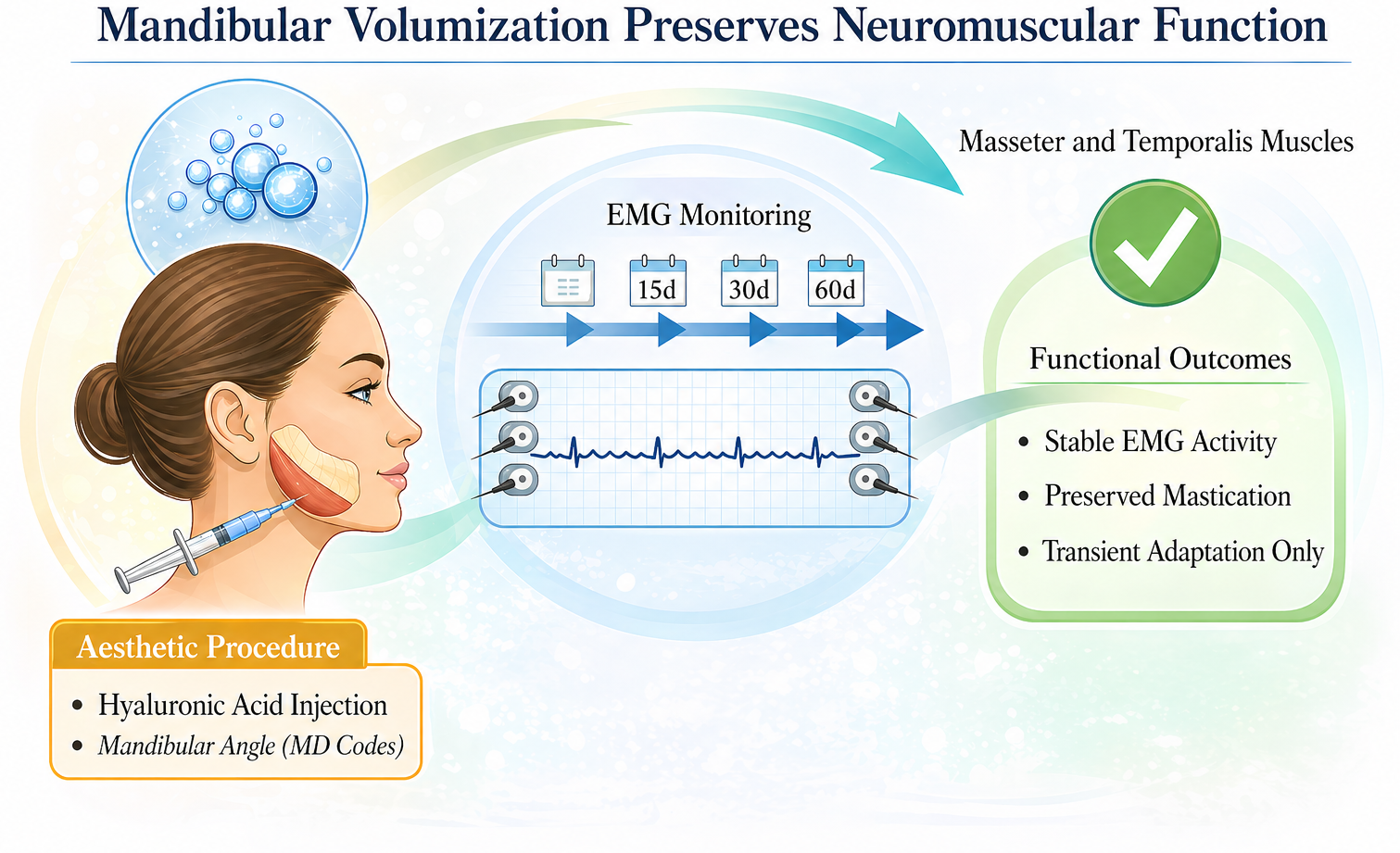
Graphical Abstract

1. Introduction

Orofacial harmonization has increasingly gained space in interdisciplinary clinical practice involving dentistry, medicine, and aesthetic sciences, with the objective of improving facial aesthetics while maintaining stomatognathic system function [1]. The mandibular angle stands out for its clinical and aesthetic importance, as it plays a key role in shaping the contour of the lower third of the face and is associated with youthfulness, symmetry, and sexual dimorphism [2,3]. In this context, hyaluronic acid fillers have been widely used to enhance mandibular definition, especially in individuals presenting age-related structural volume loss or specific anatomical characteristics [4].
Recent epidemiological data demonstrate continuous global growth in minimally invasive facial aesthetic procedures using dermal fillers. In 2022 alone, more than 13 million aesthetic injectable procedures were performed globally, approximately 4.3 million of which involved hyaluronic acid fillers [5]. This increase reflects the progressive worldwide expansion of facial volumization procedures over recent decades in both developed and developing countries [6].
Hyaluronic acid is a naturally occurring component of the extracellular matrix characterized by high biocompatibility and hydrophilic capacity, properties that support its extensive application in facial volumization procedures [7]. Additionally, newer formulations containing advanced cross-linking technologies have demonstrated improved rheological behavior, greater volumetric stability, and more homogeneous tissue integration compared with conventional fillers, contributing to safer and longer-lasting outcomes following deep facial injections [8].
From a functional standpoint, the mandibular angle is closely associated with the insertion of the masseter muscle, one of the primary muscles responsible for mandibular elevation and generation of masticatory force, whereas the temporalis muscle contributes to mandibular elevation and posterior positioning during mandibular movements [9,10]. Therefore, changes in local tissue volume resulting from hyaluronic acid filler injection in the mandibular angle may theoretically interfere with the biomechanical relationship between muscle insertions and adjacent structures, potentially affecting motor recruitment and load distribution patterns, as injectable fillers may alter muscle support and functional dynamics through biomechanical modulation of facial soft tissues [11]. For this reason, preserving the balance among synergistic and antagonistic muscles is essential when performing aesthetic interventions aimed at improving facial appearance without compromising muscular function [12].
Surface electromyography represents a noninvasive and validated method for quantitative assessment of masticatory muscle electrical activity. Standardized international recommendations regarding electrode positioning and signal acquisition contribute to methodological reproducibility and reliability [13]. Furthermore, previous investigations have demonstrated the sensitivity of electromyography for detecting functional changes associated with dental, rehabilitative, and orthodontic interventions, supporting its applicability in the evaluation of neuromuscular adaptations after facial structural modifications [14].
Despite the growing popularity of mandibular angle augmentation procedures in orofacial harmonization, evidence regarding their possible effects on the electromyographic behavior of the masseter and temporalis muscles remains limited, particularly because volumetric changes in this region may theoretically influence muscle recruitment patterns and masticatory biomechanics due to the close anatomical relationship with the masseter muscle insertion. Most currently available studies primarily emphasize aesthetic outcomes, patient satisfaction, and procedural safety [8], while objective functional analyses of the stomatognathic system remain scarce. Considering that stomatognathic function depends on the interaction between skeletal, muscular, and occlusal components, it becomes clinically relevant to investigate whether mandibular angle volumization may induce measurable alterations in myoelectric activity functional mandibular tasks.
Accordingly, the present study aimed to investigate the electromyographic activity of the masseter and temporalis muscles during mandibular tasks and dynamic chewing conditions before and after hyaluronic acid injection in the mandibular angle. The null hypothesis of the study states that hyaluronic acid injection in this region is not associated with significant changes in the electromyographic activity of the masseter and temporalis muscles throughout the follow-up period.

2. Materials and Methods

2.1. Population and Sample Characterization

This study consisted of a longitudinal observational investigation approved by the Research Ethics Committee of the Ribeirão Preto School of Dentistry, University of São Paulo (Brazil), under protocol no. 79298124.2.0000.5419. All subjects received detailed explanations regarding the study procedures and signed an informed consent form prior to participation.
Sample size calculation was performed using G*Power software version 3.1.9.2 (Franz Faul, University of Kiel, Germany). Based on previously published findings with similar methodological design, an effect size of 1.08 was adopted [15], indicating a minimum sample of 10 subjects for statistical power of 81%.
Inclusion criteria comprised adults presenting complete permanent dentition, normal occlusal relationships, satisfactory systemic health, and body mass index within normal limits. Normal occlusion was characterized by an Angle Class I relationship, defined by occlusion of the mesiobuccal cusp of the maxillary first permanent molar with the mesiobuccal groove of the mandibular first permanent molar. Subjects were selected according to predefined eligibility criteria to standardize physical and functional conditions and minimize possible confounding variables.
Throughout the follow-up period, subjects were instructed not to undergo surgical procedures or additional facial aesthetic interventions. Subjects with ulcerative lesions, open skin wounds, cognitive or neurological disorders, uncontrolled systemic diseases, previous facial filler procedures, or hypersensitivity to hyaluronic acid were excluded. Individuals wearing removable or fixed dental prostheses, using muscle relaxants capable of influencing neuromuscular physiology, or diagnosed with temporomandibular disorders according to the Diagnostic Criteria for Temporomandibular Disorders (DC/TMD) were also excluded from the investigation. The DC/TMD protocol was applied by a previously trained and calibrated examiner [16].
The sample evaluated in the present study was previously described by Bettiol et al. [17]. However, the present investigation specifically focused on electromyographic outcomes involving the masseter and temporalis muscles, whereas the previous study analyzed maximum molar bite force and orofacial tissue pressure. Electromyographic analyses were conducted according to the recommendations of the Surface Electromyography for the Non-Invasive Assessment of Muscles (SENIAM) [13]. This approach allowed independent analysis and interpretation of distinct functional variables obtained from the same clinical sample.

2.2. Hyaluronic Acid Injection in the Mandibular Angle

Injection planning for mandibular contour enhancement followed the MD Codes facial mapping strategy. This protocol provides standardized codes for facial filler application according to the anatomical region and the correction objective. In the present study, the JAW code was adopted for the mandibular angle region. The protocol defines injection sequence, application sites, filler volume, injection depth, and the most appropriate delivery instrument for each region [18]. A cannula was used for filler administration in all subjects.
Injection sites were determined according to anatomical landmarks described in the MD Codes™ protocol for mandibular contour enhancement. The JAW1 region corresponded to the mandibular angle projection area, JAW2 to the preauricular transition zone, and JAW3 to the mandibular body contour. In all subjects, filler placement was performed along the mandibular contour in planes superficial to the masseter muscle, as recommended for mandibular definition and facial structural support. This approach was adopted because it reflects the technique classically employed for mandibular contour definition, allowing assessment of the functional behavior of the stomatognathic system after the procedure. Injection volume and filler distribution were standardized bilaterally for all participants to reduce procedural variability and improve reproducibility of electromyographic assessments. Minor adjustments in cannula positioning and vector orientation were performed when necessary, according to individual anatomical characteristics, while maintaining the same predefined MD Codes™ sequence and total filler volume.
Each hemiface received 2 mL of cross-linked hyaluronic acid filler (Voluma Juvéderm®, Allergan Inc., Irvine, CA, USA). The product contains hyaluronic acid at a concentration of 20 mg/mL and was previously approved by the U.S. Food and Drug Administration (FDA) for restoration of facial volume loss associated with aging. Previous reports describe favorable aesthetic outcomes, reduced recovery time, and a low complication rate associated with this material [19]. For mandibular angle augmentation, 0.5 mL was injected into the JAW1 region using a cannula, while an additional 0.5 mL was administered into the preauricular region (JAW2), and 1 mL was applied along the mandibular body (JAW3). This combined approach aimed to improve mandibular contour definition through a standardized technique supported by previous evidence [19].

2.3. Electromyographic Activity Assessment

Surface electromyographic activity (µVs) of the masseter and temporalis muscles was recorded during the following mandibular tasks: rest (4 s), protrusion (4 s), right laterality (4 s), left laterality (4 s), and dental clenching during maximum voluntary contraction performed with and without parafilm (4 s each condition). The parafilm consisted of a folded paraffin sheet (Parafilm M®, Pechiney Plastic Packaging, Batavia, IL, USA) measuring 18 × 17 × 4 mm and weighing 245 mg, positioned bilaterally between the first and second permanent molars.
Electromyographic recordings were obtained using the Trigno™ Wireless EMG System (Delsys Inc., Natick, MA, USA), which performed signal acquisition, amplification (gain of 300), and digitization at a sampling frequency of 4 kHz with 16-bit A/D resolution through EMGworks® Acquisition and Analysis 4.8.0 (Delsys Inc., Boston, MA, USA). The minimum interelectrode distance was 20 mm, and total channel noise remained below 0.45 µV peak-to-peak.
Electrode placement was carried out by a calibrated examiner following SENIAM recommendations [13]. Electromyographic signals were processed using root mean square (RMS) values. Before electrode fixation, the skin surface was cleaned with alcohol to minimize cutaneous impedance [20]. Subjects were instructed to remain relaxed and cooperative during all procedures.
For dynamic analyses of habitual and non-habitual chewing, masticatory cycle efficiency was used as the outcome measure, calculated from the integral of the linear envelope of the electromyographic signal of the masseter and temporalis muscles bilaterally, with values expressed in microvolt-seconds (µVs). Habitual chewing recordings were performed using 5 g of peanuts (hard consistency) and 5 g of raisins (soft consistency), whereas parafilm chewing represented the non-habitual chewing condition. Chewing tasks were performed in a standardized sequence, beginning with parafilm, followed by raisins and peanuts, with a 2 min rest interval between tasks to minimize possible muscular fatigue and adaptation effects.
Integral values corresponding to masticatory cycles were calculated from cycles occurring between 5 and 10 s of the chewing task. Initial chewing cycles were excluded because of the greater variability typically observed at the beginning of mastication [21].
The examiner responsible for all assessments underwent previous training and calibration to ensure methodological standardization. Intra-examiner reliability was calculated using Dahlberg’s formula based on two repeated measurements obtained from five subjects with a seven-day interval between evaluations. Method error for electromyographic activity was 3.74%, indicating satisfactory reproducibility. Intra-rater reliability was assessed using the intraclass correlation coefficient (ICC), which demonstrated excellent reproducibility for electromyographic activity (ICC = 0.936).

2.4. Statistical Analysis

Prior to inferential analysis, data normality was verified using the Shapiro–Wilk test. Statistical analyses were performed using the Statistical Package for the Social Sciences (SPSS), version 20.0 (SPSS Inc., Chicago, IL, USA). Comparisons among time points were conducted using repeated-measures ANOVA followed by Bonferroni post hoc correction, considering p < 0.05 as statistically significant. In addition to p-values, effect sizes were estimated using partial eta squared (η2p) to determine the magnitude of temporal effects. Pairwise comparisons between baseline and follow-up periods (15, 30, and 60 days) were additionally assessed using Cohen’s d for repeated measures. Descriptive data were expressed as mean values and 95% confidence intervals (95% CI), which represent the range within which the population mean is expected to lie with 95% confidence. Considering the reduced sample size, longitudinal individual trajectories (graphical representation of repeated electromyographic measurements obtained from each participant over time) were also analyzed to characterize within-subject variability and temporal behavior of electromyographic activity. For this purpose, electromyographic values obtained at baseline and at 15, 30, and 60 days were plotted individually for each participant. Visual inspection of trajectories was performed to identify temporal consistency, direction of changes, and interindividual variability, allowing comparison between individual patterns and group-level findings.

3. Results

Thirty individuals were initially screened for eligibility. After application of the inclusion and exclusion criteria, 10 subjects were considered eligible and included in the study. The final sample consisted of eight women and two men, with mean age of 34.30 ± 11.20 years and mean body mass index of 23.94 ± 2.35 kg/m2. Electromyographic variables related to stomatognathic function were evaluated at baseline and at 15, 30, and 60 days following mandibular angle augmentation with hyaluronic acid.
Table 1 presents the electromyographic activity of the masseter and temporalis muscles during mandibular tasks at baseline and at 15, 30, and 60 days after hyaluronic acid injection. At rest, no significant differences were observed for any of the evaluated muscles over time (p > 0.05), with small effect sizes (η2p ≤ 0.12). Similarly, during protrusion, no significant differences were found for the masseter or temporalis muscles (p > 0.05), with small effect sizes (η2p ≤ 0.13). For right laterality, electromyographic activity remained stable throughout the follow-up period for all analyzed muscles (p > 0.05), with effect sizes ranging from small to moderate (η2p = 0.03–0.17). During left laterality, a significant effect of time was observed for the right masseter muscle (p = 0.03; η2p = 0.17), while no significant differences were found for the remaining muscles (p > 0.05). During maximum voluntary contraction, a significant effect of time was observed only for the left masseter muscle (p = 0.02; η2p = 0.22), with no significant differences for the other muscles (p > 0.05). A similar finding was observed during maximum voluntary contraction performed with parafilm, in which only the left masseter muscle demonstrated a significant temporal effect (p = 0.04; η2p = 0.19). The remaining muscles did not exhibit statistically significant differences over time (p > 0.05).
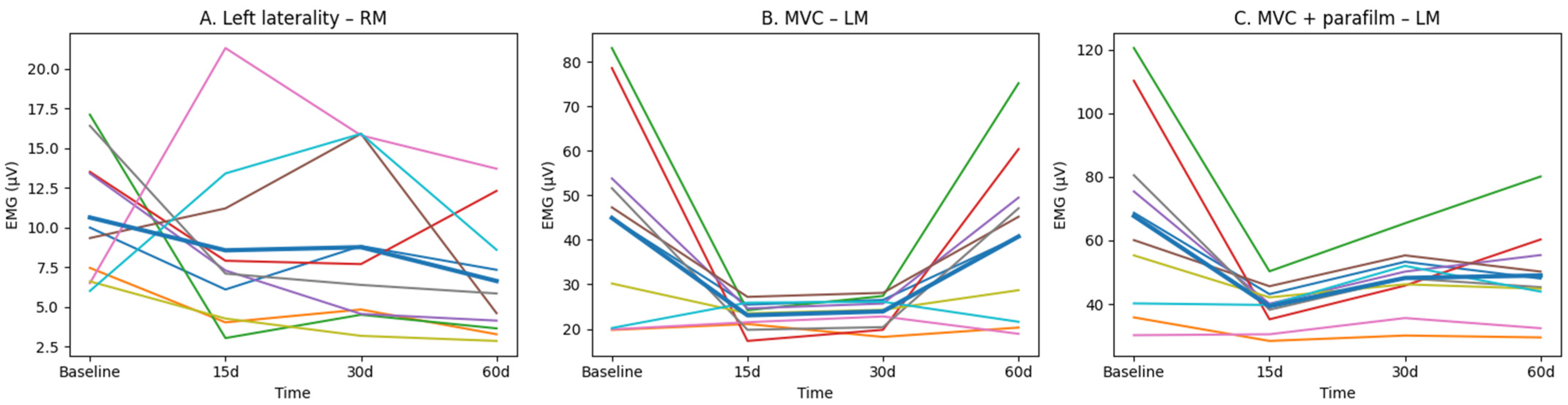
Analysis of individual electromyographic trajectories across the experimental periods is illustrated in Figure 1. The graphical representation demonstrated within-subject variability together with relatively consistent temporal behavior, supporting the overall stability identified in the repeated-measures analyses.
Table 2 presents the electromyographic activity of the masseter and temporalis muscles during habitual (peanuts and raisins) and non-habitual (parafilm) chewing at baseline and at 15, 30, and 60 days after hyaluronic acid injection. During habitual chewing with peanuts, no significant temporal differences were observed for any evaluated muscle (p > 0.05), with effect sizes varying from small to moderate. Likewise, during raisin chewing, electromyographic activity remained stable across all evaluation periods for both the masseter and temporalis muscles (p > 0.05), also demonstrating small-to-moderate effect sizes. For non-habitual chewing performed with parafilm, electromyographic activity did not significantly differ across time for any analyzed muscle (p > 0.05), and effect sizes remained small.

4. Discussion

The null hypothesis of this study stated that hyaluronic acid injection in the mandibular angle would not promote significant changes in the electromyographic activity of the masseter and temporalis muscles throughout the follow-up period. Overall, the present findings support this hypothesis, since electromyographic behavior remained stable under most experimental conditions, with only limited and temporary variations identified in the masseter muscle. In addition to statistical significance, interpretation of the findings also considered effect sizes, confidence intervals, and individual trajectories, providing a broader perspective for analysis in a small-sample longitudinal study [22,23].
The mandibular angle region has unique anatomical relevance because it represents the primary insertion site of the masseter muscle [9], and volumetric interventions may theoretically influence local biomechanics [24]. Nevertheless, the predominance of small effect sizes together with overlapping confidence intervals suggests that any possible biomechanical influence remained subtle and within physiological limits.
Electromyographic activity recorded during the rest condition remained stable throughout the follow-up period. This observation has physiological relevance because masticatory muscles under normal conditions generally exhibit minimal electrical activity at rest, except for baseline activity necessary to maintain mandibular posture [13]. Furthermore, the absence of consistent changes in individual trajectories reinforces the lack of systematic neuromuscular modulation after the procedure.
During protrusion and laterality (right and left), expected neuromuscular patterns were generally preserved [25], although minor variations were observed at some point of time. These variations were not accompanied by consistent temporal patterns or expressive effect sizes, suggesting physiological intra-individual variability rather than a clinically relevant intervention effect.
The preservation of these activation patterns indicates maintenance of trigeminal motor control and functional integrity of corticobulbar pathways associated with masticatory muscle activity, as previously described in neurophysiological investigations [26]. Additionally, the combination of small effect sizes, overlapping confidence intervals, and heterogeneous individual responses further supports the absence of coordinated neuromuscular alterations at the group level.
A statistically significant effect was observed in the right masseter during left laterality (η2p = 0.17), representing a moderate effect size; however, this finding should be interpreted cautiously considering the broad confidence intervals and the absence of uniform temporal behavior among subjects. The reduction identified at 30 days may reflect a transient adaptive response associated with subtle biomechanical modifications at the muscle insertion area, potentially related to progressive tissue integration and viscoelastic characteristics of hyaluronic acid [27,28]. Nevertheless, the variability among subjects and the tendency toward recovery at 60 days indicate that these changes are likely to represent temporary physiological adaptation rather than a persistent functional effect.
During dental clenching at maximum voluntary contraction, significant effects were observed for the left masseter muscle (η2p = 0.19–0.22), indicating moderate-to-large effect sizes. Importantly, interpretation of these findings should not rely exclusively on statistical significance, but also on temporal consistency and effect magnitude. Maximum voluntary clenching represents a condition of high motor unit recruitment [29]. The transient reduction observed at 15 and 30 days may be attributed to proprioceptive adjustments resulting from volumetric modification of the mandibular angle. Importantly, individual trajectory analysis demonstrated a coherent pattern of temporary reduction followed by recovery at 60 days, which supports the interpretation of a short-term adaptive response rather than random fluctuation. The return to baseline values further reinforces the absence of persistent functional alteration.
With regard to habitual chewing (peanuts and raisins) and non-habitual chewing (parafilm), no significant differences were observed over time. In addition to non-significant p-values, the consistently small effect sizes (η2p ≤ 0.14) and the substantial overlap of 95% confidence intervals across all time points indicate a high degree of stability in masticatory performance. This finding is functionally relevant, since chewing efficiency can be inferred from the amount of electromyographic activity required to perform the same task [14,30]. Moreover, individual trajectory analysis did not demonstrate consistent directional changes, indicating that the lack of group differences was not masking opposite individual responses. From a physiological standpoint, this demonstrates that mandibular angle filling did not compromise the synergy between the masseter and temporalis muscles during dynamic masticatory cycles.
The biocompatibility of hyaluronic acid is a central aspect in interpreting these findings. It is a polysaccharide naturally present in the extracellular matrix, with high water affinity and progressive tissue integration. Its non-immunogenic nature and controlled enzymatic degradation contribute to tissue homeostasis [31]. The absence of cumulative or persistent electromyographic alterations over time further supports the interpretation that the material does not induce long-term neuromuscular disturbance when applied under appropriate clinical conditions.
Furthermore, the technique based on the MD Codes protocol likely contributed to the observed functional preservation [18]. By targeting deep supraperiosteal planes, the intervention minimizes direct interaction with muscle fibers, which is consistent with the small magnitude of observed effects and the absence of systematic changes in individual trajectories. From a systemic physiological perspective, the stomatognathic system exhibits a remarkable capacity for neuromuscular adaptation [32]. The present findings are consistent with this adaptive behavior, since the identified variations were small, temporary, and lacked consistent directional patterns over time.
This study has clinical and scientific relevance, as it expands the functional understanding of orofacial harmonization procedures. Importantly, by incorporating effect sizes, confidence intervals, and individual trajectory analysis, this study provides a more nuanced and transparent interpretation of the data, reducing the risk of overreliance on p-values and avoiding causal overinterpretation in a small sample context. These findings support the functional safety of hyaluronic acid injection in the mandibular angle when performed using standardized techniques and appropriate materials. Some limitations should be considered. The sample size was small, and the follow-up was limited to 60 days. However, complementary statistical approaches, including effect sizes, 95% confidence intervals, and individual trajectory analyses, were used to help mitigate these limitations and improve data interpretability.

5. Conclusions

Hyaluronic acid injection in the mandibular angle was not associated with clinically relevant changes in the electromyographic activity of the masseter and temporalis muscles. Most variables remained stable throughout the follow-up period, and the few significant changes observed were temporary and showed small-to-moderate effect sizes. These findings suggest preservation of stomatognathic neuromuscular function after mandibular angle volumization within the evaluated follow-up period.

Author Contributions

Conceptualization, G.D.A.R., N.B.B., F.A.d.C., S.C.H.R., M.d.M., S.S. and M.P.; methodology, G.D.A.R., N.B.B., F.A.d.C., S.C.H.R., S.S. and M.P.; software, G.D.A.R., N.B.B., F.A.d.C., S.C.H.R., J.F.M.-C., L.V.M. and M.P.; statistics, S.C.H.R., S.S. and M.P.; validation, S.C.H.R., S.S., J.F.M.-C., L.V.M. and M.P.; investigation, G.D.A.R., N.B.B. and F.A.d.C.; resources, G.D.A.R., N.B.B., F.A.d.C. and M.P.; data curation, G.D.A.R., N.B.B., F.A.d.C. and M.P.; writing—original draft preparation, G.D.A.R., N.B.B., M.P. and S.C.H.R.; writing—review and editing, S.S., J.F.M.-C., L.V.M. and M.d.M.; visualization, M.P.; supervision, S.C.H.R. and M.P.; project administration, G.D.A.R., N.B.B., F.A.d.C. and M.P.; funding acquisition, S.C.H.R. and S.S. All authors have read and agreed to the published version of the manuscript.

Funding

This study was supported by a grant from the FAPESP (Process: 2014/50891-1) CNPQ (Process: 312586/2021-3) and INCT Digital Mental Health (Process: 409148/2024-5).

Institutional Review Board Statement

The study was conducted in accordance with the Declaration of Helsinki and approved by the Ethics Committee of the School of Dentistry of Ribeirão Preto, University of São Paulo, Brazil (protocol code 79298124.2.0000.5419, date of approval: 25 April 2024).

Informed Consent Statement

Informed consent was obtained from all subjects involved in the study. Written informed consent was obtained from the patients to publish this manuscript.

Data Availability Statement

The data presented in this study are available on reasonable request, after the signature of a formal data sharing agreement in anonymous form, from the corresponding author because they are protected by privacy.

Acknowledgments

During the preparation of this work, the authors used ChatGPT (OpenAI, GPT-5 model) to support text translation and to assist in the creation of image-related content. Following the use of this tool, the authors carefully reviewed and revised the material as needed and take full responsibility for the final version of the publication.

Conflicts of Interest

The authors declare no conflicts of interest.

Abbreviations

The following abbreviations are used in this manuscript:
ANOVAAnalysis of Variance
BMIBody Mass Index
CIConfidence Interval
CNPqConselho Nacional de Desenvolvimento Científico e Tecnológico
DC/TMDDiagnostic Criteria for Temporomandibular Disorders
EMGElectromyography
EMGworks®Electromyography Works Software
FDAFood and Drug Administration
ICCIntraclass Correlation Coefficient
INCT.TMNational Institute and Technology—Translational Medicine
ISAPSInternational Society of Aesthetic Plastic Surgery
LMLeft Masseter Muscle
LTLeft Temporalis Muscle
MD CodesMedical Codes for Facial Mapping
MVCMaximum Voluntary Contraction
RMSRoot Mean Square
SENIAMSurface Electromyography for the Non-Invasive Assessment of Muscles
SPSSStatistical Package for the Social Sciences
η2pPartial Eta Squared

References

  1. Dall’Magro, A.K.; Dogenski, L.C.; Dall’Magro, E.; Figur, N.S.; Trentin, M.S.; De Carli, J.P. Orthognathic surgery and orthodontics associated with orofacial harmonization: Case report. Int. J. Surg. Case Rep. 2021, 83, 106013. [Google Scholar] [CrossRef]
  2. Jagadish Chandra, H.; Ravi, M.S.; Sharma, S.M.; Rajendra Prasad, B. Standards of facial esthetics: An anthropometric study. J. Maxillofac. Oral Surg. 2012, 11, 384–389. [Google Scholar] [CrossRef] [PubMed]
  3. van der Wel, H.; Qiu, B.; Spijkervet, F.K.L.; Jansma, J.; Schepers, R.H.; Kraeima, J. Morphological variation of the mandible in the orthognathic population: A morphological study using statistical shape modelling. J. Pers. Med. 2023, 13, 854. [Google Scholar] [CrossRef] [PubMed]
  4. Burgess, C.; Dayan, S.; Bank, D.; Weinkle, S.; Sartor, M.; Chawla, S.; Keaney, T. Hyaluronic acid filler VYC-25L for jawline restoration yields high satisfaction, improved jawline measurements, and sustained effectiveness across skin types, age, and gender for up to 12 months. Aesthet. Surg. J. 2024, 45, 98–107. [Google Scholar] [CrossRef]
  5. International Society of Aesthetic Plastic Surgery. ISAPS International Survey on Aesthetic/Cosmetic Procedures Performed in 2022. 2023. Available online: https://www.isaps.org (accessed on 27 February 2026).
  6. Heidekrueger, P.I.; Juran, S.; Ehrl, D.; Aung, T.; Tanna, N.; Broer, P.N. Global aesthetic surgery statistics: A closer look. J. Plast. Surg. Hand Surg. 2017, 51, 270–274. [Google Scholar] [CrossRef] [PubMed]
  7. Puljic, A.; Frank, K.; Cohen, J.; Otto, K.; Mayr, J.; Hugh-Bloch, A.; Kuroki-Hasenöhrl, D. A scientific framework for comparing hyaluronic acid filler crosslinking technologies. Gels 2025, 11, 487. [Google Scholar] [CrossRef]
  8. Liu, J.; Gao, M.; Hu, H.; Pang, H.; Liu, Y.; Zhang, P. Facial injectable fillers in aesthetic medicine: Clinical applications and safety strategies. Med. Sci. Monit. 2025, 31, e949944. [Google Scholar] [CrossRef]
  9. Mezey, S.E.; Müller-Gerbl, M.; Toranelli, M.; Türp, J.C. The human masseter muscle revisited: First description of its coronoid part. Ann. Anat. 2022, 240, 151879. [Google Scholar] [CrossRef]
  10. Corcoran, N.M.; Goldman, E.M. Anatomy, head and neck, masseter muscle. In StatPearls; StatPearls Publishing: Treasure Island, FL, USA, 2025. [Google Scholar]
  11. De Maio, M. The minimal approach: An innovation in facial cosmetic procedures. Aesthetic Plast. Surg. 2004, 28, 295–300. [Google Scholar] [CrossRef]
  12. De Maio, M. Myomodulation with injectable fillers: An innovative approach to addressing facial muscle movement. Aesthetic Plast. Surg. 2020, 44, 1300–1316. [Google Scholar] [CrossRef]
  13. Hermens, H.J.; Freriks, B.; Disselhorst-Klug, C.; Rau, G. Development of recommendations for SEMG sensors and sensor placement procedures. J. Electromyogr. Kinesiol. 2000, 10, 361–374. [Google Scholar] [CrossRef]
  14. De Rossi, M.; Palinkas, M.; de Lima-Lucas, B.; Santos, C.M.; Semprini, M.; Oliveira, L.F.; Hallak-Regalo, I.; Bersani, E.O.; Miglioranca, R.; Siéssere, S.; et al. Masticatory muscle activity evaluation by electromyography in subjects with zygomatic implants. Med. Oral Patol. Oral Cir. Bucal. 2017, 22, e392–e397. [Google Scholar] [CrossRef] [PubMed][Green Version]
  15. Marcus, K.; Moradi, A.; Kaufman-Janette, J.; Ablon, G.; Donofrio, L.; Chapas, A.; Kazin, R.; Rivkin, A.; Rohrich, R.J.; Weiss, R.; et al. A randomized trial to assess effectiveness and safety of a hyaluronic acid filler for chin augmentation and correction of chin retrusion. Plast. Reconstr. Surg. 2022, 150, 1240e–1248e. [Google Scholar] [CrossRef]
  16. Warzocha, J.; Gadomska-Krasny, J.; Mrowiec, J. Etiologic factors of temporomandibular disorders: A systematic review of literature containing Diagnostic Criteria for Temporomandibular Disorders (DC/TMD) and Research Diagnostic Criteria for Temporomandibular Disorders (RDC/TMD) from 2018 to 2022. Healthcare 2024, 12, 575. [Google Scholar] [CrossRef]
  17. Bettiol, N.B.; Carvalho, F.A.; Siessere, S.; Romero, G.D.A.; Menezes, M.; Martini, C.C.J.; Mazzi-Chaves, J.F.; Magri, L.V.; Regalo, S.C.H.; Palinkas, M. Assessment of orofacial function after mandibular angle harmonization with hyaluronic acid: A longitudinal observational study. Dent. J. 2026, 14, 241. [Google Scholar] [CrossRef]
  18. de Maio, M. MD Codes™: A methodological approach to facial aesthetic treatment with injectable hyaluronic acid fillers. Aesthetic Plast. Surg. 2021, 45, 690–709. [Google Scholar] [CrossRef] [PubMed]
  19. Ho, D.; Jagdeo, J. Biological properties of a new volumizing hyaluronic acid filler: A systematic review. J. Drugs Dermatol. 2015, 14, 50–54. [Google Scholar]
  20. Di Palma, E.; Tepedino, M.; Chimenti, C.; Tartaglia, G.M.; Sforza, C. Effects of the functional orthopaedic therapy on masticatory muscles activity. J. Clin. Exp. Dent. 2017, 9, e886–e891. [Google Scholar] [CrossRef][Green Version]
  21. Siéssere, S.; de Albuquerque Lima, N.; Semprini, M.; de Sousa, L.G.; Issa, J.P.M.; Monteiro, S.A.C.; Regalo, S.C.H. Masticatory process in individuals with maxillary and mandibular osteoporosis: Electromyographic analysis. Osteoporos. Int. 2009, 20, 1847–1851. [Google Scholar] [CrossRef]
  22. Lakens, D. Calculating and reporting effect sizes to facilitate cumulative science: A practical primer for t-tests and ANOVAs. Front. Psychol. 2013, 4, 863. [Google Scholar] [CrossRef] [PubMed]
  23. Cumming, G. The new statistics: Why and how. Psychol. Sci. 2014, 25, 7–29. [Google Scholar] [CrossRef]
  24. Manzaneda Cipriani, R.M.; Cárdenas Larenas, J.P.; Viaro, M.S.S.; Flores González, E.A.; Adrianzen, G.; Babaitis, R.; Duran Vega, H.; Stefanelli, M.; Ventura, R. Jawline aesthetic definition: Enhancement with masseteric augmentation using ultrasound-guided fat transfer. Plast. Reconstr. Surg. Glob. Open 2024, 12, e5695. [Google Scholar] [CrossRef] [PubMed]
  25. Cecílio, F.A.; Regalo, S.C.; Palinkas, M.; Issa, J.P.; Siéssere, S.; Hallak, J.E.; Machado-de-Sousa, J.P.; Semprini, M. Ageing and surface EMG activity patterns of masticatory muscles. J. Oral Rehabil. 2010, 37, 248–255. [Google Scholar] [CrossRef]
  26. Cruccu, G.; Berardelli, A.; Inghilleri, M.; Manfredi, M. Functional organization of the trigeminal motor system in man: A neurophysiological study. Brain 1989, 112, 1333–1350. [Google Scholar] [CrossRef] [PubMed]
  27. Blazevich, A.J. Adaptations in the passive mechanical properties of skeletal muscle to altered patterns of use. J. Appl. Physiol. 2019, 126, 1483–1491. [Google Scholar] [CrossRef]
  28. Melero, A.; Andrade Del Olmo, J.; Martínez de Cestafe, N.; Goenaga Ibeas, C.; Ucelay López de Heredia, M.; Izaguirre, J.K.; Alonso, J.M.; Pérez González, R. Viscoelastic properties and enzymatic degradation of crosslinked hyaluronic acid for deep dermal filler use. Gels 2025, 11, 754. [Google Scholar] [CrossRef]
  29. Donegan, S.J.; Christensen, L.V.; Kaltenbrunner, A.M. Surface electromyographic estimates of recruitment/rate coding of masseteric motor units. J. Oral Rehabil. 1992, 19, 129–136. [Google Scholar] [CrossRef] [PubMed]
  30. da Silva, N.; Verri, E.; Palinkas, M.; Hallak, J.; Regalo, S.; Siéssere, S. Impact of Parkinson’s disease on the efficiency of masticatory cycles: Electromyographic analysis. Med. Oral Patol. Oral Cir. Bucal 2019, 24, e314–e318. [Google Scholar] [CrossRef]
  31. Mousavi, S.; Dahiya, D.; Nigam, P.S.; Sionkowska, A. Applications of hyaluronic acid in pharmaceuticals, healthcare and cosmetics and its biosynthesis. Biotechnol. J. 2026, 21, e70180. [Google Scholar] [CrossRef]
  32. Nakata, Y.; Ueda, H.M.; Kato, M.; Tabe, H.; Shikata-Wakisaka, N.; Matsumoto, E.; Koh, M.; Tanaka, E.; Tanne, K. Changes in stomatognathic function induced by orthognathic surgery in patients with mandibular prognathism. J. Oral Maxillofac. Surg. 2007, 65, 444–451. [Google Scholar] [CrossRef]
Figure 1. Trajectories of electromyographic activity of study participant of the masseter muscle across evaluated periods (baseline, 15, 30, and 60 days) after hyaluronic acid injection in the mandibular angle. (A) Right masseter during left laterality; (B) left masseter during maximum voluntary contraction (MVC); (C) left masseter during MVC with parafilm. Each thin line represents an individual participant, and the thicker line represents the group mean. EMG values are expressed in microvolts (µV).
Oral 06 00068 g001
Table 1. Electromyographic activity (µVs) of the masseter and temporalis muscles during mandibular tasks at baseline and at 15, 30, and 60 days after hyaluronic acid injection in the mandibular angle. Values are expressed as mean ± standard error and 95% confidence intervals (95% CIs). Statistical analysis was performed using repeated-measures ANOVA with Bonferroni correction (p < 0.05). Effect sizes are presented as partial eta squared (η2p).
TasksMusclesPeriodsp ANOVAη2p
Baseline95% CI15 Days95% CI30 Days95% CI60 Days95% CI
RestRM3.80 ± 0.313.19–4.413.50 ± 0.282.94–4.064.01 ± 0.383.26–4.763.89 ± 0.293.32–4.460.760.03
LM4.41 ± 0.273.88–4.943.73 ± 0.233.26–4.204.63 ± 0.403.84–5.424.21 ± 0.343.54–4.880.290.12
RT4.88 ± 0.503.90–5.864.93 ± 0.483.98–5.884.38 ± 0.243.91–4.854.62 ± 0.304.03–5.210.740.04
LT4.52 ± 0.264.01–5.034.57 ± 0.294.01–5.134.32 ± 0.363.60–5.045.12 ± 0.394.35–5.890.300.11
ProtrusionRM13.44 ± 2.099.37–17.519.08 ± 1.815.53–12.6312.74 ± 2.448.02–17.4613.37 ± 2.189.20–17.540.280.13
LM10.86 ± 1.837.33–14.399.02 ± 1.885.38–12.669.62 ± 1.905.91–13.3310.05 ± 1.916.33–13.770.790.03
RT5.83 ± 0.594.68–6.987.57 ± 1.684.32–10.825.84 ± 0.634.61–7.075.66 ± 1.003.73–7.590.430.09
LT6.25 ± 1.084.18–8.326.86 ± 1.224.51–9.215.87 ± 0.764.37–7.376.20 ± 0.654.91–7.490.730.04
Right
laterality
RM6.54 ± 0.735.11–7.978.24 ± 1.824.64–11.848.28 ± 1.695.02–11.546.22 ± 1.253.68–8.760.160.17
LM8.96 ± 1.386.21–11.718.06 ± 1.495.08–11.048.02 ± 1.894.35–11.698.48 ± 1.675.24–11.720.680.05
RT8.21 ± 1.385.46–10.969.61 ± 1.496.63–12.598.87 ± 1.895.20–12.549.00 ± 1.675.76–12.240.800.03
LT5.23 ± 0.534.17–6.296.04 ± 0.954.17–7.915.37 ± 0.584.22–6.525.40 ± 0.444.53–6.270.530.07
Left
laterality
RM9.99 ± 1.497.12–12.866.09 ± 0.894.54–7.648.83 ± 1.286.52–11.147.33 ± 1.135.45–9.210.030.17
LM8.22 ± 1.585.24–11.207.02 ± 1.504.19–9.857.80 ± 1.634.73–10.877.60 ± 1.804.22–10.980.880.02
RT6.64 ± 1.443.93–9.355.61 ± 1.033.72–7.506.75 ± 1.274.36–9.144.87 ± 0.294.29–5.450.380.09
LT10.77 ± 2.016.85–14.699.90 ± 2.305.42–14.3810.11 ± 2.165.90–14.3211.51 ± 2.327.01–16.010.700.05
MVCRM44.04 ± 6.9430.43–57.6536.49 ± 6.5823.59–49.3925.60 ± 5.9214.02–37.1840.30 ± 7.9124.79–55.810.700.06
LM44.87 ± 7.5730.90–58.8425.46 ± 4.4317.28–33.6426.52 ± 3.5219.64–33.4040.70 ± 8.3725.26–56.140.020.22
RT32.20 ± 7.5417.47–46.9327.68 ± 5.4317.07–38.2941.58 ± 7.3827.17–55.9940.29 ± 7.0926.47–54.110.210.14
LT38.55 ± 5.9426.93–50.1729.39 ± 5.8118.03–40.7542.51 ± 7.5427.77–57.2540.07 ± 6.8526.71–53.430.160.16
MVC with parafilmRM62.17 ± 7.9946.49–77.8551.98 ± 7.6836.92–67.0470.37 ± 7.9354.83–85.9152.10 ± 8.0936.27–67.930.330.12
LM68.70 ± 10.2248.66–88.7443.12 ± 6.4330.51–55.7353.29 ± 4.8543.78–62.8048.02 ± 9.3129.78–66.260.040.19
RT 48.50 ± 9.2130.46–66.5451.98 ± 9.3533.66–70.3060.79 ± 8.2044.73–76.8554.42 ± 11.3232.23–76.610.750.03
LT57.27 ± 10.6636.39–78.1545.16 ± 6.9231.60–58.7260.14 ± 8.8542.79–77.4957.89 ± 9.2639.75–76.030.290.13
MVC. maximum voluntary contraction; RM. right masseter muscle; LM. left masseter muscle; RT. right temporal muscle; LT. left temporal muscle.
Table 2. Electromyographic activity (µVs) of the masseter and temporalis muscles during habitual chewing (peanuts and raisins) and non-habitual chewing (parafilm) at baseline and at 15, 30, and 60 days after hyaluronic acid injection in the mandibular angle. Values are expressed as mean ± standard error and 95% confidence intervals (95% CI). Statistical comparisons were performed using repeated-measures ANOVA with Bonferroni correction (p < 0.05). Effect sizes are expressed as partial eta squared (η2p).
ChewingMusclesPeriodsp ANOVAη2p
Baseline95% CI15 Days95% CI30 Days95% CI60 Days95% CI
ParafilmRM485.23 ± 104.52280–690488.23 ± 88.09315–661509.20 ± 90.37332–686436.18 ± 95.16250–6220.950.02
LM460.18 ± 107.04250–670476.22 ± 86.32307–645520.04 ± 83.93355–685437.48 ± 79.14282–5920.890.03
RT511.67 ± 75.90363–660442.67 ± 89.19268–617416.02 ± 87.23245–587529.68 ± 99.01335–7240.650.05
LT411.15 ± 82.96248–574639.61 ± 89.03465–814507.07 ± 87.92335–679564.44 ± 98.98370–7580.170.12
RaisinsRM567.06 ± 97.22376–758477.76 ± 77.05326–630491.93 ± 79.47336–648645.09 ± 72.76502–7880.280.10
LM381.17 ± 91.42201–561564.85 ± 80.87406–723449.43 ± 68.98314–585522.21 ± 70.66383–6610.280.11
RT419.95 ± 63.24296–544465.78 ± 85.48298–633406.12 ± 67.07274–538627.66 ± 81.01468–7870.180.13
LT490.05 ± 96.40301–679456.36 ± 74.82309–603532.29 ± 66.32402–662576.04 ± 59.35460–6920.700.04
PeanutsRM425.70 ± 104.85220–631514.31 ± 97.83322–706358.62 ± 106.61150–567550.41 ± 118.08319–7820.640.09
LM408.76 ± 101.07210–608493.84 ± 107.41283–705526.23 ± 100.53329–723550.85 ± 75.57403–6990.720.08
RT520.62 ± 93.42337–704552.35 ± 102.75351–753344.85 ± 90.80167–523476.70 ± 104.02272–6810.390.12
LT489.77 ± 114.07266–713735.46 ± 73.35592–879583.03 ± 100.09387–779677.85 ± 81.46518–8370.270.14
RM. right masseter muscle; LM. left masseter muscle; RT. right temporal muscle; LT. left temporal muscle.
Disclaimer/Publisher’s Note: The statements, opinions and data contained in all publications are solely those of the individual author(s) and contributor(s) and not of MDPI and/or the editor(s). MDPI and/or the editor(s) disclaim responsibility for any injury to people or property resulting from any ideas, methods, instructions or products referred to in the content.