1. Introduction
Medication-related osteonecrosis of the jaw (MRONJ) displays markedly different epidemiological and temporal patterns, depending on the amount (high vs. low dosage; HD vs. LD) and duration of exposure to the bone-modifying agents (BMA) [
1]. High-dose BMAs (HD-BMAs) are associated with a higher incidence of MRONJ and a shorter latency period, thus supporting the concurred recommendation for preventive risk-reduction measures before therapy initiation whenever feasible. In contrast, low-dose BMAs (LD-BMAs) are linked to a substantially lower incidence of MRONJ (<1%), which is typically revealed after prolonged drug exposure. This divergence has contributed to the development of heterogeneous, preventive strategies and uncertainty regarding the optimal timing and scope of dental intervention in LD-BMA patients, who are the numerically predominant population exposed to BMAs; the latter comprise patients with fracture-risk fragility for postmenopausal and secondary osteoporosis.
While consensus documents and position papers uniformly emphasize the importance of MRONJ prevention, they diverge considerably on
when dental assessment and related dental practices should occur and
how rapidly. They should be translated into operative risk reduction procedures. Specifically, this regards the prevention of the main oral MRONJ risk factors (dental/periodontal/peri-implant diseases and dental extraction or implant removal, respectively) in patients receiving LD-BMAs. These discrepancies may be the consequence of expert opinion-based rather than clinical or epidemiology-based evidence [
1,
2,
3,
4,
5].
This critical commentary will compare four conceptually and distinct position papers: The American Association of Oral and Maxillofacial Surgeons (AAOMS) (2022) [
2], The Italian Society of Oral Pathology and Medicine and Italian Society of Maxillofacial Surgery (SIPMO–SICMF) (2020/2024) [
1,
3], a Chinese expert consensus (2024) [
4] and The Italian Society of Orthopedics and Traumatology and Italian Society of Periodontology and Implantology (SIOT–SIdP) (2023) [
5], through the lens of four pragmatic questions:
Who are the LD-BMA patients?
When should a dental assessment be performed in LD-BMA therapy?
How rapidly should risk assessment be translated into the operative management of the main oral risk factors of MRONJ?
Could prescriber-oriented screening tools improve the timing and prioritization of dental referral in patients receiving LD-BMAs?
A comparative SWOT analysis summarizing the strengths, weaknesses, opportunities, and threats of four internationally recognized MRONJ preventive dental strategies in patients receiving LD-BMA therapy is reported in
Table 1.
2. Who Are the LD-BMA Patients?
A marked discrepancy among the four position papers exists concerning the definition of “Low-Dose BMA” patients.
On the one hand, the latest AAOMS position paper has adopted a disease-centered model in order to establish patients at risk of MRONJ, distinguishing “osteoporosis patients” from “cancer patients”; it merely implicitly assigns the highest risk of MRONJ onset to the highest dosage of BMA in cancer patients [
2]. This framework, while pragmatic, leaves a gray zone of cancer patients who are oncologic by diagnosis but pharmacologically treated with osteoporosis-like regimens of LD-BMAs (i.e., cancer patients without bone metastases and who are at risk of cancer treatment-induced bone loss) [
6].
On the other hand, the SIPMO–SICMF position paper explicitly adopts a drug-centered model to define increased MRONJ risk, which encompasses the initial patient disease. It describes four different categories of patients receiving BMAs by dose and regimen [
1,
7], including in the LD-risk spectrum patients with osteoporosis and cancer patients without bone metastases receiving LD-BMAs for cancer treatment-induced bone loss (CTIBL). This represents a conceptual advance, acknowledging that pharmacodynamics (and the cumulative dose for BP) should guide MRONJ preventive strategies. Hence, the SIPMO–SICMF position paper structures risk and management by drug schedule, thus overcoming the distinction between oncologic and non-oncologic patients, which today no longer seems applicable.
The Chinese expert consensus also avoids a formal stratification of patients based on systemic diseases, adopting a precautionary, drug-centered model in which any exposure to MRONJ-related medications categorically justifies comprehensive pre-treatment oral assessment whenever feasible [
4]. In other words, the consensus suggests the same approach to different MRONJ risk conditions.
Finally, the SIOT–SIdP position paper focuses only on patients with disorders affecting bone metabolism, and presenting with periodontitis, which many would consider a intentional narrow phenotype [
5].
3. When Should a Dental Assessment Be Performed in LD-BMA Therapy?
The point at which a dental assessment should be performed in LD-BMA therapy can be considered to display the greatest divergence regarding the position papers. It may thus contribute to a degree of clinical confusion.
At least two distinct dimensions should be considered: (i) biological risk, related to drug exposure, cumulative dose, and local risk factors; and (ii) healthcare system-related risk, including access to dental care, referral pathways, and organizational delays. Timing recommendations across position papers often reflect different balances between these two domains.
The AAOMS position paper states that in cases of non-malignant disease, the “optimization of oral health may occur concurrently with antiresorptive therapy”, clearly de-emphasizing the need for mandatory pre-treatment dental clearance [
2]. No obvious temporal window is suggested; the decisions are generically risk-based and individualized.
Stated differently, the SIPMO–SICMF position paper and the following SIPMO/SIOMMMS Joint Report (2025) [
1,
7] have introduced an important operational nuance [
1]. Pre-treatment oral evaluation remains strongly recommended for patients scheduled to start HD-BMAs. However, for those patients initiating LD-BMAs, the Expert Panel prioritizes counselling and initiation of preventive measures, thus permitting clinical and radiographic assessment to occur within the first six months of therapy, provided that no urgent infectious or surgical oral conditions are present [
1].
The SIPMO-SIOMMS joint report has further specified that any required dental procedure should be coordinated between the dentist and the bone specialist or prescribing physician to ensure timely intervention, preferably prior to therapy initiation [
7]. The six-month allowance is not a biological threshold; it is an organizational compromise, which is designed to prevent unnecessary postponement in fracture-preventive BMA therapy while still mandating early preventive actions against MRONJ. The SIPMO–SICMF has explicitly recognized that organizational feasibility is not a secondary consideration but a determinant of real-world prevention. Timing recommendations implicitly assume ready access to dental services, imaging, and periodontal care. In many settings, particularly in rural areas or small towns far from referral centers, prompt specialist assessment may be limited by distances required for travelling, hospital waiting lists or fragmented pathways between prescribers and dental providers. Under these circumstances, rigid “pre-treatment clearance” may delay clinically indicated LD-BMA therapy and generate out-of-pocket expenses when dental care is not covered. Conversely, an overly permissive strategy may postpone dental extractions which ultimately prove necessary to reduce MRONJ onset.
In low-resource settings, where access to dental services is limited, simplified triage models and prioritization strategies may be necessary to ensure feasibility.
A pragmatic prevention model, therefore, requires tiered, geographically resilient pathways. Initial triage and basic oral risk screening should occur locally at the point of prescription, with referral for dental and radiological evaluation reserved for patients with clearly relevant findings (e.g., gingival bleeding or swelling). In this perspective, the SIPMO–SICMF allowance of early post-initiation assessment (within a defined time window) should be interpreted not as reduced preventive ambition but as an attempt to reconcile MRONJ prevention with access inequities, treatment continuity, and the specific pharmacological risk profile of the BMA deployed. SIPMO–SICMF does not suggest “waiting six months,” but it suggests not exceeding six months without dental interception. This latter model was recently shared by the most recent Position Statement from the Korean Multidisciplinary Task Force on MRONJ [
8].
The Chinese expert consensus has adopted a more prescriptive approach, recommending a comprehensive pre BMA-treatment clinical and radiographic examination and management whenever feasible, regardless of the BMA dosage. This approach can be considered to reflect a high-prevention model with low flexibility, which is clearly unjustifiable by the available data [
4]. Similarly, the SIOT–SIdP document favors pre-therapy dental evaluation in patients with periodontitis, which is regarded as a major upstream determinant of later surgical requirement and a contributor to the infectious–inflammatory burden associated with MRONJ [
5].
These differences reflect not only divergent interpretations of MRONJ etiology but also distinct organizational assumptions regarding access to dental care. The SIPMO–SICMF framework explicitly integrates feasibility and access constraints, thereby proposing a time-defined, risk-based model which avoids unnecessary delays in LD-BMA therapy and the downstream consequences of deferred oral interception in this category of patients receiving LD-BMAs.
4. How Rapidly Should Risk Assessment Be Translated into the Management of the Main Oral Risk Factors for MRONJ?
The effective endpoint of prevention should not be the dental status assessment itself but the speed at which risk is reduced. Indeed, in almost all documents, it seems that a critical misunderstanding persists in clinical practice: dental assessment is often interpreted as a simple visit, rather than as initiation of targeted interventions which improve oral health and teeth prognosis, thereby reducing the risk of future tooth extractions. Thus, the clinically relevant question is not “When is the visit scheduled?” but rather “How rapidly does the visit translate into resolution of the main oral risk factors for MRONJ?”, which, regarding clinical applicability, may be pragmatically defined as the time from assessment to intervention and the time to resolution of infection. This issue is particularly relevant considering the latest AAOMS position paper, which acknowledges that tooth extractions performed during therapy often reflect delayed management of pre-existing disease rather than unavoidable drug toxicity [
2].
Similarly, the SIPMO–SICMF position paper suggests that many so-called “post-extraction” MRONJ cases mainly originate from dental or periodontal infections, with the extraction merely unmasking a pre-existing necrotic process, rather than being related to the surgical procedures [
9]. The Expert Panel has also emphasized that the primary prevention of MRONJ should be conceived as a continuous process extending beyond treatment initiation. Indeed, preventive strategies are also to be applied after the start of BMA at any dosage, with distinct follow-up schedules tailored to LD and HD regimens [
1].
The Chinese expert consensus has similarly provided an oral status assessment, which is aimed at risk reduction as a treatment-completion pathway rather than a purely diagnostic step. It recommends that dentists perform a comprehensive clinical and imaging-based evaluation (including assessment of periodontal status, periapical/pulpal disease, and prosthetic trauma) and that they provide all necessary dental care (e.g., caries management, periodontal therapy, prosthesis adjustment, extraction of hopeless teeth), preferably before the initiation of MRONJ-related medications whenever feasible, with no explicit allowance for flexibility in timing [
4]. Similarly, the SIOT–SIdP consensus identifies untreated periodontitis as the primary upstream driver of tardy dento-alveolar surgery, advocating early periodontal therapy as a preventive measure, not a cosmetic one [
5].
Taken together, three of the four models converge on a simple assumption: assessment prevents MRONJ only if it rapidly translates into risk-factor control measures and the timely removal of oral triggers. However, up-to-date evidence for this view is limited. In patients receiving LD-BMAs, particularly those with compromised oral health, such a rigid strategy may inadvertently shift necessary surgical procedures into a less favorable pharmacologic context, even when a formal “assessment” has been completed.
5. Could Prescriber-Oriented Screening Tools Improve the Timing and Prioritization of Dental Referral in Patients Receiving LD-BMAs?
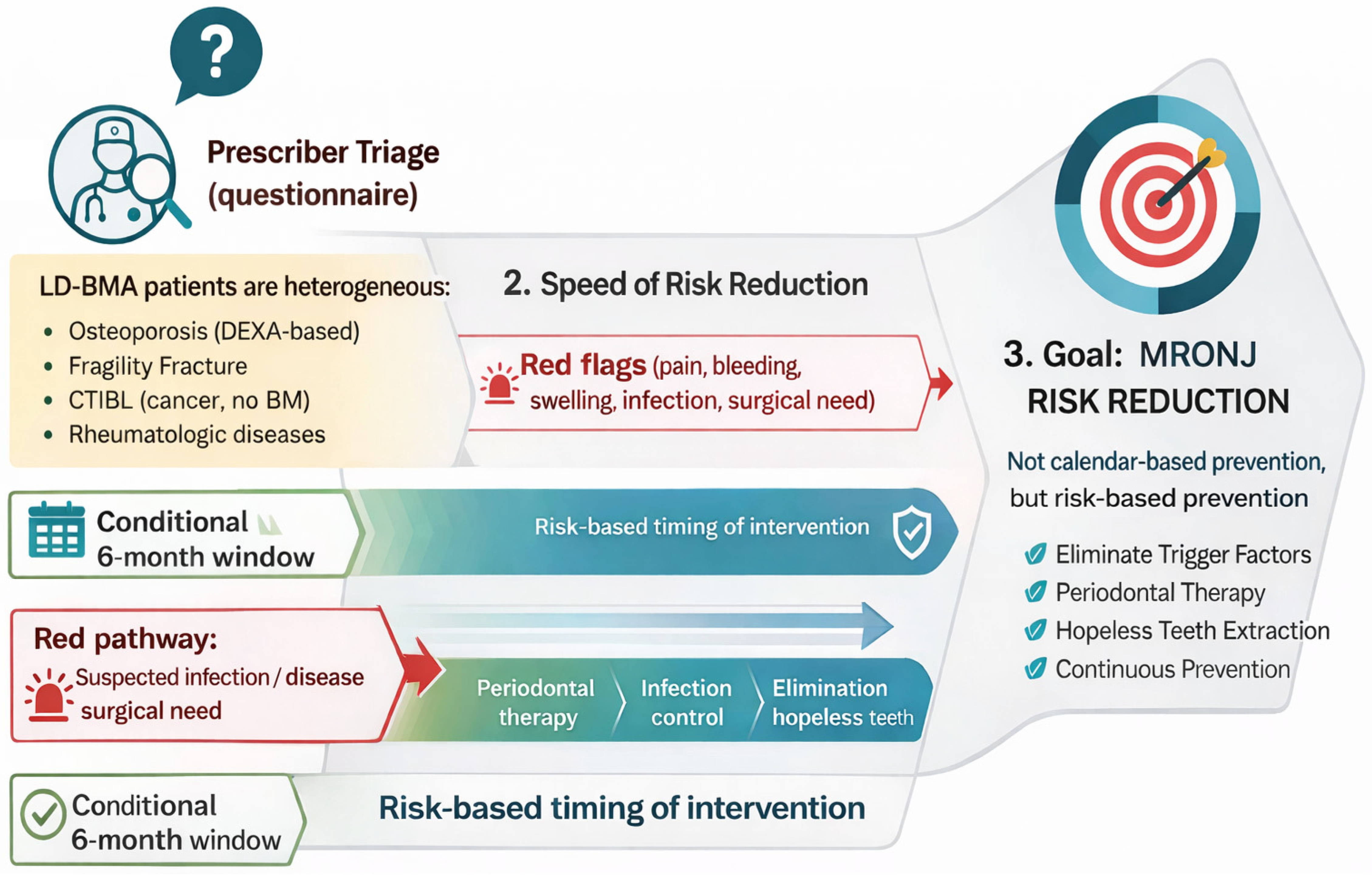
The SIPMO–SICMF Consensus Update of 2020 suggests administering a standardized questionnaire to prescribers, which is designed to estimate oral risk factors and to anticipate individual patient referrals regarding MRONJ prevention [
3]. This instrument, based on simple, dental history-driven items, permits all healthcare professionals involved to identify patients who cannot wait for treatment for various clinical reasons (
Figure 1). The questionnaire does not diagnose disease; it basically triages the urgency of preventive measures of patients at risk of MRONJ.
Significantly, the questionnaire reframes timing decisions from a calendar-based model (“before or after starting the LD-BMA therapy”) to a risk–trigger model: when red-flag responses emerge, dental referral should be prioritized regardless of dose category. Moreover, through the answers provided, the questionnaire may also guide the prescribing specialist toward a treatment strategy, thus preserving therapeutic efficacy whilst aligning itself with the individual MRONJ risk profile. Barriers to effective interdisciplinary communication—including fragmented care pathways, lack of shared records, and unclear referral responsibilities—may significantly limit the implementation of integrated prevention strategies.
This approach aligns perfectly with SIPMO–SICMF’s six-month window, which applies only in the absence of warning signals, closing when red flags are present; it reflects an ideal framework for coordinated care, although it may require adaptation based on local healthcare resources and organizational structures.
6. Clinical Relevance and Limitations
The commentary presented in this article provides a pragmatic framework with which to interpret heterogeneous preventive strategies for MRONJ in patients receiving LD-BMAs. Its clinical relevance lies in shifting the focus from rigid, calendar-based approaches toward dynamic, risk-based models which prioritize the speed of risk reduction and proactive collaboration between prescribers and dental professionals.
The proposed commentary interpretations may support clinicians in adapting prevention strategies to real-world constraints, including variability in access to dental care, geographical disparities, and organizational limitations. However, this paper has several limitations. First, it is a narrative critical commentary and it does not follow a systematic methodology for revision of the literature. Second, the analysis is largely based on expert consensus documents rather than high-level evidence. Third, the proposed interpretations reflect the authors’ perspective and they should be viewed as complementary to existing evidence rather than as definitive recommendations. The aim of future research should be to validate pragmatic, risk-based prevention models through prospective clinical studies.
7. Conclusions
Heterogeneity within the group of patients receiving LD-BMA (e.g., dual-energy x-ray absorptiometry/DEXA-diagnosed osteoporosis, clinical evidence of advanced osteoporosis—known fracture—cancer patients at risk of CTIBL, patients with rheumatologic diseases) still requires further stratification; this would underscore the need for individual risk models which integrate the dose and duration of BMAs, systemic condition, and oral health status. Based on our current understanding and emerging evidence, MRONJ prevention appears to be shifting away from rigid, calendar-based approaches (prior to, during, and after treatment) toward strategies which are focused on the speed of the application of risk reduction measures. Of the models discussed, the SIPMO–SICMF framework appears to offer a clinically balanced and operationally feasible approach.
Dental evaluation may occur within six months after therapy initiation but only when MRONJ risk is low; when patients report oral issues (e.g., dental, periodontal, or peri-implant disease) which have been identified by means of prescriber-based questionnaires such as that proposed above, temporal flexibility is reduced.
In healthcare systems where preventive strategies vary depending on the bone specialist who has been initially consulted, a unified, prescriber-based screening tool may offer the most effective means to harmonize timing decisions across different clinical settings. Ultimately, effective prevention depends on the ability to translate early assessment into timely and continuous clinical action. Further studies are required to improve defining optimal preventive strategies and to strengthen the evidence base supporting clinical decision-making in patients receiving BMAs.
Author Contributions
Conceptualization, G.C.; methodology, G.C., A.B., R.M., M.C., V.F. and F.B.; validation, G.C., A.B., R.M., M.C., V.F. and F.B.; formal analysis, G.C., A.B., R.M., M.C., V.F. and F.B.; investigation, G.C., A.B., R.M., M.C., V.F. and F.B.; resources, G.C., A.B., R.M., M.C., V.F. and F.B.; data curation, G.C., A.B., R.M., M.C., V.F. and F.B.; writing—original draft preparation, G.C., A.B., R.M., M.C., V.F. and F.B.; writing—review and editing, G.C., A.B., R.M., M.C., V.F. and F.B.; visualization, G.C.; supervision, G.C.; project administration, G.C.; funding acquisition, G.C. All authors have read and agreed to the published version of the manuscript.
Funding
This research received no external funding.
Institutional Review Board Statement
Not applicable.
Informed Consent Statement
Not applicable.
Data Availability Statement
Not applicable.
Acknowledgments
The authors would like to thank J. O. Davies for reviewing the text as a native English speaker.
Conflicts of Interest
The first author serves as Editor-in-Chief of the journal. To ensure editorial independence and transparency, this manuscript was managed entirely by an independent Associate Editor, who had no conflicts of interest. The Editor-in-Chief had no role in the peer-review process or in the decision to publish this article. All authors declare no other competing interests.
References
- Bedogni, A.; Mauceri, R.; Fusco, V.; Bertoldo, F.; Bettini, G.; Di Fede, O.; Lo Casto, A.; Marchetti, C.; Panzarella, V.; Saia, G.; et al. Italian Position Paper (SIPMO-SICMF) on Medication-Related Osteonecrosis of the Jaw (MRONJ). Oral Dis. 2024, 30, 3679–3709. [Google Scholar] [CrossRef] [PubMed]
- Ruggiero, S.L.; Dodson, T.B.; Aghaloo, T.; Carlson, E.R.; Ward, B.B.; Kademani, D. American Association of Oral and Maxillofacial Surgeons’ Position Paper on Medication-Related Osteonecrosis of the Jaws—2022 Update. J. Oral Maxillofac. Surg. 2022, 80, 920–943. [Google Scholar] [CrossRef] [PubMed]
- Campisi, G.; Mauceri, R.; Bertoldo, F.; Bettini, G.; Biasotto, M.; Colella, G.; Consolo, U.; Di Fede, O.; Favia, G.; Fusco, V.; et al. Medication-Related Osteonecrosis of Jaws (MRONJ) Prevention and Diagnosis: Italian Consensus Update 2020. Int. J. Environ. Res. Public Health 2020, 17, 5998. [Google Scholar] [CrossRef] [PubMed]
- Ruan, H.J.; Chen, H.; Hou, J.S.; An, J.G.; Guo, Y.X.; Liu, B.; Tian, L.; Pan, J.; Li, J.S.; Jiang, C.H.; et al. Chinese Expert Consensus on the Diagnosis and Clinical Management of Medication-Related Osteonecrosis of the Jaw. J. Bone Oncol. 2024, 49, 100650. [Google Scholar] [CrossRef] [PubMed]
- Landi, L.; Leali, P.T.; Barbato, L.; Carrassi, A.M.; Discepoli, N.; Muti, P.C.M.; Oteri, G.; Rigoni, M.; Romanini, E.; Ruggiero, C.; et al. Anti-Resorptive Therapy in the Osteometabolic Patient Affected by Periodontitis. A Joint Position Paper of the Italian Society of Orthopaedics and Traumatology (SIOT) and the Italian Society of Periodontology and Implantology (SIdP). J. Orthop. Traumatol. 2023, 24, 36. [Google Scholar] [CrossRef] [PubMed]
- Mauceri, R.; Coppini, M.; Attanasio, M.; Bedogni, A.; Bettini, G.; Fusco, V.; Giudice, A.; Graziani, F.; Marcianò, A.; Nisi, M.; et al. MRONJ in Breast Cancer Patients under Bone Modifying Agents for Cancer Treatment-Induced Bone Loss (CTIBL): A Multi-Hospital-Based Case Series. BMC Oral Health 2023, 23, 71. [Google Scholar] [CrossRef] [PubMed]
- Bertoldo, F.; Eller-Vainicher, C.; Fusco, V.; Mauceri, R.; Pepe, J.; Bedogni, A.; Palermo, A.; Romeo, U.; Guglielmi, G.; Campisi, G. Medication Related Osteonecrosis (MRONJ) in the Management of CTIBL in Breast and Prostate Cancer Patients. Joint Report by SIPMO AND SIOMMMS. J. Bone Oncol. 2025, 50, 100656. [Google Scholar] [CrossRef] [PubMed]
- Kim, J.W.; Kong, S.H.; Kim, J.Y.; Kwak, M.K.; Kim, J.Y.; Oh, J.H.; Park, H.Y.; Kim, B.; Lee, Y.K.; Han, J.J.; et al. Medication-Related Osteonecrosis of the Jaw: An Evidence-Based 2025 Position Statement from a Korean Multidisciplinary Task Force. Endocrinol. Metab. 2025, 40, 787–810. [Google Scholar] [CrossRef] [PubMed] [PubMed Central]
- Nicolatou-Galitis, O.; Papadopoulou, E.; Vardas, E.; Kouri, M.; Galiti, D.; Galitis, E.; Alexiou, K.E.; Tsiklakis, K.; Ardavanis, A.; Razis, E.; et al. Alveolar Bone Histological Necrosis Observed Prior to Extractions in Patients, Who Received Bone-Targeting Agents. Oral Dis. 2020, 26, 955–966. [Google Scholar] [CrossRef] [PubMed]
| Disclaimer/Publisher’s Note: The statements, opinions and data contained in all publications are solely those of the individual author(s) and contributor(s) and not of MDPI and/or the editor(s). MDPI and/or the editor(s) disclaim responsibility for any injury to people or property resulting from any ideas, methods, instructions or products referred to in the content. |




 ,
,