1. Introduction
The relationship between upper airway obstruction and dentofacial development has been a significant area of interest in the orthodontic literature. Obstruction of the upper airway is thought to influence the development of dentofacial structures by altering the breathing patterns of growing individuals [
1]. Specifically, chronic mouth breathing has been frequently cited as an etiological factor contributing to conditions such as maxillary arch deficiency, crossbite, posterior rotation of the mandible, mandibular retrognathia, and a long face pattern [
2]. Consequently, numerous studies have investigated the correlation between airway dimensions and various malocclusions to elucidate the intricate relationship between the developing dentofacial complex and the nasopharyngeal and oropharyngeal structures [
3,
4,
5].
The presence of “opacification” within the sinuses, as mentioned in this study, typically signifies conditions such as sinusitis, significant mucosal inflammation, or mucus retention. This distinction is crucial as it indicates a soft-tissue or fluid-based obstruction rather than a permanent structural anomaly. Such conditions, being often amenable to treatment and resolution, provide a foundation for evaluating the potential role of therapies like Right Angle Maxillary Protraction Appliance (RAMPA) in facilitating their alleviation [
6]. Rhinosinusitis, particularly in its chronic form (CRS), is characterized by persistent inflammation of the mucosal lining of the nose and paranasal sinuses [
7]. This inflammatory state can lead to substantial airway obstruction through several interconnected mechanisms. A primary factor is the obstruction of the sinus ostia, which are narrow channels (typically 1–3 mm in diameter) connecting the sinuses to the nasal cavity for ventilation and drainage. Inflammation and swelling of the surrounding mucosa can cause their blockage. This obstruction, in turn, impairs the normal aeration of the sinuses and compromises the function of cilia, the microscopic hair-like structures responsible for mucociliary clearance. The resulting stasis of secretions within the sinus cavities creates an environment conducive to secondary bacterial infection and perpetuates the inflammatory cycle. Furthermore, mucosal edema (swelling) directly contributes to the narrowing of the sinus passages and the adjacent nasal cavity [
8]. Collectively, these pathological changes—inflammation, mucus accumulation, and mucosal swelling—reduce the air-filled volume within the sinuses and can significantly impact the patency of the nasal airway, leading to symptoms such as nasal congestion, difficulty breathing through the nose, and a measurable reduction in airway volume. This pathophysiological understanding explains why an “opacified sinus group” would be expected to exhibit reduced baseline airway volume and provides a clear rationale for how the resolution of such opacification could lead to a substantial increase in measurable airway space. Upper airway obstruction, whether attributable to craniofacial imbalance, skeletal deficiency, or soft tissue collapse, can be influenced by a range of orthodontic, orthopedic, and surgical interventions. The advent of three-dimensional imaging modalities such as cone-beam computed tomography (CBCT), magnetic resonance imaging (MRI), and acoustic rhinometry (AR) now enables objective quantification of the volumetric effects of these therapies. Rapid Maxillary Expansion (RME) is extensively studied in pediatric patients presenting with maxillary transverse deficiency. Multiple investigations have reported significant increases in nasal and upper pharyngeal airway volume following expansion. A systematic review and meta-analysis by Buck et al. demonstrated a pooled volumetric increase of approximately 1144 mm
3 to 1218 mm
3 in upper airway space following RME, though heterogeneity among included studies limited the strength of conclusions [
9]. Similarly, Enoki et al. utilized acoustic rhinometry and rhinomanometry to report that RME significantly decreased nasal resistance, even in the absence of significant changes in cross-sectional area, suggesting functional improvements [
10]. Julián-López et al. conducted a longitudinal CBCT study comparing patients treated with RME to untreated controls, reporting a 31.8% volume gain in the treatment group versus 20.9% in controls, with an approximate net increase of 5183 mm
3 attributable to the intervention [
11]. These findings were reinforced by the systematic review by Di Carlo et al., which concluded that RME generally induces statistically significant airway increases in growing individuals, particularly in the nasopharyngeal region [
12].
Several authors have emphasized the close relationship between sinonasal inflammation, allergic disease, and functional airway compromise. Olivier highlighted that allergic sinusitis and sinus-related headache disorders are frequently underrecognized contributors to nasal obstruction and altered breathing patterns, underscoring the clinical importance of addressing sinonasal pathology when evaluating airway-related treatments [
13]. In pediatric populations, chronic rhinosinusitis and inflammatory sinonasal disease have been shown to significantly reduce nasal cavity volume and airflow, with potential downstream effects on craniofacial growth and respiratory function [
7,
14,
15]. Current consensus guidelines further emphasize that mucosal edema, secretion retention, and obstruction of the osteomeatal complex play a central role in reducing sinonasal aeration and nasal airway patency [
16]. Although orthodontic and orthopedic interventions have been shown to improve upper airway dimensions, existing studies have rarely stratified patients according to baseline sinus status. Consequently, there is limited comparative volumetric evidence evaluating how the presence of paranasal sinus opacification influences airway response to orthopedic maxillary protraction therapies such as RAMPA, providing the rationale for the present investigation.
Beyond pediatric orthopedic approaches, a broad range of orthodontic, orthopedic, and surgical interventions across age groups have been shown to influence upper airway volume, highlighting the multifactorial and mechanism-dependent nature of airway change. For adult patients with fused midpalatal sutures, RME necessitates surgical assistance. Yazigi et al. compared two surgical protocols—conventional osteotomy (CO-SAME) and selective osteotomy (SO-SAME)—and reported significant airway volume increases (∼1.2–1.3 cm
3) in both groups, with greater posterior gains noted in SO-SAME patients [
17]. This study demonstrated that surgically facilitated maxillary expansion can enhance airway dimensions even in skeletally mature populations. Functional appliances such as the Twin Block (TB) are commonly employed in growing patients with mandibular retrognathia. Yıldırım and Karaçay used CBCT to assess the effect of TB on airway volume and observed significant increases in upper and lower pharyngeal volumes post-treatment [
18]. The volumetric improvements were accompanied by skeletal changes, including increased SNB angle and mandibular length, confirming the appliance’s dual orthopedic and airway-enhancing effects. Mandibular Advancement Splints (MAS) are frequently prescribed for adult patients with obstructive sleep apnea (OSA). A systematic review and meta-analysis by Dontsos et al. assessed 11 studies and found a mean increase of 1.95 cm
3 in airway volume with MAS therapy, most prominently in the velopharyngeal space [
19]. In a related study, Bamagoos et al. conducted a dose–response trial using a remotely controlled mandibular positioner and demonstrated a linear reduction in optimal positive airway pressure (CPAP) requirements with increasing mandibular advancement [
20]. These findings highlight the anatomical and functional benefits of mandibular repositioning in OSA management. Surgical interventions offer another treatment pathway, particularly in cases of severe OSA. Sutherland et al. utilized MRI to analyze airway volume in patients undergoing multilevel surgery (e.g., uvulopalatopharyngoplasty and tongue ablation). Despite significant reductions in apnea-hypopnea index (AHI), they reported no corresponding increase in static airway volume [
21]. This suggests that surgical success may rely more on dynamic airway stabilization or neuromuscular adaptations than on structural enlargement alone. Though not classified as an orthodontic intervention, Functional Endoscopic Sinus Surgery (FESS) can significantly affect nasal airflow and airway volume [
22]. However, in the pediatric population, the management of upper airway obstruction is often complicated by chronic rhinosinusitis, which necessitates a comprehensive understanding of mucosal health and its impact on long-term respiratory outcomes [
7]. Moreover, recent evidence emphasizes that the severity of pediatric OSA is influenced by the synergistic relationship between tonsillar/adenoidal hypertrophy and structural constraints, highlighting the need for orthopedic solutions that can effectively enlarge the skeletal framework to compensate for these soft tissue comorbidities [
8].
While these studies collectively demonstrate that airway volume can be influenced by a wide range of orthodontic, orthopedic, and surgical interventions across age groups, they rarely account for baseline sinonasal inflammatory status when evaluating treatment response. Accordingly, stratifying pediatric patients by baseline paranasal sinus status may be clinically relevant when evaluating the airway effects of orthopedic maxillary protraction therapies, as the mechanisms and magnitude of airway change may differ between structurally unobstructed and inflammation-compromised sinuses.
This study was designed to evaluate the treatment effects of RAMPA Therapy on the upper airway volume.
2. Methods and Materials
2.1. Overview of RAMPA System
The RAMPA system is an orthopedic/orthodontic treatment modality designed to address certain craniofacial discrepancies. It comprises two main components: an intraoral device, often referred to as the RAMPA Oral Appliance (ROA), which facilitates semi-rapid palatal expansion, and an extraoral device (the RAMPA itself) that applies forces for the anterosuperior protraction of the maxillo-cranial complex [
23,
24,
25,
26]. The system is engineered to apply specific, directed forces. As described, these forces aim to pull the palate (maxilla) in both a forward (anterior) and upward (superior) direction. This action is intended to rotate the palatal plane (ANS-PNS line) in a forward direction, which, consequently, is theorized to encourage the mandible to rotate forward and grow more horizontally. The force system involves distinct vectors: F1, a forward force vector; F2, an upward force vector designed to counteract unwanted extrusion of the anterior teeth; and F3, a towing vector that contributes to the forward rotation of the palatal plane. These forces are typically applied symmetrically via elastic bands [
23]. The RAMPA system is applicable for patients in mixed dentition (having both primary and permanent teeth) and permanent dentition, and effective treatment generally requires consistent wear for more than 12 h per day.
2.2. Intended Effects on Craniofacial Structures and Airway
The biomechanical actions of the RAMPA system are intended to produce a cascade of effects on the craniofacial structures, which in turn are hypothesized to positively influence upper airway dimensions. Maxillary expansion, achieved by the intraoral component, serves to widen the maxilla transversely. This widening directly increases the width of the nasal cavity floor, as the palatal bones form the floor of the nasal cavity [
25]. The anterosuperior movement of the entire maxillary complex, driven by the extraoral appliance, is expected to reposition the maxilla and associated soft tissues, including the palate and surrounding musculature. This repositioning can potentially lead to an enlargement of the nasopharyngeal and oropharyngeal portions of the airway [
23,
24,
25,
26] and has been observed for different suture’s stiffness [
26]. The study under review posits that these skeletal alterations induce corresponding adaptations in the soft tissues, culminating in an overall increase in airway volume, an effect particularly anticipated in the clear sinus group. The importance of assessing upper airway dimensions is underscored by the understanding that increased airway resistance, often associated with constricted airways, can contribute to abnormal craniofacial growth patterns and potentially to conditions like sleep-disordered breathing [
27].
The anterosuperior vector of maxillary movement promoted by RAMPA is a distinguishing feature [
23,
24,
25,
26]. This contrasts with some other maxillary protraction appliances that may emphasize a more purely anterior or anteroinferior force [
27]. The inclusion of a significant superior component in the protraction force could have specific implications for the paranasal sinuses and their drainage pathways. The maxillary sinuses, for instance, are located superior and posterior to the palate and maxillary dentition. An upward (superior) displacement of the maxilla, in conjunction with forward (anterior) movement, might alter the spatial relationships and orientation of the sinus ostia, particularly those within the ostiomeatal complex, which is a critical final common pathway for drainage of the frontal, maxillary, and anterior ethmoid sinuses [
28]. Such an alteration could potentially enhance sinus drainage and aeration. This biomechanical consideration offers a plausible mechanistic link between the specific design of the RAMPA system and its observed efficacy in the opacified sinus group, where resolution of sinus content is a primary contributor to airway volume increase.
2.3. Study Design and Patient Cohorts
The investigation employed a retrospective comparative cohort study design. This approach involved analyzing existing data from two distinct groups of pediatric patients who had previously undergone RAMPA therapy. Ethical approval of this prospective study was obtained from The Ethics Committee of Nihon University School of Dentistry in Tokyo, Japan (EP22D001).
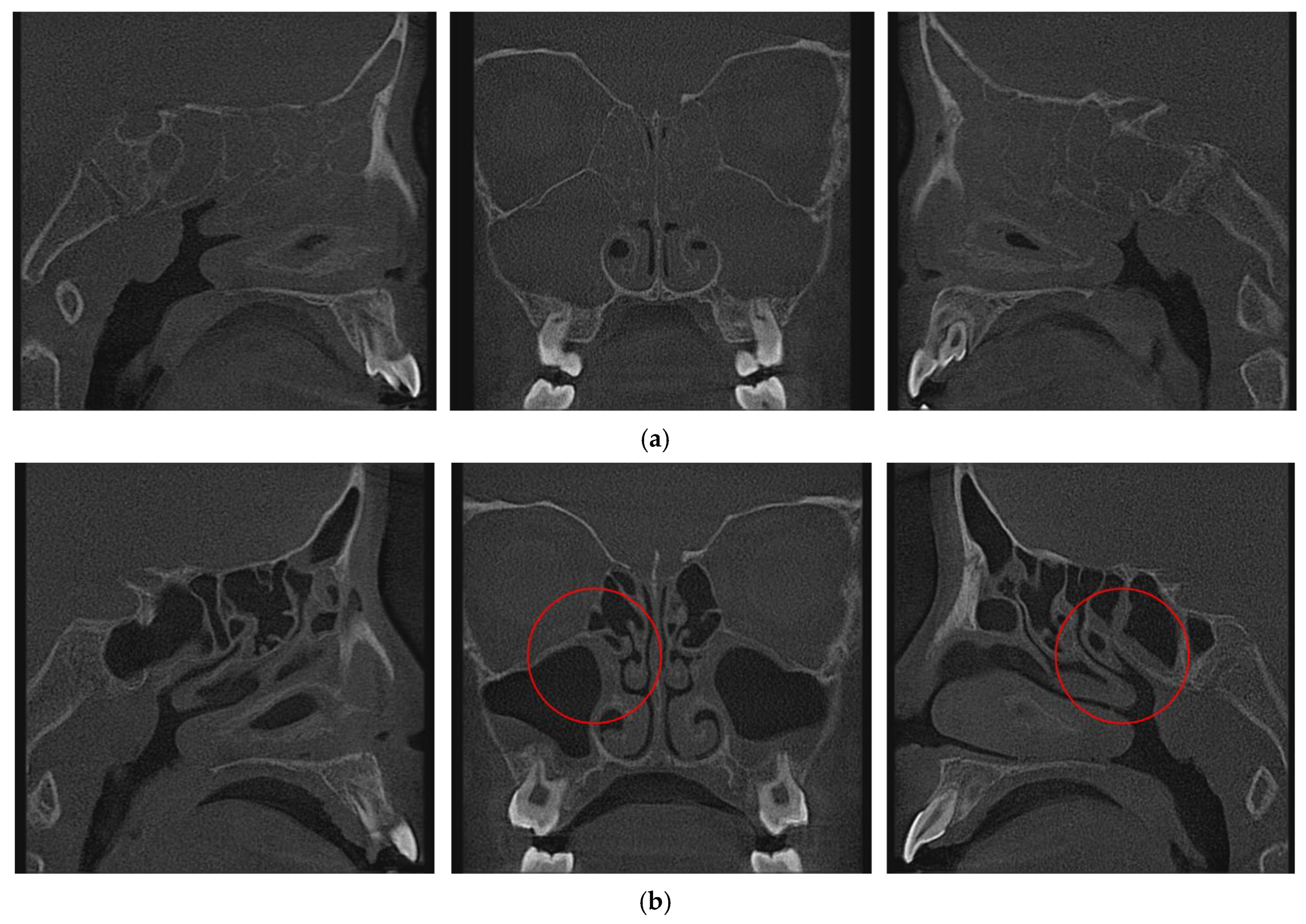
The Clear Sinus Group consisted of 26 patients (14 males, 12 females). The mean age at the first observation was approximately 6.6 years (6.8 ± 1.6 years for males, 6.4 ± 1.4 years for females), with an age range from 4 years 4 months to 11 years 0 months. Inclusion criteria for this group stipulated that patients presented with conditions deemed suitable for RAMPA therapy (such as unilateral or bilateral posterior crossbite or other orthodontic/craniofacial reasons) and, crucially, exhibited radiologically clear paranasal sinuses on their baseline cone-beam computed tomography (CBCT) scans. “Clear” was defined as the absence of significant mucosal thickening, fluid retention, or polypoid changes that could appreciably compromise baseline airway volume due to sinus pathology, opening the sinus ostium (
Figure 1b).
The Opacified Sinus Group comprised 20 patients (7 males, 13 females). The mean age at the first observation was approximately 6.8 years (7.5 ± 3.3 years for males, 6.3 ± 1.9 years for females), with an age range from 4 years 1 month to 13 years 5 months. Inclusion criteria required patients to have conditions necessitating RAMPA therapy and to exhibit significant opacification in one or more paranasal sinuses on baseline CBCT scans. “Opacification” was defined as the presence of radiopaque material within the sinus cavity, indicative of conditions such as sinusitis, significant mucosal inflammation, or mucus retention, which were presumed to contribute to a reduced baseline airway volume. Radiological classification of paranasal sinus status (clear versus opacified) was performed using predefined CBCT-based criteria by the examiner. All assessments were conducted by a single experienced examiner, and formal inter-observer reliability testing was not performed. These patients were also noted to have been diagnosed with rhinosinusitis by an otolaryngologist, swelling of the mucosa by 1 mm or more, and blocking the sinus ostium (
Figure 1a).
Baseline demographic and clinical characteristics were tabulated (referred to as
Table 1 in the source document). Notably, the mean pre-treatment airway volume was, as anticipated, lower in the opacified sinus group (18,277.4 ± 10,621.8 mm
3) compared to the clear sinus group (26,534.0 ± 8738.1 mm
3). Mean treatment durations were comparable between the groups (9.4 ± 6.0 months for clear, 8.9 ± 3.9 months for opacified).
This study was designed as a retrospective comparative cohort analysis of patients who all received RAMPA therapy. Consequently, no untreated control group or group treated with an alternative orthodontic modality was available for comparison.
Because of the retrospective design, detailed information regarding concomitant ENT medical treatments (e.g., antibiotics, nasal decongestants, or steroids) was not consistently available and therefore was not controlled for or used as an exclusion criterion. No patients underwent surgical ENT interventions during the observation period.
2.4. RAMPA Therapy Protocol and Data Acquisition
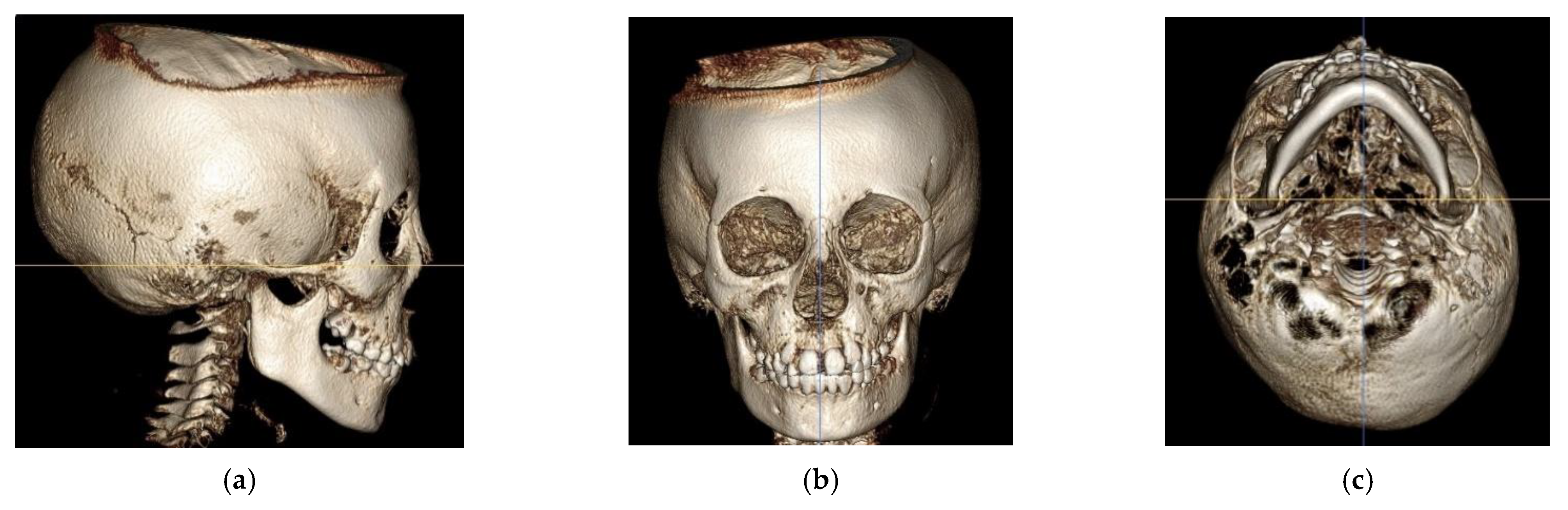
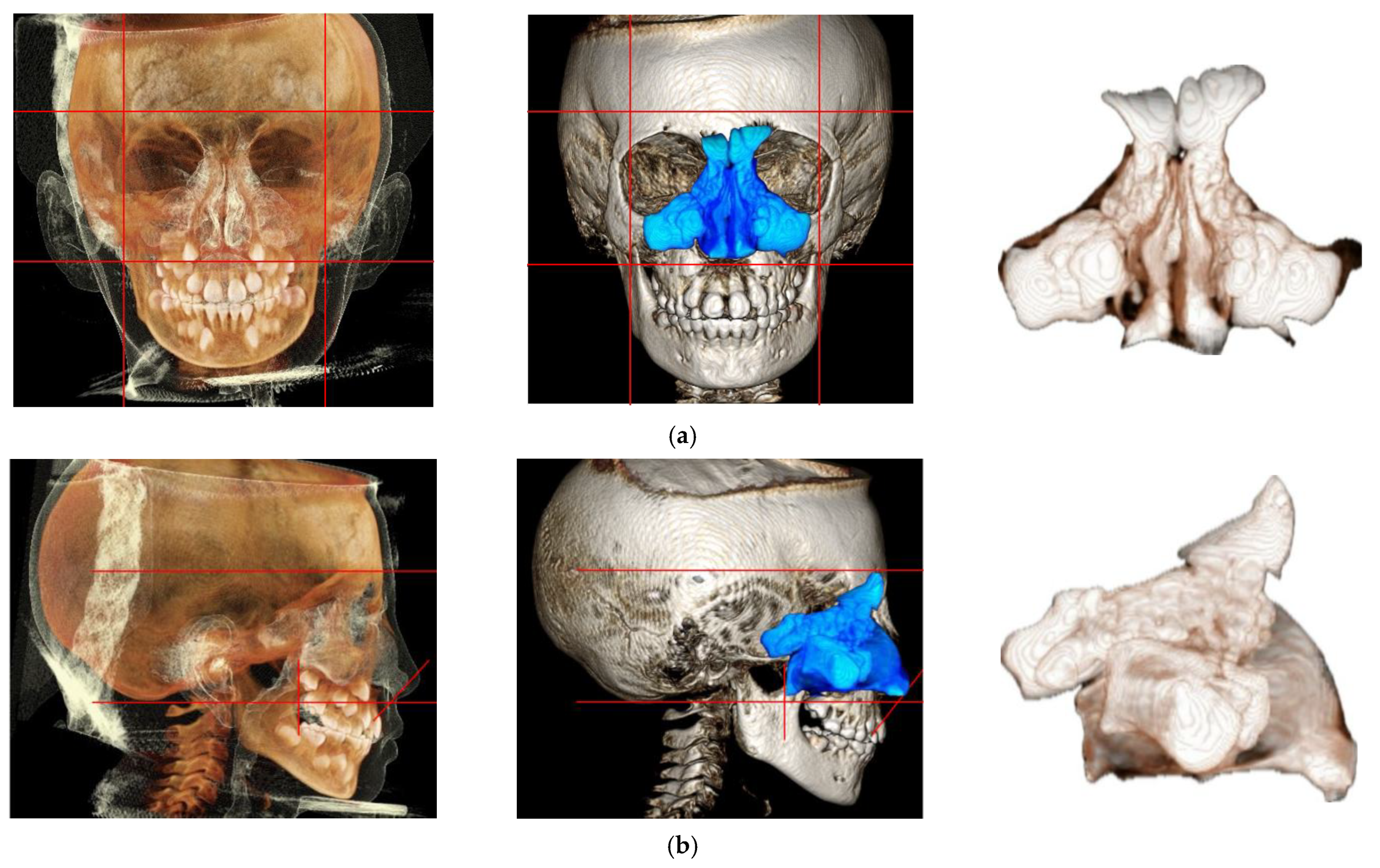
A standardized RAMPA system and treatment protocol were applied to all patients in both cohorts. Volumetric measurements of the upper airway were performed using CBCT scans. These scans were acquired at two time points: baseline (T1), prior to the initiation of RAMPA therapy, and post-treatment (T2), after completion of the active therapy or at a significant follow-up point. Image analysis for airway volumetrics was conducted using a specified Hounsfield Unit threshold range (−1000 to −625 HU) to segment the airway space. CT images were analyzed using the software Invivo 5 (Anatomage Inc Santa Clara, CA, USA.). The anatomical boundaries for the nasal cavity volume measurement are as follows: (i) Make a reference plane on the FH plane (
Figure 2a). (ii) The midline is determined by the line connecting the center of the nasal bone and the anterior nasal spine (
Figure 2b). (iii) Set the line connecting the mental spine of the mandible and both mandibular condyles so that they intersect at a right angle (
Figure 2c). It was extended from the anterior edge of the adenoid to the external nostril (
Figure 3). Airway volume was calculated in cubic millimeter. This process was applied on T1 and T2 images separately. Landmark identifications and measurements were made by the same author.
2.5. Statistical Analysis
A comprehensive suite of statistical methods was employed to analyze the data. Descriptive statistics, including means, standard deviations (SD), and ranges, were calculated for key variables. The normality of distribution for continuous variables was assessed using Shapiro–Wilk and Kolmogorov–Smirnov tests, supplemented by visual inspection of Q-Q plots. This step was crucial as it informed the choice between parametric and non-parametric tests for subsequent inferential analyses, thereby enhancing the statistical robustness of the findings.
For intra-group analysis (comparing T1 and T2 airway volumes within each group), paired t-tests were used for normally distributed differences, while Wilcoxon signed-rank tests were applied for non-normally distributed differences. To compare treatment effects between the clear and opacified sinus groups (inter-group analysis), independent samples t-tests (for normally distributed data with equal variances) or Mann–Whitney U tests (for non-normally distributed data or unequal variances) were utilized. The influence of potential confounding factors such as sex, age at treatment initiation, and duration of RAMPA therapy was investigated using appropriate correlational methods (Pearson or Spearman correlation coefficients) and linear regression analyses (simple and multiple). For all inferential statistical tests, a p-value less than 0.05 was considered to indicate statistical significance.
The retrospective nature of this study, while allowing for the examination of real-world treatment outcomes, inherently carries certain limitations, such as the potential for selection bias and the absence of a non-randomized control group. Specifically, the criteria for “significant opacification” were based on available radiological interpretations. Without a non-treatment opacified control group, it is challenging to definitively attribute all observed improvements in the opacified group solely to RAMPA therapy, as spontaneous resolution of sinusitis or the effects of unrecorded concurrent medical management cannot be entirely excluded. However, the study’s hypothesis posits that RAMPA therapy actively facilitates this resolution. The substantial magnitude of change observed in the opacified group, especially when compared to the clear sinus group, and the distinct lack of correlation with treatment duration in the opacified cohort, provide strong inferential support for RAMPA playing a significant, possibly catalytic, role in the observed airway improvements.
3. Results
The study yielded significant findings regarding the efficacy of RAMPA therapy in augmenting upper airway volume in pediatric patients, with distinct differences observed between the clear and opacified sinus groups.
3.1. Overall Efficacy (Intra-Group Analysis)
RAMPA therapy demonstrated a statistically significant capacity to increase upper airway volume within both patient cohorts when comparing pre-treatment (T1) and post-treatment (T2) measurements.
Clear Sinus Group: For the 26 patients with radiologically clear paranasal sinuses at baseline:
The mean pre-treatment airway volume was 26,534.0 mm3 (SD = 8738.1 mm3).
The mean post-treatment airway volume increased to 31,420.9 mm3 (SD = 8601.2 mm3).
This resulted in a mean absolute airway volume increase of 4886.9 mm3 (SD = 3127.2 mm3).
The mean percentage increase in airway volume was approximately 18%.
This change was, highly, statistically significant, as determined by a paired t-test (t = 7.9682, p = 2.527 × 10⁻⁸), with a 95% confidence interval for the mean change of (3623.8 mm3, 6150.0 mm3).
Opacified Sinus Group: For the 20 patients presenting with opacified paranasal sinuses (diagnosed with rhinosinusitis) at baseline:
The mean pre-treatment airway volume was 18,277.4 mm3 (SD = 10,621.8 mm3). This baseline volume was notably lower than that of the clear sinus group, consistent with the presence of sinus obstruction.
The mean post-treatment airway volume increased substantially to 29,470.2 mm3 (SD = 8576.6 mm3).
This represented a mean absolute airway volume increase of 11,192.8 mm3 (SD = 6116.5 mm3).
The mean percentage increase in airway volume was approximately 61%.
This substantial increase was also highly statistically significant (paired t-test, t = −8.184, p = 0.000; the negative t-statistic indicates post-treatment volume was greater than pre-treatment).
These intra-group analyses clearly establish that RAMPA therapy is an effective intervention for increasing upper airway volume in pediatric patients, regardless of their initial paranasal sinus status.
3.2. Comparative Efficacy (Inter-Group Analysis)
A direct statistical comparison of the treatment effects between the two groups revealed a striking difference. The opacified sinus group demonstrated a markedly greater increase in airway volume compared to the clear sinus group, both in absolute and percentage terms. The mean absolute increase was more than double in the opacified group (11,192.8 mm
3) compared to the clear group (4886.9 mm
3), and the mean percentage increase was over threefold greater (61% vs. 18%). This substantial difference in the magnitude of improvement is a central finding of the study and was statistically significant. This highlights that the presence of baseline paranasal sinus opacification profoundly influences the extent of airway volume gain achievable with RAMPA therapy.
Table 1 summarizes these key volumetric changes.
An important observation stemming from these results is that the post-treatment mean airway volume in the opacified sinus group (29,470.2 mm3) approached that of the clear sinus group (31,420.9 mm3). Considering that the opacified group began with a significantly lower baseline airway volume, this convergence suggests that RAMPA therapy, in conjunction with the resolution of sinus opacification, can effectively “normalize” or substantially improve airway dimensions in these compromised patients. This brings their airway volumes to a level comparable to those who did not have initial sinus issues, indicating a clinically relevant restoration beyond just a statistical increase.
Overall, RAMPA therapy resulted in a significantly greater absolute and percentage increase in upper airway volume in patients with opacified paranasal sinuses compared to those with clear sinuses (61% vs. 18%). Despite a lower baseline airway volume, the post-treatment airway volume in the opacified sinus group approached that of the clear sinus group, indicating substantial functional recovery of the nasal airway following treatment.
3.3. Investigating the Mechanisms: Different Pathways to Airway Expansion
The study’s findings not only quantify the effects of RAMPA therapy but also provide compelling evidence for differing primary mechanisms of airway volume expansion between the two patient cohorts, largely hinging on the role of treatment duration.
Clear Sinus Group: Gradual Adaptation
In the clear sinus group, the observed mean airway volume increase of approximately 18% is primarily attributed to the known skeletal and soft tissue effects of RAMPA therapy. These include transverse maxillary expansion and anterosuperior displacement of the maxillary complex, which are understood to create more space for the airway by altering bony boundaries and leading to corresponding adaptation of the surrounding soft tissues [
23,
24,
25,
26]. This aligns with general principles of orthopedic maxillary protraction and expansion therapies [
29]. A critical factor elucidating the mechanism in this group is the influence of treatment duration. The analysis revealed a statistically significant moderate positive correlation (Spearman’s rank correlation coefficient, ρ = 0.425,
p = 0.0303) between the duration of RAMPA therapy (in months) and the magnitude of airway volume increase. This finding supports a mechanism of gradual, progressive change. As therapeutic forces are applied over a more extended period, more substantial skeletal remodeling (such as sutural responses and bone apposition/resorption) and associated soft tissue adaptation can occur. This suggests a dose–response relationship, where longer treatment yields greater volumetric improvement in patients without pre-existing sinus obstruction.
Opacified Sinus Group: Rapid Obstruction Relief
The opacified sinus group exhibited a dramatically larger mean airway volume increase of approximately 61%. This substantial magnitude strongly suggests that mechanisms beyond purely skeletal remodeling are predominantly at play. The most telling finding in this group relates to treatment duration. In stark contrast to the clear sinus group, no significant association was observed between treatment duration and the extent of airway volume change (correlation coefficient, r = 0.241; regression analysis
p = 0.288). This lack of correlation is pivotal. It strongly supports the hypothesis that a major component of the airway volume increase in these patients stems from the relatively rapid resolution of pre-existing sinus opacification. This resolution likely involves the drainage of accumulated mucus, reduction in mucosal inflammation and edema, and restoration of sinus aeration [
8]. These patients tend to show “large increases in early treatment, and then the change plateaus” or that “initial large increases are seen, but then it becomes gentle”. This pattern of rapid initial gain is consistent with the clearing of a physical obstruction, which would provide an immediate and substantial increase in measurable air volume. This “space-gaining” effect is inherently less dependent on months of continuous force application required for significant skeletal remodeling.
4. Discussion
4.1. A Mechanistic Dichotomy
When contrasting the two groups, a mechanistic dichotomy emerges.
The clear sinus group appears to experience airway volume increase primarily through therapy-induced skeletal changes and the consequent adaptation of soft tissues. This is an inherently time-dependent process, correlating with the duration of applied therapeutic forces.
The opacified sinus group, on the other hand, likely benefits from a dual phenomenon:
A rapid and substantial volume gain resulting from the relief of sinus obstruction. As described in the source, “space widens as the opaque fluid is drained”. This aligns with the understanding that CRS can cause significant obstruction via mucosal edema and secretion stasis, the resolution of which would reclaim airway space [
15].
An underlying component of RAMPA-induced skeletal change, similar in nature to that occurring in the clear sinus group, but its contribution to the total volume change may be overshadowed by the larger, more immediate effect of obstruction relief, or it may become the primary driver of change after the initial clearing of the sinuses.
The dominance of the obstruction relief mechanism in the opacified sinus group effectively explains both the larger overall percentage increase in airway volume and the diminished role of treatment duration as a significant predictor of the total observed change. The “plateau effect” alluded to for the opacified group further supports this interpretation. It implies that once the bulk of the opacification is resolved (the first phase of rapid improvement), any subsequent increases in airway volume would then become more dependent on the slower, duration-related skeletal and soft tissue changes, similar to the mechanism observed in the clear sinus group (the second phase). This suggests a two-phase improvement model for patients starting with opacified sinuses, where the initial, non-duration-dependent change from obstruction clearance is most prominent within the typical treatment timelines evaluated.
4.2. Exploring Other Influencing Factors: Age and Sex
The study also investigated the influence of patient sex and age at treatment initiation on the efficacy of RAMPA therapy in both cohorts.
4.2.1. Influence of Sex
The analysis indicated that sex did not significantly affect the treatment outcomes in terms of airway volume change in either group.
In the Clear Sinus Group, a Mann–Whitney U test comparing treatment effects between males and females yielded a W = 81 and p = 0.8995, indicating no statistically significant difference.
Similarly, in the Opacified Sinus Group, an independent samples t-test resulted in a T-statistic = −0.786 and p = 0.442, also showing no statistically significant difference in volume change between males and females. Boxplot visualizations further supported similar distributions between sexes in this group. Based on these findings, RAMPA therapy appears to be equally effective for both male and female pediatric patients in achieving airway volume increases, irrespective of their baseline sinus condition.
4.2.2. Influence of Age
The influence of age on treatment was more nuanced and did not emerge as a strong, independent predictor of the magnitude of change in airway volume.
In the Clear Sinus Group, Spearman’s rank correlation analysis between age (in months) and treatment effect (volume change) showed a weak negative correlation (ρ = −0.381) with borderline statistical significance (p = 0.0545). This suggests a slight tendency for older children within this cohort to experience slightly smaller volume increases, possibly attributable to decreasing craniofacial growth potential or reduced sutural compliance with age, though this interpretation requires caution given the p-value.
In the Opacified Sinus Group, while age showed expected positive correlations with absolute pre-treatment and post-treatment airway volumes (older children generally have larger airways [
14]), its impact on the treatment-induced change in volume was not statistically significant. In a multiple regression model that included age and treatment duration, age was not a significant predictor of treatment change (
p = 0.092). A Mann–Whitney U test comparing treatment effects between younger and older patients (split by median age) also yielded a borderline or not strictly significant result (
p = 0.054).
Overall, while age naturally correlates with absolute airway size, its influence on the additional volume gained as a result of RAMPA therapy was found to be weak or not statistically significant within the pediatric age ranges (approximately 4 to 13 years) studied. For the opacified group, the presence and resolution of sinus opacification itself appeared to be a more dominant factor influencing the amount of change than age. The borderline
p-values associated with age effects (e.g.,
p = 0.0545 in the clear group;
p = 0.092 and
p = 0.054 in the opacified group) suggest that while age did not meet the strict criterion for statistical significance as a primary driver in this particular study, a subtle influence, especially at the extreme ends of the studied age spectrum, cannot be entirely dismissed. A larger sample size might provide greater clarity on these potential minor age-related trends in responsiveness.
Table 2 consolidates the findings regarding the influence of these factors.
4.3. Clinical Significance and Practical Implications for Practitioners
The findings of this study carry significant clinical implications for practitioners involved in the orthodontic and airway management of pediatric patients.
Patient Selection and Prognosis
The research suggests that RAMPA therapy can be a highly effective treatment modality for pediatric patients experiencing airway compromise, particularly those with opacified paranasal sinuses. These patients may experience substantially greater percentage improvements in airway volume compared to patients with clear sinuses, owing to the dual benefit of resolving sinus pathology alongside inducing skeletal changes. This understanding allows clinicians to provide more tailored prognoses. For instance, patients presenting with significant sinus opacification on baseline CBCT scans may be counseled to expect potentially larger and more rapid initial percentage increases in airway volume following RAMPA therapy.
Treatment Planning and Duration
The differential role of treatment duration between the two groups has direct consequences for treatment planning:
For patients with clear sinuses, where airway volume gain is primarily a function of gradual skeletal and soft tissue adaptation, an adequate duration of RAMPA therapy appears crucial to maximize the therapeutic outcome.
For patients with opacified sinuses, the most dramatic improvements in airway volume may be achieved relatively quickly, during an initial phase focused on the resolution of sinus opacification (which RAMPA therapy appears to facilitate). While RAMPA remains beneficial, the role of long-term treatment in these patients might then shift towards stabilizing these initial gains, achieving further desired skeletal and occlusal goals, rather than solely pursuing continued airway volume increase at the same initial rapid rate.
4.4. RAMPA’s Potential Role in Sinus Health
An intriguing implication is that RAMPA therapy may not only induce favorable skeletal changes but could also actively contribute to the resolution of sinus opacification itself. This proposed contribution of RAMPA therapy to sinus drainage and reduction in mucosal inflammation should be regarded as hypothesis-generating. In the present study, sinus status was inferred from CBCT-based radiographic opacification and airway volumetric changes, which constitute indirect indicators rather than direct measures of inflammatory activity or mucociliary function. Confirmation of this mechanism would require dedicated clinical or imaging parameters such as validated sinus scoring systems (e.g., Lund–Mackay score), symptom-based assessments, or nasal airflow/permeability tests.
It should also be acknowledged that, in pediatric populations, functional narrowing of the nasal and paranasal sinus cavities is frequently influenced by respiratory hypersensitivity and allergic inflammation, which can lead to mucosal edema and impaired sinus ventilation independent of structural factors [
13].
The anterosuperior protraction and expansion of the maxilla achieved by RAMPA can alter the geometry of the nasal passages and potentially the orientation and patency of the sinus ostia, particularly within the ostiomeatal complex [
29]. Improved drainage and ventilation of the sinuses resulting from these structural changes could be a key mechanism by which RAMPA facilitates the clearing of retained secretions and reduction in mucosal inflammation, thus acting synergistically to improve both skeletal form and sinus health.
These findings may suggest a potential evolution in the management approach for certain pediatric patients who present with both malocclusion (requiring orthopedic intervention) and concomitant rhinosinusitis with airway implications. Traditionally, such conditions might be addressed sequentially, for example, with ENT management of rhinosinusitis preceding or separate from orthodontic/orthopedic treatment. However, if RAMPA therapy can concurrently address the skeletal aspects of malocclusion and contribute significantly to the resolution of sinus opacification and associated airway compromise, it could offer a more integrated and potentially more efficient treatment pathway. This could lead to reduced overall treatment times, lessened patient burden, and possibly enhanced comprehensive outcomes by addressing interconnected problems in a holistic manner. Such an approach would necessitate close collaboration between orthodontists and otorhinolaryngologists when considering RAMPA therapy for this patient population.
4.5. Study Limitations
An important limitation of this study is the absence of an untreated control group or a group managed with a different orthodontic approach. In pediatric patients with sinus opacification, spontaneous resolution of rhinosinusitis over time cannot be entirely excluded. Therefore, the observed airway volume increases in the opacified sinus group cannot be attributed exclusively to RAMPA therapy with absolute certainty. Accordingly, the findings should be interpreted as an association between RAMPA therapy and airway volume changes rather than definitive proof of causality. Furthermore, the present findings cannot directly confirm inflammatory resolution, as no standardized ENT-specific clinical or functional outcome measures were included. In addition, sinus classification was based on single-observer radiological assessment, which may introduce a degree of subjective interpretation. Additionally, the absence of serial imaging precludes assessment of the timing of sinus clearance relative to RAMPA therapy. As a result, it cannot be determined whether radiological improvement occurred early during treatment, progressed gradually in parallel with orthopedic changes, or reflected spontaneous resolution independent of appliance activation.
Moreover, intra-observer reliability analysis for airway volumetric measurements was not formally assessed using ICC or error analysis, which should be considered a methodological limitation. Given the lower baseline airway volume in the opacified sinus group, regression to the mean may have contributed in part to the observed changes; however, the magnitude of volume increase and the absence of a treatment-duration correlation in this group suggest that regression alone is unlikely to fully account for the findings.
Nevertheless, the markedly greater magnitude of airway volume increase in the opacified sinus group compared with the clear sinus group, together with the absence of a significant correlation with treatment duration, suggests that RAMPA therapy likely acted as an active facilitating factor rather than the observed changes being solely due to natural disease resolution.
Prospective studies incorporating untreated controls or alternative orthopedic interventions are warranted to more definitively isolate the causal contribution of RAMPA therapy.
5. Conclusions: Synthesizing the Evidence
Right Angle Maxillary Protraction Appliance (RAMPA) therapy is demonstrably effective in significantly increasing upper airway volume in pediatric patients, both those with radiologically clear paranasal sinuses and those presenting with opacified paranasal sinuses indicative of rhinosinusitis. However, the magnitude of this airway volume increase is markedly greater in patients who begin treatment with opacified sinuses (experiencing an approximate 61% mean increase) compared to those with clear sinuses (approximate 18% mean increase). This substantial difference is attributed to a dual benefit conferred by RAMPA therapy in the opacified group: a rapid and significant volume gain resulting from the resolution of pre-existing sinus obstruction, compounded by the therapy-induced skeletal and soft tissue changes that also benefit the clear sinus group.
A critical differentiating factor in the mechanism of action between the two groups is the role of treatment duration. For patients with clear sinuses, a longer duration of RAMPA therapy significantly correlates with a greater increase in airway volume, suggesting a process of gradual, dose-dependent skeletal and soft tissue adaptation. Conversely, in patients with opacified sinuses, treatment duration does not significantly predict the extent of airway volume change. This finding supports the interpretation that the initial relief of sinus obstruction is the dominant factor contributing to the large volumetric increases observed in this group, a process that appears to occur relatively rapidly and is less dependent on the cumulative duration of appliance wear compared to skeletal remodeling. The study also found that sex does not significantly influence the effect of RAMPA therapy on airway volume changes in either cohort. The role of age at treatment initiation is more nuanced; while older children generally present with larger baseline airways, age did not emerge as a strong, independent predictor for the magnitude of change in airway volume induced by RAMPA therapy within the pediatric age ranges studied.
These findings collectively highlight that RAMPA therapy may operate through distinct primary mechanisms and yield different scales of effect depending on the baseline paranasal sinus status of the pediatric patient. This understanding offers valuable insights for clinical decision-making, allowing for more tailored treatment planning, patient selection, and counseling regarding expected outcomes. While the current study provides compelling evidence, further prospective research with larger cohorts and long-term follow-up is warranted to substantiate these observations, explore the stability of the achieved changes, and further elucidate the intricate interplay between RAMPA therapy, craniofacial development, and sinonasal health.
From a clinical perspective, these findings suggest that RAMPA therapy may be particularly beneficial for pediatric patients presenting with both craniofacial discrepancies and radiological evidence of paranasal sinus opacification. In such cases, clinicians may expect not only orthopedic skeletal effects but also a rapid improvement in nasal airway patency related to sinus clearance. Therefore, baseline CBCT evaluation of sinus status may assist in treatment planning, prognosis estimation, and interdisciplinary collaboration with otolaryngologists.




 ,
,