

Marine Macrophytes as Macromolecular Resources in the Mediterranean Circular Bioeconomy: Ecology, Green Ex-Traction, Bioactivity, and Valorization of Posidonia oceanica, Padina pavonica, and Chaetomorpha linum

 , and
, and 
Abstract
1. Introduction
1.1. From a Linear Economy to a Marine Circular Bioeconomy
1.2. Rationale for Selecting the Three Mediterranean Species
1.3. Scope and Critical Framework of the Review
1.4. Literature Search Strategy
2. Ecological Functions, Biomass Dynamics, and Sustainable Sourcing
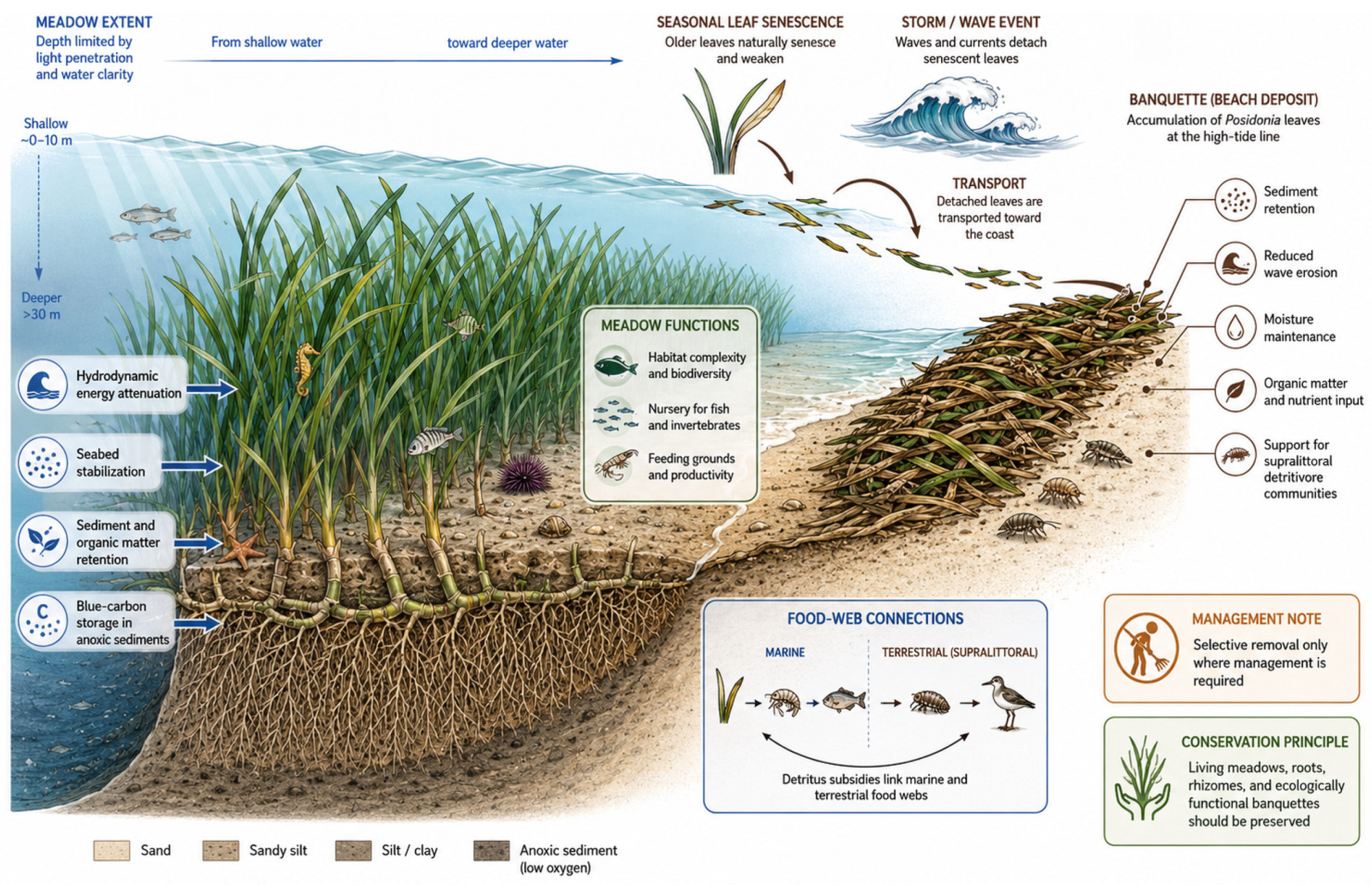
2.1. Posidonia oceanica Meadows and Banquette Formation
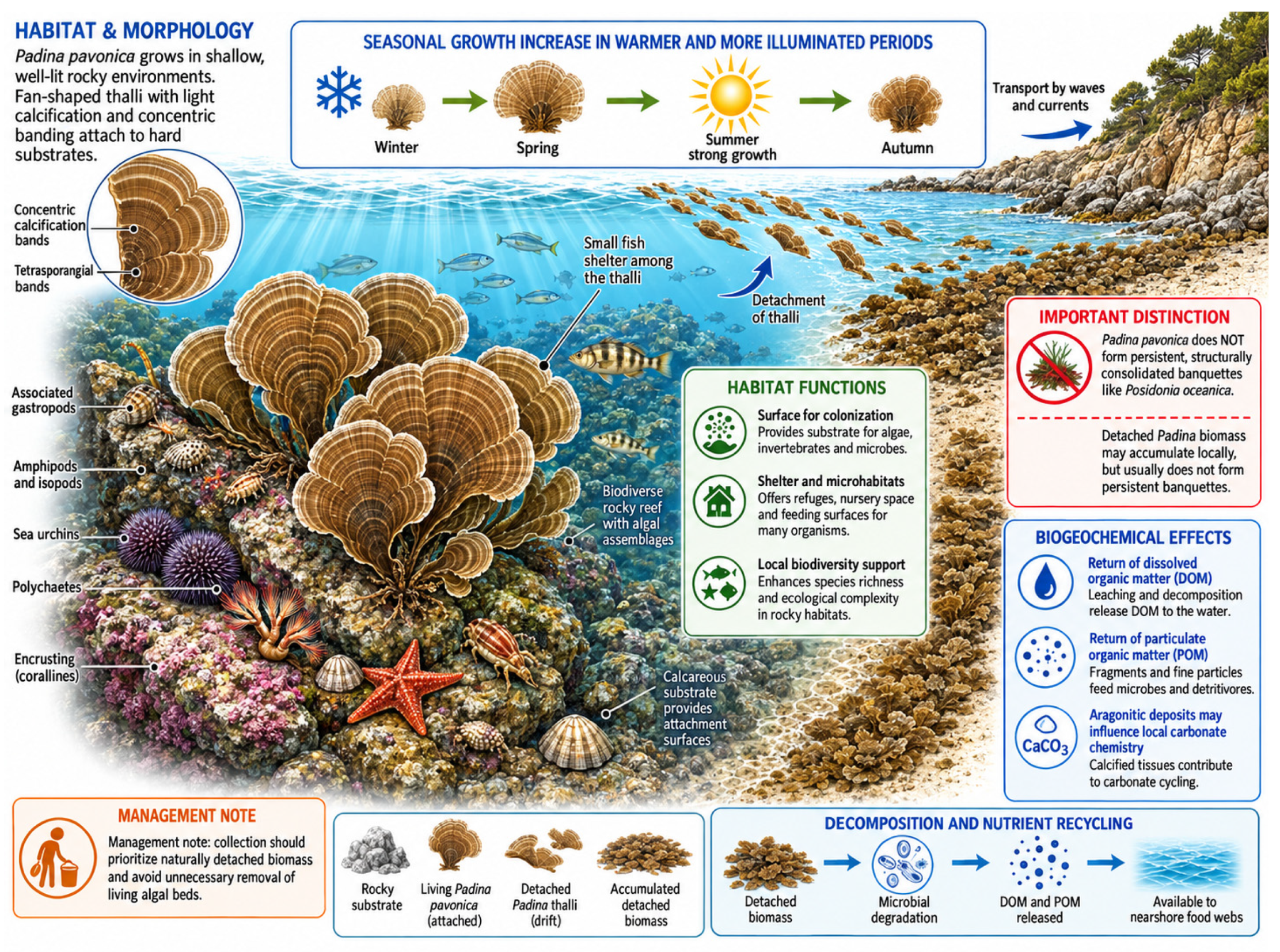
2.2. Padina pavonica in Rocky Sublittoral Habitats
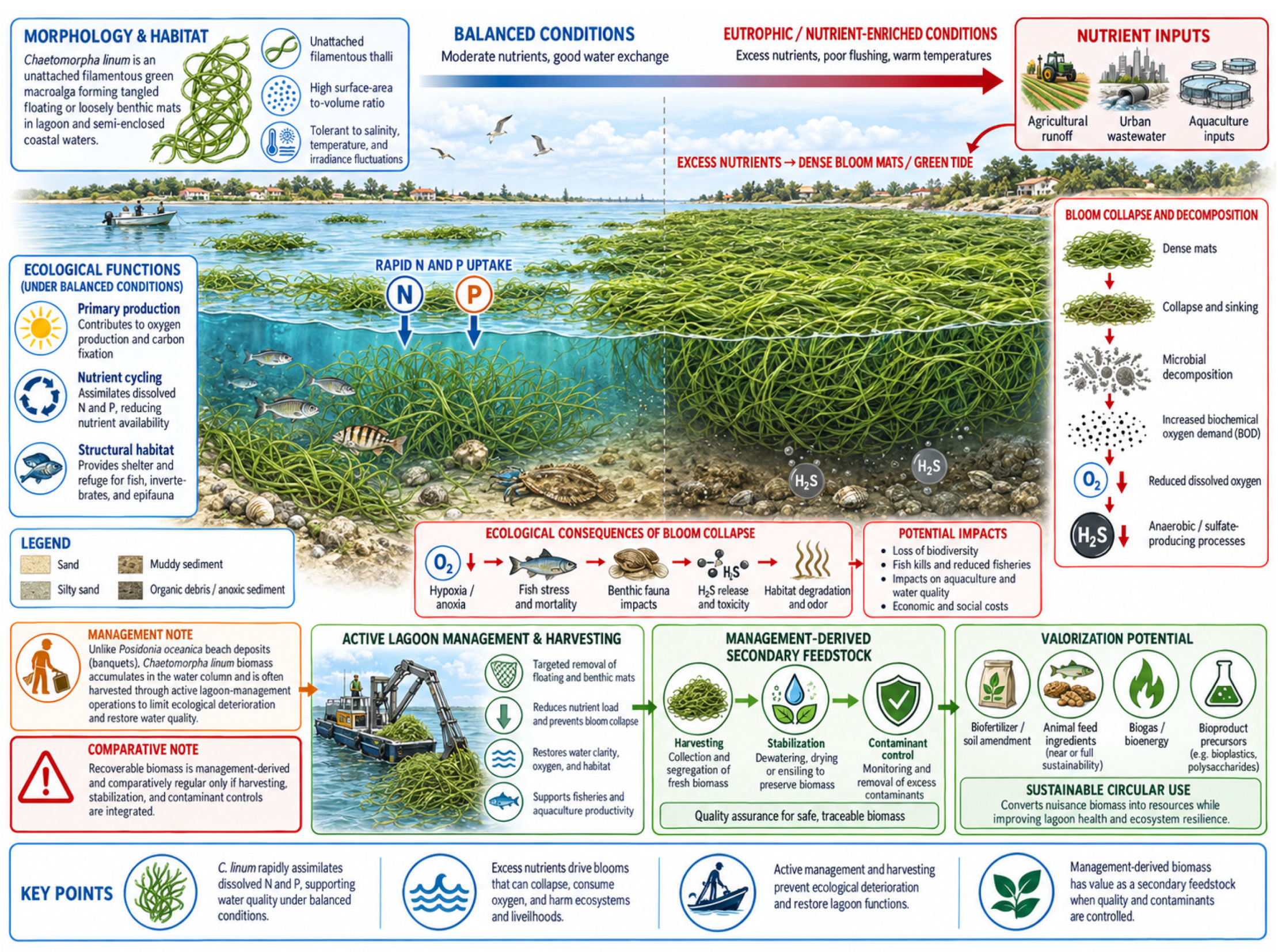
2.3. Chaetomorpha linum, Nutrient Assimilation, and Bloom Biomass
2.4. Quantitative Biomass Generation and Management-Available Supply
2.5. Ecologically Acceptable Harvesting Limits
2.6. Comparative Management Implications
3. Green Extraction Methods and Chemical Profiling
3.1. Eco-Friendly Extraction Technologies
3.2. Lignocellulosic Components and Complex Polysaccharides
3.3. Minerals, Photosynthetic Pigments, and Fatty Acids
3.4. Phenolic Compounds and Other Bioactive Fractions
3.5. Quantitative Chemical Composition and Sources of Variability
Moisture Content, Variability, and Processing Implications
3.6. Macrophyte-Associated Microorganisms as Biotechnological Resources
3.6.1. Posidonia oceanica-Associated Microorganisms
3.6.2. Padina pavonica-Associated Microorganisms
3.6.3. Chaetomorpha linum-Associated Microorganisms
3.6.4. Isolation Workflow, Quality Control, and Safety
4. Biological Activities of Marine Extracts
4.1. Antioxidant and Anti-Inflammatory Properties
4.2. Antimicrobial Potential
4.3. Adsorbent and Biostimulant Potential
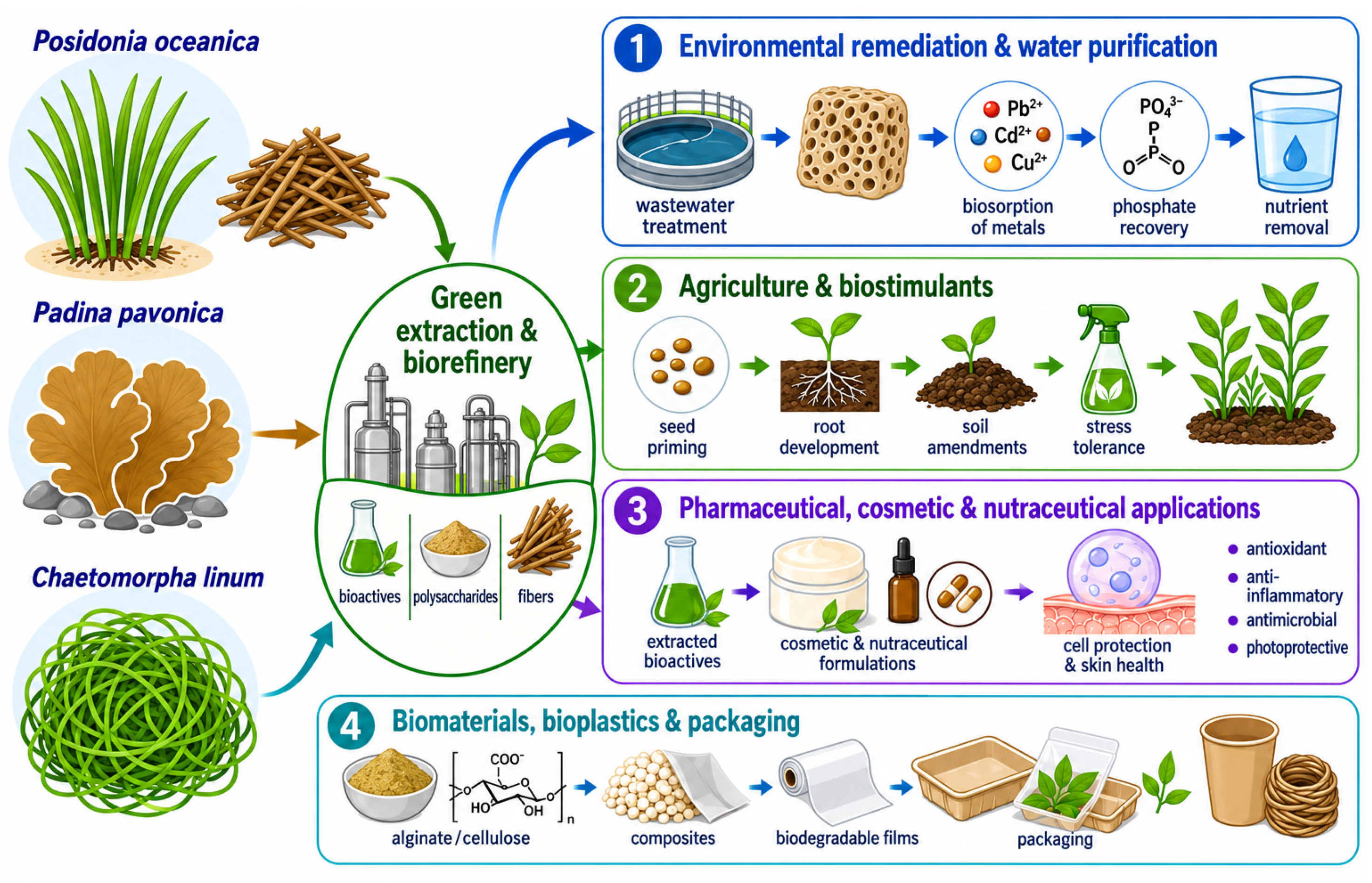
5. Circular-Bioeconomy Applications and Translational Potential
5.1. Environmental Remediation and Water Purification
5.2. Agriculture, Soil Inputs, and Aquaculture Integration
5.3. Cosmetic, Pharmaceutical, and Nutraceutical Applications
5.4. Biomaterials, Bioplastics, Packaging, and Construction
5.5. Cascading Biorefineries and Comparative Readiness
5.6. Operating Facilities, Commercial Readiness, and Management-Driven Valorization
6. Safety, Standardization, Regulation, and Sustainability
6.1. Feedstock Variability and Contaminant Control
6.2. Standardization and Quality-by-Design
6.3. Ecological and Regulatory Constraints
6.4. Scale-Up, Techno-Economic Performance, and Life-Cycle Assessment
6.5. Post-Harvest Transport, Stabilization, and Storage
6.6. Feedstock Cost Ranges and Economic Boundaries
7. Knowledge Gaps and Research Priorities
8. Conclusions
Author Contributions
Funding
Institutional Review Board Statement
Data Availability Statement
Acknowledgments
Conflicts of Interest
Abbreviations
| Abbreviation | Definition |
| ASE | Accelerated solvent extraction |
| BOD | Biochemical oxygen demand |
| DES | Deep eutectic solvent |
| DOM | Dissolved organic matter |
| EAE | Enzyme-assisted extraction |
| MAE | Microwave-assisted extraction |
| NaDES | Natural deep eutectic solvent |
| PEF | Pulsed electric field |
| PLE | Pressurized liquid extraction |
| POM | Particulate organic matter |
| SFE | Supercritical fluid extraction |
| SWE | Subcritical water extraction |
| UAE | Ultrasound-assisted extraction |
References
- Tavakolnia, E. Shifting to a Bio-Based Economy: Reducing Fossil Fuel Dependence. SSRN Electron. J. 2024. [Google Scholar] [CrossRef] [Scilit]
- Chand, S.K.; Yatirajula, S.K.; Dalai, A.; Singh, S.; Boorla, V.; Singh, S.; Chand, S. Strategic Pathways for Sustainable Plastic Management through a Circular Economy Approach in India. Discov. Sustain. 2025, 6, 1374. [Google Scholar] [CrossRef] [Scilit]
- The European Green Deal—European Commission. Available online: https://commission.europa.eu/strategy-and-policy/priorities-2019-2024/european-green-deal_en (accessed on 6 July 2026).
- Trezza, A.; Mahboob, L.; Visibelli, A.; Geminiani, M.; Santucci, A. Lignin Waste Valorization in the Bioeconomy Era: Toward Sustainable Innovation and Climate Resilience. Appl. Sci. 2025, 15, 8038. [Google Scholar] [CrossRef] [Scilit]
- Pashakolaie, V.G.; Gonella, S.; Muhit, I.B. Integrating Modern Bioeconomy into Macroeconomics: A Comprehensive Review of Impacts and Interactions. Bioresour. Technol. Rep. 2025, 30, 102125. [Google Scholar] [CrossRef] [Scilit]
- Purnama, I.; Mutamima, A.; Aziz, M.; Wijaya, K.; Maulida, I.D.; Junaidi, J.; Sari, K.; Effendi, I.; Dini, I.R. Environmental Impacts and the Food vs. Fuel Debate: A Critical Review of Palm Oil as Biodiesel. GCB Bioenergy 2025, 17, e70043. [Google Scholar] [CrossRef] [Scilit]
- Adlan, C.A.; Hanssen, S.V.; Luchtenbelt, H.; Hendriks, C.; Doelman, J.C.; Stehfest, E.; Wicke, B. Emissions Footprints of Agriculture Around the World 1970-2020: Decreasing Land Conversion, Regional Exceptions and Increasing Management Intensity. Glob. Change Biol. 2025, 31, e70528. [Google Scholar] [CrossRef] [Scilit]
- Rakha Aryasatya, F.; Mar, F.; Amanullah, I.; Intan Putri Apriani, M.; Hemalina Prasetyo, R. Oceanian Sovereignty in Blue Economy: Ending Unfair Dependency Constraining Small Island Developing States. J. World Trade Stud. 2024, 9, 1–14. [Google Scholar] [CrossRef] [Scilit]
- Fairoz Basha, M.; Shrikanya Rao, K.V.L. A Review on Third-Generation Biofuels from Marine Diatoms. GSC Biol. Pharm. Sci. 2023, 24, 373–379. [Google Scholar] [CrossRef] [Scilit]
- Kooren, R.; Sumithra, T.G.; Mannur, V.S.; Jaseera, K.V.; Sunithakumari, K.; Hasan, S.; Ratheesh Kumar, R.; Krupesha Sharma, S.R.; Kaladharan, P. Harnessing Seaweeds for Third-Generation Bioethanol: Opportunities in the Indian Context. Sustain. Energy Technol. Assess. 2026, 87, 104881. [Google Scholar] [CrossRef] [Scilit]
- Hosny, S.; Elshobary, M.E.; El-Sheekh, M.M. Unleashing the Power of Microalgae: A Pioneering Path to Sustainability and Achieving the Sustainable Development Goals. Environ. Sci. Pollut. Res. 2025, 32, 17312–17342. [Google Scholar] [CrossRef] [Scilit]
- Pal, P.; Singh, A.K.; Srivastava, R.K.; Rathore, S.S.; Sahoo, U.K.; Subudhi, S.; Sarangi, P.K.; Prus, P. Circular Bioeconomy in Action: Transforming Food Wastes into Renewable Food Resources. Foods 2024, 13, 3007. [Google Scholar] [CrossRef] [Scilit]
- Pakseresht, A.; Kermani, A.; Decker-Lange, C. Towards a Sustainable and Circular Blue Bioeconomy: A Scoping Review. Technol. Forecast. Soc. Change 2025, 216, 124157. [Google Scholar] [CrossRef] [Scilit]
- Danovaro, R. Climate Change Impacts on the Biota and on Vulnerable Habitats of the Deep Mediterranean Sea. Rend. Lincei 2018, 29, 525–541. [Google Scholar] [CrossRef] [Scilit]
- Baldan, D.; Chauvier-Mendes, Y.; Panzeri, D.; Cossarini, G.; Solidoro, C.; Bandelj, V. The Geography of Mediterranean Benthic Communities Under Climate Change. Glob. Change Biol. 2026, 32, e70725. [Google Scholar] [CrossRef] [Scilit]
- Vasarri, M.; De Biasi, A.M.; Barletta, E.; Pretti, C.; Degl’innocenti, D. An Overview of New Insights into the Benefits of the Seagrass Posidonia oceanica for Human Health. Mar. Drugs 2021, 19, 476. [Google Scholar] [CrossRef] [Scilit]
- Fragassa, C.; Pesic, A.; Mattiello, S.; Pavlovic, A.; Santulli, C. Exploring the Potential of Posidonia oceanica Fibers in Eco-Friendly Composite Materials: A Review. J. Mar. Sci. Eng. 2025, 13, 177. [Google Scholar] [CrossRef] [Scilit]
- Li, R.; Xing, R.; Li, H.; Ren, J.; Chen, L.; Yu, Z.; Zhang, H.; Wu, W.; Li, C.; Zhu, L.; et al. From Terrestrial Plants to Marine Macroalgae: A Comprehensive Review of Cell Wall Component-Properties, Extraction, Modification, and Application of Algal Cellulose. J. Agric. Food Chem. 2025, 73, 23759–23782. [Google Scholar] [CrossRef] [Scilit]
- Rushdi, M.I.; Abdel-Rahman, I.A.M.; Saber, H.; Attia, E.Z.; Madkour, H.A.; Abdelmohsen, U.R. A Review on the Pharmacological Potential of the Genus Padina. S. Afr. J. Bot. 2021, 141, 37–48. [Google Scholar] [CrossRef] [Scilit]
- Bürger, K.; Clifford, E.L.; Schagerl, M. Morphological Changes with Depth in the Calcareous Brown Alga Padina pavonica. Botan. Mar. 2017, 60, 171–180. [Google Scholar] [CrossRef] [Scilit]
- Akl, F.M.A.; El-Sheekh, M.M.; Makhlof, M.E.M.; Ahmed, S.I. Antimicrobial, Antidiabetic, Antiviral, and Antioxidant Activities of Fucoidan Extracted from the Brown Seaweed Padina pavonica. BMC Biotechnol. 2025, 25, 70. [Google Scholar] [CrossRef] [Scilit]
- Makhlof, M.; El-Sheekh, M.; Abbas, H.; Elsayed, A.M.; Zewail, M. Exploring the Photoprotective and Antiaging Potential of Padina pavonica Loaded Hyatocosomes: In-Vitro Evaluation and Biological Studies. Bioorg. Chem. 2026, 178, 109952. [Google Scholar] [CrossRef] [Scilit]
- Wynhorst, J.; Chung, W.H.; Fotedar, R.; Howieson, J. Growth, Antioxidant Activity and Mineral Profile of Chaetomorpha linum (O.F. Müller) Kützing (1845) Cultured in Potassium Deficient Media. Food Biosci. 2025, 63, 105702. [Google Scholar] [CrossRef] [Scilit]
- Sorce, C.; Persiano Leporatti, M.; Lenzi, M. Growth and Physiological Features of Chaetomorpha linum (Müller) Kütz. in High Density Mats. Mar. Pollut. Bull. 2018, 129, 772–781. [Google Scholar] [CrossRef] [Scilit]
- Thygesen, A.; Fernando, D.; Ståhl, K.; Daniel, G.; Mensah, M.; Meyer, A.S. Cell Wall Configuration and Ultrastructure of Cellulose Crystals in Green Seaweeds. Cellulose 2021, 28, 2763–2778. [Google Scholar] [CrossRef] [Scilit]
- Raven, J.A.; Hurd, C.L. Ecophysiology of Photosynthesis in Macroalgae. Photosynth. Res. 2012, 113, 105–125. [Google Scholar] [CrossRef] [Scilit]
- Bordoni, R.; Paoli, C.; Montefalcone, M.; Oprandi, A.; Rigo, I.; Ruggeri, F.; Vassallo, P. Habitat Suitability Modeling for Posidonia oceanica Distribution along a Mediterranean Region (NW Italy). Environ. Sustain. Indic. 2025, 25, 100587. [Google Scholar] [CrossRef] [Scilit]
- Boulenger, A.; Chapeyroux, J.; Fullgrabe, L.; Marengo, M.; Gobert, S. Assessing Posidonia oceanica Recolonisation Dynamics for Effective Restoration Designs in Degraded Anchoring Sites. Mar. Pollut. Bull. 2025, 216, 117960. [Google Scholar] [CrossRef] [Scilit]
- Monnier, B.; Pergent, G.; Mateo, M.Á.; Clabaut, P.; Pergent-Martini, C. Quantification of Blue Carbon Stocks Associated with Posidonia oceanica Seagrass Meadows in Corsica (NW Mediterranean). Sci. Total Environ. 2022, 838, 155864. [Google Scholar] [CrossRef] [Scilit]
- Bedini, R.; Bedini, M.; Trafeli, A.; Manuele, M. Study on the Ecological Situation and the Nursery Function of the Posidonia oceanica (L.) Delile, 1813 Prairies on the Islands of Ventotene e Santo Stefano. Annu. Res. Rev. Biol. 2021, 36, 58–76. [Google Scholar] [CrossRef] [Scilit]
- Astudillo-Gutierrez, C.; Pavo-Fernandez, E.; Gracia, V.; Sierra, J.P.; Llull, T.; Mosso, C.; Sanchez-Artus, X.; Sanchez-Arcilla, A. Posidonia oceanica Banquette Accumulations in Southern Catalonia: Management Approaches and Key Parameters for Coastal Protection. Front. Mar. Sci. 2025, 12, 1681826. [Google Scholar] [CrossRef] [Scilit]
- Dentamare, I.; Capasso, L.; Chianese, E.; Calicchio, R.; Franzese, P.P.; Grande, U.; Russo, G.F.; Buonocore, E. Ecological Implications of Posidonia oceanica Banquette Removal: Potential Loss of Natural Capital and Ecosystem Services. Water 2025, 17, 1362. [Google Scholar] [CrossRef] [Scilit]
- Blanfuné, A.; Boudouresque, C.F.; Thibaut, T. Distribution and Management of the Beach Banquettes of the Seagrass Posidonia oceanica along the Provence and French Riviera Mediterranean Coast. Reg. Stud. Mar. Sci. 2026, 97, 105037. [Google Scholar] [CrossRef] [Scilit]
- Benita, M.; Dubinsky, Z.; Iluz, D.; Benita, M.; Dubinsky, Z.; Iluz, D. Padina pavonica: Morphology and Calcification Functions and Mechanism. Am. J. Plant Sci. 2018, 9, 1156–1168. [Google Scholar] [CrossRef]
- Lenzo, D.; Colangelo, M.A.; Pasteris, A.; Rindi, F.; Pistocchi, R.; Pezzolesi, L. Understanding the Role of Macroalgal Complexity and Allelochemicals Production in Invasive and Non-Invasive Macroalgae in the North-Western Adriatic Sea: Effect on the Associated Communities. Water 2023, 15, 1697. [Google Scholar] [CrossRef] [Scilit]
- Mancuso, F.P.; Bisanti, L.; Picone, F.; Chemello, R. Within-Reef Biomass Partitioning in a Mediterranean Vermetid Reef: A Baseline for Future Monitoring. Front. Mar. Sci. 2025, 12, 1656826. [Google Scholar] [CrossRef] [Scilit]
- Herbert, R.J.H.; Willis, J.; Baugh, J.; Blanco, S.; Lucas Pérez-Lloréns, J. The Importance of Propagule Dispersal in Maintaining Local Populations of Rare Algae on Complex Coastlines: Padina pavonica on the South Coast of England. Phycology 2021, 1, 1–13. [Google Scholar] [CrossRef] [Scilit]
- Buapet, P.; Sinutok, S. Calcification in Three Common Calcified Algae from Phuket, Thailand: Potential Relevance on Seawater Carbonate Chemistry and Link to Photosynthetic Process. Plants 2021, 10, 2537. [Google Scholar] [CrossRef] [Scilit]
- Iluz, D.; Fermani, S.; Ramot, M.; Reggi, M.; Caroselli, E.; Prada, F.; Dubinsky, Z.; Goffredo, S.; Falini, G. Calcifying Response and Recovery Potential of the Brown Alga Padina pavonica under Ocean Acidification. ACS Earth Space Chem. 2017, 1, 316–323. [Google Scholar] [CrossRef] [Scilit]
- Wynhorst, J.; Camer-Pesci, B.; Fotedar, R.; Howieson, J. Review of Australian Seaweed Aquaculture: Limitations and Opportunities with a Focus on Two Candidate Species Asparagopsis Taxiformis (Delile) Trevisan (1845) and Chaetomorpha linum (O.F. Müller) Kützing (1845). J. Agric. Food Res. 2025, 21, 101846. [Google Scholar] [CrossRef] [Scilit]
- Ge, S.; Champagne, P. Cultivation of the Marine Macroalgae Chaetomorpha linum in Municipal Wastewater for Nutrient Recovery and Biomass Production. Environ. Sci. Technol. 2017, 51, 3558–3566. [Google Scholar] [CrossRef] [Scilit]
- Xie, J.H.; Shao, X.L.; Ma, K.; Gao, L. Algal Growth and Alkaline Phosphatase Activity of ‘Green Tide’ Chaetomorpha linum in Response to Phosphorus Stress. J. Mar. Syst. 2024, 241, 103912. [Google Scholar] [CrossRef] [Scilit]
- Avendaño, O.; Velázquez-Abunader, I.; Rocha, F.; Guerra, Á. Using Fisher’s Knowledge to Estimate Catch and Effort in the Large-Scale Octopus Fishery on the Eastern Campeche Bank (Mexico, NW Atlantic). Sci. Mar. 2022, 86, e037. [Google Scholar] [CrossRef] [Scilit]
- Wynhorst, J.; Chung, W.H.; Fotedar, R.; Vadiveloo, A.; Moheimani, N.R.; Howieson, J. Growth and Biochemical Composition of Green Seaweed Chaetomorpha linum (O.F. Müller) Kützing (1845) Cultured in a Range of Ionic Profiles. Algal Res. 2024, 84, 103769. [Google Scholar] [CrossRef] [Scilit]
- Polonelli, F.; Leporatti Persiano, M.; Melillo, C.; Lenzi, M. Evolution of a Dystrophic Crisis in a Non-Tidal Lagoon Through Microphyte Blooms. Phycology 2025, 5, 78. [Google Scholar] [CrossRef] [Scilit]
- Traganos, D.; Lee, C.B.; Blume, A.; Poursanidis, D.; Čižmek, H.; Deter, J.; Mačić, V.; Montefalcone, M.; Pergent, G.; Pergent-Martini, C.; et al. Spatially Explicit Seagrass Extent Mapping Across the Entire Mediterranean. Front. Mar. Sci. 2022, 9, 871799. [Google Scholar] [CrossRef] [Scilit]
- Pergent-Martini, C.; Rico-Raimondino, V.; Pergent, G. Primary Production of Posidonia oceanica in the Mediterranean Basin. Mar. Biol. 1994, 120, 9–15. [Google Scholar] [CrossRef] [Scilit]
- Deidun, A.L.A.N. Quantitative Assessment and Physical Characterisation of Posidonia oceanica Wrack Beached Along the Maltese Coastline. Biol. Mar. Mediterr. 2011, 18, 307. [Google Scholar]
- Lenzi, M.; Salvaterra, G.; Gennaro, P.; Mercatali, I.; Persia, E.; Porrello, S.; Sorce, C. A New Approach to Macroalgal Bloom Control in Eutrophic, Shallow-Water, Coastal Areas. J. Environ. Manag. 2015, 150, 456–465. [Google Scholar] [CrossRef] [Scilit]
- Herbert, R.J.H.; Ma, L.; Marston, A.; Farnham, W.F.; Tittley, I.; Cornes, R.C. The Calcareous Brown Alga Padina pavonica in Southern Britain: Population Change and Tenacity over 300 Years. Mar. Biol. 2016, 3, 46. [Google Scholar] [CrossRef] [Scilit]
- Restaino, O.F.; Giosafatto, C.V.L.; Mirpoor, S.F.; Cammarota, M.; Hejazi, S.; Mariniello, L.; Schiraldi, C.; Porta, R. Sustainable Exploitation of Posidonia oceanica Sea Balls (Egagropili): A Review. Int. J. Mol. Sci. 2023, 24, 7301. [Google Scholar] [CrossRef] [Scilit]
- Čagalj, M.; Fras Zemljič, L.; Kraševac Glaser, T.; Mežnar, E.; Sterniša, M.; Smole Možina, S.; Razola-Díaz, M.d.C.; Šimat, C. Seasonal Changes in Chemical Profile and Antioxidant Activity of Padina pavonica Extracts and Their Application in the Development of Bioactive Chitosan/PLA Bilayer Film. Foods 2022, 11, 3847. [Google Scholar] [CrossRef] [Scilit]
- Liang, B.; Wu, X.; Zhang, H.; Qu, Z.; Yang, B.; Wu, G. Modeling Wave Attenuation in Salt Marshes under Variable Vegetation and Wave Conditions Using XBeach Model with a New Parameterization Scheme. Ocean Eng. 2026, 343, 123595. [Google Scholar] [CrossRef] [Scilit]
- Risandi, J.; Rifai, H.; Lukman, K.M.; Sondak, C.F.A.; Hernawan, U.E.; Quevedo, J.M.D.; Hidayat, R.; Ambo-Rappe, R.; Lanuru, M.; McKenzie, L.; et al. Hydrodynamics across Seagrass Meadows and Its Impacts on Indonesian Coastal Ecosystems: A Review. Front. Earth Sci. 2023, 11, 1034827. [Google Scholar] [CrossRef] [Scilit]
- Rasmussen, J.R.; Pedersen, M.F.; Olesen, B.; Nielsen, S.L.; Pedersen, T.M. Temporal and Spatial Dynamics of Ephemeral Drift-Algae in Eelgrass, Zostera marina, Beds. Estuar. Coast. Shelf Sci. 2013, 119, 167–175. [Google Scholar] [CrossRef] [Scilit]
- Shang, F.; Goh, H.C.; Masud, M.M. Stakeholder Perceptions of Tourism’s Impacts on the Ecological Environment of Island Destinations Based on a Systematic Review and Meta-Analysis. Sci. Rep. 2025, 15, 23306. [Google Scholar] [CrossRef] [Scilit]
- Baetz, A.; Tucker, T.R.; DeBruyne, R.L.; Gatch, A.; Höök, T.; Fischer, J.L.; Roseman, E.F. Review of Methods to Repair and Maintain Lithophilic Fish Spawning Habitat. Water 2020, 12, 2501. [Google Scholar] [CrossRef] [Scilit]
- Pinardo-Barco, S.; Sanromualdo-Collado, A.; García-Romero, L. Can the Long-Term Effects of Beach Cleaning Heavy Duty Machinery on Aeolian Sedimentary Dynamics Be Detected by Monitoring of Vehicle Tracks? An Applied and Methodological Approach. J. Environ. Manag. 2023, 325, 116645. [Google Scholar] [CrossRef] [Scilit]
- Orth, R.J.; Heck, K.L. The Dynamics of Seagrass Ecosystems: History, Past Accomplishments, and Future Prospects. Estuaries Coasts 2023, 46, 1653–1676. [Google Scholar] [CrossRef] [Scilit]
- Dans, S.L.; Koen Alonso, M.; Pedraza, S.N.; Crespo, E.A. Incidental Catch of Dolphins in Trawling Fisheries Off Patagonia, Argentina: Can Populations Persist? Ecol. Appl. 2003, 13, 754–762. [Google Scholar] [CrossRef] [Scilit]
- Pergent-Martini, C.; Pergent, G.; Monnier, B.; Boudouresque, C.F.; Mori, C.; Valette-Sansevin, A. Contribution of Posidonia oceanica Meadows in the Context of Climate Change Mitigation in the Mediterranean Sea. Mar. Environ. Res. 2021, 165, 105236. [Google Scholar] [CrossRef] [Scilit]
- Stabili, L.; Acquaviva, M.I.; Angilé, F.; Cavallo, R.A.; Cecere, E.; Del Coco, L.; Fanizzi, F.P.; Gerardi, C.; Narracci, M.; Petrocelli, A. Screening of Chaetomorpha linum Lipidic Extract as a New Potential Source of Bioactive Compounds. Mar. Drugs 2019, 17, 313. [Google Scholar] [CrossRef] [Scilit]
- Hernández-Escaño, M.; Borja, R.; García-Gómez, J.C.; Raposo, F. Posidonia oceanica Ashore Waste Biomass: State-of-the-Art and Valorisation Perspectives Within the Circular Economy Framework. Clean Technol. 2026, 8, 56. [Google Scholar] [CrossRef] [Scilit]
- Barletta, R.; Trezza, A.; Geminiani, M.; Frusciante, L.; Olmastroni, T.; Sannio, F.; Docquier, J.D.; Santucci, A. Chaetomorpha linum Extract as a Source of Antimicrobial Compounds: A Circular Bioeconomy Approach. Mar. Drugs 2024, 22, 511. [Google Scholar] [CrossRef] [Scilit]
- Sari, A.; Tuzen, M. Equilibrium, Thermodynamic and Kinetic Studies on Aluminum Biosorption from Aqueous Solution by Brown Algae (Padina pavonica) Biomass. J. Hazard. Mater. 2009, 171, 973–979. [Google Scholar] [CrossRef] [Scilit]
- Zielinski, S.; Botero, C.M.; Yanes, A. To Clean or Not to Clean? A Critical Review of Beach Cleaning Methods and Impacts. Mar. Pollut. Bull. 2019, 139, 390–401. [Google Scholar] [CrossRef] [Scilit]
- Santos, I.R.; Friedrich, A.C.; Wallner-Kersanach, M.; Fillmann, G. Influence of Socio-Economic Characteristics of Beach Users on Litter Generation. Ocean Coast. Manag. 2005, 48, 742–752. [Google Scholar] [CrossRef] [Scilit]
- Cardoso, C.; Matos, J.; Afonso, C. Extraction of Marine Bioactive Compounds from Seaweed: Coupling Environmental Concerns and High Yields. Mar. Drugs 2025, 23, 366. [Google Scholar] [CrossRef] [Scilit]
- Guan, Y.; Guo, Y.; Lin, L.; Zhang, L.; Chen, W.; Zhao, C. Green Extraction of Bioactive Compounds from Marine Macroalgae: Chemistry, Pharmacological Activities, and Biotechnological Applications. Mar. Drugs 2026, 24, 198. [Google Scholar] [CrossRef] [Scilit]
- Carreira-Casais, A.; Otero, P.; Garcia-Perez, P.; Garcia-Oliveira, P.; Pereira, A.G.; Carpena, M.; Soria-Lopez, A.; Simal-Gandara, J.; Prieto, M.A. Benefits and Drawbacks of Ultrasound-Assisted Extraction for the Recovery of Bioactive Compounds from Marine Algae. Int. J. Environ. Res. Public Health 2021, 18, 9153. [Google Scholar] [CrossRef] [Scilit]
- Zhang, Y.; Hawboldt, K.; MacQuarrie, S. Extraction of Bioactive Compounds from Beach-Cast Brown Algae: A Review on Accelerated Solvent Extraction and Subcritical Water Extraction. RSC Sustain. 2024, 2, 2069–2091. [Google Scholar] [CrossRef] [Scilit]
- Zeb, L.; Shafiq, M.; Jordheim, M. Advancements in Sustainable Extraction of Seaweed Phenolics: Integrating Extraction Technologies with Natural Deep Eutectic Solvents (NADES). Food Chem. 2025, 489, 144941. [Google Scholar] [CrossRef] [Scilit]
- Ciko, A.M.; Jokić, S.; Šubarić, D.; Jerković, I. Overview on the Application of Modern Methods for the Extraction of Bioactive Compounds from Marine Macroalgae. Mar. Drugs 2018, 16, 348. [Google Scholar] [CrossRef] [Scilit]
- Lourenço-Lopes, C.; Carreira-Casais, A.; Carperna, M.; Barral-Martinez, M.; Chamorro, F.; Jiménez-López, C.; Cassani, L.; Simal-Gandara, J.; Prieto, M.A. Emerging Technologies to Extract Fucoxanthin from Undaria Pinnatifida: Microwave vs. Ultrasound Assisted Extractions. Mar. Drugs 2023, 21, 282. [Google Scholar] [CrossRef] [Scilit]
- Čagalj, M.; Skroza, D.; Tabanelli, G.; Özogul, F.; Šimat, V. Maximizing the Antioxidant Capacity of Padina pavonica by Choosing the Right Drying and Extraction Methods. Processes 2021, 9, 587. [Google Scholar] [CrossRef] [Scilit]
- Messyasz, B.; Michalak, I.; Łęska, B.; Schroeder, G.; Górka, B.; Korzeniowska, K.; Lipok, J.; Wieczorek, P.; Rój, E.; Wilk, R.; et al. Valuable Natural Products from Marine and Freshwater Macroalgae Obtained from Supercritical Fluid Extracts. J. Appl. Phycol. 2018, 30, 591–603. [Google Scholar] [CrossRef] [Scilit]
- Manuguerra, S.; Arena, R.; Curcuraci, E.; Messina, C.M.; Santulli, A. Photoprotective and Anti-Melanogenic Effects of Supercritical Fluids Extract from Posidonia oceanica Beach-Cast Leaves: From Waste Stream to Cosmeceutical Applications. Mar. Drugs 2026, 24, 27. [Google Scholar] [CrossRef] [Scilit]
- Nour, M.; Stiger-Pouvreau, V.; Guenneguez, A.; Meslet-Cladière, L.; Cérantola, S.; Ali, A.; Simon, G.; Daher, A.; Petek, S. Eco-Friendly Extraction of Phlorotannins from Padina pavonica: Identification Related to Purification Methods Towards Innovative Cosmetic Applications. Mar. Drugs 2025, 23, 15. [Google Scholar] [CrossRef] [Scilit]
- Sanjeewa, K.K.A.; Herath, K.H.I.N.M.; Kim, Y.S.; Jeon, Y.J.; Kim, S.K. Enzyme-Assisted Extraction of Bioactive Compounds from Seaweeds and Microalgae. TrAC-Trends Anal. Chem. 2023, 167, 117266. [Google Scholar] [CrossRef] [Scilit]
- Nguyen, H.C.; Ngo, K.N.; Tran, H.K.; Barrow, C.J. Enzyme-Assisted Coextraction of Phenolics and Polysaccharides from Padina Gymnospora. Mar. Drugs 2024, 22, 42. [Google Scholar] [CrossRef] [Scilit]
- Camarena-Bononad, P.; Freitas, P.A.V.; Chiralt, A.; Vargas, M. Use of Cellulose Fibres from Posidonia oceanica to Obtain Chitosan Biocomposites and Poly(Lactic Acid) Laminates. Polysaccharides 2025, 6, 27. [Google Scholar] [CrossRef] [Scilit]
- Benito-González, I.; López-Rubio, A.; Martínez-Sanz, M. Potential of Lignocellulosic Fractions from Posidonia oceanica to Improve Barrier and Mechanical Properties of Bio-Based Packaging Materials. Int. J. Biol. Macromol. 2018, 118, 542–551. [Google Scholar] [CrossRef] [Scilit]
- Camarena-Bononad, P.; Freitas, P.A.V.; González-Martínez, C.; Chiralt, A.; Vargas, M. Influence of the Purification Degree of Cellulose from Posidonia oceanica on the Properties of Cellulose-PLA Composites. Polysaccharides 2024, 5, 807–822. [Google Scholar] [CrossRef] [Scilit]
- Li, Y.; Zheng, Y.; Zhang, Y.; Yang, Y.; Wang, P.; Imre, B.; Wong, A.C.Y.; Hsieh, Y.S.Y.; Wang, D. Brown Algae Carbohydrates: Structures, Pharmaceutical Properties, and Research Challenges. Mar. Drugs 2021, 19, 620. [Google Scholar] [CrossRef] [Scilit]
- Abka-khajouei, R.; Tounsi, L.; Shahabi, N.; Patel, A.K.; Abdelkafi, S.; Michaud, P. Structures, Properties and Applications of Alginates. Mar. Drugs 2022, 20, 364. [Google Scholar] [CrossRef] [Scilit]
- Ale, M.T.; Mikkelsen, J.D.; Meyer, A.S. Important Determinants for Fucoidan Bioactivity: A Critical Review of Structure-Function Relations and Extraction Methods for Fucose-Containing Sulfated Polysaccharides from Brown Seaweeds. Mar. Drugs 2011, 9, 2106–2130. [Google Scholar] [CrossRef] [Scilit]
- Karuppusamy, S.; Rajauria, G.; Fitzpatrick, S.; Lyons, H.; McMahon, H.; Curtin, J.; Tiwari, B.K.; O’Donnell, C. Biological Properties and Health-Promoting Functions of Laminarin: A Comprehensive Review of Preclinical and Clinical Studies. Mar. Drugs 2022, 20, 772. [Google Scholar] [CrossRef] [Scilit]
- Gil-Díaz, T.; Haroun, R.; Tuya, F.; Betancor, S.; Viera-Rodríguez, M.A. Effects of Ocean Acidification on the Brown Alga Padina pavonica: Decalcification Due to Acute and Chronic Events. PLoS ONE 2014, 9, e108630. [Google Scholar] [CrossRef] [Scilit]
- Alsufyani, T.; M’sakni, N.H. Part A: Biodegradable Bio-Composite Film Reinforced with Cellulose Nanocrystals from Chaetomorpha linum into Thermoplastic Starch Matrices. Polymers 2023, 15, 1542. [Google Scholar] [CrossRef] [Scilit]
- Neifar, M.; Chatter, R.; Chouchane, H.; Genouiz, R.; Jaouani, A.; Masmoudi, A.S.; Cherif, A. Optimization of Enzymatic Saccharification of Chaetomorpha linum Biomass for the Production of Macroalgae-Based Third Generation Bioethanol. AIMS Bioeng. 2016, 3, 400–411. [Google Scholar] [CrossRef] [Scilit]
- Circuncisão, A.R.; Catarino, M.D.; Cardoso, S.M.; Silva, A.M.S. Minerals from Macroalgae Origin: Health Benefits and Risks for Consumers. Mar. Drugs 2018, 16, 400. [Google Scholar] [CrossRef] [Scilit]
- Bruno, A.; Velders, A.H.; Biasone, A.; Li Vigni, M.; Mondelli, D.; Miano, T. Chemical Composition, Biomolecular Analysis, and Nuclear Magnetic Resonance Spectroscopic Fingerprinting of Posidonia oceanica and Ascophyllum Nodosum Extracts. Metabolites 2023, 13, 170. [Google Scholar] [CrossRef] [Scilit]
- Sanz-Lázaro, C.; Malea, P.; Apostolaki, E.T.; Kalantzi, I.; Marín, A.; Karakassis, I. The Role of the Seagrass Posidonia oceanica in the Cycling of Trace Elements. Biogeosciences 2012, 9, 2497–2507. [Google Scholar] [CrossRef] [Scilit]
- Menéndez, M.; Herrera, J.; Comín, F.A. Effect of Nitrogen and Phosphorus Supply on Growth, Chlorophyll Content and Tissue Composition of the Macroalga Chaetomorpha linum (O.F. Müll), Kütz, in a Mediterranean Coastal Lagoon. Sci. Mar. 2002, 66, 355–364. [Google Scholar] [CrossRef] [Scilit]
- Banach, J.L.; Hoek-van den Hil, E.F.; van der Fels-Klerx, H.J. Food Safety Hazards in the European Seaweed Chain. Compr. Rev. Food Sci. Food Saf. 2020, 19, 332–364. [Google Scholar] [CrossRef] [Scilit]
- Cotas, J.; Tavares, J.O.; Silva, R.; Pereira, L. Seaweed as a Safe Nutraceutical Food: How to Increase Human Welfare? Nutraceuticals 2024, 4, 323–362. [Google Scholar] [CrossRef] [Scilit]
- Ktari, L.; Mdallel, C.; Aoun, B.; Chebil Ajjabi, L.; Sadok, S. Fucoxanthin and Phenolic Contents of Six Dictyotales from the Tunisian Coasts with an Emphasis for a Green Extraction Using a Supercritical CO2 Method. Front. Mar. Sci. 2021, 8, 647159. [Google Scholar] [CrossRef] [Scilit]
- Yalçln, S.; Karakaş, Ö.; Okudan, E.S.; Başkan, K.S.; Çekiç, S.D.; Apak, R. HPLC Detection and Antioxidant Capacity Determination of Brown, Red and Green Algal Pigments in Seaweed Extracts. J. Chromatogr. Sci. 2021, 59, 325–337. [Google Scholar] [CrossRef] [Scilit]
- Madonia, A.; Caporale, G.; Penna, M.; Bonamano, S.; Marcelli, M. Assessment of the Photosynthetic Response of Posidonia oceanica (Linneaus) Delile, 1813 along a Depth Gradient in the Northern Tyrrhenian Sea (Latium, Italy). Geosciences 2021, 11, 202. [Google Scholar] [CrossRef] [Scilit]
- Frusciante, L.; Geminiani, M.; Trezza, A.; Olmastroni, T.; Mastroeni, P.; Salvini, L.; Lamponi, S.; Bernini, A.; Grasso, D.; Dreassi, E.; et al. Phytochemical Composition, Anti-Inflammatory Property, and Anti-Atopic Effect of Chaetomorpha linum Extract. Mar. Drugs 2024, 22, 226. [Google Scholar] [CrossRef] [Scilit]
- Astudillo-Pascual, M.; Domínguez, I.; Aguilera, P.A.; Frenich, A.G. New Phenolic Compounds in Posidonia oceanica Seagrass: A Comprehensive Array Using High Resolution Mass Spectrometry. Plants 2021, 10, 864. [Google Scholar] [CrossRef] [Scilit]
- Messina, C.M.; Arena, R.; Manuguerra, S.; Pericot, Y.; Curcuraci, E.; Kerninon, F.; Renda, G.; Hellio, C.; Santulli, A. Antioxidant Bioactivity of Extracts from Beach Cast Leaves of Posidonia oceanica (L.) Delile. Mar. Drugs 2021, 19, 560. [Google Scholar] [CrossRef] [Scilit]
- Shanura Fernando, I.P.; Kim, M.; Son, K.T.; Jeong, Y.; Jeon, Y.J. Antioxidant Activity of Marine Algal Polyphenolic Compounds: A Mechanistic Approach. J. Med. Food 2016, 19, 615–628. [Google Scholar] [CrossRef] [Scilit]
- Papadopoulou, S.N.A.; Adamantidi, T.; Kranas, D.; Cholidis, P.; Anastasiadou, C.; Tsoupras, A. A Comprehensive Review on the Valorization of Bioactives from Marine Animal By-Products for Health-Promoting, Biofunctional Cosmetics. Mar. Drugs 2025, 23, 299. [Google Scholar] [CrossRef] [Scilit]
- Jayawardhana, H.H.A.C.K.; Jayawardena, T.U.; Sanjeewa, K.K.A.; Liyanage, N.M.; Nagahawatta, D.P.; Lee, H.G.; Kim, J.I.; Jeon, Y.J. Marine Algal Polyphenols as Skin Protective Agents: Current Status and Future Prospectives. Mar. Drugs 2023, 21, 285. [Google Scholar] [CrossRef] [Scilit]
- Schenk, S.; Bucher, M.; Herrenbauer, M.; Schmid, D.; Schmid, M. Challenges of Alginate-Based Cast Films in Plastic-Free Food Packaging Applications: An Overview. Polymers 2025, 17, 3061. [Google Scholar] [CrossRef] [Scilit]
- Mnafki, R.; Morales, A.; Sillero, L.; Khiari, R.; Moussaoui, Y.; Labidi, J. Integral Valorization of Posidonia oceanica Balls: An Abundant and Potential Biomass. Polymers 2024, 16, 164. [Google Scholar] [CrossRef] [Scilit]
- Mirpoor, S.F.; Giosafatto, C.V.L.; Di Pierro, P.; Di Girolamo, R.; Regalado-González, C.; Porta, R. Valorisation of Posidonia oceanica Sea Balls (Egagropili) as a Potential Source of Reinforcement Agents in Protein-Based Biocomposites. Polymers 2020, 12, 2788. [Google Scholar] [CrossRef] [Scilit]
- Kaal, J.; Serrano, O.; del Río, J.C.; Rencoret, J. Radically Different Lignin Composition in Posidonia Species May Link to Differences in Organic Carbon Sequestration Capacity. Org. Geochem. 2018, 124, 247–256. [Google Scholar] [CrossRef] [Scilit]
- Ansari, A.A.; Ghanem, S.M. Growth Attributes and Biochemical Composition of Padina pavonica (L.) from the Red Sea, in Response to Seasonal Alterations of Tabuk, Saudi Arabia. Egypt. J. Aquat. Res. 2019, 45, 139–144. [Google Scholar] [CrossRef] [Scilit]
- Paiva, L.S.; Lima, E.M.C.; Baptista, J.A.B.; Patarra, R.F.; Neto, A.I. Azorean Macroalgae as a Food Supplement: Determination of Proteins, Fiber, and Total of Lipids and Carbohydrates Content. In Proceedings of the 11º Encontro de Química dos Alimentos (11EQA), Bragança, Portugal, 16–19 September 2012; Abstract Book; Universidade dos Açores: Ponta Delgada, Portugal, 2012; p. 181. Available online: https://hdl.handle.net/10400.3/2212 (accessed on 7 July 2026).
- Yucetepe, A.; Aydar, E.F.; Okudan, E.Ş.; Özçelik, B.; Durmaz, G. Proximate Analysis and Fatty Acid, Mineral and Soluble Carbohydrate Profiles of Some Brown Macroalgae Collected from Türkiye Coasts. Z. Naturforsch. C 2023, 78, 261–269. [Google Scholar] [CrossRef] [Scilit]
- Kamenarska, Z.; Gasic, M.J.; Zlatovic, M.; Rasovic, A.; Sladic, D.; Kljajic, Z.; Stefanov, K.; Seizova, K.; Najdenski, H.; Kujumgiev, A.; et al. Chemical Composition of the Brown Alga Padina pavonia (L.) Gaill. from the Adriatic Sea. Bot. Mar. 2002, 45, 339–345. [Google Scholar] [CrossRef] [Scilit]
- Schultz-Jensen, N.; Thygesen, A.; Leipold, F.; Thomsen, S.T.; Roslander, C.; Lilholt, H.; Bjerre, A.B. Pretreatment of the Macroalgae Chaetomorpha linum for the Production of Bioethanol: Comparison of Five Pretreatment Technologies. Bioresour. Technol. 2013, 140, 36–42. [Google Scholar] [CrossRef] [Scilit]
- Naz, M.; Sayın, S.; Çetin, Z.; Saygılı, E.İ.; Taşkın, E.; Söyler, O. The Changes in Biochemical Compositions of Five Different Macroalgae and Seagrass (Halophila stipulacea (Forsskal) Ascherson 1867) Collected from Iskenderun Bay. J. Adv. Res. Nat. Appl. Sci. 2022, 8, 796–804. [Google Scholar] [CrossRef] [Scilit]
- Yucetepe, A.; Altuntas, U.; Sensu, E.; Izci, Y.; Ozcelik, B.; Okudan, E.Ş. Determination of Mineral, Fatty Acid, and Soluble Carbohydrate Profiles of Green Algae Ulva rigida, Chaetomorpha linum, Codium fragile, Caulerpa prolifera and Caulerpa racemosa f. requienii Collected from Türkiye Coasts. Turk. J. Fish. Aquat. Sci. 2025, 25, TRJFAS26117. [Google Scholar] [CrossRef] [Scilit]
- Hamzaoui, A.; Ghariani, M.; Sellem, I.; Hamdi, M.; Feki, A.; Jaballi, I.; Nasri, M.; Ben Amara, I. Extraction, Characterization and Biological Properties of Polysaccharide Derived from Green Seaweed ‘Chaetomorpha linum’ and Its Potential Application in Tunisian Beef Sausages. Int. J. Biol. Macromol. 2020, 148, 1156–1168. [Google Scholar] [CrossRef] [Scilit]
- Rammou, E.; Mitani, A.; Ntalos, G.; Koutsianitis, D.; Taghiyari, H.R.; Papadopoulos, A.N. The Potential Use of Seaweed (Posidonia oceanica) as an Alternative Lignocellulosic Raw Material for Wood Composites Manufacture. Coatings 2021, 11, 69. [Google Scholar] [CrossRef] [Scilit]
- Ksouri, J.; Elferjani, H.; Mensi, F. Estimation Du Stock Naturel de l’Algue Brune Padina pavonica (L)Thivy En Tunisie Septentrionale (Cap Zebib). INSTM Bull. Mar. Freshw. Sci. 2008, 35, 57–60. [Google Scholar] [CrossRef]
- Ong, M.Y.; Abdul Latif, N.I.S.; Leong, H.Y.; Salman, B.; Show, P.L.; Nomanbhay, S. Characterization and Analysis of Malaysian Macroalgae Biomass as Potential Feedstock for Bio-Oil Production. Energies 2019, 12, 3509. [Google Scholar] [CrossRef] [Scilit]
- Lucas-Elió, P.; Marco-Noales, E.; Espinosa, E.; Ordax, M.; López, M.M.; Garcías-Bonet, N.; Marba, N.; Duarte, C.M.; Sanchez-Amat, A. Marinomonas alcarazii sp. Nov., M. rhizomae sp. Nov., M. foliarum sp. Nov., M. posidonica sp. Nov. and M. aquiplantarum sp. Nov., Isolated from the Microbiota of the Seagrass Posidonia oceanica. Int. J. Syst. Evol. Microbiol. 2011, 61, 2191–2196. [Google Scholar] [CrossRef] [Scilit]
- Rotini, A.; Conte, C.; Winters, G.; Vasquez, M.I.; Migliore, L. Undisturbed Posidonia oceanica Meadows Maintain the Epiphytic Bacterial Community in Different Environments. Environ. Sci. Pollut. Res. 2023, 30, 95464–95474. [Google Scholar] [CrossRef] [Scilit]
- Crucitti, D.; Sutera, A.; Carimi, F.; Barone, S.; La Bella, F.; Badalamenti, F.; De Michele, R.; Pacifico, D. Microbial Life Inside Posidonia Seeds: Beneficial Endophytes and Implications for Marine Plant Health. Microbiologyopen 2026, 15, e70259. [Google Scholar] [CrossRef] [Scilit]
- Poli, A.; Bovio, E.; Ranieri, L.; Varese, G.C.; Prigione, V. Fungal Diversity in the Neptune Forest: Comparison of the Mycobiota of Posidonia oceanica, Flabellia petiolata, and Padina pavonica. Front. Microbiol. 2020, 11, 933. [Google Scholar] [CrossRef] [Scilit]
- Vohník, M.; Borovec, O.; Kolaříková, Z.; Sudová, R.; Réblová, M. Extensive Sampling and High-Throughput Sequencing Reveal Posidoniomyces Atricolor Gen. et Sp. Nov. (Aigialaceae, Pleosporales) as the Dominant Root Mycobiont of the Dominant Mediterranean Seagrass Posidonia oceanica. MycoKeys 2019, 55, 59–86. [Google Scholar] [CrossRef] [Scilit]
- Ismail, A.; Ktari, L.; Ahmed, M.; Bolhuis, H.; Boudabbous, A.; Stal, L.J.; Cretoiu, M.S.; El Bour, M. Antimicrobial Activities of Bacteria Associated with the Brown Alga Padina pavonica. Front. Microbiol. 2016, 7, 181765. [Google Scholar] [CrossRef] [Scilit]
- Murugan, A.; Begum, M.S.; Ramasamy, M.S.; Raja, P. Antifouling and Antipredatory Activity of Natural Products of the Seaweeds Dictyota Dichotoma and Chaetomorpha Linoides. Nat. Prod. Res. 2012, 26, 975–978. [Google Scholar] [CrossRef] [Scilit]
- Vasarri, M.; De Marchi, L.; Pretti, C.; Barletta, E.; Degl’Innocenti, D. Antioxidant and Anti-Inflammatory Properties of Four Native Mediterranean Seagrasses: A Review of Bioactive Potential and Ecological Context. Mar. Drugs 2025, 23, 206. [Google Scholar] [CrossRef] [Scilit]
- Micheli, L.; Vasarri, M.; Degl’Innocenti, D.; Di Cesare Mannelli, L.; Ghelardini, C.; Emiliano, A.; Verdelli, A.; Caproni, M.; Barletta, E. Posidonia oceanica (L.) Delile Is a Promising Marine Source Able to Alleviate Imiquimod-Induced Psoriatic Skin Inflammation. Mar. Drugs 2024, 22, 300. [Google Scholar] [CrossRef] [Scilit]
- Vasarri, M.; Degl’Innocenti, D.; Lulli, M.; Schiavone, N.; Verdelli, A.; Caproni, M.; Antiga, E.; Barletta, E. Posidonia oceanica (L.) Delile as a Marine Anti-Inflammatory Modulator of Keratinocyte Inflammatory Responses Relevant to Psoriasis. Mar. Drugs 2026, 24, 85. [Google Scholar] [CrossRef] [Scilit]
- Silva, A.; Silva, S.A.; Carpena, M.; Garcia-Oliveira, P.; Gullón, P.; Barroso, M.F.; Prieto, M.A.; Simal-Gandara, J. Macroalgae as a Source of Valuable Antimicrobial Compounds: Extraction and Applications. Antibiotics 2020, 9, 642. [Google Scholar] [CrossRef] [Scilit]
- Behzadnia, A.; Moosavi-Nasab, M.; Oliyaei, N. Anti-Biofilm Activity of Marine Algae-Derived Bioactive Compounds. Front. Microbiol. 2024, 15, 1270174. [Google Scholar] [CrossRef] [Scilit]
- Pradhan, B.; Nayak, R.; Bhuyan, P.P.; Patra, S.; Behera, C.; Sahoo, S.; Ki, J.S.; Quarta, A.; Ragusa, A.; Jena, M. Algal Phlorotannins as Novel Antibacterial Agents with Reference to the Antioxidant Modulation: Current Advances and Future Directions. Mar. Drugs 2022, 20, 403. [Google Scholar] [CrossRef] [Scilit]
- Jun, J.Y.; Jung, M.J.; Jeong, I.H.; Yamazaki, K.; Kawai, Y.; Kim, B.M. Antimicrobial and Antibiofilm Activities of Sulfated Polysaccharides from Marine Algae against Dental Plaque Bacteria. Mar. Drugs 2018, 16, 301. [Google Scholar] [CrossRef] [Scilit]
- Pereira, L.; Valado, A. Beyond Nutrition: The Therapeutic Promise of Seaweed-Derived Polysaccharides Against Bacterial and Viral Threats. Mar. Drugs 2025, 23, 407. [Google Scholar] [CrossRef] [Scilit]
- Piva, G.; Fracassetti, D.; Tirelli, A.; Mascheroni, E.; Musatti, A.; Inglese, P.; Piergiovanni, L.; Rollini, M. Evaluation of the Antioxidant/Antimicrobial Performance of Posidonia oceanica in Comparison with Three Commercial Natural Extracts and as a Treatment on Fresh-Cut Peaches (Prunus Persica Batsch). Postharvest Biol. Technol. 2017, 124, 54–61. [Google Scholar] [CrossRef] [Scilit]
- Ozbil, E.; Ilktac, M.; Ogmen, S.; Isbilen, O.; Duran Ramirez, J.M.; Gomez, J.; Walker, J.N.; Volkan, E. In Vitro Antibacterial, Antibiofilm Activities, and Phytochemical Properties of Posidonia oceanica (L.) Delile: An Endemic Mediterranean Seagrass. Heliyon 2024, 10, e35592. [Google Scholar] [CrossRef] [Scilit]
- Punginelli, D.; Catania, V.; Abruscato, G.; Luparello, C.; Vazzana, M.; Mauro, M.; Cunsolo, V.; Saletti, R.; Di Francesco, A.; Arizza, V.; et al. New Bioactive Peptides from the Mediterranean Seagrass Posidonia oceanica (L.) Delile and Their Impact on Antimicrobial Activity and Apoptosis of Human Cancer Cells. Int. J. Mol. Sci. 2023, 24, 5650. [Google Scholar] [CrossRef] [Scilit]
- Bilal, M.; Rasheed, T.; Sosa-Hernández, J.E.; Raza, A.; Nabeel, F.; Iqbal, H.M.N. Biosorption: An Interplay between Marine Algae and Potentially Toxic Elements—A Review. Mar. Drugs 2018, 16, 65. [Google Scholar] [CrossRef] [Scilit]
- Elgarahy, A.M.; Elwakeel, K.Z.; Mohammad, S.H.; Elshoubaky, G.A. A Critical Review of Biosorption of Dyes, Heavy Metals and Metalloids from Wastewater as an Efficient and Green Process. Clean. Eng. Technol. 2021, 4, 100209. [Google Scholar] [CrossRef] [Scilit]
- Ncibi, M.C.; Mahjoub, B.; Seffen, M. Investigation of the Sorption Mechanisms of Metal-Complexed Dye onto Posidonia oceanica (L.) Fibres through Kinetic Modelling Analysis. Bioresour. Technol. 2008, 99, 5582–5589. [Google Scholar] [CrossRef] [Scilit]
- Elmorsi, R.R.; El-Wakeel, S.T.; Shehab El-Dein, W.A.; Lotfy, H.R.; Rashwan, W.E.; Nagah, M.; Shaaban, S.A.; Sayed Ahmed, S.A.; El-Sherif, I.Y.; Abou-El-Sherbini, K.S. Adsorption of Methylene Blue and Pb 2+ by Using Acid-Activated Posidonia oceanica Waste. Sci. Rep. 2019, 9, 3356. [Google Scholar] [CrossRef] [Scilit]
- Boulaiche, W.; Belhamdi, B.; Hamdi, B.; Trari, M. Kinetic and Equilibrium Studies of Biosorption of M(II) (M = Cu, Pb, Ni, Zn and Cd) onto Seaweed Posidonia oceanica Fibers. Appl. Water Sci. 2019, 9, 173. [Google Scholar] [CrossRef] [Scilit]
- Cataldo, S.; Muratore, N.; Giannici, F.; Bongiorno, D.; Chiodo, V.; Maisano, S.; Pettignano, A. Hydrocarbons Removal from Synthetic Bilge Water by Adsorption onto Biochars of Dead Posidonia oceanica. Environ. Sci. Pollut. Res. 2022, 29, 90231–90247. [Google Scholar] [CrossRef] [Scilit]
- González, J.A.; Mengual, J.; Palomares, A.E. From Waste to Resource: Phosphorus Adsorption on Posidonia oceanica Ash and Its Application as a Soil Fertilizer. AgriEngineering 2025, 7, 333. [Google Scholar] [CrossRef] [Scilit]
- Mengual, J.; González, J.A. Sustainable Valorization of Posidonia Waste Ash for Phosphate Removal: A Surface Complexation Approach Under Variable Water Chemistry. Molecules 2025, 30, 3639. [Google Scholar] [CrossRef] [Scilit]
- Aloufi, A.S.; Al Riyami, B.; Fawzy, M.A.; Al-Yasi, H.M.; Koutb, M.; Hassan, S.H.A. Model-Assisted Optimization of Cobalt Biosorption on Macroalgae Padina pavonica for Wastewater Treatment. Water 2024, 16, 887. [Google Scholar] [CrossRef] [Scilit]
- Lenzi, M.; Leporatti-Persiano, M.; Gennaro, P. C, N, P, S Content of the Chlorophyta Chaetomorpha linum (Müller) Kützing in a Vast High Density Mat of a Mediterranean Non-Tidal Lagoon. Knowl. Manag. Aquat. Ecosyst. 2020, 421, 38. [Google Scholar] [CrossRef] [Scilit]
- Lenzi, M.; Cianchi, F. Summer Dystrophic Criticalities of Non-Tidal Lagoons: The Case Study of a Mediterranean Lagoon. Diversity 2022, 14, 771. [Google Scholar] [CrossRef] [Scilit]
- du Jardin, P. Plant Biostimulants: Definition, Concept, Main Categories and Regulation. Sci. Hortic. 2015, 196, 3–14. [Google Scholar] [CrossRef] [Scilit]
- Regulation-2019/1009-EN-EUR-Lex. Available online: https://eur-lex.europa.eu/eli/reg/2019/1009/oj/eng (accessed on 8 July 2026).
- Kumar, G.; Nanda, S.; Singh, S.K.; Kumar, S.; Singh, D.; Singh, B.N.; Mukherjee, A. Seaweed Extracts: Enhancing Plant Resilience to Biotic and Abiotic Stresses. Front. Mar. Sci. 2024, 11, 1457500. [Google Scholar] [CrossRef] [Scilit]
- Mamede, M.; Cotas, J.; Pereira, L.; Bahcevandziev, K. Seaweed Polysaccharides as Potential Biostimulants in Turnip Greens Production. Horticulturae 2024, 10, 130. [Google Scholar] [CrossRef] [Scilit]
- Trezza, A.; Frusciante, L.; Barua, P.; Lamponi, S.; Geminiani, M.; Santucci, A. From Lagoons to Biostimulants: Chaetomorpha linum Extracts Enhance Germination Dynamics and Early Seedling Development. Appl. Sci. 2026, 16, 2931. [Google Scholar] [CrossRef] [Scilit]
- Ferrández-Gómez, B.; Jordá, J.D.; Cerdán, M.; Sánchez, A. Valorization of Posidonia oceanica Biomass: Role on Germination of Cucumber and Tomato Seeds. Waste Manag. 2023, 171, 634–641. [Google Scholar] [CrossRef] [Scilit]
- Ferrández-Gómez, B.; Cerdán, M.; Jordá, J.D.; Sánchez-Sánchez, A. Valorization of Posidonia oceanica Biomass Extract as an Elicitor to Mitigate Aphid-Induced Stress in Sweet Pepper Plants. Plants 2025, 14, 3002. [Google Scholar] [CrossRef] [Scilit]
- Dural, M.U.; Cavas, L.; Papageorgiou, S.K.; Katsaros, F.K. Methylene Blue Adsorption on Activated Carbon Prepared from Posidonia oceanica (L.) Dead Leaves: Kinetics and Equilibrium Studies. Chem. Eng. J. 2011, 168, 77–85. [Google Scholar] [CrossRef] [Scilit]
- Photiou, P.; Koutsokeras, L.; Constantinides, G.; Koutinas, M.; Vyrides, I. Phosphate Removal from Synthetic and Real Wastewater Using Thermally Treated Seagrass Residues of Posidonia oceanica. J. Clean. Prod. 2021, 278, 123294. [Google Scholar] [CrossRef] [Scilit]
- Cardoso, S.M.; Pereira, O.R.; Seca, A.M.L.; Pinto, D.C.G.A.; Silva, A.M.S. Seaweeds as Preventive Agents for Cardiovascular Diseases: From Nutrients to Functional Foods. Mar. Drugs 2015, 13, 6838–6865. [Google Scholar] [CrossRef] [Scilit]
- Peñalver, R.; Lorenzo, J.M.; Ros, G.; Amarowicz, R.; Pateiro, M.; Nieto, G. Seaweeds as a Functional Ingredient for a Healthy Diet. Mar. Drugs 2020, 18, 301. [Google Scholar] [CrossRef] [Scilit]
- Leandro, A.; Pereira, L.; Gonçalves, A.M.M. Diverse Applications of Marine Macroalgae. Mar. Drugs 2020, 18, 17. [Google Scholar] [CrossRef] [Scilit]
- Holdt, S.L.; Kraan, S. Bioactive Compounds in Seaweed: Functional Food Applications and Legislation. J. Appl. Phycol. 2011, 23, 543–597. [Google Scholar] [CrossRef] [Scilit]
- Simeone, S.; De Falco, G. Morphology and Composition of Beach-Cast Posidonia oceanica Litter on Beaches with Different Exposures. Geomorphology 2012, 151–152, 224–233. [Google Scholar] [CrossRef] [Scilit]
- Cantasano, N. Deposition Dynamics of Posidonia oceanica “Banquettes” on Calabrian Sandy Beaches (Southern Italy). Coasts 2021, 1, 25–30. [Google Scholar] [CrossRef] [Scilit]
- Sirikwa, L.N.; Manguramas, Y.J.; Anh, N.T.N.; Giang, H.T. A Review of Biology and Applications of Chaetomorpha linum (Müller) Kützing in Global Aquaculture. J. Appl. Phycol. 2024, 36, 2417–2438. [Google Scholar] [CrossRef] [Scilit]
- Pandya, M.; Mehta, S. Seaweed Utilizing as a Biostimulants in Agriculture Sector: A Review. Int. J. Res. Appl. Sci. Eng. Technol. 2023, 11, 927–934. [Google Scholar] [CrossRef] [Scilit]
- Wazeer, H.; Shridhar Gaonkar, S.; Doria, E.; Pagano, A.; Balestrazzi, A.; Macovei, A. Plant-Based Biostimulants for Seeds in the Context of Circular Economy and Sustainability. Plants 2024, 13, 1004. [Google Scholar] [CrossRef] [Scilit]
- Sharma, A.; Dubey, S.; Singh, K.; Mittal, R.; Quille, P.; Rajauria, G. Innovative Processing and Industrial Applications of Seaweed. Phycology 2025, 5, 10. [Google Scholar] [CrossRef] [Scilit]
- Altay, P.; Koçak, E.D.; Kayıhan, M. From Bioresource Waste to Biocomposite: Modifying Posidonia oceanica Fibers for Sustainable Biocomposites. ACS Sustain. Chem. Eng. 2025, 13, 12407–12420. [Google Scholar] [CrossRef] [Scilit]
- Khiari, R.; Jawaid, M. Current Status and Opportunity in Fibre and Composites; Springer: Singapore, 2025. [Google Scholar] [CrossRef] [Scilit]
- Dalal, S.R.; El-Naggar, N.E.A.; El Naeem, G.A. Biosynthesis of Sustainable Biodegradable Bioplastics Using Alginate Extracted from Padina pavonica, Optimization and Characterization. Algal Res. 2023, 76, 103325. [Google Scholar] [CrossRef] [Scilit]
- Ummat, V.; Sivagnanam, S.P.; Rajauria, G.; O’Donnell, C.; Tiwari, B.K. Advances in Pre-Treatment Techniques and Green Extraction Technologies for Bioactives from Seaweeds. Trends Food Sci. Technol. 2021, 110, 90–106. [Google Scholar] [CrossRef] [Scilit]
- Garcia-Vaquero, M.; Ravindran, R.; Walsh, O.; O’doherty, J.; Jaiswal, A.K.; Tiwari, B.K.; Rajauria, G. Evaluation of Ultrasound, Microwave, Ultrasound–Microwave, Hydrothermal and High Pressure Assisted Extraction Technologies for the Recovery of Phytochemicals and Antioxidants from Brown Macroalgae. Mar. Drugs 2021, 19, 309. [Google Scholar] [CrossRef] [Scilit]
- Mittal, R.; Ranade, V.V. Intensifying Extraction of Biomolecules from Macroalgae Using Vortex Based Hydrodynamic Cavitation Device. Ultrason. Sonochem. 2023, 94, 106347. [Google Scholar] [CrossRef] [Scilit]
- Garcia-Vaquero, M.; Ummat, V.; Tiwari, B.; Rajauria, G. Exploring Ultrasound, Microwave and Ultrasound–Microwave Assisted Extraction Technologies to Increase the Extraction of Bioactive Compounds and Antioxidants from Brown Macroalgae. Mar. Drugs 2020, 18, 172. [Google Scholar] [CrossRef] [Scilit]
- Men’shova, R.V.; Ermakova, S.P.; Rachidi, S.M.; Al-Hajje, A.H.; Zvyagintseva, T.N.; Kanaan, H.M. Seasonal Variations of the Composition, Structural Features, and Antitumor Properties of Polysaccharides from Padina pavonica (Lebanon) as a Function of Composition. Chem. Nat. Compd. 2012, 47, 870–875. [Google Scholar] [CrossRef] [Scilit]
- Faidi, A.; Lassoued, M.A.; Becheikh, M.E.H.; Touati, M.; Stumbé, J.F.; Farhat, F. Application of Sodium Alginate Extracted from a Tunisian Brown Algae Padina pavonica for Essential Oil Encapsulation: Microspheres Preparation, Characterization and in Vitro Release Study. Int. J. Biol. Macromol. 2019, 136, 386–394. [Google Scholar] [CrossRef] [Scilit]
- Arulkumar, A.; Nigariga, P.; Paramasivam, S.; Rajaram, R. Metals Accumulation in Edible Marine Algae Collected from Thondi Coast of Palk Bay, Southeastern India. Chemosphere 2019, 221, 856–862. [Google Scholar] [CrossRef] [Scilit]
- Mediterranean Algae → Soluciones Con Macroalgas Mediterráneas. Available online: https://www.mediterraneanalgae.com/ (accessed on 6 August 2026).
- Minetti, M.; Bernardini, G.; Biazzo, M.; Gutierrez, G.; Geminiani, M.; Petrucci, T.; Santucci, A. Padina pavonica Extract Promotes In Vitro Differentiation and Functionality of Human Primary Osteoblasts. Mar. Drugs 2019, 17, 473. [Google Scholar] [CrossRef] [Scilit]
- Zhang, X.; Thomsen, M. Techno-Economic and Environmental Assessment of Novel Biorefinery Designs for Sequential Extraction of High-Value Biomolecules from Brown Macroalgae Laminaria Digitata, Fucus Vesiculosus, and Saccharina Latissima. Algal Res. 2021, 60, 102499. [Google Scholar] [CrossRef] [Scilit]
- Borges, A.V.; Champenois, W. Preservation Protocol for Dimethylsulfoniopropionate and Dimethylsulfoxide Analysis in Plant Material of the Mediterranean Seagrass Posidonia oceanica, and Re-Evaluation of Dimethylsulfoniopropionate Leaf Content. Aquat. Bot. 2017, 143, 8–10. [Google Scholar] [CrossRef] [Scilit]
- Drira, M.; Ben Mohamed, J.; Ben Hlima, H.; Hentati, F.; Michaud, P.; Abdelkafi, S.; Fendri, I. Improvement of Arabidopsis Thaliana Salt Tolerance Using a Polysaccharidic Extract from the Brown Algae Padina pavonica. Algal Res. 2021, 56, 102324. [Google Scholar] [CrossRef] [Scilit]
- Sánchez-García, F.; Hernández, I.; Palacios, V.M.; Roldán, A.M. Freshness Quality and Shelf Life Evaluation of the Seaweed Ulva Rigida through Physical, Chemical, Microbiological, and Sensory Methods. Foods 2021, 10, 181. [Google Scholar] [CrossRef] [Scilit]
- Foscarini, R.; Prakash, J. Handbook on Eucheuma Seaweed Cultivation in Fiji; FAO: Rome, Italy, 1990. [Google Scholar]
- Badmus, U.O.; Taggart, M.A.; Boyd, K.G. The Effect of Different Drying Methods on Certain Nutritionally Important Chemical Constituents in Edible Brown Seaweeds. J. Appl. Phycol. 2019, 31, 3883–3897. [Google Scholar] [CrossRef] [Scilit]
- Rudovica, V.; Rotter, A.; Gaudêncio, S.P.; Novoveská, L.; Akgül, F.; Akslen-Hoel, L.K.; Alexandrino, D.A.M.; Anne, O.; Arbidans, L.; Atanassova, M.; et al. Valorization of Marine Waste: Use of Industrial By-Products and Beach Wrack Towards the Production of High Added-Value Products. Front. Mar. Sci. 2021, 8, 723333. [Google Scholar] [CrossRef] [Scilit]
- Barbot, Y.N.; Al-Ghaili, H.; Benz, R. A Review on the Valorization of Macroalgal Wastes for Biomethane Production. Mar. Drugs 2016, 14, 120. [Google Scholar] [CrossRef] [Scilit]
- Vance, C.; Mainardis, M.; Magnolo, F.; Sweeney, J.; Murphy, F. Modeling the Effects of Ecosystem Changes on Seagrass Wrack Valorization: Merging System Dynamics with Life Cycle Assessment. J. Clean. Prod. 2022, 370, 133454. [Google Scholar] [CrossRef] [Scilit]
- Rios, S.; Luzzi, S. Algae and Climate European Maritime and Fisheries Fund; Publications Office of the European Union: Luxembourg, 2023. [Google Scholar] [CrossRef]

| Species | Quantitative Indicator | Reported or Calculated Value | Interpretation and Source |
|---|---|---|---|
| P. oceanica | Mapped Mediterranean meadow extent | Approximately 19,020 km2 between 0 and 25 m depth | Living protected habitat, not recoverable biomass [47] |
| P. oceanica | Annual leaf and rhizome production | Approximately 130–1284 g DW m−2 year−1 | Multi-site empirical range influenced by depth and meadow density [47] |
| P. oceanica | Calculated basin-scale annual production envelope | Approximately 2.47–24.42 million tonnes DW year−1 | Area-based extrapolation derived from Traganos et al. [46] and Pergent-Martini et al. [47], not a measured or harvestable quantity |
| P. oceanica | Documented local commercial harvest | Approximately 40 tonnes year−1 in Malta | Local operational figure, not total annual biological production [48] |
| C. linum | High-density lagoon standing crop | 20,418 tonnes WW over approximately 235 ha | Site- and time-specific standing biomass [49] |
| C. linum | Management-derived removal | Approximately 6000 tonnes WW over about six months | Local harvested biomass, not Mediterranean-wide annual production [49] |
| Species | Ecological Setting and Function | Main Biomass Source for Valorization | Key Sourcing Constraint |
|---|---|---|---|
| P. oceanica | Long-lived seagrass meadows; sediment stabilization, habitat formation, coastal protection, and blue-carbon storage. | Naturally detached leaves, fibres, egagropili, or material selectively removed from managed beaches. | Living meadows and ecologically functional banquettes must be protected; deposits are heterogeneous and often contain sand and salts. |
| P. pavonica | Seasonal brown macroalgal stands on shallow rocky substrates; local habitat complexity and organic-matter cycling. | Seasonally detached thalli and mixed coastal drift, or biomass from controlled cultivation. | Availability is spatially and seasonally variable; living beds should not be depleted. |
| C. linum | Filamentous mats in lagoons and semi-enclosed waters; nutrient assimilation and habitat provision under balanced conditions. | Biomass harvested during lagoon management, nutrient-recovery operations, or controlled cultivation. | Bloom-derived biomass may contain salts, sediments, microorganisms, metals, and lagoon-specific contaminants. |
| Biomass/Sample and Origin | Reported Quantitative Composition | Basis and Interpretation | |
|---|---|---|---|
| [82] | Beach-cast leaf residues; Mediterranean coastal biomass used for lignocellulosic fractionation. | Holocellulose 59 ± 1%; lignin 18 ± 2%; ash 13 ± 2% DW. The same feedstock was subsequently described as containing approximately 7% protein and 4% lipids. | Whole dry biomass. Rounded proximate values may not close exactly to 100%. |
| [107] | Washed and dried egagropili collected at Chatt-Mariem, Sousse, Tunisia. | Glucan 21.1%; hemicelluloses 18.1%; total lignin 34.2% (32.6% acid-insoluble and 1.5% acid-soluble); extractives 4.3%; ash 8.6% DW. | Whole dry egagropili analysed using a lignocellulosic mass-balance approach. The unreported remainder includes components not quantified by the selected protocol. |
| [108] | Dried sea balls (egagropili) used to isolate nanocrystalline cellulose and a lignin-containing fraction. | Holocellulose 61.8%; cellulose approximately 40% DW; nanocrystalline-cellulose recovery 225 mg/g ground egagropili. | The first two values characterize the raw fibrous material; the recovery value is a process yield and is not an additional biomass component. |
| [109] | Bulk plants and individual organs, including fibre-rich leaf sheaths. | Lignin 29.5% in P. oceanica; guaiacyl and syringyl lignin units showed very high p-hydroxybenzoylation, approximately 73% and 61%, respectively. | Lignin content and structural characterization. The percentages of p-hydroxybenzoylation describe lignin subunits, not whole-biomass abundance. |
| [17] | Egagropili and loose beach fibres summarized from Mediterranean studies. | Holocellulose approximately 61.8% in egagropili and 57.1% in loose fibres; lignin approximately 29.8% and 24.7%, respectively. | Secondary synthesis comparing two beach-cast morphological feedstock classes. The values are retained as source-specific examples and are not combined with the primary-study measurements above. |
| Reference | Biomass/Sample and Origin | Reported Quantitative Composition | Basis and Interpretation |
|---|---|---|---|
| [110] | Whole thalli collected at Haql, Red Sea, in January, April, July, and October 2018. | Approximate seasonal ranges read from the published figures: total carbohydrates 32–45% DW; protein 8–9.5% DW; lipids 0.8–1.0% DW; mineral ash 26–36% DW; dietary fibre 33–43% DW; water 5–8%. | Whole-biomass seasonal study. Values are approximate because numerical data were presented graphically. All major fractions peaked or approached their maximum in July. |
| [111] | Whole P. oceanica from Azorean shores. | Protein 2.86% DW; total carbohydrates 7.61% DW. | Conference contribution reporting selected proximate components. The markedly lower values than the Red Sea study illustrate geographical and methodological variability. |
| [112] | Dried P. oceanica biomass used as the starting material for green protein extraction. | Crude protein 57.28 ± 0.12 mg/g DW, corresponding to 5.728% DW. | Whole-biomass baseline measured before protein extraction. Extract composition and bioactivity were evaluated separately. |
| [113] | Whole thalli collected from the southern Adriatic Sea. | Within total fatty acids: palmitic acid 49.0%, oleic acid 15.9%, and myristic acid 13.0%. Within the sterol fraction: cholesterol 34.0% and fucosterol 24.3%. | Relative composition of lipid and sterol fractions, not percentage of whole dry biomass. The paper used the historical name Padina pavonia. |
| P. oceanica sampled in different months and subjected to different drying and extraction conditions. | Total phenolic content of extracts varied approximately from 11.88 to 26.69 mg gallic-acid equivalents per g extract. | Extract-based value. It demonstrates that season and post-harvest processing substantially change the recoverable phenolic fraction [52]. |
| Reference | Biomass/Sample and Origin | Reported Quantitative Composition | Basis and Interpretation |
|---|---|---|---|
| [114] | Washed C. linum from Roskilde Fjord, Denmark, collected in two years. | Glucan 34–38 g/100 g DM; xylan 6 g/100 g DM; arabinan 9–10 g/100 g DM; non-hydrolysable organic components 7 g/100 g DM; ash 21–23 g/100 g DM. The non-cell-wall-monosaccharide fraction included approximately 14 g pectin and 6 g wax per 100 g DM. | Whole dry biomass characterized for biorefinery processing. DM, dry matter. The analytical fractions overlap only as defined in the original mass-balance method. |
| [115] | Whole thalli collected from Iskenderun Bay, Türkiye. | Ash 17.68 ± 0.33%; lipids 4.84 ± 1.68%; protein 5.56 ± 0.06% DW. | Whole-biomass proximate composition. The relatively low ash and high lipid values differ substantially from another Turkish coastal sample. |
| [116] | Whole thalli collected at Çanakkale, Türkiye, washed, dried, and milled. | Protein 4.40 ± 0.09%; lipids 0.57 ± 0.10%; ash 42.28 ± 0.70%; crude fibre 12.02 ± 0.13%; total soluble carbohydrate 40.71 ± 1.41% DW. | Whole dry biomass. The study used defined AOAC, Soxhlet, phenol-sulfuric-acid, and gravimetric methods. |
| [116] | Same Çanakkale biomass; fatty-acid, mineral, and soluble-sugar profiling. | Fatty-acid fraction: SFA 75.43 ± 1.90%, MUFA 20.45 ± 0.95%, PUFA 4.12 ± 0.02%; palmitic 50.38 ± 1.10%, myristic 17.18 ± 0.30%, oleic 17.72 ± 0.74%. Soluble sugars: sucrose 4968.06, myo-inositol 3156.96, glucose 2336.47, and fructose 1264.58 mg/kg DW. | Fatty-acid percentages refer to total identified fatty acids. Soluble sugars are expressed on a whole-dry-biomass basis. |
| [117] | Dried C. linum used for aqueous polysaccharide extraction. | Extracted polysaccharide yield 16.35 ± 0.50% of dry biomass; the study also reported total carbohydrate of approximately 52.54% DW for the starting biomass. | The first value is an extraction yield, whereas the second is a whole-biomass compositional measurement. |
| [62] | Lipid extract from C. linum collected in the Mar Piccolo of Taranto, Italy. | Within the identified fatty-acid fraction: linoleic acid 38.46%, eicosapentaenoic acid 8.83%, and arachidonic acid 8.14%. | Relative composition of the lipid extract, not percentage of whole dry biomass. Differences from Yucetepe et al. reflect geography, season, and extraction method. |
| Species | Biomass and Condition | Moisture Content | Reporting Basis and Interpretation | Reference |
|---|---|---|---|---|
| P. oceanica | As-collected beach-cast leaves | 118% DB, equivalent to approximately 54.1% WB | Material collected from the coastline before drying. The wet-basis value was calculated from the reported dry-basis moisture content. | [118] |
| P. oceanica | Ashore residues reported across different studies | Approximately 16–71% | Broad literature range reflecting residue type, shoreline residence, weather exposure, storage, and pretreatment. | [63] |
| P. oceanica | Fresh natural biomass collected at Cap Zebib, Tunisia | Approximately 77.8% WB | Calculated from 112.5 t fresh biomass and 25 t dry biomass. This is an inferred value, not a direct moisture assay. | [119] |
| C. linum | Untreated harvested biomass | 78.95% WB | Direct determination by oven drying at 105 °C to constant mass. | [120] |
| Host Macrophyte | Demonstrated Associated Microorganisms | Reported Functions | Potential Applications | Current Limitation |
|---|---|---|---|---|
| P. oceanica | Marinomonas, Halomonas, Bacillus, Metabacillus, Kocuria, Lysobacter, Aureimonas, Posidoniomyces, and other bacteria and fungi [121,123,125]. | Indole-3-acetic-acid and siderophore production, nitrogen fixation, phosphate solubilization, biofilm formation, and hydrolytic enzyme activities [123]. | Plant-growth-promoting inoculants, marine restoration, enzyme production, and discovery of microbial metabolites. | Most functional evidence derives from laboratory screening. Living tissues are ecologically protected, and industrial sampling cannot justify destructive harvesting. |
| P. oceanica | Cultivable epiphytic bacteria affiliated mainly with Proteobacteria, Firmicutes, and Actinobacteria; the most active isolate was closely related to Bacillus pumilus [126]. | Inhibition of selected bacterial pathogens and Candida albicans; potential contribution to host antimicrobial and surface-defence activity. | Antimicrobial and antifouling metabolites, marine-adapted enzymes, and activity-guided microbial fermentation. | The number of characterized isolates remains limited, and the active microbial products have not been fully purified or structurally identified. |
| C. linum | The species-specific cultivable microbiota remains insufficiently characterized. Antibiofilm epiphytic bacteria have been reported for the related species Chaetomorpha linoides [127]. | Potential biofilm inhibition, antifouling defence, nutrient transformation, and production of lagoon-adapted enzymes. | Antifouling compounds, enzymes for biomass conversion, nutrient-recovery microorganisms, and bioremediation strains. | Direct and robust evidence for C. linum is lacking. Lagoon-derived isolates may reflect wastewater, sediment, or other environmental inputs and require strict biosafety assessment. |
| Species or Fraction | Reported Functional Activity | Evidence Level | Main Limitation |
|---|---|---|---|
| P. oceanica phenolic-rich extracts | Antioxidant, photoprotective, anti-inflammatory, enzyme-modulating, antimicrobial, and antibiofilm effects [77,138]. | Chemical assays, selected cellular models, and microbiological studies. | Composition varies with tissue, senescence, shoreline residence, extraction, and formulation; independent validation remains limited. |
| P. pavonica phlorotannin and fucoidan fractions | Antioxidant, elastase and tyrosinase inhibition, antimicrobial activity, and metal biosorption [21,78]. | Chemical, enzymatic, microbiological, and bench-scale adsorption assays. | Molecular weight, sulfate content, purity, and extraction conditions are not consistently standardized across studies. |
| C. linum hydroalcoholic or aqueous extracts | Anti-inflammatory, antimicrobial, nutrient-removal, seed-germination, root-growth, and seedling-vigour effects [41,64,100,154]. | Cellular, microbiological, nutrient-assimilation, and early plant-growth studies, with computational mechanistic support in selected cases. | Whole-extract effects cannot be assigned to individual compounds without fractionation; field performance, formulation stability, and contaminant control require further study. |
| Solid or thermally converted biomasses | Removal of metals, dyes, hydrocarbons, phosphate, and other contaminants; potential nutrient recovery [144,157,158]. | Bench-scale biosorption and material-characterization studies. | Regeneration, mixed-contaminant matrices, real wastewater, contaminant-loaded residue management, and scale-up require validation. |
| Species | Most Credible Near-Term Pathways | Relative Readiness | Primary Bottleneck | Priority Development Step | References |
|---|---|---|---|---|---|
| P. oceanica | Fibres, cellulose, composites, sorbents, biochar, and selected phenolic extracts. | Moderate for materials and sorbents; low-to-moderate for formulated bioactives. | Heterogeneous beach-cast material, salts, sand, and ecological limits on collection. | Define feedstock classes and demonstrate pilot-scale fractionation, material performance, and life-cycle benefit. | [51,102,144] |
| P. pavonica | Alginate- and fucoidan-containing fractions, phlorotannin-rich extracts, films, gels, and biosorbents. | Low-to-moderate; promising high-value fractions but limited species-specific scale-up. | Seasonal and spatially variable supply, calcification, purification demands, and incomplete molecular standardization. | Establish controlled supply and standardized molecular characterization linked to reproducible function. | [21,78,119,176,177] |
| C. linum | Nutrient recovery, management-derived biomass, biostimulant formulations, and emerging structural products. | Moderate for harvesting and nutrient removal; low for standardized downstream products. | Rapid deterioration, high moisture and salinity, and site-specific contaminant burden. | Integrate harvesting with immediate stabilization, contaminant control, and field or pilot validation. | [24,41,89,100,120,154,178] |
| Barrier | Why It Matters | Recommended Action |
|---|---|---|
| Ecologically inappropriate sourcing | Removal can damage habitats, sediment retention, or shoreline protection. | Use management-derived or selectively recoverable biomass and document collection authorization and ecological criteria. |
| Feedstock heterogeneity | Composition and performance vary among sites, seasons, tissues, and storage conditions. | Define feedstock classes, sampling plans, acceptance specifications, and batch traceability. |
| Salts, sand, and contaminants | They affect extraction, safety, corrosion, material performance, and product classification. | Apply use-specific analytical panels and optimize washing or demineralization with wastewater management. |
| Incomplete process reporting | Studies cannot be compared or reproduced. | Report complete mass balances, process parameters, extraction yield, energy, and solvent recovery. |
| Evidence limited to laboratory assays | Chemical or bench-scale activity may not predict formulated or field performance. | Progress through standardized cellular, material, greenhouse, field, pilot, and real-matrix validation. |
| Uncertain economic and environmental benefit | Processing can exceed the value or impact reduction achieved. | Perform techno-economic analysis and life-cycle assessment against realistic conventional alternatives. |
| Species and Raw-Material Condition | Published Handling Evidence | Recommended Transport to Processing | Temporary Storage Before Stabilization | Stabilized Storage and Limitation |
|---|---|---|---|---|
| P. oceanica, wet or recently deposited beach-cast leaves | Fresh material has been rapidly transported in dark coolers and stored at 4 °C or frozen before analysis [92,182]. | Same day, preferably within 12 h; clean covered containers; protect from sunlight and heating. | 0–4 °C; preferably process within 24 h and no later than 48 h. This is a conservative operational recommendation, not a validated shelf-life. | Dry to constant mass for structural uses or freeze for labile metabolites. Target-dependent stability is essential: oven-dried DMSP declined markedly during 80 days, whereas frozen material was stable for 198 days [182]. |
| P. oceanica, dry fibres or egagropili | Dried powders have been stored in dark or sealed containers at room temperature [155]. | Lower urgency than wet leaves, but protect from rain, soil, and rewetting; transport preferably within 24–48 h after collection. | Dry, ventilated, shaded area; avoid compacted outdoor piles and condensation. | Airtight, dark containers only after moisture stabilization. No validated maximum duration; monitor moisture, odour, mould, and target markers. |
| P. oceanica, fresh thalli | Published protocols washed biomass after collection and used 4–7 days of shade drying, 24 h oven drying at 60 °C, or 2 days freeze-drying [183]. | Same working day, preferably within 6–12 h; 0–4 °C, dark, drained containers. | 0–4 °C for the shortest possible period; stabilize within 24 h for phenolic, pigment, or polysaccharide recovery. A 48 h emergency maximum is proposed but is not species-validated. | After complete drying, use airtight or aerated dry storage according to product objective [147,183]. No validated shelf-life; periodic chemical and microbial control required. |
| C. linum, fresh management-harvested lagoon biomass | Valorization studies washed biomass promptly, dried it at 50–55 °C to constant weight, and stored powder in airtight containers at room temperature [64,154]. | Immediate same-day transfer, preferably within 4–6 h; drain, cool to 0–4 °C, avoid compression and sealed wet piles. | Stabilize preferably within 12 h and no later than 24 h. Refrigeration is only a short holding step because of high moisture and lagoon microbial burden. | Dry powder in airtight containers at room temperature, or frozen biomass for labile targets. No validated maximum duration; monitor moisture, water activity, microbial load, and chemical markers. |
| Operation | Harvester or Collection Operator | Processor or Controlled Pretreatment Unit |
|---|---|---|
| Selective collection | Primary responsibility; collect only authorized biomass and avoid non-target habitats. | Define feedstock specifications and rejection criteria. |
| Removal of visible foreign matter | Remove plastics, stones, shells, ropes, large sediment aggregates, and non-target organisms. | Perform final sorting and verify impurity content. |
| Preliminary drainage | Drain free water without prolonged compression or contamination. | Measure incoming wet mass, solids content, and moisture. |
| Initial seawater rinse | Optional for P. oceanica or cultivated biomass when permitted and included in the supply protocol. | Verify whether rinsing affects salt content and target compounds. |
| Controlled washing | Normally not performed during field collection. | Primary responsibility; use defined water quality, biomass-to-water ratio, time, and temperature. |
| Desalting | Limited field role unless a validated mobile unit is available. | Primary responsibility because desalting affects composition, wastewater generation, and product performance. |
| Mechanical dewatering | Basic drainage may be performed at collection. | Controlled pressing, centrifugation, filtration, or other defined dewatering operation. |
| Drying | May be performed by the producer in decentralized cultivation systems under an agreed specification. | Preferred responsibility for standardized industrial, cosmetic, nutraceutical, agricultural, or material applications. |
| Milling and homogenization | Not normally recommended at the collection site. | Processor responsibility under contamination and particle-size control. |
| Contaminant and microbiological testing | Provide collection-site traceability and environmental information. | Primary responsibility for analytical testing and batch release. |
| Wastewater management | Prevent uncontrolled discharge during collection. | Treat or recover saline washing and desalting streams according to applicable requirements. |
| Documentation | Record site, date, authorization, biomass condition, collection method, and transport time. | Record washing, desalting, drying, storage, analytical results, and final batch disposition. |
| Species and Feedstock Origin | Cost Basis | Indicative Range | Interpretation and Source |
|---|---|---|---|
| P. oceanica, management-authorized beach-cast biomass | Collection and supply of as-collected wet biomass | EUR 6–140/t WW | Broad logistics range derived from marine-wrack removal and an Italian seagrass-wrack case; not a commercial biomass price [187,189] |
| P. oceanica, naturally detached biomass | Collection and supply of wet biomass | EUR 6–120/t WW | Proxy derived from general beach-wrack management; no species-specific estimate is available [187,188] |
| P. oceanica, purpose-grown biomass | Macroalgal cultivation cost | Approximately EUR 1.5–37/kg DW; mean approximately EUR 14/kg DW | Proxy based mainly on Saccharina and Ulva cultivation systems, not a direct P. oceanica cost [167] |
| C. linum, management-harvested lagoon biomass | Harvesting and supply of wet biomass | EUR 6–120/t WW | Screening-level proxy for eutrophication-derived macroalgal biomass; no Orbetello-specific unit cost was identified [187,188] |
| All stabilized macroalgal feedstocks | Additional drying cost | Approximately EUR 85/t of material in beach-wrack assessments, or mean EUR 0.3/kg DW in macroalgal production assessments | Values have different system boundaries and should not be combined without moisture and process data [167,187] |
Disclaimer/Publisher’s Note: The statements, opinions and data contained in all publications are solely those of the individual author(s) and contributor(s) and not of MDPI and/or the editor(s). MDPI and/or the editor(s) disclaim responsibility for any injury to people or property resulting from any ideas, methods, instructions or products referred to in the content. |
© 2026 by the authors. Licensee MDPI, Basel, Switzerland. This article is an open access article distributed under the terms and conditions of the Creative Commons Attribution (CC BY) license.
Share and Cite
Trezza, A.; Visibelli, A.; Ammannati, L.; Geminiani, M.; Santucci, A. Marine Macrophytes as Macromolecular Resources in the Mediterranean Circular Bioeconomy: Ecology, Green Ex-Traction, Bioactivity, and Valorization of Posidonia oceanica, Padina pavonica, and Chaetomorpha linum. Macromol 2026, 6, 80. https://doi.org/10.3390/macromol6030080
Trezza A, Visibelli A, Ammannati L, Geminiani M, Santucci A. Marine Macrophytes as Macromolecular Resources in the Mediterranean Circular Bioeconomy: Ecology, Green Ex-Traction, Bioactivity, and Valorization of Posidonia oceanica, Padina pavonica, and Chaetomorpha linum. Macromol. 2026; 6(3):80. https://doi.org/10.3390/macromol6030080
Chicago/Turabian StyleTrezza, Alfonso, Anna Visibelli, Lisa Ammannati, Michela Geminiani, and Annalisa Santucci. 2026. "Marine Macrophytes as Macromolecular Resources in the Mediterranean Circular Bioeconomy: Ecology, Green Ex-Traction, Bioactivity, and Valorization of Posidonia oceanica, Padina pavonica, and Chaetomorpha linum" Macromol 6, no. 3: 80. https://doi.org/10.3390/macromol6030080
APA StyleTrezza, A., Visibelli, A., Ammannati, L., Geminiani, M., & Santucci, A. (2026). Marine Macrophytes as Macromolecular Resources in the Mediterranean Circular Bioeconomy: Ecology, Green Ex-Traction, Bioactivity, and Valorization of Posidonia oceanica, Padina pavonica, and Chaetomorpha linum. Macromol, 6(3), 80. https://doi.org/10.3390/macromol6030080

