Review

Integration and Challenges of Lignocellulosic Materials into Bio-Based Construction Systems

1
Prudêncio Impermeabilizações, Rua dos Pedreiros, 14, Parque Industrial das Sete Fontes, 4710-553 Braga, Portugal
2
CeNTI—Centre for Nanotechnology and Smart Materials, Rua Fernando Mesquita, 2785, 4760-034 Vila Nova de Famalicão, Portugal
3
Laboratório para Investigação e Inovação em Sensors (LabRISE), School of Engineering, Polytechnic Institute of Porto, R. Dr. António Bernardino de Almeida 431, 4249-015 Porto, Portugal
4
Itecons—Institute for Research and Technological Development in Construction, Energy Environment and Sustainability, Rua Pedro Hispano, 3030-289 Coimbra, Portugal
5
Civil Engineering Research and Innovation for Sustainability (CERIS), University of Coimbra, Rua Luís Reis Santos, Pólo II, 3030-790 Coimbra, Portugal
6
Painel 2000, Rua Parque Industrial, 154, 4720-536 Braga, Portugal
7
Civil Engineering Research and Innovation for Sustainability (CERIS), Department of Civil Engineering, University of Coimbra, Rua Luís Reis Santos, Pólo II, 3030-790 Coimbra, Portugal
*
Authors to whom correspondence should be addressed.
Macromol 2026, 6(2), 30; https://doi.org/10.3390/macromol6020030

Submission received: 5 March 2026 / Revised: 6 April 2026 / Accepted: 6 May 2026 / Published: 14 May 2026
(This article belongs to the Special Issue Advances in Starch and Lignocellulosic-Based Materials)

Abstract

The construction sector is responsible for substantial energy consumption, greenhouse gas emissions, and resource depletion, driving the search for sustainable alternatives to conventional petroleum-based insulation materials. Lignocellulosic biomass, comprising cellulose, hemicellulose, and lignin, offers a renewable resource for the development of bio-based foams with potential application in construction systems. This review provides a comprehensive analysis of bio-based foams tailored to building applications, positioning recent scientific advances against the technical properties of commercial synthetic insulation foams. Key performance parameters, including density, thermal conductivity, compressive strength, dimensional stability, water vapour diffusion resistance, and fire behaviour, are critically examined. Developments in lignocellulosic-based foams are discussed, highlighting processing strategies such as crosslinking, chemical modification, and hybrid reinforcement to enhance mechanical, thermal, and fire performance. The reported results demonstrate that lignin-based polyurethane and phenolic foams can achieve competitive compressive strength and thermal insulation, while cellulose-based aerogels and foams exhibit ultra-low density and promising conductivity values. However, challenges related to moisture sensitivity, fire classification, process scalability, standardisation, and market integration remain significant. Overall, lignocellulosic foams represent a promising pathway toward decarbonised, circular construction systems, provided that technical optimisation and regulatory alignment are successfully achieved.

Graphical Abstract

1. Introduction

1.1. Construction Sector—Spending, Pollution, and Impact

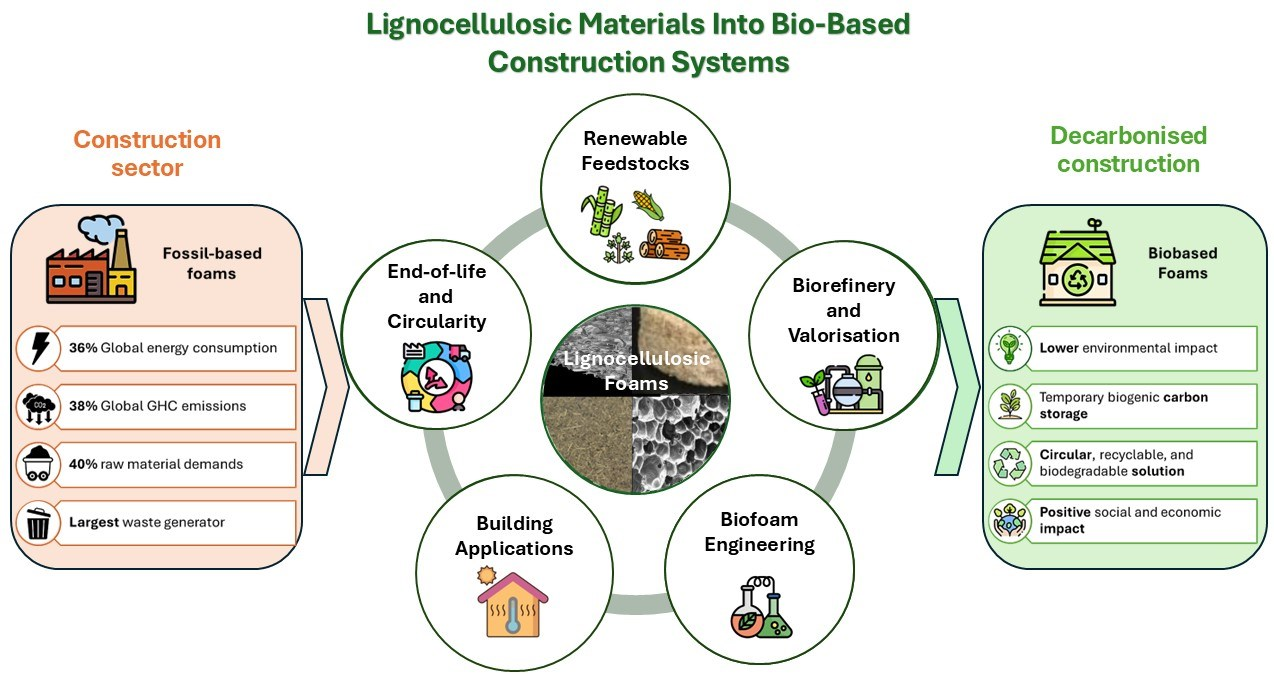
The transition to a bioeconomy is essential for reducing the environmental and social impacts associated with the current economic model, particularly regarding the intensive consumption of materials [1]. The construction sector is responsible for 36% of global energy consumption, 38% of annual greenhouse gas (GHG) emissions, and 40% of global energy demand [1,2,3].
This sector is also characterised by an extremely intensive use of resources. In 2018, 40% of the global use of materials whose renewal depends on long geological processes was associated with construction and infrastructure [2]. In addition, construction is the largest generator of waste in the European Union (EU) and also one of the main consumers of water [1]. This, together with the estimated need for around 300 million new homes by 2030 and the growing demand for denser, larger buildings, puts great pressure on resources, increasing the global environmental impact [4].
There are also social and urban impacts, such as the increased heat island effect, habitat degradation, and large volumes of waste from both construction and demolition of 63.74 kg/m2 and 1615 kg/m2, respectively [5]. It is estimated that recycling waste materials commonly used in construction, such as concrete and brick, can generate a savings of approximately 45 million dollars, reflecting the economic potential of circularity strategies [5].
The accumulated environmental, economic, and social impacts reveal an urgent need for sustainable alternatives. The construction sector faces increasing risks associated with climate change, such as increased carbon taxes and disruptions in supply processes. On the other hand, it also has great potential to reduce emissions, resource consumption, and waste generation through circularity, dematerialisation, and recycling strategies [2,4].
In this context, there has been a substantial increase in demand for renewable, biodegradable, and low environmental impact materials. Thus, bio-based natural materials, including those rich in lignin, cellulose, and hemicellulose, emerge as promising alternatives to high-energy and high-carbon-intensity building materials, contributing decisively to decarbonisation, circularity, and reducing pressure on non-renewable resources [3,5,6].

1.2. Lignocellulosic Materials

Lignocellulosic biomass comprises three essential biopolymers: cellulose, hemicellulose, and lignin. Cellulose, the most abundant biopolymer in nature [7,8], has a wide range of commercial applications. Its primary industrial sources are wood and various plant fibres, including cotton, jute, and sisal [9]. Beyond terrestrial plants, cellulose is also produced by certain acetic acid-generating bacteria and occurs in algae, fungi, and even some animals, such as urochordates, the only known animal group capable of synthesising cellulose [9,10,11]. Structurally, cellulose is a homopolysaccharide composed of linear D-anhydroglucopyranose units (AGUs) linked by β-(1→4) glycosidic bonds between C(1) and C(4). This β-linkage constrains each glucose ring into a low-energy chair conformation, contributing to the formation of cellulose’s highly ordered and complex supramolecular structure [12,13,14].
Hemicelluloses, the second most abundant structural component of wood, are heteropolysaccharides composed of a mixture of sugar with an average degree of polymerisation (DP) of 100–200. Their backbone and side-chain structures are built from a mixture of monosaccharides, including hexoses (mannose, galactose, and glucose), pentoses (xylose and arabinose), and hexuronic acids (D-glucopyranosyluronic acid and D-galactopyranosyluronic acid) [9,15].
Lignin is a complex, three-dimensional, amorphous phenolic polymer composed predominantly of aromatic structures derived from phenylpropane units [9,15,16]. Its structure is formed through the enzymatic dehydrogenation of three primary monolignol precursors, p-coumaryl, coniferyl, and sinapyl alcohol, and the subsequent recombination of their phenoxy radicals. These reactions generate the three characteristic phenylpropane units: p-hydroxyphenyl (H), guaiacyl (G), and syringyl (S) [9,17].
Lignocellulosic materials have shown promise as alternatives to conventional building materials, especially in the field of thermal insulation. In addition to being of renewable origin, they have a temporary carbon storage capacity, low embodied energy, and significant potential to reduce carbon dioxide emissions throughout the lifespan of buildings, either by improving thermal performance or by capturing biogenic carbon during the plant growth phase [1,2].
The use of second-generation lignocellulosic biomass, such as agricultural and forestry residues, stands out particularly, as they have a smaller environmental footprint and can replace energy- and carbon-intensive materials such as synthetic foams, plastics, steel, cement, and concrete [2,5,6]. In addition to their lower environmental impact, the abundance, recyclability, biodegradability, and relatively low cost of residual biomass [18] have driven the development of functional foams and biocomposites. These materials, explored for thermal insulation and building systems applications, are derived from lignocellulosic feedstocks such as sugarcane [19,20], wheat straw [21], pinewood [22], hemp shives [23,24,25,26], sunflower cake [27], and kenaf, sisal, and flax fibres, used in synergy with polylactide acid (PLA) for reinforced hybrid composites [28,29,30].
However, the efficient valorisation of lignocellulose is subject to significant technical challenges. The rigid, heterogeneous, and complex structure of the biomass implies difficulties in the processing and extraction of most commonly occurring components: lignin, cellulose, hemicellulose, and phenolic compounds, such as tannins. The complexity of refining processes is conditioned by the release of various sugars during degradation, while the inherent heterogeneity of the raw material gives rise to differences at the structural and compositional levels, depending on origin and environmental conditions [2,31]. That said, to maximise the economic and environmental performance of these materials, it is important to optimise several stages through its lifecycle, from the valorisation processes in a biorefinery concept to recycling of end-products [2,31]. Thus, the transition to a bioeconomy based on lignocellulosic waste must be evaluated simultaneously in the environmental, economic, and social dimensions [2].
The high thermal performance of lignocellulosic materials is due to their low conductivity, resulting from porosity, low density, and cellular structure, which contributes to the reduction of energy consumption in heating and cooling, thus reinforcing the role of these materials as viable solutions for the decarbonisation of building envelopes [1,3]. The fact that they are non-toxic, non-allergenic, and biodegradable promotes even healthier environments and reduces the generation of persistent waste [3].
In summary, lignocellulosic materials offer a robust set of advantages, making them essential candidates for more efficient construction aligned with global decarbonisation goals. Their effective use represents a strategic opportunity to reduce dependence on fossil fuels and mitigate the environmental impacts of the sector, without compromising the technical performance of construction systems [2,3,5].
This review article distinguishes itself by offering a comprehensive overview of lignocellulosic foams tailored for the construction sector. It covers scientific developments in the field and identifies the relevant technical properties of insulation foams—primarily commercial synthetic ones—used in construction, positioning the results of the scientific literature accordingly. Additionally, it examines market opportunities, the current state of standardisation and certification, and the key challenges that integrating bio-based foams into building systems may encounter. As a result, this review offers a holistic perspective that extends beyond a typical review of scientific literature.
Beyond the introduction, this review article comprises five additional sections. The section titled Requirements for foams in construction applications identifies the relevant properties of foams for building use. Additionally, it provides a brief survey of existing foams on the market and their performance regarding the identified properties, aiming to position research outcomes related to lignocellulosic foams within the scope of these products. The section Current developments of bio-based foams addresses the following: (1) the main developments regarding lignocellulosic foams; (2) market studies on insulation products and lignocellulosic materials, to highlight opportunities for lignocellulosic foams; commercial lignocellulosic-based raw materials with potential for lignocellulosic foam production; commercial cellulosic foams that, despite not being specifically developed for construction, are noted by developers for their potential as insulation materials; and (3) current certifications and challenges to the standardisation of lignocellulosic foams, identifying opportunities and possible future directions. The section Challenges of the integration of bio-based foams in building systems examines the most relevant challenges facing bio-based materials, aiming to position lignocellulosic foams within this context. The section Future research highlights research directions. Finally, the section Conclusions summarises the main findings.
The writing of a review focused on the integration and challenges of lignocellulosic materials into bio-based construction systems is motivated by a critical convergence between the urgent need for decarbonisation in the construction sector and the growing interest in renewable, low-environmental impact materials. Despite their potential, widespread adoption is hindered mainly by fragmented research and a lack of standardised performance data. This review article aims to bridge the gap between science and construction engineering by providing a comprehensive synthesis of current knowledge, systemic challenges, and the technical/standardisation/certification requirements for scaling up these solutions in modern building practices.

2. Requirements for Foams in Construction Applications

The importance of thermal insulation materials has increased over recent decades, resulting in a corresponding growth in the variety of available products, their specific properties, and their intended uses [32]. As a result, selecting insulation materials for construction projects requires the consideration of several key factors: (1) evaluation of fundamental material properties, (2) identification of relevant regulatory standards, and (3) determination of specific installation and operational requirements [33,34].
While low thermal conductivity remains the main performance criterion for thermal insulation, other factors such as compressive strength and reaction to fire may be decisive depending on the application [32,34]. Additionally, density, dimensional stability, and water vapour diffusion resistance are important criteria [34,35]. Although most commercially available insulation materials meet a wide range of these requirements, no single insulation material satisfies all performance criteria completely.
The following provides a brief overview of the most important technical features of insulation foams, emphasising their relevance in the construction sector. This is accompanied by a concise list of foams available on the market, together with their applicability and, where available, their performance parameters (Table 1 and Table 2).

2.1. Density

The density of thermal insulation foams is critical at several levels. Regarding compressive strength, the relationship between density and compressive strength in foams is described by the Gibson–Ashby model [53]. This model shows that the mechanical behaviour of cellular materials can be predicted primarily from the properties of the solid material forming the cell walls (the ‘parent’ or ‘solid’ material), the relative density of the cellular structure, and the cell geometry (open-cell vs. closed-cell, bending vs. stretching).
Parameters such as cell size, porosity, cell density, and wall thickness collectively determine the volume fraction of gas within the material. For instance, larger cells and higher porosity increase the void fraction, leading to lower densities, whereas smaller cells and a higher number of cells per unit volume result in a more compact structure [54,55]. Similarly, increases in cell wall and edge thickness contribute to a higher solid fraction, thereby increasing density [56]. Morphological modifications induced by fillers or processing conditions can further alter these structural parameters, indirectly affecting density through changes in the cellular architecture [57,58]. In this way, density can be interpreted as a direct macroscopic consequence of the underlying foam morphology.
Density is a key factor in material handling and the overall weight of the insulation system. High-density foams can increase the complexity of the application process for professionals. Conversely, foam density directly determines the weight of the insulation system and, consequently, the loads transmitted to the supporting structure. Lower-density foams allow lighter and more efficient solutions, provided they maintain sufficient mechanical resistance to meet service requirements. The synthetic foams on the market have low density, between 30 and 40 kg/m3 (Table 2), i.e., they are light.
Table 2. Technical properties of synthetic-based insulations on the market. The obtained performance data are accompanied by the standards used in the calculation, provided this information is available from the manufacturer.
ProductFire Classification
(EN 13501-1)
Thermal Conductivity
(W/mK)
Density (kg/m3)Compressive Strength (100% Deformation,
EN 826 [59], kPa)
Vapour
Diffusion (μ)
UTHERM Roof L, UTHERM Roof BGM, UTHERM Roof MF0.022–0.02732≥15050–100
UTHERM Wall AN/A0.02230≥15050–100
UTHERM Floor KN/A0.02230≥15050–100
UTHERM Premium LEE0.020–0.02130≥15050–100
PIR F ALK, PIR ALK, PIR BVE–F0.023–0.028 (EN 12667 [60])32≥175N/A
PIR ADE0.030 (EN 12667)N/A≥400N/A
PIR AFN/A0.023 (EN 12667)32≥175N/A
PIR 7CE–F0.023 (EN 12667)N/A≥175N/A
DANOPREN 500E0.034 (EN 12667)3850080 (EN 12086 [61])
DANOPREN FSE0.035 (EN 12667)32≥200≥80 (EN 12086)
DANOPREN PRE0.034 (EN 12667)32≥200≥80 (EN 12086)
SOPRA XPS SLE0.033–0.035 (EN 12667)30–40300 150
SOPRA XPS CBE0.033–0.035 (EN 12667)30–40250 ≥80
SOPRA XPS 500E0.033–0.035 (EN 12667)30–40500 150
SR/PRC0.021–0.023 (EN 12667)N/A100N/A
SAFE R—SR/CWD0.020–0.021 (EN 12667)N/A100 N/A
SAFE R—SR/UFD0.020–0.021 (EN 12667)N/A100N/A
Kooltherm K107F0.019 (EN 12667)N/A100N/A
Kooltherm K5C0.021–0.020 (EN 12667)N/A100N/A
Kooltherm K103C0.019 (EN 12667)N/A120N/A

2.2. Thermal Conductivity

Thermal conductivity is a fundamental parameter in evaluating the performance of foams used in thermal insulation systems, as it quantifies a material’s ability to conduct heat. This parameter establishes a direct relationship between the foam’s microscopic structure and its macroscopic thermal behaviour.
Thermal insulation foams are characterised by low thermal conductivity values, primarily due to the high-volume fraction of gas trapped within the cells [62]. Air or low-conductivity gases present in the cellular cavities limit heat transfer mechanisms—namely conduction and convection—significantly contributing to the material’s insulating efficiency. Additionally, cell geometry and size, as well as the ratio of open to closed cells, directly influence the foam’s overall thermal conductivity [62,63], although the governing trends vary between foam systems. In polyurethane foams, small, closed cells with narrow size distributions are particularly effective in limiting heat transfer [64]. In phenolic foams, thermal conductivity is influenced by a combination of porosity, cell density, and solid-phase properties, with optimised cellular structures leading to improved insulation performance [65]. In contrast, polystyrene foams exhibit a more complex relationship, where cell size can reduce thermal conductivity at lower densities due to decreased radiative heat transfer, while having a limited influence at higher densities [66]. This demonstrates that the morphology–thermal property relationship is system-dependent and influenced by the dominant heat transfer mechanisms. The degree of cell openness further illustrates differences between foam types. Closed-cell structures are typically associated with improved thermal insulation in PU foams [64]. However, in polystyrene-based systems, an increase in open-cell content, often related to processing conditions, can also reduce thermal conductivity, indicating a different governing mechanism [67]. The thermal performance of a construction system is often expressed by thermal resistance, defined as the ratio of the thickness of the insulating material to its thermal conductivity [37]. Thus, using foams with low thermal conductivity enables high thermal resistance with reduced thickness, optimising available space and reducing the system’s dead weight. This characteristic is particularly relevant for energy-efficient buildings and lightweight construction solutions. In summary, thermal conductivity plays a central role in determining the efficacy of thermal insulation foams, directly influencing energy performance, required material thickness, the weight of the construction system, its long-term sustainability, and cost [68]. Thermal conductivity varies among commercially available foams: phenolic foams exhibit values between 0.019 and 0.023 W/mK, polyisocyanurate-based foams range from 0.020 to 0.03 W/mK, and polystyrene-based foams fall within 0.033–0.035 W/mK (Table 2).

2.3. Dimensional Stability

Dimensional stability is a crucial requirement for the performance of foams used in thermal insulation systems, as it refers to the material’s ability to maintain its original dimensions when subjected to variations in temperature, humidity, and mechanical stress over time [35].
The dimensional stability of thermal insulation foams depends on several factors, including cellular structure, density, base polymer composition, and the type of gas trapped within the cells [69]. Foams with a homogeneous cellular structure and a predominance of closed cells tend to exhibit lower sensitivity to hygrothermal variations [70], demonstrating greater dimensional stability. A lack of dimensional stability can significantly compromise both thermal efficacy and the integrity of the constructive system. Excessive dimensional changes—such as shrinkage, expansion, or permanent deformation—can lead to discontinuities in the insulation, including the formation of cracks, gaps, or thermal bridges [71]. These discontinuities facilitate heat transfer and reduce the overall thermal resistance of the building element, partially negating the benefits provided by the insulating material [71]. Additionally, dimensional stability is a relevant criterion within regulatory and normative frameworks, being the subject of standardised tests that define allowable limits for dimensional variation under specific temperature and humidity conditions [72,73]. Compliance with these requirements ensures the initial thermal performance and its preservation under real service conditions over time. In brief, dimensional stability is a critical parameter in the selection and application of thermal insulation foams, as it guarantees insulation continuity, the durability of construction systems, and the maintenance of energy performance throughout the building’s service life.

2.4. Water Vapour Diffusion Resistance

Thermal insulation foams with high water vapour diffusion resistance reduce the risk of interstitial condensation within construction layers, thereby preventing associated issues such as material degradation, the growth of microorganisms, and loss of thermal performance [34,70]. Foams with a predominantly closed-cell structure, such as polyurethane (PUR), polyisocyanurate (PIR), or extruded polystyrene (XPS), generally exhibit high values of water vapour diffusion resistance (Table 2), functioning simultaneously as thermal insulation and vapour barriers [32]. In contrast, foams with a higher percentage of open cells show lower diffusion resistance, allowing greater vapour permeability [74]. The presence of moisture, resulting from water vapour diffusion, within thermal insulation foams can increase thermal conductivity, reducing insulation efficiency, as well as inducing dimensional changes [75] and loss of mechanical properties. Thus, water vapour diffusion resistance contributes not only to condensation control but also to the preservation of thermal performance and dimensional stability over time.
Water vapour diffusion resistance is an essential parameter in evaluating thermal insulation foams, influencing the hygrothermal behaviour of building envelopes, the prevention of construction pathologies, material durability, and the preservation of the building’s energy performance. The water vapour resistance of products on the market varies between 50 and 100 for polyisocyanurate foams and 80 and 150 for polystyrene foams (Table 2).

2.5. Compressive Strength

Compressive strength is a fundamental mechanical property of foams used in thermal insulation systems, as it indicates the material’s ability to withstand compressive loads without excessive deformation or significant performance loss [76]. This parameter is particularly important in applications where the insulation is exposed to permanent or variable mechanical actions. From a functional perspective, adequate compressive strength ensures the maintenance of the insulation’s effective thickness, which is essential for preserving the designed thermal resistance. Excessive deformation due to crushing reduces the thickness of the insulating layer, leading to increased thermal transmittance and decreased energy efficiency of the construction elements. In addition to immediate compressive strength, long-term compressive strength is critical, especially when the insulation is subjected to permanent dead loads. For this reason, technical standards set specific criteria for evaluating compressive strength and behaviour under prolonged loading conditions [77].
Mechanical behaviour of foams, including compressive strength, is dependent on cell size, cell density, and structural uniformity. In general, smaller cells are associated with improved mechanical resistance, as they reduce the distance between cell walls and enable a more efficient distribution of applied stresses [65,78]. This results in higher compressive strength and resistance to deformation, as observed in both polyurethane and phenolic foams. Similarly, in polystyrene-based foams, an increase in cell size can reduce specific mechanical properties, although in some cases, the effect may be limited depending on the material structure and cell configuration [55]. These observations indicate that, while the beneficial effect of smaller cells is generally consistent, its magnitude depends on the foam type and microstructural context. Morphological uniformity is another common factor influencing mechanical performance. More homogeneous and well-defined cellular structures promote uniform stress distribution, leading to improved mechanical properties, as reported for both PU and phenolic foams [65,79]. In contrast, irregular and heterogeneous morphologies, such as those observed in tannin-based foams, lead to stress concentration and increased brittleness, facilitating cell collapse under load [80]. Given the importance of morphological structure to mechanical performance, compositional and processing modifications have been studied by the scientific community. For phenolic foams, for example, research has focused on the use of nanotubes, nanofibres, and cork, among other additives, to enhance their mechanical properties [50,51,52]. For example, in phenolic foams, the incorporation of cellulose fibres refines the morphology by decreasing cell size and increasing cell density, which is associated with improved properties [57]. In PU foams, the formation process itself, particularly the role of pre-dispersed air bubbles as pore precursors, plays a decisive role in defining the final morphology [64].
Overall, compressive strength is a decisive parameter in selecting thermal insulation foams, ensuring dimensional stability under load, maintenance of thermal performance, durability of the construction system, and the functional safety of insulation solutions over time.
For commercially available products, compressive strength values are aligned with their final application (Table 1 and Table 2). Foams used in roofs and walls—such as ETICS, cavity wall insulation, and ventilated facades—typically exhibit compressive strength values between 150 kPa and 200 kPa, with some products exceeding this range. Conversely, for flooring or roofing that are subject to high compression, such as industrial floors, parking areas, or trafficable roofs, the market offers foams with compressive strength in the order of 500 kPa.

2.6. Reaction to Fire

Thermal insulation foams with high fire resistance retard flame spread, extending evacuation time and reducing the risk of structural collapse during fire events. Furthermore, they act as barriers that limit heat transfer and the spread of flames between compartments, contributing to fire containment at the point of origin. Another important aspect is the reduction of smoke and toxic gas emissions. Untreated foams may release hazardous substances, whereas materials with incorporated flame retardants significantly mitigate these risks [81,82]. Additionally, fire resistance preserves the structural integrity of construction elements by delaying the heating of components such as steel and concrete, thereby prolonging their stability during fire situations. Compliance with safety standards, including the Euroclasses for reaction to fire, is another key factor in the use of insulation foams in architectural and civil engineering projects [83]. In summary, fire behaviour in thermal insulation foams is an essential requirement for contemporary buildings, promoting safe, efficient, and regulated construction solutions. Apart from phenolic foams, which are known for their high fire performance, commercially available products are generally classified as Class E—one of the lowest ratings in the Euroclass system. Nevertheless, numerous studies have sought to enhance the fire performance of these foams (e.g., [84,85,86]).
This section demonstrates that for lignocellulosic foams to achieve the same applications as synthetic foams, they must prioritise low density and low thermal conductivity—particularly when compared to phenolic foams. Additionally, they require high water vapour diffusion resistance (unless protected by a vapour barrier), medium to high compressive strength, and a fire reaction classification at least equal to Class E.

3. Current Developments of Bio-Based Foams

This section presents studies that use bio-based raw materials to produce foams, with a specific focus on those that use lignocellulose as raw material. It intends to address current developments in this field while also providing a very brief benchmarking of these foams’ performance against those currently available on the market and used in the construction sector.

3.1. Sustainable Feedstocks

The construction sector is being transformed by the introduction of more sustainable and bio-based materials, reducing environmental impact and increasing resource efficiency [87]. Materials like bio-composites, natural fibres, and biopolymers are derived from renewable and sustainable sources, reducing reliance on petrochemical-based alternatives [88].
Developments in bio-based foams have explored a wide range of raw materials and foaming methods, achieving encouraging results [89,90]. These foams reveal strong potential for use as thermal and acoustic insulation materials, reaching low thermal conductivity values, similar to those of commercial petroleum-based foams. This potential is particularly attributed to their low cost and good insulating properties. There has been a significant amount of research and development in the field of bio-based foams, as their performance is approaching that of petroleum-based foams. Bio-based foams are typically composed of biomass and can be based on soybean, corn, starch, or others. Soybean-based foams show superior thermal insulation capability, high specific strength, and excellent energy-absorption capacity for shock, vibration, and sound [91], and a fire-retardant property [92]. Corn-based foams are an alternative, prepared with corn polyols and corn-derived additives. They have closed-cell structures with reduced cell sizes and higher mass densities reaching enhanced mechanical properties [93]. Fire-retardant properties were also enhanced using dimethyl methyl phosphonate (DMMP) [94]. Starch is also a low-cost, biodegradable, and nontoxic bio-based material that can be used to produce bio-based foams. Starch-based foams are typically derived from natural sources, e.g., potato, corn, cassava, and oca starch. Duan et al. applied a two-step extrusion process to reinforce starch-based foams and achieve a density and compressive strength similar to expanded polystyrene (EPS) foam [94]. Tannin is also being used to produce rigid foams obtained by copolymerising the tannic extract with furfuryl alcohol in an acidic medium [88,95]. Previous studies have proved the ability of these foams to match synthetic foams based on the positive characteristics of thermal insulation, low density, and reduced cost [96,97] and also acoustic behaviour [98]. The main advantage of this foam is its fire behaviour, with low emission of smoke and harmful gases [98]. Li et al. also reached an excellent thermal conductivity of 0.0239 W/m·K [99]. This foam is very promising, and Rodrigues et al. [80] investigated its possible use in sandwich panels and achieved excellent performances comparable to conventional foams, such as PUR foams. However, the drawback of this solution is related to water absorption, which shows higher results when compared with PUR. This can affect the thermal performance of the foam. Although displaying low swelling, this property can increase the conductivity [80].
Within the category of sustainable feedstocks, we also find lignocellulosic materials, which will be explored in detail in the next section.
Table 3 presents the performance regarding density, thermal conductivity, and compressive strength for bio-based foams. In terms of density, there is a wide range of values, and it is possible to observe foams with a lightness similar to those on the market. Regarding thermal conductivity, the results are also encouraging, as mentioned above. For several foams, the values are close to the PIR and phenolic foams on the market, while others are comparable to XPS foams (Table 2). Regarding compressive strength, the performance range is broad and includes values similar to the XPS foams on the market, albeit at the cost of a higher density—as is the case with the tannin-based foam developed by Chen et al. [98]. Among the foams presented in Table 3, the one developed by Petrovic et al. [92] exhibits the best balance among density, thermal conductivity, and compressive strength as compared to those on the market.

3.2. Lignocellulosic Feedstocks

Lignocellulosic resources can be classified as native lignocellulose, found in untreated biomass such as wood, grasses, and agricultural residues, or as processed lignocellulose, produced after chemical fractionation. Among industrial treatments, the kraft process is the most widely used method for delignification [104]. In this process, wood chips are cooked in an alkaline solution containing sodium hydroxide and sodium sulphide, which dissolve lignin and part of the hemicellulose. The resulting kraft pulp may be unbleached (70–85 wt% cellulose, 5–10 wt% lignin, 10–20 wt% hemicellulose) or bleached (90–98 wt% cellulose, <1 wt% lignin, 2–8 wt% hemicellulose), depending on the degree of purification [105]. These compositional differences significantly affect fibre reactivity, bonding ability, and final foam properties.
The availability of purified cellulose fibres and nanofibrillated cellulose (NFC) from lignocellulosic biomass has enabled the development of lightweight, highly porous foams with adjustable mechanical and thermal properties for use in construction, packaging, environmental remediation, and acoustic insulation.

3.2.1. Cellulose

Cellulose foams produced without chemical crosslinking or surface functionalisation rely primarily on physical entanglement, hydrogen bonding, and controlled pore formation to achieve structural integrity. Ultra-lightweight cellulose foams fabricated using a NaOH/urea dissolution–regeneration system, combined with mechanical frothing and freeze-drying, exhibit densities of approximately 0.04 g·cm−3 and highly porous microstructures. The transition in morphology from a fibril-interconnecting sheet-like-network to a close-grained sheet-like-network occurs in regenerated cellulose (RC) or cellulose-based hydrogels with the addition of Polyethylene Glycol (PEG). This structural change, often described as a transition from a 3D fibrillar network to a denser, compacted, or “close-grained” network, is due to PEG acting as a crosslinker, filling the spaces between the cellulose fibres and facilitating a denser structure [106]. During dissolution and regeneration, cellulose transitions from crystalline cellulose I to cellulose II. Li et al. found that despite their extremely low density, the resulting foams exhibit characteristic J-shaped compressive stress–strain behaviour, indicating elastic recovery and structural stability. Wet foam bubbles initially measuring 20–50 µm expand to over 100 µm after freeze-drying, contributing to high porosity and reduced thermal conductivity [107]. In general, cellulose foams prepared by mechanical foaming, surfactant-assisted foaming, or freeze-drying exhibit densities ranging from 0.010–0.03 g·cm−3 for ultra-lightweight systems to 20–35 kg·m−3 for insulation materials, with porosities often exceeding 98% and pore sizes between <70 nm and 500 µm. The suppression of gaseous heat conduction through mesoporous structures (<70 nm) contributes to thermal insulation via the Knudsen effect [103,108,109].
Fibre morphology has a decisive influence on mechanical performance and air permeability. Pevec et al. performed comparative analysis of foams prepared from short eucalyptus fibres and long spruce fibres and showed that short fibres produce denser foams (~28 kg·m−3) with a higher tensile strength and elastic modulus, while long fibres yield lower-density foams (~19 kg·m−3) with greater thickness, ductility, porosity, and approximately 30% higher air permeability. Blended fibre systems provide intermediate, balanced performance, highlighting the importance of fibre aspect ratio and flexibility in network formation [110].
Overall, improving the global performance of cellulose foams depends critically on chemical crosslinking and related chemical modification strategies, which enable the fabrication of mechanically robust and durable foam structures. In non-crosslinked systems, the porous architecture is mainly stabilised by hydrogen bonding and physical entanglements; these interactions are highly sensitive to moisture, resulting in dimensional instability, pore collapse, and significant deterioration of mechanical properties under humid conditions [111,112]. Covalent crosslinks strengthen the three-dimensional network, greatly enhancing compressive strength, structural integrity, and resistance to moisture-induced deformation [105]. Therefore, crosslinking and chemical functionalisation or reinforcement are often essential for scaling cellulose foams from laboratory materials to technically viable, competitive insulation systems [113,114].
To overcome intrinsic limitations such as moisture sensitivity, limited compressive strength, or flammability, various modification strategies have been introduced in cellulose foams. Wet-strength enhancement through polyamide epichlorohydrin (PAE) crosslinking significantly improves water stability [18]. Bleached kraft pulp foams crosslinked at 120 °C for 1 h maintain structural integrity after prolonged immersion in water (up to 60 days), whereas non-crosslinked foams disintegrate upon stirring. This strategy improves durability without fundamentally altering foam density. A bio-inspired borate crosslinking approach introduces sodium tetraborate during foam formation, establishing coordination bonds between cellulose chains [115]. Borate-modified foams exhibit densities as low as 13.3–16.4 mg·cm−3 and compressive strengths up to 74.1 kPa—approximately 28 times higher than unmodified counterparts. In addition to mechanical reinforcement, boron incorporation (~3.45 wt%) confers self-extinguishing flame behaviour and maintains low thermal conductivity (~0.045 W·m−1·K−1). Mechanical performance can also be enhanced through the formation of organic–inorganic hybrid networks within microfibrillated cellulose foams (MFC) [116]. At a density of 32.9 mg·cm−3, these reinforced foams achieve compressive moduli of 451.3 kPa and yield strengths of 25.1 kPa, surpassing many surfactant-foamed MFC systems. Importantly, recyclability and biodegradability are preserved, and life-cycle assessment demonstrates reduced carbon emissions compared to petroleum-based foams.
NFC aerogels represent an advanced class of physically structured cellulose foams [22]. After chemical purification and ultrasonication, nanofibrils with diameters of 10–40 nm are obtained. Freeze-drying following rapid freezing yields homogeneous open-pore aerogels. Thermal stability increases significantly, with the degradation onset rising from 260 °C in raw wood to 340 °C in purified cellulose. Optimal NFC concentrations (1.00 wt%) achieve minimal thermal conductivity (25.5 mW·m−1·K−1), while higher concentrations produce denser morphologies and higher conductivity. These aerogels provide superior thermal insulation compared to conventional polyurethane foam and glass wool, while maintaining cyclic compressive resilience.
Surface functionalisation also enables environmental applications. Ultra-lightweight foams made from bagasse fibres and NFC have been modified with a PDMAEMA-co-PHA(Poly(2-(dimethylamino)ethyl methacrylate)-co-polyhydroxyalkanoate) copolymer to introduce pH-responsive wettability [20]. The modified foams maintain low density (0.0232 g·cm−3) and high porosity (>90%) while doubling compressive stress (from 55.75 to 106.65 kPa). Adsorption capacities range from 20 to 60 g·g−1, with about 80% efficiency retained after five cycles due to reversible protonation of tertiary amine groups. This approach enables controlled oil–water separation and reusable environmental remediation. In addition to direct cellulose network modification, cellulose-derived polyols have been explored as reactive intermediates to produce polyurethane (PUR) foams. Szpiłyk et al. demonstrated that biodegradable PUR foams synthesised from cellulose-based polyols exhibit competitive density and water uptake, along with improved thermal stability [117]. Complementary work reported in European Polymer Journal further confirms that bio-based polyols derived from cellulose can be effectively integrated into PUR formulations, enabling partial replacement of petrochemical components while maintaining suitable mechanical strength, dimensional stability, and thermal performance for insulation applications [118]. Together, these studies illustrate that both direct crosslinking of cellulose networks and indirect valorisation routes via cellulose-derived intermediates represent viable pathways toward high-performance, sustainable foam materials.

3.2.2. Lignin

Lignin is commonly incorporated into polyurethane foams (flexible and rigid) and recognised as a promising strategy to reduce dependence on petroleum-based polyols and improve sustainability. Lignin, an abundant aromatic biopolymer rich in hydroxyl groups, can react with isocyanates and partially replace conventional polyols in PU formulations [119]. Due to its rigid aromatic structure and high carbon content, lignin can enhance the thermal stability, stiffness, and flame resistance of developing foams [120]. However, its structural heterogeneity, limited solubility, and relatively low reactivity often affect cell morphology, mechanical performance, and processability, requiring chemical modification or formulation optimisation to achieve homogeneous foam structures and desired properties.
  • Flexible Polyurethane Foams incorporating lignin
Gondaliya and Nejad replaced 20% of petrochemical polyol with 15 different unmodified lignins derived from hardwood, softwood, and bagasse sources, including kraft and organosolv types [121]. Lignin addition generally increased foam density while maintaining values suitable for carpet underlay and insulation. Mechanical properties, including compression force deflection, compressive modulus, tensile strength, tear resistance, support factor, and thermal stability, consistently improved, while elongation at break decreased. Lignins with higher hydroxyl content produced denser foams and greater compression resistance. Organosolv lignin showed superior substitution efficiency, while kraft lignin produced denser foams with enhanced mechanical strength, highlighting the impact of lignin origin and extraction process. Zhu et al. incorporated lignin derived from enzymatic hydrolysis residues at levels up to 15% of the polyol fraction [122]. At low loadings (2.5–7.5%), foam density decreased compared to the control, while 15% substitution caused a substantial density increase (117 kg m−3). The compressive modulus increased nearly tenfold at the highest lignin content. Although compressive strength remained stable up to 10% substitution, it increased significantly at 15%. A higher lignin content resulted in less homogeneous cellular structures and slightly reduced thermal stability. Carriço et al. incorporated up to 40% kraft lignin into flexible polyurethane foams formulated with castor oil and crude glycerol [123]. Density decreased slightly up to 15% lignin, then increased linearly at higher loadings. Mechanical performance met commercial standards up to 17.5% substitution. At 40%, density nearly doubled relative to the control, compressive strength increased, and thermal stability declined modestly. To address lignin’s intrinsic reactivity limitations, chemical modification strategies have been widely used. Wang et al. converted phenolic hydroxyl groups into aliphatic hydroxyl functionalities with PEG2000, enhancing lignin’s reactivity toward isocyanates and enabling flexible PUR foam production [120]. Modified lignin enabled partial polyol substitution and produced lighter foams with improved compressive resistance and flexibility. Increasing the lignin content shifted the thermal degradation onset to lower temperatures but increased the maximum degradation temperature. Alkaline-treated lignin outperformed untreated lignin in cushioning and insulation performance. Liu et al. functionalised four lignin types via oxypropylation (10–25 wt%) [124]. Substitution levels above 25% caused gelation during blending. The resulting foams had densities of 0.08–0.09 g cm−3 and compressive moduli of 0.3–0.82 MPa, slightly lower than the control, but all lignin-based foams exceeded 100 kPa compressive strength. High glass transition temperatures (120–160 °C), 100% shape fixity, and 80–96% shape recovery enabled use in shape-memory systems. Liang et al. synthesised lignin-based biopolyols and achieved substitution levels up to 100% [125]. Fully bio-based foams showed biodegradability nearly four times higher than petroleum-based references. Maximum compressive stress occurred at 60% substitution, with values four times higher than those of conventional foams. Density and thermal conductivity increased with lignin content, while water uptake decreased. Zhang et al. demonstrated that blending lignin with propylene carbonate reduces brittleness in lignin-rich PUR foams [126]. Foams with 80% substitution showed closed-cell morphology, increased compressive strength, improved moisture resistance, and competitive thermal insulation performance. Flame resistance decreased slightly as the lignin content increased, while compressive strength improved.
Overall, modified lignin offers clear advantages over unmodified lignin in PUR foams due to its higher reactivity and improved compatibility with the polymer matrix. Native lignin typically presents limited accessibility of hydroxyl groups and structural heterogeneity, leading to poor dispersion and irregular foam morphology. Chemical modifications such as oxypropylation or phenolation increase hydroxyl functionality and reactivity toward isocyanates, promoting better incorporation into the PUR network and more controlled crosslinking. As a result, modified lignin-based foams generally exhibit improved mechanical performance, enhanced thermal stability, and more homogeneous cellular structures compared to foams produced with unmodified lignin.
  • Rigid Polyurethane Foams Incorporating Lignin
In rigid PUR foams, incorporating lignin (either directly or through modified polyols) has led to significant improvements in thermal and fire performance. Haridevan et al. improved lignin dispersion by pre-mixing kraft lignin in glycerol and aromatic polyether polyols (3 wt%) before foaming. This approach reduced thermal conductivity by 30%, slightly increased density and compressive strength, decreased cell size, enhanced flame resistance, and raised the onset of degradation temperature from 314 to 330 °C. Henry et al. demonstrated that rigid PUR foams with 0–100% substitution of petrochemical polyols by unmodified softwood kraft lignin met ASTM Type I insulation requirements [127]. A fully lignin-based foam reduced burn length by 127%. Density and thermal conductivity increased with the lignin content, while compressive strength peaked at 50% substitution. Further systematic evaluation of 19 lignins confirmed that source, hydroxyl content, pH, and impurities strongly influence foam performance [128]. Enzymatic hydrolysis of lignin from corn stover showed the most favourable performance profile. Oxypropylated lignins enabled even broader property tuning. Cateto et al. achieved comparable or superior performance to reference foams at substitution levels up to 100% [129]. Modified lignin reduced density, cell size, and thermal conductivity, although the compressive modulus initially declined before increasing at higher contents. Additional modification strategies—including hydroxymethylation and aromatic polyol synthesis—consistently demonstrated improved compressive strength, reduced thermal conductivity, and enhanced thermal stability [130,131,132]. Lignocellulosic foams combining cellulose fibres and lignosulfonates achieved low densities, high compressive modulus, and very low thermal conductivity, with enhanced flame resistance provided by inorganic nanocoatings [133].
  • Phenolic Foams Incorporating Lignin
Early investigations demonstrated that lignin could function both as a phenol substitute and as a structural modifier within phenolic foams. Del Saz-Orozco et al. systematically evaluated lignin nanoparticle-reinforced phenolic foams (LRPFs) containing 1.5–8.5 wt% lignin nanoparticles and compared them with unreinforced phenolic foams (PFs) [134]. Increasing the lignin nanoparticle content led to a consistent reduction in foam density and cell size, which the authors attributed to the surfactant-like behaviour of lignin nanoparticles during bubble nucleation and stabilisation. Statistical modelling (ANOVA-based predictive models) further confirmed that the optimal mechanical performance was achieved at approximately 8.5 wt% lignin nanoparticles, particularly within the density range of 120–160 kg·m−3, which is relevant for insulation and structural applications. Within this density range, LRPFs outperformed neat PFs in both compressive modulus and strength. For example, at 120 kg·m−3, the compressive modulus increased from 14.70 MPa (PF) to 18.86 MPa (LRPF), corresponding to 128% of the unreinforced value. Similarly, compressive strength increased from 0.474 MPa to 0.824 MPa, representing 174% of the reference foam. Notably, improvements in modulus were observed at densities below 155 kg·m−3, while strength enhancements were particularly pronounced below 145 kg·m−3. These gains are comparable to, or in some cases superior to, those reported for phenolic foams reinforced with non-biodegradable fibres such as aramid or glass fibres, highlighting the efficiency of lignin nanoparticles as bio-based reinforcing agents.
Subsequent studies focused on direct phenol substitution using technical lignin. Li et al. developed bio-phenol–formaldehyde foams incorporating kraft lignin with up to 50% replacement of petroleum-derived phenol and formaldehyde [135]. Foam properties were strongly dependent on formulation, particularly on the blowing agent (hexane) content and catalyst concentration. At low hexane levels, 50% phenol substitution resulted in the lowest thermal conductivity, whereas at higher hexane contents, the same substitution level led to increased thermal conductivity. Nevertheless, the optimised foams exhibited low densities (20–80 kg m−3), predominantly closed-cell morphology, compressive strengths up to 1.01 MPa, thermal conductivity between 0.03 and 0.048 W m−1 K−1, and flame retardancy with LOI values of 32–33%, confirming their suitability for insulation applications. D’Souza et al. systematically evaluated kraft lignin substitution levels from 10% to 50% in phenolic foams [136]. Increasing the lignin content enhanced the water absorption capacity (up to 2050%), absorption kinetics, and biodegradability (50–68%), although compressive strength declined beyond 30% substitution. Density showed non-monotonic behaviour, increasing up to 30% lignin and then decreasing at higher substitution levels. The open-cell content and water uptake increased progressively with lignin addition. These studies indicate that lignin incorporation enables multifunctional phenolic foams, but optimal substitution requires balancing mechanical strength, insulation performance, and sustainability parameters such as degradability.
In conclusion, incorporating lignin into phenolic foams offers a promising way to enhance sustainability while maintaining or improving material performance. With its aromatic structure and phenolic functionalities, lignin can partially replace phenol in resin formulations, reducing the fossil-based content and environmental impact. Properly optimised systems show improved thermal stability, increased char formation, and competitive flame-retardant properties. However, challenges related to lignin heterogeneity, reactivity, and compatibility must be carefully addressed to ensure uniform cell morphology and consistent mechanical properties. Overall, lignin-modified phenolic foams represent a viable pathway toward more sustainable, high-performance insulation materials.
  • Lignin Nanocellulose Composite Foams
Nanocellulose, particularly in the form of cellulose nanofibrils (CNFs), serves as a versatile nanofibrillar scaffold for the fabrication of lightweight, highly porous lignocellulosic foams. Its high surface area and ability to form interconnected networks enable tunable pore structures and mesoporosity, which contribute to low thermal conductivity (~0.020–0.040 W·m−1·K−1) via the Knudsen effect and enhanced phonon scattering [137,138]. Beyond thermal insulation, CNFs act as reinforcing and nucleating agents, improving pore uniformity, mechanical properties, and foam stability. However, their intrinsic hydrophilicity can lead to increased moisture uptake, compromising dimensional stability and thermal performance, which motivates surface modification strategies such as hydrophobisation or incorporation into polymeric composites. For instance, polyvinyl alcohol (PVA) blended with lignin-containing nanocellulose (LCN) forms stable hydrogen-bonded networks that enhance structural integrity and thermal stability, although additional components may be required to improve flame retardancy or tensile performance at higher loadings [139]. Processing techniques such as freeze-drying and ice-templating allow precise pore control but are limited in scalability, whereas chemical crosslinking strategies using glycerol–succinic anhydride (GSA) or citric acid (CA) effectively produce mechanically robust foams with high porosity (up to 99.5%), low density (~13–20 mg·cm−3), and multifunctional properties including sound absorption, antioxidant activity, and improved thermal insulation [140,141]. Recent studies have shown that CNFs can also act as self-reinforcing agents, reducing or eliminating the need for hazardous chemical crosslinkers. In tannin-based foams, CNFs at very low loadings (0.1 wt%) form highly entangled nanonetworks that increase mechanical strength by up to 30%, reduce foam density by ~25%, and raise thermal degradation temperatures by 30–50 °C while decreasing mass loss under fire conditions [142]. Similarly, combining CNFs with lignin and green crosslinkers such as citric acid produces highly porous, mechanically robust foams with uniform pore structures, reduced shrinkage, and significantly higher compressive modulus and strength compared to CNF alone. These foams also exhibit enhanced thermal insulation, acoustic damping, and antioxidant activity, demonstrating multifunctional performance suitable for sustainable, bio-based applications [143]. Moreover, the incorporation of lignin-containing nanocellulose fibrils (LCNFs) into polymeric foams such as rigid polyurethane further improves thermal and mechanical performance. LCNFs act as nucleating agents, producing finer, more heterogeneous cell structures and slightly increasing foam density, which enhances compressive strength and modulus while reducing thermal conductivity. This approach allows for lower isocyanate usage, resulting in more sustainable and cost-effective lightweight foams with tailored thermal and mechanical properties [144]. Overall, the integration of nanocellulose into composite systems and chemically crosslinked networks represents a promising strategy for developing next-generation lignocellulosic foams with controlled porosity, low thermal conductivity, and multifunctional properties.
Table 4 resumes the main technical properties for foams produced from cellulose and lignin origins. Particularly interesting is the compressive strength data, which are found to be much higher for lignin-derived products than for cellulose-derived products. Scientific developments in the field of cellulosic foams show that it is possible to obtain lightweight foams, even lighter than the synthetic ones available on the market (Table 2 and Table 4); however, their mechanical performance, specifically compressive strength, is below the level required for the applications listed in Table 1. Regarding thermal conductivity, the values are slightly higher than those recorded for XPS foams, which are the ones with the highest values on the market. In the scope of lignin-based foams, the density range is wide, and the results obtained are mixed. There are foams with low densities and values very close to those on the market but also high-density foams (greater than 50 kg/m3). Regarding thermal conductivity, the results are promising, with several foams reaching values within the range observed for synthetic foams on the market (Table 2). Concerning compressive strength, the range of values is broad, with a predominance of values lower than those recorded for foams on the market (Table 2). The foam developed by Avérous et al. [132] presents the best balance between the three variables; that is, it is a lightweight foam with low thermal conductivity and a compressive strength that resembles that of XPS foams.

3.2.3. Hemicellulose

In addition to cellulose and lignin, hemicelluloses constitute an increasingly important fraction of lignocellulosic biomass for the development of lightweight porous materials. Due to their branched molecular architecture, high density of hydroxyl groups, and inherent film-forming ability, hemicelluloses such as xylan, arabinoxylan, and glucomannan (including konjac-derived glucomannan) have been successfully processed into low-density foams and aerogels, often in combination with reinforcing polymers or nanostructured cellulose [150].
Hemicellulose-based systems are frequently blended with poly(vinyl alcohol) (PVA), agarose, or reinforced with cellulose nanofibrils (CNF) or cellulose nanocrystals (CNC). These materials can yield ultralight foams and aerogels with densities in the range of 0.02–0.03 g·cm−3, high porosity, and good elastic recovery. For example, CNF/xylan aerogels have reported apparent densities of approximately 23–32 kg·m−3, reflecting the reinforcing role of nanocellulose in stabilising the pore architecture and improving mechanical resilience [147]. PVA-based networks have demonstrated compressive strengths in the range of 2–3 MPa under large deformation conditions, depending on the crosslink density and solid content. These results indicate that hemicellulose-containing networks, when appropriately crosslinked and reinforced, can significantly mitigate the brittleness typically observed in highly porous bio-based aerogels [148]. Hemicellulose-based foams have also been engineered for thermal energy storage applications. Deng et al. developed konjac glucomannan (KGM) foams integrated with bilayer phase change microcapsules (PCM), producing materials with high latent heat storage capacity and effective thermal insulation performance [149]. The reported melting enthalpy reached approximately 149 J·g−1, while the bilayer microcapsule design effectively suppressed paraffin leakage, maintaining structural integrity during repeated thermal cycling. These results highlight the multifunctional potential of hemicellulose-based foams for combined insulation and heat-storage systems. Processing strategies for hemicellulose aerogels typically include freeze-drying, supercritical drying, and nanocellulose reinforcement to preserve hierarchical porosity and reduce shrinkage. A broader biorefinery-oriented review emphasises that hemicelluloses such as arabinoxylan and xylan can be integrated into aerogel fabrication routes alongside cellulose nanofibrils, enabling tailored pore structures and multifunctional performance [150]. However, high-performance drying methods (particularly supercritical CO2 drying and lyophilisation) remain energy-intensive and costly, posing scale-up challenges.

3.3. Market Tendencies

This section summarises the insulation foam, lignocellulosic materials, and lignocellulosic fibre markets, including their future outlooks, growth drivers, and market constraints, to highlight opportunities for lignocellulosic foams. It then presents bio-based products on the market for direct use in construction and products developed by research institutions and companies with commercial potential (lignocellulosic-based raw materials with potential applications in insulation foams, and lignocellulosic-based foams that, although already commercially available, are not yet produced on a large scale).

3.3.1. Market Studies

Valued at USD 30.33 billion in 2025, the insulation foam sector (polystyrene, PUR and PIR, polyolefin, elastomeric, phenolic, and others) is projected to rise to USD 31.81 billion by 2026. Looking further ahead, the market is anticipated to hit USD 40.39 billion by 2031, sustained by a compound annual growth rate (CAGR) of 4.89% during the 2026–2031 period [136]. Dominating the landscape in 2025, PUR and PIR foams commanded a 40.74% market share, with the building and construction industry emerging as the primary end-user, accounting for 36.72% of total demand [151]. Key drivers include building energy codes such as the International Energy Conservation Code (IECC) 2024, which establish minimum energy efficiency standards for both new constructions and renovations, alongside sustainable building certifications like LEED (Leadership in Energy and Environmental Design) [151]. To comply with these increasingly stringent regulations, builders are adopting high-density polyurethane, polyisocyanurate, and structural insulated panels (SIPs). Renovation activities are also on the rise, fuelled by incentives that reward energy efficiency upgrades in existing structures. Foam solutions are preferred due to their high thermal resistance at lower thicknesses, meeting the performance limits required by the code. Additional drivers include the rapid expansion of the e-commerce cold chain and the growth of off-site modular construction utilising foam-insulated panels [151]. As constraints, we have the market volatile fossil raw material prices. Additionally, fire safety regulations impose stricter limits on flame spread and smoke density, particularly for high-occupancy structures. As a result, manufacturers are reformulating products with advanced flame retardants, which increases the final cost. Finally, recyclability mandates and limited foam recovery programmes are beginning to require these materials to be recyclable at the end of their life cycle; however, the necessary technology and infrastructure remain non-existent [151].
It is precisely in addressing the obstacles presented by synthetic-based foams in conjunction with the rising demand for sustainable materials, awareness of environmental impact and government initiatives promoting renewable resources [152] that lignocellulosic-based foams can play a decisive role. Although market studies specifically for lignocellulosic foams are non-existent, studies focusing on lignocellulosic materials and fibres highlight the construction sector’s growing interest in products of lignocellulosic origin.
The lignocellulosic materials market is poised to attain a value of USD 28.57 billion by 2030, maintaining a consistent CAGR of 7.2% throughout the 2023–2030 forecast window. When segmented by application, the pulp and paper industry stands as the primary consumer; however, the construction sector also ranks as a significant end-user of these materials [152]. Regarding the market constraints, technical hurdles in the extraction of lignocellulosic materials, requiring niche equipment and skilled labour, act as a barrier to entry. The lack of uniformity in both biomass composition and processing techniques creates quality gaps that stifle market growth [152]. Also, despite their potential, bio-based lignocellulosic inputs struggle to gain ground against long-standing industry standards. The need for manufacturers to overhaul existing processes introduces financial and logistical burdens that can stall adoption. Furthermore, the lack of consumer familiarity with these sustainable options often leads to a preference for traditional, well-known products. Finally, there is a lack of economic analysis for bio-insulation products; specifically, Life Cycle Cost (LCC) analyses for lignocellulosic foams are currently non-existent. However, the main conclusions of studies addressing bio-based insulation costs point to market constraints, as these products tend to be more expensive than well-established insulation materials on the market [153,154].
The global lignocellulosic fibre industry is anticipated to expand at an annual growth rate of 7% through 2031 [155]. Historical data from 2022 show that bioplastics and packaging were the dominant sectors; however, insulation has also established itself as a major functional application for these fibres [155].

3.3.2. Bio-Based Materials on the Market

When analysing commercial products, we can categorise them into three groups: (1) bio-based materials, some of them lignocellulosic-based, for direct use in construction, which are not foams, (2) lignocellulosic-based raw materials with potential applications in foam production, and (3) lignocellulosic-based foams.
Bio-based materials on the market.
There are bio-based insulations on the market produced from raw materials such as wood fibres, recycled waste wood chips, newspapers, and industrial hemp fibres, etc., (Table 5). In addition to the bio-based raw material, these insulations might include other components, with specific functions, such as binders made from recycled materials. Ekolution® Hemp Fiber Insulation IB30 (Malmö, Sweden) uses recycled polyethylene as its binder. To address the limitations of lignocellulosic materials, the formulations on the market rely on additives aimed at increasing resistance to water, moisture, and fire [156,157]. For example, paraffin acts as a hydrophobic agent, PUR resin serves as a binder and increases moisture resistance, and ammonium phosphate functions as a fire retardant. However, in cases of prolonged failures in the airtightness of construction systems incorporating these insulations, the additives may not remain sufficiently effective in the long term. The insulations on the market are rigid, semi-rigid, and flexible in nature and can be applied in interior walls, pitched roofs, floors, exterior walls in ETICS systems, and cross-laminated timber (CLT) walls. These applications are similar to those for synthetic insulations on the market (Table 1).
The analysis of the various technical properties of commercially available bio-based insulators and their comparison with foams in Table 2 reveals challenges regarding energy efficiency, density, and compressive strength—the latter depending on the intended application. Concerning thermal conductivity, bio-based insulation available on the market shows values in the range of 0.036–0.049 W/m K (Table 6). Although these thermal conductivity values are slightly higher than those of commercially available polystyrene-based foams, they are much higher than those of PIR and phenolic foams. Density variation is broad, with values between 30 and 70 kg/m3 for flexible and semi-rigid insulation and between 110 and 240 kg/m3 for rigid insulation. Challenges also arise at this stage, as the high densities of rigid panels—well above those recorded for rigid PIR and XPS panels—require robust structural elements to support the weight. For example, application in an ETICS system becomes demanding for professionals, fastening systems, and the supporting structure due to the high weight. Case studies reveal further difficulties associated with handling these materials: wood fibre is somewhat heavier than other materials and, while it can be cut, it cannot be shaved or planed as easily as, say, polystyrene [158]. Despite the high density values, the compressive strength values are like those obtained for commercially available PIR and XPS insulation, except for those whose application involves high loads, such as DANOPREN 500. The water vapour diffusion resistance (0.48–5) is significantly lower than that of the foams in Table 2, making these insulations quite permeable and breathable, and suitable for pitched roof or wall structures where a breathable system is required. In cases where these panels are used in a deck system, where high vapour diffusion resistance is necessary, a vapour barrier must be applied beneath the insulation to protect it from internal moisture. In these systems, the top layer, usually the waterproofing membrane, has high vapour diffusion resistance, preventing the drying or passage of accumulated internal moisture to the exterior. In the absence of a vapour barrier, moisture will accumulate in the insulation, which is undesirable as water reduces the thermal insulation properties of the material [159]. Regarding fire resistance, bio-based insulation exhibits performance similar to synthetic insulation, with a Class E rating. Results obtained by adding fire retardants are insufficient to achieve superior performance.
Table 5. Bio-based insulation materials on the market.
ProductComponentsApplicationInsulation TypeReference
Gutex ThermoroomRecycled waste wood chips, PUR resin (4%)Interior insulation systemRigid[160]
Gutex Multiplex TopRecycled waste wood chips, PUR resin (4%), Paraffin (1.5%)Pitched roofs and timber frame wallsRigid[161]
Gutex MultithermRecycled waste wood chips, PUR resin (4%), Paraffin (1%)Externally on timber frame and CLT walls and roofsRigid[162]
Gutex 5in1Wood fibreUniversal application including approval for ETICSRigid[163]
Gutex OmnithermUntreated fir and spruce wood,
PUR resin (4%) paraffin (1%)
Rigid[164]
Gutex ThermoflexUntreated fir and spruce wood, ammonium salts (6%), textile binding fibres (5%)Roof, ceiling, inside wall, outside wallSemi-rigid[165]
MULTITHERM 110Wood fibres, PMDI gluing, paraffinUniversally for roofs and wallsRigid[166]
WALL 140Wood fibres, PMDI gluing, paraffinETICS, exterior masonry and solid wood wallsRigid[167]
Steico Universal DryWood fibre, polyurethane resin, paraffin waxETICS, pitch roofs, walls, and floorsRigid[168]
Steico Special DryWood fibre, polyurethane resin, paraffin waxETICS, pitch roofs, walls, and floorsRigid[169]
Steico Therm Drywood fibre, polyurethane resin, paraffin waxPitch roofs, walls, and floorsRigid[170]
Ekolution® Hemp Fiber Insulation IB30Industrial hemp fibres (92%), recycled binders (5%, polypropylene and recycled polyethylene), fire retardant (mineral salt- ammonium phosphate, 3%) Above-ground structural applications, including exterior and interior walls, roofs, and intermediate floorsSemi-rigid[171]
Ekovilla slabPaper, newspaper, cardboard, flame retardant (boric acid, 0.1%), polyester staple fibre, additives–78.3% recycled materialsRoofs, floors and wallsSemi-rigid[172]
VestaEco FlexLignocellulosic fibres, cellulose fibres, BICO fibresBetween-rafter insulation and as an insulating infill of walls and slabs with a timber frame structureFlexible[173]
VestaEco ThermLignocellulosic fibres, PMDI resinInsulation of walls and roofs of houses with timber frame structureRigid[174]
VestaEco WallLignocellulosic fibres, cellulose fibres, BICO fibresMasonry wallsRigid[175]
Gramitherm® grass fibreGrass fibre (70%, +/−5%), recycled jute fibre (20%, +/−5%) and synthetic binder (10%, +/−2%) Insulation of walls, floors, ceilings, attics and roofsSemi-rigid[176]
IndiBreathe FlexIndustrial hemp and recycled jute fibresBetween rafters, joists, and within cavities in roofs, walls, ceilings, and floorsFlexible[177]
PavathermWood fibresVentilated facade on a timber frame, ventilated pitched roof, ETICSRigid[178,179]
Isolair MultiWood fibresVentilated facade, ventilated pitched roof, ETICSRigid[179,180]
Pavawall® GF XLWood fibresETICSRigid[179,181]
Pavaflex® Confort 36Wood fibresInternal ceilings and wallsSemi-rigid[179,182]
Table 6. Technical properties of bio-based insulations on the market. Most of the products are according to EN 13171.
ProductFire
Classification
(EN 13501-1)
Thermal
Conductivity
(W/mK)
Density
(kg/m3)
Compressive Strength (kPa)Vapour
Diffusion (μ)
Gutex Thermoroom E0.039–0.40 130–150≥503
Gutex Multiplex Top E0.045220≥2003
Gutex MultithermE0.04140≥1004
Gutex 5in1E0.04N/A≥1004
Gutex Omnitherm E0.04140≥1004
Gutex ThermoflexE0.03650N/A2
MULTITHERM 110E0.038110≥503
WALL 140E0.04140≥1003
Steico Universal Dry **E0.043–0.045180–210≥2003
Steico Special Dry **E0.04140≥1003
Steico Therm Dry **E0.037110≥503
Ekolution® Hemp
Fiber Insulation IB30 N/A
0.038–0.04130N/AN/A
Ekovilla slabE0.03932–42N/AN/A
Vesta Eco FlexE0.03770N/A2
Vesta Eco ThermE0.0492401505
Vesta Eco WallE0.039110303
Gramitherm® grass fibre ***E0.04140N/A2
IndiBreathe FlexE0.039–0.4235N/A0.48
PavathermE *0.038110503
Isolair MultiE0.041–0.044145–200100–2003–4
Pavawall® GF XL E0.040–0.044130–19070–2003
Pavawall® Smart EN/A115N/A3
Pavaflex® Confort 36E *0.03850N/A2
* According to EN 13238 [183]; ** EN 13171 [184] and EN 14964 [185]; *** ETA N° 21/0260 [186] and EN 12086 (vapour diffusion).
Lignocellulosic-based raw materials on the market.
Lineo®, a bio-based polymer derived from lignin and produced by Stora Enso, serves as a sustainable substitute for fossil-based materials in various industries. Its versatility spans multiple applications, from replacing phenol in plywood resins to the development of biodegradable, bio-based polymers [187]. The commercial availability of this raw material is particularly significant, as numerous academic studies have already begun exploring lignin’s potential as a primary component in the production of insulation foams, as described in Section 3 (e.g., [188,189]). UPM Biochemicals manufactures fully bio-based lignin, offering a portfolio of specialised products tailored for industries such as composites, rubber, adhesives, resins, and polymer foams [190]. A notable example is their UPM BioPiva™ technology, which facilitates the substitution of toxic, petroleum-derived phenol in phenolic resins. This represents a significant breakthrough, aligning with extensive literature that emphasises lignin’s viability in the production of phenolic insulation foams (e.g., [191,192]). Borregaard offers a product line of lignin and lignosulfonates. Eco-friendly lignin-derived biopolymers exhibit a diverse array of functional properties, serving as agents for antioxidation, corrosion inhibition, and emulsion stabilisation, as well as providing UV protection, dispersing capabilities, and complexing features. Furthermore, they act asphenolic building blocks and facilitate crystal growth control and binding [193]. Within the insulation foam sector, these lignins and lignosulfonates are particularly valuable when converted into bio-based polyols, which function as sustainable precursors for polyurethane foam synthesis. LEAF’s portfolio includes bio-polyols derived from vegetable oils, ensuring a 100% green base for polyurethane formulations. These polyols feature low viscosity and superior technical performance in foams, adhesives, elastomers, and coatings [194].
Lignocellulosic-based foams.
Among the companies dedicated to producing lignocellulosic-based foams, the products currently available are primarily intended for packaging applications, although manufacturers emphasise their potential as insulation materials. Regarding large-scale production and commercialisation of these foams, available data highlight their promise, yet the technology remains in the testing phase. The products on the market are discussed below.
Stora Enso offers Papira® and Fibrease® foams, which are produced using raw materials sourced from sustainably managed forests. Fibrease® is an eco-friendly, flexible, and low-density wood foam developed to substitute fossil fuel-based polymers in the packaging sector, providing both thermal insulation and impact protection. This material is currently being scaled for commercial availability. Similarly, Papira® is a lightweight cellulose-based foam engineered for cushioning applications within the packaging industry [195]. Designed for circularity, it provides a biodegradable solution for various end-users and has been in pilot-stage production since 2021. Through a partnership with Novapor, this pilot phase aims to optimise large-scale manufacturing processes. Notably, both Fibrease® and Papira® are compatible with existing paper recycling streams, allowing them to be disposed of in standard fibre collection bins without requiring disassembly. A collaborative effort between the Research Institutes of Sweden (RISE) and Apple resulted in the development of a cellulose-based foam designed for cushioning in the packaging industry [196]. With a notably low density of 24 kg/m3, the foam’s structural and mechanical characteristics indicate a high potential to displace fossil-derived alternatives like synthetic polymer foams. These applications span across packaging, thermal insulation, and lightweight composite manufacturing. To expedite commercialisation, both organisations are actively seeking partners to expand upon this research and adapt the material for diverse industrial uses. Innofibre, an institution specialising in advanced cellulosic materials, has developed foams composed entirely of cellulose fibres. Consequently, these materials are 100% bio-based, fully recyclable, and biodegradable at end-of-life [197]. Current development targets two primary applications: thermal insulation and protective cushioning for packaging. Due to their rigid mechanical properties, Innofibre suggests that these foams can be implemented as structural panels within wall assemblies. Furthermore, the water-based manufacturing process facilitates the seamless and uniform integration of essential additives, such as fire retardants and moisture-resistant agents, which are critical for meeting industry standards. The startup Fibu has engineered a versatile cellulose-based foam with customisable density, thickness, and geometry. This adaptability makes it an ideal solution for protective packaging in high-end sectors—such as cosmetics, electronics, and laboratory glassware—as well as for thermal insulation in the medical and grocery cold-chain markets [198]. While the material exhibits lower tensile and tearing strength compared to traditional plastics, its compressive strength remains competitive. Furthermore, its patented mono-material composition, consisting exclusively of wood fibres, ensures 100% biodegradability and seamless integration into paper recycling streams. A life cycle assessment conducted by RISE underscores its environmental superiority, showing a 60% to 90% reduction in carbon footprint compared to fossil-based equivalents, significantly advancing global decarbonisation goals. Woamy, a spinout from Aalto University, was conceived from the insights gained during the Foamwood research project. This work resulted in a patented bio-foam technology, which mimics the directional strength of wood [199]. The outcome is a high-quality solid foam, exceptional in its strength and remarkable for its lightweight nature. While its primary application is currently protective packaging, its versatile properties suggest a vast range of potential uses. The team has successfully transitioned the manufacturing process from laboratory scale to an expanded pilot stage and is currently commissioning a larger production line to facilitate the first commercial packaging trials.

3.3.3. Standardisation and Certification

Construction products, such as foams, within the European Economic Area (EEA) must comply with the EU Construction Products Regulation (CPR), also known as the Construction Products Regulation. This law states that all products traded or sold in Europe must bear a CE mark, when a harmonised standard exists for this product [200]. A CE marking is important in that it ensures the construction products meet the community harmonisation legislation and consequently freely circulate in the European Union Internal Market. This marking is affixed by the product manufacturer [201].
The CE marking procedures is obligatory when a specific product is covered by a harmonised standard that is already on the Official Journal of the European Union. For construction products that are not covered by a harmonised standard, it is also possible to affix the CE marking through a voluntary route. In this process, it is necessary to verify if a European Assessment Document (EAD) exists in which construction products can be included [201]. This process ensures that the functional and performance requirements of the products are defined in accordance with the Basic Requirements for Construction Works established by Regulation (EU) 2024/3110, and the performance of the products is assessed through a set of experimental tests selected based on their intended use, exposure conditions, and role within construction works. These tests need to address all the essential characteristics relevant to the applicable Basic Requirements for Construction Works, covering different fields such as: Fire safety of construction works; Protection against ad-verse hygiene and health impacts related to construction works; Safety and accessibility of construction works; Resistance to the passage of sound and acoustic properties of construction works; Energy efficiency and thermal performance of construction work. Also, the bio-based construction products need to ensure chemical and physical compatibility with adjacent construction materials and systems, ensuring safe and durable integration into construction works.
Bio-based foams, and lignocellulosic-based foams specifically, for insulation of buildings are not covered by a harmonised standard and the most similar would be the one for phenolic foams—EN 13166 for Thermal insulation products for buildings—Factory-made phenolic foam (PF) products [202], but not specifically for bio-based foams. Also, the EN 13171 Thermal insulation products for buildings—Factory-made wood fibre (WF) products [184] is limited to rolls, batts, felts, boards, or slabs and do not cover foams. Also, the EN 13170 Thermal insulation products for buildings—Factory-made products of expanded cork (ICB)—Specification [203] is limited to panels produced exclusively from cork. Looking at European Assessment Documents, we could consider the application of the European Assessment Document for Factory-made thermal and/or acoustic insulation products made of vegetable or animal fibres (EAD 040005-00-1201) [204] as a reference to define the technical requirements needed for assessment, although it was not designed for foams.
The lack of a specific harmonised standard acts as a major constraint to the development and integration into the market of bio-based insulation foams [205]. Under the current framework, to place a lignocellulosic-based foam on the market, a manufacturer must develop a product with performance comparable to existing fossil-based products on the market and initiate the process for developing aa new EAD. This process was designed to be a bottom-up process, precisely to allow the entry of new innovative products into the market, but it is nonetheless time-consuming and costly. The manufacturer (or a group of manufacturers) must approach a Technical Assessment Body (TAB) in any EU Member State, specifying the uses and applications of the product in the construction system, and request the preparation of a new EAD. The TAB will therefore carry out a detailed characterisation of the product, conduct a detailed study of the product, and develop tests to assess its performance, thereby ensuring the product’s durability, safety, and overall performance throughout its life cycle and in accordance with the intended conditions of use. The EAD proposal drawn up by the TAB will then be submitted to the European Organisation for Technical Assessment (EOTA), which will assess whether the product is relevant to the market and whether there are similar products, and will establish a Working Group comprising experts from industry, academia, and a group of TABs to define: the essential characteristics of the product, the product testing methods, using existing standards (EN, ISO) wherever possible or, where this is not possible, proposing new ones, and the assessment methodologies. This is followed by a consultation phase until the adoption and publication of the new EAD in the Official Journal of the EU. Only once this process is complete can the manufacturer apply for a European Technical Assessment (ETA) based on that EAD and the CE marking for placing the product on the market.
Beyond the difficulty of the lack of certification for placing products on the market, there has been a lack of policy and regulatory incentives for the creation of bio-based products. While some European countries, such as France, have already established supportive policies that favour bio-based materials, others continue to prioritise conventional materials due to existing standards that focus on thermal efficiency without fully considering environmental impacts. A key drawback is the reduction to thermal operational efficiency over the incorporation of environmental impacts [206]. If these impacts were considered, it would foster the selection of materials based on their environmental impact rather than just on their thermal efficiency [205]. Some authors argue that to reach a progressive push towards a decarbonised construction, there should be a bio-economy directive and clear CO2 reduction targets [207]. We can argue that early standardisation of bio-based materials can increase the number of market players and hence the average greenness of products in the market, inducing further demand for biomaterials.
Furthermore, research and development of more bio-based insulating foams will lead to the development of more robust products, with improved technical characterisation and increased performance studies. This will encourage manufacturers to proceed with the request for European assessment documents, guaranteeing market acceptance through CE marking.

4. Challenges of the Integration of Bio-Based Foams in Building Systems

This section focuses on the barriers to the integration of bio-based building materials. Specific studies regarding the challenges of integrating lignocellulosic foams into construction systems are non-existent. From a more global perspective, considering bio-based materials in general, several studies can be found that identify the primary challenges of integrating these materials into building systems, as will be explored below. Consequently, this section provides an overview of the current landscape. This is highly relevant to the development of lignocellulosic foams because, given their nature, they will encounter the same obstacles. Therefore, their development must consider challenges related to performance (compared to the most used insulation materials), long-term durability, production and installation, regulations and incentive policies, costs, and the perception of stakeholders. These interconnected challenges are addressed in a concise manner.

4.1. Performance of Bio-Based Materials

Many bio-based materials remain niche due to batch production and lack of CE marking but also constraints in the performance, mainly structural capacity, durability and fire constraints. Indeed, the absence of CE marking is an obstacle due to the time-consuming nature of bringing products to market, but also because of the difficulty in identifying minimum performance properties and testing procedures whilst the products are still at the development stage. However, performance limitations are undoubtedly a greater challenge, requiring further research to overcome.
While significant progress has been achieved at the material-development level, the performance of bio-based insulation under construction-relevant conditions remains a critical factor to a widespread adaptation. A primary challenge concerns the stability of thermal performance over time and in different environmental conditions such as moisture ingress, temperature fluctuations, and ageing. The presence of hydrophilic components and partially open cellular structures may lead to increased thermal conductivity under elevated humidity conditions, raising concerns regarding the long-term validity of declared thermal performance [80].
Moisture sensitivity and hygrothermal behaviour constitute another critical performance-related challenge. Bio-based materials frequently exhibit higher water absorption and lower water vapour diffusion resistance than synthetic materials. This may have a positive effect, absorbing moisture into the internal porous system at increased air humidities, and conversely, gradual moisture release into the surroundings with decreasing air humidity [208]. This mechanism favourably influences the indoor air humidity, primarily in winter when prolonged periods of low indoor air humidity may be experienced. But this may be problematic if the material is exposed on a long-term basis to an environment with high humidity or if it is in contact with liquid water [209]. It is known that the relative air humidity affects the effective thermal conductivity of polyurethane foam (PUF) [210]. According to these studies, when the relative humidity varies from 40 to 95%, the moisture content of closed-cell foam changes from 0.7 to 5%. The thermal conductivity coefficient changes from 0.024 to 0.026 W/m⸱K at 10 °C. With the same relative humidity parameters, the moisture content of open-cell foam changes from 2% to 41%, and the thermal conductivity increases from 0.039 to 0.61 W/m⸱K. Moreover, the excessive exposure to humidity can also increase the risk of moisture accumulation within the insulation layer, affecting thermal conductivity, dimensional stability, and mechanical properties and potentially reducing the durability of the insulation system and cause biological corrosion, i.e., degradation by bacteria, mildew and fungi acting on the material [209]. This fragility can be overcome by integrating it into a constructive system, ensuring protection against excessive moisture, such as through ETICS.
From a mechanical performance standpoint, bio-based foams often exhibit lower and more variable compressive strength compared to established synthetic insulation materials. Mechanical behaviour is strongly dependent on foam density, cell morphology, and cell-wall strength, which are influenced by raw material variability and processing routes. In load-bearing or semi-load-bearing applications, insufficient compressive strength or long-term creep resistance may limit the applicability or necessitate additional protective layers, increasing system complexity. Again, this performance can condition the application demanding the use of protective elements, such as in sandwich panels. In general, a material with higher density has better compression performance; however, this may not be true for non-homogeneous materials [211]. Rodrigues et al. [80], in their study on sandwich panels with tannin foams, confirmed the link between the more fragile and irregular cellular structure of tannin foams with reduced resistance to compression and bending. Some additives have shown improvements in the compressive performance by generating stronger foam cell wall structure, such as soybean protein isolate in tannin foams [212]. In fact, these authors argued that foam density is not the only factor influencing compressive strength, but also the cell morphology and cell wall strength.
Fire performance remains a decisive performance-related challenge. In general, insulation products are typically vulnerable to fire and contribute to smoke production. Although certain bio-based foams, such as tannin-based systems, have demonstrated inherently favourable fire behaviour due to char formation [98,213], many bio-based materials remain vulnerable to ignition and flame propagation without modification. Achieving adequate reaction-to-fire classification while maintaining thermal and mechanical performance often requires the incorporation of flame retardants or structural modifications, which may affect sustainability credentials and processing complexity.
Finally, one of the main concerns with bio-based materials stems from the variability of bio-based raw materials, which introduces additional uncertainty in terms of consistent performance. Natural feedstocks are subject to variations in chemical composition, molecular weight distribution, and impurity content, which can influence foam morphology and, consequently, thermal, mechanical, and hygrothermal properties. Ensuring the reproducibility of performance on an industrial scale remains one of the challenges for the diffusion of these new materials and their regulatory and market acceptance.

4.2. Regulations and Policies

The absence of harmonised standards, as mentioned in the previous section, constitutes a challenge of major relevance as identified by various stakeholders [205,214]. The possibility of obtaining European Technical Assessment (ETA) certification is recognised, but the high costs and significant time required to achieve it are considered major barriers. A disorganised and fragmented certification process in some countries regarding these products is also seen as a barrier [205]. In other countries, such as Belgium, it is considered that the government lacks sufficient rules or initiatives to promote construction using bio-based materials [215].
Strict fire safety standards are also considered a barrier [205,214,216]. When German stakeholders were questioned about the primary obstacles, DIN EN 13501-1 was identified as a challenge since most bio-based products require treatment with fire retardants to satisfy the standard, and research into natural fire retardants remains scarce. On the other hand, the addition of fire-retardants to enhance the fire performance improves the cost of bio-based products.
In the field of policy, incentive-related measures have received special attention, both for their positive role in encouraging the adoption of these materials in construction and for their currently limited application [214]. For example, in Germany, the potential of the Bavarian Wood Construction Subsidy program is recognised; however, it is considered limited as it only applies to large-scale construction projects [205]. Another example is Finland, where the Housing Finance and Development Centre provides loans for public and private building projects. If these projects incorporate the use of wood, the costs can be partially compensated by the government [214].

4.3. Long-Term Durability

The study of the influence of environmental factors on thermomechanical properties is essential for identifying challenges related to thermal performance, dimensional stability, mechanical behaviour, and biological corrosion of materials over time. Ageing studies are therefore crucial, as they enable the identification of challenges in the long-term performance of insulation materials. For bio-based foams (fully or partially bio-based), there are few ageing studies, which prevents a comprehensive discussion of the long-term durability of these materials and their comparison with fossil-based foams. The main conclusions are presented, but it remains impossible to clearly identify the specific challenges in this area. Consequently, future research in this field is a priority.
Zhou et al. investigated the ageing process of palm-oil polyurethane foams reinforced with CNCs. While they noted that the nano-reinforcements significantly boosted water uptake, the subsequent effects on the foams’ mechanical integrity were not addressed [217]. Dong, Wei et al. manufactured a lignocellulosic foam using multiscale cellulose fibres and sodium lignosulfonate, and in investigating its stability after 120 days of storage, they found that the morphological and structural properties were maintained without significant decrease or collapse. Stability was also observed in terms of compression modulus and thermal conductivity [133]. Zhu et al. produced lignocellulose/clay composite foams for building insulation and found no statistically significant difference in the samples in terms of weight, structural dimensions, or appearance after 9 months under laboratory conditions (22 ± 1 °C and 50% relative humidity) [218]. The hygrothermal ageing of phenolic foams incorporating lignin and wood flour showed a reduction in mechanical properties, between 66–69% in compressive modulus and 57% in compressive strength. Additionally, hygrothermal ageing did not influence the cell size of the foams [219]. Ageing studies on polyurethane foams prepared from castor oil demonstrated that thermal conductivity performance is not compromised when compared to the ageing of petroleum-based polyurethane foams [220].

4.4. Production and Installation

Challenges regarding production and installation are linked to a lack of skilled labour and the absence of training programs throughout the entire value chain [214,215]. Furthermore, the limited size of the market and industry makes it difficult to benefit from economies of scale and technological learning [214]. Such learning is essential to operationalise and optimise the production of these products, ultimately making them more attractive from a cost-efficient perspective. An in-depth analysis of the topic is out of the scope of this paper.
In the specific case of sandwich panels, research has focused on bio-based skins, bio-based adhesives, and bio-based cores [221,222,223,224,225]. Widely studied bio-based core materials include balsa wood (in laminated configurations), plywood, cork stoppers (reused or recycled), and bio-based polymeric foams (such as those made from PLA, starch, or tannin). However, for lignocellulosic cores, research has shown limitations in terms of strength and anisotropic behaviour, core-to-metal sheet bonding, and compatibility with currently used industrial technology [221]. The core-to-metal sheet bonding and compatibility with currently used industrial technology are features of major interest in the production process.
Improving the interfacial bonding strength between the faces (generally biocomposites) and the core (lightweight material) is one of the main challenges affecting the overall mechanical properties of sandwich panels. Lignocellulosic cores do not naturally adhere to metal sheets, contrary to what is observed with PIR-based cores. Adhesive bonding is the simplest method, but adhesives (even bio-based ones) can have the disadvantage of reduced bonding strength over time and across different working environments [226]. Additionally, a concern for bio-based adhesives is the resulting bonding strength and adhesive’s susceptibility to external factors such as humidity, ageing, and the need for surface treatment on the bonding substrate [227]. The intrinsic variability of lignocellulosic raw materials, mentioned in Section 4.1, constitutes an industrial technological limitation. This variability translates into inconsistent dosing, viscosity fluctuations, cellular heterogeneity, density variations across the panel width, and a higher risk of localised defects, including poorly consolidated zones, cellular collapse, or delamination. Conventional industrial PUR/PIR systems work with much more standardised raw materials, thus avoiding these challenges. Still in the context of a sandwich panel production line, lignocellulosic fibres or powders can lead to dust generation, cause increased equipment wear and abrasion, require more frequent cleaning, elevate the possibility of microbiological contamination of the raw material, and, depending on the particle size and concentration in the suspension, pose a potential ATEX (from the French Atmosphères Explosibles) risk due to combustible dust. While this does not render the scale-up unfeasible, it implies the re-engineering of existing production lines regarding raw material feeding, aspiration systems, local inerting, and storage. The challenges mentioned in this section result from the experience of Engineer Jose Junqueira, one of the authors of this article, who works for a company dedicated to the production of sandwich panels. In scientific literature, these types of limitations are not reported.
Considering what has been presented in this section, the gaps in harmonised standards, and the results of long-term durability studies, it can be stated that the industrial upscaling of lignocellulosic foams into continuous sandwich-panel manufacturing remains constrained by three interrelated bottlenecks: process variability, regulatory qualification, and system-level durability. Unlike conventional PUR/PIR systems, lignocellulosic feedstocks exhibit wider variability in moisture content, particle size distribution, extractives, and thermal stability, which narrows the processing window and complicates density control, cell homogeneity, cure kinetics, and adhesion to facings. From a market-entry perspective, the absence of a fully consolidated, harmonised standard pathway for structural lignocellulosic foam cores may require case-specific ETA/EAD-based assessment, increasing te certification time and cost. In addition, long-term performance/durability under moisture, biological exposure, thermal cycling, and fire must be demonstrated more rigorously, particularly for applications in continuous sandwich-panel lines originally designed for conventional petrochemical foams.

4.5. Costs

From an economic perspective, there is still limited data on the production costs, operational costs, and long-term profitability of bio-based materials. However, several studies point to the high cost of these materials as a barrier to their adoption in building [205,215,228]. A comparison of bio-based insulation products with expanded polystyrene and stone wool using Life Cycle Costing showed that bio-based insulation materials are more expensive than expanded polystyrene—ranging from 70% more for wood fibre-based materials to 9% more for miscanthus-based materials [154]. Lower market prices for expanded polystyrene insulation compared to bio-based products were also identified in [153]. Rock wool and glass wool (loose fill) also have lower market prices than bio-based material [153]. These high costs are associated with high labour costs, the expenses incurred by producers to obtain the necessary certifications [215], the limited availability of raw materials (as many producers must import their supply) [205], and the processing of raw materials, which is sometimes complex and expensive [205].

4.6. Stakeholder Perception

Regarding this point, the challenges are related to the low acceptance of these materials within the construction sector. This is partly due to a lack of knowledge concerning application methods and the absence of solid expertise, leading to resistance to switching from conventional to bio-based materials. Furthermore, a culture rooted in misinformation often perceives these materials as vulnerable and having limited durability [205,215,228,229]. Other studies point to a lack of awareness and knowledge—specifically, an unfamiliarity with bio-based insulation materials among both end-users and sales personnel [229]. There is also poor communication and a lack of common understanding and interests among designers, contractors, and architects, alongside a lack of public drive to emphasise the saving and preservation of resources in construction [230].

5. Future Research

The development of lignocellulosic materials for building applications is a requisite aligned with global sustainability targets, particularly those associated with the European Green Deal and decarbonisation strategies. Recent advances in nanotechnology have further expanded the functional properties of wood-based materials, enabling the development of high-performance systems such as densified wood, transparent wood, and bioinspired wood. These materials demonstrate enhanced mechanical strength, improved fire resistance, optical transparency, and controlled structural properties, highlighting their strong potential to replace or complement conventional materials in sustainable building solutions [231,232].
In parallel, significant research efforts have focused on the valorisation of agro-industrial residues and natural fibres as raw materials for lignocellulosic foams and composites. The agro-industry generates large amounts of residues that can be repurposed into value-added construction materials, contributing to waste reduction and lowering the environmental impact associated with synthetic material production [140,209,233,234,235]. Natural fibres such as hemp, flax, straw, coconut, sisal, and sunflower offer several advantages, including low density, renewability, biodegradability, low energy processing requirements, and reduced CO2 emissions [209,234,235,236]. Their intrinsic cellular structure contributes to favourable thermoacoustic insulation properties, depending on composition and processing conditions [237,238]. Future research should therefore prioritise the exploration of locally available and underutilised fibres to reduce transportation costs, promote regional circular economies, and diversify the raw material base for sustainable construction materials [209,239].
Another promising research direction lies in the application of bioinspired and biomimetic approaches to enhance the performance of lignocellulosic materials. By mimicking natural processes such as biomineralisation, it is possible to engineer organic–inorganic hybrid systems with improved mechanical strength, thermal stability, and fire resistance without relying on toxic additives [240,241]. These strategies exploit the intrinsic porous structure and surface chemistry of lignocellulosic materials to induce in situ mineral formation, resulting in composites that benefit from reduced heat transfer, enhanced resistance to biological degradation, and improved fire behaviour through stable char formation [240,241]. Such approaches not only preserve the sustainability of bio-based materials but also transform them into multifunctional systems with specified properties for advanced building applications. Overall, the convergence of material innovation, waste valorisation, and bioinspired design provides a clear pathway for the development of next-generation lignocellulosic foams and composites that meet the demands of energy-efficient, low-carbon construction.
In addition to material development and performance optimisation, future research should address critical gaps related to the long-term sustainability and end-of-life management of lignocellulosic materials. Although these materials are inherently bio-based and often considered environmentally friendly, comprehensive evaluations of their full life cycle remain limited. In this context, it is essential to conduct detailed life cycle assessments (LCAs) to quantify their environmental impact from raw material sourcing to disposal or recycling, ensuring that their implementation effectively contributes to carbon reduction and circular economy goals [234]. Furthermore, systematic degradation studies under realistic environmental conditions, such as prolonged exposure to humidity, temperature fluctuations, UV radiation, and biological agents, are necessary to assess durability, performance stability, and potential environmental release of degradation by-products over time [209,237]. Long-term exposure studies will also be crucial to validate their applicability in real building environments, particularly in terms of mechanical integrity, insulation performance, and fire resistance throughout their service life. Addressing these aspects will be fundamental to ensuring not only the initial sustainability of lignocellulosic materials but also their safe, reliable, and responsible integration into next-generation construction systems.
Lastly, research regarding LCC is practically non-existent. Among the challenges identified, the higher cost of bio-based insulation than synthetic alternatives stands out as a significant limitation. However, it is essential to develop LCC analyses specifically tailored to these materials to enable proper benchmarking against market-dominant insulation types. While the initial cost is important to the end consumer, understanding the savings achieved over the service life of bio-based insulation is crucial for evaluating their true economic value and, consequently, identifying market opportunities.

6. Conclusions

The integration of lignocellulosic materials into bio-based construction systems represents a technically credible pathway toward reducing the embodied carbon and fossil dependency of thermal insulation products. Lignocellulosic foams can achieve densities between 10 and 120 kg·m−3 and thermal conductivities as low as 0.019–0.046 W·m−1·K−1, approaching those of established synthetic foams. Through control of relative density, pore size distribution, crosslink density, and polymer–biopolymer interfacial compatibility, it is possible to tailor compressive strength, dimensional stability, and fire performance to meet specific building requirements. In particular, chemically modified lignin has demonstrated strong potential for partial or full substitution of petrochemical polyols in polyurethane and phenolic systems, while crosslinked cellulose and nanocellulose architectures enable lightweight structures with hierarchical porosity and competitive insulation performance.
Nevertheless, translating laboratory-scale success into market-ready construction products requires overcoming several interrelated challenges: (1) biomass heterogeneity, arising from feedstock origin and extraction processes, introduces variability in hydroxyl functionality, molecular weight distribution, and impurity content, directly affecting reactivity, foaming kinetics, and reproducibility at industrial scale; (2) moisture sensitivity remains a fundamental limitation for polysaccharide-rich systems, as water uptake increases thermal conductivity and compromises dimensional stability and mechanical integrity, necessitating crosslinking or hydrophobisation strategies that must be balanced against environmental impact; (3) fire performance, although improved in lignin-rich systems due to enhanced char formation, many bio-based foams still struggle to achieve classifications beyond Class E without additives. Achieving consistent Euroclass performance without compromising mechanical and thermal properties remains a central research priority. In addition, processing scalability is a significant bottleneck. Techniques such as freeze-drying and supercritical CO2 drying enable highly controlled porous architectures but are energy-intensive and economically prohibitive at construction scale. Mechanical foaming, extrusion, and reactive foaming routes are more scalable but require precise rheological and kinetic control to prevent phase separation, cell coalescence, or structural collapse. Bridging the gap between laboratory-scale solutions and industrially viable rigid boards is therefore a major technological hurdle. Comprehensive validation of long-term durability of lignocellulosic foams under realistic service conditions, including cyclic humidity, biological attack, sustained compressive loading, and ageing, remains essential for regulatory certification and market penetration. However, such performance data are still insufficiently documented and lack systematic standardisation.
Finally, considering the bio-based products currently on the market, we can anticipate challenges for lignocellulosic foams related to the lack of skilled labour to handle the final product, the absence of incentives, and a resistance to change from various stakeholders due to a lack of knowledge and poor market disclosure of these products.
Overall, lignocellulosic foams possess the clear potential to evolve into structurally reliable, thermally competitive, and environmentally advantageous insulation materials. However, they must not only match technical performance and compatible processing and integration, but also economic competitiveness to become commercially viable insulation materials capable of contributing substantively to a circular and low-carbon construction system.

Author Contributions

Conceptualisation, T.D. and N.S.; investigation, S.G.; writing—original draft preparation, T.D., E.S.V., J.J.C., A.G.A., M.C., S.G., J.J. and S.L.; writing—review and editing, T.D.; S.F., E.S.V., J.J.C., A.G.A. and A.J.D.; supervision, N.D., N.S., J.J., P.F.S. and F.T.C.M.; project administration, P.F.S. and S.F.; funding acquisition, P.F.S., J.J., N.S. and F.T.C.M. All authors have read and agreed to the published version of the manuscript.

Funding

This research was funded in the framework of EcoSys2Build project, grant number COMPETE2030-FEDER-01393200, co-financed by the Innovation and Digital Transition Thematic Programme (COMPETE 2030), under the PORTUGAL 2030 Partnership Agreement, through the European Regional Development Fund (ERDF). This research was funded in whole or in part by the Fundação para a Ciência e a Tecnologia, I.P. (FCT, https://ror.org/00snfqn58, accessed on 4 March 2026) under Grant UID/6438/2025 (https://doi.org/10.54499/UID/06438/2025) of the research unit CERIS.

Data Availability Statement

No new data were created or analyzed in this study.

Conflicts of Interest

Author José Junqueira and Sandra Leitão were employed by the company Painel 2000. Autor Elizabeth S. Vieira and P. Filipe Santos were employed by the company Prudêncio Impermeabilizações. The remaining authors declare that the research was conducted in the absence of any commercial or financial relationships that could be construed as a potential conflict of interest.

Abbreviations

The following abbreviations are used in this manuscript:
AGUsD-anhydroglucopyranose units
ASTMAmerican Society for Testing and Materials
BPUBio-based polyurethane
CAGRCompound annual growth rate
CNCCellulose nanocrystals
CNFCellulose nanofibrils
CPRConstruction product regulation
DMMPDimethyl methyl phosphonate
DPDegree of polymerisation
EADEuropean Assessment Document
EEAEuropean economic area
EPSExpanded polystyrene
ETICSExternal thermal insulation composite systems
EUEuropean Union
GHGGreenhouse gas
ICBInsulation cork board
IECCInternational Energy Conservation Code
KGMKonjac Glucomannan
LEEDLeadership in Energy and Environmental Design
LRPFsLignin nanoparticle-reinforced phenolic foams
MFCMicrofibrillated cellulose
NFCNanofibrillated cellulose
PAEPolyamide epichlorohydrin
PCMPhase change microcapsules
PDMAEMPoly(2-(dimethylamino)ethyl methacrylate)
PEPolyethylene foam
PEGPolyethylene glycol
PFPhenolic foams
PHAPolyhydroxyalkanoate
PIRPolyisocyanurate
PLAPolylactide acid
PUFPolyurethane foam
PURPolyurethane
PVAPoly(vinyl alcohol)
RCRegenerated cellulose
SDSSodium dodecyl sulphate
SIPsStructural insulated panels
UFUrea-formaldehyde resin in situ foam
WFWood fibre
XPSExtruded polystyrene

References

  1. Bourbia, S.; Kazeoui, H.; Belarbi, R. A review on recent research on bio-based building materials and their applications. Mater. Renew. Sustain. Energy 2023, 12, 117–139. [Google Scholar] [CrossRef] [Scilit]
  2. Barrio, A.; Francisco, F.B.; Leoncini, A.; Wietschel, L.; Thorenz, A. Life Cycle Sustainability Assessment of a Novel Bio-Based Multilayer Panel for Construction Applications. Resources 2021, 10, 98. [Google Scholar] [CrossRef] [Scilit]
  3. Raja, P.; Murugan, V.; Ravichandran, S.; Behera, L.; Mensah, R.A.; Mani, S.; Kasi ABalasubramanian, K.B.N.; Sas, G.; Vahabi, H.; Das, O. A Review of Sustainable Bio-Based Insulation Materials for Energy-Efficient Buildings. Macromol. Mater. Eng. 2023, 308, 2300086. [Google Scholar] [CrossRef] [Scilit]
  4. Keena, N.; Raugei, M.; Lokko M-l Aly Etman, M.; Achnani, V.; Reck, B.K.; Dyson, A. A Life-Cycle Approach to Investigate the Potential of Novel Biobased Construction Materials toward a Circular Built Environment. Energies 2022, 15, 7239. [Google Scholar] [CrossRef] [Scilit]
  5. Dey, N.; Bhardwaj, S.; Maji, P.K. Recent breakthroughs in the valorization of lignocellulosic biomass for advancements in the construction industry: A review. RSC Sustain. 2025, 3, 3307–3357. [Google Scholar] [CrossRef] [Scilit]
  6. Parlato, M.C.M.; Pezzuolo, A. From Field to Building: Harnessing Bio-Based Building Materials for a Circular Bioeconomy. Agronomy 2024, 14, 2152. [Google Scholar] [CrossRef] [Scilit]
  7. Biermann, O.; Hädicke, E.; Koltzenburg, S.; Müller-Plathe, F. Hydrophilicity and Lipophilicity of Cellulose Crystal Surfaces. Angew. Chem. Int. Ed. 2001, 40, 3822–3825. [Google Scholar] [CrossRef] [Scilit]
  8. Kondo, T. Hydrogen Bonds in Cellulose and Cellulose Derivatives. In Polysaccharides: Structural Diversity and Functional Versatility; Kyushu University: Fukuoka, Japan, 2004; pp. 69–98. [Google Scholar]
  9. Sixta, H. Pulp Purification. In Handbook of Pulp; Wiley: Hoboken, NJ, USA, 2006; pp. 933–965. [Google Scholar]
  10. Heinze, T. Cellulose: Structure and Properties. In Cellulose Chemistry and Properties: Fibers, Nanocelluloses and Advanced Materials; Rojas, O.J., Ed.; Springer International Publishing: Cham, Switzerland, 2016; pp. 1–52. [Google Scholar]
  11. Nakashima, K.; Yamada, L.; Satou, Y.; Azuma, J.; Satoh, N. The evolutionary origin of animal cellulose synthase. Dev. Genes Evol. 2004, 214, 81–88. [Google Scholar] [CrossRef] [Scilit]
  12. Bruel, C.; Tavares, J.R.; Carreau, P.J.; Heuzey, M.-C. The structural amphiphilicity of cellulose nanocrystals characterized from their cohesion parameters. Carbohydr. Polym. 2019, 205, 184–191. [Google Scholar] [CrossRef] [Scilit]
  13. Medronho, B.; Lindman, B. Brief overview on cellulose dissolution/regeneration interactions and mechanisms. Adv. Colloid Interface Sci. 2015, 222, 502–508. [Google Scholar] [CrossRef] [Scilit]
  14. Rosenau, T.; Potthast, A.; Hofinger, A.; Bacher, M.; Yoneda, Y.; Mereiter, K.; Nakatsubo, F.; Jäger, C.; French, A.D.; Kajiwara, K. Toward a Better Understanding of Cellulose Swelling, Dissolution, and Regeneration on the Molecular Level. In Cellulose Science and Technology; Taylor & Francis Group: Abingdon, UK; Wiley: Hoboken, NJ, USA, 2018; pp. 99–125. [Google Scholar]
  15. Rowell, R.M.; Pettersen, R.; Tshabalala, M.A. Cell Wall Chemistry; Rowelleditor, R.M., Ed.; CRC Press Inc.: Boca Raton, FL, USA, 2013; pp. 33–72. [Google Scholar]
  16. Bajpai, P. Chapter 2–Wood and Fiber Fundamentals. In Biermann’s Handbook of Pulp and Paper, 3rd ed.; Bajpai, P., Ed.; Elsevier: Amsterdam, The Netherlands, 2018; pp. 19–74. [Google Scholar]
  17. Kai, D.; Tan, M.J.; Chee, P.L.; Chua, Y.K.; Yap, Y.L.; Loh, X.J. Towards lignin-based functional materials in a sustainable world. Green Chem. 2016, 18, 1175–1200. [Google Scholar] [CrossRef] [Scilit]
  18. Liao, J.; Luan, P.; Zhang, Y.; Chen, L.; Huang, L.; Mo, L.; Li, J.; Xiong, Q. A lightweight, biodegradable, and recyclable cellulose-based bio-foam with good mechanical strength and water stability. J. Environ. Chem. Eng. 2022, 10, 107788. [Google Scholar] [CrossRef] [Scilit]
  19. Ferreira, E.S.; Cranston, E.D.; Rezende, C.A. Naturally Hydrophobic Foams from Lignocellulosic Fibers Prepared by Oven-Drying. ACS Sustain. Chem. Eng. 2020, 8, 8267–8278. [Google Scholar] [CrossRef] [Scilit]
  20. Xie, M.; Zhong, M.; Qin, C.; Liu, Y.; Zhao, H.; Yin, W. Novel bagasse cellulose-based foams with pH-responsive wetting properties for controlled oil/water separation. Ind. Crops Prod. 2023, 193, 116192. [Google Scholar] [CrossRef] [Scilit]
  21. Rojas, C.; Cea, M.; Iriarte, A.; Valdés, G.; Navia, R.; Cárdenas, R.J.P. Thermal insulation materials based on agricultural residual wheat straw and corn husk biomass, for application in sustainable buildings. Sustain. Mater. Technol. 2019, 20, e00102. [Google Scholar] [CrossRef] [Scilit]
  22. Gupta, P.; Singh, B.; Agrawal, A.K.; Maji, P.K. Low density and high strength nanofibrillated cellulose aerogel for thermal insulation application. Mater. Des. 2018, 158, 224–236. [Google Scholar] [CrossRef] [Scilit]
  23. Benfratello, S.; Capitano, C.; Peri, G.; Rizzo, G.; Scaccianoce, G.; Sorrentino, G. Thermal and structural properties of a hemp–lime biocomposite. Constr. Build. Mater. 2013, 48, 745–754. [Google Scholar] [CrossRef] [Scilit]
  24. Martínez, B.; Mendizabal, V.; Roncero, M.B.; Bernat-Maso, E.; Gil, L. Towards sustainable building solutions: Development of hemp shiv-based green insulation material. Constr. Build. Mater. 2024, 414, 134987. [Google Scholar] [CrossRef] [Scilit]
  25. Le, A.T.; Gacoin, A.; Li, A.; Mai, T.H.; El Wakil, N. Influence of various starch/hemp mixtures on mechanical and acoustical behavior of starch-hemp composite materials. Compos. Part B Eng. 2015, 75, 201–211. [Google Scholar] [CrossRef] [Scilit]
  26. Bourdot, A.; Moussa, T.; Gacoin, A.; Maalouf, C.; Vazquez, P.; Thomachot-Schneider, C.; Bliard, C.; Merabtine, A.; Lachi, M.; Douzane, O.; et al. Characterization of a hemp-based agro-material: Influence of starch ratio and hemp shive size on physical, mechanical, and hygrothermal properties. Energy Build. 2017, 153, 501–512. [Google Scholar] [CrossRef] [Scilit]
  27. Evon, P.; Vandenbossche, V.; Pontalier, P.-Y.; Rigal, L. New thermal insulation fiberboards from cake generated during biorefinery of sunflower whole plant in a twin-screw extruder. Ind. Crops Prod. 2014, 52, 354–362. [Google Scholar] [CrossRef] [Scilit]
  28. Asaithambi, B.; Ganesan, G.; Kumar, S.A. Thermal and Morphological Analysis of Banana and Sisal Fibers Reinforced Polylactide Hybrid Bio-Composites. J. Adv. Microsc. Res. 2015, 10, 124–131. [Google Scholar] [CrossRef] [Scilit]
  29. Abu Hassan, N.A.; Ahmad, S.; Chen, R.S.; Natarajan, V.D. Synergistically enhanced mechanical, combustion and acoustic properties of biopolymer composite foams reinforcement by kenaf fibre. Compos. Part A Appl. Sci. Manuf. 2022, 155, 106826. [Google Scholar] [CrossRef] [Scilit]
  30. Pilla, S.; Kramschuster, A.; Lee, J.; Auer, G.K.; Gong, S.; Turng, L.-S. Microcellular and Solid Polylactide–Flax Fiber Composites. Compos. Interfaces 2009, 16, 869–890. [Google Scholar] [CrossRef] [Scilit]
  31. Segers, B.; Nimmegeers, P.; Spiller, M.; Tofani, G.; Jasiukaitytė-Grojzdek, E.; Dace, E.; Kikas, T.; Marchetti, J.M.; Rajić, M.; Yildiz, G.; et al. Lignocellulosic biomass valorisation: A review of feedstocks, processes and potential value chains and their implications for the decision-making process. RSC Sustain. 2024, 12, 3730–3749. [Google Scholar] [CrossRef] [Scilit]
  32. Papadopoulos, A.M. State of the art in thermal insulation materials and aims for future developments. Energy Build. 2005, 37, 77–86. [Google Scholar] [CrossRef] [Scilit]
  33. Dickson, T.; Pavía, S. Energy performance, environmental impact and cost of a range of insulation materials. Renew. Sustain. Energy Rev. 2021, 140, 110752. [Google Scholar] [CrossRef] [Scilit]
  34. Al-Homoud, M.S. Performance characteristics and practical applications of common building thermal insulation materials. Build. Environ. 2005, 40, 353–366. [Google Scholar] [CrossRef] [Scilit]
  35. PIMA. Dimensional Stability of Polyiso Roof Insulation. In PIMA Technical Bulletin, 107; PIMA: Graham County, AZ, USA, 2023. [Google Scholar]
  36. Unilin. PIR Placas de Isolamento; Unilin: Wielsbeke, Belgian, 2024; Available online: https://cdn.ymaws.com/www.polyiso.org/resource/resmgr/website_images/tbimages/107/tb107_june2025.pdf (accessed on 1 January 2026).
  37. Kingspan. Panel PIR F ALK. 2025. Available online: https://www.kingspan.com/pt/pt/produtos/isolamento-termico/placas-de-isolamento-para-coberturas/poliuretanos-pir-f-alk/?s=d (accessed on 1 January 2026).
  38. Kingspan. Panel PIR ALK. 2025. Available online: https://www.kingspan.com/content/dam/kingspan/kil/products/poliuretanos/pir-alk/kingspan-pir-alk-product-data-sheet-en-es.pdf (accessed on 1 January 2026).
  39. Kingspan. Panel PIR BV. 2025. Available online: https://www.kingspan.com/content/dam/kingspan/kil/products/poliuretanos/pir-bv/kingspan-pir-bv-product-data-sheet-en-es.pdf (accessed on 1 January 2026).
  40. Kingspan. Placa PIR AD. 2025. Available online: https://www.insulation.kingspan.com/pt/pt/produtos/isolamento-termico/placas-de-isolamento-para-coberturas/poliuretanos-pir-ad (accessed on 1 January 2026).
  41. Kingspan. Placa PIR AF. 2023. Available online: https://www.insulation.kingspan.com/pt/pt/produtos/isolamento-termico/placas-de-isolamento-para-paredes/poliuretanos-pir-7c (accessed on 1 January 2026).
  42. Kingspan. Placa PIR 7C. 2025. Available online: https://www.kingspan.com/content/dam/kingspan/kil/products/poliuretanos/pir-7c/portugal/kingspan-pir-7c-product-data-sheet-pt-es.pdf (accessed on 1 January 2026).
  43. Danosa. DANOPREN 500. 2025. Available online: https://www.danosa.com/global/product/danopren-500/ (accessed on 1 January 2026).
  44. Danosa. DANOPREN FS. 2025. Available online: https://www.danosa.com/global/product/danopren-fs/ (accessed on 1 January 2026).
  45. Danosa. DANOPREN PR. 2025. Available online: https://www.danosa.com/pt-pt/produto/danopren-pr-p/ (accessed on 1 January 2026).
  46. Soprema. SOPRA XPS. 2021. Available online: https://www.soprema.pt/pt/isolamento-termico-catalogo-sopra-xps (accessed on 1 January 2026).
  47. Unilin. Pitched Roofs-SR/PR. 2026. Available online: https://unilininsulation.co.uk/products/safe-r/safe-r-srpr/ (accessed on 1 January 2026).
  48. Unilin. SAFE R–SR/CW. 2025. Available online: https://unilininsulation.co.uk/products/safe-r/safe-r-sr-cw/ (accessed on 1 January 2026).
  49. Unilin. Safe-R–SR/UF. 2025. Available online: https://unilininsulation.co.uk/products/safe-r/safe-r-sr-uf/ (accessed on 1 January 2026).
  50. Kingspan. Kooltherm K107. 2025. Available online: https://www.kingspan.com/gb/en/products/insulation-boards/roof-insulation-boards/kooltherm-k107-pitched-roof-board/?s=d (accessed on 1 January 2026).
  51. Kingspan. Kooltherm K5. 2025. Available online: https://www.kingspan.com/gb/en/products/insulation-boards/wall-insulation-boards/kooltherm-k5-external-wall-board/?s=d (accessed on 1 January 2026).
  52. Kingspan. Kooltherm K103. 2025. Available online: https://www.kingspan.com/gb/en/products/insulation-boards/floor-insulation-boards/kooltherm-k103-floorboard/?s=d (accessed on 1 January 2026).
  53. Lacoste, C.; Basso, M.C.; Pizzi, A.; Laborie, M.P.; Garcia, D.; Celzard, A. Bioresourced pine tannin/furanic foams with glyoxal and glutaraldehyde. Ind. Crops Prod. 2013, 45, 401–405. [Google Scholar] [CrossRef] [Scilit]
  54. Chen, X.; Yu, W.; Ma, L.; Zhou, S.; Liu, X. Mechanical properties and thermal characteristics of different-density phenolic foams. J. Therm. Anal. Calorim. 2021, 144, 393–401. [Google Scholar] [CrossRef] [Scilit]
  55. Doroudiani, S.; Kortschot, M. TPolystyrene foams. III. Structure–Tensile Properties Relationships. J. Appl. Polym. Sci. 2003, 90, 1427–1434. [Google Scholar] [CrossRef] [Scilit]
  56. Shivakumar, N.D.; Deb, A. Dependence of the mechanical properties of rigid PU foam on density. J. Reinf. Plast. Compos. 2022, 41, 355–363. [Google Scholar] [CrossRef] [Scilit]
  57. Del Saz-Orozco, B.; Alonso, M.V.; Oliet, M.; Domínguez, J.C.; Rodriguez, F. Mechanical, thermal and morphological characterization of cellulose fiber-reinforced phenolic foams. Compos. Part B Eng. 2015, 75, 367–372. [Google Scholar] [CrossRef] [Scilit]
  58. Mirski, R.; Walkiewicz, J.; Dukarska, D.; Derkowski, A. Morphological Features of PUR-Wood Particle Composite Foams. Materials 2022, 15, 6741. [Google Scholar] [CrossRef] [Scilit] [PubMed]
  59. EN 826:2013; Thermal Insulating Products for Building Applications—Determination of Compression Behaviour. European Committee for Standardization: Brussels, Belgium, 2013.
  60. EN 12667:2001; Thermal Performance of Building Materials and Products—Determination of Thermal Resistance by Means of Guarded Hot Plate and Heat Flow Meter Methods—Products of High and Medium Thermal Resistance. European Committee for Standardization: Brussels, Belgium, 2001.
  61. EN 12086:2013; Thermal Insulating Products for Building Applications—Determination of Water Vapour Transmission Properties. European Committee for Standardization: Brussels, Belgium, 2013.
  62. Hung Anh, L.D.; Pásztory, Z. An overview of factors influencing thermal conductivity of building insulation materials. J. Build. Eng. 2021, 44, 102604. [Google Scholar] [CrossRef] [Scilit]
  63. Hee Kim, S.; Lim, H.; Chul Song, J.; Kyu Kim, B. Effect of Blowing Agent Type in Rigid Polyurethane Foam. J. Macromol. Sci. Part A 2008, 45, 323–327. [Google Scholar] [CrossRef] [Scilit]
  64. Hamann, M.; Andrieux, S.; Schütte, M.; Telkemeyer, D.; Ranft, M.; Drenckhan, W. Directing the pore size of rigid polyurethane foam via controlled air entrainment. J. Cell. Plast. 2023, 59, 201–214. [Google Scholar] [CrossRef] [Scilit]
  65. Song, S.A.; Chung, Y.S.; Kim, S.S. The mechanical and thermal characteristics of phenolic foams reinforced with carbon nanoparticles. Compos. Sci. Technol. 2014, 103, 85–93. [Google Scholar] [CrossRef] [Scilit]
  66. Schellenberg, J.; Wallis, M. Dependence of Thermal Properties of Expandable Polystyrene Particle Foam on Cell Size and Density. J. Cell. Plast. 2010, 46, 209–222. [Google Scholar] [CrossRef] [Scilit]
  67. Wong, C.-M.; Tsai, S.-J.; Ying, C.-H.; Hung, M.-L. Effect of Low Density Polyethylene on Polystyrene Foam. J. Cell. Plast. 2006, 42, 153–163. [Google Scholar] [CrossRef] [Scilit]
  68. Hasanzadeh, R.; Azdast, T.; Lee, P.C.; Park, C.B. A review of the state-of-the-art on thermal insulation performance of polymeric foams. Therm. Sci. Eng. Prog. 2023, 41, 101808. [Google Scholar] [CrossRef] [Scilit]
  69. Daems, D.; Rosbotham, D.; Singh, S.N.; Franco, M.V. Factors Affecting the Long Term Dimensional Stability of Rigid Foam for the Construction Industry. J. Cell. Plast. 1996, 32, 485–500. [Google Scholar] [CrossRef] [Scilit]
  70. Ducoulombier, L.; Lafhaj, Z. Comparative study of hygrothermal properties of five thermal insulation materials. Case Stud. Therm. Eng. 2017, 10, 628–640. [Google Scholar] [CrossRef] [Scilit]
  71. FOAMGLAS. The Importance of Dimensional Stability and Its Influence on the Performance of insulation Material; FOAMGLAS: London, UK, 2020. [Google Scholar]
  72. EN 1604:2013; Thermal Insulating products for Building Applications–Determination of Dimensional Stability Under Specified Temperature and Humidity Conditions. European Committee for Standardization: Brussels, Belgium, 2013.
  73. ASTM C1289-22; Standard Specification for Faced Rigid Cellular Polyisocyanurate Thermal Insulation Board. American Society for Testing and Materials: West Conshohocken, PA, USA, 2022. Available online: https://cdn.ymaws.com/www.polyiso.org/resource/resmgr/website_images/tbimages/102/tb102_june2025.pdf (accessed on 1 January 2026).
  74. Kurańska, M.; Polaczek, K.; Auguścik-Królikowska, M.; Prociak, A.; Ryszkowska, J. Open-cell rigid polyurethane bio-foams based on modified used cooking oil. Polymer 2020, 190, 122164. [Google Scholar] [CrossRef] [Scilit]
  75. Reignier, J.; Méchin, F.; Fougeron, A. Depth-Resolved Analysis of Dimensional Stability (DS) in Poly(urethane-isocyanurate) Rigid Foams Under Humid and Thermal Stress. ACS Appl. Eng. Mater. 2026, 4, 611–622. [Google Scholar] [CrossRef] [Scilit]
  76. PIMA. Compressive Strength: An Important Physical Property. In PIMA Technical Bulletin #102; PIMA: Graham County, AZ, USA, 2022. [Google Scholar]
  77. EN ISO 16534:2020; Thermal Insulating Products for Building Applications–Determination of Compressive Creep (ISO 16534:2020). European Committee for Standardization: Brussels, Belgium, 2020.
  78. Sung, G.; Kim, J.H. Influence of filler surface characteristics on morphological, physical, acoustic properties of polyurethane composite foams filled with inorganic fillers. Compos. Sci. Technol. 2017, 146, 147–154. [Google Scholar] [CrossRef] [Scilit]
  79. Thirumal, M.; Khastgir, D.; Singha, N.K.; Manjunath, B.S.; Naik, Y.P. Effect of foam density on the properties of water blown rigid polyurethane foam. J. Appl. Polym. Sci. 2008, 108, 1810–1817. [Google Scholar] [CrossRef] [Scilit]
  80. Rodrigues, M.B.; Côrrea, R.; De Cademartori, P.H.G.; Ribeiro, A.C.R.; Coldebella, R.; Delucis, R.A.; Lunkes, N.; Missio, A.L. Bio-Based Tannin Foams: Comparing Their Physical and Thermal Response to Polyurethane Foams in Lightweight Sandwich Panels. Compounds 2024, 4, 1–16. [Google Scholar] [CrossRef] [Scilit]
  81. Yadav, A.; de Souza, F.M.; Dawsey, T.; Gupta, R.K. Recent Advancements in Flame-Retardant Polyurethane Foams: A Review. Ind. Eng. Chem. Res. 2022, 61, 15046–15065. [Google Scholar] [CrossRef] [Scilit]
  82. Głowacz-Czerwonka, D.; Zakrzewska, P.; Zygmunt-Kowalska, B.; Zarzyka, I. Thermal and Flammability Analysis of Polyurethane Foams with Solid and Liquid Flame Retardants: Comparative Study. Polymers 2025, 17, 1977. [Google Scholar] [CrossRef] [Scilit]
  83. EN 13501-1:2018; Fire Classification of Construction Products and Building Elements–Part 1: Classification Using Data from Reaction to Fire Tests. European Committee for Standardization: Brussels, Belgium, 2018.
  84. Cao, Z.-J.; Liao, W.; Wang, S.-X.; Zhao, H.-B.; Wang, Y.-Z. Polyurethane foams with functionalized graphene towards high fire-resistance, low smoke release, superior thermal insulation. Chem. Eng. J. 2019, 361, 1245–1254. [Google Scholar] [CrossRef] [Scilit]
  85. Ciecierska, E.; Jurczyk-Kowalska, M.; Bazarnik, P.; Gloc, M.; Kulesza, M.; Kowalski, M.; Krauze, S.; Lewandowska, M. Flammability, mechanical properties and structure of rigid polyurethane foams with different types of carbon reinforcing materials. Compos. Struct. 2016, 140, 67–76. [Google Scholar] [CrossRef] [Scilit]
  86. Usta, N. Investigation of fire behavior of rigid polyurethane foams containing fly ash and intumescent flame retardant by using a cone calorimeter. J. Appl. Polym. Sci. 2012, 124, 3372–3382. [Google Scholar] [CrossRef] [Scilit]
  87. Barbhuiya, S.; Qureshi, T.; Das, B.B. Advancing sustainable pavements: A review of low-carbon construction materials and practices. Discov. Concr. Cem. 2025, 1, 19. [Google Scholar] [CrossRef] [Scilit]
  88. Ye, F.; Wei, H.; Xiao, Y.; Berardi, U.; Quaranta, G.; Demartino, C. Bio-based insulation materials in sustainable constructions: A review of environmental, thermal and acoustic insulation, durability, and mechanical performances. Renew. Sustain. Energy Rev. 2025, 223, 115872. [Google Scholar] [CrossRef] [Scilit]
  89. Mort, R.; Vorst, K.; Curtzwiler, G.; Jiang, S. Biobased foams for thermal insulation: Material selection, processing, modelling, and performance. RSC Adv. 2021, 11, 4375–4394. [Google Scholar] [CrossRef] [Scilit] [PubMed]
  90. DSouza, G.C.; Ng, H.; Charpentier, P.; Xu, C.C. Recent Developments in Biobased Foams and Foam Composites for Construction Applications. ChemBioEng Rev. 2024, 11, 7–38. [Google Scholar] [CrossRef] [Scilit]
  91. Dhaliwal, G.S.; Anandan, S.; Chandrashekhara, K.; Dudenhoeffer, N.; Nam, P. Fabrication and Testing of Soy-Based Polyurethane Foam for Insulation and Structural Applications. J. Polym. Environ. 2019, 27, 1897–1907. [Google Scholar] [CrossRef] [Scilit]
  92. Guo, A.; Javni, I.; Petrovic, Z. Rigid polyurethane foams based on soybean oil. J. Appl. Polym. Sci. 2000, 77, 467–473. [Google Scholar] [CrossRef]
  93. Ugarte, L.; Gómez-Fernández, S.; Peña-Rodríuez, C.; Prociak, A.; Corcuera, M.A.; Eceiza, A. Tailoring Mechanical Properties of Rigid Polyurethane Foams by Sorbitol and Corn Derived Biopolyol Mixtures. ACS Sustain. Chem. Eng. 2015, 3, 3382–3387. [Google Scholar] [CrossRef] [Scilit]
  94. Ramanujam, S.; Zequine, C.; Bhoyate, S.; Neria, B.; Kahol, P.K.; Gupta, R.K. Novel Biobased Polyol Using Corn Oil for Highly Flame-Retardant Polyurethane Foams. C 2019, 5, 13. [Google Scholar] [CrossRef] [Scilit]
  95. Tondi, G.; Fierro, V.; Pizzi, A.; Celzard, A. Tannin-based carbon foams. Carbon 2009, 47, 1480–1492. [Google Scholar] [CrossRef] [Scilit]
  96. C Basso, M.; Li, X.; Fierro, V.; Pizzi, A.; Giovando, S.; Celzard, A. Green, formaldehyde-free, foams for thermal insulation. Adv. Mater. Lett. 2011, 2, 378–382. [Google Scholar] [CrossRef] [Scilit]
  97. Borrero-López, A.M.; Nicolas, V.; Marie, Z.; Celzard, A.; Fierro, V. A Review of Rigid Polymeric Cellular Foams and Their Greener Tannin-Based Alternatives. Polymers 2022, 14, 3974. [Google Scholar] [CrossRef] [Scilit]
  98. Chen, X.; Li, J.; Essawy, H.; Pizzi, A.; Fredon, E.; Gerardin, C.; Du, G.; Zhou, X. Flame-retardant and thermally-insulating tannin and soybean protein isolate (SPI) based foams for potential applications in building materials. Constr. Build. Mater. 2022, 315, 125711. [Google Scholar] [CrossRef] [Scilit]
  99. Li, J.; Liao, J.; Essawy, H.; Zhang, J.; Li, T.; Wu, Z.; Du, G.; Zhou, X. Preparation and characterization of novel cellular/nonporous foam structures derived from tannin furanic resin. Ind. Crops Prod. 2021, 162, 113264. [Google Scholar] [CrossRef] [Scilit]
  100. Pfundstein, M.; Gellert, R.; Spitzner, M.; Rudolphi, A. Insulating Materials: Principles, Materials, Applications; Institut Für Internationale Architektur-Dokumentation GmbH & Co.: München, Germany, 2008. [Google Scholar]
  101. Schiavoni, S.; D׳Alessandro, F.; Bianchi, F.; Asdrubali, F. Insulation materials for the building sector: A review and comparative analysis. Renew. Sustain. Energy Rev. 2016, 62, 988–1011. [Google Scholar] [CrossRef] [Scilit]
  102. Duan, Q.; Zhu, Z.; Chen, Y.; Liu, H.; Yang, M.; Chen, L.; Yu, L. Starch-Based Foams Nucleated and Reinforced by Polysaccharide-Based Crystals. ACS Sustain. Chem. Eng. 2022, 10, 2169–2179. [Google Scholar] [CrossRef] [Scilit]
  103. Antonini, C.; Wu, T.; Zimmermann, T.; Kherbeche, A.; Thoraval, M.-J.; Nyström, G.; Geiger, T. Ultra-Porous Nanocellulose Foams: A Facile and Scalable Fabrication Approach. Nanomaterials 2019, 9, 1142. [Google Scholar] [CrossRef] [Scilit]
  104. Grenda, K.; Gamelas, J.A.F.; Arnold, J.; Cayre, O.J.; Rasteiro, M.G. Cationization of Eucalyptus wood waste pulps with diverse lignin contents for potential application in colored wastewater treatment. RSC Adv. 2019, 9, 34814–34826. [Google Scholar] [CrossRef] [Scilit]
  105. Mathews, S.L.; Pawlak, J.; Grunden, A.M. Bacterial biodegradation and bioconversion of industrial lignocellulosic streams. Appl. Microbiol. Biotechnol. 2015, 99, 2939–2954. [Google Scholar] [CrossRef] [Scilit]
  106. Teng, J.; Yang, B.; Zhang, L.-Q.; Lin, S.-Q.; Xu, L.; Zhong, G.-J.; Tang, J.-H.; Li, Z.-M. Ultra-high mechanical properties of porous composites based on regenerated cellulose and cross-linked poly(ethylene glycol). Carbohydr. Polym. 2018, 179, 244–251. [Google Scholar] [CrossRef] [Scilit] [PubMed]
  107. Li, R.; Du, J.; Zheng, Y.; Wen, Y.; Zhang, X.; Yang, W.; Lue, A.; Zhang, L. Ultra-lightweight cellulose foam material: Preparation and properties. Cellulose 2017, 24, 1417–1426. [Google Scholar] [CrossRef] [Scilit]
  108. Senthil, A.; Larsson, S.H.; Wallstén, S.; Matsakas, L.; Christakopoulos, P.; Rova, U.; Antonopoulou, I. Cellulose foams from organosolv pulps with potential application as active packaging. Cellulose 2026, 33, 2261–2281. [Google Scholar] [CrossRef] [Scilit]
  109. Cervin, N.T.; Andersson, L.; Ng, J.B.S.; Olin, P.; Bergström, L.; Wågberg, L. Lightweight and Strong Cellulose Materials Made from Aqueous Foams Stabilized by Nanofibrillated Cellulose. Biomacromolecules 2013, 14, 503–511. [Google Scholar] [CrossRef] [Scilit]
  110. Pevec, P.; Kavčič, U.; Hladnik, A.; Gregor-Svetec, D. Multiscale Structural Engineering of Cellulose Foams: Performance Characterization and Fiber Imaging. Polymers 2025, 17, 2355. [Google Scholar] [CrossRef] [Scilit]
  111. Klemm, D.; Kramer, F.; Moritz, S.; Lindström, T.; Ankerfors, M.; Gray, D.; Dorris, A. Nanocelluloses: A New Family of Nature-Based Materials. Angew. Chem. Int. Ed. 2011, 50, 5438–5466. [Google Scholar] [CrossRef] [Scilit]
  112. Lavoine, N.; Desloges, I.; Dufresne, A.; Bras, J. Microfibrillated cellulose–Its barrier properties and applications in cellulosic materials: A review. Carbohydr. Polym. 2012, 90, 735–764. [Google Scholar] [CrossRef] [Scilit]
  113. Kuilla, T.; Bhadra, S.; Yao, D.; Kim, N.H.; Bose, S.; Lee, J.H. Recent advances in graphene based polymer composites. Prog. Polym. Sci. 2010, 6, 1350–1375. [Google Scholar] [CrossRef] [Scilit]
  114. Zhao, J.; Zhang, W.; Zhang, X.; Zhang, X.; Lu, C.; Deng, Y. Extraction of cellulose nanofibrils from dry softwood pulp using high shear homogenization. Carbohydr. Polym. 2013, 97, 695–702. [Google Scholar] [CrossRef] [Scilit]
  115. He, S.; Liu, C.; Chi, X.; Zhang, Y.; Yu, G.; Wang, H.; Li, B.; Peng, H. Bio-inspired lightweight pulp foams with improved mechanical property and flame retardancy via borate cross-linking. Chem. Eng. J. 2019, 371, 34–42. [Google Scholar] [CrossRef] [Scilit]
  116. Sun, H.; Zhu, H.; Zhu, P.; Yang, P.; Yu, Z.; Zheng, D.; Sun, X.; Vo, A.; Bi, X.; Xu, M.; et al. Lightweight, mechanically robust and scalable cellulose-based foam enabled by organic-inorganic network and air drying. Chem. Eng. J. 2024, 491, 152014. [Google Scholar] [CrossRef] [Scilit]
  117. Szpiłyk, M.; Lubczak, R.; Lubczak, J. The biodegradable cellulose-derived polyol and polyurethane foam. Polym. Test. 2021, 100, 107250. [Google Scholar] [CrossRef] [Scilit]
  118. Zhang, B.; Jia, L.; Tian, M.; Ning, N.; Zhang, L.; Wang, W. Surface and interface modification of aramid fiber and its reinforcement for polymer composites: A review. Eur. Polym. J. 2021, 147, 110352. [Google Scholar] [CrossRef] [Scilit]
  119. Xue, B.-L.; Wen, J.-L.; Sun, R.-C. Lignin-Based Rigid Polyurethane Foam Reinforced with Pulp Fiber: Synthesis and Characterization. ACS Sustain. Chem. Eng. 2014, 2, 1474–1480. [Google Scholar] [CrossRef] [Scilit]
  120. Wang, S.; Liu, W.; Yang, D.; Qiu, X. Highly Resilient Lignin-Containing Polyurethane Foam. Ind. Eng. Chem. Res. 2019, 58, 496–504. [Google Scholar] [CrossRef] [Scilit]
  121. Gondaliya, A.; Nejad, M. Lignin as a Partial Polyol Replacement in Polyurethane Flexible Foam. Molecules 2021, 26, 2302. [Google Scholar] [CrossRef] [Scilit]
  122. Zhu, S.; Chen, K.; Xu, J.; Li, J.; Mo, L. Bio-based polyurethane foam preparation employing lignin from corn stalk enzymatic hydrolysis residues. RSC Adv. 2018, 8, 15754–15761. [Google Scholar] [CrossRef] [Scilit]
  123. Carriço, C.S.; Fraga, T.; Pasa, V.M.D. Production and characterization of polyurethane foams from a simple mixture of castor oil, crude glycerol and untreated lignin as bio-based polyols. Eur. Polym. J. 2016, 85, 53–61. [Google Scholar] [CrossRef] [Scilit]
  124. Liu, L.-Y.; Karaaslan, M.A.; Hua, Q.; Cho, M.; Chen, S.; Renneckar, S. Thermo-Responsive Shape-Memory Polyurethane Foams from Renewable Lignin Resources with Tunable Structures–Properties and Enhanced Temperature Resistance. Ind. Eng. Chem. Res. 2021, 60, 11882–11892. [Google Scholar] [CrossRef] [Scilit]
  125. Liang, J.; Zhao, Z.; Zhou, T.; Fu, Y.; Tian, G.; Wang, Z. Fabrication of Bio-Based Flexible Polyurethane Foam with Biodegradation by Etherification of Kraft Lignin. ACSApplied Polym. Mater. 2024, 6, 4441–4448. [Google Scholar] [CrossRef] [Scilit]
  126. Zhang, M.; Jeong, S.; Cho, W.; Ryu, J.; Zhang, B.; Crovella, P.; Ragauskas, A.J.; Wie, J.J.; Yoo, C.G. Green co-solvent-assisted one-pot synthesis of high-performance flexible lignin polyurethane foam. Chem. Eng. J. 2024, 499, 156142. [Google Scholar] [CrossRef] [Scilit]
  127. Henry, C.; Nejad, M. Lignin-Based Low-Density Rigid Polyurethane/Polyisocyanurate Foams. Ind. Eng. Chem. Res. 2023, 62, 6865–6873. [Google Scholar] [CrossRef] [Scilit]
  128. Henry, C.; Gondaliya, A.; Thies, M.; Nejad, M. Studying the Suitability of Nineteen Lignins as Partial Polyol Replacement in Rigid Polyurethane/Polyisocyanurate Foam. Molecules 2022, 27, 2535. [Google Scholar] [CrossRef] [Scilit]
  129. Cateto, C.A.; Barreiro, M.F.; Ottati, C.; Lopretti, M.; Rodrigues, A.E.; Belgacem, M.N. Lignin-based rigid polyurethane foams with improved biodegradation. J. Cell. Plast. 2014, 50, 81–95. [Google Scholar] [CrossRef] [Scilit]
  130. Li, B.; Zhou, M.; Huo, W.; Cai, D.; Qin, P.; Cao, H.; Tan, T. Fractionation and oxypropylation of corn-stover lignin for the production of biobased rigid polyurethane foam. Ind. Crops Prod. 2020, 143, 111887. [Google Scholar] [CrossRef] [Scilit]
  131. Pinto, J.A.; Fernandes, I.P.; Pinto, V.D.; Gomes, E.; Oliveira, C.F.; CRPinto, P.C.R.; Mesquita, L.M.R.; Piloto, P.A.G.; Rodrigues, A.E.; Barreiro, M.-F. Valorization of Lignin Side-Streams into Polyols and Rigid Polyurethane Foams—A Contribution to the Pulp and Paper Industry Biorefinery. Energies 2021, 14, 3825. [Google Scholar] [CrossRef] [Scilit]
  132. Duval, A.; Vidal, D.; Sarbu, A.; René, W.; Avérous, L. Scalable single-step synthesis of lignin-based liquid polyols with ethylene carbonate for polyurethane foams. Mater. Today Chem. 2022, 24, 100793. [Google Scholar] [CrossRef] [Scilit]
  133. Dong, H.; Wei, S.; Chen, W.; Lu, B.; Cai, Z.; Yang, B.; Li, X.; Li, X. Bioinspired Lignocellulose Foam: Exceptional Toughness and Thermal Insulation. ACS Nano 2025, 19, 11712–11727. [Google Scholar] [CrossRef] [Scilit]
  134. Del Saz-Orozco, B.; Oliet, M.; Alonso, M.V.; Rojo, E.; Rodríguez, F. Formulation optimization of unreinforced and lignin nanoparticle-reinforced phenolic foams using an analysis of variance approach. Compos. Sci. Technol. 2012, 72, 667–674. [Google Scholar] [CrossRef] [Scilit]
  135. Li, B.; Yuan, Z.; Schmidt, J.; Xu, C.C. New foaming formulations for production of bio-phenol formaldehyde foams using raw kraft lignin. Eur. Polym. J. 2019, 111, 1–10. [Google Scholar] [CrossRef] [Scilit]
  136. DSouza, G.C.; Chio, C.; Ray, M.B.; Prakash, A.; Qin, W.; Xu, C. Synthesis and characterization of biodegradable Kraft lignin-based hydrophilic phenol formaldehyde foams. Sustain. Mater. Technol. 2024, 41, e01064. [Google Scholar] [CrossRef] [Scilit]
  137. Tanpichai, S. Recent development of plant-derived nanocellulose in polymer nanocomposite foams and multifunctional applications: A mini-review. Express Polym. Lett. 2022, 16, 52–74. [Google Scholar] [CrossRef] [Scilit]
  138. Apostolopoulou-Kalkavoura, V.; Munier, P.; Bergström, L. Thermally Insulating Nanocellulose-Based Materials. Adv. Mater. 2021, 33, 2001839. [Google Scholar] [CrossRef] [Scilit]
  139. Xie, J.; Wang, Y.; Qi, J.; Wang, L.; Chen, L.; Chen, Q. Lignin-containing nanocellulose/PVA blends with flame retardant and UV shielding properties. Ind. Crops Prod. 2024, 222, 119847. [Google Scholar] [CrossRef] [Scilit]
  140. Lohtander, T.; Herrala, R.; Laaksonen, P.; Franssila, S.; Österberg, M. Lightweight lignocellulosic foams for thermal insulation. Cellulose 2022, 29, 1855–1871. [Google Scholar] [CrossRef] [Scilit]
  141. Dinesh Kumar, B.; Pham, D.H.; Kim, J. Strong, highly porous and sustainable nanocellulose foam made using bioderived hyperbranched crosslinker for thermal insulation and sound absorption. Carbohydr. Polym. 2024, 334, 122016. [Google Scholar] [CrossRef] [Scilit]
  142. Missio, A.L.; Otoni, C.G.; Zhao, B.; Beaumont, M.; Khakalo, A.; Kämäräinen, T.; Silva, S.H.F.; Mattos, B.D.; Rojas, O.J. Nanocellulose Removes the Need for Chemical Crosslinking in Tannin-Based Rigid Foams and Enhances Their Strength and Fire Retardancy. ACS Sustain. Chem. Eng. 2022, 10, 10303–10310. [Google Scholar] [CrossRef] [Scilit]
  143. Dinesh Wang, H.; Kim, J. Citric Acid-Crosslinked Highly Porous Cellulose Nanofiber Foam Prepared by an Environment-Friendly and Simple Process. Glob. Chall. 2022, 6, 2200090. [Google Scholar] [CrossRef] [Scilit]
  144. Bello, K.O.; Yan, N. Mechanical and Insulation Performance of Rigid Polyurethane Foam Reinforced with Lignin-Containing Nanocellulose Fibrils. Polymers 2024, 16, 2119. [Google Scholar] [CrossRef] [Scilit]
  145. Salim, M.H.; Kassab, Z.; Ablouh, E.H.; Hassani, F.Z.S.A.; El Achaby, M. Cellulosic biocomposite foam papers impregnated by crosslinked starch/poly (vinyl alcohol) biopolymers. Ind. Crops Prod. 2023, 192, 116074. [Google Scholar] [CrossRef] [Scilit]
  146. Haridevan, H.B.; Evans, D.; Martin, D. Enhanced Dispersion of Lignin in PET Polyols for Improved Thermal Insulation of Polyurethane Foams. In Proceedings of the SPE-ANTEC 2021 Technical Conference, Virtual, 10–21 May 2021. [Google Scholar]
  147. Mandin, S.; Moreau, S.; Talantikite, M.; Novalès, B.; Maigret, J.-E.; Cathala, B.; Moreau, C. Cellulose Nanofibrils/Xyloglucan Bio-Based Aerogels with Shape Recovery. Gels 2021, 7, 5. [Google Scholar] [CrossRef] [Scilit]
  148. Guan, Y.; Qi, X.M.; Zhang, B.; Chen, G.G.; Peng, F.; Sun, R.C. Physically crosslinked composite hydrogels of hemicelluloses with poly(vinyl alcohol phosphate) and chitin nanowhiskers. BioResources 2015, 10, 1378–1393. [Google Scholar] [CrossRef] [Scilit]
  149. Wang, Y.; Wang, K.; Wang, Y.; Zhao, P.; Cheng, M.; Lu, J.; Xi, X.; Wang, X.; Han, X.; Wang, J. Development and characterization of a novel konjac glucomannan/shellac bilayer composite film with effective UV resistance, antioxidant and antibacterial activity. Ind. Crops Prod. 2025, 225, 120497. [Google Scholar] [CrossRef] [Scilit]
  150. Mathura, S.R.; Landázuri, A.C.; Mathura, F.; Andrade Sosa, A.G.; Orejuela-Escobar, L.M. Hemicelluloses from bioresidues and their applications in the food industry–towards an advanced bioeconomy and a sustainable global value chain of chemicals and materials. Sustain. Food Technol. 2024, 2, 1183–1205. [Google Scholar] [CrossRef] [Scilit]
  151. Mordor Intelligence. Foam Insulation Market Size & Share Analysis–Growth Trends and Forecast (2026–2031); Mordor Intelligence: Hyderabad, India, 2026. [Google Scholar]
  152. Virtue Market Research. Global Lignocellulosic Materials Market Research Report–Segmented by raw Material (Wood, Agricultural Residues, and Others); By Product Type (Cellulose, Hemicellulose, Lignin); By End-Use Industry (Pulp and Paper, Biofuels, Textile and Apparel, Building and Construction, Food and Beverages, Animal Feed, and Other); and Region–Size, Share, Growth Analysis|Forecast (2023–2030); Virtue Market Research: Pune, India, 2023. [Google Scholar]
  153. Rabbat, C.; Awad, S.; Villot, A.; Rollet, D.; Andrès, Y. Sustainability of biomass-based insulation materials in buildings: Current status in France, end-of-life projections and energy recovery potentials. Renew. Sustain. Energy Rev. 2022, 156, 111962. [Google Scholar] [CrossRef] [Scilit]
  154. Schulte, M.; Lewandowski, I.; Pude, R.; Wagner, M. Comparative life cycle assessment of bio-based insulation materials: Environmental and economic performances. GCB Bioenergy 2021, 13, 979–998. [Google Scholar] [CrossRef] [Scilit]
  155. Transparency Market Research. Lignocellulosic Fibers Market (Source: Wood, Non-wood, Agriculture & Forestry Residue, and Others; Application: Bioplastic, Textile, Insulation, Packaging, Wipes, and Others)–Global Industry Analysis, Size, Share, Growth, Trends, and Forecast, 2023–2031; Transparency Market Research: Albany, NY, USA, 2023. [Google Scholar]
  156. Gutex. Gutex Pyroresist Wall. 2025. Available online: https://www.gutex.de/produkte-systeme/daemmstoffe/gutex-pyroresist-wall~p388 (accessed on 1 January 2026).
  157. Bros-Williamson, J.; Seminara, P.; Livingstone, A.; Reid, A. Innovation and commercialisation of Scottish homegrown wood fibre insulation. Scott. For. 2022, 76, 32–37. [Google Scholar]
  158. Sutton, A.; Black, D.; Walker, P.; May, N.; Brunt, K. Natural Fibre Insulation Low Impact Materials: Case Studies Newly Completed (NBT) Blockwork Going in Between Concrete Superstructure (NBT); University of Bath: Bath, UK, 2011. [Google Scholar]
  159. Bastien, D.; Winther-Gaasvig, M. Influence of driving rain and vapour diffusion on the hygrothermal performance of a hygroscopic and permeable building envelope. Energy 2018, 164, 288–297. [Google Scholar] [CrossRef] [Scilit]
  160. Gutex. GUTEX Thermoroom. 2023. Available online: https://www.ecologicalbuildingsystems.com/product/thermoroom?srsltid=AfmBOoqY69DXLUNsVa7qekhRorN29Hy0y9AHEba6UfN9o_jQElZ7rRU2#downloads (accessed on 1 January 2026).
  161. Gutex. Gutex Multiplex-Top. 2025. Available online: https://www.gutex.co.uk/Downloads/PDF/Technisches%20Datenblatt%20-%20EN/GUTEX_Multiplex-top-TDB_en.pdf (accessed on 1 January 2026).
  162. Gutex. Gutex Multitherm. 2025. Available online: https://www.ecologicalbuildingsystems.com/product/multitherm?srsltid=AfmBOoqNlQ6gWWQoB4lwmduPO7AOBFuodghdftcns3DTwnnHkXzw7wbB#downloads (accessed on 1 January 2026).
  163. Gutex. Gutex Thermowall 5in1–Five Applications, One Solution. 2025. Available online: https://www.gutex.co.uk/products-systems/insulation-materials/gutex-thermowall-5in1~p1038#productDetails (accessed on 1 January 2026).
  164. Gutex. Gutex Omnitherm. 2025. Available online: https://www.gutex.co.uk/products-systems/insulation-materials?s=index (accessed on 1 January 2026).
  165. Gutex. GUTEX Thermoflex. 2023. Available online: https://www.gutex.co.uk/Downloads/PDF/Technisches%20Datenblatt%20-%20EN/GUTEX_Thermoflex-TDB_en.pdf (accessed on 1 January 2026).
  166. SCHNEIDER. MULTITHERM 110. 2025. Available online: https://www.schneider-holz.com/en/service/downloads/download/technical-data-sheet-multitherm-110/ (accessed on 1 January 2026).
  167. SCHNEIDER. WALL 140. 2025. Available online: https://www.schneider-holz.com/en/service/downloads/download/technical-data-sheet-wall-140/ (accessed on 1 January 2026).
  168. Steico. Steico Universal Dry. 2025. Available online: https://www.steico.com/fileadmin/user_upload/Public_Docs/EUR_en/EUR_en_Technical_Data_Sheets/1._Product_information_wood_fibre_insulation/STEICO_technical-data-sheet_universal-dry_EUR_en_i.pdf (accessed on 1 January 2026).
  169. Steico. Steico Special Dry. 2025. Available online: https://www.steico.com/fileadmin/user_upload/importer/downloads/4028b6097384810e0174960f8d140710/STEICO_technical-data-sheet_special-dry_GBR-IRL_en_i.pdf (accessed on 1 January 2026).
  170. Steico. Steico Therm Dry. 2025. Available online: https://www.steico.com/fileadmin/user_upload/importer/downloads/4028b6097384810e01749638ebfd1c5c/STEICO_technical-data-sheet_therm-dry_GBR-IRL_en_i.pdf (accessed on 1 January 2026).
  171. EKOLUTION. EKOLUTION®–Hemp Fibre Insulation IB30. 2025. Available online: https://www.environdec.com/library/epd24945 (accessed on 1 January 2026).
  172. Ekovilla. Slab Cellulose Thermal Insulation; Ekovilla: Kouvola, Finland, 2024. [Google Scholar]
  173. VestaEco. VestaEco FLEX. 2025. Available online: https://www.vestaeco.com/produkt_VestaEco_FLEX,32.html (accessed on 1 January 2026).
  174. VestaEco. VestaEco THERM. 2025. Available online: https://www.vestaeco.com/produkt_VestaEco_THERM,5.html (accessed on 1 January 2026).
  175. VestaEco. VestaEco Wall. 2025. Available online: https://www.vestaeco.com/produkt_VestaEco_WALL,1.html (accessed on 1 January 2026).
  176. Gramitherm. Gramitherm® Grass Fibre Insulation Board. 2025. Available online: https://www.gramitherm.eu/en/products/gramitherm-insulation (accessed on 1 January 2026).
  177. IndiNature. IndiBreathe Flex. Available online: https://www.indinature.co/indibreathe-flex (accessed on 1 January 2026).
  178. Soprema. PAVATHERM. 2021. Available online: https://www.soprema.pt/pt/product/pavatherm (accessed on 1 January 2026).
  179. Soprema. Gama Pavatex. 2025. Available online: https://my.assets-library.com/m/3badaf6fa8094e80/original/GAMA-PAVATEX.pdf (accessed on 1 January 2026).
  180. Soprema. Isolair Multi. 2025. Available online: https://www.soprema.co.uk/products/isolair-multi (accessed on 1 January 2026).
  181. Soprema. PAVAWALL GF. 2025. Available online: https://www.soprema.pt/pt/product/pavawall-gf-xl (accessed on 1 January 2026).
  182. Soprema. PAVAFLEX CONFORT. 2025. Available online: https://www.soprema.pt/pt/product/pavaflex-confort (accessed on 1 January 2026).
  183. EN 13238:2010; Reaction to Fire Tests for Building Products—Conditioning Procedures and General Rules for Selection of Substrates. European Committee for Standardization: Brussels, Belgium, 2010.
  184. EN 13171; Thermal Insulation Products for Buildings—Factory Made Wood Fibre (WF) Products—Specification. European Committee for Standardization: Brussels, Belgium, 2012.
  185. EN 14964:2006; Rigid Underlays for Discontinuous Roofing—Definitions and Characteristics. European Committee for Standardization: Brussels, Belgium, 2006.
  186. ETA-21/0260; European Technical Assessment. Deutsches Institut für Bautechnik: Berlin, Germany, 2021.
  187. Enso, S. Lineo®: Nature’s Strongest Asset–Hidden in Plain Sight 2025. Available online: https://www.storaenso.com/en/products/lignin/lineo (accessed on 1 January 2026).
  188. Jeong, S.; Zhang, M.; Meng, X.; Wang, Y.; Scheidemantle, B.; Zhang, B.; Min, H.; Ji, A.; Crovella, P.; Cai, C.M.; et al. Properties and performance of lignin-based polyurethane foams from lignin and castor oil as synergistic bio-polyols. Chem. Eng. J. 2025, 520, 166159. [Google Scholar] [CrossRef] [Scilit]
  189. Ma, X.; Chen, J.; Zhu, J.; Yan, N. Lignin-Based Polyurethane: Recent Advances and Future Perspectives. Macromol. Rapid Commun. 2021, 42, 2000492. [Google Scholar] [CrossRef] [Scilit] [PubMed]
  190. UPM Biochemicals. 100% Bio-Based Lignin Leads the Way. 2017. Available online: https://www.upmbiochemicals.com/siteassets/documents/lignin/upm_lignin_brochure_en.pdf (accessed on 1 January 2026).
  191. Melro, E.; Duarte, H.; Antunes, F.E.; Valente, A.J.M.; Romano, A.; Norgren, M.; Medronho, B. Engineering novel phenolic foams with lignin extracted from pine wood residues via a new levulinic-acid assisted process. Int. J. Biol. Macromol. 2023, 248, 125947. [Google Scholar] [CrossRef] [Scilit]
  192. Li, B.; Wang, Y.; Mahmood, N.; Yuan, Z.; Schmidt, J.; Xu, C. Preparation of bio-based phenol formaldehyde foams using depolymerized hydrolysis lignin. Ind. Crops Prod. 2017, 97, 409–416. [Google Scholar] [CrossRef] [Scilit]
  193. Borregaard. Lignin Functionalities. 2026. Available online: https://www.borregaard.com/product-areas/lignin/lignin-functionalities (accessed on 1 January 2026).
  194. LEAF. Portfólio de Soluções LEAF. 2026. Available online: https://leafpolyol.com/produtos (accessed on 1 January 2026).
  195. StoraEnso. Papira® by Stora Enso–A Bio-Based Protective Foam that Will Change the Game for Packaging; StoraEnso: Helsinki, Finland, 2025. [Google Scholar]
  196. Holmqvist, H.; Mueller, B.; Johansson, K.; Srinivasa, P.; Ciftci, C.G.; Dedic, D.; Cowan, W.; Glass, J.; Long, M.; Connie Yang, C. Cellulose Foams: Sustainable Solutions to Replace Fossil-Based Plastic Foams. 2024. Available online: https://ri.diva-portal.org/smash/get/diva2:1899526/FULLTEXT01.pdf (accessed on 4 March 2026).
  197. Myja, D. Cellulose Foams, a New Ally to Support the Ecological Transition. 2024. Available online: https://innofibre.ca/en/cellulose-foams-a-new-ally-to-support-the-ecological-transition/ (accessed on 1 January 2026).
  198. Fibu. Innovative Wood Fiber Foam. 2025. Available online: https://fibu.se/ (accessed on 1 January 2026).
  199. Alava, M.; Koivisto, J.; Puisto, A. Method and Apparatus for Producing Solid Foam, Product and Use. U.S. Patent No. 12,528,231, 4 October 2021. [Google Scholar]
  200. SGS. Construction Products Regulation–CE Marking. Available online: https://www.sgs.com/en-pt/services/construction-products-regulation-ce-marking (accessed on 1 January 2026).
  201. Accept. Colcoar no Mercado. 2025. Available online: https://accept.uc.pt/processes (accessed on 1 January 2026).
  202. EN 13166; Thermal Insulation Products for Buildings–Factory Made Phenolic Foam (PF) Products–Specification. European Committee for Standardization: Brussels, Belgium, 2012.
  203. EN 13170; Thermal Insulation Products for Buildings–Factory-Made Products of Expanded Cork (ICB)–Specification. European Committee for Standardization: Brussels, Belgium, 2012.
  204. EAD 040005-00-1201; Factory-Made Thermal and/or Acoustic Insulation Products Made of Vegetable or Animal Fibres. European Organisation for Technical Assessment: Brussels, Belgium, 2015.
  205. Zerari, S.; Franchino, R.; Pisacane, N. Industry Experts’ Perspectives on the Difficulties and Opportunities of the Integration of Bio-Based Insulation Materials in the European Construction Sector. Sustainability 2024, 16, 7314. [Google Scholar] [CrossRef] [Scilit]
  206. Zerari, S.; Franchino, R.; Pisacane, N.; Llatas, C.; Soust-Verdaguer, B. Addressing the Difficulties and Opportunities to Bridge the Integration Gaps of Bio-Based Insulation Materials in the European Construction Sector: A Systematic Literature Review. Sustainability 2024, 16, 8711. [Google Scholar] [CrossRef] [Scilit]
  207. Pittau, F.; Lumia, G.; Heeren, N.; Iannaccone, G.; Habert, G. Retrofit as a carbon sink: The carbon storage potentials of the EU housing stock. J. Clean. Prod. 2019, 214, 365–376. [Google Scholar] [CrossRef] [Scilit]
  208. Korjenic, A.; Teblick, H.; Bednar, T. Increasing the Indoor Humidity Levels in Buildings with Ventilation Systems: Simulation aided Design in Case of Passive Houses. In Building Simulation; Tsinghua Press: Heidelberg, Germany, 2010; pp. 295–310. [Google Scholar]
  209. Korjenic, A.; Petránek, V.; Zach, J.; Hroudová, J. Development and performance evaluation of natural thermal-insulation materials composed of renewable resources. Energy Build. 2011, 43, 2518–2523. [Google Scholar] [CrossRef] [Scilit]
  210. Berardi, U. The impact of aging and environmental conditions on the effective thermal conductivity of several foam materials. Energy 2019, 182, 777–794. [Google Scholar] [CrossRef] [Scilit]
  211. Cosentino, L.; Fernandes, J.; Mateus, R. A Review of Natural Bio-Based Insulation Materials. Energies 2023, 16, 4676. [Google Scholar] [CrossRef] [Scilit]
  212. Chen, X.; Li, J.; Pizzi, A.; Fredon, E.; Gerardin, C.; Zhou, X.; Du, G. Tannin-furanic foams modified by soybean protein isolate (SPI) and industrial lignin substituting formaldehyde addition. Ind. Crops Prod. 2021, 168, 113607. [Google Scholar] [CrossRef] [Scilit]
  213. Missio, A.L.; Delucis, R.A.; Otoni, C.G.; de Cademartori, P.H.G.; Coldebella, R.; Aramburu, A.B.; Mattos, B.D.; Rodrigues, M.B.B.; Lunkes, N.; Gatto, D.A.; et al. Thermally Resistant, Self-Extinguishing Thermoplastic Composites Enabled by Tannin-Based Carbonaceous Particulate. Polymers 2022, 14, 3743. [Google Scholar] [CrossRef] [Scilit]
  214. Cardellini, G.; Mijnendonckx, J. Synergies, Energy Efficiency and Circularity in the Renovation Wave; European Environment Agency: Copenhagen, Denmark, 2022. [Google Scholar]
  215. Le, D.L.; Salomone, R.; Nguyen, Q.T.; Versele, A.; Piccardo, C. Status and barriers to circular bio-based building material adoption in developed economies: The case of Flanders, Belgium. J. Environ. Manag. 2024, 367, 121965. [Google Scholar] [CrossRef] [Scilit]
  216. Gustavsson, L.; Madlener, R.; Hoen, H.F.; Jungmeier, G.; Karjalainen, T.; KlÖhn, S.; Mahapatra, K.; Pohjola, J.; Solberg, B.; Spelter, H. The Role of Wood Material for Greenhouse Gas Mitigation. Mitig. Adapt. Strateg. Glob. Change 2006, 11, 1097–1127. [Google Scholar] [CrossRef] [Scilit]
  217. Zhou, X.; Sain, M.M.; Oksman, K. Semi-rigid biopolyurethane foams based on palm-oil polyol and reinforced with cellulose nanocrystals. Compos. Part A Appl. Sci. Manuf. 2016, 83, 56–62. [Google Scholar] [CrossRef] [Scilit]
  218. Zhu, Y.; Zhu, J.; Li, Y.; Chen, J.; Rojas, O.; Jiang, F. Chemical Binder-Free and Oven-Dried Lignocellulose/Clay Composite Foams: Flame Resistance, Thermal Insulation, and Recyclability. ACS Sustain. Chem. Eng. 2023, 11, 16499–16508. [Google Scholar] [CrossRef] [Scilit]
  219. Del Saz-Orozco, B.; Alonso, M.V.; Oliet, M.; Domínguez, J.C.; Rojo, E.; Rodriguez, F. Lignin particle- and wood flour-reinforced phenolic foams: Friability, thermal stability and effect of hygrothermal aging on mechanical properties and morphology. Compos. Part B Eng. 2015, 80, 154–161. [Google Scholar] [CrossRef] [Scilit]
  220. Diaz, T.J.; Cerrutti, P.; Chiacchiarelli, L.M. In-situ thermal aging of biobased and conventional rigid polyurethane foams nanostructured with bacterial nanocellulose. J. Appl. Polym. Sci. 2022, 139, 51824. [Google Scholar] [CrossRef] [Scilit]
  221. Oliveira, P.R.; May, M.; Panzera, T.H.; Hiermaier, S. Bio-based/green sandwich structures: A review. Thin-Walled Struct. 2022, 177, 109426. [Google Scholar] [CrossRef] [Scilit]
  222. Hemmilä, V.; Adamopoulos, S.; Karlsson, O.; Kumar, A. Development of sustainable bio-adhesives for engineered wood panels–A Review. RSC Adv. 2017, 7, 38604–38630. [Google Scholar] [CrossRef] [Scilit]
  223. Tenorio-Alfonso, A.; Pizarro, M.L.; Sánchez, M.C.; Franco, J.M. Assessing the rheological properties and adhesion performance on different substrates of a novel green polyurethane based on castor oil and cellulose acetate: A comparison with commercial adhesives. Int. J. Adhes. Adhes. 2018, 82, 21–26. [Google Scholar] [CrossRef] [Scilit]
  224. John, M.J. Design and Manufacturing of Bio-Based Sandwich Structures. In Handbook of Composites from Renewable Materials; John Wiley & Sons: Hoboken, NJ, USA, 2017; pp. 93–110. [Google Scholar]
  225. Hoto, R.; Furundarena, G.; Torres, J.P.; Muñoz, E.; Andrés, J.; García, J.A. Flexural behavior and water absorption of asymmetrical sandwich composites from natural fibers and cork agglomerate core. Mater. Lett. 2014, 127, 48–52. [Google Scholar] [CrossRef] [Scilit]
  226. Faidzi, M.K.; Abdullah, S.; Abdullah, M.F.; Azman, A.H.; Hui, D.; Singh, S.S.K. Review of current trends for metal-based sandwich panel: Failure mechanisms and their contribution factors. Eng. Fail. Anal. 2021, 123, 105302. [Google Scholar] [CrossRef] [Scilit]
  227. Tenorio-Alfonso, A.; Sánchez, M.C.; Franco, J.M. A Review of the Sustainable Approaches in the Production of Bio-based Polyurethanes and Their Applications in the Adhesive Field. J. Polym. Environ. 2020, 28, 749–774. [Google Scholar] [CrossRef] [Scilit]
  228. Gounder, S.; Hasan, A.; Shrestha, A.; Elmualim, A. Barriers to the use of sustainable materials in Australian building projects. Eng. Constr. Archit. Manag. 2021, 30, 189–209. [Google Scholar] [CrossRef] [Scilit]
  229. Dams, B.; Maskell, D.; Shea, A.; Allen, S.; Cascione, V.; Walker, P. Upscaling bio-based construction: Challenges and opportunities. Build. Res. Inf. 2023, 51, 764–782. [Google Scholar] [CrossRef] [Scilit]
  230. Dalirazar, S.; Sabzi, Z. Barriers to sustainable development: Critical social factors influencing the sustainable building development based on Swedish experts’ perspectives. Sustain. Dev. 2022, 30, 1963–1974. [Google Scholar] [CrossRef] [Scilit]
  231. Song, J.; Chen, C.; Zhu, S.; Zhu, M.; Dai, J.; Ray, U.; Li, Y.; Kuang, Y.; Li, Y.; Quispe, N.; et al. Processing bulk natural wood into a high-performance structural material. Nature 2018, 554, 224–228. [Google Scholar] [CrossRef] [Scilit]
  232. Zhu, M.; Song, J.; Li, T.; Gong, A.; Wang, Y.; Dai, J.; Yao, Y.; Luo, W.; Henderson, D.; Hu, L. Highly Anisotropic, Highly Transparent Wood Composites. Adv. Mater. 2016, 28, 5181–5187. [Google Scholar] [CrossRef] [Scilit] [PubMed]
  233. Faruk, O.; Bledzki, A.K.; Fink, H.-P.; Sain, M. Biocomposites reinforced with natural fibers: 2000–2010. Prog. Polym. Sci. 2012, 37, 1552–1596. [Google Scholar] [CrossRef] [Scilit]
  234. Asdrubali, F.; D’Alessandro, F.; Schiavoni, S. A review of unconventional sustainable building insulation materials. Sustain. Mater. Technol. 2015, 4, 1–17. [Google Scholar] [CrossRef] [Scilit]
  235. Pickering, K.L.; Efendy, M.G.A.; Le, T.M. A review of recent developments in natural fibre composites and their mechanical performance. Compos. Part A Appl. Sci. Manuf. 2016, 83, 98–112. [Google Scholar] [CrossRef] [Scilit]
  236. John, M.J.; Thomas, S. Biofibres and biocomposites. Carbohydr. Polym. 2008, 71, 343–364. [Google Scholar] [CrossRef] [Scilit]
  237. Asdrubali, F.; Schiavoni, S.; Horoshenkov, K.V. A Review of Sustainable Materials for Acoustic Applications. Build. Acoust. 2012, 19, 283–311. [Google Scholar] [CrossRef] [Scilit]
  238. Li, Y.; Mai, Y.-W.; Ye, L. Sisal fibre and its composites: A review of recent developments. Compos. Sci. Technol. 2000, 60, 2037–2055. [Google Scholar] [CrossRef] [Scilit]
  239. Satyanarayana, K.G.; Guimarães, J.L.; Wypych, F. Studies on lignocellulosic fibers of Brazil. Part I: Source, production, morphology, properties and applications. Compos. Part A Appl. Sci. Manuf. 2007, 38, 1694–1709. [Google Scholar] [CrossRef] [Scilit]
  240. Nudelman, F.; Sommerdijk, N.A.J.M. Biomineralization as an Inspiration for Materials Chemistry. Angew. Chem. Int. Ed. 2012, 51, 6582–6596. [Google Scholar] [CrossRef] [Scilit]
  241. Li, T.; Song, J.; Zhao, X.; Yang, Z.; Pastel, G.; Xu, S.; Jia, C.; Dai, J.; Chen, C.; Gong, A.; et al. Anisotropic, lightweight, strong, and super thermally insulating nanowood with naturally aligned nanocellulose. Sci. Adv. 2018, 4, eaar3724. [Google Scholar] [CrossRef] [Scilit] [PubMed]
Table 1. Synthetic-based insulation materials on the market.
ProductFoamApplicationInsulation TypeReference
UTHERM Roof L, UTHERM Roof BGM, UTHERM Roof MPIRRoofRigid[36]
UTHERM Wall APIRVentilated facadeRigid[36]
UTHERM Floor K PIRFloorRigid[36]
UTHERM Premium LE PIRFloorRigid[36]
PIR F ALK, PIR ALK, PIR BVPIRMetallic deck-type roofsRigid[37,38,39]
PIR ADPIRMetallic deck-type roofsRigid[40]
PIR AFPIRVentilated facades and external wallsRigid[41]
PIR 7CPIRCavity wall thermal insulation.Rigid[42]
DANOPREN 500XPSIndustrial flooring or car park roofingRigid[43]
DANOPREN FSXPSETICSRigid[44]
DANOPREN PRXPSFlat roofs, residential and commercial overloaded floors, and air chambersRigid[45]
SOPRA XPS SLXPSRoofRigid[46]
SOPRA XPS CBXPSETICSRigid[46]
SOPRA XPS 500XPSParking garages and industrial buildings with heavy trafficRigid[46]
SAFE R—SR/PRPhenolicVentilated, warm, or hybrid sloped roofsRigid[47]
SAFE R—SR/CWPhenolicPartial fill cavity wallsRigid[48]
SAFE R—SR/UFPhenolicFloorsRigid[49]
Kooltherm K107PhenolicPitched roofRigid[50]
Kooltherm K5PhenolicExternal insulation for masonry wallsRigid[51]
Kooltherm K103PhenolicFloorRigid[52]
Table 3. Technical properties of bio-based insulations.
Type of FoamDensity (kg/m3)Thermal Conductivity (W/(m·K))Compressive Stress at 10% Deformation (kPa)Reference
Calcium silicate foam 0.045–0.065 [100]
Urea-formaldehyde resin in situ foam (UF)100.035–0.040 [100]
Melamine foam8–110.0354–20[100]
Phenolic foam40–1600.021–0.04120[101]
Soy-based foam54.9–98.80.025–0.02761–137[91]
Soy-based rigid polyurethane foam28.9–32.40,022148–229[92]
Sorbitol and corn-based rigid polyurethane foam66–1030,3537–0.36431015–396[93]
Starch-based foam19.94–32.53 75–125.1[102]
Polyethylene foam
(PE)
50–1100.033 [103]
Tannin-based foams 82–1220.026 200–350 [98]
Tannin-based sandwich 160[80]
Table 4. Technical properties of lignocellulosic foams.
Type of FoamDensity
(kg/m3)
Thermal Conductivity (W/(m·K))Compressive Stress at 10% Deformation (kPa) *Reference
Cellulose/poly(ethylene glycol) composites40.0–120-70.0 (at 30% compression)[106]
Cellulose biocomposite foams--90–2660 (maximum stress)[145]
SDS/cellulose/NaOH/urea blend foams25.0–150.0-0.31–1.41[107]
Cellulose nanofibril foam5.6–60-4.0–40.0[103]
Cellulose fibre-based foams19.0–28.0-2.8–10[110]
Cellulose foams from organosolv pulps20-13.3–22.4[108]
Cellulose-based bio-foam12.6–16.8 0.0513.9–221.2[18]
Cellulose pulp/borate cross-linking foams13.3–16.4 0.045 74.1 [115]
Cellulose-based/MFC foam32.90.04025.1[116]
Nanofibrillated cellulose aerogel8.1–20.30.025-[22]
PDMAEMA-co-PHA cellulose-based foams98.84–0.0175-55.75–106.65[20]
Lignin PUR flexible foams58.0–95.0-4.0–14.0
(at 50% compression)
[121]
Bio-based polyurethane (BPU) foams60.0–117.0-0.61–59.87[122]
Kraft lignin, castor oil and residual glycerol PUR foams50.0–120.0-10.0–65.0[123]
PEG2000 grafted-alkali lignin PUR foam120.0–344.0-54.6–201.0
(at 50% compression)
[120]
Lignin-based polyol PUR foams80.0–90.0--[124]
Lignin-based polyurethane foam145.0–192.00.0375–0.0432-[125]
Polyol lignin and PEG polyurethane foams38.0–75.0-50.0–226.0[126]
Rigid lignin-based PUR foam18.0–54.00.009–0.033125.0–270.0
(at 13% compression)
[127,129,146]
Lignin poliol/rigid PUR and PIR Foam28.0–445.00.09 0–0.01240.0–265.0
(at 13% compression)
[128]
Oxypropylated lignin rigid PUR foam44.0–130.00.03348–0.4919150.0–830.0[130,131]
Lignin-based polyols with ethylene carbonate PUR foams27.0–29.00.025–0.025214.0–244.0[132]
Close-cell kraft lignin/bio-phenol formaldehyde foams20.0–80.00.030–0.04830.0–1010[135]
Open cell kraft lignin-based phenol formaldehyde foams40.0–54.0-4.62–7.40[136]
Cellulose nanofibrils/xyloglucan bio-based aerogels23.0–32.0-5.84[147]
Hydrogels of hemicelluloses with poly(vinyl alcohol phosphate) and chitin nanowhiskers--1000–2000[148]
Konjac glucomannan/shellac bilayer composite film--35,000–56,000[149]
* For compressive strength values obtained at a strain other than 10%, the percentage value is indicated in parentheses.
Disclaimer/Publisher’s Note: The statements, opinions and data contained in all publications are solely those of the individual author(s) and contributor(s) and not of MDPI and/or the editor(s). MDPI and/or the editor(s) disclaim responsibility for any injury to people or property resulting from any ideas, methods, instructions or products referred to in the content.