
Systematic Review

Narrowband UVB Compared to Psoralen Associated with UVA or UVB in the Repigmentation of Vitiligo: A Systematic Review

by
Giulia de Lara Quagliotto
1,
Nathalia Bakes Teodoro
1,
Cristiane Buzanello Donin
2,
Gladson Ricardo Flor Bertolini
1,* and
Márcia Rosângela Buzanello
1
1
UNIOESTE Campus Cascavel-PR, Universidade Estadual do Oeste do Paraná, Cascavel 85819-110, Brazil
2
Campus Toledo-PR, Universidade Paranaense (UNIPAR), Umuarama 87502-210, Brazil
*
Author to whom correspondence should be addressed.
Submission received: 28 October 2025 / Revised: 15 January 2026 / Accepted: 26 January 2026 / Published: 2 February 2026
(This article belongs to the Special Issue Reviews in Dermatology: Current Advances and Future Directions)

Abstract

Background/Aims: This study aimed to undertake a systematic literature review to compare the effectiveness of narrowband UVB (nb-UVB) therapy with Psoralen + UVA (PUVA) or Psoralen + UVB treatments in individuals with vitiligo. Methods: A comprehensive search was executed across multiple electronic databases (PubMed, Embase, Cochrane, Scopus, Web of Science, LILACS) and grey literature repositories (Google Scholar, LIVIVO, OpenGrey, ProQuest). Methodological quality was independently assessed by two reviewers employing the Cochrane RoB 2 tool; consensus was achieved through consultation with a third reviewer when necessary. The main efficacy endpoint was repigmentation. Results: From 4758 initial records, four randomized controlled trials that satisfied the inclusion criteria were identified. The aggregated results from these studies indicated that nb-UVB, either alone or combined with psoralen (P-nbUVB), produced better repigmentation outcomes compared to PUVA. Conclusions: Nb-UVB phototherapy demonstrated superior repigmentation efficacy, improved color matching, and a faster clinical response relative to PUVA. The addition of psoralen (P-nbUVB) further enhanced therapeutic outcomes, particularly in VASI scores and in areas typically less exposed to resunlight.

1. Introduction

Vitiligo is defined as an acquired loss of skin pigment resulting from the gradual disappearance of melanocytes in the epidermis, resulting in depigmented patches of varying dimensions. These areas can present in localized, segmental, or widespread patterns of distribution [1]. Epidemiological data indicate that vitiligo affects roughly 1–2% of individuals worldwide, with comparable incidence rates observed among all sexes and ethnic groups [2]. Although its exact cause is unknown, despite a lack of full elucidation of its etiology, multiple pathogenic mechanisms have been hypothesized, including genetic susceptibility, environmental influences, autoimmune activity, oxidative stress, altered melanocyte autophagy, and metabolic disturbances [1,3]. The disease typically progresses slowly and unpredictably, with patients developing new lesions or noting the extension of existing ones, largely due to immune-mediated destruction of melanocytes [4].
Vitiligo is often mistakenly perceived as only a cosmetic issue. However, individuals living with the condition experience a markedly heavier psychosocial impact than the general population, as shown across multiple quality-of-life measures [5]. The disorder can cause considerable emotional strain, frequently contributing to lowered self-esteem and a diminished overall quality of life [1].
Therapeutic approaches for vitiligo involve a broad spectrum of topical and systemic treatments. Available treatments range from pharmacologic agents (corticosteroids, calcineurin inhibitors) to phototherapy and surgery. Combination therapy is standard to achieve three main goals: arresting progression, stabilizing vitiligo patches, and encouraging melanocyte repopulation [4,6,7]. Treatment strategies primarily aim to enhance melanocyte proliferation and migration while regulating inflammatory mechanisms that compromise melanocyte integrity or function [1,2]. Although several therapeutic options exist, no curative therapy has yet been established. For the management of generalized vitiligo, phototherapy—notably PUVA and nb-UVB—stands as the cornerstone among therapeutic modalities [2].
Considering the key importance of phototherapy in vitiligo treatment—especially protocols combining psoralen with either nb-UVB or UVA—the purpose of this systematic review was to appraise the clinical effectiveness of phototherapy modalities, specifically PUVA and NB-UVB, for managing vitiligo.

2. Materials and Methods

2.1. Protocol

The methodology for this systematic review adhered to the Preferred Reporting Items for Systematic Reviews and Meta-Analyses (PRISMA) guidelines. A pre-registered protocol is accessible via the Open Science Framework (DOI: https://doi.org/10.17605/OSF.IO/WVK7U).

2.2. Eligibility Criteria

The research question was formulated using the PICOS framework, as follows:
  • Population (P): Individuals with a clinical diagnosis of vitiligo (all types and severities);
  • Intervention (I): Administration of narrowband UVB (nb-UVB) phototherapeutic treatment;
  • Comparison (C): The comparator interventions were PUVA (psoralen + UVA) or PUVB (psoralen + UVB) therapy;
  • Outcome (O): extent of repigmentation;
  • Study design (S): randomized clinical trials (RCTs).
The inclusion criteria were as follows: (1) study design: randomized controlled trial (RCT); (2) intervention/comparison: direct comparison of nb-UVB with PUVA or PUVB; (3) population: patients with vitiligo; (4) outcome: reported measures of repigmentation. Studies were included if involving human participants. Non-randomized studies, reviews, case reports, animal studies, and abstracts without full texts were excluded.

2.3. Search Strategies

A comprehensive and unrestricted search strategy was implemented, applying no filters for publication date or language. Systematic queries were conducted across the electronic databases PubMed, Embase, the Cochrane Library, Scopus, LILACS, and Web of Science. To capture additional sources, grey literature was also screened through Google Scholar, OpenGrey, ProQuest Dissertations and Theses, and LIVIVO. Database queries were constructed using Medical Subject Headings (MeSH) when available, supplemented by relevant free-text keywords. The fundamental Boolean operator linking the key concepts was “Vitiligo” AND “Ultraviolet Therapy.” The complete search protocols are documented in the Supplementary Materials.

2.4. Selection of Studies

The selection of studies was undertaken in two sequential phases by two independent reviewers (R1 and R2). Phase 1 involved title and abstract screening based on the eligibility criteria. In Phase 2, the full texts of studies passing the initial screen were reviewed. A final cross-verification of all extracted data was performed by both reviewers to confirm consistency. In case of any disagreement between reviewers, a third reviewer (R3) was consulted to resolve discrepancies.

2.5. Data Collected

Information was extracted on several study characteristics, including authorship, study design, publication year, country, type of intervention, assessment tools used, reported outcomes, follow-up periods, and main conclusions. The principal outcome considered in this review was the degree of repigmentation.

2.6. Risk of Bias in Studies

Assessment of bias was conducted with the Cochrane RoB 2 tool (Bristol University, London, UK). To ensure objectivity, two reviewers (R1 and R2) performed independent, blinded evaluations, with a third reviewer (R3) consulted to resolve any inconsistencies. We examined the five core domains of the tool—randomization process, deviations from intended interventions, missing outcome data, measurement of outcomes, and selection of reported results—assigning a rating of low risk, some concerns, or high risk to each.

3. Results

3.1. Study Selection

In total, 4758 records were retrieved—4629 from the primary databases and 129 from grey literature sources. After the removal of 836 duplicates, 3793 records remained for Phase 1 screening of titles and abstracts. Full-text screening of 29 articles resulted in the inclusion of four studies for qualitative synthesis, following the application of the eligibility criteria (see Figure 1 for the study flow).

3.2. Characteristics of the Studies

Table 1 outlines the key characteristics of the four randomized clinical trials included in this review. Two trials were carried out in India [8,9], one in England [10] and another in Iran [11]. Across these studies, a total of 160 participants with vitiligo were enrolled, consisting of 71 males and 89 females. The included studies reported a wide spectrum of disease duration among participants (2 months to 10 years). The experimental intervention in all cases was narrowband UVB (nb-UVB) phototherapy. This was compared against two alternative modalities: psoralen plus UVA (PUVA) or psoralen plus UVB (PUVB). Repigmentation served as the primary outcome in all trials.

3.2.1. Types of Vitiligo/Classification of Sun-Reactive Skin

The patient populations across the reviewed studies comprised different vitiligo subtypes and were stratified based on Fitzpatrick skin type. In one study, Yones et al. [10] focused on non-segmental vitiligo, with affected body surface area ranging from 2% to 70%. Raja and Prasath [8] focused on patients with non-segmental vitiligo in either generalized or localized forms. Skin phototype classification yielded the following breakdown: 2 patients were type III, 20 were type IV, and 8 were type V. Bansal et al. [9] included patients whose vitiligo affected more than 5% of their body surface area. The investigation by Zabolinejad et al. [11] enrolled patients diagnosed with generalized vitiligo, with the extent of involvement ranging from 5% to 60% of the body surface area.

3.2.2. Evaluation of Repigmentation

The four studies employed different approaches to evaluate repigmentation. Bansal et al. [9] and Zabolinejad et al. [11] used the Vitiligo Area Severity Index (VASI) to quantify depigmentation and compare outcomes between treatment groups. In the study by Yones et al. [10], the percentage of body surface area affected by vitiligo (BSA-V) was quantified at baseline and post-treatment, with clinical photography employed to document morphological changes. They also examined the color match between repigmented areas and normal skin, categorizing results as excellent or not. Raja and Prasath [8] assessed repigmentation by calculating the percentage of pigment return in affected regions with a planimeter and classified the outcomes as excellent, good, or slight.

3.2.3. Collateral Effects

Adverse events—particularly erythema—were thoroughly reported in the vitiligo treatment trials. In the trial conducted by Yones et al. [10], erythema occurred in about 96% of individuals receiving PUVA therapy, whereas 68% of those treated with nb-UVB experienced this reaction. Despite its high frequency, treatment discontinuation due to side effects occurred in only one PUVA-treated patient, and no correlation was observed between the occurrence of erythema and variables such as sex, age, or skin phototype. Moreover, eight participants in the PUVA group were switched from 8-MOP (10 mg Puvasoralene) to 5-MOP because of nausea.
In the trial conducted by Raja and Prasath [8], pruritus occurred in three participants receiving nb-UVB and in four individuals treated with PUVA. Photodermatitis was documented in only one patient from the nb-UVB group, with no cases identified among those receiving PUVA. Nausea was reported exclusively in the PUVA arm, affecting seven participants, while none of the nb-UVB–treated patients experienced this symptom. One PUVA-treated patient also showed elevated liver enzyme levels. Lesion relapse at previously treated sites were more common in the nb-UVB group (3 cases) than in the PUVA group (1 case). Furthermore, the emergence of new lesions in previously unaffected areas was observed in four patients receiving nb-UVB, compared to only one patient in the PUVA cohort.
In the Bansal et al. [9] trial, nausea associated with methoxypsoralen administration was reported by nine participants in the psoralen-nbUVB (P-nbUVB) group. A phototoxic reaction occurred in one participant from each treatment arm. Furthermore, the development of new depigmented macules in previously unaffected areas was observed in three patients in the nb-UVB group and two patients in the P-nbUVB group. Hyperpigmentation was observed more frequently in the P-nb-UVB group, affecting five participants, whereas only one case was recorded in the nb-UVB group.
Zabolinejad et al. [11], documented a nearly twofold higher incidence of adverse events in the P-nbUVB group compared to the nb-UVB group. However, the authors did not provide a detailed description of the specific side effects observed.

3.2.4. Description of Procedures

In the trial by Raja and Prasath [8], treatment was administered over a 4-month period, with both groups receiving two sessions weekly. Participants in the PUVA arm ingested oral 8-methoxypsoralen at a dose of 0.4 mg/kg per session, 1.5 h prior to UVA exposure. The starting UVA dose was 2 J/cm2, followed by 25% dose increases at each subsequent session. For the nb-UVB group, therapy began at 0.574 J/cm2, with the dose similarly escalated by 25% per session. In both treatment arms, dose modifications were guided by individual skin responses, with adjustments continuing until the appearance of asymptomatic erythema.
In the Yones et al. [10] trial, all participants received treatment twice weekly. Patients in the P-nb-UVB arm ingested 8-methoxypsoralen orally two hours before phototherapy, while those in the nb-UVB arm received a matched placebo. The initial nb-UVB dose was 0.1 J/cm2, escalated by 20% per session to a maximum of 2 J/cm2. PUVA therapy started at 0.5 J/cm2 and was increased by 0.25 J/cm2 per session, up to a ceiling of 5 J/cm2. For both modalities, the dose was titrated based on the presence and degree of erythema.
In Bansal et al. [9], both groups received up to 60 phototherapy sessions or treatment for 6 months, whichever occurred first. The P-nb-UVB group took oral 8-methoxypsoralen two hours before each session. UVB therapy began at 0.33 J/cm2 with 20% dose increments per session, as tolerated. The dose was titrated according to erythema response, with increments applied when no erythema was observed; with barely perceptible erythema, the previous dose was maintained; and when maximum erythema occurred in the prior session, the dose was either maintained or increased depending on severity.
In the study by Zabolinejad et al. [11], phototherapy was administered three times weekly on alternate days to both cohorts. Participants assigned to P-nb-UVB ingested 8-methoxypsoralen two hours prior to treatment. A starting dose of 250 mJ/cm2 was used for all patients, followed by 20% incremental increases per session as tolerated. Treatment cessation criteria included: (1) complete or near-complete repigmentation; (2) inadequate or very slow response after 40 sessions; or (3) intolerance due to systemic or local adverse events.

3.2.5. Individual Study Results

In the trial by Yones et al. [10] found that both PUVA and nb-UVB significantly reduced vitiligo-involved body surface area (BSA-V). Following 48 sessions, a >50% improvement was observed in 64% of nb-UVB patients versus 36% of PUVA patients. Excellent color matching of repigmented skin was universal in the nb-UVB group but achieved by only 44% of the PUVA cohort. Consequently, the overall reduction in BSA-V was superior with nb-UVB therapy.
Zabolinejad et al. [11] reported that P-nbUVB produced a significantly greater reduction in the overall Vitiligo Area Scoring Index (VASI) compared to nb-UVB monotherapy. While both groups exhibited improvement on the trunk, significant VASI score reductions on the upper and lower extremities were unique to the P-nbUVB cohort. The findings indicate that P-nbUVB offers superior efficacy for vitiligo lesions with a favorable safety profile relative to nb-UVB alone.
In the study by Raja and Prasath [8], 93.3% of patients in the PUVA group showed an excellent to slight improvement in repigmentation. However, the nb-UVB group demonstrated statistically better results and a faster response, with considerable repigmentation (up to 90%) after just two months of treatment, while the PUVA group achieved only a slight improvement (up to 37%) during the same period. Patients in the PUVA group also showed hyperpigmentation when compared to unaffected skin. The study concluded that nb-UVB provided better and more significant results than PUVA.
Bansal et al. [9] reported that therapeutic responses followed a characteristic anatomical gradient, with the face and neck showing the best outcomes, followed by the upper limbs, lower limbs, and trunk. While both nb-UVB and P-nb-UVB led to significant improvements in Vitiligo Area Scoring Index (VASI) scores, the combination therapy (P-nb-UVB) demonstrated superior efficacy at most sites. Specifically for facial lesions, mean repigmentation was 64.2% with P-nb-UVB, contrasting with 40% for nb-UVB alone. Furthermore, repigmentation in sun-protected areas was more pronounced in the P-nb-UVB group. Collectively, the results establish P-nb-UVB as the more efficacious modality overall.

3.3. Risk of Bias

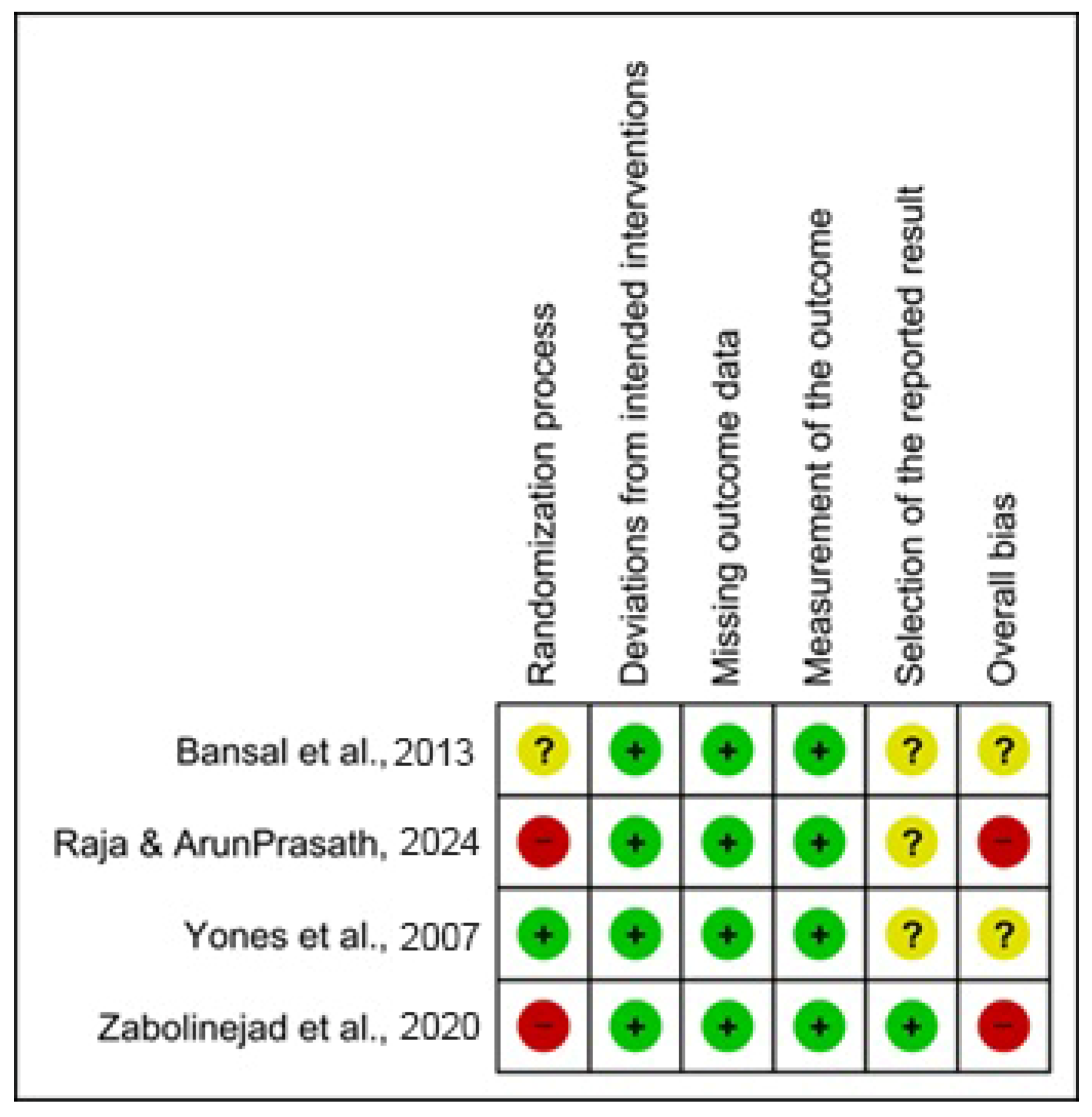
The overall risk of bias across the four included studies ranged from moderate to high. A high risk of bias was identified in the trials by Raja and Prasath [8] and Zabolinejad et al. [11], primarily due to issues in the randomization process. The study by Yones et al. [10] raised some concerns, mainly regarding selective reporting, despite low risk in all other domains. Bansal et al. [9] were also judged to have some concerns, stemming from uncertainties in randomization and outcome selection, although they demonstrated low risk in the domains of deviations, missing data, and measurement (Figure 2).
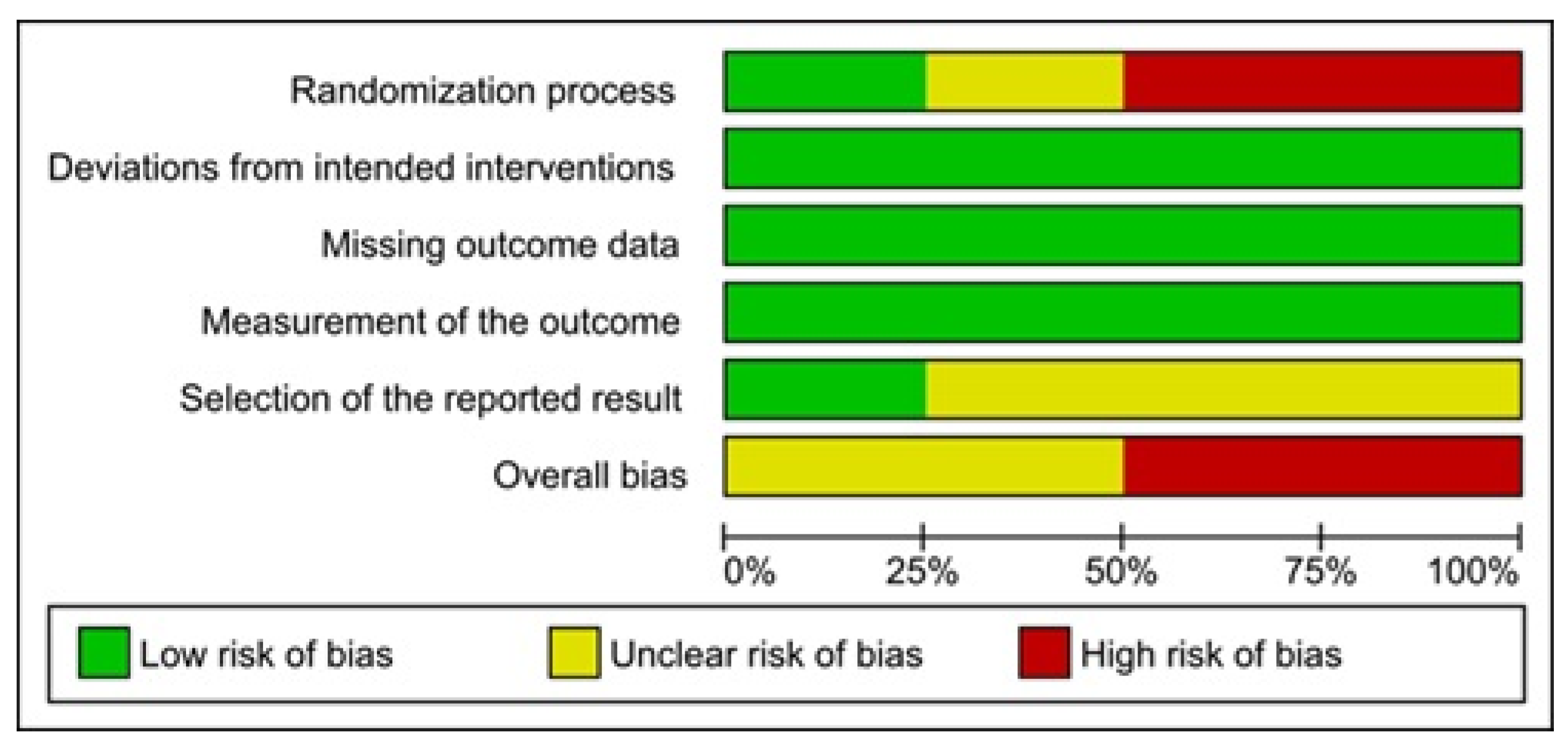
Figure 3 summarizes the risk of bias assessments. A low risk of bias was consistently found across all studies for three domains: deviations from intended interventions, missing outcome data, and outcome measurement. However, concerns were identified elsewhere. The randomization process exhibited variable risk levels. For the selection of reported results, 75% of studies raised some concerns, while 25% were low risk. Consequently, the overall judgment was split: 50% of studies were rated as having some concerns, and 50% were deemed high risk.

4. Discussion

This systematic review sought to assess the therapeutic efficacy of narrowband ultraviolet B (nb-UVB) phototherapy for vitiligo by evaluating randomized experimental protocols that compared it against psoralen-based photochemotherapy (PUVA or PUVB).
Marked by clearly defined areas of skin depigmentation, vitiligo is a chronic condition with consequences beyond the physical. It often induces significant psychosocial distress, negatively affecting self-esteem and overall quality of life. Epidemiological data indicate a prevalence of 0.46–0.68% in the Brazilian population, with no difference between sexes. Since most patients develop the disease in early adulthood, vitiligo can influence their personal, psychological, and professional development. Many patients experience symptoms of depression and anxiety, which can negatively affect their social life, leading to isolation. Therefore, in addition to providing psychological support for affected patients, treatment of the disease is another crucial aspect to improve patients’ quality of life [12,13].
The pathogenesis of vitiligo involves multiple cytotoxic pathways that target melanocytes, leading to a significant decline in their population and, ultimately, to their total loss. Both UVA and narrowband UVB (nb-UVB) serve as strong stimulators of melanocyte repigmentation [14]. The cornerstone treatment for generalized vitiligo is phototherapy, primarily psoralen plus UVA (PUVA) and narrowband UVB (nb-UVB). For localized disease, management typically involves excimer laser therapy or various topical agents [2]. Narrowband UVB (nb-UVB) phototherapy is established as the first-line treatment for generalized vitiligo [15].
Narrowband UVB (nb-UVB) phototherapy is a well-established, first-line treatment for vitiligo, demonstrating superior efficacy to psoralen-based phototherapy. Its therapeutic mechanism is multifactorial, involving immunomodulation, melanocyte stimulation, and melanogenesis. During active disease, nb-UVB downregulates key inflammatory cytokines and chemokines (e.g., IFN-γ, IL-12, IL-17A, CXCL9, CXCL10), stabilizing disease activity. Concurrently, it promotes repigmentation by fostering regulatory T cell (Treg) differentiation, protecting melanocytes from destruction, and enhancing their proliferation and migration to depigmented areas. Furthermore, nb-UVB augments tyrosinase activity and melanin synthesis [3]. Clinical evidence establishes nb-UVB phototherapy as both a cornerstone treatment and a more efficacious choice for vitiligo relative to psoralen–ultraviolet therapy [9].
The acronym PUVA refers to the use of oral 8-methoxypsoralen followed by exposure to ultraviolet A (UVA) radiation, a modality known as photochemotherapy. Today, it also refers to therapy with any psoralen, either oral or topical, combined with any source of radiation, whether artificial or from the sun. While psoralen plus UVA (PUVA) has been a mainstay therapy for extensive and treatment-resistant vitiligo in adults, narrowband UVB (nb-UVB) phototherapy is increasingly supplanting its role [16], which is considered a safe therapy, even when performed at home [17].
Vitiligo poses significant therapeutic challenges, motivating researchers to explore how psoralen combined with UVA or UVB compares in effectiveness to narrowband UVB phototherapy, aiming for better results in repigmentation and overall efficacy. When comparing different phototherapy techniques, the studies by Yones et al. [10] and Raja & Prasath [8] indicate that nb-UVB alone produced more effective results. Conversely, Zabolinejad et al. [11] and Bansal et al. [9] showed more favorable outcomes with the use of psoralen combined with narrowband UVB. Evidence from a 2015 Cochrane systematic review indicates that narrowband UVB (nb-UVB) holds a slight superiority over PUVA in achieving repigmentation and is associated with an enhanced tolerability profile [18].
Evidence suggests that combining nb-UVB with other modalities may enhance therapeutic outcomes, though the magnitude of benefit is inconsistent. For instance, Zhang et al. [19] achieved over 90% repigmentation in 81.3% of patients using nb-UVB with autologous melanocyte transplantation. In contrast, augmenting nb-UVB with topical tacrolimus yielded only a modest, non-significant increase in repigmentation. This variability indicates that the added value of combination strategies is highly dependent on the specific adjunctive treatment [20].
A multimodal approach integrating topical/systemic agents, phototherapy (including optimized PUVA, P-nb-UVB, and nb-UVB protocols), and surgical interventions holds promise for enhancing repigmentation and patient satisfaction. However, variable therapeutic responses and potential adverse effects necessitate personalized management and further high-quality trials. It is important to note that this review specifically evaluated P-nb-UVB versus nb-UVB monotherapy, even though these phototherapy modalities may be utilized within broader combination strategies.
It should be noted that half of the studies presented a high risk of bias, which weakens confidence in the findings. Although the four studies compared Psoralen + UVA or Psoralen + UVB with nb-UVB alone, their protocols and evaluation methods differed substantially, particularly in the criteria used to measure repigmentation and to assess quality-of-life outcomes. Such methodological variability may introduce bias and hinder direct comparison across studies, showing high heterogeneity. Consequently, standardizing assessment methodologies is crucial to enhance comparability across studies and treatment protocols, thereby facilitating more robust meta-analytical syntheses in the future. In this way, one of the limitations of this study, which was the inability to perform a meta-analysis, can be addressed in future reviews. Another important limitation was not including outcomes such as quality of life, cost-effectiveness, or the long-term maintenance of repigmentation.

5. Conclusions

This review indicates that narrowband UVB (nb-UVB) phototherapy, both as monotherapy and especially when combined with psoralen (P-nbUVB), offers superior efficacy and a more favorable safety profile than PUVA for vitiligo. Key advantages include better color matching, faster repigmentation, and greater improvement in VASI scores, particularly in sun-protected areas with P-nbUVB. These conclusions, however, are tempered by considerable heterogeneity in treatment protocols, outcome assessments, and a moderate to high risk of bias across the included studies, underscoring the need for cautious interpretation and more standardized future research.

Supplementary Materials

The following supporting information can be downloaded at: https://www.mdpi.com/article/10.3390/dermato6010005/s1, Table S1: Database Search Strategy.

Author Contributions

Conceptualization, G.d.L.Q., N.B.T., C.B.D., G.R.F.B. and M.R.B.; methodology, G.d.L.Q., N.B.T., C.B.D., G.R.F.B. and M.R.B.; software, M.R.B.; formal analysis, G.d.L.Q., N.B.T., C.B.D., G.R.F.B. and M.R.B.; investigation, G.d.L.Q. and N.B.T.; resources, M.R.B.; data curation, G.d.L.Q., N.B.T., C.B.D., G.R.F.B. and M.R.B.; writing—original draft preparation, G.d.L.Q.; writing—review and editing, N.B.T., C.B.D., G.R.F.B. and M.R.B.; visualization, C.B.D.; supervision, G.R.F.B.; project administration, M.R.B.; funding acquisition, M.R.B. All authors have read and agreed to the published version of the manuscript.

Funding

This research received no external funding.

Data Availability Statement

The raw data supporting the conclusions of this article will be made available by the authors on request.

Conflicts of Interest

The authors declare no conflicts of interest.

Abbreviations

The following abbreviations are used in this manuscript:
nb-UVBnarrowband ultraviolet B
OSFOpen Science Framework
PRISMAPreferred Reporting Items for Systematic Reviews and Meta-Analyses
PUVApsoralen combined with ultraviolet A

References

  1. Kądziela, M.; Kutwin, M.; Karp, P.; Woźniacka, A. Role of cytokines and chemokines in vitiligo and their therapeutic implications. J. Clin. Med. 2024, 13, 4919. [Google Scholar] [CrossRef] [PubMed]
  2. Bae, J.M.; Jung, H.M.; Hong, B.Y.; Lee, J.H.; Choi, W.J.; Lee, J.H.; Kim, G.M. Phototherapy for vitiligo. JAMA Dermatol. 2017, 153, 666. [Google Scholar] [CrossRef] [PubMed]
  3. Zhu, B.; Liu, C.; Zhang, L.; Wang, J.; Chen, M.; Wei, Y. Comparison of NB-UVB combination therapy regimens for vitiligo: A systematic review and network meta-analysis. J. Cosmet. Dermatol. 2023, 22, 1083–1098. [Google Scholar] [CrossRef] [PubMed]
  4. Wang, Y.; Li, S.; Li, C. Clinical features, immunopathogenesis, and therapeutic strategies in vitiligo. Clin. Rev. Allergy Immunol. 2021, 61, 299–323. [Google Scholar] [CrossRef] [PubMed]
  5. Ezzedine, K.; Eleftheriadou, V.; Jones, H.; Bibeau, K.; Kuo, F.I.; Sturm, D.; Pandya, A.G. Psychosocial effects of vitiligo: A systematic literature review. Am. J. Clin. Dermatol. 2021, 22, 757–774. [Google Scholar] [CrossRef] [PubMed]
  6. Frisoli, M.L.; Essien, K.; Harris, J.E. Vitiligo: Mechanisms of pathogenesis and treatment. Annu. Rev. Immunol. 2020, 38, 621–648. [Google Scholar] [CrossRef] [PubMed]
  7. Nahhas, A.F.; Braunberger, T.L.; Hamzavi, I.H. Update on the management of vitiligo. Skin Therapy Lett. 2019, 24, 1–6. [Google Scholar] [PubMed]
  8. Raja, S.; Prasath, P.A. Comparative study of puva therapy vs narrow band therapy in the treatment of vitiligo. Res. J. Pharm. Biol. Chem. Sci. 2024, 15, 333–339. [Google Scholar]
  9. Bansal, S.; Sahoo, B.; Garg, V. Psoralen-narrowband UVB phototherapy for the treatment of vitiligo in comparison to narrowband UVB alone. Photodermatol. Photoimmunol. Photomed. 2013, 29, 311–317. [Google Scholar] [CrossRef] [PubMed]
  10. Yones, S.S.; Palmer, R.A.; Garibaldinos, T.M.; Hawk, J.L. Randomized double-blind trial of treatment of vitiligo efficacy of psoralen-UV-A therapy vs narrowband-UV-B therapy. Arch. Dermatol. 2007, 143, 578–584. [Google Scholar] [CrossRef] [PubMed]
  11. Zabolinejad, N.; Maleki, M.; Salehi, M.; Ashrafi, Z.; Molkara, S.; Layegh, P. Psoralen and narrowband UVB combination provides higher efficacy in treating vitiligo compared with narrowband UVB alone: A randomised clinical trial. Australas. J. Dermatol. 2020, 61, e65–e69. [Google Scholar] [CrossRef] [PubMed]
  12. Carneiro, A.H.R.; Sampaio, C.N.; Filho, E.F.L.; Lopes, G.S.; Duarte, H.B.; Avena, K.d.M. Avaliação da qualidade de vida de pessoas com vitiligo: Estudo transversal. Rev. Enferm. Contemp. 2024, 13, e5829. [Google Scholar] [CrossRef]
  13. de Paula Faria, C.S.; de Paula Faria, L.S.; Tavares, L.B.S.; Melo, L.F.; Nobre, C.L.; Thiesen, J.L. Estratégias terapêuticas e atualizações no tratamento de vitiligo. Rev. Soc. Bras. Clin. Med. 2021, 19, 128–166. [Google Scholar]
  14. Falabella, R. Vitiligo and the melanocyte reservoir. Indian J. Dermatol. 2009, 54, 313. [Google Scholar] [CrossRef] [PubMed]
  15. Seneschal, J.; Speeckaert, R.; Taïeb, A.; Wolkerstorfer, A.; Passeron, T.; Pandya, A.G.; Lim, H.W.; Ezzedine, K.; Zhou, Y.; Xiang, F.; et al. Worldwide expert recommendations for the diagnosis and management of vitiligo: Position statement from the international Vitiligo Task Force—Part 2: Specific treatment recommendations. J. Eur. Acad. Dermatol. Venereol. 2023, 37, 2185–2195. [Google Scholar] [CrossRef] [PubMed]
  16. Shenoi, S.; Prabhu, S. Photochemotherapy (PUVA) in psoriasis and vitiligo. Indian J. Dermatol. Venereol. Leprol. 2014, 80, 497. [Google Scholar] [CrossRef]
  17. Koek, M.B.G.; Buskens, E.; van Weelden, H.A.; Steegmans, P.H.; Bruijnzeel-Koomen, C.A.F.M.; Sigurdsson, V. Home versus outpatient ultraviolet B phototherapy for mild to severe psoriasis: Pragmatic multicentre randomised controlled non-inferiority trial (PLUTO study). BMJ 2009, 338, b1542. [Google Scholar] [CrossRef]
  18. Zubair, R.; Hamzavi, I.H. Phototherapy for vitiligo. Dermatol. Clin. 2020, 38, 55–62. [Google Scholar] [CrossRef]
  19. Zhang, D.-M.; Hong, W.-S.; Fu, L.-F.; Wei, X.-D.; Xu, A.-E. A randomized controlled study of the effects of different modalities of narrow-band ultraviolet B therapy on the outcome of cultured autologous melanocytes transplantation in treating vitiligo. Dermatol. Surg. 2014, 40, 420–426. [Google Scholar] [CrossRef]
  20. Kanwar, A.J.; Parsad, D.; Vinay, K.; Satyanarayan, H.S. Efficacy and tolerability of combined treatment with NB-UVB and topical tacrolimus versus NB-UVB alone in patients with vitiligo vulgaris: A randomized intra-individual open comparative trial. Indian J. Dermatol. Venereol. Leprol. 2013, 79, 525–527. [Google Scholar] [CrossRef] [PubMed]
Figure 1. Flow diagram from the PRISMA 2020 statement, applicable to new systematic reviews whose search strategy encompassed electronic databases, trial registers, and other sources.
Dermato 06 00005 g001
Figure 2. Summary of methodological quality: Author assessments for each bias domain across the included trials [8,9,10,11].
Dermato 06 00005 g002
Figure 3. Graphical representation of bias assessments, showing the proportion of studies rated at each risk level per domain.
Dermato 06 00005 g003
Table 1. Synthesis of the principal outcomes reported in the randomized controlled trials (n = 04).
Eligible Studies/
Country
Sample DescriptionIntervention ProtocolBody RegionTime PointsOutcomes/
Measuring Instruments
Conclusion
Raja et al. [8]
India
N = 30
EG (n =15)
CG: (n =15)
Sex:
EG: (01) 6.7% (M)
(14) 93.3% (F)
CG: (02) 13.3% (M)
(13) 86.7% (F)
Age:
EG: 16.2 ± 11.02
CG: 29.8 ± 12.09
EG: nb-UVB
CG: PUVA
EG: Whole body
CG: Whole body
T0: Baseline
T1: 2 months
T1: 4 months
Percentage of repigmentation on depigmented areas:
-(<40% mild);
-(40–70% good);
-(70–100% excellent).
nb-UVB treatment can provide statistically significantly better results than PUVA.
Bansal et al. [9]
India
N = 40
EG: (n = 20)
CG: (n = 20)
Sex:
EG: 11 (M)
09 (F)
CG: 08 (M)
12 (F)
Age:
EG: 21.9 (median)
GC: 23.4 (median)
EG: nb-UVB
CG: P-nbUVB
EG: Whole body
CG: Whole body
T0: Baseline
T1: After 20 sessions
T1: After 40 sessions
T1: After 60 sessions
- Affected area and degree of depigmentation:
(VASI) and modified VASI scoring
Both narrowband ultraviolet B (nb-UVB) and psoralen-narrowband ultraviolet B (P-nbUVB) phototherapy demonstrate safety and efficacy in vitiligo treatment. The available evidence, however, indicates superior efficacy for the P-nbUVB regimen compared to standard nb-UVB
Yones et al. [10]
Inglaterra
N = 50
EG: (n = 25)
CG: (n = 25)
Sex:
EG: (17) 68% (M)
(08) 32% (F)
CG: (12) 48% (M)
(13) 52% (F)
Age:
EG: 38 (18–64 medium)
CG: 36 (18–70 medium)
EG: nb-UVB + Oral placebo psoralen
CG: PUVA
EG: Whole body
CG: Whole body
T0: Baseline
T1: After 16 sessions
T2: After 32 sessions
- Proportion of total body surface area:
Body surface area with vitiligo
(BSA-V) (%)
For the treatment of vitiligo, narrowband ultraviolet B (nb-UVB) phototherapy demonstrates superior efficacy and a more favorable safety profile compared to psoralen plus UVA (PUVA)
Zabolinejad et al. [11]
Iran
N: 40
EG: (n = 20)
CG: (n = 20)
Sex:
EG: (10) 50% (M)
(10) 50% (F)
CG: (10) 50% (M)
(10) 50% (F)
Age:
EG: 36 ± 11.7
CG: 31.8 ± 10.8
EG: nb-UVB
CG: P + nbUVB
EG: Whole body
CG: Whole body
T0: Baseline
T1: After 20 sessions
T2: After 40 sessions
T3: After 60 sessions
- Affected area and degree of depigmentation:
(VASI)
Combining psoralen with nb-UVB (P-nbUVB) yields better clinical outcomes for vitiligo than nb-UVB alone, while remaining well-tolerated
Legend: nb—narrowband; M: Male; F: Female; P: Psoralen; UVA: Ultraviolet A; UVB: Ultraviolet B; PUVA: Psoralen + UVA; VASI: Vitiligo Area Severity Index; EG: Experimental group; CG: Control group.
Disclaimer/Publisher’s Note: The statements, opinions and data contained in all publications are solely those of the individual author(s) and contributor(s) and not of MDPI and/or the editor(s). MDPI and/or the editor(s) disclaim responsibility for any injury to people or property resulting from any ideas, methods, instructions or products referred to in the content.