1. Introduction
In 1758, Linnaeus [
1] erected the order Anseres for waterbirds whose digits are united, entirely or in part, by interdigital webs. Among these, he diagnosed the genus
Pelecanus as having linear, obliterated nares and all four toes connected by webs, and described five species under it:
P. onocrotalus (Great White Pelican),
P. aquilus (now Ascension Frigatebird,
Fregata aquila),
P. carbo (now Great Cormorant,
Phalacrocorax carbo),
P. bassanus (now Northern Gannet,
Morus bassanus), and
P. piscator (now Red-footed Booby,
Sula sula). In a separate genus,
Phaethon, he placed
P. aethereus (Red-billed Tropicbird), noting that its hallux, though much reduced, was connected to the second digit by an interdigital web.
The possession of four webbed toes (
pes totipalmatus) became not merely a diagnostic feature but the founding principle of what would be formalised as the order Pelecaniformes Sharpe, 1891. Beddard [
2] (p. 402, footnote 1) considered this single feature sufficient to define the group, a conviction that persisted well into the twentieth century. Sibley and Ahlquist [
3] (p. 65) treated the totipalmate foot as the only obvious anatomical character shared by all members of Pelecaniformes and absent from other avian groups. By the 1970s, this position was no longer descriptively correct but remained taxonomically operative.
The reliance on a single locomotor character carried a particular hazard in this group. Birds adapted to a common aquatic mode of life are subject to repeated morphological convergence [
4], because swimming, diving, and the capture of aquatic prey impose similar demands on distantly related lineages. The external features that answer those demands, among them interdigital webbing and modifications of the bill and feeding apparatus, recur across unrelated aquatic birds and are therefore weak evidence of common ancestry. Sclater [
5] judged the totipalmate condition itself to be a superficial character on these grounds. A group founded on a single such character is at risk of uniting forms that share a way of life rather than a recent common ancestor.
Doubts were never entirely absent. Mivart [
6], working from the postcranial axial skeleton, found no characters sufficient to unite
Fregata and
Phaethon with the remaining genera. Brandt [
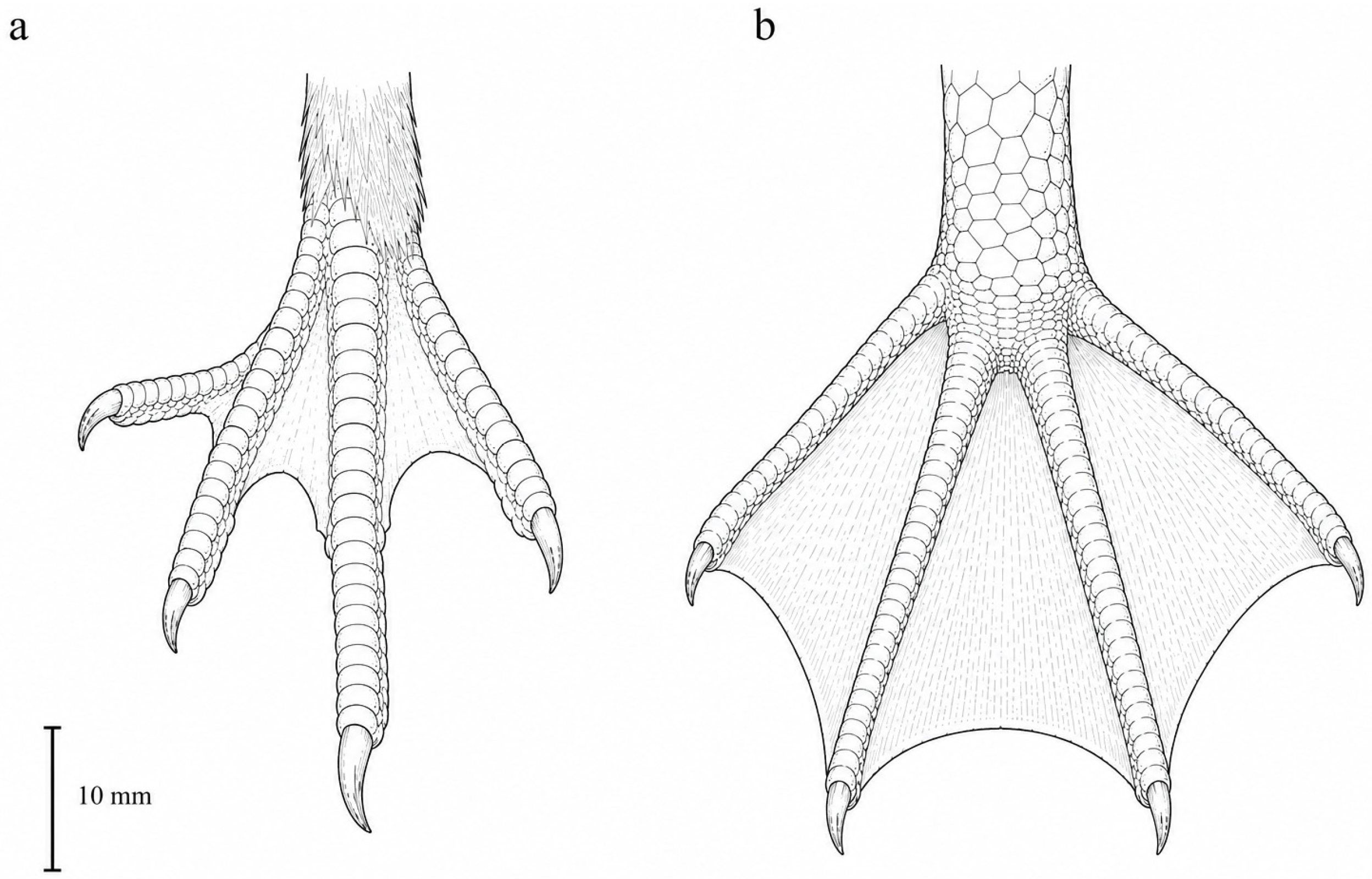
7] had already noted that the interdigital webs of frigatebirds were markedly reduced relative to those of cormorants, gannets, anhingas, and pelicans (
Figure 1), a variation whose taxonomic significance went largely unappreciated. Shufeldt [
8] identified cranial similarities between
Fregata and albatrosses, and between
Phaethon and petrels, that would have warranted exclusion of both genera from Steganopodes had the totipalmate foot not retained the authority of an ordinal criterion.
Three decades after Hennig [
11] had formalised cladistic methodology, Cracraft [
12] conducted the first explicit phylogenetic test of the assemblage and recovered a monophyletic Pelecaniformes inclusive of
Phaethon. The cladistic analyses that followed, those of Mayr [
13], Bourdon et al. [
14], Livezey and Zusi [
15], Smith [
16], and Carlos [
17], produced results that diverged from Cracraft’s at one or more nodes, but none reproduced the molecular hypothesis in full. The latest, Carlos [
17], recovered Phaethontidae outside the totipalmate clade and Fregatidae as sister to Suloidea (Sulidae + Phalacrocoracidae + Anhingidae), but retained Pelecanidae within Steganopodes, contrary to the molecular arrangement.
Molecular analyses spanning three decades, from the DNA–DNA hybridisation results of Sibley and Ahlquist [
18], through the multilocus studies of Cracraft et al. [
19], Fain and Houde [
20], Ericson et al. [
21], and Hackett et al. [
22], to the phylogenomic analyses of Prum et al. [
23], Kuhl et al. [
24], and Stiller et al. [
25], congruently recovered the non-monophyly of traditional Pelecaniformes. Phaethontidae was excluded from the totipalmate clade and placed with Eurypygiformes as sister to the core waterbird assemblage. Pelecanidae was placed with Scopidae, Balaenicipitidae, Ardeidae, and Threskiornithidae in a redefined Pelecaniformes that excludes the families traditionally central to the order. The remaining four families were formalised as Suliformes Sharpe, 1891 by Chesser et al. [
26], with Fregatidae as sister to Suloidea.
The current classification rests almost entirely on molecular evidence. Its morphological basis has not been established by any comprehensive cladistic analysis meeting current standards of character construction and taxon sampling, and the formally named groupings within it; the redefined Pelecaniformes, Suliformes, and Phaethontimorphae, lack formally demonstrated morphological synapomorphies. A classification in this condition is incomplete in a technical sense rather than provisional. The distinction, developed in
Section 6.5, is epistemic rather than ontological. A provisional classification has a defined evidentiary path to closure, in that the evidence that would confirm or refute it is, in principle, identifiable. A classification is incomplete when its evidential base cannot, by its own structure, supply the confirmation it requires. The molecular evidence for the redefined Pelecaniformes, Suliformes, and Phaethontimorphae is robust and well replicated. The classification is incomplete in this sense not because it is certainly wrong, but because it has not yet been integrated with the fossil evidence that its own terminal units require.
Three questions follow from that condition. What was the actual evidential basis for the cohesion of the traditional order, and how was that basis evaluated, or not, by successive generations of ornithologists? To what extent do the phenotypic and molecular hypotheses converge, and where do the genuine conflicts lie? Given that the current classification rests almost entirely on molecular evidence, what would a rigorously constructed, comprehensive morphological hypothesis contribute and why has none yet been produced? The aim of this essay is to address these three questions by tracing the history of the group’s classification and assessing the evidential condition of the arrangement that history produced. Its contribution is the distinction between a provisional and an incomplete classification, defined above, and the specification—for each of the three contested groupings—of the morphological analysis that its resolution requires.
The monophyly of Suloidea has been consistently recovered by both phenotypic and molecular analyses and is not in dispute here. The contentious issues concern the position of Phaethontidae, the relationships of Pelecanidae, and the sister group of Suloidea. On all three points, phenotypic and molecular evidence remain in conflict, and on all three, the resolution of that conflict depends on the availability of a morphological dataset that is both comprehensive and methodologically rigorous. That dataset does not yet exist.
2. From Linnaeus to the Late Nineteenth Century: The Totipalmate Foot as Taxonomic Criterion
The classification of birds in Linnaeus’s
Systema Naturae [
1] was organised, at the ordinal level, around two principal criteria, the configuration of the beak and the structure of the feet. For waterbirds, the relevant criterion was the degree to which the digits were united by interdigital webs. Linnaeus placed birds with fully webbed feet (
pedes palmati) in the order Anseres, alongside ducks, geese, and allies. Within this arrangement, the genus
Pelecanus was distinguished by the extension of the web to all four digits, including the hallux, a condition he termed ‘
pedes digitis omnibus quatuor simul palmatis.’
Linnaeus [
1] did not unite all totipalmate birds under a single genus.
Phaethon was described separately, with no explicit reference to fully webbed feet in the generic diagnosis, though the description of
P. aethereus (p. 134) does mention the hallux as reduced and connected to the second digit by a web (‘
digito postico adnato… digito quarto etiam membrane afixo’). Illiger [
27] formalised the totipalmate birds as a discrete taxonomic unit, order Steganopodes, defined exclusively by the possession of four webbed toes, collapsing the distinction Linnaeus had implicitly drawn between
Pelecanus and
Phaethon. From that point on, the totipalmate foot functioned as the primary, and often sole, criterion for ordinal membership.
The circularity latent in this arrangement, a group defined by a single external character whose membership was then used to validate the character as taxonomically significant, went largely unexamined through the first half of the nineteenth century. The prevailing approach to avian classification in this period, which Sibley and Ahlquist [
18] (p. 185) later dismissed as the ‘beak–foot–feather method,’ was a convention rather than a method. Taxa were grouped based on overall resemblance in the most visible features, with little attention to the distinction between shared derived characters and shared primitive ones.
Fürbringer’s [
28] two-volume
Untersuchungen zur Morphologie und Systematik der Vögel devoted considerable attention to the totipalmate assemblage within a comprehensive framework that drew on myology, osteology, and external morphology simultaneously. Fürbringer [
28] retained the totipalmate birds as a coherent unit but acknowledged the divergence of
Fregata and
Phaethon from the remaining genera, grouping them in a separate subdivision whose precise status he left deliberately ambiguous. Gadow [
29,
30], in his contribution to
Bronn’s Klassen und Ordnungen des Thier-
Reichs, adopted a broadly similar arrangement, retaining the order Steganopodes of Illiger. Seebohm [
31] independently attempted to classify the suborders of waterbirds using osteological characters alone, and in his broader classification [
32] treated the totipalmate assemblage in terms that differed little from those of his contemporaries. None of these authors possessed conceptual tools to distinguish synapomorphies from symplesiomorphies. All treated the internal divergences of the totipalmate assemblage as evidence of variation within a natural group, not against its naturalness.
Darwin’s and Wallace’s concurrent works introduced a new organising principle into taxonomy: common ancestry. Morphological similarity was no longer self-evidently indicative of relationship; it could equally reflect convergent adaptation to similar environments or ways of life. Sclater [
5] (p. 404) made the point with respect to webbed feet, judging the totipalmate condition a ‘very slight and superficial character’ and pointing to the close affinity of gulls to waders, despite the difference in foot structure, as evidence that the Natatores grouping was unnatural.
Yet this conclusion was not drawn, or not drawn decisively, with respect to Pelecaniformes for several more decades. The totipalmate condition did appear to co-occur with a set of other shared features (e.g., desmognathous palate, reduced or absent nasal openings, a gular pouch), lending the group an apparent coherence beyond the feet alone. Brandt’s [
7] osteological monograph, which concluded that the totipalmate birds formed ‘a natural group… although its constituent genera diverged in different directions, and so should be sorted into subgroups,’ provided anatomical endorsement for a grouping that was, at its foundation, defined by a single external character.
The persistence of this arrangement into the late nineteenth and early twentieth centuries was thus not simply inertia. It reflected a genuine, if unresolved, tension between two kinds of evidence. The external morphological criterion had originally defined the group. The internal anatomical evidence both supported and complicated it.
6. Current Classification and Remaining Controversies
6.1. The Two-Order Arrangement and the Questions It Leaves Open
The classification formalised by Chesser et al. [
26] and subsequently adopted by the IOC World Bird List and other classification authorities divides the traditional Pelecaniformes into two orders: a redefined Pelecaniformes comprising Pelecanidae, Scopidae, Balaenicipitidae, Ardeidae, and Threskiornithidae; and Suliformes comprising Fregatidae, Sulidae, Phalacrocoracidae, and Anhingidae. Phaethontidae, excluded from both orders, is placed in Phaethontiformes, recovered in molecular analyses as sister to Eurypygiformes within a clade sister to the core waterbird assemblage (
Table 1).
The molecular evidence reviewed in 5 establishes that the traditional Pelecaniformes, as defined by the possession of totipalmate feet, is not a natural group, a conclusion anticipated by anatomical evidence as early as Beddard [
40] and argued on cladistic grounds by Mayr [
13] and Bourdon et al. [
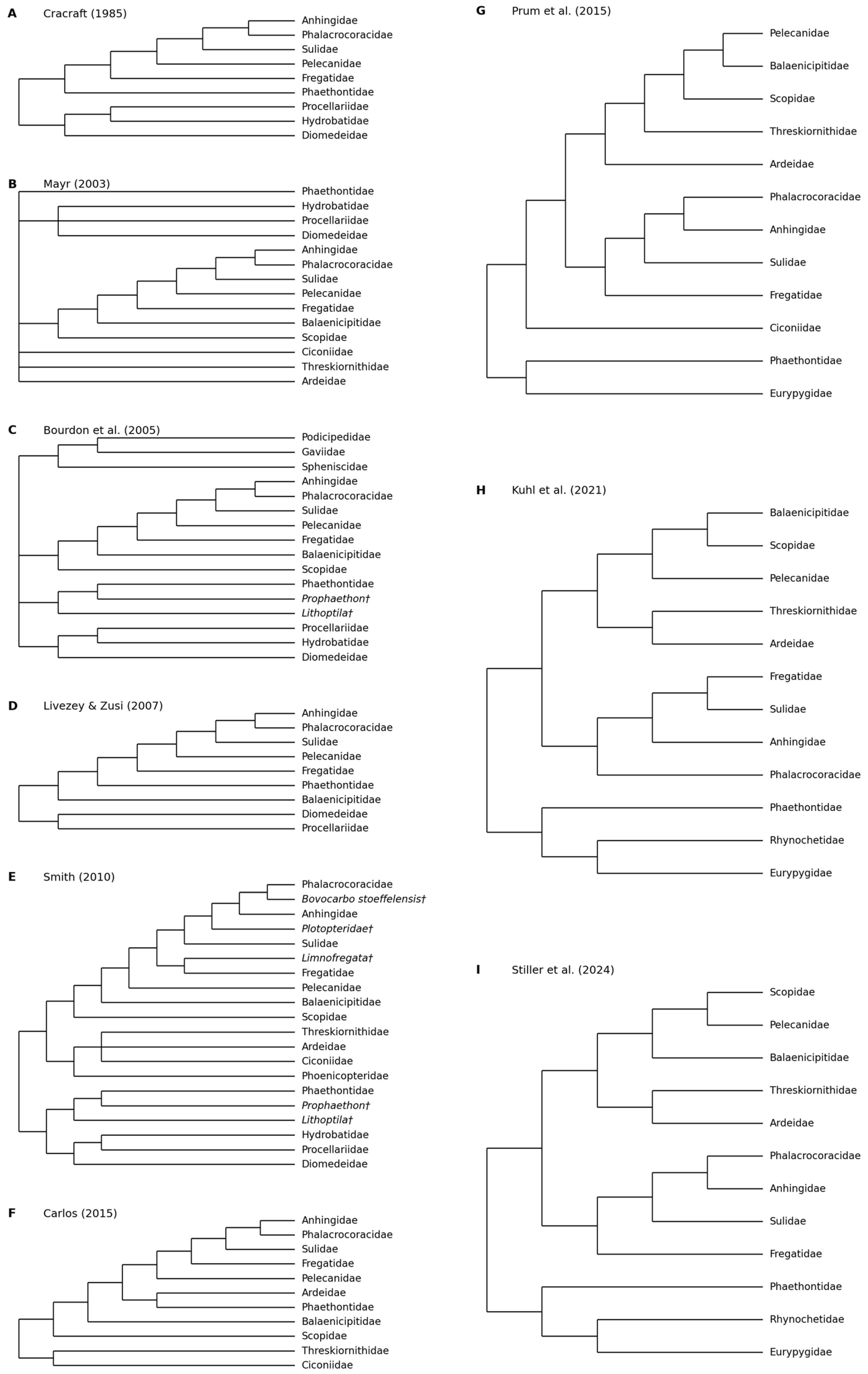
14]. That evidence does not by itself establish the morphological basis for the groupings it recovers in place of the traditional order. The position of Phaethontidae within or near Aequornithes, the relationships of Pelecanidae to its proposed allies in the redefined Pelecaniformes, and the sister group of Suloidea each remain at different stages of evidential support, treated in turn in
Section 6.2,
Section 6.3 and
Section 6.4 (
Figure 2).
6.2. The Position of Phaethontidae: Between Waterbirds and Eurypygiformes
The first of these three questions, the placement of Phaethontidae, is the subject of the longest-running disagreement between molecular and phenotypic approaches to waterbird systematics. Molecular analyses agree on the exclusion of Phaethontidae from the totipalmate clade but disagree on where tropicbirds belong. Fain and Houde [
20] and Ericson et al. [
21] placed Phaethontidae in Metaves, a grouping of otherwise disparate orders whose coherence has since been called into question. Jarvis et al. [
58], in the first whole-genome analysis of avian orders, recovered (Eurypygiformes + Phaethontidae) as sister to the core waterbird assemblage with moderate bootstrap support. Prum et al. [
23], Kuhl et al. [
24], and Stiller et al. [
25] subsequently confirmed this result with higher support (
Figure 2G–I), consistently recovering the clade Phaethontimorphae
sensu Sangster et al. [
59], uniting Phaethontiformes with Eurypygiformes, as sister to Aequornithes. Metaves has been abandoned in post-2015 molecular classifications. The position of Phaethontiformes as sister to Eurypygiformes, within a clade sister to the core waterbirds, now represents the molecular consensus, supported across independent phylogenomic datasets with concordant high support values. The contrast with Metaves bears on the confidence the current arrangement warrants. Metaves was supported by a single nuclear intron and did not survive the addition of further loci, whereas the placement of Phaethontiformes within Aequornithes rests on the replicated phylogenomic signal just described. The earlier collapse therefore shows the fragility of a grouping resting on one marker rather than casting doubt on a result recovered across independent datasets.
Phenotype-based analyses produced no equivalent agreement. Mayr [
13] and Bourdon et al. [
14] excluded Phaethontidae from the totipalmate clade, placing it closer to Procellariiformes based on shared cranial features (
Figure 2B,C). Livezey and Zusi [
15] retained Phaethontidae in Pelecaniformes as sister to the remaining families (
Figure 2D). Smith [
16] also recovered a non-monophyletic Pelecaniformes, with Phaethontidae and the fossil Prophaethontidae forming the sister taxon to Procellariiformes (
Figure 2E). Carlos [
17] recovered a position without precedent in either approach, placing Phaethontidae as sister to Ardeidae (
Figure 2F).
Across both approaches, the exclusion of Phaethontidae from the traditional totipalmate assemblage (Steganopodes, comprising Fregatidae, Sulidae, Phalacrocoracidae, Anhingidae, and Pelecanidae) is the one result that holds. Its precise phylogenetic position does not. The morphological features that link Phaethon to Procellariiformes, or distinguish it from Steganopodes, have not been incorporated into a comprehensive cladistic analysis meeting current standards of character construction. The position of Phaethontidae thus remains undetermined beyond that exclusion.
The molecular consensus has not gone unchallenged from the morphological side. The recovery of Phaethontimorphae implies that the sister group of Phaethontiformes is a clade of terrestrial birds, since Eurypygiformes comprises the Sunbittern (Eurypyga helias) and the Kagu (Rhynochetos jubatus), neither of which is aquatic. If this relationship is correct, a substantial ecological and morphological transition must have occurred on at least one of the two stem lineages descending from the most recent common ancestor of Phaethontimorphae: either the stem phaethontiform lineage transitioned from a terrestrial or generalised ancestor to a fully aquatic condition, or the stem eurypygiform lineage transitioned in the opposite direction from an aquatic ancestor to the terrestrial habit of extant taxa. Intermediate ancestral conditions, semi-aquatic or ecologically generalised, do not eliminate the requirement for directional transformation, they only redistribute it between the two stem lineages. The morphological evidence reviewed below does not logically refute the molecular placement, but it does substantially constrain the evolutionary transitions it implies.
The available evidence supports a morphological case against a terrestrial or generalised ancestor for Phaethontiformes, drawn from the fossil record of the order itself. The skeletal morphology of extant tropicbirds is aquatic in all features scored by comparative anatomists, and the case from extant morphology alone neither establishes nor refutes the molecular hypothesis. A now aquatic clade could in principle have descended from a terrestrial ancestor. The case requires evidence about the morphology of the lineage at the points where the transition implied by the molecular hypothesis would have to be visible, and that evidence comes from fossils. The current understanding of prophaethontid morphology derives largely from a body of work by G. Mayr and collaborators on the early Palaeogene avifaunas of the London Clay, the Waipara Greensand of New Zealand, and analogous deposits [
67,
68,
69,
70]. No independent re-examination of this material under a different analytical framework has yet been published. The morphological signal that conflicts with the molecular placement therefore rests, at present, on the interpretations of a single research group—a concentration that qualifies the independence of the fossil evidence as a test of the molecular hypothesis without diminishing the descriptive record on which it draws.
Mayr [
67] and Mayr [
68] documented in detail the skeletal morphology of †
Prophaethon shrubsolei, the best-known early Palaeogene stem phaethontiform, recovered from the early Eocene London Clay. The pelvis and leg bones, the latter including the previously unknown tarsometatarsus, are very different from those of extant tropicbirds and more closely resemble those of Procellariiformes, particularly albatrosses (Diomedeidae). On this basis, Mayr [
67] inferred that
Prophaethon foraged at or below the sea surface, its skeletal proportions suggesting a greater contribution of hindlimb propulsion than in the highly aerial, plunge-diving extant Phaethontidae, and a correspondingly more aquatic mode of life. Mayr and Kitchener [
70], describing additional specimens of †
Prophaethon from the same deposit and erecting a new species (†
Prophaethon waltonensis), reported a distal humerus bearing a small but well-defined processus supracondylaris dorsalis, a feature shared with Palaeogene stem-group Procellariiformes (Diomedeoididae) and interpreted by the authors as associated with the elevated aerodynamic loading characteristic of pelagic flight. †
Clymenoptilon novaezealandicum [
69], a partial skeleton from the mid-Paleocene Waipara Greensand of New Zealand (approximately 61–63 Ma) and the first unambiguous record of the order from the Southern Hemisphere, extends the temporal range of the phaethontiform fossil record by some seven million years. †
Clymenoptilon is recovered by the authors as a basal stem-phaethontiform, likely positioned outside a clade comprising †
Lithoptila, †
Prophaethon, and crown-group Phaethontidae. Its morphology, including the narrow pelvis it shares with †
Prophaethon (and with early-diverging Aequornithes) and the long crista deltopectoralis of the humerus, is consistent with an aquatic, seabird-like ecology, although its proportionally shorter pelvis indicates that it was less specialised for sub-surface aquatic foraging than †
Prophaethon. Mayr and Kitchener [
70], in the most recent assessment of stem-phaethontiform morphology, concluded that the skeletal morphology of early Palaeogene stem-group Phaethontiformes is as different from that of eurypygiform birds as is that of extant tropicbirds, and that the new fossils strengthen the previously noted morphological resemblances between †
Prophaethon and procellariiform birds and other aquatic taxa of Aequornithes. The aquatic morphology evident in extant Phaethontidae is thus continuous, in the elements preserved in the fossil record, from the mid-Paleocene to the present, with variation in the degree of aquatic specialisation along the stem lineage but no documented departure from a fundamentally aquatic, seabird-like ecology. The fossil record currently described contains no terrestrial or generalised stem representative from which the modern aquatic morphology might have been derived.
On the Eurypygiformes side of the clade, no fossil evidence has been reported that would suggest a more aquatic ancestral mode of life from which the modern terrestrial habit was derived. The morphology of extant Sunbittern and Kagu, both ground-dwelling birds, shows no skeletal adaptation to aquatic locomotion or foraging. The case here is one of absence of contrary evidence rather than presence of confirming evidence, and the argument therefore rests primarily on the Phaethontiformes side of the question.
The conflict between the molecular placement of Phaethontiformes and the morphological evidence from its fossil record is not a residual disagreement between older phenotypic and newer molecular analyses. It is an active conflict between the most recent molecular consensus and the most recently described fossil evidence, and it cannot be resolved by additional evidence of either kind alone. The molecular hypothesis is morphologically untested at the relevant nodes, and the morphological evidence comes from fossils for which molecular data are unavailable, so that the molecular hypothesis cannot be tested at the nodes where the morphological signal conflicts with it. The resolution requires a comprehensive cladistic analysis that incorporates both extant and fossil Phaethontiformes alongside the proposed sister group, evaluated against the molecular topology with characters constructed to current methodological standards. The molecular hypothesis is not weakened as a phylogenetic inference by the morphological evidence reviewed here. The phylogenomic signal supporting Phaethontimorphae is robust, replicated across independent datasets and analytical frameworks, and there is no molecular result that places Phaethontiformes elsewhere with comparable support. The morphological evidence indicates that the ecological and skeletal implications of this clade have not been independently corroborated, and at present cannot be reconciled with the fossil record of either constituent order. The minimum-crown-clade PhyloCode definition of Phaethontimorphae adopted by Sangster et al. [
59] is anchored on a molecular reference phylogeny [
24]. The only morphological synapomorphy proposed for the clade, a proximodistally elongated dorsal tubercle of the humerus inferred by Sangster et al. [
59] from the matrix of Livezey and Zusi [
43], is not widely corroborated, and the difficulty of identifying robust morphological synapomorphies for Phaethontimorphae has been emphasised by Mayr and Kitchener [
70] in connection with the new prophaethontid material.
Carlos [
17] recovered Phaethontidae as sister to Ardeidae, within a clade that also includes Scopidae, Balaenicipitidae, Ardeidae, and Steganopodes. The placement is unparalleled in either the phenotypic or molecular literature, was treated in the original analysis as tentative, and is, by the criterion applied throughout this essay to the molecular consensus, an incomplete morphological hypothesis: it rests on cranial characters alone, lacks corroboration from postcranial or fossil data, and proposes a grouping for which no synapomorphies were identified beyond those achieving low support at the relevant node. The result therefore offers no positive resolution to the question of where Phaethontidae belongs. It is, however, the only phenotype-based analysis to have tested the placement of Phaethontidae alongside Ardeidae, Scopidae, and Balaenicipitidae from a cladistic matrix of cranial characters, and as such defines a hypothesis that has yet to be tested with broader character sampling. It contributes to the question that has remained constant across phenotype-based analyses with otherwise divergent topologies. In the Carlos [
17] hypothesis, as in those of Mayr [
13], Bourdon et al. [
14], and Smith [
16],
Phaethon falls outside Steganopodes. The exclusion of Phaethontidae from the totipalmate assemblage is the one result that the entire phenotype-based literature, including the analysis whose specific placement is incompatible with all others, has consistently recovered. The specific sister group of Phaethontidae remains undetermined; its exclusion from Steganopodes does not.
6.3. The Relationships of Pelecanidae: Pelicans Between Two Orders
Pelicans share with cormorants, gannets, frigatebirds, and anhingas a suite of cranial features that phenotype-based analyses have consistently recovered as synapomorphies of Steganopodes or of more inclusive clades within which Steganopodes is nested. The cladistic analysis of Carlos [
17] recovered four of these characters as synapomorphies of Steganopodes itself (the absence of the vomer, the presence of
os suprajugale, a nasal gland impression on the orbital surface of the frontal, and the near-absence of the nasal conchae) and two as synapomorphies of a more inclusive clade including pelicans, frigatebirds, sulids, anhingas, cormorants, herons, the shoebill, the hamerkop, and tropicbirds: the near-absence of bony nasal apertures and the medial fusion of the choanal portions of the palatines (see [
12,
13] for earlier reviews of the character literature). The displacement of Pelecanidae from Steganopodes to a clade with Scopidae, Balaenicipitidae, Ardeidae, and Threskiornithidae is among the molecular results that the morphological evidence does not readily accommodate.
The morphological case against that displacement is not, however, the absence of any character signal linking Pelecanidae to its molecular allies. A closer relationship of
Balaeniceps rex to Pelecanidae had been proposed on anatomical grounds since the nineteenth century and developed in the comparative study of Cottam [
38], who identified two characters of the pectoral skeleton—the presence of a foramen for the supracoracoideus nerve in the coracoid and the fusion of the furcula with the apex of the sternal carina—as shared between pelicans and the shoebill. Cracraft [
12], in the first cladistic analysis of pelecaniform relationships, scored these and additional characters and concluded that
Balaeniceps fell outside Pelecaniformes, interpreting the pectoral and cranial similarities between the shoebill and pelicans as convergent mechanical responses to similar feeding modes. Mayr [
13], in the cladistic analysis discussed in
Section 4.2, reanalysed the same characters and additional ones identified in the intervening literature, and concluded that the shared derived characters uniting Scopidae, Balaenicipitidae, and Steganopodes in a more inclusive clade were less readily explained by convergent evolution than Cracraft [
12] had assumed. The placement of Scopidae within the clade containing Pelecanidae, Scopidae, and Balaenicipitidae has been recovered in molecular analyses with full taxon sampling [
22,
71]. Stiller et al. [
25], with all three families sampled, recovered the topology (Balaenicipitidae + (Pelecanidae + Scopidae)), placing Pelecanidae and Scopidae as sister taxa with Balaenicipitidae as sister to that pair. This topology differs both from the (Scopidae + (Balaenicipitidae + Steganopodes)) arrangement reasserted on morphological grounds by Mayr [
13] and from molecular topologies that have recovered (Pelecanidae + Balaenicipitidae) as the closest internal pair. No morphological synapomorphy specifically uniting Pelecanidae with Scopidae has been proposed in the cladistic literature reviewed here.
This instability lies within the molecular evidence itself, and concerns the internal arrangement of the three families rather than their membership in the redefined Pelecaniformes. The pairing (Pelecanidae + Scopidae) recovered by Stiller et al. [
25] was not recovered by the earlier full-sampling analyses of Hackett et al. [
22] and Yuri et al. [
71], and a third pairing, (Pelecanidae + Balaenicipitidae), appears elsewhere in the molecular literature. The candidate morphological characters bear on this unresolved point rather than standing apart from it, since the pectoral characters of Cottam [
38] link Pelecanidae to Balaenicipitidae, one of the competing molecular pairings, while no character has been proposed for the pairing that Stiller et al. [
25] recover. Where the molecular signal has not converged on the internal topology, morphological evidence could discriminate among the arrangements the molecular data leave open rather than merely confirming a settled one.
The fossil record of Pelecanidae extends to the late Eocene and is morphologically informative in a specific and limited way. The oldest representative, †
Eopelecanus aegyptiacus [
72], is a nearly complete tibiotarsus from the early Priabonian of the Birket Qarun Formation, Egypt, ca. 36 Ma. The element is sufficiently distinct to warrant generic separation from extant
Pelecanus but is described by its authors as broadly similar in anatomy to its modern relatives. The next oldest record, an early Oligocene specimen from Luberon in southeastern France [
73], preserves a nearly complete beak morphologically identical to that of extant pelicans, and was assigned to
Pelecanus. Subsequent records, including †
Miopelecanus gracilis and the Miocene and Pliocene species of
Pelecanus, fall within the morphological range of the modern genus. The pattern, as Louchart et al. [
73] characterised it, is one of evolutionary stasis in the pelican feeding apparatus across approximately thirty million years. The late Eocene †
Protopelicanus, of uncertain affinities, has been interpreted variously as a pelecanid [
74], a sulid [
75], or a pelagornithid [
76], and is not informative for the present question. What this record permits, and what it does not, must be stated carefully. The available fossils document that pelican-typical morphology (at least in the elements preserved, namely the tibiotarsus of †
Eopelecanus and the beak of the Luberon specimen) was already established by the late Eocene. They do not preserve the anatomy of the lineage at any earlier point, and they have not been subjected to a cladistic analysis directed at testing the morphological coherence of the molecular grouping that places Pelecanidae with Scopidae, Balaenicipitidae, Ardeidae, and Threskiornithidae. The fossil record of Pelecanidae has not been mobilised to evaluate the molecular hypothesis.
The conflict in the case of Pelecanidae is therefore not between the molecular hypothesis and an absence of morphological signal, but between two sets of potentially synapomorphic characters that have never been weighed against each other in a comprehensive cladistic analysis: those linking Pelecanidae to Steganopodes, recovered consistently across phenotype-based analyses from Cracraft [
12] to Carlos [
17], and those linking Pelecanidae to (Scopidae + Balaenicipitidae), proposed by Cottam [
38], interpreted as convergent by Cracraft [
12], and reasserted on cladistic grounds by Mayr [
13], but not subsequently tested in an analysis incorporating the full range of relevant taxa and characters under current standards of construction. The cranial analysis of Carlos [
17] recovered Pelecanidae within Steganopodes as sister to Suliformes, a result more congruent with molecular topologies than those of Cracraft [
12], Mayr [
13], or Livezey and Zusi [
15] in placing Fregatidae rather than Pelecanidae as sister to Suloidea, but it retained pelicans within the totipalmate clade rather than displacing them to a grouping with Scopidae and Balaenicipitidae. The matrix of Carlos [
17] is restricted to cranial osteology and does not score the pectoral characters identified by Cottam [
38] and reanalysed by Mayr [
13] as potentially supporting a closer relationship of Pelecanidae to Balaenicipitidae; the analysis cannot therefore be treated as a test of those specific characters, and its recovery of Pelecanidae within Steganopodes is compatible with both the cranial hypothesis it recovered and a hypothesis in which the pectoral characters of Cottam [
38], as reanalysed by Mayr [
13], are included alongside the cranial signal in a combined analysis. The molecular recovery of Pelecanidae outside Steganopodes was, on the same grounds noted in
Section 4.5, regarded by Carlos [
17] as requiring reanalysis rather than acceptance of the molecular arrangement as settled.
Resolution of the Pelecanidae problem requires what neither the molecular nor the phenotype-based analyses to date have supplied, a cladistic analysis that includes Pelecanidae, Scopidae, Balaenicipitidae, Ardeidae, Threskiornithidae, and representatives of Steganopodes in a single matrix, scoring the full range of characters identified across the literature as potentially synapomorphic in either direction, constructed under the principles of Sereno [
42], and analysed with appropriate treatment of inapplicable data following Brazeau et al. [
77]. The fossil record of Pelecanidae, primarily mobilised in the literature as biogeographic evidence for an African origin of the family [
72], would acquire phylogenetic significance under such an analysis only to the extent that †
Eopelecanus and the Luberon specimen preserve characters informative for the relevant nodes. This, too, is a question that the existing literature has not asked. The morphological case for or against the redefined Pelecaniformes thus remains formally undemonstrated.
6.4. The Sister Group of Suloidea: Fregatidae or Pelecanidae?
Within Suliformes, the monophyly of Suloidea, the clade comprising Sulidae, Phalacrocoracidae, and Anhingidae, is a result recovered by every phenotypic and molecular analysis that has included all three families, and is not at issue here. The question of the sister group of Suloidea, however, remains formally unresolved at the morphological level. Molecular analyses from the early 2000s onwards [
4,
19,
20,
21,
22] have consistently recovered Fregatidae in this position, and the order Suliformes Sharpe, 1891, formalised on the basis of that result by Chesser et al. [
26], is supported across all post-genomic phylogenetic analyses with strong nodal support. Phenotype-based analyses, with the partial exceptions of Smith [
16] when fossil taxa are included, and of Carlos [
17] when implied weighting is applied to a reformulated cranial character matrix, have consistently recovered Pelecanidae rather than Fregatidae as the sister group of Suloidea, with Fregatidae placed in a more basal position within Steganopodes (
Figure 2A,B,D).
Mayr [
78] identified five morphological features potentially supporting a clade of (Fregatidae + Suloidea): a well-developed angulus caudolateralis of the palatine; an enlarged recessus tympanicus dorsalis situated rostrally to the articular facets of the quadrate (with secondary reduction in Phalacrocoracidae and Anhingidae); an abbreviated and stocky tarsometatarsus, measuring approximately half the length of the carpometacarpus or less (except in Phalacrocoracidae); the relative distal projection of the second metatarsal trochlea beyond the third; and a pectinate medial margin of the third toe claw. Mayr [
36] subsequently added two further candidate synapomorphies: a marked sulcus on the patella for the tendon of the ambiens muscle, and the loss of the
os urohyale of the hyobranchial apparatus, a hyoid element well developed in Pelecanidae, Balaenicipitidae, and most other birds but absent in
Fregata,
Sula,
Phalacrocorax, and
Anhinga. Hieronymus and Witmer [
35], in an independent comparative study of rhamphotheca morphology, identified a further derived character shared by Fregatidae and Suloidea, and the presence of a separate jugal operculum correlated with an accessory ossification, the suprajugal ossiculum, a character treated by Livezey and Zusi [
15] as an apomorphy of the traditional Pelecaniformes as a whole and reinterpreted by Hieronymus and Witmer [
35] as restricted to Fregatidae and Suloidea. Whether the full set of candidate characters constitutes non-homoplastic synapomorphies for (Fregatidae + Suloidea), rather than convergences or plesiomorphies whose distribution among outgroup taxa is incompletely characterised, has not been tested in any comprehensive cladistic analysis. The candidates are concrete, identifiable, and drawn from multiple anatomical systems and independent analyses, and they provide the morphological case for Suliformes as a clade with substantially greater specification than the corresponding case for the redefined Pelecaniformes discussed in
Section 6.3. They do not, however, constitute that case in formally demonstrated form. As noted in
Section 6.2 with respect to stem-phaethontiform morphology, the morphological case for (Fregatidae + Suloidea) rests substantially on character analyses by G. Mayr and collaborators, although the independent corroboration provided by Hieronymus and Witmer [
35] and by the pectoral girdle and forelimb dataset of Chen et al. [
79], discussed below, partially mitigates this concentration.
The
os urohyale is functionally integrated with the tongue and the apparatus of prey capture [
80], which invites a functional rather than phylogenetic reading of its loss. These four genera do not, however, share a single feeding mode. Three of them,
Sula,
Phalacrocorax, and
Anhinga, capture prey underwater, while the fourth,
Fregata, is aerial and feeds at the surface [
81], so an absence driven by the demands of underwater feeding would not be expected in the frigatebird, and the shared loss is, if anything, more consistent with synapomorphy than with convergence under a common feeding mode. The developmental criterion that bears on the homology of the totipalmate foot (
Section 4.2) has not been applied to the hyobranchial apparatus in these taxa, and the data that would test the loss directly are not available, so its status remains a question for a comprehensive analysis with adequate outgroup sampling.
Smith [
16] recovered Fregatidae as sister to Suloidea only when †
Limnofregata was included in the matrix. In analyses restricted to extant taxa, the same matrix recovered Pelecanidae as sister to Suloidea, with Fregatidae in a more basal position within a monophyletic Steganopodes, consistent with the topology of Cracraft [
12], Mayr [
13], Bourdon et al. [
14], and Livezey and Zusi [
15]. The implication, as discussed in
Section 4.4, is that the morphological signal supporting the molecular grouping is present in the dataset but requires the inclusion of fossil evidence to be expressed in the cladogram. The asymmetry is informative. The placement of Fregatidae outside (Fregatidae + Suloidea) is recovered consistently from extant morphological data without recourse to fossils, while the placement of Fregatidae as sister to Suloidea is dependent on them. Any phenotype-based analysis that aims to recover the molecular topology must therefore include †
Limnofregata, and any analysis restricted to extant taxa must be interpreted in that light. Beyond †
Limnofregata, the fossil record relevant to the position of Suloidea includes †Plotopteridae, which have been recovered as sister to Suloidea in recent cladistic analyses [
68,
82]. Their incorporation into any cladistic test of (Fregatidae + Suloidea) would be required for completeness, although the question of plotopterid affinities is itself the subject of ongoing analysis and is not pursued further here.
Carlos [
17], working from a reformulated cranial character matrix under implied weighting, recovered Pelecanidae as the sister group of Suliformes, i.e., of the clade (Fregatidae + (Sulidae + (Anhingidae + Phalacrocoracidae))), without recourse to fossil taxa. The internal topology of Suloidea recovered, (Sulidae + (Anhingidae + Phalacrocoracidae)), is congruent with that consistently recovered in molecular analyses based on nuclear data. As discussed in
Section 4.5, the recovery of Fregatidae as sister to Suloidea in Carlos [
17] admits two interpretations. It may reflect a genuine signal present in the cranial matrix and absent from the broader but differently constructed dataset of Smith [
16], or it may reflect the behaviour of the implied weighting protocol on a character set whose polarity is incompletely constrained by the outgroup sample. The synapomorphies recovered at the relevant node in Carlos [
17] have not been systematically compared with those identified by Mayr [
36,
78], Hieronymus and Witmer [
35], or Chen et al. [
79], and the convergence among these analyses on the same topology, from different anatomical systems and under different analytical protocols, has not been formally evaluated. The analysis of Livezey and Zusi [
15], the only previous extant-only analysis of comparable scope, recovered Pelecanidae rather than Fregatidae as sister to Suloidea. The question of whether the constructional limitations of that matrix, discussed in
Section 4.3, account for the discrepancy with Carlos [
17] and Smith [
16], or whether the discrepancy reflects a genuine difference in phylogenetic signal between the cranial and broader anatomical datasets, has not been investigated.
Resolution of the sister group of Suloidea at the morphological level requires a comprehensive cladistic analysis that includes Fregatidae, Sulidae, Phalacrocoracidae, Anhingidae, Pelecanidae, †
Limnofregata, and where appropriate, †Plotopteridae, scored for the hyoid and pedal characters identified by Mayr [
36,
78], the rhamphotheca characters identified by Hieronymus and Witmer [
35], the pectoral and forelimb characters scored by Chen et al. [
79], and the cranial characters whose phylogenetic behaviour Carlos [
17] examined under implied weighting. The matrix would need to be constructed under the principles of Sereno [
42], with the treatment of inapplicable data following Brazeau et al. [
77]. The analytical question is narrower than that posed in
Section 6.3 for the position of Pelecanidae and in
Section 6.2 for the position of Phaethontidae. The candidate synapomorphies for (Fregatidae + Suloidea) are identified across multiple independent studies and anatomical systems, the relevant fossil taxa are described, and the discrepancies among the existing phenotype-based analyses are localisable to specific methodological features of the matrices on which they were conducted. In that respect, the case for Suliformes is the most advanced of the three discussed in this essay, and the gap between the molecular consensus and a formally demonstrated morphological hypothesis is the narrowest. The gap remains, however.
6.5. Congruence, Conflict, and the Epistemology of Competing Hypotheses
Morphological synapomorphies are treated here as a necessary condition for classificatory completeness, not as additional evidence that would be desirable if available. The distinction matters. If morphological synapomorphies were merely desirable, the appropriate response to their absence would be patience. They will eventually be found, or their absence will eventually be explained, and in the meantime the molecular classification stands. If they are necessary, their absence constitutes an active gap in the classification, and the gap cannot be filled by additional evidence of the kind already adduced.
As stated in the Introduction, the distinction between ‘provisional’ and ‘incomplete’ is epistemic rather than ontological. A provisional classification has a defined path to closure, while an incomplete one cannot, by its own structure, supply the confirmation it requires. The argument that morphological synapomorphies are necessary, rather than desirable, has its strongest formulation in the case of fossil taxa, conditional on the prior commitment that classifications should accommodate fossils as terminal units, and the case of fossil taxa applies with particular force to the waterbird assemblage. Fossils preserve phenotype and not sequence. Any hypothesis that includes them as terminal taxa requires morphological evidence by structural necessity, not by methodological preference. A grouping inferred entirely from molecular data has been shown to share a common ancestry. Whether that grouping is recognisable in the anatomical organisation of organisms, including those represented only by fossils, is a further question, and one that the molecular evidence alone cannot address, because the relevant taxa are inaccessible to it. Sequence-based synapomorphies establish a common branching point in the space of heritable molecular variation. Phenotypic synapomorphies establish that the organisms sharing that branching point are recognisably organised in a common morphological plan, observable in living and fossil representatives alike. The two are not intersubstitutable as evidence for the recognisability of a group that includes fossils, because the second answers a question that the first cannot. The current classification of the waterbird assemblage is incomplete in this sense. Not because it is certainly wrong, but because it lacks a form of support that additional molecular data, however comprehensive, cannot provide.
This necessity is built into the methods the field now uses to place fossils in time. In total-evidence dating, the phylogenetic position of a fossil and the length of the branch joining it to the extant tree are inferred from morphological characters scored alongside molecular data for the living taxa [
83], so a fossil contributes only through its morphology, no other evidence being available for it. The method has already been applied within the waterbird assemblage—to penguins and their fossil record [
84]—which makes the requirement concrete rather than hypothetical. A classification of the waterbirds that aims to place their fossils, in topology or in time, therefore depends on morphological characters by the structure of the available evidence.
The conflict between the molecular placement of Phaethontiformes as sister to the terrestrial Eurypygiformes and its consistently aquatic fossil record (
Section 6.2) illustrates why morphological evidence is necessary rather than merely desirable. This conflict cannot be resolved by additional genomic data, not because the molecular evidence is inadequate, but because the fossil taxa at the centre of the conflict are inaccessible to molecular analysis. The evidence that would resolve it is morphological by necessity, not by default or preference. The argument applies with maximal force to Phaethontiformes, where additional sequence data cannot in principle resolve the conflict, and with diminishing force to Pelecanidae and the sister group of Suloidea, where morphological reanalysis is required because it has not yet been performed to current standards, not because morphology is the only evidence type that could contribute. In each case, the question that remains open is not whether the molecular hypothesis is well supported, but whether it is morphologically understood. The argument does not, however, apply uniformly to all groups in all systematic contexts. In some, morphological evidence is structurally inaccessible, as in many bacterial or protistan groups, or in molecular-only lineages inferred from environmental sequences, and a classification resting entirely on molecular evidence is not incomplete in the sense intended here, because no alternative evidence type exists. In others, morphological evidence has been systematically accessed and is broadly concordant with the molecular hypothesis; in such cases, the classification is not incomplete but is progressively being confirmed. The argument applies to a third situation, in which morphological evidence is accessible, the organisms have a well-known skeletal anatomy, a fossil record, and a history of comparative anatomical investigation, but has not yet been subjected to a comprehensive cladistic analysis meeting current methodological standards. The waterbird assemblage is such a case. The families involved have been subjects of comparative anatomy for nearly two centuries, their fossil record extends to the early Palaeogene, and the history documented in the preceding sections records an extensive, if methodologically limited, engagement with their morphology. The objection that purely molecular classifications have become the norm across many avian groups is therefore not a response to the argument developed here. The norm is relevant only to groups where morphological evidence is inaccessible, or where it has been accessed and found concordant. For the waterbird assemblage, neither condition holds, and the incompleteness of the current classification follows from that.
Molecular sequence data offer, in principle, an effectively unlimited supply of characters, largely free of the functional correlations that complicate the interpretation of morphological characters, and amenable to statistical modelling. They provide no direct evidence for the morphological basis of the groupings they recover, they are unavailable for fossil taxa, and their interpretation depends on models of molecular evolution whose adequacy is always open to question. Morphological data, by contrast, are directly observable in both extant and fossil taxa, provide evidence for the anatomical basis of phylogenetic groupings, and are independent of molecular data in a way that makes them informative for testing molecular hypotheses.
Nomenclature does not merely record hypotheses; it stabilises them. Sangster and Mayr [
60], reviewing eleven phylogenomic studies that congruently supported a clade uniting Procellariiformes, Sphenisciformes, Ciconiiformes, Suliformes, and Pelecaniformes within Aequornithes, proposed the name Feraequornithes for this grouping (Aequornithes exclusive of Gaviiformes) on the grounds that its consistency across datasets was sufficient to warrant permanent nomenclatural recognition. Sangster et al. [
59] subsequently provided phylogenetic definitions for twenty-five higher-level avian clade names, including Phaethontimorphae, the clade uniting Phaethontiformes and Eurypygiformes, and Phaethoquornithes, the clade uniting Phaethontimorphae with Aequornithes. These acts are not, in themselves, phylogenetic arguments; they are the consequence of a molecular consensus sufficiently stable to sustain permanent naming. A named clade acquires institutional weight: it appears in textbooks, field guides, and databases; it structures future research questions; it becomes the default against which alternative hypotheses must argue. Steganopodes persisted as a classificatory unit long after the anatomical evidence for its internal heterogeneity had accumulated beyond reasonable doubt (
Section 6.4), not because the evidence was unknown, but because the institutional weight of an established name created a presumption in its favour that phylogenetic argument was required to overcome. The formalisation of Phaethontimorphae presents an analogous situation in the opposite direction. A name has been established for a molecular grouping before the morphological basis of that grouping has been demonstrated, and before the conflict between the molecular placement and the fossil record has been resolved. This is not an argument against the name, whose molecular motivation is real and substantial, but an argument for recognising that the naming of a clade is not the conclusion of a phylogenetic debate but a moment within it, one that creates new obligations rather than dissolving old ones. For the waterbird assemblage, the most pressing of those obligations is a morphological hypothesis capable of evaluating what the nomenclature has formalised.
The obligation identified in the preceding paragraph presupposes a prior question about what constitutes an appropriate response to conflicts between molecular and morphological hypotheses. Hennig [
11] introduced the concept of reciprocal illumination, on which cladograms derived from different datasets are best treated as complementary sources of evidence, to be compared for congruence and reconciled through reanalysis when they conflict. The position taken here is stronger than complementarity. In the three conflicts documented above, the morphological evidence required to evaluate the molecular hypothesis is not an additional source whose contribution would refine an answer that the molecular data have already produced. It is the only source that can answer the question the molecular data pose, because the question concerns groupings whose morphological basis is in dispute or absent, and because the taxa central to the dispute include fossils inaccessible to molecular analysis. Reciprocal illumination, in the form that applies to these cases, is not a methodological preference for combining datasets but a specific empirical condition. The molecular hypotheses cannot be morphologically evaluated until the morphological hypotheses exist.
The three cases reviewed in
Section 6.2,
Section 6.3 and
Section 6.4 instantiate this condition in different forms. For Phaethontidae, the conflict between the molecular placement as sister to the terrestrial Eurypygiformes and the fossil record of stem Phaethontiformes is structurally unresolvable by additional sequence data, because the fossil record is inaccessible to molecular analysis (
Section 6.2). For Pelecanidae, every phenotype-based analysis reviewed here has recovered cranial synapomorphies linking pelicans to the totipalmate clade, and the morphological status of the candidate characters identified by Cottam [
38] and reanalysed by Mayr [
13], now potentially relevant to the molecular grouping Pelecanidae + (Scopidae + Balaenicipitidae), has not been assessed in any comprehensive cladistic analysis (
Section 6.3). For the sister group of Suloidea, the candidate synapomorphies identified by Mayr [
36,
78], the absence of
os urohyale and the relative distal projection of the second metatarsal trochlea, remain unevaluated in any analysis meeting current methodological standards in the literature reviewed here (
Section 6.4). These are not conflicts that reflect inadequate molecular data; they are conflicts that reflect inadequate morphological data.
Three objections to the argument developed above require direct response. The first concerns the evidential weight assigned to Palaeogene skeletal morphology. The argument treats fossil morphology as capable of generating genuine conflict with the molecular consensus, in the case of Phaethontiformes above all, without establishing that osteological characters reliably track phylogeny rather than ecology. The history documented in the preceding sections records precisely this failure. Morphological convergence driven by shared aquatic habit misled systematic workers repeatedly and persistently, and the totipalmate assemblage is itself the product of that misdirection. The objection has force. The response is not that fossil morphology is reliable in this domain in any general sense, but that its use here is constrained to a specific claim, namely that the skeletal morphology of early Palaeogene Phaethontiformes is inconsistent with the derivation from an ancestor of the kind the Phaethontimorphae hypothesis requires, namely a small, terrestrial, structurally generalised form of which extant Eurypygiformes are the closest living analogue. †Prophaethon, †Lithoptila, and †Clymenoptilon novaezealandicum are not transitional in this sense. Their pectoral and pelvic configurations are those of pelagic flying birds at the earliest points in the group’s known fossil record, with no skeletal indication of recent derivation from a terrestrial ancestor. The argument depends not on osteological characters tracking phylogeny with general fidelity, but on the absence, in the fossil record of Phaethontiformes, of any morphology consistent with the transition the molecular hypothesis implies.
The second objection turns the essay’s own historical argument against one of its central positions. The argument that frigatebirds and tropicbirds were retained in Steganopodes for 150 years based on morphological characters whose phylogenetic validity had never been rigorously tested is structurally parallel, a critic may observe, to the argument that retains Pelecanidae in Steganopodes on morphological grounds against the molecular consensus today. The parallel is real, and it would be evasive to deny it. The two situations are distinguished by their evidential structure, but not in the way an uncritical defence of current morphological argument would imply. The characters that retained Fregata and Phaethon in Steganopodes were dominated by the totipalmate foot, whose phylogenetic interpretation was complicated by the absence, at the time, of an explicit framework for distinguishing shared derivation from convergent adaptation to a shared aquatic mode, and by secondary characters whose distribution across the assemblage was insufficiently known to assess their independence.
The cladistic analysis of Carlos [
17] recovered four cranial characters as synapomorphies of Steganopodes (Pelecanidae as sister to Suliformes): the absence of the vomer, the presence of
os suprajugale, a nasal gland impression on the orbital surface of the frontal, and the near-absence of the nasal conchae. These are of a heterogeneous evidential character: a bone loss, an acquisition of a discrete accessory ossification, an osteological correlate of a soft-tissue specialisation, and a reduction of internal nasal structure. Whether they reflect shared derivation or some less obvious form of convergence is precisely the question that a comprehensive cladistic reanalysis is required to settle. The parallel between the two cases is real. The two cases differ in that the evidential apparatus for adjudicating between phylogeny and ecology is now available and was not in the nineteenth century. The risk the objection identifies, that a suite of characters may reflect ecology rather than phylogeny, is precisely what such a reanalysis is designed to evaluate. The reliance on the cladistic analysis presented in Carlos [
17] for the recovery of these four characters as synapomorphies of Steganopodes means that the evaluation of the parallel between historical and current cases is offered here as a reasoned position rather than as a settled finding. An independent comprehensive cladistic reanalysis, built on a character matrix that incorporates extant and fossil terminals and meets current methodological standards, and evaluated against the topology recovered by the molecular consensus, remains the appropriate test. The objection is, in this sense, an argument for the research agenda of this essay rather than against its conclusions.
The third objection concerns the term ‘incomplete’ as applied to the current classification. A classification is incomplete, on the account given here, only if closure is structurally inaccessible. Yet a critic may reasonably note that morphological analysis of the relevant taxa is not impossible in principle, and that its results would confirm or refute the groupings in question. On this view, ‘unconfirmed’ would be more precise than ‘incomplete’. The objection has two layers, and they require separate answers. At the level of vocabulary, the use of ‘incomplete’ is stipulative and requires defence. What is incomplete is not the evidence available to any individual investigator but the evidential base that the systematic community treats as sufficient for classificatory purposes. The gap is not in quantity but in type, and a gap of type cannot be closed by additional evidence of the kind already adduced. At a more substantive level, a critic may press further and argue that sequence-based synapomorphies do render groups recognisable, only in a different domain of biological organisation than the one privileged here, and that the privilege is itself the point in dispute. This deeper objection is conceded in part. The argument developed above does not deny that molecular synapomorphies render groupings recognisable in some sense. It asserts that for classifications which include fossil taxa as terminal units, recognisability has to be established in the phenotypic organisation of organisms, because that is the only level at which fossil and extant representatives can be evaluated together. The privilege is not absolute, but conditional on the inclusion of fossils, and the inclusion of fossils is constitutive of the question for the waterbird assemblage rather than optional. The contestation of this conditional privilege is a question about the scope of systematic classification—whether classifications should answer to fossil evidence at all, rather than about the evidence available in any particular case. The argument here proceeds from the assumption that they should.
6.6. Limitations of the Evidence and of the Present Assessment
Several limitations qualify the assessment developed in the preceding sections. The morphological evidence most relevant to the three contested groupings rests in part on Carlos [
17], a doctoral dissertation that has not been published in the primary literature and whose character matrix has not been independently reanalysed. That work is treated here as the point of departure for a proposed reanalysis, set out in
Section 7, rather than as a source of established conclusions, and the present author’s authorship of it is declared in the Conflicts of Interest statement. The fossil evidence that conflicts with the molecular placement of Phaethontiformes rests largely on the work of a single research group (
Section 6.2), which limits its independence as a test of the molecular hypothesis.
A second limitation concerns the standing of the argument itself. The distinction between the evidence reviewed here and the interpretation placed upon it has been maintained throughout, and the central claim, that the current classification is incomplete in the sense defined in 1 and developed in
Section 6.5, is an interpretation of the evidential situation rather than a result derived from new data. The reanalysis proposed in
Section 7 is prospective. It has not been carried out here, and its outcome cannot be anticipated. The present essay is accordingly a retrospective assessment of the evidential condition of an existing classification, and the reanalysis it motivates remains to be performed.
7. Conclusions and Proposed Reanalysis
The preceding sections traced the relationship between evidence and methods in the history of pelecaniform classification. The totipalmate birds were recognised as a group before there was any method for determining whether a group was natural. They were maintained as a group after anatomical evidence had begun to undermine the character on which the grouping rested. The first phylogenetic test came three decades after the method for conducting it had been formalised. The dissolution that followed was partial and provisional, produced by molecular evidence whose morphological implications remain largely unexamined. At each stage, the limiting factor was not the absence of relevant observations, but the absence of the conceptual and methodological tools needed to interpret them.
The cohesion of the traditional order rested on a single external character, the totipalmate foot, together with a few correlated features, and that basis was evaluated by overall resemblance rather than by any test of homology until the cladistic era (
Section 2 and
Section 3). The phenotypic and molecular hypotheses converge on the monophyly of Suloidea and on the exclusion of Phaethontidae from the totipalmate clade, and they conflict on the position of Phaethontidae, the relationships of Pelecanidae, and the sister group of Suloidea (
Section 6.1,
Section 6.2,
Section 6.3 and
Section 6.4). A comprehensive morphological hypothesis would supply the one form of test that molecular data cannot, whether these groupings are recognisable in the phenotypic organisation of organisms, including those represented only by fossils. None has been produced because the integration of anatomical systems and fossil terminals that it requires has not been assembled in a single analysis meeting current standards (
Section 6.5).
Linnaeus’s placement of pelicans, cormorants, gannets, and frigatebirds in a single genus based on four webbed toes was not, by the standards of eighteenth-century natural history, an unreasonable act of classification. The persistence of
pes totipalmatus as an ordinal criterion became unreasonable, as the discipline developed, long after Brandt [
7], Mivart [
6], and Beddard [
40], among others, had recognised that the interdigital webs of
Fregata and
Phaethon differed sufficiently from those of the remaining genera to raise questions about their homology. The totipalmate foot was not a hypothesis that was tested and confirmed; it was an assumption that was never seriously challenged until Mayr [
13] applied to it the logic of cladistic character construction that had been available, in principle, since Hennig [
11].
The anatomical workers of the nineteenth and early twentieth centuries, Brandt, Beddard, and Shufeldt among them, made observations that the modern classification would eventually corroborate, set out in
Section 2 and
Section 3. In each case, the observations were sound. The interpretive framework was insufficient to extract from them the phylogenetic signal they contained.
The molecular analyses from Cracraft et al. [
19] to Stiller et al. [
25] have established the current classification with a consistency and scale of evidence that no phenotype-based analysis has replicated: Phaethontidae excluded from the totipalmate assemblage and placed with Eurypygiformes as sister to Aequornithes; Pelecanidae placed with Scopidae, Balaenicipitidae, Ardeidae, and Threskiornithidae in a redefined Pelecaniformes; and Fregatidae, Sulidae, Phalacrocoracidae, and Anhingidae constituting Suliformes. The two-order arrangement is well supported as a working classification, and the nomenclatural acts of Sangster and Mayr [
60] and Sangster et al. [
59] have formalised this consensus in the taxonomic record of ornithology.
The current classification is not, however, a closed question, and the three formally named clades whose morphological basis the preceding sections have called into question are not in the same evidentiary state. Ordered from the most morphologically substantiated to the most acutely conflicted, they admit a gradation that the preceding sections have established but not yet made explicit. The morphological case for Suliformes is the most advanced of the three. Candidate synapomorphies have been identified by Mayr [
36,
78] and partially corroborated by Smith [
16] and by the cranial analysis of Carlos [
17], discussed below as one of four matrices evaluated as point of departure for the proposed reanalysis, and what remains is their evaluation in an analysis that meets the standards of character construction and taxon sampling the question demands.
The redefined Pelecaniformes is in a different position. Candidate synapomorphies linking Pelecanidae to Balaenicipitidae (the foramen for the supracoracoideus nerve in the coracoid and the fusion of the furcula with the apex of the sternal carina) have been identified by Cottam [
38] and Mayr [
13], but no morphological synapomorphy uniting all five families of the redefined Pelecaniformes has been identified in the literature reviewed here, and the cranial characters consistently recovered by phenotype-based analyses link Pelecanidae to Steganopodes rather than to the Scopidae–Balaenicipitidae–Ardeidae–Threskiornithidae assemblage. The candidate characters proposed for the inner clade (Pelecanidae + Balaenicipitidae) have not been evaluated against the cranial signal in any comprehensive analysis (
Section 6.3). The case is more advanced than that for Phaethontimorphae but less developed than that for Suliformes.
The conflict is most acute in the case of Phaethontimorphae. The molecular consensus places Phaethontiformes as sister to the terrestrial Eurypygiformes, while the morphological evidence from fossil Phaethontiformes, from †
Prophaethon and †
Lithoptila to †
Clymenoptilon novaezealandicum [
69] and a new London Clay prophaethontid [
70], documents an aquatic morphology continuous from the earliest stem representatives, with no skeletal indication of recent derivation from a terrestrial ancestor. The only comprehensive cladistic analysis of cranial characters across the waterbird assemblage [
17] recovered
Phaethon within a clade including Scopidae, Balaenicipitidae, and Ardeidae, i.e., in association with extant waterbirds rather than with Eurypygiformes. This result is not advanced as evidence against the molecular hypothesis, but records that the only phenotype-based analysis to address the question with reformulated characters and assessed methodological behaviour produced a placement incompatible with Phaethontimorphae. A formally named clade whose proposed morphological synapomorphy [
59] has not been corroborated by subsequent analyses, and whose phylogenetic position lacks support from either extant or fossil representatives in the cranial and postcranial systems most informative for the question, occupies the condition this essay has called incomplete, in the sense defined in
Section 1 and developed in
Section 6.5. Provisional classifications can be confirmed or refuted by additional evidence of the same kind. The classification under discussion cannot, because the evidence required to close the question is structurally different from the evidence on which the classification rests. The distinction matters because it determines what kind of work remains to be done.
A comprehensive morphological analysis of the waterbird assemblage requires a point of departure, and the choice is not arbitrary. Any dataset taken as that point must satisfy three conditions: its characters must have been reformulated to current standards of construction, following the principles of Sereno [
42]; its behaviour under implied weighting must have been assessed, so that extensions to new anatomical systems can be evaluated against a stable methodological baseline; and its internal consistency must not be under active revision through inheritance of constructional problems from prior matrices, so that results obtained from it can be treated as informative rather than provisional pending reconstruction. The matrices available for evaluation are those of Livezey and Zusi [
43], Mayr [
13,
36,
78], Smith [
16], and Carlos [
17]. The last of these is the work of the present author, as noted in
Section 4.5. The assessment that follows is therefore advanced as the evaluation of an interested party, and the criteria applied are identified before the comparison rather than after it, so that they may be applied symmetrically across the four matrices and contested independently of the conclusion they support.
The matrix of Livezey and Zusi [
43] does not satisfy the first or third conditions. The constructional problems documented in the preceding sections are pervasive enough that systematic reformulation would in practice amount to constructing a new matrix from the same anatomical observations, which is a different undertaking from extension. The behaviour of the matrix under implied weighting has not been assessed in the published literature. The matrices of Mayr [
13,
36,
78], assembled before the principles of Sereno [
42] were available, were not constructed to those standards, and have not been reformulated to them subsequently. Smith [
16] requires separate consideration. The matrix is broad in anatomical coverage, with 464 osteological characters across the cranial, axial, pectoral, and pelvic regions, and is the only existing dataset that incorporates †
Limnofregata, whose inclusion is critical to the recovery of Fregatidae as sister to Suloidea (
Section 4.4 and
Section 6.4). On the question of fossil sampling for Suliformes, it is therefore the most informative analysis available. The constructional question is independent. Approximately 81% of the characters in Smith [
16] are drawn or modified from earlier analyses, including those of Livezey and Zusi [
43], and inherit the constructional limitations of their sources to the extent that those limitations were not corrected in the modification. The behaviour of the matrix under implied weighting has not been evaluated, and reformulation of its inherited characters to the standards of Sereno [
42] has not been undertaken in any subsequent analysis using the matrix.
The cranial matrix of Carlos [
17] satisfies the three conditions. Its 78 characters were reformulated to the standards of Sereno [
42], and their behaviour under implied weighting was assessed in the analysis itself. It is narrower in anatomical scope than Smith [
16], and it does not include †
Limnofregata. These limitations are substantive, and the reanalysis proposed below addresses them by extending the cranial matrix to the additional anatomical systems set out below and by incorporating the fossil sampling that Smith [
16] demonstrated to be necessary. The argument is not that Carlos [
17] is the best available matrix in absolute terms (a judgement the present author cannot make about his own work), but that it is the matrix whose construction and methodological behaviour have been brought into a state from which extension, rather than reconstruction, is possible. Whether the construction of a new matrix from anatomical observations would in fact be preferable to extension is a question the systematic community is better positioned to answer than the author of any of the matrices under consideration.
Carlos [
17], working from a matrix that meets the conditions stated above, recovered results more congruent with the molecular hypothesis than any prior phenotypic analysis: Phaethontidae excluded from the totipalmate clade, Fregatidae recovered as sister to Suloidea from cranial data alone, and the broader waterbird assemblage structured in a way that is consistent with the arrangements of Hackett et al. [
22], Prum et al. [
23], and Kuhl et al. [
24]. The placement of Pelecanidae within Steganopodes rather than in a clade with Scopidae and Balaenicipitidae remains the persistent conflict, and its resolution requires precisely the comprehensive morphological reanalysis that this essay has argued is necessary. The reanalysis proposed here does not promise to overturn the molecular consensus, nor to deliver morphological evidence whose weight will match that of phylogenomic data on the questions where the two now conflict. What it promises is a comprehensive morphological hypothesis constructed to current standards, one against which the molecular consensus can be evaluated rather than merely registered. The construction of such a hypothesis requires the integration of anatomical systems and fossil taxa not represented in any single existing matrix. Three anatomical systems are critical to that reanalysis. The first is hyoid osteology. The absence of
os urohyale, identified by Mayr [
36,
78] as a candidate synapomorphy for Suliformes, was not scored in the cranial matrix of Carlos [
17], and its status as a non-homoplastic synapomorphy has not been evaluated in any comprehensive cladistic analysis. The second is the pectoral girdle and forelimb skeleton. Chen et al. [
79] found no unambiguous synapomorphies for Aequornithes in the pectoral girdle and forelimb under the topology of Stiller et al. [
25]. This is not a residual historical gap but an active finding of a recent analysis conducted with precisely the methodology this essay advocates. Its integration with the cranial matrix of Carlos [
17] would constitute an advance. The third is the hindlimb, and specifically the totipalmate foot itself. The variation in interdigital web development among
Fregata,
Phaethon, and the remaining families has never been reformulated into discrete, non-overlapping states following the principles of Sereno [
42]. A rigorous reformulation would provide the first formally defensible test of the congruence of the totipalmate condition across the assemblage, that is, of whether the character agrees with the remaining evidence or marks independent acquisitions in phylogenetically distant lineages. Congruence is one criterion of homology, and the developmental evidence reviewed in
Section 4.2 bears on another. The two are complementary, and a reformulated foot character tested for congruence does not by itself settle whether the webbing is developmentally homologous across the assemblage. Fossil sampling presents an equivalent requirement. Any analysis that does not include †
Limnofregata and †
Prophaethon cannot be considered adequate for testing the two most contested placements in this essay. The recovery of Fregatidae as sister to Suloidea depends critically on the inclusion of the former, as Smith [
16] demonstrated. The morphological evidence from the latter, together with †
Lithoptila and †
Clymenoptilon novaezealandicum, conflicts most directly with the molecular placement of Phaethontiformes as sister to the terrestrial Eurypygiformes.
The methodological tools for conducting this reanalysis are more developed than they were when Carlos [
17] was conducted. Brazeau [
85] showed that standard coding practices misrepresent inapplicable variation, the problem that affects the Livezey and Zusi [
43] matrix, and Brazeau et al. [
77] provided an algorithm for inapplicable data that should replace the conventional treatment of such states as missing data. Simões et al. [
86] showed, furthermore, that large matrices do not guarantee phylogenetic rigour when character construction is inadequate.
The cranial matrix of Carlos [
17] treated inapplicable characters as missing data. Whether their proper treatment under the algorithm of Brazeau et al. [
77] would alter the placement of Fregatidae or Phaethontidae, the two results on which the partial convergence with the molecular hypothesis most depends, has not been tested. That test is therefore a first step of the reanalysis, so that the results of Carlos [
17] are not taken as a stable baseline without verification of their robustness. The absence of this analysis is not a minor technical gap but a methodological incompleteness with direct consequences for the taxonomic infrastructure of ornithology. Those consequences are not only nomenclatural. A phylogeny is the framework against which similarity in foot structure, locomotion, and feeding is judged homologous or convergent, and the reclassification of the totipalmate assemblage revises which resemblances among these lineages reflect common descent and which reflect independent adaptation to the aquatic habit. For classifications that include fossil taxa as terminal units, recognisability has to be established in the phenotypic organisation of organisms, which is the only level at which fossil and extant representatives can be evaluated together. The nomenclatural acts documented above introduced into the formal taxonomic record of ornithology groupings whose morphological basis has not been established by any comprehensive cladistic analysis. The appropriate lesson is not that molecular nomenclature should be resisted. The evidence for Aequornithes, for Suliformes, and for the redefined Pelecaniformes is robust and well-replicated. Classifications that include named groupings for which morphological synapomorphies have not been identified or have not been corroborated by comprehensive cladistic analysis are, nonetheless, in the condition this essay has called incomplete, and the work that remains is morphological.
The dissolution of the traditional Pelecaniformes was the partial correction of an error that the anatomical evidence had been signalling, imperfectly but persistently, since at least Brandt [
7]. That the correction came from molecular data rather than from morphology reflects the state of the discipline at the turn of the twenty-first century, not the relative epistemic standing of the two kinds of evidence. Morphology identified the problem, the heterogeneity of the totipalmate assemblage, long before it had the methodological tools to resolve it. The resolution proposed by molecular analyses is plausible and well supported. What remains to be constructed is a comprehensive morphological hypothesis against which that resolution can be evaluated, and which can be integrated with it where the two agree and identified as the locus of substantive conflict where they do not. The priority this assessment identifies is the construction of a single character matrix that scores together the candidate synapomorphies so far examined separately, across the hyoid, the pectoral girdle and forelimb, and the pedal skeleton, incorporates the stem fossils of the contested lineages, and is evaluated against the molecular topology. Each contested grouping is at present supported, where it is supported at all, by characters considered in isolation, and only an evaluation at that scope can establish whether the groupings are recognisable in phenotype or dissolve as artefacts of piecemeal examination. The molecular consensus posed the question. The morphological hypothesis the question has called for has not yet been constructed.